COCKER - COCKER SPANIEL
View allAll Photos Tagged Retinal
Extended retinal rods ...
Palo Alto, San Mateo County, Northern California, USA
( Please View Full Screen ... )
Wikipedia: The northern treeshrew (Tupaia belangeri) is a treeshrew species native to Southeast Asia.
The northern treeshrew has attained growing interest for use as a medical model. In 2002, an article was published describing that its primary hepatocytes could be used as a model for studying the Hepatitis C virus, which is a major cause of chronic hepatitis worldwide. It was also used in studies on the development of photo reception, investigation of retinal cones, and refractive state and ocular component dimensions of the eye. Many studies have been conducted regarding eye structure, development, and vision using the northern treeshrew model because of the similarity to human eye structure and sight that is uncharacteristic of conventional small lab animals, such as rodents.
en.wikipedia.org/wiki/Northern_treeshrew
Conservation status: Least Concern
Achromatopsia (total color blindness) is a rare, bilateral inherited retinal degeneration affecting all three types of cone photoreceptor cells that results in reduced visual acuity, photophobia, hemeralopia, and severe loss of color discrimination.
Don't use this image on any media without my permission.
© All rights reserved.
Please NO multigroup invites! Por favor NO invitaciones a multigrupos!
EFECTOS ESPECIALES +HDR
EXIF CANON REBEL XTI 1/60 f:5,6 50 mm
ALTAMENTE RECOMENDADO VERLA EN GRANDE - RECOMMENDED VIEW LARGE
Eye - Ojo
En la retina están las células visuales, por lo que se puede comparar a una película fotosensible. La luz, es decir, la imagen que percibimos, se transforma allí en impulsos eléctricos que el nervio óptico transmite al cerebro. Los nervios ópticos de la zona nasal de ambos ojos se entrecruzan antes de entrar en el encéfalo, formando el quiasma óptico, en cambio la zona temporal no se cruza, dejando en un lado del cerebro el sector nasal de un ojo y el temporal del otro. Luego se prolongan por las vías visuales hacia la zona media del cerebro y atravesando el tejido cerebral, alcanzan los centros visuales de los lóbulos occipitales. Se ignora que ocurre con exactitud después, pero los impulsos eléctricos se transforman en imágenes. La imagen llega invertida y deforme por las irregularidades del ojo a la retina, pero el cerebro la rectifica y podemos percibirla en su posición original.
In retinal cells are visual, so it can be compared to a photosensitive film. Light, ie, the image we perceive, it is transformed into electrical impulses that the optic nerve transmits to the brain. The optic nerves of the nasal area of both eyes cross before entering the brain, forming the optic chiasm, while the zone is not crossed, leaving on one side of the brain of an eye, nose and other temporary . After extending the visual pathways to the middle area of the brain through the brain tissue, reach the visual centers of the occipital lobes. It is not known exactly happens after, but the electrical impulses are converted into images. The inverted image comes and deformed by irregularities of the eye to the retina, but the brain can perceive it and correcting its original position.
Last weekend I managed to get an additional day off for a three day photoblitz of 5 locations including the White Mountains, Seirra Nevada, Alabama Hills, Whitney Portal and Trona Pinnacles. First stop was Ancient Bristlecone Forest. When we arrived the weather was quite threatening and I was thrilled. Lightning striking every couple of minutes and thunder rolling through the clouds, and heading in our direction, It was quite thrilling. I was with my cousin and Flickr photographer Juvian Duff, so we jumped in the truck and managed to get out ahead of the storm slightly, when the clouds parted shooting some light down onto this hillside.
I've always wondered what lays at the end of a rainbow and on this day it was a whopper. It came in form of a chance meeting with Dr. Elliot McGucken. Dr "E" is an renowned professor that earned a BA in Theoretical Physics and a PHD in physics, His NSF funded research on an artificial retinal prosthesis is now helping the blind to see.
I have been following The Doc since I first joined Flickr, and I had always thought that the creator of the site was a female shooter having never taken the time to read the profile. Just the sheer beauty and creativity I guess made me automatically think "Female." Sorry Doc, that is intended as a compliment. :)
As I was driving "expeditiously" down the dirt road leading up to Patriarch Grove and rounded a corner while looking down at my GPS I might add, and found a vehicle parked off to one side on the dirt road. I was looking for this location because Wayne and I had marked it on the GPS as a possible MW comp under a glorious lone Bristlecone Tree, I stepped out of the truck and found The Doc shooting towards the same tree I had marked, waiting for a good lightning strike. Previously, I had made a personal pact to introduce myself to every photographer that I meet. Not just to get my name out there but I have met and made friends with several people that I found shooting at field locations. So, I introduced myself and we stood there chatting in a 20 mile per hour wind that was bustling across the ridge. I noticed that he was quite outgoing and well spoken so I ask him if he did any social networking and if he was a Flickr Member. He said he was and then told me his screen name was 45 Surf Oddessy. I immediately recognized the screen name from not only his glorious photos of magnificent landscapes, but an incredible collection of fabulous swimsuit portraits of beautiful ladies on the beach. We then started taking some photos together there but I was shaking so bad I couldn't hold the camera still, being in shorts and a T-Shirt at 10,000 ft in the wind, that was going to require a tripod and long pants. At this point the wind was so bad i think we both decided to head elsewhere and parted ways after exchanging contact info.
For all of those photographers that keep to themselves when on location, you are doing yourself a disservice. Introduce yourself and you will find it not only makes for a better experience on site but could possibly culminate in a great friendship as it has for me on several occasions.
Thanks Doc, It was great to make your acquaintance and I hope to get a chance to shoot with you again soon. :)
Here's a link to Dr. McGuckens awesome Flickr stream. Do yourself a favor and check him out, he writes great descriptions and is very forthcoming about his techniques and processes
www.flickr.com/photos/herosjourneymythology45surf/
Thanks for taking the time to take a look at my photos, and as always, your views, comments, faves, and support are greatly appreciated!! Have a great Thursday!! :)
If you have any questions about this photo or about photography in general, I will do my best to help, just post a comment or send me a Flickr mail and I will respond as quickly as possible.
For those of you new to photography, I would like to provide you with some very helpful videos that will help you get more from your photography. They where very useful to me while I was learning and I hope that they will help you out as well. Just click the link below and there are pre-made playlists on everything you could ever want to know about photography. I hope you enjoy them and as always my friends "Happy Shooting"
www.youtube.com/user/EricGaildot21Studios/playlists?sort=...
Please do me a favor and follow me on my other social sites found below:
'Rods' (as in retinal), required ...
China Camp Fishing Pier, San Rafael, San Pablo Bay, Marin County, Northern California, USA
( Please View Full Screen ... )
Eyes are organs of the visual system. They provide animals with vision, the ability to receive and process visual detail, as well as enabling several photo response functions that are independent of vision. Eyes detect light and convert it into electro-chemical impulses in neurons. In higher organisms, the eye is a complex optical system which collects light from the surrounding environment, regulates its intensity through a diaphragm, focuses it through an adjustable assembly of lenses to form an image, converts this image into a set of electrical signals, and transmits these signals to the brain through complex neural pathways that connect the eye via the optic nerve to the visual cortex and other areas of the brain. Eyes with resolving power have come in ten fundamentally different forms, and 96% of animal species possess a complex optical system. Image-resolving eyes are present in molluscs, chordates and arthropods.
The most simple eyes, pit eyes, are eye-spots which may be set into a pit to reduce the angles of light that enters and affects the eye-spot, to allow the organism to deduce the angle of incoming light. From more complex eyes, retinal photosensitive ganglion cells send signals along the retinohypothalamic tract to the suprachiasmatic nuclei to effect circadian adjustment and to the pretectal area to control the pupillary light reflex.
Complex eyes can distinguish shapes and colours. The visual fields of many organisms, especially predators, involve large areas of binocular vision to improve depth perception. In other organisms, eyes are located so as to maximise the field of view, such as in rabbits and horses, which have monocular vision.
Source Wikipedia.
TD : 1/40 f/2.8 ISO 800 @50mm
Botanic Garden
Cal Poly San Luis Obispo
Euphorbia is a very large and diverse genus of flowering plants, commonly called spurge. This variety, also known as Mediterranean Spurge, blooms in late winter or early spring and has lime green flowers in its cyathium. It is a contender for space in our San Francisco garden.
In the genus Euphorbia, the flowers are reduced in size and aggregated into a cluster of flowers called a cyathium. This feature is present in every species of the genus Euphorbia but nowhere else in the plant kingdom.
The milky sap of spurges (called "latex") evolved as a deterrent to herbivores. It is usually white, and transparent when dry. The pressurized sap seeps from the slightest wound and congeals after a few minutes in air. The skin-irritating and caustic effects are largely caused by varying amounts of diterpenes, which are antimicrobial and anti-nflammatory compounds that are found in retinal and retinol.
Thanks for stopping by!
© Melissa Post 2024
I am thinking of working on a series of self portraits inspired by RL events and this is the first piece.
I am helpless without my glasses and have rather severe myopia. But I am a photographer in RL and I am forever working at computer for long hours editing my pictures. My mom always tell me that at this rate I am going to go blind.
Once I asked an optician if I would eventually go blind and he told me that I run the risk of suffering from retinal detachment. When he said that I could almost feel my retina peeling off and collapsing helplessly into a heap of mess.
Retinal flare space (2018) by Olafur Eliasson.
Museum Voorlinden, Wassenaar, The Netherlands.
Just three coated glass discs and a light source can do amazing things!
Week 38 in 52 Weeks for Dogs.
Tasku had her appointment with the specialist ophthalmologist vet last Monday and he is fairly sure that the diagnosis of SARDS (Sudden Aquired Retinal Degeneration Syndrome) is correct, though it can't be confirmed or ruled out without further tests. We have almost come to a decision to not put her through that additional stress as the vet also said that he doesn't think she will regain any vision no matter what the final diagnosis might be.
We are therefore helping her to adjust as best we can and giving her lots of love and TLC.
A Sandhill crane comes in for a landing at Staten Island wetlands. My favorite time to shoot these graceful birds is at first morning light when the flock is still asleep and just getting moving. There are a couple of duckies dropping in back there too.
Lens is the DFA 150-450 on the K3II.
Some retinal damage was incurred while staring directly into the sun waiting for birds to fly past.
The amount of light that can damage your eyes depends on the brightness of the light and how long you're exposed to it:
Sunlight
Staring directly at the sun for even a few seconds can cause permanent retinal damage.
Dim light
Staring directly into a dim light, like a reading light, for more than a few seconds can cause discomfort.
Chronic exposure
Exposure to light that's not as intense over days or weeks can also cause permanent eye damage. This is called photo-oxidative damage and can injure the retina.
The iris, the coloured part of your eye, is your eye's main defence against bright light. When intense light hits your eye, the iris constricts your pupil to protect your retina.
Snow blindness, also known as photokeratitis, is a painful eye condition that occurs when the cornea is exposed to too much ultraviolet (UV) light: Snow blindness is a type of sunburn that affects the eyes. It's caused by damage to the cornea, the transparent front layer of the eye, from UV rays.
Sunshine and shadows - Oslo, Norway.
Yes, I know there are two of them, three rly (good number, no?). I mean as a star, a sun, something so bright you have to squint - and mebbe go blind.
Note: Please be advised I will not be held liable for retinal damage due to staring too long into this sun.
BLOGPOST 033
SPONSORS | Details:
Raven Bodysuit - OMNI @ THE Grand Event
Rigged for Kupra, Legacy, Peach, Reborn, Waifu
Rising Retinal - Saint @ Mainstore
EvoX HD Applier / 16 swatches
Dixie Lip Varnish - Saint @ Mainstore
EvoX HD Applier / 24 swatches
SPECIAL MENTION
Brat Wig - naja
Cyber Face Tattoos - PHANTOMHIVE
Luna Earrings - Suicidal Unborn
Nose Piercing Set 03 - Suicidal Unborn
Ereshkigal Cheek Piercings - VERBOTEN
Hyuga Stacked Bangles - HUNTT
Hecate Tattoo - Miss Black
Here is a flight shot of the Short-eared Owl that I found on the moors this week. In Britain the yellow eye colour helps distinguish it from the similar Long-eared Owl, which has orange eyes, though in North America both species have yellow eyes. If you look carefully at the eyes you will see that they are different (try zooming in if it isn't apparent). Its left eye is in the sunshine and it has a small black pupil, but its right eye is in the shade so the pupil is dilated to let more light in, and subsequently looks about twice as large as the other pupil. The size of the pupil is governed by the muscles of the iris and the main trigger for dilation is low light levels, as it is with most vertebrates. But in humans pupils also dilate when we are feeling amorous, and generally males find females with dilated pupils attractive. We cannot adjust the size of our pupil at will, but certain chemicals, for example atropine, will dilate our pupils. This chemical overrides the reaction of our iris muscles to light levels and is used by ophthalmologists to facilitate eye or retinal examinations. Atropine comes from the plant Deadly Nightshade, and its scientific name is (Atropa) belladonna, which is Italian for "beautiful lady", as it was once used by ladies to make them more attractive. As its name suggests, Deadly Nightshade is deadly if ingested, and is not a common plant in Britain. Here a flowering Deadly Nightshade that I found near Silverdale in Lancashire. www.flickr.com/photos/timmelling/3732267143/in/photolist
(part of my Seattle Public Library set)
Seattle Central Library
Seattle, Washington
cc 2005 Eden Politte
This, believe it or not, is a picture bicoloured paeony flower taken at the RHS Wisley garden with a vintage lens. Or at least it started out that way (see the first comment).
Often paeony flowers are host to all sorts of invertebrates, which is both interesting and annoying at times when you are photographing them. You can see a typical beetle and its clone in the image :)
I’ve noticed before that using a mirror distort filter on flowers often produces interesting results. The bulk of work is done by creation and you’re just tidying up the symmetry. The results often make me want to go back to the original and look more closely (see the first comment if you are interested).
For Sliders Sunday today, this was overcooked with Nik Color Efex using about eight of the filters to mangle tone and colour, having knocked out the greens to produce a black background first. If you would like the Nik preset that I created for this then please ask.
Thank you for taking the time to look. I hope you enjoy the image. Happy Sliders Sunday :)
the act of converging and especially moving toward union or uniformity. the convergence of the three rivers. especially : coordinated movement of the two eyes so that the image of a single point is formed on corresponding retinal areas. 2. : the state or property of being convergent.
Day 2 post-surgery.
If you think you are at risk for vision-distorting eye diseases, have regular vision tests and between exams, personally check each eye with an Amsler Grid. And PLEASE, see a physician if you notice any changes in vision; in some cases, it’s an emergency !
Fellow Flickrites: Pre-surgery, my corrected vision was 20/200 — legally blind. My post-surgery visual acuity, won’t be fully known for 6 months to a year. I currently have a vision-impairing gas bubble inserted in my eye, so please don’t expect any comments or responses for quite a while.
Sharing so that it may aid macular hole researchers:
I hadn’t picked up a camera in months. And then this happened – a rare macular hole that distorted the core, central vision of my dominant/left/viewfinder eye. Peripheral vision remained intact. It happened quietly, with no fireworks, no flashing lights. And my good eye kept the secret by compensating for the distortions I would have seen if only I had looked into my camera viewfinder to check settings and refine the focal area.
I am far-sighted and, with age, have very slightly blurred vision at all distances, so the macular hole also went unrecognized without (monovision) vision correction -- my left eye is corrected for long and mid-distance viewing (not reading, which is reserved for my right eye). There were no black holes, no white holes, no grey holes nor fuzziness. There was only a small area of central distortion – distortion that looking at distant organic landscapes went unnoticed. It was only with my right eye shut while looking at distant buildings that I noticed a slight dimpling of the straight vertical edges (Metamorphopsia) at the core of my vision. Signs of metamorphosia worsened as the date of my vitrectomy surgery grew near.
How I experienced metamorphosia in my left eye only:
•A single, small segment of distant buildings flared inward.
•At a distance of 20 feet, my seated cat appeared to have a head the size of a mouse (likewise, at a distance, humans had heads the size of a tennis ball. Up-close facial features displayed characteristics of a gravity well – features became smaller and swirled downward into a tube, as if it were seen through a concave lens.
•Thus, central objects appeared smaller and more distant than they were (micropsia).
•All peripheral vision was fine. If I looked even slightly off-center, all of the above-noted distortions disappeared – what was once distorted core vision became non-distorted peripheral vision.
Even though current research doesn’t support a genetic link, my mother was diagnosed with a macular hole at my age +/- 2 years. Also in her left eye, and never her right eye.
I have a family history of left eye dominance in right-handers.
Left eye macular hole with left eye dominance seems to be a shared trait of an unusually high number of macular hole bloggers (my personal, casual observation).
For more information about macular holes : www.nei.nih.gov/learn-about-eye-health/eye-conditions-and...
Magnolia is an eight-year-old mini-schnauzer who is losing her eyesight to Sudden Acute Retinal Degeneration Syndrome (SARDS). She is the sweetest dog we've had over the years and the moose is by far her favorite toy. I'm in my office and the moment is too precious to not record with my iPhone.
June 6, 2017 Update - Magnolia is now either totally blind or almost completely blind. She might be able to see shadow figures but that's debatable. She's been learning how to get around but still bumps into a lot of stuff. Still, she's doing okay and is always, "the baby".
✧˖ ° Galagher✧˖ °
Arabella
Legacy | Perky| Lara X| Reborn | Waifu | Maitreya
Located @
Taxi:
maps.secondlife.com/secondlife/No%20Comment/129/127/35
✧˖ ° Saint ✧˖ °
richy retinal
Retinals has been curated for Lel Evo X heads, while extending compatibility with BOM showcasing a palette of 16 shades
Located @ Mainstore
Taxi:
maps.secondlife.com/secondlife/Willows/56/43/816
✧˖ ° Saint ✧˖ °
liani skin veil
Available in Velour Tones.
INCLUDED IN EACH PURCHASE:
Identical Shape & Brows| Skin, Neckblends, & Ears, (Tattoo Layers)| Browless Version
Located @ Mainstore
Taxi:
I've seen these flowers in the Sierras, but I'd never seen so many on one bush, Usually only one or two hanging over the bank of one of the rivers... but this was a real surprize.
Lilium parvum is a species of lily known by the common names Sierra tiger lily and alpine lily. It is native to the mountains of the western United States, primarily the Sierra Nevada of California but also with additional populations in northwestern Nevada and southwestern Oregon. The plant grows in high altitude forests, sending up flowering stalks during the summer months.
The flowers of Lilium parvum are smaller than those of other lilies, and more bell-shaped than most others. They are yellowish-orange to dark orange-red with lighter orange or yellow centers. The petals are spotted with purple or brown markings. There is a variety that bears lighter pink flowers in the foothills of El Dorado County, California, which is known by the informal common name ditch lily. The plant also readily hybridizes with other Lilium species growing close by.
I found this particular flowers in the high country near Lake Mary (I think it was). This was one of our last one day trips, and it was beautiful. I've never been a real "hiker." My longest was around nine miles because we got slightly lost. (The national and state forests are wanting ... wanting for signage! It also happened at Mt. Rainier which I have told you about and near Crater Lake which I'll relate on some other date.) Anyway, after just three miles - which is sufficient for my age and at that altitude - we took our photos and headed back home. It was a great day, and I have at least this one shot. Two weeks later, I had the retinal detachment and six months of poor vision. My vision will never be what it was, but I can see well enough to photograph whatever comes my way. Hey, it was as bad as 20/90 and now I'm at 20/40. Biggest problem is that I'm better at looking at a mountain than at the path under my feet which is iffy and does affect my balance. Otherwise, I'm in fantastic shape for a man of 108.
Other than me, no animals were harmed in the making of this photo. It was soooo low to the ground!
最近パートカラーに興味を持っています。
なぜなら、人間が暗所で見ている画像はカラーとモノクロが混在しているからです。
明るい部分はカラーを感じることができる昼目の網膜細胞が働きますが、暗い部分を感じる夜目の網膜細胞はモノクロしか感じられません。それならば、意図的にカラーとモノクロが混在した画像を作ると人間はどう感じるのか知りたいです。
Recently I have become interested in part color.
This is because the images that humans see in the dark are a mixture of color and monochrome.
Daytime retinal cells, which can sense colors, work in bright areas, but night-eye retinal cells, which sense dark areas, can only sense monochrome. If that's the case, I'd like to know how people feel when you intentionally create an image that mixes color and monochrome.
Details of Retinal flare space, 2018.
Artwork by Olafur Eliasson, an Icelandic–Danish artist known for sculptured and large-scale installation art.
On display at Museum Voorlinden, Wassenaar NL.
For WAH who are visiting scratching the retina to directly touch the rods and cones of our retinae
playing with my eldest's camera tonight.
Miami Beach, FL.
Nikon D300 with Nikon 70-200 mm VR. M/A mode.
Flying seagull with the sun at the background.
No crop. Processed with level, shadow/highlight/midtone adjustment, Hue/Sat, warm filter, and unsharp mask in Photoshop.
No other modification. They are real sunray colors with enhancement.
WARNING: Do not look directly into the sun through the viewfinder as the light can cause permanent retinal damage.
Retinal Damage hat by Warm Clarity - exclusive one off auction piece at Art in Hats - read more here:
ghee-sl.blogspot.co.uk/2015/11/art-in-hats-with-right-hat...
Winter is the time of mulled wine and snowy landscapes...
Except that this year there is no sign of any snow, and that has been getting truer each year.
Not to be outdone by mere nature I thought it would be a good time to publish this one. I can't recall ever having published a monochrome for Sliders Sunday before - I normally go for the retinal burnout approach, though I realise I need to change my ways :)
The image was taken last February and is of the drive of one of the larger houses in our valley. The property used to be called Luggershall Farm, but they changed it a few years ago to something a little more refined (see the in-camera version below).
I'll publish links to both the in-camera original and a 'proper' edit of the image in the first comment so you that can see the levels of deviousness employed. The editing was done entirely in Affinity Photo on the iPaddle with the subterfuge mainly taking place using the sliders of the B&W adjustment layer...
Hopefully, some people will be surprised that it's fake. That's the fun of misdirection :)
Thank you for taking the time to look. I hope you enjoy the image. Happy Sliders Sunday :)
The iconic Flanker roaring into the sky and flying into the sun like Ikarus. I love the heat effect of the exhaust plume of the afterburner turning the air into jelly. Powered by two Lyulka/Saturn Al-31F afterburning turbofan engines developing 123 kN each. I did close my right eye, as the magnifying effect of the SLR camera can cause retinal burns if pointed at the sun. The silhouette of the Flanker is beautiful, elegant and unmistakable. Evening display during Bucharest International Air Show 2016. Explored 8th January 2017.
Categories:
Sukhoi - Su-27 - Cold War Aircraft - Ukrainian Air Force - BIAS - BIAS 2016
Collections:
I will have an operation of retinal detachment in 12/24.
So, I probably will not be able to see and comment to your photos this year.
I pray you have merry Christmas and happy new year.
網膜剥離の手術を12/24に受けることになったため、しばらくflickrをお休みします。良いクリスマスと年末年始をお過ごし下さい。
I had the second of six injections into my eye, today, for retinal bleeding and am not much into using my eyes and therefore photography. But dear Tessa came over and sat right in front of me making this shot effortless.
i've always said that moonlight was nothing more than a bankshot of photons. in this photo, i got the reflection of winter trees off my coated macro lens. it seems rather retinal.
i added this photo to A Few of My Favorite Things - because, yes this is completely trite, but my camera is a favorite thing. i cant tell how many times i reach for it throughout the day, how many times i think about the settings for a shot while driving along or walking by something. it gives me a mechanism to distill and communicate my sense of the world. i couldnt ask for anything more from a favorite thing!
Here is another photo from my close encounter with a Short-eared Owl this week. In Britain the yellow eye colour helps distinguish it from the similar Long-eared Owl, which has orange eyes, though in North America both species have yellow eyes. If you look carefully at the eyes you will see that they are different (try zooming in if it isn't apparent). Its left eye is in the sunshine and it has a small black pupil, but its right eye is in the shade so the pupil is dilated to let more light in, and subsequently looks about twice as large as the other pupil. The size of the pupil is governed by the muscles of the iris and the main trigger for dilation is low light levels, as it is with most vertebrates. But in humans pupils also dilate when we are feeling amorous, and generally males find females with dilated pupils attractive. We cannot adjust the size of our pupil at will, but certain chemicals, for example atropine, will dilate our pupils. This chemical overrides the reaction of our iris muscles to light levels and is used by ophthalmologists to facilitate eye or retinal examinations. Atropine comes from the plant Deadly Nightshade, and its scientific name is (Atropa) belladonna, which is Italian for "beautiful lady", as it was once used by ladies to make them more attractive with dilated pupils. As its name suggests, Deadly Nightshade is deadly if ingested, and is not a common plant in Britain. Here a flowering Deadly Nightshade that I found near Silverdale in Lancashire. www.flickr.com/photos/timmelling/3732267143/in/photolist
If you are not close enough to see the eye colour then Short-eared and Long-eared Owls can look quite similar in flight. The ground colour in SEO is usually a bit more yellow, and more orange in LEO. And the wing tips are more black than pale in SEO, but more pale than black in LEO. Here's a LEO for comparison: www.flickr.com/photos/timmelling/50071100962/in/photolist
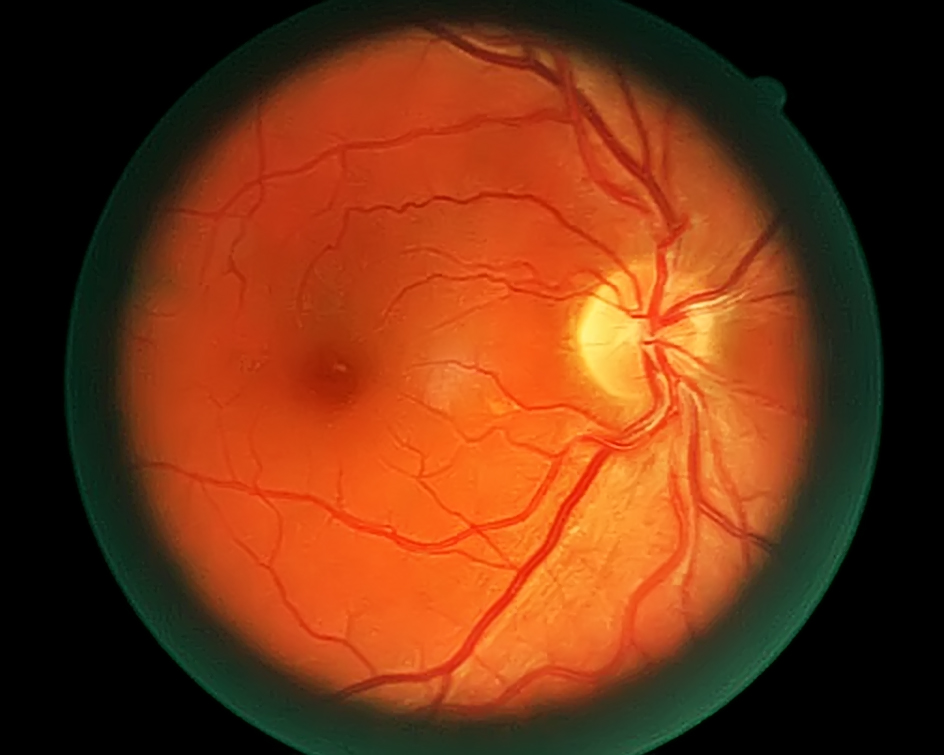
This is a photograph of the back of my right eye, which was taken by my optometrist, Dr. Lori Ann Kim. She says I have healthy eyes, even though I can't see with 'em.
I always wondered what it looked like back there.
Here's a larger version.
There was still sufficient smoke in the atmosphere last night in western North Dakota for a rather brilliant sunset. Yep, never shoot into the sun... Check... I also desired the very black silhouetting in this case, for I do like my contrast, it would seem. (7-24-2021)
Our eyes evolved to basically be able to hunt/identify berries and things like that during the day, in high resolution and high speed (the cones in the retinal fovea - the part we read with in the centre of our vision)
These cones have a response time of tens of milliseconds, but need a fairly bright light level. You basically need sunlight or partial daylight.
In low light our rods take over. These probably evolved to save us at night from being attacked from the sides by nocturnal predators, as they are very good at detecting motion, especially in the peripheral vision, and they can work at much lower light levels, but don’t have a very high resolution and are also slow at a few hundred millisecond responses. They let you know if something is moving off to the side in the darkness.
There is a misconception that you can see single photons. Because our photoreceptor chromophore molecules need to absorb energy to activate, a single photon would indeed activate a chromophore. This would for example be a green photon that has roughly a 2.5 eV energy.
Since we are humans who have a body temperature of +37C or so, thermal processes sometimes randomly generate this amount of energy. That means if we actually were able to see single photons, our vision would be obscured by constant fuzz from thermal false detections. To cut down on false alarms, the human eye uses something called concurrency. Two adjacent rods need to BOTH receive a photon within a small fraction of a second, or the signal is ignored and not passed down the next layer of neurons in the retina
The human body is a wealth of clever designs.
Your tablet, smartphone, laptop, and flat screen TV all have one thing in common: They each give off blue light.
The sun is the greatest source of blue light. Natural blue light helps regulate your circadian rhythm, or wake-and-sleep cycle. Sunlight is also instrumental in children's eye development. There's some evidence that the lack of natural blue light might be a factor in a recent increase in cases of nearsightedness (myopia).
Growing evidence shows that blue light can:
1.Boost alertness
2.Improve attention span and reaction time
3.Help memory -- one study showed that 30 minutes of exposure to blue light led to better recall
4.Raise your mood and effectively treat depression
Blue light is hard for our eyes to block, so nearly all of it travels to our retinas. There has been concern that continuous long-term exposure to blue light can damage retinal cells; so rest your eyes regularly (I do this mainly by falling asleep - age!).
This is a photo of my relative, Ella Schoen, age 13, taken in 1904. I had a macular hole affecting central vision in my left eye. Through photo editing software, I created an image of the visual distortions (metamorphosia) that I saw. Objects also appeared smaller than actual (micropsia). Peripheral (side) vision was unaffected. The final photo is my eyesight 9 months post-vitrectomy surgery – objects lean to the right, appear slightly thinner than actual and there is still a small round distortion/loss around the very center of my vision (I am looking directly between her eyes). My eyesight continues to improve, though I now also have a very common surgically-induced cataract.
I recently fell, resulting in a traumatic brain injury. Immediately following the fall, I noticed distorted vision in my right eye and will be undergoing vitrectomy surgery due to a macular hole for that eye as well (only 10-15 percent of patients have bilateral macular holes, having the condition in both eyes).
Sharing because I could find no good visualizations of what it is like to have a macular hole. Please feel free to use it for educational/editorial, modeling or machine learning purposes.
A moment after I took this shot I noticed Blue squinting her left eye. Pulling her eyelid back her cornea looked just horrible. I thought it had burst. Put her in the car and off to the vet we went. Without an appointment we had to wait 2 1/2 hours to be seen - extremely frustrating. Her cornea had not burst but the lens/cataract in that eye had detached on the upper portion and was tilting back into her eye. You can notice it in this pic quite clearly. This caused a dramatic increase in pressure within the eye. She is on pain, anti-inflammatory meds and glaucoma drops. When we are able to see the eye specialist they will most likely recommend removing her eye. I don't care that she won't have an eye, she is blind after all, but I'm worried about the surgery at her age. Still, throughout it all, she has never been a burden in any way. Loves and trusts everyone, every situation and setting. The most amazing friend.