View allAll Photos Tagged Prolog
I'm sorry for the inactivity over the last few weeks. My creativity and motivation to post something hit bottom. Hopefully I can recover from this phase.
The next 3 weeks I will be traveling through Vietnam - I hope the foreign influences help me get back on the straight and narrow....
Thanks everyone for the constant support!
Happy Holidays everyone!
See you in 2016.
Tumblr | 500px | GettyImages
CEKUS Dance Photo
Organizacja : Fotozakupy.pl
Prowadzenie : Krzysztof Kadis i Cezary Korsieko
Choreografia : Marzena Kobryń, Agata Słowińska, Justyna Michalska
Tancerki : Studio Tańca MK i Zespół Tańca Nowoczesnego TESS
Makijaż i fryzury : Daria Madej Makeup & Virginia Fox & Aneta Flajszer
Oświetlenie : art studio oho i FOMEI Polska
Lokalizacja : Centrum Kultury Śląskiej w Nakle Śląskim
This is part of the new piece by Imke Jelle van Dam, inspired by Tolkien's Silmarillion.
Full verson:
www.youtube.com/user/piano4film?feature=mhum#p/a/u/0/IZUC...
Teatro Comunale Bologna
Maggio 2016
Peter Grimes
Opera in un prologo e tre atti
Libretto di Montagu Slater
Musica di Benjamin Britten
Direttore, Juraj Valcuha
Regia, Cesare Lievi
Scene, Csaba Antal
Costumi, Marina Luxardo
Luci, Luigi Saccomandi
Allestimento della Fondazione Teatro Comunale di Modena
Orchestra e Coro del Teatro Comunale di Bologna
Personaggi e Interpreti
Auntie, Gabriella Sborgi
Balstrode, Mark S. Doss
Bob Boles, Paolo Antognetti
Ellen Orford, Charlotte-Anne Shipley
Hobson, Luca Gallo
Mrs. (Nabob) Sedley, Kamelia Kader
Ned Keene, Maurizio Leoni
Niece 1, Lucrezia Drei
Niece 2, Sandra Pastrana
Peter Grimes, Ian Storey
Rev. Horace Adams, Saverio Bambi
Swallow, John Molloy
Prolog:
So I did a whirlwind tour of Indonesia about 3 weeks ago - there was an extra day off on account of Good Friday. As it has been with almost all of the South-East Asia trips this was quite adventure filled as well.
We decided to do the trip one a couple of days before the holidays and didn't have a plan until the last minute. Heck, we didn't even have a plan even after we arrived in Jakarta. Unlike Malaysia or Thailand or even Batam / Bintan (Although I'd like to call them Singaporean colonies rather than parts of Indonesia), the common man in Jakarta doesn't speak or understand even bits and pieces of English. This proved to be a nightmare. Somehow we managed to beat all odds and successfully completed a 30 Hour long, 1300+ Km road trip from Jakarta to Yogyakarta (pronounced Jogjakarta by the locals) amidst some of the worst, haphazard and dangerous traffic you could ever imaging. Pause for a moment and picture this phrase about traffic woes in a different country coming from an Indian.
Our main attractions were supposed to be in Jogja - Mount Merapi (an active volcano), Borabudhur (the largest buddhist temple complex in the world!) and last but not least the Prambanan Temple complex!
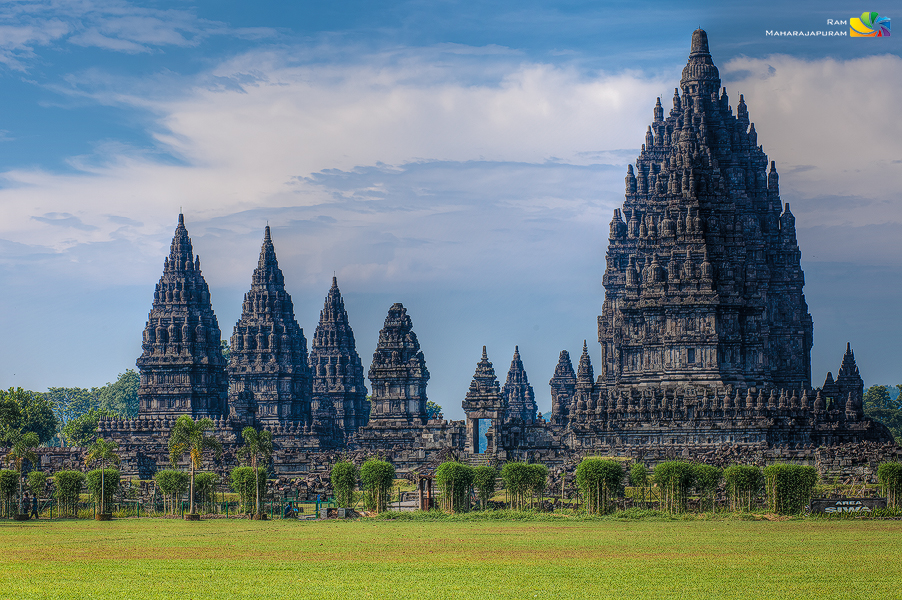
I will do detailed posts on the trip in its entirety an all these attractions separately, but to kick-start this series, here is a shot of Candi Prambanan.
Introduction:
The opening stanza of the Wikitravel article on Prambanan sets the tone for what is about to come:
A UNESCO World Heritage Site, in almost any other country a magnificent ancient monument on the scale of Prambanan would quickly be designated a national symbol. In Indonesia though it is somewhat overshadowed by the even more awe-inspiring nature of nearby Borobudur. The two sites are quite different in style with Hindu Prambanan being a collection of sharp, jaggedly sculpted towers in contrast to the vast horizontal bulk of Buddhist Borobudur.
This temple was built around 850 CE - to put it in perspective, the famous Brihadeeswarar Temple in Thanjavur was built in 1010 AD. The complex was built by the Hindu Sanjaya dynasty apparently to mark their return to central Java after the Buddhist Sailendra Dynasty.
Etymology:
Since we are getting started with just this series, let us start by understanding the name Prambanan. A quest for this might give us some very interesting insights.
The present name Prambanan, Wikipedia tells me, is probably a corrupted Javanese pronunciation of "Para Brahman" ("of the brahmins"). What do they have to do here, you may ask?
To understand that, we need to go back a little bit in history.
Unlike most of the Eurpoean colonialism that we have been used to from the Medieval ages, Hinduism (and surprisingly, Islam) did not land in Indonesia by force. They were influencers - whose culture and way of life attracted the local kingdoms during their trading relationships and was eventually embraced upon. Apparently, references to Java and Sumatra have been found in Sanskrit texts from as early as 200 BC and such Indianized empires are supposed to have thrived in the region until Buddhism arrived in the 8th century.
Not much of this information is present in the Indian history books other than customary references to Rajendra Chola's invasion of the region in 1025 AD. This not only weakened the Srivijaya empire but also eventually led to their fall and the rise of Islam over the next couple of centuries.
On a parallel topic, let us understand how the Prambanan temple is laid out. Originally there was total 240 temples stood in Prambanan. The Prambanan Temple Compound consist of:
* 3 Trimurti temples: three main temples dedicated to Shiva, Visnu, and Brahma
* 3 Vahana temples: three temples in front of Trimurti temples dedicated to the vahana of each gods; Nandi, Garuda, and Hamsa
* 2 Apit temples: two temples located between the rows of Trimurti and Vahana temples on north and south side
* 4 Kelir temples: four small shrines located on 4 cardinal directions right beyond the 4 main gates of inner zone
* 4 Patok temples: four small shrines located on 4 corners of inner zone
* 224 Pervara temples: hundreds of temples arranged in 4 concentric square rows; numbers of temples from inner row to outer row are: 44, 52, 60, and 68
We will go about how much of it has been restored and when it happened in a future post but for now, let us understand about the Pervara temples.
Apparently the 224 Pervara (Prahara?) temples served as a place of meditation for the temple priests! In addition to the structures in the complex, there is a HUGE park around it today. Originally, this was supposed to have been a priest's boarding school (Veda Pata sala). The supporting buildings for the temple complex were made from organic material; as a consequence no remains occur.
I will dwell into a little more interesting details / history in the future posts including how different is Hinduism that is practised in Indonesia from that we see close to home in India.
Stay tuned!
Elsewhere on the Internet:
LEGAL NOTICE | protected work • All Rights reserved! © B. Egger photographer retains ownership and all copyrights in this work.
photographer | Bernard Egger.. • collections • sets
event | 2010 ENNSTAL-CLASSIC • Styria 💚 Austria
© Dieses Foto darf ohne vorherige Lizenzvereinbarung keinesfalls publiziert oder an nicht berechtigte Nutzer weiter gegeben werden.
Todos los Derechos Reservados • Tous droits réservés • Todos os Direitos Reservados • Все права защищены • Tutti i diritti riservati
licence | for any user agreement please contact Bernard Egger.
-
rumoto images, 2010 Ennstal-Classic, 写真家, カメラマン, 摄影师, Bernard Egger, photography, Nikon FX, 2010 Prolog, Bad Mitterndorf, Rolls Royce 17 EX, Schaufler, Ennstal-Classic, Моторспорт фотография, Motorsport, Моторспорт, машина, авто, Automobile, 車, Oldtimer, european cars, british cars, classiche, classica, classic cars, vintage cars, historic cars, motoring, legends, sports cars, Sportwagen, classic sports cars, stunning, awesome, Passione, Mythos, Leggenda,
📷 | 1928 Rolls Royce 17 EX Schaufler :: rumoto images # 3318
Überraschungen auf der Leuchtenburg
Der erste Raum, den man betritt, entführt in eine surreale Welt ... durch Lichteffekte und sphärische Klänge unterstützt.
Aber was hat das mit Porzellan zu tun?
weitere Handy-Fotos: www.flickr.com/photos/farbengier/collections/721577176082...
PARK ART A ROMA! Francesco Amorosino + Laura Croce
sabato 20 marzo 2010
Ora: 17.00 - 20.00
Piazzale Tiburtino/ Porta Labicana (Zona San Lorenzo), Rome, Italy
PARK ART: prendi un parcheggio con le striscie blu, paga e non parcheggiare, facci una mostra! Per il primo giorno internazionale della Park Art, lanciato da Mattia Paco Rizzi, a Roma Francesco Amorosino e Laura Croce animeranno delle tristi striscie blu in zona San Lorenzo. Preparatevi a un bagno di origami!
Das Raimundtheater um 1898
Das nach dem österreichischen Dramatiker Ferdinand Raimund benannte Theater wurde im Jahr 1893 von einem Verein von 500 Bürgern des Gemeindebezirks Mariahilf gegründet, nach Entwürfen des Architekten Franz Roth (1841–1909) errichtet und, vollständig elektrisch beleuchtet, am 28. November 1893 (erste Vorstellung am 27. November 1893) mit Raimunds Zauberspiel Die gefesselte Phantasie feierlich eröffnet (Prolog verfasst von Alfred von Berger).
Bis zum Jahr 1896 stand das Theater unter der Leitung von Adam Müller-Guttenbrunn. Er und sein künstlerischer Beirat Hermann Bahr machten das Theater zu einer Sprechbühne mit klassischen Volksstücken, die ein Gegengewicht zur großbürgerlichen „Operettendekadenz“ darstellen sollten. Alexander Girardi, Eleonora Duse, Max Reinhardt, Louise Dumont und Adele Sandrock traten hier auf.
1907 übernahm der jüdische Regisseur und Theaterdirektor Sigmund Lautenburg (1851–1918) die Leitung des Raimund-Theaters, jedoch nur für kurze Zeit. Er beauftragte für eine neue Inszenierung des Schauspiels "Die Nibelungen" von Friedrich Hebbel Carl Otto Czeschka, die Bühnenbilder und Kostüme zu entwerfen. Auf die Aufführung wurde aus verschiedenen Gründen verzichtet, aber ein unmittelbares Ergebnis der intensiven Beschäftigung Czeschkas mit dem Nibelungenthema für das Raimund-Theater waren die Zeichnungen, die dem kleinen Buch "Die Nibelungen" im Verlag Gerlach & Wiedling als Grundlage dienten.
Unter Direktor Wilhelm Karczag hielt ab 1908 die Operette Einzug, etwa durch die Eigenproduktion „Der Zigeunerbaron“ von Johann Strauß im Jahre 1908 oder Robert Stolz' „Glücksmädel“ und dem auf Franz Schuberts Musik beruhenden Dreimäderlhaus. Von 1921 bis 1924 wurden unter Direktor Rudolf Beer wieder vor allem Sprechstücke gespielt.
Nach 1945 erlebte unter Rudolf Marik (1900–1976), der das Haus von 1948 bis 1976 leitete, die Operette mit Johannes Heesters, Marika Rökk, Zarah Leander und anderen bekannten Darstellern und Sängern einen Höhepunkt. Am Raimund Theater begannen viele berühmte Schauspieler ihre Karriere, wie zum Beispiel Hansi Niese, Paula Wessely, Attila Hörbiger, Karl Skraup.
Im Dezember 1968 beging das Raimundtheater sein 75-Jahr-Jubiläum mit der Aufführung der Operette "Der Bettelstudent" von Carl Millöcker.
Als Festwochenpremiere am 23. Mai 1969 wurde die Operette Giuditta von Franz Lehár gegeben, in der Gretl Schörg (1914–2006) nochmals glänzend in Erscheinung trat, bevor sie sich wenig später ganz vom Bühnenleben zurückzog.
Nach 1976 wurden bereits sporadisch Musicals gespielt. In den Jahren 1984 und 1985 wurde das Theater generalsaniert. Seit 1987 gehört es gemeinsam mit dem Theater an der Wien und dem Ronacher zu den Vereinigten Bühnen Wien (GmbH) und ist seither hauptsächlich Spielstätte für Musicals.
Bekannte Musicals in deutscher Sprache wie zum Beispiel Die Schöne und das Biest mit Ethan Freeman und Caroline Vasicek in den Hauptrollen, Tanz der Vampire mit Steve Barton und Cornelia Zenz, Wake Up mit Alexander Goebel und Rainhard Fendrich und zuletzt auch Barbarella mit Nina Proll in der Titelrolle und Eva-Maria Marold, hatten jeweils am Raimund Theater ihre Uraufführung. Im Februar 2005 fand die Premiere der deutschsprachigen Erstaufführung von Romeo und Julia mit Lukas Perman und Marjan Shaki in den beiden Titelrollen statt. In weiteren Rollen waren unter anderem Carin Filipčić als Amme, Mark Seibert als Tybalt, Rasmus Borkowski als Mercutio und Mathias Edenborn als Benvolio sowie Thomas Mülner als Graf Paris zu sehen.
Das Musical Elisabeth wurde anlässlich dessen 20. Geburtstag von 2012 bis 2014 gespielt. Dabei wurden im Saal vier LED-Übersetzungstafeln angebracht, auf denen seither die Stücke in Englisch übersetzt werden.
Die Verleihung des im Jahr 2000 initiierten Nestroy-Theaterpreises fand 2011 zum ersten Mal im Raimund Theater statt.
Das Raimund Theater umfasst derzeit 1.193 Sitzplätze und 40 Stehplätze.
Uraufführungen
Logo des Raimund Theaters
Zuschauerraum des Raimundtheaters
Der Kellermeister, Operette von Carl Zeller, am 21. Dezember 1901
Das Glücksmädel, Operette von Robert Stolz, am 28. Oktober 1910
Das Zirkuskind, Operette von Edmund Eysler, am 18. Februar 1911
Casimirs Himmelfahrt, Operette von Bruno Granichstaedten, 25. Dezember 1911
Das Dreimäderlhaus, Operette von Heinrich Berté, am 15. Jänner 1916
Das alte Lied, Operette von Bruno Granichstaedten, 21. Dezember 1918
Die Liebe geht um, Operette von Robert Stolz, am 22. Juni 1922
Das Bergwerk. Drama von Hans Kaltneker, 6. Februar 1923
Das Schwalbennest, Operette von Bruno Granichstaedten, 2. September 1926
Der Reiter der Kaiserin, Operette von August Pepöck, am 30. April 1941
Bel Ami, Musical von Peter Kreuder, am 25. Mai 1960
Die Jungfrau von Paris, Operette von Friedrich Schröder, 19. Dezember 1969
Tanz der Vampire, Musical von Jim Steinman und Michael Kunze, am 4. Oktober 1997 (bis 15. Jänner 2000, 677 Vorstellungen mit 805.000 Besuchern)
Wake Up, Musical von Rainhard Fendrich, am 29. September 2002 (bis 1. Jänner 2004)
Barbarella (Musical), Musical von Dave Stewart und Rudi Klausnitzer, am 11. März 2004 (bis 1. Jänner 2005)
Rebecca, Musical von Michael Kunze und Sylvester Levay, am 28. September 2006 (bis 31. Dezember 2008, 405.000 Besucher)
Rudolf, Musical von Frank Wildhorn und Jack Murphy, von 26. Februar 2009 bis 24. Jänner 2010, (deutschsprachige Erstaufführung/Uraufführung der Wiener Fassung, bzw Ko-Produktion mit Operettenhaus Budapest, 210 Show mit 180.984 Besucher)
Weitere Aufführungen
Der Eingangsbereich während der Spielzeit von We Will Rock You
A Chorus Line, Musical von Marvin Hamlish und Michael Bennett, von 16. Oktober 1987 bis 1. Juli 1988 (225 Vorstellungen, 235.000 Besucher, österreichische Erstaufführung)
Les Misérables, Musical von Alain Boublil & Claude-Michel Schönberg, von 15. September 1988 bis 31. März 1990 (400 Vorstellungen, 420.000 Besucher, deutschsprachige Erstaufführung)
Phantom der Oper, Musical von Andrew Lloyd Webber, von 9. Juni 1990 bis 30. Juni 1993 (zuvor von Dezember 1988 bis Juni 1990 im Theater an der Wien; 1.363 Vorstellungen, 1.4 Mio. Besucher, deutschsprachige Erstaufführung)
Kuss der Spinnenfrau, Musical von John Kander und Fred Ebb, Premiere 28. November 1993 bis 1994 (deutschsprachige Erstaufführung)
Rocky Horror Show, Musical von Richard O’Brien, 1994 , (siebenwöchiges Zwischenspiel, nicht von den VBW)
Grease, Musical von Warren Casey und Jim Jacobs, 1994 bis Juni 1995, (deutschsprachige Erstaufführung)
Disney’s Die Schöne und das Biest, Musical von Alan Menken, Howard Ashman & Tim Rice, von 28. September 1995 bis 29. Juni 1997 (560 Vorstellungen, ca. 600.000 Besucher, deutschsprachige Erstaufführung)
Joseph and the Amazing Technicolor Dreamcoat, Musical von Andrew Lloyd Webber, von 3. März 2000 bis 14. Jänner 2001 (236 Vorstellungen, ca. 251.000 Besucher, österreichische Erstaufführung)
Hair, Musical von Galt MacDermot, Gerome Ragni & James Rado, von 10. März 2001 bis 30. Juni 2002 (385 Vorstellungen, ca. 395.000 Besucher, österreichische Erstaufführung)
Romeo und Julia, Musical von Gérard Presgurvic, von 24. Februar 2005 bis 8. Juli 2006 (deutschsprachige Erstaufführung)
We Will Rock You, Musical von Queen und Ben Elton, von 16. Jänner 2008 bis 13. Juli 2008 (203 Vorstellungen, ca. 250.000 Besucher, österreichische Erstaufführung)
Ich war noch niemals in New York, Musical mit den Songs von Udo Jürgens, 17. März 2010 bis 15. Juni 2012 (592 Vorstellungen, ca. 630.000 Besucher, österreichische Erstaufführung (Wiener Fassung))
Elisabeth, Musical von Michael Kunze und Sylvester Levay, 5. September 2012 bis 1. Februar 2014 (381 Vorstellungen, ca 412.000 Besucher, leicht überarbeitete Wiener Version)
Mamma Mia!, Musical von Benny Andersson, Björn Ulvaeus und Catherine Johnson, 19. März 2014 bis 28. Juni 2015 (360 Vorstellungen, ca 360.000 Besucher)
Mozart!, Musical von Michael Kunze und Sylvester Levay, seit 24. September 2015 (+7 Previews)