View allAll Photos Tagged Principle
Photo Copyright 2012, dynamo.photography.
All rights reserved, no use without license
From Wikipedia, the free encyclopedia
(Redirected from Hong kong)
Hong Kong, officially the Hong Kong Special Administrative Region of the People's Republic of China, is an autonomous territory south to Mainland China and east to Macao in East Asia. With around 7.2 million Hong Kongers of various nationalities[note 2] in a territory of 1,104 km2, Hong Kong is the world's fourth most densely populated country or territory.
Hong Kong used to be a British colony with the perpetual cession of Hong Kong Island from the Qing Empire after the First Opium War (1839–42). The colony expanded to the Kowloon Peninsula in 1860 and acquired a 99-year lease of the New Territories from 1898. Hong Kong was later occupied by Japan during the Second World War until British control resumed in 1945. The Sino-British Joint Declaration signed between the United Kingdom and China in 1984 paved way for the transfer of sovereignty of Hong Kong in 1997, when it became a special administrative region (SAR) of the People's Republic of China with a high degree of autonomy.[15]
Under the principle of "one country, two systems",[16][17] Hong Kong maintains a separate political and economic system from China. Except in military defence and foreign affairs, Hong Kong maintains its independent executive, legislative and judiciary powers.[18] In addition, Hong Kong develops relations directly with foreign states and international organisations in a broad range of "appropriate fields".[19] Hong Kong involves in international organizations, such as the WTO[20] and the APEC [21], actively and independently.
Hong Kong is one of the world's most significant financial centres, with the highest Financial Development Index score and consistently ranks as the world's most competitive and freest economic entity.[22][23] As the world's 8th largest trading entity,[24] its legal tender, the Hong Kong dollar, is the world's 13th most traded currency.[25] As the world's most visited city,[26][27] Hong Kong's tertiary sector dominated economy is characterised by competitive simple taxation and supported by its independent judiciary system.[28] Even with one of the highest per capita incomes in the world, it suffers from severe income inequality.[29]
Nicknamed "Pearl of the Orient", Hong Kong is renowned for its deep natural harbour, which boasts the world's fifth busiest port with ready access by cargo ships, and its impressive skyline, with the most skyscrapers in the world.[30][31] It has a very high Human Development Index ranking and the world's longest life expectancy.[32][33] Over 90% of the population makes use of well-developed public transportation.[34][35] Seasonal air pollution with origins from neighbouring industrial areas of Mainland China, which adopts loose emissions standards, has resulted in a high level of atmospheric particulates in winter.[36][37][38]
Contents
1 Etymology
2 History
2.1 Prehistory
2.2 Imperial China
2.3 British Crown Colony: 1842–1941
2.4 Japanese occupation: 1941–45
2.5 Resumption of British rule and industrialisation: 1945–97
2.6 Handover and Special Administrative Region status
3 Governance
3.1 Structure of government
3.2 Electoral and political reforms
3.3 Legal system and judiciary
3.4 Foreign relations
3.5 Human rights
3.6 Regions and districts
3.7 Military
4 Geography and climate
5 Economy
5.1 Financial centre
5.2 International trading
5.3 Tourism and expatriation
5.4 Policy
5.5 Infrastructure
6 Demographics
6.1 Languages
6.2 Religion
6.3 Personal income
6.4 Education
6.5 Health
7 Culture
7.1 Sports
7.2 Architecture
7.3 Cityscape
7.4 Symbols
8 See also
9 Notes
10 References
10.1 Citations
10.2 Sources
11 Further reading
12 External links
Etymology
Hong Kong was officially recorded in the 1842 Treaty of Nanking to encompass the entirety of the island.[39]
The source of the romanised name "Hong Kong" is not known, but it is generally believed to be an early imprecise phonetic rendering of the pronunciation in spoken Cantonese 香港 (Cantonese Yale: Hēung Góng), which means "Fragrant Harbour" or "Incense Harbour".[13][14][40] Before 1842, the name referred to a small inlet—now Aberdeen Harbour (Chinese: 香港仔; Cantonese Yale: Hēunggóng jái), literally means "Little Hong Kong"—between Aberdeen Island and the southern coast of Hong Kong Island. Aberdeen was an initial point of contact between British sailors and local fishermen.[41]
Another theory is that the name would have been taken from Hong Kong's early inhabitants, the Tankas (水上人); it is equally probable that romanisation was done with a faithful execution of their speeches, i.e. hōng, not hēung in Cantonese.[42] Detailed and accurate romanisation systems for Cantonese were available and in use at the time.[43]
Fragrance may refer to the sweet taste of the harbour's fresh water estuarine influx of the Pearl River or to the incense from factories lining the coast of northern Kowloon. The incense was stored near Aberdeen Harbour for export before Hong Kong developed Victoria Harbour.[40]
The name had often been written as the single word Hongkong until the government adopted the current form in 1926.[44] Nevertheless, a number of century-old institutions still retain the single-word form, such as the Hongkong Post, Hongkong Electric and the Hongkong and Shanghai Banking Corporation.
As of 1997, its official name is the "Hong Kong Special Administrative Region of the People's Republic of China". This is the official title as mentioned in the Hong Kong Basic Law and the Hong Kong Government's website;[45] however, "Hong Kong Special Administrative Region" and "Hong Kong" are widely accepted.
Hong Kong has carried many nicknames. The most famous among those is the "Pearl of the Orient", which reflected the impressive nightscape of the city's light decorations on the skyscrapers along both sides of the Victoria Harbour. The territory is also known as "Asia's World City".
History
Main articles: History of Hong Kong and History of China
Prehistory
Main article: Prehistoric Hong Kong
Archaeological studies support human presence in the Chek Lap Kok area (now Hong Kong International Airport) from 35,000 to 39,000 years ago and on Sai Kung Peninsula from 6,000 years ago.[46][47][48]
Wong Tei Tung and Three Fathoms Cove are the earliest sites of human habitation in Hong Kong during the Paleolithic Period. It is believed that the Three Fathom Cove was a river-valley settlement and Wong Tei Tung was a lithic manufacturing site. Excavated Neolithic artefacts suggested cultural differences from the Longshan culture of northern China and settlement by the Che people, prior to the migration of the Baiyue to Hong Kong.[49][50] Eight petroglyphs, which dated to the Shang Dynasty (c. 1600 BC – 1066 BC) in China, were discovered on the surrounding islands.[51]
Imperial China
Main article: History of Hong Kong under Imperial China
In 214 BC, Qin Shi Huang, the first emperor of a centralised China, conquered the Baiyue tribes in Jiaozhi (modern-day Liangguang region and Vietnam) and incorporated the area of Hong Kong into his imperial China for the first time. Hong Kong proper was assigned to the Nanhai commandery (modern-day Nanhai District), near the commandery's capital city Panyu.[52][53][54]
After a brief period of centralisation and collapse of the Qin dynasty, the area of Hong Kong was consolidated under the Kingdom of Nanyue, founded by general Zhao Tuo in 204 BC.[55] When Nanyue lost the Han-Nanyue War in 111 BC, Hong Kong came under the Jiaozhi commandery of the Han dynasty. Archaeological evidence indicates an increase of population and flourish of salt production. The Lei Cheng Uk Han Tomb on the Kowloon Peninsula is believed to have been built as a burial site during the Han dynasty.[56]
From the Han dynasty to the early Tang dynasty, Hong Kong was a part of Bao'an County. In the Tang dynasty, modern-day Guangzhou (Canton) flourished as an international trading centre. In 736, the Emperor Xuanzong of Tang established a military stronghold in Tuen Mun to strengthen defence of the coastal area.[57] The nearby Lantau Island was a salt production centre and salt smuggler riots occasionally broke out against the government. In c. 1075, The first village school, Li Ying College, was established around 1075 AD in modern-day New Territories by the Northern Song dynasty.[58] During their war against the Mongols, the imperial court of Southern Song was briefly stationed at modern-day Kowloon City (the Sung Wong Toi site) before their ultimate defeat by the Mongols at the Battle of Yamen in 1279.[59] The Mongols then established their dynastic court and governed Hong Kong for 97 years.
From the mid-Tang dynasty to the early Ming dynasty (1368–1644), Hong Kong was a part of Dongguan County. During the Ming dynasty, the area was transferred to Xin'an County. The indigenous inhabitants at that time consisted of several ethnicities such as Punti, Hakka, Tanka and Hoklo.
European discovery
The earliest European visitor on record was Jorge Álvares, a Portuguese explorer, who arrived in 1513.[60][61] Having established a trading post in a site they called "Tamão" in Hong Kong waters, Portuguese merchants commenced with regular trading in southern China. Subsequent military clashes between China and Portugal, however, led to the expulsion of all Portuguese merchants from southern China.
Since the 14th century, the Ming court had enforced the maritime prohibition laws that strictly forbade all private maritime activities in order to prevent contact with foreigners by sea.[62] When the Manchu Qing dynasty took over China, Hong Kong was directly affected by the Great Clearance decree of the Kangxi Emperor, who ordered the evacuation of coastal areas of Guangdong from 1661 to 1669. Over 16,000 inhabitants of Xin'an County including those in Hong Kong were forced to migrate inland; only 1,648 of those who had evacuated subsequently returned.[63][64]
British Crown Colony: 1842–1941
A painter at work. John Thomson. Hong Kong, 1871. The Wellcome Collection, London
Main articles: British Hong Kong and History of Hong Kong (1800s–1930s)
In 1839, threats by the imperial court of Qing to sanction opium imports caused diplomatic friction with the British Empire. Tensions escalated into the First Opium War. The Qing admitted defeat when British forces captured Hong Kong Island on 20 January 1841. The island was initially ceded under the Convention of Chuenpi as part of a ceasefire agreement between Captain Charles Elliot and Governor Qishan. A dispute between high-ranking officials of both countries, however, led to the failure of the treaty's ratification. On 29 August 1842, Hong Kong Island was formally ceded in perpetuity to the United Kingdom of Great Britain and Ireland under the Treaty of Nanking.[65] The British officially established a Crown colony and founded the City of Victoria in the following year.[66]
The population of Hong Kong Island was 7,450 when the Union Flag raised over Possession Point on 26 January 1841. It mostly consisted of Tanka fishermen and Hakka charcoal burners, whose settlements scattered along several coastal hamlets. In the 1850s, a large number of Chinese immigrants crossed the then-free border to escape from the Taiping Rebellion. Other natural disasters, such as flooding, typhoons and famine in mainland China would play a role in establishing Hong Kong as a place for safe shelter.[67][68]
Further conflicts over the opium trade between Britain and Qing quickly escalated into the Second Opium War. Following the Anglo-French victory, the Crown Colony was expanded to include Kowloon Peninsula (south of Boundary Street) and Stonecutter's Island, both of which were ceded to the British in perpetuity under the Convention of Beijing in 1860.
In 1898, Britain obtained a 99-year lease from Qing under the Convention for the Extension of Hong Kong Territory, in which Hong Kong obtained a 99-year lease of Lantau Island, the area north of Boundary Street in Kowloon up to Shenzhen River and over 200 other outlying islands.[69][70][71]
Hong Kong soon became a major entrepôt thanks to its free port status, attracting new immigrants to settle from both China and Europe. The society, however, remained racially segregated and polarised under early British colonial policies. Despite the rise of a British-educated Chinese upper-class by the late-19th century, race laws such as the Peak Reservation Ordinance prevented ethnic Chinese in Hong Kong from acquiring houses in reserved areas such as Victoria Peak. At this time, the majority of the Chinese population in Hong Kong had no political representation in the British colonial government. The British governors did rely, however, on a small number of Chinese elites, including Sir Kai Ho and Robert Hotung, who served as ambassadors and mediators between the government and local population.
File:1937 Hong Kong VP8.webmPlay media
Hong Kong filmed in 1937
In 1904, the United Kingdom established the world's first border and immigration control; all residents of Hong Kong were given citizenship as Citizens of United Kingdom and Colonies (CUKC).
Hong Kong continued to experience modest growth during the first half of the 20th century. The University of Hong Kong was established in 1911 as the territory's first higher education institute. While there had been an exodus of 60,000 residents for fear of a German attack on the British colony during the First World War, Hong Kong remained unscathed. Its population increased from 530,000 in 1916 to 725,000 in 1925 and reached 1.6 million by 1941.[72]
In 1925, Cecil Clementi became the 17th Governor of Hong Kong. Fluent in Cantonese and without a need for translator, Clementi introduced the first ethnic Chinese, Shouson Chow, into the Executive Council as an unofficial member. Under Clementi's tenure, Kai Tak Airport entered operation as RAF Kai Tak and several aviation clubs. In 1937, the Second Sino-Japanese War broke out when the Japanese Empire expanded its territories from northeastern China into the mainland proper. To safeguard Hong Kong as a freeport, Governor Geoffry Northcote declared the Crown Colony as a neutral zone.
Japanese occupation: 1941–45
Main article: Japanese occupation of Hong Kong
The Cenotaph in Hong Kong commemorates those who died in service in the First World War and the Second World War.[73]
As part of its military campaign in Southeast Asia during Second World War, the Japanese army moved south from Guangzhou of mainland China and attacked Hong Kong in on 8 December 1941.[74] Crossing the border at Shenzhen River on 8 December, the Battle of Hong Kong lasted for 18 days when British and Canadian forces held onto Hong Kong Island. Unable to defend against intensifying Japanese air and land bombardments, they eventually surrendered control of Hong Kong on 25 December 1941. The Governor of Hong Kong was captured and taken as a prisoner of war. This day is regarded by the locals as "Black Christmas".[75]
During the Japanese occupation of Hong Kong, the Japanese army committed atrocities against civilians and POWs, such as the St. Stephen's College massacre. Local residents also suffered widespread food shortages, limited rationing and hyper-inflation arising from the forced exchange of currency from Hong Kong dollars to Japanese military banknotes. The initial ratio of 2:1 was gradually devalued to 4:1 and ownership of Hong Kong dollars was declared illegal and punishable by harsh torture. Due to starvation and forced deportation for slave labour to mainland China, the population of Hong Kong had dwindled from 1.6 million in 1941 to 600,000 in 1945, when the United Kingdom resumed control of the colony on 2 September 1945.[76]
Resumption of British rule and industrialisation: 1945–97
Main articles: British Hong Kong, 1950s in Hong Kong, 1960s in Hong Kong, 1970s in Hong Kong, 1980s in Hong Kong, and 1990s in Hong Kong
Flag of British Hong Kong from 1959 to 1997
Hong Kong's population recovered quickly after the war, as a wave of skilled migrants from the Republic of China moved in to seek refuge from the Chinese Civil War. When the Communist Party eventually took full control of mainland China in 1949, even more skilled migrants fled across the open border for fear of persecution.[69] Many newcomers, especially those who had been based in the major port cities of Shanghai and Guangzhou, established corporations and small- to medium-sized businesses and shifted their base operations to British Hong Kong.[69] The establishment of a socialist state in China (People's Republic of China) on 1 October 1949 caused the British colonial government to reconsider Hong Kong's open border to mainland China. In 1951, a boundary zone was demarked as a buffer zone against potential military attacks from communist China. Border posts along the north of Hong Kong began operation in 1953 to regulate the movement of people and goods into and out of the territory.
Stamp with portrait of Queen Elizabeth II, 1953
In the 1950s, Hong Kong became the first of the Four Asian Tiger economies under rapid industrialisation driven by textile exports, manufacturing industries and re-exports of goods to China. As the population grew, with labour costs remaining low, living standards began to rise steadily.[77] The construction of the Shek Kip Mei Estate in 1953 marked the beginning of the public housing estate programme to provide shelter for the less privileged and to cope with the influx of immigrants.
Under Sir Murray MacLehose, 25th Governor of Hong Kong (1971–82), a series of reforms improved the public services, environment, housing, welfare, education and infrastructure of Hong Kong. MacLehose was British Hong Kong's longest-serving governor and, by the end of his tenure, had become one of the most popular and well-known figures in the Crown Colony. MacLehose laid the foundation for Hong Kong to establish itself as a key global city in the 1980s and early 1990s.
A sky view of Hong Kong Island
An aerial view of the northern shore of Hong Kong Island in 1986
To resolve traffic congestion and to provide a more reliable means of crossing the Victoria Harbour, a rapid transit railway system (metro), the MTR, was planned from the 1970s onwards. The Island Line (Hong Kong Island), Kwun Tong Line (Kowloon Peninsula and East Kowloon) and Tsuen Wan Line (Kowloon and urban New Territories) opened in the early 1980s.[78]
In 1983, the Hong Kong dollar left its 16:1 peg with the Pound sterling and switched to the current US-HK Dollar peg. Hong Kong's competitiveness in manufacturing gradually declined due to rising labour and property costs, as well as new development in southern China under the Open Door Policy introduced in 1978 which opened up China to foreign business. Nevertheless, towards the early 1990s, Hong Kong had established itself as a global financial centre along with London and New York City, a regional hub for logistics and freight, one of the fastest-growing economies in Asia and the world's exemplar of Laissez-faire market policy.[79]
The Hong Kong question
In 1971, the Republic of China (Taiwan)'s permanent seat on the United Nations was transferred to the People's Republic of China (PRC), Hong Kong's status as a recognised colony became terminated in 1972 under the request of PRC. Facing the uncertain future of Hong Kong and expiry of land lease of New Territories beyond 1997, Governor MacLehose raised the question in the late 1970s.
The British Nationality Act 1981 reclassified Hong Kong into a British Dependent Territory amid the reorganisation of global territories of the British Empire. All residents of Hong Kong became British Dependent Territory Citizens (BDTC). Diplomatic negotiations began with China and eventually concluded with the 1984 Sino-British Joint Declaration. Both countries agreed to transfer Hong Kong's sovereignty to China on 1 July 1997, when Hong Kong would remain autonomous as a special administrative region and be able to retain its free-market economy, British common law through the Hong Kong Basic Law, independent representation in international organisations (e.g. WTO and WHO), treaty arrangements and policy-making except foreign diplomacy and military defence.
It stipulated that Hong Kong would retain its laws and be guaranteed a high degree of autonomy for at least 50 years after the transfer. The Hong Kong Basic Law, based on English law, would serve as the constitutional document after the transfer. It was ratified in 1990.[69] The expiry of the 1898 lease on the New Territories in 1997 created problems for business contracts, property leases and confidence among foreign investors.
Handover and Special Administrative Region status
Main articles: Transfer of sovereignty over Hong Kong and 2000s in Hong Kong
Transfer of sovereignty
Golden Bauhinia Square
On 1 July 1997, the transfer of sovereignty over Hong Kong from the United Kingdom to the People's Republic of China took place, officially marking the end of Hong Kong's 156 years under British colonial governance. As the largest remaining colony of the United Kingdom, the loss of Hong Kong effectively represented the end of the British Empire. This transfer of sovereignty made Hong Kong the first special administrative region of China. Tung Chee-Hwa, a pro-Beijing business tycoon, was elected Hong Kong's first Chief Executive by a selected electorate of 800 in a televised programme.
Structure of government
Hong Kong's current structure of governance inherits from the British model of colonial administration set up in the 1850s. The 1984 Sino-British Joint Declaration states that "Hong Kong should enjoy a high degree of autonomy in all areas except defence and foreign affairs" with reference to the underlying principle of one country, two systems.[note 3] This Declaration stipulates that Hong Kong maintains her capitalist economic system and guarantees the rights and freedoms of her people for at least 50 years after the 1997 handover. [note 4] Such guarantees are enshrined in the Hong Kong's Basic Law, the territory's constitutional document, which outlines the system of governance after 1997, albeit subject to interpretation by China's Standing Committee of the National People's Congress (NPCSC).[95][96]
Hong Kong's most senior leader, Chief Executive, is elected by a committee of 1,200 selected members (600 in 1997) and nominally appointed by the Government of China. The primary pillars of government are the Executive Council, Legislative Council, civil service and Judiciary.
Policy-making is initially discussed in the Executive Council, presided by the Chief Executive of Hong Kong, before passing to the Legislative Council for bill adoption. The Executive Council consists of 30 official/unofficial members appointed by the Chief Executive and one member among them acts as the convenor.[97][98]
The Legislative Council, set up in 1843, debates policies and motions before voting to adopt or rejecting bills. It has 70 members (originally 60) and 40 (originally 30) among them are directly elected by universal suffrage; the other 30 members are "functional constituencies" (indirectly) elected by a smaller electorate of corporate bodies or representatives of stipulated economic sectors as defined by the government. The Legislative Council is chaired by a president who acts as the speaker.[99][100]
In 1997, seating of the Legislative Council (also public services and election franchises) of Hong Kong modelled on the British system: Urban Council (Hong Kong and Kowloon) and District Council (New Territories and Outlying Islands). In 1999, this system has been reformed into 18 directly elected District Offices across 5 Legislative Council constituencies: Hong Kong Island (East/West), Kowloon and New Territories (East/West); the remaining outlying islands are divided across the aforementioned regions.
Hong Kong's Civil Service, created by the British colonial government, is a politically neutral body that implements government policies and provides public services. Senior civil servants are appointed based on meritocracy. The territory's police, firefighting and customs forces, as well as clerical officers across various government departments, make up the civil service.[101][102]
James Cauty – The Aftermath Dislocation Principle Part V
Fonteijne, Vlissingen 2014
“The Aftermath Dislocation Principle Part V” van James Cauty ziet eruit als een verwoest, verlaten, vernietigd en verbrand landschap. In de overblijfselen zijn 5.000 politiemannen achtergebleven. Iedereen is opgepakt en weggevoerd, waarschijnlijk niet zonder slag of stoot. De politie heeft niemand meer om in de gaten te houden, op te pakken of te controleren. De ultieme politiestaat?
James Cauty's roguish and voluble approach has earned him a cult following for work that remains radical, responsive and darkly comical. He produces work that draws on and responds to contemporary culture, very often sampling it and sending/selling it back as recoded realities. In billboard and stamp projects Mickey Mouse was sent to Iraq in 'Operation Magic Kingdom' whilst Julie Andrews danced across vast rubbish heaps, crushed cars were sold to second hand car dealers as art and riots have been rendered as tiny models in jam jars.
His most recent work has been focussed on the making of 1:87 riotous scale models as small world re-enactments, often displayed in upturned jam jars as A Riot in A Jam Jar. His new exhibition The Aftermath Dislocation Principle continues this preoccupation with small world re-enactments as a vast 1:87 scale-model landscape (equivalent to 1 sq mile in miniature) which has been desolated, deserted, destroyed, burnt and is devoid of life apart from 5000 or so model police that attend this apocalyptic aftermath; a kind of bizarre twisted model village experience, where Cauty continues his fascination with subversion, consumerism and entertainment through creative exploration and dark humour.
Dr. Elliot McGucken Golden Ratio Light Cone Spacetime Sculpture d4/dt=ic: Golden Spiral Galaxy Huygens Principle Phyllotaxis Sphere!
Dr. Elliot McGucken Fine Art Spacetime Sculpture dx4//dt=ic:
Epic Fine Art Photography Prints & Luxury Wall Art:
Support epic, stoic fine art: Hero's Odyssey Gear!
Follow me on Instagram!
Facebook:
All my photography celebrates the physics of light! The McGucken Principle of the fourth expanding dimension: The fourth dimension is expanding at the rate of c relative to the three spatial dimensions: dx4/dt=ic .
Lao Tzu--The Tao: Nature does not hurry, yet everything is accomplished.
Light Time Dimension Theory: The Foundational Physics Unifying Einstein's Relativity and Quantum Mechanics: A Simple, Illustrated Introduction to the Unifying Physical Reality of the Fourth Expanding Dimensionsion dx4/dt=ic !: geni.us/Fa1Q
"Between every two pine trees there is a door leading to a new way of life." --John Muir
Epic Stoicism guides my fine art odyssey and photography: geni.us/epicstoicism
“The clearest way into the Universe is through a forest wilderness.” --John Muir
Epic Poetry inspires all my photography: geni.us/9K0Ki Epic Poetry for Epic Landscape Photography: Exalt Fine Art Nature Photography with the Poetic Wisdom of John Muir, Emerson, Thoreau, Homer's Iliad, Milton's Paradise Lost & Dante's Inferno Odyssey
“The mountains are calling and I must go.” --John Muir
Epic Art & 45EPIC Gear exalting golden ratio designs for your Hero's Odyssey:
Support epic fine art! 45surf ! Bitcoin: 1FMBZJeeHVMu35uegrYUfEkHfPj5pe9WNz
Exalt the goddess archetype in the fine art of photography! My Epic Book: Photographing Women Models!
Portrait, Swimsuit, Lingerie, Boudoir, Fine Art, & Fashion Photography Exalting the Venus Goddess Archetype: How to Shoot Epic ... Epic! Beautiful Surf Fine Art Portrait Swimsuit Bikini Models!
Some of my epic books, prints, & more!
Exalt your photography with Golden Ratio Compositions!
Golden Ratio Compositions & Secret Sacred Geometry for Photography, Fine Art, & Landscape Photographers: How to Exalt Art with Leonardo da Vinci's, Michelangelo's!
Epic Landscape Photography:
A Simple Guide to the Principles of Fine Art Nature Photography: Master Composition, Lenses, Camera Settings, Aperture, ISO, ... Hero's Odyssey Mythology Photography)
All art is but imitation of nature.-- Seneca (Letters from a Stoic - Letter LXV: On the First Cause)
The universe itself is God and the universal outpouring of its soul. --Chrysippus (Quoted by Cicero in De Natura Deorum)
Season of mists and mellow fruitfulness
Close bosom-friend of the maturing sun
Conspiring with him how to load and bless
With fruit the vines that round the thatch-eves run;
To bend with apples the moss'd cottage-trees,
And fill all fruit with ripeness to the core;
To swell the gourd, and plump the hazel shells
With a sweet kernel; to set budding more,
And still more, later flowers for the bees,
Until they think warm days will never cease,
For Summer has o'er-brimm'd their clammy cells. --To Autumn. by John Keats
Menu description: “Naturally colored, with a cream cheese filling and glaze and sprinkled with red velvet cake crumbs.” Dubbed as a “cake doughnut”: fluffy texture, and egg free. If you’re a fan of red velvet cake, give this a try!
Floating above like there’s “nothing at all”!
Another day, another time for sweets. This time at Doughnut Plant for some things I’ve never tried before. One of them being the red velvet doughnut. Tasted sweet, had a fluffy texture, and was delish!
Shot on March 8, 2020. Photo by Jeffrey Duran of The Pleasure Principle of NJ (TPPNJ)
___________________________________
___________________________________
Other gear used:
Tripod(s)/Support:
• x2 Manfrotto Pixi Evo Tabletop Tripod, to support my camera & my light.
Lighting:
• x1Lume Cube 2.0 Mini LEDs , mounted on top of my Manfrotto Pixi Evo tabletop tripods on opposite ends of the table.
Other things used:
• Fishing Wire (no hook), and I held this as stable as can be through the doughnut.
• Sandwich skewer, stabbed this through the doughnut to make it look floaty.
en.wikipedia.org/wiki/Beamish_Museum
Beamish Museum is the first regional open-air museum, in England, located at Beamish, near the town of Stanley, in County Durham, England. Beamish pioneered the concept of a living museum. By displaying duplicates or replaceable items, it was also an early example of the now commonplace practice of museums allowing visitors to touch objects.
The museum's guiding principle is to preserve an example of everyday life in urban and rural North East England at the climax of industrialisation in the early 20th century. Much of the restoration and interpretation is specific to the late Victorian and Edwardian eras, together with portions of countryside under the influence of industrial revolution from 1825. On its 350 acres (140 ha) estate it uses a mixture of translocated, original and replica buildings, a large collection of artefacts, working vehicles and equipment, as well as livestock and costumed interpreters.
The museum has received a number of awards since it opened to visitors in 1972 and has influenced other living museums. It is an educational resource, and also helps to preserve some traditional and rare north-country livestock breeds.
History
Genesis
In 1958, days after starting as director of the Bowes Museum, inspired by Scandinavian folk museums, and realising the North East's traditional industries and communities were disappearing, Frank Atkinson presented a report to Durham County Council urging that a collection of items of everyday history on a large scale should begin as soon as possible, so that eventually an open air museum could be established. As well as objects, Atkinson was also aiming to preserve the region's customs and dialect. He stated the new museum should "attempt to make the history of the region live" and illustrate the way of life of ordinary people. He hoped the museum would be run by, be about and exist for the local populace, desiring them to see the museum as theirs, featuring items collected from them.
Fearing it was now almost too late, Atkinson adopted a policy of "unselective collecting" — "you offer it to us and we will collect it." Donations ranged in size from small items to locomotives and shops, and Atkinson initially took advantage of a surplus of space available in the 19th-century French chateau-style building housing the Bowes Museum to store items donated for the open air museum. With this space soon filled, a former British Army tank depot at Brancepeth was taken over, although in just a short time its entire complement of 22 huts and hangars had been filled, too.
In 1966, a working party was established to set up a museum "for the purpose of studying, collecting, preserving and exhibiting buildings, machinery, objects and information illustrating the development of industry and the way of life of the north of England", and it selected Beamish Hall, having been vacated by the National Coal Board, as a suitable location.
Establishment and expansion
In August 1970, with Atkinson appointed as its first full-time director together with three staff members, the museum was first established by moving some of the collections into the hall. In 1971, an introductory exhibition, "Museum in the Making" opened at the hall.
The museum was opened to visitors on its current site for the first time in 1972, with the first translocated buildings (the railway station and colliery winding engine) being erected the following year. The first trams began operating on a short demonstration line in 1973. The Town station was formally opened in 1976, the same year the reconstruction of the colliery winding engine house was completed, and the miners' cottages were relocated. Opening of the drift mine as an exhibit followed in 1979.
In 1975 the museum was visited by the Queen Elizabeth The Queen Mother, and by Anne, Princess Royal, in 2002. In 2006, as the Grand Master of the United Grand Lodge of England, The Duke of Kent visited, to open the town masonic lodge.
With the Co-op having opened in 1984, the town area was officially opened in 1985. The pub had opened in the same year, with Ravensworth Terrace having been reconstructed from 1980 to 1985. The newspaper branch office had also been built in the mid-1980s. Elsewhere, the farm on the west side of the site (which became Home Farm) opened in 1983. The present arrangement of visitors entering from the south was introduced in 1986.
At the beginning of the 1990s, further developments in the Pit Village were opened, the chapel in 1990, and the board school in 1992. The whole tram circle was in operation by 1993.[8] Further additions to the Town came in 1994 with the opening of the sweet shop and motor garage, followed by the bank in 1999. The first Georgian component of the museum arrived when Pockerley Old Hall opened in 1995, followed by the Pockerley Waggonway in 2001.
In the early 2000s two large modern buildings were added, to augment the museum's operations and storage capacity - the Regional Resource Centre on the west side opened in 2001, followed by the Regional Museums Store next to the railway station in 2002. Due to its proximity, the latter has been cosmetically presented as Beamish Waggon and Iron Works. Additions to display areas came in the form of the Masonic lodge (2006) and the Lamp Cabin in the Colliery (2009). In 2010, the entrance building and tea rooms were refurbished.
Into the 2010s, further buildings were added - the fish and chip shop (opened 2011)[28] band hall (opened 2013) and pit pony stables (built 2013/14) in the Pit Village, plus a bakery (opened 2013) and chemist and photographers (opened 2016) being added to the town. St Helen's Church, in the Georgian landscape, opened in November 2015.
Remaking Beamish
A major development, named 'Remaking Beamish', was approved by Durham County Council in April 2016, with £10.7m having been raised from the Heritage Lottery Fund and £3.3m from other sources.
As of September 2022, new exhibits as part of this project have included a quilter's cottage, a welfare hall, 1950s terrace, recreation park, bus depot, and 1950s farm (all discussed in the relevant sections of this article). The coming years will see replicas of aged miners' homes from South Shields, a cinema from Ryhope, and social housing will feature a block of four relocated Airey houses, prefabricated concrete homes originally designed by Sir Edwin Airey, which previously stood in Kibblesworth. Then-recently vacated and due for demolition, they were instead offered to the museum by The Gateshead Housing Company and accepted in 2012.
Museum site
The approximately 350-acre (1.4 km2) current site, once belonging to the Eden and Shafto families, is a basin-shaped steep-sided valley with woodland areas, a river, some level ground and a south-facing aspect.
Visitors enter the site through an entrance arch formed by a steam hammer, across a former opencast mining site and through a converted stable block (from Greencroft, near Lanchester, County Durham).
Visitors can navigate the site via assorted marked footpaths, including adjacent (or near to) the entire tramway oval. According to the museum, it takes 20 minutes to walk at a relaxed pace from the entrance to the town. The tramway oval serves as both an exhibit and as a free means of transport around the site for visitors, with stops at the entrance (south), Home Farm (west), Pockerley (east) and the Town (north). Visitors can also use the museum's buses as a free form of transport between various parts of the museum. Although visitors can also ride on the Town railway and Pockerley Waggonway, these do not form part of the site's transport system (as they start and finish from the same platforms).
Governance
Beamish was the first English museum to be financed and administered by a consortium of county councils (Cleveland, Durham, Northumberland and Tyne and Wear) The museum is now operated as a registered charity, but continues to receive support from local authorities - Durham County Council, Sunderland City Council, Gateshead Council, South Tyneside Council and North Tyneside Council. The supporting Friends of Beamish organisation was established in 1968. Frank Atkinson retired as director in 1987. The museum has been 96% self-funding for some years (mainly from admission charges).
Sections of the museum
1913
The town area, officially opened in 1985, depicts chiefly Victorian buildings in an evolved urban setting of 1913.
Tramway
The Beamish Tramway is 1.5 miles (2.4 km) long, with four passing loops. The line makes a circuit of the museum site forming an important element of the visitor transportation system.
The first trams began operating on a short demonstration line in 1973, with the whole circle in operation by 1993.[8] It represents the era of electric powered trams, which were being introduced to meet the needs of growing towns and cities across the North East from the late 1890s, replacing earlier horse drawn systems.
Bakery
Presented as Joseph Herron, Baker & Confectioner, the bakery was opened in 2013 and features working ovens which produce food for sale to visitors. A two-storey curved building, only the ground floor is used as the exhibit. A bakery has been included to represent the new businesses which sprang up to cater for the growing middle classes - the ovens being of the modern electric type which were growing in use. The building was sourced from Anfield Plain (which had a bakery trading as Joseph Herron), and was moved to Beamish in the late 1970s and early 1980s. The frontage features a stained glass from a baker's shop in South Shields. It also uses fittings from Stockton-on-Tees.
Motor garage
Presented as Beamish Motor & Cycle Works, the motor garage opened in 1994. Reflecting the custom nature of the early motor trade, where only one in 232 people owned a car in 1913, the shop features a showroom to the front (not accessible to visitors), with a garage area to the rear, accessed via the adjacent archway. The works is a replica of a typical garage of the era. Much of the museum's car, motorcycle and bicycle collection, both working and static, is stored in the garage. The frontage has two storeys, but the upper floor is only a small mezzanine and is not used as part of the display.
Department Store
Presented as the Annfield Plain Industrial Co-operative Society Ltd, (but more commonly referred to as the Anfield Plain Co-op Store) this department store opened in 1984, and was relocated to Beamish from Annfield Plain in County Durham. The Annfield Plain co-operative society was originally established in 1870, with the museum store stocking various products from the Co-operative Wholesale Society (CWS), established 1863. A two-storey building, the ground floor comprises the three departments - grocery, drapery and hardware; the upper floor is taken up by the tea rooms (accessed from Redman Park via a ramp to the rear). Most of the items are for display only, but a small amount of goods are sold to visitors. The store features an operational cash carrier system, of the Lamson Cash Ball design - common in many large stores of the era, but especially essential to Co-ops, where customer's dividends had to be logged.
Ravensworth Terrace
Ravensworth Terrace is a row of terraced houses, presented as the premises and living areas of various professionals. Representing the expanding housing stock of the era, it was relocated from its original site on Bensham Bank, having been built for professionals and tradesmen between 1830 and 1845. Original former residents included painter John Wilson Carmichael and Gateshead mayor Alexander Gillies. Originally featuring 25 homes, the terrace was to be demolished when the museum saved it in the 1970s, reconstructing six of them on the Town site between 1980 and 1985. They are two storey buildings, with most featuring display rooms on both floors - originally the houses would have also housed a servant in the attic. The front gardens are presented in a mix of the formal style, and the natural style that was becoming increasingly popular.
No. 2 is presented as the home of Miss Florence Smith, a music teacher, with old fashioned mid-Victorian furnishings as if inherited from her parents. No. 3 & 4 is presented as the practice and home respectively (with a knocked through door) of dentist J. Jones - the exterior nameplate having come from the surgery of Mr. J. Jones in Hartlepool. Representing the state of dental health at the time, it features both a check-up room and surgery for extraction, and a technicians room for creating dentures - a common practice at the time being the giving to daughters a set on their 21st birthday, to save any future husband the cost at a later date. His home is presented as more modern than No.2, furnished in the Edwardian style the modern day utilities of an enamelled bathroom with flushing toilet, a controllable heat kitchen range and gas cooker. No. 5 is presented as a solicitor's office, based on that of Robert Spence Watson, a Quaker from Newcastle. Reflecting the trade of the era, downstairs is laid out as the partner's or principal office, and the general or clerk's office in the rear. Included is a set of books sourced from ER Hanby Holmes, who practised in Barnard Castle.
Pub
Presented as The Sun Inn, the pub opened in the town in 1985. It had originally stood in Bondgate in Bishop Auckland, and was donated to the museum by its final owners, the Scottish and Newcastle Breweries. Originally a "one-up one down" cottage, the earliest ownership has been traced to James Thompson, on 21 January 1806. Known as The Tiger Inn until the 1850s, from 1857 to 1899 under the ownership of the Leng family, it flourished under the patronage of miners from Newton Cap and other collieries. Latterly run by Elsie Edes, it came under brewery ownership in the 20th Century when bought by S&N antecedent, James Deuchar Ltd. The pub is fully operational, and features both a front and back bar, the two stories above not being part of the exhibit. The interior decoration features the stuffed racing greyhound Jake's Bonny Mary, which won nine trophies before being put on display in The Gerry in White le Head near Tantobie.
Town stables
Reflecting the reliance on horses for a variety of transport needs in the era, the town features a centrally located stables, situated behind the sweet shop, with its courtyard being accessed from the archway next to the pub. It is presented as a typical jobmaster's yard, with stables and a tack room in the building on its north side. A small, brick built open air, carriage shed is sited on the back of the printworks building. On the east side of the courtyard is a much larger metal shed (utilising iron roof trusses from Fleetwood), arranged mainly as carriage storage, but with a blacksmith's shop in the corner. The building on the west side of the yard is not part of any display. The interior fittings for the harness room came from Callaly Caste. Many of the horses and horse-drawn vehicles used by the museum are housed in the stables and sheds.
Printer, stationer and newspaper branch office
Presented as the Beamish Branch Office of the Northern Daily Mail and the Sunderland Daily Echo, the two storey replica building was built in the mid-1980s and represents the trade practices of the era. Downstairs, on the right, is the branch office, where newspapers would be sold directly and distributed to local newsagents and street vendors, and where orders for advertising copy would be taken. Supplementing it is a stationer's shop on the left hand side, with both display items and a small number of gift items on public sale. Upstairs is a jobbing printers workshop, which would not produce the newspapers, but would instead print leaflets, posters and office stationery. Split into a composing area and a print shop, the shop itself has a number of presses - a Columbian built in 1837 by Clymer and Dixon, an Albion dating back to 1863, an Arab Platen of c. 1900, and a Wharfedale flat bed press, built by Dawson & Son in around 1870. Much of the machinery was sourced from the print works of Jack Ascough's of Barnard Castle. Many of the posters seen around the museum are printed in the works, with the operation of the machinery being part of the display.
Sweet shop
Presented as Jubilee Confectioners, the two storey sweet shop opened in 1994 and is meant to represent the typical family run shops of the era, with living quarters above the shop (the second storey not being part of the display). To the front of the ground floor is a shop, where traditional sweets and chocolate (which was still relatively expensive at the time) are sold to visitors, while in the rear of the ground floor is a manufacturing area where visitors can view the techniques of the time (accessed via the arched walkway on the side of the building). The sweet rollers were sourced from a variety of shops and factories.
Bank
Presented as a branch of Barclays Bank (Barclay & Company Ltd) using period currency, the bank opened in 1999. It represents the trend of the era when regional banks were being acquired and merged into national banks such as Barclays, formed in 1896. Built to a three-storey design typical of the era, and featuring bricks in the upper storeys sourced from Park House, Gateshead, the Swedish imperial red shade used on the ground floor frontage is intended to represent stability and security. On the ground floor are windows for bank tellers, plus the bank manager's office. Included in a basement level are two vaults. The upper two storeys are not part of the display. It features components sourced from Southport and Gateshead
Masonic Hall
The Masonic Hall opened in 2006, and features the frontage from a former masonic hall sited in Park Terrace, Sunderland. Reflecting the popularity of the masons in North East England, as well as the main hall, which takes up the full height of the structure, in a small two story arrangement to the front of the hall is also a Robing Room and the Tyler's Room on the ground floor, and a Museum Room upstairs, featuring display cabinets of masonic regalia donated from various lodges. Upstairs is also a class room, with large stained glass window.
Chemist and photographer
Presented as W Smith's Chemist and JR & D Edis Photographers, a two-storey building housing both a chemist and photographers shops under one roof opened on 7 May 2016 and represents the growing popularity of photography in the era, with shops often growing out of or alongside chemists, who had the necessary supplies for developing photographs. The chemist features a dispensary, and equipment from various shops including John Walker, inventor of the friction match. The photographers features a studio, where visitors can dress in period costume and have a photograph taken. The corner building is based on a real building on Elvet Bridge in Durham City, opposite the Durham Marriot Hotel (the Royal County), although the second storey is not part of the display. The chemist also sells aerated water (an early form of carbonated soft drinks) to visitors, sold in marble-stopper sealed Codd bottles (although made to a modern design to prevent the safety issue that saw the original bottles banned). Aerated waters grew in popularity in the era, due to the need for a safe alternative to water, and the temperance movement - being sold in chemists due to the perception they were healthy in the same way mineral waters were.
Costing around £600,000 and begun on 18 August 2014, the building's brickwork and timber was built by the museum's own staff and apprentices, using Georgian bricks salvaged from demolition works to widen the A1. Unlike previous buildings built on the site, the museum had to replicate rather than relocate this one due to the fact that fewer buildings are being demolished compared to the 1970s, and in any case it was deemed unlikely one could be found to fit the curved shape of the plot. The studio is named after a real business run by John Reed Edis and his daughter Daisy. Mr Edis, originally at 27 Sherburn Road, Durham, in 1895, then 52 Saddler Street from 1897. The museum collection features several photographs, signs and equipment from the Edis studio. The name for the chemist is a reference to the business run by William Smith, who relocated to Silver Street, near the original building, in 1902. According to records, the original Edis company had been supplied by chemicals from the original (and still extant) Smith business.
Redman Park
Redman Park is a small lawned space with flower borders, opposite Ravensworth Terrace. Its centrepiece is a Victorian bandstand sourced from Saltwell Park, where it stood on an island in the middle of a lake. It represents the recognised need of the time for areas where people could relax away from the growing industrial landscape.
Other
Included in the Town are drinking fountains and other period examples of street furniture. In between the bank and the sweet shop is a combined tram and bus waiting room and public convenience.
Unbuilt
When construction of the Town began, the projected town plan incorporated a market square and buildings including a gas works, fire station, ice cream parlour (originally the Central Cafe at Consett), a cast iron bus station from Durham City, school, public baths and a fish and chip shop.
Railway station
East of the Town is the Railway Station, depicting a typical small passenger and goods facility operated by the main railway company in the region at the time, the North Eastern Railway (NER). A short running line extends west in a cutting around the north side of the Town itself, with trains visible from the windows of the stables. It runs for a distance of 1⁄4 mile - the line used to connect to the colliery sidings until 1993 when it was lifted between the town and the colliery so that the tram line could be extended. During 2009 the running line was relaid so that passenger rides could recommence from the station during 2010.
Rowley station
Representing passenger services is Rowley Station, a station building on a single platform, opened in 1976, having been relocated to the museum from the village of Rowley near Consett, just a few miles from Beamish.
The original Rowley railway station was opened in 1845 (as Cold Rowley, renamed Rowley in 1868) by the NER antecedent, the Stockton and Darlington Railway, consisting of just a platform. Under NER ownership, as a result of increasing use, in 1873 the station building was added. As demand declined, passenger service was withdrawn in 1939, followed by the goods service in 1966. Trains continued to use the line for another three years before it closed, the track being lifted in 1970. Although in a state of disrepair, the museum acquired the building, dismantling it in 1972, being officially unveiled in its new location by railway campaigner and poet, Sir John Betjeman.
The station building is presented as an Edwardian station, lit by oil lamp, having never been connected to gas or electricity supplies in its lifetime. It features both an open waiting area and a visitor accessible waiting room (western half), and a booking and ticket office (eastern half), with the latter only visible from a small viewing entrance. Adorning the waiting room is a large tiled NER route map.
Signal box
The signal box dates from 1896, and was relocated from Carr House East near Consett. It features assorted signalling equipment, basic furnishings for the signaller, and a lever frame, controlling the stations numerous points, interlocks and semaphore signals. The frame is not an operational part of the railway, the points being hand operated using track side levers. Visitors can only view the interior from a small area inside the door.
Goods shed
The goods shed is originally from Alnwick. The goods area represents how general cargo would have been moved on the railway, and for onward transport. The goods shed features a covered platform where road vehicles (wagons and carriages) can be loaded with the items unloaded from railway vans. The shed sits on a triangular platform serving two sidings, with a platform mounted hand-crane, which would have been used for transhipment activity (transfer of goods from one wagon to another, only being stored for a short time on the platform, if at all).
Coal yard
The coal yard represents how coal would have been distributed from incoming trains to local merchants - it features a coal drop which unloads railway wagons into road going wagons below. At the road entrance to the yard is a weighbridge (with office) and coal merchant's office - both being appropriately furnished with display items, but only viewable from outside.
The coal drop was sourced from West Boldon, and would have been a common sight on smaller stations. The weighbridge came from Glanton, while the coal office is from Hexham.
Bridges and level crossing
The station is equipped with two footbridges, a wrought iron example to the east having come from Howden-le-Wear, and a cast iron example to the west sourced from Dunston. Next to the western bridge, a roadway from the coal yard is presented as crossing the tracks via a gated level crossing (although in reality the road goes nowhere on the north side).
Waggon and Iron Works
Dominating the station is the large building externally presented as Beamish Waggon and Iron Works, estd 1857. In reality this is the Regional Museums Store (see below), although attached to the north side of the store are two covered sidings (not accessible to visitors), used to service and store the locomotives and stock used on the railway.
Other
A corrugated iron hut adjacent to the 'iron works' is presented as belonging to the local council, and houses associated road vehicles, wagons and other items.
Fairground
Adjacent to the station is an events field and fairground with a set of Frederick Savage built steam powered Gallopers dating from 1893.
Colliery
Presented as Beamish Colliery (owned by James Joicey & Co., and managed by William Severs), the colliery represents the coal mining industry which dominated the North East for generations - the museum site is in the former Durham coalfield, where 165,246 men and boys worked in 304 mines in 1913. By the time period represented by Beamish's 1900s era, the industry was booming - production in the Great Northern Coalfield had peaked in 1913, and miners were relatively well paid (double that of agriculture, the next largest employer), but the work was dangerous. Children could be employed from age 12 (the school leaving age), but could not go underground until 14.
Deep mine
Reconstructed pitworks buildings showing winding gear
Dominating the colliery site are the above ground structures of a deep (i.e. vertical shaft) mine - the brick built Winding Engine House, and the red painted wooden Heapstead. These were relocated to the museum (which never had its own vertical shaft), the winding house coming from Beamish Chophill Colliery, and the Heapstead from Ravensworth Park Mine in Gateshead. The winding engine and its enclosing house are both listed.
The winding engine was the source of power for hauling miners, equipment and coal up and down the shaft in a cage, the top of the shaft being in the adjacent heapstead, which encloses the frame holding the wheel around which the hoist cable travels. Inside the Heapstead, tubs of coal from the shaft were weighed on a weighbridge, then tipped onto jigging screens, which sifted the solid lumps from small particles and dust - these were then sent along the picking belt, where pickers, often women, elderly or disabled people or young boys (i.e. workers incapable of mining), would separate out unwanted stone, wood and rubbish. Finally, the coal was tipped onto waiting railway wagons below, while the unwanted waste sent to the adjacent heap by an external conveyor.
Chophill Colliery was closed by the National Coal Board in 1962, but the winding engine and tower were left in place. When the site was later leased, Beamish founder Frank Atkinson intervened to have both spot listed to prevent their demolition. After a protracted and difficult process to gain the necessary permissions to move a listed structure, the tower and engine were eventually relocated to the museum, work being completed in 1976. The winding engine itself is the only surviving example of the type which was once common, and was still in use at Chophill upon its closure. It was built in 1855 by J&G Joicey of Newcastle, to an 1800 design by Phineas Crowther.
Inside the winding engine house, supplementing the winding engine is a smaller jack engine, housed in the rear. These were used to lift heavy equipment, and in deep mines, act as a relief winding engine.
Outdoors, next to the Heapstead, is a sinking engine, mounted on red bricks. Brought to the museum from Silksworth Colliery in 1971, it was built by Burlington's of Sunderland in 1868 and is the sole surviving example of its kind. Sinking engines were used for the construction of shafts, after which the winding engine would become the source of hoist power. It is believed the Silksworth engine was retained because it was powerful enough to serve as a backup winding engine, and could be used to lift heavy equipment (i.e. the same role as the jack engine inside the winding house).
Drift mine
The Mahogany Drift Mine is original to Beamish, having opened in 1855 and after closing, was brought back into use in 1921 to transport coal from Beamish Park Drift to Beamish Cophill Colliery. It opened as a museum display in 1979. Included in the display is the winding engine and a short section of trackway used to transport tubs of coal to the surface, and a mine office. Visitor access into the mine shaft is by guided tour.
Lamp cabin
The Lamp Cabin opened in 2009, and is a recreation of a typical design used in collieries to house safety lamps, a necessary piece of equipment for miners although were not required in the Mahogany Drift Mine, due to it being gas-free. The building is split into two main rooms; in one half, the lamp cabin interior is recreated, with a collection of lamps on shelves, and the system of safety tokens used to track which miners were underground. Included in the display is a 1927 Hailwood and Ackroyd lamp-cleaning machine sourced from Morrison Busty Colliery in Annfield Plain. In the second room is an educational display, i.e., not a period interior.
Colliery railways
The colliery features both a standard gauge railway, representing how coal was transported to its onward destination, and narrow-gauge typically used by Edwardian collieries for internal purposes. The standard gauge railway is laid out to serve the deep mine - wagons being loaded by dropping coal from the heapstead - and runs out of the yard to sidings laid out along the northern-edge of the Pit Village.
The standard gauge railway has two engine sheds in the colliery yard, the smaller brick, wood and metal structure being an operational building; the larger brick-built structure is presented as Beamish Engine Works, a reconstruction of an engine shed formerly at Beamish 2nd Pit. Used for locomotive and stock storage, it is a long, single track shed featuring a servicing pit for part of its length. Visitors can walk along the full length in a segregated corridor. A third engine shed in brick (lower half) and corrugated iron has been constructed at the southern end of the yard, on the other side of the heapstead to the other two sheds, and is used for both narrow and standard gauge vehicles (on one road), although it is not connected to either system - instead being fed by low-loaders and used for long-term storage only.
The narrow gauge railway is serviced by a corrugate iron engine shed, and is being expanded to eventually encompass several sidings.
There are a number of industrial steam locomotives (including rare examples by Stephen Lewin from Seaham and Black, Hawthorn & Co) and many chaldron wagons, the region's traditional type of colliery railway rolling stock, which became a symbol of Beamish Museum. The locomotive Coffee Pot No 1 is often in steam during the summer.
Other
On the south eastern corner of the colliery site is the Power House, brought to the museum from Houghton Colliery. These were used to store explosives.
Pit Village
Alongside the colliery is the pit village, representing life in the mining communities that grew alongside coal production sites in the North East, many having come into existence solely because of the industry, such as Seaham Harbour, West Hartlepool, Esh Winning and Bedlington.
Miner's Cottages
The row of six miner's cottages in Francis Street represent the tied-housing provided by colliery owners to mine workers. Relocated to the museum in 1976, they were originally built in the 1860s in Hetton-le-Hole by Hetton Coal Company. They feature the common layout of a single-storey with a kitchen to the rear, the main room of the house, and parlour to the front, rarely used (although it was common for both rooms to be used for sleeping, with disguised folding "dess" beds common), and with children sleeping in attic spaces upstairs. In front are long gardens, used for food production, with associated sheds. An outdoor toilet and coal bunker were in the rear yards, and beyond the cobbled back lane to their rear are assorted sheds used for cultivation, repairs and hobbies. Chalkboard slates attached to the rear wall were used by the occupier to tell the mine's "knocker up" when they wished to be woken for their next shift.
No.2 is presented as a Methodist family's home, featuring good quality "Pitman's mahogany" furniture; No.3 is presented as occupied by a second generation well off Irish Catholic immigrant family featuring many items of value (so they could be readily sold off in times of need) and an early 1890s range; No.3 is presented as more impoverished than the others with just a simple convector style Newcastle oven, being inhabited by a miner's widow allowed to remain as her son is also a miner, and supplementing her income doing laundry and making/mending for other families. All the cottages feature examples of the folk art objects typical of mining communities. Also included in the row is an office for the miner's paymaster.[11] In the rear alleyway of the cottages is a communal bread oven, which were commonplace until miner's cottages gradually obtained their own kitchen ranges. They were used to bake traditional breads such as the Stottie, as well as sweet items, such as tea cakes. With no extant examples, the museum's oven had to be created from photographs and oral history.
School
The school opened in 1992, and represents the typical board school in the educational system of the era (the stone built single storey structure being inscribed with the foundation date of 1891, Beamish School Board), by which time attendance at a state approved school was compulsory, but the leaving age was 12, and lessons featured learning by rote and corporal punishment. The building originally stood in East Stanley, having been set up by the local school board, and would have numbered around 150 pupils. Having been donated by Durham County Council, the museum now has a special relationship with the primary school that replaced it. With separate entrances and cloakrooms for boys and girls at either end, the main building is split into three class rooms (all accessible to visitors), connected by a corridor along the rear. To the rear is a red brick bike shed, and in the playground visitors can play traditional games of the era.
Chapel
Pit Hill Chapel opened in 1990, and represents the Wesleyan Methodist tradition which was growing in North East England, with the chapels used for both religious worship and as community venues, which continue in its role in the museum display. Opened in the 1850s, it originally stood not far from its present site, having been built in what would eventually become Beamish village, near the museum entrance. A stained glass window of The Light of The World by William Holman Hunt came from a chapel in Bedlington. A two handled Love Feast Mug dates from 1868, and came from a chapel in Shildon Colliery. On the eastern wall, above the elevated altar area, is an angled plain white surface used for magic lantern shows, generated using a replica of the double-lensed acetylene gas powered lanterns of the period, mounted in the aisle of the main seating area. Off the western end of the hall is the vestry, featuring a small library and communion sets from Trimdon Colliery and Catchgate.
Fish bar
Presented as Davey's Fried Fish & Chip Potato Restaurant, the fish and chip shop opened in 2011, and represents the typical style of shop found in the era as they were becoming rapidly popular in the region - the brick built Victorian style fryery would most often have previously been used for another trade, and the attached corrugated iron hut serves as a saloon with tables and benches, where customers would eat and socialise. Featuring coal fired ranges using beef-dripping, the shop is named in honour of the last coal fired shop in Tyneside, in Winlaton Mill, and which closed in 2007. Latterly run by brothers Brian and Ramsay Davy, it had been established by their grandfather in 1937. The serving counter and one of the shop's three fryers, a 1934 Nuttal, came from the original Davy shop. The other two fryers are a 1920s Mabbott used near Chester until the 1960s, and a GW Atkinson New Castle Range, donated from a shop in Prudhoe in 1973. The latter is one of only two known late Victorian examples to survive. The decorative wall tiles in the fryery came to the museum in 1979 from Cowes Fish and Game Shop in Berwick upon Tweed. The shop also features both an early electric and hand-powered potato rumblers (cleaners), and a gas powered chip chopper built around 1900. Built behind the chapel, the fryery is arranged so the counter faces the rear, stretching the full length of the building. Outside is a brick built row of outdoor toilets. Supplementing the fish bar is the restored Berriman's mobile chip van, used in Spennymoor until the early 1970s.
Band hall
The Hetton Silver Band Hall opened in 2013, and features displays reflecting the role colliery bands played in mining life. Built in 1912, it was relocated from its original location in South Market Street, Hetton-le-Hole, where it was used by the Hetton Silver Band, founded in 1887. They built the hall using prize money from a music competition, and the band decided to donate the hall to the museum after they merged with Broughtons Brass Band of South Hetton (to form the Durham Miners' Association Brass Band). It is believed to be the only purpose built band hall in the region. The structure consists of the main hall, plus a small kitchen to the rear; as part of the museum it is still used for performances.
Pit pony stables
The Pit Pony Stables were built in 2013/14, and house the museum's pit ponies. They replace a wooden stable a few metres away in the field opposite the school (the wooden structure remaining). It represents the sort of stables that were used in drift mines (ponies in deep mines living their whole lives underground), pit ponies having been in use in the north east as late as 1994, in Ellington Colliery. The structure is a recreation of an original building that stood at Rickless Drift Mine, between High Spen and Greenside; it was built using a yellow brick that was common across the Durham coalfield.
Other
Doubling as one of the museum's refreshment buildings, Sinker's Bait Cabin represents the temporary structures that would have served as living quarters, canteens and drying areas for sinkers, the itinerant workforce that would dig new vertical mine shafts.
Representing other traditional past-times, the village fields include a quoits pitch, with another refreshment hut alongside it, resembling a wooden clubhouse.
In one of the fields in the village stands the Cupola, a small round flat topped brick built tower; such structures were commonly placed on top of disused or ventilation shafts, also used as an emergency exit from the upper seams.
The Georgian North (1825)
A late Georgian landscape based around the original Pockerley farm represents the period of change in the region as transport links were improved and as agriculture changed as machinery and field management developed, and breeding stock was improved. It became part of the museum in 1990, having latterly been occupied by a tenant farmer, and was opened as an exhibit in 1995. The hill top position suggests the site was the location of an Iron Age fort - the first recorded mention of a dwelling is in the 1183 Buke of Boldon (the region's equivalent of the Domesday Book). The name Pockerley has Saxon origins - "Pock" or "Pokor" meaning "pimple of bag-like" hill, and "Ley" meaning woodland clearing.
The surrounding farmlands have been returned to a post-enclosure landscape with ridge and furrow topography, divided into smaller fields by traditional riven oak fencing. The land is worked and grazed by traditional methods and breeds.
Pockerley Old Hall
The estate of Pockerley Old Hall is presented as that of a well off tenant farmer, in a position to take advantage of the agricultural advances of the era. The hall itself consists of the Old House, which is adjoined (but not connected to) the New House, both south facing two storey sandstone built buildings, the Old House also having a small north–south aligned extension. Roof timbers in the sandstone built Old House have been dated to the 1440s, but the lower storey (the undercroft) may be from even earlier. The New House dates to the late 1700s, and replaced a medieval manor house to the east of the Old House as the main farm house - once replaced itself, the Old House is believed to have been let to the farm manager. Visitors can access all rooms in the New and Old House, except the north–south extension which is now a toilet block. Displays include traditional cooking, such as the drying of oatcakes over a wooden rack (flake) over the fireplace in the Old House.
Inside the New House the downstairs consists of a main kitchen and a secondary kitchen (scullery) with pantry. It also includes a living room, although as the main room of the house, most meals would have been eaten in the main kitchen, equipped with an early range, boiler and hot air oven. Upstairs is a main bedroom and a second bedroom for children; to the rear (i.e. the colder, north side), are bedrooms for a servant and the servant lad respectively. Above the kitchen (for transferred warmth) is a grain and fleece store, with attached bacon loft, a narrow space behind the wall where bacon or hams, usually salted first, would be hung to be smoked by the kitchen fire (entering through a small door in the chimney).
Presented as having sparse and more old fashioned furnishings, the Old House is presented as being occupied in the upper story only, consisting of a main room used as the kitchen, bedroom and for washing, with the only other rooms being an adjoining second bedroom and an overhanging toilet. The main bed is an oak box bed dating to 1712, obtained from Star House in Baldersdale in 1962. Originally a defensive house in its own right, the lower level of the Old House is an undercroft, or vaulted basement chamber, with 1.5 metre thick walls - in times of attack the original tenant family would have retreated here with their valuables, although in its later use as the farm managers house, it is now presented as a storage and work room, housing a large wooden cheese press.[68] More children would have slept in the attic of the Old House (not accessible as a display).
To the front of the hall is a terraced garden featuring an ornamental garden with herbs and flowers, a vegetable garden, and an orchard, all laid out and planted according to the designs of William Falla of Gateshead, who had the largest nursery in Britain from 1804 to 1830.
The buildings to the east of the hall, across a north–south track, are the original farmstead buildings dating from around 1800. These include stables and a cart shed arranged around a fold yard. The horses and carts on display are typical of North Eastern farms of the era, Fells or Dales ponies and Cleveland Bay horses, and two wheeled long carts for hilly terrain (as opposed to four wheel carts).
Pockerley Waggonway
The Pockerley Waggonway opened in 2001, and represents the year 1825, as the year the Stockton and Darlington Railway opened. Waggonways had appeared around 1600, and by the 1800s were common in mining areas - prior to 1800 they had been either horse or gravity powered, before the invention of steam engines (initially used as static winding engines), and later mobile steam locomotives.
Housing the locomotives and rolling stock is the Great Shed, which opened in 2001 and is based on Timothy Hackworth's erecting shop, Shildon railway works, and incorporating some material from Robert Stephenson and Company's Newcastle works. Visitors can walk around the locomotives in the shed, and when in steam, can take rides to the end of the track and back in the line's assorted rolling stock - situated next to the Great Shed is a single platform for passenger use. In the corner of the main shed is a corner office, presented as a locomotive designer's office (only visible to visitors through windows). Off the pedestrian entrance in the southern side is a room presented as the engine crew's break room. Atop the Great Shed is a weather vane depicting a waggonway train approaching a cow, a reference to a famous quote by George Stephenson when asked by parliament in 1825 what would happen in such an eventuality - "very awkward indeed - for the coo!".
At the far end of the waggonway is the (fictional) coal mine Pockerley Gin Pit, which the waggonway notionally exists to serve. The pit head features a horse powered wooden whim gin, which was the method used before steam engines for hauling men and material up and down mineshafts - coal was carried in corves (wicker baskets), while miners held onto the rope with their foot in an attached loop.
Wooden waggonway
Following creation of the Pockerley Waggonway, the museum went back a chapter in railway history to create a horse-worked wooden waggonway.
St Helen's Church
St Helen's Church represents a typical type of country church found in North Yorkshire, and was relocated from its original site in Eston, North Yorkshire. It is the oldest and most complex building moved to the museum. It opened in November 2015, but will not be consecrated as this would place restrictions on what could be done with the building under church law.
The church had existed on its original site since around 1100. As the congregation grew, it was replaced by two nearby churches, and latterly became a cemetery chapel. After closing in 1985, it fell into disrepair and by 1996 was burnt out and vandalised leading to the decision by the local authority in 1998 to demolish it. Working to a deadline of a threatened demolition within six months, the building was deconstructed and moved to Beamish, reconstruction being authorised in 2011, with the exterior build completed by 2012.
While the structure was found to contain some stones from the 1100 era, the building itself however dates from three distinct building phases - the chancel on the east end dates from around 1450, while the nave, which was built at the same time, was modernised in 1822 in the Churchwarden style, adding a vestry. The bell tower dates from the late 1600s - one of the two bells is a rare dated Tudor example. Gargoyles, originally hidden in the walls and believed to have been pranks by the original builders, have been made visible in the reconstruction.
Restored to its 1822 condition, the interior has been furnished with Georgian box pews sourced from a church in Somerset. Visitors can access all parts except the bell tower. The nave includes a small gallery level, at the tower end, while the chancel includes a church office.
Joe the Quilter's Cottage
The most recent addition to the area opened to the public in 2018 is a recreation of a heather-thatched cottage which features stones from the Georgian quilter Joseph Hedley's original home in Northumberland. It was uncovered during an archaeological dig by Beamish. His original cottage was demolished in 1872 and has been carefully recreated with the help of a drawing on a postcard. The exhibit tells the story of quilting and the growth of cottage industries in the early 1800s. Within there is often a volunteer or member of staff not only telling the story of how Joe was murdered in 1826, a crime that remains unsolved to this day, but also giving visitors the opportunity to learn more and even have a go at quilting.
Other
A pack pony track passes through the scene - pack horses having been the mode of transport for all manner of heavy goods where no waggonway exists, being also able to reach places where carriages and wagons could not access. Beside the waggonway is a gibbet.
Farm (1940s)
Presented as Home Farm, this represents the role of North East farms as part of the British Home Front during World War II, depicting life indoors, and outside on the land. Much of the farmstead is original, and opened as a museum display in 1983. The farm is laid out across a north–south public road; to the west is the farmhouse and most of the farm buildings, while on the east side are a pair of cottages, the British Kitchen, an outdoor toilet ("netty"), a bull field, duck pond and large shed.
The farm complex was rebuilt in the mid-19th century as a model farm incorporating a horse mill and a steam-powered threshing mill. It was not presented as a 1940s farm until early 2014.
The farmhouse is presented as having been modernised, following the installation of electric power and an Aga cooker in the scullery, although the main kitchen still has the typical coal-fired black range. Lino flooring allowed quicker cleaning times, while a radio set allowed the family to keep up to date with wartime news. An office next to the kitchen would have served both as the administration centre for the wartime farm, and as a local Home Guard office. Outside the farmhouse is an improvised Home Guard pillbox fashioned from half an egg-ended steam boiler, relocated from its original position near Durham.
The farm is equipped with three tractors which would have all seen service during the war: a Case, a Fordson N and a 1924 Fordson F. The farm also features horse-drawn traps, reflecting the effect wartime rationing of petrol would have had on car use. The farming equipment in the cart and machinery sheds reflects the transition of the time from horse-drawn to tractor-pulled implements, with some older equipment put back into use due to the war, as well as a large Foster thresher, vital for cereal crops, and built specifically for the war effort, sold at the Newcastle Show. Although the wartime focus was on crops, the farm also features breeds of sheep, cattle, pigs and poultry that would have been typical for the time. The farm also has a portable steam engine, not in use, but presented as having been left out for collection as part of a wartime scrap metal drive.
The cottages would have housed farm labourers, but are presented as having new uses for the war: Orchard Cottage housing a family of evacuees, and Garden Cottage serving as a billet for members of the Women's Land Army (Land Girls). Orchard Cottage is named for an orchard next to it, which also contains an Anderson shelter, reconstructed from partial pieces of ones recovered from around the region. Orchard Cottage, which has both front and back kitchens, is presented as having an up to date blue enameled kitchen range, with hot water supplied from a coke stove, as well as a modern accessible bathroom. Orchard Cottage is also used to stage recreations of wartime activities for schools, elderly groups and those living with dementia. Garden Cottage is sparsely furnished with a mix of items, reflecting the few possessions Land Girls were able to take with them, although unusually the cottage is depicted with a bathroom, and electricity (due to proximity to a colliery).
The British Kitchen is both a display and one of the museum's catering facilities; it represents an installation of one of the wartime British Restaurants, complete with propaganda posters and a suitably patriotic menu.
Town (1950s)
As part of the Remaking Beamish project, with significant funding from the National Lottery Heritage Fund, the museum is creating a 1950s town. Opened in July 2019, the Welfare Hall is an exact replica of the Leasingthorne Colliery Welfare Hall and Community Centre which was built in 1957 near Bishop Auckland. Visitors can 'take part in activities including dancing, crafts, Meccano, beetle drive, keep fit and amateur dramatics' while also taking a look at the National Health Service exhibition on display, recreating the environment of an NHS clinic. A recreation and play park, named Coronation Park was opened in May 2022 to coincide with the celebrations around the Platinum Jubilee of Elizabeth II.
The museum's first 1950s terrace opened in February 2022. This included a fish and chip shop from Middleton St George, a cafe, a replica of Norman Cornish's home, and a hairdressers. Future developments opposite the existing 1950s terrace will see a recreation of The Grand Cinema, from Ryhope, in Sunderland, and toy and electricians shops. Also underdevelopment are a 1950s bowling green and pavilion, police houses and aged miner's cottages. Also under construction are semi-detached houses; for this exhibit, a competition was held to recreate a particular home at Beamish, which was won by a family from Sunderland.
As well as the town, a 1950s Northern bus depot has been opened on the western side of the museum – the purpose of this is to provide additional capacity for bus, trolleybus and tram storage once the planned trolleybus extension and the new area are completed, providing extra capacity and meeting the need for modified routing.
Spain's Field Farm
In March 2022, the museum opened Spain's Field Farm. It had stood for centuries at Eastgate in Weardale, and was moved to Beamish stone-by-stone. It is exhibited as it would have been in the 1950s.
1820s Expansion
In the area surrounding the current Pockerley Old Hall and Steam Wagon Way more development is on the way. The first of these was planned to be a Georgian Coaching Inn that would be the museum's first venture into overnight accommodation. However following the COVID-19 pandemic this was abandoned, in favour of self-catering accommodation in existing cottages.
There are also plans for 1820s industries including a blacksmith's forge and a pottery.
Museum stores
There are two stores on the museum site, used to house donated objects. In contrast to the traditional rotation practice used in museums where items are exchanged regularly between store and display, it is Beamish policy that most of their exhibits are to be in use and on display - those items that must be stored are to be used in the museum's future developments.
Open Store
Housed in the Regional Resource Centre, the Open Store is accessible to visitors. Objects are housed on racks along one wall, while the bulk of items are in a rolling archive, with one set of shelves opened, with perspex across their fronts to permit viewing without touching.
Regional Museums Store
The real purposes of the building presented as Beamish Waggon and Iron Works next to Rowley Station is as the Regional Museums Store, completed in 2002, which Beamish shares with Tyne and Wear Museums. This houses, amongst other things, a large marine diesel engine by William Doxford & Sons of Pallion, Sunderland (1977); and several boats including the Tyne wherry (a traditional local type of lighter) Elswick No. 2 (1930). The store is only open at selected times, and for special tours which can be arranged through the museum; however, a number of viewing windows have been provided for use at other times.
Transport collection
Main article: Beamish Museum transport collection
The museum contains much of transport interest, and the size of its site makes good internal transportation for visitors and staff purposes a necessity.
The collection contains a variety of historical vehicles for road, rail and tramways. In addition there are some modern working replicas to enhance the various scenes in the museum.
Agriculture
The museum's two farms help to preserve traditional northcountry and in some cases rare livestock breeds such as Durham Shorthorn Cattle; Clydesdale and Cleveland Bay working horses; Dales ponies; Teeswater sheep; Saddleback pigs; and poultry.
Regional heritage
Other large exhibits collected by the museum include a tracked steam shovel, and a coal drop from Seaham Harbour.
In 2001 a new-build Regional Resource Centre (accessible to visitors by appointment) opened on the site to provide accommodation for the museum's core collections of smaller items. These include over 300,000 historic photographs, printed books and ephemera, and oral history recordings. The object collections cover the museum's specialities. These include quilts; "clippy mats" (rag rugs); Trade union banners; floor cloth; advertising (including archives from United Biscuits and Rowntree's); locally made pottery; folk art; and occupational costume. Much of the collection is viewable online and the arts of quilting, rug making and cookery in the local traditions are demonstrated at the museum.
Filming location
The site has been used as the backdrop for many film and television productions, particularly Catherine Cookson dramas, produced by Tyne Tees Television, and the final episode and the feature film version of Downton Abbey. Some of the children's television series Supergran was shot here.
Visitor numbers
On its opening day the museum set a record by attracting a two-hour queue. Visitor numbers rose rapidly to around 450,000 p.a. during the first decade of opening to the public, with the millionth visitor arriving in 1978.
Awards
Museum of the Year1986
European Museum of the Year Award1987
Living Museum of the Year2002
Large Visitor Attraction of the YearNorth East England Tourism awards2014 & 2015
Large Visitor Attraction of the Year (bronze)VisitEngland awards2016
It was designated by the Museums, Libraries and Archives Council in 1997 as a museum with outstanding collections.
Critical responses
In responding to criticism that it trades on nostalgia the museum is unapologetic. A former director has written: "As individuals and communities we have a deep need and desire to understand ourselves in time."
According to the BBC writing in its 40th anniversary year, Beamish was a mould-breaking museum that became a great success due to its collection policy, and what sets it apart from other museums is the use of costumed people to impart knowledge to visitors, rather than labels or interpretive panels (although some such panels do exist on the site), which means it "engages the visitor with history in a unique way".
Legacy
Beamish was influential on the Black Country Living Museum, Blists Hill Victorian Town and, in the view of museologist Kenneth Hudson, more widely in the museum community and is a significant educational resource locally. It can also demonstrate its benefit to the contemporary local economy.
The unselective collecting policy has created a lasting bond between museum and community.
The supreme principle of life at Kampung Dukuh Village is wrote down on a book called Ilmu Dukuh, the magic of safety tough, it is a line of words in lyric or poet, some part written on a book and it keeps in superintendent’s hand, another part is recorded in a speed memory of Mak (Granny) Iyah who is already 804years old in 2014.
Beside of a principle of life, Ilmu Dukuh also write about uga or sasauran sepuh baheula, a form of foresee about life in the future in accordance with ancestor’s teaching and foresee. The residents believe that social evolution will be happened match with their forecast. If there is some thing happens, there will always be a wise expression to say, “It is destiny.”
In 4th October 2006, there were 51 of 96 houses at Kampung Dukuh Village destroyed by fire. Unfortunately, some ancestor treasures are devastated. But nobody emotionally cut up to the incident. They believe that the blaze tragedy was only predestination; it is just because of destiny.
Velázquez (Diego Rodríguez de Silva y Velázquez), Sevilla 1599 – Madrid 1660
Phillip IV. im Gebet - Philip IV in Prayer (ca. 1655)
Museo del Prado, Madrid
The pair of portraits combines several aspects of Spanish portraiture of the Baroque period. In principle, the figures of Philip IV and his second wife, Mariana of Austria, are a continuation of the donor-tradition that goes back to medieval religious painting. The client would be incorporated, kneeling or prostrate in a reverential position, into the religious scene that he or she had commissioned; the portrait of the client manifested his or her devotion, but also his or her privileged financial and social situation. In these portraits of the monarchs, however, the supernatural element has been omitted. The two figures are individualized, life-sized, and in a luxurious setting of drapery, just as in any other court-portrait. The object of their adoration does not figure in the pictorial space, but is, rather, presumably located somewhere between the two portraits, given the figures’ symmetrical pose. That is, the portraits were part of a constructed scene that simulated the king and queen’s constant prayer before an image.
This peculiar mixture of court-portrait and votive offering may be explained by the devotional customs of the House of Austria and, more especially, the place for which the portraits were painted: the Monastery of San Lorenzo el Real at El Escorial. The monastery is the principal religious edifice of the House of Austria in Spain, constructed, among other purposes, to house the family burial vaults. At each side of the basilica’s high altar were groups of sculptures portraying the Emperor Charles V, Philip II, and Philip II’s family and most direct line of descendants. The statues, done in bronze by the father-and-son Leonis (Pompeo and Leone), depict the figures in prayer and turned toward the great tabernacle under the altarpiece. Thus, they symbolize the Habsburgs’ perpetual worship and adoration of God and the Church. These groups are the clearest antecedent for the portraits of Philip IV and Mariana at prayer.
It was, in fact, Philip IV who completed the construction of the Royal Pantheon, inaugurated in 1654. His association with El Escorial was, thus, very close, and even extended to the paintings and other art used in the building’s main spaces. The king sent some of the most important paintings in the royal collection to the sacristy and chapter rooms, where Velázquez supervised their hanging. In this setting, it is entirely logical that an artist, or royal client, might conceive images that testified to the constancy of Philip IV’s religious constancy and fervor.
Source: Museo del Prado
Rapid strata formation in soft sand (field evidence).
Photo of strata formation in soft sand on a beach, created by tidal action of the sea.
Formed in a single, high tidal event. Stunning evidence which displays multiple strata/layers.
Why this is so important ....
It has long been assumed, ever since the 17th century, that layers/strata observed in sedimentary rocks were built up gradually, layer upon layer, over many years. It certainly seemed logical at the time, from just looking at rocks, that lower layers would always be older than the layers above them, i.e. that lower layers were always laid down first followed, in time, by successive layers on top.
This was assumed to be true and became known as the superposition principle.
It was also assumed that a layer comprising a different material from a previous layer, represented a change in environmental conditions/factors.
These changes in composition of layers or strata were considered to represent different, geological eras on a global scale, spanning millions of years. This formed the basis for the Geologic Column, which is used to date rocks and also fossils. The evolutionary, 'fossil record' was based on the vast ages and assumed geological eras of the Geologic Column.
There was also circular reasoning applied with the assumed age of 'index' fossils (based on evolutionary beliefs & preconceptions) used to date strata in the Geologic Column. Dating strata from the assumed age of (index) fossils is known as Biostratigraphy.
We now know that, although these assumptions seemed logical, they are not supported by the evidence.
At the time, the mechanics of stratification were not properly known or studied.
An additional factor was that this assumed superposition and uniformitarian model became essential, with the wide acceptance of Darwinism, for the long ages required for progressive microbes-to-human evolution. There was no incentive to question or challenge the superposition, uniformitarian model, because the presumed, fossil 'record' had become dependant on it, and any change in the accepted model would present devastating implications for Darwinism.
This had the unfortunate effect of linking the study of geology so closely to Darwinism, that any study independent of Darwinian considerations was effectively stymied. This link of geology with Darwinian preconceptions is known as biostratigraphy.
Some other field evidence, in various situations, can be observed here: www.flickr.com/photos/101536517@N06/sets/72157635944904973/
and also in the links to stunning, experimental evidence, carried out by sedimentologists, given later.
_______________________________________________
GEOLOGIC PRINCIPLES (established by Nicholas Steno in the 17th Century):
What Nicolas Steno believed about strata formation is the basis of the principle of Superposition and the principle of Original Horizontality.
dictionary.sensagent.com/Law_of_superposition/en-en/
“Assuming that all rocks and minerals had once been fluid, Nicolas Steno reasoned that rock strata were formed when particles in a fluid such as water fell to the bottom. This process would leave horizontal layers. Thus Steno's principle of original horizontality states that rock layers form in the horizontal position, and any deviations from this horizontal position are due to the rocks being disturbed later.”)
BEDDING PLANES.
'Bedding plane' describes the surface in between each stratum which are formed during sediment deposition.
science.jrank.org/pages/6533/Strata.html
“Strata form during sediment deposition, that is, the laying down of sediment. Meanwhile, if a change in current speed or sediment grain size occurs or perhaps the sediment supply is cut off, a bedding plane forms. Bedding planes are surfaces that separate one stratum from another. Bedding planes can also form when the upper part of a sediment layer is eroded away before the next episode of deposition. Strata separated by a bedding plane may have different grain sizes, grain compositions, or colours. Sometimes these other traits are better indicators of stratification as bedding planes may be very subtle.”
______________________________________________
Several catastrophic events, flash floods, volcanic eruptions etc. have forced Darwinian, influenced geologists to admit to rapid stratification in some instances. However they claim it is a rare phenomenon, which they have known about for many years, and which does nothing to invalidate the Geologic Column, the fossil record, evolutionary timescale, or any of the old assumptions regarding strata formation, sedimentation and the superposition principle. They fail to face up to the fact that rapid stratification is not an extraordinary phenonemon, but rather the prevailing and normal mechanism of sedimentary deposition whenever and wherever there is moving, sediment-laden water. The experimental evidence demonstrates the mechanism and a mass of field evidence in normal (non-catastrophic) conditions shows it is a normal everyday occurrence.
It is clear from the experimental evidence that the usual process of stratification is - that strata are not formed by horizontal layers being laid on top of each other in succession, as was assumed. But by sediment being sorted in the flowing water and laid down diagonally in the direction of flow. See diagram:
www.flickr.com/photos/truth-in-science/39821536092/in/dat...
The field evidence (in the image) presented here - of rapid, simultaneous stratification refutes the Superposition Principle and the Principle of Lateral Continuity.
We now know, the Superposition Principle only applies on a rare occasion where sedimentary deposits are laid down in still water.
Superposition is required for the long evolutionary timescale, but the evidence shows it is not the general rule, as was once believed. Most sediment is laid down in moving water, where particle segregation is the general rule, resulting in the simultaneous deposition of strata/layers as shown in the photo.
See many other examples of rapid stratification (with geological features): www.flickr.com/photos/101536517@N06/sets/72157635944904973/
Rapid, simultaneous formation of layers/strata, through particle segregation in moving water, is so easily created it has even been described by sedimentologists (working on flume experiments) as a law ...
"Upon filling the tank with water and pouring in sediments, we immediately saw what was to become the rule: The sediments sorted themselves out in very clear layers. This became so common that by the end of two weeks, we jokingly referred to Andrew's law as "It's difficult not to make layers," and Clark's law as "It's easy to make layers." Later on, I proposed the "law" that liquefaction destroys layers, as much to my surprise as that was." Ian Juby, www.ianjuby.org/sedimentation/
The field example in the photo is the result of normal, everyday tidal action formed in a single incident,
Where the water current or movement is more turbulent, violent, or catastrophic, great depths (many metres) of stratified sediment can be laid down in a short time. Certainly not the many millions of years assumed by evolutionists.
The composition of strata formed in any deposition event. is related to whatever materials are in the sediment mix, not to any particular timescale. Whatever is in the mix will be automatically sorted into strata/layers. It could be sand, or other material added from mud slides, erosion of chalk deposits, coastal erosion, volcanic ash etc. Any organic material (potential fossils), alive or dead, engulfed by, or swept into, a turbulent sediment mix, will also be sorted and buried within the rapidly, forming layers.
See many other examples of rapid stratification with geological features: www.flickr.com/photos/101536517@N06/sets/72157635944904973/
Stratified, soft sand deposit. demonstrates the rapid, stratification principle.
Important, field evidence which supports the work of the eminent, sedimentologist Dr Guy Berthault MIAS - Member of the International Association of Sedimentologists.
(Dr Berthault's experiments (www.sedimentology.fr/)
And also the experimental work of Dr M.E. Clark (Professor Emeritus, U of Illinois @ Urbana), Andrew Rodenbeck and Dr. Henry Voss, (www.ianjuby.org/sedimentation/)
Location: Yaverland, Isle of Wight. photographed 25/04/2018, formed several weeks previously and showing signs of consolidation.
This field evidence demonstrates that multiple strata in sedimentary deposits do not need millions of years to form and can be formed rapidly. This natural example confirms the principle demonstrated by the sedimentation experiments carried out by Dr Guy Berthault and other sedimentologists. It calls into question the standard, multi-million year dating of sedimentary rocks, and the dating of fossils by depth of burial or position in the strata.
Mulltiple strata/layers are evident in this example.
Dr Berthault's experiments (www.sedimentology.fr/) and other experiments (www.ianjuby.org/sedimentation/) and field studies of floods and volcanic action show that, rather than being formed by gradual, slow deposition of sucessive layers superimposed upon previous layers, with the strata or layers representing a particular timescale, particle segregation in moving water or airborne particles can form strata or layers very quickly, frequently, in a single event.
And, most importantly, lower strata are not older than upper strata, they are the same age, having been created in the same sedimentary episode.
Such field studies confirm experiments which have shown that there is no longer any reason to conclude that strata/layers in sedimentary rocks relate to different geological eras and/or a multi-million year timescale. www.youtube.com/watch?v=5PVnBaqqQw8&feature=share&.... they also show that the relative position of fossils in rocks is not indicative of an order of evolutionary succession. Obviously, the uniformitarian principle, on which the geologic column is based, can no longer be considered valid. And the multi-million, year dating of sedimentary rocks and fossils needs to be reassessed. Rapid deposition of stratified sediments also explains the enigma of polystrate fossils, i.e. large fossils that intersect several strata. In some cases, tree trunk fossils are found which intersect the strata of sedimentary rock up to forty feet in depth. upload.wikimedia.org/wikipedia/commons/thumb/0/08/Lycopsi... They must have been buried in stratified sediment in a short time (certainly not millions, thousands, or even hundreds of years), or they would have rotted away. youtu.be/vnzHU9VsliQ
In fact, the vast majority of fossils are found in good, intact condition, which is testament to their rapid burial. You don't get good fossils from gradual burial, because they would be damaged or destroyed by decay, predation or erosion. The existence of so many fossils in sedimentary rock on a global scale is stunning evidence for the rapid depostion of sedimentary rock as the general rule. It is obvious that all rock containing good intact fossils was formed from sediment laid down in a very short time, not millions, or even thousands of years.
See set of photos of other examples of rapid stratification: www.flickr.com/photos/101536517@N06/sets/72157635944904973/
Carbon dating of coal should not be possible if it is millions of years old, yet significant amounts of Carbon 14 have been detected in coal and other fossil material, which indicates that it is less than 50,000 years old. www.ldolphin.org/sewell/c14dating.html
www.grisda.org/origins/51006.htm
Evolutionists confidently cite multi-million year ages for rocks and fossils, but what most people don't realise is that no one actually knows the age of sedimentary rocks or the fossils found within them. So how are evolutionists so sure of the ages they so confidently quote? The astonishing thing is they aren't. Sedimentary rocks cannot be dated by radiometric methods*, and fossils can only be dated to less than 50,000 years with Carbon 14 dating. The method evolutionists use is based entirely on assumptions. Unbelievably, fossils are dated by the assumed age of rocks, and rocks are dated by the assumed age of fossils, that's right ... it is known as circular reasoning.
* Regarding the radiometric dating of igneous rocks, which is claimed to be relevant to the dating of sedimentary rocks, in an occasional instance there is an igneous intrusion associated with a sedimentary deposit -
Prof. Aubouin says in his Précis de Géologie: "Each radioactive element disintegrates in a characteristic and constant manner, which depends neither on the physical state (no variation with pressure or temperature or any other external constraint) nor on the chemical state (identical for an oxide or a phosphate)."
"Rocks form when magma crystallizes. Crystallisation depends on pressure and temperature, from which radioactivity is independent. So, there is no relationship between radioactivity and crystallisation.
Consequently, radioactivity doesn't date the formation of rocks. Moreover, daughter elements contained in rocks result mainly from radioactivity in magma where gravity separates the heavier parent element, from the lighter daughter element. Thus radiometric dating has no chronological signification." Dr. Guy Berthault www.sciencevsevolution.org/Berthault.htm
"A team of Russian sedimentologists directed by Alexander Lalomov (Russian Academy of Sciences’ Institute of Ore Deposits) applied paleohydraulic analyses to geological formations in Russia. One example is the publication of a report in 2007 by the Lithology and Mineral Resources journal of the Russian Academy of Sciences. It concerns the Crimean Peninsular. It shows that the time of sedimentation of the sequence studied corresponds to a virtually instantaneous episode whilst according to stratigraphy it took several millions of years. Moreover, a recent report concerning the North-West Russian plateau in the St. Petersburg region shows that the time of sedimentation was much shorter than that attributed to it by the stratigraphic time-scale: 0.05% of the time."
www.sciencevsevolution.org/Berthault.htm
Rapid strata formation and rapid erosion at Mount St Helens.
slideplayer.com/slide/5703217/18/images/28/Rapid+Strata+F...
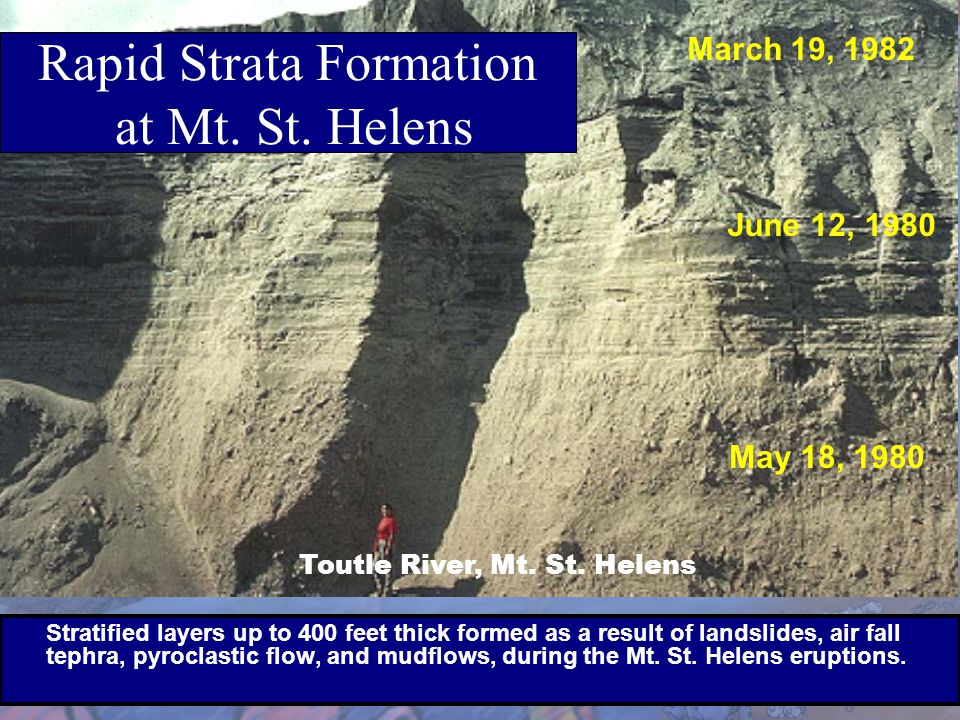
Visit the fossil museum:
www.flickr.com/photos/101536517@N06/sets/72157641367196613/
Just how good are peer reviews of scientific papers?
www.sciencemag.org/content/342/6154/60.full
www.examiner.com/article/want-to-publish-science-paper-ju...
The neo-Darwinian idea that the human genome consists entirely of an accumulation of billions of mutations is, quite obviously, completely bonkers. Nevertheless, it is compulsorily taught in schools and universities as 'science'.
WEEK 22 – Principle Toyota of Hernando
Since we saw Hernando’s new Toyota dealership from its eastern border of McIngvale Road on Tuesday, it only makes sense to view it from its western border of Interstate 55 today. As with where we left off, we’re beginning at the southern edge of the property, where its parking lot comes to a peak due to the triangular shape of the land.
Everything is looking very spiffy and brand new, and I think the residential neighborhoods over this way will likely (hopefully!) be pleased by the look of the dealership. (Ideally its upkeep will be just as nice.) The only thing I’m not sure about the residents liking so much is the multitude of lights on this property, whereas there was nothing lighting this area of land before. Hopefully that’s not too overwhelming or bright.
Principle Toyota of Hernando // 2887 McIngvale Road S, Hernando, MS 38632
(c) 2020 Retail Retell
These places are public so these photos are too, but just as I tell where they came from, I'd appreciate if you'd say who :)
The Palouse Washington State Farmlands Fuji GFX100s Fine Art Landscape Nature Photography! Steptoe Butte State Park View: Green & Yellow Farm Fields Rolling Hills of Wheat! Elliot McGucken 45EPIC Master Medium Format Photographer Fujifilm GFX 100s & Fuji Fujinon GF Lens!
Epic Fine Art Photography Prints & Luxury Wall Art:
Support epic, stoic fine art: Hero's Odyssey Gear!
Follow me on Instagram!
Facebook:
All my photography celebrates the physics of light! The McGucken Principle of the fourth expanding dimension: The fourth dimension is expanding at the rate of c relative to the three spatial dimensions: dx4/dt=ic .
Lao Tzu--The Tao: Nature does not hurry, yet everything is accomplished.
Light Time Dimension Theory: The Foundational Physics Unifying Einstein's Relativity and Quantum Mechanics: A Simple, Illustrated Introduction to the Unifying Physical Reality of the Fourth Expanding Dimensionsion dx4/dt=ic !: geni.us/Fa1Q
"Between every two pine trees there is a door leading to a new way of life." --John Muir
Epic Stoicism guides my fine art odyssey and photography: geni.us/epicstoicism
“The clearest way into the Universe is through a forest wilderness.” --John Muir
Epic Poetry inspires all my photography: geni.us/9K0Ki Epic Poetry for Epic Landscape Photography: Exalt Fine Art Nature Photography with the Poetic Wisdom of John Muir, Emerson, Thoreau, Homer's Iliad, Milton's Paradise Lost & Dante's Inferno Odyssey
“The mountains are calling and I must go.” --John Muir
Epic Art & 45EPIC Gear exalting golden ratio designs for your Hero's Odyssey:
Support epic fine art! 45surf ! Bitcoin: 1FMBZJeeHVMu35uegrYUfEkHfPj5pe9WNz
Exalt the goddess archetype in the fine art of photography! My Epic Book: Photographing Women Models!
Portrait, Swimsuit, Lingerie, Boudoir, Fine Art, & Fashion Photography Exalting the Venus Goddess Archetype: How to Shoot Epic ... Epic! Beautiful Surf Fine Art Portrait Swimsuit Bikini Models!
Some of my epic books, prints, & more!
Exalt your photography with Golden Ratio Compositions!
Golden Ratio Compositions & Secret Sacred Geometry for Photography, Fine Art, & Landscape Photographers: How to Exalt Art with Leonardo da Vinci's, Michelangelo's!
Epic Landscape Photography:
A Simple Guide to the Principles of Fine Art Nature Photography: Master Composition, Lenses, Camera Settings, Aperture, ISO, ... Hero's Odyssey Mythology Photography)
All art is but imitation of nature.-- Seneca (Letters from a Stoic - Letter LXV: On the First Cause)
The universe itself is God and the universal outpouring of its soul. --Chrysippus (Quoted by Cicero in De Natura Deorum)
Best wishes on your Epic Odyssey!
Homer: Tell me, O muse, of that ingenious hero who traveled far and wide after he had sacked the famous town of Troy. Many cities did he visit, and many were the nations with whose manners and customs he was acquainted; moreover he suffered much by sea while trying to save his own life and bring his men safely home. . . --Homer's Odyssey, Book I
Photographs available as epic fine art luxury prints. For prints and licensing information, please send me a flickr mail or contact drelliot@gmail.com with your queries! All the best on your Epic Hero's Odyssey!
Epic Sony A7RII Malibu Beach Fine Art Landscape /Seascape Sunset! Dr. Elliot McGucken Fine Art Sea Caves Landscape and Nature Photography
Sony Vario-Tessar T* FE 16-35mm f/4 ZA OSS Lens SEL1635Z Carl Zeiss!
instagram.com/elliotmcgucken
Join my new 45EPIC fine art landscapes page on facebook!
facebook.com/mcgucken
Working on a couple photography books! 45EPIC GODDESS PHOTOGRAPHY: A classic guide to exalting the archetypal woman. And 45EPIC Fine Art Landscape Photography!
Fresh snow! More on my golden ratio musings: facebook.com/goldennumberratio
instagram.com/goldennumberratio
Greetings all! I have been busy finishing a few books on photography, while traveling all over--to Zion and the Sierras--shooting fall colors. Please see some here: facebook.com/mcgucken
instagram.com/elliotmcgucken
Let me know in the comments if you would like a free review copy of one of my photography books! :)
Titles include:
The Tao of Epic Landscape Photography: Exalt Fine Art with the Yin-Yang Wisdom of Lao Tzu's Tao Te Ching!
The Golden Number Ratio Principle: Why the Fibonacci Numbers Exalt Beauty and How to Create PHI Compositions in Art, Design, & Photography
facebook.com/goldennumberratio
And I am also working on a book on photographing the goddesses! :) More goddesses soon!
Best wishes on your epic hero's odyssey!:)
instagram.com/45surf
en.wikipedia.org/wiki/Beamish_Museum
Beamish Museum is the first regional open-air museum, in England, located at Beamish, near the town of Stanley, in County Durham, England. Beamish pioneered the concept of a living museum. By displaying duplicates or replaceable items, it was also an early example of the now commonplace practice of museums allowing visitors to touch objects.
The museum's guiding principle is to preserve an example of everyday life in urban and rural North East England at the climax of industrialisation in the early 20th century. Much of the restoration and interpretation is specific to the late Victorian and Edwardian eras, together with portions of countryside under the influence of industrial revolution from 1825. On its 350 acres (140 ha) estate it uses a mixture of translocated, original and replica buildings, a large collection of artefacts, working vehicles and equipment, as well as livestock and costumed interpreters.
The museum has received a number of awards since it opened to visitors in 1972 and has influenced other living museums. It is an educational resource, and also helps to preserve some traditional and rare north-country livestock breeds.
History
Genesis
In 1958, days after starting as director of the Bowes Museum, inspired by Scandinavian folk museums, and realising the North East's traditional industries and communities were disappearing, Frank Atkinson presented a report to Durham County Council urging that a collection of items of everyday history on a large scale should begin as soon as possible, so that eventually an open air museum could be established. As well as objects, Atkinson was also aiming to preserve the region's customs and dialect. He stated the new museum should "attempt to make the history of the region live" and illustrate the way of life of ordinary people. He hoped the museum would be run by, be about and exist for the local populace, desiring them to see the museum as theirs, featuring items collected from them.
Fearing it was now almost too late, Atkinson adopted a policy of "unselective collecting" — "you offer it to us and we will collect it." Donations ranged in size from small items to locomotives and shops, and Atkinson initially took advantage of a surplus of space available in the 19th-century French chateau-style building housing the Bowes Museum to store items donated for the open air museum. With this space soon filled, a former British Army tank depot at Brancepeth was taken over, although in just a short time its entire complement of 22 huts and hangars had been filled, too.
In 1966, a working party was established to set up a museum "for the purpose of studying, collecting, preserving and exhibiting buildings, machinery, objects and information illustrating the development of industry and the way of life of the north of England", and it selected Beamish Hall, having been vacated by the National Coal Board, as a suitable location.
Establishment and expansion
In August 1970, with Atkinson appointed as its first full-time director together with three staff members, the museum was first established by moving some of the collections into the hall. In 1971, an introductory exhibition, "Museum in the Making" opened at the hall.
The museum was opened to visitors on its current site for the first time in 1972, with the first translocated buildings (the railway station and colliery winding engine) being erected the following year. The first trams began operating on a short demonstration line in 1973. The Town station was formally opened in 1976, the same year the reconstruction of the colliery winding engine house was completed, and the miners' cottages were relocated. Opening of the drift mine as an exhibit followed in 1979.
In 1975 the museum was visited by the Queen Elizabeth The Queen Mother, and by Anne, Princess Royal, in 2002. In 2006, as the Grand Master of the United Grand Lodge of England, The Duke of Kent visited, to open the town masonic lodge.
With the Co-op having opened in 1984, the town area was officially opened in 1985. The pub had opened in the same year, with Ravensworth Terrace having been reconstructed from 1980 to 1985. The newspaper branch office had also been built in the mid-1980s. Elsewhere, the farm on the west side of the site (which became Home Farm) opened in 1983. The present arrangement of visitors entering from the south was introduced in 1986.
At the beginning of the 1990s, further developments in the Pit Village were opened, the chapel in 1990, and the board school in 1992. The whole tram circle was in operation by 1993.[8] Further additions to the Town came in 1994 with the opening of the sweet shop and motor garage, followed by the bank in 1999. The first Georgian component of the museum arrived when Pockerley Old Hall opened in 1995, followed by the Pockerley Waggonway in 2001.
In the early 2000s two large modern buildings were added, to augment the museum's operations and storage capacity - the Regional Resource Centre on the west side opened in 2001, followed by the Regional Museums Store next to the railway station in 2002. Due to its proximity, the latter has been cosmetically presented as Beamish Waggon and Iron Works. Additions to display areas came in the form of the Masonic lodge (2006) and the Lamp Cabin in the Colliery (2009). In 2010, the entrance building and tea rooms were refurbished.
Into the 2010s, further buildings were added - the fish and chip shop (opened 2011)[28] band hall (opened 2013) and pit pony stables (built 2013/14) in the Pit Village, plus a bakery (opened 2013) and chemist and photographers (opened 2016) being added to the town. St Helen's Church, in the Georgian landscape, opened in November 2015.
Remaking Beamish
A major development, named 'Remaking Beamish', was approved by Durham County Council in April 2016, with £10.7m having been raised from the Heritage Lottery Fund and £3.3m from other sources.
As of September 2022, new exhibits as part of this project have included a quilter's cottage, a welfare hall, 1950s terrace, recreation park, bus depot, and 1950s farm (all discussed in the relevant sections of this article). The coming years will see replicas of aged miners' homes from South Shields, a cinema from Ryhope, and social housing will feature a block of four relocated Airey houses, prefabricated concrete homes originally designed by Sir Edwin Airey, which previously stood in Kibblesworth. Then-recently vacated and due for demolition, they were instead offered to the museum by The Gateshead Housing Company and accepted in 2012.
Museum site
The approximately 350-acre (1.4 km2) current site, once belonging to the Eden and Shafto families, is a basin-shaped steep-sided valley with woodland areas, a river, some level ground and a south-facing aspect.
Visitors enter the site through an entrance arch formed by a steam hammer, across a former opencast mining site and through a converted stable block (from Greencroft, near Lanchester, County Durham).
Visitors can navigate the site via assorted marked footpaths, including adjacent (or near to) the entire tramway oval. According to the museum, it takes 20 minutes to walk at a relaxed pace from the entrance to the town. The tramway oval serves as both an exhibit and as a free means of transport around the site for visitors, with stops at the entrance (south), Home Farm (west), Pockerley (east) and the Town (north). Visitors can also use the museum's buses as a free form of transport between various parts of the museum. Although visitors can also ride on the Town railway and Pockerley Waggonway, these do not form part of the site's transport system (as they start and finish from the same platforms).
Governance
Beamish was the first English museum to be financed and administered by a consortium of county councils (Cleveland, Durham, Northumberland and Tyne and Wear) The museum is now operated as a registered charity, but continues to receive support from local authorities - Durham County Council, Sunderland City Council, Gateshead Council, South Tyneside Council and North Tyneside Council. The supporting Friends of Beamish organisation was established in 1968. Frank Atkinson retired as director in 1987. The museum has been 96% self-funding for some years (mainly from admission charges).
Sections of the museum
1913
The town area, officially opened in 1985, depicts chiefly Victorian buildings in an evolved urban setting of 1913.
Tramway
The Beamish Tramway is 1.5 miles (2.4 km) long, with four passing loops. The line makes a circuit of the museum site forming an important element of the visitor transportation system.
The first trams began operating on a short demonstration line in 1973, with the whole circle in operation by 1993.[8] It represents the era of electric powered trams, which were being introduced to meet the needs of growing towns and cities across the North East from the late 1890s, replacing earlier horse drawn systems.
Bakery
Presented as Joseph Herron, Baker & Confectioner, the bakery was opened in 2013 and features working ovens which produce food for sale to visitors. A two-storey curved building, only the ground floor is used as the exhibit. A bakery has been included to represent the new businesses which sprang up to cater for the growing middle classes - the ovens being of the modern electric type which were growing in use. The building was sourced from Anfield Plain (which had a bakery trading as Joseph Herron), and was moved to Beamish in the late 1970s and early 1980s. The frontage features a stained glass from a baker's shop in South Shields. It also uses fittings from Stockton-on-Tees.
Motor garage
Presented as Beamish Motor & Cycle Works, the motor garage opened in 1994. Reflecting the custom nature of the early motor trade, where only one in 232 people owned a car in 1913, the shop features a showroom to the front (not accessible to visitors), with a garage area to the rear, accessed via the adjacent archway. The works is a replica of a typical garage of the era. Much of the museum's car, motorcycle and bicycle collection, both working and static, is stored in the garage. The frontage has two storeys, but the upper floor is only a small mezzanine and is not used as part of the display.
Department Store
Presented as the Annfield Plain Industrial Co-operative Society Ltd, (but more commonly referred to as the Anfield Plain Co-op Store) this department store opened in 1984, and was relocated to Beamish from Annfield Plain in County Durham. The Annfield Plain co-operative society was originally established in 1870, with the museum store stocking various products from the Co-operative Wholesale Society (CWS), established 1863. A two-storey building, the ground floor comprises the three departments - grocery, drapery and hardware; the upper floor is taken up by the tea rooms (accessed from Redman Park via a ramp to the rear). Most of the items are for display only, but a small amount of goods are sold to visitors. The store features an operational cash carrier system, of the Lamson Cash Ball design - common in many large stores of the era, but especially essential to Co-ops, where customer's dividends had to be logged.
Ravensworth Terrace
Ravensworth Terrace is a row of terraced houses, presented as the premises and living areas of various professionals. Representing the expanding housing stock of the era, it was relocated from its original site on Bensham Bank, having been built for professionals and tradesmen between 1830 and 1845. Original former residents included painter John Wilson Carmichael and Gateshead mayor Alexander Gillies. Originally featuring 25 homes, the terrace was to be demolished when the museum saved it in the 1970s, reconstructing six of them on the Town site between 1980 and 1985. They are two storey buildings, with most featuring display rooms on both floors - originally the houses would have also housed a servant in the attic. The front gardens are presented in a mix of the formal style, and the natural style that was becoming increasingly popular.
No. 2 is presented as the home of Miss Florence Smith, a music teacher, with old fashioned mid-Victorian furnishings as if inherited from her parents. No. 3 & 4 is presented as the practice and home respectively (with a knocked through door) of dentist J. Jones - the exterior nameplate having come from the surgery of Mr. J. Jones in Hartlepool. Representing the state of dental health at the time, it features both a check-up room and surgery for extraction, and a technicians room for creating dentures - a common practice at the time being the giving to daughters a set on their 21st birthday, to save any future husband the cost at a later date. His home is presented as more modern than No.2, furnished in the Edwardian style the modern day utilities of an enamelled bathroom with flushing toilet, a controllable heat kitchen range and gas cooker. No. 5 is presented as a solicitor's office, based on that of Robert Spence Watson, a Quaker from Newcastle. Reflecting the trade of the era, downstairs is laid out as the partner's or principal office, and the general or clerk's office in the rear. Included is a set of books sourced from ER Hanby Holmes, who practised in Barnard Castle.
Pub
Presented as The Sun Inn, the pub opened in the town in 1985. It had originally stood in Bondgate in Bishop Auckland, and was donated to the museum by its final owners, the Scottish and Newcastle Breweries. Originally a "one-up one down" cottage, the earliest ownership has been traced to James Thompson, on 21 January 1806. Known as The Tiger Inn until the 1850s, from 1857 to 1899 under the ownership of the Leng family, it flourished under the patronage of miners from Newton Cap and other collieries. Latterly run by Elsie Edes, it came under brewery ownership in the 20th Century when bought by S&N antecedent, James Deuchar Ltd. The pub is fully operational, and features both a front and back bar, the two stories above not being part of the exhibit. The interior decoration features the stuffed racing greyhound Jake's Bonny Mary, which won nine trophies before being put on display in The Gerry in White le Head near Tantobie.
Town stables
Reflecting the reliance on horses for a variety of transport needs in the era, the town features a centrally located stables, situated behind the sweet shop, with its courtyard being accessed from the archway next to the pub. It is presented as a typical jobmaster's yard, with stables and a tack room in the building on its north side. A small, brick built open air, carriage shed is sited on the back of the printworks building. On the east side of the courtyard is a much larger metal shed (utilising iron roof trusses from Fleetwood), arranged mainly as carriage storage, but with a blacksmith's shop in the corner. The building on the west side of the yard is not part of any display. The interior fittings for the harness room came from Callaly Caste. Many of the horses and horse-drawn vehicles used by the museum are housed in the stables and sheds.
Printer, stationer and newspaper branch office
Presented as the Beamish Branch Office of the Northern Daily Mail and the Sunderland Daily Echo, the two storey replica building was built in the mid-1980s and represents the trade practices of the era. Downstairs, on the right, is the branch office, where newspapers would be sold directly and distributed to local newsagents and street vendors, and where orders for advertising copy would be taken. Supplementing it is a stationer's shop on the left hand side, with both display items and a small number of gift items on public sale. Upstairs is a jobbing printers workshop, which would not produce the newspapers, but would instead print leaflets, posters and office stationery. Split into a composing area and a print shop, the shop itself has a number of presses - a Columbian built in 1837 by Clymer and Dixon, an Albion dating back to 1863, an Arab Platen of c. 1900, and a Wharfedale flat bed press, built by Dawson & Son in around 1870. Much of the machinery was sourced from the print works of Jack Ascough's of Barnard Castle. Many of the posters seen around the museum are printed in the works, with the operation of the machinery being part of the display.
Sweet shop
Presented as Jubilee Confectioners, the two storey sweet shop opened in 1994 and is meant to represent the typical family run shops of the era, with living quarters above the shop (the second storey not being part of the display). To the front of the ground floor is a shop, where traditional sweets and chocolate (which was still relatively expensive at the time) are sold to visitors, while in the rear of the ground floor is a manufacturing area where visitors can view the techniques of the time (accessed via the arched walkway on the side of the building). The sweet rollers were sourced from a variety of shops and factories.
Bank
Presented as a branch of Barclays Bank (Barclay & Company Ltd) using period currency, the bank opened in 1999. It represents the trend of the era when regional banks were being acquired and merged into national banks such as Barclays, formed in 1896. Built to a three-storey design typical of the era, and featuring bricks in the upper storeys sourced from Park House, Gateshead, the Swedish imperial red shade used on the ground floor frontage is intended to represent stability and security. On the ground floor are windows for bank tellers, plus the bank manager's office. Included in a basement level are two vaults. The upper two storeys are not part of the display. It features components sourced from Southport and Gateshead
Masonic Hall
The Masonic Hall opened in 2006, and features the frontage from a former masonic hall sited in Park Terrace, Sunderland. Reflecting the popularity of the masons in North East England, as well as the main hall, which takes up the full height of the structure, in a small two story arrangement to the front of the hall is also a Robing Room and the Tyler's Room on the ground floor, and a Museum Room upstairs, featuring display cabinets of masonic regalia donated from various lodges. Upstairs is also a class room, with large stained glass window.
Chemist and photographer
Presented as W Smith's Chemist and JR & D Edis Photographers, a two-storey building housing both a chemist and photographers shops under one roof opened on 7 May 2016 and represents the growing popularity of photography in the era, with shops often growing out of or alongside chemists, who had the necessary supplies for developing photographs. The chemist features a dispensary, and equipment from various shops including John Walker, inventor of the friction match. The photographers features a studio, where visitors can dress in period costume and have a photograph taken. The corner building is based on a real building on Elvet Bridge in Durham City, opposite the Durham Marriot Hotel (the Royal County), although the second storey is not part of the display. The chemist also sells aerated water (an early form of carbonated soft drinks) to visitors, sold in marble-stopper sealed Codd bottles (although made to a modern design to prevent the safety issue that saw the original bottles banned). Aerated waters grew in popularity in the era, due to the need for a safe alternative to water, and the temperance movement - being sold in chemists due to the perception they were healthy in the same way mineral waters were.
Costing around £600,000 and begun on 18 August 2014, the building's brickwork and timber was built by the museum's own staff and apprentices, using Georgian bricks salvaged from demolition works to widen the A1. Unlike previous buildings built on the site, the museum had to replicate rather than relocate this one due to the fact that fewer buildings are being demolished compared to the 1970s, and in any case it was deemed unlikely one could be found to fit the curved shape of the plot. The studio is named after a real business run by John Reed Edis and his daughter Daisy. Mr Edis, originally at 27 Sherburn Road, Durham, in 1895, then 52 Saddler Street from 1897. The museum collection features several photographs, signs and equipment from the Edis studio. The name for the chemist is a reference to the business run by William Smith, who relocated to Silver Street, near the original building, in 1902. According to records, the original Edis company had been supplied by chemicals from the original (and still extant) Smith business.
Redman Park
Redman Park is a small lawned space with flower borders, opposite Ravensworth Terrace. Its centrepiece is a Victorian bandstand sourced from Saltwell Park, where it stood on an island in the middle of a lake. It represents the recognised need of the time for areas where people could relax away from the growing industrial landscape.
Other
Included in the Town are drinking fountains and other period examples of street furniture. In between the bank and the sweet shop is a combined tram and bus waiting room and public convenience.
Unbuilt
When construction of the Town began, the projected town plan incorporated a market square and buildings including a gas works, fire station, ice cream parlour (originally the Central Cafe at Consett), a cast iron bus station from Durham City, school, public baths and a fish and chip shop.
Railway station
East of the Town is the Railway Station, depicting a typical small passenger and goods facility operated by the main railway company in the region at the time, the North Eastern Railway (NER). A short running line extends west in a cutting around the north side of the Town itself, with trains visible from the windows of the stables. It runs for a distance of 1⁄4 mile - the line used to connect to the colliery sidings until 1993 when it was lifted between the town and the colliery so that the tram line could be extended. During 2009 the running line was relaid so that passenger rides could recommence from the station during 2010.
Rowley station
Representing passenger services is Rowley Station, a station building on a single platform, opened in 1976, having been relocated to the museum from the village of Rowley near Consett, just a few miles from Beamish.
The original Rowley railway station was opened in 1845 (as Cold Rowley, renamed Rowley in 1868) by the NER antecedent, the Stockton and Darlington Railway, consisting of just a platform. Under NER ownership, as a result of increasing use, in 1873 the station building was added. As demand declined, passenger service was withdrawn in 1939, followed by the goods service in 1966. Trains continued to use the line for another three years before it closed, the track being lifted in 1970. Although in a state of disrepair, the museum acquired the building, dismantling it in 1972, being officially unveiled in its new location by railway campaigner and poet, Sir John Betjeman.
The station building is presented as an Edwardian station, lit by oil lamp, having never been connected to gas or electricity supplies in its lifetime. It features both an open waiting area and a visitor accessible waiting room (western half), and a booking and ticket office (eastern half), with the latter only visible from a small viewing entrance. Adorning the waiting room is a large tiled NER route map.
Signal box
The signal box dates from 1896, and was relocated from Carr House East near Consett. It features assorted signalling equipment, basic furnishings for the signaller, and a lever frame, controlling the stations numerous points, interlocks and semaphore signals. The frame is not an operational part of the railway, the points being hand operated using track side levers. Visitors can only view the interior from a small area inside the door.
Goods shed
The goods shed is originally from Alnwick. The goods area represents how general cargo would have been moved on the railway, and for onward transport. The goods shed features a covered platform where road vehicles (wagons and carriages) can be loaded with the items unloaded from railway vans. The shed sits on a triangular platform serving two sidings, with a platform mounted hand-crane, which would have been used for transhipment activity (transfer of goods from one wagon to another, only being stored for a short time on the platform, if at all).
Coal yard
The coal yard represents how coal would have been distributed from incoming trains to local merchants - it features a coal drop which unloads railway wagons into road going wagons below. At the road entrance to the yard is a weighbridge (with office) and coal merchant's office - both being appropriately furnished with display items, but only viewable from outside.
The coal drop was sourced from West Boldon, and would have been a common sight on smaller stations. The weighbridge came from Glanton, while the coal office is from Hexham.
Bridges and level crossing
The station is equipped with two footbridges, a wrought iron example to the east having come from Howden-le-Wear, and a cast iron example to the west sourced from Dunston. Next to the western bridge, a roadway from the coal yard is presented as crossing the tracks via a gated level crossing (although in reality the road goes nowhere on the north side).
Waggon and Iron Works
Dominating the station is the large building externally presented as Beamish Waggon and Iron Works, estd 1857. In reality this is the Regional Museums Store (see below), although attached to the north side of the store are two covered sidings (not accessible to visitors), used to service and store the locomotives and stock used on the railway.
Other
A corrugated iron hut adjacent to the 'iron works' is presented as belonging to the local council, and houses associated road vehicles, wagons and other items.
Fairground
Adjacent to the station is an events field and fairground with a set of Frederick Savage built steam powered Gallopers dating from 1893.
Colliery
Presented as Beamish Colliery (owned by James Joicey & Co., and managed by William Severs), the colliery represents the coal mining industry which dominated the North East for generations - the museum site is in the former Durham coalfield, where 165,246 men and boys worked in 304 mines in 1913. By the time period represented by Beamish's 1900s era, the industry was booming - production in the Great Northern Coalfield had peaked in 1913, and miners were relatively well paid (double that of agriculture, the next largest employer), but the work was dangerous. Children could be employed from age 12 (the school leaving age), but could not go underground until 14.
Deep mine
Reconstructed pitworks buildings showing winding gear
Dominating the colliery site are the above ground structures of a deep (i.e. vertical shaft) mine - the brick built Winding Engine House, and the red painted wooden Heapstead. These were relocated to the museum (which never had its own vertical shaft), the winding house coming from Beamish Chophill Colliery, and the Heapstead from Ravensworth Park Mine in Gateshead. The winding engine and its enclosing house are both listed.
The winding engine was the source of power for hauling miners, equipment and coal up and down the shaft in a cage, the top of the shaft being in the adjacent heapstead, which encloses the frame holding the wheel around which the hoist cable travels. Inside the Heapstead, tubs of coal from the shaft were weighed on a weighbridge, then tipped onto jigging screens, which sifted the solid lumps from small particles and dust - these were then sent along the picking belt, where pickers, often women, elderly or disabled people or young boys (i.e. workers incapable of mining), would separate out unwanted stone, wood and rubbish. Finally, the coal was tipped onto waiting railway wagons below, while the unwanted waste sent to the adjacent heap by an external conveyor.
Chophill Colliery was closed by the National Coal Board in 1962, but the winding engine and tower were left in place. When the site was later leased, Beamish founder Frank Atkinson intervened to have both spot listed to prevent their demolition. After a protracted and difficult process to gain the necessary permissions to move a listed structure, the tower and engine were eventually relocated to the museum, work being completed in 1976. The winding engine itself is the only surviving example of the type which was once common, and was still in use at Chophill upon its closure. It was built in 1855 by J&G Joicey of Newcastle, to an 1800 design by Phineas Crowther.
Inside the winding engine house, supplementing the winding engine is a smaller jack engine, housed in the rear. These were used to lift heavy equipment, and in deep mines, act as a relief winding engine.
Outdoors, next to the Heapstead, is a sinking engine, mounted on red bricks. Brought to the museum from Silksworth Colliery in 1971, it was built by Burlington's of Sunderland in 1868 and is the sole surviving example of its kind. Sinking engines were used for the construction of shafts, after which the winding engine would become the source of hoist power. It is believed the Silksworth engine was retained because it was powerful enough to serve as a backup winding engine, and could be used to lift heavy equipment (i.e. the same role as the jack engine inside the winding house).
Drift mine
The Mahogany Drift Mine is original to Beamish, having opened in 1855 and after closing, was brought back into use in 1921 to transport coal from Beamish Park Drift to Beamish Cophill Colliery. It opened as a museum display in 1979. Included in the display is the winding engine and a short section of trackway used to transport tubs of coal to the surface, and a mine office. Visitor access into the mine shaft is by guided tour.
Lamp cabin
The Lamp Cabin opened in 2009, and is a recreation of a typical design used in collieries to house safety lamps, a necessary piece of equipment for miners although were not required in the Mahogany Drift Mine, due to it being gas-free. The building is split into two main rooms; in one half, the lamp cabin interior is recreated, with a collection of lamps on shelves, and the system of safety tokens used to track which miners were underground. Included in the display is a 1927 Hailwood and Ackroyd lamp-cleaning machine sourced from Morrison Busty Colliery in Annfield Plain. In the second room is an educational display, i.e., not a period interior.
Colliery railways
The colliery features both a standard gauge railway, representing how coal was transported to its onward destination, and narrow-gauge typically used by Edwardian collieries for internal purposes. The standard gauge railway is laid out to serve the deep mine - wagons being loaded by dropping coal from the heapstead - and runs out of the yard to sidings laid out along the northern-edge of the Pit Village.
The standard gauge railway has two engine sheds in the colliery yard, the smaller brick, wood and metal structure being an operational building; the larger brick-built structure is presented as Beamish Engine Works, a reconstruction of an engine shed formerly at Beamish 2nd Pit. Used for locomotive and stock storage, it is a long, single track shed featuring a servicing pit for part of its length. Visitors can walk along the full length in a segregated corridor. A third engine shed in brick (lower half) and corrugated iron has been constructed at the southern end of the yard, on the other side of the heapstead to the other two sheds, and is used for both narrow and standard gauge vehicles (on one road), although it is not connected to either system - instead being fed by low-loaders and used for long-term storage only.
The narrow gauge railway is serviced by a corrugate iron engine shed, and is being expanded to eventually encompass several sidings.
There are a number of industrial steam locomotives (including rare examples by Stephen Lewin from Seaham and Black, Hawthorn & Co) and many chaldron wagons, the region's traditional type of colliery railway rolling stock, which became a symbol of Beamish Museum. The locomotive Coffee Pot No 1 is often in steam during the summer.
Other
On the south eastern corner of the colliery site is the Power House, brought to the museum from Houghton Colliery. These were used to store explosives.
Pit Village
Alongside the colliery is the pit village, representing life in the mining communities that grew alongside coal production sites in the North East, many having come into existence solely because of the industry, such as Seaham Harbour, West Hartlepool, Esh Winning and Bedlington.
Miner's Cottages
The row of six miner's cottages in Francis Street represent the tied-housing provided by colliery owners to mine workers. Relocated to the museum in 1976, they were originally built in the 1860s in Hetton-le-Hole by Hetton Coal Company. They feature the common layout of a single-storey with a kitchen to the rear, the main room of the house, and parlour to the front, rarely used (although it was common for both rooms to be used for sleeping, with disguised folding "dess" beds common), and with children sleeping in attic spaces upstairs. In front are long gardens, used for food production, with associated sheds. An outdoor toilet and coal bunker were in the rear yards, and beyond the cobbled back lane to their rear are assorted sheds used for cultivation, repairs and hobbies. Chalkboard slates attached to the rear wall were used by the occupier to tell the mine's "knocker up" when they wished to be woken for their next shift.
No.2 is presented as a Methodist family's home, featuring good quality "Pitman's mahogany" furniture; No.3 is presented as occupied by a second generation well off Irish Catholic immigrant family featuring many items of value (so they could be readily sold off in times of need) and an early 1890s range; No.3 is presented as more impoverished than the others with just a simple convector style Newcastle oven, being inhabited by a miner's widow allowed to remain as her son is also a miner, and supplementing her income doing laundry and making/mending for other families. All the cottages feature examples of the folk art objects typical of mining communities. Also included in the row is an office for the miner's paymaster.[11] In the rear alleyway of the cottages is a communal bread oven, which were commonplace until miner's cottages gradually obtained their own kitchen ranges. They were used to bake traditional breads such as the Stottie, as well as sweet items, such as tea cakes. With no extant examples, the museum's oven had to be created from photographs and oral history.
School
The school opened in 1992, and represents the typical board school in the educational system of the era (the stone built single storey structure being inscribed with the foundation date of 1891, Beamish School Board), by which time attendance at a state approved school was compulsory, but the leaving age was 12, and lessons featured learning by rote and corporal punishment. The building originally stood in East Stanley, having been set up by the local school board, and would have numbered around 150 pupils. Having been donated by Durham County Council, the museum now has a special relationship with the primary school that replaced it. With separate entrances and cloakrooms for boys and girls at either end, the main building is split into three class rooms (all accessible to visitors), connected by a corridor along the rear. To the rear is a red brick bike shed, and in the playground visitors can play traditional games of the era.
Chapel
Pit Hill Chapel opened in 1990, and represents the Wesleyan Methodist tradition which was growing in North East England, with the chapels used for both religious worship and as community venues, which continue in its role in the museum display. Opened in the 1850s, it originally stood not far from its present site, having been built in what would eventually become Beamish village, near the museum entrance. A stained glass window of The Light of The World by William Holman Hunt came from a chapel in Bedlington. A two handled Love Feast Mug dates from 1868, and came from a chapel in Shildon Colliery. On the eastern wall, above the elevated altar area, is an angled plain white surface used for magic lantern shows, generated using a replica of the double-lensed acetylene gas powered lanterns of the period, mounted in the aisle of the main seating area. Off the western end of the hall is the vestry, featuring a small library and communion sets from Trimdon Colliery and Catchgate.
Fish bar
Presented as Davey's Fried Fish & Chip Potato Restaurant, the fish and chip shop opened in 2011, and represents the typical style of shop found in the era as they were becoming rapidly popular in the region - the brick built Victorian style fryery would most often have previously been used for another trade, and the attached corrugated iron hut serves as a saloon with tables and benches, where customers would eat and socialise. Featuring coal fired ranges using beef-dripping, the shop is named in honour of the last coal fired shop in Tyneside, in Winlaton Mill, and which closed in 2007. Latterly run by brothers Brian and Ramsay Davy, it had been established by their grandfather in 1937. The serving counter and one of the shop's three fryers, a 1934 Nuttal, came from the original Davy shop. The other two fryers are a 1920s Mabbott used near Chester until the 1960s, and a GW Atkinson New Castle Range, donated from a shop in Prudhoe in 1973. The latter is one of only two known late Victorian examples to survive. The decorative wall tiles in the fryery came to the museum in 1979 from Cowes Fish and Game Shop in Berwick upon Tweed. The shop also features both an early electric and hand-powered potato rumblers (cleaners), and a gas powered chip chopper built around 1900. Built behind the chapel, the fryery is arranged so the counter faces the rear, stretching the full length of the building. Outside is a brick built row of outdoor toilets. Supplementing the fish bar is the restored Berriman's mobile chip van, used in Spennymoor until the early 1970s.
Band hall
The Hetton Silver Band Hall opened in 2013, and features displays reflecting the role colliery bands played in mining life. Built in 1912, it was relocated from its original location in South Market Street, Hetton-le-Hole, where it was used by the Hetton Silver Band, founded in 1887. They built the hall using prize money from a music competition, and the band decided to donate the hall to the museum after they merged with Broughtons Brass Band of South Hetton (to form the Durham Miners' Association Brass Band). It is believed to be the only purpose built band hall in the region. The structure consists of the main hall, plus a small kitchen to the rear; as part of the museum it is still used for performances.
Pit pony stables
The Pit Pony Stables were built in 2013/14, and house the museum's pit ponies. They replace a wooden stable a few metres away in the field opposite the school (the wooden structure remaining). It represents the sort of stables that were used in drift mines (ponies in deep mines living their whole lives underground), pit ponies having been in use in the north east as late as 1994, in Ellington Colliery. The structure is a recreation of an original building that stood at Rickless Drift Mine, between High Spen and Greenside; it was built using a yellow brick that was common across the Durham coalfield.
Other
Doubling as one of the museum's refreshment buildings, Sinker's Bait Cabin represents the temporary structures that would have served as living quarters, canteens and drying areas for sinkers, the itinerant workforce that would dig new vertical mine shafts.
Representing other traditional past-times, the village fields include a quoits pitch, with another refreshment hut alongside it, resembling a wooden clubhouse.
In one of the fields in the village stands the Cupola, a small round flat topped brick built tower; such structures were commonly placed on top of disused or ventilation shafts, also used as an emergency exit from the upper seams.
The Georgian North (1825)
A late Georgian landscape based around the original Pockerley farm represents the period of change in the region as transport links were improved and as agriculture changed as machinery and field management developed, and breeding stock was improved. It became part of the museum in 1990, having latterly been occupied by a tenant farmer, and was opened as an exhibit in 1995. The hill top position suggests the site was the location of an Iron Age fort - the first recorded mention of a dwelling is in the 1183 Buke of Boldon (the region's equivalent of the Domesday Book). The name Pockerley has Saxon origins - "Pock" or "Pokor" meaning "pimple of bag-like" hill, and "Ley" meaning woodland clearing.
The surrounding farmlands have been returned to a post-enclosure landscape with ridge and furrow topography, divided into smaller fields by traditional riven oak fencing. The land is worked and grazed by traditional methods and breeds.
Pockerley Old Hall
The estate of Pockerley Old Hall is presented as that of a well off tenant farmer, in a position to take advantage of the agricultural advances of the era. The hall itself consists of the Old House, which is adjoined (but not connected to) the New House, both south facing two storey sandstone built buildings, the Old House also having a small north–south aligned extension. Roof timbers in the sandstone built Old House have been dated to the 1440s, but the lower storey (the undercroft) may be from even earlier. The New House dates to the late 1700s, and replaced a medieval manor house to the east of the Old House as the main farm house - once replaced itself, the Old House is believed to have been let to the farm manager. Visitors can access all rooms in the New and Old House, except the north–south extension which is now a toilet block. Displays include traditional cooking, such as the drying of oatcakes over a wooden rack (flake) over the fireplace in the Old House.
Inside the New House the downstairs consists of a main kitchen and a secondary kitchen (scullery) with pantry. It also includes a living room, although as the main room of the house, most meals would have been eaten in the main kitchen, equipped with an early range, boiler and hot air oven. Upstairs is a main bedroom and a second bedroom for children; to the rear (i.e. the colder, north side), are bedrooms for a servant and the servant lad respectively. Above the kitchen (for transferred warmth) is a grain and fleece store, with attached bacon loft, a narrow space behind the wall where bacon or hams, usually salted first, would be hung to be smoked by the kitchen fire (entering through a small door in the chimney).
Presented as having sparse and more old fashioned furnishings, the Old House is presented as being occupied in the upper story only, consisting of a main room used as the kitchen, bedroom and for washing, with the only other rooms being an adjoining second bedroom and an overhanging toilet. The main bed is an oak box bed dating to 1712, obtained from Star House in Baldersdale in 1962. Originally a defensive house in its own right, the lower level of the Old House is an undercroft, or vaulted basement chamber, with 1.5 metre thick walls - in times of attack the original tenant family would have retreated here with their valuables, although in its later use as the farm managers house, it is now presented as a storage and work room, housing a large wooden cheese press.[68] More children would have slept in the attic of the Old House (not accessible as a display).
To the front of the hall is a terraced garden featuring an ornamental garden with herbs and flowers, a vegetable garden, and an orchard, all laid out and planted according to the designs of William Falla of Gateshead, who had the largest nursery in Britain from 1804 to 1830.
The buildings to the east of the hall, across a north–south track, are the original farmstead buildings dating from around 1800. These include stables and a cart shed arranged around a fold yard. The horses and carts on display are typical of North Eastern farms of the era, Fells or Dales ponies and Cleveland Bay horses, and two wheeled long carts for hilly terrain (as opposed to four wheel carts).
Pockerley Waggonway
The Pockerley Waggonway opened in 2001, and represents the year 1825, as the year the Stockton and Darlington Railway opened. Waggonways had appeared around 1600, and by the 1800s were common in mining areas - prior to 1800 they had been either horse or gravity powered, before the invention of steam engines (initially used as static winding engines), and later mobile steam locomotives.
Housing the locomotives and rolling stock is the Great Shed, which opened in 2001 and is based on Timothy Hackworth's erecting shop, Shildon railway works, and incorporating some material from Robert Stephenson and Company's Newcastle works. Visitors can walk around the locomotives in the shed, and when in steam, can take rides to the end of the track and back in the line's assorted rolling stock - situated next to the Great Shed is a single platform for passenger use. In the corner of the main shed is a corner office, presented as a locomotive designer's office (only visible to visitors through windows). Off the pedestrian entrance in the southern side is a room presented as the engine crew's break room. Atop the Great Shed is a weather vane depicting a waggonway train approaching a cow, a reference to a famous quote by George Stephenson when asked by parliament in 1825 what would happen in such an eventuality - "very awkward indeed - for the coo!".
At the far end of the waggonway is the (fictional) coal mine Pockerley Gin Pit, which the waggonway notionally exists to serve. The pit head features a horse powered wooden whim gin, which was the method used before steam engines for hauling men and material up and down mineshafts - coal was carried in corves (wicker baskets), while miners held onto the rope with their foot in an attached loop.
Wooden waggonway
Following creation of the Pockerley Waggonway, the museum went back a chapter in railway history to create a horse-worked wooden waggonway.
St Helen's Church
St Helen's Church represents a typical type of country church found in North Yorkshire, and was relocated from its original site in Eston, North Yorkshire. It is the oldest and most complex building moved to the museum. It opened in November 2015, but will not be consecrated as this would place restrictions on what could be done with the building under church law.
The church had existed on its original site since around 1100. As the congregation grew, it was replaced by two nearby churches, and latterly became a cemetery chapel. After closing in 1985, it fell into disrepair and by 1996 was burnt out and vandalised leading to the decision by the local authority in 1998 to demolish it. Working to a deadline of a threatened demolition within six months, the building was deconstructed and moved to Beamish, reconstruction being authorised in 2011, with the exterior build completed by 2012.
While the structure was found to contain some stones from the 1100 era, the building itself however dates from three distinct building phases - the chancel on the east end dates from around 1450, while the nave, which was built at the same time, was modernised in 1822 in the Churchwarden style, adding a vestry. The bell tower dates from the late 1600s - one of the two bells is a rare dated Tudor example. Gargoyles, originally hidden in the walls and believed to have been pranks by the original builders, have been made visible in the reconstruction.
Restored to its 1822 condition, the interior has been furnished with Georgian box pews sourced from a church in Somerset. Visitors can access all parts except the bell tower. The nave includes a small gallery level, at the tower end, while the chancel includes a church office.
Joe the Quilter's Cottage
The most recent addition to the area opened to the public in 2018 is a recreation of a heather-thatched cottage which features stones from the Georgian quilter Joseph Hedley's original home in Northumberland. It was uncovered during an archaeological dig by Beamish. His original cottage was demolished in 1872 and has been carefully recreated with the help of a drawing on a postcard. The exhibit tells the story of quilting and the growth of cottage industries in the early 1800s. Within there is often a volunteer or member of staff not only telling the story of how Joe was murdered in 1826, a crime that remains unsolved to this day, but also giving visitors the opportunity to learn more and even have a go at quilting.
Other
A pack pony track passes through the scene - pack horses having been the mode of transport for all manner of heavy goods where no waggonway exists, being also able to reach places where carriages and wagons could not access. Beside the waggonway is a gibbet.
Farm (1940s)
Presented as Home Farm, this represents the role of North East farms as part of the British Home Front during World War II, depicting life indoors, and outside on the land. Much of the farmstead is original, and opened as a museum display in 1983. The farm is laid out across a north–south public road; to the west is the farmhouse and most of the farm buildings, while on the east side are a pair of cottages, the British Kitchen, an outdoor toilet ("netty"), a bull field, duck pond and large shed.
The farm complex was rebuilt in the mid-19th century as a model farm incorporating a horse mill and a steam-powered threshing mill. It was not presented as a 1940s farm until early 2014.
The farmhouse is presented as having been modernised, following the installation of electric power and an Aga cooker in the scullery, although the main kitchen still has the typical coal-fired black range. Lino flooring allowed quicker cleaning times, while a radio set allowed the family to keep up to date with wartime news. An office next to the kitchen would have served both as the administration centre for the wartime farm, and as a local Home Guard office. Outside the farmhouse is an improvised Home Guard pillbox fashioned from half an egg-ended steam boiler, relocated from its original position near Durham.
The farm is equipped with three tractors which would have all seen service during the war: a Case, a Fordson N and a 1924 Fordson F. The farm also features horse-drawn traps, reflecting the effect wartime rationing of petrol would have had on car use. The farming equipment in the cart and machinery sheds reflects the transition of the time from horse-drawn to tractor-pulled implements, with some older equipment put back into use due to the war, as well as a large Foster thresher, vital for cereal crops, and built specifically for the war effort, sold at the Newcastle Show. Although the wartime focus was on crops, the farm also features breeds of sheep, cattle, pigs and poultry that would have been typical for the time. The farm also has a portable steam engine, not in use, but presented as having been left out for collection as part of a wartime scrap metal drive.
The cottages would have housed farm labourers, but are presented as having new uses for the war: Orchard Cottage housing a family of evacuees, and Garden Cottage serving as a billet for members of the Women's Land Army (Land Girls). Orchard Cottage is named for an orchard next to it, which also contains an Anderson shelter, reconstructed from partial pieces of ones recovered from around the region. Orchard Cottage, which has both front and back kitchens, is presented as having an up to date blue enameled kitchen range, with hot water supplied from a coke stove, as well as a modern accessible bathroom. Orchard Cottage is also used to stage recreations of wartime activities for schools, elderly groups and those living with dementia. Garden Cottage is sparsely furnished with a mix of items, reflecting the few possessions Land Girls were able to take with them, although unusually the cottage is depicted with a bathroom, and electricity (due to proximity to a colliery).
The British Kitchen is both a display and one of the museum's catering facilities; it represents an installation of one of the wartime British Restaurants, complete with propaganda posters and a suitably patriotic menu.
Town (1950s)
As part of the Remaking Beamish project, with significant funding from the National Lottery Heritage Fund, the museum is creating a 1950s town. Opened in July 2019, the Welfare Hall is an exact replica of the Leasingthorne Colliery Welfare Hall and Community Centre which was built in 1957 near Bishop Auckland. Visitors can 'take part in activities including dancing, crafts, Meccano, beetle drive, keep fit and amateur dramatics' while also taking a look at the National Health Service exhibition on display, recreating the environment of an NHS clinic. A recreation and play park, named Coronation Park was opened in May 2022 to coincide with the celebrations around the Platinum Jubilee of Elizabeth II.
The museum's first 1950s terrace opened in February 2022. This included a fish and chip shop from Middleton St George, a cafe, a replica of Norman Cornish's home, and a hairdressers. Future developments opposite the existing 1950s terrace will see a recreation of The Grand Cinema, from Ryhope, in Sunderland, and toy and electricians shops. Also underdevelopment are a 1950s bowling green and pavilion, police houses and aged miner's cottages. Also under construction are semi-detached houses; for this exhibit, a competition was held to recreate a particular home at Beamish, which was won by a family from Sunderland.
As well as the town, a 1950s Northern bus depot has been opened on the western side of the museum – the purpose of this is to provide additional capacity for bus, trolleybus and tram storage once the planned trolleybus extension and the new area are completed, providing extra capacity and meeting the need for modified routing.
Spain's Field Farm
In March 2022, the museum opened Spain's Field Farm. It had stood for centuries at Eastgate in Weardale, and was moved to Beamish stone-by-stone. It is exhibited as it would have been in the 1950s.
1820s Expansion
In the area surrounding the current Pockerley Old Hall and Steam Wagon Way more development is on the way. The first of these was planned to be a Georgian Coaching Inn that would be the museum's first venture into overnight accommodation. However following the COVID-19 pandemic this was abandoned, in favour of self-catering accommodation in existing cottages.
There are also plans for 1820s industries including a blacksmith's forge and a pottery.
Museum stores
There are two stores on the museum site, used to house donated objects. In contrast to the traditional rotation practice used in museums where items are exchanged regularly between store and display, it is Beamish policy that most of their exhibits are to be in use and on display - those items that must be stored are to be used in the museum's future developments.
Open Store
Housed in the Regional Resource Centre, the Open Store is accessible to visitors. Objects are housed on racks along one wall, while the bulk of items are in a rolling archive, with one set of shelves opened, with perspex across their fronts to permit viewing without touching.
Regional Museums Store
The real purposes of the building presented as Beamish Waggon and Iron Works next to Rowley Station is as the Regional Museums Store, completed in 2002, which Beamish shares with Tyne and Wear Museums. This houses, amongst other things, a large marine diesel engine by William Doxford & Sons of Pallion, Sunderland (1977); and several boats including the Tyne wherry (a traditional local type of lighter) Elswick No. 2 (1930). The store is only open at selected times, and for special tours which can be arranged through the museum; however, a number of viewing windows have been provided for use at other times.
Transport collection
Main article: Beamish Museum transport collection
The museum contains much of transport interest, and the size of its site makes good internal transportation for visitors and staff purposes a necessity.
The collection contains a variety of historical vehicles for road, rail and tramways. In addition there are some modern working replicas to enhance the various scenes in the museum.
Agriculture
The museum's two farms help to preserve traditional northcountry and in some cases rare livestock breeds such as Durham Shorthorn Cattle; Clydesdale and Cleveland Bay working horses; Dales ponies; Teeswater sheep; Saddleback pigs; and poultry.
Regional heritage
Other large exhibits collected by the museum include a tracked steam shovel, and a coal drop from Seaham Harbour.
In 2001 a new-build Regional Resource Centre (accessible to visitors by appointment) opened on the site to provide accommodation for the museum's core collections of smaller items. These include over 300,000 historic photographs, printed books and ephemera, and oral history recordings. The object collections cover the museum's specialities. These include quilts; "clippy mats" (rag rugs); Trade union banners; floor cloth; advertising (including archives from United Biscuits and Rowntree's); locally made pottery; folk art; and occupational costume. Much of the collection is viewable online and the arts of quilting, rug making and cookery in the local traditions are demonstrated at the museum.
Filming location
The site has been used as the backdrop for many film and television productions, particularly Catherine Cookson dramas, produced by Tyne Tees Television, and the final episode and the feature film version of Downton Abbey. Some of the children's television series Supergran was shot here.
Visitor numbers
On its opening day the museum set a record by attracting a two-hour queue. Visitor numbers rose rapidly to around 450,000 p.a. during the first decade of opening to the public, with the millionth visitor arriving in 1978.
Awards
Museum of the Year1986
European Museum of the Year Award1987
Living Museum of the Year2002
Large Visitor Attraction of the YearNorth East England Tourism awards2014 & 2015
Large Visitor Attraction of the Year (bronze)VisitEngland awards2016
It was designated by the Museums, Libraries and Archives Council in 1997 as a museum with outstanding collections.
Critical responses
In responding to criticism that it trades on nostalgia the museum is unapologetic. A former director has written: "As individuals and communities we have a deep need and desire to understand ourselves in time."
According to the BBC writing in its 40th anniversary year, Beamish was a mould-breaking museum that became a great success due to its collection policy, and what sets it apart from other museums is the use of costumed people to impart knowledge to visitors, rather than labels or interpretive panels (although some such panels do exist on the site), which means it "engages the visitor with history in a unique way".
Legacy
Beamish was influential on the Black Country Living Museum, Blists Hill Victorian Town and, in the view of museologist Kenneth Hudson, more widely in the museum community and is a significant educational resource locally. It can also demonstrate its benefit to the contemporary local economy.
The unselective collecting policy has created a lasting bond between museum and community.
Olympic National Park Hoh Rain Forest Hall of Mosses, Ferns & Spruce Trees Fuji GFX100 Fine Art Landscape Natur Photography! Epic Washington State Summer Wilderness Art! Elliot McGucken 45EPIC Master Medium Format Photographer Fujifilm GFX 100 & Fuji Fujinon GF Lens!
Epic Fine Art Photography Prints & Luxury Wall Art:
Support epic, stoic fine art: Hero's Odyssey Gear!
Follow me on Instagram!
Facebook:
All my photography celebrates the physics of light! The McGucken Principle of the fourth expanding dimension: The fourth dimension is expanding at the rate of c relative to the three spatial dimensions: dx4/dt=ic .
Lao Tzu--The Tao: Nature does not hurry, yet everything is accomplished.
Light Time Dimension Theory: The Foundational Physics Unifying Einstein's Relativity and Quantum Mechanics: A Simple, Illustrated Introduction to the Unifying Physical Reality of the Fourth Expanding Dimensionsion dx4/dt=ic !: geni.us/Fa1Q
"Between every two pine trees there is a door leading to a new way of life." --John Muir
Epic Stoicism guides my fine art odyssey and photography: geni.us/epicstoicism
“The clearest way into the Universe is through a forest wilderness.” --John Muir
Epic Poetry inspires all my photography: geni.us/9K0Ki Epic Poetry for Epic Landscape Photography: Exalt Fine Art Nature Photography with the Poetic Wisdom of John Muir, Emerson, Thoreau, Homer's Iliad, Milton's Paradise Lost & Dante's Inferno Odyssey
“The mountains are calling and I must go.” --John Muir
Epic Art & 45EPIC Gear exalting golden ratio designs for your Hero's Odyssey:
Support epic fine art! 45surf ! Bitcoin: 1FMBZJeeHVMu35uegrYUfEkHfPj5pe9WNz
Exalt the goddess archetype in the fine art of photography! My Epic Book: Photographing Women Models!
Portrait, Swimsuit, Lingerie, Boudoir, Fine Art, & Fashion Photography Exalting the Venus Goddess Archetype: How to Shoot Epic ... Epic! Beautiful Surf Fine Art Portrait Swimsuit Bikini Models!
Some of my epic books, prints, & more!
Exalt your photography with Golden Ratio Compositions!
Golden Ratio Compositions & Secret Sacred Geometry for Photography, Fine Art, & Landscape Photographers: How to Exalt Art with Leonardo da Vinci's, Michelangelo's!
Epic Landscape Photography:
A Simple Guide to the Principles of Fine Art Nature Photography: Master Composition, Lenses, Camera Settings, Aperture, ISO, ... Hero's Odyssey Mythology Photography)
All art is but imitation of nature.-- Seneca (Letters from a Stoic - Letter LXV: On the First Cause)
The universe itself is God and the universal outpouring of its soul. --Chrysippus (Quoted by Cicero in De Natura Deorum)
Best wishes on your Epic Odyssey!
Homer: Tell me, O muse, of that ingenious hero who traveled far and wide after he had sacked the famous town of Troy. Many cities did he visit, and many were the nations with whose manners and customs he was acquainted; moreover he suffered much by sea while trying to save his own life and bring his men safely home. . . --Homer's Odyssey, Book I
I was asked for the setup picture for The Uncertainty Principle so here it is.
No Photoshop.
No Gimp.
Part of the floor is sliding.
The shutter is on a long time.
I move it back and forth during the exposure.
Few tens of pictures later you get the desired effect.
Simples (as the Meerkat would say)
The principle of slow in and slow out is achieved easily by using some variation of ease-in-out easing.
Designing Interface Animation: Meaningful Motion for User Experience, Head, Val, 2016. New York: Rosenfeld Media rosenfeldmedia.com/books/designing-interface-animation
The principle that this species use for pollination (mimicry = imitation, copy...), is maybe the same like the orchids of the genus "Ophrys" use. This genus is mainly common to the mediterranean region.
Have a look at Ophrys scolopax:
images.google.de/imgres?imgurl=http://upload.wikimedia.or...

en.wikipedia.org/wiki/Beamish_Museum
Beamish Museum is the first regional open-air museum, in England, located at Beamish, near the town of Stanley, in County Durham, England. Beamish pioneered the concept of a living museum. By displaying duplicates or replaceable items, it was also an early example of the now commonplace practice of museums allowing visitors to touch objects.
The museum's guiding principle is to preserve an example of everyday life in urban and rural North East England at the climax of industrialisation in the early 20th century. Much of the restoration and interpretation is specific to the late Victorian and Edwardian eras, together with portions of countryside under the influence of industrial revolution from 1825. On its 350 acres (140 ha) estate it uses a mixture of translocated, original and replica buildings, a large collection of artefacts, working vehicles and equipment, as well as livestock and costumed interpreters.
The museum has received a number of awards since it opened to visitors in 1972 and has influenced other living museums. It is an educational resource, and also helps to preserve some traditional and rare north-country livestock breeds.
History
Genesis
In 1958, days after starting as director of the Bowes Museum, inspired by Scandinavian folk museums, and realising the North East's traditional industries and communities were disappearing, Frank Atkinson presented a report to Durham County Council urging that a collection of items of everyday history on a large scale should begin as soon as possible, so that eventually an open air museum could be established. As well as objects, Atkinson was also aiming to preserve the region's customs and dialect. He stated the new museum should "attempt to make the history of the region live" and illustrate the way of life of ordinary people. He hoped the museum would be run by, be about and exist for the local populace, desiring them to see the museum as theirs, featuring items collected from them.
Fearing it was now almost too late, Atkinson adopted a policy of "unselective collecting" — "you offer it to us and we will collect it." Donations ranged in size from small items to locomotives and shops, and Atkinson initially took advantage of a surplus of space available in the 19th-century French chateau-style building housing the Bowes Museum to store items donated for the open air museum. With this space soon filled, a former British Army tank depot at Brancepeth was taken over, although in just a short time its entire complement of 22 huts and hangars had been filled, too.
In 1966, a working party was established to set up a museum "for the purpose of studying, collecting, preserving and exhibiting buildings, machinery, objects and information illustrating the development of industry and the way of life of the north of England", and it selected Beamish Hall, having been vacated by the National Coal Board, as a suitable location.
Establishment and expansion
In August 1970, with Atkinson appointed as its first full-time director together with three staff members, the museum was first established by moving some of the collections into the hall. In 1971, an introductory exhibition, "Museum in the Making" opened at the hall.
The museum was opened to visitors on its current site for the first time in 1972, with the first translocated buildings (the railway station and colliery winding engine) being erected the following year. The first trams began operating on a short demonstration line in 1973. The Town station was formally opened in 1976, the same year the reconstruction of the colliery winding engine house was completed, and the miners' cottages were relocated. Opening of the drift mine as an exhibit followed in 1979.
In 1975 the museum was visited by the Queen Elizabeth The Queen Mother, and by Anne, Princess Royal, in 2002. In 2006, as the Grand Master of the United Grand Lodge of England, The Duke of Kent visited, to open the town masonic lodge.
With the Co-op having opened in 1984, the town area was officially opened in 1985. The pub had opened in the same year, with Ravensworth Terrace having been reconstructed from 1980 to 1985. The newspaper branch office had also been built in the mid-1980s. Elsewhere, the farm on the west side of the site (which became Home Farm) opened in 1983. The present arrangement of visitors entering from the south was introduced in 1986.
At the beginning of the 1990s, further developments in the Pit Village were opened, the chapel in 1990, and the board school in 1992. The whole tram circle was in operation by 1993.[8] Further additions to the Town came in 1994 with the opening of the sweet shop and motor garage, followed by the bank in 1999. The first Georgian component of the museum arrived when Pockerley Old Hall opened in 1995, followed by the Pockerley Waggonway in 2001.
In the early 2000s two large modern buildings were added, to augment the museum's operations and storage capacity - the Regional Resource Centre on the west side opened in 2001, followed by the Regional Museums Store next to the railway station in 2002. Due to its proximity, the latter has been cosmetically presented as Beamish Waggon and Iron Works. Additions to display areas came in the form of the Masonic lodge (2006) and the Lamp Cabin in the Colliery (2009). In 2010, the entrance building and tea rooms were refurbished.
Into the 2010s, further buildings were added - the fish and chip shop (opened 2011)[28] band hall (opened 2013) and pit pony stables (built 2013/14) in the Pit Village, plus a bakery (opened 2013) and chemist and photographers (opened 2016) being added to the town. St Helen's Church, in the Georgian landscape, opened in November 2015.
Remaking Beamish
A major development, named 'Remaking Beamish', was approved by Durham County Council in April 2016, with £10.7m having been raised from the Heritage Lottery Fund and £3.3m from other sources.
As of September 2022, new exhibits as part of this project have included a quilter's cottage, a welfare hall, 1950s terrace, recreation park, bus depot, and 1950s farm (all discussed in the relevant sections of this article). The coming years will see replicas of aged miners' homes from South Shields, a cinema from Ryhope, and social housing will feature a block of four relocated Airey houses, prefabricated concrete homes originally designed by Sir Edwin Airey, which previously stood in Kibblesworth. Then-recently vacated and due for demolition, they were instead offered to the museum by The Gateshead Housing Company and accepted in 2012.
Museum site
The approximately 350-acre (1.4 km2) current site, once belonging to the Eden and Shafto families, is a basin-shaped steep-sided valley with woodland areas, a river, some level ground and a south-facing aspect.
Visitors enter the site through an entrance arch formed by a steam hammer, across a former opencast mining site and through a converted stable block (from Greencroft, near Lanchester, County Durham).
Visitors can navigate the site via assorted marked footpaths, including adjacent (or near to) the entire tramway oval. According to the museum, it takes 20 minutes to walk at a relaxed pace from the entrance to the town. The tramway oval serves as both an exhibit and as a free means of transport around the site for visitors, with stops at the entrance (south), Home Farm (west), Pockerley (east) and the Town (north). Visitors can also use the museum's buses as a free form of transport between various parts of the museum. Although visitors can also ride on the Town railway and Pockerley Waggonway, these do not form part of the site's transport system (as they start and finish from the same platforms).
Governance
Beamish was the first English museum to be financed and administered by a consortium of county councils (Cleveland, Durham, Northumberland and Tyne and Wear) The museum is now operated as a registered charity, but continues to receive support from local authorities - Durham County Council, Sunderland City Council, Gateshead Council, South Tyneside Council and North Tyneside Council. The supporting Friends of Beamish organisation was established in 1968. Frank Atkinson retired as director in 1987. The museum has been 96% self-funding for some years (mainly from admission charges).
Sections of the museum
1913
The town area, officially opened in 1985, depicts chiefly Victorian buildings in an evolved urban setting of 1913.
Tramway
The Beamish Tramway is 1.5 miles (2.4 km) long, with four passing loops. The line makes a circuit of the museum site forming an important element of the visitor transportation system.
The first trams began operating on a short demonstration line in 1973, with the whole circle in operation by 1993.[8] It represents the era of electric powered trams, which were being introduced to meet the needs of growing towns and cities across the North East from the late 1890s, replacing earlier horse drawn systems.
Bakery
Presented as Joseph Herron, Baker & Confectioner, the bakery was opened in 2013 and features working ovens which produce food for sale to visitors. A two-storey curved building, only the ground floor is used as the exhibit. A bakery has been included to represent the new businesses which sprang up to cater for the growing middle classes - the ovens being of the modern electric type which were growing in use. The building was sourced from Anfield Plain (which had a bakery trading as Joseph Herron), and was moved to Beamish in the late 1970s and early 1980s. The frontage features a stained glass from a baker's shop in South Shields. It also uses fittings from Stockton-on-Tees.
Motor garage
Presented as Beamish Motor & Cycle Works, the motor garage opened in 1994. Reflecting the custom nature of the early motor trade, where only one in 232 people owned a car in 1913, the shop features a showroom to the front (not accessible to visitors), with a garage area to the rear, accessed via the adjacent archway. The works is a replica of a typical garage of the era. Much of the museum's car, motorcycle and bicycle collection, both working and static, is stored in the garage. The frontage has two storeys, but the upper floor is only a small mezzanine and is not used as part of the display.
Department Store
Presented as the Annfield Plain Industrial Co-operative Society Ltd, (but more commonly referred to as the Anfield Plain Co-op Store) this department store opened in 1984, and was relocated to Beamish from Annfield Plain in County Durham. The Annfield Plain co-operative society was originally established in 1870, with the museum store stocking various products from the Co-operative Wholesale Society (CWS), established 1863. A two-storey building, the ground floor comprises the three departments - grocery, drapery and hardware; the upper floor is taken up by the tea rooms (accessed from Redman Park via a ramp to the rear). Most of the items are for display only, but a small amount of goods are sold to visitors. The store features an operational cash carrier system, of the Lamson Cash Ball design - common in many large stores of the era, but especially essential to Co-ops, where customer's dividends had to be logged.
Ravensworth Terrace
Ravensworth Terrace is a row of terraced houses, presented as the premises and living areas of various professionals. Representing the expanding housing stock of the era, it was relocated from its original site on Bensham Bank, having been built for professionals and tradesmen between 1830 and 1845. Original former residents included painter John Wilson Carmichael and Gateshead mayor Alexander Gillies. Originally featuring 25 homes, the terrace was to be demolished when the museum saved it in the 1970s, reconstructing six of them on the Town site between 1980 and 1985. They are two storey buildings, with most featuring display rooms on both floors - originally the houses would have also housed a servant in the attic. The front gardens are presented in a mix of the formal style, and the natural style that was becoming increasingly popular.
No. 2 is presented as the home of Miss Florence Smith, a music teacher, with old fashioned mid-Victorian furnishings as if inherited from her parents. No. 3 & 4 is presented as the practice and home respectively (with a knocked through door) of dentist J. Jones - the exterior nameplate having come from the surgery of Mr. J. Jones in Hartlepool. Representing the state of dental health at the time, it features both a check-up room and surgery for extraction, and a technicians room for creating dentures - a common practice at the time being the giving to daughters a set on their 21st birthday, to save any future husband the cost at a later date. His home is presented as more modern than No.2, furnished in the Edwardian style the modern day utilities of an enamelled bathroom with flushing toilet, a controllable heat kitchen range and gas cooker. No. 5 is presented as a solicitor's office, based on that of Robert Spence Watson, a Quaker from Newcastle. Reflecting the trade of the era, downstairs is laid out as the partner's or principal office, and the general or clerk's office in the rear. Included is a set of books sourced from ER Hanby Holmes, who practised in Barnard Castle.
Pub
Presented as The Sun Inn, the pub opened in the town in 1985. It had originally stood in Bondgate in Bishop Auckland, and was donated to the museum by its final owners, the Scottish and Newcastle Breweries. Originally a "one-up one down" cottage, the earliest ownership has been traced to James Thompson, on 21 January 1806. Known as The Tiger Inn until the 1850s, from 1857 to 1899 under the ownership of the Leng family, it flourished under the patronage of miners from Newton Cap and other collieries. Latterly run by Elsie Edes, it came under brewery ownership in the 20th Century when bought by S&N antecedent, James Deuchar Ltd. The pub is fully operational, and features both a front and back bar, the two stories above not being part of the exhibit. The interior decoration features the stuffed racing greyhound Jake's Bonny Mary, which won nine trophies before being put on display in The Gerry in White le Head near Tantobie.
Town stables
Reflecting the reliance on horses for a variety of transport needs in the era, the town features a centrally located stables, situated behind the sweet shop, with its courtyard being accessed from the archway next to the pub. It is presented as a typical jobmaster's yard, with stables and a tack room in the building on its north side. A small, brick built open air, carriage shed is sited on the back of the printworks building. On the east side of the courtyard is a much larger metal shed (utilising iron roof trusses from Fleetwood), arranged mainly as carriage storage, but with a blacksmith's shop in the corner. The building on the west side of the yard is not part of any display. The interior fittings for the harness room came from Callaly Caste. Many of the horses and horse-drawn vehicles used by the museum are housed in the stables and sheds.
Printer, stationer and newspaper branch office
Presented as the Beamish Branch Office of the Northern Daily Mail and the Sunderland Daily Echo, the two storey replica building was built in the mid-1980s and represents the trade practices of the era. Downstairs, on the right, is the branch office, where newspapers would be sold directly and distributed to local newsagents and street vendors, and where orders for advertising copy would be taken. Supplementing it is a stationer's shop on the left hand side, with both display items and a small number of gift items on public sale. Upstairs is a jobbing printers workshop, which would not produce the newspapers, but would instead print leaflets, posters and office stationery. Split into a composing area and a print shop, the shop itself has a number of presses - a Columbian built in 1837 by Clymer and Dixon, an Albion dating back to 1863, an Arab Platen of c. 1900, and a Wharfedale flat bed press, built by Dawson & Son in around 1870. Much of the machinery was sourced from the print works of Jack Ascough's of Barnard Castle. Many of the posters seen around the museum are printed in the works, with the operation of the machinery being part of the display.
Sweet shop
Presented as Jubilee Confectioners, the two storey sweet shop opened in 1994 and is meant to represent the typical family run shops of the era, with living quarters above the shop (the second storey not being part of the display). To the front of the ground floor is a shop, where traditional sweets and chocolate (which was still relatively expensive at the time) are sold to visitors, while in the rear of the ground floor is a manufacturing area where visitors can view the techniques of the time (accessed via the arched walkway on the side of the building). The sweet rollers were sourced from a variety of shops and factories.
Bank
Presented as a branch of Barclays Bank (Barclay & Company Ltd) using period currency, the bank opened in 1999. It represents the trend of the era when regional banks were being acquired and merged into national banks such as Barclays, formed in 1896. Built to a three-storey design typical of the era, and featuring bricks in the upper storeys sourced from Park House, Gateshead, the Swedish imperial red shade used on the ground floor frontage is intended to represent stability and security. On the ground floor are windows for bank tellers, plus the bank manager's office. Included in a basement level are two vaults. The upper two storeys are not part of the display. It features components sourced from Southport and Gateshead
Masonic Hall
The Masonic Hall opened in 2006, and features the frontage from a former masonic hall sited in Park Terrace, Sunderland. Reflecting the popularity of the masons in North East England, as well as the main hall, which takes up the full height of the structure, in a small two story arrangement to the front of the hall is also a Robing Room and the Tyler's Room on the ground floor, and a Museum Room upstairs, featuring display cabinets of masonic regalia donated from various lodges. Upstairs is also a class room, with large stained glass window.
Chemist and photographer
Presented as W Smith's Chemist and JR & D Edis Photographers, a two-storey building housing both a chemist and photographers shops under one roof opened on 7 May 2016 and represents the growing popularity of photography in the era, with shops often growing out of or alongside chemists, who had the necessary supplies for developing photographs. The chemist features a dispensary, and equipment from various shops including John Walker, inventor of the friction match. The photographers features a studio, where visitors can dress in period costume and have a photograph taken. The corner building is based on a real building on Elvet Bridge in Durham City, opposite the Durham Marriot Hotel (the Royal County), although the second storey is not part of the display. The chemist also sells aerated water (an early form of carbonated soft drinks) to visitors, sold in marble-stopper sealed Codd bottles (although made to a modern design to prevent the safety issue that saw the original bottles banned). Aerated waters grew in popularity in the era, due to the need for a safe alternative to water, and the temperance movement - being sold in chemists due to the perception they were healthy in the same way mineral waters were.
Costing around £600,000 and begun on 18 August 2014, the building's brickwork and timber was built by the museum's own staff and apprentices, using Georgian bricks salvaged from demolition works to widen the A1. Unlike previous buildings built on the site, the museum had to replicate rather than relocate this one due to the fact that fewer buildings are being demolished compared to the 1970s, and in any case it was deemed unlikely one could be found to fit the curved shape of the plot. The studio is named after a real business run by John Reed Edis and his daughter Daisy. Mr Edis, originally at 27 Sherburn Road, Durham, in 1895, then 52 Saddler Street from 1897. The museum collection features several photographs, signs and equipment from the Edis studio. The name for the chemist is a reference to the business run by William Smith, who relocated to Silver Street, near the original building, in 1902. According to records, the original Edis company had been supplied by chemicals from the original (and still extant) Smith business.
Redman Park
Redman Park is a small lawned space with flower borders, opposite Ravensworth Terrace. Its centrepiece is a Victorian bandstand sourced from Saltwell Park, where it stood on an island in the middle of a lake. It represents the recognised need of the time for areas where people could relax away from the growing industrial landscape.
Other
Included in the Town are drinking fountains and other period examples of street furniture. In between the bank and the sweet shop is a combined tram and bus waiting room and public convenience.
Unbuilt
When construction of the Town began, the projected town plan incorporated a market square and buildings including a gas works, fire station, ice cream parlour (originally the Central Cafe at Consett), a cast iron bus station from Durham City, school, public baths and a fish and chip shop.
Railway station
East of the Town is the Railway Station, depicting a typical small passenger and goods facility operated by the main railway company in the region at the time, the North Eastern Railway (NER). A short running line extends west in a cutting around the north side of the Town itself, with trains visible from the windows of the stables. It runs for a distance of 1⁄4 mile - the line used to connect to the colliery sidings until 1993 when it was lifted between the town and the colliery so that the tram line could be extended. During 2009 the running line was relaid so that passenger rides could recommence from the station during 2010.
Rowley station
Representing passenger services is Rowley Station, a station building on a single platform, opened in 1976, having been relocated to the museum from the village of Rowley near Consett, just a few miles from Beamish.
The original Rowley railway station was opened in 1845 (as Cold Rowley, renamed Rowley in 1868) by the NER antecedent, the Stockton and Darlington Railway, consisting of just a platform. Under NER ownership, as a result of increasing use, in 1873 the station building was added. As demand declined, passenger service was withdrawn in 1939, followed by the goods service in 1966. Trains continued to use the line for another three years before it closed, the track being lifted in 1970. Although in a state of disrepair, the museum acquired the building, dismantling it in 1972, being officially unveiled in its new location by railway campaigner and poet, Sir John Betjeman.
The station building is presented as an Edwardian station, lit by oil lamp, having never been connected to gas or electricity supplies in its lifetime. It features both an open waiting area and a visitor accessible waiting room (western half), and a booking and ticket office (eastern half), with the latter only visible from a small viewing entrance. Adorning the waiting room is a large tiled NER route map.
Signal box
The signal box dates from 1896, and was relocated from Carr House East near Consett. It features assorted signalling equipment, basic furnishings for the signaller, and a lever frame, controlling the stations numerous points, interlocks and semaphore signals. The frame is not an operational part of the railway, the points being hand operated using track side levers. Visitors can only view the interior from a small area inside the door.
Goods shed
The goods shed is originally from Alnwick. The goods area represents how general cargo would have been moved on the railway, and for onward transport. The goods shed features a covered platform where road vehicles (wagons and carriages) can be loaded with the items unloaded from railway vans. The shed sits on a triangular platform serving two sidings, with a platform mounted hand-crane, which would have been used for transhipment activity (transfer of goods from one wagon to another, only being stored for a short time on the platform, if at all).
Coal yard
The coal yard represents how coal would have been distributed from incoming trains to local merchants - it features a coal drop which unloads railway wagons into road going wagons below. At the road entrance to the yard is a weighbridge (with office) and coal merchant's office - both being appropriately furnished with display items, but only viewable from outside.
The coal drop was sourced from West Boldon, and would have been a common sight on smaller stations. The weighbridge came from Glanton, while the coal office is from Hexham.
Bridges and level crossing
The station is equipped with two footbridges, a wrought iron example to the east having come from Howden-le-Wear, and a cast iron example to the west sourced from Dunston. Next to the western bridge, a roadway from the coal yard is presented as crossing the tracks via a gated level crossing (although in reality the road goes nowhere on the north side).
Waggon and Iron Works
Dominating the station is the large building externally presented as Beamish Waggon and Iron Works, estd 1857. In reality this is the Regional Museums Store (see below), although attached to the north side of the store are two covered sidings (not accessible to visitors), used to service and store the locomotives and stock used on the railway.
Other
A corrugated iron hut adjacent to the 'iron works' is presented as belonging to the local council, and houses associated road vehicles, wagons and other items.
Fairground
Adjacent to the station is an events field and fairground with a set of Frederick Savage built steam powered Gallopers dating from 1893.
Colliery
Presented as Beamish Colliery (owned by James Joicey & Co., and managed by William Severs), the colliery represents the coal mining industry which dominated the North East for generations - the museum site is in the former Durham coalfield, where 165,246 men and boys worked in 304 mines in 1913. By the time period represented by Beamish's 1900s era, the industry was booming - production in the Great Northern Coalfield had peaked in 1913, and miners were relatively well paid (double that of agriculture, the next largest employer), but the work was dangerous. Children could be employed from age 12 (the school leaving age), but could not go underground until 14.
Deep mine
Reconstructed pitworks buildings showing winding gear
Dominating the colliery site are the above ground structures of a deep (i.e. vertical shaft) mine - the brick built Winding Engine House, and the red painted wooden Heapstead. These were relocated to the museum (which never had its own vertical shaft), the winding house coming from Beamish Chophill Colliery, and the Heapstead from Ravensworth Park Mine in Gateshead. The winding engine and its enclosing house are both listed.
The winding engine was the source of power for hauling miners, equipment and coal up and down the shaft in a cage, the top of the shaft being in the adjacent heapstead, which encloses the frame holding the wheel around which the hoist cable travels. Inside the Heapstead, tubs of coal from the shaft were weighed on a weighbridge, then tipped onto jigging screens, which sifted the solid lumps from small particles and dust - these were then sent along the picking belt, where pickers, often women, elderly or disabled people or young boys (i.e. workers incapable of mining), would separate out unwanted stone, wood and rubbish. Finally, the coal was tipped onto waiting railway wagons below, while the unwanted waste sent to the adjacent heap by an external conveyor.
Chophill Colliery was closed by the National Coal Board in 1962, but the winding engine and tower were left in place. When the site was later leased, Beamish founder Frank Atkinson intervened to have both spot listed to prevent their demolition. After a protracted and difficult process to gain the necessary permissions to move a listed structure, the tower and engine were eventually relocated to the museum, work being completed in 1976. The winding engine itself is the only surviving example of the type which was once common, and was still in use at Chophill upon its closure. It was built in 1855 by J&G Joicey of Newcastle, to an 1800 design by Phineas Crowther.
Inside the winding engine house, supplementing the winding engine is a smaller jack engine, housed in the rear. These were used to lift heavy equipment, and in deep mines, act as a relief winding engine.
Outdoors, next to the Heapstead, is a sinking engine, mounted on red bricks. Brought to the museum from Silksworth Colliery in 1971, it was built by Burlington's of Sunderland in 1868 and is the sole surviving example of its kind. Sinking engines were used for the construction of shafts, after which the winding engine would become the source of hoist power. It is believed the Silksworth engine was retained because it was powerful enough to serve as a backup winding engine, and could be used to lift heavy equipment (i.e. the same role as the jack engine inside the winding house).
Drift mine
The Mahogany Drift Mine is original to Beamish, having opened in 1855 and after closing, was brought back into use in 1921 to transport coal from Beamish Park Drift to Beamish Cophill Colliery. It opened as a museum display in 1979. Included in the display is the winding engine and a short section of trackway used to transport tubs of coal to the surface, and a mine office. Visitor access into the mine shaft is by guided tour.
Lamp cabin
The Lamp Cabin opened in 2009, and is a recreation of a typical design used in collieries to house safety lamps, a necessary piece of equipment for miners although were not required in the Mahogany Drift Mine, due to it being gas-free. The building is split into two main rooms; in one half, the lamp cabin interior is recreated, with a collection of lamps on shelves, and the system of safety tokens used to track which miners were underground. Included in the display is a 1927 Hailwood and Ackroyd lamp-cleaning machine sourced from Morrison Busty Colliery in Annfield Plain. In the second room is an educational display, i.e., not a period interior.
Colliery railways
The colliery features both a standard gauge railway, representing how coal was transported to its onward destination, and narrow-gauge typically used by Edwardian collieries for internal purposes. The standard gauge railway is laid out to serve the deep mine - wagons being loaded by dropping coal from the heapstead - and runs out of the yard to sidings laid out along the northern-edge of the Pit Village.
The standard gauge railway has two engine sheds in the colliery yard, the smaller brick, wood and metal structure being an operational building; the larger brick-built structure is presented as Beamish Engine Works, a reconstruction of an engine shed formerly at Beamish 2nd Pit. Used for locomotive and stock storage, it is a long, single track shed featuring a servicing pit for part of its length. Visitors can walk along the full length in a segregated corridor. A third engine shed in brick (lower half) and corrugated iron has been constructed at the southern end of the yard, on the other side of the heapstead to the other two sheds, and is used for both narrow and standard gauge vehicles (on one road), although it is not connected to either system - instead being fed by low-loaders and used for long-term storage only.
The narrow gauge railway is serviced by a corrugate iron engine shed, and is being expanded to eventually encompass several sidings.
There are a number of industrial steam locomotives (including rare examples by Stephen Lewin from Seaham and Black, Hawthorn & Co) and many chaldron wagons, the region's traditional type of colliery railway rolling stock, which became a symbol of Beamish Museum. The locomotive Coffee Pot No 1 is often in steam during the summer.
Other
On the south eastern corner of the colliery site is the Power House, brought to the museum from Houghton Colliery. These were used to store explosives.
Pit Village
Alongside the colliery is the pit village, representing life in the mining communities that grew alongside coal production sites in the North East, many having come into existence solely because of the industry, such as Seaham Harbour, West Hartlepool, Esh Winning and Bedlington.
Miner's Cottages
The row of six miner's cottages in Francis Street represent the tied-housing provided by colliery owners to mine workers. Relocated to the museum in 1976, they were originally built in the 1860s in Hetton-le-Hole by Hetton Coal Company. They feature the common layout of a single-storey with a kitchen to the rear, the main room of the house, and parlour to the front, rarely used (although it was common for both rooms to be used for sleeping, with disguised folding "dess" beds common), and with children sleeping in attic spaces upstairs. In front are long gardens, used for food production, with associated sheds. An outdoor toilet and coal bunker were in the rear yards, and beyond the cobbled back lane to their rear are assorted sheds used for cultivation, repairs and hobbies. Chalkboard slates attached to the rear wall were used by the occupier to tell the mine's "knocker up" when they wished to be woken for their next shift.
No.2 is presented as a Methodist family's home, featuring good quality "Pitman's mahogany" furniture; No.3 is presented as occupied by a second generation well off Irish Catholic immigrant family featuring many items of value (so they could be readily sold off in times of need) and an early 1890s range; No.3 is presented as more impoverished than the others with just a simple convector style Newcastle oven, being inhabited by a miner's widow allowed to remain as her son is also a miner, and supplementing her income doing laundry and making/mending for other families. All the cottages feature examples of the folk art objects typical of mining communities. Also included in the row is an office for the miner's paymaster.[11] In the rear alleyway of the cottages is a communal bread oven, which were commonplace until miner's cottages gradually obtained their own kitchen ranges. They were used to bake traditional breads such as the Stottie, as well as sweet items, such as tea cakes. With no extant examples, the museum's oven had to be created from photographs and oral history.
School
The school opened in 1992, and represents the typical board school in the educational system of the era (the stone built single storey structure being inscribed with the foundation date of 1891, Beamish School Board), by which time attendance at a state approved school was compulsory, but the leaving age was 12, and lessons featured learning by rote and corporal punishment. The building originally stood in East Stanley, having been set up by the local school board, and would have numbered around 150 pupils. Having been donated by Durham County Council, the museum now has a special relationship with the primary school that replaced it. With separate entrances and cloakrooms for boys and girls at either end, the main building is split into three class rooms (all accessible to visitors), connected by a corridor along the rear. To the rear is a red brick bike shed, and in the playground visitors can play traditional games of the era.
Chapel
Pit Hill Chapel opened in 1990, and represents the Wesleyan Methodist tradition which was growing in North East England, with the chapels used for both religious worship and as community venues, which continue in its role in the museum display. Opened in the 1850s, it originally stood not far from its present site, having been built in what would eventually become Beamish village, near the museum entrance. A stained glass window of The Light of The World by William Holman Hunt came from a chapel in Bedlington. A two handled Love Feast Mug dates from 1868, and came from a chapel in Shildon Colliery. On the eastern wall, above the elevated altar area, is an angled plain white surface used for magic lantern shows, generated using a replica of the double-lensed acetylene gas powered lanterns of the period, mounted in the aisle of the main seating area. Off the western end of the hall is the vestry, featuring a small library and communion sets from Trimdon Colliery and Catchgate.
Fish bar
Presented as Davey's Fried Fish & Chip Potato Restaurant, the fish and chip shop opened in 2011, and represents the typical style of shop found in the era as they were becoming rapidly popular in the region - the brick built Victorian style fryery would most often have previously been used for another trade, and the attached corrugated iron hut serves as a saloon with tables and benches, where customers would eat and socialise. Featuring coal fired ranges using beef-dripping, the shop is named in honour of the last coal fired shop in Tyneside, in Winlaton Mill, and which closed in 2007. Latterly run by brothers Brian and Ramsay Davy, it had been established by their grandfather in 1937. The serving counter and one of the shop's three fryers, a 1934 Nuttal, came from the original Davy shop. The other two fryers are a 1920s Mabbott used near Chester until the 1960s, and a GW Atkinson New Castle Range, donated from a shop in Prudhoe in 1973. The latter is one of only two known late Victorian examples to survive. The decorative wall tiles in the fryery came to the museum in 1979 from Cowes Fish and Game Shop in Berwick upon Tweed. The shop also features both an early electric and hand-powered potato rumblers (cleaners), and a gas powered chip chopper built around 1900. Built behind the chapel, the fryery is arranged so the counter faces the rear, stretching the full length of the building. Outside is a brick built row of outdoor toilets. Supplementing the fish bar is the restored Berriman's mobile chip van, used in Spennymoor until the early 1970s.
Band hall
The Hetton Silver Band Hall opened in 2013, and features displays reflecting the role colliery bands played in mining life. Built in 1912, it was relocated from its original location in South Market Street, Hetton-le-Hole, where it was used by the Hetton Silver Band, founded in 1887. They built the hall using prize money from a music competition, and the band decided to donate the hall to the museum after they merged with Broughtons Brass Band of South Hetton (to form the Durham Miners' Association Brass Band). It is believed to be the only purpose built band hall in the region. The structure consists of the main hall, plus a small kitchen to the rear; as part of the museum it is still used for performances.
Pit pony stables
The Pit Pony Stables were built in 2013/14, and house the museum's pit ponies. They replace a wooden stable a few metres away in the field opposite the school (the wooden structure remaining). It represents the sort of stables that were used in drift mines (ponies in deep mines living their whole lives underground), pit ponies having been in use in the north east as late as 1994, in Ellington Colliery. The structure is a recreation of an original building that stood at Rickless Drift Mine, between High Spen and Greenside; it was built using a yellow brick that was common across the Durham coalfield.
Other
Doubling as one of the museum's refreshment buildings, Sinker's Bait Cabin represents the temporary structures that would have served as living quarters, canteens and drying areas for sinkers, the itinerant workforce that would dig new vertical mine shafts.
Representing other traditional past-times, the village fields include a quoits pitch, with another refreshment hut alongside it, resembling a wooden clubhouse.
In one of the fields in the village stands the Cupola, a small round flat topped brick built tower; such structures were commonly placed on top of disused or ventilation shafts, also used as an emergency exit from the upper seams.
The Georgian North (1825)
A late Georgian landscape based around the original Pockerley farm represents the period of change in the region as transport links were improved and as agriculture changed as machinery and field management developed, and breeding stock was improved. It became part of the museum in 1990, having latterly been occupied by a tenant farmer, and was opened as an exhibit in 1995. The hill top position suggests the site was the location of an Iron Age fort - the first recorded mention of a dwelling is in the 1183 Buke of Boldon (the region's equivalent of the Domesday Book). The name Pockerley has Saxon origins - "Pock" or "Pokor" meaning "pimple of bag-like" hill, and "Ley" meaning woodland clearing.
The surrounding farmlands have been returned to a post-enclosure landscape with ridge and furrow topography, divided into smaller fields by traditional riven oak fencing. The land is worked and grazed by traditional methods and breeds.
Pockerley Old Hall
The estate of Pockerley Old Hall is presented as that of a well off tenant farmer, in a position to take advantage of the agricultural advances of the era. The hall itself consists of the Old House, which is adjoined (but not connected to) the New House, both south facing two storey sandstone built buildings, the Old House also having a small north–south aligned extension. Roof timbers in the sandstone built Old House have been dated to the 1440s, but the lower storey (the undercroft) may be from even earlier. The New House dates to the late 1700s, and replaced a medieval manor house to the east of the Old House as the main farm house - once replaced itself, the Old House is believed to have been let to the farm manager. Visitors can access all rooms in the New and Old House, except the north–south extension which is now a toilet block. Displays include traditional cooking, such as the drying of oatcakes over a wooden rack (flake) over the fireplace in the Old House.
Inside the New House the downstairs consists of a main kitchen and a secondary kitchen (scullery) with pantry. It also includes a living room, although as the main room of the house, most meals would have been eaten in the main kitchen, equipped with an early range, boiler and hot air oven. Upstairs is a main bedroom and a second bedroom for children; to the rear (i.e. the colder, north side), are bedrooms for a servant and the servant lad respectively. Above the kitchen (for transferred warmth) is a grain and fleece store, with attached bacon loft, a narrow space behind the wall where bacon or hams, usually salted first, would be hung to be smoked by the kitchen fire (entering through a small door in the chimney).
Presented as having sparse and more old fashioned furnishings, the Old House is presented as being occupied in the upper story only, consisting of a main room used as the kitchen, bedroom and for washing, with the only other rooms being an adjoining second bedroom and an overhanging toilet. The main bed is an oak box bed dating to 1712, obtained from Star House in Baldersdale in 1962. Originally a defensive house in its own right, the lower level of the Old House is an undercroft, or vaulted basement chamber, with 1.5 metre thick walls - in times of attack the original tenant family would have retreated here with their valuables, although in its later use as the farm managers house, it is now presented as a storage and work room, housing a large wooden cheese press.[68] More children would have slept in the attic of the Old House (not accessible as a display).
To the front of the hall is a terraced garden featuring an ornamental garden with herbs and flowers, a vegetable garden, and an orchard, all laid out and planted according to the designs of William Falla of Gateshead, who had the largest nursery in Britain from 1804 to 1830.
The buildings to the east of the hall, across a north–south track, are the original farmstead buildings dating from around 1800. These include stables and a cart shed arranged around a fold yard. The horses and carts on display are typical of North Eastern farms of the era, Fells or Dales ponies and Cleveland Bay horses, and two wheeled long carts for hilly terrain (as opposed to four wheel carts).
Pockerley Waggonway
The Pockerley Waggonway opened in 2001, and represents the year 1825, as the year the Stockton and Darlington Railway opened. Waggonways had appeared around 1600, and by the 1800s were common in mining areas - prior to 1800 they had been either horse or gravity powered, before the invention of steam engines (initially used as static winding engines), and later mobile steam locomotives.
Housing the locomotives and rolling stock is the Great Shed, which opened in 2001 and is based on Timothy Hackworth's erecting shop, Shildon railway works, and incorporating some material from Robert Stephenson and Company's Newcastle works. Visitors can walk around the locomotives in the shed, and when in steam, can take rides to the end of the track and back in the line's assorted rolling stock - situated next to the Great Shed is a single platform for passenger use. In the corner of the main shed is a corner office, presented as a locomotive designer's office (only visible to visitors through windows). Off the pedestrian entrance in the southern side is a room presented as the engine crew's break room. Atop the Great Shed is a weather vane depicting a waggonway train approaching a cow, a reference to a famous quote by George Stephenson when asked by parliament in 1825 what would happen in such an eventuality - "very awkward indeed - for the coo!".
At the far end of the waggonway is the (fictional) coal mine Pockerley Gin Pit, which the waggonway notionally exists to serve. The pit head features a horse powered wooden whim gin, which was the method used before steam engines for hauling men and material up and down mineshafts - coal was carried in corves (wicker baskets), while miners held onto the rope with their foot in an attached loop.
Wooden waggonway
Following creation of the Pockerley Waggonway, the museum went back a chapter in railway history to create a horse-worked wooden waggonway.
St Helen's Church
St Helen's Church represents a typical type of country church found in North Yorkshire, and was relocated from its original site in Eston, North Yorkshire. It is the oldest and most complex building moved to the museum. It opened in November 2015, but will not be consecrated as this would place restrictions on what could be done with the building under church law.
The church had existed on its original site since around 1100. As the congregation grew, it was replaced by two nearby churches, and latterly became a cemetery chapel. After closing in 1985, it fell into disrepair and by 1996 was burnt out and vandalised leading to the decision by the local authority in 1998 to demolish it. Working to a deadline of a threatened demolition within six months, the building was deconstructed and moved to Beamish, reconstruction being authorised in 2011, with the exterior build completed by 2012.
While the structure was found to contain some stones from the 1100 era, the building itself however dates from three distinct building phases - the chancel on the east end dates from around 1450, while the nave, which was built at the same time, was modernised in 1822 in the Churchwarden style, adding a vestry. The bell tower dates from the late 1600s - one of the two bells is a rare dated Tudor example. Gargoyles, originally hidden in the walls and believed to have been pranks by the original builders, have been made visible in the reconstruction.
Restored to its 1822 condition, the interior has been furnished with Georgian box pews sourced from a church in Somerset. Visitors can access all parts except the bell tower. The nave includes a small gallery level, at the tower end, while the chancel includes a church office.
Joe the Quilter's Cottage
The most recent addition to the area opened to the public in 2018 is a recreation of a heather-thatched cottage which features stones from the Georgian quilter Joseph Hedley's original home in Northumberland. It was uncovered during an archaeological dig by Beamish. His original cottage was demolished in 1872 and has been carefully recreated with the help of a drawing on a postcard. The exhibit tells the story of quilting and the growth of cottage industries in the early 1800s. Within there is often a volunteer or member of staff not only telling the story of how Joe was murdered in 1826, a crime that remains unsolved to this day, but also giving visitors the opportunity to learn more and even have a go at quilting.
Other
A pack pony track passes through the scene - pack horses having been the mode of transport for all manner of heavy goods where no waggonway exists, being also able to reach places where carriages and wagons could not access. Beside the waggonway is a gibbet.
Farm (1940s)
Presented as Home Farm, this represents the role of North East farms as part of the British Home Front during World War II, depicting life indoors, and outside on the land. Much of the farmstead is original, and opened as a museum display in 1983. The farm is laid out across a north–south public road; to the west is the farmhouse and most of the farm buildings, while on the east side are a pair of cottages, the British Kitchen, an outdoor toilet ("netty"), a bull field, duck pond and large shed.
The farm complex was rebuilt in the mid-19th century as a model farm incorporating a horse mill and a steam-powered threshing mill. It was not presented as a 1940s farm until early 2014.
The farmhouse is presented as having been modernised, following the installation of electric power and an Aga cooker in the scullery, although the main kitchen still has the typical coal-fired black range. Lino flooring allowed quicker cleaning times, while a radio set allowed the family to keep up to date with wartime news. An office next to the kitchen would have served both as the administration centre for the wartime farm, and as a local Home Guard office. Outside the farmhouse is an improvised Home Guard pillbox fashioned from half an egg-ended steam boiler, relocated from its original position near Durham.
The farm is equipped with three tractors which would have all seen service during the war: a Case, a Fordson N and a 1924 Fordson F. The farm also features horse-drawn traps, reflecting the effect wartime rationing of petrol would have had on car use. The farming equipment in the cart and machinery sheds reflects the transition of the time from horse-drawn to tractor-pulled implements, with some older equipment put back into use due to the war, as well as a large Foster thresher, vital for cereal crops, and built specifically for the war effort, sold at the Newcastle Show. Although the wartime focus was on crops, the farm also features breeds of sheep, cattle, pigs and poultry that would have been typical for the time. The farm also has a portable steam engine, not in use, but presented as having been left out for collection as part of a wartime scrap metal drive.
The cottages would have housed farm labourers, but are presented as having new uses for the war: Orchard Cottage housing a family of evacuees, and Garden Cottage serving as a billet for members of the Women's Land Army (Land Girls). Orchard Cottage is named for an orchard next to it, which also contains an Anderson shelter, reconstructed from partial pieces of ones recovered from around the region. Orchard Cottage, which has both front and back kitchens, is presented as having an up to date blue enameled kitchen range, with hot water supplied from a coke stove, as well as a modern accessible bathroom. Orchard Cottage is also used to stage recreations of wartime activities for schools, elderly groups and those living with dementia. Garden Cottage is sparsely furnished with a mix of items, reflecting the few possessions Land Girls were able to take with them, although unusually the cottage is depicted with a bathroom, and electricity (due to proximity to a colliery).
The British Kitchen is both a display and one of the museum's catering facilities; it represents an installation of one of the wartime British Restaurants, complete with propaganda posters and a suitably patriotic menu.
Town (1950s)
As part of the Remaking Beamish project, with significant funding from the National Lottery Heritage Fund, the museum is creating a 1950s town. Opened in July 2019, the Welfare Hall is an exact replica of the Leasingthorne Colliery Welfare Hall and Community Centre which was built in 1957 near Bishop Auckland. Visitors can 'take part in activities including dancing, crafts, Meccano, beetle drive, keep fit and amateur dramatics' while also taking a look at the National Health Service exhibition on display, recreating the environment of an NHS clinic. A recreation and play park, named Coronation Park was opened in May 2022 to coincide with the celebrations around the Platinum Jubilee of Elizabeth II.
The museum's first 1950s terrace opened in February 2022. This included a fish and chip shop from Middleton St George, a cafe, a replica of Norman Cornish's home, and a hairdressers. Future developments opposite the existing 1950s terrace will see a recreation of The Grand Cinema, from Ryhope, in Sunderland, and toy and electricians shops. Also underdevelopment are a 1950s bowling green and pavilion, police houses and aged miner's cottages. Also under construction are semi-detached houses; for this exhibit, a competition was held to recreate a particular home at Beamish, which was won by a family from Sunderland.
As well as the town, a 1950s Northern bus depot has been opened on the western side of the museum – the purpose of this is to provide additional capacity for bus, trolleybus and tram storage once the planned trolleybus extension and the new area are completed, providing extra capacity and meeting the need for modified routing.
Spain's Field Farm
In March 2022, the museum opened Spain's Field Farm. It had stood for centuries at Eastgate in Weardale, and was moved to Beamish stone-by-stone. It is exhibited as it would have been in the 1950s.
1820s Expansion
In the area surrounding the current Pockerley Old Hall and Steam Wagon Way more development is on the way. The first of these was planned to be a Georgian Coaching Inn that would be the museum's first venture into overnight accommodation. However following the COVID-19 pandemic this was abandoned, in favour of self-catering accommodation in existing cottages.
There are also plans for 1820s industries including a blacksmith's forge and a pottery.
Museum stores
There are two stores on the museum site, used to house donated objects. In contrast to the traditional rotation practice used in museums where items are exchanged regularly between store and display, it is Beamish policy that most of their exhibits are to be in use and on display - those items that must be stored are to be used in the museum's future developments.
Open Store
Housed in the Regional Resource Centre, the Open Store is accessible to visitors. Objects are housed on racks along one wall, while the bulk of items are in a rolling archive, with one set of shelves opened, with perspex across their fronts to permit viewing without touching.
Regional Museums Store
The real purposes of the building presented as Beamish Waggon and Iron Works next to Rowley Station is as the Regional Museums Store, completed in 2002, which Beamish shares with Tyne and Wear Museums. This houses, amongst other things, a large marine diesel engine by William Doxford & Sons of Pallion, Sunderland (1977); and several boats including the Tyne wherry (a traditional local type of lighter) Elswick No. 2 (1930). The store is only open at selected times, and for special tours which can be arranged through the museum; however, a number of viewing windows have been provided for use at other times.
Transport collection
Main article: Beamish Museum transport collection
The museum contains much of transport interest, and the size of its site makes good internal transportation for visitors and staff purposes a necessity.
The collection contains a variety of historical vehicles for road, rail and tramways. In addition there are some modern working replicas to enhance the various scenes in the museum.
Agriculture
The museum's two farms help to preserve traditional northcountry and in some cases rare livestock breeds such as Durham Shorthorn Cattle; Clydesdale and Cleveland Bay working horses; Dales ponies; Teeswater sheep; Saddleback pigs; and poultry.
Regional heritage
Other large exhibits collected by the museum include a tracked steam shovel, and a coal drop from Seaham Harbour.
In 2001 a new-build Regional Resource Centre (accessible to visitors by appointment) opened on the site to provide accommodation for the museum's core collections of smaller items. These include over 300,000 historic photographs, printed books and ephemera, and oral history recordings. The object collections cover the museum's specialities. These include quilts; "clippy mats" (rag rugs); Trade union banners; floor cloth; advertising (including archives from United Biscuits and Rowntree's); locally made pottery; folk art; and occupational costume. Much of the collection is viewable online and the arts of quilting, rug making and cookery in the local traditions are demonstrated at the museum.
Filming location
The site has been used as the backdrop for many film and television productions, particularly Catherine Cookson dramas, produced by Tyne Tees Television, and the final episode and the feature film version of Downton Abbey. Some of the children's television series Supergran was shot here.
Visitor numbers
On its opening day the museum set a record by attracting a two-hour queue. Visitor numbers rose rapidly to around 450,000 p.a. during the first decade of opening to the public, with the millionth visitor arriving in 1978.
Awards
Museum of the Year1986
European Museum of the Year Award1987
Living Museum of the Year2002
Large Visitor Attraction of the YearNorth East England Tourism awards2014 & 2015
Large Visitor Attraction of the Year (bronze)VisitEngland awards2016
It was designated by the Museums, Libraries and Archives Council in 1997 as a museum with outstanding collections.
Critical responses
In responding to criticism that it trades on nostalgia the museum is unapologetic. A former director has written: "As individuals and communities we have a deep need and desire to understand ourselves in time."
According to the BBC writing in its 40th anniversary year, Beamish was a mould-breaking museum that became a great success due to its collection policy, and what sets it apart from other museums is the use of costumed people to impart knowledge to visitors, rather than labels or interpretive panels (although some such panels do exist on the site), which means it "engages the visitor with history in a unique way".
Legacy
Beamish was influential on the Black Country Living Museum, Blists Hill Victorian Town and, in the view of museologist Kenneth Hudson, more widely in the museum community and is a significant educational resource locally. It can also demonstrate its benefit to the contemporary local economy.
The unselective collecting policy has created a lasting bond between museum and community.
today's lesson is in two parts: part 1 is here
basically, the determination of certain pairs physical quantities cannot be simultaneously done to arbitrarily high precision.
So you can measure precisely the position of a clone but not determine his future speed, or you measure precisely his speed but not his position.
I hear your objection that Heisenberg didn't specifically mention clones in his work but, I bet, if he had lived now he would build his theory around clones rather than elementary particles and waves.
and he did not even get the name of his theory right: he called it indeterminacy, not half as sexy as uncertainty
For nicer theories go to the previous lessons in the Great Scientific Theories set
and a happy May the 4th to everybody
A Vörös Gárda Péterváron 1917-ben. Ismeretlen fényképész felvétele. A Vörös Gárdáról In: allpowertothesoviets.wordpress.com/2017/11/03/the-red-gua... Hozzáférés: 2020.12.14
The Red Guard and the October Revolution:
Posted on November 3, 2017 by allpowertothesoviets
What force did the Petrograd workers offer from a military point of view? This raises the question of the Red Guard. It is time to speak of this in greater detail, for the Red Guard is soon to come out on the great arena of history.
Deriving its tradition from 1905, the Workers’ Guard was reborn with the February revolution and subsequently shared the vicissitudes of its fate. Kornilov, while Commander of the Petrograd military district, asserted that during the days of the overthrow of the monarchy, 30,000 revolvers and 40,000 rifles disappeared from the military stores. Over and above that, a considerable quantity of weapons came into the possession of the people during the disarming of the police and by the hands of friendly regiments. Nobody responded to the demand to restore the weapons. A revolution teaches you to value a rifle. The organized workers, however, had received only a small part of this blessing.
During the first four months the workers were not in any way confronted with the question of insurrection. The democratic régime of the dual power gave the Bolsheviks an opportunity to win a majority in the soviets. Armed companies of workers formed a constituent part of the militia. This was, however, more form than substance. A rifle in the hands of a worker involves a totally different historic principle than the same rifle in the hands of a student.
The possession of rifles by the workers alarmed the possessing classes from the very beginning, since it shifted the correlation of forces sharply to the advantage of the factory. In Petrograd, where the state apparatus supported by the Central Executive Committee was at first an indubitable power, the Workers’ Militia was not much of a menace. In the provincial industrial regions, however, a reinforcement of the Workers’ Guard would involve a complete change of all relations, not only within the given plant but all around it. Armed workers would remove managers and engineers, and even arrest them. Upon resolutions adopted by a factory meeting the Red Guard would not infrequently receive pay out of the factory exchequer. In the Urals, with their rich tradition of guerrilla fighting in 1905, companies of the Red Guard led by the old veterans established law and order. Armed workers almost unnoticeably dissolved the old government and replaced it with soviet institutions. Sabotage on the part of the property owners and administrators shifted to the workers the task of protecting the plants – the machines, stores, reserves of coal and raw materials. Rôles were here interchanged: the worker would tightly grip his rifle in defense of the factory in which he saw the source of his power. In this way elements of a workers’ dictatorship were inaugurated in the factories and districts some time before the proletariat as a whole seized the state power.
Reflecting as always the fright of the property owners, the Compromisers tried with all their might to oppose the arming of the Petrograd workers or reduce it to a minimum. According to Minichev, all the arms in the possession of the Narva district consisted of “fifteen or twenty rifles and a few revolvers.” At that time robberies and deeds of violence were increasing in the capital. Alarming rumours were spreading everywhere heralding new disturbances. On the eve of the July demonstration it was generally expected that the district would be set fire to. The workers were hunting for weapons, knocking at all doors and sometimes breaking them in.
red guard detachment petrograd 1917
Red Guard detachment in Petrograd, 1917
The Putilov men brought back a trophy from the demonstration of July 3rd: a machine-gun with five cases of cartridgebelt. “We were happy as children,” said Minichev. Certain individual factories were somewhat better armed. According to Lichkov, the workers of his factory had 80 rifles and 20 big revolvers. Riches indeed! Through the Red Guard headquarters they got two machine-guns. They put one in the dining-room, one in the attic. “Our commander,” says Lichkov, “was Kocherovsky, and his first assistants were Tomchak, who was killed by White Guards in the October Days near Tsarskoe Selo, and Efimov, who was shot by White bands near Hamburg.” These scant words enable us to glance into the factory laboratory where the cadres of the October revolution and the future Red Army were forming, where the Tomchaks and Efimovs were being chosen out, tempered, and were learning to command, and with them those hundreds and thousands of nameless workers who won the power, loyally defended it from its enemy, and fell subsequently on all the fields of battle.
The July Days introduced a sudden change in the situation of the Red Guard. The disarming of the workers was now carried out quite openly – not by admonition but by force. However, what the workers gave up as weapons was mostly old rubbish. All the very valuable guns were carefully concealed. Rifles were distributed among the most reliable members of the party. Machine-guns smeared with tallow were buried in the ground. Detachments of the Guard closed up shop and went underground, closely adhering to the Bolsheviks.
The business of arming the workers was originally placed in the hands of the factory and district committees of the party. It was only after the recovery from the July Days that the Military Organisation of the Bolsheviks, which had formerly worked only in the garrison and at the front, took up the organisation of the Red Guard, providing the workers with military instructors and in some cases with weapons. The prospect of armed insurrection put forward by the party gradually prepared the advanced workers for a new conception of the function of the Red Army. It was no longer a militia of the factories and workers’ districts, but the cadres of a future army of insurrection.
During August, fires in the shops and factories multiplied. Every new crisis is preceded by a convulsion of the collective mind, sending forth waves of alarm. The factory and shop committees developed an intense labor of defending the plants from attacks of this kind. Concealed rifles came out into the open. The Kornilov insurrection conclusively legalized the Red Guard. About 25,000 workers were enrolled in companies and armed – by no means fully, to be sure – with rifles, and in part with machine-guns. Workers from the Schlusselberg powder factory delivered on the Neva a bargeful of hand grenades and explosives – against Kornilov! The compromisist Central Executive Committee refused this gift of the Greeks. The Red Guards of the Vyborg side distributed the gift by night throughout the district.
“Drill in the art of handling a rifle,” says the worker Skorinko, “formerly carried on in flats and tenements, was now brought out into the light and air, into the parks, the boulevards.” “The shops were turned into camps,” says another worker, Rakitov … “The worker would stand at his bench with knapsack on his back and rifle beside him.” Very soon all those working in the bomb factory except the old Social Revolutionaries and Mensheviks were enrolled in the Guard. After the whistle all would draw up in the court for drill. “Side by side with a bearded worker you would see a boy apprentice, and both of them attentively listening to the instructor …” Thus while the old czarist army was disintegrating, the foundation of a future Red Army was being laid in the factories.
As soon as the Kornilov danger passed, the Compromisers tried to slow up on the fulfillment of their promises. To the 30,000 Putilov men, for instance, only 500 rifles were given out. Soon the giving out of weapons stopped altogether. The danger now was not from the right, but the left; protection must be sought not among the proletarians but the junkers.
An absence of immediate practical aims combined with the lack of weapons caused an ebbing of workers from the Red Guard, but this only for a short interval. The foundation cadres had been laid down solidly in every plant; firm bonds had been established between the different companies. These cadres now knew from experience that they had serious reserves which could be brought to their feet in case of danger.
The going over of the Soviet to the Bolsheviks again radically changed the position of the Red Guard. From being persecuted or tolerated, it now became an official instrument of the Soviet already reaching for the power. The workers now often found by themselves a way to weapons, asking only the sanction of the Soviet. From the end of September on, and more especially from the 10th of October, the preparation of an insurrection was openly placed on the order of the day. For a month before the revolution in scores of shops and factories of Petrograd an intense military activity was in progress – chiefly rifle practice. By the middle of October the interest in weapons had risen to a new height. In certain factories almost every last man was enrolled in a company.
The workers were more and more impatiently demanding weapons from the Soviet, but the weapons were infinitely fewer than the hands stretched out for them. “I came to Smolny every day,” relates the engineer, Kozmin, “and observed how both before and after the sitting of the Soviet, workers and sailors would come up to Trotsky, offering and demanding weapons for the arming of the workers, making reports as to how and where these weapons were distributed, and putting the question: ‘But when does business begin?’ The impatience was very great …”
Formally the Red Guard remained non-party. But the nearer the final day came, the more prominent were the Bolsheviks. They constituted the nucleus of every company; they controlled the commanding staff and the communications with other plants and districts. The non-party workers and Left Social Revolutionaries followed the lead of the Bolsheviks.
However, even now, on the eve of the insurrection, the ranks of the Guard were not numerous. On the 16th, Uritzky, a member of the Bolshevik Central Committee, estimated the workers’ army of Petrograd at 40,000 bayonets. The figure is probably exaggerated. The resources of weapons remained still very limited. In spite of the impotence of the government it was impossible to seize the arsenals without taking the road of open insurrection.
On the 22nd, there was held an all-city conference of the Red Guard, its hundred delegates representing about twenty thousand fighters. The figure is not to be taken too literally – not all those registered had shown any sign of activity. But at a moment of alarm volunteers would pour into the companies in large numbers. Regulations adopted the next day by the conference defined the Red Guard as “an organisation of the armed forces of the proletariat for the struggle against counter-revolution and the defense of the conquests of the revolution.” Observe this: that twenty-four hours before the insurrection the task was still defined in terms of defense and not attack.
The basic military unit was the ten; four tens was a squad, three squads, a company; three companies, a battalion. With its commanding staff and special units, a battalion numbered over 500 men. The battalions of a district constituted a division. Big factories like the Putilov had their own divisions. Special technical commands – sappers, bicycles, telegraphers, machine-gunners and artillery men – were recruited in the corresponding factories, and attached to the riflemen – or else acted independently according to the nature of the given task. The entire commanding staff was elective. There was no risk in this: all were volunteers here and knew each other well.
The working women created Red Cross divisions. At the shops manufacturing surgical supplies for the army, lectures were announced on the care of the wounded. “Already in almost all the factories,” writes Tatiana Graff, “the working women were regularly on duty as nurses with the necessary first-aid supplies.” The organisation was extremely poor in money and technical equipment. By degrees, however, the factory committees sent material for hospital bases and ambulances. During the hours of the revolution these weak nuclei swiftly developed. An imposing technical equipment was suddenly found at their disposal. On the 24th the Vyborg district soviet issued the following order: “Immediately requisition all automobiles … Take an inventory of all first-aid supplies, and have nurses on duty in all clinics.”
A growing number of non-party workers were now going out for shooting drill and maneuvers. The number of posts requiring patrol duty was increasing. In the factories sentries were on duty night and day. The headquarters of the Red Guard were transferred to more spacious rooms. On the 23rd at a pipe foundry they held an examination of the Red Guard. An attempt of a Menshevik to speak against the insurrection was drowned in a storm of indignation: Enough, enough The time for argument is passed The movement was irresistible. It was seizing even the Mensheviks. “They were enrolling in the Red Guard,” says Tatiana Graff, “participating in all duties and even developing some initiative.” Skorinko tells how on the 23rd, Social Revolutionaries and Mensheviks, old and young, were fraternizing with the Bolsheviks, and how Skorinko himself joyfully embraced his own father, who was a worker in the same factory. The worker Peskovoi says that in his armed detachment, “there were young workers of sixteen and old men of fifty.” The variety of ages gave “good cheer and fighting courage.”
The Vyborg side was especially fervent in preparing for battle. Having stolen the keys of the drawbridges, studied out the vulnerable points of the district, and elected their military revolutionary committee, the factory committees established continuous patrols. Kayurov writes with legitimate pride of the Vyborg men: “They were the first to go to battle with the autocracy, they were the first to institute in their district the eight-hour day, the first to come out with a protest against the ten minister-capitalists, the first to raise a protest on July 7th against the persecution of our party, and they were not the last on the decisive day of October 25th.” What is true is true. The history of the Red Guard is to a considerable extent the history of the dual power. With its inner contradictions and conflicts, the dual power helped the workers to create a considerable armed force even before the insurrection. To cast up the general total of the workers’ detachments throughout the country at the moment of insurrection is hardly possible, at least at the present moment. In any case, tens and tens of thousands of armed workers constituted the cadres of the insurrection. The reserves were almost inexhaustible.
The organisation of the Red Guard remained, of course, extremely far from complete. Everything was done in haste, in the rough, and not always skilfully. The Red Guard men were in the majority little trained; the communications were badly organized; the supply system was poor; the sanitary corps lagged behind. But the Red Guard, recruited from the most self-sacrificing workers, was burning to carry the job through this time to the end. And that was the decisive thing. The difference between the workers’ divisions and the peasant regiments was determined not only by the social ingredients of the two – many of those clumsy soldiers after returning to their villages and dividing the landlords’ land will fight desperately against the White Guards, first in guerrilla bands and afterwards in the Red Army. Beside the social difference there existed another more immediate one: Whereas the garrison represented a compulsory assemblage of old soldiers defending themselves against war, the divisions of the Red Guard were newly constructed by individual selection on a new basis and with new aims.
The Military Revolutionary Committee had at its disposal a third kind of armed force: the sailors of the Baltic Fleet. In their social ingredients they are far closer to the workers than the infantry are. There are a good many Petrograd workers among them. The political level of the sailors is incomparably higher than that of the soldiers. In distinction from the none too belligerent reserves who have forgotten all about rifles, these sailors have never stopped actual service.
For active operations it was possible to count firmly upon the armed Bolsheviks, upon the divisions of the Red Guard, upon the advanced group of the sailors, and upon the better preserved regiments. The different elements of this collective army supplemented each other. The numerous garrisons lacked the will to fight. The sailor detachments lacked numbers. The Red Guard lacked skill. The workers together with the sailors contributed energy, daring and enthusiasm. The regiments of the garrison constituted a rather inert reserve, imposing in its numbers and overwhelming in its mass.
In contact as they were from day to day with workers, soldiers and sailors, the Bolsheviks were aware of the deep qualitative difference between the constituent parts of this army they were to lead into battle. The very plan of the insurrection was based to a considerable degree upon a calculation of these differences.
The possessing classes constituted the social force of the other camp. This means that they were its military weakness. These solid people of capital, the press, the pulpit – where and when have they ever fought? They are accustomed to find out by telegraph or telephone the results of the battles which settle their fate. The younger generation, the sons, the students? They were almost all hostile to the October revolution. But a majority of them too stood aside. They stood with their fathers awaiting the outcome of the battle. A number of them afterward joined the officers and junkers – already largely recruited from among the students. The property holders had no popular masses with them. The workers, soldiers, peasants had turned against them. The collapse of the Compromise Parties meant that the possessing classes were left without an army.
In proportion to the significance of railroads in the life of modern states, a large place was occupied in the political calculations of both camps by the question of the railroad workers. Here the hierarchical constitution of the personnel leaves room for an extraordinary political variegation, creating favorable conditions for the diplomats of the Compromisers. The lately formed Vikzhel had kept a considerably more solid root among the clerks and even among the workers than, for instance, the army committees at the front. In the railroads only a minority followed the Bolsheviks, chiefly workers in the stations and yards. According to the report of Schmidt, one of the Bolshevik leaders of the trade union movement, the railroad workers of the Petrograd and Moscow junctions stood closest of all to the party.
But even among the compromisist mass of clerks and workers there was a sharp shift to the left from the date of the railroad strike at the end of September. Dissatisfaction with the Vikzhel, which had compromised itself by talking and wavering, was more and more evident in the lower ranks. Lenin remarked: “The army of railroad and postal clerks continues in a state of sharp conflict with the government.” From the standpoint of the immediate tasks of the insurrection that was almost enough.
Things were less favorable in the post and telegraph service. According to the Bolshevik, Boky, “the men in the Post and Telegraph Offices are mostly Kadets.” But here too the lower personnel had taken a hostile attitude toward the upper ranks. There was a group of mail carriers ready at a critical moment to seize the Post Office.
It would have been hopeless in any case to try to change the minds of the railroad and postal clerks with words. If the Bolsheviks should prove indecisive, the advantage would remain with the Kadets and the compromisist upper circles. With a decisive revolutionary leadership the lower ranks must inevitably carry with them the intermediate layers, and isolate the upper circles of the Vikzhel. In revolutionary calculations statistics alone are not enough; the co-efficient of living action is also essential.
The enemies of the insurrection in the ranks of the Bolshevik party itself found, however, sufficient ground for pessimistic conclusions. Zinoviev and Kamenev gave warning against an under-estimation of the enemy’s forces. “Petrograd will decide, and in Petrograd the enemy has … considerable forces: 5,000 junkers, magnificently armed and knowing how to fight, and then the army headquarters, and then the shock troops, and then the Cossacks, and then a considerable part of the garrison, and then a very considerable quantity of artillery spread out fan-wise around Petrograd. Moreover the enemy with the help of the Central Executive Committee will almost certainly attempt to bring troops from the front …” The list sounds imposing, but it is only a list. If an army as a whole is a copy of society, then when society openly splits, both armies are copies of the two warring camps. The army of the possessors contained the wormholes of isolation and decay.
The officers crowding the hotels, restaurants and brothels had been hostile to the government ever since the break between Kerensky and Kornilov. Their hatred of the Bolsheviks, however, was infinitely more bitter. As a general rule, the monarchist officers were most active on the side of the government. “Dear Kornilov and Krymov, in what you failed to do perhaps with God’s help we shall succeed …” Such was the prayer of officer Sinegub, one of the most valiant defenders of the Winter Palace on the day of the uprising. But in spite of the vast number of officers, only single individuals were really ready to fight. The Kornilov plot had already proven that these completely demoralized officers were not a fighting force.
The junkers were not homogeneous in social make-up, and there was no unanimity among them. Along with hereditary fighters, sons and grandsons of officers, there were many accidental elements gathered up under pressure of war-needs even during the monarchy. The head of an engineering school said to an officer: “I must die with you … We are nobles, you know, and cannot think otherwise.” These lucky gentlemen, who did after all succeed in evading a noble death, would speak of the democratic junkers as low-breeds, as muzhiks “with coarse stupid faces.” This division into the blue blood and the black penetrated deeply into the junker schools, and it is noticeable that here too those who came out most zealously in defense of the republican government were the very ones who most mourned the loss of the monarchy. The democratic junkers declared that they were not for Kerensky but for the Central Executive Committee. The revolution had first opened the doors of the junker schools to the Jews. And in trying to hold their own with the privileged upper circles, the sons of the Jewish bourgeoisie became extraordinarily warlike against the Bolsheviks. But, alas, this was not enough to save the régime – not even to defend the Winter Palace. The heterogeneousness of these military schools and their complete isolation from the army brought it about that during the critical hours the junkers began to hold meetings. They began to ask questions: How are the Cossacks behaving? Is anybody coming out besides us? Is it worth while anyway to defend the Provisional Government? According to a report of Podvoisky, there were about 120 socialist junkers in the Petrograd military schools at the beginning of October, and of these 42 or 43 were Bolsheviks. “The junkers say that the whole commanding staff of the schools is counter-revolutionary. They are being definitely prepared in case anything happens to put down the insurrection …” The number of socialists, and especially Bolsheviks, was wholly insignificant, but they made it possible for Smolny to know everything of importance that went on among the junkers. In addition to that, the location of the military schools was very disadvantageous. The junkers were sandwiched in among the barracks, and although they spoke scornfully of the soldiers, they looked upon them with a great deal of dread.
The junkers had plenty of ground for caution. Thousands of hostile eyes were watching them from the neighboring barracks and the workers’ districts. This observation was the more effective in that every school had its soldier group, neutral in words but in reality inclining toward the insurrection. The school storerooms were in the hands of non-combatant soldiers. “Those scoundrels,” writes an officer of the Engineering School, “not satisfied with losing the key to the storeroom so that I had to give order to break in the door, also removed the breech-blocks from the machine-guns and hid them somewhere.” In these circumstances you could hardly expect miracles of heroism from the junkers.
But would not a Petrograd insurrection be threatened from without, from the neighboring garrisons? In the last days of its life the monarchy had never ceased to put its hope in that small military ring surrounding the capital. The monarchy had missed its guess, but how would it go this time? To guarantee conditions excluding every possible danger would have been to make the very insurrection unnecessary. After all, its aim was to break down the obstacles which could not be dissolved politically. Everything could not be calculated in advance, but all that could be, was.
Early in October a conference of the soviets of Petrograd province was held in Kronstadt. Delegates from the garrisons of the environs of the capital – Gatchina, Tsarskoe, Krasnoe, Oranienbaum, Kronstadt itself – took the very highest note set by the tuning-fork of the Baltic sailors. Their resolution was adhered to by the deputies of Petrograd province. The muzhiks were veering sharply through the Left Social Revolutionaries toward the Bolsheviks.
At a conference of the Central Committee on the 16th, a party worker in the province, Stepanov, drew a somewhat variegated picture of the state of the forces, but nevertheless with a clear predominance of Bolshevik colors. In Sestroretsk and Kolpino the workers are under arms; their mood is militant. In Novy Peterhoff the work in the regiment has fallen off; the regiment is disorganised. In Krasnoe Selo the 176th regiment is Bolshevik (the same regiment which patrolled the Tauride Palace on July 4th), the 172nd is on the side of the Bolsheviks, “and, besides, there is cavalry there.” In Luga the garrison of 30,000, after swinging over to the Bolsheviks, is wavering in part; the soviet is still defensist. In Gdov the regiment is Bolshevik. In Kronstadt the mood has declined; the garrison boiled over during the preceding months; the better part of the sailors are in the active fleet. In Schlusselburg, within 60 versts of Petrograd, the soviet long ago became the sole power; the workers of the powder factory are ready at any moment to support the capital.
In combination with the results of that Kronstadt conference of soviets, this information about the first line reserves may be considered entirely encouraging. The radiation of the February insurrection had been sufficient to dissolve discipline over a wide area. And it was now possible to look with confidence upon the nearby garrisons, their conditions being adequately known in advance.
The troops of Finland and the Northern front were among the second line reserves. Here conditions were still more favorable. The work of Smilga, Antonov, Dybenko had produced invaluable results. Along with the garrison of Helsingfors the fleet had become a sovereign in Finnish territory. The government had no more power there. The two Cossack divisions quartered in Helsingfors – Kornilov had intended them for a blow at Petrograd – had come in close contact with the sailors and were supporting the Bolsheviks, or the Left Social Revolutionaries, who in the Baltic Fleet were becoming less and less distinguishable from Bolsheviks.
Helsingfors was extending its hand to the sailors of the Reval naval base, whose attitude up to that time had been indefinite. The Congress of Soviets of the Northern Region, in which also apparently the Baltic Fleet had taken the initiative, had united the soviets of the garrisons surrounding Petrograd in such a wide circle that it took in Moscow on one side and Archangel on the other. “In this manner,” writes Antonov, “the idea was realized of armoring the capital of the revolution against possible attacks from Kerensky’s troops.” Smilga returned from the Congress to Helsingfors to organize a special detachment of sailors, infantry and artillery to be sent to Petrograd at the first signal. The Finland flank of the Petrograd insurrection was thus protected to the last degree. On this side no blow was to be expected, only strong help. On other portions of the front, too, things were wholly favorable – at least far more favorable than the most optimistic of the Bolsheviks in those days imagined. During October committee elections were held throughout the army, and everywhere they showed a sharp swing to the Bolsheviks. In the corps quartered near Dvinsk the “old reasonable soldiers” were completely snowed under in the elections to the regimental and company committees; their places were taken by “gloomy, grey creatures … with angry piercing eyes and wolfish snouts.” The same thing happened in other sectors. “Committee elections are in progress everywhere, and everywhere only Bolsheviks and defeatists are elected.” The governmental commissars began to avoid making trips to their units.
“Their situation is now no better than ours” We are quoting Baron Budberg. Two cavalry regiments of his corps, the Hussar and Ural Cossacks, who remained longest of all in the control of the commanders, and had not refused to put down mutinous units, suddenly changed color and demanded “that they be relieved of the function of punitive troops and gendarmes.” The threatening sense of this warning was clear to the Baron and to everybody else. “You can’t command a flock of hyenas, jackals and sheep by playing on a violin,” he wrote. “The only salvation lies in a mass application of the hot iron …” And here follows the tragic confession: “… a thing which we haven’t got and is nowhere to be gotten.”
If we do not cite similar testimony about other corps and divisions, it is only because their chiefs were not as observant as Budberg, or they did not keep diaries, or these diaries have not yet come to light. But the corps standing near Dvinsk was distinguished in nothing but the trenchant style of its commander from the other corps of the 5th Army, which in its turn was but little in advance of the other armies.
The compromisist committee of the 5th Army, which had long been hanging in the air, continued to send telegraphic threats to Petrograd to the effect that it would restore order in the rear with the bayonet. “All that was mere braggadocio and hot air,” writes Budberg. The committee was actually living its last days. On the 23rd it failed of re-election. The president of the new Bolshevik committee was Doctor Skliansky, a magnificent young organizer who soon developed his talent widely in the work of creating the Red Army, and who died subsequently an accidental death while canoeing on one of the American lakes.
The assistant of the government Commissar of the Northern front reports to the War Minister on the 22nd of October that the ideas of Bolshevism are making great headway in the army, that the mass wants peace, and that even the artillery which has held out to the very last moment has become “hospitable to defeatist propaganda.” This too is no unimportant symptom. “The Provisional Government has no authority” – reports its own direct agent three days before the revolution.
To be sure, the Military Revolutionary Committee did not then know of all these documents. But what it did know was amply sufficient. On the 23rd, representatives of various units at the front filed past the Petrograd Soviet and demanded peace. Otherwise, they answered, they would march to the rear and “destroy all the parasites who want to keep on fighting for another ten years.” Seize the power, the front men said to the Soviet, ’the trenches will support you.”
In the more remote and backward fronts, the South-western and Romanian, Bolsheviks were still rare specimens, curiosities. But the mood of the soldiers here was the same as elsewhere. Efgenia Bosh tells how in the 2nd Corps of the Guards, quartered in the vicinity of Zhmerinka, among 60,000 soldiers, there was one young communist and two sympathizers. This did not prevent the corps from coming out in support of the insurrection in the October days.
To the very last hour the government circles rested their hope in the Cossacks. Hut the less blind among the politicians of the right camp understood that here too things were in a very bad way. The Cossack officers were Kornilovists almost to a man. The rank-and-file were tending more and more to the left. In the government they did not understand this, imagining that the coolness of the Cossack regiments to the Winter Palace was caused by injured feelings about Kaledin. In the long run, however, it became clear even to the Minister of Justice, Maliantovich, that “only the Cossack officers” were supporters of Kaledin. The rank-and-file Cossacks, like all the soldiers, were simply going Bolshevik. Of that front which in the early days of March had kissed the hands and feet of liberal priests, had carried Kadet ministers on its shoulders, got drunk on the speeches of Kerensky, and believed that the Bolsheviks were German agents – of that there was nothing left. Those rosy illusions had been drowned in the mud of the trenches, which the soldiers refused to go on kneading with their leaky boots. “The denouement is approaching,” wrote Budberg on the very day of the Petrograd insurrection, “and there can be no doubt of its outcome. On our front there is not one single unit … which would not be in the control of the Bolsheviks.”
L.D. Trotsky, “The Art of Insurrection,” The History of the Russian Revolution
Kronológia: libcom.org/library/bolsheviks-workers-control-solidarity-...
Rapid strata formation in soft sand (field evidence).
Photo of strata formation in soft sand on a beach, created by tidal action of the sea.
Formed in a high tidal event. Stunning evidence which displays multiple strata/layers.
Why this is so important ....
It has long been assumed, ever since the 17th century, that layers/strata observed in sedimentary rocks were built up gradually, layer upon layer, over many years. It certainly seemed logical at the time, from just looking at rocks, that lower layers would always be older than the layers above them, i.e. that lower layers were always laid down first followed, in time, by successive layers on top.
This was assumed to be true and became known as the superposition principle.
It was also assumed that a layer comprising a different material from a previous layer, represented a change in environmental conditions/factors.
These changes in composition of layers or strata were considered to represent different, geological eras on a global scale, spanning millions of years. This formed the basis for the Geologic Column, which is used to date rocks and also fossils. The evolutionary, 'fossil record' was based on the vast ages and assumed geological eras of the Geologic Column.
There was also circular reasoning applied with the assumed age of 'index' fossils (based on evolutionary beliefs & preconceptions) used to date strata in the Geologic Column. Dating strata from the assumed age of (index) fossils is known as Biostratigraphy.
We now know that, although these assumptions seemed logical, they are not supported by the evidence.
At the time, the mechanics of stratification were not properly known or studied.
An additional factor was that this assumed superposition and uniformitarian model became essential, with the wide acceptance of Darwinism, for the long ages required for progressive microbes-to-human evolution. There was no incentive to question or challenge the superposition, uniformitarian model, because the presumed, fossil 'record' had become dependant on it, and any change in the accepted model would present devastating implications for Darwinism.
This had the unfortunate effect of linking the study of geology so closely to Darwinism, that any study independent of Darwinian considerations was effectively stymied. This link of geology with Darwinian preconceptions is known as biostratigraphy.
Some other field evidence, in various situations, can be observed here: www.flickr.com/photos/101536517@N06/sets/72157635944904973/
and also in the links to stunning, experimental evidence, carried out by sedimentologists, given later.
_______________________________________________
GEOLOGIC PRINCIPLES (established by Nicholas Steno in the 17th Century):
What Nicolas Steno believed about strata formation is the basis of the principle of Superposition and the principle of Original Horizontality.
dictionary.sensagent.com/Law_of_superposition/en-en/
“Assuming that all rocks and minerals had once been fluid, Nicolas Steno reasoned that rock strata were formed when particles in a fluid such as water fell to the bottom. This process would leave horizontal layers. Thus Steno's principle of original horizontality states that rock layers form in the horizontal position, and any deviations from this horizontal position are due to the rocks being disturbed later.”)
BEDDING PLANES.
'Bedding plane' describes the surface in between each stratum which are formed during sediment deposition.
science.jrank.org/pages/6533/Strata.html
“Strata form during sediment deposition, that is, the laying down of sediment. Meanwhile, if a change in current speed or sediment grain size occurs or perhaps the sediment supply is cut off, a bedding plane forms. Bedding planes are surfaces that separate one stratum from another. Bedding planes can also form when the upper part of a sediment layer is eroded away before the next episode of deposition. Strata separated by a bedding plane may have different grain sizes, grain compositions, or colours. Sometimes these other traits are better indicators of stratification as bedding planes may be very subtle.”
______________________________________________
Several catastrophic events, flash floods, volcanic eruptions etc. have forced Darwinian, influenced geologists to admit to rapid stratification in some instances. However they claim it is a rare phenomenon, which they have known about for many years, and which does nothing to invalidate the Geologic Column, the fossil record, evolutionary timescale, or any of the old assumptions regarding strata formation, sedimentation and the superposition principle. They fail to face up to the fact that rapid stratification is not an extraordinary phenonemon, but rather the prevailing and normal mechanism of sedimentary deposition whenever and wherever there is moving, sediment-laden water. The experimental evidence demonstrates the mechanism and a mass of field evidence in normal (non-catastrophic) conditions shows it is a normal everyday occurrence.
It is clear from the experimental evidence that the usual process of stratification is - that strata are not formed by horizontal layers being laid on top of each other in succession, as was assumed. But by sediment being sorted in the flowing water and laid down diagonally in the direction of flow. See diagram:
www.flickr.com/photos/truth-in-science/39821536092/in/dat...
The field evidence (in the image) presented here - of rapid, simultaneous stratification refutes the Superposition Principle and the Principle of Lateral Continuity.
We now know, the Superposition Principle only applies on a rare occasion where sedimentary deposits are laid down in still water.
Superposition is required for the long evolutionary timescale, but the evidence shows it is not the general rule, as was once believed. Most sediment is laid down in moving water, where particle segregation is the general rule, resulting in the simultaneous deposition of strata/layers as shown in the photo.
See many other examples of rapid stratification (with geological features): www.flickr.com/photos/101536517@N06/sets/72157635944904973/
Rapid, simultaneous formation of layers/strata, through particle segregation in moving water, is so easily created it has even been described by sedimentologists (working on flume experiments) as a law ...
"Upon filling the tank with water and pouring in sediments, we immediately saw what was to become the rule: The sediments sorted themselves out in very clear layers. This became so common that by the end of two weeks, we jokingly referred to Andrew's law as "It's difficult not to make layers," and Clark's law as "It's easy to make layers." Later on, I proposed the "law" that liquefaction destroys layers, as much to my surprise as that was." Ian Juby, www.ianjuby.org/sedimentation/
The example in the photo is the result of normal, everyday tidal action formed in a single incident. Where the water current or movement is more turbulent, violent, or catastrophic, great depths (many metres) of stratified sediment can be laid down in a short time. Certainly not requiring the many millions of years assumed by evolutionists.
The composition of strata formed in any deposition event. is related to whatever materials are in the sediment mix, not to any particular timescale. Whatever is in the mix will be automatically sorted into strata/layers. It could be sand, or other material added from mud slides, erosion of chalk deposits, coastal erosion, volcanic ash etc. Any organic material (potential fossils), alive or dead, engulfed by, or swept into, a turbulent sediment mix, will also be sorted and buried within the rapidly, forming layers.
See many other examples of rapid stratification with geological features: www.flickr.com/photos/101536517@N06/sets/72157635944904973/
Stratified, soft sand deposit. demonstrates the rapid, stratification principle.
Important, field evidence which supports the work of the eminent, sedimentologist Dr Guy Berthault MIAS - Member of the International Association of Sedimentologists.
(Dr Berthault's experiments (www.sedimentology.fr/)
And also the experimental work of Dr M.E. Clark (Professor Emeritus, U of Illinois @ Urbana), Andrew Rodenbeck and Dr. Henry Voss, (www.ianjuby.org/sedimentation/)
Location: Sandown, Isle of Wight. Photographed: 08/12/2019
This field evidence demonstrates that multiple strata in sedimentary deposits do not need millions of years to form and can be formed rapidly. This natural example confirms the principle demonstrated by the sedimentation experiments carried out by Dr Guy Berthault and other sedimentologists. It calls into question the standard, multi-million year dating of sedimentary rocks, and the dating of fossils by depth of burial or position in the strata.
Mulltiple strata/layers are evident in this example.
Dr Berthault's experiments (www.sedimentology.fr/) and other experiments (www.ianjuby.org/sedimentation/) and field studies of floods and volcanic action show that, rather than being formed by gradual, slow deposition of sucessive layers superimposed upon previous layers, with the strata or layers representing a particular timescale, particle segregation in moving water or airborne particles can form strata or layers very quickly, frequently, in a single event.
And, most importantly, lower strata are not older than upper strata, they are the same age, having been created in the same sedimentary episode.
Such field studies confirm experiments which have shown that there is no longer any reason to conclude that strata/layers in sedimentary rocks relate to different geological eras and/or a multi-million year timescale. www.youtube.com/watch?v=5PVnBaqqQw8&feature=share&.... they also show that the relative position of fossils in rocks is not indicative of an order of evolutionary succession. Obviously, the uniformitarian principle, on which the geologic column is based, can no longer be considered valid. And the multi-million, year dating of sedimentary rocks and fossils needs to be reassessed. Rapid deposition of stratified sediments also explains the enigma of polystrate fossils, i.e. large fossils that intersect several strata. In some cases, tree trunk fossils are found which intersect the strata of sedimentary rock up to forty feet in depth. upload.wikimedia.org/wikipedia/commons/thumb/0/08/Lycopsi... They must have been buried in stratified sediment in a short time (certainly not millions, thousands, or even hundreds of years), or they would have rotted away. youtu.be/vnzHU9VsliQ
In fact, the vast majority of fossils are found in good, intact condition, which is testament to their rapid burial. You don't get good fossils from gradual burial, because they would be damaged or destroyed by decay, predation or erosion. The existence of so many fossils in sedimentary rock on a global scale is stunning evidence for the rapid depostion of sedimentary rock as the general rule. It is obvious that all rock containing good intact fossils was formed from sediment laid down in a very short time, not millions, or even thousands of years.
See set of photos of other examples of rapid stratification: www.flickr.com/photos/101536517@N06/sets/72157635944904973/
Carbon dating of coal should not be possible if it is millions of years old, yet significant amounts of Carbon 14 have been detected in coal and other fossil material, which indicates that it is less than 50,000 years old. www.ldolphin.org/sewell/c14dating.html
www.grisda.org/origins/51006.htm
Evolutionists confidently cite multi-million year ages for rocks and fossils, but what most people don't realise is that no one actually knows the age of sedimentary rocks or the fossils found within them. So how are evolutionists so sure of the ages they so confidently quote? The astonishing thing is they aren't. Sedimentary rocks cannot be dated by radiometric methods*, and fossils can only be dated to less than 50,000 years with Carbon 14 dating. The method evolutionists use is based entirely on assumptions. Unbelievably, fossils are dated by the assumed age of rocks, and rocks are dated by the assumed age of fossils, that's right ... it is known as circular reasoning.
* Regarding the radiometric dating of igneous rocks, which is claimed to be relevant to the dating of sedimentary rocks, in an occasional instance there is an igneous intrusion associated with a sedimentary deposit -
Prof. Aubouin says in his Précis de Géologie: "Each radioactive element disintegrates in a characteristic and constant manner, which depends neither on the physical state (no variation with pressure or temperature or any other external constraint) nor on the chemical state (identical for an oxide or a phosphate)."
"Rocks form when magma crystallizes. Crystallisation depends on pressure and temperature, from which radioactivity is independent. So, there is no relationship between radioactivity and crystallisation.
Consequently, radioactivity doesn't date the formation of rocks. Moreover, daughter elements contained in rocks result mainly from radioactivity in magma where gravity separates the heavier parent element, from the lighter daughter element. Thus radiometric dating has no chronological signification." Dr. Guy Berthault www.sciencevsevolution.org/Berthault.htm
Radiometric dating based on unverifiable assumptions.
scienceagainstevolution.info/v8i8f.htm
Rapid strata formation and rapid erosion at Mount St Helens.
slideplayer.com/slide/5703217/18/images/28/Rapid+Strata+F...

Visit the fossil museum:
www.flickr.com/photos/101536517@N06/sets/72157641367196613/
Just how good are peer reviews of scientific papers?
www.sciencemag.org/content/342/6154/60.full
www.examiner.com/article/want-to-publish-science-paper-ju...
The neo-Darwinian idea that the human genome consists entirely of an accumulation of billions of mutations is, quite obviously, completely bonkers. Nevertheless, it is compulsorily taught in schools and universities as 'science'.
www.flickr.com/photos/truth-in-science/35505679183
Dr James Tour - 'The Origin of Life' - Abiogenesis decisively refuted.
youtu.be/B1E4QMn2mxk
en.wikipedia.org/wiki/Beamish_Museum
Beamish Museum is the first regional open-air museum, in England, located at Beamish, near the town of Stanley, in County Durham, England. Beamish pioneered the concept of a living museum. By displaying duplicates or replaceable items, it was also an early example of the now commonplace practice of museums allowing visitors to touch objects.
The museum's guiding principle is to preserve an example of everyday life in urban and rural North East England at the climax of industrialisation in the early 20th century. Much of the restoration and interpretation is specific to the late Victorian and Edwardian eras, together with portions of countryside under the influence of industrial revolution from 1825. On its 350 acres (140 ha) estate it uses a mixture of translocated, original and replica buildings, a large collection of artefacts, working vehicles and equipment, as well as livestock and costumed interpreters.
The museum has received a number of awards since it opened to visitors in 1972 and has influenced other living museums. It is an educational resource, and also helps to preserve some traditional and rare north-country livestock breeds.
History
Genesis
In 1958, days after starting as director of the Bowes Museum, inspired by Scandinavian folk museums, and realising the North East's traditional industries and communities were disappearing, Frank Atkinson presented a report to Durham County Council urging that a collection of items of everyday history on a large scale should begin as soon as possible, so that eventually an open air museum could be established. As well as objects, Atkinson was also aiming to preserve the region's customs and dialect. He stated the new museum should "attempt to make the history of the region live" and illustrate the way of life of ordinary people. He hoped the museum would be run by, be about and exist for the local populace, desiring them to see the museum as theirs, featuring items collected from them.
Fearing it was now almost too late, Atkinson adopted a policy of "unselective collecting" — "you offer it to us and we will collect it." Donations ranged in size from small items to locomotives and shops, and Atkinson initially took advantage of a surplus of space available in the 19th-century French chateau-style building housing the Bowes Museum to store items donated for the open air museum. With this space soon filled, a former British Army tank depot at Brancepeth was taken over, although in just a short time its entire complement of 22 huts and hangars had been filled, too.
In 1966, a working party was established to set up a museum "for the purpose of studying, collecting, preserving and exhibiting buildings, machinery, objects and information illustrating the development of industry and the way of life of the north of England", and it selected Beamish Hall, having been vacated by the National Coal Board, as a suitable location.
Establishment and expansion
In August 1970, with Atkinson appointed as its first full-time director together with three staff members, the museum was first established by moving some of the collections into the hall. In 1971, an introductory exhibition, "Museum in the Making" opened at the hall.
The museum was opened to visitors on its current site for the first time in 1972, with the first translocated buildings (the railway station and colliery winding engine) being erected the following year. The first trams began operating on a short demonstration line in 1973. The Town station was formally opened in 1976, the same year the reconstruction of the colliery winding engine house was completed, and the miners' cottages were relocated. Opening of the drift mine as an exhibit followed in 1979.
In 1975 the museum was visited by the Queen Elizabeth The Queen Mother, and by Anne, Princess Royal, in 2002. In 2006, as the Grand Master of the United Grand Lodge of England, The Duke of Kent visited, to open the town masonic lodge.
With the Co-op having opened in 1984, the town area was officially opened in 1985. The pub had opened in the same year, with Ravensworth Terrace having been reconstructed from 1980 to 1985. The newspaper branch office had also been built in the mid-1980s. Elsewhere, the farm on the west side of the site (which became Home Farm) opened in 1983. The present arrangement of visitors entering from the south was introduced in 1986.
At the beginning of the 1990s, further developments in the Pit Village were opened, the chapel in 1990, and the board school in 1992. The whole tram circle was in operation by 1993.[8] Further additions to the Town came in 1994 with the opening of the sweet shop and motor garage, followed by the bank in 1999. The first Georgian component of the museum arrived when Pockerley Old Hall opened in 1995, followed by the Pockerley Waggonway in 2001.
In the early 2000s two large modern buildings were added, to augment the museum's operations and storage capacity - the Regional Resource Centre on the west side opened in 2001, followed by the Regional Museums Store next to the railway station in 2002. Due to its proximity, the latter has been cosmetically presented as Beamish Waggon and Iron Works. Additions to display areas came in the form of the Masonic lodge (2006) and the Lamp Cabin in the Colliery (2009). In 2010, the entrance building and tea rooms were refurbished.
Into the 2010s, further buildings were added - the fish and chip shop (opened 2011)[28] band hall (opened 2013) and pit pony stables (built 2013/14) in the Pit Village, plus a bakery (opened 2013) and chemist and photographers (opened 2016) being added to the town. St Helen's Church, in the Georgian landscape, opened in November 2015.
Remaking Beamish
A major development, named 'Remaking Beamish', was approved by Durham County Council in April 2016, with £10.7m having been raised from the Heritage Lottery Fund and £3.3m from other sources.
As of September 2022, new exhibits as part of this project have included a quilter's cottage, a welfare hall, 1950s terrace, recreation park, bus depot, and 1950s farm (all discussed in the relevant sections of this article). The coming years will see replicas of aged miners' homes from South Shields, a cinema from Ryhope, and social housing will feature a block of four relocated Airey houses, prefabricated concrete homes originally designed by Sir Edwin Airey, which previously stood in Kibblesworth. Then-recently vacated and due for demolition, they were instead offered to the museum by The Gateshead Housing Company and accepted in 2012.
Museum site
The approximately 350-acre (1.4 km2) current site, once belonging to the Eden and Shafto families, is a basin-shaped steep-sided valley with woodland areas, a river, some level ground and a south-facing aspect.
Visitors enter the site through an entrance arch formed by a steam hammer, across a former opencast mining site and through a converted stable block (from Greencroft, near Lanchester, County Durham).
Visitors can navigate the site via assorted marked footpaths, including adjacent (or near to) the entire tramway oval. According to the museum, it takes 20 minutes to walk at a relaxed pace from the entrance to the town. The tramway oval serves as both an exhibit and as a free means of transport around the site for visitors, with stops at the entrance (south), Home Farm (west), Pockerley (east) and the Town (north). Visitors can also use the museum's buses as a free form of transport between various parts of the museum. Although visitors can also ride on the Town railway and Pockerley Waggonway, these do not form part of the site's transport system (as they start and finish from the same platforms).
Governance
Beamish was the first English museum to be financed and administered by a consortium of county councils (Cleveland, Durham, Northumberland and Tyne and Wear) The museum is now operated as a registered charity, but continues to receive support from local authorities - Durham County Council, Sunderland City Council, Gateshead Council, South Tyneside Council and North Tyneside Council. The supporting Friends of Beamish organisation was established in 1968. Frank Atkinson retired as director in 1987. The museum has been 96% self-funding for some years (mainly from admission charges).
Sections of the museum
1913
The town area, officially opened in 1985, depicts chiefly Victorian buildings in an evolved urban setting of 1913.
Tramway
The Beamish Tramway is 1.5 miles (2.4 km) long, with four passing loops. The line makes a circuit of the museum site forming an important element of the visitor transportation system.
The first trams began operating on a short demonstration line in 1973, with the whole circle in operation by 1993.[8] It represents the era of electric powered trams, which were being introduced to meet the needs of growing towns and cities across the North East from the late 1890s, replacing earlier horse drawn systems.
Bakery
Presented as Joseph Herron, Baker & Confectioner, the bakery was opened in 2013 and features working ovens which produce food for sale to visitors. A two-storey curved building, only the ground floor is used as the exhibit. A bakery has been included to represent the new businesses which sprang up to cater for the growing middle classes - the ovens being of the modern electric type which were growing in use. The building was sourced from Anfield Plain (which had a bakery trading as Joseph Herron), and was moved to Beamish in the late 1970s and early 1980s. The frontage features a stained glass from a baker's shop in South Shields. It also uses fittings from Stockton-on-Tees.
Motor garage
Presented as Beamish Motor & Cycle Works, the motor garage opened in 1994. Reflecting the custom nature of the early motor trade, where only one in 232 people owned a car in 1913, the shop features a showroom to the front (not accessible to visitors), with a garage area to the rear, accessed via the adjacent archway. The works is a replica of a typical garage of the era. Much of the museum's car, motorcycle and bicycle collection, both working and static, is stored in the garage. The frontage has two storeys, but the upper floor is only a small mezzanine and is not used as part of the display.
Department Store
Presented as the Annfield Plain Industrial Co-operative Society Ltd, (but more commonly referred to as the Anfield Plain Co-op Store) this department store opened in 1984, and was relocated to Beamish from Annfield Plain in County Durham. The Annfield Plain co-operative society was originally established in 1870, with the museum store stocking various products from the Co-operative Wholesale Society (CWS), established 1863. A two-storey building, the ground floor comprises the three departments - grocery, drapery and hardware; the upper floor is taken up by the tea rooms (accessed from Redman Park via a ramp to the rear). Most of the items are for display only, but a small amount of goods are sold to visitors. The store features an operational cash carrier system, of the Lamson Cash Ball design - common in many large stores of the era, but especially essential to Co-ops, where customer's dividends had to be logged.
Ravensworth Terrace
Ravensworth Terrace is a row of terraced houses, presented as the premises and living areas of various professionals. Representing the expanding housing stock of the era, it was relocated from its original site on Bensham Bank, having been built for professionals and tradesmen between 1830 and 1845. Original former residents included painter John Wilson Carmichael and Gateshead mayor Alexander Gillies. Originally featuring 25 homes, the terrace was to be demolished when the museum saved it in the 1970s, reconstructing six of them on the Town site between 1980 and 1985. They are two storey buildings, with most featuring display rooms on both floors - originally the houses would have also housed a servant in the attic. The front gardens are presented in a mix of the formal style, and the natural style that was becoming increasingly popular.
No. 2 is presented as the home of Miss Florence Smith, a music teacher, with old fashioned mid-Victorian furnishings as if inherited from her parents. No. 3 & 4 is presented as the practice and home respectively (with a knocked through door) of dentist J. Jones - the exterior nameplate having come from the surgery of Mr. J. Jones in Hartlepool. Representing the state of dental health at the time, it features both a check-up room and surgery for extraction, and a technicians room for creating dentures - a common practice at the time being the giving to daughters a set on their 21st birthday, to save any future husband the cost at a later date. His home is presented as more modern than No.2, furnished in the Edwardian style the modern day utilities of an enamelled bathroom with flushing toilet, a controllable heat kitchen range and gas cooker. No. 5 is presented as a solicitor's office, based on that of Robert Spence Watson, a Quaker from Newcastle. Reflecting the trade of the era, downstairs is laid out as the partner's or principal office, and the general or clerk's office in the rear. Included is a set of books sourced from ER Hanby Holmes, who practised in Barnard Castle.
Pub
Presented as The Sun Inn, the pub opened in the town in 1985. It had originally stood in Bondgate in Bishop Auckland, and was donated to the museum by its final owners, the Scottish and Newcastle Breweries. Originally a "one-up one down" cottage, the earliest ownership has been traced to James Thompson, on 21 January 1806. Known as The Tiger Inn until the 1850s, from 1857 to 1899 under the ownership of the Leng family, it flourished under the patronage of miners from Newton Cap and other collieries. Latterly run by Elsie Edes, it came under brewery ownership in the 20th Century when bought by S&N antecedent, James Deuchar Ltd. The pub is fully operational, and features both a front and back bar, the two stories above not being part of the exhibit. The interior decoration features the stuffed racing greyhound Jake's Bonny Mary, which won nine trophies before being put on display in The Gerry in White le Head near Tantobie.
Town stables
Reflecting the reliance on horses for a variety of transport needs in the era, the town features a centrally located stables, situated behind the sweet shop, with its courtyard being accessed from the archway next to the pub. It is presented as a typical jobmaster's yard, with stables and a tack room in the building on its north side. A small, brick built open air, carriage shed is sited on the back of the printworks building. On the east side of the courtyard is a much larger metal shed (utilising iron roof trusses from Fleetwood), arranged mainly as carriage storage, but with a blacksmith's shop in the corner. The building on the west side of the yard is not part of any display. The interior fittings for the harness room came from Callaly Caste. Many of the horses and horse-drawn vehicles used by the museum are housed in the stables and sheds.
Printer, stationer and newspaper branch office
Presented as the Beamish Branch Office of the Northern Daily Mail and the Sunderland Daily Echo, the two storey replica building was built in the mid-1980s and represents the trade practices of the era. Downstairs, on the right, is the branch office, where newspapers would be sold directly and distributed to local newsagents and street vendors, and where orders for advertising copy would be taken. Supplementing it is a stationer's shop on the left hand side, with both display items and a small number of gift items on public sale. Upstairs is a jobbing printers workshop, which would not produce the newspapers, but would instead print leaflets, posters and office stationery. Split into a composing area and a print shop, the shop itself has a number of presses - a Columbian built in 1837 by Clymer and Dixon, an Albion dating back to 1863, an Arab Platen of c. 1900, and a Wharfedale flat bed press, built by Dawson & Son in around 1870. Much of the machinery was sourced from the print works of Jack Ascough's of Barnard Castle. Many of the posters seen around the museum are printed in the works, with the operation of the machinery being part of the display.
Sweet shop
Presented as Jubilee Confectioners, the two storey sweet shop opened in 1994 and is meant to represent the typical family run shops of the era, with living quarters above the shop (the second storey not being part of the display). To the front of the ground floor is a shop, where traditional sweets and chocolate (which was still relatively expensive at the time) are sold to visitors, while in the rear of the ground floor is a manufacturing area where visitors can view the techniques of the time (accessed via the arched walkway on the side of the building). The sweet rollers were sourced from a variety of shops and factories.
Bank
Presented as a branch of Barclays Bank (Barclay & Company Ltd) using period currency, the bank opened in 1999. It represents the trend of the era when regional banks were being acquired and merged into national banks such as Barclays, formed in 1896. Built to a three-storey design typical of the era, and featuring bricks in the upper storeys sourced from Park House, Gateshead, the Swedish imperial red shade used on the ground floor frontage is intended to represent stability and security. On the ground floor are windows for bank tellers, plus the bank manager's office. Included in a basement level are two vaults. The upper two storeys are not part of the display. It features components sourced from Southport and Gateshead
Masonic Hall
The Masonic Hall opened in 2006, and features the frontage from a former masonic hall sited in Park Terrace, Sunderland. Reflecting the popularity of the masons in North East England, as well as the main hall, which takes up the full height of the structure, in a small two story arrangement to the front of the hall is also a Robing Room and the Tyler's Room on the ground floor, and a Museum Room upstairs, featuring display cabinets of masonic regalia donated from various lodges. Upstairs is also a class room, with large stained glass window.
Chemist and photographer
Presented as W Smith's Chemist and JR & D Edis Photographers, a two-storey building housing both a chemist and photographers shops under one roof opened on 7 May 2016 and represents the growing popularity of photography in the era, with shops often growing out of or alongside chemists, who had the necessary supplies for developing photographs. The chemist features a dispensary, and equipment from various shops including John Walker, inventor of the friction match. The photographers features a studio, where visitors can dress in period costume and have a photograph taken. The corner building is based on a real building on Elvet Bridge in Durham City, opposite the Durham Marriot Hotel (the Royal County), although the second storey is not part of the display. The chemist also sells aerated water (an early form of carbonated soft drinks) to visitors, sold in marble-stopper sealed Codd bottles (although made to a modern design to prevent the safety issue that saw the original bottles banned). Aerated waters grew in popularity in the era, due to the need for a safe alternative to water, and the temperance movement - being sold in chemists due to the perception they were healthy in the same way mineral waters were.
Costing around £600,000 and begun on 18 August 2014, the building's brickwork and timber was built by the museum's own staff and apprentices, using Georgian bricks salvaged from demolition works to widen the A1. Unlike previous buildings built on the site, the museum had to replicate rather than relocate this one due to the fact that fewer buildings are being demolished compared to the 1970s, and in any case it was deemed unlikely one could be found to fit the curved shape of the plot. The studio is named after a real business run by John Reed Edis and his daughter Daisy. Mr Edis, originally at 27 Sherburn Road, Durham, in 1895, then 52 Saddler Street from 1897. The museum collection features several photographs, signs and equipment from the Edis studio. The name for the chemist is a reference to the business run by William Smith, who relocated to Silver Street, near the original building, in 1902. According to records, the original Edis company had been supplied by chemicals from the original (and still extant) Smith business.
Redman Park
Redman Park is a small lawned space with flower borders, opposite Ravensworth Terrace. Its centrepiece is a Victorian bandstand sourced from Saltwell Park, where it stood on an island in the middle of a lake. It represents the recognised need of the time for areas where people could relax away from the growing industrial landscape.
Other
Included in the Town are drinking fountains and other period examples of street furniture. In between the bank and the sweet shop is a combined tram and bus waiting room and public convenience.
Unbuilt
When construction of the Town began, the projected town plan incorporated a market square and buildings including a gas works, fire station, ice cream parlour (originally the Central Cafe at Consett), a cast iron bus station from Durham City, school, public baths and a fish and chip shop.
Railway station
East of the Town is the Railway Station, depicting a typical small passenger and goods facility operated by the main railway company in the region at the time, the North Eastern Railway (NER). A short running line extends west in a cutting around the north side of the Town itself, with trains visible from the windows of the stables. It runs for a distance of 1⁄4 mile - the line used to connect to the colliery sidings until 1993 when it was lifted between the town and the colliery so that the tram line could be extended. During 2009 the running line was relaid so that passenger rides could recommence from the station during 2010.
Rowley station
Representing passenger services is Rowley Station, a station building on a single platform, opened in 1976, having been relocated to the museum from the village of Rowley near Consett, just a few miles from Beamish.
The original Rowley railway station was opened in 1845 (as Cold Rowley, renamed Rowley in 1868) by the NER antecedent, the Stockton and Darlington Railway, consisting of just a platform. Under NER ownership, as a result of increasing use, in 1873 the station building was added. As demand declined, passenger service was withdrawn in 1939, followed by the goods service in 1966. Trains continued to use the line for another three years before it closed, the track being lifted in 1970. Although in a state of disrepair, the museum acquired the building, dismantling it in 1972, being officially unveiled in its new location by railway campaigner and poet, Sir John Betjeman.
The station building is presented as an Edwardian station, lit by oil lamp, having never been connected to gas or electricity supplies in its lifetime. It features both an open waiting area and a visitor accessible waiting room (western half), and a booking and ticket office (eastern half), with the latter only visible from a small viewing entrance. Adorning the waiting room is a large tiled NER route map.
Signal box
The signal box dates from 1896, and was relocated from Carr House East near Consett. It features assorted signalling equipment, basic furnishings for the signaller, and a lever frame, controlling the stations numerous points, interlocks and semaphore signals. The frame is not an operational part of the railway, the points being hand operated using track side levers. Visitors can only view the interior from a small area inside the door.
Goods shed
The goods shed is originally from Alnwick. The goods area represents how general cargo would have been moved on the railway, and for onward transport. The goods shed features a covered platform where road vehicles (wagons and carriages) can be loaded with the items unloaded from railway vans. The shed sits on a triangular platform serving two sidings, with a platform mounted hand-crane, which would have been used for transhipment activity (transfer of goods from one wagon to another, only being stored for a short time on the platform, if at all).
Coal yard
The coal yard represents how coal would have been distributed from incoming trains to local merchants - it features a coal drop which unloads railway wagons into road going wagons below. At the road entrance to the yard is a weighbridge (with office) and coal merchant's office - both being appropriately furnished with display items, but only viewable from outside.
The coal drop was sourced from West Boldon, and would have been a common sight on smaller stations. The weighbridge came from Glanton, while the coal office is from Hexham.
Bridges and level crossing
The station is equipped with two footbridges, a wrought iron example to the east having come from Howden-le-Wear, and a cast iron example to the west sourced from Dunston. Next to the western bridge, a roadway from the coal yard is presented as crossing the tracks via a gated level crossing (although in reality the road goes nowhere on the north side).
Waggon and Iron Works
Dominating the station is the large building externally presented as Beamish Waggon and Iron Works, estd 1857. In reality this is the Regional Museums Store (see below), although attached to the north side of the store are two covered sidings (not accessible to visitors), used to service and store the locomotives and stock used on the railway.
Other
A corrugated iron hut adjacent to the 'iron works' is presented as belonging to the local council, and houses associated road vehicles, wagons and other items.
Fairground
Adjacent to the station is an events field and fairground with a set of Frederick Savage built steam powered Gallopers dating from 1893.
Colliery
Presented as Beamish Colliery (owned by James Joicey & Co., and managed by William Severs), the colliery represents the coal mining industry which dominated the North East for generations - the museum site is in the former Durham coalfield, where 165,246 men and boys worked in 304 mines in 1913. By the time period represented by Beamish's 1900s era, the industry was booming - production in the Great Northern Coalfield had peaked in 1913, and miners were relatively well paid (double that of agriculture, the next largest employer), but the work was dangerous. Children could be employed from age 12 (the school leaving age), but could not go underground until 14.
Deep mine
Reconstructed pitworks buildings showing winding gear
Dominating the colliery site are the above ground structures of a deep (i.e. vertical shaft) mine - the brick built Winding Engine House, and the red painted wooden Heapstead. These were relocated to the museum (which never had its own vertical shaft), the winding house coming from Beamish Chophill Colliery, and the Heapstead from Ravensworth Park Mine in Gateshead. The winding engine and its enclosing house are both listed.
The winding engine was the source of power for hauling miners, equipment and coal up and down the shaft in a cage, the top of the shaft being in the adjacent heapstead, which encloses the frame holding the wheel around which the hoist cable travels. Inside the Heapstead, tubs of coal from the shaft were weighed on a weighbridge, then tipped onto jigging screens, which sifted the solid lumps from small particles and dust - these were then sent along the picking belt, where pickers, often women, elderly or disabled people or young boys (i.e. workers incapable of mining), would separate out unwanted stone, wood and rubbish. Finally, the coal was tipped onto waiting railway wagons below, while the unwanted waste sent to the adjacent heap by an external conveyor.
Chophill Colliery was closed by the National Coal Board in 1962, but the winding engine and tower were left in place. When the site was later leased, Beamish founder Frank Atkinson intervened to have both spot listed to prevent their demolition. After a protracted and difficult process to gain the necessary permissions to move a listed structure, the tower and engine were eventually relocated to the museum, work being completed in 1976. The winding engine itself is the only surviving example of the type which was once common, and was still in use at Chophill upon its closure. It was built in 1855 by J&G Joicey of Newcastle, to an 1800 design by Phineas Crowther.
Inside the winding engine house, supplementing the winding engine is a smaller jack engine, housed in the rear. These were used to lift heavy equipment, and in deep mines, act as a relief winding engine.
Outdoors, next to the Heapstead, is a sinking engine, mounted on red bricks. Brought to the museum from Silksworth Colliery in 1971, it was built by Burlington's of Sunderland in 1868 and is the sole surviving example of its kind. Sinking engines were used for the construction of shafts, after which the winding engine would become the source of hoist power. It is believed the Silksworth engine was retained because it was powerful enough to serve as a backup winding engine, and could be used to lift heavy equipment (i.e. the same role as the jack engine inside the winding house).
Drift mine
The Mahogany Drift Mine is original to Beamish, having opened in 1855 and after closing, was brought back into use in 1921 to transport coal from Beamish Park Drift to Beamish Cophill Colliery. It opened as a museum display in 1979. Included in the display is the winding engine and a short section of trackway used to transport tubs of coal to the surface, and a mine office. Visitor access into the mine shaft is by guided tour.
Lamp cabin
The Lamp Cabin opened in 2009, and is a recreation of a typical design used in collieries to house safety lamps, a necessary piece of equipment for miners although were not required in the Mahogany Drift Mine, due to it being gas-free. The building is split into two main rooms; in one half, the lamp cabin interior is recreated, with a collection of lamps on shelves, and the system of safety tokens used to track which miners were underground. Included in the display is a 1927 Hailwood and Ackroyd lamp-cleaning machine sourced from Morrison Busty Colliery in Annfield Plain. In the second room is an educational display, i.e., not a period interior.
Colliery railways
The colliery features both a standard gauge railway, representing how coal was transported to its onward destination, and narrow-gauge typically used by Edwardian collieries for internal purposes. The standard gauge railway is laid out to serve the deep mine - wagons being loaded by dropping coal from the heapstead - and runs out of the yard to sidings laid out along the northern-edge of the Pit Village.
The standard gauge railway has two engine sheds in the colliery yard, the smaller brick, wood and metal structure being an operational building; the larger brick-built structure is presented as Beamish Engine Works, a reconstruction of an engine shed formerly at Beamish 2nd Pit. Used for locomotive and stock storage, it is a long, single track shed featuring a servicing pit for part of its length. Visitors can walk along the full length in a segregated corridor. A third engine shed in brick (lower half) and corrugated iron has been constructed at the southern end of the yard, on the other side of the heapstead to the other two sheds, and is used for both narrow and standard gauge vehicles (on one road), although it is not connected to either system - instead being fed by low-loaders and used for long-term storage only.
The narrow gauge railway is serviced by a corrugate iron engine shed, and is being expanded to eventually encompass several sidings.
There are a number of industrial steam locomotives (including rare examples by Stephen Lewin from Seaham and Black, Hawthorn & Co) and many chaldron wagons, the region's traditional type of colliery railway rolling stock, which became a symbol of Beamish Museum. The locomotive Coffee Pot No 1 is often in steam during the summer.
Other
On the south eastern corner of the colliery site is the Power House, brought to the museum from Houghton Colliery. These were used to store explosives.
Pit Village
Alongside the colliery is the pit village, representing life in the mining communities that grew alongside coal production sites in the North East, many having come into existence solely because of the industry, such as Seaham Harbour, West Hartlepool, Esh Winning and Bedlington.
Miner's Cottages
The row of six miner's cottages in Francis Street represent the tied-housing provided by colliery owners to mine workers. Relocated to the museum in 1976, they were originally built in the 1860s in Hetton-le-Hole by Hetton Coal Company. They feature the common layout of a single-storey with a kitchen to the rear, the main room of the house, and parlour to the front, rarely used (although it was common for both rooms to be used for sleeping, with disguised folding "dess" beds common), and with children sleeping in attic spaces upstairs. In front are long gardens, used for food production, with associated sheds. An outdoor toilet and coal bunker were in the rear yards, and beyond the cobbled back lane to their rear are assorted sheds used for cultivation, repairs and hobbies. Chalkboard slates attached to the rear wall were used by the occupier to tell the mine's "knocker up" when they wished to be woken for their next shift.
No.2 is presented as a Methodist family's home, featuring good quality "Pitman's mahogany" furniture; No.3 is presented as occupied by a second generation well off Irish Catholic immigrant family featuring many items of value (so they could be readily sold off in times of need) and an early 1890s range; No.3 is presented as more impoverished than the others with just a simple convector style Newcastle oven, being inhabited by a miner's widow allowed to remain as her son is also a miner, and supplementing her income doing laundry and making/mending for other families. All the cottages feature examples of the folk art objects typical of mining communities. Also included in the row is an office for the miner's paymaster.[11] In the rear alleyway of the cottages is a communal bread oven, which were commonplace until miner's cottages gradually obtained their own kitchen ranges. They were used to bake traditional breads such as the Stottie, as well as sweet items, such as tea cakes. With no extant examples, the museum's oven had to be created from photographs and oral history.
School
The school opened in 1992, and represents the typical board school in the educational system of the era (the stone built single storey structure being inscribed with the foundation date of 1891, Beamish School Board), by which time attendance at a state approved school was compulsory, but the leaving age was 12, and lessons featured learning by rote and corporal punishment. The building originally stood in East Stanley, having been set up by the local school board, and would have numbered around 150 pupils. Having been donated by Durham County Council, the museum now has a special relationship with the primary school that replaced it. With separate entrances and cloakrooms for boys and girls at either end, the main building is split into three class rooms (all accessible to visitors), connected by a corridor along the rear. To the rear is a red brick bike shed, and in the playground visitors can play traditional games of the era.
Chapel
Pit Hill Chapel opened in 1990, and represents the Wesleyan Methodist tradition which was growing in North East England, with the chapels used for both religious worship and as community venues, which continue in its role in the museum display. Opened in the 1850s, it originally stood not far from its present site, having been built in what would eventually become Beamish village, near the museum entrance. A stained glass window of The Light of The World by William Holman Hunt came from a chapel in Bedlington. A two handled Love Feast Mug dates from 1868, and came from a chapel in Shildon Colliery. On the eastern wall, above the elevated altar area, is an angled plain white surface used for magic lantern shows, generated using a replica of the double-lensed acetylene gas powered lanterns of the period, mounted in the aisle of the main seating area. Off the western end of the hall is the vestry, featuring a small library and communion sets from Trimdon Colliery and Catchgate.
Fish bar
Presented as Davey's Fried Fish & Chip Potato Restaurant, the fish and chip shop opened in 2011, and represents the typical style of shop found in the era as they were becoming rapidly popular in the region - the brick built Victorian style fryery would most often have previously been used for another trade, and the attached corrugated iron hut serves as a saloon with tables and benches, where customers would eat and socialise. Featuring coal fired ranges using beef-dripping, the shop is named in honour of the last coal fired shop in Tyneside, in Winlaton Mill, and which closed in 2007. Latterly run by brothers Brian and Ramsay Davy, it had been established by their grandfather in 1937. The serving counter and one of the shop's three fryers, a 1934 Nuttal, came from the original Davy shop. The other two fryers are a 1920s Mabbott used near Chester until the 1960s, and a GW Atkinson New Castle Range, donated from a shop in Prudhoe in 1973. The latter is one of only two known late Victorian examples to survive. The decorative wall tiles in the fryery came to the museum in 1979 from Cowes Fish and Game Shop in Berwick upon Tweed. The shop also features both an early electric and hand-powered potato rumblers (cleaners), and a gas powered chip chopper built around 1900. Built behind the chapel, the fryery is arranged so the counter faces the rear, stretching the full length of the building. Outside is a brick built row of outdoor toilets. Supplementing the fish bar is the restored Berriman's mobile chip van, used in Spennymoor until the early 1970s.
Band hall
The Hetton Silver Band Hall opened in 2013, and features displays reflecting the role colliery bands played in mining life. Built in 1912, it was relocated from its original location in South Market Street, Hetton-le-Hole, where it was used by the Hetton Silver Band, founded in 1887. They built the hall using prize money from a music competition, and the band decided to donate the hall to the museum after they merged with Broughtons Brass Band of South Hetton (to form the Durham Miners' Association Brass Band). It is believed to be the only purpose built band hall in the region. The structure consists of the main hall, plus a small kitchen to the rear; as part of the museum it is still used for performances.
Pit pony stables
The Pit Pony Stables were built in 2013/14, and house the museum's pit ponies. They replace a wooden stable a few metres away in the field opposite the school (the wooden structure remaining). It represents the sort of stables that were used in drift mines (ponies in deep mines living their whole lives underground), pit ponies having been in use in the north east as late as 1994, in Ellington Colliery. The structure is a recreation of an original building that stood at Rickless Drift Mine, between High Spen and Greenside; it was built using a yellow brick that was common across the Durham coalfield.
Other
Doubling as one of the museum's refreshment buildings, Sinker's Bait Cabin represents the temporary structures that would have served as living quarters, canteens and drying areas for sinkers, the itinerant workforce that would dig new vertical mine shafts.
Representing other traditional past-times, the village fields include a quoits pitch, with another refreshment hut alongside it, resembling a wooden clubhouse.
In one of the fields in the village stands the Cupola, a small round flat topped brick built tower; such structures were commonly placed on top of disused or ventilation shafts, also used as an emergency exit from the upper seams.
The Georgian North (1825)
A late Georgian landscape based around the original Pockerley farm represents the period of change in the region as transport links were improved and as agriculture changed as machinery and field management developed, and breeding stock was improved. It became part of the museum in 1990, having latterly been occupied by a tenant farmer, and was opened as an exhibit in 1995. The hill top position suggests the site was the location of an Iron Age fort - the first recorded mention of a dwelling is in the 1183 Buke of Boldon (the region's equivalent of the Domesday Book). The name Pockerley has Saxon origins - "Pock" or "Pokor" meaning "pimple of bag-like" hill, and "Ley" meaning woodland clearing.
The surrounding farmlands have been returned to a post-enclosure landscape with ridge and furrow topography, divided into smaller fields by traditional riven oak fencing. The land is worked and grazed by traditional methods and breeds.
Pockerley Old Hall
The estate of Pockerley Old Hall is presented as that of a well off tenant farmer, in a position to take advantage of the agricultural advances of the era. The hall itself consists of the Old House, which is adjoined (but not connected to) the New House, both south facing two storey sandstone built buildings, the Old House also having a small north–south aligned extension. Roof timbers in the sandstone built Old House have been dated to the 1440s, but the lower storey (the undercroft) may be from even earlier. The New House dates to the late 1700s, and replaced a medieval manor house to the east of the Old House as the main farm house - once replaced itself, the Old House is believed to have been let to the farm manager. Visitors can access all rooms in the New and Old House, except the north–south extension which is now a toilet block. Displays include traditional cooking, such as the drying of oatcakes over a wooden rack (flake) over the fireplace in the Old House.
Inside the New House the downstairs consists of a main kitchen and a secondary kitchen (scullery) with pantry. It also includes a living room, although as the main room of the house, most meals would have been eaten in the main kitchen, equipped with an early range, boiler and hot air oven. Upstairs is a main bedroom and a second bedroom for children; to the rear (i.e. the colder, north side), are bedrooms for a servant and the servant lad respectively. Above the kitchen (for transferred warmth) is a grain and fleece store, with attached bacon loft, a narrow space behind the wall where bacon or hams, usually salted first, would be hung to be smoked by the kitchen fire (entering through a small door in the chimney).
Presented as having sparse and more old fashioned furnishings, the Old House is presented as being occupied in the upper story only, consisting of a main room used as the kitchen, bedroom and for washing, with the only other rooms being an adjoining second bedroom and an overhanging toilet. The main bed is an oak box bed dating to 1712, obtained from Star House in Baldersdale in 1962. Originally a defensive house in its own right, the lower level of the Old House is an undercroft, or vaulted basement chamber, with 1.5 metre thick walls - in times of attack the original tenant family would have retreated here with their valuables, although in its later use as the farm managers house, it is now presented as a storage and work room, housing a large wooden cheese press.[68] More children would have slept in the attic of the Old House (not accessible as a display).
To the front of the hall is a terraced garden featuring an ornamental garden with herbs and flowers, a vegetable garden, and an orchard, all laid out and planted according to the designs of William Falla of Gateshead, who had the largest nursery in Britain from 1804 to 1830.
The buildings to the east of the hall, across a north–south track, are the original farmstead buildings dating from around 1800. These include stables and a cart shed arranged around a fold yard. The horses and carts on display are typical of North Eastern farms of the era, Fells or Dales ponies and Cleveland Bay horses, and two wheeled long carts for hilly terrain (as opposed to four wheel carts).
Pockerley Waggonway
The Pockerley Waggonway opened in 2001, and represents the year 1825, as the year the Stockton and Darlington Railway opened. Waggonways had appeared around 1600, and by the 1800s were common in mining areas - prior to 1800 they had been either horse or gravity powered, before the invention of steam engines (initially used as static winding engines), and later mobile steam locomotives.
Housing the locomotives and rolling stock is the Great Shed, which opened in 2001 and is based on Timothy Hackworth's erecting shop, Shildon railway works, and incorporating some material from Robert Stephenson and Company's Newcastle works. Visitors can walk around the locomotives in the shed, and when in steam, can take rides to the end of the track and back in the line's assorted rolling stock - situated next to the Great Shed is a single platform for passenger use. In the corner of the main shed is a corner office, presented as a locomotive designer's office (only visible to visitors through windows). Off the pedestrian entrance in the southern side is a room presented as the engine crew's break room. Atop the Great Shed is a weather vane depicting a waggonway train approaching a cow, a reference to a famous quote by George Stephenson when asked by parliament in 1825 what would happen in such an eventuality - "very awkward indeed - for the coo!".
At the far end of the waggonway is the (fictional) coal mine Pockerley Gin Pit, which the waggonway notionally exists to serve. The pit head features a horse powered wooden whim gin, which was the method used before steam engines for hauling men and material up and down mineshafts - coal was carried in corves (wicker baskets), while miners held onto the rope with their foot in an attached loop.
Wooden waggonway
Following creation of the Pockerley Waggonway, the museum went back a chapter in railway history to create a horse-worked wooden waggonway.
St Helen's Church
St Helen's Church represents a typical type of country church found in North Yorkshire, and was relocated from its original site in Eston, North Yorkshire. It is the oldest and most complex building moved to the museum. It opened in November 2015, but will not be consecrated as this would place restrictions on what could be done with the building under church law.
The church had existed on its original site since around 1100. As the congregation grew, it was replaced by two nearby churches, and latterly became a cemetery chapel. After closing in 1985, it fell into disrepair and by 1996 was burnt out and vandalised leading to the decision by the local authority in 1998 to demolish it. Working to a deadline of a threatened demolition within six months, the building was deconstructed and moved to Beamish, reconstruction being authorised in 2011, with the exterior build completed by 2012.
While the structure was found to contain some stones from the 1100 era, the building itself however dates from three distinct building phases - the chancel on the east end dates from around 1450, while the nave, which was built at the same time, was modernised in 1822 in the Churchwarden style, adding a vestry. The bell tower dates from the late 1600s - one of the two bells is a rare dated Tudor example. Gargoyles, originally hidden in the walls and believed to have been pranks by the original builders, have been made visible in the reconstruction.
Restored to its 1822 condition, the interior has been furnished with Georgian box pews sourced from a church in Somerset. Visitors can access all parts except the bell tower. The nave includes a small gallery level, at the tower end, while the chancel includes a church office.
Joe the Quilter's Cottage
The most recent addition to the area opened to the public in 2018 is a recreation of a heather-thatched cottage which features stones from the Georgian quilter Joseph Hedley's original home in Northumberland. It was uncovered during an archaeological dig by Beamish. His original cottage was demolished in 1872 and has been carefully recreated with the help of a drawing on a postcard. The exhibit tells the story of quilting and the growth of cottage industries in the early 1800s. Within there is often a volunteer or member of staff not only telling the story of how Joe was murdered in 1826, a crime that remains unsolved to this day, but also giving visitors the opportunity to learn more and even have a go at quilting.
Other
A pack pony track passes through the scene - pack horses having been the mode of transport for all manner of heavy goods where no waggonway exists, being also able to reach places where carriages and wagons could not access. Beside the waggonway is a gibbet.
Farm (1940s)
Presented as Home Farm, this represents the role of North East farms as part of the British Home Front during World War II, depicting life indoors, and outside on the land. Much of the farmstead is original, and opened as a museum display in 1983. The farm is laid out across a north–south public road; to the west is the farmhouse and most of the farm buildings, while on the east side are a pair of cottages, the British Kitchen, an outdoor toilet ("netty"), a bull field, duck pond and large shed.
The farm complex was rebuilt in the mid-19th century as a model farm incorporating a horse mill and a steam-powered threshing mill. It was not presented as a 1940s farm until early 2014.
The farmhouse is presented as having been modernised, following the installation of electric power and an Aga cooker in the scullery, although the main kitchen still has the typical coal-fired black range. Lino flooring allowed quicker cleaning times, while a radio set allowed the family to keep up to date with wartime news. An office next to the kitchen would have served both as the administration centre for the wartime farm, and as a local Home Guard office. Outside the farmhouse is an improvised Home Guard pillbox fashioned from half an egg-ended steam boiler, relocated from its original position near Durham.
The farm is equipped with three tractors which would have all seen service during the war: a Case, a Fordson N and a 1924 Fordson F. The farm also features horse-drawn traps, reflecting the effect wartime rationing of petrol would have had on car use. The farming equipment in the cart and machinery sheds reflects the transition of the time from horse-drawn to tractor-pulled implements, with some older equipment put back into use due to the war, as well as a large Foster thresher, vital for cereal crops, and built specifically for the war effort, sold at the Newcastle Show. Although the wartime focus was on crops, the farm also features breeds of sheep, cattle, pigs and poultry that would have been typical for the time. The farm also has a portable steam engine, not in use, but presented as having been left out for collection as part of a wartime scrap metal drive.
The cottages would have housed farm labourers, but are presented as having new uses for the war: Orchard Cottage housing a family of evacuees, and Garden Cottage serving as a billet for members of the Women's Land Army (Land Girls). Orchard Cottage is named for an orchard next to it, which also contains an Anderson shelter, reconstructed from partial pieces of ones recovered from around the region. Orchard Cottage, which has both front and back kitchens, is presented as having an up to date blue enameled kitchen range, with hot water supplied from a coke stove, as well as a modern accessible bathroom. Orchard Cottage is also used to stage recreations of wartime activities for schools, elderly groups and those living with dementia. Garden Cottage is sparsely furnished with a mix of items, reflecting the few possessions Land Girls were able to take with them, although unusually the cottage is depicted with a bathroom, and electricity (due to proximity to a colliery).
The British Kitchen is both a display and one of the museum's catering facilities; it represents an installation of one of the wartime British Restaurants, complete with propaganda posters and a suitably patriotic menu.
Town (1950s)
As part of the Remaking Beamish project, with significant funding from the National Lottery Heritage Fund, the museum is creating a 1950s town. Opened in July 2019, the Welfare Hall is an exact replica of the Leasingthorne Colliery Welfare Hall and Community Centre which was built in 1957 near Bishop Auckland. Visitors can 'take part in activities including dancing, crafts, Meccano, beetle drive, keep fit and amateur dramatics' while also taking a look at the National Health Service exhibition on display, recreating the environment of an NHS clinic. A recreation and play park, named Coronation Park was opened in May 2022 to coincide with the celebrations around the Platinum Jubilee of Elizabeth II.
The museum's first 1950s terrace opened in February 2022. This included a fish and chip shop from Middleton St George, a cafe, a replica of Norman Cornish's home, and a hairdressers. Future developments opposite the existing 1950s terrace will see a recreation of The Grand Cinema, from Ryhope, in Sunderland, and toy and electricians shops. Also underdevelopment are a 1950s bowling green and pavilion, police houses and aged miner's cottages. Also under construction are semi-detached houses; for this exhibit, a competition was held to recreate a particular home at Beamish, which was won by a family from Sunderland.
As well as the town, a 1950s Northern bus depot has been opened on the western side of the museum – the purpose of this is to provide additional capacity for bus, trolleybus and tram storage once the planned trolleybus extension and the new area are completed, providing extra capacity and meeting the need for modified routing.
Spain's Field Farm
In March 2022, the museum opened Spain's Field Farm. It had stood for centuries at Eastgate in Weardale, and was moved to Beamish stone-by-stone. It is exhibited as it would have been in the 1950s.
1820s Expansion
In the area surrounding the current Pockerley Old Hall and Steam Wagon Way more development is on the way. The first of these was planned to be a Georgian Coaching Inn that would be the museum's first venture into overnight accommodation. However following the COVID-19 pandemic this was abandoned, in favour of self-catering accommodation in existing cottages.
There are also plans for 1820s industries including a blacksmith's forge and a pottery.
Museum stores
There are two stores on the museum site, used to house donated objects. In contrast to the traditional rotation practice used in museums where items are exchanged regularly between store and display, it is Beamish policy that most of their exhibits are to be in use and on display - those items that must be stored are to be used in the museum's future developments.
Open Store
Housed in the Regional Resource Centre, the Open Store is accessible to visitors. Objects are housed on racks along one wall, while the bulk of items are in a rolling archive, with one set of shelves opened, with perspex across their fronts to permit viewing without touching.
Regional Museums Store
The real purposes of the building presented as Beamish Waggon and Iron Works next to Rowley Station is as the Regional Museums Store, completed in 2002, which Beamish shares with Tyne and Wear Museums. This houses, amongst other things, a large marine diesel engine by William Doxford & Sons of Pallion, Sunderland (1977); and several boats including the Tyne wherry (a traditional local type of lighter) Elswick No. 2 (1930). The store is only open at selected times, and for special tours which can be arranged through the museum; however, a number of viewing windows have been provided for use at other times.
Transport collection
Main article: Beamish Museum transport collection
The museum contains much of transport interest, and the size of its site makes good internal transportation for visitors and staff purposes a necessity.
The collection contains a variety of historical vehicles for road, rail and tramways. In addition there are some modern working replicas to enhance the various scenes in the museum.
Agriculture
The museum's two farms help to preserve traditional northcountry and in some cases rare livestock breeds such as Durham Shorthorn Cattle; Clydesdale and Cleveland Bay working horses; Dales ponies; Teeswater sheep; Saddleback pigs; and poultry.
Regional heritage
Other large exhibits collected by the museum include a tracked steam shovel, and a coal drop from Seaham Harbour.
In 2001 a new-build Regional Resource Centre (accessible to visitors by appointment) opened on the site to provide accommodation for the museum's core collections of smaller items. These include over 300,000 historic photographs, printed books and ephemera, and oral history recordings. The object collections cover the museum's specialities. These include quilts; "clippy mats" (rag rugs); Trade union banners; floor cloth; advertising (including archives from United Biscuits and Rowntree's); locally made pottery; folk art; and occupational costume. Much of the collection is viewable online and the arts of quilting, rug making and cookery in the local traditions are demonstrated at the museum.
Filming location
The site has been used as the backdrop for many film and television productions, particularly Catherine Cookson dramas, produced by Tyne Tees Television, and the final episode and the feature film version of Downton Abbey. Some of the children's television series Supergran was shot here.
Visitor numbers
On its opening day the museum set a record by attracting a two-hour queue. Visitor numbers rose rapidly to around 450,000 p.a. during the first decade of opening to the public, with the millionth visitor arriving in 1978.
Awards
Museum of the Year1986
European Museum of the Year Award1987
Living Museum of the Year2002
Large Visitor Attraction of the YearNorth East England Tourism awards2014 & 2015
Large Visitor Attraction of the Year (bronze)VisitEngland awards2016
It was designated by the Museums, Libraries and Archives Council in 1997 as a museum with outstanding collections.
Critical responses
In responding to criticism that it trades on nostalgia the museum is unapologetic. A former director has written: "As individuals and communities we have a deep need and desire to understand ourselves in time."
According to the BBC writing in its 40th anniversary year, Beamish was a mould-breaking museum that became a great success due to its collection policy, and what sets it apart from other museums is the use of costumed people to impart knowledge to visitors, rather than labels or interpretive panels (although some such panels do exist on the site), which means it "engages the visitor with history in a unique way".
Legacy
Beamish was influential on the Black Country Living Museum, Blists Hill Victorian Town and, in the view of museologist Kenneth Hudson, more widely in the museum community and is a significant educational resource locally. It can also demonstrate its benefit to the contemporary local economy.
The unselective collecting policy has created a lasting bond between museum and community.
Mesquite Dunes Sunset Death Valley National Park California Desert Fuji GFX100 Fine Art Landscape Nature Photography! Dr. Elliot McGucken dx4/dt=ic California Fine Art Medium Format Photographer! Fuji GFX 100 & FUJIFILM FUJINON Lens!
All my photography celebrates the physics of light! The McGucken Principle of the fourth expanding dimension: The fourth dimension is expanding at the rate of c relative to the three spatial dimensions: dx4/dt=ic .
Lao Tzu--The Tao: Nature does not hurry, yet everything is accomplished.
Light Time Dimension Theory: The Foundational Physics Unifying Einstein's Relativity and Quantum Mechanics: A Simple, Illustrated Introduction to the Unifying Physical Reality of the Fourth Expanding Dimensionsion dx4/dt=ic !: geni.us/Fa1Q
"Between every two pine trees there is a door leading to a new way of life." --John Muir
Epic Stoicism guides my fine art odyssey and photography: geni.us/epicstoicism
“The clearest way into the Universe is through a forest wilderness.” --John Muir
Epic Poetry inspires all my photography: geni.us/9K0Ki Epic Poetry for Epic Landscape Photography: Exalt Fine Art Nature Photography with the Poetic Wisdom of John Muir, Emerson, Thoreau, Homer's Iliad, Milton's Paradise Lost & Dante's Inferno Odyssey
“The mountains are calling and I must go.” --John Muir
Epic Art & 45EPIC Gear exalting golden ratio designs for your Hero's Odyssey:
Support epic fine art! 45surf ! Bitcoin: 1FMBZJeeHVMu35uegrYUfEkHfPj5pe9WNz
Exalt the goddess archetype in the fine art of photography! My Epic Book: Photographing Women Models!
Portrait, Swimsuit, Lingerie, Boudoir, Fine Art, & Fashion Photography Exalting the Venus Goddess Archetype: How to Shoot Epic ... Epic! Beautiful Surf Fine Art Portrait Swimsuit Bikini Models!
Some of my epic books, prints, & more!
Exalt your photography with Golden Ratio Compositions!
Golden Ratio Compositions & Secret Sacred Geometry for Photography, Fine Art, & Landscape Photographers: How to Exalt Art with Leonardo da Vinci's, Michelangelo's!
Epic Landscape Photography:
A Simple Guide to the Principles of Fine Art Nature Photography: Master Composition, Lenses, Camera Settings, Aperture, ISO, ... Hero's Odyssey Mythology Photography)
All art is but imitation of nature.-- Seneca (Letters from a Stoic - Letter LXV: On the First Cause)
The universe itself is God and the universal outpouring of its soul. --Chrysippus (Quoted by Cicero in De Natura Deorum)
Season of mists and mellow fruitfulness
Close bosom-friend of the maturing sun
Conspiring with him how to load and bless
With fruit the vines that round the thatch-eves run;
To bend with apples the moss'd cottage-trees,
And fill all fruit with ripeness to the core;
To swell the gourd, and plump the hazel shells
With a sweet kernel; to set budding more,
And still more, later flowers for the bees,
Until they think warm days will never cease,
For Summer has o'er-brimm'd their clammy cells. --To Autumn. by John Keats
This diagram illustrates the principle of magnetic force in terms of electric forces only. There is no "magnetic force" involved in magnetism.
The negatively charged loops and their positively charged shields are models for wires but they could also just as easily represent a spinning negatively charged electron within the positive "shield" of the nucleus of it's atom.
Wires (and pretty much everything around) are electrically neutral - the number of positively charged protons equal the number of negatively charged electrons.
However when current begins to flow in a wire something happens. The motion of the electrons increases their electric field perpendicular to the wire.
At which point the lattice of the wire in which the electrons flow must also increase it's field so that the entire wire remains neutral. It does this by increasing the charge density of positive charges in the wire. (This is depicted in the drawing by simply increasing the amount of charge in the shield but in actuality the shield would contract it's volume to compensate for the increased field of the moving loop).
It's this "field compensation due to relative motion" that is the principle behind magnetic forces.
The drawing depicts the frame of reference of a charge moving in a loop as it "watches" other charges in a nearby similar loop/shield system.
From the perspective of an outside observer inside the laboratory, each current loop is travelling at the same speed inside their shield. The loops going in the same direction repel each other and the loops going in opposite directions attract each other.
When the loops that attract each other are allowed to fall together they tend to flip over and 'jump' on top of each other so that their axes are parallel. This action minimizes the distance between the opposite charges moving relative to each other and so is the lowest energy state.
Principle investigator for the Neutral Mass Spectrometer (INMS) at the Southwest Research Institute, Hunter Waite, right, speaks during a press conference previewing Cassini's End of Mission as director of NASA's Planetary Science Division, Jim Green, left, Cassini program manager at JPL, Earl Maize, second from left, and Cassini project scientist at JPL, Linda Spilker, second from right, look on, Wednesday, Sept. 13, 2017 at NASA's Jet Propulsion Laboratory in Pasadena, California. Since its arrival in 2004, the Cassini-Huygens mission has been a discovery machine, revolutionizing our knowledge of the Saturn system and captivating us with data and images never before obtained with such detail and clarity. On Sept. 15, 2017, operators will deliberately plunge the spacecraft into Saturn, as Cassini gathered science until the end. The “plunge” ensures Saturn’s moons will remain pristine for future exploration. During Cassini’s final days, mission team members from all around the world gathered at NASA’s Jet Propulsion Laboratory, Pasadena, California, to celebrate the achievements of this historic mission. Photo Credit: (NASA/Joel Kowsky)
"I'm telling you, Mr. Kretyn! Carter is a cheater, just like he was at Brentwood!"
"Impossible! Everyone in his class aren't worth cheating off of. He's far above them all!"
Principle Kretyn's office. I've only been here once before, when I got into trouble for defending myself against Nate. I got a 30 minute talking to from him that just left me confused. At least the office is nice! Not as nice as the nest, but still. Seems a bit dirtier, though, like...
"Excuse me, Mr. Kretyn? You have these soda cans all over your floor. Don't you keep this place clean?...hm. 'Heen-nuh-kun'. What's that taste like?"
"Give me that! It's uh...something a visitor forgot to throw away! Anyway, Mr. Arlington, just how do you deduce that one of our top students is a cheater?"
"Well Mr. Kretyn, you see..."
Johnny kept talking to Mr. Kretyn about what we found in Carter's locker. I was still looking around the room. I looked at Mr. Kretyn's desk and saw a paper. A...uh...."Re-strain-ing order". Wonder what those are...oh look, a signature at the bottom? Signed by Mrs. Harrow? The music teacher? She's a nice lady. Wonder why her name is here?
"And here's the evidence, sir!"
"...well, this might just be a study guide, for all you know!"
"But Mr. Harrison doesn't hand out study guides! This is a photocopied cheat sheet! Mr.Harrison must've given it to Carter, like he's bribing Mr. Harrison for it or something."
"Mr. Harrison is one of our best teachers? How can you have the audacity to make up such stories about him!"
"I'm not! We found tons of these in Carter's locker!"
"So you broke into another student's locker?"
"Uh..well..."
"Principle Kretyn, what's a restraining order? Y'know, like that paper on your desk there?"
"WHAT THE--!?!"
Principle Kretyn grabs the paper and any other things on his desk and stuffs them in one of the drawers in his desk. He looked pretty mad doing it, too. I don't think I'm supposed to see the restraining order. Does it have to do with student grades or something? Mrs. Harrow did have her name there, after all, and she's a teacher.
"Alright, look! You two boys are VERY lucky I'm not giving you detentions for breaking into another student's locker! I expect better from someone like you, Arlington. And you, Jackson! Slip up like this one more time, and it's a suspension! Now both of you get out! I have to, uh....clean up!"
...........................................................................................................................................................
"Like I said, he wouldn't do anything."
"So what now Johnny? We gotta bust Carter!"
"Maybe if we catch Mr. Harrison and Carter in the act, we can get some real evidence, like a photo or something. That should get that moron Kretyn to do something right for once."
"Right!....so Johnny, do you know what a restraining order is?"
"Keep asking too many questions. You'll find out."
PERIYAR E.V.RAMASAMY and WOMEN RIGHTS
With regards to marriage, Periyar has stated that it is one of the worst customs in India. He claimed that the marriage principle, briefly, involves the enslavement of a woman by her husband and nothing else. This enslavement is concealed under the cover of marriage rites to deceive the women concerned by giving the wedding the false name of a divine function.[7]
There have been numerous papers in South India reporting how husbands have killed their wives, suspecting immoral behavior. The husband's suspicion of his wife's character has often led to murders. Those who believe in the divine dispensation, according to Periyar, do not have the knowledge to ask themselves why marriages conducted according to religious rites and the approval of God end in this fashion.[7]
Periyar further states that the very idea that the only proper thing for women to do is to be slaves of domesticity, bear children and bring them up, is a faulty one. As long as these restrictions are imposed on women, we can be sure that women have to be subservient to men and depend on men for help. If women have to live on terms of equality with men, they must have the liberty, like men, to have the kind of education they like and also to do unhampered, any work suitable to their knowledge, ability and taste.[8]
Furthermore, Periyar objected to terms like "giving of a maid" and "given in marriage". They are, "Sanskrit terms" and treat woman as a thing. He advocated the substitution of the word for marriage taken from the Tirukkual "Valkai thunai" or "life partner".[9]
Expenses[edit]
With marriage comes the expenses. Periyar stated that in our country, and particularly in Hindu society, a marriage is a function causing a lot of difficulties and waste to all people concerned. But those who conduct the marriage function and those who are getting married do not appear to notice the attendant difficulties because they think that social life necessitates wasteful expense and many difficulties and therefore they must necessarily face those inconveniences and hardships.[10]
Wedding feast, jewels, expensive clothes, procession, pandal, dance, music—money is spent on all these to satisfy the vanity of the organizers. Whatever may be the amount of money spent on the wedding and however pompous each of the items may be, the mirth and jollity associated with these are over in two or three days. In a week's time the prestige and honor connected with these are forgotten.[10] But the wedding expenses leave many families crushed; for many poor families these expenses leave an enormous burden and the debts remain uncleared for a number of years.[11]
However, if the money intended for the wedding expense is not borrowed and belongs to either of the marriage parties, then that amount could be used by her to bring up her children and to educate them. Such a procedure would be highly beneficial to her.[12]
Arranged marriages[edit]
In South Asia we mostly hear of arranged marriages as part of custom, heritage, and religions. Periyar thought that the Aryan wedding methods were barbarous because of the Aryan religion and art: Vedas, Sastras, Puranas, and Epics belong to the barbaric age. He further stated that is the reason why their wedding methods involve the parents giving the girl, prostituting the girl children and some stranger carrying the girl away by force or stealth.[13]
Arranged marriages in general were meant to enable the couple to live together throughout life and derive happiness, satisfaction and a good reputation, even years after the sexual urge and sexual pleasure are forgotten.[14]
But, with the selfish manipulation of this pact, Periyar claimed that women find 'pleasure' in slavish marriage because they have been brought up by their parents without education, independence and self-respect and because they have been made to believe that marriage means subordination to males. The inclusion of such slavish women in the group of 'chaste' women is another lure to them, leading them to find pleasure in such marriages.
Because a man is also married before he has understood the nature of life, its problems and its pleasures, he is satisfied with the slavish nature of the wife and the sexual pleasure she gives. If he finds any incompatibility, he adapts himself to his partner and the circumstances and puts up with his lot.[14]
Love marriages[edit]
Love marriages, claims Periyar, on the other hand will suit only those who have no ideals in life. Such a wedding gives primacy to sexual union along and it is doubtful if it indicates an agreement between the couple for good life. Sexual compatibility alone does not ensure happy married life; the couple should be able to live together cheerfully. Suitability for life or living together can be determined only if the man and woman get used to the company of each other, and are satisfied with each other. Only then, they can enter into an agreement to live together.[13]
Periyar further states that love marriages can give pleasure only as long as there is lust and the ability to satisfy that lust. If there is no compatibility between the partners in other respects, such marriages end only in the enslavement of women. The lies of such women resemble the lives of bullocks which are tied to a cart, beaten up and made to labor endlessly until they die.[14]
Therefore, there is a proverb stating, "A deeply loving girl is unfit for family life; a suitable life partner is unfit for love." Periyar believed that the agreement between partners to live together will constitute a better marriage than a love marriage.[14]
Self-respect marriages[edit]
In a leading article of Viduthalai, Periyar states that a self-respect wedding is based on rationalism. Rationalism is based on the individual's courage. Some may have the courage to conduct it during the time which almanacs indicate as the time of the planet Rahu and that, particularly in the evening. Some others may have just enough daring to avoid the Brahmin priest and his mother tongue - the Sanskrit language.[15] Some may feel nervous about not keeping the traditional lamp burning in broad daylight. Some others may have the rotten thought that conducting a wedding without 'mangala sutra' is disgraceful.
Still, the self-respect weddings conducted during the past thirty years have some basic limits. They are: Brahmins and their mantras should be utterly avoided; meaningless rituals, piling mud pots, one on another, having the traditional lamp during day time, ritual smoke - all these should be avoided. Rationalism does not approve of these. Periyar then asks why can't the government pass an Act that legalizes weddings which avoid the above-mentioned superstitious practices. If all these details cannot be accommodated in the Act, the latter can legalize weddings which don't have Brahmin priests, the Sanskrit language and the so called holy fire.[16]
Thus, marriages styled as Self-Respect marriages carried a threefold significance: a) replacing the Purohit, b) inter-caste equality, c) man-woman equality. Periyar claimed to have performed Self-Respect marriages unofficially since 1925 and officially since 1928.[17] Self-Respect marriages were legalized in 1967 by the Dravida Munnetra Kazhagam (DMK) Government.[18]
Widow-remarriage[edit]
On the remarriage of widows, Periyar states that among the atrocities perpetrated by the Hindu male population against women, here we have to consider the treatment meted out to widows alone. If a girl loses her husband, even before knowing anything of worldly pleasures, she is compelled to close her eyes to everything in the world and die broken-hearted. Even in Periyar's community at the time, there were widowed girls below the age of 13 years. Periyar stated how it is a touching sight to see the parents of those widowed children treating them like untouchables.[19]
He goes on to say that whatever may be the reason for the present state of the Hindu society, my firm belief that the low position given permanently to widows may prove to be the reason for the utter ruin of the Hindu religion and the Hindu society.[20]
If we try to find the reason for such conduct, we will have to conclude that they instinctively feel that women are slaves, subservient to men and that they must be kept under control. That is why these people treat women like animals. They seem to feel that giving freedom to women is equivalent to committing a very serious crime. The result of this attitude is that there is no independence or freedom to one half of the human race. This wicked enslavement of half of the human race is due to the fact that men are physically a little stronger than women. This principle applies to all spheres of life and the weaker are enslaved by the stronger.
If slavery has to be abolished in society, the male arrogance and wickedness which lead to the enslavement of women must be abolished first. Only when this is achieved, the tender sprouts of freedom and equality will register growth.[21]
One of the reasons why Periayr hated Hinduism and the orthodoxy practiced in the name of Hinduism was the practice of child marriage. Many of the girl children who were married before they were ten or twelve years old became widows before they knew the meaning of the word. According to the 1921 All India Census the details of the child widows reported living in the country that time were as follows:[22]
1 year baby widows - 497
1 to 2 year child widows - 494
2 to 3 year child widows - 1,257
3 to 4 year child widows - 2,837
4 to 5 year child widows - 6,707
Total number of widows - 11,342
5 to 10 year young widows - 85,037
10 to 15 year young widows - 232,147
15 to 20 year young widows - 396,172
20 to 25 year young widows - 742,820
25 to 30 year young widows - 1,163,720
Total number of widows - 2,631,238[22][23]
Periyar was deeply disturbed when he realized that among the widows in India, 11,892 were little children below 5 years and that young widows below 15 years numbering 232,147 were denied the pleasures of life.[24]
With regards to the re-marriage of widows, Periyar stated that it is the practice of our people to refer to such a wedding as "a widow's marriage". Such an expression is used only with reference to women and in connection with men. Just as this lady is marrying another husband after the death of the first husband, many men marry again after the death of the first wife. But the second marriage of a man is not referred to as "a widower's marriage", though that is the proper thing to do.
Periyar himself was a widower. After becoming one, he took a second wife. He claimed that in the ancient days, both men and women in the country had this practice. There were numerous instances in sastras and puranas of women getting married again after the death of their first husband. Periyar further stated that this is not an unusual practice in the rest of the world though it might appear strange for us at the present time. Christian and Muslim women marry again after the death of the first husband. 90 percent of women in Muslim countries get married again soon after the death of the first husband. This may be unusual in certain sections of Indian societies. But it is a common practice in certain other sections of our society which are called very backward communities.[25]
Further, inter-caste marriages and remarriage of widows are on the increase in India. Brahmins oppose these because they are afraid that they cannot exploit the people any more in the name of sastras. For the same reason they oppose the Sharada Act which is necessary for social well-being.[26]
Child marriage[edit]
In all the meetings of the non-Brahmins and the Self-Respectors, Periyar condemned child marriages and emphasized the need for educating all girl children and giving right to young widows to get married again.
Periyar has been very much against child marriage and stated that it reflects the cruelty to which innocent girls were subjected by their well-meaning parents. Periyar asked that if these parents can be considered civilized in any sense of the term. There was no other leader other than Periyar who reacted against this practice of child marriage.[24]
Those who supported child marriage were strongly against Periyar's condemnation of this act. Take for example, the Sharada Act. Those who opposed this Act say that it was against the Sastras to conduct the marriage of a girl after she has attained puberty. They further say that those who conduct such marriages are committing a sin and therefore will go to hell.[27]
Chastity[edit]
Periyar claimed that "household duties" have risen out of the foolishness of people and were not natural duties.[28] He went on to say that it was our selfish greed which has multiplied our household work. Nobody need worry that without household work, the women will lose their "chastity". On chastity, Periyar went on to say that it is something that belongs to women and is not a pledge to men. Whatever, chastity is, it was something that belonged to individuals.
In society, it was believed that if people lose their chastity, they will get divine punishment. Others are not going to get that punishment. Referring to the doctrines of institutionalized orthodox religions, he went on to say that men need not to worry themselves that women are committing a sin by not doing household work. Thus, let men realize that women are not slaves and that men are not their masters or guardians. Women should be allowed to develop the competence to protect themselves and their chastity and men need not be their watchdogs. He also believed that it was derogatory for men to play such a role.[citation needed]
It was said by the orthodox[who?] that women will develop diseases if they lose their chastity. The disease that a woman gets affects the husbands also. If we[who?] educate the women, they will develop the capability to keep themselves and their husbands pure. Thus, Periyar stated in the Kudi Arasu for the society to think deeply about taking a decision and do the right thing for their sisters and girl children.[29]
Periyar kindled the thoughts of everybody by also ridiculing the use of the word chastity only with reference to women. (Periyar-Father of Tamil 32) He stated that character is essential for both men and women and that speaking of chastity only with reference to women degraded not merely women but men also. He extended this thought and said that in any sphere of activity, civilized society cannot think of one law for men and another for women. He also said that the way most men treated their women was far worse than the way the upper class people treated the lower class, the way in which rich men treated the poor and the way in which a master treated his slave.[30]
Education[edit]
On education, Periyar stated that some foolish parents believe that if girls get educated, they will correspond with their secret lovers. That it is a very foolish and mischievous notion. No parent need be anxious about it. If a girl writes a letter, it will only be to a male. We can even now caution men not to read any love letter addressed to them by a woman and, even if they read it, not to reply to it. If men do not listen to this advice, they, as well as the girls who write them must be punished. It will be a hopelessly bad thing, if parents keep their girl children uneducated for this reason.[29]
At a speeched delivered by Periyar at the Prize Distribution function in the Municipal School for Girls at Karungal Palayam, Erode, he stated that girl children should be taught active and energetic exercises like running, high jump, long jump,and wrestling so that they may acquire the strength and courage of men. Their time and energy should not be wasted in light pastimes like Kummi (groups going in a circle, clapping their hands rhythmically) and in Kolatam (striking with sticks rhythmically).
In ancient Tamil literature, poets have stressed the value of education for women. In a famous verse, a poet by the name of Naladiar stated that, "What gives beauty to a woman is not the hair style or the patter of her dress or the saffron on her face but only education".[31] In a verse of Eladhi it states, "Beauty does not lie in the style of wailing or in the charm of a blush but only in the combination of numbers and letters (education).[32]
In a 1960 issue of Viduthalai Periyar stated that "There should be a drastic revolution in the desires and ideals of Indian women. They should equip themselves to do all types of work that men are doing. They should have good domestic life without allowing nature's obstacles in their own lives. Therefore, there should be a welcome change in the minds of our women. The administrators also most pay special attention to the advancement of women".[33]
Armed forces[edit]
Periyar advocated for women to be given weapons to protect themselves in reply to a question put in the Central Legislature. He stated that we have no hope that the state governments will do anything in this sphere because most of the state ministers hold the orthodox belief that women are slavish creatures.[34] Though here and there we[who?] find women also as ministers, they are old-fashioned traditionalists who will say, "We don't want any kind of freedom. We are perfectly happy with slavery".[33]
In Periyar's time he explained that ""Indian" women had no self-determination in any sphere of life like education property and marriage. They thought that modern civilization meant dressing themselves like British and American women and adorning themselves. Even our educated women do not entertain any thought that they must enter the police and army departments and learn to pilot airplanes like the women of Russia and Turkey. Just as modern education has made men cowards an book-worms, it has made our women decoratie [sic] dolls and weaklings".[33]
In a leading article written by Periyar in Viduthalai in 1946, he claimed that unless there is a drastic, fundamental and revolutionary change in our[who?] administrative machinery, it is impossible to make our women independent beings.[33]
Periyar goes on to explain that in our country also, there are thousands of women with the courage, competence and desire to work in the police department. Just as girls going to school was considered wonderful and cycle-riding by girls was considered funny, a few years ago, women on police duty may appear to be wonderful or strange for a few years. Then, in course of time, this will be considered natural.[33]
We[who?] need methods that will effect an astounding revolution in the world of women. Until we acquire those methods, we will be moving forward like a tortoise and writing and talking about Drowpath and Sita.[35]
Periyar, in a 1932 article of Kudi Arasu, explained that "women should develop physical strength like men. They must take exercise and get training in the use of weapons. They must acquire the ability to protect themselves when any sex-mad person tries to molest them. They should get the necessary training to join the armey [sic] when need arises and fight the enemy. This is the view of all civilized people. Women also wholeheartedly support this view. When the general view in the world is like this, who can accept the statement of some people that there is no use in giving higher education to women?"[33]
Birth control[edit]
"Others advocate birth-control, with a view of preserving the health of women and conserving family property; but we advocate it for the liberation of women."[36]
In the Kudi Arasu of 1932, Periyar explained the basic differences between the reasons given to us for contraception and the reasons given by others for this. We say that contraception is necessary for women to gain freedom. Others advocate contraception taking into consideration many problems like the health of women, the health and energy of the children, the poverty of the country and the maintenance of the family property. Many Westerners also support contraception for the same reasons. Our view is not based on these considerations. We recommend that women should stop delivering children altogether because conception stands in the way of women enjoying personal freedom. Further, begetting a number of children prevents men also from being free and independent. This truth will be clear if we listen to talk of men and women when their freedom is hampered.[33]
He went on to say how birth control does not aim at preventing the birth of children altogether, but aims only at limiting births. A man and his wife may have two children, or at the most, three children. This birth control policy is against bringing forth an unlimited number of children.[37]
While Periyar and the Self-Respect movement were advocating for birth control, Rajaji (C. Rajagopalachariar) very strongly opposed it. Others who opposed birth control was Thiru Adhithanar, the publisher of an extremely popular newspaper, Dina Thandhi at the time. In response to Rajaji's stand against birth control, Periyar explained that he was against this since he was of the Vedic Brahmin community that staunchly engrossed in the Manu Dharma. Thus, limiting births of overpopulation would limit diseases and death from many and therefore leave Brahmin priests without a job of doing ceremonies for the sick and funerals. In a 1959 article of Viduthalai he exclaimed that "If people like Rajaji discover new islands, make the forests habitable, do propaganda for the birth of more and more children and have farms for the upbringing of children, we may be in a position to understand them."[38]
During the late 1950s, 80 percent of the men and 90 percent of the women in Tamil Nadu were illiterate. Siriyar argued in a 1959 article in Viduthalai that "in this situation, if birth control is not practiced and people are allowed to have any number of children, the result will be the multiplication of castes among the "Sudras", like washermen, barbers, pot-makers, kuravas or gypsies, hunters, fishermen, famers [sic], toddy tappers, padayachies, pillars, cobblers, pariahs, and a thousand others and a limitless increase in population. The increase in population will force the 'Sudras' to preserve themselves from starvation by standing with folded hands before lazy fellows and calling them 'swami', 'master' and 'landlord'. What good result can we expect if birth control is not adopted?"[39]
Previously in a 1933 article of the Kudi Arasu, Periyar, in his words, explained that "even a High Court Judge in India does not know the amount of trouble that a mother takes to bring up a child. If a husband is kind to his wife and shows concern for her health and happiness, he must adopt the contraceptive method. Otherwise, he must be one who could manage to see that in delivery and in the brining [sic] up of children, she does not have much trouble. Therefore, the proper thing to do now is to drastically cut the expenses mentioned above and spend money on the proper upbringing of children with the help of nurses."[40]
Property rights and divorce[edit]
With regards to property rights for women, Periyar stated that there was no difference between men and women. He went on to say that like men, women should have the right to own property and enjoy its benefits. With regards to divorce or separations, he advocated that a woman can lie away from her husband if he is an undesirable person and if he has nay virulent disease. When a woman has to live apart from her husband in these circumstances, she is entitled to maintenance allowance and a claim on the husband's property. Even if a widow gets remarried, she must be given the right to claim a share of the first husband's property.[41]
On February 4, 1946, the Central Legislature passed an Act giving the right the Hindu married woman to get from her husband in certain circumstances a separate place to live in and a maintenance allowance. Periyar explained how that it was a useless Act. since it seems that the members of the Hindu Mahasabha and Sanadahnis agitated against the grant of even this right.[42]
Dowry[edit]
On the Dowry system practiced widely throughout the Indian sub-continent not only by Hindus but Christians too, Periyar calls it a "serious disease that was spreading fast amongst Tamilians". He went on to state that the disease was also found in its virulent form among the Andhras and the Brahmins of Tamil Nadu. Periyar also argued that if a man with property worth one lakh has three daughters, he has to become a beggar by the time these daughters are married. In the name of dowry, the parents of the young men who marry the three daughters, squeeze the man's property out of him.[43]
In the 1959 issue of Viduthalai, Periyar stated that, "according to a new legislation, women have the right to a share of the parents' property. Therefore every girl will definitely get her legitimate share from the parents' wealth - if the parents are wealth. It is inhuamane [sic] on the part of the parents of a boy to dump on him a girl whom he does not like and to plan to such as much as they can from the property of the girl's father. There is basically no difference between selling education and love for money and selling one's chastity for money. 'Prostitute' is a germ of contempt for a woman; a boy should not be reduced by his avaricous [sic] parents to get the name, 'a prostituted boy' or 'a boy that has been sold'. A father-in-law who has means, however miserly he may be by nature, will not be indifferent when his daughter suffers out of poverty. Therefore, it is very shameful on the part of the bridegroom's parents to demand from the bride's father that at the time of the marriage he should gie jewels worth so many thousands along with so many thousand rupees as dowry and that he should provide the bridegroom with a house and a care. The fact that another party makes such demands at the time of his daughter's marriage does not justify any parent's demands at the time of his son's wedding. All people must realize that both demanding and giving dowry are wrong and they must boldly declare this when occasion arises."[44]
Periyar calls the dowry an evil and exploitative practice depriving tens of thousands of talented and beautiful young women with sound character remaining spinsters without any chance of getting married.[45]
Devadasis[edit]
Among the atrocities the Tamil society committed against women was the practice of keeping some women attached to temples as Devadasis. Dr. Muthulakshmi proposed the resolution at the Madras Legislature that the Devadasi system should be abolished. The Government wanted comments on that from all important people. Periyar in his statement pointed out that the Devadasi system was a disgrace to Hindu religion. The fact that, in the name of a temple or a god, some women are kept as common property is an insult to all the women in the society. He also remarked that the prevalence of this system encouraged immorality among men and thus set the pattern for unprincipled life in many families. This was stoutly opposed in the Assembly by Satyamurthi Iyer, an orthodox Congress member, under the pretext of safeguarding the Hindu traditions. It should be said to the credit of Dr. Muthulakshmi and the leaders like Periyar that the proposal of the Doctor was accepted and a law was enacted against the Devadasi system.[30]
Periyar's example of the degradation of women in the Devadasi system is explained that "if a man's physical passion is aroused when his wife is not with him, he immediately goes to a prostitute. Rough stones are planted where cows and bufaloes [sic] graze to facilitate the animals to rub against the stones when they feel like it.[46] Likewise, Devadasis served in temples and in all villages rough stones planted on the borders and they say that these two (employing devadasis and the planting rough stones) are aamong [sic] the 32 dharmas mentioned in the sastras. When we consider why his kindness to the suffering and also the 32 dharmas are all bogus".[46]
Resolutions passed[edit]
As the Self-Respect conference held in Chengalpattu, Tamil Nadu in 1929, the following were among the many resolutions passed with regards for women's rights:
Women should be given equal right along with men for the family property.
There should be no objection to employing women to any job for which they are qualified.[47]
Schools, particularly schools, should try to employ only women teachers.
At the conference held in Erode in 1930, the same resolutions were passed again reminding the delegates and others that the interest of women was still uppermost in Periyar's mind. M.R. Jayakar who presided oer the Erode conference was greatly impressed by the progressive views of Periyar and other members. He was particularly happy that the movement included not merely non-Brahmin Hindus but Christians and Muslims too. He pointed out that the Self-Respect movement was more progressive than Congress. Furthermore, at the Virudhnagar conference the women members held a separate conference and passed some resolutions demanding that women should have the right to select their life partners without any consideration of religion or community and that weddings should not involve wasteful expenditure and elaborate ceremonies.[47]
PERIYAR E.V.RAMASAMY and WOMEN RIGHTS
With regards to marriage, Periyar has stated that it is one of the worst customs in India. He claimed that the marriage principle, briefly, involves the enslavement of a woman by her husband and nothing else. This enslavement is concealed under the cover of marriage rites to deceive the women concerned by giving the wedding the false name of a divine function.[7]
There have been numerous papers in South India reporting how husbands have killed their wives, suspecting immoral behavior. The husband's suspicion of his wife's character has often led to murders. Those who believe in the divine dispensation, according to Periyar, do not have the knowledge to ask themselves why marriages conducted according to religious rites and the approval of God end in this fashion.[7]
Periyar further states that the very idea that the only proper thing for women to do is to be slaves of domesticity, bear children and bring them up, is a faulty one. As long as these restrictions are imposed on women, we can be sure that women have to be subservient to men and depend on men for help. If women have to live on terms of equality with men, they must have the liberty, like men, to have the kind of education they like and also to do unhampered, any work suitable to their knowledge, ability and taste.[8]
Furthermore, Periyar objected to terms like "giving of a maid" and "given in marriage". They are, "Sanskrit terms" and treat woman as a thing. He advocated the substitution of the word for marriage taken from the Tirukkual "Valkai thunai" or "life partner".[9]
Expenses[edit]
With marriage comes the expenses. Periyar stated that in our country, and particularly in Hindu society, a marriage is a function causing a lot of difficulties and waste to all people concerned. But those who conduct the marriage function and those who are getting married do not appear to notice the attendant difficulties because they think that social life necessitates wasteful expense and many difficulties and therefore they must necessarily face those inconveniences and hardships.[10]
Wedding feast, jewels, expensive clothes, procession, pandal, dance, music—money is spent on all these to satisfy the vanity of the organizers. Whatever may be the amount of money spent on the wedding and however pompous each of the items may be, the mirth and jollity associated with these are over in two or three days. In a week's time the prestige and honor connected with these are forgotten.[10] But the wedding expenses leave many families crushed; for many poor families these expenses leave an enormous burden and the debts remain uncleared for a number of years.[11]
However, if the money intended for the wedding expense is not borrowed and belongs to either of the marriage parties, then that amount could be used by her to bring up her children and to educate them. Such a procedure would be highly beneficial to her.[12]
Arranged marriages[edit]
In South Asia we mostly hear of arranged marriages as part of custom, heritage, and religions. Periyar thought that the Aryan wedding methods were barbarous because of the Aryan religion and art: Vedas, Sastras, Puranas, and Epics belong to the barbaric age. He further stated that is the reason why their wedding methods involve the parents giving the girl, prostituting the girl children and some stranger carrying the girl away by force or stealth.[13]
Arranged marriages in general were meant to enable the couple to live together throughout life and derive happiness, satisfaction and a good reputation, even years after the sexual urge and sexual pleasure are forgotten.[14]
But, with the selfish manipulation of this pact, Periyar claimed that women find 'pleasure' in slavish marriage because they have been brought up by their parents without education, independence and self-respect and because they have been made to believe that marriage means subordination to males. The inclusion of such slavish women in the group of 'chaste' women is another lure to them, leading them to find pleasure in such marriages.
Because a man is also married before he has understood the nature of life, its problems and its pleasures, he is satisfied with the slavish nature of the wife and the sexual pleasure she gives. If he finds any incompatibility, he adapts himself to his partner and the circumstances and puts up with his lot.[14]
Love marriages[edit]
Love marriages, claims Periyar, on the other hand will suit only those who have no ideals in life. Such a wedding gives primacy to sexual union along and it is doubtful if it indicates an agreement between the couple for good life. Sexual compatibility alone does not ensure happy married life; the couple should be able to live together cheerfully. Suitability for life or living together can be determined only if the man and woman get used to the company of each other, and are satisfied with each other. Only then, they can enter into an agreement to live together.[13]
Periyar further states that love marriages can give pleasure only as long as there is lust and the ability to satisfy that lust. If there is no compatibility between the partners in other respects, such marriages end only in the enslavement of women. The lies of such women resemble the lives of bullocks which are tied to a cart, beaten up and made to labor endlessly until they die.[14]
Therefore, there is a proverb stating, "A deeply loving girl is unfit for family life; a suitable life partner is unfit for love." Periyar believed that the agreement between partners to live together will constitute a better marriage than a love marriage.[14]
Self-respect marriages[edit]
In a leading article of Viduthalai, Periyar states that a self-respect wedding is based on rationalism. Rationalism is based on the individual's courage. Some may have the courage to conduct it during the time which almanacs indicate as the time of the planet Rahu and that, particularly in the evening. Some others may have just enough daring to avoid the Brahmin priest and his mother tongue - the Sanskrit language.[15] Some may feel nervous about not keeping the traditional lamp burning in broad daylight. Some others may have the rotten thought that conducting a wedding without 'mangala sutra' is disgraceful.
Still, the self-respect weddings conducted during the past thirty years have some basic limits. They are: Brahmins and their mantras should be utterly avoided; meaningless rituals, piling mud pots, one on another, having the traditional lamp during day time, ritual smoke - all these should be avoided. Rationalism does not approve of these. Periyar then asks why can't the government pass an Act that legalizes weddings which avoid the above-mentioned superstitious practices. If all these details cannot be accommodated in the Act, the latter can legalize weddings which don't have Brahmin priests, the Sanskrit language and the so called holy fire.[16]
Thus, marriages styled as Self-Respect marriages carried a threefold significance: a) replacing the Purohit, b) inter-caste equality, c) man-woman equality. Periyar claimed to have performed Self-Respect marriages unofficially since 1925 and officially since 1928.[17] Self-Respect marriages were legalized in 1967 by the Dravida Munnetra Kazhagam (DMK) Government.[18]
Widow-remarriage[edit]
On the remarriage of widows, Periyar states that among the atrocities perpetrated by the Hindu male population against women, here we have to consider the treatment meted out to widows alone. If a girl loses her husband, even before knowing anything of worldly pleasures, she is compelled to close her eyes to everything in the world and die broken-hearted. Even in Periyar's community at the time, there were widowed girls below the age of 13 years. Periyar stated how it is a touching sight to see the parents of those widowed children treating them like untouchables.[19]
He goes on to say that whatever may be the reason for the present state of the Hindu society, my firm belief that the low position given permanently to widows may prove to be the reason for the utter ruin of the Hindu religion and the Hindu society.[20]
If we try to find the reason for such conduct, we will have to conclude that they instinctively feel that women are slaves, subservient to men and that they must be kept under control. That is why these people treat women like animals. They seem to feel that giving freedom to women is equivalent to committing a very serious crime. The result of this attitude is that there is no independence or freedom to one half of the human race. This wicked enslavement of half of the human race is due to the fact that men are physically a little stronger than women. This principle applies to all spheres of life and the weaker are enslaved by the stronger.
If slavery has to be abolished in society, the male arrogance and wickedness which lead to the enslavement of women must be abolished first. Only when this is achieved, the tender sprouts of freedom and equality will register growth.[21]
One of the reasons why Periayr hated Hinduism and the orthodoxy practiced in the name of Hinduism was the practice of child marriage. Many of the girl children who were married before they were ten or twelve years old became widows before they knew the meaning of the word. According to the 1921 All India Census the details of the child widows reported living in the country that time were as follows:[22]
1 year baby widows - 497
1 to 2 year child widows - 494
2 to 3 year child widows - 1,257
3 to 4 year child widows - 2,837
4 to 5 year child widows - 6,707
Total number of widows - 11,342
5 to 10 year young widows - 85,037
10 to 15 year young widows - 232,147
15 to 20 year young widows - 396,172
20 to 25 year young widows - 742,820
25 to 30 year young widows - 1,163,720
Total number of widows - 2,631,238[22][23]
Periyar was deeply disturbed when he realized that among the widows in India, 11,892 were little children below 5 years and that young widows below 15 years numbering 232,147 were denied the pleasures of life.[24]
With regards to the re-marriage of widows, Periyar stated that it is the practice of our people to refer to such a wedding as "a widow's marriage". Such an expression is used only with reference to women and in connection with men. Just as this lady is marrying another husband after the death of the first husband, many men marry again after the death of the first wife. But the second marriage of a man is not referred to as "a widower's marriage", though that is the proper thing to do.
Periyar himself was a widower. After becoming one, he took a second wife. He claimed that in the ancient days, both men and women in the country had this practice. There were numerous instances in sastras and puranas of women getting married again after the death of their first husband. Periyar further stated that this is not an unusual practice in the rest of the world though it might appear strange for us at the present time. Christian and Muslim women marry again after the death of the first husband. 90 percent of women in Muslim countries get married again soon after the death of the first husband. This may be unusual in certain sections of Indian societies. But it is a common practice in certain other sections of our society which are called very backward communities.[25]
Further, inter-caste marriages and remarriage of widows are on the increase in India. Brahmins oppose these because they are afraid that they cannot exploit the people any more in the name of sastras. For the same reason they oppose the Sharada Act which is necessary for social well-being.[26]
Child marriage[edit]
In all the meetings of the non-Brahmins and the Self-Respectors, Periyar condemned child marriages and emphasized the need for educating all girl children and giving right to young widows to get married again.
Periyar has been very much against child marriage and stated that it reflects the cruelty to which innocent girls were subjected by their well-meaning parents. Periyar asked that if these parents can be considered civilized in any sense of the term. There was no other leader other than Periyar who reacted against this practice of child marriage.[24]
Those who supported child marriage were strongly against Periyar's condemnation of this act. Take for example, the Sharada Act. Those who opposed this Act say that it was against the Sastras to conduct the marriage of a girl after she has attained puberty. They further say that those who conduct such marriages are committing a sin and therefore will go to hell.[27]
Chastity[edit]
Periyar claimed that "household duties" have risen out of the foolishness of people and were not natural duties.[28] He went on to say that it was our selfish greed which has multiplied our household work. Nobody need worry that without household work, the women will lose their "chastity". On chastity, Periyar went on to say that it is something that belongs to women and is not a pledge to men. Whatever, chastity is, it was something that belonged to individuals.
In society, it was believed that if people lose their chastity, they will get divine punishment. Others are not going to get that punishment. Referring to the doctrines of institutionalized orthodox religions, he went on to say that men need not to worry themselves that women are committing a sin by not doing household work. Thus, let men realize that women are not slaves and that men are not their masters or guardians. Women should be allowed to develop the competence to protect themselves and their chastity and men need not be their watchdogs. He also believed that it was derogatory for men to play such a role.[citation needed]
It was said by the orthodox[who?] that women will develop diseases if they lose their chastity. The disease that a woman gets affects the husbands also. If we[who?] educate the women, they will develop the capability to keep themselves and their husbands pure. Thus, Periyar stated in the Kudi Arasu for the society to think deeply about taking a decision and do the right thing for their sisters and girl children.[29]
Periyar kindled the thoughts of everybody by also ridiculing the use of the word chastity only with reference to women. (Periyar-Father of Tamil 32) He stated that character is essential for both men and women and that speaking of chastity only with reference to women degraded not merely women but men also. He extended this thought and said that in any sphere of activity, civilized society cannot think of one law for men and another for women. He also said that the way most men treated their women was far worse than the way the upper class people treated the lower class, the way in which rich men treated the poor and the way in which a master treated his slave.[30]
Education[edit]
On education, Periyar stated that some foolish parents believe that if girls get educated, they will correspond with their secret lovers. That it is a very foolish and mischievous notion. No parent need be anxious about it. If a girl writes a letter, it will only be to a male. We can even now caution men not to read any love letter addressed to them by a woman and, even if they read it, not to reply to it. If men do not listen to this advice, they, as well as the girls who write them must be punished. It will be a hopelessly bad thing, if parents keep their girl children uneducated for this reason.[29]
At a speeched delivered by Periyar at the Prize Distribution function in the Municipal School for Girls at Karungal Palayam, Erode, he stated that girl children should be taught active and energetic exercises like running, high jump, long jump,and wrestling so that they may acquire the strength and courage of men. Their time and energy should not be wasted in light pastimes like Kummi (groups going in a circle, clapping their hands rhythmically) and in Kolatam (striking with sticks rhythmically).
In ancient Tamil literature, poets have stressed the value of education for women. In a famous verse, a poet by the name of Naladiar stated that, "What gives beauty to a woman is not the hair style or the patter of her dress or the saffron on her face but only education".[31] In a verse of Eladhi it states, "Beauty does not lie in the style of wailing or in the charm of a blush but only in the combination of numbers and letters (education).[32]
In a 1960 issue of Viduthalai Periyar stated that "There should be a drastic revolution in the desires and ideals of Indian women. They should equip themselves to do all types of work that men are doing. They should have good domestic life without allowing nature's obstacles in their own lives. Therefore, there should be a welcome change in the minds of our women. The administrators also most pay special attention to the advancement of women".[33]
Armed forces[edit]
Periyar advocated for women to be given weapons to protect themselves in reply to a question put in the Central Legislature. He stated that we have no hope that the state governments will do anything in this sphere because most of the state ministers hold the orthodox belief that women are slavish creatures.[34] Though here and there we[who?] find women also as ministers, they are old-fashioned traditionalists who will say, "We don't want any kind of freedom. We are perfectly happy with slavery".[33]
In Periyar's time he explained that ""Indian" women had no self-determination in any sphere of life like education property and marriage. They thought that modern civilization meant dressing themselves like British and American women and adorning themselves. Even our educated women do not entertain any thought that they must enter the police and army departments and learn to pilot airplanes like the women of Russia and Turkey. Just as modern education has made men cowards an book-worms, it has made our women decoratie [sic] dolls and weaklings".[33]
In a leading article written by Periyar in Viduthalai in 1946, he claimed that unless there is a drastic, fundamental and revolutionary change in our[who?] administrative machinery, it is impossible to make our women independent beings.[33]
Periyar goes on to explain that in our country also, there are thousands of women with the courage, competence and desire to work in the police department. Just as girls going to school was considered wonderful and cycle-riding by girls was considered funny, a few years ago, women on police duty may appear to be wonderful or strange for a few years. Then, in course of time, this will be considered natural.[33]
We[who?] need methods that will effect an astounding revolution in the world of women. Until we acquire those methods, we will be moving forward like a tortoise and writing and talking about Drowpath and Sita.[35]
Periyar, in a 1932 article of Kudi Arasu, explained that "women should develop physical strength like men. They must take exercise and get training in the use of weapons. They must acquire the ability to protect themselves when any sex-mad person tries to molest them. They should get the necessary training to join the armey [sic] when need arises and fight the enemy. This is the view of all civilized people. Women also wholeheartedly support this view. When the general view in the world is like this, who can accept the statement of some people that there is no use in giving higher education to women?"[33]
Birth control[edit]
"Others advocate birth-control, with a view of preserving the health of women and conserving family property; but we advocate it for the liberation of women."[36]
In the Kudi Arasu of 1932, Periyar explained the basic differences between the reasons given to us for contraception and the reasons given by others for this. We say that contraception is necessary for women to gain freedom. Others advocate contraception taking into consideration many problems like the health of women, the health and energy of the children, the poverty of the country and the maintenance of the family property. Many Westerners also support contraception for the same reasons. Our view is not based on these considerations. We recommend that women should stop delivering children altogether because conception stands in the way of women enjoying personal freedom. Further, begetting a number of children prevents men also from being free and independent. This truth will be clear if we listen to talk of men and women when their freedom is hampered.[33]
He went on to say how birth control does not aim at preventing the birth of children altogether, but aims only at limiting births. A man and his wife may have two children, or at the most, three children. This birth control policy is against bringing forth an unlimited number of children.[37]
While Periyar and the Self-Respect movement were advocating for birth control, Rajaji (C. Rajagopalachariar) very strongly opposed it. Others who opposed birth control was Thiru Adhithanar, the publisher of an extremely popular newspaper, Dina Thandhi at the time. In response to Rajaji's stand against birth control, Periyar explained that he was against this since he was of the Vedic Brahmin community that staunchly engrossed in the Manu Dharma. Thus, limiting births of overpopulation would limit diseases and death from many and therefore leave Brahmin priests without a job of doing ceremonies for the sick and funerals. In a 1959 article of Viduthalai he exclaimed that "If people like Rajaji discover new islands, make the forests habitable, do propaganda for the birth of more and more children and have farms for the upbringing of children, we may be in a position to understand them."[38]
During the late 1950s, 80 percent of the men and 90 percent of the women in Tamil Nadu were illiterate. Siriyar argued in a 1959 article in Viduthalai that "in this situation, if birth control is not practiced and people are allowed to have any number of children, the result will be the multiplication of castes among the "Sudras", like washermen, barbers, pot-makers, kuravas or gypsies, hunters, fishermen, famers [sic], toddy tappers, padayachies, pillars, cobblers, pariahs, and a thousand others and a limitless increase in population. The increase in population will force the 'Sudras' to preserve themselves from starvation by standing with folded hands before lazy fellows and calling them 'swami', 'master' and 'landlord'. What good result can we expect if birth control is not adopted?"[39]
Previously in a 1933 article of the Kudi Arasu, Periyar, in his words, explained that "even a High Court Judge in India does not know the amount of trouble that a mother takes to bring up a child. If a husband is kind to his wife and shows concern for her health and happiness, he must adopt the contraceptive method. Otherwise, he must be one who could manage to see that in delivery and in the brining [sic] up of children, she does not have much trouble. Therefore, the proper thing to do now is to drastically cut the expenses mentioned above and spend money on the proper upbringing of children with the help of nurses."[40]
Property rights and divorce[edit]
With regards to property rights for women, Periyar stated that there was no difference between men and women. He went on to say that like men, women should have the right to own property and enjoy its benefits. With regards to divorce or separations, he advocated that a woman can lie away from her husband if he is an undesirable person and if he has nay virulent disease. When a woman has to live apart from her husband in these circumstances, she is entitled to maintenance allowance and a claim on the husband's property. Even if a widow gets remarried, she must be given the right to claim a share of the first husband's property.[41]
On February 4, 1946, the Central Legislature passed an Act giving the right the Hindu married woman to get from her husband in certain circumstances a separate place to live in and a maintenance allowance. Periyar explained how that it was a useless Act. since it seems that the members of the Hindu Mahasabha and Sanadahnis agitated against the grant of even this right.[42]
Dowry[edit]
On the Dowry system practiced widely throughout the Indian sub-continent not only by Hindus but Christians too, Periyar calls it a "serious disease that was spreading fast amongst Tamilians". He went on to state that the disease was also found in its virulent form among the Andhras and the Brahmins of Tamil Nadu. Periyar also argued that if a man with property worth one lakh has three daughters, he has to become a beggar by the time these daughters are married. In the name of dowry, the parents of the young men who marry the three daughters, squeeze the man's property out of him.[43]
In the 1959 issue of Viduthalai, Periyar stated that, "according to a new legislation, women have the right to a share of the parents' property. Therefore every girl will definitely get her legitimate share from the parents' wealth - if the parents are wealth. It is inhuamane [sic] on the part of the parents of a boy to dump on him a girl whom he does not like and to plan to such as much as they can from the property of the girl's father. There is basically no difference between selling education and love for money and selling one's chastity for money. 'Prostitute' is a germ of contempt for a woman; a boy should not be reduced by his avaricous [sic] parents to get the name, 'a prostituted boy' or 'a boy that has been sold'. A father-in-law who has means, however miserly he may be by nature, will not be indifferent when his daughter suffers out of poverty. Therefore, it is very shameful on the part of the bridegroom's parents to demand from the bride's father that at the time of the marriage he should gie jewels worth so many thousands along with so many thousand rupees as dowry and that he should provide the bridegroom with a house and a care. The fact that another party makes such demands at the time of his daughter's marriage does not justify any parent's demands at the time of his son's wedding. All people must realize that both demanding and giving dowry are wrong and they must boldly declare this when occasion arises."[44]
Periyar calls the dowry an evil and exploitative practice depriving tens of thousands of talented and beautiful young women with sound character remaining spinsters without any chance of getting married.[45]
Devadasis[edit]
Among the atrocities the Tamil society committed against women was the practice of keeping some women attached to temples as Devadasis. Dr. Muthulakshmi proposed the resolution at the Madras Legislature that the Devadasi system should be abolished. The Government wanted comments on that from all important people. Periyar in his statement pointed out that the Devadasi system was a disgrace to Hindu religion. The fact that, in the name of a temple or a god, some women are kept as common property is an insult to all the women in the society. He also remarked that the prevalence of this system encouraged immorality among men and thus set the pattern for unprincipled life in many families. This was stoutly opposed in the Assembly by Satyamurthi Iyer, an orthodox Congress member, under the pretext of safeguarding the Hindu traditions. It should be said to the credit of Dr. Muthulakshmi and the leaders like Periyar that the proposal of the Doctor was accepted and a law was enacted against the Devadasi system.[30]
Periyar's example of the degradation of women in the Devadasi system is explained that "if a man's physical passion is aroused when his wife is not with him, he immediately goes to a prostitute. Rough stones are planted where cows and bufaloes [sic] graze to facilitate the animals to rub against the stones when they feel like it.[46] Likewise, Devadasis served in temples and in all villages rough stones planted on the borders and they say that these two (employing devadasis and the planting rough stones) are aamong [sic] the 32 dharmas mentioned in the sastras. When we consider why his kindness to the suffering and also the 32 dharmas are all bogus".[46]
Resolutions passed[edit]
As the Self-Respect conference held in Chengalpattu, Tamil Nadu in 1929, the following were among the many resolutions passed with regards for women's rights:
Women should be given equal right along with men for the family property.
There should be no objection to employing women to any job for which they are qualified.[47]
Schools, particularly schools, should try to employ only women teachers.
At the conference held in Erode in 1930, the same resolutions were passed again reminding the delegates and others that the interest of women was still uppermost in Periyar's mind. M.R. Jayakar who presided oer the Erode conference was greatly impressed by the progressive views of Periyar and other members. He was particularly happy that the movement included not merely non-Brahmin Hindus but Christians and Muslims too. He pointed out that the Self-Respect movement was more progressive than Congress. Furthermore, at the Virudhnagar conference the women members held a separate conference and passed some resolutions demanding that women should have the right to select their life partners without any consideration of religion or community and that weddings should not involve wasteful expenditure and elaborate ceremonies.[47]
PERIYAR E.V.RAMASAMY and WOMEN RIGHTS
With regards to marriage, Periyar has stated that it is one of the worst customs in India. He claimed that the marriage principle, briefly, involves the enslavement of a woman by her husband and nothing else. This enslavement is concealed under the cover of marriage rites to deceive the women concerned by giving the wedding the false name of a divine function.[7]
There have been numerous papers in South India reporting how husbands have killed their wives, suspecting immoral behavior. The husband's suspicion of his wife's character has often led to murders. Those who believe in the divine dispensation, according to Periyar, do not have the knowledge to ask themselves why marriages conducted according to religious rites and the approval of God end in this fashion.[7]
Periyar further states that the very idea that the only proper thing for women to do is to be slaves of domesticity, bear children and bring them up, is a faulty one. As long as these restrictions are imposed on women, we can be sure that women have to be subservient to men and depend on men for help. If women have to live on terms of equality with men, they must have the liberty, like men, to have the kind of education they like and also to do unhampered, any work suitable to their knowledge, ability and taste.[8]
Furthermore, Periyar objected to terms like "giving of a maid" and "given in marriage". They are, "Sanskrit terms" and treat woman as a thing. He advocated the substitution of the word for marriage taken from the Tirukkual "Valkai thunai" or "life partner".[9]
Expenses[edit]
With marriage comes the expenses. Periyar stated that in our country, and particularly in Hindu society, a marriage is a function causing a lot of difficulties and waste to all people concerned. But those who conduct the marriage function and those who are getting married do not appear to notice the attendant difficulties because they think that social life necessitates wasteful expense and many difficulties and therefore they must necessarily face those inconveniences and hardships.[10]
Wedding feast, jewels, expensive clothes, procession, pandal, dance, music—money is spent on all these to satisfy the vanity of the organizers. Whatever may be the amount of money spent on the wedding and however pompous each of the items may be, the mirth and jollity associated with these are over in two or three days. In a week's time the prestige and honor connected with these are forgotten.[10] But the wedding expenses leave many families crushed; for many poor families these expenses leave an enormous burden and the debts remain uncleared for a number of years.[11]
However, if the money intended for the wedding expense is not borrowed and belongs to either of the marriage parties, then that amount could be used by her to bring up her children and to educate them. Such a procedure would be highly beneficial to her.[12]
Arranged marriages[edit]
In South Asia we mostly hear of arranged marriages as part of custom, heritage, and religions. Periyar thought that the Aryan wedding methods were barbarous because of the Aryan religion and art: Vedas, Sastras, Puranas, and Epics belong to the barbaric age. He further stated that is the reason why their wedding methods involve the parents giving the girl, prostituting the girl children and some stranger carrying the girl away by force or stealth.[13]
Arranged marriages in general were meant to enable the couple to live together throughout life and derive happiness, satisfaction and a good reputation, even years after the sexual urge and sexual pleasure are forgotten.[14]
But, with the selfish manipulation of this pact, Periyar claimed that women find 'pleasure' in slavish marriage because they have been brought up by their parents without education, independence and self-respect and because they have been made to believe that marriage means subordination to males. The inclusion of such slavish women in the group of 'chaste' women is another lure to them, leading them to find pleasure in such marriages.
Because a man is also married before he has understood the nature of life, its problems and its pleasures, he is satisfied with the slavish nature of the wife and the sexual pleasure she gives. If he finds any incompatibility, he adapts himself to his partner and the circumstances and puts up with his lot.[14]
Love marriages[edit]
Love marriages, claims Periyar, on the other hand will suit only those who have no ideals in life. Such a wedding gives primacy to sexual union along and it is doubtful if it indicates an agreement between the couple for good life. Sexual compatibility alone does not ensure happy married life; the couple should be able to live together cheerfully. Suitability for life or living together can be determined only if the man and woman get used to the company of each other, and are satisfied with each other. Only then, they can enter into an agreement to live together.[13]
Periyar further states that love marriages can give pleasure only as long as there is lust and the ability to satisfy that lust. If there is no compatibility between the partners in other respects, such marriages end only in the enslavement of women. The lies of such women resemble the lives of bullocks which are tied to a cart, beaten up and made to labor endlessly until they die.[14]
Therefore, there is a proverb stating, "A deeply loving girl is unfit for family life; a suitable life partner is unfit for love." Periyar believed that the agreement between partners to live together will constitute a better marriage than a love marriage.[14]
Self-respect marriages[edit]
In a leading article of Viduthalai, Periyar states that a self-respect wedding is based on rationalism. Rationalism is based on the individual's courage. Some may have the courage to conduct it during the time which almanacs indicate as the time of the planet Rahu and that, particularly in the evening. Some others may have just enough daring to avoid the Brahmin priest and his mother tongue - the Sanskrit language.[15] Some may feel nervous about not keeping the traditional lamp burning in broad daylight. Some others may have the rotten thought that conducting a wedding without 'mangala sutra' is disgraceful.
Still, the self-respect weddings conducted during the past thirty years have some basic limits. They are: Brahmins and their mantras should be utterly avoided; meaningless rituals, piling mud pots, one on another, having the traditional lamp during day time, ritual smoke - all these should be avoided. Rationalism does not approve of these. Periyar then asks why can't the government pass an Act that legalizes weddings which avoid the above-mentioned superstitious practices. If all these details cannot be accommodated in the Act, the latter can legalize weddings which don't have Brahmin priests, the Sanskrit language and the so called holy fire.[16]
Thus, marriages styled as Self-Respect marriages carried a threefold significance: a) replacing the Purohit, b) inter-caste equality, c) man-woman equality. Periyar claimed to have performed Self-Respect marriages unofficially since 1925 and officially since 1928.[17] Self-Respect marriages were legalized in 1967 by the Dravida Munnetra Kazhagam (DMK) Government.[18]
Widow-remarriage[edit]
On the remarriage of widows, Periyar states that among the atrocities perpetrated by the Hindu male population against women, here we have to consider the treatment meted out to widows alone. If a girl loses her husband, even before knowing anything of worldly pleasures, she is compelled to close her eyes to everything in the world and die broken-hearted. Even in Periyar's community at the time, there were widowed girls below the age of 13 years. Periyar stated how it is a touching sight to see the parents of those widowed children treating them like untouchables.[19]
He goes on to say that whatever may be the reason for the present state of the Hindu society, my firm belief that the low position given permanently to widows may prove to be the reason for the utter ruin of the Hindu religion and the Hindu society.[20]
If we try to find the reason for such conduct, we will have to conclude that they instinctively feel that women are slaves, subservient to men and that they must be kept under control. That is why these people treat women like animals. They seem to feel that giving freedom to women is equivalent to committing a very serious crime. The result of this attitude is that there is no independence or freedom to one half of the human race. This wicked enslavement of half of the human race is due to the fact that men are physically a little stronger than women. This principle applies to all spheres of life and the weaker are enslaved by the stronger.
If slavery has to be abolished in society, the male arrogance and wickedness which lead to the enslavement of women must be abolished first. Only when this is achieved, the tender sprouts of freedom and equality will register growth.[21]
One of the reasons why Periayr hated Hinduism and the orthodoxy practiced in the name of Hinduism was the practice of child marriage. Many of the girl children who were married before they were ten or twelve years old became widows before they knew the meaning of the word. According to the 1921 All India Census the details of the child widows reported living in the country that time were as follows:[22]
1 year baby widows - 497
1 to 2 year child widows - 494
2 to 3 year child widows - 1,257
3 to 4 year child widows - 2,837
4 to 5 year child widows - 6,707
Total number of widows - 11,342
5 to 10 year young widows - 85,037
10 to 15 year young widows - 232,147
15 to 20 year young widows - 396,172
20 to 25 year young widows - 742,820
25 to 30 year young widows - 1,163,720
Total number of widows - 2,631,238[22][23]
Periyar was deeply disturbed when he realized that among the widows in India, 11,892 were little children below 5 years and that young widows below 15 years numbering 232,147 were denied the pleasures of life.[24]
With regards to the re-marriage of widows, Periyar stated that it is the practice of our people to refer to such a wedding as "a widow's marriage". Such an expression is used only with reference to women and in connection with men. Just as this lady is marrying another husband after the death of the first husband, many men marry again after the death of the first wife. But the second marriage of a man is not referred to as "a widower's marriage", though that is the proper thing to do.
Periyar himself was a widower. After becoming one, he took a second wife. He claimed that in the ancient days, both men and women in the country had this practice. There were numerous instances in sastras and puranas of women getting married again after the death of their first husband. Periyar further stated that this is not an unusual practice in the rest of the world though it might appear strange for us at the present time. Christian and Muslim women marry again after the death of the first husband. 90 percent of women in Muslim countries get married again soon after the death of the first husband. This may be unusual in certain sections of Indian societies. But it is a common practice in certain other sections of our society which are called very backward communities.[25]
Further, inter-caste marriages and remarriage of widows are on the increase in India. Brahmins oppose these because they are afraid that they cannot exploit the people any more in the name of sastras. For the same reason they oppose the Sharada Act which is necessary for social well-being.[26]
Child marriage[edit]
In all the meetings of the non-Brahmins and the Self-Respectors, Periyar condemned child marriages and emphasized the need for educating all girl children and giving right to young widows to get married again.
Periyar has been very much against child marriage and stated that it reflects the cruelty to which innocent girls were subjected by their well-meaning parents. Periyar asked that if these parents can be considered civilized in any sense of the term. There was no other leader other than Periyar who reacted against this practice of child marriage.[24]
Those who supported child marriage were strongly against Periyar's condemnation of this act. Take for example, the Sharada Act. Those who opposed this Act say that it was against the Sastras to conduct the marriage of a girl after she has attained puberty. They further say that those who conduct such marriages are committing a sin and therefore will go to hell.[27]
Chastity[edit]
Periyar claimed that "household duties" have risen out of the foolishness of people and were not natural duties.[28] He went on to say that it was our selfish greed which has multiplied our household work. Nobody need worry that without household work, the women will lose their "chastity". On chastity, Periyar went on to say that it is something that belongs to women and is not a pledge to men. Whatever, chastity is, it was something that belonged to individuals.
In society, it was believed that if people lose their chastity, they will get divine punishment. Others are not going to get that punishment. Referring to the doctrines of institutionalized orthodox religions, he went on to say that men need not to worry themselves that women are committing a sin by not doing household work. Thus, let men realize that women are not slaves and that men are not their masters or guardians. Women should be allowed to develop the competence to protect themselves and their chastity and men need not be their watchdogs. He also believed that it was derogatory for men to play such a role.[citation needed]
It was said by the orthodox[who?] that women will develop diseases if they lose their chastity. The disease that a woman gets affects the husbands also. If we[who?] educate the women, they will develop the capability to keep themselves and their husbands pure. Thus, Periyar stated in the Kudi Arasu for the society to think deeply about taking a decision and do the right thing for their sisters and girl children.[29]
Periyar kindled the thoughts of everybody by also ridiculing the use of the word chastity only with reference to women. (Periyar-Father of Tamil 32) He stated that character is essential for both men and women and that speaking of chastity only with reference to women degraded not merely women but men also. He extended this thought and said that in any sphere of activity, civilized society cannot think of one law for men and another for women. He also said that the way most men treated their women was far worse than the way the upper class people treated the lower class, the way in which rich men treated the poor and the way in which a master treated his slave.[30]
Education[edit]
On education, Periyar stated that some foolish parents believe that if girls get educated, they will correspond with their secret lovers. That it is a very foolish and mischievous notion. No parent need be anxious about it. If a girl writes a letter, it will only be to a male. We can even now caution men not to read any love letter addressed to them by a woman and, even if they read it, not to reply to it. If men do not listen to this advice, they, as well as the girls who write them must be punished. It will be a hopelessly bad thing, if parents keep their girl children uneducated for this reason.[29]
At a speeched delivered by Periyar at the Prize Distribution function in the Municipal School for Girls at Karungal Palayam, Erode, he stated that girl children should be taught active and energetic exercises like running, high jump, long jump,and wrestling so that they may acquire the strength and courage of men. Their time and energy should not be wasted in light pastimes like Kummi (groups going in a circle, clapping their hands rhythmically) and in Kolatam (striking with sticks rhythmically).
In ancient Tamil literature, poets have stressed the value of education for women. In a famous verse, a poet by the name of Naladiar stated that, "What gives beauty to a woman is not the hair style or the patter of her dress or the saffron on her face but only education".[31] In a verse of Eladhi it states, "Beauty does not lie in the style of wailing or in the charm of a blush but only in the combination of numbers and letters (education).[32]
In a 1960 issue of Viduthalai Periyar stated that "There should be a drastic revolution in the desires and ideals of Indian women. They should equip themselves to do all types of work that men are doing. They should have good domestic life without allowing nature's obstacles in their own lives. Therefore, there should be a welcome change in the minds of our women. The administrators also most pay special attention to the advancement of women".[33]
Armed forces[edit]
Periyar advocated for women to be given weapons to protect themselves in reply to a question put in the Central Legislature. He stated that we have no hope that the state governments will do anything in this sphere because most of the state ministers hold the orthodox belief that women are slavish creatures.[34] Though here and there we[who?] find women also as ministers, they are old-fashioned traditionalists who will say, "We don't want any kind of freedom. We are perfectly happy with slavery".[33]
In Periyar's time he explained that ""Indian" women had no self-determination in any sphere of life like education property and marriage. They thought that modern civilization meant dressing themselves like British and American women and adorning themselves. Even our educated women do not entertain any thought that they must enter the police and army departments and learn to pilot airplanes like the women of Russia and Turkey. Just as modern education has made men cowards an book-worms, it has made our women decoratie [sic] dolls and weaklings".[33]
In a leading article written by Periyar in Viduthalai in 1946, he claimed that unless there is a drastic, fundamental and revolutionary change in our[who?] administrative machinery, it is impossible to make our women independent beings.[33]
Periyar goes on to explain that in our country also, there are thousands of women with the courage, competence and desire to work in the police department. Just as girls going to school was considered wonderful and cycle-riding by girls was considered funny, a few years ago, women on police duty may appear to be wonderful or strange for a few years. Then, in course of time, this will be considered natural.[33]
We[who?] need methods that will effect an astounding revolution in the world of women. Until we acquire those methods, we will be moving forward like a tortoise and writing and talking about Drowpath and Sita.[35]
Periyar, in a 1932 article of Kudi Arasu, explained that "women should develop physical strength like men. They must take exercise and get training in the use of weapons. They must acquire the ability to protect themselves when any sex-mad person tries to molest them. They should get the necessary training to join the armey [sic] when need arises and fight the enemy. This is the view of all civilized people. Women also wholeheartedly support this view. When the general view in the world is like this, who can accept the statement of some people that there is no use in giving higher education to women?"[33]
Birth control[edit]
"Others advocate birth-control, with a view of preserving the health of women and conserving family property; but we advocate it for the liberation of women."[36]
In the Kudi Arasu of 1932, Periyar explained the basic differences between the reasons given to us for contraception and the reasons given by others for this. We say that contraception is necessary for women to gain freedom. Others advocate contraception taking into consideration many problems like the health of women, the health and energy of the children, the poverty of the country and the maintenance of the family property. Many Westerners also support contraception for the same reasons. Our view is not based on these considerations. We recommend that women should stop delivering children altogether because conception stands in the way of women enjoying personal freedom. Further, begetting a number of children prevents men also from being free and independent. This truth will be clear if we listen to talk of men and women when their freedom is hampered.[33]
He went on to say how birth control does not aim at preventing the birth of children altogether, but aims only at limiting births. A man and his wife may have two children, or at the most, three children. This birth control policy is against bringing forth an unlimited number of children.[37]
While Periyar and the Self-Respect movement were advocating for birth control, Rajaji (C. Rajagopalachariar) very strongly opposed it. Others who opposed birth control was Thiru Adhithanar, the publisher of an extremely popular newspaper, Dina Thandhi at the time. In response to Rajaji's stand against birth control, Periyar explained that he was against this since he was of the Vedic Brahmin community that staunchly engrossed in the Manu Dharma. Thus, limiting births of overpopulation would limit diseases and death from many and therefore leave Brahmin priests without a job of doing ceremonies for the sick and funerals. In a 1959 article of Viduthalai he exclaimed that "If people like Rajaji discover new islands, make the forests habitable, do propaganda for the birth of more and more children and have farms for the upbringing of children, we may be in a position to understand them."[38]
During the late 1950s, 80 percent of the men and 90 percent of the women in Tamil Nadu were illiterate. Siriyar argued in a 1959 article in Viduthalai that "in this situation, if birth control is not practiced and people are allowed to have any number of children, the result will be the multiplication of castes among the "Sudras", like washermen, barbers, pot-makers, kuravas or gypsies, hunters, fishermen, famers [sic], toddy tappers, padayachies, pillars, cobblers, pariahs, and a thousand others and a limitless increase in population. The increase in population will force the 'Sudras' to preserve themselves from starvation by standing with folded hands before lazy fellows and calling them 'swami', 'master' and 'landlord'. What good result can we expect if birth control is not adopted?"[39]
Previously in a 1933 article of the Kudi Arasu, Periyar, in his words, explained that "even a High Court Judge in India does not know the amount of trouble that a mother takes to bring up a child. If a husband is kind to his wife and shows concern for her health and happiness, he must adopt the contraceptive method. Otherwise, he must be one who could manage to see that in delivery and in the brining [sic] up of children, she does not have much trouble. Therefore, the proper thing to do now is to drastically cut the expenses mentioned above and spend money on the proper upbringing of children with the help of nurses."[40]
Property rights and divorce[edit]
With regards to property rights for women, Periyar stated that there was no difference between men and women. He went on to say that like men, women should have the right to own property and enjoy its benefits. With regards to divorce or separations, he advocated that a woman can lie away from her husband if he is an undesirable person and if he has nay virulent disease. When a woman has to live apart from her husband in these circumstances, she is entitled to maintenance allowance and a claim on the husband's property. Even if a widow gets remarried, she must be given the right to claim a share of the first husband's property.[41]
On February 4, 1946, the Central Legislature passed an Act giving the right the Hindu married woman to get from her husband in certain circumstances a separate place to live in and a maintenance allowance. Periyar explained how that it was a useless Act. since it seems that the members of the Hindu Mahasabha and Sanadahnis agitated against the grant of even this right.[42]
Dowry[edit]
On the Dowry system practiced widely throughout the Indian sub-continent not only by Hindus but Christians too, Periyar calls it a "serious disease that was spreading fast amongst Tamilians". He went on to state that the disease was also found in its virulent form among the Andhras and the Brahmins of Tamil Nadu. Periyar also argued that if a man with property worth one lakh has three daughters, he has to become a beggar by the time these daughters are married. In the name of dowry, the parents of the young men who marry the three daughters, squeeze the man's property out of him.[43]
In the 1959 issue of Viduthalai, Periyar stated that, "according to a new legislation, women have the right to a share of the parents' property. Therefore every girl will definitely get her legitimate share from the parents' wealth - if the parents are wealth. It is inhuamane [sic] on the part of the parents of a boy to dump on him a girl whom he does not like and to plan to such as much as they can from the property of the girl's father. There is basically no difference between selling education and love for money and selling one's chastity for money. 'Prostitute' is a germ of contempt for a woman; a boy should not be reduced by his avaricous [sic] parents to get the name, 'a prostituted boy' or 'a boy that has been sold'. A father-in-law who has means, however miserly he may be by nature, will not be indifferent when his daughter suffers out of poverty. Therefore, it is very shameful on the part of the bridegroom's parents to demand from the bride's father that at the time of the marriage he should gie jewels worth so many thousands along with so many thousand rupees as dowry and that he should provide the bridegroom with a house and a care. The fact that another party makes such demands at the time of his daughter's marriage does not justify any parent's demands at the time of his son's wedding. All people must realize that both demanding and giving dowry are wrong and they must boldly declare this when occasion arises."[44]
Periyar calls the dowry an evil and exploitative practice depriving tens of thousands of talented and beautiful young women with sound character remaining spinsters without any chance of getting married.[45]
Devadasis[edit]
Among the atrocities the Tamil society committed against women was the practice of keeping some women attached to temples as Devadasis. Dr. Muthulakshmi proposed the resolution at the Madras Legislature that the Devadasi system should be abolished. The Government wanted comments on that from all important people. Periyar in his statement pointed out that the Devadasi system was a disgrace to Hindu religion. The fact that, in the name of a temple or a god, some women are kept as common property is an insult to all the women in the society. He also remarked that the prevalence of this system encouraged immorality among men and thus set the pattern for unprincipled life in many families. This was stoutly opposed in the Assembly by Satyamurthi Iyer, an orthodox Congress member, under the pretext of safeguarding the Hindu traditions. It should be said to the credit of Dr. Muthulakshmi and the leaders like Periyar that the proposal of the Doctor was accepted and a law was enacted against the Devadasi system.[30]
Periyar's example of the degradation of women in the Devadasi system is explained that "if a man's physical passion is aroused when his wife is not with him, he immediately goes to a prostitute. Rough stones are planted where cows and bufaloes [sic] graze to facilitate the animals to rub against the stones when they feel like it.[46] Likewise, Devadasis served in temples and in all villages rough stones planted on the borders and they say that these two (employing devadasis and the planting rough stones) are aamong [sic] the 32 dharmas mentioned in the sastras. When we consider why his kindness to the suffering and also the 32 dharmas are all bogus".[46]
Resolutions passed[edit]
As the Self-Respect conference held in Chengalpattu, Tamil Nadu in 1929, the following were among the many resolutions passed with regards for women's rights:
Women should be given equal right along with men for the family property.
There should be no objection to employing women to any job for which they are qualified.[47]
Schools, particularly schools, should try to employ only women teachers.
At the conference held in Erode in 1930, the same resolutions were passed again reminding the delegates and others that the interest of women was still uppermost in Periyar's mind. M.R. Jayakar who presided oer the Erode conference was greatly impressed by the progressive views of Periyar and other members. He was particularly happy that the movement included not merely non-Brahmin Hindus but Christians and Muslims too. He pointed out that the Self-Respect movement was more progressive than Congress. Furthermore, at the Virudhnagar conference the women members held a separate conference and passed some resolutions demanding that women should have the right to select their life partners without any consideration of religion or community and that weddings should not involve wasteful expenditure and elaborate ceremonies.[47]
With regards to marriage, Periyar has stated that it is one of the worst customs in India. He claimed that the marriage principle, briefly, involves the enslavement of a woman by her husband and nothing else. This enslavement is concealed under the cover of marriage rites to deceive the women concerned by giving the wedding the false name of a divine function.[7]
There have been numerous papers in South India reporting how husbands have killed their wives, suspecting immoral behavior. The husband's suspicion of his wife's character has often led to murders. Those who believe in the divine dispensation, according to Periyar, do not have the knowledge to ask themselves why marriages conducted according to religious rites and the approval of God end in this fashion.[7]
Periyar further states that the very idea that the only proper thing for women to do is to be slaves of domesticity, bear children and bring them up, is a faulty one. As long as these restrictions are imposed on women, we can be sure that women have to be subservient to men and depend on men for help. If women have to live on terms of equality with men, they must have the liberty, like men, to have the kind of education they like and also to do unhampered, any work suitable to their knowledge, ability and taste.[8]
Furthermore, Periyar objected to terms like "giving of a maid" and "given in marriage". They are, "Sanskrit terms" and treat woman as a thing. He advocated the substitution of the word for marriage taken from the Tirukkual "Valkai thunai" or "life partner".
With marriage comes the expenses. Periyar stated that in our country, and particularly in Hindu society, a marriage is a function causing a lot of difficulties and waste to all people concerned. But those who conduct the marriage function and those who are getting married do not appear to notice the attendant difficulties because they think that social life necessitates wasteful expense and many difficulties and therefore they must necessarily face those inconveniences and hardships.[10]
Wedding feast, jewels, expensive clothes, procession, pandal, dance, music—money is spent on all these to satisfy the vanity of the organizers. Whatever may be the amount of money spent on the wedding and however pompous each of the items may be, the mirth and jollity associated with these are over in two or three days. In a week's time the prestige and honor connected with these are forgotten.[10] But the wedding expenses leave many families crushed; for many poor families hese expenses leave an enormous burden and the debts remain uncleared for a number of years.[11]
However, if the money intended for the wedding expense is not borrowed and belongs to either of the marriage parties, then that amount could be used by her to bring up her children and to educate them. Such a procedure would be highly beneficial to her
Arranged marriages[edit]
In South Asia we mostly hear of arranged marriages as part of custom, heritage, and religions. Periyar thought that the Aryan wedding methods were barbarous because of the Aryan religion and art: Vedas, Sastras, Puranas, and Epics belong to the barbaric age. He further stated that is the reason why their wedding methods involve the parents giving the girl, prostituting the girl children and some stranger carrying the girl away by force or stealth.[13]
Arranged marriages in general were meant to enable the couple to live together throughout life and derive happiness, satisfaction and a good reputation, even years after the sexual urge and sexual pleasure are forgotten.[14]
But, with the selfish manipulation of this pact, Periyar claimed that women find 'pleasure' in slavish marriage because they have been brought up by their parents without education, independence and self-respect and because they have been made to believe that marriage means subordination to males. The inclusion of such slavish women in the group of 'chaste' women is another lure to them, leading them to find pleasure in such marriages.
Because a man is also married before he has understood the nature of life, its problems and its pleasures, he is satisfied with the slavish nature of the wife and the sexual pleasure she gives. If he finds any incompatibility, he adapts himself to his partner and the circumstances and puts up with his lot.
Love marriages[edit]
Love marriages, claims Periyar, on the other hand will suit only those who have no ideals in life. Such a wedding gives primacy to sexual union along and it is doubtful if it indicates an agreement between the couple for good life. Sexual compatibility alone does not ensure happy married life; the couple should be able to live together cheerfully. Suitability for life or living together can be determined only if the man and woman get used to the company of each other, and are satisfied with each other. Only then, they can enter into an agreement to live together.[13]
Periyar further states that love marriages can give pleasure only as long as there is lust and the ability to satisfy that lust. If there is no compatibility between the partners in other respects, such marriages end only in the enslavement of women. The lies of such women resemble the lives of bullocks which are tied to a cart, beaten up and made to labor endlessly until they die.[14]
Therefore, there is a proverb stating, "A deeply loving girl is unfit for family life; a suitable life partner is unfit for love." Periyar believed that the agreement between partners to live together will constitute a better marriage than a love marriage
In a leading article of Viduthalai, Periyar states that a self-respect wedding is based on rationalism. Rationalism is based on the individual's courage. Some may have the courage to conduct it during the time which almanacs indicate as the time of the planet Rahu and that, particularly in the evening. Some others may have just enough daring to avoid the Brahmin priest and his mother tongue - the Sanskrit language.[15] Some may feel nervous about not keeping the traditional lamp burning in broad daylight. Some others may have the rotten thought that conducting a wedding without 'mangala sutra' is disgraceful.
Still, the self-respect weddings conducted during the past thirty years have some basic limits. They are: Brahmins and their mantras should be utterly avoided; meaningless rituals, piling mud pots, one on another, having the traditional lamp during day time, ritual smoke - all these should be avoided. Rationalism does not approve of these. Periyar then asks why can't the government pass an Act that legalizes weddings which avoid the above-mentioned superstitious practices. If all these details cannot be accommodated in the Act, the latter can legalize weddings which don't have Brahmin priests, the Sanskrit language and the so called holy fire.[16]
Thus, marriages styled as Self-Respect marriages carried a threefold significance: a) replacing the Purohit, b) inter-caste equality, c) man-woman equality. Periyar claimed to have performed Self-Respect marriages unofficially since 1925 and officially since 1928.[17] Self-Respect marriages were legalized in 1967 by the Dravida Munnetra Kazhagam (DMK) Government
On the remarriage of widows, Periyar states that among the atrocities perpetrated by the Hindu male population against women, here we have to consider the treatment meted out to widows alone. If a girl loses her husband, even before knowing anything of worldly pleasures, she is compelled to close her eyes to everything in the world and die broken-hearted. Even in Periyar's community at the time, there were widowed girls below the age of 13 years. Periyar stated how it is a touching sight to see the parents of those widowed children treating them like untouchables.[19]
He goes on to say that whatever may be the reason for the present state of the Hindu society, my firm belief that the low position given permanently to widows may prove to be the reason for the utter ruin of the Hindu religion and the Hindu society.[20]
If we try to find the reason for such conduct, we will have to conclude that they instinctively feel that women are slaves, subservient to men and that they must be kept under control. That is why these people treat women like animals. They seem to feel that giving freedom to women is equivalent to committing a very serious crime. The result of this attitude is that there is no independence or freedom to one half of the human race. This wicked enslavement of half of the human race is due to the fact that men are physically a little stronger than women. This principle applies to all spheres of life and the weaker are enslaved by the stronger.
If slavery has to be abolished in society, the male arrogance and wickedness which lead to the enslavement of women must be abolished first. Only when this is achieved, the tender sprouts of freedom and equality will register growth.[21]
One of the reasons why Periayr hated Hinduism and the orthodoxy practiced in the name of Hinduism was the practice of child marriage. Many of the girl children who were married before they were ten or twelve years old became widows before they knew the meaning of the word. According to the 1921 All India Census the details of the child widows reported living in the country that time were as follows
1 year baby widows - 497
1 to 2 year child widows - 494
2 to 3 year child widows - 1,257
3 to 4 year child widows - 2,837
4 to 5 year child widows - 6,707
Total number of widows - 11,342
5 to 10 year young widows - 85,037
10 to 15 year young widows - 232,147
15 to 20 year young widows - 396,172
20 to 25 year young widows - 742,820
25 to 30 year young widows - 1,163,720
Total number of widows - 2,631,238[22][23]
Periyar was deeply disturbed when he realized that among the widows in India, 11,892 were little children below 5 years and that young widows below 15 years numbering 232,147 were denied the pleasures of life.[24]
With regards to the re-marriage of widows, Periyar stated that it is the practice of our people to refer to such a wedding as "a widow's marriage". Such an expression is used only with reference to women and in connection with men. Just as this lady is marrying another husband after the death of the first husband, many men marry again after the death of the first wife. But the second marriage of a man is not referred to as "a widower's marriage", though that is the proper thing to do.
Periyar himself was a widower. After becoming one, he took a second wife. He claimed that in the ancient days, both men and women in the country had this practice. There were numerous instances in sastras and puranas of women getting married again after the death of their first husband. Periyar further stated that this is not an unusual practice in the rest of the world though it might appear strange for us at the present time. Christian and Muslim women marry again after the death of the first husband. 90 percent of women in Muslim countries get married again soon after the death of the first husband. This may be unusual in certain sections of Indian societies. But it is a common practice in certain other sections of our society which are called very backward communities.[25]
Further, inter-caste marriages and remarriage of widows are on the increase in India. Brahmins oppose these because they are afraid that they cannot exploit the people any more in the name of sastras. For the same reason they oppose the Sharada Act which is necessary for social well-being
Child marriage[edit]
In all the meetings of the non-Brahmins and the Self-Respectors, Periyar condemned child marriages and emphasized the need for educating all girl children and giving right to young widows to get married again.
Periyar has been very much against child marriage and stated that it reflects the cruelty to which innocent girls were subjected by their well-meaning parents. Periyar asked that if these parents can be considered civilized in any sense of the term. There was no other leader other than Periyar who reacted against this practice of child marriage.[24]
Those who supported child marriage were strongly against Periyar's condemnation of this act. Take for example, the Sharada Act. Those who opposed this Act say that it was against the Sastras to conduct the marriage of a girl after she has attained puberty. They further say that those who conduct such marriages are committing a sin and therefore will go to hell
Periyar claimed that "household duties" have risen out of the foolishness of people and were not natural duties.[28] He went on to say that it was our selfish greed which has multiplied our household work. Nobody need worry that without household work, the women will lose their "chastity". On chastity, Periyar went on to say that it is something that belongs to women and is not a pledge to men. Whatever, chastity is, it was something that belonged to individuals.
In society, it was believed that if people lose their chastity, they will get divine punishment. Others are not going to get that punishment. Referring to the doctrines of institutionalized orthodox religions, he went on to say that men need not to worry themselves that women are committing a sin by not doing household work. Thus, let men realize that women are not slaves and that men are not their masters or guardians. Women should be allowed to develop the competence to protect themselves and their chastity and men need not be their watchdogs. He also believed that it was derogatory for men to play such a role.[citation needed]
It was said by the orthodox[who?] that women will develop diseases if they lose their chastity. The disease that a woman gets affects the husbands also. If we[who?] educate the women, they will develop the capability to keep themselves and their husbands pure. Thus, Periyar stated in the Kudi Arasu for the society to think deeply about taking a decision and do the right thing for their sisters and girl children.[29]
Periyar kindled the thoughts of everybody by also ridiculing the use of the word chastity only with reference to women. (Periyar-Father of Tamil 32) He stated that character is essential for both men and women and that speaking of chastity only with reference to women degraded not merely women but men also. He extended this thought and said that in any sphere of activity, civilized society cannot think of one law for men and another for women. He also said that the way most men treated their women was far worse than the way the upper class people treated the lower class, the way in which rich men treated the poor and the way in which a master treated his slave
On education, Periyar stated that some foolish parents believe that if girls get educated, they will correspond with their secret lovers. That it is a very foolish and mischievous notion. No parent need be anxious about it. If a girl writes a letter, it will only be to a male. We can even now caution men not to read any love letter addressed to them by a woman and, even if they read it, not to reply to it. If men do not listen to this advice, they, as well as the girls who write them must be punished. It will be a hopelessly bad thing, if parents keep their girl children uneducated for this reason.[29]
At a speeched delivered by Periyar at the Prize Distribution function in the Municipal School for Girls at Karungal Palayam, Erode, he stated that girl children should be taught active and energetic exercises like running, high jump, long jump,and wrestling so that they may acquire the strength and courage of men. Their time and energy should not be wasted in light pastimes like Kummi (groups going in a circle, clapping their hands rhythmically) and in Kolatam (striking with sticks rhythmically).
In ancient Tamil literature, poets have stressed the value of education for women. In a famous verse, a poet by the name of Naladiar stated that, "What gives beauty to a woman is not the hair style or the patter of her dress or the saffron on her face but only education".[31] In a verse of Eladhi it states, "Beauty does not lie in the style of wailing or in the charm of a blush but only in the combination of numbers and letters (education).[32]
In a 1960 issue if Viduthalai Periyar stated that "There should be a drastic revolution in the desires and ideals of Indian women. They should equip themselves to do all types of work that men are doing. They should have good domestic life without allowing nature's obstacles in their own lives. Therefore, there should be a welcome change in the minds of our women. The administrators also most pay special attention to the advancement of women"
Periyar advocated for women to be given weapons to protect themselves in reply to a question put in the Central Legislature. He stated that we have no hope that the state governments will do anything in this sphere because most of the state ministers hold the orthodox belief that women are slavish creatures.[34] Though here and there we[who?] find women also as ministers, they are old-fashioned traditionalists who will say, "We don't want any kind of freedom. We are perfectly happy with slavery".[33]
In Periyar's time he explained that ""Indian" women had no self-determination in any sphere of life like education property and marriage. They thought that modern civilization meant dressing themselves like British and American women and adorning themselves. Even our educated women do not entertain any thought that they must enter the police and army departments and learn to pilot airplanes like the women of Russia and Turkey. Just as modern education has made men cowards an book-worms, it has made our women decoratie [sic] dolls and weaklings".[33]
In a leading article written by Periyar in Viduthalai in 1946, he claimed that unless there is a drastic, fundamental and revolutionary change in our[who?] administrative machinery, it is impossible to make our women independent beings.[33]
Periyar goes on to explain that in our country also, there are thousands of women with the courage, competence and desire to work in the police department. Just as girls going to school was considered wonderful and cycle-riding by girls was considered funny, a few years ago, women on police duty may appear to be wonderful or strange for a few years. Then, in course of time, this will be considered natural.[33]
We[who?] need methods that will effect an astounding revolution in the world of women. Until we acquire those methods, we will be moving forward like a tortoise and writing and talking about Drowpath and Sita.[35]
Periyar, in a 1932 article of Kudi Arasu, explained that "women should develop physical strength like men. They must take exercise and get training in the use of weapons. They must acquire the ability to protect themselves when any sex-mad person tries to molest them. They should get the necessary training to join the armey [sic] when need arises and fight the enemy. This is the view of all civilized people. Women also wholeheartedly support this view. When the general view in the world is like this, who can accept the statement of some people that there is no use in giving higher education to women?
Property rights and divorce[edit]
With regards to property rights for women, Periyar stated that there was no difference between men and women. He went on to say that like men, women should have the right to own property and enjoy its benefits. With regards to divorce or separations, he advocated that a woman can lie away from her husband if he is an undesirable person and if he has nay virulent disease. When a woman has to live apart from her husband in these circumstances, she is entitled to maintenance allowance and a claim on the husband's property. Even if a widow gets remarried, she must be given the right to claim a share of the first husband's property.[41]
On February 4, 1946, the Central Legislature passed an Act giving the right the Hindu married woman to get from her husband in certain circumstances a separate place to live in and a maintenance allowance. Periyar explained how that it was a useless Act. since it seems that the members of the Hindu Mahasabha and Sanadahnis agitated against the grant of even this right
Dowry[edit]
On the Dowry system practiced widely throughout the Indian sub-continent not only by Hindus but Christians too, Periyar calls it a "serious disease that was spreading fast amongst Tamilians". He went on to state that the disease was also found in its virulent form among the Andhras and the Brahmins of Tamil Nadu. Periyar also argued that if a man with property worth one lakh has three daughters, he has to become a beggar by the time these daughters are married. In the name of dowry, the parents of the young men who marry the three daughters, squeeze the man's property out of him.[43]
In the 1959 issue of Viduthalai, Periyar stated that, "according to a new legislation, women have the right to a share of the parents' property. Therefore every girl will definitely get her legitimate share from the parents' wealth - if the parents are wealth. It is inhuamane [sic] on the part of the parents of a boy to dump on him a girl whom he does not like and to plan to such as much as they can from the property of the girl's father. There is basically no difference between selling education and love for money and selling one's chastity for money. 'Prostitute' is a germ of contempt for a woman; a boy should not be reduced by his avaricous [sic] parents to get the name, 'a prostituted boy' or 'a boy that has been sold'. A father-in-law who has means, however miserly he may be by nature, will not be indifferent when his daughter suffers out of poverty. Therefore, it is very shameful on the part of the bridegroom's parents to demand from the bride's father that at the time of the marriage he should gie jewels worth so many thousands along with so many thousand rupees as dowry and that he should provide the bridegroom with a house and a care. The fact that another party makes such demands at the time of his daughter's marriage does not justify any parent's demands at the time of his son's wedding. All people must realize that both demanding and giving dowry are wrong and they must boldly declare this when occasion arises."[44]
Periyar calls the dowry an evil and exploitative practice depriving tens of thousands of talented and beautiful young women with sound character remaining spinsters without any chance of getting married.
Devadasis[edit]
Among the atrocities the Tamil society committed against women was the practice of keeping some women attached to temples as Devadasis. Dr. Muthulakshmi proposed the resolution at the Madras Legislature that the Devadasi system should be abolished. The Government wanted comments on that from all important people. Periyar in his statement pointed out that the Devadasi system was a disgrace to Hindu religion. The fact that, in the name of a temple or a god, some women are kept as common property is an insult to all the women in the society. He also remarked that the prevalence of this system encouraged immorality among men and thus set the pattern for unprincipled life in many families. This was stoutly opposed in the Assembly by Satyamurthi Iyer, an orthodox Congress member, under the pretext of safeguarding the Hindu traditions. It should be said to the credit of Dr. Muthulakshmi and the leaders like Periyar that the proposal of the Doctor was accepted and a law was enacted against the Devadasi system.[30]
Periyar's example of the degradation of women in the Devadasi system is explained that "if a man's physical passion is aroused when his wife is not with him, he immediately goes to a prostitute. Rough stones are planted where cows and bufaloes [sic] graze to facilitate the animals to rub against the stones when they feel like it.[46] Likewise, Devadasis served in temples and in all villages rough stones planted on the borders and they say that these two (employing devadasis and the planting rough stones) are aamong [sic] the 32 dharmas mentioned in the sastras. When we consider why his kindness to the suffering and also the 32 dharmas are all bogus"
Resolutions passed[edit]
As the Self-Respect conference held in Chengalpattu, Tamil Nadu in 1929, the following were among the many resolutions passed with regards for women's rights:
Women should be given equal right along with men for the family property.
There should be no objection to employing women to any job for which they are qualified.[47]
Schools, particularly schools, should try to employ only women teachers.
At the conference held in Erode in 1930, the same resolutions were passed again reminding the delegates and others that the interest of women was still uppermost in Periyar's mind. M.R. Jayakar who presided oer the Erode conference was greatly impressed by the progressive views of Periyar and other members. He was particularly happy that the movement included not merely non-Brahmin Hindus but Christians and Muslims too. He pointed out that the Self-Respect movement was more progressive than Congress. Furthermore, at the Virudhnagar conference the women members held a separate conference and passed some resolutions demanding that women should have the right to select their life partners without any consideration of religion or community and that weddings should not involve wasteful expenditure and elaborate ceremonies
The Golden Ratio in Dr. Elliot McGucken's Fine Art Ballet Photography!
facebook.com/goldennumberratio
Dr. E's: Golden Number Ratio Principle--Why the Fibonacci Numbers Exalt Beauty: The golden ratio exalts beauty because the number is a characteristic of the mathematically and physically most efficient manners of growth and distribution, on both evolutionary and purely physical levels. The golden ratio ensures that the proportions and structure of that which came before provide the proportions and structure of that which comes after, thusly providing symmetry over not only space but time, and exalting life’s foundational dynamic symmetry. Robust, ordered, symmetric growth is naturally associated with health and beauty, and thus we evolved to perceive the golden ratio harmonies as inherently beautiful, as we saw and felt their presence in all vital growth and life—in the salient features and proportions of humans and nature alike, from the distribution of our facial features and bones to the arrangements of petals, leaves, and sunflowers seeds. As ratios between Fibonacci Numbers offer the closest whole-number approximations to the golden ratio, and as seeds, cells, leaves, bones, and other physical entities appear in whole numbers, the Fibonacci Numbers oft appear in the arrangement of nature’s discrete elements as “growth’s numbers.” From the dawn of time, humanity sought to salute their gods in art and temples exalting the same proportion by which they and all their vital sustenance, as well as all the flowers and nature’s epic beauty, had been created—the golden ratio.
Fine Art Ballet Photography: Nikon D810 Elliot McGucken Fine Art Ballerina Dancer Dancing Classical Ballet Seascape Landscape Photography!
Fine Art Ballet Photography: Nikon D810 Elliot McGucken Fine Art Ballerina Dancer Dancing Classical Ballet Seascape Landscape Photography!
White leotard and flowy dress!
Dancing for Dynamic Dimensions Theory dx4/dt=ic: The fourth dimension is expanding relative to the three spatial dimensions at the rate of c!
New ballet & landscape instagrams!
www.instagram.com/elliotmcgucken/
Nikon D810 Epic Fine Art Ballerina Goddess Dancing Ballet! Dr. Elliot McGucken Fine Art Ballet!
Marrying epic landscape, nature, and urban photography to ballet!
Nikon D810 with the Nikon MB-D12 Multi Battery Power Pack / Grip for D800 and D810 Digital Cameras allows one to shoot at a high to catch the action FPS! Ballerina Dance Goddess Photos! Pretty, Tall Ballet Swimsuit Bikini Model Goddess! Captured with the AF-S NIKKOR 70-200mm f/2.8G ED VR II from Nikon, and the Sigma 50mm f/1.4 DG HSM Art Lens for Nikon! Love them both!
www.facebook.com/45surfAchillesOdysseyMythology
A pretty goddess straight out of Homer's Iliad & Odyssey!
New Instagram! instagram.com/45surf
New facebook: www.facebook.com/45surfAchillesOdysseyMythology
Join my new fine art ballet facebook page! www.facebook.com/fineartballet/
The 45EPIC landscapes and goddesses are straight out of Homer's Iliad & Odyssey!
I'm currently updating a translation with the Greek names for the gods and goddesses--will publish soon! :)
"RAGE--Sing, O goddess, the anger of Achilles son of Peleus, that brought countless ills upon the Achaeans. Many a brave soul did it send hurrying down to Hades, and many a hero did it yield a prey to dogs and vultures, for so were the counsels of Zeus fulfilled from the day on which the son of Atreus, king of men, and great Achilles, first fell out with one another. " --Homer's Iliad capturing the rage of the 45EPIC landscapes and seascapes! :)
Ludwig van Beethoven: "Music/poetry/art should strike fire from the heart of man, and bring tears from the eyes of woman."
Magnificent Grizzly Bears Playing Wrestling Fighting Montana Snow Sony A1 ILCE-1 Fine Art Grizzly Bear Photography! Sony Alpha 1 & Sony FE 200–600mm F5.6–6.3 G OSS Emount Zoom Lens SEL200600G West Yellowstone Montana! Elliot McGucken Fine Art
All my photography celebrates the physics of light! The McGucken Principle of the fourth expanding dimension: The fourth dimension is expanding at the rate of c relative to the three spatial dimensions: dx4/dt=ic .
Lao Tzu--The Tao: Nature does not hurry, yet everything is accomplished.
Light Time Dimension Theory: The Foundational Physics Unifying Einstein's Relativity and Quantum Mechanics: A Simple, Illustrated Introduction to the Unifying Physical Reality of the Fourth Expanding Dimensionsion dx4/dt=ic !: geni.us/Fa1Q
"Between every two pine trees there is a door leading to a new way of life." --John Muir
Epic Stoicism guides my fine art odyssey and photography: geni.us/epicstoicism
“The clearest way into the Universe is through a forest wilderness.” --John Muir
Epic Poetry inspires all my photography: geni.us/9K0Ki Epic Poetry for Epic Landscape Photography: Exalt Fine Art Nature Photography with the Poetic Wisdom of John Muir, Emerson, Thoreau, Homer's Iliad, Milton's Paradise Lost & Dante's Inferno Odyssey
“The mountains are calling and I must go.” --John Muir
Epic Art & 45EPIC Gear exalting golden ratio designs for your Hero's Odyssey:
Support epic fine art! 45surf ! Bitcoin: 1FMBZJeeHVMu35uegrYUfEkHfPj5pe9WNz
Exalt the goddess archetype in the fine art of photography! My Epic Book: Photographing Women Models!
Portrait, Swimsuit, Lingerie, Boudoir, Fine Art, & Fashion Photography Exalting the Venus Goddess Archetype: How to Shoot Epic ... Epic! Beautiful Surf Fine Art Portrait Swimsuit Bikini Models!
Some of my epic books, prints, & more!
Exalt your photography with Golden Ratio Compositions!
Golden Ratio Compositions & Secret Sacred Geometry for Photography, Fine Art, & Landscape Photographers: How to Exalt Art with Leonardo da Vinci's, Michelangelo's!
Epic Landscape Photography:
A Simple Guide to the Principles of Fine Art Nature Photography: Master Composition, Lenses, Camera Settings, Aperture, ISO, ... Hero's Odyssey Mythology Photography)
All art is but imitation of nature.-- Seneca (Letters from a Stoic - Letter LXV: On the First Cause)
The universe itself is God and the universal outpouring of its soul. --Chrysippus (Quoted by Cicero in De Natura Deorum)
Photographs available as epic fine art luxury prints. For prints and licensing information, please send me a flickr mail or contact drelliot@gmail.com with your queries! All the best on your Epic Hero's Odyssey!
Malibu Sea Cave Fine Art Seascape Photography Golden Spiral Prismatic Wave Dodecahedron Elliot McGucken Fine Art Sculpture Fine Art Landscape 45EPIC dx4/dt=ic
Golden Spiral Galaxy Huygens Principle Phyllotaxis Sphere!
Some early NFTs!
Dr. Elliot McGucken Fine Art Spacetime Sculpture dx4//dt=ic:
Epic Fine Art Photography Prints & Luxury Wall Art:
Support epic, stoic fine art: Hero's Odyssey Gear!
Follow me on Instagram!
Facebook:
All my photography celebrates the physics of light! The McGucken Principle of the fourth expanding dimension: The fourth dimension is expanding at the rate of c relative to the three spatial dimensions: dx4/dt=ic .
Lao Tzu--The Tao: Nature does not hurry, yet everything is accomplished.
Light Time Dimension Theory: The Foundational Physics Unifying Einstein's Relativity and Quantum Mechanics: A Simple, Illustrated Introduction to the Unifying Physical Reality of the Fourth Expanding Dimensionsion dx4/dt=ic !: geni.us/Fa1Q
"Between every two pine trees there is a door leading to a new way of life." --John Muir
Epic Stoicism guides my fine art odyssey and photography: geni.us/epicstoicism
“The clearest way into the Universe is through a forest wilderness.” --John Muir
Epic Poetry inspires all my photography: geni.us/9K0Ki Epic Poetry for Epic Landscape Photography: Exalt Fine Art Nature Photography with the Poetic Wisdom of John Muir, Emerson, Thoreau, Homer's Iliad, Milton's Paradise Lost & Dante's Inferno Odyssey
“The mountains are calling and I must go.” --John Muir
Epic Art & 45EPIC Gear exalting golden ratio designs for your Hero's Odyssey:
Support epic fine art! 45surf ! Bitcoin: 1FMBZJeeHVMu35uegrYUfEkHfPj5pe9WNz
Exalt the goddess archetype in the fine art of photography! My Epic Book: Photographing Women Models!
Portrait, Swimsuit, Lingerie, Boudoir, Fine Art, & Fashion Photography Exalting the Venus Goddess Archetype: How to Shoot Epic ... Epic! Beautiful Surf Fine Art Portrait Swimsuit Bikini Models!
Some of my epic books, prints, & more!
Exalt your photography with Golden Ratio Compositions!
Golden Ratio Compositions & Secret Sacred Geometry for Photography, Fine Art, & Landscape Photographers: How to Exalt Art with Leonardo da Vinci's, Michelangelo's!
Epic Landscape Photography:
A Simple Guide to the Principles of Fine Art Nature Photography: Master Composition, Lenses, Camera Settings, Aperture, ISO, ... Hero's Odyssey Mythology Photography)
All art is but imitation of nature.-- Seneca (Letters from a Stoic - Letter LXV: On the First Cause)
The universe itself is God and the universal outpouring of its soul. --Chrysippus (Quoted by Cicero in De Natura Deorum)
Season of mists and mellow fruitfulness
Close bosom-friend of the maturing sun
Conspiring with him how to load and bless
With fruit the vines that round the thatch-eves run;
To bend with apples the moss'd cottage-trees,
And fill all fruit with ripeness to the core;
To swell the gourd, and plump the hazel shells
With a sweet kernel; to set budding more,
And still more, later flowers for the bees,
Until they think warm days will never cease,
For Summer has o'er-brimm'd their clammy cells. --To Autumn. by John Keats
Dr. Elliot McGucken Golden Ratio Light Cone Spacetime Sculpture d4/dt=ic: Golden Spiral Galaxy Huygens Principle Phyllotaxis Sphere!
Dr. Elliot McGucken Fine Art Spacetime Sculpture dx4//dt=ic:
Epic Fine Art Photography Prints & Luxury Wall Art:
Support epic, stoic fine art: Hero's Odyssey Gear!
Follow me on Instagram!
Facebook:
All my photography celebrates the physics of light! The McGucken Principle of the fourth expanding dimension: The fourth dimension is expanding at the rate of c relative to the three spatial dimensions: dx4/dt=ic .
Lao Tzu--The Tao: Nature does not hurry, yet everything is accomplished.
Light Time Dimension Theory: The Foundational Physics Unifying Einstein's Relativity and Quantum Mechanics: A Simple, Illustrated Introduction to the Unifying Physical Reality of the Fourth Expanding Dimensionsion dx4/dt=ic !: geni.us/Fa1Q
"Between every two pine trees there is a door leading to a new way of life." --John Muir
Epic Stoicism guides my fine art odyssey and photography: geni.us/epicstoicism
“The clearest way into the Universe is through a forest wilderness.” --John Muir
Epic Poetry inspires all my photography: geni.us/9K0Ki Epic Poetry for Epic Landscape Photography: Exalt Fine Art Nature Photography with the Poetic Wisdom of John Muir, Emerson, Thoreau, Homer's Iliad, Milton's Paradise Lost & Dante's Inferno Odyssey
“The mountains are calling and I must go.” --John Muir
Epic Art & 45EPIC Gear exalting golden ratio designs for your Hero's Odyssey:
Support epic fine art! 45surf ! Bitcoin: 1FMBZJeeHVMu35uegrYUfEkHfPj5pe9WNz
Exalt the goddess archetype in the fine art of photography! My Epic Book: Photographing Women Models!
Portrait, Swimsuit, Lingerie, Boudoir, Fine Art, & Fashion Photography Exalting the Venus Goddess Archetype: How to Shoot Epic ... Epic! Beautiful Surf Fine Art Portrait Swimsuit Bikini Models!
Some of my epic books, prints, & more!
Exalt your photography with Golden Ratio Compositions!
Golden Ratio Compositions & Secret Sacred Geometry for Photography, Fine Art, & Landscape Photographers: How to Exalt Art with Leonardo da Vinci's, Michelangelo's!
Epic Landscape Photography:
A Simple Guide to the Principles of Fine Art Nature Photography: Master Composition, Lenses, Camera Settings, Aperture, ISO, ... Hero's Odyssey Mythology Photography)
All art is but imitation of nature.-- Seneca (Letters from a Stoic - Letter LXV: On the First Cause)
The universe itself is God and the universal outpouring of its soul. --Chrysippus (Quoted by Cicero in De Natura Deorum)
Season of mists and mellow fruitfulness
Close bosom-friend of the maturing sun
Conspiring with him how to load and bless
With fruit the vines that round the thatch-eves run;
To bend with apples the moss'd cottage-trees,
And fill all fruit with ripeness to the core;
To swell the gourd, and plump the hazel shells
With a sweet kernel; to set budding more,
And still more, later flowers for the bees,
Until they think warm days will never cease,
For Summer has o'er-brimm'd their clammy cells. --To Autumn. by John Keats