View allAll Photos Tagged PhilipGuston
2008-2009
Acrylic and colored pencil on canvas
12 x 12 inches
This image is actually a revisiting of a painting I did back in 2004/2005, I suppose you could call it a refresher. The color's way better in this one, and while the space the cherries sit in in deeper, it could stand some more push. Next time!
Definitely inspired by Philip Guston's cherry painting.
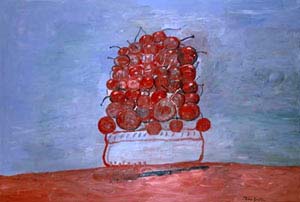
©Ashley Anderson
Philip Guston ‘Late Fall’, 1963, exhibition ‘Approaching American Abstraction’, SFMOMA, San Francisco, 2019
Taking photos of paintings can be challenging. First of all it is not allowed in all museums, and because of the angle you take the photo distortion comes into play.
These next photos are taken in Stedelijk Museum Amsterdam, The Netherlands.
Painting, Smoking, Eating - Philip Guston (1973)
Taken by: Emiel Dekker (emield.myportfolio.com/)
Philip Guston (1913-1980) oil on canvas at the Metropolitan Museum of Art in New York. Written near the painting: At Guston's 1970 exhibition at New York's Marlborough Gallery, many who admired his elegant abstractions were shocked to discover a return to the representational imagery he had abandoned two decades earlier. Bare light bulbs, trashcans, old shoes, and other detritus of a seemingly apocalyptic word—painted in a cartoonlike style on a grand scale—now populated his canvases. As Guston put it, "I got sick and tired of all that Purity! I wanted to tell stories.” For the rest of the decade his works incorporated elusive narratives of a country embroiled in a devastating war and of painful struggles at home, alternating with solitary figures like this one—an anxious smoker, often interpreted as a self-portrait, lying awake while the clock ticks away the small hours.
Week 4 Musical Interlude (3) (1016 – 1020)10/20 – 10/24/2019 ID 1016
Philip Guston American, 1913-1980
Performers , 1947
Oil on Canvas
Guston devoted much of his career to exploring the relationship between abstraction and the human form. Throughout the 1930s and 1940s, the artist often painted groups of moody figures, mostly children, engaged in activities—tense street skirmishes, public performances—that he saw as parallel to experiences and events in the contemporary adult world. Showing a group of young musicians, The Performers is evocative of medieval European art, with the figures pressed to the front of the composition, filling the picture completely. Soon after painting The Performers, Guston adopted an even more abstract style.
Arthur Hoppock Hearn Fund, 1950 (50.32)
From the Placard: The Metropolitan Museum of Art, New York, NY
en.wikipedia.org/wiki/Philip_Guston
Philip Guston (American, born Canada 1913-1980)
Evidence (1980), oil on canvas
San Francisco Museum of Modern Art, gift oif the artist
2019.
20190602_164237
Philip Guston ‘Brushes’, 1978, exhibition ‘Approaching American Abstraction’, SFMOMA, San Francisco, 2019
Philip Guston
Bombardment, 1937-38
Oil on canvas
Born in Montreal to Russian-Jewish parents, Philip Guston (1913-80) was raised in California but moved to New York in 1936 to work under the aegis of the Works Progress Administration. In the 1950s, he attained fame as an abstract expressionist and a member of the "New York School."
"No men ever entered the earth more honorably than those who died in Spain," wrote Ernest Hemingway in 1939. Between the years of 1936-1939, an estimated 1,000 Americans, many from New York, died fighting to protect the elected government of the Spanish Republic against a rebellion led by General Francisco Franco and backed by Hitler and Mussolini. On display at the Museum of the City of New York from March 23 - August 12, 2007, Facing Fascism: New York and the Spanish Civil War examines the role that New Yorkers played in the conflict, as well as the political and social ideologies that motivated them to participate in activities ranging from rallying support, fundraising, and relief aid, to fighting--and sometimes dying--on the front lines in Spain. The stories of these New Yorkers will be told through photographs, letters, uniforms, weapons, and an array of personal and historical memorabilia.
The Museum of the City of New York (MCNY), founded in 1923 to present the history of New York City and its people, fills an imposing 5-floor brick and limestone building on the Museum Mile section of Fifth Avenue, between 103rd and 104th Streets. The Museum was originally housed in Gracie Mansion until this Neo-Georgian-Colonial style was built to the design of Joseph J. Freedlander from 1928-1930. The museum's collections include paintings, drawings, prints, and photographs featuring New York City and its residents, as well as costumes, decorative objects and furniture, toys, rare books and manuscripts, marine and military collections, police and fire collections, and a theater collection.
From the NGA label: When Guston returned to painting on canvas after a year mostly away from it, he began reducing his palette to black and white. The new paintings were done rapidly to force himself to paint wet-into-wet, with black and white blending on the canvas with other colors to create a variety of grays. As he explained, "This form has to emerge, or grow, out of the working on it." Later, Guston associated works from this period with the golem, a humanlike being that, according to Jewish lore, was made from mud by a medieval rabbi and wielded great powers of both good and evil.
Link to other paintings from the exhibition "Philip Guston Now".