View allAll Photos Tagged Parable
Short Meaning:
Be aware of beauty in the world around you.
Not So Short Meaning:
There are these two young fish swimming along and they happen to meet an older fish swimming the other way, who nods at them and says "Morning, boys. How's the water?" And the two young fish swim on for a bit, and then eventually one of them looks over at the other and goes "What the hell is water?"
And If You Have 5 Minutes To Kill:
Transcription of the 2005 Kenyon Commencement Address By David Foster Wallace
- May 21, 2005
(If anybody feels like perspiring [cough], I'd advise you to go ahead, because I'm sure going to. In fact I'm gonna [mumbles while pulling up his gown and taking out a handkerchief from his pocket].) Greetings ["parents"?] and congratulations to Kenyon's graduating class of 2005. There are these two young fish swimming along and they happen to meet an older fish swimming the other way, who nods at them and says "Morning, boys. How's the water?" And the two young fish swim on for a bit, and then eventually one of them looks over at the other and goes "What the hell is water?"
This is a standard requirement of US commencement speeches, the deployment of didactic little parable-ish stories. The story ["thing"] turns out to be one of the better, less bullshitty conventions of the genre, but if you're worried that I plan to present myself here as the wise, older fish explaining what water is to you younger fish, please don't be. I am not the wise old fish. The point of the fish story is merely that the most obvious, important realities are often the ones that are hardest to see and talk about. Stated as an English sentence, of course, this is just a banal platitude, but the fact is that in the day to day trenches of adult existence, banal platitudes can have a life or death importance, or so I wish to suggest to you on this dry and lovely morning.
Of course the main requirement of speeches like this is that I'm supposed to talk about your liberal arts education's meaning, to try to explain why the degree you are about to receive has actual human value instead of just a material payoff. So let's talk about the single most pervasive cliché in the commencement speech genre, which is that a liberal arts education is not so much about filling you up with knowledge as it is about quote teaching you how to think. If you're like me as a student, you've never liked hearing this, and you tend to feel a bit insulted by the claim that you needed anybody to teach you how to think, since the fact that you even got admitted to a college this good seems like proof that you already know how to think. But I'm going to posit to you that the liberal arts cliché turns out not to be insulting at all, because the really significant education in thinking that we're supposed to get in a place like this isn't really about the capacity to think, but rather about the choice of what to think about. If your total freedom of choice regarding what to think about seems too obvious to waste time discussing, I'd ask you to think about fish and water, and to bracket for just a few minutes your skepticism about the value of the totally obvious.
Here's another didactic little story. There are these two guys sitting together in a bar in the remote Alaskan wilderness. One of the guys is religious, the other is an atheist, and the two are arguing about the existence of God with that special intensity that comes after about the fourth beer. And the atheist says: "Look, it's not like I don't have actual reasons for not believing in God. It's not like I haven't ever experimented with the whole God and prayer thing. Just last month I got caught away from the camp in that terrible blizzard, and I was totally lost and I couldn't see a thing, and it was fifty below, and so I tried it: I fell to my knees in the snow and cried out 'Oh, God, if there is a God, I'm lost in this blizzard, and I'm gonna die if you don't help me.'" And now, in the bar, the religious guy looks at the atheist all puzzled. "Well then you must believe now," he says, "After all, here you are, alive." The atheist just rolls his eyes. "No, man, all that was was a couple Eskimos happened to come wandering by and showed me the way back to camp."
It's easy to run this story through kind of a standard liberal arts analysis: the exact same experience can mean two totally different things to two different people, given those people's two different belief templates and two different ways of constructing meaning from experience. Because we prize tolerance and diversity of belief, nowhere in our liberal arts analysis do we want to claim that one guy's interpretation is true and the other guy's is false or bad. Which is fine, except we also never end up talking about just where these individual templates and beliefs come from. Meaning, where they come from INSIDE the two guys. As if a person's most basic orientation toward the world, and the meaning of his experience were somehow just hard-wired, like height or shoe-size; or automatically absorbed from the culture, like language. As if how we construct meaning were not actually a matter of personal, intentional choice. Plus, there's the whole matter of arrogance. The nonreligious guy is so totally certain in his dismissal of the possibility that the passing Eskimos had anything to do with his prayer for help. True, there are plenty of religious people who seem arrogant and certain of their own interpretations, too. They're probably even more repulsive than atheists, at least to most of us. But religious dogmatists' problem is exactly the same as the story's unbeliever: blind certainty, a close-mindedness that amounts to an imprisonment so total that the prisoner doesn't even know he's locked up.
The point here is that I think this is one part of what teaching me how to think is really supposed to mean. To be just a little less arrogant. To have just a little critical awareness about myself and my certainties. Because a huge percentage of the stuff that I tend to be automatically certain of is, it turns out, totally wrong and deluded. I have learned this the hard way, as I predict you graduates will, too.
Here is just one example of the total wrongness of something I tend to be automatically sure of: everything in my own immediate experience supports my deep belief that I am the absolute center of the universe; the realest, most vivid and important person in existence. We rarely think about this sort of natural, basic self-centeredness because it's so socially repulsive. But it's pretty much the same for all of us. It is our default setting, hard-wired into our boards at birth. Think about it: there is no experience you have had that you are not the absolute center of. The world as you experience it is there in front of YOU or behind YOU, to the left or right of YOU, on YOUR TV or YOUR monitor. And so on. Other people's thoughts and feelings have to be communicated to you somehow, but your own are so immediate, urgent, real.
Please don't worry that I'm getting ready to lecture you about compassion or other-directedness or all the so-called virtues. This is not a matter of virtue. It's a matter of my choosing to do the work of somehow altering or getting free of my natural, hard-wired default setting which is to be deeply and literally self-centered and to see and interpret everything through this lens of self. People who can adjust their natural default setting this way are often described as being "well-adjusted", which I suggest to you is not an accidental term.
Given the triumphant academic setting here, an obvious question is how much of this work of adjusting our default setting involves actual knowledge or intellect. This question gets very tricky. Probably the most dangerous thing about an academic education -- least in my own case -- is that it enables my tendency to over-intellectualize stuff, to get lost in abstract argument inside my head, instead of simply paying attention to what is going on right in front of me, paying attention to what is going on inside me.
As I'm sure you guys know by now, it is extremely difficult to stay alert and attentive, instead of getting hypnotized by the constant monologue inside your own head (may be happening right now). Twenty years after my own graduation, I have come gradually to understand that the liberal arts cliché about teaching you how to think is actually shorthand for a much deeper, more serious idea: learning how to think really means learning how to exercise some control over how and what you think. It means being conscious and aware enough to choose what you pay attention to and to choose how you construct meaning from experience. Because if you cannot exercise this kind of choice in adult life, you will be totally hosed. Think of the old cliché about quote the mind being an excellent servant but a terrible master.
This, like many clichés, so lame and unexciting on the surface, actually expresses a great and terrible truth. It is not the least bit coincidental that adults who commit suicide with firearms almost always shoot themselves in: the head. They shoot the terrible master. And the truth is that most of these suicides are actually dead long before they pull the trigger.
And I submit that this is what the real, no bullshit value of your liberal arts education is supposed to be about: how to keep from going through your comfortable, prosperous, respectable adult life dead, unconscious, a slave to your head and to your natural default setting of being uniquely, completely, imperially alone day in and day out. That may sound like hyperbole, or abstract nonsense. Let's get concrete. The plain fact is that you graduating seniors do not yet have any clue what "day in day out" really means. There happen to be whole, large parts of adult American life that nobody talks about in commencement speeches. One such part involves boredom, routine, and petty frustration. The parents and older folks here will know all too well what I'm talking about.
By way of example, let's say it's an average adult day, and you get up in the morning, go to your challenging, white-collar, college-graduate job, and you work hard for eight or ten hours, and at the end of the day you're tired and somewhat stressed and all you want is to go home and have a good supper and maybe unwind for an hour, and then hit the sack early because, of course, you have to get up the next day and do it all again. But then you remember there's no food at home. You haven't had time to shop this week because of your challenging job, and so now after work you have to get in your car and drive to the supermarket. It's the end of the work day and the traffic is apt to be: very bad. So getting to the store takes way longer than it should, and when you finally get there, the supermarket is very crowded, because of course it's the time of day when all the other people with jobs also try to squeeze in some grocery shopping. And the store is hideously lit and infused with soul-killing muzak or corporate pop and it's pretty much the last place you want to be but you can't just get in and quickly out; you have to wander all over the huge, over-lit store's confusing aisles to find the stuff you want and you have to maneuver your junky cart through all these other tired, hurried people with carts (et cetera, et cetera, cutting stuff out because this is a long ceremony) and eventually you get all your supper supplies, except now it turns out there aren't enough check-out lanes open even though it's the end-of-the-day rush. So the checkout line is incredibly long, which is stupid and infuriating. But you can't take your frustration out on the frantic lady working the register, who is overworked at a job whose daily tedium and meaninglessness surpasses the imagination of any of us here at a prestigious college.
But anyway, you finally get to the checkout line's front, and you pay for your food, and you get told to "Have a nice day" in a voice that is the absolute voice of death. Then you have to take your creepy, flimsy, plastic bags of groceries in your cart with the one crazy wheel that pulls maddeningly to the left, all the way out through the crowded, bumpy, littery parking lot, and then you have to drive all the way home through slow, heavy, SUV-intensive, rush-hour traffic, et cetera et cetera.
Everyone here has done this, of course. But it hasn't yet been part of you graduates' actual life routine, day after week after month after year.
But it will be. And many more dreary, annoying, seemingly meaningless routines besides. But that is not the point. The point is that petty, frustrating crap like this is exactly where the work of choosing is gonna come in. Because the traffic jams and crowded aisles and long checkout lines give me time to think, and if I don't make a conscious decision about how to think and what to pay attention to, I'm gonna be pissed and miserable every time I have to shop. Because my natural default setting is the certainty that situations like this are really all about me. About MY hungriness and MY fatigue and MY desire to just get home, and it's going to seem for all the world like everybody else is just in my way. And who are all these people in my way? And look at how repulsive most of them are, and how stupid and cow-like and dead-eyed and nonhuman they seem in the checkout line, or at how annoying and rude it is that people are talking loudly on cell phones in the middle of the line. And look at how deeply and personally unfair this is.
Or, of course, if I'm in a more socially conscious liberal arts form of my default setting, I can spend time in the end-of-the-day traffic being disgusted about all the huge, stupid, lane-blocking SUV's and Hummers and V-12 pickup trucks, burning their wasteful, selfish, forty-gallon tanks of gas, and I can dwell on the fact that the patriotic or religious bumper-stickers always seem to be on the biggest, most disgustingly selfish vehicles, driven by the ugliest [responding here to loud applause] (this is an example of how NOT to think, though) most disgustingly selfish vehicles, driven by the ugliest, most inconsiderate and aggressive drivers. And I can think about how our children's children will despise us for wasting all the future's fuel, and probably screwing up the climate, and how spoiled and stupid and selfish and disgusting we all are, and how modern consumer society just sucks, and so forth and so on.
You get the idea.
If I choose to think this way in a store and on the freeway, fine. Lots of us do. Except thinking this way tends to be so easy and automatic that it doesn't have to be a choice. It is my natural default setting. It's the automatic way that I experience the boring, frustrating, crowded parts of adult life when I'm operating on the automatic, unconscious belief that I am the center of the world, and that my immediate needs and feelings are what should determine the world's priorities.
The thing is that, of course, there are totally different ways to think about these kinds of situations. In this traffic, all these vehicles stopped and idling in my way, it's not impossible that some of these people in SUV's have been in horrible auto accidents in the past, and now find driving so terrifying that their therapist has all but ordered them to get a huge, heavy SUV so they can feel safe enough to drive. Or that the Hummer that just cut me off is maybe being driven by a father whose little child is hurt or sick in the seat next to him, and he's trying to get this kid to the hospital, and he's in a bigger, more legitimate hurry than I am: it is actually I who am in HIS way.
Or I can choose to force myself to consider the likelihood that everyone else in the supermarket's checkout line is just as bored and frustrated as I am, and that some of these people probably have harder, more tedious and painful lives than I do.
Again, please don't think that I'm giving you moral advice, or that I'm saying you are supposed to think this way, or that anyone expects you to just automatically do it. Because it's hard. It takes will and effort, and if you are like me, some days you won't be able to do it, or you just flat out won't want to.
But most days, if you're aware enough to give yourself a choice, you can choose to look differently at this fat, dead-eyed, over-made-up lady who just screamed at her kid in the checkout line. Maybe she's not usually like this. Maybe she's been up three straight nights holding the hand of a husband who is dying of bone cancer. Or maybe this very lady is the low-wage clerk at the motor vehicle department, who just yesterday helped your spouse resolve a horrific, infuriating, red-tape problem through some small act of bureaucratic kindness. Of course, none of this is likely, but it's also not impossible. It just depends what you what to consider. If you're automatically sure that you know what reality is, and you are operating on your default setting, then you, like me, probably won't consider possibilities that aren't annoying and miserable. But if you really learn how to pay attention, then you will know there are other options. It will actually be within your power to experience a crowded, hot, slow, consumer-hell type situation as not only meaningful, but sacred, on fire with the same force that made the stars: love, fellowship, the mystical oneness of all things deep down.
Not that that mystical stuff is necessarily true. The only thing that's capital-T True is that you get to decide how you're gonna try to see it.
This, I submit, is the freedom of a real education, of learning how to be well-adjusted. You get to consciously decide what has meaning and what doesn't. You get to decide what to worship.
Because here's something else that's weird but true: in the day-to day trenches of adult life, there is actually no such thing as atheism. There is no such thing as not worshipping. Everybody worships. The only choice we get is what to worship. And the compelling reason for maybe choosing some sort of god or spiritual-type thing to worship -- be it JC or Allah, bet it YHWH or the Wiccan Mother Goddess, or the Four Noble Truths, or some inviolable set of ethical principles -- is that pretty much anything else you worship will eat you alive. If you worship money and things, if they are where you tap real meaning in life, then you will never have enough, never feel you have enough. It's the truth. Worship your body and beauty and sexual allure and you will always feel ugly. And when time and age start showing, you will die a million deaths before they finally grieve you. On one level, we all know this stuff already. It's been codified as myths, proverbs, clichés, epigrams, parables; the skeleton of every great story. The whole trick is keeping the truth up front in daily consciousness.
Worship power, you will end up feeling weak and afraid, and you will need ever more power over others to numb you to your own fear. Worship your intellect, being seen as smart, you will end up feeling stupid, a fraud, always on the verge of being found out. But the insidious thing about these forms of worship is not that they're evil or sinful, it's that they're unconscious. They are default settings.
They're the kind of worship you just gradually slip into, day after day, getting more and more selective about what you see and how you measure value without ever being fully aware that that's what you're doing.
And the so-called real world will not discourage you from operating on your default settings, because the so-called real world of men and money and power hums merrily along in a pool of fear and anger and frustration and craving and worship of self. Our own present culture has harnessed these forces in ways that have yielded extraordinary wealth and comfort and personal freedom. The freedom all to be lords of our tiny skull-sized kingdoms, alone at the center of all creation. This kind of freedom has much to recommend it. But of course there are all different kinds of freedom, and the kind that is most precious you will not hear much talk about much in the great outside world of wanting and achieving and [unintelligible -- sounds like "displayal"]. The really important kind of freedom involves attention and awareness and discipline, and being able truly to care about other people and to sacrifice for them over and over in myriad petty, unsexy ways every day.
That is real freedom. That is being educated, and understanding how to think. The alternative is unconsciousness, the default setting, the rat race, the constant gnawing sense of having had, and lost, some infinite thing.
I know that this stuff probably doesn't sound fun and breezy or grandly inspirational the way a commencement speech is supposed to sound. What it is, as far as I can see, is the capital-T Truth, with a whole lot of rhetorical niceties stripped away. You are, of course, free to think of it whatever you wish. But please don't just dismiss it as just some finger-wagging Dr. Laura sermon. None of this stuff is really about morality or religion or dogma or big fancy questions of life after death.
The capital-T Truth is about life BEFORE death.
It is about the real value of a real education, which has almost nothing to do with knowledge, and everything to do with simple awareness; awareness of what is so real and essential, so hidden in plain sight all around us, all the time, that we have to keep reminding ourselves over and over:
"This is water."
"This is water."
It is unimaginably hard to do this, to stay conscious and alive in the adult world day in and day out. Which means yet another grand cliché turns out to be true: your education really IS the job of a lifetime. And it commences: now.
I wish you way more than luck.
- David Foster Wallace
“The love of one's country is a splendid thing. But why should love stop at the border?”
~Pablo Casals
"Alright, I've got a solution. This time to make sure we don't get lost, I've employed the help of the Stanley Parable Adventure Line™."
Carlton Arms (In Progress)
3 x 2.5 feet
My current body of work is an allegory about memory's power to hold us back or move us forward. The central character in this parable is a 6 x 10 foot linocut of an Everyman, who has lost it all and wanders the plains with all his belongings strapped to his back. He navigates a world in crisis by learning from his past. The remainder of the characters that he encounters are individuals lost in regret.
I have developed these paintings and prints during the American housing and credit crisis of the past year. In contemplating where we are and where we might be, I have found myself looking back at history, remembering the Great Depression, and considering what effects it had on the American psyche. The uncertainty that existed then is present now, and I am addressing the kind of escapism through nostalgia that can occur in the midst of calamity. Every character that the Everyman sees is gripped by this need to escape their present circumstance. They are people lost in a memory at the very point when they should be paying attention to what lies ahead.
Many different artists have inspired the flavor of this world including the photography of Walker Evans, the films of the Cohen brothers, the music of Tom Waits and the theatre of Robert Wilson.
Parable of the Ten Bridesmaids
“Then the Kingdom of Heaven will be like ten bridesmaids who took their lamps and went to meet the bridegroom. Five of them were foolish, and five were wise. The five who were foolish didn’t take enough olive oil for their lamps, but the other five were wise enough to take along extra oil. When the bridegroom was delayed, they all became drowsy and fell asleep.
“At midnight they were roused by the shout, ‘Look, the bridegroom is coming! Come out and meet him!’
“All the bridesmaids got up and prepared their lamps. Then the five foolish ones asked the others, ‘Please give us some of your oil because our lamps are going out.’
“But the others replied, ‘We don’t have enough for all of us. Go to a shop and buy some for yourselves.’
“But while they were gone to buy oil, the bridegroom came. Then those who were ready went in with him to the marriage feast, and the door was locked. Later, when the other five bridesmaids returned, they stood outside, calling, ‘Lord! Lord! Open the door for us!’
“But he called back, ‘Believe me, I don’t know you!’
“So you, too, must keep watch! For you do not know the day or hour of my return.
[Matthew 25:1-13 NLT]
5 THINGS YOU SHOULD KNOW:
1. Like it or not, we are ALL sinners: As the Scriptures say, “No one is righteous—not even one. No one is truly wise; no one is seeking God. All have turned away; all have become useless. No one does good, not a single one.” (Romans 3:10-12 NLT)
2. The punishment for sin is death: When Adam sinned, sin entered the world. Adam’s sin brought death, so death spread to everyone, for everyone sinned. (Romans 5:12 NLT)
3. Jesus is our only hope: But God showed his great love for us by sending Christ to die for us while we were still sinners. (Romans 5:8 NLT) For the wages of sin is death, but the free gift of God is eternal life through Christ Jesus our Lord. (Romans 6:23 NLT)
4. SALVATION is by GRACE through FAITH in JESUS: God saved you by his grace when you believed. And you can’t take credit for this; it is a gift from God. Salvation is not a reward for the good things we have done, so none of us can boast about it. For we are God’s masterpiece. He has created us anew in Christ Jesus, so we can do the good things he planned for us long ago. (Ephesians 2:8-10 NLT)
5. Accept Jesus and receive eternal life: If you openly declare that Jesus is Lord and believe in your heart that God raised him from the dead, you will be saved. (Romans 10:9 NLT) But to all who believed him and accepted him, he gave the right to become children of God. (John 1:12 NLT) And this is what God has testified: He has given us eternal life, and this life is in his Son. Whoever has the Son has life; whoever does not have God’s Son does not have life. (1 John 5:11-12 NLT)
Read the Bible for yourself. Allow the Lord to speak to you through his Word. YOUR ETERNITY IS AT STAKE!
"The tax collectors and the sinners were all seeking the company of Jesus to hear what he had to say, and the Pharisees and the scribes complained. ‘This man’ they said ‘welcomes sinners and eats with them.’ So he spoke this parable to them:
‘A man had two sons. The younger said to his father, “Father, let me have the share of the estate that would come to me.” So the father divided the property between them. A few days later, the younger son got together everything he had and left for a distant country where he squandered his money on a life of debauchery.
‘When he had spent it all, that country experienced a severe famine, and now he began to feel the pinch, so he hired himself out to one of the local inhabitants who put him on his farm to feed the pigs. And he would willingly have filled his belly with the husks the pigs were eating but no one offered him anything. Then he came to his senses and said, “How many of my father’s paid servants have more food than they want, and here am I dying of hunger! I will leave this place and go to my father and say: Father, I have sinned against heaven and against you; I no longer deserve to be called your son; treat me as one of your paid servants.” So he left the place and went back to his father.
‘While he was still a long way off, his father saw him and was moved with pity. He ran to the boy, clasped him in his arms and kissed him tenderly. Then his son said, “Father, I have sinned against heaven and against you. I no longer deserve to be called your son.” But the father said to his servants, “Quick! Bring out the best robe and put it on him; put a ring on his finger and sandals on his feet. Bring the calf we have been fattening, and kill it; we are going to have a feast, a celebration, because this son of mine was dead and has come back to life; he was lost and is found.” And they began to celebrate.
‘Now the elder son was out in the fields, and on his way back, as he drew near the house, he could hear music and dancing. Calling one of the servants he asked what it was all about. “Your brother has come” replied the servant “and your father has killed the calf we had fattened because he has got him back safe and sound.” He was angry then and refused to go in, and his father came out to plead with him; but he answered his father, “Look, all these years I have slaved for you and never once disobeyed your orders, yet you never offered me so much as a kid for me to celebrate with my friends. But, for this son of yours, when he comes back after swallowing up your property – he and his women – you kill the calf we had been fattening.”
‘The father said, “My son, you are with me always and all I have is yours. But it was only right we should celebrate and rejoice, because your brother here was dead and has come to life; he was lost and is found.”’"
– Luke 15:1-3,11-32, which is today's Gospel at Mass (4th Sunday in Lent).
Stained glass of the Prodigal Son from Lille Cathedral.
Igor is paying attention!
I am SO glad I read these apocalyptic novels by Octavia Butler....there are many parallels to our current political and economic realities...Read them!!!!
.
Street Photography, Jungle Style.
Photo No# 2 of 2.
10 kilos of kibble has been delivered to the Head Monk.
More kibble will be delivered to the nuns in a couple days.
Right behind me is the cave you have often seen full of
monkeys and golden statues. This is The Leroy Crews Turf
where all The Hooligans live.This is also where the tourists
come and interact with the naughty monkeys.
Today I'm going to do my best to re-tell a story that was
told to me 20+ years ago by a Thai Monk living in America.
Two monks, one young the other older set out from a temple
located in the lower plains to a special temple high in the
mountains.The trip will be quite long and daunting with many
dangerous and difficult obstacles along the way.
The temple on top of the mountain was special due to housing
a shrine of The Lord Buddha, think of it as a pilgrimage for the
younger monk.
During their journey they came to a wide stream with swift
moving water. Not to deep, maybe no more then up to their
knees but still the current made it treacherous just the same.
When they had finished rolling their robes up and preparing
to step into the water a beautiful young woman appeared and
begged them to help her cross the wide body of water.
Mindful of his vow to have no physical contact with women the
younger monk stubbornly refused any help at all !
The older monk however hoisted the young woman up onto
his back and with obvious enjoyment carried her to the other side
of the fast moving water. Once there she humbly thanked
him and was soon on her way down the trail.
The younger monk and older monk did the same continuing
their journey up a centuries old path towards the ancient temple situated high in the mountains.
The younger monk however was in a dark mood filled with
black humor and disdainful contempt .
Finally he couldn't contain himself any longer and demanded
to know why, in defiance of all propriety, his older companion
had carried the young woman on his back ? !
To which the older monk replied:
"But my dear brother, what is the difference between us ?
As you have been carrying her ever since we left the river."
A Zen parable meant for self reflection, hope you enjoyed ..;-)
Thank You.
Jon&Crew.
Please help with your temple dog donations here.
www.gofundme.com/f/help-for-abandoned-thai-temple-dogs
Please,
No Awards, Invites, Large Logos or Copy an Pastes.
.
Orval Abbey – l’Abbaye Notre-Dame d’Orval – in southern Belgium has been a Cistercian monastery since 1132. It’s still a thriving community, not to say tourist attraction, and it’s also embracing ancient and modern to good effect.
This, for example, is one of a group of modern sculptures in the historic grounds. Entitled ‘Entraide’ (in English ‘Help’; in Dutch ‘Hulpbetoon’), it’s by the Belgian sculptor Camille Colruyt (1908-65), and was inspired by the parable of the good Samaritan. The sculpture fits astonishingly well against its ancient backdrop.
NekTar consoles Omni in his distress over everything else
My friend Ed, a poet, shared with me a little parable he wrote for his sons when they were young. It concerned the wonders that arose from an unlikely friendship between a field mouse and a disfigured purple pumpkin with boundless empathy.
I have tried to capture the spirit of them in a couple of illustrations. His story didn't need them, but I needed to try.
"Then he told them a parable: ‘There was once a rich man who, having had a good harvest from his land, thought to himself, “What am I to do? I have not enough room to store my crops.” Then he said, “This is what I will do: I will pull down my barns and build bigger ones, and store all my grain and my goods in them, and I will say to my soul: My soul, you have plenty of good things laid by for many years to come; take things easy, eat, drink, have a good time.” But God said to him, “Fool! This very night the demand will be made for your soul; and this hoard of yours, whose will it be then?” So it is when a man stores up treasure for himself in place of making himself rich in the sight of God.’"
– Luke 12:16-21, which is part of today's Gospel at Mass.
Stained glass detail from the Sainte Chapelle in Paris.
"We’re all familiar with the parable of the Good Samaritan, and the moral of the story is obvious. “Go, and do the same yourself” – Go, and care for those in need, including your enemy. Love your neighbour. But the other half of that famous injunction is that we should love God. And as St John says, we can love God because He has first loved us. So, the Fathers interpreted this Gospel in a Christological way. They noted that we, fallen humanity, are the ones attacked by sin and the Devil, and left to die, deprived of sanctifying grace. And God, in his compassion, comes to us; He who is the Traveller, Jesus Christ the Son. It is Christ who heals the wound of original sin with oil – the sacred chrism with which we’re anointed at baptism. And Christ also heals our soul with the new wine of his Eucharist, a wine that fills us with joy. So by these sacraments of initiation we are restored to grace, and friendship with God. Thus Christ then lifts us up, so setting us on a par with him. So initiated, we are then carried into Christ’s inn of healing, which is the Church. For she, our holy Mother the Church is a refuge for sinners, a hospital for the wounded, a resting place for the weary. As God has shown us such mercy and love, so are we strengthened by grace to love Him with all our heart, and so, to be merciful and loving to our neighbour."
Stained glass of today's Gospel from Old St Paul's church in Baltimore.
Protagonist Parable.
Syllogisme Determinativeness individus structurés debout contre,
Gleichgültigkeit vertreten Arten definieren Gänge Existenz,
realiter in verbis ambiguitatem rationes sacrificiorum,
проникнутые линеаменты неформованные конкретные формы плавления обстоятельства,
ταυτότητας διαλεκτική φυγής αισθήσεις προηγουμένως επουσιώδης απλότητα γραπτή,
عمليات المثقفين توبيخ لأوامر غير مخلوق الحقائق كافية أعرف,
goruchwyliaeth illumined darganfod canfyddiadau gwybodaeth gasgliadau supervenes,
argumenty naturalne wyjaśnienia wielu posiadłości zobaczyć liczne obiekty essence,
spesso implorando di giudizio filosofi distruggendo articoli di corruzione duro,
defekte eksempler acweþan ulike samsvars anført mangel uforanderlige prinsipper holdt,
Касапа приказом маске чудне вештачки утицаји утичу обновљених тема,
fascinates chatalóg saibhreas inspioráid atmaisféar grafach Primeval fondúireachtaí climaxing,
ylläpitäminen luennoi ulotteinen rajoituksia taiteellinen läpinäkyvä svengaava cubist katselua,
megrovása üzenetek lázadó ellenség megjelenését kéri az emésztést zavarba,
愚行は安いサソリの夜に言いようのない苦痛を与え.
Steve.D.Hammond.
Matthew 13:24-43
24 Another parable put he [Jesus] forth unto them, saying, The kingdom of heaven is likened unto a man which sowed good seed in his field: 25 But while men slept, his enemy came and sowed tares among the wheat, and went his way. 26 But when the blade was sprung up, and brought forth fruit, then appeared the tares also. 27 So the servants of the householder came and said unto him, Sir, didst not thou sow good seed in thy field? from whence then hath it tares? 28 He said unto them, An enemy hath done this. The servants said unto him, Wilt thou then that we go and gather them up? 29 But he said, Nay; lest while ye gather up the tares, ye root up also the wheat with them. 30 Let both grow together until the harvest: and in the time of harvest I will say to the reapers, Gather ye together first the tares, and bind them in bundles to burn them: but gather the wheat into my barn. 31 Another parable put he forth unto them, saying, The kingdom of heaven is like to a grain of mustard seed, which a man took, and sowed in his field: 32 Which indeed is the least of all seeds: but when it is grown, it is the greatest among herbs, and becometh a tree, so that the birds of the air come and lodge in the branches thereof. 33 Another parable spake he unto them; The kingdom of heaven is like unto leaven, which a woman took, and hid in three measures F28 of meal, till the whole was leavened. 34 All these things spake Jesus unto the multitude in parables; and without a parable spake he not unto them: 35 That it might be fulfilled which was spoken by the prophet, saying, I will open my mouth in parables; I will utter things which have been kept secret from the foundation of the world. 36 Then Jesus sent the multitude away, and went into the house: and his disciples came unto him, saying, Declare unto us the parable of the tares of the field. 37 He answered and said unto them, He that soweth the good seed is the Son of man; 38 The field is the world; the good seed are the children of the kingdom; but the tares are the children of the wicked one; 39 The enemy that sowed them is the devil; the harvest is the end of the world; and the reapers are the angels. 40 As therefore the tares are gathered and burned in the fire; so shall it be in the end of this world. 41 The Son of man shall send forth his angels, and they shall gather out of his kingdom all things F29 that offend, and them which do iniquity; 42 And shall cast them into a furnace of fire: there shall be wailing and gnashing of teeth. 43 Then shall the righteous shine forth as the sun in the kingdom of their Father. Who hath ears to hear, let him hear.
--------------------------------------------------------------------------------
FOOTNOTES:
F28: measures: the word in the Greek is a measure containing about a peck and a half, wanting a little more than a pint
F29: things...: or, scandals
I like the contrast of this because of the rocky soil below. It reminded me of the parable of the seed and the soil. What kind of ground do I provide for the seed? Will I be able to produce fruit?
"‘While he was still a long way off, his father saw him and was moved with pity. He ran to the boy, clasped him in his arms and kissed him tenderly. Then his son said, “Father, I have sinned against heaven and against you. I no longer deserve to be called your son.” But the father said to his servants, “Quick! Bring out the best robe and put it on him; put a ring on his finger and sandals on his feet. Bring the calf we have been fattening, and kill it; we are going to have a feast, a celebration, because this son of mine was dead and has come back to life; he was lost and is found.” And they began to celebrate." – Luke 15:20-24, which is part of today's Gospel.
Roundel from the Cloisters Museum in New York City.
Lunchtime in the bookshop: food for the body, food for the mind.Revisiting Parable of the Sower by the late, great Octavia Butler (an author I've recommended to so many book browers) in preparation for an online book group I was chairing at the recent third Cymera Festival, a literary science fiction, fantasy and horror festival we started in 2019 in Edinburgh.
Read this years ago, interesting to revisit it: published in the early 90s, the future date it is set in is 2024 onwards, and of course that is rather closer now than when it first came out, while the story and setting is scarily more appropriate now than it was when first written... Quick "still life with book" snapped with the phone on my lunch break.
This reminded me of the parable in the gospel of Matthew about the sower and the seed.Jesus explained that the seed that feel on rocky solid quickly sprouted and grew but since the soil was shallow it quickly withered. Lord let my heart be fertile for your word to take root and grow.
As the wise rabbi in the parable taught his students: until “you can look into the face of another human being and you have enough light in you to recognize your brother or your sister . . . it is night, and darkness is still with us.”...
...Someone once said that “community is the place where the person you least want to live with always lives.” That person who annoys you or who needs too much is always in your community somewhere.
-Spiritual Direction, Henri J. M. Nouwen
My people, hear my teaching;
listen to the words of my mouth.
I will open my mouth with a parable;
I will utter hidden things, things from of old—
things we have heard and known,
things our ancestors have told us.
We will not hide them from their descendants;
we will tell the next generation
the praiseworthy deeds of the Lord,
his power, and the wonders he has done.
[Psalm 78:1-4 NIV]
5 THINGS YOU SHOULD KNOW:
1. Like it or not, we are ALL sinners: As the Scriptures say, “No one is righteous—not even one. No one is truly wise; no one is seeking God. All have turned away; all have become useless. No one does good, not a single one.” (Romans 3:10-12 NLT)
2. The punishment for sin is death: When Adam sinned, sin entered the world. Adam’s sin brought death, so death spread to everyone, for everyone sinned. (Romans 5:12 NLT)
3. Jesus is our only hope: But God showed his great love for us by sending Christ to die for us while we were still sinners. (Romans 5:8 NLT) For the wages of sin is death, but the free gift of God is eternal life through Christ Jesus our Lord. (Romans 6:23 NLT)
4. SALVATION is by GRACE through FAITH in JESUS: God saved you by his grace when you believed. And you can’t take credit for this; it is a gift from God. Salvation is not a reward for the good things we have done, so none of us can boast about it. For we are God’s masterpiece. He has created us anew in Christ Jesus, so we can do the good things he planned for us long ago. (Ephesians 2:8-10 NLT)
5. Accept Jesus and receive eternal life: If you openly declare that Jesus is Lord and believe in your heart that God raised him from the dead, you will be saved. (Romans 10:9 NLT) But to all who believed him and accepted him, he gave the right to become children of God. (John 1:12 NLT) And this is what God has testified: He has given us eternal life, and this life is in his Son. Whoever has the Son has life; whoever does not have God’s Son does not have life. (1 John 5:11-12 NLT)
Read the Bible for yourself. Allow the Lord to speak to you through his Word. YOUR ETERNITY IS AT STAKE!
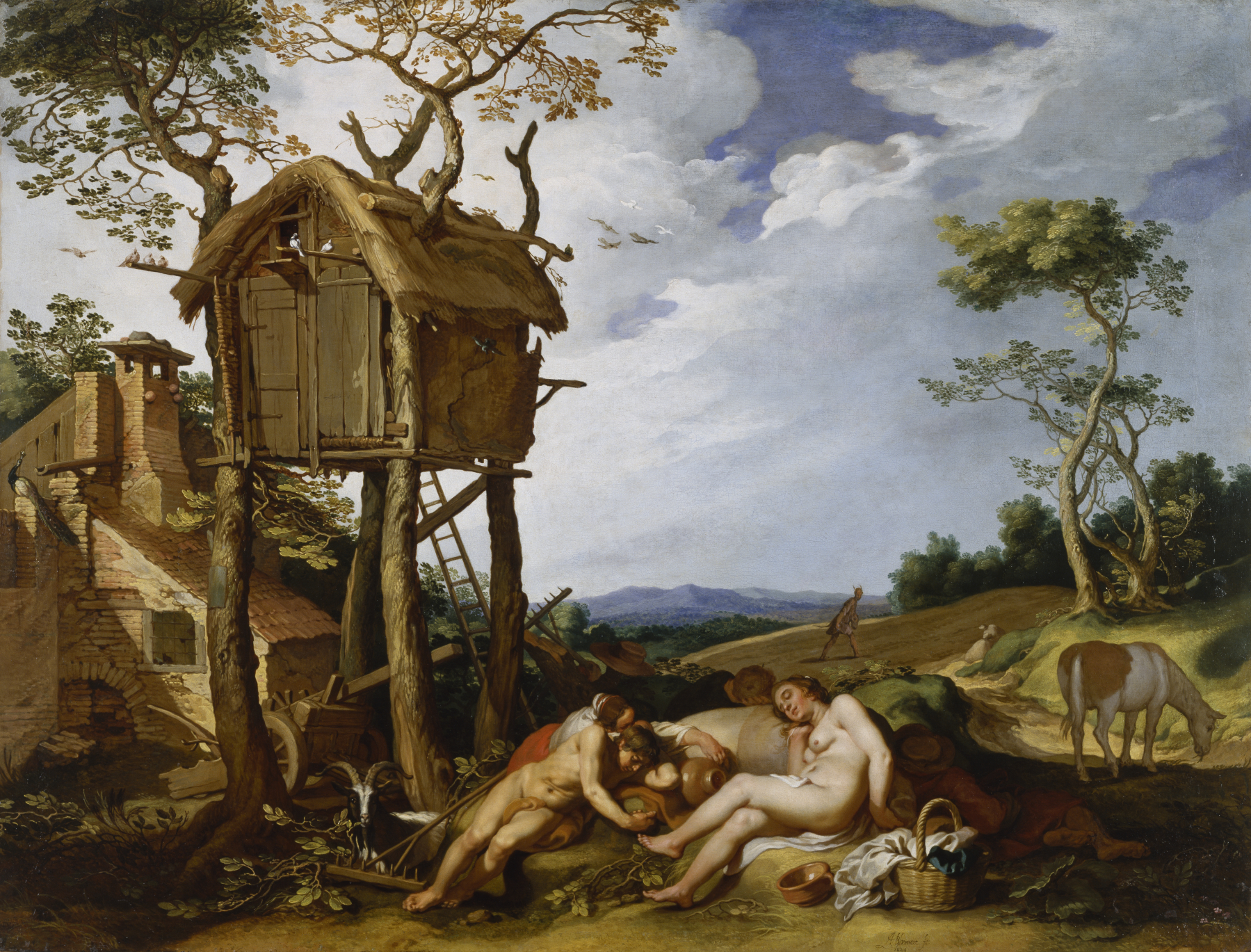
inspiration: upload.wikimedia.org/wikipedia/commons/c/c9/Abraham_Bloem...
I am SO SORRY! I totally forgot the due date for the last theme X_X I've been really busy, but trust me,from now on I will try my hardest to get all my photos in on time!
the 7 deadly sin I chose was "sloth" :D I really like how my pic turned out! hope you like it!
Parable of the Ten Bridesmaids
"Then the Kingdom of Heaven will be like ten bridesmaids who took their lamps and went to meet the bridegroom. Five of them were foolish, and five were wise. The five who were foolish didn’t take enough olive oil for their lamps, but the other five were wise enough to take along extra oil. When the bridegroom was delayed, they all became drowsy and fell asleep.
“At midnight they were roused by the shout, ‘Look, the bridegroom is coming! Come out and meet him!’
“All the bridesmaids got up and prepared their lamps. Then the five foolish ones asked the others, ‘Please give us some of your oil because our lamps are going out.’
“But the others replied, ‘We don’t have enough for all of us. Go to a shop and buy some for yourselves.’
"But while they were gone to buy oil, the bridegroom came. Then those who were ready went in with him to the marriage feast, and the door was locked. Later, when the other five bridesmaids returned, they stood outside, calling, ‘Lord! Lord! Open the door for us!’
“But he called back, ‘Believe me, I don’t know you!’
“So you, too, must keep watch! For you do not know the day or hour of my return.
[Matthew 25:1-13 NLT]
5 THINGS YOU SHOULD KNOW:
1. Like it or not, we are ALL sinners: As the Scriptures say, “No one is righteous—not even one. No one is truly wise; no one is seeking God. All have turned away; all have become useless. No one does good, not a single one.” (Romans 3:10-12 NLT)
2. The punishment for sin is death: When Adam sinned, sin entered the world. Adam’s sin brought death, so death spread to everyone, for everyone sinned. (Romans 5:12 NLT)
3. Jesus is our only hope: But God showed his great love for us by sending Christ to die for us while we were still sinners. (Romans 5:8 NLT) For the wages of sin is death, but the free gift of God is eternal life through Christ Jesus our Lord. (Romans 6:23 NLT)
4. SALVATION is by GRACE through FAITH in JESUS: God saved you by his grace when you believed. And you can’t take credit for this; it is a gift from God. Salvation is not a reward for the good things we have done, so none of us can boast about it. For we are God’s masterpiece. He has created us anew in Christ Jesus, so we can do the good things he planned for us long ago. (Ephesians 2:8-10 NLT)
5. Accept Jesus and receive eternal life: If you openly declare that Jesus is Lord and believe in your heart that God raised him from the dead, you will be saved. (Romans 10:9 NLT) But to all who believed him and accepted him, he gave the right to become children of God. (John 1:12 NLT) And this is what God has testified: He has given us eternal life, and this life is in his Son. Whoever has the Son has life; whoever does not have God’s Son does not have life. (1 John 5:11-12 NLT)
Read the Bible for yourself. Allow the Lord to speak to you through his Word. YOUR ETERNITY IS AT STAKE!
Google No Evil - Stream No Evil - eMail No Evil
The We are Here challenge on January 6 2015 was: Three Wise Monkeys
Lighting: 1 YN-560-III 1/8 right, 1 SB600 1/8 left, wireless triggers.
"‘While he was still a long way off, his father saw him and was moved with pity. He ran to the boy, clasped him in his arms and kissed him tenderly. Then his son said, “Father, I have sinned against heaven and against you. I no longer deserve to be called your son.” But the father said to his servants, “Quick! Bring out the best robe and put it on him; put a ring on his finger and sandals on his feet. Bring the calf we have been fattening, and kill it; we are going to have a feast, a celebration, because this son of mine was dead and has come back to life; he was lost and is found.” And they began to celebrate.
‘Now the elder son was out in the fields, and on his way back, as he drew near the house, he could hear music and dancing. Calling one of the servants he asked what it was all about. “Your brother has come” replied the servant “and your father has killed the calf we had fattened because he has got him back safe and sound.” He was angry then and refused to go in, and his father came out to plead with him; but he answered his father, “Look, all these years I have slaved for you and never once disobeyed your orders, yet you never offered me so much as a kid for me to celebrate with my friends. But, for this son of yours, when he comes back after swallowing up your property – he and his women – you kill the calf we had been fattening.”
‘The father said, “My son, you are with me always and all I have is yours. But it was only right we should celebrate and rejoice, because your brother here was dead and has come to life; he was lost and is found.”
– Luke 15:20-32, which is part of today's Gospel at Mass.
Stained glass window from St Vincent's Archabbey in Latrobe.
Pompeo Girolamo Batoni, 1708 Lucca - 1787 Rom
Das Gleichnis vom verlorenen Sohn oder Die Rückkehr des verlorenen Sohns / The Parable of the Prodigal Son aka The Return of the Prodigal Son (1773)
Kunsthistorisches Museum, Wien
The Italian painter Pompeo Girolamo Batoni displayed a solid technical knowledge in his portrait work and in his numerous allegorical and mythological pictures. The high number of foreign visitors travelling throughout Italy and reaching Rome during their Grand Tour, made the artist specialized in portraits.
28x22 in.
Oil, oil stick, oil pastel on posterboard
To purchase original please contact ajeffries101958@yahoo.com
Prints, etc. are available at www.redbubble.com/people/atj1958 and www.artslant.com/global/artists/show/52481-alan-taylor-je...
Thanks for taking the time to look at my work.
Scandalous Dining
We typically fill our parties with people similar to ourselves. We invite into our homes those we work with, play with, or otherwise have something in common with. We celebrate with fellow graduates, entertain people from our neighborhoods, and open our doors to four year-olds when our own is turning four. Psychologists concur: we socialize with those in our circles because we have some ring of similarity that connects us.
The man in the parable of the great banquet is no different. The story is told in Luke chapter 14 of an affluent master of ceremonies who had invited a great number of people like himself to a meal. The list was likely distinguished; the guests were no doubt as prosperous socially as they were financially. Jesus sets the story at a critical time for all involved. The invitations had long been sent out and accepted. Places were now set; the table was now prepared. All was ready. Accordingly, the owner of the house sent his servant to bring in the guests. But none would come.
Anthropologists characterize the culture of Jesus’s day as an “honor/shame” society, where one’s quality of life was directly affected by the amount of honor or shame socially attributed to him or her. The public eye was paramount; every interaction either furthered or diminished one’s standing, honor, and regard in the eyes of the world.
Thus, in this parable, the master of the banquet had just been deliberately and publicly shamed. He was pushed to the margins of society and treated with the force of contempt. Hearers of this parable would have been waiting with baited breath to hear how this man would attempt to reclaim his honor. But scandalously, in fact, the master of the feast did not attempt to reverse his public shame. Altogether curiously, he embraced it.
Turning to the slave, the owner of the house appointed the servant with a new task: “Go out quickly into the streets and lanes of the city, and the poor and maimed and lame and blind bring in here.”(1) Returning, the servant reported, “Lord it has all occurred as you ordered, and still there is room.” So the owner of the house responded again, “Go out into the waves and hedges and compel them to come in, that my house may be filled.”
The slave is told to do what he must to compel the masses to come, liberating the blind, the lame, and the excluded of their social status and stigma with an invitation to dine with none other than the master. It is a staggering portrayal of a God who is shamed by the rejection of his people, and yet continues to respond with lavish grace and scandalous invitation into his presence. The owner of the house has opened wide the doors. The feast is ready—and there is yet room.
The longing to belong in the right circles is a desire that touches us all. Even so, one only has to watch a group of kids on playground to see how easily our desire to belong is corrupted by our need to exclude: the inner circle is not inner if there are no outsiders. Lines of honor and shame are futile if the majority is not on the wrong side. But in this story, God scandalously breaks these lines of demarcation and stratification. The Father forever challenges the notion that his house will be filled only with the rich or the righteous or those without shame.
The banquet is ready and there is a call to fill the house with the lost and unworthy, the homeless, the blind, the outsiders and the out-of-place. The invitation Jesus presents is wide enough to scour the darkest of hedges and the depths of the city streets. Whether we find ourselves outside of the circle because we have rejected him or at the table communing with his guests, it is a thought to digest: the kingdom of God is like a great banquet. God’s compulsion is our nourishment. The feast is ready and there is still room.
Jill Carattini is managing editor of A Slice of Infinity at Ravi Zacharias International Ministries in Atlanta, Georgia.
A resident at the retirement community where I work loaned me a book that he promised I would like. The title is, "The Parable of the Tares in Twenty-One Sermons."
A quick Google search revealed that the original manuscripts were once again printed in 2018. But, the title page of the one in my possession indicates that it was printed in 1771.
Before reading any of it, I gave my macro lens a feast. More photos to come.
"Jesus told this parable to his disciples: ‘The kingdom of heaven will be like this: Ten bridesmaids took their lamps and went to meet the bridegroom. Five of them were foolish and five were sensible: the foolish ones did take their lamps, but they brought no oil, whereas the sensible ones took flasks of oil as well as their lamps. The bridegroom was late, and they all grew drowsy and fell asleep. But at midnight there was a cry, “The bridegroom is here! Go out and meet him.” At this, all those bridesmaids woke up and trimmed their lamps, and the foolish ones said to the sensible ones, “Give us some of your oil: our lamps are going out.” But they replied, “There may not be enough for us and for you; you had better go to those who sell it and buy some for yourselves.” They had gone off to buy it when the bridegroom arrived. Those who were ready went in with him to the wedding hall and the door was closed. The other bridesmaids arrived later. “Lord, Lord,” they said “open the door for us.” But he replied, “I tell you solemnly, I do not know you.” So stay awake, because you do not know either the day or the hour.’"
– Matthew 25:1-13, which is today's Gospel.
My sermon for today can be read here.
Stained glass window from the National Cathedral in Washington DC.
Welcome to the Irrlicht Engine
The Irrlicht Engine is an open source realtime 3D engine written in C++. It is cross-platform, using D3D, OpenGL and its own software renderers. OpenGL-ES2 and WebGL renderers are also in development. It is a stable library which has been worked on for nearly 2 decades. We've got a huge community and Irrlicht is used by hobbyists and professional companies alike. You can find enhancements for it all over the web, like alternative terrain renderers, portal renderers, exporters, world layers, tutorials, editors, language bindings and so on. And best of all: It's completely free.
Irrlichtelieren (Will-o’-the-wisping-around)
Jane K. Brown
UNIVERSITY OF WASHINGTON
The lexeme Irrlichtelieren (will-o’-the-wisping-around, i.e. thinking outside the box) is Goethe’s neologism for a heterodox line of thought that displaces traditional methods of philosophy and science. Although the term occurs only once, in the student scene of Faust, Part One (FA 1.7:83.1917), the shifting value of will-o’-the-wisps in Faust and other works corresponds to the theories of scientific method Goethe advanced in essays of the 1790s and especially to the methodology of his Zur Farbenlehre (Theory of Color) of 1810. While in Goethe’s letters and in the devil’s language in Faust, will-o’-the-wisps betoken illusion, they develop in the course of Faust into symbols of the ineffable truth that Kantian metaphysics had effectively substituted for God. The ironic dialectic of the will-o’-the-wisps shapes Goethe’s views of pedagogy and scientific epistemology and his positions on the idealist subject/object dichotomy, on the relationships of nature and truth, on representation and knowledge, and on knowledge and community.
Introduction
Etymological Implications
Learning as Flitting Around
Subject-Object Relations
The Relationship of Nature and Truth
Representation as Knowledge
Knowledge and Community
Notes
Related Entries
Works Cited and Further Reading
Introduction
The neologism irrlichtelieren can be defined as: “An innovative and eccentric line of thought, [. . .] a lexical innovation [. . .] that configures the ‘improper’ imperative of Goethean thought [. . .] to displace the ‘proper’ way of doing philosophy (including logic, rationalist metaphysics, and transcendental idealism) by repurposing its traditional instruments of torture.”1 Goethe invented the word and used it only once, in the student scene of Faust I. Derived from the noun Irrlicht (will-o’-the-wisp, or ignis fatuus), it initially identifies the confused thinking of the student who has yet to learn logic,
Daß er bedächtiger so fortan
Hinschleiche die Gedankenbahn,
Und nicht etwa, die Kreuz und Quer,
Irrlichteliere hin und her. (FA 1.7:83.1914–17)2
So that he creep more circumspectly
along the train of thought
and not go will-o’-the-wisping
back and forth and here and there.
However, the use of will-o’-the-wisp in Faust transforms this apparent praise of logic into its opposite, so that “will-o’-the-wisping back and forth” comes to represent the epistemology actually promoted not only in Faust but also in Goethe’s essays on scientific methodology and optics from the 1790s and in his massive Zur Farbenlehre (Theory of Colors) of 1810. Derived from irren (erring), the central theme of Faust, where the Lord says “Es irrt der Mensch, so lang er strebt” (FA 1.7:27.317; man errs as long as he strives) and Licht (light), used consistently as an image for knowledge or truth in Goethe, as so often in the period, irrlichtelieren becomes a useful term for Goethe’s process of learning truth by trial and error. It engages a series of epistemological issues typical of the period: thinking outside the box, subject/object, the relation of nature and truth, the role of representation in knowledge, and the epistemology of community formation. Irrlichtelieren not only exemplifies Goethe’s tendency to heuristic rather than systematic thought (unlike that of his Romantic colleagues), but indeed embodies its own meaning—for will-o’-the-wisps and similar figures appear as characters in his (arguably) most characteristic works: Faust and the Märchen (Fairy Tale) of 1795. Furthermore, the word irrlichtelieren appears in Faust in the context of philosophical discourse when Mephistopheles is holding forth on the place of logic in the curriculum; similarly, in Faust II, a will-o’-wisp-like creature named Homunculus, seeking to become, is introduced in the context of implied questions of becoming in idealist philosophy as well as the philosophical-scientific discourse of classical antiquity invoked by the two pre-Socratics Anaxagoras and Thales. Yet because, unlike most of the terms in this lexicon, irrlichtelieren begins in Goethe’s poetic works as a metaphor that then becomes a personification, it emerges as a philosophical concept only in the metadiscourse of scholarly analysis.
Etymological Implications
The addition of “-ieren” to the word “Irrlicht” turns it into a verb, so that it means “to wisp around.” The combination of “will-o’-the-wisp” with the formal French suffix is intentionally frivolous, as is often the case with Goethe at his most ironic and most profound moments. In Goethe’s day, an Irrlicht was a still mysterious natural phenomenon (now understood as a natural fluorescence originating in the spontaneous combustion of gases from rotting matter in marshy places). Its entry into folklore, specifically as a mischievous nature spirit, is documented in Germany only beginning in the sixteenth century, when the Latin term ignis fatuus (silly flame) was invented by a German humanist to lend the long-existing German word intellectual credibility.3 Although Goethe was familiar with explanations for Irrlichter extending back to Paracelsus (1493–1541) and, beyond him, to the pre-Socratics, he used it as a scientific term only once, in a reference to two essays by his friend, the botanist and Romantic natural philosopher Christian Gottfried Nees von Esenbeck (1776–1858).4 Esenbeck considered both will-o’-the-wisps and falling stars to be entirely natural phenomena connected to a slime (Schleim), but in a tension typical of Romantic Naturphilosophie remained uncertain as to whether its effects were natural or supernatural. Sly allusions to Esenbeck are to be found in Faust via the presence of falling stars in the “Walpurgis Night’s Dream” and the sticky roses that torment Mephistopheles in act five of Faust II. Otherwise, Goethe used Irrlicht in his poetic works, essays, and correspondence always negatively, to refer to delusions.5 Thus, in Faust, “will-o’-the-wisp” emerges primarily from the mouth of Mephistopheles, the skeptical conjuror of illusions, and its ultimate significance as the best way to learn about truth arises from the fundamental irony inherent in the devil’s role in the play.
Learning as Flitting Around
Irrlichter are delusive because they constantly move around and because their light leads travelers astray. And yet, for the author of innumerable works about characters who wander aimlessly, wandering is a primary mode of being. Examples of such characters include Faust, for whom erring is the only path to salvation; the hero of Wilhelm Meisters Lehrjahre (1795/96; Wilhelm Meister’s Apprenticeship) and almost everyone in Wilhelm Meisters Wanderjahre (1829; Wilhelm Meister’s Journeyman Years); the indecisive traveler of Briefe aus der Schweiz (1808; Letters from Switzerland), who worries whether he should climb the Furka in winter; and the traveler in Italienische Reise (1816/17; Italian Journey), who hesitates to go to Sicily and decides not to go to Greece. In his autobiography, Dichtung und Wahrheit (1833; Poetry and Truth), Goethe regularly defines epochs of his life in terms of place and consistently features his own lack of agency in his choice of places. He, too, was a constant wanderer, even after he was more or less settled in Weimar.
Wandering is also the primary mode of scientific experimentation in the essays of the 1790s, where a “good experiment” (Goethe’s word is “Erfahrung [. . .] einer höhern Art”; FA 1.25:34) requires multiple observations of the same object from many different points of view (see, especially, “Der Versuch als Vermittler zwischen Objekt und Subjekt” of 1793). Indeed, the word Erfahrung contains the verb fahren (to travel). In this respect, Goethe was already ahead of Hegel, whose Phänomenologie was originally called “Die Wissenschaft der Erfahrung des Bewußtseins” (The Science of the Experience of Consciousness) and who emphasizes the notion of “dialektische Bewegung” (dialectical movement) at the heart of Erfahrung. Similarly, Part 1 of the Farbenlehre calls upon the reader to engage in several long series of observations, each of which ends with analogical amplifications of central observation rather than with a theoretical conclusion. Indeed, at the end of a Goethean experiment, the phenomenon “kann niemals isoliert werden” (FA 1.25:126; can never be isolated), the truth is to remain untouched in the unarticulated center of all the different observations. The same is still true in the Wanderjahre of the late 1820s, a text that both celebrates wandering and delights in the juxtaposition of seemingly contradictory points of view in its narratives and aphorisms. Indeed, Goethe’s cultivation of aphorism, as also his history of the science of color in the form of separate descriptions of scientists without an overarching narrative, reflect this same method of what, at first, seems to be random flitting. Irrlichterlieren is the freedom to attend to each detail carefully in itself before connecting it to others.
Subject-Object Relations
The experimental method Goethe described in the 1790s, when he was doing research in botany, anatomy, geology, and optics, when he was also absorbed in Kant’s Kritik der Urteilskraft (Critique of Judgment) and bringing scientists and philosophers (like Hegel) of the new idealist movement to the university at Jena had, as its explicit purpose, the mediation between subject and object. The multiperspectivism of “Der Versuch als Vermittler” (The Experiment as Mediator) arises from the need to keep scientific knowledge from imposing the subject on the object, the basic problem of idealism. Too much subjectivity causes the investigator to draw arbitrary and often unwarranted connections among phenomena and to become too attached to hypotheses, while too much objectivity reduces scientific knowledge to a mere collection of isolated facts (FA 1.25:31–33). Goethe resolves the problem with the term “Entäußerung,” renunciation, or, literally, withdrawal of one’s self to the outside. Goethe’s “experiment” escapes subjectivity but connects facts by multiplying and varying the conditions of observation. The quality of wandering now becomes flitting around outside of the box—that is, behaving like an Irrlicht flitting around outdoors. Similarly, Faust removes himself to the outside of his study and his identity with the aid of Mephistopheles, the invoker of will-o’-the-wisps in the play, while the world of the Märchen transcends itself through the mediation of actual will-o’-the-wisps visiting from abroad. Such is the model for Goethe’s epistemology.
The Relationship of Nature and Truth
In the Farbenlehre and repeatedly in the Wanderjahre Goethe asserts that the truth, the phenomenon (and later Urphänomen, or sometimes das Absolute), remains unknowable. Ringed about by observations, it is incommensurable, a secret to be respected, in some contexts to be reverenced, but to remain unviolated. Especially the Farbenlehre makes generous use of the terms “higher” and “highest” to rank insights and phenomena and does not hesitate to address transition points from the material to the spiritual/intellectual realm. Above all, the volume communicates the profound respect the scientist owes to the purity and essential impenetrability of the natural phenomenon. Just as in the earlier methodological essays, the phenomenon proper, which Goethe calls the “Urphänomen,” remains, to the end, a riddle at the center of all the scientist’s observations. Esenbeck’s theory of the mysterious slime that characterizes will-o’-the-wisps and falling stars is a similar mystery at the heart of a scientific explanation, leaving an opening to the realm of Geist (spirit/mind). The Irrlicht is Goethe’s image for this essential part of his epistemology. The Irrlicht can never be grasped, like the rainbow in the first scene of Faust II or the jewels scattered by Knabe Lenker (Boy Charioteer) in act two that turn to insects in the hand. In its inconstant motion, it escapes the control even of Mephistopheles in the Walpurgis Night of Faust I and it is repeatedly imagined in evanescent lights in Faust I and in a series of mysterious attractive figures in Faust II, such as Knabe Lenker, Homunculus, the angels of the burning roses in act five, and, finally, the rising Mater Gloriosa, always just out of reach at the very end of the play. In the Märchen the will-o’-the-wisps, having transubstantiated the green snake, restore the world to order and harmony and end by scattering gold, always in Goethe a symbol of the vital force of life, natura naturans. As folklore figures, will-o’-the-wisps are Goethe’s ideal image of Romantic natural supernaturalism, of the permeable, ungraspable boundary between nature and spirit, between the real and the ideal.
Representation as Knowledge
While the Absolute cannot be grasped directly, it can nevertheless be known through representations the mind stages for itself. The essay “Physik überhaupt” (1798; Physics in general) already introduces aesthetic terminology: the goal of Goethe’s series of observations is not to pin down the phenomenon but to understand it in a sequence or in a series of episodes. To present it, then, requires the condensing activity of the subject to represent aspects of the object “in einer stetigen Folge der Erscheinungen” (FA 1.25:126; in a regular series of appearances). “Aesthetic” is the appropriate term here, because all of Goethe’s poetic writing of the 1790s has episodic plots consisting of a series of experiences repeated from varied perspectives. The tripartite structure of the Farbenlehre similarly reflects Goethe’s basic principle of examining any phenomenon from several different points of view, both between and within parts, and his corresponding stylistic tendency toward episodic organization.
Yet, aesthetic terminology plays an even greater role in the epistemology of the Farbenlehre. Part 1 discusses the subject-object tension, for example, by focusing on “Begrenzung” (limitation) as the essential cause of color rather than Newton’s refraction. Color, like any other phenomenon, can only be recognized as such through its boundaries. Defining the edges of color or of light, then, transforms it into an image, a Bild (“Anzeige und Übersicht des goetheschen Werkes zur Farbenlehre,” FA 1.23.1:1045). Such framing equates to looking at the phenomenon from outside, a single perspective at a time, followed by connecting single observations into patterns in order to transform attentive looking into theorizing (FA 1.23.1:14), as already in the essays of the 1790s. But the consistent focus on the word Bild for what Goethe calls “theorizing” dominates this work (see also FA 1.23.1:12, 120). The foreword to the Farbenlehre compares understanding people’s inner (hidden) character through their deeds to understanding the nature of light through color: “Die Farben sind Taten des Lichts, Taten und Leiden” (FA 1.23.1:12; Colors are the deeds of light, what it does and what it endures). The comparison of human character to light has suddenly morphed into personification when colors become the deeds and sufferings of humanity. Colors have become actors, and indeed, given the Aristotelian atmosphere evoked by “Taten und Leiden,” tragic actors. Actors are images, personifications, representations, and not essences, but these “actors” are the realia of empirical observations. Reality is now something staged. Indeed, the first part of the Farbenlehre provides illustrations to enable the reader to repeat, to reenact, the “experiments” described in the text, and Goethe justifies this move by comparing his illustrations to a play performance, which requires spectacle, sound, and motion to be realized (FA 1.23.1:18–19). Theorizing is transformed into interpretation as observation of nature is equated to observation of a play on stage.
This dramatizing personification underpins Goethe’s understanding of light. The human eye, he asserts, does not see forms, but only light, dark, and color. He continues, “Das Auge hat sein Dasein dem Licht zu danken. Aus gleichgültigen thierischen Hülfsorganen ruft sich das Licht ein Organ hervor, das seines Gleichen werde; und so bildet sich das Auge am Lichte für’s Licht, damit das innere Licht dem äußeren entgegentrete” (FA 1.23.1:24; The eye owes its existence to light. From among the lesser ancillary organs of the animals, light calls forth one organ to be its like, and thus the eye is formed by the light and for the light so that the inner light may emerge to meet the outer light).6 Now light is the creator god calling forth the human eye, made in the god’s own image. From here it is but a step back to Faust, with its little erring lights, the will-o’-the-wisps, and Faust as, in effect, the erring human eye, looking at and wanting to experience the entire creation, a notion of experience as viewing already adumbrated at the end of the Vorspiel auf dem Theater (Prelude on the Stage) and in the final line of the first scene in Faust II, “Am farbigen Abglanz haben wir das Leben” (FA 1.7.206:4727; Life is ours in the colorful reflection). Indeed, the Irrlichter in Faust actually anticipate the trajectory of color and light in the Farbenlehre. They enter the play in Mephistopheles’ frivolous neologism, irrlichtelieren, and appear on stage as speaking actors in the Walpurgis Night and in the Walpurgis Night’s Dream, then as Knabe Lenker, Homunculus, and the impish angels in Faust II. Seeming at first to be delusions leading into error, they become images, then actors, who mirror for Faust and for us the presence in the world of the invisible and incommensurable truth that gives it meaning. The whole drama is nothing but plays within the play, and, in the end, it turns out that is all anyone can expect. In the final scene, Faust floats upward and onward apparently into the infinite, but in order to know that, to perceive the infinites, images are still necessary. Hence the baroque Catholic imagery that is obviously and uncomfortably not “real.” The final “chorus mysticus” (FA 1.7:464.12104–11) speaks of “Gleichnis” (parable), an extreme form of image, and then of dramatic action (“getan” [done], “Ereignis” [event]), exactly the way the Farbenlehre describes the representation of light in color. “Das Unzulängliche” (what is inadequate/unachievable) itself is transformed in the process. In Goethe’s day, this adjective meant “inadequate” but, in Goethe’s usage, becomes “unachievable”—a category of the object becomes a category of subjective striving. The play ends with the impossible riddle, “das ewig-Weibliche” (the eternal feminine). It is the Urphänomen, the phenomenon that underlies all our observations but remains alone as a riddle in the center.
Knowledge and Community
As Irrlichter are promoted from metaphor to personification in Faust, they become mediators, agents of cooperation. They take on bodies, and in the course of Faust II appear in the bodies of poetry, the vital spirit of life, in effect as Beauty in the form of Helen, and eventually as the angelic messengers of Divine Love. In the course of the play, they represent everything up a great chain of being from delusive nature to higher truth, to pure spirit. In the Märchen their ontological status engages the same totality, but not in such a clearly ordered hierarchy. In that tale, they become brighter and apparently more solid after substantial meals of gold, and as they scatter their energy in showers of gold coins they lose substance and even visibility. But the fact that they generously spend their golden substance is crucial. In both their getting and spending they enable the troubled inhabitants of the fairytale world to work together as a community and to restore their golden age of unity, peace, and prosperity. Their arrival signals the beginning of the restoration, and their departure its completion. They are the circulators of gold, of the vitality of nature and spirit; they are the light of this particular world, its erring light. As the mediators between spirit and nature, they also enable the establishment of human community, the injection of ideal order into an otherwise imperfect real world. Cooperation is also an essential element of Goethe’s scientific epistemology: scientific knowledge is built up one small piece at a time, whether as the process of repeated observations by a single individual or, at least as importantly, as the accumulation of observations by many individuals over long periods. The historical section of the Farbenlehre is longer than its theoretical section and polemic against Newton put together. Irrlichtelieren, as a unique mode of engagement with others, inspires a different kind of cooperative knowledge from the chains of tradition.
Nevertheless, it would be naive and most un-Goethean to regard this view as simple optimistic progressivism. Irrlichter are transient, evanescent phenomena. They may inspire social cohesion for the moment, as in the Märchen, but they are eternal wanderers, succeeded in the tale, to be sure, by other wanderers, but hardly guarantors of a permanent future outside of a fairy tale. Similarly, Faust’s utopian draining of swamps does not last forever in the real world of Faust, and Faust’s own vision of the future foresees them constantly recreated in a permanent struggle with the sea. And the sea is not only a force of destruction, but is also, in itself, a life-giving force. It, too, is a wanderer. It takes wanderers, the force of constant change, to promote social community but, like the visitors to the New World in the Wanderjahre, they always leave again.
Goethe’s early political ideal was Justus Möser’s federalism of small states. While he read political thinkers like Jean-Jacques Rousseau, Gaetano Filangieri, and Cesare Beccaria, he never favored large permanent systems. He loved Rome, center of the world, for the personal relationships and development it afforded him, but not as the great political center. Not the Aeneid, the great epic of the founding of the Roman Empire, excited him, but the Odyssey, in which the hero’s struggles increasingly have to do with escaping the lures of women to return to his small island home, when he must yet again depart on another journey to plant an oar in a place where journeying by sea and epic heroism are unknown. Goethe admired but did not celebrate Napoleon, and he juxtaposed to his demonic hero Faust the passive, bourgeois heroes Wilhelm Meister and the Hermann of Hermann und Dorothea (1797; Hermann and Dorothea). His politics favored the small-scale operations that allowed for variation, change, indeed the “frivolity” of will-o’-wisps. In a common cliché, Goethe is the last Renaissance man, the last universalist, which is another way of saying that his scientific and poetic epistemologies, or his epistemology and his poetology, are essentially linked, as in this anything but frivolous term irrlichtelieren.
Clark Muenzer, personal communication. See also Muenzer’s “Begriff” entry in this volume. ↩
All references to Faust are cited parenthetically by line number. All translations are my own unless otherwise indicated. ↩
See the entry “Irrlicht” in Handwörterbuch des deutschen Aberglaubens, ed. Hanns Bächtold-Stäubli and Eduard Hoffmann-Krayer (Berlin: de Gruyter, 1931-32). ↩
G. Schmid, “Irrlicht und Sternschnuppe,” Goethe 13 (1951): 268-89. ↩
See the entries “Irrlicht,” “irrlichtartig,” and “irrlichtelieren” in the Goethe-Wörterbuch, ed. Berlin-Brandenburgische Akademie der Wissenschaften, Deutsche Akademie der Wissenschaften zu Berlin, Akademie der Wissenschaften in Göttingen, and the Heidelberger Akademie der Wissenschaften (Stuttgart: Kohlhammer, 1978), 2:235-43. woerterbuchnetz.de/?sigle=GWB#0. ↩
Johann Wolfgang Goethe. Scientific Studies, trans. Douglas Miller (Suhrkamp: New York, 1988), 164. First sentence altered by JKB. ↩