View allAll Photos Tagged NoiseReduction
Description in English and Dutch:
Land art park Buitenschot is one of the most unique parks in the world in terms of noise reduction. Buitenschot is located on the north side of Hoofddorp and forms a buffer between Schiphol Amsterdam Airport (Polderbaan) and residential areas. Through a landscape design in which hills are laid out in certain patterns, so that sound is reflected several times. This in turn means that the noise of taxiing and taking off aircraft is no longer a nuisance for residents in the residential areas. The embankments are 3 meters high and are sunken into the ground level.The noise barriers affect the low-frequency noise of aircraft taking off. It is a Schiphol project that was partly realized with the cooperation of the residents and the municipality of Haarlemmermeer, to which Schiphol and Hoofddorp belong. The green park is also a beautiful recreation area where you can walk and cycle. In the distance you can see the most impressive planes taxiing and take off on the other side without the sound of this bothering you.
Nederlands
Het landartpark Buitenschot is op het gebied van geluidsreductie een van de meest unieke parken in de hele wereld. Buitenschot is gevestigd aan de Noordkant van Hoofddorp en vormt een buffer tussen Schiphol Amsterdam Airport (Polderbaan) en woonwijken. Door een landschappelijke inrichting waarbij heuvels in bepaalde patronen zijn aangelegd wordt geluid meerdere keren weerkaatst. De grondwallen zijn 3 meter hoog en liggen in het maaiveld verzonken.Dit heeft weer tot positief gevolg dat het geluid van taxiënde en opstijgende vliegtuigen niet meer hinderlijk is voor de bewoners in de woonwijken. De geluidswallen hebben invloed op het lage freqente geluid van startende vliegtuigen. Het is een project van Schiphol dat mede tot stand is gekomen met medewerking van de bewoners en de gemeente Haarlemmermeer waartoe Schiphol en Hoofddorp behoort. Het groene park is tegelijkertijd een recreatiegebied waar je heerlijk kunt wandelen en fietsen. Als je er wandelt is het heel interessant om de meest indrukwekkende vliegtuigen er te zien taxiën en aan de andere kant weer te zien opstijgen.
During a walk in the evening I decided to take a picture of the Fountain at the Sprudelhof.
unfortunately I didn't find a fitting point to lay down the camera in the symetric axis and so I had to use a very high ISO.
MOON SHOT: Taken indoor through my living room window on "November 10, 2021". Editing was done with using "PhotoPad Image Editor" on "November 18, 2021". Thank you everyone for your views, comments, group awards, and favorites.
I have been working with HDR and noise reduction and I was rather happy with the way that this one came out...
I believe that this pond was once conceted to the river nearby and has only recently lost its connection.
I really like this place, not only because it's a natural refugium very close to the city and usually very quiet but also because I have among others allready seen grass snakes and a kingfisher there and there is a constant population of European pond turtels. Also in the pond and even easier to spot? Large american "Pseudemys" turtels. I hope the introduced species doesn't crowd out the european pond turtels!
I often assume that this duck, in its beige version is a hen but the behaviour of this one makes me think that it is probably a first year drake … it was really active at the lagoon and looked very confident, not the behaviour that I normally associated with or see in the shy female. Not sure if there is an easy way to distinguish the first year male from the female. Again, someone had turned off the light on me while I was shooting this duck so I had to crank up the ISO. I must admit that these images gave me some practice in post processing noise … something I rarely do. I would usually discard images when high ISO was used but I liked the behaviour here and gave a try to noise reduction methods. ISO 5000 600 mm F 7.1 1/2000s
. . . Another shot from Old Mission Point last night, this time deliberately over exposed and with little to no noise reduction just to show the sheer number of stars out there! Of course the aurora was nowhere near this bright either, but the details of Lake Michigan and the high water levels at the point are visible now too!
Have a great week Facebook, Flickr, and 500px friends!
I often assume that this duck, in its beige version is a hen but the behaviour of this one makes me think that it is probably a first year drake … it was really active at the lagoon and looked very confident, not the behaviour that I normally associated with or see in the shy female. Not sure if there is an easy way to distinguish the first year male from the female. Again, someone had turned off the light on me while I was shooting this duck so I had to crank up the ISO. I must admit that these images gave me some practice in post processing noise … something I rarely do. I would usually discard images when high ISO was used but I liked the behaviour here and gave a try to noise reduction method. ISO 5000 600 mm F 7.1 1/2000s
WINTER PHOTO: Mild editing was done. 50% "Auto Levels" was added, 50% "Noise Reduction" was added. and 25% "Sharpness" was added. I used "PhotoPad Image Editor". Thank you everyone for your views, comments, group awards, and favorites.
Here's a story I wrote about my recent night under the stars at Palouse Falls, published in today's Spokesman Review newspaper, www.spokesman.com/stories/2015/may/14/seeing-the-lights/
Some people have asked about dealing with the noise in the landscape part of these really long exposures. I tend to post my rough-drafts here on Flickr before I remove the noise. This photo is the finished product with all the noise removed.
There is an in-camera noise reduction feature but for every 8-10 minute exposure it takes an additional 8 to 10 minutes of sitting waiting for the camera to do a dark-frame subtraction. This kind of delay just isn't feasible with my work flow when I'm out shooting, so in post-processing I use the healing brush in Photoshop to remove all the red, green, and purple spots. In some cases it only takes 30 minutes. In others, like this one, it took me about 8 hours. For me that's the price I pay for not missing the shot.
If I weren't crunched for time I might use in-camera NR. I should also probably learn how to do it manually with my own dark-frame but I'm not convinced that will lead to a good result given the sheer volume of the noise that results. I suspect it would look really blotchy given how the noise changes from frame to frame.
Comparison between DxO Deep Prime Noise reduction and Topaz DeNoise Ai noise reduction. I used the DxO PureRAW program to apply the noise reduction PRIOR to the ACR process. Topaz DeNoise AI is applied after ACR as a plugin in photoshop. Which result do you like better?
Amazing how far noise reduction has come - even though both programs take several minutes to process the image.
Follow my Vision and Imagination using your iPhone
Free Photo Guides QLD Location guides from photographers for photographers
---
Explore #2 - 29/10/08...thank you all!!!
View Large to fully appreciate
There's a natural mystic blowing in through the air.
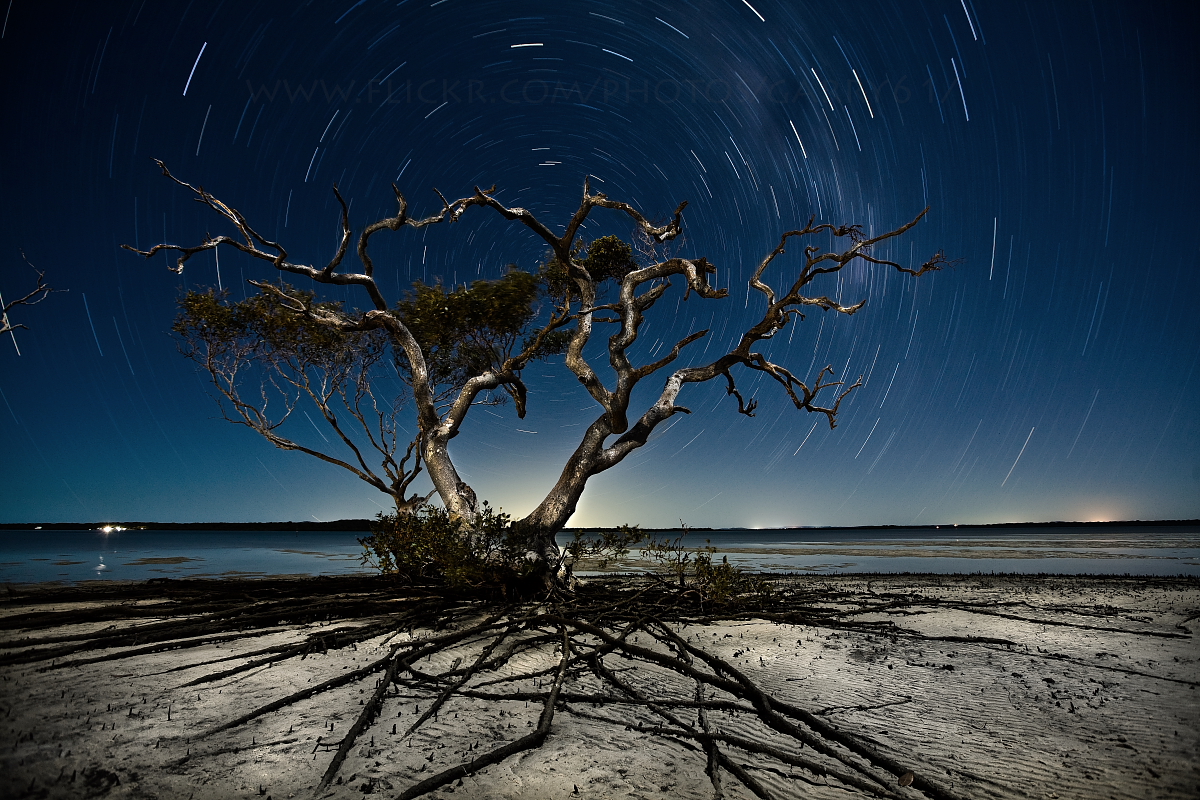
This curly tree seemed to be ideal for a star trail effect.
.
For all technical info please check "More properties"
- No Filters used
- No HDR
About One Million
Mangroves are trees and shrubs that grow in saline coastal habitats in the tropics and subtropics. The saline conditions tolerated by various species range from brackish water, through pure seawater to water of over twice the salinity of ocean seawater, where the salt has become concentrated by evaporation.
There are many species of trees and shrubs adapted to saline conditions. Not all are closely related, and the term 'mangrove' may be used for all of them, or more narrowly only for the mangrove family of plants, the Rhizophoraceae, or even more specifically just for mangrove trees of the genus Rhizophora.
More than fifty species of Rhizophoraceae grow in Australasia, with particularly high biodiversity on the island of New Guinea and northern Australia.
Australia has approximately 11,500 km2 of mangroves primarily on the northern and eastern coasts of the continent, with occurrences as far south as Millers Landing in Wilsons Promontory, Victoria and Barker Inlet in Adelaide, South Australia.
Our driveway on an autumn night.
I've previously used this image to test noise reduction but never published the whole image.
Following today's, at best, semi-rigorous testing, this version using Deep Prime NR in DxO followed by Topaz Sharpen won over both Topaz Denoise and Topaz Photo AI (v1.02). I am yet to upgrade to DxO v6 with Deep Prime XD noise reduction, but it's clear that noise is no longer an issue with this image, even with DxO PhotoLab 5.5.
Upper Antelope Canyon, about 200 metres in length, is a slot canyon in the American Southwest. It is on Navajo land east of Page, Arizona. Antelope Canyon includes two separate, scenic slot canyon sections, referred to individually as "Upper Antelope Canyon" or "The Crack" Antelope Canyon "or" The Corkscrew ". The Navajo name for Upper Antelope Canyon is Tsé bighánílíní, which means 'the place where water runs through rocks'. Lower Antelope Canyon is Hazdistazí (called "Hasdestwazi" by the Navajo Parks and Recreation Department), or 'spiral rock arches'. Both are in the LeChee Chapter of the Navajo Nation.
Antelope Canyon's winding walls were carved by fast flowing flash flood waters. The floods carried abrasive sand, rocks logs and other debris picked up by the sudden torrents. Over millenia, these floods sculpted natural corridors through the soft sandstone. (sourced from internet)
This is a hand-held HDR, uncropped and only with noise reduction. This area was in a very dark spot, so the colour was not as vivid as the other images.
Effiart 2021
art eVokes emotions
blue fantasy moon
Highest position: 295 on Saturday, February 20, 2021
bighugelabs.com/scout.php?mode=history&id=50956915503
started with only 5 groups
SX70 Nightmode, Scenery Mode
ISO 2000
Selbst ISO 3200 ist sauber korrigiert!
Serie zeigt kaum einen Unterschied zu ISO 100 bis 400!
Das wurde in Tests nie erwähnt.
.
all scenery modes have a great
internal noise detection
.
Empfehlungen des Mondkalenders für
Freitag, den 19.02.2021
Heute steht der Mond im Sternzeichen Stier, Mondphase Zunehmender Halbmond (um ca. 19:47 Uhr).
Der Mond wechselt heute um 16:03 Uhr in das Sternzeichen Zwillinge.
Es ist Namenstag von Irmgard, Irma und Hedwig.
Zunehmender Halbmond 🌓
Zimmerpflanzen umtopfen
Möglichst im Frühjahr oder Herbst. In der Regel topft man Zimmerpflanzen alle zwei bis drei Jahre um, denn innerhalb dieses Zeitraums wird der Wurzelballen einer Pflanze oft so kräftig, dass er verfilzt, wenn abgestorbene Wurzelteile nicht entfernt werden und die Pflanze frische Erde und Nährstoffe bekommt.
Bei günstigem Mondeinfluss sind die Chancen sehr gut, dass alles anwächst und sich Wurzel bilden.
Alles gedeiht.
!!!
Abnehmen erst wieder bei abnehmendem Mond 🌛.
Your first time in Times Square.
The neon heart of Manhattan, where leopard skinned break-dancers do head spins next to pipe-smoking superheroes. Where underwear-clad 10-gallon hat toting cowboys sing next to full tables of 'leather' handbags and flashy watches. Where classic brides and horse-drawn carriages meet the ultra modern side of the hundred year old Empire City. And that's just Sunday afternoon.
A dazzling display of excess and commercialism against the backdrop of American debt.
Only in New York.
Licensed through Getty Images
Connect: Facebook | Twitter | Instagram | Wedding Photography
___
With the fisheye. This is a composite of two images assembled in photoshop. The exposure for the sky was shot at ISO 3200 with large amounts of noise reduction in post. The foreground image was a 3 minute exposure shot at ISO 800. I painted the arch with a flashlight. this arch was probably the largest feature I've ever tried to light paint, rather difficult to get uniform lighting!
This is a copy of Cu Nim over Salcombe Estuary: www.flickr.com/photos/tramsteer/3638325244/
But I was very disatisfied with the noise in the blue sky.
I have treated it with software called Topaz.
You will not see any differance unless you look in all sizes.
At Ureddplassen, a scenic rest stop along the Kystriksveien in Mevik, Nordland, the road stretches westward into the twilight. As the blue hour deepens, the Northern Lights unfurl like emerald ribbons across the sky, casting a surreal glow over the rugged coastline and steep mountain slopes. The contrast between the rocky shore and lush greenery creates a natural amphitheater for the aurora’s silent symphony.
This place, named "Uredd" (meaning "Fearless"), honors Norwegian WWII submariners and offers one of the most breathtaking views along the coastal route. Here, nature and memory converge—where the road meets the horizon and the heavens come alive.
Funfact:
Ureddplassen is not just a rest stop—it’s considered one of the most beautiful public toilets in the world! Its wave-shaped design and panoramic view of the Norwegian Sea make it a popular destination for both travelers and photographers.
With not a cloud in sight and new moon in the heavens, my photo-buddies and I headed out to Lake Tahoe and enjoyed the cool air from midnight till 3am.
Canon EOS 5D Mark III
Canon EF 24mm f/1.4L
Exposure 23.8 sec
Aperture f/1.6
ISO 3200
In Sagittarius, low in the south, just above hot rooftops (37C daytime temp) with 30+ degrees C sensor temperatures taken with Canon 6Da and Esprit 100mm f5.5 telescope and Optolong L (IR/UV cut) filter. Two separate stacks in Deepskystacker 12x30sec iso1600 and 40x120sec iso1600 using 20 darks, 31 flats and 174 biasframes. Processed in Pixinsight using DBE, HDRCombination, Histogramtransformation, HDR Multiscaletransform and Curves. No Noisereduction.
Knight Observatory, Tomar
Use F11 and L for best view.
This is composition taking in many of the bright and not so bright nebulas in and around the Sword and Belt of Orion.
At bottom is the bright Orion Nebula, Messier 42. Above it is the bluish Running Man Nebula, NGC 1973-5-7. At centre is the famous dark Horsehead Nebula, B33, silhouetted against the bright glow of IC 434. Above it, and above the blue star Alnitak is the pinkish Flame Nebula, NGC 2024. At top left is the reflection nebula complex of Messier 78 and NGC 2071. Numerous other small patches of nebulosity shine around the Belt stars at right of centre. The large Barnard's Loop, Sh-2-276, just sneaks into the corner of the frame at top left.
This is a blend of filtered and unfiltered images: a stack of 8 x 8-minute exposures through an Optolong L-Enhance filter blended with a stack of 12 x 8-minute exposures without a filter, with the filtered shots at ISO 3200 and unfiltered shots at ISO 800. Stacks of 4 x 2-minute at ISO 800 and 4 x 2-minute at ISO 200 are also blended in with luminosity masks to retain the details in the bright core of the Orion Nebula, and to shrink the stars.
All were with the Canon EOS Ra mirrorless camera shooting through the William Optics RedCat 51mm astrograph at f/5 (250mm focal length). The unfiltered shots were taken the night after the filtered shots, as incoming haze and ice fog cut short the shoot on the first night, January 9, 2021, and prevented more filtered shots (for lower noise) without haze. As it is, some haze surrounds the stars. The RedCat is equipped with the Starizona filter drawer accessory to make it easier to swap the filter in and out without affecting camera position.
This was on the Astro-Physics Mach1 mount and guided with the made-in-Hungary Lacerta MGEN3 autoguider which also controlled the camera and applied a dithering motion between each shot to help remove thermal noise. No dark frames were taken nor was Long Exposure Noise Reduction applied in camera, though it was -5° C these nights, chilly but mild for January here in Alberta.
All stacking, aligning and mean or median combining (the latter to eliminate some geosat trails) was done in Photoshop 2021. Luminosity masks to enhance the faint nebulosity and apply star masks where needed were created with the Lumenzia extension panel. The masking helps compress the dynamic range, allowing the faintest nebulosity to be enhanced without blowing out the bright highlights like the core of M42. But inevitably, the Orion Nebula ends up looking dimmer than it really is in relation to the other nebulas in the field.
There's something about this spot at String Lake in Grand Teton National Park that feels magical every time I go there (especially at night). I'm not sure if it's the rugged peaks, the glowing skies, or the starry reflections but it's definitely a place that heightens the senses.
The milky way rising from the Caliente wilderness area, Pacific crest trail. It wasn't the best night for milky way viewing. While it was visible there was enough ambient light from a 1/4 moon rising that it was dim. I was at this same location last June and the milky was was so clear it was practically bursting from the sky. These milky way shots really push the limits of my camera and lens so Don't look too closely! Shot at ISO 3200, 17mm focal length at f/4. Lots of processing in lightroom: boosted contrast and blacks, adjust white balance, and massive noise reduction hence the softness of the rock.