View allAll Photos Tagged LifeMagazine
life magazine
left image: "here come the sidewalk surfers," june 5, 1964
right image: "skateboard mania," may 14, 1965
via google books
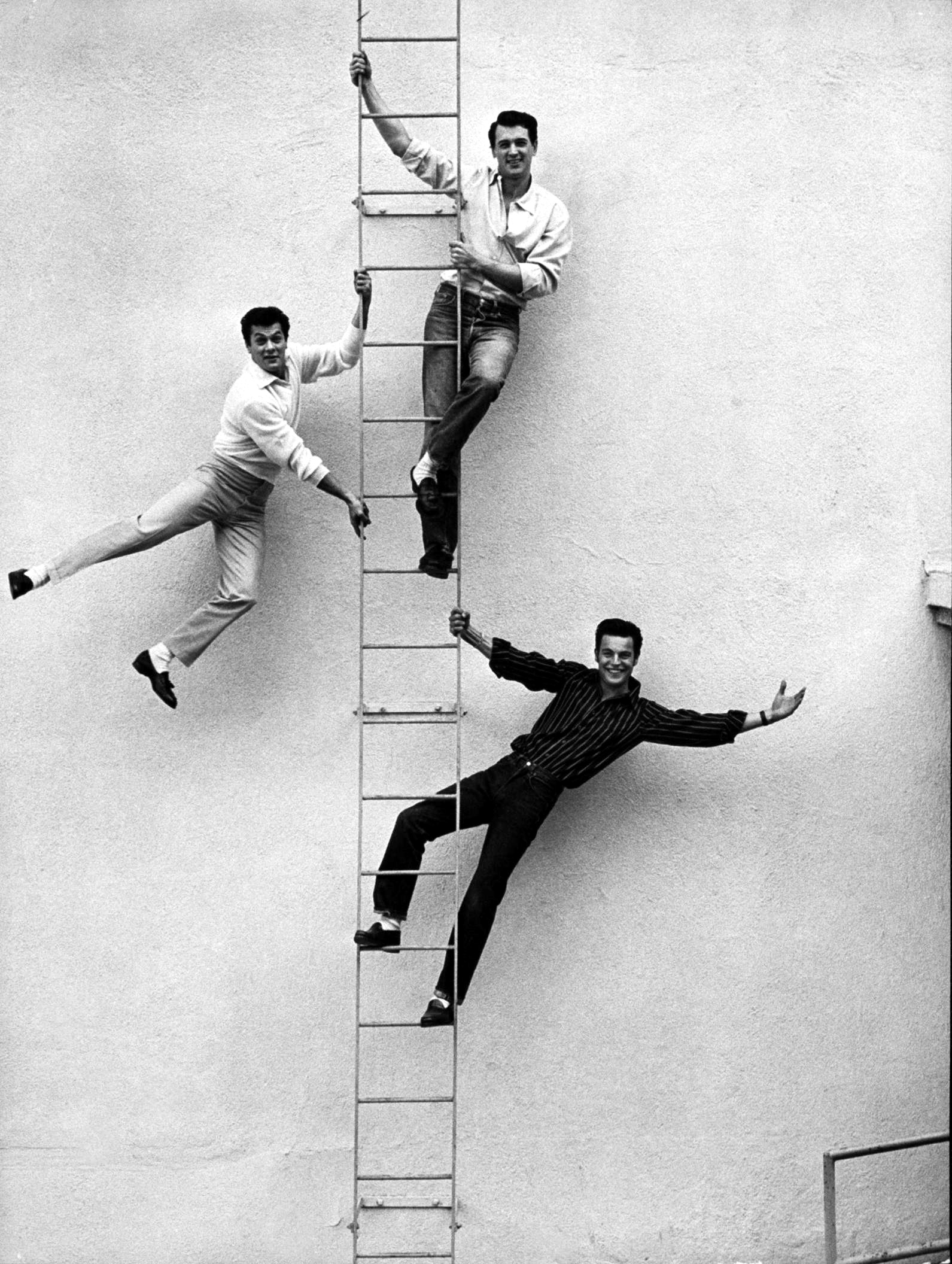
Movie stars (top to bottom) Rock Hudson, Tony Curtis, & Robert Wagner in a silly photo taken for Life magazine, 1954. Before the rumors. No clue as to the photographer.
The original photo: www.doctormacro.com/Images/Curtis,%20Tony/Annex/Annex%20-...
Graphic illustration from the November 16, 1942 issue of Life Magazine in which we learn the REAL TRUTH ABOUT WHY THE AMERICANS WENT TO WAR!.
These are the things we are fighting for... THE RIGHT OF A WOMAN TO MARRY FOR LOVE AND NOT AT THE STATE'S COMMAND.
Illustrator: Alex Ross (Alexander Sharpe Ross)
Explore #129 2/24/09
If you got to pick someone to be friends with, someone to lunch with, and someone to have a romantic interlude with, who would you pick?
My choice about 15 years ago to this question was Katharine Hepburn for a friend, Jimmy Stewart for a lunch companion, and Kevin Costner for the romance.
Who would you choose?
The 1952 Ford introduced several notable advancements compared to earlier models:
•Engine Upgrade: The "Mileage Maker" straight-6 engine replaced the older L-head straight-6, offering improved performance with 101 horsepower. Ford’s high-compression “Strato-Star” V-8 was stepped up to 110 horsepower.
•Design Enhancements: It featured a curved one-piece windshield, a redesigned grille with a single center "bullet," and new trunk hinges that prevented crushing the contents. A lower center of gravity along with redesigned springs and shock absorbers gave a smoother ride.
•Interior Improvements: The dashboard included a "flight-style" control panel, suspended pedals, and standard gauges for voltmeter, gas, temperature, and oil pressure.
•Model Line Reshuffle: The base model was renamed "Mainline," the mid-level "Customline," and the top-tier "Crestline," which included options like the "Sunliner" convertible and "Victoria" hardtop.
These updates made the 1952 Ford more modern and user-friendly.
Color advertisement for the Mercury 8 Sedan, taken from the March 18, 1940 issue of Life Magazine.
"So we headed the MERCURY for Sun Valley!"
Joel-Peter Witkin's contemporary corpse photography is nothing new. In the earliest days of photography, in the 1840's, grieving parents of means, would hire a daguerreotypist to record, on the silver coated copper plate, a photo of their deceased child. This image was taken in either southern Arizona or northern Mexico. I would guess the latter. Mexicans would routinely photograph a loved one in their open coffin, surrounded by family members holding unlit candles.
Which is remindful of W. Eugene Smith's masterpiece from his 1951 Life magazine "Spanish Village" essay; where the dead body is ringed by the women in black. Diego Velazquez (1599-1660) or Michaelangelo Caravaggio (1571-1610) come to mind. Smith was one of the few photographers who printed their own photos for Life. Comparing Smith's original prints to the reproductions in Life are literally apples and oranges. I collect old Life magazines and the pages have turned yellow/brown from the acid. Even in 1951 Smith's exquisite prints were barely hinted at in the unremarkable magazine reproductions.
As I wrote earlier, I was a student of Smith. I attended his final class. I am the last person quoted in Jim Hughes' biography of Gene. I will write about my observations of him when I establish my own personal web site.
Note: Signed, numbered, limited edition, archival matte C-prints of this image can purchased on page 5 of my Etsy store: www.etsy.com/shop/davidleeguss
@2009 David Lee Guss Homage, W. Eugene Smith, funeral, 1890's-2008
This photo was taken from the balcony of the Minaret of the Al Fadhel Mosque in Manama in the presence of the Mosque's Imam, of the old waterfront (site of the present-day Government Avenue) and part of the old mixed commercial and residential centre of Manama. From bottom to top: the Almoayyed old family home with its wooden bridge connecting its southern section (site of the present-day Almoayyed car park) to its northern section (site of the present-day twin buildings of A.K. Almoayyed on Al Khalifa Avenue and Y.K. Almoayyed on Government Avenue) is the second property on the left, the extensive Gray Mackenzie shipping company premises (occupies the present-day site of several buildings including the HSBC vacant old offices, the Salahuddins, and the Yateem Shopping Centre to name a few) is the third property on the far left of the photo, the Judicial Court on the opposite side of the street with its small garden on the waterfront road (site of the present-day Constitutional Court), next to it from the top is yet another Gray Mackenzie's property (site of the present-day Downtown Rotana Hotel), and adjacent to it from the top is the Cable & Wireless premises (site of the present-day Batelco building) farther to the right is the Manama port with its long pier jutting out into the sea (site of the present-day Bahrain Financial Harbour), the customs house with its bonded warehouses is at the centre of the photo within the port's vicinity (the present-day site of The Manama Post Office and the adjacent car park), and the large square building further to the top of the photo, on the centre left, is the famous Helal Al-Mutairi's (formerly Yusuf Kanoo's) building, which was once the largest mixed-use building in the Arabian Gulf when it was constructed at the turn of the twentieth century by Bahraini merchant and banker Yusuf Kanoo (occupying the present-day site of the Unitag Group and its car park, the large rectangular commercial building alongside it, and the Regency Plaza building) in May 1945.
more images and items from my collection at my blogspot page:
A romantic journey through time – comparing phone conversations between lovers a century ago and their counterparts today:
In 1921, telephones required landlines and operators to connect callers manually. Conversations had to happen at specific places, usually in one’s home, often in the presence of prying eyes and ears. Due to the formality in making phone calls, conversations were deliberate, focused, and full of anticipation, every word carried more weight. The audio was grainy and prone to interruptions, especially when more than one family shared a party line. People often had to speak loudly and clearly. Patience was a virtue in courtship.
Now, cellphones are ubiquitous and wireless, with touchscreens, instant messaging, and apps, and they may be carried with you anywhere. Instant connectivity with a tap. Cellphones offer voice calls, video calls, texts, and more. Modern conversations can be short, casual, and frequent. Emojis, gifs, and video messages add a new dimension to expressing affection. High-definition audio, noise cancellation, and even video calls offer clear, intimate conversations. While calls can be made from virtually anywhere, privacy can be compromised in public spaces. However, technology also allows for more spontaneous and frequent connections. The tools and methods of expressing love and affection have evolved dramatically.
[Note: You don't know how far we've come unless you know where we've been].
1955, Chicago, Illinois: Dorothy Crouch, legs crossed in graceful scissors stance, arm raised, after releasing ball in preliminary match during nine-day championship tournament.
Photo by Francis Miller
© Time-Life
Dorothy June Crouch, 89 (June 6, 1931 - January 1, 2021)
Her passion in life was to bowl and was a 50 (+) year member of the National Woman's Bowling League and won many awards including a State Games of Americas gold medal during her bowling career. She would always tell you to keep that thumb at 11 o'clock and bring that arm up over your shoulder! She graced the stage of The Price Is Right show winning her prize package and will be remembered playing the piano, guitar, singing and crocheting beautiful blankets.
www.flinnmaguire.net/obituaries/Dorothy-June-Crouch?obId=...
Vintage December 6, 1948 issue of Life Magazine with a great cover photo of actor Montgomery Clift. It’s always a thrill when it’s from Vinnie DeVille!
Ads scanned from an old LIFE Magazine
November 27, 1950 edition.
The pages were very brittle and dry and were crumbling during handling.
In 1949 Life Magazine published photo's of 8 young starlets by Philippe Halsman, one of those girls was Marilyn Monroe who expressed 4 different situations: a hug, a good joke, a cool drink & facing a monster
Day 228/366
August 15, 2012
Davey, The Netherlands
Inspired by this collage
The social advantages that Colgate Ribbon Dental Cream offers the women with marital problems, according to an ad from a 1940's era issue of Life Magazine.
Save your marriage, ladies and BRUSH YOUR TEETH!
"If nurses could only tell!"
See what I did there?
WWII Days
Midway Village Museum
Rockford, Illinois about 42.279698, -88.981941
September 30, 2023
COPYRIGHT 2023 by JimFrazier All Rights Reserved. This may NOT be used for ANY reason without written consent from Jim Frazier.
230930cz7-79661366x768
This issue of Life Magazine from June 2, 1972 features beautiful Raquel Welch is on the cover, with her derby jersey, her skates, and not much else!
The cover says "Raquel, On Skates as a Derby Demon." The article profiles her role as a roller derby "demon" in the film "The Kansas City Bomber." There are several photos of Raquel and her teammates in the movie.
In addition to the article about Raquel, there are several noteworthy vintage ads in this magazine, including ads for The World Book Encyclopedia; retro cars from Detroit including the Hornet, Gremlin and Matador; and cool vintage Polaroid Land Cameras.
Over a thousand Chicagoans from all over the city, gathered at Millennium Park to perform "Crowd Out" by David Lang.
The Martin PBM Mariner was a patrol bomber flying boat of World War II and the early Cold War period. It was designed to complement the Consolidated PBY Catalina in service. A total of 1,366 were built, with the first example flying on 18 February 1939 and the type entering service in September 1940.
Design and development:
In 1937 the Glenn L. Martin Company designed a new twin-engined flying boat, the Model 162, to succeed its earlier Martin P3M and complement the PBY Catalina. It received an order for a single prototype XPBM-1 on 30 June 1937. This was followed by an initial production order for 21 PBM-1 aircraft on 28 December 1937.
To test the PBM's layout, Martin built a ⅜ scale flying model, the Martin 162A Tadpole Clipper with a crew of one and powered by a single 120 hp (89 kW) Chevrolet engine; this was flown in December 1937. The first genuine PBM, the XPBM-1, flew on 18 February 1939.
The aircraft was fitted with five gun turrets, and bomb bays that were in the engine nacelles. The gull wing was of cantilever design, and featured clean aerodynamics with an unbraced twin tail. The PBM-1 was equipped with retractable wing landing floats that were hinged outboard, with single-strut supported floats that retracted inwards to rest beneath the wing, with the floats' keels just outboard of each of the engine nacelles. The PBM-3 had fixed floats, and the fuselage was three feet longer than that of the PBM-1.
Operational history:
The first PBM-1s entered service with Patrol Squadron Fifty-Five (VP-55) of the United States Navy on 1 September 1940. Prior to the USA's entry into World War II, PBMs were used (together with PBYs) to carry out Neutrality Patrols in the Atlantic, including operations from Iceland. Following Japan's attack on Pearl Harbor, PBMs were used on anti-submarine patrols, sinking their first German U-boat, U-158 on 30 June 1942. PBMs were responsible, wholly or in part, for sinking a total of ten U-boats during World War II. PBMs were also heavily used in the Pacific War, operating from bases at Saipan, Okinawa, Iwo Jima and the South West Pacific.
The United States Coast Guard acquired 27 Martin PBM-3 aircraft during the first half of 1943. In late 1944, the service acquired 41 PBM-5 models and more were delivered in the latter half of 1945. Ten were still in service in 1955, although all were gone from the active Coast Guard inventory by 1958 (when the last example was released from CGAS San Diego and returned to the U.S. Navy). These flying boats became the backbone of the long-range aerial search and rescue efforts of the Coast Guard in the early post-war years until supplanted by the P5M Marlin and the HU-16 Albatross in the mid-1950s.
PBMs continued in service with the U.S. Navy following the end of World War II, flying long patrol missions during the Korean War. It continued in front line use until replaced by its direct development, the P5M Marlin, with the last USN squadron equipped with the PBM, Patrol Squadron Fifty (VP-50), retiring them in July 1956.
The British Royal Air Force acquired 32 Mariners, but they were not used operationally, with some returned to the United States Navy. A further 12 PBM-3Rs were transferred to the Royal Australian Air Force for transporting troops and cargo.
The Royal Netherlands Navy acquired 17 PBM-5A Mariners at the end of 1955 for service in Netherlands New Guinea. The PBM-5A was an amphibian with retractable landing gear. The engines were 2,100 hp (1,600 kW) Pratt & Whitney R-2800-34. After a series of crashes, the Dutch withdrew their remaining aircraft from use in December 1959. (wiki)
Scanned from a ww2 era LIFE magazine.