View allAll Photos Tagged LifeMagazine
Oldsmobile advertisement highlighting their New Hydra-Matic Drive, from the March 18, 1940 issue of Life Magazine.
"NO CLUTCH ! NO SHIFT !"
"Best Looking Car On The Road!"
Full page from the March 18, 1940 issue of Life Magazine with ads for Listerine and Webster Fancy Tales Cigars - and some letters to the editor concerned about some porpoise stuff.
- "We're saving to get married - so we use this money-saving tooth paste!"
- "The big tube that lasts 3 months!"
- "contains Luster-Foam"
- "Webster - the after-dinner favorite" (I bet she is)
What some people will do for love...
life magazine
left image: "here come the sidewalk surfers," june 5, 1964
right image: "skateboard mania," may 14, 1965
via google books
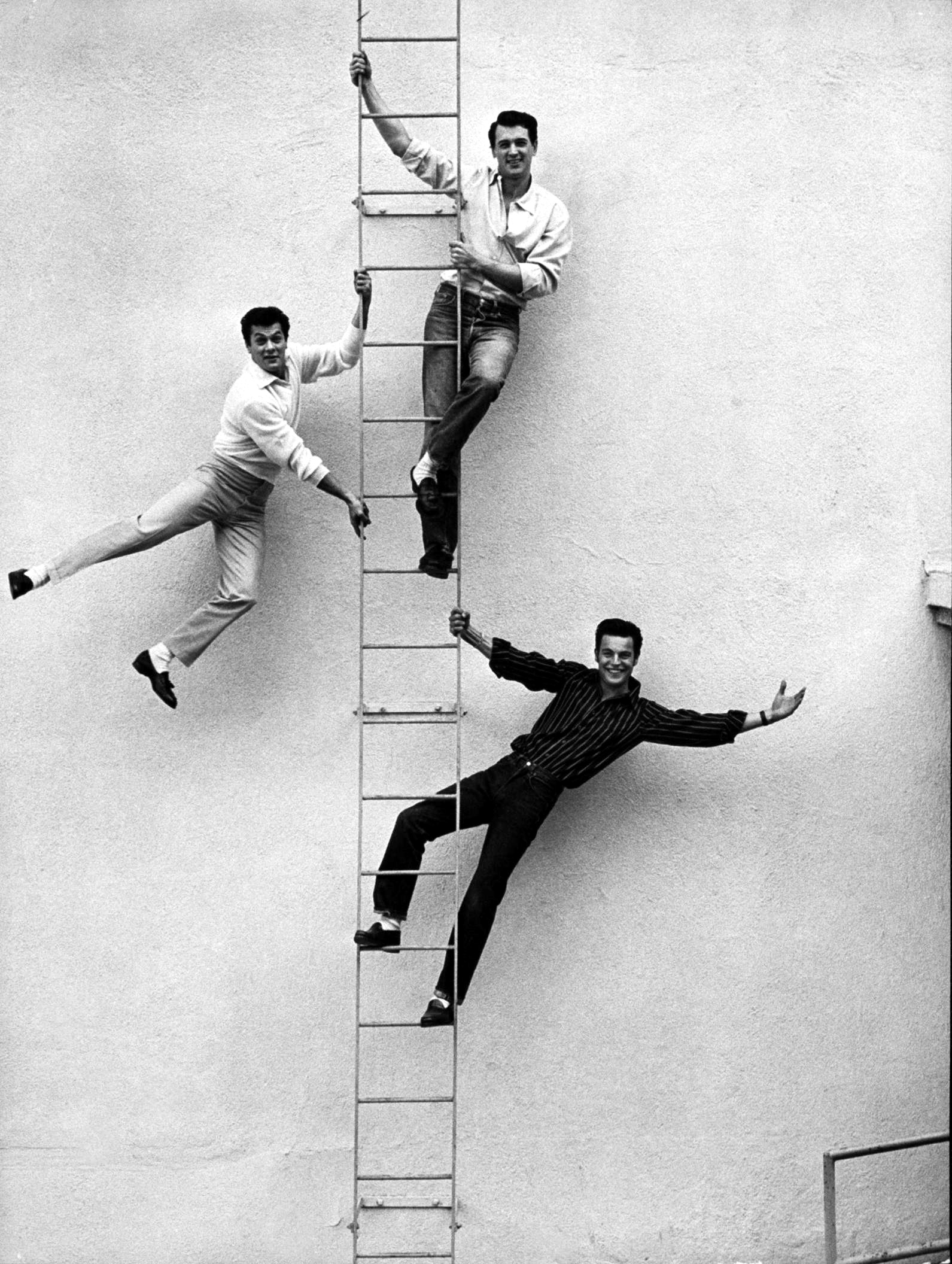
Movie stars (top to bottom) Rock Hudson, Tony Curtis, & Robert Wagner in a silly photo taken for Life magazine, 1954. Before the rumors. No clue as to the photographer.
The original photo: www.doctormacro.com/Images/Curtis,%20Tony/Annex/Annex%20-...
Graphic illustration from the November 16, 1942 issue of Life Magazine in which we learn the REAL TRUTH ABOUT WHY THE AMERICANS WENT TO WAR!.
These are the things we are fighting for... THE RIGHT OF A WOMAN TO MARRY FOR LOVE AND NOT AT THE STATE'S COMMAND.
Illustrator: Alex Ross (Alexander Sharpe Ross)
Explore #129 2/24/09
If you got to pick someone to be friends with, someone to lunch with, and someone to have a romantic interlude with, who would you pick?
My choice about 15 years ago to this question was Katharine Hepburn for a friend, Jimmy Stewart for a lunch companion, and Kevin Costner for the romance.
Who would you choose?
Royal Gelatin Deserts advertisement featuring Billie Burke, and some nifty graphic cartoons, from the June 23, 1941 issue of Life Magazine.
"A big bouquet to Royal for this gay and summery desert."
Color advertisement for the Mercury 8 Sedan, taken from the March 18, 1940 issue of Life Magazine.
"So we headed the MERCURY for Sun Valley!"
Joel-Peter Witkin's contemporary corpse photography is nothing new. In the earliest days of photography, in the 1840's, grieving parents of means, would hire a daguerreotypist to record, on the silver coated copper plate, a photo of their deceased child. This image was taken in either southern Arizona or northern Mexico. I would guess the latter. Mexicans would routinely photograph a loved one in their open coffin, surrounded by family members holding unlit candles.
Which is remindful of W. Eugene Smith's masterpiece from his 1951 Life magazine "Spanish Village" essay; where the dead body is ringed by the women in black. Diego Velazquez (1599-1660) or Michaelangelo Caravaggio (1571-1610) come to mind. Smith was one of the few photographers who printed their own photos for Life. Comparing Smith's original prints to the reproductions in Life are literally apples and oranges. I collect old Life magazines and the pages have turned yellow/brown from the acid. Even in 1951 Smith's exquisite prints were barely hinted at in the unremarkable magazine reproductions.
As I wrote earlier, I was a student of Smith. I attended his final class. I am the last person quoted in Jim Hughes' biography of Gene. I will write about my observations of him when I establish my own personal web site.
Note: Signed, numbered, limited edition, archival matte C-prints of this image can purchased on page 5 of my Etsy store: www.etsy.com/shop/davidleeguss
@2009 David Lee Guss Homage, W. Eugene Smith, funeral, 1890's-2008
This photo was taken from the balcony of the Minaret of the Al Fadhel Mosque in Manama in the presence of the Mosque's Imam, of the old waterfront (site of the present-day Government Avenue) and part of the old mixed commercial and residential centre of Manama. From bottom to top: the Almoayyed old family home with its wooden bridge connecting its southern section (site of the present-day Almoayyed car park) to its northern section (site of the present-day twin buildings of A.K. Almoayyed on Al Khalifa Avenue and Y.K. Almoayyed on Government Avenue) is the second property on the left, the extensive Gray Mackenzie shipping company premises (occupies the present-day site of several buildings including the HSBC vacant old offices, the Salahuddins, and the Yateem Shopping Centre to name a few) is the third property on the far left of the photo, the Judicial Court on the opposite side of the street with its small garden on the waterfront road (site of the present-day Constitutional Court), next to it from the top is yet another Gray Mackenzie's property (site of the present-day Downtown Rotana Hotel), and adjacent to it from the top is the Cable & Wireless premises (site of the present-day Batelco building) farther to the right is the Manama port with its long pier jutting out into the sea (site of the present-day Bahrain Financial Harbour), the customs house with its bonded warehouses is at the centre of the photo within the port's vicinity (the present-day site of The Manama Post Office and the adjacent car park), and the large square building further to the top of the photo, on the centre left, is the famous Helal Al-Mutairi's (formerly Yusuf Kanoo's) building, which was once the largest mixed-use building in the Arabian Gulf when it was constructed at the turn of the twentieth century by Bahraini merchant and banker Yusuf Kanoo (occupying the present-day site of the Unitag Group and its car park, the large rectangular commercial building alongside it, and the Regency Plaza building) in May 1945.
more images and items from my collection at my blogspot page:
For Oct. 28-Nov. 3, 2022.
"Pick" Brach's and "pick" the finest.
From the Feb. 7, 1949 issue of Life magazine.
In 1949 Life Magazine published photo's of 8 young starlets by Philippe Halsman, one of those girls was Marilyn Monroe who expressed 4 different situations: a hug, a good joke, a cool drink & facing a monster
Day 228/366
August 15, 2012
Davey, The Netherlands
Inspired by this collage