View allAll Photos Tagged Length
Carrocería/Bodywork: Castrosua CS-40
Chassis: Pegaso 5226
Lote/Batch info: 3/4 - 1 total (654)
Matricula/Plate: GC-0704-AZ
Longitud/Length: 12m
Servicio/Service: 1992 - 2006 (Donated / Donado)
Info (SP): En 1990 la española Pegaso fue comprada por la rival italiana Iveco. Previo a esto, Salcai ya había matriculado mas de 30 vehiculos de la gama CS-40 con motorización Pegaso. No obstante, dicha union no llego a convencer a ambas empresas sobre si Pegaso mantendría su legendaria robustez. Por ello, y a modo de prueba, cada empresa compro una unica unidad bajo la carrocería CS-40; Salcai adquirio la 654 en 1992 y Utinsa la 693 en 1993. Sin embargo tras la quiebra de la marca y la union entre ambas empresas, estas dos unidades fueron de las primeras que se quitaron de encima. Se desconoce lo que ocurrió con la unidad de Utinsa pero la de Salcai acabo donada al servicio contra incendios Flack, donde lo utilizarían como vehiculo de pruebas. Permaneceria ahi hasta que el cuerpo de bomberos de Las Palmas lo recibió en 2021 para hacer practicas físicas.
Info (EN): In 1990 the Spanish brand Pegaso was taken over by its Italian rival Iveco. Before this, Salcai had already purchased over 30 Castrosua CS-40 vehicles powered by the Spanish brand. However this takeover did not convince either company if the name Pegaso would maintain its legendary toughness. Because of this, and as a way of testing the grounds, each company purchased one single CS-40 vehicle; Salcai purchased unit 654 in 1992 and Utinsa purchased unit 693 in 1993. Nevertheless, with the bankruptcy of the brand and the union between the two companies, these units where some of the first ones to disappear. It is unknown what happened to the Utinsa unit, but the Salcai one was donated to the service against fires Flack, where it was used as testing and training vehicle. It would remain there until 2021, when it was then donated to the Las Palmas fire brigade for physical training.
Program:Manual
Lens:0mm f/0 MF
F:2.0
Speed:1/1600
ISO:200
Focal Length:85.0 mm (35 mm equivalent 127.0 mm)
Focus Mode:Manual
Shooting Mode:Single-Frame, Auto ISO
VR:Off
EV:-2/3
Metering Mode:Spot
WB:Auto1
Picture Control:Standard
So far I’ve written a lot about the unique focal length the Batis 2/40 CF offers (or 'the odd', depends how you see it). Great work, but kind of theoretical. How does the 40mm focal length feel in practice? To be honest, it's difficult to give any final conclusions after so short usage, but one interesting thing I've noticed is that I perceive more it as a wide angle 35mm than a standard 50mm. And as a substitute for 35mm it feels ok: wide enough for indoors and I don't find myself taking steps backwards too often. There's also at least one advantage compared to a regular 35mm lens: portraits are a bit more flattering because of added compression that extra 5mm brings. All in all, the Batis 2/40 CF would make a good 35mm lens substitute.
But thinking it as a substitute for something else is not really intellectually honest – it's not an alternative for 35mm lens, it's 40mm and should be thought like that. This brings me to my point: as a focal length the 40mm is not immediately familiar and I find myself comparing it to both 35mm and 50mm. There are some particular focal lengths that I know like pockets of my jacket, like the 25mm, 85mm & crop-50mm, and I can 'scan the environment' through these lenses without the camera, but the 40mm is something else. Maybe it’s again the idea of the 'standard focal length' that guides my inner perception and taps into the latent fears and anxieties: it’s comforting to categorize the Batis 2/40 either a 35mm or 50mm because these are the categories we have been cultivated to understand and see around us. But the 40mm is of course neither; it is as close to 35mm as it is to 50mm.
So, having worked with the Batis 2/40 there are some images that look to me like ‘the 35mm’ and there are some others that resemble more 'the 50mm'. But here's the interesting thing: there are some pictures where I kind of see both, 'the 35mm' and 'the 50mm'. Like the one I'm sharing today. When I took this picture it was the last exceptionally warm days of autumn in Finland (now it's totally different). Meri is playing at the edge of the fountain while her big sister Aura stands behind her. In my eyes this picture kind of has 'the wide angle field of view' from the 35mm lens and 'a bit of a telecompression' from the 50mm (and pretty nice painterly background blur as well). It’s the pictures like this where I think I start to see the unique properties of the 40mm lens. And this is precisely what I mean when I say that I need to learn to 'see the forty' with its unique characteristics. At its best I see it combining the wide angle look with the little compression taken from the standard field of view. This offers great possibilities and it is definitely a new and flexible way of working within that standard of field of view. I think this is the best way I can describe the feeling of forty.
Colour: Metallic Triton Blue
Frame: Aluminium twin spar
Length: 81.7 in. (2,075 mm)
Width: 27.8 in. (705 mm)
Height: 45.1 in. (1,145 mm)
Ground clearance: 5.1 in. (130 mm)
Seat height: 32.5 in. (825 mm)
Wet weight: 445 lbs. (201 kg)
Front suspension: 1.96 in. (43 mm) Showa Big Piston inverted telescopic forks, coil spring, oil damped
Front wheel travel: 4.9 in. (125 mm)
Rear suspension: Link type, single shock, coil spring, oil damped
Rear wheel travel: 5.1 in. (130 mm)
Front brake: Twin 12.59 in. (320 mm) discs, Brembo 4 piston calipers, ABS equipped
Rear brakes: Single 8.66 in. (220 mm) disc, Nissin 1 piston caliper, ABS equipped
Front tire:120/70ZR17M/C (58W), tubeless
Rear tire:190/55ZR17M/C (73W), tubeless
Wheels: Black 6 spoke lightweight cast aluminium
Fuel capacity: 3.52 gal. (16 litres)
Engine oil capacity: 7.21 pints (0.9 gal - 4.1 litres)
Engine: 999.8 cc (61.01 cu. in.) 4 stroke, liquid cooled, 4 cylinder, fuel injected, DOHC
Engine output: 199.2 hp (148.6 kW) at 13,200 rpm
Gearbox: 6 speed constant mesh
Top speed: 186 mph (299 km/h)
Price new: £15,599 ($19,130 - 18,180 Euro)
LIGHT YARDS: A Two-Week-Long Installation Melding Light, Sculpture and Music to Create Wonder!
The innovative art installation spanning two weeks and three weekends at The Yards Park will kick off on Saturday, February 20 from 7pm to 10pm with a large-scale projection mapping visual display set to the beat of a live DJ set. The event’s focal point and medium for the light display will be a 48 x 24 x 20 foot Point Cloud, and 12 x 12 x 12 foot Cube, constructed of industrial steel with illuminated white cubes designed by New York based light artist and architect John Ensor Parker. These light sculptures will remain throughout the two weeks
The Afon Glaslyn (English, River Glaslyn) is a river in Gwynedd, north-west Wales. While not of great significance in terms of its length (about 16 miles (26 km)), it is one of Gwynedd's primary rivers, and has greatly influenced the landscape in which it flows.
It has its source in Glaslyn, a cirque lake on the flanks of Snowdon. It is joined by Nant Traswnant which drains Pen-y-Pass and by Nant Cynnyd before entering the beautiful lake, Llyn Gwynant. The river then flows through Llyn Dinas before entering the village of Beddgelert. In the middle of the village it is joined by the substantial tributary, the River Colwyn which drains the south-western flank of Snowdon. The much enlarged river flows down past Gelert's grave before tumbling down into the Aberglaslyn Pass. This is a small rocky gorge close to the main road which provides easy public access to a most picturesque piece of Snowdonian scenery.
Passing through Pont Aberglaslyn, the river emerges from the gorge into the relatively flat agricultural land of Tremadog and Porthmadog. This wide flat valley – now called Traeth Mawr – was once the estuary of the Glaslyn before the Porthmadog Cob was created. This sealed off the mouth of the estuary, enabling the land to be reclaimed. Once the river has crossed under the railway line, it meanders in large pools and marshes before eventually passing through the tidal sluices on the Cob at the south-eastern end of the town of Porthmadog, and from there into Tremadog Bay. Further south, the River Dwyryd also drains into Tremadog Bay.
The first pair of breeding ospreys in Wales nest at Pont Croesor about 4 miles (6.4 km) upstream from Porthmadog where the RSPB have set up observation facilities. They first bred in 2005 and have returned every year since.
Fishing on the Glaslyn up to Beddgelert is controlled by the Glaslyn Angling Association.
The Aberglaslyn Pass is a narrow gorge of considerable beauty in Snowdonia, Gwynedd, north Wales. The A498 road/A4085 road follows a relatively level route along the Afon Glaslyn through the pass from Beddgelert to Prenteg and then continues at the edge of the Traeth Mawr via Tremadog to Porthmadog.
As recently as the early 19th century, the river Glaslyn was navigable for small boats at high tide as far as Pont Aberglaslyn, which is just one mile (1.6 km) south of Beddgelert, where a sixth-century monastery was succeeded in the twelfth by an Augustinian priory. In the Middle Ages Beddgelert was seen as a safe resting place before travelling further. The route from the coast via Beddgelert and overland to Caernarfon or Bangor via Llyn Cwellyn was often considered preferable to the long voyage round the Llŷn Peninsula.
Pont Aberglaslyn is in the parish of Nantmor. From here to the sea, landowners have benefited significantly from the land reclamation made possible by the construction at Porthmadog in 1812 of the great embankment across the Traeth Mawr estuary, known as The Cob.
Pont Aberglaslyn has a bridge with a connection to the Devil. It is very similar to other Devil and bridge-related stories found throughout the British Isles. The Devil built the bridge on the understanding that he would receive the soul of the first living creature to cross over it. When the bridge was finished he went to the local inn (Y Delyn Aur) to inform the magician Robin Ddu that it was ready. Robin went to inspect the new bridge with a dog he lured from the pub with a fresh-baked loaf of bread. Upon seeing the bridge Robin asked the Devil whether it was sturdy and how much weight it could carry as he thought it might not even take the weight of the loaf he was carrying. The Devil was shocked and demanded that the magician throw his loaf onto the bridge to prove that it was indeed strong enough. So Robin threw the loaf onto the bridge and the dog chased it across the bridge, thus cheating the Devil of a human soul. Robin Ddu then returned to the pub to finish his drinking.
In another version of this tale, it is a local hotelier who asks Robin to aid him in constructing a bridge and as payment, Robin was to take the soul of the first living person that crossed it.
Robin Ddu or Black Robin the Magician, or more correctly Robin Ddu ap Siencyn Bledrydd of Anglesey, lived circa 1450. He was a poet and sometimes known as a prophetic poet, and about ninety of his pieces are still preserved on manuscripts. It would appear that Robin also pretended to be a sorcerer or wizard and he appears in many Welsh tales.
In the later 19th century, with the coming of the Cambrian Railways, numerous schemes were proposed for the construction of a railway to Beddgelert. Some were started and there are several examples of abandoned railway works in the past. One scheme eventually succeeded and the Welsh Highland Railway was opened in 1922 from Dinas near Caernarfon to Porthmadog. The railway was closed in 1937 and the rails requisitioned and removed for War Department use in 1941. The trackbed remained in the ownership of the receiver of the company, and an iron girder bridge was left.
Since then, the railway trackbed and its three tunnels had become a very popular path for walking and hiking. The longest tunnel was first built in 1906 but was not used by rail until 1922. Before the Cob was built, the Glaslyn estuary was tidal as far as Pont Aberglaslyn and the fisherman's path through the pass was used as a route to the coast. It gradually fell out of use and through erosion by the river, became impassable.
In 1995 and 1996, controversy ensued, as the Ffestiniog Railway was seeking to take ownership of the trackbed to rebuild the Welsh Highland Railway. Walkers and environmentalists claimed that an important footpath would be lost. However, having no real argument (given that the fisherman's path was still alongside the railway owned trackbed), they claimed that owing to danger from falling rocks the pass would be unsafe for trains. In order to meet these objections and fears, civil engineering consultants produced plans for remedial works to overhanging rock, retaining walls and paths and this work was done by local expert contractors.
In the Autumn of 2000, the Welsh Highland Railway closed the trackbed to walkers in order to prepare for the rebuilding of the railway. The railway company, along with the National Trust, which owns the surrounding land, worked to rebuild the fisherman's path for use again.
In 2003, after some delay, a new footbridge was built across the river at Bryn-y-felin. Prior to this, in 1999, the old railway girder bridge had been removed, although even for some years before that its use as a footbridge had been banned. In March 2006 a replacement girder bridge was installed, this largely identical to the original bridge, which had laid unmaintained since 1936, and was consequently weak through corrosion – the original bridge (of a modular design intended for use in India) had never been painted and never had holes drilled for rain-water to drain away, despite both of these measures being suggested by the railway inspector in the 1920s, hence the advanced state of decay on this and two other identical bridges on the WHR by the time of their removal.
The public continued to unofficially use the trackbed and tunnels as a footpath until construction work on the railway made such use dangerous. Until that point, however, the railway had offered better views for walkers than the Fisherman's Path, plus the thrill of walking through the tunnels which also provided a more direct route to Nantmor car-park than the narrow and slippery Fisherman's Path.
Tracklaying progress on the railway reached the pass with the relaying of track across Bryn-y-felin bridge in August 2007, and by mid-October had already passed beyond the tunnels and the stretch of dramatic rock cuttings and embankments near Nantmor.
Gwynedd is a county in the north-west of Wales. It borders Anglesey across the Menai Strait to the north, Conwy, Denbighshire, and Powys to the east, Ceredigion over the Dyfi estuary to the south, and the Irish Sea to the west. The city of Bangor is the largest settlement, and the administrative centre is Caernarfon. The preserved county of Gwynedd, which is used for ceremonial purposes, includes the Isle of Anglesey.
Gwynedd is the second largest county in Wales but sparsely populated, with an area of 979 square miles (2,540 km2) and a population of 117,400. After Bangor (18,322), the largest settlements are Caernarfon (9,852), Bethesda (4,735), and Pwllheli (4,076). The county has the highest percentage of Welsh speakers in Wales, at 64.4%, and is considered a heartland of the language.
The geography of Gwynedd is mountainous, with a long coastline to the west. Much of the county is covered by Snowdonia National Park (Eryri), which contains Wales's highest mountain, Snowdon (Yr Wyddfa; 3,560 feet, 1,090 m). To the west, the Llŷn Peninsula is flatter and renowned for its scenic coastline, part of which is protected by the Llŷn AONB. Gwynedd also contains several of Wales's largest lakes and reservoirs, including the largest, Bala Lake (Llyn Tegid).
The area which is now the county has played a prominent part in the history of Wales. It formed part of the core of the Kingdom of Gwynedd and the native Principality of Wales, which under the House of Aberffraw remained independent from the Kingdom of England until Edward I's conquest between 1277 and 1283. Edward built the castles at Caernarfon and Harlech, which form part of the Castles and Town Walls of King Edward in Gwynedd World Heritage Site. During the Industrial Revolution the slate industry rapidly developed; in the late nineteenth century the neighbouring Penrhyn and Dinorwic quarries were the largest in the world, and the Slate Landscape of Northwest Wales is now a World Heritage Site. Gwynedd covers the majority of the historic counties of Caernarfonshire and Merionethshire.
In the past, historians such as J. E. Lloyd assumed that the Celtic source of the word Gwynedd meant 'collection of tribes' – the same root as the Irish fine, meaning 'tribe'. Further, a connection is recognised between the name and the Irish Féni, an early ethnonym for the Irish themselves, related to fían, 'company of hunting and fighting men, company of warriors under a leader'. Perhaps *u̯en-, u̯enə ('strive, hope, wish') is the Indo-European stem. The Irish settled in NW Wales, and in Dyfed, at the end of the Roman era. Venedotia was the Latin form, and in Penmachno there is a memorial stone from c. AD 500 which reads: Cantiori Hic Iacit Venedotis ('Here lies Cantiorix, citizen of Gwynedd'). The name was retained by the Brythons when the kingdom of Gwynedd was formed in the 5th century, and it remained until the invasion of Edward I. This historical name was revived when the new county was formed in 1974.
Gwynedd was an independent kingdom from the end of the Roman period until the 13th century, when it was conquered by England. The modern Gwynedd was one of eight Welsh counties created on 1 April 1974 under the Local Government Act 1972. It covered the entirety of the historic counties of Anglesey and Caernarfonshire, and all of Merionethshire apart from Edeirnion Rural District (which went to Clwyd); and also a few parishes of Denbighshire: Llanrwst, Llansanffraid Glan Conwy, Eglwysbach, Llanddoged, Llanrwst and Tir Ifan.
The county was divided into five districts: Aberconwy, Arfon, Dwyfor, Meirionnydd and Anglesey.
The Local Government (Wales) Act 1994 abolished the 1974 county (and the five districts) on 1 April 1996, and its area was divided: the Isle of Anglesey became an independent unitary authority, and Aberconwy (which included the former Denbighshire parishes) passed to the new Conwy County Borough. The remainder of the county was constituted as a principal area, with the name Caernarfonshire and Merionethshire, as it covers most of the areas of those two historic counties. As one of its first actions, the Council renamed itself Gwynedd on 2 April 1996. The present Gwynedd local government area is governed by Gwynedd Council. As a unitary authority, the modern entity no longer has any districts, but Arfon, Dwyfor and Meirionnydd remain as area committees.
The pre-1996 boundaries were retained as a preserved county for a few purposes such as the Lieutenancy. In 2003, the boundary with Clwyd was adjusted to match the modern local government boundary, so that the preserved county now covers the two local government areas of Gwynedd and Anglesey. Conwy county borough is now entirely within Clwyd.
A Gwynedd Constabulary was formed in 1950 by the merger of the Anglesey, Caernarfonshire and Merionethshire forces. A further amalgamation took place in the 1960s when Gwynedd Constabulary was merged with the Flintshire and Denbighshire county forces, retaining the name Gwynedd. In one proposal for local government reform in Wales, Gwynedd had been proposed as a name for a local authority covering all of north Wales, but the scheme as enacted divided this area between Gwynedd and Clwyd. To prevent confusion, the Gwynedd Constabulary was therefore renamed the North Wales Police.
The Snowdonia National Park was formed in 1951. After the 1974 local authority reorganisation, the park fell entirely within the boundaries of Gwynedd, and was run as a department of Gwynedd County Council. After the 1996 local government reorganisation, part of the park fell under Conwy County Borough, and the park's administration separated from the Gwynedd council. Gwynedd Council still appoints nine of the eighteen members of the Snowdonia National Park Authority; Conwy County Borough Council appoints three; and the Welsh Government appoints the remaining six.
There has been considerable inwards migration to Gwynedd, particularly from England. According to the 2021 census, 66.6% of residents had been born in Wales whilst 27.1% were born in England.
The county has a mixed economy. An important part of the economy is based on tourism: many visitors are attracted by the many beaches and the mountains. A significant part of the county lies within the Snowdonia National Park, which extends from the north coast down to the district of Meirionnydd in the south. But tourism provides seasonal employment and thus there is a shortage of jobs in the winter.
Agriculture is less important than in the past, especially in terms of the number of people who earn their living on the land, but it remains an important element of the economy.
The most important of the traditional industries is the slate industry, but these days only a small percentage of workers earn their living in the slate quarries.
Industries which have developed more recently include TV and sound studios: the record company Sain has its HQ in the county.
The education sector is also very important for the local economy, including Bangor University and Further Education colleges, Coleg Meirion-Dwyfor and Coleg Menai, both now part of Grŵp Llandrillo Menai.
The proportion of respondents in the 2011 census who said they could speak Welsh.
Gwynedd has the highest proportion of people in Wales who can speak Welsh. According to the 2021 census, 64.4% of the population aged three and over stated that they could speak Welsh,[7] while 64.4% noted that they could speak Welsh in the 2011 census.
It is estimated that 83% of the county's Welsh-speakers are fluent, the highest percentage of all counties in Wales.[9] The age group with the highest proportion of Welsh speakers in Gwynedd were those between ages 5–15, of whom 92.3% stated that they could speak Welsh in 2011.
The proportion of Welsh speakers in Gwynedd declined between 1991 and 2001,[10] from 72.1% to 68.7%, even though the proportion of Welsh speakers in Wales as a whole increased during that decade to 20.5%.
The Annual Population Survey estimated that as of March 2023, 77.0% of those in Gwynedd aged three years and above could speak Welsh.
Notable people
Leslie Bonnet (1902–1985), RAF officer, writer; originated the Welsh Harlequin duck in Criccieth
Sir Dave Brailsford (born 1964), cycling coach; grew up in Deiniolen, near Caernarfon
Duffy (born 1984), singer, songwriter and actress; born in Bangor, Gwynedd
Edward II of England (1284–1327), born in Caernarfon Castle
Elin Fflur (born 1984), singer-songwriter, TV and radio presenter; went to Bangor University
Bryn Fôn (born 1954), actor and singer-songwriter; born in Llanllyfni, Caernarfonshire.
Wayne Hennessey (born 1987), football goalkeeper with 108 caps for Wales; born in Bangor, Gwynedd
John Jones (c. 1530 – 1598), a Franciscan friar, Roman Catholic priest and martyr; born at Clynnog
Sir Love Jones-Parry, 1st Baronet (1832–1891), landowner and politician, co-founder of the Y Wladfa settlement in Patagonia
T. E. Lawrence (1888–1935), archaeologist, army officer and inspiration for Lawrence of Arabia, born in Tremadog
David Lloyd George (1863–1945), statesman and Prime Minister; lived in Llanystumdwy from infancy
Sasha (born 1969), disc jockey, born in Bangor, Gwynedd
Sir Bryn Terfel (born 1965), bass-baritone opera and concert singer from Pant Glas
Sir Clough Williams-Ellis (1883–1978), architect of Portmeirion
Owain Fôn Williams, (born 1987), footballer with 443 club caps; born and raised in Penygroes, Gwynedd.
Hedd Wyn (1887–1917), poet from the village of Trawsfynydd; killed in WWI
Length: 30 cm
Weight: 125 g (male); 90 g (female)
Similar species: Eurasian blackbird, Bellbird
A large dark honeyeater with a decurved black bill, dark brown eyes, black legs and feet, and black head, underparts, wings and tail showing iridescent blue-green on the head and wings. The upper back and flanks are brown with a bronze sheen, the nape and sides of the neck have filamentous white feathers, and there are two curled white feather tufts on the throat.
Colour: Bianco innocenza
Frame type: Pressed steel
Length: 87.8 in. (2,230 mm)
Width: 29.7 in. (755 mm)
Height:
Seat height: 31.1 in. (790 mm)
Bike weight: 236 lb. (148 kg)
Front suspension: Single arm, no adjust
Rear suspension: Single shock, preload adjust
Front brake: (220 mm) disc
Rear brake: (220 mm) disc
Front tyre size: 120/70 x 12
Rear tyre size: 130/70 x 12
Fuel capacity: (9.2 litres)
Tank range: 170 miles
Average fuel consumption: 70 mpg
Engine: 278 cc single cylinder, 4 stroke, 4 valve, liquid cooled
Engine output: 22 hp
Top speed: 80 mph
Had seen it around where others took photos of the books they'd read last year and thought I'd examine my stack. Somehow, I thought there were more than this, but perhaps not. ;-) (then again, this isn't including any e-books I may have gotten, of which there were quite a few) And yes, I know Les Mis is abridged. I'm not sure I'm up to the full length. ;-)
Edited to add:
This list is missing The Secret Bride and And Only to Deceive (I knew there were two missing!).
YOUR BABY IS DUE Aug 28:
You are currently 4 WEEKS PREGNANT
Estimated Date of Conception: Dec 05, 1988
(4 weeks 3 days or 1 months)
This is based on the cycle length provided, not an average cycle length of 28 days, however it is still an estimate.
PROGRESS: You are 12% of the way through your pregnancy.
12% Weekly Development WEEK 1 & 2
Weeks 1 & 2 of your pregnancy is Nov 22, 1988 - Dec 05, 1988
Baby Conceived: It's ovulation time. If sperm and egg meet, you're on your way to pregnancy.
WEEK 3: Week 3 of your pregnancy is Dec 06, 1988 - Dec 12, 1988
Implantation occurs: Your baby is a tiny ball of several hundred cells that are rapidly multiplying and burrowing into the lining of your uterus. The cells that become the placenta are producing hCG, the pregnancy hormone. It tells your ovaries to stop releasing eggs and keep producing progesterone. Once there's enough hCG in your urine, you'll get a positive pregnancy test result.
WEEK 4: Week 4 of your pregnancy is Dec 13, 1988 - Dec 19, 1988 - Positive Pregnancy Test: Your baby is an embryo made up of two layers, the hypoblast and the epiblast. The placenta is developing and preparing to provide nutrients and oxygen to your growing baby. The amniotic sac is developing and will surround and protect your baby while it continues to grow.
WEEK 5: Week 5 of your pregnancy is Dec 20, 1988 - Dec 26, 1988 - Your embryo is now made up of three layers, the ectoderm, the mesoderm and the endoderm which will later form all the organs and tissues. You might start to feel the first twinges of pregnancy such as tender breasts, frequent urination, or morning sickness.
WEEK 6: Week 6 of your pregnancy is Dec 27, 1988 - Jan 02, 1989
Heartbeat detectable by ultrasound. Your baby's heart is beating about 160 times a minute and the nose, mouth and ears are taking shape. Lungs and digestive system are forming organs.
WEEK 7: Week 7 of your pregnancy is Jan 03, 1989 - Jan 09, 1989 - Your baby is forming hands and feet. Key organs like the stomach, liver and esophagus are beginning to form. Your uterus has doubled in size. The umbilical cord is transferring blood and waste between baby and mother.
WEEK 8: Week 8 of your pregnancy is Jan 10, 1989 - Jan 16, 1989 - The respiratory system is forming now. Breathing tubes extend from the throat to the branches of the developing lungs.
WEEK 9: Week 9 of your pregnancy is Jan 17, 1989 - Jan 23, 1989 - Your baby is nearly an inch long now. If you watch closely, you may see your baby move if you have an ultrasound done
WEEK 10: Week 10 of your pregnancy is Jan 24, 1989 - Jan 30, 1989 - Your baby's organs are growing and beginning to mature. The baby's head comprises half the length of the body.
WEEK 11: Week 11 of your pregnancy is Jan 31, 1989 - Feb 06, 1989 - Fingers and toes have separated and the bones are beginning to harden. External genitalia has almost completely formed.
WEEK 12: Week 12 of your pregnancy is Feb 07, 1989 - Feb 13, 1989 - The kidneys can now secrete urine and the nervous system is maturing. You baby may be curling all 10 toes, practicing opening and closing fingers and sucking a thumb. And mom should have gained from 0,5 -3 kgs.
WEEK 13: Week 13 of your pregnancy is Feb 14, 1989 - Feb 20, 1989 - Miscarriage risk decreases. Your baby now has unique fingerprints and the kidney and urinary tract are completely functional, that means she's peeing. And if you are having a girl, her ovaries are already full of thousands of eggs.
WEEK 14: Week 14 of your pregnancy is Feb 21, 1989 - Feb 27, 1989 - Your baby's facial muscles are getting a workout as he squints, frowns, grimaces and practices his first smile for you.
WEEK 15: Week 15 of your pregnancy is Feb 28, 1989 - Mar 06, 1989 - Your baby is looking more like a baby with legs growing longer than the arms and all her limbs moving. The ears are properly positioned on the side of her head and the eyes are moving from the side of the head to the front of the face. At your doctor's visit, he should offer you a quad screening test to check for Down's syndrome or other chromosomal abnormalities.
WEEK 16: Week 16 of your pregnancy is Mar 07, 1989 - Mar 13, 1989 - Baby's heart is pumping about 25 quarts of blood each day. His eyes are working and moving side to side even though the eyelids are still sealed. Mom will have a "pregnancy glow" due to increased blood supply.
WEEK 17: Week 17 of your pregnancy is Mar 14, 1989 - Mar 20, 1989 - Baby's skeleton is changing from soft cartilage to bone and her heart is now regulated by her brain. She's practicing her sucking and swallowing skills in preparation for that first suckle at your breast or the bottle. Mom's breasts may have increased a full bra size.
WEEK 18: Week 18 of your pregnancy is Mar 21, 1989 - Mar 27, 1989 - Gender reveal time. If you're having a girl, her uterus and fallopian tubes are formed and in place. If you're having a boy, his genitals are noticable now but he may hide them during an ultrasound. Are you feeling kickes and punches? Baby's hearing is also developing, so you may want to start talking to your baby.
WEEK 19: Week 19 of your pregnancy is Mar 28, 1989 - Apr 03, 1989 - Baby's brain is designating specialized areas for his 5 senses - vision, hearing, taste, smell and touch. A waxy protective coating called the vernix caseosa is forming on his skin to prevent wrinkling.
WEEK 20: Week 20 of your pregnancy is Apr 04, 1989 - Apr 10, 1989 - Your baby weighs about 300 grams and is the size of a small banana. Her uterus is fully formed this week and she may have tiny primitive eggs in tiny ovaries now. His testicles are waiting for the scrotum to finish growing and will begin their descent soon. Mom can expect to gain about 1/2 lb per week for the rest of her pregnancy.
WEEK 21: Week 21 of your pregnancy is Apr 11, 1989 - Apr 17, 1989 - Feel all that moving and shaking going on! Baby's arms and legs are in proportion now and movements are much more coordinated. Bone marrow is now helping the liver and spleen produce blood cells. The intestines are starting to produce meconium, the thick tarry looking stool first seen in baby's diaper.
WEEK 22: Week 22 of your pregnancy is Apr 18, 1989 - Apr 24, 1989 - Senses are growing stronger. Now she can hear your heart beat, your breathing and digestion. Sense of sight is becoming more fine-tuned and he can preceive light and dark. Hormones are now developing which will the organs the commands they need to operate.
WEEK 23: Week 23 of your pregnancy is Apr 25, 1989 - May 01, 1989 - Premature baby may survive. Baby's organs and bones are visible through his skin, which has a red hue because of the developing veins and arteries beneath. He'll become less transparent as his fat deposits fill in. Baby is also developing surfactant which will help the lungs inflate if baby is born prematurely
WEEK 24: Week 24 of your pregnancy is May 02, 1989 - May 08, 1989 - Baby's face is almost fully formed complete with eyelashes, eyebrows and hair. Right now her hair is white because there's no pigment yet. Between now and 28 weeks, the doctor should send mom for a glucose screening test for gestational diabetes.
WEEK 25: Week 25 of your pregnancy is May 09, 1989 - May 15, 1989 - Baby is gaining more fat and looking more like a newborn. Hair color and texture is in place. His lungs are maturing and preparing for that first breath. You might feel the baby having hiccups.
WEEK 26: Week 26 of your pregnancy is May 16, 1989 - May 22, 1989 - Brain-wave activity is on high That means baby can hear noises and respond to them with an increase pulse rate or movement. Eyes are beginning to open but they don't have much pigmentation. That will develop over the next couple months and may even continue to change until she's about 6-months-old.
WEEK 27: Week 27 of your pregnancy is May 23, 1989 - May 29, 1989 - Start talking to your baby . Baby may recognize both your and your partner's voices. This is the time to read and even sing to your baby. She now has taste buds so when you eat spicy food, your baby will be able to taste the difference in the amniotic fluid. Her mealtime comes about two hours after yours. Feel some belly spasms? Those are likely hiccups from that spicy food. It doesn't bother the baby as much as you. Baby also has settled in to a regular sleep cycle, but it may be different from mom's.
WEEK 28: Week 28 of your pregnancy is May 30, 1989 - Jun 05, 1989 - During the third trimester the brain triples in weight adding billions of new nerve cells. Senses of hearing, smell and touch are developed and functional. Your baby is having different sleep cycles, including rapid eye movement. That means she's dreaming.
WEEK 29: Week 29 of your pregnancy is Jun 06, 1989 - Jun 12, 1989 - Baby can breathe. Baby's bones are soaking up lots of calcium as they harden so be sure to consume good sources of calcium. We recommend taking Nordic Naturals and Fairhaven Health supplements.
WEEK 30: Week 30 of your pregnancy is Jun 13, 1989 - Jun 19, 1989 - Baby's brain is taking on characteristic grooves and indentations to allow for an increased amount of brain tissue. Bone marrow has taken over the production of red blood cells. This means she'll be better able to thrive on her own when she's born Baby is now weighing about 1.36 kgs and is 28 centimetres.
WEEK 31: Week 31 of your pregnancy is Jun 20, 1989 - Jun 26, 1989 - Baby's brain is developing faster than ever and he's processing information, tracking light and perceiving signals from all five sense. She's probably moving a lot, especially at night when you're trying to sleep. Take comfort that all this activity means your baby is healthy. Mom may start feeling some Braxton Hicks contractions.
WEEK 32: Week 32 of your pregnancy is Jun 27, 1989 - Jul 03, 1989 - Baby can focus on large objects not too far away; toenails and fingernails have grown in along with real hair. He's practicing swallowing, breathing, kicking and sucking. All key skills for thriving after birth.
WEEK 33: Week 33 of your pregnancy is Jul 04, 1989 - Jul 10, 1989 - Immune system is maturing. The bones in your baby's skull are still pliable which makes it easier for her to fit through the birth canal. Your uterine walls are becoming thinner allowing more light to penetrate your womb. That helps baby differentiate between night and day.
WEEK 34: Week 34 of your pregnancy is Jul 11, 1989 - Jul 17, 1989 - Baby's fat layers are filling her out and will help regulate body temperture when she's born. If your baby is a boy, the testicles are making their way down from the abdomen to the scrotum.
WEEK 35: Week 35 of your pregnancy is Jul 18, 1989 - Jul 24, 1989 - Kidneys are fully developed and her liver can process some waste products. Most of her physical development is complete. She'll spend the next few weeks gaining weight and adding baby fat. Baby is settling lower into the pelvis preparing for delivery and this is called "lightening".
WEEK 36: Week 36 of your pregnancy is Jul 25, 1989 - Jul 31, 1989 - Hopefully your baby is in a head-down position. If not, your practitioner may suggest an external cephalic version to manipulate your baby into a head down position. The vernix caseosa has now disappeared.
WEEK 37: Week 37 of your pregnancy is Aug 01, 1989 - Aug 07, 1989 - Baby is considered full term. Baby is taking up most of the room in your womb so he's only kicking and poking you, no more somersaults. Baby is sucking her thumb, blinking eyes and inhaling and exhaling amniotic fluid.
WEEK 38: Week 38 of your pregnancy is Aug 08, 1989 - Aug 14, 1989 - Baby's eyes right now are blue, gray or brown but once they're exposed to light they may change color or a shade. The lanugo, the fine downy hair that covered his body for warmth is falling off in preparation for delivery. Her lungs have strenthened and her vocal cords have developed. That means she's ready for her first cry.
WEEK 39: Week 39 of your pregnancy is Aug 15, 1989 - Aug 21, 1989 - Baby is ready to make his debut. He's adding more fat as his pinkish skin turns white or white-grayish. He won't have his final pigment until shortly after birth.
WEEK 40: Week 40 of your pregnancy is Aug 22, 1989 - Aug 28, 1989 - This is the official end of your pregnancy but because due dates are just a calculation he might be "late." No need to worry, your body knows the right time to go into labor, or your doctor may suggest you be induced. At birth your baby's eye sight is a little blurry since central vision is still developing. Just say hello and he'll recognize your voice.
During the Process of Fertilization, the sperm and the oocyte cease to exist as such, and a new human being is produced.
This long gap or crevice in the ice was about 2 feet deep. It was about the length of a football field and divided the shore from the resevoir. A fascinating incident in nature it makes me think of the danger below.
Nepabunna.
On the way at Frome Gap is Angepena sheep station established 1855. It has had just 4 or 5 owners since 1855. Although the Adnyamathanha Aboriginal people were spread the length of the Flinders Ranges from Quorn northwards by the 1930s one large group was still living around a permanent water hole on Balcanoona Station. By 1900 most of the Adnyamathanha people were outwardly Europeanised and spoke English and wore clothes but they spoke Adnyamathanha and kept their spiritual values. After conflict with the leaseholder of Balcanoona an Aboriginal mission was created around a different (and inferior) waterhole (Nepabunna means shallow waterhole) some distance away and Nepabunna United Aborigines Mission was established in 1931. They had 20 square miles of land donated by the owner of Balcanoona Station from his leasehold. Children were required to live in dormitories and shop only at the mission store and to attend the mission school. Although the mission superintendent was sympathetic and sensitive to Adnyamathanha culture there were no employment opportunities apart from seasonal station work and water was an issue. With some conflict between the Adnyamathanha and the missionaries conflicts also arose between those who wanted to maintain the old ways and those who wanted to accept the Christian religion. Most stayed at Nepabunna because they at least had “their land” there. Slowly their old traditions lapsed. The last initiation ceremony was held in 1947. A church and a community hall were built by the mission in the 1950s and a small hospital was established. In 1962 an Education Department School was built on site but the Adnyamathanha people were still dissatisfied with being controlled by missionaries. In 1966 they asked the government to take control of Nepabunna. This occurred in 1973 and the government handed control back to the Adnyamathanha in 1977. Just a few years later Balcanoona Station was resumed by the government to create Gammon Ranges National Park and local Adnyamathanha woman Elsie Jackson was invited to open that park. Several Adnyamathanha people like Cliff and Des Coulthard then got employment as Park Rangers. The Adnyamathanha have always supported education and they know that teaching Europeans about their culture and sacred sites will add to people’s enjoyment and appreciation of the Flinders Ranges whilst preserving and recording their culture. They run school camps and treks in particular to teach their culture to white Australian school children. Sadly only about 20 people still speak Adnyamathanha fluently but language revival is happening. The Nepabunna Council District was formed in 1998 as part of the Local Government Association and about 50 people still live at Nepabunna. Historian and anthropologist Peggy Brock has also written three books on the Nepabunna people and their interactions with white settlers and the government.
In 2009 the Federal Court recognised that the Adnyamathanha had Native Title over Nepabunna and much of the Flinders Ranges. Justice Mansfield made determinations recognising the rights and interests of the Adnyamathanha People over 41,085sq km of land. The determinations give the Adnyamathanha People non-exclusive rights for access for ceremonial or cultural activities, hunting and camping. The determinations also resolved a claim over the Flinders Ranges National Park for the co-management of it. The Adnyamathanha Coulthard family have in recent years established the Iga Warta Aboriginal education centre which offers a great cultural experience visit.
One derelict suspension mtn. bike, w/ just the least mods to take the rear arm from horizontal to vertical, and double up the front fork length/ no welds to original bike, nice and Tall AND Bouncy!!
A few words on the builder.. vimeo.com/34417435
***Attention! imitation in 2011!
www.youtube.com/watch?v=uxs0uPGBWus&feature=player_em...
Reversible in @ 10 min. set to music @ 5:00 here www.youtube.com/watch?v=GpRZOeDAcwo&feature=related
See this & taller in action: www.youtube.com/watch?v=SMnMdEMrXdc&feature=channel_page
However, the above is not tall, see below for tall, Down Under:
farm1.static.flickr.com/79/236846752_360fc20730.jpg?v=0
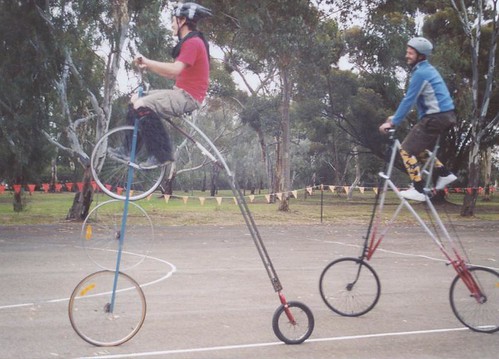
Photo by Refractionless. Then I made this:
farm1.static.flickr.com/198/494857358_798d38d439.jpg?v=0
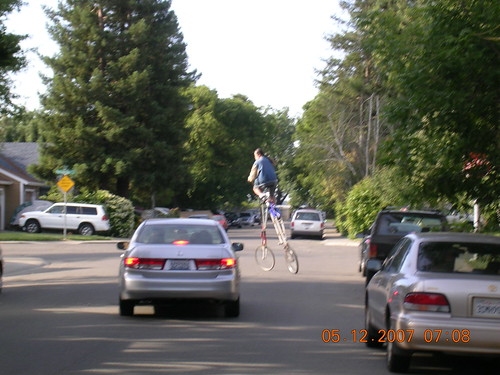
in action in 2010: www.youtube.com/watch?v=WuwXdOQYpso
and a comprehensive set of where it all started.. www.johnnypayphone.net/tallbikes/
On Lesser Celandine, Talbot Heath.
Length 5 to 8 mm. This is one of a group known as March Flies. The adult males have large bulbous eyes. It is identified from some similar species by the fact that it has reddish legs, but Bibio varipes can look very similar.
The harbor (or harbour) seal (Phoca vitulina), also known as the common seal, is a true seal found along temperate and Arctic marine coastlines of the Northern Hemisphere. The most widely distributed species of pinniped (walruses, eared seals, and true seals), they are found in coastal waters of the northern Atlantic and Pacific oceans, Baltic and North seas.
Harbor seals are brown, silvery white, tan, or gray, with distinctive V-shaped nostrils. An adult can attain a length of 1.85 m (6.1 ft) and a mass of up to 168 kg (370 lb). Blubber under the seal's skin helps to maintain body temperature. Females outlive males (30–35 years versus 20–25 years). Harbor seals stick to familiar resting spots or haulout sites, generally rocky areas (although ice, sand, and mud may also be used) where they are protected from adverse weather conditions and predation, near a foraging area. Males may fight over mates under water and on land. Females bear a single pup after a nine-month gestation, which they care for alone. Pups can weigh up to 16 kg (35 lb) and are able to swim and dive within hours of birth. They develop quickly on their mothers' fat-rich milk, and are weaned after four to six weeks.
The global population of harbor seals is 350,000–500,000, but the freshwater subspecies Ungava seal in Northern Quebec is endangered. Once a common practice, sealing is now illegal in many nations within the animal's range.
Description
Individual harbor seals possess a unique pattern of spots, either dark on a light background or light on a dark. They vary in colour from brownish black to tan or grey; underparts are generally lighter. The body and flippers are short, heads are rounded. Nostrils appear distinctively V-shaped. As with other true seals, there is no pinna (ear flap). An ear canal may be visible behind the eye. Including the head and flippers, they may reach an adult length of 1.85 m (6.1 ft) and a weight of 55 to 168 kg (120 to 370 lb). Females are generally smaller than males.
Population
There are an estimated 350,000–500,000 harbor seals worldwide. While the population is not threatened as a whole, the Greenland, Hokkaidō and Baltic Sea populations are exceptions. Local populations have been reduced or eliminated through disease (especially the phocine distemper virus) and conflict with humans, both unintentionally and intentionally. Killing seals perceived to threaten fisheries is legal in Norway, and Canada, but commercial hunting is illegal. Seals are also taken in subsistence hunting and accidentally as bycatch (mainly in bottomset nets). Along the Norwegian coast, bycatch accounted for 48% of pup mortality. Killing or taking seals has been illegal in the United Kingdom since 1 March 2021.
Seals in the United Kingdom are protected by the 1970 Conservation of Seals Act, which prohibits most forms of killing. In the United States, the Marine Mammal Protection Act of 1972 prohibits the killing of any marine mammals, and most local ordinances, as well as NOAA, instruct citizens to leave them alone unless serious danger to the seal exists.
Habitat and diet
Harbor seals prefer to frequent familiar resting sites. They may spend several days at sea and travel up to 50 km in search of feeding grounds, and will also swim more than a hundred miles upstream into fresh water in large rivers in search of migratory fish like shad and likely salmon.[citation needed] Resting sites may be both rugged, rocky coasts, such as those of the Hebrides or the shorelines of New England, or sandy beaches, like the ones that flank Normandy in Northern France or the Outer Banks of North Carolina.[1] Harbor seals frequently congregate in harbors, bays, sandy intertidal zones,[1] and estuaries in pursuit of prey fish such as salmon, menhaden, anchovy, sea bass, herring, mackerel, cod, whiting and flatfish, and occasionally shrimp, crabs, mollusks, and squid. Atlantic subspecies of either Europe or North America also exploit deeper-dwelling fish of the genus Ammodytes as a food source and Pacific subspecies have been recorded occasionally consuming fish of the genus Oncorhynchus. Although primarily coastal, dives of over 500 m have been recorded. Harbor seals have been recorded to attack, kill and eat several kinds of ducks.
Behavior, survival, and reproduction
Harbor seals are solitary, but are gregarious when hauled out and during the breeding season, though they do not form groups as large as some other seals. When not actively feeding, they haul to rest. They tend to be coastal, not venturing more than 20 km offshore. The mating system is not known, but thought to be polygamous. Females give birth once per year, with a gestation period around nine months. Females have a mean age at sexual maturity of 3.72 years and a mean age at first parturition of 4.64. Both courtship and mating occur under water. Researchers have found males gather under water, turn on their backs, put their heads together, and vocalize to attract females ready for breeding. Pregnancy rate of females was 92% from age 3 to age 36, with lowered reproductive success after the age of 25 years.
Birthing of pups occurs annually on shore. The timing of the pupping season varies with location, occurring in February for populations in lower latitudes, and as late as July in the subarctic zone. The mothers are the sole providers of care, with lactation lasting 24 days. The single pups are born well developed, capable of swimming and diving within hours. Suckling for three to four weeks, pups feed on the mother's rich, fatty milk and grow rapidly; born weighing up to 16 kilograms, the pups may double their weight by the time of weaning.
Harbor seals must spend a great deal of time on shore when molting, which occurs shortly after breeding. This onshore time is important to the life cycle, and can be disturbed when substantial human presence occurs. The timing of onset of molt depends on the age and sex of the animal, with yearlings molting first and adult males last. A female mates again immediately following the weaning of her pup. Harbor seals are sometimes reluctant to haul out in the presence of humans, so shoreline development and access must be carefully studied in known locations of seal haul out.
In comparison to many pinniped species, and in contrast to otariid pinnipeds, harbor seals are generally regarded to be more vocally reticent. However, they do utilize non-harmonic vocalizations to maintain breeding territories and to attract mates during specified times of year, and also during mother and pup interactions.
Annual survival rates were calculated at 0.91 for adult males, and 0.902 for adult females. Maximum age for females was 36 and for males 31 years.
Pacific Coast
The California population of subspecies P. v. richardsi amounted to about 25,000 individuals as of 1984. Pacific harbor seals or California harbor seals are found along the entire Pacific Coast shoreline of the state. They prefer to remain relatively close to shore in subtidal and intertidal zones, and have not been seen beyond the Channel Islands as a pelagic form; moreover, they often venture into bays and estuaries and even swim up coastal rivers. They feed in shallow littoral waters on herring, flounder, hake, anchovy, codfish, and sculpin.
Breeding occurs in California from March to May, with pupping between April and May, depending on local populations. As top-level feeders in the kelp forest, harbor seals enhance species diversity and productivity. They are preyed upon by killer whales (orcas) and white sharks. Haul out sites in California include urban beaches and from time to time they can be seen having a nap on the beach in all of San Francisco Bay, which would include the conurbation of Richmond, Oakland, and San Francisco, the Greater Los Angeles area, which would include Santa Barbara, the city of Los Angeles itself, and Long Beach, and all of San Diego Bay, most famously beaches near La Jolla.
Considerable scientific inquiry has been carried out by the Marine Mammal Center and other research organizations beginning in the 1980s regarding the incidence and transmission of diseases in harbor seals in the wild, including analysis of phocine herpesvirus. In San Francisco Bay, some harbor seals are fully or partially reddish in color, possibly caused by an accumulation of trace elements such as iron or selenium in the ocean, or a change in the hair follicles.
Although some of the largest harbor seal pupping areas are found in California, they are also found north along the Pacific Coast in Oregon, Washington, British Columbia and Alaska. Large populations move with the season south along the west coast of Canada and may winter on the islands in Washington and Oregon. Pupping is known to occur in both Washington and Oregon as of 2020. People are advised to stay at least 50m away from harbor seals that have hauled out on land, especially the pups, as mothers will abandon them if there's too much human activity nearby.
Atlantic Coast
Historically, the range of the harbor seal extended from the mouth of the St. Lawrence River and Greenland to the sandy beaches of North Carolina, a distance of well over a thousand miles (greater than 1600 km.) Evidence of their presence in these areas is consistent with both the fossil record as well as a few landmarks named for them during colonization: Robbin's Reef, off of Bayonne, New Jersey, gets its name from the Dutch word robben, meaning "seals". On the border between Canada and the US is an island known as Machias Seal Island, a place where today the harbor seal will occasionally visit but is now a sanctuary for puffins. Over the course of hundreds of years, however, the seal was wiped out steadily by being shot on sight by fishermen and by massive pollution. The evidence for this is found in documents all along the coast of New England which put a bounty on the head of every seal shot, as well as the accounts of harbormasters. New York City, when it was founded in the 1640s, was founded on top of an enormous estuary teeming with life that included the harbor seal. Oil in the 1800s started the process of pollution that was later compounded by even more toxic 20th century chemicals that included PCB's and dioxin. By the time of the 1972 Clean Water Act, New York Harbor was almost dead-almost no living thing could survive in it. Approximately 300 miles to the north, Boston Harbor was equally polluted. Raw sewage had been dumped in the harbor since the late 1800s and the stench of fecal matter in the Charles River was overpowering, as evidenced by the song "Dirty Water" by the Standells, written in 1966. Flatfish, abundant in the area, had enormous tumors in their livers by the 1980s and the harbor seal was long gone, shot to oblivion.
As of 2020, however, the seals have returned. They never were extirpated from Canada and certain pockets of the Maine coast, and thus an important mother population was created from whence the species could reclaim the home of their ancestors. Currently, they are sighted as far south as the barrier islands of North Carolina on a regular basis, with Massachusetts being the southernmost point of known pupping areas along the Atlantic Coast. Harbor seals move south from eastern Canadian waters to breed along the coast of Maine, Cape Cod, and the South Shore in Massachusetts in May and June, and return northward in fall. Others will head south from these areas to "vacation" in warmer waters, particularly young seals unable to compete with adults for food and territory; they do not return north until spring.
One park ranger in New York City, which is dead center of its West Atlantic range, says that "New York is like their Miami resort." This refers to the habit of young seals leaving Cape Cod and even some Arctic waters to inhabit the harbor in winter. In 2018 the New York Post reported that the harbor is now "cleaner than it has been in 110 years," and since the first decade of the 21st century, the harbor seal has found the old turf of its ancestors to be a land of plenty and the water to be livable. Within sight of the New York skyline, known colonies of harbor seals are found on Hoffman and Swinburne Islands as well as portions of Red Hook and Staten Island, readily hauling out every from October until very early May. Known favorite foods of the seal are returning in grand numbers to New York Harbor as well as nearby New Jersey, from Raritan Bay all the way down the entire Jersey Shore, with schools of mossbunker regularly attracting harbor seals, their cousins the grey seals, dolphins and, most recently, whales. Both the northern and southern shores of Long Island have a reliable population of harbor seals as well as greys, where they will take sand lance as well as some species of crab as part of their diet.
Injury from waste in the world's oceans
A major problem is injury from litter floating in the world's oceans. Seals get entangled in nets of general waste like garments, old fishing lines from hobby and professional fishermen and packaging waste (packaging straps) and fishing hooks from professional shark and tuna fishing. If they cannot free themselves from the entanglement, these grow into the skin or flippers of young and old seals and the animals will die from them. The organisation Ocean Conservation Namibia has freed about 3000 seals from such dangerous waste and documents such rescue operations on YouTube.
Notable individuals
Andre, rescued and trained by his owner Harry Goodridge, he became an iconic figure in his hometown of Rockport, Maine.
Hoover, also rescued from a Maine harbor. Hoover became famous for his ability to imitate human speech, something not observed in any other mammal.
Popeye, the official seal of Friday Harbor, Washington, notable for her common sightings up until 2019, when she was presumed to have died. She was identified and named for her cloudy left eye. There is a statue of her in the Port of Friday Harbor.
Freddie, a seal pup commonly spotted along the Thames in central London. Named after Freddie Mercury due to his bushy whiskers and playfulness. Freddie was known to travel unusually far into London from the Thames Estuary, and was often sighted as far west as Hammersmith. On 21 March 2021 he had to be put down after he was violently mauled by an out-of-control dog.
The Eurasian eagle-owl (Bubo bubo) is a species of eagle-owl that resides in much of Eurasia. It is also called the Uhu and it is occasionally abbreviated to just the eagle-owl in Europe. It is one of the largest species of owl, and females can grow to a total length of 75 cm (30 in), with a wingspan of 188 cm (6 ft 2 in), with males being slightly smaller. This bird has distinctive ear tufts, with upper parts that are mottled with darker blackish colouring and tawny. The wings and tail are barred. The underparts are a variably hued buff, streaked with darker colouring. The facial disc is not very defined and the orange eyes are distinctive.
Eurasian eagle-owls are found in many habitats, but are mostly birds of mountainous regions or other rocky areas, often those near varied woodland edge and shrubby areas with openings or wetlands to hunt a majority of their prey. Additionally, they inhabit coniferous forests, steppes, and other areas at varied elevations that are typically relatively remote. Eurasian eagle-owls are occasionally found amongst farmland and in park-like settings within European cities, even rarely within busier urban areas. The eagle-owl is mostly a nocturnal predator, hunting for a range of different prey species. Predominantly, their diet is composed of small mammals such as rodents and rabbits, but they also prey on larger mammals and birds of varying sizes. Other secondary prey can include reptiles, amphibians, fish, large insects and other assorted invertebrates. The species typically breeds on cliff ledges, in gullies, among rocks, or in other concealed locations. The nest is a scrape containing a clutch of 2–4 eggs typically, which are laid at intervals and hatch at different times. The female incubates the eggs and broods the young, and the male provides food for her, and when they hatch, for the nestlings, as well. Continuing parental care for the young is provided by both adults for about five months. At least 12 subspecies of the Eurasian eagle-owl are described.
In addition to being one of the largest living species of owl, the Eurasian eagle-owl is also one of the most widely distributed.[9] With a total range in Europe and Asia of about 51.4 million km2 (19.8 million sq mi) and a total population estimated to be between 100,000 and 500,000 individuals, the IUCN lists the bird's conservation status as being of least concern, although the trend is listed as decreasing. The vast majority of eagle-owls live in Continental Europe, Scandinavia, Russia (which is almost certainly where the peak numbers and diversity of race occurs), and Central Asia. Additional minor populations exist in Anatolia, the northern Middle East, the montane upper part of South Asia, China, Korea and in Japan; in addition, an estimated 12 to 40 pairs are thought to reside in the United Kingdom as of 2016 (where they are arguably non-native), a number which may be on the rise, and have successfully bred in the UK since at least 1996. Tame eagle-owls have occasionally been used in pest control because of their size to deter large birds such as gulls from nesting.
Description
The Eurasian eagle-owl is among the larger birds of prey, smaller than the golden eagle (Aquila chrysaetos), but larger than the snowy owl (Bubo scandiacus), despite some overlap in size with both of those species. It is sometimes referred to as the world's largest owl, although Blakiston's fish owl (B. blakistoni) is slightly heavier on average and the much lighter weight great grey owl (Strix nebulosa) is slightly longer on average. Heimo Mikkola reported the largest specimens of eagle-owl as having the same upper body mass, 4.6 kg (10 lb), as the largest Blakiston’s fish owl and attained a length around 3 cm (1.2 in) longer. In terms of average weight and wing size, the Blakiston’s is the slightly larger species seemingly, even averaging a bit larger in these aspects than the biggest eagle-owl races from Russia. Also, although 9 cm (3.5 in) shorter than the largest of the latter species, the Eurasian eagle-owl can weigh well more than twice as much as the largest great grey owl. The Eurasian eagle-owl typically has a wingspan of 131–188 cm (4 ft 4 in – 6 ft 2 in), with the largest specimens possibly attaining 2 m (6 ft 7 in). The total length of the species can vary from 56 to 75 cm (22 to 30 in). Females can weigh from 1.75 to 4.6 kg (3.9 to 10.1 lb), and males can weigh from 1.2 to 3.2 kg (2.6 to 7.1 lb). In comparison, the barn owl (Tyto alba), the world's most widely distributed owl species, weighs about 0.5 kg (1.1 lb) and the great horned owl (B. virginianus), which fills the eagle-owl's ecological niche in North America, weighs around 1.4 kg (3.1 lb).
Eurasian eagle-owl in captivity
Besides the female being larger, little external sexual dimorphism is seen in the Eurasian eagle-owl, although the ear tufts of males reportedly tend to be more upright than those of females. When an eagle-owl is seen on its own in the field, distinguishing the individual’s sex is generally not possible. Gender determination by size is possible by in-hand measurements. In some populations, the female typically may be slightly darker than the male. The plumage coloration across at least 13 accepted subspecies can be highly variable. The upper parts may be brown-black to tawny-buff to pale creamy gray, typically showing dense freckling on the forehead and crown, stripes on the nape, sides, and back of the neck, and dark splotches on the pale ground colour of the back, mantle, and scapulars. A narrow buff band, freckled with brown or buff, often runs up from the base of the bill, above the inner part of the eye, and along the inner edge of the black-brown ear tufts. The rump and upper tail-coverts are delicately patterned with dark vermiculations and fine, wavy barring, the extent of which varies with subspecies. The underwing coverts and undertail coverts are similar, but tend to be more strongly barred in brownish-black.
The primaries and secondaries are brown with broad, dark brown bars and dark brown tips, and grey or buff irregular lines. A complete moult takes place each year between July and December. The facial disc is tawny-buff, speckled with black-brown, so densely on the outer edge of the disc as to form a "frame" around the face. The chin and throat are white with a brownish central streak. The feathers of the upper breast generally have brownish-black centres and reddish-brown edges except for the central ones, which have white edges. The chin and throat may appear white continuing down the center of the upper breast. The lower breast and belly feathers are creamy-brown to tawny buff to off-white with a variable amount of fine dark wavy barring, on a tawny-buff ground colour. The legs and feet (which are feathered almost to the talons) are likewise marked on a buff ground colour but more faintly. The tail is tawny-buff, mottled dark grey-brown with about six black-brown bars. The bill and feet are black. The iris is most often orange but is fairly variable. In some European birds, the iris is a bright reddish, blood-orange colour but then in subspecies found in arid, desert-like habitats, the iris can range into an orange-yellow colour (most closely related species generally have yellowish irises, excluding the Indian eagle-owl).
Standard measurements and physiology
Among standard measurements for the Eurasian eagle-owl, the wing chord measures 378 to 518 mm (14.9 to 20.4 in), the tail measures 229–310 mm (9.0–12.2 in) long, the tarsus measures 64.5–112 mm (2.54–4.41 in), and the total length of the bill is 38.9–59 mm (1.53–2.32 in). The wings are reportedly the smallest in proportion to the body weight of any European owl, when measured by the weight per area of wing size, was found to be 0.72 g/cm2. Thus, they have quite high wing loading. The great horned owl has even smaller wings (0.8 g/cm2) relative to its body size. The golden eagle has slightly lower wing loading proportionately (0.65 g/cm2), so the aerial abilities of the two species (beyond the eagle’s spectacular ability to stoop) may not be as disparate as expected. Some other owls, such as barn owls, short-eared owls (Asio flammeus), and even the related snowy owls have lower wing loading relative to their size, so are presumably able to fly faster, with more agility, and for more extended periods than the Eurasian eagle-owl. In the relatively small race B. b. hispanus, the middle claw, the largest talon, (as opposed to rear hallux-claw, which is the largest in accipitrids) was found to measure from 21.6 to 40.1 mm (0.85 to 1.58 in) in length. A 3.82 kg (8.4 lb) female examined in Britain (origins unspecified) had a middle claw measuring 57.9 mm (2.28 in), on par in length with a large female golden eagle hallux-claw. Generally, owls do not have talons as proportionately large as those of accipitrids, but have stronger, more robust feet relative to their size. Accipitrids use their talons to inflict organ damage and blood loss, whereas typical owls use their feet to constrict their prey to death, the talons serving only to hold the prey in place or provide incidental damage. The talons of the Eurasian eagle-owl are very large and not often exceeded in size by diurnal raptors. Unlike the great horned owls, the overall foot size and strength of the Eurasian eagle-owl is not known to have been tested, but the considerably smaller horned owl has one of the strongest grips ever measured in a bird.
The feathers of the ear tufts in Spanish birds (when not damaged) were found to measure from 63.3 to 86.6 mm (2.49 to 3.41 in).[26] The ear openings (covered in feathers as in all birds) are relatively uncomplicated for an owl, but are also large, being larger on the right than on the left as in most owls, and proportionately larger than those of the great horned owl. In the female, the ear opening averages 31.7 mm (1.25 in) on the right and 27.4 mm (1.08 in) on the left, and in males, averages 26.8 mm (1.06 in) on the right and 24.4 mm (0.96 in) on the left. The depth of the facial disc and the size and complexity of the ear opening are directly correlated to the importance of sound in an owl’s hunting behaviour. Examples of owls with more complicated ear structures and deeper facial disc are barn owls, long-eared owls (Asio otus), and boreal owls (Aegolius funereus). Given the uncomplicated structure of their ear openings and relatively shallow, undefined facial discs, hunting by ear is secondary to hunting by sight in eagle-owls; this seems to be true for Bubo in general. More sound-based hunters such as the aforementioned species likely focus their hunting activity in more complete darkness. Also, owls with white throat patches such as the Eurasian eagle-owl are more likely to be active in low-light conditions in the hours before and after sunrise and sunset rather than the darkest times in the middle of the night. The boreal and barn owls, to extend these examples, lack obvious visual cues such as white throat patches (puffed up in displaying eagle-owls), again indicative of primary activity being in darker periods.
Distinguishing from other species
The great size, bulky, barrel-shaped build, erect ear tufts, and orange eyes render this as a distinctive species. Other than general morphology, the above features differ markedly from those of two of the next largest subarctic owl species in Europe and western Asia, which are the great grey owl and the greyish to chocolate-brown Ural owl (Strix uralensis), both of which have no ear tufts and have a distinctly rounded head, rather than the blocky shape of the eagle-owl’s head. The snowy owl is obviously distinctive from most eagle-owls, but during winter the palest Eurasian eagle-owl race (B. b. sibiricus) can appear off-white. Nevertheless, the latter is still distinctively an ear-tufted Eurasian eagle-owl and lacks the pure white background colour and variable blackish spotting of the slightly smaller species (which has relatively tiny, vestigial ear tufts that have only been observed to have flared on rare occasions).
Unique camouflage pattern
The long-eared owl has a somewhat similar plumage to the eagle-owl, but is considerably smaller (an average female eagle-owl may be twice as long and 10 times heavier than an average long-eared owl). Long-eared owls in Eurasia have vertical striping like that of the Eurasian eagle-owl, while long-eared owls in North America show a more horizontal striping like that of great horned owls. Whether these are examples of mimicry either way is unclear but it is known that both Bubo owls are serious predators of long-eared owls. The same discrepancy in underside streaking has also been noted in the Eurasian and American representations of the grey owl. A few other related species overlap minimally in range in Asia, mainly in East Asia and the southern reaches of the Eurasian eagle-owl’s range. Three fish owls appear to overlap in range, the brown (Ketupa zeylonensis) in at least northern Pakistan, probably Kashmir, and discontinuously in southern Turkey, the tawny (K. flavipes) through much of eastern China, and Blakiston's fish owl in the Russian Far East, northeastern China, and Hokkaido. Fish owls are distinctively different looking, possessing more scraggy ear tufts that hang to the side rather than sit erect on top of the head, and generally have more uniform, brownish plumages without the contrasting darker streaking of an eagle-owl. The brown fish owl has no feathering on the tarsus or feet, and the tawny has feathering only on the upper portion of the tarsi, but the Blakiston’s is nearly as extensively feathered on the tarsi and feet as the eagle-owl. Tawny and brown fish owls are both slightly smaller than co-occurring Eurasian eagle-owls, and Blakiston’s fish owls are similar or slightly larger than co-occurring large northern eagle-owls. Fish owls, being tied to the edges of fresh water, where they hunt mainly fish and crabs, also have slightly differing, and more narrow, habitat preferences.
In the lower Himalayas of northern Pakistan and Jammu and Kashmir, along with the brown fish owl, the Eurasian eagle-owl at the limit of its distribution may co-exist with at least two to three other eagle-owls. One of these, the dusky eagle-owl (B. coromandus) is smaller, with more uniform tan-brownish plumage, untidy uniform light streaking rather than the Eurasian’s dark streaking below and an even less well-defined facial disc. The dusky is usually found in slightly more enclosed woodland areas than Eurasian eagle-owls. Another is possibly the spot-bellied eagle-owl (B. nipalensis), which is strikingly different looking, with stark brown plumage, rather than the warm hues typical of the Eurasian, bold spotting on a whitish background on the belly, and somewhat askew ear tufts that are bold white with light brown crossbars on the front. Both species may occur in some parts of the Himalayan foothills, but they are not currently verified to occur in the same area, in part because of the spot-bellied’s preference for dense, primary forest. Most similar, with basically the same habitat preferences and the only one verified to co-occur with the Eurasian eagle-owls of the race B. b. turcomanus in Kashmir is the Indian eagle-owl (B. bengalensis). The Indian species is smaller, with a bolder, blackish facial disc border, more rounded and relatively smaller wings, and partially unfeathered toes. Far to the west, the pharaoh eagle-owl (B. ascalaphus) also seemingly overlaps in range with the Eurasian, at least in Jordan. Although also relatively similar to the Eurasian eagle-owl, the pharaoh eagle-owl is distinguished by its smaller size, paler, more washed-out plumage, and the diminished size of its ear tufts.
Moulting
The Eurasian eagle-owls’ feathers are lightweight and robust, but nevertheless need to be replaced periodically as they become worn. In the Eurasian eagle-owl, this happens in stages, and the first moult starts the year after hatching with some body feathers and wing coverts being replaced. The next year, the three central secondaries on each wing and three middle tail feathers are shed and regrow, and the following year, two or three primaries and their coverts are lost. In the final year of this postjuvenile moult, the remaining primaries are moulted and all the juvenile feathers will have been replaced. Another moult takes place during years 6-12 of the bird's life. This happens between June and October after the conclusion of the breeding season, and again it is a staged process with six to nine main flight feathers being replaced each year. Such a moulting pattern lasting several years is repeated throughout the bird's life.
Taxonomy
The Eurasian eagle-owl was formally described by the Swedish naturalist Carl Linnaeus in 1758 in the tenth edition of his Systema Naturae under the binomial name Strix bulbo. Although Linnaeus specified the "habitat" as "Europa" the type locality is restricted to Sweden. The Eurasian eagle-owl is now placed in the genus Bubo that was introduced by André Duméril in 1805.
The genus Bubo with 20 extant species includes most of the larger owl species in the world today. Based on an extensive fossil record and a central distribution of extant species on that continent, Bubo appears to have evolved into existence in Africa, although early radiations seem to branch from southern Asia, as well. Two genera belonging to the scops owls complex, the giant scops owls (Otus gurneyi) found in Asia and the Ptilopsis or the white-faced scops owl found in Africa, although firmly ensconced in the scops owl group, appear to share some characteristics with the eagle-owls. The Strix genus is also related to Bubo, and is considered a "sister complex", with Pulsatrix possibly being intermediate between the two. The Eurasian eagle-owl appears to represent an expansion of the genus Bubo into the Eurasian continent. A few of the other species of Bubo seem to have been derived from the Eurasian eagle-owl, making it a "paraspecies", or they at least share a relatively recent common ancestor.
The pharaoh eagle-owl, distributed in the Arabian Peninsula and sections of the Sahara Desert through North Africa where rocky outcrops are found, was until recently considered a subspecies of the Eurasian eagle-owl. The pharaoh eagle-owl apparently differs about 3.8% in mitochondrial DNA from the Eurasian eagle-owl, well past the minimum genetic difference to differentiate species of 1.5%. Smaller and paler than Eurasian eagle-owls, the pharaoh eagle-owl can also be considered a distinct species largely due to its higher-pitched and more descending call, and the observation that Eurasian eagle-owls formerly found in Morocco (B. b. hispanus) apparently did not breed with the co-existing pharaoh eagle-owls. On the contrary, the race still found together with the pharaoh eagle-owl in the wild (B. b. interpositus) in the central Middle East has been found to interbreed in the wild with the pharaoh eagle-owl, although genetical materials have indicated B. b. interpositus may itself be a distinct species from the Eurasian eagle-owl, as it differs from the nominate subspecies of the Eurasian eagle-owl by 2.8% in mitochondrial DNA. For three Asian Eurasian eagle-owl subspecies (B. b. ussuriensis, B. b. kiautschensis and B. b. hemachlana, respectively), it was found that they met the criterion for subspecies well, with a high haplotype diversity and in spite of a relatively recent common ancestor and low genetic diversity. The Indian eagle-owl (B. bengalensis) was also considered a subspecies of the Eurasian eagle-owl until recently, but its smaller size, distinct voice (more clipped and high-pitched than the Eurasian), and the fact that it is largely allopatric in distribution (filling out the Indian subcontinent) with other Eurasian eagle-owl races has led to it being considered a distinct species. The mitochondrial DNA of the Indian species also appears considerably distinct from the Eurasian species. The Cape eagle-owl (B. capensis) appears to represent a return of this genetic line back into the African continent, where it leads a lifestyle similar to Eurasian eagle-owls, albeit far to the south. Another offshoot of the northern Bubo group is the snowy owl. It appears to have separated from other Bubo species at least 4 million years ago.
The fourth and most famous derivation of the evolutionary line that includes the Eurasian eagle-owl is the great horned owl, which appears to have been the result of primitive eagle-owls spreading into North America. According to some authorities, the great horned owls and Eurasian eagle-owls are barely distinct as species, with a similar level of divergence in their plumages as the Eurasian and North American representations of the great grey owl or the long-eared owl. More outward physical differences exist between the great horned owl and the Eurasian eagle-owl than in those two examples, including a great size difference favoring the Eurasian species, the great horned owl’s horizontal rather than vertical underside barring, yellow rather than orange eyes, and a much stronger black bracket to the facial disc, not to mention a number of differences in their reproductive behaviour and distinctive voices. Furthermore, genetic research has revealed that the snowy owl is more closely related to the great horned owl than are Eurasian eagle-owls. The most closely related species beyond the pharaoh, Indian, and Cape eagle-owls to the Eurasian eagle-owl is the smaller, less powerful and African spotted eagle-owl (B. africanus), which was likely to have divided from the line before they radiated away from Africa. Somehow, genetic materials indicate the spotted eagle-owl appears to share a more recent ancestor with the Indian eagle-owl than with the Eurasian eagle-owl or even the sympatric Cape eagle-owl. Eurasian eagle-owls in captivity have produced apparently healthy hybrids with both the Indian eagle-owl and the great horned owl. The pharaoh, Indian, and Cape eagle-owls and the great horned owl are all broadly similar in size to each other, but all are considerably smaller than the Eurasian eagle-owl, which averages at least 15–30% larger in linear dimensions and 30–50% larger in body mass than these other related species, possibly as the eagle-owls adapted to warmer climates and smaller prey. Fossils from southern France have indicated that during the Middle Pleistocene, Eurasian eagle-owls (this paleosubspecies is given the name B. b. davidi) were larger than they are today, even larger were those found in Azerbaijan and in the Caucasus (either B. b. bignadensis or B. bignadensis), which were deemed to date to the Late Pleistocene. About 12 subspecies are recognized today.
Habitat
Eagle-owls are distributed somewhat sparsely, but can potentially inhabit a wide range of habitats, with a partiality for irregular topography. They have been found in habitats as diverse as northern coniferous forests to the edge of vast deserts. Essentially, Eurasian eagle-owls have been found living in almost every climatic and environmental condition on the Eurasian continent, excluding the greatest extremities, i.e. they are absent from humid rainforest in Southeast Asia, and the high Arctic tundra, both of which they are more or less replaced by other species of Bubo owls. They are often found in the largest numbers in areas where cliffs and ravines are surrounded by a scattering of trees and bushes. Grassland areas such as alpine meadows or desert-like steppe can also host them so long as they have the cover and protection of rocky areas. The preference of eagle-owls for places with irregular topography has been reported in most known studies. The obvious benefit of such nesting locations is that both nests and daytime roosts located in rocky areas and/or steep slopes would be less accessible to predators, including man. Also, they may be attracted to the vicinity of riparian or wetlands areas, because the soft soil of wet areas is conducive to burrowing by the small, terrestrial mammals normally preferred in the diet, such as voles and rabbits.
Due to their preference for rocky areas, the species is often found in mountainous areas, and can be found up to elevations of 2,100 m (6,900 ft) in the Alps, 4,500 m (14,800 ft) in the Himalayas, and 4,700 m (15,400 ft) in the adjacent Tibetan Plateau. They can also be found living at sea level and may nest amongst rocky sea cliffs. Despite their success in areas such as subarctic zones and mountains that are frigid for much of the year, warmer conditions seem to result in more successful breeding attempts per studies in the Eifel region of Germany. In a study from Spain, areas primarily consisting of woodlands (52% of study area being forested) were preferred with pine trees predominating the oaks in habitats used, as opposed to truly mixed pine-oak woodland. Pine and other coniferous stands are often preferred in great horned owls, as well, due to the constant density, which make overlooking the large birds more likely. In mountainous forest, they are not generally found in enclosed wooded areas, as is the tawny owl (Strix alucco), instead usually near forest edge. Only 2.7% of the habitat included in the territorial ranges for eagle-owls per the habitat study in Spain consisted of cultivated or agricultural land. Compared to golden eagles, though, they can visit cultivated land more regularly in hunting forays due to their nocturnal habits, which allow them to largely evade human activity. Other accounts make clear that farmland is only frequented where its less intensively farmed, holds more extensive treed and bushy areas, and often has limited to no irrigation; farmland areas with fallow or abandoned fields are more likely to hold more prey, so are prone to less frequent human disturbance. In the Italian Alps, almost no pristine habitat remained, and eagle-owls nested locally in the vicinity of towns, villages, and ski resorts.
Although found in the largest numbers in areas sparsely populated by humans, farmland is sometimes inhabited, and they even have been observed living in park-like or other quiet settings within European cities. Since 2005, at least five pairs have nested in Helsinki. This is due in part to feral European rabbits (Oryctolagus cuniculus) having recently populated the Helsinki area, originally from pet rabbits released to the wild. The number is expected to increase due to the growth of the European rabbit population in Helsinki. European hares (Lepus europaeus), the often preferred prey species by biomass of the eagle-owls in their natural habitat, live only in rural areas of Finland, not in the city centre. In June 2007, an eagle-owl nicknamed 'Bubi' landed in the crowded Helsinki Olympic Stadium during the European Football Championship qualification match between Finland and Belgium. The match was interrupted for six minutes. After tiring of the match, following Jonathan Johansson's opening goal for Finland, the bird left the scene. Finland's national football team have had the nickname Huuhkajat (Finnish for "Eurasian eagle-owls") ever since. The owl was named "Helsinki Citizen of the Year" in December 2007. In 2020, a brood of three eagle-owl chicks was raised by their mother on a large, well-foliaged planter on an apartment window in the city centre of Geel, Belgium.
Distribution
The Eurasian eagle-owl is one of the most widely distributed of all owl species, although it is far less wide-ranging than the barn owl, the short-eared owl (Asio flammeus) and long-eared owl and lacks the circumpolar range of boreal species such as great grey owl, boreal owl and northern hawk owl (Surnia ulula). This eagle-owl reaches its westernmost range in the Iberian Peninsula, both almost throughout Spain and more spottily in Portugal. From there, the Eurasian eagle-owl ranges widely in the south of France from Toulouse to Monaco and as far north into the central part of the country as in Allier. Farther north, they are found sporadically and discontinuously in Luxembourg, southern and western Belgium and scarcely into the Netherlands. It is infrequently found in southern and central United Kingdom. In Germany, the eagle-owl can be found in large but highly discontinuous areas, mostly in the south and central areas but is almost entirely absent in areas such as Brandenburg. Across from its south German range, this species range is nearly continuous into the Czech Republic, Slovakia, northern and eastern Hungary and very spottily into Poland. In the fairly montane countries of Switzerland and Austria, the eagle-owl can be found fairly broadly. In Italy, the Eurasian eagle-owl is found where the habitat is favorable in much of the northern, western and central portions down to as far south Melito di Porto Salvo. From Italy, this species sweeps quite broadly along the Mediterranean coast in Southeastern Europe from Slovenia mostly continuously to most of Greece and Bulgaria. In eastern Europe, the Eurasian eagle-owl is found essentially throughout from central Romania to Estonia. The species also occupies a majority of Finland and Scandinavia, where most broadly found in Norway, somewhat more spottily in Sweden and in Denmark it is found widely in Jutland (absent from the islands).
The Eurasian eagle-owl's range in Russia is truly massive, with the species apparently nearly unbound by habitat, with their distribution only excluding them from the true Arctic zone, i.e. their range stops around the tree line. If not the most densely populated species, they almost certainly stand as Russia's most widely distributed owl species. From Russia, they are found throughout Central Asia, residing continuously in each nation from Kazakhstan down to Afghanistan. In Asia Minor, they are found broadly in Georgia, Azerbaijan and somewhat so in western and southern Turkey but is quite sporadic in distribution overall in Turkey. A spotty range also exists in the Middle East in Syria, Iraq, Lebanon, Israel, Jordan and western Iran, the species being found broadly only in north and western Iran. In South Asia, the Eurasian eagle-owl is found mostly often in northern Pakistan, northern Nepal and Bhutan and more marginally into far northern India. This species resides throughout Mongolia, almost the entirety of China (mainly absent only from southern Yunnan and southern Guangxi). From China and eastern Russia, the Eurasian eagle-owl is found throughout Korea, Sakhalin, the Kuril Islands and rarely into Japan in northern Hokkaido. Besides the Kurils, the farthest eastern part of the range for this species is in Magadan in the Russian Far East.
Behaviour
The Eurasian eagle-owl is largely nocturnal in activity, as are most owl species, with its activity focused in the first few hours after sunset and the last few hours before sunrise. In the northern stretches of its range, partial diurnal behaviour has been recorded, including active hunting in broad daylight during the late afternoon. In such areas, full nightfall is essentially non-existent at the peak of summer, so eagle-owls must presumably hunt and actively brood at the nest during daylight. The Eurasian eagle-owl has a number of vocalizations that are used at different times. It will usually select obvious topographic features such as rocky pinnacles, stark ridges and mountain peaks to use as regular song posts. These are dotted along the outer edges of the eagle-owl's territory and they are visited often but only for a few minutes at a time.
Vocal activity is almost entirely confined to the colder months from late fall through winter, with vocal activity in October through December mainly having territorial purposes and from January to February being primarily oriented towards courtship and mating purposes. Vocalizations in a Spanish study begin no sooner than 29 minutes after sunset and end no later than 55 minutes before sunrise. The territorial song, which can be heard at great distance, is a deep resonant ooh-hu with emphasis on the first syllable for the male, and a more high-pitched and slightly more drawn-out uh-hu for the female. It is not uncommon for a pair to perform an antiphonal duet. The widely used name in Germany as well as some other sections of Europe for this species is uhu due to its song. At 250–350 Hz, the Eurasian eagle-owls territorial song or call is deeper, farther-carrying and is often considering "more impressive" than the territorial songs of the great horned owl or even that of the slightly larger Blakiston's fish owl, although the horned owl’s call averages slightly longer in duration and the Blakiston's call is typically deeper.[7] Other calls include a rather faint, laughter-like OO-OO-oo and a harsh kveck-kveck. Intruding eagle-owls and other potential dangers may be met with a "terrifying", extremely loud hooo. Raucous barks not unlike those of ural owls or long-eared owls have been recorded but are deeper and more powerful than those species’ barks. Annoyance at close quarters is expressed by bill-clicking and cat-like spitting, and a defensive posture involves lowering the head, ruffling the back feathers, fanning the tail and spreading the wings.
The Eurasian eagle-owl rarely assumes the so-called "tall-thin position", which is when an owl adopts an upright stance with plumage closely compressed and may stand tightly beside a tree trunk. Among others, the long-eared owl is among the most often reported to sit with this pose. The great horned owl has been more regularly recorded using the tall-thin, if not as consistently as some Strix and Asio owls, and it is commonly thought to aid camouflage if encountering a threatening or novel animal or sound. The Eurasian eagle-owl is a broad-winged species and engages in a strong, direct flight, usually consisting of shallow wing beats and long, surprisingly fast glides. It has, unusually for an owl, also been known to soar on updrafts on rare occasions. The latter method of flight has led them to be mistaken for Buteos, which are smaller and quite differently proportioned. Usually when seen flying during the day, it is due to being disturbed or displaced from its roost by humans or mobbing animals, such as crows. Eurasian eagle-owls are highly sedentary, normally maintaining a single territory throughout their adult lives.
Eurasian eagle-owl are considered a completely non-migratory bird, as are all members of the Bubo genus excluding the snowy owl. Even those near the northern limits of their range, where winters are harsh and likely to bear little in food, the eagle-owl does not leave its native range. In 2020, a study presented evidence of a short distance distribution by adult eagle-owls in the fall subsequent to breeding, with 5 adults found to move over 20 km (12 mi) away from their nests. There are additionally claimed cases from Russia of Eurasian eagle-owls moving south for the winter, as the icebound, infamously harsh climate there may be too severe even for these hardy birds and their prey. Similarly, Eurasian eagle-owls living in the Tibetan highlands and Himalayas may in some anecdotal cases vacate their normal territories when winter hits and move south. In both of those examples, these are old, unverified reports and there is no evidence whatsoever of consistent, annual migration by Eurasian eagle-owls and the birds may eke out a living on their normal territories even in the sparsest times.
Dietary biology
Eurasian eagle-owls are strictly territorial and will defend their territories from interloping eagle-owls year around, but territorial calling appears to peak around October to early January. Territory size is similar or occasionally slightly greater than great horned owl: averaging 15 to 80 km2 (5.8 to 30.9 sq mi). Territories are established by the male eagle-owl, who selected the highest points in the territory from which to sing. The high prominence of singing perches allows their song to be heard at greater distances and lessens the need for potentially dangerous physical confrontations in the areas where territories may meet. Nearly as important in territorial behaviour as vocalization is the white throat patch. When taxidermied specimens with flared white throats were placed around the perimeter of eagle-owl territories, male eagle-owls reacted quite strongly and often attacked the stuffed owl, reacting more mildly to a stuffed eagle-owl with a non-flared white throat. Females were less likely to be aggressive to mounted specimens and did not seem to vary in their response whether exposed to the specimens with or without the puffed up white patch. In January and February, the primary function for vocalization becomes for the purpose of courtship. More often than not, eagle-owls will pair for life but usually engage in courtship rituals annually, most likely to re-affirm pair bonds. When calling for the purposes of courtship, males tend to bow and hoot loudly but do so in a less contorted manner than the male great horned owl. Courtship in the Eurasian eagle-owl may involve bouts of "duetting", with the male sitting upright and the female bowing as she calls. There may be mutual bowing, billing and fondling before the female flies to a perch where coitus occurs, usually taking place several times over the course of a few minutes.
Nests
The male selects breeding sites and advertises their potential to the female by flying to them and kneading out a small depression (if soil is present) and making staccato notes and clucking noises. Several potential sites may be presented, with the female selecting one. In Baden-Wurttenberg, Germany, the amount of male nest site visits were found to increase in time spent over the pre-laying breeding season from a mean of 29 minutes to 3 hours with frequent incubation like sitting by the male. Like all owls, Eurasian eagle-owls do not build nests or add material but nest on the surface or material already present. Eurasian eagle-owls normally nest on rocks or boulders, most often utilizing cliff ledges and steep slopes, as well as crevices, gullies, holes or caves. Rocky areas that also prove concealing woodlots as well as, for hunting purposes, that border river valleys and grassy scrubland may be especially attractive. If only low rubble is present, they will nest on the ground between rocks. Often, in more densely forested areas, they've been recorded nesting on the ground, often among roots of trees, under large bushes and under fallen tree trunks. Steep slopes with dense vegetation are preferred if nesting on the ground, although some ground nests are surprisingly exposed or in flat spots such as in open spots of the taiga, steppe, ledges of river banks and between wide tree trunks. All Eurasian eagle-owl nests in the largely forested Altai Krai region of Russia were found to be on the ground, usually at the base of pines. This species does not often use other bird’s nests as does the great horned owl, which often prefers nests built by other animals over any other nesting site. The Eurasian eagle-owl has been recorded in singular cases using nests built by common buzzards (Buteo buteo), golden eagle, greater spotted (Clanga clanga) and white-tailed eagles (Haliaeetus albicilla), common ravens (Corvus corax) and black storks (Ciconia nigra). Among the eagle-owls of the fairly heavily wooded wildlands of Belarus, they more commonly utilize nests built by other birds than most eagle-owls, i.e. stork or accipitrid nests, but a majority of nests are still located on the ground. This is contrary to the indication that ground nests are selected only if rocky areas or other bird nests are unavailable, as many will utilize ground nests even where large bird nests seem to be accessible. Tree holes being used for nesting sites are even more rarely recorded than nests constructed by other birds. While it may be assumed that the eagle-owl is too large to utilize tree hollows, when other large species like the great grey owl have never been recorded nesting in one, the even more robust Blakiston's fish owl nests exclusively in cavernous hollows. The Eurasian eagle-owl often uses the same nest site year after year.
Parental behaviour
In Engadin, Switzerland, the male eagle-owl alone hunts until the young are 4 to 5 weeks old and the female spends all her time brooding at the nest. After this point, the female gradually resumes hunting from both herself and the young and thus provides a greater range of food for the young. While it may seem contrary to the species’ highly territorial nature, there is one verified cases of polygamy in Germany, with a male apparently mating with two females, and cooperative brooding in Spain, with a third adult of undetermined sex helping a breeding pair care for the chicks. The response of Eurasian eagle-owls to humans approaching at the nest is quite variable. The species is often rather less aggressive than some other owls, including related species like the spot-bellied eagle-, great horned and snowy owls, many of the northern Strix species, and even some rather smaller owl species, which often fearlessly attack any person found to be nearing their nests. Occasionally, if a person climbs to an active nest, the adult female eagle-owl will do a distraction display, in which they feign an injury. This is an uncommon behavior in most owls and is most often associated with small birds trying to falsely draw the attention of potential predators away from their offspring. More commonly, the adults withdraw to a safe distance, as their nests are usually well-camouflaged. Occasionally if cornered both adults and nestlings will do an elaborate threat display, also rare in owls in general, in which the eagle-owls raise their wings into a semi-circle and puff up their feathers, followed by a snapping of their bills. Apparently, eagle-owls of uncertain and probably exotic origin in Britain are likely to react aggressively to humans approaching the nest. Also, aggressive encounters involving eagle-owls around their nest, despite being historically uncommon, apparently have increased in recent decades in Scandinavia. The discrepancy of aggressiveness at the nest between the Eurasian eagle-owl and its Nearctic counterpart may be correlated to variation in the extent of nest predation that the species endured during the evolutionary process.
Eggs and offspring development
The eggs are normally laid at intervals of three days and are incubated only by the female. Laying generally begins in late winter but may be later in the year in colder habitats. During the incubation period, the female is brought food at the nest by her mate. A single clutch of white eggs is laid; each egg can measure from 56 to 73 mm (2.2 to 2.9 in) long by 44.2 to 53 mm (1.74 to 2.09 in) in width, and will usually weigh about 75 to 80 g (2.6 to 2.8 oz). In Central Europe, eggs average 59.8 mm × 49.5 mm (2.35 in × 1.95 in), and in Siberia, eggs average 59.4 mm × 50.1 mm (2.34 in × 1.97 in). Their eggs are only slightly larger than those of snowy owls and the nominate subspecies of great horned owl, while similar in size to those of spot-bellied eagle-owls and Blakiston's fish owls. The Eurasian eagle-owl’s eggs are noticeably larger than those of Indian eagle-owl and pharaoh eagle-owls. Usually clutch size is one or two, rarely three or four, and exceptionally to six. The average number of eggs laid varies with latitude in Europe. Clutch size ranges from 2.02 to 2.14 in Spain and the massifs of France, and 1.82 to 1.89 in central Europe and the eastern Alps; in Sweden and Finland, the mean clutch size is 1.56 and 1.87, respectively. While variation based on climate is not unusual for different wide-ranging palearctic species, the higher clutch size of western Mediterranean eagle-owls is also probably driven by the presence of lagomorphs in the diet, which provide high nutritional value than most other regular prey. The average clutch size, attributed as 2.7, was the lowest of any European owl per one study. One species was attributed with an even lower clutch size in North America, the great grey owl with a mean of 2.6, but the mean clutch size was much higher for the same species in Europe, at 4.05.
In Spain, incubation is from mid-January to mid-March, hatching and early nestling period is from late March to early April, fledging and postfledging dependence can range from mid-April to August, and territorial/courtship is anytime hereafter; i.e. the period between the beginning of juvenile dispersal to egg laying; from September to early January. The same general date parameters were followed in southern France. In the Italian Alps, the mean egg-laying date was similarly February 27, but the young were more likely to be dependent later, as all fledglings were still being cared for by the end of August, and some even lingered under parental care until October. In northern climes, the breeding season shifts somewhat later by as much as a month so that egg laying may be as late as late March or early April. Nonetheless, the Eurasian eagle-owl is one of the earliest nesting bird species in Europe or northern, temperate Asia.
The first egg hatches after 31 to 36 days of incubation. The eggs hatch successively; although the average interval between egg-laying is 3 days, the young tend to hatch no more than a day or two apart. Like all owls that nest in the open, the downy young are often a mottled grey with some white and buff, which provides camouflage. They open their eyes at 4 days of age. The chicks grow rapidly, being able to consume small prey whole after roughly 3 weeks. In Andalusia, the most noticeable development of the young before they leave the nest was the increase of body size, which was the highest growth rate of any studied owl and faster than either snowy or great horned owls. Body mass increased fourteen times over from 5 days old to 60 days old in this study. The male continues to bring prey, leaving it on or around the nest, and the female feeds the nestlings, tearing up the food into suitably sized pieces. The female resumes hunting after about 3 weeks, which increases the food supply to the chicks. Many nesting attempts produce two fledglings, indicating that siblicide is not as common as in other birds of prey, especially a few species of eagles. In Spain, males are thought to be the first egg laid to reduce the likelihood of sibling aggression due to the size difference, thus the younger female hatchling is less likely to be killed since it is similar in size to its older sibling.
Apparently, the point at which the chicks venture out of the nest is driven by the location of the nest. In elevated nest sites, chicks usually wander out of the nest at 5 to as late as 7 weeks of age, but have been recorded leaving the nest if the nest is on the ground as early as 22 to 25 days old. The chicks can walk well at 5 weeks of age and by 7 weeks are taking short flights. Hunting and flying skills are not tested prior to the young eagle-owls leaving the nest. Young Eurasian eagle-owls leave the nest by 5–6 weeks of age and typically can be flying weakly (a few metres) by about 7–8 weeks of age. Normally, they are cared for at least another month. By the end of the month, the young eagle-owls are quite assured fliers. A few cases have been confirmed of adult eagle-owls in Spain feeding and caring for postfledgling juvenile eagle-owls that were not their own.
Like many large owls, Eurasian eagle-owls leave the nest while still in a functionally flightless state and with large amounts of second down still present, but will fly shortly thereafter.
A study from southern France found the mean number of fledglings per nest was 1.67. In central Europe, the mean number of fledglings per nest was between 1.8 and 1.9. The mean fledgling rate in the Italian Alps was 1.89, thus being similar. In the Italian Alps, heavier rainfall during breeding decreased fledgling success because it inhibited the ability of the parents to hunt and potentially exposed nestlings to hypothermia. In the reintroduced population of eagle-owls in Eifel, Germany, occupied territories produced an average of 1.17 fledglings, but not all occupying pairs attempted to breed, with about 23% of those attempting to breed being unsuccessful. In slightly earlier studies, possibly due to higher persecution rates, the mean number of young leaving the nest was often lower, such as 1.77 in Bavaria, Germany, 1.1 in lower Austria, and 0.6 in southern Sweden. An experimental supplemental feeding program to young eagle-owls on two small Norwegian islands were found to increase mean numbers of fledglings from a mean of about 1.2 to 1.7 despite evidence that increased human activity near the nest decreased owlet survivability. While sibling owls are close in the stage between leaving the nest and fully fledged, about 20 days after leaving the nest, the family unit seems to dissolve and the young disperse quickly and directly. All told, the dependence of young eagle-owls on their parents lasts for 20 to 24 weeks. Independence in central Europe is from September to November. The young leave their parents' care normally on their own, but are also sometimes chased away by their parents. The young Eurasian eagle-owls reach sexual maturity by the following year, but do not normally breed until they can establish a territory at around 2–3 years old. Until they are able to establish their own territories, young eagle-owls spend their lives as nomadic "floaters", and while they also call, select inconspicuous perch sites unlike breeding birds. Male floaters are especially wary about intrusion into an established territory to avoid potential conspecific aggression.
Status
he Eurasian eagle-owl has a very wide range across much of Europe and Asia, estimated to be about 32,000,000 km2 (12,000,000 sq mi). In Europe, the population is estimated at 19,000 to 38,000 breeding pairs, and in the whole world around 250,000 to 2,500,000 individual birds. The population trend is thought to be decreasing because of human activities, but with such a large range and large total population, the International Union for Conservation of Nature has rated the bird as being of least concern. Although roughly equal in adaptability and wideness of distribution, the great horned owl, with a total estimated population up to 5.3 million individuals, apparently has a total population that is roughly twice that of the Eurasian eagle-owl. Numerous factors, including a shorter history of systematic persecution, lesser sensitivity to human disturbance while nesting, somewhat greater ability to adapt to marginal habitats and widespread urbanization, and slightly smaller territories may play into the horned owls greater numbers in modern times. Eurasian eagle-owls are listed in Appendix II of the Convention on International Trade in Endangered Species (CITES) meaning international trade (including in parts and derivatives) is regulated.
Longevity
The Eurasian eagle-owl surely is one of the longest-living owls on average. The eagle-owl can live for up to 20 years in the wild. At one time, the oldest ringed eagle-owl was considered a 19-year-old specimen. Some studies posited that in protected areas, lifespans ranging up to 15–20 years may not be uncommon. A record-breaking specimen banded in the wild was subsequently found to survive to be 27 years and 9 months old. Like many other bird species in captivity, they can live much longer without having to endure difficult natural conditions, and have possibly survived up to 68 years in zoo collections. Healthy adults normally have no natural predators, thus are considered apex predators. The leading causes of death for this species are man-made; electrocution, traffic accidents, and shooting frequently claim the lives of eagle-owls.
Anthropogenic mortality
Electrocution was the greatest cause of mortality in 68% of 25 published studies, and accounted, on average, for 38.2% of the reported eagle-owl deaths. This was particularly true in the Italian Alps, where the number of dangerous, uninsulated pylons near nests was extremely high, but is highly problematic almost throughout the species’ European distribution. In one telemetry study, 55% of 27 dispersing young were electrocuted within 1 year of their release from captivity, while electrocution rates of wild-born young are even higher. Mortality in the Swiss Rhine Valley was variable, in radio-tagged, released individuals, most died as a result of starvation (48%) rather than human-based causes, but 93% of the wild, untagged individuals found dead were due to human activities, 46% due to electrocution, and 43% due to collision with vehicles or trains. Insulation of pylons is thought to result in a stabilisation of the local population due to floaters taking up residence in unoccupied territories that formerly held deceased eagle-owls. Eurasian eagle-owls from Finland were found mainly to die due to electrocution (39%) and collisions with vehicles (22%). Wind turbine collisions can also be a serious cause of mortality locally.
Eagle-owls have been singled out historically as a threat to game species, thus to the economic well-being of landowners, game-keepers, and even governmental agencies, and as such, have been singled out for widespread persecution. Local extinctions of Eurasian eagle-owls have been primarily due to persecution. Examples of this include northern Germany in 1830, the Netherlands sometimes in the late 19th century, Luxembourg in 1903, Belgium in 1943, and central and western Germany in the 1960s. In trying to determine causes of death for 1476 eagle-owls from Spain, most were unknown and undetermined types of trauma. The largest group that could be determined, 411 birds, was due to collisions, more than half of which were from electrocution, while 313 were due to persecution, and merely 85 were directly attributable to natural causes. Clearly, while pylon safety is perhaps the most serious factor to be addressed in Spain, persecution continues to be a massive problem for Spanish eagle-owls. Of seven European nations where modern Eurasian eagle-owl mortality is well-studied, continual persecution is by far the largest problem in Spain, although also continues to be serious (often comprising at least half of studied mortality) in France. From France and Spain, nearly equal numbers of eagle-owls are poisoned (for which raptors might not be the main target), or shot intentionally.
Conservation and reintroductions
While the eagle-owl remains reasonably numerous in some parts of its habitat where nature is still relatively little disturbed by human activity, such as the sparsely populated regions of Russia and Scandinavia, concern has been expressed about the future of the Eurasian eagle-owl in Western and Central Europe. There, very few areas are not heavily modified by human civilisation, thus exposing the birds to the risk of collisions with deadly man-made objects (e.g. pylons) and a depletion of native prey numbers due to ongoing habitat degradation and urbanisation.
In Spain, long-term governmental protection of the Eurasian eagle-owl seems to have no positive effect on reducing the persecution of eagle-owls. Therefore, Spanish conservationists have recommended to boost education and stewardship programs to protect eagle-owls from direct killing by local residents. Unanimously, biologists studying eagle-owl mortality and conservation factors have recommended to proceed with the proper insulation of electric wires and pylons in areas where the species is present. As this measure is labour-intensive and therefore rather expensive, few efforts have actually been made to insulate pylons in areas with few fiscal resources devoted to conservation such as rural Spain. In Sweden, a mitigation project was launched to insulate transformers that are frequently damaged by eagle-owl electrocution.
Large reintroduction programs were instituted in Germany after the eagle-owl was deemed extinct in the country as a breeding species by the 1960s, as a result of a long period of heavy persecution. The largest reintroduction there occurred from the 1970s to the 1990s in the Eifel region, near the border with Belgium and Luxembourg. The success of this measure, consisting in more than a thousand eagle-owls being reintroduced at an average cost of US$1,500 per bird, is a subject of controversy. Those eagle-owls reintroduced in the Eifel region appear to be able to breed successfully, and enjoy nesting success comparable with wild eagle-owls from elsewhere in Europe. Mortality levels in the Eifel region, though, appear to remain quite high due to anthropogenic factors. Also, concerns exist about a lack of genetic diversity of the species in this part of Germany. Apparently, the German reintroductions have allowed eagle-owls to repopulate neighbouring parts of Europe, as the breeding populations now occurring in the Low Countries (the Netherlands, Belgium, and Luxembourg) are believed to be the result of influx from regions further to the east. Smaller reintroductions have been done elsewhere, and the current breeding population in Sweden is believed to be primarily the result of a series of reintroductions. Conversely to numerous threats and declines incurred by Eurasian eagle-owls, areas where human-dependent, non-native prey species such as brown rats (Rattus norvegicus) and rock pigeons (Columba livia) have flourished, have given the eagle-owls a primary food source and allowed them occupy regions where they were once marginalized or absent.
Occurrence in Great Britain
The Eurasian eagle-owl at one time occurred naturally in Great Britain. Some, including the RSPB, have claimed that it had disappeared about 10,000–9,000 years ago, after the last ice age, but fossil remains found in Meare Lake Village indicate the eagle-owl occurring as recently as roughly 2,000 years ago in the fossil record. The lack of presence of the Eurasian eagle-owl in British folklore or writings in recent millennium may indicate the lack of occurrence by this species there. The flooding of the land bridge between Britain and continental Europe may have been responsible for their extirpation as they only disperse over limited distances, although early human persecution presumably played a role as well. Some reportages of eagle-owls in Britain have been revealed to actually be great horned owls or Indian eagle-owls, the latter a particularly popular owl in falconry circuits.[110] Some breeding pairs do still occur in Britain, though the exact number of pairs and individuals is not definitely known. The World Owl Trust stated that they believe some eagle-owls occurring in North England and Scotland are naturally occurring, making the flight of roughly 350 to 400 km (220 to 250 mi) from the west coast of Norway to Shetland and the east coast of Scotland, as well as possibly from the coasts of the Netherlands and Belgium to the south. Although not migratory, eagle-owls can disperse some notable distances in young birds seeking a territory.
Prior studies of eagle-owl distribution have indicated a strong reluctance to cross large bodies of water in the species. Many authorities state that the Eurasian eagle-owls occurring in Britain are individuals that have escaped from captivity. While, until the 19th century, wealthy collectors may have released unwanted eagle-owls, despite press to the contrary, no evidence of any organization or individual intentionally releasing eagle-owls recently with the intent to establish a breeding population has been found. Many feel that the eagle-owl would be classified as an "alien" species. Due to its predatory abilities, many, especially those in the press, have expressed alarm of their effect on "native" species. From 1994 to 2007, 73 escaped eagle-owls were not registered as returned, while 50 escapees were recaptured. Several recorded breeding attempts have been studied, and most were unsuccessful, due in large part to incidental disturbance by humans and some due to direct persecution, with eggs having been smashed.
Effect on conservation-dependent species
As highly opportunistic predators, Eurasian eagle-owls hunt almost any appropriately sized prey they encounter. Most often, they take whatever prey is locally common and can take a large number of species considered harmful to human financial interests, such as rats, mice, and pigeons. Eurasian eagle-owls do take rare or endangered species, as well. Among the species considered at least vulnerable (up to critically endangered as in the mink and eel, both heavily overexploited by humans) to extinction known to be hunted by Eurasian eagle-owls are Russian desman (Desmana moschata) Pyrenean desman (Galemys pyrenaicus), barbastelle (Barbastella barbastellus), European ground squirrel (Spermophilus citellus), southwestern water vole (Arvicola sapidus), European mink (Mustela lutreola), marbled polecat (Vormela peregusna), lesser white-fronted goose (Anser erythrops), Egyptian vulture (Neophron percnopterus), greater spotted eagle (Clanga clanga), eastern imperial eagle (Aquila heliaca), saker falcon (Falco cherrug), houbara bustard (Chlamydotis undulata), great bustard (Otis tarda), spur-thighed tortoise (Testudo graeca), Atlantic cod (Gadus morhua), European eel (Anguilla anguilla) and lumpfish (Cyclopterus lumpus).
06/19/2015 - Adam Lambert - Adam Lambert in Concert on ABC's "Good Morning America" Summer Concert Series - June 19, 2015 - Rumsey Playfield, Central Park - New York City, NY, USA - Keywords: Vertical, 3/4 Length Shot, Black Leather Pants, Black Pants, Black Belt, Red Button Up Shirt, Tattoo, Tattoos, Bracelet, Bracelets, Ring, Rings, Jewelry, Earrings, Short Wavy Brown Hair, Facial Hair, Beard, Singing, Performing, performer, pop artist, singer, Performance, actor, Musician, Music, Stage, Television Show, Arts Culture and Entertainment, GMA, Celebrities, American Broadcasting Company, Celebrity, Person, People, Man, Queen + Adam Lambert, "American Idol" Orientation: Portrait Face Count: 1 - False - Photo Credit: Janet Mayer / PRPhotos.com - Contact (1-866-551-7827) - Portrait Face Count: 1
Orinoco Delta
Here the Orinoco’s final journey to the ocean is through a maze of narrow creeks and channels that seep between thousands of low islands of palm forest and mangrove.
Almost the whole length of the Orinoco, one of the great rivers of the world, lies within Venezuela. It rises in tropical rainforests that continue to the Amazon to form the planet's largest area of rainforest, and it ends at the Atlantic in the only neotropical delta, the most extensive anywhere in the tropics. Here the Orinoco's final journey to the ocean is through a maze of narrow creeks and channels that seep between thousands of low islands of palm forest and mangrove.
Warao communities
The central area of the Delta, about the size of Wales, is home to the 20,000 strong Warao people. Their world is as remote and timeless as the hidden world of the rainforest in which the river began. The history of the Warao dates back perhaps 6,000 years and maybe much longer. Once more widely scattered, they have remained secluded in the labyrinth of the Delta for centuries, weathering Arawak and Carib conquests of the West Indies, and the arrival of the Europeans.
Their way of life is well adapted to their unusual environment and their culture is counted as one of the most long-lived and successful in South America. Although many hundreds of miles apart, the Warao people who live in the Delta find many cultural echoes with the indigenous communities of the rainforests of the upper Orinoco.
In their view they inhabit the centre of a world that is a flat disk, surrounded by water. The disk is rather thin, which explains why the land is permanently sodden.
The Warao's name means 'boat people' and the skill they regard most highly is the making of canoes, to which boys and young men are trained for many years in both craft and spiritual aspects. All are made from single trees and they vary in size from tiny ones a few feet long, to giants capable of carrying 50 people. Hollowed out to leave just an inch of wood, the average canoe for a man is strong, stable and manœuvrable, but longer craft with several crew are needed for large rivers or the sea. Everybody gets about by canoe -- children paddling tiny craft before they can walk.
Warao houses are usually built on tall stilts to cope with constantly changing water levels, and to take advantage of the cooling trade winds. Each house is connected to its neighbour by a raised walkway, to form little family communities or villages of up to a thousand or more inhabitants. Everyone is an expert at fishing, and the moriche palm provides food, wine, boats, rope and hammocks. Other crops include plantains, sugar cane, maize, rice and yucca. Chickens and ducks are kept, but no other food animals are required, given the constant supply of a variety of good fish. Music for dancing is provided by the violin, which has become fully absorbed into Warao culture, with many talented exponents.
Wildlife of the Orinoco Delta
The Delta's birds and animals, though made shy by hunting, are generally easier to see than those of the rainforest: macaws, parrots, toucans, hoatzin, the horned screamer, many species of waterbirds, howler and capuchin monkeys, giant river otter, fresh water dolphin, caiman, turtle, piranha and four-eyed fish can usually be seen in a trip of a few days.
Where to stay in the Orinoco delta
There are lodges close to the land-side edge of the Delta which provide an introduction to the region, its people and its fauna and flora -- with a taste of adventure too. Close to the ocean at San Francisco de Guayo, it is possible to stay in a locally-owned guesthouse on the fringes of a large Warao village -- a wonderful place for relaxation and reflection in the simplest style.
www.geodyssey.co.uk/venezuela/venezuela-guide/orinoco-del...
KARACHI: January 19 – Zafarullah Khan Baloch showing Holy Quran 2.3mm in length claims that the smallest Holy Quran of the world. APP photo by Jahangir Khan
The Manhattan Bridge is a suspension bridge that crosses the East River in New York City, connecting Lower Manhattan at Canal Street with Brooklyn at the Flatbush Avenue Extension. The main span is 1,470 ft (448 m) long, with the suspension cables being 3,224 ft (983 m) long. The bridge's total length is 6,855 ft (2,089 m).
Sony NEX-6
Pentax-M 50mm f/1.4 SMC
(Full-frame equiv. focal length=75mm)
@f2.8 1/1000 sec ISO200
This image comes from a series taken at Wakehurst Place, West Sussex - it's a National Trust property with botanical gardens, manor house, huge grounds including forests and lakes, and is also home to the millennium seed bank project.
Edd, Haydee and I were lucky enough that they were holding a festival all weekend, and that festival included a Birds of Prey display. This is the Falconer and owner of these amazing birds. I don't like animals being held captive but he lets his out to hunt and they apparently always come back. This Peregrine was being particularly playful with the owner, it gave me a really good impression of how well his birds are looked after. I believe he works for a sanctuary that he was collecting for, so fair play to him!
Pride and Prejudice: on Raphael Perez's Artwork
Raphael Perez, born in 1965, studied art at the College of Visual Arts in Beer Sheva, and from 1995 has been living and working in his studio in Tel Aviv. Today Perez plays an important role in actively promoting the LGBT (lesbian, gay, bisexual and transsexual) art and culture in Tel Aviv, and the internet portal he set up helps artists from the community reach large audiences in Israel and abroad. Hundreds of his artworks are part of private collections in Israel and abroad, and his artworks were shown in several group exhibitions: in Tel Aviv Museum of Art, "Zman Le'Omanut" art gallery, Camera Obscura, The Open House in Jerusalem, Ophir Gallery, The Haifa Forum and other private businesses and galleries.
In 2003-4 his paintings and studio appeared in a full-length movie, three student films and two graduation films.
Raphael Perez is the first Israeli artist to express his lifestyle as a Gay. His life and the life of the LGBT community are connected and unfold over hundreds of artwork pieces. His art creation is rare and extraordinary by every Israeli and international artistic standard. His sources of inspiration are first and foremost life events intertwined in Jewish and Israeli locality as well as influences and quotes from art history (David Hockney, Matisse). This uniqueness has crossed international borders and has succeeded in moving the LGBT and art communities around the world.
This is the first time we meet an Israeli artist who expresses all of his emotions in a previously unknown strength. The subjects of the paintings are the everyday life of couples in everyday places and situations, along with the aspiration to a homosexual relationship and family, equality and public recognition. Perez's works bring forward to the cultural space and to the public discourse the truth about living as LGBT and about relationships, with all of their aspects – casual relationships and sex, the yearning for love, the everyday life and the mundane activities that exist in every romantic relationship – whether by describing two men in an intimate scene in the bathroom, the bedroom or the toilet, a male couple raising a baby or the homosexual version of the Garden of Eden, family dinners, relationship ups and downs, the complexity in sharing a life as well as mundane, everyday life competing with the aspiration to self realization – through Perez's life.
Perez's first artworks are personal diaries, which he creates at 14 years of age. He makes sure to hide these diaries, as in them he keeps a personal journal describing his life events in the most genuine way. In these journals he draws thousands of drawings and sketches, next to which he alternately writes and erases his so-called "problematic texts", texts describing his struggle with his sexual orientation. His diaries are filled with obsessive cataloging of details, daily actions, friends and work, as well as repeating themes, such as thoughts, exhibits he has seen, movies, television, books and review of his work.
When he is done writing, Perez draws on his diaries. Each layer is done from beginning to end all along the journal. In fact, the work on the diaries never ends.
This struggle never ends, and when the emotion is passed on to paper, and it ends its role and becomes meaningless in a way, the visual-graphic side becomes dominant, due to the need to hide the written text, according to Perez. In books and diaries this stands out even more – when he chooses to draw in a style influenced by children's drawings, the characters are cheerful, happy, naïve and do not portray any sexuality, and when he tries drawing as an adult the sketches became more depressed and somber. During these years Perez works with preschool children, teaching them drawing and movement games. Perez says that during this period he completely abandoned the search for a relationship, either with a woman or a man, and working with children has given him existential meaning. This creation continues over 10 years, and Perez creates about 60 books-personal journals in various sizes (notepads, old notebooks, atlases and even old art books).
In his early paintings (1998-1999) the transition from relationships with women to relationships with men can be seen, from restraint to emotional outburst in color, lines and composition. Some characters display strong emotional expression. The women are usually drawn in restraint and passiveness, while a happy and loving emotional outburst is expressed in the colors and style of the male paintings.
"I fantasized that in a relationship with a woman I could fly in the sky, love, fly. However, I felt I was hiding something; I was choked up, hidden behind a mask, as if there was an internal scream wanting to come out. I was frustrated, I felt threatened…"
His first romance with a man in 1999 has drawn out a series of naïve paintings dealing with love and the excitement of performing everyday actions together in the intimate domestic environment.
"The excitement from each everyday experience of doing things together and the togetherness was great, so I painted every possible thing I liked doing with him."
From the moment the self-oppression and repression stopped, Perez started the process of healing, which was expressed in a burst of artworks, enormous in their size, amount, content and vivid colors – red, pink and white.
In 2000 Perez starts painting the huge artworks describing the hangouts of the LGBT community (The Lake, The Pool) and the Tel Avivian balcony paintings describing the masculine world, which, according to him, becomes existent thanks to the painting. Perez has dedicated this year to many series of drawings and paintings of the experience of love, in which he describes his first love for his new partner, and during these months he paints from morning to night. These paintings are the fruit of a long dialogue with David Hockney, and the similarity can be seen both in subjects and in different gestures.
In 2001 Perez creates a series of artworks, "Portraits from The Community". Perez describes in large, photorealistic paintings over 20 portraits of active and well-known members of the LGBT community. The emphasis is on the achievements that reflect the community's strong standing in Tel Aviv.
As a Tel-Avivian painter, in the past two years Perez has been painting urban landscapes of central locations in his city. Perez wanders around the city and chooses familiar architectural and geographical landmarks, commerce and recreation, and historical sites, and paints them from a homosexual point of view, decorated with the rainbow flag, which provide a sense of belonging to the place. His artworks are characterized by a cheerful joie de vivre and colors, and they also describe encounters and meetings. The touristic nature of his paintings makes them a declaration of Tel Aviv's image as a place where cultural freedom prevails.
Perez's Tel Aviv is a city where young families and couples live and fill the streets, the parks, the beach, the houses and the balconies – all the city's spaces. The characters in his paintings are similar, which helps reinforcing the belonging to the LGBT community in Tel Aviv. The collective theme in Perez's artwork interacts with the work of the Israeli artist Yohanan Simon, who dealt with the social aspects of the Kibbutz. Simon, who lived and worked in a Kibbutz, expressed the human model of the Kibbutznik (member of a Kibbutz) and the uniqueness of the Kibbutz members as part of a group where all are equal. Simon's works, and now Perez's, have contributed to the Israeli society what is has been looking for endlessly, which is a sense of identity and belonging.
Perez maps his territory and marks his boundaries, and does not forget the historical sites. Unlike other Tel Avivian artists, Perez wishes to present the lives of the residents of the city and the great love in their hearts. By choosing the historical sites in Tel Aviv, he also pays tribute to the artist Nachum Gutman, who loved the city and lived in it his whole life. In his childhood Gutman experienced historical moments (lighting the first oil lamp, first concert, first pavement), and as an adult he recreated the uniqueness of those events while keeping the city's magic.
Like Gutman, Perez has also turned the city into an object of love, and it has started adorning itself in rich colors and supplying the energy of a city that wishes to be "the city that never sleeps", combining old and new. Perez meticulously describes the uniqueness and style of the Bauhaus houses and balconies along the modern glass and steel buildings, all from unusual angles in a rectangular format that wishes to imitate the panorama of a diverse city in its centennial celebrations.
Daniel Cahana-Levensohn, curator.
Interview with the painter Raphael Perez about his family artist book
An interview with the painter Raphael Perez about an artist's book he created about his family, the Peretz family from 6 Nissan St. Kiryat Yuval Jerusalem
Question: Raphael Perez, tell me about the family artist book you created
Answer: I created close to 40 artist books, notebooks, diaries, sketch books and huge books. I dedicated one of the books to my dear family, a book in which I took a childhood photograph of my family, my parents and brothers and sisters.. I pasted the photographs inside a book (the photograph is 10 percent of the total painting) and I drew with acrylic paints, markers and ink on the book and the photograph, so that the image of the photograph was an inspiration to me Build the story that includes page by page..
Question: Tell me when you were born, where, and a little about your family
Answer: I was born on March 4, 1965 in the Kiryat Yuval neighborhood in Jerusalem
I have a twin brother named Miki Peretz and we are seven brothers and sisters, five boys and two girls
Question: Tell us a little about your parents
Answer: My parents were new immigrants from Morocco, both immigrated young.
My mother's name before the wedding was Alice - Aliza ben Yair and my father's name was Shimon Peretz,
My mother was born in the Atlas Mountains and was orphaned at a young age and was later adopted by my father's family at the age of 10, so that my mother and father spent childhood and adolescence together....
They had a beautiful and happy relationship but sometimes when they argued my mother would say "even when she was a child she was like that..." This means that their acquaintance and relationship dates back to childhood..
Question: What did your parents Shimon and Aliza Peretz work for?
Answer: My father, Shimon Perez, born in 1928 - worked in a building in his youth and then for thirty years worked as a receptionist at Hadassah Ein Kerem Hospital in Jerusalem... My father's great love was actually art, he loved to draw as a hobby, write, read, solve crossword puzzles and research Regarding the issue of medicinal plants, as a breadwinner he could not fulfill his dream of becoming an artist, in order to support and feed seven children. But we are the next generation, his children are engaged in the world of creativity and education, a field in which both of my parents were engaged during their lives. My father died at the age of 69
My mother, Alice Aliza Perez, born in 1934, worked as an assistant to a kindergarten teacher, and later took care of a baby at home. She is a woman of wholehearted giving and caring for children and people, a warm, generous and humble woman.. and took care of us in our childhood for every emotional and physical deficiency.. My mother is right For the year 2023, the 89-year-old is partly happy and happy despite the difficulties of age.. May you have a long life..
My mother really loved gardening and nature and both of them together created a magnificent garden, my parents have a relatively large garden so they could grow many types of special and rare medicinal plants and my father even wrote a catalog (unpublished) of medicinal plants and we even had botany students come to us who were interested in the field... today they They also grow ornamental plants, and fruit trees...
Question: A book about the brothers and sisters
Answer: My elder brother David Perez repented in his mid-twenties.. He was a very sharp, opinionated, curious and very charismatic guy who brought many people back to repentance, and also helped people with problems through the yeshiva and the synagogue to return to the normal path of life, he died young at the age of 56
Hana Peretz: My lovely sister, raised eight children, worked in the field of education, a kindergarten teacher, and child care.
She has a very large extended family of grandchildren, great-grandchildren and great-great-grandchildren...
My brother Avi (Abraham) Peretz studied in Israel at the University of Philosophy and Judaism, he married a wonderful woman named Mira Drumi, a nurse by profession, and together they had three wonderful children, when they moved to the United States in their mid-twenties, where my brother Avi Peretz completed his master's degree in education, worked in the field Education and for the last twenty years is A conservative rabbi
The fourth brother is Asher Peretz - a great man of the world, very fond of traveling and has been to magical places all over the world, engaged in the creation of jewelry with two children.
I am Rafi Peretz english raphael perez the fifth and after fifteen minutes my twin brother was born
My mother still gets confused and can't remember who was born first :-)
My twin brother Miki micky - Michael Peretz, a beloved brother (everyone is beloved), a talented industrial designer, he has three children, his wife Revital Peretz Ben, who is a well-known art curator, active and responsible for the art field in Tel Aviv, they are a dynamic and talented couple, full of talents and action
The lovely little sister Shlomit Peretz - has been involved in the Bezeq telephone company for almost three decades, and is there in management positions, raising her lovely and beloved child.
The art book I dedicated to my family is colorful, rich in details, shows a very intense childhood, happy, cheerful, colorful, ... We were taught to be diligent and to be happy in our part and to see the glass half full in life, to have emotional intelligence and to put the relationship and love at the center with self-fulfillment in work that will interest you us and you will give us satisfaction.
Each of us is different in our life decisions and my family is actually a mosaic of the State of Israel that includes both religious and secular people from the entire political spectrum who understand that the secret to unity is mutual respect for each other... when my mother these days is also the family glue in everyone's gatherings on Shabbat and holidays..
The personification of the flower couple paintings by the Israeli painter Raphael Perez
Raphael Perez, also known as Rafi Peretz, is an Israeli painter who
explores his personal and sexual identity through his flower paintings. He created a series of flower paintings from 1995 to 1998, when he was in his early thirties and still in relationships with women, despite feeling gay. His flower paintings reflect his emotional turmoil and his struggle with his sexual orientation. He painted two flowers, one blooming and one wilting, to represent the contrast and conflict between his heterosexual relationships and his true self. He also painted single flowers or two flowers in their prime, to express his longing for a harmonious relationship that matches his nature. He chose sunflowers, white lilies, and red lilies as symbols of expression, purity, and joy, respectively. He painted from real flowers, using different styles and light to create drama and mood. Perez’s paintings of the flower couples are minimalist and focused on the theme of the complex relationship. He omitted any background or context, leaving only the canvas and the drawing of the flower couples. In some of the paintings, he added a very airy abstract surface with thin oil paints that give an atmosphere of watercolors. He also made drawings of flowers in ink, markers and gouache on paper. Later on, he created large acrylic paintings of flowers and still life. Perez’s flower paintings are not mere illustrations or decorations. They are autobiographical and psychological expressions of his inner state and his struggle with his sexuality. He wanted to reveal his loneliness, distress and concealment through these paintings, and to connect with people who are in a similar situation. He deliberately chose only two flowers and no more to intensify the engagement in the charged and complex relationship. Perez also painted and drew couples of men and women with charged psychological states, as well as states of desire for connection and realization of a heterosexual relationship that did not succeed. He used hyperrealism and expressive styles to convey his frozen and calculated state, as well as his mental stress. He used harsh lighting to create contrast and drama, with one side very bright and the other side darker. Perez was influenced by some of the famous artists who painted flowers, such as Van Gogh, who also used sunflowers as a symbol of expression. He also used white lilies and red lilies to convey freshness, cleanliness, purity, color, joy, movement, eruption, and splendor. Perez also painted some single flowers or two flowers in their prime, to show his aspiration for a future where he will have a harmonious relationship. Today, he is 58 years old and in a happy relationship for 10 years with his partner Assaf Henigsberg. He is surrounded by female friends and soulmates and not conflicted with heterosexual relationships as he used to be. He occasionally paints flowers in pots to symbolize home, stability, and peace. Sometimes I paint flowers in pots, which represent home, stability, and solid ground for me. I don’t paint just a couple of flowers, but pots full of flowers that overflow with life. This means that we also have a supportive network of family, friends, and peers around us. We live in a rich, supportive, and protective world. These paintings are a personification of my psychological state, when I had no words to express my feelings to myself. The painting began In 35 years of my creation (starting in 1998), you can read more about how my art and style evolved over time. Perez’s flower paintings are a unique and extraordinary artistic creation that reveals his personal journey and his sexual identity. His work is honest, expressive, and emotional, as well as beautiful and vibrant.
The characteristics of the naive painting of the painter Raphael Perez
A full interview with the Israeli painter Raphael Perez (Hebrew name: Rafi Peretz) about the ideas behind the naive painting, resume, personal biography and curriculum vitae Question: Raphael Perez Tell us about your work process as a naive painter? Answer: I choose the most iconic and famous buildings in every city and town that are architecturally interesting and have a special shape and place the iconic buildings on boulevards full of trees, bushes, vegetation, flowers. Question: How do you give depth in your naive paintings? Answer: To give depth to the painting, I build the painting with layers of vegetation, after those low famous buildings, followed by a tall avenue of trees, and behind them towers and skyscrapers, in the sky I sometimes put innocent signs of balloons, kites. A recurring motif in some of my paintings is the figure of the painter who is in the center of the boulevard and paints the entire scene unfolding in front of him, also there are two kindergarten teachers who are walking with the kindergarten children with the state flags that I paint, and loving couples hugging and kissing and family paintings of mother, father and child walking in harmony on the boulevard. Question: Raphael Perez, what characterizes your naive painting? Answer: Most naive paintings have the same characteristics (Definition as it appears in Wikipedia) • Tells a simple story to absorb from everyday life, usually with humans. • The representation of the painter's idealization to reality - the mapping of reality. • Failure to maintain perspective - especially details even in distant details. • Extensive use of repeating patterns - many details. • Warm and bright colors. • Sometimes the emphasis is on outlines. • Most of the characters are flat, lack volume • No interest in texture, expression, correct proportions • No interest in anatomy. • There is not much use of light and shade, the colors create a three-dimensional effect. I find these definitions to be valid for all my naive paintings Question: Raphael Perez, why do you choose the city of Tel Aviv? Answer: I was born in Jerusalem, the capital city which I love very much and also paint, I love the special Bauhaus buildings in Tel Aviv, the ornamental buildings that were built a century ago in the 1920s and 1930s, the beautiful boulevards, towers and modern skyscrapers give you the feeling of the hustle and bustle of a large metropolis and there are quite a few low and tall buildings that are architecturally fascinating in their form the special one Also, the move to Tel Aviv, which is the capital of culture, freedom, and secularism, allowed me to live my life as I chose, to live in a relationship with a man, Jerusalem, which is a traditional city, it is more complicated to live a homosexual life, also, the art world takes place mainly in the city of Tel Aviv, and it is possible that from a professional point of view, this allows I can support myself better in Tel Aviv than in any other city in Israel. Question: Raphael Perez, are the paintings of the city of Tel Aviv different from the paintings of the city of Jerusalem? Answer: Most of the paintings of Jerusalem have an emphasis on the color yellow, gold, the color of the old city walls, the subjects I painted in Jerusalem are mainly a type of idealization of a peaceful life between Jews and Arabs and paintings that deal with the Jewish religious world, a number of paintings depict all shades of the currents of Judaism today In contrast, the Tel Aviv paintings are more colorful, with skyscrapers, the sea, balloons and more secular motifs Question: Raphael Perez, tell me about which buildings and their architects you usually choose in your drawings of cities Answer: My favorite buildings are those that have a special shape that anyone can recognize and are the symbols of the city and you will give several examples: In the city of Tel Aviv, my favorite buildings are: the opera building with its unusual geometric shape, the Yisrotel tower with its special head, the Hail Bo Shalom tower that for years was the symbol of the tallest building in Tel Aviv, the Levin house that looks like a Japanese pagoda, the burgundy-colored Nordeau hotel with the special dome at the end of the building, A pair of Alon towers with the special structure of the sea, Bauhaus buildings typical of Tel Aviv with the special balconies and the special staircase, the Yaakov Agam fountain in Dizengoff square appears in a large part of the paintings, many towers that are in the stock exchange complex, the Aviv towers and other tall buildings on Ayalon, in some of the paintings I took plans An outline of future buildings that need to be built in the city and I drew them even before they were built in reality, In the paintings of Jerusalem, I mainly chose the area of the Old City and East Jerusalem, a painting of the walls of the Old City, the Western Wall, the Church of the Holy Sepulcher, the El Akchea Mosque, the Tower of David, most of the famous churches in the city, the right hand of Moses, in most of the paintings the Jew is wearing a blue shirt with a red male cord I was in the youth movement and the Arab with a galabia, and in the paintings of the religious public then, Jews with black suits and white shirts, tallitas, kippahs, special hats, synagogues and more I also created three paintings of the city of Haifa and one painting of Safed In the Haifa paintings I drew the university, the Technion, the famous Egged Tower, the Sail Tower, well-known hotels, of course the Baha'i Gardens and the Baha'i Temple, Haifa Port and the boats and other famous buildings in the city Question: Raphael Perez, have you created series of other cities from around the world? Answer: I created series of New York City with all the iconic and famous buildings such as: the Guggenheim Museum, the famous skyscrapers - the Chrysler Building, the Empire State Building, Lincoln Center, the famous synagogue in the city, the Statue of Liberty, the flags of the United States and other famous buildings Two paintings of London and all its famous sites, Big Ben, famous monuments, the Ferris wheel, Queen Elizabeth and her family, the double bus, the famous public telephone, palaces, famous churches, well-known monuments I created 4 naive paintings of cities in China, a painting of Shanghai, two paintings of the city of Suzhou and a painting of the World Park in the city of Beijing... I chose the famous skyline of Shanghai with all the famous towers, the famous promenade, temples and old buildings, two Paintings of the city of Suzhou with the famous canals, bridges, special gardens, towers and skyscrapers of the city Question: Raphael Perez What is the general idea that accompanies your paintings Answer: To create a good, beautiful, naive, innocent world in which we will see the innovation of the modern city through the skyscrapers in front of small and low buildings that bring the history and past of each country, all with an abundance of vegetation, boulevards, trees Resume, biography, CV of the painter Rafi Peretz and his family Question: When was Raphael Perez born in hebrew his name rafi peretz? Answer: Raphael Perez in Hebrew his name Rafi Peretz was born on March 4, 1965 Question: Where was Raphael Perez born? Answer: Raphael Perez was born in Jerusalem, Israel Question: What is the full name of Raphael Perez? Answer: His full name is Raphael Perez Question: Which art institution did Raphael Perez graduate from? Answer: Raphael Perez graduated from the Visual Arts Center in Be'er Sheva Question: When did Raphael Perez start painting? Answer: Raphael Perez started painting in 1989 Question: When did you start making a living selling art? Answer: Raphael Perez started making a living selling art in 1999 Question: Where does Raphael Perez live and work? Answer: Since 1995, Raphael Perez has been living and working from his studio in Tel Aviv Question: In which military framework did Raphael Perez serve in the IDF? Answer: Raphael Perez served in the artillery corps Question: Raphael Perez, what jobs did he work after his military service? Answer: Raphael Perez worked for 15 years in education in therapeutic settings for children and taught arts and movement Question: How many brothers and sisters does Raphael Perez, the Israeli painter, have? Answer: There are seven children in total, with the painter 5 sons and two daughters, that means the painter Raphael Perez has 4 more brothers and two sisters Question: What do the brothers and sisters of the painter Raphael Perez do? Answer: The elder brother David Peretz Perez was involved in the field of religious studies, the sister Hana Peretz Perez is involved in the field of education, a kindergarten teacher and child care, the brother Avi Peretz Perez who is in the United States today is a conservative rabbi but in the past was involved in education and therapy, the brother Asher Peretz Perez is involved in the fields of creativity and jewelry The twin brother Mickey Peretz Perez is a well-known industrial designer and seller. The younger sister Shlomit Peretz Perez works in a managerial position at Bezeq. Question: Tell me about the parents of the painter Raphael PerezAnswer: The painter Raphael Perez's parents are Shimon Perez Peretz and Eliza Alice Ben Yair, they were married in 1950 in Jerusalem, both were born in Morocco and immigrated to Israel in 1949, Shimon Peretz worked in a building in his youth and later as a receptionist at the Hadassah Ein Kerem Hospital, Eliza Alice Peretz dealt in child care Kindergarten, working in kindergartens and of course taking care of and raising her seven children
----------------------
רפי פרץ צייר אמן ישראלי עכשווי מודרני אמנים ישראלים אומנים
ישראליים עכשוויים מודרניים האמנים הישראלים העכשוויים המודרניים האומנים הישראליים העכשוויים המודרניים יוצר הומו הומוסקסואל קווירי הומוסקסואליות באמנות הישראלית מגדר אומנות ומגדר אמנות ישראלית עכשווית מודרנית האמנות הישראלית העכשווית המודרנית
erotic gay art painting artist raphael perez pintura homossexual da arte de gomoseksual badiiy rasm гомосексуальний художній живопис pittura di arte omosessuale lukisan seni homoseksual listmálun samkynhneigðra péintéireacht ealaíne homaighnéasach pikturë arti homoseksual homoseksuaalne kunstimaal хомосексуална художествена живопис homoseksualno likovno slikarstvo жывапіс гомасэксуальнага мастацтва সমকামী আর্ট পেইন্টিং homoseksuel kunstmaleri homoszexuális művészeti festmény рассоми санъати гомосексуалӣ gomoseksual sungat suratkeşligi homoseksuālas mākslas glezniecība homoseksualaus meno tapyba homoseksuell kunstmaleri homoseksualno likovno slikarstvo
queer artworks paintings homoerotic painter lgbt artwork glbt artworks homo erotica man nude male naked men image images picture pictures homosexual homosexualiy artists painters artist body realism realistic famous
مثلي الجنس الفن الغريبة الأعمال الفنية معرض معرض رجل عارية لوحة رجال عراة صورة الجسم الإسرائيلي فنان رسام مثلى الفنانين الرسامين لوحات واقعية مثلي الجنس الشهير صورة كبيرة
arte homosexual queer obras de arte galería exposición hombre desnudo pintura hombres desnudos retrato cuerpo artista israelí pintor artistas gay pintores pinturas realistas homoerótico famoso imagen grande
гомосексуальное искусство квир произведения искусства галерея выставка мужчина ню живопись голые мужчины портрет тело израильский художник художник геи художники художники реалистичные картины гомоэротика знаменитый большое изображение
ομοφυλοφιλική τέχνη queer artworks γκαλερί έκθεση άντρας γυμνή ζωγραφική γυμνοί άντρες πορτραίτο ισραήλ καλλιτέχνης ζωγράφος γκέι καλλιτέχνες ζωγράφοι ρεαλιστικοί πίνακες ομοιορωτική διάσημη μεγάλη εικόνα
homosexuelle kunst queer kunstwerke galerie ausstellung mann nackt malerei nackte männer porträtkörper israelischer künstler maler schwule künstler maler realistische gemälde homoerotisch berühmtes großes bild
homoseksuele kunst queer kunstwerken galerie tentoonstelling man naakt schilderij naakte mannen portret lichaam Israëlische kunstenaar schilder homo kunstenaars schilders realistische schilderijen homo-erotisch beroemd groot beeld
art homosexuel queer oeuvres d'art galerie exposition homme peinture nue hommes nus portrait corps artiste israélien peintre artistes gais peintres peintures réalistes homoérotique célèbre grande image
homoseksualna sztuka queer dzieła galeria wystawa mężczyzna nago malarstwo nagi mężczyzna portret ciało izraelski artysta malarz homoseksualiści malarze realistyczni obrazy homoerotyk sławny duży obraz
Eşcinsel sanat queer sanat eseri galeri sergi adam çıplak boyama çıplak erkekler portre vücut İsrail sanatçı ressam eşcinsel sanatçılar ressamlar gerçekçi resim sergisi homoerotik ünlü büyük resim
समलैंगिक कला क्वीर कलाकृतियों गैलरी प्रदर्शनी आदमी नग्न पेंटिंग नग्न पुरुषों चित्र शरीर इजरायल कलाकार चित्रकार समलैंगिक कलाकारों चित्रकारों यथार्थवादी चित्रों समलैंगिक प्रसिद्ध बड़ी छवि
homoseksuell konst queer konstverk galleri utställning man nakenmålning nakna män porträtt kropp israelisk konstnär målare gay konstnärer målare realistiska målningar homoerotisk berömd stor bild
Oh life, it's bigger
It's bigger than you
And you are not me
The lengths that I will go to
The distance in your eyes
Oh no, I've said too much
I've said enough
That's me in the corner
That's me in the spotlight
Losing my religion
Trying to keep up with you
And I don't know if I can do it
Oh no, I've said too much
I haven't said enough
I thought that I heard you laughing
I thought that I heard you sing
I think I thought I saw you try
Every whisper
Of every waking hour
I'm choosing my confessions
Trying to keep an eye on you
Like a hurt, lost and blinded fool, fool
Oh no, I've said too much
I've said enough
Consider this
Consider this, the hint of the century
Consider this, the slip
That brought me to my knees, failed
What if all these fantasies come
Flailing around
Now I've said too much
I thought that I heard you laughing
I thought that I heard you sing
I think I thought I saw you try
But that was just a dream
That was just a dream
That's me in the corner
That's me in the spotlight
Losing my religion
Trying to keep up with you
And I don't know if I can do it
Oh no, I've said too much
I haven't said enough
I thought that I heard you laughing
I thought that I heard you sing
I think I thought I saw you try
But that was just a dream
Try, cry, why try
That was just a dream
Just a dream
Just a dream, dream
R.E.M
Champion V3: .810 overall length, 1/4-32 thread, 5/16 hex.
Rimfire Z3: .750 overall length, 10-40 thread, 6mm hex.
See Our Miniature Spark Plug Collection at: www.flickr.com/photos/15794235@N06/albums/72157651839098937
See Our Miniature Engine Collection at: www.flickr.com/photos/15794235@N06/albums/72157602933346098
Visit Our Photo Albums at: www.flickr.com/photos/15794235@N06/sets
Courtesy of Paul and Paula Knapp
Miniature Engineering Museum
From Wikipedia, the free encyclopedia
History
Name: Köln
Launched: 23 May 1928
Commissioned: January 1930
Fate: Sunk by American aircraft on 3 March 1945
General characteristics [a]
Class and type: Königsberg-class cruiser
Displacement: 7,700 long tons (7,800 t)
Length: 174 m (571 ft)
Beam: 15.3 m (50 ft)
Draft: 6.28 m (20.6 ft)
Propulsion: 3 shafts, two MAN 10-cylinder diesels, four geared turbines
Speed: 32 knots (59 km/h; 37 mph)
Range: 5,700 nmi (10,600 km; 6,600 mi) at 19 knots (35 km/h; 22 mph)
Complement:
21 officers
493 enlisted men
Armament:
9 × 15 cm SK C/25 guns
2 × 8.8 cm SK L/45 anti-aircraft guns
12 × 50 cm torpedoes
120 mines
Armor:
Belt: 50 mm (2.0 in)
Deck: 40 mm (1.6 in)
Conning tower: 100 mm (3.9 in)
Köln was a light cruiser, the third member of the Königsberg class that was operated between 1929 and March 1945, including service in World War II. She was operated by two German navies, the Reichsmarine and the Kriegsmarine. She had two sister ships, Königsberg and Karlsruhe. Köln was built by the Deutsche Werke shipyard in Kiel; she was laid down in August 1926, launched in May 1928, and commissioned into the Reichsmarine in January 1930. She was armed with a main battery of nine 15 cm SK C/25 guns in three triple turrets and had a top speed of 32 knots (59 km/h; 37 mph).
Like her sister ships, Köln served as a training ship for naval cadets in the 1930s, and joined the non-intervention patrols during the Spanish Civil War during the latter part of the decade. After the outbreak of World War II in September 1939, she conducted several operations in the North Sea, but did not encounter any British warships. She participated in the attack on Bergen during Operation Weserübung in April 1940, and she was the only member of her class to survive the operation. In 1942, she was modified to carry a Flettner Fl 282 helicopter experimentally. Later in 1942, she returned to Norway, but did not see significant action. She remained there until early 1945, when she returned to Germany; in March, she was sunk by American bombers in Wilhelmshaven. She remained on an even keel, with her gun turrets above water; this allowed her to provide gunfire support to defenders of the city until the end of the war in May 1945.
Characteristics
Line-drawing of Köln
Main article: Königsberg-class cruiser (1927)
Köln was 174 meters (571 ft) long overall and had a beam of 15.2 m (50 ft) and a maximum draft of 6.28 m (20.6 ft). She displaced 7,700 long tons (7,800 t) at full combat load. Her propulsion system consisted of four steam turbines and a pair of 10-cylinder four-stroke diesel engines. Steam for the turbines was provided by six Marine-type double-ended oil-fired boilers. The ship's propulsion system provided a top speed of 32 knots (59 km/h; 37 mph) and a range of approximately 5,700 nautical miles (10,600 km; 6,600 mi) at 19 knots (35 km/h; 22 mph). Köln had a crew of 21 officers and 493 enlisted men.[1]
The ship was armed with nine 15 cm SK C/25 guns mounted in three triple gun turrets. One was located forward, and two were placed in a superfiring pair aft. The rear gun turrets were offset to increase their arc of fire. They were supplied with 1,080 rounds of ammunition, for 120 shells per gun. The ship was also equipped with two 8.8 cm SK L/45 anti-aircraft guns in single mounts; they had 400 rounds of ammunition each. Köln also carried four triple torpedo tube mounts located amidships; they were supplied with twenty-four 50 cm (20 in) torpedoes. She was also capable of carrying 120 naval mines.[2] The ship was protected by an armored deck that was 40 mm (1.6 in) thick amidships and an armored belt that was 50 mm (2.0 in) thick. The conning tower had 100 mm (3.9 in) thick sides.[3]
Service history
Köln was ordered as "Cruiser D" under the contract name Ersatz Arcona, as a replacement for the old cruiser Arcona.[3] The keel for Köln was laid on 7 August 1926 at the Kriegsmarinewerft shipyard in Wilhelmshaven. She was launched on 23 May 1928, and commissioned into the Reichsmarine on 15 January 1930, the last member of her class to be completed.[4] She spent the year conducting sea trials and training in the Baltic Sea. In 1931, she was modified with dual 8.8 cm anti-aircraft guns to replace the original single mounts, the rear superstructure was enlarged, and a fire control system was installed aft.[5] Köln departed on a cruise into the Atlantic in early 1932 for more extensive sea trials. After returning to Germany, she took on her first crew of naval cadets for a world cruise, departing Germany in late 1932. The tour lasted a full year; she stopped in ports across the globe, including in the Atlantic, Pacific, and Indian Oceans, and the Mediterranean Sea.[6]
In 1935, the ship had an aircraft catapult installed, along with cranes to handle float planes. A pole mast was also installed on the rear side of the aft funnel.[5] Köln continued to serve as a training ship until early 1936, when she was transferred to fishery protection duty. Later that year, she joined the non-intervention patrols off Spain during the Spanish Civil War. After the German heavy cruiser Deutschland was attacked by Republican bombers in the so-called "Deutschland incident", Köln transported wounded crew members from Deutschland back to Germany. Köln conducted a further four patrols off Spain before returning to fishery protection in the North Sea in 1938. Late in the year, she went into drydock for a refit in Kiel.[6]
World War II
In March 1939, Köln participated in the annexation of Memel which Germany had demanded from Lithuania. Later in the year, she joined the battleship Gneisenau and the heavy cruisers Deutschland, Admiral Scheer, and Admiral Graf Spee for a major series of maneuvers in the Atlantic.[6] In the final days of August, Köln was stationed in the western Baltic to prevent Polish vessels from fleeing after the German invasion of Poland on 1 September; she was unsuccessful in this task. She thereafter joined her sister ships in laying a series of defensive minefields.[7]
Köln joined Gneisenau and nine destroyers for a sortie into the North Sea on 7–9 October. The goal was to draw units of the Royal Navy over a U-boat line and into range of the Luftwaffe, though it failed on both counts. The British launched an air attack consisting of 12 Wellington bombers, though it too failed to hit any of the German warships.[8] On 20–22 November, Köln and the cruiser Leipzig escorted the battleships Gneisenau and Scharnhorst on the first leg of their sortie into the North Atlantic. On the 22nd, Köln and Leipzig were detached to join an unsuccessful patrol for Allied merchant ships in the Skagerrak along with Deutschland and three torpedo boats.[9] The patrol lasted until 25 November, and failed to locate any Allied freighters.[10] On 13 December, Köln, Leipzig, and Nürnberg covered the return of several destroyers that had laid an offensive minefield off Newcastle.[11]
Köln took part in Operation Weserübung, the invasion of Norway, in April 1940. She was assigned Group 3, tasked with the assault on Bergen, along with her sister Königsberg.[12] She reached the harbor unscathed, but Königsberg was not so lucky; she was badly damaged by Norwegian coastal guns. Köln nevertheless supported the German infantry ashore with her main guns. After the port was secured, she returned to Germany, along with a pair of destroyers.[7] In late 1940, she went into drydock for further modifications. A degaussing coil was installed, along with a helicopter landing platform on top of turret "Bruno".[6] She thereafter served as a testbed for the Flettner Fl 282 helicopter, a task she performed until 1942.[13]
While still conducting experiments with the FI 282 in September 1941, Köln provided gunfire support to ground troops attacking Soviet positions on Dagö in the Gulf of Riga. She also bombarded Soviet positions on Ristna.[13] She joined the battleship Tirpitz, Admiral Scheer, Nürnberg, and several destroyers and torpedo boats formed the Baltic Fleet, which was intended to block any Soviet warships from fleeing the eastern Baltic. No Soviet vessels attempted to do so, however.[14] On 13 July, the Soviet submarine Shch-322 tried to attack Köln, but the cruiser's escorts forced the Soviet submarine to break off the attack.[15]
Köln sunk in Wilhelmshaven at the end of the war
Toward the end of 1941, she was transferred to the North Sea, and went into drydock for her last major modification.[13] This consisted of the installation of a FuMO 21 radar set on the forward command center roof.[6] In July 1942, Köln departed Germany to join the growing naval presence in Norway, though she saw no major action there.[13] On 13 September, she and the heavy cruisers Admiral Scheer and Admiral Hipper and two destroyers attempted to attack Convoy PQ 18. While en route from Narvik to Altenfjord, the flotilla was attacked by the British submarine HMS Tigris, but the torpedoes passed behind the German ships.[16] The convoy was instead attacked by U-boats and long-range bombers, which sank thirteen freighters.[17] She returned to Germany in January 1943, where she was decommissioned in Kiel on 17 February. She was sent to drydock in early 1944 for an overhaul to prepare her to return to combat duty; this was completed by 1 July. The cruiser served briefly as a training ship before escorting German merchant vessels in Norway.[13] While en route from Kristiansand on 7 July, the ship laid a defensive minefield in the Skagerrak. She and three destroyers laid another minefield on 14–15 July, before steaming to Trondheim.[18]
On the night of 13–14 December,[19] Köln was attacked by British bombers in Oslofjord; several near misses caused damage to her propulsion system that required repair in Germany.[13] She departed Norway on 23 January 1945 in company with Admiral Hipper and a destroyer, and arrived in Kiel on 8 February.[20] She then proceeded to Wilhelmshaven, where she was again attacked by Allied bombers repeatedly.[13] On 30 March, B-24 Liberators from the Eighth Air Force attacked the harbor;[21] Köln was hit and sank on an even keel. Since her guns remained above water, the ship was used as an artillery battery to defend the city from advancing Allied forces. She served in this capacity until the end of the war in May. She was partially dismantled in situ after the end of the war, and finally raised in 1956 for scrapping.[22]
Vessel PACIFIC LEADER (IMO: 9648362, MMSI: 564871000) is an offshore tug/supply ship built in 2014 and currently sailing under the flag of Singapore.
PACIFIC LEADER has 97m length overall and beam of 20m. Her gross tonnage is 5179 tons.
M/V Pacific Leader
Brake Horsepower 10,616 BHP
Clear Deck Space 912 m2
Deadweight 5,000 - 5,258 tonnes
Deck Cargo Capacity 2,500 tonnes
General Information
Built: JMU Japan, April 2014
Flag: Singapore
Call Sign: 9V7283
IMO No.: 9648362
Classification: DNV +1A1 Fire fighter(I) Offshore service vessel(Supply) SPS Clean
DYNPOS(AUTR) E0 SF
Dimensions
Length, overall: 97.29 metres
Length, BP: 86.552 metres
Breadth, moulded: 20.00 metres
Depth, main deck: 9.00 metres
Design draft: 6.40 metres @ 4500 DWT
Maximum draft midship: 6.80 metres @ 5263 DWT
GT: 5179 tonnes
NT: 1554 tonnes
Capacities
Deadweight (maximum): 5258 metric tonnes
Clear Deck Area: 912 m2 (57m x 16m)
Deck Strength: 10 t/m2 Aft of frame 30, 5 t/m2 Fwd of frame 30
Deck Cargo: 2500 tonnes
Ship Fuel: 494 m3
Cargo Fuel: 825 m3 @ 100%
Potable Water: 732 m3
Ballast Water: 1146 m3
Drill Water: 382 m3
Brine / DMA / Glycol / Liquid
Mud:
1799 m3, Sg 2.5 t/m3 flash point above 60°C.
NLS(Noxius Liquid Substances)
Drilling Brine: 1034 m3
Dry Bulk: 340.8 m3, Sg 2.6 t/m3 - 5 tanks
Ship's Stores: Freezer (-25°C.) - approximately 31 m3
Cold Room (+4°C.) - approximately 26 m3
Provisions store - approximately 52 m3 ~ 12°C
Machinery
Main Engines: 4 x 1,980 kW = 7,920 kW (10,616 BHP) @ 720 rpm, MAN Diesel & Turbo
6L27/38 TIER II compliant
Propulsion: 2 x 2,500 kW (2 x 3,351.21 BHP) Inovelis POD GE, Azimuth
Bow Thrusters: 3 x 965 kW (3 x 1,294 BHP) electric motor driven tunnel type, CPP, frequency
controlled
Emergency Generators: 1 x 365 kW @1800 rpm / 450V / 3ph / 60Hz (also harbour generator), TIER II
compliant
Deck Machinery
Tuggers: Rolls Royce Brattvaag 2 x 10 t @ 0 - 20 m/min, capacity 240 m of 20 mm dia.
wire each , electric drive
Capstans: Rolls Royce Brattvaag 2 x 10 t @ 0 - 15 m/min, vertical type warping head,
electric drive
Windlass: Rolls Royce Brattvaag 2 x combined mooring winch/anchor windlasses
Cable lifter, mooring drum and warping end electric drive
Duty on cable lifter nominal 11.9 t @ 0 - 12 m/min, max pull 17.8 t
Mooring drum, declutchable rope drum with band brake, dia. 530 mm, flange
dia. 1360 mm, drum length 600 mm, stowing capacity 270 m of 52mm dia
polypropylene 8 strand rope, duty on 1st layer 12 t @ 0 - 12 m/min, light line @
0 - 40 m/min
Fixed warping end on drum shaft, dia. 560 mm, length 500 mm, approximately
11 t pull
Bow Mooring: See windlass. Roller type chain stopper with lashing arrangement for dia. 50
mm K3 chain cable.
Smit Towing Bracket: 1 x 200 t
Crane Capacity: Heila 1 x 5t @ 15 metres radius, knuckle boom crane
Electronics
Main Radar: Furuno FAR-2837S-D ARPA Radar, S Band, 23.1"
Auxiliary Radar: Furuno FAR-2817-D ARPA Radar, X Band, 23.1"
Auto Pilot: Tokyo Keiki PR6344A-22
Gyro Compass: 3 x Tokyo Keiki TG-8000/8500 Type S
Magnetic Compass: Tokyo Keiki SH - 165 A1 Reflector Type
Echo Sounder: Furuno FE-700, dual frequency 50Hz and 200Hz
DGPS : Furuno GP-150
Anemometer : 2 x Gill WindObserver 2
Speed Log: Furuno Doppler Speed Log DS-80
Communications: Furuno MF-HF (SSB) Transceiver integrated with DSC/Watch Receiver.
Furuno Inmarsat-C (no.1) - Felcom 18 (Integrated with EGC)
Furuno Inmarsat-C (no.2) - Felcom 18
Watch System: Furuno BRR-500
Navtex Receiver: Furuno NX-700A
Weather Fax: Furuno FAX-410
Satellite Communication: FBB: Sailor 500
VSAT: Sailor 900
AIS: Furuno FA-150
Satellite Navigation: Furuno GP150
Voyage Data Recorder(VDR): Furuno VDR VR-3000
VHF: Furuno FM-8900S Semiduplex VHF
Electronic Chart Display: 1 set - Furuno FMD-3300
VRU: SMC IMU-007
BNWAS: Furuno BR-500
Pride and Prejudice: on Raphael Perez's Artwork
Raphael Perez, born in 1965, studied art at the College of Visual Arts in Beer Sheva, and from 1995 has been living and working in his studio in Tel Aviv. Today Perez plays an important role in actively promoting the LGBT (lesbian, gay, bisexual and transsexual) art and culture in Tel Aviv, and the internet portal he set up helps artists from the community reach large audiences in Israel and abroad. Hundreds of his artworks are part of private collections in Israel and abroad, and his artworks were shown in several group exhibitions: in Tel Aviv Museum of Art, "Zman Le'Omanut" art gallery, Camera Obscura, The Open House in Jerusalem, Ophir Gallery, The Haifa Forum and other private businesses and galleries.
In 2003-4 his paintings and studio appeared in a full-length movie, three student films and two graduation films.
Raphael Perez is the first Israeli artist to express his lifestyle as a Gay. His life and the life of the LGBT community are connected and unfold over hundreds of artwork pieces. His art creation is rare and extraordinary by every Israeli and international artistic standard. His sources of inspiration are first and foremost life events intertwined in Jewish and Israeli locality as well as influences and quotes from art history (David Hockney, Matisse). This uniqueness has crossed international borders and has succeeded in moving the LGBT and art communities around the world.
This is the first time we meet an Israeli artist who expresses all of his emotions in a previously unknown strength. The subjects of the paintings are the everyday life of couples in everyday places and situations, along with the aspiration to a homosexual relationship and family, equality and public recognition. Perez's works bring forward to the cultural space and to the public discourse the truth about living as LGBT and about relationships, with all of their aspects – casual relationships and sex, the yearning for love, the everyday life and the mundane activities that exist in every romantic relationship – whether by describing two men in an intimate scene in the bathroom, the bedroom or the toilet, a male couple raising a baby or the homosexual version of the Garden of Eden, family dinners, relationship ups and downs, the complexity in sharing a life as well as mundane, everyday life competing with the aspiration to self realization – through Perez's life.
Perez's first artworks are personal diaries, which he creates at 14 years of age. He makes sure to hide these diaries, as in them he keeps a personal journal describing his life events in the most genuine way. In these journals he draws thousands of drawings and sketches, next to which he alternately writes and erases his so-called "problematic texts", texts describing his struggle with his sexual orientation. His diaries are filled with obsessive cataloging of details, daily actions, friends and work, as well as repeating themes, such as thoughts, exhibits he has seen, movies, television, books and review of his work.
When he is done writing, Perez draws on his diaries. Each layer is done from beginning to end all along the journal. In fact, the work on the diaries never ends.
This struggle never ends, and when the emotion is passed on to paper, and it ends its role and becomes meaningless in a way, the visual-graphic side becomes dominant, due to the need to hide the written text, according to Perez. In books and diaries this stands out even more – when he chooses to draw in a style influenced by children's drawings, the characters are cheerful, happy, naïve and do not portray any sexuality, and when he tries drawing as an adult the sketches became more depressed and somber. During these years Perez works with preschool children, teaching them drawing and movement games. Perez says that during this period he completely abandoned the search for a relationship, either with a woman or a man, and working with children has given him existential meaning. This creation continues over 10 years, and Perez creates about 60 books-personal journals in various sizes (notepads, old notebooks, atlases and even old art books).
In his early paintings (1998-1999) the transition from relationships with women to relationships with men can be seen, from restraint to emotional outburst in color, lines and composition. Some characters display strong emotional expression. The women are usually drawn in restraint and passiveness, while a happy and loving emotional outburst is expressed in the colors and style of the male paintings.
"I fantasized that in a relationship with a woman I could fly in the sky, love, fly. However, I felt I was hiding something; I was choked up, hidden behind a mask, as if there was an internal scream wanting to come out. I was frustrated, I felt threatened…"
His first romance with a man in 1999 has drawn out a series of naïve paintings dealing with love and the excitement of performing everyday actions together in the intimate domestic environment.
"The excitement from each everyday experience of doing things together and the togetherness was great, so I painted every possible thing I liked doing with him."
From the moment the self-oppression and repression stopped, Perez started the process of healing, which was expressed in a burst of artworks, enormous in their size, amount, content and vivid colors – red, pink and white.
In 2000 Perez starts painting the huge artworks describing the hangouts of the LGBT community (The Lake, The Pool) and the Tel Avivian balcony paintings describing the masculine world, which, according to him, becomes existent thanks to the painting. Perez has dedicated this year to many series of drawings and paintings of the experience of love, in which he describes his first love for his new partner, and during these months he paints from morning to night. These paintings are the fruit of a long dialogue with David Hockney, and the similarity can be seen both in subjects and in different gestures.
In 2001 Perez creates a series of artworks, "Portraits from The Community". Perez describes in large, photorealistic paintings over 20 portraits of active and well-known members of the LGBT community. The emphasis is on the achievements that reflect the community's strong standing in Tel Aviv.
As a Tel-Avivian painter, in the past two years Perez has been painting urban landscapes of central locations in his city. Perez wanders around the city and chooses familiar architectural and geographical landmarks, commerce and recreation, and historical sites, and paints them from a homosexual point of view, decorated with the rainbow flag, which provide a sense of belonging to the place. His artworks are characterized by a cheerful joie de vivre and colors, and they also describe encounters and meetings. The touristic nature of his paintings makes them a declaration of Tel Aviv's image as a place where cultural freedom prevails.
Perez's Tel Aviv is a city where young families and couples live and fill the streets, the parks, the beach, the houses and the balconies – all the city's spaces. The characters in his paintings are similar, which helps reinforcing the belonging to the LGBT community in Tel Aviv. The collective theme in Perez's artwork interacts with the work of the Israeli artist Yohanan Simon, who dealt with the social aspects of the Kibbutz. Simon, who lived and worked in a Kibbutz, expressed the human model of the Kibbutznik (member of a Kibbutz) and the uniqueness of the Kibbutz members as part of a group where all are equal. Simon's works, and now Perez's, have contributed to the Israeli society what is has been looking for endlessly, which is a sense of identity and belonging.
Perez maps his territory and marks his boundaries, and does not forget the historical sites. Unlike other Tel Avivian artists, Perez wishes to present the lives of the residents of the city and the great love in their hearts. By choosing the historical sites in Tel Aviv, he also pays tribute to the artist Nachum Gutman, who loved the city and lived in it his whole life. In his childhood Gutman experienced historical moments (lighting the first oil lamp, first concert, first pavement), and as an adult he recreated the uniqueness of those events while keeping the city's magic.
Like Gutman, Perez has also turned the city into an object of love, and it has started adorning itself in rich colors and supplying the energy of a city that wishes to be "the city that never sleeps", combining old and new. Perez meticulously describes the uniqueness and style of the Bauhaus houses and balconies along the modern glass and steel buildings, all from unusual angles in a rectangular format that wishes to imitate the panorama of a diverse city in its centennial celebrations.
Daniel Cahana-Levensohn, curator.
Interview with the painter Raphael Perez about his family artist book
An interview with the painter Raphael Perez about an artist's book he created about his family, the Peretz family from 6 Nissan St. Kiryat Yuval Jerusalem
Question: Raphael Perez, tell me about the family artist book you created
Answer: I created close to 40 artist books, notebooks, diaries, sketch books and huge books. I dedicated one of the books to my dear family, a book in which I took a childhood photograph of my family, my parents and brothers and sisters.. I pasted the photographs inside a book (the photograph is 10 percent of the total painting) and I drew with acrylic paints, markers and ink on the book and the photograph, so that the image of the photograph was an inspiration to me Build the story that includes page by page..
Question: Tell me when you were born, where, and a little about your family
Answer: I was born on March 4, 1965 in the Kiryat Yuval neighborhood in Jerusalem
I have a twin brother named Miki Peretz and we are seven brothers and sisters, five boys and two girls
Question: Tell us a little about your parents
Answer: My parents were new immigrants from Morocco, both immigrated young.
My mother's name before the wedding was Alice - Aliza ben Yair and my father's name was Shimon Peretz,
My mother was born in the Atlas Mountains and was orphaned at a young age and was later adopted by my father's family at the age of 10, so that my mother and father spent childhood and adolescence together....
They had a beautiful and happy relationship but sometimes when they argued my mother would say "even when she was a child she was like that..." This means that their acquaintance and relationship dates back to childhood..
Question: What did your parents Shimon and Aliza Peretz work for?
Answer: My father, Shimon Perez, born in 1928 - worked in a building in his youth and then for thirty years worked as a receptionist at Hadassah Ein Kerem Hospital in Jerusalem... My father's great love was actually art, he loved to draw as a hobby, write, read, solve crossword puzzles and research Regarding the issue of medicinal plants, as a breadwinner he could not fulfill his dream of becoming an artist, in order to support and feed seven children. But we are the next generation, his children are engaged in the world of creativity and education, a field in which both of my parents were engaged during their lives. My father died at the age of 69
My mother, Alice Aliza Perez, born in 1934, worked as an assistant to a kindergarten teacher, and later took care of a baby at home. She is a woman of wholehearted giving and caring for children and people, a warm, generous and humble woman.. and took care of us in our childhood for every emotional and physical deficiency.. My mother is right For the year 2023, the 89-year-old is partly happy and happy despite the difficulties of age.. May you have a long life..
My mother really loved gardening and nature and both of them together created a magnificent garden, my parents have a relatively large garden so they could grow many types of special and rare medicinal plants and my father even wrote a catalog (unpublished) of medicinal plants and we even had botany students come to us who were interested in the field... today they They also grow ornamental plants, and fruit trees...
Question: A book about the brothers and sisters
Answer: My elder brother David Perez repented in his mid-twenties.. He was a very sharp, opinionated, curious and very charismatic guy who brought many people back to repentance, and also helped people with problems through the yeshiva and the synagogue to return to the normal path of life, he died young at the age of 56
Hana Peretz: My lovely sister, raised eight children, worked in the field of education, a kindergarten teacher, and child care.
She has a very large extended family of grandchildren, great-grandchildren and great-great-grandchildren...
My brother Avi (Abraham) Peretz studied in Israel at the University of Philosophy and Judaism, he married a wonderful woman named Mira Drumi, a nurse by profession, and together they had three wonderful children, when they moved to the United States in their mid-twenties, where my brother Avi Peretz completed his master's degree in education, worked in the field Education and for the last twenty years is A conservative rabbi
The fourth brother is Asher Peretz - a great man of the world, very fond of traveling and has been to magical places all over the world, engaged in the creation of jewelry with two children.
I am Rafi Peretz english raphael perez the fifth and after fifteen minutes my twin brother was born
My mother still gets confused and can't remember who was born first :-)
My twin brother Miki micky - Michael Peretz, a beloved brother (everyone is beloved), a talented industrial designer, he has three children, his wife Revital Peretz Ben, who is a well-known art curator, active and responsible for the art field in Tel Aviv, they are a dynamic and talented couple, full of talents and action
The lovely little sister Shlomit Peretz - has been involved in the Bezeq telephone company for almost three decades, and is there in management positions, raising her lovely and beloved child.
The art book I dedicated to my family is colorful, rich in details, shows a very intense childhood, happy, cheerful, colorful, ... We were taught to be diligent and to be happy in our part and to see the glass half full in life, to have emotional intelligence and to put the relationship and love at the center with self-fulfillment in work that will interest you us and you will give us satisfaction.
Each of us is different in our life decisions and my family is actually a mosaic of the State of Israel that includes both religious and secular people from the entire political spectrum who understand that the secret to unity is mutual respect for each other... when my mother these days is also the family glue in everyone's gatherings on Shabbat and holidays..
The personification of the flower couple paintings by the Israeli painter Raphael Perez
Raphael Perez, also known as Rafi Peretz, is an Israeli painter who
explores his personal and sexual identity through his flower paintings. He created a series of flower paintings from 1995 to 1998, when he was in his early thirties and still in relationships with women, despite feeling gay. His flower paintings reflect his emotional turmoil and his struggle with his sexual orientation. He painted two flowers, one blooming and one wilting, to represent the contrast and conflict between his heterosexual relationships and his true self. He also painted single flowers or two flowers in their prime, to express his longing for a harmonious relationship that matches his nature. He chose sunflowers, white lilies, and red lilies as symbols of expression, purity, and joy, respectively. He painted from real flowers, using different styles and light to create drama and mood. Perez’s paintings of the flower couples are minimalist and focused on the theme of the complex relationship. He omitted any background or context, leaving only the canvas and the drawing of the flower couples. In some of the paintings, he added a very airy abstract surface with thin oil paints that give an atmosphere of watercolors. He also made drawings of flowers in ink, markers and gouache on paper. Later on, he created large acrylic paintings of flowers and still life. Perez’s flower paintings are not mere illustrations or decorations. They are autobiographical and psychological expressions of his inner state and his struggle with his sexuality. He wanted to reveal his loneliness, distress and concealment through these paintings, and to connect with people who are in a similar situation. He deliberately chose only two flowers and no more to intensify the engagement in the charged and complex relationship. Perez also painted and drew couples of men and women with charged psychological states, as well as states of desire for connection and realization of a heterosexual relationship that did not succeed. He used hyperrealism and expressive styles to convey his frozen and calculated state, as well as his mental stress. He used harsh lighting to create contrast and drama, with one side very bright and the other side darker. Perez was influenced by some of the famous artists who painted flowers, such as Van Gogh, who also used sunflowers as a symbol of expression. He also used white lilies and red lilies to convey freshness, cleanliness, purity, color, joy, movement, eruption, and splendor. Perez also painted some single flowers or two flowers in their prime, to show his aspiration for a future where he will have a harmonious relationship. Today, he is 58 years old and in a happy relationship for 10 years with his partner Assaf Henigsberg. He is surrounded by female friends and soulmates and not conflicted with heterosexual relationships as he used to be. He occasionally paints flowers in pots to symbolize home, stability, and peace. Sometimes I paint flowers in pots, which represent home, stability, and solid ground for me. I don’t paint just a couple of flowers, but pots full of flowers that overflow with life. This means that we also have a supportive network of family, friends, and peers around us. We live in a rich, supportive, and protective world. These paintings are a personification of my psychological state, when I had no words to express my feelings to myself. The painting began In 35 years of my creation (starting in 1998), you can read more about how my art and style evolved over time. Perez’s flower paintings are a unique and extraordinary artistic creation that reveals his personal journey and his sexual identity. His work is honest, expressive, and emotional, as well as beautiful and vibrant.
The characteristics of the naive painting of the painter Raphael Perez
A full interview with the Israeli painter Raphael Perez (Hebrew name: Rafi Peretz) about the ideas behind the naive painting, resume, personal biography and curriculum vitae Question: Raphael Perez Tell us about your work process as a naive painter? Answer: I choose the most iconic and famous buildings in every city and town that are architecturally interesting and have a special shape and place the iconic buildings on boulevards full of trees, bushes, vegetation, flowers. Question: How do you give depth in your naive paintings? Answer: To give depth to the painting, I build the painting with layers of vegetation, after those low famous buildings, followed by a tall avenue of trees, and behind them towers and skyscrapers, in the sky I sometimes put innocent signs of balloons, kites. A recurring motif in some of my paintings is the figure of the painter who is in the center of the boulevard and paints the entire scene unfolding in front of him, also there are two kindergarten teachers who are walking with the kindergarten children with the state flags that I paint, and loving couples hugging and kissing and family paintings of mother, father and child walking in harmony on the boulevard. Question: Raphael Perez, what characterizes your naive painting? Answer: Most naive paintings have the same characteristics (Definition as it appears in Wikipedia) • Tells a simple story to absorb from everyday life, usually with humans. • The representation of the painter's idealization to reality - the mapping of reality. • Failure to maintain perspective - especially details even in distant details. • Extensive use of repeating patterns - many details. • Warm and bright colors. • Sometimes the emphasis is on outlines. • Most of the characters are flat, lack volume • No interest in texture, expression, correct proportions • No interest in anatomy. • There is not much use of light and shade, the colors create a three-dimensional effect. I find these definitions to be valid for all my naive paintings Question: Raphael Perez, why do you choose the city of Tel Aviv? Answer: I was born in Jerusalem, the capital city which I love very much and also paint, I love the special Bauhaus buildings in Tel Aviv, the ornamental buildings that were built a century ago in the 1920s and 1930s, the beautiful boulevards, towers and modern skyscrapers give you the feeling of the hustle and bustle of a large metropolis and there are quite a few low and tall buildings that are architecturally fascinating in their form the special one Also, the move to Tel Aviv, which is the capital of culture, freedom, and secularism, allowed me to live my life as I chose, to live in a relationship with a man, Jerusalem, which is a traditional city, it is more complicated to live a homosexual life, also, the art world takes place mainly in the city of Tel Aviv, and it is possible that from a professional point of view, this allows I can support myself better in Tel Aviv than in any other city in Israel. Question: Raphael Perez, are the paintings of the city of Tel Aviv different from the paintings of the city of Jerusalem? Answer: Most of the paintings of Jerusalem have an emphasis on the color yellow, gold, the color of the old city walls, the subjects I painted in Jerusalem are mainly a type of idealization of a peaceful life between Jews and Arabs and paintings that deal with the Jewish religious world, a number of paintings depict all shades of the currents of Judaism today In contrast, the Tel Aviv paintings are more colorful, with skyscrapers, the sea, balloons and more secular motifs Question: Raphael Perez, tell me about which buildings and their architects you usually choose in your drawings of cities Answer: My favorite buildings are those that have a special shape that anyone can recognize and are the symbols of the city and you will give several examples: In the city of Tel Aviv, my favorite buildings are: the opera building with its unusual geometric shape, the Yisrotel tower with its special head, the Hail Bo Shalom tower that for years was the symbol of the tallest building in Tel Aviv, the Levin house that looks like a Japanese pagoda, the burgundy-colored Nordeau hotel with the special dome at the end of the building, A pair of Alon towers with the special structure of the sea, Bauhaus buildings typical of Tel Aviv with the special balconies and the special staircase, the Yaakov Agam fountain in Dizengoff square appears in a large part of the paintings, many towers that are in the stock exchange complex, the Aviv towers and other tall buildings on Ayalon, in some of the paintings I took plans An outline of future buildings that need to be built in the city and I drew them even before they were built in reality, In the paintings of Jerusalem, I mainly chose the area of the Old City and East Jerusalem, a painting of the walls of the Old City, the Western Wall, the Church of the Holy Sepulcher, the El Akchea Mosque, the Tower of David, most of the famous churches in the city, the right hand of Moses, in most of the paintings the Jew is wearing a blue shirt with a red male cord I was in the youth movement and the Arab with a galabia, and in the paintings of the religious public then, Jews with black suits and white shirts, tallitas, kippahs, special hats, synagogues and more I also created three paintings of the city of Haifa and one painting of Safed In the Haifa paintings I drew the university, the Technion, the famous Egged Tower, the Sail Tower, well-known hotels, of course the Baha'i Gardens and the Baha'i Temple, Haifa Port and the boats and other famous buildings in the city Question: Raphael Perez, have you created series of other cities from around the world? Answer: I created series of New York City with all the iconic and famous buildings such as: the Guggenheim Museum, the famous skyscrapers - the Chrysler Building, the Empire State Building, Lincoln Center, the famous synagogue in the city, the Statue of Liberty, the flags of the United States and other famous buildings Two paintings of London and all its famous sites, Big Ben, famous monuments, the Ferris wheel, Queen Elizabeth and her family, the double bus, the famous public telephone, palaces, famous churches, well-known monuments I created 4 naive paintings of cities in China, a painting of Shanghai, two paintings of the city of Suzhou and a painting of the World Park in the city of Beijing... I chose the famous skyline of Shanghai with all the famous towers, the famous promenade, temples and old buildings, two Paintings of the city of Suzhou with the famous canals, bridges, special gardens, towers and skyscrapers of the city Question: Raphael Perez What is the general idea that accompanies your paintings Answer: To create a good, beautiful, naive, innocent world in which we will see the innovation of the modern city through the skyscrapers in front of small and low buildings that bring the history and past of each country, all with an abundance of vegetation, boulevards, trees Resume, biography, CV of the painter Rafi Peretz and his family Question: When was Raphael Perez born in hebrew his name rafi peretz? Answer: Raphael Perez in Hebrew his name Rafi Peretz was born on March 4, 1965 Question: Where was Raphael Perez born? Answer: Raphael Perez was born in Jerusalem, Israel Question: What is the full name of Raphael Perez? Answer: His full name is Raphael Perez Question: Which art institution did Raphael Perez graduate from? Answer: Raphael Perez graduated from the Visual Arts Center in Be'er Sheva Question: When did Raphael Perez start painting? Answer: Raphael Perez started painting in 1989 Question: When did you start making a living selling art? Answer: Raphael Perez started making a living selling art in 1999 Question: Where does Raphael Perez live and work? Answer: Since 1995, Raphael Perez has been living and working from his studio in Tel Aviv Question: In which military framework did Raphael Perez serve in the IDF? Answer: Raphael Perez served in the artillery corps Question: Raphael Perez, what jobs did he work after his military service? Answer: Raphael Perez worked for 15 years in education in therapeutic settings for children and taught arts and movement Question: How many brothers and sisters does Raphael Perez, the Israeli painter, have? Answer: There are seven children in total, with the painter 5 sons and two daughters, that means the painter Raphael Perez has 4 more brothers and two sisters Question: What do the brothers and sisters of the painter Raphael Perez do? Answer: The elder brother David Peretz Perez was involved in the field of religious studies, the sister Hana Peretz Perez is involved in the field of education, a kindergarten teacher and child care, the brother Avi Peretz Perez who is in the United States today is a conservative rabbi but in the past was involved in education and therapy, the brother Asher Peretz Perez is involved in the fields of creativity and jewelry The twin brother Mickey Peretz Perez is a well-known industrial designer and seller. The younger sister Shlomit Peretz Perez works in a managerial position at Bezeq. Question: Tell me about the parents of the painter Raphael PerezAnswer: The painter Raphael Perez's parents are Shimon Perez Peretz and Eliza Alice Ben Yair, they were married in 1950 in Jerusalem, both were born in Morocco and immigrated to Israel in 1949, Shimon Peretz worked in a building in his youth and later as a receptionist at the Hadassah Ein Kerem Hospital, Eliza Alice Peretz dealt in child care Kindergarten, working in kindergartens and of course taking care of and raising her seven children
====================
רפי פרץ צייר אמן ישראלי עכשווי מודרני אמנים ישראלים אומנים ישראליים עכשוויים מודרניים האמנים הישראלים העכשוויים המודרניים האומנים הישראליים העכשוויים המודרניים יוצר הומו הומוסקסואל קווירי הומוסקסואליות באמנות הישראלית מגדר אומנות ומגדר אמנות ישראלית עכשווית מודרנית האמנות הישראלית העכשווית המודרנית
erotic gay art painting artist raphael perez pintura homossexual da arte de gomoseksual badiiy rasm гомосексуальний художній живопис pittura di arte omosessuale lukisan seni homoseksual listmálun samkynhneigðra péintéireacht ealaíne homaighnéasach pikturë arti homoseksual homoseksuaalne kunstimaal хомосексуална художествена живопис homoseksualno likovno slikarstvo жывапіс гомасэксуальнага мастацтва সমকামী আর্ট পেইন্টিং homoseksuel kunstmaleri homoszexuális művészeti festmény рассоми санъати гомосексуалӣ gomoseksual sungat suratkeşligi homoseksuālas mākslas glezniecība homoseksualaus meno tapyba homoseksuell kunstmaleri homoseksualno likovno slikarstvo
queer artworks paintings homoerotic painter lgbt artwork glbt artworks homo erotica man nude male naked men image images picture pictures homosexual homosexualiy artists painters artist body realism realistic famous
مثلي الجنس الفن الغريبة الأعمال الفنية معرض معرض رجل عارية لوحة رجال عراة صورة الجسم الإسرائيلي فنان رسام مثلى الفنانين الرسامين لوحات واقعية مثلي الجنس الشهير صورة كبيرة
arte homosexual queer obras de arte galería exposición hombre desnudo pintura hombres desnudos retrato cuerpo artista israelí pintor artistas gay pintores pinturas realistas homoerótico famoso imagen grande
гомосексуальное искусство квир произведения искусства галерея выставка мужчина ню живопись голые мужчины портрет тело израильский художник художник геи художники художники реалистичные картины гомоэротика знаменитый большое изображение
ομοφυλοφιλική τέχνη queer artworks γκαλερί έκθεση άντρας γυμνή ζωγραφική γυμνοί άντρες πορτραίτο ισραήλ καλλιτέχνης ζωγράφος γκέι καλλιτέχνες ζωγράφοι ρεαλιστικοί πίνακες ομοιορωτική διάσημη μεγάλη εικόνα
homosexuelle kunst queer kunstwerke galerie ausstellung mann nackt malerei nackte männer porträtkörper israelischer künstler maler schwule künstler maler realistische gemälde homoerotisch berühmtes großes bild
homoseksuele kunst queer kunstwerken galerie tentoonstelling man naakt schilderij naakte mannen portret lichaam Israëlische kunstenaar schilder homo kunstenaars schilders realistische schilderijen homo-erotisch beroemd groot beeld
art homosexuel queer oeuvres d'art galerie exposition homme peinture nue hommes nus portrait corps artiste israélien peintre artistes gais peintres peintures réalistes homoérotique célèbre grande image
homoseksualna sztuka queer dzieła galeria wystawa mężczyzna nago malarstwo nagi mężczyzna portret ciało izraelski artysta malarz homoseksualiści malarze realistyczni obrazy homoerotyk sławny duży obraz
Eşcinsel sanat queer sanat eseri galeri sergi adam çıplak boyama çıplak erkekler portre vücut İsrail sanatçı ressam eşcinsel sanatçılar ressamlar gerçekçi resim sergisi homoerotik ünlü büyük resim
समलैंगिक कला क्वीर कलाकृतियों गैलरी प्रदर्शनी आदमी नग्न पेंटिंग नग्न पुरुषों चित्र शरीर इजरायल कलाकार चित्रकार समलैंगिक कलाकारों चित्रकारों यथार्थवादी चित्रों समलैंगिक प्रसिद्ध बड़ी छवि
homoseksuell konst queer konstverk galleri utställning man nakenmålning nakna män porträtt kropp israelisk konstnär målare gay konstnärer målare realistiska målningar homoerotisk berömd stor bild
The Kia-Ora approaching the fish co-op wharf at Tuncurry , circa 1960, with unidentified moored vessel on the left.
Details
Name: Kia-Ora formerly the Barry John R
Type: Fishing Vessel
Length: 42ft Beam: 12ft 5in
Depth: 5ft 10in
Register Tonnage: (Volumetric measure 1 ton = 100 cubic ft)
- Gross: 15.88 tons
- Underdeck: : unknown
- Net: unknown
Engine: 40h.p at 1200 rpm 4 Cylinder 4SA Fairbanks Morse Diesel Electric Start
Gearing: 2 Reduction, clutch reverse, single screw.
Built: Tuncurry, Cape Hawke.:
Builder: unknown
Launched: 1950
Fishing Boat No: LFB: 65
Ports and Owners
- Forster / Tuncurry NSW. - D Emerton 1950 - 1954
- Forster / Tuncurry NSW. -D. Morris & Perce Nixon 1954 - 1971
- Forster / Tuncurry NSW.- Bob Nixon & Allan Lewis 1971
Construction Details
Planking: Chine construction, carvel planked, 1⅛" flooded gum, copper fastened.
Framing: 3"x3" @ 24" centres with 3"x3" @ 24" between.
Bulkheads: (1screen & 3 watertight) double diagonal 2 layers of ¾" T&G with Malthoid between .
Stringers: 3 per side, two, bottom 4"x3¼" in two laminations, one side 4"x3½" in two laminations.
Shelf: 3½"x1¾" with 4"x2” below.
Hog: 9"x5".
Keel: 8"x6" Ironbark.
Deck beams: 2½"x2½" @ 21" centres with two 3½"x3" runners on aft deck 5½"x2½"x16" centres on raised forward deck
Deck: 1¼" sheathed with ¾" hardwood aft 1¼" ti-tree forward.
Ceiling: ½" T&G.
Deckhouse: ¾" T&G on2"x2" studs.
Rudder: Metal rudder 30"x24",
Steering: Hand steering via rod & worm gear box.
Mast: Wooden 6¼"x6¼".
Bulwarks: Aft 15" high.
Portlights: Three in starboard side of raised forward deck.
History
1944-1950
Under construction at Tuncurry.
1949
Survey commenced 9th November 1949
1950
Launched (Date unknown) named the Barry John R
1950 – 1952
Licensed coastal fishing vessel at Tuncurry.
1952
December- Engine reconditioned, new liners, pistons, bushes, rings, big ends and main bearings.
1953
Rabaul-bound schooner aground at Forster
Bound for Rabaul, the new 50-ton auxiliary schooner Manmo, ran into trouble after crossing the bar at Forster on Tuesday when she became fast on a sandbank.
It was not until high water on Wednesday that she was towed into deep water after a number of unsuccessful attempts to release her.
The Manmo left the ship building yards of Wynne S. Breedon, Stockton, on Monday, and had put into Forster for minor engine adjustment.
After negotiating the bar she was being taken to Tuncurry in charge of the Forster pilot when she ran onto the sandbank which forms a division between the Wallamba River Channel and the Wallis Lake Estuary.
Efforts were immediately undertaken to tow her back into the channel, but when these failed further attempts were abandoned until high tide the following day.
On Wednesday the fishing boat, Barry John [Barry John R] (D. Emerton), and the ferry launch, Monterey (C. Blows), were successful in towing the stranded vessel into deep water on the Forster side of the entrance.
Manning River Times Friday 27th November 1953.
1954
January - Inspected under power, survey completed. Seagoing fishing vessel carrying 4 crew (Class X), later Class IX.
Sold
In December of 1954 the Barry John R was sold to D Morris & Perce Nixon.
She was then renamed the Kia-Ora .
1958-New Engine
In March the Kia-Ora encountered a mishap to the engine, where by No.2 connecting rod carried away badly damaging the side of the crankcase.
A new 70hp @ 1300 rpm 5cy 4SA Gardner 5LW diesel, electric start, 2:1 reduction, clutch reverse, was installed.
1958-1971:
Continued fishing out of Forster –Tuncurry NSW.
Fate Unknown
Any further information on this vessel would be greatly appreciated.
Image Source - Nicholson Family Collection.
Acknowledgements: The assistance of Mori Flapan (Mori Flapan boatregister) by providing access to his extensive database is greatly appreciated.
All Images in this photostream are Copyright - Great Lakes Manning River Shipping and/or their individual owners as may be stated above and may not be downloaded, reproduced, or used in any way without prior written approval.
GREAT LAKES MANNING RIVER SHIPPING, NSW - Flick Group --> Alphabetical Boat Index --> Boat builders Index --> Tags List
A comparison of a pic of how my hair looks presently (left), and how it could look in 2 years (right, photoshopped). Bun waves
From Wikipedia, the free encyclopedia
History
United States
Name:USS Vesuvius (AE-15)
Namesake:Mount Vesuvius
Launched:26 May 1944
Commissioned:16 January 1945
Decommissioned:20 April 1946
Recommissioned:15 November 1951
Decommissioned:14 August 1973
Struck:14 August 1973
Honors and
awards:
2 battle stars (World War II)
2 battle stars (Korea)
10 battle stars (Vietnam)
Fate:scrapped, 1974
Badge:USS Vesuvius (AE-15) insignia, circa in the 1960s (NH 71935-KN).png
General characteristics
Length:459 ft 2 in (140 m)
Beam:63 ft (19.2 m)
Draft:28 ft 3 in (8.6 m)
Propulsion:
Geared turbine
1 × shaft
6,000 shp (4.5 MW)
Speed:16 knots (30 km/h)
Capacity:7,700 long tons (7,800 t) deadweight
Complement:267 officers and enlisted
Armament:4 × 3"/50 caliber guns
The fourth USS Vesuvius (AE-15) was laid down under a Maritime Commission contract (MC hull 1381) by the North Carolina Shipbuilding Company, Wilmington, N.C.; launched on 26 May 1944; acquired by the United States Navy on 4 July 1944; and commissioned on 16 January 1945, Comdr. Flavius J. George in command.
Service history
World War II, 1945–1946
The ship underwent builder's trials out of Brooklyn, New York, and then began shakedown out of Hampton Roads, Virginia, in Chesapeake Bay. On 17 February, she sailed to Earle, New Jersey, to load ammunition. She then headed for the island of Ulithi, via the Panama Canal, on 5 March. She reached her destination on 5 April and promptly unloaded and took on more cargo. Vesuvius departed for Okinawa on 10 April where she became part of Service Squadron 6. In this role, she replenished ammunition to the Fleet in the waters around Okinawa. In July 1945, Vesuvius joined a rearming group off Honshū, Japan, to support raids on Japan by the 3rd Fleet. She detached on 2 August and set sail for Leyte Gulf, Philippines. While there, word of the Japanese capitulation was received on 15 August 1945. The ship remained in the Philippines until 28 October, when she left for the United States.
After transiting the Panama Canal, Vesuvius joined the Service Force, Atlantic Fleet. The ship arrived at Yorktown, Virginia, on 14 December 1945. Vesuvius departed Yorktown on 10 January 1946, bound for Leonardo, N.J., to discharge her cargo and ship's ammunition to the Naval Ammunition Depot. On 7 February, she headed for Orange, Texas, arriving there on 13 February to commence her pre-inactivation overhaul. Vesuvius was placed out of commission, in reserve, at Orange on 20 August 1946.
Korean War, 1951–1952
In response to the needs imposed by the Korean War, Vesuvius was recommissioned on 15 November 1951. She remained at Orange and Beaumont, Texas, for outfitting and readying for sea until 7 January 1952, when she departed for San Diego. Having arrived on 14 February, the ship conducted exercises and loaded ammunition at Port Chicago, California, before sailing on 22 March for Sasebo, Japan. She arrived at Sasebo on 3 May 1952 and, after voyage repairs, began supplying ammunition to the ships of Task Force (TF) 77 on patrol off the east coast of Korea. On 1 December, Vesuvius headed for the United States, arriving at San Francisco on 18 December for overhaul.
Pacific Fleet, 1953–1967
Over the next decade, Vesuvius was to make 11 more extended deployments to the western Pacific where she serviced units of the 7th Fleet. These operations were interspersed with port visits to Japan, Okinawa, Taiwan, the Philippines, and Hong Kong. Periods on the west coast of the United States were spent in overhaul and in the conduct of underway training.
On 24 June 1963, Vesuvius commenced her 13th post-World War II deployment to the western Pacific, making stops at Pearl Harbor and at Guam for repairs and arriving at Yokosuka on 4 August. She serviced the 7th Fleet throughout August. In October, she visited Sasebo and Kagoshima, Japan; Subic Bay, Philippines; and Buckner Bay, Okinawa. In November, she visited Hong Kong and spent the entire month of December 1963 in and out of Yokosuka, Japan. She also visited Beppu, and Komatsushima, Japan. (1st American Navy ship to visit since end of World War II).
Vesuvius began 1964 in Yokosuka making final preparations for her homeward passage. On 7 January, she got underway for San Francisco via the great circle route. She arrived on 31 January and spent February and March moored to the pier at Port Chicago. A brief trip to San Diego and participation in an exercise with other units of the 1st Fleet occupied April, and Vesuvius spent May in an upkeep status at Concord, California. On 6 July, she was underway for coastal operations. August and September saw the ship in and out of port, training and providing services to the Fleet Training Group. In October, she participated in operations with members of the 1st Fleet. On 20 November 1964, Vesuvius returned to Concord for upkeep and a holiday leave period. She got underway on 18 December for the Mare Island Annex, where she spent the holiday season.
Vietnam, 1965–1972
The ship made a brief trip to San Diego beginning on 4 January 1965 before returning to Concord on 13 January. She began reloading cargo in preparation for deployment and got underway for the Far East on 1 February. Vesuvius reached Subic Bay, via Pearl Harbor and Guam, on 28 February. She then began operations in the South China Sea interrupted by brief returns for the onload of cargo in Subic Bay. In July 1965, she received a respite from her duties in Hong Kong. After a week there, she resumed operations. Having made 182 underway replenishments during the deployment, Vesuvius returned to Concord, California, on 28 November.
Vesuvius began the year 1966 by steaming on 3 January to the Puget Sound Naval Shipyard at Bremerton, Washington, to undergo repairs for six weeks. After leaving Bremerton, the ship headed south to Concord to onload ammunition. On 5 March, she sailed for San Diego for refresher training. Shortly after arrival, a 26-inch crack in one of her hull plates was discovered. She promptly began transferring her load of ammunition to other ships. By 26 March, the ammunition had been successfully offloaded; and, on 28 April 1966, Vesuvius proceeded to the Bethlehem Steel Shipyard in San Francisco. On 14 May, Vesuvius deployed for the western Pacific. From 13 June through 27 November 1966, Vesuvius conducted replenishment operations between the Philippines and the South China Sea. In December, she stopped at Pearl Harbor on her way home, where an unusual cargo was embarked — $9,700,000 was brought on board for a special currency lift back to the United States. Shortly before Christmas, Vesuvius reached Concord.
The year 1967 found the ship berthed at Mare Island preparing to undergo her first major overhaul since 1962. Following completion of overhaul at the Mare Island Naval Shipyard and underway training, Vesuvius departed for the western Pacific on 15 July 1967, bound for Subic Bay. Except for brief periods in Hong Kong, Vesuvius came off the line in the South China Sea only long enough to fill her hold with more ammunition.
Near the end of January 1968, Vesuvius sailed to Yokosuka on her return trip to the United States, only to be recalled to the seas off Vietnam following the Pueblo Incident to support Operation Formation Star. Vesuvius finally returned to the San Francisco Bay area on 17 March 1968, offloaded, proceeded to the Naval Shipyard at Mare Island and, on 4 April, entered the Triple A Shipyard in San Francisco for extensive repairs and upkeep. Repairs were completed on 10 May, and the ship began refresher training in June. Following inspections and loadout, Vesuvius deployed again on 31 July 1968. She reached Subic Bay on 20 August for receipt of ammunition, then began operations in the Vietnam area. She remained on line through 3 December, when she left for a period of rest and recreation in Hong Kong. She departed there on 10 December to return to Vietnam.
Vesuvius remained on line through January and February 1969. In late February, she sailed into Bangkok, Thailand. From Bangkok, the ship went to Subic Bay to commence her final loadout before heading home. After a brief stop in Hawaii, Vesuvius arrived in Concord on 1 April 1969. In late April, the ship underwent six weeks of restricted availability at a commercial yard in San Francisco. Late in June, she steamed for San Diego and refresher training and exercises. By 23 July, she had returned to San Francisco and began three weeks of loadout for yet another deployment. Vesuvius departed for the western Pacific on 17 September 1969. After stopovers in Pearl Harbor and Yokosuka, she touched at Subic Bay for a few days before starting her line period off Vietnam.
During this deployment, Vesuvius conducted seven line runs in the South China Sea and the Tonkin Gulf in support of 7th Fleet operations. On 25 April, she left for home with stops at Kobe, Japan, and Pearl Harbor. She arrived at Concord on 23 May 1970. The ship entered a three-month upkeep in San Francisco from July to October followed by a pre-deployment inspection. On 9 November, Vesuvius departed the San Francisco area for intensive training in San Diego and, on 6 December, steamed back to Port Chicago for a holiday leave period.
Vesuvius again departed for the western Pacific on 4 January 1971. She arrived at Subic Bay on 25 January, and, one week later, was underway for her first line run of the deployment. On 20 February, she pulled into Singapore and then proceeded shortly thereafter to the Philippines for a 15-day upkeep period. Vesuvius then resumed her assignment of providing ammunition logistics support to the 7th Fleet and Royal Australian Navy units off the coast of Vietnam. On 2 August 1971, Vesuvius left Subic Bay for San Francisco, arriving on 1 September. After offloading ammunition at Concord, the ship moved to the Mare Island Naval Shipyard for a month of stand-down. On 4 October, she entered a six-week upkeep. Upon completion, she returned to Concord on 19 November. Vesuvius departed Concord on 29 November for refresher training off San Diego, returning to Mare Island on 4 December.
Vesuvius got underway on 3 January 1972 and, on 5 January, commenced refresher training in San Diego. She returned to Concord on 29 January. Preparations for deployment began immediately, and the ship left California on 14 February. Upon arrival at Subic Bay, Vesuvius again supported combat operations for the 7th Fleet. On 29 June, she began upkeep and returned to action on 18 July. Her duties were interrupted for short trips to Hong Kong and Bangkok in August and October. In December, she entered drydock at Subic Bay to replace her propeller, but she promptly returned to Vietnam and ended the year in the combat zone.
Decommissioning, 1973
The ship returned to Concord on 3 March 1973. After offloading ammunition, the ship moved to Mare Island. The ship was scheduled for upkeep from April to July. However, a message was received from the Chief of Naval Operations in July to prepare the ship for decommissioning. On 14 August 1973, Vesuvius was decommissioned and transferred to the Inactive Ship Maintenance Facility at Mare Island for further disposition and was struck from the Navy List. Vesuvius was reported to have been used for target practice, shortly after decommissioning.
Awards
Vesuvius received two battle stars for World War II, two battle stars for the Korean War, and 10 battle stars for her service in Vietnam.
Brookfield Zoo.
Panthera leo
Body Length:Males: 5'7"–8'2"; Females: 3'–5'9"
Tail Length:Males: 39–41"; Females: 27–39"
Height:Males: 49"; Females: 42"
Weight:Males: 330 to 550 lbs; Females: 260—400 lbs
Geographic Distribution:Southern Sahara to South Africa
Habitat:Grassy plains, savannahs, open woodlands, and scrub country
Wild Diet:Animals in the 100- to 650-pound range: wildebeests, impalas, antelope, young giraffes, buffalo, wild hogs, and zebras; they also scavenge, displacing other predators from their kills
Zoo Diet:Commercial "Nebraska Diet," plus chunk horse meat, shank bones, whole prey, and carcases as treats (guinea pigs, rats, rabbits, goats, and pigs)
Status in the Wild:Vulnerable
Location:Big Cats
African lions are sexually dimorphic (have two distinct gender forms). Males are larger and have a mane. Their fur is light tawny, with white on the belly and the inner side of the legs, while the back of their ears and their tail tip are black. The mane can be tawny to reddish-brown to black. Adult males usually have a dark mane on the head, neck, and shoulders, which offers protection to the neck during fights. Both sexes have a tuft of fur on the tip of the tail.
Dorsal view of main crew living space. Fore to aft. Swimming pool, comms array, sports stadium, greenhouse, medium drone docking ports.
Name: S.S. Bessemer
Registration Number: KCC-1894 (Kolter Construction Contract Number 1,894)
Affiliation: Kolter Mining, Refining, and Fuel.
Class Name: Bessemer class
Type: Deep Space Mining Operations Flagship
Commissioned: Circa late 2500’s, post recent major conflict
Specifications:
Length: 1,844 meters (184.4 studs, 58.1 inches, 4.83 feet, 147.5 cm model)
Width: 503 meters (50.3 studs, 15.8 inches, 40.2 cm model)
Height: 484 meters, 398 meters without dorsal comms array, (48.4 studs, 15.2 inches, 38.7 cm model)
Crew: 2,950 standard complement + capacity for crew families, as well as smaller guest quarters for up to 2,000 additional personnel to be moved to/from mining operations.
Armament: 1 super-heavy coaxial particle beam cannon, (primarily for asteroid mining, but also more than capable of defensive action,) 4 dual-mounted heavy particle cannon turrets, 8 dual-mounted medium particle cannon turrets, 2 coaxial fore medium particle cannons, 80 quad-mounted 80mm anti-fighter flak railgun turrets.
Defensive systems:
Hull: Super-heavy steel alloy hull with carbon nanotube/buckypaper composite layers as spall lining.
Armor plating: steel, titanium alloy, tungsten, ceramic, and carbon nanotube composite armor layers against asteroids/other space debris, kinetic weapons, kinetic spalling, particle, laser, and plasma fire. Thick composite armor provides excellent survivability, but with very high mass. Some battleships are less armored than this ship.
Bulkheads: Extensive titanium bulkhead support network.
Structural integrity field: High power system designed for significant cargo mass placing stress on the frame, or to withstand asteroid impacts to the hull.
Shielding: Internally housed high power adaptive particle field repulsing shielding system capable of surviving significant punishment. Some older battleships have less robust shielding.
Powerplant: 1 primary matter-antimatter reactor with extensive fuel reserves, 2 secondary fusion reactors with extensive fuel reserves. Multiple massive power capacitors. Extensive heatinks.
Propulsion: 1 massive primary fusion engine for sub-lightspeed travel, 1 internal FTL core capable of moderate FTL speed, long range travel, and 32 large reaction control thrusters for slow but dependable below light speed maneuvering.
Computer systems: Single supercomputer core with onboard Virtual Intelligence system.
Comms and Sensors: Local and FTL comms arrays. Radar, LIDAR, infrared, multi-spectral, and additional other local area sensors systems, along with extensive FTL sensors.
Additional Systems: High power artificial singularity for both artificial gravity generation and inertial dampening, allowing for 1G gravity even when hauling an entire cargo hold full of heavy-metal. 6 massive blast furnaces for refining metal ore, an enormous central cargo hold system, 4 fuel refining tanks, 4 massive fuel storage tanks, and an internal rail system for moving ore and personnel.
Embarked Craft: 2 Thunderbird class super-heavy cargo/personnel shuttles, 2 Hurricane class heavy cargo/personnel shuttles, 20 heavy mining drones, 24 medium mining drones, 2 gunships of variable class, 2 heavy fighter/bombers of variable class, potential for multiple additional light shuttles and fighters.
Background: After seeing both the devastation to outlying areas of space caused by the recent Great War, and the corruption within the Federal Defense Navy (working title) Admiralty, Captain David Courtland retired honorably from military service and went to helm his family’s generations old mining company, Kolter Mining, Refining, and Fuel; one of the largest mining companies in United Earth Federation space. (Working title.)
He wanted to take the company, already a reputable and successful business, in a new direction. That direction was the disputed, war-torn, no-man’s-waste-land of space known as The Divide, (working title) situated between the major powers of the galaxy. Life in The Divide was desperate, with little hope for the many people stranded in the ruins, poverty, and crime infested land. None of the major powers could intervene without starting another territorial war, and as such, pirates, gangs, and unscrupulous mega-corporations ruled supreme.
Courtland wanted to make a difference to this sorrowful place, and with trillions of credits and a Fortunes 1,000 company at his control, he had the means to at least begin; although even he lacked the ability to single-handedly remedy the myriad of woes The Divide faced.
David’s plan was simple, to move significant mining operations to The Divide, thus:
1: Creating new, safe, well-paying, good jobs for both an area and an industry that seldom offered such things.
2: Allowing for the placement of company security forces to deter pirate activity around major settlements.
3: Providing tax-free revenue to fund new schools, hospitals, food, water, shetler, and other charitable activities in The Divide.
But to do it, he required a new kind of mining vessel, as well as additional security forces. Thus he contacted Nelson Heavy Industries, who in turn partnered with AxonTech Interstellar Systems for some components, to place an order for a line of custom massive deep space mining operation flagships with enhanced combat capabilities and capable of operating in the remotest reaches of space for months or even years at a time. And so the Bessemer class was born.
The Bessemer class is unlike any mining vessel ever produced before it. Certainly significantly larger mining ships existed, but these were typically little more than unarmed, slow moving things with small engines; closer to a semi-mobile starbase than a combination frontier battleship/mining vessel. But Courtland required something unique. Something that could move faster, survive more punishment, and something that had teeth; not a fragile, barely moving thing that would only sit in safe areas of space. Courtland needed a mighty sheepdog in a world of sheep and wolves.
Bessemer class vessels are 1,844 meters long, and possess more armor, firepower, and shielding than many pre Great War battleship designs. Almost any pirate or local gang would be terrified of the sight of over a mile of steel and particle cannons; clad in Kolter white, green, and yellow.
But the Bessemer, and others of her class, are not merely warships masquerading as civilian craft. They are heavy mining machines that live up to their name; a steel producing process that revolutionized the industry of Earth some seven hundred years earlier. The Bessemer and her sister ships are capable of blasting metal-rich asteroids to bits with their coaxial mining particle beam cannon, and then having swarms of automated mining drones devour any valuable deposits within before unloading the materials into the Bessemer’s ore hold for the internal rail system to run any raw ore through her six corvette sized forges, and then having the refined metal shunted to her cavernous lower hold, while any waste material from the refining process is vented directly into space.
Ships of this class are outfitted with a sizable hangar, advanced sensor suite, extensive internal cargo bays, and large cargo pod clamps that allow it to act in the capacity of miner, defensive ship, operations command center, and even freighter and personnel carrier should usual shipping to outlying mining sites be disrupted.
But capable as they are, these are not the spartan mining vessels with unlivable working conditions that some shady companies have been known to operate. These space-faring cities of steel feature robust safety systems, spacious and comfortable crew quarters, multiple restaurants, multiple mess-halls, multiple shops for clothing, food, electronics, and other items, an arcade, multiple gyms with weights, various weight and cardio machines, martial arts areas, gymnastics equipment, along with a walking track, a small bowling alley, an olympic sized swimming pool, a multi-sport stadium, a greenhouse, hydroponics bays, a small stage/concert area, several computer labs, a library, a small movie theater, crew lounges and break areas, a salon/spa, a bar/club, chapels, classroom/daycare areas, office areas, as well as repair stations, enough dry and frozen storage to keep everyone fed for extended missions, advanced workshops, astrotography, laboratories, guest bunk-rooms, and a starbase grade medical center.
Not everyone is happy about Kolter Mining’s efforts, however. While Courtland founded the Kolter Foundation to aid those in need, he also lobbied for what came to be known as the Kolter Bill to be passed. Mining employees out in the colonies loved the added protections this afforded them. But the executives of Kolter’s rival mining companies operating out of Earth’s colony worlds quickly found themselves facing laws that favored the profits of Kolter and their already developed safety systems and excellent treatment of employees. What’s more, the Federal Defense Navy Admiralty have been continually frustrated that rather than helping to line their pockets as part of the military industrial complex, Courtland has been working tirelessly to reveal their corruption and hidden support of crime in outlying areas of space.
What’s more, there are even rumors that Courtland is now working with, and possibly even helping to fund, a mercenary vigilante unit out in The Divide known as the Phoenix Command Group, founded by Jonathan Scarlett, another former Federal Defense Navy Captain who ran afoul of the Admiralty.
The wealthy and corrupt among the Admiralty, military industrial complex, crime syndicates, and corrupt businesses running shady operations out in The Divide are deeply troubled by these rumors. But those who are now citizens of no nation, and who have known nothing but hopelessness and need for years, have a slight spark of hope rising like a Phoenix.
IRL info: This digital SHIP was made in Bricklink’s Studio software from September 11th to September 30th, 2021. I did not originally plan to participate in SHIPtember, but I couldn’t resist. It is 184 studs (58.1 inches) long, 50 studs wide, and 48 studs high. It is comprised of 23,470 pieces, which I believe makes it my highest piece-count SHIP to date, and means that the model itself has a mass of 973.502 ounces, or 60.843 pounds, or 27.597 kilograms, which most likely makes it my heaviest SHIP as well as my most piece intensive. (I really need to learn to build a little more hollow.) Note that it uses all real pieces/colors that are available for sale on Bricklink. (Albeit at a price that makes attempting to build it in physical bricks highly impractical.) It is 100% connected, and should be at least somewhat stable in real life. I would want to reinforce the fore-end with more Technic, and switch out the longest Lego Technic axle holding the engine for an aftermarket stainless steel version. I cannot guarantee that various sections built out from the main SNOT and Technic frame would be totally stable without slight redesign of a few bits. It would also require a hefty display stand of some kind.
The current pictures are WIP to show the completed status of the build itself. Better renders done by importing the Studio build into Mecabricks, replacing any pieces that fail to load or change position, and then exporting to Blender for higher quality rendering, and finally hopefully doing some cool backgrounds with GIMP, will hopefully follow before whatever October picture deadline is decided on. Please do not use these early pictures in the poster if time remains, as I hope to provide better ones. Thank you for reading this lengthy description. Have a cookie.
If this ship had a theme song, this magnificent piece by Clamavi De Profundis would be it: youtu.be/Xm96Cqu4Ils