View allAll Photos Tagged KABBALA
I'm playing with a bunch of the possibilities in the very powerful and fun Ribbet online photo editor. I mostly use the effects, themes, and algorithms in the Ribbet Sandbox.
Ribbit is my all-time favorite image editor because it has lots of wonderful, cascading, and controllable effects and icons.
In this album, I was playing with Ribbet's Jewish icons and a Christmas tree ornament upside down, which makes a great Star of David hot air balloon!
Erst nach etwa drei Jahrhunderten wurden erneut jüdische Familien in Sulzbach ansässig (1666); ein am 9. Febr. 1666 ausgestellter Schutzbrief für den Juden Feustel Bloch belegt dies. Ermöglicht wurde die Ansiedlung durch die judenfreundliche Politik des Pfalzgrafen Christian August (1645-1708), der in seinem Territorium auch die Neugründung der jüdischen Gemeinde in Floß erlaubt hatte. Knapp 20 Jahre später erhielt die inzwischen aus mehreren Familien bestehende Judenschaft einen auf zwölf Jahre gültigen, dann immer wieder verlängerten Schutzbrief. Dieser schrieb die Rechte und Pflichten der Juden fest und beinhaltete gleichzeitig die Anerkennung der jüdischen Gemeinde. Unter der Regentschaft des Pfalzgrafen Christian August wurde Sulzbach zu einem kulturellen Zentrum, das weit über die Grenzen des kleinen Herzogtums bekannt wurde. An den Sulzbacher Hof wurde u.a. auch Christian Knorr von Rosenroth geholt, der sich als Kenner der jüdischen Kultur und Sprache mit der Übersetzung der Kabbala einen Namen machte. Durch ein kurfürstliches Dekret von 1690 wurde das Amt eines Juden-Obmanns - eine spezifisch Sulzbacher Einrichtung - geschaffen, das die Interessen der hiesigen Juden vertreten und Rechtsstreitigkeiten beilegen sollte; denn mit den Sulzbacher Bürgern, die die Juden als Konkurrenz sahen, gab es immer wieder Reibereien. 1744 hob Fürst Karl Theodor die alten Judenordnungen auf und erließ für Sulzbach und Floß neue „Conzessionen“, die u.a. das jüdische Gemeindeleben, steuerliche Lasten, wirtschaftliche Betätigungen und ähnliches betrafen. 20 Jahre später wurden diese Reglements ergänzt und auf alle pfälzischen Landjudenschaften übertragen. Auch die Obmannschaft wurde 1765 abgeschafft und alle Entscheidungen in „Judenangelegenheiten“ direkt der Regierung übertragen.
Photo: Brunnen und Kastanienallee in der Adolfsallee, Wiesbaden, Hessen
Fountain and chestnut-trees in Adolfsalle, Wiesbaden, Germany
+++++++++++++++++++++++++++++++++++++++++++++
Der Gnadenbrunn fließt noch
1.) Der Gnadenbrunn fließt noch,
Den jedermann kann trinken.
Mein Geist, lass deinen Gott
Dir doch umsonst nicht winken,
Es lehrt dich ja das Wort,
Das Licht für deinen Fuß,
Dass Christus dir allein
Von Sünden helfen muss.
2.) Dein Tun ist nicht geschickt
Zu einem bessern Leben,
Auf Christum richte dich,
Der kann dir solches geben,
Der hat den Zorn versöhnt
Mit seinem teuren Blut
Und uns den Weg gebahnt
Zu Gott, dem höchsten Gut.
3.) Die Sünden abzuthun,
Kannst du dir doch nicht trauen,
Dein Glaube muss allein
Auf Gottes Hilfe bauen.
Vernunft geht, wie sie will,
Der Satan kann sie drehn.
Hilft Gottes Geist dir nicht,
So ist's um dich geschehn.
4.) Nun, Herr, ich fühle Durst
Nach deiner Gnadenquelle
Wie ein gejagter Hirsch
Auf so viel Sündenfälle.
Wie komm ich aus der Not
Als durch den Gnadensaft?
Hilf mir durch deinen Geist,
In mir ist keine Kraft.
5.) Du hast ja zugesagt,
Du sollst, die Durst empfinden
Nach der Gerechtigkeit,
Befrein von ihren Sünden.
Nun weiset uns den Weg
Dein Sohn, der wahre Christ.
Nur du musst Helfer sein,
Weil du voll Hilfe bist.
6.) O selig, willst du mir
Von diesem Wasser geben,
Das tränket meinen Geist
Zu der Gerechten Leben.
Gib diesen Trunk mir stets,
Du Brunn der Gütigkeit,
So ist mir immer wohl
In der Gelassenheit.
+++++++++++++++++++++++++++++
Text: Christian Knorr von Rosenroth
Melodie: Christi Tod ist Adams Leben
+++++++++++++++++++++++++++++
Gefunden im Freylinghausenschen
'Geist=reichen Gesang=Buch'
gedruckt in Halle, 1706
Liednummer 253- Kapitel Abendmahl
+++++++++++++++++++++++++++++
Christian Knorr von Rosenroth, * im Juli 1636 in Alt-Raudten bei Wohlau (Schlesien); † im Mai 1689 in Sulzbach (Oberpfalz), war ein deutscher Universalgelehrter, Schriftsteller und evangelischer Kirchenlieddichter. Er war schlesischer Pfarrerssohn, besuchte die Lateinschule zu Fraustadt, dann das Pädagogium in Stettin und studierte ab 1655 Theologie, Jura, Geschichte, Philosophie, klassische und moderne Sprachen und schloss die Studien 1660 als Magister mit einer Dissertation ab. In den folgenden Jahren betrieb er Privatstudien, vermutlich in Wittenberg und bereiste 1663–1666 die Niederlande, Frankreich und England. In den Niederlanden fand er Kontakt zu christlichen Gruppierungen . Entscheidend für ihn wurde der Kontakt zu Franciscus Mercurius van Helmont, durch dessen Vermittlung er 1668 Hof- und Kanzleirat des Pfalzgrafen Christian August zu Sulzbach wurde.
Sein Werk enthält Gelegenheitsdichtungen für den Sulzbacher Hof, Übertragungen von Sammlungen naturphilosophischer Werke, die er ausgiebig kommentierte, eine Zusammenstellung von Schriften der jüdischen Mystik unter dem Titel ‚Kabbala Denudata’ mit der Knorr von Rosenroth den einheitlichen Ursprung von christlicher Lehre und Kabbala nachweisen wollte. Von den vielen Liedern, die er für private Familiengelegenheiten dichtete, ist das Lied ‚Morgenglanz der Ewigkeit’ noch heute im kirchlichen Gebrauch.
Der Arzt und Alchimist Paracelsus verlässt Basel und flüchtet nach Colmar, bevor er sein Wanderleben wieder aufnimmt. Flamme entspricht Sulphur
Rauch entspricht Mercurius Quecksilber Hg
Asche entspricht Salz
Paracelsus beklagt sich bitterlich in zwei Briefen an den Juristen Bonifacius vom 28.2.1528 und 4.3.1528 mit der Erkenntnis: "Wahrheit trägt Hass ein" (S.234).Nun, so einfach stimmt das nicht, denn Paracelsus hat doch mit Polemiken und mit Zwangsumstrukturierungen im Medizinalwesen in Basel einigen Widerstand auf sich gezogen, und eigenartigerweise kann er nie ein Dokument über seinen Doktortitel vorweisen. Er konnte doch damit rechnen, dass unter seinen Schülern in Basel die Söhne mancher Ärzte und Apotheker sassen, die von den Umstrukturierungen betroffen waren. Ausserdem steht die Schweiz ein Jahr vor der Reformation und die Stimmung ist allgemein derart aufgeheizt, dass die politischen Verantwortlichen nicht mehr wissen, für welche Seite sie sich denn nun entscheiden sollen. Kurz gesagt, Paracelsus will zu viel in zu kurzer Zeit verändern, und dies provoziert harten Widerstand].
Zerwürfnis in Colmar mit Laurentius Fried - Buch über die SyphilisAb ungefähr April 1528 kommt es dann in Colmar selbst zu einem weiteren Zerwürfnis, dieses Mal zwischen Paracelsus und Laurentius Fried wegen immer stärkeren Meinungsverschiedenheiten zur Medizin oder zum Vorgehen in der Medizin (S.234).Aber die Kraft zu neuen Publikationen ist bei Paracelsus auch in Colmar ungebrochen. Am 11.6.1528 wird ein Buch von Paracelsus über die Syphilis publiziert "Von chemy und heilung der Franzosen neun Bücher" ["Von Chemie und der Heilung der Syphilis neun Bücher"]dem Bürgermeister der Stadt Colmar, Hieronymus Boner, gewidmet (S.96) Im Jahre 1528 ist Paracelsus generell wieder dauernd auf der Suche nach Heilmitteln (S.11). Ab 1529 beginnt für Paracelsus dann wieder eine regelrechte "Schreibphase" mit Arbeit-- am Chirurgiebuch "Bertheonea"-- am "Spitalbuch"-- am Buch über Geschwüre und offene Schädel-- an 10 Kapiteln über die Französische Krankheit (Syphilis) (S.234). 1529 Reformation in der Schweiz Das Jahr 1529 ist auch ein "christliches" Revolutionsjahr mit vielen "Bilderstürmen und Vertreibungen katholischer Angestellter:
-- Gossau: Bildersturm und Vertreibung des katholischen Abt Diethelm Blarer von Wartensee (S.34)-- St. Gallen: Bildersturm und Vertreibung des katholischen Abt Franz Gaisberg (S.34)
-- Zürich: Reformation: Zwingli und Leo Jud (S.60). Führender Reformator ist Zwingli, zweiter Mann ist Leo Jud mit gutem Verhältnis zu Paracelsus (S.60). Leo Jud hat nicht nur gute Worte für Paracelsus, sondern hilft ihm auch mit Taten mit der Herausgabe von Paracelsus-Schriften (S.75). Paracelsus selbst ist religiös unentschlossen und besucht kaum religiöse Veranstaltungen (S.68). Dafür publiziert er sein nächstes Buch: 1529 Buch zur Syphilis: "Vom Ursprung und Herkommen der Franzosen sampt der Rezepten Heilung 8 Bücher" (S.60,250) Die astrologisch-stilistische Betrachtungsweise von Paracelsus über die Syphilis
-- Paracelsus betrachtet nicht nur die Symptome ganzheitlich, sondern auch den Zustand des einzelnen Patienten in Seele, Körper und Geist-- Paracelsus betreibt bezüglich Syphilis auch Exosemiotik: Er behauptet astrale Bezüge, historische Bezüge, Sternkonstellationen, Regenbogen als Zeichen etc. (S.252).-- Paracelsus behauptet fest, die Syphilis sei nicht von den Ureinwohnern aus Süd-"Amerika" importiert sondern stamme aus Europa selbst im Zusammenhang mit Planetenkonstellation und Luxus (S.252) bzw. oo es sei ein astraler Faktor, genannt "Venus", dabei zu berücksichtigen (S.253): Der Lauf der Planeten regiert gemäss Paracelsus Krankheitskonstellationen: Venus ist im astrologischen Denken von Paracelsus "eine Mutter der Krankheit für den so genannten unteren Himmel" (S.254), für den Mann (S.161) mit Faktoren Zeit, Triebhaftigkeit und Grenzenlosigkeit, wobei ein weiser Mann diese Faktoren beherrscht (S.254)
oo ausserdem sei ein Infektionsfaktor, genannt "Luxus", zu berücksichtigen (S.253): Wenn Venus am Himmel ist, dann ist Luxus, eine "Mutter" der Krankheit, nicht mehr weit: Geschwüre stehen bereit, aus den Frauen in die Männer übertragen zu werden (S.254); und ein voller Magen im "Luxus" ist Voraussetzung für die Lust, die die Übertragung im "Spiritus peccans" (im "schädlichen Geist") möglich macht (S.255)oo gemäss Paracelsus müssen äussere Konstellation von "Venus" und innere Konstellation von "Luxus" zusammenwirken, um die Syphilis auszulösen (S.255)
oo der "spiritus" macht den Samen und zeugt die Kinder, so die Vorstellung von Paracelsus (S.255)oo ausserdem ist ein medizinisch-therapeutischer Gesichtspunkt zu berücksichtigen in Anlehnung an die allgemeine Lehre zu den Geschwüren, genannt "Crepinus" (S.253-254)-- Paracelsus stellt befriedigend fest, dass das Auftreten der Syphilis die alte Viersäftelehre absolut in Frage stellt, denn die "Klassiker" der Medizin hätten zu dieser Krankheit noch nie etwas geschrieben (S.254).[Nun, eigenartigerweise tauchte die Syphilis in Europa aber genau ab der Rückkehr von Kolumbus mit seinen menschlichen "Geschenken" aus Süd-"Amerika" auf. Diese Tatsache wird von Paracelsus verdrängt].Verlegenheitsrezepte von Paracelsus gegen die Syphilis Pirmin Meier: "Entgegen dem allgemeinen Lob der paracelsischen Syphilisideologie scheinen die zahlreichen Kuren, die er in seinen Studien zur grossen Seuche anführt, eher Ausdruck von Verlegenheit zu sein": -- Schwitztränke
-- Salzpräparate-- Arsen, äusserlich angewandt-- gemässigte Quecksilbertherapie-- allerlei Öle-- schweflige Lösungen
-- Heilpflanzenpräparate wie oo Salomonssiegel oo Persicaria (Knöterichgewächs) oo Melisse oo Baldrian oo Aloe etc. (S.257)Die beste Vorsorge sei Keuschheit (S.258). [Das haben die katholischen Pfarrer sicher auch gesagt...]. Aber da ist noch ein Buch: 1529 Buch von Paracelsus: Volumen Paramirum Buch 1 und 2 Paracelsus behauptet: Der Mensch ist ein Zwischenstadium zwischen Urmaterie und Endmaterie-- zwischen der Ursprungsmaterie vor der Geburt und vollendeter Materie nach dem Tod-- der Mensch sei ein "mittel corpus" zwischen "prima materia" und "ultima materia" (S.102) Paracelsus behauptet: Die fünf Gründe der Krankheiten / die "fünf Fürsten": Die Ganzheitlichkeit der verschiedenen Faktoren für eine Krankheit (S.307); diese "fünf Fürsten" sind programmatisch für das Verständnis von Paracelsus, sind für ihn erstrangig, haben für ihn erste Priorität (S.308).-- erste Krankheitsursache ist: das "ens astrale" / das Umgebende -- zweite Krankheitsursache ist: das "ens venale" / das Infizierende und Vergiftende
-- dritte Krankheitsursache ist: das "ens naturale" / das Verderbende und Konstituierende -- vierte Krankheitsursache ist: das "ens spirituale" / das Wüten aus dem Bewussten oder Unbewussten -- fünfte Krankheitsursache ist: das "ens dei" / das von oben Prüfende und Heimsuchende (S.308). Diese Fünfteilung des Krankwerdens ist weltweit die erste differenzierte Handhabung des Kausalitätsdenkens in der Medizin überhaupt (S.310). Paracelsus postuliert in seinem Buch "Volumen Paramirum": Patienten müssen differenziert betrachtet werden. Bei Krebs z.B. müssen umweltbedingte, ernährungsbedingte, erbbedingte oder auch psychische Faktoren berücksichtigt werden. Das Geschwür bringt gemäss Paracelsus sogar spirituelle "Mitteilungen". Wer nur einen Grund für eine Krankheit annimmt, versteht gemäss Paracelsus die Krankheit nicht (S.311). Auch eine einzige Heilungsart genügt nicht. Weder Homöopathie (Heilung mit Gleichem), noch Allopathie (Heilung durch Gegenmittel) haben eine Monopolstellung, sondern alle Heilmethoden sollen in Proportion zueinander stehen. Der Arzt soll sich leiten lassen von Erfahrenheit und Vernunft: "experimenta ac ratio" (S.317). Gemäss Pirmin Meier ergibt sich eine auffällige Parallelität zur alchemistischen Zahl 4 plus die Quintessenz als fünfte Stufe (S.308). Paracelsus teilt auch die Entien / Daseinszustände in 4 "heidnische" Bücher ein - mit der Beschreibung natürlicher Heilungen - denen ein fünftes "nichtheidnisches" Buch zugefügt ist mit der Beschreibung theologischer Betrachtungsweisen (S.308). Gemäss Pirmin Meier ergibt sich auch in der chinesischen Philosophie eine auffällige Parallelität zur Zahl 5, die in Europa aber wahrscheinlich nicht bekannt gewesen ist: -- 5 Eingeweide
-- 5 Elemente bzw. Wandlungsphasen-- 5 Geschmäcker
-- 5 Glücksfälle-- 5 Haupttugenden-- 5 Insignien-- 5 Lehren
-- 5 Richtunge-- 5 Tätigkeiten-- 5 Tugenden-- 5 Töne
-- 5 wilde Tiere etc. (S.308)Das "Salz-Merkur-Sulphur"-Prinzip
(S.97,98):-- Paracelsus glaubt an tote und belebte Materie, dass die Körpermaterie des Menschen nach dem Tod anders ist als vor dem Tod bzw. Paracelsus meint, an Leichen seien wichtige Informationen nicht mehr vorhanden, die am lebenden Mensch noch vorhanden sind (S.100)-- Paracelsus gibt der Krankenbettmedizin die Basis (S.101)-- Paracelsus beschreibt das Wesen von Substanz mit "Sal-Merkur-Sulphur", was nicht als die trockenen Elemente Salz-Quecksilber (Hg)-Schwefel zu verstehen ist, sondern als eine Umschreibung von Eigenschaften bei Prozessen (S.100)
-- die 3 Prinzipien stehen für das "Lebendige", den "menschlichen Leib" mit der Seele (S.100)-- Gleichnis von Paracelsus zu den Elemente-Prozessen am Beispiel Holz (als Leib): oo Flamme entspricht Sulphur oo Rauch entspricht Mercurius / Quecksilber Hgoo Asche entspricht Salz (S.101)
-- Paracelsus behauptet, die 3 Prinzipien "Sal-Merkur-Sulphur" stehen im Zusammenhang mit den 4 Elementen und den 3 männlichen Werken: "Brandstiftung, Auflösung, Verduften" (S.98) Paracelsus definiert "Krankheit" neu
-- Krankheit ist gemäss Paracelsus immer relativ: "die krankheit stet in dem Gewicht, in der zal und in der mass." (S.100)-- Paracelsus hat das Prinzip, den gesunden Menschen schon mit zukünftigen Krankheiten oder in Umformungsprozessen einzuschätzen (S.101). Er benutzt dazu ein Gleichnis: Er sieht den Mensch als Baum und stellt sich vor, wie die Flammen lodern würden, wenn der Baum brennen würde. Paracelsus appelliert, alle Mediziner sollten solche "Feueraugen" entwickeln (S.102)
-- Alchimisten mit "arzneiischen Augen" sehen mehr Krankheiten als Menschen, die nur "Bauernaugen" haben (S.101)-- Paracelsus schlussfolgert auch, dass man die Wahrheit über den menschlichen Körper erst dann erfährt, wenn der Mensch eine Krankheit durchmacht, und ebenso im Tod (S.102); das gesunde Leben ist nie ein Frieden, weil immer eine Krankheit kommen kann (S.102). Arznei ist für Paracelsus Medizin, Kräfte der Natur und Kräfte des Glaubens (S.103). Die "männliche" Wirkung der 3 Prozesse der Paracelsus-Medizin: sal, mercurius und sulphur
Die Ursache von Krankheit beruht bei Paracelsus auf Störungen bei den 3 Prinzipien sal, mercurius und sulphur. Paracelsus wird damit zum Medizin-Revolutionär-- seine Heilkunst ist eine eher chemisch orientierte Heilkunst mit spezifischen Errungenschaften- er gibt eine neue Ordnung vor, mit männlichen Wirkungen, die zerstören: brennen / Brandstiftung (sulphur), faulen/auflösen (Salz konserviert, dann faulen die Dinge und geraten in Auflösung) und weglaufen (mercurius: Hg verdampft bereits bei Raumtemperatur) (S.104)-- der Prozess des Brennens erfolgt bei Krankheiten dabei durch Brennstoffe (genannnt "Sulphur") wie Harz, Gummi, Schmiere, Fett, Butter, Öl, Weingeist, Holz, Fleisch, Metalllösungen, brennbare Flüssigkeiten aus Steinen wie Petrol (S.104)-- Faulen und Auflösen von Stoffen ergibt sich durch einen "männischen" Einfluss eines Sterns oder Umwelteinfluss auf das Prinzip Sal. Der Stern wird als "Salzmann" dargestellt, der Salzsäure einsetzt. Die Konservierungseigenschaft des Sal geht dann ins Gegenteil über. Auflösende Wirkungen gehen aus von Kalken, Aschen, Kupferwässer, Antimon (Antimontrisulfid, Arsen genannt) (S.105)-- flüchten: Mercurius ist ein männlicher Meister im Davonlaufen, im sich französisch Verabschieden: Sonne / Wärme lässt Merkur verflüchtigen (S.105).
Definition von Krieg gegen Krankheiten - die positive Dosis
Paracelsus bezeichnet Krieg als das männlichste aller gesundheitsschädlichen Werke. Er vergleicht die Heilkunst auch mit Kriegskunst und bezeichnet Heilmittel auch als "Waffen der Arznei" (S.105). Die 3 Elemente müssen so "dressiert" / "gezähmt" werden, dass sie heilend wirken:
->> Feuer ("sulphur") wird so Bestandteil der Arznei
->> eine auflösende Wirkung ("sal") ist angebracht z.B. bei Steinkrankheiten (S.105). Umwandlungen im Magen - Meister "Archeus. Paracelsus personifiziert den Umwandlungsprozess im Magen durch einen "meister im magen", genannt "Archeus", der Verteiler und Verwandter aller Dinge, "Künstler und Arzt" (S.106)
Meister "Archeus" verwandelt im Magen
oo Schwefel zu Eisen
oo Salz zu Diamanten
oo Quecksilber (Hg) zu Gold (S.106)
Insgesamt wird der Mensch im Magen durch "Archeus" geformt und geschmiedet, so die Vorstellung von Paracelsus (S.106). Beispiele von Heilmitteln gemäss Paracelsus
-- Hausmittel Kamille und Pfeffer-- Karfunkel, Tuffstein, Tanne, Zypresse, Gold (v.a. Trinkgold), Silber -- Rose, Lattich, Hahnenfuss, Rittersporn, Nessel, Coloquint, Scammonea (Purgierwurzel, Wurzel zur Reinigung)
-- Mittel zur Magenreinigung gegen Sodbrennen erscheinen besonders wichtig (S.109).Volumen Paramirum Buch 3:
Über Steinbildungsprozesse (Tartarus-Prinzipien) - über Magenprozesse / Umwandlungsprozesse - über Ernährung
Das "Tartarus-Buch" ist gemäss Pirmin Meier eine Glanzleistung (S.109). Steinkrankheiten -- Paracelsus beschreibt, wie Steinkrankheiten / Tartarus-Krankheiten entstehen (S. 99) -- der Salzgeist bildet Steine in Nieren und anderen Organen -- der Salzgeist bildet auch Weinsteine, Donnersteine, Hagelsteine, Meteoren (S.109) -- Paracelsus beschreibt weiter
oo Abläufe der Gerinnung
oo Abläufe der Versteinerung
oo Abläufe der Ernährung
oo Abläufe beim Stoffwechsel
oo Abläufe im Magen (S.98)
oo Fasten wird als chemischer Vorgang beschrieben, z.B. bei Klaus von Flüe (S.99)
Magenvorgänge und Ernährung
-- Paracelsus beschreibt verschiedener Magenvorgänge / Umwandlungsvorgänge in den Gliedern, auch in der Nase, im Gehirn, in der Nase, im Auge, im Herz, in den Lungen und in den Hauptgliedern, wo "verdaut" / umgewandelt wird: mit Bränden, Gerinnungen, Steinbildungen, Ablagerungen, mit Hauptursache des "feurigen Salzgeistes" (S. 109)-- Paracelsus hat dabei die Vorstellung, dass im Mund und im Magen die Nahrung zu Blut und Fleisch etc. umgewandelt wird (S.133)
--Paracelsus appeals, all physicians should such "fire eyes"
-- Archeus ist der "Herr des Magens", der Umwandlungskräfte auf der Erde, z.B. bei "Stein- und Mergelgeburten"-- Archeus ist auch der Herr der Energieumwandlung zur Bildung von Pflanzen und Tieren, von Paracelsus als Archeus vegetalis und Archeus animalis bezeichnet (S.132)-- Mundverdauung: Der Mund ist für Paracelsus auch ein "Magen", die Nährstoffe werden im Mund aufgenommen-- Mundverdauung sei die "edlere Art", die Magenverdauung sei die "bäuerische" Art (S.132)
Die Vorahnung von Paracelsus einer Vorverdauung im Mund
Mit der Definition einer Mundverdauung wird die Erkenntnis der Vorverdauung durch das Enzym Ptyalin vorweggenommen.Über Stoffabbau redet Paracelsus nicht, sondern immer von Stoffverwandlung (S.133).
Der Sinn vom Fasten - der Missbrauch vom Fasten aus Sensationssucht
Religiöses Fasten wie die Fastenzeit bei einigen Religionen bringt gemäss Paracelsus
oo einen "nüchternen leib"
oo "gute vernunft"
oo "ein gesund haupt" [gut funktionierendes Gehirn]
oo "ein rein, leuchtend, gesund geb lüet"
oo "ein gut gesund memori" [gesundes Gedächtnis]
oo "ein rein keusch herz gegen got" [Herz, das mit Gott in Einklang steht]
oo "andacht" und "göttliche liebe"
oo "treibt den teufel auss, alle sünd und laster"
oo "gibt zu erkennen das liecht der natur, philosophiam" [bringt mehr geistige Aktivität] oo "gibt gute wahre treum im schlaf und erkanntnus göttlicher heimlichkeiten"oo "auch bewart es den leib vor vil unglücks und vor vilen krankheiten, die aus fressen, saufen iren ursprung nemben" Leute die fasten sind oft Leute mit "kranckheit, traurigkeit, herzleid, unsinnigkeit, phantasei (Wahnvorstellungen)" (S.134), die "nihts isset und doch keinen hunger klaget [...] dergleichen an gefangenen und besessenen und unsinnigen leuten und in denen, die mit grosser phantasei beladen seint, zu sehen ist." (S.135) -- Zauberer und "Schwarzkünstler", die nur aus Sensationslust fasten, missbrauchen das Fasten -- Fasten soll aus religiösen Gründen und im Dienste der Gesundheit geschehen (S.133)
-- Paracelsus meint, "dass etliche krankheiten allein aus essen und trinken entspringen"-- Paracelsus lehnt Zwangsfasten ab, denn dies sei eine Schikane am Volk, wenn die Regierenden der Bevölkerung Fastentage vorschreiben und selbst in Saus und Braus schlemmen. Das Fasten von Klaus von Flüe mit Kräuterauflagen und Wasser. Paracelsus: -- "wie Bruder Claus und andere waldleut [...] nichts gessen hat, allein dass er zu aufenthaltung seines lebens etlich kreuter und wurzeln uf sein magen auswendig (äusserlich) ufs herzgrüeblein gelegt; und wenn das dürr ward, leget er andere drauf, und also hat er vil jar sein leben erhalten, auch sonst kein speis in seinen munt genomben, noch vil weniger hinab in sei magen verschlückt." (S.135)-- Niklaus von Flüe machte beim Fasten auch grosse, epilepsieähnliche Kämpfe durch (S.135)-- Paracelsus warnt vor den Gefahren des Fastens: Gemäss Meier sind mit dem Fasten "mannigfaltige physische, psychische und geistliche Gefahren" verbunden (S.135)-- Paracelsus erwähnt das Beispiel "Jesus" in der Wüste, denn es gelte "hierbei zu wissen, dass der teufel noch keinen unangefochten lässt, der in ein sollichs ernstlichs fasten sich begibt." (S.135) "Paracelsus" wird der "Humanistenname" für Theophrastus von Hohenheim - die Herkunft des Namens "Paracelsus"
(S.11) Ab 1529 wird der Name "Paracelsus" wird in Kalenderschriften geläufig, z.B. in der Nürnberger "Practica, gemacht auf Europen" (S.19). Es sind dafür zwei verschiedene Erklärungen möglich: Para-Celsus: heisst: "über Celsus hinausgehend": Celsus war ein spätrömischer, gelehrter Kompilator, Aulus Cornelius Celsius im 1. Jh. n. Chr. (S.199), wird aber von Paracelsus selbst nie erwähnt (S.200) die Bezeichnung "Paracelsus" wird gemäss Karl Bittel um 1528 vielleicht an einer Tafelrunde in Colmar erfunden, ein humanistisch inspirierter Saufname: "der Erhabene" (S.200)
Basel: An der Universität Basel ändert nun doch der Geist dank der Paracelsus-Schüler
(S.227) 1529-1530 Reisephase von Paracelsus: Strassburg - Esslingen - Augsburg - Berazhausen - Regensburg
(S.234) Und schon kommt das nächste Paracelsus-Buch: Wundarzneibuch "Bertheonea" - mit "Grobianismus" mit Schimpfworten
-- mit einem Schimpfvokabular gegen Ärzte der Viersäftelehre
The Alchemist
The wonderfull Cabbala...
HKD
Falls Psychologie und Mystik von Interesse sind:
Der mystische Pfad
Ich wollte immer wissen, wer ich wirklich bin und ging rational und wissenschaftlich an die Erforschung meines innersten Wesenkerns beziehungsweise meiner Seele. Durch meine rationale und konsequent durchgeführte Analyse erkannte ich, dass Wissenschaft die Religion unserer Zeit ist, dass wissenschaftliches Denken den Zeitgeist beherrscht.
Erst dadurch wurde mir klar, dass es auch andere Sicht- und Denkweisen gibt und die wissenschaftliche nicht die endgültig richtige ist. Wie das religiöse Denken vom wissenschaftlichen überwachsen wurde wird das wissenschaftliche vom spirituellen Denken integriert und überwachsen. So erfuhr ich es in mir.
Das spirituelle Denken wiederum wurde durch die Erfahrung des Einen überwachsen. Diese Erfahrung bestätigt die Aussagen der Mystiker. Mystiker sprechen durch Bilder. Ihre metaphorischen Geschichten, ihr alchemistisches Experimentieren interpretierte ich einige Jahre lang und ich begann, ihre metaphorischen Bilder zu verstehen. Nachdem ich ähnliche Erfahrungen gemacht hatte war der Inhalt sozusagen klar und einleuchtend.
So erschienen mir die mystischen Bilder als sehr sinnvoll, und ich bin dankbar für alle mystischen Traditionen. Ich erfuhr die tiefe Bedeutung der mystischen Aussagen, der Legenden, der Märchen und philosophischen Konzepte.
Mystik ist eine Rückanbindung an den eigenen Wesenskern, häufig symbolisiert durch die sich in den Schwanz beißende Schlange. Das ist die Rückanbindung an den Beginn des Seins, die Rückanbindung an sich selbst.
Das mystische Denken und das kindliche, gefühlte Sein wird durch ihre Vereinigung zu einer Ganzheit. Die gefühlte Emotionalität ist der eines Kindes gleich, für den Mystiker allerdings kommt die Bewusstheit mit hinzu. Der Alchemist würde sagen, der graue Stein ist zum geschliffenen Diamanten geworden.
Im mystischen Zweig des tibetischen Buddhismus, im Tantrayana, werden zahlreiche Bilder (Wort-Metaphern, Allegorien, figürliche und bildliche Darstellungen) benutzt, um das Verstehen dessen, worum es geht, zu unterstützen. Es geht um eine Veränderung des Bewusstseins. Im natürlichen Kreislauf des Lebens werden alte Menschen wieder kindlich, doch für die meisten geschieht dieser Vorgang unbewusst. Daher erscheint mir Aufklärung über diesen recht angebracht.
Bewusstheit und Bewusstsein wird auf dem alchemistischen, dem kabbalistischen ebenso angestrebt wie auf dem „diamantenen Pfad“.
Bewusstheit entsteht dadurch, dass der Geist die Bilder und auch die Worte versteht. Bilder werden an selbst gemachte Erfahrungen angekoppelt.
Auch die Alchemie kennt den diamantenen Weg, jene Entwicklung, durch die das Rollenverhalten erkannt und die Ego-Maske wieder aufgelöst wird.
Ich erkenne den Symbolgehalt der Bilder die mir auf dem Pilgerweg begegneten. Und während ich auf meinem Weg weiter gehe, schaffe ich Bilder für andere Pilger. Bestätigungen dafür, dass sie aus meiner Sicht heraus auf dem „goldenen“ oder „diamantenen“ Pfad sind.
Kabbala, Alchemie, Philosophie, Tiefenpsychologie, Astrologie oder Tarot… Es gibt zahlreiche Konzepte, die stets die Selbsterforschung und - Erfahrung zum Zweck haben. Für jede charakterliche Neigung findet sich der passende Weg.
Der Weg zum inneren Frieden – zum Heiligen Gral – lohnt sich.
HKD
Digital Art – own resources
HKD
Mein besonderer Dank geht an Nektarius!!!
HKD
Manuscript title: Jean Thenaud, Introduction to the Kabbalah, dedicated to King Francis I
Manuscript summary: This parchment manuscript contains the mystic text of the Kabbala in cursive script, illustrated with numerous highly colorful drawings with allegorical, cosmological, and liturgical themes.
Origin: Geneva (Switzerland)
Period: 16th century
Image source: Genève, Bibliothèque de Genève, Ms. fr. 167: Jean Thenaud, Introduction to the Kabbalah, dedicated to King Francis I (www.e-codices.unifr.ch/en/list/one/bge/fr0167).
Manuscript title: Jean Thenaud, Introduction to the Kabbalah, dedicated to King Francis I
Manuscript summary: This parchment manuscript contains the mystic text of the Kabbala in cursive script, illustrated with numerous highly colorful drawings with allegorical, cosmological, and liturgical themes.
Origin: Geneva (Switzerland)
Period: 16th century
Image source: Genève, Bibliothèque de Genève, Ms. fr. 167: Jean Thenaud, Introduction to the Kabbalah, dedicated to King Francis I (www.e-codices.unifr.ch/en/list/one/bge/fr0167).
Manuscript title: Jean Thenaud, Introduction to the Kabbalah, dedicated to King Francis I
Manuscript summary: This parchment manuscript contains the mystic text of the Kabbala in cursive script, illustrated with numerous highly colorful drawings with allegorical, cosmological, and liturgical themes.
Origin: Geneva (Switzerland)
Period: 16th century
Image source: Genève, Bibliothèque de Genève, Ms. fr. 167: Jean Thenaud, Introduction to the Kabbalah, dedicated to King Francis I (www.e-codices.unifr.ch/en/list/one/bge/fr0167).
as with all saintly people, my head appears as a ray of light. time to cut back on the kabbala, I guess
pentacon six tl (obviously...) biometar 80mmf2.8 ilford hp5
zips and things especially for *Toni.R
Bordeaux vue d... Photographies By Colin Alexander Smith Book Preview
"We are opposed around the world by a monolithic and ruthless conspiracy that relies primarily on covert means for expanding its sphere of influence – on infiltration instead of invasion, on subversion instead of elections, on intimidation instead of free choice, on guerrillas by night instead of armies by day. It is a system which has conscripted vast human and material resources into the building of a tightly knit, highly efficient machine that combines military, diplomatic, intelligence, economic, scientific and political operations.” President John F. Kennedy, in his address before the American Newspaper Publishers Association, Waldorf-Astoria Hotel, New York City, April 27, 1961
'The New World Order' - a book by A. Ralph Epperson. Exposes the globalist plot for world domination.
Sinister Sites, The EU Parliament Strasbourg - Return to Babel
vigilantcitizen.com/sinistersites/sinister-sites-the-eu-p...
Globalist agenda - World government.
The return to Babel.
thewildvoice.org/wp-content/uploads/2014/06/the-wild-voic...
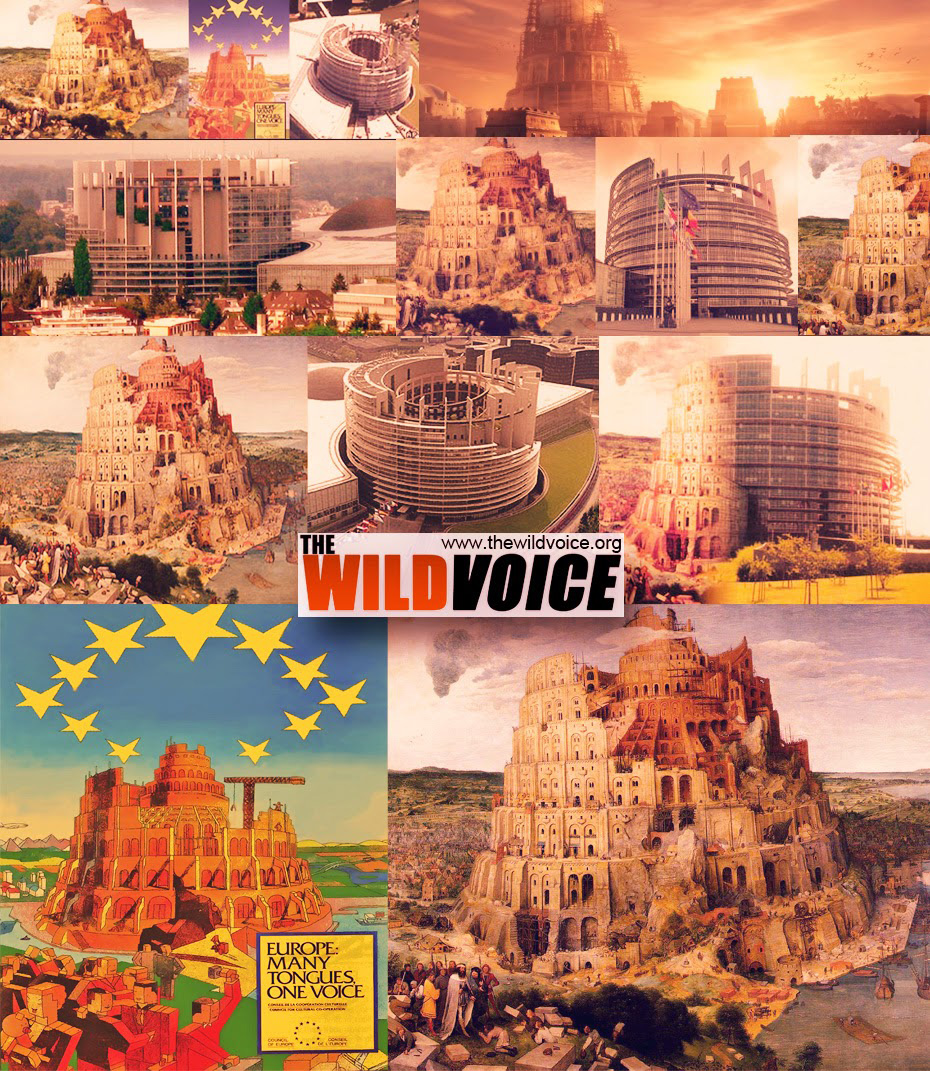
The European Union - the return to Babel
The irrefutable evidence in plain sight.
Also see:
AND:
EUbabel. The shocking occult symbolism of the European Union.
peuplesobservateursblog.wordpress.com/2017/09/23/togo-all...
Empty seat number 666
www.jesus-is-savior.com/End of the World/seat_666.htm
the-reason-the-elite-hate-trump-so-much-is-because-he-is-opposed-to-the-one-world-agenda-of-the-globalists
endoftheamericandream.com/archives/the-reason-the-elite-h...
‘Imagine there’s no Heaven, it’s easy if you try
No Hell below us, above us only sky”
John Lennon.
‘Imagine’ a nightmare, world dictatorship.
European Union project, undemocratic, expansionist empire. Prototype and fledgling, World Government.
Brexit - The anti-globalist struggle against the NWO globalists.
Aaron Banks:
Asked if he would back the Leave side in a rerun of the 2016 referendum, Mr Banks said: “The corruption I have seen in British politics, the sewer that exists and the disgraceful behaviour of the Government over what they are doing with Brexit and how they are selling out, means that if I had my time again I think we would have been better to probably remain and not unleash these demons.”
Maybe Mr Banks didn't realise that he hit the nail squarely on the head when he described the incredibly fierce opposition to Brexit as the unleashing of "demons". The globalist agenda is truly demonic. It is no surprise that the globalists, and their puppets in the media and liberal establishment, are so desperate to stop Brexit interfering with their diabolical plans for world domination.
See: ‘Brexit, The Movie’ - available on YouTube.
The EU, mystery Babylon. www.biblelight.net/tower-painting-parliament.jpg

The EU parliament in Strasbourg is modelled on the Tower of Babel.
thewildvoice.org/mystery-babylon-european-union/#comment-...
The symbolism of the EU in plain sight, is the desire of its advocates to return to the spirit of Babel.
The Council of Europe's poster produced to promote the European Union and the EU Parliament building in Strasbourg grandmageri422.files.wordpress.com/2015/07/europe-many-to... is filled with occult symbolism: a tower of Babel, 11 inverted stars (pentagrams),, the 12th pentagram is behind the top (head) of the tower. This is a Satanic parody of the 12 stars surrounding the head of the Woman (Church/Mary) in the book of Revelation. The inverted pentagram is an occult symbol designed to represent the head of Baphomet (Satan or the Goat of Mendes), illuminati pyramids are also evident in the background (since when have Egyptian pyramids been part of Europe? Square, blockheaded (indoctrinated) people (useful idiots) are featured, building a tower designed for their own enslavement and suppression, with a round-headed baby, who is too young to have been indoctrinated.
The dangerous, climate change scam:
A high level of Co2 is essential for our survival. The exact opposite of what we a led to believe by the popular, eco- fanatic narrative which is designed to convince people of the necessity for globalist control.
See the truth here:
The reason the elite hate Trump so much is because he is opposed to the one world agenda globalists.
www.zerohedge.com/news/2017-02-10/reason-elite-hate-trump...
Why satanism is now on the center stage in the culture war.
www.crisismagazine.com/2019/why-satanism-is-now-on-the-ce...
Common Purpose, Extinction Rebellion, Agenda 2030, sustainable development, WEF, Davos, Google Camp, World Economic Forum, ‘fiat’ money, SWIFT, World Governance Council, G7, Society for Worldwide Interbank Financial Telecommunications, Bank of International Settlements, Institute of International Affairs, New World Order, Globalism, European Union, EU Commission, ECJ, European Empire, evil empire, global conspiracy, United Nations, League of Nations, NAFTA, Freemasonry, Edward Mandal House, Thule Society, Kabbala, Kaaba, fractional reserve banking, Company Interbank Financial Telecommunication, internationalism, IMF, World Bank, ECB, European Central Bank, usury, Ruling Elite, Liberal fascism, Euro, EU cartel, EU empire, EU single currency, federalism, EUSSR, global elite, Federal Reserve, Paul Warburg, globalists, world government, WGS, World Government Summit, liberalism, Situational ethics, moral relativism, cultural imperialism, Bribery, Corruption, blackmail, slander, assassination, Moral relativism, Propaganda, project fear, fake news, Liberty, National Council for Civil Liberties, selective democracy, Illuminati, Bilderbergers, False religion, Maitreya, false ecumenism, World Council of Churches, Cultural Marxism, Censorship, Ted Turner, Timothy Wirth, Hilary Clinton, Club of Rome, Treaty of Rome, Maastricht Treaty, Lisbon Treaty, climate change scam, global warming, EU federalism, liberal establishment, Multiculturalism, EU Army, Palmera Arch, Temple of Baal, Nazis, National Socialism, Red Flag, hammer and sickle, useful idiots, globalist puppets, quislings, internationalism, Internationale, anti-Brexit, anti-Putin, FBI, people’s vote, EU army, Islamisation, Multinationals, multinational conglomerates, nationalisation, Fake News, Bellingcat, Bureaucracy, Climategate, chemtrails, Deep State, Council on Foreign Relations, CFR, Trilateral Commission, GM seed, GM food, quantitive easing, Bilderbergers, Eco-fanaticism, Greenpeace, eco warriors, Chatham House, Bohemian Grove, New Age, Illiberal Undemocrats, EU, Open Society, Open Britain, George Soros, Nancy Pelosi, Clinton foundation, John Podesta, John Dewey, Socialism, Humanists UK, Young Humanists, National Secular Society, British Humanist Association, neo Darwinism, Darwinism, evolution scam, CNN, New York Times, NBC news, PBS, MSNBC, BBC, liberal media, Drug legalisation, Money manipulation, IG Farben, quantitative easing, punitive taxation, Green taxes, progressives, Transgenderism, Social engineering, Communism, arch capitalism, Social Darwinism, Marxism, neo Darwinism, Erasmus Darwin, Charles Darwin, Charles Lyell, Bertrand Russell, James Hutton, David Hume, National Socialism (Nazism), Racism, international socialism, Gay mafia, gay adoption, rainbow alliance, UFOLOGY, global warming, Yakov Sverdlovsk, Red Terror, new age, Rothschilds, Rockefellers, Jacob Schiff, Adam Weishaupt, Alistair Crowley. Albert Pike, Theosophy, Antichrist, Abortion, Population control, Karl Marx, Stalin, Mao, Pol Pot, Hitler, Lenin, Trotsky, Engels, Euthanasia, Eugenics, Atheism, Soviet Union, USSR, People’s Democratic Republics, ‘People’s Vote’, Secularism, Andrew Copson, False science, Scientism, Lawrence Krauss, Richard Dawkins, Christopher Hitchens, Bill Nye, Gary Kasparov, Pussy Riot, radical left, atheist naturalism, pagan naturalism, A C Grayling, militant atheism, secular humanism, atheist pseudoscience, Cloning, Surrogacy, Fabianism, Central Banking, Fiat Currencies, banking cartels, LGBTQ agenda, Political correctness, liberal establishment, propaganda, progressive evolution, Hollywood, State control, Labour Party, Democratic Party, Green Party, Liberal Democrats, Fabian society, Secular Society, Antifa, BHA, FFRF, RDFRS, ACLU, gay priests, gay Bishops, gay pride, child abuse, gay fascism, sodomites, Stonewall, indoctrination, LGTB, LGBT, left wing feminism, lesbianism, homosexual agenda, Redefined marriage, Gender fanaticism, transgenderism, gay marriage, political correctness, hedonism, false equality, gender reassignment, surrogacy, Gay adoption, perverted sex education, Embryo experimentation, sperm banks, IVF, cloning, useful idiots, globalist puppets, UN, snowflakes, quislings, internationalism, liberal media, pornography, quislings, fifth column, Trojan horses, Sankt Galen Mafia, infiltrators, modernism, amnesty international, UNICEF, CIA, cyber surveillance, CCTV, Neo Darwinism, cultural Marxism, social Darwinism, atheist naturalism, paganism, Charles Darwin, Charles Lyell, Christianophobia, Secular Humanism, Militant atheism, abortion, Margaret Sanger, Moloch, Planned Parenthood, pro choice, Klu Klux Klan, Southern Poverty Law Centre, progressives, Christophobia, Newspeak, Satanism, Hate speech, political correctness, women’s march, False Ecumenism, election rigging, mass migration, Green taxes, climate change scam, global warming scam, carbon credits scam, debt enslavement, international bankers, Arch capitalism, Kuhn Loeb, Goldman Sachs, John D Rockefeller, Lehman Brothers, J P Morgan, Max Warburg, Order of the Skull and Bones, Extortionate taxation, class war, gender war, ageism, divide and rule, centralisation, climate change scam, mass migrations, cultural imperialism, Marie Stopes, Cultural war. human trafficking. Liberal Democrats, liberal media, Socialist Workers Party, Morning Star, Emmanuel Macron, Planned Parenthood, Marie Stopes International, BPAS, British Pregnancy Advisory Service, Satanism, Wicca, Witchcraft, Luciferian. Lunar Society, secret societies, Annie Besant, Helena Blavatsky. Alice Bailey, Marxist Social Democratic Federation. Alliance for Global Justice, Malthusian League. House of Sulzberger-Ochs, House of Meyer-Graham, Mike Bloomberg, Pierre Omidyar, Sheldon Adelson, Brzezinski, Benjamin Creme, George Kennan, James Baker, Carroll Quigley, Strobe Talbott, Lev Dobriansky, PNAC, William Kristol, Donald Rumsfeld, Dick Cheney, Paul Walfowitz, Robert Kagan, Professor Joseph Nye, Lester Mondale, American atheists, British Humanist Association, Outright Action International, National Secular Society. Abolition of nation states, NWO. World dictatorship, Tower of Babel, European Parliament. European Commission.
The war against anti-globalist Putin, and the globalist demonising of Russia.
www.flickr.com/photos/truth-in-science/43042520105
The reason the elite hate Trump so much is because he is opposed to the one world agenda of the globalists.
endoftheamericandream.com/archives/the-reason-the-elite-h...
Ending the crime of abortion is crucial in curbing the power, of Satan.
www.flickr.com/photos/truth-in-science/43172544140
Ending the crime of abortion is crucial in curbing the power, of Satan.
www.flickr.com/photos/truth-in-science/43172544140
IF and THEN, the atheist dilemma
In Alchemy y, the motto is a common component of the symbolic “Chamber of reflection,” where alchemist contemplates and reflects on the nature of death. In both Alchemy, the motto refers to a process of internal, spiritual purification.
From the Middle Ages to the late 17th-century, the so-called “philosopher’s stone” was the most sought-after goal in the world of alchemy, the medieval ancestor of chemistry. According to legend, the philosopher’s stone was a substance that could turn ordinary metals such as iron, tin, lead, zinc, nickel or copper into precious metals like gold and silver. It also acted as an elixir of life, with the power to cure illness, renew the properties of youth and even grant immortality to those who possessed it. The philosopher’s stone may not have been a stone at all, but a powder or other type of substance; it was variously known as “the tincture,” “the powder” or “materia prima.” In their quest to find it, alchemists examined countless substances in their laboratories, building a base of knowledge that would spawn the fields of chemistry, pharmacology and metallurgy.In chemistry, vitriol is iron or copper sulfate salts and their derivative, sulfuric acid. The name comes from the Latin for “glassy,” after the resemblance of iron sulfate to shards of green glass. Vitriol is symbolized alchemically as the “green lion,” a poisonous substance that appears when metal is degraded by acid. Sulfuric acid, or oil of vitriol, was used in the synthesis of the lapis philosophorum- the Philosopher’s Stone. One unique peoperty of sulfuric acid is the dissolution of metals- all except for gold, on which it has no effect. The alchemical motto for vitriol is “Visita Interiora Terrae Rectificando Invenies Occultum Lapidem,” “Visit the interior of the earth and rectifying (purifying) you will find the hidden stone.” The motto originated in L’Azoth des Philosophes by the 15th Century alchemist Basilius Valentinus. Many of the Western world’s most brilliant minds searched for the philosopher’s stone over the centuries, including Roger Boyle, the father of modern chemistry, and even Sir Isaac Newton, whose secretive dabblings in alchemy are well known by now. Long before Newton, however, there was Nicolas Flamel, a French bookseller and notary who lived in Paris during the 14th and early 15th centuries. In 1382, Flamel claimed to have transformed lead into gold after decoding an ancient book of alchemy with the help of a Spanish scholar familiar with the mystic Hebrew texts known as the Kabbala. Whether this was true or not, the historical record shows that Flamel did come into considerable wealth around this time, and donated his riches to charity. Harry Potter fans might recognize the name, as J.K. Rowling incorporated Nicolas Flamel into the first book in her world-famous series. Originally titled “Harry Potter and the Philosopher’s Stone” in the United Kingdom, it was renamed “Harry Potter and the Sorcerer’s Stone” for U.S. publication.
The philosopher's stone, or stone of the philosophers (Latin: lapis philosophorum) is a legendary alchemical substance capable of turning base metals such as mercury into gold (chrysopoeia, from the Greek χρυσός khrusos, "gold", and ποιεῖν poiēin, "to make") or silver. It is also called the elixir of life, useful for rejuvenation and for achieving immortality; for many centuries, it was the most sought goal in alchemy. The philosopher's stone was the central symbol of the mystical terminology of alchemy, symbolizing perfection at its finest, enlightenment, and heavenly bliss. Efforts to discover the philosopher's stone were known as the Magnum Opus ("Great Work").It’s a great fear widespreading within your entire being, while you wait in the “Chamber of reflection” the call from the Temple, and the chamber of reflection is outside the Masonic Temple/Lodge, but the waiting lasts too long, felt like externally, and your dear friend, who invited you to become one, is passing from time to time, saying,”It’s not to late, you still can vanish and no one will say a word, it’s normal…”. Being said like a calming words, but indeed they provide the fear, knowing, being told many times, that the process (The Acceptance Rite) is irreversible, and once being passed the tough and enormously challiging your entire being Acceptance Rite, there would be no turning back. At the time in the “Chamber of reflection” in practice, being said in true alchemical language, the VITRIOL, that burns your heart with hyper anxious fear, that something fatal would happen, and you still can stand up and go out free, … this is the Spiritual vitriol, that burns all your human personality, to the degree, that if you really have a proper idea, where you’re about to be invited for an Acceptance by the first and most important Rite in Alchemy, as so, as if you are a true seeker, you should know through those hundreds of books... So, when you strive to get yourself together and accumulate such a True Grit, like you are waiting on a death row to be hanged – the feeling in the Chamber of reflection is as such, especially, when by 15en minutes, someone empathetic to your little you is coming to say, that it’s not late to get up and exit as a man throughout the he door…All of your unholly metalls burns, as by litteraly the V.I.T.R.I.O.L – the biggest written word inside, which you don’t know a sh°t about…Untill they call you with a high, strong and manly Nobile voice to come in front of the Temple’s doors. At this moment, psychologically – and then you just feel it by your entire self – SPIRITUALLY – YOU ARE THE PURE SPIRIT, THAT YOU ALWAYS HAVE BEEN -indeed, long before your birth, but this you SEE AND UNDERATAND MUCH LATER – so, at that point, as a pure Spirit (Gold), cleaned by all the unpure metals built-over You for the entire life of yours – of course by the “Green Lion” you are ready to pass the process of your Initiation means, Spiritually. It’s the most glory day of your life. You are being initiated and invented to the Temple of God – which symbolize the Lodge’s inside hall (the Temple of Solomon, built, as a Home where G-d shall live… And all of that is so symbolical, that, I would said, there isn’t a single mistake in Alchemy. All is as natural, as posible, but that natural for the Spirit things are hard to be accepted by an non-purified by vitriol and then wormly accepted in the House of G-d mortals, who can’t believe, that a little part of their personality is an immortal being and their essential true Self, Who deserves the all ages motto, Know ThySelf, to be a subject of a deeper meditatation – as the Tibetan Monks are doing.
Interpretations
The various names and attributes assigned to the philosopher's stone has led to long-standing speculation on its composition and source. Esoteric candidates have been found in metals, plants, rocks, chemical compounds, and bodily products such as hair, urine, and eggs. Justus von Liebig states that 'it was indispensable that every substance accessible... should be observed and examined'. Alchemists once thought a key component in the creation of the stone was a mythical element named carmot.
Esoteric hermetic alchemists may reject work on exoteric substances, instead directing their search for the philosopher's stone inward. Though esoteric and exoteric approaches are sometimes mixed, it is clear that some authors "are not concerned with material substances but are employing the language of exoteric alchemy for the sole purpose of expressing theological, philosophical, or mystical beliefs and aspirations". New interpretations continue to be developed around spagyric, chemical, and esoteric schools of thought.
Appearance
The first key of Basil Valentine, emblem associated with the 'Great Work' of obtaining the Philosopher's stone (Twelve Keys of Basil Valentine). Descriptions of the Philosopher's Stone are numerous and various. According to alchemical texts, the stone of the philosophers came in two varieties, prepared by an almost identical method: white (for the purpose of making silver), and red (for the purpose of making gold), the white stone being a less matured version of the red stone. Some ancient and medieval alchemical texts leave clues to the physical appearance of the stone of the philosophers, specifically the red stone. It is often said to be orange (saffron colored) or red when ground to powder. Or in a solid form, an intermediate between red and purple, transparent and glass-like.The weight is spoken of as being heavier than gold, and it is soluble in any liquid, yet incombustible in fire. Alchemical authors sometimes suggest that the stone's descriptors are metaphorical. The appearance is expressed geometrically in Michael Maier's Atalanta Fugiens. "Make of a man and woman a circle; then a quadrangle; out of this a triangle; make again a circle, and you will have the Stone of the Wise. Thus is made the stone, which thou canst not discover, unless you, through diligence, learn to understand this geometrical teaching." Rupescissa uses the imagery of the Christian passion, telling us it ascends "from the sepulcher of the Most Excellent King, shining and glorious, resuscitated from the dead and wearing a red diadem...".
Properties
The most commonly mentioned properties are the ability to transmute base metals into gold or silver, and the ability to heal all forms of illness and prolong the life of any person who consumes a small part of the philosopher's stone.[ Other mentioned properties include: creation of perpetually burning lamps, transmutation of common crystals into precious stones and diamonds, reviving of dead plants, creation of flexible or malleable glass, or the creation of a clone or homunculus.
Names
Numerous synonyms were used to make oblique reference to the stone, such as "white stone" (calculus albus, identified with the calculus candidus of Revelation 2:17 which was taken as a symbol of the glory of heaven, vitriol (as expressed in the backronym Visita Interiora Terrae Rectificando Invenies Occultum Lapidem), also lapis noster, lapis occultus, in water at the box, and numerous oblique, mystical or mythological references such as Adam, Aer, Animal, Alkahest, Antidotus, Antimonium, Aqua benedicta, Aqua volans per aeram, Arcanum, Atramentum, Autumnus, Basilicus, Brutorum cor, Bufo, Capillus, Capistrum auri, Carbones, Cerberus, Chaos, Cinis cineris, Crocus, Dominus philosophorum, Divine quintessence, Draco elixir, Filius ignis, Fimus, Folium, Frater, Granum, Granum frumenti, Haematites, Hepar, Herba, Herbalis, Lac, Melancholia, Ovum philosophorum, Panacea salutifera, Pandora, Phoenix, Philosophic mercury, Pyrites, Radices arboris solares, Regina, Rex regum, Sal metallorum, Salvator terrenus, Talcum, Thesaurus, Ventus hermetis. Many of the medieval allegories for a Christ were adopted for the lapis, and the Christ and the Stone were indeed taken as identical in a mystical sense. The name of "Stone" or lapis itself is informed by early Christian allegory, such as Priscillian (4th century), who stated Unicornis est Deus, nobis petra Christus, nobis lapis angularis Jesus, nobis hominum homo Christus. In some texts it is simply called 'stone', or our stone, or in the case of Thomas Norton's Ordinal, "oure delycious stone". The stone was frequently praised and referred to in such terms.
It needs to be noted that philosophorum does not mean "of the philosopher" or "the philosopher's" in the sense of a single philosopher. It means "of the philosophers" in the sense of a plurality of philosophers.
Manuscript title: Jean Thenaud, Introduction to the Kabbalah, dedicated to King Francis I
Manuscript summary: This parchment manuscript contains the mystic text of the Kabbala in cursive script, illustrated with numerous highly colorful drawings with allegorical, cosmological, and liturgical themes.
Origin: Geneva (Switzerland)
Period: 16th century
Image source: Genève, Bibliothèque de Genève, Ms. fr. 167: Jean Thenaud, Introduction to the Kabbalah, dedicated to King Francis I (www.e-codices.unifr.ch/en/list/one/bge/fr0167).
Hovering above the rather faded labyrinth at St. Hilda’s Anglican Church in Sechelt.
Walking the labyrinth is an ancient spiritual act that is being rediscovered during our time.
Usually constructed from circular patterns, labyrinths are based on principles of sacred geometry. Sometimes called “divine imprints”, they are found around the world as sacred patterns that have been passed down through the ages for at least 4,000 years. When a pattern of a certain size is constructed or placed on the ground, it can be used for walking meditations and rituals.
Labyrinths and their geometric cousins (spirals and mandalas) can be found in almost every religious tradition. For example, the Kabbala, or Tree of Life, is found in the Jewish mystical tradition. The Hopi Medicine Wheel, and the Man in the Maze are two forms from the Native American labyrinth traditions. The Cretan labyrinth, the remains of which can be found on the island of Crete, has seven path rings and is the oldest known labyrinth (4,000 or 5.000 years old).
In Europe, the Celts and later the early Christian Celtic Church revered labyrinths and frequently built them in natural settings. Sacred dances would be performed in them to celebrate solar and religious festivals. During the Middle Ages, labyrinths were created in churches and cathedrals throughout France and Northern Italy. These characteristically flat church or pavement labyrinths were inlaid into the floor of the nave of the church.
The Chartres Labyrinth
The labyrinth constructed at St. Hilda’s is an 11-circuit labyrinth. It is a replica of the one embedded in the floor of Chartres Cathedral in France. The design of this labyrinth, and many of the other church labyrinths in Europe, is a reworking of the ancient labyrinth design in which an equal- armed cross is emphasized and surrounded by a web of concentric circles. As with many Christian symbols, this was an adaptation of a symbol; that is known to have predated the Christian faith. This medieval variation is considered a breakthrough in design because it is less linear than the preceding, more formal, Roman design that developed from quadrant to quadrant. The medieval design made one path as long as possible, starting at the outer circumference and leading to the centre. Fraught with twists and turns, the path’s meanderings were considered symbolic representations of the Christian pilgrim’s journey to the Holy City of Jerusalem and of one’s own journey through life. This classical design is sometimes referred to as “the Chartres Labyrinth” due to the location of its best known example.1 The labyrinth was built at Chartres in the early 13th century (~ 1215 A.D.). No one knows the source of this classical 11-circuit labyrinth design, and much of its spiritual meaning and use has been lost.
The tradition of pilgrimage is as old as religion itself. Worshippers on pilgrimage traveled to holy festivals whether to solstice celebrations, to Mecca to gather around the Ka’aba for the high holy days of Islam, or to Easter festivals in the Holy City of Jerusalem. Pilgrimages were a mixture of religious duty and holiday relaxation for the peasant, the commoner and rich land owner alike. The journey was often embarked on in groups with designated places to stay at night. The pilgrims were restless to explore the mystical holy places, and many were in search of physical or spiritual healing.
The Christian story, which emphasized the humanity of Christ, fascinated the pilgrims. In the Middle Ages, most people did not read. As a result, they were much more oriented to the senses than we are today. They learned the story by traveling to Jerusalem to walk where Jesus walked, to pray where he prayed, and to experience, in a solemn moment, where he died. Unlike today, Pilgrims encountered the truth of the Christian mystery through an ongoing intimacy with all their senses.
When a person committed his or her life to Christ in the early Middle Ages, they sometimes made a vow to make a pilgrimage to the Holy City of Jerusalem. However, by the 12th century when the Crusades swept across Europe and the ownership of Jerusalem was in tumultuous flux, travel became dangerous and expensive. In response to this situation, the Roman Church appointed seven pilgrimage cathedrals to become “Jerusalem” for pilgrims. Consequently, in the pilgrimage tradition, the path within the labyrinth was called the Chemin de Jerusalem and the center of the labyrinth was called “New Jerusalem”.
The walk into the labyrinth marked the end of the physical journey across the countryside and served as a symbolic entry-way into the spiritual realms of the Celestial City. The image of the Celestial City – taken straight out of the Book of Revelation to John – captivated the religious imagination of many during the Middle Ages. The wondrous Gothic cathedrals, with painted walls either in bright, even gaudy colours, or else white-washed, were designed to represent the Celestial City. The stained glass windows – when illuminated by the sun – created the sense of colourful, dancing jewels, allowing the pilgrim to experience the awesome mystery of the City of God.”
Symbolism and Meanings Found in the Chartres Labyrinth
Circles and Spirals
The circle is the symbol of unity or union and it is the primary shape of all labyrinths. The circle in sacred geometry 4 represents the incessant movement of the universe (uncomprehensible) as opposed to the square which represents comprehensible order. The labyrinth is a close cousin to the spiral and it, too, reflects the cyclical element of nature and is regarded as the symbol of eternal life.
The labyrinth functions like a spiral, creating a vortex in its center. Upon entering, the path winds in a clockwise pattern. Energy is being drawn out. Upon leaving the center the walker goes in a counter clockwise direction. The unwinding path integrates and empowers us on our walk back out. We are literally ushered back out into the world in a strengthened condition.
The Path
The path lies in 11 concentric circles with the 12th being the labyrinth center. The path meanders throughout the whole circle. There are 34 turns on the path going into the center. Six are semi-right turns and 28 are 180 turns. So the 12 rings that form the 11 pathways may symbolically represent, the 12 apostles, 12 tribes of Israel or 12 months of the year. 5 Twelve is a mystical number in Christianity. In sacred geometry three represents heaven and four represents earth. Twelve is the product of 3 x 4 and, therefore, the path which flows through the whole is then representative of all creation.
www.sthilda.ca/pages/labyrinth
You can view a larger version of this panorama here:
www.360cities.net/image/labyrinth-at-st-hildas-anglican-c...
This High Dynamic Range 360° aerial panorama was stitched from 105 bracketed photographs with PTGUI Pro, tone-mapped with Photomatix, processed with Color Efex, and touched up in Affinity Photo and Aperture.
Original size: 18000 × 9000 (162.0 MP; 684.31 MB).
Location: Sechelt, British Columbia, Canada
St. Hilda’s By The Sea is a small Anglican church in Sechelt. Set among the verdant green trees of the temperate rainforest, it is an eclectic mix of old and new: retired British pensioners polish the altar crystal and set out flowers for Sunday services, presided over by a gay Chinese-Canadian priest. Tai chi mixes with Celtic mysticism in a melange that is somehow stronger than its parts. And isn’t that what community is all about?
From the official website:
Walking the labyrinth is an ancient spiritual act that is being rediscovered during our time.
Usually constructed from circular patterns, labyrinths are based on principles of sacred geometry. Sometimes called “divine imprints”, they are found around the world as sacred patterns that have been passed down through the ages for at least 4,000 years. When a pattern of a certain size is constructed or placed on the ground, it can be used for walking meditations and rituals.
Labyrinths and their geometric cousins (spirals and mandalas) can be found in almost every religious tradition. For example, the Kabbala, or Tree of Life, is found in the Jewish mystical tradition. The Hopi Medicine Wheel, and the Man in the Maze are two forms from the Native American labyrinth traditions. The Cretan labyrinth, the remains of which can be found on the island of Crete, has seven path rings and is the oldest known labyrinth (4,000 or 5.000 years old).
In Europe, the Celts and later the early Christian Celtic Church revered labyrinths and frequently built them in natural settings. Sacred dances would be performed in them to celebrate solar and religious festivals. During the Middle Ages, labyrinths were created in churches and cathedrals throughout France and Northern Italy. These characteristically flat church or pavement labyrinths were inlaid into the floor of the nave of the church.
The Chartres Labyrinth
The labyrinth constructed at St. Hilda’s is an 11-circuit labyrinth. It is a replica of the one embedded in the floor of Chartres Cathedral in France. The design of this labyrinth, and many of the other church labyrinths in Europe, is a reworking of the ancient labyrinth design in which an equal-armed cross is emphasized and surrounded by a web of concentric circles. As with many Christian symbols, this was an adaptation of a symbol; that is known to have predated the Christian faith. This medieval variation is considered a breakthrough in design because it is less linear than the preceding, more formal, Roman design that developed from quadrant to quadrant. The medieval design made one path as long as possible, starting at the outer circumference and leading to the centre. Fraught with twists and turns, the path’s meanderings were considered symbolic representations of the Christian pilgrim’s journey to the Holy City of Jerusalem and of one’s own journey through life. This classical design is sometimes referred to as “the Chartres Labyrinth” due to the location of its best known example. The labyrinth was built at Chartres in the early 13th century (~ 1215 A.D.). No one knows the source of this classical 11-circuit labyrinth design, and much of its spiritual meaning and use has been lost.
The Chartres Labyrinth is located in the west end of the nave, the central body of the cathedral. When you walk in the main doors and look towards the high altar, you see the center of the labyrinth on the floor about 50 feet in front of you. It is approximately 42 feet in diameter and the path is 16 inches wide. At Chartres, the center of the Rose Window mirrors the center of the labyrinth. The cathedral is perfectly proportioned, so that if we put the west wall of the cathedral on hinges and folded it down on the labyrinth, the Rose Window would fit almost perfectly over the labyrinth.
Labyrinth or Maze?
The difference between a labyrinth used for meditation and mazes can be confusing. Mazes often have many entrances, dead-ends and cul-de-sacs that frequently confound the human mind. In contrast, meditation labyrinths offer only one path. By following the one path to the center, the seeker can use the labyrinth to quiet his or her mind and find peace and illumination at the center of his or her being. “As soon as one enters the labyrinth, one realizes that the path of the labyrinth serves as a metaphor for one’s spiritual journey. The walk, and all that happens on it, can be grasped through the intuitive, pattern-discerning faculty of the person walking it. The genius of this tool is that it reflects back to the seeker whatever he or she needs to discover from the perspective of a new level of conscious awareness.”
The Labyrinth is a Universal Meditation Tool
Anyone from any tradition or spiritual path can walk into the labyrinth and, through reflecting in the present moment, can benefit from it. A meditation labyrinth is one of many tools that can be used for spiritual practice. Like any tool, it is best used with a proper, good, intention. A church or temple can be used simply as a refuge from a rainstorm, but it can be so much more with a different intention. The same is true of the labyrinth. The seeker is only asked to put one foot in front of the other. By stepping into the labyrinth, we are choosing once again to walk the contemplative spiritual path. We are agreeing to let ourselves be open to see, to be free to hear, and to becoming real enough to respond. The labyrinth is a prayer path, a crucible of change, a meditation tool, a blueprint where psyche meets soul.
The best way to learn about the labyrinth is to walk a well-constructed one a few times, with an open heart and an open mind. Then allow your experience to guide you as to whether this will be a useful spiritual tool for you.
The Chartres Labyrinth and the Pilgrim’s Journey
Pilgrims are persons in motion – passing through territories not their own – seeking something we might call completion, or perhaps the word clarity will do as well, a goal to which only the spirit’s compass points the way.
Richard R. Niebuhr in Pilgrims and Pioneers
“The tradition of pilgrimage is as old as religion itself. Worshippers on pilgrimage traveled to holy festivals whether to solstice celebrations, to Mecca to gather around the Ka’aba for the high holy days of Islam, or to Easter festivals in the Holy City of Jerusalem. Pilgrimages were a mixture of religious duty and holiday relaxation for the peasant, the commoner and rich land owner alike. The journey was often embarked on in groups with designated places to stay at night. The pilgrims were restless to explore the mystical holy places, and many were in search of physical or spiritual healing.
The Christian story, which emphasized the humanity of Christ, fascinated the pilgrims. In the Middle Ages, most people did not read. As a result, they were much more oriented to the senses than we are today. They learned the story by traveling to Jerusalem to walk where Jesus walked, to pray where he prayed, and to experience, in a solemn moment, where he died. Unlike today, Pilgrims encountered the truth of the Christian mystery through an ongoing intimacy with all their senses.
When a person committed his or her life to Christ in the early Middle Ages, they sometimes made a vow to make a pilgrimage to the Holy City of Jerusalem. However, by the 12th century when the Crusades swept across Europe and the ownership of Jerusalem was in tumultuous flux, travel became dangerous and expensive. In response to this situation, the Roman Church appointed seven pilgrimage cathedrals to become “Jerusalem” for pilgrims. Consequently, in the pilgrimage tradition, the path within the labyrinth was called the Chemin de Jerusalem and the center of the labyrinth was called “New Jerusalem”.
The walk into the labyrinth marked the end of the physical journey across the countryside and served as a symbolic entry-way into the spiritual realms of the Celestial City. The image of the Celestial City – taken straight out of the Book of Revelation to John – captivated the religious imagination of many during the Middle Ages. The wondrous Gothic cathedrals, with painted walls either in bright, even gaudy colours, or else white-washed, were designed to represent the Celestial City. The stained glass windows – when illuminated by the sun – created the sense of colourful, dancing jewels, allowing the pilgrim to experience the awesome mystery of the City of God.”
The Journey of Life
A fundamental approach to the labyrinth is to see it as a metaphor for life’s journey. The labyrinth reminds us that all of life, with its joys, sorrows, twists and turns, is a journey that comes from God (birth) and goes to God (death). It is a physical metaphor for the journey of healing, spiritual and emotional growth and transformation. Following the path is like any journey. Sometimes you feel you are at or nearing your destination, and at other times you may feel distant or even lost. Only by faithfully keeping to the path will you arrive at the physical center of the labyrinth, which signifies God, the center of our lives and souls.
Applying the Three Fold Mystical Tradition to the Labyrinth
In the Christian mystical tradition, the journey to God was articulated in the three stages. These stages have become recognized as being universal to meditation: to release and quiet; to open and receive; and to take what was gained back out into the world.
The Three Stages
The first part of the Three- Fold Mystical Path is Purgation. This archaic word is from the root word “to purge”, meaning to cleanse, to let go. Shedding is another way of describing the experience. The mystical word is empting or releasing. It is believed that monks journeyed the first part of the labyrinth Purgation on their knees as a penitential act. This was not done for reasons of punishment as we might think, but as a way to humble oneself before God.
The second stage of the Three-Fold Path, Illumination, is found in the center of the labyrinth. Usually it is a surprise to reach the center because the long winding path seems “illogical” and cannot be figured out by the linear mind. After quieting the mind in the first part of the walk, the center presents a new experience: a place of meditation and prayer. Often people at this stage in the walk find insight into their situation in life, or clarity about a certain problem, hence the label “illumination”. As one enters the
center, the instruction is simple: enter with an open heart and mind; receive what there is for you.
The third stage, Union, begins when you leave the center of the labyrinth and continues as you retrace the path that brought you in. In this stage the meditation takes on a grounded, energized feeling. Many people who have had an important experience in the center feel that this third stage of the labyrinth gives them a way of integrating the insights they received. Others feel that this stage stokes the creative fires within. It energizes insight. It empowers, invites, and even pushes us to be more authentic and confident and to take risks with our gifts in the world. Union means communing with God.
The Monastic Orders experienced a union with God through their community life by creating a fulfilling balance between the work that was assigned, sleep and the many hours of worship attended daily. Our times present a similar challenge: we struggle to find balance between work, sleep, family and friends, leisure and spiritual life. The lack of structured communities in which people share work responsibilities and the “every person for himself or herself” mentality (or every family for itself) prevalent in our highly individualistic society makes the task of finding balance even more difficult.
Monastic communities offered a mystical spirituality that spoke to highly intuitive and intensely introverted people and (paradoxically to some) at the same time provided an economic structure throughout Europe. Monasteries during the Middle Ages provided schools and hospitals managed by monks; yet, at the same time, cloistered life helped the monks stay inwardly directed. Today, without any reliable structure directing us, the way of union needs to be re-thought. Our times call for most of us to be outer-directed. We are called to action in every aspect of our society in order to meet the spiritual challenges that confront us in the 21st century. Gratefully, there are still people in religious orders holding the candle for deep contemplation, but the majority of people involved in the spiritual transformation are searching for a path that guides them to service in the world in an active, extroverted, compassionate way. The third stage of the labyrinth empowers the seeker to move back into the world replenished and directed – which makes the labyrinth a particularly powerful tool for transformation.
Walking the Labyrinth: The Process
The purpose of all spiritual disciplines – prayer, fasting, meditation – is to help create an open attentiveness that enables us to receive and renew our awareness of our grounding and wholeness in God.
The Experience of Walking Meditation
Many of us have trouble quieting our minds. The Buddhists call the distracted state of mind the “monkey mind”, which is an apt image of what the mind is frequently like: thoughts swinging like monkeys from branch to branch, chattering away without any rhyme or conscious reason. When the mind is quiet, we feel peaceful and open, aware of a silence that embraces the universe.
Complete quiet in the mind is not a realistic goal for most of us. Instead, the task is to dis-identify with the thoughts going through our minds. Don’t get hooked by the thoughts, let them go. Thomas Keating, a Cistercian monk who teaches Centering Prayer (meditation) in the Christian tradition, described the mind as a still lake. A thought is like a fish that swims through it. If you get involved with the fish (“Gee what an unusual fish, I wonder what it is called?”), then you are hooked. Many of us have discovered through learning meditation how difficult it is to quiet the mind; yet, the rewards are great.
In the labyrinth, the sheer act of walking a complicated, attention demanding path begins to focus the mind. Thoughts of daily tasks and experiences become less intrusive. A quiet mind does not happen automatically. You must gently guide the mind with the intention of letting go of extraneous thoughts. This is much easier to do when your whole body is moving – when you are walking. Movement takes away the excess charge of psychic energy that disturbs our efforts to quiet our thought processes.
Two Basic Approaches to the Walk
One way to walk the labyrinth is to choose to let all thought go and simply open yourself to your experience with gracious attention. Usually – though not always – quieting happens in the first stage of the walk. After the mind is quiet, you can choose to remain in the quiet. Or use the labyrinth as a prayer path. Simply begin to talk to God. This is an indication that you are ready to receive what is there for you, or you allow a sincere part of your being to find its voice.
A second approach to a labyrinth walk is to consider a question. Concentrate on the question as you walk in. Amplify your thoughts about it; let all else go but your question. When you walk into the center with an open heart and an open mind, you are opening yourself to receiving new information, new insights about yourself.
Guidelines for the Walk
Find your pace. In our chaotic world we are often pushed beyond a comfortable rhythm. In this state we lose the sense of our own needs. To make matters worse, we are often rushed and then forced to wait. Anyone who has hurried to the bank only to stand in line knows the feeling. Ironically, the same thing can happen with the labyrinth, but there is a difference. The labyrinth helps us find what our natural pace would be and draws our attention to it when we are not honouring it.
Along with finding your pace, support your movement through the labyrinth by becoming conscious of your breath. Let your breath flow smoothly in and out of your body. It can be coordinated with each step – as is done in the Buddhist walking meditation – if you choose. Let your experience be your guide.
Each experience in the labyrinth is different, even if you walk it often in a short period of time. The pace usually differs each time as well. It can change dramatically within the different stages of the walk. When the labyrinth has more than a comfortable number of seekers on it, you can “pass” people if you want to continue to honour the intuitive pace your inner process has set. If you are moving at a slower pace, you can allow people to pass you. At first people are uncomfortable with the idea of “passing” someone on the labyrinth. It looks competitive, especially since the walk is a spiritual exercise. Again, these kinds of thoughts and feelings, we hope, are greeted from a spacious place inside that smiles knowingly about the machinations of the human ego. On the spiritual path we meet every and all things. To find our pace, to allow spaciousness within, to be receptive to all experience, and to be aware of the habitual thoughts and issues that hamper our spiritual development is a road to self-knowledge.
Summary of How to Walk the Labyrinth
Pause at the entry way to allow yourself to be fully conscious of the act of stepping into the labyrinth. Allow about a minute, or several turns on the path, to create some space between yourself and the person in front of you. Some ritual act, such as a bow, may feel appropriate during the labyrinth walk. Do what comes naturally.
Follow your pace. Allow your body to determine the pace. If you allow a rapid pace and the person in front of you is moving slower, feel free to move around this person. This is easiest to do at the turns by turning earlier. If you are moving slowly, you can step onto the labyrs (wide spaces at the turns) to allow others to pass.
The narrow path is a two-way street. If you are going in and another person is going out, you will meet on the path. If you want to keep in an inward meditative state, simply do not make eye contact. If you meet someone you know, a touch of the hand or a hug may be an important acknowledgement of being on the path together.
Symbolism and Meanings Found in the Chartres Labyrinth
Circles and Spirals
The circle is the symbol of unity or union and it is the primary shape of all labyrinths. The circle in sacred geometry represents the incessant movement of the universe (uncomprehensible) as opposed to the square which represents comprehensible order. The labyrinth is a close cousin to the spiral and it, too, reflects the cyclical element of nature and is regarded as the symbol of eternal life.
The labyrinth functions like a spiral, creating a vortex in its center. Upon entering, the path winds in a clockwise pattern. Energy is being drawn out. Upon leaving the center the walker goes in a counter clockwise direction. The unwinding path integrates and empowers us on our walk back out. We are literally ushered back out into the world in a strengthened condition.
The Path
The path lies in 11 concentric circles with the 12th being the labyrinth center. The path meanders throughout the whole circle. There are 34 turns on the path going into the center. Six are semi-right turns and 28 are 180° turns. So the 12 rings that form the 11 pathways may symbolically represent, the 12 apostles, 12 tribes of Israel or 12 months of the year. Twelve is a mystical number in Christianity. In sacred geometry three represents heaven and four represents earth. Twelve is the product of 3 x 4 and, therefore, the path which flows through the whole is then representative of all creation.
The obvious metaphor for the path is the difficult path to salvation, with its many twists and turns. Since we cannot see a straight path to our destination, the labyrinth can be viewed as a metaphor for our lives. We learn to surrender to the path (Christ) and trust that he will lead us on our journey.
The path can also be viewed as grace or the Church guiding us through chaos.
The Cruciform and Labyrs
The labyrinth is divided equally into four quadrants that make an equal-armed cross or cruciform. The four arms represent in symbol what is thought to be the essential
structure of the universe for example, the four spatial directions, the four elements (earth, wind, water and fire), the four seasons and, most important, salvation through the cross. The four arms of the cross emerging from the center seem to give order to the would-be chaos of the meandering path around it.
The Chartres labyrinth cross or cruciform is delineated by the 10 labyrs (labyr means to turn and this is the root of the word labyrinth). The labyrs are double-ax shaped and visible at the turns and between turns. They are traditionally seen as a symbol of women’s power and creativity.
The Centre Rosette
In the Middle Ages, the rose was regarded as a symbol for the Virgin Mary. Because of its association with the myths of Percival and the Holy Grail at that time, it also was seen as a sign of beauty and love. The rose becomes symbolic of both human and divine love, of passionate love, but also love beyond passion. The single rose became a symbol of a simple acceptance of God’s love for the world.
Unlike a normal rose (which has five petals) the rosette has six petals and is steeped in mysticism. Although associated with the Rose of Sharon, which refers to Mary, it may also represent the Holy Spirit (wisdom and enlightenment). The six petals may have corresponded to the story of the six days of creation. In other mystical traditions, the petals can be viewed as the levels of evolution (mineral, plant, animal, humankind, angelic and divine).
The Lunations
The lunations are the outer ring of partial circles that complete the outside circle of the labyrinth. They are unique to the Chartres design.
Celtic Symbols on the St. Hilda’s Labyrinth
The Celtic peoples have given us seven enduring spiritual principles:
1. A deep respect of nature, regarding creation as the fifth Gospel.
2. Quiet care for all living things.
3. The love of learning.
4. A wonder-lust or migratory nature.
5. Love of silence and solitude.
6. Understanding of time as a sacred reality and an appreciation of ordinary life, worshipping God through everyday life, and with great joy.
7. The value of family and clan affiliation, and especially spiritual ties of soul friends.
To show our respect for such wisdom, two Celtic designs adorn the St. Hilda’s labyrinth.
To mark the entrance to the labyrinth is a Celtic zoomorphic design painted in red. Traditionally, Celtic monks used intricate knotwork and zoomorphic designs (odd animals intertwined in uncomfortable ways) as mere filler for their illuminated gospel texts. They had no discernible meaning.
However, because of their unique design components, zoomorphs are now associated with transformations.
Transformation, change, action, and passion are also associated with red, the colour of fire. Therefore, this entrance symbol may well be an appropriate sign for the journey ahead.
At the labyrinth’s centre is a Celtic triquetra. This interlocked knotwork design of three stylized fish (whales) is often interpreted as the Trinity knot. It is a perfect representation of the concept of "three in one" in Christian trinity beliefs. Having the design enclosed within the centre circle further emphasizes the unity theme.
The triquetra can also be considered to represent the triplicities of mind, body, and soul, as well as the three domains of earth- earth, sea, and sky.
Final Reflection: The Labyrinth as a “Thinning Place”
In Celtic Christianity, places where people felt most strongly connected with God’s presence were referred to as thin places. It was these places in nature (forest groves, hilltops and deep wells) that the seen and unseen worlds were most closely connected, and the inhabitants of both worlds could momentarily touch the other. Today our churches, temples and sacred sites are the new thin places to meet the Divine. Here, at St Hilda’s, we have opportunities to encounter many thinning places – whether it be during Eucharistic or Taize services, while singing or praying, or through the love of a welcoming inclusive community. The labyrinth is a welcome addition; and with the right intent can also become a new thinning place for the modern pilgrim/spiritual seeker.This outward journey is an archetype with which we can have a direct experience. We can walk it. It can serve to frame the inward journey – a journey of repentance, forgiveness and rebirth, a journey that seeks a deeper faith, and greater holiness, a journey in search of God.
This 360° High Dynamic Range panorama was stitched from 66 bracketed photographs images with PTGUI Pro, tone-mapped with Photomatix, processed with Color Efex, and touched up in Aperture.
Original size: 20000 × 10000 (200.0 MP; 1.04 GB).
Location: St. Hilda’s By The Sea Anglican Church, Sechelt, British Columbia, Canada
Basilica di Santa Maria della Salute*****Basilica della Salute, which is simply known as La Salute in Venice, is surrounded by many mysteries: the greatest of all concerns its construction, starting with the uncertain origins of its architect. Longhena was probably born in Brescia around 1598; his baptismal certificate has never been found, but it is known that his father was named Melchisedec, revealing the Jewish origins of the family. In fact, La Salute reveals a strange blend of Christian and Jewish numerology, from which it draws power and energy that are difficult to ignore. The architect submitted his project on 13 April 1631, with the exact dimensions of the temple. But Longhena provided false dimensions, and he later modified them as the work progressed, basing the construction on two numbers: 8 and 11. The total length of the Basilica is in fact 121 Venetian feet (the ancient unit of length in Venice, equal to 32.7 centimeters); the width of the space for the altar is 88 feet; the side of rhe church (which is not round as it appears, but octagonal) measure 44 feet. The church square itself, from the water to the church, is exactly 44 feet deep.
The 8 derives directly from the Christian tradition because its shape is the symbol of infinity, and it therefore represents eternal life and the resurrection; but II, which represents God and his ten emanations, the sefirot, in the Jewish tradition, for the Catholics represents the infringement of the ten commandments. This could imply a Kabbalistic use of numbers: at that time many Christians believed that Kabbala could safely be integrated into the context of Catholicism. However the results of these attempts differ in many ways from the Hebrew Qabbalah, and are more akin to esotericism.
Manuscript title: Jean Thenaud, Introduction to the Kabbalah, dedicated to King Francis I
Manuscript summary: This parchment manuscript contains the mystic text of the Kabbala in cursive script, illustrated with numerous highly colorful drawings with allegorical, cosmological, and liturgical themes.
Origin: Geneva (Switzerland)
Period: 16th century
Image source: Genève, Bibliothèque de Genève, Ms. fr. 167: Jean Thenaud, Introduction to the Kabbalah, dedicated to King Francis I (www.e-codices.unifr.ch/en/list/one/bge/fr0167).
Manuscript title: Jean Thenaud, Introduction to the Kabbalah, dedicated to King Francis I
Manuscript summary: This parchment manuscript contains the mystic text of the Kabbala in cursive script, illustrated with numerous highly colorful drawings with allegorical, cosmological, and liturgical themes.
Origin: Geneva (Switzerland)
Period: 16th century
Image source: Genève, Bibliothèque de Genève, Ms. fr. 167: Jean Thenaud, Introduction to the Kabbalah, dedicated to King Francis I (www.e-codices.unifr.ch/en/list/one/bge/fr0167).
The True Meaning Of Christ-Mass
(David Meyer)
They tell us that it is the season to be jolly. It is a time of ornaments, red and green decorations, silver bells, holly, mistletoe and colored lights. It is also a time of department store Santas calling out their universal mantra, "Ho ho ho! Merry Christmas." Nearly all of the realm of so-called "Christianity" join in and repeat this same greeting, "Merry Christmas!"
Although we hear these words constantly as they resonate millions of times throughout the land, almost nobody understands what they are really saying. It is the purpose of this tract to take the words, "Merry Christmas" and examine the true meaning and essence of those words.
A true Christian would want to examine everything they say, because Jesus said in Matthew 12:36-37, "But I say unto you, that every idle word that men shall speak, they shall give account thereof in the day of judgement. For by your words you shall be justified, and by your words you shall be condemned." We will now set aside all of the customs, glitter and traditions of Christmas, which were taken from pagan witchcraft and popularized by the Roman Catholic Church, and we will focus on the true meaning of the words, "Merry Christmas!"
The word "Merry" is simple to define. It unquestionably means to be happy, joyful and light-hearted. The word "merry" fits into the ambience of laughter and frivolity. This word "merry" by itself is innocent and innocuous enough, but as we will now see, it becomes heinously blasphemous when used with the word "Christmas."
Here let it be noted that most people think that the word, "Christmas" means "the birth of Christ." By definition, it means "death of Christ", and I will prove it by using the World Book Encyclopedia, the Catholic Encyclopedia, and a book entitled, The Mass In Slow Motion.
If you are an honest, sincere and discerning Christian, please read on; if not, you might as well stop right here. The World Book Encyclopedia defines "Christmas" as follows: "The word Christmas comes from "Cristes Maesse", an early English phrase that means "Mass of Christ." (1) It is interesting to note that the word "Mass", as used by the Roman Catholics, has traditionally been rejected by the so-called Protestants, such as Lutherans, Baptists, Methodists, Presbyterians, Pentecostals and so on. The word "Mass" is strictly a Catholic word and thus, so is "Christ-Mass."
It would stand to reason, that since all of these denominations love and embrace "Christ-Mass", that December 25th is the great homecoming day, when all of the Protestants become Catholic for a day. It would seem that all of the so-called "wayward daughters" of the Romish church return to their mother, the scarlet harlot. Thus, all of the so-called Protestant churches could sing to the Pope that popular song "I'll be home for Christmas."
As previously stated, the word "Mass" in religious usage means a "death sacrifice." The impact of this fact is horrifying and shocking; for when the millions of people are saying, "Merry Christmas", they are literally saying "Merry death of Christ!" Furthermore, when the fat man in the red suit laughs boisterously and says, "Ho ho ho, Merry Christmas", he is mocking and laughing at the suffering and bleeding Savior, who died for our sins. He does this while parents place their little children into his waiting arms to hear his false promises of gifts that he says he will give them. Consider what you are saying when you say "Merry Christmas."
What is so amusing about our Savior's painful death? What is so funny? Why is Santa laughing? Why are you going along with it? Your words do count and Satan knows it. Yes, the word "Mass" does mean "death sacrifice", and to cement that fact, we will consider the definition of the inventors of the religious application of the word "Mass." I am looking at page 537 of the Catholic Encyclopedia, which says, "In the Christian law, the supreme sacrifice is that of the Mass." It goes on to say, "The supreme act of worship consists essentially in an offering of a worthy victim to God, the offering made by a proper person, as a priest, the destruction of the victim." (2)
Please note carefully the word, "victim" of the Mass. The Latin word for victim is "Hostia" from which the word "host" is derived. The Mass, by definition of those who coined the word, is a sacrifice involving a victim. There is no other meaning for the word "Mass" or "Christ-Mass." On page 110 of a book entitled "The Mass In Slow Motion", we find the following words: "It is only with the consecration that the sacrifice of the Mass is achieved. I have represented the Mass to you, more than once, as a kind of ritual dance." (3)
In essence, the Mass is the ceremonial slaying of Jesus Christ over and over again, followed by the eating of his flesh and the drinking of his blood. The Mass is the death sacrifice, and the "Host" is the victim. This is official Roman Catholic doctrine, and "Christmas" is a word that they invented. Again, I ask, what is so merry about the pain, bleeding, suffering and death of Jesus Christ? Satan has done quite a job of getting millions of so-called "Christians" to blaspheme. What a deceiver he is.
Now you know the true meaning of the word "Christmas" or Mass of Christ. There is much more to know about this pagan holiday, and we will be glad to provide you with plenty of evidence that Jesus was not born on December 25th, and that Christmas is not only a lie, but is actually a witches' sabbat called "Yule" in clever disguise. For the sake of your soul, flee from idolatry!
Acknowledgments:
01. World Book Encyclopedia, vol.3, p. 408, 1986 ed., World Book Inc., Chicago, IL
02. The Catholic Encyclopedia, R.C. Broderick, 1975 ed., Nihil Obstat, Richard J. Sklba, Censor Librorum. Imprimatur, Archbishop William E. Cousins, Milwaukee, WI.
03. The Mass In Slow Motion, Ronald Knox, 1948, Sheed & Ward, Inc., New York, MY. Nihil Obstat, E.C. Messenger, Censor Deputatus. Imprimatur, E. Morrogh Bernard, Vic. Gen.
www.gracegems.org/29/true_meaning_of_christmass.htm
Christmas" is a shortened form of "Christ's mass". It is derived from the Middle English Cristemasse, which is from Old English Crīstesmæsse, a phrase first recorded in 1038 followed by the word Cristes-messe in 1131. Crīst (genitive Crīstes) is from Greek Khrīstos (Χριστός), a translation of Hebrew Māšîaḥ (מָשִׁיחַ), "Messiah", meaning "anointed"; and mæsse is from Latin missa, the celebration of the Eucharist.
en.wikipedia.org/wiki/Christmas
Nobody’s said this part, but it’s the answer to what you’re asking: The ‘mass’ in Christmas (and Michaelmas and Martinmas and others) is indeed related to the word meaning ‘a particular church service,’ but isn’t the same.
In this context, the suffix ‘-mas’ refers to a given day set aside annually in honor of a particular saint, angel, or in the case of Christmas, Jesus. The entire 365-day calendar (in the Orthodox, Catholic, and Church of England liturgical calendars) is filled to the brim with days dedicated to these folks, sometimes two or three to a day. At least the important ones are also called Feast Days.
Not all of them are widely known or celebrated, but in medieval Europe, communities would live their lives—planting, harvesting, marrying, and so on—by these feast days.
So for the next three days, I wish you a happy St Yvo of Chartres Day, a joyful Feast of Saints Adam and Eve, and a merry Christmas!
Mass is a church ceremony. When Christians go to church on sunday, they go to mass.
As for the origin of the term:
"eucharistic service," Middle English messe, masse, from Old English mæsse, from Vulgar Latin messa "eucharistic service," literally "dismissal," from Late Latin missa "dismissal," fem. past participle of mittere "to let go, send"
www.reddit.com/r/etymology/comments/a8wvdw/is_the_word_ch...
The War against Putin. A book by M.S King.
The propaganda war.
The globalists versus the anti-globalists.
The elitist, globalist establishment targets anti-globalist Vladimir Putin and Russia.
Why Putin is being demonised by the globalists and liberal left establishment.:
youtu.be/Y4I7Cnpirw8 This video is no longer available. (Censored by YouTube?)
The European Union - the return to Babel
The irrefutable evidence in plain sight.
AND:
EUbabel. The shocking occult symbolism of the European Union.
peuplesobservateursblog.wordpress.com/2017/09/23/togo-all...
'The New World Order' - a book by A. Ralph Epperson. Exposes the globalist plot for world domination.
Globalist agenda - World government.
The return to Babel.
thewildvoice.org/wp-content/uploads/2014/06/the-wild-voic...
The European Union - the return to Babel
The irrefutable evidence in plain sight.
Also see:
AND:
EUbabel. The shocking occult symbolism of the European Union.
peuplesobservateursblog.wordpress.com/2017/09/23/togo-all...
Empty seat number 666
www.jesus-is-savior.com/End of the World/seat_666.htm
‘Imagine there’s no Heaven, it’s easy if you try
No Hell below us, above us only sky”
John Lennon.
‘Imagine’ a nightmare, world dictatorship.
Why satanism is now on the center stage in the culture war.
www.crisismagazine.com/2019/why-satanism-is-now-on-the-ce...
European Union project, undemocratic, expansionist empire. Prototype and fledgling, World Government.
Brexit - The anti-globalist struggle against the NWO globalists.
Aaron Banks:
Asked if he would back the Leave side in a rerun of the 2016 referendum, Mr Banks said: “The corruption I have seen in British politics, the sewer that exists and the disgraceful behaviour of the Government over what they are doing with Brexit and how they are selling out, means that if I had my time again I think we would have been better to probably remain and not unleash these demons.”
Maybe Mr Banks didn't realise that he hit the nail squarely on the head when he described the incredibly fierce opposition to Brexit as the unleashing of "demons". The globalist agenda is truly demonic. It is no surprise that the globalists, and their puppets in the media and liberal establishment, are so desperate to stop Brexit interfering with their diabolical plans for world domination.
See: ‘Brexit, The Movie’ - available on YouTube.
The EU, mystery Babylon. www.biblelight.net/tower-painting-parliament.jpg
The EU parliament in Strasbourg is modelled on the Tower of Babel.
thewildvoice.org/mystery-babylon-european-union/#comment-...
The symbolism of the EU in plain sight, is the desire of its advocates to return to the spirit of Babel.
The Council of Europe's poster produced to promote the European Union and the EU Parliament building in Strasbourg grandmageri422.files.wordpress.com/2015/07/europe-many-to... is filled with occult symbolism: a tower of Babel, 11 inverted stars (pentagrams),, the 12th pentagram is behind the top (head) of the tower. This is a Satanic parody of the 12 stars surrounding the head of the Woman (Church/Mary) in the book of Revelation. The inverted pentagram is an occult symbol designed to represent the head of Baphomet (Satan or the Goat of Mendes), illuminati pyramids are also evident in the background (since when have Egyptian pyramids been part of Europe? Square, blockheaded (indoctrinated) people (useful idiots) are featured, building a tower designed for their own enslavement and suppression, with a round-headed baby, who is too young to have been indoctrinated.
The dangerous, climate change scam:
A high level of Co2 is essential for our survival. The exact opposite of what we a led to believe by the popular, eco- fanatic narrative which is designed to convince people of the necessity for globalist control.
See the truth here:
The reason the elite hate Trump so much is because he is opposed to the one world agenda globalists.
www.zerohedge.com/news/2017-02-10/reason-elite-hate-trump...
Extinction Rebellion, Agenda 2021, Sustainable Development, W.H.O, Common Purpose, Agenda 2030, WEF, Davos, Google Camp, World Economic Forum, ‘fiat’ money, SWIFT, World Governance Council, G7, Society for Worldwide Interbank Financial Telecommunications, Bank of International Settlements, Institute of International Affairs, New World Order, Globalism, European Union, EU Commission, ECJ, European Empire, evil empire, global conspiracy, United Nations, UNICEF, League of Nations, NAFTA, Freemasonry, Edward Mandal House, Fabian Society, Thule Society, Kabbala, Kaaba, fractional reserve banking, Company Interbank Financial Telecommunication, internationalism, IMF, World Bank, ECB, European Central Bank, usury, Ruling Elite, Liberal fascism, Euro, EU cartel, EU empire, EU single currency, federalism, EUSSR, global elite, Federal Reserve, Paul Warburg, globalists, world government, WGS, World Government Summit, liberalism, Situational ethics, moral relativism, cultural imperialism, Bribery, Corruption, blackmail, slander, assassination, Moral relativism, Propaganda, project fear, fake news, Liberty, National Council for Civil Liberties, selective democracy, Illuminati, False religion, Maitreya, false ecumenism, World Council of Churches, Cultural Marxism, Censorship, Ted Turner, Timothy Wirth, Hilary Clinton, Club of Rome, Treaty of Rome, Maastricht Treaty, Lisbon Treaty, climate change scam, global warming, Green Party, EU federalism, liberal establishment, Multiculturalism, EU Army, Palmera Arch, Temple of Baal, Nazis, National Socialism, Red Flag, hammer and sickle, useful idiots, globalist puppets, quislings, internationalism, Internationale, anti-Brexit, anti-Putin, FBI, people’s vote, EU army, Islamisation, Multinationals, multinational conglomerates, nationalisation, Fake News, Bellingcat, Bureaucracy, Climategate, chemtrails, Deep State, Council on Foreign Relations, CFR, Trilateral Commission, GM seed, GM food, quantitive easing, Bilderbergers, Eco-fanaticism, Greenpeace, eco warriors, Chatham House, New Age, Illiberal Undemocrats, EU, Open Society, Open Britain, George Soros, Nancy Pelosi, Clinton foundation, John Podesta, John Dewey, Socialism, Humanists UK, Young Humanists, National Secular Society, British Humanist Association, neo Darwinism, Darwinism, evolution scam, CNN, New York Times, NBC news, PBS, MSNBC, BBC, liberal media, Drug legalisation, Money manipulation, IG Farben, quantitative easing, punitive taxation, Green taxes, progressives, Transgenderism, Social engineering, Communism, arch capitalism, Social Darwinism, Marxism, neo Darwinism, Erasmus Darwin, Charles Darwin, Charles Lyell, Bertrand Russell, James Hutton, David Hume, National Socialism (Nazism), Racism, international socialism, Gay mafia, gay adoption, rainbow alliance, UFOLOGY, global warming, Yakov Sverdlovsk, Red Terror, new age, Rothschilds, Rockefellers, Jacob Schiff, Adam Weishaupt, Alistair Crowley. Albert Pike, Theosophy, Antichrist, Abortion, Population control, Karl Marx, Stalin, Mao, Pol Pot, Hitler, Lenin, Trotsky, Engels, Euthanasia, Eugenics, Atheism, Soviet Union, USSR, People’s Democratic Republics, ‘People’s Vote’, Secularism, Andrew Copson, False science, Scientism, Lawrence Krauss, Richard Dawkins, Christopher Hitchens, Bill Nye, Gary Kasparov, Pussy Riot, radical left, atheist naturalism, pagan naturalism, A C Grayling, militant atheism, secular humanism, atheist pseudoscience, Cloning, Surrogacy, Fabianism, Central Banking, Fiat Currencies, banking cartels, LGBTQ agenda, Political correctness, liberal establishment, propaganda, progressive evolution, Hollywood, State control, Labour Party, Democratic Party, Green Party, Liberal Democrats, Fabian society, Secular Society, Antifa, BHA, FFRF, RDFRS, ACLU, gay priests, gay Bishops, gay pride, child abuse, gay fascism, sodomites, Stonewall, indoctrination, LGTB, LGBT, left wing feminism, lesbianism, homosexual agenda, Redefined marriage, Gender fanaticism, gay marriage, political correctness, hedonism, false equality, gender reassignment, surrogacy, Gay adoption, perverted sex education, Embryo experimentation, sperm banks, IVF, cloning, useful idiots, globalist puppets, UN, snowflakes, quislings, internationalism, liberal media, pornography, quislings, fifth column, Trojan horses, Sankt Galen Mafia, infiltrators, modernism, amnesty international, UNICEF, CIA, cyber surveillance, CCTV, Neo Darwinism, cultural Marxism, social Darwinism, atheist naturalism, paganism, Charles Darwin, Charles Lyell, Christianophobia, Secular Humanism, Militant atheism, abortion, Margaret Sanger, Moloch, Planned Parenthood, pro choice, Klu Klux Klan, Southern Poverty Law Centre, progressives, Christophobia, Newspeak, Satanism, Hate speech, political correctness, LibDems, women’s march, False Ecumenism, election rigging, mass migration, Green taxes, climate change scam, global warming scam, carbon credits scam, debt enslavement, international bankers, Arch capitalism, Kuhn Loeb, Goldman Sachs, John D Rockefeller, Lehman Brothers, J P Morgan, Max Warburg, Order of the Skull and Bones, Extortionate taxation, class war, gender war, ageism, divide and rule, centralisation, climate change scam, mass migrations, cultural imperialism, Marie Stopes, Cultural war. human trafficking. Liberal Democrats, liberal media, Socialist Workers Party, Morning Star, Emmanuel Macron, Planned Parenthood, Marie Stopes International, BPAS, British Pregnancy Advisory Service, Satanism, Wicca, Witchcraft, Luciferian. Bohemian Grove, Lunar Society, secret societies, Annie Besant, Helena Blavatsky. Alice Bailey, Marxist Social Democratic Federation. Alliance for Global Justice, Malthusian League. House of Sulzberger-Ochs, House of Meyer-Graham, Mike Bloomberg, Pierre Omidyar, Sheldon Adelson, Brzezinski, Benjamin Creme, George Kennan, James Baker, Carroll Quigley, Strobe Talbott, Lev Dobriansky, PNAC, William Kristol, Donald Rumsfeld, Dick Cheney, Paul Walfowitz, Robert Kagan, Professor Joseph Nye, Lester Mondale, American atheists, British Humanist Association, Outright Action International, National Secular Society. Abolition of nation states, NWO. World dictatorship, Tower of Babel, European Parliament. European Commission.
The war against anti-globalist Putin, and the globalist demonising of Russia.
www.flickr.com/photos/truth-in-
science/43042520105
The reason the elite hate Trump so much is because he is opposed to the one world agenda of the globalists.
endoftheamericandream.com/archives/the-reason-the-elite-h...
Ending the crime of abortion is crucial in curbing the power, of Satan.
www.flickr.com/photos/truth-in-science/43172544140
Ending the crime of abortion is crucial in curbing the power, of Satan.
www.flickr.com/photos/truth-in-science/43172544140
IF and THEN, the atheist dilemma
www.flickr.com/photos/truth-in-science/46553358861w
Who trusts the MSM? Their lies are not just fake news, they deliberately set out to slander those who don’t agree with the liberal left, globalist elite. Their lies are positively evil. Everyone should watch this video and they will never trust the media again: banned.video/watch?id=5f00ca7c672706002f4026a9
St. Hilda’s By The Sea is a small Anglican church in Sechelt. Set among the verdant green trees of the temperate rainforest, it is an eclectic mix of old and new: retired British pensioners polish the altar crystal and set out flowers for Sunday services, presided over by a gay Chinese-Canadian priest. Tai chi mixes with Celtic mysticism in a melange that is somehow stronger than its parts. And isn’t that what community is all about?
From the official website:
Walking the labyrinth is an ancient spiritual act that is being rediscovered during our time.
Usually constructed from circular patterns, labyrinths are based on principles of sacred geometry. Sometimes called “divine imprints”, they are found around the world as sacred patterns that have been passed down through the ages for at least 4,000 years. When a pattern of a certain size is constructed or placed on the ground, it can be used for walking meditations and rituals.
Labyrinths and their geometric cousins (spirals and mandalas) can be found in almost every religious tradition. For example, the Kabbala, or Tree of Life, is found in the Jewish mystical tradition. The Hopi Medicine Wheel, and the Man in the Maze are two forms from the Native American labyrinth traditions. The Cretan labyrinth, the remains of which can be found on the island of Crete, has seven path rings and is the oldest known labyrinth (4,000 or 5.000 years old).
In Europe, the Celts and later the early Christian Celtic Church revered labyrinths and frequently built them in natural settings. Sacred dances would be performed in them to celebrate solar and religious festivals. During the Middle Ages, labyrinths were created in churches and cathedrals throughout France and Northern Italy. These characteristically flat church or pavement labyrinths were inlaid into the floor of the nave of the church.
The Chartres Labyrinth
The labyrinth constructed at St. Hilda’s is an 11-circuit labyrinth. It is a replica of the one embedded in the floor of Chartres Cathedral in France. The design of this labyrinth, and many of the other church labyrinths in Europe, is a reworking of the ancient labyrinth design in which an equal-armed cross is emphasized and surrounded by a web of concentric circles. As with many Christian symbols, this was an adaptation of a symbol; that is known to have predated the Christian faith. This medieval variation is considered a breakthrough in design because it is less linear than the preceding, more formal, Roman design that developed from quadrant to quadrant. The medieval design made one path as long as possible, starting at the outer circumference and leading to the centre. Fraught with twists and turns, the path’s meanderings were considered symbolic representations of the Christian pilgrim’s journey to the Holy City of Jerusalem and of one’s own journey through life. This classical design is sometimes referred to as “the Chartres Labyrinth” due to the location of its best known example. The labyrinth was built at Chartres in the early 13th century (~ 1215 A.D.). No one knows the source of this classical 11-circuit labyrinth design, and much of its spiritual meaning and use has been lost.
The Chartres Labyrinth is located in the west end of the nave, the central body of the cathedral. When you walk in the main doors and look towards the high altar, you see the center of the labyrinth on the floor about 50 feet in front of you. It is approximately 42 feet in diameter and the path is 16 inches wide. At Chartres, the center of the Rose Window mirrors the center of the labyrinth. The cathedral is perfectly proportioned, so that if we put the west wall of the cathedral on hinges and folded it down on the labyrinth, the Rose Window would fit almost perfectly over the labyrinth.
Labyrinth or Maze?
The difference between a labyrinth used for meditation and mazes can be confusing. Mazes often have many entrances, dead-ends and cul-de-sacs that frequently confound the human mind. In contrast, meditation labyrinths offer only one path. By following the one path to the center, the seeker can use the labyrinth to quiet his or her mind and find peace and illumination at the center of his or her being. “As soon as one enters the labyrinth, one realizes that the path of the labyrinth serves as a metaphor for one’s spiritual journey. The walk, and all that happens on it, can be grasped through the intuitive, pattern-discerning faculty of the person walking it. The genius of this tool is that it reflects back to the seeker whatever he or she needs to discover from the perspective of a new level of conscious awareness.”
The Labyrinth is a Universal Meditation Tool
Anyone from any tradition or spiritual path can walk into the labyrinth and, through reflecting in the present moment, can benefit from it. A meditation labyrinth is one of many tools that can be used for spiritual practice. Like any tool, it is best used with a proper, good, intention. A church or temple can be used simply as a refuge from a rainstorm, but it can be so much more with a different intention. The same is true of the labyrinth. The seeker is only asked to put one foot in front of the other. By stepping into the labyrinth, we are choosing once again to walk the contemplative spiritual path. We are agreeing to let ourselves be open to see, to be free to hear, and to becoming real enough to respond. The labyrinth is a prayer path, a crucible of change, a meditation tool, a blueprint where psyche meets soul.
The best way to learn about the labyrinth is to walk a well-constructed one a few times, with an open heart and an open mind. Then allow your experience to guide you as to whether this will be a useful spiritual tool for you.
The Chartres Labyrinth and the Pilgrim’s Journey
Pilgrims are persons in motion – passing through territories not their own – seeking something we might call completion, or perhaps the word clarity will do as well, a goal to which only the spirit’s compass points the way.
Richard R. Niebuhr in Pilgrims and Pioneers
“The tradition of pilgrimage is as old as religion itself. Worshippers on pilgrimage traveled to holy festivals whether to solstice celebrations, to Mecca to gather around the Ka’aba for the high holy days of Islam, or to Easter festivals in the Holy City of Jerusalem. Pilgrimages were a mixture of religious duty and holiday relaxation for the peasant, the commoner and rich land owner alike. The journey was often embarked on in groups with designated places to stay at night. The pilgrims were restless to explore the mystical holy places, and many were in search of physical or spiritual healing.
The Christian story, which emphasized the humanity of Christ, fascinated the pilgrims. In the Middle Ages, most people did not read. As a result, they were much more oriented to the senses than we are today. They learned the story by traveling to Jerusalem to walk where Jesus walked, to pray where he prayed, and to experience, in a solemn moment, where he died. Unlike today, Pilgrims encountered the truth of the Christian mystery through an ongoing intimacy with all their senses.
When a person committed his or her life to Christ in the early Middle Ages, they sometimes made a vow to make a pilgrimage to the Holy City of Jerusalem. However, by the 12th century when the Crusades swept across Europe and the ownership of Jerusalem was in tumultuous flux, travel became dangerous and expensive. In response to this situation, the Roman Church appointed seven pilgrimage cathedrals to become “Jerusalem” for pilgrims. Consequently, in the pilgrimage tradition, the path within the labyrinth was called the Chemin de Jerusalem and the center of the labyrinth was called “New Jerusalem”.
The walk into the labyrinth marked the end of the physical journey across the countryside and served as a symbolic entry-way into the spiritual realms of the Celestial City. The image of the Celestial City – taken straight out of the Book of Revelation to John – captivated the religious imagination of many during the Middle Ages. The wondrous Gothic cathedrals, with painted walls either in bright, even gaudy colours, or else white-washed, were designed to represent the Celestial City. The stained glass windows – when illuminated by the sun – created the sense of colourful, dancing jewels, allowing the pilgrim to experience the awesome mystery of the City of God.”
The Journey of Life
A fundamental approach to the labyrinth is to see it as a metaphor for life’s journey. The labyrinth reminds us that all of life, with its joys, sorrows, twists and turns, is a journey that comes from God (birth) and goes to God (death). It is a physical metaphor for the journey of healing, spiritual and emotional growth and transformation. Following the path is like any journey. Sometimes you feel you are at or nearing your destination, and at other times you may feel distant or even lost. Only by faithfully keeping to the path will you arrive at the physical center of the labyrinth, which signifies God, the center of our lives and souls.
Applying the Three Fold Mystical Tradition to the Labyrinth
In the Christian mystical tradition, the journey to God was articulated in the three stages. These stages have become recognized as being universal to meditation: to release and quiet; to open and receive; and to take what was gained back out into the world.
The Three Stages
The first part of the Three- Fold Mystical Path is Purgation. This archaic word is from the root word “to purge”, meaning to cleanse, to let go. Shedding is another way of describing the experience. The mystical word is empting or releasing. It is believed that monks journeyed the first part of the labyrinth Purgation on their knees as a penitential act. This was not done for reasons of punishment as we might think, but as a way to humble oneself before God.
The second stage of the Three-Fold Path, Illumination, is found in the center of the labyrinth. Usually it is a surprise to reach the center because the long winding path seems “illogical” and cannot be figured out by the linear mind. After quieting the mind in the first part of the walk, the center presents a new experience: a place of meditation and prayer. Often people at this stage in the walk find insight into their situation in life, or clarity about a certain problem, hence the label “illumination”. As one enters the
center, the instruction is simple: enter with an open heart and mind; receive what there is for you.
The third stage, Union, begins when you leave the center of the labyrinth and continues as you retrace the path that brought you in. In this stage the meditation takes on a grounded, energized feeling. Many people who have had an important experience in the center feel that this third stage of the labyrinth gives them a way of integrating the insights they received. Others feel that this stage stokes the creative fires within. It energizes insight. It empowers, invites, and even pushes us to be more authentic and confident and to take risks with our gifts in the world. Union means communing with God.
The Monastic Orders experienced a union with God through their community life by creating a fulfilling balance between the work that was assigned, sleep and the many hours of worship attended daily. Our times present a similar challenge: we struggle to find balance between work, sleep, family and friends, leisure and spiritual life. The lack of structured communities in which people share work responsibilities and the “every person for himself or herself” mentality (or every family for itself) prevalent in our highly individualistic society makes the task of finding balance even more difficult.
Monastic communities offered a mystical spirituality that spoke to highly intuitive and intensely introverted people and (paradoxically to some) at the same time provided an economic structure throughout Europe. Monasteries during the Middle Ages provided schools and hospitals managed by monks; yet, at the same time, cloistered life helped the monks stay inwardly directed. Today, without any reliable structure directing us, the way of union needs to be re-thought. Our times call for most of us to be outer-directed. We are called to action in every aspect of our society in order to meet the spiritual challenges that confront us in the 21st century. Gratefully, there are still people in religious orders holding the candle for deep contemplation, but the majority of people involved in the spiritual transformation are searching for a path that guides them to service in the world in an active, extroverted, compassionate way. The third stage of the labyrinth empowers the seeker to move back into the world replenished and directed – which makes the labyrinth a particularly powerful tool for transformation.
Walking the Labyrinth: The Process
The purpose of all spiritual disciplines – prayer, fasting, meditation – is to help create an open attentiveness that enables us to receive and renew our awareness of our grounding and wholeness in God.
The Experience of Walking Meditation
Many of us have trouble quieting our minds. The Buddhists call the distracted state of mind the “monkey mind”, which is an apt image of what the mind is frequently like: thoughts swinging like monkeys from branch to branch, chattering away without any rhyme or conscious reason. When the mind is quiet, we feel peaceful and open, aware of a silence that embraces the universe.
Complete quiet in the mind is not a realistic goal for most of us. Instead, the task is to dis-identify with the thoughts going through our minds. Don’t get hooked by the thoughts, let them go. Thomas Keating, a Cistercian monk who teaches Centering Prayer (meditation) in the Christian tradition, described the mind as a still lake. A thought is like a fish that swims through it. If you get involved with the fish (“Gee what an unusual fish, I wonder what it is called?”), then you are hooked. Many of us have discovered through learning meditation how difficult it is to quiet the mind; yet, the rewards are great.
In the labyrinth, the sheer act of walking a complicated, attention demanding path begins to focus the mind. Thoughts of daily tasks and experiences become less intrusive. A quiet mind does not happen automatically. You must gently guide the mind with the intention of letting go of extraneous thoughts. This is much easier to do when your whole body is moving – when you are walking. Movement takes away the excess charge of psychic energy that disturbs our efforts to quiet our thought processes.
Two Basic Approaches to the Walk
One way to walk the labyrinth is to choose to let all thought go and simply open yourself to your experience with gracious attention. Usually – though not always – quieting happens in the first stage of the walk. After the mind is quiet, you can choose to remain in the quiet. Or use the labyrinth as a prayer path. Simply begin to talk to God. This is an indication that you are ready to receive what is there for you, or you allow a sincere part of your being to find its voice.
A second approach to a labyrinth walk is to consider a question. Concentrate on the question as you walk in. Amplify your thoughts about it; let all else go but your question. When you walk into the center with an open heart and an open mind, you are opening yourself to receiving new information, new insights about yourself.
Guidelines for the Walk
Find your pace. In our chaotic world we are often pushed beyond a comfortable rhythm. In this state we lose the sense of our own needs. To make matters worse, we are often rushed and then forced to wait. Anyone who has hurried to the bank only to stand in line knows the feeling. Ironically, the same thing can happen with the labyrinth, but there is a difference. The labyrinth helps us find what our natural pace would be and draws our attention to it when we are not honouring it.
Along with finding your pace, support your movement through the labyrinth by becoming conscious of your breath. Let your breath flow smoothly in and out of your body. It can be coordinated with each step – as is done in the Buddhist walking meditation – if you choose. Let your experience be your guide.
Each experience in the labyrinth is different, even if you walk it often in a short period of time. The pace usually differs each time as well. It can change dramatically within the different stages of the walk. When the labyrinth has more than a comfortable number of seekers on it, you can “pass” people if you want to continue to honour the intuitive pace your inner process has set. If you are moving at a slower pace, you can allow people to pass you. At first people are uncomfortable with the idea of “passing” someone on the labyrinth. It looks competitive, especially since the walk is a spiritual exercise. Again, these kinds of thoughts and feelings, we hope, are greeted from a spacious place inside that smiles knowingly about the machinations of the human ego. On the spiritual path we meet every and all things. To find our pace, to allow spaciousness within, to be receptive to all experience, and to be aware of the habitual thoughts and issues that hamper our spiritual development is a road to self-knowledge.
Summary of How to Walk the Labyrinth
Pause at the entry way to allow yourself to be fully conscious of the act of stepping into the labyrinth. Allow about a minute, or several turns on the path, to create some space between yourself and the person in front of you. Some ritual act, such as a bow, may feel appropriate during the labyrinth walk. Do what comes naturally.
Follow your pace. Allow your body to determine the pace. If you allow a rapid pace and the person in front of you is moving slower, feel free to move around this person. This is easiest to do at the turns by turning earlier. If you are moving slowly, you can step onto the labyrs (wide spaces at the turns) to allow others to pass.
The narrow path is a two-way street. If you are going in and another person is going out, you will meet on the path. If you want to keep in an inward meditative state, simply do not make eye contact. If you meet someone you know, a touch of the hand or a hug may be an important acknowledgement of being on the path together.
Symbolism and Meanings Found in the Chartres Labyrinth
Circles and Spirals
The circle is the symbol of unity or union and it is the primary shape of all labyrinths. The circle in sacred geometry represents the incessant movement of the universe (uncomprehensible) as opposed to the square which represents comprehensible order. The labyrinth is a close cousin to the spiral and it, too, reflects the cyclical element of nature and is regarded as the symbol of eternal life.
The labyrinth functions like a spiral, creating a vortex in its center. Upon entering, the path winds in a clockwise pattern. Energy is being drawn out. Upon leaving the center the walker goes in a counter clockwise direction. The unwinding path integrates and empowers us on our walk back out. We are literally ushered back out into the world in a strengthened condition.
The Path
The path lies in 11 concentric circles with the 12th being the labyrinth center. The path meanders throughout the whole circle. There are 34 turns on the path going into the center. Six are semi-right turns and 28 are 180° turns. So the 12 rings that form the 11 pathways may symbolically represent, the 12 apostles, 12 tribes of Israel or 12 months of the year. Twelve is a mystical number in Christianity. In sacred geometry three represents heaven and four represents earth. Twelve is the product of 3 x 4 and, therefore, the path which flows through the whole is then representative of all creation.
The obvious metaphor for the path is the difficult path to salvation, with its many twists and turns. Since we cannot see a straight path to our destination, the labyrinth can be viewed as a metaphor for our lives. We learn to surrender to the path (Christ) and trust that he will lead us on our journey.
The path can also be viewed as grace or the Church guiding us through chaos.
The Cruciform and Labyrs
The labyrinth is divided equally into four quadrants that make an equal-armed cross or cruciform. The four arms represent in symbol what is thought to be the essential
structure of the universe for example, the four spatial directions, the four elements (earth, wind, water and fire), the four seasons and, most important, salvation through the cross. The four arms of the cross emerging from the center seem to give order to the would-be chaos of the meandering path around it.
The Chartres labyrinth cross or cruciform is delineated by the 10 labyrs (labyr means to turn and this is the root of the word labyrinth). The labyrs are double-ax shaped and visible at the turns and between turns. They are traditionally seen as a symbol of women’s power and creativity.
The Centre Rosette
In the Middle Ages, the rose was regarded as a symbol for the Virgin Mary. Because of its association with the myths of Percival and the Holy Grail at that time, it also was seen as a sign of beauty and love. The rose becomes symbolic of both human and divine love, of passionate love, but also love beyond passion. The single rose became a symbol of a simple acceptance of God’s love for the world.
Unlike a normal rose (which has five petals) the rosette has six petals and is steeped in mysticism. Although associated with the Rose of Sharon, which refers to Mary, it may also represent the Holy Spirit (wisdom and enlightenment). The six petals may have corresponded to the story of the six days of creation. In other mystical traditions, the petals can be viewed as the levels of evolution (mineral, plant, animal, humankind, angelic and divine).
The Lunations
The lunations are the outer ring of partial circles that complete the outside circle of the labyrinth. They are unique to the Chartres design.
Celtic Symbols on the St. Hilda’s Labyrinth
The Celtic peoples have given us seven enduring spiritual principles:
1. A deep respect of nature, regarding creation as the fifth Gospel.
2. Quiet care for all living things.
3. The love of learning.
4. A wonder-lust or migratory nature.
5. Love of silence and solitude.
6. Understanding of time as a sacred reality and an appreciation of ordinary life, worshipping God through everyday life, and with great joy.
7. The value of family and clan affiliation, and especially spiritual ties of soul friends.
To show our respect for such wisdom, two Celtic designs adorn the St. Hilda’s labyrinth.
To mark the entrance to the labyrinth is a Celtic zoomorphic design painted in red. Traditionally, Celtic monks used intricate knotwork and zoomorphic designs (odd animals intertwined in uncomfortable ways) as mere filler for their illuminated gospel texts. They had no discernible meaning.
However, because of their unique design components, zoomorphs are now associated with transformations.
Transformation, change, action, and passion are also associated with red, the colour of fire. Therefore, this entrance symbol may well be an appropriate sign for the journey ahead.
At the labyrinth’s centre is a Celtic triquetra. This interlocked knotwork design of three stylized fish (whales) is often interpreted as the Trinity knot. It is a perfect representation of the concept of "three in one" in Christian trinity beliefs. Having the design enclosed within the centre circle further emphasizes the unity theme.
The triquetra can also be considered to represent the triplicities of mind, body, and soul, as well as the three domains of earth- earth, sea, and sky.
Final Reflection: The Labyrinth as a “Thinning Place”
In Celtic Christianity, places where people felt most strongly connected with God’s presence were referred to as thin places. It was these places in nature (forest groves, hilltops and deep wells) that the seen and unseen worlds were most closely connected, and the inhabitants of both worlds could momentarily touch the other. Today our churches, temples and sacred sites are the new thin places to meet the Divine. Here, at St Hilda’s, we have opportunities to encounter many thinning places – whether it be during Eucharistic or Taize services, while singing or praying, or through the love of a welcoming inclusive community. The labyrinth is a welcome addition; and with the right intent can also become a new thinning place for the modern pilgrim/spiritual seeker.This outward journey is an archetype with which we can have a direct experience. We can walk it. It can serve to frame the inward journey – a journey of repentance, forgiveness and rebirth, a journey that seeks a deeper faith, and greater holiness, a journey in search of God.
This High Dynamic Range panorama was stitched from 84 bracketed images with PTGUI Pro, tone-mapped with Photomatix, and touched up in Aperture.
Original size: 18160 × 9080 (164.9 MP; 194 MB).
Location: St. Hilda’s By The Sea Anglican Church, Sechelt, British Columbia, Canada
St. Hilda’s By The Sea is a small Anglican church in Sechelt. Set among the verdant green trees of the temperate rainforest, it is an eclectic mix of old and new: retired British pensioners polish the altar crystal and set out flowers for Sunday services, presided over by a gay Chinese-Canadian priest. Tai chi mixes with Celtic mysticism in a melange that is somehow stronger than its parts. And isn’t that what community is all about?
From the official website:
Walking the labyrinth is an ancient spiritual act that is being rediscovered during our time.
Usually constructed from circular patterns, labyrinths are based on principles of sacred geometry. Sometimes called “divine imprints”, they are found around the world as sacred patterns that have been passed down through the ages for at least 4,000 years. When a pattern of a certain size is constructed or placed on the ground, it can be used for walking meditations and rituals.
Labyrinths and their geometric cousins (spirals and mandalas) can be found in almost every religious tradition. For example, the Kabbala, or Tree of Life, is found in the Jewish mystical tradition. The Hopi Medicine Wheel, and the Man in the Maze are two forms from the Native American labyrinth traditions. The Cretan labyrinth, the remains of which can be found on the island of Crete, has seven path rings and is the oldest known labyrinth (4,000 or 5.000 years old).
In Europe, the Celts and later the early Christian Celtic Church revered labyrinths and frequently built them in natural settings. Sacred dances would be performed in them to celebrate solar and religious festivals. During the Middle Ages, labyrinths were created in churches and cathedrals throughout France and Northern Italy. These characteristically flat church or pavement labyrinths were inlaid into the floor of the nave of the church.
The Chartres Labyrinth
The labyrinth constructed at St. Hilda’s is an 11-circuit labyrinth. It is a replica of the one embedded in the floor of Chartres Cathedral in France. The design of this labyrinth, and many of the other church labyrinths in Europe, is a reworking of the ancient labyrinth design in which an equal-armed cross is emphasized and surrounded by a web of concentric circles. As with many Christian symbols, this was an adaptation of a symbol; that is known to have predated the Christian faith. This medieval variation is considered a breakthrough in design because it is less linear than the preceding, more formal, Roman design that developed from quadrant to quadrant. The medieval design made one path as long as possible, starting at the outer circumference and leading to the centre. Fraught with twists and turns, the path’s meanderings were considered symbolic representations of the Christian pilgrim’s journey to the Holy City of Jerusalem and of one’s own journey through life. This classical design is sometimes referred to as “the Chartres Labyrinth” due to the location of its best known example. The labyrinth was built at Chartres in the early 13th century (~ 1215 A.D.). No one knows the source of this classical 11-circuit labyrinth design, and much of its spiritual meaning and use has been lost.
The Chartres Labyrinth is located in the west end of the nave, the central body of the cathedral. When you walk in the main doors and look towards the high altar, you see the center of the labyrinth on the floor about 50 feet in front of you. It is approximately 42 feet in diameter and the path is 16 inches wide. At Chartres, the center of the Rose Window mirrors the center of the labyrinth. The cathedral is perfectly proportioned, so that if we put the west wall of the cathedral on hinges and folded it down on the labyrinth, the Rose Window would fit almost perfectly over the labyrinth.
Labyrinth or Maze?
The difference between a labyrinth used for meditation and mazes can be confusing. Mazes often have many entrances, dead-ends and cul-de-sacs that frequently confound the human mind. In contrast, meditation labyrinths offer only one path. By following the one path to the center, the seeker can use the labyrinth to quiet his or her mind and find peace and illumination at the center of his or her being. “As soon as one enters the labyrinth, one realizes that the path of the labyrinth serves as a metaphor for one’s spiritual journey. The walk, and all that happens on it, can be grasped through the intuitive, pattern-discerning faculty of the person walking it. The genius of this tool is that it reflects back to the seeker whatever he or she needs to discover from the perspective of a new level of conscious awareness.”
The Labyrinth is a Universal Meditation Tool
Anyone from any tradition or spiritual path can walk into the labyrinth and, through reflecting in the present moment, can benefit from it. A meditation labyrinth is one of many tools that can be used for spiritual practice. Like any tool, it is best used with a proper, good, intention. A church or temple can be used simply as a refuge from a rainstorm, but it can be so much more with a different intention. The same is true of the labyrinth. The seeker is only asked to put one foot in front of the other. By stepping into the labyrinth, we are choosing once again to walk the contemplative spiritual path. We are agreeing to let ourselves be open to see, to be free to hear, and to becoming real enough to respond. The labyrinth is a prayer path, a crucible of change, a meditation tool, a blueprint where psyche meets soul.
The best way to learn about the labyrinth is to walk a well-constructed one a few times, with an open heart and an open mind. Then allow your experience to guide you as to whether this will be a useful spiritual tool for you.
The Chartres Labyrinth and the Pilgrim’s Journey
Pilgrims are persons in motion – passing through territories not their own – seeking something we might call completion, or perhaps the word clarity will do as well, a goal to which only the spirit’s compass points the way.
Richard R. Niebuhr in Pilgrims and Pioneers
“The tradition of pilgrimage is as old as religion itself. Worshippers on pilgrimage traveled to holy festivals whether to solstice celebrations, to Mecca to gather around the Ka’aba for the high holy days of Islam, or to Easter festivals in the Holy City of Jerusalem. Pilgrimages were a mixture of religious duty and holiday relaxation for the peasant, the commoner and rich land owner alike. The journey was often embarked on in groups with designated places to stay at night. The pilgrims were restless to explore the mystical holy places, and many were in search of physical or spiritual healing.
The Christian story, which emphasized the humanity of Christ, fascinated the pilgrims. In the Middle Ages, most people did not read. As a result, they were much more oriented to the senses than we are today. They learned the story by traveling to Jerusalem to walk where Jesus walked, to pray where he prayed, and to experience, in a solemn moment, where he died. Unlike today, Pilgrims encountered the truth of the Christian mystery through an ongoing intimacy with all their senses.
When a person committed his or her life to Christ in the early Middle Ages, they sometimes made a vow to make a pilgrimage to the Holy City of Jerusalem. However, by the 12th century when the Crusades swept across Europe and the ownership of Jerusalem was in tumultuous flux, travel became dangerous and expensive. In response to this situation, the Roman Church appointed seven pilgrimage cathedrals to become “Jerusalem” for pilgrims. Consequently, in the pilgrimage tradition, the path within the labyrinth was called the Chemin de Jerusalem and the center of the labyrinth was called “New Jerusalem”.
The walk into the labyrinth marked the end of the physical journey across the countryside and served as a symbolic entry-way into the spiritual realms of the Celestial City. The image of the Celestial City – taken straight out of the Book of Revelation to John – captivated the religious imagination of many during the Middle Ages. The wondrous Gothic cathedrals, with painted walls either in bright, even gaudy colours, or else white-washed, were designed to represent the Celestial City. The stained glass windows – when illuminated by the sun – created the sense of colourful, dancing jewels, allowing the pilgrim to experience the awesome mystery of the City of God.”
The Journey of Life
A fundamental approach to the labyrinth is to see it as a metaphor for life’s journey. The labyrinth reminds us that all of life, with its joys, sorrows, twists and turns, is a journey that comes from God (birth) and goes to God (death). It is a physical metaphor for the journey of healing, spiritual and emotional growth and transformation. Following the path is like any journey. Sometimes you feel you are at or nearing your destination, and at other times you may feel distant or even lost. Only by faithfully keeping to the path will you arrive at the physical center of the labyrinth, which signifies God, the center of our lives and souls.
Applying the Three Fold Mystical Tradition to the Labyrinth
In the Christian mystical tradition, the journey to God was articulated in the three stages. These stages have become recognized as being universal to meditation: to release and quiet; to open and receive; and to take what was gained back out into the world.
The Three Stages
The first part of the Three- Fold Mystical Path is Purgation. This archaic word is from the root word “to purge”, meaning to cleanse, to let go. Shedding is another way of describing the experience. The mystical word is empting or releasing. It is believed that monks journeyed the first part of the labyrinth Purgation on their knees as a penitential act. This was not done for reasons of punishment as we might think, but as a way to humble oneself before God.
The second stage of the Three-Fold Path, Illumination, is found in the center of the labyrinth. Usually it is a surprise to reach the center because the long winding path seems “illogical” and cannot be figured out by the linear mind. After quieting the mind in the first part of the walk, the center presents a new experience: a place of meditation and prayer. Often people at this stage in the walk find insight into their situation in life, or clarity about a certain problem, hence the label “illumination”. As one enters the
center, the instruction is simple: enter with an open heart and mind; receive what there is for you.
The third stage, Union, begins when you leave the center of the labyrinth and continues as you retrace the path that brought you in. In this stage the meditation takes on a grounded, energized feeling. Many people who have had an important experience in the center feel that this third stage of the labyrinth gives them a way of integrating the insights they received. Others feel that this stage stokes the creative fires within. It energizes insight. It empowers, invites, and even pushes us to be more authentic and confident and to take risks with our gifts in the world. Union means communing with God.
The Monastic Orders experienced a union with God through their community life by creating a fulfilling balance between the work that was assigned, sleep and the many hours of worship attended daily. Our times present a similar challenge: we struggle to find balance between work, sleep, family and friends, leisure and spiritual life. The lack of structured communities in which people share work responsibilities and the “every person for himself or herself” mentality (or every family for itself) prevalent in our highly individualistic society makes the task of finding balance even more difficult.
Monastic communities offered a mystical spirituality that spoke to highly intuitive and intensely introverted people and (paradoxically to some) at the same time provided an economic structure throughout Europe. Monasteries during the Middle Ages provided schools and hospitals managed by monks; yet, at the same time, cloistered life helped the monks stay inwardly directed. Today, without any reliable structure directing us, the way of union needs to be re-thought. Our times call for most of us to be outer-directed. We are called to action in every aspect of our society in order to meet the spiritual challenges that confront us in the 21st century. Gratefully, there are still people in religious orders holding the candle for deep contemplation, but the majority of people involved in the spiritual transformation are searching for a path that guides them to service in the world in an active, extroverted, compassionate way. The third stage of the labyrinth empowers the seeker to move back into the world replenished and directed – which makes the labyrinth a particularly powerful tool for transformation.
Walking the Labyrinth: The Process
The purpose of all spiritual disciplines – prayer, fasting, meditation – is to help create an open attentiveness that enables us to receive and renew our awareness of our grounding and wholeness in God.
The Experience of Walking Meditation
Many of us have trouble quieting our minds. The Buddhists call the distracted state of mind the “monkey mind”, which is an apt image of what the mind is frequently like: thoughts swinging like monkeys from branch to branch, chattering away without any rhyme or conscious reason. When the mind is quiet, we feel peaceful and open, aware of a silence that embraces the universe.
Complete quiet in the mind is not a realistic goal for most of us. Instead, the task is to dis-identify with the thoughts going through our minds. Don’t get hooked by the thoughts, let them go. Thomas Keating, a Cistercian monk who teaches Centering Prayer (meditation) in the Christian tradition, described the mind as a still lake. A thought is like a fish that swims through it. If you get involved with the fish (“Gee what an unusual fish, I wonder what it is called?”), then you are hooked. Many of us have discovered through learning meditation how difficult it is to quiet the mind; yet, the rewards are great.
In the labyrinth, the sheer act of walking a complicated, attention demanding path begins to focus the mind. Thoughts of daily tasks and experiences become less intrusive. A quiet mind does not happen automatically. You must gently guide the mind with the intention of letting go of extraneous thoughts. This is much easier to do when your whole body is moving – when you are walking. Movement takes away the excess charge of psychic energy that disturbs our efforts to quiet our thought processes.
Two Basic Approaches to the Walk
One way to walk the labyrinth is to choose to let all thought go and simply open yourself to your experience with gracious attention. Usually – though not always – quieting happens in the first stage of the walk. After the mind is quiet, you can choose to remain in the quiet. Or use the labyrinth as a prayer path. Simply begin to talk to God. This is an indication that you are ready to receive what is there for you, or you allow a sincere part of your being to find its voice.
A second approach to a labyrinth walk is to consider a question. Concentrate on the question as you walk in. Amplify your thoughts about it; let all else go but your question. When you walk into the center with an open heart and an open mind, you are opening yourself to receiving new information, new insights about yourself.
Guidelines for the Walk
Find your pace. In our chaotic world we are often pushed beyond a comfortable rhythm. In this state we lose the sense of our own needs. To make matters worse, we are often rushed and then forced to wait. Anyone who has hurried to the bank only to stand in line knows the feeling. Ironically, the same thing can happen with the labyrinth, but there is a difference. The labyrinth helps us find what our natural pace would be and draws our attention to it when we are not honouring it.
Along with finding your pace, support your movement through the labyrinth by becoming conscious of your breath. Let your breath flow smoothly in and out of your body. It can be coordinated with each step – as is done in the Buddhist walking meditation – if you choose. Let your experience be your guide.
Each experience in the labyrinth is different, even if you walk it often in a short period of time. The pace usually differs each time as well. It can change dramatically within the different stages of the walk. When the labyrinth has more than a comfortable number of seekers on it, you can “pass” people if you want to continue to honour the intuitive pace your inner process has set. If you are moving at a slower pace, you can allow people to pass you. At first people are uncomfortable with the idea of “passing” someone on the labyrinth. It looks competitive, especially since the walk is a spiritual exercise. Again, these kinds of thoughts and feelings, we hope, are greeted from a spacious place inside that smiles knowingly about the machinations of the human ego. On the spiritual path we meet every and all things. To find our pace, to allow spaciousness within, to be receptive to all experience, and to be aware of the habitual thoughts and issues that hamper our spiritual development is a road to self-knowledge.
Summary of How to Walk the Labyrinth
Pause at the entry way to allow yourself to be fully conscious of the act of stepping into the labyrinth. Allow about a minute, or several turns on the path, to create some space between yourself and the person in front of you. Some ritual act, such as a bow, may feel appropriate during the labyrinth walk. Do what comes naturally.
Follow your pace. Allow your body to determine the pace. If you allow a rapid pace and the person in front of you is moving slower, feel free to move around this person. This is easiest to do at the turns by turning earlier. If you are moving slowly, you can step onto the labyrs (wide spaces at the turns) to allow others to pass.
The narrow path is a two-way street. If you are going in and another person is going out, you will meet on the path. If you want to keep in an inward meditative state, simply do not make eye contact. If you meet someone you know, a touch of the hand or a hug may be an important acknowledgement of being on the path together.
Symbolism and Meanings Found in the Chartres Labyrinth
Circles and Spirals
The circle is the symbol of unity or union and it is the primary shape of all labyrinths. The circle in sacred geometry represents the incessant movement of the universe (uncomprehensible) as opposed to the square which represents comprehensible order. The labyrinth is a close cousin to the spiral and it, too, reflects the cyclical element of nature and is regarded as the symbol of eternal life.
The labyrinth functions like a spiral, creating a vortex in its center. Upon entering, the path winds in a clockwise pattern. Energy is being drawn out. Upon leaving the center the walker goes in a counter clockwise direction. The unwinding path integrates and empowers us on our walk back out. We are literally ushered back out into the world in a strengthened condition.
The Path
The path lies in 11 concentric circles with the 12th being the labyrinth center. The path meanders throughout the whole circle. There are 34 turns on the path going into the center. Six are semi-right turns and 28 are 180° turns. So the 12 rings that form the 11 pathways may symbolically represent, the 12 apostles, 12 tribes of Israel or 12 months of the year. Twelve is a mystical number in Christianity. In sacred geometry three represents heaven and four represents earth. Twelve is the product of 3 x 4 and, therefore, the path which flows through the whole is then representative of all creation.
The obvious metaphor for the path is the difficult path to salvation, with its many twists and turns. Since we cannot see a straight path to our destination, the labyrinth can be viewed as a metaphor for our lives. We learn to surrender to the path (Christ) and trust that he will lead us on our journey.
The path can also be viewed as grace or the Church guiding us through chaos.
The Cruciform and Labyrs
The labyrinth is divided equally into four quadrants that make an equal-armed cross or cruciform. The four arms represent in symbol what is thought to be the essential
structure of the universe for example, the four spatial directions, the four elements (earth, wind, water and fire), the four seasons and, most important, salvation through the cross. The four arms of the cross emerging from the center seem to give order to the would-be chaos of the meandering path around it.
The Chartres labyrinth cross or cruciform is delineated by the 10 labyrs (labyr means to turn and this is the root of the word labyrinth). The labyrs are double-ax shaped and visible at the turns and between turns. They are traditionally seen as a symbol of women’s power and creativity.
The Centre Rosette
In the Middle Ages, the rose was regarded as a symbol for the Virgin Mary. Because of its association with the myths of Percival and the Holy Grail at that time, it also was seen as a sign of beauty and love. The rose becomes symbolic of both human and divine love, of passionate love, but also love beyond passion. The single rose became a symbol of a simple acceptance of God’s love for the world.
Unlike a normal rose (which has five petals) the rosette has six petals and is steeped in mysticism. Although associated with the Rose of Sharon, which refers to Mary, it may also represent the Holy Spirit (wisdom and enlightenment). The six petals may have corresponded to the story of the six days of creation. In other mystical traditions, the petals can be viewed as the levels of evolution (mineral, plant, animal, humankind, angelic and divine).
The Lunations
The lunations are the outer ring of partial circles that complete the outside circle of the labyrinth. They are unique to the Chartres design.
Celtic Symbols on the St. Hilda’s Labyrinth
The Celtic peoples have given us seven enduring spiritual principles:
1. A deep respect of nature, regarding creation as the fifth Gospel.
2. Quiet care for all living things.
3. The love of learning.
4. A wonder-lust or migratory nature.
5. Love of silence and solitude.
6. Understanding of time as a sacred reality and an appreciation of ordinary life, worshipping God through everyday life, and with great joy.
7. The value of family and clan affiliation, and especially spiritual ties of soul friends.
To show our respect for such wisdom, two Celtic designs adorn the St. Hilda’s labyrinth.
To mark the entrance to the labyrinth is a Celtic zoomorphic design painted in red. Traditionally, Celtic monks used intricate knotwork and zoomorphic designs (odd animals intertwined in uncomfortable ways) as mere filler for their illuminated gospel texts. They had no discernible meaning.
However, because of their unique design components, zoomorphs are now associated with transformations.
Transformation, change, action, and passion are also associated with red, the colour of fire. Therefore, this entrance symbol may well be an appropriate sign for the journey ahead.
At the labyrinth’s centre is a Celtic triquetra. This interlocked knotwork design of three stylized fish (whales) is often interpreted as the Trinity knot. It is a perfect representation of the concept of "three in one" in Christian trinity beliefs. Having the design enclosed within the centre circle further emphasizes the unity theme.
The triquetra can also be considered to represent the triplicities of mind, body, and soul, as well as the three domains of earth- earth, sea, and sky.
Final Reflection: The Labyrinth as a “Thinning Place”
In Celtic Christianity, places where people felt most strongly connected with God’s presence were referred to as thin places. It was these places in nature (forest groves, hilltops and deep wells) that the seen and unseen worlds were most closely connected, and the inhabitants of both worlds could momentarily touch the other. Today our churches, temples and sacred sites are the new thin places to meet the Divine. Here, at St Hilda’s, we have opportunities to encounter many thinning places – whether it be during Eucharistic or Taize services, while singing or praying, or through the love of a welcoming inclusive community. The labyrinth is a welcome addition; and with the right intent can also become a new thinning place for the modern pilgrim/spiritual seeker.This outward journey is an archetype with which we can have a direct experience. We can walk it. It can serve to frame the inward journey – a journey of repentance, forgiveness and rebirth, a journey that seeks a deeper faith, and greater holiness, a journey in search of God.
This High Dynamic Range panorama was stitched from 84 bracketed images with PTGUI Pro, tone-mapped with Photomatix, and touched up in Aperture.
Original size: 18160 × 9080 (164.9 MP; 194 MB).
Location: St. Hilda’s By The Sea Anglican Church, Sechelt, British Columbia, Canada
St. Hilda’s By The Sea is a small Anglican church in Sechelt. Set among the verdant green trees of the temperate rainforest, it is an eclectic mix of old and new: retired British pensioners polish the altar crystal and set out flowers for Sunday services, presided over by a gay Chinese-Canadian priest. Tai chi mixes with Celtic mysticism in a melange that is somehow stronger than its parts. And isn’t that what community is all about?
From the official website:
Walking the labyrinth is an ancient spiritual act that is being rediscovered during our time.
Usually constructed from circular patterns, labyrinths are based on principles of sacred geometry. Sometimes called “divine imprints”, they are found around the world as sacred patterns that have been passed down through the ages for at least 4,000 years. When a pattern of a certain size is constructed or placed on the ground, it can be used for walking meditations and rituals.
Labyrinths and their geometric cousins (spirals and mandalas) can be found in almost every religious tradition. For example, the Kabbala, or Tree of Life, is found in the Jewish mystical tradition. The Hopi Medicine Wheel, and the Man in the Maze are two forms from the Native American labyrinth traditions. The Cretan labyrinth, the remains of which can be found on the island of Crete, has seven path rings and is the oldest known labyrinth (4,000 or 5.000 years old).
In Europe, the Celts and later the early Christian Celtic Church revered labyrinths and frequently built them in natural settings. Sacred dances would be performed in them to celebrate solar and religious festivals. During the Middle Ages, labyrinths were created in churches and cathedrals throughout France and Northern Italy. These characteristically flat church or pavement labyrinths were inlaid into the floor of the nave of the church.
The Chartres Labyrinth
The labyrinth constructed at St. Hilda’s is an 11-circuit labyrinth. It is a replica of the one embedded in the floor of Chartres Cathedral in France. The design of this labyrinth, and many of the other church labyrinths in Europe, is a reworking of the ancient labyrinth design in which an equal-armed cross is emphasized and surrounded by a web of concentric circles. As with many Christian symbols, this was an adaptation of a symbol; that is known to have predated the Christian faith. This medieval variation is considered a breakthrough in design because it is less linear than the preceding, more formal, Roman design that developed from quadrant to quadrant. The medieval design made one path as long as possible, starting at the outer circumference and leading to the centre. Fraught with twists and turns, the path’s meanderings were considered symbolic representations of the Christian pilgrim’s journey to the Holy City of Jerusalem and of one’s own journey through life. This classical design is sometimes referred to as “the Chartres Labyrinth” due to the location of its best known example. The labyrinth was built at Chartres in the early 13th century (~ 1215 A.D.). No one knows the source of this classical 11-circuit labyrinth design, and much of its spiritual meaning and use has been lost.
The Chartres Labyrinth is located in the west end of the nave, the central body of the cathedral. When you walk in the main doors and look towards the high altar, you see the center of the labyrinth on the floor about 50 feet in front of you. It is approximately 42 feet in diameter and the path is 16 inches wide. At Chartres, the center of the Rose Window mirrors the center of the labyrinth. The cathedral is perfectly proportioned, so that if we put the west wall of the cathedral on hinges and folded it down on the labyrinth, the Rose Window would fit almost perfectly over the labyrinth.
Labyrinth or Maze?
The difference between a labyrinth used for meditation and mazes can be confusing. Mazes often have many entrances, dead-ends and cul-de-sacs that frequently confound the human mind. In contrast, meditation labyrinths offer only one path. By following the one path to the center, the seeker can use the labyrinth to quiet his or her mind and find peace and illumination at the center of his or her being. “As soon as one enters the labyrinth, one realizes that the path of the labyrinth serves as a metaphor for one’s spiritual journey. The walk, and all that happens on it, can be grasped through the intuitive, pattern-discerning faculty of the person walking it. The genius of this tool is that it reflects back to the seeker whatever he or she needs to discover from the perspective of a new level of conscious awareness.”
The Labyrinth is a Universal Meditation Tool
Anyone from any tradition or spiritual path can walk into the labyrinth and, through reflecting in the present moment, can benefit from it. A meditation labyrinth is one of many tools that can be used for spiritual practice. Like any tool, it is best used with a proper, good, intention. A church or temple can be used simply as a refuge from a rainstorm, but it can be so much more with a different intention. The same is true of the labyrinth. The seeker is only asked to put one foot in front of the other. By stepping into the labyrinth, we are choosing once again to walk the contemplative spiritual path. We are agreeing to let ourselves be open to see, to be free to hear, and to becoming real enough to respond. The labyrinth is a prayer path, a crucible of change, a meditation tool, a blueprint where psyche meets soul.
The best way to learn about the labyrinth is to walk a well-constructed one a few times, with an open heart and an open mind. Then allow your experience to guide you as to whether this will be a useful spiritual tool for you.
The Chartres Labyrinth and the Pilgrim’s Journey
Pilgrims are persons in motion – passing through territories not their own – seeking something we might call completion, or perhaps the word clarity will do as well, a goal to which only the spirit’s compass points the way.
Richard R. Niebuhr in Pilgrims and Pioneers
“The tradition of pilgrimage is as old as religion itself. Worshippers on pilgrimage traveled to holy festivals whether to solstice celebrations, to Mecca to gather around the Ka’aba for the high holy days of Islam, or to Easter festivals in the Holy City of Jerusalem. Pilgrimages were a mixture of religious duty and holiday relaxation for the peasant, the commoner and rich land owner alike. The journey was often embarked on in groups with designated places to stay at night. The pilgrims were restless to explore the mystical holy places, and many were in search of physical or spiritual healing.
The Christian story, which emphasized the humanity of Christ, fascinated the pilgrims. In the Middle Ages, most people did not read. As a result, they were much more oriented to the senses than we are today. They learned the story by traveling to Jerusalem to walk where Jesus walked, to pray where he prayed, and to experience, in a solemn moment, where he died. Unlike today, Pilgrims encountered the truth of the Christian mystery through an ongoing intimacy with all their senses.
When a person committed his or her life to Christ in the early Middle Ages, they sometimes made a vow to make a pilgrimage to the Holy City of Jerusalem. However, by the 12th century when the Crusades swept across Europe and the ownership of Jerusalem was in tumultuous flux, travel became dangerous and expensive. In response to this situation, the Roman Church appointed seven pilgrimage cathedrals to become “Jerusalem” for pilgrims. Consequently, in the pilgrimage tradition, the path within the labyrinth was called the Chemin de Jerusalem and the center of the labyrinth was called “New Jerusalem”.
The walk into the labyrinth marked the end of the physical journey across the countryside and served as a symbolic entry-way into the spiritual realms of the Celestial City. The image of the Celestial City – taken straight out of the Book of Revelation to John – captivated the religious imagination of many during the Middle Ages. The wondrous Gothic cathedrals, with painted walls either in bright, even gaudy colours, or else white-washed, were designed to represent the Celestial City. The stained glass windows – when illuminated by the sun – created the sense of colourful, dancing jewels, allowing the pilgrim to experience the awesome mystery of the City of God.”
The Journey of Life
A fundamental approach to the labyrinth is to see it as a metaphor for life’s journey. The labyrinth reminds us that all of life, with its joys, sorrows, twists and turns, is a journey that comes from God (birth) and goes to God (death). It is a physical metaphor for the journey of healing, spiritual and emotional growth and transformation. Following the path is like any journey. Sometimes you feel you are at or nearing your destination, and at other times you may feel distant or even lost. Only by faithfully keeping to the path will you arrive at the physical center of the labyrinth, which signifies God, the center of our lives and souls.
Applying the Three Fold Mystical Tradition to the Labyrinth
In the Christian mystical tradition, the journey to God was articulated in the three stages. These stages have become recognized as being universal to meditation: to release and quiet; to open and receive; and to take what was gained back out into the world.
The Three Stages
The first part of the Three- Fold Mystical Path is Purgation. This archaic word is from the root word “to purge”, meaning to cleanse, to let go. Shedding is another way of describing the experience. The mystical word is empting or releasing. It is believed that monks journeyed the first part of the labyrinth Purgation on their knees as a penitential act. This was not done for reasons of punishment as we might think, but as a way to humble oneself before God.
The second stage of the Three-Fold Path, Illumination, is found in the center of the labyrinth. Usually it is a surprise to reach the center because the long winding path seems “illogical” and cannot be figured out by the linear mind. After quieting the mind in the first part of the walk, the center presents a new experience: a place of meditation and prayer. Often people at this stage in the walk find insight into their situation in life, or clarity about a certain problem, hence the label “illumination”. As one enters the
center, the instruction is simple: enter with an open heart and mind; receive what there is for you.
The third stage, Union, begins when you leave the center of the labyrinth and continues as you retrace the path that brought you in. In this stage the meditation takes on a grounded, energized feeling. Many people who have had an important experience in the center feel that this third stage of the labyrinth gives them a way of integrating the insights they received. Others feel that this stage stokes the creative fires within. It energizes insight. It empowers, invites, and even pushes us to be more authentic and confident and to take risks with our gifts in the world. Union means communing with God.
The Monastic Orders experienced a union with God through their community life by creating a fulfilling balance between the work that was assigned, sleep and the many hours of worship attended daily. Our times present a similar challenge: we struggle to find balance between work, sleep, family and friends, leisure and spiritual life. The lack of structured communities in which people share work responsibilities and the “every person for himself or herself” mentality (or every family for itself) prevalent in our highly individualistic society makes the task of finding balance even more difficult.
Monastic communities offered a mystical spirituality that spoke to highly intuitive and intensely introverted people and (paradoxically to some) at the same time provided an economic structure throughout Europe. Monasteries during the Middle Ages provided schools and hospitals managed by monks; yet, at the same time, cloistered life helped the monks stay inwardly directed. Today, without any reliable structure directing us, the way of union needs to be re-thought. Our times call for most of us to be outer-directed. We are called to action in every aspect of our society in order to meet the spiritual challenges that confront us in the 21st century. Gratefully, there are still people in religious orders holding the candle for deep contemplation, but the majority of people involved in the spiritual transformation are searching for a path that guides them to service in the world in an active, extroverted, compassionate way. The third stage of the labyrinth empowers the seeker to move back into the world replenished and directed – which makes the labyrinth a particularly powerful tool for transformation.
Walking the Labyrinth: The Process
The purpose of all spiritual disciplines – prayer, fasting, meditation – is to help create an open attentiveness that enables us to receive and renew our awareness of our grounding and wholeness in God.
The Experience of Walking Meditation
Many of us have trouble quieting our minds. The Buddhists call the distracted state of mind the “monkey mind”, which is an apt image of what the mind is frequently like: thoughts swinging like monkeys from branch to branch, chattering away without any rhyme or conscious reason. When the mind is quiet, we feel peaceful and open, aware of a silence that embraces the universe.
Complete quiet in the mind is not a realistic goal for most of us. Instead, the task is to dis-identify with the thoughts going through our minds. Don’t get hooked by the thoughts, let them go. Thomas Keating, a Cistercian monk who teaches Centering Prayer (meditation) in the Christian tradition, described the mind as a still lake. A thought is like a fish that swims through it. If you get involved with the fish (“Gee what an unusual fish, I wonder what it is called?”), then you are hooked. Many of us have discovered through learning meditation how difficult it is to quiet the mind; yet, the rewards are great.
In the labyrinth, the sheer act of walking a complicated, attention demanding path begins to focus the mind. Thoughts of daily tasks and experiences become less intrusive. A quiet mind does not happen automatically. You must gently guide the mind with the intention of letting go of extraneous thoughts. This is much easier to do when your whole body is moving – when you are walking. Movement takes away the excess charge of psychic energy that disturbs our efforts to quiet our thought processes.
Two Basic Approaches to the Walk
One way to walk the labyrinth is to choose to let all thought go and simply open yourself to your experience with gracious attention. Usually – though not always – quieting happens in the first stage of the walk. After the mind is quiet, you can choose to remain in the quiet. Or use the labyrinth as a prayer path. Simply begin to talk to God. This is an indication that you are ready to receive what is there for you, or you allow a sincere part of your being to find its voice.
A second approach to a labyrinth walk is to consider a question. Concentrate on the question as you walk in. Amplify your thoughts about it; let all else go but your question. When you walk into the center with an open heart and an open mind, you are opening yourself to receiving new information, new insights about yourself.
Guidelines for the Walk
Find your pace. In our chaotic world we are often pushed beyond a comfortable rhythm. In this state we lose the sense of our own needs. To make matters worse, we are often rushed and then forced to wait. Anyone who has hurried to the bank only to stand in line knows the feeling. Ironically, the same thing can happen with the labyrinth, but there is a difference. The labyrinth helps us find what our natural pace would be and draws our attention to it when we are not honouring it.
Along with finding your pace, support your movement through the labyrinth by becoming conscious of your breath. Let your breath flow smoothly in and out of your body. It can be coordinated with each step – as is done in the Buddhist walking meditation – if you choose. Let your experience be your guide.
Each experience in the labyrinth is different, even if you walk it often in a short period of time. The pace usually differs each time as well. It can change dramatically within the different stages of the walk. When the labyrinth has more than a comfortable number of seekers on it, you can “pass” people if you want to continue to honour the intuitive pace your inner process has set. If you are moving at a slower pace, you can allow people to pass you. At first people are uncomfortable with the idea of “passing” someone on the labyrinth. It looks competitive, especially since the walk is a spiritual exercise. Again, these kinds of thoughts and feelings, we hope, are greeted from a spacious place inside that smiles knowingly about the machinations of the human ego. On the spiritual path we meet every and all things. To find our pace, to allow spaciousness within, to be receptive to all experience, and to be aware of the habitual thoughts and issues that hamper our spiritual development is a road to self-knowledge.
Summary of How to Walk the Labyrinth
Pause at the entry way to allow yourself to be fully conscious of the act of stepping into the labyrinth. Allow about a minute, or several turns on the path, to create some space between yourself and the person in front of you. Some ritual act, such as a bow, may feel appropriate during the labyrinth walk. Do what comes naturally.
Follow your pace. Allow your body to determine the pace. If you allow a rapid pace and the person in front of you is moving slower, feel free to move around this person. This is easiest to do at the turns by turning earlier. If you are moving slowly, you can step onto the labyrs (wide spaces at the turns) to allow others to pass.
The narrow path is a two-way street. If you are going in and another person is going out, you will meet on the path. If you want to keep in an inward meditative state, simply do not make eye contact. If you meet someone you know, a touch of the hand or a hug may be an important acknowledgement of being on the path together.
Symbolism and Meanings Found in the Chartres Labyrinth
Circles and Spirals
The circle is the symbol of unity or union and it is the primary shape of all labyrinths. The circle in sacred geometry represents the incessant movement of the universe (uncomprehensible) as opposed to the square which represents comprehensible order. The labyrinth is a close cousin to the spiral and it, too, reflects the cyclical element of nature and is regarded as the symbol of eternal life.
The labyrinth functions like a spiral, creating a vortex in its center. Upon entering, the path winds in a clockwise pattern. Energy is being drawn out. Upon leaving the center the walker goes in a counter clockwise direction. The unwinding path integrates and empowers us on our walk back out. We are literally ushered back out into the world in a strengthened condition.
The Path
The path lies in 11 concentric circles with the 12th being the labyrinth center. The path meanders throughout the whole circle. There are 34 turns on the path going into the center. Six are semi-right turns and 28 are 180° turns. So the 12 rings that form the 11 pathways may symbolically represent, the 12 apostles, 12 tribes of Israel or 12 months of the year. Twelve is a mystical number in Christianity. In sacred geometry three represents heaven and four represents earth. Twelve is the product of 3 x 4 and, therefore, the path which flows through the whole is then representative of all creation.
The obvious metaphor for the path is the difficult path to salvation, with its many twists and turns. Since we cannot see a straight path to our destination, the labyrinth can be viewed as a metaphor for our lives. We learn to surrender to the path (Christ) and trust that he will lead us on our journey.
The path can also be viewed as grace or the Church guiding us through chaos.
The Cruciform and Labyrs
The labyrinth is divided equally into four quadrants that make an equal-armed cross or cruciform. The four arms represent in symbol what is thought to be the essential
structure of the universe for example, the four spatial directions, the four elements (earth, wind, water and fire), the four seasons and, most important, salvation through the cross. The four arms of the cross emerging from the center seem to give order to the would-be chaos of the meandering path around it.
The Chartres labyrinth cross or cruciform is delineated by the 10 labyrs (labyr means to turn and this is the root of the word labyrinth). The labyrs are double-ax shaped and visible at the turns and between turns. They are traditionally seen as a symbol of women’s power and creativity.
The Centre Rosette
In the Middle Ages, the rose was regarded as a symbol for the Virgin Mary. Because of its association with the myths of Percival and the Holy Grail at that time, it also was seen as a sign of beauty and love. The rose becomes symbolic of both human and divine love, of passionate love, but also love beyond passion. The single rose became a symbol of a simple acceptance of God’s love for the world.
Unlike a normal rose (which has five petals) the rosette has six petals and is steeped in mysticism. Although associated with the Rose of Sharon, which refers to Mary, it may also represent the Holy Spirit (wisdom and enlightenment). The six petals may have corresponded to the story of the six days of creation. In other mystical traditions, the petals can be viewed as the levels of evolution (mineral, plant, animal, humankind, angelic and divine).
The Lunations
The lunations are the outer ring of partial circles that complete the outside circle of the labyrinth. They are unique to the Chartres design.
Celtic Symbols on the St. Hilda’s Labyrinth
The Celtic peoples have given us seven enduring spiritual principles:
1. A deep respect of nature, regarding creation as the fifth Gospel.
2. Quiet care for all living things.
3. The love of learning.
4. A wonder-lust or migratory nature.
5. Love of silence and solitude.
6. Understanding of time as a sacred reality and an appreciation of ordinary life, worshipping God through everyday life, and with great joy.
7. The value of family and clan affiliation, and especially spiritual ties of soul friends.
To show our respect for such wisdom, two Celtic designs adorn the St. Hilda’s labyrinth.
To mark the entrance to the labyrinth is a Celtic zoomorphic design painted in red. Traditionally, Celtic monks used intricate knotwork and zoomorphic designs (odd animals intertwined in uncomfortable ways) as mere filler for their illuminated gospel texts. They had no discernible meaning.
However, because of their unique design components, zoomorphs are now associated with transformations.
Transformation, change, action, and passion are also associated with red, the colour of fire. Therefore, this entrance symbol may well be an appropriate sign for the journey ahead.
At the labyrinth’s centre is a Celtic triquetra. This interlocked knotwork design of three stylized fish (whales) is often interpreted as the Trinity knot. It is a perfect representation of the concept of "three in one" in Christian trinity beliefs. Having the design enclosed within the centre circle further emphasizes the unity theme.
The triquetra can also be considered to represent the triplicities of mind, body, and soul, as well as the three domains of earth- earth, sea, and sky.
Final Reflection: The Labyrinth as a “Thinning Place”
In Celtic Christianity, places where people felt most strongly connected with God’s presence were referred to as thin places. It was these places in nature (forest groves, hilltops and deep wells) that the seen and unseen worlds were most closely connected, and the inhabitants of both worlds could momentarily touch the other. Today our churches, temples and sacred sites are the new thin places to meet the Divine. Here, at St Hilda’s, we have opportunities to encounter many thinning places – whether it be during Eucharistic or Taize services, while singing or praying, or through the love of a welcoming inclusive community. The labyrinth is a welcome addition; and with the right intent can also become a new thinning place for the modern pilgrim/spiritual seeker.This outward journey is an archetype with which we can have a direct experience. We can walk it. It can serve to frame the inward journey – a journey of repentance, forgiveness and rebirth, a journey that seeks a deeper faith, and greater holiness, a journey in search of God.
This 360° High Dynamic Range panorama was stitched from 66 bracketed photographs images with PTGUI Pro, tone-mapped with Photomatix, processed with Color Efex, and touched up in Aperture.
Original size: 20000 × 10000 (200.0 MP; 1.04 GB).
Location: St. Hilda’s By The Sea Anglican Church, Sechelt, British Columbia, Canada
St. Hilda’s By The Sea is a small Anglican church in Sechelt. Set among the verdant green trees of the temperate rainforest, it is an eclectic mix of old and new: retired British pensioners polish the altar crystal and set out flowers for Sunday services, presided over by a gay Chinese-Canadian priest. Tai chi mixes with Celtic mysticism in a melange that is somehow stronger than its parts. And isn’t that what community is all about?
From the official website:
Walking the labyrinth is an ancient spiritual act that is being rediscovered during our time.
Usually constructed from circular patterns, labyrinths are based on principles of sacred geometry. Sometimes called “divine imprints”, they are found around the world as sacred patterns that have been passed down through the ages for at least 4,000 years. When a pattern of a certain size is constructed or placed on the ground, it can be used for walking meditations and rituals.
Labyrinths and their geometric cousins (spirals and mandalas) can be found in almost every religious tradition. For example, the Kabbala, or Tree of Life, is found in the Jewish mystical tradition. The Hopi Medicine Wheel, and the Man in the Maze are two forms from the Native American labyrinth traditions. The Cretan labyrinth, the remains of which can be found on the island of Crete, has seven path rings and is the oldest known labyrinth (4,000 or 5.000 years old).
In Europe, the Celts and later the early Christian Celtic Church revered labyrinths and frequently built them in natural settings. Sacred dances would be performed in them to celebrate solar and religious festivals. During the Middle Ages, labyrinths were created in churches and cathedrals throughout France and Northern Italy. These characteristically flat church or pavement labyrinths were inlaid into the floor of the nave of the church.
The Chartres Labyrinth
The labyrinth constructed at St. Hilda’s is an 11-circuit labyrinth. It is a replica of the one embedded in the floor of Chartres Cathedral in France. The design of this labyrinth, and many of the other church labyrinths in Europe, is a reworking of the ancient labyrinth design in which an equal-armed cross is emphasized and surrounded by a web of concentric circles. As with many Christian symbols, this was an adaptation of a symbol; that is known to have predated the Christian faith. This medieval variation is considered a breakthrough in design because it is less linear than the preceding, more formal, Roman design that developed from quadrant to quadrant. The medieval design made one path as long as possible, starting at the outer circumference and leading to the centre. Fraught with twists and turns, the path’s meanderings were considered symbolic representations of the Christian pilgrim’s journey to the Holy City of Jerusalem and of one’s own journey through life. This classical design is sometimes referred to as “the Chartres Labyrinth” due to the location of its best known example. The labyrinth was built at Chartres in the early 13th century (~ 1215 A.D.). No one knows the source of this classical 11-circuit labyrinth design, and much of its spiritual meaning and use has been lost.
The Chartres Labyrinth is located in the west end of the nave, the central body of the cathedral. When you walk in the main doors and look towards the high altar, you see the center of the labyrinth on the floor about 50 feet in front of you. It is approximately 42 feet in diameter and the path is 16 inches wide. At Chartres, the center of the Rose Window mirrors the center of the labyrinth. The cathedral is perfectly proportioned, so that if we put the west wall of the cathedral on hinges and folded it down on the labyrinth, the Rose Window would fit almost perfectly over the labyrinth.
Labyrinth or Maze?
The difference between a labyrinth used for meditation and mazes can be confusing. Mazes often have many entrances, dead-ends and cul-de-sacs that frequently confound the human mind. In contrast, meditation labyrinths offer only one path. By following the one path to the center, the seeker can use the labyrinth to quiet his or her mind and find peace and illumination at the center of his or her being. “As soon as one enters the labyrinth, one realizes that the path of the labyrinth serves as a metaphor for one’s spiritual journey. The walk, and all that happens on it, can be grasped through the intuitive, pattern-discerning faculty of the person walking it. The genius of this tool is that it reflects back to the seeker whatever he or she needs to discover from the perspective of a new level of conscious awareness.”
The Labyrinth is a Universal Meditation Tool
Anyone from any tradition or spiritual path can walk into the labyrinth and, through reflecting in the present moment, can benefit from it. A meditation labyrinth is one of many tools that can be used for spiritual practice. Like any tool, it is best used with a proper, good, intention. A church or temple can be used simply as a refuge from a rainstorm, but it can be so much more with a different intention. The same is true of the labyrinth. The seeker is only asked to put one foot in front of the other. By stepping into the labyrinth, we are choosing once again to walk the contemplative spiritual path. We are agreeing to let ourselves be open to see, to be free to hear, and to becoming real enough to respond. The labyrinth is a prayer path, a crucible of change, a meditation tool, a blueprint where psyche meets soul.
The best way to learn about the labyrinth is to walk a well-constructed one a few times, with an open heart and an open mind. Then allow your experience to guide you as to whether this will be a useful spiritual tool for you.
The Chartres Labyrinth and the Pilgrim’s Journey
Pilgrims are persons in motion – passing through territories not their own – seeking something we might call completion, or perhaps the word clarity will do as well, a goal to which only the spirit’s compass points the way.
Richard R. Niebuhr in Pilgrims and Pioneers
“The tradition of pilgrimage is as old as religion itself. Worshippers on pilgrimage traveled to holy festivals whether to solstice celebrations, to Mecca to gather around the Ka’aba for the high holy days of Islam, or to Easter festivals in the Holy City of Jerusalem. Pilgrimages were a mixture of religious duty and holiday relaxation for the peasant, the commoner and rich land owner alike. The journey was often embarked on in groups with designated places to stay at night. The pilgrims were restless to explore the mystical holy places, and many were in search of physical or spiritual healing.
The Christian story, which emphasized the humanity of Christ, fascinated the pilgrims. In the Middle Ages, most people did not read. As a result, they were much more oriented to the senses than we are today. They learned the story by traveling to Jerusalem to walk where Jesus walked, to pray where he prayed, and to experience, in a solemn moment, where he died. Unlike today, Pilgrims encountered the truth of the Christian mystery through an ongoing intimacy with all their senses.
When a person committed his or her life to Christ in the early Middle Ages, they sometimes made a vow to make a pilgrimage to the Holy City of Jerusalem. However, by the 12th century when the Crusades swept across Europe and the ownership of Jerusalem was in tumultuous flux, travel became dangerous and expensive. In response to this situation, the Roman Church appointed seven pilgrimage cathedrals to become “Jerusalem” for pilgrims. Consequently, in the pilgrimage tradition, the path within the labyrinth was called the Chemin de Jerusalem and the center of the labyrinth was called “New Jerusalem”.
The walk into the labyrinth marked the end of the physical journey across the countryside and served as a symbolic entry-way into the spiritual realms of the Celestial City. The image of the Celestial City – taken straight out of the Book of Revelation to John – captivated the religious imagination of many during the Middle Ages. The wondrous Gothic cathedrals, with painted walls either in bright, even gaudy colours, or else white-washed, were designed to represent the Celestial City. The stained glass windows – when illuminated by the sun – created the sense of colourful, dancing jewels, allowing the pilgrim to experience the awesome mystery of the City of God.”
The Journey of Life
A fundamental approach to the labyrinth is to see it as a metaphor for life’s journey. The labyrinth reminds us that all of life, with its joys, sorrows, twists and turns, is a journey that comes from God (birth) and goes to God (death). It is a physical metaphor for the journey of healing, spiritual and emotional growth and transformation. Following the path is like any journey. Sometimes you feel you are at or nearing your destination, and at other times you may feel distant or even lost. Only by faithfully keeping to the path will you arrive at the physical center of the labyrinth, which signifies God, the center of our lives and souls.
Applying the Three Fold Mystical Tradition to the Labyrinth
In the Christian mystical tradition, the journey to God was articulated in the three stages. These stages have become recognized as being universal to meditation: to release and quiet; to open and receive; and to take what was gained back out into the world.
The Three Stages
The first part of the Three- Fold Mystical Path is Purgation. This archaic word is from the root word “to purge”, meaning to cleanse, to let go. Shedding is another way of describing the experience. The mystical word is empting or releasing. It is believed that monks journeyed the first part of the labyrinth Purgation on their knees as a penitential act. This was not done for reasons of punishment as we might think, but as a way to humble oneself before God.
The second stage of the Three-Fold Path, Illumination, is found in the center of the labyrinth. Usually it is a surprise to reach the center because the long winding path seems “illogical” and cannot be figured out by the linear mind. After quieting the mind in the first part of the walk, the center presents a new experience: a place of meditation and prayer. Often people at this stage in the walk find insight into their situation in life, or clarity about a certain problem, hence the label “illumination”. As one enters the
center, the instruction is simple: enter with an open heart and mind; receive what there is for you.
The third stage, Union, begins when you leave the center of the labyrinth and continues as you retrace the path that brought you in. In this stage the meditation takes on a grounded, energized feeling. Many people who have had an important experience in the center feel that this third stage of the labyrinth gives them a way of integrating the insights they received. Others feel that this stage stokes the creative fires within. It energizes insight. It empowers, invites, and even pushes us to be more authentic and confident and to take risks with our gifts in the world. Union means communing with God.
The Monastic Orders experienced a union with God through their community life by creating a fulfilling balance between the work that was assigned, sleep and the many hours of worship attended daily. Our times present a similar challenge: we struggle to find balance between work, sleep, family and friends, leisure and spiritual life. The lack of structured communities in which people share work responsibilities and the “every person for himself or herself” mentality (or every family for itself) prevalent in our highly individualistic society makes the task of finding balance even more difficult.
Monastic communities offered a mystical spirituality that spoke to highly intuitive and intensely introverted people and (paradoxically to some) at the same time provided an economic structure throughout Europe. Monasteries during the Middle Ages provided schools and hospitals managed by monks; yet, at the same time, cloistered life helped the monks stay inwardly directed. Today, without any reliable structure directing us, the way of union needs to be re-thought. Our times call for most of us to be outer-directed. We are called to action in every aspect of our society in order to meet the spiritual challenges that confront us in the 21st century. Gratefully, there are still people in religious orders holding the candle for deep contemplation, but the majority of people involved in the spiritual transformation are searching for a path that guides them to service in the world in an active, extroverted, compassionate way. The third stage of the labyrinth empowers the seeker to move back into the world replenished and directed – which makes the labyrinth a particularly powerful tool for transformation.
Walking the Labyrinth: The Process
The purpose of all spiritual disciplines – prayer, fasting, meditation – is to help create an open attentiveness that enables us to receive and renew our awareness of our grounding and wholeness in God.
The Experience of Walking Meditation
Many of us have trouble quieting our minds. The Buddhists call the distracted state of mind the “monkey mind”, which is an apt image of what the mind is frequently like: thoughts swinging like monkeys from branch to branch, chattering away without any rhyme or conscious reason. When the mind is quiet, we feel peaceful and open, aware of a silence that embraces the universe.
Complete quiet in the mind is not a realistic goal for most of us. Instead, the task is to dis-identify with the thoughts going through our minds. Don’t get hooked by the thoughts, let them go. Thomas Keating, a Cistercian monk who teaches Centering Prayer (meditation) in the Christian tradition, described the mind as a still lake. A thought is like a fish that swims through it. If you get involved with the fish (“Gee what an unusual fish, I wonder what it is called?”), then you are hooked. Many of us have discovered through learning meditation how difficult it is to quiet the mind; yet, the rewards are great.
In the labyrinth, the sheer act of walking a complicated, attention demanding path begins to focus the mind. Thoughts of daily tasks and experiences become less intrusive. A quiet mind does not happen automatically. You must gently guide the mind with the intention of letting go of extraneous thoughts. This is much easier to do when your whole body is moving – when you are walking. Movement takes away the excess charge of psychic energy that disturbs our efforts to quiet our thought processes.
Two Basic Approaches to the Walk
One way to walk the labyrinth is to choose to let all thought go and simply open yourself to your experience with gracious attention. Usually – though not always – quieting happens in the first stage of the walk. After the mind is quiet, you can choose to remain in the quiet. Or use the labyrinth as a prayer path. Simply begin to talk to God. This is an indication that you are ready to receive what is there for you, or you allow a sincere part of your being to find its voice.
A second approach to a labyrinth walk is to consider a question. Concentrate on the question as you walk in. Amplify your thoughts about it; let all else go but your question. When you walk into the center with an open heart and an open mind, you are opening yourself to receiving new information, new insights about yourself.
Guidelines for the Walk
Find your pace. In our chaotic world we are often pushed beyond a comfortable rhythm. In this state we lose the sense of our own needs. To make matters worse, we are often rushed and then forced to wait. Anyone who has hurried to the bank only to stand in line knows the feeling. Ironically, the same thing can happen with the labyrinth, but there is a difference. The labyrinth helps us find what our natural pace would be and draws our attention to it when we are not honouring it.
Along with finding your pace, support your movement through the labyrinth by becoming conscious of your breath. Let your breath flow smoothly in and out of your body. It can be coordinated with each step – as is done in the Buddhist walking meditation – if you choose. Let your experience be your guide.
Each experience in the labyrinth is different, even if you walk it often in a short period of time. The pace usually differs each time as well. It can change dramatically within the different stages of the walk. When the labyrinth has more than a comfortable number of seekers on it, you can “pass” people if you want to continue to honour the intuitive pace your inner process has set. If you are moving at a slower pace, you can allow people to pass you. At first people are uncomfortable with the idea of “passing” someone on the labyrinth. It looks competitive, especially since the walk is a spiritual exercise. Again, these kinds of thoughts and feelings, we hope, are greeted from a spacious place inside that smiles knowingly about the machinations of the human ego. On the spiritual path we meet every and all things. To find our pace, to allow spaciousness within, to be receptive to all experience, and to be aware of the habitual thoughts and issues that hamper our spiritual development is a road to self-knowledge.
Summary of How to Walk the Labyrinth
Pause at the entry way to allow yourself to be fully conscious of the act of stepping into the labyrinth. Allow about a minute, or several turns on the path, to create some space between yourself and the person in front of you. Some ritual act, such as a bow, may feel appropriate during the labyrinth walk. Do what comes naturally.
Follow your pace. Allow your body to determine the pace. If you allow a rapid pace and the person in front of you is moving slower, feel free to move around this person. This is easiest to do at the turns by turning earlier. If you are moving slowly, you can step onto the labyrs (wide spaces at the turns) to allow others to pass.
The narrow path is a two-way street. If you are going in and another person is going out, you will meet on the path. If you want to keep in an inward meditative state, simply do not make eye contact. If you meet someone you know, a touch of the hand or a hug may be an important acknowledgement of being on the path together.
Symbolism and Meanings Found in the Chartres Labyrinth
Circles and Spirals
The circle is the symbol of unity or union and it is the primary shape of all labyrinths. The circle in sacred geometry represents the incessant movement of the universe (uncomprehensible) as opposed to the square which represents comprehensible order. The labyrinth is a close cousin to the spiral and it, too, reflects the cyclical element of nature and is regarded as the symbol of eternal life.
The labyrinth functions like a spiral, creating a vortex in its center. Upon entering, the path winds in a clockwise pattern. Energy is being drawn out. Upon leaving the center the walker goes in a counter clockwise direction. The unwinding path integrates and empowers us on our walk back out. We are literally ushered back out into the world in a strengthened condition.
The Path
The path lies in 11 concentric circles with the 12th being the labyrinth center. The path meanders throughout the whole circle. There are 34 turns on the path going into the center. Six are semi-right turns and 28 are 180° turns. So the 12 rings that form the 11 pathways may symbolically represent, the 12 apostles, 12 tribes of Israel or 12 months of the year. Twelve is a mystical number in Christianity. In sacred geometry three represents heaven and four represents earth. Twelve is the product of 3 x 4 and, therefore, the path which flows through the whole is then representative of all creation.
The obvious metaphor for the path is the difficult path to salvation, with its many twists and turns. Since we cannot see a straight path to our destination, the labyrinth can be viewed as a metaphor for our lives. We learn to surrender to the path (Christ) and trust that he will lead us on our journey.
The path can also be viewed as grace or the Church guiding us through chaos.
The Cruciform and Labyrs
The labyrinth is divided equally into four quadrants that make an equal-armed cross or cruciform. The four arms represent in symbol what is thought to be the essential
structure of the universe for example, the four spatial directions, the four elements (earth, wind, water and fire), the four seasons and, most important, salvation through the cross. The four arms of the cross emerging from the center seem to give order to the would-be chaos of the meandering path around it.
The Chartres labyrinth cross or cruciform is delineated by the 10 labyrs (labyr means to turn and this is the root of the word labyrinth). The labyrs are double-ax shaped and visible at the turns and between turns. They are traditionally seen as a symbol of women’s power and creativity.
The Centre Rosette
In the Middle Ages, the rose was regarded as a symbol for the Virgin Mary. Because of its association with the myths of Percival and the Holy Grail at that time, it also was seen as a sign of beauty and love. The rose becomes symbolic of both human and divine love, of passionate love, but also love beyond passion. The single rose became a symbol of a simple acceptance of God’s love for the world.
Unlike a normal rose (which has five petals) the rosette has six petals and is steeped in mysticism. Although associated with the Rose of Sharon, which refers to Mary, it may also represent the Holy Spirit (wisdom and enlightenment). The six petals may have corresponded to the story of the six days of creation. In other mystical traditions, the petals can be viewed as the levels of evolution (mineral, plant, animal, humankind, angelic and divine).
The Lunations
The lunations are the outer ring of partial circles that complete the outside circle of the labyrinth. They are unique to the Chartres design.
Celtic Symbols on the St. Hilda’s Labyrinth
The Celtic peoples have given us seven enduring spiritual principles:
1. A deep respect of nature, regarding creation as the fifth Gospel.
2. Quiet care for all living things.
3. The love of learning.
4. A wonder-lust or migratory nature.
5. Love of silence and solitude.
6. Understanding of time as a sacred reality and an appreciation of ordinary life, worshipping God through everyday life, and with great joy.
7. The value of family and clan affiliation, and especially spiritual ties of soul friends.
To show our respect for such wisdom, two Celtic designs adorn the St. Hilda’s labyrinth.
To mark the entrance to the labyrinth is a Celtic zoomorphic design painted in red. Traditionally, Celtic monks used intricate knotwork and zoomorphic designs (odd animals intertwined in uncomfortable ways) as mere filler for their illuminated gospel texts. They had no discernible meaning.
However, because of their unique design components, zoomorphs are now associated with transformations.
Transformation, change, action, and passion are also associated with red, the colour of fire. Therefore, this entrance symbol may well be an appropriate sign for the journey ahead.
At the labyrinth’s centre is a Celtic triquetra. This interlocked knotwork design of three stylized fish (whales) is often interpreted as the Trinity knot. It is a perfect representation of the concept of "three in one" in Christian trinity beliefs. Having the design enclosed within the centre circle further emphasizes the unity theme.
The triquetra can also be considered to represent the triplicities of mind, body, and soul, as well as the three domains of earth- earth, sea, and sky.
Final Reflection: The Labyrinth as a “Thinning Place”
In Celtic Christianity, places where people felt most strongly connected with God’s presence were referred to as thin places. It was these places in nature (forest groves, hilltops and deep wells) that the seen and unseen worlds were most closely connected, and the inhabitants of both worlds could momentarily touch the other. Today our churches, temples and sacred sites are the new thin places to meet the Divine. Here, at St Hilda’s, we have opportunities to encounter many thinning places – whether it be during Eucharistic or Taize services, while singing or praying, or through the love of a welcoming inclusive community. The labyrinth is a welcome addition; and with the right intent can also become a new thinning place for the modern pilgrim/spiritual seeker.This outward journey is an archetype with which we can have a direct experience. We can walk it. It can serve to frame the inward journey – a journey of repentance, forgiveness and rebirth, a journey that seeks a deeper faith, and greater holiness, a journey in search of God.
This High Dynamic Range panorama was stitched from 84 bracketed images with PTGUI Pro, tone-mapped with Photomatix, and touched up in Aperture.
Original size: 18160 × 9080 (164.9 MP; 194 MB).
Location: St. Hilda’s By The Sea Anglican Church, Sechelt, British Columbia, Canada
Unio Mystica
Ancient spiritual traditions reveal the secret of the „golden consciousness“ in symbols and pictures. This picture shows a monk. In his middle we find a symbol of uniting ratio and eros, heaven and earth or the male and the feamale energies in himself - thinking and feeling.
After having learned to think properly, feelings have to be released (childhood) otherwise there is nothing to unite with ☺
The „unio mystica“ opens a new dimension of beeing – the feeling of wholeness, oneness. The psyche leave the underworld - the time of inner conflicts - behind and one feels released and free.
The words written in the picture are coppied from an originall old alchemist manuscript. They have quite important messages...
Religious concepts can be a finger, pointing at the truth. Christian mystic is far away from the norm - don't mix it with any religious denominations...
HKD
I f you want to read a bit about contemplation follow this link
epages.wordpress.com/2010/01/24/contemplation-as-a-method...
Manuscript title: Jean Thenaud, Introduction to the Kabbalah, dedicated to King Francis I
Manuscript summary: This parchment manuscript contains the mystic text of the Kabbala in cursive script, illustrated with numerous highly colorful drawings with allegorical, cosmological, and liturgical themes.
Origin: Geneva (Switzerland)
Period: 16th century
Image source: Genève, Bibliothèque de Genève, Ms. fr. 167: Jean Thenaud, Introduction to the Kabbalah, dedicated to King Francis I (www.e-codices.unifr.ch/en/list/one/bge/fr0167).
World Government currency. The Euro, single, multinational currency, prototype of world currency.
"And that no man might buy or sell, save he that had the mark, or the name of the beast, or the number of his name."
Revelation 13:17King James Version (KJV)
The European Union is the fledgling, world government.
'The New World Order' - a book by A. Ralph Epperson. Exposes the globalist plot for world domination.
Globalist agenda - World government.
The return to Babel.
thewildvoice.org/wp-content/uploads/2014/06/the-wild-voic...
The European Union - the return to Babel
The irrefutable evidence in plain sight.
Also see:
AND:
EUbabel. The shocking occult symbolism of the European Union.
peuplesobservateursblog.wordpress.com/2017/09/23/togo-all...
Empty seat number 666
www.jesus-is-savior.com/End of the World/seat_666.htm
‘Imagine there’s no Heaven, it’s easy if you try
No Hell below us, above us only sky”
John Lennon.
‘Imagine’ a nightmare, world dictatorship.
From the UK Labour Party’s 1964 election manifesto:
Labour’s admits its ambition for a one world government.
B. New Prospects for Peace
The second great opportunity for British statesmanship arose as a result of the changes in the communist world that followed Stalin's death - changes which are gradually transforming the relations between the Soviet Union, Eastern Europe and China and rapidly changing the whole nature of East-West relationships. In 1945, it was the hope of the whole world that east-west co-operation would prove close enough to permit the United Nations to be transformed step by step into a world government.
When these hopes were blighted by Stalin's brutal intransigence, it was Labour's Foreign Secretary, Ernest Bevin, who took the lead in facing the harsh realities of the cold war, and in creating the Nato alliance as the basis of Europe's military security. But even during the grimmest periods of the Berlin airlift and the Korean War, Labour always regarded the cold war strategies as a second best, forced on us by Russia's obstinacy and remained faithful to its long-term belief in the establishment of east-west co-operation as the basis for a strengthened United Nations developing towards world government.
European Union project, undemocratic, expansionist empire. Prototype and fledgling, World Government.
Brexit - The anti-globalist struggle against the NWO globalists.
Aaron Banks:
Asked if he would back the Leave side in a rerun of the 2016 referendum, Mr Banks said: “The corruption I have seen in British politics, the sewer that exists and the disgraceful behaviour of the Government over what they are doing with Brexit and how they are selling out, means that if I had my time again I think we would have been better to probably remain and not unleash these demons.”
Maybe Mr Banks didn't realise that he hit the nail squarely on the head when he described the incredibly fierce opposition to Brexit as the unleashing of "demons". The globalist agenda is truly demonic. It is no surprise that the globalists, and their puppets in the media and liberal establishment, are so desperate to stop Brexit interfering with their diabolical plans for world domination.
See: ‘Brexit, The Movie’ - available on YouTube.
The EU, mystery Babylon. www.biblelight.net/tower-painting-parliament.jpg
The EU parliament in Strasbourg is modelled on the Tower of Babel.
thewildvoice.org/mystery-babylon-european-union/#comment-...
The symbolism of the EU in plain sight, is the desire of its advocates to return to the spirit of Babel.
The Council of Europe's poster produced to promote the European Union and the EU Parliament building in Strasbourg grandmageri422.files.wordpress.com/2015/07/europe-many-to... is filled with occult symbolism: a tower of Babel, 11 inverted stars (pentagrams),, the 12th pentagram is behind the top (head) of the tower. This is a Satanic parody of the 12 stars surrounding the head of the Woman (Church/Mary) in the book of Revelation. The inverted pentagram is an occult symbol designed to represent the head of Baphomet (Satan or the Goat of Mendes), illuminati pyramids are also evident in the background (since when have Egyptian pyramids been part of Europe? Square, blockheaded (indoctrinated) people (useful idiots) are featured, building a tower designed for their own enslavement and suppression, with a round-headed baby, who is too young to have been indoctrinated.
The poison in our midst - progressive politics.
www.flickr.com/photos/truth-in-science/47971464278
The dangerous, climate change scam:
A high level of Co2 is essential for our survival. The exact opposite of what we a led to believe by the popular, eco- fanatic narrative which is designed to convince people of the necessity for globalist control.
See the truth here:
The reason the elite hate Trump so much is because he is opposed to the one world agenda globalists.
www.zerohedge.com/news/2017-02-10/reason-elite-hate-trump...
Agenda 2030, agenda 2012, HR6666, WHO, Common Purpose, WEF, Davos, Google Camp, World Economic Forum, ‘fiat’ money, SWIFT, World Governance Council, G7, Society for Worldwide Interbank Financial Telecommunications, Bank of International Settlements, Institute of International Affairs, New World Order, Globalism, European Union, EU Commission, ECJ, European Empire, evil empire, global conspiracy, United Nations, League of Nations, NAFTA, global currency, Freemasonry, Edward Mandal House, Thule Society, Kabbala, UNICEF, Kaaba, fractional reserve banking, Bill Gates, Company Interbank Financial Telecommunication, internationalism, IMF, World Bank, ECB, European Central Bank, usury, Ruling Elite, Liberal fascism, Euro, EU cartel, EU empire, EU single currency, federalism, EUSSR, global elite, Federal Reserve, Paul Warburg, globalists, world government, WGS, World Government Summit, liberalism, Situational ethics, moral relativism, cultural imperialism, Bribery, Corruption, blackmail, slander, assassination, Moral relativism, Propaganda, project fear, fake news, Liberty, National Council for Civil Liberties, selective democracy, Illuminati, False religion, Maitreya, false ecumenism, World Council of Churches, Cultural Marxism, Censorship, Ted Turner, Timothy Wirth, Hilary Clinton, Club of Rome, Freemasonry, Treaty of Rome, Maastricht Treaty, Lisbon Treaty, climate change scam, global warming, EU federalism, liberal establishment, Multiculturalism, EU Army, Palmera Arch, Temple of Baal, Nazis, National Socialism, Red Flag, hammer and sickle, communism, useful idiots, globalist puppets, quislings, internationalism, Internationale, anti-Brexit, anti-Putin, FBI, people’s vote, EU army, Islamisation, Multinationals, multinational conglomerates, nationalisation, Fake News, Bellingcat, Bureaucracy, Climategate, chemtrails, Deep State, Council on Foreign Relations, CFR, Trilateral Commission, GM seed, GM food, quantitive easing, Bilderbergers, Eco-fanaticism, Greenpeace, eco warriors, Chatham House, Bohemian Grove, New Age, Illiberal Undemocrats, EU, Open Society, Open Britain, George Soros, Nancy Pelosi, Clinton foundation, John Podesta, John Dewey, Socialism, HumanistsUK, Young Humanists, National Secular Society, British Humanist Association, neo Darwinism, Darwinism, evolution scam, CNN, New York Times, NBC news, PBS, MSNBC, BBC, liberal media, Drug legalisation, Money manipulation, IG Farben, quantitative easing, punitive taxation, Green taxes, progressives, Transgenderism, Social engineering, Communism, arch capitalism, Social Darwinism, Marxism, neo Darwinism, Erasmus Darwin, Charles Darwin, Charles Lyell, Bertrand Russell, James Hutton, David Hume, National Socialism (Nazism), Racism, international socialism, Gay mafia, gay adoption, rainbow alliance, UFOLOGY, global warming, Yakov Sverdlovsk, Red Terror, new age, paganism, Pachamama, Satanism, age of reason, atheist naturalism, Rothschilds, Rockefellers, Jacob Schiff, Adam Weishaupt, Alistair Crowley. Albert Pike, Theosophy, Antichrist, Abortion, Population control, Karl Marx, Stalin, Mao, Pol Pot, Hitler, Lenin, Trotsky, Engels, Euthanasia, Eugenics, Atheism, Soviet Union, USSR, People’s Democratic Republics, ‘People’s Vote’, Secularism, Andrew Copson, False science, Scientism, Lawrence Krauss, Richard Dawkins, Christopher Hitchens, Bill Nye, Gary Kasparov, Pussy Riot, radical left, atheist naturalism, pagan naturalism, A C Grayling, militant atheism, secular humanism, atheist pseudoscience, Cloning, Surrogacy, Fabianism, eugenics, population control, Central Banking, Fiat Currencies, banking cartels, LGBTQ agenda, Political correctness, liberal establishment, propaganda, progressive evolution, Hollywood, State control, Labour Party, Democratic Party, Green Party, Liberal Democrats, Fabian society, Secular Society, Antifa, BHA, FFRF, RDFRS, ACLU, gay priests, gay Bishops, gay pride, child abuse, gay fascism, sodomites, Stonewall, indoctrination, LGTB, LGBT, left wing feminism, lesbianism, homosexual agenda, Redefined marriage, Gender fanaticism, gay marriage, political correctness, hedonism, false equality, gender reassignment, surrogacy, Gay adoption, perverted sex education, Embryo experimentation, sperm banks, IVF, cloning, useful idiots, globalist puppets, UN, snowflakes, quislings, internationalism, liberal media, pornography, quislings, fifth column, Trojan horses, Sankt Galen Mafia, infiltrators, modernism, amnesty international, UNICEF, CIA, cyber surveillance, CCTV, Neo Darwinism, cultural Marxism, social Darwinism, atheist naturalism, paganism, Charles Darwin, Charles Lyell, Christianophobia, Secular Humanism, Militant atheism, abortion, Margaret Sanger, Moloch, Planned Parenthood, pro choice, BPAS, Marie Stopes International, Ku Klux Klan, Southern Poverty Law Centre, progressives, Christophobia, Newspeak, Satanism, Hate speech, political correctness, women’s march, False Ecumenism, election rigging, mass migration, Green taxes, climate change scam, global warming scam, carbon credits scam, debt enslavement, international bankers, Arch capitalism, Kuhn Loeb, Goldman Sachs, John D Rockefeller, Lehman Brothers, J P Morgan, Max Warburg, Order of the Skull and Bones, Extortionate taxation, class war, gender war, ageism, divide and rule, centralisation, climate change scam, mass migrations, cultural imperialism, Marie Stopes, Cultural war. human trafficking. Liberal Democrats, liberal media, Socialist Workers Party, Morning Star, Emmanuel Macron, Planned Parenthood, Marie Stopes International, BPAS, British Pregnancy Advisory Service, Satanism, Wicca, Witchcraft, Luciferian. Lunar Society, secret societies, Annie Besant, Helena Blavatsky. Alice Bailey, Marxist Social Democratic Federation. Alliance for Global Justice, Malthusian League. House of Sulzberger-Ochs, House of Meyer-Graham, Mike Bloomberg, Pierre Omidyar, Sheldon Adelson, Brzezinski, Benjamin Creme, George Kennan, James Baker, Carroll Quigley, Strobe Talbott, Lev Dobriansky, PNAC, William Kristol, Donald Rumsfeld, Dick Cheney, Paul Walfowitz, Robert Kagan, Professor Joseph Nye, Lester Mondale, John Lennon, American atheists, British Humanist Association, Outright Action International, National Secular Society. Abolition of nation states, NWO. World dictatorship, Tower of Babel, European Parliament. European Commission.
The war against anti-globalist Putin, and the globalist demonising of Russia.
www.flickr.com/photos/truth-in-science/43042520105
Ending the crime of abortion is crucial in curbing the power, of Satan.
www.flickr.com/photos/truth-in-science/43172544140
Why satanism is now on the center stage in the culture war.
www.crisismagazine.com/2019/why-satanism-is-now-on-the-ce...
Ending the crime of abortion is crucial in curbing the power, of Satan.
www.flickr.com/photos/truth-in-science/43172544140
IF and THEN, the atheist dilemma
www.flickr.com/photos/truth-in-science/46553358861
Who trusts the MSM? Their lies are not just fake news, they deliberately set out to slander those who don’t agree with the liberal left, globalist elite. Their lies are positively evil. Everyone should watch this video and they will never trust the media again: banned.video/watch?id=5f00ca7c672706002f4026a9
The passing of the 10,000,000 views in the joy of accomplishment to capture the thrill of creative effort. 3333 images are shown in the gallery and 20 are over 50,000 views. Most viewed image exceeds 300,000 views Numerology is naturally an interest that occurs during awakening because many individuals will find themselves starting to see repeated numerological sequences over and over, sometimes even to the point where these numbers begin to haunt them. The most common being 11:11 however the more you notice the more you see, numbers such as 12:34, 111, 1:33, 333, 444, 555, etc. begin to follow you everywhere you go. Many people believe they are simply “Angelic Numbers” or “Messages from the Angels” but in truth Numerology is a very complex system. Each number corresponds to the system of the Kabbalah and the Tarot. The way to understand each of the numerological sequences you have to study the tree of life, archetypes, geometry and various symbolism throughout ancient history. Each number is a point on the dimensional plane of the system of the mind. Numerology works in a way that triggers a subconscious archetypal response within your long term memory all going right back to processing numbers like a futuristic computer. Carl Jung has studied this concept of subconscious triggers extensively within his work such as Man and His Symbols. They are essentially mind relapse triggers that influence our long term memory and change our DNA. You could say they’re “upgrades” but what they are doing is triggering your subconscious mind into the act of remembrance of who you are.What does seeing Numerology such as 11:11, 12:34, 1:11, 3:33… mean to me?
In reality while there is much symbolism behind each number, the true meaning all comes down to what resonates with you most. They could be said these are “Codes” that unlock our dna strands and awaken old memories of who we used to be but they are honestly a trigger like a talisman. 11:11 is by far the most common as well as 111,222,333,444,555, etc. Any of the master numbers can/will start showing up repeatedly denoting a particular sequential message. It’s always good to pay attention to your thoughts at the particular time you see the number or look at what you are doing. Being conscious of our surroundings, what we’re doing or what is around us at the time such as a symbol can sometimes help to figure out the meaning behind the message of the number.
There are various theories out there for why numbers are displaying a particular message. Some of these include:
Binary DNA Activation – Reality is composed from numbers, our mind is similar to a computer which relies on binary codes (1’s and 0’s). These Numbers such as 11:11 are working as a form of binary that activates your dormant (junk) DNA.
11:11 Gateway/Portal – Also known as Stargates, 10.10. 10. 11.11.11 12.12.12 These are astrological alignments that are created during a specific date in time. They are most known for being an Energetic Gateway for others to Awaken and also known to create energetic shifts. It could also signify that “11:11 is the doorway between two worlds – between the 3rd dimensional and the 5th dimensional worlds” [ref]In5d All About 11:11[/ref]
Making a Wish – Many Teenagers used to play the game “make a wish it’s 11:11”, perhaps their subconscious knew more than they did about this mysterious phenomena.
Life Path Numbers – Life Path numbers are a different form of numerology but are connected to Symbolic interpretation. They are found by adding your birth date and birth year together into a single digit.
Angel or Spirit Guide Messages – The more popular theory by Doreen Virtue that Numerology is basically messages from your angels or spirit guides trying to communicate with you. These messages include similar sayings such as “you are on the right direction of your spiritual path” or “stay positive, you have nothing to fear in regards to your soul purpose”
Fibonacci Sequence/Golden Ratio – Our reality is made around the Golden Ratio even our bodies are composed from the beautiful sequence of Phi, perhaps the numbers are simply reminding us of who we are?
Global Consciousness – Cosmic consciousness, sometimes people just simply think that these numbers are here to tell us we are connected to one another.
Wake Up Call – The most popular interpretation, Wake up call to GLOBAL AWAKENING. Numerology is mainly noticed by people who are going through the process of a Spiritual/ Kundalini Awakening. These numbers could simply mean you are on the right track and they signify your own Awakening Journey.
Since Numerology is linked to archetypal symbolism, the most direct interpretation will always be the symbolic representation of the Number itself. The numbers are there to guide us but the most powerful meaning is the one you put in front of the symbol. What resonates with you?
The Master Numbers:
1010 – reality is a biogenetic experiment created from numbers
911 – 9=Endings. 11=DNA. 911=ending code of our DNA program in this reality.
111 – The vision, illumination, channel to the subconscious, insight without rational thought, the gateway
222 – Duality – Polarity – Reality is created by an electromagnetic energy grid. 2+2=2=6=Flower of Life
333 – Represents a higher octave of 9 = closure in 3D
444 – Represents a higher octave of 3 = 4d mastery of thought and illusion
555 – All elements(air, earth, water, fire, ether) combined is a sphenic number. In base 10, it is a repdigit, and because it is divisible by the sum of its digits, it is a Harshad number. It is also a Harshad number in binary, base 11, base 13 and hexadecimal. Represents 5D
666 – Creating the merkabah, star of david, aligning the elements and the senses together in understanding. the number of man elements of earth combined with spirit
777 – Spiritual divine connection (connected to crown chakra)
888 – Rebirth, infinity, paradise regained
999 – Karma codes ending, life cycles complete. It is the Triple Triad – Completion; fulfillment; attainment; beginning and the end; the whole number; a celestial and angelic number – the Earthly Paradise.
10 – Completion and back to the source energy field or universal cosmic consciousness. Ten is the number of the cosmos—-the paradigm of creation. The decad contains all numbers and therefore all things and possibilities. It is the radix or turning point of all counting.
The representation of all master numbers connects to the universal sequence of 369.
0 – Tree of life, zero point
3 – Density line, creation for all. 3d. creation, the triangle, the student, the third solution, the creation of a double charge, the progression through life.
6 – Perfect balance, which ideally transmit the will of God on earth. Heaven uniting with earth. double-builder 33, the power of the material world, balance
9 – Completion, whole creation, all thought, divine, full circle, bio-energy, complete creation, power, brilliance, triple connection and balance.
[mks_separator style=”dotted” height=”2″]The 11 is the most intuitive of all numbers. It represents illumination; a channel to the subconscious; insight without rational thought; and sensitivity, nervous energy, shyness,andimpracticality. It is a dreamer. The 11 has all the aspects of the 2, enhanced and charged with charisma, leadership, and inspiration. It is a number with inborn duality, which creates dynamism, inner conflict, andothercatalyses with its mere presence. It is a number that, when not focused on some goal beyond itself, can beturnedinward to create fears and phobias. The 11 walks the edge between greatness and self-destruction. Its potential for growth, stability, and personal power lies in its acceptance of intuitive understanding, and of spiritual truths. For the 11, such peace is not found so much in logic, but in faith. It is the psychic’s number.The 22 is the most powerful of all numbers. It is often called the Master Builder. The 22 can turn the most ambitious of dreams into reality. It is potentially the most successful of all numbers. It has many of the inspirational insights of the 11, combined with the practicality and methodical nature of the 4. It is unlimited, yet disciplined. It sees the archetype, and brings itdown to earth in some material form. It has big ideas, great plans, idealism, leadership, and enormous self-confidence. If not practical, the 22s waste their potential. Like the 11, the 22 can easily shrink from its own ambition, causing difficult interior pressures. Both the 11 and the 22 experience the pressure-cooker effect very strongly, particularly at an early age. It must work toward the realization of goals that are larger than personal ambition. The 22 serves the world in a practical way.The 33 is the most influential of all numbers. It is the Master Teacher. The 33 combines the 11 and the 22 and brings their potential to another level. When expressed to the fullest, the 33 lacks all personal ambition, and instead focuses its considerable abilities toward the spiritual uplifting of mankind. What makes the 33 especially impressive, is the high level of sincere devotion. This is shown in its determination to seek understanding and wisdom before preaching to others. The 33 in full force is extremely rare. [ref]Numerology: Key to Your Inner Self By Hanz Decoz[/ref]
[mks_separator style=”dotted” height=”2″]
Numbers Their Culture and Their Meanings:
The Numbers explained Further Curiosity of Crystalinks [ref]Crystalinks.com A major thank you to Ellie who let us use her pages for reference[/ref]:
Zero
Zero is a powerful number which brings great transformational change, sometimes occurring in a profound manner. It has much intensity, so caution is needed wherever it appears to ensure that extremes are not encountered.
Zero represents the Cosmic Egg, the primordial Androgyne – the Plenum. Zero as an empty circle depicts both the nothingness of death and yet the totality of life contained within the circle. As an ellipse the two sides represent ascent and descent, evolution and involution.
Before the One (meaning the Source—not the number) there is only Void, or non-being; thought; the ultimate mystery, the incomprehensible Absolute. Begins with meanings such as, Non-existence; nothingness; the unmanifest; the unlimited; the eternal. The absence of all quality or quantity.
Cultural References
Taoism: It symbolizes the Void; non-being.
Buddhism: It is the Void and no-thingness.
Kabbalism: Boundless; Limitless Light; the Ain.
Pathagoras saw zero as the perfect. Zero is the Monad, the originator and container of All.
Islamic: Zero is the Divine Essence.
Zero Number connected to Fibonacci Numbers
[mks_separator style=”dotted” height=”2″]
One (1)
1 (one) is a number, numeral, and the name of the glyph representing that number. It is the natural number following 0 and preceding 2. It represents a single entity. One is sometimes referred to as unity or unit as an adjective. For example, a line segment of “unit length” is a line segment of length 1. Is considered to be a primordial unity. The beginning. The Creator. It the First Cause or as some cultures refer, the First Mover. One is the sum of all possibilities. It is essence, the Center. One is referred to isolation. One springs forth, upsurges. It is seen as the number that gives cause to duality as multiplicity and back to final unity. Chinese: refer to one as Yang, masculine; celestial. It is seen as an auspicios number. One is The Monad. Christian : God the Father; the Godhead.
Hebrew: Adonai, the Lord, the Most High, the I am, hidden intelligence. Islamic: One refers to one as God as unity; the Absolute; self sufficient. Pathagorean: One as meaning Spirit; God, from which all things come. It is the very essence, the Monad. Taoism “Tao begets One, One begets Two, Two begets Three and Three begets all things.” [mks_separator style=”dotted” height=”2″]
Two (2)
Duality. Alteration; diversity; conflict; dependence. Two is a static condition. It is rooted, seen as balance (two sides); stability; reflection. Two are the opposite poles. Represents the dual nature of the human being. It is desire, since all that is manifest in duality is in pairs of opposites. As One represents a point, two represents a length. The Binary is the first number to recede from Unity, it also symbolizes sin which deviates from the first good and denotes the transitory and the corruptible.Two represents two-fold strength—that is symbolized by two of anything, usually in history, by animals in pairs. Cultural References In Alchemy, two are the opposites, sun and moon. King and Queen. Sulpher and quicksilver, at first antagonistic but finally resolved and united in the androgyne. Buddhist: see two as the duality of samsara; male and female. Two is theory and practice; wisdom and method. It is blind and the lame united to see the way and to walk it.
Chinese, two is Yin , feminine; terrestrial; inauspicious. Christian: Christ with two natures as God and human.
Revelation: Two is the number of witness. The disciples were sent out by two’s (Mark 6:7). Two witnesses are required to establish truth (Deu 17:6, John 8:17, 2 Cor 13:1). Examples in Revelation are the beast out of the earth who has two horns like a lamb but spoke like a dragon (13:11). He is the false prophet. However the two witnesses are the true prophets of God (11:3). Hebrew: Two is The life-force. In Qabalism wisdom and self-consciousness. Hindu: Two is duality, the shakta-shakti. Islamic: Two Spirit. Platonic: Plato says two is a digit without meaning as it implies relationship, which introduces the third factor. Pythagorean: Two is The Duad, the divided terrestrial being. Taoist says two is representative of The K’ua, the Two. Determinants, the yin-yang. Two is a weak yin number as it as no center. Duality. Alteration; diversity; conflict; dependence. Two is a static condition. It is rooted, seen as balance (two sides); stability; reflection. Two are the opposite poles. Represents the dual nature of the human being. It is desire, since all that is manifest in duality is in pairs of opposites. As One represents a point, two represents a length. The Binary is the first number to recede from Unity, it also symbolizes sin which deviates from the first good and denotes the transitory and the corruptible.Two represents two-fold strength—that is symbolized by two of anything, usually in history, by animals in pairs. Cultural References
In Alchemy, two are the opposites, sun and moon. King and Queen. Sulpher and quicksilver, at first antagonistic but finally resolved and united in the androgyne. Buddhist: see two as the duality of samsara; male and female. Two is theory and practice; wisdom and method. It is blind and the lame united to see the way and to walk it. Chinese, two is Yin , feminine; terrestrial; inauspicious. Christian: Christ with two natures as God and human. Revelation: Two is the number of witness. The disciples were sent out by two’s (Mark 6:7). Two witnesses are required to establish truth (Deu 17:6, John 8:17, 2 Cor 13:1). Examples in Revelation are the beast out of the earth who has two horns like a lamb but spoke like a dragon (13:11). He is the false prophet. However the two witnesses are the true prophets of God (11:3). Hebrew: Two is The life-force. In Qabalism wisdom and self-consciousness. Hindu: Two is duality, the shakta-shakti. Islamic: Two Spirit. Platonic: Plato says two is a digit without meaning as it implies relationship, which introduces the third factor. Pythagorean: Two is The Duad, the divided terrestrial being. Taoist says two is representative of The K’ua, the Two. Determinants, the yin-yang. Two is a weak yin number as it as no center [mks_separator style=”dotted” height=”2″]
Three (3). The third dimension – we do things in threes so they will manifest in our physical realm. It’s roots stem from the meaning of multiplicity. Creative power; growth. Three is a moving forward of energy, overcoming duality, expression, manifestation and synthesis. Three is the first number to which the meaning “all” was given. It is The Triad, being the number of the whole as it contains the beginning, a middle and an end. The power of three is universal and is the tripartide nature of the world as heaven, earth, and waters. It is human as body, soul and spirit. Notice the distinction that soul and spirit are not the same. They are not. Three is birth, life, death. It is the beginning, middle and end. Three is a complete cycle unto itself. It is past, present, future. The symbol of three is the triangle. Three interwoven circles or triangles can represent the indissoluble unity of the three persons of the trinity. Others symbols using three are: trident, fleur-de-lis, trefoil, trisula, thunderbolt, and trigrams. The astral or emotional body stays connected to the physically body for three days after death. There is scientific evidence that the brain, even when all other systems are failing takes three days to register complete shutdown. There are 3 phases to the moon. Lunar animals are often depcited as 3 legged.
Three is the heavenly number, representing soul, as four represents body. Together the two equal seven (3+4=7 ) and form the sacred hebdomad. The 3×4=12 representing the signs of the Zodiac and months of the year. Pythagorean three means completion. There are three wishes, genies have three wishes, three leprecons, three prince or princesses, three witches, three weird sisters among others. Cultural References Africa Ashanti: the moon goddess is three people, two black, and one white. Arabian, Pre-Islamic: the Manant is a threefold goddess representing the 3 Holy Virgins, Al-Itab, Al-Uzza, and Al-Manat. They are depicted as aniconic stelae, stones or pillars, or as pillars surmounted by doves. Buddhist: tradition the theme of 3 is represented by, The Tri-ratna, The Three Precious Jewels, and the Buddha, Dharma, Sangha.
Chinese: Sanctity; the auspicious number; the first odd, yang number….The moon toad, or bird, is three-legged. Celtic: Bridgit is threefold; there are the Three Blessed Ladies and innumerable Triads, often a threefold aspect of the same divinity. Christianity: Three represents the Trinity, the soul, the union of body and soul in human in the church. There were three gifts of the Magi to Christ as God-King-Sacrifice; three figures of transformation, temptations, denials by Peter (one of the 12 Apostles—- 12=3 (1+2=3). There were 3 crosses at Calvary, He died on The Hills, there were 3 days to the death process for Christ, and there were 3 appearances after his death. There were 3 Marys, and there are 3 qualities or theological virtutes being Faith, Hope, Love or more commonly known as Charity. The number 3 gives to the meaning the embracing Godhead – Father, Mother, Son/Daughter. Egyptian: Hermetic tradition, Thoth is the Thrice Great, ‘Trismegistus’. The Supreme Power. The opening line of the Emerald Tablets of Thoth the Atlantean. Tablet 11
Three is the mystery, come from the great one, Hear, and light on thee will dawn. In the primeval dwell three unities,Other than these none can exist. These are the equilibrium, source of creation,One God, One Truth, One Point of Freedom.Three come forth from the three of the balance, All Life, all Good, all Power.Three are the qualities of God in his light-home Infinite Power, Infinite Wisdom, Infinite Love. Three are the circles (or states) of Existence: The Circle of Light where dwells nothing but God, and only God can traverse it, The Circle of Chaos where all things by nature arise from Death, The Circle of Awareness where all things spring from Life. All things animate are of three states of existence, Chaos or death, liberty in humanity, and felicity of Heaven. There is an ancient wisdom that’s says; ‘Messages or events that come in three’s are worth noticing. ‘Whenever anything is mentioned three times it is a witness to us that these things are of utmost importance. Three symbolizes manifestation into the physical. It is the triangle – pyramid shape in the vesica pisces – see image below. The TV Show ‘Charmed’ deals the ‘Power of Three Sister Witches’, known as the Charmed Ones. Their job is to vanquish evil forces in their many forms and sometimes non-forms. knot The symbol to the side, called a Triquetra (tri-KET a Latin word meaning ‘three cornered’) appears on The Book Of Shadows.an ancient book of spells that assists these ‘Charmed Ones’ in dealing with the evil forces they are continually encountering. In some episodes so called evil and good must work together to bring balance to a situation. They cancel each other out in the end – poof – gone – disappeared! ‘Power of Three’ has to do with Alchemy. The Egyptian god Thoth or the Greek Hermes Trismegistus (Thrice Blessed or Thrice Great) are the progenitors of the Emerald Tablets describing the mysteries of Alchemy. The alchemy of three is demonstrated by its power of multiplicity. For example, in understanding the numbers – One gave rise to Two (1+1=2) and Two gave Rise to Three (2+1=3) and Three gave rise to all numbers (3+1=4, 3+2=5, 3+3=6, 3+4=7, 3+5=8 3+6=9). Thus in addition to being a number of good fortune, Three is also the number of multiplicity and alchemy among other things. Many believe the Triquetrais an ancient symbol of the female trinity, because it is composed of three interlaced yonic Vesica Pisces (a.k.a. PiscisSLatin for “Vessel of the Fish”) and is the most basic and important construction in Sacred Geometry, which is the architecture of the universe.
A Vesica is formed when the circumference of two identical circles each pass through the center of the other in effect creating a portal. ‘The Triquetra’ represents the ‘Power of Three’ or the threefold nature of existence i.e. body, mind and spirit; life, death and rebirth; past, present and future; beginning, middle and end; Sun, Moon and Earth; and the threefold co-creative process described as thought, word, and deed. Sphere=ovum Vesica Pisces – Oval opening of the penis The creation process as described in the Vedas is unfolding, maintaining, and concluding as in birth, life and death. There are innumerable trinities and triads throughout myth and religious traditions, such as the triple goddess; maiden, mother, crone. One example in Greek mythology is Kore, Demeter, Hecate. The Christian trinity is Father, Son and Holy Ghost. Vedic trinities include Brahma, Vishnu and Shiva with their consorts Saraswati, Lakshmi and Kali to name just a few. [mks_separator style=”dotted” height=”2″]
Four (4)
Four is the 4th dimension = time which is illusion. Four is seen as the first solid number. Spatial in scheme or order in manifestation.Static as opposed to the circular and the dynamic Wholeness; totality; completion; solid Earth; order
Rational – relativity and justice Symbol of measurement
Foundation The are four cardinal points; four seasons; four winds; four directions (as in North, South, East, West); four elements (Fire, Water, Air, Earth) in the western culture. There are four sides to a square; four arms to a cross. There are four rivers to Paradise, that formed a cross (the Garden of Eden was said to be within the four rivers). Within Paradise were four infernal regions, seas, and sacred mountains. There are four watches of the night and day, quarters of the moon. There are four quarters to the earth. There are four tetramorphs. The Divine Quaternity is in direct contrast to the Trinity. Four is a symbolic number used throughout in the Old Testament. The quaternary can be depicted as the quatrefoil as well as the square and the cross.Cultural References
Native American: As in other cultures, ceremonies and ritual acts are repeated in fours. The Native Amercican cultures have used the number 4 most frequently as in the four cardinal directions. The four winds are depicted by the symbol of the cross and by the symbol of the swastika. The swastika as some misbelieve was not created by Hitler. It was instead borrowed from the Native American and occult beliefs of which Hitler had great interests. Hitler derived his “insanity” of power from his misdirected interpretation and use of metaphysical principles. He used knowledge that his human consciousness couldn’t possibly understand and the use of this knowledge for personal gain is part of the imbalance that creates the chaos and karma. Buddhism: The Damba Tree of Life has four limbs and from its roots four sacred streams of Paradise that represent the the four boundless wishes of compassion, affection, love impartiality. It also represents the four directions of the heart as well. Chinese Buddism: there are four celestial guardians of cardinal points are Mo-li Ch’ing, the East, with the jade ring and spear; Virupaksha, the West, the Far-gazer, with the four-stringed quitar; Virudhaka, the South, with the umbrella of choas and darkness and earthquakes; Vaisravenna, the North, with the whips, leopard-skin bag, snake and pearl. Chinese: Four is the number of the Earth, symbolized by square. There are four streams of immortality. Four is even an number. It is Yin in polarity.
Christian: Four is the number representing the body, with three representing the soul. Again we see the theme of the four rivers in Paradise. There are four Gospels, Evangelists, chef arch-angels, chef-devils, four Fathers of the Church, Great Prophets. There are four cardinal virtues—prudence, fortitude, justice, temperance. The are four winds from which the One Spirit is said to come. There are four horsemen of the Apocalypse. Revelation: There four angels standing at the four corners of the Earth, holding back the four winds of the earth (Rev 7:1). The great multitude from every nation, tribe, people and language (four-fold description) – Rev 5:9 11:9 13:7 14:6 the four-fold description indicates that these people come from all over the earth. Egyptian: Four is the sacred number of Time, measurement of the sun. Four pillars support the vault of heaven. There are four canopic jars placed around the dead at the four corners guarded by the four sons of Horus who are associated with the cardinal points. In the Hermetic it is the divine quaternity. It represents God. Gnostic: belief in Barbelo, the Four-ness of God. Greek: Four is the sacred number of Hermes Hebrew: Four represents measuring; beneficence; intelligence. In the Kabbalah four is memory; four represents the four worlds of the Kabbalah.It also represents the four directions of space and the four levels of the hierarchical organism of the Torah. Hindu: Four is Totality; plenitude; perfection. Brahma, the Creator is four faced. The temple is based on the four sides of the square, symbolizing order and finality. There are four tattvas the four bodies bodies of human and kingdoms of nature which are animal, vegetable, mineral, mind. There are four yugas. Four is the winning throw of the dice. There are four castes and pairs of opposites. Islamic: tradition the four terms of the quaternary are the Principle which is Creator; Universal Spirit; Universal Soul; and the primordial matter. These correspond to the four worlds of Kabbalism. There are four angelic beings and four houses of death. There are four levels to the Bardo. Mayan culture four giants support the celestial roof. Four is seen as the number of support .Pythagorean: Four is Perfection; harmonious proportion; justice; the earth. Four is the number of the Pythagorean oath. Four and ten are divinities. The Tetraktys 1+2+3+4=10. Scandinavian: there are four rivers of milk flowing in Asgard.Sumero-Semitic: Four astral gods are indentified with the four cardinal points. Teutonic: four dwarfs support the world. Taoist: There are four celestial guardians, Li, with the pagoda; Ma, with the sword; Cho with two swords; Wen with a spiked club. [mks_separator style=”dotted” height=”2″] Five (5)
Five is the symbol of human microcosm. The number of the human being. Human forms—-the pentagon when arms and legs are out stretched. The pentagon is endless —-sharing the symbolism of perfection and power of the circle. Five is a circular number as it produces itself in its last digit when raised to its own power. The pentacle, like the circle symbolizes whole, the quincunx being the number of its center and the meeting point of heaven, earth, and the four cardinal points plus the center point. Five is also representative of the Godhead – Central Creator of the four fours plus itself equalling five. Five is the marriage of the hieros gamos as combination of feminine and the masculine. Feminine being even, as 2, in frequency and masculine being odd as 3 in frequency = 5. The number five symbolizes meditation; religion; versatility. It represents the five senses (taste, touch, smell, sight, hearing) everywhere except in the East. In the East there are six—-the extra being Mind. We find meanings to five in the five petaled flower, five pointed leaves—especially the ROSE. The Rose has much symbolism, but also the lily, vine, all of which represent the microcosm.
The five pointed star depicts individuality and spiritual aspiration, and education when it points upward. The five pointed star pointing downward represents witchcraft, and it is used in black magic. Noted: There is a very broad difference between witchcraft and black magic. The number five formed the first counting process from which all else came. Cultural References Alchemy: The five petaled flower and five pointed star symbolizing the quintessence.
Buddhist: belief the heart has four directions— the heart center makes five, symbolizing, universality. This idea is also symbolized by the Sacred Mountains surrounded by the four islands. There are five Dhyani Buddhas: Vairocana, the Brillant, who is represented by the wheel, the witness; Akshobhya, the Imperturbable, with vajra, the East and blue; Ratnasambhava, the Jewel-born, jewel, south, yellow; Amitabha, Boundless Light, lotus, West, red; Amoghasiddhi, Infallible Success, sword, North, green. Chinese: There are five elements. Five atmospheres; conditions; planets; sacred mountains; grains, colors, tastes, poisons; powerful charms; cardinal virtues; blessings; eternal ideas; relations to human kind. Christian: Five depicts human beings after the Fall in the Garden of Eden. There are five senses; five points to the cross; wounds of Christ; fishes feeding five thousand; and books of Moses. Egyptian: There are five crocodiles of the Nile. Graeco-Roman: Five is the nuptial number of love and union.. It is the number of Venus. Venus years are completed in groups of five. Apollo as god of light has five qualities: omniscience, omnipresence; omnipotence, eternity, and unity.
Hebrew: Five represents strength and severity; radical intelligence. In kabbala five represence fear. Hindu: Five is the quinary groups of the world; the five elements of the subtle and coarse states; their primary colors; of senses; five faces of Siva and the twice-five incarnations of Vishnu. Islamic: There are five pillars of religion; five Devine Presences; five fundamental dogmas; five actions; and five daily times of prayer. Parsee: Five is a significant number in Parsee and Mandaean rites – possibly connected with the five sacred intercalary days of light. Pythagorean: Hieros, gamos, the marriage of heaven, earth. It represents Apollo as God of light and his five qualities. Crystalinks: The Pentagram Pentagrams often show up on palms – hands [mks_separator style=”dotted” height=”2″]
Six (6) Six represents equilibrium; harmony – balance. It is the perfect number within the decad: 1+2+3=6. It is the most productive of all numbers. It symbolizes union of polarity, the hermaphrodite being represented by the two interlaced triangles, the upward- pointing as male, fire and the heavens, and the downward-pointing as female, the waters and the earth. Six is the symbol of luck; love; health; beauty; chance. It is a winning number at the throw of the dice in the West. There are six rays of the solar wheel and there are six interlaced triangles. There are six pointed stars or Seal of Solomon – and Star of David – Merkabah Cultural References;Chinese: Six represents Universe, with its four cardinal points and the Above and Below – making it a total of six directions. Chinese culture there are six senses: tastse, touch, smell, sight, hearing, the sixth being mind. The day and night each have six periods. Christian: Six is perfection; completion because man was created on the sixth day. Six is man’s number The most obvious use of this number is in the notorious passage containing 666. (Rev 13:18 NIV) This calls for wisdom. If anyone has insight, let him calculate the number of the beast, for it is man’s number. His number is 666. Hebrew: There are six days of creation. It symbolizes meditation and intelligence. Kabbalism: Six is creation, and beauty. Pythagorean: Luck Sumerian: Six days of creation
[mks_separator style=”dotted” height=”2″]
Seven (7)
If 6 represents humanity then 7 – the center of the spiral is humanity’s connection to its source, god, Christ consciousness – or whatever name you prefer.
Seven is the number of the Universe. It is the three of the heavens (soul) combined with the four (body) of the earth; being the first number containing both the spiritual and the temporal. In looking over the list of meanings it doesn’t take long to figure out why the seven has become significant in metaphysical, religious and other spiritual doctrines – as seven represents the virginity of the Great Mother – feminine archetype – She who creates.
There are 7 ages of man ancient wonders of the world circles of Universe cosmic stages days of the week heavens hells
pillars of wisdom rays of the sun musical notes – sound as frequency plays a key roll in matters of Universe. There are over 80 octaves of frequency – each governing a specific manifestation in Universe. Cultural References In all cultures, myths and legends seven represents…completeness and totality macrocosm perfection plenty reintegration rest
security safety synthesis The writings about the seven-headed dragon appear throughout India, Persia, the Far East, especially Cambodia, but also Celtic and other Mediterranean myths. The seventh ray of the sun is the path by which the human beings pass from this world to the next. Seven days is the period for fasting and penitence. The seventh power of any number, both square and a cube and thus was given great importance. Alchemy – There are seven metals involved with the Work. Astrology: There are seven stars of the Great Bear which are indestructible. There are seven Pleiades— sometimes referred to as the, Seven Sisters. Buddhist: Seven is the number of ascent and of ascending to the higest; attaining the center. The seven steps of Buddha symbolize the ascent of the seven cosmic stages transcending time and space. The seven-storied prasada at Borobadur is a sacred mountain and axis mundi, culminating in the transcendent North, reaching the realm of Buddha. Chinese culture the meaning and symboligies are intertwined throughout in their myths and legends of fairies and animal spirits. Christian: Seven is idealogogy. God is represented by the seventh ray in the center of the six rays of creation. There are seven sacraments; gifts of spirit; the seven of 3+4 theological and cardinal virtues; deadly sins, tiers of Purgatory (in metaphysical belief this would be one of the lower astral planes – or in Buddhism, one of the Bardo planes). There are 7 councils of the early church – crystal spheres containing the planets – devils cast out by Christ – joys and sorrows of Mary the Blessed Virgin, mother of Jesus – liberal arts – major prophets – periods of fasting and penitence – seventh day after the six of creation In the Old Testament there are the seven altars of Baalam; oxen and rams for sacrifice; trumpets; circuits of Jericho; seven times Naaman bathed in the Jordan. Seven is the number of Samon’s bonds; the child raised by Elisha sneezed seven times. The Ark rested on the seventh month and the dove was sent out after seven days. The number seven is used 55 times in Revelation. It usually means fullness or completeness as in seven days of the week. God rested on the seventh day. Examples abound: seven churches, seven trumpets, seven seals, seven bowls, seven eyes etc etc. Egyptian mythology: There are seven Hathors as Fates and the priestesses of Hathor have seven jars in their seven tunics. Ra has seven hawks representing the seven Wise Ones. Six cows and a bull represent fertility. There are seven houses of the underworld, as depicted in Egyptian myths, with three times seven gates. Seven is the sacred number of Osiris. Graeco-Roman: Sacred to Apollo, whose lyre has seven strings, and to Athene/Minerva and Ares/Mars; Pan had seven pipes (again a reference to seven musical notes and frequency); there seven Wise Men of Greece. Hebrew tradition: Seven is the number of occult intelligence. There are seven Great Holy Days in the Jewish year; the Menorah has seven branches; the Temple took seven years to build; and there are seven pillars of wisdom. Hinduism there are Seven Jewels of the Brahmanas and seven gods before the floods and seven Wise Men saved from it. Islamic: The perfect number is seven. In Islamic tradition there are references to seven: heavens climates earths and seas
colors prophets (active powers) states or stations of the heart The Ka’aba is circumambulated seven times representing the seven attributes of God. Magic: There are seven knots in a cord for “spellbinding” and incantations are sevenfold. Certain orders of Brotherhood use theme of tying seven knots in their rope sash worn around their waist. Mithraic: The cave of Mithras has seven doors, seven altars, and a ladder with seven rungs depicting the seven grades of initiation into the mystery schools. Pythagorean: Seven is a cosmic number with three of heaven and four of the world. Sumero-Semitic: There are seven lunar divisions and days of the week. “Thou shalt shine with horns to determine six days and on the seventh with half a crown.”, the seventh thus becomes opposition to the sun and symbolizes darkness and balefulness and therefore is dangerous to undertake anything on the seventh day because that is the day of rest. We can see here the influence of this belief in other religious contexts. There are seven zones of earth; heavens, symbolized by the planes of ziggurat. There are seven branches to the Tree of Life each having seven leaves. Leaves are symbols of fertility, renewal and growth. There are seven gates of hell, seven demons of Tiamat and seven winds to destroy her—-interesting to note that in many belief systems it is said that the astral plane has seven levels to it—one sound on one of those levels is “wind”.
Seven is a mystic number traditionally associated with Venus and more recently with Neptune. It is the number of feelings and of instincts – of the Group Mind, of Love, whether that strange, indescribable but pervasive feeling of love is towards another person, a pet, oneself or one’s God. ‘Love’ embodies tremendous sexual energy, the emotions of which may be directed in various ways.
St. Hilda’s By The Sea is a small Anglican church in Sechelt. Set among the verdant green trees of the temperate rainforest, it is an eclectic mix of old and new: retired British pensioners polish the altar crystal and set out flowers for Sunday services, presided over by a gay Chinese-Canadian priest. Tai chi mixes with Celtic mysticism in a melange that is somehow stronger than its parts. And isn’t that what community is all about?
From the official website:
Walking the labyrinth is an ancient spiritual act that is being rediscovered during our time.
Usually constructed from circular patterns, labyrinths are based on principles of sacred geometry. Sometimes called “divine imprints”, they are found around the world as sacred patterns that have been passed down through the ages for at least 4,000 years. When a pattern of a certain size is constructed or placed on the ground, it can be used for walking meditations and rituals.
Labyrinths and their geometric cousins (spirals and mandalas) can be found in almost every religious tradition. For example, the Kabbala, or Tree of Life, is found in the Jewish mystical tradition. The Hopi Medicine Wheel, and the Man in the Maze are two forms from the Native American labyrinth traditions. The Cretan labyrinth, the remains of which can be found on the island of Crete, has seven path rings and is the oldest known labyrinth (4,000 or 5.000 years old).
In Europe, the Celts and later the early Christian Celtic Church revered labyrinths and frequently built them in natural settings. Sacred dances would be performed in them to celebrate solar and religious festivals. During the Middle Ages, labyrinths were created in churches and cathedrals throughout France and Northern Italy. These characteristically flat church or pavement labyrinths were inlaid into the floor of the nave of the church.
The Chartres Labyrinth
The labyrinth constructed at St. Hilda’s is an 11-circuit labyrinth. It is a replica of the one embedded in the floor of Chartres Cathedral in France. The design of this labyrinth, and many of the other church labyrinths in Europe, is a reworking of the ancient labyrinth design in which an equal-armed cross is emphasized and surrounded by a web of concentric circles. As with many Christian symbols, this was an adaptation of a symbol; that is known to have predated the Christian faith. This medieval variation is considered a breakthrough in design because it is less linear than the preceding, more formal, Roman design that developed from quadrant to quadrant. The medieval design made one path as long as possible, starting at the outer circumference and leading to the centre. Fraught with twists and turns, the path’s meanderings were considered symbolic representations of the Christian pilgrim’s journey to the Holy City of Jerusalem and of one’s own journey through life. This classical design is sometimes referred to as “the Chartres Labyrinth” due to the location of its best known example. The labyrinth was built at Chartres in the early 13th century (~ 1215 A.D.). No one knows the source of this classical 11-circuit labyrinth design, and much of its spiritual meaning and use has been lost.
The Chartres Labyrinth is located in the west end of the nave, the central body of the cathedral. When you walk in the main doors and look towards the high altar, you see the center of the labyrinth on the floor about 50 feet in front of you. It is approximately 42 feet in diameter and the path is 16 inches wide. At Chartres, the center of the Rose Window mirrors the center of the labyrinth. The cathedral is perfectly proportioned, so that if we put the west wall of the cathedral on hinges and folded it down on the labyrinth, the Rose Window would fit almost perfectly over the labyrinth.
Labyrinth or Maze?
The difference between a labyrinth used for meditation and mazes can be confusing. Mazes often have many entrances, dead-ends and cul-de-sacs that frequently confound the human mind. In contrast, meditation labyrinths offer only one path. By following the one path to the center, the seeker can use the labyrinth to quiet his or her mind and find peace and illumination at the center of his or her being. “As soon as one enters the labyrinth, one realizes that the path of the labyrinth serves as a metaphor for one’s spiritual journey. The walk, and all that happens on it, can be grasped through the intuitive, pattern-discerning faculty of the person walking it. The genius of this tool is that it reflects back to the seeker whatever he or she needs to discover from the perspective of a new level of conscious awareness.”
The Labyrinth is a Universal Meditation Tool
Anyone from any tradition or spiritual path can walk into the labyrinth and, through reflecting in the present moment, can benefit from it. A meditation labyrinth is one of many tools that can be used for spiritual practice. Like any tool, it is best used with a proper, good, intention. A church or temple can be used simply as a refuge from a rainstorm, but it can be so much more with a different intention. The same is true of the labyrinth. The seeker is only asked to put one foot in front of the other. By stepping into the labyrinth, we are choosing once again to walk the contemplative spiritual path. We are agreeing to let ourselves be open to see, to be free to hear, and to becoming real enough to respond. The labyrinth is a prayer path, a crucible of change, a meditation tool, a blueprint where psyche meets soul.
The best way to learn about the labyrinth is to walk a well-constructed one a few times, with an open heart and an open mind. Then allow your experience to guide you as to whether this will be a useful spiritual tool for you.
The Chartres Labyrinth and the Pilgrim’s Journey
Pilgrims are persons in motion – passing through territories not their own – seeking something we might call completion, or perhaps the word clarity will do as well, a goal to which only the spirit’s compass points the way.
Richard R. Niebuhr in Pilgrims and Pioneers
“The tradition of pilgrimage is as old as religion itself. Worshippers on pilgrimage traveled to holy festivals whether to solstice celebrations, to Mecca to gather around the Ka’aba for the high holy days of Islam, or to Easter festivals in the Holy City of Jerusalem. Pilgrimages were a mixture of religious duty and holiday relaxation for the peasant, the commoner and rich land owner alike. The journey was often embarked on in groups with designated places to stay at night. The pilgrims were restless to explore the mystical holy places, and many were in search of physical or spiritual healing.
The Christian story, which emphasized the humanity of Christ, fascinated the pilgrims. In the Middle Ages, most people did not read. As a result, they were much more oriented to the senses than we are today. They learned the story by traveling to Jerusalem to walk where Jesus walked, to pray where he prayed, and to experience, in a solemn moment, where he died. Unlike today, Pilgrims encountered the truth of the Christian mystery through an ongoing intimacy with all their senses.
When a person committed his or her life to Christ in the early Middle Ages, they sometimes made a vow to make a pilgrimage to the Holy City of Jerusalem. However, by the 12th century when the Crusades swept across Europe and the ownership of Jerusalem was in tumultuous flux, travel became dangerous and expensive. In response to this situation, the Roman Church appointed seven pilgrimage cathedrals to become “Jerusalem” for pilgrims. Consequently, in the pilgrimage tradition, the path within the labyrinth was called the Chemin de Jerusalem and the center of the labyrinth was called “New Jerusalem”.
The walk into the labyrinth marked the end of the physical journey across the countryside and served as a symbolic entry-way into the spiritual realms of the Celestial City. The image of the Celestial City – taken straight out of the Book of Revelation to John – captivated the religious imagination of many during the Middle Ages. The wondrous Gothic cathedrals, with painted walls either in bright, even gaudy colours, or else white-washed, were designed to represent the Celestial City. The stained glass windows – when illuminated by the sun – created the sense of colourful, dancing jewels, allowing the pilgrim to experience the awesome mystery of the City of God.”
The Journey of Life
A fundamental approach to the labyrinth is to see it as a metaphor for life’s journey. The labyrinth reminds us that all of life, with its joys, sorrows, twists and turns, is a journey that comes from God (birth) and goes to God (death). It is a physical metaphor for the journey of healing, spiritual and emotional growth and transformation. Following the path is like any journey. Sometimes you feel you are at or nearing your destination, and at other times you may feel distant or even lost. Only by faithfully keeping to the path will you arrive at the physical center of the labyrinth, which signifies God, the center of our lives and souls.
Applying the Three Fold Mystical Tradition to the Labyrinth
In the Christian mystical tradition, the journey to God was articulated in the three stages. These stages have become recognized as being universal to meditation: to release and quiet; to open and receive; and to take what was gained back out into the world.
The Three Stages
The first part of the Three- Fold Mystical Path is Purgation. This archaic word is from the root word “to purge”, meaning to cleanse, to let go. Shedding is another way of describing the experience. The mystical word is empting or releasing. It is believed that monks journeyed the first part of the labyrinth Purgation on their knees as a penitential act. This was not done for reasons of punishment as we might think, but as a way to humble oneself before God.
The second stage of the Three-Fold Path, Illumination, is found in the center of the labyrinth. Usually it is a surprise to reach the center because the long winding path seems “illogical” and cannot be figured out by the linear mind. After quieting the mind in the first part of the walk, the center presents a new experience: a place of meditation and prayer. Often people at this stage in the walk find insight into their situation in life, or clarity about a certain problem, hence the label “illumination”. As one enters the
center, the instruction is simple: enter with an open heart and mind; receive what there is for you.
The third stage, Union, begins when you leave the center of the labyrinth and continues as you retrace the path that brought you in. In this stage the meditation takes on a grounded, energized feeling. Many people who have had an important experience in the center feel that this third stage of the labyrinth gives them a way of integrating the insights they received. Others feel that this stage stokes the creative fires within. It energizes insight. It empowers, invites, and even pushes us to be more authentic and confident and to take risks with our gifts in the world. Union means communing with God.
The Monastic Orders experienced a union with God through their community life by creating a fulfilling balance between the work that was assigned, sleep and the many hours of worship attended daily. Our times present a similar challenge: we struggle to find balance between work, sleep, family and friends, leisure and spiritual life. The lack of structured communities in which people share work responsibilities and the “every person for himself or herself” mentality (or every family for itself) prevalent in our highly individualistic society makes the task of finding balance even more difficult.
Monastic communities offered a mystical spirituality that spoke to highly intuitive and intensely introverted people and (paradoxically to some) at the same time provided an economic structure throughout Europe. Monasteries during the Middle Ages provided schools and hospitals managed by monks; yet, at the same time, cloistered life helped the monks stay inwardly directed. Today, without any reliable structure directing us, the way of union needs to be re-thought. Our times call for most of us to be outer-directed. We are called to action in every aspect of our society in order to meet the spiritual challenges that confront us in the 21st century. Gratefully, there are still people in religious orders holding the candle for deep contemplation, but the majority of people involved in the spiritual transformation are searching for a path that guides them to service in the world in an active, extroverted, compassionate way. The third stage of the labyrinth empowers the seeker to move back into the world replenished and directed – which makes the labyrinth a particularly powerful tool for transformation.
Walking the Labyrinth: The Process
The purpose of all spiritual disciplines – prayer, fasting, meditation – is to help create an open attentiveness that enables us to receive and renew our awareness of our grounding and wholeness in God.
The Experience of Walking Meditation
Many of us have trouble quieting our minds. The Buddhists call the distracted state of mind the “monkey mind”, which is an apt image of what the mind is frequently like: thoughts swinging like monkeys from branch to branch, chattering away without any rhyme or conscious reason. When the mind is quiet, we feel peaceful and open, aware of a silence that embraces the universe.
Complete quiet in the mind is not a realistic goal for most of us. Instead, the task is to dis-identify with the thoughts going through our minds. Don’t get hooked by the thoughts, let them go. Thomas Keating, a Cistercian monk who teaches Centering Prayer (meditation) in the Christian tradition, described the mind as a still lake. A thought is like a fish that swims through it. If you get involved with the fish (“Gee what an unusual fish, I wonder what it is called?”), then you are hooked. Many of us have discovered through learning meditation how difficult it is to quiet the mind; yet, the rewards are great.
In the labyrinth, the sheer act of walking a complicated, attention demanding path begins to focus the mind. Thoughts of daily tasks and experiences become less intrusive. A quiet mind does not happen automatically. You must gently guide the mind with the intention of letting go of extraneous thoughts. This is much easier to do when your whole body is moving – when you are walking. Movement takes away the excess charge of psychic energy that disturbs our efforts to quiet our thought processes.
Two Basic Approaches to the Walk
One way to walk the labyrinth is to choose to let all thought go and simply open yourself to your experience with gracious attention. Usually – though not always – quieting happens in the first stage of the walk. After the mind is quiet, you can choose to remain in the quiet. Or use the labyrinth as a prayer path. Simply begin to talk to God. This is an indication that you are ready to receive what is there for you, or you allow a sincere part of your being to find its voice.
A second approach to a labyrinth walk is to consider a question. Concentrate on the question as you walk in. Amplify your thoughts about it; let all else go but your question. When you walk into the center with an open heart and an open mind, you are opening yourself to receiving new information, new insights about yourself.
Guidelines for the Walk
Find your pace. In our chaotic world we are often pushed beyond a comfortable rhythm. In this state we lose the sense of our own needs. To make matters worse, we are often rushed and then forced to wait. Anyone who has hurried to the bank only to stand in line knows the feeling. Ironically, the same thing can happen with the labyrinth, but there is a difference. The labyrinth helps us find what our natural pace would be and draws our attention to it when we are not honouring it.
Along with finding your pace, support your movement through the labyrinth by becoming conscious of your breath. Let your breath flow smoothly in and out of your body. It can be coordinated with each step – as is done in the Buddhist walking meditation – if you choose. Let your experience be your guide.
Each experience in the labyrinth is different, even if you walk it often in a short period of time. The pace usually differs each time as well. It can change dramatically within the different stages of the walk. When the labyrinth has more than a comfortable number of seekers on it, you can “pass” people if you want to continue to honour the intuitive pace your inner process has set. If you are moving at a slower pace, you can allow people to pass you. At first people are uncomfortable with the idea of “passing” someone on the labyrinth. It looks competitive, especially since the walk is a spiritual exercise. Again, these kinds of thoughts and feelings, we hope, are greeted from a spacious place inside that smiles knowingly about the machinations of the human ego. On the spiritual path we meet every and all things. To find our pace, to allow spaciousness within, to be receptive to all experience, and to be aware of the habitual thoughts and issues that hamper our spiritual development is a road to self-knowledge.
Summary of How to Walk the Labyrinth
Pause at the entry way to allow yourself to be fully conscious of the act of stepping into the labyrinth. Allow about a minute, or several turns on the path, to create some space between yourself and the person in front of you. Some ritual act, such as a bow, may feel appropriate during the labyrinth walk. Do what comes naturally.
Follow your pace. Allow your body to determine the pace. If you allow a rapid pace and the person in front of you is moving slower, feel free to move around this person. This is easiest to do at the turns by turning earlier. If you are moving slowly, you can step onto the labyrs (wide spaces at the turns) to allow others to pass.
The narrow path is a two-way street. If you are going in and another person is going out, you will meet on the path. If you want to keep in an inward meditative state, simply do not make eye contact. If you meet someone you know, a touch of the hand or a hug may be an important acknowledgement of being on the path together.
Symbolism and Meanings Found in the Chartres Labyrinth
Circles and Spirals
The circle is the symbol of unity or union and it is the primary shape of all labyrinths. The circle in sacred geometry represents the incessant movement of the universe (uncomprehensible) as opposed to the square which represents comprehensible order. The labyrinth is a close cousin to the spiral and it, too, reflects the cyclical element of nature and is regarded as the symbol of eternal life.
The labyrinth functions like a spiral, creating a vortex in its center. Upon entering, the path winds in a clockwise pattern. Energy is being drawn out. Upon leaving the center the walker goes in a counter clockwise direction. The unwinding path integrates and empowers us on our walk back out. We are literally ushered back out into the world in a strengthened condition.
The Path
The path lies in 11 concentric circles with the 12th being the labyrinth center. The path meanders throughout the whole circle. There are 34 turns on the path going into the center. Six are semi-right turns and 28 are 180° turns. So the 12 rings that form the 11 pathways may symbolically represent, the 12 apostles, 12 tribes of Israel or 12 months of the year. Twelve is a mystical number in Christianity. In sacred geometry three represents heaven and four represents earth. Twelve is the product of 3 x 4 and, therefore, the path which flows through the whole is then representative of all creation.
The obvious metaphor for the path is the difficult path to salvation, with its many twists and turns. Since we cannot see a straight path to our destination, the labyrinth can be viewed as a metaphor for our lives. We learn to surrender to the path (Christ) and trust that he will lead us on our journey.
The path can also be viewed as grace or the Church guiding us through chaos.
The Cruciform and Labyrs
The labyrinth is divided equally into four quadrants that make an equal-armed cross or cruciform. The four arms represent in symbol what is thought to be the essential
structure of the universe for example, the four spatial directions, the four elements (earth, wind, water and fire), the four seasons and, most important, salvation through the cross. The four arms of the cross emerging from the center seem to give order to the would-be chaos of the meandering path around it.
The Chartres labyrinth cross or cruciform is delineated by the 10 labyrs (labyr means to turn and this is the root of the word labyrinth). The labyrs are double-ax shaped and visible at the turns and between turns. They are traditionally seen as a symbol of women’s power and creativity.
The Centre Rosette
In the Middle Ages, the rose was regarded as a symbol for the Virgin Mary. Because of its association with the myths of Percival and the Holy Grail at that time, it also was seen as a sign of beauty and love. The rose becomes symbolic of both human and divine love, of passionate love, but also love beyond passion. The single rose became a symbol of a simple acceptance of God’s love for the world.
Unlike a normal rose (which has five petals) the rosette has six petals and is steeped in mysticism. Although associated with the Rose of Sharon, which refers to Mary, it may also represent the Holy Spirit (wisdom and enlightenment). The six petals may have corresponded to the story of the six days of creation. In other mystical traditions, the petals can be viewed as the levels of evolution (mineral, plant, animal, humankind, angelic and divine).
The Lunations
The lunations are the outer ring of partial circles that complete the outside circle of the labyrinth. They are unique to the Chartres design.
Celtic Symbols on the St. Hilda’s Labyrinth
The Celtic peoples have given us seven enduring spiritual principles:
1. A deep respect of nature, regarding creation as the fifth Gospel.
2. Quiet care for all living things.
3. The love of learning.
4. A wonder-lust or migratory nature.
5. Love of silence and solitude.
6. Understanding of time as a sacred reality and an appreciation of ordinary life, worshipping God through everyday life, and with great joy.
7. The value of family and clan affiliation, and especially spiritual ties of soul friends.
To show our respect for such wisdom, two Celtic designs adorn the St. Hilda’s labyrinth.
To mark the entrance to the labyrinth is a Celtic zoomorphic design painted in red. Traditionally, Celtic monks used intricate knotwork and zoomorphic designs (odd animals intertwined in uncomfortable ways) as mere filler for their illuminated gospel texts. They had no discernible meaning.
However, because of their unique design components, zoomorphs are now associated with transformations.
Transformation, change, action, and passion are also associated with red, the colour of fire. Therefore, this entrance symbol may well be an appropriate sign for the journey ahead.
At the labyrinth’s centre is a Celtic triquetra. This interlocked knotwork design of three stylized fish (whales) is often interpreted as the Trinity knot. It is a perfect representation of the concept of "three in one" in Christian trinity beliefs. Having the design enclosed within the centre circle further emphasizes the unity theme.
The triquetra can also be considered to represent the triplicities of mind, body, and soul, as well as the three domains of earth- earth, sea, and sky.
Final Reflection: The Labyrinth as a “Thinning Place”
In Celtic Christianity, places where people felt most strongly connected with God’s presence were referred to as thin places. It was these places in nature (forest groves, hilltops and deep wells) that the seen and unseen worlds were most closely connected, and the inhabitants of both worlds could momentarily touch the other. Today our churches, temples and sacred sites are the new thin places to meet the Divine. Here, at St Hilda’s, we have opportunities to encounter many thinning places – whether it be during Eucharistic or Taize services, while singing or praying, or through the love of a welcoming inclusive community. The labyrinth is a welcome addition; and with the right intent can also become a new thinning place for the modern pilgrim/spiritual seeker.This outward journey is an archetype with which we can have a direct experience. We can walk it. It can serve to frame the inward journey – a journey of repentance, forgiveness and rebirth, a journey that seeks a deeper faith, and greater holiness, a journey in search of God.
This 360° High Dynamic Range panorama was stitched from 66 bracketed photographs images with PTGUI Pro, tone-mapped with Photomatix, processed with Color Efex, and touched up in Aperture.
Original size: 20000 × 10000 (200.0 MP; 1.04 GB).
Location: St. Hilda’s By The Sea Anglican Church, Sechelt, British Columbia, Canada
'The New World Order' - a book by A. Ralph Epperson. Exposes the globalist plot for world domination.
Globalist agenda - World government.
The return to Babel.
thewildvoice.org/wp-content/uploads/2014/06/the-wild-voic...
The European Union - the return to Babel
The irrefutable evidence in plain sight.
Also see:
AND:
EUbabel. The shocking occult symbolism of the European Union.
peuplesobservateursblog.wordpress.com/2017/09/23/togo-all...
Empty seat number 666
www.jesus-is-savior.com/End of the World/seat_666.htm
‘Imagine there’s no Heaven, it’s easy if you try
No Hell below us, above us only sky”
John Lennon.
‘Imagine’ a nightmare, world dictatorship.
European Union project, undemocratic, expansionist empire. Prototype and fledgling, World Government.
Brexit - The anti-globalist struggle against the NWO globalists.
Aaron Banks:
Asked if he would back the Leave side in a rerun of the 2016 referendum, Mr Banks said: “The corruption I have seen in British politics, the sewer that exists and the disgraceful behaviour of the Government over what they are doing with Brexit and how they are selling out, means that if I had my time again I think we would have been better to probably remain and not unleash these demons.”
Maybe Mr Banks didn't realise that he hit the nail squarely on the head when he described the incredibly fierce opposition to Brexit as the unleashing of "demons". The globalist agenda is truly demonic. It is no surprise that the globalists, and their puppets in the media and liberal establishment, are so desperate to stop Brexit interfering with their diabolical plans for world domination.
See: ‘Brexit, The Movie’ - available on YouTube.
Why satanism is now on the center stage in the culture war.
www.crisismagazine.com/2019/why-satanism-is-now-on-the-ce...
The EU, mystery Babylon. www.biblelight.net/tower-painting-parliament.jpg
The EU parliament in Strasbourg is modelled on the Tower of Babel.
thewildvoice.org/mystery-babylon-european-union/#comment-...
The symbolism of the EU in plain sight, is the desire of its advocates to return to the spirit of Babel.
The Council of Europe's poster produced in 1992 to promote the European Union, and the building of the EU Parliament in Strasbourg (completed in 1999) is filled with occult symbolism:
A pictorial depiction of the Tower of Babel, surrounded by 11 inverted stars (pentagrams), the 12th pentagram is behind the top (head) of the tower.
This is an obvious, Satanic parody of the crown of 12 stars surrounding the head of the Woman (Church/Mary) described in the book of Revelation (in the Bible).
The inverted pentagram is an especially evil occult symbol designed to represent the head of Baphomet (Satan or the Goat of Mendes), Look up the occult meaning of an inverted pentagram (inverted five pointed star) on Wikipedia. It is a Satanic sign that represents such evil that even many, self-declared witches won’t use it.
illuminati pyramids are also evident in the background of the poster (since when have Egyptian pyramids been part of Europe?
Square, blockheaded (indoctrinated) people (useful idiots) are featured, naively building a tower designed for their own enslavement and suppression, one is holding a round-headed baby, signifying that it is too young to have been indoctrinated.
The dangerous, climate change scam:
A high level of Co2 is essential for our survival. The exact opposite of what we a led to believe by the popular, eco- fanatic narrative which is designed to convince people of the necessity for globalist control.
See the truth here:
Who trusts the MSM? Their lies are not just fake news, they deliberately set out to slander those who don’t agree with the liberal left, globalist elite. Their lies are positively evil. Everyone should watch this video and they will never trust the media again: banned.video/watch?id=5f00ca7c672706002f4026a9
Common Purpose, Agenda 2030, WEF, Davos, Google Camp, World Economic Forum, ‘fiat’ money, SWIFT, World Governance Council, G7, Society for Worldwide Interbank Financial Telecommunications, Bank of International Settlements, Institute of International Affairs, New World Order, Globalism, European Union, EU Commission, ECJ, European Empire, evil empire, global conspiracy, United Nations, League of Nations, NAFTA, Freemasonry, Edward Mandal House, Thule Society, Kabbala, Kaaba, fractional reserve banking, Company Interbank Financial Telecommunication, internationalism, IMF, World Bank, ECB, European Central Bank, usury, Ruling Elite, Liberal fascism, Euro, EU cartel, EU empire, EU single currency, federalism, EUSSR, global elite, Federal Reserve, Paul Warburg, globalists, world government, WGS, World Government Summit, liberalism, Situational ethics, moral relativism, cultural imperialism, Bribery, Corruption, blackmail, slander, assassination, Moral relativism, Propaganda, project fear, fake news, Liberty, National Council for Civil Liberties, selective democracy, Illuminati, False religion, Maitreya, false ecumenism, World Council of Churches, Cultural Marxism, Censorship, Ted Turner, Timothy Wirth, Hilary Clinton, Club of Rome, Treaty of Rome, Maastricht Treaty, Lisbon Treaty, climate change scam, global warming, EU federalism, liberal establishment, Multiculturalism, EU Army, Palmera Arch, Temple of Baal, Nazis, National Socialism, Red Flag, hammer and sickle, useful idiots, globalist puppets, quislings, internationalism, Internationale, anti-Brexit, anti-Putin, FBI, people’s vote, EU army, Islamisation, Multinationals, multinational conglomerates, nationalisation, Fake News, Bellingcat, Bureaucracy, Climategate, chemtrails, Deep State, Council on Foreign Relations, CFR, Trilateral Commission, GM seed, GM food, quantitive easing, Bilderbergers, Eco-fanaticism, Greenpeace, eco warriors, Chatham House, Bohemian Grove, New Age, Illiberal Undemocrats, EU, Open Society, Open Britain, George Soros, Nancy Pelosi, Clinton foundation, John Podesta, John Dewey, Lord Falconer, Socialism, Lord Adonis, Humanists UK, Young Humanists, National Secular Society, British Humanist Association, neo Darwinism, Darwinism, evolution scam, CNN, New York Times, NBC news, PBS, MSNBC, BBC, liberal media, Drug legalisation, Money manipulation, IG Farben, quantitative easing, punitive taxation, Green taxes, progressives, Transgenderism, Social engineering, Communism, arch capitalism, Social Darwinism, Marxism, neo Darwinism, Erasmus Darwin, Charles Darwin, Charles Lyell, Bertrand Russell, James Hutton, David Hume, National Socialism (Nazism), Racism, international socialism, Gay mafia, gay adoption, rainbow alliance, UFOLOGY, global warming, Yakov Sverdlovsk, Red Terror, new age, Rothschilds, Rockefellers, Jacob Schiff, Adam Weishaupt, Alistair Crowley. Albert Pike, Theosophy, Antichrist, Abortion, Population control, Karl Marx, Stalin, Mao, Pol Pot, Hitler, Lenin, Trotsky, Engels, Euthanasia, Eugenics, Atheism, Soviet Union, USSR, People’s Democratic Republics, ‘People’s Vote’, Secularism, Andrew Copson, Jean Monnet, False science, Scientism, Lawrence Krauss, Richard Dawkins, Christopher Hitchens, Bill Nye, Gary Kasparov, Pussy Riot, radical left, atheist naturalism, pagan naturalism, A C Grayling, militant atheism, secular humanism, atheist pseudoscience, Cloning, Surrogacy, Fabianism, Central Banking, Fiat Currencies, banking cartels, LGBTQ agenda, Political correctness, liberal establishment, propaganda, progressive evolution, Hollywood, State control, Labour Party, Democratic Party, Green Party, Liberal Democrats, Fabian society, Secular Society, Antifa, BHA, FFRF, RDFRS, ACLU, gay priests, gay Bishops, false ecumenism, gay pride, child abuse, gay fascism, sodomites, Stonewall, indoctrination, LGTB, LGBT, left wing feminism, lesbianism, homosexual agenda, Redefined marriage, Gender fanaticism, gay marriage, political correctness, hedonism, false equality, gender reassignment, surrogacy, Gay adoption, perverted sex education, Embryo experimentation, sperm banks, IVF, cloning, useful idiots, globalist puppets, UN, snowflakes, quislings, internationalism, liberal media, pornography, quislings, fifth column, Trojan horses, Sankt Galen Mafia, infiltrators, modernism, amnesty international, UNICEF, CIA, cyber surveillance, CCTV, Neo Darwinism, cultural Marxism, social Darwinism, atheist naturalism, paganism, Charles Darwin, Charles Lyell, Christianophobia, Secular Humanism, Militant atheism, abortion, Margaret Sanger, Moloch, Planned Parenthood, pro choice, Klu Klux Klan, Southern Poverty Law Centre, progressives, Christophobia, Newspeak, Satanism, Hate speech, political correctness, women’s march, False Ecumenism, election rigging, mass migration, Green taxes, climate change scam, global warming scam, carbon credits scam, debt enslavement, international bankers, Arch capitalism, Kuhn Loeb, Goldman Sachs, John D Rockefeller, Lehman Brothers, J P Morgan, Max Warburg, Order of the Skull and Bones, Extortionate taxation, class war, gender war, ageism, divide and rule, centralisation, climate change scam, mass migrations, cultural imperialism, Marie Stopes, Cultural war. human trafficking. Liberal Democrats, liberal media, Socialist Workers Party, Morning Star, Emmanuel Macron, Planned Parenthood, Marie Stopes International, BPAS, British Pregnancy Advisory Service, Satanism, Wicca, Witchcraft, Luciferian. Lunar Society, secret societies, Annie Besant, Helena Blavatsky. Alice Bailey, Marxist Social Democratic Federation. Alliance for Global Justice, Malthusian League. House of Sulzberger-Ochs, House of Meyer-Graham, Mike Bloomberg, Pierre Omidyar, Sheldon Adelson, Brzezinski, Benjamin Creme, George Kennan, James Baker, Carroll Quigley, Strobe Talbott, Lev Dobriansky, PNAC, William Kristol, Donald Rumsfeld, Dick Cheney, Paul Walfowitz, Robert Kagan, Professor Joseph Nye, Lester Mondale, American atheists, British Humanist Association, Outright Action International, National Secular Society. Abolition of nation states, NWO. World dictatorship, Tower of Babel, European Parliament. European Commission.
The poison in our midst - progressive politics.
www.flickr.com/photos/truth-in-science/47971464278
The war against anti-globalist Putin, and the globalist demonising of Russia.
www.flickr.com/photos/truth-in-science/43042520105
The reason the elite hate Trump so much is because he is opposed to the one world agenda of the globalists.
endoftheamericandream.com/archives/the-reason-the-elite-h...
Ending the crime of abortion is crucial in curbing the power, of Satan.
www.flickr.com/photos/truth-in-science/43172544140
Ending the crime of abortion is crucial in curbing the power, of Satan.
www.flickr.com/photos/truth-in-science/43172544140
IF and THEN, the atheist dilemma
The EU promotional poster was issued in 1992 by the Council of Europe.
It portrays blockheaded people constructing a Tower of Babel building. 12 Inverted pentagrams surround the tower. A Satanic parody of the the Book of Revelation’s woman surrounded by 12 stars (representing the Church and 12 Apostles/12 tribes of Israel).
One inverted pentagrams is hidden behind the top of the tower, presumably because 11 apostles were left after Judas betrayed Jesus,
An inverted pentagram is regarded as an especially evil symbol, representing the horned, goat headed Mendes (Satan).
Pyramids can be seen in the background, another occult symbol (there are no pyramids in Europe).
In 1999 the European Parliament building in Strasbourg was completed. There was already an EU Parliament building in Brussels.
This second EU Parliament building was undeniably designed as a modernist interpretation of the Tower of Babel.
‘The New World Order' - a book by A. Ralph Epperson. Exposes the globalist plot for world domination.
Globalist agenda - World government.
The return to Babel.
thewildvoice.org/wp-content/uploads/2014/06/the-wild-voic...
The European Union - the return to Babel
The irrefutable evidence in plain sight.
Also see:
AND:
EUbabel. The shocking occult symbolism of the European Union.
peuplesobservateursblog.wordpress.com/2017/09/23/togo-all...
Empty seat number 666
www.jesus-is-savior.com/End of the World/seat_666.htm
‘Imagine there’s no Heaven, it’s easy if you try
No Hell below us, above us only sky”
John Lennon.
‘Imagine’ a nightmare, world dictatorship.
European Union project, undemocratic, expansionist empire. Prototype and fledgling, World Government.
Brexit - The anti-globalist struggle against the NWO globalists.
Aaron Banks:
Asked if he would back the Leave side in a rerun of the 2016 referendum, Mr Banks said: “The corruption I have seen in British politics, the sewer that exists and the disgraceful behaviour of the Government over what they are doing with Brexit and how they are selling out, means that if I had my time again I think we would have been better to probably remain and not unleash these demons.”
Maybe Mr Banks didn't realise that he hit the nail squarely on the head when he described the incredibly fierce opposition to Brexit as the unleashing of "demons". The globalist agenda is truly demonic. It is no surprise that the globalists, and their puppets in the media and liberal establishment, are so desperate to stop Brexit interfering with their diabolical plans for world domination.
See: ‘Brexit, The Movie’ - available on YouTube.
The EU, mystery Babylon. www.biblelight.net/tower-painting-parliament.jpg
The EU parliament in Strasbourg is modelled on the Tower of Babel.
thewildvoice.org/mystery-babylon-european-union/#comment-...
The symbolism of the EU in plain sight, is the desire of its advocates to return to the spirit of Babel.
The Council of Europe's poster produced to promote the European Union and the EU Parliament building in Strasbourg grandmageri422.files.wordpress.com/2015/07/europe-many-to... is filled with occult symbolism: a tower of Babel, 11 inverted stars (pentagrams),, the 12th pentagram is behind the top (head) of the tower. This is a Satanic parody of the 12 stars surrounding the head of the Woman (Church/Mary) in the book of Revelation. The inverted pentagram is an occult symbol designed to represent the head of Baphomet (Satan or the Goat of Mendes), illuminati pyramids are also evident in the background (since when have Egyptian pyramids been part of Europe? Square, blockheaded (indoctrinated) people (useful idiots) are featured, building a tower designed for their own enslavement and suppression, with a round-headed baby, who is too young to have been indoctrinated.
The dangerous, climate change scam:
A high level of Co2 is essential for our survival. The exact opposite of what we a led to believe by the popular, eco- fanatic narrative which is designed to convince people of the necessity for globalist control.
See the truth here:
The reason the elite hate Trump so much is because he is opposed to the one world agenda globalists.
www.zerohedge.com/news/2017-02-10/reason-elite-hate-trump...
Common Purpose, Agenda 21, Agenda 2030, WEF, Davos, Google Camp, World Economic Forum, ‘fiat’ money, SWIFT, World Governance Council, G7, Society for Worldwide Interbank Financial Telecommunications, Bank of International Settlements, Institute of International Affairs, New World Order, Globalism, European Union, EU Commission, ECJ, European Empire, evil empire, global conspiracy, United Nations, League of Nations, NAFTA, Freemasonry, Edward Mandal House, Thule Society, Kabbala, Kaaba, fractional reserve banking, Company Interbank Financial Telecommunication, internationalism, IMF, World Bank, ECB, European Central Bank, usury, Ruling Elite, Liberal fascism, Euro, EU cartel, EU empire, EU single currency, federalism, EUSSR, global elite, Federal Reserve, Paul Warburg, globalists, world government, WGS, World Government Summit, liberalism, Situational ethics, moral relativism, cultural imperialism, Bribery, Corruption, blackmail, slander, assassination, Moral relativism, Propaganda, project fear, fake news, Liberty, National Council for Civil Liberties, selective democracy, Illuminati, False religion, Maitreya, false ecumenism, World Council of Churches, Cultural Marxism, Censorship, Ted Turner, Timothy Wirth, Hilary Clinton, Club of Rome, Treaty of Rome, Maastricht Treaty, Lisbon Treaty, climate change scam, global warming, EU federalism, liberal establishment, Multiculturalism, EU Army, Palmera Arch, Temple of Baal, Nazis, National Socialism, Red Flag, hammer and sickle, useful idiots, globalist puppets, quislings, internationalism, Internationale, anti-Brexit, anti-Putin, FBI, people’s vote, EU army, Islamisation, Multinationals, multinational conglomerates, nationalisation, Fake News, Bellingcat, Bureaucracy, Climategate, chemtrails, Deep State, Council on Foreign Relations, CFR, Trilateral Commission, GM seed, GM food, quantitive easing, Bilderbergers, Eco-fanaticism, Greenpeace, eco warriors, Green Party, Liberal Democrats, Nancy Pelosi, Democratic Party, Chatham House, Bohemian Grove, New Age, Illiberal Undemocrats, EU, Open Society, Open Britain, George Soros, Nancy Pelosi, Clinton foundation, John Podesta, John Dewey, Socialism, Humanists UK, Young Humanists, National Secular Society, British Humanist Association, neo Darwinism, Darwinism, evolution scam, CNN, New York Times, NBC news, PBS, MSNBC, BBC, liberal media, Drug legalisation, Money manipulation, IG Farben, quantitative easing, punitive taxation, Green taxes, progressives, Transgenderism, Social engineering, Communism, Socialist Workers Party, arch capitalism, Social Darwinism, Marxism, neo Darwinism, Erasmus Darwin, Charles Darwin, Charles Lyell, Bertrand Russell, James Hutton, David Hume, National Socialism (Nazism), Racism, international socialism, Gay mafia, gay adoption, rainbow alliance, UFOLOGY, global warming, Yakov Sverdlovsk, Red Terror, new age, Rothschilds, Rockefellers, Jacob Schiff, Adam Weishaupt, Alistair Crowley. Albert Pike, Theosophy, Antichrist, Abortion, Population control, Karl Marx, Stalin, Mao, Pol Pot, Hitler, Lenin, Trotsky, Engels, Euthanasia, Eugenics, Atheism, Soviet Union, USSR, People’s Democratic Republics, ‘People’s Vote’, Secularism, Andrew Copson, False science, Scientism, Lawrence Krauss, Richard Dawkins, Christopher Hitchens, Bill Nye, Gary Kasparov, Pussy Riot, radical left, atheist naturalism, pagan naturalism, A C Grayling, militant atheism, secular humanism, atheist pseudoscience, Cloning, Surrogacy, Fabianism, Central Banking, Fiat Currencies, banking cartels, LGBTQ agenda, Political correctness, liberal establishment, propaganda, progressive evolution, Hollywood, State control, Labour Party, Democratic Party, Green Party, Liberal Democrats, Fabian society, Secular Society, Antifa, BHA, FFRF, RDFRS, ACLU, gay priests, gay Bishops, gay pride, child abuse, gay fascism, sodomites, Stonewall, indoctrination, LGTB, LGBT, left wing feminism, lesbianism, homosexual agenda, Redefined marriage, Gender fanaticism, gay marriage, political correctness, hedonism, false equality, gender reassignment, surrogacy, Gay adoption, perverted sex education, Embryo experimentation, sperm banks, IVF, cloning, useful idiots, globalist puppets, UN, snowflakes, quislings, internationalism, liberal media, pornography, quislings, fifth column, Trojan horses, Sankt Galen Mafia, infiltrators, modernism, amnesty international, UNICEF, CIA, cyber surveillance, CCTV, Neo Darwinism, cultural Marxism, social Darwinism, atheist naturalism, paganism, Charles Darwin, Charles Lyell, Christianophobia, Secular Humanism, Militant atheism, abortion, Margaret Sanger, Moloch, Planned Parenthood, pro choice, Klu Klux Klan, Southern Poverty Law Centre, progressives, Christophobia, Newspeak, Satanism, Hate speech, political correctness, women’s march, False Ecumenism, election rigging, mass migration, Green taxes, climate change scam, global warming scam, carbon credits scam, debt enslavement, international bankers, Arch capitalism, Kuhn Loeb, Goldman Sachs, John D Rockefeller, Lehman Brothers, J P Morgan, Max Warburg, Order of the Skull and Bones, Extortionate taxation, class war, gender war, ageism, divide and rule, centralisation, climate change scam, mass migrations, cultural imperialism, Marie Stopes, Cultural war. human trafficking. Liberal Democrats, liberal media, Socialist Workers Party, Morning Star, Emmanuel Macron, Planned Parenthood, Marie Stopes International, BPAS, British Pregnancy Advisory Service, Satanism, Wicca, Witchcraft, Luciferian. Lunar Society, secret societies, Annie Besant, Helena Blavatsky. Alice Bailey, Marxist Social Democratic Federation. Alliance for Global Justice, Malthusian League. House of Sulzberger-Ochs, House of Meyer-Graham, Mike Bloomberg, Pierre Omidyar, Sheldon Adelson, Brzezinski, Benjamin Creme, George Kennan, James Baker, Carroll Quigley, Strobe Talbott, Lev Dobriansky, PNAC, William Kristol, Donald Rumsfeld, Dick Cheney, Paul Walfowitz, Robert Kagan, Professor Joseph Nye, Lester Mondale, American atheists, British Humanist Association, Outright Action International, National Secular Society. Abolition of nation states, NWO. World dictatorship, Tower of Babel, European Parliament. European Commission.
The war against anti-globalist Putin, and the globalist demonising of Russia.
www.flickr.com/photos/truth-in-science/43042520105
The reason the elite hate Trump so much is because he is opposed to the one world agenda of the globalists.
endoftheamericandream.com/archives/the-reason-the-elite-h...
Why satanism is now on the center stage in the culture war.
www.crisismagazine.com/2019/why-satanism-is-now-on-the-ce...
Ending the crime of abortion is crucial in curbing the power, of Satan.
www.flickr.com/photos/truth-in-science/43172544140
Ending the crime of abortion is crucial in curbing the power, of Satan.
www.flickr.com/photos/truth-in-science/43172544140
IF and THEN, the atheist dilemma
www.flickr.com/photos/truth-in-science/46553358861
The poison in our midst - progressive politics.
www.flickr.com/photos/truth-in-science/47971464278
Who trusts the MSM? Their lies are not just fake news, they deliberately set out to slander those who don’t agree with the liberal left, globalist elite. Their lies are positively evil. Everyone should watch this video and they will never trust the media again: banned.video/watch?id=5f00ca7c672706002f4026a9
Hovering above the rather faded labyrinth at St. Hilda’s Anglican Church in Sechelt.
Walking the labyrinth is an ancient spiritual act that is being rediscovered during our time.
Usually constructed from circular patterns, labyrinths are based on principles of sacred geometry. Sometimes called “divine imprints”, they are found around the world as sacred patterns that have been passed down through the ages for at least 4,000 years. When a pattern of a certain size is constructed or placed on the ground, it can be used for walking meditations and rituals.
Labyrinths and their geometric cousins (spirals and mandalas) can be found in almost every religious tradition. For example, the Kabbala, or Tree of Life, is found in the Jewish mystical tradition. The Hopi Medicine Wheel, and the Man in the Maze are two forms from the Native American labyrinth traditions. The Cretan labyrinth, the remains of which can be found on the island of Crete, has seven path rings and is the oldest known labyrinth (4,000 or 5.000 years old).
In Europe, the Celts and later the early Christian Celtic Church revered labyrinths and frequently built them in natural settings. Sacred dances would be performed in them to celebrate solar and religious festivals. During the Middle Ages, labyrinths were created in churches and cathedrals throughout France and Northern Italy. These characteristically flat church or pavement labyrinths were inlaid into the floor of the nave of the church.
The Chartres Labyrinth
The labyrinth constructed at St. Hilda’s is an 11-circuit labyrinth. It is a replica of the one embedded in the floor of Chartres Cathedral in France. The design of this labyrinth, and many of the other church labyrinths in Europe, is a reworking of the ancient labyrinth design in which an equal- armed cross is emphasized and surrounded by a web of concentric circles. As with many Christian symbols, this was an adaptation of a symbol; that is known to have predated the Christian faith. This medieval variation is considered a breakthrough in design because it is less linear than the preceding, more formal, Roman design that developed from quadrant to quadrant. The medieval design made one path as long as possible, starting at the outer circumference and leading to the centre. Fraught with twists and turns, the path’s meanderings were considered symbolic representations of the Christian pilgrim’s journey to the Holy City of Jerusalem and of one’s own journey through life. This classical design is sometimes referred to as “the Chartres Labyrinth” due to the location of its best known example.1 The labyrinth was built at Chartres in the early 13th century (~ 1215 A.D.). No one knows the source of this classical 11-circuit labyrinth design, and much of its spiritual meaning and use has been lost.
The tradition of pilgrimage is as old as religion itself. Worshippers on pilgrimage traveled to holy festivals whether to solstice celebrations, to Mecca to gather around the Ka’aba for the high holy days of Islam, or to Easter festivals in the Holy City of Jerusalem. Pilgrimages were a mixture of religious duty and holiday relaxation for the peasant, the commoner and rich land owner alike. The journey was often embarked on in groups with designated places to stay at night. The pilgrims were restless to explore the mystical holy places, and many were in search of physical or spiritual healing.
The Christian story, which emphasized the humanity of Christ, fascinated the pilgrims. In the Middle Ages, most people did not read. As a result, they were much more oriented to the senses than we are today. They learned the story by traveling to Jerusalem to walk where Jesus walked, to pray where he prayed, and to experience, in a solemn moment, where he died. Unlike today, Pilgrims encountered the truth of the Christian mystery through an ongoing intimacy with all their senses.
When a person committed his or her life to Christ in the early Middle Ages, they sometimes made a vow to make a pilgrimage to the Holy City of Jerusalem. However, by the 12th century when the Crusades swept across Europe and the ownership of Jerusalem was in tumultuous flux, travel became dangerous and expensive. In response to this situation, the Roman Church appointed seven pilgrimage cathedrals to become “Jerusalem” for pilgrims. Consequently, in the pilgrimage tradition, the path within the labyrinth was called the Chemin de Jerusalem and the center of the labyrinth was called “New Jerusalem”.
The walk into the labyrinth marked the end of the physical journey across the countryside and served as a symbolic entry-way into the spiritual realms of the Celestial City. The image of the Celestial City – taken straight out of the Book of Revelation to John – captivated the religious imagination of many during the Middle Ages. The wondrous Gothic cathedrals, with painted walls either in bright, even gaudy colours, or else white-washed, were designed to represent the Celestial City. The stained glass windows – when illuminated by the sun – created the sense of colourful, dancing jewels, allowing the pilgrim to experience the awesome mystery of the City of God.”
Symbolism and Meanings Found in the Chartres Labyrinth
Circles and Spirals
The circle is the symbol of unity or union and it is the primary shape of all labyrinths. The circle in sacred geometry 4 represents the incessant movement of the universe (uncomprehensible) as opposed to the square which represents comprehensible order. The labyrinth is a close cousin to the spiral and it, too, reflects the cyclical element of nature and is regarded as the symbol of eternal life.
The labyrinth functions like a spiral, creating a vortex in its center. Upon entering, the path winds in a clockwise pattern. Energy is being drawn out. Upon leaving the center the walker goes in a counter clockwise direction. The unwinding path integrates and empowers us on our walk back out. We are literally ushered back out into the world in a strengthened condition.
The Path
The path lies in 11 concentric circles with the 12th being the labyrinth center. The path meanders throughout the whole circle. There are 34 turns on the path going into the center. Six are semi-right turns and 28 are 180 turns. So the 12 rings that form the 11 pathways may symbolically represent, the 12 apostles, 12 tribes of Israel or 12 months of the year. 5 Twelve is a mystical number in Christianity. In sacred geometry three represents heaven and four represents earth. Twelve is the product of 3 x 4 and, therefore, the path which flows through the whole is then representative of all creation.
www.sthilda.ca/pages/labyrinth
You can view a larger version of this panorama here:
www.360cities.net/image/labyrinth-at-st-hildas-anglican-c...
This High Dynamic Range 360° aerial panorama was stitched from 105 bracketed photographs with PTGUI Pro, tone-mapped with Photomatix, processed with Color Efex, and touched up in Affinity Photo and Aperture.
Original size: 18000 × 9000 (162.0 MP; 702.16 MB).
Location: Sechelt, British Columbia, Canada
Manuscript title: Jean Thenaud, Introduction to the Kabbalah, dedicated to King Francis I
Manuscript summary: This parchment manuscript contains the mystic text of the Kabbala in cursive script, illustrated with numerous highly colorful drawings with allegorical, cosmological, and liturgical themes.
Origin: Geneva (Switzerland)
Period: 16th century
Image source: Genève, Bibliothèque de Genève, Ms. fr. 167: Jean Thenaud, Introduction to the Kabbalah, dedicated to King Francis I (www.e-codices.unifr.ch/en/list/one/bge/fr0167).
St. Hilda’s By The Sea is a small Anglican church in Sechelt. Set among the verdant green trees of the temperate rainforest, it is an eclectic mix of old and new: retired British pensioners polish the altar crystal and set out flowers for Sunday services, presided over by a gay Chinese-Canadian priest. Tai chi mixes with Celtic mysticism in a melange that is somehow stronger than its parts. And isn’t that what community is all about?
From the official website:
Walking the labyrinth is an ancient spiritual act that is being rediscovered during our time.
Usually constructed from circular patterns, labyrinths are based on principles of sacred geometry. Sometimes called “divine imprints”, they are found around the world as sacred patterns that have been passed down through the ages for at least 4,000 years. When a pattern of a certain size is constructed or placed on the ground, it can be used for walking meditations and rituals.
Labyrinths and their geometric cousins (spirals and mandalas) can be found in almost every religious tradition. For example, the Kabbala, or Tree of Life, is found in the Jewish mystical tradition. The Hopi Medicine Wheel, and the Man in the Maze are two forms from the Native American labyrinth traditions. The Cretan labyrinth, the remains of which can be found on the island of Crete, has seven path rings and is the oldest known labyrinth (4,000 or 5.000 years old).
In Europe, the Celts and later the early Christian Celtic Church revered labyrinths and frequently built them in natural settings. Sacred dances would be performed in them to celebrate solar and religious festivals. During the Middle Ages, labyrinths were created in churches and cathedrals throughout France and Northern Italy. These characteristically flat church or pavement labyrinths were inlaid into the floor of the nave of the church.
The Chartres Labyrinth
The labyrinth constructed at St. Hilda’s is an 11-circuit labyrinth. It is a replica of the one embedded in the floor of Chartres Cathedral in France. The design of this labyrinth, and many of the other church labyrinths in Europe, is a reworking of the ancient labyrinth design in which an equal-armed cross is emphasized and surrounded by a web of concentric circles. As with many Christian symbols, this was an adaptation of a symbol; that is known to have predated the Christian faith. This medieval variation is considered a breakthrough in design because it is less linear than the preceding, more formal, Roman design that developed from quadrant to quadrant. The medieval design made one path as long as possible, starting at the outer circumference and leading to the centre. Fraught with twists and turns, the path’s meanderings were considered symbolic representations of the Christian pilgrim’s journey to the Holy City of Jerusalem and of one’s own journey through life. This classical design is sometimes referred to as “the Chartres Labyrinth” due to the location of its best known example. The labyrinth was built at Chartres in the early 13th century (~ 1215 A.D.). No one knows the source of this classical 11-circuit labyrinth design, and much of its spiritual meaning and use has been lost.
The Chartres Labyrinth is located in the west end of the nave, the central body of the cathedral. When you walk in the main doors and look towards the high altar, you see the center of the labyrinth on the floor about 50 feet in front of you. It is approximately 42 feet in diameter and the path is 16 inches wide. At Chartres, the center of the Rose Window mirrors the center of the labyrinth. The cathedral is perfectly proportioned, so that if we put the west wall of the cathedral on hinges and folded it down on the labyrinth, the Rose Window would fit almost perfectly over the labyrinth.
Labyrinth or Maze?
The difference between a labyrinth used for meditation and mazes can be confusing. Mazes often have many entrances, dead-ends and cul-de-sacs that frequently confound the human mind. In contrast, meditation labyrinths offer only one path. By following the one path to the center, the seeker can use the labyrinth to quiet his or her mind and find peace and illumination at the center of his or her being. “As soon as one enters the labyrinth, one realizes that the path of the labyrinth serves as a metaphor for one’s spiritual journey. The walk, and all that happens on it, can be grasped through the intuitive, pattern-discerning faculty of the person walking it. The genius of this tool is that it reflects back to the seeker whatever he or she needs to discover from the perspective of a new level of conscious awareness.”
The Labyrinth is a Universal Meditation Tool
Anyone from any tradition or spiritual path can walk into the labyrinth and, through reflecting in the present moment, can benefit from it. A meditation labyrinth is one of many tools that can be used for spiritual practice. Like any tool, it is best used with a proper, good, intention. A church or temple can be used simply as a refuge from a rainstorm, but it can be so much more with a different intention. The same is true of the labyrinth. The seeker is only asked to put one foot in front of the other. By stepping into the labyrinth, we are choosing once again to walk the contemplative spiritual path. We are agreeing to let ourselves be open to see, to be free to hear, and to becoming real enough to respond. The labyrinth is a prayer path, a crucible of change, a meditation tool, a blueprint where psyche meets soul.
The best way to learn about the labyrinth is to walk a well-constructed one a few times, with an open heart and an open mind. Then allow your experience to guide you as to whether this will be a useful spiritual tool for you.
The Chartres Labyrinth and the Pilgrim’s Journey
Pilgrims are persons in motion – passing through territories not their own – seeking something we might call completion, or perhaps the word clarity will do as well, a goal to which only the spirit’s compass points the way.
Richard R. Niebuhr in Pilgrims and Pioneers
“The tradition of pilgrimage is as old as religion itself. Worshippers on pilgrimage traveled to holy festivals whether to solstice celebrations, to Mecca to gather around the Ka’aba for the high holy days of Islam, or to Easter festivals in the Holy City of Jerusalem. Pilgrimages were a mixture of religious duty and holiday relaxation for the peasant, the commoner and rich land owner alike. The journey was often embarked on in groups with designated places to stay at night. The pilgrims were restless to explore the mystical holy places, and many were in search of physical or spiritual healing.
The Christian story, which emphasized the humanity of Christ, fascinated the pilgrims. In the Middle Ages, most people did not read. As a result, they were much more oriented to the senses than we are today. They learned the story by traveling to Jerusalem to walk where Jesus walked, to pray where he prayed, and to experience, in a solemn moment, where he died. Unlike today, Pilgrims encountered the truth of the Christian mystery through an ongoing intimacy with all their senses.
When a person committed his or her life to Christ in the early Middle Ages, they sometimes made a vow to make a pilgrimage to the Holy City of Jerusalem. However, by the 12th century when the Crusades swept across Europe and the ownership of Jerusalem was in tumultuous flux, travel became dangerous and expensive. In response to this situation, the Roman Church appointed seven pilgrimage cathedrals to become “Jerusalem” for pilgrims. Consequently, in the pilgrimage tradition, the path within the labyrinth was called the Chemin de Jerusalem and the center of the labyrinth was called “New Jerusalem”.
The walk into the labyrinth marked the end of the physical journey across the countryside and served as a symbolic entry-way into the spiritual realms of the Celestial City. The image of the Celestial City – taken straight out of the Book of Revelation to John – captivated the religious imagination of many during the Middle Ages. The wondrous Gothic cathedrals, with painted walls either in bright, even gaudy colours, or else white-washed, were designed to represent the Celestial City. The stained glass windows – when illuminated by the sun – created the sense of colourful, dancing jewels, allowing the pilgrim to experience the awesome mystery of the City of God.”
The Journey of Life
A fundamental approach to the labyrinth is to see it as a metaphor for life’s journey. The labyrinth reminds us that all of life, with its joys, sorrows, twists and turns, is a journey that comes from God (birth) and goes to God (death). It is a physical metaphor for the journey of healing, spiritual and emotional growth and transformation. Following the path is like any journey. Sometimes you feel you are at or nearing your destination, and at other times you may feel distant or even lost. Only by faithfully keeping to the path will you arrive at the physical center of the labyrinth, which signifies God, the center of our lives and souls.
Applying the Three Fold Mystical Tradition to the Labyrinth
In the Christian mystical tradition, the journey to God was articulated in the three stages. These stages have become recognized as being universal to meditation: to release and quiet; to open and receive; and to take what was gained back out into the world.
The Three Stages
The first part of the Three- Fold Mystical Path is Purgation. This archaic word is from the root word “to purge”, meaning to cleanse, to let go. Shedding is another way of describing the experience. The mystical word is empting or releasing. It is believed that monks journeyed the first part of the labyrinth Purgation on their knees as a penitential act. This was not done for reasons of punishment as we might think, but as a way to humble oneself before God.
The second stage of the Three-Fold Path, Illumination, is found in the center of the labyrinth. Usually it is a surprise to reach the center because the long winding path seems “illogical” and cannot be figured out by the linear mind. After quieting the mind in the first part of the walk, the center presents a new experience: a place of meditation and prayer. Often people at this stage in the walk find insight into their situation in life, or clarity about a certain problem, hence the label “illumination”. As one enters the
center, the instruction is simple: enter with an open heart and mind; receive what there is for you.
The third stage, Union, begins when you leave the center of the labyrinth and continues as you retrace the path that brought you in. In this stage the meditation takes on a grounded, energized feeling. Many people who have had an important experience in the center feel that this third stage of the labyrinth gives them a way of integrating the insights they received. Others feel that this stage stokes the creative fires within. It energizes insight. It empowers, invites, and even pushes us to be more authentic and confident and to take risks with our gifts in the world. Union means communing with God.
The Monastic Orders experienced a union with God through their community life by creating a fulfilling balance between the work that was assigned, sleep and the many hours of worship attended daily. Our times present a similar challenge: we struggle to find balance between work, sleep, family and friends, leisure and spiritual life. The lack of structured communities in which people share work responsibilities and the “every person for himself or herself” mentality (or every family for itself) prevalent in our highly individualistic society makes the task of finding balance even more difficult.
Monastic communities offered a mystical spirituality that spoke to highly intuitive and intensely introverted people and (paradoxically to some) at the same time provided an economic structure throughout Europe. Monasteries during the Middle Ages provided schools and hospitals managed by monks; yet, at the same time, cloistered life helped the monks stay inwardly directed. Today, without any reliable structure directing us, the way of union needs to be re-thought. Our times call for most of us to be outer-directed. We are called to action in every aspect of our society in order to meet the spiritual challenges that confront us in the 21st century. Gratefully, there are still people in religious orders holding the candle for deep contemplation, but the majority of people involved in the spiritual transformation are searching for a path that guides them to service in the world in an active, extroverted, compassionate way. The third stage of the labyrinth empowers the seeker to move back into the world replenished and directed – which makes the labyrinth a particularly powerful tool for transformation.
Walking the Labyrinth: The Process
The purpose of all spiritual disciplines – prayer, fasting, meditation – is to help create an open attentiveness that enables us to receive and renew our awareness of our grounding and wholeness in God.
The Experience of Walking Meditation
Many of us have trouble quieting our minds. The Buddhists call the distracted state of mind the “monkey mind”, which is an apt image of what the mind is frequently like: thoughts swinging like monkeys from branch to branch, chattering away without any rhyme or conscious reason. When the mind is quiet, we feel peaceful and open, aware of a silence that embraces the universe.
Complete quiet in the mind is not a realistic goal for most of us. Instead, the task is to dis-identify with the thoughts going through our minds. Don’t get hooked by the thoughts, let them go. Thomas Keating, a Cistercian monk who teaches Centering Prayer (meditation) in the Christian tradition, described the mind as a still lake. A thought is like a fish that swims through it. If you get involved with the fish (“Gee what an unusual fish, I wonder what it is called?”), then you are hooked. Many of us have discovered through learning meditation how difficult it is to quiet the mind; yet, the rewards are great.
In the labyrinth, the sheer act of walking a complicated, attention demanding path begins to focus the mind. Thoughts of daily tasks and experiences become less intrusive. A quiet mind does not happen automatically. You must gently guide the mind with the intention of letting go of extraneous thoughts. This is much easier to do when your whole body is moving – when you are walking. Movement takes away the excess charge of psychic energy that disturbs our efforts to quiet our thought processes.
Two Basic Approaches to the Walk
One way to walk the labyrinth is to choose to let all thought go and simply open yourself to your experience with gracious attention. Usually – though not always – quieting happens in the first stage of the walk. After the mind is quiet, you can choose to remain in the quiet. Or use the labyrinth as a prayer path. Simply begin to talk to God. This is an indication that you are ready to receive what is there for you, or you allow a sincere part of your being to find its voice.
A second approach to a labyrinth walk is to consider a question. Concentrate on the question as you walk in. Amplify your thoughts about it; let all else go but your question. When you walk into the center with an open heart and an open mind, you are opening yourself to receiving new information, new insights about yourself.
Guidelines for the Walk
Find your pace. In our chaotic world we are often pushed beyond a comfortable rhythm. In this state we lose the sense of our own needs. To make matters worse, we are often rushed and then forced to wait. Anyone who has hurried to the bank only to stand in line knows the feeling. Ironically, the same thing can happen with the labyrinth, but there is a difference. The labyrinth helps us find what our natural pace would be and draws our attention to it when we are not honouring it.
Along with finding your pace, support your movement through the labyrinth by becoming conscious of your breath. Let your breath flow smoothly in and out of your body. It can be coordinated with each step – as is done in the Buddhist walking meditation – if you choose. Let your experience be your guide.
Each experience in the labyrinth is different, even if you walk it often in a short period of time. The pace usually differs each time as well. It can change dramatically within the different stages of the walk. When the labyrinth has more than a comfortable number of seekers on it, you can “pass” people if you want to continue to honour the intuitive pace your inner process has set. If you are moving at a slower pace, you can allow people to pass you. At first people are uncomfortable with the idea of “passing” someone on the labyrinth. It looks competitive, especially since the walk is a spiritual exercise. Again, these kinds of thoughts and feelings, we hope, are greeted from a spacious place inside that smiles knowingly about the machinations of the human ego. On the spiritual path we meet every and all things. To find our pace, to allow spaciousness within, to be receptive to all experience, and to be aware of the habitual thoughts and issues that hamper our spiritual development is a road to self-knowledge.
Summary of How to Walk the Labyrinth
Pause at the entry way to allow yourself to be fully conscious of the act of stepping into the labyrinth. Allow about a minute, or several turns on the path, to create some space between yourself and the person in front of you. Some ritual act, such as a bow, may feel appropriate during the labyrinth walk. Do what comes naturally.
Follow your pace. Allow your body to determine the pace. If you allow a rapid pace and the person in front of you is moving slower, feel free to move around this person. This is easiest to do at the turns by turning earlier. If you are moving slowly, you can step onto the labyrs (wide spaces at the turns) to allow others to pass.
The narrow path is a two-way street. If you are going in and another person is going out, you will meet on the path. If you want to keep in an inward meditative state, simply do not make eye contact. If you meet someone you know, a touch of the hand or a hug may be an important acknowledgement of being on the path together.
Symbolism and Meanings Found in the Chartres Labyrinth
Circles and Spirals
The circle is the symbol of unity or union and it is the primary shape of all labyrinths. The circle in sacred geometry represents the incessant movement of the universe (uncomprehensible) as opposed to the square which represents comprehensible order. The labyrinth is a close cousin to the spiral and it, too, reflects the cyclical element of nature and is regarded as the symbol of eternal life.
The labyrinth functions like a spiral, creating a vortex in its center. Upon entering, the path winds in a clockwise pattern. Energy is being drawn out. Upon leaving the center the walker goes in a counter clockwise direction. The unwinding path integrates and empowers us on our walk back out. We are literally ushered back out into the world in a strengthened condition.
The Path
The path lies in 11 concentric circles with the 12th being the labyrinth center. The path meanders throughout the whole circle. There are 34 turns on the path going into the center. Six are semi-right turns and 28 are 180° turns. So the 12 rings that form the 11 pathways may symbolically represent, the 12 apostles, 12 tribes of Israel or 12 months of the year. Twelve is a mystical number in Christianity. In sacred geometry three represents heaven and four represents earth. Twelve is the product of 3 x 4 and, therefore, the path which flows through the whole is then representative of all creation.
The obvious metaphor for the path is the difficult path to salvation, with its many twists and turns. Since we cannot see a straight path to our destination, the labyrinth can be viewed as a metaphor for our lives. We learn to surrender to the path (Christ) and trust that he will lead us on our journey.
The path can also be viewed as grace or the Church guiding us through chaos.
The Cruciform and Labyrs
The labyrinth is divided equally into four quadrants that make an equal-armed cross or cruciform. The four arms represent in symbol what is thought to be the essential
structure of the universe for example, the four spatial directions, the four elements (earth, wind, water and fire), the four seasons and, most important, salvation through the cross. The four arms of the cross emerging from the center seem to give order to the would-be chaos of the meandering path around it.
The Chartres labyrinth cross or cruciform is delineated by the 10 labyrs (labyr means to turn and this is the root of the word labyrinth). The labyrs are double-ax shaped and visible at the turns and between turns. They are traditionally seen as a symbol of women’s power and creativity.
The Centre Rosette
In the Middle Ages, the rose was regarded as a symbol for the Virgin Mary. Because of its association with the myths of Percival and the Holy Grail at that time, it also was seen as a sign of beauty and love. The rose becomes symbolic of both human and divine love, of passionate love, but also love beyond passion. The single rose became a symbol of a simple acceptance of God’s love for the world.
Unlike a normal rose (which has five petals) the rosette has six petals and is steeped in mysticism. Although associated with the Rose of Sharon, which refers to Mary, it may also represent the Holy Spirit (wisdom and enlightenment). The six petals may have corresponded to the story of the six days of creation. In other mystical traditions, the petals can be viewed as the levels of evolution (mineral, plant, animal, humankind, angelic and divine).
The Lunations
The lunations are the outer ring of partial circles that complete the outside circle of the labyrinth. They are unique to the Chartres design.
Celtic Symbols on the St. Hilda’s Labyrinth
The Celtic peoples have given us seven enduring spiritual principles:
1. A deep respect of nature, regarding creation as the fifth Gospel.
2. Quiet care for all living things.
3. The love of learning.
4. A wonder-lust or migratory nature.
5. Love of silence and solitude.
6. Understanding of time as a sacred reality and an appreciation of ordinary life, worshipping God through everyday life, and with great joy.
7. The value of family and clan affiliation, and especially spiritual ties of soul friends.
To show our respect for such wisdom, two Celtic designs adorn the St. Hilda’s labyrinth.
To mark the entrance to the labyrinth is a Celtic zoomorphic design painted in red. Traditionally, Celtic monks used intricate knotwork and zoomorphic designs (odd animals intertwined in uncomfortable ways) as mere filler for their illuminated gospel texts. They had no discernible meaning.
However, because of their unique design components, zoomorphs are now associated with transformations.
Transformation, change, action, and passion are also associated with red, the colour of fire. Therefore, this entrance symbol may well be an appropriate sign for the journey ahead.
At the labyrinth’s centre is a Celtic triquetra. This interlocked knotwork design of three stylized fish (whales) is often interpreted as the Trinity knot. It is a perfect representation of the concept of "three in one" in Christian trinity beliefs. Having the design enclosed within the centre circle further emphasizes the unity theme.
The triquetra can also be considered to represent the triplicities of mind, body, and soul, as well as the three domains of earth- earth, sea, and sky.
Final Reflection: The Labyrinth as a “Thinning Place”
In Celtic Christianity, places where people felt most strongly connected with God’s presence were referred to as thin places. It was these places in nature (forest groves, hilltops and deep wells) that the seen and unseen worlds were most closely connected, and the inhabitants of both worlds could momentarily touch the other. Today our churches, temples and sacred sites are the new thin places to meet the Divine. Here, at St Hilda’s, we have opportunities to encounter many thinning places – whether it be during Eucharistic or Taize services, while singing or praying, or through the love of a welcoming inclusive community. The labyrinth is a welcome addition; and with the right intent can also become a new thinning place for the modern pilgrim/spiritual seeker.This outward journey is an archetype with which we can have a direct experience. We can walk it. It can serve to frame the inward journey – a journey of repentance, forgiveness and rebirth, a journey that seeks a deeper faith, and greater holiness, a journey in search of God.
This High Dynamic Range panorama was stitched from 84 bracketed images with PTGUI Pro, tone-mapped with Photomatix, and touched up in Aperture.
Original size: 18160 × 9080 (164.9 MP; 194 MB).
Location: St. Hilda’s By The Sea Anglican Church, Sechelt, British Columbia, Canada
St. Hilda’s By The Sea is a small Anglican church in Sechelt. Set among the verdant green trees of the temperate rainforest, it is an eclectic mix of old and new: retired British pensioners polish the altar crystal and set out flowers for Sunday services, presided over by a gay Chinese-Canadian priest. Tai chi mixes with Celtic mysticism in a melange that is somehow stronger than its parts. And isn’t that what community is all about?B
From the official website:
Walking the labyrinth is an ancient spiritual act that is being rediscovered during our time.
Usually constructed from circular patterns, labyrinths are based on principles of sacred geometry. Sometimes called “divine imprints”, they are found around the world as sacred patterns that have been passed down through the ages for at least 4,000 years. When a pattern of a certain size is constructed or placed on the ground, it can be used for walking meditations and rituals.
Labyrinths and their geometric cousins (spirals and mandalas) can be found in almost every religious tradition. For example, the Kabbala, or Tree of Life, is found in the Jewish mystical tradition. The Hopi Medicine Wheel, and the Man in the Maze are two forms from the Native American labyrinth traditions. The Cretan labyrinth, the remains of which can be found on the island of Crete, has seven path rings and is the oldest known labyrinth (4,000 or 5.000 years old).
In Europe, the Celts and later the early Christian Celtic Church revered labyrinths and frequently built them in natural settings. Sacred dances would be performed in them to celebrate solar and religious festivals. During the Middle Ages, labyrinths were created in churches and cathedrals throughout France and Northern Italy. These characteristically flat church or pavement labyrinths were inlaid into the floor of the nave of the church.
The Chartres Labyrinth
The labyrinth constructed at St. Hilda’s is an 11-circuit labyrinth. It is a replica of the one embedded in the floor of Chartres Cathedral in France. The design of this labyrinth, and many of the other church labyrinths in Europe, is a reworking of the ancient labyrinth design in which an equal-armed cross is emphasized and surrounded by a web of concentric circles. As with many Christian symbols, this was an adaptation of a symbol; that is known to have predated the Christian faith. This medieval variation is considered a breakthrough in design because it is less linear than the preceding, more formal, Roman design that developed from quadrant to quadrant. The medieval design made one path as long as possible, starting at the outer circumference and leading to the centre. Fraught with twists and turns, the path’s meanderings were considered symbolic representations of the Christian pilgrim’s journey to the Holy City of Jerusalem and of one’s own journey through life. This classical design is sometimes referred to as “the Chartres Labyrinth” due to the location of its best known example. The labyrinth was built at Chartres in the early 13th century (~ 1215 A.D.). No one knows the source of this classical 11-circuit labyrinth design, and much of its spiritual meaning and use has been lost.
The Chartres Labyrinth is located in the west end of the nave, the central body of the cathedral. When you walk in the main doors and look towards the high altar, you see the center of the labyrinth on the floor about 50 feet in front of you. It is approximately 42 feet in diameter and the path is 16 inches wide. At Chartres, the center of the Rose Window mirrors the center of the labyrinth. The cathedral is perfectly proportioned, so that if we put the west wall of the cathedral on hinges and folded it down on the labyrinth, the Rose Window would fit almost perfectly over the labyrinth.
Labyrinth or Maze?
The difference between a labyrinth used for meditation and mazes can be confusing. Mazes often have many entrances, dead-ends and cul-de-sacs that frequently confound the human mind. In contrast, meditation labyrinths offer only one path. By following the one path to the center, the seeker can use the labyrinth to quiet his or her mind and find peace and illumination at the center of his or her being. “As soon as one enters the labyrinth, one realizes that the path of the labyrinth serves as a metaphor for one’s spiritual journey. The walk, and all that happens on it, can be grasped through the intuitive, pattern-discerning faculty of the person walking it. The genius of this tool is that it reflects back to the seeker whatever he or she needs to discover from the perspective of a new level of conscious awareness.”
The Labyrinth is a Universal Meditation Tool
Anyone from any tradition or spiritual path can walk into the labyrinth and, through reflecting in the present moment, can benefit from it. A meditation labyrinth is one of many tools that can be used for spiritual practice. Like any tool, it is best used with a proper, good, intention. A church or temple can be used simply as a refuge from a rainstorm, but it can be so much more with a different intention. The same is true of the labyrinth. The seeker is only asked to put one foot in front of the other. By stepping into the labyrinth, we are choosing once again to walk the contemplative spiritual path. We are agreeing to let ourselves be open to see, to be free to hear, and to becoming real enough to respond. The labyrinth is a prayer path, a crucible of change, a meditation tool, a blueprint where psyche meets soul.
The best way to learn about the labyrinth is to walk a well-constructed one a few times, with an open heart and an open mind. Then allow your experience to guide you as to whether this will be a useful spiritual tool for you.
The Chartres Labyrinth and the Pilgrim’s Journey
Pilgrims are persons in motion – passing through territories not their own – seeking something we might call completion, or perhaps the word clarity will do as well, a goal to which only the spirit’s compass points the way.
Richard R. Niebuhr in Pilgrims and Pioneers
“The tradition of pilgrimage is as old as religion itself. Worshippers on pilgrimage traveled to holy festivals whether to solstice celebrations, to Mecca to gather around the Ka’aba for the high holy days of Islam, or to Easter festivals in the Holy City of Jerusalem. Pilgrimages were a mixture of religious duty and holiday relaxation for the peasant, the commoner and rich land owner alike. The journey was often embarked on in groups with designated places to stay at night. The pilgrims were restless to explore the mystical holy places, and many were in search of physical or spiritual healing.
The Christian story, which emphasized the humanity of Christ, fascinated the pilgrims. In the Middle Ages, most people did not read. As a result, they were much more oriented to the senses than we are today. They learned the story by traveling to Jerusalem to walk where Jesus walked, to pray where he prayed, and to experience, in a solemn moment, where he died. Unlike today, Pilgrims encountered the truth of the Christian mystery through an ongoing intimacy with all their senses.
When a person committed his or her life to Christ in the early Middle Ages, they sometimes made a vow to make a pilgrimage to the Holy City of Jerusalem. However, by the 12th century when the Crusades swept across Europe and the ownership of Jerusalem was in tumultuous flux, travel became dangerous and expensive. In response to this situation, the Roman Church appointed seven pilgrimage cathedrals to become “Jerusalem” for pilgrims. Consequently, in the pilgrimage tradition, the path within the labyrinth was called the Chemin de Jerusalem and the center of the labyrinth was called “New Jerusalem”.
The walk into the labyrinth marked the end of the physical journey across the countryside and served as a symbolic entry-way into the spiritual realms of the Celestial City. The image of the Celestial City – taken straight out of the Book of Revelation to John – captivated the religious imagination of many during the Middle Ages. The wondrous Gothic cathedrals, with painted walls either in bright, even gaudy colours, or else white-washed, were designed to represent the Celestial City. The stained glass windows – when illuminated by the sun – created the sense of colourful, dancing jewels, allowing the pilgrim to experience the awesome mystery of the City of God.”
The Journey of Life
A fundamental approach to the labyrinth is to see it as a metaphor for life’s journey. The labyrinth reminds us that all of life, with its joys, sorrows, twists and turns, is a journey that comes from God (birth) and goes to God (death). It is a physical metaphor for the journey of healing, spiritual and emotional growth and transformation. Following the path is like any journey. Sometimes you feel you are at or nearing your destination, and at other times you may feel distant or even lost. Only by faithfully keeping to the path will you arrive at the physical center of the labyrinth, which signifies God, the center of our lives and souls.
Applying the Three Fold Mystical Tradition to the Labyrinth
In the Christian mystical tradition, the journey to God was articulated in the three stages. These stages have become recognized as being universal to meditation: to release and quiet; to open and receive; and to take what was gained back out into the world.
The Three Stages
The first part of the Three- Fold Mystical Path is Purgation. This archaic word is from the root word “to purge”, meaning to cleanse, to let go. Shedding is another way of describing the experience. The mystical word is empting or releasing. It is believed that monks journeyed the first part of the labyrinth Purgation on their knees as a penitential act. This was not done for reasons of punishment as we might think, but as a way to humble oneself before God.
The second stage of the Three-Fold Path, Illumination, is found in the center of the labyrinth. Usually it is a surprise to reach the center because the long winding path seems “illogical” and cannot be figured out by the linear mind. After quieting the mind in the first part of the walk, the center presents a new experience: a place of meditation and prayer. Often people at this stage in the walk find insight into their situation in life, or clarity about a certain problem, hence the label “illumination”. As one enters the
center, the instruction is simple: enter with an open heart and mind; receive what there is for you.
The third stage, Union, begins when you leave the center of the labyrinth and continues as you retrace the path that brought you in. In this stage the meditation takes on a grounded, energized feeling. Many people who have had an important experience in the center feel that this third stage of the labyrinth gives them a way of integrating the insights they received. Others feel that this stage stokes the creative fires within. It energizes insight. It empowers, invites, and even pushes us to be more authentic and confident and to take risks with our gifts in the world. Union means communing with God.
The Monastic Orders experienced a union with God through their community life by creating a fulfilling balance between the work that was assigned, sleep and the many hours of worship attended daily. Our times present a similar challenge: we struggle to find balance between work, sleep, family and friends, leisure and spiritual life. The lack of structured communities in which people share work responsibilities and the “every person for himself or herself” mentality (or every family for itself) prevalent in our highly individualistic society makes the task of finding balance even more difficult.
Monastic communities offered a mystical spirituality that spoke to highly intuitive and intensely introverted people and (paradoxically to some) at the same time provided an economic structure throughout Europe. Monasteries during the Middle Ages provided schools and hospitals managed by monks; yet, at the same time, cloistered life helped the monks stay inwardly directed. Today, without any reliable structure directing us, the way of union needs to be re-thought. Our times call for most of us to be outer-directed. We are called to action in every aspect of our society in order to meet the spiritual challenges that confront us in the 21st century. Gratefully, there are still people in religious orders holding the candle for deep contemplation, but the majority of people involved in the spiritual transformation are searching for a path that guides them to service in the world in an active, extroverted, compassionate way. The third stage of the labyrinth empowers the seeker to move back into the world replenished and directed – which makes the labyrinth a particularly powerful tool for transformation.
Walking the Labyrinth: The Process
The purpose of all spiritual disciplines – prayer, fasting, meditation – is to help create an open attentiveness that enables us to receive and renew our awareness of our grounding and wholeness in God.
The Experience of Walking Meditation
Many of us have trouble quieting our minds. The Buddhists call the distracted state of mind the “monkey mind”, which is an apt image of what the mind is frequently like: thoughts swinging like monkeys from branch to branch, chattering away without any rhyme or conscious reason. When the mind is quiet, we feel peaceful and open, aware of a silence that embraces the universe.
Complete quiet in the mind is not a realistic goal for most of us. Instead, the task is to dis-identify with the thoughts going through our minds. Don’t get hooked by the thoughts, let them go. Thomas Keating, a Cistercian monk who teaches Centering Prayer (meditation) in the Christian tradition, described the mind as a still lake. A thought is like a fish that swims through it. If you get involved with the fish (“Gee what an unusual fish, I wonder what it is called?”), then you are hooked. Many of us have discovered through learning meditation how difficult it is to quiet the mind; yet, the rewards are great.
In the labyrinth, the sheer act of walking a complicated, attention demanding path begins to focus the mind. Thoughts of daily tasks and experiences become less intrusive. A quiet mind does not happen automatically. You must gently guide the mind with the intention of letting go of extraneous thoughts. This is much easier to do when your whole body is moving – when you are walking. Movement takes away the excess charge of psychic energy that disturbs our efforts to quiet our thought processes.
Two Basic Approaches to the Walk
One way to walk the labyrinth is to choose to let all thought go and simply open yourself to your experience with gracious attention. Usually – though not always – quieting happens in the first stage of the walk. After the mind is quiet, you can choose to remain in the quiet. Or use the labyrinth as a prayer path. Simply begin to talk to God. This is an indication that you are ready to receive what is there for you, or you allow a sincere part of your being to find its voice.
A second approach to a labyrinth walk is to consider a question. Concentrate on the question as you walk in. Amplify your thoughts about it; let all else go but your question. When you walk into the center with an open heart and an open mind, you are opening yourself to receiving new information, new insights about yourself.
Guidelines for the Walk
Find your pace. In our chaotic world we are often pushed beyond a comfortable rhythm. In this state we lose the sense of our own needs. To make matters worse, we are often rushed and then forced to wait. Anyone who has hurried to the bank only to stand in line knows the feeling. Ironically, the same thing can happen with the labyrinth, but there is a difference. The labyrinth helps us find what our natural pace would be and draws our attention to it when we are not honouring it.
Along with finding your pace, support your movement through the labyrinth by becoming conscious of your breath. Let your breath flow smoothly in and out of your body. It can be coordinated with each step – as is done in the Buddhist walking meditation – if you choose. Let your experience be your guide.
Each experience in the labyrinth is different, even if you walk it often in a short period of time. The pace usually differs each time as well. It can change dramatically within the different stages of the walk. When the labyrinth has more than a comfortable number of seekers on it, you can “pass” people if you want to continue to honour the intuitive pace your inner process has set. If you are moving at a slower pace, you can allow people to pass you. At first people are uncomfortable with the idea of “passing” someone on the labyrinth. It looks competitive, especially since the walk is a spiritual exercise. Again, these kinds of thoughts and feelings, we hope, are greeted from a spacious place inside that smiles knowingly about the machinations of the human ego. On the spiritual path we meet every and all things. To find our pace, to allow spaciousness within, to be receptive to all experience, and to be aware of the habitual thoughts and issues that hamper our spiritual development is a road to self-knowledge.
Summary of How to Walk the Labyrinth
Pause at the entry way to allow yourself to be fully conscious of the act of stepping into the labyrinth. Allow about a minute, or several turns on the path, to create some space between yourself and the person in front of you. Some ritual act, such as a bow, may feel appropriate during the labyrinth walk. Do what comes naturally.
Follow your pace. Allow your body to determine the pace. If you allow a rapid pace and the person in front of you is moving slower, feel free to move around this person. This is easiest to do at the turns by turning earlier. If you are moving slowly, you can step onto the labyrs (wide spaces at the turns) to allow others to pass.
The narrow path is a two-way street. If you are going in and another person is going out, you will meet on the path. If you want to keep in an inward meditative state, simply do not make eye contact. If you meet someone you know, a touch of the hand or a hug may be an important acknowledgement of being on the path together.
Symbolism and Meanings Found in the Chartres Labyrinth
Circles and Spirals
The circle is the symbol of unity or union and it is the primary shape of all labyrinths. The circle in sacred geometry represents the incessant movement of the universe (uncomprehensible) as opposed to the square which represents comprehensible order. The labyrinth is a close cousin to the spiral and it, too, reflects the cyclical element of nature and is regarded as the symbol of eternal life.
The labyrinth functions like a spiral, creating a vortex in its center. Upon entering, the path winds in a clockwise pattern. Energy is being drawn out. Upon leaving the center the walker goes in a counter clockwise direction. The unwinding path integrates and empowers us on our walk back out. We are literally ushered back out into the world in a strengthened condition.
The Path
The path lies in 11 concentric circles with the 12th being the labyrinth center. The path meanders throughout the whole circle. There are 34 turns on the path going into the center. Six are semi-right turns and 28 are 180° turns. So the 12 rings that form the 11 pathways may symbolically represent, the 12 apostles, 12 tribes of Israel or 12 months of the year. Twelve is a mystical number in Christianity. In sacred geometry three represents heaven and four represents earth. Twelve is the product of 3 x 4 and, therefore, the path which flows through the whole is then representative of all creation.
The obvious metaphor for the path is the difficult path to salvation, with its many twists and turns. Since we cannot see a straight path to our destination, the labyrinth can be viewed as a metaphor for our lives. We learn to surrender to the path (Christ) and trust that he will lead us on our journey.
The path can also be viewed as grace or the Church guiding us through chaos.
The Cruciform and Labyrs
The labyrinth is divided equally into four quadrants that make an equal-armed cross or cruciform. The four arms represent in symbol what is thought to be the essential
structure of the universe for example, the four spatial directions, the four elements (earth, wind, water and fire), the four seasons and, most important, salvation through the cross. The four arms of the cross emerging from the center seem to give order to the would-be chaos of the meandering path around it.
The Chartres labyrinth cross or cruciform is delineated by the 10 labyrs (labyr means to turn and this is the root of the word labyrinth). The labyrs are double-ax shaped and visible at the turns and between turns. They are traditionally seen as a symbol of women’s power and creativity.
The Centre Rosette
In the Middle Ages, the rose was regarded as a symbol for the Virgin Mary. Because of its association with the myths of Percival and the Holy Grail at that time, it also was seen as a sign of beauty and love. The rose becomes symbolic of both human and divine love, of passionate love, but also love beyond passion. The single rose became a symbol of a simple acceptance of God’s love for the world.
Unlike a normal rose (which has five petals) the rosette has six petals and is steeped in mysticism. Although associated with the Rose of Sharon, which refers to Mary, it may also represent the Holy Spirit (wisdom and enlightenment). The six petals may have corresponded to the story of the six days of creation. In other mystical traditions, the petals can be viewed as the levels of evolution (mineral, plant, animal, humankind, angelic and divine).
The Lunations
The lunations are the outer ring of partial circles that complete the outside circle of the labyrinth. They are unique to the Chartres design.
Celtic Symbols on the St. Hilda’s Labyrinth
The Celtic peoples have given us seven enduring spiritual principles:
1. A deep respect of nature, regarding creation as the fifth Gospel.
2. Quiet care for all living things.
3. The love of learning.
4. A wonder-lust or migratory nature.
5. Love of silence and solitude.
6. Understanding of time as a sacred reality and an appreciation of ordinary life, worshipping God through everyday life, and with great joy.
7. The value of family and clan affiliation, and especially spiritual ties of soul friends.
To show our respect for such wisdom, two Celtic designs adorn the St. Hilda’s labyrinth.
To mark the entrance to the labyrinth is a Celtic zoomorphic design painted in red. Traditionally, Celtic monks used intricate knotwork and zoomorphic designs (odd animals intertwined in uncomfortable ways) as mere filler for their illuminated gospel texts. They had no discernible meaning.
However, because of their unique design components, zoomorphs are now associated with transformations.
Transformation, change, action, and passion are also associated with red, the colour of fire. Therefore, this entrance symbol may well be an appropriate sign for the journey ahead.
At the labyrinth’s centre is a Celtic triquetra. This interlocked knotwork design of three stylized fish (whales) is often interpreted as the Trinity knot. It is a perfect representation of the concept of "three in one" in Christian trinity beliefs. Having the design enclosed within the centre circle further emphasizes the unity theme.
The triquetra can also be considered to represent the triplicities of mind, body, and soul, as well as the three domains of earth- earth, sea, and sky.
Final Reflection: The Labyrinth as a “Thinning Place”
In Celtic Christianity, places where people felt most strongly connected with God’s presence were referred to as thin places. It was these places in nature (forest groves, hilltops and deep wells) that the seen and unseen worlds were most closely connected, and the inhabitants of both worlds could momentarily touch the other. Today our churches, temples and sacred sites are the new thin places to meet the Divine. Here, at St Hilda’s, we have opportunities to encounter many thinning places – whether it be during Eucharistic or Taize services, while singing or praying, or through the love of a welcoming inclusive community. The labyrinth is a welcome addition; and with the right intent can also become a new thinning place for the modern pilgrim/spiritual seeker.This outward journey is an archetype with which we can have a direct experience. We can walk it. It can serve to frame the inward journey – a journey of repentance, forgiveness and rebirth, a journey that seeks a deeper faith, and greater holiness, a journey in search of God.
This High Dynamic Range panorama was stitched from 84 bracketed images with PTGUI Pro, tone-mapped with Photomatix, and touched up in Aperture.
Original size: 18160 × 9080 (164.9 MP; 194 MB).
Location: St. Hilda’s By The Sea Anglican Church, Sechelt, British Columbia, Canada
St. Hilda’s By The Sea is a small Anglican church in Sechelt. Set among the verdant green trees of the temperate rainforest, it is an eclectic mix of old and new: retired British pensioners polish the altar crystal and set out flowers for Sunday services, presided over by a gay Chinese-Canadian priest. Tai chi mixes with Celtic mysticism in a melange that is somehow stronger than its parts. And isn’t that what community is all about?
From the official website:
Walking the labyrinth is an ancient spiritual act that is being rediscovered during our time.
Usually constructed from circular patterns, labyrinths are based on principles of sacred geometry. Sometimes called “divine imprints”, they are found around the world as sacred patterns that have been passed down through the ages for at least 4,000 years. When a pattern of a certain size is constructed or placed on the ground, it can be used for walking meditations and rituals.
Labyrinths and their geometric cousins (spirals and mandalas) can be found in almost every religious tradition. For example, the Kabbala, or Tree of Life, is found in the Jewish mystical tradition. The Hopi Medicine Wheel, and the Man in the Maze are two forms from the Native American labyrinth traditions. The Cretan labyrinth, the remains of which can be found on the island of Crete, has seven path rings and is the oldest known labyrinth (4,000 or 5.000 years old).
In Europe, the Celts and later the early Christian Celtic Church revered labyrinths and frequently built them in natural settings. Sacred dances would be performed in them to celebrate solar and religious festivals. During the Middle Ages, labyrinths were created in churches and cathedrals throughout France and Northern Italy. These characteristically flat church or pavement labyrinths were inlaid into the floor of the nave of the church.
The Chartres Labyrinth
The labyrinth constructed at St. Hilda’s is an 11-circuit labyrinth. It is a replica of the one embedded in the floor of Chartres Cathedral in France. The design of this labyrinth, and many of the other church labyrinths in Europe, is a reworking of the ancient labyrinth design in which an equal-armed cross is emphasized and surrounded by a web of concentric circles. As with many Christian symbols, this was an adaptation of a symbol; that is known to have predated the Christian faith. This medieval variation is considered a breakthrough in design because it is less linear than the preceding, more formal, Roman design that developed from quadrant to quadrant. The medieval design made one path as long as possible, starting at the outer circumference and leading to the centre. Fraught with twists and turns, the path’s meanderings were considered symbolic representations of the Christian pilgrim’s journey to the Holy City of Jerusalem and of one’s own journey through life. This classical design is sometimes referred to as “the Chartres Labyrinth” due to the location of its best known example. The labyrinth was built at Chartres in the early 13th century (~ 1215 A.D.). No one knows the source of this classical 11-circuit labyrinth design, and much of its spiritual meaning and use has been lost.
The Chartres Labyrinth is located in the west end of the nave, the central body of the cathedral. When you walk in the main doors and look towards the high altar, you see the center of the labyrinth on the floor about 50 feet in front of you. It is approximately 42 feet in diameter and the path is 16 inches wide. At Chartres, the center of the Rose Window mirrors the center of the labyrinth. The cathedral is perfectly proportioned, so that if we put the west wall of the cathedral on hinges and folded it down on the labyrinth, the Rose Window would fit almost perfectly over the labyrinth.
Labyrinth or Maze?
The difference between a labyrinth used for meditation and mazes can be confusing. Mazes often have many entrances, dead-ends and cul-de-sacs that frequently confound the human mind. In contrast, meditation labyrinths offer only one path. By following the one path to the center, the seeker can use the labyrinth to quiet his or her mind and find peace and illumination at the center of his or her being. “As soon as one enters the labyrinth, one realizes that the path of the labyrinth serves as a metaphor for one’s spiritual journey. The walk, and all that happens on it, can be grasped through the intuitive, pattern-discerning faculty of the person walking it. The genius of this tool is that it reflects back to the seeker whatever he or she needs to discover from the perspective of a new level of conscious awareness.”
The Labyrinth is a Universal Meditation Tool
Anyone from any tradition or spiritual path can walk into the labyrinth and, through reflecting in the present moment, can benefit from it. A meditation labyrinth is one of many tools that can be used for spiritual practice. Like any tool, it is best used with a proper, good, intention. A church or temple can be used simply as a refuge from a rainstorm, but it can be so much more with a different intention. The same is true of the labyrinth. The seeker is only asked to put one foot in front of the other. By stepping into the labyrinth, we are choosing once again to walk the contemplative spiritual path. We are agreeing to let ourselves be open to see, to be free to hear, and to becoming real enough to respond. The labyrinth is a prayer path, a crucible of change, a meditation tool, a blueprint where psyche meets soul.
The best way to learn about the labyrinth is to walk a well-constructed one a few times, with an open heart and an open mind. Then allow your experience to guide you as to whether this will be a useful spiritual tool for you.
The Chartres Labyrinth and the Pilgrim’s Journey
Pilgrims are persons in motion – passing through territories not their own – seeking something we might call completion, or perhaps the word clarity will do as well, a goal to which only the spirit’s compass points the way.
Richard R. Niebuhr in Pilgrims and Pioneers
“The tradition of pilgrimage is as old as religion itself. Worshippers on pilgrimage traveled to holy festivals whether to solstice celebrations, to Mecca to gather around the Ka’aba for the high holy days of Islam, or to Easter festivals in the Holy City of Jerusalem. Pilgrimages were a mixture of religious duty and holiday relaxation for the peasant, the commoner and rich land owner alike. The journey was often embarked on in groups with designated places to stay at night. The pilgrims were restless to explore the mystical holy places, and many were in search of physical or spiritual healing.
The Christian story, which emphasized the humanity of Christ, fascinated the pilgrims. In the Middle Ages, most people did not read. As a result, they were much more oriented to the senses than we are today. They learned the story by traveling to Jerusalem to walk where Jesus walked, to pray where he prayed, and to experience, in a solemn moment, where he died. Unlike today, Pilgrims encountered the truth of the Christian mystery through an ongoing intimacy with all their senses.
When a person committed his or her life to Christ in the early Middle Ages, they sometimes made a vow to make a pilgrimage to the Holy City of Jerusalem. However, by the 12th century when the Crusades swept across Europe and the ownership of Jerusalem was in tumultuous flux, travel became dangerous and expensive. In response to this situation, the Roman Church appointed seven pilgrimage cathedrals to become “Jerusalem” for pilgrims. Consequently, in the pilgrimage tradition, the path within the labyrinth was called the Chemin de Jerusalem and the center of the labyrinth was called “New Jerusalem”.
The walk into the labyrinth marked the end of the physical journey across the countryside and served as a symbolic entry-way into the spiritual realms of the Celestial City. The image of the Celestial City – taken straight out of the Book of Revelation to John – captivated the religious imagination of many during the Middle Ages. The wondrous Gothic cathedrals, with painted walls either in bright, even gaudy colours, or else white-washed, were designed to represent the Celestial City. The stained glass windows – when illuminated by the sun – created the sense of colourful, dancing jewels, allowing the pilgrim to experience the awesome mystery of the City of God.”
The Journey of Life
A fundamental approach to the labyrinth is to see it as a metaphor for life’s journey. The labyrinth reminds us that all of life, with its joys, sorrows, twists and turns, is a journey that comes from God (birth) and goes to God (death). It is a physical metaphor for the journey of healing, spiritual and emotional growth and transformation. Following the path is like any journey. Sometimes you feel you are at or nearing your destination, and at other times you may feel distant or even lost. Only by faithfully keeping to the path will you arrive at the physical center of the labyrinth, which signifies God, the center of our lives and souls.
Applying the Three Fold Mystical Tradition to the Labyrinth
In the Christian mystical tradition, the journey to God was articulated in the three stages. These stages have become recognized as being universal to meditation: to release and quiet; to open and receive; and to take what was gained back out into the world.
The Three Stages
The first part of the Three- Fold Mystical Path is Purgation. This archaic word is from the root word “to purge”, meaning to cleanse, to let go. Shedding is another way of describing the experience. The mystical word is empting or releasing. It is believed that monks journeyed the first part of the labyrinth Purgation on their knees as a penitential act. This was not done for reasons of punishment as we might think, but as a way to humble oneself before God.
The second stage of the Three-Fold Path, Illumination, is found in the center of the labyrinth. Usually it is a surprise to reach the center because the long winding path seems “illogical” and cannot be figured out by the linear mind. After quieting the mind in the first part of the walk, the center presents a new experience: a place of meditation and prayer. Often people at this stage in the walk find insight into their situation in life, or clarity about a certain problem, hence the label “illumination”. As one enters the
center, the instruction is simple: enter with an open heart and mind; receive what there is for you.
The third stage, Union, begins when you leave the center of the labyrinth and continues as you retrace the path that brought you in. In this stage the meditation takes on a grounded, energized feeling. Many people who have had an important experience in the center feel that this third stage of the labyrinth gives them a way of integrating the insights they received. Others feel that this stage stokes the creative fires within. It energizes insight. It empowers, invites, and even pushes us to be more authentic and confident and to take risks with our gifts in the world. Union means communing with God.
The Monastic Orders experienced a union with God through their community life by creating a fulfilling balance between the work that was assigned, sleep and the many hours of worship attended daily. Our times present a similar challenge: we struggle to find balance between work, sleep, family and friends, leisure and spiritual life. The lack of structured communities in which people share work responsibilities and the “every person for himself or herself” mentality (or every family for itself) prevalent in our highly individualistic society makes the task of finding balance even more difficult.
Monastic communities offered a mystical spirituality that spoke to highly intuitive and intensely introverted people and (paradoxically to some) at the same time provided an economic structure throughout Europe. Monasteries during the Middle Ages provided schools and hospitals managed by monks; yet, at the same time, cloistered life helped the monks stay inwardly directed. Today, without any reliable structure directing us, the way of union needs to be re-thought. Our times call for most of us to be outer-directed. We are called to action in every aspect of our society in order to meet the spiritual challenges that confront us in the 21st century. Gratefully, there are still people in religious orders holding the candle for deep contemplation, but the majority of people involved in the spiritual transformation are searching for a path that guides them to service in the world in an active, extroverted, compassionate way. The third stage of the labyrinth empowers the seeker to move back into the world replenished and directed – which makes the labyrinth a particularly powerful tool for transformation.
Walking the Labyrinth: The Process
The purpose of all spiritual disciplines – prayer, fasting, meditation – is to help create an open attentiveness that enables us to receive and renew our awareness of our grounding and wholeness in God.
The Experience of Walking Meditation
Many of us have trouble quieting our minds. The Buddhists call the distracted state of mind the “monkey mind”, which is an apt image of what the mind is frequently like: thoughts swinging like monkeys from branch to branch, chattering away without any rhyme or conscious reason. When the mind is quiet, we feel peaceful and open, aware of a silence that embraces the universe.
Complete quiet in the mind is not a realistic goal for most of us. Instead, the task is to dis-identify with the thoughts going through our minds. Don’t get hooked by the thoughts, let them go. Thomas Keating, a Cistercian monk who teaches Centering Prayer (meditation) in the Christian tradition, described the mind as a still lake. A thought is like a fish that swims through it. If you get involved with the fish (“Gee what an unusual fish, I wonder what it is called?”), then you are hooked. Many of us have discovered through learning meditation how difficult it is to quiet the mind; yet, the rewards are great.
In the labyrinth, the sheer act of walking a complicated, attention demanding path begins to focus the mind. Thoughts of daily tasks and experiences become less intrusive. A quiet mind does not happen automatically. You must gently guide the mind with the intention of letting go of extraneous thoughts. This is much easier to do when your whole body is moving – when you are walking. Movement takes away the excess charge of psychic energy that disturbs our efforts to quiet our thought processes.
Two Basic Approaches to the Walk
One way to walk the labyrinth is to choose to let all thought go and simply open yourself to your experience with gracious attention. Usually – though not always – quieting happens in the first stage of the walk. After the mind is quiet, you can choose to remain in the quiet. Or use the labyrinth as a prayer path. Simply begin to talk to God. This is an indication that you are ready to receive what is there for you, or you allow a sincere part of your being to find its voice.
A second approach to a labyrinth walk is to consider a question. Concentrate on the question as you walk in. Amplify your thoughts about it; let all else go but your question. When you walk into the center with an open heart and an open mind, you are opening yourself to receiving new information, new insights about yourself.
Guidelines for the Walk
Find your pace. In our chaotic world we are often pushed beyond a comfortable rhythm. In this state we lose the sense of our own needs. To make matters worse, we are often rushed and then forced to wait. Anyone who has hurried to the bank only to stand in line knows the feeling. Ironically, the same thing can happen with the labyrinth, but there is a difference. The labyrinth helps us find what our natural pace would be and draws our attention to it when we are not honouring it.
Along with finding your pace, support your movement through the labyrinth by becoming conscious of your breath. Let your breath flow smoothly in and out of your body. It can be coordinated with each step – as is done in the Buddhist walking meditation – if you choose. Let your experience be your guide.
Each experience in the labyrinth is different, even if you walk it often in a short period of time. The pace usually differs each time as well. It can change dramatically within the different stages of the walk. When the labyrinth has more than a comfortable number of seekers on it, you can “pass” people if you want to continue to honour the intuitive pace your inner process has set. If you are moving at a slower pace, you can allow people to pass you. At first people are uncomfortable with the idea of “passing” someone on the labyrinth. It looks competitive, especially since the walk is a spiritual exercise. Again, these kinds of thoughts and feelings, we hope, are greeted from a spacious place inside that smiles knowingly about the machinations of the human ego. On the spiritual path we meet every and all things. To find our pace, to allow spaciousness within, to be receptive to all experience, and to be aware of the habitual thoughts and issues that hamper our spiritual development is a road to self-knowledge.
Summary of How to Walk the Labyrinth
Pause at the entry way to allow yourself to be fully conscious of the act of stepping into the labyrinth. Allow about a minute, or several turns on the path, to create some space between yourself and the person in front of you. Some ritual act, such as a bow, may feel appropriate during the labyrinth walk. Do what comes naturally.
Follow your pace. Allow your body to determine the pace. If you allow a rapid pace and the person in front of you is moving slower, feel free to move around this person. This is easiest to do at the turns by turning earlier. If you are moving slowly, you can step onto the labyrs (wide spaces at the turns) to allow others to pass.
The narrow path is a two-way street. If you are going in and another person is going out, you will meet on the path. If you want to keep in an inward meditative state, simply do not make eye contact. If you meet someone you know, a touch of the hand or a hug may be an important acknowledgement of being on the path together.
Symbolism and Meanings Found in the Chartres Labyrinth
Circles and Spirals
The circle is the symbol of unity or union and it is the primary shape of all labyrinths. The circle in sacred geometry represents the incessant movement of the universe (uncomprehensible) as opposed to the square which represents comprehensible order. The labyrinth is a close cousin to the spiral and it, too, reflects the cyclical element of nature and is regarded as the symbol of eternal life.
The labyrinth functions like a spiral, creating a vortex in its center. Upon entering, the path winds in a clockwise pattern. Energy is being drawn out. Upon leaving the center the walker goes in a counter clockwise direction. The unwinding path integrates and empowers us on our walk back out. We are literally ushered back out into the world in a strengthened condition.
The Path
The path lies in 11 concentric circles with the 12th being the labyrinth center. The path meanders throughout the whole circle. There are 34 turns on the path going into the center. Six are semi-right turns and 28 are 180° turns. So the 12 rings that form the 11 pathways may symbolically represent, the 12 apostles, 12 tribes of Israel or 12 months of the year. Twelve is a mystical number in Christianity. In sacred geometry three represents heaven and four represents earth. Twelve is the product of 3 x 4 and, therefore, the path which flows through the whole is then representative of all creation.
The obvious metaphor for the path is the difficult path to salvation, with its many twists and turns. Since we cannot see a straight path to our destination, the labyrinth can be viewed as a metaphor for our lives. We learn to surrender to the path (Christ) and trust that he will lead us on our journey.
The path can also be viewed as grace or the Church guiding us through chaos.
The Cruciform and Labyrs
The labyrinth is divided equally into four quadrants that make an equal-armed cross or cruciform. The four arms represent in symbol what is thought to be the essential
structure of the universe for example, the four spatial directions, the four elements (earth, wind, water and fire), the four seasons and, most important, salvation through the cross. The four arms of the cross emerging from the center seem to give order to the would-be chaos of the meandering path around it.
The Chartres labyrinth cross or cruciform is delineated by the 10 labyrs (labyr means to turn and this is the root of the word labyrinth). The labyrs are double-ax shaped and visible at the turns and between turns. They are traditionally seen as a symbol of women’s power and creativity.
The Centre Rosette
In the Middle Ages, the rose was regarded as a symbol for the Virgin Mary. Because of its association with the myths of Percival and the Holy Grail at that time, it also was seen as a sign of beauty and love. The rose becomes symbolic of both human and divine love, of passionate love, but also love beyond passion. The single rose became a symbol of a simple acceptance of God’s love for the world.
Unlike a normal rose (which has five petals) the rosette has six petals and is steeped in mysticism. Although associated with the Rose of Sharon, which refers to Mary, it may also represent the Holy Spirit (wisdom and enlightenment). The six petals may have corresponded to the story of the six days of creation. In other mystical traditions, the petals can be viewed as the levels of evolution (mineral, plant, animal, humankind, angelic and divine).
The Lunations
The lunations are the outer ring of partial circles that complete the outside circle of the labyrinth. They are unique to the Chartres design.
Celtic Symbols on the St. Hilda’s Labyrinth
The Celtic peoples have given us seven enduring spiritual principles:
1. A deep respect of nature, regarding creation as the fifth Gospel.
2. Quiet care for all living things.
3. The love of learning.
4. A wonder-lust or migratory nature.
5. Love of silence and solitude.
6. Understanding of time as a sacred reality and an appreciation of ordinary life, worshipping God through everyday life, and with great joy.
7. The value of family and clan affiliation, and especially spiritual ties of soul friends.
To show our respect for such wisdom, two Celtic designs adorn the St. Hilda’s labyrinth.
To mark the entrance to the labyrinth is a Celtic zoomorphic design painted in red. Traditionally, Celtic monks used intricate knotwork and zoomorphic designs (odd animals intertwined in uncomfortable ways) as mere filler for their illuminated gospel texts. They had no discernible meaning.
However, because of their unique design components, zoomorphs are now associated with transformations.
Transformation, change, action, and passion are also associated with red, the colour of fire. Therefore, this entrance symbol may well be an appropriate sign for the journey ahead.
At the labyrinth’s centre is a Celtic triquetra. This interlocked knotwork design of three stylized fish (whales) is often interpreted as the Trinity knot. It is a perfect representation of the concept of "three in one" in Christian trinity beliefs. Having the design enclosed within the centre circle further emphasizes the unity theme.
The triquetra can also be considered to represent the triplicities of mind, body, and soul, as well as the three domains of earth- earth, sea, and sky.
Final Reflection: The Labyrinth as a “Thinning Place”
In Celtic Christianity, places where people felt most strongly connected with God’s presence were referred to as thin places. It was these places in nature (forest groves, hilltops and deep wells) that the seen and unseen worlds were most closely connected, and the inhabitants of both worlds could momentarily touch the other. Today our churches, temples and sacred sites are the new thin places to meet the Divine. Here, at St Hilda’s, we have opportunities to encounter many thinning places – whether it be during Eucharistic or Taize services, while singing or praying, or through the love of a welcoming inclusive community. The labyrinth is a welcome addition; and with the right intent can also become a new thinning place for the modern pilgrim/spiritual seeker.This outward journey is an archetype with which we can have a direct experience. We can walk it. It can serve to frame the inward journey – a journey of repentance, forgiveness and rebirth, a journey that seeks a deeper faith, and greater holiness, a journey in search of God.
This High Dynamic Range panorama was stitched from 84 bracketed images with PTGUI Pro, tone-mapped with Photomatix, and touched up in Aperture.
Original size: 18160 × 9080 (164.9 MP; 194 MB).
Location: St. Hilda’s By The Sea Anglican Church, Sechelt, British Columbia, Canada
"Your abominations are but a faint startle from your indifference! At least take advantage of this hornet body to discharge your debt, if it is some consistency in you own doctrine.Thus he will expiate this absurd moment out of love for Justice, so long as it belongs to his power to determine and imagine what notion of justice he could still possess.Already his breath passed through the narrow corset of the insect, he felt so at ease again that he stood on his feet, and, spreading his wings from the top of the scale plate, straight away he flew towards the rosatres nipples of the immense nudity: he barely touched it when a spark blew out: the pine wing set him on fire.The fire grew stronger, it was struggling and the fire redoubled in intensity, the more it moved, the bigger it grew and the more the flame crackled; then discerning through the smoke the radiance of its sublime slopes and the vast arc of the smile of its sweet lips, it still managed to hum."
Baphomet by Pierre kKossowsky
." Whithout a form that is stabilized but able to evolve until iy fixes itself in all the possible forms of existence" Eisenstein's definition of a protoplasm. Evoking a primitif form this piece materlializes the idea of plasmaticity brought uo by the Russian himmaker and present in other terms, in Klossowski's work. in equelibrium and weightlessness, hung like a trophy in the center of the room, this creature freezes the s^pectacle of a possible unterruped latent metamorphosis. " I am not a creator who subjugates what he creates to a single me and this me to a single body" the Baphomet proclaims in the eponymous novel by Pierre Klossowski.
Bertrand Lamarche does not consider himself a creator: he does not create archetypes, forms from nothing. he works from precedents, reacts to already existing subjects and figures. the Baphomet is inserted in this genealogy. a pagan idol, the sovereign of alchemists, the Baphomet would seem to be the symbol of instability and metamoorphosis. responding to the theater of La Maréchalrie, Bertrand Lamarche presents new works that are animated in the etymological meaning of the world (from the Latin animare, to give life) compared with earlier works. through the manifestation of primitive forms, these works summon up a bestiary that can echo mythology, the fantasy genre and science-fiction novejs; from the myth of Pygmalion and Galatea to Walt Disney's anthropomorphic charayers, frankenstein's creature and the works of Poe, lovecraft or Orwell.
The systems create images of the successive states of the process of the living as so many moments seized of formal, corporeal and identity mutations, taking place before us. asserting that " nothing ever remains equal to itself but that every constantly changes" Pierre Klossowsky's Baphomet opens to multtiplicity and unlocks identities. Echoing the author's reflection, Bertrand Lamarche turns elasticity of matter, the rejection of fixity, the freedom of becoming into concrete form.
To understand the association of this goat-headed devil figure with Alchemy s, one must follow a long and tortured path which begins in the 12th Century. In the year 1119, a small military band in Jerusalem formed a medieval religious and military order to protect pilgrims visiting Palestine after the First Crusade. They were known as the Knights Templar. Headed by a grand master, they lived austere lives patterned on the Cistercian monks and fought bravely to defend the Church. As the several Crusades progressed, however, they began to amass both wealth and stature. Levi's Baphomet - Note signature at bottom!Because the Knights Templars regularly transmitted money and supplies from Europe to Palestine, they gradually developed an efficient banking system unlike any the world had seen before. Their military might and financial acumen caused them to become both trusted and feared. Their defense of the Holy Lands and their monastic vows gave them a presumed respectability and those who wished to remain in Europe were happy to support their endeavors. The Knights amassed great wealth through gifts from their grateful benefactors. By the late 1200s however, the Knights Templars had suffered several military defeats which left them in a vulnerable position while their wealth became the object of jealousy for many including the Papacy. World events were also taking place which caused this situation to become more complicated. The French King, Philip IV, was engaged in a tumultuous struggle with Pope Boniface VIII which grew out of the King's attempt to levy taxes against the clergy. Boniface forbade the clergy to pay taxes to a secular power and in 1302 issued the bull Unam Sanctam, a declaration of papal supremacy. Philip's partisans imprisoned Boniface who later escaped but died soon afterwards. In 1305, Philip obtained the election of one of his own adherents as pope, Clement V and compelled him to reside in France where he would be in control of his every move. (This was the beginning of the so-called 'Babylonian Captivity of the papacy - 1309-1377 - during which the popes lived at Avignon and were subjected to French rule.)
With the papacy now firmly in his control, Philip turned his sight to the somewhat discredited (due to their military losses) Knights Templars and their treasure. In 1307, Philip ordered a sweeping raid during which all known Knights were rounded up and thrown into dungeons, including their Grand Master Jacques de Molay, charging them with sacrilege and Satanism. In 1312, the Pope, now a puppet of the King, issued the order suppressing the military and religious order and their wealth was confiscated by Philip. (The English assets of the Templars was similarly confiscated by King Edward II of England.).
Baphomet - Tarot Card: The Templars ceased to exist from that time forward. Many of their members, including Jacques de Molay, were tortured mercilessly during their internment and caused to 'confess' to a myriad of crimes, including a list of some 127 charges in nine sub categories. These included such things as the holding their meetings in secret and at night. "The Alchemist must steal the Devil's fire. When we work with the Arcanum A. Z. F., we steal fire from the Devil and thus convert ourselves into Gods. On the forehead of the goat of Mendès shines the esoteric Pentagram. The Caduceus of Mercury replaces the sexual organs. In short, we can say that this Caduceus of Mercury represents the sexual organs. Every alchemist must work with Transmutation; when we steal his fire from the Devil, the five-pointed Star shines.. We must develop the Kundalini and dissolve the "I", it is only in this way that we will obtain Liberation.The Initiates of the fourth way (the Wise Way of Man) call "working with the Devil" the process of dissolving the Self. The tenebrous ones usually attack us with violence. Anyone who works in the dissolution of the self, while not being a demon, is usually, nevertheless, surrounded by demons. When uninitiated clairvoyants see a man in this way, they misjudge him, slander him and call him a demon. The Initiates of the Cunning Way of Man reveal themselves to be enigmatic. The disciples of the path are confused when they notice black candles on the altars of these Initiates, and then, naturally, they judge them wrongly.The ego exercises control over the five lower centres of the human machine; that is, over the centres of Thought, Feeling, Movement, Instinct and Sex. The two higher centres of the human being, the Higher Mind and the Higher Emotional Centre, cannot be controlled by the Self. If we want to dissolve the ego, we must study it in the five lower centres; we need understanding. It is essential to understand the actions and reactions of each of the five lower centres of the human machine. The ego works with the five lower centers, and by fully understanding the activity of each of these lower centers we are on the way to dissolve the ego. In front of the same theatrical performance, two people react in a different way. What is pleasing to one person can be unpleasant for the other. The difference is very often that one person can judge and see with the mind while the other person can be touched in his feelings.We must learn to differentiate between the Mind and the Sentiment. The mind is one thing, and the feeling is another. In the mind there is a whole set of actions and reactions that must be carefully understood. In the feeling are affects that must be crucified, emotions that must be studied and, in general, a whole mechanism of actions and reactions that are easily confused with the activities of the Mind.In every human being there are instinctive subhuman forces that paralyze the true spirit of love and charity. These demonic forces must first be understood, then subdued and eliminated. They are animal forces, criminal instinctive forces: lust, cowardice, fear, etc. We need to understand and subdue these bestial forces before we can dissolve them.Sex is the fourth power of the human being. Sex can liberate or enslave man. No one can be complete, no one can be fully realized without sexual strength. Sex is the power of the Soul. The complete human being can only be achieved with the absolute fusion of the male and female poles of the soul. Sexual strength develops, evolves and progresses according to seven levels (the seven levels of the Soul). In this physical world, sex is a blind force of mutual attraction; in the Astral, sexual attraction is based on the affinity of types according to their polarity and Essence; in the Mind, sexual attraction is carried out according to the laws of polarity and mental affinity. In the Causal, sexual attraction is based on conscious will; it is in the world of natural causes that the perfect unification of the soul is consciously realized. No one can actually attain the glorious fullness of marital status if he has not reached the fourth degree of human integration.At the supreme moment of conception, the human Essences are totally open to all kinds of influences. The purity of the parents and the strength of will not to overthrow the Cup of Hermes are the only things that can protect us against the terrible danger that the sperm and the egg of the subhuman substances of animal souls that would like to reincarnate themselves are infiltrated into the sperm and the egg.Sexuality is the door to Eden. The keeper in front of the door is the Assyrian Sphinx, the Egyptian Sphinx, the Taurus of Moses holding the Sword between his paws. It is the psychological ego, the Baphomet who, with the help of his sword, pushes away from the threshold all those who are not ready. The enemy is inside us. We have to work with the demon to dissolve it. We have to steal the devil's fire.Author Stephen Dafoe in his excellent and detailed work on this subject titled "Unholy Worship" says, "Regardless of its lack of historical appearances, so central to the Templar legend has the Baphomet become, it has grown a Mythos of its own. The Baphomet has been utilized on everything from Tarot cards to video games. It has been accepted as synonymous with the Devil and has become, as we will see in a later chapter, the key iconography of Satanism.
Over 500 years later, Alphonse Louis Constant was studying to be a Roman Catholic Priest. He decided, however, to give up Catholicism and become an occultist and adopted the Jewish pseudonym of Eliphas L�vi. His life work involved writing huge volumes about Magick including extensive commentaries on the alleged deity of the Knights Templar, the Baphomet. Of all his works, the best known is his illustration which appears at the top of this page and was used as a frontispiece to "The Doctrine of High Magic" published in 1855. Levi also believed that if one rearranged the letters in Baphomet by reversing them, one would get an abbreviated Latin phrase "Tem Oph Ab" which he thought to be some type of reference to King Solomon's Temple. You can also see, parenthetically, that the "pentagram" is NOT the symbol L�vi used in his drawing shown above on the left: rather, it is a quite common star!
At the time, it was a crime punishable by death to recant a 'confession' - even if such 'confession' was extracted through heinous torture. Consider what you'd admit to if someone was pulling out your toenails with pliers or dropping hot coals on your body while chuckling.... Those who've experienced severe pain can barely appreciate the conditions under which the Templars met their fate.
Among the charges against the Templars were that they worshiped some sort of 'bearded head'. What was it? There are various theories including the religious relic head of John the Baptist, the Shroud of Turin, an image of Mohammed (the father of the Islamic religion) and other even more bizarre things. But how would such a respected religious order come to worship a head idol or engage in such evil? Likely, they didn't! King Philip lusted after the Templar wealth and could only take it from them if they were judged heretics. The charges against the Templars were nothing new. In fact, such charges were common when 'proving' heresy. Similar charges continued even through the 1600s and were seen even in the United States during the Salem Witchcraft Trials.
Jack Chick "The Curse of The Baphomet" (From an anti-Masonic publication titled "Curse of The Baphomet" � Jack Chick publications whose little comic books rail against Freemasonry, Catholicism, and all sorts of other "evils". )
So how did this supposed idol of the ancient Templars become associated with Freemasonry? Through a hoax perpetrated by Leo Taxil on Albert Pike in the late 1800's. Taxil's hoax (which we describe in detail here on our site) was to reveal a highly secret Masonic order called the Palladium (which existed only in Taxil's highly fertile imagination). The cover of Taxil's book depicts a group of Masons dancing around the demonic Baphomet as drawn by none other than the ex-priest, Eliphas L�vi.
And from there, the rest is history. The hoax, despite the recanting by its creator, continues and is accepted as 'gospel' by new generations of religious intolerants. Freemasonry is defamed by a ludicrous charge and those thinking they're religious and right, perpetuate a lie. And the drawing of a goat's head now grotesquely changed becomes the rallying point of those who, in ignorance and/or hatred, defame Alchemy.It is really true, certain and very true that the mystery of Baphomet is sexual alchemy. From a rigorous understanding and sexual transmutation, we transform the lead of personality into the Gold of the Spirit. The "I" is then annihilated. The rose develops its fragrance with the mud of the earth. The scent of the rose is transmuted mud.
In this figure of a reclining man, the liver gave people information about their medical conditions and cures that were contrary to the accepted medical procedures of his day. Today some of these have become more commonplace in holistic medicine and today are among commonly used naturopathic practices. He has been therefore called the father of holistic medicine. A man before his time for certain. Some called Edgar, a man out of time for he seems to have reinvigorated albeit through the unconscious trance state, the practices of ancient physicians once again. In addition to his medical readings, he also gave life readings upon request. In most of those readings people were astonished to find that they had lived before. While most were found to be average people, in a handful of cases individuals were reported to have been persons of historic significance. In even a few cases these souls had lived lives during the time that Jesus walked the earth and it is these few upon which this picture is focused. Their roles in Jesus life were varied. There were teachers, acquaintances, friends and personal relationships. In addition, a good number of these people were part of the Essene community, which he knew about prior to the surprise discovery of the Dead Sea Scrolls which occurred after his death and which then introduced them to the world at large after being translated painstakingly for years. The sculpture of Rouen spoke of these people on the shores of the Dead Sea and northern Palestine, today's Israel,
The Tree of Life is a universal symbol found in many spiritual and mythological traditions around the world. In various cultures it is known as the Cosmic Tree, the World Tree and the Holy Tree. The Tree of Life symbolizes many things, including wisdom, protection, strength, bounty, beauty, and redemption. This wise and holy Tree is like the Creator as it sustains creation with its abundant fruit, protection and generativity. The Tree is also like human beings, as we develop roots, strengthen our trunk and branch out to a wider vision of life as we grow.
Trees provide many analogies to human development. They are amazing microcosms of exchange and flow of water, nutrients and gases. With sustenance from the earth, cooling water, refreshing air and the light of the sun, they grow in stature and strength and eventually blossom into full flower and fruit. They are earth-bound and yet reach up toward the heavens, trying to touch back to the source. Their three main systems of roots, trunk and branches parallel human development of body, psyche and spirit.
The following are some examples of how the Great Tree is understood around the world. These examples demonstrate why so many cultures use the Tree of Life to describe the Divine and our journey back to the Divine.
Kabbalah – In Kabbalah, the Jewish mystical tradition underlying Judaism and Christianity, two different Tree of Life symbols are used: one is upside-down and the other right-side-up. The original Tree of Life emanates out of the divine world of unity and is depicted as upside-down, with its roots flowing from the divine place of unity and infinite light. The trunk and branches reach down towards us, penetrating the worlds of spirit, psyche, and physical existence. This is said to be the Tree of Emanation, which flows downward from the source. The other Tree of Life symbol flows upward, back towards the source, with roots in the ground and branches growing up to the sky. This is the Tree that the initiate climbs to return to the source and is the Tree of evolution or initiation. It is the initiate’s responsibility to evolve and awaken, climbing the Tree and penetrating the worlds of psyche, spirit and divine unity, reconnecting with the divine source.
Depth Psychology – From a depth psychology perspective, the tree is seen as a powerful symbol of growth, as the tree is the only living thing that continues to grow throughout its lifetime. The tree is also a symbol for the true self and serves as a positive, healthy model for the unfolding development of both psyche and spirit. As we grow and develop, a larger and more mature personality emerges and begins to flower and fruit, providing its gifts and bounties to the wider world.
Christianity – In Christian art, Jesus is often depicted as standing in the branches of the Tree of Life, presented as the living fruit of the Tree. In this capacity he is the bridge between the Divine and humanity and between heaven and earth. He is a vision of enlightened humanity and our potential to bloom and bring forth abundant fruit. The image of Christ on the cross is another depiction of the World Savior on the Tree of Life, redeeming humanity through his death and subsequent rebirth.
Buddhism – It was beneath the great Bodhi tree, the great Tree of Enlightenment, that Buddha was said to redeem the whole universe under its protective branches. Under this World Tree, the Buddha transformed all negative temptations and energies and achieved perfect enlightenment. In this story, as in the Christ story, we have the archetypal World Savior and the World Tree themes together.
Nordic – In Nordic mythology, Odin is the god who rules all magic and guards the great well of wisdom and knowledge at the root of the World Tree Yggdrasill, whose strength supports the entire universe. Here, under the branches of Yggdrasill, Odin becomes an initiate magician and discovers a Shamanic vocation, obtaining inner sight and healing capacities.
Shamanic – In many Shamanic cosmologies, the Cosmic Tree is said to connect the Underworld, Middle world and Above world. During initiation, the Shaman learns to travel comfortably in all three realms. In some traditions the Underworld contains power animals and helper guides for healing. The Above world consists of ancestors, spirit guides and spirits of plants and diseases to whom the Shaman can speak and engage their help in healing others. During initiation, Shamans are often instructed to make and climb a ladder to symbolize their ability to access the three zones of the Cosmic Tree.
Minoan – From the ancient Minoan culture of Crete, the Tree of Life is connected to the Mysteries of the Labyrinth. The Tree of Life is said to occupy the very center of the labyrinth. The goal of initiation is to claim your own self by winding into the center of the labyrinth, climb the Tree of Life and connect with your own divinity as well as the divine source.
Alkahest is a term used in Renaissance alchemy for the theorized "universal solvent", which was supposed to be capable of dissolving any other substance, including gold, without altering or destroying its fundamental components.[1] Among its philosophical and spiritual preoccupations, Hermeticism was more anciently concerned with the Panacea, but (in the context of reformed understandings of human physiology) the emergent Latin alchemy associated with European humanism was itself transmuted into a new medical and pharmaceutical philosophy. The Swiss physician and alchemist Philippus Paracelsus (1493-1541), who gave his name to the early modern school of medical theory known as Paracelcism, first made mention of the Alkahest as a chemical which could fortify the liver, and (in instances where the liver failed) could act as a substitute for its functions (see De Viribus Membrorum Spiritualium, Cap. VI, "De Cura Epatis", at p. 10). By reducing or dissolving substances into their fundamental virtues and properties, it was hoped to gain control of those invaluable medical healing properties (see also Azoth), and for this reason the Alkahest (also known as the ignis gehennae[2]) was earnestly sought for, and the reality (or otherwise) of its existence was debated among the alchemists and philosophers.
Contents
1History
2Etymology
2.1Other names
3Structure and mechanism
4Uses
5Recipe
5.1Paracelsus
5.2Jan Baptist van Helmont
5.3Seventeenth century alchemists
6Issues with the concept
7References
History
Alkahest became very popular in the 17th and 18th centuries through J.B. van Helmont, after which it was taken less seriously over time. Its prevalence in the 17th and 18th centuries, despite its otherwise absurd and extreme qualities, was likely due to the popularity of alchemy at the time and the lack of an adequate alternative theory of chemistry.[3] Those who followed and trained under Paracelsus did not think of the alkahest as van Helmont did, but slowly built upon the ideas posed by their teacher.[3] Tobias Ludwig Kohlhans (1624-1705) suggested in his dissertation of the spleen, that alkahest could be found in the lymphatic vessels of animals.[2] This was then contested and doubted by Helmont, Henry Oldenburg (later in 1661), and Goddard, who raised questions about the lymph's "sweetly acidic" quality, the necessity of a hypothetical universal solvent to explain the acidity in empty animal lymphatic vessels, its ability to be generated within the body, and how it differed from that of the other fluids or humours in the body.[2] The German alchemist Johann Kunckel (1630-1703) and others in time began to see the alkahest as merely fantasy and wishful thinking.[4] Ladislaus Reti, a 20th-century historian of science, investigated alchemical recipes involving alkahest and found that no chemical was sufficient in breaking down the wide variety of materials Helmont supposed. Reti points out that in such recipes, an alcohol solution of potassium hydroxide could have been used instead.[4]
Etymology
There is no consensus on the origin and etymology of the word alkahest, as Paracelsus left no trace or history of the word. George Starkey argued it came from the german word al-gehest (all spirit).[4] Johann Rudolph Glauber posed that it could have come from the words alhali est, the german word al gar heis, or Al zu hees, meaning "very hot".[4] Cleidophorus Mystagogus in England[5] argued for its root being of Belgian or High Dutch.[4] Paracelsus believed that alkahest was, in fact, the philosopher's stone, whereas Henry Oldenburg in 1661 made experimental connections between the legendary alkahest, and the liquid discovered in the lymphatic vessels of animals introduced by Kohlhans.[2] Boerhaave in his textbook Elementa Chymiae (1732), did not think Alkahest was the philosopher's stone but that it was in fact of greater importance and value than the stone.[2]
Other names
Helmont considered the alkahest to have never-ending reusability, calling it an "immortal".[2] He also used the term "maccabean fire" because of its similarities to the "thick water" in the deuterocanonical Book of Maccabees in the Old Testament.[2] Another name for the Alkahest termed by Helmont was ignis gehennae.[2] Other names include Latex (or "clear water reduced to its minutest atoms"), and primum Ens Salum (or "salt exalted to its highest degree").[2]
Structure and mechanism
The theory of alkahest was conceived in terms of alchemy, Helmontian theories, and the physical theory of corpuscularianism.[3][6] According to Helmont and Robert Boyle, the alkahest had a "microstructure", meaning it was composed of extremely small, homogeneous corpuscles.[3][7] This structure allowed the alkahest's corpuscles to move between the corpuscles of all other materials and mechanically separate them without altering their base materials or itself, conforming with the idea that it was infinitely reuseable.[3][7] It was these qualities which made the alkahest distinct from ordinary corrosives, which are altered by the substances they act upon and thus are not infinitely reusable.[7]
Uses
George Starkey and his mentor Helmont (by their report) used mercuric sulphide to dissolve gold, and informed Boyle about it in a series of letters. The alkahest, according to Starkey, was able to remove sulphur from the natural mercury leaving a quicksilver resistant to corrosion.[7] Moreover, because of the credited power of alkahest to break down substances into their occult qualities, it was sought after for its potential to cure incurable diseases at the time.[7] For example, the breaking down of Ludus could provide a cure for urinary calculi.[2]
Recipe
The recipe for the theorized alkahest was often kept secret, as many alchemical recipes were.[4] There were many alchemists attempting to obtain the universal solvent, and thus many recipes, some later rejected by their creators, have been found.[7]
Paracelsus
Paracelsus's own recipe for alkahest was made of caustic lime, alcohol, and carbonate of potash; however, his recipe was not intended to be a "universal solvent".[3][8]
Jan Baptist van Helmont
Following Paracelsus, it was the chemist Jan Baptist van Helmont who expanded on the alkahest, believing it was a universal solvent.[3] Helmont claimed that knowledge of the recipe was granted by God and was therefore known by few, and he had many dreams during which he believed he had been gifted the recipe, only to find them inadequate.[3][4] Given the difficulty of obtaining alkahest, Helmont suggested the use of other, inferior substances that they believed were capable of similar tasks.[7] Volatile salt of tartar, also known as pyrotartaric acid or glutaric acid, was considered both a substitute for alkahest and a component of alkahest.[7][1] Helmont's writings also referred to a fourteenth century alchemical manuscript which discussed sal alkali, which may have been caustic potash or lye, that was capable of dissolving many substances and may have been an ingredient for Helmont's alkahest.[3][8][9]
Seventeenth century alchemists
During the seventeenth century, many alchemists were working on obtaining the alkahest, some being Johann Rudolf Glauber, George Starkey, Frederick Clod, Thomas Vaughan, Thomas Henshaw, Johann Brun, Robert Hamilton, Hugh Piatt, and Robert Child.[3] Glauber believed that the alkahest was a class of substances, rather than one, particular substance.[3] Glauber believed he had discovered alkahest after discovering that volatile niter (nitric acid) and fixed niter (potassium carbonate) were able to dissolve many substances.[7] Starkey described alkahest as a circulated salt that is neither acid nor alkali.[3][10] Moreover, Starkey believed that, because acid saline liquors are destroyed by alkalies and urinous spirits, they cannot be ingredients of the immortal alkahest.[7] He believed instead that non-acidic substances could be ingredients of the alkahest, some of these suspected substances being urinous spirits, spirit of alkalies, and sulphureous vegetable spirits.[7] In particular, Starkey believed that alkahest's secret ingredient laid within urine.[3][7] Clodius believed that mercury could convert salts into "ponderous liquor", which he believed was needed to make the alkahest.[7]
Issues with the concept
A potential problem involving alkahest is that, if it dissolves everything, then it cannot be placed into a container because it would dissolve the container. This problem was first posed by German alchemist Johann Kunckel.[4] However, the alchemist Philalethes specified that alkahest dissolved only composed materials into their constituent, elemental parts;[10] hence, a hypothetical container made of a pure element (say, lead) would not be dissolved by alkahest. The old remark "spit is the universal solvent" satirizes the idea, suggesting that instead of a solvent that would easily dissolve anything, the only "real" solvent to anything is a great deal of hard work. In modern times, water is sometimes called the universal solvent, because it can dissolve a large variety of substances, due to its chemical polarity and amphoterism.
The tree of life is a diagram used in various mystical traditions.[1] It usually consists of 10 nodes symbolizing different archetypes and 22 lines connecting the nodes.[2] The nodes are often arranged into three columns to represent that they belong to a common category.[2]
The nodes are usually represented as spheres and the lines are usually represented as paths.[2] The nodes usually represent encompassing aspects of existence, God, or the human psyche.[2][3][4] The lines usually represent the relationship between the concepts ascribed to the spheres or a symbolic description of the requirements to go from one sphere to another.[2][4] The nodes are also associated to deities, angels, celestial bodies, values, single colors or combinations of them, and specific numbers.[3][5] The columns are usually symbolized as pillars.[2] These pillars usually represent different kinds of values, electric charges, or types of ceremonial magic.[2][5] It is usually referred to as the Kabbalistic tree of life in order to distinguish it from other concepts with the same name.[1][6] In the Jewish Kabbalah, the nodes are called sephiroth.[2] The diagram is also used by Christian Cabbala, Hermetic Qabalah and Theosophy.[5][6][7] The diagram is believed to be derivable from the flower of life.[3]
Scholars believe that the concept of a tree of life with different spheres encompassing aspects of reality traces its origins back to Assyria in the 9th century BC.[1][6] The Assyrians also assigned values and specific numbers to their deities similar to those used by the later Jewish Kabbalah.[1][6] The beginnings of the Jewish Kabbalah are traced back by scholars to the Medieval Age, originating in the Book of Bahir and the Book of Zohar.[5][6] However, the first historical instance of the modern diagram appeared centuries later in the cover of the Latin translation of Gates of Light in the year 1516.[5] Scholars have traced the origin of the art in the Porta Lucis cover to Johann Reuchlin.[8]
Contents
1Evolution
2Interpretations
2.1Chassidist
3See also
4References
5External links
Evolution
A version of the Kabbalistic tree of life
The first historical instance of the modern tree of life was designed by Johann Reuchlin.[8] Paolo Riccio's son, Hyeronomius, had actively exchanged letters and shared his father's work with Reuchlin before publication.[9] Thus, in the year 1516, Reuchlin's diagram came to appear on the cover of the Paolo Riccio's Latin translation of Joseph Gikatilla's Gates of Light. The diagram only had 17 paths and, at the time, the concepts of 10 spheres and 22 letters were still distinct in the literature.[10] In 1573, a version sketched by Franciscus Zillettus appeared in Cesare Evoli, De divinis attributis.[11] This version introduced several innovations that would reappear in later versions: all the spheres were of the same size, the lines became wide paths, the spheres were aligned into 3 distinct columns, Malkuth was connected to three spheres, and astrological symbols for the known celestial bodies were used in conjunction with the Hebrew names to label the spheres. However, it also had only 17 paths, albeit distributed differently. Reuchlin's version was reprinted in Johann Pistorius' compilation of 1587. Finally, several versions from unknown artists introducing 21 and 22 paths appeared in the posthumous print editions of Moses Cordovero's Pardes Rimonim between 1592 and 1609.[12] However, the diagrams with 22 paths lacked consistency with each other and none of them had the 22 letters.[13] Between 1652 and 1654, Athanasius Kircher published his own version of the tree in Oedipus Aegyptiacus. Kircher might have designed his diagram in a syncretic attempt to reconcile several distinct ideas. This heavily annotated version, self-termed Sephirotic System, introduced more innovations: abstract concepts, divine names, the 22 Hebrew letters for each path, and new astrological symbols.[14] Between 1677 and 1684, Christian Knorr von Rosenroth published Kabbala Denudat. He designed several new versions of the tree of life, introduced the first version with 11 spheres, placed Daath between Kether and Tiphareth, and attempted to derive the tree of life from elemental geometry.[15][16][17]
Consequently, to modern day, two versions are widely circulated: one where Malkuth has 1 path, owing to Reuchlin's original; and another where Malkuth has three paths, owing to several later versions; both having 22 paths in total, corresponding each to a Hebrew letter, owing to Kircher's syncretism.[18] With the resurgence of occultism in the 19th century, many new versions appeared, but without major innovations.[19] In the 20th century, Aleister Crowley might have resurfaced the idea of Daath as an 11th hidden sphere between Kether and Tiphareth in his book Liber 777, syncretizing the concept with Kircher's symbols and von Rosenroth's diagrams.[20][21] With the discovery of new planets, people might have tried to introduce more astrological symbols to their own versions of the diagram. As a result, there is no general agreement about the position of Uranus, Neptune and Pluto.[22][23] However, in particular, it has been noted that Pluto bears resemblance with Daath: Pluto is a former planet, the last traditional celestial body to be discovered, and Daath is a hidden sphere, the last to be introduced.[24] In the 21st century, enthusiasts might have rushed to attribute these collaborative works spanning centuries and involving several people through complex interactions to single authors. Thus, sometimes, the version where Malkuth has 3 paths is termed the Tree of Emanation, and the version where Malkuth has 1 path is termed the Tree of Return.[5]
en.wikipedia.org/wiki/Alkahest
en.wikipedia.org/wiki/Tree_of_life_(Kabbalah)
Manuscript title: Jean Thenaud, Introduction to the Kabbalah, dedicated to King Francis I
Manuscript summary: This parchment manuscript contains the mystic text of the Kabbala in cursive script, illustrated with numerous highly colorful drawings with allegorical, cosmological, and liturgical themes.
Origin: Geneva (Switzerland)
Period: 16th century
Image source: Genève, Bibliothèque de Genève, Ms. fr. 167: Jean Thenaud, Introduction to the Kabbalah, dedicated to King Francis I (www.e-codices.unifr.ch/en/list/one/bge/fr0167).
St. Hilda’s By The Sea is a small Anglican church in Sechelt. Set among the verdant green trees of the temperate rainforest, it is an eclectic mix of old and new: retired British pensioners polish the altar crystal and set out flowers for Sunday services, presided over by a gay Chinese-Canadian priest. Tai chi mixes with Celtic mysticism in a melange that is somehow stronger than its parts. And isn’t that what community is all about?
From the official website:
Walking the labyrinth is an ancient spiritual act that is being rediscovered during our time.
Usually constructed from circular patterns, labyrinths are based on principles of sacred geometry. Sometimes called “divine imprints”, they are found around the world as sacred patterns that have been passed down through the ages for at least 4,000 years. When a pattern of a certain size is constructed or placed on the ground, it can be used for walking meditations and rituals.
Labyrinths and their geometric cousins (spirals and mandalas) can be found in almost every religious tradition. For example, the Kabbala, or Tree of Life, is found in the Jewish mystical tradition. The Hopi Medicine Wheel, and the Man in the Maze are two forms from the Native American labyrinth traditions. The Cretan labyrinth, the remains of which can be found on the island of Crete, has seven path rings and is the oldest known labyrinth (4,000 or 5.000 years old).
In Europe, the Celts and later the early Christian Celtic Church revered labyrinths and frequently built them in natural settings. Sacred dances would be performed in them to celebrate solar and religious festivals. During the Middle Ages, labyrinths were created in churches and cathedrals throughout France and Northern Italy. These characteristically flat church or pavement labyrinths were inlaid into the floor of the nave of the church.
The Chartres Labyrinth
The labyrinth constructed at St. Hilda’s is an 11-circuit labyrinth. It is a replica of the one embedded in the floor of Chartres Cathedral in France. The design of this labyrinth, and many of the other church labyrinths in Europe, is a reworking of the ancient labyrinth design in which an equal-armed cross is emphasized and surrounded by a web of concentric circles. As with many Christian symbols, this was an adaptation of a symbol; that is known to have predated the Christian faith. This medieval variation is considered a breakthrough in design because it is less linear than the preceding, more formal, Roman design that developed from quadrant to quadrant. The medieval design made one path as long as possible, starting at the outer circumference and leading to the centre. Fraught with twists and turns, the path’s meanderings were considered symbolic representations of the Christian pilgrim’s journey to the Holy City of Jerusalem and of one’s own journey through life. This classical design is sometimes referred to as “the Chartres Labyrinth” due to the location of its best known example. The labyrinth was built at Chartres in the early 13th century (~ 1215 A.D.). No one knows the source of this classical 11-circuit labyrinth design, and much of its spiritual meaning and use has been lost.
The Chartres Labyrinth is located in the west end of the nave, the central body of the cathedral. When you walk in the main doors and look towards the high altar, you see the center of the labyrinth on the floor about 50 feet in front of you. It is approximately 42 feet in diameter and the path is 16 inches wide. At Chartres, the center of the Rose Window mirrors the center of the labyrinth. The cathedral is perfectly proportioned, so that if we put the west wall of the cathedral on hinges and folded it down on the labyrinth, the Rose Window would fit almost perfectly over the labyrinth.
Labyrinth or Maze?
The difference between a labyrinth used for meditation and mazes can be confusing. Mazes often have many entrances, dead-ends and cul-de-sacs that frequently confound the human mind. In contrast, meditation labyrinths offer only one path. By following the one path to the center, the seeker can use the labyrinth to quiet his or her mind and find peace and illumination at the center of his or her being. “As soon as one enters the labyrinth, one realizes that the path of the labyrinth serves as a metaphor for one’s spiritual journey. The walk, and all that happens on it, can be grasped through the intuitive, pattern-discerning faculty of the person walking it. The genius of this tool is that it reflects back to the seeker whatever he or she needs to discover from the perspective of a new level of conscious awareness.”
The Labyrinth is a Universal Meditation Tool
Anyone from any tradition or spiritual path can walk into the labyrinth and, through reflecting in the present moment, can benefit from it. A meditation labyrinth is one of many tools that can be used for spiritual practice. Like any tool, it is best used with a proper, good, intention. A church or temple can be used simply as a refuge from a rainstorm, but it can be so much more with a different intention. The same is true of the labyrinth. The seeker is only asked to put one foot in front of the other. By stepping into the labyrinth, we are choosing once again to walk the contemplative spiritual path. We are agreeing to let ourselves be open to see, to be free to hear, and to becoming real enough to respond. The labyrinth is a prayer path, a crucible of change, a meditation tool, a blueprint where psyche meets soul.
The best way to learn about the labyrinth is to walk a well-constructed one a few times, with an open heart and an open mind. Then allow your experience to guide you as to whether this will be a useful spiritual tool for you.
The Chartres Labyrinth and the Pilgrim’s Journey
Pilgrims are persons in motion – passing through territories not their own – seeking something we might call completion, or perhaps the word clarity will do as well, a goal to which only the spirit’s compass points the way.
Richard R. Niebuhr in Pilgrims and Pioneers
“The tradition of pilgrimage is as old as religion itself. Worshippers on pilgrimage traveled to holy festivals whether to solstice celebrations, to Mecca to gather around the Ka’aba for the high holy days of Islam, or to Easter festivals in the Holy City of Jerusalem. Pilgrimages were a mixture of religious duty and holiday relaxation for the peasant, the commoner and rich land owner alike. The journey was often embarked on in groups with designated places to stay at night. The pilgrims were restless to explore the mystical holy places, and many were in search of physical or spiritual healing.
The Christian story, which emphasized the humanity of Christ, fascinated the pilgrims. In the Middle Ages, most people did not read. As a result, they were much more oriented to the senses than we are today. They learned the story by traveling to Jerusalem to walk where Jesus walked, to pray where he prayed, and to experience, in a solemn moment, where he died. Unlike today, Pilgrims encountered the truth of the Christian mystery through an ongoing intimacy with all their senses.
When a person committed his or her life to Christ in the early Middle Ages, they sometimes made a vow to make a pilgrimage to the Holy City of Jerusalem. However, by the 12th century when the Crusades swept across Europe and the ownership of Jerusalem was in tumultuous flux, travel became dangerous and expensive. In response to this situation, the Roman Church appointed seven pilgrimage cathedrals to become “Jerusalem” for pilgrims. Consequently, in the pilgrimage tradition, the path within the labyrinth was called the Chemin de Jerusalem and the center of the labyrinth was called “New Jerusalem”.
The walk into the labyrinth marked the end of the physical journey across the countryside and served as a symbolic entry-way into the spiritual realms of the Celestial City. The image of the Celestial City – taken straight out of the Book of Revelation to John – captivated the religious imagination of many during the Middle Ages. The wondrous Gothic cathedrals, with painted walls either in bright, even gaudy colours, or else white-washed, were designed to represent the Celestial City. The stained glass windows – when illuminated by the sun – created the sense of colourful, dancing jewels, allowing the pilgrim to experience the awesome mystery of the City of God.”
The Journey of Life
A fundamental approach to the labyrinth is to see it as a metaphor for life’s journey. The labyrinth reminds us that all of life, with its joys, sorrows, twists and turns, is a journey that comes from God (birth) and goes to God (death). It is a physical metaphor for the journey of healing, spiritual and emotional growth and transformation. Following the path is like any journey. Sometimes you feel you are at or nearing your destination, and at other times you may feel distant or even lost. Only by faithfully keeping to the path will you arrive at the physical center of the labyrinth, which signifies God, the center of our lives and souls.
Applying the Three Fold Mystical Tradition to the Labyrinth
In the Christian mystical tradition, the journey to God was articulated in the three stages. These stages have become recognized as being universal to meditation: to release and quiet; to open and receive; and to take what was gained back out into the world.
The Three Stages
The first part of the Three- Fold Mystical Path is Purgation. This archaic word is from the root word “to purge”, meaning to cleanse, to let go. Shedding is another way of describing the experience. The mystical word is empting or releasing. It is believed that monks journeyed the first part of the labyrinth Purgation on their knees as a penitential act. This was not done for reasons of punishment as we might think, but as a way to humble oneself before God.
The second stage of the Three-Fold Path, Illumination, is found in the center of the labyrinth. Usually it is a surprise to reach the center because the long winding path seems “illogical” and cannot be figured out by the linear mind. After quieting the mind in the first part of the walk, the center presents a new experience: a place of meditation and prayer. Often people at this stage in the walk find insight into their situation in life, or clarity about a certain problem, hence the label “illumination”. As one enters the
center, the instruction is simple: enter with an open heart and mind; receive what there is for you.
The third stage, Union, begins when you leave the center of the labyrinth and continues as you retrace the path that brought you in. In this stage the meditation takes on a grounded, energized feeling. Many people who have had an important experience in the center feel that this third stage of the labyrinth gives them a way of integrating the insights they received. Others feel that this stage stokes the creative fires within. It energizes insight. It empowers, invites, and even pushes us to be more authentic and confident and to take risks with our gifts in the world. Union means communing with God.
The Monastic Orders experienced a union with God through their community life by creating a fulfilling balance between the work that was assigned, sleep and the many hours of worship attended daily. Our times present a similar challenge: we struggle to find balance between work, sleep, family and friends, leisure and spiritual life. The lack of structured communities in which people share work responsibilities and the “every person for himself or herself” mentality (or every family for itself) prevalent in our highly individualistic society makes the task of finding balance even more difficult.
Monastic communities offered a mystical spirituality that spoke to highly intuitive and intensely introverted people and (paradoxically to some) at the same time provided an economic structure throughout Europe. Monasteries during the Middle Ages provided schools and hospitals managed by monks; yet, at the same time, cloistered life helped the monks stay inwardly directed. Today, without any reliable structure directing us, the way of union needs to be re-thought. Our times call for most of us to be outer-directed. We are called to action in every aspect of our society in order to meet the spiritual challenges that confront us in the 21st century. Gratefully, there are still people in religious orders holding the candle for deep contemplation, but the majority of people involved in the spiritual transformation are searching for a path that guides them to service in the world in an active, extroverted, compassionate way. The third stage of the labyrinth empowers the seeker to move back into the world replenished and directed – which makes the labyrinth a particularly powerful tool for transformation.
Walking the Labyrinth: The Process
The purpose of all spiritual disciplines – prayer, fasting, meditation – is to help create an open attentiveness that enables us to receive and renew our awareness of our grounding and wholeness in God.
The Experience of Walking Meditation
Many of us have trouble quieting our minds. The Buddhists call the distracted state of mind the “monkey mind”, which is an apt image of what the mind is frequently like: thoughts swinging like monkeys from branch to branch, chattering away without any rhyme or conscious reason. When the mind is quiet, we feel peaceful and open, aware of a silence that embraces the universe.
Complete quiet in the mind is not a realistic goal for most of us. Instead, the task is to dis-identify with the thoughts going through our minds. Don’t get hooked by the thoughts, let them go. Thomas Keating, a Cistercian monk who teaches Centering Prayer (meditation) in the Christian tradition, described the mind as a still lake. A thought is like a fish that swims through it. If you get involved with the fish (“Gee what an unusual fish, I wonder what it is called?”), then you are hooked. Many of us have discovered through learning meditation how difficult it is to quiet the mind; yet, the rewards are great.
In the labyrinth, the sheer act of walking a complicated, attention demanding path begins to focus the mind. Thoughts of daily tasks and experiences become less intrusive. A quiet mind does not happen automatically. You must gently guide the mind with the intention of letting go of extraneous thoughts. This is much easier to do when your whole body is moving – when you are walking. Movement takes away the excess charge of psychic energy that disturbs our efforts to quiet our thought processes.
Two Basic Approaches to the Walk
One way to walk the labyrinth is to choose to let all thought go and simply open yourself to your experience with gracious attention. Usually – though not always – quieting happens in the first stage of the walk. After the mind is quiet, you can choose to remain in the quiet. Or use the labyrinth as a prayer path. Simply begin to talk to God. This is an indication that you are ready to receive what is there for you, or you allow a sincere part of your being to find its voice.
A second approach to a labyrinth walk is to consider a question. Concentrate on the question as you walk in. Amplify your thoughts about it; let all else go but your question. When you walk into the center with an open heart and an open mind, you are opening yourself to receiving new information, new insights about yourself.
Guidelines for the Walk
Find your pace. In our chaotic world we are often pushed beyond a comfortable rhythm. In this state we lose the sense of our own needs. To make matters worse, we are often rushed and then forced to wait. Anyone who has hurried to the bank only to stand in line knows the feeling. Ironically, the same thing can happen with the labyrinth, but there is a difference. The labyrinth helps us find what our natural pace would be and draws our attention to it when we are not honouring it.
Along with finding your pace, support your movement through the labyrinth by becoming conscious of your breath. Let your breath flow smoothly in and out of your body. It can be coordinated with each step – as is done in the Buddhist walking meditation – if you choose. Let your experience be your guide.
Each experience in the labyrinth is different, even if you walk it often in a short period of time. The pace usually differs each time as well. It can change dramatically within the different stages of the walk. When the labyrinth has more than a comfortable number of seekers on it, you can “pass” people if you want to continue to honour the intuitive pace your inner process has set. If you are moving at a slower pace, you can allow people to pass you. At first people are uncomfortable with the idea of “passing” someone on the labyrinth. It looks competitive, especially since the walk is a spiritual exercise. Again, these kinds of thoughts and feelings, we hope, are greeted from a spacious place inside that smiles knowingly about the machinations of the human ego. On the spiritual path we meet every and all things. To find our pace, to allow spaciousness within, to be receptive to all experience, and to be aware of the habitual thoughts and issues that hamper our spiritual development is a road to self-knowledge.
Summary of How to Walk the Labyrinth
Pause at the entry way to allow yourself to be fully conscious of the act of stepping into the labyrinth. Allow about a minute, or several turns on the path, to create some space between yourself and the person in front of you. Some ritual act, such as a bow, may feel appropriate during the labyrinth walk. Do what comes naturally.
Follow your pace. Allow your body to determine the pace. If you allow a rapid pace and the person in front of you is moving slower, feel free to move around this person. This is easiest to do at the turns by turning earlier. If you are moving slowly, you can step onto the labyrs (wide spaces at the turns) to allow others to pass.
The narrow path is a two-way street. If you are going in and another person is going out, you will meet on the path. If you want to keep in an inward meditative state, simply do not make eye contact. If you meet someone you know, a touch of the hand or a hug may be an important acknowledgement of being on the path together.
Symbolism and Meanings Found in the Chartres Labyrinth
Circles and Spirals
The circle is the symbol of unity or union and it is the primary shape of all labyrinths. The circle in sacred geometry represents the incessant movement of the universe (uncomprehensible) as opposed to the square which represents comprehensible order. The labyrinth is a close cousin to the spiral and it, too, reflects the cyclical element of nature and is regarded as the symbol of eternal life.
The labyrinth functions like a spiral, creating a vortex in its center. Upon entering, the path winds in a clockwise pattern. Energy is being drawn out. Upon leaving the center the walker goes in a counter clockwise direction. The unwinding path integrates and empowers us on our walk back out. We are literally ushered back out into the world in a strengthened condition.
The Path
The path lies in 11 concentric circles with the 12th being the labyrinth center. The path meanders throughout the whole circle. There are 34 turns on the path going into the center. Six are semi-right turns and 28 are 180° turns. So the 12 rings that form the 11 pathways may symbolically represent, the 12 apostles, 12 tribes of Israel or 12 months of the year. Twelve is a mystical number in Christianity. In sacred geometry three represents heaven and four represents earth. Twelve is the product of 3 x 4 and, therefore, the path which flows through the whole is then representative of all creation.
The obvious metaphor for the path is the difficult path to salvation, with its many twists and turns. Since we cannot see a straight path to our destination, the labyrinth can be viewed as a metaphor for our lives. We learn to surrender to the path (Christ) and trust that he will lead us on our journey.
The path can also be viewed as grace or the Church guiding us through chaos.
The Cruciform and Labyrs
The labyrinth is divided equally into four quadrants that make an equal-armed cross or cruciform. The four arms represent in symbol what is thought to be the essential
structure of the universe for example, the four spatial directions, the four elements (earth, wind, water and fire), the four seasons and, most important, salvation through the cross. The four arms of the cross emerging from the center seem to give order to the would-be chaos of the meandering path around it.
The Chartres labyrinth cross or cruciform is delineated by the 10 labyrs (labyr means to turn and this is the root of the word labyrinth). The labyrs are double-ax shaped and visible at the turns and between turns. They are traditionally seen as a symbol of women’s power and creativity.
The Centre Rosette
In the Middle Ages, the rose was regarded as a symbol for the Virgin Mary. Because of its association with the myths of Percival and the Holy Grail at that time, it also was seen as a sign of beauty and love. The rose becomes symbolic of both human and divine love, of passionate love, but also love beyond passion. The single rose became a symbol of a simple acceptance of God’s love for the world.
Unlike a normal rose (which has five petals) the rosette has six petals and is steeped in mysticism. Although associated with the Rose of Sharon, which refers to Mary, it may also represent the Holy Spirit (wisdom and enlightenment). The six petals may have corresponded to the story of the six days of creation. In other mystical traditions, the petals can be viewed as the levels of evolution (mineral, plant, animal, humankind, angelic and divine).
The Lunations
The lunations are the outer ring of partial circles that complete the outside circle of the labyrinth. They are unique to the Chartres design.
Celtic Symbols on the St. Hilda’s Labyrinth
The Celtic peoples have given us seven enduring spiritual principles:
1. A deep respect of nature, regarding creation as the fifth Gospel.
2. Quiet care for all living things.
3. The love of learning.
4. A wonder-lust or migratory nature.
5. Love of silence and solitude.
6. Understanding of time as a sacred reality and an appreciation of ordinary life, worshipping God through everyday life, and with great joy.
7. The value of family and clan affiliation, and especially spiritual ties of soul friends.
To show our respect for such wisdom, two Celtic designs adorn the St. Hilda’s labyrinth.
To mark the entrance to the labyrinth is a Celtic zoomorphic design painted in red. Traditionally, Celtic monks used intricate knotwork and zoomorphic designs (odd animals intertwined in uncomfortable ways) as mere filler for their illuminated gospel texts. They had no discernible meaning.
However, because of their unique design components, zoomorphs are now associated with transformations.
Transformation, change, action, and passion are also associated with red, the colour of fire. Therefore, this entrance symbol may well be an appropriate sign for the journey ahead.
At the labyrinth’s centre is a Celtic triquetra. This interlocked knotwork design of three stylized fish (whales) is often interpreted as the Trinity knot. It is a perfect representation of the concept of "three in one" in Christian trinity beliefs. Having the design enclosed within the centre circle further emphasizes the unity theme.
The triquetra can also be considered to represent the triplicities of mind, body, and soul, as well as the three domains of earth- earth, sea, and sky.
Final Reflection: The Labyrinth as a “Thinning Place”
In Celtic Christianity, places where people felt most strongly connected with God’s presence were referred to as thin places. It was these places in nature (forest groves, hilltops and deep wells) that the seen and unseen worlds were most closely connected, and the inhabitants of both worlds could momentarily touch the other. Today our churches, temples and sacred sites are the new thin places to meet the Divine. Here, at St Hilda’s, we have opportunities to encounter many thinning places – whether it be during Eucharistic or Taize services, while singing or praying, or through the love of a welcoming inclusive community. The labyrinth is a welcome addition; and with the right intent can also become a new thinning place for the modern pilgrim/spiritual seeker.This outward journey is an archetype with which we can have a direct experience. We can walk it. It can serve to frame the inward journey – a journey of repentance, forgiveness and rebirth, a journey that seeks a deeper faith, and greater holiness, a journey in search of God.
This 360° High Dynamic Range panorama was stitched from 66 bracketed photographs images with PTGUI Pro, tone-mapped with Photomatix, processed with Color Efex, and touched up in Aperture.
Original size: 20000 × 10000 (200.0 MP; 1.04 GB).
Location: St. Hilda’s By The Sea Anglican Church, Sechelt, British Columbia, Canada
Postcard banknote - German, 50 million mark banknote 1923. Used as a postcard with stamp and writing on reverse. Posted on the day before the revaluation of the Mark. Using a 50 million Mark banknote was obviously cheaper than buying a postcard!
Hyper-inflation - resulting from printing excess money not backed by gold or other tangible assets. Printing excess money has now been made respectable by calling it 'Quantitive Easing'.
A lesson from history, not learnt.
Quantitive Easing erodes the value of money and is ... legalised fraud against anyone who has savings.
EUbabel. The shocking occult symbolism of the European Union.
peuplesobservateursblog.wordpress.com/2017/09/23/togo-all...
'The New World Order' - a book by A. Ralph Epperson. Exposes the globalist plot for world domination.
Globalist agenda - World government.
The return to Babel.
thewildvoice.org/wp-content/uploads/2014/06/the-wild-voic...
The European Union - the return to Babel
The irrefutable evidence in plain sight.
Also see:
AND:
EUbabel. The shocking occult symbolism of the European Union.
peuplesobservateursblog.wordpress.com/2017/09/23/togo-all...
Empty seat number 666
www.jesus-is-savior.com/End of the World/seat_666.htm
‘Imagine there’s no Heaven, it’s easy if you try
No Hell below us, above us only sky”
John Lennon.
‘Imagine’ a nightmare, world dictatorship.
European Union project, undemocratic, expansionist empire. Prototype and fledgling, World Government.
Brexit - The anti-globalist struggle against the NWO globalists.
Aaron Banks:
Asked if he would back the Leave side in a rerun of the 2016 referendum, Mr Banks said: “The corruption I have seen in British politics, the sewer that exists and the disgraceful behaviour of the Government over what they are doing with Brexit and how they are selling out, means that if I had my time again I think we would have been better to probably remain and not unleash these demons.”
Maybe Mr Banks didn't realise that he hit the nail squarely on the head when he described the incredibly fierce opposition to Brexit as the unleashing of "demons". The globalist agenda is truly demonic. It is no surprise that the globalists, and their puppets in the media and liberal establishment, are so desperate to stop Brexit interfering with their diabolical plans for world domination.
See: ‘Brexit, The Movie’ - available on YouTube.
The EU, mystery Babylon. www.biblelight.net/tower-painting-parliament.jpg
The EU parliament in Strasbourg is modelled on the Tower of Babel.
thewildvoice.org/mystery-babylon-european-union/#comment-...
The symbolism of the EU in plain sight, is the desire of its advocates to return to the spirit of Babel.
The Council of Europe's poster produced to promote the European Union and the EU Parliament building in Strasbourg grandmageri422.files.wordpress.com/2015/07/europe-many-to... is filled with occult symbolism: a tower of Babel, 11 inverted stars (pentagrams),, the 12th pentagram is behind the top (head) of the tower. This is a Satanic parody of the 12 stars surrounding the head of the Woman (Church/Mary) in the book of Revelation. The inverted pentagram is an occult symbol designed to represent the head of Baphomet (Satan or the Goat of Mendes), illuminati pyramids are also evident in the background (since when have Egyptian pyramids been part of Europe? Square, blockheaded (indoctrinated) people (useful idiots) are featured, building a tower designed for their own enslavement and suppression, with a round-headed baby, who is too young to have been indoctrinated.
The dangerous, climate change scam:
A high level of Co2 is essential for our survival. The exact opposite of what we a led to believe by the popular, eco- fanatic narrative which is designed to convince people of the necessity for globalist control.
See the truth here:
Agenda 2030, WEF, Davos, World Economic Forum, ‘fiat’ money, SWIFT, World Governance Council, G7, Society for Worldwide Interbank Financial Telecommunications, Bank of International Settlements, Institute of International Affairs, New World Order, Globalism, European Union, EU Commission, ECJ, European Empire, evil empire, global conspiracy, United Nations, League of Nations, NAFTA, Freemasonry, Edward Mandal House, Thule Society, Kabbala, Kaaba, fractional reserve banking, Company Interbank Financial Telecommunication, internationalism, IMF, World Bank, ECB, European Central Bank, usury, Ruling Elite, Liberal fascism, Euro, EU cartel, EU empire, EU single currency, federalism, EUSSR, global elite, Federal Reserve, Paul Warburg, globalists, world government, WGS, World Government Summit, liberalism, Situational ethics, moral relativism, cultural imperialism, Bribery, Corruption, blackmail, slander, assassination, Moral relativism, Propaganda, project fear, fake news, Liberty, National Council for Civil Liberties, selective democracy, Illuminati, False religion, Maitreya, false ecumenism, World Council of Churches, Cultural Marxism, Censorship, Ted Turner, Timothy Wirth, Hilary Clinton, Club of Rome, Treaty of Rome, Maastricht Treaty, Lisbon Treaty, climate change scam, global warming, EU federalism, liberal establishment, Multiculturalism, EU Army, Palmera Arch, Temple of Baal, Nazis, National Socialism, Red Flag, hammer and sickle, useful idiots, globalist puppets, quislings, internationalism, Internationale, anti-Brexit, anti-Putin, FBI, people’s vote, EU army, Islamisation, Multinationals, multinational conglomerates, nationalisation, Fake News, Bellingcat, Bureaucracy, Climategate, chemtrails, Deep State, Council on Foreign Relations, CFR, Trilateral Commission, GM seed, GM food, quantitive easing, Bilderbergers, Eco-fanaticism, Greenpeace, eco warriors, Chatham House, Bohemian Grove, New Age, Illiberal Undemocrats, EU, Open Society, Open Britain, George Soros, Nancy Pelosi, Clinton foundation, John Podesta, John Dewey, Socialism, Humanists UK, Young Humanists, National Secular Society, British Humanist Association, neo Darwinism, Darwinism, evolution scam, CNN, New York Times, NBC news, PBS, MSNBC, BBC, liberal media, Drug legalisation, Money manipulation, IG Farben, quantitative easing, punitive taxation, Green taxes, progressives, Transgenderism, Social engineering, Communism, arch capitalism, Social Darwinism, Marxism, neo Darwinism, Erasmus Darwin, Charles Darwin, Charles Lyell, Bertrand Russell, James Hutton, David Hume, National Socialism (Nazism), Racism, international socialism, Gay mafia, gay adoption, rainbow alliance, UFOLOGY, global warming, Yakov Sverdlovsk, Red Terror, new age, Rothschilds, Rockefellers, Jacob Schiff, Adam Weishaupt, Alistair Crowley. Albert Pike, Theosophy, Antichrist, Abortion, Population control, Karl Marx, Stalin, Mao, Pol Pot, Hitler, Lenin, Trotsky, Engels, Euthanasia, Eugenics, Atheism, Soviet Union, USSR, People’s Democratic Republics, ‘People’s Vote’, Secularism, Andrew Copson, False science, Scientism, Lawrence Krauss, Richard Dawkins, Christopher Hitchens, Bill Nye, Gary Kasparov, Pussy Riot, radical left, atheist naturalism, pagan naturalism, A C Grayling, militant atheism, secular humanism, atheist pseudoscience, Cloning, Surrogacy, Fabianism, Central Banking, Fiat Currencies, banking cartels, LGBTQ agenda, Political correctness, liberal establishment, propaganda, progressive evolution, Hollywood, State control, Labour Party, Democratic Party, Green Party, Liberal Democrats, Fabian society, Secular Society, Antifa, BHA, FFRF, RDFRS, ACLU, gay priests, gay Bishops, gay pride, child abuse, gay fascism, sodomites, Stonewall, indoctrination, LGTB, LGBT, left wing feminism, lesbianism, homosexual agenda, Redefined marriage, Gender fanaticism, gay marriage, political correctness, hedonism, false equality, gender reassignment, surrogacy, Gay adoption, perverted sex education, Embryo experimentation, sperm banks, IVF, cloning, useful idiots, globalist puppets, UN, snowflakes, quislings, internationalism, liberal media, pornography, quislings, fifth column, Trojan horses, Sankt Galen Mafia, infiltrators, modernism, amnesty international, UNICEF, CIA, cyber surveillance, CCTV, Neo Darwinism, cultural Marxism, social Darwinism, atheist naturalism, paganism, Charles Darwin, Charles Lyell, Christianophobia, Secular Humanism, Militant atheism, abortion, Margaret Sanger, Moloch, Planned Parenthood, pro choice, Klu Klux Klan, Southern Poverty Law Centre, progressives, Christophobia, Newspeak, Satanism, Hate speech, political correctness, women’s march, False Ecumenism, election rigging, mass migration, Green taxes, climate change scam, global warming scam, carbon credits scam, debt enslavement, international bankers, Arch capitalism, Kuhn Loeb, Goldman Sachs, John D Rockefeller, Lehman Brothers, J P Morgan, Max Warburg, Order of the Skull and Bones, Extortionate taxation, class war, gender war, ageism, divide and rule, centralisation, climate change scam, mass migrations, cultural imperialism, Marie Stopes, Cultural war. human trafficking. Liberal Democrats, liberal media, Socialist Workers Party, Morning Star, Emmanuel Macron, Planned Parenthood, Marie Stopes International, BPAS, British Pregnancy Advisory Service, Satanism, Wicca, Witchcraft, Luciferian. Lunar Society, secret societies, Annie Besant, Helena Blavatsky. Alice Bailey, Marxist Social Democratic Federation. Alliance for Global Justice, Malthusian League. House of Sulzberger-Ochs, House of Meyer-Graham, Mike Bloomberg, Pierre Omidyar, Sheldon Adelson, Brzezinski, Benjamin Creme, George Kennan, James Baker, Carroll Quigley, Strobe Talbott, Lev Dobriansky, PNAC, William Kristol, Donald Rumsfeld, Dick Cheney, Paul Walfowitz, Robert Kagan, Professor Joseph Nye, Lester Mondale, American atheists, British Humanist Association, Outright Action International, National Secular Society. Abolition of nation states, NWO. World dictatorship, Tower of Babel, European Parliament. European Commission.
The war against anti-globalist Putin, and the globalist demonising of Russia.
www.flickr.com/photos/truth-in-science/43042520105
The reason the elite hate Trump so much is because he is opposed to the one world agenda of the globalists.
endoftheamericandream.com/archives/the-reason-the-elite-h...
Ending the crime of abortion is crucial in curbing the power, of Satan.
www.flickr.com/photos/truth-in-science/43172544140
Ending the crime of abortion is crucial in curbing the power, of Satan.
www.flickr.com/photos/truth-in-science/43172544140
IF and THEN, the atheist dilemma
KABBALAH Bedeutung: bedeutet Kabbala Empfangs und Tradition. Das heißt, eine ausdauernde Tradition (das Wesen) in einer Form receaving, die zu unserer Zeit geeignet ist. Es gibt nur eine Wesen der Kabbalah, doch viele Formen, in denen es exprimiert wird. So gibt es viele kabbalahs. Man ist theologische gekennzeichnet, Ich (www.FrankRa.com) nennen es beschreibend. Man markiert ekstatisch Kabbalah, ich nenne es erfahrungs.
Der Gründer der Ecstatic Kabbala ist Abraham Abulafia (www.abrahamabulafia.org/). Er war eine große Inspiration der italienischen Renaissance, weil seine Manuskripte und die Lehren, die Arbeit von Pico Della Mirandola und andere wichtige Persönlichkeiten jener Zeit beeinflusst. Es gibt sieben Hauptschichten, die Abulafia verwendet spirituelle Texte zu analysieren und drei Ansätze zur Meditation. Er lehrte, wie Kabbalah Permutation von Briefen schriftlich zu tun, durch Kombinationen zwischen den Buchstaben / Töne bilden, die heiligen Namen und Vokale bilden. Wie die Permutationen zu singen. Wie die Buchstaben geistig zu permutieren, während ihre Formen und andere Attribute zu manipulieren.
Schlüsseltexte der Ecstatic Kabbala sind:
- Sefer Yetzirah
- Bahir
- Sefer Raziel HaMalakh
Theologische Kabbalah beinhaltet Texte wie:
- Zohar
- Pardes Rimonim
- Etz Hayim and the Eight Gates
Wir sprachen über: Kabbalah Kabbalah Kabbalah, Kabbala Bedeutung, Abulafia, Verzückt Kabbalah, Renaissance Mystizismus, Abulafia kabbalah, zohar Kabbalah, Renaissance kabbalah, freie Kabbalah Kabbalah Video, Kabbalah Bücher, Kabbalah Kabbalah Kabbalah, Kabbala Bedeutung, Abulafia, Verzückt Kabbalah, Renaissance Mystizismus, Abulafia kabbalah, zohar Kabbalah, Renaissance kabbalah, frei kabbalah, kabbalah, Video, Kabbalah Bücher.
Kabbala Literatur
Nicole Maria Bauer: Zwischen Tradition und Transformation. Kabbalistische Vorstellungen und Praktiken in der religiösen Gegenwartskultur. Zeitschrift für Anomalistic
John W. McGinley: „The Written“ as the Vocation of Conceiving Jewishly. To Excel/Kaleidoscope Sof, 2006, ISBN 0-595-40488-X.
Karl Erich Grözinger: Jüdisches Denken. Band 2: Von der mittelalterlichen Kabbala zum Hasidismus. Campus, Frankfurt am Main 2005, ISBN 3-593-37513-3.
Z’ev ben Shimon Halevi: Lebensbaum und Kabbala. Heyne, München 1997, ISBN 3-453-11836-7. Originaltitel Adam and the Kabbalistic tree. Gateway books.
Andreas B. Kilcher: Kabbala. In: Gert Ueding (Hg.): Historisches Wörterbuch der Rhetorik. WBG, Darmstadt 1992 ff., Bd. 10 (2011), Sp. 438–446.
Johann Maier: Die Kabbalah. Einführung – Klassische Texte – Erläuterungen. Beck, München 20042, ISBN 3-406-39659-3.
Johann Maier: Geschichte der jüdischen Religion. Von der Zeit Alexanders des Großen bis zur Aufklärung mit einem Ausblick auf das 19./20. Jahrhundert. Herder/Spektrum, 4116; Herder, Freiburg i. Br. 1992, dort bes. § 33 „Kabbalah“ (S. 333–359; Lit.!).
Gershom Scholem: Die jüdische Mystik in ihren Hauptströmungen. Suhrkamp, Frankfurt (Main) 1980, ISBN 3-518-07930-1 (bedeutendste Gesamtdarstellung jüdischer Kabbala.)
Gershom Scholem: Zur Kabbala und ihrer Symbolik. Suhrkamp, Frankfurt (Main) 1973, ISBN 3-518-27613-1.
Gershom Scholem: Kabbalah. In: Encyclopaedia Judaica. Bd. 10. Keter Publishing, Jerusalem 1971, S. 489–653.
Gershom Scholem: Jewish Gnosticism, Merkabah Mysticism and Talmudic Tradition. The Jewish Theological Seminary of America, New York 1965.
Gershom Scholem: Von der mystischen Gestalt der Gottheit. Studien zu Grundbegriffen der Kabbala. Rhein-Verlag, Zürich 1962.
Sammlungen mit Textauszügen im Überblick
Daniel C. Matt (Hg.): Das Herz der Kabbala. Jüdische Mystik aus zwei Jahrtausenden. O. W. Barth, Berlin 1996 (thematischer Auswahlband; besonders gute Übersetzungen), ISBN 3-50-265450-6.
Helmut Werner: Kabbala. Komet, Frechen 2002, ISBN 3-89836-349-X (eine Textauswahl mit Einleitung, Bibliografie und Lexikon; besonders daran die Einteilung theoretischer und praktischer Kabbala.)
Einführungen
Heinrich Elijah Benedikt: Die Kabbala als jüdisch-christlicher Einweihungsweg. 2 Bände: Bd. I: Farbe, Ton, Zahl und Wort als Tore zu Seele und Geist. Gebundene Ausgabe, 398 S., Ansata-Verlag, 12.Aufl. 2004, ISBN 3762602794. / Bd. II: Der Lebensbaum. Spiegel des Kosmos und des Menschen. Gebundene Ausgabe, 604 S., Ansata-Verlag, 9. Aufl. 2004, ISBN 3762602808.
Perle Besserman: Der versteckte Garten. Die Kabbala als Quelle spiritueller Unterweisung. Fischer-Taschenbuch-Verlag, Frankfurt am Main 1996, ISBN 3-596-13013-1 (jüdische Einführung.)
Joseph Dan: Kabbalah. A very short introduction. Oxford University Press, New York 2006.
Christina Gehse: Die Kabbala als weiblicher Einweihungsweg. Irdana Verlag, Hamburg 2010, ISBN 978-3-9813609-1-2 (eine theoretische und praktische Einführung aus einer weiblichen Sicht.)
Will Parfitt: Die Kabbala. Aurum-Verlag, Braunschweig 1993, ISBN 3-591-08339-9 (Einführung in die praktische Kabbala mit Bezügen zu verschiedenen Kabbalisten der letzten 100 Jahre.)
Picasso's use of the bullfight theme appears to have an association with the Mithraic cult. The American art historian Ruth Kaufman identified the use of Mithraic iconography in Picasso's Crucifixion of 1930 and associated it with the writings of Georges Bataille who was Picasso's friend at that time.Picasso also seems to have referred to the Mithraic cult in his work before 1930. In 1901, he made a series of studies and paintings of women at the infirmary of Saint Lazare, in which the subjects are often wearing a Mithraic cap, a kind of bonnet traditionally worn by Mithras and associated with alchemy. The patients at Saint Lazare wore a similar type of headgear; Picasso's exaggerated rendition of it has been linked to the Phrygian cap - the Mithraic cap by another name, which later became a symbol of the French revolution.The Mithraic cult was early Christianity's most serious rival as it spread from Syria, Anatolia and Phrygia throughout the Roman Empire. Its origins are obscure but it was known to have been one of the religions of ancient Indo-Persia. The earliest record of the cult dates as far back as 1400 B.C. The cult was a form of sun worship involving astrology. Its was symbolically represented by the god Mithras and the eternal struggle between good and evil. It was an exclusive male cult with seven grades of initiation, symbolized by a seven runged ladder which was believed to lead to immortality. Most important in the stages of initiation was the slaying of the bull, a re-enactment of Mithras' killing of the cosmic bull of creation, symbolising the conquest of evil and death. The Mithraic cap represented freedom from materialism and another of its symbols, the Tau cross, signified the uniting of opposites. The cult was introduced to the West in the 1st century AD by the Romans and it became very popular among the military and the merchant classes. By the 4th century, it became the target of Christian persecution and gradually died out, but its legacy continued to live on in the more secretive practices of Alchemy. Symbolic facets of the legacy also found their way into Christianity, Mithras' birth was celebrated on the 25th of December, and cakes marked with a cross, representing the Earth, were traditionally eaten at the cult meal.The 1934 drawing is full of Mithraic symbolism derived from the traditions of alchemy and the artists knowledge of ancient culture and symbolism. The theme of the bullfight is partly a Mithraic theme. Picasso's use of the seven runged ladder and the Tau cross in the drawing appear to be derived from the same source, as are a number of other more obsure symbols. The symbolism of Mithraism was extensive and parts of it correspond astonishingly with other esoteric disciplines including the Kabbala and the Tarot.
web.org.uk/picasso/mithras.html
Probabely Picasso studied Mithraism and his explaination from Carl Jung with other sources of India and a silk or peper way throught Iran or Persic Gulf?
In 1932, C. G. Jung and others gave a series of lectures on Kundalini, the name in yoga for a flow of energy up the spine to the crown of the head. He particularly focused on its relationship to Individuation, a component of the Developmental Psychology . Picasso painted with same light...In 1932, C. G. Jung and others gave a series of lectures on Kundalini, the name in yoga for a flow of energy up the spine to the crown of the head. He particularly focused on its relationship to Individuation, a component of the Developmental Psychology examined in this blog. There are two main reasons for discussing this here. First, either through yoga or just spontaneously (as seems more and more to be the case), large numbers of people are reporting experiences of Kundalini. It eventually brings increased health, vitality, and self-knowledge, but its earliest stages–which may last for years–consist of psychological and physical symptoms as war rages in body and mind between ego and the impersonal, transformative power of the Kundalini streaming up the spine. Whereas traditionally Kundalini was a discipline followed under the guidance of a guru, those experiencing it spontaneously may have a Kundalini syndrome, that is to them puzzling and disturbing until they learn enough to cooperate with the process.
Second, Jung’s kundalini lectures are one of the few places where he says much about Individuation as a process with stages (the bodily regions through which the Kundalini passes). Even in those lectures, his treatment is digressive, jumping back and forth between yogic concepts and possible Western parallels. So I am giving here what I hope is a clearer version of comparisons between the Levels of Complexity in Developmental Psychology and one way* of describing the chakras (energy centers) opened by the Kundalini as it moves up from the bottom of the spine to the crown of the head.
Muladhara (located at the base of the spine): It concerns survival and correlates with the Surviver (L1) in the Levels of Complexity.
Swadisthana (located in the center of gravity two inches below the navel, the area the Japanese call the hara): relationships, the core of familial or tribal L2 (Truster).
Manipura (located in the solar plexus): Tradition associates it with the color yellow, but since not all computer screens can make yellow very visible, I’m using gold here. And there’s another problem as well. Chakras are described as having a front and back, the front more personal, the back more social. In some cases, this distinction just involves a nuance, not very relevant to the Levels of Developmental Psychology, but with this one the general function of the chakra is a sense of order. The front (personal) side relates to ego and personal power, thus correlating with L3 (Unscrupulous Competitor). The back concerns social order, correlating with the moral orderer L4.
Anahata (located in the general area of the heart) Correlation becomes even odder here because of the front-back distinction. When the back of the chakra opens, it relates to Empathizer (L6), which is to say that people tend to open the front part (self-love) more easily than the back part (love of others) and move on to the next chakra before this one is fully open.
Vishuddha (throat): It concerns communication and builds the mass communication, capitalist market of L5. People today tend to explore the material goodies of this stage before opening the Empathizer of L6.
Ajna (the so-called “third eye” on the forehead above the two physical ones). Another of the distinctions I have been ignoring in this presentation up to this point is that each of the Levels itself has two phases. That becomes relevant here in that the first of those for the Holistic L7 is someone trying to perceive in a way as complex as the Unconscious, thus the correlation with this “third eye.”
Sahasrara (crown of the head): This is the second phase of L7, the unification of Conscious and Unconscious into what Jung called the “Self.”
The first time I presented this chart, someone in the audience remarked that humanity would have been far better off if they had managed to reach what is presently numbered as L6 before L5, in that science and capitalism (present L5) would have been guided by the insights of empathy (present L6).
*Although the idea of energy centers in the body is an extremely common one around the world, their number, location and properties vary from culture to culture. Why? My guess is that the Unconscious is looking for a means with which to communicate with Consciousness and so it uses any system available: the vast number of variants of the Tarot cards, or of reflexology or of dream symbolism, etc. In other words, set up such a system and your Unconscious will try to fit what it has to say to it. The above chakra system is simply the most widely disseminated one at this time, and thus the one most likely to manifest today.
holisticunconscious.wordpress.com/2014/05/26/kundalini-an...
One enduring statement that C.G. Jung made late in life about not having to be a Jungian reveals much of his attitude towards the psyche. He saw his scientific role as a phenomenologist always open to the ambivalent and many aspected ambiguous intrusions of the unconscious into the ego field of conscious existence. He saw the ego loosely attached to a vast impersonal realm of the Self, which, in his later works he presented as the only objective and fundamental reality human beings could connect with. From this perspective the multi-layered, and to the conscious being, bewildering, complexity of the soul's functions was as fleeting as the Buddhist Maya. The west sees this Maya as the reality, and focusing our civilisation on the mastery of externals has produced its own catastrophic psychic disfunctioning as the values of internal reality have been neglected.
Jung saw the Indian speak not of Personal/Impersonal, Subjective/Objective; but of a personal consciousness and Kundalini. The two were never identified: the Gods were utterly different from humans. It was necessary to live through, and establish, a presence of stable consciousness within the world before it was possible for the detachment to gradually emerge which would permit that other, objective reality to connect with the conscious. Jung's journeys to Africa and India enabled him to confirm his experiences of the unconscious as he saw the visible proof of its functioning in the pre European modes of his own era. His description of how, in the myths of the Pueblo, where the emergence of conscious from a dark and very dim beginning proceeds through a series of caves one above the other to a full awakening on the surface of the earth in the light of the sun and moon, parallels the system of chakras outlined in Kundalini Yoga, as the development of the impersonal life.
Jung was aware of the existent texts on this subject, from Arthur Avalon's translations from Sanskrit to the Chinese 'Secret of the Golden Flower' a Taoist manual translated by Richard Wilhelm, a key figure in Jungian life whose deep knowledge of Chinese esotericism enabled him to formulate a number of basic concepts of psychology, among them the theory of synchronicity -(a concatenation of events linked by a single meaning). Jung's interpretation of the process of Kundalini did not, however, stem from theories. It was the consistent attention he paid to the indications of its movement within the psychic life of his patients that gave the conforming clues to the emergence of the impersonal life of the collective unconscious. He was keenly aware of the dangers of the ego becoming inflated by the stirrings of unconscious contents to the extent of total psychic imbalance. Temporary identifications could make the ego lunatic for a time; prolonged identification could produced schizophrenia. The structure of Indian systems on the other hand drew clear distinctions between the transitory and permanent self which could only be realised in a state of detachment. The gods, in European or modern man so efficiently focussed on outer existence, Jung described as being reduced to mere functions 'neuroses of the stomach, or the colour or the bladder, simply disturbances of the underworld.' The Gods being asleep stir in the bowels of the earth, as the idea of God in conscious life is remote, abstract and to one level of modern theology, effectively dead.
In the ideas of pre-European civilisations is reflected their identification with the various levels of the chakras. However, it was in the careful unravelling of the psychic life of his patients in their journey towards the impersonal self which he described as the process of individuation, that the Kundalini manifested. This gave his statements of the chakras a verification based on real experience. He concluded that the main level of activity of most people was in the lower three centres beginning with the Muladhara (literally, root support), where existence was established, through Swadistana (the manifest creativity in the personality) and to Manipur and Void, centre of emotionality, the Red Sea of the Old Testament whose crossing to the Heart (Anahata) required the discipline of the Guru both individually and collectively. At the heart the first intimations of the Self reach consciousness. The Purusha, whose tiny flame of eternal being establishes the domain of objective reality. If, as Jung suggests, enough people could connect with this level the mass psychoses of out modern era would vanish altogether.
Jung saw each chakra as a whole world in itself. At the level of Muladhara for instance is the earth, our conscious world, but also where instinct and desire is largely unconscious -a state of participation mystique. Reason can do little: storms of emotion or externally, war or revolutions can sweep all away. The bizarre elaboration of weapons in the modern world is nothing more than an attempt to contain or destroy the threat of impulses from the lower centres. Worse, much of it is an expression of them.
Jung found the stages of individuation of his patients elaborated through dream and symbol corresponding with those of old mystery cults. In baptism he saw a reflection of the dangerous journey of analysis itself - baptism being a symbolic drowning to inaugurate a new life.
Jung realised that arousing the activity of Swadistana, the Kundalini itself had to be aroused, but he also realised that such happenings were spontaneous, and not produced through the dangerous practices of Tantrism where the exalted idea of shakti, the pure Kundalini, is degraded into the literalism of a sexual cult. Jung never practised any form of organised meditation but saw the attention itself gathered into deeper levels of being by the motion of the unconscious self through Kundalini awakening. Further, the motion of anima leading into the depths of the unconscious, he recognised as an imaginal figure projected by Kundalini and identified with it.
In the various symbols surrounding the chakras Jung identified with his own system. The Muladhara with its image of the elephant (Hindu Ganesha) has a fourfold structure of psychic functions (the chakra has four petals) and corresponds with the world of consciousness. The heart with its symbolism of the dear projects images of lightness of being, swiftness and elevation. Beyond; Vissuddi, Agnya and Sahasrahra - he said little except that as fully developed centres they were so above ordinary consciousness that not even thought could offer any illumination. Essentially he came to the view that, from the standpoint of the gods, the great archetypal figures, the world is less than child's play, a seed, a mere potentiality for the future. People, and they consist of the vast majority, who pass through life unawakened and unaware, victims of outer circumstances and inner compulsions, have not lived at all and pass back into the universal unconscious, to quote Socrates; 'the unexamined life is not worth living'. To Jung the awakening of Kundalini out of mere potentiality is to 'start a world which is totally different from our world: it is infinity'.
John Henshaw
Peter Salzman December 11, 1997 Soul and Psyche Final Paper
Kundalini and the Process of Individuation
“You see, the Kundalini in psychological terms is that which makes you go on the greatest adventures. I say, ‘Oh, damn, why did I ever try such a thing?. But if I turn back, then the whole adventure goes out of my life, and my life is nothing any longer; it has lost its flavor.’ It is this quest that makes life livable, and this is Kundalini; this is the divine urge...” [1]
-- Carl Gustav Jung
Kundalini is the divine urge within us all that longs to connect the immanent to the transcendent, to unite the particular center of our inner universe with the infinity of the outer universe, to achieve union or ‘yoga’ between heaven and earth. Biblical language describes human beings as reflections of the divine, made in God’s image, each of us having a spark of the Godly within. The process can be described theologically or psychologically. Kundalini yoga is the classical scientific and spiritual system and language for describing and encouraging this process of awakening and will be discussed in this essay only in terms of its relation to other ways of understanding it. In addition to other religious and non- religious models, I will be specifically exploring Carl Gustav Jung’s notions of individuation and the unconscious to try to get a handle on what is Kundalini and what is our relationship to it.
Throughout and within different religious and spiritual traditions there are human beings who are considered to be saints, prophets, sages, masters, avatars, holy, or enlightened, and the traditions and the people honor them as having to some or to full extent realized their inner sanctity. They serve as models or teachers for us in our journeys toward deeper and higher realizations of our humanity. The world honors people of genius like Albert Einstein, master artists such as Picasso and Vincent Van Gough, and musicians like Bach, Beethoven, or Jimi Hendrix. And while some people may be uncomfortable with religious language used to describe humans, many of those same people might find themselves admitting to the revolutionary sanctity of leaders like Mahatma Gandhi and Martin Luther King Jr. We tend to see these people as stars that we can be in awe of but not really touch and yet we all have such infinite capacities. The process of getting in touch with that infinite capacity within and manifesting it without does not have to be as dramatic or as loud as with the folks mentioned above. It could, but it could also be experienced as a small still voice that only you can hear or through a personal hobby or private religious practice that you keep to yourself. To awaken ‘Kundalini’, which some scholars translate as meaning ‘latent reservoir of energy’, ‘power at rest’, ‘psycho-somatic power center’, ‘a form of psycho- spiritual energy’, or ‘the energy of consciousness’ is to tap into the root of what we really are. www.dirtroad.org/kundalini.pdf
I was initiated, and advanced to the honourary Degree of a Mark Master Mason by Phoenix Chapter No. 34, Cookstown, ON.
en.m.wikipedia.org/wiki/Order_of_Mark_Master_Masons
Probably the most beautiful symbol of Freemasonry is that of the Keystone!
It does not appear in the symbolism of the Lodge, but is reserved for those degrees dealing with the Chapter and, its symbolism, where it is found in all but one of the degrees of that system. The reason for its absence in lodge symbolism is that the lodge deals with preparation for eternal life, whereas the Chapter deals with the completion. (This reminds me of the Jason Bourne movies which refer to him rebuilding his life)
Keystone Symbol - The Keystone is the symbol of completion.
For all practical purposes the Keystone is the last stone placed in the arch, and as such represents completion. The placing of the Keystone in the symbolic arch of the Chapter, represents the completion of the individual Temple which each craftsman is erecting.
True, the Temple material was destroyed, but it was only the symbol of the Spiritual Temple which can never be destroyed. Royal Arch Masonry efforts are towards building spiritual Temples and its ceremonies, its legends, and its teachings, while beautiful in themselves, are there for the sole purpose of teaching great spiritual truths.
Our spiritual Temple can be completed only by death, the great leveller, but if that Temple be built by plumb line, by level, and by square, we are taught that its foundations shall never crumble nor decay, and that when we have reached “that bourne from which no traveller returns” we may enjoy the fruits of our labours here on earth throughout the endless eons of time.
And we may add again, the Keystone, the emblem of completion, is the outstanding symbol of Masonic teaching!
Cookstown Masonic Temple.
THE WAGES OF AN ENTERED APPRENTICE - June 09, 1958
PRESENTED TO: PORT ARTHUR LODGE A.F. & A.M. No. 499 BY HORNEPAYNE LODGE A.F. & A.M. No. 636
THUNDER BAY, ONTARIO.
THE WAGES OF AN ENTERED APPRENTICE:
The catechisms of the Craft and the conventional lecture on the Tracing Board of the Second Degree, all of which speak with that authority that belongs to age, tell us that the wages of an Entered Apprentice are Corn, Wine and Oil. Sometimes it is added that he received Corn for food, Wine for nourishment, and Oil for comfort. The broad difference that was thought to be set up between the Apprentice and the Fellowcraft apparently was that the Fellowcraft was paid in coin while the apprentice was paid in kind. I fear it would be difficult to produce any authority for this, and probably the distinction between the liaisons of the two degrees is the invention of some imaginative brother who may have got the hint from a practise that was not uncommon among early operatives. Two or three centuries ago the conditions of labour were laid down as firmly as they are today by our powerful trade unions. A master could not employ more than a certain very limited number of apprentices - often the number was restricted to one - and these apprentices were taken bound to serve their masters for a period of seven years. Not infrequently, alike in mason and other trades, the apprentice went into residence with his master and during the early years of his apprenticeship received no remuneration except board and lodging. Only when he became a journeyman, or Fellowcraft, and was free from the master who had taught him his business, was he entitled to wages in the form of cash. If, as it is possible, some elaborator of Freemasonry, got the hint here as to the remuneration of an apprentice one can easily understand that commonplace language such as “board and lodging” would not appeal to him, and that he would seek to ornament the matter with just such combination of words as “Corn, Wine and Oil.”
One of the traditions of the craft, dearly beloved by uncritical Freemasons, says that the whole number of workmen engaged on the Temple at Jerusalem amounted to 217,281 persons, and that of these 80,000 were Fellowcraft and 30,000 were Entered Apprentices - the latter of whom were arranged into one hundred lodges with three hundred members in each. This immense multitude was paid weekly on the sixth day of the week; and one tradition solemnly asserts that the 80,000 Fellowcraft toiled up the Winding Stair to the Inner Chamber to receive their wages. Mackey tells us in this “Lexicon” that the Fellowcraft “were paid in corn, wine and oil”, and the authors of “The Reflected Rays of Light upon Freemasonry” adopting the same view say “What could be more absurd than to believe that eighty thousand craftsmen had to ascend such a stair, to the narrow precincts of the Middle Chamber to receive their wages in Corn, Wine and Oil? “It is very evident that Mackey and the authors of “Reflected Rays” have misread the Lecture on the Second Tracing Board. It was the Entered Apprentice who received the corn, wine and oil and wherever he got it, he did not receive it in the Inner Chamber. To gain access to that apartment a workmen required the pass-grip and pass-word of a Fellowcraft, and it is obvious that no Entered Apprentice could have possessed these.
One may pause here for a moment to remark that according to another tradition, all the workers of every degree were paid in current coin. The total wage bill is alleged to have amounted to about £140,000,000 sterling, and it was distributed among the craftsmen on a progressive scale which was quite obviously adjusted on the principle of the more honour the more pay. At the one end of the industrial line stood the humble Entered Apprentices who received one shekel, or about 2s 3d of English money (.50) per day, while at the other end, was the Super-Excellent Mason who received 81 shekels per day, equal to about £9 2s 3d sterling (One Masonic author very generously described this as “only a fanciful speculation of some of our ancient brethren, “and we may return, therefore, to our Corn, Wine and Oil.
If I am right in my theory that the wages of an Entered Apprentice in Speculative Freemasonry were suggested by the board and lodging which were the reward of the operative youth while learning t his trade, I think it is clear that the person who fixed to Wages of the Speculative A found his material in the Volume of the Sacred Law. We read in the Second Chapter of the Second Book of Chronicles that when Solomon appealed to the King of Tyre for assistance in building the Temple, he said, “Behold, I will give to thy servants, the hewers that cut timber twenty thousand measures of beaten wheat, and twenty thousand measures of barley, and twenty thousand baths of wine, and twenty thousand baths of oil.” The offer of Solomon was accepted by the King of Tyre who replied “now, therefore, the wheat, and the barley, the oil and the wine, which my lord hath spoken of, let him send unto his servants; and we will cut wood out of Lebanon as much as thou shalt need.” The account preserved. In the 5th Chapter of the first book of Kings, indicates that the gifts were made annually to Hiram’s work people, but there is a discrepancy as to the amount. In 1st Kings the Wines is omitted, and the oil is set down as “twenty measures” equal to about 1340 gallons, whereas the 20,000 baths of 2nd Chronicles were more than ten times as much, being the equivalent of about 165,000 gallons.
Old Sheckels:
www.flickr.com/photos/21728045@N08/31064028256/in/datepos...
www.flickr.com/photos/dynamosquito/5723176457/in/photolis...
THE WAGES OF A FELLOW CRAFT MASON:
From The Grand Lodge Of Texas
During the second section of the Fellow Craft Degree, the new initiate is presented with the wages of a Fellow Craft Mason. He is told the reward for the Freemason who has observed the moral and divine law and not wasted his time in idleness or vice is to be corn, wine and oil. Such wages were indeed true in ancient days when corn, wine and oil represented wealth and were used for money. The Fellow Craft Mason received these wages, not in a literal sense, but symbolically.
In ancient days, "corn" was not what we think of as corn today. Instead it was a grain, such as wheat or barley, which was called corn. Thus, an ear of grain (corn) represents plenty. It is also a symbol of nourishment.
Wine is mentioned in Psalms 104 as something "that gladdens the heart of man" and, as such, can symbolize health and refreshment of body and spirit. On another level, wine can represent the completed and perfected human life. Wine starts as an inferior juice when newly pressed from the grape, representing youth or immaturity. But with time and through fermentation, it can become a completed product, wine. Wine represents the maturity of mind and spirit we should strive to obtain in our relationship with God, while the fermentation process symbolizes the struggles of life we encounter in developing that relationship.
The oil is olive oil, which was a necessity in ancient times as it served multiple purposes. It was used in the preparation of food, served as a medicine both internally and externally, and provided a source of light in the ancient oil lamps. In this view, oil can represent nourishment, health, and peace. As a food item, oil symbolizes nourishment for our physical bodies but also the moral development we as Freemasons should be striving to obtain. As a medicine or remedy, it represents physical health and the spiritual health (or joy) we obtain in our relationship to God. As a source of light, oil represents the physical and spiritual peace we obtain by overcoming the vices of life.
Taken as a whole, the corn, wine and oil represent both the physical and spiritual nourishment, refreshment and joy the Freemason receives for living an industrious life devoted to the service of God and his fellowman. The faithful Fellow Craft Mason is assured that his wages, his reward, shall not be just sufficient but plentiful to supply all of his physical, moral, and spiritual needs. He will have health of body, mind, and soul. He will enjoy peace in this life, in the hour of death, and in the life to come.
The Grand Lodge of Scotland
MASTER'S WAGES:
It is rewarding to know that we as Freemasons can answer the
question as to what induced us to become Master Masons, and one answer, of course, is to receive Master's Wages.
Our Operative Brethren received their Master's Wages in coin of the realm. Speculatives content themselves with intangible wages, and occasionally some are hard pressed to explain to the wondering initiate just what, in this practical age, a "Master's Wages" really are.
The wages of a Master may be classified under two heads: first,
those inalienable rights which every Freemason enjoys as a result of payment of fees, initiation and the payment of annual dues to his Lodge; second, those more precious privileges which are his if he will but stretch out his hand to take.
The first right of which any initiate is conscious is that of
passing the Tyler and attending his Lodge, instead of being
conducted through the West Gate as a preliminary step to initiation. For a time this right of mingling with his new brethren is so engrossing that he looks no further for his Master's Wages.
Later he learns that he has also the right of visitation in other
Lodges, even though it is a "right" hedged about with restrictions. He must be in good standing to exercise it.
Generally this right of visiting other Lodges is a very real part of
what may be termed his concrete Master's Wages, and many are the Freemasons who find in it a cure for loneliness in strange places; who think of the opportunity to find a welcome and friends, where otherwise they would be alone, as wages of substantial character.
The opportunities to see and hear the beautiful ceremonies of
Freemasonry, to take from them again and again a new thought, are wages not to be lightly received. For him with the open ears and the inquiring mind, the degrees lead to a new world, since familiarity with ritual provides the key by which he may read an endless stream of books about Freemasonry.
"Master's Wages" are paid in acquaintance. Unless a newly made Master Mason is so shy and retiring that he seeks the farthest corner of his Lodge-room, there to sit shrinking into himself, inevitably he will become acquainted with many men of many minds, always an interesting addition to the joy of life. What he does with his acquaintances is another story, but at least wages are there, waiting for him. No honest man becomes a Freemason thinking to ask the Craft for relief. Yet the consciousness that poor is the Lodge and sodden the hearts of the brethren thereof from which relief will not be forthcoming if the need is bitter, is wages from which much comfort may be taken.
Freemasonry is not, per se, a relief organisation It does not exist merely for the purpose of dispensing charity. Nor has it great funds with which to work its gentle ministrations to the poor.
Fees are modest; dues often are too small, rather than too large. Yet, for the Brother down and out, who has no fuel for the fire, no food for his hungry children, whom sudden disaster threatens, the strong arm of the fraternity stretches forth to push back the danger. The cold are warmed, the hungry fed, the naked clothed, the jobless given work, the discouraged heartened. "Master's Wages" surely far greater than the effort put forth to earn them.
Freemasonry is strong in defence of the helpless. The widow and the orphan need ask but once to receive her bounty. All Brethren hope to support their own, provide for their loved ones, but misfortune comes to the just and the unjust alike. To be one of a world-wide Brotherhood on which widow and child may call is of untold comfort, "Master's Wages" more precious than coin of gold.
Finally, it is the right of Mason's burial. At home or abroad a
Freemason, known to desire it, is followed to his last home by
sorrowing Brethren who lay him away under the apron of the Craft and the sprig of Acacia of immortal hope. This, too, is "Wages of a Master".
"Pay the Craft their Wages, if any be due."
To some the practical wages mentioned are the important payments for a Freemason's work. To others, the more tangible but none the less beloved opportunities to give, rather than to get, are the "Master's Wages" which count the most.
Great among these is the Craft's opportunity for service. The world is full of chances to do for others, and no man need apply to a Masonic Lodge only because he wants a chance to "do unto others as he would that others do unto him". But Freemasonry offers peculiar opportunities to unusual talents which are not always found in the profane world.
There is always something to do in a Lodge. There are always
committees to be served and committee work is usually thankless work. He who cannot find his payment in his satisfaction of a task well done will receive no "Master's Wages" for his labours on Lodge committees.
There are Brethren to be taught. Learning all the "work" is a man's task, not to be accomplished in a hurry. Yet it is worth the doing, and in instructing officers and candidates many a Mason has found a quiet joy which is "Master's Wages" pressed down and running over.
Service leads to the possibility of appointment or election to the
line of officers. There is little use to speak of the "Master's
Wages" this opportunity pays, because only those who have occupied the Oriental Chair know what they are. The outer evidence of the experience may be told, but the inner spiritual experience is untellable because the words have not been invented. But Past
Masters know! To them is issued a special coinage of "Master's
Wages" which only a Worshipful Master may earn. Ask any of them if they were not well paid for the labour.
If practical "Master's Wages" are acquaintance in Lodge, the
enjoyment of fellowship, merged into friendship, is the same payment in a larger form, Difficult to describe, the sense of being one of a group, the solidarity of the circle which is the Lodge, provides a satisfaction and pleasure impossible to describe as it is clearly to be felt. It is interesting to meet many men of many walks of life;
it is heart-warming continually to meet the same group, always with the same feeling of equality. High and low, rich and poor, merchant and farmer, banker and fisherman, doctor and ditch-digger, meet on the level, and find it happy - "Master's Wages", value untranslatable into money.
Finally - and best - is the making of many friends. Thousands of
Brethren count their nearest and dearest friends on the rolls of the Lodge they love and serve. The Mystic Tie makes for friendship. It attracts man to man and often draws together "those who might otherwise have remained at a perpetual distance". The teachings of brotherly love, relief and truth; of temperance, fortitude, prudence and justice; the inculcation of patriotism and love of country, we everyday experience in a Masonic Lodge. When men speak freely those thoughts which, in the world without, they keep silent, friendships are formed. Count gain for work well done in what coin seems most valuable; the dearest of the intangibles which come to any Master Mason are those Masonic friendships of which there are no greater "Master's Wages".
Map: www.flickr.com/photos/internetarchivebookimages/147770369...
Portable Masonic Wages: From Phoenix Masonry
A portable leather case of corn, wine and oil is symbolic of the wages paid to a Fellow Craft Mason as he makes his way or "passes" through the middle chamber. The "corn, wine, and oil are emblematical of nourishment, refreshment and joy and teach us this important lesson... that we should be ever-ready to nourish the needy, refresh the destitute, and pour the oil of joy in the hearts of the afflicted."
The corn in the Masonic rituals is a synonym of grain or wheat. In ancient rituals was used as an emblem of the Greek goddess
Demeter, or of the Roman Cybelis. Both female figures were conceived as appearances of the Mother Earth. In Greek pottery someone can see that in festivities in honour of Demeter the priests and the faithful were crowned with ears of wheat. This symbolized the fertility of the earth, which with the grain gives the bread to the mankind. Thus was corn or grain according to this symbolism the personification of the idea of plenty, abundance, and due to the divine intervention promised fertility.
Following the same religious beliefs was wine the symbol of Greek God Dionysos. By drinking the wine the Dionysiac priests and initiated participants to the Bacchical mysteries were able to come to the psychic condition of "methexis" - a condition of holy madness -, so they could play the drama of ritual death and rebirth of Dionysos. The wine helped them to loose their identity and come as divine actors to a psychological situation, under which they understood hidden truths and the divine allegory by using their feelings and insights rather than their intellect. The wine was seen
as a symbol of joy, exaltation ,and as a mean towards the initiation through the emotion and the instinct, by acting in Bacchical rituals, after having eliminated the logic.
The oil was, as an extract of the olive fruit, a reward of the
Greek goddess of knowledge Athena - Pallas, who had as emblem, among others, the olive-tree. One of the principal uses of oil was to bring the light in homes, so it was seen in its more esoterical significance as a symbol of spiritual Enlightenment, in other words as a symbol of the eternal lantern of divine knowledge. In the same meaning was the oil a symbol of peace through Enlightenment. Plants of the olive tree were given as a reward to the winners of the Olympic games, during which every war must be breached. Thus Athena brought to
the faithful with the present of oil the reward of hidden knowledge, enlightenment and peace.
In the Biblical symbolism the three products possessed a similar meaning and significance to this of the Greco-roman world. King Solomon gave corn, wine and oil to the builders of the Temple as a reward for their labors. The ear of corn together with the flood of water personifies in the Hebrew word Shibboleth the abundance and wealth. The wine was seen as an element of consecration and a divine refreshment. The Hebrews anointed their Kings, Prophets and High Priests with oil mixed with other spices, because the oil was the major element of the ceremony, which was leading towards the path of the divine initiation.
In the Christian symbolism the corn refers to the bread and this
last one makes someone remember of the body of Jesus Christ in the Eucharist, as well as the wine refers to the blood of him. The oil symbolizes the Baptism. The three substances are the most significant of the Christian initiation. In Christian Masonic
degrees these three rewards of the Mason bring with them the
remembrance of the Holy Passion and the promise of the Resurrection.
According to all above mentioned symbolical languages the Mason receives as a reward for his labors in the Lodge the present of grain, because he fertilized himself and all other Masons by working in the building of himself and the building of the Temple. He receives the wine to remember that through his emotion and instinct conquered the hidden knowledge by playing in the rituals the passions of God his symbolical murder and his eternal rebirth. Thirdly, he receives the oil to remember that he achieved at the end of the road the spiritual enlightenment, the baptism, and his inner peace as a reflection of the eternal peace of God.
Mark Master Degree - Its Ritual and Antiquity
R. E. Trebilcock
RITUAL OF THE MARK MASTER DEGREE:
The degree of Mark Master has continued with as few changes as any Masonic degree of which we have knowledge. It is impossible for anyone to specify accurately what the ritual consisted of previous to 1797, but in that year, Thomas Smith Webb issued the first complete Masonic Monitor which included the Capitular degrees.
We have before us, as we write, this first edition of Webb; in it he says of the degree:
The first section explains the manner of convocating and opening a Master Mark Lodge. It teaches the duties of the respective officers, and recapitulates the mystic ceremony of introducing a candidate. In this section is exemplified the regularity and good order that was observed by the craftsmen on Mount Libanus, and in the plains and quarries of Zeredathah, and ends with a beautiful display of the manner by which one of the principal events took place.
In the second section, the Master Mark Mason is particularly instructed in the history of this degree, and the increased obligation he is under to stretch forth his assisting hand to the relief of an indigent and worthy brother.
The distinguishing marks and characteristics are also explained and illustrated in this section. In the course of the lecture the following texts of Scripture are recited, viz.:
Then follow five quotations taken from Psalms, Matthew, Mark, Luke, and Acts all having to do with the "stone which the builders rejected." In many jurisdictions this has been changed by using quotations which are not so monotonous, since references are made throughout the degree to the same passages.
The Charge which follows is identical with that in use to this day; the Parable of the Vineyard occupied an important place; and the Mark Master Song, as now used, was printed in full.
The degree of Mark Master in 1797 is that of 1964!
THE SCRIPTURE USED IN MARK DEGREE:
Quotations from the Scriptures appear very prominently throughout the ritual of the Mark Master degree, beginning with the opening and appearing also in the closing ceremonies.
These include extracts from I Peter, Ezekiel, Isaiah, Revelations, Matthew and Proverbs. In a few instances not all of the verse has been used, to enable it to fit into the ritual ceremony. A few changes are necessary so as to be inoffensive to any religious belief.
An instance of this appears in the opening ceremonies as taken from I Peter:
Wherefore, laying aside all malice, and all guile, and hypocrisies, and envies, and all evil speakings; if so be ye have tasted that the Lord is gracious; to whom coming, as unto a living stone, disallowed indeed of men, but chosen of God, and precious; ye also as lively (changed to "living") stones, be ye built up a spiritual house (change to "are built up, etc.), an holy priesthood, to offer up spiritual sacrifices acceptable to God by Jesus Christ. ("by Jesus Christ" stricken out to make acceptable to Hebrew and Moslem.)
Verse 3 is omitted entirely, having no connection with the ritual. Instead of continuing to quote from Peter, the next section jumps over to Isaiah 28:16:
Therefore thus saith the Lord God (changed to "Wherefore, also it is contained in the Scripture")
Behold, I lay in Zion for a foundation a stone, a tried stone, a precious cornerstone, a sure foundation; he that believeth shall not make haste to pass it over. ("to pass it over" is stricken out in the ritual.)
And there are changes made in verse 7 of I Peter, 2:
Unto you therefore which believe he is precious (ritual reads "it is an honor") but unto them which be disobedient (ritual says "and even to them which be disobedient,"), the stone which the builders disallowed, the same is made the head of the comer.
And jumping to verses 15-17 of the same chapter, we read:
For so is the will of God (the ritual says "Brethren, this is the will of God"), that with well doing, ye may put to silence ("may" is left out of the ritual), the ignorance of foolish men: as free, and not using your liberty for a cloke (spelled cloak in ritual), of maliciousness, but as the servants of God. Honour all men. Love the brotherhood. Fear God. Honour the King. (The ritual says: "Honor all men; love the brotherhood; fear God.")
The Scripture of the perambulations is taken from Ezekiel 44, verses 1, 2, 3, and 5, and there is no change in the ritual from that of the Scripture. These passages refer to the vision of Ezekiel, to understand which we must refer to Ezekiel 40 v. 2-3:
In the visions of God brought he me into the land of Israel, and set me upon a very high mountain ... and he brought me thither, and behold, there was a man whose appearance was like the appearance of brass ... and he stood in the gate (of the City of Jerusalem).
The "man" thereupon conducted him about the Temple giving information and instruction to Ezekiel, when, finally,
He brought me back the way of the gate of the outward sanctuary which looketh toward the east; and it was shut.
Then follows verses 2, 3, and 5, omitting 4, which has no connection.
We encounter in the ritual, the following:
what you give, give freely, for the Lord loves a cheerful giver.
The passage is taken from II Corinthians 9:7:
Every man according as he purposeth in his heart, so let him give; not grudgingly, or of necessity: for God loveth a cheerful giver.
A passage from Ezekiel is twice used in the ritual (Ezekiel 44:5), where Ezekiel is told to listen carefully to all that has been said; this applies equally to the instruction being given the candidate:
Mark well, and behold with thine eyes, and hear with thine ears, all that I say unto thee concerning all the ordinances of the house of the Lord, and all the laws thereof, and mark well the entering in of the house with every going forth of the sanctuary.
In the Revelation of St. John the Divine appears a passage of importance to the Mark Master. It is in Revelation 2:17, and refers to the message to the churches:
To him that overcometh will I give to eat of the hidden manna, and will give him a white stone, and in the stone a new name written, which no man knoweth saving he hath received it.
The white stone with the name written thereon is one of the principal pieces of furniture of a Mark Master lodge and its traditions and symbolism are carefully explained to each candidate. Not only did the "white stone" convey the name, but it was also the stone found necessary in completing the temple. Just so is the name essential for completing the spiritual temple.
And finally, we come to the beautiful parable of the vineyard, quoted exactly from Matthew 20:1-16. The quotation follows a conversation between Jesus and Peter, his disciple. The discussion is on the matter of everlasting life and the parable is used to impress upon Peter that whosoever seeks eternal life shall find it whether that search begins in youth, in manhood, or in age when one comes in "at the eleventh hour," "receiving as much as they who have borne the burden of the day."
How appropriately it is introduced into the Mark Master degree, only those who receive it, and study it, may know.
The closing passage of scripture is taken from Proverbs 3:1, and carries on the story of eternal life by calling attention to those things necessary to attain it.
Read it:
Forget not God's law; but let thine heart keep his commandments; for length of days, and long life, and peace, shall they add to thee.
Let not mercy and truth forsake thee; bind them about thy neck; write them upon the table of thine heart: so shalt thou find favor and good understanding in the sight of God and man.
And what a fine theme on which to close a Masonic degree!
A MARK MASTER'S WORKING TOOLS:
Why were the chisel and mallet chosen as the working tools of a Mark Master? What particular relationship do these tools have with the degree of Mark Master?
First, let us see what we are told about these implements:
The Mallet morally teaches us to correct irregularities, and to reduce man to a proper level; so that, by quiet deportment, he may, in the school of discipline, learn to be content.
What the Mallet is to the workmen, enlightened reason is to the passions; it curbs ambition, depresses envy, moderates anger, and encourages good dispositions; whence arises among good Freemasons, that comely order, Which nothing earthly gives, or can destroy; The soul's calm sunshine, and the heartfelt joy.
The Chisel morally demonstrates the advantages of discipline and education. The mind, like the diamond in its original state, is rude and unpolished; but as the effect of the Chisel on the external coat soon presents to view the latent beauties of the diamond, so education discovers the latent virtues of the mind, and draws them forth to range the large field of matter and space, to display the summit of human knowledge, our duty to God and to man.
A progressive study of Masonic working tools will show both a practical and a symbolic use of these instruments; this is the teaching of Freemasonry, and how well we absorb this teaching will decide how good a Freemason we are.
In the first place, their practical purpose is explained in the Mark Master lecture; but the candidate is not told that with these tools he can communicate with another brother, for it is with these instruments that he makes the Masonic cipher alphabet. It is with these instruments that he can place his individual mark upon each piece of work which he may complete for the building of the temple. And here for the first time he is taught individual responsibility. Heretofore he has been working for the combined interest of the human family; now he is taught that he has an individual responsibility, and that each piece of work which he presents has a distinct personal value; that his work must be square and true and that those who inspect will: through his mark, be able to detect imperfect work, or work presented by imposters.
But most important is the thought that each of us must perfect our own lives; that it is in our power to build a substantial structure or an imperfect one. Our lives are like blocks of stone which the sculptor, by striking off bits here and there, may form into a beautiful work of art, the value of which depends solely on the vision of the artist himself. The Chisel and Mallet are his instruments for producing his masterpiece. So, does the Mark Master, using his Chisel and Mallet as spiritual instruments, perfect his character by striking off all those vices and irregularities which mar a life, and reveal a perfect character, the finest gift one can offer to the Great Overseer.
In the lodge we are taught the value of each stone that goes into the temple, materially and spiritually. In the chapter we are taught that we are the architects of our own lives and that it is within our power to say whether that life be good or bad.
How important to us, as Freemasons, are the teachings of the Chisel and the Mallet which give us an insight into our duties and our possibilities!
THE ANTIQUITY OF THE MARK:
William J. Hughan, the most famous of the English Masonic historians says of the Mark degree:
The antiquity of Mark Masonry cannot be doubted. Operatively considered and even speculatively, it has enjoyed special prominence for centuries; records of the custom being followed by speculative brethren, according to existing records, dating back to 1600, in which year, on the 8th day of June, "Ye principal warden and chief master of maisons, Wm. Schaw, master of work to ye Kingis Maistie", met members of the Lodge of Edinburgh (Now No. 1) at Holyrood House, at which meeting the Laird of Auchinleck was present, and attested the minutes of the assembly by his Mark, as did the operatives, in accordance with the Schaw Statutes of December 28, 1598, which provided "That the day of reassauying (receiving) of said fellow of craft or master be ord'lie buikit and his name and Mark insert in the said buik."
Another minute book of the same lodge contains a list of members in 1767, setting out after each name the date on which the member received the degree of R.A. The earliest date given is 1745.
Turning to America, we find a reference in a minute book of a lodge in Virginia of the degree being conferred in 1753.
Castells in his book "Organization of the Royal Arch Chapter Two Centuries Ago" says, in his opening chapter, that
"The question of the fons et origo of our Supreme Degree is a problem; but we claim that we have solved it, for we have shown in previous works that the Royal Arch is only a dilution of Kabbalism."
Let us see on what this claim is founded. He admits in his preface that he had only at his disposal "a few scraps of information, which are like the tiny bits of a jigsaw puzzle, most difficult to combine into a pictorial design," but he believes he has put them together in the right order. But do the scraps of information justify the conclusion at which he has arrived?
The Kabbala was a secret science of the Jewish Rabbis for the interpretation of the hidden meaning of the scriptures, claimed to be handed down by oral tradition.
In his chapter on the Kabbalistic Degrees, the author refers to an ancient work known as the Sepher-ha-Zohar, a book that appeared in Spain in the thirteenth century. The copies of this book (there are two or three still in existence) were in the manuscript of a professional copyist, who apparently had an earlier copy in his possession.
The subject matter is undoubtedly considerably older than the 13th century, but probably had been handed down by tradition and reduced to writing only in then comparatively recent times. It professes to be the work of one Simeon bin Jochai who lived in the first century A.D.
Speaking of the first word with which we of the R.A. are familiar, Simeon says,
"Now come and see the mystery of the Word. There are Three Degrees (in the word) and each Degree, exists by itself, and although the Three constitute One, they are closely united into One, and are inseparable from each other."
Simeon was discussing the word, and had explained that there were three ways of writing it:
The simple four-lettered word, without points;
The same four letters with certain vowels, taken from another sacred word;
The same with the vowel points of still another sacred word.
From this Castells infers "that the unwritten word of Kabbalism. consisted of three particles, or syllables, each one being capable of standing by itself; and as it had a meaning of its own, it could be considered either singly or separately. The three syllables, however, formed one word, and were actually united and inseparable. This answers exactly to the Word which the R.A. Companions know of."
So far we may, perhaps, agree with Castells, but he goes further, and claims that "The statement of the Zohar implies that each part of the Sacred Word was communicated and shared piecemeal by the three who bore sway among the old time companions, and this was done by them as they passed successively from chair to chair, until the climax was reached when the whole Word became known."
He submits, therefore, that the passage refers to the Second Word with which we are familiar "which was the Masonic Word" of the seventeenth century.
I would like to be able to agree with Castells in this last deduction, but I am afraid he has built too much on very slender premises.
Be that as it may, he proves nothing. The first Word (except as to its correct pronunciation) is known to all the world, and has so been known for many centuries, so the possession of it by the R.A. does not indicate that it came from the Kabbalists. As to the second word, Castells' claim that it was possessed by the Kabbalists is entirely without foundation.
Further, there is more in our traditions than the knowledge of a word — the tradition as to the finding of what was lost. Even Castells does not suggest that the Kabbalists had a tradition of a loss of something important and its subsequent discovery. If it could be shown that they had, then the conclusion that our Order was a descendant of Kabbalism would be almost irrefutable.
Castells says:
"the analysis of Kabbalism … leaves no room for doubt … Kabbalism in this country (England) degenerated and gave rise to Freemasonry…. Our views have now been before Masonic students for some years, and if there be any fallacy in them, let those who can disprove them."
The fallacy is obvious. He has based his views on insufficient data; the "tiny bits" of his "jigsaw puzzle" are too few and too small to warrant the picture he has built out of them.
No, we can trace the Royal Arch back with certainty to a few years before 1744 (say 1740), and the place, England. It is probably very much older, but there we must leave it. Some day, perhaps, some old manuscript may turn up which will give it still greater antiquity, but it is not likely.
¸¸,ø¤º°`°º¤ø,¸¸,ø¤º°`°º°´°º¤ø,¸¸,ø¤º°`°º¤ø,¸
Photo: Hauseingang in Irland
¸¸,ø¤º°`°º¤ø,¸¸,ø¤º°`°º°´°º¤ø,¸¸,ø¤º°`°º¤ø,¸
Der Sonnenuntergang des Himmels Abendrot
1.) Der Sonnenuntergang des Himmels Abendrot,
Das schwarze Kleid der Nacht, der Schlaf - der halbe Tod.
Entkleidung, Müdigkeit und Hoffnung, aufzustehen,
Dies alles reizet mich, o Gott, vor dich zu gehen.
2.) Die Sonne geht - nicht du! O meiner Seelen Licht,
O Wärm', O Lebens-Trieb! O Freud, entweiche nicht!
Lass deines Sohnes Sonn' am Himmel meiner Erde,
Dass seines Lebens Tag in mir nie dunkel werde.
3.) Der Seelen Abendrot, das Bild der Heuchelei,
Da zwar viel bunter Schein, und sonst doch nicht dabei
Als Nacht und Finsternis der Strafen, wie der Sünden.
Das lass, o Heuchlerfeind, sich doch in mir nicht finden.
4.) Die Nacht, der Höllen-Art, des Satans Herrschens-Zeit,
Der Träum- und Larvenspiel, das Bild der Traurigkeit,
Der Sünden Konterfei (a), die Blindheit im Gemüte
Treib ferne von mir weg durch steten Tag der Güte.
5.) Und bleibt gleich noch in uns der alte Seelenschlaf,
Der durch der Schlangen Gift in Adam (b) uns betraf:
So lass das Lebenswort doch mich stets auferwecken,
Wenn andre mit der Welt noch immer Mohnsaft (c) lecken.
6.) Den bunten Rock der Welt, des alten Adams (d) Schuh,
Des Fleisches Karmisol (e) als unbequem zur Ruh,
Die hab ich abgelegt, die lass ich auch mit Freuden
Und Christi Grabe-Tuch soll mich zu Bette kleiden.
7.) Auch fühlt die Seele zwar des Leibes Müdigkeit
In ihrem Wettelauf und langem Christenstreit, (f)
Und sehnt durch Christum sich nach ihres Tages Ende,
Doch gibt sie sich, und dies allein, in deine Hände.
8.) Ist dieses denn für sie der Erden letzte Nacht,
So hat sie ja genug in Nächten zugebracht,
In Faulheit, Traum und Schlaf, und hofft, die Erztrompete (g)
Der dort versprochnen Zeit und jene Morgenröte.
9.) Dies ist mein Andachts-Feu'r, mein Herz ist dein Altar,
Ich bin das Opfer (h) selbst, hier brenn ich ganz und gar.
Wenn Sonn' und Abendrot, Nacht, Schlaf, Kleid, Glied vergehen,
So lass mein feurig' Herz dort wie die Sonne stehen.
(a) Antlitz, Gesicht
(b) Nach christlicher Vorstellung unterliegt jeder Mensch der Erbsünde, die durch den Sündenfall Adams auf ihn gekommen ist und erst durch Jesus Christus und seinen Opfertod am Kreuz aufgehoben wurde. Adam oder Moses, zwei Personen des Alten Testaments, werden häufig als Personifizierungen der Erbsünde benannt. Der durch Christi Opfertod erlöste Mensch ist demgegenüber der neue Mensch, die neue Kreatur oder der neue Adam.
(c) Mohn ist ein Betäubungsmittel, in der bildenden Kunst ist die Mohnkapsel das Attribut des Todes
(d) Nach christlicher Vorstellung unterliegt jeder Mensch der Erbsünde, die durch den Sündenfall Adams auf ihn gekommen ist und erst durch Jesus Christus und seinen Opfertod am Kreuz aufgehoben wurde. Adam oder Moses, zwei Personen des Alten Testaments, werden häufig als Personifizierungen der Erbsünde benannt. Der durch Christi Opfertod erlöste Mensch ist demgegenüber der neue Mensch, die neue Kreatur oder der neue Adam.
(e) Ein Kamisol ist ein Kleidungsstück des 16.–18. Jahrhunderts für den Oberkörper; hier im übertragenen Sinn: der menschliche Körper
(f) Glaubenskampf
(g) Trompeten werde das Signal zum Jüngsten Gericht geben
(h) Dankgabe, Geschenk
++++++++++++++++++++++++++++++++++++++++++++++
Autor: Christian Knorr von Rosenroth
Melodie: Eigene Melodie
++++++++++++++++++++++++++++++++++++++++++++++
gefunden in Christian Knorr von Rosenroth:
Neuer Helicon mit seinen neun Musen.
Das ist: Geistliche Sitten-Lieder,
von Erkäntnüs der wahren Glückseligkeit
und der Unglückseligkeit falscher Güter.
Von einem Liebhaber Christlicher Übungen.
verlegt bei Felßecker, Nürnberg 1699
Thema: Abendlied
++++++++++++++++++++++++++++++++++++++++++++++
Christian Anton Philipp Knorr von Rosenroth (* 15. Juli 1636 in Alt-Raudten bei Wohlau/ Schlesien; † 4. Mai 1689 in Sulzbach in der Oberpfalz) war ein deutscher Universalgelehrter, Schriftsteller und evangelisch-lutherischer Lieddichter. Rosenroth wurde als Sohn des Pfarrers Abraham Knorr geboren und besuchte die Lateinschule in Fraustadt. Anschließend studierte er am Pädagogium in Stettin und ab 1655 Theologie, Jura, Geschichte, Philosophie, klassische und moderne Sprachen. Er schloss seine Studien im Jahr 1660 mit dem Magistertitel und einer Dissertation ab. In den folgenden Jahren setzte er seine Studien als Privatgelehrter fort, hielt sich vermutlich eine zeitlang in Wittenberg auf und bereiste von 1663 bis 1666 die Niederlande, Frankreich und England, wo er mit der Mystik und der Kabbala bekannt wurde. Durch Vermittlung seines Freundes Franciscus Mercurius van Helmont (1614-1699) wurde er im Jahr 1668 Hof- und Kanzleirat des zum Katholizismus konvertierten Pfalzgrafen Christian August zu Sulzbach (1622-1708). Knorr von Rosenroths Werk enthält Gelegenheitsdichtungen für den Sulzbacher Hof, Übertragungen von Sammlungen naturphilosophischer Werke und eine Zusammenstellung von Schriften der jüdischen Mystik. Von den vielen Liedern, die er für private Familiengelegenheiten dichtete, ist das Morgenlied 'Morgenglanz der Ewigkeit', für das er auf ein Gedicht von Martin Opitz (1597-1639) zurückgriff, noch heute in Gottesdiensten gern gesungenes Lied und steht u.a. im Evangelischen Gesangbuch (EG) von 1993.
++++++++++++++++++++++++++++++++++++++++++++++
¸¸,ø¤º°`°º¤ø,¸¸,ø¤º°`°º°´°º¤ø,¸¸,ø¤º°`°º¤ø,¸
Aus dem Buch: Nacht aus Licht. 526 geistliche Abendlieder und -gedichte aus 5 Jahrhunderten. ISBN: 9783750470019, 19,90 €
¸¸,ø¤º°`°º¤ø,¸¸,ø¤º°`°º°´°º¤ø,¸¸,ø¤º°`°º¤ø,¸
Manuscript title: Jean Thenaud, Introduction to the Kabbalah, dedicated to King Francis I
Manuscript summary: This parchment manuscript contains the mystic text of the Kabbala in cursive script, illustrated with numerous highly colorful drawings with allegorical, cosmological, and liturgical themes.
Origin: Geneva (Switzerland)
Period: 16th century
Image source: Genève, Bibliothèque de Genève, Ms. fr. 167: Jean Thenaud, Introduction to the Kabbalah, dedicated to King Francis I (www.e-codices.unifr.ch/en/list/one/bge/fr0167).
St. Hilda’s By The Sea is a small Anglican church in Sechelt. Set among the verdant green trees of the temperate rainforest, it is an eclectic mix of old and new: retired British pensioners polish the altar crystal and set out flowers for Sunday services, presided over by a gay Chinese-Canadian priest. Tai chi mixes with Celtic mysticism in a melange that is somehow stronger than its parts. And isn’t that what community is all about?
From the official website:
Walking the labyrinth is an ancient spiritual act that is being rediscovered during our time.
Usually constructed from circular patterns, labyrinths are based on principles of sacred geometry. Sometimes called “divine imprints”, they are found around the world as sacred patterns that have been passed down through the ages for at least 4,000 years. When a pattern of a certain size is constructed or placed on the ground, it can be used for walking meditations and rituals.
Labyrinths and their geometric cousins (spirals and mandalas) can be found in almost every religious tradition. For example, the Kabbala, or Tree of Life, is found in the Jewish mystical tradition. The Hopi Medicine Wheel, and the Man in the Maze are two forms from the Native American labyrinth traditions. The Cretan labyrinth, the remains of which can be found on the island of Crete, has seven path rings and is the oldest known labyrinth (4,000 or 5.000 years old).
In Europe, the Celts and later the early Christian Celtic Church revered labyrinths and frequently built them in natural settings. Sacred dances would be performed in them to celebrate solar and religious festivals. During the Middle Ages, labyrinths were created in churches and cathedrals throughout France and Northern Italy. These characteristically flat church or pavement labyrinths were inlaid into the floor of the nave of the church.
The Chartres Labyrinth
The labyrinth constructed at St. Hilda’s is an 11-circuit labyrinth. It is a replica of the one embedded in the floor of Chartres Cathedral in France. The design of this labyrinth, and many of the other church labyrinths in Europe, is a reworking of the ancient labyrinth design in which an equal-armed cross is emphasized and surrounded by a web of concentric circles. As with many Christian symbols, this was an adaptation of a symbol; that is known to have predated the Christian faith. This medieval variation is considered a breakthrough in design because it is less linear than the preceding, more formal, Roman design that developed from quadrant to quadrant. The medieval design made one path as long as possible, starting at the outer circumference and leading to the centre. Fraught with twists and turns, the path’s meanderings were considered symbolic representations of the Christian pilgrim’s journey to the Holy City of Jerusalem and of one’s own journey through life. This classical design is sometimes referred to as “the Chartres Labyrinth” due to the location of its best known example. The labyrinth was built at Chartres in the early 13th century (~ 1215 A.D.). No one knows the source of this classical 11-circuit labyrinth design, and much of its spiritual meaning and use has been lost.
The Chartres Labyrinth is located in the west end of the nave, the central body of the cathedral. When you walk in the main doors and look towards the high altar, you see the center of the labyrinth on the floor about 50 feet in front of you. It is approximately 42 feet in diameter and the path is 16 inches wide. At Chartres, the center of the Rose Window mirrors the center of the labyrinth. The cathedral is perfectly proportioned, so that if we put the west wall of the cathedral on hinges and folded it down on the labyrinth, the Rose Window would fit almost perfectly over the labyrinth.
Labyrinth or Maze?
The difference between a labyrinth used for meditation and mazes can be confusing. Mazes often have many entrances, dead-ends and cul-de-sacs that frequently confound the human mind. In contrast, meditation labyrinths offer only one path. By following the one path to the center, the seeker can use the labyrinth to quiet his or her mind and find peace and illumination at the center of his or her being. “As soon as one enters the labyrinth, one realizes that the path of the labyrinth serves as a metaphor for one’s spiritual journey. The walk, and all that happens on it, can be grasped through the intuitive, pattern-discerning faculty of the person walking it. The genius of this tool is that it reflects back to the seeker whatever he or she needs to discover from the perspective of a new level of conscious awareness.”
The Labyrinth is a Universal Meditation Tool
Anyone from any tradition or spiritual path can walk into the labyrinth and, through reflecting in the present moment, can benefit from it. A meditation labyrinth is one of many tools that can be used for spiritual practice. Like any tool, it is best used with a proper, good, intention. A church or temple can be used simply as a refuge from a rainstorm, but it can be so much more with a different intention. The same is true of the labyrinth. The seeker is only asked to put one foot in front of the other. By stepping into the labyrinth, we are choosing once again to walk the contemplative spiritual path. We are agreeing to let ourselves be open to see, to be free to hear, and to becoming real enough to respond. The labyrinth is a prayer path, a crucible of change, a meditation tool, a blueprint where psyche meets soul.
The best way to learn about the labyrinth is to walk a well-constructed one a few times, with an open heart and an open mind. Then allow your experience to guide you as to whether this will be a useful spiritual tool for you.
The Chartres Labyrinth and the Pilgrim’s Journey
Pilgrims are persons in motion – passing through territories not their own – seeking something we might call completion, or perhaps the word clarity will do as well, a goal to which only the spirit’s compass points the way.
Richard R. Niebuhr in Pilgrims and Pioneers
“The tradition of pilgrimage is as old as religion itself. Worshippers on pilgrimage traveled to holy festivals whether to solstice celebrations, to Mecca to gather around the Ka’aba for the high holy days of Islam, or to Easter festivals in the Holy City of Jerusalem. Pilgrimages were a mixture of religious duty and holiday relaxation for the peasant, the commoner and rich land owner alike. The journey was often embarked on in groups with designated places to stay at night. The pilgrims were restless to explore the mystical holy places, and many were in search of physical or spiritual healing.
The Christian story, which emphasized the humanity of Christ, fascinated the pilgrims. In the Middle Ages, most people did not read. As a result, they were much more oriented to the senses than we are today. They learned the story by traveling to Jerusalem to walk where Jesus walked, to pray where he prayed, and to experience, in a solemn moment, where he died. Unlike today, Pilgrims encountered the truth of the Christian mystery through an ongoing intimacy with all their senses.
When a person committed his or her life to Christ in the early Middle Ages, they sometimes made a vow to make a pilgrimage to the Holy City of Jerusalem. However, by the 12th century when the Crusades swept across Europe and the ownership of Jerusalem was in tumultuous flux, travel became dangerous and expensive. In response to this situation, the Roman Church appointed seven pilgrimage cathedrals to become “Jerusalem” for pilgrims. Consequently, in the pilgrimage tradition, the path within the labyrinth was called the Chemin de Jerusalem and the center of the labyrinth was called “New Jerusalem”.
The walk into the labyrinth marked the end of the physical journey across the countryside and served as a symbolic entry-way into the spiritual realms of the Celestial City. The image of the Celestial City – taken straight out of the Book of Revelation to John – captivated the religious imagination of many during the Middle Ages. The wondrous Gothic cathedrals, with painted walls either in bright, even gaudy colours, or else white-washed, were designed to represent the Celestial City. The stained glass windows – when illuminated by the sun – created the sense of colourful, dancing jewels, allowing the pilgrim to experience the awesome mystery of the City of God.”
The Journey of Life
A fundamental approach to the labyrinth is to see it as a metaphor for life’s journey. The labyrinth reminds us that all of life, with its joys, sorrows, twists and turns, is a journey that comes from God (birth) and goes to God (death). It is a physical metaphor for the journey of healing, spiritual and emotional growth and transformation. Following the path is like any journey. Sometimes you feel you are at or nearing your destination, and at other times you may feel distant or even lost. Only by faithfully keeping to the path will you arrive at the physical center of the labyrinth, which signifies God, the center of our lives and souls.
Applying the Three Fold Mystical Tradition to the Labyrinth
In the Christian mystical tradition, the journey to God was articulated in the three stages. These stages have become recognized as being universal to meditation: to release and quiet; to open and receive; and to take what was gained back out into the world.
The Three Stages
The first part of the Three- Fold Mystical Path is Purgation. This archaic word is from the root word “to purge”, meaning to cleanse, to let go. Shedding is another way of describing the experience. The mystical word is empting or releasing. It is believed that monks journeyed the first part of the labyrinth Purgation on their knees as a penitential act. This was not done for reasons of punishment as we might think, but as a way to humble oneself before God.
The second stage of the Three-Fold Path, Illumination, is found in the center of the labyrinth. Usually it is a surprise to reach the center because the long winding path seems “illogical” and cannot be figured out by the linear mind. After quieting the mind in the first part of the walk, the center presents a new experience: a place of meditation and prayer. Often people at this stage in the walk find insight into their situation in life, or clarity about a certain problem, hence the label “illumination”. As one enters the
center, the instruction is simple: enter with an open heart and mind; receive what there is for you.
The third stage, Union, begins when you leave the center of the labyrinth and continues as you retrace the path that brought you in. In this stage the meditation takes on a grounded, energized feeling. Many people who have had an important experience in the center feel that this third stage of the labyrinth gives them a way of integrating the insights they received. Others feel that this stage stokes the creative fires within. It energizes insight. It empowers, invites, and even pushes us to be more authentic and confident and to take risks with our gifts in the world. Union means communing with God.
The Monastic Orders experienced a union with God through their community life by creating a fulfilling balance between the work that was assigned, sleep and the many hours of worship attended daily. Our times present a similar challenge: we struggle to find balance between work, sleep, family and friends, leisure and spiritual life. The lack of structured communities in which people share work responsibilities and the “every person for himself or herself” mentality (or every family for itself) prevalent in our highly individualistic society makes the task of finding balance even more difficult.
Monastic communities offered a mystical spirituality that spoke to highly intuitive and intensely introverted people and (paradoxically to some) at the same time provided an economic structure throughout Europe. Monasteries during the Middle Ages provided schools and hospitals managed by monks; yet, at the same time, cloistered life helped the monks stay inwardly directed. Today, without any reliable structure directing us, the way of union needs to be re-thought. Our times call for most of us to be outer-directed. We are called to action in every aspect of our society in order to meet the spiritual challenges that confront us in the 21st century. Gratefully, there are still people in religious orders holding the candle for deep contemplation, but the majority of people involved in the spiritual transformation are searching for a path that guides them to service in the world in an active, extroverted, compassionate way. The third stage of the labyrinth empowers the seeker to move back into the world replenished and directed – which makes the labyrinth a particularly powerful tool for transformation.
Walking the Labyrinth: The Process
The purpose of all spiritual disciplines – prayer, fasting, meditation – is to help create an open attentiveness that enables us to receive and renew our awareness of our grounding and wholeness in God.
The Experience of Walking Meditation
Many of us have trouble quieting our minds. The Buddhists call the distracted state of mind the “monkey mind”, which is an apt image of what the mind is frequently like: thoughts swinging like monkeys from branch to branch, chattering away without any rhyme or conscious reason. When the mind is quiet, we feel peaceful and open, aware of a silence that embraces the universe.
Complete quiet in the mind is not a realistic goal for most of us. Instead, the task is to dis-identify with the thoughts going through our minds. Don’t get hooked by the thoughts, let them go. Thomas Keating, a Cistercian monk who teaches Centering Prayer (meditation) in the Christian tradition, described the mind as a still lake. A thought is like a fish that swims through it. If you get involved with the fish (“Gee what an unusual fish, I wonder what it is called?”), then you are hooked. Many of us have discovered through learning meditation how difficult it is to quiet the mind; yet, the rewards are great.
In the labyrinth, the sheer act of walking a complicated, attention demanding path begins to focus the mind. Thoughts of daily tasks and experiences become less intrusive. A quiet mind does not happen automatically. You must gently guide the mind with the intention of letting go of extraneous thoughts. This is much easier to do when your whole body is moving – when you are walking. Movement takes away the excess charge of psychic energy that disturbs our efforts to quiet our thought processes.
Two Basic Approaches to the Walk
One way to walk the labyrinth is to choose to let all thought go and simply open yourself to your experience with gracious attention. Usually – though not always – quieting happens in the first stage of the walk. After the mind is quiet, you can choose to remain in the quiet. Or use the labyrinth as a prayer path. Simply begin to talk to God. This is an indication that you are ready to receive what is there for you, or you allow a sincere part of your being to find its voice.
A second approach to a labyrinth walk is to consider a question. Concentrate on the question as you walk in. Amplify your thoughts about it; let all else go but your question. When you walk into the center with an open heart and an open mind, you are opening yourself to receiving new information, new insights about yourself.
Guidelines for the Walk
Find your pace. In our chaotic world we are often pushed beyond a comfortable rhythm. In this state we lose the sense of our own needs. To make matters worse, we are often rushed and then forced to wait. Anyone who has hurried to the bank only to stand in line knows the feeling. Ironically, the same thing can happen with the labyrinth, but there is a difference. The labyrinth helps us find what our natural pace would be and draws our attention to it when we are not honouring it.
Along with finding your pace, support your movement through the labyrinth by becoming conscious of your breath. Let your breath flow smoothly in and out of your body. It can be coordinated with each step – as is done in the Buddhist walking meditation – if you choose. Let your experience be your guide.
Each experience in the labyrinth is different, even if you walk it often in a short period of time. The pace usually differs each time as well. It can change dramatically within the different stages of the walk. When the labyrinth has more than a comfortable number of seekers on it, you can “pass” people if you want to continue to honour the intuitive pace your inner process has set. If you are moving at a slower pace, you can allow people to pass you. At first people are uncomfortable with the idea of “passing” someone on the labyrinth. It looks competitive, especially since the walk is a spiritual exercise. Again, these kinds of thoughts and feelings, we hope, are greeted from a spacious place inside that smiles knowingly about the machinations of the human ego. On the spiritual path we meet every and all things. To find our pace, to allow spaciousness within, to be receptive to all experience, and to be aware of the habitual thoughts and issues that hamper our spiritual development is a road to self-knowledge.
Summary of How to Walk the Labyrinth
Pause at the entry way to allow yourself to be fully conscious of the act of stepping into the labyrinth. Allow about a minute, or several turns on the path, to create some space between yourself and the person in front of you. Some ritual act, such as a bow, may feel appropriate during the labyrinth walk. Do what comes naturally.
Follow your pace. Allow your body to determine the pace. If you allow a rapid pace and the person in front of you is moving slower, feel free to move around this person. This is easiest to do at the turns by turning earlier. If you are moving slowly, you can step onto the labyrs (wide spaces at the turns) to allow others to pass.
The narrow path is a two-way street. If you are going in and another person is going out, you will meet on the path. If you want to keep in an inward meditative state, simply do not make eye contact. If you meet someone you know, a touch of the hand or a hug may be an important acknowledgement of being on the path together.
Symbolism and Meanings Found in the Chartres Labyrinth
Circles and Spirals
The circle is the symbol of unity or union and it is the primary shape of all labyrinths. The circle in sacred geometry represents the incessant movement of the universe (uncomprehensible) as opposed to the square which represents comprehensible order. The labyrinth is a close cousin to the spiral and it, too, reflects the cyclical element of nature and is regarded as the symbol of eternal life.
The labyrinth functions like a spiral, creating a vortex in its center. Upon entering, the path winds in a clockwise pattern. Energy is being drawn out. Upon leaving the center the walker goes in a counter clockwise direction. The unwinding path integrates and empowers us on our walk back out. We are literally ushered back out into the world in a strengthened condition.
The Path
The path lies in 11 concentric circles with the 12th being the labyrinth center. The path meanders throughout the whole circle. There are 34 turns on the path going into the center. Six are semi-right turns and 28 are 180° turns. So the 12 rings that form the 11 pathways may symbolically represent, the 12 apostles, 12 tribes of Israel or 12 months of the year. Twelve is a mystical number in Christianity. In sacred geometry three represents heaven and four represents earth. Twelve is the product of 3 x 4 and, therefore, the path which flows through the whole is then representative of all creation.
The obvious metaphor for the path is the difficult path to salvation, with its many twists and turns. Since we cannot see a straight path to our destination, the labyrinth can be viewed as a metaphor for our lives. We learn to surrender to the path (Christ) and trust that he will lead us on our journey.
The path can also be viewed as grace or the Church guiding us through chaos.
The Cruciform and Labyrs
The labyrinth is divided equally into four quadrants that make an equal-armed cross or cruciform. The four arms represent in symbol what is thought to be the essential
structure of the universe for example, the four spatial directions, the four elements (earth, wind, water and fire), the four seasons and, most important, salvation through the cross. The four arms of the cross emerging from the center seem to give order to the would-be chaos of the meandering path around it.
The Chartres labyrinth cross or cruciform is delineated by the 10 labyrs (labyr means to turn and this is the root of the word labyrinth). The labyrs are double-ax shaped and visible at the turns and between turns. They are traditionally seen as a symbol of women’s power and creativity.
The Centre Rosette
In the Middle Ages, the rose was regarded as a symbol for the Virgin Mary. Because of its association with the myths of Percival and the Holy Grail at that time, it also was seen as a sign of beauty and love. The rose becomes symbolic of both human and divine love, of passionate love, but also love beyond passion. The single rose became a symbol of a simple acceptance of God’s love for the world.
Unlike a normal rose (which has five petals) the rosette has six petals and is steeped in mysticism. Although associated with the Rose of Sharon, which refers to Mary, it may also represent the Holy Spirit (wisdom and enlightenment). The six petals may have corresponded to the story of the six days of creation. In other mystical traditions, the petals can be viewed as the levels of evolution (mineral, plant, animal, humankind, angelic and divine).
The Lunations
The lunations are the outer ring of partial circles that complete the outside circle of the labyrinth. They are unique to the Chartres design.
Celtic Symbols on the St. Hilda’s Labyrinth
The Celtic peoples have given us seven enduring spiritual principles:
1. A deep respect of nature, regarding creation as the fifth Gospel.
2. Quiet care for all living things.
3. The love of learning.
4. A wonder-lust or migratory nature.
5. Love of silence and solitude.
6. Understanding of time as a sacred reality and an appreciation of ordinary life, worshipping God through everyday life, and with great joy.
7. The value of family and clan affiliation, and especially spiritual ties of soul friends.
To show our respect for such wisdom, two Celtic designs adorn the St. Hilda’s labyrinth.
To mark the entrance to the labyrinth is a Celtic zoomorphic design painted in red. Traditionally, Celtic monks used intricate knotwork and zoomorphic designs (odd animals intertwined in uncomfortable ways) as mere filler for their illuminated gospel texts. They had no discernible meaning.
However, because of their unique design components, zoomorphs are now associated with transformations.
Transformation, change, action, and passion are also associated with red, the colour of fire. Therefore, this entrance symbol may well be an appropriate sign for the journey ahead.
At the labyrinth’s centre is a Celtic triquetra. This interlocked knotwork design of three stylized fish (whales) is often interpreted as the Trinity knot. It is a perfect representation of the concept of "three in one" in Christian trinity beliefs. Having the design enclosed within the centre circle further emphasizes the unity theme.
The triquetra can also be considered to represent the triplicities of mind, body, and soul, as well as the three domains of earth- earth, sea, and sky.
Final Reflection: The Labyrinth as a “Thinning Place”
In Celtic Christianity, places where people felt most strongly connected with God’s presence were referred to as thin places. It was these places in nature (forest groves, hilltops and deep wells) that the seen and unseen worlds were most closely connected, and the inhabitants of both worlds could momentarily touch the other. Today our churches, temples and sacred sites are the new thin places to meet the Divine. Here, at St Hilda’s, we have opportunities to encounter many thinning places – whether it be during Eucharistic or Taize services, while singing or praying, or through the love of a welcoming inclusive community. The labyrinth is a welcome addition; and with the right intent can also become a new thinning place for the modern pilgrim/spiritual seeker.This outward journey is an archetype with which we can have a direct experience. We can walk it. It can serve to frame the inward journey – a journey of repentance, forgiveness and rebirth, a journey that seeks a deeper faith, and greater holiness, a journey in search of God.
This High Dynamic Range panorama was stitched from 84 bracketed images with PTGUI Pro, tone-mapped with Photomatix, and touched up in Aperture.
Original size: 18160 × 9080 (164.9 MP; 194 MB).
Location: St. Hilda’s By The Sea Anglican Church, Sechelt, British Columbia, Canada
St. Hilda’s By The Sea is a small Anglican church in Sechelt. Set among the verdant green trees of the temperate rainforest, it is an eclectic mix of old and new: retired British pensioners polish the altar crystal and set out flowers for Sunday services, presided over by a gay Chinese-Canadian priest. Tai chi mixes with Celtic mysticism in a melange that is somehow stronger than its parts. And isn’t that what community is all about?
From the official website:
Walking the labyrinth is an ancient spiritual act that is being rediscovered during our time.
Usually constructed from circular patterns, labyrinths are based on principles of sacred geometry. Sometimes called “divine imprints”, they are found around the world as sacred patterns that have been passed down through the ages for at least 4,000 years. When a pattern of a certain size is constructed or placed on the ground, it can be used for walking meditations and rituals.
Labyrinths and their geometric cousins (spirals and mandalas) can be found in almost every religious tradition. For example, the Kabbala, or Tree of Life, is found in the Jewish mystical tradition. The Hopi Medicine Wheel, and the Man in the Maze are two forms from the Native American labyrinth traditions. The Cretan labyrinth, the remains of which can be found on the island of Crete, has seven path rings and is the oldest known labyrinth (4,000 or 5.000 years old).
In Europe, the Celts and later the early Christian Celtic Church revered labyrinths and frequently built them in natural settings. Sacred dances would be performed in them to celebrate solar and religious festivals. During the Middle Ages, labyrinths were created in churches and cathedrals throughout France and Northern Italy. These characteristically flat church or pavement labyrinths were inlaid into the floor of the nave of the church.
The Chartres Labyrinth
The labyrinth constructed at St. Hilda’s is an 11-circuit labyrinth. It is a replica of the one embedded in the floor of Chartres Cathedral in France. The design of this labyrinth, and many of the other church labyrinths in Europe, is a reworking of the ancient labyrinth design in which an equal-armed cross is emphasized and surrounded by a web of concentric circles. As with many Christian symbols, this was an adaptation of a symbol; that is known to have predated the Christian faith. This medieval variation is considered a breakthrough in design because it is less linear than the preceding, more formal, Roman design that developed from quadrant to quadrant. The medieval design made one path as long as possible, starting at the outer circumference and leading to the centre. Fraught with twists and turns, the path’s meanderings were considered symbolic representations of the Christian pilgrim’s journey to the Holy City of Jerusalem and of one’s own journey through life. This classical design is sometimes referred to as “the Chartres Labyrinth” due to the location of its best known example. The labyrinth was built at Chartres in the early 13th century (~ 1215 A.D.). No one knows the source of this classical 11-circuit labyrinth design, and much of its spiritual meaning and use has been lost.
The Chartres Labyrinth is located in the west end of the nave, the central body of the cathedral. When you walk in the main doors and look towards the high altar, you see the center of the labyrinth on the floor about 50 feet in front of you. It is approximately 42 feet in diameter and the path is 16 inches wide. At Chartres, the center of the Rose Window mirrors the center of the labyrinth. The cathedral is perfectly proportioned, so that if we put the west wall of the cathedral on hinges and folded it down on the labyrinth, the Rose Window would fit almost perfectly over the labyrinth.
Labyrinth or Maze?
The difference between a labyrinth used for meditation and mazes can be confusing. Mazes often have many entrances, dead-ends and cul-de-sacs that frequently confound the human mind. In contrast, meditation labyrinths offer only one path. By following the one path to the center, the seeker can use the labyrinth to quiet his or her mind and find peace and illumination at the center of his or her being. “As soon as one enters the labyrinth, one realizes that the path of the labyrinth serves as a metaphor for one’s spiritual journey. The walk, and all that happens on it, can be grasped through the intuitive, pattern-discerning faculty of the person walking it. The genius of this tool is that it reflects back to the seeker whatever he or she needs to discover from the perspective of a new level of conscious awareness.”
The Labyrinth is a Universal Meditation Tool
Anyone from any tradition or spiritual path can walk into the labyrinth and, through reflecting in the present moment, can benefit from it. A meditation labyrinth is one of many tools that can be used for spiritual practice. Like any tool, it is best used with a proper, good, intention. A church or temple can be used simply as a refuge from a rainstorm, but it can be so much more with a different intention. The same is true of the labyrinth. The seeker is only asked to put one foot in front of the other. By stepping into the labyrinth, we are choosing once again to walk the contemplative spiritual path. We are agreeing to let ourselves be open to see, to be free to hear, and to becoming real enough to respond. The labyrinth is a prayer path, a crucible of change, a meditation tool, a blueprint where psyche meets soul.
The best way to learn about the labyrinth is to walk a well-constructed one a few times, with an open heart and an open mind. Then allow your experience to guide you as to whether this will be a useful spiritual tool for you.
The Chartres Labyrinth and the Pilgrim’s Journey
Pilgrims are persons in motion – passing through territories not their own – seeking something we might call completion, or perhaps the word clarity will do as well, a goal to which only the spirit’s compass points the way.
Richard R. Niebuhr in Pilgrims and Pioneers
“The tradition of pilgrimage is as old as religion itself. Worshippers on pilgrimage traveled to holy festivals whether to solstice celebrations, to Mecca to gather around the Ka’aba for the high holy days of Islam, or to Easter festivals in the Holy City of Jerusalem. Pilgrimages were a mixture of religious duty and holiday relaxation for the peasant, the commoner and rich land owner alike. The journey was often embarked on in groups with designated places to stay at night. The pilgrims were restless to explore the mystical holy places, and many were in search of physical or spiritual healing.
The Christian story, which emphasized the humanity of Christ, fascinated the pilgrims. In the Middle Ages, most people did not read. As a result, they were much more oriented to the senses than we are today. They learned the story by traveling to Jerusalem to walk where Jesus walked, to pray where he prayed, and to experience, in a solemn moment, where he died. Unlike today, Pilgrims encountered the truth of the Christian mystery through an ongoing intimacy with all their senses.
When a person committed his or her life to Christ in the early Middle Ages, they sometimes made a vow to make a pilgrimage to the Holy City of Jerusalem. However, by the 12th century when the Crusades swept across Europe and the ownership of Jerusalem was in tumultuous flux, travel became dangerous and expensive. In response to this situation, the Roman Church appointed seven pilgrimage cathedrals to become “Jerusalem” for pilgrims. Consequently, in the pilgrimage tradition, the path within the labyrinth was called the Chemin de Jerusalem and the center of the labyrinth was called “New Jerusalem”.
The walk into the labyrinth marked the end of the physical journey across the countryside and served as a symbolic entry-way into the spiritual realms of the Celestial City. The image of the Celestial City – taken straight out of the Book of Revelation to John – captivated the religious imagination of many during the Middle Ages. The wondrous Gothic cathedrals, with painted walls either in bright, even gaudy colours, or else white-washed, were designed to represent the Celestial City. The stained glass windows – when illuminated by the sun – created the sense of colourful, dancing jewels, allowing the pilgrim to experience the awesome mystery of the City of God.”
The Journey of Life
A fundamental approach to the labyrinth is to see it as a metaphor for life’s journey. The labyrinth reminds us that all of life, with its joys, sorrows, twists and turns, is a journey that comes from God (birth) and goes to God (death). It is a physical metaphor for the journey of healing, spiritual and emotional growth and transformation. Following the path is like any journey. Sometimes you feel you are at or nearing your destination, and at other times you may feel distant or even lost. Only by faithfully keeping to the path will you arrive at the physical center of the labyrinth, which signifies God, the center of our lives and souls.
Applying the Three Fold Mystical Tradition to the Labyrinth
In the Christian mystical tradition, the journey to God was articulated in the three stages. These stages have become recognized as being universal to meditation: to release and quiet; to open and receive; and to take what was gained back out into the world.
The Three Stages
The first part of the Three- Fold Mystical Path is Purgation. This archaic word is from the root word “to purge”, meaning to cleanse, to let go. Shedding is another way of describing the experience. The mystical word is empting or releasing. It is believed that monks journeyed the first part of the labyrinth Purgation on their knees as a penitential act. This was not done for reasons of punishment as we might think, but as a way to humble oneself before God.
The second stage of the Three-Fold Path, Illumination, is found in the center of the labyrinth. Usually it is a surprise to reach the center because the long winding path seems “illogical” and cannot be figured out by the linear mind. After quieting the mind in the first part of the walk, the center presents a new experience: a place of meditation and prayer. Often people at this stage in the walk find insight into their situation in life, or clarity about a certain problem, hence the label “illumination”. As one enters the
center, the instruction is simple: enter with an open heart and mind; receive what there is for you.
The third stage, Union, begins when you leave the center of the labyrinth and continues as you retrace the path that brought you in. In this stage the meditation takes on a grounded, energized feeling. Many people who have had an important experience in the center feel that this third stage of the labyrinth gives them a way of integrating the insights they received. Others feel that this stage stokes the creative fires within. It energizes insight. It empowers, invites, and even pushes us to be more authentic and confident and to take risks with our gifts in the world. Union means communing with God.
The Monastic Orders experienced a union with God through their community life by creating a fulfilling balance between the work that was assigned, sleep and the many hours of worship attended daily. Our times present a similar challenge: we struggle to find balance between work, sleep, family and friends, leisure and spiritual life. The lack of structured communities in which people share work responsibilities and the “every person for himself or herself” mentality (or every family for itself) prevalent in our highly individualistic society makes the task of finding balance even more difficult.
Monastic communities offered a mystical spirituality that spoke to highly intuitive and intensely introverted people and (paradoxically to some) at the same time provided an economic structure throughout Europe. Monasteries during the Middle Ages provided schools and hospitals managed by monks; yet, at the same time, cloistered life helped the monks stay inwardly directed. Today, without any reliable structure directing us, the way of union needs to be re-thought. Our times call for most of us to be outer-directed. We are called to action in every aspect of our society in order to meet the spiritual challenges that confront us in the 21st century. Gratefully, there are still people in religious orders holding the candle for deep contemplation, but the majority of people involved in the spiritual transformation are searching for a path that guides them to service in the world in an active, extroverted, compassionate way. The third stage of the labyrinth empowers the seeker to move back into the world replenished and directed – which makes the labyrinth a particularly powerful tool for transformation.
Walking the Labyrinth: The Process
The purpose of all spiritual disciplines – prayer, fasting, meditation – is to help create an open attentiveness that enables us to receive and renew our awareness of our grounding and wholeness in God.
The Experience of Walking Meditation
Many of us have trouble quieting our minds. The Buddhists call the distracted state of mind the “monkey mind”, which is an apt image of what the mind is frequently like: thoughts swinging like monkeys from branch to branch, chattering away without any rhyme or conscious reason. When the mind is quiet, we feel peaceful and open, aware of a silence that embraces the universe.
Complete quiet in the mind is not a realistic goal for most of us. Instead, the task is to dis-identify with the thoughts going through our minds. Don’t get hooked by the thoughts, let them go. Thomas Keating, a Cistercian monk who teaches Centering Prayer (meditation) in the Christian tradition, described the mind as a still lake. A thought is like a fish that swims through it. If you get involved with the fish (“Gee what an unusual fish, I wonder what it is called?”), then you are hooked. Many of us have discovered through learning meditation how difficult it is to quiet the mind; yet, the rewards are great.
In the labyrinth, the sheer act of walking a complicated, attention demanding path begins to focus the mind. Thoughts of daily tasks and experiences become less intrusive. A quiet mind does not happen automatically. You must gently guide the mind with the intention of letting go of extraneous thoughts. This is much easier to do when your whole body is moving – when you are walking. Movement takes away the excess charge of psychic energy that disturbs our efforts to quiet our thought processes.
Two Basic Approaches to the Walk
One way to walk the labyrinth is to choose to let all thought go and simply open yourself to your experience with gracious attention. Usually – though not always – quieting happens in the first stage of the walk. After the mind is quiet, you can choose to remain in the quiet. Or use the labyrinth as a prayer path. Simply begin to talk to God. This is an indication that you are ready to receive what is there for you, or you allow a sincere part of your being to find its voice.
A second approach to a labyrinth walk is to consider a question. Concentrate on the question as you walk in. Amplify your thoughts about it; let all else go but your question. When you walk into the center with an open heart and an open mind, you are opening yourself to receiving new information, new insights about yourself.
Guidelines for the Walk
Find your pace. In our chaotic world we are often pushed beyond a comfortable rhythm. In this state we lose the sense of our own needs. To make matters worse, we are often rushed and then forced to wait. Anyone who has hurried to the bank only to stand in line knows the feeling. Ironically, the same thing can happen with the labyrinth, but there is a difference. The labyrinth helps us find what our natural pace would be and draws our attention to it when we are not honouring it.
Along with finding your pace, support your movement through the labyrinth by becoming conscious of your breath. Let your breath flow smoothly in and out of your body. It can be coordinated with each step – as is done in the Buddhist walking meditation – if you choose. Let your experience be your guide.
Each experience in the labyrinth is different, even if you walk it often in a short period of time. The pace usually differs each time as well. It can change dramatically within the different stages of the walk. When the labyrinth has more than a comfortable number of seekers on it, you can “pass” people if you want to continue to honour the intuitive pace your inner process has set. If you are moving at a slower pace, you can allow people to pass you. At first people are uncomfortable with the idea of “passing” someone on the labyrinth. It looks competitive, especially since the walk is a spiritual exercise. Again, these kinds of thoughts and feelings, we hope, are greeted from a spacious place inside that smiles knowingly about the machinations of the human ego. On the spiritual path we meet every and all things. To find our pace, to allow spaciousness within, to be receptive to all experience, and to be aware of the habitual thoughts and issues that hamper our spiritual development is a road to self-knowledge.
Summary of How to Walk the Labyrinth
Pause at the entry way to allow yourself to be fully conscious of the act of stepping into the labyrinth. Allow about a minute, or several turns on the path, to create some space between yourself and the person in front of you. Some ritual act, such as a bow, may feel appropriate during the labyrinth walk. Do what comes naturally.
Follow your pace. Allow your body to determine the pace. If you allow a rapid pace and the person in front of you is moving slower, feel free to move around this person. This is easiest to do at the turns by turning earlier. If you are moving slowly, you can step onto the labyrs (wide spaces at the turns) to allow others to pass.
The narrow path is a two-way street. If you are going in and another person is going out, you will meet on the path. If you want to keep in an inward meditative state, simply do not make eye contact. If you meet someone you know, a touch of the hand or a hug may be an important acknowledgement of being on the path together.
Symbolism and Meanings Found in the Chartres Labyrinth
Circles and Spirals
The circle is the symbol of unity or union and it is the primary shape of all labyrinths. The circle in sacred geometry represents the incessant movement of the universe (uncomprehensible) as opposed to the square which represents comprehensible order. The labyrinth is a close cousin to the spiral and it, too, reflects the cyclical element of nature and is regarded as the symbol of eternal life.
The labyrinth functions like a spiral, creating a vortex in its center. Upon entering, the path winds in a clockwise pattern. Energy is being drawn out. Upon leaving the center the walker goes in a counter clockwise direction. The unwinding path integrates and empowers us on our walk back out. We are literally ushered back out into the world in a strengthened condition.
The Path
The path lies in 11 concentric circles with the 12th being the labyrinth center. The path meanders throughout the whole circle. There are 34 turns on the path going into the center. Six are semi-right turns and 28 are 180° turns. So the 12 rings that form the 11 pathways may symbolically represent, the 12 apostles, 12 tribes of Israel or 12 months of the year. Twelve is a mystical number in Christianity. In sacred geometry three represents heaven and four represents earth. Twelve is the product of 3 x 4 and, therefore, the path which flows through the whole is then representative of all creation.
The obvious metaphor for the path is the difficult path to salvation, with its many twists and turns. Since we cannot see a straight path to our destination, the labyrinth can be viewed as a metaphor for our lives. We learn to surrender to the path (Christ) and trust that he will lead us on our journey.
The path can also be viewed as grace or the Church guiding us through chaos.
The Cruciform and Labyrs
The labyrinth is divided equally into four quadrants that make an equal-armed cross or cruciform. The four arms represent in symbol what is thought to be the essential
structure of the universe for example, the four spatial directions, the four elements (earth, wind, water and fire), the four seasons and, most important, salvation through the cross. The four arms of the cross emerging from the center seem to give order to the would-be chaos of the meandering path around it.
The Chartres labyrinth cross or cruciform is delineated by the 10 labyrs (labyr means to turn and this is the root of the word labyrinth). The labyrs are double-ax shaped and visible at the turns and between turns. They are traditionally seen as a symbol of women’s power and creativity.
The Centre Rosette
In the Middle Ages, the rose was regarded as a symbol for the Virgin Mary. Because of its association with the myths of Percival and the Holy Grail at that time, it also was seen as a sign of beauty and love. The rose becomes symbolic of both human and divine love, of passionate love, but also love beyond passion. The single rose became a symbol of a simple acceptance of God’s love for the world.
Unlike a normal rose (which has five petals) the rosette has six petals and is steeped in mysticism. Although associated with the Rose of Sharon, which refers to Mary, it may also represent the Holy Spirit (wisdom and enlightenment). The six petals may have corresponded to the story of the six days of creation. In other mystical traditions, the petals can be viewed as the levels of evolution (mineral, plant, animal, humankind, angelic and divine).
The Lunations
The lunations are the outer ring of partial circles that complete the outside circle of the labyrinth. They are unique to the Chartres design.
Celtic Symbols on the St. Hilda’s Labyrinth
The Celtic peoples have given us seven enduring spiritual principles:
1. A deep respect of nature, regarding creation as the fifth Gospel.
2. Quiet care for all living things.
3. The love of learning.
4. A wonder-lust or migratory nature.
5. Love of silence and solitude.
6. Understanding of time as a sacred reality and an appreciation of ordinary life, worshipping God through everyday life, and with great joy.
7. The value of family and clan affiliation, and especially spiritual ties of soul friends.
To show our respect for such wisdom, two Celtic designs adorn the St. Hilda’s labyrinth.
To mark the entrance to the labyrinth is a Celtic zoomorphic design painted in red. Traditionally, Celtic monks used intricate knotwork and zoomorphic designs (odd animals intertwined in uncomfortable ways) as mere filler for their illuminated gospel texts. They had no discernible meaning.
However, because of their unique design components, zoomorphs are now associated with transformations.
Transformation, change, action, and passion are also associated with red, the colour of fire. Therefore, this entrance symbol may well be an appropriate sign for the journey ahead.
At the labyrinth’s centre is a Celtic triquetra. This interlocked knotwork design of three stylized fish (whales) is often interpreted as the Trinity knot. It is a perfect representation of the concept of "three in one" in Christian trinity beliefs. Having the design enclosed within the centre circle further emphasizes the unity theme.
The triquetra can also be considered to represent the triplicities of mind, body, and soul, as well as the three domains of earth- earth, sea, and sky.
Final Reflection: The Labyrinth as a “Thinning Place”
In Celtic Christianity, places where people felt most strongly connected with God’s presence were referred to as thin places. It was these places in nature (forest groves, hilltops and deep wells) that the seen and unseen worlds were most closely connected, and the inhabitants of both worlds could momentarily touch the other. Today our churches, temples and sacred sites are the new thin places to meet the Divine. Here, at St Hilda’s, we have opportunities to encounter many thinning places – whether it be during Eucharistic or Taize services, while singing or praying, or through the love of a welcoming inclusive community. The labyrinth is a welcome addition; and with the right intent can also become a new thinning place for the modern pilgrim/spiritual seeker.This outward journey is an archetype with which we can have a direct experience. We can walk it. It can serve to frame the inward journey – a journey of repentance, forgiveness and rebirth, a journey that seeks a deeper faith, and greater holiness, a journey in search of God.
This 360° High Dynamic Range panorama was stitched from 66 bracketed photographs images with PTGUI Pro, tone-mapped with Photomatix, processed with Color Efex, and touched up in Aperture.
Original size: 20000 × 10000 (200.0 MP; 1.04 GB).
Location: St. Hilda’s By The Sea Anglican Church, Sechelt, British Columbia, Canada