View allAll Photos Tagged Instinctual
The source of numerous psychic disturbances and difficulties occasioned by man's progressive alienation from his instinctual foundation, i.e., by his uprootedness and identification with his conscious knowledge of himself, by his concern with consciousness at the expense of the unconscious. The result is that modern man can know himself only in so far as he can become conscious of himself--his consciousness therefor orients itself chiefly by observing and investigating the world around him, and it is to its peculiarities that he must adapt his psychic and technical resources. This task is so exacting, and its fulfillment so advantageous, that he forgets himself in the process, losing sight of his instinctual nature and putting his own conception of himself in place of his real being. In this way he slips imperceptibly into a purely conceptual world where the products of his conscious activity progressively replace reality. Separation from his instinctual nature inevitably plunges civilized man into the conflict between conscious and unconscious, spirit and nature, knowledge and faith, a split that becomes pathological the moment his consciousness is no longer able to neglect or suppress his instinctual side.
-Carl Gustav Jung
Why do mothers go to such great length to protect and provide safe haven from life's storms? Some would state that it is instinct, part of our dna, or part of our natural make-up mechanism being paramount to our survival. I agree that all of those are true, but what of love, obligation, and who designed those instinctual protections? Do all creatures have these characteristics by chance?
I believe that life is too complex for these events to occur by happenstance. Logic suggests to me that a mother’s instinct to be universally protective, and hold life as precious is too pure and loving to have it occur by mere circumstance. Yes, I believe that there is a higher power, a plan and purpose for life, and a reason that mothers everywhere and of every species takes loving care of their offspring.
It was a splendid day, low humidity, a cool breeze and clear skies. A very rare day in Louisiana. I had to get out and shoot. As we were approaching the Golden Hour, I found myself cutting through an alleyway when a man at the opposite end grabbed my attention.
Oshay was wearing an apron and dragging a garbage can down the alley. I asked if I could get his portrait for 100 Strangers and I explained the project. I really wanted a few images similar to the work of one of my friends, Gary Csuk. Gary, known on flickr as f u oscar does some of the most striking environmental street photography that is sensitive, classically composed and all around outstanding.
I did a quick look around and asked Oshay to stand in front of the wall where graffiti had been painted over, forming a cloud. I saw the electrical connections and the chain link fence as being metaphorical to my subject.
Oshay told me he is a dishwasher at a nearby restaurant. He was not hesitant about telling me this. He told me with the confidence of a man who knows that all work is honorable, and of a man who is making his own way in the world. Oshay and I swapped Instagram contacts, and I later found on his Instagram page "A Yahweh Fearing Man, Oakland Born, Louisiana Raised, Singer, Rap Artist."
I shot Oshay at ƒ/8 on aperture priority, with the camera bracketed one f-stop to allow more light to compensate for his dark skin. That yielded a shutter speed of 1/30. In retrospect, I would have liked a bit more sharpness, (I'm sharp obsessive). As the light began to fade, I could have easily shot this image at ƒ/5.8 or ƒ/4. I would have had a faster shutter with no DoF loss. Live and learn. That's what 100 Strangers is all about for me. Learning to make the mechanics of photography instinctual so you can focus on engaging your subject. I need to get back into the mix.
Thank you Oshay for being the 197th stranger in my 100 Strangers project. Find out more about the project and see pictures taken by other photographers at the flickr group page.
Instinctual Behavior shapes the Beast, conduct and cognition shape the Man .... Quotes by Patricia Bechthold
"Robert The Bruce of Scots " 1316- 1329
As I stood before this amazing statue, my mind went into a playback loop trying to comprehend how it was I came to find myself here. One moment I was in a grocery store crowded with Saturday morning shoppers. Next moment I'm here in this desolate burial ground, completely alone in the presence of this figurine. The intermediate movements were already becoming vague. I simply reacted to a sudden urge to gather up the camera and come here. I wandered about for perhaps half an hour, shooting many photos but not feeling fulfilled. My hands were numbing from the cold wind. I headed back in the direction of my car which beckoned me with warmth and security. I stood there for a few moments, but instead of getting in I started walking away. This happens so often I've become accustomed to it although to relate it to others makes me sound like a crazy person. At times I actually feel I'm being led about, guided as to where to go. Sort of instinctual I suppose yet it often feels external, as if it's not of my own choosing. I equate the feeling to a water witch, a person driving for underground water with a dousing rod. Anyway, back in the moment, I felt a spiritual presence even before I saw this figurine. When it came into view I knew immediately this is why I had been brought here. I approached with a sense of reverence. This seemed to be way more than a simple figurine. Everything about it seemed so lifelike. The facial expression was filled with emotion, a weird combination of joy and anguish. It was haunting and so eerie yet comforting to be next to. The entire morning boiled down to this place and time. As usual, the lighting and conditions were perfect, like walking onto a sound stage that had been thoroughly prepared. The heavy Nikon hung uselessly at my waist. It was simply not needed; way past overkill. I pulled out the iPhone and captured not just the scene, but the emotion I felt and the overwhelming serenity in the face of the statue.
Seeing primates inside enclosures for crimes they didn't commit sometimes gives me a primal empathy for whatever they may feel instinctually about life behind bars.
So I haven't been writing a ton - at least not up to my historical usual standards - with posts of late. But I have delivered some good lectures via classes I have taught lately and I wanted to get some of that down in writing, seeing as dark pixels on a computer screen are at least slightly more tangible and than sounds invisibly echoing through a classroom a week ago.
And today's bit revolves around composition. Talking about composition continues to perplex me. Composition itself I love and have no problems with, but when it comes to describing it I struggle. And the reason for that is twofold... at least.
First, I am experienced enough to know that there is no definition of composition that will prove to be universally true. Sometimes rules of thirds works, sometimes it doesn't. Sometimes negative space is amazing other times it is not appropriate. Square, rectangle, pano, circle... these are all fluid in their effect on an image. The game changes depending on what you are photographing, who is photographing and who is looking. Composition that works for one audience won't for another. For example, in western societies we read top to bottom, left to right, so the top right corner of the frame is the strongest for us. But not all civilizations around the globe read in such a way. Their brains are used to starting out in different corners of the rectangle so other parts of the frame may be preferential to them. Nothing is universal.
Second, composition is so instinctual for me. I don't think about composition I just go by feel. I envision and look at what I want to photograph then I position myself and then my camera until everything in the frame feels proper and it is all in the right place. It is hard to describe instincts to other people as something more than an abstract notion. At the same time, I stress that if something feels right to you as a photographer, then trust those instincts, even if they are in disagreement with some text you just read about how composition "should be done". Go with your gut, it is right there in the scene with you, it knows what is going on, even if you cannot always explain it.
I do encourage flexibility though when it comes to composition. First off, never take never for an answer from anybody (including me). If someone tells you you should never compose in a certain fashion, I suggest taking that advice with a huge grain of salt. A creative photographer can do largely whatever they want when it comes to composition, it is all just a matter of how powerful an imagination you have. Be careful about painting yourself into mental corners by believing that one way is more proper or better than another. For example, articles on composition arguing for the use of the rule of thirds generally tell you that you should never center your composition. Yet I have seen many, many, many centered compositions that worked wonderfully. There is nothing wrong with centered, it is just all in how you put it to use.
Now if you have read this far, let me give you perhaps my best piece of advice. When it comes to composition, Composition is not the C-word you should be thinking primarily about. That C-word is Content, otherwise known as subject. It is the thought, idea, emotion, mood, moment in time, what-have-you that you are building an image about. It is your message. It is what you are trying to say. Your content is the most important element, your composition is simply there to support it, to let it make sense to the viewer. Concentrate more on your content and once you get good at that you will find that it drives your composition. Don't try to shoe-horn ideas into a compositional formula, rather let those ideas dictate the shape of the frame, the inclusion and placement of elements. Let the ideas guide your hands, feet and eyes.
Yet one last way perhaps to think about composition is that one good method of composing images is to figure out your subject and then eliminate everything from the composition that doesn't pertain to the content, because if it is not supporting it, it is weakening it through distraction.
And there you have it, a summary of sorts. Hope it helps.
Fuji G617 / Kodak Ektar 100
Art for Fun by Mrs HappyFace
Instinctual Behavior shapes the Beast: Conduct and Cognition shape the Man..
Quotes On Making Choices
Mrs Happy Face
www.last.fm/music/Harlem+Shakes/_/Sunlight
i want to be the one that means the most to you
means the most to you
Due to a calf's fairly underdeveloped brain, the elephant is very much like a blank slate which must be shaped over the upcoming years. The elephant is quite similar to the human and many of the other great apes in this one particular way; a great deal of brain development goes on outside of the womb. Specifically, the brain of a new-born elephant is about 30-40% of the size of that of an adult. Amazingly, this opens worlds of possibility for complex learning, social development, and the formation of culture. In this situation a species tends to rely less upon instinctual behaviors and more upon socially learned behaviors within each individual's genetic boundary.
ipiccy.com texture
Chewy is a two-and-a-half year old male Golden Retriever that loves sticks, rocks and swimming. He finds a rock under the water and then dives to get it, coming ashore with his "prize". He shakes and rolls in the grass, and bounds back into the water to start playing all over again. He's waiting for the day when he actually "gets" one of those pesky fishes! LOL He is also a champion digger. At this young age he never gets tired. His owner (not me) bathes and combs him every day. Then he patiently waits for her to take him for his swim and playtime at sunset ~ South Florida ~ Florida Everglades U.S.A.
(five more sky sun-dogs in the comments)
**********************************************************************************
The Golden Retriever is a large-sized breed of dog bred as gun dogs to retrieve shot waterfowl such as ducks and upland game birds during hunting & shooting parties, and were named 'retriever' because of their ability to retrieve shot game undamaged. Golden Retrievers have an instinctive love of water, and are easy to train to basic or advanced obedience standards. They are a long-coated breed, with a dense inner coat that provides them with adequate warmth in the outdoors, & an outer coat that lies flat against their bodies and repels water. Golden Retrievers are well suited to residency in suburban or country environments. Although they need substantial outdoor exercise, they should be housed in a fenced area because of their instinctual tendency to roam. They shed copiously, particularly at the change of seasons, and require fairly regular grooming.
The breed is a prominent participant in conformation shows for purebred dogs. The Golden Retrievers' intelligence makes them a versatile breed and allows them to fill a variety of roles – common ones being guide dog for the blind, hearing dog for the deaf, hunting dog, detection dog, and search and rescue participant. The breed's friendly, gentle temperament means it is unsuited to being a professional guard dog, but its temperament has also made it the third-most popular family dog breed (by registration) in the United States, the fifth-most popular in Australia, and the eighth-most popular in the United Kingdom. Golden Retrievers are rarely choosy eaters, but require ample exercise (of two or more hours a day). The breed is fond of play but also highly trainable.
en.wikipedia.org/wiki/Golden_Retriever
It seems almost instinctual that whenever you see a place named "Sunset Point" on a map, particularly a national park map, you want to go camera and tripod in hand.
And so we went to watch the sun set over Capitol Reef National Park from--you guessed it--Sunset Point.
Hengki Lee is from Jakarta, Indonesia. Photography has been his passion for the last few years. He likes to blur his photographs using lensbaby to create dreamy and moody images. His shots are usually surrealistic, emotive, and poetic. His work has been published in numerous magazines, including Fotoblur Magazine, Stark Magazine, and B&W Magazine. Many of his photos have been selected for awards and prizes both internationally and in his native Indonesia.
Story Behind:
Early morning, January 2012. I was walking with some friends in a forest in Bogor, West Java, Indonesia. The rain was falling heavily not long after we arrived in the location. So we took a shelter in a small building there. Almost 45 minutes later, the rain stopped, and I could hear nothing but drops trickling in the calm forest. Then suddenly, the mist started engulfing the entire forest. The atmosphere was overtly dramatic, evoking mysterious sense in me as if I was torn away from reality.
I got out my camera and started shooting this wondrous forest scene. A small local boy approached me and inquired if I would like to rent his umbrella. I instinctually realized that this encounter was somehow connected to the shot I needed to take.
The Tarot Garden (Giardino Dei Tarocchi) is an exploration of the human condition whose medium is mosaic on a monumental scale. These almost impossibly brightly coloured combinations of buildings and sculpture reflect the metaphysical qualities represented by the 22 main tarot cards (the major arcana). They're not concerned with the fortune-telling uses of the cards, rather the elements of life's experience, personality and self-knowledge they refer to. Work on the garden began in 1979 and the main part of the work was carried out in the 1980s; it was officially opened to the public in May 1998. During construction Niki de Saint Phalle lived in the sphinx-like Empress, a mirror-glassed cavern with kitchen, bedroom and bathroom leading off.
The 5 cards in this photo, as described by Niki de Saint Phalle, are:
The High Priestess, card no 3.
The High Priestess of intuitive feminine power (on the left). This feminine intuition is one of the "keys" of wisdom. She represents the irrational unconscious with all its potential. Those who wish to explain events by reason or logic alone remain on the surface of things without the depth of instinctual vision and imagination.
The Magician, card no. 2.
The Magician (card no. 2., above the High Priestess), the great trickster, For me, the Magician is the card of God the creator of the universe. It is he that created the marvelous joke of our paradoxical world. It is the card of active intelligence. Pure light, pure energy, mischief and creation.
The Hierophant, card no. 5.
The Hierophant is in the background in the middle. Through this card one acquires knowledge of a sacred nature. He represents for some a teacher, a guru, a prophet or a Pope. The Hierophant deciphers mysteries. It may be a book, a shaman, a rabbi or a holy man or woman.
The Sun, card no. 19.
The Sun (card no. 19, on the right) is a life force. It makes everything grow. A divinity that can lift our spirits. I have conceived of the sun as a bird like those found in American Indian and Mexican legends. The bird is the creature closest to the sun.
The Wheel of Fortune, card no. 10. is at the back of the pool in the middle.
Niki de Saint Phalle
Healthy wolves and healthy women share certain psychic characteristics: keen sensing, playful spirit, and a heightened capacity for devotion. Wolves and women are relational by nature, inquiring, possessed of great endurance and strength. They are deeply intuitive, intensely concerned with their young, their mates and their pack. They are experienced in adapting to constantly changing circumstances; they are fiercely stalwart and very brave.
Both have been hounded and harassed, and falsely imputed to be devouring and devious, overly aggressive, of less value than those who are their detractors. They have been the targets of those who would clean up the wilds as well as the wildish environs of the psyche, extincting the instinctual, and leaving no trace of it behind. The predation of wolves and women by those who misunderstand them is strikingly similar. -Clarissa Pinkola Estes
What an absolute blessing it was when shortly after dropping anchor, my friend Kent calmly said, “there’s a manatee.” It was just after daybreak and the suns morning light was still skipping across the clear surface waters of Silver Glen, not yet providing views of the depths below. One after another, at least seven manatees came out of the darkness and were surrounding the boat now in a very slow but tightly knit procession. Hugging the starboard side at the stern, they slowly proceeded to the bow, turned hard left and came right back down our port side. For the first time in many years I was engulfed in a wildlife encounter so amazing that I did not want to whiteness it through my cameras viewfinder. My camera could not to be laid aside though, as I held it to the side of my head and snapped away and tried to maintain my desire to jump in and feel thin amongst them, if even for a moment.
Midway along the port side, one of the adults looked up through the darkness as if curiosity demanded a better look at the humans above. Instinctually, I bent down extending my hand toward the water to touch this magnificent creature. Touch apparently was not what this blessing was about as the manatee simply and slowly reversed away from my undesired forwardness.
They stayed in the proximity of our boat for a few minutes, then seemingly headed east and out into Lake George. As they exited the glen, and with may cameras viewfinder back where it belongs, I noticed a pair breaking the surface. At this angle and being ignorant of manatee behavior, I will call it a kiss as it was slow, seemed meaningful, intentional (unlike a collision) exchange of affection. But I must also add that it could possibly be a Lady and the Tramp spaghetti moment over a piece of vegetation, as I certainly do not know for sure.
God knows our hearts and our heads…us, as our creator. I thank Him for the encounter shared above and this past weekend. Gifts received, much needed and deeply appreciated.
©Ray Hanson All Rights Reserved
Copying, Printing, Downloading, or otherwise using this image without my expressed written permission is a violation of US and International Copyright Laws. If you would like to use/purchase this image please contact me via Flickr Mail.
During the early to mid 1800's, buffalo populations were dwindling due to large demand for their hides while the west was opening up to new settlers. Cattle herds became larger and larger as there was unlimited grassland for grazing. The land was wide open, and huge ranches sprung up across the western plains and mountain valleys. Slowly, as more people migrated west to settle on homesteads and eek out a meager living, the availability of open land began to shrink, and there became more demand for land. The huge cattle operators were now faced with people who wanted to encroach on what they thought was theirs, and disputes arose as to who had property rights and title. Barb Wire played a critical role in the old west, but created as many problems as it solved.
©2012 Ray Hanson
Below is From WIKI: "In the American West"
en.wikipedia.org/wiki/Barbed_wire
A rangeland fence
Barbed wire played an important role in the protection of range rights in the U.S. West. Although some ranchers put notices in newspapers claiming land areas, and joined stockgrowers associations to help enforce their claims, livestock continued to cross range boundaries. Fences of smooth wire did not hold stock well, and hedges were difficult to grow and maintain. Barbed wire's introduction in the West in the 1870s dramatically reduced the cost of enclosing land.[21]
Rusted barbed wire in a roll
Barbed wire also emerged as a major source of conflict with the so called “Big Die Up” incident in the 1880s. This conflict occurred because of the instinctual migrations of cattle away from the blizzard conditions of the Northern Plains to the warmer and plentiful Southern Plains, but by the early 1880s this area was already divided and claimed by ranchers. The ranchers in place, especially in the Texas Panhandle, knew that their holdings could not support the grazing of additional cattle, so the only alternative was to block the migrations with barb wire fencing.[22]
Many of the herds were decimated in the winter of 1885, with some losing as many as three-quarters of all animals when they could not find a way around the fence. Later other smaller scale cattlemen, especially in central Texas, opposed the closing of the open range, and began cutting fences to allow cattle to pass through to find grazing land. In this transition zone between the agricultural regions to the south and the rangeland to the north, conflict erupted, with vigilantes joining the scene causing chaos and even death. The fence cutters war came to an end with the passage of a Texas law in 1884 that stated among other provisions that fence cutting was a felony; and other states followed, although conflicts still occurred through the opening years of the 20th century.[23] A federal law passed in 1885 forbade stretching such fences across the public domain.[21]
I cuddled up last night with some Coltrane, paper scraps and a bucket of glue, and loaded the results into my scanner for the internet people to see..
There was no major goal, or game plan in mind. Just spontaneous paper finds underfoot, scraps from previous days and instinctual combinations of words and images...
I mak...e stuff @ www.elus1v.com/
Benches on the campus plaza in the early morning.
Captured with iPhone and Contrast camera app used Snapseed to add a little border.
This is a very strange large wide open space. There have always been benches and a couple of picnic tables but I have never seen people using either of them.
In fact when I see people walking in the space they are rarely using the open middle, always walking close to the buildings or the tree and shrubbery lined edge behind me.
I think it's some early ancestor instinctual reaction to stay out of large open areas with no cover to duck into.
Knowing how to "instinctually"- "slip" a punch and avoid being hit- is an important skill in Boxing.
Many fighters/Boxers focus on hitting and their combinations , yet very Boxers study
the Art of
Not-Being-There-When-The-Boxing-Glove's-comin' at-their-head!
Another image from 2020 this time. Hurricanes affected the mountains in the autumn of that year with lots of rain and tenuous conditions on trails. The trail on Big Creek this day was, in a word, sloppy. Midnight Hole is a popular destination, especially in the summer, as that plunge has carved out a deep hole just beyond it, making jumping off those rocks quite enticing. It’s noisy, it’s crowded, it’s fun, and everyone’s enjoying themselves! I’m happy about that. Yet, I’m just as happy to find it in its most pristine condition. Being the only one hiking this day in drizzling rain with Boggs wading boots assured me I would find it just so.
The trek to Midnight Hole is about a mile and a half up the trail. That trail starts above the creek, then ascends over and around a high ledge and eventually meets level with the creek again. You don’t see the drop as directly as this image shows from the trail, but you know when you’re there, as the noise from the creek changes. Wading out into the shallows for a face-on shot, it occurred to me just how noisy the water was here. While working through a few compositions all by my lonesome, I realized a bear could be standing beside me and I’d never know it. Personally, I don’t think of myself as ‘good eats’, though instinctually aware that a harsh winter is just around the bend, the bears here may not be so picky… ha!
This creek is wide and deep in spots as it descends from upstream, narrows and crashes into these rocks and is forced between them by gravity and pressure. Mouse Branch Falls, a half mile upstream from here, is a much grander drop… and actually has a name. Though this drop is not high at around 6 feet, it is forceful in digging out a deep, dark pool fitting of the name Midnight Hole… and it’s loud. Did you ever wonder why something so fluid can make so much racket? Falling water carries some amount of kinetic energy from its movement. When this meets the surface of the still water, it breaks the water’s surface tension and the kinetic energy becomes vibrations, which convert into sound waves. How about that? Science and beauty in one shot… geek photography! Yeah, this little water drop apparently deserved no name, yet you cannot deny how it draws the eye in this charming autumn landscape.
Instinctual Behavior shapes the Beast, conduct and cognition shape the Man .... Quotes by Patricia Bechthold
"Robert The Bruce of Scots " 1316- 1329
Calgary Alberta Canada
I cuddled up last night with some Coltrane, paper scraps and a bucket of glue, and loaded the results into my scanner for the internet people to see..
There was no major goal, or game plan in mind. Just spontaneous paper finds underfoot, scraps from previous days and instinctual combinations of words and images...
I mak...e stuff @ www.elus1v.com/
This was taken in South Africa, just of the Mboyti coast, during the annual sardine migration
The sardine run of southern Africa occurs between May and July when millions of sardines - or more specifically the Southern African pilchard Sardinops sagax - spawn in the cool waters of the Agulhas Bank and move northward along the east coast of South Africa. Their sheer numbers create a feeding frenzy along the coastline. The run, containing millions of individual sardines, occurs when a current of cold water heads north from the Agulhas Bank up to Mozambique where it then leaves the coastline and goes further east into the Indian Ocean.
In terms of biomass, researchers estimate the sardine run could rival East Africa's great wildebeest migration. However, little is known of the phenomenon. It is believed that the water temperature has to drop below 21°C in order for the migration to take place. In 2003, the sardines failed to 'run' for the third time in 23 years. While 2005 saw a good run, 2006 marked another non-run.
The shoals are often more than 7 km long, 1.5 km wide and 30 meters deep and are clearly visible from spotter planes or from the surface.
Sardines group together when they are threatened. This instinctual behaviour is a defense mechanism, as lone individuals are more likely to be eaten than large groups.
Dolphins (estimated as being up to 18,000 in number, mostly the common dolphin but also the bottlenose dolphin) are largely responsible for rounding up the sardines into bait balls. These bait balls can be 10–20 metres in diameter and extend to a depth of 10 metres. The bait balls are short lived and seldom last longer than 10 minutes. Once the sardines are rounded up, sharks (primarily the bronze whaler, but also dusky shark, blacktip shark, spinner shark and zambezi shark), game fish (like shad/elf a.k.a. bluefish, king mackerel, various kingfish species, garrick, geelbek and eastern little tuna) and birds (like the Cape gannet, cormorants, terns and gulls) take advantage of the opportunity. (wiki)
The Synthesis Man is a true visionary, a master of collaboration and connection. He understood that success is not achieved through individual efforts alone but rather through the ability to bring together diverse ideas, perspectives, and resources to create something more significant than the sum of its parts. The ability to harness the potential of others and work towards shared goals is a skill that sets the Synthesis Man apart from the instinctual superior.
Blogger
www.jjfbbennett.com/2023/05/21st-synthesis-man.html
JJFBbennett Art Directory
Contemporary Positional Art and Socio-Fictional Writings
It is about being creative and innovative with knowledge
On the Feast Day of the Most Sacred Heart of Jesus in 1938, a young boy named Derrick Taylor who was living in the mining town of Coppull, Lancashire, experienced a Catholic spiritual awakening that would change the course of his life. Derrick, seven years old at the time, entered his friend Stanley Eastham’s home in Coppull and in the corner of the hallway, saw for the very first time a representation of the Sacred Heart of Jesus candlelit by votive lamps. Derrick walked over to the picture and touched the Sacred Heart, then instantly feeling inside an instinctual draw to the Catholic faith through the devotion. This moment of elation sparked Derrick’s journey of conversion to Catholicism at age 20 from his childhood religion Anglicanism. Now viewed as a metaphor for his conversion, Derrick asked his friend’s mother to light a candle for him to stand alongside that same picture of the Sacred Heart that had kindled his Catholicity. On that day, the Lord Jesus Christ guided the young boy Derrick to him through his Sacred Heart and it is to this same devotion that Derrick would return throughout his life to guide him through the many tribulations and sufferances he would necessarily endure. The Kindlement is the commencement of Derrick Taylor’s journey in the Catholic faith and embodies the first event of divine intervention in his life. As a result, Derrick’s deep connection to the Sacred Heart was established, a connection that would, some thirty-three years later, effectuate his first experience of divine locution.
Learn more about the extraordinary Catholic lives of Derrick and Irene Mary Taylor at www.irenemary.com
© 2023 David Young. All Rights Reserved.
This portrait wasn't planned. Normally Dante (L) is the one that will pick up things when told, but this time Koko, not to be outdone by her brother, decided to joined in.
"The best camera is the one you have with you"
#Instinctual
The Id is unconscious by definition. In Freud's formulation,
“ It is the dark, inaccessible part of our personality, what little we know of it we have learnt from our study of the dream-work and of the construction of neurotic symptoms, and most of this is of a negative character and can be described only as a contrast to the ego. We all approach the id with analogies: we call it a chaos, a cauldron full of seething excitations... It is filled with energy reaching it from the instincts, but it has no organisation, produces no collective will, but only a striving to bring about the satisfaction of the instinctual needs subject to the observance of the pleasure principle."
[Freud, New Introductory Lectures on Psychoanalysis (1933)]
PLEASE VIEW LARGE
”
”Ladies and gentlemen, I will be blunt, because we haven't much time left. As you are likely aware, the Central American Secession Area bombed one of our top military bases two days ago with what we've confirmed to be some form of growth accelerating wave emitter and a cocktail of genetically modified plants engineered to be highly destructive. Our attempts to cut back and contain the growing plants have failed, and burning was reserved as a last resort but ultimately failed as the GMOs secrete flame-retardant mucus. In these two days, they have completely engulfed several cities. Within the last seven hours, they crossed our borders into Canada. Obviously, CASA and their affiliate defense provider Aether Phylltech Incorporated do not intend to stop with punishing East-USA, they have decided it is time to expand their territory. It is reasonable to believe they will not see any reason not to attempt the EU in the future... Besides surrender, our only option is to destroy the growth area. Our intel in CASA, which we're very lucky to to have, has sent us a file pertaining to the “Green Tide” bomb and its progeny. It is very technical; in short it outlines the mechanism and how to disarm it. It is a two-step process: the bomb itself, which emits an energized signal that sends hyperexpanded matter to plants containing a certain artificial gene, must be remotely deactivated from CASA. Secondly, all the plants in Green Tide's arsenal are engineered with a special genetic subprotocol that kills the organism when a certain “key protein” is introduced in a specified amount to the organism's system. CASA no doubt will turn off their bomb and kill the green wave when they are ready to occupy our land, but it will be too late for us at that point. I have called you together to evaluate and brainstorm a means of infiltrating CASA, deactivating the wave bomb, and retrieving the coded protein and information about the proper amount to administer it in. I need not tell you that this will be difficult. Our spies have managed to hack a few images through CASA's firewalls, but we really have no idea what CASA has done recently, as they began to block orbital cameras a few years back. However, intel has sent us a number of files pertaining to their border defenses, which are invaluable. All drones sent to investigate have lost transmission before their cameras could get a glimpse, and neither they nor the brave souls who tried to see it in person have ever returned.
There is a wall that encloses the entirety of CASA. Each fencepost stands fifteen feet tall and fifteen feet away from the next one. The actual wall consists of three horizontal rods, reaching a height of nine feet. A total of six metallic pods sit on the rods of each wall segment, and from these grow a type of climbing ivy that has been engineered to convert excess sunlight into electrical energy, effectively electrifying the fence. Like most API patented GMO organisms, they secrete flame-retardant mucus, so we cannot simply burn down the wall.
Atop every post is a motion sensor and light, except every fifth post...those are topped instead by a long-range electromagnetic pulse railgun outfitted with a camera and chemical laser cannon. The EMP has a range of 750 yards, while the laser cannon remains powerful for long enough to shoot down a high-altitude airplane. The specifications here note that the electro-ivy will discharge to power these defenses when the wall is not under attack, but they are also powered by an auxiliary generator within a complex several miles from the wall.
I know what some of you are thinking: Tunnel under! Sadly, we cannot. If you'll direct your attention to the conference screen, you will see CASA's primary border defense. The wall is secondary, though without the guns we could easily fly over.
This...monster...is noted here as one of the more complex experiments API has released for CASA's use. I will quote: 'Subject 491: Dionaea Muscipula extensively modified to enhance size, maneuverability, speed, and environmental durability for purposes of national security. Modifications include, in the following order:
Hormonal Controls: Modified to reject humans (fingers used to trigger trap mechanism) wearing patent #236 security pheromones except when otherwise prompted.
Size: Accelerated and assisted crossbreeding of largest organisms per crop to create a 50x specimen after 672 generations in 1.28 years.
Speed: Accelerated the organism's metabolism using Procedure 43.
Mobility and Structure: Modified genome content to replace cellulose in individual cell walls with cartilage and/or keratin. Flame-retardant mucus #4 was designed to be secreted. Extra space in stem, basal, and root structures due to size increases was redesigned to incorporate tension joints patterned after muscle structures in the trunk of an elephant. A more complicated nervous system with ganglia spread throughout the organism was implemented. Bipedal structures from class Aves and a caudal appendage for balance were carefully replicated using the organism's tissues and grafted to it. Reverse gene-sequencing procedures were followed to replicate the organism naturally.
Reproductive Inhibitors: Organism was modified to allow reproduction only through budding to create exact clones, three times, when fully mature. The buds will detach and take root; the adult will feed them until the first one to uproot itself kills the others for food right before the adult dies.
Instinct, Behavior, and Final Controls: The organism's ganglia were imprinted with subprotocols enabling dexterity in locomotion and battle and instinctual confining parameters of patrol except when triggered by any of the range of applicable control pheromones, hormones, and code proteins listed in the API GMO control directory. A more specific command to place a portion of any prey it captures by the pylons of the border fence so they could collect the biodegrading matter to fertilize the defense ivy was also included.'
Ladies and gentlemen, I would like to say that is is moments like these that make me regret running for the presidency.
Another build for BL3. I think I'm starting to get into a running theme that isn't too realistic for my taste, but still refreshingly natural. "Natural".
Instinctual Behavior shapes the Beast, conduct and cognition shape the Man .... Quotes by Patricia Bechthold
"Robert The Bruce of Scots " 1316- 1329
Performative Sculpture
By: Alice Anderson
Anderson’s practice is concerned with the transformation of virtual data into tactile forms to create new physical relationships with object and space through ritual performance. Using primitive instinctual and repetitive gestures, her lived performances stimulate a vital energy that replaces the energy that is drained through everyday interaction with the digital world.
More about the artist: en.wikipedia.org/wiki/Alice_Anderson
A Mother is a truest friend we have,when trials heavy and sudden,fall upon us; when adversity takes the place of prosperity... A mother's love is instinctual unconditional and forever,there is no substitute for mother,love is all we need !
Love you Mum
A new, terrifying player has emerged in Lego Battle Bugs. The Spiderbot Forward Command Bug. This large mech is biomechanical in it's construction. It is made of both organic tissue, and mechanical parts.
It's body is covered in thousands of hairlike growths. They serve two functions. Firstly they mask the Spiderbot's EM signature, making it appear to sensors as biological rather than technological in nature. This hides it from enemy radar and both passive and active sensors. Secondly these hairs are actually part of an integrated network of antenna allowing it to monitor enemy frequencies, and co-ordinate with the forces under it's command. The Spiderbot itself is one massive communication array. The esoteric nature of it's form makes it extremely difficult for enemies to triangulate the location of it's broadcasts.
The bulk of the Spiderbot's body is taken up with massive tactical and encryption/decryption computers, however it is not entirely defenseless. It is quick, agile, and strong in melee combat, and it is armed with a number of heavy yield corrosive warhead missiles. It also carries a squad of robotic infantry.
Lastly it's very appearance was designed to instill a primal fear in it's opponents. Many humans, as well as other species have an almost instinctual fear of spiders, and it's robotic creators understand this. While it's basic mission profile is one of indirect combat through stealth and coordinated tactics, it can also be used as a potent weapon of fear and awe.
EDIT: With the advent of the Tick Battle Bug, a software package is being developed for the Spiderbot which will allow the hairs on its outer surface to detect the intrusion of such robotic parasites.
The "Big Hairy Spider" was built for the Battlebugs Creepy Crawlers Build Challenge.
Battlebugs is returning to BrickCon in 2010, so be sure to bring your bugs!!!
While staying in a hotel last week, I felt so inspired to create. I just had to take an image using the kitchen, focusing on my instinctual reactions to the space.
Godfrey of Angeurs, Agravain the Hippogryph Mount:
There can be found, over the many centuries of the Holy Land’s detailed history, individuals who embody the virtues of honor, chivalry and bravery to such a caliber that their names reverberate throughout the passage of time. They are sung about in ballads and glorified over tales spoken around fires. These regal individuals, however, pale in comparison to the kingdoms greatest knight, a man of such courage and virtue that he is seen without peer; Godfrey of Angeurs, the Defender of the Holy Sepulchre and the Roaming Knight.
Born into the royal family of the dukedome of Anguers along the mountainous northern fringes of The Holy Land, Godfrey was head in the line of succession to become baron and duke of that land. However, one fateful day would change his future and the future of the great kingdom. Passing through a rural village with his personal retinue on a royal hunt, the young Godfrey and the villagers were assailed by a foul and cruel necromancer.
Reacting with instinctual bravery and honor, Godfrey stepped between a peasant-born woman and several of the evil undead minions as they attempted to tear her limb from limb. Slashing and hewing with the art of a skilled warrior, Godfrey felled his dark enemies and at last came to the necromancer. In a duel between sword and vile magics, the young knight beheaded his foe and vanquished the undead horde.
Gazing around at the carnage and bloodshed wrought by that evil, Godfrey came to realize what path he must take. He knew that as long he sat upon his fathers throne, the duties of governing and ruling would keep him from his true calling as an honor-bound knight, protecting the weak and upholding the righteous.
And so, relinquishing his right to rule, Godfrey became the Roaming Knight. Throughout the years he has protected the needy from all sorts of cruel and vicious evils. Be it noble or peasant, Godfrey did not care, for all those of good and kind deserve to be protected from evil.
Godfrey of Anguers has shown such courage, bravery and honor on the field of battle that King Leonreante has granted him the title of Defender of the Holy Sepulchre, for the valiant and heroic knight has refused the titles of baron or duke, and will even refuse to join the other knightly military orders. He is truly devoted to uphold the laws of chivalry and honor and defending the weak, a man who all men look up to.
The dukedome of Anguers rests upon the northern territories of The Holy Land, a mountainous and harsh region. Here, the knights breed their rare and intelligent Pegasus mounts and fearlessly tame the ferocious and wild Hippogryphs that make their nests on the mountainsides, raising their young upon the peaks. Hippogryphs are seen to have the front half of an eagle, hawk or some other avian predator and the hind quarters of a horse. They are renown throughout the land as ferocious, loyal, and brave beasts, treasured by knights as battle mounts.
Godfrey ventured forth on to the sheer cliff sides to find an unhatched hippogryph egg. A tough and arduous journey, most knights see death rather than achieve the goal of capturing a hippogryph. He named the hatchling Agravain, and through the years has formed a bond between rider and mount stronger than any other found in the world. Agravain is truly the greatest hippogryph to ride the skies, a fearless and courageous ally in battle, and a loyal and true friend to Godfrey. Many of Godfrey’s quests have been completed only by Agravain’s loyal battle prowess and fierce nature.
Riding into battle upon his beloved mount, Godfrey of Angeurs wields his sword, De Honneur, and shows the proud heraldry of his family, a stag horn beset by the deepest of greens. One of the greatest warriors and the most fearsome adversary in single combat, Godfrey, the Roaming Knight, has become legend throughout the world and strikes fear into the most stout of his enemies. The Defender of the Holy Sepulchre has come to the aid of his kingdom once more, and seeks to purge all lands of evil once and for all...
There's been someone sitting here, scattered cigarettes left in the matted grass, watching a very sleepy Annapolis River roll by. Things move slow this far from the sea, this deep in a shallow summer. Confluence with a creek that has no name, water finds it way more lazily than me. What an arrival, of all those centuries going the same old way, and all my brief hours after new ones. Every time I follow a waterway, feels like I'm more natural with every step. Each minute finds me further from roads, must mean I'm instinctual. You can see the evidence, too. Game trails worn along the way, mostly by deer in these parts – but porcupine, skunk, and raccoons, too. Single file line of wild things through the forest. I'm one a little while.
August 23, 2022
South Farmington, Nova Scotia
facebook | instagram | tumblr | youtube | etsy
You can support my work
get things in the mail
and see everything
first on Patreon
INTERVIEW WITH Dr Glenn Losack by ALICE FEIRING- an American journalist and author, for several years a wine and travel columnist for Time magazine and known as an advocate for "natural wine".
en.wikipedia.org/wiki/Alice_Feiring
(ONE OF ALICE'S FAVORITE GLOSACK WORKS)
I've known Glenn Losack for over 20 years, seeing him segue from full time shrink to mostly a full time photographer, from 35 mm to the digital age. I have been always humbled by the humanity, beauty and difficulty of his shots. He has an obsessive, manic eye that make beauty ugly, ugly beautiful, and what marks his work is always the narrative. Now that his work is becoming public, I've decided to force him to sit down and answer a few questions about his style and motivation.
AF: What was the first image that made you take another?
GL: I was sixteen and in 1970 I took a shot of two elderly ladies in a Brooklyn park. They must have known where they were going because they seemed determined, walking briskly, very directed.
AF: Do you remember any emotional connection?
GL: I remember thinking that
their journey through life was almost over. Mine just beginning. I felt carefree and stupid. I escaped my familyâs lunacy by retreating into the darkroom. I was sixteen and spending time in the dark was easier than asking girls out. I was a baby. Lost. Lost and waiting for my beard to appear, and still afraid of girls. These older women were friendlier, more approachable, at least with my camera.
AF: How do you approach your subjects? I'm thinking of the leper series or even the man hugging the camel, the armless and the legless. These people let you in, they don't feel exploited.
GL: I dont ever use those words, May I? I just never ask. Sure, I would take no for an answer. I just never get it. If I really want a shot, I'll manage. I have the feeling that these people know I'm taking a photograph of something that goes beyond their deformity. I am telling their story and people have an almost instinctual drive to tell their stories.
AF: Any particular person or story come to mind?
GL: Mohammed Islam. Mohammed is a Muslim man born with no lower portion of his body.
I have known and recorded him for two decades, as I've been visiting the mosque he begs at that long. This mosque has a long walkway. At low tide it is accessible, at high tide it is submerged.
During low tide, it is covered with beggars with all sorts of birth defects and mutilations. Mohammedâs been in the same spot, on his dolly for twenty years. He always greets me with, "How are you friend? Come here. Sit down"... we shake hands. He buys me a chai. He buys it for me! He gets insulted if I take money out.
I sit on the filthy pavement with him, we smell the filthy putrid urine filled air of
the causeway also a toilet for the beggars and others.
We say very little. We are friends for life it seems. He knows I am a doctor. He doesnât understand why I shoot.
I offer him the usual bakshish one offers beggars
and he customarily refuses to accept it.
Often, as I sit there with him, a beggar lady approaches. He pulls out 20 rupees and hands it to her. Hindi is spoken, as if she is thanking him for his kindness and he motions to her to back off. He doesn't want her thanks.
He looked at my eyes. I looked away, because I canât believe Iâm seated with one of the most severely deformed men in the world and he acknowledges me! Not the other way around.
I then ask if I may take some images and the OK is given.
I swiftly shoot on high speed, so as not to take too much time.
While I'm shooting, many other people approach him;
locals, mosque caretakers etc to chat and have chai. Itâs fantastic because I'm totally ignored. That's the way I like it.
AF: You have such a fascination with India. Tell me why?
GL: India excuses my flaws, reminds me of my mortality.
India excuses the weak the deformed those in pain those with no eyes or hearing India allows one to live without living big .
AF: It's something more though. No?
GL:India forces me to be myself.
AF: Do you mean, allows you to be yourself?
GL: Maybe that's it. India takes me as I am. I can get lost there in a sea of people. I love the anonymity. I love the colors and the humanity. I'm always struggling. But there, maybe because thereâs so much struggle all around me, I feel at peace. It is my baseline. India's disenfranchised is a replica of my childhood; a lost mother and a father castrated by his old man to the point of being told to come home early from his honeymoon to load the trucks.
AF: Your father?
GL: Al was given a scholarship to Cooper Union for his artistic skills, and went into trucking. It was a tragedy.
AF: I never realized that your father was an artist. So, that's where your music and art comes from?
GL: Maybe. India fights for the truck driver in me. I have that too, you know. And thereâs another aspect to India. Iâm fascinated by the openness. Indians live outside. They do everything outside except have sex. Everything is in view, the panorama of the human condition/situation. While in the West? Everything is perfect, ordered, predictable, known, expected, monotonous, in the east it is chaotic, unpredictable, random, unexpected. It is the human condition at its most basic. From severe human deformity to elegant weddings, to cremations, to leprosy, to praying in the ghats, to amazing cultural edifice.
AF: Who, if any were major influences on your artistic vision?
GL: James Nachtwey comes to mind.
AF: I can see that. There's a certain brutal honest to his work
GL: He shoots with courage the poorest and most unfortunate people of the world.
AF: Glenn, his subjects can't hold a candle to yours.
GL: No, really, Nachtwey is a master. He taught me how to not worry about the distractions, but to look, learn and love the subject. He taught me to be in there, feel the pain and agony and the beauty. Don't just shoot, feel.
Photography’s new conscience
Highest Explore Position #197 ~ On September 8th 2008.
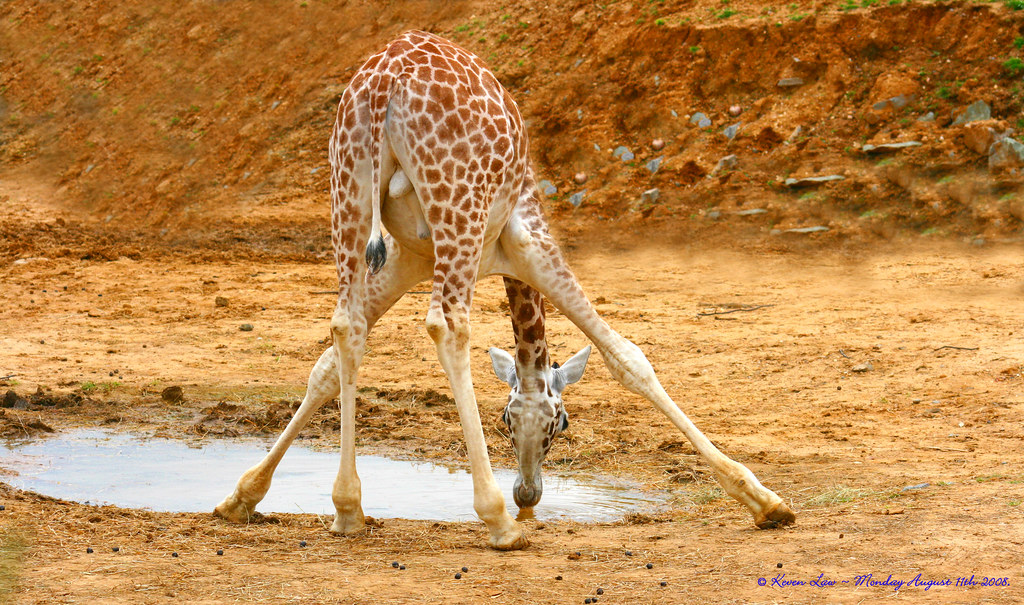
Baby Giraffe - Colchester Zoo, Colchester, Essex, England - Monday August 11th 2008.
Click here to see the Larger image
Click here to see My most interesting images
From Wikipedia, the free encyclopedia ~ The giraffe (Giraffa camelopardalis) is an African even-toed ungulate mammal, the tallest of all land-living animal species, and the largest ruminant. Males can be 4.8 to 5.5 metres (16 to 18 feet) tall and weigh up to 1,700 kilograms (3,800 pounds). The record-sized bull, shot in Kenya in 1934, was 5.87 m (19.2 ft) tall and weighed approximately 2,000 kg (4,400 lb). Females are generally slightly shorter, and weigh less than the males do.
The giraffe is related to deer and cattle, but is placed in a separate family, the Giraffidae, consisting only of the giraffe and its closest relative, the okapi. Its range extends from Chad to South Africa.
Giraffes can inhabit savannas, grasslands, or open woodlands. They prefer areas enriched with acacia growth. They drink large quantities of water and, as a result, they can spend long periods of time in dry, arid areas. When searching for more food they will venture into areas with denser foliage.
Etymology ~ The species name camelopardalis (camelopard) is derived from its early Roman name, where it was described as having characteristics of both a camel and a leopard. The English word camelopard first appeared in the 14th century and survived in common usage well into the 19th century. The Afrikaans language retained it. The Arabic word الزرافة ziraafa or zurapha, meaning "assemblage" (of animals), or just "tall", was used in English from the sixteenth century on, often in the Italianate form giraffa.
Taxonomy and evolution ~ Giraffids evolved from a 3 metre (10 ft) tall antelope-like mammal which roamed Europe and Asia 30-50 million years ago. The earliest giraffid was the Climacoceras, which still resembled deer, having large antler-like ossicones. It first appeared in the early Miocene period. As the lineage went on the genuses Palaeotragus and Samotherium appeared in the early to mid-Miocene. One species of Palaeotragus developed more giraffe-like ossicones. They both were tall at the shoulder but still had short necks. For there the genus Giraffa evolved in the Pliocene period and Okapia evolved in the Pleistocene. The modern long-necked giraffe, Giraffa camelopardalis, appeared 1 million years ago.
Anatomy and morphology ~ Male giraffes are around 4.8-5.5 m (16-19 ft) tall at the horn tips, and normally weigh 1300-1700 kg (2900-3800 lb) Females are 30-60 cm (1-2 ft) shorter and weigh about 200-400 kg (400-800 lb) less than males. Giraffes have spots covering their entire bodies, except their underbellies, with each giraffe having a unique pattern of spots.
Horns ~ Both sexes have horns, although the horns of a female are smaller. The prominent horns are formed from ossified cartilage and are called ossicones. The appearance of horns is a reliable method of identifying the sex of giraffes, with the females displaying tufts of hair on the top of the horns, where as males' horns tend to be bald on top — an effect of necking in combat. Males sometimes develop calcium deposits which form bumps on their skull as they age, which can give the appearance of up to three further horns.
Neck ~ Giraffes have long necks, which they use to browse the leaves of trees. They possess seven vertebrae in the neck (the usual number for a mammal) that are elongated. The vertebrae are separated by highly flexible joints. The base of the neck has spines which project upward and form a hump over the shoulders. They have anchor muscles that hold the neck upright.
Legs and pacing ~ Giraffes also have slightly elongated forelegs, about 10% longer than their hind legs. The pace of the giraffe is an amble, though when pursued it can run extremely fast. It can not sustain a lengthy chase. Its leg length compels an unusual gait with the left legs moving together followed by right (similar to pacing) at low speed, and the back legs crossing outside the front at high speed. When hunting adult giraffes, lions try to knock the lanky animal off its feet and pull it down. Giraffes are difficult and dangerous prey though, and when attacked the giraffe defends itself by kicking with great force. A single well-placed kick from an adult giraffe can shatter a lion's skull or break its spine. Lions are the only predators which pose a serious threat to an adult giraffe.
Circulatory system ~ Giraffes bending down to drinkModifications to the giraffe's structure have evolved, particularly to the circulatory system. A giraffe's heart, which can weigh up to 10 kg (22 lb) and measure about 60 cm (2 ft) long, has to generate around double the normal blood pressure for an average large mammal in order to maintain blood flow to the brain against gravity. In the upper neck, a complex pressure-regulation system called the rete mirabile prevents excess blood flow to the brain when the giraffe lowers its head to drink. Conversely, the blood vessels in the lower legs are under great pressure (because of the weight of fluid pressing down on them). In other animals such pressure would force the blood out through the capillary walls; giraffes, however, have a very tight sheath of thick skin over their lower limbs which maintains high extravascular pressure in exactly the same way as a pilot's g-suit.
Behaviour ~ Social structure and breeding habits ~ Female giraffes associate in groups of a dozen or so members, occasionally including a few younger males. Younger males tend to live in "bachelor" herds, with older males often leading solitary lives. Reproduction is polygamous, with a few older males impregnating all the fertile females in a herd. Male giraffes determine female fertility by tasting the female's urine in order to detect estrus, in a multi-step process known as the Flehmen response.
Giraffes will mingle with the other herbivores in the African bush. They are beneficial to be around because of their height. A giraffe is tall enough to have a much wider scope of an area and will watch out for predators.
Reproduction ~ Giraffe gestation lasts between 14 and 15 months, after which a single calf is born. The mother gives birth standing up and the embryonic sack usually bursts when the baby falls to the ground. Newborn giraffes are about 1.8 m (6 ft) tall.
Within a few hours of being born, calves can run around and are indistinguishable from a week-old calf; however, for the first two weeks, they spend most of their time lying down, guarded by the mother. The young can fall prey to lions, leopards, spotted hyenas, and wild dogs. It has been speculated that their characteristic spotted pattern provides a certain degree of camouflage. Only 25 to 50% of giraffe calves reach adulthood; the life expectancy is between 20 and 25 years in the wild and 28 years in captivity (Encyclopedia of Animals).
Necking ~ As noted above, males often engage in necking, which has been described as having various functions. One of these is combat. Battles can be fatal, but are more often less severe. The longer the neck, and the heavier the head at the end of the neck, the greater the force a giraffe is able to deliver in a blow. It has also been observed that males that are successful in necking have greater access to estrous females, so the length of the neck may be a product of sexual selection.
After a necking duel, a giraffe can land a powerful blow with his head — occasionally knocking a male opponent to the ground. These fights rarely last more than a few minutes or end in physical harm.
Another function of necking is affectionate and sexual, in which two males will caress and court each other, leading up to mounting and climax. Same sex relations are more frequent than heterosexual behaviour. In one area 94% of mounting incidents were of a homosexual nature. The proportion of same sex courtships varies between 30 and 75%, and at any given time one in twenty males will be engaged in affectionate necking behaviour with another male. Females, on the other hand, only appear to have same sex relations in 1% of mounting incidents.
Stereotypic behavior ~ Many animals when kept in captivity, such as in zoos, display abnormal behaviours. Such unnatural behaviours are known as stereotypic behaviours. In particular, giraffes show distinct patterns of stereotypic behaviours when removed from their natural environment. Due to a subconscious response to suckle milk from their mother, something which many human-reared giraffes and other captive animals do not experience, giraffes resort instead to excessive tongue use on inanimate objects.
Due to the obvious social and cultural discomfort associated with the addition of milk delivery devices, animal enclosures are often enriched with other stimuli, such as food and mental distractions (toys, scent markings etc.). This operates as a distraction, removing the giraffe’s focus from its instinctual tendencies towards suckling, resulting in tongue lolling and licking of objects in close proximity.
Feeding and cleaning ~ Giraffes use their long, prehensile tongues to extend their reach.The giraffe browses on the twigs of trees, preferring trees of the genus Mimosa; but it appears that it can live without inconvenience on other vegetable food. A giraffe can eat 63 kg (140 lb) of leaves and twigs daily. As ruminants, they first chew their food, swallow for processing and then visibly regurgitate the semi-digested cud up their necks and back into the mouth, in order to chew again. This process is usually repeated several times for each mouthful.
A giraffe will clean off any bugs that appear on its face with its extremely long tongue (about 45 cm/18 in). The tongue is tough on account of the giraffe's diet, which can include thorns from the trees that they eat. In Southern Africa, giraffes feed on all acacias, especially Acacia erioloba, and possess a specially-adapted tongue and lips that are tough enough to withstand, or even ignore, the vicious thorns of this plant.
Sleep ~ The giraffe has one of the shortest sleep requirements of any mammal, which is between 10 minutes and two hours in a 24-hour period, averaging 1.9 hours per day.
Sounds ~ Although generally quiet and not vocal, giraffes have been heard to make various sounds. Courting males will emit loud coughs. Females will call their young by whistling or bellowing. Calves will bleat, moo, or make mewing sounds. In addition, giraffes will grunt, snort, hiss, or make strange flute-like sounds. Recent research has shown evidence that the animal communicates at an infrasound level.
Brown-headed cowbird. I believe it's posing for a female, showing it's handsome profile. A minute later a female came by and it did a wing display and ruffled its feathers. These behaviors must be strongly instinctual since they are not raised by their own species.
Nothing beats sunstars and flowing water, although when the two work in combination with each other, it's definitely a special treat for me.
----------------------------------------------------------------------------
I woke up at 5am, and drove to this blowhole in nothing but board shorts because it was about 70F with humidity that morning. I hate the heat because I'm part abominable snowman, but the urge as a photographer to try and shoot this scene took precedence over my instinctual nature to run to the next ice maker. Contrary to what everyone says about this place, it's actually VERY easy to get to. I could have probably waddled my way there on all four if I had to, but at the risk of looking like a complete idiot in the morning, I just walked there. :)
When I arrived to this spot, the water was definitely flying out of the hole. The tide was just right as the blowhole is nothing more than an opening to a underwater channel blowing up water to the surface. I wanted to capture the water receding into the hole although initially in the morning the clouds didn't cooperate with me. I waited until later in the morning when the clouds parted a bit to cause the sun to peak out of the clouds forming a sunstar and nice reflection of it in the pool.
Walking out of the lava pools happy, I thought nothing could go wrong. NOT. A giant nene (hawaiian goose) decided to take a shit on me from above and luckily it shat on my shoulder and not my head. You definitely don't want nene shit on you.
5dII, 16-35II, Lee 3 stop
I cuddled up last night with some Coltrane, paper scraps and a bucket of glue, and loaded the results into my scanner for the internet people to see..
There was no major goal, or game plan in mind. Just spontaneous paper finds underfoot, scraps from previous days and instinctual combinations of words and images...
I mak...e stuff @ www.elus1v.com/
Well...not really. Actually one black crow three ways, but I reckon I finally got caught up in the spirit of the season.
It's not unusual for crows to accompany me on my winter walks, flying from branch to branch overhead until I'm out of their territorial range of interest or concern. It is, however, unusual for me to be able to catch them with the camera in that they exercise an amazing ability to fly off precisely when the camera is raised to shoot them. I have found they will sit in the trees above me, cawing to beat the band, until the arms move upward and then they're off. Perhaps it's the similar motion employed in a different type of shooting which has instilled the now instinctual reaction. And, of course, crows are anything but stupid. But I did catch this guy fleeing the scene, surprisingly in focus amongst blurred trees. An image begging for manipulation...and I obliged.
Now where can I find those maids a-milking...
Ever since middle school, whale tales at the crack of dawn has been about my favorite thing ever. This was a lucky, instinctual arm-extended-off-the-boat shot just as she went back under the water.
Taken in Baja during my annual trek down to kite surf in the Sea of Cortez. There is so much ocean life down there it is just insane.
More Places to find me: Zach Dischner Photography | 500px
Blog: 2manventure
Instagram: drzachman