View allAll Photos Tagged Insectlike
This Sugar Maple, infested with spindle-shaped leaf galls, was beginning to show fall color.
The "Maple Spindle Gall" condition is due to an army of mites (Vasates aceriscrumena) that have set up housekeeping on the upper surface of the leaves. Each gall, produced by the leaf in response to the feeding mite, contains one female mite that feeds on the leaf and lays eggs within the gall. Though the galls are very unsightly, the mites do not usually kill the host plant.
Grasshopper Sparrow on Mayfield Road near Boise, Idaho
"The stubby-tailed and bull-necked Grasshopper Sparrow is easy to overlook throughout its range. When not singing its quiet, insectlike song from atop a stalk in a weedy pasture, it disappears into the grasses where it usually runs along the ground rather than flies."
Please, no invitations to award/forced comment groups or to those with large/animated comment codes.
A common prinia with drab gray-brown plumage that varies in tone across its range. Note the pale, wide eyebrow and the long tail that appears as if it is loosely attached to the body. Breeding birds have a black bill and a shorter tail. Common in various habitats, especially farms and wetlands, but avoids woodlands with a canopy. A somewhat bold species, it often skulks in the undergrowth but sings from exposed perches. The song is a repeated series of insectlike trills. Calls include various buzzing and clinking notes. Also produces snapping sounds with its wings. (eBird)
---------------
These prinias are common throughout southeast Asia, but are not that easy to photograph. They flick about in the undergrowth hunting for insects. This one, however, was singing just before this shot so I managed to capture just three quick shots before he disappeared again.
Phnom Krom Marshland, Siemréab, Cambodia. February 2025.
Cambodia Bird Guide Association.
A common prinia with drab gray-brown plumage that varies in tone across its range. Note the pale, wide eyebrow and the long tail that appears as if it is loosely attached to the body. Breeding birds have a black bill and a shorter tail. Common in various habitats, especially farms and wetlands, but avoids woodlands with a canopy. A somewhat bold species, it often skulks in the undergrowth but sings from exposed perches. The song is a repeated series of insectlike trills. Calls include various buzzing and clinking notes. Also produces snapping sounds with its wings. (eBird)
--------------
A sweet little bird that we often saw in the various wetlands that we visited. This one was surveying his territory. The cattail perch gives a good indication of the bird's small size.
Here's a link to our Thailand bird trip list: ebird.org/tripreport/328567
Phraek Nam Daeng--6 Alley marshes & aquaculture ponds, Samut Songkhram, Thailand. February 2025.
Rockjumper Birding Tours.
The stubby-tailed and bull-necked Grasshopper Sparrow is easy to overlook throughout its range. When not singing its quiet, insectlike song from atop a stalk in a weedy pasture, it disappears into the grasses where it usually runs along the ground rather than flies. As sparrows go these birds are lightly marked, buffy tan with clean, unstreaked underparts contrasting with brown, gray, and orange above. The flat head, with an almost comically large bill for such a small bird, completes the distinctive look.
The stubby-tailed and bull-necked Grasshopper Sparrow is easy to overlook throughout its range. When not singing its quiet, insectlike song from atop a stalk in a weedy pasture, it disappears into the grasses where it usually runs along the ground rather than flies.
One of my target birds at Skinner State Park in Hadley, MA last Thursday. I was happy to see a few individuals low to the ground.
A plain warbler dressed in subtle shades of olive, brown, and buff. Note black and tan stripes on head and long, sharp bill. Pinkish legs. Skulky, often seen in the understory, probing clumps of dead leaves in search of insects. Breeds in mature deciduous forests, especially on steep dry slopes. Winters primarily in Middle America and the Caribbean, where it can be found in a wider variety of forested habitats. Listen for its dry, insectlike trill that is very similar to Chipping Sparrow. Appearance most similar to Swainson’s Warbler; distinguished by head pattern (Swainson’s has a rufous crown, Worm-eating has a striped head) and habits (Swainson’s usually found on the ground, Worm-eating in low understory).
Uncommon to locally fairly common summer migrant from winter grounds in Africa. Favors damp grassy thickets, heaths, and other rank shrubby habitats, often near water. Very skulking, and rarely seen unless singing. Sings from perch in grass or low bush, mainly late in the day (sometimes at night): a prolonged, insectlike, reeling trill. Plumage dark gray-brown overall with wide black streaks on back; also note long undertail coverts with big dark centers.
Hollala, Finland. May 2019.
Tiny, insectlike hummingbird of humid tropical forest and edge in foothills and lowlands; infrequently seen. Feeds quietly at all levels in small flowers where could easily be passed off as a big moth or bumblebee (and vice versa). Male often perches on exposed thin twigs. Feeding flight notably slow and beelike, with tail held cocked to show off bold white rump band. Male has long wispy crest of black feathers and bright red bill. Female has boldly spotted underparts and white rump band.
Taken on a photo tour in Costa Rica led by Juan Carlos Vindas of Neotropic Photo Tours.
La Fortuna, Costa Rica
February 2020
A common prinia with drab gray-brown plumage that varies in tone across its range. Note the pale, wide eyebrow and the long tail that appears as if it is loosely attached to the body. Breeding birds have a black bill and a shorter tail. Common in various habitats, especially farms and wetlands, but avoids woodlands with a canopy. A somewhat bold species, it often skulks in the undergrowth but sings from exposed perches. The song is a repeated series of insectlike trills. Calls include various buzzing and clinking notes. Also produces snapping sounds with its wings.
Wondering why I've been a bit quiet for the past month? Well, I've been involved in a large LDD collab project with Darksiderz ( www.flickr.com/photos/darksiderz_photostream/ ): a giant chess board with CCBS made characters with the theme "Light vs Dark". Finally, we are ready to reveal it one small step at a time! I took responsibility of the Dark Side, with insectoids, necromancers and ethereals. This is my Queen, a mutant insectoid, erm, queen, and mother of the Pawn characters. It was only right to give the most powerful piece in chess the most intimidating and beautifully grotesque looks as I possibly could in the confines of LDD :o)
See a 360 degree spinnie of the MOC here: www.brickshelf.com/gallery/TheOneVeyronian/LDDMOCSpinnies...
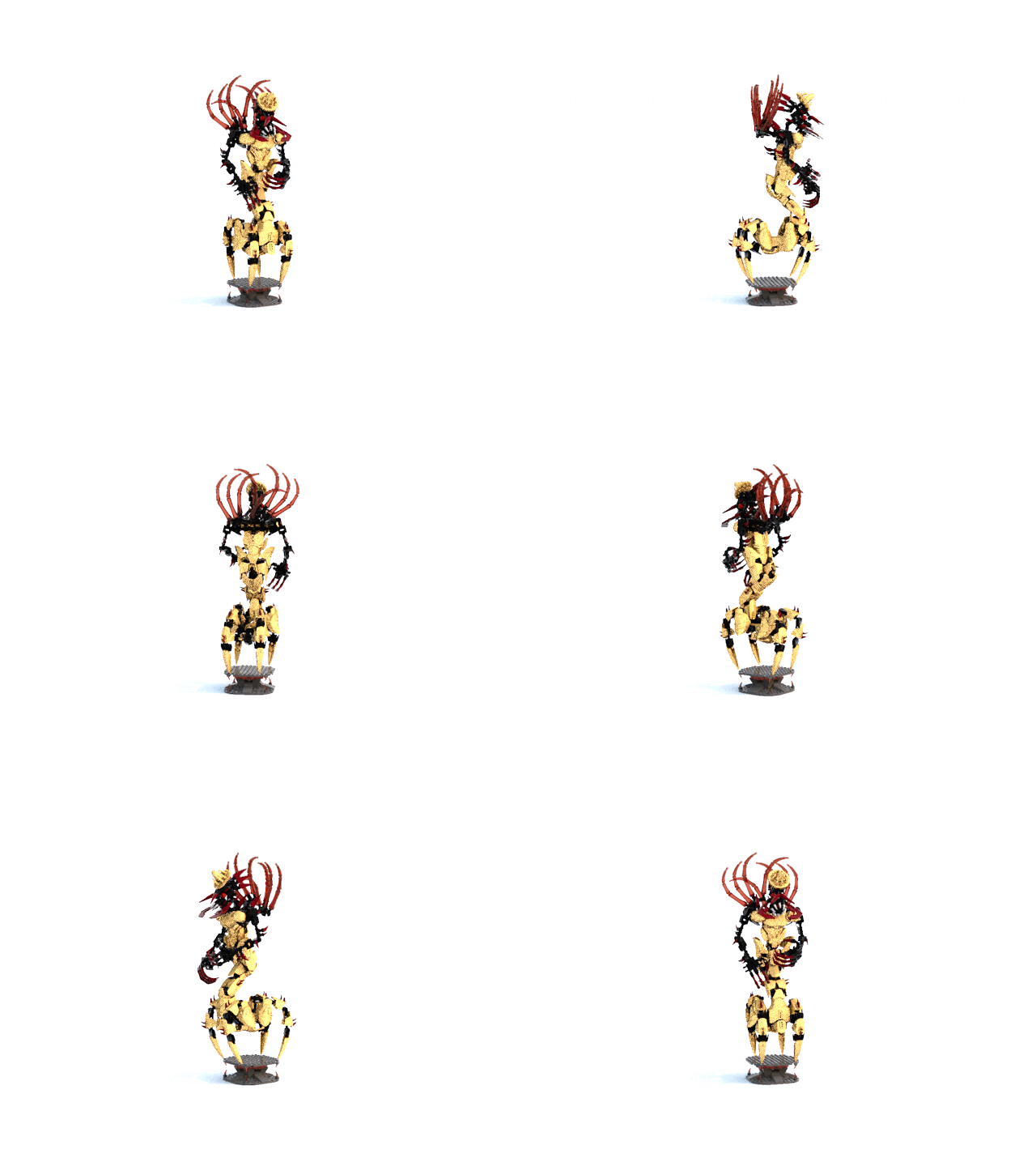
LXF file download here: www.brickshelf.com/gallery/TheOneVeyronian/CollabProject/...
Don't forget to watch Darksiderz' photostream for his Light side characters, and stay tuned for my final piece, the King... :o)
Wondering why I've been a bit quiet for the past month? Well, I've been involved in a large LDD collab project with Darksiderz ( www.flickr.com/photos/darksiderz_photostream/ ): a giant chess board with CCBS made characters with the theme "Light vs Dark". Finally, we are ready to reveal it one small step at a time! I took responsibility of the Dark Side, with insectoids, necromancers and ethereals. This is my King, a noble looking insectoid centaur mutant creature thing.
See a 360 degree spinnie of the MOC here: www.brickshelf.com/gallery/TheOneVeyronian/LDDMOCSpinnies...

LXF file download here: www.brickshelf.com/gallery/TheOneVeyronian/CollabProject/...
Don't forget to watch Darksiderz' photostream for his Light side characters. And that's almost it from me, I will be uploading a picture of the entire Light vs Dark chessboard sometime tomorrow :o)
It's SHIPtember, and so here I am with a car that might as well be a spaceship. As Lamborghini has grown tamer under Audi's stewardship, another genius has stepped up to take on the mantle of insane Italian hypercar maker. The Huayra to me has always looked alien and insectlike, like something H.R. Giger would have designed if he'd been into cars. And the fact that it can also do 380 kph just boggles my mind.
It's SHIPtember, and so here I am with a car that might as well be a spaceship. As Lamborghini has grown tamer under Audi's stewardship, another genius has stepped up to take on the mantle of insane Italian hypercar maker. The Huayra to me has always looked alien and insectlike, like something H.R. Giger would have designed if he'd been into cars. And the fact that it can also do 380 kph just boggles my mind.
The moment I saw these, dialogue from batman begins immediately flashed..
"If you are bored of brawling with thieves and want to achieve something there is a rare blue flower that grows on the eastern slopes. Pick one of these flowers. If you can carry it to the top of the mountain you may find what you were looking for in the first place."
Now, I just need to take these to the top of the mountain ;)
It's SHIPtember, and so here I am with a car that might as well be a spaceship. As Lamborghini has grown tamer under Audi's stewardship, another genius has stepped up to take on the mantle of insane Italian hypercar maker. The Huayra to me has always looked alien and insectlike, like something H.R. Giger would have designed if he'd been into cars. And the fact that it can also do 380 kph just boggles my mind.
Oil on canvas, 24.1 x 33 cm. The Museum Of Modern Art, New York
Time is the theme here, from the melting watches to the decay implied by the swarming ants. The monstrous fleshy creature draped across the paintings center is an approximation of Dalís own face in profile. Mastering what he called "the usual paralyzing tricks of eye-fooling," Dalí painted this work with "the most imperialist fury of precision," but only, he said, "to systematize confusion and thus to help discredit completely the world of reality." There is, however, a nod to the real: The distant golden cliffs are those on the coast of Catalonia, Dalís home.
Dalí rendered his fantastic visions with meticulous verisimilitude, giving the representations of dreams a tangible and credible appearance. In what he called "hand painted dream photographs," hard objects become inexplicably limp, time bends, and metal attracts ants like rotting flesh. The monstrous creature draped across the painting's center resembles the artist's own face in profile; its long eyelashes seem insectlike or even sexual, as does what may or may not be a tongue oozing from its nose like a fat snail.
Like a Praying Mantis waiting to catch its prey is EU05VBJ, a Volvo B7L, Ayats Bravo, double deck sightseeing bus operating in Bath.
It was new in May 2005 to Bath Bus Company as their 273.
I'm told that in the industry, large mirrors like this are known as P45 Mirrors - they are so expensive if you break them you get your P45!
Arthur Young
American, 1905-1995
Bell-47D1 Helicopter, 1945
Aluminum, steel, and acrylic plastic, 9' 2 3/4" x 7' 11" x 42' 8 3/4"
Manufactured by Bell Helicopter Inc., Buffalo, NY.
Marshall Cogan Purchase Fund
Publication excerpt from The Museum of Modern Art, MoMA Highlights, New York: The Museum of Modern Art, revised 2004, originally published 1999, p. 203
More than three thousand Bell-47D1 helicopters were made in the United States and sold in forty countries between 1946 and 1973, when production ceased. While the Bell-47D1 is a straightforward utilitarian craft, its designer, Young, who was also a poet and a painter, consciously juxtaposed its transparent plastic bubble with the open structure of its tail boom to create an object whose delicate beauty is in-separable from its efficiency. That the plastic bubble is made in one piece rather than in sections joined by metal seams sets the Bell-47D1 apart from other helicopters. The result is a cleaner, more unified appearance.
The bubble also lends an insectlike appearance to the hovering craft, which generated its nickname, the "bug-eyed helicopter." It seems fitting, then, that one of the principal uses of the Bell-47D1 has been for pest control in crop dusting and spraying. It has also been used for traffic surveillance and for the delivery of mail and cargo to remote areas. During the Korean War, it served as an aerial ambulance.
Awarded the world's first commercial helicopter license by the Civil Aeronautics Administration (now the FAA), the Bell-47D1 weighs 1,380 pounds. Its maximum speed is 92 miles per hour and its maximum range 194 miles. It can hover like a dragonfly at altitudes up to 10,000 feet.
The buzz of large numbers of silver perch (Bairdiella chrysoura), called an aggregation, can sound almost insectlike. Because the fish formed an aggregation, they were likely engaged in courtship behavior employing the sound to attract spawning females.
Arthur Young
American, 1905-1995
Aluminum, steel, and acrylic plastic, 9' 2 3/4" x 7' 11" x 42' 8 3/4"
More than three thousand Bell-47D1 helicopters were made in the United States and sold in forty countries between 1946 and 1973, when production ceased. While the Bell-47D1 is a straightforward utilitarian craft, its designer, Young, who was also a poet and a painter, consciously juxtaposed its transparent plastic bubble with the open structure of its tail boom to create an object whose delicate beauty is in-separable from its efficiency. That the plastic bubble is made in one piece rather than in sections joined by metal seams sets the Bell-47D1 apart from other helicopters. The result is a cleaner, more unified appearance.
The bubble also lends an insectlike appearance to the hovering craft, which generated its nickname, the "bug-eyed helicopter." It seems fitting, then, that one of the principal uses of the Bell-47D1 has been for pest control in crop dusting and spraying. It has also been used for traffic surveillance and for the delivery of mail and cargo to remote areas. During the Korean War, it served as an aerial ambulance.
Awarded the world's first commercial helicopter license by the Civil Aeronautics Administration (now the FAA), the Bell-47D1 weighs 1,380 pounds. Its maximum speed is 92 miles per hour and its maximum range 194 miles. It can hover like a dragonfly at altitudes up to 10,000 feet.
Publication excerpt
The Museum of Modern Art, MoMA Highlights, New York: The Museum of Modern Art, revised 2004, originally published 1999, p. 203
From citynoise.org/article/1418
Plum Beach is a grimy spit of sand that is just past Sheepshead Bay and part of Gateway National Park. It's beautiful and filthy and therefore gloriously neglected, unkempt and various. It appears to attract people of all races and creeds. It's entered via a parking area that is just off the Belt Parkway, a major highway. A lot seems to go on in this parking lot; it's the kind of place where people might meet for illicit affairs. There are also liaisons in the dunes. I've heard there are poachers of the local sealife. I've seen people performing religious rites, tossing flowers and fruits into the water. Fishermen also come to stand in the water. Boats and garbage wash up on a shore that is littered with broken shells. In May and June, at the new and full moons, throngs of horseshoe crabs gather to mate. It's a risky business--the females arrive to lay their eggs at high tide, and the males swarm around them, frantically maneuvering to hitch to a female's shell and inseminate her eggs when she buries herself in the sand and releases them. The breaking waves often overturn these crabs, leaving them waving their legs and tails helplessly in the air. Some never right themselves, and as the water recedes their carcasses dry slowly in the sand. When I was a kid I was afraid of them, since they were big and brown and insectlike and usually dead, but I've come to love the whole ritual.
DSC_6443-as-Smart-Object-1
Koreans don't typically have the tools required to scrape ice an sweep snow off of their cars so they rely on the cars heating system and the wipers. Obviously if the wipers are frozen to the car they aren't much good . . .
Victoria BC
An atypical Chipping Sparrow on Mt. Tolmie sings in its dry, insect-like trill. This white-cheeked bird lacks the black stripe through the eye, and gray face of a typical "Chippie". This is likely the same bird Jody Wells referred to as the "intrigue bird", as a frontal view from below sparks hopes for a rarity (see previous photo).. This plumage variation is possibly a form of leucism or partial albinism. Comments please.
This the fire version of the S-64 Tarhe ('skycrane'). Very insectlike, and very useful for dumping water / retardant on fires.
[http://en.wikipedia.org/wiki/CH-54_Tarhe]
Another somewhat nondescript little songbird of the northern prairie. It isn't flashy or colourful, and even its song is described as "a series of insectlike buzzes" by my bird guide. Nevertheless, I love the presence of these prairie birds; without them, the "great lone land" would be a lot lonelier. In a buffaloberry thicket, Frenchman River Valley, near Val Marie, Saskatchewan.
Don't use this image on websites, blogs or other media without explicit permission.
© 2013 James R. Page - all rights reserved
and the ones that mother gives you.
don't do anything at all
This was lurking under the wallpaper in the study. What the hell were they eating in Plano circa 1968?
Shoes:
For this project I looked at shoes, their shapes and textures. I was intrigued by the different pieces that the shoe was made up from and so I took them apart and rearranged them into a new form. I started photocopying the shape and drawing over the lines, adding up and subtracting layers in order to try and go as far away from the recognizable shape of the shoe. This built up into a pattern which I printed out. I started working with the printed paper to try and bring a 3D aspect to the flat print. In the end I created a backpiece made up of cut-out shapes of the print, connected by clear pastic so it seemed like the pieces were floating. I quite like the way the project developed again into an insectlike armour piece which resembles the exoskeleton from the suspension project.
Spanish, 1904-1989
Oil on canvas
Dalí rendered his fantastic visions with meticulous verisimlitude, giving the representations of dreams a tangible and credible appearance. In what he called "hand painted dream photographs," hard objects become inexplicable limp, time bends, and metal attracts ants like rotting flesh. The monstrous creature draped across the painting's center resembles the artist's won face in profile; its long eyelashes seem insectlike or even sexual, as does what may or may not be a tongue oozing from its nose like a fat snail.
See original photo in 1st comment below. • Created with the Amazing Circles tool of dumpr.net - fun with your photos.
Salvador Dali
Spanish, 1904-1989
"The Persistence of Memory" 1931
Oil on canvas
Dali rendered his fantastic visions with meticulous verisimilitude, giving the representations of dreams a tangible and credible appearance. In what he called "hand painted dream photographs," hard objects become inexplicably limp, time bends, and metal attracts ants like rotting flesh. The monstrous creature draped across the painting's center resembles the artist's own face in profile; its long eyelashes seem insectlike or even sexual, as does what may or may not be a tongue oozing from its nose like a fat snail.
Salvador Dali
Spanish, 1904-1989
"The Persistence of Memory" 1931
Oil on canvas
Dali rendered his fantastic visions with meticulous verisimilitude, giving the representations of dreams a tangible and credible appearance. In what he called "hand painted dream photographs," hard objects become inexplicably limp, time bends, and metal attracts ants like rotting flesh. The monstrous creature draped across the painting's center resembles the artist's own face in profile; its long eyelashes seem insectlike or even sexual, as does what may or may not be a tongue oozing from its nose like a fat snail.