View allAll Photos Tagged Gleichnis
A tram parts the crowd at night like a ship parting the sea. The void will be reclaimed after it passes. #Amsterdam #Jordaan #Leidseplein #night #Nacht #nuit #urban #city #street #ville #Stadt #街 #夜 #simile
Restaurant lights mingle with streetlights on the windows before continuing their journey like commuters on a tram.
Meanwhile an old man eats carryout at the fountain while light pours from it like beer from a tap. #zwart-wit #B&W #Leidseplein #Amsterdam #KingdomOfHolland #night #nuit #Nacht #夜 #141 #simile #比喩 #comparaison #Gleichnis #vergelijking
Die Klugen und Törichten Jungfrauen sind eine Skulpturengruppe am Paradiesportal des Magdeburger Doms, die das gleichnamige Gleichnis darstellt. Man datiert sie um die Mitte des 13. Jahrhunderts, der Bildhauer bleibt anonym. Die zehn Figuren bestehen aus Sandstein und sind mit einer Höhe von 120–130 cm annähernd lebensgroß.
The wise and foolish virgins are a group of sculptures at the paradise portal of Magdeburg Cathedral, which depicts the parable of the same name. It is dated to the middle of the 13th century, the sculptor remains anonymous. The ten figures are made of sandstone and are almost life-size with a height of 120–130 cm.
(Wikipedia)
-----------------------------------
Die Törichten hätte ich mir auch aufheben können, wenn wir eine Verlängerung des Lockdowns bekommen oder einen dritten harten Lockdown später. Irgendwie will ich dieses Foto aber in diesem unerfreulichen Jahr noch raus hauen :-)
I could have saved the foolish ones if we will get an extension of the lockdown or a third hard lockdown later. Somehow I want to get this photo out of this unpleasant year :-)
Cars stream thru Zion National Park like the Virgin River cuts thru the canyon. This was taken from Zion Park Blvd. An easy day trip from Las Vegas. This park is the opposite of the Grand Canyon. Here the entrance is at the bottom of the canyon. The Grand Canyon entrance is at the top. There are many parks are close to Vegas.
#NPS #ZionNationalPark #nature #ZionParkBlvd #simile #Utah
"Alles Vergängliche ist nur ein Gleichnis..."
(aus Goethes Faust)
texture: www.flickr.com/photos/27805557@N08/3730709461/in/set-7215...
Die Klugen und Törichten Jungfrauen sind eine Skulpturengruppe am Paradiesportal des Magdeburger Doms, die das gleichnamige Gleichnis darstellt. Man datiert sie um die Mitte des 13. Jahrhunderts, der Bildhauer bleibt anonym. Die zehn Figuren bestehen aus Sandstein und sind mit einer Höhe von 120–130 cm annähernd lebensgroß.
The wise and foolish virgins are a group of sculptures at the paradise portal of Magdeburg Cathedral, which depicts the parable of the same name. It is dated to the middle of the 13th century, the sculptor remains anonymous. The ten figures are made of sandstone and are almost life-size with a height of 120–130 cm.
(Wikipedia)
-----------------------------------------------------------------------------
Die Törichten zeige ich euch zu einem passenden Zeitpunkt :-)
I will show you the foolish virgins in an appropriate moment :-)
Alles Vergängliche
ist nur ein Gleichnis;
das Unzulängliche
hier wird's Ereignis;
das Unbeschreibliche,
hier ist's getan;
das Ewigweibliche
zieht uns hinan. (Chorus Mysticus)
Johann Wolfgang von Goethe
Faust 2, V, Bergschluchten
All that is transitory
is only a parable
The Weak's event is here
The indescribable Here's done
the eternally feminine
draws us upward.
Durch die HDR-Aufnahme wird erkennbar, dass die Figuren ursprünglich farbig waren.
The HDR image shows that the figures were originally coloured.
de.wikipedia.org/wiki/Gleichnis_von_den_klugen_und_t%C3%B...
Durch die HDR-Aufnahme wird erkennbar, dass die Figuren ursprünglich farbig waren.
The HDR image shows that the figures were originally coloured.
de.wikipedia.org/wiki/Gleichnis_von_den_klugen_und_t%C3%B...
Two dahlias like two sisters. Most of our life lies between these two flowers. Both are beautiful. Hyvinkää, Finland. 17.7.2018
Dargestellt ist das Gleichnis vom verlorenenen Sohn. Ich hoffe sehr, dass es mir beim Begradigen der stark stürzenden Linien gelungen sein möge, die originalen Proportionen wiederherzustellen. Falls mir das nicht geglückt sein sollte, bitte ich um Nachsicht.
It depicts the parable of the prodigal son. I sincerely hope that I have succeeded in restoring the original proportions when straightening out the heavily tumbled lines. If I have not succeeded in doing so, I apologise.
Im Hintergrund sieht man das Dampfmaschinenhaus für den Betrieb der Brunnen im Park Sanssouci, das wegen seiner Architektur auch als "Moschee" bekannt ist. Die Weltkugel wird aus zwei sich kreuzenden Schriftbändern gebildet. Ein Satz von Karl Marx aus der 11. Feuerbachthese windet sich spiralförmig um die Skulptur: „Die Philosophen haben die Welt nur verschieden interpretiert, es kommt aber darauf an, sie zu verändern.“. Gekreuzt wird er vom Schlusssatz aus Faust II von Johann Wolfgang von Goethe: „Alles Vergängliche ist nur ein Gleichnis.“ Die technische Umsetzung des Entwurfs wurde von der Potsdamer Werkstatt Ulrich Dalichow ausgeführt.
In the background you can see the steam engine house for operating the fountains in Sanssouci Park, also known as the "mosque" because of its architecture. The globe is formed by two intersecting bands of writing. A sentence by Karl Marx from the 11th Feuerbach Thesis spirals around the sculpture: "The philosophers have only interpreted the world, in various ways; the point is to change it.". It is crossed by the final sentence from Faust II by Johann Wolfgang von Goethe: "All of the transient, is parable, only." The technical implementation of the design was carried out by the Potsdam workshop Ulrich Dalichow.
Die Weltkugel wird aus zwei sich kreuzenden Schriftbändern gebildet. Ein Satz von Karl Marx aus der 11. Feuerbachthese windet sich spiralförmig um die Skulptur: „Die Philosophen haben die Welt nur verschieden interpretiert, es kommt aber darauf an, sie zu verändern.“. Gekreuzt wird er vom Schlusssatz aus Faust II von Johann Wolfgang von Goethe: „Alles Vergängliche ist nur ein Gleichnis.“ Die technische Umsetzung des Entwurfs wurde von der Potsdamer Werkstatt Ulrich Dalichow ausgeführt.
The globe is formed by two intersecting bands of writing. A sentence by Karl Marx from the 11th Feuerbach Thesis spirals around the sculpture: "The philosophers have only interpreted the world, in various ways; the point is to change it.". It is crossed by the final sentence from Faust II by Johann Wolfgang von Goethe: "All of the transient, is parable, only." The technical implementation of the design was carried out by the Potsdam workshop Ulrich Dalichow.
First Snow - Andrei Rudjev, 2004.
Exhibition in Linden-Museum, Stuttgart, Germany, 2009 || Andrej Rudjev
Andrej Rudjev
St. Petersburg
Post-constructivism
"Art - is always a paradoxical world do you start a picture, so you're more in the end than at the beginning we are all agents of the infinite."
_____________________________________________________________________________
Shamanism in artistic dialogue
Between St. Petersburg and Berlin
I begin with the simple question, which could have to do with art and shamanism vice versa?
What connects these topics?
Inspired by trance and ritual, the shaman enters a virtual Reiise into the world of the gods, to metaphysical places that remain inaccessible to the community.
From there, he returned with an image or likeness, which he passes on as a message from the gods to the community.
The artist observes the real world and transformed his impressions in his own world of images, with a specific meaning often remains closed and the observer for independent interpretation prompts. [...]
Both, shamans and artists act, each in his own way, of course, as an agent and translator of perceptions of a community.
It is quite conceivable that an artist in the moments of high concentration, similar to the shaman, in a trance-like state expires. Here, he will focus his creativity and focus so that he can almost caught his real environment and to translate his ideas into his own world of images and implement. [...]
Schamanismus im künstlerischen Dialog
Zwischen St. Petersburg und Berlin
Ich beginne schlicht mit der Frage, was Schamanismus mit Kunst und umgekehrt zu tun haben könnte?
Was verbindet diese Themen?
Angeregt durch Trance und Ritual begibt sich der Schamane auf eine virtuelle Reise in die Welt der Götter, zu metaphysischen Orten, die der Gemeinschaft unzugänglich bleiben.
Von dort kehrt er mit einem Bild oder Gleichnis zurück, das er als Botschaft der Götter an die Gemeinschaft weiterleitet.
Der Künstler beobachtet die Realwelt und transformiert seine Eindrücke in eigene Bilderwelten, wobei eine konkrete Bedeutung oftmals verschlossen bleibt und die Betrachter zur selbstständigen Interpretation aufgefordert werden. […]
Beide, Schamanen und Künstler, fungieren, jeder natürlich auf seine Weise, als Vermittler und Übersetzer von Wahrnehmungen an eine Gemeinschaft.
Es ist durchaus vorstellbar, dass ein Künstler in den Momenten hoher Konzentration, ähnlich dem Schamanen, in einen tranceähnlichen Zustand verfällt. Hierbei wird er seine Kreativität so fokussieren und konzentrieren, dass er seine reale Umgebung nahezu entrückt und seine Vorstellungen in seine eigene Bilderwelt zu übersetzen und umzusetzen vermag. […]
_____________________________________________________________________________
Source: Schamanen Sibiriens, Buch zur Austellung, Erich Kasten, Kapitel: Schamanismus im Künstlerischen Dialog - Zwischen St. Petersburg und Berlin
Paradiesvorhalle / Magdeburger Dom
Magdeburg / Germany
See where this picture was taken. [?]
Here you can see the panorama with the interactive 360 degree viewer
(10 single shots)
© All Rights Reserved - you may not use this image in any form without my prior permission.
Totem , Andrej Rudjev, 2004
__________________________________________________________________________
[...] I will start simply with the question what has Shamanism got to do with art and what has art got to do with Shamanism?
How are these themes related? Incited by trance and ritual the Shaman virtually travels into the world of gods to metaphysical places which remain inaccessible to the community. From these places he returns with an image or a parable which he passes on to the community as a message of the gods.
The artist observes the real world and transforms his impressions into worlds of images, whereat a concrete meaning often remains locked, and the observers are incited to independent interpretations.
Generally the medium used in this process hardly plays any role.
Both Shamans and artists function, each in their own way naturallly, as an intermediary and an interpreter of observations to the community [...,]
Source:
"Shamans of Siberia"
Magicians Intermediaries Healers
The book on exhibition in the Linden Museum of Stuttgart
Erich Kasten
Chapter:
"Shamanism in an artistic dialogue between Saint Petersburg and Berlin"
By Iris Schneider
_______
[..] Ich beginne schlicht mit der Frage, was Schamanismus mit Kunst und umgekehrt zu tun haben könnte?
Was verbindet diese Themen? Angeregt durch Trance und Ritual begibt sich der Schamane auf eine virtuelle Reise in die Welt der Götter, zu metaphysischen Orten, die der Gemeinschaft unzugänglich bleiben. Von dort kehrt er mit einem Bild oder Gleichnis zurück, das er als Botschaft der Götter an die Gemeinschaft weiterleitet.
Der Künstler beobachtet die Realwelt und transformiert seine Eindrücke in eigene Bilderwelten, wobei eine konkrete Bedeutung oftmals verschlossen bleibt und die Betrachter zur selbstständigen Interpretationen aufgefordert werden. Dabei spielt das Medium, mit dem gearbeitet wird, allgemein betrachtet, zunächst keine Rolle.
Beide, Schamane und Künstler fungieren, jeder natürlich auf seine Weise, als Vermittler und Übersetzte von Wahrnehmungen an eine Gemeinschaft. [...]
Quelle:
„Schamanen Sibiriens“
Magier Mittler Heiler
Das Buch zur Ausstellung im Linden-Museum, Stuttgart
Erich Kasten
Kapitel:
„Schamanismus im Künstlerischen Dialog zwischen St. Petersburg und Berlin“
von Iris Schneider
________
Wien - Schloß Schönbrunn
seen from Neptune Fountain
gesehen vom Neptunbrunnen
Schönbrunn Palace (German: Schloss Schönbrunn [ʃøːnˈbʁʊn]; Central Bavarian: Schloss Scheenbrunn) was the main summer residence of the Habsburg rulers, located in Hietzing, Vienna. The 1,441-room Rococo palace is one of the most important architectural, cultural, and historic monuments in the country. Since the mid-1950s it has been a major tourist attraction. The history of the palace and its vast gardens spans over 300 years, reflecting the changing tastes, interests, and aspirations of successive Habsburg monarchs.
In 1569, Holy Roman Emperor Maximilian II purchased a large floodplain of the Wien river beneath a hill, situated between Meidling and Hietzing, where a former owner, in 1548, had erected a mansion called Katterburg. The emperor ordered the area to be fenced and put game there such as pheasants, ducks, deer and boar, in order for it to serve as the court's recreational hunting ground. In a small separate part of the area, "exotic" birds such as turkeys and peafowl were kept. Fishponds were also built.
The name Schönbrunn (meaning "beautiful spring") has its roots in an artesian well from which water was consumed by the court.
During the next century, the area was used as a hunting and recreation ground. Eleonora Gonzaga, who loved hunting, spent much time there and was bequeathed the area as her widow's residence after the death of her husband, Ferdinand II. From 1638 to 1643, she added a palace to the Katterburg mansion, while in 1642 came the first mention of the name "Schönbrunn" on an invoice. The origins of the Schönbrunn orangery seem to go back to Eleonora Gonzaga as well. The Schönbrunn Palace in its present form was built and remodelled during the 1740–50s during the reign of empress Maria Theresa who received the estate as a wedding gift. Franz I commissioned the redecoration of the palace exterior in the neoclassical style as it appears today.
Franz Joseph, the longest-reigning emperor of Austria, was born at Schönbrunn and spent a great deal of his life there. He died there, at the age of 86, on 21 November 1916. Following the downfall of the Habsburg monarchy in November 1918, the palace became the property of the newly founded Austrian Republic and was preserved as a museum.
After World War II and during the Allied Occupation of Austria (1945—55), Schönbrunn Palace was requisitioned to provide offices for both the British Delegation to the Allied Commission for Austria, and for the headquarters for the small British Military Garrison present in Vienna. With the reestablishment of the Austrian republic in 1955, the palace once again became a museum. It is still sometimes used for important events such as the meeting between U.S. president John F. Kennedy and Soviet premier Nikita Khrushchev in 1961.
Since 1992 the palace and gardens have been owned and administered by the Schloss Schönbrunn Kultur-und Betriebsges.m.b.H., a limited-liability company wholly owned by the Republic of Austria. The company conducts preservation and restoration of all palace properties without state subsidies. UNESCO catalogued Schönbrunn Palace on the World Heritage List in 1996, together with its gardens, as a remarkable Baroque ensemble and example of synthesis of the arts (Gesamtkunstwerk).
The sculpted garden space between the palace and the Neptune Fountain is called the Great Parterre. The French garden, a big part of the area, was planned by Jean Trehet, a disciple of André Le Nôtre, in 1695. It contains, among other things, a maze.
The complex however includes many more attractions: Besides the Tiergarten, an orangerie erected around 1755, staple luxuries of European palaces of its type, a palm house (replacing, by 1882, around ten earlier and smaller glass houses in the western part of the park) is noteworthy. Western parts were turned into English garden style in 1828–1852.
The area called Meidlinger Vertiefung (engl.: depression of Meidling) to the west of the castle was turned into a play area and drill ground for the children of the Habsburgs in the 19th century. At this time it was common to use parks for the military education of young princes. Whereas the miniature bastion, which was built for this purpose, does not exist anymore, the garden pavilion that was used as shelter still does. It was turned into a café in 1927 and is known as Landtmann’s Jausen Station since 2013.
At the outmost western edge, a botanical garden going back to an earlier arboretum was re-arranged in 1828, when the Old Palm House was built. A modern enclosure for Orangutans, was restored besides a restaurant and office rooms in 2009.
The garden axis points towards a 60-metre-high (200 ft) hill, which since 1775 has been crowned by the Gloriette structure (Fischer von Erlach had initially planned to erect the main palace on the top of this hill).
(Wikipedia)
Das Schloss Schönbrunn, in seiner heutigen Form im 18. Jahrhundert als Sommerresidenz für Kaiserin (eigentlich Kaisergattin und Erzherzogin) Maria Theresia errichtet, liegt seit 1892 im 13. Wiener Gemeindebezirk, Hietzing. Sein Name geht auf einen Kaiser Matthias zugeschriebenen Ausspruch zurück. Er soll hier im Jahr 1619 auf der Jagd eine artesische Quelle „entdeckt“ und ausgerufen haben: „Welch’ schöner Brunn“.
Von 1638 bis 1643 wurde in dieser Gegend ein Schlossbau als Residenz für die zweite Ehefrau des Kaisers Ferdinand II., Eleonora Gonzaga, errichtet. Diese Anlage wurde jedoch in der Zweiten Wiener Türkenbelagerung 1683 schwer beschädigt. 1687 gab Leopold I. für seinen Thronfolger Joseph I. einen repräsentativen Neubau von Johann Bernhard Fischer von Erlach für das damals weit vor den Toren der Stadt gelegene Schloss in Auftrag.
Erst ab 1743 wurden unter Maria Theresia, seit 1745 als Kaiserin tituliert, von Nikolaus von Pacassi und Johann Ferdinand Hetzendorf von Hohenberg das Schloss und der Park in seiner heutigen Form um- und ausgebaut. Der barocke Palast war von der Mitte des 18. Jahrhunderts bis zum Ende des Heiligen Römischen Reiches im Jahre 1806 die Sommerresidenz der Könige und Kaiser des Reiches und ab 1804 bis zum Ende des Ersten Weltkrieges des österreichischen Kaiserhauses. Das Schloss war in dieser Zeit fast durchgehend von einem mehrere hundert Personen umfassenden Hofstaat bewohnt und wurde zu einem kulturellen und politischen Mittelpunkt des Habsburgerreiches. Während der österreichisch-ungarischen Monarchie wurde es auch k. k. Lustschloss Schönbrunn genannt.
Schönbrunn ist das größte Schloss und eines der bedeutendsten und meistbesuchten Kulturgüter Österreichs. Das Schloss und der etwa 160 ha große Park sind seit 1996 Teil des UNESCO-Weltkulturerbes. Eine Hauptattraktion im Schlosspark ist der älteste noch bestehende Zoo der Welt, der Tiergarten Schönbrunn (16 ha). Schloss und Park zählen zu den touristischen Hauptsehenswürdigkeiten Wiens.
Das Schloss und sein Park bilden ein untrennbares Ensemble. Zwar ist die Anlage bereits in Fischer von Erlachs Entwurf skizziert, doch geht die gartenarchitektonische Gestaltung auf Jean Trehet, einen Schüler Le Nôtres, zurück, der 1695 mit den Planungen begann und bis 1699 ständig in Schönbrunn beschäftigt war. Späteres, wenigstens zeitweiliges Wirken ebenda ist anzunehmen. Auf Trehet geht die Breite des Parterres zurück (das sich damals aber vermutlich nur in halber jetziger Länge erstreckte), und er ließ die seitlich davon liegenden Boskette anlegen. Zu Trehets Anlage gibt es zwar Notizen, doch leider keine Abbildungen.
Nachdem Maria Theresia 1742 das Schloss zur Sommerresidenz erkoren hatte, wurde das Parterre um 1750 auf die jetzige Größe erweitert. Um die Umgestaltung der Anlage kümmerte sich insbesondere Kaiser Franz I. Stephan, der 1752 den Tiergarten und 1753, auf dafür zugekauftem Grund, der westlich an das bisherige Areal anschloss, den Holländisch-Botanischen Garten einrichten ließ. Er beauftragte damit den Holländer Adrian van Steckhoven und seinen Gehilfen Richard van der Schot. Zwar wurde 1755 das jetzige Orangeriegebäude fertig gestellt, doch Pläne für die Gestaltung des Hügels gediehen zu Lebzeiten des Kaisers nur so weit, dass eine das Parkett fortführende Schneise in den Wald geschlagen wurde.
Erst sieben Jahre nach dem Tode ihres Gemahls gab Maria Theresia eine gründliche Umgestaltung des Hügels und des Parks in Auftrag, und zwar an Hetzendorf von Hohenberg, den ihr Berater Kaunitz bereits 1765 bei Hof eingeführt hatte.
Hohenbergs erstes Projekt (1771/1772) sah ein großes Bassin auf der Anhöhe vor, das eine Anzahl von Springbrunnen speisen sollte, beispielsweise neben dem Neptunbrunnen vier weitere im Großen Parterre. Die Bauarbeiten wurden 1773 begonnen. Ein in der Mittelachse des Parterres seit etwa 1700 bestehendes sternförmiges Becken wurde in das westliche Boskett versetzt, wo es bis heute als Sternbassin oder Westlicher Najadenbrunnen besteht.
Erst 1776/1777 stellte sich endgültig heraus, dass der Wasserbedarf der Brunnen von Hohenbergs erstem Entwurf nicht gedeckt werden konnte, weshalb zwölf bereits gegrabene Brunnenbecken wieder zugeschüttet wurden, die vier im Großen Parterre, die anderen am Hang. Hohenberg vollendete stattdessen den Obeliskbrunnen (1777) und die Ruine (1778) und konzentrierte sich danach auf die Gestaltung des Neptunbrunnens. Dieser konnte 1780, noch zu Lebzeiten Maria Theresias, in Betrieb genommen werden.
Der Park wurde um 1779 von Kaiser Joseph II. zum Unmut des Hofadels der Öffentlichkeit zugänglich gemacht und stellt seither ein wichtiges Erholungsgebiet für die Wiener Bevölkerung dar. Bedeutender Hofgartendirektor war Friedrich Leo von Rottenberger, der die Leitung von 1918 bis 1934 erfolgreich innehatte. Nach dem Ende der Monarchie wurden die Gärten von den Bundesgärten Wien Innsbruck verwaltet. Nachfolger von Rottenberger wurde Franz Matschkai. Derzeit liegt die Leitung bei Brigitte Mang.
(Wikipedia)
Der Neptunbrunnen im Schönbrunner Schlosspark wurde im Zuge der Umgestaltung der Anlage unter Kaiserin Maria Theresia zwischen 1778 und 1780 erbaut. Der Brunnen ist gut hundert Meter lang, knapp fünfzig Meter breit und ohne Figuren etwas über sieben Meter hoch.
Geschichte
Der Neptunbrunnen im Schönbrunner Schlosspark wurde im Zuge der Umgestaltung der Anlage unter Kaiserin Maria Theresia zwischen 1778 und 1780 erbaut. Der Brunnen ist gut hundert Meter lang, knapp fünfzig Meter breit und ohne Figuren etwas über sieben Meter hoch.
Geschichte
Die Grabungen für das Bassin (und vier weitere im Großen Parterre vorgesehene Brunnen) wurden 1776 begonnen, doch musste das Konzept 1777 abgeändert werden, nachdem sich herausgestellt hatte, dass keine entsprechenden Mengen Wassers herbeigeleitet werden könnten. Dies führte dazu, dass gegrabene Bassins wieder zugeschüttet werden mussten und dass die Fertigstellung des Neptunbrunnens sich bis 1780 verzögerte.
Der Entwurf der aus Ziegeln gemauerten, aber mit Kaiserstein verkleideten Anlage stammt von Johann Ferdinand Hetzendorf von Hohenberg. Die Herstellung der Skulpturen aus weißem Sterzinger Marmor wurde dem k.k. Hofstatuarius (Hofbildhauer) Johann Christian Wilhelm Beyer übertragen und in seinem Atelier ausgeführt.
Beschreibung
Der Brunnen liegt in der Hauptachse zwischen Schloss und Gloriette am Rande des Großen Parterres, das die über-lebensgroßen Figuren abschließen, während sie gleichzeitig den Übergang zum Hügel akzentuieren.
Er besteht aus einem großen Bassin, das gegen den Hang durch eine geschwungene Stützmauer abgeschlossen wird. In deren Mitte befindet sich eine künstliche Felsgrotte, darüber der Meeresgott Neptun auf einem Muschelwagen, gestützt auf seinen Dreizack.
Zu seiner Rechten kniet die Meeresnymphe Thetis, die Mutter des Achill. Sie bittet Neptun um einen Seesturm, der die Entführung Helenas durch den trojanischen Prinzen Paris nach Troja vereiteln sollte. Im Wissen um die Prophezeiung, ihr Sohn werde im Trojanischen Krieg einen frühen Tod sterben, sucht sie den Meeresgott zu überreden, den drohenden Krieg zu verhindern, und so das Leben ihres Sohnes zu retten. Zu Neptuns Linken, zu seinen Füßen, eine Nymphe mit Füllhorn, Hinweis auf den überquellenden Reichtum der Meere. Umgeben wird die Hauptgruppe von vier Tritonen, den Bändigern der Hippocampen (Meerespferde), die Neptuns Wagen ziehen. Die ursprünglich sieben Figurengruppen (neben der Hauptgruppe mit Neptun und den vier Tritonengruppen noch zwei Najadengruppen, die im Bassin aufgestellt werden sollten) führten zu Streit und einigem amtlichem Schriftverkehr: Die Najadengruppen waren gegenüber den anderen so unproportional klein ausgeführt, dass man sie in die beiden Becken des östlichen und westlichen Rondells (jetzt Rundes und Sternenbecken) setzen musste. Beyer wurde beschuldigt, dies absichtlich herbeigeführt zu haben, um anderen Bildhauern, die sonst für diese Bassins gearbeitet hätten, mit vollendeten Tatsachen zuvorzukommen.
Der die Meere beherrschende Neptun stand in der Kunst des 16. bis 18. Jahrhunderts als Gleichnis für den sein Land lenkenden Souverän.
Hinter dem Brunnen befindet sich ein in den Hang gemauertes Gebäude, durch das ein Ziegelgewölbe mit bis zu eineinhalb Meter dicken Mauern unterhalb des Brunnens und ein Verbindungsstollen zum hinteren Glorietteteich zugänglich werden. Das Wasser wird durch eine Gravitationsleitung von dort zum Neptunbrunnen geführt. Wegen Wassermangels wurde der Brunnen früher nur bei besonderen Anlässen in Betrieb genommen, und nach jedem der beiden Weltkriege gar nicht. Erst seit der letzten und kompletten Sanierung des Brunnens ist ein Wasserkreislauf vorhanden und damit ein Dauerbetrieb möglich.
(Wikipedia)
_______________________________________________
_______________________________________________
Platon's shadows
In a cavernous underground room people squatting on the floor and never see anything but fleeting shadows on the wall. In Plato's cave allegory designed in a thought experiment arrangement, the parable of a world in which people hold for real, what they see. In truth, they only see the images of a higher spiritual (intelligible) world.
In this sense, the painted or photographed image is just a poor copy of the appearance . Who draws something, according to Plato commits an illusion, because he does not mimic the silhouette and is not engaged in the shadows opposite absolute idea. He creates just the same as a copy.
Plato uses the terms "shadow" (Skias, phantasmata) and "mirror image" (eidola) ambiguous and sometimes synonymously. However, there is a difference.
After the designated mirror stage theory of child development of the psychiatrist Jacques Lacan, the ego identifies with its mirror image, as Narcissus of Greek mythology fell in love with his reflection he sees in the water. In contrast, it comes at the idea of the body double (shadow) to the identification with the Other. Narcissus Ichverliebte will therefore not take care of his shadow.
Plato's theory from a perfect idea (true being) gradually over subordinate ideas down inaugural world was further developed by Plotinus, the most famous representative of Neo-Platonism. He also justified from above and describes the hypothesis of a Perfect (good), the descending weakens more and more until in the range of the physical only remain shadows. These are the "shadow images of beings," the shadows of perfection.
Platons Schatten
In einem höhlenartigen unterirdischen Raum hocken Menschen am Boden und sehen nie etwas anderes als vorbeihuschende Schatten an der Wand. Im Höhlengleichnis entwarf Platon in einer gedanklichen Versuchsanordnung das Gleichnis einer Welt, in der die Menschen für real halten, was sie sehen. In Wahrheit sehen sie nur die Abbilder einer höheren, geistigen (intelligiblen) Welt. In diesem Sinn ist das gemalte oder fotografierte Bild bloß ein Abklatsch des Scheins. Wer so etwas anfertigt, begeht nach Platon eine Täuschung, weil er nur das Schattenbild nachahmt und sich nicht mit der dem Schatten gegenüberstehenden absoluten Idee beschäftigt. Er erschafft lediglich dasselbe als Kopie.
Platon verwendet die Begriffe „Schatten“ (skias, phantasmata) und „Spiegelbild“ (eidola) uneindeutig und manchmal synonym. Es gibt jedoch einen Unterschied. Nach der mit Spiegelstadium bezeichneten Theorie der kindlichen Entwicklung des Psychiaters Jacques Lacan identifiziert sich das Ich mit seinem Spiegelbild, wie sich der Narziss der griechischen Mythologie in sein Spiegelbild verliebt, das er im Wasser erblickt. Im Gegensatz hierzu geht es bei der Vorstellung vom Doppelgänger (Schatten) um die Identifikation mit dem Anderen. Narziss, der Ichverliebte, wird sich daher nicht um seinen Schatten kümmern.
Platons Ideenlehre einer sich von der vollkommenen Idee (dem wahren Sein) stufenweise über nachgeordnete Ideen nach unten konstituierenden Welt wurde von Plotin, dem bekanntesten Vertreter des Neuplatonismus weiterentwickelt. Er begründet ebenso von oben her und beschreibt die Hypothese eines Vollkommenen (Guten), das sich absteigend immer mehr abschwächt, bis im Bereich des Körperlichen nur noch Schatten übrigbleiben. Dies sind die „Schattenbilder vom Seienden“, die Abschattungen des Vollkommenen.
Stephan Kessler (1622-1700) - Allegory of the rich man and poor Lazarus.
www.kollerauktionen.ch/en/334792-0003-1190-STEPHAN-KESSLE...
Pompeo Girolamo Batoni, 1708 Lucca - 1787 Rom
Das Gleichnis vom verlorenen Sohn oder Die Rückkehr des verlorenen Sohns / The Parable of the Prodigal Son aka The Return of the Prodigal Son (1773)
Kunsthistorisches Museum, Wien
The Italian painter Pompeo Girolamo Batoni displayed a solid technical knowledge in his portrait work and in his numerous allegorical and mythological pictures. The high number of foreign visitors travelling throughout Italy and reaching Rome during their Grand Tour, made the artist specialized in portraits.
Frankreich - Palast von Versailles
View down to the Fountain of Latona with the Grand Canal in the background.
Blick hinunter zum Latonabrunnen mit dem Großen Kanal im Hintergrund.
The Palace of Versailles (/vɛərˈsaɪ, vɜːrˈsaɪ/ vair-SY, vur-SY; French: Château de Versailles [ʃɑto d(ə) vɛʁsɑj] (About this soundlisten)) was the principal royal residence of France from 1682, under Louis XIV, until the start of the French Revolution in 1789, under Louis XVI. It is located in the department of Yvelines, in the region of Île-de-France, about 20 kilometres (12 miles) southwest of the centre of Paris.
A simple hunting lodging and later a small château with a moat occupied the site until 1661, when the first work expanding the château into a palace was carried out for Louis XIV. In 1682, when the palace had become large enough, the king moved the entire royal court and the French government to Versailles. Some of the palace furniture at this time was constructed of solid silver, but in 1689 much of it was melted down to pay for the cost of war. Subsequent rulers mostly carried out interior remodeling, to meet the demands of changing taste, although Louis XV did install an opera house at the north end of the north wing for the wedding of the Dauphin and Marie Antoinette in 1770. The palace has also been a site of historical importance. The Peace of Paris (1783) was signed at Versailles, the Proclamation of the German Empire occurred in the vaunted Hall of Mirrors, and World War I was ended in the palace with the Treaty of Versailles, among many other events.
The palace is now a historical monument and UNESCO World Heritage site, notable especially for the ceremonial Hall of Mirrors, the jewel-like Royal Opera, and the royal apartments; for the more intimate royal residences, the Grand Trianon and Petit Trianon located within the park; the small rustic Hameau (Hamlet) created for Marie Antoinette; and the vast Gardens of Versailles with fountains, canals, and geometric flower beds and groves, laid out by André le Nôtre. The Palace was stripped of all its furnishings after the French Revolution, but many pieces have been returned and many of the palace rooms have been restored.
In 2017 the Palace of Versailles received 7,700,000 visitors, making it the second-most visited monument in the Île-de-France region, just behind the Louvre and ahead of the Eiffel Tower.
The Gardens of Versailles (French: Jardins du château de Versailles; French pronunciation: [ʒaʁdɛ̃ dy ʃato də versaij]) occupy part of what was once the Domaine royal de Versailles, the royal demesne of the château of Versailles. Situated to the west of the palace, the gardens cover some 800 hectares of land, much of which is landscaped in the classic French formal garden style perfected here by André Le Nôtre. Beyond the surrounding belt of woodland, the gardens are bordered by the urban areas of Versailles to the east and Le Chesnay to the north-east, by the National Arboretum de Chèvreloup to the north, the Versailles plain (a protected wildlife preserve) to the west, and by the Satory Forest to the south.
Administered by the Public Establishment of the Palace, Museum and National Estate of Versailles, an autonomous public entity operating under the aegis of the French Ministry of Culture, the gardens are now one of the most visited public sites in France, receiving more than six million visitors a year.
In addition to the meticulous manicured lawns, parterres, and sculptures are the fountains, which are located throughout the garden. Dating from the time of Louis XIV and still using much of the same network of hydraulics as was used during the Ancien Régime, the fountains contribute to making the gardens of Versailles unique. On weekends from late spring to early autumn, the administration of the museum sponsors the Grandes Eaux – spectacles during which all the fountains in the gardens are in full play. Designed by André Le Nôtre, the Grand Canal is the masterpiece of the Gardens of Versailles. In the Gardens too, the Grand Trianon was built to provide Sun King with the retreat he wanted. The Petit Trianon is associated with Marie-Antoinette, who spent her time there with her closest relatives and friends.
In 1979, the gardens along with the château were inscribed on the UNESCO World Heritage List, one of thirty-one such designations in France.
(Wikipedia)
Das Schloss Versailles (französisch château de Versailles) in der gleichnamigen Nachbarstadt von Paris ist eine der größten Palastanlagen Europas und war von der Mitte des 17. Jahrhunderts bis zum Ausbruch der Französischen Revolution die Hauptresidenz der Könige von Frankreich. Der Barockbau, dessen größte Ausdehnung mehr als einen halben Kilometer beträgt, gilt als ein Höhepunkt europäischer Palastarchitektur und diente vom 17. bis zum 19. Jahrhundert als Vorbild für zahlreiche weitere Schlossbauten.
Ursprünglich von Philibert Le Roy als Jagdschloss für König Ludwig XIII. errichtet, wurde die Anlage ab 1661 unter Ludwig XIV. durch Louis Le Vau, François II d’Orbay, Jules Hardouin-Mansart und Robert de Cotte in mehreren Phasen um- und ausgebaut. Die Innenausstattung schuf Charles Lebrun, die berühmten Gartenanlagen stammen von André Le Nôtre. In seiner Zeit als Residenz war der Palast fast durchgehend von einem mehrere tausend Personen umfassenden Hofstaat bewohnt und bildete das kulturelle und politische Zentrum Frankreichs.
Seit dem 19. Jahrhundert wird das Schloss als Museum genutzt. Es steht heute für Besucher offen, ebenso wie die weitläufigen Gartenanlagen und wie die drei weiteren im Park befindlichen Lustschlösser Grand Trianon, Petit Trianon und Hameau de la Reine. Während der Mittelbau mit den Staatssälen des 17. und 18. Jahrhunderts in der ursprünglichen Form zu sehen ist, beherbergen die großen Seitenflügel das im 19. Jahrhundert eingerichtete Museum der Geschichte Frankreichs. 1979 wurde Schloss Versailles in die Liste des UNESCO-Weltkulturerbes aufgenommen.
Die Gartenanlagen gehen auf den von Jacques Boyceau de la Barauderie für Ludwig XIII. geschaffenen Petit Parc zurück. Sie wurden in ihrer heutigen Ausdehnung weitgehend in drei Abschnitten von 1662 bis 1667, 1668 bis 1677 und 1678 bis 1689 durch André Le Nôtre geschaffen. Der Schlosspark gliedert sich in drei für alle Barockgärten typische Bereiche: Die dem Schloss nahen Parterres, die anschließenden Boskette und den fernen Jagdwald. Der Bereich der Parterres, der Boskette und des großen Kanals wird noch heute als Petit Parc bezeichnet, der ursprünglich mehrere tausend Hektar große Waldbereich als Grand Parc. Die aus dem Vorbild von Vaux-le-Vicomte übernommene Hauptachse gliedert die Gartenanlagen und führt von der Stadt durch das Schloss, durch den Garten und den großen Kanal bis in die weite Ferne. Der Park wurde durch mehr als 75.000 gestutzte Bäume und Bäumchen verziert, von denen zahlreiche aus den Baumschulen Vaux-le-Vicomtes stammten und zu Fouquets konfisziertem Vermögen gehörten. Bezeichnenderweise blieb der Park in seiner barocken Struktur bis zum Ende des Ancien Régime in weiten Teilen unverändert. Die im 18. Jahrhundert von englischen Vorbildern beeinflusste Umgestaltung vieler europäischer Schlossparks tangierte die Versailler Gärten nur im kleinen Maßstab im sogenannten Boskett der Königin, im Boskett des Apollo-Bades und im privateren Bereich der Trianon-Schlösser. Zur Zeit Ludwigs XVI. wurden Teile des Parks umgestaltet und eine Aufforstung der Boskette vorgenommen. Dafür wurden weite Bereiche gerodet und neu bepflanzt, eine ähnliche Neubepflanzung wurde in den 1990er Jahren vorgenommen.
Den Übergang vom Schloss- zum Gartenbereich bilden die Parterres, die durch ihre niedrige Bepflanzung den Blick auf das Gebäude gewähren und durch ihre ornamentale Gestaltung die Motive der Baudekoration wiederholen. Vor dem Nord- und dem Südflügel des Schlosses befinden sich prächtige Broderieparterres, das Parterre du Nord und das Parterre du Midi, die mit ornamentalen Blumenpflanzungen, zahlreichen Prunkvasen und Statuen dekoriert sind. Dem Corps de Logis sind zwei große Wasserbecken vorgelagert, die als Parterre d’Eau bezeichnet werden. In den fünfzehn Bosketten wiederholen sich die Säle des Schlossinneren im Freien. Hier sind mit gärtnerischen Mitteln Salons zwischen Hecken und Bäumen eingerichtet, die man ebenfalls mit Skulpturen, Springbrunnen und kunstvoll beschnittenen Pflanzen ausstaffierte. Zu den bekanntesten Gartenarchitekturen Frankreichs gehört dort die von Mansart entworfene kreisrunde, mit dutzenden Springbrunnen verzierte Kolonnade, und die Salle de Bal (der Ballsaal), seinerzeit berühmt war auch das große Labyrinth von Versailles.
Das Zentrum des Petit Parcs bildet der aus mehreren Treppenstufen gebildete Brunnen der Latona, von dort führt die Königliche Allee mit dem so genannten Grünen Teppich in Richtung des Apollo-Brunnens, aus welchem der Sonnengott emporsteigt und sich symbolisch in Richtung des Königs erhebt. Hinter diesem Bassin beginnt der kreuzförmige Grand Canal, der den Park optisch in die Ferne verlängert und zugleich das sumpfige Gelände entwässert. Zur Zeit des Ancien Régime wurde die Wasserfläche mit venezianischen Gondeln samt italienischer Gondolieri befahren, für die eigens ein kleines Wohnareal namens Petit Venise, Klein Venedig, geschaffen wurde.Sogar der Nachbau eines Kriegsschiffes lag dort vor Anker. Am Südarm des Kanals befand sich eine große Menagerie, Ludwig XIV. hielt dort von 1668 bis 1681 unter anderem einen afrikanischen Elefanten, der ein diplomatisches Geschenk aus Portugal war.
Der Latonabrunnen. Latona kann mit Anna von Österreich interpretiert werden, deren Sohn Ludwig dann Apollon entspricht. Die Bedrohung der Latona durch die lykischen Bauern und deren anschließende Bestrafung ist ein Symbol der politischen Unruhen während der Kindheit Ludwigs. Im Hintergrund die Königliche Allee mit dem Grünen Teppich und in der Ferne der Große Kanal
Wie das Schloss, so diente auch der Park der Verherrlichung des Sonnenkönigs und ist voll von offenen und versteckten Anspielungen auf ihn. In den Brunnen und Skulpturengruppen wird die griechische Mythologie als Gleichnis auf die Regierung Ludwigs dargestellt. Die Gärten steigen, durch mehrere Terrassen gegliedert, zum Schloss an, so dass man sich nicht nur symbolisch hoch zum König begab. Sternförmige Wegkreuzungen entwickeln sich an verschiedenen Punkten des Parks, doch alle Hauptwege führen zu der dominierenden Mittelachse. Diese führt vom Großen Kanal zum Schloss und darüber hinaus durch die Stadt, ein Symbol für die Wege, die beim König zusammentreffen. Das Parterre d’Eau ist mit Skulpturen geschmückt, die Frankreichs große Flüsse versinnbildlichen und somit Zeichen von der Größe des Landes geben.
Ludwig XIV. selbst verfasste den ersten Führer zu seinem Park, in dem er einen Rundweg empfahl, die Bedeutung der Statuen und Brunnen erläuterte und auf Besonderheiten in den Anpflanzungen hinwies:
„Wir steigen zum Apollobrunnen hinab und machen hier einen kleinen Halt, um die Figuren und Vasen der Königlichen Allee, des Latonabrunnens und des Schlosses zu bewundern. Von hier aus erblicken wir den Großen Kanal. Wer die Menagerie und das Trianon am gleichen Tag besichtigen will, sollte dies zuerst tun und sich erst dann den übrigen Brunnen widmen.“
– Ludwig XIV., Rundgang durch die Gärten von Versailles
(Wikipedia)
Welcome to the Irrlicht Engine
The Irrlicht Engine is an open source realtime 3D engine written in C++. It is cross-platform, using D3D, OpenGL and its own software renderers. OpenGL-ES2 and WebGL renderers are also in development. It is a stable library which has been worked on for nearly 2 decades. We've got a huge community and Irrlicht is used by hobbyists and professional companies alike. You can find enhancements for it all over the web, like alternative terrain renderers, portal renderers, exporters, world layers, tutorials, editors, language bindings and so on. And best of all: It's completely free.
Irrlichtelieren (Will-o’-the-wisping-around)
Jane K. Brown
UNIVERSITY OF WASHINGTON
The lexeme Irrlichtelieren (will-o’-the-wisping-around, i.e. thinking outside the box) is Goethe’s neologism for a heterodox line of thought that displaces traditional methods of philosophy and science. Although the term occurs only once, in the student scene of Faust, Part One (FA 1.7:83.1917), the shifting value of will-o’-the-wisps in Faust and other works corresponds to the theories of scientific method Goethe advanced in essays of the 1790s and especially to the methodology of his Zur Farbenlehre (Theory of Color) of 1810. While in Goethe’s letters and in the devil’s language in Faust, will-o’-the-wisps betoken illusion, they develop in the course of Faust into symbols of the ineffable truth that Kantian metaphysics had effectively substituted for God. The ironic dialectic of the will-o’-the-wisps shapes Goethe’s views of pedagogy and scientific epistemology and his positions on the idealist subject/object dichotomy, on the relationships of nature and truth, on representation and knowledge, and on knowledge and community.
Introduction
Etymological Implications
Learning as Flitting Around
Subject-Object Relations
The Relationship of Nature and Truth
Representation as Knowledge
Knowledge and Community
Notes
Related Entries
Works Cited and Further Reading
Introduction
The neologism irrlichtelieren can be defined as: “An innovative and eccentric line of thought, [. . .] a lexical innovation [. . .] that configures the ‘improper’ imperative of Goethean thought [. . .] to displace the ‘proper’ way of doing philosophy (including logic, rationalist metaphysics, and transcendental idealism) by repurposing its traditional instruments of torture.”1 Goethe invented the word and used it only once, in the student scene of Faust I. Derived from the noun Irrlicht (will-o’-the-wisp, or ignis fatuus), it initially identifies the confused thinking of the student who has yet to learn logic,
Daß er bedächtiger so fortan
Hinschleiche die Gedankenbahn,
Und nicht etwa, die Kreuz und Quer,
Irrlichteliere hin und her. (FA 1.7:83.1914–17)2
So that he creep more circumspectly
along the train of thought
and not go will-o’-the-wisping
back and forth and here and there.
However, the use of will-o’-the-wisp in Faust transforms this apparent praise of logic into its opposite, so that “will-o’-the-wisping back and forth” comes to represent the epistemology actually promoted not only in Faust but also in Goethe’s essays on scientific methodology and optics from the 1790s and in his massive Zur Farbenlehre (Theory of Colors) of 1810. Derived from irren (erring), the central theme of Faust, where the Lord says “Es irrt der Mensch, so lang er strebt” (FA 1.7:27.317; man errs as long as he strives) and Licht (light), used consistently as an image for knowledge or truth in Goethe, as so often in the period, irrlichtelieren becomes a useful term for Goethe’s process of learning truth by trial and error. It engages a series of epistemological issues typical of the period: thinking outside the box, subject/object, the relation of nature and truth, the role of representation in knowledge, and the epistemology of community formation. Irrlichtelieren not only exemplifies Goethe’s tendency to heuristic rather than systematic thought (unlike that of his Romantic colleagues), but indeed embodies its own meaning—for will-o’-the-wisps and similar figures appear as characters in his (arguably) most characteristic works: Faust and the Märchen (Fairy Tale) of 1795. Furthermore, the word irrlichtelieren appears in Faust in the context of philosophical discourse when Mephistopheles is holding forth on the place of logic in the curriculum; similarly, in Faust II, a will-o’-wisp-like creature named Homunculus, seeking to become, is introduced in the context of implied questions of becoming in idealist philosophy as well as the philosophical-scientific discourse of classical antiquity invoked by the two pre-Socratics Anaxagoras and Thales. Yet because, unlike most of the terms in this lexicon, irrlichtelieren begins in Goethe’s poetic works as a metaphor that then becomes a personification, it emerges as a philosophical concept only in the metadiscourse of scholarly analysis.
Etymological Implications
The addition of “-ieren” to the word “Irrlicht” turns it into a verb, so that it means “to wisp around.” The combination of “will-o’-the-wisp” with the formal French suffix is intentionally frivolous, as is often the case with Goethe at his most ironic and most profound moments. In Goethe’s day, an Irrlicht was a still mysterious natural phenomenon (now understood as a natural fluorescence originating in the spontaneous combustion of gases from rotting matter in marshy places). Its entry into folklore, specifically as a mischievous nature spirit, is documented in Germany only beginning in the sixteenth century, when the Latin term ignis fatuus (silly flame) was invented by a German humanist to lend the long-existing German word intellectual credibility.3 Although Goethe was familiar with explanations for Irrlichter extending back to Paracelsus (1493–1541) and, beyond him, to the pre-Socratics, he used it as a scientific term only once, in a reference to two essays by his friend, the botanist and Romantic natural philosopher Christian Gottfried Nees von Esenbeck (1776–1858).4 Esenbeck considered both will-o’-the-wisps and falling stars to be entirely natural phenomena connected to a slime (Schleim), but in a tension typical of Romantic Naturphilosophie remained uncertain as to whether its effects were natural or supernatural. Sly allusions to Esenbeck are to be found in Faust via the presence of falling stars in the “Walpurgis Night’s Dream” and the sticky roses that torment Mephistopheles in act five of Faust II. Otherwise, Goethe used Irrlicht in his poetic works, essays, and correspondence always negatively, to refer to delusions.5 Thus, in Faust, “will-o’-the-wisp” emerges primarily from the mouth of Mephistopheles, the skeptical conjuror of illusions, and its ultimate significance as the best way to learn about truth arises from the fundamental irony inherent in the devil’s role in the play.
Learning as Flitting Around
Irrlichter are delusive because they constantly move around and because their light leads travelers astray. And yet, for the author of innumerable works about characters who wander aimlessly, wandering is a primary mode of being. Examples of such characters include Faust, for whom erring is the only path to salvation; the hero of Wilhelm Meisters Lehrjahre (1795/96; Wilhelm Meister’s Apprenticeship) and almost everyone in Wilhelm Meisters Wanderjahre (1829; Wilhelm Meister’s Journeyman Years); the indecisive traveler of Briefe aus der Schweiz (1808; Letters from Switzerland), who worries whether he should climb the Furka in winter; and the traveler in Italienische Reise (1816/17; Italian Journey), who hesitates to go to Sicily and decides not to go to Greece. In his autobiography, Dichtung und Wahrheit (1833; Poetry and Truth), Goethe regularly defines epochs of his life in terms of place and consistently features his own lack of agency in his choice of places. He, too, was a constant wanderer, even after he was more or less settled in Weimar.
Wandering is also the primary mode of scientific experimentation in the essays of the 1790s, where a “good experiment” (Goethe’s word is “Erfahrung [. . .] einer höhern Art”; FA 1.25:34) requires multiple observations of the same object from many different points of view (see, especially, “Der Versuch als Vermittler zwischen Objekt und Subjekt” of 1793). Indeed, the word Erfahrung contains the verb fahren (to travel). In this respect, Goethe was already ahead of Hegel, whose Phänomenologie was originally called “Die Wissenschaft der Erfahrung des Bewußtseins” (The Science of the Experience of Consciousness) and who emphasizes the notion of “dialektische Bewegung” (dialectical movement) at the heart of Erfahrung. Similarly, Part 1 of the Farbenlehre calls upon the reader to engage in several long series of observations, each of which ends with analogical amplifications of central observation rather than with a theoretical conclusion. Indeed, at the end of a Goethean experiment, the phenomenon “kann niemals isoliert werden” (FA 1.25:126; can never be isolated), the truth is to remain untouched in the unarticulated center of all the different observations. The same is still true in the Wanderjahre of the late 1820s, a text that both celebrates wandering and delights in the juxtaposition of seemingly contradictory points of view in its narratives and aphorisms. Indeed, Goethe’s cultivation of aphorism, as also his history of the science of color in the form of separate descriptions of scientists without an overarching narrative, reflect this same method of what, at first, seems to be random flitting. Irrlichterlieren is the freedom to attend to each detail carefully in itself before connecting it to others.
Subject-Object Relations
The experimental method Goethe described in the 1790s, when he was doing research in botany, anatomy, geology, and optics, when he was also absorbed in Kant’s Kritik der Urteilskraft (Critique of Judgment) and bringing scientists and philosophers (like Hegel) of the new idealist movement to the university at Jena had, as its explicit purpose, the mediation between subject and object. The multiperspectivism of “Der Versuch als Vermittler” (The Experiment as Mediator) arises from the need to keep scientific knowledge from imposing the subject on the object, the basic problem of idealism. Too much subjectivity causes the investigator to draw arbitrary and often unwarranted connections among phenomena and to become too attached to hypotheses, while too much objectivity reduces scientific knowledge to a mere collection of isolated facts (FA 1.25:31–33). Goethe resolves the problem with the term “Entäußerung,” renunciation, or, literally, withdrawal of one’s self to the outside. Goethe’s “experiment” escapes subjectivity but connects facts by multiplying and varying the conditions of observation. The quality of wandering now becomes flitting around outside of the box—that is, behaving like an Irrlicht flitting around outdoors. Similarly, Faust removes himself to the outside of his study and his identity with the aid of Mephistopheles, the invoker of will-o’-the-wisps in the play, while the world of the Märchen transcends itself through the mediation of actual will-o’-the-wisps visiting from abroad. Such is the model for Goethe’s epistemology.
The Relationship of Nature and Truth
In the Farbenlehre and repeatedly in the Wanderjahre Goethe asserts that the truth, the phenomenon (and later Urphänomen, or sometimes das Absolute), remains unknowable. Ringed about by observations, it is incommensurable, a secret to be respected, in some contexts to be reverenced, but to remain unviolated. Especially the Farbenlehre makes generous use of the terms “higher” and “highest” to rank insights and phenomena and does not hesitate to address transition points from the material to the spiritual/intellectual realm. Above all, the volume communicates the profound respect the scientist owes to the purity and essential impenetrability of the natural phenomenon. Just as in the earlier methodological essays, the phenomenon proper, which Goethe calls the “Urphänomen,” remains, to the end, a riddle at the center of all the scientist’s observations. Esenbeck’s theory of the mysterious slime that characterizes will-o’-the-wisps and falling stars is a similar mystery at the heart of a scientific explanation, leaving an opening to the realm of Geist (spirit/mind). The Irrlicht is Goethe’s image for this essential part of his epistemology. The Irrlicht can never be grasped, like the rainbow in the first scene of Faust II or the jewels scattered by Knabe Lenker (Boy Charioteer) in act two that turn to insects in the hand. In its inconstant motion, it escapes the control even of Mephistopheles in the Walpurgis Night of Faust I and it is repeatedly imagined in evanescent lights in Faust I and in a series of mysterious attractive figures in Faust II, such as Knabe Lenker, Homunculus, the angels of the burning roses in act five, and, finally, the rising Mater Gloriosa, always just out of reach at the very end of the play. In the Märchen the will-o’-the-wisps, having transubstantiated the green snake, restore the world to order and harmony and end by scattering gold, always in Goethe a symbol of the vital force of life, natura naturans. As folklore figures, will-o’-the-wisps are Goethe’s ideal image of Romantic natural supernaturalism, of the permeable, ungraspable boundary between nature and spirit, between the real and the ideal.
Representation as Knowledge
While the Absolute cannot be grasped directly, it can nevertheless be known through representations the mind stages for itself. The essay “Physik überhaupt” (1798; Physics in general) already introduces aesthetic terminology: the goal of Goethe’s series of observations is not to pin down the phenomenon but to understand it in a sequence or in a series of episodes. To present it, then, requires the condensing activity of the subject to represent aspects of the object “in einer stetigen Folge der Erscheinungen” (FA 1.25:126; in a regular series of appearances). “Aesthetic” is the appropriate term here, because all of Goethe’s poetic writing of the 1790s has episodic plots consisting of a series of experiences repeated from varied perspectives. The tripartite structure of the Farbenlehre similarly reflects Goethe’s basic principle of examining any phenomenon from several different points of view, both between and within parts, and his corresponding stylistic tendency toward episodic organization.
Yet, aesthetic terminology plays an even greater role in the epistemology of the Farbenlehre. Part 1 discusses the subject-object tension, for example, by focusing on “Begrenzung” (limitation) as the essential cause of color rather than Newton’s refraction. Color, like any other phenomenon, can only be recognized as such through its boundaries. Defining the edges of color or of light, then, transforms it into an image, a Bild (“Anzeige und Übersicht des goetheschen Werkes zur Farbenlehre,” FA 1.23.1:1045). Such framing equates to looking at the phenomenon from outside, a single perspective at a time, followed by connecting single observations into patterns in order to transform attentive looking into theorizing (FA 1.23.1:14), as already in the essays of the 1790s. But the consistent focus on the word Bild for what Goethe calls “theorizing” dominates this work (see also FA 1.23.1:12, 120). The foreword to the Farbenlehre compares understanding people’s inner (hidden) character through their deeds to understanding the nature of light through color: “Die Farben sind Taten des Lichts, Taten und Leiden” (FA 1.23.1:12; Colors are the deeds of light, what it does and what it endures). The comparison of human character to light has suddenly morphed into personification when colors become the deeds and sufferings of humanity. Colors have become actors, and indeed, given the Aristotelian atmosphere evoked by “Taten und Leiden,” tragic actors. Actors are images, personifications, representations, and not essences, but these “actors” are the realia of empirical observations. Reality is now something staged. Indeed, the first part of the Farbenlehre provides illustrations to enable the reader to repeat, to reenact, the “experiments” described in the text, and Goethe justifies this move by comparing his illustrations to a play performance, which requires spectacle, sound, and motion to be realized (FA 1.23.1:18–19). Theorizing is transformed into interpretation as observation of nature is equated to observation of a play on stage.
This dramatizing personification underpins Goethe’s understanding of light. The human eye, he asserts, does not see forms, but only light, dark, and color. He continues, “Das Auge hat sein Dasein dem Licht zu danken. Aus gleichgültigen thierischen Hülfsorganen ruft sich das Licht ein Organ hervor, das seines Gleichen werde; und so bildet sich das Auge am Lichte für’s Licht, damit das innere Licht dem äußeren entgegentrete” (FA 1.23.1:24; The eye owes its existence to light. From among the lesser ancillary organs of the animals, light calls forth one organ to be its like, and thus the eye is formed by the light and for the light so that the inner light may emerge to meet the outer light).6 Now light is the creator god calling forth the human eye, made in the god’s own image. From here it is but a step back to Faust, with its little erring lights, the will-o’-the-wisps, and Faust as, in effect, the erring human eye, looking at and wanting to experience the entire creation, a notion of experience as viewing already adumbrated at the end of the Vorspiel auf dem Theater (Prelude on the Stage) and in the final line of the first scene in Faust II, “Am farbigen Abglanz haben wir das Leben” (FA 1.7.206:4727; Life is ours in the colorful reflection). Indeed, the Irrlichter in Faust actually anticipate the trajectory of color and light in the Farbenlehre. They enter the play in Mephistopheles’ frivolous neologism, irrlichtelieren, and appear on stage as speaking actors in the Walpurgis Night and in the Walpurgis Night’s Dream, then as Knabe Lenker, Homunculus, and the impish angels in Faust II. Seeming at first to be delusions leading into error, they become images, then actors, who mirror for Faust and for us the presence in the world of the invisible and incommensurable truth that gives it meaning. The whole drama is nothing but plays within the play, and, in the end, it turns out that is all anyone can expect. In the final scene, Faust floats upward and onward apparently into the infinite, but in order to know that, to perceive the infinites, images are still necessary. Hence the baroque Catholic imagery that is obviously and uncomfortably not “real.” The final “chorus mysticus” (FA 1.7:464.12104–11) speaks of “Gleichnis” (parable), an extreme form of image, and then of dramatic action (“getan” [done], “Ereignis” [event]), exactly the way the Farbenlehre describes the representation of light in color. “Das Unzulängliche” (what is inadequate/unachievable) itself is transformed in the process. In Goethe’s day, this adjective meant “inadequate” but, in Goethe’s usage, becomes “unachievable”—a category of the object becomes a category of subjective striving. The play ends with the impossible riddle, “das ewig-Weibliche” (the eternal feminine). It is the Urphänomen, the phenomenon that underlies all our observations but remains alone as a riddle in the center.
Knowledge and Community
As Irrlichter are promoted from metaphor to personification in Faust, they become mediators, agents of cooperation. They take on bodies, and in the course of Faust II appear in the bodies of poetry, the vital spirit of life, in effect as Beauty in the form of Helen, and eventually as the angelic messengers of Divine Love. In the course of the play, they represent everything up a great chain of being from delusive nature to higher truth, to pure spirit. In the Märchen their ontological status engages the same totality, but not in such a clearly ordered hierarchy. In that tale, they become brighter and apparently more solid after substantial meals of gold, and as they scatter their energy in showers of gold coins they lose substance and even visibility. But the fact that they generously spend their golden substance is crucial. In both their getting and spending they enable the troubled inhabitants of the fairytale world to work together as a community and to restore their golden age of unity, peace, and prosperity. Their arrival signals the beginning of the restoration, and their departure its completion. They are the circulators of gold, of the vitality of nature and spirit; they are the light of this particular world, its erring light. As the mediators between spirit and nature, they also enable the establishment of human community, the injection of ideal order into an otherwise imperfect real world. Cooperation is also an essential element of Goethe’s scientific epistemology: scientific knowledge is built up one small piece at a time, whether as the process of repeated observations by a single individual or, at least as importantly, as the accumulation of observations by many individuals over long periods. The historical section of the Farbenlehre is longer than its theoretical section and polemic against Newton put together. Irrlichtelieren, as a unique mode of engagement with others, inspires a different kind of cooperative knowledge from the chains of tradition.
Nevertheless, it would be naive and most un-Goethean to regard this view as simple optimistic progressivism. Irrlichter are transient, evanescent phenomena. They may inspire social cohesion for the moment, as in the Märchen, but they are eternal wanderers, succeeded in the tale, to be sure, by other wanderers, but hardly guarantors of a permanent future outside of a fairy tale. Similarly, Faust’s utopian draining of swamps does not last forever in the real world of Faust, and Faust’s own vision of the future foresees them constantly recreated in a permanent struggle with the sea. And the sea is not only a force of destruction, but is also, in itself, a life-giving force. It, too, is a wanderer. It takes wanderers, the force of constant change, to promote social community but, like the visitors to the New World in the Wanderjahre, they always leave again.
Goethe’s early political ideal was Justus Möser’s federalism of small states. While he read political thinkers like Jean-Jacques Rousseau, Gaetano Filangieri, and Cesare Beccaria, he never favored large permanent systems. He loved Rome, center of the world, for the personal relationships and development it afforded him, but not as the great political center. Not the Aeneid, the great epic of the founding of the Roman Empire, excited him, but the Odyssey, in which the hero’s struggles increasingly have to do with escaping the lures of women to return to his small island home, when he must yet again depart on another journey to plant an oar in a place where journeying by sea and epic heroism are unknown. Goethe admired but did not celebrate Napoleon, and he juxtaposed to his demonic hero Faust the passive, bourgeois heroes Wilhelm Meister and the Hermann of Hermann und Dorothea (1797; Hermann and Dorothea). His politics favored the small-scale operations that allowed for variation, change, indeed the “frivolity” of will-o’-wisps. In a common cliché, Goethe is the last Renaissance man, the last universalist, which is another way of saying that his scientific and poetic epistemologies, or his epistemology and his poetology, are essentially linked, as in this anything but frivolous term irrlichtelieren.
Clark Muenzer, personal communication. See also Muenzer’s “Begriff” entry in this volume. ↩
All references to Faust are cited parenthetically by line number. All translations are my own unless otherwise indicated. ↩
See the entry “Irrlicht” in Handwörterbuch des deutschen Aberglaubens, ed. Hanns Bächtold-Stäubli and Eduard Hoffmann-Krayer (Berlin: de Gruyter, 1931-32). ↩
G. Schmid, “Irrlicht und Sternschnuppe,” Goethe 13 (1951): 268-89. ↩
See the entries “Irrlicht,” “irrlichtartig,” and “irrlichtelieren” in the Goethe-Wörterbuch, ed. Berlin-Brandenburgische Akademie der Wissenschaften, Deutsche Akademie der Wissenschaften zu Berlin, Akademie der Wissenschaften in Göttingen, and the Heidelberger Akademie der Wissenschaften (Stuttgart: Kohlhammer, 1978), 2:235-43. woerterbuchnetz.de/?sigle=GWB#0. ↩
Johann Wolfgang Goethe. Scientific Studies, trans. Douglas Miller (Suhrkamp: New York, 1988), 164. First sentence altered by JKB. ↩
Johann Wilhelm Schirmer (1807 - 1863; active in Dusseldorf and Karlsruhe
The Evening
The Good Samaritan, 1857
From the series "The Four Times of Day" with scenes from the parable of the Good Samaritan
Acquired in 1858 as grand-ducal private property, inventory 615
Johann Wilhelm Schirmer (1807 - 1863; tätig in Düsseldorf und Karlsruhe
Der Abend
Der Barmherzige Samariter, 1857
Aus der Serie "Die Vier Tageszeiten" mit Szenen aus dem Gleichnis vom Barmherzigen Samariter
Erworben 1858 als großherzogliches Privateigentum. Inventar 615
Collection
The foundation of the collection consists of 205 mostly French and Dutch paintings from the 17th and 18th centuries which Margravine Karoline Luise acquired 1759-1776. From this collection originate significant works, such as The portrait of a young man by Frans van Mieris the Elder, The winter landscape with lime kiln of Nicolaes Pieterszoon Berchem, The Lacemaker by Gerard Dou, the Still Life with hunting equipment and dead partridge of Willem van Aelst, The Peace in the Chicken yard by Melchior de Hondecoeter as well as a self-portrait by Rembrandt van Rijn. In addition, four still lifes of Jean Siméon Chardin and two pastoral scenes by François Boucher, having been commissioned directly by the Marchioness from artists.
A first significant expansion the museum received in 1858 by the collection of canon Johann Baptist von Hirscher (1788-1865) with works of religious art of the 15th and 16th centuries. This group includes works such as two tablets of the Sterzinger altar and the wing fragment The sacramental blessing of Bartholomew Zeitblom. From 1899 to 1920, the native of Baden painter Hans Thoma held the position of Director of the Kunsthalle. He acquired old masterly paintings as the tauberbischofsheim altarpiece by Matthias Grünewald and drove the expansion of the collection with art of the 19th century forward. Only his successors expanded the holdings of the Art Gallery with works of Impressionism and the following generations of artists.
The permanent exhibition in the main building includes approximately 800 paintings and sculptures. Among the outstanding works of art of the Department German painters of the late Gothic and Renaissance are the Christ as Man of Sorrows by Albrecht Dürer, the Carrying of the Cross and the Crucifixion by Matthias Grünewald, Maria with the Child by Lucas Cranach the Elder, the portrait of Sebastian Brant by Hans Burgkmair the elder and The Nativity of Hans Baldung. Whose Margrave panel due to property disputes in 2006 made it in the headlines and also led to political conflicts. One of the biggest buying successes which a German museum in the postwar period was able to land concerns the successive acquisition of six of the seven known pieces of a Passion altar in 1450 - the notname of the artist after this work "Master of the Karlsruhe Passion" - a seventh piece is located in German public ownership (Wallraf-Richartz Museum, Cologne).
In the department of Dutch and Flemish paintings of the 16th century can be found, in addition to the aforementioned works, the portrait of the Marchesa Veronica Spinola Doria by Peter Paul Rubens, Moses strikes the rock and water flows for the thirsty people of Israel of Jacob Jordaens, the still life with kitchen tools and foods of Frans Snyders, the village festival of David Teniers the younger, the still life with lemon, oranges and filled clay pot by Willem Kalf, a Young couple having breakfast by Gabriel Metsu, in the bedroom of Pieter de Hooch, the great group of trees at the waterfront of Jacob Izaaksoon van Ruisdael, a river landscape with a milkmaid of Aelbert Jacobsz. Cuyp as well as a trompe-l'œil still life of Samuel van Hoogstraten.
Further examples of French paintings of the 17th and 18th centuries are, the adoration of the golden calf of Claude Lorrain, preparations for dance class of the Le Nain brothers, the portrait of Marshal Charles-Auguste de Matignon by Hyacinthe Rigaud, the portrait of a young nobleman in hunting costume of Nicolas de Largillière, The storm of Claude Joseph Vernet and The minuet of Nicolas Lancret. From the 19th century can be found with Rocky wooded valley at Civita Castellana by Gustave Courbet, The Lamentation of Eugène Delacroix, the children portrait Le petit Lange of Édouard Manet, the portrait of Madame Jeantaud by Edgar Degas, the landscape June morning near Pontoise by Camille Pissarro, homes in Le Pouldu Paul Gauguin and views to the sea at L'Estaque by Paul Cézanne further works of French artists at Kunsthalle.
One focus of the collection is the German painting and sculpture of the 19th century. From Joseph Anton Koch, the Kunsthalle possesses a Heroic landscape with rainbow, from Georg Friedrich Kersting the painting The painter Gerhard Kügelgen in his studio, from Caspar David Friedrich the landscape rocky reef on the sea beach and from Karl Blechen view to the Monastery of Santa Scolastica. Other important works of this department are the disruption of Adolph Menzel as well as the young self-portrait, the portrait Nanna Risi and The Banquet of Plato of Anselm Feuerbach.
For the presentation of the complex of oeuvres by Hans Thoma, a whole wing in 1909 at the Kunsthalle was installed. Main oeuvres of the arts are, for example, the genre picture The siblings as well as, created on behalf of the grand-ducal family, Thoma Chapel with its religious themes.
Of the German contemporaries of Hans Thoma, Max Liebermann on the beach of Noordwijk and Lovis Corinth with a portrait of his wife in the museum are represented. Furthermore the Kunsthalle owns works by Ferdinand Georg Waldmüller, Carl Spitzweg, Arnold Böcklin, Hans von Marées, Wilhelm Leibl, Fritz von Uhde, Wilhelm Trübner and Max Klinger.
In the building of the adjacent Orangerie works of the collection and new acquisitions from the years after 1952 can be seen. In two integrated graphics cabinets the Kupferstichkabinett (gallery of prints) gives insight into its inventory of contemporary art on paper. From the period after 1945, the works Arabs with footprints by Jean Dubuffet, Sponge Relief RE 48; Sol. 1960 by Yves Klein, Honoring the square: Yellow center of Josef Albers, the cityscape F by Gerhard Richter and the Fixe idea by Georg Baselitz in the Kunsthalle. The collection of classical modernism wandered into the main building. Examples of paintings from the period to 1945 are The Eiffel Tower by Robert Delaunay, the Improvisation 13 by Wassily Kandinsky, Deers in the Forest II by Franz Marc, People at the Blue lake of August Macke, the self-portrait The painter of Ernst Ludwig Kirchner, the Merzpicture 21b by Kurt Schwitters, the forest of Max Ernst, Tower gate II by Lyonel Feininger, the Seven Deadly Sins of Otto Dix and the removal of the Sphinxes by Max Beckmann. In addition, the museum regularly shows special exhibitions.
Sammlung
Den Grundstock der Sammlung bilden 205 meist französische und niederländische Gemälde des 17. und 18. Jahrhunderts, welche Markgräfin Karoline Luise zwischen 1759 und 1776 erwarb. Aus dieser Sammlung stammen bedeutende Arbeiten, wie das Bildnis eines jungen Mannes von Frans van Mieris der Ältere, die Winterlandschaft mit Kalkofen von Nicolaes Pieterszoon Berchem, Die Spitzenklöpplerin von Gerard Dou, das Stillleben mit Jagdgeräten und totem Rebhuhn von Willem van Aelst, Der Friede im Hühnerhof von Melchior de Hondecoeter sowie ein Selbstbildnis von Rembrandt van Rijn. Hinzu kommen vier Stillleben von Jean Siméon Chardin und zwei Schäferszenen von François Boucher, die die Markgräfin bei Künstlern direkt in Auftrag gegeben hatte.
Eine erste wesentliche Erweiterung erhielt das Museum 1858 durch die Sammlung des Domkapitulars Johann Baptist von Hirscher (1788–1865) mit Werken religiöser Kunst des 15. und 16. Jahrhunderts. Zu dieser Gruppe gehören Werke wie zwei Tafeln des Sterzinger Altars und das Flügelfragment Der sakramentale Segen von Bartholomäus Zeitblom. Von 1899 bis 1920 bekleidete der aus Baden stammende Maler Hans Thoma die Position des Direktors der Kunsthalle. Er erwarb altmeisterliche Gemälde wie den Tauberbischofsheimer Altar von Matthias Grünewald und trieb den Ausbau der Sammlung mit Kunst des 19. Jahrhunderts voran. Erst seine Nachfolger erweiterten die Bestände der Kunsthalle um Werke des Impressionismus und der folgenden Künstlergenerationen.
Die Dauerausstellung im Hauptgebäude umfasst rund 800 Gemälde und Skulpturen. Zu den herausragenden Kunstwerken der Abteilung deutsche Maler der Spätgotik und Renaissance gehören der Christus als Schmerzensmann von Albrecht Dürer, die Kreuztragung und Kreuzigung von Matthias Grünewald, Maria mit dem Kinde von Lucas Cranach der Ältere, das Bildnis Sebastian Brants von Hans Burgkmair der Ältere und die Die Geburt Christi von Hans Baldung. Dessen Markgrafentafel geriet durch Eigentumsstreitigkeiten 2006 in die Schlagzeilen und führte auch zu politischen Auseinandersetzungen. Einer der größten Ankaufserfolge, welche ein deutsches Museum in der Nachkriegszeit verbuchen konnte, betrifft den sukzessiven Erwerb von sechs der sieben bekannten Tafeln eines Passionsaltars um 1450 – der Notname des Malers nach diesem Werk „Meister der Karlsruher Passion“ – eine siebte Tafel befindet sich in deutschem öffentlichen Besitz (Wallraf-Richartz Museum, Köln).
In der Abteilung niederländischer und flämischer Malerei des 16. Jahrhunderts finden sich, neben den erwähnten Werken, das Bildnis der Marchesa Veronica Spinola Doria von Peter Paul Rubens, Moses schlägt Wasser aus dem Felsen von Jacob Jordaens, das Stillleben mit Küchengeräten und Lebensmitteln von Frans Snyders, das Dorffest von David Teniers dem Jüngeren, das Stillleben mit Zitrone, Orangen und gefülltem Römer von Willem Kalf, ein Junges Paar beim Frühstück von Gabriel Metsu, Im Schlafzimmer von Pieter de Hooch, die Große Baumgruppe am Wasser von Jacob Izaaksoon van Ruisdael, eine Flusslandschaft mit Melkerin von Aelbert Jacobsz. Cuyp sowie ein Augenbetrüger-Stillleben von Samuel van Hoogstraten.
Weitere Beispiele französischer Malerei des 17. bzw. 18. Jahrhunderts sind Die Anbetung des Goldeen Kalbes von Claude Lorrain, die Vorbereitung zur Tanzstunde der Brüder Le Nain, das Bildnis des Marschalls Charles-Auguste de Matignon von Hyacinthe Rigaud, das Bildnis eines jungen Edelmannes im Jagdkostüm von Nicolas de Largillière, Der Sturm von Claude Joseph Vernet und Das Menuett von Nicolas Lancret. Aus dem 19. Jahrhundert finden sich mit Felsiges Waldtal bei Cività Castellana von Gustave Courbet, Die Beweinung Christi von Eugène Delacroix, dem Kinderbildnis Le petit Lange von Édouard Manet, dem Bildnis der Madame Jeantaud von Edgar Degas, dem Landschaftsbild Junimorgen bei Pontoise von Camille Pissarro, Häuser in Le Pouldu von Paul Gauguin und Blick auf das Meer bei L’Estaque von Paul Cézanne weitere Arbeiten französischer Künstler in der Kunsthalle.
Einen Schwerpunkt der Sammlung bildet die deutsche Malerei und Skulptur des 19. Jahrhunderts. Von Joseph Anton Koch besitzt die Kunsthalle eine Heroische Landschaft mit Regenbogen, von Georg Friedrich Kersting das Gemälde Der Maler Gerhard Kügelgen in seinem Atelier, von Caspar David Friedrich das Landschaftsbild Felsenriff am Meeresstrand und von Karl Blechen den Blick auf das Kloster Santa Scolastica. Weitere bedeutende Werke dieser Abteilung sind Die Störung von Adolph Menzel sowie das Jugendliche Selbstbildnis, das Bildnis Nanna Risi und Das Gastmahl des Plato von Anselm Feuerbach.
Für die Präsentation des Werkkomplexes von Hans Thoma wurde 1909 in der Kunsthalle ein ganzer Gebäudetrakt errichtet. Hauptwerke des Künstlers sind etwa das Genrebild Die Geschwister sowie die, im Auftrag der großherzöglichen Familie geschaffene, Thoma-Kapelle mit ihren religiösen Themen.
Von den deutschen Zeitgenossen Hans Thomas sind Max Liebermann mit Am Strand von Noordwijk und Lovis Corinth mit einem Bildnis seiner Frau im Museum vertreten. Darüber hinaus besitzt die Kunsthalle Werke von Ferdinand Georg Waldmüller, Carl Spitzweg, Arnold Böcklin, Hans von Marées, Wilhelm Leibl, Fritz von Uhde, Wilhelm Trübner und Max Klinger.
Im Gebäude der benachbarten Orangerie sind Werke der Sammlung und Neuankäufe aus den Jahren nach 1952 zu sehen. In zwei integrierten Grafikkabinetten gibt das Kupferstichkabinett Einblick in seinen Bestand zeitgenössischer Kunst auf Papier. Aus der Zeit nach 1945 finden sich die Arbeiten Araber mit Fußspuren von Jean Dubuffet, Schwammrelief >RE 48:Sol.1960< von Yves Klein, Ehrung des Quadrates: Gelbes Zentrum von Josef Albers, das Stadtbild F von Gerhard Richter und die Fixe Idee von Georg Baselitz in der Kunsthalle. Die Sammlung der Klassischen Moderne wanderte in das Hauptgebäude. Beispiele für Gemälde aus der Zeit bis 1945 sind Der Eiffelturm von Robert Delaunay, die Improvisation 13 von Wassily Kandinsky, Rehe im Wald II von Franz Marc, Leute am blauen See von August Macke, das Selbstbildnis Der Maler von Ernst Ludwig Kirchner, das Merzbild 21b von Kurt Schwitters, Der Wald von Max Ernst, Torturm II von Lyonel Feininger, Die Sieben Todsünden von Otto Dix und der Abtransport der Sphinxe von Max Beckmann. Darüber hinaus zeigt das Museum regelmäßig Sonderausstellungen.
de.wikipedia.org/wiki/Staatliche_Kunsthalle_Karlsruhe
La parábola de la adolescencia (segunda versión)
The parable of adolescence (second version)
Das Gleichnis der Adoleszenz (zweite Version)
Foto realitzada des del mirador de La Cala de Benidorm (Alacant)
En la primera versió, m'ha semblat que el "futur" no era suficientment negre...
Processat: augment de saturació per zones. Filtre graduat neutre a la part dreta per enfosquir l'aigua. Lleuger enfosquiment de l'ombra de la nena.
Rembrandt Harmensz. van Rijn, Leiden 1606 - Amsterdam 1669
Das Gleichnis vom reichen Kornbauern oder Der Geldwechsler / Parable of the Rich Man aka Parable of the Rich Fool aka The Money-Changer (1627)
Gemäldegalerie Berlin
The painting, also known as The Money-Changer, is also interpreted as the allegory of miserliness.
Rembrandt's work is imbued with certain qualities we can call Caravaggesque even if they are not directly derived from the Italian master's work. The highly conscious use of dark and light in constructing compositions is considered part of Caravaggio's legacy. This method was known to Rembrandt through the mediation of Utrecht painters like Gerrit van Honthorst, who brought stylistic Caravaggism from Italy to Holland.
Source: Web Gallery of Art
24 - النور
بِسْمِ اللهِ الرَّحْمنِ الرَّحِيمِِ
. اللَّهُ نُورُ السَّمَاوَاتِ وَالْأَرْضِ مَثَلُ نُورِهِ كَمِشْكَاةٍ فِيهَا مِصْبَاحٌ الْمِصْبَاحُ فِي زُجَاجَةٍ الزُّجَاجَةُ كَأَنَّهَا كَوْكَبٌ دُرِّيٌّ يُوقَدُ مِن شَجَرَةٍ مُّبَارَكَةٍ زَيْتُونِةٍ لَّا شَرْقِيَّةٍ وَلَا غَرْبِيَّةٍ يَكَادُ زَيْتُهَا يُضِيءُ وَلَوْ لَمْ تَمْسَسْهُ نَارٌ نُّورٌ عَلَى نُورٍ يَهْدِي اللَّهُ لِنُورِهِ مَن يَشَاءُ وَيَضْرِبُ اللَّهُ الْأَمْثَالَ لِلنَّاسِ وَاللَّهُ بِكُلِّ شَيْءٍ عَلِيمٌ
24 - AN-NUR
In the Name of Allah, Most Gracious, Most Merciful!
35. Allah is the Light of the heavens and the earth. The Parable of His Light is as if there were a Niche and within it a Lamp: the Lamp enclosed in Glass: the glass as it were a brilliant star: lit from a blessed Tree, an Olive, neither of the east nor of the west, whose oil is well-nigh luminous, though fire scarce touched it: Light upon Light! Allah doth guide whom He will to His Light: Allah doth set forth Parables for men: and Allah doth know all things.
24 - Das Licht
Im Namen Allahs, des Gnädigen, des Barmherzigen.
35. Allah ist das Licht der Himmel und der Erde. Das Gleichnis Seines Lichts ist wie eine Nische, worin sich eine Lampe befindet. Die Lampe ist in einem Glas. Das Glas ist gleichsam ein glitzernder Stern - angezündet von einem gesegneten Baum, einem Ölbaum, weder vom Osten noch vom Westen, dessen Öl beinah leuchten würde, auch wenn das Feuer es nicht berührte. Licht über Licht. Allah leitet zu Seinem Licht, wen Er will. Und Allah prägt Gleichnisse für die Menschen, denn Allah kennt alle Dinge.
Joachim Antonisz. Wtewael -
Kuechenstueck-mit-dem-Gleichnis-vom-grossen-Gastmahl [1605] -
Berlin Gemäldegalerie SMB
The original publication of a photo from the painting by the Museum in Berlin: Gemälde-Galerie
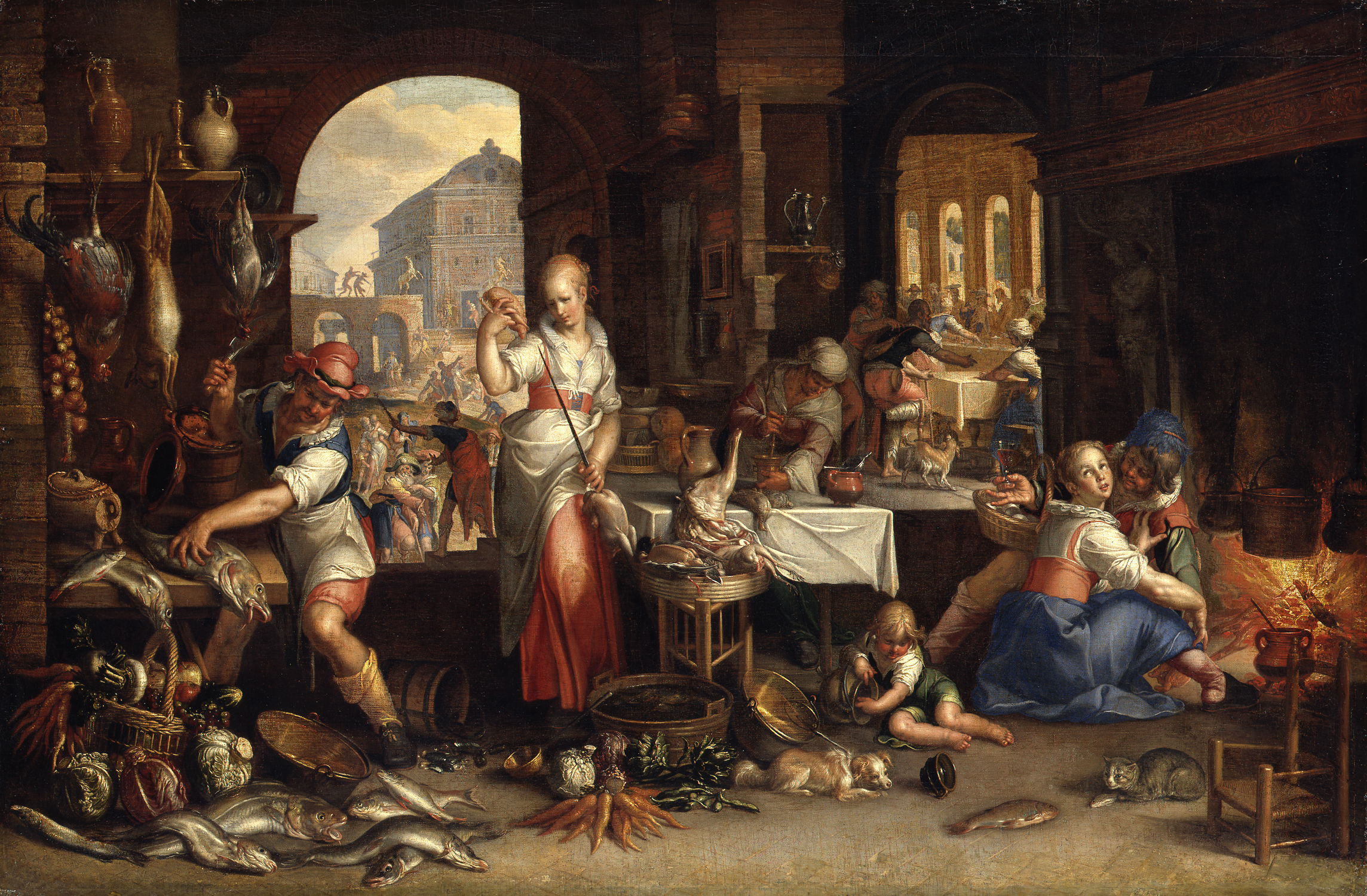
Johann Wilhelm Schirmer (1807 - 1863; active in Dusseldorf and Karlsruhe
The Noon
The Attack on the Hiker, 1857
From the series "The Four Times of Day" with scenes from the parable of the Good Samaritan
Acquired in 1858 as grand-ducal private property. inventory 614
Johann Wilhelm Schirmer (1807 - 1863; tätig in Düsseldorf und Karlsruhe
Der Mittag
Der Überfall auf den Wanderer, 1857
Aus der Serie "Die Vier Tageszeiten" mit Szenen aus dem Gleichnis vom Barmherzigen Samariter
Erworben 1858 als großherzogliches Privateigentum. Inventar 614
Collection
The foundation of the collection consists of 205 mostly French and Dutch paintings from the 17th and 18th centuries which Margravine Karoline Luise acquired 1759-1776. From this collection originate significant works, such as The portrait of a young man by Frans van Mieris the Elder, The winter landscape with lime kiln of Nicolaes Pieterszoon Berchem, The Lacemaker by Gerard Dou, the Still Life with hunting equipment and dead partridge of Willem van Aelst, The Peace in the Chicken yard by Melchior de Hondecoeter as well as a self-portrait by Rembrandt van Rijn. In addition, four still lifes of Jean Siméon Chardin and two pastoral scenes by François Boucher, having been commissioned directly by the Marchioness from artists.
A first significant expansion the museum received in 1858 by the collection of canon Johann Baptist von Hirscher (1788-1865) with works of religious art of the 15th and 16th centuries. This group includes works such as two tablets of the Sterzinger altar and the wing fragment The sacramental blessing of Bartholomew Zeitblom. From 1899 to 1920, the native of Baden painter Hans Thoma held the position of Director of the Kunsthalle. He acquired old masterly paintings as the tauberbischofsheim altarpiece by Matthias Grünewald and drove the expansion of the collection with art of the 19th century forward. Only his successors expanded the holdings of the Art Gallery with works of Impressionism and the following generations of artists.
The permanent exhibition in the main building includes approximately 800 paintings and sculptures. Among the outstanding works of art of the Department German painters of the late Gothic and Renaissance are the Christ as Man of Sorrows by Albrecht Dürer, the Carrying of the Cross and the Crucifixion by Matthias Grünewald, Maria with the Child by Lucas Cranach the Elder, the portrait of Sebastian Brant by Hans Burgkmair the elder and The Nativity of Hans Baldung. Whose Margrave panel due to property disputes in 2006 made it in the headlines and also led to political conflicts. One of the biggest buying successes which a German museum in the postwar period was able to land concerns the successive acquisition of six of the seven known pieces of a Passion altar in 1450 - the notname of the artist after this work "Master of the Karlsruhe Passion" - a seventh piece is located in German public ownership (Wallraf-Richartz Museum, Cologne).
In the department of Dutch and Flemish paintings of the 16th century can be found, in addition to the aforementioned works, the portrait of the Marchesa Veronica Spinola Doria by Peter Paul Rubens, Moses strikes the rock and water flows for the thirsty people of Israel of Jacob Jordaens, the still life with kitchen tools and foods of Frans Snyders, the village festival of David Teniers the younger, the still life with lemon, oranges and filled clay pot by Willem Kalf, a Young couple having breakfast by Gabriel Metsu, in the bedroom of Pieter de Hooch, the great group of trees at the waterfront of Jacob Izaaksoon van Ruisdael, a river landscape with a milkmaid of Aelbert Jacobsz. Cuyp as well as a trompe-l'œil still life of Samuel van Hoogstraten.
Further examples of French paintings of the 17th and 18th centuries are, the adoration of the golden calf of Claude Lorrain, preparations for dance class of the Le Nain brothers, the portrait of Marshal Charles-Auguste de Matignon by Hyacinthe Rigaud, the portrait of a young nobleman in hunting costume of Nicolas de Largillière, The storm of Claude Joseph Vernet and The minuet of Nicolas Lancret. From the 19th century can be found with Rocky wooded valley at Civita Castellana by Gustave Courbet, The Lamentation of Eugène Delacroix, the children portrait Le petit Lange of Édouard Manet, the portrait of Madame Jeantaud by Edgar Degas, the landscape June morning near Pontoise by Camille Pissarro, homes in Le Pouldu Paul Gauguin and views to the sea at L'Estaque by Paul Cézanne further works of French artists at Kunsthalle.
One focus of the collection is the German painting and sculpture of the 19th century. From Joseph Anton Koch, the Kunsthalle possesses a Heroic landscape with rainbow, from Georg Friedrich Kersting the painting The painter Gerhard Kügelgen in his studio, from Caspar David Friedrich the landscape rocky reef on the sea beach and from Karl Blechen view to the Monastery of Santa Scolastica. Other important works of this department are the disruption of Adolph Menzel as well as the young self-portrait, the portrait Nanna Risi and The Banquet of Plato of Anselm Feuerbach.
For the presentation of the complex of oeuvres by Hans Thoma, a whole wing in 1909 at the Kunsthalle was installed. Main oeuvres of the arts are, for example, the genre picture The siblings as well as, created on behalf of the grand-ducal family, Thoma Chapel with its religious themes.
Of the German contemporaries of Hans Thoma, Max Liebermann on the beach of Noordwijk and Lovis Corinth with a portrait of his wife in the museum are represented. Furthermore the Kunsthalle owns works by Ferdinand Georg Waldmüller, Carl Spitzweg, Arnold Böcklin, Hans von Marées, Wilhelm Leibl, Fritz von Uhde, Wilhelm Trübner and Max Klinger.
In the building of the adjacent Orangerie works of the collection and new acquisitions from the years after 1952 can be seen. In two integrated graphics cabinets the Kupferstichkabinett (gallery of prints) gives insight into its inventory of contemporary art on paper. From the period after 1945, the works Arabs with footprints by Jean Dubuffet, Sponge Relief RE 48; Sol. 1960 by Yves Klein, Honoring the square: Yellow center of Josef Albers, the cityscape F by Gerhard Richter and the Fixe idea by Georg Baselitz in the Kunsthalle. The collection of classical modernism wandered into the main building. Examples of paintings from the period to 1945 are The Eiffel Tower by Robert Delaunay, the Improvisation 13 by Wassily Kandinsky, Deers in the Forest II by Franz Marc, People at the Blue lake of August Macke, the self-portrait The painter of Ernst Ludwig Kirchner, the Merzpicture 21b by Kurt Schwitters, the forest of Max Ernst, Tower gate II by Lyonel Feininger, the Seven Deadly Sins of Otto Dix and the removal of the Sphinxes by Max Beckmann. In addition, the museum regularly shows special exhibitions.
Sammlung
Den Grundstock der Sammlung bilden 205 meist französische und niederländische Gemälde des 17. und 18. Jahrhunderts, welche Markgräfin Karoline Luise zwischen 1759 und 1776 erwarb. Aus dieser Sammlung stammen bedeutende Arbeiten, wie das Bildnis eines jungen Mannes von Frans van Mieris der Ältere, die Winterlandschaft mit Kalkofen von Nicolaes Pieterszoon Berchem, Die Spitzenklöpplerin von Gerard Dou, das Stillleben mit Jagdgeräten und totem Rebhuhn von Willem van Aelst, Der Friede im Hühnerhof von Melchior de Hondecoeter sowie ein Selbstbildnis von Rembrandt van Rijn. Hinzu kommen vier Stillleben von Jean Siméon Chardin und zwei Schäferszenen von François Boucher, die die Markgräfin bei Künstlern direkt in Auftrag gegeben hatte.
Eine erste wesentliche Erweiterung erhielt das Museum 1858 durch die Sammlung des Domkapitulars Johann Baptist von Hirscher (1788–1865) mit Werken religiöser Kunst des 15. und 16. Jahrhunderts. Zu dieser Gruppe gehören Werke wie zwei Tafeln des Sterzinger Altars und das Flügelfragment Der sakramentale Segen von Bartholomäus Zeitblom. Von 1899 bis 1920 bekleidete der aus Baden stammende Maler Hans Thoma die Position des Direktors der Kunsthalle. Er erwarb altmeisterliche Gemälde wie den Tauberbischofsheimer Altar von Matthias Grünewald und trieb den Ausbau der Sammlung mit Kunst des 19. Jahrhunderts voran. Erst seine Nachfolger erweiterten die Bestände der Kunsthalle um Werke des Impressionismus und der folgenden Künstlergenerationen.
Die Dauerausstellung im Hauptgebäude umfasst rund 800 Gemälde und Skulpturen. Zu den herausragenden Kunstwerken der Abteilung deutsche Maler der Spätgotik und Renaissance gehören der Christus als Schmerzensmann von Albrecht Dürer, die Kreuztragung und Kreuzigung von Matthias Grünewald, Maria mit dem Kinde von Lucas Cranach der Ältere, das Bildnis Sebastian Brants von Hans Burgkmair der Ältere und die Die Geburt Christi von Hans Baldung. Dessen Markgrafentafel geriet durch Eigentumsstreitigkeiten 2006 in die Schlagzeilen und führte auch zu politischen Auseinandersetzungen. Einer der größten Ankaufserfolge, welche ein deutsches Museum in der Nachkriegszeit verbuchen konnte, betrifft den sukzessiven Erwerb von sechs der sieben bekannten Tafeln eines Passionsaltars um 1450 – der Notname des Malers nach diesem Werk „Meister der Karlsruher Passion“ – eine siebte Tafel befindet sich in deutschem öffentlichen Besitz (Wallraf-Richartz Museum, Köln).
In der Abteilung niederländischer und flämischer Malerei des 16. Jahrhunderts finden sich, neben den erwähnten Werken, das Bildnis der Marchesa Veronica Spinola Doria von Peter Paul Rubens, Moses schlägt Wasser aus dem Felsen von Jacob Jordaens, das Stillleben mit Küchengeräten und Lebensmitteln von Frans Snyders, das Dorffest von David Teniers dem Jüngeren, das Stillleben mit Zitrone, Orangen und gefülltem Römer von Willem Kalf, ein Junges Paar beim Frühstück von Gabriel Metsu, Im Schlafzimmer von Pieter de Hooch, die Große Baumgruppe am Wasser von Jacob Izaaksoon van Ruisdael, eine Flusslandschaft mit Melkerin von Aelbert Jacobsz. Cuyp sowie ein Augenbetrüger-Stillleben von Samuel van Hoogstraten.
Weitere Beispiele französischer Malerei des 17. bzw. 18. Jahrhunderts sind Die Anbetung des Goldeen Kalbes von Claude Lorrain, die Vorbereitung zur Tanzstunde der Brüder Le Nain, das Bildnis des Marschalls Charles-Auguste de Matignon von Hyacinthe Rigaud, das Bildnis eines jungen Edelmannes im Jagdkostüm von Nicolas de Largillière, Der Sturm von Claude Joseph Vernet und Das Menuett von Nicolas Lancret. Aus dem 19. Jahrhundert finden sich mit Felsiges Waldtal bei Cività Castellana von Gustave Courbet, Die Beweinung Christi von Eugène Delacroix, dem Kinderbildnis Le petit Lange von Édouard Manet, dem Bildnis der Madame Jeantaud von Edgar Degas, dem Landschaftsbild Junimorgen bei Pontoise von Camille Pissarro, Häuser in Le Pouldu von Paul Gauguin und Blick auf das Meer bei L’Estaque von Paul Cézanne weitere Arbeiten französischer Künstler in der Kunsthalle.
Einen Schwerpunkt der Sammlung bildet die deutsche Malerei und Skulptur des 19. Jahrhunderts. Von Joseph Anton Koch besitzt die Kunsthalle eine Heroische Landschaft mit Regenbogen, von Georg Friedrich Kersting das Gemälde Der Maler Gerhard Kügelgen in seinem Atelier, von Caspar David Friedrich das Landschaftsbild Felsenriff am Meeresstrand und von Karl Blechen den Blick auf das Kloster Santa Scolastica. Weitere bedeutende Werke dieser Abteilung sind Die Störung von Adolph Menzel sowie das Jugendliche Selbstbildnis, das Bildnis Nanna Risi und Das Gastmahl des Plato von Anselm Feuerbach.
Für die Präsentation des Werkkomplexes von Hans Thoma wurde 1909 in der Kunsthalle ein ganzer Gebäudetrakt errichtet. Hauptwerke des Künstlers sind etwa das Genrebild Die Geschwister sowie die, im Auftrag der großherzöglichen Familie geschaffene, Thoma-Kapelle mit ihren religiösen Themen.
Von den deutschen Zeitgenossen Hans Thomas sind Max Liebermann mit Am Strand von Noordwijk und Lovis Corinth mit einem Bildnis seiner Frau im Museum vertreten. Darüber hinaus besitzt die Kunsthalle Werke von Ferdinand Georg Waldmüller, Carl Spitzweg, Arnold Böcklin, Hans von Marées, Wilhelm Leibl, Fritz von Uhde, Wilhelm Trübner und Max Klinger.
Im Gebäude der benachbarten Orangerie sind Werke der Sammlung und Neuankäufe aus den Jahren nach 1952 zu sehen. In zwei integrierten Grafikkabinetten gibt das Kupferstichkabinett Einblick in seinen Bestand zeitgenössischer Kunst auf Papier. Aus der Zeit nach 1945 finden sich die Arbeiten Araber mit Fußspuren von Jean Dubuffet, Schwammrelief >RE 48:Sol.1960< von Yves Klein, Ehrung des Quadrates: Gelbes Zentrum von Josef Albers, das Stadtbild F von Gerhard Richter und die Fixe Idee von Georg Baselitz in der Kunsthalle. Die Sammlung der Klassischen Moderne wanderte in das Hauptgebäude. Beispiele für Gemälde aus der Zeit bis 1945 sind Der Eiffelturm von Robert Delaunay, die Improvisation 13 von Wassily Kandinsky, Rehe im Wald II von Franz Marc, Leute am blauen See von August Macke, das Selbstbildnis Der Maler von Ernst Ludwig Kirchner, das Merzbild 21b von Kurt Schwitters, Der Wald von Max Ernst, Torturm II von Lyonel Feininger, Die Sieben Todsünden von Otto Dix und der Abtransport der Sphinxe von Max Beckmann. Darüber hinaus zeigt das Museum regelmäßig Sonderausstellungen.
de.wikipedia.org/wiki/Staatliche_Kunsthalle_Karlsruhe
It is of profound significance if we are able to understand the words written by Goethe in his testament, the second part of “Faust,” when he had completed his course on the Earth. After his death, this second part was found in his writing table, closed and sealed. He put this book as a gospel into the world, as a testament. And this testament closes with his mystical creed:
Alles Vergängliche ist nur sin Gleichnis
Das Unzulängliche hier wird's Ereignis.
Das Unbeschreibliche, hier ist's getan,
Das ewig Weibliche zieht uns hinan.
he door is closed since Horus his soul left the apartment
horus son is responsible for her father's vengeance he must kill his uncle
"Once Chuang Chou dreamt he was a butterfly, a butterfly flitting and fluttering around, happy with himself and doing as he pleased. He didn't know he was Chuang Chou. Suddenly he woke up and there he was, solid and unmistakable Chuang Chou. But he didn't know if he was Chuang Chou who had dreamt he was a butterfly, or a butterfly dreaming he was Chuang Chou. Between Chuang Chou and a butterfly there must be some distinction! This is called the Transformation of Things." . . . . . . . . . . This story found in the taoist book Zhuangzi "True classic of souther (cultural) Florescense" / "Nan Hua Zhen Jing" / Zhuangzi or Chuang Chi (lot of differents writings) was a chinese philosopher who lived around 4th century BCE ------------------------------------------------------------------------------------------------------------------------------ Dschuang Dsi, Meister Zhuang war ein daoistischer Philosoph und Schriftsteller, dessen persönlicher Name Zhuang Zhou war, und dessen Werk nach ihm als Zhuangzi bezeichnet wird.Das wahrscheinlich bekannteste Gleichnis des Zhuangzi ist der so genannte "Schmetterlingstraum"
Jacopo Bassano (c. 1510-1992), active in Bassano
Parable of the rich man and poor Lazarus, c. 1555-60
The parable of the rich spendthrift and poor Lazarus is about the balancing justice after death. As in most representations of this subject, the painter portrays the contrast between the poor half-naked Lazarus lying on the doorstep of the house of the rich man, whose ulcers are licked by the dogs, and the rich glutton, who is served in the background at the dinner table.
Jacopo Bassano (um 1510-1992), tätig in Bassano
Gleichnis vom reichen Mann und dem armen Lazarus, um 1555-60
Die Parabel vom reichen Prasser und vom armen Lazarus handelt von der ausgleichenden Gerechtigkeit nach dem Tod. Wie bei den meisten Darstellungen dieses Themas schildert der Maler den Gegensatz zwischen dem armen halbnackten Lazarus, der an der Schwelle des Hauses des Reichen liegt und dessen Geschwüre von den Hunden geleckt werden, und dem reichen Prasser, der im Hintergrund an der Tafel bedient wird.
Austria Kunsthistorisches Museum
Federal Museum
Logo KHM
Regulatory authority (ies)/organs to the Federal Ministry for Education, Science and Culture
Founded 17 October 1891
Headquartered Castle Ring (Burgring), Vienna 1, Austria
Management Sabine Haag
www.khm.at website
Main building of the Kunsthistorisches Museum at Maria-Theresa-Square
The Kunsthistorisches Museum (KHM abbreviated) is an art museum in Vienna. It is one of the largest and most important museums in the world. It was opened in 1891 and 2012 visited of 1.351.940 million people.
The museum
The Kunsthistorisches Museum is with its opposite sister building, the Natural History Museum (Naturhistorisches Museum), the most important historicist large buildings of the Ringstrasse time. Together they stand around the Maria Theresa square, on which also the Maria Theresa monument stands. This course spans the former glacis between today's ring road and 2-line, and is forming a historical landmark that also belongs to World Heritage Site Historic Centre of Vienna.
History
Archduke Leopold Wilhelm in his Gallery
The Museum came from the collections of the Habsburgs, especially from the portrait and armor collections of Ferdinand of Tyrol, the collection of Emperor Rudolf II (most of which, however scattered) and the art collection of Archduke Leopold Wilhelm into existence. Already In 1833 asked Joseph Arneth, curator (and later director) of the Imperial Coins and Antiquities Cabinet, bringing together all the imperial collections in a single building .
Architectural History
The contract to build the museum in the city had been given in 1858 by Emperor Franz Joseph. Subsequently, many designs were submitted for the ring road zone. Plans by August Sicard von Sicardsburg and Eduard van der Null planned to build two museum buildings in the immediate aftermath of the Imperial Palace on the left and right of the Heroes' Square (Heldenplatz). The architect Ludwig Förster planned museum buildings between the Schwarzenberg Square and the City Park, Martin Ritter von Kink favored buildings at the corner Währingerstraße/ Scots ring (Schottenring), Peter Joseph, the area Bellariastraße, Moritz von Loehr the south side of the opera ring, and Ludwig Zettl the southeast side of the grain market (Getreidemarkt).
From 1867, a competition was announced for the museums, and thereby set their current position - at the request of the Emperor, the museum should not be too close to the Imperial Palace, but arise beyond the ring road. The architect Carl von Hasenauer participated in this competition and was able the at that time in Zürich operating Gottfried Semper to encourage to work together. The two museum buildings should be built here in the sense of the style of the Italian Renaissance. The plans got the benevolence of the imperial family. In April 1869, there was an audience with of Joseph Semper at the Emperor Franz Joseph and an oral contract was concluded, in July 1870 was issued the written order to Semper and Hasenauer.
Crucial for the success of Semper and Hasenauer against the projects of other architects were among others Semper's vision of a large building complex called "Imperial Forum", in which the museums would have been a part of. Not least by the death of Semper in 1879 came the Imperial Forum not as planned for execution, the two museums were built, however.
Construction of the two museums began without ceremony on 27 November 1871 instead. Semper moved to Vienna in the sequence. From the beginning, there were considerable personal differences between him and Hasenauer, who finally in 1877 took over sole construction management. 1874, the scaffolds were placed up to the attic and the first floor completed, built in 1878, the first windows installed in 1879, the Attica and the balustrade from 1880 to 1881 and built the dome and the Tabernacle. The dome is topped with a bronze statue of Pallas Athena by Johannes Benk.
The lighting and air conditioning concept with double glazing of the ceilings made the renunciation of artificial light (especially at that time, as gas light) possible, but this resulted due to seasonal variations depending on daylight to different opening times .
Kuppelhalle
Entrance (by clicking the link at the end of the side you can see all the pictures here indicated!)
Grand staircase
Hall
Empire
The Kunsthistorisches Museum was on 17 October 1891 officially opened by Emperor Franz Joseph I. Since 22 October 1891 , the museum is accessible to the public. Two years earlier, on 3 November 1889, the collection of arms, Arms and Armour today, had their doors open. On 1 January 1890 the library service resumed its operations. The merger and listing of other collections of the Highest Imperial Family from the Upper and Lower Belvedere, the Hofburg Palace and Ambras in Tyrol will need another two years.
189, the farm museum was organized in seven collections with three directorates:
Directorate of coins, medals and antiquities collection
The Egyptian Collection
The Antique Collection
The coins and medals collection
Management of the collection of weapons, art and industrial objects
Weapons collection
Collection of industrial art objects
Directorate of Art Gallery and Restaurieranstalt (Restoration Office)
Collection of watercolors, drawings, sketches, etc.
Restoration Office
Library
Very soon the room the Court Museum (Hofmuseum) for the imperial collections was offering became too narrow. To provide temporary help, an exhibition of ancient artifacts from Ephesus in the Theseus Temple was designed. However, additional space had to be rented in the Lower Belvedere.
1914, after the assassination of Franz Ferdinand, heir to the throne, his " Estonian Forensic Collection " passed to the administration of the Court Museum. This collection, which emerged from the art collection of the house of d' Este and world travel collection of Franz Ferdinand, was placed in the New Imperial Palace since 1908. For these stocks, the present collection of old musical instruments and the Museum of Ethnology emerged.
The First World War went by, apart from the oppressive economic situation without loss. The farm museum remained during the five years of war regularly open to the public.
Until 1919 the K.K. Art Historical Court Museum was under the authority of the Oberstkämmereramt (head chamberlain office) and belonged to the House of Habsburg-Lorraine. The officials and employees were part of the royal household.
First Republic
The transition from monarchy to republic, in the museum took place in complete tranquility. On 19 November 1918 the two imperial museums on Maria Theresa Square were placed under the state protection of the young Republic of German Austria. Threatening to the stocks of the museum were the claims raised in the following weeks and months of the "successor states" of the monarchy as well as Italy and Belgium on Austrian art collection. In fact, it came on 12th February 1919 to the violent removal of 62 paintings by armed Italian units. This "art theft" left a long time trauma among curators and art historians.
It was not until the Treaty of Saint-Germain of 10 September 1919, providing in Article 195 and 196 the settlement of rights in the cultural field by negotiations. The claims of Belgium, Czechoslovakia, and Italy again could mostly being averted in this way. Only Hungary, which presented the greatest demands by far, was met by more than ten years of negotiation in 147 cases.
On 3 April 1919 was the expropriation of the House of Habsburg-Lorraine by law and the acquisition of its property, including the "Collections of the Imperial House" , by the Republic. Of 18 June 1920 the then provisional administration of the former imperial museums and collections of Este and the secular and clergy treasury passed to the State Office of Internal Affairs and Education, since 10 November 1920, the Federal Ministry of the Interior and Education. A few days later it was renamed the Art History Court Museum in the "Kunsthistorisches Museum, Vienna State", 1921 "Kunsthistorisches Museum" . Of 1st January 1921 the employees of the museum staff passed to the state of the Republic.
Through the acquisition of the former imperial collections owned by the state, the museum found itself in a complete new situation. In order to meet the changed circumstances in the museum area, designed Hans Tietze in 1919 the "Vienna Museum program". It provided a close cooperation between the individual museums to focus at different houses on main collections. So dominated exchange, sales and equalizing the acquisition policy in the interwar period. Thus resulting until today still valid collection trends. Also pointing the way was the relocation of the weapons collection from 1934 in its present premises in the New Castle, where since 1916 the collection of ancient musical instruments was placed.
With the change of the imperial collections in the ownership of the Republic the reorganization of the internal organization went hand in hand, too. Thus the museum was divided in 1919 into the
Egyptian and Near Eastern Collection (with the Oriental coins)
Collection of Classical Antiquities
Collection of ancient coins
Collection of modern coins and medals
Weapons collection
Collection of sculptures and crafts with the Collection of Ancient Musical Instruments
Picture Gallery
The Museum 1938-1945
Count Philipp Ludwig Wenzel Sinzendorf according to Rigaud. Clarisse 1948 by Baroness de Rothschildt "dedicated" to the memory of Baron Alphonse de Rothschildt; restituted to the Rothschilds in 1999, and in 1999 donated by Bettina Looram Rothschild, the last Austrian heiress.
With the "Anschluss" of Austria to the German Reich all Jewish art collections such as the Rothschilds were forcibly "Aryanised". Collections were either "paid" or simply distributed by the Gestapo at the museums. This resulted in a significant increase in stocks. But the KHM was not the only museum that benefited from the linearization. Systematically looted Jewish property was sold to museums, collections or in pawnshops throughout the empire.
After the war, the museum struggled to reimburse the "Aryanised" art to the owners or their heirs. They forced the Rothschild family to leave the most important part of their own collection to the museum and called this "dedications", or "donations". As a reason, was the export law stated, which does not allow owners to perform certain works of art out of the country. Similar methods were used with other former owners. Only on the basis of international diplomatic and media pressure, to a large extent from the United States, the Austrian government decided to make a change in the law (Art Restitution Act of 1998, the so-called Lex Rothschild). The art objects were the Rothschild family refunded only in the 1990s.
The Kunsthistorisches Museum operates on the basis of the federal law on the restitution of art objects from the 4th December 1998 (Federal Law Gazette I, 181 /1998) extensive provenance research. Even before this decree was carried out in-house provenance research at the initiative of the then archive director Herbert Haupt. This was submitted in 1998 by him in collaboration with Lydia Grobl a comprehensive presentation of the facts about the changes in the inventory levels of the Kunsthistorisches Museum during the Nazi era and in the years leading up to the State Treaty of 1955, an important basis for further research provenance.
The two historians Susanne Hehenberger and Monika Löscher are since 1st April 2009 as provenance researchers at the Kunsthistorisches Museum on behalf of the Commission for Provenance Research operating and they deal with the investigation period from 1933 to the recent past.
The museum today
Today the museum is as a federal museum, with 1st January 1999 released to the full legal capacity - it was thus the first of the state museums of Austria, implementing the far-reaching self-financing. It is by far the most visited museum in Austria with 1.3 million visitors (2007).
The Kunsthistorisches Museum is under the name Kunsthistorisches Museum and Museum of Ethnology and the Austrian Theatre Museum with company number 182081t since 11 June 1999 as a research institution under public law of the Federal virtue of the Federal Museums Act, Federal Law Gazette I/115/1998 and the Museum of Procedure of the Kunsthistorisches Museum and Museum of Ethnology and the Austrian Theatre Museum, 3 January 2001, BGBl II 2/ 2001, in force since 1 January 2001, registered.
In fiscal 2008, the turnover was 37.185 million EUR and total assets amounted to EUR 22.204 million. In 2008 an average of 410 workers were employed.
Management
1919-1923: Gustav Glück as the first chairman of the College of science officials
1924-1933: Hermann Julius Hermann 1924-1925 as the first chairman of the College of the scientific officers in 1925 as first director
1933: Arpad Weixlgärtner first director
1934-1938: Alfred Stix first director
1938-1945: Fritz Dworschak 1938 as acting head, from 1938 as a chief in 1941 as first director
1945-1949: August von Loehr 1945-1948 as executive director of the State Art Collections in 1949 as general director of the historical collections of the Federation
1945-1949: Alfred Stix 1945-1948 as executive director of the State Art Collections in 1949 as general director of art historical collections of the Federation
1949-1950: Hans Demel as administrative director
1950: Karl Wisoko-Meytsky as general director of art and historical collections of the Federation
1951-1952: Fritz Eichler as administrative director
1953-1954: Ernst H. Buschbeck as administrative director
1955-1966: Vincent Oberhammer 1955-1959 as administrative director, from 1959 as first director
1967: Edward Holzmair as managing director
1968-1972: Erwin Auer first director
1973-1981: Friderike Klauner first director
1982-1990: Hermann Fillitz first director
1990: George Kugler as interim first director
1990-2008: Wilfried Seipel as general director
Since 2009: Sabine Haag as general director
Collections
To the Kunsthistorisches Museum are also belonging the collections of the New Castle, the Austrian Theatre Museum in Palais Lobkowitz, the Museum of Ethnology and the Wagenburg (wagon fortress) in an outbuilding of Schönbrunn Palace. A branch office is also Ambras in Innsbruck.
Kunsthistorisches Museum (main building)
Picture Gallery
Egyptian and Near Eastern Collection
Collection of Classical Antiquities
Vienna Chamber of Art
Numismatic Collection
Library
New Castle
Ephesus Museum
Collection of Ancient Musical Instruments
Arms and Armour
Archive
Hofburg
The imperial crown in the Treasury
Imperial Treasury of Vienna
Insignia of the Austrian Hereditary Homage
Insignia of imperial Austria
Insignia of the Holy Roman Empire
Burgundian Inheritance and the Order of the Golden Fleece
Habsburg-Lorraine Household Treasure
Ecclesiastical Treasury
Schönbrunn Palace
Imperial Carriage Museum Vienna
Armory in Ambras Castle
Ambras Castle
Collections of Ambras Castle
Major exhibits
Among the most important exhibits of the Art Gallery rank inter alia:
Jan van Eyck: Cardinal Niccolò Albergati, 1438
Martin Schongauer: Holy Family, 1475-80
Albrecht Dürer : Trinity Altar, 1509-16
Portrait Johann Kleeberger, 1526
Parmigianino: Self Portrait in Convex Mirror, 1523/24
Giuseppe Arcimboldo: Summer 1563
Michelangelo Merisi da Caravaggio: Madonna of the Rosary 1606/ 07
Caravaggio: Madonna of the Rosary (1606-1607)
Titian: Nymph and Shepherd to 1570-75
Portrait of Jacopo de Strada, 1567/68
Raffaello Santi: Madonna of the Meadow, 1505 /06
Lorenzo Lotto: Portrait of a young man against white curtain, 1508
Peter Paul Rubens: The altar of St. Ildefonso, 1630-32
The Little Fur, about 1638
Jan Vermeer: The Art of Painting, 1665/66
Pieter Bruegel the Elder: Fight between Carnival and Lent, 1559
Kids, 1560
Tower of Babel, 1563
Christ Carrying the Cross, 1564
Gloomy Day (Early Spring), 1565
Return of the Herd (Autumn), 1565
Hunters in the Snow (Winter) 1565
Bauer and bird thief, 1568
Peasant Wedding, 1568/69
Peasant Dance, 1568/69
Paul's conversion (Conversion of St Paul), 1567
Cabinet of Curiosities:
Saliera from Benvenuto Cellini 1539-1543
Egyptian-Oriental Collection:
Mastaba of Ka Ni Nisut
Collection of Classical Antiquities:
Gemma Augustea
Treasure of Nagyszentmiklós
Gallery: Major exhibits
Atelier: Domenico Fetti (c. 1591/92-1623)
La parabole de la Perle de Grand Prix (1600-1620)
Werkstatt: Domenico Fetti (um 1591/92 - 1623)
Gleichnis von der köstlichen Perle (1600-1620)
Austria Kunsthistorisches Museum
Federal Museum
Logo KHM
Regulatory authority (ies)/organs to the Federal Ministry for Education, Science and Culture
Founded 17 October 1891
Headquartered Castle Ring (Burgring), Vienna 1, Austria
Management Sabine Haag
www.khm.at website
Main building of the Kunsthistorisches Museum at Maria-Theresa-Square
The Kunsthistorisches Museum (KHM abbreviated) is an art museum in Vienna. It is one of the largest and most important museums in the world. It was opened in 1891 and 2012 visited of 1.351.940 million people.
The museum
The Kunsthistorisches Museum is with its opposite sister building, the Natural History Museum (Naturhistorisches Museum), the most important historicist large buildings of the Ringstrasse time. Together they stand around the Maria Theresa square, on which also the Maria Theresa monument stands. This course spans the former glacis between today's ring road and 2-line, and is forming a historical landmark that also belongs to World Heritage Site Historic Centre of Vienna.
History
Archduke Leopold Wilhelm in his Gallery
The Museum came from the collections of the Habsburgs, especially from the portrait and armor collections of Ferdinand of Tyrol, the collection of Emperor Rudolf II (most of which, however scattered) and the art collection of Archduke Leopold Wilhelm into existence. Already In 1833 asked Joseph Arneth, curator (and later director) of the Imperial Coins and Antiquities Cabinet, bringing together all the imperial collections in a single building .
Architectural History
The contract to build the museum in the city had been given in 1858 by Emperor Franz Joseph. Subsequently, many designs were submitted for the ring road zone. Plans by August Sicard von Sicardsburg and Eduard van der Null planned to build two museum buildings in the immediate aftermath of the Imperial Palace on the left and right of the Heroes' Square (Heldenplatz). The architect Ludwig Förster planned museum buildings between the Schwarzenberg Square and the City Park, Martin Ritter von Kink favored buildings at the corner Währingerstraße/ Scots ring (Schottenring), Peter Joseph, the area Bellariastraße, Moritz von Loehr the south side of the opera ring, and Ludwig Zettl the southeast side of the grain market (Getreidemarkt).
From 1867, a competition was announced for the museums, and thereby set their current position - at the request of the Emperor, the museum should not be too close to the Imperial Palace, but arise beyond the ring road. The architect Carl von Hasenauer participated in this competition and was able the at that time in Zürich operating Gottfried Semper to encourage to work together. The two museum buildings should be built here in the sense of the style of the Italian Renaissance. The plans got the benevolence of the imperial family. In April 1869, there was an audience with of Joseph Semper at the Emperor Franz Joseph and an oral contract was concluded, in July 1870 was issued the written order to Semper and Hasenauer.
Crucial for the success of Semper and Hasenauer against the projects of other architects were among others Semper's vision of a large building complex called "Imperial Forum", in which the museums would have been a part of. Not least by the death of Semper in 1879 came the Imperial Forum not as planned for execution, the two museums were built, however.
Construction of the two museums began without ceremony on 27 November 1871 instead. Semper moved to Vienna in the sequence. From the beginning, there were considerable personal differences between him and Hasenauer, who finally in 1877 took over sole construction management. 1874, the scaffolds were placed up to the attic and the first floor completed, built in 1878, the first windows installed in 1879, the Attica and the balustrade from 1880 to 1881 and built the dome and the Tabernacle. The dome is topped with a bronze statue of Pallas Athena by Johannes Benk.
The lighting and air conditioning concept with double glazing of the ceilings made the renunciation of artificial light (especially at that time, as gas light) possible, but this resulted due to seasonal variations depending on daylight to different opening times .
Kuppelhalle
Entrance (by clicking the link at the end of the side you can see all the pictures here indicated!)
Grand staircase
Hall
Empire
The Kunsthistorisches Museum was on 17 October 1891 officially opened by Emperor Franz Joseph I. Since 22 October 1891 , the museum is accessible to the public. Two years earlier, on 3 November 1889, the collection of arms, Arms and Armour today, had their doors open. On 1 January 1890 the library service resumed its operations. The merger and listing of other collections of the Highest Imperial Family from the Upper and Lower Belvedere, the Hofburg Palace and Ambras in Tyrol will need another two years.
189, the farm museum was organized in seven collections with three directorates:
Directorate of coins, medals and antiquities collection
The Egyptian Collection
The Antique Collection
The coins and medals collection
Management of the collection of weapons, art and industrial objects
Weapons collection
Collection of industrial art objects
Directorate of Art Gallery and Restaurieranstalt (Restoration Office)
Collection of watercolors, drawings, sketches, etc.
Restoration Office
Library
Very soon the room the Court Museum (Hofmuseum) for the imperial collections was offering became too narrow. To provide temporary help, an exhibition of ancient artifacts from Ephesus in the Theseus Temple was designed. However, additional space had to be rented in the Lower Belvedere.
1914, after the assassination of Franz Ferdinand, heir to the throne, his " Estonian Forensic Collection " passed to the administration of the Court Museum. This collection, which emerged from the art collection of the house of d' Este and world travel collection of Franz Ferdinand, was placed in the New Imperial Palace since 1908. For these stocks, the present collection of old musical instruments and the Museum of Ethnology emerged.
The First World War went by, apart from the oppressive economic situation without loss. The farm museum remained during the five years of war regularly open to the public.
Until 1919 the K.K. Art Historical Court Museum was under the authority of the Oberstkämmereramt (head chamberlain office) and belonged to the House of Habsburg-Lorraine. The officials and employees were part of the royal household.
First Republic
The transition from monarchy to republic, in the museum took place in complete tranquility. On 19 November 1918 the two imperial museums on Maria Theresa Square were placed under the state protection of the young Republic of German Austria. Threatening to the stocks of the museum were the claims raised in the following weeks and months of the "successor states" of the monarchy as well as Italy and Belgium on Austrian art collection. In fact, it came on 12th February 1919 to the violent removal of 62 paintings by armed Italian units. This "art theft" left a long time trauma among curators and art historians.
It was not until the Treaty of Saint-Germain of 10 September 1919, providing in Article 195 and 196 the settlement of rights in the cultural field by negotiations. The claims of Belgium, Czechoslovakia, and Italy again could mostly being averted in this way. Only Hungary, which presented the greatest demands by far, was met by more than ten years of negotiation in 147 cases.
On 3 April 1919 was the expropriation of the House of Habsburg-Lorraine by law and the acquisition of its property, including the "Collections of the Imperial House" , by the Republic. Of 18 June 1920 the then provisional administration of the former imperial museums and collections of Este and the secular and clergy treasury passed to the State Office of Internal Affairs and Education, since 10 November 1920, the Federal Ministry of the Interior and Education. A few days later it was renamed the Art History Court Museum in the "Kunsthistorisches Museum, Vienna State", 1921 "Kunsthistorisches Museum" . Of 1st January 1921 the employees of the museum staff passed to the state of the Republic.
Through the acquisition of the former imperial collections owned by the state, the museum found itself in a complete new situation. In order to meet the changed circumstances in the museum area, designed Hans Tietze in 1919 the "Vienna Museum program". It provided a close cooperation between the individual museums to focus at different houses on main collections. So dominated exchange, sales and equalizing the acquisition policy in the interwar period. Thus resulting until today still valid collection trends. Also pointing the way was the relocation of the weapons collection from 1934 in its present premises in the New Castle, where since 1916 the collection of ancient musical instruments was placed.
With the change of the imperial collections in the ownership of the Republic the reorganization of the internal organization went hand in hand, too. Thus the museum was divided in 1919 into the
Egyptian and Near Eastern Collection (with the Oriental coins)
Collection of Classical Antiquities
Collection of ancient coins
Collection of modern coins and medals
Weapons collection
Collection of sculptures and crafts with the Collection of Ancient Musical Instruments
Picture Gallery
The Museum 1938-1945
Count Philipp Ludwig Wenzel Sinzendorf according to Rigaud. Clarisse 1948 by Baroness de Rothschildt "dedicated" to the memory of Baron Alphonse de Rothschildt; restituted to the Rothschilds in 1999, and in 1999 donated by Bettina Looram Rothschild, the last Austrian heiress.
With the "Anschluss" of Austria to the German Reich all Jewish art collections such as the Rothschilds were forcibly "Aryanised". Collections were either "paid" or simply distributed by the Gestapo at the museums. This resulted in a significant increase in stocks. But the KHM was not the only museum that benefited from the linearization. Systematically looted Jewish property was sold to museums, collections or in pawnshops throughout the empire.
After the war, the museum struggled to reimburse the "Aryanised" art to the owners or their heirs. They forced the Rothschild family to leave the most important part of their own collection to the museum and called this "dedications", or "donations". As a reason, was the export law stated, which does not allow owners to perform certain works of art out of the country. Similar methods were used with other former owners. Only on the basis of international diplomatic and media pressure, to a large extent from the United States, the Austrian government decided to make a change in the law (Art Restitution Act of 1998, the so-called Lex Rothschild). The art objects were the Rothschild family refunded only in the 1990s.
The Kunsthistorisches Museum operates on the basis of the federal law on the restitution of art objects from the 4th December 1998 (Federal Law Gazette I, 181 /1998) extensive provenance research. Even before this decree was carried out in-house provenance research at the initiative of the then archive director Herbert Haupt. This was submitted in 1998 by him in collaboration with Lydia Grobl a comprehensive presentation of the facts about the changes in the inventory levels of the Kunsthistorisches Museum during the Nazi era and in the years leading up to the State Treaty of 1955, an important basis for further research provenance.
The two historians Susanne Hehenberger and Monika Löscher are since 1st April 2009 as provenance researchers at the Kunsthistorisches Museum on behalf of the Commission for Provenance Research operating and they deal with the investigation period from 1933 to the recent past.
The museum today
Today the museum is as a federal museum, with 1st January 1999 released to the full legal capacity - it was thus the first of the state museums of Austria, implementing the far-reaching self-financing. It is by far the most visited museum in Austria with 1.3 million visitors (2007).
The Kunsthistorisches Museum is under the name Kunsthistorisches Museum and Museum of Ethnology and the Austrian Theatre Museum with company number 182081t since 11 June 1999 as a research institution under public law of the Federal virtue of the Federal Museums Act, Federal Law Gazette I/115/1998 and the Museum of Procedure of the Kunsthistorisches Museum and Museum of Ethnology and the Austrian Theatre Museum, 3 January 2001, BGBl II 2/ 2001, in force since 1 January 2001, registered.
In fiscal 2008, the turnover was 37.185 million EUR and total assets amounted to EUR 22.204 million. In 2008 an average of 410 workers were employed.
Management
1919-1923: Gustav Glück as the first chairman of the College of science officials
1924-1933: Hermann Julius Hermann 1924-1925 as the first chairman of the College of the scientific officers in 1925 as first director
1933: Arpad Weixlgärtner first director
1934-1938: Alfred Stix first director
1938-1945: Fritz Dworschak 1938 as acting head, from 1938 as a chief in 1941 as first director
1945-1949: August von Loehr 1945-1948 as executive director of the State Art Collections in 1949 as general director of the historical collections of the Federation
1945-1949: Alfred Stix 1945-1948 as executive director of the State Art Collections in 1949 as general director of art historical collections of the Federation
1949-1950: Hans Demel as administrative director
1950: Karl Wisoko-Meytsky as general director of art and historical collections of the Federation
1951-1952: Fritz Eichler as administrative director
1953-1954: Ernst H. Buschbeck as administrative director
1955-1966: Vincent Oberhammer 1955-1959 as administrative director, from 1959 as first director
1967: Edward Holzmair as managing director
1968-1972: Erwin Auer first director
1973-1981: Friderike Klauner first director
1982-1990: Hermann Fillitz first director
1990: George Kugler as interim first director
1990-2008: Wilfried Seipel as general director
Since 2009: Sabine Haag as general director
Collections
To the Kunsthistorisches Museum are also belonging the collections of the New Castle, the Austrian Theatre Museum in Palais Lobkowitz, the Museum of Ethnology and the Wagenburg (wagon fortress) in an outbuilding of Schönbrunn Palace. A branch office is also Ambras in Innsbruck.
Kunsthistorisches Museum (main building)
Picture Gallery
Egyptian and Near Eastern Collection
Collection of Classical Antiquities
Vienna Chamber of Art
Numismatic Collection
Library
New Castle
Ephesus Museum
Collection of Ancient Musical Instruments
Arms and Armour
Archive
Hofburg
The imperial crown in the Treasury
Imperial Treasury of Vienna
Insignia of the Austrian Hereditary Homage
Insignia of imperial Austria
Insignia of the Holy Roman Empire
Burgundian Inheritance and the Order of the Golden Fleece
Habsburg-Lorraine Household Treasure
Ecclesiastical Treasury
Schönbrunn Palace
Imperial Carriage Museum Vienna
Armory in Ambras Castle
Ambras Castle
Collections of Ambras Castle
Major exhibits
Among the most important exhibits of the Art Gallery rank inter alia:
Jan van Eyck: Cardinal Niccolò Albergati, 1438
Martin Schongauer: Holy Family, 1475-80
Albrecht Dürer : Trinity Altar, 1509-16
Portrait Johann Kleeberger, 1526
Parmigianino: Self Portrait in Convex Mirror, 1523/24
Giuseppe Arcimboldo: Summer 1563
Michelangelo Merisi da Caravaggio: Madonna of the Rosary 1606/ 07
Caravaggio: Madonna of the Rosary (1606-1607)
Titian: Nymph and Shepherd to 1570-75
Portrait of Jacopo de Strada, 1567/68
Raffaello Santi: Madonna of the Meadow, 1505 /06
Lorenzo Lotto: Portrait of a young man against white curtain, 1508
Peter Paul Rubens: The altar of St. Ildefonso, 1630-32
The Little Fur, about 1638
Jan Vermeer: The Art of Painting, 1665/66
Pieter Bruegel the Elder: Fight between Carnival and Lent, 1559
Kids, 1560
Tower of Babel, 1563
Christ Carrying the Cross, 1564
Gloomy Day (Early Spring), 1565
Return of the Herd (Autumn), 1565
Hunters in the Snow (Winter) 1565
Bauer and bird thief, 1568
Peasant Wedding, 1568/69
Peasant Dance, 1568/69
Paul's conversion (Conversion of St Paul), 1567
Cabinet of Curiosities:
Saliera from Benvenuto Cellini 1539-1543
Egyptian-Oriental Collection:
Mastaba of Ka Ni Nisut
Collection of Classical Antiquities:
Gemma Augustea
Treasure of Nagyszentmiklós
Gallery: Major exhibits
Johann Wilhelm Schirmer (1807 - 1863; active in Dusseldorf and Karlsruhe)
The attack on the hiker, about 1857
Scene from the parable of the Good Samaritan. Study to the painting "The Noon"
Acquired 1921. Inventory 1411
Johann Wilhelm Schirmer (1807 - 1863; tätig in Düsseldorf und Karlsruhe)
Der Überfall auf den Wanderer, um 1857
Szene aus dem Gleichnis vom Barmherzigen Samariter. Studie zum Gemälde "Der Mittag"
Erworben 1921. Inventar 1411
Collection
The foundation of the collection consists of 205 mostly French and Dutch paintings from the 17th and 18th centuries which Margravine Karoline Luise acquired 1759-1776. From this collection originate significant works, such as The portrait of a young man by Frans van Mieris the Elder, The winter landscape with lime kiln of Nicolaes Pieterszoon Berchem, The Lacemaker by Gerard Dou, the Still Life with hunting equipment and dead partridge of Willem van Aelst, The Peace in the Chicken yard by Melchior de Hondecoeter as well as a self-portrait by Rembrandt van Rijn. In addition, four still lifes of Jean Siméon Chardin and two pastoral scenes by François Boucher, having been commissioned directly by the Marchioness from artists.
A first significant expansion the museum received in 1858 by the collection of canon Johann Baptist von Hirscher (1788-1865) with works of religious art of the 15th and 16th centuries. This group includes works such as two tablets of the Sterzinger altar and the wing fragment The sacramental blessing of Bartholomew Zeitblom. From 1899 to 1920, the native of Baden painter Hans Thoma held the position of Director of the Kunsthalle. He acquired old masterly paintings as the tauberbischofsheim altarpiece by Matthias Grünewald and drove the expansion of the collection with art of the 19th century forward. Only his successors expanded the holdings of the Art Gallery with works of Impressionism and the following generations of artists.
The permanent exhibition in the main building includes approximately 800 paintings and sculptures. Among the outstanding works of art of the Department German painters of the late Gothic and Renaissance are the Christ as Man of Sorrows by Albrecht Dürer, the Carrying of the Cross and the Crucifixion by Matthias Grünewald, Maria with the Child by Lucas Cranach the Elder, the portrait of Sebastian Brant by Hans Burgkmair the elder and The Nativity of Hans Baldung. Whose Margrave panel due to property disputes in 2006 made it in the headlines and also led to political conflicts. One of the biggest buying successes which a German museum in the postwar period was able to land concerns the successive acquisition of six of the seven known pieces of a Passion altar in 1450 - the notname of the artist after this work "Master of the Karlsruhe Passion" - a seventh piece is located in German public ownership (Wallraf-Richartz Museum, Cologne).
In the department of Dutch and Flemish paintings of the 16th century can be found, in addition to the aforementioned works, the portrait of the Marchesa Veronica Spinola Doria by Peter Paul Rubens, Moses strikes the rock and water flows for the thirsty people of Israel of Jacob Jordaens, the still life with kitchen tools and foods of Frans Snyders, the village festival of David Teniers the younger, the still life with lemon, oranges and filled clay pot by Willem Kalf, a Young couple having breakfast by Gabriel Metsu, in the bedroom of Pieter de Hooch, the great group of trees at the waterfront of Jacob Izaaksoon van Ruisdael, a river landscape with a milkmaid of Aelbert Jacobsz. Cuyp as well as a trompe-l'œil still life of Samuel van Hoogstraten.
Further examples of French paintings of the 17th and 18th centuries are, the adoration of the golden calf of Claude Lorrain, preparations for dance class of the Le Nain brothers, the portrait of Marshal Charles-Auguste de Matignon by Hyacinthe Rigaud, the portrait of a young nobleman in hunting costume of Nicolas de Largillière, The storm of Claude Joseph Vernet and The minuet of Nicolas Lancret. From the 19th century can be found with Rocky wooded valley at Civita Castellana by Gustave Courbet, The Lamentation of Eugène Delacroix, the children portrait Le petit Lange of Édouard Manet, the portrait of Madame Jeantaud by Edgar Degas, the landscape June morning near Pontoise by Camille Pissarro, homes in Le Pouldu Paul Gauguin and views to the sea at L'Estaque by Paul Cézanne further works of French artists at Kunsthalle.
One focus of the collection is the German painting and sculpture of the 19th century. From Joseph Anton Koch, the Kunsthalle possesses a Heroic landscape with rainbow, from Georg Friedrich Kersting the painting The painter Gerhard Kügelgen in his studio, from Caspar David Friedrich the landscape rocky reef on the sea beach and from Karl Blechen view to the Monastery of Santa Scolastica. Other important works of this department are the disruption of Adolph Menzel as well as the young self-portrait, the portrait Nanna Risi and The Banquet of Plato of Anselm Feuerbach.
For the presentation of the complex of oeuvres by Hans Thoma, a whole wing in 1909 at the Kunsthalle was installed. Main oeuvres of the arts are, for example, the genre picture The siblings as well as, created on behalf of the grand-ducal family, Thoma Chapel with its religious themes.
Of the German contemporaries of Hans Thoma, Max Liebermann on the beach of Noordwijk and Lovis Corinth with a portrait of his wife in the museum are represented. Furthermore the Kunsthalle owns works by Ferdinand Georg Waldmüller, Carl Spitzweg, Arnold Böcklin, Hans von Marées, Wilhelm Leibl, Fritz von Uhde, Wilhelm Trübner and Max Klinger.
In the building of the adjacent Orangerie works of the collection and new acquisitions from the years after 1952 can be seen. In two integrated graphics cabinets the Kupferstichkabinett (gallery of prints) gives insight into its inventory of contemporary art on paper. From the period after 1945, the works Arabs with footprints by Jean Dubuffet, Sponge Relief RE 48; Sol. 1960 by Yves Klein, Honoring the square: Yellow center of Josef Albers, the cityscape F by Gerhard Richter and the Fixe idea by Georg Baselitz in the Kunsthalle. The collection of classical modernism wandered into the main building. Examples of paintings from the period to 1945 are The Eiffel Tower by Robert Delaunay, the Improvisation 13 by Wassily Kandinsky, Deers in the Forest II by Franz Marc, People at the Blue lake of August Macke, the self-portrait The painter of Ernst Ludwig Kirchner, the Merzpicture 21b by Kurt Schwitters, the forest of Max Ernst, Tower gate II by Lyonel Feininger, the Seven Deadly Sins of Otto Dix and the removal of the Sphinxes by Max Beckmann. In addition, the museum regularly shows special exhibitions.
Sammlung
Den Grundstock der Sammlung bilden 205 meist französische und niederländische Gemälde des 17. und 18. Jahrhunderts, welche Markgräfin Karoline Luise zwischen 1759 und 1776 erwarb. Aus dieser Sammlung stammen bedeutende Arbeiten, wie das Bildnis eines jungen Mannes von Frans van Mieris der Ältere, die Winterlandschaft mit Kalkofen von Nicolaes Pieterszoon Berchem, Die Spitzenklöpplerin von Gerard Dou, das Stillleben mit Jagdgeräten und totem Rebhuhn von Willem van Aelst, Der Friede im Hühnerhof von Melchior de Hondecoeter sowie ein Selbstbildnis von Rembrandt van Rijn. Hinzu kommen vier Stillleben von Jean Siméon Chardin und zwei Schäferszenen von François Boucher, die die Markgräfin bei Künstlern direkt in Auftrag gegeben hatte.
Eine erste wesentliche Erweiterung erhielt das Museum 1858 durch die Sammlung des Domkapitulars Johann Baptist von Hirscher (1788–1865) mit Werken religiöser Kunst des 15. und 16. Jahrhunderts. Zu dieser Gruppe gehören Werke wie zwei Tafeln des Sterzinger Altars und das Flügelfragment Der sakramentale Segen von Bartholomäus Zeitblom. Von 1899 bis 1920 bekleidete der aus Baden stammende Maler Hans Thoma die Position des Direktors der Kunsthalle. Er erwarb altmeisterliche Gemälde wie den Tauberbischofsheimer Altar von Matthias Grünewald und trieb den Ausbau der Sammlung mit Kunst des 19. Jahrhunderts voran. Erst seine Nachfolger erweiterten die Bestände der Kunsthalle um Werke des Impressionismus und der folgenden Künstlergenerationen.
Die Dauerausstellung im Hauptgebäude umfasst rund 800 Gemälde und Skulpturen. Zu den herausragenden Kunstwerken der Abteilung deutsche Maler der Spätgotik und Renaissance gehören der Christus als Schmerzensmann von Albrecht Dürer, die Kreuztragung und Kreuzigung von Matthias Grünewald, Maria mit dem Kinde von Lucas Cranach der Ältere, das Bildnis Sebastian Brants von Hans Burgkmair der Ältere und die Die Geburt Christi von Hans Baldung. Dessen Markgrafentafel geriet durch Eigentumsstreitigkeiten 2006 in die Schlagzeilen und führte auch zu politischen Auseinandersetzungen. Einer der größten Ankaufserfolge, welche ein deutsches Museum in der Nachkriegszeit verbuchen konnte, betrifft den sukzessiven Erwerb von sechs der sieben bekannten Tafeln eines Passionsaltars um 1450 – der Notname des Malers nach diesem Werk „Meister der Karlsruher Passion“ – eine siebte Tafel befindet sich in deutschem öffentlichen Besitz (Wallraf-Richartz Museum, Köln).
In der Abteilung niederländischer und flämischer Malerei des 16. Jahrhunderts finden sich, neben den erwähnten Werken, das Bildnis der Marchesa Veronica Spinola Doria von Peter Paul Rubens, Moses schlägt Wasser aus dem Felsen von Jacob Jordaens, das Stillleben mit Küchengeräten und Lebensmitteln von Frans Snyders, das Dorffest von David Teniers dem Jüngeren, das Stillleben mit Zitrone, Orangen und gefülltem Römer von Willem Kalf, ein Junges Paar beim Frühstück von Gabriel Metsu, Im Schlafzimmer von Pieter de Hooch, die Große Baumgruppe am Wasser von Jacob Izaaksoon van Ruisdael, eine Flusslandschaft mit Melkerin von Aelbert Jacobsz. Cuyp sowie ein Augenbetrüger-Stillleben von Samuel van Hoogstraten.
Weitere Beispiele französischer Malerei des 17. bzw. 18. Jahrhunderts sind Die Anbetung des Goldeen Kalbes von Claude Lorrain, die Vorbereitung zur Tanzstunde der Brüder Le Nain, das Bildnis des Marschalls Charles-Auguste de Matignon von Hyacinthe Rigaud, das Bildnis eines jungen Edelmannes im Jagdkostüm von Nicolas de Largillière, Der Sturm von Claude Joseph Vernet und Das Menuett von Nicolas Lancret. Aus dem 19. Jahrhundert finden sich mit Felsiges Waldtal bei Cività Castellana von Gustave Courbet, Die Beweinung Christi von Eugène Delacroix, dem Kinderbildnis Le petit Lange von Édouard Manet, dem Bildnis der Madame Jeantaud von Edgar Degas, dem Landschaftsbild Junimorgen bei Pontoise von Camille Pissarro, Häuser in Le Pouldu von Paul Gauguin und Blick auf das Meer bei L’Estaque von Paul Cézanne weitere Arbeiten französischer Künstler in der Kunsthalle.
Einen Schwerpunkt der Sammlung bildet die deutsche Malerei und Skulptur des 19. Jahrhunderts. Von Joseph Anton Koch besitzt die Kunsthalle eine Heroische Landschaft mit Regenbogen, von Georg Friedrich Kersting das Gemälde Der Maler Gerhard Kügelgen in seinem Atelier, von Caspar David Friedrich das Landschaftsbild Felsenriff am Meeresstrand und von Karl Blechen den Blick auf das Kloster Santa Scolastica. Weitere bedeutende Werke dieser Abteilung sind Die Störung von Adolph Menzel sowie das Jugendliche Selbstbildnis, das Bildnis Nanna Risi und Das Gastmahl des Plato von Anselm Feuerbach.
Für die Präsentation des Werkkomplexes von Hans Thoma wurde 1909 in der Kunsthalle ein ganzer Gebäudetrakt errichtet. Hauptwerke des Künstlers sind etwa das Genrebild Die Geschwister sowie die, im Auftrag der großherzöglichen Familie geschaffene, Thoma-Kapelle mit ihren religiösen Themen.
Von den deutschen Zeitgenossen Hans Thomas sind Max Liebermann mit Am Strand von Noordwijk und Lovis Corinth mit einem Bildnis seiner Frau im Museum vertreten. Darüber hinaus besitzt die Kunsthalle Werke von Ferdinand Georg Waldmüller, Carl Spitzweg, Arnold Böcklin, Hans von Marées, Wilhelm Leibl, Fritz von Uhde, Wilhelm Trübner und Max Klinger.
Im Gebäude der benachbarten Orangerie sind Werke der Sammlung und Neuankäufe aus den Jahren nach 1952 zu sehen. In zwei integrierten Grafikkabinetten gibt das Kupferstichkabinett Einblick in seinen Bestand zeitgenössischer Kunst auf Papier. Aus der Zeit nach 1945 finden sich die Arbeiten Araber mit Fußspuren von Jean Dubuffet, Schwammrelief >RE 48:Sol.1960< von Yves Klein, Ehrung des Quadrates: Gelbes Zentrum von Josef Albers, das Stadtbild F von Gerhard Richter und die Fixe Idee von Georg Baselitz in der Kunsthalle. Die Sammlung der Klassischen Moderne wanderte in das Hauptgebäude. Beispiele für Gemälde aus der Zeit bis 1945 sind Der Eiffelturm von Robert Delaunay, die Improvisation 13 von Wassily Kandinsky, Rehe im Wald II von Franz Marc, Leute am blauen See von August Macke, das Selbstbildnis Der Maler von Ernst Ludwig Kirchner, das Merzbild 21b von Kurt Schwitters, Der Wald von Max Ernst, Torturm II von Lyonel Feininger, Die Sieben Todsünden von Otto Dix und der Abtransport der Sphinxe von Max Beckmann. Darüber hinaus zeigt das Museum regelmäßig Sonderausstellungen.
de.wikipedia.org/wiki/Staatliche_Kunsthalle_Karlsruhe
Nikolaus Knüpfer (1603 - 1655, active in Magdeburg, Utrecht, The Hague ()?
The Parable of the Workers in the Vineyard, about 1650
Acquired in 1980 from Toto-Lotto funds, inventory 2701
Nikolaus Knüpfer (1603 - 1655, tätig in Magdeburg, Utrecht, Den Haag (?)
Das Gleichnis von den Arbeitern im Weinberg, um 1650
Erworben 1980 aus Toto-Lotto-Mitteln, Inventar 2701
Collection
The foundation of the collection consists of 205 mostly French and Dutch paintings from the 17th and 18th centuries which Margravine Karoline Luise acquired 1759-1776. From this collection originate significant works, such as The portrait of a young man by Frans van Mieris the Elder, The winter landscape with lime kiln of Nicolaes Pieterszoon Berchem, The Lacemaker by Gerard Dou, the Still Life with hunting equipment and dead partridge of Willem van Aelst, The Peace in the Chicken yard by Melchior de Hondecoeter as well as a self-portrait by Rembrandt van Rijn. In addition, four still lifes of Jean Siméon Chardin and two pastoral scenes by François Boucher, having been commissioned directly by the Marchioness from artists.
A first significant expansion the museum received in 1858 by the collection of canon Johann Baptist von Hirscher (1788-1865) with works of religious art of the 15th and 16th centuries. This group includes works such as two tablets of the Sterzinger altar and the wing fragment The sacramental blessing of Bartholomew Zeitblom. From 1899 to 1920, the native of Baden painter Hans Thoma held the position of Director of the Kunsthalle. He acquired old masterly paintings as the tauberbischofsheim altarpiece by Matthias Grünewald and drove the expansion of the collection with art of the 19th century forward. Only his successors expanded the holdings of the Art Gallery with works of Impressionism and the following generations of artists.
The permanent exhibition in the main building includes approximately 800 paintings and sculptures. Among the outstanding works of art of the Department German painters of the late Gothic and Renaissance are the Christ as Man of Sorrows by Albrecht Dürer, the Carrying of the Cross and the Crucifixion by Matthias Grünewald, Maria with the Child by Lucas Cranach the Elder, the portrait of Sebastian Brant by Hans Burgkmair the elder and The Nativity of Hans Baldung. Whose Margrave panel due to property disputes in 2006 made it in the headlines and also led to political conflicts. One of the biggest buying successes which a German museum in the postwar period was able to land concerns the successive acquisition of six of the seven known pieces of a Passion altar in 1450 - the notname of the artist after this work "Master of the Karlsruhe Passion" - a seventh piece is located in German public ownership (Wallraf-Richartz Museum, Cologne).
In the department of Dutch and Flemish paintings of the 16th century can be found, in addition to the aforementioned works, the portrait of the Marchesa Veronica Spinola Doria by Peter Paul Rubens, Moses strikes the rock and water flows for the thirsty people of Israel of Jacob Jordaens, the still life with kitchen tools and foods of Frans Snyders, the village festival of David Teniers the younger, the still life with lemon, oranges and filled clay pot by Willem Kalf, a Young couple having breakfast by Gabriel Metsu, in the bedroom of Pieter de Hooch, the great group of trees at the waterfront of Jacob Izaaksoon van Ruisdael, a river landscape with a milkmaid of Aelbert Jacobsz. Cuyp as well as a trompe-l'œil still life of Samuel van Hoogstraten.
Further examples of French paintings of the 17th and 18th centuries are, the adoration of the golden calf of Claude Lorrain, preparations for dance class of the Le Nain brothers, the portrait of Marshal Charles-Auguste de Matignon by Hyacinthe Rigaud, the portrait of a young nobleman in hunting costume of Nicolas de Largillière, The storm of Claude Joseph Vernet and The minuet of Nicolas Lancret. From the 19th century can be found with Rocky wooded valley at Civita Castellana by Gustave Courbet, The Lamentation of Eugène Delacroix, the children portrait Le petit Lange of Édouard Manet, the portrait of Madame Jeantaud by Edgar Degas, the landscape June morning near Pontoise by Camille Pissarro, homes in Le Pouldu Paul Gauguin and views to the sea at L'Estaque by Paul Cézanne further works of French artists at Kunsthalle.
One focus of the collection is the German painting and sculpture of the 19th century. From Joseph Anton Koch, the Kunsthalle possesses a Heroic landscape with rainbow, from Georg Friedrich Kersting the painting The painter Gerhard Kügelgen in his studio, from Caspar David Friedrich the landscape rocky reef on the sea beach and from Karl Blechen view to the Monastery of Santa Scolastica. Other important works of this department are the disruption of Adolph Menzel as well as the young self-portrait, the portrait Nanna Risi and The Banquet of Plato of Anselm Feuerbach.
For the presentation of the complex of oeuvres by Hans Thoma, a whole wing in 1909 at the Kunsthalle was installed. Main oeuvres of the arts are, for example, the genre picture The siblings as well as, created on behalf of the grand-ducal family, Thoma Chapel with its religious themes.
Of the German contemporaries of Hans Thoma, Max Liebermann on the beach of Noordwijk and Lovis Corinth with a portrait of his wife in the museum are represented. Furthermore the Kunsthalle owns works by Ferdinand Georg Waldmüller, Carl Spitzweg, Arnold Böcklin, Hans von Marées, Wilhelm Leibl, Fritz von Uhde, Wilhelm Trübner and Max Klinger.
In the building of the adjacent Orangerie works of the collection and new acquisitions from the years after 1952 can be seen. In two integrated graphics cabinets the Kupferstichkabinett (gallery of prints) gives insight into its inventory of contemporary art on paper. From the period after 1945, the works Arabs with footprints by Jean Dubuffet, Sponge Relief RE 48; Sol. 1960 by Yves Klein, Honoring the square: Yellow center of Josef Albers, the cityscape F by Gerhard Richter and the Fixe idea by Georg Baselitz in the Kunsthalle. The collection of classical modernism wandered into the main building. Examples of paintings from the period to 1945 are The Eiffel Tower by Robert Delaunay, the Improvisation 13 by Wassily Kandinsky, Deers in the Forest II by Franz Marc, People at the Blue lake of August Macke, the self-portrait The painter of Ernst Ludwig Kirchner, the Merzpicture 21b by Kurt Schwitters, the forest of Max Ernst, Tower gate II by Lyonel Feininger, the Seven Deadly Sins of Otto Dix and the removal of the Sphinxes by Max Beckmann. In addition, the museum regularly shows special exhibitions.
Sammlung
Den Grundstock der Sammlung bilden 205 meist französische und niederländische Gemälde des 17. und 18. Jahrhunderts, welche Markgräfin Karoline Luise zwischen 1759 und 1776 erwarb. Aus dieser Sammlung stammen bedeutende Arbeiten, wie das Bildnis eines jungen Mannes von Frans van Mieris der Ältere, die Winterlandschaft mit Kalkofen von Nicolaes Pieterszoon Berchem, Die Spitzenklöpplerin von Gerard Dou, das Stillleben mit Jagdgeräten und totem Rebhuhn von Willem van Aelst, Der Friede im Hühnerhof von Melchior de Hondecoeter sowie ein Selbstbildnis von Rembrandt van Rijn. Hinzu kommen vier Stillleben von Jean Siméon Chardin und zwei Schäferszenen von François Boucher, die die Markgräfin bei Künstlern direkt in Auftrag gegeben hatte.
Eine erste wesentliche Erweiterung erhielt das Museum 1858 durch die Sammlung des Domkapitulars Johann Baptist von Hirscher (1788–1865) mit Werken religiöser Kunst des 15. und 16. Jahrhunderts. Zu dieser Gruppe gehören Werke wie zwei Tafeln des Sterzinger Altars und das Flügelfragment Der sakramentale Segen von Bartholomäus Zeitblom. Von 1899 bis 1920 bekleidete der aus Baden stammende Maler Hans Thoma die Position des Direktors der Kunsthalle. Er erwarb altmeisterliche Gemälde wie den Tauberbischofsheimer Altar von Matthias Grünewald und trieb den Ausbau der Sammlung mit Kunst des 19. Jahrhunderts voran. Erst seine Nachfolger erweiterten die Bestände der Kunsthalle um Werke des Impressionismus und der folgenden Künstlergenerationen.
Die Dauerausstellung im Hauptgebäude umfasst rund 800 Gemälde und Skulpturen. Zu den herausragenden Kunstwerken der Abteilung deutsche Maler der Spätgotik und Renaissance gehören der Christus als Schmerzensmann von Albrecht Dürer, die Kreuztragung und Kreuzigung von Matthias Grünewald, Maria mit dem Kinde von Lucas Cranach der Ältere, das Bildnis Sebastian Brants von Hans Burgkmair der Ältere und die Die Geburt Christi von Hans Baldung. Dessen Markgrafentafel geriet durch Eigentumsstreitigkeiten 2006 in die Schlagzeilen und führte auch zu politischen Auseinandersetzungen. Einer der größten Ankaufserfolge, welche ein deutsches Museum in der Nachkriegszeit verbuchen konnte, betrifft den sukzessiven Erwerb von sechs der sieben bekannten Tafeln eines Passionsaltars um 1450 – der Notname des Malers nach diesem Werk „Meister der Karlsruher Passion“ – eine siebte Tafel befindet sich in deutschem öffentlichen Besitz (Wallraf-Richartz Museum, Köln).
In der Abteilung niederländischer und flämischer Malerei des 16. Jahrhunderts finden sich, neben den erwähnten Werken, das Bildnis der Marchesa Veronica Spinola Doria von Peter Paul Rubens, Moses schlägt Wasser aus dem Felsen von Jacob Jordaens, das Stillleben mit Küchengeräten und Lebensmitteln von Frans Snyders, das Dorffest von David Teniers dem Jüngeren, das Stillleben mit Zitrone, Orangen und gefülltem Römer von Willem Kalf, ein Junges Paar beim Frühstück von Gabriel Metsu, Im Schlafzimmer von Pieter de Hooch, die Große Baumgruppe am Wasser von Jacob Izaaksoon van Ruisdael, eine Flusslandschaft mit Melkerin von Aelbert Jacobsz. Cuyp sowie ein Augenbetrüger-Stillleben von Samuel van Hoogstraten.
Weitere Beispiele französischer Malerei des 17. bzw. 18. Jahrhunderts sind Die Anbetung des Goldeen Kalbes von Claude Lorrain, die Vorbereitung zur Tanzstunde der Brüder Le Nain, das Bildnis des Marschalls Charles-Auguste de Matignon von Hyacinthe Rigaud, das Bildnis eines jungen Edelmannes im Jagdkostüm von Nicolas de Largillière, Der Sturm von Claude Joseph Vernet und Das Menuett von Nicolas Lancret. Aus dem 19. Jahrhundert finden sich mit Felsiges Waldtal bei Cività Castellana von Gustave Courbet, Die Beweinung Christi von Eugène Delacroix, dem Kinderbildnis Le petit Lange von Édouard Manet, dem Bildnis der Madame Jeantaud von Edgar Degas, dem Landschaftsbild Junimorgen bei Pontoise von Camille Pissarro, Häuser in Le Pouldu von Paul Gauguin und Blick auf das Meer bei L’Estaque von Paul Cézanne weitere Arbeiten französischer Künstler in der Kunsthalle.
Einen Schwerpunkt der Sammlung bildet die deutsche Malerei und Skulptur des 19. Jahrhunderts. Von Joseph Anton Koch besitzt die Kunsthalle eine Heroische Landschaft mit Regenbogen, von Georg Friedrich Kersting das Gemälde Der Maler Gerhard Kügelgen in seinem Atelier, von Caspar David Friedrich das Landschaftsbild Felsenriff am Meeresstrand und von Karl Blechen den Blick auf das Kloster Santa Scolastica. Weitere bedeutende Werke dieser Abteilung sind Die Störung von Adolph Menzel sowie das Jugendliche Selbstbildnis, das Bildnis Nanna Risi und Das Gastmahl des Plato von Anselm Feuerbach.
Für die Präsentation des Werkkomplexes von Hans Thoma wurde 1909 in der Kunsthalle ein ganzer Gebäudetrakt errichtet. Hauptwerke des Künstlers sind etwa das Genrebild Die Geschwister sowie die, im Auftrag der großherzöglichen Familie geschaffene, Thoma-Kapelle mit ihren religiösen Themen.
Von den deutschen Zeitgenossen Hans Thomas sind Max Liebermann mit Am Strand von Noordwijk und Lovis Corinth mit einem Bildnis seiner Frau im Museum vertreten. Darüber hinaus besitzt die Kunsthalle Werke von Ferdinand Georg Waldmüller, Carl Spitzweg, Arnold Böcklin, Hans von Marées, Wilhelm Leibl, Fritz von Uhde, Wilhelm Trübner und Max Klinger.
Im Gebäude der benachbarten Orangerie sind Werke der Sammlung und Neuankäufe aus den Jahren nach 1952 zu sehen. In zwei integrierten Grafikkabinetten gibt das Kupferstichkabinett Einblick in seinen Bestand zeitgenössischer Kunst auf Papier. Aus der Zeit nach 1945 finden sich die Arbeiten Araber mit Fußspuren von Jean Dubuffet, Schwammrelief >RE 48:Sol.1960< von Yves Klein, Ehrung des Quadrates: Gelbes Zentrum von Josef Albers, das Stadtbild F von Gerhard Richter und die Fixe Idee von Georg Baselitz in der Kunsthalle. Die Sammlung der Klassischen Moderne wanderte in das Hauptgebäude. Beispiele für Gemälde aus der Zeit bis 1945 sind Der Eiffelturm von Robert Delaunay, die Improvisation 13 von Wassily Kandinsky, Rehe im Wald II von Franz Marc, Leute am blauen See von August Macke, das Selbstbildnis Der Maler von Ernst Ludwig Kirchner, das Merzbild 21b von Kurt Schwitters, Der Wald von Max Ernst, Torturm II von Lyonel Feininger, Die Sieben Todsünden von Otto Dix und der Abtransport der Sphinxe von Max Beckmann. Darüber hinaus zeigt das Museum regelmäßig Sonderausstellungen.
Johann Wilhelm Schirmer (1807 - 1863; active in Dusseldorf and Karlsruhe
The Night
The Arrival at the Hostel, 1857
From the series "The Four Times of Day" with scenes from the parable of the Good Samaritan
Acquired in 1858 as grand-ducal private property, inventory 616
Johann Wilhelm Schirmer (1807 - 1863; tätig in Düsseldorf und Karlsruhe
Die Nacht
Die Ankunft in der Herberge, 1857
Aus der Serie "Die Vier Tageszeiten" mit Szenen aus dem Gleichnis vom Barmherzigen Samariter
Erworben 1858 als großherzogliches Privateigentum. Inventar 616
Collection
The foundation of the collection consists of 205 mostly French and Dutch paintings from the 17th and 18th centuries which Margravine Karoline Luise acquired 1759-1776. From this collection originate significant works, such as The portrait of a young man by Frans van Mieris the Elder, The winter landscape with lime kiln of Nicolaes Pieterszoon Berchem, The Lacemaker by Gerard Dou, the Still Life with hunting equipment and dead partridge of Willem van Aelst, The Peace in the Chicken yard by Melchior de Hondecoeter as well as a self-portrait by Rembrandt van Rijn. In addition, four still lifes of Jean Siméon Chardin and two pastoral scenes by François Boucher, having been commissioned directly by the Marchioness from artists.
A first significant expansion the museum received in 1858 by the collection of canon Johann Baptist von Hirscher (1788-1865) with works of religious art of the 15th and 16th centuries. This group includes works such as two tablets of the Sterzinger altar and the wing fragment The sacramental blessing of Bartholomew Zeitblom. From 1899 to 1920, the native of Baden painter Hans Thoma held the position of Director of the Kunsthalle. He acquired old masterly paintings as the tauberbischofsheim altarpiece by Matthias Grünewald and drove the expansion of the collection with art of the 19th century forward. Only his successors expanded the holdings of the Art Gallery with works of Impressionism and the following generations of artists.
The permanent exhibition in the main building includes approximately 800 paintings and sculptures. Among the outstanding works of art of the Department German painters of the late Gothic and Renaissance are the Christ as Man of Sorrows by Albrecht Dürer, the Carrying of the Cross and the Crucifixion by Matthias Grünewald, Maria with the Child by Lucas Cranach the Elder, the portrait of Sebastian Brant by Hans Burgkmair the elder and The Nativity of Hans Baldung. Whose Margrave panel due to property disputes in 2006 made it in the headlines and also led to political conflicts. One of the biggest buying successes which a German museum in the postwar period was able to land concerns the successive acquisition of six of the seven known pieces of a Passion altar in 1450 - the notname of the artist after this work "Master of the Karlsruhe Passion" - a seventh piece is located in German public ownership (Wallraf-Richartz Museum, Cologne).
In the department of Dutch and Flemish paintings of the 16th century can be found, in addition to the aforementioned works, the portrait of the Marchesa Veronica Spinola Doria by Peter Paul Rubens, Moses strikes the rock and water flows for the thirsty people of Israel of Jacob Jordaens, the still life with kitchen tools and foods of Frans Snyders, the village festival of David Teniers the younger, the still life with lemon, oranges and filled clay pot by Willem Kalf, a Young couple having breakfast by Gabriel Metsu, in the bedroom of Pieter de Hooch, the great group of trees at the waterfront of Jacob Izaaksoon van Ruisdael, a river landscape with a milkmaid of Aelbert Jacobsz. Cuyp as well as a trompe-l'œil still life of Samuel van Hoogstraten.
Further examples of French paintings of the 17th and 18th centuries are, the adoration of the golden calf of Claude Lorrain, preparations for dance class of the Le Nain brothers, the portrait of Marshal Charles-Auguste de Matignon by Hyacinthe Rigaud, the portrait of a young nobleman in hunting costume of Nicolas de Largillière, The storm of Claude Joseph Vernet and The minuet of Nicolas Lancret. From the 19th century can be found with Rocky wooded valley at Civita Castellana by Gustave Courbet, The Lamentation of Eugène Delacroix, the children portrait Le petit Lange of Édouard Manet, the portrait of Madame Jeantaud by Edgar Degas, the landscape June morning near Pontoise by Camille Pissarro, homes in Le Pouldu Paul Gauguin and views to the sea at L'Estaque by Paul Cézanne further works of French artists at Kunsthalle.
One focus of the collection is the German painting and sculpture of the 19th century. From Joseph Anton Koch, the Kunsthalle possesses a Heroic landscape with rainbow, from Georg Friedrich Kersting the painting The painter Gerhard Kügelgen in his studio, from Caspar David Friedrich the landscape rocky reef on the sea beach and from Karl Blechen view to the Monastery of Santa Scolastica. Other important works of this department are the disruption of Adolph Menzel as well as the young self-portrait, the portrait Nanna Risi and The Banquet of Plato of Anselm Feuerbach.
For the presentation of the complex of oeuvres by Hans Thoma, a whole wing in 1909 at the Kunsthalle was installed. Main oeuvres of the arts are, for example, the genre picture The siblings as well as, created on behalf of the grand-ducal family, Thoma Chapel with its religious themes.
Of the German contemporaries of Hans Thoma, Max Liebermann on the beach of Noordwijk and Lovis Corinth with a portrait of his wife in the museum are represented. Furthermore the Kunsthalle owns works by Ferdinand Georg Waldmüller, Carl Spitzweg, Arnold Böcklin, Hans von Marées, Wilhelm Leibl, Fritz von Uhde, Wilhelm Trübner and Max Klinger.
In the building of the adjacent Orangerie works of the collection and new acquisitions from the years after 1952 can be seen. In two integrated graphics cabinets the Kupferstichkabinett (gallery of prints) gives insight into its inventory of contemporary art on paper. From the period after 1945, the works Arabs with footprints by Jean Dubuffet, Sponge Relief RE 48; Sol. 1960 by Yves Klein, Honoring the square: Yellow center of Josef Albers, the cityscape F by Gerhard Richter and the Fixe idea by Georg Baselitz in the Kunsthalle. The collection of classical modernism wandered into the main building. Examples of paintings from the period to 1945 are The Eiffel Tower by Robert Delaunay, the Improvisation 13 by Wassily Kandinsky, Deers in the Forest II by Franz Marc, People at the Blue lake of August Macke, the self-portrait The painter of Ernst Ludwig Kirchner, the Merzpicture 21b by Kurt Schwitters, the forest of Max Ernst, Tower gate II by Lyonel Feininger, the Seven Deadly Sins of Otto Dix and the removal of the Sphinxes by Max Beckmann. In addition, the museum regularly shows special exhibitions.
Sammlung
Den Grundstock der Sammlung bilden 205 meist französische und niederländische Gemälde des 17. und 18. Jahrhunderts, welche Markgräfin Karoline Luise zwischen 1759 und 1776 erwarb. Aus dieser Sammlung stammen bedeutende Arbeiten, wie das Bildnis eines jungen Mannes von Frans van Mieris der Ältere, die Winterlandschaft mit Kalkofen von Nicolaes Pieterszoon Berchem, Die Spitzenklöpplerin von Gerard Dou, das Stillleben mit Jagdgeräten und totem Rebhuhn von Willem van Aelst, Der Friede im Hühnerhof von Melchior de Hondecoeter sowie ein Selbstbildnis von Rembrandt van Rijn. Hinzu kommen vier Stillleben von Jean Siméon Chardin und zwei Schäferszenen von François Boucher, die die Markgräfin bei Künstlern direkt in Auftrag gegeben hatte.
Eine erste wesentliche Erweiterung erhielt das Museum 1858 durch die Sammlung des Domkapitulars Johann Baptist von Hirscher (1788–1865) mit Werken religiöser Kunst des 15. und 16. Jahrhunderts. Zu dieser Gruppe gehören Werke wie zwei Tafeln des Sterzinger Altars und das Flügelfragment Der sakramentale Segen von Bartholomäus Zeitblom. Von 1899 bis 1920 bekleidete der aus Baden stammende Maler Hans Thoma die Position des Direktors der Kunsthalle. Er erwarb altmeisterliche Gemälde wie den Tauberbischofsheimer Altar von Matthias Grünewald und trieb den Ausbau der Sammlung mit Kunst des 19. Jahrhunderts voran. Erst seine Nachfolger erweiterten die Bestände der Kunsthalle um Werke des Impressionismus und der folgenden Künstlergenerationen.
Die Dauerausstellung im Hauptgebäude umfasst rund 800 Gemälde und Skulpturen. Zu den herausragenden Kunstwerken der Abteilung deutsche Maler der Spätgotik und Renaissance gehören der Christus als Schmerzensmann von Albrecht Dürer, die Kreuztragung und Kreuzigung von Matthias Grünewald, Maria mit dem Kinde von Lucas Cranach der Ältere, das Bildnis Sebastian Brants von Hans Burgkmair der Ältere und die Die Geburt Christi von Hans Baldung. Dessen Markgrafentafel geriet durch Eigentumsstreitigkeiten 2006 in die Schlagzeilen und führte auch zu politischen Auseinandersetzungen. Einer der größten Ankaufserfolge, welche ein deutsches Museum in der Nachkriegszeit verbuchen konnte, betrifft den sukzessiven Erwerb von sechs der sieben bekannten Tafeln eines Passionsaltars um 1450 – der Notname des Malers nach diesem Werk „Meister der Karlsruher Passion“ – eine siebte Tafel befindet sich in deutschem öffentlichen Besitz (Wallraf-Richartz Museum, Köln).
In der Abteilung niederländischer und flämischer Malerei des 16. Jahrhunderts finden sich, neben den erwähnten Werken, das Bildnis der Marchesa Veronica Spinola Doria von Peter Paul Rubens, Moses schlägt Wasser aus dem Felsen von Jacob Jordaens, das Stillleben mit Küchengeräten und Lebensmitteln von Frans Snyders, das Dorffest von David Teniers dem Jüngeren, das Stillleben mit Zitrone, Orangen und gefülltem Römer von Willem Kalf, ein Junges Paar beim Frühstück von Gabriel Metsu, Im Schlafzimmer von Pieter de Hooch, die Große Baumgruppe am Wasser von Jacob Izaaksoon van Ruisdael, eine Flusslandschaft mit Melkerin von Aelbert Jacobsz. Cuyp sowie ein Augenbetrüger-Stillleben von Samuel van Hoogstraten.
Weitere Beispiele französischer Malerei des 17. bzw. 18. Jahrhunderts sind Die Anbetung des Goldeen Kalbes von Claude Lorrain, die Vorbereitung zur Tanzstunde der Brüder Le Nain, das Bildnis des Marschalls Charles-Auguste de Matignon von Hyacinthe Rigaud, das Bildnis eines jungen Edelmannes im Jagdkostüm von Nicolas de Largillière, Der Sturm von Claude Joseph Vernet und Das Menuett von Nicolas Lancret. Aus dem 19. Jahrhundert finden sich mit Felsiges Waldtal bei Cività Castellana von Gustave Courbet, Die Beweinung Christi von Eugène Delacroix, dem Kinderbildnis Le petit Lange von Édouard Manet, dem Bildnis der Madame Jeantaud von Edgar Degas, dem Landschaftsbild Junimorgen bei Pontoise von Camille Pissarro, Häuser in Le Pouldu von Paul Gauguin und Blick auf das Meer bei L’Estaque von Paul Cézanne weitere Arbeiten französischer Künstler in der Kunsthalle.
Einen Schwerpunkt der Sammlung bildet die deutsche Malerei und Skulptur des 19. Jahrhunderts. Von Joseph Anton Koch besitzt die Kunsthalle eine Heroische Landschaft mit Regenbogen, von Georg Friedrich Kersting das Gemälde Der Maler Gerhard Kügelgen in seinem Atelier, von Caspar David Friedrich das Landschaftsbild Felsenriff am Meeresstrand und von Karl Blechen den Blick auf das Kloster Santa Scolastica. Weitere bedeutende Werke dieser Abteilung sind Die Störung von Adolph Menzel sowie das Jugendliche Selbstbildnis, das Bildnis Nanna Risi und Das Gastmahl des Plato von Anselm Feuerbach.
Für die Präsentation des Werkkomplexes von Hans Thoma wurde 1909 in der Kunsthalle ein ganzer Gebäudetrakt errichtet. Hauptwerke des Künstlers sind etwa das Genrebild Die Geschwister sowie die, im Auftrag der großherzöglichen Familie geschaffene, Thoma-Kapelle mit ihren religiösen Themen.
Von den deutschen Zeitgenossen Hans Thomas sind Max Liebermann mit Am Strand von Noordwijk und Lovis Corinth mit einem Bildnis seiner Frau im Museum vertreten. Darüber hinaus besitzt die Kunsthalle Werke von Ferdinand Georg Waldmüller, Carl Spitzweg, Arnold Böcklin, Hans von Marées, Wilhelm Leibl, Fritz von Uhde, Wilhelm Trübner und Max Klinger.
Im Gebäude der benachbarten Orangerie sind Werke der Sammlung und Neuankäufe aus den Jahren nach 1952 zu sehen. In zwei integrierten Grafikkabinetten gibt das Kupferstichkabinett Einblick in seinen Bestand zeitgenössischer Kunst auf Papier. Aus der Zeit nach 1945 finden sich die Arbeiten Araber mit Fußspuren von Jean Dubuffet, Schwammrelief >RE 48:Sol.1960< von Yves Klein, Ehrung des Quadrates: Gelbes Zentrum von Josef Albers, das Stadtbild F von Gerhard Richter und die Fixe Idee von Georg Baselitz in der Kunsthalle. Die Sammlung der Klassischen Moderne wanderte in das Hauptgebäude. Beispiele für Gemälde aus der Zeit bis 1945 sind Der Eiffelturm von Robert Delaunay, die Improvisation 13 von Wassily Kandinsky, Rehe im Wald II von Franz Marc, Leute am blauen See von August Macke, das Selbstbildnis Der Maler von Ernst Ludwig Kirchner, das Merzbild 21b von Kurt Schwitters, Der Wald von Max Ernst, Torturm II von Lyonel Feininger, Die Sieben Todsünden von Otto Dix und der Abtransport der Sphinxe von Max Beckmann. Darüber hinaus zeigt das Museum regelmäßig Sonderausstellungen.
de.wikipedia.org/wiki/Staatliche_Kunsthalle_Karlsruhe
Johann Wilhelm Schirmer (1807 - 1863; active in Dusseldorf and Karlsruhe
The Evening
The Good Samaritan, 1857
From the series "The Four Times of Day" with scenes from the parable of the Good Samaritan
Acquired in 1858 as grand-ducal private property, inventory 615
Johann Wilhelm Schirmer (1807 - 1863; tätig in Düsseldorf und Karlsruhe
Der Abend
Der Barmherzige Samariter, 1857
Aus der Serie "Die Vier Tageszeiten" mit Szenen aus dem Gleichnis vom Barmherzigen Samariter
Erworben 1858 als großherzogliches Privateigentum. Inventar 615
Collection
The foundation of the collection consists of 205 mostly French and Dutch paintings from the 17th and 18th centuries which Margravine Karoline Luise acquired 1759-1776. From this collection originate significant works, such as The portrait of a young man by Frans van Mieris the Elder, The winter landscape with lime kiln of Nicolaes Pieterszoon Berchem, The Lacemaker by Gerard Dou, the Still Life with hunting equipment and dead partridge of Willem van Aelst, The Peace in the Chicken yard by Melchior de Hondecoeter as well as a self-portrait by Rembrandt van Rijn. In addition, four still lifes of Jean Siméon Chardin and two pastoral scenes by François Boucher, having been commissioned directly by the Marchioness from artists.
A first significant expansion the museum received in 1858 by the collection of canon Johann Baptist von Hirscher (1788-1865) with works of religious art of the 15th and 16th centuries. This group includes works such as two tablets of the Sterzinger altar and the wing fragment The sacramental blessing of Bartholomew Zeitblom. From 1899 to 1920, the native of Baden painter Hans Thoma held the position of Director of the Kunsthalle. He acquired old masterly paintings as the tauberbischofsheim altarpiece by Matthias Grünewald and drove the expansion of the collection with art of the 19th century forward. Only his successors expanded the holdings of the Art Gallery with works of Impressionism and the following generations of artists.
The permanent exhibition in the main building includes approximately 800 paintings and sculptures. Among the outstanding works of art of the Department German painters of the late Gothic and Renaissance are the Christ as Man of Sorrows by Albrecht Dürer, the Carrying of the Cross and the Crucifixion by Matthias Grünewald, Maria with the Child by Lucas Cranach the Elder, the portrait of Sebastian Brant by Hans Burgkmair the elder and The Nativity of Hans Baldung. Whose Margrave panel due to property disputes in 2006 made it in the headlines and also led to political conflicts. One of the biggest buying successes which a German museum in the postwar period was able to land concerns the successive acquisition of six of the seven known pieces of a Passion altar in 1450 - the notname of the artist after this work "Master of the Karlsruhe Passion" - a seventh piece is located in German public ownership (Wallraf-Richartz Museum, Cologne).
In the department of Dutch and Flemish paintings of the 16th century can be found, in addition to the aforementioned works, the portrait of the Marchesa Veronica Spinola Doria by Peter Paul Rubens, Moses strikes the rock and water flows for the thirsty people of Israel of Jacob Jordaens, the still life with kitchen tools and foods of Frans Snyders, the village festival of David Teniers the younger, the still life with lemon, oranges and filled clay pot by Willem Kalf, a Young couple having breakfast by Gabriel Metsu, in the bedroom of Pieter de Hooch, the great group of trees at the waterfront of Jacob Izaaksoon van Ruisdael, a river landscape with a milkmaid of Aelbert Jacobsz. Cuyp as well as a trompe-l'œil still life of Samuel van Hoogstraten.
Further examples of French paintings of the 17th and 18th centuries are, the adoration of the golden calf of Claude Lorrain, preparations for dance class of the Le Nain brothers, the portrait of Marshal Charles-Auguste de Matignon by Hyacinthe Rigaud, the portrait of a young nobleman in hunting costume of Nicolas de Largillière, The storm of Claude Joseph Vernet and The minuet of Nicolas Lancret. From the 19th century can be found with Rocky wooded valley at Civita Castellana by Gustave Courbet, The Lamentation of Eugène Delacroix, the children portrait Le petit Lange of Édouard Manet, the portrait of Madame Jeantaud by Edgar Degas, the landscape June morning near Pontoise by Camille Pissarro, homes in Le Pouldu Paul Gauguin and views to the sea at L'Estaque by Paul Cézanne further works of French artists at Kunsthalle.
One focus of the collection is the German painting and sculpture of the 19th century. From Joseph Anton Koch, the Kunsthalle possesses a Heroic landscape with rainbow, from Georg Friedrich Kersting the painting The painter Gerhard Kügelgen in his studio, from Caspar David Friedrich the landscape rocky reef on the sea beach and from Karl Blechen view to the Monastery of Santa Scolastica. Other important works of this department are the disruption of Adolph Menzel as well as the young self-portrait, the portrait Nanna Risi and The Banquet of Plato of Anselm Feuerbach.
For the presentation of the complex of oeuvres by Hans Thoma, a whole wing in 1909 at the Kunsthalle was installed. Main oeuvres of the arts are, for example, the genre picture The siblings as well as, created on behalf of the grand-ducal family, Thoma Chapel with its religious themes.
Of the German contemporaries of Hans Thoma, Max Liebermann on the beach of Noordwijk and Lovis Corinth with a portrait of his wife in the museum are represented. Furthermore the Kunsthalle owns works by Ferdinand Georg Waldmüller, Carl Spitzweg, Arnold Böcklin, Hans von Marées, Wilhelm Leibl, Fritz von Uhde, Wilhelm Trübner and Max Klinger.
In the building of the adjacent Orangerie works of the collection and new acquisitions from the years after 1952 can be seen. In two integrated graphics cabinets the Kupferstichkabinett (gallery of prints) gives insight into its inventory of contemporary art on paper. From the period after 1945, the works Arabs with footprints by Jean Dubuffet, Sponge Relief RE 48; Sol. 1960 by Yves Klein, Honoring the square: Yellow center of Josef Albers, the cityscape F by Gerhard Richter and the Fixe idea by Georg Baselitz in the Kunsthalle. The collection of classical modernism wandered into the main building. Examples of paintings from the period to 1945 are The Eiffel Tower by Robert Delaunay, the Improvisation 13 by Wassily Kandinsky, Deers in the Forest II by Franz Marc, People at the Blue lake of August Macke, the self-portrait The painter of Ernst Ludwig Kirchner, the Merzpicture 21b by Kurt Schwitters, the forest of Max Ernst, Tower gate II by Lyonel Feininger, the Seven Deadly Sins of Otto Dix and the removal of the Sphinxes by Max Beckmann. In addition, the museum regularly shows special exhibitions.
Sammlung
Den Grundstock der Sammlung bilden 205 meist französische und niederländische Gemälde des 17. und 18. Jahrhunderts, welche Markgräfin Karoline Luise zwischen 1759 und 1776 erwarb. Aus dieser Sammlung stammen bedeutende Arbeiten, wie das Bildnis eines jungen Mannes von Frans van Mieris der Ältere, die Winterlandschaft mit Kalkofen von Nicolaes Pieterszoon Berchem, Die Spitzenklöpplerin von Gerard Dou, das Stillleben mit Jagdgeräten und totem Rebhuhn von Willem van Aelst, Der Friede im Hühnerhof von Melchior de Hondecoeter sowie ein Selbstbildnis von Rembrandt van Rijn. Hinzu kommen vier Stillleben von Jean Siméon Chardin und zwei Schäferszenen von François Boucher, die die Markgräfin bei Künstlern direkt in Auftrag gegeben hatte.
Eine erste wesentliche Erweiterung erhielt das Museum 1858 durch die Sammlung des Domkapitulars Johann Baptist von Hirscher (1788–1865) mit Werken religiöser Kunst des 15. und 16. Jahrhunderts. Zu dieser Gruppe gehören Werke wie zwei Tafeln des Sterzinger Altars und das Flügelfragment Der sakramentale Segen von Bartholomäus Zeitblom. Von 1899 bis 1920 bekleidete der aus Baden stammende Maler Hans Thoma die Position des Direktors der Kunsthalle. Er erwarb altmeisterliche Gemälde wie den Tauberbischofsheimer Altar von Matthias Grünewald und trieb den Ausbau der Sammlung mit Kunst des 19. Jahrhunderts voran. Erst seine Nachfolger erweiterten die Bestände der Kunsthalle um Werke des Impressionismus und der folgenden Künstlergenerationen.
Die Dauerausstellung im Hauptgebäude umfasst rund 800 Gemälde und Skulpturen. Zu den herausragenden Kunstwerken der Abteilung deutsche Maler der Spätgotik und Renaissance gehören der Christus als Schmerzensmann von Albrecht Dürer, die Kreuztragung und Kreuzigung von Matthias Grünewald, Maria mit dem Kinde von Lucas Cranach der Ältere, das Bildnis Sebastian Brants von Hans Burgkmair der Ältere und die Die Geburt Christi von Hans Baldung. Dessen Markgrafentafel geriet durch Eigentumsstreitigkeiten 2006 in die Schlagzeilen und führte auch zu politischen Auseinandersetzungen. Einer der größten Ankaufserfolge, welche ein deutsches Museum in der Nachkriegszeit verbuchen konnte, betrifft den sukzessiven Erwerb von sechs der sieben bekannten Tafeln eines Passionsaltars um 1450 – der Notname des Malers nach diesem Werk „Meister der Karlsruher Passion“ – eine siebte Tafel befindet sich in deutschem öffentlichen Besitz (Wallraf-Richartz Museum, Köln).
In der Abteilung niederländischer und flämischer Malerei des 16. Jahrhunderts finden sich, neben den erwähnten Werken, das Bildnis der Marchesa Veronica Spinola Doria von Peter Paul Rubens, Moses schlägt Wasser aus dem Felsen von Jacob Jordaens, das Stillleben mit Küchengeräten und Lebensmitteln von Frans Snyders, das Dorffest von David Teniers dem Jüngeren, das Stillleben mit Zitrone, Orangen und gefülltem Römer von Willem Kalf, ein Junges Paar beim Frühstück von Gabriel Metsu, Im Schlafzimmer von Pieter de Hooch, die Große Baumgruppe am Wasser von Jacob Izaaksoon van Ruisdael, eine Flusslandschaft mit Melkerin von Aelbert Jacobsz. Cuyp sowie ein Augenbetrüger-Stillleben von Samuel van Hoogstraten.
Weitere Beispiele französischer Malerei des 17. bzw. 18. Jahrhunderts sind Die Anbetung des Goldeen Kalbes von Claude Lorrain, die Vorbereitung zur Tanzstunde der Brüder Le Nain, das Bildnis des Marschalls Charles-Auguste de Matignon von Hyacinthe Rigaud, das Bildnis eines jungen Edelmannes im Jagdkostüm von Nicolas de Largillière, Der Sturm von Claude Joseph Vernet und Das Menuett von Nicolas Lancret. Aus dem 19. Jahrhundert finden sich mit Felsiges Waldtal bei Cività Castellana von Gustave Courbet, Die Beweinung Christi von Eugène Delacroix, dem Kinderbildnis Le petit Lange von Édouard Manet, dem Bildnis der Madame Jeantaud von Edgar Degas, dem Landschaftsbild Junimorgen bei Pontoise von Camille Pissarro, Häuser in Le Pouldu von Paul Gauguin und Blick auf das Meer bei L’Estaque von Paul Cézanne weitere Arbeiten französischer Künstler in der Kunsthalle.
Einen Schwerpunkt der Sammlung bildet die deutsche Malerei und Skulptur des 19. Jahrhunderts. Von Joseph Anton Koch besitzt die Kunsthalle eine Heroische Landschaft mit Regenbogen, von Georg Friedrich Kersting das Gemälde Der Maler Gerhard Kügelgen in seinem Atelier, von Caspar David Friedrich das Landschaftsbild Felsenriff am Meeresstrand und von Karl Blechen den Blick auf das Kloster Santa Scolastica. Weitere bedeutende Werke dieser Abteilung sind Die Störung von Adolph Menzel sowie das Jugendliche Selbstbildnis, das Bildnis Nanna Risi und Das Gastmahl des Plato von Anselm Feuerbach.
Für die Präsentation des Werkkomplexes von Hans Thoma wurde 1909 in der Kunsthalle ein ganzer Gebäudetrakt errichtet. Hauptwerke des Künstlers sind etwa das Genrebild Die Geschwister sowie die, im Auftrag der großherzöglichen Familie geschaffene, Thoma-Kapelle mit ihren religiösen Themen.
Von den deutschen Zeitgenossen Hans Thomas sind Max Liebermann mit Am Strand von Noordwijk und Lovis Corinth mit einem Bildnis seiner Frau im Museum vertreten. Darüber hinaus besitzt die Kunsthalle Werke von Ferdinand Georg Waldmüller, Carl Spitzweg, Arnold Böcklin, Hans von Marées, Wilhelm Leibl, Fritz von Uhde, Wilhelm Trübner und Max Klinger.
Im Gebäude der benachbarten Orangerie sind Werke der Sammlung und Neuankäufe aus den Jahren nach 1952 zu sehen. In zwei integrierten Grafikkabinetten gibt das Kupferstichkabinett Einblick in seinen Bestand zeitgenössischer Kunst auf Papier. Aus der Zeit nach 1945 finden sich die Arbeiten Araber mit Fußspuren von Jean Dubuffet, Schwammrelief >RE 48:Sol.1960< von Yves Klein, Ehrung des Quadrates: Gelbes Zentrum von Josef Albers, das Stadtbild F von Gerhard Richter und die Fixe Idee von Georg Baselitz in der Kunsthalle. Die Sammlung der Klassischen Moderne wanderte in das Hauptgebäude. Beispiele für Gemälde aus der Zeit bis 1945 sind Der Eiffelturm von Robert Delaunay, die Improvisation 13 von Wassily Kandinsky, Rehe im Wald II von Franz Marc, Leute am blauen See von August Macke, das Selbstbildnis Der Maler von Ernst Ludwig Kirchner, das Merzbild 21b von Kurt Schwitters, Der Wald von Max Ernst, Torturm II von Lyonel Feininger, Die Sieben Todsünden von Otto Dix und der Abtransport der Sphinxe von Max Beckmann. Darüber hinaus zeigt das Museum regelmäßig Sonderausstellungen.
de.wikipedia.org/wiki/Staatliche_Kunsthalle_Karlsruhe
5. Johann Friedrich Overbeck (Lübeck 1789 - 1869 Rome)
The parable of Christ of the the ears of grain
1818/19
Ink on paper
Purchase with the collection Johann Christoph Endris, Vienna, 1868
5. Johann Friedrich Overbeck (Lübeck 1789 - 1869 Rom)
Christi Gleichnis von den Ähren
1818/19
Tusche auf Papier
Ankauf mit der Sammlung Johann Christoph Endris, Wien, 1868
On the history of women's studies at the Academy of Fine Arts Vienna
1897
Conservative journalist A.F. Seligmann founded the art school for women and girls and taught there as a single teacher 16 students in the "Curs for head and act". 1898 expands the school: Tina Blau, a former teacher of the Munich artists association conducts 1.1.1898 a "Curs for landscape and still-life", which she held until 1915. Richard Kauffungen was nominated for sculpture, Ludwig Michalek led the "Curs for head and act" as well as an Radierkurs (etching course), Adolf Böhm the course for decorative and applied arts, Fabiani teaches ornamentation and style of teaching as well as "Modern home furnishings", Georg Klimt taught metalwork, Friedrich King wood cutting art and Hans Tichy from 1900 the drawing and painting from the living model. In all these teachers are moderate modern artists from the area of the Secession. The theoretical lectures are held in the company founded by Emil Zuckerkandl and Julius Tandler 1900 "Association of Austrian university lecturers Athenaeum", which had the task to be "an educational institution for members of the female sex". The first school year was completed with 64 students, the school is rapidly expanding, so that it forms 200-300 students annually within a few years. The steady growth is due to the restrictive attitude of the public schools of art (especially the academy) towards women, but also from the indiscriminate admission of which have been blamed all the private schools also on the part of women harshly, and just by women.
1904
The Academy of Fine Arts Vienna is one of the many requests for opening the Academy for students once again putting the old arguments against that women are rarely equipped with creative spirit in the field of great art and the other a "proliferation of dilettantism and a pushing back of male members" is to be feared. Just the idea of a joint education had "abhorred" the College. The Academy therefore advocates for the financial support of the art school for women and girls, and rejects the application for opening the academy for women unanimously. The main argument for the impossibility of the joint Aktzeichnens (nude drawing) and the need for a second Aktsaales (nude hall) is increasingly mentioned, which cannot be realized because lack of space and lack of money. Henni Lehmann (Artistic studies of women, Darmstadt 1913) countered the same argument in Germany: "The common nude studies of women and men can not be described as impossible as it is done in many places, without having shown any grievances". The objection of the Quorum of the Berlin University professors that no teacher could be forced to teach women at all in such delicate subjects is countered that the problem was easily solved by entrusting a lady the Aktunterricht (nude drawing) in ladies. Suitable artists were plentiful present. That the life drawing for a long time (until 1937) remained problematic, shows the application of the renowned sculptor Teresa F. Ries of 1931, in which she was offering the Academy her services for the purpose of the management of a yet to be affiliated department, where young girls separated from the young men could work under the direction of a woman. The application was not even put to a vote.
1912
The rector of the Munich Academy also does not believe in the inclusion of students (female ones): "... it is impossible, even with regard to the space conditions, apart from that that the aspirations of the artists who devote themselves to the arts especially are usually others than that of women..."
1913
No significant change in attitude can be found between the opinions of the Academies from 1904 and those of 1913.
1919
In the report from the College's meeting of the Academy of Fine Arts Vienna to the State Office of Internal Affairs and Teaching is communicated that against the requested admission there were no fundamental objections, but that the Academy is so limited in spatial relationship, that after the experiences of the last entrance exams not even the majority of gifted young artists, capable of studying, could be included, and therefore, in case of the admission of women to the study initially had to be made a considerable expansion. The State Office counters that a further delay in the admission of women to the academic study could not be justified and that approval is to allow at least temporarily in a narrow frame.
1920
The State Office for the Interior and Education officially approved the admission of women to study at the Academy of Fine Arts Vienna (since 1919 women were admitted to all faculties of the University of Vienna, with the exception of the Catholic and Protestant Theological Faculty).
A committee consisting of the professors Bacher, Delug, Schmutzer, and Jettmar Muellner claims that the Academy has never pronounced in principle against women's studies but have always only expressed reservations because of the cramped space and financial situation. As a complete novelty proves that no more concerns are raised with regard to coeducation. Men and women should compete in the entrance examination. In the winter semester 1920/21 will be included 14 women, of course, representing only a small minority in relation to the 250 male students.
1926/1927
In the new study regulations are for the first time mentioned Schüler (M) and Schülerinnen (F).
March 1927
Report of the Academy of Fine and Applied Arts about the experiences regarding the access of women to universities: ..."in past years it was thought for the education of women and girls by the Academy of Women for Liberal and Applied Art, which is also equipped with academic classes and by the State subsidized, sufficiently having taken precautions: during a period of almost seven years of study, it was probably possible to get a clear picture about the access applications of women, and about the degree course ... Of course, the number of female candidates in the painting is strongest, weaker in sculpture, and very low in the architecture. As much already now can be said, that in no way in terms of education in the new admissions the women are left behind the male candidates. During the study period, the female students are not in diligence and seriousness of studying behind their male colleagues. Particularly gratifying can be emphasized that because of the co-education of both sexes in common rooms in the individual schools a win-win situation for everybody was. In the master schools the College was repeatedly able also honouring women with academic prices. Subsuming, it should be emphasized that our experiences with the study of women in the Academy of Fine Arts were quite favorable."
The number of students (Studentinnen) increased from 5 % in the winter semester 1920/1921 till 1939/1940 to about 25 %. After the annexation of Austria to Nazi Germany, the number of students (Studentinnen) decreased. The proportion of female students rose after 1940 naturally, reached during the war years up to 70 % and amounted 1945/1946 to 65%. From 1946/1947 the number of students (Studentinnen) fell sharply again, so 1952/1953 only 20% of the students at the Academy were women. 1963/1964 there were, however, already 41% (278).
2002
Students (Studentinnen): 570 of 936 students
University professors (Universitätsprofessorinnen): 9 out of 29
Ao Univ. (extraordinary female professors) 2 of 12
Univ.Ass. (female university assistant) 18 of 41
Contract teachers (Vertragslehrerinnen): 3 of 7
Lecturer (Lehrbeautragte): 32 of 46
Almut Krapf
www.akbild.ac.at/Portal/organisation/uber-uns/Organisatio...
Johann Wilhelm Schirmer (1807 - 1863; active in Dusseldorf and Karlsruhe
The Noon
The Attack on the Hiker, 1857
From the series "The Four Times of Day" with scenes from the parable of the Good Samaritan
Acquired in 1858 as grand-ducal private property. inventory 614
Johann Wilhelm Schirmer (1807 - 1863; tätig in Düsseldorf und Karlsruhe
Der Mittag
Der Überfall auf den Wanderer, 1857
Aus der Serie "Die Vier Tageszeiten" mit Szenen aus dem Gleichnis vom Barmherzigen Samariter
Erworben 1858 als großherzogliches Privateigentum. Inventar 614
Collection
The foundation of the collection consists of 205 mostly French and Dutch paintings from the 17th and 18th centuries which Margravine Karoline Luise acquired 1759-1776. From this collection originate significant works, such as The portrait of a young man by Frans van Mieris the Elder, The winter landscape with lime kiln of Nicolaes Pieterszoon Berchem, The Lacemaker by Gerard Dou, the Still Life with hunting equipment and dead partridge of Willem van Aelst, The Peace in the Chicken yard by Melchior de Hondecoeter as well as a self-portrait by Rembrandt van Rijn. In addition, four still lifes of Jean Siméon Chardin and two pastoral scenes by François Boucher, having been commissioned directly by the Marchioness from artists.
A first significant expansion the museum received in 1858 by the collection of canon Johann Baptist von Hirscher (1788-1865) with works of religious art of the 15th and 16th centuries. This group includes works such as two tablets of the Sterzinger altar and the wing fragment The sacramental blessing of Bartholomew Zeitblom. From 1899 to 1920, the native of Baden painter Hans Thoma held the position of Director of the Kunsthalle. He acquired old masterly paintings as the tauberbischofsheim altarpiece by Matthias Grünewald and drove the expansion of the collection with art of the 19th century forward. Only his successors expanded the holdings of the Art Gallery with works of Impressionism and the following generations of artists.
The permanent exhibition in the main building includes approximately 800 paintings and sculptures. Among the outstanding works of art of the Department German painters of the late Gothic and Renaissance are the Christ as Man of Sorrows by Albrecht Dürer, the Carrying of the Cross and the Crucifixion by Matthias Grünewald, Maria with the Child by Lucas Cranach the Elder, the portrait of Sebastian Brant by Hans Burgkmair the elder and The Nativity of Hans Baldung. Whose Margrave panel due to property disputes in 2006 made it in the headlines and also led to political conflicts. One of the biggest buying successes which a German museum in the postwar period was able to land concerns the successive acquisition of six of the seven known pieces of a Passion altar in 1450 - the notname of the artist after this work "Master of the Karlsruhe Passion" - a seventh piece is located in German public ownership (Wallraf-Richartz Museum, Cologne).
In the department of Dutch and Flemish paintings of the 16th century can be found, in addition to the aforementioned works, the portrait of the Marchesa Veronica Spinola Doria by Peter Paul Rubens, Moses strikes the rock and water flows for the thirsty people of Israel of Jacob Jordaens, the still life with kitchen tools and foods of Frans Snyders, the village festival of David Teniers the younger, the still life with lemon, oranges and filled clay pot by Willem Kalf, a Young couple having breakfast by Gabriel Metsu, in the bedroom of Pieter de Hooch, the great group of trees at the waterfront of Jacob Izaaksoon van Ruisdael, a river landscape with a milkmaid of Aelbert Jacobsz. Cuyp as well as a trompe-l'œil still life of Samuel van Hoogstraten.
Further examples of French paintings of the 17th and 18th centuries are, the adoration of the golden calf of Claude Lorrain, preparations for dance class of the Le Nain brothers, the portrait of Marshal Charles-Auguste de Matignon by Hyacinthe Rigaud, the portrait of a young nobleman in hunting costume of Nicolas de Largillière, The storm of Claude Joseph Vernet and The minuet of Nicolas Lancret. From the 19th century can be found with Rocky wooded valley at Civita Castellana by Gustave Courbet, The Lamentation of Eugène Delacroix, the children portrait Le petit Lange of Édouard Manet, the portrait of Madame Jeantaud by Edgar Degas, the landscape June morning near Pontoise by Camille Pissarro, homes in Le Pouldu Paul Gauguin and views to the sea at L'Estaque by Paul Cézanne further works of French artists at Kunsthalle.
One focus of the collection is the German painting and sculpture of the 19th century. From Joseph Anton Koch, the Kunsthalle possesses a Heroic landscape with rainbow, from Georg Friedrich Kersting the painting The painter Gerhard Kügelgen in his studio, from Caspar David Friedrich the landscape rocky reef on the sea beach and from Karl Blechen view to the Monastery of Santa Scolastica. Other important works of this department are the disruption of Adolph Menzel as well as the young self-portrait, the portrait Nanna Risi and The Banquet of Plato of Anselm Feuerbach.
For the presentation of the complex of oeuvres by Hans Thoma, a whole wing in 1909 at the Kunsthalle was installed. Main oeuvres of the arts are, for example, the genre picture The siblings as well as, created on behalf of the grand-ducal family, Thoma Chapel with its religious themes.
Of the German contemporaries of Hans Thoma, Max Liebermann on the beach of Noordwijk and Lovis Corinth with a portrait of his wife in the museum are represented. Furthermore the Kunsthalle owns works by Ferdinand Georg Waldmüller, Carl Spitzweg, Arnold Böcklin, Hans von Marées, Wilhelm Leibl, Fritz von Uhde, Wilhelm Trübner and Max Klinger.
In the building of the adjacent Orangerie works of the collection and new acquisitions from the years after 1952 can be seen. In two integrated graphics cabinets the Kupferstichkabinett (gallery of prints) gives insight into its inventory of contemporary art on paper. From the period after 1945, the works Arabs with footprints by Jean Dubuffet, Sponge Relief RE 48; Sol. 1960 by Yves Klein, Honoring the square: Yellow center of Josef Albers, the cityscape F by Gerhard Richter and the Fixe idea by Georg Baselitz in the Kunsthalle. The collection of classical modernism wandered into the main building. Examples of paintings from the period to 1945 are The Eiffel Tower by Robert Delaunay, the Improvisation 13 by Wassily Kandinsky, Deers in the Forest II by Franz Marc, People at the Blue lake of August Macke, the self-portrait The painter of Ernst Ludwig Kirchner, the Merzpicture 21b by Kurt Schwitters, the forest of Max Ernst, Tower gate II by Lyonel Feininger, the Seven Deadly Sins of Otto Dix and the removal of the Sphinxes by Max Beckmann. In addition, the museum regularly shows special exhibitions.
Sammlung
Den Grundstock der Sammlung bilden 205 meist französische und niederländische Gemälde des 17. und 18. Jahrhunderts, welche Markgräfin Karoline Luise zwischen 1759 und 1776 erwarb. Aus dieser Sammlung stammen bedeutende Arbeiten, wie das Bildnis eines jungen Mannes von Frans van Mieris der Ältere, die Winterlandschaft mit Kalkofen von Nicolaes Pieterszoon Berchem, Die Spitzenklöpplerin von Gerard Dou, das Stillleben mit Jagdgeräten und totem Rebhuhn von Willem van Aelst, Der Friede im Hühnerhof von Melchior de Hondecoeter sowie ein Selbstbildnis von Rembrandt van Rijn. Hinzu kommen vier Stillleben von Jean Siméon Chardin und zwei Schäferszenen von François Boucher, die die Markgräfin bei Künstlern direkt in Auftrag gegeben hatte.
Eine erste wesentliche Erweiterung erhielt das Museum 1858 durch die Sammlung des Domkapitulars Johann Baptist von Hirscher (1788–1865) mit Werken religiöser Kunst des 15. und 16. Jahrhunderts. Zu dieser Gruppe gehören Werke wie zwei Tafeln des Sterzinger Altars und das Flügelfragment Der sakramentale Segen von Bartholomäus Zeitblom. Von 1899 bis 1920 bekleidete der aus Baden stammende Maler Hans Thoma die Position des Direktors der Kunsthalle. Er erwarb altmeisterliche Gemälde wie den Tauberbischofsheimer Altar von Matthias Grünewald und trieb den Ausbau der Sammlung mit Kunst des 19. Jahrhunderts voran. Erst seine Nachfolger erweiterten die Bestände der Kunsthalle um Werke des Impressionismus und der folgenden Künstlergenerationen.
Die Dauerausstellung im Hauptgebäude umfasst rund 800 Gemälde und Skulpturen. Zu den herausragenden Kunstwerken der Abteilung deutsche Maler der Spätgotik und Renaissance gehören der Christus als Schmerzensmann von Albrecht Dürer, die Kreuztragung und Kreuzigung von Matthias Grünewald, Maria mit dem Kinde von Lucas Cranach der Ältere, das Bildnis Sebastian Brants von Hans Burgkmair der Ältere und die Die Geburt Christi von Hans Baldung. Dessen Markgrafentafel geriet durch Eigentumsstreitigkeiten 2006 in die Schlagzeilen und führte auch zu politischen Auseinandersetzungen. Einer der größten Ankaufserfolge, welche ein deutsches Museum in der Nachkriegszeit verbuchen konnte, betrifft den sukzessiven Erwerb von sechs der sieben bekannten Tafeln eines Passionsaltars um 1450 – der Notname des Malers nach diesem Werk „Meister der Karlsruher Passion“ – eine siebte Tafel befindet sich in deutschem öffentlichen Besitz (Wallraf-Richartz Museum, Köln).
In der Abteilung niederländischer und flämischer Malerei des 16. Jahrhunderts finden sich, neben den erwähnten Werken, das Bildnis der Marchesa Veronica Spinola Doria von Peter Paul Rubens, Moses schlägt Wasser aus dem Felsen von Jacob Jordaens, das Stillleben mit Küchengeräten und Lebensmitteln von Frans Snyders, das Dorffest von David Teniers dem Jüngeren, das Stillleben mit Zitrone, Orangen und gefülltem Römer von Willem Kalf, ein Junges Paar beim Frühstück von Gabriel Metsu, Im Schlafzimmer von Pieter de Hooch, die Große Baumgruppe am Wasser von Jacob Izaaksoon van Ruisdael, eine Flusslandschaft mit Melkerin von Aelbert Jacobsz. Cuyp sowie ein Augenbetrüger-Stillleben von Samuel van Hoogstraten.
Weitere Beispiele französischer Malerei des 17. bzw. 18. Jahrhunderts sind Die Anbetung des Goldeen Kalbes von Claude Lorrain, die Vorbereitung zur Tanzstunde der Brüder Le Nain, das Bildnis des Marschalls Charles-Auguste de Matignon von Hyacinthe Rigaud, das Bildnis eines jungen Edelmannes im Jagdkostüm von Nicolas de Largillière, Der Sturm von Claude Joseph Vernet und Das Menuett von Nicolas Lancret. Aus dem 19. Jahrhundert finden sich mit Felsiges Waldtal bei Cività Castellana von Gustave Courbet, Die Beweinung Christi von Eugène Delacroix, dem Kinderbildnis Le petit Lange von Édouard Manet, dem Bildnis der Madame Jeantaud von Edgar Degas, dem Landschaftsbild Junimorgen bei Pontoise von Camille Pissarro, Häuser in Le Pouldu von Paul Gauguin und Blick auf das Meer bei L’Estaque von Paul Cézanne weitere Arbeiten französischer Künstler in der Kunsthalle.
Einen Schwerpunkt der Sammlung bildet die deutsche Malerei und Skulptur des 19. Jahrhunderts. Von Joseph Anton Koch besitzt die Kunsthalle eine Heroische Landschaft mit Regenbogen, von Georg Friedrich Kersting das Gemälde Der Maler Gerhard Kügelgen in seinem Atelier, von Caspar David Friedrich das Landschaftsbild Felsenriff am Meeresstrand und von Karl Blechen den Blick auf das Kloster Santa Scolastica. Weitere bedeutende Werke dieser Abteilung sind Die Störung von Adolph Menzel sowie das Jugendliche Selbstbildnis, das Bildnis Nanna Risi und Das Gastmahl des Plato von Anselm Feuerbach.
Für die Präsentation des Werkkomplexes von Hans Thoma wurde 1909 in der Kunsthalle ein ganzer Gebäudetrakt errichtet. Hauptwerke des Künstlers sind etwa das Genrebild Die Geschwister sowie die, im Auftrag der großherzöglichen Familie geschaffene, Thoma-Kapelle mit ihren religiösen Themen.
Von den deutschen Zeitgenossen Hans Thomas sind Max Liebermann mit Am Strand von Noordwijk und Lovis Corinth mit einem Bildnis seiner Frau im Museum vertreten. Darüber hinaus besitzt die Kunsthalle Werke von Ferdinand Georg Waldmüller, Carl Spitzweg, Arnold Böcklin, Hans von Marées, Wilhelm Leibl, Fritz von Uhde, Wilhelm Trübner und Max Klinger.
Im Gebäude der benachbarten Orangerie sind Werke der Sammlung und Neuankäufe aus den Jahren nach 1952 zu sehen. In zwei integrierten Grafikkabinetten gibt das Kupferstichkabinett Einblick in seinen Bestand zeitgenössischer Kunst auf Papier. Aus der Zeit nach 1945 finden sich die Arbeiten Araber mit Fußspuren von Jean Dubuffet, Schwammrelief >RE 48:Sol.1960< von Yves Klein, Ehrung des Quadrates: Gelbes Zentrum von Josef Albers, das Stadtbild F von Gerhard Richter und die Fixe Idee von Georg Baselitz in der Kunsthalle. Die Sammlung der Klassischen Moderne wanderte in das Hauptgebäude. Beispiele für Gemälde aus der Zeit bis 1945 sind Der Eiffelturm von Robert Delaunay, die Improvisation 13 von Wassily Kandinsky, Rehe im Wald II von Franz Marc, Leute am blauen See von August Macke, das Selbstbildnis Der Maler von Ernst Ludwig Kirchner, das Merzbild 21b von Kurt Schwitters, Der Wald von Max Ernst, Torturm II von Lyonel Feininger, Die Sieben Todsünden von Otto Dix und der Abtransport der Sphinxe von Max Beckmann. Darüber hinaus zeigt das Museum regelmäßig Sonderausstellungen.
de.wikipedia.org/wiki/Staatliche_Kunsthalle_Karlsruhe
Pompeo Batoni (1708-1787), actif à Rome
Retour de l'enfant prodigue, 1773
La parabole biblique du fils prodigue raconte de la miséricorde de Dieu pour le pécheur repentant. Batoni représente le retour du fils pauvre et nu dans les bras du père qui le reçoit avec amour et lui entoure avec son manteau de manière protectrice. Le peintre ainsi exprime tout particulièrement le sens de la parabole, à savoir, que le repenti est plus aimé. Le tableau fut acheté immédiatement après sa création chez l'artiste lui-même pour la galerie de Peinture Impériale.
Pompeo Batoni (1708-1787), tätig in Rom
Heimkehr des Verlorenen Sohnes, 1773
Das biblische Gleichnis vom Verlorenen Sohn erzählt von der Barmherzigkeit Gottes mit dem reuigen Sünder. Batoni stellt die Rückkehr des armen und nackten Sohnes in die Arme des Vaters dar, der ihn liebevoll aufnimmt und ihm schützend seinen Mantel umlegt. Der Maler bringt damit den Sinngehalt des Gleichnisses, nämlich dass der Bereuende mehr geliebt wird, besonders deutlich zum Ausdruck. Das Bild wurde sofort nach seiner Entstehung beim Künstler selbst für die kaiserliche Gemäldegalerie gekauft.
Austria Kunsthistorisches Museum
Federal Museum
Logo KHM
Regulatory authority (ies)/organs to the Federal Ministry for Education, Science and Culture
Founded 17 October 1891
Headquartered Castle Ring (Burgring), Vienna 1, Austria
Management Sabine Haag
www.khm.at website
Main building of the Kunsthistorisches Museum at Maria-Theresa-Square
The Kunsthistorisches Museum (KHM abbreviated) is an art museum in Vienna. It is one of the largest and most important museums in the world. It was opened in 1891 and 2012 visited of 1.351.940 million people.
The museum
The Kunsthistorisches Museum is with its opposite sister building, the Natural History Museum (Naturhistorisches Museum), the most important historicist large buildings of the Ringstrasse time. Together they stand around the Maria Theresa square, on which also the Maria Theresa monument stands. This course spans the former glacis between today's ring road and 2-line, and is forming a historical landmark that also belongs to World Heritage Site Historic Centre of Vienna.
History
Archduke Leopold Wilhelm in his Gallery
The Museum came from the collections of the Habsburgs, especially from the portrait and armor collections of Ferdinand of Tyrol, the collection of Emperor Rudolf II (most of which, however scattered) and the art collection of Archduke Leopold Wilhelm into existence. Already In 1833 asked Joseph Arneth, curator (and later director) of the Imperial Coins and Antiquities Cabinet, bringing together all the imperial collections in a single building .
Architectural History
The contract to build the museum in the city had been given in 1858 by Emperor Franz Joseph. Subsequently, many designs were submitted for the ring road zone. Plans by August Sicard von Sicardsburg and Eduard van der Null planned to build two museum buildings in the immediate aftermath of the Imperial Palace on the left and right of the Heroes' Square (Heldenplatz). The architect Ludwig Förster planned museum buildings between the Schwarzenberg Square and the City Park, Martin Ritter von Kink favored buildings at the corner Währingerstraße/ Scots ring (Schottenring), Peter Joseph, the area Bellariastraße, Moritz von Loehr the south side of the opera ring, and Ludwig Zettl the southeast side of the grain market (Getreidemarkt).
From 1867, a competition was announced for the museums, and thereby set their current position - at the request of the Emperor, the museum should not be too close to the Imperial Palace, but arise beyond the ring road. The architect Carl von Hasenauer participated in this competition and was able the at that time in Zürich operating Gottfried Semper to encourage to work together. The two museum buildings should be built here in the sense of the style of the Italian Renaissance. The plans got the benevolence of the imperial family. In April 1869, there was an audience with of Joseph Semper at the Emperor Franz Joseph and an oral contract was concluded, in July 1870 was issued the written order to Semper and Hasenauer.
Crucial for the success of Semper and Hasenauer against the projects of other architects were among others Semper's vision of a large building complex called "Imperial Forum", in which the museums would have been a part of. Not least by the death of Semper in 1879 came the Imperial Forum not as planned for execution, the two museums were built, however.
Construction of the two museums began without ceremony on 27 November 1871 instead. Semper moved to Vienna in the sequence. From the beginning, there were considerable personal differences between him and Hasenauer, who finally in 1877 took over sole construction management. 1874, the scaffolds were placed up to the attic and the first floor completed, built in 1878, the first windows installed in 1879, the Attica and the balustrade from 1880 to 1881 and built the dome and the Tabernacle. The dome is topped with a bronze statue of Pallas Athena by Johannes Benk.
The lighting and air conditioning concept with double glazing of the ceilings made the renunciation of artificial light (especially at that time, as gas light) possible, but this resulted due to seasonal variations depending on daylight to different opening times .
Kuppelhalle
Entrance (by clicking the link at the end of the side you can see all the pictures here indicated!)
Grand staircase
Hall
Empire
The Kunsthistorisches Museum was on 17 October 1891 officially opened by Emperor Franz Joseph I. Since 22 October 1891 , the museum is accessible to the public. Two years earlier, on 3 November 1889, the collection of arms, Arms and Armour today, had their doors open. On 1 January 1890 the library service resumed its operations. The merger and listing of other collections of the Highest Imperial Family from the Upper and Lower Belvedere, the Hofburg Palace and Ambras in Tyrol will need another two years.
189, the farm museum was organized in seven collections with three directorates:
Directorate of coins, medals and antiquities collection
The Egyptian Collection
The Antique Collection
The coins and medals collection
Management of the collection of weapons, art and industrial objects
Weapons collection
Collection of industrial art objects
Directorate of Art Gallery and Restaurieranstalt (Restoration Office)
Collection of watercolors, drawings, sketches, etc.
Restoration Office
Library
Very soon the room the Court Museum (Hofmuseum) for the imperial collections was offering became too narrow. To provide temporary help, an exhibition of ancient artifacts from Ephesus in the Theseus Temple was designed. However, additional space had to be rented in the Lower Belvedere.
1914, after the assassination of Franz Ferdinand, heir to the throne, his " Estonian Forensic Collection " passed to the administration of the Court Museum. This collection, which emerged from the art collection of the house of d' Este and world travel collection of Franz Ferdinand, was placed in the New Imperial Palace since 1908. For these stocks, the present collection of old musical instruments and the Museum of Ethnology emerged.
The First World War went by, apart from the oppressive economic situation without loss. The farm museum remained during the five years of war regularly open to the public.
Until 1919 the K.K. Art Historical Court Museum was under the authority of the Oberstkämmereramt (head chamberlain office) and belonged to the House of Habsburg-Lorraine. The officials and employees were part of the royal household.
First Republic
The transition from monarchy to republic, in the museum took place in complete tranquility. On 19 November 1918 the two imperial museums on Maria Theresa Square were placed under the state protection of the young Republic of German Austria. Threatening to the stocks of the museum were the claims raised in the following weeks and months of the "successor states" of the monarchy as well as Italy and Belgium on Austrian art collection. In fact, it came on 12th February 1919 to the violent removal of 62 paintings by armed Italian units. This "art theft" left a long time trauma among curators and art historians.
It was not until the Treaty of Saint-Germain of 10 September 1919, providing in Article 195 and 196 the settlement of rights in the cultural field by negotiations. The claims of Belgium, Czechoslovakia, and Italy again could mostly being averted in this way. Only Hungary, which presented the greatest demands by far, was met by more than ten years of negotiation in 147 cases.
On 3 April 1919 was the expropriation of the House of Habsburg-Lorraine by law and the acquisition of its property, including the "Collections of the Imperial House" , by the Republic. Of 18 June 1920 the then provisional administration of the former imperial museums and collections of Este and the secular and clergy treasury passed to the State Office of Internal Affairs and Education, since 10 November 1920, the Federal Ministry of the Interior and Education. A few days later it was renamed the Art History Court Museum in the "Kunsthistorisches Museum, Vienna State", 1921 "Kunsthistorisches Museum" . Of 1st January 1921 the employees of the museum staff passed to the state of the Republic.
Through the acquisition of the former imperial collections owned by the state, the museum found itself in a complete new situation. In order to meet the changed circumstances in the museum area, designed Hans Tietze in 1919 the "Vienna Museum program". It provided a close cooperation between the individual museums to focus at different houses on main collections. So dominated exchange, sales and equalizing the acquisition policy in the interwar period. Thus resulting until today still valid collection trends. Also pointing the way was the relocation of the weapons collection from 1934 in its present premises in the New Castle, where since 1916 the collection of ancient musical instruments was placed.
With the change of the imperial collections in the ownership of the Republic the reorganization of the internal organization went hand in hand, too. Thus the museum was divided in 1919 into the
Egyptian and Near Eastern Collection (with the Oriental coins)
Collection of Classical Antiquities
Collection of ancient coins
Collection of modern coins and medals
Weapons collection
Collection of sculptures and crafts with the Collection of Ancient Musical Instruments
Picture Gallery
The Museum 1938-1945
Count Philipp Ludwig Wenzel Sinzendorf according to Rigaud. Clarisse 1948 by Baroness de Rothschildt "dedicated" to the memory of Baron Alphonse de Rothschildt; restituted to the Rothschilds in 1999, and in 1999 donated by Bettina Looram Rothschild, the last Austrian heiress.
With the "Anschluss" of Austria to the German Reich all Jewish art collections such as the Rothschilds were forcibly "Aryanised". Collections were either "paid" or simply distributed by the Gestapo at the museums. This resulted in a significant increase in stocks. But the KHM was not the only museum that benefited from the linearization. Systematically looted Jewish property was sold to museums, collections or in pawnshops throughout the empire.
After the war, the museum struggled to reimburse the "Aryanised" art to the owners or their heirs. They forced the Rothschild family to leave the most important part of their own collection to the museum and called this "dedications", or "donations". As a reason, was the export law stated, which does not allow owners to perform certain works of art out of the country. Similar methods were used with other former owners. Only on the basis of international diplomatic and media pressure, to a large extent from the United States, the Austrian government decided to make a change in the law (Art Restitution Act of 1998, the so-called Lex Rothschild). The art objects were the Rothschild family refunded only in the 1990s.
The Kunsthistorisches Museum operates on the basis of the federal law on the restitution of art objects from the 4th December 1998 (Federal Law Gazette I, 181 /1998) extensive provenance research. Even before this decree was carried out in-house provenance research at the initiative of the then archive director Herbert Haupt. This was submitted in 1998 by him in collaboration with Lydia Grobl a comprehensive presentation of the facts about the changes in the inventory levels of the Kunsthistorisches Museum during the Nazi era and in the years leading up to the State Treaty of 1955, an important basis for further research provenance.
The two historians Susanne Hehenberger and Monika Löscher are since 1st April 2009 as provenance researchers at the Kunsthistorisches Museum on behalf of the Commission for Provenance Research operating and they deal with the investigation period from 1933 to the recent past.
The museum today
Today the museum is as a federal museum, with 1st January 1999 released to the full legal capacity - it was thus the first of the state museums of Austria, implementing the far-reaching self-financing. It is by far the most visited museum in Austria with 1.3 million visitors (2007).
The Kunsthistorisches Museum is under the name Kunsthistorisches Museum and Museum of Ethnology and the Austrian Theatre Museum with company number 182081t since 11 June 1999 as a research institution under public law of the Federal virtue of the Federal Museums Act, Federal Law Gazette I/115/1998 and the Museum of Procedure of the Kunsthistorisches Museum and Museum of Ethnology and the Austrian Theatre Museum, 3 January 2001, BGBl II 2/ 2001, in force since 1 January 2001, registered.
In fiscal 2008, the turnover was 37.185 million EUR and total assets amounted to EUR 22.204 million. In 2008 an average of 410 workers were employed.
Management
1919-1923: Gustav Glück as the first chairman of the College of science officials
1924-1933: Hermann Julius Hermann 1924-1925 as the first chairman of the College of the scientific officers in 1925 as first director
1933: Arpad Weixlgärtner first director
1934-1938: Alfred Stix first director
1938-1945: Fritz Dworschak 1938 as acting head, from 1938 as a chief in 1941 as first director
1945-1949: August von Loehr 1945-1948 as executive director of the State Art Collections in 1949 as general director of the historical collections of the Federation
1945-1949: Alfred Stix 1945-1948 as executive director of the State Art Collections in 1949 as general director of art historical collections of the Federation
1949-1950: Hans Demel as administrative director
1950: Karl Wisoko-Meytsky as general director of art and historical collections of the Federation
1951-1952: Fritz Eichler as administrative director
1953-1954: Ernst H. Buschbeck as administrative director
1955-1966: Vincent Oberhammer 1955-1959 as administrative director, from 1959 as first director
1967: Edward Holzmair as managing director
1968-1972: Erwin Auer first director
1973-1981: Friderike Klauner first director
1982-1990: Hermann Fillitz first director
1990: George Kugler as interim first director
1990-2008: Wilfried Seipel as general director
Since 2009: Sabine Haag as general director
Collections
To the Kunsthistorisches Museum are also belonging the collections of the New Castle, the Austrian Theatre Museum in Palais Lobkowitz, the Museum of Ethnology and the Wagenburg (wagon fortress) in an outbuilding of Schönbrunn Palace. A branch office is also Ambras in Innsbruck.
Kunsthistorisches Museum (main building)
Picture Gallery
Egyptian and Near Eastern Collection
Collection of Classical Antiquities
Vienna Chamber of Art
Numismatic Collection
Library
New Castle
Ephesus Museum
Collection of Ancient Musical Instruments
Arms and Armour
Archive
Hofburg
The imperial crown in the Treasury
Imperial Treasury of Vienna
Insignia of the Austrian Hereditary Homage
Insignia of imperial Austria
Insignia of the Holy Roman Empire
Burgundian Inheritance and the Order of the Golden Fleece
Habsburg-Lorraine Household Treasure
Ecclesiastical Treasury
Schönbrunn Palace
Imperial Carriage Museum Vienna
Armory in Ambras Castle
Ambras Castle
Collections of Ambras Castle
Major exhibits
Among the most important exhibits of the Art Gallery rank inter alia:
Jan van Eyck: Cardinal Niccolò Albergati, 1438
Martin Schongauer: Holy Family, 1475-80
Albrecht Dürer : Trinity Altar, 1509-16
Portrait Johann Kleeberger, 1526
Parmigianino: Self Portrait in Convex Mirror, 1523/24
Giuseppe Arcimboldo: Summer 1563
Michelangelo Merisi da Caravaggio: Madonna of the Rosary 1606/ 07
Caravaggio: Madonna of the Rosary (1606-1607)
Titian: Nymph and Shepherd to 1570-75
Portrait of Jacopo de Strada, 1567/68
Raffaello Santi: Madonna of the Meadow, 1505 /06
Lorenzo Lotto: Portrait of a young man against white curtain, 1508
Peter Paul Rubens: The altar of St. Ildefonso, 1630-32
The Little Fur, about 1638
Jan Vermeer: The Art of Painting, 1665/66
Pieter Bruegel the Elder: Fight between Carnival and Lent, 1559
Kids, 1560
Tower of Babel, 1563
Christ Carrying the Cross, 1564
Gloomy Day (Early Spring), 1565
Return of the Herd (Autumn), 1565
Hunters in the Snow (Winter) 1565
Bauer and bird thief, 1568
Peasant Wedding, 1568/69
Peasant Dance, 1568/69
Paul's conversion (Conversion of St Paul), 1567
Cabinet of Curiosities:
Saliera from Benvenuto Cellini 1539-1543
Egyptian-Oriental Collection:
Mastaba of Ka Ni Nisut
Collection of Classical Antiquities:
Gemma Augustea
Treasure of Nagyszentmiklós
Gallery: Major exhibits
La parábola de la adolescencia.
The parable of adolescence.
Das Gleichnis der Adoleszenz.
Foto realitzada des del mirador de La Cala de Benidorm (Alacant)
Processat: augment de saturació per zones. Lleuger enfosquiment de l'ombra de la nena.
Kluge Jungfrauen – Flamme kommt aus Lämpchen. Das Gleichnis war im Mittelalter eines der populärsten Gleichnisse. Nach der Deutung der glossa ordinaria symbolisieren die klugen Jungfrauen, die sich rechtzeitig mit Öl für ihre Öllampen versorgt haben, die christliche Seele, die sich in fünffacher Weise tugendhaft Gott zuwendet; die törichten
Fresken um das Jahr 1420 - 1430 ( 15. Jahrhundert - Mittelalter - 1931 freigelegt - Bilderbibel Bild Bilderzyklus Wandmalereien Wandbild Gemälde Fresko ) in der ...
Kirche Erlenbach ( Gotteshaus reformiert - Erwähnt 1228 - Baujahr um 1000 - Geweiht St. Michael - Michaelskirche Chiuche church église temple chiesa ) im Dorf Erlenbach im Simmental im Berner Oberland im Kanton Bern der Schweiz
.
.
.
***************************************************************************************************************
***************************************************************************************************************
Michaelskirche - Kirche Erlenbach im Simmental
***************************************************************************************************************
***************************************************************************************************************
.
.
.
- Baujahr : um das Jahr 1000
- Erste Erwähnung : Im L.ausanner Kirchenverzeichnis von 1228
- Besonderes : W.andm.alerein um 1420
- O.rgel : Ja - Baujahr 1812
.
.
.
Die Michaelskirche - Kirche Erlenbach im Simmental steht im Dorf Erlenbach im Simmental
im Berner Oberland im Kanton Bern der Schweiz.
.
.
.
Im Dorfzentrum von Erlenbach liegt die wunderschöne rund tausendjährige Kirche. Als
Baugruppe zusammen mit dem P.farrh.aus und der H.olzt.reppe wurde sind als national
bedeutsam eingestuft.
.
.
.
Im L.ausanner Kirchenverzeichnis von 1228 ist die Kirche Erlenbach als Arlinbach
zum ersten Mal urkundlich erwähnt. Wer für ihren baulichen Unterhalt sorgte ist
nirgends festgehalten.
Die erhaltenen Schriften berichten aber, dass bei den Kämpfe der F.reiherren von
W.eissenb.urg gegen das aufstrebende Bern auch das Kirchengut in Mitleidenschaft
gezogen wurde.
Als die Berner bis Erlenbach vordrangen, plünderten sie das Gotteshaus schonungslos.
In einem späteren Vergleich erklärten sie sich aber bereit, die gestohlenen K.elche und
Ausstattungsgegenstände wieder zurückzugeben. Dies bestätigte der P.riester am
7. D.ezember 1303 im ältesten erhaltenen Schriftstück über die Erlenbacher Pfarrei.
Der K.ampf gegen Bern brachte die Herren von W.eissenb.urg in so arge finanzielle Be-
drängnis, dass sie am 20. A.ugust 1330 den Kirchensatz von Erlenbach samt Patronat,
dem P.riesterh.aus mit dem dazugehörigen Land sowie zwei Gütern, genannt de
Kumme und in dem Wijer an das A.ugustinerk.loster I.nterlaken übergaben.
Bald brachte ein innerer Zerfall auch die I.nterlakner C.horherren in finanzielle Schwierig-
keiten. Der Kirchensatz von Erlenbach wurde dem Geschlecht B.randis verpfändet. Dank
der Hilfe des B.ischoffs von L.ausanne und Bern konnten die I.nterlakner 1369 für eine
Summe von 1060 Gulden lauteres goldes und rechter gewicht die Schuld abzahlen.
Das K.loster I.nterlaken scheint seinen Pflichten nachgekommen zu sein. Die Kirche be-
fand sich in einem baulich guten Zustand, was Abgeordnete des B.ischoff von L.ausanne
anlässlich einer Inspektionsreise 1416 - 1417 bestätigten.
Das Kirchenspiel zähle damals einschliesslich des D.iemtigtals 300 Haushaltungen
und war weitaus das grösste im Niedersimmental ( W.immis: 100 und O.berwil: 70 ).
Auch wirtschaftlich und politisch war Erlenbach das Zentrum der Talschaft. Sein M.arkt
genoss bereits im 15. Jahrhundert einen beachtlichen Ruf.
In der ersten Hälfte des 15. Jahrhunderts wurde die Kirche vorübergehend zur Baustelle.
Die Neugestaltung des ganzen Innenraums war geplant.
Weil das einfache Volk des Lesens noch nicht kundig war, sollten die Kirchenwände mit
einer belehrenden B.ilderfolge versehen werden. Um Architektur und W.andm.alerei in
Einklang zu bringen war eine neue Wandgliederung erforderlich.
Die R.undbogenf.ensterchen wurden durch rechteckige ersetzt, welche genau der Grösse
der geplanten Bilder entsprachen.
Kurz nach 1420 war der ganze K.irchenraum, S.chiff und C.hor mit den eindrücklichen
W.andb.ildern neu ausgeschmückt. Die christliche Heilslehre wurde packend und folge-
richtig dargestellt.
Die B.ilderwände liessen sich mit Leichtigkeit im religiösen Unterricht einsetzen. Rund
hundert Jahre nach ihrem Entstehen wurden die M.alereien im Zeichen der Reformation
zugetüncht.
Als der bischöfliche Abgesandte 1453 die Kirche inspizierte wurden einige Veränderungen
befohlen. Der T.urm erschien den Inspektoren zu bescheiden.
Bereits vor der Reformation im 15. Jahrhundert beunruhigte ein starker S.ittenzerfall die
bernische Obrigkeit. Nachdem sich die Stürme der Reformation gelegt hatten sollte mit
der Glaubenserneuerung auch das verlotterte sittliche Leben der B.urger wieder in
bessere B.ahnen gebracht werden.
Als Ersatz für das bisherige geistliche G.ericht des B.ischofs setzte das reformierte Bern
1529 in jedem Kirchenspiel ein C.horgericht ein. Die bernische Staatsverfassung von
1831 brachte eine Neuorganisation der Gemeinden.
Das C.horgericht hiess von nun an S.ittengericht. Die Arbeit wurde 1852 dem neugeschaf-
fene Kirchenvorstand übertragen, 1874 dem Kirchgemeinderat. Seit 1881 ist die S.itten-
p.olizei nicht mehr Sache der Kirchgemeinden.
Im blühenden H.exenwesen und Aberglauben zeugte von der mangelhaften religiösen
Bildung des Volkes. Nach e.inigen bescheidenen Vorstössen erschien 1628 die erste
gedruckte Landschulordnung.
Schulpflichtig waren alle 13- bis 14jährigen Kinder. Sie sollten in Schryben und Läsen
und in den puncten dess glaubens unterrichtet werden. Die Landschulordnung von
1675 schrieb vor, dass die E.ltern die K.inder früh - sobald sie imstande seien, zu be-
greifen - zur Schule schicken. Entlassen wurden sie erst, wenn sie die Fundamente
der wahren Religion beherrschten. Das Hauptanliegen der Schule lag somit vollständig
im religiösen Bereich.
In der Nacht vom 23. auf den 24. A.pril 1765 war in mithen des in dem dorf Erlenbach
gestandenen und von etwelchen Haushaltungen bewohnt gewesenen Schulhause,
ohnwissend wie, dergestalten Feür ausgebrochen.
Ausser der Kirche, dem P.frundhaus, zwei M.ühlen und fünf Häusern war alles übrige
durch den Dorfb.rand zerstört. In der Kirche erinnert der achteckige, hölzerne T.auf-
s.teindeckel an jene Zeit des Wiederaufbaus.
1785 und 1786 wurden in der Kirche verschiedene Reparationen vorgenommen. Dem
Verlangen nach mehr Luft und Raum wurde man mit den beiden grossen Rundbogen-
f.enstern im S.chiff und einer besseren Beleuchtung gerecht.
Im C.hor entstand den drei Wänden entlang ein neues Gestühl mit 22 Sitzen. Die
Balkendecke wurde herausgerissen und an ihrer Stelle entstand eine leicht Holztonne
aus langen T.annenholzbrettern. Sie entsprach zwar dem damaligen Geschmack, aber
nicht den Gesetzen der Baustatik.
Rund hundert Jahre später versuchte man mit gespannten Rundeisen der drohender
Einsturzgefahr entgegen zu wirken. Erst 1968 wurde der Kräfteausgleich innerhalb der
Dachkonstruktion mit einer stählernen Dachbinderverstärkung wieder hergestellt.
1812 errichtete Johannes Stölli auf der E.mpore eine stattliche O.rgel. Gleichzeitig
wurde in den beiden Längsmauern je ein hohes Fenster ausgebrochen, damit dem
Organisten mehr Licht zur Verfügung stand.
Um die kürzeste Verbindung vom Dorfkern zur Kirche begehbar zu machen, errichtete
David Tschabold 1816 ein 58stufige, überdachte Kirchent.reppe - ein Zimmermanns-
werk, das seinen Meister ehrt.
Die Kirchenu.hr, die heute noch ihren Dienst tut, stammt aus der Werkstatt eines St.
G.aller U.hrenmachers und wurde 1869 an Stelle des nicht mehr genügenden alten
Werkes gesetzt.
Im Frühjahr 1897 lieferte die G.lockengiesserei H. R.üetschi AG in A.arau ein neues,
dreistimmiges Geläute im F-Dur-Dreiklang.
Bis 1798 war das Kirchenspiel die unterste Verwaltungseinheit im bernischen Staats-
gefüge. Der Pfarrherr arbeitet nicht nur als Seelsorger sondern auch als staatlicher
Beamter auf Gemeindestufe; von der K.anzel verkündete er sowohl das Evangelium
als auch die Mandate der Regierung.
Das Gemeindegesetz 1852 löste schliesslich das Kirchenwesen teilweise aus dem
Aufgabenkreis der Einwohnergemeinde aus. Das Kirchengesetz von 1874 schaffte
noch eine klarere Ordnung und schafft Kirchgemeinde und Kirchgemeinderat. Seit
1891 ist die ganze Kirche, das P.farrh.aus mit den dazugehörigen Gebäuden Eigentum
der Kirchgemeinde. Beide stehen heute unter Denkmalschutz.
.
.
.
.
***************************************************************************************************************
W.andm.alereien
***************************************************************************************************************
.
.
.
Kurz nach 1420 hatte die Erlenbacher Kirche ein grossartiges Geschenk empfangen. Der
ganze Kirchenraum, S.chiff und C.hor war mit eindrücklichen W.andb.ildern neu geschmückt
worden.
Dieses Unternehmen hatte viel Mut, Einsatz und Opferfreude gefordert. Die Auftraggeber
hatten nicht nur einen ausgezeichneten g.otischen Künstler gefunden, sondern sie hatten
es auch verstanden, diesem Meister ein B.ildprogramm aufzutragen, das die ganze christ-
liche Heilslehre packend und folgerichtig zur Darstellung brachte.
Wer diesen Kirchenraum betrat und sich unter priesterlicher Führung mit all den B.ildinhalten
vertraut machte, der empfing einen tiefen Eindruck von der erlösenden Zuwendung Gottes
an den fehlbaren und innerlich hilfsbedürftigen Menschen. Es ist unverkennbar, dass der
Schöpfer dieses B.ildprogramms solche Seelenführung und Seelsorge anstrebte.
Nahezu vier Jahrhunderte waren seit der Reformation verstrichen und niemand wusste mehr
von den verborgenen Schätzen und man stand 1901 plötzlichen ungekannten Bildspuren
gegenüber, die sich in der Nordostecke des Schiffs zeigten.
Der zu Rate gezogene Professor Zemp ahnte grosse, wertvolle Z.yklen und empfahl deren
Freilegung. Der Kirchgemeinderat gab zu verstehen, dass er der Gesellschaft für Erhaltung
historischer Denkmäler gegenüber den alten Standpunkt zu behaupten habe und die Kirche
wurde erneut geweisselt.
Dreissig Jahre später zeigten sich wiederum M.alspuren. Diese schienen so vielversprechend,
dass Pfarrer Richard Bäumlin eigenhändig zum Schabm.esser griff. Je mehr die Wand wieder
in ihren warmen Farben zu leuchten begannen, desto mehr geriet der alte Standpunkt des
Rates ins Wanken. Der einzige anerkannte Restaurator, M.aler K.arl L.üthi, machte sich an die
Freilegung der B.ilder.
Wieder waren dreissig Jahre vergangen und die B.ilder hatten nicht nur Staub angesetzt,
sondern auch Risse bekommen und die Wischfestigkeit ihrer Farben eingebüsst. Wiederum
setzte sich der Pfarrherr, nun Ernst von Känel, für eine umfassende Restaurierung ein. Im
S.ommer 1962 gingen der erfahrene Restaurator Hans A. F.ischer und seine Mitarbeiter ans
Werk.
Nach der Freilegung aller noch auffindbaren Details wurde die M.alerei ein erstes Mal mit
einer erprobten F.ixierflüssigkeit bespricht. Damit waren die nicht mehr wischfesten Farben
vorläufig gespeichert. Nach der teilweisen Ergänzung der fehlenden B.ilder wurde mit einer
letzten Fixierung verhindert, dass der S.taub weiterhin in die Poren der M.alschicht eindringt.
So verlangen die B.ilder keine weitere Wartung ausser eine alle zehn Jahre zu wiederholende
sorgfältige Entstaubung durch den Restaurator.
.
.
.
.
( BeschriebKircheErlenbach KircheErlenbach KantonBern Berner KircheKantonBern
AlbumKircheKantonBern AlbumKirchenundKapellenimKantonBern Kirche Church
Eglise Chiuche Chiuchli Iglesia Kirke Kirkko Εκκλησία Chiesa 教会 Kerk Kościół Igreja
Церковь Schweiz Suisse Switzerland Svizzera Suissa Swiss Sveitsi Sviss スイス Sveits Zwitserland Szwajcaria Suíça Suiza )
.
.
.
.
***************************************************************************************************************
.
.
Besuch der K.irchen im B.erner O.berland am Dienstag den 19. März 2013
.
.
Mit dem Z.ug von B.ern nach M.ünsingen
.
.
B.esichtigung der K.irche M.ünsingen
.
.
Mit dem Z.ug von M.ünsingen über S.piez nach O.ey-D.iemtigen und weiter mit dem
P.ostauto nach D.iemtigen
.
.
Mit dem F.ahrrad von D.iemtigen über E.rlenbach - W.immis - S.piez - F.aulensee
nach L.eissigen und über S.piez wieder zurück nach T.hun
.
.
Mit dem Z.ug von T.hun wieder zurück nach B.ern
.
.
***************************************************************************************************************
.
.
Kamera : Canon EOS 550D Neu
Objektiv : -
Modus : P
Zeit in Sekunden : -
ISO : -
B.litz : -
Weissabgleich : -
Bearbeitung : -
.
.
***************************************************************************************************************
Hurni130319 KantonBern AlbumRegionT.hunHochformat
E - Mail : chrigu.hurni@bluemail.ch
***************************************************************************************************************
Letzte Aktualisierung - Ergänzung des Textes : 310317
***************************************************************************************************************
NIF