View allAll Photos Tagged Gemologist
Golconda Fort, also known as Golkonda (Telugu: "shepherds' hill"), is a fortified citadel and an early capital city of the Qutb Shahi dynasty (c. 1512–1687), located in Hyderabad, Telangana, India. Because of the vicinity of diamond mines, especially Kollur Mine, Golconda flourished as a trade centre of large diamonds, known as the Golconda Diamonds. The region has produced some of the world's most famous diamonds, including the colourless Koh-i-Noor (now owned by the United Kingdom), the blue Hope (United States), the pink Daria-i-Noor (Iran), the white Regent (France), the Dresden Green (Germany), and the colourless Orlov (Russia), Nizam and Jacob (India), as well as the now lost diamonds Florentine Yellow, Akbar Shah and Great Mogul.
HISTORY
Under the Bahmani Sultanate, Golconda slowly rose to prominence. Sultan Quli Qutb-ul-Mulk (r. 1487–1543), sent by the Bahmanids as a governor at Golconda, established the city as the seat of his government around 1501. Bahmani rule gradually weakened during this period, and Sultan Quli formally became independent in 1538, establishing the Qutb Shahi dynasty based in Golconda. Over a period of 62 years, the mud fort was expanded by the first three Qutb Shahi sultans into the present structure, a massive fortification of granite extending around 5 km in circumference. It remained the capital of the Qutb Shahi dynasty until 1590 when the capital was shifted to Hyderabad. The Qutb Shahis expanded the fort, whose 7 km outer wall enclosed the city.
During the early seventeenth century a strong cotton-weaving industry existed in Golconda. Large quantities of cotton were produced for domestic and exports consumption. High quality plain or patterned cloth made of muslin and calico was produced. Plain cloth was available as white or brown colour, in bleached or dyed variety. Exports of this cloth was to Persia and European countries. Patterned cloth was made of prints which were made indigenously with indigo for blue, chay-root for red coloured prints and vegetable yellow. Patterned cloth exports were mainly to Java, Sumatra and other eastern countries.
The fort finally fell into ruin in 1687, after an eight-month-long siege led to its fall at the hands of the Mughal emperor Aurangzeb.
DIAMONDS
The Golconda Fort used to have a vault where the famous Koh-i-Noor and Hope diamonds were once stored along with other diamonds.
Golconda is renowned for the diamonds found on the south-east at Kollur Mine near Kollur, Guntur district, Paritala and Atkur in Krishna district and cut in the city during the Kakatiya reign. At that time, India had the only known diamond mines in the world. Golkonda was the market city of the diamond trade, and gems sold there came from a number of mines. The fortress-city within the walls was famous for diamond trade.
Its name has taken a generic meaning and has come to be associated with great wealth. Gemologists use this classification to denote a diamond with a complete (or almost-complete) lack of nitrogen; "Golconda" material is also referred to as 2A.
Many famed diamonds are believed to have been excavated from the mines of Golconda, such as:
Daria-i-Noor
Noor-ul-Ain
Koh-i-Noor
Hope Diamond
Princie Diamond
Regent Diamond
Wittelsbach-Graff Diamond
By the 1880s, "Golconda" was being used generically by English speakers to refer to any particularly rich mine, and later to any source of great wealth.
During the Renaissance and the early modern eras, the name "Golconda" acquired a legendary aura and became synonymous for vast wealth. The mines brought riches to the Qutb Shahis of Hyderabad State, who ruled Golconda up to 1687, then to the Nizam of Hyderabad, who ruled after the independence from the Mughal Empire in 1724 until 1948, when the Indian integration of Hyderabad occurred.The siege of Golconda occurred in January 1687, when Mughal Emperor Aurangzeb led his forces to besiege the Qutb Shahi dynasty at Golconda Fort (also known as the Diamond Capitol of its time) and was home to the Kollur Mine. The ruler of Golconda was the well entrenched Abul Hasan Qutb Shah.
THE FORT
Golconda Fort is listed as an archaeological treasure on the official "List of Monuments" prepared by the Archaeological Survey of India under The Ancient Monuments and Archaeological Sites and Remains Act. Golconda consists of four distinct forts with a 10 km long outer wall with 87 semicircular bastions (some still mounted with cannons), eight gateways, and four drawbridges, with a number of royal apartments and halls, temples, mosques, magazines, stables, etc. inside. The lowest of these is the outermost enclosure entered by the "Fateh Darwaza" (Victory gate, so called after Aurangzeb’s triumphant army marched in through this gate) studded with giant iron spikes (to prevent elephants from battering them down) near the south-eastern corner. An acoustic effect can be experienced at Fateh Darwazaan, a hand clap at a certain point below the dome at the entrance reverberates and can be heard clearly at the 'Bala Hisar' pavilion, the highest point almost a kilometer away. This worked as a warning in case of an attack.
Bala Hissar Gate is the main entrance to the fort located on the eastern side. It has a pointed arch bordered by rows of scroll work. The spandrels have yalis and decorated roundels. The area above the door has peacocks with ornate tails flanking an ornamental arched niche. The granite block lintel below has sculpted yalis flanking a disc. The design of peacocks and lions is typical of Hindu architecture and underlies this fort's Hindu origins.
Toli Masjid, situated at Karwan, about 2 km from the Golconda Fort, was built in 1671 by Mir Musa Khan Mahaldar, royal architect of Abdullah Qutb Shah. The facade consists of five arches, each with lotus medallions in the spandrels. The central arch is slightly wider and more ornate. The mosque inside is divided into two halls, a transverse outer hall and an inner hall entered through triple arches.
It is believed that there is a secret tunnel that leads from the "Durbar Hall" and ends in one of the palaces at the foot of the hill. The fort also contains the tombs of the Qutub Shahi kings. These tombs have Islamic architecture and are located about 1 km north of the outer wall of Golconda. They are encircled by beautiful gardens and numerous carved stones. It is also believed that there was a secret tunnel to Charminar.
The two individual pavilions on the outer side of Golconda are built on a point which is quite rocky. The "Kala Mandir" is also located in the fort. It can be seen from the king's durbar (king's court) which was on top of the Golconda Fort.
The other buildings found inside the fort are: Habshi Kamans (Abyssian arches), Ashlah Khana, Taramati mosque, Ramadas Bandikhana, Camel stable, private chambers (kilwat), Mortuary bath, Nagina bagh, Ramasasa's kotha, Durbar hall, Ambar khana etc.
GOLCONDA RULING DYNASTIES
Several dynasties ruled Golconda over year
Bahamani Sultans
Qutb Shahi dynasty
Mughal Empire
NAYA QILA (NEW FORT)
Naya Qila is an extension of Golconda Fort which was turned into the Hyderabad Golf Club despite resistance from farmers who owned the land and various NGOs within the city. The ramparts of the new fort start after the residential area with many towers and the Hatiyan ka Jhad ("Elephant-sized tree") - an ancient baobab tree with an enormous girth. It also includes a war mosque. These sites are under restrictive access to the public because of the Golf Course.
QUTUB SHAHI TOMBS
The tombs of the Qutub Shahi sultans lie about one kilometre north of Golconda's outer wall. These structures are made of beautifully carved stonework, and surrounded by landscaped gardens. They are open to the public and receive many visitors. It is one of the famous sight seeing places in Hyderabad.
UNESCO World Heritage
The Golconda fort, and other Qutb Shahi dynasty Monuments of Hyderabad (the Charminar, and the Qutb Shahi Tombs) were submitted by the Permanent Delegation of India to UNESCO in 2010 for consideration as World Heritage Sites. They are currently included on India's "tentative list".
INFLUENCES
IN POPULAR CULTURE
Russell Conwell's book Acres of Diamonds tells a story of the discovery of the Golconda mines.
René Magritte's painting Golconda was named after the city.
John Keats' early poem "On receiving a curious Shell" opens with the lines: "Hast thou from the caves of Golkonda, a gem / pure as the ice-drop that froze on the mountain?"
Referenced in the classical Russian ballet, La Bayadère
Anthony Doerr's Pulitzer Prize–winning novel All the Light We Cannot See references the Golconda Mines as the discovery place of the "Sea of Flames" diamond
In Patrick O'Brian's novel The Surgeon's Mate, a character describes a particularly valuable diamond as being worth "half Golconda".
PLACES NAMED AFTER GOLCONDA
A city in Illinois, United States is named after Golconda.
A city in Nevada, United States is named after Golconda.
A village located in the southern part of Trinidad had given the name in the 19th century to a rich tract of land which was once a sugar-cane estate. Currently, mostly descendants of East Indian indentured servants occupy the village of Golconda.
WIKIPEDIA
The Hope Diamond
•Catalog Number: NMNH G3551-00
•Locality: India
•Weight: 45.52 ct
Gift of Harry Winston, Inc in 1958.
Over 100 million visitors have experienced the beauty of the Hope Diamond since Harry Winston donated it to the Smithsonian Institution in 1958. Learn more about this remarkable gem using the tiles below.
Timeline
The French Kings: 1668-1792
1668-1669: Tavernier’s Diamond
King Louis XIV was fond of beautiful and rare gems, especially diamonds. In December of 1668, the explorer Jean-Baptiste Tavernier met with the king to share a collection of diamonds collected on his recently completed trip to India. In February of 1669, King Louis XIV purchased the lot of diamonds, including a large blue diamond weighing 112 3⁄16 old French carats (approximately 115 modern metric carats) for 220,000 livres (Bapst 1889). In recognition of this transaction, the king honored Tavernier with the rank of nobleman (Morel 1988).
It is commonly assumed that Tavernier acquired the diamond on his last journey to India (1664-1668) and that it came from the Kollur Mine of the Golconda region. However, evidence for both source and timing is circumstantial, as Tavernier makes no mention of the acquisition of the diamond in the published accounts of his journeys. The Kollur Mine is considered a likely source because it was known for producing large and colored diamonds (Post and Farges 2014), but there were several diamond mines throughout India during the time of Tavernier’s voyages, and the diamond could have come from any one of them. The diamond must at least have originated in India, as India was the only commercial source of diamonds in Tavernier’s time.
1669-1672: Creating the French Blue
King Louis XIV ordered one of his court jewelers, Jean Pittan the Younger, to supervise the recutting of the 115-carat blue diamond. The king likely ordered the stone recut because of differences between Indian and European tastes in diamonds: Indian gems were cut to retain size and weight, while Europeans prized luster, symmetry and brilliance. It is not known who actually cut the diamond, but the job took about two years to complete. The result was an approximately 69-carat heart-shaped diamond referred to as “the great violet diamond of His Majesty” in the historic royal archives. At that time, “violet” meant a shade of blue. Today, the diamond is most commonly known as the “French Blue” (Post and Farges 2014).
An inventory of the French Crown Jewels from 1691 reveals that the French Blue was “set into gold and mounted on a stick.” In 2012, a computer simulation revealed that eight central facets on the pavilion of the French Blue were cut so as to be visible when one looked through the face of the gem (Farges et al. 2012). When the stone was set in gold, the effect would be the appearance of a gold sun in the center of the blue diamond. Post and Farges (2014) proposed that the stone was cut this way to show the colors of the French monarchy, blue and gold, symbolizing the divine standing and power of King Louis XIV, the Sun King. The diamond was not worn as a piece of jewelry or kept with the French Crown Jewels, but rather was stored in the King’s cabinet of curiosities at Versailles, where he could show it to special guests.
1749: The Order of the Golden Fleece
Louis XIV’s great-grandson, Louis XV, inherited the royal jewels when he ascended to the throne. Around 1749, King Louis XV tasked the Parisian jeweler Pierre-André Jacqumin with creating an emblem of knighthood of the Order of the Golden Fleece. The finished emblem featured a number of spectacular gems, including the French Blue Diamond, the 107-carat Côte de Bretagne spinel (carved into the shape of a dragon and originally thought to be a ruby), and several other diamonds. It was rarely worn, functioning instead as a symbol of the king’s power (Post and Farges 2014).
1791: The Capture of Louis XVI
Amidst the turmoil of the French Revolution, King Louis XVI and Marie Antoinette attempted to escape France, but were apprehended and returned to Paris. The French Crown Jewels, including the French Blue Diamond in the Order of the Golden Fleece, were turned over to the revolutionary government and moved to the Garde-Meuble, the Royal Storehouse, where they were put on view for the public once a week until 1792. On visiting days, the doors of the armoires would be opened and a selection of mounted and unmounted jewels could be viewed in special display cases.
1792: The Theft of the French Crown Jewels
On the night of September 11th, 1792, a group of thieves climbed through the first-floor windows of the Garde-Meuble into the room where the French Crown Jewels were stored and escaped with some of the jewels. At the time, no one in the storehouse even realized that a theft had taken place: The seal on the door to the room had not been broken, and no guards were stationed inside of the room. The thieves returned over the following nights to steal more of the jewels. By the evening of September 17th, the group of thieves had grown to about fifty. Acting loudly and carelessly, they attracted the attention of the patrol, putting an end to one of the most curious thefts in history (Morel 1988).
By then, the Order of the Golden Fleece was gone. The French Blue Diamond has not been seen since.
From Europe to America: 1812-1958
1812: A Blue Diamond Appears in London
It is now clear that the French Blue resurfaced in London nearly 20 years later, although no one seems to have recognized it at the time. It had by then been recut to a smaller (though still spectacular) gem, which we know today as the Hope Diamond.
The first reference to this diamond is a sketch and description made in 1812 by the London jeweler John Francillon:
The above drawing is the exact size and shape of a very curious superfine deep blue Diamond. Brilliant cut, and equal to a fine deep blue Sapphire. It is beauty full and all perfection without specks or flaws, and the color even and perfect all over the Diamond. I traced it round the diamond with a pencil by leave of Mr. Daniel Eliason and it is as finely cut as I have ever seen in a Diamond. The color of the Drawing is as near the color of the Diamond as possible.
Francillon does not mention where the diamond came from or who had cut it, nor does he connect it to the French Blue.
Intriguingly, the Francillon Memo is dated just two days after the twenty-year statute of limitations for crimes committed during the French Revolution had passed. The diamond may have resurfaced at this time because the possibility of prosecution and of France reclaiming the diamond was eliminated, making the owner comfortable enough to share the diamond with others (Winters and White 1991).
1813-1823: Mr. Eliason’s Diamond
Several other British naturalists and gem experts made note of a large blue diamond in London in the years following Francillon’s memo. In the 1813 and 1815 editions of his book, A Treatise on Diamonds and Precious Stones, mineralogist and gem connoisseur John Mawe writes that “there is at this time a superlatively fine blue diamond, of above 44 carats, in possession of an individual in London, which may be considered as matchless, and of course of arbitrary value.” Similarly, James Sowerby, a naturalist known for his illustrations of minerals and other objects, wrote that “Daniel Eliason, Esq. has in London, a nearly perfect blue Brilliant, of 44½ carats, that is superior to any other coloured diamond known” (Sowerby 1817).
By 1823, the diamond was no longer in Eliason’s possession. Mawe returned to the subject of the blue diamond in the 1823 edition of his book, writing that:
“A superlatively fine blue diamond weighing 44 carats and valued at £30,000, formerly the property of Mr. Eliason, an eminent diamond merchant, is now said to be in the possession of our most gracious sovereign… The unrivaled gem is of a deep sapphire blue, and from its rarity and color, might have been estimated at a higher sum. It has found its most worthy destination in passing into the possession of a monarch, whose refined taste has ever been conspicuous in the highest degree” (Mawe 1823)
According to Mawe, then, Eliason had parted with the diamond and it had come into the possession of George IV, the King of England. However, no evidence linking the Hope Diamond to the king has been found in the British royal archives, and we do not know whether George IV ever possessed it as either owner or borrower (Post and Farges 2014).
1839: Henry Philip Hope’s Gem Collection
Henry Philip Hope (1774-1839) was a wealthy British banker with an affinity for fine art and precious gems. An 1839 catalogue of his gem collection mentions a large blue diamond weighing 45.5 carats. The diamond would take his name, becoming known as “Hope’s Diamond” or the “Hope Diamond.” The catalogue describes the diamond as “a most magnificent and rare brilliant, of a deep sapphire blue, of the greatest purity, and most beautifully cut” (Hertz 1839). It was set in a medallion with smaller, rose-cut, colorless diamonds surrounding it and a pearl that dropped from the bottom of the medallion as a pendant. Unfortunately, Hope does not record when or where he acquired the diamond in his 1839 catalogue.
Henry Philip Hope died in 1839, leaving his possessions to his three nephews: Henry Thomas, Adrian, and Alexander. In his will, Henry Philip Hope divided his money and property amongst the brothers, but did not leave instructions for the division of his gem collection. Given the immense value of his collection, the Hope brothers argued for years over who would inherit it. In 1849, after ten years of dispute, the brothers reached an agreement: the property went to Adrian, the Hope Pearl and around 700 precious gemstones went to Alexander, and the Hope Diamond and seven other gems went to Henry Thomas (Kurin 2006).
1851: The Great London Exhibition
Henry Thomas Hope loaned the Hope Diamond for display at the Crystal Palace during the Great London Exhibition. According to a catalogue from the exhibition, 28 diamonds from the Henry Philip Hope Collection were exhibited. This suggests that the brother of Henry Thomas, Alexander, must have contributed diamonds to the display effort since Henry Thomas had only inherited eight gems from his uncle and Alexander had inherited the rest (Kurin 2006).
1858: The French Blue Connection
Today, we are certain that the Hope Diamond is the recut French Blue. However, it took 46 years after Francillon described the modern Hope for someone to connect the two diamonds. The French gemologist Charles Barbot was first, speculating in his 1858 book, Traité Complet de Pierres Précieuses, that the Hope Diamond was cut from the French Blue (Post and Farges 2014).
Later authors continued in this track. In 1870, Charles W. King wrote about a likely connection between the two blue diamonds in his book, The Natural History of the Precious Stones and of the Precious Metals. On the subject of “Hope’s Blue Diamond” King writes “suspected to be that of the French Regalia (stolen in 1792), and then weighing 67 car., and afterwards re-cut as a brilliant to its present weight of 44½ carat.”
In 1882, Edwin Streeter wrote about the diamond’s provenance in his book, The Great Diamonds of the World: Their History and Romance:
The disappearance of Tavernier’s rough blue from the French regalia, followed by the unexplained appearance of a cut gem of precisely the same delicate blue tint, and answering in size to the original after due allowance made for loss in cutting, leaves little or no room for doubting the identity of the two stones… It thus appears that the rough un-cut Tavernier, the French “Blue,” lost in 1792, and the “Hope,” are one and the same stone. (Streeter 1882, p. 214).
1887: The Extravagant Life of Lord Francis Hope
Henry Thomas Hope left his possessions, including the Hope Diamond, to his wife Anne Adéle Hope when he passed away in 1862. Anne, in turn, decided to leave the family treasures not to her daughter, Henrietta (whose husband was careless with money and often on the verge of bankruptcy) but to her grandson, Francis Hope. In her 1876 will, Anne named Francis as heir to the family treasures, stipulating that the estates and heirlooms were to be used during his lifetime and then passed on to another Hope descendant. Anne passed away in 1884, and Francis Hope claimed his inheritance when he turned 21, three years later (Kurin 2006).
Lord Francis Hope was less prudent than his grandmother might have hoped. He lived extravagantly, quickly spending his inheritance on traveling, entertainment, and gambling and sinking into tremendous debt. In 1892, he met a showgirl in New York City named May Yohé, a glamorous and charming actress from Pennsylvania. Hope and Yohé married in 1894 and continued to live well beyond their means. To avoid bankruptcy, Hope appealed to his relatives for permission to sell a portion of the family art collection, claiming that he could no longer afford to care for the paintings. After years of litigation, the family finally agreed to allow Hope to sell a selection of the paintings, but the sale was not enough to save him from financial crisis. In 1901, after more litigation with his family, Lord Francis offered the Hope Diamond for sale (Patch 1999).
1901-1907: Crossing the Atlantic
In 1901, Lord Francis Hope sold the Hope Diamond to London diamond merchant Adolf Weil, who sold the diamond to Joseph Frankel’s Sons & Co. of New York shortly thereafter. Simon Frankel sailed to London from New York to finalize the purchase. One source reported that Frankel paid $250,000 (~6.7 million 2014 dollars) for the diamond (Patch 1999).
Frankel brought the Hope Diamond back to New York to try to sell it in America, but received no reasonable offers. By 1907, the market for diamonds had sharply declined due to a slow economy, and Frankel’s company faced the possibility of bankruptcy (Kurin 2006). The Hope Diamond sat locked away in a New York safe deposit box while Frankel tried to find a buyer.
1908-1909: Selim Habib and Rumors of a Curse
Joseph Frankel’s Sons & Co. finally found a buyer for the Hope Diamond in 1908: Selim Habib, a Turkish diamond collector and merchant who purchased the Hope Diamond for a reported $200,000 (~5 million 2014 dollars). According to the New York Times, Selim Habib soon had financial troubles, and in 1909, he sold his gem collection, including the Hope Diamond (Kurin, 2006). His financial difficulties and a later, incorrect report of his death at sea contributed to the growing myth of a curse on the Hope Diamond.
Habib’s collection was put up for auction at the Hotel Drouot in Paris, France on June 24, 1909. Jeweler and gem expert Louis Aucoc oversaw the auction, withdrawing the Hope Diamond from the sale before selling it to jeweler C. N. Rosenau for 400,000 francs (Kurin 2006).
1910: Cartier acquired the Hope Diamond
Cartier, a French jewelry house, purchased the Hope Diamond from jeweler C.N. Rosenau in 1910. The Hope Diamond arrived in the U.S. on November 23, 1910, where it was valued at $110,000 for customs plus the $10,000 duty for an unmounted gem (Patch 1999).
Pierre Cartier took on the responsibility of selling the Hope Diamond. Pierre was a talented salesman: Charming, smooth-talking, and sophisticated, he was experienced in the art of selling to wealthy customers, Americans in particular, having worked at Cartier’s New York office.
By this time, the art of developing colorful narratives for famous gems was already well established. Intriguing histories helped with gem sales, and in turn, gave the purchaser an interesting tale to tell admirers at various events. Cartier thus began to fabricate a fanciful story around the Hope Diamond that included a curse, which he would pitch to potential buyers (Kurin 2006).
1912: The McLeans buy the Hope Diamond
In 1912, Pierre Cartier sold the Hope Diamond to an American couple, Ned and Evalyn Walsh McLean. The sale was the result of two years of work.
Pierre identified the McLeans as potential buyers shortly after Cartier purchased the Hope Diamond. Both Evalyn and Ned were heirs to American fortunes, Evalyn’s from mining and Ned’s from newspapers. They were previous, big-spending clients of Cartier, having purchased the 94.8-carat Star of the East Diamond from Cartier in 1908 while they were on their honeymoon. Pierre arranged to meet with them in 1910 while they were on vacation in Paris. He presented his embellished tale of the Hope Diamond’s extraordinary provenance to the McLeans, including the curse that brought bad luck to all who owned it. Evalyn was fascinated with the story and told Pierre that she believed objects that brought bad luck to others would bring good luck to her. Despite her interest, she initially declined to purchase the blue diamond because she did not like its setting (McLean 1936).
Pierre, a persistent man, did not let an old-fashioned setting prevent him from securing the sale. He took the Hope Diamond to New York, where he had it reset into a contemporary mounting. In the new mounting (essentially the same mounting it is in today), the Hope was framed by 16 colorless diamonds and could be worn as part of a head ornament or a diamond necklace. Pierre returned to Washington and left the newly set Hope with Evalyn and Ned over a weekend.
Pierre’s strategy was successful—Evalyn adored the Hope Diamond, and several months later agreed to purchase it from Cartier, settling on a price of $180,000 (Patch 1999) plus the return of an emerald and pearl pendant with diamond necklace that she no longer wanted (McLean 1936). The Hope Diamond became Evalyn Walsh McLean’s signature in the high society of Washington, D.C. She wore it frequently, layered with her other important gems and jewelry, to events and the lavish parties she hosted. Evalyn would even let her Great Dane, Mike, wear the Hope Diamond on his collar.
1947-1949: Evalyn Walsh McLean Passes Away
Evalyn Walsh McLean died from pneumonia on April 26, 1947. She dictated in her will that all of her jewelry be held in trust until her youngest grandchild turned twenty-five, at which point her jewels were to be divided equally by all of her grandchildren. Two years after her death, however, the court ordered the sale of her jewelry collection to pay off debts and claims against her estate (Patch 1999). The Hope Diamond, the Star of the East Diamond, and the rest of her jewelry collection were purchased by jeweler Harry Winston of New York.
1949-1958: Winston and the Court of Jewels
In 1949, Harry Winston purchased the Hope Diamond along with the rest of the Evalyn Walsh McLean’s jewelry collection. Winston incoporated McLean’s jewelry into the Court of Jewels, a traveling exhibition of gems supplemented by a jewelry fashion show. Large and famous diamonds, including the Hope Diamond, the Star of the East Diamond, and the 127-carat Portuguese Diamond (now also part of the Smithsonian’s collection), were featured as part of the show. The exhibit travelled throughout America from 1949 to 1953 to teach the public about precious gems and raise money for civic and charitable organizations (Harry Winston, Inc.). Harry Winston once stated: “I want the public to know more about precious gems. With so much expensive junk jewelry around these days, people forget that a good diamond, ruby, or emerald, however small, is a possession to be prized for generations” (Tupper and Tupper 1947).
At the Smithsonian: 1958-Present
1958: The Hope Diamond comes to the Smithsonian
In 1958, Harry Winston donated the Hope Diamond to the Smithsonian Institution. On November 10th, the Hope arrived at the Smithsonian in a plain brown package shipped by registered mail (and insured for a sum of one million dollars). Mrs. Harry Winston presented the Hope Diamond to Dr. Leonard Carmichael, Secretary of the Smithsonian, and Dr. George S. Switzer, Curator of Mineralogy. The Hope Diamond was exhibited in the Gem Hall at the National Museum of Natural History and almost immediately became its premier attraction.
1962: A Visit to France
With the encouragement of First Lady Jacqueline Kennedy, the Hope Diamond was loaned for a month to the Louvre Museum for the exhibition “Ten Centuries of French Jewels.” It was displayed with two famous diamonds, the Regent (a 140.50-carat brilliant cushion cut diamond) and the Sancy (a pale yellow 55.23-carat pear-shaped diamond). Also on display was the Côte de Bretagne, a red spinel carved in the shape of a dragon that, along with the French Blue Diamond, had been part of Louis XV’s elaborate emblem of the Order of the Golden Fleece. This exhibition marked the reunion of these two gems after 170 years. In return, the Louvre’s masterpiece, Leonardo da Vinci’s Mona Lisa, was loaned to the National Gallery of Art in Washington, D.C. from January 8 to February 3, 1963.
1965: At the Rand Easter Show in South Africa
The Hope Diamond was loaned to DeBeers and traveled to Johannesburg, South Africa for the Rand Easter Show, one of the largest consumer exhibitions in the world. The Hope Diamond was the main attraction in the jewel box in the Diamond Pavilion. Surrounded by a cluster of diamonds, it was exhibited on a finely woven spider’s web supported by the bare branches of a rose bush and illuminated from above.
1982: At the Metropolitan Museum of Art
In November 1982, Ronald Winston, son of Harry Winston, hosted 1,200 guests in the Metropolitan Museum of Art’s Engelhard Court. (Kurin 2006) For the glittering gala, the Hope Diamond was reunited with the Star of the East (a 94.80-carat pear-shaped diamond previously owned by Evalyn Walsh McLean) and the Idol’s Eye (a 70.21-carat rounded pear-shape diamond exhibited at the Rand Easter Show in 1965).
1997: The New Harry Winston Gallery
The Hope Diamond was put on display in the Harry Winston Gallery of the newly completed Janet Annenberg Hooker Hall of Geology, Gems and Minerals in the National Museum of Natural History. The diamond is mounted on a rotating pedestal so that it can be viewed from all four sides of the vault.
2009-2010: Celebrating 50 years at the Smithsonian
In September 2009, the Hope Diamond was removed from its setting and exhibited unmounted for the first time ever. To celebrate the 50th anniversary of the Hope Diamond at the Smithsonian, an online contest was used to select a commemorative necklace from one of three designs submitted by Harry Winston, Inc. The winning entry, “Embracing Hope”, was designed by Maurice Galli. This modern design consisted of three-dimensional ribbons set with baguette-cut diamonds wrapping the Hope Diamond in an exquisite embrace. The Hope Diamond was set in the Embracing Hope necklace and displayed for over a year before being returned to its original Cartier mounting.
2017: The Hope Diamond Today
Today, the Hope Diamond remains one of the most popular objects at the Smithsonian, attracting millions of visitors every year. Even now, the Hope retains much of its mystery, and Smithsonain scientists continue to study it to better understand its eventful history and rare beauty.
Grading the Hope
For many years, the weight of the Hope Diamond was not precisely known, with reports of its weight ranging from 44 carats to 45.5 carats. On November 13, 1975, the Hope Diamond was removed from its setting and found to weigh 45.52 carats.
Gemologists from the Gemological Institute of America (GIA) visited the Smithsonian in 1988 to grade the Hope Diamond. They observed that the gem showed evidence of wear, that it had a remarkably strong phosphorescence, and that its clarity was slightly affected by a whitish graining that is common to blue diamonds. They described its color as fancy dark grayish-blue and its clarity as VS1 (Crowningshield 1989).
In 1996, the Hope Diamond necklace was sent to Harry Winston, Inc. for cleaning and minor restoration work. The diamond was removed from its setting and re-examined by the GIA. In this report, the Hope’s color was described as a a natural fancy deep grayish-blue (reflecting a change in GIA’s nomenclature for grading, not a change in the assessment of the diamond).
How much is the Hope Diamond worth?
We at the Smithsonian like to say that the Hope Diamond is priceless. Its size, color, and eventful history, as well as its long tenure at the heart of the Smithsonian’s gem collection, make it a true American treasure. In any case, it’s not for sale!
What can we say about the value of a gem like the Hope, if we’re not going to commit to a specific number? A large part of a gem’s value comes from its physical properties: color, clarity, cut, and carat weight. But other, less tangible factors can also increase the value of a gem. For example, as Pierre Cartier recognized a hundred years ago, an eventful, well-documented history is important, as are the tastes and means of an individual buyer. The price of an individual stone reflects the confluence of these and other factors.
Blue diamonds like the Hope are very rare, and the money being spent to purchase them is enormous. Several large blue diamonds have fetched tens of millions of dollars at auction in recent years:
•The 9.75 carat, Fancy Vivid Blue Zoe sold at Sotheby’s in 2014 for $32.6 million
•The 13.22 carat, Fancy Vivid Blue Winston Blue sold at Christie’s in 2014 for $24.2 million
•The 35.56 carat, Fancy Deep Grayish Blue Wittelsbach-Graff sold at Christie’s in 2008 for $24.3 million
Less well-documented are private sales, where famous stones such as the Heart of Eternity and the Wittelsbach-Graff may have fetched even higher prices.
Computer Modeling
A computer modeling study of the Tavernier, French Blue and Hope diamonds was conducted. The results support the long-held theory that the diamonds are in fact the same stone, concluding that the Hope Diamond is likely the only surviving piece of the diamond originally sold to King Louis XIV–the rest having been ground away during the various recuttings. This research, conducted by Jeffrey Post, Smithsonian curator of the National Gem Collection, Steven Attaway, engineer and gem cutter, and Scott Sucher and Nancy Attaway, gem cutting experts, was featured on the Discovery Channel. The film, “Unsolved History: Hope Diamond,” premiered Feb 10, 2005.
In 2007, a lead cast of the French Blue diamond was discovered in the mineral collection of the Museum National d’Histoire Naturelle in Paris, permitting additional refinements to the modeling study.
Boron in Blue Diamonds
The blue color in the Hope Diamond and others like it is caused by trace amounts of boron. The Hope Diamond was tested to measure its chemical composition and determine the concentration of boron. This study used various spectroscopic methods and time-of-flight secondary ion mass spectroscopy to analyze for boron in natural type IIb blue diamonds, including the Hope Diamond and the Blue Heart Diamond (also a part of the Smithsonian’s National Gem Collection). The study found that, on average, the Hope Diamond contains about 0.6 parts per million boron.
Phosphoresence of the Hope Diamond
Curator Dr. Jeffrey Post led a team from the Smithsonian and the U.S. Naval Research Laboratory to investigate the intense, red-orange phosphorescence exhibited by the Hope Diamond after exposure to ultra-violet light. They discovered that all type IIB blue diamonds exhibit similar phosphorescence behaviors and that the specific phosphorescence spectral properties might be unique to each individual blue diamond, enabling the researchers to essentially “fingerprint” each stone.
The Star of Bombay, a cabochon-cut star sapphire, on display in the Hall of Gems and Minerals at the Smithsonian Museum of Natural History in Washington, D.C.
Sapphires are gemstones that are made of the mineral corundum (crystalline aluminum oxide). Pure corundum is colorless, but when trace elements like chromium, vanadium, iron, or nickel get mixed in it takes on color. The red variety is known as ruby; all the other varities are known as sapphires. The violet-blue color is caused by the presence of titanium, iron, and vanadium.
The star effect is known as asterism. Minute fibers of titanium oxide (known as "rutile fibers" or "silk") have formed inside the mineral. These fibers can only form at 60-degree angles to one another. This causes the "star" effect. A gemologist has to carefully analyze the mineral before polishing it to choose exactly the right angle. Only at the right angle does the star effect become most apparent.
The “Star of Bombay” is 182 carats. (A carat is 200 milligrams). It is cabochon-cut, which means it is shaped and polied rather than faceted. It is also dome-shaped.
The jewel came from Sri Lanka, not India. It was acquired by the jewelry firm of Trabert & Hoeffer (New York), although it is unclear if it was already cut and polished by then or if it already had its name by then. Where it came from in Sri Lanka is completely unknown.
The gem was set in a necklace of diamonds and sapphires in a platinum setting, and given by Douglas Fairbanks, Sr. to Mary Pickford as a wedding gift. She bequeathed it to the Smithsonian Institution. At her death in 1979, the Smithsonian actually traded a $15,000 diamond necklace, $45,000 sapphire bracelet, and $34,000 sapphire ring for it.
It went on display in 1984.
Lots of people erroneously report that this was in a ring setting; sorry! no! They also confuse it with the "Star of Bombay" diamond, which is in a ring setting.
Golconda Fort, also known as Golkonda (Telugu: "shepherds' hill"), is a fortified citadel and an early capital city of the Qutb Shahi dynasty (c. 1512–1687), located in Hyderabad, Telangana, India. Because of the vicinity of diamond mines, especially Kollur Mine, Golconda flourished as a trade centre of large diamonds, known as the Golconda Diamonds. The region has produced some of the world's most famous diamonds, including the colourless Koh-i-Noor (now owned by the United Kingdom), the blue Hope (United States), the pink Daria-i-Noor (Iran), the white Regent (France), the Dresden Green (Germany), and the colourless Orlov (Russia), Nizam and Jacob (India), as well as the now lost diamonds Florentine Yellow, Akbar Shah and Great Mogul.
HISTORY
Under the Bahmani Sultanate, Golconda slowly rose to prominence. Sultan Quli Qutb-ul-Mulk (r. 1487–1543), sent by the Bahmanids as a governor at Golconda, established the city as the seat of his government around 1501. Bahmani rule gradually weakened during this period, and Sultan Quli formally became independent in 1538, establishing the Qutb Shahi dynasty based in Golconda. Over a period of 62 years, the mud fort was expanded by the first three Qutb Shahi sultans into the present structure, a massive fortification of granite extending around 5 km in circumference. It remained the capital of the Qutb Shahi dynasty until 1590 when the capital was shifted to Hyderabad. The Qutb Shahis expanded the fort, whose 7 km outer wall enclosed the city.
During the early seventeenth century a strong cotton-weaving industry existed in Golconda. Large quantities of cotton were produced for domestic and exports consumption. High quality plain or patterned cloth made of muslin and calico was produced. Plain cloth was available as white or brown colour, in bleached or dyed variety. Exports of this cloth was to Persia and European countries. Patterned cloth was made of prints which were made indigenously with indigo for blue, chay-root for red coloured prints and vegetable yellow. Patterned cloth exports were mainly to Java, Sumatra and other eastern countries.
The fort finally fell into ruin in 1687, after an eight-month-long siege led to its fall at the hands of the Mughal emperor Aurangzeb.
DIAMONDS
The Golconda Fort used to have a vault where the famous Koh-i-Noor and Hope diamonds were once stored along with other diamonds.
Golconda is renowned for the diamonds found on the south-east at Kollur Mine near Kollur, Guntur district, Paritala and Atkur in Krishna district and cut in the city during the Kakatiya reign. At that time, India had the only known diamond mines in the world. Golkonda was the market city of the diamond trade, and gems sold there came from a number of mines. The fortress-city within the walls was famous for diamond trade.
Its name has taken a generic meaning and has come to be associated with great wealth. Gemologists use this classification to denote a diamond with a complete (or almost-complete) lack of nitrogen; "Golconda" material is also referred to as 2A.
Many famed diamonds are believed to have been excavated from the mines of Golconda, such as:
Daria-i-Noor
Noor-ul-Ain
Koh-i-Noor
Hope Diamond
Princie Diamond
Regent Diamond
Wittelsbach-Graff Diamond
By the 1880s, "Golconda" was being used generically by English speakers to refer to any particularly rich mine, and later to any source of great wealth.
During the Renaissance and the early modern eras, the name "Golconda" acquired a legendary aura and became synonymous for vast wealth. The mines brought riches to the Qutb Shahis of Hyderabad State, who ruled Golconda up to 1687, then to the Nizam of Hyderabad, who ruled after the independence from the Mughal Empire in 1724 until 1948, when the Indian integration of Hyderabad occurred.The siege of Golconda occurred in January 1687, when Mughal Emperor Aurangzeb led his forces to besiege the Qutb Shahi dynasty at Golconda Fort (also known as the Diamond Capitol of its time) and was home to the Kollur Mine. The ruler of Golconda was the well entrenched Abul Hasan Qutb Shah.
THE FORT
Golconda Fort is listed as an archaeological treasure on the official "List of Monuments" prepared by the Archaeological Survey of India under The Ancient Monuments and Archaeological Sites and Remains Act. Golconda consists of four distinct forts with a 10 km long outer wall with 87 semicircular bastions (some still mounted with cannons), eight gateways, and four drawbridges, with a number of royal apartments and halls, temples, mosques, magazines, stables, etc. inside. The lowest of these is the outermost enclosure entered by the "Fateh Darwaza" (Victory gate, so called after Aurangzeb’s triumphant army marched in through this gate) studded with giant iron spikes (to prevent elephants from battering them down) near the south-eastern corner. An acoustic effect can be experienced at Fateh Darwazaan, a hand clap at a certain point below the dome at the entrance reverberates and can be heard clearly at the 'Bala Hisar' pavilion, the highest point almost a kilometer away. This worked as a warning in case of an attack.
Bala Hissar Gate is the main entrance to the fort located on the eastern side. It has a pointed arch bordered by rows of scroll work. The spandrels have yalis and decorated roundels. The area above the door has peacocks with ornate tails flanking an ornamental arched niche. The granite block lintel below has sculpted yalis flanking a disc. The design of peacocks and lions is typical of Hindu architecture and underlies this fort's Hindu origins.
Toli Masjid, situated at Karwan, about 2 km from the Golconda Fort, was built in 1671 by Mir Musa Khan Mahaldar, royal architect of Abdullah Qutb Shah. The facade consists of five arches, each with lotus medallions in the spandrels. The central arch is slightly wider and more ornate. The mosque inside is divided into two halls, a transverse outer hall and an inner hall entered through triple arches.
It is believed that there is a secret tunnel that leads from the "Durbar Hall" and ends in one of the palaces at the foot of the hill. The fort also contains the tombs of the Qutub Shahi kings. These tombs have Islamic architecture and are located about 1 km north of the outer wall of Golconda. They are encircled by beautiful gardens and numerous carved stones. It is also believed that there was a secret tunnel to Charminar.
The two individual pavilions on the outer side of Golconda are built on a point which is quite rocky. The "Kala Mandir" is also located in the fort. It can be seen from the king's durbar (king's court) which was on top of the Golconda Fort.
The other buildings found inside the fort are: Habshi Kamans (Abyssian arches), Ashlah Khana, Taramati mosque, Ramadas Bandikhana, Camel stable, private chambers (kilwat), Mortuary bath, Nagina bagh, Ramasasa's kotha, Durbar hall, Ambar khana etc.
GOLCONDA RULING DYNASTIES
Several dynasties ruled Golconda over year
Bahamani Sultans
Qutb Shahi dynasty
Mughal Empire
NAYA QILA (NEW FORT)
Naya Qila is an extension of Golconda Fort which was turned into the Hyderabad Golf Club despite resistance from farmers who owned the land and various NGOs within the city. The ramparts of the new fort start after the residential area with many towers and the Hatiyan ka Jhad ("Elephant-sized tree") - an ancient baobab tree with an enormous girth. It also includes a war mosque. These sites are under restrictive access to the public because of the Golf Course.
QUTUB SHAHI TOMBS
The tombs of the Qutub Shahi sultans lie about one kilometre north of Golconda's outer wall. These structures are made of beautifully carved stonework, and surrounded by landscaped gardens. They are open to the public and receive many visitors. It is one of the famous sight seeing places in Hyderabad.
UNESCO World Heritage
The Golconda fort, and other Qutb Shahi dynasty Monuments of Hyderabad (the Charminar, and the Qutb Shahi Tombs) were submitted by the Permanent Delegation of India to UNESCO in 2010 for consideration as World Heritage Sites. They are currently included on India's "tentative list".
INFLUENCES
IN POPULAR CULTURE
Russell Conwell's book Acres of Diamonds tells a story of the discovery of the Golconda mines.
René Magritte's painting Golconda was named after the city.
John Keats' early poem "On receiving a curious Shell" opens with the lines: "Hast thou from the caves of Golkonda, a gem / pure as the ice-drop that froze on the mountain?"
Referenced in the classical Russian ballet, La Bayadère
Anthony Doerr's Pulitzer Prize–winning novel All the Light We Cannot See references the Golconda Mines as the discovery place of the "Sea of Flames" diamond
In Patrick O'Brian's novel The Surgeon's Mate, a character describes a particularly valuable diamond as being worth "half Golconda".
PLACES NAMED AFTER GOLCONDA
A city in Illinois, United States is named after Golconda.
A city in Nevada, United States is named after Golconda.
A village located in the southern part of Trinidad had given the name in the 19th century to a rich tract of land which was once a sugar-cane estate. Currently, mostly descendants of East Indian indentured servants occupy the village of Golconda.
WIKIPEDIA
From the well known red glow of ruby to other reactions that are not completely understood, science, art, and alchemy have collided in this powerful unit. Early testing has indicated the unit safe enough for cautious and calculated full field testing in real life situations. Due to the dire circumstances of Professor Fumolatro and the Veritas League, the development and testing of the Padamya Crystal Reactor was accelerated. If needed, arrangements can be made for trasnport of the device to Lady Porkshanks or the Professor.
Functions and Plauseable Scientific Explanation:
According to gemologists, rubies from the Mogok region of Burma, considered to be the "best of show" on the planet, owe their intense beauty to two different effects. First being the purity and saturation of the red color common to these rare gems of the area. And second, is the often strong phosphorescent reaction to ultraviolet light which adds a red glow to the gems when viewed in natural light. Whith these two in combination, you have an unbeatable phenomena resulting in color vibrancy not found else where in nature. Why?
Is this just ordinary light play? Or, are there magnified energy sources at work here as well? And, can they be amplified further? Didn't the ancient Shaman, Wizirds, and healers recognize and make use of "energy fields" associated with crystals?
The ancients called the ruby "drop of heart's blood of mother earth" and believed that changes in the light emitted from the stone may be a signal of evil. If the stone darkens, there is an approach of evil, if the stone lightens, the evil retreats. Again could these properties be magnified?
Several years ago, in an impossible series of errors on his part and mishaps involving a lighting strike, Liquid Phosphorescent Ultraviolet Intense Light (LPUIL) was accidentally created in the Lab of Professor Quentin Ziplash. After the healing, Prof. Ziplash discovered a small puddle of the substance in a brass dish while sifting through the rubble of his once robust and functional laboratory. Not knowing the precise measurements or the exact components of the spillage at the time of the disaster, Ziplash went to work reverse engineering the accident with a vengeance until it could be duplicated.
Combining this substance with his knowledge of gems and suspicion that crystals housed magnifiable energy fields, Ziplash began experiments that eventually lead to the prototype Padamya Crystal Reactor. In the early testing, when one ruby crystal from the glass vial was added to the LPUVIL (Liquid Phosphorescent Ultra Violet Intense Light) in the brass vial, an intense red glow emitted from the vial that was visible only to the wearer of the Neckpiece, if and only if, the wearer had been wearing the device for over an hour and a coat or heavy shirt was warn over it. It appears that body heat is necessary to properly trigger the reaction.
Early night testing proved interesting and generated further questions. As a coyote approached from across an open hay field the red light faded as the coyote closed the gap bewteen it and the Professor. When the wild dog passed within approximately fifty English yards, and began to move away, the light slowly became brighter as the coyote added distance to his position. Even though the wind at the time had be blowing directly in the coyote's direction, there was no hint that the dog detected Ziplash's presence in the slightest.............More reports on early testing to follow later.
Golconda Fort, also known as Golkonda (Telugu: "shepherds' hill"), is a fortified citadel and an early capital city of the Qutb Shahi dynasty (c. 1512–1687), located in Hyderabad, Telangana, India. Because of the vicinity of diamond mines, especially Kollur Mine, Golconda flourished as a trade centre of large diamonds, known as the Golconda Diamonds. The region has produced some of the world's most famous diamonds, including the colourless Koh-i-Noor (now owned by the United Kingdom), the blue Hope (United States), the pink Daria-i-Noor (Iran), the white Regent (France), the Dresden Green (Germany), and the colourless Orlov (Russia), Nizam and Jacob (India), as well as the now lost diamonds Florentine Yellow, Akbar Shah and Great Mogul.
HISTORY
Under the Bahmani Sultanate, Golconda slowly rose to prominence. Sultan Quli Qutb-ul-Mulk (r. 1487–1543), sent by the Bahmanids as a governor at Golconda, established the city as the seat of his government around 1501. Bahmani rule gradually weakened during this period, and Sultan Quli formally became independent in 1538, establishing the Qutb Shahi dynasty based in Golconda. Over a period of 62 years, the mud fort was expanded by the first three Qutb Shahi sultans into the present structure, a massive fortification of granite extending around 5 km in circumference. It remained the capital of the Qutb Shahi dynasty until 1590 when the capital was shifted to Hyderabad. The Qutb Shahis expanded the fort, whose 7 km outer wall enclosed the city.
During the early seventeenth century a strong cotton-weaving industry existed in Golconda. Large quantities of cotton were produced for domestic and exports consumption. High quality plain or patterned cloth made of muslin and calico was produced. Plain cloth was available as white or brown colour, in bleached or dyed variety. Exports of this cloth was to Persia and European countries. Patterned cloth was made of prints which were made indigenously with indigo for blue, chay-root for red coloured prints and vegetable yellow. Patterned cloth exports were mainly to Java, Sumatra and other eastern countries.
The fort finally fell into ruin in 1687, after an eight-month-long siege led to its fall at the hands of the Mughal emperor Aurangzeb.
DIAMONDS
The Golconda Fort used to have a vault where the famous Koh-i-Noor and Hope diamonds were once stored along with other diamonds.
Golconda is renowned for the diamonds found on the south-east at Kollur Mine near Kollur, Guntur district, Paritala and Atkur in Krishna district and cut in the city during the Kakatiya reign. At that time, India had the only known diamond mines in the world. Golkonda was the market city of the diamond trade, and gems sold there came from a number of mines. The fortress-city within the walls was famous for diamond trade.
Its name has taken a generic meaning and has come to be associated with great wealth. Gemologists use this classification to denote a diamond with a complete (or almost-complete) lack of nitrogen; "Golconda" material is also referred to as 2A.
Many famed diamonds are believed to have been excavated from the mines of Golconda, such as:
Daria-i-Noor
Noor-ul-Ain
Koh-i-Noor
Hope Diamond
Princie Diamond
Regent Diamond
Wittelsbach-Graff Diamond
By the 1880s, "Golconda" was being used generically by English speakers to refer to any particularly rich mine, and later to any source of great wealth.
During the Renaissance and the early modern eras, the name "Golconda" acquired a legendary aura and became synonymous for vast wealth. The mines brought riches to the Qutb Shahis of Hyderabad State, who ruled Golconda up to 1687, then to the Nizam of Hyderabad, who ruled after the independence from the Mughal Empire in 1724 until 1948, when the Indian integration of Hyderabad occurred.The siege of Golconda occurred in January 1687, when Mughal Emperor Aurangzeb led his forces to besiege the Qutb Shahi dynasty at Golconda Fort (also known as the Diamond Capitol of its time) and was home to the Kollur Mine. The ruler of Golconda was the well entrenched Abul Hasan Qutb Shah.
THE FORT
Golconda Fort is listed as an archaeological treasure on the official "List of Monuments" prepared by the Archaeological Survey of India under The Ancient Monuments and Archaeological Sites and Remains Act. Golconda consists of four distinct forts with a 10 km long outer wall with 87 semicircular bastions (some still mounted with cannons), eight gateways, and four drawbridges, with a number of royal apartments and halls, temples, mosques, magazines, stables, etc. inside. The lowest of these is the outermost enclosure entered by the "Fateh Darwaza" (Victory gate, so called after Aurangzeb’s triumphant army marched in through this gate) studded with giant iron spikes (to prevent elephants from battering them down) near the south-eastern corner. An acoustic effect can be experienced at Fateh Darwazaan, a hand clap at a certain point below the dome at the entrance reverberates and can be heard clearly at the 'Bala Hisar' pavilion, the highest point almost a kilometer away. This worked as a warning in case of an attack.
Bala Hissar Gate is the main entrance to the fort located on the eastern side. It has a pointed arch bordered by rows of scroll work. The spandrels have yalis and decorated roundels. The area above the door has peacocks with ornate tails flanking an ornamental arched niche. The granite block lintel below has sculpted yalis flanking a disc. The design of peacocks and lions is typical of Hindu architecture and underlies this fort's Hindu origins.
Toli Masjid, situated at Karwan, about 2 km from the Golconda Fort, was built in 1671 by Mir Musa Khan Mahaldar, royal architect of Abdullah Qutb Shah. The facade consists of five arches, each with lotus medallions in the spandrels. The central arch is slightly wider and more ornate. The mosque inside is divided into two halls, a transverse outer hall and an inner hall entered through triple arches.
It is believed that there is a secret tunnel that leads from the "Durbar Hall" and ends in one of the palaces at the foot of the hill. The fort also contains the tombs of the Qutub Shahi kings. These tombs have Islamic architecture and are located about 1 km north of the outer wall of Golconda. They are encircled by beautiful gardens and numerous carved stones. It is also believed that there was a secret tunnel to Charminar.
The two individual pavilions on the outer side of Golconda are built on a point which is quite rocky. The "Kala Mandir" is also located in the fort. It can be seen from the king's durbar (king's court) which was on top of the Golconda Fort.
The other buildings found inside the fort are: Habshi Kamans (Abyssian arches), Ashlah Khana, Taramati mosque, Ramadas Bandikhana, Camel stable, private chambers (kilwat), Mortuary bath, Nagina bagh, Ramasasa's kotha, Durbar hall, Ambar khana etc.
GOLCONDA RULING DYNASTIES
Several dynasties ruled Golconda over year
Bahamani Sultans
Qutb Shahi dynasty
Mughal Empire
NAYA QILA (NEW FORT)
Naya Qila is an extension of Golconda Fort which was turned into the Hyderabad Golf Club despite resistance from farmers who owned the land and various NGOs within the city. The ramparts of the new fort start after the residential area with many towers and the Hatiyan ka Jhad ("Elephant-sized tree") - an ancient baobab tree with an enormous girth. It also includes a war mosque. These sites are under restrictive access to the public because of the Golf Course.
QUTUB SHAHI TOMBS
The tombs of the Qutub Shahi sultans lie about one kilometre north of Golconda's outer wall. These structures are made of beautifully carved stonework, and surrounded by landscaped gardens. They are open to the public and receive many visitors. It is one of the famous sight seeing places in Hyderabad.
UNESCO World Heritage
The Golconda fort, and other Qutb Shahi dynasty Monuments of Hyderabad (the Charminar, and the Qutb Shahi Tombs) were submitted by the Permanent Delegation of India to UNESCO in 2010 for consideration as World Heritage Sites. They are currently included on India's "tentative list".
INFLUENCES
IN POPULAR CULTURE
Russell Conwell's book Acres of Diamonds tells a story of the discovery of the Golconda mines.
René Magritte's painting Golconda was named after the city.
John Keats' early poem "On receiving a curious Shell" opens with the lines: "Hast thou from the caves of Golkonda, a gem / pure as the ice-drop that froze on the mountain?"
Referenced in the classical Russian ballet, La Bayadère
Anthony Doerr's Pulitzer Prize–winning novel All the Light We Cannot See references the Golconda Mines as the discovery place of the "Sea of Flames" diamond
In Patrick O'Brian's novel The Surgeon's Mate, a character describes a particularly valuable diamond as being worth "half Golconda".
PLACES NAMED AFTER GOLCONDA
A city in Illinois, United States is named after Golconda.
A city in Nevada, United States is named after Golconda.
A village located in the southern part of Trinidad had given the name in the 19th century to a rich tract of land which was once a sugar-cane estate. Currently, mostly descendants of East Indian indentured servants occupy the village of Golconda.
WIKIPEDIA
203.04 cts. D-Flawless is the world's largest perfect diamond and one of the very few externally and internally flawless diamond cut by laser. One gemologist claim that it is the most beautiful diamond he had ever seen.
Golconda Fort, also known as Golkonda (Telugu: "shepherds' hill"), is a fortified citadel and an early capital city of the Qutb Shahi dynasty (c. 1512–1687), located in Hyderabad, Telangana, India. Because of the vicinity of diamond mines, especially Kollur Mine, Golconda flourished as a trade centre of large diamonds, known as the Golconda Diamonds. The region has produced some of the world's most famous diamonds, including the colourless Koh-i-Noor (now owned by the United Kingdom), the blue Hope (United States), the pink Daria-i-Noor (Iran), the white Regent (France), the Dresden Green (Germany), and the colourless Orlov (Russia), Nizam and Jacob (India), as well as the now lost diamonds Florentine Yellow, Akbar Shah and Great Mogul.
HISTORY
Under the Bahmani Sultanate, Golconda slowly rose to prominence. Sultan Quli Qutb-ul-Mulk (r. 1487–1543), sent by the Bahmanids as a governor at Golconda, established the city as the seat of his government around 1501. Bahmani rule gradually weakened during this period, and Sultan Quli formally became independent in 1538, establishing the Qutb Shahi dynasty based in Golconda. Over a period of 62 years, the mud fort was expanded by the first three Qutb Shahi sultans into the present structure, a massive fortification of granite extending around 5 km in circumference. It remained the capital of the Qutb Shahi dynasty until 1590 when the capital was shifted to Hyderabad. The Qutb Shahis expanded the fort, whose 7 km outer wall enclosed the city.
During the early seventeenth century a strong cotton-weaving industry existed in Golconda. Large quantities of cotton were produced for domestic and exports consumption. High quality plain or patterned cloth made of muslin and calico was produced. Plain cloth was available as white or brown colour, in bleached or dyed variety. Exports of this cloth was to Persia and European countries. Patterned cloth was made of prints which were made indigenously with indigo for blue, chay-root for red coloured prints and vegetable yellow. Patterned cloth exports were mainly to Java, Sumatra and other eastern countries.
The fort finally fell into ruin in 1687, after an eight-month-long siege led to its fall at the hands of the Mughal emperor Aurangzeb.
DIAMONDS
The Golconda Fort used to have a vault where the famous Koh-i-Noor and Hope diamonds were once stored along with other diamonds.
Golconda is renowned for the diamonds found on the south-east at Kollur Mine near Kollur, Guntur district, Paritala and Atkur in Krishna district and cut in the city during the Kakatiya reign. At that time, India had the only known diamond mines in the world. Golkonda was the market city of the diamond trade, and gems sold there came from a number of mines. The fortress-city within the walls was famous for diamond trade.
Its name has taken a generic meaning and has come to be associated with great wealth. Gemologists use this classification to denote a diamond with a complete (or almost-complete) lack of nitrogen; "Golconda" material is also referred to as 2A.
Many famed diamonds are believed to have been excavated from the mines of Golconda, such as:
Daria-i-Noor
Noor-ul-Ain
Koh-i-Noor
Hope Diamond
Princie Diamond
Regent Diamond
Wittelsbach-Graff Diamond
By the 1880s, "Golconda" was being used generically by English speakers to refer to any particularly rich mine, and later to any source of great wealth.
During the Renaissance and the early modern eras, the name "Golconda" acquired a legendary aura and became synonymous for vast wealth. The mines brought riches to the Qutb Shahis of Hyderabad State, who ruled Golconda up to 1687, then to the Nizam of Hyderabad, who ruled after the independence from the Mughal Empire in 1724 until 1948, when the Indian integration of Hyderabad occurred.The siege of Golconda occurred in January 1687, when Mughal Emperor Aurangzeb led his forces to besiege the Qutb Shahi dynasty at Golconda Fort (also known as the Diamond Capitol of its time) and was home to the Kollur Mine. The ruler of Golconda was the well entrenched Abul Hasan Qutb Shah.
THE FORT
Golconda Fort is listed as an archaeological treasure on the official "List of Monuments" prepared by the Archaeological Survey of India under The Ancient Monuments and Archaeological Sites and Remains Act. Golconda consists of four distinct forts with a 10 km long outer wall with 87 semicircular bastions (some still mounted with cannons), eight gateways, and four drawbridges, with a number of royal apartments and halls, temples, mosques, magazines, stables, etc. inside. The lowest of these is the outermost enclosure entered by the "Fateh Darwaza" (Victory gate, so called after Aurangzeb’s triumphant army marched in through this gate) studded with giant iron spikes (to prevent elephants from battering them down) near the south-eastern corner. An acoustic effect can be experienced at Fateh Darwazaan, a hand clap at a certain point below the dome at the entrance reverberates and can be heard clearly at the 'Bala Hisar' pavilion, the highest point almost a kilometer away. This worked as a warning in case of an attack.
Bala Hissar Gate is the main entrance to the fort located on the eastern side. It has a pointed arch bordered by rows of scroll work. The spandrels have yalis and decorated roundels. The area above the door has peacocks with ornate tails flanking an ornamental arched niche. The granite block lintel below has sculpted yalis flanking a disc. The design of peacocks and lions is typical of Hindu architecture and underlies this fort's Hindu origins.
Toli Masjid, situated at Karwan, about 2 km from the Golconda Fort, was built in 1671 by Mir Musa Khan Mahaldar, royal architect of Abdullah Qutb Shah. The facade consists of five arches, each with lotus medallions in the spandrels. The central arch is slightly wider and more ornate. The mosque inside is divided into two halls, a transverse outer hall and an inner hall entered through triple arches.
It is believed that there is a secret tunnel that leads from the "Durbar Hall" and ends in one of the palaces at the foot of the hill. The fort also contains the tombs of the Qutub Shahi kings. These tombs have Islamic architecture and are located about 1 km north of the outer wall of Golconda. They are encircled by beautiful gardens and numerous carved stones. It is also believed that there was a secret tunnel to Charminar.
The two individual pavilions on the outer side of Golconda are built on a point which is quite rocky. The "Kala Mandir" is also located in the fort. It can be seen from the king's durbar (king's court) which was on top of the Golconda Fort.
The other buildings found inside the fort are: Habshi Kamans (Abyssian arches), Ashlah Khana, Taramati mosque, Ramadas Bandikhana, Camel stable, private chambers (kilwat), Mortuary bath, Nagina bagh, Ramasasa's kotha, Durbar hall, Ambar khana etc.
GOLCONDA RULING DYNASTIES
Several dynasties ruled Golconda over year
Bahamani Sultans
Qutb Shahi dynasty
Mughal Empire
NAYA QILA (NEW FORT)
Naya Qila is an extension of Golconda Fort which was turned into the Hyderabad Golf Club despite resistance from farmers who owned the land and various NGOs within the city. The ramparts of the new fort start after the residential area with many towers and the Hatiyan ka Jhad ("Elephant-sized tree") - an ancient baobab tree with an enormous girth. It also includes a war mosque. These sites are under restrictive access to the public because of the Golf Course.
QUTUB SHAHI TOMBS
The tombs of the Qutub Shahi sultans lie about one kilometre north of Golconda's outer wall. These structures are made of beautifully carved stonework, and surrounded by landscaped gardens. They are open to the public and receive many visitors. It is one of the famous sight seeing places in Hyderabad.
UNESCO World Heritage
The Golconda fort, and other Qutb Shahi dynasty Monuments of Hyderabad (the Charminar, and the Qutb Shahi Tombs) were submitted by the Permanent Delegation of India to UNESCO in 2010 for consideration as World Heritage Sites. They are currently included on India's "tentative list".
INFLUENCES
IN POPULAR CULTURE
Russell Conwell's book Acres of Diamonds tells a story of the discovery of the Golconda mines.
René Magritte's painting Golconda was named after the city.
John Keats' early poem "On receiving a curious Shell" opens with the lines: "Hast thou from the caves of Golkonda, a gem / pure as the ice-drop that froze on the mountain?"
Referenced in the classical Russian ballet, La Bayadère
Anthony Doerr's Pulitzer Prize–winning novel All the Light We Cannot See references the Golconda Mines as the discovery place of the "Sea of Flames" diamond
In Patrick O'Brian's novel The Surgeon's Mate, a character describes a particularly valuable diamond as being worth "half Golconda".
PLACES NAMED AFTER GOLCONDA
A city in Illinois, United States is named after Golconda.
A city in Nevada, United States is named after Golconda.
A village located in the southern part of Trinidad had given the name in the 19th century to a rich tract of land which was once a sugar-cane estate. Currently, mostly descendants of East Indian indentured servants occupy the village of Golconda.
WIKIPEDIA
Golconda Fort, also known as Golkonda (Telugu: "shepherds' hill"), is a fortified citadel and an early capital city of the Qutb Shahi dynasty (c. 1512–1687), located in Hyderabad, Telangana, India. Because of the vicinity of diamond mines, especially Kollur Mine, Golconda flourished as a trade centre of large diamonds, known as the Golconda Diamonds. The region has produced some of the world's most famous diamonds, including the colourless Koh-i-Noor (now owned by the United Kingdom), the blue Hope (United States), the pink Daria-i-Noor (Iran), the white Regent (France), the Dresden Green (Germany), and the colourless Orlov (Russia), Nizam and Jacob (India), as well as the now lost diamonds Florentine Yellow, Akbar Shah and Great Mogul.
HISTORY
Under the Bahmani Sultanate, Golconda slowly rose to prominence. Sultan Quli Qutb-ul-Mulk (r. 1487–1543), sent by the Bahmanids as a governor at Golconda, established the city as the seat of his government around 1501. Bahmani rule gradually weakened during this period, and Sultan Quli formally became independent in 1538, establishing the Qutb Shahi dynasty based in Golconda. Over a period of 62 years, the mud fort was expanded by the first three Qutb Shahi sultans into the present structure, a massive fortification of granite extending around 5 km in circumference. It remained the capital of the Qutb Shahi dynasty until 1590 when the capital was shifted to Hyderabad. The Qutb Shahis expanded the fort, whose 7 km outer wall enclosed the city.
During the early seventeenth century a strong cotton-weaving industry existed in Golconda. Large quantities of cotton were produced for domestic and exports consumption. High quality plain or patterned cloth made of muslin and calico was produced. Plain cloth was available as white or brown colour, in bleached or dyed variety. Exports of this cloth was to Persia and European countries. Patterned cloth was made of prints which were made indigenously with indigo for blue, chay-root for red coloured prints and vegetable yellow. Patterned cloth exports were mainly to Java, Sumatra and other eastern countries.
The fort finally fell into ruin in 1687, after an eight-month-long siege led to its fall at the hands of the Mughal emperor Aurangzeb.
DIAMONDS
The Golconda Fort used to have a vault where the famous Koh-i-Noor and Hope diamonds were once stored along with other diamonds.
Golconda is renowned for the diamonds found on the south-east at Kollur Mine near Kollur, Guntur district, Paritala and Atkur in Krishna district and cut in the city during the Kakatiya reign. At that time, India had the only known diamond mines in the world. Golkonda was the market city of the diamond trade, and gems sold there came from a number of mines. The fortress-city within the walls was famous for diamond trade.
Its name has taken a generic meaning and has come to be associated with great wealth. Gemologists use this classification to denote a diamond with a complete (or almost-complete) lack of nitrogen; "Golconda" material is also referred to as 2A.
Many famed diamonds are believed to have been excavated from the mines of Golconda, such as:
Daria-i-Noor
Noor-ul-Ain
Koh-i-Noor
Hope Diamond
Princie Diamond
Regent Diamond
Wittelsbach-Graff Diamond
By the 1880s, "Golconda" was being used generically by English speakers to refer to any particularly rich mine, and later to any source of great wealth.
During the Renaissance and the early modern eras, the name "Golconda" acquired a legendary aura and became synonymous for vast wealth. The mines brought riches to the Qutb Shahis of Hyderabad State, who ruled Golconda up to 1687, then to the Nizam of Hyderabad, who ruled after the independence from the Mughal Empire in 1724 until 1948, when the Indian integration of Hyderabad occurred.The siege of Golconda occurred in January 1687, when Mughal Emperor Aurangzeb led his forces to besiege the Qutb Shahi dynasty at Golconda Fort (also known as the Diamond Capitol of its time) and was home to the Kollur Mine. The ruler of Golconda was the well entrenched Abul Hasan Qutb Shah.
THE FORT
Golconda Fort is listed as an archaeological treasure on the official "List of Monuments" prepared by the Archaeological Survey of India under The Ancient Monuments and Archaeological Sites and Remains Act. Golconda consists of four distinct forts with a 10 km long outer wall with 87 semicircular bastions (some still mounted with cannons), eight gateways, and four drawbridges, with a number of royal apartments and halls, temples, mosques, magazines, stables, etc. inside. The lowest of these is the outermost enclosure entered by the "Fateh Darwaza" (Victory gate, so called after Aurangzeb’s triumphant army marched in through this gate) studded with giant iron spikes (to prevent elephants from battering them down) near the south-eastern corner. An acoustic effect can be experienced at Fateh Darwazaan, a hand clap at a certain point below the dome at the entrance reverberates and can be heard clearly at the 'Bala Hisar' pavilion, the highest point almost a kilometer away. This worked as a warning in case of an attack.
Bala Hissar Gate is the main entrance to the fort located on the eastern side. It has a pointed arch bordered by rows of scroll work. The spandrels have yalis and decorated roundels. The area above the door has peacocks with ornate tails flanking an ornamental arched niche. The granite block lintel below has sculpted yalis flanking a disc. The design of peacocks and lions is typical of Hindu architecture and underlies this fort's Hindu origins.
Toli Masjid, situated at Karwan, about 2 km from the Golconda Fort, was built in 1671 by Mir Musa Khan Mahaldar, royal architect of Abdullah Qutb Shah. The facade consists of five arches, each with lotus medallions in the spandrels. The central arch is slightly wider and more ornate. The mosque inside is divided into two halls, a transverse outer hall and an inner hall entered through triple arches.
It is believed that there is a secret tunnel that leads from the "Durbar Hall" and ends in one of the palaces at the foot of the hill. The fort also contains the tombs of the Qutub Shahi kings. These tombs have Islamic architecture and are located about 1 km north of the outer wall of Golconda. They are encircled by beautiful gardens and numerous carved stones. It is also believed that there was a secret tunnel to Charminar.
The two individual pavilions on the outer side of Golconda are built on a point which is quite rocky. The "Kala Mandir" is also located in the fort. It can be seen from the king's durbar (king's court) which was on top of the Golconda Fort.
The other buildings found inside the fort are: Habshi Kamans (Abyssian arches), Ashlah Khana, Taramati mosque, Ramadas Bandikhana, Camel stable, private chambers (kilwat), Mortuary bath, Nagina bagh, Ramasasa's kotha, Durbar hall, Ambar khana etc.
GOLCONDA RULING DYNASTIES
Several dynasties ruled Golconda over year
Bahamani Sultans
Qutb Shahi dynasty
Mughal Empire
NAYA QILA (NEW FORT)
Naya Qila is an extension of Golconda Fort which was turned into the Hyderabad Golf Club despite resistance from farmers who owned the land and various NGOs within the city. The ramparts of the new fort start after the residential area with many towers and the Hatiyan ka Jhad ("Elephant-sized tree") - an ancient baobab tree with an enormous girth. It also includes a war mosque. These sites are under restrictive access to the public because of the Golf Course.
QUTUB SHAHI TOMBS
The tombs of the Qutub Shahi sultans lie about one kilometre north of Golconda's outer wall. These structures are made of beautifully carved stonework, and surrounded by landscaped gardens. They are open to the public and receive many visitors. It is one of the famous sight seeing places in Hyderabad.
UNESCO World Heritage
The Golconda fort, and other Qutb Shahi dynasty Monuments of Hyderabad (the Charminar, and the Qutb Shahi Tombs) were submitted by the Permanent Delegation of India to UNESCO in 2010 for consideration as World Heritage Sites. They are currently included on India's "tentative list".
INFLUENCES
IN POPULAR CULTURE
Russell Conwell's book Acres of Diamonds tells a story of the discovery of the Golconda mines.
René Magritte's painting Golconda was named after the city.
John Keats' early poem "On receiving a curious Shell" opens with the lines: "Hast thou from the caves of Golkonda, a gem / pure as the ice-drop that froze on the mountain?"
Referenced in the classical Russian ballet, La Bayadère
Anthony Doerr's Pulitzer Prize–winning novel All the Light We Cannot See references the Golconda Mines as the discovery place of the "Sea of Flames" diamond
In Patrick O'Brian's novel The Surgeon's Mate, a character describes a particularly valuable diamond as being worth "half Golconda".
PLACES NAMED AFTER GOLCONDA
A city in Illinois, United States is named after Golconda.
A city in Nevada, United States is named after Golconda.
A village located in the southern part of Trinidad had given the name in the 19th century to a rich tract of land which was once a sugar-cane estate. Currently, mostly descendants of East Indian indentured servants occupy the village of Golconda.
WIKIPEDIA
Way way back machine weekend. I must admit, i have got a lot of "so & so smoking pot" photos. Most of them, though, feature people i know and think would probably not want a picture of them getting high on the internet. fortunately, here, i have no idea where alexis is. matter of fact, i am not even sure that was her real name. in addition to needing help smoking from a pipe, she was also known among our group as having worked as an exotic dancer under a pseudonym(and for the life of me i cannot remember if alexis was her stage name or her real name), and flipping out one year at the Reggae Fest when she ate all five of the pot brownies she'd bought on a whim, apparently oblivious to the fact that said brownies don't just taste like pot but are actually made of the stuff. i ended up having to take her home that day, laughed to myself as she had her own little freak out in my back seat, seeing everything in purple and imagining monsters in the passing cars.
she only hung out with our group for a few months, never to be seen again.
jason, the guy helping alexis out, hung around with us for perhaps a little over a year, flamboyant and in-your-face, but one day he was gone as well.
sherri's married with children, charlie's a gemologist in NY, the Polaroid camera on the table stopped working one year later, and the camera I took this photo with now sits on my mantle, a place of honor.
Where do exotic dancers go when they're done?
The Hope Diamond
•Catalog Number: NMNH G3551-00
•Locality: India
•Weight: 45.52 ct
Gift of Harry Winston, Inc in 1958.
Over 100 million visitors have experienced the beauty of the Hope Diamond since Harry Winston donated it to the Smithsonian Institution in 1958. Learn more about this remarkable gem using the tiles below.
Timeline
The French Kings: 1668-1792
1668-1669: Tavernier’s Diamond
King Louis XIV was fond of beautiful and rare gems, especially diamonds. In December of 1668, the explorer Jean-Baptiste Tavernier met with the king to share a collection of diamonds collected on his recently completed trip to India. In February of 1669, King Louis XIV purchased the lot of diamonds, including a large blue diamond weighing 112 3⁄16 old French carats (approximately 115 modern metric carats) for 220,000 livres (Bapst 1889). In recognition of this transaction, the king honored Tavernier with the rank of nobleman (Morel 1988).
It is commonly assumed that Tavernier acquired the diamond on his last journey to India (1664-1668) and that it came from the Kollur Mine of the Golconda region. However, evidence for both source and timing is circumstantial, as Tavernier makes no mention of the acquisition of the diamond in the published accounts of his journeys. The Kollur Mine is considered a likely source because it was known for producing large and colored diamonds (Post and Farges 2014), but there were several diamond mines throughout India during the time of Tavernier’s voyages, and the diamond could have come from any one of them. The diamond must at least have originated in India, as India was the only commercial source of diamonds in Tavernier’s time.
1669-1672: Creating the French Blue
King Louis XIV ordered one of his court jewelers, Jean Pittan the Younger, to supervise the recutting of the 115-carat blue diamond. The king likely ordered the stone recut because of differences between Indian and European tastes in diamonds: Indian gems were cut to retain size and weight, while Europeans prized luster, symmetry and brilliance. It is not known who actually cut the diamond, but the job took about two years to complete. The result was an approximately 69-carat heart-shaped diamond referred to as “the great violet diamond of His Majesty” in the historic royal archives. At that time, “violet” meant a shade of blue. Today, the diamond is most commonly known as the “French Blue” (Post and Farges 2014).
An inventory of the French Crown Jewels from 1691 reveals that the French Blue was “set into gold and mounted on a stick.” In 2012, a computer simulation revealed that eight central facets on the pavilion of the French Blue were cut so as to be visible when one looked through the face of the gem (Farges et al. 2012). When the stone was set in gold, the effect would be the appearance of a gold sun in the center of the blue diamond. Post and Farges (2014) proposed that the stone was cut this way to show the colors of the French monarchy, blue and gold, symbolizing the divine standing and power of King Louis XIV, the Sun King. The diamond was not worn as a piece of jewelry or kept with the French Crown Jewels, but rather was stored in the King’s cabinet of curiosities at Versailles, where he could show it to special guests.
1749: The Order of the Golden Fleece
Louis XIV’s great-grandson, Louis XV, inherited the royal jewels when he ascended to the throne. Around 1749, King Louis XV tasked the Parisian jeweler Pierre-André Jacqumin with creating an emblem of knighthood of the Order of the Golden Fleece. The finished emblem featured a number of spectacular gems, including the French Blue Diamond, the 107-carat Côte de Bretagne spinel (carved into the shape of a dragon and originally thought to be a ruby), and several other diamonds. It was rarely worn, functioning instead as a symbol of the king’s power (Post and Farges 2014).
1791: The Capture of Louis XVI
Amidst the turmoil of the French Revolution, King Louis XVI and Marie Antoinette attempted to escape France, but were apprehended and returned to Paris. The French Crown Jewels, including the French Blue Diamond in the Order of the Golden Fleece, were turned over to the revolutionary government and moved to the Garde-Meuble, the Royal Storehouse, where they were put on view for the public once a week until 1792. On visiting days, the doors of the armoires would be opened and a selection of mounted and unmounted jewels could be viewed in special display cases.
1792: The Theft of the French Crown Jewels
On the night of September 11th, 1792, a group of thieves climbed through the first-floor windows of the Garde-Meuble into the room where the French Crown Jewels were stored and escaped with some of the jewels. At the time, no one in the storehouse even realized that a theft had taken place: The seal on the door to the room had not been broken, and no guards were stationed inside of the room. The thieves returned over the following nights to steal more of the jewels. By the evening of September 17th, the group of thieves had grown to about fifty. Acting loudly and carelessly, they attracted the attention of the patrol, putting an end to one of the most curious thefts in history (Morel 1988).
By then, the Order of the Golden Fleece was gone. The French Blue Diamond has not been seen since.
From Europe to America: 1812-1958
1812: A Blue Diamond Appears in London
It is now clear that the French Blue resurfaced in London nearly 20 years later, although no one seems to have recognized it at the time. It had by then been recut to a smaller (though still spectacular) gem, which we know today as the Hope Diamond.
The first reference to this diamond is a sketch and description made in 1812 by the London jeweler John Francillon:
The above drawing is the exact size and shape of a very curious superfine deep blue Diamond. Brilliant cut, and equal to a fine deep blue Sapphire. It is beauty full and all perfection without specks or flaws, and the color even and perfect all over the Diamond. I traced it round the diamond with a pencil by leave of Mr. Daniel Eliason and it is as finely cut as I have ever seen in a Diamond. The color of the Drawing is as near the color of the Diamond as possible.
Francillon does not mention where the diamond came from or who had cut it, nor does he connect it to the French Blue.
Intriguingly, the Francillon Memo is dated just two days after the twenty-year statute of limitations for crimes committed during the French Revolution had passed. The diamond may have resurfaced at this time because the possibility of prosecution and of France reclaiming the diamond was eliminated, making the owner comfortable enough to share the diamond with others (Winters and White 1991).
1813-1823: Mr. Eliason’s Diamond
Several other British naturalists and gem experts made note of a large blue diamond in London in the years following Francillon’s memo. In the 1813 and 1815 editions of his book, A Treatise on Diamonds and Precious Stones, mineralogist and gem connoisseur John Mawe writes that “there is at this time a superlatively fine blue diamond, of above 44 carats, in possession of an individual in London, which may be considered as matchless, and of course of arbitrary value.” Similarly, James Sowerby, a naturalist known for his illustrations of minerals and other objects, wrote that “Daniel Eliason, Esq. has in London, a nearly perfect blue Brilliant, of 44½ carats, that is superior to any other coloured diamond known” (Sowerby 1817).
By 1823, the diamond was no longer in Eliason’s possession. Mawe returned to the subject of the blue diamond in the 1823 edition of his book, writing that:
“A superlatively fine blue diamond weighing 44 carats and valued at £30,000, formerly the property of Mr. Eliason, an eminent diamond merchant, is now said to be in the possession of our most gracious sovereign… The unrivaled gem is of a deep sapphire blue, and from its rarity and color, might have been estimated at a higher sum. It has found its most worthy destination in passing into the possession of a monarch, whose refined taste has ever been conspicuous in the highest degree” (Mawe 1823)
According to Mawe, then, Eliason had parted with the diamond and it had come into the possession of George IV, the King of England. However, no evidence linking the Hope Diamond to the king has been found in the British royal archives, and we do not know whether George IV ever possessed it as either owner or borrower (Post and Farges 2014).
1839: Henry Philip Hope’s Gem Collection
Henry Philip Hope (1774-1839) was a wealthy British banker with an affinity for fine art and precious gems. An 1839 catalogue of his gem collection mentions a large blue diamond weighing 45.5 carats. The diamond would take his name, becoming known as “Hope’s Diamond” or the “Hope Diamond.” The catalogue describes the diamond as “a most magnificent and rare brilliant, of a deep sapphire blue, of the greatest purity, and most beautifully cut” (Hertz 1839). It was set in a medallion with smaller, rose-cut, colorless diamonds surrounding it and a pearl that dropped from the bottom of the medallion as a pendant. Unfortunately, Hope does not record when or where he acquired the diamond in his 1839 catalogue.
Henry Philip Hope died in 1839, leaving his possessions to his three nephews: Henry Thomas, Adrian, and Alexander. In his will, Henry Philip Hope divided his money and property amongst the brothers, but did not leave instructions for the division of his gem collection. Given the immense value of his collection, the Hope brothers argued for years over who would inherit it. In 1849, after ten years of dispute, the brothers reached an agreement: the property went to Adrian, the Hope Pearl and around 700 precious gemstones went to Alexander, and the Hope Diamond and seven other gems went to Henry Thomas (Kurin 2006).
1851: The Great London Exhibition
Henry Thomas Hope loaned the Hope Diamond for display at the Crystal Palace during the Great London Exhibition. According to a catalogue from the exhibition, 28 diamonds from the Henry Philip Hope Collection were exhibited. This suggests that the brother of Henry Thomas, Alexander, must have contributed diamonds to the display effort since Henry Thomas had only inherited eight gems from his uncle and Alexander had inherited the rest (Kurin 2006).
1858: The French Blue Connection
Today, we are certain that the Hope Diamond is the recut French Blue. However, it took 46 years after Francillon described the modern Hope for someone to connect the two diamonds. The French gemologist Charles Barbot was first, speculating in his 1858 book, Traité Complet de Pierres Précieuses, that the Hope Diamond was cut from the French Blue (Post and Farges 2014).
Later authors continued in this track. In 1870, Charles W. King wrote about a likely connection between the two blue diamonds in his book, The Natural History of the Precious Stones and of the Precious Metals. On the subject of “Hope’s Blue Diamond” King writes “suspected to be that of the French Regalia (stolen in 1792), and then weighing 67 car., and afterwards re-cut as a brilliant to its present weight of 44½ carat.”
In 1882, Edwin Streeter wrote about the diamond’s provenance in his book, The Great Diamonds of the World: Their History and Romance:
The disappearance of Tavernier’s rough blue from the French regalia, followed by the unexplained appearance of a cut gem of precisely the same delicate blue tint, and answering in size to the original after due allowance made for loss in cutting, leaves little or no room for doubting the identity of the two stones… It thus appears that the rough un-cut Tavernier, the French “Blue,” lost in 1792, and the “Hope,” are one and the same stone. (Streeter 1882, p. 214).
1887: The Extravagant Life of Lord Francis Hope
Henry Thomas Hope left his possessions, including the Hope Diamond, to his wife Anne Adéle Hope when he passed away in 1862. Anne, in turn, decided to leave the family treasures not to her daughter, Henrietta (whose husband was careless with money and often on the verge of bankruptcy) but to her grandson, Francis Hope. In her 1876 will, Anne named Francis as heir to the family treasures, stipulating that the estates and heirlooms were to be used during his lifetime and then passed on to another Hope descendant. Anne passed away in 1884, and Francis Hope claimed his inheritance when he turned 21, three years later (Kurin 2006).
Lord Francis Hope was less prudent than his grandmother might have hoped. He lived extravagantly, quickly spending his inheritance on traveling, entertainment, and gambling and sinking into tremendous debt. In 1892, he met a showgirl in New York City named May Yohé, a glamorous and charming actress from Pennsylvania. Hope and Yohé married in 1894 and continued to live well beyond their means. To avoid bankruptcy, Hope appealed to his relatives for permission to sell a portion of the family art collection, claiming that he could no longer afford to care for the paintings. After years of litigation, the family finally agreed to allow Hope to sell a selection of the paintings, but the sale was not enough to save him from financial crisis. In 1901, after more litigation with his family, Lord Francis offered the Hope Diamond for sale (Patch 1999).
1901-1907: Crossing the Atlantic
In 1901, Lord Francis Hope sold the Hope Diamond to London diamond merchant Adolf Weil, who sold the diamond to Joseph Frankel’s Sons & Co. of New York shortly thereafter. Simon Frankel sailed to London from New York to finalize the purchase. One source reported that Frankel paid $250,000 (~6.7 million 2014 dollars) for the diamond (Patch 1999).
Frankel brought the Hope Diamond back to New York to try to sell it in America, but received no reasonable offers. By 1907, the market for diamonds had sharply declined due to a slow economy, and Frankel’s company faced the possibility of bankruptcy (Kurin 2006). The Hope Diamond sat locked away in a New York safe deposit box while Frankel tried to find a buyer.
1908-1909: Selim Habib and Rumors of a Curse
Joseph Frankel’s Sons & Co. finally found a buyer for the Hope Diamond in 1908: Selim Habib, a Turkish diamond collector and merchant who purchased the Hope Diamond for a reported $200,000 (~5 million 2014 dollars). According to the New York Times, Selim Habib soon had financial troubles, and in 1909, he sold his gem collection, including the Hope Diamond (Kurin, 2006). His financial difficulties and a later, incorrect report of his death at sea contributed to the growing myth of a curse on the Hope Diamond.
Habib’s collection was put up for auction at the Hotel Drouot in Paris, France on June 24, 1909. Jeweler and gem expert Louis Aucoc oversaw the auction, withdrawing the Hope Diamond from the sale before selling it to jeweler C. N. Rosenau for 400,000 francs (Kurin 2006).
1910: Cartier acquired the Hope Diamond
Cartier, a French jewelry house, purchased the Hope Diamond from jeweler C.N. Rosenau in 1910. The Hope Diamond arrived in the U.S. on November 23, 1910, where it was valued at $110,000 for customs plus the $10,000 duty for an unmounted gem (Patch 1999).
Pierre Cartier took on the responsibility of selling the Hope Diamond. Pierre was a talented salesman: Charming, smooth-talking, and sophisticated, he was experienced in the art of selling to wealthy customers, Americans in particular, having worked at Cartier’s New York office.
By this time, the art of developing colorful narratives for famous gems was already well established. Intriguing histories helped with gem sales, and in turn, gave the purchaser an interesting tale to tell admirers at various events. Cartier thus began to fabricate a fanciful story around the Hope Diamond that included a curse, which he would pitch to potential buyers (Kurin 2006).
1912: The McLeans buy the Hope Diamond
In 1912, Pierre Cartier sold the Hope Diamond to an American couple, Ned and Evalyn Walsh McLean. The sale was the result of two years of work.
Pierre identified the McLeans as potential buyers shortly after Cartier purchased the Hope Diamond. Both Evalyn and Ned were heirs to American fortunes, Evalyn’s from mining and Ned’s from newspapers. They were previous, big-spending clients of Cartier, having purchased the 94.8-carat Star of the East Diamond from Cartier in 1908 while they were on their honeymoon. Pierre arranged to meet with them in 1910 while they were on vacation in Paris. He presented his embellished tale of the Hope Diamond’s extraordinary provenance to the McLeans, including the curse that brought bad luck to all who owned it. Evalyn was fascinated with the story and told Pierre that she believed objects that brought bad luck to others would bring good luck to her. Despite her interest, she initially declined to purchase the blue diamond because she did not like its setting (McLean 1936).
Pierre, a persistent man, did not let an old-fashioned setting prevent him from securing the sale. He took the Hope Diamond to New York, where he had it reset into a contemporary mounting. In the new mounting (essentially the same mounting it is in today), the Hope was framed by 16 colorless diamonds and could be worn as part of a head ornament or a diamond necklace. Pierre returned to Washington and left the newly set Hope with Evalyn and Ned over a weekend.
Pierre’s strategy was successful—Evalyn adored the Hope Diamond, and several months later agreed to purchase it from Cartier, settling on a price of $180,000 (Patch 1999) plus the return of an emerald and pearl pendant with diamond necklace that she no longer wanted (McLean 1936). The Hope Diamond became Evalyn Walsh McLean’s signature in the high society of Washington, D.C. She wore it frequently, layered with her other important gems and jewelry, to events and the lavish parties she hosted. Evalyn would even let her Great Dane, Mike, wear the Hope Diamond on his collar.
1947-1949: Evalyn Walsh McLean Passes Away
Evalyn Walsh McLean died from pneumonia on April 26, 1947. She dictated in her will that all of her jewelry be held in trust until her youngest grandchild turned twenty-five, at which point her jewels were to be divided equally by all of her grandchildren. Two years after her death, however, the court ordered the sale of her jewelry collection to pay off debts and claims against her estate (Patch 1999). The Hope Diamond, the Star of the East Diamond, and the rest of her jewelry collection were purchased by jeweler Harry Winston of New York.
1949-1958: Winston and the Court of Jewels
In 1949, Harry Winston purchased the Hope Diamond along with the rest of the Evalyn Walsh McLean’s jewelry collection. Winston incoporated McLean’s jewelry into the Court of Jewels, a traveling exhibition of gems supplemented by a jewelry fashion show. Large and famous diamonds, including the Hope Diamond, the Star of the East Diamond, and the 127-carat Portuguese Diamond (now also part of the Smithsonian’s collection), were featured as part of the show. The exhibit travelled throughout America from 1949 to 1953 to teach the public about precious gems and raise money for civic and charitable organizations (Harry Winston, Inc.). Harry Winston once stated: “I want the public to know more about precious gems. With so much expensive junk jewelry around these days, people forget that a good diamond, ruby, or emerald, however small, is a possession to be prized for generations” (Tupper and Tupper 1947).
At the Smithsonian: 1958-Present
1958: The Hope Diamond comes to the Smithsonian
In 1958, Harry Winston donated the Hope Diamond to the Smithsonian Institution. On November 10th, the Hope arrived at the Smithsonian in a plain brown package shipped by registered mail (and insured for a sum of one million dollars). Mrs. Harry Winston presented the Hope Diamond to Dr. Leonard Carmichael, Secretary of the Smithsonian, and Dr. George S. Switzer, Curator of Mineralogy. The Hope Diamond was exhibited in the Gem Hall at the National Museum of Natural History and almost immediately became its premier attraction.
1962: A Visit to France
With the encouragement of First Lady Jacqueline Kennedy, the Hope Diamond was loaned for a month to the Louvre Museum for the exhibition “Ten Centuries of French Jewels.” It was displayed with two famous diamonds, the Regent (a 140.50-carat brilliant cushion cut diamond) and the Sancy (a pale yellow 55.23-carat pear-shaped diamond). Also on display was the Côte de Bretagne, a red spinel carved in the shape of a dragon that, along with the French Blue Diamond, had been part of Louis XV’s elaborate emblem of the Order of the Golden Fleece. This exhibition marked the reunion of these two gems after 170 years. In return, the Louvre’s masterpiece, Leonardo da Vinci’s Mona Lisa, was loaned to the National Gallery of Art in Washington, D.C. from January 8 to February 3, 1963.
1965: At the Rand Easter Show in South Africa
The Hope Diamond was loaned to DeBeers and traveled to Johannesburg, South Africa for the Rand Easter Show, one of the largest consumer exhibitions in the world. The Hope Diamond was the main attraction in the jewel box in the Diamond Pavilion. Surrounded by a cluster of diamonds, it was exhibited on a finely woven spider’s web supported by the bare branches of a rose bush and illuminated from above.
1982: At the Metropolitan Museum of Art
In November 1982, Ronald Winston, son of Harry Winston, hosted 1,200 guests in the Metropolitan Museum of Art’s Engelhard Court. (Kurin 2006) For the glittering gala, the Hope Diamond was reunited with the Star of the East (a 94.80-carat pear-shaped diamond previously owned by Evalyn Walsh McLean) and the Idol’s Eye (a 70.21-carat rounded pear-shape diamond exhibited at the Rand Easter Show in 1965).
1997: The New Harry Winston Gallery
The Hope Diamond was put on display in the Harry Winston Gallery of the newly completed Janet Annenberg Hooker Hall of Geology, Gems and Minerals in the National Museum of Natural History. The diamond is mounted on a rotating pedestal so that it can be viewed from all four sides of the vault.
2009-2010: Celebrating 50 years at the Smithsonian
In September 2009, the Hope Diamond was removed from its setting and exhibited unmounted for the first time ever. To celebrate the 50th anniversary of the Hope Diamond at the Smithsonian, an online contest was used to select a commemorative necklace from one of three designs submitted by Harry Winston, Inc. The winning entry, “Embracing Hope”, was designed by Maurice Galli. This modern design consisted of three-dimensional ribbons set with baguette-cut diamonds wrapping the Hope Diamond in an exquisite embrace. The Hope Diamond was set in the Embracing Hope necklace and displayed for over a year before being returned to its original Cartier mounting.
2017: The Hope Diamond Today
Today, the Hope Diamond remains one of the most popular objects at the Smithsonian, attracting millions of visitors every year. Even now, the Hope retains much of its mystery, and Smithsonain scientists continue to study it to better understand its eventful history and rare beauty.
Grading the Hope
For many years, the weight of the Hope Diamond was not precisely known, with reports of its weight ranging from 44 carats to 45.5 carats. On November 13, 1975, the Hope Diamond was removed from its setting and found to weigh 45.52 carats.
Gemologists from the Gemological Institute of America (GIA) visited the Smithsonian in 1988 to grade the Hope Diamond. They observed that the gem showed evidence of wear, that it had a remarkably strong phosphorescence, and that its clarity was slightly affected by a whitish graining that is common to blue diamonds. They described its color as fancy dark grayish-blue and its clarity as VS1 (Crowningshield 1989).
In 1996, the Hope Diamond necklace was sent to Harry Winston, Inc. for cleaning and minor restoration work. The diamond was removed from its setting and re-examined by the GIA. In this report, the Hope’s color was described as a a natural fancy deep grayish-blue (reflecting a change in GIA’s nomenclature for grading, not a change in the assessment of the diamond).
How much is the Hope Diamond worth?
We at the Smithsonian like to say that the Hope Diamond is priceless. Its size, color, and eventful history, as well as its long tenure at the heart of the Smithsonian’s gem collection, make it a true American treasure. In any case, it’s not for sale!
What can we say about the value of a gem like the Hope, if we’re not going to commit to a specific number? A large part of a gem’s value comes from its physical properties: color, clarity, cut, and carat weight. But other, less tangible factors can also increase the value of a gem. For example, as Pierre Cartier recognized a hundred years ago, an eventful, well-documented history is important, as are the tastes and means of an individual buyer. The price of an individual stone reflects the confluence of these and other factors.
Blue diamonds like the Hope are very rare, and the money being spent to purchase them is enormous. Several large blue diamonds have fetched tens of millions of dollars at auction in recent years:
•The 9.75 carat, Fancy Vivid Blue Zoe sold at Sotheby’s in 2014 for $32.6 million
•The 13.22 carat, Fancy Vivid Blue Winston Blue sold at Christie’s in 2014 for $24.2 million
•The 35.56 carat, Fancy Deep Grayish Blue Wittelsbach-Graff sold at Christie’s in 2008 for $24.3 million
Less well-documented are private sales, where famous stones such as the Heart of Eternity and the Wittelsbach-Graff may have fetched even higher prices.
Computer Modeling
A computer modeling study of the Tavernier, French Blue and Hope diamonds was conducted. The results support the long-held theory that the diamonds are in fact the same stone, concluding that the Hope Diamond is likely the only surviving piece of the diamond originally sold to King Louis XIV–the rest having been ground away during the various recuttings. This research, conducted by Jeffrey Post, Smithsonian curator of the National Gem Collection, Steven Attaway, engineer and gem cutter, and Scott Sucher and Nancy Attaway, gem cutting experts, was featured on the Discovery Channel. The film, “Unsolved History: Hope Diamond,” premiered Feb 10, 2005.
In 2007, a lead cast of the French Blue diamond was discovered in the mineral collection of the Museum National d’Histoire Naturelle in Paris, permitting additional refinements to the modeling study.
Boron in Blue Diamonds
The blue color in the Hope Diamond and others like it is caused by trace amounts of boron. The Hope Diamond was tested to measure its chemical composition and determine the concentration of boron. This study used various spectroscopic methods and time-of-flight secondary ion mass spectroscopy to analyze for boron in natural type IIb blue diamonds, including the Hope Diamond and the Blue Heart Diamond (also a part of the Smithsonian’s National Gem Collection). The study found that, on average, the Hope Diamond contains about 0.6 parts per million boron.
Phosphoresence of the Hope Diamond
Curator Dr. Jeffrey Post led a team from the Smithsonian and the U.S. Naval Research Laboratory to investigate the intense, red-orange phosphorescence exhibited by the Hope Diamond after exposure to ultra-violet light. They discovered that all type IIB blue diamonds exhibit similar phosphorescence behaviors and that the specific phosphorescence spectral properties might be unique to each individual blue diamond, enabling the researchers to essentially “fingerprint” each stone.
The Hope Diamond
•Catalog Number: NMNH G3551-00
•Locality: India
•Weight: 45.52 ct
Gift of Harry Winston, Inc in 1958.
Over 100 million visitors have experienced the beauty of the Hope Diamond since Harry Winston donated it to the Smithsonian Institution in 1958. Learn more about this remarkable gem using the tiles below.
Timeline
The French Kings: 1668-1792
1668-1669: Tavernier’s Diamond
King Louis XIV was fond of beautiful and rare gems, especially diamonds. In December of 1668, the explorer Jean-Baptiste Tavernier met with the king to share a collection of diamonds collected on his recently completed trip to India. In February of 1669, King Louis XIV purchased the lot of diamonds, including a large blue diamond weighing 112 3⁄16 old French carats (approximately 115 modern metric carats) for 220,000 livres (Bapst 1889). In recognition of this transaction, the king honored Tavernier with the rank of nobleman (Morel 1988).
It is commonly assumed that Tavernier acquired the diamond on his last journey to India (1664-1668) and that it came from the Kollur Mine of the Golconda region. However, evidence for both source and timing is circumstantial, as Tavernier makes no mention of the acquisition of the diamond in the published accounts of his journeys. The Kollur Mine is considered a likely source because it was known for producing large and colored diamonds (Post and Farges 2014), but there were several diamond mines throughout India during the time of Tavernier’s voyages, and the diamond could have come from any one of them. The diamond must at least have originated in India, as India was the only commercial source of diamonds in Tavernier’s time.
1669-1672: Creating the French Blue
King Louis XIV ordered one of his court jewelers, Jean Pittan the Younger, to supervise the recutting of the 115-carat blue diamond. The king likely ordered the stone recut because of differences between Indian and European tastes in diamonds: Indian gems were cut to retain size and weight, while Europeans prized luster, symmetry and brilliance. It is not known who actually cut the diamond, but the job took about two years to complete. The result was an approximately 69-carat heart-shaped diamond referred to as “the great violet diamond of His Majesty” in the historic royal archives. At that time, “violet” meant a shade of blue. Today, the diamond is most commonly known as the “French Blue” (Post and Farges 2014).
An inventory of the French Crown Jewels from 1691 reveals that the French Blue was “set into gold and mounted on a stick.” In 2012, a computer simulation revealed that eight central facets on the pavilion of the French Blue were cut so as to be visible when one looked through the face of the gem (Farges et al. 2012). When the stone was set in gold, the effect would be the appearance of a gold sun in the center of the blue diamond. Post and Farges (2014) proposed that the stone was cut this way to show the colors of the French monarchy, blue and gold, symbolizing the divine standing and power of King Louis XIV, the Sun King. The diamond was not worn as a piece of jewelry or kept with the French Crown Jewels, but rather was stored in the King’s cabinet of curiosities at Versailles, where he could show it to special guests.
1749: The Order of the Golden Fleece
Louis XIV’s great-grandson, Louis XV, inherited the royal jewels when he ascended to the throne. Around 1749, King Louis XV tasked the Parisian jeweler Pierre-André Jacqumin with creating an emblem of knighthood of the Order of the Golden Fleece. The finished emblem featured a number of spectacular gems, including the French Blue Diamond, the 107-carat Côte de Bretagne spinel (carved into the shape of a dragon and originally thought to be a ruby), and several other diamonds. It was rarely worn, functioning instead as a symbol of the king’s power (Post and Farges 2014).
1791: The Capture of Louis XVI
Amidst the turmoil of the French Revolution, King Louis XVI and Marie Antoinette attempted to escape France, but were apprehended and returned to Paris. The French Crown Jewels, including the French Blue Diamond in the Order of the Golden Fleece, were turned over to the revolutionary government and moved to the Garde-Meuble, the Royal Storehouse, where they were put on view for the public once a week until 1792. On visiting days, the doors of the armoires would be opened and a selection of mounted and unmounted jewels could be viewed in special display cases.
1792: The Theft of the French Crown Jewels
On the night of September 11th, 1792, a group of thieves climbed through the first-floor windows of the Garde-Meuble into the room where the French Crown Jewels were stored and escaped with some of the jewels. At the time, no one in the storehouse even realized that a theft had taken place: The seal on the door to the room had not been broken, and no guards were stationed inside of the room. The thieves returned over the following nights to steal more of the jewels. By the evening of September 17th, the group of thieves had grown to about fifty. Acting loudly and carelessly, they attracted the attention of the patrol, putting an end to one of the most curious thefts in history (Morel 1988).
By then, the Order of the Golden Fleece was gone. The French Blue Diamond has not been seen since.
From Europe to America: 1812-1958
1812: A Blue Diamond Appears in London
It is now clear that the French Blue resurfaced in London nearly 20 years later, although no one seems to have recognized it at the time. It had by then been recut to a smaller (though still spectacular) gem, which we know today as the Hope Diamond.
The first reference to this diamond is a sketch and description made in 1812 by the London jeweler John Francillon:
The above drawing is the exact size and shape of a very curious superfine deep blue Diamond. Brilliant cut, and equal to a fine deep blue Sapphire. It is beauty full and all perfection without specks or flaws, and the color even and perfect all over the Diamond. I traced it round the diamond with a pencil by leave of Mr. Daniel Eliason and it is as finely cut as I have ever seen in a Diamond. The color of the Drawing is as near the color of the Diamond as possible.
Francillon does not mention where the diamond came from or who had cut it, nor does he connect it to the French Blue.
Intriguingly, the Francillon Memo is dated just two days after the twenty-year statute of limitations for crimes committed during the French Revolution had passed. The diamond may have resurfaced at this time because the possibility of prosecution and of France reclaiming the diamond was eliminated, making the owner comfortable enough to share the diamond with others (Winters and White 1991).
1813-1823: Mr. Eliason’s Diamond
Several other British naturalists and gem experts made note of a large blue diamond in London in the years following Francillon’s memo. In the 1813 and 1815 editions of his book, A Treatise on Diamonds and Precious Stones, mineralogist and gem connoisseur John Mawe writes that “there is at this time a superlatively fine blue diamond, of above 44 carats, in possession of an individual in London, which may be considered as matchless, and of course of arbitrary value.” Similarly, James Sowerby, a naturalist known for his illustrations of minerals and other objects, wrote that “Daniel Eliason, Esq. has in London, a nearly perfect blue Brilliant, of 44½ carats, that is superior to any other coloured diamond known” (Sowerby 1817).
By 1823, the diamond was no longer in Eliason’s possession. Mawe returned to the subject of the blue diamond in the 1823 edition of his book, writing that:
“A superlatively fine blue diamond weighing 44 carats and valued at £30,000, formerly the property of Mr. Eliason, an eminent diamond merchant, is now said to be in the possession of our most gracious sovereign… The unrivaled gem is of a deep sapphire blue, and from its rarity and color, might have been estimated at a higher sum. It has found its most worthy destination in passing into the possession of a monarch, whose refined taste has ever been conspicuous in the highest degree” (Mawe 1823)
According to Mawe, then, Eliason had parted with the diamond and it had come into the possession of George IV, the King of England. However, no evidence linking the Hope Diamond to the king has been found in the British royal archives, and we do not know whether George IV ever possessed it as either owner or borrower (Post and Farges 2014).
1839: Henry Philip Hope’s Gem Collection
Henry Philip Hope (1774-1839) was a wealthy British banker with an affinity for fine art and precious gems. An 1839 catalogue of his gem collection mentions a large blue diamond weighing 45.5 carats. The diamond would take his name, becoming known as “Hope’s Diamond” or the “Hope Diamond.” The catalogue describes the diamond as “a most magnificent and rare brilliant, of a deep sapphire blue, of the greatest purity, and most beautifully cut” (Hertz 1839). It was set in a medallion with smaller, rose-cut, colorless diamonds surrounding it and a pearl that dropped from the bottom of the medallion as a pendant. Unfortunately, Hope does not record when or where he acquired the diamond in his 1839 catalogue.
Henry Philip Hope died in 1839, leaving his possessions to his three nephews: Henry Thomas, Adrian, and Alexander. In his will, Henry Philip Hope divided his money and property amongst the brothers, but did not leave instructions for the division of his gem collection. Given the immense value of his collection, the Hope brothers argued for years over who would inherit it. In 1849, after ten years of dispute, the brothers reached an agreement: the property went to Adrian, the Hope Pearl and around 700 precious gemstones went to Alexander, and the Hope Diamond and seven other gems went to Henry Thomas (Kurin 2006).
1851: The Great London Exhibition
Henry Thomas Hope loaned the Hope Diamond for display at the Crystal Palace during the Great London Exhibition. According to a catalogue from the exhibition, 28 diamonds from the Henry Philip Hope Collection were exhibited. This suggests that the brother of Henry Thomas, Alexander, must have contributed diamonds to the display effort since Henry Thomas had only inherited eight gems from his uncle and Alexander had inherited the rest (Kurin 2006).
1858: The French Blue Connection
Today, we are certain that the Hope Diamond is the recut French Blue. However, it took 46 years after Francillon described the modern Hope for someone to connect the two diamonds. The French gemologist Charles Barbot was first, speculating in his 1858 book, Traité Complet de Pierres Précieuses, that the Hope Diamond was cut from the French Blue (Post and Farges 2014).
Later authors continued in this track. In 1870, Charles W. King wrote about a likely connection between the two blue diamonds in his book, The Natural History of the Precious Stones and of the Precious Metals. On the subject of “Hope’s Blue Diamond” King writes “suspected to be that of the French Regalia (stolen in 1792), and then weighing 67 car., and afterwards re-cut as a brilliant to its present weight of 44½ carat.”
In 1882, Edwin Streeter wrote about the diamond’s provenance in his book, The Great Diamonds of the World: Their History and Romance:
The disappearance of Tavernier’s rough blue from the French regalia, followed by the unexplained appearance of a cut gem of precisely the same delicate blue tint, and answering in size to the original after due allowance made for loss in cutting, leaves little or no room for doubting the identity of the two stones… It thus appears that the rough un-cut Tavernier, the French “Blue,” lost in 1792, and the “Hope,” are one and the same stone. (Streeter 1882, p. 214).
1887: The Extravagant Life of Lord Francis Hope
Henry Thomas Hope left his possessions, including the Hope Diamond, to his wife Anne Adéle Hope when he passed away in 1862. Anne, in turn, decided to leave the family treasures not to her daughter, Henrietta (whose husband was careless with money and often on the verge of bankruptcy) but to her grandson, Francis Hope. In her 1876 will, Anne named Francis as heir to the family treasures, stipulating that the estates and heirlooms were to be used during his lifetime and then passed on to another Hope descendant. Anne passed away in 1884, and Francis Hope claimed his inheritance when he turned 21, three years later (Kurin 2006).
Lord Francis Hope was less prudent than his grandmother might have hoped. He lived extravagantly, quickly spending his inheritance on traveling, entertainment, and gambling and sinking into tremendous debt. In 1892, he met a showgirl in New York City named May Yohé, a glamorous and charming actress from Pennsylvania. Hope and Yohé married in 1894 and continued to live well beyond their means. To avoid bankruptcy, Hope appealed to his relatives for permission to sell a portion of the family art collection, claiming that he could no longer afford to care for the paintings. After years of litigation, the family finally agreed to allow Hope to sell a selection of the paintings, but the sale was not enough to save him from financial crisis. In 1901, after more litigation with his family, Lord Francis offered the Hope Diamond for sale (Patch 1999).
1901-1907: Crossing the Atlantic
In 1901, Lord Francis Hope sold the Hope Diamond to London diamond merchant Adolf Weil, who sold the diamond to Joseph Frankel’s Sons & Co. of New York shortly thereafter. Simon Frankel sailed to London from New York to finalize the purchase. One source reported that Frankel paid $250,000 (~6.7 million 2014 dollars) for the diamond (Patch 1999).
Frankel brought the Hope Diamond back to New York to try to sell it in America, but received no reasonable offers. By 1907, the market for diamonds had sharply declined due to a slow economy, and Frankel’s company faced the possibility of bankruptcy (Kurin 2006). The Hope Diamond sat locked away in a New York safe deposit box while Frankel tried to find a buyer.
1908-1909: Selim Habib and Rumors of a Curse
Joseph Frankel’s Sons & Co. finally found a buyer for the Hope Diamond in 1908: Selim Habib, a Turkish diamond collector and merchant who purchased the Hope Diamond for a reported $200,000 (~5 million 2014 dollars). According to the New York Times, Selim Habib soon had financial troubles, and in 1909, he sold his gem collection, including the Hope Diamond (Kurin, 2006). His financial difficulties and a later, incorrect report of his death at sea contributed to the growing myth of a curse on the Hope Diamond.
Habib’s collection was put up for auction at the Hotel Drouot in Paris, France on June 24, 1909. Jeweler and gem expert Louis Aucoc oversaw the auction, withdrawing the Hope Diamond from the sale before selling it to jeweler C. N. Rosenau for 400,000 francs (Kurin 2006).
1910: Cartier acquired the Hope Diamond
Cartier, a French jewelry house, purchased the Hope Diamond from jeweler C.N. Rosenau in 1910. The Hope Diamond arrived in the U.S. on November 23, 1910, where it was valued at $110,000 for customs plus the $10,000 duty for an unmounted gem (Patch 1999).
Pierre Cartier took on the responsibility of selling the Hope Diamond. Pierre was a talented salesman: Charming, smooth-talking, and sophisticated, he was experienced in the art of selling to wealthy customers, Americans in particular, having worked at Cartier’s New York office.
By this time, the art of developing colorful narratives for famous gems was already well established. Intriguing histories helped with gem sales, and in turn, gave the purchaser an interesting tale to tell admirers at various events. Cartier thus began to fabricate a fanciful story around the Hope Diamond that included a curse, which he would pitch to potential buyers (Kurin 2006).
1912: The McLeans buy the Hope Diamond
In 1912, Pierre Cartier sold the Hope Diamond to an American couple, Ned and Evalyn Walsh McLean. The sale was the result of two years of work.
Pierre identified the McLeans as potential buyers shortly after Cartier purchased the Hope Diamond. Both Evalyn and Ned were heirs to American fortunes, Evalyn’s from mining and Ned’s from newspapers. They were previous, big-spending clients of Cartier, having purchased the 94.8-carat Star of the East Diamond from Cartier in 1908 while they were on their honeymoon. Pierre arranged to meet with them in 1910 while they were on vacation in Paris. He presented his embellished tale of the Hope Diamond’s extraordinary provenance to the McLeans, including the curse that brought bad luck to all who owned it. Evalyn was fascinated with the story and told Pierre that she believed objects that brought bad luck to others would bring good luck to her. Despite her interest, she initially declined to purchase the blue diamond because she did not like its setting (McLean 1936).
Pierre, a persistent man, did not let an old-fashioned setting prevent him from securing the sale. He took the Hope Diamond to New York, where he had it reset into a contemporary mounting. In the new mounting (essentially the same mounting it is in today), the Hope was framed by 16 colorless diamonds and could be worn as part of a head ornament or a diamond necklace. Pierre returned to Washington and left the newly set Hope with Evalyn and Ned over a weekend.
Pierre’s strategy was successful—Evalyn adored the Hope Diamond, and several months later agreed to purchase it from Cartier, settling on a price of $180,000 (Patch 1999) plus the return of an emerald and pearl pendant with diamond necklace that she no longer wanted (McLean 1936). The Hope Diamond became Evalyn Walsh McLean’s signature in the high society of Washington, D.C. She wore it frequently, layered with her other important gems and jewelry, to events and the lavish parties she hosted. Evalyn would even let her Great Dane, Mike, wear the Hope Diamond on his collar.
1947-1949: Evalyn Walsh McLean Passes Away
Evalyn Walsh McLean died from pneumonia on April 26, 1947. She dictated in her will that all of her jewelry be held in trust until her youngest grandchild turned twenty-five, at which point her jewels were to be divided equally by all of her grandchildren. Two years after her death, however, the court ordered the sale of her jewelry collection to pay off debts and claims against her estate (Patch 1999). The Hope Diamond, the Star of the East Diamond, and the rest of her jewelry collection were purchased by jeweler Harry Winston of New York.
1949-1958: Winston and the Court of Jewels
In 1949, Harry Winston purchased the Hope Diamond along with the rest of the Evalyn Walsh McLean’s jewelry collection. Winston incoporated McLean’s jewelry into the Court of Jewels, a traveling exhibition of gems supplemented by a jewelry fashion show. Large and famous diamonds, including the Hope Diamond, the Star of the East Diamond, and the 127-carat Portuguese Diamond (now also part of the Smithsonian’s collection), were featured as part of the show. The exhibit travelled throughout America from 1949 to 1953 to teach the public about precious gems and raise money for civic and charitable organizations (Harry Winston, Inc.). Harry Winston once stated: “I want the public to know more about precious gems. With so much expensive junk jewelry around these days, people forget that a good diamond, ruby, or emerald, however small, is a possession to be prized for generations” (Tupper and Tupper 1947).
At the Smithsonian: 1958-Present
1958: The Hope Diamond comes to the Smithsonian
In 1958, Harry Winston donated the Hope Diamond to the Smithsonian Institution. On November 10th, the Hope arrived at the Smithsonian in a plain brown package shipped by registered mail (and insured for a sum of one million dollars). Mrs. Harry Winston presented the Hope Diamond to Dr. Leonard Carmichael, Secretary of the Smithsonian, and Dr. George S. Switzer, Curator of Mineralogy. The Hope Diamond was exhibited in the Gem Hall at the National Museum of Natural History and almost immediately became its premier attraction.
1962: A Visit to France
With the encouragement of First Lady Jacqueline Kennedy, the Hope Diamond was loaned for a month to the Louvre Museum for the exhibition “Ten Centuries of French Jewels.” It was displayed with two famous diamonds, the Regent (a 140.50-carat brilliant cushion cut diamond) and the Sancy (a pale yellow 55.23-carat pear-shaped diamond). Also on display was the Côte de Bretagne, a red spinel carved in the shape of a dragon that, along with the French Blue Diamond, had been part of Louis XV’s elaborate emblem of the Order of the Golden Fleece. This exhibition marked the reunion of these two gems after 170 years. In return, the Louvre’s masterpiece, Leonardo da Vinci’s Mona Lisa, was loaned to the National Gallery of Art in Washington, D.C. from January 8 to February 3, 1963.
1965: At the Rand Easter Show in South Africa
The Hope Diamond was loaned to DeBeers and traveled to Johannesburg, South Africa for the Rand Easter Show, one of the largest consumer exhibitions in the world. The Hope Diamond was the main attraction in the jewel box in the Diamond Pavilion. Surrounded by a cluster of diamonds, it was exhibited on a finely woven spider’s web supported by the bare branches of a rose bush and illuminated from above.
1982: At the Metropolitan Museum of Art
In November 1982, Ronald Winston, son of Harry Winston, hosted 1,200 guests in the Metropolitan Museum of Art’s Engelhard Court. (Kurin 2006) For the glittering gala, the Hope Diamond was reunited with the Star of the East (a 94.80-carat pear-shaped diamond previously owned by Evalyn Walsh McLean) and the Idol’s Eye (a 70.21-carat rounded pear-shape diamond exhibited at the Rand Easter Show in 1965).
1997: The New Harry Winston Gallery
The Hope Diamond was put on display in the Harry Winston Gallery of the newly completed Janet Annenberg Hooker Hall of Geology, Gems and Minerals in the National Museum of Natural History. The diamond is mounted on a rotating pedestal so that it can be viewed from all four sides of the vault.
2009-2010: Celebrating 50 years at the Smithsonian
In September 2009, the Hope Diamond was removed from its setting and exhibited unmounted for the first time ever. To celebrate the 50th anniversary of the Hope Diamond at the Smithsonian, an online contest was used to select a commemorative necklace from one of three designs submitted by Harry Winston, Inc. The winning entry, “Embracing Hope”, was designed by Maurice Galli. This modern design consisted of three-dimensional ribbons set with baguette-cut diamonds wrapping the Hope Diamond in an exquisite embrace. The Hope Diamond was set in the Embracing Hope necklace and displayed for over a year before being returned to its original Cartier mounting.
2017: The Hope Diamond Today
Today, the Hope Diamond remains one of the most popular objects at the Smithsonian, attracting millions of visitors every year. Even now, the Hope retains much of its mystery, and Smithsonain scientists continue to study it to better understand its eventful history and rare beauty.
Grading the Hope
For many years, the weight of the Hope Diamond was not precisely known, with reports of its weight ranging from 44 carats to 45.5 carats. On November 13, 1975, the Hope Diamond was removed from its setting and found to weigh 45.52 carats.
Gemologists from the Gemological Institute of America (GIA) visited the Smithsonian in 1988 to grade the Hope Diamond. They observed that the gem showed evidence of wear, that it had a remarkably strong phosphorescence, and that its clarity was slightly affected by a whitish graining that is common to blue diamonds. They described its color as fancy dark grayish-blue and its clarity as VS1 (Crowningshield 1989).
In 1996, the Hope Diamond necklace was sent to Harry Winston, Inc. for cleaning and minor restoration work. The diamond was removed from its setting and re-examined by the GIA. In this report, the Hope’s color was described as a a natural fancy deep grayish-blue (reflecting a change in GIA’s nomenclature for grading, not a change in the assessment of the diamond).
How much is the Hope Diamond worth?
We at the Smithsonian like to say that the Hope Diamond is priceless. Its size, color, and eventful history, as well as its long tenure at the heart of the Smithsonian’s gem collection, make it a true American treasure. In any case, it’s not for sale!
What can we say about the value of a gem like the Hope, if we’re not going to commit to a specific number? A large part of a gem’s value comes from its physical properties: color, clarity, cut, and carat weight. But other, less tangible factors can also increase the value of a gem. For example, as Pierre Cartier recognized a hundred years ago, an eventful, well-documented history is important, as are the tastes and means of an individual buyer. The price of an individual stone reflects the confluence of these and other factors.
Blue diamonds like the Hope are very rare, and the money being spent to purchase them is enormous. Several large blue diamonds have fetched tens of millions of dollars at auction in recent years:
•The 9.75 carat, Fancy Vivid Blue Zoe sold at Sotheby’s in 2014 for $32.6 million
•The 13.22 carat, Fancy Vivid Blue Winston Blue sold at Christie’s in 2014 for $24.2 million
•The 35.56 carat, Fancy Deep Grayish Blue Wittelsbach-Graff sold at Christie’s in 2008 for $24.3 million
Less well-documented are private sales, where famous stones such as the Heart of Eternity and the Wittelsbach-Graff may have fetched even higher prices.
Computer Modeling
A computer modeling study of the Tavernier, French Blue and Hope diamonds was conducted. The results support the long-held theory that the diamonds are in fact the same stone, concluding that the Hope Diamond is likely the only surviving piece of the diamond originally sold to King Louis XIV–the rest having been ground away during the various recuttings. This research, conducted by Jeffrey Post, Smithsonian curator of the National Gem Collection, Steven Attaway, engineer and gem cutter, and Scott Sucher and Nancy Attaway, gem cutting experts, was featured on the Discovery Channel. The film, “Unsolved History: Hope Diamond,” premiered Feb 10, 2005.
In 2007, a lead cast of the French Blue diamond was discovered in the mineral collection of the Museum National d’Histoire Naturelle in Paris, permitting additional refinements to the modeling study.
Boron in Blue Diamonds
The blue color in the Hope Diamond and others like it is caused by trace amounts of boron. The Hope Diamond was tested to measure its chemical composition and determine the concentration of boron. This study used various spectroscopic methods and time-of-flight secondary ion mass spectroscopy to analyze for boron in natural type IIb blue diamonds, including the Hope Diamond and the Blue Heart Diamond (also a part of the Smithsonian’s National Gem Collection). The study found that, on average, the Hope Diamond contains about 0.6 parts per million boron.
Phosphoresence of the Hope Diamond
Curator Dr. Jeffrey Post led a team from the Smithsonian and the U.S. Naval Research Laboratory to investigate the intense, red-orange phosphorescence exhibited by the Hope Diamond after exposure to ultra-violet light. They discovered that all type IIB blue diamonds exhibit similar phosphorescence behaviors and that the specific phosphorescence spectral properties might be unique to each individual blue diamond, enabling the researchers to essentially “fingerprint” each stone.
The Hope Diamond
•Catalog Number: NMNH G3551-00
•Locality: India
•Weight: 45.52 ct
Gift of Harry Winston, Inc in 1958.
Over 100 million visitors have experienced the beauty of the Hope Diamond since Harry Winston donated it to the Smithsonian Institution in 1958. Learn more about this remarkable gem using the tiles below.
Timeline
The French Kings: 1668-1792
1668-1669: Tavernier’s Diamond
King Louis XIV was fond of beautiful and rare gems, especially diamonds. In December of 1668, the explorer Jean-Baptiste Tavernier met with the king to share a collection of diamonds collected on his recently completed trip to India. In February of 1669, King Louis XIV purchased the lot of diamonds, including a large blue diamond weighing 112 3⁄16 old French carats (approximately 115 modern metric carats) for 220,000 livres (Bapst 1889). In recognition of this transaction, the king honored Tavernier with the rank of nobleman (Morel 1988).
It is commonly assumed that Tavernier acquired the diamond on his last journey to India (1664-1668) and that it came from the Kollur Mine of the Golconda region. However, evidence for both source and timing is circumstantial, as Tavernier makes no mention of the acquisition of the diamond in the published accounts of his journeys. The Kollur Mine is considered a likely source because it was known for producing large and colored diamonds (Post and Farges 2014), but there were several diamond mines throughout India during the time of Tavernier’s voyages, and the diamond could have come from any one of them. The diamond must at least have originated in India, as India was the only commercial source of diamonds in Tavernier’s time.
1669-1672: Creating the French Blue
King Louis XIV ordered one of his court jewelers, Jean Pittan the Younger, to supervise the recutting of the 115-carat blue diamond. The king likely ordered the stone recut because of differences between Indian and European tastes in diamonds: Indian gems were cut to retain size and weight, while Europeans prized luster, symmetry and brilliance. It is not known who actually cut the diamond, but the job took about two years to complete. The result was an approximately 69-carat heart-shaped diamond referred to as “the great violet diamond of His Majesty” in the historic royal archives. At that time, “violet” meant a shade of blue. Today, the diamond is most commonly known as the “French Blue” (Post and Farges 2014).
An inventory of the French Crown Jewels from 1691 reveals that the French Blue was “set into gold and mounted on a stick.” In 2012, a computer simulation revealed that eight central facets on the pavilion of the French Blue were cut so as to be visible when one looked through the face of the gem (Farges et al. 2012). When the stone was set in gold, the effect would be the appearance of a gold sun in the center of the blue diamond. Post and Farges (2014) proposed that the stone was cut this way to show the colors of the French monarchy, blue and gold, symbolizing the divine standing and power of King Louis XIV, the Sun King. The diamond was not worn as a piece of jewelry or kept with the French Crown Jewels, but rather was stored in the King’s cabinet of curiosities at Versailles, where he could show it to special guests.
1749: The Order of the Golden Fleece
Louis XIV’s great-grandson, Louis XV, inherited the royal jewels when he ascended to the throne. Around 1749, King Louis XV tasked the Parisian jeweler Pierre-André Jacqumin with creating an emblem of knighthood of the Order of the Golden Fleece. The finished emblem featured a number of spectacular gems, including the French Blue Diamond, the 107-carat Côte de Bretagne spinel (carved into the shape of a dragon and originally thought to be a ruby), and several other diamonds. It was rarely worn, functioning instead as a symbol of the king’s power (Post and Farges 2014).
1791: The Capture of Louis XVI
Amidst the turmoil of the French Revolution, King Louis XVI and Marie Antoinette attempted to escape France, but were apprehended and returned to Paris. The French Crown Jewels, including the French Blue Diamond in the Order of the Golden Fleece, were turned over to the revolutionary government and moved to the Garde-Meuble, the Royal Storehouse, where they were put on view for the public once a week until 1792. On visiting days, the doors of the armoires would be opened and a selection of mounted and unmounted jewels could be viewed in special display cases.
1792: The Theft of the French Crown Jewels
On the night of September 11th, 1792, a group of thieves climbed through the first-floor windows of the Garde-Meuble into the room where the French Crown Jewels were stored and escaped with some of the jewels. At the time, no one in the storehouse even realized that a theft had taken place: The seal on the door to the room had not been broken, and no guards were stationed inside of the room. The thieves returned over the following nights to steal more of the jewels. By the evening of September 17th, the group of thieves had grown to about fifty. Acting loudly and carelessly, they attracted the attention of the patrol, putting an end to one of the most curious thefts in history (Morel 1988).
By then, the Order of the Golden Fleece was gone. The French Blue Diamond has not been seen since.
From Europe to America: 1812-1958
1812: A Blue Diamond Appears in London
It is now clear that the French Blue resurfaced in London nearly 20 years later, although no one seems to have recognized it at the time. It had by then been recut to a smaller (though still spectacular) gem, which we know today as the Hope Diamond.
The first reference to this diamond is a sketch and description made in 1812 by the London jeweler John Francillon:
The above drawing is the exact size and shape of a very curious superfine deep blue Diamond. Brilliant cut, and equal to a fine deep blue Sapphire. It is beauty full and all perfection without specks or flaws, and the color even and perfect all over the Diamond. I traced it round the diamond with a pencil by leave of Mr. Daniel Eliason and it is as finely cut as I have ever seen in a Diamond. The color of the Drawing is as near the color of the Diamond as possible.
Francillon does not mention where the diamond came from or who had cut it, nor does he connect it to the French Blue.
Intriguingly, the Francillon Memo is dated just two days after the twenty-year statute of limitations for crimes committed during the French Revolution had passed. The diamond may have resurfaced at this time because the possibility of prosecution and of France reclaiming the diamond was eliminated, making the owner comfortable enough to share the diamond with others (Winters and White 1991).
1813-1823: Mr. Eliason’s Diamond
Several other British naturalists and gem experts made note of a large blue diamond in London in the years following Francillon’s memo. In the 1813 and 1815 editions of his book, A Treatise on Diamonds and Precious Stones, mineralogist and gem connoisseur John Mawe writes that “there is at this time a superlatively fine blue diamond, of above 44 carats, in possession of an individual in London, which may be considered as matchless, and of course of arbitrary value.” Similarly, James Sowerby, a naturalist known for his illustrations of minerals and other objects, wrote that “Daniel Eliason, Esq. has in London, a nearly perfect blue Brilliant, of 44½ carats, that is superior to any other coloured diamond known” (Sowerby 1817).
By 1823, the diamond was no longer in Eliason’s possession. Mawe returned to the subject of the blue diamond in the 1823 edition of his book, writing that:
“A superlatively fine blue diamond weighing 44 carats and valued at £30,000, formerly the property of Mr. Eliason, an eminent diamond merchant, is now said to be in the possession of our most gracious sovereign… The unrivaled gem is of a deep sapphire blue, and from its rarity and color, might have been estimated at a higher sum. It has found its most worthy destination in passing into the possession of a monarch, whose refined taste has ever been conspicuous in the highest degree” (Mawe 1823)
According to Mawe, then, Eliason had parted with the diamond and it had come into the possession of George IV, the King of England. However, no evidence linking the Hope Diamond to the king has been found in the British royal archives, and we do not know whether George IV ever possessed it as either owner or borrower (Post and Farges 2014).
1839: Henry Philip Hope’s Gem Collection
Henry Philip Hope (1774-1839) was a wealthy British banker with an affinity for fine art and precious gems. An 1839 catalogue of his gem collection mentions a large blue diamond weighing 45.5 carats. The diamond would take his name, becoming known as “Hope’s Diamond” or the “Hope Diamond.” The catalogue describes the diamond as “a most magnificent and rare brilliant, of a deep sapphire blue, of the greatest purity, and most beautifully cut” (Hertz 1839). It was set in a medallion with smaller, rose-cut, colorless diamonds surrounding it and a pearl that dropped from the bottom of the medallion as a pendant. Unfortunately, Hope does not record when or where he acquired the diamond in his 1839 catalogue.
Henry Philip Hope died in 1839, leaving his possessions to his three nephews: Henry Thomas, Adrian, and Alexander. In his will, Henry Philip Hope divided his money and property amongst the brothers, but did not leave instructions for the division of his gem collection. Given the immense value of his collection, the Hope brothers argued for years over who would inherit it. In 1849, after ten years of dispute, the brothers reached an agreement: the property went to Adrian, the Hope Pearl and around 700 precious gemstones went to Alexander, and the Hope Diamond and seven other gems went to Henry Thomas (Kurin 2006).
1851: The Great London Exhibition
Henry Thomas Hope loaned the Hope Diamond for display at the Crystal Palace during the Great London Exhibition. According to a catalogue from the exhibition, 28 diamonds from the Henry Philip Hope Collection were exhibited. This suggests that the brother of Henry Thomas, Alexander, must have contributed diamonds to the display effort since Henry Thomas had only inherited eight gems from his uncle and Alexander had inherited the rest (Kurin 2006).
1858: The French Blue Connection
Today, we are certain that the Hope Diamond is the recut French Blue. However, it took 46 years after Francillon described the modern Hope for someone to connect the two diamonds. The French gemologist Charles Barbot was first, speculating in his 1858 book, Traité Complet de Pierres Précieuses, that the Hope Diamond was cut from the French Blue (Post and Farges 2014).
Later authors continued in this track. In 1870, Charles W. King wrote about a likely connection between the two blue diamonds in his book, The Natural History of the Precious Stones and of the Precious Metals. On the subject of “Hope’s Blue Diamond” King writes “suspected to be that of the French Regalia (stolen in 1792), and then weighing 67 car., and afterwards re-cut as a brilliant to its present weight of 44½ carat.”
In 1882, Edwin Streeter wrote about the diamond’s provenance in his book, The Great Diamonds of the World: Their History and Romance:
The disappearance of Tavernier’s rough blue from the French regalia, followed by the unexplained appearance of a cut gem of precisely the same delicate blue tint, and answering in size to the original after due allowance made for loss in cutting, leaves little or no room for doubting the identity of the two stones… It thus appears that the rough un-cut Tavernier, the French “Blue,” lost in 1792, and the “Hope,” are one and the same stone. (Streeter 1882, p. 214).
1887: The Extravagant Life of Lord Francis Hope
Henry Thomas Hope left his possessions, including the Hope Diamond, to his wife Anne Adéle Hope when he passed away in 1862. Anne, in turn, decided to leave the family treasures not to her daughter, Henrietta (whose husband was careless with money and often on the verge of bankruptcy) but to her grandson, Francis Hope. In her 1876 will, Anne named Francis as heir to the family treasures, stipulating that the estates and heirlooms were to be used during his lifetime and then passed on to another Hope descendant. Anne passed away in 1884, and Francis Hope claimed his inheritance when he turned 21, three years later (Kurin 2006).
Lord Francis Hope was less prudent than his grandmother might have hoped. He lived extravagantly, quickly spending his inheritance on traveling, entertainment, and gambling and sinking into tremendous debt. In 1892, he met a showgirl in New York City named May Yohé, a glamorous and charming actress from Pennsylvania. Hope and Yohé married in 1894 and continued to live well beyond their means. To avoid bankruptcy, Hope appealed to his relatives for permission to sell a portion of the family art collection, claiming that he could no longer afford to care for the paintings. After years of litigation, the family finally agreed to allow Hope to sell a selection of the paintings, but the sale was not enough to save him from financial crisis. In 1901, after more litigation with his family, Lord Francis offered the Hope Diamond for sale (Patch 1999).
1901-1907: Crossing the Atlantic
In 1901, Lord Francis Hope sold the Hope Diamond to London diamond merchant Adolf Weil, who sold the diamond to Joseph Frankel’s Sons & Co. of New York shortly thereafter. Simon Frankel sailed to London from New York to finalize the purchase. One source reported that Frankel paid $250,000 (~6.7 million 2014 dollars) for the diamond (Patch 1999).
Frankel brought the Hope Diamond back to New York to try to sell it in America, but received no reasonable offers. By 1907, the market for diamonds had sharply declined due to a slow economy, and Frankel’s company faced the possibility of bankruptcy (Kurin 2006). The Hope Diamond sat locked away in a New York safe deposit box while Frankel tried to find a buyer.
1908-1909: Selim Habib and Rumors of a Curse
Joseph Frankel’s Sons & Co. finally found a buyer for the Hope Diamond in 1908: Selim Habib, a Turkish diamond collector and merchant who purchased the Hope Diamond for a reported $200,000 (~5 million 2014 dollars). According to the New York Times, Selim Habib soon had financial troubles, and in 1909, he sold his gem collection, including the Hope Diamond (Kurin, 2006). His financial difficulties and a later, incorrect report of his death at sea contributed to the growing myth of a curse on the Hope Diamond.
Habib’s collection was put up for auction at the Hotel Drouot in Paris, France on June 24, 1909. Jeweler and gem expert Louis Aucoc oversaw the auction, withdrawing the Hope Diamond from the sale before selling it to jeweler C. N. Rosenau for 400,000 francs (Kurin 2006).
1910: Cartier acquired the Hope Diamond
Cartier, a French jewelry house, purchased the Hope Diamond from jeweler C.N. Rosenau in 1910. The Hope Diamond arrived in the U.S. on November 23, 1910, where it was valued at $110,000 for customs plus the $10,000 duty for an unmounted gem (Patch 1999).
Pierre Cartier took on the responsibility of selling the Hope Diamond. Pierre was a talented salesman: Charming, smooth-talking, and sophisticated, he was experienced in the art of selling to wealthy customers, Americans in particular, having worked at Cartier’s New York office.
By this time, the art of developing colorful narratives for famous gems was already well established. Intriguing histories helped with gem sales, and in turn, gave the purchaser an interesting tale to tell admirers at various events. Cartier thus began to fabricate a fanciful story around the Hope Diamond that included a curse, which he would pitch to potential buyers (Kurin 2006).
1912: The McLeans buy the Hope Diamond
In 1912, Pierre Cartier sold the Hope Diamond to an American couple, Ned and Evalyn Walsh McLean. The sale was the result of two years of work.
Pierre identified the McLeans as potential buyers shortly after Cartier purchased the Hope Diamond. Both Evalyn and Ned were heirs to American fortunes, Evalyn’s from mining and Ned’s from newspapers. They were previous, big-spending clients of Cartier, having purchased the 94.8-carat Star of the East Diamond from Cartier in 1908 while they were on their honeymoon. Pierre arranged to meet with them in 1910 while they were on vacation in Paris. He presented his embellished tale of the Hope Diamond’s extraordinary provenance to the McLeans, including the curse that brought bad luck to all who owned it. Evalyn was fascinated with the story and told Pierre that she believed objects that brought bad luck to others would bring good luck to her. Despite her interest, she initially declined to purchase the blue diamond because she did not like its setting (McLean 1936).
Pierre, a persistent man, did not let an old-fashioned setting prevent him from securing the sale. He took the Hope Diamond to New York, where he had it reset into a contemporary mounting. In the new mounting (essentially the same mounting it is in today), the Hope was framed by 16 colorless diamonds and could be worn as part of a head ornament or a diamond necklace. Pierre returned to Washington and left the newly set Hope with Evalyn and Ned over a weekend.
Pierre’s strategy was successful—Evalyn adored the Hope Diamond, and several months later agreed to purchase it from Cartier, settling on a price of $180,000 (Patch 1999) plus the return of an emerald and pearl pendant with diamond necklace that she no longer wanted (McLean 1936). The Hope Diamond became Evalyn Walsh McLean’s signature in the high society of Washington, D.C. She wore it frequently, layered with her other important gems and jewelry, to events and the lavish parties she hosted. Evalyn would even let her Great Dane, Mike, wear the Hope Diamond on his collar.
1947-1949: Evalyn Walsh McLean Passes Away
Evalyn Walsh McLean died from pneumonia on April 26, 1947. She dictated in her will that all of her jewelry be held in trust until her youngest grandchild turned twenty-five, at which point her jewels were to be divided equally by all of her grandchildren. Two years after her death, however, the court ordered the sale of her jewelry collection to pay off debts and claims against her estate (Patch 1999). The Hope Diamond, the Star of the East Diamond, and the rest of her jewelry collection were purchased by jeweler Harry Winston of New York.
1949-1958: Winston and the Court of Jewels
In 1949, Harry Winston purchased the Hope Diamond along with the rest of the Evalyn Walsh McLean’s jewelry collection. Winston incoporated McLean’s jewelry into the Court of Jewels, a traveling exhibition of gems supplemented by a jewelry fashion show. Large and famous diamonds, including the Hope Diamond, the Star of the East Diamond, and the 127-carat Portuguese Diamond (now also part of the Smithsonian’s collection), were featured as part of the show. The exhibit travelled throughout America from 1949 to 1953 to teach the public about precious gems and raise money for civic and charitable organizations (Harry Winston, Inc.). Harry Winston once stated: “I want the public to know more about precious gems. With so much expensive junk jewelry around these days, people forget that a good diamond, ruby, or emerald, however small, is a possession to be prized for generations” (Tupper and Tupper 1947).
At the Smithsonian: 1958-Present
1958: The Hope Diamond comes to the Smithsonian
In 1958, Harry Winston donated the Hope Diamond to the Smithsonian Institution. On November 10th, the Hope arrived at the Smithsonian in a plain brown package shipped by registered mail (and insured for a sum of one million dollars). Mrs. Harry Winston presented the Hope Diamond to Dr. Leonard Carmichael, Secretary of the Smithsonian, and Dr. George S. Switzer, Curator of Mineralogy. The Hope Diamond was exhibited in the Gem Hall at the National Museum of Natural History and almost immediately became its premier attraction.
1962: A Visit to France
With the encouragement of First Lady Jacqueline Kennedy, the Hope Diamond was loaned for a month to the Louvre Museum for the exhibition “Ten Centuries of French Jewels.” It was displayed with two famous diamonds, the Regent (a 140.50-carat brilliant cushion cut diamond) and the Sancy (a pale yellow 55.23-carat pear-shaped diamond). Also on display was the Côte de Bretagne, a red spinel carved in the shape of a dragon that, along with the French Blue Diamond, had been part of Louis XV’s elaborate emblem of the Order of the Golden Fleece. This exhibition marked the reunion of these two gems after 170 years. In return, the Louvre’s masterpiece, Leonardo da Vinci’s Mona Lisa, was loaned to the National Gallery of Art in Washington, D.C. from January 8 to February 3, 1963.
1965: At the Rand Easter Show in South Africa
The Hope Diamond was loaned to DeBeers and traveled to Johannesburg, South Africa for the Rand Easter Show, one of the largest consumer exhibitions in the world. The Hope Diamond was the main attraction in the jewel box in the Diamond Pavilion. Surrounded by a cluster of diamonds, it was exhibited on a finely woven spider’s web supported by the bare branches of a rose bush and illuminated from above.
1982: At the Metropolitan Museum of Art
In November 1982, Ronald Winston, son of Harry Winston, hosted 1,200 guests in the Metropolitan Museum of Art’s Engelhard Court. (Kurin 2006) For the glittering gala, the Hope Diamond was reunited with the Star of the East (a 94.80-carat pear-shaped diamond previously owned by Evalyn Walsh McLean) and the Idol’s Eye (a 70.21-carat rounded pear-shape diamond exhibited at the Rand Easter Show in 1965).
1997: The New Harry Winston Gallery
The Hope Diamond was put on display in the Harry Winston Gallery of the newly completed Janet Annenberg Hooker Hall of Geology, Gems and Minerals in the National Museum of Natural History. The diamond is mounted on a rotating pedestal so that it can be viewed from all four sides of the vault.
2009-2010: Celebrating 50 years at the Smithsonian
In September 2009, the Hope Diamond was removed from its setting and exhibited unmounted for the first time ever. To celebrate the 50th anniversary of the Hope Diamond at the Smithsonian, an online contest was used to select a commemorative necklace from one of three designs submitted by Harry Winston, Inc. The winning entry, “Embracing Hope”, was designed by Maurice Galli. This modern design consisted of three-dimensional ribbons set with baguette-cut diamonds wrapping the Hope Diamond in an exquisite embrace. The Hope Diamond was set in the Embracing Hope necklace and displayed for over a year before being returned to its original Cartier mounting.
2017: The Hope Diamond Today
Today, the Hope Diamond remains one of the most popular objects at the Smithsonian, attracting millions of visitors every year. Even now, the Hope retains much of its mystery, and Smithsonain scientists continue to study it to better understand its eventful history and rare beauty.
Grading the Hope
For many years, the weight of the Hope Diamond was not precisely known, with reports of its weight ranging from 44 carats to 45.5 carats. On November 13, 1975, the Hope Diamond was removed from its setting and found to weigh 45.52 carats.
Gemologists from the Gemological Institute of America (GIA) visited the Smithsonian in 1988 to grade the Hope Diamond. They observed that the gem showed evidence of wear, that it had a remarkably strong phosphorescence, and that its clarity was slightly affected by a whitish graining that is common to blue diamonds. They described its color as fancy dark grayish-blue and its clarity as VS1 (Crowningshield 1989).
In 1996, the Hope Diamond necklace was sent to Harry Winston, Inc. for cleaning and minor restoration work. The diamond was removed from its setting and re-examined by the GIA. In this report, the Hope’s color was described as a a natural fancy deep grayish-blue (reflecting a change in GIA’s nomenclature for grading, not a change in the assessment of the diamond).
How much is the Hope Diamond worth?
We at the Smithsonian like to say that the Hope Diamond is priceless. Its size, color, and eventful history, as well as its long tenure at the heart of the Smithsonian’s gem collection, make it a true American treasure. In any case, it’s not for sale!
What can we say about the value of a gem like the Hope, if we’re not going to commit to a specific number? A large part of a gem’s value comes from its physical properties: color, clarity, cut, and carat weight. But other, less tangible factors can also increase the value of a gem. For example, as Pierre Cartier recognized a hundred years ago, an eventful, well-documented history is important, as are the tastes and means of an individual buyer. The price of an individual stone reflects the confluence of these and other factors.
Blue diamonds like the Hope are very rare, and the money being spent to purchase them is enormous. Several large blue diamonds have fetched tens of millions of dollars at auction in recent years:
•The 9.75 carat, Fancy Vivid Blue Zoe sold at Sotheby’s in 2014 for $32.6 million
•The 13.22 carat, Fancy Vivid Blue Winston Blue sold at Christie’s in 2014 for $24.2 million
•The 35.56 carat, Fancy Deep Grayish Blue Wittelsbach-Graff sold at Christie’s in 2008 for $24.3 million
Less well-documented are private sales, where famous stones such as the Heart of Eternity and the Wittelsbach-Graff may have fetched even higher prices.
Computer Modeling
A computer modeling study of the Tavernier, French Blue and Hope diamonds was conducted. The results support the long-held theory that the diamonds are in fact the same stone, concluding that the Hope Diamond is likely the only surviving piece of the diamond originally sold to King Louis XIV–the rest having been ground away during the various recuttings. This research, conducted by Jeffrey Post, Smithsonian curator of the National Gem Collection, Steven Attaway, engineer and gem cutter, and Scott Sucher and Nancy Attaway, gem cutting experts, was featured on the Discovery Channel. The film, “Unsolved History: Hope Diamond,” premiered Feb 10, 2005.
In 2007, a lead cast of the French Blue diamond was discovered in the mineral collection of the Museum National d’Histoire Naturelle in Paris, permitting additional refinements to the modeling study.
Boron in Blue Diamonds
The blue color in the Hope Diamond and others like it is caused by trace amounts of boron. The Hope Diamond was tested to measure its chemical composition and determine the concentration of boron. This study used various spectroscopic methods and time-of-flight secondary ion mass spectroscopy to analyze for boron in natural type IIb blue diamonds, including the Hope Diamond and the Blue Heart Diamond (also a part of the Smithsonian’s National Gem Collection). The study found that, on average, the Hope Diamond contains about 0.6 parts per million boron.
Phosphoresence of the Hope Diamond
Curator Dr. Jeffrey Post led a team from the Smithsonian and the U.S. Naval Research Laboratory to investigate the intense, red-orange phosphorescence exhibited by the Hope Diamond after exposure to ultra-violet light. They discovered that all type IIB blue diamonds exhibit similar phosphorescence behaviors and that the specific phosphorescence spectral properties might be unique to each individual blue diamond, enabling the researchers to essentially “fingerprint” each stone.
Golconda Fort, also known as Golkonda (Telugu: "shepherds' hill"), is a fortified citadel and an early capital city of the Qutb Shahi dynasty (c. 1512–1687), located in Hyderabad, Telangana, India. Because of the vicinity of diamond mines, especially Kollur Mine, Golconda flourished as a trade centre of large diamonds, known as the Golconda Diamonds. The region has produced some of the world's most famous diamonds, including the colourless Koh-i-Noor (now owned by the United Kingdom), the blue Hope (United States), the pink Daria-i-Noor (Iran), the white Regent (France), the Dresden Green (Germany), and the colourless Orlov (Russia), Nizam and Jacob (India), as well as the now lost diamonds Florentine Yellow, Akbar Shah and Great Mogul.
HISTORY
Under the Bahmani Sultanate, Golconda slowly rose to prominence. Sultan Quli Qutb-ul-Mulk (r. 1487–1543), sent by the Bahmanids as a governor at Golconda, established the city as the seat of his government around 1501. Bahmani rule gradually weakened during this period, and Sultan Quli formally became independent in 1538, establishing the Qutb Shahi dynasty based in Golconda. Over a period of 62 years, the mud fort was expanded by the first three Qutb Shahi sultans into the present structure, a massive fortification of granite extending around 5 km in circumference. It remained the capital of the Qutb Shahi dynasty until 1590 when the capital was shifted to Hyderabad. The Qutb Shahis expanded the fort, whose 7 km outer wall enclosed the city.
During the early seventeenth century a strong cotton-weaving industry existed in Golconda. Large quantities of cotton were produced for domestic and exports consumption. High quality plain or patterned cloth made of muslin and calico was produced. Plain cloth was available as white or brown colour, in bleached or dyed variety. Exports of this cloth was to Persia and European countries. Patterned cloth was made of prints which were made indigenously with indigo for blue, chay-root for red coloured prints and vegetable yellow. Patterned cloth exports were mainly to Java, Sumatra and other eastern countries.
The fort finally fell into ruin in 1687, after an eight-month-long siege led to its fall at the hands of the Mughal emperor Aurangzeb.
DIAMONDS
The Golconda Fort used to have a vault where the famous Koh-i-Noor and Hope diamonds were once stored along with other diamonds.
Golconda is renowned for the diamonds found on the south-east at Kollur Mine near Kollur, Guntur district, Paritala and Atkur in Krishna district and cut in the city during the Kakatiya reign. At that time, India had the only known diamond mines in the world. Golkonda was the market city of the diamond trade, and gems sold there came from a number of mines. The fortress-city within the walls was famous for diamond trade.
Its name has taken a generic meaning and has come to be associated with great wealth. Gemologists use this classification to denote a diamond with a complete (or almost-complete) lack of nitrogen; "Golconda" material is also referred to as 2A.
Many famed diamonds are believed to have been excavated from the mines of Golconda, such as:
Daria-i-Noor
Noor-ul-Ain
Koh-i-Noor
Hope Diamond
Princie Diamond
Regent Diamond
Wittelsbach-Graff Diamond
By the 1880s, "Golconda" was being used generically by English speakers to refer to any particularly rich mine, and later to any source of great wealth.
During the Renaissance and the early modern eras, the name "Golconda" acquired a legendary aura and became synonymous for vast wealth. The mines brought riches to the Qutb Shahis of Hyderabad State, who ruled Golconda up to 1687, then to the Nizam of Hyderabad, who ruled after the independence from the Mughal Empire in 1724 until 1948, when the Indian integration of Hyderabad occurred.The siege of Golconda occurred in January 1687, when Mughal Emperor Aurangzeb led his forces to besiege the Qutb Shahi dynasty at Golconda Fort (also known as the Diamond Capitol of its time) and was home to the Kollur Mine. The ruler of Golconda was the well entrenched Abul Hasan Qutb Shah.
THE FORT
Golconda Fort is listed as an archaeological treasure on the official "List of Monuments" prepared by the Archaeological Survey of India under The Ancient Monuments and Archaeological Sites and Remains Act. Golconda consists of four distinct forts with a 10 km long outer wall with 87 semicircular bastions (some still mounted with cannons), eight gateways, and four drawbridges, with a number of royal apartments and halls, temples, mosques, magazines, stables, etc. inside. The lowest of these is the outermost enclosure entered by the "Fateh Darwaza" (Victory gate, so called after Aurangzeb’s triumphant army marched in through this gate) studded with giant iron spikes (to prevent elephants from battering them down) near the south-eastern corner. An acoustic effect can be experienced at Fateh Darwazaan, a hand clap at a certain point below the dome at the entrance reverberates and can be heard clearly at the 'Bala Hisar' pavilion, the highest point almost a kilometer away. This worked as a warning in case of an attack.
Bala Hissar Gate is the main entrance to the fort located on the eastern side. It has a pointed arch bordered by rows of scroll work. The spandrels have yalis and decorated roundels. The area above the door has peacocks with ornate tails flanking an ornamental arched niche. The granite block lintel below has sculpted yalis flanking a disc. The design of peacocks and lions is typical of Hindu architecture and underlies this fort's Hindu origins.
Toli Masjid, situated at Karwan, about 2 km from the Golconda Fort, was built in 1671 by Mir Musa Khan Mahaldar, royal architect of Abdullah Qutb Shah. The facade consists of five arches, each with lotus medallions in the spandrels. The central arch is slightly wider and more ornate. The mosque inside is divided into two halls, a transverse outer hall and an inner hall entered through triple arches.
It is believed that there is a secret tunnel that leads from the "Durbar Hall" and ends in one of the palaces at the foot of the hill. The fort also contains the tombs of the Qutub Shahi kings. These tombs have Islamic architecture and are located about 1 km north of the outer wall of Golconda. They are encircled by beautiful gardens and numerous carved stones. It is also believed that there was a secret tunnel to Charminar.
The two individual pavilions on the outer side of Golconda are built on a point which is quite rocky. The "Kala Mandir" is also located in the fort. It can be seen from the king's durbar (king's court) which was on top of the Golconda Fort.
The other buildings found inside the fort are: Habshi Kamans (Abyssian arches), Ashlah Khana, Taramati mosque, Ramadas Bandikhana, Camel stable, private chambers (kilwat), Mortuary bath, Nagina bagh, Ramasasa's kotha, Durbar hall, Ambar khana etc.
GOLCONDA RULING DYNASTIES
Several dynasties ruled Golconda over year
Bahamani Sultans
Qutb Shahi dynasty
Mughal Empire
NAYA QILA (NEW FORT)
Naya Qila is an extension of Golconda Fort which was turned into the Hyderabad Golf Club despite resistance from farmers who owned the land and various NGOs within the city. The ramparts of the new fort start after the residential area with many towers and the Hatiyan ka Jhad ("Elephant-sized tree") - an ancient baobab tree with an enormous girth. It also includes a war mosque. These sites are under restrictive access to the public because of the Golf Course.
QUTUB SHAHI TOMBS
The tombs of the Qutub Shahi sultans lie about one kilometre north of Golconda's outer wall. These structures are made of beautifully carved stonework, and surrounded by landscaped gardens. They are open to the public and receive many visitors. It is one of the famous sight seeing places in Hyderabad.
UNESCO World Heritage
The Golconda fort, and other Qutb Shahi dynasty Monuments of Hyderabad (the Charminar, and the Qutb Shahi Tombs) were submitted by the Permanent Delegation of India to UNESCO in 2010 for consideration as World Heritage Sites. They are currently included on India's "tentative list".
INFLUENCES
IN POPULAR CULTURE
Russell Conwell's book Acres of Diamonds tells a story of the discovery of the Golconda mines.
René Magritte's painting Golconda was named after the city.
John Keats' early poem "On receiving a curious Shell" opens with the lines: "Hast thou from the caves of Golkonda, a gem / pure as the ice-drop that froze on the mountain?"
Referenced in the classical Russian ballet, La Bayadère
Anthony Doerr's Pulitzer Prize–winning novel All the Light We Cannot See references the Golconda Mines as the discovery place of the "Sea of Flames" diamond
In Patrick O'Brian's novel The Surgeon's Mate, a character describes a particularly valuable diamond as being worth "half Golconda".
PLACES NAMED AFTER GOLCONDA
A city in Illinois, United States is named after Golconda.
A city in Nevada, United States is named after Golconda.
A village located in the southern part of Trinidad had given the name in the 19th century to a rich tract of land which was once a sugar-cane estate. Currently, mostly descendants of East Indian indentured servants occupy the village of Golconda.
WIKIPEDIA
The Hope Diamond
•Catalog Number: NMNH G3551-00
•Locality: India
•Weight: 45.52 ct
Gift of Harry Winston, Inc in 1958.
Over 100 million visitors have experienced the beauty of the Hope Diamond since Harry Winston donated it to the Smithsonian Institution in 1958. Learn more about this remarkable gem using the tiles below.
Timeline
The French Kings: 1668-1792
1668-1669: Tavernier’s Diamond
King Louis XIV was fond of beautiful and rare gems, especially diamonds. In December of 1668, the explorer Jean-Baptiste Tavernier met with the king to share a collection of diamonds collected on his recently completed trip to India. In February of 1669, King Louis XIV purchased the lot of diamonds, including a large blue diamond weighing 112 3⁄16 old French carats (approximately 115 modern metric carats) for 220,000 livres (Bapst 1889). In recognition of this transaction, the king honored Tavernier with the rank of nobleman (Morel 1988).
It is commonly assumed that Tavernier acquired the diamond on his last journey to India (1664-1668) and that it came from the Kollur Mine of the Golconda region. However, evidence for both source and timing is circumstantial, as Tavernier makes no mention of the acquisition of the diamond in the published accounts of his journeys. The Kollur Mine is considered a likely source because it was known for producing large and colored diamonds (Post and Farges 2014), but there were several diamond mines throughout India during the time of Tavernier’s voyages, and the diamond could have come from any one of them. The diamond must at least have originated in India, as India was the only commercial source of diamonds in Tavernier’s time.
1669-1672: Creating the French Blue
King Louis XIV ordered one of his court jewelers, Jean Pittan the Younger, to supervise the recutting of the 115-carat blue diamond. The king likely ordered the stone recut because of differences between Indian and European tastes in diamonds: Indian gems were cut to retain size and weight, while Europeans prized luster, symmetry and brilliance. It is not known who actually cut the diamond, but the job took about two years to complete. The result was an approximately 69-carat heart-shaped diamond referred to as “the great violet diamond of His Majesty” in the historic royal archives. At that time, “violet” meant a shade of blue. Today, the diamond is most commonly known as the “French Blue” (Post and Farges 2014).
An inventory of the French Crown Jewels from 1691 reveals that the French Blue was “set into gold and mounted on a stick.” In 2012, a computer simulation revealed that eight central facets on the pavilion of the French Blue were cut so as to be visible when one looked through the face of the gem (Farges et al. 2012). When the stone was set in gold, the effect would be the appearance of a gold sun in the center of the blue diamond. Post and Farges (2014) proposed that the stone was cut this way to show the colors of the French monarchy, blue and gold, symbolizing the divine standing and power of King Louis XIV, the Sun King. The diamond was not worn as a piece of jewelry or kept with the French Crown Jewels, but rather was stored in the King’s cabinet of curiosities at Versailles, where he could show it to special guests.
1749: The Order of the Golden Fleece
Louis XIV’s great-grandson, Louis XV, inherited the royal jewels when he ascended to the throne. Around 1749, King Louis XV tasked the Parisian jeweler Pierre-André Jacqumin with creating an emblem of knighthood of the Order of the Golden Fleece. The finished emblem featured a number of spectacular gems, including the French Blue Diamond, the 107-carat Côte de Bretagne spinel (carved into the shape of a dragon and originally thought to be a ruby), and several other diamonds. It was rarely worn, functioning instead as a symbol of the king’s power (Post and Farges 2014).
1791: The Capture of Louis XVI
Amidst the turmoil of the French Revolution, King Louis XVI and Marie Antoinette attempted to escape France, but were apprehended and returned to Paris. The French Crown Jewels, including the French Blue Diamond in the Order of the Golden Fleece, were turned over to the revolutionary government and moved to the Garde-Meuble, the Royal Storehouse, where they were put on view for the public once a week until 1792. On visiting days, the doors of the armoires would be opened and a selection of mounted and unmounted jewels could be viewed in special display cases.
1792: The Theft of the French Crown Jewels
On the night of September 11th, 1792, a group of thieves climbed through the first-floor windows of the Garde-Meuble into the room where the French Crown Jewels were stored and escaped with some of the jewels. At the time, no one in the storehouse even realized that a theft had taken place: The seal on the door to the room had not been broken, and no guards were stationed inside of the room. The thieves returned over the following nights to steal more of the jewels. By the evening of September 17th, the group of thieves had grown to about fifty. Acting loudly and carelessly, they attracted the attention of the patrol, putting an end to one of the most curious thefts in history (Morel 1988).
By then, the Order of the Golden Fleece was gone. The French Blue Diamond has not been seen since.
From Europe to America: 1812-1958
1812: A Blue Diamond Appears in London
It is now clear that the French Blue resurfaced in London nearly 20 years later, although no one seems to have recognized it at the time. It had by then been recut to a smaller (though still spectacular) gem, which we know today as the Hope Diamond.
The first reference to this diamond is a sketch and description made in 1812 by the London jeweler John Francillon:
The above drawing is the exact size and shape of a very curious superfine deep blue Diamond. Brilliant cut, and equal to a fine deep blue Sapphire. It is beauty full and all perfection without specks or flaws, and the color even and perfect all over the Diamond. I traced it round the diamond with a pencil by leave of Mr. Daniel Eliason and it is as finely cut as I have ever seen in a Diamond. The color of the Drawing is as near the color of the Diamond as possible.
Francillon does not mention where the diamond came from or who had cut it, nor does he connect it to the French Blue.
Intriguingly, the Francillon Memo is dated just two days after the twenty-year statute of limitations for crimes committed during the French Revolution had passed. The diamond may have resurfaced at this time because the possibility of prosecution and of France reclaiming the diamond was eliminated, making the owner comfortable enough to share the diamond with others (Winters and White 1991).
1813-1823: Mr. Eliason’s Diamond
Several other British naturalists and gem experts made note of a large blue diamond in London in the years following Francillon’s memo. In the 1813 and 1815 editions of his book, A Treatise on Diamonds and Precious Stones, mineralogist and gem connoisseur John Mawe writes that “there is at this time a superlatively fine blue diamond, of above 44 carats, in possession of an individual in London, which may be considered as matchless, and of course of arbitrary value.” Similarly, James Sowerby, a naturalist known for his illustrations of minerals and other objects, wrote that “Daniel Eliason, Esq. has in London, a nearly perfect blue Brilliant, of 44½ carats, that is superior to any other coloured diamond known” (Sowerby 1817).
By 1823, the diamond was no longer in Eliason’s possession. Mawe returned to the subject of the blue diamond in the 1823 edition of his book, writing that:
“A superlatively fine blue diamond weighing 44 carats and valued at £30,000, formerly the property of Mr. Eliason, an eminent diamond merchant, is now said to be in the possession of our most gracious sovereign… The unrivaled gem is of a deep sapphire blue, and from its rarity and color, might have been estimated at a higher sum. It has found its most worthy destination in passing into the possession of a monarch, whose refined taste has ever been conspicuous in the highest degree” (Mawe 1823)
According to Mawe, then, Eliason had parted with the diamond and it had come into the possession of George IV, the King of England. However, no evidence linking the Hope Diamond to the king has been found in the British royal archives, and we do not know whether George IV ever possessed it as either owner or borrower (Post and Farges 2014).
1839: Henry Philip Hope’s Gem Collection
Henry Philip Hope (1774-1839) was a wealthy British banker with an affinity for fine art and precious gems. An 1839 catalogue of his gem collection mentions a large blue diamond weighing 45.5 carats. The diamond would take his name, becoming known as “Hope’s Diamond” or the “Hope Diamond.” The catalogue describes the diamond as “a most magnificent and rare brilliant, of a deep sapphire blue, of the greatest purity, and most beautifully cut” (Hertz 1839). It was set in a medallion with smaller, rose-cut, colorless diamonds surrounding it and a pearl that dropped from the bottom of the medallion as a pendant. Unfortunately, Hope does not record when or where he acquired the diamond in his 1839 catalogue.
Henry Philip Hope died in 1839, leaving his possessions to his three nephews: Henry Thomas, Adrian, and Alexander. In his will, Henry Philip Hope divided his money and property amongst the brothers, but did not leave instructions for the division of his gem collection. Given the immense value of his collection, the Hope brothers argued for years over who would inherit it. In 1849, after ten years of dispute, the brothers reached an agreement: the property went to Adrian, the Hope Pearl and around 700 precious gemstones went to Alexander, and the Hope Diamond and seven other gems went to Henry Thomas (Kurin 2006).
1851: The Great London Exhibition
Henry Thomas Hope loaned the Hope Diamond for display at the Crystal Palace during the Great London Exhibition. According to a catalogue from the exhibition, 28 diamonds from the Henry Philip Hope Collection were exhibited. This suggests that the brother of Henry Thomas, Alexander, must have contributed diamonds to the display effort since Henry Thomas had only inherited eight gems from his uncle and Alexander had inherited the rest (Kurin 2006).
1858: The French Blue Connection
Today, we are certain that the Hope Diamond is the recut French Blue. However, it took 46 years after Francillon described the modern Hope for someone to connect the two diamonds. The French gemologist Charles Barbot was first, speculating in his 1858 book, Traité Complet de Pierres Précieuses, that the Hope Diamond was cut from the French Blue (Post and Farges 2014).
Later authors continued in this track. In 1870, Charles W. King wrote about a likely connection between the two blue diamonds in his book, The Natural History of the Precious Stones and of the Precious Metals. On the subject of “Hope’s Blue Diamond” King writes “suspected to be that of the French Regalia (stolen in 1792), and then weighing 67 car., and afterwards re-cut as a brilliant to its present weight of 44½ carat.”
In 1882, Edwin Streeter wrote about the diamond’s provenance in his book, The Great Diamonds of the World: Their History and Romance:
The disappearance of Tavernier’s rough blue from the French regalia, followed by the unexplained appearance of a cut gem of precisely the same delicate blue tint, and answering in size to the original after due allowance made for loss in cutting, leaves little or no room for doubting the identity of the two stones… It thus appears that the rough un-cut Tavernier, the French “Blue,” lost in 1792, and the “Hope,” are one and the same stone. (Streeter 1882, p. 214).
1887: The Extravagant Life of Lord Francis Hope
Henry Thomas Hope left his possessions, including the Hope Diamond, to his wife Anne Adéle Hope when he passed away in 1862. Anne, in turn, decided to leave the family treasures not to her daughter, Henrietta (whose husband was careless with money and often on the verge of bankruptcy) but to her grandson, Francis Hope. In her 1876 will, Anne named Francis as heir to the family treasures, stipulating that the estates and heirlooms were to be used during his lifetime and then passed on to another Hope descendant. Anne passed away in 1884, and Francis Hope claimed his inheritance when he turned 21, three years later (Kurin 2006).
Lord Francis Hope was less prudent than his grandmother might have hoped. He lived extravagantly, quickly spending his inheritance on traveling, entertainment, and gambling and sinking into tremendous debt. In 1892, he met a showgirl in New York City named May Yohé, a glamorous and charming actress from Pennsylvania. Hope and Yohé married in 1894 and continued to live well beyond their means. To avoid bankruptcy, Hope appealed to his relatives for permission to sell a portion of the family art collection, claiming that he could no longer afford to care for the paintings. After years of litigation, the family finally agreed to allow Hope to sell a selection of the paintings, but the sale was not enough to save him from financial crisis. In 1901, after more litigation with his family, Lord Francis offered the Hope Diamond for sale (Patch 1999).
1901-1907: Crossing the Atlantic
In 1901, Lord Francis Hope sold the Hope Diamond to London diamond merchant Adolf Weil, who sold the diamond to Joseph Frankel’s Sons & Co. of New York shortly thereafter. Simon Frankel sailed to London from New York to finalize the purchase. One source reported that Frankel paid $250,000 (~6.7 million 2014 dollars) for the diamond (Patch 1999).
Frankel brought the Hope Diamond back to New York to try to sell it in America, but received no reasonable offers. By 1907, the market for diamonds had sharply declined due to a slow economy, and Frankel’s company faced the possibility of bankruptcy (Kurin 2006). The Hope Diamond sat locked away in a New York safe deposit box while Frankel tried to find a buyer.
1908-1909: Selim Habib and Rumors of a Curse
Joseph Frankel’s Sons & Co. finally found a buyer for the Hope Diamond in 1908: Selim Habib, a Turkish diamond collector and merchant who purchased the Hope Diamond for a reported $200,000 (~5 million 2014 dollars). According to the New York Times, Selim Habib soon had financial troubles, and in 1909, he sold his gem collection, including the Hope Diamond (Kurin, 2006). His financial difficulties and a later, incorrect report of his death at sea contributed to the growing myth of a curse on the Hope Diamond.
Habib’s collection was put up for auction at the Hotel Drouot in Paris, France on June 24, 1909. Jeweler and gem expert Louis Aucoc oversaw the auction, withdrawing the Hope Diamond from the sale before selling it to jeweler C. N. Rosenau for 400,000 francs (Kurin 2006).
1910: Cartier acquired the Hope Diamond
Cartier, a French jewelry house, purchased the Hope Diamond from jeweler C.N. Rosenau in 1910. The Hope Diamond arrived in the U.S. on November 23, 1910, where it was valued at $110,000 for customs plus the $10,000 duty for an unmounted gem (Patch 1999).
Pierre Cartier took on the responsibility of selling the Hope Diamond. Pierre was a talented salesman: Charming, smooth-talking, and sophisticated, he was experienced in the art of selling to wealthy customers, Americans in particular, having worked at Cartier’s New York office.
By this time, the art of developing colorful narratives for famous gems was already well established. Intriguing histories helped with gem sales, and in turn, gave the purchaser an interesting tale to tell admirers at various events. Cartier thus began to fabricate a fanciful story around the Hope Diamond that included a curse, which he would pitch to potential buyers (Kurin 2006).
1912: The McLeans buy the Hope Diamond
In 1912, Pierre Cartier sold the Hope Diamond to an American couple, Ned and Evalyn Walsh McLean. The sale was the result of two years of work.
Pierre identified the McLeans as potential buyers shortly after Cartier purchased the Hope Diamond. Both Evalyn and Ned were heirs to American fortunes, Evalyn’s from mining and Ned’s from newspapers. They were previous, big-spending clients of Cartier, having purchased the 94.8-carat Star of the East Diamond from Cartier in 1908 while they were on their honeymoon. Pierre arranged to meet with them in 1910 while they were on vacation in Paris. He presented his embellished tale of the Hope Diamond’s extraordinary provenance to the McLeans, including the curse that brought bad luck to all who owned it. Evalyn was fascinated with the story and told Pierre that she believed objects that brought bad luck to others would bring good luck to her. Despite her interest, she initially declined to purchase the blue diamond because she did not like its setting (McLean 1936).
Pierre, a persistent man, did not let an old-fashioned setting prevent him from securing the sale. He took the Hope Diamond to New York, where he had it reset into a contemporary mounting. In the new mounting (essentially the same mounting it is in today), the Hope was framed by 16 colorless diamonds and could be worn as part of a head ornament or a diamond necklace. Pierre returned to Washington and left the newly set Hope with Evalyn and Ned over a weekend.
Pierre’s strategy was successful—Evalyn adored the Hope Diamond, and several months later agreed to purchase it from Cartier, settling on a price of $180,000 (Patch 1999) plus the return of an emerald and pearl pendant with diamond necklace that she no longer wanted (McLean 1936). The Hope Diamond became Evalyn Walsh McLean’s signature in the high society of Washington, D.C. She wore it frequently, layered with her other important gems and jewelry, to events and the lavish parties she hosted. Evalyn would even let her Great Dane, Mike, wear the Hope Diamond on his collar.
1947-1949: Evalyn Walsh McLean Passes Away
Evalyn Walsh McLean died from pneumonia on April 26, 1947. She dictated in her will that all of her jewelry be held in trust until her youngest grandchild turned twenty-five, at which point her jewels were to be divided equally by all of her grandchildren. Two years after her death, however, the court ordered the sale of her jewelry collection to pay off debts and claims against her estate (Patch 1999). The Hope Diamond, the Star of the East Diamond, and the rest of her jewelry collection were purchased by jeweler Harry Winston of New York.
1949-1958: Winston and the Court of Jewels
In 1949, Harry Winston purchased the Hope Diamond along with the rest of the Evalyn Walsh McLean’s jewelry collection. Winston incoporated McLean’s jewelry into the Court of Jewels, a traveling exhibition of gems supplemented by a jewelry fashion show. Large and famous diamonds, including the Hope Diamond, the Star of the East Diamond, and the 127-carat Portuguese Diamond (now also part of the Smithsonian’s collection), were featured as part of the show. The exhibit travelled throughout America from 1949 to 1953 to teach the public about precious gems and raise money for civic and charitable organizations (Harry Winston, Inc.). Harry Winston once stated: “I want the public to know more about precious gems. With so much expensive junk jewelry around these days, people forget that a good diamond, ruby, or emerald, however small, is a possession to be prized for generations” (Tupper and Tupper 1947).
At the Smithsonian: 1958-Present
1958: The Hope Diamond comes to the Smithsonian
In 1958, Harry Winston donated the Hope Diamond to the Smithsonian Institution. On November 10th, the Hope arrived at the Smithsonian in a plain brown package shipped by registered mail (and insured for a sum of one million dollars). Mrs. Harry Winston presented the Hope Diamond to Dr. Leonard Carmichael, Secretary of the Smithsonian, and Dr. George S. Switzer, Curator of Mineralogy. The Hope Diamond was exhibited in the Gem Hall at the National Museum of Natural History and almost immediately became its premier attraction.
1962: A Visit to France
With the encouragement of First Lady Jacqueline Kennedy, the Hope Diamond was loaned for a month to the Louvre Museum for the exhibition “Ten Centuries of French Jewels.” It was displayed with two famous diamonds, the Regent (a 140.50-carat brilliant cushion cut diamond) and the Sancy (a pale yellow 55.23-carat pear-shaped diamond). Also on display was the Côte de Bretagne, a red spinel carved in the shape of a dragon that, along with the French Blue Diamond, had been part of Louis XV’s elaborate emblem of the Order of the Golden Fleece. This exhibition marked the reunion of these two gems after 170 years. In return, the Louvre’s masterpiece, Leonardo da Vinci’s Mona Lisa, was loaned to the National Gallery of Art in Washington, D.C. from January 8 to February 3, 1963.
1965: At the Rand Easter Show in South Africa
The Hope Diamond was loaned to DeBeers and traveled to Johannesburg, South Africa for the Rand Easter Show, one of the largest consumer exhibitions in the world. The Hope Diamond was the main attraction in the jewel box in the Diamond Pavilion. Surrounded by a cluster of diamonds, it was exhibited on a finely woven spider’s web supported by the bare branches of a rose bush and illuminated from above.
1982: At the Metropolitan Museum of Art
In November 1982, Ronald Winston, son of Harry Winston, hosted 1,200 guests in the Metropolitan Museum of Art’s Engelhard Court. (Kurin 2006) For the glittering gala, the Hope Diamond was reunited with the Star of the East (a 94.80-carat pear-shaped diamond previously owned by Evalyn Walsh McLean) and the Idol’s Eye (a 70.21-carat rounded pear-shape diamond exhibited at the Rand Easter Show in 1965).
1997: The New Harry Winston Gallery
The Hope Diamond was put on display in the Harry Winston Gallery of the newly completed Janet Annenberg Hooker Hall of Geology, Gems and Minerals in the National Museum of Natural History. The diamond is mounted on a rotating pedestal so that it can be viewed from all four sides of the vault.
2009-2010: Celebrating 50 years at the Smithsonian
In September 2009, the Hope Diamond was removed from its setting and exhibited unmounted for the first time ever. To celebrate the 50th anniversary of the Hope Diamond at the Smithsonian, an online contest was used to select a commemorative necklace from one of three designs submitted by Harry Winston, Inc. The winning entry, “Embracing Hope”, was designed by Maurice Galli. This modern design consisted of three-dimensional ribbons set with baguette-cut diamonds wrapping the Hope Diamond in an exquisite embrace. The Hope Diamond was set in the Embracing Hope necklace and displayed for over a year before being returned to its original Cartier mounting.
2017: The Hope Diamond Today
Today, the Hope Diamond remains one of the most popular objects at the Smithsonian, attracting millions of visitors every year. Even now, the Hope retains much of its mystery, and Smithsonain scientists continue to study it to better understand its eventful history and rare beauty.
Grading the Hope
For many years, the weight of the Hope Diamond was not precisely known, with reports of its weight ranging from 44 carats to 45.5 carats. On November 13, 1975, the Hope Diamond was removed from its setting and found to weigh 45.52 carats.
Gemologists from the Gemological Institute of America (GIA) visited the Smithsonian in 1988 to grade the Hope Diamond. They observed that the gem showed evidence of wear, that it had a remarkably strong phosphorescence, and that its clarity was slightly affected by a whitish graining that is common to blue diamonds. They described its color as fancy dark grayish-blue and its clarity as VS1 (Crowningshield 1989).
In 1996, the Hope Diamond necklace was sent to Harry Winston, Inc. for cleaning and minor restoration work. The diamond was removed from its setting and re-examined by the GIA. In this report, the Hope’s color was described as a a natural fancy deep grayish-blue (reflecting a change in GIA’s nomenclature for grading, not a change in the assessment of the diamond).
How much is the Hope Diamond worth?
We at the Smithsonian like to say that the Hope Diamond is priceless. Its size, color, and eventful history, as well as its long tenure at the heart of the Smithsonian’s gem collection, make it a true American treasure. In any case, it’s not for sale!
What can we say about the value of a gem like the Hope, if we’re not going to commit to a specific number? A large part of a gem’s value comes from its physical properties: color, clarity, cut, and carat weight. But other, less tangible factors can also increase the value of a gem. For example, as Pierre Cartier recognized a hundred years ago, an eventful, well-documented history is important, as are the tastes and means of an individual buyer. The price of an individual stone reflects the confluence of these and other factors.
Blue diamonds like the Hope are very rare, and the money being spent to purchase them is enormous. Several large blue diamonds have fetched tens of millions of dollars at auction in recent years:
•The 9.75 carat, Fancy Vivid Blue Zoe sold at Sotheby’s in 2014 for $32.6 million
•The 13.22 carat, Fancy Vivid Blue Winston Blue sold at Christie’s in 2014 for $24.2 million
•The 35.56 carat, Fancy Deep Grayish Blue Wittelsbach-Graff sold at Christie’s in 2008 for $24.3 million
Less well-documented are private sales, where famous stones such as the Heart of Eternity and the Wittelsbach-Graff may have fetched even higher prices.
Computer Modeling
A computer modeling study of the Tavernier, French Blue and Hope diamonds was conducted. The results support the long-held theory that the diamonds are in fact the same stone, concluding that the Hope Diamond is likely the only surviving piece of the diamond originally sold to King Louis XIV–the rest having been ground away during the various recuttings. This research, conducted by Jeffrey Post, Smithsonian curator of the National Gem Collection, Steven Attaway, engineer and gem cutter, and Scott Sucher and Nancy Attaway, gem cutting experts, was featured on the Discovery Channel. The film, “Unsolved History: Hope Diamond,” premiered Feb 10, 2005.
In 2007, a lead cast of the French Blue diamond was discovered in the mineral collection of the Museum National d’Histoire Naturelle in Paris, permitting additional refinements to the modeling study.
Boron in Blue Diamonds
The blue color in the Hope Diamond and others like it is caused by trace amounts of boron. The Hope Diamond was tested to measure its chemical composition and determine the concentration of boron. This study used various spectroscopic methods and time-of-flight secondary ion mass spectroscopy to analyze for boron in natural type IIb blue diamonds, including the Hope Diamond and the Blue Heart Diamond (also a part of the Smithsonian’s National Gem Collection). The study found that, on average, the Hope Diamond contains about 0.6 parts per million boron.
Phosphoresence of the Hope Diamond
Curator Dr. Jeffrey Post led a team from the Smithsonian and the U.S. Naval Research Laboratory to investigate the intense, red-orange phosphorescence exhibited by the Hope Diamond after exposure to ultra-violet light. They discovered that all type IIB blue diamonds exhibit similar phosphorescence behaviors and that the specific phosphorescence spectral properties might be unique to each individual blue diamond, enabling the researchers to essentially “fingerprint” each stone.
Article about the Somali Pharaonic Legacy . Thursday 3/ 1 / 2013.
According to the Pharaonic scriptures , the ancestors of the Pharaohs came from the Land of Punt , in the horn of Africa , now ,the Somali Peninsula ."(Punt in european language) "Buun" in ancient egyptian language and also ,in Somali ,"Buun" means the "Horn" and it is located in the Horn of Africa . This fact is clear in Egyptology ,beyond the racist views which deny the african identity of the pharaohs since the 18th and 19th century in our era .
Recently , in february 2012, an excavation was made in the north of Somalia ,in "Sanaag" of Somaliland region . by IRMAN ARCHEAOLOGY COMPANY (IRM) the team led by a Somali gemologist Mubaarak Ismail . Many statues and plates were found . These two plates of the pharaoh Tutankhamon's Portraits (reign 14th century B-C) consist of gold, metal, copper, bronze and the "bones of cows" according to the Somali Gemologist who found these glorious ancient artifacts . A concrete Legacy of the Somali Egypt-Punt's civilisation in the North Eastern of Africa .
History :
In “The Making of Egypt” (1939). Petrie states that the Land of Punt was “sacred to the Egyptians as the source of their race.”
« Again the representations of the early Puntites, or Somali people, on the Egyptian monuments, show striking resemblances to the Egyptians themselves. » By Brian Brown New York: Brentano's[1923]/ We can understand theses Similarities through their ancestral history :
"Encyclopædia Britannica describes Punt as follows: “in ancient Egyptian and Greek geography, the southern coast of the Red Sea and adjacent coasts of the Gulf of Aden, corresponding to modern coastal Eritrea, Somalia and Djibouti ."/
According to the historian Richard Pankhurst :"""The Egyptians sometimes called Punt land Ta-Netjeru, meaning "Land of the Gods," and considered it their place of origin ." (Richard Pankhurst, The Ethiopian Borderlands:1997) /
"In addition to the erection and endowments of many temples listed in the Palermo Stone, the Pharaohs of the Fifth Dynasty were active, as the King Sahure (2458-2446 B.C.) from this Egyptian Old Kingdom, Dynasty V (2498-2491 B.C.). Egyptian ships also reached the shores of the land of Punt on the Somali coast to procure highly valued cargoes of myrrh, ebony and animals, among other goods. " Text Reference: The UNESCO General History of Africa:
Ancient Civilization of Africa, Vol, II, General History of Africa, G. Mokhtar, 1990, p 64-68
The Queen and Female Pharaoh of Egypt sent a trade expedition to the Land of Punt , the Ancient kingdom of the Somalis , in the 15th century B-C. The Famous French Egyptologist Christiane D.Noblecourt , in his book "Hatshepsout ,the Mysterious Queen" said that the Ancient-Egyptians and The Puntites used to speak and communicate with the same language . Hatshepsut got also many products from the Land of Punt ,surnamed also , the Land of gods , ancestors ,"Ta - An- Jirnay "; as the frankincense , myrrh, ebony, gold , and exotic animals ,Cheetahs, giraffes, baboons, etc .Also ,in order to reinforce the mutual relationships, a Puntite delegation was sent to the Ancient Egypt during the reign of Hatshepsut .
" According to the Ancient Egyptians themselves , the egyptians came from the Land of Punt, the land of gods,ancestors and even , Queen Hatshepsout of Egypt (15th century B-C) said that Hathor The mistress of Punt ,her mother was from the land of Punt ,from "Buun" the ancient name of Somalia ! To conclude ,"Buun" means in Somali "Horn" and the Land of "Buun" (or Punt in european language) is located in the the Horn of Africa, in the Somali territories, " by Abdisalam Mahamoud . Master II degree: History of Civilisations and Religions.
Today, the frankincense-yielding areas in Somalia are still extensive, but the trees are confined to mountain areas, which makes collection difficult; the stands on the coast have long since been destroyed. The trees introduced into Egypt have like wise vanished, and only the bas-reliefs in Thebes are left to tell the story of the wonderland of Punt. -- [forestry department]
Punt and Aksum: Egypt and the Horn of Africa, Jacke Phillips,The Journal of African History, Vo. 38, No. 3 (1997), 423-457
The greek historian Diodorus of Sicily in his book "Universal history "said that in 6th century before-J-Christ , because of a political crisis in Egypt and the euro-asiatics's infiltrations in Egypt , more than 200 thousands of ancient-egyptians migrated in the south of the Nile by crossing Nubia-Ethiopia with their ships ,in the direction of North- Eastern of Africa (Now, Somalia ,Djibouti,Ethiopia ...) ./ This last historical fact can explain why the somali language is a survived ancient-egyptian language ,according to the british linguist :"The language of ancient Egypt belonged to the Hamitic group;today, of course, the language of
Egypt is a form of Arabic, but a descendant of the ancient Hamitic
language of Egypt, Coptic, survived until about the fifteenth
century, and is still used as the liturgical language of the Coptic
Church.Surviving Hamitic languages are spoken across a large part of North Africa and include Somali." (The english language ,A Historical Introduction," by Charles Barber .)
Even, the genetic research prove that the somali DNA is originally from Egypt => Haplogroup E1b1b1a (V68) :19th century before J-Christ => Place of origin : Egypt and northern Soudan . Extract of the genetic research :( More recently, Tillmar et al. (2009) typed 147 males from Somalia for 12 Y-STR loci, and observed that 77% (113/147) had typical E1b1b1a1b haplotypes. This is currently the highest frequency of E1b1b1a1b found in any single sample population. Similarly, Hassan et al. (2008) in their study observed this to be the most common of the sub-clades of E-M78 found in Sudan, especially among the Beja, Masalit and Fur. The Beja, like Somalis and Oromos, speak an Afro-Asiatic language and live along the "corridor" from Egypt to the Horn of Africa.)
Short Research made by Abdisalam Mahamoud . Master II degree: History of Civilisations and Religions.
sajokal5@yahoo.fr
Thanks for sharing !
168,471 items / 1,313,441 views
From Wikipedia, the free encyclopedia
Shia Muslims are a large minority among India's Muslims. However, there has been no particular census conducted in India with regards to sects, but Indian sources like Times of India and DNA reported Indian Shiite population in mid 2005-2006 between 25% to 31% of entire Muslim population of India which accounts them in numbers between 40,000,000[1][1] to 50,000,000[2] of 157,000,000 Indian Muslim population[3]. However, as per an estimation of one reputed Shiite NGO Alimaan Trust, India's Shia population in early 2000 was around 30 million with Sayyids comprising just over half of the entire Shia population[4]. According to some national and international sources Indian Shia population is the world's second-largest after Iran[5][6][7][8][9][10][11][12][13], Shiite population was also acclaimed publicly as second largest by the 14th Indian Prime Minister Dr. Manmohan Singh quoted in the year 2005.[14][15] One of the lingering problems in estimating the Shia population is that unless the Shia form a significant minority in a Muslim country, the entire population is often listed as Sunni. For example, the 1926 rise of the House of Saud in Arabia brought official discrimination against Shias. The Shia-majority areas of Al-Hasa, Qatif and Hofuf on the Persian Gulf, Western Arabia provinces of Jizan, Asir, and Hejaz that had large Shia minorities have officially been completely stripped off their religious identities.[16] Shiites are estimated to be 21-35 percent of the Muslim population in South Asia, although the total number is difficult to estimate due to the intermingling between the Muslim Sects and practice of taqiyya by Shiites.[17]
However,some external sources like the Pew Research Center figure them between 10 to 14 percent giving the numbers between 16,000,000 to 24,000,000[18]. However, the Pew Research Center report is not considered authentic by many Shiites and also national and International reports after taking into consideration the report released by Britannica Book of the year in 1997 which put the estimates of Shiite population in India in 1996 over 26,000,000[19][20][21] out of entire Indian Muslim population of 103,000,000 at that time.[22][23]
There are many big and small towns and villages with majority Shiite Muslim population in India. Many Sayyids between 12th to 16th century migrated to the Indian subcontinent to escape the persecution of Shias in mostly Sunni ruled Middle East. Prominent places in India with majority or considerable Shiite Muslim population are Kargil, Delhi, Mumbai, Hyderabad, Barabanki, Lucknow, Hallaur, Sadaat Amroha and Naugawan Sadat. Shias in Hallaur, Sadaat Amroha and Naugawan Sadat are majority Sayyids. Among the Shias of India an overwhelming majority belongs to the Ithna Ashari (Twelver) division, while the Shias among the Khoja and Bohra communities are Ismaili.[24] Dawoodi Bohras are primarily based in India, even though the Dawoodi theology originated in Yemen. India is home to the majority Dawoodi Bohra population most of them concentrated in Gujarat out of over 1 million followers worldwide.[25]
There is no certainty as to when the Shia community first established itself in India. As per historical evidences and the genealogy maintained by the Sayyids who migrated to India from Middle East the history of Shia Islam traces long back around 1000 years. The rulers of various dynasties of India and also in the 11th century the rulers of Multan and Sindh which are now part of Pakistan were adherents of Shia Islam.[26] The Nawabs of Awadh and Hyder Ali & Tipu Sultan of Mysore, who were rulers in India, were also Shia Muslims.[27]
Shia culture and belief has left its influence all over India with Imam al Husain ibn Ali becoming the revered personality in India not only for the Shias but also from non-Muslim communities, especially the Hindus of northern India who participate in ceremonies commemorating Husain ibn Ali's martyrdom on the day of Ashura.
Shaykh al-Mufid writes that before the Battle of Karbala, Husain ibn Ali and the commander of the enemy forces, Umar ibn Saad, met at night and talked together for a long time. After that meeting Umar ibn Saad sent a letter to the Governor of Kufa, Ubayd-Allah ibn Ziyad in which he wrote that Husain ibn Ali has suggested that he go to ‘one of the border outposts’ of the rapidly expanding Muslim empire as a way of resolving conflict.[28] Other traditions name that border outpost as Al Hind or India. Even though Husain ibn Ali himself was not able to go to India, some of the Shia did emigrate there for various reasons, including those who came as refugees from Umayyads and Abbasids persecution.[29] These refugees brought with them rituals which kept alive the remembrance of Karbala and their Shia Identity.[30]
Its narrated by Abd al Razzaq al Muqarram in his work of Maqtal al-Husayn that prior to his martyrdom, Al Abbas ibn Ali while asking water for Mohammad's family from the Yazid's army expressed his desire to go either Rome or to India. This made some people wept in the army of Yazid[31].
It has been believed that in 7th century few ladies from the household of Prophet Mohammad after Battle of Karbala came in Punjab province of India which after the partition of 1947 became a part of Pakistan. One of the prominent of them was Ruqayyah bint Ali, the daughter of Ali bin Abi Talib through his wife Ummul Banin, Ruqayyah bint Ali was the sister of Abbas ibn Ali and wife of Muslim ibn Aqeel. Still her shrine in Lahore, Punjab of Pakistan, is visited by people all around and she is referred as Bibi Pak Daman.
[edit] Persecution
Shiites in India faced persecution by some Sunni rulers and Mughal Emperors which resulted in the martyrdom of Indian Shia scholars like Qazi Nurullah Shustari (also known as Shaheed-e-Thaalis, the third Martyr) and Mirza Muhammad Kamil Dehlavi (also known as Shaheed-e- Rabay, the fourth Martyr) who are two of the five martyrs of Shia Islam.
Shias also faced persecution in India in Kashmir for centuries, by the Sunni invaders of the region which resulted in massacre of many Shias and as a result most of them had to flee the region.[32] Shias in Kashmir in subsequent years had to pass through the most atrocious period of their history. Plunder, loot and massacres which came to be known as ‘Taarajs’ virtually devastated the community. History records 10 such Taarajs also known as ‘Taraj-e-Shia’ between 15th to 19th century in 1548, 1585, 1635, 1686, 1719, 1741, 1762, 1801, 1830, 1872 during which the Shia habitations were plundered, people slaughtered, libraries burnt and their sacred sites desecrated.[32] Such was the reign of terror during this period that the community widely went into the practice of Taqya in order to preserve their lives and the honor of their womenfolk.[32] Village after village disappeared, with community members either migrating to safety further north or dissolving in the majority faith. The persecution suffered by Shias in Kashmir during the successive foreign rules was not new for the community. Many of the standard bearers of Shia’ism, like Sa’adaat or the descendants of the Prophet Mohammad and other missionaries who played a key role in spread of the faith in Kashmir, had left their home lands forced by similar situations.[32]
[edit] India's role in battle of Karbala
Nathanvilal Wahshi, a Hindu Writer narrated about the arrival of a helper for Husain’s cause on the eight day of Moharram. Husain ibn Ali welcomed him and immediately confirmed his Indian Identity. Husain ibn Ali then goes on to praise India and its people in the following words:
"The perfumed fragrance entered the realm of love from your country The cool breeze came to my grandfather Mohammad from that garden."[33]
Upon asking more about the guest’s background he finds out that he is an Indian merchant residing in neighboring city of Basra, his father had been entrusted with the treasury of the war booty by none other than Ali bin Abitalib. For this reason the merchant holds himself morally responsible for assisting Husain ibn Ali in any possible way when the later is in trouble. Husain ibn Ali appreciated gesture, but discouraged the merchant from taking up arms in following words:
"Brother, in my opinion you are the beloved of the world In this country you are the treasure of India."[33]
Munshi Premchand further narrates the perception of this merchant on the part of Imam as suspicion about Husain ibn Ali’s sincerity because of being a Hindu.
With tear filled eyes the traveler said: ”I am a Hindu, perhaps my fidelity is not convincing Master! Even though this heart is the land of Idol Temple In it is also lit the light of affection”.[33]
Husain ibn Ali said : What have you said in passion, Why should my eyes doubt your fidelity? My lord is aware of my conscience. What’s the difference between Hindu and Muslim is the quest for truth. This has the guiding principle for the People of the Cloak or Ahl al-Kisa. ”.[34]
[edit] Shia Muslim Dynasties in India
Shiite Islam has deep rooted influence in present and history of India from North to South with various Shia Muslim dynasties ruling Indian provinces from time to time.
Few prominent ones of the Indian Shia Muslim dynasties are as follows:
* Bahmani Sultanate (1347–1527 AD)
The Bahmani Sultanate also called the Bahmanid Empire or Bahmani Kingdom was a Muslim state of the Deccan in southern India and one of the great medieval Indian kingdoms.[35] Bahmanid Sultanate was the first independent Islamic and Shi'ite Kingdom in South India.[36]
* Sharqi Dynasty (1394 CE to 1479 CE)
The Sharqi sultanate was an independent medieval Shia Muslim dynasty of North India, one of the many kingdoms that came up following the disintegration of the Delhi Sultanate.[37] Between 1394 CE to 1479 CE, Sharqi dynasty ruled from Jaunpur in the present day state of Uttar Pradesh.
* Berar Sultanate (1490-1572 AD)
On the establishment of the Bahmani Sultanate in the Deccan (1348), Berar Sultanate was constituted one of the five provinces into which their kingdom was divided, being governed by great nobles, with a separate army. The perils of this system becoming apparent, the province was divided (1478 or 1479) into two separate provinces, named after their capitals Gawil and Mahur.
* Bidar Sultanate (1489-1619 AD)
Bidar Sultanate was one of the Deccan sultanates of late medieval India. Its founder, Qasim Barid was a Turk, domiciled in Georgia. He joined the service of the Bahmani sultan Muhammad Shah III. He started his career as a Sar-Naubat but later became the Mir-Jumla (prime minister) of the Bahmani sultanate.
* Qutb Shahi dynasty (1518–1687 AD)
The Qutb Shahi dynasty was a Turkic dynasty (whose members were also called the Qutub Shahis). They were the ruling family of the kingdom of Golconda in southern India. They were Shia Muslims and belonged to Kara Koyunlu.
* Adil Shahi dynasty (1527–1686 AD)
The Adil Shahi dynasty ruled the Sultanate of Bijapur in the Western area of the Deccan region of Southern India from 1490 to 1686. Bijapur had been a province of the Bahmani Sultanate (1347–1518), before its political decline in the last quarter of the 15th century and eventual break-up in 1518. The Bijapur Sultanate was absorbed into the Mughal Empire on 12 September 1686, after its conquest by the Emperor Aurangzeb.[38]
* Nawab of Awadh (1722-1858 AD)
Of all the Muslim states and dependencies of the Mughal empire, Awadh had the newest royal family, the Nawabs of Awadh. They were descended from a Persian adventurer called Sa'adat Khan, originally from Khurasan in Persia.
* Najafi Nawabs of Bengal (1757–1880)
The Najafi Dynasty of Nawabs of Bengal were Sayyids and were descendants of Prophet Muhammad through Al Imam Hasan ibn Ali, ruling from 1757 until 1880.
* Nawab of Rampur
Rampur, former princely state of British India. Previously ruled by Shiite Muslim Nawabs of Rampur, it was incorporated into the state of Uttar Pradesh in 1949.
* Nizams of Hyderabad State(1724–1948 AD)[39]
The ruling Nizams of Hyderabad State patronized Islamic art, culture and literature and developed railway network in Hyderabad. Islamic Sharia law was the guiding principle of the Nizams' official machinery.
[edit] Present circumstances
India, the only non Muslim nation in the world with Shiite population of 3-4 percent of its entire population, has recognized the day of Ashura listed as Moharram as the Public Holiday in India. India also has the Birthday of Imam Ali bin Abi Talib as public Holiday in states of Bihar and Uttar Pradesh, whose capital Lucknow is considered as the centre of India’s Shiite Muslim community. The Birthdate of Ali bin Abi Talib is not recognized by any country in any of its states other than India and Iran as public Holiday. It is also a known fact that when Saddam mercilessly quelled a Shia uprising in 1992. The world media remained silent and damage to the shrines of Husayn ibn Ali and his half-brother Al Abbas ibn Ali, in the course of Baathist attempts to flush out Shia rebels was a tightly kept secret of the Saddam regime but Indian media Doordarshan was the only network in the world to have shown that footage[40].
However, there has been reports about the Moharram procession being banned and Shiite people protesting against the ban were beaten up by the Indian Army.[41] Main procession is banned in Srinagar since the eruption of militancy in 1990s,[41] the ban is protested by Shiites every year during Moharram who condemn and blame Indian government for suppressing their right of religious freedom in Jammu and Kashmir, which is a Muslim majority state.[42]
Apart from the reign of few Mughal Emperors, there have been no reports of specific targeted persecution of Shias in India unlike the neighboring Pakistan and few Middle Eastern countries. India being a secular country, Shiite Muslims in India practice their religion freely without any restriction, except for few areas like Kashmir where their religious freedom is suppressed by Indian government[41]. However, in post Godhra riots a Shia Ex Member of the Parliament Ehsan Jafri was reported to be burnt to death by Hindu mob in his own residence in the state of Gujarat in 2002.
Shias also claim to be sidelined in India, hence the All India Shia Personal Law Board was formed after segregation from the All India Muslim Personal Law Board in 2005 to address the legal needs of the Shia population. AISPLB feels that there should be a national policy for the Shias to prevent their exploitation by vested interests. The attitude of the government towards Muslims especially in Maharashtra came in for criticism.[1] The newly formed All India Shia Personal Law Board had 69 members at the time of formation compared to 204 members in the All India Muslim Personal Law Board.[43] The Shia body had the support of the erstwhile royal family of Lucknow, some 2000 descendants of the family claim to have extended their support. Shias claim they have been sidelined by the Sunni-dominated law board, which was set up in 1972.[44] Maulana Mirza Mohammed Athar, president of the breakaway All India Shia Personal Law Board explained the reason for segregation saying that, Shias have formed a forum of themselves because the All India Muslim Personal Law Board never took interest in their well being." Shias and Sunnis do not interpret family laws in a similar way. Shiites also have different Mosques and Burial grounds in India.[44]
Azadari or the mourning practice of Imam Husain ibn Ali is very much prevalent across India.[45] One thing which is worth noting in Indian Azadari is the participation of non Muslims in Shia rituals on the day of Ashura.[45][46][47]
The Hindu rulers of Vijayanagar during the 16th and 17th centuries even donned blackened garments and helped to arrange the Kala Tazia (Black Tazia) processions. Even the Scindias of Gwalior and the Holkar Maharajas of Indore conducted Majlis or Muharram congregations[48]. In Lucknow Hindus regularly join Muslims in the Azadari and Alam processions. The Sufi saints of India along with the Shi'ite Scholars encouraged the mixing and merging of indigenous elements from the rich cultural heritage of the land to that of Muharram thus proclaiming the message of peaceful co-existence among communities and united resistance to tyrannical authority[48].
The carrying of Alams through fire by men is more common. There are several occasions when these are traditionally practiced particularly in the town of Vizianagaram 550 km outside of Hyderabad where 110 Alams are taken through the fire. A significant aspect of firewalking in the context of Moharram commemorations in Andhra Pradesh is the participation of Hindus in the ceremonies. In Vizinagaram 109 of the Alams are carried by Hindus.[49]
[edit] Notable Shia Muslim Personalities of India
[edit] Religion
* Grand Ayatollah Ghufran Ma'ab - One of the leading Ayatollah, India had ever produced.
* Sayyid Ahmad al Musawi al Hindi - Grandfather of revolutionary Iranian leader Grand Ayatollah Ruhollah al Musawi al Khomeini.He was born in Kintoor Barabanki UP
* Qazi Nurullah Shustari - Executed by Mughal Emperor Jehangir, is regarded as the third among the five martyrs of Shia Islam.
* Al-Allamah, Al-Faqeeh, Al-Adeeb Ayatullah Shaikh Ali Hazeen Lahiji ( Four Hundred Years ago)
* Mirza Muhammad Kamil Dehlavi - Executed by Sunni Ruler of Jhajhar, also known as the Shahid Rabay or the fourth martyr of the five martyrs of Shia Islam.
* Ayatollah Sayyid Mir Hamid Hussain al Musawi Kintoori Lakhnavi - Leading Indian Cleric of his time.
* Moulvi Khursheed Ali Khan, Famous Landlord, Founder Jamia-e-Imania, Banaras (1287/1866)
* Ayat-ul-Ilm-e-wat-Tuqa Ayatullah Syed Imdad Ali, First Ameed Jamia-e-Imania, Banaras.
* Jawad-ul-Ulama Ayatullah Syed Ali Jawad Al-Husaini (Banaras) Mu'aasir wa ham-jama'at Sahib-e-Abaqaat.
* Mir Anis - Legendary Urdu poet and renowned Marsia writer all over the world. He was born in Faizabad in the northern Indian state of Uttar Pradesh in 1803 and died in 1874.
* Mirza Dabeer - Leading Urdu poet of India who excelled and perfected the art of Marsiya writing and is considered the leading exponent of Marsiya writing along with Mir Anis.
* Munaitiq-e-Zaman Ayatullah Syed Mohammad Sajjad Al-Husaini, Founder Jamia Jawadia, Banaras (1928)
* Qudwat-ul-Fuqaha Ayatullah Syed Sibte Husain, Jaunpur.
* Grand Ayatollah Sayyid Mohsin Nawab Rizvi Mujtahid - Vice Principal of Sultanul Madaris, Lucknow, former Principal, Madarse Aliya (Oriental College), Rampur, and Madarse Nasirya, Jaunpur.
* Ayatollah Najmul Millat - Leading Ayatollah and father of Maulana Syed Mohammad the founder of Madrasatul Waizeen
* Alam-ul-Aalaam Ayatullah Syed Muzaffar Husain Al-Husaini, First Haadi (Supreme Authority) Jamia Jawadia,Banaras (Wafat 1944).
* Ayatullah Agha Hajji Mirza Mahdi Puya Yazdi - A Twelver Shia Muslim and an Islamic scholar, most notable for his famous tafsir of the Qur'an.
* Ayatollah Syed Mohammad Abul Hasan – Founder of Sultanul Madaris son of Ayatollah Syed Ali Shah.
* Aal-e-Jawad-ul-Ulama Maulana Mulla Syed Mohammad Tahir Al-Husaini (1920-1971) Ameed Jamia-e-Imania / Haadi Jamia-e-Jawadia
* Grand Ayatollah Ali Naqi Naqvi - Leading Mujtahid of modern India.
* Ayatollah Syed Ali Shah – Father of Grand Ayatollah Syed Mohammad Abul Hasan.
* Ayatollah Syed Aqeel-al-Gharavi - Leading Shia scholar and community activist of India.
* Syed Kalbe Hussain - One of the senior clerics of India.
* Maulana Muhammad Rizvi - Twelver Shia Cleric, son of Maulana Sa'id Akhtar Rizvi and author of the book Shī‘ism Imāmate & Wilāyat. Canada: Al-Ma‘ārif Books. 1999. ISBN 0-920675-11-5.
* Maulana Sa'id Akhtar Rizvi - Indian born, Twelver Shī‘ah scholar, who actively promoted Islam in East Africa.
* Syed Sibte Hasan Naqvi - Shia Cleric and father of Syed Mohammad Waris Hasan Naqvi
* Syed Mohammad Waris Hasan Naqvi - Shia Cleric form Lucknow, India.
* Maulana Kalbe Abid(late) - Mujtahid from Lucknow, India and father of Maulana Kalbe Jawad.
* Late Maulana Sayyid Aqa Hasan Naqvi - Mujtahid from Lucknow
* Maulana Kalbe Sadiq - Senior member of All India Muslim Personal Law Board and brother of Maulana Kalbe Abid(late).
* Maulana Kalbe Jawad - Leading cleric of India, leader of Friday prayers in Asafi Imambargah and son of Maulana Kalbe Abid(late).
* Ustaz-ul-Asatizah Maulana Syed Mohammad Husaini (Zaeem Hauza-e-Ilmiyyah Imania,Banaras)
* Maulana Mirza Mohammad Athar - Leading Orater of India, and the first president of All India Shia Personal Law Board (AISPLB).
* Syed Hamidul Hasan - Cleric from India and one of the students of Ayatullah al-Uzma Syed Muhsin al-Hakim and Ayatullah al-Uzma Syed Abul Qasim al-Khoei.
* Maulana Syed Ghulam Hussain Raza Agha Mujtahid ul Asr - Leading scholar and head of ulema of Hyderabad
* Raja Amir Mohd. Khan (Raja of Mehmoodabad)-Famous Marsiyakhan
* Maulana Sayyid Urujul Hasan Meesum - Cleric from India
[edit] Business and politics - present and past
Azim Premji, CEO of India's 3rd largest IT company Wipro Technologies and the 5th richest man in India with an estimated fortune of US$17.1 billion.[50]
* Dr. Hamid Ansari - Incumbent Vice President of India.
* Azim Premji - Indian business tycoon from Gujarat state and Owner of one of India's largest Software development Companies Wipro.
* Fakhruddin T. Khorakiwala - Dawoodi Bohra, Chancellor of Jamia Millia University, former Sheriff of Mumbai and owner of Akbarallys and Wockhardt.
* Zoher Khorakiwala and Komail Khorakiwala - Dawoodi Bohra, owner of Monginis Bakery Chain
* Sir Sultan Ahmed - Indian barrister and politician
* Zafar Ali Naqvi - Indian politician and Member of the Parliament of India
* Mukhtar Abbas Naqvi - Former Indian Federal Minister and Member of the Parliament of India
* Ehsan Jafri (1929 – February 28, 2002) - Indian politician and ex-Member of the Parliament of India, killed during Gulbarg Society massacre
* Syed Sibtey Razi - Governor of Assam state and former Governor of Jharkhand state.
* Ali Yawar Jung - Former Indian diplomat and former Governor of the state of Maharashtra from 1971 to 1976. He played a significant role in full scale establishment of Azadari in Mumbai.
* Nur Jehan - Mughal Empress, considered mastermind behind Jehangir's rule, family origin in Persia
* Mumtaz Mahal - Wife of Mughal Emperor Shah Jahan I buried in Taj Mahal in Agra, India.
* Bahmani Sultanate rulers.
* Sharqi Dynasty rulers
* Berar Sultanate rulers.
* Bidar Sultanate rulers.
* Qutb Shahi dynasty rulers.
* Adil Shahi dynasty rulers.
* Nawab of Awadh rulers.
o Begum Hazrat Mahal - Wife of Wajid Ali Shah, last Nawab of the princely kingdom of Awadh
* Nawab of Rampur rulers.
* Najafi Dynasty Nawabs of Bengal.
* Hyderabad State Nizam rulers.
* Mahabat Khan - prominent Mughal general and statesman, perhaps best known for his coup against the Mughal Emperor Jahangir in 1626.
* Sayyed Mahmud Khan - Military general of Mughal Emperor Akbar's army.
* Siraj ud-Daulah - Last ruler of Bengal before British intrusion.
[edit] Bollywood
* Kamal Amrohi - Bollywood film director, screenwriter, and dialogue writer
* Meena Kumari - Bollywood Actress and Urdu-Hindi Poetess.
* Farida Jalal - Bollywood Actress.
* Jagdeep - Bollywood Actor and Comedian, father of Javed Jaffrey and Naved Jaffrey.
* Feroz Khan - Indian Actor, Film editor, Producer and Director in the Bollywood film Industry.
* Saeed Jaffrey - Indian Punjabi British actor.
* Sanjay Khan - Actor turned film producer and director
* Akbar Khan - Film actor, screenwriter, producer and director.
* Fardeen Khan - Indian established Bollywood actor and son of legendary Feroz Khan.
* Zayed Khan - Indian Bollywood actor and son of Sanjay Khan.
* Javed Jaffrey - Bollywood actor and comedian.
* Naved Jaffrey - Co-producer of Boogie Woogie series.
* Emraan Hashmi - Bollywood actor
* Farah Khan Ali - Gemologist and renowned jewellery designer of India
* DJ Aqeel - DJ, singer and composer
[edit] Sports
* Syed Kirmani - Former Indian cricket captain who was awarded Padma Sri in 1982
* Jalaluddin Rizvi - Former field hockey player who represented India in the 1984 Olympics and 1982 Asian Games
* Sania Mirza - Indian tennis player. She began her tennis career in 2003. In 2004 she was awarded the Arjuna award by the Indian Government.
[edit] Journalism
* Saeed Naqvi - Senior journalist and Distinguished Fellow at Observer Research Foundation, 20 Rouse Avenue, New Delhi. Visiting Professor at Academy of Third World Studies, Jamia Millia and Senior Advisor at Centre for Culture, Media and Governance, Jamia Millia Islamia University, New Delhi.
* Nikhat Kazmi - Senior correspondent writing for The Times of India since 1987
[edit] Others
* Amir Rizvi - Indian designer
* Ali Hyder Tabatabai - Poet, translator and scholar of languages
* Safi Lakhnavi - Urdu poet
* Saghar Khayyami - Urdu poet leading humorist and satirist
[edit] Shia organizations in India
* All India Shia Personal Law Board
* Jamia Nazmia
* Sultan al Madaris
* All India Shia Yateem Khaana
* All India Shia Husaini Fund
* All India Shia Conference (1930s)
* Anjuman Haideri Hallaur
The Hope Diamond
•Catalog Number: NMNH G3551-00
•Locality: India
•Weight: 45.52 ct
Gift of Harry Winston, Inc in 1958.
Over 100 million visitors have experienced the beauty of the Hope Diamond since Harry Winston donated it to the Smithsonian Institution in 1958. Learn more about this remarkable gem using the tiles below.
Timeline
The French Kings: 1668-1792
1668-1669: Tavernier’s Diamond
King Louis XIV was fond of beautiful and rare gems, especially diamonds. In December of 1668, the explorer Jean-Baptiste Tavernier met with the king to share a collection of diamonds collected on his recently completed trip to India. In February of 1669, King Louis XIV purchased the lot of diamonds, including a large blue diamond weighing 112 3⁄16 old French carats (approximately 115 modern metric carats) for 220,000 livres (Bapst 1889). In recognition of this transaction, the king honored Tavernier with the rank of nobleman (Morel 1988).
It is commonly assumed that Tavernier acquired the diamond on his last journey to India (1664-1668) and that it came from the Kollur Mine of the Golconda region. However, evidence for both source and timing is circumstantial, as Tavernier makes no mention of the acquisition of the diamond in the published accounts of his journeys. The Kollur Mine is considered a likely source because it was known for producing large and colored diamonds (Post and Farges 2014), but there were several diamond mines throughout India during the time of Tavernier’s voyages, and the diamond could have come from any one of them. The diamond must at least have originated in India, as India was the only commercial source of diamonds in Tavernier’s time.
1669-1672: Creating the French Blue
King Louis XIV ordered one of his court jewelers, Jean Pittan the Younger, to supervise the recutting of the 115-carat blue diamond. The king likely ordered the stone recut because of differences between Indian and European tastes in diamonds: Indian gems were cut to retain size and weight, while Europeans prized luster, symmetry and brilliance. It is not known who actually cut the diamond, but the job took about two years to complete. The result was an approximately 69-carat heart-shaped diamond referred to as “the great violet diamond of His Majesty” in the historic royal archives. At that time, “violet” meant a shade of blue. Today, the diamond is most commonly known as the “French Blue” (Post and Farges 2014).
An inventory of the French Crown Jewels from 1691 reveals that the French Blue was “set into gold and mounted on a stick.” In 2012, a computer simulation revealed that eight central facets on the pavilion of the French Blue were cut so as to be visible when one looked through the face of the gem (Farges et al. 2012). When the stone was set in gold, the effect would be the appearance of a gold sun in the center of the blue diamond. Post and Farges (2014) proposed that the stone was cut this way to show the colors of the French monarchy, blue and gold, symbolizing the divine standing and power of King Louis XIV, the Sun King. The diamond was not worn as a piece of jewelry or kept with the French Crown Jewels, but rather was stored in the King’s cabinet of curiosities at Versailles, where he could show it to special guests.
1749: The Order of the Golden Fleece
Louis XIV’s great-grandson, Louis XV, inherited the royal jewels when he ascended to the throne. Around 1749, King Louis XV tasked the Parisian jeweler Pierre-André Jacqumin with creating an emblem of knighthood of the Order of the Golden Fleece. The finished emblem featured a number of spectacular gems, including the French Blue Diamond, the 107-carat Côte de Bretagne spinel (carved into the shape of a dragon and originally thought to be a ruby), and several other diamonds. It was rarely worn, functioning instead as a symbol of the king’s power (Post and Farges 2014).
1791: The Capture of Louis XVI
Amidst the turmoil of the French Revolution, King Louis XVI and Marie Antoinette attempted to escape France, but were apprehended and returned to Paris. The French Crown Jewels, including the French Blue Diamond in the Order of the Golden Fleece, were turned over to the revolutionary government and moved to the Garde-Meuble, the Royal Storehouse, where they were put on view for the public once a week until 1792. On visiting days, the doors of the armoires would be opened and a selection of mounted and unmounted jewels could be viewed in special display cases.
1792: The Theft of the French Crown Jewels
On the night of September 11th, 1792, a group of thieves climbed through the first-floor windows of the Garde-Meuble into the room where the French Crown Jewels were stored and escaped with some of the jewels. At the time, no one in the storehouse even realized that a theft had taken place: The seal on the door to the room had not been broken, and no guards were stationed inside of the room. The thieves returned over the following nights to steal more of the jewels. By the evening of September 17th, the group of thieves had grown to about fifty. Acting loudly and carelessly, they attracted the attention of the patrol, putting an end to one of the most curious thefts in history (Morel 1988).
By then, the Order of the Golden Fleece was gone. The French Blue Diamond has not been seen since.
From Europe to America: 1812-1958
1812: A Blue Diamond Appears in London
It is now clear that the French Blue resurfaced in London nearly 20 years later, although no one seems to have recognized it at the time. It had by then been recut to a smaller (though still spectacular) gem, which we know today as the Hope Diamond.
The first reference to this diamond is a sketch and description made in 1812 by the London jeweler John Francillon:
The above drawing is the exact size and shape of a very curious superfine deep blue Diamond. Brilliant cut, and equal to a fine deep blue Sapphire. It is beauty full and all perfection without specks or flaws, and the color even and perfect all over the Diamond. I traced it round the diamond with a pencil by leave of Mr. Daniel Eliason and it is as finely cut as I have ever seen in a Diamond. The color of the Drawing is as near the color of the Diamond as possible.
Francillon does not mention where the diamond came from or who had cut it, nor does he connect it to the French Blue.
Intriguingly, the Francillon Memo is dated just two days after the twenty-year statute of limitations for crimes committed during the French Revolution had passed. The diamond may have resurfaced at this time because the possibility of prosecution and of France reclaiming the diamond was eliminated, making the owner comfortable enough to share the diamond with others (Winters and White 1991).
1813-1823: Mr. Eliason’s Diamond
Several other British naturalists and gem experts made note of a large blue diamond in London in the years following Francillon’s memo. In the 1813 and 1815 editions of his book, A Treatise on Diamonds and Precious Stones, mineralogist and gem connoisseur John Mawe writes that “there is at this time a superlatively fine blue diamond, of above 44 carats, in possession of an individual in London, which may be considered as matchless, and of course of arbitrary value.” Similarly, James Sowerby, a naturalist known for his illustrations of minerals and other objects, wrote that “Daniel Eliason, Esq. has in London, a nearly perfect blue Brilliant, of 44½ carats, that is superior to any other coloured diamond known” (Sowerby 1817).
By 1823, the diamond was no longer in Eliason’s possession. Mawe returned to the subject of the blue diamond in the 1823 edition of his book, writing that:
“A superlatively fine blue diamond weighing 44 carats and valued at £30,000, formerly the property of Mr. Eliason, an eminent diamond merchant, is now said to be in the possession of our most gracious sovereign… The unrivaled gem is of a deep sapphire blue, and from its rarity and color, might have been estimated at a higher sum. It has found its most worthy destination in passing into the possession of a monarch, whose refined taste has ever been conspicuous in the highest degree” (Mawe 1823)
According to Mawe, then, Eliason had parted with the diamond and it had come into the possession of George IV, the King of England. However, no evidence linking the Hope Diamond to the king has been found in the British royal archives, and we do not know whether George IV ever possessed it as either owner or borrower (Post and Farges 2014).
1839: Henry Philip Hope’s Gem Collection
Henry Philip Hope (1774-1839) was a wealthy British banker with an affinity for fine art and precious gems. An 1839 catalogue of his gem collection mentions a large blue diamond weighing 45.5 carats. The diamond would take his name, becoming known as “Hope’s Diamond” or the “Hope Diamond.” The catalogue describes the diamond as “a most magnificent and rare brilliant, of a deep sapphire blue, of the greatest purity, and most beautifully cut” (Hertz 1839). It was set in a medallion with smaller, rose-cut, colorless diamonds surrounding it and a pearl that dropped from the bottom of the medallion as a pendant. Unfortunately, Hope does not record when or where he acquired the diamond in his 1839 catalogue.
Henry Philip Hope died in 1839, leaving his possessions to his three nephews: Henry Thomas, Adrian, and Alexander. In his will, Henry Philip Hope divided his money and property amongst the brothers, but did not leave instructions for the division of his gem collection. Given the immense value of his collection, the Hope brothers argued for years over who would inherit it. In 1849, after ten years of dispute, the brothers reached an agreement: the property went to Adrian, the Hope Pearl and around 700 precious gemstones went to Alexander, and the Hope Diamond and seven other gems went to Henry Thomas (Kurin 2006).
1851: The Great London Exhibition
Henry Thomas Hope loaned the Hope Diamond for display at the Crystal Palace during the Great London Exhibition. According to a catalogue from the exhibition, 28 diamonds from the Henry Philip Hope Collection were exhibited. This suggests that the brother of Henry Thomas, Alexander, must have contributed diamonds to the display effort since Henry Thomas had only inherited eight gems from his uncle and Alexander had inherited the rest (Kurin 2006).
1858: The French Blue Connection
Today, we are certain that the Hope Diamond is the recut French Blue. However, it took 46 years after Francillon described the modern Hope for someone to connect the two diamonds. The French gemologist Charles Barbot was first, speculating in his 1858 book, Traité Complet de Pierres Précieuses, that the Hope Diamond was cut from the French Blue (Post and Farges 2014).
Later authors continued in this track. In 1870, Charles W. King wrote about a likely connection between the two blue diamonds in his book, The Natural History of the Precious Stones and of the Precious Metals. On the subject of “Hope’s Blue Diamond” King writes “suspected to be that of the French Regalia (stolen in 1792), and then weighing 67 car., and afterwards re-cut as a brilliant to its present weight of 44½ carat.”
In 1882, Edwin Streeter wrote about the diamond’s provenance in his book, The Great Diamonds of the World: Their History and Romance:
The disappearance of Tavernier’s rough blue from the French regalia, followed by the unexplained appearance of a cut gem of precisely the same delicate blue tint, and answering in size to the original after due allowance made for loss in cutting, leaves little or no room for doubting the identity of the two stones… It thus appears that the rough un-cut Tavernier, the French “Blue,” lost in 1792, and the “Hope,” are one and the same stone. (Streeter 1882, p. 214).
1887: The Extravagant Life of Lord Francis Hope
Henry Thomas Hope left his possessions, including the Hope Diamond, to his wife Anne Adéle Hope when he passed away in 1862. Anne, in turn, decided to leave the family treasures not to her daughter, Henrietta (whose husband was careless with money and often on the verge of bankruptcy) but to her grandson, Francis Hope. In her 1876 will, Anne named Francis as heir to the family treasures, stipulating that the estates and heirlooms were to be used during his lifetime and then passed on to another Hope descendant. Anne passed away in 1884, and Francis Hope claimed his inheritance when he turned 21, three years later (Kurin 2006).
Lord Francis Hope was less prudent than his grandmother might have hoped. He lived extravagantly, quickly spending his inheritance on traveling, entertainment, and gambling and sinking into tremendous debt. In 1892, he met a showgirl in New York City named May Yohé, a glamorous and charming actress from Pennsylvania. Hope and Yohé married in 1894 and continued to live well beyond their means. To avoid bankruptcy, Hope appealed to his relatives for permission to sell a portion of the family art collection, claiming that he could no longer afford to care for the paintings. After years of litigation, the family finally agreed to allow Hope to sell a selection of the paintings, but the sale was not enough to save him from financial crisis. In 1901, after more litigation with his family, Lord Francis offered the Hope Diamond for sale (Patch 1999).
1901-1907: Crossing the Atlantic
In 1901, Lord Francis Hope sold the Hope Diamond to London diamond merchant Adolf Weil, who sold the diamond to Joseph Frankel’s Sons & Co. of New York shortly thereafter. Simon Frankel sailed to London from New York to finalize the purchase. One source reported that Frankel paid $250,000 (~6.7 million 2014 dollars) for the diamond (Patch 1999).
Frankel brought the Hope Diamond back to New York to try to sell it in America, but received no reasonable offers. By 1907, the market for diamonds had sharply declined due to a slow economy, and Frankel’s company faced the possibility of bankruptcy (Kurin 2006). The Hope Diamond sat locked away in a New York safe deposit box while Frankel tried to find a buyer.
1908-1909: Selim Habib and Rumors of a Curse
Joseph Frankel’s Sons & Co. finally found a buyer for the Hope Diamond in 1908: Selim Habib, a Turkish diamond collector and merchant who purchased the Hope Diamond for a reported $200,000 (~5 million 2014 dollars). According to the New York Times, Selim Habib soon had financial troubles, and in 1909, he sold his gem collection, including the Hope Diamond (Kurin, 2006). His financial difficulties and a later, incorrect report of his death at sea contributed to the growing myth of a curse on the Hope Diamond.
Habib’s collection was put up for auction at the Hotel Drouot in Paris, France on June 24, 1909. Jeweler and gem expert Louis Aucoc oversaw the auction, withdrawing the Hope Diamond from the sale before selling it to jeweler C. N. Rosenau for 400,000 francs (Kurin 2006).
1910: Cartier acquired the Hope Diamond
Cartier, a French jewelry house, purchased the Hope Diamond from jeweler C.N. Rosenau in 1910. The Hope Diamond arrived in the U.S. on November 23, 1910, where it was valued at $110,000 for customs plus the $10,000 duty for an unmounted gem (Patch 1999).
Pierre Cartier took on the responsibility of selling the Hope Diamond. Pierre was a talented salesman: Charming, smooth-talking, and sophisticated, he was experienced in the art of selling to wealthy customers, Americans in particular, having worked at Cartier’s New York office.
By this time, the art of developing colorful narratives for famous gems was already well established. Intriguing histories helped with gem sales, and in turn, gave the purchaser an interesting tale to tell admirers at various events. Cartier thus began to fabricate a fanciful story around the Hope Diamond that included a curse, which he would pitch to potential buyers (Kurin 2006).
1912: The McLeans buy the Hope Diamond
In 1912, Pierre Cartier sold the Hope Diamond to an American couple, Ned and Evalyn Walsh McLean. The sale was the result of two years of work.
Pierre identified the McLeans as potential buyers shortly after Cartier purchased the Hope Diamond. Both Evalyn and Ned were heirs to American fortunes, Evalyn’s from mining and Ned’s from newspapers. They were previous, big-spending clients of Cartier, having purchased the 94.8-carat Star of the East Diamond from Cartier in 1908 while they were on their honeymoon. Pierre arranged to meet with them in 1910 while they were on vacation in Paris. He presented his embellished tale of the Hope Diamond’s extraordinary provenance to the McLeans, including the curse that brought bad luck to all who owned it. Evalyn was fascinated with the story and told Pierre that she believed objects that brought bad luck to others would bring good luck to her. Despite her interest, she initially declined to purchase the blue diamond because she did not like its setting (McLean 1936).
Pierre, a persistent man, did not let an old-fashioned setting prevent him from securing the sale. He took the Hope Diamond to New York, where he had it reset into a contemporary mounting. In the new mounting (essentially the same mounting it is in today), the Hope was framed by 16 colorless diamonds and could be worn as part of a head ornament or a diamond necklace. Pierre returned to Washington and left the newly set Hope with Evalyn and Ned over a weekend.
Pierre’s strategy was successful—Evalyn adored the Hope Diamond, and several months later agreed to purchase it from Cartier, settling on a price of $180,000 (Patch 1999) plus the return of an emerald and pearl pendant with diamond necklace that she no longer wanted (McLean 1936). The Hope Diamond became Evalyn Walsh McLean’s signature in the high society of Washington, D.C. She wore it frequently, layered with her other important gems and jewelry, to events and the lavish parties she hosted. Evalyn would even let her Great Dane, Mike, wear the Hope Diamond on his collar.
1947-1949: Evalyn Walsh McLean Passes Away
Evalyn Walsh McLean died from pneumonia on April 26, 1947. She dictated in her will that all of her jewelry be held in trust until her youngest grandchild turned twenty-five, at which point her jewels were to be divided equally by all of her grandchildren. Two years after her death, however, the court ordered the sale of her jewelry collection to pay off debts and claims against her estate (Patch 1999). The Hope Diamond, the Star of the East Diamond, and the rest of her jewelry collection were purchased by jeweler Harry Winston of New York.
1949-1958: Winston and the Court of Jewels
In 1949, Harry Winston purchased the Hope Diamond along with the rest of the Evalyn Walsh McLean’s jewelry collection. Winston incoporated McLean’s jewelry into the Court of Jewels, a traveling exhibition of gems supplemented by a jewelry fashion show. Large and famous diamonds, including the Hope Diamond, the Star of the East Diamond, and the 127-carat Portuguese Diamond (now also part of the Smithsonian’s collection), were featured as part of the show. The exhibit travelled throughout America from 1949 to 1953 to teach the public about precious gems and raise money for civic and charitable organizations (Harry Winston, Inc.). Harry Winston once stated: “I want the public to know more about precious gems. With so much expensive junk jewelry around these days, people forget that a good diamond, ruby, or emerald, however small, is a possession to be prized for generations” (Tupper and Tupper 1947).
At the Smithsonian: 1958-Present
1958: The Hope Diamond comes to the Smithsonian
In 1958, Harry Winston donated the Hope Diamond to the Smithsonian Institution. On November 10th, the Hope arrived at the Smithsonian in a plain brown package shipped by registered mail (and insured for a sum of one million dollars). Mrs. Harry Winston presented the Hope Diamond to Dr. Leonard Carmichael, Secretary of the Smithsonian, and Dr. George S. Switzer, Curator of Mineralogy. The Hope Diamond was exhibited in the Gem Hall at the National Museum of Natural History and almost immediately became its premier attraction.
1962: A Visit to France
With the encouragement of First Lady Jacqueline Kennedy, the Hope Diamond was loaned for a month to the Louvre Museum for the exhibition “Ten Centuries of French Jewels.” It was displayed with two famous diamonds, the Regent (a 140.50-carat brilliant cushion cut diamond) and the Sancy (a pale yellow 55.23-carat pear-shaped diamond). Also on display was the Côte de Bretagne, a red spinel carved in the shape of a dragon that, along with the French Blue Diamond, had been part of Louis XV’s elaborate emblem of the Order of the Golden Fleece. This exhibition marked the reunion of these two gems after 170 years. In return, the Louvre’s masterpiece, Leonardo da Vinci’s Mona Lisa, was loaned to the National Gallery of Art in Washington, D.C. from January 8 to February 3, 1963.
1965: At the Rand Easter Show in South Africa
The Hope Diamond was loaned to DeBeers and traveled to Johannesburg, South Africa for the Rand Easter Show, one of the largest consumer exhibitions in the world. The Hope Diamond was the main attraction in the jewel box in the Diamond Pavilion. Surrounded by a cluster of diamonds, it was exhibited on a finely woven spider’s web supported by the bare branches of a rose bush and illuminated from above.
1982: At the Metropolitan Museum of Art
In November 1982, Ronald Winston, son of Harry Winston, hosted 1,200 guests in the Metropolitan Museum of Art’s Engelhard Court. (Kurin 2006) For the glittering gala, the Hope Diamond was reunited with the Star of the East (a 94.80-carat pear-shaped diamond previously owned by Evalyn Walsh McLean) and the Idol’s Eye (a 70.21-carat rounded pear-shape diamond exhibited at the Rand Easter Show in 1965).
1997: The New Harry Winston Gallery
The Hope Diamond was put on display in the Harry Winston Gallery of the newly completed Janet Annenberg Hooker Hall of Geology, Gems and Minerals in the National Museum of Natural History. The diamond is mounted on a rotating pedestal so that it can be viewed from all four sides of the vault.
2009-2010: Celebrating 50 years at the Smithsonian
In September 2009, the Hope Diamond was removed from its setting and exhibited unmounted for the first time ever. To celebrate the 50th anniversary of the Hope Diamond at the Smithsonian, an online contest was used to select a commemorative necklace from one of three designs submitted by Harry Winston, Inc. The winning entry, “Embracing Hope”, was designed by Maurice Galli. This modern design consisted of three-dimensional ribbons set with baguette-cut diamonds wrapping the Hope Diamond in an exquisite embrace. The Hope Diamond was set in the Embracing Hope necklace and displayed for over a year before being returned to its original Cartier mounting.
2017: The Hope Diamond Today
Today, the Hope Diamond remains one of the most popular objects at the Smithsonian, attracting millions of visitors every year. Even now, the Hope retains much of its mystery, and Smithsonain scientists continue to study it to better understand its eventful history and rare beauty.
Grading the Hope
For many years, the weight of the Hope Diamond was not precisely known, with reports of its weight ranging from 44 carats to 45.5 carats. On November 13, 1975, the Hope Diamond was removed from its setting and found to weigh 45.52 carats.
Gemologists from the Gemological Institute of America (GIA) visited the Smithsonian in 1988 to grade the Hope Diamond. They observed that the gem showed evidence of wear, that it had a remarkably strong phosphorescence, and that its clarity was slightly affected by a whitish graining that is common to blue diamonds. They described its color as fancy dark grayish-blue and its clarity as VS1 (Crowningshield 1989).
In 1996, the Hope Diamond necklace was sent to Harry Winston, Inc. for cleaning and minor restoration work. The diamond was removed from its setting and re-examined by the GIA. In this report, the Hope’s color was described as a a natural fancy deep grayish-blue (reflecting a change in GIA’s nomenclature for grading, not a change in the assessment of the diamond).
How much is the Hope Diamond worth?
We at the Smithsonian like to say that the Hope Diamond is priceless. Its size, color, and eventful history, as well as its long tenure at the heart of the Smithsonian’s gem collection, make it a true American treasure. In any case, it’s not for sale!
What can we say about the value of a gem like the Hope, if we’re not going to commit to a specific number? A large part of a gem’s value comes from its physical properties: color, clarity, cut, and carat weight. But other, less tangible factors can also increase the value of a gem. For example, as Pierre Cartier recognized a hundred years ago, an eventful, well-documented history is important, as are the tastes and means of an individual buyer. The price of an individual stone reflects the confluence of these and other factors.
Blue diamonds like the Hope are very rare, and the money being spent to purchase them is enormous. Several large blue diamonds have fetched tens of millions of dollars at auction in recent years:
•The 9.75 carat, Fancy Vivid Blue Zoe sold at Sotheby’s in 2014 for $32.6 million
•The 13.22 carat, Fancy Vivid Blue Winston Blue sold at Christie’s in 2014 for $24.2 million
•The 35.56 carat, Fancy Deep Grayish Blue Wittelsbach-Graff sold at Christie’s in 2008 for $24.3 million
Less well-documented are private sales, where famous stones such as the Heart of Eternity and the Wittelsbach-Graff may have fetched even higher prices.
Computer Modeling
A computer modeling study of the Tavernier, French Blue and Hope diamonds was conducted. The results support the long-held theory that the diamonds are in fact the same stone, concluding that the Hope Diamond is likely the only surviving piece of the diamond originally sold to King Louis XIV–the rest having been ground away during the various recuttings. This research, conducted by Jeffrey Post, Smithsonian curator of the National Gem Collection, Steven Attaway, engineer and gem cutter, and Scott Sucher and Nancy Attaway, gem cutting experts, was featured on the Discovery Channel. The film, “Unsolved History: Hope Diamond,” premiered Feb 10, 2005.
In 2007, a lead cast of the French Blue diamond was discovered in the mineral collection of the Museum National d’Histoire Naturelle in Paris, permitting additional refinements to the modeling study.
Boron in Blue Diamonds
The blue color in the Hope Diamond and others like it is caused by trace amounts of boron. The Hope Diamond was tested to measure its chemical composition and determine the concentration of boron. This study used various spectroscopic methods and time-of-flight secondary ion mass spectroscopy to analyze for boron in natural type IIb blue diamonds, including the Hope Diamond and the Blue Heart Diamond (also a part of the Smithsonian’s National Gem Collection). The study found that, on average, the Hope Diamond contains about 0.6 parts per million boron.
Phosphoresence of the Hope Diamond
Curator Dr. Jeffrey Post led a team from the Smithsonian and the U.S. Naval Research Laboratory to investigate the intense, red-orange phosphorescence exhibited by the Hope Diamond after exposure to ultra-violet light. They discovered that all type IIB blue diamonds exhibit similar phosphorescence behaviors and that the specific phosphorescence spectral properties might be unique to each individual blue diamond, enabling the researchers to essentially “fingerprint” each stone.
These Historical Figures by George Stuart are in the permanent collection of the Ventura County Museum in Ventura, California. The quarter scale diamond replicas in the historical figures accessories as well as the full size cubic zirconia replicas exhibited with the figures were crafted by gemologist Scott Sucher of Albuquerque, New Mexico.
The Hope Diamond
•Catalog Number: NMNH G3551-00
•Locality: India
•Weight: 45.52 ct
Gift of Harry Winston, Inc in 1958.
Over 100 million visitors have experienced the beauty of the Hope Diamond since Harry Winston donated it to the Smithsonian Institution in 1958. Learn more about this remarkable gem using the tiles below.
Timeline
The French Kings: 1668-1792
1668-1669: Tavernier’s Diamond
King Louis XIV was fond of beautiful and rare gems, especially diamonds. In December of 1668, the explorer Jean-Baptiste Tavernier met with the king to share a collection of diamonds collected on his recently completed trip to India. In February of 1669, King Louis XIV purchased the lot of diamonds, including a large blue diamond weighing 112 3⁄16 old French carats (approximately 115 modern metric carats) for 220,000 livres (Bapst 1889). In recognition of this transaction, the king honored Tavernier with the rank of nobleman (Morel 1988).
It is commonly assumed that Tavernier acquired the diamond on his last journey to India (1664-1668) and that it came from the Kollur Mine of the Golconda region. However, evidence for both source and timing is circumstantial, as Tavernier makes no mention of the acquisition of the diamond in the published accounts of his journeys. The Kollur Mine is considered a likely source because it was known for producing large and colored diamonds (Post and Farges 2014), but there were several diamond mines throughout India during the time of Tavernier’s voyages, and the diamond could have come from any one of them. The diamond must at least have originated in India, as India was the only commercial source of diamonds in Tavernier’s time.
1669-1672: Creating the French Blue
King Louis XIV ordered one of his court jewelers, Jean Pittan the Younger, to supervise the recutting of the 115-carat blue diamond. The king likely ordered the stone recut because of differences between Indian and European tastes in diamonds: Indian gems were cut to retain size and weight, while Europeans prized luster, symmetry and brilliance. It is not known who actually cut the diamond, but the job took about two years to complete. The result was an approximately 69-carat heart-shaped diamond referred to as “the great violet diamond of His Majesty” in the historic royal archives. At that time, “violet” meant a shade of blue. Today, the diamond is most commonly known as the “French Blue” (Post and Farges 2014).
An inventory of the French Crown Jewels from 1691 reveals that the French Blue was “set into gold and mounted on a stick.” In 2012, a computer simulation revealed that eight central facets on the pavilion of the French Blue were cut so as to be visible when one looked through the face of the gem (Farges et al. 2012). When the stone was set in gold, the effect would be the appearance of a gold sun in the center of the blue diamond. Post and Farges (2014) proposed that the stone was cut this way to show the colors of the French monarchy, blue and gold, symbolizing the divine standing and power of King Louis XIV, the Sun King. The diamond was not worn as a piece of jewelry or kept with the French Crown Jewels, but rather was stored in the King’s cabinet of curiosities at Versailles, where he could show it to special guests.
1749: The Order of the Golden Fleece
Louis XIV’s great-grandson, Louis XV, inherited the royal jewels when he ascended to the throne. Around 1749, King Louis XV tasked the Parisian jeweler Pierre-André Jacqumin with creating an emblem of knighthood of the Order of the Golden Fleece. The finished emblem featured a number of spectacular gems, including the French Blue Diamond, the 107-carat Côte de Bretagne spinel (carved into the shape of a dragon and originally thought to be a ruby), and several other diamonds. It was rarely worn, functioning instead as a symbol of the king’s power (Post and Farges 2014).
1791: The Capture of Louis XVI
Amidst the turmoil of the French Revolution, King Louis XVI and Marie Antoinette attempted to escape France, but were apprehended and returned to Paris. The French Crown Jewels, including the French Blue Diamond in the Order of the Golden Fleece, were turned over to the revolutionary government and moved to the Garde-Meuble, the Royal Storehouse, where they were put on view for the public once a week until 1792. On visiting days, the doors of the armoires would be opened and a selection of mounted and unmounted jewels could be viewed in special display cases.
1792: The Theft of the French Crown Jewels
On the night of September 11th, 1792, a group of thieves climbed through the first-floor windows of the Garde-Meuble into the room where the French Crown Jewels were stored and escaped with some of the jewels. At the time, no one in the storehouse even realized that a theft had taken place: The seal on the door to the room had not been broken, and no guards were stationed inside of the room. The thieves returned over the following nights to steal more of the jewels. By the evening of September 17th, the group of thieves had grown to about fifty. Acting loudly and carelessly, they attracted the attention of the patrol, putting an end to one of the most curious thefts in history (Morel 1988).
By then, the Order of the Golden Fleece was gone. The French Blue Diamond has not been seen since.
From Europe to America: 1812-1958
1812: A Blue Diamond Appears in London
It is now clear that the French Blue resurfaced in London nearly 20 years later, although no one seems to have recognized it at the time. It had by then been recut to a smaller (though still spectacular) gem, which we know today as the Hope Diamond.
The first reference to this diamond is a sketch and description made in 1812 by the London jeweler John Francillon:
The above drawing is the exact size and shape of a very curious superfine deep blue Diamond. Brilliant cut, and equal to a fine deep blue Sapphire. It is beauty full and all perfection without specks or flaws, and the color even and perfect all over the Diamond. I traced it round the diamond with a pencil by leave of Mr. Daniel Eliason and it is as finely cut as I have ever seen in a Diamond. The color of the Drawing is as near the color of the Diamond as possible.
Francillon does not mention where the diamond came from or who had cut it, nor does he connect it to the French Blue.
Intriguingly, the Francillon Memo is dated just two days after the twenty-year statute of limitations for crimes committed during the French Revolution had passed. The diamond may have resurfaced at this time because the possibility of prosecution and of France reclaiming the diamond was eliminated, making the owner comfortable enough to share the diamond with others (Winters and White 1991).
1813-1823: Mr. Eliason’s Diamond
Several other British naturalists and gem experts made note of a large blue diamond in London in the years following Francillon’s memo. In the 1813 and 1815 editions of his book, A Treatise on Diamonds and Precious Stones, mineralogist and gem connoisseur John Mawe writes that “there is at this time a superlatively fine blue diamond, of above 44 carats, in possession of an individual in London, which may be considered as matchless, and of course of arbitrary value.” Similarly, James Sowerby, a naturalist known for his illustrations of minerals and other objects, wrote that “Daniel Eliason, Esq. has in London, a nearly perfect blue Brilliant, of 44½ carats, that is superior to any other coloured diamond known” (Sowerby 1817).
By 1823, the diamond was no longer in Eliason’s possession. Mawe returned to the subject of the blue diamond in the 1823 edition of his book, writing that:
“A superlatively fine blue diamond weighing 44 carats and valued at £30,000, formerly the property of Mr. Eliason, an eminent diamond merchant, is now said to be in the possession of our most gracious sovereign… The unrivaled gem is of a deep sapphire blue, and from its rarity and color, might have been estimated at a higher sum. It has found its most worthy destination in passing into the possession of a monarch, whose refined taste has ever been conspicuous in the highest degree” (Mawe 1823)
According to Mawe, then, Eliason had parted with the diamond and it had come into the possession of George IV, the King of England. However, no evidence linking the Hope Diamond to the king has been found in the British royal archives, and we do not know whether George IV ever possessed it as either owner or borrower (Post and Farges 2014).
1839: Henry Philip Hope’s Gem Collection
Henry Philip Hope (1774-1839) was a wealthy British banker with an affinity for fine art and precious gems. An 1839 catalogue of his gem collection mentions a large blue diamond weighing 45.5 carats. The diamond would take his name, becoming known as “Hope’s Diamond” or the “Hope Diamond.” The catalogue describes the diamond as “a most magnificent and rare brilliant, of a deep sapphire blue, of the greatest purity, and most beautifully cut” (Hertz 1839). It was set in a medallion with smaller, rose-cut, colorless diamonds surrounding it and a pearl that dropped from the bottom of the medallion as a pendant. Unfortunately, Hope does not record when or where he acquired the diamond in his 1839 catalogue.
Henry Philip Hope died in 1839, leaving his possessions to his three nephews: Henry Thomas, Adrian, and Alexander. In his will, Henry Philip Hope divided his money and property amongst the brothers, but did not leave instructions for the division of his gem collection. Given the immense value of his collection, the Hope brothers argued for years over who would inherit it. In 1849, after ten years of dispute, the brothers reached an agreement: the property went to Adrian, the Hope Pearl and around 700 precious gemstones went to Alexander, and the Hope Diamond and seven other gems went to Henry Thomas (Kurin 2006).
1851: The Great London Exhibition
Henry Thomas Hope loaned the Hope Diamond for display at the Crystal Palace during the Great London Exhibition. According to a catalogue from the exhibition, 28 diamonds from the Henry Philip Hope Collection were exhibited. This suggests that the brother of Henry Thomas, Alexander, must have contributed diamonds to the display effort since Henry Thomas had only inherited eight gems from his uncle and Alexander had inherited the rest (Kurin 2006).
1858: The French Blue Connection
Today, we are certain that the Hope Diamond is the recut French Blue. However, it took 46 years after Francillon described the modern Hope for someone to connect the two diamonds. The French gemologist Charles Barbot was first, speculating in his 1858 book, Traité Complet de Pierres Précieuses, that the Hope Diamond was cut from the French Blue (Post and Farges 2014).
Later authors continued in this track. In 1870, Charles W. King wrote about a likely connection between the two blue diamonds in his book, The Natural History of the Precious Stones and of the Precious Metals. On the subject of “Hope’s Blue Diamond” King writes “suspected to be that of the French Regalia (stolen in 1792), and then weighing 67 car., and afterwards re-cut as a brilliant to its present weight of 44½ carat.”
In 1882, Edwin Streeter wrote about the diamond’s provenance in his book, The Great Diamonds of the World: Their History and Romance:
The disappearance of Tavernier’s rough blue from the French regalia, followed by the unexplained appearance of a cut gem of precisely the same delicate blue tint, and answering in size to the original after due allowance made for loss in cutting, leaves little or no room for doubting the identity of the two stones… It thus appears that the rough un-cut Tavernier, the French “Blue,” lost in 1792, and the “Hope,” are one and the same stone. (Streeter 1882, p. 214).
1887: The Extravagant Life of Lord Francis Hope
Henry Thomas Hope left his possessions, including the Hope Diamond, to his wife Anne Adéle Hope when he passed away in 1862. Anne, in turn, decided to leave the family treasures not to her daughter, Henrietta (whose husband was careless with money and often on the verge of bankruptcy) but to her grandson, Francis Hope. In her 1876 will, Anne named Francis as heir to the family treasures, stipulating that the estates and heirlooms were to be used during his lifetime and then passed on to another Hope descendant. Anne passed away in 1884, and Francis Hope claimed his inheritance when he turned 21, three years later (Kurin 2006).
Lord Francis Hope was less prudent than his grandmother might have hoped. He lived extravagantly, quickly spending his inheritance on traveling, entertainment, and gambling and sinking into tremendous debt. In 1892, he met a showgirl in New York City named May Yohé, a glamorous and charming actress from Pennsylvania. Hope and Yohé married in 1894 and continued to live well beyond their means. To avoid bankruptcy, Hope appealed to his relatives for permission to sell a portion of the family art collection, claiming that he could no longer afford to care for the paintings. After years of litigation, the family finally agreed to allow Hope to sell a selection of the paintings, but the sale was not enough to save him from financial crisis. In 1901, after more litigation with his family, Lord Francis offered the Hope Diamond for sale (Patch 1999).
1901-1907: Crossing the Atlantic
In 1901, Lord Francis Hope sold the Hope Diamond to London diamond merchant Adolf Weil, who sold the diamond to Joseph Frankel’s Sons & Co. of New York shortly thereafter. Simon Frankel sailed to London from New York to finalize the purchase. One source reported that Frankel paid $250,000 (~6.7 million 2014 dollars) for the diamond (Patch 1999).
Frankel brought the Hope Diamond back to New York to try to sell it in America, but received no reasonable offers. By 1907, the market for diamonds had sharply declined due to a slow economy, and Frankel’s company faced the possibility of bankruptcy (Kurin 2006). The Hope Diamond sat locked away in a New York safe deposit box while Frankel tried to find a buyer.
1908-1909: Selim Habib and Rumors of a Curse
Joseph Frankel’s Sons & Co. finally found a buyer for the Hope Diamond in 1908: Selim Habib, a Turkish diamond collector and merchant who purchased the Hope Diamond for a reported $200,000 (~5 million 2014 dollars). According to the New York Times, Selim Habib soon had financial troubles, and in 1909, he sold his gem collection, including the Hope Diamond (Kurin, 2006). His financial difficulties and a later, incorrect report of his death at sea contributed to the growing myth of a curse on the Hope Diamond.
Habib’s collection was put up for auction at the Hotel Drouot in Paris, France on June 24, 1909. Jeweler and gem expert Louis Aucoc oversaw the auction, withdrawing the Hope Diamond from the sale before selling it to jeweler C. N. Rosenau for 400,000 francs (Kurin 2006).
1910: Cartier acquired the Hope Diamond
Cartier, a French jewelry house, purchased the Hope Diamond from jeweler C.N. Rosenau in 1910. The Hope Diamond arrived in the U.S. on November 23, 1910, where it was valued at $110,000 for customs plus the $10,000 duty for an unmounted gem (Patch 1999).
Pierre Cartier took on the responsibility of selling the Hope Diamond. Pierre was a talented salesman: Charming, smooth-talking, and sophisticated, he was experienced in the art of selling to wealthy customers, Americans in particular, having worked at Cartier’s New York office.
By this time, the art of developing colorful narratives for famous gems was already well established. Intriguing histories helped with gem sales, and in turn, gave the purchaser an interesting tale to tell admirers at various events. Cartier thus began to fabricate a fanciful story around the Hope Diamond that included a curse, which he would pitch to potential buyers (Kurin 2006).
1912: The McLeans buy the Hope Diamond
In 1912, Pierre Cartier sold the Hope Diamond to an American couple, Ned and Evalyn Walsh McLean. The sale was the result of two years of work.
Pierre identified the McLeans as potential buyers shortly after Cartier purchased the Hope Diamond. Both Evalyn and Ned were heirs to American fortunes, Evalyn’s from mining and Ned’s from newspapers. They were previous, big-spending clients of Cartier, having purchased the 94.8-carat Star of the East Diamond from Cartier in 1908 while they were on their honeymoon. Pierre arranged to meet with them in 1910 while they were on vacation in Paris. He presented his embellished tale of the Hope Diamond’s extraordinary provenance to the McLeans, including the curse that brought bad luck to all who owned it. Evalyn was fascinated with the story and told Pierre that she believed objects that brought bad luck to others would bring good luck to her. Despite her interest, she initially declined to purchase the blue diamond because she did not like its setting (McLean 1936).
Pierre, a persistent man, did not let an old-fashioned setting prevent him from securing the sale. He took the Hope Diamond to New York, where he had it reset into a contemporary mounting. In the new mounting (essentially the same mounting it is in today), the Hope was framed by 16 colorless diamonds and could be worn as part of a head ornament or a diamond necklace. Pierre returned to Washington and left the newly set Hope with Evalyn and Ned over a weekend.
Pierre’s strategy was successful—Evalyn adored the Hope Diamond, and several months later agreed to purchase it from Cartier, settling on a price of $180,000 (Patch 1999) plus the return of an emerald and pearl pendant with diamond necklace that she no longer wanted (McLean 1936). The Hope Diamond became Evalyn Walsh McLean’s signature in the high society of Washington, D.C. She wore it frequently, layered with her other important gems and jewelry, to events and the lavish parties she hosted. Evalyn would even let her Great Dane, Mike, wear the Hope Diamond on his collar.
1947-1949: Evalyn Walsh McLean Passes Away
Evalyn Walsh McLean died from pneumonia on April 26, 1947. She dictated in her will that all of her jewelry be held in trust until her youngest grandchild turned twenty-five, at which point her jewels were to be divided equally by all of her grandchildren. Two years after her death, however, the court ordered the sale of her jewelry collection to pay off debts and claims against her estate (Patch 1999). The Hope Diamond, the Star of the East Diamond, and the rest of her jewelry collection were purchased by jeweler Harry Winston of New York.
1949-1958: Winston and the Court of Jewels
In 1949, Harry Winston purchased the Hope Diamond along with the rest of the Evalyn Walsh McLean’s jewelry collection. Winston incoporated McLean’s jewelry into the Court of Jewels, a traveling exhibition of gems supplemented by a jewelry fashion show. Large and famous diamonds, including the Hope Diamond, the Star of the East Diamond, and the 127-carat Portuguese Diamond (now also part of the Smithsonian’s collection), were featured as part of the show. The exhibit travelled throughout America from 1949 to 1953 to teach the public about precious gems and raise money for civic and charitable organizations (Harry Winston, Inc.). Harry Winston once stated: “I want the public to know more about precious gems. With so much expensive junk jewelry around these days, people forget that a good diamond, ruby, or emerald, however small, is a possession to be prized for generations” (Tupper and Tupper 1947).
At the Smithsonian: 1958-Present
1958: The Hope Diamond comes to the Smithsonian
In 1958, Harry Winston donated the Hope Diamond to the Smithsonian Institution. On November 10th, the Hope arrived at the Smithsonian in a plain brown package shipped by registered mail (and insured for a sum of one million dollars). Mrs. Harry Winston presented the Hope Diamond to Dr. Leonard Carmichael, Secretary of the Smithsonian, and Dr. George S. Switzer, Curator of Mineralogy. The Hope Diamond was exhibited in the Gem Hall at the National Museum of Natural History and almost immediately became its premier attraction.
1962: A Visit to France
With the encouragement of First Lady Jacqueline Kennedy, the Hope Diamond was loaned for a month to the Louvre Museum for the exhibition “Ten Centuries of French Jewels.” It was displayed with two famous diamonds, the Regent (a 140.50-carat brilliant cushion cut diamond) and the Sancy (a pale yellow 55.23-carat pear-shaped diamond). Also on display was the Côte de Bretagne, a red spinel carved in the shape of a dragon that, along with the French Blue Diamond, had been part of Louis XV’s elaborate emblem of the Order of the Golden Fleece. This exhibition marked the reunion of these two gems after 170 years. In return, the Louvre’s masterpiece, Leonardo da Vinci’s Mona Lisa, was loaned to the National Gallery of Art in Washington, D.C. from January 8 to February 3, 1963.
1965: At the Rand Easter Show in South Africa
The Hope Diamond was loaned to DeBeers and traveled to Johannesburg, South Africa for the Rand Easter Show, one of the largest consumer exhibitions in the world. The Hope Diamond was the main attraction in the jewel box in the Diamond Pavilion. Surrounded by a cluster of diamonds, it was exhibited on a finely woven spider’s web supported by the bare branches of a rose bush and illuminated from above.
1982: At the Metropolitan Museum of Art
In November 1982, Ronald Winston, son of Harry Winston, hosted 1,200 guests in the Metropolitan Museum of Art’s Engelhard Court. (Kurin 2006) For the glittering gala, the Hope Diamond was reunited with the Star of the East (a 94.80-carat pear-shaped diamond previously owned by Evalyn Walsh McLean) and the Idol’s Eye (a 70.21-carat rounded pear-shape diamond exhibited at the Rand Easter Show in 1965).
1997: The New Harry Winston Gallery
The Hope Diamond was put on display in the Harry Winston Gallery of the newly completed Janet Annenberg Hooker Hall of Geology, Gems and Minerals in the National Museum of Natural History. The diamond is mounted on a rotating pedestal so that it can be viewed from all four sides of the vault.
2009-2010: Celebrating 50 years at the Smithsonian
In September 2009, the Hope Diamond was removed from its setting and exhibited unmounted for the first time ever. To celebrate the 50th anniversary of the Hope Diamond at the Smithsonian, an online contest was used to select a commemorative necklace from one of three designs submitted by Harry Winston, Inc. The winning entry, “Embracing Hope”, was designed by Maurice Galli. This modern design consisted of three-dimensional ribbons set with baguette-cut diamonds wrapping the Hope Diamond in an exquisite embrace. The Hope Diamond was set in the Embracing Hope necklace and displayed for over a year before being returned to its original Cartier mounting.
2017: The Hope Diamond Today
Today, the Hope Diamond remains one of the most popular objects at the Smithsonian, attracting millions of visitors every year. Even now, the Hope retains much of its mystery, and Smithsonain scientists continue to study it to better understand its eventful history and rare beauty.
Grading the Hope
For many years, the weight of the Hope Diamond was not precisely known, with reports of its weight ranging from 44 carats to 45.5 carats. On November 13, 1975, the Hope Diamond was removed from its setting and found to weigh 45.52 carats.
Gemologists from the Gemological Institute of America (GIA) visited the Smithsonian in 1988 to grade the Hope Diamond. They observed that the gem showed evidence of wear, that it had a remarkably strong phosphorescence, and that its clarity was slightly affected by a whitish graining that is common to blue diamonds. They described its color as fancy dark grayish-blue and its clarity as VS1 (Crowningshield 1989).
In 1996, the Hope Diamond necklace was sent to Harry Winston, Inc. for cleaning and minor restoration work. The diamond was removed from its setting and re-examined by the GIA. In this report, the Hope’s color was described as a a natural fancy deep grayish-blue (reflecting a change in GIA’s nomenclature for grading, not a change in the assessment of the diamond).
How much is the Hope Diamond worth?
We at the Smithsonian like to say that the Hope Diamond is priceless. Its size, color, and eventful history, as well as its long tenure at the heart of the Smithsonian’s gem collection, make it a true American treasure. In any case, it’s not for sale!
What can we say about the value of a gem like the Hope, if we’re not going to commit to a specific number? A large part of a gem’s value comes from its physical properties: color, clarity, cut, and carat weight. But other, less tangible factors can also increase the value of a gem. For example, as Pierre Cartier recognized a hundred years ago, an eventful, well-documented history is important, as are the tastes and means of an individual buyer. The price of an individual stone reflects the confluence of these and other factors.
Blue diamonds like the Hope are very rare, and the money being spent to purchase them is enormous. Several large blue diamonds have fetched tens of millions of dollars at auction in recent years:
•The 9.75 carat, Fancy Vivid Blue Zoe sold at Sotheby’s in 2014 for $32.6 million
•The 13.22 carat, Fancy Vivid Blue Winston Blue sold at Christie’s in 2014 for $24.2 million
•The 35.56 carat, Fancy Deep Grayish Blue Wittelsbach-Graff sold at Christie’s in 2008 for $24.3 million
Less well-documented are private sales, where famous stones such as the Heart of Eternity and the Wittelsbach-Graff may have fetched even higher prices.
Computer Modeling
A computer modeling study of the Tavernier, French Blue and Hope diamonds was conducted. The results support the long-held theory that the diamonds are in fact the same stone, concluding that the Hope Diamond is likely the only surviving piece of the diamond originally sold to King Louis XIV–the rest having been ground away during the various recuttings. This research, conducted by Jeffrey Post, Smithsonian curator of the National Gem Collection, Steven Attaway, engineer and gem cutter, and Scott Sucher and Nancy Attaway, gem cutting experts, was featured on the Discovery Channel. The film, “Unsolved History: Hope Diamond,” premiered Feb 10, 2005.
In 2007, a lead cast of the French Blue diamond was discovered in the mineral collection of the Museum National d’Histoire Naturelle in Paris, permitting additional refinements to the modeling study.
Boron in Blue Diamonds
The blue color in the Hope Diamond and others like it is caused by trace amounts of boron. The Hope Diamond was tested to measure its chemical composition and determine the concentration of boron. This study used various spectroscopic methods and time-of-flight secondary ion mass spectroscopy to analyze for boron in natural type IIb blue diamonds, including the Hope Diamond and the Blue Heart Diamond (also a part of the Smithsonian’s National Gem Collection). The study found that, on average, the Hope Diamond contains about 0.6 parts per million boron.
Phosphoresence of the Hope Diamond
Curator Dr. Jeffrey Post led a team from the Smithsonian and the U.S. Naval Research Laboratory to investigate the intense, red-orange phosphorescence exhibited by the Hope Diamond after exposure to ultra-violet light. They discovered that all type IIB blue diamonds exhibit similar phosphorescence behaviors and that the specific phosphorescence spectral properties might be unique to each individual blue diamond, enabling the researchers to essentially “fingerprint” each stone.
The Hope Diamond
•Catalog Number: NMNH G3551-00
•Locality: India
•Weight: 45.52 ct
Gift of Harry Winston, Inc in 1958.
Over 100 million visitors have experienced the beauty of the Hope Diamond since Harry Winston donated it to the Smithsonian Institution in 1958. Learn more about this remarkable gem using the tiles below.
Timeline
The French Kings: 1668-1792
1668-1669: Tavernier’s Diamond
King Louis XIV was fond of beautiful and rare gems, especially diamonds. In December of 1668, the explorer Jean-Baptiste Tavernier met with the king to share a collection of diamonds collected on his recently completed trip to India. In February of 1669, King Louis XIV purchased the lot of diamonds, including a large blue diamond weighing 112 3⁄16 old French carats (approximately 115 modern metric carats) for 220,000 livres (Bapst 1889). In recognition of this transaction, the king honored Tavernier with the rank of nobleman (Morel 1988).
It is commonly assumed that Tavernier acquired the diamond on his last journey to India (1664-1668) and that it came from the Kollur Mine of the Golconda region. However, evidence for both source and timing is circumstantial, as Tavernier makes no mention of the acquisition of the diamond in the published accounts of his journeys. The Kollur Mine is considered a likely source because it was known for producing large and colored diamonds (Post and Farges 2014), but there were several diamond mines throughout India during the time of Tavernier’s voyages, and the diamond could have come from any one of them. The diamond must at least have originated in India, as India was the only commercial source of diamonds in Tavernier’s time.
1669-1672: Creating the French Blue
King Louis XIV ordered one of his court jewelers, Jean Pittan the Younger, to supervise the recutting of the 115-carat blue diamond. The king likely ordered the stone recut because of differences between Indian and European tastes in diamonds: Indian gems were cut to retain size and weight, while Europeans prized luster, symmetry and brilliance. It is not known who actually cut the diamond, but the job took about two years to complete. The result was an approximately 69-carat heart-shaped diamond referred to as “the great violet diamond of His Majesty” in the historic royal archives. At that time, “violet” meant a shade of blue. Today, the diamond is most commonly known as the “French Blue” (Post and Farges 2014).
An inventory of the French Crown Jewels from 1691 reveals that the French Blue was “set into gold and mounted on a stick.” In 2012, a computer simulation revealed that eight central facets on the pavilion of the French Blue were cut so as to be visible when one looked through the face of the gem (Farges et al. 2012). When the stone was set in gold, the effect would be the appearance of a gold sun in the center of the blue diamond. Post and Farges (2014) proposed that the stone was cut this way to show the colors of the French monarchy, blue and gold, symbolizing the divine standing and power of King Louis XIV, the Sun King. The diamond was not worn as a piece of jewelry or kept with the French Crown Jewels, but rather was stored in the King’s cabinet of curiosities at Versailles, where he could show it to special guests.
1749: The Order of the Golden Fleece
Louis XIV’s great-grandson, Louis XV, inherited the royal jewels when he ascended to the throne. Around 1749, King Louis XV tasked the Parisian jeweler Pierre-André Jacqumin with creating an emblem of knighthood of the Order of the Golden Fleece. The finished emblem featured a number of spectacular gems, including the French Blue Diamond, the 107-carat Côte de Bretagne spinel (carved into the shape of a dragon and originally thought to be a ruby), and several other diamonds. It was rarely worn, functioning instead as a symbol of the king’s power (Post and Farges 2014).
1791: The Capture of Louis XVI
Amidst the turmoil of the French Revolution, King Louis XVI and Marie Antoinette attempted to escape France, but were apprehended and returned to Paris. The French Crown Jewels, including the French Blue Diamond in the Order of the Golden Fleece, were turned over to the revolutionary government and moved to the Garde-Meuble, the Royal Storehouse, where they were put on view for the public once a week until 1792. On visiting days, the doors of the armoires would be opened and a selection of mounted and unmounted jewels could be viewed in special display cases.
1792: The Theft of the French Crown Jewels
On the night of September 11th, 1792, a group of thieves climbed through the first-floor windows of the Garde-Meuble into the room where the French Crown Jewels were stored and escaped with some of the jewels. At the time, no one in the storehouse even realized that a theft had taken place: The seal on the door to the room had not been broken, and no guards were stationed inside of the room. The thieves returned over the following nights to steal more of the jewels. By the evening of September 17th, the group of thieves had grown to about fifty. Acting loudly and carelessly, they attracted the attention of the patrol, putting an end to one of the most curious thefts in history (Morel 1988).
By then, the Order of the Golden Fleece was gone. The French Blue Diamond has not been seen since.
From Europe to America: 1812-1958
1812: A Blue Diamond Appears in London
It is now clear that the French Blue resurfaced in London nearly 20 years later, although no one seems to have recognized it at the time. It had by then been recut to a smaller (though still spectacular) gem, which we know today as the Hope Diamond.
The first reference to this diamond is a sketch and description made in 1812 by the London jeweler John Francillon:
The above drawing is the exact size and shape of a very curious superfine deep blue Diamond. Brilliant cut, and equal to a fine deep blue Sapphire. It is beauty full and all perfection without specks or flaws, and the color even and perfect all over the Diamond. I traced it round the diamond with a pencil by leave of Mr. Daniel Eliason and it is as finely cut as I have ever seen in a Diamond. The color of the Drawing is as near the color of the Diamond as possible.
Francillon does not mention where the diamond came from or who had cut it, nor does he connect it to the French Blue.
Intriguingly, the Francillon Memo is dated just two days after the twenty-year statute of limitations for crimes committed during the French Revolution had passed. The diamond may have resurfaced at this time because the possibility of prosecution and of France reclaiming the diamond was eliminated, making the owner comfortable enough to share the diamond with others (Winters and White 1991).
1813-1823: Mr. Eliason’s Diamond
Several other British naturalists and gem experts made note of a large blue diamond in London in the years following Francillon’s memo. In the 1813 and 1815 editions of his book, A Treatise on Diamonds and Precious Stones, mineralogist and gem connoisseur John Mawe writes that “there is at this time a superlatively fine blue diamond, of above 44 carats, in possession of an individual in London, which may be considered as matchless, and of course of arbitrary value.” Similarly, James Sowerby, a naturalist known for his illustrations of minerals and other objects, wrote that “Daniel Eliason, Esq. has in London, a nearly perfect blue Brilliant, of 44½ carats, that is superior to any other coloured diamond known” (Sowerby 1817).
By 1823, the diamond was no longer in Eliason’s possession. Mawe returned to the subject of the blue diamond in the 1823 edition of his book, writing that:
“A superlatively fine blue diamond weighing 44 carats and valued at £30,000, formerly the property of Mr. Eliason, an eminent diamond merchant, is now said to be in the possession of our most gracious sovereign… The unrivaled gem is of a deep sapphire blue, and from its rarity and color, might have been estimated at a higher sum. It has found its most worthy destination in passing into the possession of a monarch, whose refined taste has ever been conspicuous in the highest degree” (Mawe 1823)
According to Mawe, then, Eliason had parted with the diamond and it had come into the possession of George IV, the King of England. However, no evidence linking the Hope Diamond to the king has been found in the British royal archives, and we do not know whether George IV ever possessed it as either owner or borrower (Post and Farges 2014).
1839: Henry Philip Hope’s Gem Collection
Henry Philip Hope (1774-1839) was a wealthy British banker with an affinity for fine art and precious gems. An 1839 catalogue of his gem collection mentions a large blue diamond weighing 45.5 carats. The diamond would take his name, becoming known as “Hope’s Diamond” or the “Hope Diamond.” The catalogue describes the diamond as “a most magnificent and rare brilliant, of a deep sapphire blue, of the greatest purity, and most beautifully cut” (Hertz 1839). It was set in a medallion with smaller, rose-cut, colorless diamonds surrounding it and a pearl that dropped from the bottom of the medallion as a pendant. Unfortunately, Hope does not record when or where he acquired the diamond in his 1839 catalogue.
Henry Philip Hope died in 1839, leaving his possessions to his three nephews: Henry Thomas, Adrian, and Alexander. In his will, Henry Philip Hope divided his money and property amongst the brothers, but did not leave instructions for the division of his gem collection. Given the immense value of his collection, the Hope brothers argued for years over who would inherit it. In 1849, after ten years of dispute, the brothers reached an agreement: the property went to Adrian, the Hope Pearl and around 700 precious gemstones went to Alexander, and the Hope Diamond and seven other gems went to Henry Thomas (Kurin 2006).
1851: The Great London Exhibition
Henry Thomas Hope loaned the Hope Diamond for display at the Crystal Palace during the Great London Exhibition. According to a catalogue from the exhibition, 28 diamonds from the Henry Philip Hope Collection were exhibited. This suggests that the brother of Henry Thomas, Alexander, must have contributed diamonds to the display effort since Henry Thomas had only inherited eight gems from his uncle and Alexander had inherited the rest (Kurin 2006).
1858: The French Blue Connection
Today, we are certain that the Hope Diamond is the recut French Blue. However, it took 46 years after Francillon described the modern Hope for someone to connect the two diamonds. The French gemologist Charles Barbot was first, speculating in his 1858 book, Traité Complet de Pierres Précieuses, that the Hope Diamond was cut from the French Blue (Post and Farges 2014).
Later authors continued in this track. In 1870, Charles W. King wrote about a likely connection between the two blue diamonds in his book, The Natural History of the Precious Stones and of the Precious Metals. On the subject of “Hope’s Blue Diamond” King writes “suspected to be that of the French Regalia (stolen in 1792), and then weighing 67 car., and afterwards re-cut as a brilliant to its present weight of 44½ carat.”
In 1882, Edwin Streeter wrote about the diamond’s provenance in his book, The Great Diamonds of the World: Their History and Romance:
The disappearance of Tavernier’s rough blue from the French regalia, followed by the unexplained appearance of a cut gem of precisely the same delicate blue tint, and answering in size to the original after due allowance made for loss in cutting, leaves little or no room for doubting the identity of the two stones… It thus appears that the rough un-cut Tavernier, the French “Blue,” lost in 1792, and the “Hope,” are one and the same stone. (Streeter 1882, p. 214).
1887: The Extravagant Life of Lord Francis Hope
Henry Thomas Hope left his possessions, including the Hope Diamond, to his wife Anne Adéle Hope when he passed away in 1862. Anne, in turn, decided to leave the family treasures not to her daughter, Henrietta (whose husband was careless with money and often on the verge of bankruptcy) but to her grandson, Francis Hope. In her 1876 will, Anne named Francis as heir to the family treasures, stipulating that the estates and heirlooms were to be used during his lifetime and then passed on to another Hope descendant. Anne passed away in 1884, and Francis Hope claimed his inheritance when he turned 21, three years later (Kurin 2006).
Lord Francis Hope was less prudent than his grandmother might have hoped. He lived extravagantly, quickly spending his inheritance on traveling, entertainment, and gambling and sinking into tremendous debt. In 1892, he met a showgirl in New York City named May Yohé, a glamorous and charming actress from Pennsylvania. Hope and Yohé married in 1894 and continued to live well beyond their means. To avoid bankruptcy, Hope appealed to his relatives for permission to sell a portion of the family art collection, claiming that he could no longer afford to care for the paintings. After years of litigation, the family finally agreed to allow Hope to sell a selection of the paintings, but the sale was not enough to save him from financial crisis. In 1901, after more litigation with his family, Lord Francis offered the Hope Diamond for sale (Patch 1999).
1901-1907: Crossing the Atlantic
In 1901, Lord Francis Hope sold the Hope Diamond to London diamond merchant Adolf Weil, who sold the diamond to Joseph Frankel’s Sons & Co. of New York shortly thereafter. Simon Frankel sailed to London from New York to finalize the purchase. One source reported that Frankel paid $250,000 (~6.7 million 2014 dollars) for the diamond (Patch 1999).
Frankel brought the Hope Diamond back to New York to try to sell it in America, but received no reasonable offers. By 1907, the market for diamonds had sharply declined due to a slow economy, and Frankel’s company faced the possibility of bankruptcy (Kurin 2006). The Hope Diamond sat locked away in a New York safe deposit box while Frankel tried to find a buyer.
1908-1909: Selim Habib and Rumors of a Curse
Joseph Frankel’s Sons & Co. finally found a buyer for the Hope Diamond in 1908: Selim Habib, a Turkish diamond collector and merchant who purchased the Hope Diamond for a reported $200,000 (~5 million 2014 dollars). According to the New York Times, Selim Habib soon had financial troubles, and in 1909, he sold his gem collection, including the Hope Diamond (Kurin, 2006). His financial difficulties and a later, incorrect report of his death at sea contributed to the growing myth of a curse on the Hope Diamond.
Habib’s collection was put up for auction at the Hotel Drouot in Paris, France on June 24, 1909. Jeweler and gem expert Louis Aucoc oversaw the auction, withdrawing the Hope Diamond from the sale before selling it to jeweler C. N. Rosenau for 400,000 francs (Kurin 2006).
1910: Cartier acquired the Hope Diamond
Cartier, a French jewelry house, purchased the Hope Diamond from jeweler C.N. Rosenau in 1910. The Hope Diamond arrived in the U.S. on November 23, 1910, where it was valued at $110,000 for customs plus the $10,000 duty for an unmounted gem (Patch 1999).
Pierre Cartier took on the responsibility of selling the Hope Diamond. Pierre was a talented salesman: Charming, smooth-talking, and sophisticated, he was experienced in the art of selling to wealthy customers, Americans in particular, having worked at Cartier’s New York office.
By this time, the art of developing colorful narratives for famous gems was already well established. Intriguing histories helped with gem sales, and in turn, gave the purchaser an interesting tale to tell admirers at various events. Cartier thus began to fabricate a fanciful story around the Hope Diamond that included a curse, which he would pitch to potential buyers (Kurin 2006).
1912: The McLeans buy the Hope Diamond
In 1912, Pierre Cartier sold the Hope Diamond to an American couple, Ned and Evalyn Walsh McLean. The sale was the result of two years of work.
Pierre identified the McLeans as potential buyers shortly after Cartier purchased the Hope Diamond. Both Evalyn and Ned were heirs to American fortunes, Evalyn’s from mining and Ned’s from newspapers. They were previous, big-spending clients of Cartier, having purchased the 94.8-carat Star of the East Diamond from Cartier in 1908 while they were on their honeymoon. Pierre arranged to meet with them in 1910 while they were on vacation in Paris. He presented his embellished tale of the Hope Diamond’s extraordinary provenance to the McLeans, including the curse that brought bad luck to all who owned it. Evalyn was fascinated with the story and told Pierre that she believed objects that brought bad luck to others would bring good luck to her. Despite her interest, she initially declined to purchase the blue diamond because she did not like its setting (McLean 1936).
Pierre, a persistent man, did not let an old-fashioned setting prevent him from securing the sale. He took the Hope Diamond to New York, where he had it reset into a contemporary mounting. In the new mounting (essentially the same mounting it is in today), the Hope was framed by 16 colorless diamonds and could be worn as part of a head ornament or a diamond necklace. Pierre returned to Washington and left the newly set Hope with Evalyn and Ned over a weekend.
Pierre’s strategy was successful—Evalyn adored the Hope Diamond, and several months later agreed to purchase it from Cartier, settling on a price of $180,000 (Patch 1999) plus the return of an emerald and pearl pendant with diamond necklace that she no longer wanted (McLean 1936). The Hope Diamond became Evalyn Walsh McLean’s signature in the high society of Washington, D.C. She wore it frequently, layered with her other important gems and jewelry, to events and the lavish parties she hosted. Evalyn would even let her Great Dane, Mike, wear the Hope Diamond on his collar.
1947-1949: Evalyn Walsh McLean Passes Away
Evalyn Walsh McLean died from pneumonia on April 26, 1947. She dictated in her will that all of her jewelry be held in trust until her youngest grandchild turned twenty-five, at which point her jewels were to be divided equally by all of her grandchildren. Two years after her death, however, the court ordered the sale of her jewelry collection to pay off debts and claims against her estate (Patch 1999). The Hope Diamond, the Star of the East Diamond, and the rest of her jewelry collection were purchased by jeweler Harry Winston of New York.
1949-1958: Winston and the Court of Jewels
In 1949, Harry Winston purchased the Hope Diamond along with the rest of the Evalyn Walsh McLean’s jewelry collection. Winston incoporated McLean’s jewelry into the Court of Jewels, a traveling exhibition of gems supplemented by a jewelry fashion show. Large and famous diamonds, including the Hope Diamond, the Star of the East Diamond, and the 127-carat Portuguese Diamond (now also part of the Smithsonian’s collection), were featured as part of the show. The exhibit travelled throughout America from 1949 to 1953 to teach the public about precious gems and raise money for civic and charitable organizations (Harry Winston, Inc.). Harry Winston once stated: “I want the public to know more about precious gems. With so much expensive junk jewelry around these days, people forget that a good diamond, ruby, or emerald, however small, is a possession to be prized for generations” (Tupper and Tupper 1947).
At the Smithsonian: 1958-Present
1958: The Hope Diamond comes to the Smithsonian
In 1958, Harry Winston donated the Hope Diamond to the Smithsonian Institution. On November 10th, the Hope arrived at the Smithsonian in a plain brown package shipped by registered mail (and insured for a sum of one million dollars). Mrs. Harry Winston presented the Hope Diamond to Dr. Leonard Carmichael, Secretary of the Smithsonian, and Dr. George S. Switzer, Curator of Mineralogy. The Hope Diamond was exhibited in the Gem Hall at the National Museum of Natural History and almost immediately became its premier attraction.
1962: A Visit to France
With the encouragement of First Lady Jacqueline Kennedy, the Hope Diamond was loaned for a month to the Louvre Museum for the exhibition “Ten Centuries of French Jewels.” It was displayed with two famous diamonds, the Regent (a 140.50-carat brilliant cushion cut diamond) and the Sancy (a pale yellow 55.23-carat pear-shaped diamond). Also on display was the Côte de Bretagne, a red spinel carved in the shape of a dragon that, along with the French Blue Diamond, had been part of Louis XV’s elaborate emblem of the Order of the Golden Fleece. This exhibition marked the reunion of these two gems after 170 years. In return, the Louvre’s masterpiece, Leonardo da Vinci’s Mona Lisa, was loaned to the National Gallery of Art in Washington, D.C. from January 8 to February 3, 1963.
1965: At the Rand Easter Show in South Africa
The Hope Diamond was loaned to DeBeers and traveled to Johannesburg, South Africa for the Rand Easter Show, one of the largest consumer exhibitions in the world. The Hope Diamond was the main attraction in the jewel box in the Diamond Pavilion. Surrounded by a cluster of diamonds, it was exhibited on a finely woven spider’s web supported by the bare branches of a rose bush and illuminated from above.
1982: At the Metropolitan Museum of Art
In November 1982, Ronald Winston, son of Harry Winston, hosted 1,200 guests in the Metropolitan Museum of Art’s Engelhard Court. (Kurin 2006) For the glittering gala, the Hope Diamond was reunited with the Star of the East (a 94.80-carat pear-shaped diamond previously owned by Evalyn Walsh McLean) and the Idol’s Eye (a 70.21-carat rounded pear-shape diamond exhibited at the Rand Easter Show in 1965).
1997: The New Harry Winston Gallery
The Hope Diamond was put on display in the Harry Winston Gallery of the newly completed Janet Annenberg Hooker Hall of Geology, Gems and Minerals in the National Museum of Natural History. The diamond is mounted on a rotating pedestal so that it can be viewed from all four sides of the vault.
2009-2010: Celebrating 50 years at the Smithsonian
In September 2009, the Hope Diamond was removed from its setting and exhibited unmounted for the first time ever. To celebrate the 50th anniversary of the Hope Diamond at the Smithsonian, an online contest was used to select a commemorative necklace from one of three designs submitted by Harry Winston, Inc. The winning entry, “Embracing Hope”, was designed by Maurice Galli. This modern design consisted of three-dimensional ribbons set with baguette-cut diamonds wrapping the Hope Diamond in an exquisite embrace. The Hope Diamond was set in the Embracing Hope necklace and displayed for over a year before being returned to its original Cartier mounting.
2017: The Hope Diamond Today
Today, the Hope Diamond remains one of the most popular objects at the Smithsonian, attracting millions of visitors every year. Even now, the Hope retains much of its mystery, and Smithsonain scientists continue to study it to better understand its eventful history and rare beauty.
Grading the Hope
For many years, the weight of the Hope Diamond was not precisely known, with reports of its weight ranging from 44 carats to 45.5 carats. On November 13, 1975, the Hope Diamond was removed from its setting and found to weigh 45.52 carats.
Gemologists from the Gemological Institute of America (GIA) visited the Smithsonian in 1988 to grade the Hope Diamond. They observed that the gem showed evidence of wear, that it had a remarkably strong phosphorescence, and that its clarity was slightly affected by a whitish graining that is common to blue diamonds. They described its color as fancy dark grayish-blue and its clarity as VS1 (Crowningshield 1989).
In 1996, the Hope Diamond necklace was sent to Harry Winston, Inc. for cleaning and minor restoration work. The diamond was removed from its setting and re-examined by the GIA. In this report, the Hope’s color was described as a a natural fancy deep grayish-blue (reflecting a change in GIA’s nomenclature for grading, not a change in the assessment of the diamond).
How much is the Hope Diamond worth?
We at the Smithsonian like to say that the Hope Diamond is priceless. Its size, color, and eventful history, as well as its long tenure at the heart of the Smithsonian’s gem collection, make it a true American treasure. In any case, it’s not for sale!
What can we say about the value of a gem like the Hope, if we’re not going to commit to a specific number? A large part of a gem’s value comes from its physical properties: color, clarity, cut, and carat weight. But other, less tangible factors can also increase the value of a gem. For example, as Pierre Cartier recognized a hundred years ago, an eventful, well-documented history is important, as are the tastes and means of an individual buyer. The price of an individual stone reflects the confluence of these and other factors.
Blue diamonds like the Hope are very rare, and the money being spent to purchase them is enormous. Several large blue diamonds have fetched tens of millions of dollars at auction in recent years:
•The 9.75 carat, Fancy Vivid Blue Zoe sold at Sotheby’s in 2014 for $32.6 million
•The 13.22 carat, Fancy Vivid Blue Winston Blue sold at Christie’s in 2014 for $24.2 million
•The 35.56 carat, Fancy Deep Grayish Blue Wittelsbach-Graff sold at Christie’s in 2008 for $24.3 million
Less well-documented are private sales, where famous stones such as the Heart of Eternity and the Wittelsbach-Graff may have fetched even higher prices.
Computer Modeling
A computer modeling study of the Tavernier, French Blue and Hope diamonds was conducted. The results support the long-held theory that the diamonds are in fact the same stone, concluding that the Hope Diamond is likely the only surviving piece of the diamond originally sold to King Louis XIV–the rest having been ground away during the various recuttings. This research, conducted by Jeffrey Post, Smithsonian curator of the National Gem Collection, Steven Attaway, engineer and gem cutter, and Scott Sucher and Nancy Attaway, gem cutting experts, was featured on the Discovery Channel. The film, “Unsolved History: Hope Diamond,” premiered Feb 10, 2005.
In 2007, a lead cast of the French Blue diamond was discovered in the mineral collection of the Museum National d’Histoire Naturelle in Paris, permitting additional refinements to the modeling study.
Boron in Blue Diamonds
The blue color in the Hope Diamond and others like it is caused by trace amounts of boron. The Hope Diamond was tested to measure its chemical composition and determine the concentration of boron. This study used various spectroscopic methods and time-of-flight secondary ion mass spectroscopy to analyze for boron in natural type IIb blue diamonds, including the Hope Diamond and the Blue Heart Diamond (also a part of the Smithsonian’s National Gem Collection). The study found that, on average, the Hope Diamond contains about 0.6 parts per million boron.
Phosphoresence of the Hope Diamond
Curator Dr. Jeffrey Post led a team from the Smithsonian and the U.S. Naval Research Laboratory to investigate the intense, red-orange phosphorescence exhibited by the Hope Diamond after exposure to ultra-violet light. They discovered that all type IIB blue diamonds exhibit similar phosphorescence behaviors and that the specific phosphorescence spectral properties might be unique to each individual blue diamond, enabling the researchers to essentially “fingerprint” each stone.
The Hope Diamond
•Catalog Number: NMNH G3551-00
•Locality: India
•Weight: 45.52 ct
Gift of Harry Winston, Inc in 1958.
Over 100 million visitors have experienced the beauty of the Hope Diamond since Harry Winston donated it to the Smithsonian Institution in 1958. Learn more about this remarkable gem using the tiles below.
Timeline
The French Kings: 1668-1792
1668-1669: Tavernier’s Diamond
King Louis XIV was fond of beautiful and rare gems, especially diamonds. In December of 1668, the explorer Jean-Baptiste Tavernier met with the king to share a collection of diamonds collected on his recently completed trip to India. In February of 1669, King Louis XIV purchased the lot of diamonds, including a large blue diamond weighing 112 3⁄16 old French carats (approximately 115 modern metric carats) for 220,000 livres (Bapst 1889). In recognition of this transaction, the king honored Tavernier with the rank of nobleman (Morel 1988).
It is commonly assumed that Tavernier acquired the diamond on his last journey to India (1664-1668) and that it came from the Kollur Mine of the Golconda region. However, evidence for both source and timing is circumstantial, as Tavernier makes no mention of the acquisition of the diamond in the published accounts of his journeys. The Kollur Mine is considered a likely source because it was known for producing large and colored diamonds (Post and Farges 2014), but there were several diamond mines throughout India during the time of Tavernier’s voyages, and the diamond could have come from any one of them. The diamond must at least have originated in India, as India was the only commercial source of diamonds in Tavernier’s time.
1669-1672: Creating the French Blue
King Louis XIV ordered one of his court jewelers, Jean Pittan the Younger, to supervise the recutting of the 115-carat blue diamond. The king likely ordered the stone recut because of differences between Indian and European tastes in diamonds: Indian gems were cut to retain size and weight, while Europeans prized luster, symmetry and brilliance. It is not known who actually cut the diamond, but the job took about two years to complete. The result was an approximately 69-carat heart-shaped diamond referred to as “the great violet diamond of His Majesty” in the historic royal archives. At that time, “violet” meant a shade of blue. Today, the diamond is most commonly known as the “French Blue” (Post and Farges 2014).
An inventory of the French Crown Jewels from 1691 reveals that the French Blue was “set into gold and mounted on a stick.” In 2012, a computer simulation revealed that eight central facets on the pavilion of the French Blue were cut so as to be visible when one looked through the face of the gem (Farges et al. 2012). When the stone was set in gold, the effect would be the appearance of a gold sun in the center of the blue diamond. Post and Farges (2014) proposed that the stone was cut this way to show the colors of the French monarchy, blue and gold, symbolizing the divine standing and power of King Louis XIV, the Sun King. The diamond was not worn as a piece of jewelry or kept with the French Crown Jewels, but rather was stored in the King’s cabinet of curiosities at Versailles, where he could show it to special guests.
1749: The Order of the Golden Fleece
Louis XIV’s great-grandson, Louis XV, inherited the royal jewels when he ascended to the throne. Around 1749, King Louis XV tasked the Parisian jeweler Pierre-André Jacqumin with creating an emblem of knighthood of the Order of the Golden Fleece. The finished emblem featured a number of spectacular gems, including the French Blue Diamond, the 107-carat Côte de Bretagne spinel (carved into the shape of a dragon and originally thought to be a ruby), and several other diamonds. It was rarely worn, functioning instead as a symbol of the king’s power (Post and Farges 2014).
1791: The Capture of Louis XVI
Amidst the turmoil of the French Revolution, King Louis XVI and Marie Antoinette attempted to escape France, but were apprehended and returned to Paris. The French Crown Jewels, including the French Blue Diamond in the Order of the Golden Fleece, were turned over to the revolutionary government and moved to the Garde-Meuble, the Royal Storehouse, where they were put on view for the public once a week until 1792. On visiting days, the doors of the armoires would be opened and a selection of mounted and unmounted jewels could be viewed in special display cases.
1792: The Theft of the French Crown Jewels
On the night of September 11th, 1792, a group of thieves climbed through the first-floor windows of the Garde-Meuble into the room where the French Crown Jewels were stored and escaped with some of the jewels. At the time, no one in the storehouse even realized that a theft had taken place: The seal on the door to the room had not been broken, and no guards were stationed inside of the room. The thieves returned over the following nights to steal more of the jewels. By the evening of September 17th, the group of thieves had grown to about fifty. Acting loudly and carelessly, they attracted the attention of the patrol, putting an end to one of the most curious thefts in history (Morel 1988).
By then, the Order of the Golden Fleece was gone. The French Blue Diamond has not been seen since.
From Europe to America: 1812-1958
1812: A Blue Diamond Appears in London
It is now clear that the French Blue resurfaced in London nearly 20 years later, although no one seems to have recognized it at the time. It had by then been recut to a smaller (though still spectacular) gem, which we know today as the Hope Diamond.
The first reference to this diamond is a sketch and description made in 1812 by the London jeweler John Francillon:
The above drawing is the exact size and shape of a very curious superfine deep blue Diamond. Brilliant cut, and equal to a fine deep blue Sapphire. It is beauty full and all perfection without specks or flaws, and the color even and perfect all over the Diamond. I traced it round the diamond with a pencil by leave of Mr. Daniel Eliason and it is as finely cut as I have ever seen in a Diamond. The color of the Drawing is as near the color of the Diamond as possible.
Francillon does not mention where the diamond came from or who had cut it, nor does he connect it to the French Blue.
Intriguingly, the Francillon Memo is dated just two days after the twenty-year statute of limitations for crimes committed during the French Revolution had passed. The diamond may have resurfaced at this time because the possibility of prosecution and of France reclaiming the diamond was eliminated, making the owner comfortable enough to share the diamond with others (Winters and White 1991).
1813-1823: Mr. Eliason’s Diamond
Several other British naturalists and gem experts made note of a large blue diamond in London in the years following Francillon’s memo. In the 1813 and 1815 editions of his book, A Treatise on Diamonds and Precious Stones, mineralogist and gem connoisseur John Mawe writes that “there is at this time a superlatively fine blue diamond, of above 44 carats, in possession of an individual in London, which may be considered as matchless, and of course of arbitrary value.” Similarly, James Sowerby, a naturalist known for his illustrations of minerals and other objects, wrote that “Daniel Eliason, Esq. has in London, a nearly perfect blue Brilliant, of 44½ carats, that is superior to any other coloured diamond known” (Sowerby 1817).
By 1823, the diamond was no longer in Eliason’s possession. Mawe returned to the subject of the blue diamond in the 1823 edition of his book, writing that:
“A superlatively fine blue diamond weighing 44 carats and valued at £30,000, formerly the property of Mr. Eliason, an eminent diamond merchant, is now said to be in the possession of our most gracious sovereign… The unrivaled gem is of a deep sapphire blue, and from its rarity and color, might have been estimated at a higher sum. It has found its most worthy destination in passing into the possession of a monarch, whose refined taste has ever been conspicuous in the highest degree” (Mawe 1823)
According to Mawe, then, Eliason had parted with the diamond and it had come into the possession of George IV, the King of England. However, no evidence linking the Hope Diamond to the king has been found in the British royal archives, and we do not know whether George IV ever possessed it as either owner or borrower (Post and Farges 2014).
1839: Henry Philip Hope’s Gem Collection
Henry Philip Hope (1774-1839) was a wealthy British banker with an affinity for fine art and precious gems. An 1839 catalogue of his gem collection mentions a large blue diamond weighing 45.5 carats. The diamond would take his name, becoming known as “Hope’s Diamond” or the “Hope Diamond.” The catalogue describes the diamond as “a most magnificent and rare brilliant, of a deep sapphire blue, of the greatest purity, and most beautifully cut” (Hertz 1839). It was set in a medallion with smaller, rose-cut, colorless diamonds surrounding it and a pearl that dropped from the bottom of the medallion as a pendant. Unfortunately, Hope does not record when or where he acquired the diamond in his 1839 catalogue.
Henry Philip Hope died in 1839, leaving his possessions to his three nephews: Henry Thomas, Adrian, and Alexander. In his will, Henry Philip Hope divided his money and property amongst the brothers, but did not leave instructions for the division of his gem collection. Given the immense value of his collection, the Hope brothers argued for years over who would inherit it. In 1849, after ten years of dispute, the brothers reached an agreement: the property went to Adrian, the Hope Pearl and around 700 precious gemstones went to Alexander, and the Hope Diamond and seven other gems went to Henry Thomas (Kurin 2006).
1851: The Great London Exhibition
Henry Thomas Hope loaned the Hope Diamond for display at the Crystal Palace during the Great London Exhibition. According to a catalogue from the exhibition, 28 diamonds from the Henry Philip Hope Collection were exhibited. This suggests that the brother of Henry Thomas, Alexander, must have contributed diamonds to the display effort since Henry Thomas had only inherited eight gems from his uncle and Alexander had inherited the rest (Kurin 2006).
1858: The French Blue Connection
Today, we are certain that the Hope Diamond is the recut French Blue. However, it took 46 years after Francillon described the modern Hope for someone to connect the two diamonds. The French gemologist Charles Barbot was first, speculating in his 1858 book, Traité Complet de Pierres Précieuses, that the Hope Diamond was cut from the French Blue (Post and Farges 2014).
Later authors continued in this track. In 1870, Charles W. King wrote about a likely connection between the two blue diamonds in his book, The Natural History of the Precious Stones and of the Precious Metals. On the subject of “Hope’s Blue Diamond” King writes “suspected to be that of the French Regalia (stolen in 1792), and then weighing 67 car., and afterwards re-cut as a brilliant to its present weight of 44½ carat.”
In 1882, Edwin Streeter wrote about the diamond’s provenance in his book, The Great Diamonds of the World: Their History and Romance:
The disappearance of Tavernier’s rough blue from the French regalia, followed by the unexplained appearance of a cut gem of precisely the same delicate blue tint, and answering in size to the original after due allowance made for loss in cutting, leaves little or no room for doubting the identity of the two stones… It thus appears that the rough un-cut Tavernier, the French “Blue,” lost in 1792, and the “Hope,” are one and the same stone. (Streeter 1882, p. 214).
1887: The Extravagant Life of Lord Francis Hope
Henry Thomas Hope left his possessions, including the Hope Diamond, to his wife Anne Adéle Hope when he passed away in 1862. Anne, in turn, decided to leave the family treasures not to her daughter, Henrietta (whose husband was careless with money and often on the verge of bankruptcy) but to her grandson, Francis Hope. In her 1876 will, Anne named Francis as heir to the family treasures, stipulating that the estates and heirlooms were to be used during his lifetime and then passed on to another Hope descendant. Anne passed away in 1884, and Francis Hope claimed his inheritance when he turned 21, three years later (Kurin 2006).
Lord Francis Hope was less prudent than his grandmother might have hoped. He lived extravagantly, quickly spending his inheritance on traveling, entertainment, and gambling and sinking into tremendous debt. In 1892, he met a showgirl in New York City named May Yohé, a glamorous and charming actress from Pennsylvania. Hope and Yohé married in 1894 and continued to live well beyond their means. To avoid bankruptcy, Hope appealed to his relatives for permission to sell a portion of the family art collection, claiming that he could no longer afford to care for the paintings. After years of litigation, the family finally agreed to allow Hope to sell a selection of the paintings, but the sale was not enough to save him from financial crisis. In 1901, after more litigation with his family, Lord Francis offered the Hope Diamond for sale (Patch 1999).
1901-1907: Crossing the Atlantic
In 1901, Lord Francis Hope sold the Hope Diamond to London diamond merchant Adolf Weil, who sold the diamond to Joseph Frankel’s Sons & Co. of New York shortly thereafter. Simon Frankel sailed to London from New York to finalize the purchase. One source reported that Frankel paid $250,000 (~6.7 million 2014 dollars) for the diamond (Patch 1999).
Frankel brought the Hope Diamond back to New York to try to sell it in America, but received no reasonable offers. By 1907, the market for diamonds had sharply declined due to a slow economy, and Frankel’s company faced the possibility of bankruptcy (Kurin 2006). The Hope Diamond sat locked away in a New York safe deposit box while Frankel tried to find a buyer.
1908-1909: Selim Habib and Rumors of a Curse
Joseph Frankel’s Sons & Co. finally found a buyer for the Hope Diamond in 1908: Selim Habib, a Turkish diamond collector and merchant who purchased the Hope Diamond for a reported $200,000 (~5 million 2014 dollars). According to the New York Times, Selim Habib soon had financial troubles, and in 1909, he sold his gem collection, including the Hope Diamond (Kurin, 2006). His financial difficulties and a later, incorrect report of his death at sea contributed to the growing myth of a curse on the Hope Diamond.
Habib’s collection was put up for auction at the Hotel Drouot in Paris, France on June 24, 1909. Jeweler and gem expert Louis Aucoc oversaw the auction, withdrawing the Hope Diamond from the sale before selling it to jeweler C. N. Rosenau for 400,000 francs (Kurin 2006).
1910: Cartier acquired the Hope Diamond
Cartier, a French jewelry house, purchased the Hope Diamond from jeweler C.N. Rosenau in 1910. The Hope Diamond arrived in the U.S. on November 23, 1910, where it was valued at $110,000 for customs plus the $10,000 duty for an unmounted gem (Patch 1999).
Pierre Cartier took on the responsibility of selling the Hope Diamond. Pierre was a talented salesman: Charming, smooth-talking, and sophisticated, he was experienced in the art of selling to wealthy customers, Americans in particular, having worked at Cartier’s New York office.
By this time, the art of developing colorful narratives for famous gems was already well established. Intriguing histories helped with gem sales, and in turn, gave the purchaser an interesting tale to tell admirers at various events. Cartier thus began to fabricate a fanciful story around the Hope Diamond that included a curse, which he would pitch to potential buyers (Kurin 2006).
1912: The McLeans buy the Hope Diamond
In 1912, Pierre Cartier sold the Hope Diamond to an American couple, Ned and Evalyn Walsh McLean. The sale was the result of two years of work.
Pierre identified the McLeans as potential buyers shortly after Cartier purchased the Hope Diamond. Both Evalyn and Ned were heirs to American fortunes, Evalyn’s from mining and Ned’s from newspapers. They were previous, big-spending clients of Cartier, having purchased the 94.8-carat Star of the East Diamond from Cartier in 1908 while they were on their honeymoon. Pierre arranged to meet with them in 1910 while they were on vacation in Paris. He presented his embellished tale of the Hope Diamond’s extraordinary provenance to the McLeans, including the curse that brought bad luck to all who owned it. Evalyn was fascinated with the story and told Pierre that she believed objects that brought bad luck to others would bring good luck to her. Despite her interest, she initially declined to purchase the blue diamond because she did not like its setting (McLean 1936).
Pierre, a persistent man, did not let an old-fashioned setting prevent him from securing the sale. He took the Hope Diamond to New York, where he had it reset into a contemporary mounting. In the new mounting (essentially the same mounting it is in today), the Hope was framed by 16 colorless diamonds and could be worn as part of a head ornament or a diamond necklace. Pierre returned to Washington and left the newly set Hope with Evalyn and Ned over a weekend.
Pierre’s strategy was successful—Evalyn adored the Hope Diamond, and several months later agreed to purchase it from Cartier, settling on a price of $180,000 (Patch 1999) plus the return of an emerald and pearl pendant with diamond necklace that she no longer wanted (McLean 1936). The Hope Diamond became Evalyn Walsh McLean’s signature in the high society of Washington, D.C. She wore it frequently, layered with her other important gems and jewelry, to events and the lavish parties she hosted. Evalyn would even let her Great Dane, Mike, wear the Hope Diamond on his collar.
1947-1949: Evalyn Walsh McLean Passes Away
Evalyn Walsh McLean died from pneumonia on April 26, 1947. She dictated in her will that all of her jewelry be held in trust until her youngest grandchild turned twenty-five, at which point her jewels were to be divided equally by all of her grandchildren. Two years after her death, however, the court ordered the sale of her jewelry collection to pay off debts and claims against her estate (Patch 1999). The Hope Diamond, the Star of the East Diamond, and the rest of her jewelry collection were purchased by jeweler Harry Winston of New York.
1949-1958: Winston and the Court of Jewels
In 1949, Harry Winston purchased the Hope Diamond along with the rest of the Evalyn Walsh McLean’s jewelry collection. Winston incoporated McLean’s jewelry into the Court of Jewels, a traveling exhibition of gems supplemented by a jewelry fashion show. Large and famous diamonds, including the Hope Diamond, the Star of the East Diamond, and the 127-carat Portuguese Diamond (now also part of the Smithsonian’s collection), were featured as part of the show. The exhibit travelled throughout America from 1949 to 1953 to teach the public about precious gems and raise money for civic and charitable organizations (Harry Winston, Inc.). Harry Winston once stated: “I want the public to know more about precious gems. With so much expensive junk jewelry around these days, people forget that a good diamond, ruby, or emerald, however small, is a possession to be prized for generations” (Tupper and Tupper 1947).
At the Smithsonian: 1958-Present
1958: The Hope Diamond comes to the Smithsonian
In 1958, Harry Winston donated the Hope Diamond to the Smithsonian Institution. On November 10th, the Hope arrived at the Smithsonian in a plain brown package shipped by registered mail (and insured for a sum of one million dollars). Mrs. Harry Winston presented the Hope Diamond to Dr. Leonard Carmichael, Secretary of the Smithsonian, and Dr. George S. Switzer, Curator of Mineralogy. The Hope Diamond was exhibited in the Gem Hall at the National Museum of Natural History and almost immediately became its premier attraction.
1962: A Visit to France
With the encouragement of First Lady Jacqueline Kennedy, the Hope Diamond was loaned for a month to the Louvre Museum for the exhibition “Ten Centuries of French Jewels.” It was displayed with two famous diamonds, the Regent (a 140.50-carat brilliant cushion cut diamond) and the Sancy (a pale yellow 55.23-carat pear-shaped diamond). Also on display was the Côte de Bretagne, a red spinel carved in the shape of a dragon that, along with the French Blue Diamond, had been part of Louis XV’s elaborate emblem of the Order of the Golden Fleece. This exhibition marked the reunion of these two gems after 170 years. In return, the Louvre’s masterpiece, Leonardo da Vinci’s Mona Lisa, was loaned to the National Gallery of Art in Washington, D.C. from January 8 to February 3, 1963.
1965: At the Rand Easter Show in South Africa
The Hope Diamond was loaned to DeBeers and traveled to Johannesburg, South Africa for the Rand Easter Show, one of the largest consumer exhibitions in the world. The Hope Diamond was the main attraction in the jewel box in the Diamond Pavilion. Surrounded by a cluster of diamonds, it was exhibited on a finely woven spider’s web supported by the bare branches of a rose bush and illuminated from above.
1982: At the Metropolitan Museum of Art
In November 1982, Ronald Winston, son of Harry Winston, hosted 1,200 guests in the Metropolitan Museum of Art’s Engelhard Court. (Kurin 2006) For the glittering gala, the Hope Diamond was reunited with the Star of the East (a 94.80-carat pear-shaped diamond previously owned by Evalyn Walsh McLean) and the Idol’s Eye (a 70.21-carat rounded pear-shape diamond exhibited at the Rand Easter Show in 1965).
1997: The New Harry Winston Gallery
The Hope Diamond was put on display in the Harry Winston Gallery of the newly completed Janet Annenberg Hooker Hall of Geology, Gems and Minerals in the National Museum of Natural History. The diamond is mounted on a rotating pedestal so that it can be viewed from all four sides of the vault.
2009-2010: Celebrating 50 years at the Smithsonian
In September 2009, the Hope Diamond was removed from its setting and exhibited unmounted for the first time ever. To celebrate the 50th anniversary of the Hope Diamond at the Smithsonian, an online contest was used to select a commemorative necklace from one of three designs submitted by Harry Winston, Inc. The winning entry, “Embracing Hope”, was designed by Maurice Galli. This modern design consisted of three-dimensional ribbons set with baguette-cut diamonds wrapping the Hope Diamond in an exquisite embrace. The Hope Diamond was set in the Embracing Hope necklace and displayed for over a year before being returned to its original Cartier mounting.
2017: The Hope Diamond Today
Today, the Hope Diamond remains one of the most popular objects at the Smithsonian, attracting millions of visitors every year. Even now, the Hope retains much of its mystery, and Smithsonain scientists continue to study it to better understand its eventful history and rare beauty.
Grading the Hope
For many years, the weight of the Hope Diamond was not precisely known, with reports of its weight ranging from 44 carats to 45.5 carats. On November 13, 1975, the Hope Diamond was removed from its setting and found to weigh 45.52 carats.
Gemologists from the Gemological Institute of America (GIA) visited the Smithsonian in 1988 to grade the Hope Diamond. They observed that the gem showed evidence of wear, that it had a remarkably strong phosphorescence, and that its clarity was slightly affected by a whitish graining that is common to blue diamonds. They described its color as fancy dark grayish-blue and its clarity as VS1 (Crowningshield 1989).
In 1996, the Hope Diamond necklace was sent to Harry Winston, Inc. for cleaning and minor restoration work. The diamond was removed from its setting and re-examined by the GIA. In this report, the Hope’s color was described as a a natural fancy deep grayish-blue (reflecting a change in GIA’s nomenclature for grading, not a change in the assessment of the diamond).
How much is the Hope Diamond worth?
We at the Smithsonian like to say that the Hope Diamond is priceless. Its size, color, and eventful history, as well as its long tenure at the heart of the Smithsonian’s gem collection, make it a true American treasure. In any case, it’s not for sale!
What can we say about the value of a gem like the Hope, if we’re not going to commit to a specific number? A large part of a gem’s value comes from its physical properties: color, clarity, cut, and carat weight. But other, less tangible factors can also increase the value of a gem. For example, as Pierre Cartier recognized a hundred years ago, an eventful, well-documented history is important, as are the tastes and means of an individual buyer. The price of an individual stone reflects the confluence of these and other factors.
Blue diamonds like the Hope are very rare, and the money being spent to purchase them is enormous. Several large blue diamonds have fetched tens of millions of dollars at auction in recent years:
•The 9.75 carat, Fancy Vivid Blue Zoe sold at Sotheby’s in 2014 for $32.6 million
•The 13.22 carat, Fancy Vivid Blue Winston Blue sold at Christie’s in 2014 for $24.2 million
•The 35.56 carat, Fancy Deep Grayish Blue Wittelsbach-Graff sold at Christie’s in 2008 for $24.3 million
Less well-documented are private sales, where famous stones such as the Heart of Eternity and the Wittelsbach-Graff may have fetched even higher prices.
Computer Modeling
A computer modeling study of the Tavernier, French Blue and Hope diamonds was conducted. The results support the long-held theory that the diamonds are in fact the same stone, concluding that the Hope Diamond is likely the only surviving piece of the diamond originally sold to King Louis XIV–the rest having been ground away during the various recuttings. This research, conducted by Jeffrey Post, Smithsonian curator of the National Gem Collection, Steven Attaway, engineer and gem cutter, and Scott Sucher and Nancy Attaway, gem cutting experts, was featured on the Discovery Channel. The film, “Unsolved History: Hope Diamond,” premiered Feb 10, 2005.
In 2007, a lead cast of the French Blue diamond was discovered in the mineral collection of the Museum National d’Histoire Naturelle in Paris, permitting additional refinements to the modeling study.
Boron in Blue Diamonds
The blue color in the Hope Diamond and others like it is caused by trace amounts of boron. The Hope Diamond was tested to measure its chemical composition and determine the concentration of boron. This study used various spectroscopic methods and time-of-flight secondary ion mass spectroscopy to analyze for boron in natural type IIb blue diamonds, including the Hope Diamond and the Blue Heart Diamond (also a part of the Smithsonian’s National Gem Collection). The study found that, on average, the Hope Diamond contains about 0.6 parts per million boron.
Phosphoresence of the Hope Diamond
Curator Dr. Jeffrey Post led a team from the Smithsonian and the U.S. Naval Research Laboratory to investigate the intense, red-orange phosphorescence exhibited by the Hope Diamond after exposure to ultra-violet light. They discovered that all type IIB blue diamonds exhibit similar phosphorescence behaviors and that the specific phosphorescence spectral properties might be unique to each individual blue diamond, enabling the researchers to essentially “fingerprint” each stone.
The Hope Diamond
•Catalog Number: NMNH G3551-00
•Locality: India
•Weight: 45.52 ct
Gift of Harry Winston, Inc in 1958.
Over 100 million visitors have experienced the beauty of the Hope Diamond since Harry Winston donated it to the Smithsonian Institution in 1958. Learn more about this remarkable gem using the tiles below.
Timeline
The French Kings: 1668-1792
1668-1669: Tavernier’s Diamond
King Louis XIV was fond of beautiful and rare gems, especially diamonds. In December of 1668, the explorer Jean-Baptiste Tavernier met with the king to share a collection of diamonds collected on his recently completed trip to India. In February of 1669, King Louis XIV purchased the lot of diamonds, including a large blue diamond weighing 112 3⁄16 old French carats (approximately 115 modern metric carats) for 220,000 livres (Bapst 1889). In recognition of this transaction, the king honored Tavernier with the rank of nobleman (Morel 1988).
It is commonly assumed that Tavernier acquired the diamond on his last journey to India (1664-1668) and that it came from the Kollur Mine of the Golconda region. However, evidence for both source and timing is circumstantial, as Tavernier makes no mention of the acquisition of the diamond in the published accounts of his journeys. The Kollur Mine is considered a likely source because it was known for producing large and colored diamonds (Post and Farges 2014), but there were several diamond mines throughout India during the time of Tavernier’s voyages, and the diamond could have come from any one of them. The diamond must at least have originated in India, as India was the only commercial source of diamonds in Tavernier’s time.
1669-1672: Creating the French Blue
King Louis XIV ordered one of his court jewelers, Jean Pittan the Younger, to supervise the recutting of the 115-carat blue diamond. The king likely ordered the stone recut because of differences between Indian and European tastes in diamonds: Indian gems were cut to retain size and weight, while Europeans prized luster, symmetry and brilliance. It is not known who actually cut the diamond, but the job took about two years to complete. The result was an approximately 69-carat heart-shaped diamond referred to as “the great violet diamond of His Majesty” in the historic royal archives. At that time, “violet” meant a shade of blue. Today, the diamond is most commonly known as the “French Blue” (Post and Farges 2014).
An inventory of the French Crown Jewels from 1691 reveals that the French Blue was “set into gold and mounted on a stick.” In 2012, a computer simulation revealed that eight central facets on the pavilion of the French Blue were cut so as to be visible when one looked through the face of the gem (Farges et al. 2012). When the stone was set in gold, the effect would be the appearance of a gold sun in the center of the blue diamond. Post and Farges (2014) proposed that the stone was cut this way to show the colors of the French monarchy, blue and gold, symbolizing the divine standing and power of King Louis XIV, the Sun King. The diamond was not worn as a piece of jewelry or kept with the French Crown Jewels, but rather was stored in the King’s cabinet of curiosities at Versailles, where he could show it to special guests.
1749: The Order of the Golden Fleece
Louis XIV’s great-grandson, Louis XV, inherited the royal jewels when he ascended to the throne. Around 1749, King Louis XV tasked the Parisian jeweler Pierre-André Jacqumin with creating an emblem of knighthood of the Order of the Golden Fleece. The finished emblem featured a number of spectacular gems, including the French Blue Diamond, the 107-carat Côte de Bretagne spinel (carved into the shape of a dragon and originally thought to be a ruby), and several other diamonds. It was rarely worn, functioning instead as a symbol of the king’s power (Post and Farges 2014).
1791: The Capture of Louis XVI
Amidst the turmoil of the French Revolution, King Louis XVI and Marie Antoinette attempted to escape France, but were apprehended and returned to Paris. The French Crown Jewels, including the French Blue Diamond in the Order of the Golden Fleece, were turned over to the revolutionary government and moved to the Garde-Meuble, the Royal Storehouse, where they were put on view for the public once a week until 1792. On visiting days, the doors of the armoires would be opened and a selection of mounted and unmounted jewels could be viewed in special display cases.
1792: The Theft of the French Crown Jewels
On the night of September 11th, 1792, a group of thieves climbed through the first-floor windows of the Garde-Meuble into the room where the French Crown Jewels were stored and escaped with some of the jewels. At the time, no one in the storehouse even realized that a theft had taken place: The seal on the door to the room had not been broken, and no guards were stationed inside of the room. The thieves returned over the following nights to steal more of the jewels. By the evening of September 17th, the group of thieves had grown to about fifty. Acting loudly and carelessly, they attracted the attention of the patrol, putting an end to one of the most curious thefts in history (Morel 1988).
By then, the Order of the Golden Fleece was gone. The French Blue Diamond has not been seen since.
From Europe to America: 1812-1958
1812: A Blue Diamond Appears in London
It is now clear that the French Blue resurfaced in London nearly 20 years later, although no one seems to have recognized it at the time. It had by then been recut to a smaller (though still spectacular) gem, which we know today as the Hope Diamond.
The first reference to this diamond is a sketch and description made in 1812 by the London jeweler John Francillon:
The above drawing is the exact size and shape of a very curious superfine deep blue Diamond. Brilliant cut, and equal to a fine deep blue Sapphire. It is beauty full and all perfection without specks or flaws, and the color even and perfect all over the Diamond. I traced it round the diamond with a pencil by leave of Mr. Daniel Eliason and it is as finely cut as I have ever seen in a Diamond. The color of the Drawing is as near the color of the Diamond as possible.
Francillon does not mention where the diamond came from or who had cut it, nor does he connect it to the French Blue.
Intriguingly, the Francillon Memo is dated just two days after the twenty-year statute of limitations for crimes committed during the French Revolution had passed. The diamond may have resurfaced at this time because the possibility of prosecution and of France reclaiming the diamond was eliminated, making the owner comfortable enough to share the diamond with others (Winters and White 1991).
1813-1823: Mr. Eliason’s Diamond
Several other British naturalists and gem experts made note of a large blue diamond in London in the years following Francillon’s memo. In the 1813 and 1815 editions of his book, A Treatise on Diamonds and Precious Stones, mineralogist and gem connoisseur John Mawe writes that “there is at this time a superlatively fine blue diamond, of above 44 carats, in possession of an individual in London, which may be considered as matchless, and of course of arbitrary value.” Similarly, James Sowerby, a naturalist known for his illustrations of minerals and other objects, wrote that “Daniel Eliason, Esq. has in London, a nearly perfect blue Brilliant, of 44½ carats, that is superior to any other coloured diamond known” (Sowerby 1817).
By 1823, the diamond was no longer in Eliason’s possession. Mawe returned to the subject of the blue diamond in the 1823 edition of his book, writing that:
“A superlatively fine blue diamond weighing 44 carats and valued at £30,000, formerly the property of Mr. Eliason, an eminent diamond merchant, is now said to be in the possession of our most gracious sovereign… The unrivaled gem is of a deep sapphire blue, and from its rarity and color, might have been estimated at a higher sum. It has found its most worthy destination in passing into the possession of a monarch, whose refined taste has ever been conspicuous in the highest degree” (Mawe 1823)
According to Mawe, then, Eliason had parted with the diamond and it had come into the possession of George IV, the King of England. However, no evidence linking the Hope Diamond to the king has been found in the British royal archives, and we do not know whether George IV ever possessed it as either owner or borrower (Post and Farges 2014).
1839: Henry Philip Hope’s Gem Collection
Henry Philip Hope (1774-1839) was a wealthy British banker with an affinity for fine art and precious gems. An 1839 catalogue of his gem collection mentions a large blue diamond weighing 45.5 carats. The diamond would take his name, becoming known as “Hope’s Diamond” or the “Hope Diamond.” The catalogue describes the diamond as “a most magnificent and rare brilliant, of a deep sapphire blue, of the greatest purity, and most beautifully cut” (Hertz 1839). It was set in a medallion with smaller, rose-cut, colorless diamonds surrounding it and a pearl that dropped from the bottom of the medallion as a pendant. Unfortunately, Hope does not record when or where he acquired the diamond in his 1839 catalogue.
Henry Philip Hope died in 1839, leaving his possessions to his three nephews: Henry Thomas, Adrian, and Alexander. In his will, Henry Philip Hope divided his money and property amongst the brothers, but did not leave instructions for the division of his gem collection. Given the immense value of his collection, the Hope brothers argued for years over who would inherit it. In 1849, after ten years of dispute, the brothers reached an agreement: the property went to Adrian, the Hope Pearl and around 700 precious gemstones went to Alexander, and the Hope Diamond and seven other gems went to Henry Thomas (Kurin 2006).
1851: The Great London Exhibition
Henry Thomas Hope loaned the Hope Diamond for display at the Crystal Palace during the Great London Exhibition. According to a catalogue from the exhibition, 28 diamonds from the Henry Philip Hope Collection were exhibited. This suggests that the brother of Henry Thomas, Alexander, must have contributed diamonds to the display effort since Henry Thomas had only inherited eight gems from his uncle and Alexander had inherited the rest (Kurin 2006).
1858: The French Blue Connection
Today, we are certain that the Hope Diamond is the recut French Blue. However, it took 46 years after Francillon described the modern Hope for someone to connect the two diamonds. The French gemologist Charles Barbot was first, speculating in his 1858 book, Traité Complet de Pierres Précieuses, that the Hope Diamond was cut from the French Blue (Post and Farges 2014).
Later authors continued in this track. In 1870, Charles W. King wrote about a likely connection between the two blue diamonds in his book, The Natural History of the Precious Stones and of the Precious Metals. On the subject of “Hope’s Blue Diamond” King writes “suspected to be that of the French Regalia (stolen in 1792), and then weighing 67 car., and afterwards re-cut as a brilliant to its present weight of 44½ carat.”
In 1882, Edwin Streeter wrote about the diamond’s provenance in his book, The Great Diamonds of the World: Their History and Romance:
The disappearance of Tavernier’s rough blue from the French regalia, followed by the unexplained appearance of a cut gem of precisely the same delicate blue tint, and answering in size to the original after due allowance made for loss in cutting, leaves little or no room for doubting the identity of the two stones… It thus appears that the rough un-cut Tavernier, the French “Blue,” lost in 1792, and the “Hope,” are one and the same stone. (Streeter 1882, p. 214).
1887: The Extravagant Life of Lord Francis Hope
Henry Thomas Hope left his possessions, including the Hope Diamond, to his wife Anne Adéle Hope when he passed away in 1862. Anne, in turn, decided to leave the family treasures not to her daughter, Henrietta (whose husband was careless with money and often on the verge of bankruptcy) but to her grandson, Francis Hope. In her 1876 will, Anne named Francis as heir to the family treasures, stipulating that the estates and heirlooms were to be used during his lifetime and then passed on to another Hope descendant. Anne passed away in 1884, and Francis Hope claimed his inheritance when he turned 21, three years later (Kurin 2006).
Lord Francis Hope was less prudent than his grandmother might have hoped. He lived extravagantly, quickly spending his inheritance on traveling, entertainment, and gambling and sinking into tremendous debt. In 1892, he met a showgirl in New York City named May Yohé, a glamorous and charming actress from Pennsylvania. Hope and Yohé married in 1894 and continued to live well beyond their means. To avoid bankruptcy, Hope appealed to his relatives for permission to sell a portion of the family art collection, claiming that he could no longer afford to care for the paintings. After years of litigation, the family finally agreed to allow Hope to sell a selection of the paintings, but the sale was not enough to save him from financial crisis. In 1901, after more litigation with his family, Lord Francis offered the Hope Diamond for sale (Patch 1999).
1901-1907: Crossing the Atlantic
In 1901, Lord Francis Hope sold the Hope Diamond to London diamond merchant Adolf Weil, who sold the diamond to Joseph Frankel’s Sons & Co. of New York shortly thereafter. Simon Frankel sailed to London from New York to finalize the purchase. One source reported that Frankel paid $250,000 (~6.7 million 2014 dollars) for the diamond (Patch 1999).
Frankel brought the Hope Diamond back to New York to try to sell it in America, but received no reasonable offers. By 1907, the market for diamonds had sharply declined due to a slow economy, and Frankel’s company faced the possibility of bankruptcy (Kurin 2006). The Hope Diamond sat locked away in a New York safe deposit box while Frankel tried to find a buyer.
1908-1909: Selim Habib and Rumors of a Curse
Joseph Frankel’s Sons & Co. finally found a buyer for the Hope Diamond in 1908: Selim Habib, a Turkish diamond collector and merchant who purchased the Hope Diamond for a reported $200,000 (~5 million 2014 dollars). According to the New York Times, Selim Habib soon had financial troubles, and in 1909, he sold his gem collection, including the Hope Diamond (Kurin, 2006). His financial difficulties and a later, incorrect report of his death at sea contributed to the growing myth of a curse on the Hope Diamond.
Habib’s collection was put up for auction at the Hotel Drouot in Paris, France on June 24, 1909. Jeweler and gem expert Louis Aucoc oversaw the auction, withdrawing the Hope Diamond from the sale before selling it to jeweler C. N. Rosenau for 400,000 francs (Kurin 2006).
1910: Cartier acquired the Hope Diamond
Cartier, a French jewelry house, purchased the Hope Diamond from jeweler C.N. Rosenau in 1910. The Hope Diamond arrived in the U.S. on November 23, 1910, where it was valued at $110,000 for customs plus the $10,000 duty for an unmounted gem (Patch 1999).
Pierre Cartier took on the responsibility of selling the Hope Diamond. Pierre was a talented salesman: Charming, smooth-talking, and sophisticated, he was experienced in the art of selling to wealthy customers, Americans in particular, having worked at Cartier’s New York office.
By this time, the art of developing colorful narratives for famous gems was already well established. Intriguing histories helped with gem sales, and in turn, gave the purchaser an interesting tale to tell admirers at various events. Cartier thus began to fabricate a fanciful story around the Hope Diamond that included a curse, which he would pitch to potential buyers (Kurin 2006).
1912: The McLeans buy the Hope Diamond
In 1912, Pierre Cartier sold the Hope Diamond to an American couple, Ned and Evalyn Walsh McLean. The sale was the result of two years of work.
Pierre identified the McLeans as potential buyers shortly after Cartier purchased the Hope Diamond. Both Evalyn and Ned were heirs to American fortunes, Evalyn’s from mining and Ned’s from newspapers. They were previous, big-spending clients of Cartier, having purchased the 94.8-carat Star of the East Diamond from Cartier in 1908 while they were on their honeymoon. Pierre arranged to meet with them in 1910 while they were on vacation in Paris. He presented his embellished tale of the Hope Diamond’s extraordinary provenance to the McLeans, including the curse that brought bad luck to all who owned it. Evalyn was fascinated with the story and told Pierre that she believed objects that brought bad luck to others would bring good luck to her. Despite her interest, she initially declined to purchase the blue diamond because she did not like its setting (McLean 1936).
Pierre, a persistent man, did not let an old-fashioned setting prevent him from securing the sale. He took the Hope Diamond to New York, where he had it reset into a contemporary mounting. In the new mounting (essentially the same mounting it is in today), the Hope was framed by 16 colorless diamonds and could be worn as part of a head ornament or a diamond necklace. Pierre returned to Washington and left the newly set Hope with Evalyn and Ned over a weekend.
Pierre’s strategy was successful—Evalyn adored the Hope Diamond, and several months later agreed to purchase it from Cartier, settling on a price of $180,000 (Patch 1999) plus the return of an emerald and pearl pendant with diamond necklace that she no longer wanted (McLean 1936). The Hope Diamond became Evalyn Walsh McLean’s signature in the high society of Washington, D.C. She wore it frequently, layered with her other important gems and jewelry, to events and the lavish parties she hosted. Evalyn would even let her Great Dane, Mike, wear the Hope Diamond on his collar.
1947-1949: Evalyn Walsh McLean Passes Away
Evalyn Walsh McLean died from pneumonia on April 26, 1947. She dictated in her will that all of her jewelry be held in trust until her youngest grandchild turned twenty-five, at which point her jewels were to be divided equally by all of her grandchildren. Two years after her death, however, the court ordered the sale of her jewelry collection to pay off debts and claims against her estate (Patch 1999). The Hope Diamond, the Star of the East Diamond, and the rest of her jewelry collection were purchased by jeweler Harry Winston of New York.
1949-1958: Winston and the Court of Jewels
In 1949, Harry Winston purchased the Hope Diamond along with the rest of the Evalyn Walsh McLean’s jewelry collection. Winston incoporated McLean’s jewelry into the Court of Jewels, a traveling exhibition of gems supplemented by a jewelry fashion show. Large and famous diamonds, including the Hope Diamond, the Star of the East Diamond, and the 127-carat Portuguese Diamond (now also part of the Smithsonian’s collection), were featured as part of the show. The exhibit travelled throughout America from 1949 to 1953 to teach the public about precious gems and raise money for civic and charitable organizations (Harry Winston, Inc.). Harry Winston once stated: “I want the public to know more about precious gems. With so much expensive junk jewelry around these days, people forget that a good diamond, ruby, or emerald, however small, is a possession to be prized for generations” (Tupper and Tupper 1947).
At the Smithsonian: 1958-Present
1958: The Hope Diamond comes to the Smithsonian
In 1958, Harry Winston donated the Hope Diamond to the Smithsonian Institution. On November 10th, the Hope arrived at the Smithsonian in a plain brown package shipped by registered mail (and insured for a sum of one million dollars). Mrs. Harry Winston presented the Hope Diamond to Dr. Leonard Carmichael, Secretary of the Smithsonian, and Dr. George S. Switzer, Curator of Mineralogy. The Hope Diamond was exhibited in the Gem Hall at the National Museum of Natural History and almost immediately became its premier attraction.
1962: A Visit to France
With the encouragement of First Lady Jacqueline Kennedy, the Hope Diamond was loaned for a month to the Louvre Museum for the exhibition “Ten Centuries of French Jewels.” It was displayed with two famous diamonds, the Regent (a 140.50-carat brilliant cushion cut diamond) and the Sancy (a pale yellow 55.23-carat pear-shaped diamond). Also on display was the Côte de Bretagne, a red spinel carved in the shape of a dragon that, along with the French Blue Diamond, had been part of Louis XV’s elaborate emblem of the Order of the Golden Fleece. This exhibition marked the reunion of these two gems after 170 years. In return, the Louvre’s masterpiece, Leonardo da Vinci’s Mona Lisa, was loaned to the National Gallery of Art in Washington, D.C. from January 8 to February 3, 1963.
1965: At the Rand Easter Show in South Africa
The Hope Diamond was loaned to DeBeers and traveled to Johannesburg, South Africa for the Rand Easter Show, one of the largest consumer exhibitions in the world. The Hope Diamond was the main attraction in the jewel box in the Diamond Pavilion. Surrounded by a cluster of diamonds, it was exhibited on a finely woven spider’s web supported by the bare branches of a rose bush and illuminated from above.
1982: At the Metropolitan Museum of Art
In November 1982, Ronald Winston, son of Harry Winston, hosted 1,200 guests in the Metropolitan Museum of Art’s Engelhard Court. (Kurin 2006) For the glittering gala, the Hope Diamond was reunited with the Star of the East (a 94.80-carat pear-shaped diamond previously owned by Evalyn Walsh McLean) and the Idol’s Eye (a 70.21-carat rounded pear-shape diamond exhibited at the Rand Easter Show in 1965).
1997: The New Harry Winston Gallery
The Hope Diamond was put on display in the Harry Winston Gallery of the newly completed Janet Annenberg Hooker Hall of Geology, Gems and Minerals in the National Museum of Natural History. The diamond is mounted on a rotating pedestal so that it can be viewed from all four sides of the vault.
2009-2010: Celebrating 50 years at the Smithsonian
In September 2009, the Hope Diamond was removed from its setting and exhibited unmounted for the first time ever. To celebrate the 50th anniversary of the Hope Diamond at the Smithsonian, an online contest was used to select a commemorative necklace from one of three designs submitted by Harry Winston, Inc. The winning entry, “Embracing Hope”, was designed by Maurice Galli. This modern design consisted of three-dimensional ribbons set with baguette-cut diamonds wrapping the Hope Diamond in an exquisite embrace. The Hope Diamond was set in the Embracing Hope necklace and displayed for over a year before being returned to its original Cartier mounting.
2017: The Hope Diamond Today
Today, the Hope Diamond remains one of the most popular objects at the Smithsonian, attracting millions of visitors every year. Even now, the Hope retains much of its mystery, and Smithsonain scientists continue to study it to better understand its eventful history and rare beauty.
Grading the Hope
For many years, the weight of the Hope Diamond was not precisely known, with reports of its weight ranging from 44 carats to 45.5 carats. On November 13, 1975, the Hope Diamond was removed from its setting and found to weigh 45.52 carats.
Gemologists from the Gemological Institute of America (GIA) visited the Smithsonian in 1988 to grade the Hope Diamond. They observed that the gem showed evidence of wear, that it had a remarkably strong phosphorescence, and that its clarity was slightly affected by a whitish graining that is common to blue diamonds. They described its color as fancy dark grayish-blue and its clarity as VS1 (Crowningshield 1989).
In 1996, the Hope Diamond necklace was sent to Harry Winston, Inc. for cleaning and minor restoration work. The diamond was removed from its setting and re-examined by the GIA. In this report, the Hope’s color was described as a a natural fancy deep grayish-blue (reflecting a change in GIA’s nomenclature for grading, not a change in the assessment of the diamond).
How much is the Hope Diamond worth?
We at the Smithsonian like to say that the Hope Diamond is priceless. Its size, color, and eventful history, as well as its long tenure at the heart of the Smithsonian’s gem collection, make it a true American treasure. In any case, it’s not for sale!
What can we say about the value of a gem like the Hope, if we’re not going to commit to a specific number? A large part of a gem’s value comes from its physical properties: color, clarity, cut, and carat weight. But other, less tangible factors can also increase the value of a gem. For example, as Pierre Cartier recognized a hundred years ago, an eventful, well-documented history is important, as are the tastes and means of an individual buyer. The price of an individual stone reflects the confluence of these and other factors.
Blue diamonds like the Hope are very rare, and the money being spent to purchase them is enormous. Several large blue diamonds have fetched tens of millions of dollars at auction in recent years:
•The 9.75 carat, Fancy Vivid Blue Zoe sold at Sotheby’s in 2014 for $32.6 million
•The 13.22 carat, Fancy Vivid Blue Winston Blue sold at Christie’s in 2014 for $24.2 million
•The 35.56 carat, Fancy Deep Grayish Blue Wittelsbach-Graff sold at Christie’s in 2008 for $24.3 million
Less well-documented are private sales, where famous stones such as the Heart of Eternity and the Wittelsbach-Graff may have fetched even higher prices.
Computer Modeling
A computer modeling study of the Tavernier, French Blue and Hope diamonds was conducted. The results support the long-held theory that the diamonds are in fact the same stone, concluding that the Hope Diamond is likely the only surviving piece of the diamond originally sold to King Louis XIV–the rest having been ground away during the various recuttings. This research, conducted by Jeffrey Post, Smithsonian curator of the National Gem Collection, Steven Attaway, engineer and gem cutter, and Scott Sucher and Nancy Attaway, gem cutting experts, was featured on the Discovery Channel. The film, “Unsolved History: Hope Diamond,” premiered Feb 10, 2005.
In 2007, a lead cast of the French Blue diamond was discovered in the mineral collection of the Museum National d’Histoire Naturelle in Paris, permitting additional refinements to the modeling study.
Boron in Blue Diamonds
The blue color in the Hope Diamond and others like it is caused by trace amounts of boron. The Hope Diamond was tested to measure its chemical composition and determine the concentration of boron. This study used various spectroscopic methods and time-of-flight secondary ion mass spectroscopy to analyze for boron in natural type IIb blue diamonds, including the Hope Diamond and the Blue Heart Diamond (also a part of the Smithsonian’s National Gem Collection). The study found that, on average, the Hope Diamond contains about 0.6 parts per million boron.
Phosphoresence of the Hope Diamond
Curator Dr. Jeffrey Post led a team from the Smithsonian and the U.S. Naval Research Laboratory to investigate the intense, red-orange phosphorescence exhibited by the Hope Diamond after exposure to ultra-violet light. They discovered that all type IIB blue diamonds exhibit similar phosphorescence behaviors and that the specific phosphorescence spectral properties might be unique to each individual blue diamond, enabling the researchers to essentially “fingerprint” each stone.
The Hope Diamond
•Catalog Number: NMNH G3551-00
•Locality: India
•Weight: 45.52 ct
Gift of Harry Winston, Inc in 1958.
Over 100 million visitors have experienced the beauty of the Hope Diamond since Harry Winston donated it to the Smithsonian Institution in 1958. Learn more about this remarkable gem using the tiles below.
Timeline
The French Kings: 1668-1792
1668-1669: Tavernier’s Diamond
King Louis XIV was fond of beautiful and rare gems, especially diamonds. In December of 1668, the explorer Jean-Baptiste Tavernier met with the king to share a collection of diamonds collected on his recently completed trip to India. In February of 1669, King Louis XIV purchased the lot of diamonds, including a large blue diamond weighing 112 3⁄16 old French carats (approximately 115 modern metric carats) for 220,000 livres (Bapst 1889). In recognition of this transaction, the king honored Tavernier with the rank of nobleman (Morel 1988).
It is commonly assumed that Tavernier acquired the diamond on his last journey to India (1664-1668) and that it came from the Kollur Mine of the Golconda region. However, evidence for both source and timing is circumstantial, as Tavernier makes no mention of the acquisition of the diamond in the published accounts of his journeys. The Kollur Mine is considered a likely source because it was known for producing large and colored diamonds (Post and Farges 2014), but there were several diamond mines throughout India during the time of Tavernier’s voyages, and the diamond could have come from any one of them. The diamond must at least have originated in India, as India was the only commercial source of diamonds in Tavernier’s time.
1669-1672: Creating the French Blue
King Louis XIV ordered one of his court jewelers, Jean Pittan the Younger, to supervise the recutting of the 115-carat blue diamond. The king likely ordered the stone recut because of differences between Indian and European tastes in diamonds: Indian gems were cut to retain size and weight, while Europeans prized luster, symmetry and brilliance. It is not known who actually cut the diamond, but the job took about two years to complete. The result was an approximately 69-carat heart-shaped diamond referred to as “the great violet diamond of His Majesty” in the historic royal archives. At that time, “violet” meant a shade of blue. Today, the diamond is most commonly known as the “French Blue” (Post and Farges 2014).
An inventory of the French Crown Jewels from 1691 reveals that the French Blue was “set into gold and mounted on a stick.” In 2012, a computer simulation revealed that eight central facets on the pavilion of the French Blue were cut so as to be visible when one looked through the face of the gem (Farges et al. 2012). When the stone was set in gold, the effect would be the appearance of a gold sun in the center of the blue diamond. Post and Farges (2014) proposed that the stone was cut this way to show the colors of the French monarchy, blue and gold, symbolizing the divine standing and power of King Louis XIV, the Sun King. The diamond was not worn as a piece of jewelry or kept with the French Crown Jewels, but rather was stored in the King’s cabinet of curiosities at Versailles, where he could show it to special guests.
1749: The Order of the Golden Fleece
Louis XIV’s great-grandson, Louis XV, inherited the royal jewels when he ascended to the throne. Around 1749, King Louis XV tasked the Parisian jeweler Pierre-André Jacqumin with creating an emblem of knighthood of the Order of the Golden Fleece. The finished emblem featured a number of spectacular gems, including the French Blue Diamond, the 107-carat Côte de Bretagne spinel (carved into the shape of a dragon and originally thought to be a ruby), and several other diamonds. It was rarely worn, functioning instead as a symbol of the king’s power (Post and Farges 2014).
1791: The Capture of Louis XVI
Amidst the turmoil of the French Revolution, King Louis XVI and Marie Antoinette attempted to escape France, but were apprehended and returned to Paris. The French Crown Jewels, including the French Blue Diamond in the Order of the Golden Fleece, were turned over to the revolutionary government and moved to the Garde-Meuble, the Royal Storehouse, where they were put on view for the public once a week until 1792. On visiting days, the doors of the armoires would be opened and a selection of mounted and unmounted jewels could be viewed in special display cases.
1792: The Theft of the French Crown Jewels
On the night of September 11th, 1792, a group of thieves climbed through the first-floor windows of the Garde-Meuble into the room where the French Crown Jewels were stored and escaped with some of the jewels. At the time, no one in the storehouse even realized that a theft had taken place: The seal on the door to the room had not been broken, and no guards were stationed inside of the room. The thieves returned over the following nights to steal more of the jewels. By the evening of September 17th, the group of thieves had grown to about fifty. Acting loudly and carelessly, they attracted the attention of the patrol, putting an end to one of the most curious thefts in history (Morel 1988).
By then, the Order of the Golden Fleece was gone. The French Blue Diamond has not been seen since.
From Europe to America: 1812-1958
1812: A Blue Diamond Appears in London
It is now clear that the French Blue resurfaced in London nearly 20 years later, although no one seems to have recognized it at the time. It had by then been recut to a smaller (though still spectacular) gem, which we know today as the Hope Diamond.
The first reference to this diamond is a sketch and description made in 1812 by the London jeweler John Francillon:
The above drawing is the exact size and shape of a very curious superfine deep blue Diamond. Brilliant cut, and equal to a fine deep blue Sapphire. It is beauty full and all perfection without specks or flaws, and the color even and perfect all over the Diamond. I traced it round the diamond with a pencil by leave of Mr. Daniel Eliason and it is as finely cut as I have ever seen in a Diamond. The color of the Drawing is as near the color of the Diamond as possible.
Francillon does not mention where the diamond came from or who had cut it, nor does he connect it to the French Blue.
Intriguingly, the Francillon Memo is dated just two days after the twenty-year statute of limitations for crimes committed during the French Revolution had passed. The diamond may have resurfaced at this time because the possibility of prosecution and of France reclaiming the diamond was eliminated, making the owner comfortable enough to share the diamond with others (Winters and White 1991).
1813-1823: Mr. Eliason’s Diamond
Several other British naturalists and gem experts made note of a large blue diamond in London in the years following Francillon’s memo. In the 1813 and 1815 editions of his book, A Treatise on Diamonds and Precious Stones, mineralogist and gem connoisseur John Mawe writes that “there is at this time a superlatively fine blue diamond, of above 44 carats, in possession of an individual in London, which may be considered as matchless, and of course of arbitrary value.” Similarly, James Sowerby, a naturalist known for his illustrations of minerals and other objects, wrote that “Daniel Eliason, Esq. has in London, a nearly perfect blue Brilliant, of 44½ carats, that is superior to any other coloured diamond known” (Sowerby 1817).
By 1823, the diamond was no longer in Eliason’s possession. Mawe returned to the subject of the blue diamond in the 1823 edition of his book, writing that:
“A superlatively fine blue diamond weighing 44 carats and valued at £30,000, formerly the property of Mr. Eliason, an eminent diamond merchant, is now said to be in the possession of our most gracious sovereign… The unrivaled gem is of a deep sapphire blue, and from its rarity and color, might have been estimated at a higher sum. It has found its most worthy destination in passing into the possession of a monarch, whose refined taste has ever been conspicuous in the highest degree” (Mawe 1823)
According to Mawe, then, Eliason had parted with the diamond and it had come into the possession of George IV, the King of England. However, no evidence linking the Hope Diamond to the king has been found in the British royal archives, and we do not know whether George IV ever possessed it as either owner or borrower (Post and Farges 2014).
1839: Henry Philip Hope’s Gem Collection
Henry Philip Hope (1774-1839) was a wealthy British banker with an affinity for fine art and precious gems. An 1839 catalogue of his gem collection mentions a large blue diamond weighing 45.5 carats. The diamond would take his name, becoming known as “Hope’s Diamond” or the “Hope Diamond.” The catalogue describes the diamond as “a most magnificent and rare brilliant, of a deep sapphire blue, of the greatest purity, and most beautifully cut” (Hertz 1839). It was set in a medallion with smaller, rose-cut, colorless diamonds surrounding it and a pearl that dropped from the bottom of the medallion as a pendant. Unfortunately, Hope does not record when or where he acquired the diamond in his 1839 catalogue.
Henry Philip Hope died in 1839, leaving his possessions to his three nephews: Henry Thomas, Adrian, and Alexander. In his will, Henry Philip Hope divided his money and property amongst the brothers, but did not leave instructions for the division of his gem collection. Given the immense value of his collection, the Hope brothers argued for years over who would inherit it. In 1849, after ten years of dispute, the brothers reached an agreement: the property went to Adrian, the Hope Pearl and around 700 precious gemstones went to Alexander, and the Hope Diamond and seven other gems went to Henry Thomas (Kurin 2006).
1851: The Great London Exhibition
Henry Thomas Hope loaned the Hope Diamond for display at the Crystal Palace during the Great London Exhibition. According to a catalogue from the exhibition, 28 diamonds from the Henry Philip Hope Collection were exhibited. This suggests that the brother of Henry Thomas, Alexander, must have contributed diamonds to the display effort since Henry Thomas had only inherited eight gems from his uncle and Alexander had inherited the rest (Kurin 2006).
1858: The French Blue Connection
Today, we are certain that the Hope Diamond is the recut French Blue. However, it took 46 years after Francillon described the modern Hope for someone to connect the two diamonds. The French gemologist Charles Barbot was first, speculating in his 1858 book, Traité Complet de Pierres Précieuses, that the Hope Diamond was cut from the French Blue (Post and Farges 2014).
Later authors continued in this track. In 1870, Charles W. King wrote about a likely connection between the two blue diamonds in his book, The Natural History of the Precious Stones and of the Precious Metals. On the subject of “Hope’s Blue Diamond” King writes “suspected to be that of the French Regalia (stolen in 1792), and then weighing 67 car., and afterwards re-cut as a brilliant to its present weight of 44½ carat.”
In 1882, Edwin Streeter wrote about the diamond’s provenance in his book, The Great Diamonds of the World: Their History and Romance:
The disappearance of Tavernier’s rough blue from the French regalia, followed by the unexplained appearance of a cut gem of precisely the same delicate blue tint, and answering in size to the original after due allowance made for loss in cutting, leaves little or no room for doubting the identity of the two stones… It thus appears that the rough un-cut Tavernier, the French “Blue,” lost in 1792, and the “Hope,” are one and the same stone. (Streeter 1882, p. 214).
1887: The Extravagant Life of Lord Francis Hope
Henry Thomas Hope left his possessions, including the Hope Diamond, to his wife Anne Adéle Hope when he passed away in 1862. Anne, in turn, decided to leave the family treasures not to her daughter, Henrietta (whose husband was careless with money and often on the verge of bankruptcy) but to her grandson, Francis Hope. In her 1876 will, Anne named Francis as heir to the family treasures, stipulating that the estates and heirlooms were to be used during his lifetime and then passed on to another Hope descendant. Anne passed away in 1884, and Francis Hope claimed his inheritance when he turned 21, three years later (Kurin 2006).
Lord Francis Hope was less prudent than his grandmother might have hoped. He lived extravagantly, quickly spending his inheritance on traveling, entertainment, and gambling and sinking into tremendous debt. In 1892, he met a showgirl in New York City named May Yohé, a glamorous and charming actress from Pennsylvania. Hope and Yohé married in 1894 and continued to live well beyond their means. To avoid bankruptcy, Hope appealed to his relatives for permission to sell a portion of the family art collection, claiming that he could no longer afford to care for the paintings. After years of litigation, the family finally agreed to allow Hope to sell a selection of the paintings, but the sale was not enough to save him from financial crisis. In 1901, after more litigation with his family, Lord Francis offered the Hope Diamond for sale (Patch 1999).
1901-1907: Crossing the Atlantic
In 1901, Lord Francis Hope sold the Hope Diamond to London diamond merchant Adolf Weil, who sold the diamond to Joseph Frankel’s Sons & Co. of New York shortly thereafter. Simon Frankel sailed to London from New York to finalize the purchase. One source reported that Frankel paid $250,000 (~6.7 million 2014 dollars) for the diamond (Patch 1999).
Frankel brought the Hope Diamond back to New York to try to sell it in America, but received no reasonable offers. By 1907, the market for diamonds had sharply declined due to a slow economy, and Frankel’s company faced the possibility of bankruptcy (Kurin 2006). The Hope Diamond sat locked away in a New York safe deposit box while Frankel tried to find a buyer.
1908-1909: Selim Habib and Rumors of a Curse
Joseph Frankel’s Sons & Co. finally found a buyer for the Hope Diamond in 1908: Selim Habib, a Turkish diamond collector and merchant who purchased the Hope Diamond for a reported $200,000 (~5 million 2014 dollars). According to the New York Times, Selim Habib soon had financial troubles, and in 1909, he sold his gem collection, including the Hope Diamond (Kurin, 2006). His financial difficulties and a later, incorrect report of his death at sea contributed to the growing myth of a curse on the Hope Diamond.
Habib’s collection was put up for auction at the Hotel Drouot in Paris, France on June 24, 1909. Jeweler and gem expert Louis Aucoc oversaw the auction, withdrawing the Hope Diamond from the sale before selling it to jeweler C. N. Rosenau for 400,000 francs (Kurin 2006).
1910: Cartier acquired the Hope Diamond
Cartier, a French jewelry house, purchased the Hope Diamond from jeweler C.N. Rosenau in 1910. The Hope Diamond arrived in the U.S. on November 23, 1910, where it was valued at $110,000 for customs plus the $10,000 duty for an unmounted gem (Patch 1999).
Pierre Cartier took on the responsibility of selling the Hope Diamond. Pierre was a talented salesman: Charming, smooth-talking, and sophisticated, he was experienced in the art of selling to wealthy customers, Americans in particular, having worked at Cartier’s New York office.
By this time, the art of developing colorful narratives for famous gems was already well established. Intriguing histories helped with gem sales, and in turn, gave the purchaser an interesting tale to tell admirers at various events. Cartier thus began to fabricate a fanciful story around the Hope Diamond that included a curse, which he would pitch to potential buyers (Kurin 2006).
1912: The McLeans buy the Hope Diamond
In 1912, Pierre Cartier sold the Hope Diamond to an American couple, Ned and Evalyn Walsh McLean. The sale was the result of two years of work.
Pierre identified the McLeans as potential buyers shortly after Cartier purchased the Hope Diamond. Both Evalyn and Ned were heirs to American fortunes, Evalyn’s from mining and Ned’s from newspapers. They were previous, big-spending clients of Cartier, having purchased the 94.8-carat Star of the East Diamond from Cartier in 1908 while they were on their honeymoon. Pierre arranged to meet with them in 1910 while they were on vacation in Paris. He presented his embellished tale of the Hope Diamond’s extraordinary provenance to the McLeans, including the curse that brought bad luck to all who owned it. Evalyn was fascinated with the story and told Pierre that she believed objects that brought bad luck to others would bring good luck to her. Despite her interest, she initially declined to purchase the blue diamond because she did not like its setting (McLean 1936).
Pierre, a persistent man, did not let an old-fashioned setting prevent him from securing the sale. He took the Hope Diamond to New York, where he had it reset into a contemporary mounting. In the new mounting (essentially the same mounting it is in today), the Hope was framed by 16 colorless diamonds and could be worn as part of a head ornament or a diamond necklace. Pierre returned to Washington and left the newly set Hope with Evalyn and Ned over a weekend.
Pierre’s strategy was successful—Evalyn adored the Hope Diamond, and several months later agreed to purchase it from Cartier, settling on a price of $180,000 (Patch 1999) plus the return of an emerald and pearl pendant with diamond necklace that she no longer wanted (McLean 1936). The Hope Diamond became Evalyn Walsh McLean’s signature in the high society of Washington, D.C. She wore it frequently, layered with her other important gems and jewelry, to events and the lavish parties she hosted. Evalyn would even let her Great Dane, Mike, wear the Hope Diamond on his collar.
1947-1949: Evalyn Walsh McLean Passes Away
Evalyn Walsh McLean died from pneumonia on April 26, 1947. She dictated in her will that all of her jewelry be held in trust until her youngest grandchild turned twenty-five, at which point her jewels were to be divided equally by all of her grandchildren. Two years after her death, however, the court ordered the sale of her jewelry collection to pay off debts and claims against her estate (Patch 1999). The Hope Diamond, the Star of the East Diamond, and the rest of her jewelry collection were purchased by jeweler Harry Winston of New York.
1949-1958: Winston and the Court of Jewels
In 1949, Harry Winston purchased the Hope Diamond along with the rest of the Evalyn Walsh McLean’s jewelry collection. Winston incoporated McLean’s jewelry into the Court of Jewels, a traveling exhibition of gems supplemented by a jewelry fashion show. Large and famous diamonds, including the Hope Diamond, the Star of the East Diamond, and the 127-carat Portuguese Diamond (now also part of the Smithsonian’s collection), were featured as part of the show. The exhibit travelled throughout America from 1949 to 1953 to teach the public about precious gems and raise money for civic and charitable organizations (Harry Winston, Inc.). Harry Winston once stated: “I want the public to know more about precious gems. With so much expensive junk jewelry around these days, people forget that a good diamond, ruby, or emerald, however small, is a possession to be prized for generations” (Tupper and Tupper 1947).
At the Smithsonian: 1958-Present
1958: The Hope Diamond comes to the Smithsonian
In 1958, Harry Winston donated the Hope Diamond to the Smithsonian Institution. On November 10th, the Hope arrived at the Smithsonian in a plain brown package shipped by registered mail (and insured for a sum of one million dollars). Mrs. Harry Winston presented the Hope Diamond to Dr. Leonard Carmichael, Secretary of the Smithsonian, and Dr. George S. Switzer, Curator of Mineralogy. The Hope Diamond was exhibited in the Gem Hall at the National Museum of Natural History and almost immediately became its premier attraction.
1962: A Visit to France
With the encouragement of First Lady Jacqueline Kennedy, the Hope Diamond was loaned for a month to the Louvre Museum for the exhibition “Ten Centuries of French Jewels.” It was displayed with two famous diamonds, the Regent (a 140.50-carat brilliant cushion cut diamond) and the Sancy (a pale yellow 55.23-carat pear-shaped diamond). Also on display was the Côte de Bretagne, a red spinel carved in the shape of a dragon that, along with the French Blue Diamond, had been part of Louis XV’s elaborate emblem of the Order of the Golden Fleece. This exhibition marked the reunion of these two gems after 170 years. In return, the Louvre’s masterpiece, Leonardo da Vinci’s Mona Lisa, was loaned to the National Gallery of Art in Washington, D.C. from January 8 to February 3, 1963.
1965: At the Rand Easter Show in South Africa
The Hope Diamond was loaned to DeBeers and traveled to Johannesburg, South Africa for the Rand Easter Show, one of the largest consumer exhibitions in the world. The Hope Diamond was the main attraction in the jewel box in the Diamond Pavilion. Surrounded by a cluster of diamonds, it was exhibited on a finely woven spider’s web supported by the bare branches of a rose bush and illuminated from above.
1982: At the Metropolitan Museum of Art
In November 1982, Ronald Winston, son of Harry Winston, hosted 1,200 guests in the Metropolitan Museum of Art’s Engelhard Court. (Kurin 2006) For the glittering gala, the Hope Diamond was reunited with the Star of the East (a 94.80-carat pear-shaped diamond previously owned by Evalyn Walsh McLean) and the Idol’s Eye (a 70.21-carat rounded pear-shape diamond exhibited at the Rand Easter Show in 1965).
1997: The New Harry Winston Gallery
The Hope Diamond was put on display in the Harry Winston Gallery of the newly completed Janet Annenberg Hooker Hall of Geology, Gems and Minerals in the National Museum of Natural History. The diamond is mounted on a rotating pedestal so that it can be viewed from all four sides of the vault.
2009-2010: Celebrating 50 years at the Smithsonian
In September 2009, the Hope Diamond was removed from its setting and exhibited unmounted for the first time ever. To celebrate the 50th anniversary of the Hope Diamond at the Smithsonian, an online contest was used to select a commemorative necklace from one of three designs submitted by Harry Winston, Inc. The winning entry, “Embracing Hope”, was designed by Maurice Galli. This modern design consisted of three-dimensional ribbons set with baguette-cut diamonds wrapping the Hope Diamond in an exquisite embrace. The Hope Diamond was set in the Embracing Hope necklace and displayed for over a year before being returned to its original Cartier mounting.
2017: The Hope Diamond Today
Today, the Hope Diamond remains one of the most popular objects at the Smithsonian, attracting millions of visitors every year. Even now, the Hope retains much of its mystery, and Smithsonain scientists continue to study it to better understand its eventful history and rare beauty.
Grading the Hope
For many years, the weight of the Hope Diamond was not precisely known, with reports of its weight ranging from 44 carats to 45.5 carats. On November 13, 1975, the Hope Diamond was removed from its setting and found to weigh 45.52 carats.
Gemologists from the Gemological Institute of America (GIA) visited the Smithsonian in 1988 to grade the Hope Diamond. They observed that the gem showed evidence of wear, that it had a remarkably strong phosphorescence, and that its clarity was slightly affected by a whitish graining that is common to blue diamonds. They described its color as fancy dark grayish-blue and its clarity as VS1 (Crowningshield 1989).
In 1996, the Hope Diamond necklace was sent to Harry Winston, Inc. for cleaning and minor restoration work. The diamond was removed from its setting and re-examined by the GIA. In this report, the Hope’s color was described as a a natural fancy deep grayish-blue (reflecting a change in GIA’s nomenclature for grading, not a change in the assessment of the diamond).
How much is the Hope Diamond worth?
We at the Smithsonian like to say that the Hope Diamond is priceless. Its size, color, and eventful history, as well as its long tenure at the heart of the Smithsonian’s gem collection, make it a true American treasure. In any case, it’s not for sale!
What can we say about the value of a gem like the Hope, if we’re not going to commit to a specific number? A large part of a gem’s value comes from its physical properties: color, clarity, cut, and carat weight. But other, less tangible factors can also increase the value of a gem. For example, as Pierre Cartier recognized a hundred years ago, an eventful, well-documented history is important, as are the tastes and means of an individual buyer. The price of an individual stone reflects the confluence of these and other factors.
Blue diamonds like the Hope are very rare, and the money being spent to purchase them is enormous. Several large blue diamonds have fetched tens of millions of dollars at auction in recent years:
•The 9.75 carat, Fancy Vivid Blue Zoe sold at Sotheby’s in 2014 for $32.6 million
•The 13.22 carat, Fancy Vivid Blue Winston Blue sold at Christie’s in 2014 for $24.2 million
•The 35.56 carat, Fancy Deep Grayish Blue Wittelsbach-Graff sold at Christie’s in 2008 for $24.3 million
Less well-documented are private sales, where famous stones such as the Heart of Eternity and the Wittelsbach-Graff may have fetched even higher prices.
Computer Modeling
A computer modeling study of the Tavernier, French Blue and Hope diamonds was conducted. The results support the long-held theory that the diamonds are in fact the same stone, concluding that the Hope Diamond is likely the only surviving piece of the diamond originally sold to King Louis XIV–the rest having been ground away during the various recuttings. This research, conducted by Jeffrey Post, Smithsonian curator of the National Gem Collection, Steven Attaway, engineer and gem cutter, and Scott Sucher and Nancy Attaway, gem cutting experts, was featured on the Discovery Channel. The film, “Unsolved History: Hope Diamond,” premiered Feb 10, 2005.
In 2007, a lead cast of the French Blue diamond was discovered in the mineral collection of the Museum National d’Histoire Naturelle in Paris, permitting additional refinements to the modeling study.
Boron in Blue Diamonds
The blue color in the Hope Diamond and others like it is caused by trace amounts of boron. The Hope Diamond was tested to measure its chemical composition and determine the concentration of boron. This study used various spectroscopic methods and time-of-flight secondary ion mass spectroscopy to analyze for boron in natural type IIb blue diamonds, including the Hope Diamond and the Blue Heart Diamond (also a part of the Smithsonian’s National Gem Collection). The study found that, on average, the Hope Diamond contains about 0.6 parts per million boron.
Phosphoresence of the Hope Diamond
Curator Dr. Jeffrey Post led a team from the Smithsonian and the U.S. Naval Research Laboratory to investigate the intense, red-orange phosphorescence exhibited by the Hope Diamond after exposure to ultra-violet light. They discovered that all type IIB blue diamonds exhibit similar phosphorescence behaviors and that the specific phosphorescence spectral properties might be unique to each individual blue diamond, enabling the researchers to essentially “fingerprint” each stone.
Golconda Fort, also known as Golkonda (Telugu: "shepherds' hill"), is a fortified citadel and an early capital city of the Qutb Shahi dynasty (c. 1512–1687), located in Hyderabad, Telangana, India. Because of the vicinity of diamond mines, especially Kollur Mine, Golconda flourished as a trade centre of large diamonds, known as the Golconda Diamonds. The region has produced some of the world's most famous diamonds, including the colourless Koh-i-Noor (now owned by the United Kingdom), the blue Hope (United States), the pink Daria-i-Noor (Iran), the white Regent (France), the Dresden Green (Germany), and the colourless Orlov (Russia), Nizam and Jacob (India), as well as the now lost diamonds Florentine Yellow, Akbar Shah and Great Mogul.
HISTORY
Under the Bahmani Sultanate, Golconda slowly rose to prominence. Sultan Quli Qutb-ul-Mulk (r. 1487–1543), sent by the Bahmanids as a governor at Golconda, established the city as the seat of his government around 1501. Bahmani rule gradually weakened during this period, and Sultan Quli formally became independent in 1538, establishing the Qutb Shahi dynasty based in Golconda. Over a period of 62 years, the mud fort was expanded by the first three Qutb Shahi sultans into the present structure, a massive fortification of granite extending around 5 km in circumference. It remained the capital of the Qutb Shahi dynasty until 1590 when the capital was shifted to Hyderabad. The Qutb Shahis expanded the fort, whose 7 km outer wall enclosed the city.
During the early seventeenth century a strong cotton-weaving industry existed in Golconda. Large quantities of cotton were produced for domestic and exports consumption. High quality plain or patterned cloth made of muslin and calico was produced. Plain cloth was available as white or brown colour, in bleached or dyed variety. Exports of this cloth was to Persia and European countries. Patterned cloth was made of prints which were made indigenously with indigo for blue, chay-root for red coloured prints and vegetable yellow. Patterned cloth exports were mainly to Java, Sumatra and other eastern countries.
The fort finally fell into ruin in 1687, after an eight-month-long siege led to its fall at the hands of the Mughal emperor Aurangzeb.
DIAMONDS
The Golconda Fort used to have a vault where the famous Koh-i-Noor and Hope diamonds were once stored along with other diamonds.
Golconda is renowned for the diamonds found on the south-east at Kollur Mine near Kollur, Guntur district, Paritala and Atkur in Krishna district and cut in the city during the Kakatiya reign. At that time, India had the only known diamond mines in the world. Golkonda was the market city of the diamond trade, and gems sold there came from a number of mines. The fortress-city within the walls was famous for diamond trade.
Its name has taken a generic meaning and has come to be associated with great wealth. Gemologists use this classification to denote a diamond with a complete (or almost-complete) lack of nitrogen; "Golconda" material is also referred to as 2A.
Many famed diamonds are believed to have been excavated from the mines of Golconda, such as:
Daria-i-Noor
Noor-ul-Ain
Koh-i-Noor
Hope Diamond
Princie Diamond
Regent Diamond
Wittelsbach-Graff Diamond
By the 1880s, "Golconda" was being used generically by English speakers to refer to any particularly rich mine, and later to any source of great wealth.
During the Renaissance and the early modern eras, the name "Golconda" acquired a legendary aura and became synonymous for vast wealth. The mines brought riches to the Qutb Shahis of Hyderabad State, who ruled Golconda up to 1687, then to the Nizam of Hyderabad, who ruled after the independence from the Mughal Empire in 1724 until 1948, when the Indian integration of Hyderabad occurred.The siege of Golconda occurred in January 1687, when Mughal Emperor Aurangzeb led his forces to besiege the Qutb Shahi dynasty at Golconda Fort (also known as the Diamond Capitol of its time) and was home to the Kollur Mine. The ruler of Golconda was the well entrenched Abul Hasan Qutb Shah.
THE FORT
Golconda Fort is listed as an archaeological treasure on the official "List of Monuments" prepared by the Archaeological Survey of India under The Ancient Monuments and Archaeological Sites and Remains Act. Golconda consists of four distinct forts with a 10 km long outer wall with 87 semicircular bastions (some still mounted with cannons), eight gateways, and four drawbridges, with a number of royal apartments and halls, temples, mosques, magazines, stables, etc. inside. The lowest of these is the outermost enclosure entered by the "Fateh Darwaza" (Victory gate, so called after Aurangzeb’s triumphant army marched in through this gate) studded with giant iron spikes (to prevent elephants from battering them down) near the south-eastern corner. An acoustic effect can be experienced at Fateh Darwazaan, a hand clap at a certain point below the dome at the entrance reverberates and can be heard clearly at the 'Bala Hisar' pavilion, the highest point almost a kilometer away. This worked as a warning in case of an attack.
Bala Hissar Gate is the main entrance to the fort located on the eastern side. It has a pointed arch bordered by rows of scroll work. The spandrels have yalis and decorated roundels. The area above the door has peacocks with ornate tails flanking an ornamental arched niche. The granite block lintel below has sculpted yalis flanking a disc. The design of peacocks and lions is typical of Hindu architecture and underlies this fort's Hindu origins.
Toli Masjid, situated at Karwan, about 2 km from the Golconda Fort, was built in 1671 by Mir Musa Khan Mahaldar, royal architect of Abdullah Qutb Shah. The facade consists of five arches, each with lotus medallions in the spandrels. The central arch is slightly wider and more ornate. The mosque inside is divided into two halls, a transverse outer hall and an inner hall entered through triple arches.
It is believed that there is a secret tunnel that leads from the "Durbar Hall" and ends in one of the palaces at the foot of the hill. The fort also contains the tombs of the Qutub Shahi kings. These tombs have Islamic architecture and are located about 1 km north of the outer wall of Golconda. They are encircled by beautiful gardens and numerous carved stones. It is also believed that there was a secret tunnel to Charminar.
The two individual pavilions on the outer side of Golconda are built on a point which is quite rocky. The "Kala Mandir" is also located in the fort. It can be seen from the king's durbar (king's court) which was on top of the Golconda Fort.
The other buildings found inside the fort are: Habshi Kamans (Abyssian arches), Ashlah Khana, Taramati mosque, Ramadas Bandikhana, Camel stable, private chambers (kilwat), Mortuary bath, Nagina bagh, Ramasasa's kotha, Durbar hall, Ambar khana etc.
GOLCONDA RULING DYNASTIES
Several dynasties ruled Golconda over year
Bahamani Sultans
Qutb Shahi dynasty
Mughal Empire
NAYA QILA (NEW FORT)
Naya Qila is an extension of Golconda Fort which was turned into the Hyderabad Golf Club despite resistance from farmers who owned the land and various NGOs within the city. The ramparts of the new fort start after the residential area with many towers and the Hatiyan ka Jhad ("Elephant-sized tree") - an ancient baobab tree with an enormous girth. It also includes a war mosque. These sites are under restrictive access to the public because of the Golf Course.
QUTUB SHAHI TOMBS
The tombs of the Qutub Shahi sultans lie about one kilometre north of Golconda's outer wall. These structures are made of beautifully carved stonework, and surrounded by landscaped gardens. They are open to the public and receive many visitors. It is one of the famous sight seeing places in Hyderabad.
UNESCO World Heritage
The Golconda fort, and other Qutb Shahi dynasty Monuments of Hyderabad (the Charminar, and the Qutb Shahi Tombs) were submitted by the Permanent Delegation of India to UNESCO in 2010 for consideration as World Heritage Sites. They are currently included on India's "tentative list".
INFLUENCES
IN POPULAR CULTURE
Russell Conwell's book Acres of Diamonds tells a story of the discovery of the Golconda mines.
René Magritte's painting Golconda was named after the city.
John Keats' early poem "On receiving a curious Shell" opens with the lines: "Hast thou from the caves of Golkonda, a gem / pure as the ice-drop that froze on the mountain?"
Referenced in the classical Russian ballet, La Bayadère
Anthony Doerr's Pulitzer Prize–winning novel All the Light We Cannot See references the Golconda Mines as the discovery place of the "Sea of Flames" diamond
In Patrick O'Brian's novel The Surgeon's Mate, a character describes a particularly valuable diamond as being worth "half Golconda".
PLACES NAMED AFTER GOLCONDA
A city in Illinois, United States is named after Golconda.
A city in Nevada, United States is named after Golconda.
A village located in the southern part of Trinidad had given the name in the 19th century to a rich tract of land which was once a sugar-cane estate. Currently, mostly descendants of East Indian indentured servants occupy the village of Golconda.
WIKIPEDIA
This is a FINE QUALITY 7.28 carat estate ring featuring a Highly Collectible - extremely rare genuine UNHEATED & UNTREATED SI Clarity Sphene Titanite set into SOLID 14K white gold and surrounded by genuine white accent diamonds. The LARGE SIZE Exotic Sphene Titanite measures 10.34 mm x 8.23 mm with a fabulous VIVID Golden Yellow with Red/Green Flash Effect and a beautiful faceted Scissor Cut weighing 6.27 carats. There are also 76 "Clear & Shiny" accent diamonds totaling 1.01 carats set around the Sphene in a classic art deco style. The sparkling diamonds are graded at "VS2-I1" clarity with NEAR COLORLESS "G-H" color so you can be assured of the superior quality, excellent brilliance, flash, sparkle & fire. The ring measures 12.41 mm x 14.28 mm at the head and sits up 9.52 mm off the finger. For more details, please see the gemological report and photos below.
This is a stunning COLLECTOR'S GRADE ring offering a gorgeous design with detailed bridge-work adding to the exceptional style. This is by far, one of the best HIGH QUALITY Sphene rings up for auction.....a unique chance to own a very rare highly collectable ring.
This is a valuable ring that anyone has a chance to win because this is a real no reserve auction. All of the beautiful gemstones are 100% genuine totaling a very substantial 7.28 carats and the ring is a ladies size 7. The total ring weight is a HEAVY, strong & sturdy 8.36 grams and is solid 14K white gold with exceptional QUALITY natural gems.
Please compare this ring with others of lesser quality at $9,500.00 USD retail then make your best bid. Do not miss this ring as it is very difficult to obtain elsewhere. Highest bidder takes it no matter what the price.
This beauty is guaranteed authentic and has been professionally tested, certified, cleaned and polished – it is barely discernible from new and is in absolute MINT CONDITION. This is a significant ring, really one of the most substantial rings you will ever find auctioned at $1 Dollar....get it while you can!
The exceptional ring is from a local consignor who asked for our assistance in selling her lifetime jewelry colelction. We carefully examined the entire collection and professionally valued it at over
$1 Million Dollars. The collection consists of over 90 FINE quality items dating all the way back to the early 1950's. Due to difficult personal & financial times, our consignor contracted with us to liquidate her prized collection here on eBay. See The Actual Footage in the video above & below. The decision to sell at $1.00 No Reserve is based on the urgency and time frame our consignor needs to liquidate this asset. In today's market, the ring is easily worth over $8,000.00 retail and our consignor is hopeful to recover at least $5,000.00......Sphene Titanite is considered among the rarest of precious gemstones....this is the REAL DEAL, so please make your best bid!
To learn more about how this remarkable collection came to us, please view the next video towards the bottom of this page or click here.
Your purchase is 100% risk-free because of our return policy and customer satisfaction guarantee.
We will even pay the return shipping if you choose to send it back! Included with the item is a Certified Jewelry Certification documenting the authenticity, quality and characteristics of the ring with an estimated insurance replacement value of $9,943.00 because of the quality, overall beauty and uniqueness of the ring. We are offering this exceptional item at $1.00 "No Reserve", meaning a $1 Dollar starting price without a minimum bid, allowing it to sell to the high bidder regardless of price. We hope you take advantage of this extraordinary item and rare opportunity to own a "collector's grade" FINE QUALITY Unheated & Untreated Sphene Titanite and diamond cocktail ring below retail prices.
Our gemologist tested and verified every aspect of the Sphene, diamonds and gold, giving it an AAA for its vivid color, SI Clarity, No Treatments, vintage design and overall appeal. Apparently it was rarely worn, is in new condition and only required minimal polishing & cleaning. The lucky winner of this ring will have a rare treasure for the years to come. Please see photos of this incredible ring below. Thank You!
Golconda Fort, also known as Golkonda (Telugu: "shepherds' hill"), is a fortified citadel and an early capital city of the Qutb Shahi dynasty (c. 1512–1687), located in Hyderabad, Telangana, India. Because of the vicinity of diamond mines, especially Kollur Mine, Golconda flourished as a trade centre of large diamonds, known as the Golconda Diamonds. The region has produced some of the world's most famous diamonds, including the colourless Koh-i-Noor (now owned by the United Kingdom), the blue Hope (United States), the pink Daria-i-Noor (Iran), the white Regent (France), the Dresden Green (Germany), and the colourless Orlov (Russia), Nizam and Jacob (India), as well as the now lost diamonds Florentine Yellow, Akbar Shah and Great Mogul.
HISTORY
Under the Bahmani Sultanate, Golconda slowly rose to prominence. Sultan Quli Qutb-ul-Mulk (r. 1487–1543), sent by the Bahmanids as a governor at Golconda, established the city as the seat of his government around 1501. Bahmani rule gradually weakened during this period, and Sultan Quli formally became independent in 1538, establishing the Qutb Shahi dynasty based in Golconda. Over a period of 62 years, the mud fort was expanded by the first three Qutb Shahi sultans into the present structure, a massive fortification of granite extending around 5 km in circumference. It remained the capital of the Qutb Shahi dynasty until 1590 when the capital was shifted to Hyderabad. The Qutb Shahis expanded the fort, whose 7 km outer wall enclosed the city.
During the early seventeenth century a strong cotton-weaving industry existed in Golconda. Large quantities of cotton were produced for domestic and exports consumption. High quality plain or patterned cloth made of muslin and calico was produced. Plain cloth was available as white or brown colour, in bleached or dyed variety. Exports of this cloth was to Persia and European countries. Patterned cloth was made of prints which were made indigenously with indigo for blue, chay-root for red coloured prints and vegetable yellow. Patterned cloth exports were mainly to Java, Sumatra and other eastern countries.
The fort finally fell into ruin in 1687, after an eight-month-long siege led to its fall at the hands of the Mughal emperor Aurangzeb.
DIAMONDS
The Golconda Fort used to have a vault where the famous Koh-i-Noor and Hope diamonds were once stored along with other diamonds.
Golconda is renowned for the diamonds found on the south-east at Kollur Mine near Kollur, Guntur district, Paritala and Atkur in Krishna district and cut in the city during the Kakatiya reign. At that time, India had the only known diamond mines in the world. Golkonda was the market city of the diamond trade, and gems sold there came from a number of mines. The fortress-city within the walls was famous for diamond trade.
Its name has taken a generic meaning and has come to be associated with great wealth. Gemologists use this classification to denote a diamond with a complete (or almost-complete) lack of nitrogen; "Golconda" material is also referred to as 2A.
Many famed diamonds are believed to have been excavated from the mines of Golconda, such as:
Daria-i-Noor
Noor-ul-Ain
Koh-i-Noor
Hope Diamond
Princie Diamond
Regent Diamond
Wittelsbach-Graff Diamond
By the 1880s, "Golconda" was being used generically by English speakers to refer to any particularly rich mine, and later to any source of great wealth.
During the Renaissance and the early modern eras, the name "Golconda" acquired a legendary aura and became synonymous for vast wealth. The mines brought riches to the Qutb Shahis of Hyderabad State, who ruled Golconda up to 1687, then to the Nizam of Hyderabad, who ruled after the independence from the Mughal Empire in 1724 until 1948, when the Indian integration of Hyderabad occurred.The siege of Golconda occurred in January 1687, when Mughal Emperor Aurangzeb led his forces to besiege the Qutb Shahi dynasty at Golconda Fort (also known as the Diamond Capitol of its time) and was home to the Kollur Mine. The ruler of Golconda was the well entrenched Abul Hasan Qutb Shah.
THE FORT
Golconda Fort is listed as an archaeological treasure on the official "List of Monuments" prepared by the Archaeological Survey of India under The Ancient Monuments and Archaeological Sites and Remains Act. Golconda consists of four distinct forts with a 10 km long outer wall with 87 semicircular bastions (some still mounted with cannons), eight gateways, and four drawbridges, with a number of royal apartments and halls, temples, mosques, magazines, stables, etc. inside. The lowest of these is the outermost enclosure entered by the "Fateh Darwaza" (Victory gate, so called after Aurangzeb’s triumphant army marched in through this gate) studded with giant iron spikes (to prevent elephants from battering them down) near the south-eastern corner. An acoustic effect can be experienced at Fateh Darwazaan, a hand clap at a certain point below the dome at the entrance reverberates and can be heard clearly at the 'Bala Hisar' pavilion, the highest point almost a kilometer away. This worked as a warning in case of an attack.
Bala Hissar Gate is the main entrance to the fort located on the eastern side. It has a pointed arch bordered by rows of scroll work. The spandrels have yalis and decorated roundels. The area above the door has peacocks with ornate tails flanking an ornamental arched niche. The granite block lintel below has sculpted yalis flanking a disc. The design of peacocks and lions is typical of Hindu architecture and underlies this fort's Hindu origins.
Toli Masjid, situated at Karwan, about 2 km from the Golconda Fort, was built in 1671 by Mir Musa Khan Mahaldar, royal architect of Abdullah Qutb Shah. The facade consists of five arches, each with lotus medallions in the spandrels. The central arch is slightly wider and more ornate. The mosque inside is divided into two halls, a transverse outer hall and an inner hall entered through triple arches.
It is believed that there is a secret tunnel that leads from the "Durbar Hall" and ends in one of the palaces at the foot of the hill. The fort also contains the tombs of the Qutub Shahi kings. These tombs have Islamic architecture and are located about 1 km north of the outer wall of Golconda. They are encircled by beautiful gardens and numerous carved stones. It is also believed that there was a secret tunnel to Charminar.
The two individual pavilions on the outer side of Golconda are built on a point which is quite rocky. The "Kala Mandir" is also located in the fort. It can be seen from the king's durbar (king's court) which was on top of the Golconda Fort.
The other buildings found inside the fort are: Habshi Kamans (Abyssian arches), Ashlah Khana, Taramati mosque, Ramadas Bandikhana, Camel stable, private chambers (kilwat), Mortuary bath, Nagina bagh, Ramasasa's kotha, Durbar hall, Ambar khana etc.
GOLCONDA RULING DYNASTIES
Several dynasties ruled Golconda over year
Bahamani Sultans
Qutb Shahi dynasty
Mughal Empire
NAYA QILA (NEW FORT)
Naya Qila is an extension of Golconda Fort which was turned into the Hyderabad Golf Club despite resistance from farmers who owned the land and various NGOs within the city. The ramparts of the new fort start after the residential area with many towers and the Hatiyan ka Jhad ("Elephant-sized tree") - an ancient baobab tree with an enormous girth. It also includes a war mosque. These sites are under restrictive access to the public because of the Golf Course.
QUTUB SHAHI TOMBS
The tombs of the Qutub Shahi sultans lie about one kilometre north of Golconda's outer wall. These structures are made of beautifully carved stonework, and surrounded by landscaped gardens. They are open to the public and receive many visitors. It is one of the famous sight seeing places in Hyderabad.
UNESCO World Heritage
The Golconda fort, and other Qutb Shahi dynasty Monuments of Hyderabad (the Charminar, and the Qutb Shahi Tombs) were submitted by the Permanent Delegation of India to UNESCO in 2010 for consideration as World Heritage Sites. They are currently included on India's "tentative list".
INFLUENCES
IN POPULAR CULTURE
Russell Conwell's book Acres of Diamonds tells a story of the discovery of the Golconda mines.
René Magritte's painting Golconda was named after the city.
John Keats' early poem "On receiving a curious Shell" opens with the lines: "Hast thou from the caves of Golkonda, a gem / pure as the ice-drop that froze on the mountain?"
Referenced in the classical Russian ballet, La Bayadère
Anthony Doerr's Pulitzer Prize–winning novel All the Light We Cannot See references the Golconda Mines as the discovery place of the "Sea of Flames" diamond
In Patrick O'Brian's novel The Surgeon's Mate, a character describes a particularly valuable diamond as being worth "half Golconda".
PLACES NAMED AFTER GOLCONDA
A city in Illinois, United States is named after Golconda.
A city in Nevada, United States is named after Golconda.
A village located in the southern part of Trinidad had given the name in the 19th century to a rich tract of land which was once a sugar-cane estate. Currently, mostly descendants of East Indian indentured servants occupy the village of Golconda.
WIKIPEDIA
Golconda Fort, also known as Golkonda (Telugu: "shepherds' hill"), is a fortified citadel and an early capital city of the Qutb Shahi dynasty (c. 1512–1687), located in Hyderabad, Telangana, India. Because of the vicinity of diamond mines, especially Kollur Mine, Golconda flourished as a trade centre of large diamonds, known as the Golconda Diamonds. The region has produced some of the world's most famous diamonds, including the colourless Koh-i-Noor (now owned by the United Kingdom), the blue Hope (United States), the pink Daria-i-Noor (Iran), the white Regent (France), the Dresden Green (Germany), and the colourless Orlov (Russia), Nizam and Jacob (India), as well as the now lost diamonds Florentine Yellow, Akbar Shah and Great Mogul.
HISTORY
Under the Bahmani Sultanate, Golconda slowly rose to prominence. Sultan Quli Qutb-ul-Mulk (r. 1487–1543), sent by the Bahmanids as a governor at Golconda, established the city as the seat of his government around 1501. Bahmani rule gradually weakened during this period, and Sultan Quli formally became independent in 1538, establishing the Qutb Shahi dynasty based in Golconda. Over a period of 62 years, the mud fort was expanded by the first three Qutb Shahi sultans into the present structure, a massive fortification of granite extending around 5 km in circumference. It remained the capital of the Qutb Shahi dynasty until 1590 when the capital was shifted to Hyderabad. The Qutb Shahis expanded the fort, whose 7 km outer wall enclosed the city.
During the early seventeenth century a strong cotton-weaving industry existed in Golconda. Large quantities of cotton were produced for domestic and exports consumption. High quality plain or patterned cloth made of muslin and calico was produced. Plain cloth was available as white or brown colour, in bleached or dyed variety. Exports of this cloth was to Persia and European countries. Patterned cloth was made of prints which were made indigenously with indigo for blue, chay-root for red coloured prints and vegetable yellow. Patterned cloth exports were mainly to Java, Sumatra and other eastern countries.
The fort finally fell into ruin in 1687, after an eight-month-long siege led to its fall at the hands of the Mughal emperor Aurangzeb.
DIAMONDS
The Golconda Fort used to have a vault where the famous Koh-i-Noor and Hope diamonds were once stored along with other diamonds.
Golconda is renowned for the diamonds found on the south-east at Kollur Mine near Kollur, Guntur district, Paritala and Atkur in Krishna district and cut in the city during the Kakatiya reign. At that time, India had the only known diamond mines in the world. Golkonda was the market city of the diamond trade, and gems sold there came from a number of mines. The fortress-city within the walls was famous for diamond trade.
Its name has taken a generic meaning and has come to be associated with great wealth. Gemologists use this classification to denote a diamond with a complete (or almost-complete) lack of nitrogen; "Golconda" material is also referred to as 2A.
Many famed diamonds are believed to have been excavated from the mines of Golconda, such as:
Daria-i-Noor
Noor-ul-Ain
Koh-i-Noor
Hope Diamond
Princie Diamond
Regent Diamond
Wittelsbach-Graff Diamond
By the 1880s, "Golconda" was being used generically by English speakers to refer to any particularly rich mine, and later to any source of great wealth.
During the Renaissance and the early modern eras, the name "Golconda" acquired a legendary aura and became synonymous for vast wealth. The mines brought riches to the Qutb Shahis of Hyderabad State, who ruled Golconda up to 1687, then to the Nizam of Hyderabad, who ruled after the independence from the Mughal Empire in 1724 until 1948, when the Indian integration of Hyderabad occurred.The siege of Golconda occurred in January 1687, when Mughal Emperor Aurangzeb led his forces to besiege the Qutb Shahi dynasty at Golconda Fort (also known as the Diamond Capitol of its time) and was home to the Kollur Mine. The ruler of Golconda was the well entrenched Abul Hasan Qutb Shah.
THE FORT
Golconda Fort is listed as an archaeological treasure on the official "List of Monuments" prepared by the Archaeological Survey of India under The Ancient Monuments and Archaeological Sites and Remains Act. Golconda consists of four distinct forts with a 10 km long outer wall with 87 semicircular bastions (some still mounted with cannons), eight gateways, and four drawbridges, with a number of royal apartments and halls, temples, mosques, magazines, stables, etc. inside. The lowest of these is the outermost enclosure entered by the "Fateh Darwaza" (Victory gate, so called after Aurangzeb’s triumphant army marched in through this gate) studded with giant iron spikes (to prevent elephants from battering them down) near the south-eastern corner. An acoustic effect can be experienced at Fateh Darwazaan, a hand clap at a certain point below the dome at the entrance reverberates and can be heard clearly at the 'Bala Hisar' pavilion, the highest point almost a kilometer away. This worked as a warning in case of an attack.
Bala Hissar Gate is the main entrance to the fort located on the eastern side. It has a pointed arch bordered by rows of scroll work. The spandrels have yalis and decorated roundels. The area above the door has peacocks with ornate tails flanking an ornamental arched niche. The granite block lintel below has sculpted yalis flanking a disc. The design of peacocks and lions is typical of Hindu architecture and underlies this fort's Hindu origins.
Toli Masjid, situated at Karwan, about 2 km from the Golconda Fort, was built in 1671 by Mir Musa Khan Mahaldar, royal architect of Abdullah Qutb Shah. The facade consists of five arches, each with lotus medallions in the spandrels. The central arch is slightly wider and more ornate. The mosque inside is divided into two halls, a transverse outer hall and an inner hall entered through triple arches.
It is believed that there is a secret tunnel that leads from the "Durbar Hall" and ends in one of the palaces at the foot of the hill. The fort also contains the tombs of the Qutub Shahi kings. These tombs have Islamic architecture and are located about 1 km north of the outer wall of Golconda. They are encircled by beautiful gardens and numerous carved stones. It is also believed that there was a secret tunnel to Charminar.
The two individual pavilions on the outer side of Golconda are built on a point which is quite rocky. The "Kala Mandir" is also located in the fort. It can be seen from the king's durbar (king's court) which was on top of the Golconda Fort.
The other buildings found inside the fort are: Habshi Kamans (Abyssian arches), Ashlah Khana, Taramati mosque, Ramadas Bandikhana, Camel stable, private chambers (kilwat), Mortuary bath, Nagina bagh, Ramasasa's kotha, Durbar hall, Ambar khana etc.
GOLCONDA RULING DYNASTIES
Several dynasties ruled Golconda over year
Bahamani Sultans
Qutb Shahi dynasty
Mughal Empire
NAYA QILA (NEW FORT)
Naya Qila is an extension of Golconda Fort which was turned into the Hyderabad Golf Club despite resistance from farmers who owned the land and various NGOs within the city. The ramparts of the new fort start after the residential area with many towers and the Hatiyan ka Jhad ("Elephant-sized tree") - an ancient baobab tree with an enormous girth. It also includes a war mosque. These sites are under restrictive access to the public because of the Golf Course.
QUTUB SHAHI TOMBS
The tombs of the Qutub Shahi sultans lie about one kilometre north of Golconda's outer wall. These structures are made of beautifully carved stonework, and surrounded by landscaped gardens. They are open to the public and receive many visitors. It is one of the famous sight seeing places in Hyderabad.
UNESCO World Heritage
The Golconda fort, and other Qutb Shahi dynasty Monuments of Hyderabad (the Charminar, and the Qutb Shahi Tombs) were submitted by the Permanent Delegation of India to UNESCO in 2010 for consideration as World Heritage Sites. They are currently included on India's "tentative list".
INFLUENCES
IN POPULAR CULTURE
Russell Conwell's book Acres of Diamonds tells a story of the discovery of the Golconda mines.
René Magritte's painting Golconda was named after the city.
John Keats' early poem "On receiving a curious Shell" opens with the lines: "Hast thou from the caves of Golkonda, a gem / pure as the ice-drop that froze on the mountain?"
Referenced in the classical Russian ballet, La Bayadère
Anthony Doerr's Pulitzer Prize–winning novel All the Light We Cannot See references the Golconda Mines as the discovery place of the "Sea of Flames" diamond
In Patrick O'Brian's novel The Surgeon's Mate, a character describes a particularly valuable diamond as being worth "half Golconda".
PLACES NAMED AFTER GOLCONDA
A city in Illinois, United States is named after Golconda.
A city in Nevada, United States is named after Golconda.
A village located in the southern part of Trinidad had given the name in the 19th century to a rich tract of land which was once a sugar-cane estate. Currently, mostly descendants of East Indian indentured servants occupy the village of Golconda.
WIKIPEDIA
From the well known red glow of ruby to other reactions that are not completely understood, science, art, and alchemy have collided in this powerful unit. Early testing has indicated the unit safe enough for cautious and calculated full field testing in real life situations. Due to the dire circumstances of Professor Fumolatro and the Veritas League, the development and testing of the Padamya Crystal Reactor was accelerated. If needed, arrangements can be made for transport of the device to Lady Porkshanks or the Professor.
Functions and Plausible Scientific Explanation:
According to gemologists, rubies from the Mogok region of Burma, considered to be the "best of show" on the planet, owe their intense beauty to two different effects. First being the purity and saturation of the red color common to these rare gems of the area. And second, is the often strong phosphorescent reaction to ultraviolet light which adds a red glow to the gems when viewed in natural light. With these two in combination, you have an unbeatable phenomena resulting in color vibrancy not found else where in nature. Why?
Is this just ordinary light play? Or, are there magnified energy sources at work here as well? And, can they amplified further? Didn't the ancient Shaman, Wizards, and healers recognize and make use of "energy fields" associated with crystals?
The ancients called the ruby "drop of heart's blood of mother earth" and believed that changes in the light emitted from the stone may be a signal of evil. If the stone darkens, there is an approach of evil, if the stone lightens, the evil retreats. Again could these properties be magnified?
Several years ago, in an impossible series of errors on his part and mishaps involving a lighting strike, Liquid Phosphorescent Ultraviolet Intense Light (LPUIL) was accidentally created in the Lab of Professor Quentin Ziplash. After the healing, Prof. Ziplash discovered a small puddle of the substance in a brass dish while sifting through the rubble of his once robust and functional laboratory. Not knowing the precise measurements or the exact components of the spillage at the time of the disaster, Ziplash went to work reverse engineering the accident with a vengeance until it could be duplicated.
Combining this substance with his knowledge of gems and suspicion that crystals housed magnifiable energy fields, Ziplash began experiments that eventually lead to the prototype Padamya Crystal Reactor. In the early testing, when one ruby crystal from the glass vial was added to the LPUVIL (Liquid Phosphorescent Ultra Violet Intense Light) in the brass vial, an intense red glow emitted from the vial that was visible only to the wearer of the Neckpiece, if and only if, the wearer had been wearing the device for over an hour and a coat or heavy shirt was warn over it. It appears that body heat is necessary to properly trigger the reaction.
Early night testing proved interesting and generated further questions. As a coyote approached from across an open hay field the red light faded as the coyote closed the gap between it and the Professor. When the wild dog passed within approximately fifty English yards, and began to move away, the light slowly became brighter as the coyote added distance to his position. Even though the wind at the time had be blowing directly in the coyote's direction, there was no hint that the dog detected Ziplash's presence in the slightest.............More reports on early testing to follow later.
These are my personal notes taken during a geology presentation at the 2004 Central Ohio Mineral, Fossil, Gem & Jewelry Show in Columbus, Ohio. I give them here because they may be of some interest. Do not expect the notes to always be in complete sentences, etc.
-----------------------------------
Pink Diamonds of the Argyle Mine
Presented by: Karen Rice (gemologist for Suna Brothers, Inc., New York, New York, USA)
28 March 2004
----------
Pink diamonds are rare & beautiful. Diamonds literally come in almost any color.
Yellow is the most common colored diamond (canaries); yellow color is caused by a few parts per million concentration (ppm) of nitrogen. Examples of blue diamond include the famous Hope Diamond - the most visited specimen in the world. The Hope Diamond is 45.5 carats large. Most blues are not Hope-like. Most blues are actually a pale blue. The coloring agent in blue diamonds is a few ppm of boron. Traditionally, all blue diamonds were thought to be 2-B diamonds (they conduct electricity). Now, it is recognized that a few blue diamonds are not type 2-B. A few type 1-A blue diamonds are known from the Argyle Mine of Australia. Type 1-A diamonds are insulators (they don’t conduct electricity).
“Green diamonds” - very rare. Natural radiation has caused the color - usually, get only a green skin.
Red - a very rare color. Many “reds” are certified as secondary colors, such as pinkish red, purplish red, etc., much to the chagrin of their owners, as a “red” certification boosts the value of the diamond considerably.
Eye-visible inclusions are OK in colored diamonds.
Argyle pink diamonds - in order to best explain these, it’s necessary to look back in history.
In 1662, a large pink diamond from Golconda, India was observed & illustrated in a publication - “The Great Table” diamond. It is possible that the original “Great Table” diamond now exists in 2 cut pieces - they were part of the Iranian treasury (sold to the Shah of Iran in 1958) before they disappeared after the 1979 Islamic revolution in Iran.
South Africa has produced pink diamonds - a famous one is from Tanzania (rough 54.5 carats & cut to 23 carats) - it is a delicate pink specimen.
The Argyle Mine of Australia was found in 1979. The material from Argyle forced a redefinition of what pink diamonds meant. Argyle Mine pink diamonds are intensely pink, unlike the subtle pinks from India & Africa. Kimberlite diatreme pipes were recognized in 1874 as the primary source of diamonds. The Argyle Mine is over a pipe that was initially identified as a kimberlite, but subsequent examination showed that it is a lamproite. Kimberlites & lamproites are related, but are distinct. Kimberlite pipes have a steep cone shape (~80° angle sides) (courseware.e-education.psu.edu/courses/earth105new/graphi...), while lamproite pipes have a martini glass shape (the top of the pipe consists of a collapsed rock deposits) (geology.com/articles/crater-of-diamonds/lamproite-pipe.jpg).

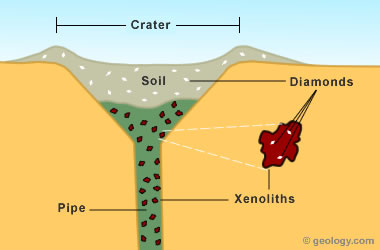
In Africa, diamond-bearing regions are in old cratonic areas, such as the West African Craton, the Central African Craton, and the Kapvaal Craton (= Africa’s oldest craton, at 3.5 billion years, in southern Africa).
The northern part of Western Australia State contains the Kimberley Craton. The Argyle Mine is not on the Kimberley Craton itself, oddly. The Argyle Mine is located along a mobile zone (Halls Creek Mobile Zone), just off the eastern edge of the Kimberley Craton. The Argyle Mine is mining the only economic diamondiferous lamproite pipe in the world.
1851 - alluvial diamonds were found in New South Wales, southeastern Australia, in the Bingara area.
1895 - diamonds discovered in the Nullagine area of Western Australia.
late 1960s & early 1970s - the Argyle area was explored. The Argyle Mine itself was found in 1979.
The Argyle Mine is now owned by Rio Tinto, a large mining organization. The Eastern Kimberly region of Western Australia is 1200 miles northeast of Perth, 300 miles from Darwin, and 110 km south of Kununurra. The area is a barren countryside with few roads & hot. It is a plateau with a few hilly areas (Matsu Range). The Argyle Mine was discovered using indicator minerals, a classic prospecting technique. The lamproite pipe was discovered October 1979 - it is 125 acres in size. It is adjacent to a ridge of quartzite, which protected it from erosion. Nearby pipes to the south are eroded down to their root zones. It erupted 1.2 billion years ago. The lamproite pipe has an elongated shape, map-wise, partially due to lateral faulting 800 million years ago that carried a slice of it southwest-ward.
Argyle Mine diamonds are 1.6 billion years old - that's 400 million years older than the pipe eruption.
The lamproite tilts northward at 30°.
Two principal facies - sandy tuff lamproite (50% quartz grains) & non-sandy tuff lamproite.
Forty million carats were produced from the Argyle Mine in 1994 alone. Most Argyle Mine diamonds (60%) are industrial quality. Many are “near-gem”. About 5% of Argyle Mine diamonds are gem-quality. Most Argyle Mine diamonds are brown colored & shaped as dodecahedrons. Argyle brown diamonds have been successfully marketed as “cognac diamonds”. Many Argyle specimens are white (clear). Only ~2% of Argyle diamonds are colored stones. Some blues (type 1A diamonds here - blue is due to presence of hydrogen), but they are not impressive. The real prize is the pinks - of the 25-30 million carats produced a year now, ~10,000 rough carats are pinks (each year). Argyle is the only consistent source of colored diamonds in the world.
The browns are sent to India for cutting. The pinks are sent to Perth for cutting. ~Fifty pink stones of 0.5 to 1.5 carat size (suitable for a center stone) are produced per year from Argyle.
There is a large range of pink colors.
Pinks are much more included than the blues here. About 7% of the Argyle pinks grade as flawless. At first, the pink coloration was thought to be caused by the presence of manganese (Mn), but it is now thought to be possibly related to heat/metamorphism-induced microfaulting/slippage of carbon atoms, resulting in pink banding at a microscopic level.
-----------------
Golconda Fort, also known as Golkonda (Telugu: "shepherds' hill"), is a fortified citadel and an early capital city of the Qutb Shahi dynasty (c. 1512–1687), located in Hyderabad, Telangana, India. Because of the vicinity of diamond mines, especially Kollur Mine, Golconda flourished as a trade centre of large diamonds, known as the Golconda Diamonds. The region has produced some of the world's most famous diamonds, including the colourless Koh-i-Noor (now owned by the United Kingdom), the blue Hope (United States), the pink Daria-i-Noor (Iran), the white Regent (France), the Dresden Green (Germany), and the colourless Orlov (Russia), Nizam and Jacob (India), as well as the now lost diamonds Florentine Yellow, Akbar Shah and Great Mogul.
HISTORY
Under the Bahmani Sultanate, Golconda slowly rose to prominence. Sultan Quli Qutb-ul-Mulk (r. 1487–1543), sent by the Bahmanids as a governor at Golconda, established the city as the seat of his government around 1501. Bahmani rule gradually weakened during this period, and Sultan Quli formally became independent in 1538, establishing the Qutb Shahi dynasty based in Golconda. Over a period of 62 years, the mud fort was expanded by the first three Qutb Shahi sultans into the present structure, a massive fortification of granite extending around 5 km in circumference. It remained the capital of the Qutb Shahi dynasty until 1590 when the capital was shifted to Hyderabad. The Qutb Shahis expanded the fort, whose 7 km outer wall enclosed the city.
During the early seventeenth century a strong cotton-weaving industry existed in Golconda. Large quantities of cotton were produced for domestic and exports consumption. High quality plain or patterned cloth made of muslin and calico was produced. Plain cloth was available as white or brown colour, in bleached or dyed variety. Exports of this cloth was to Persia and European countries. Patterned cloth was made of prints which were made indigenously with indigo for blue, chay-root for red coloured prints and vegetable yellow. Patterned cloth exports were mainly to Java, Sumatra and other eastern countries.
The fort finally fell into ruin in 1687, after an eight-month-long siege led to its fall at the hands of the Mughal emperor Aurangzeb.
DIAMONDS
The Golconda Fort used to have a vault where the famous Koh-i-Noor and Hope diamonds were once stored along with other diamonds.
Golconda is renowned for the diamonds found on the south-east at Kollur Mine near Kollur, Guntur district, Paritala and Atkur in Krishna district and cut in the city during the Kakatiya reign. At that time, India had the only known diamond mines in the world. Golkonda was the market city of the diamond trade, and gems sold there came from a number of mines. The fortress-city within the walls was famous for diamond trade.
Its name has taken a generic meaning and has come to be associated with great wealth. Gemologists use this classification to denote a diamond with a complete (or almost-complete) lack of nitrogen; "Golconda" material is also referred to as 2A.
Many famed diamonds are believed to have been excavated from the mines of Golconda, such as:
Daria-i-Noor
Noor-ul-Ain
Koh-i-Noor
Hope Diamond
Princie Diamond
Regent Diamond
Wittelsbach-Graff Diamond
By the 1880s, "Golconda" was being used generically by English speakers to refer to any particularly rich mine, and later to any source of great wealth.
During the Renaissance and the early modern eras, the name "Golconda" acquired a legendary aura and became synonymous for vast wealth. The mines brought riches to the Qutb Shahis of Hyderabad State, who ruled Golconda up to 1687, then to the Nizam of Hyderabad, who ruled after the independence from the Mughal Empire in 1724 until 1948, when the Indian integration of Hyderabad occurred.The siege of Golconda occurred in January 1687, when Mughal Emperor Aurangzeb led his forces to besiege the Qutb Shahi dynasty at Golconda Fort (also known as the Diamond Capitol of its time) and was home to the Kollur Mine. The ruler of Golconda was the well entrenched Abul Hasan Qutb Shah.
THE FORT
Golconda Fort is listed as an archaeological treasure on the official "List of Monuments" prepared by the Archaeological Survey of India under The Ancient Monuments and Archaeological Sites and Remains Act. Golconda consists of four distinct forts with a 10 km long outer wall with 87 semicircular bastions (some still mounted with cannons), eight gateways, and four drawbridges, with a number of royal apartments and halls, temples, mosques, magazines, stables, etc. inside. The lowest of these is the outermost enclosure entered by the "Fateh Darwaza" (Victory gate, so called after Aurangzeb’s triumphant army marched in through this gate) studded with giant iron spikes (to prevent elephants from battering them down) near the south-eastern corner. An acoustic effect can be experienced at Fateh Darwazaan, a hand clap at a certain point below the dome at the entrance reverberates and can be heard clearly at the 'Bala Hisar' pavilion, the highest point almost a kilometer away. This worked as a warning in case of an attack.
Bala Hissar Gate is the main entrance to the fort located on the eastern side. It has a pointed arch bordered by rows of scroll work. The spandrels have yalis and decorated roundels. The area above the door has peacocks with ornate tails flanking an ornamental arched niche. The granite block lintel below has sculpted yalis flanking a disc. The design of peacocks and lions is typical of Hindu architecture and underlies this fort's Hindu origins.
Toli Masjid, situated at Karwan, about 2 km from the Golconda Fort, was built in 1671 by Mir Musa Khan Mahaldar, royal architect of Abdullah Qutb Shah. The facade consists of five arches, each with lotus medallions in the spandrels. The central arch is slightly wider and more ornate. The mosque inside is divided into two halls, a transverse outer hall and an inner hall entered through triple arches.
It is believed that there is a secret tunnel that leads from the "Durbar Hall" and ends in one of the palaces at the foot of the hill. The fort also contains the tombs of the Qutub Shahi kings. These tombs have Islamic architecture and are located about 1 km north of the outer wall of Golconda. They are encircled by beautiful gardens and numerous carved stones. It is also believed that there was a secret tunnel to Charminar.
The two individual pavilions on the outer side of Golconda are built on a point which is quite rocky. The "Kala Mandir" is also located in the fort. It can be seen from the king's durbar (king's court) which was on top of the Golconda Fort.
The other buildings found inside the fort are: Habshi Kamans (Abyssian arches), Ashlah Khana, Taramati mosque, Ramadas Bandikhana, Camel stable, private chambers (kilwat), Mortuary bath, Nagina bagh, Ramasasa's kotha, Durbar hall, Ambar khana etc.
GOLCONDA RULING DYNASTIES
Several dynasties ruled Golconda over year
Bahamani Sultans
Qutb Shahi dynasty
Mughal Empire
NAYA QILA (NEW FORT)
Naya Qila is an extension of Golconda Fort which was turned into the Hyderabad Golf Club despite resistance from farmers who owned the land and various NGOs within the city. The ramparts of the new fort start after the residential area with many towers and the Hatiyan ka Jhad ("Elephant-sized tree") - an ancient baobab tree with an enormous girth. It also includes a war mosque. These sites are under restrictive access to the public because of the Golf Course.
QUTUB SHAHI TOMBS
The tombs of the Qutub Shahi sultans lie about one kilometre north of Golconda's outer wall. These structures are made of beautifully carved stonework, and surrounded by landscaped gardens. They are open to the public and receive many visitors. It is one of the famous sight seeing places in Hyderabad.
UNESCO World Heritage
The Golconda fort, and other Qutb Shahi dynasty Monuments of Hyderabad (the Charminar, and the Qutb Shahi Tombs) were submitted by the Permanent Delegation of India to UNESCO in 2010 for consideration as World Heritage Sites. They are currently included on India's "tentative list".
INFLUENCES
IN POPULAR CULTURE
Russell Conwell's book Acres of Diamonds tells a story of the discovery of the Golconda mines.
René Magritte's painting Golconda was named after the city.
John Keats' early poem "On receiving a curious Shell" opens with the lines: "Hast thou from the caves of Golkonda, a gem / pure as the ice-drop that froze on the mountain?"
Referenced in the classical Russian ballet, La Bayadère
Anthony Doerr's Pulitzer Prize–winning novel All the Light We Cannot See references the Golconda Mines as the discovery place of the "Sea of Flames" diamond
In Patrick O'Brian's novel The Surgeon's Mate, a character describes a particularly valuable diamond as being worth "half Golconda".
PLACES NAMED AFTER GOLCONDA
A city in Illinois, United States is named after Golconda.
A city in Nevada, United States is named after Golconda.
A village located in the southern part of Trinidad had given the name in the 19th century to a rich tract of land which was once a sugar-cane estate. Currently, mostly descendants of East Indian indentured servants occupy the village of Golconda.
WIKIPEDIA
The new girl (Delf Lishe)
Tagged by Retro☆Spective
1.She hates chewing gum…
2.She is a Gemologist (someone who studies gems)
3.She hates nail biters
4.Here favourite colours are green and yellow (like me)
5.She will only wear a dress or skirt no jeans….
6.Her hobbies include collecting gems, painting and reading
7.Her favorite movie is the girl who leaped through time…..XD
8.She hates music (of all kinds)
9.She does not like to wear makeup
10.She can be very shy but if she believes in something she will not be afraid to share her view…..
This is not her ‘proper’ wig
her ‘real’ wig is still being commissioned…..
TAG 5 PEOPLE......
Golconda Fort, also known as Golkonda (Telugu: "shepherds' hill"), is a fortified citadel and an early capital city of the Qutb Shahi dynasty (c. 1512–1687), located in Hyderabad, Telangana, India. Because of the vicinity of diamond mines, especially Kollur Mine, Golconda flourished as a trade centre of large diamonds, known as the Golconda Diamonds. The region has produced some of the world's most famous diamonds, including the colourless Koh-i-Noor (now owned by the United Kingdom), the blue Hope (United States), the pink Daria-i-Noor (Iran), the white Regent (France), the Dresden Green (Germany), and the colourless Orlov (Russia), Nizam and Jacob (India), as well as the now lost diamonds Florentine Yellow, Akbar Shah and Great Mogul.
HISTORY
Under the Bahmani Sultanate, Golconda slowly rose to prominence. Sultan Quli Qutb-ul-Mulk (r. 1487–1543), sent by the Bahmanids as a governor at Golconda, established the city as the seat of his government around 1501. Bahmani rule gradually weakened during this period, and Sultan Quli formally became independent in 1538, establishing the Qutb Shahi dynasty based in Golconda. Over a period of 62 years, the mud fort was expanded by the first three Qutb Shahi sultans into the present structure, a massive fortification of granite extending around 5 km in circumference. It remained the capital of the Qutb Shahi dynasty until 1590 when the capital was shifted to Hyderabad. The Qutb Shahis expanded the fort, whose 7 km outer wall enclosed the city.
During the early seventeenth century a strong cotton-weaving industry existed in Golconda. Large quantities of cotton were produced for domestic and exports consumption. High quality plain or patterned cloth made of muslin and calico was produced. Plain cloth was available as white or brown colour, in bleached or dyed variety. Exports of this cloth was to Persia and European countries. Patterned cloth was made of prints which were made indigenously with indigo for blue, chay-root for red coloured prints and vegetable yellow. Patterned cloth exports were mainly to Java, Sumatra and other eastern countries.
The fort finally fell into ruin in 1687, after an eight-month-long siege led to its fall at the hands of the Mughal emperor Aurangzeb.
DIAMONDS
The Golconda Fort used to have a vault where the famous Koh-i-Noor and Hope diamonds were once stored along with other diamonds.
Golconda is renowned for the diamonds found on the south-east at Kollur Mine near Kollur, Guntur district, Paritala and Atkur in Krishna district and cut in the city during the Kakatiya reign. At that time, India had the only known diamond mines in the world. Golkonda was the market city of the diamond trade, and gems sold there came from a number of mines. The fortress-city within the walls was famous for diamond trade.
Its name has taken a generic meaning and has come to be associated with great wealth. Gemologists use this classification to denote a diamond with a complete (or almost-complete) lack of nitrogen; "Golconda" material is also referred to as 2A.
Many famed diamonds are believed to have been excavated from the mines of Golconda, such as:
Daria-i-Noor
Noor-ul-Ain
Koh-i-Noor
Hope Diamond
Princie Diamond
Regent Diamond
Wittelsbach-Graff Diamond
By the 1880s, "Golconda" was being used generically by English speakers to refer to any particularly rich mine, and later to any source of great wealth.
During the Renaissance and the early modern eras, the name "Golconda" acquired a legendary aura and became synonymous for vast wealth. The mines brought riches to the Qutb Shahis of Hyderabad State, who ruled Golconda up to 1687, then to the Nizam of Hyderabad, who ruled after the independence from the Mughal Empire in 1724 until 1948, when the Indian integration of Hyderabad occurred.The siege of Golconda occurred in January 1687, when Mughal Emperor Aurangzeb led his forces to besiege the Qutb Shahi dynasty at Golconda Fort (also known as the Diamond Capitol of its time) and was home to the Kollur Mine. The ruler of Golconda was the well entrenched Abul Hasan Qutb Shah.
THE FORT
Golconda Fort is listed as an archaeological treasure on the official "List of Monuments" prepared by the Archaeological Survey of India under The Ancient Monuments and Archaeological Sites and Remains Act. Golconda consists of four distinct forts with a 10 km long outer wall with 87 semicircular bastions (some still mounted with cannons), eight gateways, and four drawbridges, with a number of royal apartments and halls, temples, mosques, magazines, stables, etc. inside. The lowest of these is the outermost enclosure entered by the "Fateh Darwaza" (Victory gate, so called after Aurangzeb’s triumphant army marched in through this gate) studded with giant iron spikes (to prevent elephants from battering them down) near the south-eastern corner. An acoustic effect can be experienced at Fateh Darwazaan, a hand clap at a certain point below the dome at the entrance reverberates and can be heard clearly at the 'Bala Hisar' pavilion, the highest point almost a kilometer away. This worked as a warning in case of an attack.
Bala Hissar Gate is the main entrance to the fort located on the eastern side. It has a pointed arch bordered by rows of scroll work. The spandrels have yalis and decorated roundels. The area above the door has peacocks with ornate tails flanking an ornamental arched niche. The granite block lintel below has sculpted yalis flanking a disc. The design of peacocks and lions is typical of Hindu architecture and underlies this fort's Hindu origins.
Toli Masjid, situated at Karwan, about 2 km from the Golconda Fort, was built in 1671 by Mir Musa Khan Mahaldar, royal architect of Abdullah Qutb Shah. The facade consists of five arches, each with lotus medallions in the spandrels. The central arch is slightly wider and more ornate. The mosque inside is divided into two halls, a transverse outer hall and an inner hall entered through triple arches.
It is believed that there is a secret tunnel that leads from the "Durbar Hall" and ends in one of the palaces at the foot of the hill. The fort also contains the tombs of the Qutub Shahi kings. These tombs have Islamic architecture and are located about 1 km north of the outer wall of Golconda. They are encircled by beautiful gardens and numerous carved stones. It is also believed that there was a secret tunnel to Charminar.
The two individual pavilions on the outer side of Golconda are built on a point which is quite rocky. The "Kala Mandir" is also located in the fort. It can be seen from the king's durbar (king's court) which was on top of the Golconda Fort.
The other buildings found inside the fort are: Habshi Kamans (Abyssian arches), Ashlah Khana, Taramati mosque, Ramadas Bandikhana, Camel stable, private chambers (kilwat), Mortuary bath, Nagina bagh, Ramasasa's kotha, Durbar hall, Ambar khana etc.
GOLCONDA RULING DYNASTIES
Several dynasties ruled Golconda over year
Bahamani Sultans
Qutb Shahi dynasty
Mughal Empire
NAYA QILA (NEW FORT)
Naya Qila is an extension of Golconda Fort which was turned into the Hyderabad Golf Club despite resistance from farmers who owned the land and various NGOs within the city. The ramparts of the new fort start after the residential area with many towers and the Hatiyan ka Jhad ("Elephant-sized tree") - an ancient baobab tree with an enormous girth. It also includes a war mosque. These sites are under restrictive access to the public because of the Golf Course.
QUTUB SHAHI TOMBS
The tombs of the Qutub Shahi sultans lie about one kilometre north of Golconda's outer wall. These structures are made of beautifully carved stonework, and surrounded by landscaped gardens. They are open to the public and receive many visitors. It is one of the famous sight seeing places in Hyderabad.
UNESCO World Heritage
The Golconda fort, and other Qutb Shahi dynasty Monuments of Hyderabad (the Charminar, and the Qutb Shahi Tombs) were submitted by the Permanent Delegation of India to UNESCO in 2010 for consideration as World Heritage Sites. They are currently included on India's "tentative list".
INFLUENCES
IN POPULAR CULTURE
Russell Conwell's book Acres of Diamonds tells a story of the discovery of the Golconda mines.
René Magritte's painting Golconda was named after the city.
John Keats' early poem "On receiving a curious Shell" opens with the lines: "Hast thou from the caves of Golkonda, a gem / pure as the ice-drop that froze on the mountain?"
Referenced in the classical Russian ballet, La Bayadère
Anthony Doerr's Pulitzer Prize–winning novel All the Light We Cannot See references the Golconda Mines as the discovery place of the "Sea of Flames" diamond
In Patrick O'Brian's novel The Surgeon's Mate, a character describes a particularly valuable diamond as being worth "half Golconda".
PLACES NAMED AFTER GOLCONDA
A city in Illinois, United States is named after Golconda.
A city in Nevada, United States is named after Golconda.
A village located in the southern part of Trinidad had given the name in the 19th century to a rich tract of land which was once a sugar-cane estate. Currently, mostly descendants of East Indian indentured servants occupy the village of Golconda.
WIKIPEDIA
Strobist: AB1600 with gridded 60X30 softbox overhead. AB800 open behind backdrop of white faux suede. Triggered by Cybersync.
Red corundum (ruby) on calcite from Burma. (USNM 177816, National Museum of Natural History, Smithsonian Institution, Washington D.C., USA; public domain photo provided by the USNM)
A mineral is a naturally-occurring, solid, inorganic, crystalline substance having a fairly definite chemical composition and having fairly definite physical properties. At its simplest, a mineral is a naturally-occurring solid chemical. Currently, there are over 6100 named and described minerals - about 200 of them are common and about 20 of them are very common. Mineral classification is based on anion chemistry. Major categories of minerals are: elements, sulfides, oxides, halides, carbonates, sulfates, phosphates, and silicates.
The oxide minerals all contain one or more oxide anions (O-2). The oxide minerals include species that are hydroxy-oxides. The hydroxide minerals (those with one or more OH-) are usually considered together with the oxides. Many sulfide minerals are not stable in Earth-surface conditions. In the presence of oxygen and moisture, sulfide minerals tend to tarnish or alter to oxides and hydroxy-oxides. All except the most inert elements (such as the platinum-group elements and gold and noble gases) readily form oxides. Gold oxide forms only under special conditions.
Corundum is aluminum oxide - Al2O3. At H≡9, it is the hardest common mineral, apart from diamond. Corundum forms hexagonal crystals, which is evident even in many river-worn specimens. The hexagonal columns of corundum typically have well-developed flat tops & bottoms. These flat ends are not cleavage planes - corundum has no cleavage. The cleavage-looking flat tops & bottoms of corundum are called partings (pseudocleavage). Additional breakages will not be along planar surfaces.
The color of corundum is variable - it can be any color, including plaid patterns. If transparent and relatively fracture-free & inclusion-free, corundum is said to be of gem-quality, and the color determines the name of the gem.
deep red = ruby
blue = sapphire
pale red = sapphire
pale green = sapphire
purple = sapphire
yellow = sapphire
Sapphire covers the largest number of colors. Gemologists and gem dealers will often deceivingly use the term "oriental" in referring to non-blue colored sapphires. For example, "oriental amethyst" is purple corundum, "oriental topaz" is yellow corundum, "oriental emerald" is green corundum, etc. Black-colored corundum is often called emery. Corundum-rich rocks are also called emery, or corundite (www.flickr.com/photos/jsjgeology/albums/72157646922258716).
The ruby mass seen here is from the Mogok area in Burma, a famous gem-bearing area.
-------------
Photo gallery of corundum and ruby:
www.mindat.org/gallery.php?min=1136
and
These Historical Figures by George Stuart are in the permanent collection of the Ventura County Museum in Ventura, California. The quarter scale diamond replicas in the historical figures accessories as well as the full size cubic zirconia replicas exhibited with the figures were crafted by gemologist Scott Sucher of Albuquerque, New Mexico.
Golconda Fort, also known as Golkonda (Telugu: "shepherds' hill"), is a fortified citadel and an early capital city of the Qutb Shahi dynasty (c. 1512–1687), located in Hyderabad, Telangana, India. Because of the vicinity of diamond mines, especially Kollur Mine, Golconda flourished as a trade centre of large diamonds, known as the Golconda Diamonds. The region has produced some of the world's most famous diamonds, including the colourless Koh-i-Noor (now owned by the United Kingdom), the blue Hope (United States), the pink Daria-i-Noor (Iran), the white Regent (France), the Dresden Green (Germany), and the colourless Orlov (Russia), Nizam and Jacob (India), as well as the now lost diamonds Florentine Yellow, Akbar Shah and Great Mogul.
HISTORY
Under the Bahmani Sultanate, Golconda slowly rose to prominence. Sultan Quli Qutb-ul-Mulk (r. 1487–1543), sent by the Bahmanids as a governor at Golconda, established the city as the seat of his government around 1501. Bahmani rule gradually weakened during this period, and Sultan Quli formally became independent in 1538, establishing the Qutb Shahi dynasty based in Golconda. Over a period of 62 years, the mud fort was expanded by the first three Qutb Shahi sultans into the present structure, a massive fortification of granite extending around 5 km in circumference. It remained the capital of the Qutb Shahi dynasty until 1590 when the capital was shifted to Hyderabad. The Qutb Shahis expanded the fort, whose 7 km outer wall enclosed the city.
During the early seventeenth century a strong cotton-weaving industry existed in Golconda. Large quantities of cotton were produced for domestic and exports consumption. High quality plain or patterned cloth made of muslin and calico was produced. Plain cloth was available as white or brown colour, in bleached or dyed variety. Exports of this cloth was to Persia and European countries. Patterned cloth was made of prints which were made indigenously with indigo for blue, chay-root for red coloured prints and vegetable yellow. Patterned cloth exports were mainly to Java, Sumatra and other eastern countries.
The fort finally fell into ruin in 1687, after an eight-month-long siege led to its fall at the hands of the Mughal emperor Aurangzeb.
DIAMONDS
The Golconda Fort used to have a vault where the famous Koh-i-Noor and Hope diamonds were once stored along with other diamonds.
Golconda is renowned for the diamonds found on the south-east at Kollur Mine near Kollur, Guntur district, Paritala and Atkur in Krishna district and cut in the city during the Kakatiya reign. At that time, India had the only known diamond mines in the world. Golkonda was the market city of the diamond trade, and gems sold there came from a number of mines. The fortress-city within the walls was famous for diamond trade.
Its name has taken a generic meaning and has come to be associated with great wealth. Gemologists use this classification to denote a diamond with a complete (or almost-complete) lack of nitrogen; "Golconda" material is also referred to as 2A.
Many famed diamonds are believed to have been excavated from the mines of Golconda, such as:
Daria-i-Noor
Noor-ul-Ain
Koh-i-Noor
Hope Diamond
Princie Diamond
Regent Diamond
Wittelsbach-Graff Diamond
By the 1880s, "Golconda" was being used generically by English speakers to refer to any particularly rich mine, and later to any source of great wealth.
During the Renaissance and the early modern eras, the name "Golconda" acquired a legendary aura and became synonymous for vast wealth. The mines brought riches to the Qutb Shahis of Hyderabad State, who ruled Golconda up to 1687, then to the Nizam of Hyderabad, who ruled after the independence from the Mughal Empire in 1724 until 1948, when the Indian integration of Hyderabad occurred.The siege of Golconda occurred in January 1687, when Mughal Emperor Aurangzeb led his forces to besiege the Qutb Shahi dynasty at Golconda Fort (also known as the Diamond Capitol of its time) and was home to the Kollur Mine. The ruler of Golconda was the well entrenched Abul Hasan Qutb Shah.
THE FORT
Golconda Fort is listed as an archaeological treasure on the official "List of Monuments" prepared by the Archaeological Survey of India under The Ancient Monuments and Archaeological Sites and Remains Act. Golconda consists of four distinct forts with a 10 km long outer wall with 87 semicircular bastions (some still mounted with cannons), eight gateways, and four drawbridges, with a number of royal apartments and halls, temples, mosques, magazines, stables, etc. inside. The lowest of these is the outermost enclosure entered by the "Fateh Darwaza" (Victory gate, so called after Aurangzeb’s triumphant army marched in through this gate) studded with giant iron spikes (to prevent elephants from battering them down) near the south-eastern corner. An acoustic effect can be experienced at Fateh Darwazaan, a hand clap at a certain point below the dome at the entrance reverberates and can be heard clearly at the 'Bala Hisar' pavilion, the highest point almost a kilometer away. This worked as a warning in case of an attack.
Bala Hissar Gate is the main entrance to the fort located on the eastern side. It has a pointed arch bordered by rows of scroll work. The spandrels have yalis and decorated roundels. The area above the door has peacocks with ornate tails flanking an ornamental arched niche. The granite block lintel below has sculpted yalis flanking a disc. The design of peacocks and lions is typical of Hindu architecture and underlies this fort's Hindu origins.
Toli Masjid, situated at Karwan, about 2 km from the Golconda Fort, was built in 1671 by Mir Musa Khan Mahaldar, royal architect of Abdullah Qutb Shah. The facade consists of five arches, each with lotus medallions in the spandrels. The central arch is slightly wider and more ornate. The mosque inside is divided into two halls, a transverse outer hall and an inner hall entered through triple arches.
It is believed that there is a secret tunnel that leads from the "Durbar Hall" and ends in one of the palaces at the foot of the hill. The fort also contains the tombs of the Qutub Shahi kings. These tombs have Islamic architecture and are located about 1 km north of the outer wall of Golconda. They are encircled by beautiful gardens and numerous carved stones. It is also believed that there was a secret tunnel to Charminar.
The two individual pavilions on the outer side of Golconda are built on a point which is quite rocky. The "Kala Mandir" is also located in the fort. It can be seen from the king's durbar (king's court) which was on top of the Golconda Fort.
The other buildings found inside the fort are: Habshi Kamans (Abyssian arches), Ashlah Khana, Taramati mosque, Ramadas Bandikhana, Camel stable, private chambers (kilwat), Mortuary bath, Nagina bagh, Ramasasa's kotha, Durbar hall, Ambar khana etc.
GOLCONDA RULING DYNASTIES
Several dynasties ruled Golconda over year
Bahamani Sultans
Qutb Shahi dynasty
Mughal Empire
NAYA QILA (NEW FORT)
Naya Qila is an extension of Golconda Fort which was turned into the Hyderabad Golf Club despite resistance from farmers who owned the land and various NGOs within the city. The ramparts of the new fort start after the residential area with many towers and the Hatiyan ka Jhad ("Elephant-sized tree") - an ancient baobab tree with an enormous girth. It also includes a war mosque. These sites are under restrictive access to the public because of the Golf Course.
QUTUB SHAHI TOMBS
The tombs of the Qutub Shahi sultans lie about one kilometre north of Golconda's outer wall. These structures are made of beautifully carved stonework, and surrounded by landscaped gardens. They are open to the public and receive many visitors. It is one of the famous sight seeing places in Hyderabad.
UNESCO World Heritage
The Golconda fort, and other Qutb Shahi dynasty Monuments of Hyderabad (the Charminar, and the Qutb Shahi Tombs) were submitted by the Permanent Delegation of India to UNESCO in 2010 for consideration as World Heritage Sites. They are currently included on India's "tentative list".
INFLUENCES
IN POPULAR CULTURE
Russell Conwell's book Acres of Diamonds tells a story of the discovery of the Golconda mines.
René Magritte's painting Golconda was named after the city.
John Keats' early poem "On receiving a curious Shell" opens with the lines: "Hast thou from the caves of Golkonda, a gem / pure as the ice-drop that froze on the mountain?"
Referenced in the classical Russian ballet, La Bayadère
Anthony Doerr's Pulitzer Prize–winning novel All the Light We Cannot See references the Golconda Mines as the discovery place of the "Sea of Flames" diamond
In Patrick O'Brian's novel The Surgeon's Mate, a character describes a particularly valuable diamond as being worth "half Golconda".
PLACES NAMED AFTER GOLCONDA
A city in Illinois, United States is named after Golconda.
A city in Nevada, United States is named after Golconda.
A village located in the southern part of Trinidad had given the name in the 19th century to a rich tract of land which was once a sugar-cane estate. Currently, mostly descendants of East Indian indentured servants occupy the village of Golconda.
WIKIPEDIA
These Historical Figures by George Stuart are in the permanent collection of the Ventura County Museum in Ventura, California. The quarter scale diamond replicas in the historical figures accessories as well as the full size cubic zirconia replicas exhibited with the figures were crafted by gemologist Scott Sucher of Albuquerque, New Mexico.
Marriage Problems
Marriage Solutions
Marriage Life
ఈ తేదీల్లో పెళ్ళి చేసుకుంటే జీవితం కష్టాలమయం.
There are many common problems in married life and a lot of them can be avoided, fixed or resolved using many different methods.so, video was very helpful and well explained in Telugu language by the best numerologist in India.
CONTACT : 9533155055, 9701590740
Dr Lingeswaarr.
Numerologist, Pronologist, Graphologist, Signaturologist, Gemologist, Vastu Expert and GTIN Pronology System Founder.
#telugu
#numerology
#numerologist
Strobist: AB1600 with gridded 60X30 softbox overhead. AB800 open behind backdrop of white faux suede. Triggered by Cybersync.
These Historical Figures by George Stuart are in the permanent collection of the Ventura County Museum in Ventura, California. The quarter scale diamond replicas in the historical figures accessories as well as the full size cubic zirconia replicas exhibited with the figures were crafted by gemologist Scott Sucher of Albuquerque, New Mexico.
Check out the first of these girls. She is... indescribably beautiful. I guess the short klip explains this more than a thousand words.
Down here I am no beauty, but the freedom of just being a "girl" EVERYWHERE I go, day or night makes it all worth while. But being a foreigner (as said before) makes one a rare jewel even amongst diamonds. So I guess that makes me.... a Black Star Sapphire and not just an ordinary one, no the rare sort cut, shaped and formed in what gemologist would declare and appraise as a, "timeless design" ;o)
But SHE ( the first one ) IS a rare diamond!
Stephen is a gemologist and goes on his treasure hunts for estate jewelry that he creates from each piece. You can read about him in <a href="http://www.scottrklinephoto.com/#/Client%20Access/Headshots/1/thumbs".InMenlo
Lighting Info: LP160 with softbox, camera right. The rest is from the lights in the room.
World’s Most Trusted Astrologer, Ajatt Oberoi is a Pioneer of Indian & Western Astrology, he is one of the Famous Astrologer in World. He has more than 29 years of experience in Advanced Astrology, Medical Astrology, Numerology, Vaastu and Feng Shui Consultant, NLP Master, Gemologist and is highly knowledgeable to give a permanent solution to various critical issues that often disturbs our day to day life.