View allAll Photos Tagged GSFC
The first anniversary image from NASA’s James Webb Space Telescope displays star birth like it’s never been seen before, full of detailed, impressionistic texture. The subject is the Rho Ophiuchi cloud complex, the closest star-forming region to Earth. It is a relatively small, quiet stellar nursery, but you’d never know it from Webb’s chaotic close-up. Jets bursting from young stars crisscross the image, impacting the surrounding interstellar gas and lighting up molecular hydrogen, shown in red. Some stars display the telltale shadow of a circumstellar disk, the makings of future planetary systems.
Image credit: NASA, ESA, CSA, STScI, Klaus Pontoppidan (STScI)
#NASA #STScI #jwst #jameswebbspacetelescope #NASAGoddard #NASAMarshall #stellarnursery
Four composite images deliver dazzling views from NASA's Chandra X-ray Observatory and James Webb Space Telescope of two galaxies, a nebula, and a star cluster. Each image combines Chandra's X-rays — a form of high-energy light — with infrared data from previously released Webb images, both of which are invisible to the unaided eye. Data from NASA's Hubble Space Telescope (optical light) and retired Spitzer Space Telescope (infrared), plus the European Space Agency's XMM-Newton (X-ray) and the European Southern Observatory's New Technology Telescope (optical) is also used. These cosmic wonders and details are made available by mapping the data to colors that humans can perceive.
Messier 16, also known as the Eagle Nebula, is a famous region of the sky often referred to as the “Pillars of Creation.” The Webb image shows the dark columns of gas and dust shrouding the few remaining fledgling stars just being formed. The Chandra sources, which look like dots, are young stars that give off copious amounts of X-rays. (X-ray: red, blue; infrared: red, green, blue)
Image credit: X-ray: Chandra: NASA/CXC/SAO, XMM: ESA/XMM-Newton; IR: JWST: NASA/ESA/CSA/STScI, Spitzer: NASA/JPL/CalTech; Optical: Hubble: NASA/ESA/STScI, ESO; Image Processing: L. Frattare, J. Major, and K. Arcand
#NASAMarshall #NASA #astrophysics #astronomy #chandra #NASAChandra #NASA #STScI #jwst #jameswebbspacetelescope #NASAGoddard #nebula
Read more about the Chanddra X-ray Observatory
Many thanks to all of you who added me as a contact on the strength of the previous photo. I was up in Hayward for the American Birkebeiner at the weekend (just watching, not competing unfortunately!). It is a short trip from there to the South Shore of Lake Superior to visit the famous ice caves, which are accessible this year for the first time in five years. They did not disappoint. I'm still going through the shots, but I think this one gives a good sense of the majesty of the sandstone cliffs and the utter desolation of the frozen lake.
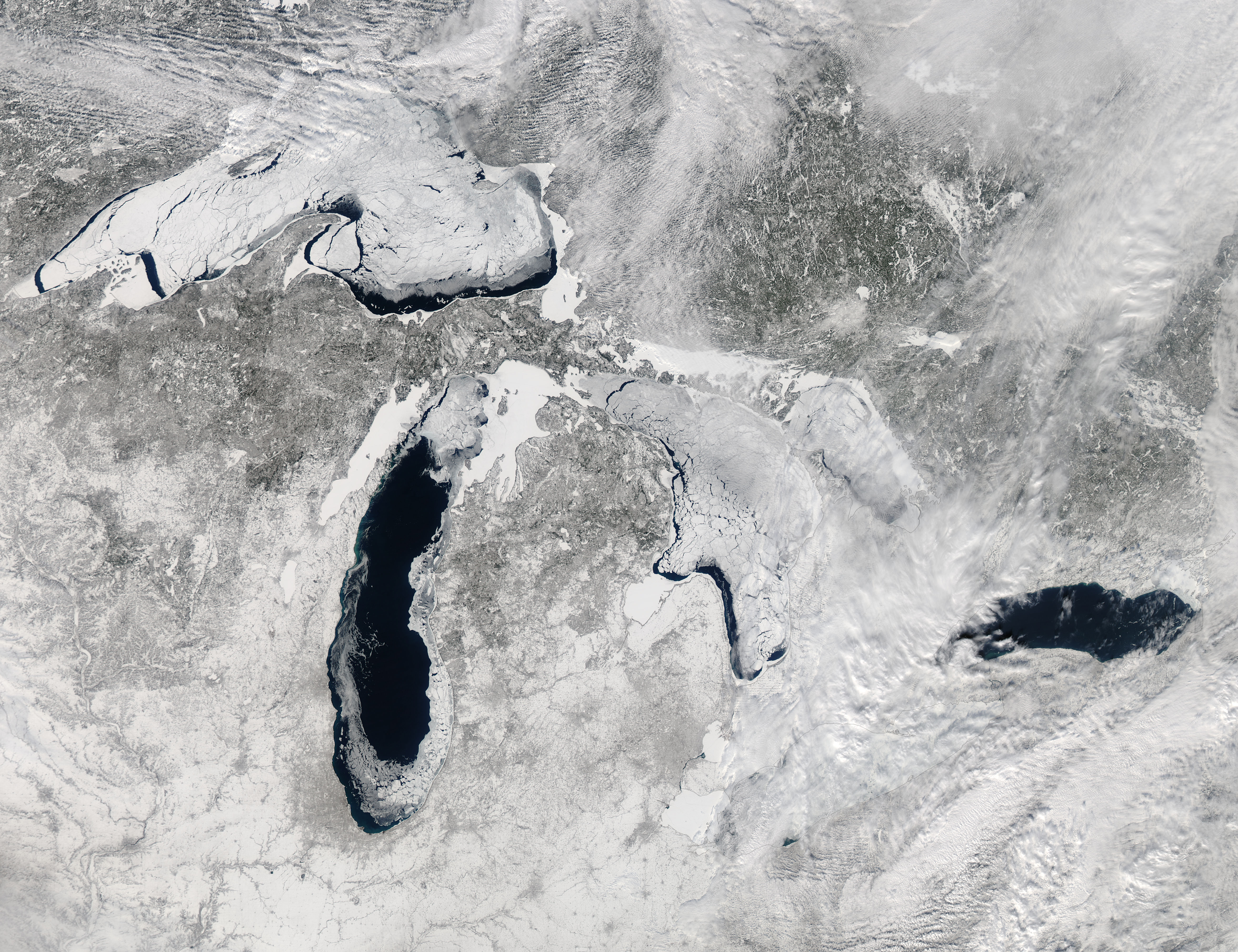
In case anyone is wondering what the ice cover of Lake Superior is right now, there is a wonderful satellite picture of the Great Lakes taken by NASA on Feb 19 here. (Lake Superior is on the far left.)
This image from the NASA/ESA Hubble Space Telescope feels incredibly three-dimensional for a piece of deep-space imagery. The image shows Arp 282, an interacting galaxy pair composed of the Seyfert galaxy NGC 169 (bottom) and the galaxy IC 1559 (top). Interestingly, both galaxies have monumentally energetic cores known as active galactic nuclei (AGN), although that is difficult to tell from this image, which is fortunate. If the image revealed the full emission of both AGNs, their brilliance would obscure the beautifully detailed tidal interactions we see in this image. Tidal forces occur when an object’s gravity causes another object to distort or stretch. The direction of tidal forces is away from the lower-mass object and toward the higher mass object. When two galaxies tidally interact, gas, dust, and even entire star systems can move toward one galaxy and away from the other. The image reveals this process in action as delicate streams of matter visibly link the two galaxies.
Astronomers now accept that an important aspect of how galaxies evolve is the way they interact with one another. Galaxies can merge, collide, or brush past one another – each interaction significantly affecting their shapes and structures. As common as such interactions may be, it is rare to capture an image of two galaxies interacting in such a visibly dynamic way.
Image Credit: ESA/Hubble & NASA, J. Dalcanton, Dark Energy Survey, Department of Energy (DOE), Cerro Tololo Inter-American Observatory/NoirLab/National Science Foundation/Association of Universities for Research in Astronomy (AURA), Sloan Digital Sky Survey (SDSS); Acknowledgment: J. Schmidt
#NASA #NASAMarshall #Hubble #HST #galaxy
This image from NASA’s Hubble Space Telescope features the Grand Design Spiral, NGC 3631, located some 53 million light-years away in the direction of the constellation Ursa Major. The “arms” of grand design spirals appear to wind around and into the galaxy’s nucleus.
Close inspection of NGC 3631’s grand spiral arms reveals dark dust lanes and bright star-forming regions along the inner part of the spiral arms. Star formation in spirals is similar to a traffic jam on the interstate. Like cars on the highway, slower moving matter in the spiral’s disk creates a bottleneck, concentrating star-forming gas and dust along the inner part of their spiral arms. This traffic jam of matter can get so dense that it gravitationally collapses, creating new stars (here seen in bright blue-white).
The image uses data collected from Hubble’s Wide Field Camera 3 and Advanced Camera for Surveys. The color blue represents visible wavelengths of blue light, and the color orange represents infrared light.
Image Credit: NASA, ESA, A. Filippenko (University of California - Berkeley), and D. Sand (University of Arizona); Image Processing: G. Kober (NASA Goddard/Catholic University of America)
#NASA #MarshallSpaceFlightCenter #MSFC #Marshall #HubbleSpaceTelescope #HST #astrophysics #gsfc #galaxy
NASA’s James Webb Space Telescope has peered into the chaos of the Cartwheel Galaxy, revealing new details about star formation and the galaxy’s central black hole. Webb’s powerful infrared gaze produced this detailed image of the Cartwheel and two smaller companion galaxies against a backdrop of many other galaxies. This image provides a new view of how the Cartwheel Galaxy has changed over billions of years.
The Cartwheel Galaxy, located about 500 million light-years away in the Sculptor constellation, is a rare sight. Its appearance, much like that of the wheel of a wagon, is the result of an intense event – a high-speed collision between a large spiral galaxy and a smaller galaxy not visible in this image. Collisions of galactic proportions cause a cascade of different, smaller events between the galaxies involved; the Cartwheel is no exception.
The collision most notably affected the galaxy’s shape and structure. The Cartwheel Galaxy sports two rings — a bright inner ring and a surrounding, colorful ring. These two rings expand outwards from the center of the collision, like ripples in a pond after a stone is tossed into it. Because of these distinctive features, astronomers call this a “ring galaxy,” a structure less common than spiral galaxies like our Milky Way.
The bright core contains a tremendous amount of hot dust with the brightest areas being the home to gigantic young star clusters. On the other hand, the outer ring, which has expanded for about 440 million years, is dominated by star formation and supernovas. As this ring expands, it plows into surrounding gas and triggers star formation.
Other telescopes, including the Hubble Space Telescope, have previously examined the Cartwheel. But the dramatic galaxy has been shrouded in mystery – perhaps literally, given the amount of dust that obscures the view. Webb, with its ability to detect infrared light, now uncovers new insights into the nature of the Cartwheel.
Image credit: NASA, ESA, CSA, STScI
#NASA #STScI #SpaceTelescopeScienceInstitute #jwst #jameswebbspacetelescope #GoddardSpaceFlightCenter #Goddard #GSFC #marshallspaceflightcenter #msfc #marshall #galaxy
In this mosaic image stretching 340 light-years across, Webb’s Near-Infrared Camera (NIRCam) displays the Tarantula Nebula star-forming region in a new light, including tens of thousands of never-before-seen young stars that were previously shrouded in cosmic dust. The most active region appears to sparkle with massive young stars, appearing pale blue.
Image credit: NASA, ESA, CSA, STScI
#NASA #STScI #SpaceTelescopeScienceInstitute #jwst #jameswebbspacetelescope #GoddardSpaceFlightCenter #Goddard #GSFC #marshallspaceflightcenter #msfc #marshall #nebula
Active regions on the sun combined to look something like a jack-o-lantern’s face on Oct. 8, 2014. The active regions appear brighter because those are areas that emit more light and energy — markers of an intense and complex set of magnetic fields hovering in the sun’s atmosphere, the corona. This image blends together two sets of wavelengths at 171 and 193 angstroms, typically colorized in gold and yellow, to create a particularly Halloween-like appearance.
This image is a blend of 171 and 193 angstrom light as captured by the Solar Dynamics Observatory.
Image Credit: NASA/GSFC/SDO
#nasa #marshallspaceflightcenter #msfc #heliophysics #sun #space #solar #observation #star #astronomy #science #goddardspaceflightcenter #gsfc #sdo #solardynamicsobservatory
Happy Fourth of July from #NASAMarshall! Appearing like a winged creature poised on a pedestal, this object captured by NASA's Hubble Space Telescope is actually a billowing tower of cold gas and dust rising in the Eagle Nebula. The soaring pillar is 9.5 light-years, or about 57 trillion miles, high, about twice the distance from our Sun to the nearest star. Stars in the Eagle Nebula are born in clouds of cold hydrogen that reside in chaotic neighborhoods, where energy from young stars sculpts fantasy-like landscapes in the gas.
Image Credit: NASA
#NASA #NASAMarshall #NASAGoddard #ESA #HubbleSpaceTelescope #HST #astrophysics #nebula
Europe has (yet again) been hit by a cloud of Saharan dust and this is what the sunrise looked like in Portugal by the end of March.
A Europa foi (mais uma vez) atingida por uma nuvem de poeira proveniente do deserto do Saara e, nos últimos dias de Março, era este o aspecto do nascer do Sol.
Carcavelos - Portugal
This Hubble image shows the star cluster NGC 1850, located about 160,000 light-years away. For this image, two filters were used with the camera to gather data: one at visible wavelengths, the other at near-infrared wavelengths. Following chromatic order, the shorter wavelength visible light data is blue, while the longer near-infrared data is red.
Image credit: NASA, ESA and P. Goudfrooij (Space Telescope Science Institute); Processing: Gladys Kober (NASA/Catholic University of America)
#NASA #NASAMarshall #NASAGoddard #ESA #HubbleSpaceTelescope #HST #astrophysics #starcluster
This image is dominated by NGC 7469, a luminous, face-on spiral galaxy approximately 90 000 light-years in diameter that lies roughly 220 million light-years from Earth in the constellation Pegasus. Its companion galaxy IC 5283 is partly visible in the lower left portion of this image.
This spiral galaxy has recently been studied as part of the Great Observatories All-sky LIRGs Survey (GOALS) Early Release Science program with the NASA/ESA/CSA James Webb Space Telescope, which aims to study the physics of star formation, black hole growth, and feedback in four nearby, merging luminous infrared galaxies. Other galaxies studied as part of the survey include previous ESA/Webb Pictures of the Month II ZW 096 and IC 1623.
NGC 7469 is home to an active galactic nucleus (AGN), which is an extremely bright central region that is dominated by the light emitted by dust and gas as it falls into the galaxy’s central black hole. This galaxy provides astronomers with the unique opportunity to study the relationship between AGNs and starburst activity because this particular object hosts an AGN that is surrounded by a starburst ring at a distance of a mere 1500 light-years. While NGC 7469 is one of the best studied AGNs in the sky, the compact nature of this system and the presence of a great deal of dust have made it difficult for scientists to achieve both the resolution and sensitivity needed to study this relationship in the infrared. Now, with Webb, astronomers can explore the galaxy’s starburst ring, the central AGN, and the gas and dust in between.
Image Credit: ESA/Webb, NASA & CSA, L. Armus, A. S. Evans
#NASA #STScI #jwst #jameswebbspacetelescope #NASAGoddard #NASAMarshall #ESA #CSA #galaxy
a wide-field view of the Puppis A supernova remnant along with a close-up image of the neutron star, known as RX J0822-4300, that is moving at a blistering pace. The larger field-of-view is a composite of X-ray data from the ROSAT satellite (pink) and optical data (purple), from the Cerro Tololo Inter-American Observatory 0.9-meter telescope, which highlights oxygen emission. Astronomers think Puppis A was created when a massive star ended its life in a supernova explosion about 3,700 years ago, forming an incredibly dense object called a neutron star and releasing debris into space. The neutron star was ejected by the explosion.
Image credit: Chandra: NASA/CXC/ Middlebury College/F.Winkler; ROSAT: NASA/GSFC/S.Snowden et al.; Optical: NOAO/CTIO/Middlebury College/ F.Winkler et al.
Learn more/access larger images:
www.nasa.gov/mission_pages/chandra/multimedia/photos07-13...
p.s. You can see all of our Chandra photos in the Chandra Group in Flickr at: www.flickr.com/groups/chandranasa/ We'd love to have you as a member!
On Sept. 21, 2022, the James Webb Space Telescope delivered the clearest view of Neptune's rings in more than 30 years. Webb's Near-Infrared Camera (NIRCam) captured several bright, narrow rings as well as the planet's fainter dust bands. Voyager 2 was the last to detect some of these rings during its flyby in 1989, but this is the first time we have an infrared image of them.
Since NIRCam images objects in the near-infrared range from 0.6 to 5 microns, Neptune does not appear blue to Webb. In fact, the methane gas so strongly absorbs red and infrared light that the planet is quite dark at these near-infrared wavelengths, except where high-altitude clouds are present. Those methane-ice clouds are prominent as bright streaks and spots, which reflect sunlight before it is absorbed by methane gas.
Image Credit: NASA, ESA, CSA, STScI
#NASA #STScI #jwst #jameswebbspacetelescope #NASAGoddard #NASAMarshall #planet #Neptune
Asteroid Bennu's boulder-covered surface gives it protection against small meteoroid impacts, according to observations of craters by NASA's OSIRIS-REx (Origins, Spectral Interpretation, Resource Identification, Security-Regolith Explorer) spacecraft.
Bennu is a “rubble-pile” asteroid, meaning that it formed from the debris of a much larger asteroid that was destroyed by an ancient impact. Fragments from the collision coalesced under their own weak gravity to form Bennu.
This image shows asteroid Bennu’s boulder-covered surface. It was taken by the PolyCam camera on NASA’s OSIRIS-REx spacecraft on April 11, 2019 from a distance of 2.8 miles (4.5 km). The field of view is 211 ft (64.4 m), and the large boulder in the upper right corner of the image is 50 ft (15.4 m) tall. When the image was taken, the spacecraft was over the southern hemisphere, pointing PolyCam far north and to the west.
Image credit: NASA/Goddard/University of Arizona
#NASA #NASAMarshall #MSFC #GSFC #GoddardSpaceFlightCenter #OSIRISRex #asteroid #newfrontiers #bennu #regolith
Shreds of the colorful supernova remnant DEM L 190 seem to billow across the screen in this image from the NASA/ESA Hubble Space Telescope. The delicate sheets and intricate filaments are debris from the cataclysmic death of a massive star that once lived in the Large Magellanic Cloud, a small satellite galaxy of the Milky Way. DEM L 190 – also known as LMC N49 – is the brightest supernova remnant in the Large Magellanic Cloud and lies approximately 160,000 light-years away from Earth in the constellation Dorado.
Image credit: ESA/Hubble & NASA, S. Kulkarni, Y. Chu
#NASA #NASAMarshall #NASAGoddard #ESA #HubbleSpaceTelescope #HST #astrophysics #supernova
What's happening to this spiral galaxy? Just a few hundred million years ago, NGC 2936, the upper of the two large galaxies shown, was likely a normal spiral galaxy -- spinning, creating stars -- and minding its own business. But then it got too close to the massive elliptical galaxy NGC 2937 below and took a dive. Dubbed the Porpoise Galaxy for its iconic shape, NGC 2936 is not only being deflected but also being distorted by the close gravitational interaction. A burst of young blue stars forms the nose of the porpoise toward the right of the upper galaxy, while the center of the spiral appears as an eye. Alternatively, the galaxy pair, together known as Arp 142, look to some like a penguin protecting an egg. Either way, intricate dark dust lanes and bright blue star streams trail the troubled galaxy to the lower right. The featured re-processed image showing Arp 142 in unprecedented detail was taken by the Hubble Space Telescope last year. Arp 142 lies about 300 million light years away toward the constellation, coincidently, of the Water Snake (Hydra). In a billion years or so the two galaxies will likely merge into one larger galaxy.
Image credit: NASA, ESA, Hubble, HLA
2006 images from three of NASA's Great Observatories were combined to create this spectacular, multiwavelength view of the starburst galaxy M82. Optical light from stars (yellow-green/Hubble Space Telescope) shows the disk of a modest-sized, apparently normal galaxy.
Another Hubble observation designed to image 10,000 degree Celsius hydrogen gas (orange) reveals a startlingly different picture of matter blasting out of the galaxy. The Spitzer Space Telescope infrared image (red) shows that cool gas and dust are also being ejected. Chandra's X-ray image (blue) reveals gas that has been heated to millions of degrees by the violent outflow. The eruption can be traced back to the central regions of the galaxy where stars are forming at a furious rate, some 10 times faster than in the Milky Way Galaxy.
Many of these newly formed stars are very massive and race through their evolution to explode as supernovas. Vigorous mass loss from these stars before they explode, and the heat generated by the supernovas drive the gas out of the galaxy at millions of miles per hour. It is thought that the expulsion of matter from a galaxy during bursts of star formation is one of the main ways of spreading elements like carbon and oxygen throughout the universe.
The burst of star formation in M82 is thought to have been initiated by shock waves generated in a close encounter with a large nearby galaxy, M81, about 100 million years ago. These shock waves triggered the collapse of giant clouds of dust and gas in M82. In another 100 million years or so, most of the gas and dust will have been used to form stars, or blown out of the galaxy, so the starburst will subside.
Image credit: X-ray: NASA/CXC/JHU/D.Strickland; Optical: NASA/ESA/STScI/AURA/The Hubble Heritage Team; IR: NASA/JPL-Caltech/Univ. of AZ/C. Engelbracht
#NASA #MarshallSpaceFlightCenter #MSFC #Marshall #ChandraXrayObservatory #cxo #HubbleSpaceTelescope #HST #astronomy #space #astrophysics #solarsystemandbeyond #gsfc #Goddard #GoddardSpaceFlightCenter #ESA #EuropeanSpaceAgency #SpitzerSpaceTelescope #JPL #JetPropulsionLaboratory #galaxy #starburstgalaxy
This image from the NASA/ESA Hubble Space Telescope reveals tendrils of dark dust threading across the heart of the spiral galaxy NGC 7172. The galaxy lies approximately 110 million light-years from Earth in the constellation Piscis Austrinus. The lane of dust threading its way across NGC 7172 is obscuring the luminous heart of the galaxy, making NGC 7172 appear to be nothing more than a normal spiral galaxy viewed from the side.
When astronomers inspected NGC 7172 across the electromagnetic spectrum they quickly discovered that there was more to it than meets the eye: NGC 7172 is a Seyfert galaxy – a type of galaxy with an intensely luminous active galactic nucleus powered by matter accreting onto a supermassive black hole.
This image combines data from two sets of Hubble observations, both proposed to study nearby active galactic nuclei. The image also combines data from two instruments -– Hubble’s Advanced Camera for Surveys and Wide Field Camera 3.
Image credit: ESA/Hubble & NASA, D. J. Rosario, A. Barth; Acknowledgment: L. Shatz
#NASA #NASAMarshall #Hubble #nebula #galaxy
©dragonflydreams88
www.fluidr.com/photos/dragonflydreams88
thanx to NASA Goddard Space Flight Center www.flickr.com/photos/gsfc/31008137280
Queen Elizabeth II, Britain's longest-reigning monarch, died on Sept. 8, 2022 at age 96. Her reign spanned all of spaceflight, predating both Sputnik and Explorer 1.
As NASA joins the planet in marking her passing, we are moved by the curiosity The Queen showed our explorers over the years.
In this photo, Queen Elizabeth II greets employees on her walk from NASA’s Goddard Space Flight Center mission control to a reception in the center’s main auditorium, Tuesday, May 8, 2007, in Greenbelt, Md. Queen Elizabeth II and her husband, Prince Philip, Duke of Edinburgh, visited the NASA Goddard Space Flight Center as one of the last stops on their six-day United States visit.
Image credit: NASA/Bill Ingalls
#NASA #GoddardSpaceFlightCenter #Goddard #GSFC #marshallspaceflightcenter #msfc #marshall #queenelisabeth
The lenticular galaxy NGC 5283 is the subject of this NASA Hubble Space Telescope image. NGC 5283 contains an active galactic nucleus, or AGN. An AGN is an extremely bright region at the heart of a galaxy where a supermassive black hole exists. When dust and gas fall into the black hole, the matter heats up and emits light across the electromagnetic spectrum.
NGC 5283 is a Seyfert galaxy. About 10 percent of all galaxies are Seyfert galaxies, and they differ from other galaxies that contain AGNs because the galaxy itself is clearly visible. Other AGNs emit so much radiation that they outshine or make it impossible to observe the structure of their host galaxy!
Hubble observed this galaxy as part of a survey for a dataset about nearby AGNs, which will serve as a resource for astronomers investigating AGN physics, black holes, host galaxy structure, and more.
Image Credit: NASA, ESA, A. Barth (University of California - Irvine), and M. Revalski (STScI); Processing: Gladys Kober (NASA/Catholic University of America)
#NASA #NASAMarshall #NASAGoddard #ESA #HubbleSpaceTelescope #HST #astrophysics #galaxy
Please View 'Phases of a Total Lunar Eclipse' Large On Black
I decided I should share some of my favorite night shots with Flickr. This is from the 2004 total lunar eclipse.
It was really cloudy in Colorado that night and I was totally bummed i was going to miss the lunar fun. If you ever find yourself in a similar situation surf on over to the Clear Sky Clock and locate the best viewing location you can drive to, it totally saved me here (lots of good general astronomy links there as well). We ended up driving out to a hole in the cloud cover and haze out in the Pawnee National Grassland in NE Colorado.
The eclipse itself was a stunning thing to see. My favorite part is when the moon passed through Earth's umbral shadow into totality. At the moment it hit totality a gazillion coyotes started howling at the moon all around us. What an evening. If you're now itching to know when the next show is, check here for a lunar eclipse schedule for the coming years.
This is one of my favorite photographs from my work. It was taken with a Nikon 4500 digiscoped through my Nikon Fieldscope 60 mm ED spotting scope.
This new NASA Hubble Space Telescope image of IC 4271, also known as Arp 40, is a curious pair of spiral galaxies some 800 million light-years away. The smaller galaxy is superimposed on the larger one, which is a type of active galaxy called a Seyfert galaxy. Seyfert galaxies are named for astronomer Carl K. Seyfert who, in 1943, published a paper about spiral galaxies with very bright emission lines. Today we know that about 10% of all galaxies may be Seyfert galaxies. They belong to the class of “active galaxies” – galaxies that have supermassive black holes at their centers accreting material, which releases vast amounts of radiation. The active cores of Seyfert galaxies are at their brightest when observed in light outside the visible spectrum.
Image Credit: NASA, ESA, and B. Holwerda (University of Louisville Research Foundation, Inc.); Image processing: G. Kober (NASA Goddard/Catholic University of America)
#NASA #MarshallSpaceFlightCenter #MSFC #Marshall #HubbleSpaceTelescope #HST #astrophysics #gsfc #galaxy
The Helix Nebula is an example of a planetary nebula. Though it looks like a bubble or eye from Earth’s point of view, the Helix is actually a trillion-mile-long tunnel of glowing gases. In its center lies a white dwarf star.
Image credit: NASA, NOAO, ESA, the Hubble Helix Nebula Team, M. Meixner (STScI), and T.A. Rector (NRAO)
#NASA #MarshallSpaceFlightCenter #MSFC #Marshall #HubbleSpaceTelescope #HST #astronomy #space #astrophysics #solarsystemandbeyond #gsfc #Goddard #GoddardSpaceFlightCenter #ESA #EuropeanSpaceAgency #nebula #planetarynebula
The latest view of Saturn from NASA's Hubble Space Telescope captures exquisite details of the ring system — which looks like a phonograph record with grooves that represent detailed structure within the rings — and atmospheric details that once could only be captured by spacecraft visiting the distant world. Hubble's Wide Field Camera 3 observed Saturn on June 20, 2019, as the planet made its closest approach to Earth, at about 845 million miles away. This image is the second in a yearly series of snapshots taken as part of the Outer Planets Atmospheres Legacy (OPAL) project. OPAL is helping scientists understand the atmospheric dynamics and evolution of our solar system's gas giant planets. In Saturn's case, astronomers will be able to track shifting weather patterns and other changes to identify trends.
Credit: NASA, ESA, A. Simon (GSFC), M.H. Wong (University of California, Berkeley) and the OPAL Team
The spiral arms of the galaxy NGC 3318 are lazily draped across this image from the NASA/ESA Hubble Space Telescope. This spiral galaxy lies in the constellation Vela and is roughly 115 million light-years away from Earth. Vela was originally part of a far larger constellation, known as Argo Navis after the fabled ship Argo from Greek mythology, but this unwieldy constellation proved to be impractically large. Argo Navis was split into three separate parts called Carina, Puppis, and Vela – each named after part of the Argo. As befits a galaxy in a nautically inspired constellation, the outer edges of NGC 3318 almost resemble a ship’s sails billowing in a gentle breeze.
Image Credit: ESA/Hubble & NASA, European Southern Observatory (ESO), R. J. Foley; Acknowledgment: R. Colombari
#NASA #NASAMarshall #Hubble #galaxy #galaxy
This cloudy, turbulent scene acquired by the Hubble Space Telescope in 2017 shows a stellar nursery within the Large Magellanic Cloud. This nursery, known as N159, contains many hot young stars. These stars emit intense ultraviolet light, which causes nearby hydrogen gas to glow, and torrential stellar winds, which carve out ridges, arcs, and filaments from the surrounding material. N159 is located over 160,000 light-years away, just south of the Tarantula Nebula.
At the heart of this cosmic cloud lies the Papillon Nebula, a butterfly-shaped region of nebulosity. This small, dense object is classified as a High-Excitation Blob, and is thought to be tightly linked to the early stages of massive star formation.
Image credit: ESA/Hubble & NASA
#NASA #MarshallSpaceFlightCenter #MSFC #Marshall #HubbleSpaceTelescope #HST #astrophysics #NASAGoddard #stellarnursery #LargeMagellanicCloud #nebula
Four composite images deliver dazzling views from NASA's Chandra X-ray Observatory and James Webb Space Telescope of two galaxies, a nebula, and a star cluster. Each image combines Chandra's X-rays — a form of high-energy light — with infrared data from previously released Webb images, both of which are invisible to the unaided eye. Data from NASA's Hubble Space Telescope (optical light) and retired Spitzer Space Telescope (infrared), plus the European Space Agency's XMM-Newton (X-ray) and the European Southern Observatory's New Technology Telescope (optical) is also used. These cosmic wonders and details are made available by mapping the data to colors that humans can perceive.
Messier 74 is also a spiral galaxy — like our Milky Way — that we see face-on from our vantage point on Earth. It is about 32 million light-years away. Messier 74 is nicknamed the Phantom Galaxy because it is relatively dim, making it harder to spot with small telescopes than other galaxies in Charles Messier’s famous catalog from the 18th century. Webb outlines gas and dust in the infrared while Chandra data spotlights high-energy activity from stars at X-ray wavelengths. Hubble optical data showcases additional stars and dust along the dust lanes. (X-ray: purple; optical: orange, cyan, blue, infrared: green, yellow, red, magenta)
Image credit: X-ray: Chandra: NASA/CXC/SAO, XMM: ESA/XMM-Newton; IR: JWST: NASA/ESA/CSA/STScI, Spitzer: NASA/JPL/CalTech; Optical: Hubble: NASA/ESA/STScI, ESO; Image Processing: L. Frattare, J. Major, and K. Arcand
#NASAMarshall #NASA #astrophysics #astronomy #chandra #NASAChandra #NASA #STScI #jwst #jameswebbspacetelescope #NASAGoddard #galaxy
Read more about the Chanddra X-ray Observatory
The spiral pattern shown by the galaxy in this image from the NASA/ESA Hubble Space Telescope is striking because of its delicate, feathery nature. These "flocculent" spiral arms indicate that the recent history of star formation of the galaxy, known as NGC 2775, has been relatively quiet. There is virtually no star formation in the central part of the galaxy, which is dominated by an unusually large and relatively empty galactic bulge, where all the gas was converted into stars long ago.
NGC 2275 is classified as a flocculent (or fluffy-looking) spiral galaxy, located 67 million light-years away in the constellation of Cancer.
Millions of bright, young, blue stars shine in the complex, feather-like spiral arms, interlaced with dark lanes of dust. Complexes of these hot, blue stars are thought to trigger star formation in nearby gas clouds. The overall feather-like spiral patterns of the arms are then formed by shearing of the gas clouds as the galaxy rotates. The spiral nature of flocculent galaxies stands in contrast to the grand-design spirals, which have prominent, well defined-spiral arms.
Image credit: ESA/Hubble & NASA, J. Lee and the PHANGS-HST Team; Acknowledgment: Judy Schmidt (Geckzilla)
This new image from NASA’s Hubble Space Telescope shows interacting galaxies known as AM 1214-255. These galaxies contain active galactic nuclei, or AGNs. An AGN is an extraordinarily luminous central region of a galaxy. Its extreme brightness is caused by matter whirling into a supermassive black hole at the galaxy’s heart.
Hubble observed the galaxy closest to the center as part of an AGN survey, with the aim of compiling a dataset about nearby AGNs to be used as a resource for astronomers investigating AGN physics, black holes, host galaxy structure, and more.
Image Credit: NASA, ESA, A. Barth (University of California - Irvine), and J. Dalcanton (University of Washington); Processing: Gladys Kober (NASA/Catholic University of America)
#NASA #NASAMarshall #NASAGoddard #ESA #HubbleSpaceTelescope #HST #astrophysics #galaxy #blackhole #supermassiveblackhole #AGN
A “jellyfish galaxy” with trailing tentacles of stars hangs in inky blackness in this image from the NASA/ESA Hubble Space Telescope. As jellyfish galaxies move through intergalactic space, gas is slowly stripped away forming trails that resemble tendrils illuminated by clumps of star formation. These blue tendrils are visible below the core of this galaxy, giving it a jellyfish-like appearance. This particular jellyfish galaxy – known as JO201 – lies in the constellation Cetus, which is named after a sea monster from ancient Greek mythology. This sea-monster-themed constellation adds to the nautical theme of this image.
The tendrils of jellyfish galaxies extend beyond the bright disk of the galaxy’s core. This particular observation comes from an investigation into the sizes, masses, and ages of clumps of star formation in the tendrils of jellyfish galaxies. Astronomers hope this will provide a better understanding of the connection between ram-pressure stripping – the process that creates the tendrils of jellyfish galaxies – and star formation.
Hubble’s Wide Field Camera 3 (WFC3) captured this galactic seascape. A versatile instrument that captures images at ultraviolet, infrared, and visible wavelengths, WFC3 is the source of some of Hubble’s most spectacular images.
Image Credit: ESA/Hubble & NASA, M. Gullieuszik
#NASA #NASAMarshall #NASAGoddard #ESA #HubbleSpaceTelescope #HST #astrophysics #galaxy
A jade heart my sister sent me, with a lovely note. My sister..my friend.
(click here for an uplifting video...(NASA's "picture of the Day") ).
antwrp.gsfc.nasa.gov/apod/astropix.html
July 22, 2008
This 2016 image of haze layers above Pluto’s limb was taken by the Ralph/Multispectral Visible Imaging Camera (MVIC) on NASA’s New Horizons spacecraft. About 20 haze layers are seen; the layers have been found to typically extend horizontally over hundreds of kilometers, but are not strictly parallel to the surface. For example, scientists note a haze layer about 3 miles (5 kilometers) above the surface (lower left area of the image), which descends to the surface at the right.
Image Credit: NASA/JHUAPL/SwRI
#NASA #NASAMarshall #NASAMarshallSpaceFlightCenter #MSFC #NewHorizons #SolarSystemandBeyond #Pluto #AmesResearchCenter #ARC #marshallspaceflightcenter #NewFrontiers #gsfc #Goddard #GoddardSpaceFlightCenter #JPL #JetPropulsionLaboratory
This image from the NASA/ESA Hubble Space Telescope shows two of the galaxies in the galactic triplet Arp 248 – also known as Wild's Triplet – which lies around 200 million light-years from Earth in the constellation Virgo. The two large spiral galaxies visible in this image – which flank a smaller, unrelated background spiral galaxy – appear connected by a luminous bridge. This elongated stream of stars and interstellar dust is known as a tidal tail, and it formed by the mutual gravitational attraction of the two foreground galaxies.
Image credit: ESA/Hubble & NASA, Dark Energy Survey/Department of Energy/Fermilab Cosmic Physics Center/Dark Energy Camera/Cerro Tololo Inter-American Observatory/NOIRLab/National Science Foundation/AURA Astronomy; J. Dalcanton
#NASA #NASAMarshall #NASAGoddard #ESA #HubbleSpaceTelescope #HST #astrophysics #galaxy
Gemini 1 at the moment of ignition, 11:00:01 a.m. EST, April 8, 1964, Launch Complex 19, CCAFS.
8.5” x 10.875”.
Note the reddish appearance of the Titan II’s exhaust. A telltale indicator of it being produced by a hypergolic fuel mixture. Even if you have no idea what that is, doesn’t it just look toxic & corrosive? Which it indeed is.
“Gemini 1 was an uncrewed orbital test of the Titan 2 launch vehicle, the Gemini spacecraft structural integrity, and the launch vehicle-spacecraft compatibility. The test covered all phases through the orbital insertion phase. Other objectives were to check out launch vehicle-spacecraft launch heating conditions, launch vehicle performance, launch vehicle flight control system switch-over circuits, launch vehicle orbit insertion accuracy, and the malfunction detection system. This was the first production Gemini spacecraft and launch vehicle.
Mission Profile
Launch of Gemini 1 took place at 11:00:01 a.m. EST (16:00:01.69 UT) from Complex 19. Six minutes after launch, the Titan 2 booster placed the Gemini spacecraft and the attached 2nd stage in a 160.5 x 320.6 km orbit with a period of 89.3 minutes. An excess speed of 22.5 km/hr sent the spacecraft 33.6 km higher than planned. Mission plans did not include separation of spacecraft from the 3.05 meter diameter, 5.8 meter long Titan stage 2, both orbited as a unit. The planned mission included only three orbits and ended about 4 hours 50 minutes after launch with the third pass over Cape Kennedy. The spacecraft was tracked until it reentered the atmosphere and disintegrated on the 64th orbital pass over the southern Atlantic on April 12. The systems functioned well within planned tolerances and the mission was deemed a successful test.
Spacecraft and Subsystems
The Gemini spacecraft was a cone-shaped capsule consisting of two components, a reentry module and an adaptor module. The adaptor module made up the base of the spacecraft. It was a truncated cone 228.6 cm high, 304.8 cm in diameter at the base and 228.6 cm at the upper end where it attached to the base of the reentry module. The re-entry module consisted of a truncated cone which decreased in diameter from 228.6 cm at the base to 98.2 cm, topped by a short cylinder of the same diameter and then another truncated cone decreasing to a diameter of 74.6 cm at the flat top. The reentry module was 345.0 cm high, giving a total height of 573.6 cm for the Gemini spacecraft.
The adaptor module was an externally skinned, stringer framed structure, with magnesium stringers and an aluminum alloy frame. The adaptor was composed of two parts, an equipment section at the base and a retrorocket section at the top. The reentry module consisted mainly of the pressurized cabin designed to hold the two Gemini astronauts. Two instrumentation pallets were mounted in place of the couches which would normally hold the astronauts. The pallets carried some 180 kg of pressure transducers, temperature sensors, and accelerometers. Separating the reentry module from the retrorocket section of the adaptor at its base was a curved silicone elastomer ablative heat shield. The module was composed predominantly of titanium and nickle-alloy with beryllium shingles. Dummy packages and ballast was used to simulate normal spacecraft weight and configuration for systems not required for this flight.”
Above per:
nssdc.gsfc.nasa.gov/nmc/spacecraft/display.action?id=1964...
Credit: NSSDCA website
Also:
en.wikipedia.org/wiki/Gemini_1
Credit: Wikipedia
A shroud of thick gas and dust surrounds a bright young star in this image from the NASA/ESA Hubble Space Telescope. Hubble’s Wide Field Camera 3 inspected a young stellar object, over 9,000 light-years away in the constellation Taurus, to help astronomers understand the earliest stages in the lives of massive stars. This object – which is known to astronomers as IRAS 05506+2414 – may be an example of an explosive event caused by the disruption of a massive young star system.
The swirling discs of material surrounding a young star are usually funneled into twin outflows of gas and dust from the star. In the case of IRAS 05506+2414, however, a fan-like spray of material traveling at velocities of up to 217 miles per second (350 km per second) is spreading outwards from the center of this image.
Image credit: ESA/Hubble & NASA, R. Sahai
#NASA #MarshallSpaceFlightCenter #MSFC #Marshall #HubbleSpaceTelescope #HST #astrophysics #NASAGoddard #star
The Orion Nebula is a picture book of star formation, from the massive, young stars shaping the nebula to the pillars of dense gas that may be the homes of budding stars. The Trapezium resides in the bright central region. Ultraviolet light unleashed by these stars carves a cavity in the emission nebula and disrupts the growth of hundreds of smaller stars.
Image credit: NASA,ESA, M. Robberto (STScI/ESA) and the Hubble Space Telescope Orion Treasury Project Team
#NASA #MarshallSpaceFlightCenter #MSFC #Marshall #HubbleSpaceTelescope #HST #astronomy #space #astrophysics #solarsystemandbeyond #gsfc #Goddard #GoddardSpaceFlightCenter #ESA #EuropeanSpaceAgency #nebula #nebula
Following the completion of critical mirror alignment steps, NASA’s James Webb Space Telescope team expects that Webb’s optical performance will be able to meet or exceed the science goals the observatory was built to achieve.
On March 11, the Webb team completed the stage of alignment known as “fine phasing.” At this key stage in the commissioning of Webb’s Optical Telescope Element, every optical parameter that has been checked and tested is performing at, or above, expectations. The team also found no critical issues and no measurable contamination or blockages to Webb’s optical path. The observatory is able to successfully gather light from distant objects and deliver it to its instruments without issue.
Although there are months to go before Webb ultimately delivers its new view of the cosmos, achieving this milestone means the team is confident that Webb’s first-of-its-kind optical system is working as well as possible.
Image Credit: NASA/STScI
#NASAMarshall #jwst #space #telescope
Thank you very much.
NASA APOD
apod.nasa.gov/apod/ap101117.html
bb.nightskylive.net/asterisk/viewtopic.php?f=9&t=22039
www.flickr.com/photos/gsfc/galleries/72157625604249608/#p...
Best APODs of 2010
www.youtube.com/watch?v=NAQXYYbBa1s
I found Frosted Leaf this morning.
There was the Galaxy there.
EOS 5D MarkII
SIGMA 15mm F2.8 EX DG FISHEYE For Nikon
Nikon → Canon conversion adapter
ISO 4000
F2.8 → F22 & Focus ∞→ macro
48sec
November 6 04:20 of this year.
Only by one shot(None Composite)
photography method
(1)First setting is bulb mode and ISO4000
(2) Next setting is F2.8(aperture ring scale → F2.8)
(3) Next is focus setting on the star(focus ring scale→∞)
(4)Shutter ON
(5)30-50 sec exposure
(6)Change it for F22(aperture ring scale → F22)
(7)Change focus into a Leaf(focus ring scale→macro)
(8)light the Leaf with LED.
(9)Shutter OFF
I use the soft filter LEE soft No3
The question of many people.
It is a F2.8 → F22 change at an aperture ring.
The operation vibrates.
I took off the spring of the aperture ring and some parts.
The aperture ring is smooth.
Another means.
It will be good to put a black box on the lens front.
Four composite images deliver dazzling views from NASA's Chandra X-ray Observatory and James Webb Space Telescope of two galaxies, a nebula, and a star cluster. Each image combines Chandra's X-rays — a form of high-energy light — with infrared data from previously released Webb images, both of which are invisible to the unaided eye. Data from NASA's Hubble Space Telescope (optical light) and retired Spitzer Space Telescope (infrared), plus the European Space Agency's XMM-Newton (X-ray) and the European Southern Observatory's New Technology Telescope (optical) is also used. These cosmic wonders and details are made available by mapping the data to colors that humans can perceive.
NGC 346 is a star cluster in a nearby galaxy, the Small Magellanic Cloud, about 200,000 light-years from Earth. Webb shows plumes and arcs of gas and dust that stars and planets use as source material during their formation. The purple cloud on the left seen with Chandra is the remains of a supernova explosion from a massive star. The Chandra data also reveals young, hot, and massive stars that send powerful winds outward from their surfaces. Additional data from Hubble and Spitzer is included, along with supporting data from XMM-Newton and ESO’s New Technology Telescope. (X-ray: purple and blue; infrared/optical: red, green, blue)
Image credit: X-ray: Chandra: NASA/CXC/SAO, XMM: ESA/XMM-Newton; IR: JWST: NASA/ESA/CSA/STScI, Spitzer: NASA/JPL/CalTech; Optical: Hubble: NASA/ESA/STScI, ESO; Image Processing: L. Frattare, J. Major, and K. Arcand
#NASAMarshall #NASA #astrophysics #astronomy #chandra #NASAChandra #NASA #STScI #jwst #jameswebbspacetelescope #NASAGoddard #starcluster
Read more about the Chanddra X-ray Observatory
This NASA Hubble Space Telescope image captures one of three segments that comprise a 65-light-year wide star-forming region named the Chamaeleon Cloud Complex. The segment in this Hubble composite image, called Chamaeleon Cloud I (Cha I), reveals dusty-dark clouds where stars are forming, dazzling reflection nebulae glowing by the light of bright-blue young stars, and radiant knots called Herbig-Haro objects.
Herbig-Haro objects are bright clumps and arcs of interstellar gas shocked and energized by jets expelled from infant “protostars” in the process of forming. The white-orange cloud at the bottom of the image hosts one of these protostars at its center. Its brilliant white jets of hot gas are ejected in narrow torrents from the protostar’s poles, creating the Herbig-Haro object HH 909A.
Image Credit: NASA, ESA, K. Luhman and T. Esplin (Pennsylvania State University), et al., and ESO; Processing: Gladys Kober (NASA/Catholic University of America)
#NASA #NASAMarshall #Hubble #HST
Four composite images deliver dazzling views from NASA's Chandra X-ray Observatory and James Webb Space Telescope of two galaxies, a nebula, and a star cluster. Each image combines Chandra's X-rays — a form of high-energy light — with infrared data from previously released Webb images, both of which are invisible to the unaided eye. Data from NASA's Hubble Space Telescope (optical light) and retired Spitzer Space Telescope (infrared), plus the European Space Agency's XMM-Newton (X-ray) and the European Southern Observatory's New Technology Telescope (optical) is also used. These cosmic wonders and details are made available by mapping the data to colors that humans can perceive.
NGC 1672 is a spiral galaxy, but one that astronomers categorize as a “barred” spiral. In regions close to their centers, the arms of barred spiral galaxies are mostly in a straight band of stars across the center that encloses the core, as opposed to other spirals that have arms that twist all the way to their core. The Chandra data reveals compact objects like neutron stars or black holes pulling material from companion stars as well as the remnants of exploded stars. Additional data from Hubble (optical light) helps fill out the spiral arms with dust and gas, while Webb data shows dust and gas in the galaxy’s spiral arms. (X-ray: purple; optical: red, green, blue; infrared: red, green, blue)
Image credit: X-ray: Chandra: NASA/CXC/SAO, XMM: ESA/XMM-Newton; IR: JWST: NASA/ESA/CSA/STScI, Spitzer: NASA/JPL/CalTech; Optical: Hubble: NASA/ESA/STScI, ESO; Image Processing: L. Frattare, J. Major, and K. Arcand
#NASAMarshall #NASA #astrophysics #astronomy #chandra #NASAChandra #NASA #STScI #jwst #jameswebbspacetelescope #NASAGoddard #starcluster
Read more about the Chanddra X-ray Observatory
The bright variable star V 372 Orionis takes center stage in this image from the NASA/ESA Hubble Space Telescope, which has also captured a smaller companion star in the upper left of this image. Both stars lie in the Orion Nebula, a colossal region of star formation roughly 1,450 light-years from Earth.
V 372 Orionis is a particular type of variable star known as an Orion Variable. These young stars experience some tempestuous moods and growing pains, which are visible to astronomers as irregular variations in luminosity. Orion Variables are often associated with diffuse nebulae, and V 372 Orionis is no exception; the patchy gas and dust of the Orion Nebula pervade this scene.
Image Credit: ESA/Hubble & NASA, J. Bally, M. Robberto
#NASA #NASAMarshall #NASAGoddard #ESA #HubbleSpaceTelescope #HST #astrophysics #nebula
NGC 3718 is a highly disturbed spiral galaxy with an unusual, warped shape that looks a bit like a plump letter “s” from Earth, with a thin thread of dark dust snaking through it. Hubble’s view of this portion of NGC 3718 shows the sinuous, twisting dust lane in detail as it sweeps by the core of the galaxy and curves into the surrounding gas. Both the galaxy’s gas and dust lane are similarly distorted into this unique configuration.
The nucleus of the galaxy is extremely hard to detect in either visible or ultraviolet light because the prominent dust lane blocks much of those wavelengths, but it can be seen when viewing infrared light, which passes through dusty regions. NGC 3718, also called Arp 214, is thought to get its unusual shape from gravitational interaction with nearby galaxy NGC 3729, another spiral galaxy located approximately 150,000 light-years away. Among the features likely caused by this interaction are the line of reddish star formation that extends toward the 9 o’clock position, and the dark tendril of dust that reaches toward the 7 o’clock position.
Hubble took this image in infrared and visible light as part of a study of the central regions of disk-shaped galaxies with prominent bulges of stars in multiple environments. The study was meant to help clarify the relationship between the mass of supermassive black holes and the properties of galactic bulges; and to investigate star formation on a galactic scale, from the region around the nucleus to a galaxy’s disk.
Image Credit: NASA, ESA, and L. Ho (Peking University); Image Processing: Gladys Kober (NASA/Catholic University of America)
#NASA #MarshallSpaceFlightCenter #MSFC #Marshall #HubbleSpaceTelescope #HST #astrophysics #gsfc #galaxy
Signs of a planet transiting a star outside of the Milky Way galaxy may have been detected for the first time. This intriguing result, using NASA’s Chandra X-ray Observatory, opens up a new window to search for exoplanets at greater distances than ever before.
The possible exoplanet candidate is located in the spiral galaxy Messier 51 (M51), also called the Whirlpool Galaxy because of its distinctive profile.
Exoplanets are defined as planets outside of our Solar System. Until now, astronomers have found all other known exoplanets and exoplanet candidates in the Milky Way galaxy, almost all of them less than about 3,000 light-years from Earth. An exoplanet in M51 would be about 28 million light-years away, meaning it would be thousands of times farther away than those in the Milky Way.
This composite image of M51 with X-rays from Chandra and optical light from NASA's Hubble Space Telescope contains a box that marks the location of the possible planet candidate.
Image credit: X-ray: NASA/CXC/SAO/R. DiStefano, et al.; Optical: NASA/ESA/STScI/Grendler
#NASA #MarshallSpaceFlightCenter #MSFC #Marshall #ChandraXrayObservatory #cxo #HubbleSpaceTelescope #HST #astronomy #space #astrophysics #solarsystemandbeyond #gsfc #Goddard #GoddardSpaceFlightCenter #ESA #EuropeanSpaceAgency #galaxy
The spiral galaxy M91 fills the frame of this Wide Field Camera 3 observation from the NASA/ESA Hubble Space Telescope. M91 lies approximately 55 million light-years from Earth in the constellation Coma Berenices and – as is evident in this image – is a barred spiral galaxy. While M91’s prominent bar makes for a spectacular galactic portrait, it also hides an astronomical monstrosity. Like our own galaxy, M91 contains a supermassive black hole at its center. A 2009 study using archival Hubble data found that this central black hole weighs somewhere between 9.6 and 38 million times as much as the Sun.
While archival Hubble data allowed astronomers to weigh M91’s central black hole, more recent observations have had other scientific aims. This observation is part of an effort to build a treasure trove of astronomical data exploring the connections between young stars and the clouds of cold gas in which they form. To do this, astronomers used Hubble to obtain ultraviolet and visible observations of galaxies already seen at radio wavelengths by the ground-based Atacama Large Millimeter/submillimeter Array.
Image credit: ESA/Hubble & NASA, J. Lee and the PHANGS-HST Team
#NASA #NASAMarshall #Hubble #nebula #galaxy
The interaction of two doomed stars has created this spectacular ring adorned with bright clumps of gas -– a diamond necklace of cosmic proportions. Fittingly known as the “Necklace Nebula,” this planetary nebula is located 15,000 light-years away from Earth in the small, dim constellation of Sagitta (the Arrow).
A pair of tightly orbiting Sun-like stars produced the Necklace Nebula, which also goes by the less glamorous name of PN G054.203.4. Roughly 10,000 years ago, one of the aging stars expanded and engulfed its smaller companion, creating something astronomers call a “common envelope.” The smaller star continued to orbit inside its larger companion, increasing the bloated giant’s rotation rate until large parts of it spun outwards into space. This escaping ring of debris formed the Necklace Nebula, with particularly dense clumps of gas forming the bright “diamonds” around the ring.
The pair of stars which created the Necklace Nebula remain so close together – separated by only several million miles – that they appear as a single bright dot in the center of this image. Despite their close encounter, the stars are still furiously whirling around each other, completing an orbit in just over a day.
Image credit: ESA/Hubble & NASA, K. Noll
#NASA #MarshallSpaceFlightCenter #MSFC #Marshall #HubbleSpaceTelescope #HST #astronomy #space #astrophysics #solarsystemandbeyond #gsfc #Goddard #GoddardSpaceFlightCenter #ESA #EuropeanSpaceAgency
NGC 4666 takes center stage in this image from the NASA/ESA Hubble Space Telescope. This majestic spiral galaxy lies about 80 million light-years away in the constellation Virgo and is undergoing a particularly intense episode of star formation. Astronomers refer to galaxies that rapidly form stars as starburst galaxies. NGC 4666’s starburst is likely due to gravitational interactions with its unruly neighbors – including the nearby galaxy NGC 4668 and a dwarf galaxy, which is a small galaxy made up of a few billion stars.
NGC 4666’s burst of star formation is driving an unusual form of extreme galactic weather known as a superwind – a gigantic transfer of gas from the bright central heart of the galaxy out into space. This superwind is the result of driving winds from short-lived massive stars formed during NGC 4666’s starburst as well as spectacularly energetic supernova explosions. Two supernovae occurred in NGC 4666 within the last decade – one in 2014 and the other in 2019. The star that led to the 2019 supernova was 19 times as massive as our Sun!
Though the torrent of superheated gas emanating from NGC 4666 is truly vast in scale – extending for tens of thousands of light-years – it is invisible in this image. The superwind’s extremely high temperature makes it stand out as a luminous plume in X-ray or radio observations, but it doesn’t show up at the visible wavelengths imaged by Hubble’s Wide Field Camera 3.
Image credit: ESA/Hubble & NASA, O. Graur; Acknowledgment: L. Shatz
#NASA #MarshallSpaceFlightCenter #MSFC #Marshall #HubbleSpaceTelescope #HST #astronomy #space #astrophysics #solarsystemandbeyond #gsfc #Goddard #GoddardSpaceFlightCenter #ESA #EuropeanSpaceAgency #galaxy
How massive can a normal star be? Estimates made from distance, brightness and standard solar models had given one star in the open cluster Pismis 24 over 200 times the mass of our Sun, making it one of the most massive stars known. This star is the brightest object located just above the gas front in the featured image. Close inspection of images taken with the Hubble Space Telescope, however, have shown that Pismis 24-1 derives its brilliant luminosity not from a single star but from three at least. Component stars would still remain near 100 solar masses, making them among the more massive stars currently on record. Toward the bottom of the image, stars are still forming in the associated emission nebula NGC 6357. Appearing perhaps like a Gothic cathedral, energetic stars near the center appear to be breaking out and illuminating a spectacular cocoon.
Image Credit: NASA, ESA and Jesús Maíz Apellániz (IAA, Spain); Acknowledgement: Davide De Martin (ESA/Hubble)
#NASA #MarshallSpaceFlightCenter #MSFC #Marshall #HubbleSpaceTelescope #HST #astronomy #space #astrophysics #Goddard #GoddardSpaceFlightCenter #ESA #EuropeanSpaceAgency #galaxy #supernova #solarsystemandbeyond #gsfc #nebula #opennebula