View allAll Photos Tagged FlickrStats
My favorite souvenir from a trip somewhere is something simple, like a coin, or a pebble. Something ordinary that people come across every day but don't necessarily give a lot of thought to.
Several of these were given to me by my grandfather, who was a merchant marine going to northern Europe before & during World War Two. The French & Soviet coins from the 1930s were from him, as were the French & German ones from the 1950s, as well as the Irish one from 1978.
The Czech ones were from our trip to Prague, while the Swiss, Canadian, Bermudan [?], and British ones were from trips to those countries. The Euro coin was probably from our honeymoon in Paris.
May got the Mexican and Dubai coins on work trips that I wasn't able to go on.
I have no idea where the Cuban coins came from. I seem to remember Kaite brought back the coins from Costa Rica.
The MBTA & video arcade ones probably shouldn't count :-). We recently had a roll of tokens for the New Hampshire turnpike that would have been good here too, but they abandoned their token system and I think we must have thrown the tokens away. Oh well.
Asia is under-represented here, must rectify that.
Photos and video of Man or Astro-man? playing at the Middle East Club in Cambridge MA on 14 Nov 2010.
More info:
• Wikipedia: Man or Astro-man?
• • • •
A note on this helmet:
The band is from Alabama, and they've been playing shows in astronaut & pilot gear for years now. Being from Alabama, I'd always assumed that this gear may have been cast offs from the Huntsville Space & Rocket Center, or maybe Maxwell Air Force Base in Montgomery.
As it turns out though, this helmet looks more like Chinese or Russian design than anything American. In fact, the closest match I can find turns out to be the GSh-6, Soviet Flight Helmet, which also has the green coiled hose on the right chin, and the silver lever on the left chin. I'm not sure which variant of the helmet it is, but it seems to be in the same family, anyway:
The GSh-6A is used primarily in the MiG-25 and MiG-31 high altitude/high speed interceptors, however, the GSh-6 is the helmet of choice when test pilots ran any of the new or newly modified Soviet/Russian high-performance aircraft - MiG-21, MiG-23, MiG-27, MiG-29, Su-17/20/22, Su-27, and Su-35 through their paces.
So then the question is where the heck they got a Russian fighter pilot's helmet? Who knows :-)
I'm interrupting my Nikon Z50 event uploads to say after thirtteen years on #flickr I've now reached 40,000,000 views.......
Thanks then both to the people that have helped me reach this but also to #flickr itself. It's fair to say I've put a bit of effort in over the years but I've been rewarded with plenty of exposure for my #photography (no pun intended.......) and have got to know so many wonderful photographers all over the world, not least in our little corner of flickr, the #Oxford Flickr group.
There's still so many talented people posting photos to flickr I'm sure it'll continue to be a big part of my photographic life.
My Website : Twitter : Facebook : Instagram : Photocrowd
© D.Godliman
This is a panorama of the Victoria Harbour stitched together using 13 full-resolution handheld 6D RAW captures.
I used to avoid taking photographs at “touristy” spots, but I really hope to document the change of the architectural landscape over time, and so I will be doing more of these in the future.
On the left hand side of the photo, there is a crane doing some heavy lifting on the sea. Most of the newer skyline of Hong Kong were built upon landfills, so my guess is that they are probably in the process of reclaiming more lands.
This was photographed at the Tsim Sha Tsui Promenade looking across the harbour so what you see in the middle is Wan Chai with the unmistakeable HKCEC. The tallest building in the center is Central Plaza. The gigantic object rising on the right is IFC (International Financial Centre).
Densely packed skyscrapers against rolling hills is one of the key distinctive features of Hong Kong which is unusual when compared to other international metropolis in the world.
# SML Data
+ Date: 2013-04-12T15:37:34+0800
+ Dimensions: 9517 x 2688
+ Exposure: 1/160 - 1/250 sec at f/8.0
+ Focal Length: 40 mm
+ ISO: 100
+ Flash: Did not fire
+ Camera: Canon EOS 6D
+ Lens: Canon EF 17-40mm f/4L USM
+ Panorama FOV: 136 degree horizontal, 60 degree vertical
+ Panoramic Projection: Cylindrical
+ GPS: 22°17'36" N 114°10'21" E
+ Location: Tsim Sha Tsui Promenade, Hong Kong
+ Subject: Hong Kong Island + Victoria Harbour
+ Workflow: Hugin 2012, Lightroom 4
+ Serial: SML.20130412.6D.00198-SML.20130412.6D.00210-Pano.Cylindrical.136x60
+ Series: 山水 Landscape, 全景攝影 Panoramic Photography
“城市山水 Urban Landscape” / 香港維多利亞港全景 Hong Kong Victoria Harbour Panorama / SML.20130412.6D.00198-SML.20130412.6D.00210-Pano.Cylindrical.136x60
/ #全景 #Pano #SMLPano #建築 #建筑 #Architecture #黑白 #BW #SMLBW #CreativeCommons #CCBY #SMLPhotography #SMLUniverse #SMLProjects
/ #中國 #中国 #China #香港 #HongKong #攝影 #摄影 #photography #山水 #Landscape #城市 #Urban #Seascape #Harbor
www.flickr.com/photos/seeminglee/8671813930/
www.flickr.com/photos/seeminglee/8671813930/sizes/o/ (9517 x 2688)
....Caterham then tweeted it! :)
My Flickr stream appears to average around 8000 views a day now. When I posted the finished Caterham pics it was at a total of 3.88 million , the various blogs that day took it upwards rapidly and just when I thought it was all going back to normal, this happens. So thanks to all, while some colleagues joke that its great for my ego (which I suppose it is!) its actually quite humbling, as I always want to better my last model because of the faults I see in them, if that makes any sense whatsoever?!
If anything inspires anyone as much as others inspired me, then its all worth it to me.
The Hong Kong Cultural Centre (Chinese: 香港文化中心) is a multipurpose performance facility in the Tsim Sha Tsui area of Hong Kong. en.wikipedia.org/wiki/Hong_Kong_Cultural_Centre
中國香港尖沙咀梳士巴利道10號
中国香港尖沙咀梳士巴利道10号
10 Salisbury Road, Tsim Sha Tsui, Hong Kong SAR, China
# SML Workflow
Captured with the iPhone app 360pano, processed in Lightroom 4. Unprocessed original: 360.io/gzrvMq
# SML Data
+ Date: 2013-01-19
+ Dimensions: 4096 x 1875
+ Camera: iPhone 5
+ GPS: 22°17'38" N 114°10'16" E
# Related SML Universe
+ SML 360pano: sml8.it/sml360pano
# Media Licensing
Creative Commons (CCBY) See-ming Lee 李思明 / SML Photography / SML Universe Limited
”香港文化中心晚上全景 Hong Kong Cultural Center Panorama at Night ” / SML.20130119.IPH5.360pano.gzrvMq
I can't decide which version of this one I like better:
• wide
• tight
Either way, it's a shame -- this hill looked like it would be a blast to go bombing down on a bike, but it isn't allowed. Oh well. :-)
The Arboretum has an interactive map on their web site. This map is found at the Arborway Gate.
Pasting from Wikipedia: Arnold Arboretum:
• • • • •
The Arnold Arboretum of Harvard University is an arboretum located in the Jamaica Plain and Roslindale sections of Boston, Massachusetts. It was designed by Frederick Law Olmsted and is the second largest "link" in the Emerald Necklace.
History
The Arboretum was founded in 1872 when the President and Fellows of Harvard College became trustees of a portion of the estate of James Arnold (1781–1868).
In 1842, Benjamin Bussey (1757–1842), a prosperous Boston merchant and scientific farmer, donated his country estate Woodland Hill and a part of his fortune to Harvard University "for instruction in agriculture, horticulture, and related subjects". Bussey had inherited land from fellow patriot Eleazer Weld in 1800 and further enlarged his large estate between 1806 and 1837 by acquiring and consolidating various farms that had been established as early as the seventeenth century. Harvard used this land for the creation of the Bussey Institute, which was dedicated to agricultural experimentation. The first Bussey Institute building was completed in 1871 and served as headquarters for an undergraduate school of agriculture.
Sixteen years after Bussey's death, James Arnold, a New Bedford, Massachusetts whaling merchant, specified that a portion of his estate was to be used for "...the promotion of Agricultural, or Horticultural improvements". In 1872, when the trustees of the will of James Arnold transferred his estate to Harvard University, Arnold’s gift was combined with 120 acres (0.49 km2) of the former Bussey estate to create the Arnold Arboretum. In the deed of trust between the Arnold trustees and the College, income from Arnold’s legacy was to be used for establishing, developing and maintaining an arboretum to be known as the Arnold Arboretum which "shall contain, as far as practicable, all the trees [and] shrubs ... either indigenous or exotic, which can be raised in the open air of West Roxbury". The historical mission of the Arnold Arboretum is to increase knowledge of woody plants through research and to disseminate this knowledge through education.
Charles Sprague Sargent was appointed director and Arnold Professor of Botany shortly after the establishment of the institution in 1872.[2] Together with landscape architect Frederick Law Olmsted he developed the road and pathway system and delineated the collection areas by family and genus, following the then current and widely accepted classification system of Bentham and Hooker. The Hunnewell building was designed by architect Alexander Wadsworth Longfellow, Jr. in 1892 and constructed with funds donated by H. H. Hunnewell in 1903. From 1946 to 1950 the landscape architect Beatrix Farrand was the landscape design consultant for the Arboretum. Her early training in the 1890s included time with Charles Sprague Sargent and chief propagator and superintendent Jackson Thornton Johnson.[3] Today the Arboretum occupies 265 acres (107 hectares) of land divided between four parcels, viz. the main Arboretum and the Peters Hill, Weld-Walter and South Street tracts. The collections, however, are located primarily in the main Arboretum and on the Peters Hill tract. The Arboretum remains one of the finest examples of a landscape designed by Frederick Law Olmsted and it is a Frederick Law Olmsted National Historic Site) and a National Historic Landmark.
Robert E. Cook is the seventh and current Director of the Arnold Arboretum. He is also the Director of the Harvard University Herbaria located in Cambridge, Massachusetts.
Status
The Arboretum is privately endowed as a department of Harvard University. The land, however, was deeded to the City of Boston in 1882 and incorporated into the so-called "Emerald Necklace". Under the agreement with the City, Harvard University was given a thousand-year lease on the property, and the University, as trustee, is directly responsible for the development, maintenance, and operation of the Arboretum; the City retains responsibility for water fountains, benches, roads, boundaries, and policing. The annual operating budget of $7,350,644 (fiscal year 2003) is largely derived from endowment, which is also managed by the University, and all Arboretum staff are University employees. Other income is obtained through granting agencies and contributors.
Location
The main Arborway gate is located on Route 203 a few hundred yards south of its junction with the Jamaicaway. Public transportation to the Arboretum is available on the MBTA Orange Line to its terminus at Forest Hills Station and by bus (#39) to the Monument in Jamaica Plain. The Arboretum is within easy walking distance from either of these points.
Hours
The grounds are open free of charge to the public from sunrise to sunset 365 days of the year. The Visitor's Center in the Hunnewell Building, 125 Arborway, is open Monday through Friday 9 a.m.–4 p.m.; Saturdays 10 a.m.–4 p.m.; Sundays 12 p.m.–4 PM. The Visitor’s Center is closed on holidays. The Library, located in the Hunnewell Building, is open Monday through Saturday, 10 a.m.–4 p.m.. The Library is closed on Sundays and holidays. Stacks are closed and the collection does not circulate.
Area
Two hundred and sixty-five acres (107 hectares) in the Jamaica Plain and Roslindale sections of Boston, Massachusetts, located at 42°19′N 71°5′W / 42.317°N 71.083°W / 42.317; -71.083, with altitudes ranging from 46 feet (15 m) in the meadow across the drive from the Hunnewell Building to 240 feet (79 m) at the top of Peters Hill.
Climate
Average yearly rainfall is 43.63 inches (1,102 mm); average snowfall, 40.2 inches (102 centimeters). Monthly mean temperature is 51.5 °F (10.8 °C); July's mean temperature is 73.5 °F (23 °C); January's is 29.6 °F (-1.3 °C). The Arboretum is located in USDA hardiness zone 6 (0 to −10 °F, −18 to −23 °C).
Collections (as of September 14, 2007)
At present, the living collections include 15,441 individual plants (including nursery holdings) belonging to 10,216 accessions representing 4,099 taxa; with particular emphasis on the ligneous species of North America and eastern Asia. Historic collections include the plant introductions from eastern Asia made by Charles Sprague Sargent, Ernest Henry Wilson, William Purdom, Joseph Hers, and Joseph Rock. Recent introductions from Asia have resulted from the 1977 Arnold Arboretum Expedition to Japan and Korea, the 1980 Sino-American Botanical Expedition to western Hubei Province, and more recent expeditions to China and Taiwan.
Comprehensive collections are maintained and augmented for most genera, and genera that have received particular emphasis include: Acer, Fagus, Carya, Forsythia, Taxodium, Pinus, Metasequoia, Lonicera, Magnolia, Malus, Quercus, Rhododendron, Syringa, Paulownia, Albizia, Ilex, Gleditsia and Tsuga. Other comprehensive collections include the Bradley Collection of Rosaceous Plants, the collection of conifers and dwarf conifers, and the Larz Anderson Bonsai Collection. Approximately 500 accessions are processed annually.
Collections policy
The mission of the Arnold Arboretum is to increase our knowledge of the evolution and biology of woody plants. Historically, this research has investigated the global distribution and evolutionary history of trees, shrubs and vines, with particular emphasis on the disjunct species of East Asia and North America. Today this work continues through molecular studies of the evolution and biogeography of the floras of temperate Asia, North America and Europe.
Research activities include molecular studies of gene evolution, investigations of plant-water relations, and the monitoring of plant phenology, vegetation succession, nutrient cycling and other factors that inform studies of environmental change. Applied work in horticulture uses the collections for studies in plant propagation, plant introduction, and environmental management. This diversity of scientific investigation is founded in a continuing commitment to acquire, grow, and document the recognized species and infraspecific taxa of ligneous plants of the Northern Hemisphere that are able to withstand the climate of the Arboretum’s 265-acre (1.07 km2) Jamaica Plain/Roslindale site.
As a primary resource for research in plant biology, the Arboretum’s living collections are actively developed, curated, and managed to support scientific investigation and study. To this end, acquisition policies place priority on obtaining plants that are genetically representative of documented wild populations. For each taxon, the Arnold Arboretum aspires to grow multiple accessions of known wild provenance in order to represent significant variation that may occur across the geographic range of the species. Accessions of garden or cultivated provenance are also acquired as governed by the collections policies herein.
For all specimens, full documentation of both provenance and history within the collection is a critical priority. Curatorial procedures provide for complete and accurate records for each accession, and document original provenance, locations in the collections, and changes in botanical identity. Herbarium specimens, DNA materials, and digital images are gathered for the collection and maintained in Arboretum data systems and the herbarium at the Roslindale site.
Research
Research on plant pathology and integrated pest management for maintenance of the living collections is constantly ongoing. Herbarium-based research focuses on the systematics and biodiversity of both temperate and tropical Asian forests, as well as the ecology and potential for sustainable use of their resources. The Arboretum's education programs offer school groups and the general public a wide range of lectures, courses, and walks focusing on the ecology and cultivation of plants. Its quarterly magazine, Arnoldia, provides in-depth information on horticulture, botany, and garden history. Current Research Initiatives
Plant Records
Plant records are maintained on a computerized database, BG-BASE 6.8 (BG-Base Inc.), which was initiated in 1985 at the request of the Arnold Arboretum and the Threatened Plants Unit (TPU) of the World Conservation Monitoring Centre (WCMC). A computerized mapping program (based on AutoCAD (Autodesk)) is linked to BG-BASE, and each accession is recorded on a series of maps at a scale of 1-inch (25 mm) to 20 feet (1:240) or 1-inch (25 mm) to 10 feet (1:120). A computer-driven embosser generates records labels. All accessioned plants in the collections are labeled with accession number, botanical name, and cultivar name (when appropriate), source information, common name, and map location. Trunk and/or display labels are also hung on many accessions and include botanical and common names and nativity. Stake labels are used to identify plants located in the Leventritt Garden and Chinese Path.
Grounds Maintenance
The grounds staff consists of the superintendent and assistant superintendent, three arborists, and ten horticultural technologists. A service garage is adjacent to the Hunnewell Building, where offices and locker rooms are located. During the summer months ten horticultural interns supplement the grounds staff. A wide array of vehicles and modern equipment, including an aerial lift truck and a John Deere backhoe and front loader, are used in grounds maintenance. Permanent grounds staff, excluding the superintendents, are members of AFL/CIO Local 615, Service Employees International Union (SEIU).
Nursery and Greenhouse Facilities
The Dana Greenhouses, located at 1050 Centre Street (with a mailing address of 125 Arborway), were completed in 1962. They comprise four service greenhouses totaling 3,744 square feet (348 m²), the headhouse with offices, cold rooms, storage areas, and a classroom. Staffing at the greenhouse includes the manager of greenhouses and nurseries, the plant propagator, two assistants, and, during the summer months, two horticultural interns. Adjacent to the greenhouse is a shade house of 3,150 square feet (293 m²), a 12,600 cubic foot (357 m³) cold storage facility, and three irrigated, inground nurseries totaling approximately one and one-half acres (6,000 m²). Also located in the greenhouse complex is the bonsai pavilion, where the Larz Anderson Bonsai Collection is displayed from the middle of April to the end of October. During the winter months the bonsai are held in the cold storage unit at temperatures slightly above freezing.
Isabella Welles Hunnewell Internship Program
The living collections department of the Arnold Arboretum offers a paid summer internship program [2] that combines hands-on training in horticulture with educational courses. Intern trainees will be accepted for 12- to 24-week appointments. Ten interns will work with the grounds maintenance department and two in the Dana Greenhouses.
As part of the training program, interns participate in mandatory instructional sessions and field trips in order to develop a broader sense of the Arboretum’s horticultural practices as well as those of other institutions. Sessions and field trips are led by Arnold staff members and embrace an open question and answer format encouraging all to participate. Interns often bring experience and knowledge that everyone, including staff, benefits from. It is a competitive-free learning environment.
Horticultural Apprenticeship
The Arboretum created the horticultural apprenticeship program in 1997 to provide hands-on experience in all aspects of the development, curation, and maintenance of the Arboretum's living collections to individuals interested in pursuing a career in an arboretum or botanical garden.
The Living Collections department of the Arnold Arboretum offers a summer internship program[4] that combines practical hands-on training in horticulture with educational courses. Fourteen Interns/Horticultural Trainees are accepted for twelve to twenty-four week appointments. Interns receive the majority of their training in one of three departments: Grounds Maintenance, Nursery and Greenhouse, or Plant Records.
Lilac Sunday
The second Sunday in May every year is "Lilac Sunday". This is the only day of the year that picnicing is allowed. In 2008, on the 100th anniversary of Lilac Sunday, the Arboretum website touted:
Of the thousands of flowering plants in the Arboretum, only one, the lilac, is singled out each year for a daylong celebration. On Lilac Sunday, garden enthusiasts from all over New England gather at the Arboretum to picnic, watch Morris dancing, and tour the lilac collection. On the day of the event, which takes place rain or shine, the Arboretum is open as usual from dawn to dusk.[5]
Associated Collections
The Arboretum's herbarium in Jamaica Plain holds specimens of cultivated plants that relate to the living collections (ca. 160,000). The Jamaica Plain herbarium, horticultural library, archives, and photographs are maintained in the Hunnewell building at 125 Arborway; however, the main portions of the herbarium and library collections are housed in Cambridge on the campus of Harvard University, at 22 Divinity Avenue.
Publications
The inventory of living collections is updated periodically and made available to sister botanical gardens and arboreta on request; it is also available on the Arboretum’s website (searchable inventory). Arnoldia, the quarterly magazine of the Arnold Arboretum, frequently publishes articles relating to the living collections. A Reunion of Trees[6] by Stephen A. Spongberg (curator emeritus) recounts the history of the introduction of many of the exotic species included in the Arobretum’s collections. New England Natives[7] written by horticultural research archivist Sheila Connor describes many of the trees and shrubs of the New England flora and the ways New Englanders have used them since prehistoric times. Science in the Pleasure Ground[8] by Ida Hay (former curatorial associate) constitutes an institutional biography of the Arboretum.
Institutional Collaborations
The Arboretum maintains an institutional membership in the American Public Garden Association (APGA) and the International Association of Botanical Gardens and Arboreta. Additionally, members of the staff are associated with many national and international botanical and horticultural organizations. The Arboretum is also a cooperating institution with the Center for Plant Conservation (CPC), and as an active member of the North American Plant Collections Consortium (NAPCC), it is committed to broadening and maintaining its holdings of: Acer, Carya, Fagus, Stewartia, Syringa, and Tsuga for the purposes of plant conservation, evaluation, and research. The Arboretum is also a member of the North American China Plant Exploration Consortium (NACPEC).
See also
Larz Anderson Bonsai Collection, donated by businessman and ambassador Larz Anderson
The Case Estates of the Arnold Arboretum
List of botanical gardens in the United States
North American Plant Collections Consortium
External links
Arnold Arboretum Official Website
Arnold Arboretum Visitor Information
American Public Gardens Association (APGA)
Virtual Information Access (VIA) Catalog of visual resources at Harvard University.
Garden and Forest A Journal of Horticulture, Landscape Art, and Forestry (1888–1897)
The annual auto generated flickr statistical summary for my photostream for 2025.
562 items uploaded (16,601 all time total as of 04/12/2025)
211,951 views received (30,611,163 all time total as of 04/12/25)
3543 favourites received
859 comments received
924 favourites given
783 comments given
It's very important to note the views/fav's/comments received in this list are only for items posted to my photostream in 2025. Views/fav's/comments received on uploads prior to 2025 are not included.
Note the total item views in 2025 are somewhat down on the 2023 and 2024 totals which disappoints me a bit as a great deal of midnight oil is burnt editing my photostream. However
favourites received and comments recieved for 2025 are both up on 2024.
Needleless to say, thank you for all your views, favourites and comments throughout 2025 before and beyond.
Quoting from Wikipedia: Jaguar E-Type:
• • • • •
The Jaguar E-Type (UK) or XK-E (US) is a British automobile manufactured by Jaguar between 1961 and 1974. Its combination of good looks, high performance, and competitive pricing established the marque as an icon of 1960s motoring. A great success for Jaguar, over seventy thousand E-Types were sold during its lifespan.
In March 2008, the Jaguar E-Type ranked first in Daily Telegraph list of the "100 most beautiful cars" of all time.[2] In 2004, Sports Car International magazine placed the E-Type at number one on their list of Top Sports Cars of the 1960s.
Contents
•• 4.2 Lightweight E-Type (1963-1964)
Overview
The E-Type was initially designed and shown to the public as a grand tourer in two-seater coupé form (FHC or Fixed Head Coupé) and as convertible (OTS or Open Two Seater). The 2+2 version with a lengthened wheelbase was released several years later.
On its release Enzo Ferrari called it "The most beautiful car ever made".
The model was made in three distinct versions which are now generally referred to as "Series 1", "Series 2" and "Series 3". A transitional series between Series 1 and Series 2 is known unofficially as "Series 1½".
In addition, several limited-edition variants were produced:
• The "'Lightweight' E-Type" which was apparently intended as a sort of follow-up to the D-Type. Jaguar planned to produce 18 units but ultimately only a dozen were reportedly built. Of those, one is known to have been destroyed and two others have been converted to coupé form. These are exceedingly rare and sought after by collectors.
• The "Low Drag Coupé" was a one-off technical exercise which was ultimately sold to a Jaguar racing driver. It is presently believed to be part of the private collection of the current Viscount Cowdray.
Concept versions
E1A (1957)
After their success at LeMans 24 hr through the 1950s Jaguars defunct racing department were given the brief to use D-Type style construction to build a road going sports car, replacing the XK150.
It is suspected that the first prototype (E1A) was given the code based on: (E): The proposed production name E-Type (1): First Prototype (A): Aluminium construction (Production models used steel bodies)
The car featured a monocoque design, Jaguar's fully independent rear suspension and the well proved "XK" engine.
The car was used solely for factory testings and was never formally released to the public. The car was eventually scrapped by the factory
E2A (1960)
Jaguar's second E-Type concept was E2A which unlike E1A was constructed from a steel chassis and used a aluminium body. This car was completed as a race car as it was thought by Jaguar at the time it would provide a better testing ground.
E2A used a 3 litre version of the XK engine with a Lucas fuel injection system.
After retiring from the LeMans 24 hr the car was shipped to America to be used for racing by Jaguar privateer Briggs Cunningham.
In 1961 the car returned to Jaguar in England to be used as a testing mule.
Ownership of E2A passed to Roger Woodley (Jaguars customer competition car manager) who took possession on the basis the car not be used for racing. E2A had been scheduled to be scrapped.
Roger's wife Penny Griffiths owned E2A until 2008 when it was offered for sale at Bonham's Quail Auction. Sale price was US$4.5 million
Production versions
Series 1 (1961-1968)
Series I
• Production
2-door coupe
2-door convertible
96.0 in (2438 mm) (FHC / OTS)
105.0 in (2667 mm) (2+2) [5]
• Length
175.3125 in (4453 mm) (FHC / OTS)
184.4375 in (4685 mm) (2+2) [5]
• Width
65.25 in (1657 mm) (all) [5]
• Height
48.125 in (1222 mm) (FHC)
50.125 in (1273 mm) (2+2)
46.5 in (1181 mm) (OTS)[5]
2,900 lb (1,315 kg) (FHC)
2,770 lb (1,256 kg) (OTS)
3,090 lb (1,402 kg) (2+2) [6]
• Fuel capacity
63.64 L (16.8 US gal; 14.0 imp gal)[5]
The Series 1 was introduced, initially for export only, in March 1961. The domestic market launch came four months later in July 1961.[7] The cars at this time used the triple SU carburetted 3.8 litre 6-cylinder Jaguar XK6 engine from the XK150S. The first 500 cars built had flat floors and external hood (bonnet) latches. These cars are rare and more valuable. After that, the floors were dished to provide more leg room and the twin hood latches moved to inside the car. The 3.8 litre engine was increased to 4.2 litres in October 1964.[7]
All E-Types featured independent coil spring rear suspension with torsion bar front ends, and four wheel disc brakes, in-board at the rear, all were power-assisted. Jaguar was one of the first auto manufacturers to equip cars with disc brakes as standard from the XK150 in 1958. The Series 1 can be recognised by glass covered headlights (up to 1967), small "mouth" opening at the front, signal lights and tail-lights above bumpers and exhaust tips under the licence plate in the rear.
3.8 litre cars have leather-upholstered bucket seats, an aluminium-trimmed centre instrument panel and console (changed to vinyl and leather in 1963), and a Moss 4-speed gearbox that lacks synchromesh for 1st gear ("Moss box"). 4.2 litre cars have more comfortable seats, improved brakes and electrical systems, and an all-synchromesh 4-speed gearbox. 4.2 litre cars also have a badge on the boot proclaiming "Jaguar 4.2 Litre E-Type" (3.8 cars have a simple "Jaguar" badge). Optional extras included chrome spoked wheels and a detachable hard top for the OTS.
An original E-Type hard top is very rare, and finding one intact with all the chrome, not to mention original paint in decent condition, is rather difficult. For those who want a hardtop and aren't fussy over whether or not it is an original from Jaguar, several third parties have recreated the hardtop to almost exact specifications. The cost ranges anywhere from double to triple the cost of a canvas/vinyl soft top.
A 2+2 version of the coupé was added in 1966. The 2+2 offered the option of an automatic transmission. The body is 9 in (229 mm) longer and the roof angles are different with a more vertical windscreen. The roadster remained a strict two-seater.
There was a transitional series of cars built in 1967-68, unofficially called "Series 1½", which are externally similar to Series 1 cars. Due to American pressure the new features were open headlights, different switches, and some de-tuning (with a downgrade of twin Zenith-Stromberg carbs from the original triple SU carbs) for US models. Some Series 1½ cars also have twin cooling fans and adjustable seat backs. Series 2 features were gradually introduced into the Series 1, creating the unofficial Series 1½ cars, but always with the Series 1 body style.
Less widely known, there was also right at the end of Series 1 production and prior to the transitional "Series 1½" referred to above, a very small number of Series 1 cars produced with open headlights.[8] These are sometimes referred to as "Series 1¼" cars.[9] Production dates on these machines vary but in right hand drive form production has been verified as late as March 1968.[10] It is thought that the low number of these cars produced relative to the other Series make them amongst the rarest of all production E Types.
An open 3.8 litre car, actually the first such production car to be completed, was tested by the British magazine The Motor in 1961 and had a top speed of 149.1 mph (240.0 km/h) and could accelerate from 0-60 mph (97 km/h) in 7.1 seconds. A fuel consumption of 21.3 miles per imperial gallon (13.3 L/100 km; 17.7 mpg-US) was recorded. The test car cost £2097 including taxes.[11]
Production numbers from Graham[12]:
• 15,490 3.8s
• 17,320 4.2s
• 10,930 2+2s
Production numbers from xkedata.com[13]: [omitted -- Flickr doesn't allow tables]
Series 2 (1969-1971)
Series II
• Production
2-door coupe
2-door convertible
3,018 lb (1,369 kg) (FHC)
2,750 lb (1,247 kg) (OTS)
3,090 lb (1,402 kg) (2+2) [6]
Open headlights without glass covers, a wrap-around rear bumper, re-positioned and larger front indicators and taillights below the bumpers, better cooling aided by an enlarged "mouth" and twin electric fans, and uprated brakes are hallmarks of Series 2 cars. De-tuned in US, but still with triple SUs in the UK, the engine is easily identified visually by the change from smooth polished cam covers to a more industrial 'ribbed' appearance. Late Series 1½ cars also had ribbed cam covers. The interior and dashboard were also redesigned, with rocker switches that met U.S health and safety regulations being substituted for toggle switches. The dashboard switches also lost their symmetrical layout. New seats were fitted, which purists claim lacked the style of the originals but were certainly more comfortable. Air conditioning and power steering were available as factory options.
Production according to Graham[12] is 13,490 of all types.
Series 2 production numbers from xkedata.com[13]: [omitted -- Flickr doesn't allow tables]
Official delivery numbers by market and year are listed in Porter[3] but no summary totals are given.
Series 3 (1971-1975)
Series III
• Production
1971–1975
2-door convertible
105 in (2667 mm) (both)[6]
• Length
184.4 in (4684 mm) (2+2)
184.5 in (4686 mm) (OTS)[6]
• Width
66.0 in (1676 mm) (2+2)
66.1 in (1679 mm) (OTS)[6]
• Height
48.9 in (1242 mm) (2+2)
48.1 in (1222 mm) (OTS)[6]
3,361 lb (1,525 kg) (2+2)
3,380 lb (1,533 kg) (OTS)[6]
• Fuel capacity
82 L (21.7 US gal; 18.0 imp gal)[14]
A new 5.3 L 12-cylinder Jaguar V12 engine was introduced, with uprated brakes and standard power steering. The short wheelbase FHC body style was discontinued and the V12 was available only as a convertible and 2+2 coupé. The convertible used the longer-wheelbase 2+2 floorplan. It is easily identifiable by the large cross-slatted front grille, flared wheel arches and a badge on the rear that proclaims it to be a V12. There were also a very limited number of 4.2 litre six-cylinder Series 3 E-Types built. These were featured in the initial sales literature. It is believed these are the rarest of all E-Types of any remaining.
In 2008 a British classic car enthusiast assembled what is surely the last ever E-Type from parts bought from the end-of-production surplus in 1974.[15]
Graham[12] lists production at 15,290.
Series 3 production numbers from xkedata.com[13]: [omitted -- Flickr doesn't allow tables]
Limited edtions
Two limited production E-Type variants were made as test beds, the Low Drag Coupe and Lightweight E-Type, both of which were raced:
Low Drag Coupé (1962)
Shortly after the introduction of the E-Type, Jaguar management wanted to investigate the possibility of building a car more in the spirit of the D-Type racer from which elements of the E-Type's styling and design were derived. One car was built to test the concept designed as a coupé as its monocoque design could only be made rigid enough for racing by using the "stressed skin" principle. Previous Jaguar racers were built as open-top cars because they were based on ladder frame designs with independent chassis and bodies. Unlike the steel production E-Types the LDC used lightweight aluminium. Sayer retained the original tub with lighter outer panels riveted and glued to it. The front steel sub frame remained intact, the windshield was given a more pronounced slope and the rear hatch welded shut. Rear brake cooling ducts appeared next to the rear windows,and the interior trim was discarded, with only insulation around the transmission tunnel. With the exception of the windscreen, all cockpit glass was plexi. A tuned version of Jaguar's 3.8 litre engine with a wide angle cylinder-head design tested on the D-Type racers was used. Air management became a major problem and, although much sexier looking and certainly faster than a production E-Type, the car was never competitive: the faster it went, the more it wanted to do what its design dictated: take off.
The one and only test bed car was completed in summer of 1962 but was sold a year later to Jaguar racing driver Dick Protheroe who raced it extensively and eventually sold it. Since then it has passed through the hands of several collectors on both sides of the Atlantic and now is believed to reside in the private collection of the current Viscount Cowdray.
Lightweight E-Type (1963-1964)
In some ways, this was an evolution of the Low Drag Coupé. It made extensive use of aluminium alloy in the body panels and other components. However, with at least one exception, it remained an open-top car in the spirit of the D-Type to which this car is a more direct successor than the production E-Type which is more of a GT than a sports car. The cars used a tuned version of the production 3.8 litre Jaguar engine with 300 bhp (224 kW) output rather than the 265 bhp (198 kW) produced by the "ordinary" version. At least one car is known to have been fitted with fuel-injection.
The cars were entered in various races but, unlike the C-Type and D-Type racing cars, they did not win at Le Mans or Sebring.
Motor Sport
Bob Jane won the 1963 Australian GT Championship at the wheel of an E-Type.
The Jaguar E-Type was very successful in SCCA Production sports car racing with Group44 and Bob Tullius taking the B-Production championship with a Series-3 V12 racer in 1975. A few years later, Gran-Turismo Jaguar from Cleveland Ohio campaigned a 4.2 L 6 cylinder FHC racer in SCCA production series and in 1980, won the National Championship in the SCCA C-Production Class defeating a fully funded factory Nissan Z-car team with Paul Newman.
See also
• Jaguar XK150 - predecessor to the E-Type
• Jaguar XJS - successor to the E-Type
• Jaguar XK8 - The E-Type's current and spiritual successor
• Guyson E12 - a rebodied series III built by William Towns
References
• ^ Loughborough graduate and designer of E Type Jaguar honoured
• ^ a b cPorter, Philip (2006). Jaguar E-type, the definitive history. p. 443. ISBN 0-85429-580-1.
• ^ a b"'69 Series 2 Jaguar E Types", Autocar, October 24, 1968
• ^ a b c d eThe Complete Official Jaguar "E". Cambridge: Robert Bentley. 1974. p. 12. ISBN 0-8376-0136-3.
• ^ a b c d e f g"Jaguar E-Type Specifications". http://www.web-cars.com/e-type/specifications.php. Retrieved 29 August 2009.
• ^ a b"Buying secondhand E-type Jaguar". Autocar 141 (nbr4042): pages 50–52. 6 April 1974.
• ^ See Jaguar Clubs of North America concourse information at: [1] and more specifically the actual Series 1½ concourse guide at [2]
• ^ Ibid.
• ^ Compare right hand drive VIN numbers given in JCNA concours guide referred to above with production dates for right hand drive cars as reflected in the XKEdata database at [3]
• ^"The Jaguar E-type". The Motor. March 22, 1961.
• ^ a b cRobson, Graham (2006). A–Z British Cars 1945–1980. Devon, UK: Herridge & Sons. ISBN 0-9541063-9-3.
• ^ a b chttp://www.xkedata.com/stats/. http://www.xkedata.com/stats/. Retrieved 29 August 2009.
• ^Daily Express Motor Show Review 1975 Cars: Page 24 (Jaguar E V12). October 1974.
• ^ jalopnik.com/5101872/british-man-cobbles-together-last-ja...
Ever since the EOSM has disappeared into the SML Blackhole [1], 彩熊 Rainbow Teddy (RT) has been working hard to continue doing photography with the 7D. Most recently, he became interested in the 100-400 because with the super telephoto he deduced that he might be able to find some other teddies nearby.
But in reality, this photo was mainly to show what that US$4 umbrella looks like. It is not silky smooth—to be frank, it has all kinds of wrinkling on its surface, even the bokeh could not hide that fact. But as you can see, a reflector is a reflector is a reflector. It does its job, and for a starving artist like SML, any penny saved is another bread on the table…
RT needed a stool on the chair because alas the Manfrotto tripod could only go as low as that, apparently.
Pictured: RT with the 7D + battery grip + 100-400 unextended. Shot with the 6D + 24-70 f/2.8L with 90EX as remote strobe + 580EX with bargain umbrella on top left, and another 430EX bargain umbrella on top right. At this rate SML should be able to afford some lightbox + monolights soon. Stay tuned!
# Notes
1. A term coined by Louis Seigal (Instagram:@seigalphoto) on SML’s supreme ability to lose things inside SML Universe’s chaos.
# Strobist Info
+ Canon 580EX with umbrella on top left
+ Canon 430EX with umbrella on top right
+ Canon 90EX as remote strobe (replacing the ST-E2) to trigger the two strobes, which is set to A:B 4:1.
# SML Data
+ Date: 2013-07-05T20:04:26+0800
+ Dimensions: 3648 x 3648
+ Exposure: 1/180 sec at f/2.8
+ Focal Length: 32 mm
+ ISO: 400
+ Camera: Canon EOS 6D
+ Lens: Canon EF 24-70mm f/2.8L USM
+ Flash: Canon 580EX + Canon 430EX + Canon 90EX
+ Accessories: Manfrotto tripod, light stands, 鑫威森 umbrellas
+ GPS: 22°25'10" N 114°13'26" E
+ Location: SML Universe HKG (Vista Paradiso, Ma On Shan, Hong Kong)
+ Workflow: Lightroom 5
+ Serial: SML.20130704.6D.17984
+ Series: 彩熊 Rainbow Teddy, Toy Story, Crazyisgood
# Media Licensing
Creative Commons (CCBY) See-ming Lee 李思明 / SML Photography / SML Universe Limited
Rainbow Teddy (RT) plays with Canon EOS 7D + Canon EF 100-400 f/4-5.6L IS USM / Crazyisgood Toy Story / SML.20130705.6D.18046
/ #RainbowTeddy #彩熊 #ToyStory #CreativeCommons #CCBY #LifeCelebratesDiversity #Crazyisgood #SMLPhotography #SMLUniverse #SMLProjects
/ #中國 #中国 #China #香港 #HongKong #gay #Teddy #WTF #instagay #gaybear #LGBT #LOL #geekporn #7D #Canon100400 #Canon #Manfrotto #strobist
I like the abstractness to this one.
In the shadow at the right, look for the Lone Red Seat where Ted Williams hit his 500+ foot home run, and clocked a Yankees fan that was taking a nap at the time.
* ** *** ***** ******* *********** ************* ***************** *******************
This photo appeared on Universal Hub on 6 April 2009 :-)
* ** *** ***** ******* *********** ************* ***************** *******************
This photo appears (retroactively) on the web site for This American Life's piece Media Fringe from 12.06.1996.
I've always wanted to be on This American Life. I just didn't realize that I'd get on an NPR radio show with a photograph :-)
• • • • •
The Lone Red Seat, seen from above and from across the ballpark.
The lone red seat in the right field bleachers (Section 42, Row 37, Seat 21), signifies the spot where the longest measurable home run ever hit inside Fenway Park's 1934 configuration landed. Ted Williams hit the home run on June 9, 1946 off Fred Hutchinson of the Detroit Tigers. Williams' bomb was officially measured at 502 feet (153 m)—well beyond "Williamsburg". According to Hit Tracker Online, the ball, if unobstructed, would have flown 520 to 535 feet.
Via www.theredseat.com/what_and_where.php
What: Back in 1946, one of the greatest Red Sox players to ever put on the uniform accomplished a feat of mythic proportions. Ted Williams (that's his number 9 up on the balcony facade) launched a pitch 502 feet into the right field bleachers - the longest home run ever hit at Fenway Park. The seat was painted red and sits among a sea of green to commemorate the feat and give fans a very visible reminder of the greatness that has been on display at Fenway all these years.
Where: Section 42, Row 37, Seat 21
Interesting fact: The seat will run you $23 to take in a game.
Test Card 8.5x11 for a black & white photocopy machine / 1998 / SML Graphic Design
Assignment
Art 366a Visual Studies
Fall Semester 1998
T-TH 1:30-3:20, 215 Park Street
Paul Elliman, Instructor
paul.elliman [at] yale.edu
1. Testcard
(Week 1-2) Devise a testcard, 8.5x11, for a black & white photocopy machine
The card is basically a set of questions or exercises - point, type specimen, line, pattern, half-tone, grey-scale spectrum, moire - designed to test the machine's effectiveness or value.
The testcard should explore not only the effective (proper?) function of the photocopier, but also any other qualities (Test the limits of its language/your language)
Investigate both the history and teh working mechanics of thsi machine, then (week 3-4) extend the scope of the testcard to include this kind of informaion.
Process (42 pages)
+ 2: Research: The Atlantic Monthly: 2006-02: pp.64: Copies in Seconds by David Owen
+ 3: Research: The Atlantic Monthly: 2006-02: pp.65: Copies in Seconds by David Owen
+ 4: Research: The Atlantic Monthly: 2006-02: pp.66: Copies in Seconds by David Owen
+ 5: Research: The Atlantic Monthly: 2006-02: pp.67: Copies in Seconds by David Owen
+ 6: Research: The Atlantic Monthly: 2006-02: pp.68: Copies in Seconds by David Owen
+ 7: Research: The Atlantic Monthly: 2006-02: pp.69: Copies in Seconds by David Owen
+ 8: Research: The Atlantic Monthly: 2006-02: pp.70: Copies in Seconds by David Owen
+ 9: Research: The Atlantic Monthly: 2006-02: pp.71: Copies in Seconds by David Owen
+ 10: Research: The Atlantic Monthly: 2006-02: pp.72: Copies in Seconds by David Owen
+ 11: Research: The Atlantic Monthly: 2006-02: pp.73: Copies in Seconds by David Owen
+ 12: Research: Anatomy of a Xerox test card
+ 13: Research: Anatomy of a Xerox test card
+ 18: Xerox: Historial Highlights: 1
+ 19: Xerox: Historial Highlights: 2
+ 20: Xerox: Historial Highlights: 3
+ 21: Xerox: Historial Highlights: 4
+ 22: Xerox: Historial Highlights: 5
+ 23: Xerox: Historial Highlights: 6
+ 24: Xerox: Historial Highlights: 7
+ 25: Xerox: Historial Highlights: 8
+ 28: Research: Basic Copier Operation: 1
+ 29: Research: Basic Copier Operation: 2
+ 30: Design: The working of a xerox machine: 1
+ 31: Design: The working of a xerox machine: 2
+ 34: Research: Basic Copier Model: 1
+ 35: Research: Basic Copier Model: 2
+ 36: Design: Anatomy of a Basic Copier
+ 37: Design: The Basic Copy Process
+ 38: Design: Anatomy of a basic copier
+ 39: Design: Anatomy of a basic copier
+ 40: Design: The Basic Copy Process
+ 41: Design: The Basic Copy Process
+ 42: Design: The Basic Copy Process
SML Copyright Notice
Copyright 1998 See-ming Lee / SML Flickr / SML Universe. All rights reserved.
Quoting from Wikipedia: Jaguar E-Type:
• • • • •
The Jaguar E-Type (UK) or XK-E (US) is a British automobile manufactured by Jaguar between 1961 and 1974. Its combination of good looks, high performance, and competitive pricing established the marque as an icon of 1960s motoring. A great success for Jaguar, over seventy thousand E-Types were sold during its lifespan.
In March 2008, the Jaguar E-Type ranked first in Daily Telegraph list of the "100 most beautiful cars" of all time.[2] In 2004, Sports Car International magazine placed the E-Type at number one on their list of Top Sports Cars of the 1960s.
Contents
•• 4.2 Lightweight E-Type (1963-1964)
Overview
The E-Type was initially designed and shown to the public as a grand tourer in two-seater coupé form (FHC or Fixed Head Coupé) and as convertible (OTS or Open Two Seater). The 2+2 version with a lengthened wheelbase was released several years later.
On its release Enzo Ferrari called it "The most beautiful car ever made".
The model was made in three distinct versions which are now generally referred to as "Series 1", "Series 2" and "Series 3". A transitional series between Series 1 and Series 2 is known unofficially as "Series 1½".
In addition, several limited-edition variants were produced:
• The "'Lightweight' E-Type" which was apparently intended as a sort of follow-up to the D-Type. Jaguar planned to produce 18 units but ultimately only a dozen were reportedly built. Of those, one is known to have been destroyed and two others have been converted to coupé form. These are exceedingly rare and sought after by collectors.
• The "Low Drag Coupé" was a one-off technical exercise which was ultimately sold to a Jaguar racing driver. It is presently believed to be part of the private collection of the current Viscount Cowdray.
Concept versions
E1A (1957)
After their success at LeMans 24 hr through the 1950s Jaguars defunct racing department were given the brief to use D-Type style construction to build a road going sports car, replacing the XK150.
It is suspected that the first prototype (E1A) was given the code based on: (E): The proposed production name E-Type (1): First Prototype (A): Aluminium construction (Production models used steel bodies)
The car featured a monocoque design, Jaguar's fully independent rear suspension and the well proved "XK" engine.
The car was used solely for factory testings and was never formally released to the public. The car was eventually scrapped by the factory
E2A (1960)
Jaguar's second E-Type concept was E2A which unlike E1A was constructed from a steel chassis and used a aluminium body. This car was completed as a race car as it was thought by Jaguar at the time it would provide a better testing ground.
E2A used a 3 litre version of the XK engine with a Lucas fuel injection system.
After retiring from the LeMans 24 hr the car was shipped to America to be used for racing by Jaguar privateer Briggs Cunningham.
In 1961 the car returned to Jaguar in England to be used as a testing mule.
Ownership of E2A passed to Roger Woodley (Jaguars customer competition car manager) who took possession on the basis the car not be used for racing. E2A had been scheduled to be scrapped.
Roger's wife Penny Griffiths owned E2A until 2008 when it was offered for sale at Bonham's Quail Auction. Sale price was US$4.5 million
Production versions
Series 1 (1961-1968)
Series I
• Production
2-door coupe
2-door convertible
96.0 in (2438 mm) (FHC / OTS)
105.0 in (2667 mm) (2+2) [5]
• Length
175.3125 in (4453 mm) (FHC / OTS)
184.4375 in (4685 mm) (2+2) [5]
• Width
65.25 in (1657 mm) (all) [5]
• Height
48.125 in (1222 mm) (FHC)
50.125 in (1273 mm) (2+2)
46.5 in (1181 mm) (OTS)[5]
2,900 lb (1,315 kg) (FHC)
2,770 lb (1,256 kg) (OTS)
3,090 lb (1,402 kg) (2+2) [6]
• Fuel capacity
63.64 L (16.8 US gal; 14.0 imp gal)[5]
The Series 1 was introduced, initially for export only, in March 1961. The domestic market launch came four months later in July 1961.[7] The cars at this time used the triple SU carburetted 3.8 litre 6-cylinder Jaguar XK6 engine from the XK150S. The first 500 cars built had flat floors and external hood (bonnet) latches. These cars are rare and more valuable. After that, the floors were dished to provide more leg room and the twin hood latches moved to inside the car. The 3.8 litre engine was increased to 4.2 litres in October 1964.[7]
All E-Types featured independent coil spring rear suspension with torsion bar front ends, and four wheel disc brakes, in-board at the rear, all were power-assisted. Jaguar was one of the first auto manufacturers to equip cars with disc brakes as standard from the XK150 in 1958. The Series 1 can be recognised by glass covered headlights (up to 1967), small "mouth" opening at the front, signal lights and tail-lights above bumpers and exhaust tips under the licence plate in the rear.
3.8 litre cars have leather-upholstered bucket seats, an aluminium-trimmed centre instrument panel and console (changed to vinyl and leather in 1963), and a Moss 4-speed gearbox that lacks synchromesh for 1st gear ("Moss box"). 4.2 litre cars have more comfortable seats, improved brakes and electrical systems, and an all-synchromesh 4-speed gearbox. 4.2 litre cars also have a badge on the boot proclaiming "Jaguar 4.2 Litre E-Type" (3.8 cars have a simple "Jaguar" badge). Optional extras included chrome spoked wheels and a detachable hard top for the OTS.
An original E-Type hard top is very rare, and finding one intact with all the chrome, not to mention original paint in decent condition, is rather difficult. For those who want a hardtop and aren't fussy over whether or not it is an original from Jaguar, several third parties have recreated the hardtop to almost exact specifications. The cost ranges anywhere from double to triple the cost of a canvas/vinyl soft top.
A 2+2 version of the coupé was added in 1966. The 2+2 offered the option of an automatic transmission. The body is 9 in (229 mm) longer and the roof angles are different with a more vertical windscreen. The roadster remained a strict two-seater.
There was a transitional series of cars built in 1967-68, unofficially called "Series 1½", which are externally similar to Series 1 cars. Due to American pressure the new features were open headlights, different switches, and some de-tuning (with a downgrade of twin Zenith-Stromberg carbs from the original triple SU carbs) for US models. Some Series 1½ cars also have twin cooling fans and adjustable seat backs. Series 2 features were gradually introduced into the Series 1, creating the unofficial Series 1½ cars, but always with the Series 1 body style.
Less widely known, there was also right at the end of Series 1 production and prior to the transitional "Series 1½" referred to above, a very small number of Series 1 cars produced with open headlights.[8] These are sometimes referred to as "Series 1¼" cars.[9] Production dates on these machines vary but in right hand drive form production has been verified as late as March 1968.[10] It is thought that the low number of these cars produced relative to the other Series make them amongst the rarest of all production E Types.
An open 3.8 litre car, actually the first such production car to be completed, was tested by the British magazine The Motor in 1961 and had a top speed of 149.1 mph (240.0 km/h) and could accelerate from 0-60 mph (97 km/h) in 7.1 seconds. A fuel consumption of 21.3 miles per imperial gallon (13.3 L/100 km; 17.7 mpg-US) was recorded. The test car cost £2097 including taxes.[11]
Production numbers from Graham[12]:
• 15,490 3.8s
• 17,320 4.2s
• 10,930 2+2s
Production numbers from xkedata.com[13]: [omitted -- Flickr doesn't allow tables]
Series 2 (1969-1971)
Series II
• Production
2-door coupe
2-door convertible
3,018 lb (1,369 kg) (FHC)
2,750 lb (1,247 kg) (OTS)
3,090 lb (1,402 kg) (2+2) [6]
Open headlights without glass covers, a wrap-around rear bumper, re-positioned and larger front indicators and taillights below the bumpers, better cooling aided by an enlarged "mouth" and twin electric fans, and uprated brakes are hallmarks of Series 2 cars. De-tuned in US, but still with triple SUs in the UK, the engine is easily identified visually by the change from smooth polished cam covers to a more industrial 'ribbed' appearance. Late Series 1½ cars also had ribbed cam covers. The interior and dashboard were also redesigned, with rocker switches that met U.S health and safety regulations being substituted for toggle switches. The dashboard switches also lost their symmetrical layout. New seats were fitted, which purists claim lacked the style of the originals but were certainly more comfortable. Air conditioning and power steering were available as factory options.
Production according to Graham[12] is 13,490 of all types.
Series 2 production numbers from xkedata.com[13]: [omitted -- Flickr doesn't allow tables]
Official delivery numbers by market and year are listed in Porter[3] but no summary totals are given.
Series 3 (1971-1975)
Series III
• Production
1971–1975
2-door convertible
105 in (2667 mm) (both)[6]
• Length
184.4 in (4684 mm) (2+2)
184.5 in (4686 mm) (OTS)[6]
• Width
66.0 in (1676 mm) (2+2)
66.1 in (1679 mm) (OTS)[6]
• Height
48.9 in (1242 mm) (2+2)
48.1 in (1222 mm) (OTS)[6]
3,361 lb (1,525 kg) (2+2)
3,380 lb (1,533 kg) (OTS)[6]
• Fuel capacity
82 L (21.7 US gal; 18.0 imp gal)[14]
A new 5.3 L 12-cylinder Jaguar V12 engine was introduced, with uprated brakes and standard power steering. The short wheelbase FHC body style was discontinued and the V12 was available only as a convertible and 2+2 coupé. The convertible used the longer-wheelbase 2+2 floorplan. It is easily identifiable by the large cross-slatted front grille, flared wheel arches and a badge on the rear that proclaims it to be a V12. There were also a very limited number of 4.2 litre six-cylinder Series 3 E-Types built. These were featured in the initial sales literature. It is believed these are the rarest of all E-Types of any remaining.
In 2008 a British classic car enthusiast assembled what is surely the last ever E-Type from parts bought from the end-of-production surplus in 1974.[15]
Graham[12] lists production at 15,290.
Series 3 production numbers from xkedata.com[13]: [omitted -- Flickr doesn't allow tables]
Limited edtions
Two limited production E-Type variants were made as test beds, the Low Drag Coupe and Lightweight E-Type, both of which were raced:
Low Drag Coupé (1962)
Shortly after the introduction of the E-Type, Jaguar management wanted to investigate the possibility of building a car more in the spirit of the D-Type racer from which elements of the E-Type's styling and design were derived. One car was built to test the concept designed as a coupé as its monocoque design could only be made rigid enough for racing by using the "stressed skin" principle. Previous Jaguar racers were built as open-top cars because they were based on ladder frame designs with independent chassis and bodies. Unlike the steel production E-Types the LDC used lightweight aluminium. Sayer retained the original tub with lighter outer panels riveted and glued to it. The front steel sub frame remained intact, the windshield was given a more pronounced slope and the rear hatch welded shut. Rear brake cooling ducts appeared next to the rear windows,and the interior trim was discarded, with only insulation around the transmission tunnel. With the exception of the windscreen, all cockpit glass was plexi. A tuned version of Jaguar's 3.8 litre engine with a wide angle cylinder-head design tested on the D-Type racers was used. Air management became a major problem and, although much sexier looking and certainly faster than a production E-Type, the car was never competitive: the faster it went, the more it wanted to do what its design dictated: take off.
The one and only test bed car was completed in summer of 1962 but was sold a year later to Jaguar racing driver Dick Protheroe who raced it extensively and eventually sold it. Since then it has passed through the hands of several collectors on both sides of the Atlantic and now is believed to reside in the private collection of the current Viscount Cowdray.
Lightweight E-Type (1963-1964)
In some ways, this was an evolution of the Low Drag Coupé. It made extensive use of aluminium alloy in the body panels and other components. However, with at least one exception, it remained an open-top car in the spirit of the D-Type to which this car is a more direct successor than the production E-Type which is more of a GT than a sports car. The cars used a tuned version of the production 3.8 litre Jaguar engine with 300 bhp (224 kW) output rather than the 265 bhp (198 kW) produced by the "ordinary" version. At least one car is known to have been fitted with fuel-injection.
The cars were entered in various races but, unlike the C-Type and D-Type racing cars, they did not win at Le Mans or Sebring.
Motor Sport
Bob Jane won the 1963 Australian GT Championship at the wheel of an E-Type.
The Jaguar E-Type was very successful in SCCA Production sports car racing with Group44 and Bob Tullius taking the B-Production championship with a Series-3 V12 racer in 1975. A few years later, Gran-Turismo Jaguar from Cleveland Ohio campaigned a 4.2 L 6 cylinder FHC racer in SCCA production series and in 1980, won the National Championship in the SCCA C-Production Class defeating a fully funded factory Nissan Z-car team with Paul Newman.
See also
• Jaguar XK150 - predecessor to the E-Type
• Jaguar XJS - successor to the E-Type
• Jaguar XK8 - The E-Type's current and spiritual successor
• Guyson E12 - a rebodied series III built by William Towns
References
• ^ Loughborough graduate and designer of E Type Jaguar honoured
• ^ a b cPorter, Philip (2006). Jaguar E-type, the definitive history. p. 443. ISBN 0-85429-580-1.
• ^ a b"'69 Series 2 Jaguar E Types", Autocar, October 24, 1968
• ^ a b c d eThe Complete Official Jaguar "E". Cambridge: Robert Bentley. 1974. p. 12. ISBN 0-8376-0136-3.
• ^ a b c d e f g"Jaguar E-Type Specifications". http://www.web-cars.com/e-type/specifications.php. Retrieved 29 August 2009.
• ^ a b"Buying secondhand E-type Jaguar". Autocar 141 (nbr4042): pages 50–52. 6 April 1974.
• ^ See Jaguar Clubs of North America concourse information at: [1] and more specifically the actual Series 1½ concourse guide at [2]
• ^ Ibid.
• ^ Compare right hand drive VIN numbers given in JCNA concours guide referred to above with production dates for right hand drive cars as reflected in the XKEdata database at [3]
• ^"The Jaguar E-type". The Motor. March 22, 1961.
• ^ a b cRobson, Graham (2006). A–Z British Cars 1945–1980. Devon, UK: Herridge & Sons. ISBN 0-9541063-9-3.
• ^ a b chttp://www.xkedata.com/stats/. http://www.xkedata.com/stats/. Retrieved 29 August 2009.
• ^Daily Express Motor Show Review 1975 Cars: Page 24 (Jaguar E V12). October 1974.
• ^ jalopnik.com/5101872/british-man-cobbles-together-last-ja...
Did Flickr change its view counting method after the recent UI change which shows photos in a never-ending scroll?
In the past, my typical daily view count circles around 3000 views per day, but as you can be seen in the screenshot here, it has gone up to the 5-digit range. So much so that in typical Flickr fashion they have probably locked my account two days before which moved view count to zero.
I know that they do inspect “suspicious activities” by temporarily locking accounts because every time my photos get used on prominent web sites, my view count will soar, and then immediately the next day I would see my view count drop to zero. But I am fairly certain that this is not such instance.
Also noted: normal new photo views typically circles around 50 at most daily but something posted yesterday now will circle in the 200+ values, leading me to suspect that something is going on — though exactly what is unclear.
SML Flickr Stats: 2013-08-01 / SML Data / SML.20130801.SC
/ #SMLFlickrStats #SMLScreenshots #CreativeCommons #CCBY #SMLData #SMLOpinions #SMLAnalytics #SMLUniverse
/ #Flickr #Stats #FlickrStats #screenshots #data #views #opinions #analytics
Sometimes the simplest things are the most beautiful. These are water patterns left behind by the boat during my boat ride in Sanya.
Photographed with the Canon EOS 6D + Canon EF 24-70mm f/2.8L USM.
水 Water / 中國海南三亞 Sanya, Hainan, China / SML.20140507.6D.32155.P2.BW
An update on my statistics since my last Flickrstats post in September 2012: Since then, I've had an additional ~5 million views of my pics, breaking the 15 million mark.
Originally I had come here to do time-lapse of the sunset, though right before I started the timer, I was working on an HDR panorama of the scenery, and had forgotten to turn off AEB (auto-exposure bracketing) setting when the timer started running. So what ended up happening is that I now have a series of HDR time-lapse footage.
In the perfect world, perhaps, these captures will automatically be stacked to HDR, then perhaps with a script I will be able to batch-process them throughout. But since I have not yet figured out how to do this, here I present you with a still capture from one of the series, here I present you with one of the HDR captures instead.
# SML Data
+ Date: 2013-08-07T19:02:31+0800
+ Dimensions: 5431 x 3621
+ Exposure: 0.4, 1/20, 1/160 sec at f/8.0
+ Focal Length: 17 mm
+ ISO: 400
+ Flash: Did not fire
+ Camera: Canon EOS 6D
+ Lens: Canon EF 17-40 f/4L USM
+ Accessories: Canon TC-80N3, Manfrotto tripod / head
+ GPS: 22°23'16" N 114°11'58" E
+ Location: 香港沙田翠榕橋 Banyan Bridge, Shatin, Hong Kong
+ Subject: 香港沙田城門河 Shing Mun River, Shatin, Hong Kong
+ Workflow: Photomatix Pro 4.2.5, Lightroom 5
+ Serial: SML.20130807.6D.25123-24-25.HDR.BW
+ Series: 寧 Serenity, HDR
# Media Licensing
Creative Commons (CCBY) See-ming Lee 李思明 / SML Photography / SML Universe Limited
如上以下 As above, so below / 香港沙田城門河之寧 Hong Kong Shatin Shing Mun River Serenity (BW HDR) / SML.20130807.6D.25123-24-25.HDR.BW
/ #寧 #Serenity #SMLSerenity #HDR #SMLHDR #黑白 #BW #SMLBW #CreativeCommons #CCBY #SMLPhotography #SMLUniverse #SMLProjects
/ #中國 #中国 #China #香港 #HongKong #攝影 #摄影 #photography #山水 #landscape #自然 #Nature #cloudscape #clouds
www.flickr.com/photos/seeminglee/9501334606/
www.flickr.com/photos/seeminglee/9501334606/sizes/o/ (5431 x 3621)
Some joker went to the trouble of actually cutting out a piece of paper to a silhouette of the MST3K characters just to mess with a test signal TV.
Some joker is awesome.
And no, this joker wasn't me, but I wish I'd thought of it.
See also video interview with the artist (Flickr HD video).
Deadly Sins
A new collectible, slated to set the mark as an icon for the 22nd Century - collect all Seven Deadly Sins. Due out by December in an exclusive limited edition set.
Pure Products USA | Ligorano/Reese Collaboration in Art
Towards a Surreal Politik…
In 1992, we began Pure Products of America as a series of multiple editions focusing on the impact of marketing on politics. Over the past 17 years, the series has expanded and now includes 14 pieces running the gamut from snow globes to underwear (our underwear was the first to pack a political message), to happy meals.
Each object is signed and numbered in various sized editions. When we introduce Pure Products, we send some of them as gifts to government officials. Presidents Obama, Bush, and Clinton, members of the Supreme Court and various Senators and Congressional representatives have all received a pure product at one time or another.
Pure Products also function as discreet elements in installations. The installations The Bible Belt, Pillars of the Clean Order, and Steel Nipples incorporated them in sculptural settings with video and other media. In 2001, we expanded on this idea with the inauguration of an online retail website as part of the project.
Each piece is grounded within a framework that satirizes political values and, often, lampoons morality. Some pure products, like Line Up and Contract with America underwear, became media sensations, reported in the press, on television and radio. The commentary surrounding the artwork is a mixture of absurdity and culture jamming, amplifying how much the media interprets and misinterprets contemporary art and blurs the connections between art, activism and commerce.
ligoranoreese.net/pure-products-usa
Bio
NORA LIGORANO and MARSHALL REESE have collaborated together as Ligorano/Reese since the early 80’s. They use collaboration to blend diverse talents into a singular voice and vision. In the process of creating their work, their individual contributions cross and criss-cross between each other from brainstorming to realizing and making the art on location or in the studio.
They use unusual materials and industrial processes to make their limited edition multiples, videos, sculptures and installations, moving easily from dish towels, underwear, and snow globes, to electronic art and computer controlled interactive installations.
They take and manipulate images, audio and text from old media: print, television, radio and combine that with the new: internet and mobile telecommunications. Their pursuit is an ongoing investigation into the impact of technology on culture and the associations and meanings that the media brings to images, language and speech in politics.
They have an interest with using open forms to involve community interaction, like their drawing contests, Crater Bay Area for the 01 Festival in San Jose and Crater New York at Location1. Installations that combine sculpture with public participation in drawing, within the context of a contest that is also streamed on the internet and in Second Life. Their ice sculptures, “Main Street Meltdown” and “The State of Things” share that same sense of open possibility, fusing natural processes of erosion and decay as flexible durations and markers to determine the experience of the work.
Many of their sculptures and installations reinterpret and reexamine older forms of technology - using objects that signify truth, authority and manifest cultural historicity. Ligorano/Reese use mirrors, clocks, metronomes and medieval codex bindings and combine them with video screens. They have invented micro-projection systems to display films on the head of a pin or the counterweight of a metronome.
Since 2004, they’ve investigated portraiture as a construct of social representation. Line Up (2004-5), their series of portraits of Bush administration officials in mug shot, acknowledges that the mug shot is the preeminent form of portraiture now that more people are incarcerated in the U.S. than any other country in the world. In December, 2007, the exhibition of these photos at the New York Public Library caused a firestorm of controversy with heavy rotation on FoxNews, DrudgeReport’s homepage and many, many other publications.
In 2001, they launched www.pureproductsusa.com, the online retail website for their infamous political art series the Pure Products of America. Since 1992, Ligorano/Reese have made 11 multiples in signed editions of 3 to 100. They are best selling editions at Printed Matter, artbook@ps1 and the New Museum store and have prompted, at least on one occasion, the RNC to threaten them with copyright infringement.
For more information see “The Joy of Collaborating: recipes for time-based art.”
Eyebeam Open Studios: Fall 2009
eyebeam.org/events/open-studios-fall-2009
Eyebeam is pleased to host Open Studios for its 2009 Senior Fellows, Resident Artists, and Student Residents at Eyebeam’s state-of-the-art design, research, and fabrication studio; showcasing video performance, wearable technologies, code and humor, party technology, and sustainablity design.
///////////////
Eyebeam is the leading not-for-profit art and technology center in the United States.
Founded in 1996 and incorporated in 1997, Eyebeam was conceived as a non-profit art and technology center dedicated to exposing broad and diverse audiences to new technologies and media arts, while simultaneously establishing and demonstrating new media as a significant genre of cultural production.
Since then, Eyebeam has supported more than 130 fellowships and residencies for artists and creative technologists; we've run an active education program for youth, artists' professional development and community outreach; and have mounted an extensive series of public programs, over recent years approximately 4 exhibitions and 40 workshops, performances and events annually.
Today, Eyebeam offers residencies and fellowships for artists and technologists working in a wide range of media. At any given time, there are up to 20 resident artists and fellows onsite at Eyebeam's 15,000-square foot Chelsea offices and Labs, developing new projects and creating work for open dissemination through online, primarily open-source, publication as well as a robust calendar of public programming that includes free exhibitions, lectures and panels, participatory workshops, live performances and educational series.
“Tracking the trackers: Gary Kovacs explains Mozilla Collusion” #data #privacy #opinions
It was said that data is the new oil [1]. The data mining industry is an annual US$39 billion business. Like it or not, data is being collected about you surf the web. The technology was not intended as evil, but as Internet citizens we have the right to know what data is being collected and how it might affect us.
During a recent TED Talk, Gary Kovacs, the CEO of the Mozilla Corporations, demonstrated Collusion, a free Firefox add-on which visualizes your browsing behavior in real time. [2, 3]
In the visualization: the blue dots are sites which you have visited, the red dots are third party sites which are tracking you, and the gray dots are tracking data which could not be identified.
In his demo, Gary showed that 25+ sites started tracking him by checking emails during breakfast. An even more alarming aspect of this was installing the addon on his 9 year-old daughter’s computer and visualizing what companies are tracking through her browsing kids’ sites.
What Gary showed is the tip of an iceberg. Through my own consulting gigs in New York, several multi-national corporations have demonstrated what their own tech can track—which goes far beyond what is thought to be humanly possible. A very alarming feat indeed.
Recommended.
1. Data is the new oil - Human Face of Big Data © Nigel Holmes 2012 www.flickr.com/photos/emcuki/8008798697/
2. TED: Gary Kovacs: Tracking the trackers: www.ted.com/talks/gary_kovacs_tracking_the_trackers.html
3. Mozilla: Collusion: discovers who is tracking you online: www.mozilla.org/en-US/collusion/
“Tracking the trackers: Gary Kovacs explains Mozilla Collusion” #data #privacy #opinions / SML.20130202.SC.Data.Privacy.Opinions
/ #SMLScreenshots #CCBY #SMLOpinions #SMLPublicMedia #SMLData #SML8BigData #SMLUniverse #SMLRec
/ #screenshots #Mozilla #GaryKovacs #bigdata data privacy opinions #technology #business #datamining #infovis #visualization #Firefox #addon #tools #security #IT #TED #internet #kids
Bostonist Photo of the Day: December 4, 2008 :-)
* ** *** ***** ******* *********** ************* ***************** *******************
This is part of a series of four photomontages taken in Provincetown, Cape Cod, MA in November 2008.
* Province Lands beach (full circle view)
* Truro beach looking at sunset over downtown Provincetown
* Provincetown Harbor horizon just after dusk
* Provincetown Harbor horizon just after dusk (folded)
Here we're seeing Provincetown Harbor just as the sun dips below the downtown skyline at the right. You can see a more detailed view of that skyline in this montage (or the folded version of the same one), while this regular photo zooms in on just the downtown area for the sunset view, and this montage shows the zoomed in horizon line from few minutes later and a slightly different vantage point to the southwest.
Search Engine Masturbation = Google Search + Live Search + Yahoo Search + RSS
Concept
Instead of daily vanity/ego search, create a Yahoo Pipe to search simultaneously using Google, Live and Yahoo and turn them into an RSS feed. In other words, instead of turning yourself into a bot to monitor the bots' activities, spend your time to create relevant content be indexed instead!
3. SML Flickr: SEM: Run Pipe: See-ming Lee
23 Days Old. Old school, better than no school. Didn't post it because it's too dark. There's not enough light streams going through to illuminate, so you can't really see anything apart from "DUNK" that I painted onto my radiator.
Just found something pretty cool. You know I love stats and everything, well, I have had no comments or favourites today. But that's not the point. Someone searched Google, but they obviously speak Arabic. Here's what they found:
تكبير تكبير تكبير : zoom zoom zoom
عندما قلبك في يد شخص آخر : when your heart's in someone else's hands
There's my teaching for today. So here ends the lesson.
Toy Story
Ernie whispers into Bert's ear: "I know just what you need to cheer you up..."
Bert: "...I think that I'd like that!"
to be continued
Strobist Info (SML Setup)
+ Canon 580EX mounted on light stand with umbrella firing from front right
+ Canon Speedlite Transmitter ST-E2
+ Canon Timer Remote Control TC-80N3
+ f/8, 0.5, ISO 100, 70mm (EXIF)
About Bert and Ernie
Bert and Ernie are two roommates on the long-running television show Sesame Street. The two appear together in numerous skits, forming a comic duo that is one of the centerpieces of the program. Originated by Frank Oz and Jim Henson, the characters are currently performed by Muppeteers Eric Jacobson and Steve Whitmire, with Oz performing Bert occasionally since 2000. en.wikipedia.org/wiki/Bert_and_Ernie
I always thought that Bert and Ernie are the perfect couple. I admire them and I cherish them. I also thought that they are the ideal husbands, and I wish that my love life is as rich and colorful as theirs.
A few years back, I met someone (who shall remain anonymous) who was an executive producer at the Children's Television Workshop, and I said: you know they are so gay... He said: They look gay because they *are* gay.
Related SML
+ SML Flickr Sets: Ideal Husbands
SML Thank You
+ Blogged: 2009-11-01: Questionable Definitions - Secret n., Something you tell to one person at a time. | Eclectic Musings
+ Blogged: 2009-11-09: Plaza Sésamo cumple 40 | La Brujula Digital
+ CC-Photo Use: Pour un bon tuyau, demandez à vos amis plutôt qu'à Google
The owner of this car posted a comment describing it thus (with added links to photos of what's being described):
Hey Guys, thanks for noticing my car! 1958 MK1 3.4 Auto. I did add spoked wheels as the pressed steel rims were warped and not safe. I could not find originals and I like the spoked better. The cut away spats are in fact original to the 3.4 model, the earlier 2.4 had the full spats. I am sure the MK2 spats do not fit this car. I have the chrome for the front and rear windscreens but I think the prior owner put the wrong rubber seals so at present cannot be installed. The doors/windows are completely original and not the same as the MK2. Thank you again, she has had much suspension and breaking work and is cruising around with ease.
Pasting then from Wikipedia: Jaguar Mark 1:
• • • • •
• Production
1955–1959
37,397 produced[1]
• Predecessor
• Successor
4-speed manual
4-speed manual + overdrive
3-speed automatic
107.5 in (2731 mm)[2]
• Length
181 in (4597 mm)[2]
• Width
66.75 in (1695 mm)[2]
• Height
57.25 in (1454 mm)[2]
The Jaguar Mark 1 was a saloon car produced by Jaguar between 1955 and 1959. Referred to in contemporary company documentation as the Jaguar 2.4-litre and Jaguar 3.4-litre, the word "Saloon" was often added. The designation "Mark 1" was included retroactively upon its replacement by the Mark 2. The 2.4-litre was the company's first small saloon since the demise of its 1½ Litre cars in 1949, and was an immediate success, easily outselling the larger Jaguar saloons.
Contents
• 3 Racing
History
In 1951 Jaguar relocated to their Browns Lane plant which provided not merely sufficient production capacity for their existing range, but enabled them to move into the middle weight executive sedan sector,[3] then occupied in the UK by cars such as the stately Humbers, the bulbous Standard Vanguard and the heavy Rover P4. Jaguar's new 2.4 and 3.4 introduced a modern style and a new level of performance to this respectable company.
Although having a family resemblance to the larger Mark VII, the Mark I differed in many ways. Most importantly, it was the first Jaguar with unitary construction of body and chassis. The car's independent front suspension featured double wishbones, coil springs, and an anti-roll bar. The front suspension subframe was mounted on the body by rubber mounts. The live rear axle was positively located by quarter elliptic leaf springs, trailing arms and a Panhard rod in a manner reminiscent of the Jaguar D-type, being a significant improvement over the other saloons and XK sports cars. The rear wheel track was some 4.5 in (114 mm) narrower than the front track and looked peculiar from behind, a feature that was blamed (probably incorrectly) for excessive understeer[1] at low speed. It was reported to be better balanced at higher speeds.
The interior was of similar design to the contemporary Jaguar saloons and sports cars, with most of the dials and switches being located on the central dashboard between the driver and passenger. This arrangement reduced the differences between LHD and RHD versions.
Although its profile was very different from that of previous Jaguars, the side window surrounds and opening rear 'no draught ventilator' (quarterlight) windows are reminiscent of Jaguar Mark IV saloons.
At launch the car had 11.125 in (283 mm) drum brakes but from the end of 1957 got the innovative (at the time) option of disc brakes on all four wheels.
Initially, the Mark 1 was offered with a 2.4 litre short-stroke version of the XK120's twin-cam six-cylinder engine, rated at 112 bhp gross, but from 1957 the larger and heavier 3.4 litre 210 bhp unit already used in the Jaguar Mark VIII also became available, largely in response to pressure from US Jaguar dealers. Wire wheels became available. The 3.4 had a larger front grille, a stronger rear axle, and rear wheel covers (spats) were cut away to accommodate the wire wheels' spinners. In Autumn 1957 a three speed Borg-Warner automatic transmission became available with either engine. From 1957 the 2.4 also got the larger grille. The car was available in Standard or Special Equipment versions with the former lacking rev counter, heater (available as an option), windscreen washers, fog lights and cigarette lighter. Both versions did however have leather upholstery and polished walnut trim. 19,992 of the 2.4 and 17,405 of the 3.4 litre versions were made.[1]
Performance
A 2.4-litre saloon with overdrive was tested by the British magazine The Motor in 1956. It was found to have a top speed of 101.5 mph (163.3 km/h) and could accelerate from 0-60 mph (97 km/h) in 14.4 seconds. A fuel consumption of 18.25 miles per imperial gallon (15.48 L/100 km; 15.20 mpg-US) was recorded. The test car cost £1532 including taxes. [2]
They went on to test a 3.4-litre automatic saloon in 1957. This car had a top speed of 119.8 mph (192.8 km/h), acceleration from 0-60 mph (97 km/h) in 11.2 seconds and a fuel consumption of 21.1 miles per imperial gallon (13.4 L/100 km; 17.6 mpg-US) was recorded. The test car cost £1864 including taxes of £622. [4]
A manual overdrive version of the 3.4-litre was tested by The Autocar in June 1958. Its 0-60 mph (97 km/h) time was 9.1 seconds, and 0-100 mph (160 km/h) in 26 seconds, little more than 1 second behind the contemporary XK150 with the same engine. [5]
Racing
Mark I 3.4-litre saloons competed successfully in many rallies, touring car, and saloon car races, notable drivers including Stirling Moss, Mike Hawthorn, Tommy Sopwith, and Roy Salvadori.[6]
References
• ^ a b c Robson, Graham (2006). A-Z British Cars 1945-1980. Devon, UK: Herridge & Sons. ISBN 0-9541063-9-3.
• ^ a b c d e "The Jaguar 2.4 litre". The Motor. July 25, 1956.
• ^ "The Lyons share - interview with WL". Motor: pages 18–21. date 19 February 1972.
• ^ "The Jaguar 3.4-litre". The Motor. April 10, 1957.
• ^ Skilleter, Paul & Whyte, Andrew: Jaguar Saloon Cars. Haynes (1980), ISBN 0-85429-263-2, page 234
• ^ Skilleter, Paul & Whyte, Andrew: Jaguar Saloon Cars. Haynes (1980), ISBN 0-85429-263-2
Other sources
Schrader, Halwart: Typenkompass Jaguar – Personenwagen seit 1931, Motorbuch-Verlag, Stuttgart (2001), ISBN 3-613-02106-4
Stertkamp, Heiner: Jaguar – die komplette Chronik von 1922 bis heute, 2. Auflage, Heel-Verlag, (2006) ISBN 3-89880-337-6
Skilleter, Paul & Whyte, Andrew: Jaguar Saloon Cars. Haynes (1980), ISBN 0-85429-263-2
External links
• Volunteer maintained online registry where users can register and upload pictures.
Most of my friends who work in finance work in this building or the IFC next door—whereas I usually come here to dine in many of the restaurants downstairs.
The Exchange Square (Chinese: 交易廣場) is a building complex located in Central, Hong Kong. It houses offices and the Hong Kong Stock Exchange [1].
It is also one of my favorite architectures in Hong Kong—featuring a beautiful striped facade accented by curves and lines.
Unlike IFC (also pictured: the skyscraper going upwards to the clouds to the left) which besides being super tall but otherwise have rather dull character, this cluster of buildings designed by Palmer & Turner and completed in 1985 (Phase 1 + 2) 1988 (Phase 3) is a feast to look at. Like many of the architectures in Central, its entrance is located not on the ground floor but the pedestrian footbridge level.
On the fourth floor is 翠玉軒 The Square, one of my favorite Chinese restaurants in Hong Kong. I was told that the view up there is spectacular also—but I am not a banker so I won’t know for sure. But one of these days I will try to make it up there to see what the fuss is all about. Stay tuned…
# SML Data
+ Date: 2013-03-26T18:04:04.85+0800
+ Dimensions: 5184 x 3456
+ Exposure: 1/50 sec at f/2.8
+ Focal Length: 28 mm
+ ISO: 500
+ Flash: Did not fire
+ Camera: Canon EOS 7D
+ Lens: Canon EF 24-70mm f/2.8L USM
+ GPS: 22°17'1" N 114°9'29" E
+ Altitude: 150 m (I am beginning to think that the altitude reading on the Canon GP-E2 cannot really be trusted)
+ Serial: SML.20130326.7D.36611.BW
+ Series: 建築 Architecture, 形 Forms, 黑白 Black and White
# Notes
1. Wikipedia: Exchange Square (Hong Kong): EN: en.wikipedia.org/wiki/Exchange_Square_(Hong_Kong)
# Media Licensing
Creative Commons (CCBY) See-ming Lee 李思明 / SML Photography / SML Universe Limited
“交易廣場 Exchange Square” / 香港中環金融建築之形 Hong Kong Central Financial Architecture Forms / SML.20130326.7D.36611.BW
/ #建築 #建筑 #Architecture #形 #Forms #SMLForms #黑白 #BW #SMLBW #CCBY #SMLPhotography #SMLUniverse #SMLProjects
/ #中國 #中国 #China #香港 #HongKong #中環 #Central #攝影 #摄影 #photography #城市 #Urban #金融 #Finance
A Larissa fez um post assim há algum tempo e eu roubei a idéia na cara de pau mesmo =P
rsrsrs
My flickr stats:
Mais visitada (e mais "roubada"): Dois Barcos
Mais comentada: Quarta Sunset
Mais favoritada: Love is all we need?
Minha favorita: Alô Drummond
Pro pessoal que pensa que só uma boa câmera faz boas fotos, todas essas foram feitas com uma compacta simples =)
Falando nisso, pessoal,
O ano está acabando e eu ainda tenho um monte de fotos da compacta que eu queria postar. Céus, comolidar?
Vou fazer um copião, postar e vocês se virem pra enxergar. hahaha
Brincadeirinha =P
Beijos e obrigada pelo carinho de sempre ;-)
[Blog] [Twitter] [Tumblr, We(♥)It e etc]
See more photos of this, and the Wikipedia article.
Details, quoting from Smithsonian National Air and Space Museum | Lockheed SR-71 Blackbird:
No reconnaissance aircraft in history has operated globally in more hostile airspace or with such complete impunity than the SR-71, the world's fastest jet-propelled aircraft. The Blackbird's performance and operational achievements placed it at the pinnacle of aviation technology developments during the Cold War.
This Blackbird accrued about 2,800 hours of flight time during 24 years of active service with the U.S. Air Force. On its last flight, March 6, 1990, Lt. Col. Ed Yielding and Lt. Col. Joseph Vida set a speed record by flying from Los Angeles to Washington, D.C., in 1 hour, 4 minutes, and 20 seconds, averaging 3,418 kilometers (2,124 miles) per hour. At the flight's conclusion, they landed at Washington-Dulles International Airport and turned the airplane over to the Smithsonian.
Transferred from the United States Air Force.
Manufacturer:
Designer:
Date:
1964
Country of Origin:
United States of America
Dimensions:
Overall: 18ft 5 15/16in. x 55ft 7in. x 107ft 5in., 169998.5lb. (5.638m x 16.942m x 32.741m, 77110.8kg)
Other: 18ft 5 15/16in. x 107ft 5in. x 55ft 7in. (5.638m x 32.741m x 16.942m)
Materials:
Titanium
Physical Description:
Twin-engine, two-seat, supersonic strategic reconnaissance aircraft; airframe constructed largley of titanium and its alloys; vertical tail fins are constructed of a composite (laminated plastic-type material) to reduce radar cross-section; Pratt and Whitney J58 (JT11D-20B) turbojet engines feature large inlet shock cones.
Long Description:
No reconnaissance aircraft in history has operated in more hostile airspace or with such complete impunity than the SR-71 Blackbird. It is the fastest aircraft propelled by air-breathing engines. The Blackbird's performance and operational achievements placed it at the pinnacle of aviation technology developments during the Cold War. The airplane was conceived when tensions with communist Eastern Europe reached levels approaching a full-blown crisis in the mid-1950s. U.S. military commanders desperately needed accurate assessments of Soviet worldwide military deployments, particularly near the Iron Curtain. Lockheed Aircraft Corporation's subsonic U-2 (see NASM collection) reconnaissance aircraft was an able platform but the U. S. Air Force recognized that this relatively slow aircraft was already vulnerable to Soviet interceptors. They also understood that the rapid development of surface-to-air missile systems could put U-2 pilots at grave risk. The danger proved reality when a U-2 was shot down by a surface to air missile over the Soviet Union in 1960.
Lockheed's first proposal for a new high speed, high altitude, reconnaissance aircraft, to be capable of avoiding interceptors and missiles, centered on a design propelled by liquid hydrogen. This proved to be impracticable because of considerable fuel consumption. Lockheed then reconfigured the design for conventional fuels. This was feasible and the Central Intelligence Agency (CIA), already flying the Lockheed U-2, issued a production contract for an aircraft designated the A-12. Lockheed's clandestine 'Skunk Works' division (headed by the gifted design engineer Clarence L. "Kelly" Johnson) designed the A-12 to cruise at Mach 3.2 and fly well above 18,288 m (60,000 feet). To meet these challenging requirements, Lockheed engineers overcame many daunting technical challenges. Flying more than three times the speed of sound generates 316° C (600° F) temperatures on external aircraft surfaces, which are enough to melt conventional aluminum airframes. The design team chose to make the jet's external skin of titanium alloy to which shielded the internal aluminum airframe. Two conventional, but very powerful, afterburning turbine engines propelled this remarkable aircraft. These power plants had to operate across a huge speed envelope in flight, from a takeoff speed of 334 kph (207 mph) to more than 3,540 kph (2,200 mph). To prevent supersonic shock waves from moving inside the engine intake causing flameouts, Johnson's team had to design a complex air intake and bypass system for the engines.
Skunk Works engineers also optimized the A-12 cross-section design to exhibit a low radar profile. Lockheed hoped to achieve this by carefully shaping the airframe to reflect as little transmitted radar energy (radio waves) as possible, and by application of special paint designed to absorb, rather than reflect, those waves. This treatment became one of the first applications of stealth technology, but it never completely met the design goals.
Test pilot Lou Schalk flew the single-seat A-12 on April 24, 1962, after he became airborne accidentally during high-speed taxi trials. The airplane showed great promise but it needed considerable technical refinement before the CIA could fly the first operational sortie on May 31, 1967 - a surveillance flight over North Vietnam. A-12s, flown by CIA pilots, operated as part of the Air Force's 1129th Special Activities Squadron under the "Oxcart" program. While Lockheed continued to refine the A-12, the U. S. Air Force ordered an interceptor version of the aircraft designated the YF-12A. The Skunk Works, however, proposed a "specific mission" version configured to conduct post-nuclear strike reconnaissance. This system evolved into the USAF's familiar SR-71.
Lockheed built fifteen A-12s, including a special two-seat trainer version. Two A-12s were modified to carry a special reconnaissance drone, designated D-21. The modified A-12s were redesignated M-21s. These were designed to take off with the D-21 drone, powered by a Marquart ramjet engine mounted on a pylon between the rudders. The M-21 then hauled the drone aloft and launched it at speeds high enough to ignite the drone's ramjet motor. Lockheed also built three YF-12As but this type never went into production. Two of the YF-12As crashed during testing. Only one survives and is on display at the USAF Museum in Dayton, Ohio. The aft section of one of the "written off" YF-12As which was later used along with an SR-71A static test airframe to manufacture the sole SR-71C trainer. One SR-71 was lent to NASA and designated YF-12C. Including the SR-71C and two SR-71B pilot trainers, Lockheed constructed thirty-two Blackbirds. The first SR-71 flew on December 22, 1964. Because of extreme operational costs, military strategists decided that the more capable USAF SR-71s should replace the CIA's A-12s. These were retired in 1968 after only one year of operational missions, mostly over southeast Asia. The Air Force's 1st Strategic Reconnaissance Squadron (part of the 9th Strategic Reconnaissance Wing) took over the missions, flying the SR-71 beginning in the spring of 1968.
After the Air Force began to operate the SR-71, it acquired the official name Blackbird-- for the special black paint that covered the airplane. This paint was formulated to absorb radar signals, to radiate some of the tremendous airframe heat generated by air friction, and to camouflage the aircraft against the dark sky at high altitudes.
Experience gained from the A-12 program convinced the Air Force that flying the SR-71 safely required two crew members, a pilot and a Reconnaissance Systems Officer (RSO). The RSO operated with the wide array of monitoring and defensive systems installed on the airplane. This equipment included a sophisticated Electronic Counter Measures (ECM) system that could jam most acquisition and targeting radar. In addition to an array of advanced, high-resolution cameras, the aircraft could also carry equipment designed to record the strength, frequency, and wavelength of signals emitted by communications and sensor devices such as radar. The SR-71 was designed to fly deep into hostile territory, avoiding interception with its tremendous speed and high altitude. It could operate safely at a maximum speed of Mach 3.3 at an altitude more than sixteen miles, or 25,908 m (85,000 ft), above the earth. The crew had to wear pressure suits similar to those worn by astronauts. These suits were required to protect the crew in the event of sudden cabin pressure loss while at operating altitudes.
To climb and cruise at supersonic speeds, the Blackbird's Pratt & Whitney J-58 engines were designed to operate continuously in afterburner. While this would appear to dictate high fuel flows, the Blackbird actually achieved its best "gas mileage," in terms of air nautical miles per pound of fuel burned, during the Mach 3+ cruise. A typical Blackbird reconnaissance flight might require several aerial refueling operations from an airborne tanker. Each time the SR-71 refueled, the crew had to descend to the tanker's altitude, usually about 6,000 m to 9,000 m (20,000 to 30,000 ft), and slow the airplane to subsonic speeds. As velocity decreased, so did frictional heat. This cooling effect caused the aircraft's skin panels to shrink considerably, and those covering the fuel tanks contracted so much that fuel leaked, forming a distinctive vapor trail as the tanker topped off the Blackbird. As soon as the tanks were filled, the jet's crew disconnected from the tanker, relit the afterburners, and again climbed to high altitude.
Air Force pilots flew the SR-71 from Kadena AB, Japan, throughout its operational career but other bases hosted Blackbird operations, too. The 9th SRW occasionally deployed from Beale AFB, California, to other locations to carryout operational missions. Cuban missions were flown directly from Beale. The SR-71 did not begin to operate in Europe until 1974, and then only temporarily. In 1982, when the U.S. Air Force based two aircraft at Royal Air Force Base Mildenhall to fly monitoring mission in Eastern Europe.
When the SR-71 became operational, orbiting reconnaissance satellites had already replaced manned aircraft to gather intelligence from sites deep within Soviet territory. Satellites could not cover every geopolitical hotspot so the Blackbird remained a vital tool for global intelligence gathering. On many occasions, pilots and RSOs flying the SR-71 provided information that proved vital in formulating successful U. S. foreign policy. Blackbird crews provided important intelligence about the 1973 Yom Kippur War, the Israeli invasion of Lebanon and its aftermath, and pre- and post-strike imagery of the 1986 raid conducted by American air forces on Libya. In 1987, Kadena-based SR-71 crews flew a number of missions over the Persian Gulf, revealing Iranian Silkworm missile batteries that threatened commercial shipping and American escort vessels.
As the performance of space-based surveillance systems grew, along with the effectiveness of ground-based air defense networks, the Air Force started to lose enthusiasm for the expensive program and the 9th SRW ceased SR-71 operations in January 1990. Despite protests by military leaders, Congress revived the program in 1995. Continued wrangling over operating budgets, however, soon led to final termination. The National Aeronautics and Space Administration retained two SR-71As and the one SR-71B for high-speed research projects and flew these airplanes until 1999.
On March 6, 1990, the service career of one Lockheed SR-71A Blackbird ended with a record-setting flight. This special airplane bore Air Force serial number 64-17972. Lt. Col. Ed Yeilding and his RSO, Lieutenant Colonel Joseph Vida, flew this aircraft from Los Angeles to Washington D.C. in 1 hour, 4 minutes, and 20 seconds, averaging a speed of 3,418 kph (2,124 mph). At the conclusion of the flight, '972 landed at Dulles International Airport and taxied into the custody of the Smithsonian's National Air and Space Museum. At that time, Lt. Col. Vida had logged 1,392.7 hours of flight time in Blackbirds, more than that of any other crewman.
This particular SR-71 was also flown by Tom Alison, a former National Air and Space Museum's Chief of Collections Management. Flying with Detachment 1 at Kadena Air Force Base, Okinawa, Alison logged more than a dozen '972 operational sorties. The aircraft spent twenty-four years in active Air Force service and accrued a total of 2,801.1 hours of flight time.
Wingspan: 55'7"
Length: 107'5"
Height: 18'6"
Weight: 170,000 Lbs
Reference and Further Reading:
Crickmore, Paul F. Lockheed SR-71: The Secret Missions Exposed. Oxford: Osprey Publishing, 1996.
Francillon, Rene J. Lockheed Aircraft Since 1913. Annapolis, Md.: Naval Institute Press, 1987.
Johnson, Clarence L. Kelly: More Than My Share of It All. Washington D.C.: Smithsonian Institution Press, 1985.
Miller, Jay. Lockheed Martin's Skunk Works. Leicester, U.K.: Midland Counties Publishing Ltd., 1995.
Lockheed SR-71 Blackbird curatorial file, Aeronautics Division, National Air and Space Museum.
DAD, 11-11-01
Quoting Smithsonian National Air and Space Museum | Northrop N1M:
John K. "Jack" Northrop's dream of a flying wing became a reality on July 3, 1940, when his N-1M (Northrop Model 1 Mockup) first flew. One of the world's preeminent aircraft designers and creator of the Lockheed Vega and Northrop Alpha, Northrop had experimented with flying wings for over a decade, believing they would have less drag and greater efficiency than conventional designs. His 1929 flying wing, while successful, had twin tail booms and a conventional tail. In the N-1M he created a true flying wing.
Built of plywood around a tubular steel frame, the N-1M was powered by two 65-horsepower Lycoming engines, later replaced with two 120-horsepower Franklins. While its flying characteristics were marginal, the N-1M led to other designs, including the Northrop XB-35 and YB-49 strategic bombers and ultimately the B-2 stealth bomber.
Transferred from the United States Air Force.
Manufacturer:
Date:
1940
Country of Origin:
United States of America
Dimensions:
Wingspan: 11.6 m (38 ft)
Length: 5.2 m (17 ft)
Height: 1.5 m (5 ft)
Weight, gross: 1,814 kg (4,000 lb)
Top speed: 322 km/h (200 mph)
Engine: 2 Franklin 6AC264F2, 120 hp
Overall: 72in. (182.9cm)
Other: 72 x 204 x 456in. (182.9 x 518.2 x 1158.2cm)
Materials:
Overall: Plywood
Physical Description:
Twin engine flying wing: Wood, painted yellow.
An update on my statistics since my last Flickrstats post in November of last year: Since then, I've had another 5 million views of my pics, breaking the 20 million mark. Crunching the numbers shows that views have nearly quadrupled in less than four years, and have doubled in the last 21 months.
Lara Grant, part of the circuit bending orchestra for Diana Eng's Fairytale Fashion Show held at Eyebeam NYC. Through various hacks and circuit bending techniques, Lara's sewing machine trigger signals that is then fed onto laptops running MAX/MSP to produce the final soundtrack for the runway. Other team members of the orchestra are Peter Kirn and Matt Ganucheau.
Lara and Sarah are a sisterly team with interests in physical computing, electronic textiles, controller design and signal processing.
Lara has a background in fashion and textile design and is currently studying at NYU's Interactive Telecommunications Program. Sarah has a background in visual arts, programming and sound design. She is also an alumni of NYU ITP.
+++
Fairytale Fashion Show
2010-02-24
7pm - 9pm
Eyebeam
Diana Eng presented the Fairytale Fashion Collection in a technology fashion show on Wed., February 24, 7PM, at Eyebeam. Models hit the runway while an orchestra of circuit bending DJ’s create music from hacked video game consoles.
The Fairytale Fashion Collection uses technology to create magical clothing in real life. Electronics, mechanical engineering, and mathematics are used to create clothing with blooming flowers, changing colors and transforming shapes. Research and development for the Fairytale Fashion collection are shared online at FairytaleFashion.org as an educational tool that teaches about science, math, and technology through fashion. Fairytale Fashion was created with the support of Eyebeam Art and Technology Center, the leading not-for-profit art and technology center in the United States.
Diana Eng is a fashion designer who specializes in technology, math, and science. Her designs range from inflatable clothing to fashions inspired by mechanical engineering. She is a designer from Bravo’s Emmy nominated TV show, Project Runway season 2 and author of Fashion Geek: Clothes, Accessories, Tech. Diana is cofounder of NYC Resistor hacker group. Diana is currently a resident artist at Eyebeam.
Quoting Smithsonian National Air and Space Museum | Concorde, Fox Alpha, Air France:
The first supersonic airliner to enter service, the Concorde flew thousands of passengers across the Atlantic at twice the speed of sound for over 25 years. Designed and built by Aérospatiale of France and the British Aviation Corporation, the graceful Concorde was a stunning technological achievement that could not overcome serious economic problems.
In 1976 Air France and British Airways jointly inaugurated Concorde service to destinations around the globe. Carrying up to 100 passengers in great comfort, the Concorde catered to first class passengers for whom speed was critical. It could cross the Atlantic in fewer than four hours - half the time of a conventional jet airliner. However its high operating costs resulted in very high fares that limited the number of passengers who could afford to fly it. These problems and a shrinking market eventually forced the reduction of service until all Concordes were retired in 2003.
In 1989, Air France signed a letter of agreement to donate a Concorde to the National Air and Space Museum upon the aircraft's retirement. On June 12, 2003, Air France honored that agreement, donating Concorde F-BVFA to the Museum upon the completion of its last flight. This aircraft was the first Air France Concorde to open service to Rio de Janeiro, Washington, D.C., and New York and had flown 17,824 hours.
Gift of Air France.
Manufacturer:
Societe Nationale Industrielle Aerospatiale
Dimensions:
Wingspan: 25.56 m (83 ft 10 in)
Length: 61.66 m (202 ft 3 in)
Height: 11.3 m (37 ft 1 in)
Weight, empty: 79,265 kg (174,750 lb)
Weight, gross: 181,435 kg (400,000 lb)
Top speed: 2,179 km/h (1350 mph)
Engine: Four Rolls-Royce/SNECMA Olympus 593 Mk 602, 17,259 kg (38,050 lb) thrust each
Manufacturer: Société Nationale Industrielle Aérospatiale, Paris, France, and British Aircraft Corporation, London, United Kingdom
Physical Description:
Aircaft Serial Number: 205. Including four (4) engines, bearing respectively the serial number: CBE066, CBE062, CBE086 and CBE085.
Also included, aircraft plaque: "AIR FRANCE Lorsque viendra le jour d'exposer Concorde dans un musee, la Smithsonian Institution a dores et deja choisi, pour le Musee de l'Air et de l'Espace de Washington, un appariel portant le couleurs d'Air France."
More photographs shot for personal stock use. The annoying bits is that whoever designed this area decided that it is great to plant some weird plants right outside, so it looks like that it has pubes or something…
# SML Data
+ Date: 2013-02-21 14:32:36 GMT+0800
+ Dimensions: 5143 x 3429
+ Exposure: 1/1000 sec at f/5.6
+ Focal Length: 280 mm
+ ISO: 100
+ Flash: Did not fire
+ Camera: Canon EOS 7D
+ Lens: Canon EF 70-200mm f/4L USM + Canon EF 1.4x Extender III
+ GPS: 22°25'11" N 114°13'37" E
+ Location: + 中國香港馬鞍山遊樂場籃球場 中国香港马鞍山游乐场篮球场 Basketball Courts, Ma On Shan Recreation Ground, Ma On Shan, Hong Kong, China
+ Workflow: Lightroom 4
+ Serial: SML.20130221.7D.24070.P1.L1
+ Series: 形 Forms, 體育 Sports
“籃球架 Basketball Hoop” / 體育之形 Sports Forms / SML.20130221.7D.24070.P1.L1
/ #形 #Forms #SMLForms #體育 #Sports #CCBY #SMLPhotography #SMLUniverse #SMLProjects
/ #中國 #中国 #China #香港 #HongKong #馬鞍山 #MaOnShan #城市 #Urban #攝影 #摄影 #photography #籃球 #Basketball #架 #Hoop
Pasted from Wikipedia:
[[[
The Bell-Boeing V-22 Osprey is a multi-mission, military, tiltrotor aircraft with both a vertical takeoff and landing (VTOL), and short takeoff and landing (STOL) capability. It is designed to combine the functionality of a conventional helicopter with the long-range, high-speed cruise performance of a turboprop aircraft.
The V-22 originated from the U.S. Department of Defense Joint-service Vertical take-off/landing Experimental (JVX) aircraft program started in 1981. It was developed jointly by the Bell Helicopter, and Boeing Helicopters team, known as Bell Boeing, which produce the aircraft.[4] The V-22 first flew in 1989, and began years of flight testing and design alterations.
The United States Marine Corps began crew training for the Osprey in 2000, and fielded it in 2007. The Osprey's other operator, the U.S. Air Force fielded their version of the tiltrotor in 2009. Since entering service with the U.S. Marine Corps and Air Force, the Osprey has been deployed for combat operations in Iraq and Afghanistan.
Contents
•• 1.2 Flight testing and design changes
• 2 Design
• 8 Notable appearances in media
Development
Early development
The failure of the Iran hostage rescue mission in 1980 demonstrated to the United States military a need[5] for "a new type of aircraft, that could not only take off and land vertically but also could carry combat troops, and do so at speed."[6] The U.S. Department of Defense began the Joint-service Vertical take-off/landing Experimental (JVX) aircraft program in 1981, under U.S. Army leadership. Later the U.S. Navy/Marine Corps took the lead.[7][8] The JVX combined requirements from the Marine Corps, Air Force, Army and Navy.[9][10] A request for proposals (RFP) was issued in December 1982 for JVX preliminary design work. Interest in the program was expressed by Aérospatiale, Bell Helicopter, Boeing Vertol, Grumman, Lockheed, and Westland. The DoD pushed for contractors to form teams. Bell partnered with Boeing Vertol. The Bell Boeing team submitted a proposal for a enlarged version of the Bell XV-15 prototype on 17 February 1983. This was the only proposal received and a preliminary design contract was awarded on 26 April 1983.[11][12]
The JVX aircraft was designated V-22 Osprey on 15 January 1985; by March that same year the first six prototypes were being produced, and Boeing Vertol was expanded to deal with the project workload.[13][14] Work has been split evenly between Bell and Boeing. Bell Helicopter manufactures and integrates the wing, nacelles, rotors, drive system, tail surfaces, and aft ramp, as well as integrates the Rolls-Royce engines and performs final assembly. Boeing Helicopters manufactures and integrates the fuselage, cockpit, avionics, and flight controls.[4][15] The USMC variant of the Osprey received the MV-22 designation and the Air Force variant received CV-22; reversed from normal procedure to prevent Marine Ospreys from having a conflicting designation with aircraft carriers (CV).[16] Full-scale development of the V-22 tilt-rotor aircraft began in 1986.[2] On 3 May 1986 the Bell-Boeing partnership was awarded a $1.714 billion contract for V-22 aircraft by the Navy, thus at this point the project had acquisition plans with all four arms of the U.S. military.[17]
The first V-22 was rolled out with significant media attention in May 1988.[18][19] However the project suffered several political blows. Firstly in the same year, the Army left the program, citing a need to focus its budget on more immediate aviation programs.[20] The project also faced considerable dialogue in the Senate, surviving two votes that both could have resulted in cancellation.[21][22] Despite the Senate's decision, the Department of Defense instructed the Navy not to spend more money on the Osprey.[23] At the same time, the Bush administration sought the cancellation of the project.[23]
Flight testing and design changes
The first of six MV-22 prototypes first flew on 19 March 1989 in the helicopter mode,[24] and on 14 September 1989 as a fixed-wing plane.[25] The third and fourth prototypes successfully completed the Osprey's first Sea Trials on the USS Wasp in December 1990.[26] However, the fourth and fifth prototypes crashed in 1991-92.[27] Flight tests were resumed in August 1993 after changes were incorporated in the prototypes.[2] From October 1992 until April 1993, Bell and Boeing redesigned the V-22 to reduce empty weight, simplify manufacture and reduce production costs. This redesigned version became the B-model.[28]
Flight testing of four full-scale development V-22s began in early 1997 when the first pre-production V-22 was delivered to the Naval Air Warfare Test Center, Naval Air Station Patuxent River, Maryland. The first EMD flight took place on 5 February 1997. The first of four low rate initial production aircraft, ordered on 28 April 1997, was delivered on 27 May 1999. Osprey number 10 completed the program's second Sea Trials, this time from the USS Saipan in January 1999.[2] During external load testing in April 1999, Boeing used a V-22 to lift and transport the M777 howitzer.[29] In 2000, Boeing announced that the V-22 would be fitted with a nose-mounted GAU-19 Gatling gun,[30] but the GAU-19 gun was later canceled.[31]
In 2000, there were two further fatal crashes, killing a total of 19 Marines, and the production was again halted while the cause of these crashes was investigated and various parts were redesigned.[32] The V-22 completed its final operational evaluation in June 2005. The evaluation was deemed successful; events included long range deployments, high altitude, desert and shipboard operations. The problems identified in various accidents had been addressed.[33]
Controversy
The V-22's development process has been long and controversial, partly due to its large cost increases.[34] When the development budget, first planned for $2.5 billion in 1986, increased to a projected $30 billion in 1988, then-Defense Secretary Dick Cheney tried to zero out its funding. He was eventually overruled by Congress.[32] As of 2008, $27 billion have been spent on the Osprey program and another $27.2 billion will be required to complete planned production numbers by the end of the program.[2]
The V-22 squadron's former commander at Marine Corps Air Station New River, Lt. Colonel Odin Lieberman, was relieved of duty in 2001 after allegations that he instructed his unit that they needed to falsify maintenance records to make the plane appear more reliable.[2][35] Three officers were later implicated in the falsification scandal.[34]
The aircraft is incapable of autorotation, and is therefore unable to land safely in helicopter mode if both engines fail. A director of the Pentagon's testing office in 2005 said that if the Osprey loses power while flying like a helicopter below 1,600 feet (490 m), emergency landings "are not likely to be survivable". But Captain Justin (Moon) McKinney, a V-22 pilot, says that this will not be a problem, "We can turn it into a plane and glide it down, just like a C-130".[31] A complete loss of power would require the failure of both engines, as a drive shaft connects the nacelles through the wing; one engine can power both proprotors.[36] While vortex ring state (VRS) contributed to a deadly V-22 accident, the aircraft is less susceptible to the condition than conventional helicopters and recovers more quickly.[5] The Marines now train new pilots in the recognition of and recovery from VRS and have instituted operational envelope limits and instrumentation to help pilots avoid VRS conditions.[32][37]
It was planned in 2000 to equip all V-22s with a nose-mounted Gatling gun, to provide "the V-22 with a strong defensive firepower capability to greatly increase the aircraft's survivability in hostile actions."[30] The nose gun project was canceled however, leading to criticism by retired Marine Corps Commandant General James L. Jones, who is not satisfied with the current V-22 armament.[31] A belly-mounted turret was later installed on some of the first V-22s sent to the War in Afghanistan in 2009.[38]
With the first combat deployment of the MV-22 in October 2007, Time Magazine ran an article condemning the aircraft as unsafe, overpriced, and completely inadequate.[31] The Marine Corps, however, responded with the assertion that much of the article's data were dated, obsolete, inaccurate, and reflected expectations that ran too high for any new field of aircraft.[39]
Recent development
On 28 September 2005, the Pentagon formally approved full-rate production for the V-22.[40] The plan is to boost production from 11 a year to between 24 and 48 a year by 2012. Of the 458 total planned, 360 are for the Marine Corps, 48 for the Navy, and 50 for the Air Force at an average cost of $110 million per aircraft, including development costs.[2] The V-22 had an incremental flyaway cost of $70 million per aircraft in 2007,[3] but the Navy hopes to shave about $10 million off that cost after a five-year production contract starts in 2008.[41]
The Bell-Boeing Joint Project Office in Amarillo, Texas will design a new integrated avionics processor to resolve electronics obsolescence issues and add new network capabilities.[42]
Design
The Osprey is the world's first production tiltrotor aircraft, with one three-bladed proprotor, turboprop engine, and transmission nacelle mounted on each wingtip. It is classified as a powered lift aircraft by the Federal Aviation Administration.[43] For takeoff and landing, it typically operates as a helicopter with the nacelles vertical (rotors horizontal). Once airborne, the nacelles rotate forward 90° in as little as 12 seconds for horizontal flight, converting the V-22 to a more fuel-efficient, higher-speed turboprop airplane. STOL rolling-takeoff and landing capability is achieved by having the nacelles tilted forward up to 45°. For compact storage and transport, the V-22's wing rotates to align, front-to-back, with the fuselage. The proprotors can also fold in a sequence taking 90 seconds.[44]
Most Osprey missions will use fixed wing flight 75 percent or more of the time, reducing wear and tear on the aircraft and reducing operational costs.[45] This fixed wing flight is higher than typical helicopter missions allowing longer range line-of-sight communications and so improved command and control.[2] Boeing has stated the V-22 design loses 10% of its vertical lift over a Tiltwing design when operating in helicopter mode because of airflow resistance due to the wings, but that the Tiltrotor design has better short takeoff and landing performance.[46]
The V-22 is equipped with a glass cockpit, which incorporates four Multi-function displays (MFDs) and one shared Central Display Unit (CDU), allowing the pilots to display a variety of images including: digimaps centered or decentered on current position, FLIR imagery, primary flight instruments, navigation (TACAN, VOR, ILS, GPS, INS), and system status. The flight director panel of the Cockpit Management System (CMS) allows for fully-coupled (aka: autopilot) functions which will take the aircraft from forward flight into a 50-foot hover with no pilot interaction other than programming the system.[47] The glass cockpit of the canceled CH-46X was derived from the V-22.[48]
The V-22 is a fly-by-wire aircraft with triple-redundant flight control systems.[49] With the nacelles pointing straight up in conversion mode at 90° the flight computers command the aircraft to fly like a helicopter, with cyclic forces being applied to a conventional swashplate at the rotor hub. With the nacelles in airplane mode (0°) the flaperons, rudder, and elevator fly the aircraft like an airplane. This is a gradual transition and occurs over the rotation range of the nacelles. The lower the nacelles, the greater effect of the airplane-mode control surfaces.[50] The nacelles can rotate past vertical to 97.5° for rearward flight.[51][52]
The Osprey can be armed with one M240 7.62x51mm NATO (.308 in caliber) or M2 .50 in caliber (12.7 mm) machine gun on the loading ramp, that can be fired rearward when the ramp is lowered. A GAU-19 three-barrel .50 in gatling gun mounted below the V-22's nose has also been studied for future upgrade.[31][53] BAE Systems developed a remotely operated turreted weapons system for the V-22,[54] which was installed on half of the first V-22s deployed to Afghanistan in 2009.[38] The 7.62 mm belly gun turret is remotely operated by a gunner inside the aircraft, who acquires targets with a separate pod using color television and forward looking infrared imagery.
U.S. Naval Air Systems Command is working on upgrades to increase the maximum speed from 250 knots (460 km/h; 290 mph) to 270 knots (500 km/h; 310 mph), increase helicopter mode altitude limit from 10,000 feet (3,000 m) to 12,000 feet (3,700 m) or 14,000 feet (4,300 m), and increase lift performance.[55]
Operational history
US Marine Corps
Marine Corps crew training on the Osprey has been conducted by VMMT-204 since March 2000. On 3 June 2005, the Marine Corps helicopter squadron Marine Medium Helicopter 263 (HMM-263), stood down to begin the process of transitioning to the MV-22 Osprey.[56] On 8 December 2005, Lieutenant General Amos, commander of the II MEF, accepted the delivery of the first fleet of MV-22s, delivered to HMM-263. The unit reactivated on 3 March 2006 as the first MV-22 squadron and was redesignated VMM-263. On 31 August 2006, VMM-162 (the former HMM-162) followed suit. On 23 March 2007, HMM-266 became Marine Medium Tiltrotor Squadron 266 (VMM-266) at Marine Corps Air Station New River, North Carolina.[57]
The Osprey has been replacing existing CH-46 Sea Knight squadrons.[58] The MV-22 reached initial operational capability (IOC) with the U.S. Marine Corps on 13 June 2007.[1] On 10 July 2007 an MV-22 Osprey landed aboard the Royal Navy aircraft carrier, HMS Illustrious in the Atlantic Ocean. This marked the first time a V-22 had landed on any non-U.S. vessel.[59]
On 13 April 2007, the U.S. Marine Corps announced that it would be sending ten V-22 aircraft to Iraq, the Osprey's first combat deployment. Marine Corps Commandant, General James Conway, indicated that over 150 Marines would accompany the Osprey set for September deployment to Al-Asad Airfield.[60][61] On 17 September 2007, ten MV-22Bs of VMM-263 left for Iraq aboard the USS Wasp. The decision to use a ship rather than use the Osprey's self-deployment capability was made because of concerns over icing during the North Atlantic portion of the trip, lack of available KC-130s for mid-air refueling, and the availability of the USS Wasp.[62]
The Osprey has provided support in Iraq, racking up some 2,000 flight hours over three months with a mission capable availability rate of 68.1% as of late-January 2008.[63] They are primarily used in Iraq's western Anbar province for routine cargo and troop movements, and also for riskier "aero-scout" missions. General David Petraeus, the top U.S. military commander in Iraq, used one to fly around Iraq on Christmas Day 2007 to visit troops.[64] Then-presidential candidate Barack Obama also flew in Ospreys during his high profile 2008 tour of Iraq.[65]
The only major problem has been obtaining the necessary spare parts to maintain the aircraft.[66] The V-22 had flown 3,000 sorties totaling 5,200 hours in Iraq as of July 2008.[67] USMC leadership expect to deploy MV-22s to Afghanistan in 2009.[66][68] General George J. Trautman, III praised the increased range of the V-22 over the legacy helicopters in Iraq and said that "it turned his battle space from the size of Texas into the size of Rhode Island."[69]
Naval Air Systems Command has devised a temporary fix for sailors to place portable heat shields under Osprey engines to prevent damage to the decks of some of the Navy's smaller amphibious ships, but they determined that a long term solution to the problem would require these decks be redesigned with heat resistant deck coatings, passive thermal barriers and changes in ship structure in order to operate V-22s and F-35Bs.[70]
A Government Accountability Office study reported that by January 2009 the Marines had 12 MV-22s operating in Iraq and they managed to successfully complete all assigned missions. The same report found that the V-22 deployments had mission capable rates averaging 57% to 68% and an overall full mission capable rate of only 6%. It also stated that the aircraft had shown weakness in situational awareness, maintenance, shipboard operations and the ability to transport troops and external cargo.[71] That study also concluded that the "deployments confirmed that the V-22’s enhanced speed and range enable personnel and internal cargo to be transported faster and farther than is possible with the legacy helicopters it is replacing".[71]
The MV-22 saw its first offensive combat mission, Operation Cobra's Anger on 4 December 2009. Ospreys assisted in inserting 1,000 Marines and 150 Afghan troops into the Now Zad Valley of Helmand Province in southern Afghanistan to disrupt communication and supply lines of the Taliban.[38] In January 2010 the MV-22 Osprey is being sent to Haiti as part of Operation Unified Response relief efforts after the earthquake there. This will be the first use the Marine V-22 in a humanitarian mission.[72]
US Air Force
The Air Force's first operational CV-22 Osprey was delivered to the 58th Special Operations Wing (58th SOW) at Kirtland Air Force Base, New Mexico on 20 March 2006. This and subsequent aircraft will become part of the 58th SOW's fleet of aircraft used for training pilots and crew members for special operations use.[73] On 16 November 2006, the Air Force officially accepted the CV-22 in a ceremony conducted at Hurlburt Field, Florida.[74]
The US Air Force's first operational deployment of the Osprey sent four CV-22s to Mali in November 2008 in support of Exercise Flintlock. The CV-22s flew nonstop from Hurlburt Field, Florida with in-flight refueling.[5] AFSOC declared that the 8th Special Operations Squadron reached Initial Operational Capability on 16 March 2009, with six of its planned nine CV-22s operational.[75]
In June 2009, CV-22s of the 8th Special Operations Squadron delivered 43,000 pounds (20,000 kg) of humanitarian supplies to remote villages in Honduras that were not accessible by conventional vehicles.[76] In November 2009, the 8th SO Squadron and its six CV-22s returned from a three-month deployment in Iraq.[77]
The first possible combat loss of an Osprey occurred on 9 April, 2010, as a CV-22 went down near Qalat, Zabul Province, Afghanistan, killing four.[78][79]
Potential operators
In 1999 the V-22 was studied for use in the United Kingdom's Royal Navy,[80] it has been raised several times as a candidate for the role of Maritime Airborne Surveillance and Control (MASC).[81]
Israel had shown interest in the purchase of MV-22s, but no order was placed.[82][83] Flightglobal reported in late 2009 that Israel has decided to wait for the CH-53K instead.[84]
The V-22 Osprey is a candidate for the Norwegian All Weather Search and Rescue Helicopter (NAWSARH) that is planned to replace the Westland Sea King Mk.43B of the Royal Norwegian Air Force in 2015.[85] The other candidates for the NAWSARH contract of 10-12 helicopters are AgustaWestland AW101 Merlin, Eurocopter EC225, NHIndustries NH90 and Sikorsky S-92.[86]
Bell Boeing has made an unsolicited offer of the V-22 for US Army medical evacuation needs.[87] However the Joint Personnel Recovery Agency issued a report that said that a common helicopter design would be needed for both combat recovery and medical evacuation and that the V-22 would not be suitable for recovery missions because of the difficulty of hoist operations and lack of self-defense capabilities.[88]
The US Navy remains a potential user of the V-22, but its role and mission with the Navy remains unclear. The latest proposal is to replace the C-2 Greyhound with the V-22 in the fleet logistics role. The V-22 would have the advantage of being able to land on and support non-carriers with rapid delivery of supplies and people between the ships of a taskforce or to ships on patrol beyond helicopter range.[89] Loren B. Thompson of the Lexington Institute has suggested V-22s for use in combat search and rescue and Marine One VIP transport, which also need replacement aircraft.[90]
Variants
• V-22A
•• Pre-production full-scale development aircraft used for flight testing. These are unofficially considered A-variants after 1993 redesign.[91]
• HV-22
•• The U.S. Navy considered an HV-22 to provide combat search and rescue, delivery and retrieval of special warfare teams along with fleet logistic support transport. However, it chose the MH-60S for this role in 1992.[92]
• SV-22
•• The proposed anti-submarine warfare Navy variant. The Navy studied the SV-22 in the 1980s to replace S-3 and SH-2 aircraft.[93]
• MV-22B
•• Basic U.S. Marine Corps transport; original requirement for 552 (now 360). The Marine Corps is the lead service in the development of the V-22 Osprey. The Marine Corps variant, the MV-22B, is an assault transport for troops, equipment and supplies, capable of operating from ships or from expeditionary airfields ashore. It is replacing the Marine Corps' CH-46E[57] and CH-53D.[94]
• CV-22B
•• Air Force variant for the U.S. Special Operations Command (USSOCOM). It will conduct long-range, special operations missions, and is equipped with extra fuel tanks and terrain-following radar.[95][96]
Operators
•• 8th Special Operations Squadron (8 SOS) at Hurlburt Field, Florida
•• 71st Special Operations Squadron (71 SOS) at Kirtland Air Force Base, New Mexico
•• 20th Special Operations Squadron (20 SOS) at Cannon Air Force Base, New Mexico
•• VMM-161
•• VMM-162
•• VMM-261
•• VMM-263
•• VMM-264
•• VMM-266
•• VMM-365
•• VMMT-204 - Training squadron
•• VMX-22 - Marine Tiltrotor Operational Test and Evaluation Squadron
Notable accidents
Main article: Accidents and incidents involving the V-22 Osprey
From 1991 to 2000 there were four significant crashes, and a total of 30 fatalities, during testing.[32] Since becoming operational in 2007, the V-22 has had one possible combat loss due to an unknown cause, no losses due to accidents, and seven other notable, but minor, incidents.
• On 11 June 1991, a mis-wired flight control system led to two minor injuries when the left nacelle struck the ground while the aircraft was hovering 15 feet (4.6 m) in the air, causing it to bounce and catch fire.[97]
• On 20 July 1992, a leaking gearbox led to a fire in the right nacelle, causing the aircraft to drop into the Potomac River in front of an audience of Congressmen and other government officials at Quantico, killing all seven on board and grounding the aircraft for 11 months.[98]
• On 8 April 2000, a V-22 loaded with Marines to simulate a rescue, attempted to land at Marana Northwest Regional Airport in Arizona, stalled when its right rotor entered vortex ring state, rolled over, crashed, and exploded, killing all 19 on board.[37]
• On 11 December 2000, after a catastrophic hydraulic leak and subsequent software instrument failure, a V-22 fell 1,600 feet (490 m) into a forest in Jacksonville, North Carolina, killing all four aboard. This caused the Marine Corps to ground their fleet of eight V-22s, the second grounding that year.[99][100]
Specifications (MV-22B)
Data from Boeing Integrated Defense Systems,[101] Naval Air Systems Command,[102] US Air Force CV-22 fact sheet,[95] Norton,[103] and Bell[104]
General characteristics
• Crew: Four (pilot, copilot and two flight engineers)
• Capacity: 24 troops (seated), 32 troops (floor loaded) or up to 15,000 lb (6,800 kg) of cargo (dual hook)
• Length: 57 ft 4 in (17.5 m)
• Rotor diameter: 38 ft 0 in (11.6 m)
• Wingspan: 45 ft 10 in (14 m)
• Width with rotors: 84 ft 7 in (25.8 m)
• Height: 22 ft 1 in/6.73 m; overall with nacelles vertical (17 ft 11 in/5.5 m; at top of tailfins)
• Disc area: 2,268 ft² (212 m²)
• Wing area: 301.4 ft² (28 m²)
• Empty weight: 33,140 lb (15,032 kg)
• Loaded weight: 47,500 lb (21,500 kg)
• Max takeoff weight: 60,500 lb (27,400 kg)
• Powerplant: 2× Rolls-Royce Allison T406/AE 1107C-Liberty turboshafts, 6,150 hp (4,590 kW) each
Performance
• Maximum speed: 250 knots (460 km/h, 290 mph) at sea level / 305 kn (565 km/h; 351 mph) at 15,000 ft (4,600 m)[105]
• Cruise speed: 241 knots (277 mph, 446 km/h) at sea level
• Range: 879 nmi (1,011 mi, 1,627 km)
• Combat radius: 370 nmi (426 mi, 685 km)
• Ferry range: 1,940 nmi (with auxiliary internal fuel tanks)
• Service ceiling: 26,000 ft (7,925 m)
• Rate of climb: 2,320 ft/min (11.8 m/s)
• Disc loading: 20.9 lb/ft² at 47,500 lb GW (102.23 kg/m²)
• Power/mass: 0.259 hp/lb (427 W/kg)
Armament
• 1× M240 machine gun on ramp, optional
Notable appearances in media
Main article: Aircraft in fiction#V-22 Osprey
See also
• Elizabeth A. Okoreeh-Baah, USMC - first female to pilot a V-22 Osprey
Related development
Comparable aircraft
Related lists
• List of military aircraft of the United States
References
Bibliography
• Markman, Steve and Bill Holder. "Bell/Boeing V-22 Osprey Tilt-Engine VTOL Transport (U.S.A.)". Straight Up: A History of Vertical Flight. Schiffer Publishing, 2000. ISBN 0-7643-1204-9.
• Norton, Bill. Bell Boeing V-22 Osprey, Tiltrotor Tactical Transport. Midland Publishing, 2004. ISBN 1-85780-165-2.
External links
Wikimedia Commons has media related to: V-22 Osprey
• V-22 Osprey web, and www.history.navy.mil/planes/v-22.html
• CV-22 fact sheet on USAF site
• www.globalsecurity.org/military/systems/aircraft/v-22.htm
• www.airforce-technology.com/projects/osprey/
• "Flight of the Osprey", US Navy video of V-22 operations
]]]
Same robot arm: overview, detail.
I didn't get a picture of the placard, but I thought it just said "Minsky's Robot Arm".
After a bit of Googling for Minsky and robots, the only reference I seem to be turning up is what generally gets referred to as the Tentacle Arm, or what he referred to as 1967's "Serpentine Hydraulic Robot Arm".
The description from www.computerhistory.org/timeline/?category=rai&year=1968 is typical:
Marvin Minsky developed the Tentacle Arm, which moved like an octopus. It had twelve joints designed to reach around obstacles. A PDP-6 computer controlled the arm, powered by hydraulic fluids. Mounted on a wall, it could lift the weight of a person.
There's slightly more info at Ed Thelen's site:
The Tentacle Arm (1968)
This arm was developed by Marvin Minsky at MIT in 1968. Since it moved like an octopus, this early robot arm was called the Tentacle Arm. It had twelve joints and was designed to reach around obstacles. The arm was controlled by a PDP-6 computer and was powered by hydraulic fluids. It was designed to be mounted on a wall and could lift the weight of a person.
The one problem here is that the arm I saw at the MIT Museum didn't look strong enough to lift a person. I suppose it was possible, but it looks like a spindly little serpentine thing.
Still, it does match the description and photos at places like the Computer History Museum (different view), so I guess it's the same one.
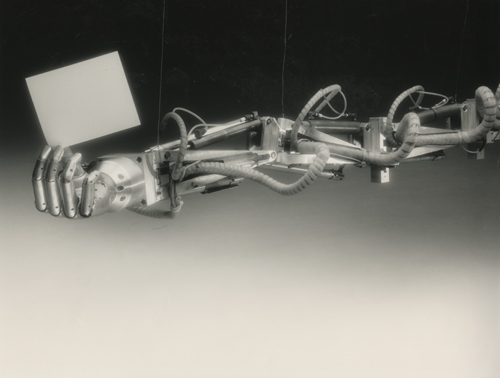
Odd that it doesn't have a Wikipedia page though. Should rectify that, eh?
* * * *
Seen on Shapeshifting blog.
Pasted from Wikipedia: Bell-Boeing V-22 Osprey
• • • • •
The Bell-Boeing V-22 Osprey is a multi-mission, military, tiltrotor aircraft with both a vertical takeoff and landing (VTOL), and short takeoff and landing (STOL) capability. It is designed to combine the functionality of a conventional helicopter with the long-range, high-speed cruise performance of a turboprop aircraft.
The V-22 originated from the U.S. Department of Defense Joint-service Vertical take-off/landing Experimental (JVX) aircraft program started in 1981. It was developed jointly by the Bell Helicopter, and Boeing Helicopters team, known as Bell Boeing, which produce the aircraft.[4] The V-22 first flew in 1989, and began years of flight testing and design alterations.
The United States Marine Corps began crew training for the Osprey in 2000, and fielded it in 2007. The Osprey's other operator, the U.S. Air Force fielded their version of the tiltrotor in 2009. Since entering service with the U.S. Marine Corps and Air Force, the Osprey has been deployed for combat operations in Iraq and Afghanistan.
Contents
•• 1.2 Flight testing and design changes
• 2 Design
• 8 Notable appearances in media
Development
Early development
The failure of the Iran hostage rescue mission in 1980 demonstrated to the United States military a need[5] for "a new type of aircraft, that could not only take off and land vertically but also could carry combat troops, and do so at speed."[6] The U.S. Department of Defense began the Joint-service Vertical take-off/landing Experimental (JVX) aircraft program in 1981, under U.S. Army leadership. Later the U.S. Navy/Marine Corps took the lead.[7][8] The JVX combined requirements from the Marine Corps, Air Force, Army and Navy.[9][10] A request for proposals (RFP) was issued in December 1982 for JVX preliminary design work. Interest in the program was expressed by Aérospatiale, Bell Helicopter, Boeing Vertol, Grumman, Lockheed, and Westland. The DoD pushed for contractors to form teams. Bell partnered with Boeing Vertol. The Bell Boeing team submitted a proposal for a enlarged version of the Bell XV-15 prototype on 17 February 1983. This was the only proposal received and a preliminary design contract was awarded on 26 April 1983.[11][12]
The JVX aircraft was designated V-22 Osprey on 15 January 1985; by March that same year the first six prototypes were being produced, and Boeing Vertol was expanded to deal with the project workload.[13][14] Work has been split evenly between Bell and Boeing. Bell Helicopter manufactures and integrates the wing, nacelles, rotors, drive system, tail surfaces, and aft ramp, as well as integrates the Rolls-Royce engines and performs final assembly. Boeing Helicopters manufactures and integrates the fuselage, cockpit, avionics, and flight controls.[4][15] The USMC variant of the Osprey received the MV-22 designation and the Air Force variant received CV-22; reversed from normal procedure to prevent Marine Ospreys from having a conflicting designation with aircraft carriers (CV).[16] Full-scale development of the V-22 tilt-rotor aircraft began in 1986.[2] On 3 May 1986 the Bell-Boeing partnership was awarded a $1.714 billion contract for V-22 aircraft by the Navy, thus at this point the project had acquisition plans with all four arms of the U.S. military.[17]
The first V-22 was rolled out with significant media attention in May 1988.[18][19] However the project suffered several political blows. Firstly in the same year, the Army left the program, citing a need to focus its budget on more immediate aviation programs.[20] The project also faced considerable dialogue in the Senate, surviving two votes that both could have resulted in cancellation.[21][22] Despite the Senate's decision, the Department of Defense instructed the Navy not to spend more money on the Osprey.[23] At the same time, the Bush administration sought the cancellation of the project.[23]
Flight testing and design changes
The first of six MV-22 prototypes first flew on 19 March 1989 in the helicopter mode,[24] and on 14 September 1989 as a fixed-wing plane.[25] The third and fourth prototypes successfully completed the Osprey's first Sea Trials on the USS Wasp in December 1990.[26] However, the fourth and fifth prototypes crashed in 1991-92.[27] Flight tests were resumed in August 1993 after changes were incorporated in the prototypes.[2] From October 1992 until April 1993, Bell and Boeing redesigned the V-22 to reduce empty weight, simplify manufacture and reduce production costs. This redesigned version became the B-model.[28]
Flight testing of four full-scale development V-22s began in early 1997 when the first pre-production V-22 was delivered to the Naval Air Warfare Test Center, Naval Air Station Patuxent River, Maryland. The first EMD flight took place on 5 February 1997. The first of four low rate initial production aircraft, ordered on 28 April 1997, was delivered on 27 May 1999. Osprey number 10 completed the program's second Sea Trials, this time from the USS Saipan in January 1999.[2] During external load testing in April 1999, Boeing used a V-22 to lift and transport the M777 howitzer.[29] In 2000, Boeing announced that the V-22 would be fitted with a nose-mounted GAU-19 Gatling gun,[30] but the GAU-19 gun was later canceled.[31]
In 2000, there were two further fatal crashes, killing a total of 19 Marines, and the production was again halted while the cause of these crashes was investigated and various parts were redesigned.[32] The V-22 completed its final operational evaluation in June 2005. The evaluation was deemed successful; events included long range deployments, high altitude, desert and shipboard operations. The problems identified in various accidents had been addressed.[33]
Controversy
The V-22's development process has been long and controversial, partly due to its large cost increases.[34] When the development budget, first planned for $2.5 billion in 1986, increased to a projected $30 billion in 1988, then-Defense Secretary Dick Cheney tried to zero out its funding. He was eventually overruled by Congress.[32] As of 2008, $27 billion have been spent on the Osprey program and another $27.2 billion will be required to complete planned production numbers by the end of the program.[2]
The V-22 squadron's former commander at Marine Corps Air Station New River, Lt. Colonel Odin Lieberman, was relieved of duty in 2001 after allegations that he instructed his unit that they needed to falsify maintenance records to make the plane appear more reliable.[2][35] Three officers were later implicated in the falsification scandal.[34]
The aircraft is incapable of autorotation, and is therefore unable to land safely in helicopter mode if both engines fail. A director of the Pentagon's testing office in 2005 said that if the Osprey loses power while flying like a helicopter below 1,600 feet (490 m), emergency landings "are not likely to be survivable". But Captain Justin (Moon) McKinney, a V-22 pilot, says that this will not be a problem, "We can turn it into a plane and glide it down, just like a C-130".[31] A complete loss of power would require the failure of both engines, as a drive shaft connects the nacelles through the wing; one engine can power both proprotors.[36] While vortex ring state (VRS) contributed to a deadly V-22 accident, the aircraft is less susceptible to the condition than conventional helicopters and recovers more quickly.[5] The Marines now train new pilots in the recognition of and recovery from VRS and have instituted operational envelope limits and instrumentation to help pilots avoid VRS conditions.[32][37]
It was planned in 2000 to equip all V-22s with a nose-mounted Gatling gun, to provide "the V-22 with a strong defensive firepower capability to greatly increase the aircraft's survivability in hostile actions."[30] The nose gun project was canceled however, leading to criticism by retired Marine Corps Commandant General James L. Jones, who is not satisfied with the current V-22 armament.[31] A belly-mounted turret was later installed on some of the first V-22s sent to the War in Afghanistan in 2009.[38]
With the first combat deployment of the MV-22 in October 2007, Time Magazine ran an article condemning the aircraft as unsafe, overpriced, and completely inadequate.[31] The Marine Corps, however, responded with the assertion that much of the article's data were dated, obsolete, inaccurate, and reflected expectations that ran too high for any new field of aircraft.[39]
Recent development
On 28 September 2005, the Pentagon formally approved full-rate production for the V-22.[40] The plan is to boost production from 11 a year to between 24 and 48 a year by 2012. Of the 458 total planned, 360 are for the Marine Corps, 48 for the Navy, and 50 for the Air Force at an average cost of $110 million per aircraft, including development costs.[2] The V-22 had an incremental flyaway cost of $70 million per aircraft in 2007,[3] but the Navy hopes to shave about $10 million off that cost after a five-year production contract starts in 2008.[41]
The Bell-Boeing Joint Project Office in Amarillo, Texas will design a new integrated avionics processor to resolve electronics obsolescence issues and add new network capabilities.[42]
Design
The Osprey is the world's first production tiltrotor aircraft, with one three-bladed proprotor, turboprop engine, and transmission nacelle mounted on each wingtip. It is classified as a powered lift aircraft by the Federal Aviation Administration.[43] For takeoff and landing, it typically operates as a helicopter with the nacelles vertical (rotors horizontal). Once airborne, the nacelles rotate forward 90° in as little as 12 seconds for horizontal flight, converting the V-22 to a more fuel-efficient, higher-speed turboprop airplane. STOL rolling-takeoff and landing capability is achieved by having the nacelles tilted forward up to 45°. For compact storage and transport, the V-22's wing rotates to align, front-to-back, with the fuselage. The proprotors can also fold in a sequence taking 90 seconds.[44]
Most Osprey missions will use fixed wing flight 75 percent or more of the time, reducing wear and tear on the aircraft and reducing operational costs.[45] This fixed wing flight is higher than typical helicopter missions allowing longer range line-of-sight communications and so improved command and control.[2] Boeing has stated the V-22 design loses 10% of its vertical lift over a Tiltwing design when operating in helicopter mode because of airflow resistance due to the wings, but that the Tiltrotor design has better short takeoff and landing performance.[46]
The V-22 is equipped with a glass cockpit, which incorporates four Multi-function displays (MFDs) and one shared Central Display Unit (CDU), allowing the pilots to display a variety of images including: digimaps centered or decentered on current position, FLIR imagery, primary flight instruments, navigation (TACAN, VOR, ILS, GPS, INS), and system status. The flight director panel of the Cockpit Management System (CMS) allows for fully-coupled (aka: autopilot) functions which will take the aircraft from forward flight into a 50-foot hover with no pilot interaction other than programming the system.[47] The glass cockpit of the canceled CH-46X was derived from the V-22.[48]
The V-22 is a fly-by-wire aircraft with triple-redundant flight control systems.[49] With the nacelles pointing straight up in conversion mode at 90° the flight computers command the aircraft to fly like a helicopter, with cyclic forces being applied to a conventional swashplate at the rotor hub. With the nacelles in airplane mode (0°) the flaperons, rudder, and elevator fly the aircraft like an airplane. This is a gradual transition and occurs over the rotation range of the nacelles. The lower the nacelles, the greater effect of the airplane-mode control surfaces.[50] The nacelles can rotate past vertical to 97.5° for rearward flight.[51][52]
The Osprey can be armed with one M240 7.62x51mm NATO (.308 in caliber) or M2 .50 in caliber (12.7 mm) machine gun on the loading ramp, that can be fired rearward when the ramp is lowered. A GAU-19 three-barrel .50 in gatling gun mounted below the V-22's nose has also been studied for future upgrade.[31][53] BAE Systems developed a remotely operated turreted weapons system for the V-22,[54] which was installed on half of the first V-22s deployed to Afghanistan in 2009.[38] The 7.62 mm belly gun turret is remotely operated by a gunner inside the aircraft, who acquires targets with a separate pod using color television and forward looking infrared imagery.
U.S. Naval Air Systems Command is working on upgrades to increase the maximum speed from 250 knots (460 km/h; 290 mph) to 270 knots (500 km/h; 310 mph), increase helicopter mode altitude limit from 10,000 feet (3,000 m) to 12,000 feet (3,700 m) or 14,000 feet (4,300 m), and increase lift performance.[55]
Operational history
US Marine Corps
Marine Corps crew training on the Osprey has been conducted by VMMT-204 since March 2000. On 3 June 2005, the Marine Corps helicopter squadron Marine Medium Helicopter 263 (HMM-263), stood down to begin the process of transitioning to the MV-22 Osprey.[56] On 8 December 2005, Lieutenant General Amos, commander of the II MEF, accepted the delivery of the first fleet of MV-22s, delivered to HMM-263. The unit reactivated on 3 March 2006 as the first MV-22 squadron and was redesignated VMM-263. On 31 August 2006, VMM-162 (the former HMM-162) followed suit. On 23 March 2007, HMM-266 became Marine Medium Tiltrotor Squadron 266 (VMM-266) at Marine Corps Air Station New River, North Carolina.[57]
The Osprey has been replacing existing CH-46 Sea Knight squadrons.[58] The MV-22 reached initial operational capability (IOC) with the U.S. Marine Corps on 13 June 2007.[1] On 10 July 2007 an MV-22 Osprey landed aboard the Royal Navy aircraft carrier, HMS Illustrious in the Atlantic Ocean. This marked the first time a V-22 had landed on any non-U.S. vessel.[59]
On 13 April 2007, the U.S. Marine Corps announced that it would be sending ten V-22 aircraft to Iraq, the Osprey's first combat deployment. Marine Corps Commandant, General James Conway, indicated that over 150 Marines would accompany the Osprey set for September deployment to Al-Asad Airfield.[60][61] On 17 September 2007, ten MV-22Bs of VMM-263 left for Iraq aboard the USS Wasp. The decision to use a ship rather than use the Osprey's self-deployment capability was made because of concerns over icing during the North Atlantic portion of the trip, lack of available KC-130s for mid-air refueling, and the availability of the USS Wasp.[62]
The Osprey has provided support in Iraq, racking up some 2,000 flight hours over three months with a mission capable availability rate of 68.1% as of late-January 2008.[63] They are primarily used in Iraq's western Anbar province for routine cargo and troop movements, and also for riskier "aero-scout" missions. General David Petraeus, the top U.S. military commander in Iraq, used one to fly around Iraq on Christmas Day 2007 to visit troops.[64] Then-presidential candidate Barack Obama also flew in Ospreys during his high profile 2008 tour of Iraq.[65]
The only major problem has been obtaining the necessary spare parts to maintain the aircraft.[66] The V-22 had flown 3,000 sorties totaling 5,200 hours in Iraq as of July 2008.[67] USMC leadership expect to deploy MV-22s to Afghanistan in 2009.[66][68] General George J. Trautman, III praised the increased range of the V-22 over the legacy helicopters in Iraq and said that "it turned his battle space from the size of Texas into the size of Rhode Island."[69]
Naval Air Systems Command has devised a temporary fix for sailors to place portable heat shields under Osprey engines to prevent damage to the decks of some of the Navy's smaller amphibious ships, but they determined that a long term solution to the problem would require these decks be redesigned with heat resistant deck coatings, passive thermal barriers and changes in ship structure in order to operate V-22s and F-35Bs.[70]
A Government Accountability Office study reported that by January 2009 the Marines had 12 MV-22s operating in Iraq and they managed to successfully complete all assigned missions. The same report found that the V-22 deployments had mission capable rates averaging 57% to 68% and an overall full mission capable rate of only 6%. It also stated that the aircraft had shown weakness in situational awareness, maintenance, shipboard operations and the ability to transport troops and external cargo.[71] That study also concluded that the "deployments confirmed that the V-22’s enhanced speed and range enable personnel and internal cargo to be transported faster and farther than is possible with the legacy helicopters it is replacing".[71]
The MV-22 saw its first offensive combat mission, Operation Cobra's Anger on 4 December 2009. Ospreys assisted in inserting 1,000 Marines and 150 Afghan troops into the Now Zad Valley of Helmand Province in southern Afghanistan to disrupt communication and supply lines of the Taliban.[38] In January 2010 the MV-22 Osprey is being sent to Haiti as part of Operation Unified Response relief efforts after the earthquake there. This will be the first use the Marine V-22 in a humanitarian mission.[72]
US Air Force
The Air Force's first operational CV-22 Osprey was delivered to the 58th Special Operations Wing (58th SOW) at Kirtland Air Force Base, New Mexico on 20 March 2006. This and subsequent aircraft will become part of the 58th SOW's fleet of aircraft used for training pilots and crew members for special operations use.[73] On 16 November 2006, the Air Force officially accepted the CV-22 in a ceremony conducted at Hurlburt Field, Florida.[74]
The US Air Force's first operational deployment of the Osprey sent four CV-22s to Mali in November 2008 in support of Exercise Flintlock. The CV-22s flew nonstop from Hurlburt Field, Florida with in-flight refueling.[5] AFSOC declared that the 8th Special Operations Squadron reached Initial Operational Capability on 16 March 2009, with six of its planned nine CV-22s operational.[75]
In June 2009, CV-22s of the 8th Special Operations Squadron delivered 43,000 pounds (20,000 kg) of humanitarian supplies to remote villages in Honduras that were not accessible by conventional vehicles.[76] In November 2009, the 8th SO Squadron and its six CV-22s returned from a three-month deployment in Iraq.[77]
The first possible combat loss of an Osprey occurred on 9 April, 2010, as a CV-22 went down near Qalat, Zabul Province, Afghanistan, killing four.[78][79]
Potential operators
In 1999 the V-22 was studied for use in the United Kingdom's Royal Navy,[80] it has been raised several times as a candidate for the role of Maritime Airborne Surveillance and Control (MASC).[81]
Israel had shown interest in the purchase of MV-22s, but no order was placed.[82][83] Flightglobal reported in late 2009 that Israel has decided to wait for the CH-53K instead.[84]
The V-22 Osprey is a candidate for the Norwegian All Weather Search and Rescue Helicopter (NAWSARH) that is planned to replace the Westland Sea King Mk.43B of the Royal Norwegian Air Force in 2015.[85] The other candidates for the NAWSARH contract of 10-12 helicopters are AgustaWestland AW101 Merlin, Eurocopter EC225, NHIndustries NH90 and Sikorsky S-92.[86]
Bell Boeing has made an unsolicited offer of the V-22 for US Army medical evacuation needs.[87] However the Joint Personnel Recovery Agency issued a report that said that a common helicopter design would be needed for both combat recovery and medical evacuation and that the V-22 would not be suitable for recovery missions because of the difficulty of hoist operations and lack of self-defense capabilities.[88]
The US Navy remains a potential user of the V-22, but its role and mission with the Navy remains unclear. The latest proposal is to replace the C-2 Greyhound with the V-22 in the fleet logistics role. The V-22 would have the advantage of being able to land on and support non-carriers with rapid delivery of supplies and people between the ships of a taskforce or to ships on patrol beyond helicopter range.[89] Loren B. Thompson of the Lexington Institute has suggested V-22s for use in combat search and rescue and Marine One VIP transport, which also need replacement aircraft.[90]
Variants
• V-22A
•• Pre-production full-scale development aircraft used for flight testing. These are unofficially considered A-variants after 1993 redesign.[91]
• HV-22
•• The U.S. Navy considered an HV-22 to provide combat search and rescue, delivery and retrieval of special warfare teams along with fleet logistic support transport. However, it chose the MH-60S for this role in 1992.[92]
• SV-22
•• The proposed anti-submarine warfare Navy variant. The Navy studied the SV-22 in the 1980s to replace S-3 and SH-2 aircraft.[93]
• MV-22B
•• Basic U.S. Marine Corps transport; original requirement for 552 (now 360). The Marine Corps is the lead service in the development of the V-22 Osprey. The Marine Corps variant, the MV-22B, is an assault transport for troops, equipment and supplies, capable of operating from ships or from expeditionary airfields ashore. It is replacing the Marine Corps' CH-46E[57] and CH-53D.[94]
• CV-22B
•• Air Force variant for the U.S. Special Operations Command (USSOCOM). It will conduct long-range, special operations missions, and is equipped with extra fuel tanks and terrain-following radar.[95][96]
Operators
•• 8th Special Operations Squadron (8 SOS) at Hurlburt Field, Florida
•• 71st Special Operations Squadron (71 SOS) at Kirtland Air Force Base, New Mexico
•• 20th Special Operations Squadron (20 SOS) at Cannon Air Force Base, New Mexico
•• VMM-161
•• VMM-162
•• VMM-261
•• VMM-263
•• VMM-264
•• VMM-266
•• VMM-365
•• VMMT-204 - Training squadron
•• VMX-22 - Marine Tiltrotor Operational Test and Evaluation Squadron
Notable accidents
Main article: Accidents and incidents involving the V-22 Osprey
From 1991 to 2000 there were four significant crashes, and a total of 30 fatalities, during testing.[32] Since becoming operational in 2007, the V-22 has had one possible combat loss due to an unknown cause, no losses due to accidents, and seven other notable, but minor, incidents.
• On 11 June 1991, a mis-wired flight control system led to two minor injuries when the left nacelle struck the ground while the aircraft was hovering 15 feet (4.6 m) in the air, causing it to bounce and catch fire.[97]
• On 20 July 1992, a leaking gearbox led to a fire in the right nacelle, causing the aircraft to drop into the Potomac River in front of an audience of Congressmen and other government officials at Quantico, killing all seven on board and grounding the aircraft for 11 months.[98]
• On 8 April 2000, a V-22 loaded with Marines to simulate a rescue, attempted to land at Marana Northwest Regional Airport in Arizona, stalled when its right rotor entered vortex ring state, rolled over, crashed, and exploded, killing all 19 on board.[37]
• On 11 December 2000, after a catastrophic hydraulic leak and subsequent software instrument failure, a V-22 fell 1,600 feet (490 m) into a forest in Jacksonville, North Carolina, killing all four aboard. This caused the Marine Corps to ground their fleet of eight V-22s, the second grounding that year.[99][100]
Specifications (MV-22B)
Data from Boeing Integrated Defense Systems,[101] Naval Air Systems Command,[102] US Air Force CV-22 fact sheet,[95] Norton,[103] and Bell[104]
General characteristics
• Crew: Four (pilot, copilot and two flight engineers)
• Capacity: 24 troops (seated), 32 troops (floor loaded) or up to 15,000 lb (6,800 kg) of cargo (dual hook)
• Length: 57 ft 4 in (17.5 m)
• Rotor diameter: 38 ft 0 in (11.6 m)
• Wingspan: 45 ft 10 in (14 m)
• Width with rotors: 84 ft 7 in (25.8 m)
• Height: 22 ft 1 in/6.73 m; overall with nacelles vertical (17 ft 11 in/5.5 m; at top of tailfins)
• Disc area: 2,268 ft² (212 m²)
• Wing area: 301.4 ft² (28 m²)
• Empty weight: 33,140 lb (15,032 kg)
• Loaded weight: 47,500 lb (21,500 kg)
• Max takeoff weight: 60,500 lb (27,400 kg)
• Powerplant: 2× Rolls-Royce Allison T406/AE 1107C-Liberty turboshafts, 6,150 hp (4,590 kW) each
Performance
• Maximum speed: 250 knots (460 km/h, 290 mph) at sea level / 305 kn (565 km/h; 351 mph) at 15,000 ft (4,600 m)[105]
• Cruise speed: 241 knots (277 mph, 446 km/h) at sea level
• Range: 879 nmi (1,011 mi, 1,627 km)
• Combat radius: 370 nmi (426 mi, 685 km)
• Ferry range: 1,940 nmi (with auxiliary internal fuel tanks)
• Service ceiling: 26,000 ft (7,925 m)
• Rate of climb: 2,320 ft/min (11.8 m/s)
• Disc loading: 20.9 lb/ft² at 47,500 lb GW (102.23 kg/m²)
• Power/mass: 0.259 hp/lb (427 W/kg)
Armament
• 1× M240 machine gun on ramp, optional
Notable appearances in media
Main article: Aircraft in fiction#V-22 Osprey
See also
• Elizabeth A. Okoreeh-Baah, USMC - first female to pilot a V-22 Osprey
Related development
Comparable aircraft
Related lists
• List of military aircraft of the United States
References
Bibliography
• Markman, Steve and Bill Holder. "Bell/Boeing V-22 Osprey Tilt-Engine VTOL Transport (U.S.A.)". Straight Up: A History of Vertical Flight. Schiffer Publishing, 2000. ISBN 0-7643-1204-9.
• Norton, Bill. Bell Boeing V-22 Osprey, Tiltrotor Tactical Transport. Midland Publishing, 2004. ISBN 1-85780-165-2.
External links
Wikimedia Commons has media related to: V-22 Osprey
• V-22 Osprey web, and www.history.navy.mil/planes/v-22.html
• CV-22 fact sheet on USAF site
• www.globalsecurity.org/military/systems/aircraft/v-22.htm
• www.airforce-technology.com/projects/osprey/
• "Flight of the Osprey", US Navy video of V-22 operations
Pasted from Wikipedia: Bell-Boeing V-22 Osprey
• • • • •
The Bell-Boeing V-22 Osprey is a multi-mission, military, tiltrotor aircraft with both a vertical takeoff and landing (VTOL), and short takeoff and landing (STOL) capability. It is designed to combine the functionality of a conventional helicopter with the long-range, high-speed cruise performance of a turboprop aircraft.
The V-22 originated from the U.S. Department of Defense Joint-service Vertical take-off/landing Experimental (JVX) aircraft program started in 1981. It was developed jointly by the Bell Helicopter, and Boeing Helicopters team, known as Bell Boeing, which produce the aircraft.[4] The V-22 first flew in 1989, and began years of flight testing and design alterations.
The United States Marine Corps began crew training for the Osprey in 2000, and fielded it in 2007. The Osprey's other operator, the U.S. Air Force fielded their version of the tiltrotor in 2009. Since entering service with the U.S. Marine Corps and Air Force, the Osprey has been deployed for combat operations in Iraq and Afghanistan.
Contents
•• 1.2 Flight testing and design changes
• 2 Design
• 8 Notable appearances in media
Development
Early development
The failure of the Iran hostage rescue mission in 1980 demonstrated to the United States military a need[5] for "a new type of aircraft, that could not only take off and land vertically but also could carry combat troops, and do so at speed."[6] The U.S. Department of Defense began the Joint-service Vertical take-off/landing Experimental (JVX) aircraft program in 1981, under U.S. Army leadership. Later the U.S. Navy/Marine Corps took the lead.[7][8] The JVX combined requirements from the Marine Corps, Air Force, Army and Navy.[9][10] A request for proposals (RFP) was issued in December 1982 for JVX preliminary design work. Interest in the program was expressed by Aérospatiale, Bell Helicopter, Boeing Vertol, Grumman, Lockheed, and Westland. The DoD pushed for contractors to form teams. Bell partnered with Boeing Vertol. The Bell Boeing team submitted a proposal for a enlarged version of the Bell XV-15 prototype on 17 February 1983. This was the only proposal received and a preliminary design contract was awarded on 26 April 1983.[11][12]
The JVX aircraft was designated V-22 Osprey on 15 January 1985; by March that same year the first six prototypes were being produced, and Boeing Vertol was expanded to deal with the project workload.[13][14] Work has been split evenly between Bell and Boeing. Bell Helicopter manufactures and integrates the wing, nacelles, rotors, drive system, tail surfaces, and aft ramp, as well as integrates the Rolls-Royce engines and performs final assembly. Boeing Helicopters manufactures and integrates the fuselage, cockpit, avionics, and flight controls.[4][15] The USMC variant of the Osprey received the MV-22 designation and the Air Force variant received CV-22; reversed from normal procedure to prevent Marine Ospreys from having a conflicting designation with aircraft carriers (CV).[16] Full-scale development of the V-22 tilt-rotor aircraft began in 1986.[2] On 3 May 1986 the Bell-Boeing partnership was awarded a $1.714 billion contract for V-22 aircraft by the Navy, thus at this point the project had acquisition plans with all four arms of the U.S. military.[17]
The first V-22 was rolled out with significant media attention in May 1988.[18][19] However the project suffered several political blows. Firstly in the same year, the Army left the program, citing a need to focus its budget on more immediate aviation programs.[20] The project also faced considerable dialogue in the Senate, surviving two votes that both could have resulted in cancellation.[21][22] Despite the Senate's decision, the Department of Defense instructed the Navy not to spend more money on the Osprey.[23] At the same time, the Bush administration sought the cancellation of the project.[23]
Flight testing and design changes
The first of six MV-22 prototypes first flew on 19 March 1989 in the helicopter mode,[24] and on 14 September 1989 as a fixed-wing plane.[25] The third and fourth prototypes successfully completed the Osprey's first Sea Trials on the USS Wasp in December 1990.[26] However, the fourth and fifth prototypes crashed in 1991-92.[27] Flight tests were resumed in August 1993 after changes were incorporated in the prototypes.[2] From October 1992 until April 1993, Bell and Boeing redesigned the V-22 to reduce empty weight, simplify manufacture and reduce production costs. This redesigned version became the B-model.[28]
Flight testing of four full-scale development V-22s began in early 1997 when the first pre-production V-22 was delivered to the Naval Air Warfare Test Center, Naval Air Station Patuxent River, Maryland. The first EMD flight took place on 5 February 1997. The first of four low rate initial production aircraft, ordered on 28 April 1997, was delivered on 27 May 1999. Osprey number 10 completed the program's second Sea Trials, this time from the USS Saipan in January 1999.[2] During external load testing in April 1999, Boeing used a V-22 to lift and transport the M777 howitzer.[29] In 2000, Boeing announced that the V-22 would be fitted with a nose-mounted GAU-19 Gatling gun,[30] but the GAU-19 gun was later canceled.[31]
In 2000, there were two further fatal crashes, killing a total of 19 Marines, and the production was again halted while the cause of these crashes was investigated and various parts were redesigned.[32] The V-22 completed its final operational evaluation in June 2005. The evaluation was deemed successful; events included long range deployments, high altitude, desert and shipboard operations. The problems identified in various accidents had been addressed.[33]
Controversy
The V-22's development process has been long and controversial, partly due to its large cost increases.[34] When the development budget, first planned for $2.5 billion in 1986, increased to a projected $30 billion in 1988, then-Defense Secretary Dick Cheney tried to zero out its funding. He was eventually overruled by Congress.[32] As of 2008, $27 billion have been spent on the Osprey program and another $27.2 billion will be required to complete planned production numbers by the end of the program.[2]
The V-22 squadron's former commander at Marine Corps Air Station New River, Lt. Colonel Odin Lieberman, was relieved of duty in 2001 after allegations that he instructed his unit that they needed to falsify maintenance records to make the plane appear more reliable.[2][35] Three officers were later implicated in the falsification scandal.[34]
The aircraft is incapable of autorotation, and is therefore unable to land safely in helicopter mode if both engines fail. A director of the Pentagon's testing office in 2005 said that if the Osprey loses power while flying like a helicopter below 1,600 feet (490 m), emergency landings "are not likely to be survivable". But Captain Justin (Moon) McKinney, a V-22 pilot, says that this will not be a problem, "We can turn it into a plane and glide it down, just like a C-130".[31] A complete loss of power would require the failure of both engines, as a drive shaft connects the nacelles through the wing; one engine can power both proprotors.[36] While vortex ring state (VRS) contributed to a deadly V-22 accident, the aircraft is less susceptible to the condition than conventional helicopters and recovers more quickly.[5] The Marines now train new pilots in the recognition of and recovery from VRS and have instituted operational envelope limits and instrumentation to help pilots avoid VRS conditions.[32][37]
It was planned in 2000 to equip all V-22s with a nose-mounted Gatling gun, to provide "the V-22 with a strong defensive firepower capability to greatly increase the aircraft's survivability in hostile actions."[30] The nose gun project was canceled however, leading to criticism by retired Marine Corps Commandant General James L. Jones, who is not satisfied with the current V-22 armament.[31] A belly-mounted turret was later installed on some of the first V-22s sent to the War in Afghanistan in 2009.[38]
With the first combat deployment of the MV-22 in October 2007, Time Magazine ran an article condemning the aircraft as unsafe, overpriced, and completely inadequate.[31] The Marine Corps, however, responded with the assertion that much of the article's data were dated, obsolete, inaccurate, and reflected expectations that ran too high for any new field of aircraft.[39]
Recent development
On 28 September 2005, the Pentagon formally approved full-rate production for the V-22.[40] The plan is to boost production from 11 a year to between 24 and 48 a year by 2012. Of the 458 total planned, 360 are for the Marine Corps, 48 for the Navy, and 50 for the Air Force at an average cost of $110 million per aircraft, including development costs.[2] The V-22 had an incremental flyaway cost of $70 million per aircraft in 2007,[3] but the Navy hopes to shave about $10 million off that cost after a five-year production contract starts in 2008.[41]
The Bell-Boeing Joint Project Office in Amarillo, Texas will design a new integrated avionics processor to resolve electronics obsolescence issues and add new network capabilities.[42]
Design
The Osprey is the world's first production tiltrotor aircraft, with one three-bladed proprotor, turboprop engine, and transmission nacelle mounted on each wingtip. It is classified as a powered lift aircraft by the Federal Aviation Administration.[43] For takeoff and landing, it typically operates as a helicopter with the nacelles vertical (rotors horizontal). Once airborne, the nacelles rotate forward 90° in as little as 12 seconds for horizontal flight, converting the V-22 to a more fuel-efficient, higher-speed turboprop airplane. STOL rolling-takeoff and landing capability is achieved by having the nacelles tilted forward up to 45°. For compact storage and transport, the V-22's wing rotates to align, front-to-back, with the fuselage. The proprotors can also fold in a sequence taking 90 seconds.[44]
Most Osprey missions will use fixed wing flight 75 percent or more of the time, reducing wear and tear on the aircraft and reducing operational costs.[45] This fixed wing flight is higher than typical helicopter missions allowing longer range line-of-sight communications and so improved command and control.[2] Boeing has stated the V-22 design loses 10% of its vertical lift over a Tiltwing design when operating in helicopter mode because of airflow resistance due to the wings, but that the Tiltrotor design has better short takeoff and landing performance.[46]
The V-22 is equipped with a glass cockpit, which incorporates four Multi-function displays (MFDs) and one shared Central Display Unit (CDU), allowing the pilots to display a variety of images including: digimaps centered or decentered on current position, FLIR imagery, primary flight instruments, navigation (TACAN, VOR, ILS, GPS, INS), and system status. The flight director panel of the Cockpit Management System (CMS) allows for fully-coupled (aka: autopilot) functions which will take the aircraft from forward flight into a 50-foot hover with no pilot interaction other than programming the system.[47] The glass cockpit of the canceled CH-46X was derived from the V-22.[48]
The V-22 is a fly-by-wire aircraft with triple-redundant flight control systems.[49] With the nacelles pointing straight up in conversion mode at 90° the flight computers command the aircraft to fly like a helicopter, with cyclic forces being applied to a conventional swashplate at the rotor hub. With the nacelles in airplane mode (0°) the flaperons, rudder, and elevator fly the aircraft like an airplane. This is a gradual transition and occurs over the rotation range of the nacelles. The lower the nacelles, the greater effect of the airplane-mode control surfaces.[50] The nacelles can rotate past vertical to 97.5° for rearward flight.[51][52]
The Osprey can be armed with one M240 7.62x51mm NATO (.308 in caliber) or M2 .50 in caliber (12.7 mm) machine gun on the loading ramp, that can be fired rearward when the ramp is lowered. A GAU-19 three-barrel .50 in gatling gun mounted below the V-22's nose has also been studied for future upgrade.[31][53] BAE Systems developed a remotely operated turreted weapons system for the V-22,[54] which was installed on half of the first V-22s deployed to Afghanistan in 2009.[38] The 7.62 mm belly gun turret is remotely operated by a gunner inside the aircraft, who acquires targets with a separate pod using color television and forward looking infrared imagery.
U.S. Naval Air Systems Command is working on upgrades to increase the maximum speed from 250 knots (460 km/h; 290 mph) to 270 knots (500 km/h; 310 mph), increase helicopter mode altitude limit from 10,000 feet (3,000 m) to 12,000 feet (3,700 m) or 14,000 feet (4,300 m), and increase lift performance.[55]
Operational history
US Marine Corps
Marine Corps crew training on the Osprey has been conducted by VMMT-204 since March 2000. On 3 June 2005, the Marine Corps helicopter squadron Marine Medium Helicopter 263 (HMM-263), stood down to begin the process of transitioning to the MV-22 Osprey.[56] On 8 December 2005, Lieutenant General Amos, commander of the II MEF, accepted the delivery of the first fleet of MV-22s, delivered to HMM-263. The unit reactivated on 3 March 2006 as the first MV-22 squadron and was redesignated VMM-263. On 31 August 2006, VMM-162 (the former HMM-162) followed suit. On 23 March 2007, HMM-266 became Marine Medium Tiltrotor Squadron 266 (VMM-266) at Marine Corps Air Station New River, North Carolina.[57]
The Osprey has been replacing existing CH-46 Sea Knight squadrons.[58] The MV-22 reached initial operational capability (IOC) with the U.S. Marine Corps on 13 June 2007.[1] On 10 July 2007 an MV-22 Osprey landed aboard the Royal Navy aircraft carrier, HMS Illustrious in the Atlantic Ocean. This marked the first time a V-22 had landed on any non-U.S. vessel.[59]
On 13 April 2007, the U.S. Marine Corps announced that it would be sending ten V-22 aircraft to Iraq, the Osprey's first combat deployment. Marine Corps Commandant, General James Conway, indicated that over 150 Marines would accompany the Osprey set for September deployment to Al-Asad Airfield.[60][61] On 17 September 2007, ten MV-22Bs of VMM-263 left for Iraq aboard the USS Wasp. The decision to use a ship rather than use the Osprey's self-deployment capability was made because of concerns over icing during the North Atlantic portion of the trip, lack of available KC-130s for mid-air refueling, and the availability of the USS Wasp.[62]
The Osprey has provided support in Iraq, racking up some 2,000 flight hours over three months with a mission capable availability rate of 68.1% as of late-January 2008.[63] They are primarily used in Iraq's western Anbar province for routine cargo and troop movements, and also for riskier "aero-scout" missions. General David Petraeus, the top U.S. military commander in Iraq, used one to fly around Iraq on Christmas Day 2007 to visit troops.[64] Then-presidential candidate Barack Obama also flew in Ospreys during his high profile 2008 tour of Iraq.[65]
The only major problem has been obtaining the necessary spare parts to maintain the aircraft.[66] The V-22 had flown 3,000 sorties totaling 5,200 hours in Iraq as of July 2008.[67] USMC leadership expect to deploy MV-22s to Afghanistan in 2009.[66][68] General George J. Trautman, III praised the increased range of the V-22 over the legacy helicopters in Iraq and said that "it turned his battle space from the size of Texas into the size of Rhode Island."[69]
Naval Air Systems Command has devised a temporary fix for sailors to place portable heat shields under Osprey engines to prevent damage to the decks of some of the Navy's smaller amphibious ships, but they determined that a long term solution to the problem would require these decks be redesigned with heat resistant deck coatings, passive thermal barriers and changes in ship structure in order to operate V-22s and F-35Bs.[70]
A Government Accountability Office study reported that by January 2009 the Marines had 12 MV-22s operating in Iraq and they managed to successfully complete all assigned missions. The same report found that the V-22 deployments had mission capable rates averaging 57% to 68% and an overall full mission capable rate of only 6%. It also stated that the aircraft had shown weakness in situational awareness, maintenance, shipboard operations and the ability to transport troops and external cargo.[71] That study also concluded that the "deployments confirmed that the V-22’s enhanced speed and range enable personnel and internal cargo to be transported faster and farther than is possible with the legacy helicopters it is replacing".[71]
The MV-22 saw its first offensive combat mission, Operation Cobra's Anger on 4 December 2009. Ospreys assisted in inserting 1,000 Marines and 150 Afghan troops into the Now Zad Valley of Helmand Province in southern Afghanistan to disrupt communication and supply lines of the Taliban.[38] In January 2010 the MV-22 Osprey is being sent to Haiti as part of Operation Unified Response relief efforts after the earthquake there. This will be the first use the Marine V-22 in a humanitarian mission.[72]
US Air Force
The Air Force's first operational CV-22 Osprey was delivered to the 58th Special Operations Wing (58th SOW) at Kirtland Air Force Base, New Mexico on 20 March 2006. This and subsequent aircraft will become part of the 58th SOW's fleet of aircraft used for training pilots and crew members for special operations use.[73] On 16 November 2006, the Air Force officially accepted the CV-22 in a ceremony conducted at Hurlburt Field, Florida.[74]
The US Air Force's first operational deployment of the Osprey sent four CV-22s to Mali in November 2008 in support of Exercise Flintlock. The CV-22s flew nonstop from Hurlburt Field, Florida with in-flight refueling.[5] AFSOC declared that the 8th Special Operations Squadron reached Initial Operational Capability on 16 March 2009, with six of its planned nine CV-22s operational.[75]
In June 2009, CV-22s of the 8th Special Operations Squadron delivered 43,000 pounds (20,000 kg) of humanitarian supplies to remote villages in Honduras that were not accessible by conventional vehicles.[76] In November 2009, the 8th SO Squadron and its six CV-22s returned from a three-month deployment in Iraq.[77]
The first possible combat loss of an Osprey occurred on 9 April, 2010, as a CV-22 went down near Qalat, Zabul Province, Afghanistan, killing four.[78][79]
Potential operators
In 1999 the V-22 was studied for use in the United Kingdom's Royal Navy,[80] it has been raised several times as a candidate for the role of Maritime Airborne Surveillance and Control (MASC).[81]
Israel had shown interest in the purchase of MV-22s, but no order was placed.[82][83] Flightglobal reported in late 2009 that Israel has decided to wait for the CH-53K instead.[84]
The V-22 Osprey is a candidate for the Norwegian All Weather Search and Rescue Helicopter (NAWSARH) that is planned to replace the Westland Sea King Mk.43B of the Royal Norwegian Air Force in 2015.[85] The other candidates for the NAWSARH contract of 10-12 helicopters are AgustaWestland AW101 Merlin, Eurocopter EC225, NHIndustries NH90 and Sikorsky S-92.[86]
Bell Boeing has made an unsolicited offer of the V-22 for US Army medical evacuation needs.[87] However the Joint Personnel Recovery Agency issued a report that said that a common helicopter design would be needed for both combat recovery and medical evacuation and that the V-22 would not be suitable for recovery missions because of the difficulty of hoist operations and lack of self-defense capabilities.[88]
The US Navy remains a potential user of the V-22, but its role and mission with the Navy remains unclear. The latest proposal is to replace the C-2 Greyhound with the V-22 in the fleet logistics role. The V-22 would have the advantage of being able to land on and support non-carriers with rapid delivery of supplies and people between the ships of a taskforce or to ships on patrol beyond helicopter range.[89] Loren B. Thompson of the Lexington Institute has suggested V-22s for use in combat search and rescue and Marine One VIP transport, which also need replacement aircraft.[90]
Variants
• V-22A
•• Pre-production full-scale development aircraft used for flight testing. These are unofficially considered A-variants after 1993 redesign.[91]
• HV-22
•• The U.S. Navy considered an HV-22 to provide combat search and rescue, delivery and retrieval of special warfare teams along with fleet logistic support transport. However, it chose the MH-60S for this role in 1992.[92]
• SV-22
•• The proposed anti-submarine warfare Navy variant. The Navy studied the SV-22 in the 1980s to replace S-3 and SH-2 aircraft.[93]
• MV-22B
•• Basic U.S. Marine Corps transport; original requirement for 552 (now 360). The Marine Corps is the lead service in the development of the V-22 Osprey. The Marine Corps variant, the MV-22B, is an assault transport for troops, equipment and supplies, capable of operating from ships or from expeditionary airfields ashore. It is replacing the Marine Corps' CH-46E[57] and CH-53D.[94]
• CV-22B
•• Air Force variant for the U.S. Special Operations Command (USSOCOM). It will conduct long-range, special operations missions, and is equipped with extra fuel tanks and terrain-following radar.[95][96]
Operators
•• 8th Special Operations Squadron (8 SOS) at Hurlburt Field, Florida
•• 71st Special Operations Squadron (71 SOS) at Kirtland Air Force Base, New Mexico
•• 20th Special Operations Squadron (20 SOS) at Cannon Air Force Base, New Mexico
•• VMM-161
•• VMM-162
•• VMM-261
•• VMM-263
•• VMM-264
•• VMM-266
•• VMM-365
•• VMMT-204 - Training squadron
•• VMX-22 - Marine Tiltrotor Operational Test and Evaluation Squadron
Notable accidents
Main article: Accidents and incidents involving the V-22 Osprey
From 1991 to 2000 there were four significant crashes, and a total of 30 fatalities, during testing.[32] Since becoming operational in 2007, the V-22 has had one possible combat loss due to an unknown cause, no losses due to accidents, and seven other notable, but minor, incidents.
• On 11 June 1991, a mis-wired flight control system led to two minor injuries when the left nacelle struck the ground while the aircraft was hovering 15 feet (4.6 m) in the air, causing it to bounce and catch fire.[97]
• On 20 July 1992, a leaking gearbox led to a fire in the right nacelle, causing the aircraft to drop into the Potomac River in front of an audience of Congressmen and other government officials at Quantico, killing all seven on board and grounding the aircraft for 11 months.[98]
• On 8 April 2000, a V-22 loaded with Marines to simulate a rescue, attempted to land at Marana Northwest Regional Airport in Arizona, stalled when its right rotor entered vortex ring state, rolled over, crashed, and exploded, killing all 19 on board.[37]
• On 11 December 2000, after a catastrophic hydraulic leak and subsequent software instrument failure, a V-22 fell 1,600 feet (490 m) into a forest in Jacksonville, North Carolina, killing all four aboard. This caused the Marine Corps to ground their fleet of eight V-22s, the second grounding that year.[99][100]
Specifications (MV-22B)
Data from Boeing Integrated Defense Systems,[101] Naval Air Systems Command,[102] US Air Force CV-22 fact sheet,[95] Norton,[103] and Bell[104]
General characteristics
• Crew: Four (pilot, copilot and two flight engineers)
• Capacity: 24 troops (seated), 32 troops (floor loaded) or up to 15,000 lb (6,800 kg) of cargo (dual hook)
• Length: 57 ft 4 in (17.5 m)
• Rotor diameter: 38 ft 0 in (11.6 m)
• Wingspan: 45 ft 10 in (14 m)
• Width with rotors: 84 ft 7 in (25.8 m)
• Height: 22 ft 1 in/6.73 m; overall with nacelles vertical (17 ft 11 in/5.5 m; at top of tailfins)
• Disc area: 2,268 ft² (212 m²)
• Wing area: 301.4 ft² (28 m²)
• Empty weight: 33,140 lb (15,032 kg)
• Loaded weight: 47,500 lb (21,500 kg)
• Max takeoff weight: 60,500 lb (27,400 kg)
• Powerplant: 2× Rolls-Royce Allison T406/AE 1107C-Liberty turboshafts, 6,150 hp (4,590 kW) each
Performance
• Maximum speed: 250 knots (460 km/h, 290 mph) at sea level / 305 kn (565 km/h; 351 mph) at 15,000 ft (4,600 m)[105]
• Cruise speed: 241 knots (277 mph, 446 km/h) at sea level
• Range: 879 nmi (1,011 mi, 1,627 km)
• Combat radius: 370 nmi (426 mi, 685 km)
• Ferry range: 1,940 nmi (with auxiliary internal fuel tanks)
• Service ceiling: 26,000 ft (7,925 m)
• Rate of climb: 2,320 ft/min (11.8 m/s)
• Disc loading: 20.9 lb/ft² at 47,500 lb GW (102.23 kg/m²)
• Power/mass: 0.259 hp/lb (427 W/kg)
Armament
• 1× M240 machine gun on ramp, optional
Notable appearances in media
Main article: Aircraft in fiction#V-22 Osprey
See also
• Elizabeth A. Okoreeh-Baah, USMC - first female to pilot a V-22 Osprey
Related development
Comparable aircraft
Related lists
• List of military aircraft of the United States
References
Bibliography
• Markman, Steve and Bill Holder. "Bell/Boeing V-22 Osprey Tilt-Engine VTOL Transport (U.S.A.)". Straight Up: A History of Vertical Flight. Schiffer Publishing, 2000. ISBN 0-7643-1204-9.
• Norton, Bill. Bell Boeing V-22 Osprey, Tiltrotor Tactical Transport. Midland Publishing, 2004. ISBN 1-85780-165-2.
External links
Wikimedia Commons has media related to: V-22 Osprey
• V-22 Osprey web, and www.history.navy.mil/planes/v-22.html
• CV-22 fact sheet on USAF site
• www.globalsecurity.org/military/systems/aircraft/v-22.htm
• www.airforce-technology.com/projects/osprey/
• "Flight of the Osprey", US Navy video of V-22 operations
The Arboretum has an interactive map on their web site. This map is found at the Arborway Gate.
Pasting from Wikipedia: Arnold Arboretum:
• • • • •
The Arnold Arboretum of Harvard University is an arboretum located in the Jamaica Plain and Roslindale sections of Boston, Massachusetts. It was designed by Frederick Law Olmsted and is the second largest "link" in the Emerald Necklace.
History
The Arboretum was founded in 1872 when the President and Fellows of Harvard College became trustees of a portion of the estate of James Arnold (1781–1868).
In 1842, Benjamin Bussey (1757–1842), a prosperous Boston merchant and scientific farmer, donated his country estate Woodland Hill and a part of his fortune to Harvard University "for instruction in agriculture, horticulture, and related subjects". Bussey had inherited land from fellow patriot Eleazer Weld in 1800 and further enlarged his large estate between 1806 and 1837 by acquiring and consolidating various farms that had been established as early as the seventeenth century. Harvard used this land for the creation of the Bussey Institute, which was dedicated to agricultural experimentation. The first Bussey Institute building was completed in 1871 and served as headquarters for an undergraduate school of agriculture.
Sixteen years after Bussey's death, James Arnold, a New Bedford, Massachusetts whaling merchant, specified that a portion of his estate was to be used for "...the promotion of Agricultural, or Horticultural improvements". In 1872, when the trustees of the will of James Arnold transferred his estate to Harvard University, Arnold’s gift was combined with 120 acres (0.49 km2) of the former Bussey estate to create the Arnold Arboretum. In the deed of trust between the Arnold trustees and the College, income from Arnold’s legacy was to be used for establishing, developing and maintaining an arboretum to be known as the Arnold Arboretum which "shall contain, as far as practicable, all the trees [and] shrubs ... either indigenous or exotic, which can be raised in the open air of West Roxbury". The historical mission of the Arnold Arboretum is to increase knowledge of woody plants through research and to disseminate this knowledge through education.
Charles Sprague Sargent was appointed director and Arnold Professor of Botany shortly after the establishment of the institution in 1872.[2] Together with landscape architect Frederick Law Olmsted he developed the road and pathway system and delineated the collection areas by family and genus, following the then current and widely accepted classification system of Bentham and Hooker. The Hunnewell building was designed by architect Alexander Wadsworth Longfellow, Jr. in 1892 and constructed with funds donated by H. H. Hunnewell in 1903. From 1946 to 1950 the landscape architect Beatrix Farrand was the landscape design consultant for the Arboretum. Her early training in the 1890s included time with Charles Sprague Sargent and chief propagator and superintendent Jackson Thornton Johnson.[3] Today the Arboretum occupies 265 acres (107 hectares) of land divided between four parcels, viz. the main Arboretum and the Peters Hill, Weld-Walter and South Street tracts. The collections, however, are located primarily in the main Arboretum and on the Peters Hill tract. The Arboretum remains one of the finest examples of a landscape designed by Frederick Law Olmsted and it is a Frederick Law Olmsted National Historic Site) and a National Historic Landmark.
Robert E. Cook is the seventh and current Director of the Arnold Arboretum. He is also the Director of the Harvard University Herbaria located in Cambridge, Massachusetts.
Status
The Arboretum is privately endowed as a department of Harvard University. The land, however, was deeded to the City of Boston in 1882 and incorporated into the so-called "Emerald Necklace". Under the agreement with the City, Harvard University was given a thousand-year lease on the property, and the University, as trustee, is directly responsible for the development, maintenance, and operation of the Arboretum; the City retains responsibility for water fountains, benches, roads, boundaries, and policing. The annual operating budget of $7,350,644 (fiscal year 2003) is largely derived from endowment, which is also managed by the University, and all Arboretum staff are University employees. Other income is obtained through granting agencies and contributors.
Location
The main Arborway gate is located on Route 203 a few hundred yards south of its junction with the Jamaicaway. Public transportation to the Arboretum is available on the MBTA Orange Line to its terminus at Forest Hills Station and by bus (#39) to the Monument in Jamaica Plain. The Arboretum is within easy walking distance from either of these points.
Hours
The grounds are open free of charge to the public from sunrise to sunset 365 days of the year. The Visitor's Center in the Hunnewell Building, 125 Arborway, is open Monday through Friday 9 a.m.–4 p.m.; Saturdays 10 a.m.–4 p.m.; Sundays 12 p.m.–4 PM. The Visitor’s Center is closed on holidays. The Library, located in the Hunnewell Building, is open Monday through Saturday, 10 a.m.–4 p.m.. The Library is closed on Sundays and holidays. Stacks are closed and the collection does not circulate.
Area
Two hundred and sixty-five acres (107 hectares) in the Jamaica Plain and Roslindale sections of Boston, Massachusetts, located at 42°19′N 71°5′W / 42.317°N 71.083°W / 42.317; -71.083, with altitudes ranging from 46 feet (15 m) in the meadow across the drive from the Hunnewell Building to 240 feet (79 m) at the top of Peters Hill.
Climate
Average yearly rainfall is 43.63 inches (1,102 mm); average snowfall, 40.2 inches (102 centimeters). Monthly mean temperature is 51.5 °F (10.8 °C); July's mean temperature is 73.5 °F (23 °C); January's is 29.6 °F (-1.3 °C). The Arboretum is located in USDA hardiness zone 6 (0 to −10 °F, −18 to −23 °C).
Collections (as of September 14, 2007)
At present, the living collections include 15,441 individual plants (including nursery holdings) belonging to 10,216 accessions representing 4,099 taxa; with particular emphasis on the ligneous species of North America and eastern Asia. Historic collections include the plant introductions from eastern Asia made by Charles Sprague Sargent, Ernest Henry Wilson, William Purdom, Joseph Hers, and Joseph Rock. Recent introductions from Asia have resulted from the 1977 Arnold Arboretum Expedition to Japan and Korea, the 1980 Sino-American Botanical Expedition to western Hubei Province, and more recent expeditions to China and Taiwan.
Comprehensive collections are maintained and augmented for most genera, and genera that have received particular emphasis include: Acer, Fagus, Carya, Forsythia, Taxodium, Pinus, Metasequoia, Lonicera, Magnolia, Malus, Quercus, Rhododendron, Syringa, Paulownia, Albizia, Ilex, Gleditsia and Tsuga. Other comprehensive collections include the Bradley Collection of Rosaceous Plants, the collection of conifers and dwarf conifers, and the Larz Anderson Bonsai Collection. Approximately 500 accessions are processed annually.
Collections policy
The mission of the Arnold Arboretum is to increase our knowledge of the evolution and biology of woody plants. Historically, this research has investigated the global distribution and evolutionary history of trees, shrubs and vines, with particular emphasis on the disjunct species of East Asia and North America. Today this work continues through molecular studies of the evolution and biogeography of the floras of temperate Asia, North America and Europe.
Research activities include molecular studies of gene evolution, investigations of plant-water relations, and the monitoring of plant phenology, vegetation succession, nutrient cycling and other factors that inform studies of environmental change. Applied work in horticulture uses the collections for studies in plant propagation, plant introduction, and environmental management. This diversity of scientific investigation is founded in a continuing commitment to acquire, grow, and document the recognized species and infraspecific taxa of ligneous plants of the Northern Hemisphere that are able to withstand the climate of the Arboretum’s 265-acre (1.07 km2) Jamaica Plain/Roslindale site.
As a primary resource for research in plant biology, the Arboretum’s living collections are actively developed, curated, and managed to support scientific investigation and study. To this end, acquisition policies place priority on obtaining plants that are genetically representative of documented wild populations. For each taxon, the Arnold Arboretum aspires to grow multiple accessions of known wild provenance in order to represent significant variation that may occur across the geographic range of the species. Accessions of garden or cultivated provenance are also acquired as governed by the collections policies herein.
For all specimens, full documentation of both provenance and history within the collection is a critical priority. Curatorial procedures provide for complete and accurate records for each accession, and document original provenance, locations in the collections, and changes in botanical identity. Herbarium specimens, DNA materials, and digital images are gathered for the collection and maintained in Arboretum data systems and the herbarium at the Roslindale site.
Research
Research on plant pathology and integrated pest management for maintenance of the living collections is constantly ongoing. Herbarium-based research focuses on the systematics and biodiversity of both temperate and tropical Asian forests, as well as the ecology and potential for sustainable use of their resources. The Arboretum's education programs offer school groups and the general public a wide range of lectures, courses, and walks focusing on the ecology and cultivation of plants. Its quarterly magazine, Arnoldia, provides in-depth information on horticulture, botany, and garden history. Current Research Initiatives
Plant Records
Plant records are maintained on a computerized database, BG-BASE 6.8 (BG-Base Inc.), which was initiated in 1985 at the request of the Arnold Arboretum and the Threatened Plants Unit (TPU) of the World Conservation Monitoring Centre (WCMC). A computerized mapping program (based on AutoCAD (Autodesk)) is linked to BG-BASE, and each accession is recorded on a series of maps at a scale of 1-inch (25 mm) to 20 feet (1:240) or 1-inch (25 mm) to 10 feet (1:120). A computer-driven embosser generates records labels. All accessioned plants in the collections are labeled with accession number, botanical name, and cultivar name (when appropriate), source information, common name, and map location. Trunk and/or display labels are also hung on many accessions and include botanical and common names and nativity. Stake labels are used to identify plants located in the Leventritt Garden and Chinese Path.
Grounds Maintenance
The grounds staff consists of the superintendent and assistant superintendent, three arborists, and ten horticultural technologists. A service garage is adjacent to the Hunnewell Building, where offices and locker rooms are located. During the summer months ten horticultural interns supplement the grounds staff. A wide array of vehicles and modern equipment, including an aerial lift truck and a John Deere backhoe and front loader, are used in grounds maintenance. Permanent grounds staff, excluding the superintendents, are members of AFL/CIO Local 615, Service Employees International Union (SEIU).
Nursery and Greenhouse Facilities
The Dana Greenhouses, located at 1050 Centre Street (with a mailing address of 125 Arborway), were completed in 1962. They comprise four service greenhouses totaling 3,744 square feet (348 m²), the headhouse with offices, cold rooms, storage areas, and a classroom. Staffing at the greenhouse includes the manager of greenhouses and nurseries, the plant propagator, two assistants, and, during the summer months, two horticultural interns. Adjacent to the greenhouse is a shade house of 3,150 square feet (293 m²), a 12,600 cubic foot (357 m³) cold storage facility, and three irrigated, inground nurseries totaling approximately one and one-half acres (6,000 m²). Also located in the greenhouse complex is the bonsai pavilion, where the Larz Anderson Bonsai Collection is displayed from the middle of April to the end of October. During the winter months the bonsai are held in the cold storage unit at temperatures slightly above freezing.
Isabella Welles Hunnewell Internship Program
The living collections department of the Arnold Arboretum offers a paid summer internship program [2] that combines hands-on training in horticulture with educational courses. Intern trainees will be accepted for 12- to 24-week appointments. Ten interns will work with the grounds maintenance department and two in the Dana Greenhouses.
As part of the training program, interns participate in mandatory instructional sessions and field trips in order to develop a broader sense of the Arboretum’s horticultural practices as well as those of other institutions. Sessions and field trips are led by Arnold staff members and embrace an open question and answer format encouraging all to participate. Interns often bring experience and knowledge that everyone, including staff, benefits from. It is a competitive-free learning environment.
Horticultural Apprenticeship
The Arboretum created the horticultural apprenticeship program in 1997 to provide hands-on experience in all aspects of the development, curation, and maintenance of the Arboretum's living collections to individuals interested in pursuing a career in an arboretum or botanical garden.
The Living Collections department of the Arnold Arboretum offers a summer internship program[4] that combines practical hands-on training in horticulture with educational courses. Fourteen Interns/Horticultural Trainees are accepted for twelve to twenty-four week appointments. Interns receive the majority of their training in one of three departments: Grounds Maintenance, Nursery and Greenhouse, or Plant Records.
Lilac Sunday
The second Sunday in May every year is "Lilac Sunday". This is the only day of the year that picnicing is allowed. In 2008, on the 100th anniversary of Lilac Sunday, the Arboretum website touted:
Of the thousands of flowering plants in the Arboretum, only one, the lilac, is singled out each year for a daylong celebration. On Lilac Sunday, garden enthusiasts from all over New England gather at the Arboretum to picnic, watch Morris dancing, and tour the lilac collection. On the day of the event, which takes place rain or shine, the Arboretum is open as usual from dawn to dusk.[5]
Associated Collections
The Arboretum's herbarium in Jamaica Plain holds specimens of cultivated plants that relate to the living collections (ca. 160,000). The Jamaica Plain herbarium, horticultural library, archives, and photographs are maintained in the Hunnewell building at 125 Arborway; however, the main portions of the herbarium and library collections are housed in Cambridge on the campus of Harvard University, at 22 Divinity Avenue.
Publications
The inventory of living collections is updated periodically and made available to sister botanical gardens and arboreta on request; it is also available on the Arboretum’s website (searchable inventory). Arnoldia, the quarterly magazine of the Arnold Arboretum, frequently publishes articles relating to the living collections. A Reunion of Trees[6] by Stephen A. Spongberg (curator emeritus) recounts the history of the introduction of many of the exotic species included in the Arobretum’s collections. New England Natives[7] written by horticultural research archivist Sheila Connor describes many of the trees and shrubs of the New England flora and the ways New Englanders have used them since prehistoric times. Science in the Pleasure Ground[8] by Ida Hay (former curatorial associate) constitutes an institutional biography of the Arboretum.
Institutional Collaborations
The Arboretum maintains an institutional membership in the American Public Garden Association (APGA) and the International Association of Botanical Gardens and Arboreta. Additionally, members of the staff are associated with many national and international botanical and horticultural organizations. The Arboretum is also a cooperating institution with the Center for Plant Conservation (CPC), and as an active member of the North American Plant Collections Consortium (NAPCC), it is committed to broadening and maintaining its holdings of: Acer, Carya, Fagus, Stewartia, Syringa, and Tsuga for the purposes of plant conservation, evaluation, and research. The Arboretum is also a member of the North American China Plant Exploration Consortium (NACPEC).
See also
Larz Anderson Bonsai Collection, donated by businessman and ambassador Larz Anderson
The Case Estates of the Arnold Arboretum
List of botanical gardens in the United States
North American Plant Collections Consortium
External links
Arnold Arboretum Official Website
Arnold Arboretum Visitor Information
American Public Gardens Association (APGA)
Virtual Information Access (VIA) Catalog of visual resources at Harvard University.
Garden and Forest A Journal of Horticulture, Landscape Art, and Forestry (1888–1897)
Pasted from Wikipedia: Bell-Boeing V-22 Osprey
• • • • •
The Bell-Boeing V-22 Osprey is a multi-mission, military, tiltrotor aircraft with both a vertical takeoff and landing (VTOL), and short takeoff and landing (STOL) capability. It is designed to combine the functionality of a conventional helicopter with the long-range, high-speed cruise performance of a turboprop aircraft.
The V-22 originated from the U.S. Department of Defense Joint-service Vertical take-off/landing Experimental (JVX) aircraft program started in 1981. It was developed jointly by the Bell Helicopter, and Boeing Helicopters team, known as Bell Boeing, which produce the aircraft.[4] The V-22 first flew in 1989, and began years of flight testing and design alterations.
The United States Marine Corps began crew training for the Osprey in 2000, and fielded it in 2007. The Osprey's other operator, the U.S. Air Force fielded their version of the tiltrotor in 2009. Since entering service with the U.S. Marine Corps and Air Force, the Osprey has been deployed for combat operations in Iraq and Afghanistan.
Contents
•• 1.2 Flight testing and design changes
• 2 Design
• 8 Notable appearances in media
Development
Early development
The failure of the Iran hostage rescue mission in 1980 demonstrated to the United States military a need[5] for "a new type of aircraft, that could not only take off and land vertically but also could carry combat troops, and do so at speed."[6] The U.S. Department of Defense began the Joint-service Vertical take-off/landing Experimental (JVX) aircraft program in 1981, under U.S. Army leadership. Later the U.S. Navy/Marine Corps took the lead.[7][8] The JVX combined requirements from the Marine Corps, Air Force, Army and Navy.[9][10] A request for proposals (RFP) was issued in December 1982 for JVX preliminary design work. Interest in the program was expressed by Aérospatiale, Bell Helicopter, Boeing Vertol, Grumman, Lockheed, and Westland. The DoD pushed for contractors to form teams. Bell partnered with Boeing Vertol. The Bell Boeing team submitted a proposal for a enlarged version of the Bell XV-15 prototype on 17 February 1983. This was the only proposal received and a preliminary design contract was awarded on 26 April 1983.[11][12]
The JVX aircraft was designated V-22 Osprey on 15 January 1985; by March that same year the first six prototypes were being produced, and Boeing Vertol was expanded to deal with the project workload.[13][14] Work has been split evenly between Bell and Boeing. Bell Helicopter manufactures and integrates the wing, nacelles, rotors, drive system, tail surfaces, and aft ramp, as well as integrates the Rolls-Royce engines and performs final assembly. Boeing Helicopters manufactures and integrates the fuselage, cockpit, avionics, and flight controls.[4][15] The USMC variant of the Osprey received the MV-22 designation and the Air Force variant received CV-22; reversed from normal procedure to prevent Marine Ospreys from having a conflicting designation with aircraft carriers (CV).[16] Full-scale development of the V-22 tilt-rotor aircraft began in 1986.[2] On 3 May 1986 the Bell-Boeing partnership was awarded a $1.714 billion contract for V-22 aircraft by the Navy, thus at this point the project had acquisition plans with all four arms of the U.S. military.[17]
The first V-22 was rolled out with significant media attention in May 1988.[18][19] However the project suffered several political blows. Firstly in the same year, the Army left the program, citing a need to focus its budget on more immediate aviation programs.[20] The project also faced considerable dialogue in the Senate, surviving two votes that both could have resulted in cancellation.[21][22] Despite the Senate's decision, the Department of Defense instructed the Navy not to spend more money on the Osprey.[23] At the same time, the Bush administration sought the cancellation of the project.[23]
Flight testing and design changes
The first of six MV-22 prototypes first flew on 19 March 1989 in the helicopter mode,[24] and on 14 September 1989 as a fixed-wing plane.[25] The third and fourth prototypes successfully completed the Osprey's first Sea Trials on the USS Wasp in December 1990.[26] However, the fourth and fifth prototypes crashed in 1991-92.[27] Flight tests were resumed in August 1993 after changes were incorporated in the prototypes.[2] From October 1992 until April 1993, Bell and Boeing redesigned the V-22 to reduce empty weight, simplify manufacture and reduce production costs. This redesigned version became the B-model.[28]
Flight testing of four full-scale development V-22s began in early 1997 when the first pre-production V-22 was delivered to the Naval Air Warfare Test Center, Naval Air Station Patuxent River, Maryland. The first EMD flight took place on 5 February 1997. The first of four low rate initial production aircraft, ordered on 28 April 1997, was delivered on 27 May 1999. Osprey number 10 completed the program's second Sea Trials, this time from the USS Saipan in January 1999.[2] During external load testing in April 1999, Boeing used a V-22 to lift and transport the M777 howitzer.[29] In 2000, Boeing announced that the V-22 would be fitted with a nose-mounted GAU-19 Gatling gun,[30] but the GAU-19 gun was later canceled.[31]
In 2000, there were two further fatal crashes, killing a total of 19 Marines, and the production was again halted while the cause of these crashes was investigated and various parts were redesigned.[32] The V-22 completed its final operational evaluation in June 2005. The evaluation was deemed successful; events included long range deployments, high altitude, desert and shipboard operations. The problems identified in various accidents had been addressed.[33]
Controversy
The V-22's development process has been long and controversial, partly due to its large cost increases.[34] When the development budget, first planned for $2.5 billion in 1986, increased to a projected $30 billion in 1988, then-Defense Secretary Dick Cheney tried to zero out its funding. He was eventually overruled by Congress.[32] As of 2008, $27 billion have been spent on the Osprey program and another $27.2 billion will be required to complete planned production numbers by the end of the program.[2]
The V-22 squadron's former commander at Marine Corps Air Station New River, Lt. Colonel Odin Lieberman, was relieved of duty in 2001 after allegations that he instructed his unit that they needed to falsify maintenance records to make the plane appear more reliable.[2][35] Three officers were later implicated in the falsification scandal.[34]
The aircraft is incapable of autorotation, and is therefore unable to land safely in helicopter mode if both engines fail. A director of the Pentagon's testing office in 2005 said that if the Osprey loses power while flying like a helicopter below 1,600 feet (490 m), emergency landings "are not likely to be survivable". But Captain Justin (Moon) McKinney, a V-22 pilot, says that this will not be a problem, "We can turn it into a plane and glide it down, just like a C-130".[31] A complete loss of power would require the failure of both engines, as a drive shaft connects the nacelles through the wing; one engine can power both proprotors.[36] While vortex ring state (VRS) contributed to a deadly V-22 accident, the aircraft is less susceptible to the condition than conventional helicopters and recovers more quickly.[5] The Marines now train new pilots in the recognition of and recovery from VRS and have instituted operational envelope limits and instrumentation to help pilots avoid VRS conditions.[32][37]
It was planned in 2000 to equip all V-22s with a nose-mounted Gatling gun, to provide "the V-22 with a strong defensive firepower capability to greatly increase the aircraft's survivability in hostile actions."[30] The nose gun project was canceled however, leading to criticism by retired Marine Corps Commandant General James L. Jones, who is not satisfied with the current V-22 armament.[31] A belly-mounted turret was later installed on some of the first V-22s sent to the War in Afghanistan in 2009.[38]
With the first combat deployment of the MV-22 in October 2007, Time Magazine ran an article condemning the aircraft as unsafe, overpriced, and completely inadequate.[31] The Marine Corps, however, responded with the assertion that much of the article's data were dated, obsolete, inaccurate, and reflected expectations that ran too high for any new field of aircraft.[39]
Recent development
On 28 September 2005, the Pentagon formally approved full-rate production for the V-22.[40] The plan is to boost production from 11 a year to between 24 and 48 a year by 2012. Of the 458 total planned, 360 are for the Marine Corps, 48 for the Navy, and 50 for the Air Force at an average cost of $110 million per aircraft, including development costs.[2] The V-22 had an incremental flyaway cost of $70 million per aircraft in 2007,[3] but the Navy hopes to shave about $10 million off that cost after a five-year production contract starts in 2008.[41]
The Bell-Boeing Joint Project Office in Amarillo, Texas will design a new integrated avionics processor to resolve electronics obsolescence issues and add new network capabilities.[42]
Design
The Osprey is the world's first production tiltrotor aircraft, with one three-bladed proprotor, turboprop engine, and transmission nacelle mounted on each wingtip. It is classified as a powered lift aircraft by the Federal Aviation Administration.[43] For takeoff and landing, it typically operates as a helicopter with the nacelles vertical (rotors horizontal). Once airborne, the nacelles rotate forward 90° in as little as 12 seconds for horizontal flight, converting the V-22 to a more fuel-efficient, higher-speed turboprop airplane. STOL rolling-takeoff and landing capability is achieved by having the nacelles tilted forward up to 45°. For compact storage and transport, the V-22's wing rotates to align, front-to-back, with the fuselage. The proprotors can also fold in a sequence taking 90 seconds.[44]
Most Osprey missions will use fixed wing flight 75 percent or more of the time, reducing wear and tear on the aircraft and reducing operational costs.[45] This fixed wing flight is higher than typical helicopter missions allowing longer range line-of-sight communications and so improved command and control.[2] Boeing has stated the V-22 design loses 10% of its vertical lift over a Tiltwing design when operating in helicopter mode because of airflow resistance due to the wings, but that the Tiltrotor design has better short takeoff and landing performance.[46]
The V-22 is equipped with a glass cockpit, which incorporates four Multi-function displays (MFDs) and one shared Central Display Unit (CDU), allowing the pilots to display a variety of images including: digimaps centered or decentered on current position, FLIR imagery, primary flight instruments, navigation (TACAN, VOR, ILS, GPS, INS), and system status. The flight director panel of the Cockpit Management System (CMS) allows for fully-coupled (aka: autopilot) functions which will take the aircraft from forward flight into a 50-foot hover with no pilot interaction other than programming the system.[47] The glass cockpit of the canceled CH-46X was derived from the V-22.[48]
The V-22 is a fly-by-wire aircraft with triple-redundant flight control systems.[49] With the nacelles pointing straight up in conversion mode at 90° the flight computers command the aircraft to fly like a helicopter, with cyclic forces being applied to a conventional swashplate at the rotor hub. With the nacelles in airplane mode (0°) the flaperons, rudder, and elevator fly the aircraft like an airplane. This is a gradual transition and occurs over the rotation range of the nacelles. The lower the nacelles, the greater effect of the airplane-mode control surfaces.[50] The nacelles can rotate past vertical to 97.5° for rearward flight.[51][52]
The Osprey can be armed with one M240 7.62x51mm NATO (.308 in caliber) or M2 .50 in caliber (12.7 mm) machine gun on the loading ramp, that can be fired rearward when the ramp is lowered. A GAU-19 three-barrel .50 in gatling gun mounted below the V-22's nose has also been studied for future upgrade.[31][53] BAE Systems developed a remotely operated turreted weapons system for the V-22,[54] which was installed on half of the first V-22s deployed to Afghanistan in 2009.[38] The 7.62 mm belly gun turret is remotely operated by a gunner inside the aircraft, who acquires targets with a separate pod using color television and forward looking infrared imagery.
U.S. Naval Air Systems Command is working on upgrades to increase the maximum speed from 250 knots (460 km/h; 290 mph) to 270 knots (500 km/h; 310 mph), increase helicopter mode altitude limit from 10,000 feet (3,000 m) to 12,000 feet (3,700 m) or 14,000 feet (4,300 m), and increase lift performance.[55]
Operational history
US Marine Corps
Marine Corps crew training on the Osprey has been conducted by VMMT-204 since March 2000. On 3 June 2005, the Marine Corps helicopter squadron Marine Medium Helicopter 263 (HMM-263), stood down to begin the process of transitioning to the MV-22 Osprey.[56] On 8 December 2005, Lieutenant General Amos, commander of the II MEF, accepted the delivery of the first fleet of MV-22s, delivered to HMM-263. The unit reactivated on 3 March 2006 as the first MV-22 squadron and was redesignated VMM-263. On 31 August 2006, VMM-162 (the former HMM-162) followed suit. On 23 March 2007, HMM-266 became Marine Medium Tiltrotor Squadron 266 (VMM-266) at Marine Corps Air Station New River, North Carolina.[57]
The Osprey has been replacing existing CH-46 Sea Knight squadrons.[58] The MV-22 reached initial operational capability (IOC) with the U.S. Marine Corps on 13 June 2007.[1] On 10 July 2007 an MV-22 Osprey landed aboard the Royal Navy aircraft carrier, HMS Illustrious in the Atlantic Ocean. This marked the first time a V-22 had landed on any non-U.S. vessel.[59]
On 13 April 2007, the U.S. Marine Corps announced that it would be sending ten V-22 aircraft to Iraq, the Osprey's first combat deployment. Marine Corps Commandant, General James Conway, indicated that over 150 Marines would accompany the Osprey set for September deployment to Al-Asad Airfield.[60][61] On 17 September 2007, ten MV-22Bs of VMM-263 left for Iraq aboard the USS Wasp. The decision to use a ship rather than use the Osprey's self-deployment capability was made because of concerns over icing during the North Atlantic portion of the trip, lack of available KC-130s for mid-air refueling, and the availability of the USS Wasp.[62]
The Osprey has provided support in Iraq, racking up some 2,000 flight hours over three months with a mission capable availability rate of 68.1% as of late-January 2008.[63] They are primarily used in Iraq's western Anbar province for routine cargo and troop movements, and also for riskier "aero-scout" missions. General David Petraeus, the top U.S. military commander in Iraq, used one to fly around Iraq on Christmas Day 2007 to visit troops.[64] Then-presidential candidate Barack Obama also flew in Ospreys during his high profile 2008 tour of Iraq.[65]
The only major problem has been obtaining the necessary spare parts to maintain the aircraft.[66] The V-22 had flown 3,000 sorties totaling 5,200 hours in Iraq as of July 2008.[67] USMC leadership expect to deploy MV-22s to Afghanistan in 2009.[66][68] General George J. Trautman, III praised the increased range of the V-22 over the legacy helicopters in Iraq and said that "it turned his battle space from the size of Texas into the size of Rhode Island."[69]
Naval Air Systems Command has devised a temporary fix for sailors to place portable heat shields under Osprey engines to prevent damage to the decks of some of the Navy's smaller amphibious ships, but they determined that a long term solution to the problem would require these decks be redesigned with heat resistant deck coatings, passive thermal barriers and changes in ship structure in order to operate V-22s and F-35Bs.[70]
A Government Accountability Office study reported that by January 2009 the Marines had 12 MV-22s operating in Iraq and they managed to successfully complete all assigned missions. The same report found that the V-22 deployments had mission capable rates averaging 57% to 68% and an overall full mission capable rate of only 6%. It also stated that the aircraft had shown weakness in situational awareness, maintenance, shipboard operations and the ability to transport troops and external cargo.[71] That study also concluded that the "deployments confirmed that the V-22’s enhanced speed and range enable personnel and internal cargo to be transported faster and farther than is possible with the legacy helicopters it is replacing".[71]
The MV-22 saw its first offensive combat mission, Operation Cobra's Anger on 4 December 2009. Ospreys assisted in inserting 1,000 Marines and 150 Afghan troops into the Now Zad Valley of Helmand Province in southern Afghanistan to disrupt communication and supply lines of the Taliban.[38] In January 2010 the MV-22 Osprey is being sent to Haiti as part of Operation Unified Response relief efforts after the earthquake there. This will be the first use the Marine V-22 in a humanitarian mission.[72]
US Air Force
The Air Force's first operational CV-22 Osprey was delivered to the 58th Special Operations Wing (58th SOW) at Kirtland Air Force Base, New Mexico on 20 March 2006. This and subsequent aircraft will become part of the 58th SOW's fleet of aircraft used for training pilots and crew members for special operations use.[73] On 16 November 2006, the Air Force officially accepted the CV-22 in a ceremony conducted at Hurlburt Field, Florida.[74]
The US Air Force's first operational deployment of the Osprey sent four CV-22s to Mali in November 2008 in support of Exercise Flintlock. The CV-22s flew nonstop from Hurlburt Field, Florida with in-flight refueling.[5] AFSOC declared that the 8th Special Operations Squadron reached Initial Operational Capability on 16 March 2009, with six of its planned nine CV-22s operational.[75]
In June 2009, CV-22s of the 8th Special Operations Squadron delivered 43,000 pounds (20,000 kg) of humanitarian supplies to remote villages in Honduras that were not accessible by conventional vehicles.[76] In November 2009, the 8th SO Squadron and its six CV-22s returned from a three-month deployment in Iraq.[77]
The first possible combat loss of an Osprey occurred on 9 April, 2010, as a CV-22 went down near Qalat, Zabul Province, Afghanistan, killing four.[78][79]
Potential operators
In 1999 the V-22 was studied for use in the United Kingdom's Royal Navy,[80] it has been raised several times as a candidate for the role of Maritime Airborne Surveillance and Control (MASC).[81]
Israel had shown interest in the purchase of MV-22s, but no order was placed.[82][83] Flightglobal reported in late 2009 that Israel has decided to wait for the CH-53K instead.[84]
The V-22 Osprey is a candidate for the Norwegian All Weather Search and Rescue Helicopter (NAWSARH) that is planned to replace the Westland Sea King Mk.43B of the Royal Norwegian Air Force in 2015.[85] The other candidates for the NAWSARH contract of 10-12 helicopters are AgustaWestland AW101 Merlin, Eurocopter EC225, NHIndustries NH90 and Sikorsky S-92.[86]
Bell Boeing has made an unsolicited offer of the V-22 for US Army medical evacuation needs.[87] However the Joint Personnel Recovery Agency issued a report that said that a common helicopter design would be needed for both combat recovery and medical evacuation and that the V-22 would not be suitable for recovery missions because of the difficulty of hoist operations and lack of self-defense capabilities.[88]
The US Navy remains a potential user of the V-22, but its role and mission with the Navy remains unclear. The latest proposal is to replace the C-2 Greyhound with the V-22 in the fleet logistics role. The V-22 would have the advantage of being able to land on and support non-carriers with rapid delivery of supplies and people between the ships of a taskforce or to ships on patrol beyond helicopter range.[89] Loren B. Thompson of the Lexington Institute has suggested V-22s for use in combat search and rescue and Marine One VIP transport, which also need replacement aircraft.[90]
Variants
• V-22A
•• Pre-production full-scale development aircraft used for flight testing. These are unofficially considered A-variants after 1993 redesign.[91]
• HV-22
•• The U.S. Navy considered an HV-22 to provide combat search and rescue, delivery and retrieval of special warfare teams along with fleet logistic support transport. However, it chose the MH-60S for this role in 1992.[92]
• SV-22
•• The proposed anti-submarine warfare Navy variant. The Navy studied the SV-22 in the 1980s to replace S-3 and SH-2 aircraft.[93]
• MV-22B
•• Basic U.S. Marine Corps transport; original requirement for 552 (now 360). The Marine Corps is the lead service in the development of the V-22 Osprey. The Marine Corps variant, the MV-22B, is an assault transport for troops, equipment and supplies, capable of operating from ships or from expeditionary airfields ashore. It is replacing the Marine Corps' CH-46E[57] and CH-53D.[94]
• CV-22B
•• Air Force variant for the U.S. Special Operations Command (USSOCOM). It will conduct long-range, special operations missions, and is equipped with extra fuel tanks and terrain-following radar.[95][96]
Operators
•• 8th Special Operations Squadron (8 SOS) at Hurlburt Field, Florida
•• 71st Special Operations Squadron (71 SOS) at Kirtland Air Force Base, New Mexico
•• 20th Special Operations Squadron (20 SOS) at Cannon Air Force Base, New Mexico
•• VMM-161
•• VMM-162
•• VMM-261
•• VMM-263
•• VMM-264
•• VMM-266
•• VMM-365
•• VMMT-204 - Training squadron
•• VMX-22 - Marine Tiltrotor Operational Test and Evaluation Squadron
Notable accidents
Main article: Accidents and incidents involving the V-22 Osprey
From 1991 to 2000 there were four significant crashes, and a total of 30 fatalities, during testing.[32] Since becoming operational in 2007, the V-22 has had one possible combat loss due to an unknown cause, no losses due to accidents, and seven other notable, but minor, incidents.
• On 11 June 1991, a mis-wired flight control system led to two minor injuries when the left nacelle struck the ground while the aircraft was hovering 15 feet (4.6 m) in the air, causing it to bounce and catch fire.[97]
• On 20 July 1992, a leaking gearbox led to a fire in the right nacelle, causing the aircraft to drop into the Potomac River in front of an audience of Congressmen and other government officials at Quantico, killing all seven on board and grounding the aircraft for 11 months.[98]
• On 8 April 2000, a V-22 loaded with Marines to simulate a rescue, attempted to land at Marana Northwest Regional Airport in Arizona, stalled when its right rotor entered vortex ring state, rolled over, crashed, and exploded, killing all 19 on board.[37]
• On 11 December 2000, after a catastrophic hydraulic leak and subsequent software instrument failure, a V-22 fell 1,600 feet (490 m) into a forest in Jacksonville, North Carolina, killing all four aboard. This caused the Marine Corps to ground their fleet of eight V-22s, the second grounding that year.[99][100]
Specifications (MV-22B)
Data from Boeing Integrated Defense Systems,[101] Naval Air Systems Command,[102] US Air Force CV-22 fact sheet,[95] Norton,[103] and Bell[104]
General characteristics
• Crew: Four (pilot, copilot and two flight engineers)
• Capacity: 24 troops (seated), 32 troops (floor loaded) or up to 15,000 lb (6,800 kg) of cargo (dual hook)
• Length: 57 ft 4 in (17.5 m)
• Rotor diameter: 38 ft 0 in (11.6 m)
• Wingspan: 45 ft 10 in (14 m)
• Width with rotors: 84 ft 7 in (25.8 m)
• Height: 22 ft 1 in/6.73 m; overall with nacelles vertical (17 ft 11 in/5.5 m; at top of tailfins)
• Disc area: 2,268 ft² (212 m²)
• Wing area: 301.4 ft² (28 m²)
• Empty weight: 33,140 lb (15,032 kg)
• Loaded weight: 47,500 lb (21,500 kg)
• Max takeoff weight: 60,500 lb (27,400 kg)
• Powerplant: 2× Rolls-Royce Allison T406/AE 1107C-Liberty turboshafts, 6,150 hp (4,590 kW) each
Performance
• Maximum speed: 250 knots (460 km/h, 290 mph) at sea level / 305 kn (565 km/h; 351 mph) at 15,000 ft (4,600 m)[105]
• Cruise speed: 241 knots (277 mph, 446 km/h) at sea level
• Range: 879 nmi (1,011 mi, 1,627 km)
• Combat radius: 370 nmi (426 mi, 685 km)
• Ferry range: 1,940 nmi (with auxiliary internal fuel tanks)
• Service ceiling: 26,000 ft (7,925 m)
• Rate of climb: 2,320 ft/min (11.8 m/s)
• Disc loading: 20.9 lb/ft² at 47,500 lb GW (102.23 kg/m²)
• Power/mass: 0.259 hp/lb (427 W/kg)
Armament
• 1× M240 machine gun on ramp, optional
Notable appearances in media
Main article: Aircraft in fiction#V-22 Osprey
See also
• Elizabeth A. Okoreeh-Baah, USMC - first female to pilot a V-22 Osprey
Related development
Comparable aircraft
Related lists
• List of military aircraft of the United States
References
Bibliography
• Markman, Steve and Bill Holder. "Bell/Boeing V-22 Osprey Tilt-Engine VTOL Transport (U.S.A.)". Straight Up: A History of Vertical Flight. Schiffer Publishing, 2000. ISBN 0-7643-1204-9.
• Norton, Bill. Bell Boeing V-22 Osprey, Tiltrotor Tactical Transport. Midland Publishing, 2004. ISBN 1-85780-165-2.
External links
Wikimedia Commons has media related to: V-22 Osprey
• V-22 Osprey web, and www.history.navy.mil/planes/v-22.html
• CV-22 fact sheet on USAF site
• www.globalsecurity.org/military/systems/aircraft/v-22.htm
• www.airforce-technology.com/projects/osprey/
• "Flight of the Osprey", US Navy video of V-22 operations
I missed passing the 10 million views mark yesterday as I was about half way through the 2nd Advanced Photographer / Nikon 24hr Photo challenge. I've had a bit of a lie in this morning Some photos of that to come soon but for now I just wanted to thank everyone that continues to visit my photostream and provide inspiration in the form of comments and favourites.
When I posted my 9 million post (only five weeks ago......) I did say this one would be the last. I'll save the next one for 15 million.
My Website : Twtter : Facebook
One of three panorama shots taken while driving through New York City in December, 2008:
* NYC Panoramas: Manhattan & Brooklyn Bridges
* NYC Panoramas: Brooklyn Bridge
* NYC Panoramas: WTC construction site
For most of these panoramas I do, I zoom the lens all the way out to 18mm (~36mm equivalent on a 35mm film camera, or about ~1.5x wider than the human eye's normal field of vision), then pan across a really big setting. That's how I did the broad view of the Manhattan & Brooklyn Bridges.
Some other times though, I zoom all the way in to 200mm (~300mm equivalent on a 35mm camera, or about 6x zoomed in compared to the human eye), then go for more detail on something in the distance. That's how I did the one of the Brooklyn Bridge while standing at the same vantage point as the one of both bridges.
As for the Brooklyn Bridges, one thing that jumps out at me with both versions is how the tops of the towers are leaning away from each other. To an extent, this is actually true -- due to the curvature of the Earth itself, big suspension bridges are further apart at the tops of their towers than they are at the bottoms. But the difference is only a matter of a few feet -- it shouldn't be possible to pick up a difference that subtle this way. I'd blame it on the abstractness of the panorama shots, but the same effect shows up in this normal shot of the main span. I think it's probably just an optical effect from the lens I use (Nikon 18-200 VR) and [maybe] from the fact that these were taken just above the water level, so I'm looking up at the towers (even though they're so far in the distance).
The best time to photograph the basketball courts appear to be at night—because the urban landscape disappears and all you see it the court.
This is a handheld captured stitched using 17 RAW captures. Again, the seams are not perfect, but trust that I will go back with a tripod one of these days.
# SML Data
+ Date: 2013-03-17 22:25:15
+ Dimensions: 10631 x 3283
+ Exposure: 1/25 - 1/30 sec at f/4.0
+ Focal Length: 17 mm
+ ISO: 500 - 640
+ Flash: Did not fire
+ Camera: Canon EOS 7D
+ Lens: Canon EF 17-40mm f/4L USM
+ Panorama FOV: 236 degree horizontal, 77.5 degree vertical
+ Panoramic Projection: Cylindrical
+ GPS: 22°25'12" N 114°13'39" E
+ Altitude: 18.0 m
+ Location: + 中國香港馬鞍山遊樂場籃球場 中国香港马鞍山游乐场篮球场 Basketball Courts, Ma On Shan Recreation Ground, Ma On Shan, Hong Kong, China
+ Workflow: Hugin 2012, Lightroom 4
+ Serial: SML.20130317.7D.35632-SML.20130317.7D.35648-Pano.Cylindrical.236x77.5
+ Series: 形 Forms, 體育 Sports, 全景攝影 Panoramic Photography
“\θ/ 狗臉籃球場 Dog-faced basketball court” / 香港體育建築全景之形 Hong Kong Sports Architecture Panoramic Forms /
SML.20130317.7D.35632-SML.20130317.7D.35648-Pano.Cylindrical.236x77.5
/ #建築 #建筑 #Architecture #形 #Forms #SMLForms #體育 #体育 #Sports #全景 #Pano #SMLPano #CCBY #SMLPhotography #SMLUniverse #SMLProjects
/ #中國 #中国 #China #香港 #HongKong #攝影 #摄影 #photography #城市 #Urban #夜 #Night #籃球 Basketball
www.flickr.com/photos/seeminglee/8567192333/
www.flickr.com/photos/seeminglee/8567192333/sizes/o/ (10631 x 3283)
This photo was used by BrooklynBased on Nobody’s Business But the Turks, a piece about a free show TMBG did on the Williamsburg Waterfront in July 2011. Sadly, their site doesn't seem to keep the photos that were used at the time, but I promise it had been there...
• • • • •
Via the Regent Theatre's web site:
A Special Family Show with . . .
They Might Be Giants
Benefit Concerts for Boston By Foot
Sunday, May 23 at 12pm and 3pm
Both shows sold out - thank you!
They Might Be Giants will be performing two special shows especially for families. These are full band, full length performances. Both shows are to benefit Boston By Foot, the non-profit group giving guided walking tours of Boston for over 33 years. All concert goers can also use their ticket stub to get a free tour from Boston by Foot, including Boston by Little Feet tours for kids, during the upcoming season. All profits will go to BBF. www.bostonbyfoot.org/
They Might Be Giants Biography
HERE COMES SCIENCE!
For alternative rock legends They Might Be Giants, rave reviews from the likes of Time Magazine, Rolling Stone, The Village Voice, Pitchfork, NPR and beyond might not be that unexpected, but we're not talking about their regular gig here. Sure, TMBG have sold millions of records, are multi-Grammy winners and have even composed a musical accompaniment for an entire issue of McSweeney's, but these most recent accolades are for the work TMBG has created for children and--as the reviews attest--no other band swings as effortlessly from adult music to children’s fare and back again with the artistic and commercial success of They Might Be Giants.
John Flansburgh and John Linnell's latest CD/DVD is Here Comes Science (Idlewild/Disney Sound). It's an ultra-vivid crash course through topics that in lesser hands could easily put kids to sleep. With rock anthems and electronic goodies crafted to amuse, intrigue and deliver the 4-1-1 on evolution, solar system, photosynthesis, the scientific method and more. Following Here Comes the ABCs and Here Come the 123s, Science is geared for older kids and it introduces ideas in a way that not only inform but will stay in your head forever.
While it may seem like an odd move for a duo recognized as the progenitors of the American alternative rock movement, it really all makes perfect sense. From their earliest days with Dial-A-Song through their online music distribution, TMBG have always challenged rock's status quo and gone out of their way to take their music to brand new audiences, and by the looks of things, they’re having a lot of fun doing it their way. The Giants use every bit of fan interactive technology by connecting with kids via regular podcasts and including a DVD of delightful animated interpretations of their songs with each Here Comes... album.
The band is constantly working on new music, new projects and touring--sometimes with 2 shows a day. Founders John Flansburgh and John Linnell, along with their long standing live combo of Dan Miller, Danny Weinkauf and Marty Beller, show no signs of swapping one successful gig (adult music) for another (children’s music). Rejoice people of Earth--there’s just that much more for us all to enjoy.
Question: You once said in an interview that TMBGs knew what you didn’t want to do with your music geared for kids: You didn’t want to tell them how to behave or write songs that are educational. But these songs are quite educational, and in fact, you have a science consultant on this record. Did you make a conscious decision to really teach something on Here Comes Science?
John Linnell: I think it’s still a record you can listen to for enjoyment, and that’s real important to us. I am perfectly comfortable with the idea of something that is pure entertainment, but I don’t think there is any need for something just purely educational from us. My sense of this record is that it is mostly fun, musical and interesting and it happens to have lyrics that talk about science.
Question: Did any Children’s books or albums make an impression on you when you were a child? Because now you’re making that impression on children.
John Flansburgh: We get that question a lot, and it’s a valid question, but speaking for myself, I feel like we have something to contribute to kid's music because what we're doing is actually lacking in the general culture. Generally, our stuff is not really coming out of any amazing experience with the kid's stuff from the past. Our childhood was during the really golden era of classic pop and singles. Those songs weren't really designed for kids, but the power of it spoke to us and a lot of other kids quite directly.
Curiously--although I see the obvious connections--we didn’t really grow up with all of the progressive kids stuff of the 70's. We were that micro generation of glitter-rock young teens listening to Alice Cooper and David Bowie and we totally missed the boat on Sesame Street and School House Rock and Free To Be You and Me. But even being a bit too old for it, you could tell there was something cool about that stuff. Basically the cartoons of our generation were either super-violent, like Spiderman, or the really simple-minded Hanna-Barbera cartoons.
Question: Which one of you was the science student? Either or you? Neither of you?
J. Linnell: Specifically into science? I would say we were both middling students in school, but philosophically we are both, as adults, very pro-science. We like living in the post-enlightenment era in history. Are we still living in the enlightenment or is it over now, I can’t tell? Are we in the “en-darkenment” now?
J. Flansburgh: I think we’re actually in to the “gee whiz” part of science--all the scientific phenomenon that sparks your imagination. We certainly aren't academics, but there is something remarkable about the world of science and there are ideas in science that just send your mind reeling.
J. Linnell: One the things that is exciting about it is that it makes you realize that things that are true, that can be proven, aren’t always intuitive. There is a difference between what seems to be the case and what turns out to be proven to be the case, and that’s really exciting. The world isn’t always what it seems to be and it makes everything more wonderful in a way. You have an experience of the world, walking around, and then science provides knowledge about the world that is not always anything like the experience.
The history of scientific discovery is partly revealing things that you don’t always experience directly, it’s bizarre in a way that so much of what we know is stuff we can’t always experience directly, like molecules and galaxies.
Question: Does that make it easier or harder to write about Science?
J. Linnell: Well, both. There is a point that you do reflect that you’re trying to explain something preposterous. And luckily, I think kids know the whole world is strange and preposterous, but as they get older, they get used to the idea that there are facts they just have to take someone’s word for.
Question: Considering you guys once used an answering machine to showcase your material, how amazed are you that you have all of this media at your disposal – podcasts, internet, video, etc…how has it changed the way you work?
J. Flansburgh: We enjoyed having an easy-breezy, loose reputation in terms of getting our music out to people. It was very great to be the one of the few acts in the United States who wasn’t preoccupied with getting on the radio or a cash return on our music. Of course now there is almost no end to the free stuff, and it is cool to see how much you can get in to the world, but with the most popular videos on YouTube being cats jumping into a box or people getting pushed down escalators, part of me worries that all this electronic media is just in the service of turning our culture into an endless episode of America’s Funniest Home Videos.
J. Linnell: A lot of what the technology suggests to people is the democratizing of culture and the notion of interactivity kind of caught fire online early on. What’s weird for John and I is that we were never interested in either one of those things. We actually like the idea of controlling what we are doing and we like the old fashioned idea of there being quality control on culture, that you would get the “good stuff” and there would be a way, through a critical apparatus or institutions, that would deliver the good stuff and filter out the bad stuff. It feels like the big problem nowadays is that everything should be available to everyone at all times and the result is a lot of garbage to wade through…not to sound like an 80 year old man! (laughs)
Question: With your accompanying DVD, how did the directors and animators come together? Are they the same people from Here Come the 123s? How much creative control do you give the animators with your songs?
J. Flansburgh: We are the producers on all the animated material and we select the artists we collaborate with pretty carefully. We've been involved in a lot of television and video projects over the years and that was very good training for these projects. There is an expression in rock video production: “Good. Fast. Cheap. Choose two” It’s a very unreasonable thing to expect everything to come together on a tight budget. Our strategy is to give the animators a relatively long lead time so they can do something that will be a good portfolio piece for them and something cool for us. And although we’re on a tight budget, we can offer a large amount of artistic freedom, and that gives us the opportunity to work with the most creative people out there.
Question: For this tour, you’re doing both “kid” and “adult” shows, sometimes 2 in one day. How is it different when you perform in front of kids versus when you perform in front of adults?
J. Flansburgh: Whatever pretensions you might have about your performance get totally re-calibrated when you’re playing for kids–playing a kid show is probably a bit closer to being a school teacher than being a rock star. There are also a lot of parents in the audience and we address them as well which kind of breaks forth the wall of "kiddie-ness."
Just to address the questions we always get: “how is it different writing a song for kids or writing for adults?” or “performing for kids and performing for adults?” Well, there is a real overlap, but there are meaningful differences too. A good song works in a way that is kind of irreducible whether or not it’s for kids or adults. If a song has a strong melody or an interesting concept, it will animate any audience, but in performance, kids have a really short attention span, so keeping things moving is important. Routinely the confetti machine gets the biggest response of the day. That will keep your ego in check.
Although in the past, “Clap your Hands” and "Alphabet of Nations" worked for adults, by and large the kid stuff stayed in the kid show just because it's, well, for kids! (laughs). But with "Here Comes Science" a lot of the songs work good in the adult show. and that’s unusual. “Meet the Elements,” “My Brother the Ape,” “A Shooting Star is not a Star,” and “Why Does the Sun Shine” slid into the adult show without any second thoughts, and “I Am a Paleontologist” is totally rocking live.
Question: What’s next for They Might Be Giants?
J. Flansburgh: We’re working on a rock album right now, but we have so much touring interrupting our effort it's hard to know when it will get done, so the real answer is we're going to be spending a lot of time on a tour bus trying to figure out how to get the WiFi working!
Our children’s book collaboration with Pascal Campion, Kids Go, just came out at the end of last year on Simon & Schuster. It's actually a very beautiful project and a fulfillment of a dream of mine. When we were approached, I wanted to do an actual picture book, which very few people get to do, and it was exciting to realize that dream. A good picture book is something that really stays with you.
Quoting from the official pamphlet:
FAST LIGHT • May 7 + 8, 2011, 7 pm - 10 pm
Contemporary pioneers in art, science, and technology have come together at MIT to create one of the most exhilarating and inventive spectacles metro Boston has ever seen. On May 7 and 8, 2011, visitors can interact with 20+ art and architectural installations illuminating the campus and the Charles River along Memorial Drive at MIT.
Installations scattered around campus (we didn't quite see all of them), again pasting from the official flyer:
• aFloat
MIT Chapel • Saturday, May 7th ONLY
Inspired by water in the Saarinen Chapel's moat, a touch releases flickers of light before serenity returns as a calm ripple.
By Otto Ng, Ben Regnier, Dena Molnar, and Arseni Zaitsev.
• Inflatables
Lobby 7, Infinite Corridor
A dodecahedron sculpture made of silver nylon resonates with gusts of air, heat from light bulbs, and the motions of passersby.
By Kyle Barker, Juan Jofre, Nick Polansky, Jorge Amaya.
• (now(now(now)))
Building 7, 4th Floor
This installation nests layers of the past into an image of the present, recursively intertwining slices of time.
By Eric Rosenbaum and Charles DeTar.
• Dis(Course)4
Building 3 Stair, Infinite Corridor
A stairwell transformed by a shummering aluminum conduit inspired by the discourse between floors and academic disciplines.
By Craig Boney, Jams Coleman and Andrew Manto.
• Maxwell's Dream
Building 10 Community Lounge, Infinite Corridor
An interactive mural created by magnetic fields that drive patterns of light, Maxwell's Dream is a visually expressive cybernetic loop.
By Kaustuv De Biswas and Daniel Rosenberg.
• Mood Meter
Student Center & Building 8, Infinite Corridor
Is the smile a barometer of happiness? Mood Meter playfully assesses and displays the mood of the MIT community onsite and at moodmeter.media.mit.edu
By Javier Hernandez and Ehsan Hoque.
• SOFT Rockers
Killian Court
Repose and charge your electronic devices using green solar powered technology
By Shiela Kennedy, P. Seaton, S. Rockcastle, W. Inam, A. Aolij, J. Nam, K. Bogenshutz, J. Bayless, M. Trimble.
• LightBridge
The Mass. Ave Bridge
A dynamic interactive LED array responds to pedestrians on the bridge, illustrating MIT's ties to both sides of the river. Thanks to Philips ColorKinetics, CISCO, SparkFun Electronics.
By Sysanne Seitinger.
• Sky Event
Killian Court, Saturday, May 7th ONLY
Immense inflatable stars soar over MIT in celebration of the distinctive symbiosis among artists, scientists and engineers.
By Otto Piene.
• Liquid Archive
Charles River
A floating inflatable screen provides a backdrop for projections that highlight MIT's history in science, technology, and art.
By Nader Tehrani and Gediminas Urbonas.
• Light Drift
Charles River
Ninety brightly glowing orbs in the river change color as they react to the presence of people along the shore.
By Meejin Yoon.
• Unflat Pavilion
Building 14 Lawn
This freestanding pavilion illuminated with LEDs flexes two dimensions into three. Flat sheets are bent and unfurl into skylights, columns, and windows.
By Nick Gelpi
• Gradated Field
Walker Memorial Lawn
A field of enticing mounts create a landscape that encourages passersby to meander through, or lounge upon the smooth plaster shapes.
By Kyle Coburn, Karina Silvester and Yihyun Lim.
• Bibliodoptera
Building 14, Hayden Library Corridor
Newly emerged from the chrysalis of MIT's diverse library pages, a cloud of butterflies flutters above, reacting to the movement of passersby.
By Elena Jessop and Peter Torpey.
• Wind Screen
Green Building Facade, Bldg 54
A shimmering curtain of light created by micro-turbines displays a visual register of the replenishable source of wind energy.
By Meejin Yoon.
• String Tunnel
Building 18 Bridge
A diaphonous tunnel creates a sense of entry to and from the Infinite Corridor and frames the surrounding landscape.
By Yuna Kim, Kelly Shaw, and Travis Williams.
• voltaDom
Building 56-66 Connector
A vaulted passageway utilizes an innovative fabrication technique that creates complex double curved vaults through the simple rolling of a sheet of material.
By Skylar Tibbits.
• Night of Numbers
Building 66 Facade & E15 Walkway
A lighting installation enlivens MIT architectre with numbers that hold special or historical significance to the Institute. Can you decode them all?
By Praveen Subramani and Anna Kotova.
• Overliner
Building E-25 Stairwell
Taking cues from a stairwell's spiraling geometry, Overliner transforms a familiar and busy passageway into a moment of surprise and repose.
By Joel Lamere and Cynthia Gunadi.
• Chroma District
Corner of Ames and Main Streets.
Lanterns react to visitors by passing sound and color from one to another, increasing in intensity along the way and illuminating the path to MIT's campus.
By Eyal Shahar, Akito van Troyer, and Seung Jin Ham.