View allAll Photos Tagged Exhalation
Bien que grouillant de personnages, le tableau est d'une lecture assez claire, car tous les mouvements sont coordonnés et s'organisent autour du cortège central. La composition permet d'isoler plusieurs espaces au sein d'un vaste paysage. Le premier est constitué par les rochers du premier plan, qui isole la Vierge et son entourage. Le second est la vaste plaine, où le Christ porte sa croix, perdu au milieu d'une foule qui semble occupée par tout autre chose.
Cependant, la plaine forme une cuvette. En suivant le dénivellé des pentes, le regard est ramené vers le Christ, qui gît au fond de celle-ci. Enfin, l'arrière-plan est partagé en deux zones par un pic rocheux surmonté d'un moulin. A gauche, on voit une ville qui pourrait bien être une Jérusalem flamande, représentée dans des tons très froids (bleu-vert). A droite se trouve le lieu du supplice.
La toile se partage assez équitablement entre tons chauds et froids. Les bruns et les verts qui composent le paysage s'équilibrent presque. Le ciel, relativement clair au-dessus de Jérusalem, s'assombrit nettement au-dessus du Golgotha. Il annonce les ténèbres qui entoureront l'expiration du Christ. Parmi les personnages, ce sont les rouges, jaunes et bruns qui sont le plus fréquemment utilisés.
Although swarming with characters, the picture is clear enough, as all movements are coordinated and organized around the central procession. The composition makes it possible to isolate several spaces within a vast landscape. The first consists of the rocks in the foreground, which isolates the Virgin and her entourage. The second is the vast plain, where Christ carries his cross, lost in the midst of a crowd that seems occupied by everything else.
However, the plain forms a bowl. Following the slope of the slopes, the gaze is brought back to Christ, who lies at the bottom of it. Finally, the background is divided into two areas by a rocky peak surmounted by a mill. On the left, we see a city that could be a Flemish Jerusalem, represented in very cold tones (blue-green). On the right is the place of torture.
The canvas is fairly evenly split between warm and cold tones. The browns and greens that make up the landscape are almost balanced. The sky, relatively clear above Jerusalem, darkens distinctly above Golgotha. He announces the darkness that will surround the exhalation of Christ. Among the characters, it is the reds, yellows and browns that are most frequently used.
Drake's Beach, Pt. Reyes National Seashore, Marin County, CA
Looks like this fella injuried himsealf potecting his section of the beach.
"Elephant seals take their name from the large proboscis of the adult male (bull), which resembles an elephant's trunk, and is considered a secondary sexual characteristic.[9] The bull's proboscis is used in producing extraordinarily loud roaring noises, especially during the mating season. More importantly, however, the nose acts as a sort of rebreather, filled with cavities designed to reabsorb moisture from their exhalations.[10] This is important during the mating season when the seals do not leave the beach to feed, and must conserve body moisture as there is no incoming source of water. They are very much larger than other pinnipeds . . . Northern elephant seal bulls reach a length of 4.3 to 4.8 m (14 to 16 ft) and the heaviest weigh about 2,500 kg (5,500 lb)." - Wikipedia-
This big male orca has been designated CA163. He is familiarly called Liner due to a black line in his right white eye patch. He is 34 years old, a transient orca which refers to his diet of mammals and not his travel habits, though he does get around, south to the Channel Islands and north at least as far as Monterey Bay. I don’t know how far north he ranges - I’ll ask folks who would know when I see them. We’ve seen Liner fairly regularly over the years. He traveled with Emma’s pod for a while - now he’s hanging with another older female, #180. I love the spiral of breath above his blowhole - the force of his exhalation made manifest.
No silence was so oceanic as the kingdom
coming down in flecks of light, glinting
silver-slivers, a needlepoint, at first, and then a drift
of ash, softer, hushed, a falling whitening
Out of blue-black sky and wintering stars, school
and park, adjacent ballfield where I stood
to watch the air disintegrate. Ice etched its lace
intaglio across the diamond with incisive
Crystallinity. I was twelve, too over-awed and cold
to leave. St. Edward's bells began a muffled
angelus as the snow, all trillion trillion wings of it,
intensified. Windless, each and each and each
Bright tatter gentled earthward or rose deftly up,
wafting, aswirl, luminous melting wafers
upon my tongue, ghostwritten haikus the dark
erased. A car eased past, half-blind.
Houselights glowed from a near solar system.
I watched this joyous offspring of Canada
and Mexico, of this world's elements wed to the in-
visible, manna frosting grass and trees
In which I'd once found sanctuary. I was center
stillness in an infinity of blur my eyes could
freeze a blink, fixed focus in a 3-D, holographic
brainstorm, thinking. The geese above or high
In it were a sudden stray thought, off the flyway by sixty
miles. I heard them pass, a flock of lost souls,
faint, ooga bike horns honking. Or were they some
other sound the mind rearranged and memory
Embellished? I stood listening, each moist exhalation
a dissipating spirit, joining the fray. My hands
curled inside my gloves, inside my parka. Snow was
every reason made whole, piecemeal, falling.
--miguel de ozarko
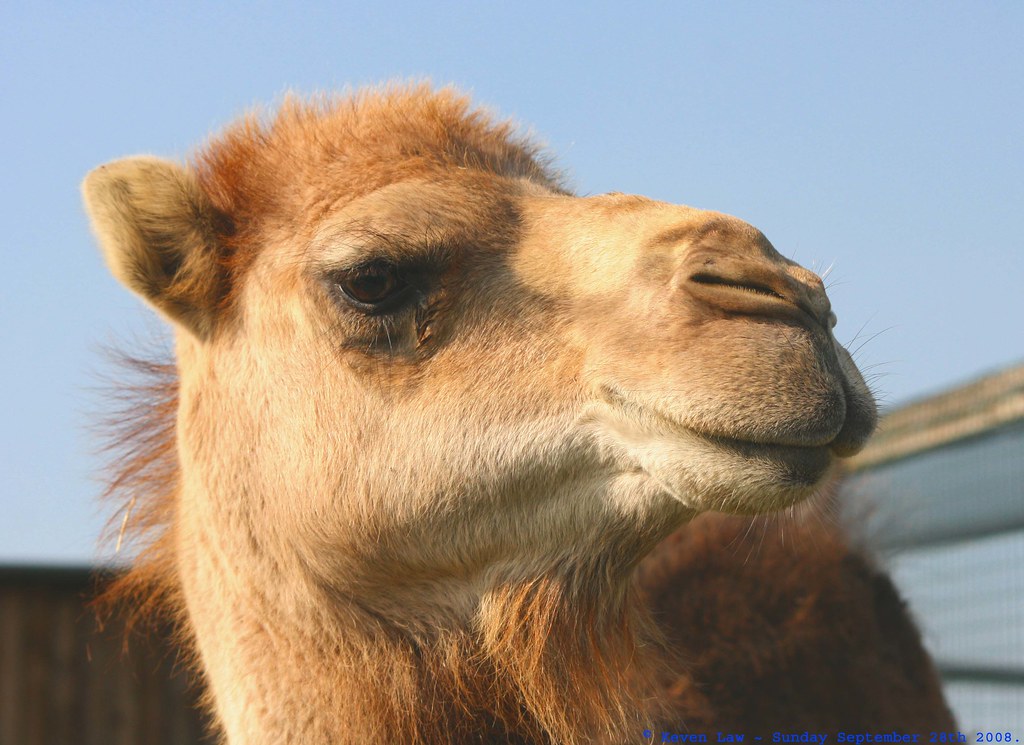
Camel - Eagle Heights, Wildlife Park, Kent, England - Sunday September 28th 2008.
Click here to see the Larger image
Click here to see My most interesting images
From Wikipedia, the free encyclopedia ~ Camels are even-toed ungulates within the genus Camelus. The dromedary, one-humped or Arabian camel has a single hump, and the Bactrian camel has two humps. They are native to the dry desert areas of western Asia, and central and east Asia, respectively.
The average life expectancy of a camel is forty to fifty years. The term camel is also used more broadly to describe any of the six camellike creatures in the family Camelidae: the two true camels, and the four South American camelids, the llama, alpaca, guanaco, and vicuña.
A fully-grown adult camel stands 1.85 m (6 ft 1 in) at the shoulder and 2.15 m (7 ft 1 in) at the hump. The hump rises about thirty inches (75 cm) out of its body. Camels can run up to 65 km/h (40 mph) in short bursts and sustain speeds of up to 40 km/h (25 mph).
Fossil evidence indicates that the ancestors of modern camels evolved in North America during the Palaeogene period, and later spread to Asia.
Humans first domesticated camels before 2000 BC.
The dromedary and the Bactrian camel are both still used for milk, meat, and as beasts of burden—the dromedary in western Asia, and the Bactrian camel further to the north and east in central Asia.
Distribution and numbers ~ The almost 14 million dromedaries alive today are domesticated animals (mostly living in Somalia, Sudan, Mauritania and nearby countries).
The Bactrian camel is now reduced to an estimated 1.4 million animals, mostly domesticated. It is thought that there are about 1000 wild Bactrian camels in the Gobi Desert in China and Mongolia.
There is a substantial feral population of dromedaries estimated at up to 700,000 in central parts of Australia, descended from individuals introduced as transport animals in the 19th century and early 20th century. This population is growing at approximately 11% per year. The government of South Australia has decided to cull the animals using aerial marksmen, because the camels use too much of the limited resources needed by sheep farmers. For more information, see Australian feral camel.
A small population of introduced camels, dromedaries and Bactrians, survived in the Southwest United States until the 1900s. These animals, imported from Turkey, were part of the US Camel Corps experiment and used as draft animals in mines and escaped or were released after the project was terminated. A descendant of one of these was seen by a backpacker in Los Padres National Forest in 1972. Twenty-three Bactrian camels were brought to Canada during the Cariboo Gold Rush.
Camels do not store water in their humps as is commonly believed; the humps are actually a reservoir of fatty tissue. When this tissue is metabolized, it acts as a source of energy, and would yield more than 1 g of water for each 1 g of fat converted through reaction with oxygen from air. This process of fat metabolization generates a net loss of water through respiration for the oxygen required to convert the fat.
Their ability to withstand long periods without water is due to a series of physiological adaptations. Their red blood cells have an oval shape, unlike those of other mammals, which are circular. This is to facilitate their flow in a dehydrated state. These cells are also more stable in order to withstand high osmotic variation without rupturing when drinking large amounts of water (100 litres (22 imp gal/26 US gal) to 150 litres (33 imp gal/40 US gal) in one drink).
Camels are able to withstand changes in body temperature and water content that would kill most other animals. Their temperature ranges from 34 °C (93 °F) at night up to 41 °C (106 °F) during the day, and only above this threshold will they begin to sweat. The upper body temperature range is often not reached during the day in milder climatic conditions, and therefore, the camel may not sweat at all during the day. Evaporation of their sweat takes place at the skin level, not at the surface of their coat, thereby being very efficient at cooling the body compared to the amount of water lost through sweating. This ability to fluctuate body temperature and the efficiency of their sweating allows them to preserve about five litres of water a day.
A feature of their nostrils is that a large amount of water vapor in their exhalations is trapped and returned to their body fluids, thereby reducing the amount of water lost through respiration.
They can withstand at least 20-25% weight loss due to sweating (most mammals can only withstand about 3-4% dehydration before cardiac failure results from the thickened blood).
A camel's blood remains hydrated, even though the body fluids are lost, until this 25% limit is reached.
Camels eating green herbage can ingest sufficient moisture in milder conditions to maintain their bodies' hydrated state without the need for drinking.
A camel's thick coat reflects sunlight. A shorn camel has to sweat 50% more to avoid overheating. It also insulates them from the intense heat that radiates from the desert sand. Their long legs help by keeping them further from the hot ground. Camels have been known to swim.
Their mouth is very sturdy, able to chew thorny desert plants. Long eyelashes and ear hairs, together with sealable nostrils, form a barrier against sand. Their gait and their widened feet help them move without sinking into the sand.
The kidneys and intestines of a camel are very efficient at retaining water. Urine comes out as a thick syrup, and their feces are so dry that they can fuel fires.
All camelids have an unusual immune system. In all mammals, the Y-shaped antibody molecules consist of two heavy (or long) chains along the length of the Y, and two light (or short) chains at each tip of the Y. Camels also have antibody molecules that have only two heavy chains, which makes them smaller and more durable. These heavy chain-only antibodies, which were discovered in 1993, probably developed 50 million years ago, after camelids split from ruminants and pigs, according to biochemist Serge Muyldermans.
The camel is the only animal to have replaced the wheel (mainly in North Africa) where the wheel had already been established. The camel did not lose that distinction until the wheel was combined with the internal combustion engine in the 20th century.
The humpback whale (Megaptera novaeangliae) is a species of baleen whale. One of the larger rorqual species, adults range in length from 12–16 metres (39–52 ft) and weigh approximately 36,000 kilograms (79,000 lb).
The humpback has a distinctive body shape, with unusually long pectoral fins and a knobbly head. An acrobatic animal known for breaching and slapping the water with its tail and pectorals, it is popular with whale watchers off the coasts of Australasia and the Americas.
Males produce a complex song lasting 10 to 20 minutes, which they repeat for hours at a time. Its purpose is not clear, though it may have a role in mating. Found in oceans and seas around the world, humpback whales typically migrate up to 25,000 kilometres (16,000 mi) each year.
Humpbacks feed only in summer, in polar waters, and migrate to tropical or subtropical waters to breed and give birth in the winter. During the winter, humpbacks fast and live off their fat reserves. Their diet consists mostly of krill and small fish.
Humpbacks have a diverse repertoire of feeding methods, including the bubble net feeding technique. Like other large whales, the humpback was and is a target for the whaling industry. Once hunted to the brink of extinction, its population fell by an estimated 90% before a moratorium was introduced in 1966. While stocks have since partially recovered, entanglement in fishing gear, collisions with ships, and noise pollution continue to impact the 80,000 humpbacks worldwide.
A humpback whale can easily be identified by its stocky body with an obvious hump and black dorsal coloring. The head and lower jaw are covered with knobs called tubercles, which are hair follicles, and are characteristic of the species. The fluked tail, which it lifts above the surface in some dive sequences, has wavy trailing edges.
The four global populations, all under study, are: North Pacific, Atlantic, and Southern Ocean humpbacks, which have distinct populations which complete a migratory round-trip each year, and the Indian Ocean population, which does not migrate, prevented by that ocean's northern coastline.
The long black and white tail fin, which can be up to a third of body length, and the pectoral fins have unique patterns, which make individual whales identifiable. Several hypotheses attempt to explain the humpback's pectoral fins, which are proportionally the longest fins of any cetacean.
The two most enduring mention the higher maneuverability afforded by long fins, and the usefulness of the increased surface area for temperature control when migrating between warm and cold climates. Humpbacks have 270 to 400 darkly colored baleen plates on each side of their mouths.
The plates measure from a mere 18 inches (46 cm) in the front to approximately 3 feet (0.91 m) long in the back, behind the hinge. Ventral grooves run from the lower jaw to the umbilicus about halfway along the underside of the whale. These grooves are less numerous (usually 14–22) than in other rorquals but are fairly wide.
The stubby dorsal fin is visible soon after the blow when the whale surfaces, but disappears by the time the flukes emerge. Humpbacks have a 3 metres (9.8 ft), heart-shaped to bushy blow, or exhalation of water through the blowholes.
Because humpback whales breathe voluntarily, the whales possibly shut off only half of their brains when sleeping. Early whalers also noted blows from humpback adults to be 10–20 feet (3.0–6.1 m) high.
This image was taken on a Elding Whale Watch trip from Akureyri in Iceland
The illimitable, silent, never-resting thing called Time, rolling, rushing on, swift, silent, like an all-embracing ocean-tide, on which we and all the universe swim like exhalations, like apparitions which are, and then are not.... ~Thomas Carlyle
Bien que grouillant de personnages, le tableau est d'une lecture assez claire, car tous les mouvements sont coordonnés et s'organisent autour du cortège central. La composition permet d'isoler plusieurs espaces au sein d'un vaste paysage. Le premier est constitué par les rochers du premier plan, qui isole la Vierge et son entourage. Le second est la vaste plaine, où le Christ porte sa croix, perdu au milieu d'une foule qui semble occupée par tout autre chose.
Cependant, la plaine forme une cuvette. En suivant le dénivellé des pentes, le regard est ramené vers le Christ, qui gît au fond de celle-ci. Enfin, l'arrière-plan est partagé en deux zones par un pic rocheux surmonté d'un moulin. A gauche, on voit une ville qui pourrait bien être une Jérusalem flamande, représentée dans des tons très froids (bleu-vert). A droite se trouve le lieu du supplice.
La toile se partage assez équitablement entre tons chauds et froids. Les bruns et les verts qui composent le paysage s'équilibrent presque. Le ciel, relativement clair au-dessus de Jérusalem, s'assombrit nettement au-dessus du Golgotha. Il annonce les ténèbres qui entoureront l'expiration du Christ. Parmi les personnages, ce sont les rouges, jaunes et bruns qui sont le plus fréquemment utilisés.
Although swarming with characters, the picture is clear enough, as all movements are coordinated and organized around the central procession. The composition makes it possible to isolate several spaces within a vast landscape. The first consists of the rocks in the foreground, which isolates the Virgin and her entourage. The second is the vast plain, where Christ carries his cross, lost in the midst of a crowd that seems occupied by everything else.
However, the plain forms a bowl. Following the slope of the slopes, the gaze is brought back to Christ, who lies at the bottom of it. Finally, the background is divided into two areas by a rocky peak surmounted by a mill. On the left, we see a city that could be a Flemish Jerusalem, represented in very cold tones (blue-green). On the right is the place of torture.
The canvas is fairly evenly split between warm and cold tones. The browns and greens that make up the landscape are almost balanced. The sky, relatively clear above Jerusalem, darkens distinctly above Golgotha. He announces the darkness that will surround the exhalation of Christ. Among the characters, it is the reds, yellows and browns that are most frequently used.
Plaster casts of the "Crouching Man," tree, and doors in Pompeii.
The eruption of Pompeii left the city and inhabitants who failed to escape covered in layers of pumice and ash. Over the millennia, the ash hardened and any organic matter buried beneath it decayed, leaving air pockets in exact shape of the object (or being) which would later be discovered by archeologists.
"18th century excavations that Italian archaeologist Giuseppe Fiorelli came up with an idea for reconstructing the bodies. After discovering the air pockets that indicated the presence of human remains in a street dubbed “the Alley of Skeletons”, Fiorelli and his team decided to pour plaster into the voids. They let the plaster harden, then chipped away the outer layers of ash, leaving behind a cast of the victims at their time of death. These plaster outlines preserved the voids left by the bodies giving a glimpse into the tragic destruction that took so many people at once. Their preserved expression of horror and pain remind us of their humanity, with their vulnerable bodies, sometimes distorted, giving an eerie feel to the ancient city." (pompeiitours.it)
(www.pompeiitours.it/blog/who-made-the-plaster-casts-at-po...)
"After the excavation of the Quadriporticus of the Theatres, between 1935 and 1939 the largest number of victims was found in this area, almost 100 bodies, 65 of which were found in the pumice layer and the rest in the debris left by the final two surges that hit the city.
Only two casts have been successfully taken from all the bodies found in the Palestra: one of an adult and the other supposedly of a young athlete.
Pictured above, is the cast described as "The Crouching Man" or "The Muleteer"... a plaster-cast of the victim found near the latrine of the Palaestra, perhaps, as portrayed here, found crouching on the ground with his back against the wall of the east end of the south portico. However, when this body was cast, he was found to be tipped forwards, huddled up and bent double on his knees, when restored he was placed in this position.
Two victims were found towards the eastern extremity from the southern portico, and from which plaster-casts could be made because they both lay in the high layer of ash. The first one was a beautiful young man's body with agile legs knocked down on the portico floor at the first fall of the ashes.
The other, the most tragically posed, was found leaning against the wall, kneeling, crouching on the ground, in that crouching position that is found in Neolithic tombs, with his head folded forward, bent almost between his knees, for the better protection of himself with his hands and cloak against the exhalation of asphyxiating gases. He had shoes on his feet and wore the typical cloak of the peasant, the œcuculla, whose flaps he held tight against his mouth. And in removing the ash under his knees, imprints of overlapping fabrics were noticed, as if the unfortunate man had found comfort in his tragic pose by shielding his knees with the few garments he could arrange." (pompeiiinpictures.com)
(pompeiiinpictures.com/pompeiiinpictures/Casts/victims%20p...)
PLEASE, NO GRAPHICS, BADGES, OR AWARDS IN COMMENTS. They will be deleted.
So refreshing to be out under a clear sky the other night. One of those cold nights when you can see your breath as you exhale, hence the slight haze behind the tree as my exhalation caught the lights I was painting with.
SooC + watermark
_____
» LongExposures website and blog
The Swaying Field.
Calculated arrangementer tower over the times,
immediatum displaying sanctuaries cry,
invitations κροτους field encompassing flowers,
windows visioni beautiful gratuitous swaying,
immense elements desideri blown,
bloeiende pleasures wide with love,
bristles la deriva rocking exhalations mood,
monumentale greens reigns brightly ever seen,
climatibus beautiful odorous air,
gentle hues crête thy noontime bless,
magical waves λιακάδα felt,
canentis past choral columns wall,
somptueux lightened furrows rushing harps winds,
ebbing images heave debajo tempest reeds,
lingering rustique crags thy wild yields,
spreading fragante hearts splendour,
aspicientes wonders ceaseless bold,
glorious mezzaluna rills symbols appear,
onward journey onward dwelling clouds dew アーメン !
Steve.D.Hammond.
ever wondered where a bun places her paws when she does the chicken? now you know!
i was laughing so hard when i was under the coffee table looking at her. :D so cute! :
(view large to stare harder, and to look at the condensation on the table caused by her exhalations. hehe)

~Elephant Seals~
Elephant Seals at the Piedras Blancas Elephant Seal Rookery.
#WestCoast #WestCoastLiving #Beach #Ocean #PacificOcean #ElephantSeals #ElephantSealRookery #PiedrasBlancas #PiedrasBlancasElephantSealRookery #SanSimeon #Proboscis #Bulls #MaleBulls #2019Photos #Water #Ocean #Sun #Spring #Beach #Sand #Bikini #Girl #Boy #Man #Lady
Elephant seals are marine mammals classified under the order Pinnipedia, which in Latin, means feather or fin footed.[6] Elephant seals are considered true seals, and fall under the family Phocidae.[7] Phocids (true seals) are characterized by having no external ear and reduced limbs.[7] The reduction of their limbs helps them be more streamlined and move easily in the water.[6] However, it makes navigating on land a bit difficult because they cannot turn their hind flippers forward to walk like the Otariids.[6] In addition, the hind flipper of elephant seals have a lot of surface area, which helps propel them in the water.[6] Elephant seals spend the majority of their time (90%) underwater in search of food, and can cover 60 miles a day when they head out to sea.[7] When elephant seals are born, they can weigh up to 80 pounds and reach lengths up to 4 feet.[7] Sexual dimorphism is prominently seen in elephant seals due to the fact that male elephant seals can weigh up to 10 times more than females.[8] Also, the large proboscis, which is considered a secondary sexual characteristic, helps males assert dominance during mating season.[7]
Elephant seals take their name from the large proboscis of the adult male (bull), which resembles an elephant's trunk.[9] The bull's proboscis is used in producing extraordinarily loud roaring noises, especially during the mating season. More importantly, however, the nose acts as a sort of rebreather, filled with cavities designed to reabsorb moisture from their exhalations.[10] This is important during the mating season when the seals do not leave the beach to feed, and must conserve body moisture as there is no incoming source of water. They are colossally large in comparison with other pinnipeds, with southern elephant seal bulls typically reaching a length of 5 m (16 ft) and a weight of 3,000 kg (6,600 lb), and are much larger than the adult females (cows), with some exceptionally large males reaching up to 6 m (20 ft) in length and weighing 4,000 kg (8,800 lb); cows typically measure about 3 m (10 ft) and 900 kg (2,000 lb). Northern elephant seal bulls reach a length of 4.3 to 4.8 m (14 to 16 ft) and the heaviest weigh about 2,500 kg (5,500 lb).
The northern and southern elephant seal can be distinguished by looking at various external features. On average, the southern elephant seal tends to be larger than the northern species. Adult male elephant seals belonging to the northern species tend to have a larger proboscis, and thick chest area with a red coloration compared to the southern species.[8] Females do not have the large proboscis and can be distinguished between species by looking at their nose characteristics.Southern females tend to have a smaller, blunt nose compared to northern females.[
ZodSqd returning from exhaustive 5 km patrol in CBRN protected mode - meaning exhaustive 2 hours sealed in the Zodiak suit with combat helmet on top and 20 kgs of payload to carry on his back.
Want to know more about the CBRN suit type Zodiak?
The CBRN suit Zodiak is a multipart protective suit of the German Federal Armed Forces manufactured from sturdy butyl rubber . It is not supplied to all soldiers, especially not to combat units, but is worn by the CBRN defense troops during decontamination activities or similar.
The suit consists of a pair of rubber flap trousers, a rubber top with fixed hood, rubber gloves and rubber boots.
The trouser's legs are pulled outward over the boots. Metal rings are inserted into the bootleg metal rings to stabilize and strengthen those in order to have a firm and gas-tight connection with the trouser's flexible rubber hem after pulling up the trousers. This compound is by most users considered as the great weak point of the Zodiak, since there often occur leaks while the Zodiak is worn.
The pants are connected to top by a roll closure. Pants and top each are equipped with an rubber apron, which are highly wrapped lying one on another. This winding is best to be done in buddy aid, however, it is considered as a robust and dense solution without any damageable moving parts like a zipper.
In the head cover of the top are three openings separated by rubber webs that can be drawn over the edges of the eye glasses and the filter connection and exhalation valve of the NBC protective mask M65 to give a gas-tight connection to the mask. The M65 mask was - unlike the Zodiak - personal basic equipment of every German soldier. With some inaccuracy of fit the hood can also used wearing the upgraded combat Mask M65z, which next to the filter connecting has a connector for a drinking valve. The latter combination can be used to extend the possible action time wearing the Zodiak suit through intermediate hydration.
The gloves manufactured from flexible thinner rubber are pulled onto the stiffened arm ends of the top part of the suit creating a very tight connection.
Shot of a workman building a duplex next to my former residence in the Short North District of Columbus, Summer 2006.
At the request of a friend to see more of the "dude in [the] red cap" I've uploaded those of him, and several more candid shots that didn't meet standards initially.
Exhalations With Splendid Driftwood'
The mallow blues blight'd rhymes,
a silent wood drifts by thy hwisprunga tide,
in autumn's custos blows thy waves to repose,
to διαρκής tidings drizzling rocks underneath,
over overflowing vignes cluster'd stream by shadowy swans,
far stunning visionibus breathes to slumbers scent,
the passing realm thy lamp glæmas delights,
of wild melodious profumo earths guest,
since the morning songs hrom companions lay,
in pillow rêves breathe gentle blues love,
and lashing rocío spill awaken'd impetuous lillies,
a rejoicing frog sourires as crystal water ease,
dwelling fléotende sunbeams spreads alluring west,
that freshness μεγαλείο balancing plumes vast,
whose e'er so chanceux to see this taintless nest,
in tender sprightly ondas thy unfolding air,
silent springing sommeil broken,
thy peinture hast spoken.
Steve.D.Hammond.
The wearing of face masks during the COVID-19 pandemic has received varying recommendations from different public health agencies and governments. The topic has been a subject of debate,[1] with various public health agencies and governments disagreeing on a protocol for wearing face masks. As of early May, 88% of the world's population lives in countries that recommend or mandate the usage of masks in public and 75+ countries have mandated the use of masks.[2] Debates have emerged regarding whether masks should be worn even when social distancing at six feet (2 meters),[3][4][5] whether they should be worn during exercise,[6] worn in the home to reduce viral load,[7][8] and whether there are mitigating factors.[9][7] Additionally, public health agencies of different countries and territories have often changed their recommendations regarding face masks over time.[10] Face masks have been a subject of shortages, and also been made compulsory in some countries.
Types of face masks, from least to most protective, include cloth face masks, medical (non-surgical) masks,[11][12] surgical masks, and filtering facepiece respirators such as N95 masks and FFP masks. Face shields and medical goggles are other types of protective equipment often used together with face masks.
Contents
1Types of masks
1.1Face shields
1.2Cloth masks
1.2.1Sterilizing and re-use
1.3Surgical masks
1.4Disposable filtering respirators
1.4.1Sterilizing and re-use
1.5Elastomeric respirators
1.6Powered air-purifying respirators (PAPRs)
1.7Novel face masks (research and development)
2Recommendations
2.1World Health Organization recommendations
2.2US Centers for Disease Control and Prevention
2.3China and Asia
3Rationale for wearing masks
4Shortages of face masks
4.1Early epidemic in China
4.2National stocks and shortages
4.3N95 and FFP masks
5The mask industry
5.1Manufacturing
5.2Distribution
6Culture
6.1Attitudes
6.2Fashion
7Mask use and policies by country and territory
8References
Types of masks[edit]
Small particles zigzag due to Brownian motion, and are easily captured. Large particles get strained out, or have too much inertia to turn, and hit a fiber. Mid-size particles follow flowlines and are more likely to get through the filter; the hardest size to filter is 0.3 microns diameter.[13]
Certified medical masks are disposable (except some faceshields). They are made of non-woven material. They are mostly multi-layer. Filter material may be made of microfibers with an electrostatic charge; that is, the fibers are electrets. An electret filter increases the chances that smaller particles will veer and hit a fiber, rather than going straight through (electrostatic capture).[13][14][15][better source needed][medical citation needed] Typically, efficiency of the filtering materials decreases when washed or used multiple times.[16]
Many medical masks are respirators; they are designed to protect the wearer. Surgical masks, on the other hand, are meant to protect others against infection transmission from the wearer (so called "source control").[17] Some respirators and masks have valves,[18] which let exhaled air out unfiltered. This makes them bad for source control.[19] It may, however, reduce inwards leakage, thus improving wearer protection.[18]
Face shields[edit]
Person wearing a face shield over a green surgical mask. A simple 3D-printed face shield: curved visor, drawstring lanyard, sheet of transparent plastic curved from side to side.
Person wearing a face shield and a surgical mask.
Main article: Face shield
It is not yet known whether face shields are effective at preventing disease transmission. They protect against splash and splatter. Cough simulation experiments show that they protect[18] the wearer[20] against large drops immediately after the cough, but do not keep out smaller aerosols. The longer it was after the simulated cough, the more particles found their way around. Because there is no evidence they prevent the wearer from getting ill, face shields are used with nose-mouth masks, and to protect nose-mouth masks, but use of face shields alone is not recommended.[18]
Cloth masks[edit]
Homemade cloth face mask
Sneezing. There is limited evidence that cloth masks can significantly reduce aerosol droplet dispersal.[18]
Main article: Cloth face mask
A cloth face mask is a mask made of a common textile, usually cotton, worn over the mouth and nose. Although they are less effective than medical-grade masks, many health authorities recommend that the general public use them because medical-grade masks are in short supply.[21][22]
They were routinely used by healthcare workers starting from the late 19th century until the mid 20th century. In the 1960s they fell out of use in the developed world in favor of modern surgical masks, but their use has persisted in developing countries.[23][24][25]
There were calls for research into the effectiveness of improvised masks even before the emergence of COVID-19, motivated also by past epidemics and modelling of likely mask shortages. However, little research has been done. There are no studies of the use of cloth masks by the general public, one study on the use of cloth masks in hospitals (by healthcare workers, not patients), and many controlled-setting/lab studies of cloth masks' effects on aerosols as of May 2020.[18]
Cloth masks are low-cost and reusable. They vary widely in effectiveness depending on material, fit/seal, and number of layers, among other factors. Unlike disposable masks, there are no legal standards for cloth masks. Fit is important (as with disposable masks). Measures to improve fit, such as an outer layer made from sheer nylon stockings or sheer tights around the head, reduce leakage.[18]
Improvised cloth masks seem to be worse than standard commercial disposable masks, but better than nothing. There is, however, little good evidence on them. A single study gives evidence that an improvised mask was better than nothing, but not as good as soft electret-filter surgical mask, for protecting health care workers simulating treating a simulated infected patient, regardless of whether "patient" or carers wore the mask.[18] Another study had volunteers wear masks they made themselves, to a pattern like that of a standard surgical mask, but with ties rather than earloops,[26] from cotton T-shirts, and found that the number of microscopic particles that leaked inside the homemade masks was twice the number that leaked into the commercial masks, and that the homemade mask let three times as many microorganisms expelled by the wearer escape (median averages). There is limited evidence that cloth masks can significantly reduce droplet dispersal.[18]
Cloth masks are commonly made with one layer, two layers, or two layers with a pocket for a removable-filter interlayer [18] (disposable surgical mask also have three layers, with the filter layer midmost[citation needed]). The CDC recommends more than one layer.[27] There is no research on the usefulness of a filter interlayer, as of May 2020. There were until recently no non-disposable materials designed for making masks (see end of paragraph). Common household fabrics which could be utilized (turned to a new use) as mask materials have been tested.[28][29][30][31] Cloth materials vary widely in filtration efficiency. Some cotton and polyester household fabrics have been found to compare with disposable surgical masks for dry particle filtering. Cotton T-shirt material, pillowcase material, and 70% cotton/30% polyester sweatshirt material are among the common materials that performed well in lab tests, with T-shirts preferred to pillowcases because it was thought that it would probably fit better. Teatowels and vacuum-cleaner bags were effective at filtering, but had a very high air resistance, so were not recommended. Scarves filtered poorly. Surgical sterilisation wrap, a polypropylene non-woven fabric made for wrapping sterilized things to keep them sterile, is designed to filter germs from the air. Using surgical sterilisation wrap to make masks, or as a filter interlayer in cloth masks, has been suggested. There are, however, no tests on using surgical sterilisation wrap for masks, as of May 2020.[18] Other suggested materials for filter interlayers include air filter materials used in ventilation, heating, and air conditioning, some of which are similar to rigid electret masks in the size ranges of particles they filter. Electrostatic cotton and non-woven, meltblown fabric are the conventional materials used in disposible masks, but are not readily available during the COVID-19 epidemic. A new type of filter, a washable electrostatic cotton filter, has been reported since the start of the pandemic; it is said to withstand repeated washing and folding.[18] It is made of electrospun nanofibers; flanking insulating blocks lay these into quasi-aligned nonwoven sheets, which are layered criss-cross to make a meshlike multilayer mask.[32][33] There is a need for research comparing how well these materials work.[18][34]
Sterilizing and re-use[edit]
There is no research on sterilizing and reusing cloth masks, as of May 2020.[18] The CDC recommends doffing the mask by handling only the ear loops or ties, placing it directly in a washing machine, and immediately washing your hands in soap and water for at least 20 seconds. They also recommend handwashing before donning the mask and again immediately after any time you touch it.[35]
There is no information on reusing a interlayer filter, and disposing of it after a single use may be desirable.[18]
Surgical masks[edit]
Main article: Surgical mask
A surgical mask
A surgical mask is a loose-fitting, disposable device that creates a physical barrier between the mouth and nose of the wearer and potential contaminants in the immediate environment. If worn properly, a surgical mask is meant to help block large-particle droplets, splashes, sprays, or splatter that may contain viruses and bacteria, keeping it from reaching the wearer's mouth and nose. Surgical masks may also help reduce exposure of the wearer's saliva and respiratory secretions to others.[36] A surgical mask, by design, does not filter or block very small particles in the air that may be transmitted by coughs, sneezes, or certain medical procedures. Surgical masks also do not provide complete protection from germs and other contaminants because of the loose fit between the surface of the face mask and the face.[36] However, in practice, with respect to some infections like influenza surgical masks appear as effective as respirators (such as N95 or FFP masks).[37] Surgical masks may be labeled as surgical, isolation, dental, or medical procedure masks.[36] Surgical masks are made of a nonwoven fabric created using a melt blowing process.[38][39]
Surgical masks made to different standards in different parts of the world have different ranges of particles which they filter. Similar-looking single-use masks are one-layer and only filter larger particles (e.g. Chinese standard YY/T0969 masks).[40][medical citation needed]
Disposable filtering respirators[edit]
An N95 mask
Main article: Mechanical filter respirator
An N95 mask is a particulate-filtering facepiece respirator that meets the N95 air filtration rating of the US National Institute for Occupational Safety and Health, meaning that it filters at least 95 percent of airborne particles, while not resistant to oil like the P95. It is the most common particulate-filtering facepiece respirator.[41] It is an example of a mechanical filter respirator, which provides protection against particulates, but not gases or vapors.[42] Like the middle layer of[citation needed] surgical masks, the N95 mask is made of four layers[18] of melt-blown nonwoven polypropylene fabric.[43][44][unreliable medical source?] The corresponding face mask used in the European Union is the FFP2 respirator.[45][46]
Hard electret-filter masks like N95 and FFP masks must fit the face to provide full protection. Untrained users often get a reasonable fit, but fewer than one in four gets a perfect fit. Fit testing is thus standard. A line of vaseline on the edge of the mask[47] has been shown to reduce edge leakage[18] in lab tests using manikins that simulate breathing.[47]
Sterilizing and re-use[edit]
Hard electret-filter masks are designed to be disposable, for 8 hours of continuous or intermittent use. One laboratory found that there was a decrease in fit quality after five consecutive donnings.[18]
Hard electret-filter masks are often reused,[citation needed] especially during pandemics when there are shortages. Infectious particles could survive on the masks for up to 24 hours after the end of use, according to studies using models of SARS-CoV-2;[18] In the COVID-19 epidemic, the US CDC recommended that if masks run short, each health care worker should be issued with five masks, one to be used per day, such that each mask spends at least five days stored in a paper bag between each use. If there are not enough masks to do this, they recommend sterilizing the masks between uses.[48] Some hospitals have been stockpiling used masks as a precaution.[49] The US CDC issued guidelines on stretching N95 supplies, recommending extended use over re-use. They highlighted the risk of infection from touching the contaminated outer surface of the mask, which even professionals frequently unintentionally do, and recommended washing hands every time before touching the mask. To reduce mask surface contamination, they recommended face shields, and asking patients to wear masks too ("source masking").[50]
Apart from time, other methods of disinfection have been tested. Physical damage to the masks has been observed when microwaving them, microwaving them in a steam bag, letting them sit in moist heat, and hitting them with excessively high doses of ultraviolet germicidal irradiation (UVGI). Chlorine-based methods, such as chlorine bleach, may cause residual smell, offgassing of chlorine when the mask becomes moist, and in one study, physical breakdown of the nosepads, causing increased leakage.[18] Fit and comfort do not seem to be harmed by UVGI, moist heat incubation, and microwave-generated steam.[18]
Some methods may not visibly damage the mask, but they ruin the mask's ability to filter. This has been seen in attempts to sterilize by soaking in soap and water, heating dry to 160°C, and treating with 70% isopropyl alcohol, and hydrogen peroxide gas plasma[18] (made under a vacuum with radio waves[51]). The static electrical charge on the microfibers (which attracts or repels particles passing through the mask, making them more likely to move sideways and hit and stick to a fiber[citation needed]) is destroyed by some cleaning methods. UVGI (ultraviolet light), boiling water vapour, and dry oven heating do not seem to reduce the filter efficiency, and these methods successfully decontaminate masks.[18]
UVGI (an ultraviolet method), ethylene oxide, dry oven heating and (highly toxic[citation needed]) vaporized hydrogen peroxide are currently the most-favoured methods in use in hospitals, but none have been properly tested.[18] Where enough masks are available, cycling them and reusing a mask only after letting it sit unused for 5 days is preferred.[48]
Elastomeric respirators[edit]
Main article: Mechanical filter respirator
Elastomeric full-face masks
Elastomeric respirators are reusable devices with exchangeable cartridge filters that offer comparable protection to N95 masks.[52] They were used as a substitute for N95 masks among shortages during the COVID-19 pandemic.[19]
The filters which must be replaced when soiled, contaminated, or clogged. These components may be hard to find amidst shortages; the filters may thus be sterilized, in a way that does not harm the filter, and re-used. In medical use, they must be cleaned and disinfected, as some germs can survive on them for weeks.[19]
Full-face versions of elastomeric respirators seal better and protect the eyes. If they have exhalation valves, then they are counterrecommended in settings where the unfiltered exhaled air might infect others (for instance, surgery). Fitting and inspection is essential to effectiveness.[19]
Powered air-purifying respirators (PAPRs)[edit]
A PAPR in a level-3 biosafety lab. Note waist pack and hose to blow air into headpiece.
Main article: Powered air-purifying respirator
PAPRs are expensive masks with a battery-powered blower that blows air through a filter to the wearer. Because they create positive pressure, they need not be tightly-fitted.[53] PAPRs typically do not filter exhaust from the wearer.[54] They are not generally designed for healthcare use, as of 2017.[17]
Novel face masks (research and development)[edit]
On 15 April 2020 scientists claimed to have developed a biodegradable material for face masks which is effective at removing particles smaller than 100 nanometres including viruses and has a high breathability.[55][56] Two Israeli companies reportedly have developed antiviral face masks – one of which is infused with antiviral copper oxide and zinc oxide nanoparticles, the other is made out of cotton embedded with accelerated copper oxide particles and a nanofiber textile.[57][58][59] Other Israeli researchers have developed a 3D-printed nanoscale fiber sticker coated with antiseptics which can be attached to a traditional mask for extra protection.[59] Other reseachers report that laser-induced graphene may be used to add self-cleaning and photothermal properties to face masks.[59] In March 2020 Jiaxing Huang became the first scientist to receive a $200,000 grant by the United States' National Science Foundation to develop a chemical which can be safely built into common face masks to make them protect against SARS-CoV-2 and self-sanitize passing droplets.[59][60]
Recommendations[edit]
Health organizations have recommended that people cover their mouth and nose with a bent elbow or a tissue when coughing or sneezing, and dispose of any tissue immediately.[61][62] Surgical masks are recommended for those who may be infected,[63][64][65] as wearing a mask can limit the volume and travel distance of expiratory droplets dispersed when talking, sneezing, and coughing.[66]
Masks have also been recommended for use by those who are taking care of someone who may have the disease.[65] The WHO has recommended the wearing of masks by healthy people only if they are at high risk, such as those who are caring for a person with COVID-19, though they also acknowledge that wearing masks may help people avoid touching their face.[65] Several countries have started to encourage the use of face masks by members of the public.[67]
As of May 2020, 88% of the world's population lived in countries where their government and leading disease experts recommended the use of masks in public places to limit the spread of COVID-19.[2]
World Health Organization recommendations[edit]
World Health Organization advice to the public in the context of COVID-19 endorsed the use of masks only under the following conditions:[68]
If you are healthy, you only need to wear a mask if you are taking care of a person with suspected 2019-nCoV infection.
Wear a mask if you are coughing or sneezing.
Masks are effective only when used in combination with frequent hand-cleaning with alcohol-based hand sanitizer or soap and water.
If you wear a mask, then you must know how to use it and dispose of it properly.
— World Health Organization
US Centers for Disease Control and Prevention[edit]
Guidance from the US Centers for Disease Control and Prevention on using and making cloth masks during the COVID-19 pandemic[69]
The United States Centers for Disease Control and Prevention (CDC) recommended in April 2020 that the general public wear cloth face coverings in public settings where other social distancing measures are difficult to maintain, such as grocery stores and pharmacies, especially in areas of significant community-based transmission, due to the significance of asymptomatic and pre-symptomatic disease transmission.[69][70]
In March 2020, the CDC recommended that if neither respirators nor surgical masks are available, as a last resort, it may be necessary for healthcare workers to use masks that have never been evaluated or approved by NIOSH or homemade masks, though caution should be exercised when considering this option.[71]
In March and April 2020, the CDC faced backlash over their earlier statements advising that most healthy people did not need to wear a mask. The earlier recommendations had been made to try to conserve supplies for medical professionals,[dubious – discuss][medical citation needed] but damaged the agency's credibility.[72][73][74]
In January 2020, there was no evidence on whether masks were useful for people who were not sick in a community setting.[75][dubious – discuss]
China and Asia[edit]
China has specifically recommended the use of disposable non-surgical medical masks by healthy members of the public,[11][76] particularly when coming into close contact (1 metre (3 ft) or less) with other people.[77] Hong Kong recommends wearing a surgical mask when taking public transport or in crowded places.[78][79] Thailand's health officials are encouraging people to make cloth face masks at home and wash them daily.[80] The Taiwanese, South Korean, and Japanese governments have also recommended the use of face masks in public.
When asked about the mistakes that other countries were making in the pandemic in March, the Chinese Center for Disease Control and Prevention director-general George Fu Gao said:
"The big mistake in the U.S. and Europe, in my opinion, is that people aren't wearing masks. This virus is transmitted by droplets and close contact. Droplets play a very important role − you've got to wear a mask, because when you speak, there are always droplets coming out of your mouth. Many people have asymptomatic or presymptomatic infections. If they are wearing face masks, it can prevent droplets that carry the virus from escaping and infecting others."[81]
Rationale for wearing masks[edit]
Queue to buy face masks in Hong Kong, 30 January 2020. Everyone in the line is already wearing a disposable medical mask.
File:Qualitative-Real-Time-Schlieren-and-Shadowgraph-Imaging-of-Human-Exhaled-Airflows-An-Aid-to-Aerosol-pone.0021392.s002.ogv
Shadowgraphs. Left, videos of the outer airflow during a sneeze, comparing different methods of covering one's mouth and nose (and none).[82] Right, conversation. Convection also shown.
Among the reasons cited by Chinese health officials for the wearing of masks, even by healthy individuals, are the following:
Asymptomatic transmission. Many people can be infected without symptoms or only with mild symptoms.[83]
Impossibility of appropriate social distancing in many public places at all times.[83]
Cost-benefit mismatch. If only the infected individuals wear a mask, they would possibly have a negative incentive to do so. An infected individual might get nothing positive, but only bear the costs such as inconvenience, purchasing expenses, and even prejudice.[83]
There is no shortage of masks in China, which has been producing 100 million masks per day since early March.[83]
Leading microbiologist Yuen Kwok-yung from the University of Hong Kong cites a large viral load in sputum and saliva of an infected person and asymptomatic cases as the reasons why even healthy individuals should wear a mask.[84][85]
According to Stephen Griffin, a virologist at the University of Leeds, "Wearing a mask can reduce the propensity [of] people to touch their faces, which is a major source of infection without proper hand hygiene."[86] The precautionary principle has also been cited by the British Medical Journal as a reason some may encourage universal face mask wearing.[87]
Asian health officials and experts have been promoting universal masking. For instance, Linfa Wang (a leading infectious disease expert who heads a joint Duke University and National University of Singapore research team) stated that masking is about "preventing the spread of disease rather than preventing getting the disease", remarking that the point is to cover the faces of people who are infected but do not know it, so it is imperative for everyone to wear one in public.[88]
Recent studies have suggested that the required six feet of social distancing is insufficient and based on debunked studies from the 1930s or error.[89][90][1]
Shortages of face masks[edit]
See also: Shortages related to the COVID-19 pandemic
Early epidemic in China[edit]
People in Wuhan lining up in front of a drug store to buy surgical masks.
A notice at a supermarket in Beijing, which says each person can only buy one pack of surgical masks and one bottle of 84 disinfectant liquid a day.
Chinese electronics manufacturers, such as BYD Electronic, began to produce surgical masks after the outbreak.
As the epidemic accelerated, the mainland market in China saw a shortage of face masks due to increased public demand.[91] In Shanghai, customers had to queue for nearly an hour to buy a pack of face masks; stocks were sold out in another in half an hour.[92] Hoarding and price gouging drove up prices, so the market regulator said it would crack down on such acts.[93][94] In January 2020, price controls were imposed on all face masks on Taobao and Tmall.[95] Other Chinese e-commerce platforms – JD.com,[96] Suning.com,[97] Pinduoduo[98] – did likewise; third-party vendors would be subject to price caps, with violators subject to sanctions.
By March China had quadrupled its production capacity (100 million masks per day).[83]
National stocks and shortages[edit]
In 2006, 156 million masks were added to the US Strategic National Stockpile in anticipation of a flu pandemic.[99] After they were used against the 2009 flu pandemic, neither the Obama administration nor the Trump administration renewed the stocks.[99] By 1 April, the US's Strategic National Stockpile was nearly emptied.[100][clarification needed]
In France, 2009 H1N1-related spending rose to €382 million, mainly on supplies and vaccines, which was later criticised.[101][102] It was decided in 2011 to not replenish its stocks and rely more on supply from China and just-in-time logistics.[101] In 2010, its stock included 1 billion surgical masks and 600 million FFP2 masks; in early 2020 it was 150 millions and zero, respectively.[101] While stocks were progressively reduced, a 2013 rationale stated the aim to reduce costs of acquisition and storage, now distributing this effort to all private enterprises as an optional best practice to ensure their workers' protection.[101] This was especially relevant to FFP2 masks, more costly to acquire and store.[101][103] As the COVID-19 pandemic in France took an increasing toll on medical supplies, masks and PPE supplies ran low, causing national outrage. France needs 40 millions masks per week, according to French president Emmanuel Macron.[104] France instructed its few remaining mask-producing factories to work 24/7 shifts, and to ramp up national production to 40 million masks per month.[104] French lawmakers opened an inquiry on the past management of these strategic stocks.[105] The mask shortage has been called a "scandal d'État" (State scandal).[106]
In late-March/early-April 2020, as Western countries were in turn dependent on China for supplies of masks and other equipment, China was seen as making soft-power play to influence world opinion.[107][12] However, a batch of masks purchased by the Netherlands was reportedly rejected as being sub-standard. The Dutch health ministry issued a recall of 600,000 face masks from a Chinese supplier on 21 March which did not fit properly and whose filters did not work as intended despite them having a quality certificate.[107][12] The Chinese Ministry of Foreign Affairs responded that the customer should "double-check the instructions to make sure that you ordered, paid for and distributed the right ones. Do not use non-surgical masks for surgical purposes".[12] Eight million of 11 million masks delivered to Canada in May also failed to meet standards.[108][109]
N95 and FFP masks[edit]
A woman in Ukraine wearing an FFP mask after masking in public places was made mandatory.
N95 and FFP masks were in short supply and high demand during the COVID-19 pandemic.[110][101] Production of N95 masks was limited due to constraints on the supply of nonwoven polypropylene fabric (which is used as the primary filter), as well as the cessation of exports from China.[43][111] China controls 50 percent of global production of masks, and facing its own coronavirus epidemic, dedicated all its production for domestic use, only allowing exports through government-allocated humanitarian assistance.[43]
In March 2020, US President Donald Trump applied the Defense Production Act against the American company 3M, which allows the Federal Emergency Management Agency to obtain N95 respirators from 3M.[112][113] White House trade adviser Peter Navarro stated that there were concerns that 3M products were not making their way to the US.[112] 3M replied that it has not changed the prices it charges, and was unable to control the prices its dealers or retailers charge.[112]
In early April 2020, Berlin politician Andreas Geisel alleged that a shipment of 200,000 N95 masks that it had ordered from American producer 3M's China facility were intercepted in Bangkok and diverted to the United States. Berlin police president Barbara Slowik stated that she believed "this is related to the US government's export ban."[114] 3M said they had no knowledge of the shipment, stating "We know nothing of an order from the Berlin police for 3M masks that come from China," and the US government denied that any confiscation had taken place and said that they use appropriate channels for all their purchases.[114][115] Berlin police later confirmed that the shipment was not seized by US authorities, but was said to have simply been bought at a better price, widely believed to be from a German dealer or China. This revelation outraged the Berlin opposition, whose CDU parliamentary group leader Burkard Dregger accused Geisel of "deliberately misleading Berliners" in order "to cover up its own inability to obtain protective equipment". FDP interior expert Marcel Luthe said "Big names in international politics like Berlin's senator Geisel are blaming others and telling US piracy to serve anti-American clichés."[116] Politico Europe reported that "the Berliners are taking a page straight out of the Trump playbook and not letting facts get in the way of a good story."[117] The Guardian also reported that "There is no solid proof Trump [nor any other American official] approved the [German] heist".[118]
Jared Moskowitz, head of the Florida Division of Emergency Management, accused 3M of selling N95 masks directly to foreign countries for cash, instead of the US. Moskowitz stated that 3M agreed to authorized distributors and brokers to represent they were selling the masks to Florida, but instead his team for the last several weeks "get to warehouses that are completely empty." He then said the 3M-authorized US distributors later told him the masks Florida contracted for never showed up because the company instead prioritized orders that came in later, for higher prices, from foreign countries (including Germany, Russia, and France). As a result, Moskowitz highlighted the issue on Twitter, saying he decided to “troll” 3M.[119][120][121] Forbes reported that "roughly 280 million masks from warehouses around the US had been purchased by foreign buyers [on March 30, 2020] and were earmarked to leave the country, according to the broker — and that was in one day", causing massive critical shortages of masks in the US.[122][123]
As more and more countries restricted the export of N95 masks, Novo Textiles in British Columbia had plans to become the number-one manufacturer in Canada.[124] AMD Medicom in Quebec also plans to become the second Canadian manufacturer of N95 masks, with a contract to supply the Government of Canada.[125]
The mask industry[edit]
Manufacturing[edit]
The government of Taiwan instituted a mask rationing system. With population of 24 million, Taiwan has been producing more than 10 million masks per day since March.
The U.S. National Guard sews facemasks
[icon]
This section needs expansion. You can help by adding to it. (May 2020)
As of 2019, mainland China manufactured half the world output of masks.[126] As Covid-19 spread, enterprises in several countries quickly started or increased the production of face masks.[127] Cottage industries and volunteer groups also emerged, manufacturing cloth masks for localised use. They used various patterns, including some with a bend-to-fit nosepiece inserts. Individual hospitals developed and requested a library of specific patterns.[128][129][130][131]
Distribution[edit]
[icon]
This section needs expansion. You can help by adding to it. (May 2020)
Some clinical stockpiles have proved inadequate in scale, and markets have expanded as non-medical consumers started obeying mandated mask-wearing or determined that masks might help or encourage them. Worldwide demand for face masks has resulted in masks shipping around the globe as a result of commercial transactions or of donations.[132]
Culture[edit]
A sign language interpreter (on the right) is wearing a transparent mask to allow lip reading.
Attitudes[edit]
In East Asian societies, a primary reason for mask-wearing is to protect others from oneself.[133][134] It is seen as a collective responsibility to reduce the transmission of the virus.[135] The broad assumption behind the act is that anyone, including seemingly healthy people, can be a carrier of the coronavirus.[134] A face mask is thus seen as a symbol of solidarity.[135] Elsewhere, the need for mask-wearing is often seen in an individual's perspective where masks only serve to protect oneself.[133]
Cultural norms and social pressure may also impede mask-wearing in public.[136] According to the Hong Kong doctor and infectious disease expert Joseph Tsang, the promotion of universal masking may resolve perceptions against mask-wearing, because mask-wearing is intimidating if few people wear masks due to cultural barriers, but if all people wear masks it shows a message that people are in this together.[88]
In the western world, the public usage of masks still often carries a large stigma,[133][135][137] as it is seen as a sign of sickness.[137] This stigmatization is a large obstacle to overcome, because people may feel too ashamed to wear a mask in public and therefore opt to not wear one.[138] Secondly, it is heavily racialized as an Asian phenomenon.[135] This has been reinforced in a lot of media discourses, where unrelated stories about the pandemic are often accompanied by imagery of Asian people in masks.[139] The focus on race has brought hostility towards Asians who are confronted with the choice to mask as precaution while they face discrimination for it.[140] However, there is also a divide within the western world, as seen in the Czech Republic and Slovakia where mass mobilization has occurred to reinforce the solidarity in mask-wearing since March 2020.[133]
On social media, there has been an effort with the #masks4all campaign to encourage people to use masks.[141] Mask-wearing has been called a prosocial behavior in which one protects others within their community.[142][143]
In the US, mask-wearing was politicized and is seen as a political statement by some people. Democrats were more likely than Republicans to say that they are wearing a mask when leaving home, 76% to 59% according to one poll.[144]
Fashion[edit]
Face masks have had an impact on fashion, with the masks themselves becoming a fashion statements, haute couture brands having pivoted to address both public health and aesthetic needs.[145][146][147][148]
Mask use and policies by country and territory[edit]
See also: COVID-19 pandemic by country and territory and National responses to the COVID-19 pandemic
Beijing Subway advises passengers to wear masks when taking trains
Argentina Argentina: After appearance of three asymptomatic cases, the capital Buenos Aires introduced compulsory masking since 14 April. Wearing a mask was made obligatory for everyone on public transit and everyone who contacts with the public in their position. Violators can face a fine. Authorities also prohibited the sale of N95 face masks to non-medical workers, suggesting the general public to use home-made masks instead.[149]
Austria Austria: Everyone entering a supermarket, a grocery store, or a drug store or using public transportation must wear a face mask, mandatory since 14 April.[150][151][152]
The Bahamas Bahamas: On 19 April, the prime minister announced that wearing a mask or covering one's face with clothing is mandatory in public. Employers must provide their employees who are serving the general public with masks.[153]
Bahrain Bahrain: The Kingdom made wearing face masks in public areas compulsory for citizens and residents as well as shop workers.[154]
Benin Benin: From 8 April, Benin's authorities began enforcing the mandatory wearing of face masks to halt the coronavirus.[155]
Bosnia and Herzegovina Bosnia and Herzegovina: Wearing a face mask is compulsory.[156][157]
Bulgaria Bulgaria: Bulgaria's government passed an order imposing an obligation to wear face masks on 30 March. The order was cancelled the next day and changed into a recommendation, due to legal complaints.[158]
Cambodia Cambodia: Many Cambodians started wearing face masks soon after the outbreak began in Wuhan. Businesses started to require customers to wear masks.[159]
Cameroon Cameroon: On 6 April, mayor of Douala announced that wearing a mask will be mandatory to slow the spread of coronavirus.[160]
Canada Canada: Since 6 April, health officials recommend wearing non-medical masks in situations where physical distancing from others is difficult (like buying groceries, or public transit).[161]
Chile Chile: From 8 April, Chilean Health Minister announced wearing a mask is mandatory in public transit.[162]
China China: Healthy individuals are advised to wear disposable medical masks in public places.[11][77] Some local governments require wearing masks when going outside. Shanghai makes wearing masks mandatory in public places.[163]
Colombia Colombia: In response to the most recent recommendations of the WHO, Colombia changed its policy on the use of masks and made it mandatory throughout the country for the use of public transport during the coronavirus emergency.[164]
Cuba Cuba: On 11 March, the government urged citizens to make their own masks, while the textile industry was drafted to fabricate them. People were advised to carry several cloth masks with them, depending on how many hours they plan to spend in public areas.[165] Later, wearing a mask was made mandatory.[166]
Czech Republic Czech Republic: Forbidden to go out in public without wearing a mask, or covering one's nose and mouth.[167]
Dominican Republic: Since 16 April, the use of face mask is mandatory in all public spaces and in the workplace.[168]
Democratic Republic of the Congo DR Congo: Since 20 April, wearing masks in the capital of Kinshasa is mandatory.[169]
Ecuador Ecuador: On 8 April, the Emergency Operations Committee (COE) decided to make face masks obligatory in public spaces.[170]
Ethiopia Ethiopia: The Council of Ministers approved a regulation that outlaws handshakes, and obligates the use of face masks in public places.[171]
France France: On 3 March, the government issued a degree announcing requisition of stocks of FFP2 and anti-splash masks until 31 May 2020.[172]
Gabon Gabon: On 10 April, the Gabonese government announced individuals in all parts of the country are required to wear masks in public to limit the spread of COVID-19.[173]
Germany Germany: On 31 March, city-county Jena, Thuringia, was the first large German city to introduce an obligation to wear masks, or makeshift masks including scarves, in supermarkets, public transport, and buildings with public traffic, from 6 April, very successfully. On 2 April, the Robert Koch Institute, the federal epidemic authority, changed its previous recommendation that only people with symptoms should wear masks to also include people without symptoms.[174][175] County Nordhausen, Thuringia, followed the example of Jena, since 13 April, several other cities later. German chancellor Merkel and state governors first gave "strong advice" to wear face masks in public from 20 April, Saxony made it mandatory from that day, Saxony-Anhalt followed from 23 April and (the rest of) Thurinigia from 24 April, finally the governors agreed to make it mandatory, so most other states followed from 27 April, except Schleswig-Holstein, from 29 April, and Berlin, where shops were excluded first, they were included from 29 April.[176]
Guinea Guinea: Guinean President Alpha Conde decided to make wearing masks compulsory.[177]
Honduras Honduras: From 7 April, Honduras President announced all citizens will now be required to cover their mouths when they are outside.[178]
Hong Kong Hong Kong: Members of the public are recommended to wear a surgical mask when taking public transport or staying in crowded places.[78]
India India: From 9 April, masking is compulsory in the state of Odisha. When leaving their home, people must cover their mouth and nose with masks or multilayered cloth (like handkerchief, dupatta, towel, etc.).[179]
Indonesia Indonesia: Citizens were ordered to wear face masks when they leave the house.[180]
Republic of Ireland Ireland: Starting monday 18th of May, the use of cloth face covering is recommend in enclosed public spaces where it's difficult to maintain social distance.[181][182]
Israel Israel: All residents are asked to wear face masks when in public.[183]
Italy Italy: Regions of Lombardy and Tuscany made wearing a face mask compulsory before going out in early April.[184]
Ivory Coast Ivory Coast: From April, 26 masks have become compulsory to enter shopping malls or supermarkets in the Southern suburb of Abidjan, Marcory.[185]
Japan Japan: Masks have been widely used by healthy individuals despite absence of official advice to do so.[186] On 1 March, prime minister Shinzo Abe enacted a policy in Hokkaido instructing manufacturers to sell face masks directly to the government, which would then deliver them to residents.[187]
Kenya Kenya: Wearing a face mask is compulsory since April 4. The government has Kenyans to strictly observe social distancing, which has been proved to one of the most efficient ways of preventing infection risks.[188]
Liberia Liberia: From 21 April, it is now compulsory to wear a face mask or covering in public.[189]
Lithuania Lithuania: Wearing a face mask or any other means of covering one's nose and mouth in public places is compulsory since 10 April 2020.
Luxembourg Luxembourg: From 20 April, wearing a mask is mandatory in places where it is not possible to keep enough distance to others such as supermarkets or on public transport.[190]
Malaysia Malaysia: Masks have been widely used by healthy individuals despite absence of official advice to do so.[191] On 17 March, Malaysia banned exports of medical and surgical masks, to meet local demand.[192] In April, the government was set to distribute 24.62 million masks, four for each household, while advising people to only use them if they have symptoms.[180]
Mexico Mexico: From 17 April, all Mexico City Metro passengers must wear masks while inside stations and on trains, Mayor Claudia Sheinbaum announced on 15 April.[193]
Mongolia Mongolia: Wearing a mask is now mandatory while riding public transportation in Ulaanbaatar. Public officials and news broadcasters had even adopted to wearing masks through press conferences and news broadcasts.[194]
Morocco Morocco: Wearing a face mask is compulsory.[195]
Mozambique Mozambique: The Mozambican government announced on 8 April that wearing face masks is now compulsory on all forms of passenger transport, and wherever groups of people are gathered.[196]
North Macedonia North Macedonia: As of 22 April, citizens of Kumanovo, Tetovo, and Prilep must wear protective masks and gloves outside their homes, at public places, outdoor and indoor areas, markets, and shops announced the government.[197]
Pakistan Pakistan: The Balochistan government on 18 April told citizens to wear face masks when going outside. According to provincial government spokesperson Liaquat Shahwani, citizens have been urged to wear masks or to cover their faces with any cloth in the wake of the COVID-19 outbreak.[198]
Panama Panama: Panama has made it obligatory to wear a face mask whenever going outside, while also recommending the manufacture of a homemade cloth face mask to those who cannot purchase face masks.[199]
Peru Peru: From 7 April, the Peruvian government started distributing free masks after decreeing their mandatory use in the streets to chase away the new coronavirus, said President Martin Vizcarra.[200]
Philippines Philippines: From 2 April, the government required all those living in areas under enhanced community quarantine to wear face masks.[201]
Poland Poland: Since 16 April, covering lips and nose is compulsory before leaving one's house (e.g., by a disposable mask, cloth mask, or scarf).[202]
Russia Russia: Khabarovsk has made the wearing of face masks obligatory to fight the spike in respiratory diseases and prevent the spread of the coronavirus.[203]
Rwanda Rwanda: On 20 April, Cabinet Minister of Health Daniel Ngamije said the latest guidelines require everyone to wear a mask in public, and at home during the lockdown and thereafter.[169]
Scotland Scotland: On 28 April, the First Minister for Scotland Nicola Sturgeon advised the voluntary use of cloth face masks in enclosed spaces such as shops and public transport (but not generally in public), while noting their limitation.[204]
Singapore Singapore: Masks have been widely used by healthy individuals despite initial absence of official advice to do so.[205] General mask-wearing was no longer discouraged from 3 April,[206] and made mandatory outside of one's residence from 14 April.[207]
Spain Spain: Wearing masks has been required since 4 May while on public transportation, which includes taxis, trains and buses. The government is providing masks to the majority of people riding public transportation, regardless of if they have a mask on.[208][209]
Slovakia Slovakia: Forbidden to go out in public without wearing a mask or covering one's nose and mouth.[167][156]
Slovenia Slovenia: From 29 March, wearing a face mask, even one made at home, or equivalents such as scarves that cover the mouth and nose is mandatory along with protective gloves; the decree stipulates that masks and gloves need to be worn in indoor public spaces.[210]
South Africa South Africa: On 10 April, Minister of Health recommended that the general public use cloth face masks when going out in public (in addition to hand-washing and social distancing).[211] After 1 May, covering one's nose and mouth will be mandatory in public (with a cloth mask, scarf, T-shirt, etc.).[212]
South Korea South Korea: Masks have been widely used by healthy individuals despite absence of official advice to do so.[213] The government implemented a policy of centralized procurement and rationing of face masks, purchasing 80 percent of national production since early March.[214]
Sweden Sweden: Sweden's Public Health Agency doubts the effectiveness of face masks, and the agency does not recommend public use of face masks.[215] The government has also warned that wearing them might create a false sense of security.[216]
Taiwan Taiwan: On 21 January, the government announced a temporary ban on the export of face masks.[217] On 6 February, the government instituted a mask rationing system.[218] Taiwan has been producing ten million masks per day since mid-March.[219] On 1 April, passengers on trains and intercity buses were required to wear face masks,[220] unmasked riders facing a fine.[221]
Turkey Turkey: Residents will be required to wear masks at markets, as Turkish president announced.[222]
Ukraine Ukraine: Since 6 April, wearing a face mask is required by the government in public places. In Kyiv, public places were clarified to include parks and streets.[223]
United States United States: On 6 April, the CDC recommended the wearing of non-medical cloth face coverings when in public places.[224][225] Since 17 April, residents of New York, must wear masks in public; New Jersey and Maryland issued similar requirements for their residents.[226]
Uzbekistan Uzbekistan: Officials made protective masks mandatory in all major cities in order to prevent the spread of coronavirus. Officials on 22 March said citizens not wearing masks in public in major cities would be fined $22 for the first offense and $67 for repeat offenses.[227]
Venezuela Venezuela: The government ordered the country’s citizens to wear face masks in public in response to the arrival of the novel coronavirus.[228]
Vietnam Vietnam: Since 16 March, everyone must wear a face mask when going to public places (such as grocery stores, transportation hubs, and public transport).[229]
Zambia Zambia: The government made it mandatory to wear face masks to minimise the spread in the country.[230]
en.wikipedia.org/wiki/Face_masks_during_the_COVID-19_pand...
Can face masks help slow the spread of the coronavirus (SARS-CoV-2) that causes COVID-19? Yes. Face masks combined with other preventive measures, such as getting vaccinated, frequent hand-washing and physical distancing, can help slow the spread of the virus. The U.S. Centers for Disease Control and Prevention (CDC) recommends fabric masks for the general public. People who haven’t been fully vaccinated should continue to wear face masks in indoor public places and outdoors where there is a high risk of COVID-19 transmission, such as crowded events or large gatherings. The CDC says that N95 masks should be reserved for health care providers. How do the different types of masks work? Medical masks Also called surgical masks, these are loosefitting disposable masks. They're meant to protect the wearer from contact with droplets and sprays that may contain germs. A medical mask also filters out large particles in the air when the wearer breathes in. To make medical masks more form-fitting, knot the ear loops where they attach to the mask. Then fold and tuck the unneeded material under the edges.
An N95 mask is a type of respirator. It offers more protection than a medical mask does because it filters out both large and small particles when the wearer inhales. Because N95 masks have been in short supply, the CDC has said they should be reserved for health care providers. Health care providers must be trained and pass a fit test before using an N95 mask. Like surgical masks, N95 masks are intended to be disposable. However, researchers are testing ways to disinfect and reuse them. Some N95 masks, and even some cloth masks, have valves that make them easier to breathe through. Unfortunately, these masks don't filter the air the wearer breathes out. For this reason, they've been banned in some places. A cloth mask is intended to trap respiratory droplets that are released when the wearer talks, coughs or sneezes. It also acts as a barrier to protect the wearer from inhaling droplets released by others.
The most effective cloths masks are made of multiple layers of tightly woven fabric like cotton. A mask with layers will stop more droplets from getting through your mask or escaping from it. How to get the most from your mask; The effectiveness of cloth and medical masks can be improved by ensuring that the masks are well fitted to the contours of your face to prevent leakage of air around the masks' edges. Masks should be snug over the nose, mouth and chin, with no gaps. You should feel warm air coming through the front of the mask when you breathe out. You shouldn't feel air coming out under the edges of the mask. Masks that have a bendable nose strip help prevent air from leaking out of the top of the mask. Some people choose to wear a disposable mask under their cloth mask. In that case, the cloth mask should press the edges of the disposable mask against the face. Don't add layers if they make it hard to breathe or obstruct your vision. Proper use, storage and cleaning of masks also affects how well they protect you. Follow these steps for putting on and taking off your mask: Wash or sanitize your hands before and after putting on your mask. Place your mask over your mouth and nose and chin. Tie it behind your head or use ear loops. Make sure it's snug.,Don't touch your mask while wearing it. If you accidentally touch your mask, wash or sanitize your hands. If your mask becomes wet or dirty, switch to a clean one. Put the used mask in a sealable bag until you can get rid of it or wash it. Remove the mask by untying it or lifting off the ear loops without touching the front of the mask or your face.
Wash your hands immediately after removing your mask.
Regularly wash cloth masks in the washing machine or by hand. (They can be washed along with other laundry.)
And don't forget these precautions: Don't put masks on anyone who has trouble breathing or is unconscious or otherwise unable to remove the mask without help. Don't put masks on children under 2 years of age. Don't use face masks as a substitute for physical distancing. What about face shields? The CDC doesn't recommend using face shields instead of masks because it's unclear how much protection shields provide. However, wearing a face mask may not be possible in every situation. If you must use a face shield instead of a mask, choose one that wraps around the sides of your face and extends below your chin.
Do you still need to wear a facemask after you’re fully vaccinated? After you're fully vaccinated, the CDC recommends that it's ok not to wear a mask except where required by a rule or law. However, if you are in an area with a high number of new COVID-19 cases in the last week, the CDC recommends wearing a mask indoors in public and outdoors in crowded areas or when you are in close contact with unvaccinated people. If you are fully vaccinated and have a condition or are taking medications that weaken your immune system, you may need to keep wearing a mask. You're considered fully vaccinated 2 weeks after you get a second dose of an mRNA COVID-19 vaccine or 2 weeks after you get a single dose of the Janssen/Johnson & Johnson COVID-19 vaccine. In the U.S., everyone also needs to wear a mask while on planes, buses, trains and other forms of public transportation. The World Health Organization (WHO) recommends medical masks for health care workers as well as for anyone who has or may have COVID-19 or who is caring for someone who has or may have COVID-19.``
www.mayoclinic.org/diseases-conditions/coronavirus/in-dep...
The Covid-19 pandemic seems to have sorted us into three types based on our attitudes toward masking: Call them nervous maskers, never-maskers and uncertain maskers. The first feel guilty or nervous about unmasking, so they tend to default to wearing masks; the second feel angry and resentful about being told to mask, so they often refuse entirely. And the third group is just trying to do the right thing without a lot of certainty one way or another. Winter is coming, with its continued battles against delta or mu or another variant. We have better protections now (vaccinations, natural antibodies) but also are returning to higher-risk environments (nightclubs, offices, schools). To complicate matters, there are additional factors to consider such as waning immunity from vaccines and the potential of a bad flu season.
Fortunately, there have been a number of important studies on the efficacy of masking over the past 18 months. The good news is that the research suggests most of us can actually de-mask without guilt or worry in many instances — and not just outdoors. It tells us, for example, that plexiglass dividers are in most cases useless or worse. But relaxed refuseniks need a rethink, too — we shouldn’t be ditching masks entirely. On the contrary, the more people adopt a policy of tactical masking, taking situational factors into account, the lower the infection risk and the more freedoms we can enjoy again. As the probability of infection increases, mask wearers lower the risk of catching the virus compared with no masking. For N95 or FFP2 masks, the protection is far greater. Note: Relative reduction in risk-of-infection figures are for an infection probability of 4%.
It’s no wonder we’re either nervous, angry or confused about masks when you consider how masking guidance and conventions have been all over the map. It seems amazing now that the Centers for Disease Control and Prevention, the World Health Organization and various governments had warned against using masks in the early days of the pandemic. When Thomas Nitzsche, mayor of Jena, Germany, made the decision to require masks in public in early April 2020, his city became one of the first to do so. Infections dropped by up to 75% over the next few weeks. In May, the CDC said fully vaccinated people no longer needed to wear masks in most public settings. Two months later, as delta variant cases rose, the CDC revised that guidance. Now seven U.S. states — Hawaii, Illinois, Louisiana, Nevada, New Mexico, Oregon and Washington — require most people to wear masks indoors in public places. Some states, including Texas and Florida, bar local authorities from imposing Covid-19 restrictions, including mask-wearing. In places that view masking as an affront to liberty, university professors can’t even ask students to wear masks during office hours without putting their jobs at risk. In England, there was a general lifting of restrictions in July, though U.K. Health Secretary Sajid Javid said last week that masking may become mandatory again in some indoor settings this winter, depending mainly on whether hospitalizations from Covid spike. While masks are required on public transport, I’d say about half or fewer comply during my journeys. Many offices require workers to mask while walking around, but few Tory lawmakers are wearing them in the House of Commons. Scotland still requires masks to be worn in shops and restaurants while not seated, as well as on public transport. Berlin requires the medical-grade FFP2 masks on public transport. Certain regions of France also have masking requirements in place. But if you care about what the evidence says (and some people don’t), the jury is in: Masks help a lot. Take, for example, the study that shows most U.S. states that had high mask usage in one month avoided high Covid rates in the subsequent month, even after adjusting for masking policy, social-distancing policy and demographic factors. The majority of states with low mask usage ended up with high Covid case rates. Note: Low mask adherence means states that fall below the 25th percentile; high adherence are those states above the 75th percentile. Study analyzed data from April to October 2020.
The largest study yet on the effectiveness of masking, posted online in pre-print earlier this month, was a randomize trial conducted in 600 villages across Bangladesh covering a population of more than 340,000 adults. It offered strong evidence that masks, and surgical masks in particular, reduce virus transmission. Researchers found that a 29 percentage-point increase in mask adoption led to an 11% reduction in symptomatic SARS-CoV-2 prevalence, where surgical masks were distributed; and a 35% reduction in people over 60. Symptom reductions using surgical masks were not statistically significant in younger age groups. While vaccines have largely broken the link between infections and hospitalizations (and death), they haven’t eliminated the need for mask-wearing. Data released last week showed that two doses of the Oxford/AstraZeneca vaccine were 67% effective against delta-variant infections (compared with 80% for two doses of Pfizer/BioNTech’s). Infections can still be nasty; long Covid remains another reason for vigilance. Not only can fully vaccinated people catch and transmit the virus, but it is unvaccinated adults who are more mask-resistant. Since it’s estimated that around half of all transmissions come from asymptomatic persons, masks are still key to preventing infections. But masking shouldn’t be performative, as it often is with those uncertain maskers who just want to show they are being thoughtful. Which masks we wear, and especially how they fit, is important. Mind the Gap . While N95s offer a higher level of protection, a well-fitted surgical mask blocks most particles.
More particles get through mask; Of course, not all masks are created equal, as a recent study published in the journal Nature highlighted. The authors measured the thermal behavior of face masks in real time during inhalation and exhalation to determine the relationship between the fabric structure of the masks and their performance. Their experiment helped shed light on how aerosol-containing bacteria and coronaviruses penetrate three different kinds of masks — reusable face masks, disposable surgical masks and the N95 — and how we can evaluate air filtration performance.Reusable masks have longer, thicker fibers with a larger average pore diameter. Unsurprisingly, they have
higher levels of permeability, with the surgical mask coming second, followed by the F95 (similar to the FFP2 in Europe). Those findings should even help manufacturers create a new generation of masks that offer more breathability while also improving filtration. The CDC doesn’t recommend scarves and other headwear because they tend to be made from loosely woven fabrics. Loosely Denser fabrics such as cotton with a 600 thread count compared with cotton that is woven with 80 threads per inch, are much more effective. Mixed fabrics also tend to have better results. A study on masks with and without gaps shows that leaks can significantly reduce their effectiveness. In addition to materials, layering them can also improve efficacy. New lab evidence on different kinds of masks showed that a three-ply surgical mask blocked 42% of particles from a simulated cough; a three-ply cloth mask was pretty similar. But the protection jumped to 92% when a cloth mask was worn over a surgical mask. Comfort is important to being able to wear a mask for long periods of time. In addition to metal nose-bridge strips that can help a mask stay on better, straps that tie behind the head and mask extenders can help reduce soreness around the ears. Insertable filters can be replaced when masks get wet.
Masks will also help prevent more vaccine-resistant variants from emerging as well as higher rates of flu infections, which can also cause serious illness and even death. Even so, the research strips away some of the mask myths and can help all categories of maskers — nervous, nevers and uncertains — be more tactical and aware. To know whether a mask is a must-have, a good idea or entirely superfluous, check the risk factors the way you might a weather report in the mountains: How densely packed and how well-ventilated is the space you are entering? Will you be moving around or stationary? It’s certainly good to mask up in an elevator or on public transport where people are pretty close together. It’s probably not necessary in an open-planned, well-ventilated office, provided people observe a measure of social distancing. Then be mindful of the infection and vaccination rates where you are. If you are in Broward County, Florida, where 70% of over-18s are vaccinated, you’d be justified in having a more relaxed approach; drive next door to Glades County, where only 31% are vaccinated and infection rates are high, and you’ll want to be more vigilant. Similarly only 16% of over-65s in King County, Texas, are vaccinated compared with 70% next door in Knox County, where the CDC recommends even vaccinated people mask. By moving beyond the “hygiene theater” of practices that don’t offer much benefit while also accepting that there are many different levels of risk tolerance and factors that increase or lower situational risk, we can treat masking a little like checking the weather forecast. Some days require a little more covering up than others.
www.bloomberg.com/graphics/2021-opinion-how-to-wear-face-...
creative commons by marfis75
Twitter: @marfis75
License: cc-by-sa
you are free to share, adapt - attribution: Credits to "marfis75 on flickr"
ZodSqd returning from exhaustive 5 km patrol in CBRN protected mode - meaning exhaustive 2 hours sealed in the Zodiak suit with combat helmet on top and 20 kgs of payload to carry on his back.
Want to know more about the CBRN suit type Zodiak?
The CBRN suit Zodiak is a multipart protective suit of the German Federal Armed Forces manufactured from sturdy butyl rubber . It is not supplied to all soldiers, especially not to combat units, but is worn by the CBRN defense troops during decontamination activities or similar.
The suit consists of a pair of rubber flap trousers, a rubber top with fixed hood, rubber gloves and rubber boots.
The trouser's legs are pulled outward over the boots. Metal rings are inserted into the bootleg metal rings to stabilize and strengthen those in order to have a firm and gas-tight connection with the trouser's flexible rubber hem after pulling up the trousers. This compound is by most users considered as the great weak point of the Zodiak, since there often occur leaks while the Zodiak is worn.
The pants are connected to top by a roll closure. Pants and top each are equipped with an rubber apron, which are highly wrapped lying one on another. This winding is best to be done in buddy aid, however, it is considered as a robust and dense solution without any damageable moving parts like a zipper.
In the head cover of the top are three openings separated by rubber webs that can be drawn over the edges of the eye glasses and the filter connection and exhalation valve of the NBC protective mask M65 to give a gas-tight connection to the mask. The M65 mask was - unlike the Zodiak - personal basic equipment of every German soldier. With some inaccuracy of fit the hood can also used wearing the upgraded combat Mask M65z, which next to the filter connecting has a connector for a drinking valve. The latter combination can be used to extend the possible action time wearing the Zodiak suit through intermediate hydration.
The gloves manufactured from flexible thinner rubber are pulled onto the stiffened arm ends of the top part of the suit creating a very tight connection.
Sugarcane Pose, it's a variation of Half Moon, in Sanskrit Ardha Chandrasana-- it is a standing balancing pose, an intense side stretch, a hip flexor and groin releasing posture. Practice pose on both sides, holding the pose for several inhalations and exhalations. A block or wall should be used for support or a modification that offers an easier or beginner friendly version of the pose. Photo taken at Weir Farm National Historic Site, a beautiful national treasure in Wilton, CT.
ZodSqd during exhaustive 5 km patrol in CBRN protected mode - meaning exhaustive 2 hours sealed in the Zodiak suit with 20 kgs of payload to carry on his back.
Want to know more about the CBRN suit type Zodiak?
The CBRN suit Zodiak is a multipart protective suit of the German Federal Armed Forces manufactured from sturdy butyl rubber . It is not supplied to all soldiers, especially not to combat units, but is worn by the CBRN defense troops during decontamination activities or similar.
The suit consists of a pair of rubber flap trousers, a rubber top with fixed hood, rubber gloves and rubber boots.
The trouser's legs are pulled outward over the boots. Metal rings are inserted into the bootleg metal rings to stabilize and strengthen those in order to have a firm and gas-tight connection with the trouser's flexible rubber hem after pulling up the trousers. This compound is by most users considered as the great weak point of the Zodiak, since there often occur leaks while the Zodiak is worn.
The pants are connected to top by a roll closure. Pants and top each are equipped with an rubber apron, which are highly wrapped lying one on another. This winding is best to be done in buddy aid, however, it is considered as a robust and dense solution without any damageable moving parts like a zipper.
In the head cover of the top are three openings separated by rubber webs that can be drawn over the edges of the eye glasses and the filter connection and exhalation valve of the NBC protective mask M65 to give a gas-tight connection to the mask. The M65 mask was - unlike the Zodiak - personal basic equipment of every German soldier. With some inaccuracy of fit the hood can also used wearing the upgraded combat Mask M65z, which next to the filter connecting has a connector for a drinking valve. The latter combination can be used to extend the possible action time wearing the Zodiak suit through intermediate hydration.
The gloves manufactured from flexible thinner rubber are pulled onto the stiffened arm ends of the top part of the suit creating a very tight connection.
en.wikipedia.org/wiki/Humpback_whale
The humpback whale (Megaptera novaeangliae) is a species of baleen whale. One of the larger rorqual species, adults range in length from 12–16 metres (39–52 ft) and weigh approximately 36,000 kilograms (79,000 lb). The humpback has a distinctive body shape, with unusually long pectoral fins and a knobbly head. An acrobatic animal known for breaching and slapping the water with its tail and pectorals, it is popular with whale watchers off Australia, New Zealand, South America, Canada, and the United States.
Males produce a complex song lasting 10 to 20 minutes, which they repeat for hours at a time. Its purpose is not clear, though it may have a role in mating.
Found in oceans and seas around the world, humpback whales typically migrate up to 25,000 kilometres (16,000 mi) each year. Humpbacks feed only in summer, in polar waters, and migrate to tropical or subtropical waters to breed and give birth in the winter. During the winter, humpbacks fast and live off their fat reserves. Their diet consists mostly of krill and small fish. Humpbacks have a diverse repertoire of feeding methods, including the bubble net feeding technique.
Like other large whales, the humpback was and is a target for the whaling industry. Once hunted to the brink of extinction, its population fell by an estimated 90% before a moratorium was introduced in 1966. While stocks have since partially recovered, entanglement in fishing gear, collisions with ships, and noise pollution continue to impact the 80,000 humpbacks worldwide.
Taxonomy
Humpback whales are rorquals (family Balaenopteridae), a family that includes the blue whale, the fin whale, the Bryde's whale, the sei whale and the minke whale. The rorquals are believed to have diverged from the other families of the suborder Mysticeti as long ago as the middle Miocene.[3] However, it is not known when the members of these families diverged from each other.
Though clearly related to the giant whales of the genus Balaenoptera, the humpback has been the sole member of its genus since Gray's work in 1846. More recently, though, DNA sequencing analysis has indicated the humpback is more closely related to certain rorquals, particularly the fin whale (Balaenoptera physalus), and possibly to the gray whale (Eschrichtius robustus), than it is to rorquals such as the minke whales.[4][5] If further research confirms these relationships, it will be necessary to reclassify the rorquals.
The humpback whale was first identified as baleine de la Nouvelle Angleterre by Mathurin Jacques Brisson in his Regnum Animale of 1756. In 1781, Georg Heinrich Borowski described the species, converting Brisson's name to its Latin equivalent, Balaena novaeangliae. In 1804, Lacépède shifted the humpback from the Balaenidae family, renaming it Balaenoptera jubartes. In 1846, John Edward Gray created the genus Megaptera, classifying the humpback as Megaptera longipinna, but in 1932, Remington Kellogg reverted the species names to use Borowski's novaeangliae.[6] The common name is derived from the curving of their backs when diving. The generic name Megaptera from the Greek mega-/μεγα- "giant" and ptera/πτερα "wing",[7] refers to their large front flippers. The specific name means "New Englander" and was probably given by Brisson due the regular sightings of humpbacks off the coast of New England.
Description
A humpback whale can easily be identified by its stocky body with an obvious hump and black dorsal coloring. The head and lower jaw are covered with knobs called tubercles, which are hair follicles, and are characteristic of the species. The fluked tail, which it lifts above the surface in some dive sequences, has wavy trailing edges.[8] The four global populations, all under study, are: North Pacific, Atlantic, and Southern Ocean humpbacks, which have distinct populations which complete a migratory round-trip each year, and the Indian Ocean population, which does not migrate, prevented by that ocean's northern coastline.
The long black and white tail fin, which can be up to a third of body length, and the pectoral fins have unique patterns, which make individual whales identifiable.[9][10] Several hypotheses attempt to explain the humpback's pectoral fins, which are proportionally the longest fins of any cetacean. The two most enduring mention the higher maneuverability afforded by long fins, and the usefulness of the increased surface area for temperature control when migrating between warm and cold climates.
Humpbacks have 270 to 400 darkly coloured baleen plates on each side of their mouths.[11] The plates measure from a mere 18 inches (46 cm) in the front to approximately 3 feet (0.91 m) long in the back, behind the hinge. Ventral grooves run from the lower jaw to the umbilicus about halfway along the underside of the whale. These grooves are less numerous (usually 14–22) than in other rorquals but are fairly wide.[11]
The stubby dorsal fin is visible soon after the blow when the whale surfaces, but disappears by the time the flukes emerge. Humpbacks have a 3 metres (9.8 ft), heart-shaped to bushy blow, or exhalation of water through the blowholes. Because humpback whales breathe voluntarily, the whales possibly shut off only half of their brains when sleeping.[12] Early whalers also noted blows from humpback adults to be 10–20 feet (3.0–6.1 m) high.
Newborn calves are roughly the length of their mother's head. At birth, calves measure 20 feet (6.1 m) at 2 short tons (1.8 t) The mother, by comparison, is about 50 feet (15 m). They nurse for approximately six months, then mix nursing and independent feeding for possibly six months more. Humpback milk is 50% fat and pink in color.
Females reach sexual maturity at the age of five, achieving full adult size a little later. Males reach sexual maturity at approximately seven years of age. Humpback whale lifespans range from 45–100 years.[13] Fully grown, the males average 13–14 m (43–46 ft). Females are slightly larger at 15–16 m (49–52 ft); the largest recorded specimen was 19 metres (62 ft) long and had pectoral fins measuring 6 metres (20 ft) each.[14] Body mass typically is in the range of 25–30 metric tons (28–33 short tons), with large specimens weighing over 40 metric tons (44 short tons).[15] The female has a hemispherical lobe about 15 centimetres (5.9 in) in diameter in its genital region. This visually distinguishes males and females.[11] The male's penis usually remains hidden in the genital slit.
Identifying individuals
The varying patterns on the tail flukes are sufficient to identify individuals. A study using data from 1973 to 1998 on whales in the North Atlantic gave researchers detailed information on gestation times, growth rates, and calving periods, as well as allowing more accurate population predictions by simulating the mark-release-recapture technique (Katona and Beard 1982). A photographic catalogue of all known North Atlantic whales was developed over this period and is currently maintained by College of the Atlantic.[16] Similar photographic identification projects have begun in the North Pacific by Structure of Populations, Levels of Abundance and Status of Humpbacks, and around the world.
Life history
Social structure
The humpback social structure is loose-knit. Typically, individuals live alone or in small, transient groups that disband after a few hours. These whales are not excessively social in most cases. Groups may stay together a little longer in summer to forage and feed cooperatively. Longer-term relationships between pairs or small groups, lasting months or even years, have rarely been observed. Some females possibly retain bonds created via cooperative feeding for a lifetime. The humpback's range overlaps considerably with other whale and dolphin species—for instance, the minke whale. However, humpbacks rarely interact socially with them, though one individual was observed playing with a bottlenose dolphin in Hawaiian waters.[17]
Courtship and reproduction
Courtship rituals take place during the winter months, following migration toward the equator from summer feeding grounds closer to the poles. Competition is usually fierce, and unrelated males, dubbed escorts by researcher Louis Herman, frequently trail females, as well as mother-calf dyads. Male gather into "competitive groups" and fight for females.[18] Group size ebbs and flows as unsuccessful males retreat and others arrive to try their luck. Behaviors include breaching, spyhopping, lob-tailing, tail-slapping, fin-slapping, peduncle throws, charging and parrying. Whale songs are assumed to have an important role in mate selection; however, they may also be used between males to establish dominance.[19]
Females typically breed every two or three years. The gestation period is 11.5 months, yet some individuals have been known to breed in two consecutive years. The peak months for birth are January, February, July, and August, with usually a one- to two–year period between humpback births. They can live up to 48 years. Recent research on humpback mitochondrial DNA reveals groups living in proximity to each other may represent distinct breeding pools.[20]
Song
Both male and female humpback whales vocalize, but only males produce the long, loud, complex "songs" for which the species is famous. Each song consists of several sounds in a low register, varying in amplitude and frequency, and typically lasting from 10 to 20 minutes.[21] Humpbacks may sing continuously for more than 24 hours. Cetaceans have no vocal cords, so whales generate their songs by forcing air through their massive nasal cavities.
Whales within a large area sing the same song. All North Atlantic humpbacks sing the same song, and those of the North Pacific sing a different song. Each population's song changes slowly over a period of years without repeating.[21]
Scientists are unsure of the purpose of whale songs. Only males sing, suggesting one purpose is to attract females. However, many of the whales observed to approach a singer are other males, often resulting in conflict. Singing may, therefore, be a challenge to other males.[22] Some scientists have hypothesized the song may serve an echolocative function.[23] During the feeding season, humpbacks make altogether different vocalizations for herding fish into their bubble nets.[24]
Humpback whales have also been found to make a range of other social sounds to communicate, such as "grunts", "groans", "thwops", "snorts" and "barks".[
Ecology
Feeding and predation
Humpbacks feed primarily in summer and live off fat reserves during winter.[26] They feed only rarely and opportunistically in their wintering waters. The humpback is an energetic hunter, taking krill and small schooling fish such as Atlantic herring, Atlantic salmon, capelin, and American sand lance, as well as Atlantic mackerel, pollock, and haddock in the North Atlantic.[27][28][29] Krill and copepods have been recorded as prey species in Australian and Antarctic waters.[30] Humpbacks hunt by direct attack or by stunning prey by hitting the water with pectoral fins or flukes.
The humpback has the most diverse feeding repertoire of all baleen whales.[31] Its most inventive technique is known as bubble net feeding; a group of whales swims in a shrinking circle blowing bubbles below a school of prey. The shrinking ring of bubbles encircles the school and confines it in an ever-smaller cylinder. This ring can begin at up to 30 metres (98 ft) in diameter and involve the cooperation of a dozen animals. Using a crittercam attached to a whale's back, some whales were found to blow the bubbles, some dive deeper to drive fish toward the surface, and others herd prey into the net by vocalizing.[32] The whales then suddenly swim upward through the "net", mouths agape, swallowing thousands of fish in one gulp. Plated grooves in the whale's mouth allow the creature to easily drain all the water initially taken in.
Given scarring records, killer whales are thought to prey upon juvenile humpbacks, though this has never been witnessed. The result of these attacks is generally nothing more serious than some scarring of the skin, but young calves likely are sometimes killed.
Range and habitat
Humpbacks inhabit all major oceans, in a wide band running from the Antarctic ice edge to 77° N latitude, though not in the eastern Mediterranean or the Baltic Sea.They are migratory, spending summers in cooler, high-latitude waters and mating and calving in tropical and subtropical waters.[21] An exception to this rule is a population in the Arabian Sea, which remains in these tropical waters year-round.[21] Annual migrations of up to 25,000 kilometres (16,000 mi) are typical, making it one of the mammals' best-traveled species.
A large population spreads across the Hawaiian Islands every winter, ranging from the island of Hawaii in the south to Kure Atoll in the north.[34] A 2007 study identified seven individuals wintering off the Pacific coast of Costa Rica as having traveled from the Antarctic—around 8,300 kilometres (5,200 mi). Identified by their unique tail patterns, these animals made the longest documented mammalian migration.[35] In Australia, two main migratory populations have been identified, off the west and east coasts, respectively. These two populations are distinct, with only a few females in each generation crossing between the two groups
Whaling
Humpback whales were hunted as early as the 18th century, but distinguished by whalers as early as the first decades of the 17th century. By the 19th century, many nations (the United States in particular), were hunting the animal heavily in the Atlantic Ocean, and to a lesser extent in the Indian and Pacific Oceans. The late-19th-century introduction of the explosive harpoon, though, allowed whalers to accelerate their take. This, along with hunting in the Antarctic Ocean beginning in 1904, sharply reduced whale populations. During the 20th century, over 200,000 humpbacks were estimated to have been taken, reducing the global population by over 90%, with North Atlantic populations estimated to have dropped to as low as 700 individuals.[37] In 1946, the International Whaling Commission was founded to oversee the whaling industry. They imposed rules and regulations for hunting whales and set open and closed hunting seasons. To prevent extinction, the International Whaling Commission banned commercial humpback whaling in 1966. By then, the population had been reduced to around 5,000.[38] That ban is still in force.
Prior to commercial whaling, populations could have reached 125,000. North Pacific kills alone are estimated at 28,000.[8] The full toll is much higher. It is now known that the Soviet Union was deliberately under-recording its catches; the Soviet catch was reported at 2,820, whereas the true number is now believed to be over 48,000.[39]
As of 2004, hunting of humpback whales was restricted to a few animals each year off the Caribbean island Bequia in the nation of St. Vincent and the Grenadines.[31] The take is not believed to threaten the local population. Japan had planned to kill 50 humpbacks in the 2007/08 season under its JARPA II research program, starting in November 2007. The announcement sparked global protests.[40] After a visit to Tokyo by the chairman of the IWC, asking the Japanese for their co-operation in sorting out the differences between pro- and antiwhaling nations on the Commission, the Japanese whaling fleet agreed no humpback whales would be caught for the two years it would take for the IWC to reach a formal agreement.[41]
In 2010, the International Whaling Commission authorized Greenland’s native population to hunt a few humpback whales for the next three years.[
Conservation
The worldwide population is at least 80,000 humpback whales, with 18,000-20,000 in the North Pacific,[43] about 12,000 in the North Atlantic,[44] and over 50,000 in the Southern Hemisphere,[45] down from a prewhaling population of 125,000.[8]
This species is considered "least concern" from a conservation standpoint, as of 2008. This is an improvement from vulnerable in the prior assessment. Most monitored stocks of humpback whales have rebounded well since the end of commercial whaling,[2][46] such as the North Atlantic, where stocks are now believed to be approaching levels similar to those before hunting began. However, the species is considered endangered in some countries, including the United States.[47][48] The United States initiated a status review of the species on August 12, 2009, and is seeking public comment on potential changes to the species listing under the Endangered Species Act.[49] Areas where population data are limited and the species may be at higher risk include the Arabian Sea, the western North Pacific Ocean, the west coast of Africa and parts of Oceania.[2]
Today, individuals are vulnerable to collisions with ships, entanglement in fishing gear, and noise pollution.[2] Like other cetaceans, humpbacks can be injured by excessive noise. In the 19th century, two humpback whales were found dead near sites of repeated oceanic sub-bottom blasting, with traumatic injuries and fractures in the ears.[50]
Once hunted to the brink of extinction, the humpback has made a dramatic comeback in the North Pacific. A 2008 study estimated the humpback population, which hit a low of 1,500 whales before hunting was banned worldwide, has made a comeback to a population of between 18,000 and 20,000.[51] Saxitoxin, a paralytic shellfish poisoning from contaminated mackerel has been implicated in humpback whale deaths.[52]
The United Kingdom, among other countries, designated the humpback as a priority species under the national Biodiversity Action Plan. The sanctuary provided by US National Parks, such as Glacier Bay National Park and Preserve and Cape Hatteras National Seashore, among others, have also become major factors in sustaining populations.[53]
Although much was learned about humpbacks from whaling, migratory patterns and social interactions were not well understood until two studies by R. Chittleborough and W. H. Dawbin in the 1960s.[54] Roger Payne and Scott McVay made further studies of the species in 1971.[55] Their analysis of whale songs led to worldwide media interest and convinced the public that whales were highly intelligent, aiding the antiwhaling advocates.
In August 2008, the IUCN changed humpback's status from Vulnerable to Least Concern, although two subpopulations remain endangered.[56] The United States is considering listing separate humpback populations, so smaller groups, such as North Pacific humpbacks, which are estimated to number 18,000-20,000 animals, might be delisted. This is made difficult by humpback's extraordinary migrations, which can extend the 5,157 miles (8,299 km) from Antarctica to Costa Rica.[
Whale-watching
Humpback whales are generally curious about objects in their environments. Some individuals, referred to as "friendlies", approach whale-watching boats closely, often staying under or near the boat for many minutes. Because humpbacks are often easily approachable, curious, easily identifiable as individuals, and display many behaviors, they have become the mainstay of whale-watching tourism in many locations around the world. Hawaii has used the concept of "ecotourism" to use the species without killing them. This whale-watching business brings in a revenue of $20 million per year for the state's economy.[57]
North AtlanticNorth PacificSouthern Hemisphere
SummerNew England, Nova Scotia and Newfoundland, the northern St. Lawrence River, the Snaefellsnes peninsula in the west of Iceland
California, Alaska, Oregon, Washington, British Columbia
Antarctica, Bahía Solano and Nuquí in Colombia
WinterSamaná Province of the Dominican Republic, the Bay of Biscay France,
Hawaii, Baja, the Bahía de Banderas off Puerto Vallarta
Sydney, Byron Bay north of Sydney, Hervey Bay north of Brisbane, North and East of Cape Town, New Zealand, the Tongan islands,
Famous humpbacks
In December 1883, a male humpback swam up the Firth of Tay in Scotland, past what was then the whaling port of Dundee. The whale was exhibited to the public by a local entrepreneur, John Woods, both locally and then as a touring exhibition which travelled to Edinburgh and London. The whale was dissected by professor John Struthers, who wrote seven papers on its anatomy, and then in 1889, a monograph on the humpback.[58][59][60][61]
Migaloo
A presumably albino humpback whale that travels up and down the east coast of Australia became famous in the local media on account of its extremely rare, all-white appearance. Migaloo is the only known all-white humpback whale.[62] First sighted in 1991, and believed to be three to five years old at that time, Migaloo was named for an indigenous Australian word for "white fella". Migaloo was shown to be male in 2004 by analysis of sloughed skin samples. Because of the intense interest, environmentalists feared he was becoming distressed by the number of boats following him each day. In response, the Queensland and New South Wales governments introduce legislation each year to create a 500-m (1600-ft) exclusion zone around the whale. Recent closeup pictures have shown Migaloo to have skin cancer and/or skin cysts as a result of his lack of protection from the sun.[63]
In 2006, a white calf was spotted with a normal humpback mother in Byron Bay, New South Wales.[64]
Humphrey
Humphrey the Whale was twice rescued by The Marine Mammal Center and other concerned groups in California.[65][66] In 1985, Humphrey swam into San Francisco Bay and then up the Sacramento River towards Rio Vista.[67] Five years later, Humphrey returned and became stuck on a mudflat in San Francisco Bay immediately north of Sierra Point below the view of onlookers from the upper floors of the Dakin Building. He was pulled off the mudflat with a large cargo net and the help of the Coast Guard. Both times, he was successfully guided back to the Pacific Ocean using a "sound net" in which people in a flotilla of boats made unpleasant noises behind the whale by banging on steel pipes, a Japanese fishing technique known as oikami. At the same time, the attractive sounds of humpback whales preparing to feed were broadcast from a boat headed towards the open ocean.[68] After leaving San Francisco Bay in 1990, Humphrey was seen only once, at the Farallon Islands in 1991.
en.wikipedia.org/wiki/Humpback_whale
The humpback whale (Megaptera novaeangliae) is a species of baleen whale. One of the larger rorqual species, adults range in length from 12–16 metres (39–52 ft) and weigh approximately 36,000 kilograms (79,000 lb). The humpback has a distinctive body shape, with unusually long pectoral fins and a knobbly head. An acrobatic animal known for breaching and slapping the water with its tail and pectorals, it is popular with whale watchers off Australia, New Zealand, South America, Canada, and the United States.
Males produce a complex song lasting 10 to 20 minutes, which they repeat for hours at a time. Its purpose is not clear, though it may have a role in mating.
Found in oceans and seas around the world, humpback whales typically migrate up to 25,000 kilometres (16,000 mi) each year. Humpbacks feed only in summer, in polar waters, and migrate to tropical or subtropical waters to breed and give birth in the winter. During the winter, humpbacks fast and live off their fat reserves. Their diet consists mostly of krill and small fish. Humpbacks have a diverse repertoire of feeding methods, including the bubble net feeding technique.
Like other large whales, the humpback was and is a target for the whaling industry. Once hunted to the brink of extinction, its population fell by an estimated 90% before a moratorium was introduced in 1966. While stocks have since partially recovered, entanglement in fishing gear, collisions with ships, and noise pollution continue to impact the 80,000 humpbacks worldwide.
Taxonomy
Humpback whales are rorquals (family Balaenopteridae), a family that includes the blue whale, the fin whale, the Bryde's whale, the sei whale and the minke whale. The rorquals are believed to have diverged from the other families of the suborder Mysticeti as long ago as the middle Miocene.[3] However, it is not known when the members of these families diverged from each other.
Though clearly related to the giant whales of the genus Balaenoptera, the humpback has been the sole member of its genus since Gray's work in 1846. More recently, though, DNA sequencing analysis has indicated the humpback is more closely related to certain rorquals, particularly the fin whale (Balaenoptera physalus), and possibly to the gray whale (Eschrichtius robustus), than it is to rorquals such as the minke whales.[4][5] If further research confirms these relationships, it will be necessary to reclassify the rorquals.
The humpback whale was first identified as baleine de la Nouvelle Angleterre by Mathurin Jacques Brisson in his Regnum Animale of 1756. In 1781, Georg Heinrich Borowski described the species, converting Brisson's name to its Latin equivalent, Balaena novaeangliae. In 1804, Lacépède shifted the humpback from the Balaenidae family, renaming it Balaenoptera jubartes. In 1846, John Edward Gray created the genus Megaptera, classifying the humpback as Megaptera longipinna, but in 1932, Remington Kellogg reverted the species names to use Borowski's novaeangliae.[6] The common name is derived from the curving of their backs when diving. The generic name Megaptera from the Greek mega-/μεγα- "giant" and ptera/πτερα "wing",[7] refers to their large front flippers. The specific name means "New Englander" and was probably given by Brisson due the regular sightings of humpbacks off the coast of New England.
Description
A humpback whale can easily be identified by its stocky body with an obvious hump and black dorsal coloring. The head and lower jaw are covered with knobs called tubercles, which are hair follicles, and are characteristic of the species. The fluked tail, which it lifts above the surface in some dive sequences, has wavy trailing edges.[8] The four global populations, all under study, are: North Pacific, Atlantic, and Southern Ocean humpbacks, which have distinct populations which complete a migratory round-trip each year, and the Indian Ocean population, which does not migrate, prevented by that ocean's northern coastline.
The long black and white tail fin, which can be up to a third of body length, and the pectoral fins have unique patterns, which make individual whales identifiable.[9][10] Several hypotheses attempt to explain the humpback's pectoral fins, which are proportionally the longest fins of any cetacean. The two most enduring mention the higher maneuverability afforded by long fins, and the usefulness of the increased surface area for temperature control when migrating between warm and cold climates.
Humpbacks have 270 to 400 darkly coloured baleen plates on each side of their mouths.[11] The plates measure from a mere 18 inches (46 cm) in the front to approximately 3 feet (0.91 m) long in the back, behind the hinge. Ventral grooves run from the lower jaw to the umbilicus about halfway along the underside of the whale. These grooves are less numerous (usually 14–22) than in other rorquals but are fairly wide.[11]
The stubby dorsal fin is visible soon after the blow when the whale surfaces, but disappears by the time the flukes emerge. Humpbacks have a 3 metres (9.8 ft), heart-shaped to bushy blow, or exhalation of water through the blowholes. Because humpback whales breathe voluntarily, the whales possibly shut off only half of their brains when sleeping.[12] Early whalers also noted blows from humpback adults to be 10–20 feet (3.0–6.1 m) high.
Newborn calves are roughly the length of their mother's head. At birth, calves measure 20 feet (6.1 m) at 2 short tons (1.8 t) The mother, by comparison, is about 50 feet (15 m). They nurse for approximately six months, then mix nursing and independent feeding for possibly six months more. Humpback milk is 50% fat and pink in color.
Females reach sexual maturity at the age of five, achieving full adult size a little later. Males reach sexual maturity at approximately seven years of age. Humpback whale lifespans range from 45–100 years.[13] Fully grown, the males average 13–14 m (43–46 ft). Females are slightly larger at 15–16 m (49–52 ft); the largest recorded specimen was 19 metres (62 ft) long and had pectoral fins measuring 6 metres (20 ft) each.[14] Body mass typically is in the range of 25–30 metric tons (28–33 short tons), with large specimens weighing over 40 metric tons (44 short tons).[15] The female has a hemispherical lobe about 15 centimetres (5.9 in) in diameter in its genital region. This visually distinguishes males and females.[11] The male's penis usually remains hidden in the genital slit.
Identifying individuals
The varying patterns on the tail flukes are sufficient to identify individuals. A study using data from 1973 to 1998 on whales in the North Atlantic gave researchers detailed information on gestation times, growth rates, and calving periods, as well as allowing more accurate population predictions by simulating the mark-release-recapture technique (Katona and Beard 1982). A photographic catalogue of all known North Atlantic whales was developed over this period and is currently maintained by College of the Atlantic.[16] Similar photographic identification projects have begun in the North Pacific by Structure of Populations, Levels of Abundance and Status of Humpbacks, and around the world.
Life history
Social structure
The humpback social structure is loose-knit. Typically, individuals live alone or in small, transient groups that disband after a few hours. These whales are not excessively social in most cases. Groups may stay together a little longer in summer to forage and feed cooperatively. Longer-term relationships between pairs or small groups, lasting months or even years, have rarely been observed. Some females possibly retain bonds created via cooperative feeding for a lifetime. The humpback's range overlaps considerably with other whale and dolphin species—for instance, the minke whale. However, humpbacks rarely interact socially with them, though one individual was observed playing with a bottlenose dolphin in Hawaiian waters.[17]
Courtship and reproduction
Courtship rituals take place during the winter months, following migration toward the equator from summer feeding grounds closer to the poles. Competition is usually fierce, and unrelated males, dubbed escorts by researcher Louis Herman, frequently trail females, as well as mother-calf dyads. Male gather into "competitive groups" and fight for females.[18] Group size ebbs and flows as unsuccessful males retreat and others arrive to try their luck. Behaviors include breaching, spyhopping, lob-tailing, tail-slapping, fin-slapping, peduncle throws, charging and parrying. Whale songs are assumed to have an important role in mate selection; however, they may also be used between males to establish dominance.[19]
Females typically breed every two or three years. The gestation period is 11.5 months, yet some individuals have been known to breed in two consecutive years. The peak months for birth are January, February, July, and August, with usually a one- to two–year period between humpback births. They can live up to 48 years. Recent research on humpback mitochondrial DNA reveals groups living in proximity to each other may represent distinct breeding pools.[20]
Song
Both male and female humpback whales vocalize, but only males produce the long, loud, complex "songs" for which the species is famous. Each song consists of several sounds in a low register, varying in amplitude and frequency, and typically lasting from 10 to 20 minutes.[21] Humpbacks may sing continuously for more than 24 hours. Cetaceans have no vocal cords, so whales generate their songs by forcing air through their massive nasal cavities.
Whales within a large area sing the same song. All North Atlantic humpbacks sing the same song, and those of the North Pacific sing a different song. Each population's song changes slowly over a period of years without repeating.[21]
Scientists are unsure of the purpose of whale songs. Only males sing, suggesting one purpose is to attract females. However, many of the whales observed to approach a singer are other males, often resulting in conflict. Singing may, therefore, be a challenge to other males.[22] Some scientists have hypothesized the song may serve an echolocative function.[23] During the feeding season, humpbacks make altogether different vocalizations for herding fish into their bubble nets.[24]
Humpback whales have also been found to make a range of other social sounds to communicate, such as "grunts", "groans", "thwops", "snorts" and "barks"
Ecology
Feeding and predation
Humpbacks feed primarily in summer and live off fat reserves during winter.[26] They feed only rarely and opportunistically in their wintering waters. The humpback is an energetic hunter, taking krill and small schooling fish such as Atlantic herring, Atlantic salmon, capelin, and American sand lance, as well as Atlantic mackerel, pollock, and haddock in the North Atlantic.[27][28][29] Krill and copepods have been recorded as prey species in Australian and Antarctic waters.[30] Humpbacks hunt by direct attack or by stunning prey by hitting the water with pectoral fins or flukes.
The humpback has the most diverse feeding repertoire of all baleen whales.[31] Its most inventive technique is known as bubble net feeding; a group of whales swims in a shrinking circle blowing bubbles below a school of prey. The shrinking ring of bubbles encircles the school and confines it in an ever-smaller cylinder. This ring can begin at up to 30 metres (98 ft) in diameter and involve the cooperation of a dozen animals. Using a crittercam attached to a whale's back, some whales were found to blow the bubbles, some dive deeper to drive fish toward the surface, and others herd prey into the net by vocalizing.[32] The whales then suddenly swim upward through the "net", mouths agape, swallowing thousands of fish in one gulp. Plated grooves in the whale's mouth allow the creature to easily drain all the water initially taken in.
Given scarring records, killer whales are thought to prey upon juvenile humpbacks, though this has never been witnessed. The result of these attacks is generally nothing more serious than some scarring of the skin, but young calves likely are sometimes killed.[33]
Range and habitat
Humpbacks inhabit all major oceans, in a wide band running from the Antarctic ice edge to 77° N latitude, though not in the eastern Mediterranean or the Baltic Sea.They are migratory, spending summers in cooler, high-latitude waters and mating and calving in tropical and subtropical waters.[21] An exception to this rule is a population in the Arabian Sea, which remains in these tropical waters year-round.[21] Annual migrations of up to 25,000 kilometres (16,000 mi) are typical, making it one of the mammals' best-traveled species.
A large population spreads across the Hawaiian Islands every winter, ranging from the island of Hawaii in the south to Kure Atoll in the north.[34] A 2007 study identified seven individuals wintering off the Pacific coast of Costa Rica as having traveled from the Antarctic—around 8,300 kilometres (5,200 mi). Identified by their unique tail patterns, these animals made the longest documented mammalian migration.[35] In Australia, two main migratory populations have been identified, off the west and east coasts, respectively. These two populations are distinct, with only a few females in each generation crossing between the two groups.[36]
Whaling
Humpback whales were hunted as early as the 18th century, but distinguished by whalers as early as the first decades of the 17th century. By the 19th century, many nations (the United States in particular), were hunting the animal heavily in the Atlantic Ocean, and to a lesser extent in the Indian and Pacific Oceans. The late-19th-century introduction of the explosive harpoon, though, allowed whalers to accelerate their take. This, along with hunting in the Antarctic Ocean beginning in 1904, sharply reduced whale populations. During the 20th century, over 200,000 humpbacks were estimated to have been taken, reducing the global population by over 90%, with North Atlantic populations estimated to have dropped to as low as 700 individuals.[37] In 1946, the International Whaling Commission was founded to oversee the whaling industry. They imposed rules and regulations for hunting whales and set open and closed hunting seasons. To prevent extinction, the International Whaling Commission banned commercial humpback whaling in 1966. By then, the population had been reduced to around 5,000.[38] That ban is still in force.
Prior to commercial whaling, populations could have reached 125,000. North Pacific kills alone are estimated at 28,000.[8] The full toll is much higher. It is now known that the Soviet Union was deliberately under-recording its catches; the Soviet catch was reported at 2,820, whereas the true number is now believed to be over 48,000.[39]
As of 2004, hunting of humpback whales was restricted to a few animals each year off the Caribbean island Bequia in the nation of St. Vincent and the Grenadines.[31] The take is not believed to threaten the local population. Japan had planned to kill 50 humpbacks in the 2007/08 season under its JARPA II research program, starting in November 2007. The announcement sparked global protests.[40] After a visit to Tokyo by the chairman of the IWC, asking the Japanese for their co-operation in sorting out the differences between pro- and antiwhaling nations on the Commission, the Japanese whaling fleet agreed no humpback whales would be caught for the two years it would take for the IWC to reach a formal agreement.[41]
In 2010, the International Whaling Commission authorized Greenland's native population to hunt a few humpback whales for the next three years.[42]
Conservation
The worldwide population is at least 80,000 humpback whales, with 18,000-20,000 in the North Pacific,[43] about 12,000 in the North Atlantic,[44] and over 50,000 in the Southern Hemisphere,[45] down from a prewhaling population of 125,000.[8]
This species is considered "least concern" from a conservation standpoint, as of 2008. This is an improvement from vulnerable in 1996 and endangered as recently as 1988. Most monitored stocks of humpback whales have rebounded well since the end of commercial whaling,[2][46] such as the North Atlantic, where stocks are now believed to be approaching levels similar to those before hunting began. However, the species is considered endangered in some countries, including the United States.[47][48] The United States initiated a status review of the species on August 12, 2009, and is seeking public comment on potential changes to the species listing under the Endangered Species Act.[49] Areas where population data are limited and the species may be at higher risk include the Arabian Sea, the western North Pacific Ocean, the west coast of Africa and parts of Oceania.[2]
Today, individuals are vulnerable to collisions with ships, entanglement in fishing gear, and noise pollution.[2] Like other cetaceans, humpbacks can be injured by excessive noise. In the 19th century, two humpback whales were found dead near sites of repeated oceanic sub-bottom blasting, with traumatic injuries and fractures in the ears.[50]
Once hunted to the brink of extinction, the humpback has made a dramatic comeback in the North Pacific. A 2008 study estimated the humpback population, which hit a low of 1,500 whales before hunting was banned worldwide, has made a comeback to a population of between 18,000 and 20,000.[51] Saxitoxin, a paralytic shellfish poisoning from contaminated mackerel has been implicated in humpback whale deaths.[52]
The United Kingdom, among other countries, designated the humpback as a priority species under the national Biodiversity Action Plan. The sanctuary provided by US National Parks, such as Glacier Bay National Park and Preserve and Cape Hatteras National Seashore, among others, have also become major factors in sustaining populations.[53]
Although much was learned about humpbacks from whaling, migratory patterns and social interactions were not well understood until two studies by R. Chittleborough and W. H. Dawbin in the 1960s.[54] Roger Payne and Scott McVay made further studies of the species in 1971.[55] Their analysis of whale songs led to worldwide media interest and convinced the public that whales were highly intelligent, aiding the antiwhaling advocates.
In August 2008, the IUCN changed humpback's status from Vulnerable to Least Concern, although two subpopulations remain endangered.[56] The United States is considering listing separate humpback populations, so smaller groups, such as North Pacific humpbacks, which are estimated to number 18,000-20,000 animals, might be delisted. This is made difficult by humpback's extraordinary migrations, which can extend the 5,157 miles (8,299 km) from Antarctica to Costa Rica.[20]
Whale-watching
Humpback whales are generally curious about objects in their environments. Some individuals, referred to as "friendlies", approach whale-watching boats closely, often staying under or near the boat for many minutes. Because humpbacks are often easily approachable, curious, easily identifiable as individuals, and display many behaviors, they have become the mainstay of whale-watching tourism in many locations around the world. Hawaii has used the concept of "ecotourism" to use the species without killing them. This whale-watching business brings in a revenue of $20 million per year for the state's economy
PLEASE, no multi invitations in your comments. DO NOT FEEL YOU HAVE TO COMMENT.Thanks.
I was lucky to see this sea turtle on my last day, taken from the shore, resort staff said this was rare to see.
Sea turtles are almost always submerged in water, and, therefore, have developed an anaerobic system of respiration. Although all sea turtles breathe air, under dire circumstances they may divert to anaerobic respiration for long periods of time. When surfacing to breathe, a sea turtle can quickly refill its lungs with a single explosive exhalation and rapid inhalation. Their large lungs have adapted to permit rapid exchange of oxygen and to avoid trapping gases during deep dives. However, turtles must emerge while breeding, given the extra level of activity.
Thor awoke to the sound of creaking cast iron doors. No such metal would hold a god. He stood. A rush of pain filled his skull, forcing him back to the ground. His temporary loss of vision diminished as he saw Skurge approaching.
”Why do you torment me so, Skurge? You already have Loki. I'm bound by these mortal shackles.” Thor yanked at the chains restraining his arms. They grew shorter. Thor grunted at the odd situation he found himself in. He almost never landed himself in any kind of prison, and if he did, he always broke out. But not this time. Something about the place was unusual.
The Executioner stood before Thor, at least a foot taller than him and dead silent. Not even the exhalation of air came from the beast of a man. No, minotaur. Skurge didn’t seem do belong in the realm of Yggdrasil. From what Thor had seen in his journeys, Skurge would’ve been of Greek origin, a child of the Titans. Strange.
”You’re being held here indefinitely, son of Odin.” he said. His voice was a low thrum, although Thor could hear restraint of anger within.
”Where is the Mjolnir?” Thor was surprised they didn’t have it. He decided it was best to play along with their confusion. ”I’ll never tell you where I sent it. It’s safe from your grimy hands, beast.”
Skurge grunted, and came closer to tighten Thor’s bindings, when a bell from down the halls sounded. The beast let out an annoyed rumble and turned back to Thor. He swung his right arm towards Thor’s head, and his vision fled.
---
Issue #4 coming on Sunday!
en.wikipedia.org/wiki/Humpback_whale
The humpback whale (Megaptera novaeangliae) is a species of baleen whale. One of the larger rorqual species, adults range in length from 12–16 metres (39–52 ft) and weigh approximately 36,000 kilograms (79,000 lb). The humpback has a distinctive body shape, with unusually long pectoral fins and a knobbly head. An acrobatic animal known for breaching and slapping the water with its tail and pectorals, it is popular with whale watchers off Australia, New Zealand, South America, Canada, and the United States.
Males produce a complex song lasting 10 to 20 minutes, which they repeat for hours at a time. Its purpose is not clear, though it may have a role in mating.
Found in oceans and seas around the world, humpback whales typically migrate up to 25,000 kilometres (16,000 mi) each year. Humpbacks feed only in summer, in polar waters, and migrate to tropical or subtropical waters to breed and give birth in the winter. During the winter, humpbacks fast and live off their fat reserves. Their diet consists mostly of krill and small fish. Humpbacks have a diverse repertoire of feeding methods, including the bubble net feeding technique.
Like other large whales, the humpback was and is a target for the whaling industry. Once hunted to the brink of extinction, its population fell by an estimated 90% before a moratorium was introduced in 1966. While stocks have since partially recovered, entanglement in fishing gear, collisions with ships, and noise pollution continue to impact the 80,000 humpbacks worldwide.
Taxonomy
Humpback whales are rorquals (family Balaenopteridae), a family that includes the blue whale, the fin whale, the Bryde's whale, the sei whale and the minke whale. The rorquals are believed to have diverged from the other families of the suborder Mysticeti as long ago as the middle Miocene.[3] However, it is not known when the members of these families diverged from each other.
Though clearly related to the giant whales of the genus Balaenoptera, the humpback has been the sole member of its genus since Gray's work in 1846. More recently, though, DNA sequencing analysis has indicated the humpback is more closely related to certain rorquals, particularly the fin whale (Balaenoptera physalus), and possibly to the gray whale (Eschrichtius robustus), than it is to rorquals such as the minke whales.[4][5] If further research confirms these relationships, it will be necessary to reclassify the rorquals.
The humpback whale was first identified as baleine de la Nouvelle Angleterre by Mathurin Jacques Brisson in his Regnum Animale of 1756. In 1781, Georg Heinrich Borowski described the species, converting Brisson's name to its Latin equivalent, Balaena novaeangliae. In 1804, Lacépède shifted the humpback from the Balaenidae family, renaming it Balaenoptera jubartes. In 1846, John Edward Gray created the genus Megaptera, classifying the humpback as Megaptera longipinna, but in 1932, Remington Kellogg reverted the species names to use Borowski's novaeangliae.[6] The common name is derived from the curving of their backs when diving. The generic name Megaptera from the Greek mega-/μεγα- "giant" and ptera/πτερα "wing",[7] refers to their large front flippers. The specific name means "New Englander" and was probably given by Brisson due the regular sightings of humpbacks off the coast of New England.
Description
A humpback whale can easily be identified by its stocky body with an obvious hump and black dorsal coloring. The head and lower jaw are covered with knobs called tubercles, which are hair follicles, and are characteristic of the species. The fluked tail, which it lifts above the surface in some dive sequences, has wavy trailing edges.[8] The four global populations, all under study, are: North Pacific, Atlantic, and Southern Ocean humpbacks, which have distinct populations which complete a migratory round-trip each year, and the Indian Ocean population, which does not migrate, prevented by that ocean's northern coastline.
The long black and white tail fin, which can be up to a third of body length, and the pectoral fins have unique patterns, which make individual whales identifiable.[9][10] Several hypotheses attempt to explain the humpback's pectoral fins, which are proportionally the longest fins of any cetacean. The two most enduring mention the higher maneuverability afforded by long fins, and the usefulness of the increased surface area for temperature control when migrating between warm and cold climates.
Humpbacks have 270 to 400 darkly coloured baleen plates on each side of their mouths.[11] The plates measure from a mere 18 inches (46 cm) in the front to approximately 3 feet (0.91 m) long in the back, behind the hinge. Ventral grooves run from the lower jaw to the umbilicus about halfway along the underside of the whale. These grooves are less numerous (usually 14–22) than in other rorquals but are fairly wide.[11]
The stubby dorsal fin is visible soon after the blow when the whale surfaces, but disappears by the time the flukes emerge. Humpbacks have a 3 metres (9.8 ft), heart-shaped to bushy blow, or exhalation of water through the blowholes. Because humpback whales breathe voluntarily, the whales possibly shut off only half of their brains when sleeping.[12] Early whalers also noted blows from humpback adults to be 10–20 feet (3.0–6.1 m) high.
Newborn calves are roughly the length of their mother's head. At birth, calves measure 20 feet (6.1 m) at 2 short tons (1.8 t) The mother, by comparison, is about 50 feet (15 m). They nurse for approximately six months, then mix nursing and independent feeding for possibly six months more. Humpback milk is 50% fat and pink in color.
Females reach sexual maturity at the age of five, achieving full adult size a little later. Males reach sexual maturity at approximately seven years of age. Humpback whale lifespans range from 45–100 years.[13] Fully grown, the males average 13–14 m (43–46 ft). Females are slightly larger at 15–16 m (49–52 ft); the largest recorded specimen was 19 metres (62 ft) long and had pectoral fins measuring 6 metres (20 ft) each.[14] Body mass typically is in the range of 25–30 metric tons (28–33 short tons), with large specimens weighing over 40 metric tons (44 short tons).[15] The female has a hemispherical lobe about 15 centimetres (5.9 in) in diameter in its genital region. This visually distinguishes males and females.[11] The male's penis usually remains hidden in the genital slit.
Identifying individuals
The varying patterns on the tail flukes are sufficient to identify individuals. A study using data from 1973 to 1998 on whales in the North Atlantic gave researchers detailed information on gestation times, growth rates, and calving periods, as well as allowing more accurate population predictions by simulating the mark-release-recapture technique (Katona and Beard 1982). A photographic catalogue of all known North Atlantic whales was developed over this period and is currently maintained by College of the Atlantic.[16] Similar photographic identification projects have begun in the North Pacific by Structure of Populations, Levels of Abundance and Status of Humpbacks, and around the world.
Life history
Social structure
The humpback social structure is loose-knit. Typically, individuals live alone or in small, transient groups that disband after a few hours. These whales are not excessively social in most cases. Groups may stay together a little longer in summer to forage and feed cooperatively. Longer-term relationships between pairs or small groups, lasting months or even years, have rarely been observed. Some females possibly retain bonds created via cooperative feeding for a lifetime. The humpback's range overlaps considerably with other whale and dolphin species—for instance, the minke whale. However, humpbacks rarely interact socially with them, though one individual was observed playing with a bottlenose dolphin in Hawaiian waters.[17]
Courtship and reproduction
Courtship rituals take place during the winter months, following migration toward the equator from summer feeding grounds closer to the poles. Competition is usually fierce, and unrelated males, dubbed escorts by researcher Louis Herman, frequently trail females, as well as mother-calf dyads. Male gather into "competitive groups" and fight for females.[18] Group size ebbs and flows as unsuccessful males retreat and others arrive to try their luck. Behaviors include breaching, spyhopping, lob-tailing, tail-slapping, fin-slapping, peduncle throws, charging and parrying. Whale songs are assumed to have an important role in mate selection; however, they may also be used between males to establish dominance.[19]
Females typically breed every two or three years. The gestation period is 11.5 months, yet some individuals have been known to breed in two consecutive years. The peak months for birth are January, February, July, and August, with usually a one- to two–year period between humpback births. They can live up to 48 years. Recent research on humpback mitochondrial DNA reveals groups living in proximity to each other may represent distinct breeding pools.[20]
Song
Both male and female humpback whales vocalize, but only males produce the long, loud, complex "songs" for which the species is famous. Each song consists of several sounds in a low register, varying in amplitude and frequency, and typically lasting from 10 to 20 minutes.[21] Humpbacks may sing continuously for more than 24 hours. Cetaceans have no vocal cords, so whales generate their songs by forcing air through their massive nasal cavities.
Whales within a large area sing the same song. All North Atlantic humpbacks sing the same song, and those of the North Pacific sing a different song. Each population's song changes slowly over a period of years without repeating.[21]
Scientists are unsure of the purpose of whale songs. Only males sing, suggesting one purpose is to attract females. However, many of the whales observed to approach a singer are other males, often resulting in conflict. Singing may, therefore, be a challenge to other males.[22] Some scientists have hypothesized the song may serve an echolocative function.[23] During the feeding season, humpbacks make altogether different vocalizations for herding fish into their bubble nets.[24]
Humpback whales have also been found to make a range of other social sounds to communicate, such as "grunts", "groans", "thwops", "snorts" and "barks"
Ecology
Feeding and predation
Humpbacks feed primarily in summer and live off fat reserves during winter.[26] They feed only rarely and opportunistically in their wintering waters. The humpback is an energetic hunter, taking krill and small schooling fish such as Atlantic herring, Atlantic salmon, capelin, and American sand lance, as well as Atlantic mackerel, pollock, and haddock in the North Atlantic.[27][28][29] Krill and copepods have been recorded as prey species in Australian and Antarctic waters.[30] Humpbacks hunt by direct attack or by stunning prey by hitting the water with pectoral fins or flukes.
The humpback has the most diverse feeding repertoire of all baleen whales.[31] Its most inventive technique is known as bubble net feeding; a group of whales swims in a shrinking circle blowing bubbles below a school of prey. The shrinking ring of bubbles encircles the school and confines it in an ever-smaller cylinder. This ring can begin at up to 30 metres (98 ft) in diameter and involve the cooperation of a dozen animals. Using a crittercam attached to a whale's back, some whales were found to blow the bubbles, some dive deeper to drive fish toward the surface, and others herd prey into the net by vocalizing.[32] The whales then suddenly swim upward through the "net", mouths agape, swallowing thousands of fish in one gulp. Plated grooves in the whale's mouth allow the creature to easily drain all the water initially taken in.
Given scarring records, killer whales are thought to prey upon juvenile humpbacks, though this has never been witnessed. The result of these attacks is generally nothing more serious than some scarring of the skin, but young calves likely are sometimes killed.[33]
Range and habitat
Humpbacks inhabit all major oceans, in a wide band running from the Antarctic ice edge to 77° N latitude, though not in the eastern Mediterranean or the Baltic Sea.They are migratory, spending summers in cooler, high-latitude waters and mating and calving in tropical and subtropical waters.[21] An exception to this rule is a population in the Arabian Sea, which remains in these tropical waters year-round.[21] Annual migrations of up to 25,000 kilometres (16,000 mi) are typical, making it one of the mammals' best-traveled species.
A large population spreads across the Hawaiian Islands every winter, ranging from the island of Hawaii in the south to Kure Atoll in the north.[34] A 2007 study identified seven individuals wintering off the Pacific coast of Costa Rica as having traveled from the Antarctic—around 8,300 kilometres (5,200 mi). Identified by their unique tail patterns, these animals made the longest documented mammalian migration.[35] In Australia, two main migratory populations have been identified, off the west and east coasts, respectively. These two populations are distinct, with only a few females in each generation crossing between the two groups.[36]
Whaling
Humpback whales were hunted as early as the 18th century, but distinguished by whalers as early as the first decades of the 17th century. By the 19th century, many nations (the United States in particular), were hunting the animal heavily in the Atlantic Ocean, and to a lesser extent in the Indian and Pacific Oceans. The late-19th-century introduction of the explosive harpoon, though, allowed whalers to accelerate their take. This, along with hunting in the Antarctic Ocean beginning in 1904, sharply reduced whale populations. During the 20th century, over 200,000 humpbacks were estimated to have been taken, reducing the global population by over 90%, with North Atlantic populations estimated to have dropped to as low as 700 individuals.[37] In 1946, the International Whaling Commission was founded to oversee the whaling industry. They imposed rules and regulations for hunting whales and set open and closed hunting seasons. To prevent extinction, the International Whaling Commission banned commercial humpback whaling in 1966. By then, the population had been reduced to around 5,000.[38] That ban is still in force.
Prior to commercial whaling, populations could have reached 125,000. North Pacific kills alone are estimated at 28,000.[8] The full toll is much higher. It is now known that the Soviet Union was deliberately under-recording its catches; the Soviet catch was reported at 2,820, whereas the true number is now believed to be over 48,000.[39]
As of 2004, hunting of humpback whales was restricted to a few animals each year off the Caribbean island Bequia in the nation of St. Vincent and the Grenadines.[31] The take is not believed to threaten the local population. Japan had planned to kill 50 humpbacks in the 2007/08 season under its JARPA II research program, starting in November 2007. The announcement sparked global protests.[40] After a visit to Tokyo by the chairman of the IWC, asking the Japanese for their co-operation in sorting out the differences between pro- and antiwhaling nations on the Commission, the Japanese whaling fleet agreed no humpback whales would be caught for the two years it would take for the IWC to reach a formal agreement.[41]
In 2010, the International Whaling Commission authorized Greenland's native population to hunt a few humpback whales for the next three years.[42]
Conservation
The worldwide population is at least 80,000 humpback whales, with 18,000-20,000 in the North Pacific,[43] about 12,000 in the North Atlantic,[44] and over 50,000 in the Southern Hemisphere,[45] down from a prewhaling population of 125,000.[8]
This species is considered "least concern" from a conservation standpoint, as of 2008. This is an improvement from vulnerable in 1996 and endangered as recently as 1988. Most monitored stocks of humpback whales have rebounded well since the end of commercial whaling,[2][46] such as the North Atlantic, where stocks are now believed to be approaching levels similar to those before hunting began. However, the species is considered endangered in some countries, including the United States.[47][48] The United States initiated a status review of the species on August 12, 2009, and is seeking public comment on potential changes to the species listing under the Endangered Species Act.[49] Areas where population data are limited and the species may be at higher risk include the Arabian Sea, the western North Pacific Ocean, the west coast of Africa and parts of Oceania.[2]
Today, individuals are vulnerable to collisions with ships, entanglement in fishing gear, and noise pollution.[2] Like other cetaceans, humpbacks can be injured by excessive noise. In the 19th century, two humpback whales were found dead near sites of repeated oceanic sub-bottom blasting, with traumatic injuries and fractures in the ears.[50]
Once hunted to the brink of extinction, the humpback has made a dramatic comeback in the North Pacific. A 2008 study estimated the humpback population, which hit a low of 1,500 whales before hunting was banned worldwide, has made a comeback to a population of between 18,000 and 20,000.[51] Saxitoxin, a paralytic shellfish poisoning from contaminated mackerel has been implicated in humpback whale deaths.[52]
The United Kingdom, among other countries, designated the humpback as a priority species under the national Biodiversity Action Plan. The sanctuary provided by US National Parks, such as Glacier Bay National Park and Preserve and Cape Hatteras National Seashore, among others, have also become major factors in sustaining populations.[53]
Although much was learned about humpbacks from whaling, migratory patterns and social interactions were not well understood until two studies by R. Chittleborough and W. H. Dawbin in the 1960s.[54] Roger Payne and Scott McVay made further studies of the species in 1971.[55] Their analysis of whale songs led to worldwide media interest and convinced the public that whales were highly intelligent, aiding the antiwhaling advocates.
In August 2008, the IUCN changed humpback's status from Vulnerable to Least Concern, although two subpopulations remain endangered.[56] The United States is considering listing separate humpback populations, so smaller groups, such as North Pacific humpbacks, which are estimated to number 18,000-20,000 animals, might be delisted. This is made difficult by humpback's extraordinary migrations, which can extend the 5,157 miles (8,299 km) from Antarctica to Costa Rica.[20]
Whale-watching
Humpback whales are generally curious about objects in their environments. Some individuals, referred to as "friendlies", approach whale-watching boats closely, often staying under or near the boat for many minutes. Because humpbacks are often easily approachable, curious, easily identifiable as individuals, and display many behaviors, they have become the mainstay of whale-watching tourism in many locations around the world. Hawaii has used the concept of "ecotourism" to use the species without killing them. This whale-watching business brings in a revenue of $20 million per year for the state's economy
Woke up at 4am, sounded like the neighbors had woken up their kids and started chasing them around the house. Goddamn neighbors...but it kept happening, this strange rolling sound that reminded me of the vibration I feel/hear right before an earthquake.
Yet no earthquake arrived.
I listened. It...it was coming from the roof. I got out of bed, went upstairs, opened the patio door, and there, everywhere, as far as I could see, The Wind was having its way with the city.
Trees swaying, but to the point I was sure they'd bend and crack. The covers to our exercise equipment flapping furiously. Emergency vehicle sirens off in the distance.
It wasn't constant, it would come in bursts, grand exhalations of wind.
I can still hear them, it's not letting up. Naturally sleep was out of the question. I stood on the roof for awhile, just listening to it. Its force, its hollow, rolling tone. Nature, having its way with us.
My Zodiak suit and other gear after doffing upon return from patrol exercise under CBRN conditions.
Want to know more about the CBRN suit type Zodiak?
The CBRN suit Zodiak is a multipart protective suit of the German Federal Armed Forces manufactured from sturdy butyl rubber . It is not supplied to all soldiers, especially not to combat units, but is worn by the CBRN defense troops during decontamination activities or similar.
The suit consists of a pair of rubber flap trousers, a rubber top with fixed hood, rubber gloves and rubber boots.
The trouser's legs are pulled outward over the boots. Metal rings are inserted into the bootleg metal rings to stabilize and strengthen those in order to have a firm and gas-tight connection with the trouser's flexible rubber hem after pulling up the trousers. This compound is by most users considered as the great weak point of the Zodiak, since there often occur leaks while the Zodiak is worn.
The pants are connected to top by a roll closure. Pants and top each are equipped with an rubber apron, which are highly wrapped lying one on another. This winding is best to be done in buddy aid, however, it is considered as a robust and dense solution without any damageable moving parts like a zipper.
In the head cover of the top are three openings separated by rubber webs that can be drawn over the edges of the eye glasses and the filter connection and exhalation valve of the NBC protective mask M65 to give a gas-tight connection to the mask. The M65 mask was - unlike the Zodiak - personal basic equipment of every German soldier. With some inaccuracy of fit the hood can also used wearing the upgraded combat Mask M65z, which next to the filter connecting has a connector for a drinking valve. The latter combination can be used to extend the possible action time wearing the Zodiak suit through intermediate hydration.
The gloves manufactured from flexible thinner rubber are pulled onto the stiffened arm ends of the top part of the suit creating a very tight connection.
CBRN suit type Zodiak
The CBRN suit Zodiak is a multipart protective suit of the German Federal Armed Forces manufactured from sturdy butyl rubber . It is not supplied to all soldiers, especially not to combat units, but is worn by the CBRN defense troops during decontamination activities or similar.
The suit consists of a pair of rubber flap trousers, a rubber top with fixed hood, rubber gloves and rubber boots.
The trouser's legs are pulled outward over the boots. Metal rings are inserted into the bootleg metal rings to stabilize and strengthen those in order to have a firm and gas-tight connection with the trouser's flexible rubber hem after pulling up the trousers. This compound is by most users considered as the great weak point of the Zodiak, since there often occur leaks while the Zodiak is worn.
The pants are connected to top by a roll closure. Pants and top each are equipped with an rubber apron, which are highly wrapped lying one on another. This winding is best to be done in buddy aid, however, it is consiedered as a robust and dense solution without any damageable moving parts like a zipper.
In the head cover of the top are three openings separated by rubber webs that can be drawn over the edges of the eye glasses and the filter connection and exhalation valve of the NBC protective mask M65 to give a gas-tight connection to the mask. The M65 mask was - unlike the Zodiak - personal basic equipment of every German soldier. With some inaccuracy of fit the hood can also used wearing the upgraded combat Mask M65z, which next to the filter connecting has a connector for a drinking valve. The latter combination can be used to extend the possible action time wearing the Zodiak suit through intermediate hydration.
The gloves manufactured from flexible thinner rubber are pulled onto the stiffened arm ends of the top part of the suit creating a very tight connection.
ZodSqd wearing the CBRN suit "Zodiak" carrying backpack with field pack of about 21 kgs.
Want to know more about the CBRN suit type Zodiak?
The CBRN suit Zodiak is a multipart protective suit of the German Federal Armed Forces manufactured from sturdy butyl rubber . It is not supplied to all soldiers, especially not to combat units, but is worn by the CBRN defense troops during decontamination activities or similar.
The suit consists of a pair of rubber flap trousers, a rubber top with fixed hood, rubber gloves and rubber boots.
The trouser's legs are pulled outward over the boots. Metal rings are inserted into the bootleg metal rings to stabilize and strengthen those in order to have a firm and gas-tight connection with the trouser's flexible rubber hem after pulling up the trousers. This compound is by most users considered as the great weak point of the Zodiak, since there often occur leaks while the Zodiak is worn.
The pants are connected to top by a roll closure. Pants and top each are equipped with an rubber apron, which are highly wrapped lying one on another. This winding is best to be done in buddy aid, however, it is considered as a robust and dense solution without any damageable moving parts like a zipper.
In the head cover of the top are three openings separated by rubber webs that can be drawn over the edges of the eye glasses and the filter connection and exhalation valve of the NBC protective mask M65 to give a gas-tight connection to the mask. The M65 mask was - unlike the Zodiak - personal basic equipment of every German soldier. With some inaccuracy of fit the hood can also used wearing the upgraded combat Mask M65z, which next to the filter connecting has a connector for a drinking valve. The latter combination can be used to extend the possible action time wearing the Zodiak suit through intermediate hydration.
The gloves manufactured from flexible thinner rubber are pulled onto the stiffened arm ends of the top part of the suit creating a very tight connection.
At certain brain wave frequencies, a sense of "ego boundary" vanishes. In the "theta" state, we are resting deeply and still conscious, at the threshold of drifting away from or back into conscious awareness.There is also a prana breathing tube that runs through the body. It connects the apexes of this Star Tetrahedral field. Learning how to breathe through this tube, combined with rotating the fields, produces the merkaba, a vehicle of ascension. As the brain enters deeper states, our consciousness is less concerned with the physical state, our 'third eye' is active, and separation becomes natural. You can be aware of your truth in every moment of every day by drawing on the deepest blue strand you can find. That strand won’t let you listen to third-dimensional words that are designed to deceive you. You will walk away from words that are not in the highest truth. With your truth strand out front, you won’t be deceived. You’ll know and hear truth, and if you hear an untruth, it will not work for you.Your blueprints have always been available to you, and when they’re interwoven, you can use this exercise to travel through the etheric fabric to find what you’re looking for. When you present your request properly to your higher self, you’ll be surprised by just how much you do know about where you want to go. Much of what you know is unsaid, hidden in your feelings, but accessible..Prana breathing tube that runs through the body. It connects the apexes of this Star Tetrahedral field. Learning how to breathe through this tube, combined with rotating the fields, produces the merkaba, a vehicle of ascension.he photon energy belt that the Earth will move through during the Shift is so huge that I cannot provide you with a precise description of its immensity. Second, prana is a vital life-giving breath, involving deep inhalation, which allows the photon energy to enter into the body through the crown chakra. Finally, your pineal gland is the receptacle of the photon energy in the body..These are three identical fields superimposed over each other, the only difference among them being that the physical body alone is locked, it does not rotate. The merkaba is created by counter-rotating fields of energy. The mental Star Tetrahedral field is electrical in nature, male, and rotates to the left. Since the higher energies work with your feelings, your focus must be on your emotional body. If you learn to think emotionally, you will be aware that your emotions guide everything within your realm. Your emotional body is between your mental and physical bodies, so when you feel something, the latter two bodies go along for the ride..The emotional Star Tetrahedral field is magnetic in nature, female, and rotates to the right. It is the linking together of the mind, heart, and physical body in a specific geometrical ratio and at a critical speed that produces the merkaba.The MerKaBa (sometimes spelled merkavah and, or merkabah) is a vehicle of Ascension. It was believed in ancient times, and even written about by the Hebrews, that the merkavah could be turned on by certain principles in meditation. This involves breathing changes & mind, heart, and body changes that alter the way a person perceives reality..The word “Mer” denotes counter-rotating fields of light, “Ka” Spirit, and “Ba” body, or reality. So the Mer-Ka-Ba then, is a counter-rotating Living field of light that encompasses both Spirit and body and it’s a dimensional vehicle. It’s far more than just that, in fact there isn’t anything that it isn’t. It is the image through which all things were created, and that image is around your body in a geometrical set of patterns.The field extends out a full fifty to sixty feet in diameter (18 to 20 meters), depending on your height. It looks like a flying saucer (Fig. 1). That field is an immense science that is being studied everywhere throughout the cosmos. How well someone understands the MerKaBa, is usually in direct relationship to their consciousness level..
If, when speaking to your higher self, you say, “I want to get from here to there and I want you to guide me,” your higher self will do whatever it wants, and it might be years before you see any results, because your higher self has no concept of time. If you want the unseen energies to guide you, you must learn to communicate with them effectively, and that means you must work with your feelings. The unseen energies do not understand language or words as you know them. They can feel you, and if they can feel you, they will know what you want. When these energies respond to your feelings, you will feel the responding communication from them. So, when you ask your higher self to guide you from here to there in the shortest manner possible, it means nothing, unless you focus on getting the feeling of where you want to go, and how and when you want to get there. If you give those feelings to your higher self, after you’ve woven them through the two brains, you will accomplish your goal. The key here is weaving the local and omni brains together. Practice this by contacting the Elven world, where the language is closest to yours here on the Earth plane. Photon, or love, energy is at the root of the current Shift in Consciousness. Pineal gland is the true master gland. It is situated between the eyes. It is the organ of clairvoyance, Third eye, the eye of Ra or Heru (God). Biblical Jacob saw God face to face on the island of Pe-ni-el. Its secretes melatonin which is anti ageing in effect and anti oxidant in nature. This also secretes melanin which colours our skin. The pineal gland, the most enigmatic of endocrine organs, has long been of interest to anatomists. Several millennia ago it was thought to be a valve that controlled the flow of memories into consciousness. René Descartes, the 17th-century French philosopher-mathematician, concluded that the pineal was the seat of the soul. A corollary notion was that calcification of the pineal caused psychiatric disease, a concept that provided support for those who considered psychotic behavior to be rampant; modern examination techniques have revealed that all pineal glands become more or less calcified..The pineal organ is small, weighing little more than 0.1 gram. It lies deep within the brain between the two cerebral hemispheres and above the third ventricle of the spinal column. It has a rich supply of adrenergic nerve fibers that greatly influence its secretions. Microscopically, the gland is composed of pinealocytes (rather typical endocrine cells except for extensions that mingle with those of adjacent cells). Supporting cells that are similar to astrocytes of the brain are interspersed.. The pineal gland contains a number of peptides, including GnRH, TRH, and vasotocin, along with a number of important neurotransmitters such as somatostatin, norepinephrine, serotonin, and histamine. The major pineal hormone, however, is melatonin, a derivative of the amino acid tryptophan. Melatonin was first discovered because it lightens amphibian skin, an effect opposite to that of melanocyte-stimulating hormone of the anterior pituitary. Secretion of melatonin is enhanced whenever the sympathetic nervous system is stimulated. Of greater interest, however, is the fact that secretion increases soon after an animal is placed in the dark; the opposite effect takes place immediately upon exposure to light. Its major action, well documented in animals, is to block the secretion of GnRH by the hypothalamus and of gonadotropins by the pituitary. While it was long thought that a decrease in melatonin secretion heralded the onset of puberty, this hypothesis cannot be supported by studies in humans. It is possible that the pineal contains an as yet unidentified hormone that serves that function. Melotonin is the only hormone secreted by the pineal gland. (The pineal gland is a tiny endocrine gland situated at the centre of the brain.) Melatonin was discovered in 1958 by Aaron B. Lerner and other researchers working at Yale University. Melatonin is produced in humans, other mammals, birds, reptiles, and amphibians. It is present in very small amounts in the human body. Melatonin was previously known to cause the skins of amphibians to blanch, but its functions in mammals remained uncertain until research discoveries in the 1970s and '80s suggested that it regulates both sleeping cycles and the hormonal changes that usher in sexual maturity during adolescence. The pineal gland's production of melatonin varies both with the time of day and with age; production of melatonin is dramatically increased during the nighttime hours and falls off during the day, and melatonin levels are much higher in children under age seven than in adolescents and are lower still in adults. Melatonin apparently acts to keep a child's body from undergoing sexual maturation, since sex hormones such as luteotropin, which play a role in the development of sexual organs, emerge only after melatonin levels have declined. This hypothesis is supported by the fact that children with tumors of the pineal gland often reach sexual maturity unusually early in life, presumably because the pineal's production of melatonin has been hampered. Melatonin also seems to play an important role in regulating sleeping cycles; test subjects injected with the hormone become sleepy, suggesting that the increased production of melatonin coincident with nightfall acts as a fundamental mechanism for making people sleepy. With dawn the pineal gland stops producing melatonin, and wakefulness and alertness ensue. The high level of melatonin production in young children may explain their tendency to sleep longer than adults. In mammals other than humans melatonin possibly acts as a breeding and mating cue, since it is produced in greater amounts in response to the longer nights of winter and less so during summer. Animals who time their mating or breeding to coincide with favorable seasons (such as spring) may depend on melatonin production as a kind of biological clock that regulates their reproductive cycles on the basis of the length of the solar day.When activated, the pineal gland becomes the line of communication, with the higher planes. The crown chakra, reaches down, until its vortex touches the pineal gland. Prana, or pure energy, is received through this energy center in the head. With Practice, the vibration level of the astral body is raised, allowing it, to separate from the physical. To activate the 'third eye' and perceive higher dimensions, the pineal gland and the pituitary body, must vibrate in unison, which is achieved through meditation and / or relaxation. When a correct relationship is established, between personality, operating through the pituitary body, and the soul, operating through the pineal gland, a magnetic field is created. The negative and positive forces, interact and become strong enough, to create the 'light in the head. ' With this 'light in the head' activated, astral projectors can withdraw themselves, from the body, carrying the light with them. Astral Travel, and other occult abilities, are closely associated with the development of the 'light in the head'. After physical relaxation, concentration upon the pineal gland, is achieved, by staring at a point in the middle of the forehead. Without straining the muscles of the eye, this will activate the pineal gland and the 'third eye'. Beginning with the withdrawal of the senses and the physical consciousness, the consciousness is centered in the region of the pineal gland. The perceptive faculty and the point of realization, are centralized in the area between the middle of the forehead and the pineal gland. The trick is to visualize, very intently, the subtle body... escaping through the trap door of the brain. A "popping sound" may occur at the time separation of the astral body, in the area of the pineal gland. Visualization exercises, are the first step, in directing the energies in our inner systems, to activate the 'third eye'. The magnetic field is created around the pineal gland, by focusing the mind on the midway point, between the pineal gland and the pituitary body. The creative imagination visualizes something, and the thought energy of the mind gives life and direction to this form. 'Third eye' development, imagination, and visualization are important ingredients, in many methods to separate from the physical form. Intuition is also achieved, through 'third eye' development. Knowledge and memory of the astral plane, are not registered in full waking consciousness, until the intuition becomes strong enough. Flashes of intuition come, with increasing consistency, as the 'third eye' is activated to a greater degree, through practice. Universal Knowledge... can also be acquired...The pineal gland, corresponds with divine thought, after being touched by the vibrating light of Kundalini. Kundalini starts its ascent, towards the head center, after responding to the vibrations from the 'light in the head.' The light is located at the top of the sutratma, or 'soul thread', which passes down from the highest plane of our being... into the physical vehicle. The 'third eye,' or 'Eye of Siva,' the organ of spiritual vision, is intimately related to karma, as we become more spiritual in the natural course of evolution. As human beings continue to evolve, further out of matter, on the journey from spirit to matter... back to spirit, the pineal gland will continue to rise from its state of age - long dormancy, bringing back to humanity... astral capacities and spiritual abilities...Your body produces its own photon energy, but you can bring more of this golden energy into your body by prana breathing it in through your crown and down through your pineal. That simple activity will awaken your God cell, also known as your Signature Cell, which is in your pineal gland. Prana breathing will flow the golden particles from the pineal through the whole of your physical body, affecting the emotional, mental and spiritual bodies in the process.Next, your thought process must be pure. If you want to get from Manhattan to a specific place in Queens and you’ve never been to Queens, you must have pure thoughts about the journey, concentrating only on the specific place you want to reach, feeling every aspect of it. Then you must go into the etheric pattern until you find and get through that little “gray space” that lets you know you’ve left the third-dimensional reality. You will find yourself in Queens, looking at the specific place you wanted to reach. You will then have to back away from it until the neighborhood where it actually is comes into focus. You will recognize the surrounding neighborhood. You may not have seen how you got there, but you will have enough information, such as an address, to Google it or to ask someone how to get there. You can go from where you are to any place in the world that way during these pre-Shift times. As a four-bodied energy, you have spiritual, mental, emotional, and physical bodies, and you have four strands of DNA that correspond to each of those bodies. The first strand of DNA is the physical, the second, the emotional, the third, the mental, and the fourth, the spiritual...The four strands of DNA are powerful, but one strand is more powerful than the rest and that is the golden strand. Each set of four strands of DNA has one golden strand, which is found in the spiritual, or etheric, body. The golden strand is pure photon energy. The photon energy you bring into your body through prana breathing gets woven with everything else via the pineal gland. During the Shift, you will let go of your third-dimensional reality with the help of that magical golden fourth strand of DNA, which is equipped to transfer you into the fourth dimension.The foundation of our spiritual practice has to be very clear to us, otherwise it is very easy to enter into mistaken techniques and practices. In the Gnostic tradition, we always seek to re-evaluate our spiritual approach; our teacher Samael Aun Weor was very rigorous in his analysis of himself, his spiritual practice, and his technique. He constantly re-evaluated his method, and corrected himself in order to ensure he was on the right path. This is because he relied on practical experience, and was constantly examining the nature of suffering in himself, and was not satisfied with concept or theory. Samael Aun Weor suffered a lot, and that suffering is what gave him the impulse, the motivation, to constantly revise his spiritual practice in order to conquer suffering, and also to help others to do the same. Really, this viewpoint about suffering is the foundation of every genuine path, so understanding suffering is the foundational aspect of all teachings. In essence, spiritual practice is about harnessing energy. In the first levels, in the foundational and Mahayana levels, the two classifications of teaching, we are really learning how to discipline our mind stream and attune it with the mind stream of Christ. This is why Bodhichitta can also be translated as Christ mind (bodhi = wisdom = Chokmah; chitta = mind).
Bodhichitta is a kind of energy that vibrates with the ray of creation, with the Ain Soph Aur, a type of light that emerges out of the Absolute, a light that comes from Adhi-Buddha, the primordial Buddha. This light, which is the supreme clear light, is the type of light that is absolutely perfect, and is the first and primordial expression of the divine. It is a light of unbelievable, indescribable radiance, whose chief characteristic is a brilliant, shining love. If you meditate on that, simply that, you will comprehend why most of the teachings of Tantra you find in the world are black. They are completely contradictory to that light. That light is not interested in pleasure. That light is not interested in the satisfaction of desire. Those are the interests of demons.
When that light emerges out of the Absolute abstract space, it emerges as a form of an archetype, related to the world of Atziluth in Kabbalah. An archetype is a blue print, a primordial form that has not yet become. For that becoming to happen, there has to be a long process of development, and that is the path of initiation, the path through which the soul is born, the soul is created. We are only the embryo of soul, a seed. We are not a soul yet. This is why Jesus said, “With patience you will possess your soul.”
The development and creation of the soul depends upon it being nourished by the light of Christ, this Christic force, which is also called Avalokiteshvara, Quetzalcoatl, Vishnu, and Osiris. They are all the same force. Christ is not a person, but an energy, an intelligence, a light.
That energy creates what we see here as the Tree of Life. That energy descends and condenses and unravels and reveals everything that exists. It is also called the great breath, and is symbolized in Kabbalah and other religions as the breath of God that emerges out of the nothingness. That great breath, that exhalation, is how everything comes to exist, macrocosmically and microcosmically. That Great Breath in Sanskrit is called Prana. The relationship between the Pineal Gland and the Sun shows how much influence the Sun has on us. It is our body clock. The Pineal Gland also reads the Sun and informs animals when it is time to hibernate..Many primitive cultures related to the Sun as the closest physical structure to God due to it’s influence on daily life. Without the Sun life would be over, but the Sun shows up everyday and on-time. The Sun not only influences human bodies internally, but provides the energy for the food humans need to survive to grow. Thus the Sun is the source of life on this planet.
During the COVID-19 pandemic, face masks, such as surgical masks and cloth masks, have been employed as a public and personal health control measure against the spread of SARS-CoV-2. In both community and healthcare settings, their use is intended as source control to limit transmission of the virus and personal protection to prevent infection. Their function for source control is emphasized in community settings.
The use of face masks (or coverings in some cases) has been recommended by American immunologist and NIAID director Anthony Fauci to reduce the risk of contagion. In the COVID-19 pandemic, governments recommend the use of face masks with a main purpose for the general population: to avoid the contagion from infected people to others. Masks with exhalation valves are not recommended, because they expel the breath of the wearer outwards, and an infected wearer would transmit the viruses through the valve. A second purpose of the face masks is to protect to each wearer from environments that can be infected, which can be achieved by many models of masks..Between the different types of face masks that have been recommended throughout the COVID-19 pandemic, with higher or lower effectivity, it is possible to include: cloth face masks surgical masks (medical masks) uncertified face-covering dust masks certified face-covering masks, considered respirators, with certifications such as N95 and N99, and FFP filtering respirators with certifications such as N95 and N99, and FFP other respirators, including elastomeric respirators, some of which may also be considered filtering masks There are some other types of personal protective equipment (PPE), as face shields and medical goggles, that are sometimes used in conjunction with face masks but are not recommended as a replacement. Other kinds of PPE include gloves, aprons, gowns, shoe covers and hair covers. A cloth face mask is worn over the mouth and nose and made of commonly available textiles. Masks vary widely in effectiveness, depending on material, fit and seal, number of layers, and other factors. Although they are usually less effective than medical-grade masks,[citation needed] some health authorities recommend their use by the general public when medical-grade masks are in short supply, as a low-cost and reusable option. Unlike disposable masks, there are no required standards for cloth masks. One study gives evidence that an improvised mask was better than nothing, but not as good as soft electret-filter surgical mask, for protecting healthcare workers while simulating treatment of an artificially infected patient. Research on commonly available fabrics used in cloth masks found that cloth masks can provide significant protection against the transmission of particles in the aerosol size range, with enhanced performance across the nano- and micronscale when masks utilize both mechanical and electrostatic-based filtration, but that leakage due to improper fit can degrade performance.[10] A review of available research published in January 2021 concludes that cloth masks are not considered adequate to protect healthcare practitioners in a clinical setting. Another study had volunteers wear masks they made themselves, from cotton T-shirts and following the pattern of a standard tie behind the head surgical mask, and found the number of microscopic particles that leaked to the inside of the homemade masks were twice that of commercial masks. Wearing homemade masks also leaked a median average of three times as many microorganisms as commercial masks. But another study found that masks made of at least two layers T-shirt fabric could be as protective against virus droplets as medical masks, and as breathable. A woman sews a multi-layered woven cloth face mask on a sewing machine. Many people made cloth face masks at home during the pandemic. World Health Organization infographic on how to wear a non-medical fabric mask safely. A peer-reviewed summary of published literature on the filtration properties of cloth and cloth masks suggested two to four layers of plain-weave cotton or flannel, of at least 100 threads per inch. There is a necessary trade-off: increasing the number of layers increases the filtration of the material but decreases breathability. Decreased breathability makes it harder to wear a mask and also increases the amount of leak around the edge of the mask. A plain-language summary of this work,[16] along with a hand-sewn design, suggestions on materials and layering, and how to put on, take off, and clean cloth masks are available. As of May 2020, there was no research on decontaminating and reusing cloth masks. The CDC recommends removing a mask by handling only the ear loops or ties, placing it directly in a washing machine, and immediately washing hands in soap and water for at least twenty seconds. Cold water is considered as effective as warm water for decontamination. The CDC also recommends washing hands before putting on the mask, and again immediately after touching it. There is no information on reusing an interlayer filter. Disposing of filters after a single use may be desirable. A narrative review of the literature on filtration properties of cloth and other household materials did not find support for the idea of using a filter. A layer of cloth, if tolerated, was suggested instead, or a PM2.5 filter, as a third layer. A surgical mask is a loose-fitting, disposable mask that creates a physical barrier separating the mouth and nose of the wearer from potential contaminants in the immediate environment. If worn properly, a surgical mask is meant to help block large-particle droplets, splashes, sprays, or splatter that may contain viruses and bacteria, keeping them from reaching the wearer's mouth and nose. Surgical masks may also help reduce exposure of others to the wearer's saliva and respiratory secretions. Certified medical masks are made of non-woven material and they are mostly multi-layer. Filters may be made of microfibers with an electrostatic charge; that is, the fibers are electrets. An electret filter increases the chances that smaller particles will veer and hit a fiber, rather than going straight through (electrostatic capture). While there is some development work on making electret filtering materials that can be washed and reused, current commercially produced electret filters are ruined by many forms of disinfection, including washing with soap and water or alcohol, which destroys the electric charge.[30] During the COVID-19 pandemic, public health authorities issued guidelines on how to save, disinfect and reuse electret-filter masks without damaging the filtration efficiency. Standard disposable surgical masks are not designed to be washed. Surgical masks may be labeled as surgical, isolation, dental, or medical procedure masks. The material surgical masks are made from is much poorer at filtering very small particles (in range a tenth of a micrometre to a micrometre across) than that of filtering respirators (for example N95, FFP2) and the fit is much poorer. Surgical masks are made of a non-woven fabric created using a melt blowing process. Random control studies of respiratory infections like influenza find little difference in protection between surgical masks and respirators (such as N95 or FFP masks). However, the filtering performance of correctly worn N95/FFP2 type filtering respirators is clearly superior to surgical and to cloth masks and for influenza, work by the UK Health and Safety executive found that live virus penetrated all surgical masks tested but properly fitted respirators reduced the viral dose by a factor of at least a hundred. Tsai Ing-wen, President of Taiwan, wearing a surgical mask Surgical masks made to different standards in different parts of the world have different ranges of particles which they filter. For example, the People's Republic of China regulates two types of such masks: single-use medical masks (Chinese standard YY/T 0969) and surgical masks (YY 0469). The latter ones are required to filter bacteria-sized particles (BFE ≥ 95%) and some virus-sized particles (PFE ≥ 30%), while the former ones are required to only filter bacteria-sized particles. The effectiveness of surgical masks in limiting particle transmission is a function of material and fit. Since the start of the pandemic, scientists have evaluated various modifications to ear loop surgical masks aimed at improving mask efficacy by reducing or eliminating gaps between the mask and face. The CDC evaluated and recommends two such modifications to ear loop masks to reduce transmission of SARS-CoV-2. Under normal use, the CDC found that a surgical mask worn by a coughing individual blocked 41.3% of simulated cough aerosols (0.1–7.0 μm particle size) from reaching a second individual six feet away. However, by applying a knot and tuck technique,[a] 62.9% of particles were blocked. When the surgical mask was covered with a larger cloth mask, 82% of particles were blocked. When both the source and recipient wore masks, 84% of particles were blocked. The number increased to more than 95% when both parties either wore double masks (surgical mask with larger cloth mask) or used the knot and tuck technique. Il Another type of modifications was aimed to improve the comfort of the wearers. Early on in the pandemic, healthcare workers were required to continue wearing surgical masks for 12 or more hours a day. This caused the ear loops of the masks to chafe the back of their ears. Ear savers, plastic straps and hooks that go around wearer's heads, were invented to move the ear loops away from the wearer's ears. They could be made on demand by using 3D printing process. An N95 mask is a particulate-filtering facepiece respirator that meets the N95 air filtration rating of the US National Institute for Occupational Safety and Health, meaning it filters at least 95 percent of airborne particles, while not resistant to oil like the P95. It is the most common particulate-filtering facepiece respirator. It is an example of a mechanical filter respirator, which provides protection against particulates, but not gases or vapors. Like the middle layer of surgical masks, the N95 mask is made of four layers[ of melt-blown nonwoven polypropylene fabric. The corresponding face mask used in the European Union is the FFP2 respirator. Hard electret-filter masks like N95 and FFP masks must fit the face to provide full protection. Untrained users often get a reasonable fit, but fewer than one in four gets a perfect fit. Fit testing is thus standard. A line of petroleum jelly on the edge of the mask. has been shown to reduce edge leakage in lab tests using mannequins that simulate breathing. Some N95 series respirators, especially those intended for industrial use, have an exhalation valve to improve comfort, making exhalation easier and reducing leakage on exhalation and steaming-up of glasses. But those respirators are not reliable for the control of infected people (source control) in respiratory diseases such as COVID-19, because infected users (asymptomatic or not) would transmit the virus to others through the valve. During the COVID-19 pandemic, there were shortages of filtering facepiece respirators, and they had to be used for extended periods, and/or disinfected and reused. At the time, public health authorities issued guidelines on how to save, disinfect and reuse masks, as some disinfection methods damaged their filtration efficiency. Some hospitals stockpiled used masks as a precaution, and some had to sanitize and reuse masks. The US Centers for Disease Control and Prevention (CDC) does not recommend the use of face shields as a substitute for masks to help slow the spread of COVID-19.[54] In a study by Lindsley et al. (7 January 2021) funded by the National Institute for Occupational Safety and Health, part of the CDC, face shields were found to block very few cough aerosols in contrast to face coverings – such as cloth masks, procedure masks, and N95 respirators – indicating that face shields are not effective as source control devices for small respiratory aerosols and that face coverings are more effective than face shields as source control devices to reduce the community transmission of SARS-CoV-2. In a scoping review, Godoy et al. (5 May 2020) said face shields are used for barrier protection against splash and splatter contamination, but should not be used as primary protection against respiratory disease transmission due to the lack of a peripheral seal rather than as an adjunct to other facial protection. They remarked that face shields have been used like this alongside medical-grade masks during the COVID-19 pandemic. They cited a cough simulation study by Lindsley et al. (2014) in which face shields were shown to reduce the risk of inhalation exposure up to 95% immediately following aerosol production, but the protection was decreased with smaller aerosol particles and persistent airborne particles around the sides. A systematic review of observational studies on the transmission of coronaviruses, funded by the World Health Organization found that eye protection including face shields was associated with less infection (adjusted odds ratio 0.22; 95% confidence interval 0·12 to 0·39), but the evidence was rated as low certainty. Elastomeric respirators are reusable personal protective equipment comprising a tight-fitting half-facepiece or full-facepiece respirator with exchangeable filters such as cartridge filters. They provide an alternative respiratory protection option to filtering facepiece respirators such as N95 masks for healthcare workers during times of short supply caused by the pandemic, as they can be reused over an extended period in healthcare settings. However, elastomeric respirators have a vent to exhalate the air outwards and unfiltered, so the wearer must be attentive that he or she is not infected with SARS-CoV-2, to prevent a possible transmission of the virus to others through the vent. For the COVID-19 response when supplies are short, the US CDC says contingency and crisis strategies should be followed: Each elastomeric respirator is issued for the exclusive use of an individual healthcare provider, but must be cleaned and disinfected as often as necessary to remain unsoiled and sanitary. If there is no other option than to share a respirator between healthcare providers, the respirator must be cleaned and disinfected before it is worn by a different individual. Filters (except for unprotected disc types) may be used for an extended period, but the filter housing of cartridge types must be disinfected after each patient interaction. A powered air-purifying respirator (PAPR) is a personal protective equipment in which a device with a filter and fan creates a highly filtered airflow towards the headpiece and a positive outflow of air from the headpiece. There is an increased risk for healthcare workers to become exposed to SARS-CoV-2 when they conduct aerosol-generating procedures on COVID-19 patients, which is why it is argued that such situations may require enhanced personal protective equipment (i.e., higher than N95) such as PAPRs for healthcare workers. In a systematic review, Licina, Silvers, and Stuart (8 August 2020) said field studies indicate that there was equivalent rates of infection between healthcare workers, who performed airway procedures on critical COVID-19 patients, utilizing PAPRs or other appropriate respiratory equipment (such as N95 or FFP2), but remarked that there is a need to further collect field data about optimal respiratory protection during highly virulent pandemics. Some masks include an exhalation valve to expel the breath outwards, but that current of air is not filtered. Certification (as N95 or FFP2) is about the mask itself and does not warrant any safety about the air that is exhaled. Putting tape over the exhalation valve can make a mask or respirator as effective as one without a valve. Scientists have visualized droplet dispersal for masks with exhalation valves and face shields, and concluded that they can be ineffective against COVID-19 spread (e.g., after a cough) and recommended alternatives. The use of face masks or coverings by the general public has been recommended by health officials to minimize the risk of transmissions, with authorities either requiring their use in certain settings, such as on public transport and in shops, or universally in public. Health officials have advised that medical-grade face masks, such as respirators, should be prioritized for use by healthcare workers in view of critical shortages, so they generally first and foremost recommend cloth masks for the general public. The recommendations have changed as the body of scientific knowledge evolved. According to #Masks4All, about 95% of the world population lives in countries where the government and leading disease experts recommend or require the use of masks in public places to limit the spread of COVID-19. Early in 2020, the WHO had only recommended medical masks for people with suspected infection and respiratory symptoms, their caregivers and those sharing living space, and healthcare workers.[71][72][73] In April 2020, the WHO acknowledged that wearing a medical mask can limit the spread of certain respiratory viral diseases including COVID-19, but claimed that medical masks would create a false sense of security and neglect of other necessary measures, such as hand hygiene. The early WHO advice on limited mask usage was scrutinized for several reasons. First, experts and researchers pointed out the asymptomatic transmission of the virus. Second, according to Marteau et al. (27 July 2020), available evidence does not support the notion that masking adversely affects hand hygiene: Dame Theresa Marteau, one of the researchers, remarked that "The concept of risk compensation, rather than risk compensation itself, seems the greater threat to public health through delaying potentially effective interventions that can help prevent the spread of disease." The WHO revised its mask guidance in June 2020, with its officials acknowledging that studies indicated asymptomatic or pre-symptomatic spread.[81] The updated advice recommended that the general public should wear non-medical fabric masks where there is known or suspected widespread transmission and where physical distancing is not possible, and that vulnerable people (60 and over, or with underlying health risks) and people with any symptoms suggestive of COVID-19 as well as caregivers and healthcare workers should wear surgical or procedure masks.[68] They stated that the purpose of mask usage is to prevent the wearer transmitting the virus to others (source control) and to offer protection to healthy wearers against infection (prevention). The WHO advises that non-medical fabric masks should comprise a minimum of three layers, suggesting an inner layer made of absorbent material (such as cotton), a middle layer made of non-woven material (such as polypropylene) which may enhance filtration or retain droplets, and an outer layer made of non-absorbent material (such as polyester or its blends) which may limit external contamination from penetration. On 21 August 2020, the WHO and UNICEF released an annex guidance for children.[83] For children five and younger, they advise that masks should not be required in consideration to a child's developmental milestones, compliance challenges, and autonomy required to use a mask properly, but recognized that the evidence supporting their cut-off age is limited and countries may hold a different and lower age of cut-off. For children 6–11, they advise that mask usage should be decided in consideration of several factors including the intensity of local viral transmission, (the latest evidence about) the risk of infection for the age group, the social and cultural environment (which influences social interactions in communities and populations), the capacity to comply with appropriate mask usage, the availability of appropriate adult supervision, and the potential impact on learning and psychosocial development, as well as additional factors involving specific settings or circumstances (such as disabilities, underlying diseases, elderly people, sport activities, and schools). For children 12 and older, they advise that masks should be worn under the same conditions for adults in accordance to WHO guidance or national guidelines. Regarding the use of non-medical fabric masks in the general population, the WHO has stated that high-quality evidence for its widespread use is limited, but advises governments to encourage its use as physical distancing may not be possible in some settings, there is some evidence for asymptomatic transmission, and masks could be helpful to provide a barrier to limit the spread of potentially infectious droplets.
en.wikipedia.org/wiki/Face_masks_during_the_COVID-19_pand...
ZodSqd wearing the CBRN suit "Zodiak" carrying backpack with field pack of about 21 kgs.
Want to know more about the CBRN suit type Zodiak?
The CBRN suit Zodiak is a multipart protective suit of the German Federal Armed Forces manufactured from sturdy butyl rubber . It is not supplied to all soldiers, especially not to combat units, but is worn by the CBRN defense troops during decontamination activities or similar.
The suit consists of a pair of rubber flap trousers, a rubber top with fixed hood, rubber gloves and rubber boots.
The trouser's legs are pulled outward over the boots. Metal rings are inserted into the bootleg metal rings to stabilize and strengthen those in order to have a firm and gas-tight connection with the trouser's flexible rubber hem after pulling up the trousers. This compound is by most users considered as the great weak point of the Zodiak, since there often occur leaks while the Zodiak is worn.
The pants are connected to top by a roll closure. Pants and top each are equipped with an rubber apron, which are highly wrapped lying one on another. This winding is best to be done in buddy aid, however, it is considered as a robust and dense solution without any damageable moving parts like a zipper.
In the head cover of the top are three openings separated by rubber webs that can be drawn over the edges of the eye glasses and the filter connection and exhalation valve of the NBC protective mask M65 to give a gas-tight connection to the mask. The M65 mask was - unlike the Zodiak - personal basic equipment of every German soldier. With some inaccuracy of fit the hood can also used wearing the upgraded combat Mask M65z, which next to the filter connecting has a connector for a drinking valve. The latter combination can be used to extend the possible action time wearing the Zodiak suit through intermediate hydration.
The gloves manufactured from flexible thinner rubber are pulled onto the stiffened arm ends of the top part of the suit creating a very tight connection.
ZodSqd wearing the CBRN suit "Zodiak" carrying backpack with field pack of about 21 kgs.
Want to know more about the CBRN suit type Zodiak?
The CBRN suit Zodiak is a multipart protective suit of the German Federal Armed Forces manufactured from sturdy butyl rubber . It is not supplied to all soldiers, especially not to combat units, but is worn by the CBRN defense troops during decontamination activities or similar.
The suit consists of a pair of rubber flap trousers, a rubber top with fixed hood, rubber gloves and rubber boots.
The trouser's legs are pulled outward over the boots. Metal rings are inserted into the bootleg metal rings to stabilize and strengthen those in order to have a firm and gas-tight connection with the trouser's flexible rubber hem after pulling up the trousers. This compound is by most users considered as the great weak point of the Zodiak, since there often occur leaks while the Zodiak is worn.
The pants are connected to top by a roll closure. Pants and top each are equipped with an rubber apron, which are highly wrapped lying one on another. This winding is best to be done in buddy aid, however, it is considered as a robust and dense solution without any damageable moving parts like a zipper.
In the head cover of the top are three openings separated by rubber webs that can be drawn over the edges of the eye glasses and the filter connection and exhalation valve of the NBC protective mask M65 to give a gas-tight connection to the mask. The M65 mask was - unlike the Zodiak - personal basic equipment of every German soldier. With some inaccuracy of fit the hood can also used wearing the upgraded combat Mask M65z, which next to the filter connecting has a connector for a drinking valve. The latter combination can be used to extend the possible action time wearing the Zodiak suit through intermediate hydration.
The gloves manufactured from flexible thinner rubber are pulled onto the stiffened arm ends of the top part of the suit creating a very tight connection.
_______________________________________________
I.
________________________________________________
[...] The shamanism is much older than all the world religions, he is as old as mankind. Many cave paintings from the Stone Age shamanic rituals are dar. We deal with our own roots as it were, if we now turn our attention to shamanic dreams. Many people today have a great yearning for the lost connection with these roots.
We have lost the one-sided by the full development of the intellect. We have said somewhat simplified, only used our left side of the face and put all the right areas out of service. This unused storage spaces of our options would be responsible for feelings, intuition, imagination, visual, symbolic way of thinking, intuition for the irrational.
Moreover, use our intellect, and I will not demonize the way, only the directed way of thinking, so we fixed a certain point that you want to see as sharp. It's the same principle as a telescope:
The price, however, you pay for this focus is a very narrow field of view. [...]____________________________________________
Source: Susanne Elsensohn - "Schamanismus und Traum"
Translated by Mr. Google!
________________________________________________
CBRN suit type Zodiak
The CBRN suit Zodiak is a multipart protective suit of the German Federal Armed Forces manufactured from sturdy butyl rubber . It is not supplied to all soldiers, especially not to combat units, but is worn by the CBRN defense troops during decontamination activities or similar.
The suit consists of a pair of rubber flap trousers, a rubber top with fixed hood, rubber gloves and rubber boots.
The trouser's legs are pulled outward over the boots. Metal rings are inserted into the bootleg metal rings to stabilize and strengthen those in order to have a firm and gas-tight connection with the trouser's flexible rubber hem after pulling up the trousers. This compound is by most users considered as the great weak point of the Zodiak, since there often occur leaks while the Zodiak is worn.
The pants are connected to top by a roll closure. Pants and top each are equipped with an rubber apron, which are highly wrapped lying one on another. This winding is best to be done in buddy aid, however, it is consiedered as a robust and dense solution without any damageable moving parts like a zipper.
In the head cover of the top are three openings separated by rubber webs that can be drawn over the edges of the eye glasses and the filter connection and exhalation valve of the NBC protective mask M65 to give a gas-tight connection to the mask. The M65 mask was - unlike the Zodiak - personal basic equipment of every German soldier. With some inaccuracy of fit the hood can also used wearing the upgraded combat Mask M65z, which next to the filter connecting has a connector for a drinking valve. The latter combination can be used to extend the possible action time wearing the Zodiak suit through intermediate hydration.
The gloves manufactured from flexible thinner rubber are pulled onto the stiffened arm ends of the top part of the suit creating a very tight connection.
CBRN suit type Zodiak
The CBRN suit Zodiak is a multipart protective suit of the German Federal Armed Forces manufactured from sturdy butyl rubber . It is not supplied to all soldiers, especially not to combat units, but is worn by the CBRN defense troops during decontamination activities or similar.
The suit consists of a pair of rubber flap trousers, a rubber top with fixed hood, rubber gloves and rubber boots.
The trouser's legs are pulled outward over the boots. Metal rings are inserted into the bootleg metal rings to stabilize and strengthen those in order to have a firm and gas-tight connection with the trouser's flexible rubber hem after pulling up the trousers. This compound is by most users considered as the great weak point of the Zodiak, since there often occur leaks while the Zodiak is worn.
The pants are connected to top by a roll closure. Pants and top each are equipped with an rubber apron, which are highly wrapped lying one on another. This winding is best to be done in buddy aid, however, it is consiedered as a robust and dense solution without any damageable moving parts like a zipper.
In the head cover of the top are three openings separated by rubber webs that can be drawn over the edges of the eye glasses and the filter connection and exhalation valve of the NBC protective mask M65 to give a gas-tight connection to the mask. The M65 mask was - unlike the Zodiak - personal basic equipment of every German soldier. With some inaccuracy of fit the hood can also used wearing the upgraded combat Mask M65z, which next to the filter connecting has a connector for a drinking valve. The latter combination can be used to extend the possible action time wearing the Zodiak suit through intermediate hydration.
The gloves manufactured from flexible thinner rubber are pulled onto the stiffened arm ends of the top part of the suit creating a very tight connection.
The breath of the Pacific
Hot weather in the Bay Area this weekend meant a spectacular marine layer over the bridge. I had intended to make Marshall Beach but as I rounded the Presidio on US-101, I saw a low and shallow layer hung over the western edge of the city and the deck of the Golden Gate Bridge.
As evening approached, the intensity of the sun waned and the fog began to recede. Sun set, we made for the very head of the headlands to catch twilight.
We passed a couple on their way down, bundled tightly against the breath of the Pacific and thrilled as we were to have happened upon an absolutely stunning sunset and the very archetype of a San Francisco marine layer.
When the glittering jewel of San Francisco put on her evening clothes and wrapped the fog about herself like a shawl, we were the only souls perched upon the stony head of the scrubland, hair tousled by the quickening exhalations of the sea and watch night steal in from the East.
ZodSqd wearing the CBRN suit "Zodiak" carrying backpack with field pack of about 21 kgs.
Want to know more about the CBRN suit type Zodiak?
The CBRN suit Zodiak is a multipart protective suit of the German Federal Armed Forces manufactured from sturdy butyl rubber . It is not supplied to all soldiers, especially not to combat units, but is worn by the CBRN defense troops during decontamination activities or similar.
The suit consists of a pair of rubber flap trousers, a rubber top with fixed hood, rubber gloves and rubber boots.
The trouser's legs are pulled outward over the boots. Metal rings are inserted into the bootleg metal rings to stabilize and strengthen those in order to have a firm and gas-tight connection with the trouser's flexible rubber hem after pulling up the trousers. This compound is by most users considered as the great weak point of the Zodiak, since there often occur leaks while the Zodiak is worn.
The pants are connected to top by a roll closure. Pants and top each are equipped with an rubber apron, which are highly wrapped lying one on another. This winding is best to be done in buddy aid, however, it is considered as a robust and dense solution without any damageable moving parts like a zipper.
In the head cover of the top are three openings separated by rubber webs that can be drawn over the edges of the eye glasses and the filter connection and exhalation valve of the NBC protective mask M65 to give a gas-tight connection to the mask. The M65 mask was - unlike the Zodiak - personal basic equipment of every German soldier. With some inaccuracy of fit the hood can also used wearing the upgraded combat Mask M65z, which next to the filter connecting has a connector for a drinking valve. The latter combination can be used to extend the possible action time wearing the Zodiak suit through intermediate hydration.
The gloves manufactured from flexible thinner rubber are pulled onto the stiffened arm ends of the top part of the suit creating a very tight connection.
ZodSqd wearing the CBRN suit "Zodiak" carrying backpack with field pack of about 21 kgs.
Want to know more about the CBRN suit type Zodiak?
The CBRN suit Zodiak is a multipart protective suit of the German Federal Armed Forces manufactured from sturdy butyl rubber . It is not supplied to all soldiers, especially not to combat units, but is worn by the CBRN defense troops during decontamination activities or similar.
The suit consists of a pair of rubber flap trousers, a rubber top with fixed hood, rubber gloves and rubber boots.
The trouser's legs are pulled outward over the boots. Metal rings are inserted into the bootleg metal rings to stabilize and strengthen those in order to have a firm and gas-tight connection with the trouser's flexible rubber hem after pulling up the trousers. This compound is by most users considered as the great weak point of the Zodiak, since there often occur leaks while the Zodiak is worn.
The pants are connected to top by a roll closure. Pants and top each are equipped with an rubber apron, which are highly wrapped lying one on another. This winding is best to be done in buddy aid, however, it is considered as a robust and dense solution without any damageable moving parts like a zipper.
In the head cover of the top are three openings separated by rubber webs that can be drawn over the edges of the eye glasses and the filter connection and exhalation valve of the NBC protective mask M65 to give a gas-tight connection to the mask. The M65 mask was - unlike the Zodiak - personal basic equipment of every German soldier. With some inaccuracy of fit the hood can also used wearing the upgraded combat Mask M65z, which next to the filter connecting has a connector for a drinking valve. The latter combination can be used to extend the possible action time wearing the Zodiak suit through intermediate hydration.
The gloves manufactured from flexible thinner rubber are pulled onto the stiffened arm ends of the top part of the suit creating a very tight connection.