View allAll Photos Tagged Environment
A maior alegria na natureza é a ausencia do homem!
The great joy for the environment is the absence of the Man!
Bliss Carman - Poeta - Canadense
Jorge Laguna-Celis, director of governance affairs at UN Environment, announces plans for a plastic free 2019 UN Environment Assembly. World Environment Day celebration UNON.
Tangier Island is seen in Accomack County, Va., on March 20, 2017. (Photo by Will Parson/Chesapeake Bay Program with aerial support by Southwings)
USAGE REQUEST INFORMATION
The Chesapeake Bay Program's photographic archive is available for media and non-commercial use at no charge. To request permission, send an email briefly describing the proposed use to requests@chesapeakebay.net. Please do not attach jpegs. Instead, reference the corresponding Flickr URL of the image.
A photo credit mentioning the Chesapeake Bay Program is mandatory. The photograph may not be manipulated in any way or used in any way that suggests approval or endorsement of the Chesapeake Bay Program. Requestors should also respect the publicity rights of individuals photographed, and seek their consent if necessary.
Typically golf courses in the Palm Springs area 'overseed' in the Fall. The grass that tolerates the heat in the summer turns brown in the winter, so the courses historically cut that grass very short and plant a winter seed on top. The process takes quite a bit of water and with the drought many courses have switched to overseeding only around the greens.
For some reason, no one every talks about the very high particulate pollution that comes from the overseeding process, both from bur cutting the summer grass in the Fall, and then bur cutting the winter grass in the Spring.
me in colourscape, taken by daniel miller or mark waddington. we had to remove our shoes and wear coloured ponchos, so the whole thing looked like a scene from barbarella.
#Winter #Cold #December #January #February #frozen #trees #snowy #snowing #landscape #nature #travel #chill #environment #ice #icy #D'hiver #froide #Décembre #Janvier #Février #congelés #arbres #neige #paysage #voyage #amérique #Kälte #Dezember #Januar #Februar #gefroren #Bäume #Schnee #schneit #Landschaft #Natur #Reise #Amerika #Umwelt #Eis #eisig #inverno #freddo #Dicembre #Gennaio #Febbraio #congelati #alberi #neve #paesaggio #natura #viaggi #freddo #ambiente, #ghiaccio #inverno #frio #dezembro #janeiro #fevereiro #congelados #árvores #paisagem #natureza #viagens #frio #meio #ambiente #gelo #Зима #холод #декабрь #январь #февраль #замороженные #деревья #снег #пейзаж #природа #путешествия #Америке #Индианаполис #штат #Индиана #озноб #охраныокружающейсреды #лед #ледяная #Invierno #frío #diciembre #enero #febrero #congelado #árboles #nieve #paisaje #naturaleza #viajes #Américafrío #medioambiente #hielo #helado #joulukuu #tammikuu #helmikuu #jäädytetyt #puut #luminen #lumisade #maisema #luonto #matkailu #Amerikassa #ympäristö #jää #jäinen #Vinter #kulde #desember #januar #februar #frosset #trær #snødekte #snø #landskap #natur #reiser #miljø #is #isete #Vetur #desember #janúar #febrúar #fryst #tré #snjókoma #landslag #náttúru #ferðalög #umhverfi #ís #inter #kallt #december #januari #februari #frusen #träd #snö #snöar #landskap #natur #resa #kyla #miljö #isig #শীতকালেঠান্ডা #ডিসেম্বর #জানুয়ারি #ফেব্রুয়ারি #হিমায়িত #গাছ #তুষারময় #তুষারপাত #আড়াআড়ি #প্রকৃতি #ভ্রমণ #আমেরিকা #ইন্ডিয়ানাপলিস #ইন্ডিয়ানা #শীতলতা #পরিবেশ #বরফ #বরফপূর্ণ #冬天 #寒冷 #十二月 #一月 #二月 #冷凍 #樹木 #白雪皚皚 #雪 #風景 #自然 #旅遊 #美國 #印第安納波利斯 #印第安納州 #寒意 #環境 #冰 #冰冷的 #冬 #寒い #12月 #1月 #2月 #冷凍 木 #雪 #風景 #自然 #旅行 #アメリカ #インデ#ィアナポリス #インディアナ州 #悪寒 #環境 #氷 #氷った #겨울 #차가운 #월 #월 #냉동 #나무 #눈 #풍경 #자연 #여행 #미국 #인디애나 #폴리스 #인디애나 #진정 #환경 #얼음 #USofA #UnitedStates #UnitedStatesofAmerica #US #USA #AmirikaSyarikat #АмерикэШтатЗэгуэтхэр #VerenigdeStatevanAmerika #DieVereinigteStaatenvoAmerika #አሜሪካ #GeāneduRīcuAmerican #АмерикаЕидуАштатқәа #Америка #الولاياتالمتحدة #EstatosUnitos #ܐܘܚܕܢܐܡܚܝܕܐ #StatiUnitialiAmerica #ÈtatsUnisd’Amèrica #আমেৰিকাযুক্তৰাষ্ট্ৰ #TetãpeteĩrekoAmérikagua #АмерикалъулЦолъаралШтатал #IstadusUnidus #AmerikaBirləşmişŞtatları #AmerikaKaKelenyalenJamanaw #মার্কিনযুক্তরাষ্ট্র" #Bíkok #AmerikaSerikat #АмерикаҠушмаШтаттары #ЗлучаныяШтатыАмерыкі #ЗлучаныяШтатыАмэрыкі #EstadosUnidos #YunaetedStetblongAmerika #Съединениамериканскищати #VereinigteStaaten #ཨ་མེ་རི་ཁ་རྒྱལ་ཕྲན་མཉམ་འབྲེལ་རྒྱལ་ཁབ། #SjedinjeneAmeričkeDržave #StadoùUnanetAmerika #АмерикийнНэгэдэһэнУлс #Spojenéstátyamerické #StatiUnitid'America #UnolDaleithiauAmerica #AmerikasForenedeStater #Amerikaa #VereinigteStaaten #އެމެރިކާ #WááshindoonBikéyahAłhidadiidzooígíí #ZjadnośonestatyAmeriki #ཡུ་ནའིཊེཊ་སི་ཊེས #AmeerikaÜhendriigid #ΗνωμένεςΠολιτείεςΑμερικής #StatUnî #АмериканьВейтьсэндявксШтаттнэ #АмериканьВейтьсэндявксШтаттнэ #EstadosUnidos #EstausUníus #AmeriketakoEstatuBatuak #ایالاتمتحدهآمریکا #SambandsríkiAmerika #ÉtatsUnis #FerieneSteaten #FerieneSteatenfanAmearika #DowlaajiDentuɗi #StâtsUnîtsdiAmeriche #StáitAontaitheMheiriceá #SteatynUnnaneysitAmerica #AmerikaBirleşikDevletläri #NaStàiteanAonaichte #美國 #امریکا #સંયુક્તરાજ્યઅમેરિકા #Mîkoet #АмерикинНиицәтәОрнНутгуд #미국 #Amurika #AmelikaHuzPūia #ԱմերիկայիՄիացյալՆահանգներ #संयुक्तराज्यअमेरिका #ZjednoćenestatyAmeriki #SjedinjeneAmeričkeDržave #NjikotaObodoAmerika #তিলপারাষ্ট্র #americanstyle #americans #americana #unitrdstatestravel #unitedstatesphotography #americanphotographer #americanphoto #americanphotography #americanphotographers #americanphotos #AmerikaSerikat #StatosUnitedeAmerica #usatravel #usaroadtrip #usatrip #foto #prent #beeld #imazh #լուսանկարը #նկար #պատկեր #argazki #irudi #фота #фатаграфія #малюнак #ফটো #ছবি #ইমেজ #slika #fotografija #снимка #картина #изображение #imatge #hulagway #larawan #chithunzi #chifaniziro #照片 #图片 #图像 #圖片 #圖像 #fotografije #slike #obraz #billede #beeld #pildi #pilti #imahe #kuva #imaxe #სურათი #Bild #φωτογραφία #εικόνα #ફોટો #ચિત્ર #છબી #imaj #फोटो #चित्र #छवि #duab #daimduab #kép #mynd #gambar #grianghraf #pictiúr #íomhá #immagine #写真 #絵 #画像 #ಭಾವಚಿತ್ರ #ಚಿತ್ರ #фото #сурет #រូបថត #រូបភាពរូបភាព #사진 #그림 #이미지 #ຮູບພາບ #ຮູບພາບຮູບພາບ #attēlu #nuotrauka #vaizdas #paveikslėlis #слика #сликата #imej #ഫോട്ടോ #ചിത്രം #ritratt #stampa #immaġni #pikitia #फोटो #चित्र #प्रतिमा #зураг #дүрс #ဓါတ်ပုံ #फोटो #चित्र #छवि #bilde #Fotografia #zdjęcie #imagem #ਫੋਟੋ #ਤਸਵੀਰ #ਚਿੱਤਰ #fotografie #фото #фотография #изображение #слика #фотографија #ඡායාරූප #පින්තූර #රූප #imidž #sawir #poto #picha #акс #тасвир #симои #புகைப்படம் #படம் #பட#த்தை #ఫోటో #చిత్రం #చిత్రం #ภาพ #фото #фотографія #зображення #rasm #tasvir #llun, #delwedd #Fọto
Elene Gagoidze is making traditional meat dumplings in her summer kitchen.
September 2011
Photo: UNDP/Giorgi Chkheidze
The Chesapeake Executive Council Meeting is held at the headquarters of the Environmental Protection Agency (EPA) in Washington, D.C., on Oct. 11, 2022. At the meeting, the Council agreed to outline the steps necessary to reach the targets set by the 2014 Chesapeake Watershed Agreement, potentially prioritizing which outcomes should be met by 2025. This critical plan will be unveiled at the 2023 Executive Council meeting, just in time for the Chesapeake Bay Program’s 40th anniversary. (Photo by Will Parson/Chesapeake Bay Program)
USAGE REQUEST INFORMATION
The Chesapeake Bay Program's photographic archive is available for media and non-commercial use at no charge. To request permission, send an email briefly describing the proposed use to requests@chesapeakebay.net. Please do not attach jpegs. Instead, reference the corresponding Flickr URL of the image.
A photo credit mentioning the Chesapeake Bay Program is mandatory. The photograph may not be manipulated in any way or used in any way that suggests approval or endorsement of the Chesapeake Bay Program. Requestors should also respect the publicity rights of individuals photographed, and seek their consent if necessary.
Employees supported a special Earth Month celebration with the Royal Botanical Gardens, Kew. Around 100 volunteers supported this important environmental organisation through either gardening with the horticulture team, or lantern making for their award-winning winter lantern trails. The activities ended with a lunch and talk from Kew Director of Science, Alex Antonelli on biodiversity.
Woodland is still not a strong environment for me and as much as I feel that in past year my eye has got much better at finding compositions, I still struggle in such a complex and chaotic environment.
After spending some time in local woodlands, I identified that a large part of the problem was my pacing; walking through way too quickly to fully take in my surroundings and not allowing myself enough time to find the strong shapes and light. This was evidenced by the fact I've walked passed this particular scene tens of times in the past few months (probably hundreds of times in the past several years) and not once spotted it.
The light on this particular evening was ideal for what I envisioned, the dappled light brought the scene to life whilst leaving enough shade to add the kind of mystery I think we all love about woodlands.
For global edits I started with a 16x9 crop to reduce the amount of foreground and create a more focused image as I wanted to accentuate the natural framing created by the trees in the mid-ground of the image. Further focus was created by using a radial filter to create a custom vignette affecting just the top and bottom of the image. To reduce some of the contrast in the image and to soften the textures down a little I used the clarity slider into the negative range.
Local edits were aplenty. I used a dodging brush to enhance the dappled lighting in the fore and mid-ground, adding warmth with the temperature slider too. To enhance the haziness created by seeds and spores etc I applied negative dehazing to the background/centre of the image as well as the slightest of exposure bumps, just to guide in the eye a little. The radial filter tool made another appearance, I used this apply de-clarity once again, but this time graduating out becoming softer towards the edges.
On my final check of the image I felt it was just a little too green (the Sigma Art lens seems to be especially good for green saturation...almost too good). I used the colour grading tool to change the hue of the shadows to more of a purple/indigo and to take the highlights away from a bright green/yellow and more towards and orange.
Standing Stone Creek flows through Alan Seeger Natural Area in Huntingdon County, Pa., on Oct. 7, 2020. An invasive insect, the hemlock woolly adelgid, has attacked eastern hemlock trees in the area, which holds a rare stand of old-growth trees. The hemlock woolly adelgid causes an infested tree to drop its needles, and stressed trees can eventually die from heat and drought. Active management in Pennsylvania includes chemical treatment and biocontrols—essentially predatory beetles that eat the invasive insect. Keeping a forest healthy—by safeguarding its soils, water quality and biodiversity—plays a huge part in keeping trees resilient to the invaders. (Photo by Will Parson/Cheapeake Bay Program)
USAGE REQUEST INFORMATION
The Chesapeake Bay Program's photographic archive is available for media and non-commercial use at no charge. To request permission, send an email briefly describing the proposed use to requests@chesapeakebay.net. Please do not attach jpegs. Instead, reference the corresponding Flickr URL of the image.
A photo credit mentioning the Chesapeake Bay Program is mandatory. The photograph may not be manipulated in any way or used in any way that suggests approval or endorsement of the Chesapeake Bay Program. Requestors should also respect the publicity rights of individuals photographed, and seek their consent if necessary.
L'ancienne carrière de La Troche (parc Eugène Chanlon, rue de Corbeville, en limite des communes d'Orsay, 91400, et de Palaiseau, 91120, Essonne) offre un front de taille de 5 mètres de haut pour 150 mètres de long, propice à l'escalade et à la varappe.
La sculpture réalisée sur une des faces du front de taille sert de point de repère sur le topoguide du site de La Troche téléchargeable sur un serveur dédié à l'escalade sur blocs en région parisienne.
Le forum de "Bleau.info" signale la réhabilitation du site d'escalade de la carrière de La Troche par Alain Perros et la réalisation d'un topoguide à jour au 16 juin 2008. Voir :
Capture d'écran réalisée à titre d'illustration le 19 août 2008.
We went out mapping, or more precisely doing aerial photography, flying a digital camera under a nice big green balloon from the green of Goldsmiths University. The MA is Design at Goldsmiths has an option called “Design & Environment” supervised by Prof Jennifer Gabrys. It is a course that initiates students to alternatives design and environmental methods and pratices. This hands-on experiment was lead by Cesar Harada acting both as Goldsmiths tutor and Public Laboratory instructor. The mappers -who are also the authors of this post- were Anuja Uttamrao Borker, Inessa Demidova, Shan-Yu Hsu, Dk Hajah Hazwani Pg Dato Haji Jaberudin, Federica Sterpos, Chian-Yun Yang, Yifan Zhang, Elvira Grob.
Ann Swanson, executive director of the Chesapeake Bay Commission, receives recognition from CBC chair and Maryland state Senator Sarah Elfreth after delivering a presentation during the Chesapeake Executive Council Meeting at the headquarters of the Environmental Protection Agency (EPA) in Washington, D.C., on Oct. 11, 2022. (Photo by Will Parson/Chesapeake Bay Program)
USAGE REQUEST INFORMATION
The Chesapeake Bay Program's photographic archive is available for media and non-commercial use at no charge. To request permission, send an email briefly describing the proposed use to requests@chesapeakebay.net. Please do not attach jpegs. Instead, reference the corresponding Flickr URL of the image.
A photo credit mentioning the Chesapeake Bay Program is mandatory. The photograph may not be manipulated in any way or used in any way that suggests approval or endorsement of the Chesapeake Bay Program. Requestors should also respect the publicity rights of individuals photographed, and seek their consent if necessary.
Made by Catharine Sherrard, 1988.
107x164cm
Influence: I was concerned about the lack of understanding that our physical and spiritual environment is polluted. The Swedish delegation to the world conference in Brazil were laughed at for talking about acid rain in the 1960's and 1970's
Technique: Machine piecing, hand quilted, 100% cotton.
This quilt was part of an exhibition of quilts from members of the Irish Patchwork Society in 2006/07. This exhibition shows quilts from the past 25 years. For more information about patchwork and quilting in Ireland see www.irishpatchwork.ie
Ann Swanson, executive director of the Chesapeake Bay Commission, delivers a presentation during the Chesapeake Executive Council Meeting at the headquarters of the Environmental Protection Agency (EPA) in Washington, D.C., on Oct. 11, 2022. (Photo by Will Parson/Chesapeake Bay Program)
USAGE REQUEST INFORMATION
The Chesapeake Bay Program's photographic archive is available for media and non-commercial use at no charge. To request permission, send an email briefly describing the proposed use to requests@chesapeakebay.net. Please do not attach jpegs. Instead, reference the corresponding Flickr URL of the image.
A photo credit mentioning the Chesapeake Bay Program is mandatory. The photograph may not be manipulated in any way or used in any way that suggests approval or endorsement of the Chesapeake Bay Program. Requestors should also respect the publicity rights of individuals photographed, and seek their consent if necessary.
Virtual World and Serious Games Research Team
University of Ulster, Magee (Northern Ireland)
Picture by: Kerri McCusker
Cormorants perch along a pound net near the mouth of the Chester River and the Eastern Shore of Maryland on Sept. 4, 2015. (Photo by Will Parson/Chesapeake Bay Program)
USAGE REQUEST INFORMATION
The Chesapeake Bay Program's photographic archive is available for media and non-commercial use at no charge. To request permission, send an email briefly describing the proposed use to requests@chesapeakebay.net. Please do not attach jpegs. Instead, reference the corresponding Flickr URL of the image.
A photo credit mentioning the Chesapeake Bay Program is mandatory. The photograph may not be manipulated in any way or used in any way that suggests approval or endorsement of the Chesapeake Bay Program. Requestors should also respect the publicity rights of individuals photographed, and seek their consent if necessary.
A forested mountain ridge is seen in Pendleton County, W.Va., on Sept. 25, 2019. (Photo by Will Parson/Chesapeake Bay Program)
USAGE REQUEST INFORMATION
The Chesapeake Bay Program's photographic archive is available for media and non-commercial use at no charge. To request permission, send an email briefly describing the proposed use to requests@chesapeakebay.net. Please do not attach jpegs. Instead, reference the corresponding Flickr URL of the image.
A photo credit mentioning the Chesapeake Bay Program is mandatory. The photograph may not be manipulated in any way or used in any way that suggests approval or endorsement of the Chesapeake Bay Program. Requestors should also respect the publicity rights of individuals photographed, and seek their consent if necessary.
This white tail doe kept staring at me while I was photographing other things in the Trempealeau National Wildlife Refuge, Wisconsin.
Environment Ministers from across Australia met in Darwin to discuss a deposit system for bottles and cans. I remember when I was a kid and we could get a decent price for aluminium cans. We would scrounge around football games and public events swooping on every can we saw. It was a great way of life and taught us about the value of recycling. Maybe these kids will have the same experience.
At the Lancaster County Super Fair, 4-H Home Environment exhibits include several projects, including Celebrate Art, Design Decision, Child Development, and Heritage.
source:
insetcep.files.wordpress.com/2008/11/environmentalfriend_...
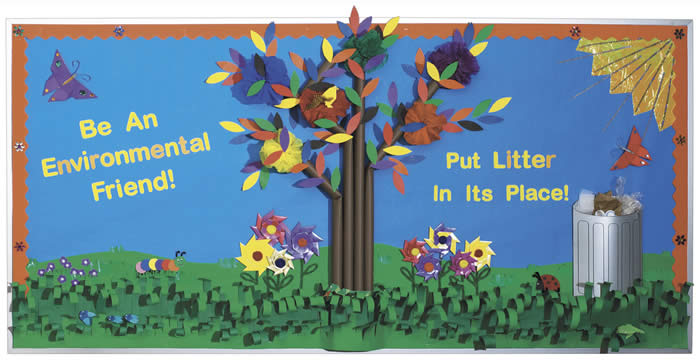
good 3-d elements
many possibilities to make this an interactive book-sharing board..have students put the title of books they are reading on the leaves, with content related to environment
Image Craft's ICON Themed Environments division created this new suite of office furniture, custom designed for our recently expanded Colorado office, now located in Centennial.
Shown here in various stages of production are a reception desk, media wall with podium, conference room table, storage and display credenzas, and more! The furnishings, primarily composed of shop ply and MDF, feature a zebra wood laminate with folkstone gray and matte black laminate work surfaces.
This project was produced entirely in-house in our Phoenix headquarters, from design to fabrication, and ultimately, through on-site installation. Backlit lettering and graphics are also part of the overall concept, and will be the final addition. We'll add more photos here as the project progresses.
For more information on ICON Themed Environments and a gallery of past projects, please see our web site at: