View allAll Photos Tagged Describes
Described as “a savage beauty” by Oscar Wilde, Connemara is rural Ireland at its most dramatic. Kari Kola’s installation of 1,000 lights spread over a distance of 5 kilometres, transforming the mountains in a wash of vibrant pulsating colours.
Galway 2020 European Capital of Culture presented Savage Beauty. The artwork transformed Ireland’s Connemara mountains with colour and light in the largest site-specific light artwork ever created.
This is how CMV Cruises describes their ship:
At 63,786grt, with a draft of 8.20 metres and overall length of nearly 250 metres, Columbus was purpose built for deep sea ocean cruising and we believe is ideally suited to the type of exciting scenic cruise programme we operate. She underwent an extensive refit in August 2015 and will be upgraded further in April 2017 before the start of her maiden CMV season.
Columbus has 775 passenger cabins including 64 de luxe balcony cabins and junior suites which will please many of our customers who have been asking for more balcony accommodation. Following the successful trial on board Magellan, and recognising the needs of single travellers, 150 cabins will be allocated for solos.
Famously described as ‘the happiest show in town’, Chester Operatic Society celebrates 100 years of musical theatre with a treat for musical fans of all ages.
Bill Snibson, a Lambeth costermonger, is revealed to be the new Earl of Hareford and his newly discovered aristocratic relations are horrified. Bringing him to Hareford Hall, they attempt to educate Bill into the ways of the gentry and to separate him from his cockney girlfriend Sally. The result? Chaos of the most comical kind!
With a host of hilarious characters, witty one-liners and several toe-tapping, uplifting songs (including the famous Lambeth Walk, The Sun Has Got His Hat On and Leaning on a Lamp Post) Me and My Girl is a sublime and sunny treat for all fans of musical comedy!
For more info see:
The show runs from Weds 8th to Sat 11th June 2022 at Storyhouse, Chester. For tickets see:
www.storyhouse.com/event/me-and-my-girl
#ChesterCulture
Ice. Perfectly describes the weather right now in Minnesota. There was a record high of 47 degrees yesterday and the current temperature at 12:20 pm is -11.
Follow me on the following social networking sites:
Facebook l Google Plus l Twitter l 500px l Pinterest
All my images are copyrighted. If you intend to use my pictures for anything, contact me first. Thank you.
Please note that It is NOT okay to use any of my images for ANY purpose -- this includes (but is not restricted to) commercial, personal, any kind of manipulation.
If you are interested in purchasing prints of any of the images you see here or using the images for commercial purposes, please contact me. I am willing to work with you on opportunities.
Images that are displayed on this Flickr site and on my personal blog site may not be copied, reproduced, republished, downloaded, displayed, modified, licensed, transferred, sold, distributed or uploaded in any way without my permission. Any and all thefts will be prosecuted to the fullest extent of the law.
Please contact me if you are interested in using my photography.
Described as the most illustrious and spectacular Hellenistic city of Asia Minor, it is today reached by cable car being 1165 ft above sea level and 1,000 feet above the surrounding plain.
Primavera, is a large panel painting in tempera paint by the Italian Renaissance painter Sandro Botticelli made in the late 1470s or early 1480s (datings vary). It has been described as "one of the most written about, and most controversial paintings in the world", and also "one of the most popular paintings in Western art".
The painting depicts a group of figures from classical mythology in a garden, but no story has been found that brings this particular group together. Most critics agree that the painting is an allegory based on the lush growth of Spring, but accounts of any precise meaning vary, though many involve the Renaissance Neoplatonism which then fascinated intellectual circles in Florence. The subject was first described as Primavera by the art historian Giorgio Vasari who saw it at Villa Castello, just outside Florence, by 1550.
Although the two are now known not to be a pair, the painting is inevitably discussed with Botticelli's other very large mythological painting, The Birth of Venus, also in the Uffizi. They are among the most famous paintings in the world, and icons of the Italian Renaissance; of the two, the Birth is even better known than the Primavera. As depictions of subjects from classical mythology on a very large scale, they were virtually unprecedented in Western art since classical antiquity.
The history of the painting is not certainly known; it may have been commissioned by one of the Medici family, but the certainty of its commission is unknown. It draws from a number of classical and Renaissance literary sources, including the works of the Ancient Roman poet Ovid and, less certainly, Lucretius, and may also allude to a poem by Poliziano, the Medici house poet who may have helped Botticelli devise the composition. Since 1919 the painting has been part of the collection of the Uffizi Gallery in Florence, Italy.
The painting features six female figures and two male, along with a cupid, in an orange grove. The movement of the composition is from right to left, so following that direction the standard identification of the figures is: at far right "Zephyrus, the biting wind of March, kidnaps and possesses the nymph Chloris, whom he later marries and transforms into a deity; she becomes the goddess of Spring, eternal bearer of life, and is scattering roses on the ground." Chloris the nymph overlaps Flora, the goddess she transforms into.
In the centre (but not exactly so) and somewhat set back from the other figures stands Venus, a red-draped woman in blue. Like the flower-gatherer, she returns the viewer's gaze. The trees behind her form a broken arch to draw the eye. In the air above her a blindfolded Cupid aims his bow to the left. On the left of the painting the Three Graces, a group of three females also in diaphanous white, join hands in a dance. At the extreme left Mercury, clothed in red with a sword and a helmet, raises his caduceus or wooden rod towards some wispy gray clouds.
The interactions between the figures are enigmatic. Zephyrus and Chloris are looking at each other. Flora and Venus look out at the viewer, the Cupid is blindfolded, and Mercury has turned his back on the others, and looks up at the clouds. The central Grace looks towards him, while the other two seem to look at each other. Flora's smile was very unusual in painting at this date.
The pastoral scenery is elaborate. There are 500 identified plant species depicted in the painting, with about 190 different flowers, of which at least 130 can be specifically identified. The overall appearance, and size, of the painting is similar to that of the millefleur ("thousand flower") Flemish tapestries that were popular decorations for palaces at the time.
These tapestries had not caught up by the 1480s with the artistic developments of the Italian Renaissance, and the composition of the painting has aspects that belong to this still Gothic style. The figures are spread in a rough line across the front of the picture space, "set side by side like pearls on a string". It is now known that in the setting for which the painting was designed the bottom was about at eye level, or slightly above it, partly explaining "the gently rising plane" on which the figures stand.
The feet of Venus are considerably higher than those of the others, showing she is behind them, but she is at the same scale, if not larger, than the other figures. Overlapping of other figures by Mercury's sword and Chloris' hands shows that they stand slightly in front of the left Grace and Flora respectively, which might not be obvious otherwise, for example from their feet. It has been argued that the flowers do not grow smaller to the rear of the picture space, certainly a feature of the millefleur tapestries.
The costumes of the figures are versions of the dress of contemporary Florence, though the sort of "quasi-theatrical costumes designed for masquerades of the sort that Vasari wrote were invented by Lorenzo de' Medici for civic festivals and tournaments." The lack of an obvious narrative may relate to the world of pageants and tableaux vivants as well as typically static Gothic allegories.
Various interpretations of the figures have been set forth, but it is generally agreed that at least at one level the painting is "an elaborate mythological allegory of the burgeoning fertility of the world." It is thought that Botticelli had help devising the composition of the painting and whatever meanings it was intended to contain, as it appears that the painting reflects a deep knowledge of classical literature and philosophy that Botticelli is unlikely to have possessed. Poliziano is usually thought to have been involved in this, though Marsilio Ficino, another member of Lorenzo de' Medici's circle and a key figure in Renaissance Neoplatonism, has also often been mentioned.
One aspect of the painting is a depiction of the progress of the season of spring, reading from right to left. The wind of early Spring blows on the land and brings forth growth and flowers, presided over by Venus, goddess of April, with at the left Mercury, the god of the month of May in an early Roman calendar, chasing away the last clouds before summer. As well as being part of a sequence over the season, Mercury in dispelling the clouds is acting as the guard of the garden, partly explaining his military dress and his facing out of the picture space. A passage in Virgil's Aeneid describes him clearing the skies with his caduceus. A more positive, Neoplatonist view of the clouds is that they are "the benificent veils through which the splendour of transcendent truth may reach the beholder without destroying him."
Venus presides over the garden – an orange grove (a Medici symbol). It is also the Garden of the Hesperides of classical myth, from which the golden apples used in the Judgement of Paris came; the Hellenistic Greeks had decided that these were citrus fruits, exotic to them. According to Claudian, no clouds were allowed there. Venus stands in front of the dark leaves of a myrtle bush. According to Hesiod, Venus had been born of the sea after the semen of Uranus had fallen upon the waters. Coming ashore in a shell she had clothed her nakedness in myrtle, and so the plant became sacred to her. Venus appears here in her character as a goddess of marriage, clothed and with her hair modestly covered, as married women were expected to appear in public.
The Three Graces are sisters, and traditionally accompany Venus. In classical art (but not literature) they are normally nude, and typically stand still as they hold hands, but the depiction here is very close to one adapting Seneca by Leon Battista Alberti in his De pictura (1435), which Botticelli certainly knew. From the left they are identified by Edgar Wind as Voluptas, Castitas, and Pulchritudo (Pleasure, Chastity and Beauty), though other names are found in mythology, and it is noticeable that many writers, including Lightbown and the Ettlingers, refrain from naming Botticelli's Graces at all.
Botticelli's Pallas and the Centaur (1482) has been proposed as the companion piece to Primavera.
Cupid's arrow is aimed at the middle Grace — Chastity, according to Wind — and the impact of love on chastity, leading to a marriage, features in many interpretations. Chastity looks towards Mercury, and some interpretations, especially those identifying the figures as modelled on actual individuals, see this couple as one to match Chloris and Zephyrus on the other side of the painting.
In a different interpretation the Earthy carnal love represented by Zephyrus to the right is renounced by the central figure of the Graces, who has turned her back to the scene, unconcerned by the threat represented to her by Cupid. Her focus is on Mercury, who himself gazes beyond the canvas at what many believe hung as the companion piece to Primavera: Pallas and the Centaur, in which "love oriented towards knowledge" (embodied by Pallas Athena) proves triumphant over lust (symbolized by the centaur).
The basic identification of the figures is now widely agreed,but in the past other names have sometimes been used for the females on the right, who are two stages of the same person in the usual interpretation. The woman in the flowered dress may be called Primavera (a personification of Spring), with Flora the figure pursued by Zephyrus. One scholar suggested in 2011 that the central figure is not Venus at all, but Persephone.
In addition to its overt meaning, the painting has been interpreted as an illustration of the ideal of Neoplatonic love popularized among the Medicis and their followers by Marsilio Ficino. The Neoplatonic philosophers saw Venus as ruling over both Earthly and divine love and argued that she was the classical equivalent of the Virgin Mary; this is alluded to by the way she is framed in an altar-like setting that is similar to contemporary images of the Virgin Mary. Venus' hand gesture of welcome, probably directed to the viewer, is the same as that used by Mary to the Archangel Gabriel in contemporary paintings of the Annunciation.
Punning allusions to Medici names probably include the golden balls of the oranges, recalling those on the Medici coat of arms, the laurel trees at right, for either Lorenzo, and the flames on the costume of both Mercury (for whom they are a regular attribute) and Venus, which are also an attribute of Saint Laurence (Lorenzo in Italian). Mercury was the god of medicine and "doctors", medici in Italian. Such puns for the Medici, and in Venus and Mars the Vespucci, run through all Botticelli's mythological paintings.
The origin of the painting is unclear. Botticelli was away in Rome for many months in 1481/82, painting in the Sistine Chapel, and suggested dates are in recent years mostly later than this, but still sometimes before. Thinking has been somewhat changed by the publication in 1975 of an inventory from 1499 of the collection of Lorenzo di Pierfrancesco de' Medici.
The 1499 inventory records it hanging in the city palace of Lorenzo di Pierfrancesco de' Medici and his brother Giovanni "Il Popolano". They were the cousins of Lorenzo de' Medici ("Lorenzo il Magnifico"), who was effectively the ruler of Florence, and after their father's early death had been his wards. It hung over a large lettuccio, an elaborate piece of furniture including a raised base, a seat and a backboard, probably topped with a cornice. The bottom of the painting was probably at about the viewer's eye-level, so rather higher than it is hung today.
In the same room was Botticelli's Pallas and the Centaur, and also a large tondo with the Virgin and Child. The tondo is now unidentified, but is a type of painting especially associated with Botticelli. This was given the highest value of the three paintings, at 180 lire. A further inventory of 1503 records that the Primavera had a large white frame.
In the first edition of his Life of Botticelli, published in 1550, Giorgio Vasari said that he had seen this painting, and the Birth of Venus, hanging in the Medici country Villa di Castello. Before the inventory was known it was usually believed that both paintings were made for the villa, probably soon after it was acquired in 1477, either commissioned by Lorenzo di Pierfrancesco or perhaps given to him by his older cousin and guardian Lorenzo de' Medici. Rather oddly, Vasari says both paintings contained female nudes, which is not strictly the case here.
Most scholars now connect the painting to the marriage of Lorenzo di Pierfrancesco de' Medici. Paintings and furniture were often given as presents celebrating weddings. The marriage was on 19 July 1482, but had been postponed after the death of the elder Lorenzo's mother on 25 March. It was originally planned for May. Recent datings tend to prefer the early 1480s, after Botticelli's return from Rome, suggesting it was directly commissioned in connection with this wedding, a view supported by many.
Another older theory, assuming an early date, suggests the older Lorenzo commissioned the portrait to celebrate the birth of his nephew Giulio di Giuliano de' Medici (who later became Pope), but changed his mind after the assassination of Giulo's father, his brother Giuliano in 1478, having it instead completed as a wedding gift for Lorenzo di Pierfrancesco.
It is frequently suggested that Lorenzo di Pierfrancesco is the model for Mercury in the portrait, and his bride Semiramide represented as Flora (or Venus). In older theories, placing the painting in the 1470s, it was proposed that the model for Venus was Simonetta Vespucci, wife of Marco Vespucci and according to popular legend the mistress of Giuliano de' Medici (who is also sometimes said to have been the model for Mercury); these identifications largely depend on an early date, in the 1470s, as both were dead by 1478. Simonetta was the aunt of Lorenzo's bride Semiramide. Summarizing the many interpretations of the painting, Leopold Ettlinger includes "descending to the ludricous – a Wagnerian pantomime enacted in memory of the murdered Giuliano de' Medici and his beloved Simonetta Vespucci with the Germanic Norns disguised as the Mediterranean Graces."
Whenever this painting and the Birth of Venus were united at Castello, they have remained together ever since. They stayed in Castello until 1815, when they were transferred to the Uffizi. For some years until 1919 they were kept in the Galleria dell'Accademia, another government museum in Florence. Since 1919, it has hung in the Uffizi Gallery in Florence. During the Italian campaign of World War Two, the picture was moved to Montegufoni Castle about ten miles south west of Florence to protect it from wartime bombing.
It was returned to the Uffizi Gallery where it remains to the present day. In 1978, the painting was restored.[66] The work has darkened considerably over the course of time
I don't have words to fully describe the sorrow in my heart.
Tonight, is our last night with this precious creature who has spent the last 11 years with my husband wrapped around her little paw, and me for the past 4.
She's made me laugh harder than any other dog ever has, and I have felt overwhelming love from her.
She's not going to get any better, without being highly medicated, she's in deep pain.
She's been a huge part of my Flickr experience, and I'll miss my Beagle model.
Tomorrow afternoon, we'll end her pain.
Our hearts are broken.
To all of you with dogs & cats....go hug them.
ABOUT RAINTINGS
Rainting is a word I coined describing a painterly effect, achieved by photographing the subject through glass that is being rained on, like a windshield or other. It achieves an oftentimes pretty or soft flowing effect, and sometimes other-worldly. It is usually creative, fun, and fluid, seldom harsh in my opinion. I have an album of them on Flickr. Rainting is already in "The Urban Dictionary" but I would like it to also be in a more sophisticated/educational type of dictionary. I started a public Flickr group of Raintings on New Year's Day 2020.
The more collegiate type of dictionaries say that the word has to actually be used by people before they're likely to publish it. So if you like the word and my idea, say it loud and say it clear and take a few Raintings and post them to my new group. Using my word and trying my new group are not inclusive of one another.
************************************************************
From left to right: Part of my driver's side window, black truck post area in cab of truck & more night sky, then Taco Time Restaurant sign, then more windshield.
***********************************************************
DSCN2570PartWindshield&TacoTimeSignRaintingFlickr031520
Described by Sir John Betjeman as 'The most beautiful Pier in England' it's certainly one of the most photographed, maybe after the shell of Brighton West Pier.
This is a quick 30 second long exposure rather than my normal 3 minutes, but I quite like the end result!
The legendary show described as a ‘Great Experience’ by Alice Cooper, ROCK OF AGES is the worldwide smash-hit that features a potent mix of 80′s-themed hilarity and eyebrow scorching tunes, including: Don’t Stop Believin’, We Built This City, The Final Countdown, Wanted Dead or Alive, Here I Go Again, Can’t Fight this Feeling and I Want To Know What Love Is.
E para recordar.......
Don’t Stop Believin’: www.youtube.com/watch?v=VcjzHMhBtf0
Some will win, some will lose
Some were born to sing the blues
Oh, the movie never ends
It goes on and on and on and on
Described as the greatest railway journey in the world, this 84 mile round trip takes you past a list of impressive extremes. Starting near the highest mountain in Britain, Ben Nevis, (Fort William) running through to Mallaig on the coast
Morsum-Kliff has been described as "one of the most important geological monuments in Germany". It stretches for around 1.8 kilometres along the northeastern coast and rises to a height of up to 21 metres. The Kliff is made up of various layers of soil:
* gray-black ''Glimmerton'' dating back 5 to 7 million years and including fossils such as snails, mussels and crabs
* reddish Limonite dating back 4 to 5 million years
* white Kaolin sands deposited here 2 to 3 million years ago from Scandinavia and containing fossilised corals, sea lilies and sponges (dead for around 500 million years).
These three layers were originally on top of each other but about 15,000 years ago during the ice age they were compressed and folded by glacial activity, so that in places they are now horizontally next to each other.
The Kliff and the nearby heath-covered area (around 43 hectares) have been a nature preserve since 1923. This prevented the planned use of the sand deposits in construction of the Hindenburgdamm.
Currently, the Kliff is threatened by erosion made worse by visitors or fossil hunters leaving the designated paths.
Sylt is an island in northern Germany, part of Nordfriesland district, Schleswig-Holstein.
As described in an earlier shot.
The result of bored children looking for something to do
It was extinguished before it spread closer to a building behind me
Near Gaskell St, St Helens
Duchamp described 'Infrathin' (Inframince), at one point, as the infinite space between two sides of the same sheet of paper. In other words that infinitely small was actually the same size/non-size as infinitely large, both being infinite, and therefore no size at all, as well as being absolutely everything, plus everything else (give or take).
Marcel infra-thinned regularly, as did James, being led through that zone by Marcel. We have already seen the distortions relative to J.J's legs, that spidering effect, but here we can see Duchamp actually in the middle of an 'Infrathin' session, manifesting the digital effects, here obvious in the distorted fingers.
These effects would diminish over time, and usually clear up after a day or two. This would explain any extra 'extremities', fingers, arms, legs, even heads, that might be visible in some of these photographs.
There is no way of knowing which dimension Marcel was actually in when this photo was taken.
All we know for sure is that when Duchamp returned from this particular 'Infrathin trip', he began immediately to set to work on his last piece entitled 'Étant donnés'. He worked on this masterpiece for 20 years, up to his death.
Some think this photograph might have been made by Man Ray. I find this attribution to be questionable, to say the least. I have my own theory as to who might have been responsible, but my lips are sealed. Not even Donny Osmond's 'Crazy Horses' could drag it out of me.
From the 'Lanech Collection'.
I photographed a model yesterday, she was excitedly describing a big shoot she was setting up for this weekend. Four photographers, nine models, four make-up artists, she's bought a bunch of outfits (to be returned after the shoot), she'd even rented a studio downtown for a full day.
That's the part that got me.
I've begun to relax around Covid. Ate indoors for the first time since November 2021, just this week. I let people into the house without a mask. But the idea of being indoors with a bunch of people, taking pictures, presumably with no masks...not quite ready for that, yet.
I told her I shoot exclusively outside right now. It's more dynamic, it has more surprises. Hell, while we were talking, clouds passed right in front of the sun, changing the light, a big old diffuser in the sky.
But three years inside a pandemic also has me admittedly skittish about being indoors without a mask, I'm now hyper-aware of airflow and other people and the way we used to live, getting sick without giving any thought as to what was actually happening.
Up in the hills with Jada on the day this picture was taken, people were walking in front of us, around us, behind us. I notice I'm more sensitive to that now, too. Proximity to others.
I'm left wondering how long I'll feel the effects of the last few years, if it's the kind of thing that'll ever go away.
Hard to describe the feeling when the curtain of light suddenly intensifies and moves higher up in the sky, then the pillars appear and begin moving sideways...awe-inspiring. Images taken 30-seconds apart can look completely different, even with the same foreground. The colors change and move as the coyotes being howling and the fish jump...
Auroraville, WI early on November 3, 2015.
ISO 1250 F/5.0 30-second exposure. Small contrast adjustment and turned down brightness in Photoshop. NO saturation enhancements.
Copyright
All my photographic and video images are copyrighted. All rights are reserved. Please do not use, copy or edit any of my photographs without my written permission. If you want to use my photo for commercial or private use, please contact me. Please do not re-upload my photos at any location on the internet without my written consent.
IMG_9880r
The Papal Basilica of St. Peter in the Vatican (Italian: Basilica Papale di San Pietro in Vaticano), or simply St. Peter's Basilica (Latin: Basilica Sancti Petri), is an Italian Renaissance church in Vatican City, the papal enclave within the city of Rome.
Designed principally by Donato Bramante, Michelangelo, Carlo Maderno and Gian Lorenzo Bernini, St. Peter's is the most renowned work of Renaissance architecture and the largest church in the world. While it is neither the mother church of the Catholic Church nor the cathedral of the Diocese of Rome, St. Peter's is regarded as one of the holiest Catholic shrines. It has been described as "holding a unique position in the Christian world" and as "the greatest of all churches of Christendom".
Catholic tradition holds that the Basilica is the burial site of Saint Peter, chief among Jesus's Apostles and also the first Bishop of Rome. Saint Peter's tomb is supposedly directly below the high altar of the Basilica. For this reason, many Popes have been interred at St. Peter's since the Early Christian period, and there has been a church on this site since the time of the Roman emperor Constantine the Great. Construction of the present basilica, which would replace Old St. Peter's Basilica from the 4th century AD, began on 18 April 1506 and was completed on 18 November 1626.
St. Peter's is famous as a place of pilgrimage and for its liturgical functions. The Pope presides at a number of liturgies throughout the year, drawing audiences of 15,000 to over 80,000 people, either within the Basilica or the adjoining St. Peter's Square. St. Peter's has many historical associations, with the Early Christian Church, the Papacy, the Protestant Reformation and Catholic Counter-reformation and numerous artists, especially Michelangelo. As a work of architecture, it is regarded as the greatest building of its age. St. Peter's is one of the four churches in the world that hold the rank of Major Basilica, all four of which are in Rome. Contrary to popular misconception, it is not a cathedral because it is not the seat of a bishop; the Cathedra of the Pope as Bishop of Rome is in the Archbasilica of St. John Lateran.
The Richard Driehaus Museum can be described as walking into a house in the world of Harry Potter. This house from the Gilded Age is full of amazing decor and history. It's intimate and cozy, the exact opposite of a sterile art museum. I wouldn't mind a house like this...
Great Chalfield Manor
Pevsner describes Great Chalfield Manor as "one of the most perfect examples of the late medieval English manor house”.
It would be difficult to find a more beautiful medieval manor house in England than Great Chalfield. Set in the tranquil Wiltshire countryside with seven acres of gardens, this ancient house has survived for five centuries since its building and appears much as it did in the 1470’s.
Over the years various films and TV shows have been filmed at Great Chalfield, including The Other Boleyn Girl, Tess of the d'Urbervilles, Wolf Hall, where it starred as Austin Friars, the home of Thomas Cromwell, and Poldark where it doubled as Killewarren, the home of Caroline and Dr Enys.
The house and gardens were given to the National Trust in 1943.
Grade I Listed
www.nationaltrust.org.uk/visit/wiltshire/great-chalfield-...
This is a LONG exposure which describes my LONG year. Not to go into any details, but lets just say I’m really looking forward to 2011. Now I’ll be the first one to say that life is about the ups & downs, and without them you’ll have nothing to look back on. But there were certainly some times this year that I’d like to forget.
So here’s to a better 2011. I know many of you will agree that 2011 has GOT to be better than 2010. Raise a glass and drink some bubbly for me. I’m still considering a quicky road trip up near Morro Bay and come back first thing Sun morning. Anyone else?
Exposure 300 (5 minutes)
Aperture f/18.0
Focal Length 17 mm
ISO Speed 160
A trip to Nottingham’s Highfields Park gave me plenty of opportunity to approach people to see if they’d be willing to let me photograph them for my stranger project.
Molly was walking towards me, so I stepped forward and introduced the project to her. Molly didn’t hesitate in saying yes to being photographed. As we’d met right near the edge of the lake, I decided to use it as a background. The sun had gone behind a light cover of cloud, which produced a beautiful soft light that was easy to work with. Every now and again I had to wait for a rowing boat to move out of frame and for one or two ducks that took off from the water behind Molly.
Molly is in her second year of a three-year course in Criminology. Molly would like to get a job in the Civil Service but hasn’t made her mind up as to which area she’d like to work in yet.
When not studying Molly plays as a forward for Beeston Hockey Club. Molly also plays polo for the university team and said she has always ridden horses, adding that her mother owns quite a few. Even though her mum wants her to explore other forms of horse riding, Molly said she’s sticking with polo.
I asked Molly what her guilty pleasure was and she said listening to Taylor Swift.
If Molly was to describe herself in one word, what would that be? “Indecisive,” she said.
What is Molly’s biggest strength? “Being resilient,” was her reply.
If Molly met her younger self, what advice would she pass on? “Don’t worry and enjoy things for what they are,” she said.
Thank-you Molly for agreeing to be photographed for my stranger project. I hope you like your portrait.
This picture is #271 in the 100 Strangers project, yes, I’ve decided to do a third round. Find out more about the project and see pictures taken by other photographers at the 100 Strangers Flickr Group page
This is my 243rd submission to the Human Family Group. To view more street portraits and stories visit www.flickr.com/groups/thehumanfamily/
Harris & Ewing, photographer
[Man, possibly William B. Greene, with model for a machine that appears to be designed to scoop up sand or gravel]
[between 1914 and 1918]
1 negative : glass ; 5 x 7 in. or smaller
Notes:
Title and other identifying information from source: Flickr Commons project, 2020.
Title from unverified caption data received with the Harris & Ewing Collection is "Unidentified machine model."
Date based on date of negatives in same range.
Gift; Harris & Ewing, Inc. 1955.
Format:
Glass negatives.
Rights Info: No known restrictions on publication.
Repository: Library of Congress, Prints and Photographs Division, Washington, D.C. 20540 USA, hdl.loc.gov/loc.pnp/pp.print
Part Of: Harris & Ewing Photograph Collection (Library of Congress)
General information about the Harris & Ewing Collection is available at hdl.loc.gov/loc.pnp/pp.hec
Higher resolution image is available (Persistent URL): hdl.loc.gov/loc.pnp/hec.08196
Call Number: LC-H261- 8214-B
How To Create Images Like This
======================================
I do love confusing people with photos, its fun xD
======================================
If anyones at all interested, heres my lovely image analysis for my A-levels, describing how I did it in detail and shizz
======================================
For this image, my main aim was to create the strongest lead through line effect as possible, something which Peter Keetman (the artist Im studying) continuously did throughout his images.
To make the image ‘my own’ I wanted to create a large sense of surrealism and almost disorientation.
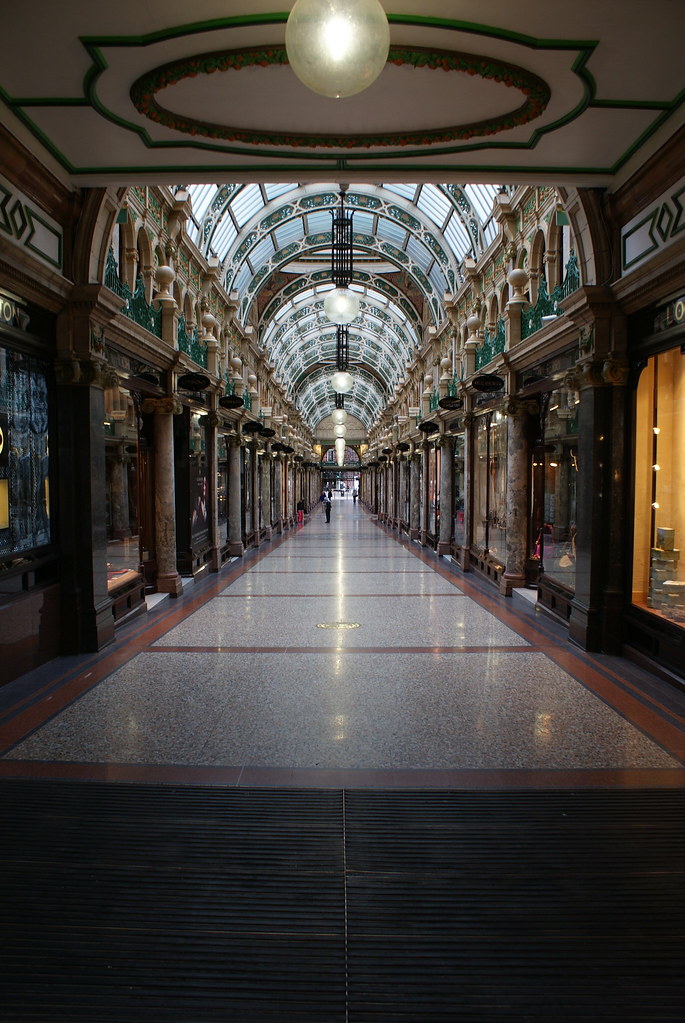
To create this image, to start off with I set my lens to 18mm to exaggerate the perspective of the building as much as possible, helping make things in the distance look further away, and placing the end of the line of shops right in the middle of the image, helping out with the lead through line.
I also opted to use a very deep depth of field in order to not lose any detail in any of the shops.
======================================
Then in Photoshop:
-Using a mixture of the tools in Camera RAW and gradient maps, I adjusted the colours to suit my preferences, upping the vibrancy and turning down the saturation helped bring out the greens in the image, I also upped the exposure and gave the blacks/contrast a boost.
-I also saw the image as too ‘cold,’ so I turned up the white balance, giving a much more warm feeling.
-To sharpen the image without creating colour artefacts, I changed the image mode to lab colour, as opposed to RBG, then turned off the A+B channels, and applied a small radius, large amount, unsharp mask.
-I then selectively dodged and burned areas of the image to bring out the details I wanted, and lose the ones I didn't.
-I then applied a very small noise reduction just to remove any unwanted grain.
-Using the patch, clone, heal and content aware fill tools I selectively removed every person out of the image as I saw them as unwanted distractions from the subject and patterns.
-To create the whole pattern itself, first I cropped the top and bottom third of the image off.
-I then selected the right half of the photograph, duplicated it into a new layer and flipped it horizontally and placed it at the left hand side and flattened the layers.
-Then I selected the top half of the image, duplicated it, flipped it vertically and placed it at the bottom of the image.
-To blend both the horizontal and vertical ‘reflections’ I used a mask and filled it with a short black to white gradient, fading the line between the layers.
-To finalise the image, creating as much disorientation as I could, I rotated it 90 degrees, making the sides of the building appear to be the path.
Personally I believe this photo tuned out exactly how I wanted it, it is full of patterns, has a multitude of lead in lines, and appears to very disorientating.
Taken in the Queens Arcade, Leeds.
Describing a scene to AI and altering the outcome to something I like, can be fun. After multiple iterations between me and the Photoshop AI, we came to settle and agree on the final scene, thus is the name for this scene: Me and My AI Scene - Fabric of My Imagination.
I have to say if this scene was real, it would be the first place to visit when I retire. I will take my fishing pole and my fishing gear and be on this lake hoping to catch some bass!
The mountain, the boat and the rabbit are AI generated. All else are from photo stocks I had in my photos library. Merging AI and non AI was a challenge!
Twilights’ Ghost
Uncanny was an exclamation used a lot by my late grandPappa; I used to love to hear him say it, even though it was years before I knew its meaning.
Uncanny is also the best word I can use to describe the following story:
I’m not sure if what follows is a true “ghost” story. I always thought of ghosts as being wispy things that people always talk about seeing, but never
>>>>>>>>>>>>>>>
GrandPappa was the dean of English Prose, Chatwick college, but it was his wife, our Móraí who was known for her stories, one of which was even published.
They lived happily on campus in a small stone cottage that once had been the livery for the historically old estate that now made up the College’s main campus.
It was a medieval-looking cottage made for lighting the imaginations of young girls like myself.
One of the tales( not one she published) our Móraí Would tell was about the local highwayman for whom Abbot‘s Chase, the road bordering the campus, was named.
Craig Abbot held up many travelers along that stretch, including the coach that my grandmother's great, great aunt Sarah had been a passenger in….
As she told the tale I could almost taste the suspense in the air as the highwayman courteously ( for Craig was a gentleman by birth) had Sarah hand over her jewels.
When my Móraí reached the part where Aunt Sarah had her hand kissed and had pleaded with him not to take her emerald ring, which had been a family keepsake she had received on her 18th birthday, She would have us spellbound with apprehension as to what would happen next( although we would hear the story many times over, and knew the outcome, it was always the same feeling).
The highwayman had only smiled, slipping off Aunt Sarah’s rings, but had allowed her to keep the non-valuable rhinestone emeralds she wore around her throat.
Poor Aunt Sarah had loved that ring, and it was not a family secret of the grief it caused her to lose it.
But for me, the romantic endeavors of Craig that I envisioned always would overshadow reality, and my cousin and I would talk through the evening wondering what had become of such a dashing figure as the masked highwayman.
But it remained a story, and nothing more. I had always hoped that I would dream myself into one of our Móraí’s tales, but no dashing prince or romantic highwayman ever did enter that realm.
It was sometime later that I would learn that my romantic highwayman had met his fate by the old bridge on Abbots Chase and had been hung. Legend had it that he was buried in the ancient cemetery located in a small wooded corner of the campus estate where servants and other non-family members were buried.
Years later, after my grandparents had both passed on, and their old stone cottage a distant, but still warm memory, I attended Chatwick college with no direct plans or purpose to be there, other than to walk the same halls as my grandfather had.
My uncanny experience happened while I was at college, one evening while attending a Masque Ball for Oxfam on a blustery Halloween‘s eve.
The Ball was being held at the posh old Ryder house in Chatwick Parish. My Girlfriend, Tallie, did not want to go alone, as friends are want to do, and convinced, or rather conned, me into going. I had a final to cram for and had planned on spending the weekend attacking that issue.
I found an old green satin bridesmaid's gown with a matching sash, from which a long brooch dangled, being a relic from my cousin’s wedding. I removed the satin sash and bow and it became a rather respectable little gown. I was also wearing the old, but still very shiny emerald necklace that we had found tucked away among my Grandmother’s things. It was pretty, with glittery emeralds surrounding a petite diamond pendant that sparkled like the real thing.
So anyway, there I was, attending a rather posh event, all dressed up, bored to tears as the saying quite correctly goes, and of course, no male seemed to notice me…
And I was much too shy a Lass to ask someone to dance.
I remember watching Tallie off-dancing with a handsome bloke wearing a prince charming outfit. Figures that my charmingly pretty friend would be the one to find a prince.
As I was snickering to myself over an image placed in my mind concerning Tallies’ dance partner’s green nylon pantaloons, someone stepped onto the hem of my long gown.
Whipping around I tripped into a tall, bearded, rather saturnine looking man sporting a black tri-corner hat and mask.
He deftly caught my fall and twirled me onto the dance floor.
He was really light on his feet and had these intense, icy eyes staring from his mask. “An executioner?” I joked to him, knowing full well he was dressed like my Móraí’s quixotic highwayman Craig Abbot.
He did not answer, only looked me over with those wistful eyes.
“Silent type ?” I remember remarking to him, trying to force a smile, but it did not work. He just grinned, remaining mute and mysterious Thinking back I realized that he had never really said anything the whole time we danced. He spoke to me through his eyes, sad and morose; it said everything that I had needed to know. And It had strangely been enough.
He kissed my hand when the dance was finished, and still not uttering a word, turned and made his way towards the black oak doors leading to the old estates’ proper English Gardens.
On a sudden whim, I followed him
He stopped at the steps outside…turning, looked back at me, then, with me following, turned and walked down the stairs.
The walk through the deserted moonlit Garden was surreal, like being in one of my Móraí’s romantic tales.
Coming to a break in the hedge, he went through. I followed, walking right into low-hanging broken strands of a cobweb spanning the opening. I bent over to free my long hair from the sticky web, I looked around, that quickly he had deserted me.
My highwayman was gone, like a phantom in the night, or more likely a will o wisp of my imagination. But he had seemed real enough, so I did not dwell on the subject, just turned and headed back inside, my skirts swishing along the cobblestone.
I walked back to the hall and rejoined my girlfriend, who was sitting with her frog prince. As she introduced me to him she stopped, and placed a hand to my throat, asking me where my necklace had gotten off to. With a start, I realized that it was gone, and we spent the rest of the evening fruitlessly tracking it down. But it, like my masked highwayman, had disappeared.
After the affair started to die down, I had declined my friend Tallies’s offer to join her and her boyfriend Charles( forever the frog prince to me), to go out after the party.
Instead, I went back to my room, and still in the gown, picked up a text that some professor actually thought a normal being could make sense of and started to half heatedly study. I found my thoughts drifting back to the party and my dance with the mysterious highwayman.
I must have fallen asleep, for I had a dream, one which I still vividly recall.
I was alone, walking along the mist-lined Road Abbot’s Chase.
My long gown again swishing against the stones. Just ahead of me just visible in the darkness, sat a mounted masked figure, shrouded in mist.
Steam emits into the chilly night air from his horses’ flared nostrils.
The horse shakes its head awaiting its master's orders. The cloaked figure looks left, then looks down into a tree-lined valley. The distant sound of horses carries up, and a lone coach soon comes into view
The carriage horses have just strained to come up from a small valley, the driver cracks his whip to keep them moving. He does not sense that there is someone up ahead , like his horses, who began to slow down. He assumes their neighs are in answer to his whip.
Thus he is totally unprepared when the horseman, cloaked and masked, rides out from the trees and points a sword at him.
He pulls to a jerking stop. “Stand and deliver” is the command he hears, The man’s voice is muffled from beneath his mask.
Dismounting, the rider strolls casually up to the carriage door and invites the occupants to step out. The passengers do so….
A gentleman comes out first.
An older man with the detached look of a sour judge. A bright gold chain encircling his waist, diamond cufflinks glint in the moonlight.
Behind him, still in the shadows of the carriage, emits the pleasing, to the masked figure, sounds of a rustling dress.
Behind the “Judge”, the open carriage door is bathed in moonlight. A wisp of satin precedes the pretty lady that enters into view.
The rider dismounts then strides purposefully up to the carriage.
“Easy does it.” The masked rider says as he helps her down, his words rolling pleasantly with a kindly Northern Welsh accent.
“I shall.” She answers head held proudly.
His eyes focus on her necklace as it lays glistening along her throat.
In my dream, this is the same necklace That I had found in my Móraí’s jewel case.
She steps down into a pool of moonlight, revealing the shimmering silver frock that adorns her pretty figure, the gown's long skirts come cascading out as she steps down to the ground. Her hair is up, and a set of drippy emerald earrings sway freely, twinkling merrily about its forlorn wearer. Diamond rings, one a bright emerald sparkle along with her slender gloved fingers. Emerald Brackets lay clasped around her wrists.
Nice of you to come dressed up this lovely evening, my pretty lass.” He smiles gallantly in her eyes, she blushes.
“What do you want,” the “judge” now
asks in a commanding voice.
With a twinkle in his eyes, the bandit answers…
“Well, the problem is, you see, my steed. I need your valuables to purchase his feed. That right Rapskellian?”
He says this to the horse behind him, who snorts upon hearing his name and tosses his head, mane flowing.
The Highwayman approaches the “Judge” and holds out his hand, fingers beckoning.
At a sign of hesitation, the sword is produced and pointed at his waist. He hands over his fat wallet, gold watch, and chain. His diamond cufflinks and emerald pin are also given over... The booty is placed y the highwayman in a pocket of his riding cloak.
“Thank you, sir..” the highwayman says in an almost civil manner.
The Highwayman then moves to the pretty lady in silver. The moon is seen behind her, framing her face casting the light through so very soft long hair.
With puppy sad eyes she looks into his, her heart-melting.
He moves forward, his sword drawn, and he brings up his gloved hand, lifting and earring up…
“Yes, this for starters!” He whispers genially, before adding in a sterner tone…
“Your jewels, then, miss.”
He asks her with a daunting voice. The look he is giving the area where her diamonds lay upon her throat, just above her ample bosom, is one of lustful desire.
Her mouth pursed in a whimper, she sadly lowers her hands, reaches up, and
fumbled for her earrings, they explode into dazzling light as she pulls them reluctantly free and lays them upon the outstretched palm. She slides the bracelets off each wrist, then looking sadly at her shimmering rings, she pulls off the two diamond ones from her gloved fingers.
She stops at the emerald ring, she looks up at him pleadingly…
“Please sir, may I keep it?”
“My lady”… he says, taking her hand up in his and pulling off the emerald ring…
‘I cannot let you keep it, though I can tell it has meaning to you.”
“I will let you keep your necklace however my lady, so that you may continue to sparkle this evening.”
Realizing he will not bargain, she steps back and watches miserably as her pile of jewelry glistens in his palm. Her hand reaches to the necklace at her throat, the only jewellery she wore that evening that wasn’t real. The cunning devil had known that!
The horse comes back into view, his head moving up and down, snorting. The highwayman, sheathing his sword, leaves the group and walks back to the horse.
“I thank you my good gentleman and fine lady, your contribution this evening is greatly appreciated.”
The “Judge” looks at him with scorn, the pretty lady smiles a sad little smile The figure on foot remounts and rides off.
Suddenly a cold wind comes howling down the road, I tried to wake, but felt paralyzed as The Highwayman rides off…
I am standing in a different spot now, by the river, on a small hill looking down over the stone bridge that crosses over it.
I see the highwayman galloping down the road to the bridge that I now recognize as being the one we now call the Kissing Bridge on Abbots Chase.
Soon after soldiers on horseback emerge from the woods and come thundering after him down the road.
He is far ahead and I see him cross the bridge, he dismounts and slapping Rapskellianon on the flank.
The horse gallops off down Abbots Chase.
The masked highwayman darts under the bridge.
As the soldiers cross the bridge in hot pursuit, he boldly salutes them from his hiding spot.
As I watch, he then goes up and works one of the flagstones loose on the bottom of the bridge, creating a little hallow.
It is here that he places his ill-gotten gains.
Then, moving the stone back in place, he moves onto the road, suddenly he turns around, looking back.
I start to look also, but then am aware of a key turning in my door. Reluctantly I tried to hold onto my dream as I hear my roommates call.
As I woke, I found my hand searching in vain for the necklace I had lost, the one he had said I could keep in my dream.
Of course, it is still gone.
>>>>>>>>>>>>>>>>>>>
The next day after my exam I met up with Tallie and her new boyfriend after her class lecture. We discussed in detail last evening’s events, including my dream.
Charles “The Frog Prince” suggested we should visit the old bridge and look for the loose flagstone. I chided him for his silliness; it was only a dream, after all, a remnant of one of my Móraí’s stories.
But after they left, I had a sort of odd, haunting feeling. I remember feeling my throat again for the necklace that I had worn. I decided that I needed to see for myself, and I felt I should do it alone.
I rose and walked around the campus until I reached Abbots Chase.
It was almost surreal as I walked down it.
The sun disappeared under some blustery autumn clouds, it grew colder, everything around me took on a colorless pale. Off to one side, I soon saw the old cemetery, and for the first time in my life, I went into it, looking over its crumbling gravestones, reading faint names of those long ago forgotten.
I found it off in a corner by itself.
A long tall stone, with carved writing, faint with age.
Craig Abbot
Below that was what looked like the word hung and a date, barely visible.
With a start, I realized that the date he had departed from this earth was chilling, the date of yesterday, the day of the dance, and the evening when I had my dream.
I thoughtful ran my fingers along the etchings, pondering.
Then I rise, still, in somewhat of a daze, I went back to the old road and drifted to the bridge a short ways off.
Upon reaching it, I remembered in vivid detail the stone he had pried away in my dream.
I went to it and attempted to move it.
It did not budge at first, but to my surprise, started to wobble, then it comes down, exposing a small cavity.
Wondering what it meant, I reached inside and felt around.
My fingers curled around a small, cold object.
Pulling it out I discovered it was a ring, upon further examination it was an emerald ring, one just like the one taken from the pretty young lady in my dream, similar to the one my Móraí had said my Aunt Sarah Had lost to Craig Abbot.
^^^^^^^^^^
As I finally write this down from my memory, I am wearing the ring I discovered hidden away... It is very old and very pretty.
What connection, if any it has with my story, I am unsure, but obviously, there are many to be made.
So was the highwayman I had danced with on that fateful evening I had lost my necklace: a ghost, a figment of my dream, some materialization of the late, Craig Abbot?
Or merely a flesh and blood rogue whose identity I never will discover? And the ring I am now wearing, could it possibly be Aunt Sarah’s?
But, much like a ghost, the real answer may never be found.
And therein lies a rub...
A video that describes the basic production of a fine art, surrealistic photograph and the way that I post process. I vaguely cover the steps it took to get from the beginning to "Lady and the last flower" to the final steps.
To give a synopsis:
I use curves to change the overall tones
Gradient map to adjust the blacks and whites
Selective color to edit specific colors
I hope this helps give a little insight on the creation of my images! If you have any questions please leave them in the comments... Happy creating!
Also, Jenna Martin and I released our underwater photography workshop information! Click here to see all the details! We will be on the Catalina Islands for a weekend teaching all the ins and outs of underwater surrealism and fine art. Hope to see you there! Message me if you have any questions!
POIMANDRES, THE VISION OF HERMES
The Divine Pymander of Hermes Mercurius Trismegistus is one of the earliest of the Hermetic writings now extant. While probably not in its original form, having been remodeled during the first centuries of the Christian Era and incorrectly translated since, this work undoubtedly contains many of the original concepts of the Hermetic cultus. The Divine Pymander consists of seventeen fragmentary writings gathered together and put forth as one work. The second book of The Divine Pymander, called Poimandres, or The Vision, is believed to describe the method by which the divine wisdom was first revealed to Hermes. It was after Hermes had received this revelation that he began his ministry, teaching to all who would listen the secrets of the invisible universe as they had been unfolded to him.
The Vision is the most: famous of all the Hermetic fragments, and contains an exposition of Hermetic cosmogony and the secret sciences of the Egyptians regarding the culture and unfoldment of the human soul. For some time it was erroneously called "The Genesis of Enoch," but that mistake has now been rectified. At hand while preparing the following interpretation of the symbolic philosophy concealed within The Vision of Hermes the present author has had these reference works: The Divine Pymander of Hermes Mercurius Trismegistus (London, 1650), translated out of the Arabic and Greek by Dr. Everard; Hermetica (Oxford, 1924), edited by Walter Scott; Hermes, The Mysteries of Egypt (Philadelphia, 1925), by Edouard Schure; and the Thrice-Greatest Hermes (London, 1906), by G. R. S. Mead. To the material contained in the above volumes he has added commentaries based upon the esoteric philosophy of the ancient Egyptians, together with amplifications derived partly from other Hermetic fragments and partly from the secret arcanum of the Hermetic sciences. For the sake of clarity, the narrative form has been chosen in preference to the original dialogic style, and obsolete words have given place to those in current use.Hermes, while wandering in a rocky and desolate place, gave himself over to meditation and prayer. Following the secret instructions of the Temple, he gradually freed his higher consciousness from the bondage of his bodily senses; and, thus released, his divine nature revealed to him the mysteries of the transcendental spheres. He beheld a figure, terrible and awe-inspiring. It was the Great Dragon, with wings stretching across the sky and light streaming in all directions from its body. (The Mysteries taught that the Universal Life was personified as a dragon.) The Great Dragon called Hermes by name, and asked him why he thus meditated upon the World Mystery. Terrified by the spectacle, Hermes prostrated himself before the Dragon, beseeching it to reveal its identity. The great creature answered that it was Poimandres, the Mind of the Universe, the Creative Intelligence, and the Absolute Emperor of all. (Schure identifies Poimandres as the god Osiris.) Hermes then besought Poimandres to disclose the nature of the universe and the constitution of the gods. The Dragon acquiesced, bidding Trismegistus hold its image in his mind.Immediately the form of Poimandres changed. Where it had stood there was a glorious and pulsating Radiance. This Light was the spiritual nature of the Great Dragon itself. Hermes was "raised" into the midst of this Divine Effulgence and the universe of material things faded from his consciousness. Presently a great darkness descended and, expanding, swallowed up the Light. Everything was troubled. About Hermes swirled a mysterious watery substance which gave forth a smokelike vapor. The air was filled with inarticulate moanings and sighings which seemed to come from the Light swallowed up in the darkness. His mind told Hermes thatthe Light was the form of the spiritual universe and that the swirling darkness which had engulfed it represented material substance.Then out of the imprisoned Light a mysterious and Holy Word came forth and took its stand upon the smoking waters. This Word--the Voice of the Light--rose out of the darkness as a great pillar, and the fire and the air followed after it, but the earth and the water remained unmoved below. Thus the waters of Light were divided from the waters of darkness, and from the waters of Light were formed the worlds above and from the waters of darkness were formed the worlds below. The earth and the water next mingled, becoming inseparable, and the Spiritual Word which is called Reason moved upon their surface, causing endless turmoil.Then again was heard the voice of Poimandres, but His form was not revealed: "I Thy God am the Light and the Mind which were before substance was divided from spirit and darkness from Light. And the Word which appeared as a pillar of flame out of the darkness is the Son of God, born of the mystery of the Mind. The name of that Word is Reason. Reason is the offspring of Thought and Reason shall divide the Light from the darkness and establish Truth in the midst of the waters. Understand, O Hermes, and meditate deeply upon the mystery. That which in you sees and hears is not of the earth, but is the Word of God incarnate. So it is said that Divine Light dwells in the midst of mortal darkness, and ignorance cannot divide them. The union of the Word and the Mind produces that mystery which is called Life. As the darkness without you is divided against itself, so the darkness within you is likewise divided. The Light and the fire which rise are the divine man, ascending in the path of the Word, and that which fails to ascend is the mortal man, which may not partake of immortality. Learn deeply of the Mind and its mystery, for therein lies the secret of immortality."The Dragon again revealed its form to Hermes, and for a long time the two looked steadfastly one upon the other, eye to eye, so that Hermes trembled before the gaze of Poimandres. At the Word of the Dragon the heavens opened and the innumerable Light Powers were revealed, soaring through Cosmos on pinions of streaming fire. Hermes beheld the spirits of the stars, the celestials controlling the universe, and all those Powers which shine with the radiance of the One Fire--the glory of the Sovereign Mind. Hermes realized that the sight which he beheld was revealed to him only because Poimandres had spoken a Word. The Word was Reason, and by the Reason of the Word invisible things were made manifest. Divine Mind--the Dragon--continued its discourse:"Before the visible universe was formed its mold was cast. This mold was called the Archetype, and this Archetype was in the Supreme Mind long before the process of creation began. Beholding the Archetypes, the Supreme Mind became enamored with Its own thought; so, taking the Word as a mighty hammer, It gouged out caverns in primordial space and cast the form of the spheres in the Archetypal mold, at the same time sowing in the newly fashioned bodies the seeds of living things. The darkness below, receiving the hammer of the Word, was fashioned into an orderly universe. The elements separated into strata and each brought forth living creatures. The Supreme Being--the Mind--male and female, brought forth the Word; and the Word, suspended between Light and darkness, was delivered of another Mind called the Workman, the Master-Builder, or the Maker of Things.
"In this manner it was accomplished, O Hermes: The Word moving like a breath through space called forth the Fire by the friction of its motion. Therefore, the Fire is called the Son of Striving. The Workman passed as a whirlwind through the universe, causing the substances to vibrate and glow with its friction, The Son of Striving thus formed Seven Governors, the Spirits of the Planets, whose orbits bounded the world; and the Seven Governors controlled the world by the mysterious power called Destiny given them by the Fiery Workman. When the Second Mind (The Workman) had organized Chaos, the Word of God rose straightway our of its prison of substance, leaving the elements without Reason, and joined Itself to the nature of the Fiery Workman. Then the Second Mind, together with the risen Word, established Itself in the midst of the universe and whirled the wheels of the Celestial Powers. This shall continue from an infinite beginning to an infinite end, for the beginning and the ending are in the same place and state."Then the downward-turned and unreasoning elements brought forth creatures without Reason. Substance could not bestow Reason, for Reason had ascended out of it. The air produced flying things and the waters such as swim. The earth conceived strange four-footed and creeping beasts, dragons, composite demons, and grotesque monsters. Then the Father--the Supreme Mind--being Light and Life, fashioned a glorious Universal Man in Its own image, not an earthy man but a heavenly Man dwelling in the Light of God. The Supreme Mind loved the Man It had fashioned and delivered to Him the control of the creations and workmanships."The Man, desiring to labor, took up His abode in the sphere of generation and observed the works of His brother--the Second Mind--which sat upon the Ring of the Fire. And having beheld the achievements of the Fiery Workman, He willed also to make things, and His Father gave permission. The Seven Governors, of whose powers He partook, rejoiced and each gave the Man a share of Its own nature."The Man longed to pierce the circumference of the circles and understand the mystery of Him who sat upon the Eternal Fire. Having already all power, He stooped down and peeped through the seven Harmonies and, breaking through the strength of the circles, made Himself manifest to Nature stretched out below. The Man, looking into the depths, smiled, for He beheld a shadow upon the earth and a likeness mirrored in the waters, which shadow and likeness were a reflection of Himself. The Man fell in love with His own shadow and desired to descend into it. Coincident with the desire, the Intelligent Thing united Itself with the unreasoning image or shape."Nature, beholding the descent, wrapped herself about the Man whom she loved, and the two were mingled. For this reason, earthy man is composite. Within him is the Sky Man, immortal and beautiful; without is Nature, mortal and destructible. Thus, suffering is the result of the Immortal Man's falling in love with His shadow and giving up Reality to dwell in the darkness of illusion; for, being immortal, man has the power of the Seven Governors--also the Life, the Light, and the Word-but being mortal, he is controlled by the Rings of the Governors--Fate or Destiny."Of the Immortal Man it should be said that He is hermaphrodite, or male and female, and eternally watchful. He neither slumbers nor sleeps, and is governed by a Father also both male and female, and ever watchful. Such is the mystery kept hidden to this day, for Nature, being mingled in marriage with the Sky Man, brought forth a wonder most wonderful--seven men, all bisexual, male and female, and upright of stature, each one exemplifying the natures of the Seven Governors. These O Hermes, are the seven races, species, and wheels."After this manner were the seven men generated. Earth was the female element and water the male element, and from the fire and the æther they received their spirits, and Nature produced bodies after the species and shapes of men. And man received the Life and Light of the Great Dragon, and of the Life was made his Soul and of the Light his Mind. And so, all these composite creatures containing immortality, but partaking of mortality, continued in this state for the duration of a period. They reproduced themselves out of themselves, for each was male and female. But at the end of the period the knot of Destiny was untied by the will of God and the bond of all things was loosened."Then all living creatures, including man, which had been hermaphroditical, were separated, the males being set apart by themselves and the females likewise, according to the dictates of Reason."Then God spoke to the Holy Word within the soul of all things, saying: 'Increase in increasing and multiply in multitudes, all you, my creatures and workmanships. Let him that is endued with Mind know himself to be immortal and that the cause of death is the love of the body; and let him learn all things that are, for he who has recognized himself enters into the state of Good.'"And when God had said this, Providence, with the aid of the Seven Governors and Harmony, brought the sexes together, making the mixtures and establishing the generations, and all things were multiplied according to their kind. He who through the error of attachment loves his body, abides wandering in darkness, sensible and suffering the things of death, but he who realizes that the body is but the tomb of his soul, rises to immortality."Then Hermes desired to know why men should be deprived of immortality for the sin of ignorance alone. The Great Dragon answered:, To the ignorant the body is supreme and they are incapable of realizing the immortality that is within them. Knowing only the body which is subject to death, they believe in death because they worship that substance which is the cause and reality of death."Then Hermes asked how the righteous and wise pass to God, to which Poimandres replied: "That which the Word of God said, say I: 'Because the Father of all things consists of Life and Light, whereof man is made.' If, therefore, a man shall learn and understand the nature of Life and Light, then he shall pass into the eternity of Life and Light."Hermes next inquired about the road by which the wise attained to Life eternal, and Poimandres continued: "Let the man endued with a Mind mark, consider, and learn of himself, and with the power of his Mind divide himself from his not-self and become a servant of Reality."Hermes asked if all men did not have Minds, and the Great Dragon replied: "Take heed what you say, for I am the Mind--the Eternal Teacher. I am the Father of the Word--the Redeemer of all men--and in the nature of the wise the Word takes flesh. By means of the Word, the world is saved. I, Thought (Thoth)--the Father of the Word, the Mind--come only unto men that are holy and good, pure and merciful, and that live piously and religiously, and my presence is an inspiration and a help to them, for when I come they immediately know all things and adore the Universal Father. Before such wise and philosophic ones die, they learn to renounce their senses, knowing that these are the enemies of their immortal souls."I will not permit the evil senses to control the bodies of those who love me, nor will I allow evil emotions and evil thoughts to enter them. I become as a porter or doorkeeper, and shut out evil, protecting the wise from their own lower nature. But to the wicked, the envious and the covetous, I come not, for such cannot understand the mysteries of Mind; therefore, I am unwelcome. I leave them to the avenging demon that they are making in their own souls, for evil each day increases itself and torments man more sharply, and each evil deed adds to the evil deeds that are gone before until finally evil destroys itself. The punishment of desire is the agony of unfulfillment."Hermes bowed his head in thankfulness to the Great Dragon who had taught him so much, and begged to hear more concerning the ultimate of the human soul. So Poimandres resumed: "At death the material body of man is returned to the elements from which it came, and the invisible divine man ascends to the source from whence he came, namely the Eighth Sphere. The evil passes to the dwelling place of the demon, and the senses, feelings, desires, and body passions return to their source, namely the Seven Governors, whose natures in the lower man destroy but in the invisible spiritual man give life."After the lower nature has returned to the brutishness, the higher struggles again to regain its spiritual estate. It ascends the seven Rings upon which sit the Seven Governors and returns to each their lower powers in this manner: Upon the first ring sits the Moon, and to it is returned the ability to increase and diminish. Upon the second ring sits Mercury, and to it are returned machinations, deceit, and craftiness. Upon the third ring sits Venus, and to it are returned the lusts and passions. Upon the fourth ring sits the Sun, and to this Lord are returned ambitions. Upon the fifth ring sits Mars, and to it are returned rashness and profane boldness. Upon the sixth ring sits Jupiter, and to it are returned the sense of accumulation and riches. And upon the seventh ring sits Saturn, at the Gate of Chaos, and to it are returned falsehood and evil plotting."Then, being naked of all the accumulations of the seven Rings, the soul comes to the Eighth Sphere, namely, the ring of the fixed stars. Here, freed of all illusion, it dwells in the Light and sings praises to the Father in a voice which only the pure of spirit may understand. Behold, O Hermes, there is a great mystery in the Eighth Sphere, for the Milky Way is the seed-ground of souls, and from it they drop into the Rings, and to the Milky Way they return again from the wheels of Saturn. But some cannot climb the seven-runged ladder of the Rings. So they wander in darkness below and are swept into eternity with the illusion of sense and earthiness."The path to immortality is hard, and only a few find it. The rest await the Great Day when the wheels of the universe shall be stopped and the immortal sparks shall escape from the sheaths of substance. Woe unto those who wait, for they must return again, unconscious and unknowing, to the seed-ground of stars, and await a new beginning. Those who are saved by the light of the mystery which I have revealed unto you, O Hermes, and which I now bid you to establish among men, shall return again to the Father who dwelleth in the White Light, and shall deliver themselves up to the Light and shall be absorbed into the Light, and in the Light they shall become Powers in God. This is the Way of Good and is revealed only to them that have wisdom."Blessed art thou, O Son of Light, to whom of all men, I, Poimandres, the Light of the World, have revealed myself. I order you to go forth, to become as a guide to those who wander in darkness, that all men within whom dwells the spirit of My Mind (The Universal Mind) may be saved by My Mind in you, which shall call forth My Mind in them. Establish My Mysteries and they shall not fail from the earth, for I am the Mind of the Mysteries and until Mind fails (which is never) my Mysteries cannot fail." With these parting words, Poimandres, radiant with celestial light, vanished, mingling with the powers of the heavens. Raising his eyes unto the heavens, Hermes blessed the Father of All Things and consecrated his life to the service of the Great Light.Thus preached Hermes: "O people of the earth, men born and made of the elements, but with the spirit of the Divine Man within you, rise from your sleep of ignorance! Be sober and thoughtful. Realize that your home is not in the earth but in the Light. Why have you delivered yourselves over unto death, having power to partake of immortality? Repent, and change your minds. Depart from the dark light and forsake corruption forever. Prepare yourselves to climb through the Seven Rings and to blend your souls with the eternal Light."Some who heard mocked and scoffed and went their way, delivering themselves to the Second Death from which there is no salvation. But others, casting themselves before the feet of Hermes, besought him to teach them the Way of Life. He lifted them gently, receiving no approbation for himself, and staff in hand, went forth teaching and guiding mankind, and showing them how they might be saved. In the worlds of men, Hermes sowed the seeds of wisdom and nourished the seeds with the Immortal Waters. And at last came the evening of his life, and as the brightness of the light of earth was beginning to go down, Hermes commanded his disciples to preserve his doctrines inviolate throughout all ages. The Vision of Poimandres he committed to writing that all men desiring immortality might therein find the way.In concluding his exposition of the Vision, Hermes wrote: "The sleep of the body is the sober watchfulness of the Mind and the shutting of my eyes reveals the true Light. My silence is filled with budding life and hope, and is full of good. My words are the blossoms of fruit of the tree of my soul. For this is the faithful account of what I received from my true Mind, that is Poimandres, the Great Dragon, the Lord of the Word, through whom I became inspired by God with the Truth. Since that day my Mind has been ever with me and in my own soul it hath given birth to the Word: the Word is Reason, and Reason hath redeemed me. For which cause, with all my soul and all my strength, I give praise and blessing unto God the Father, the Life and the Light, and the Eternal Good.
Red indian.... a member of the race of people living in America when Europeans arrived
The indigenous peoples of the Americas are the descendants of the pre-Columbian inhabitants of the Americas. Pueblos indígenas (indigenous peoples) is a common term in Spanish-speaking countries. Aborigen (aboriginal/native) is used in Argentina, whereas "Amerindian" is used in Quebec, The Guianas, and the English-speaking Caribbean.[21][22][23][24] Indigenous peoples are commonly known in Canada as Aboriginal peoples, which include First Nations, Inuit, and Métis peoples.[25] Indigenous peoples of the United States are commonly known as Native Americans or American Indians, and Alaska Natives.[26]
According to the prevailing theories of the settlement of the Americas, migrations of humans from Asia (in particular North Asia)[27][28] to the Americas took place via Beringia, a land bridge which connected the two continents across what is now the Bering Strait. The majority of experts agree that the earliest pre-modern human migration via Beringia took place at least 13,500 years ago.[29] These early Paleo-Indians spread throughout the Americas, diversifying into many hundreds of culturally distinct nations and tribes. According to the oral histories of many of the indigenous peoples of the Americas, they have been living there since their genesis, described by a wide range of creation myths.
Application of the term "Indian" originated with Christopher Columbus, who, in his search for Asia, thought that he had arrived in the East Indies.[30][31][32][33][34][35] The Americas came to be known as the "West Indies", a name still used to refer to the islands of the Caribbean Sea. This led to the names "Indies" and "Indian", which implied some kind of racial or cultural unity among the aboriginal peoples of the Americas. This unifying concept, codified in law, religion, and politics, was not originally accepted by indigenous peoples but has been embraced by many over the last two centuries.[citation needed] Even though the term "Indian" does not include the Aleuts, Inuit, or Yupik peoples, these groups are considered indigenous peoples of the Americas.
Although some indigenous peoples of the Americas were traditionally hunter-gatherers—and many, especially in Amazonia, still are—many groups practiced aquaculture and agriculture. The impact of their agricultural endowment to the world is a testament to their time and work in reshaping and cultivating the flora indigenous to the Americas.[36] Although some societies depended heavily on agriculture, others practiced a mix of farming, hunting, and gathering. In some regions the indigenous peoples created monumental architecture, large-scale organized cities, chiefdoms, states, and empires.
A Navajo man on horseback in Monument valley, Arizona.
Many parts of the Americas are still populated by indigenous peoples; some countries have sizable populations, especially Belize, Bolivia, Chile, Ecuador, Greenland, Guatemala, Mexico, and Peru. At least a thousand different indigenous languages are spoken in the Americas. Some, such as the Quechuan languages, Aymara, Guaraní, Mayan languages, and Nahuatl, count their speakers in millions. Many also maintain aspects of indigenous cultural practices to varying degrees, including religion, social organization, and subsistence practices. Like most cultures, over time, cultures specific to many indigenous peoples have evolved to incorporate traditional aspects, but also cater to modern needs. Some indigenous peoples still live in relative isolation from Western culture and a few are still counted as uncontacted peoples.
Migration into the continents[edit]
For more details on theories of the migrations of the Paleo-Indians, see settlement of the Americas.
The specifics of Paleo-Indian migration to and throughout the Americas, including the exact dates and routes traveled, provide the subject of ongoing research and discussion.[37][38] According to archaeological and genetic evidence, North and South America were the last continents in the world with human habitation.[37] During the Wisconsin glaciation, 50–17,000 years ago, falling sea levels allowed people to move across the land bridge of Beringia that joined Siberia to north west North America (Alaska).[39][40] Alaska was a glacial refugia because it had low snowfall, allowing a small population to exist. The Laurentide Ice Sheet covered most of North America, blocking nomadic inhabitants and confining them to Alaska (East Beringia) for thousands of years.[41][42]
Indigenous genetic studies suggest that the first inhabitants of the Americas share a single ancestral population, one that developed in isolation, conjectured to be Beringia.[43][44] The isolation of these peoples in Beringia might have lasted 10–20,000 years.[45][46][47] Around 16,500 years ago, the glaciers began melting, allowing people to move south and east into Canada and beyond.[38][48][49] These people are believed to have followed herds of now-extinct Pleistocene megafauna along ice-free corridors that stretched between the Laurentide and Cordilleran Ice Sheets.[50]
Another route proposed involves migration - either on foot or using primitive boats - along the Pacific Northwest coast to South America.[51] Evidence of the latter would have been covered by a sea level rise of more than 120 meters since the last ice age.[52]
The time range of 40,000–16,500 years ago is debatable and probably will remain so for years to come.[37][38] The few agreements achieved to date include:[29][53]
the origin from Central Asia
widespread habitation of the Americas during the end of the last glacial period, or more specifically what is known as the Late Glacial Maximum, around 16,000–13,000 years before present
Stone tools, particularly projectile points and scrapers, are the primary evidence of the earliest human activity in the Americas. Crafted lithic flaked tools are used by archaeologists and anthropologists to classify cultural periods.[54] The Clovis culture, the earliest definitively-dated Paleo-Indians in the Americas, appears around 11,500 RCBP (radiocarbon years Before Present[55]), equivalent to 13,500 to 13,000 calendar years ago.
In 2014, the autosomal DNA of a 12,500+-year-old infant from Montana found in close association with several Clovis artifacts was sequenced.[56] These are the Anzick-1 remains from the Anzick Clovis burial in Montana. The data indicate that the individual was from a population ancestral to present South American and Central American Native American populations, and closely related to present North American Native American populations. The implication is that there was an early divergence between North American and Central American plus South American populations. Hypotheses which posit that invasions subsequent to the Clovis culture overwhelmed or assimilated previous migrants into the Americas were ruled out.[56]
Similarly, the skeleton of a teenage girl (named 'Naia', after a water nymph from Greek mythology) found in the underwater caves called sistema Sac Actun in Mexico's eastern Yucatán Peninsula in 2007 has had DNA extracted, and at 13,000 years old is considered the oldest genetically intact human skeleton ever found in the Americas. The DNA indicates she was from a lineage derived from Asian origins that is represented in the modern native population's DNA.[57]
Pre-Columbian era[edit]
Main article: Pre-Columbian era
See also: Archaeology of the Americas
Language families of North American indigenous peoples
The Pre-Columbian era incorporates all period subdivisions in the history and prehistory of the Americas before the appearance of significant European and African influences on the American continents, spanning the time of the original arrival in the Upper Paleolithic to European colonization during the early modern period.[58]
While technically referring to the era before Christopher Columbus' voyages of 1492 to 1504, in practice the term usually includes the history of American indigenous cultures until Europeans either conquered or significantly influenced them, even if this happened decades or even centuries after Columbus' initial landing.[59] "Pre-Columbian" is used especially often in the context of discussing the great indigenous civilizations of the Americas, such as those of Mesoamerica (the Olmec, the Toltec, the Teotihuacano, the Zapotec, the Mixtec, the Aztec, and the Maya civilizations) and those of the Andes (Inca Empire, Moche culture, Muisca Confederation, Cañaris).
Ethnic groups circa 1300-1535
Paleo-Indians hunting a glyptodont
Many pre-Columbian civilizations established characteristics and hallmarks which included permanent or urban settlements, agriculture, civic and monumental architecture, and complex societal hierarchies.[60] Some of these civilizations had long faded by the time of the first significant European and African arrivals (ca. late 15th–early 16th centuries), and are known only through oral history and through archaeological investigations. Others were contemporary with this period, and are also known from historical accounts of the time. A few, such as the Mayan, Olmec, Mixtec, and Nahua peoples, had their own written records. However, the European colonists of the time worked to eliminate non-Christian beliefs, and Christian pyres destroyed many pre-Columbian written records. Only a few documents remained hidden and survived, leaving contemporary historians with glimpses of ancient culture and knowledge.
According to both indigenous American and European accounts and documents, American civilizations at the time of European encounter had achieved many accomplishments.[61] For instance, the Aztecs built one of the largest cities in the world, Tenochtitlan, the ancient site of Mexico City, with an estimated population of 200,000. American civilizations also displayed impressive accomplishments in astronomy and mathematics. The domestication of maize or corn required thousands of years of selective breeding.
Inuit, Alaskan Native, and American Indian creation myths tell of a variety of origins of their respective peoples. Some were "always there" or were created by gods or animals, some migrated from a specified compass point, and others came from "across the ocean".[62]
European colonization[edit]
Main article: European colonization of the Americas
See also: Population history of indigenous peoples of the Americas and Columbian Exchange
Cultural areas of North America at time of European contact
The European colonization of the Americas forever changed the lives and cultures of the peoples of the continents. Although the exact pre-contact population of the Americas is unknown, scholars estimate that Native American populations diminished by between 80 and 90% within the first centuries of contact with Europeans. The leading cause was disease. The continent was ravaged by epidemics of diseases such as smallpox, measles, and cholera, which were brought from Europe by the early explorers and spread quickly into new areas even before later explorers and colonists reached them. Native Americans suffered high mortality rates due to their lack of prior exposure to these diseases. The loss of lives was exacerbated by conflict between colonists and indigenous people. Colonists also frequently perpetrated massacres on the indigenous groups and enslaved them.[63][64][65] According to the U.S. Bureau of the Census (1894), the North American Indian Wars of the 19th century cost the lives of about 19,000 whites and 30,000 Native Americans.[66]
The first indigenous group encountered by Columbus were the 250,000 Taínos of Hispaniola who represented the dominant culture in the Greater Antilles and the Bahamas. Within thirty years about 70% of the Taínos had died.[67] They had no immunity to European diseases, so outbreaks of measles and smallpox ravaged their population.[68] Increasing punishment of the Taínos for revolting against forced labour, despite measures put in place by the encomienda, which included religious education and protection from warring tribes,[69] eventually led to the last great Taíno rebellion.
Following years of mistreatment, the Taínos began to adopt suicidal behaviors, with women aborting or killing their infants and men jumping from the cliffs or ingesting untreated cassava, a violent poison.[67] Eventually, a Taíno Cacique named Enriquillo managed to hold out in the Baoruco Mountain Range for thirteen years, causing serious damage to the Spanish, Carib-held plantations and their Indian auxiliaries.[70] Hearing of the seriousness of the revolt, Emperor Charles V (also King of Spain) sent captain Francisco Barrionuevo to negotiate a peace treaty with the ever-increasing number of rebels. Two months later, after consultation with the Audencia of Santo Domingo, Enriquillo was offered any part of the island to live in peace.
The Laws of Burgos, 1512-1513, were the first codified set of laws governing the behavior of Spanish settlers in America, particularly with regard to native Indians. The laws forbade the maltreatment of natives and endorsed their conversion to Catholicism.[71] The Spanish crown found it difficult to enforce these laws in a distant colony.
Drawing accompanying text in Book XII of the 16th-century Florentine Codex (compiled 1540–1585), showing Nahuas of conquest-era central Mexico suffering from smallpox
Various theories for the decline of the Native American populations emphasize epidemic diseases, conflicts with Europeans, and conflicts among warring tribes. Scholars now believe that, among the various contributing factors, epidemic disease was the overwhelming cause of the population decline of the American natives.[72][73] Some believe that after first contacts with Europeans and Africans, Old World diseases caused the death of 90 to 95% of the native population of the New World in the following 150 years.[74] Smallpox killed up to one third of the native population of Hispaniola in 1518.[75] By killing the Incan ruler Huayna Capac, smallpox caused the Inca Civil War. Smallpox was only the first epidemic. Typhus (probably) in 1546, influenza and smallpox together in 1558, smallpox again in 1589, diphtheria in 1614, measles in 1618—all ravaged the remains of Inca culture.
Smallpox had killed millions of native inhabitants of Mexico.[76][77] Unintentionally introduced at Veracruz with the arrival of Pánfilo de Narváez on April 23, 1520, smallpox ravaged Mexico in the 1520s,[78] possibly killing over 150,000 in Tenochtitlán alone (the heartland of the Aztec Empire), and aiding in the victory of Hernán Cortés over the Aztec Empire at Tenochtitlan (present-day Mexico City) in 1521.[citation needed]
Over the centuries, the Europeans had developed high degrees of immunity to these diseases, while the indigenous Americans had no immunity.[79]
Explorations of the Caribbean led to the discovery of the Arawaks of the Lesser Antilles. The culture was destroyed by 1650. Only 500 had survived by the year 1550, though the bloodlines continued through to the modern populace. In Amazonia, indigenous societies weathered centuries of colonization.[80]
Indians visiting a Brazilian farm plantation in Minas Gerais ca. 1824
Contact with European diseases such as smallpox and measles killed between 50 and 67 per cent of the Aboriginal population of North America in the first hundred years after the arrival of Europeans.[81] Some 90 per cent of the native population near Massachusetts Bay Colony died of smallpox in an epidemic in 1617–1619.[82] In 1633, in Plymouth, the Native Americans there were exposed to smallpox because of contact with Europeans. As it had done elsewhere, the virus wiped out entire population groups of Native Americans.[83] It reached Lake Ontario in 1636, and the lands of the Iroquois by 1679.[84][85] During the 1770s, smallpox killed at least 30% of the West Coast Native Americans.[86] The 1775–82 North American smallpox epidemic and 1837 Great Plains smallpox epidemic brought devastation and drastic population depletion among the Plains Indians.[87][88] In 1832, the federal government of the United States established a smallpox vaccination program for Native Americans (The Indian Vaccination Act of 1832).[89][90]
The Indigenous peoples in Brazil declined from a pre-Columbian high of an estimated three million[91] to some 300,000 in 1997.[dubious – discuss][not in citation given][92]
The Spanish Empire and other Europeans brought horses to the Americas. Some of these animals escaped and began to breed and increase their numbers in the wild.[93] The re-introduction of the horse, extinct in the Americas for over 7500 years, had a profound impact on Native American culture in the Great Plains of North America and of Patagonia in South America. By domesticating horses, some tribes had great success: horses enabled them to expand their territories, exchange more goods with neighboring tribes, and more easily capture game, especially bison.
Agriculture[edit]
See also: Agriculture in Mesoamerica and Incan agriculture
A bison hunt depicted by George Catlin
Over the course of thousands of years, American indigenous peoples domesticated, bred and cultivated a large array of plant species. These species now constitute 50–60% of all crops in cultivation worldwide.[94] In certain cases, the indigenous peoples developed entirely new species and strains through artificial selection, as was the case in the domestication and breeding of maize from wild teosinte grasses in the valleys of southern Mexico. Numerous such agricultural products retain their native names in the English and Spanish lexicons.
The South American highlands were a center of early agriculture. Genetic testing of the wide variety of cultivars and wild species suggests that the potato has a single origin in the area of southern Peru,[95] from a species in the Solanum brevicaule complex. Over 99% of all modern cultivated potatoes worldwide are descendants of a subspecies indigenous to south-central Chile,[96] Solanum tuberosum ssp. tuberosum, where it was cultivated as long as 10,000 years ago.[97][98] According to George Raudzens, "It is clear that in pre-Columbian times some groups struggled to survive and often suffered food shortages and famines, while others enjoyed a varied and substantial diet."[99] The persistent drought around 850 AD coincided with the collapse of Classic Maya civilization, and the famine of One Rabbit (AD 1454) was a major catastrophe in Mexico.[100]
Andenes in the Sacred Valley of the Incas, Peru. The Incan agricultural terraces are still used by many of the Incas' descendents, Quechua-speaking Andean farmers.
Natives of North America began practicing farming approximately 4,000 years ago, late in the Archaic period of North American cultures. Technology had advanced to the point that pottery was becoming common and the small-scale felling of trees had become feasible. Concurrently, the Archaic Indians began using fire in a controlled manner. Intentional burning of vegetation was used to mimic the effects of natural fires that tended to clear forest understories. It made travel easier and facilitated the growth of herbs and berry-producing plants, which were important for both food and medicines.[101]
In the Mississippi River valley, Europeans noted Native Americans' managed groves of nut and fruit trees not far from villages and towns and their gardens and agricultural fields. Further away, prescribed burning would have been used in forest and prairie areas.[102]
Many crops first domesticated by indigenous Americans are now produced and used globally. Chief among these is maize or "corn", arguably the most important crop in the world.[103] Other significant crops include cassava, chia, squash (pumpkins, zucchini, marrow, acorn squash, butternut squash), the pinto bean, Phaseolus beans including most common beans, tepary beans and lima beans, tomatoes, potatoes, avocados, peanuts, cocoa beans (used to make chocolate), vanilla, strawberries, pineapples, Peppers (species and varieties of Capsicum, including bell peppers, jalapeños, paprika and chili peppers) sunflower seeds, rubber, brazilwood, chicle, tobacco, coca, manioc and some species of cotton.
Studies of contemporary indigenous environmental management, including agro-forestry practices among Itza Maya in Guatemala and hunting and fishing among the Menominee of Wisconsin, suggest that longstanding "sacred values" may represent a summary of sustainable millennial traditions.[104]
Culture[edit]
Further information: Mythologies of the indigenous peoples of North America
Quechua woman and child in the Sacred Valley, Andes, Peru
Cultural practices in the Americas seem to have been shared mostly within geographical zones where unrelated peoples adopted similar technologies and social organizations. An example of such a cultural area is Mesoamerica, where millennia of coexistence and shared development among the peoples of the region produced a fairly homogeneous culture with complex agricultural and social patterns. Another well-known example is the North American plains where until the 19th century several peoples shared the traits of nomadic hunter-gatherers based primarily on buffalo hunting.
Writing systems[edit]
See also: Canadian Aboriginal syllabics, Cherokee syllabary, and Quipu
Maya glyphs in stucco at the Museo de sitio in Palenque, Mexico
The development of writing is counted among the many achievements and innovations of pre-Columbian American cultures. Independent from the development of writing in other areas of the world, the Mesoamerican region produced several indigenous writing systems beginning in the 1st millennium BCE. What may be the earliest-known example in the Americas of an extensive text thought to be writing is by the Cascajal Block. The Olmec hieroglyphs tablet has been indirectly dated from ceramic shards found in the same context to approximately 900 BCE, around the time that Olmec occupation of San Lorenzo Tenochtitlán began to wane.[105]
The Maya writing system was a combination of phonetic syllabic symbols and logograms — that is, it was a logosyllabic writing system. It is the only pre-Columbian writing system known to represent completely the spoken language of its community. In total, the script has more than one thousand different glyphs, although a few are variations of the same sign or meaning, and many appear only rarely or are confined to particular localities. At any one time, no more than about five hundred glyphs were in use, some two hundred of which (including variations) had a phonetic or syllabic interpretation.[106][107][108]
Aztec codices (singular codex) are books written by pre-Columbian and colonial-era Aztecs. These codices provide some of the best primary sources for Aztec culture. The pre-Columbian codices differ from European codices in that they are largely pictorial; they were not meant to symbolize spoken or written narratives.[109] The colonial era codices not only contain Aztec pictograms, but also Classical Nahuatl (in the Latin alphabet), Spanish, and occasionally Latin.
Spanish mendicants in the sixteenth century taught indigenous scribes in their communities to write their languages in Latin letters, and there is a large number of local-level documents in Nahuatl, Zapotec, Mixtec, and Yucatec Maya from the colonial era, many of which were part of lawsuits and other legal matters. Although Spaniards initially taught indigenous scribes alphabetic writing, the tradition became self-perpetuating at the local level.[110] The Spanish crown gathered such documentation, and contemporary Spanish translations were made for legal cases. Scholars have translated and analyzed these documents in what is called the New Philology to write histories of indigenous peoples from indigenous viewpoints.[111]
The Wiigwaasabak, birch bark scrolls on which the Ojibwa (Anishinaabe) people wrote complex geometrical patterns and shapes, can also be considered a form of writing, as can Mi'kmaq hieroglyphics.
Aboriginal syllabic writing, or simply syllabics, is a family of abugidas used to write some Aboriginal Canadian languages of the Algonquian, Inuit, and Athabaskan language families.
Music and art[edit]
Main articles: Visual arts by indigenous peoples of the Americas and Native American music
Apache fiddle made by Chesley Goseyun Wilson (San Carlos Apache)
Chimu culture feather pectoral, feathers, reed, copper, silver, hide, cordage, ca. 1350–1450 CE
Textile art by Julia Pingushat (Inuk, Arviat, Nunavut Territory, Canada), wool, embroidery floss, 1995
Native American music in North America is almost entirely monophonic, but there are notable exceptions. Traditional Native American music often centers around drumming. Rattles, clappersticks, and rasps were also popular percussive instruments. Flutes were made of rivercane, cedar, and other woods. The tuning of these flutes is not precise and depends on the length of the wood used and the hand span of the intended player, but the finger holes are most often around a whole step apart and, at least in Northern California, a flute was not used if it turned out to have an interval close to a half step. The Apache fiddle is a single stringed instrument.[citation needed]
The music of the indigenous peoples of Central Mexico and Central America was often pentatonic. Before the arrival of the Spaniards and other Europeans, music was inseparable from religious festivities and included a large variety of percussion and wind instruments such as drums, flutes, sea snail shells (used as a trumpet) and "rain" tubes. No remnants of pre-Columbian stringed instruments were found until archaeologists discovered a jar in Guatemala, attributed to the Maya of the Late Classic Era (600–900 CE), which depicts a stringed musical instrument which has since been reproduced. This instrument is one of the very few stringed instruments known in the Americas prior to the introduction of European musical instruments; when played, it produces a sound that mimics a jaguar's growl.[112]
Visual arts by indigenous peoples of the Americas comprise a major category in the world art collection. Contributions include pottery, paintings, jewellery, weavings, sculptures, basketry, carvings, and beadwork.[113] Because too many artists were posing as Native Americans and Alaska Natives[114] in order to profit from the cachet of Indigenous art in the United States, the U.S. passed the Indian Arts and Crafts Act of 1990, requiring artists to prove that they are enrolled in a state or federally recognized tribe. To support the ongoing practice of American Indian, Alaska Native, and Native Hawaiian arts and cultures in the United States,[115] the Ford Foundation, arts advocates and American Indian tribes created an endowment seed fund and established a national Native Arts and Cultures Foundation in 2007.[116][117]
Demography of contemporary populations[edit]
This map shows the percentage of indigenous population in different countries of the Americas.
The following table provides estimates for each country in the Americas of the populations of indigenous people and those with partial indigenous ancestry, each expressed as a percentage of the overall population. The total percentage obtained by adding both of these categories is also given.
Note: these categories are inconsistently defined and measured differently from country to country. Some figures are based on the results of population-wide genetic surveys while others are based on self-identification or observational estimation
All Saints Church at Brixworth has been described by Simon Jenkins as “one of the most important Romanesque churches in Europe”. It is reckoned to be the second oldest church in England, dating from around 675AD, when the Peterborough Chronicle recorded it as a monastery. It was badly damaged by the Danes in 876AD and converted into a church in the 10th century. Like most other churches in England, it has had substantial additions and alterations over the centuries. The broach spire, for example, dates from the 14th century.
But I believe that this building actually started its life as a quite substantial Roman building that was taken over by the Anglo Saxons several hundred years after its original construction.
The stair turret is reckoned to be Saxon, dating from the 10th century, but there is evidence of Roman construction at the base. The large window arches with their pantiles at the side of the church are quite clearly Roman while conclusive evidence is inside the church. Here an arch of typical Roman construction on the inside of the tower has been cut into by a Saxon window. This is virtually identical to Saxon windows dating from 970AD that can be seen in the tower of All Saints Church at Earls Barton.
Coincidentally, the oldest church in England is St Martin’s in Canterbury, which dates from 597AD. But as the Venerable Bede confirmed, it is actually based around a much older Roman building. Just like I believe All Saints Church is at Brixworth.
Described by Pevsner as "the most complete small medieval manor house in Kent" Ightham Mote originally dates to around 1320. The Great Hall but probably not the window is a survivor from this era.
This is the third part of a series describing the setup of the photo Berry Hard Work.
The Little Dudes
You might think that positioning the little dudes is easy. Many times, it is. This time, it was not.
I recently purchased some of the figures in this photo and had never used them before. In fact, they were sealed up in their packaging until a few minutes before I started setting up the scene. Unfortunately, when I pulled them out of their packaging, I discovered that three of them were broken.
1. The Headless Ax Man. He sounds like a horror movie villain, but it wasn't as bad as it sounds. The man standing in front of the strawberry had lost his head. So I grabbed some glue and stuck it back on. I let it sit for a few minutes, and he was fine. It was not that big a deal.
2. The Disarmed Wheelbarrow Man. His problem was a little more difficult to solve. His arms were attached to the wheelbarrow, which is good, but they were not attached to his body, which is bad. Again, I applied a little glue, but getting him into a position where the glue could do its thing was a bit of a challenge. His arms kept falling off of the bottom of his white shirt. Finally, after many failed attempts, I found a position where both arms would stay attached to his shirt, and I left him alone to heal. But if you look closely in the final photo, you can see that his right arm still isn't quite 100% attached to his shirt.
3. The One-Armed Dolly Man. What started off as a nightmare ended up as the silver lining. I always knew I would have this guy in front of the wheelbarrow man, with the dolly just out of view so that you might think it's another wheelbarrow full of strawberry bits. What I didn't know is that his right arm was detached from his body at the shoulder, and his left hand was not attached to the dolly at all. That sounds bad, and it was bad, until I discovered that this figure was poorly balanced, and had he been intact, he would have fallen over time and time again. However, since I was gluing him back together, I could choose how best to position his arm such that the dolly would help prop up his ill-designed body. And because I knew I was positioning him in profile, his left arm obscured by his right, it didn't matter if his left hand was attached to the dolly or not. And so, as you might be able to see in this setup photo, I didn't bother trying to fix his left hand. I just angled his right arm, and by extension the dolly, to ensure that this poor guy could stand up. And it worked!
See Also: Setup 1 | Setup 2 | Setup 3 | Setup 4 | Setup 5 | Setup 6 | Setup 7 | Setup 8 | Setup 9 | Setup 10 | Setup 11 | Berry Hard Work
--
Learn more about this image at the source.
Source: photos.jdhancock.com/photo/2013-04-23-231317-berry-hard-w...
Middleport Pottery has been described as a "Model Pottery" of the Staffordshire Pottery Industry at the time of its construction. Its scale and linear organisation contrast with the constricted sites and haphazard layout of traditional potteries such as the Gladstone Pottery Museum. It was designed to make all production processes more efficient and to improve conditions for the workforce. The passageways between the ranges were just wide enough for a cart to get through, and for the easy movement of workers and pottery. Finished pottery was placed (using the crane next to the packing house) straight onto barges on the Trent and Mersey Canal waiting to take the ceramics out to the coast for international export. Alternatively they were sent out by horse and cart via the road.
The Boulton steam engine powered the machinery for mixing clay and continued to be in use until the coal strike of the 1970s. It was fed by a large boiler that also provided steam for heating and drying pottery.
Middleport Pottery had many pre-eminent designers over the years. Charlotte Rhead worked there from 1926-1931 producing her exquisite tube-lined designs, and David Copeland worked at the Pottery in the 60s, bringing new modern designs while still using traditional copper plate engraving skills.
TACKY TACKY TACKY
TACKY IS HOW I describe this year, very childish and cutesy, but yet I still freak out everytime a new bratz is announced? credit goes to instagram and the sizzle vids for comic con.
let me get straight to the point. COME THRU DARK SKIN! So many pretty dark skin ladies this year, like the sasha with the blonde weave, and the Felicia with the pink fro.
yes I'd like to believe that's felicia. if so they did her wrong but she looks flawless but the outfit is gross.
the intention kumi is getting is great, she now has a 2nd doll, and I love her vest! meygan looks great, but her shirt throws me off.
now that that's over, let's talk about this new line that's unnamed.
words cannot describe how upset I am vee face is not used this year, cuz those 4 new dolls need them. honestly only one I like is cloe and "vinessa"
Describe what you're feeling...
#Halloween #MaitreyaBuddha #MountMeru #Jambudvipa #Mahishasura #Secondlife #SpiritedAway #Baphomet #KeigoTakami #Hawks #BNHA #Alirium #KhaosMuse #Luc #MakeaMark #AsteroidBox #Sintiklia #Zenith #EgosumAii #HPMD #SPICYBLOODNOODLES
Described by www.scottishgeology.com/best-places/beinn-eighe/ as "The remarkable Coire a’ Cheud-chnoic, or Valley of a Hundred Hills, is one of the best examples of hummocky moraine in Scotland. On the ground, this is a chaotic array of moraine mounds and ridges. When viewed from above, however, the moraines are often aligned in parallel rows, at an angle to the valley sides. These alignments indicate the former ice-margin positions as the glaciers retreated. Behind Beinn Eighe, Coire Mhic Fhearchair is one of Scotland’s most spectacular corries. At the lip of the corrie there are good examples of ice-moulded bedrock with glacial striations and rock surfaces abraded by the ice."
LC Verse Spider-Man #38 "Kid Spider"
S.H.I.E.L.D. riddles me with question after question about what I saw, no words could describe the sorrow in the members of NY after the death of Spider-Man. Worst of all I could of helped sooner but I couldn't move I was so scared and by the time I did it was too late. I told Nick Fury I wanted to take over the role as Spider-Man but it's some giant boots to fit in, ones that will take me years to grow into but he agreed, I was tested by the science department about my parasite suit, Red and Black my two parasite live in peace each one taking control in combat when necessary. Anything to protect me, their host. Nick decides to introduce me to Spider-Man's team because they're now short of a teammate.
_________________________________________________________________________________________
I stand before the old Spider-Man's team they look quite a bunch. I hold up my hand giving a slight wave and smile awkwardly at them, I mean what am I supposed to say "Hi I'm going to replace your teammate Spider-Man, what's up?" Doesn't exactly bode well. "Miles Morales this your new team, meet Vulture, Night Cat and Antisite." Nick Fury says as he gestures to the team and exits. The one called Antisite glares at me and storms off after Nick Fury, obviously displeased with Spider-Man's replacement ergo me. "Hi?" I shift nervously looking at them, Night Cat looks at me and smiles slightly "Hey there, I'm Feleica." She walks up to me and places her hand on my shoulder, her eyes seem to shimmer with sadness. "You look just like him." She mutters quietly as she traces her hand over my chest, almost like she's feeling the real Spider-Man. I can't help but feel bad for her. I look away from her and see the one called Vulture, it's studying me like I'm glowing blue or something. Felecia must notice my look of confusion and she puts on a fake smile. "That's Vulture. He can't really talk a lot, you know with his beak and all." She steps back next to him and an awkward silence fills the room, it seems like eternity till she speaks again. "Don't worry about Eddie. He's um concerned about your position." She says. I nod slightly understanding it must be hard on him losing his teammate.
__________________________________________________________________________________________
"Suit up heroes we got a mission for you." Nick Furys voice booms as I walk up to the exit standing with my new team. "What's the mission?" Antisite growls slightly angered and catches my glance at him. He glares at me and I look away quickly to the floor. "Hobgoblin and Jack'O Lantern seem to be raiding OSCORP. Possibly for some new equipment to form a new 'Sinister Six' and with the death of Spider-Man the villains seem to think they own New York now. It's up to you Team to stop it." He says as the doors begin to open revealing the city. "Well let's get to work. You ready Bird Brain?" Felecia flashes a smile and Vulture squawks in confirmation. "I was talking to him." She laughs looking at me and I smile taking a deep breath. "I'm ready."
The Canada Goose (Branta canadensis) is a goose belonging to the genus Branta, which is native to North America. It is quite often called the Canadian Goose, but that name is not strictly correct, according to the American Ornithologists' Union.[2]
According to the Oxford English Dictionary, the first citation for the 'Canada Goose' dates back to 1772.
The Canada Goose was one of the many species described by Linnaeus in his 18th-century work Systema Naturae.[3] It belongs to the Branta genus of geese, which contains species with largely black plumage, distinguishing them from the grey species of the Anser genus. The specific epithet canadensis is a New Latin word meaning "of Canada".
A recent proposed revision by Harold Hanson suggests splitting Canada Goose into six species and 200 subspecies. This radical nature of this proposal has provoked surprise in some quarters, such as Rochard Banks of the AOU, who urges caution before any of Hanson's proposals are accepted.[4]
The black head and neck with white "chinstrap" distinguish the Canada Goose from all, except the Barnacle Goose, but the latter has a black breast, and grey, rather than brownish, body plumage.[5] There are seven subspecies of this bird, of varying sizes and plumage details, but all are recognizable as Canada Geese. Some of the smaller races can be hard to distinguish from the newly-separated Cackling Goose.
This species is 76-110 cm (30-43 in) long with a 127-180 cm (50-71 in) wingspan.[6] The male usually weighs 3.2–6.5 kg, (7–14 pounds), and can be very aggressive in defending territory. The female looks virtually identical but is slightly lighter at 2.5–5.5 kg (5.5–12 pounds), generally 10% smaller than its male counterpart, and has a different honk. An exceptionally large male of the race B. c. maxima, the "giant Canada goose" (which rarely exceed 8 kg/18 lb), weighed 10.9 kg (24 pounds) and had a wingspan of 2.24 m (88 inches). This specimen is the largest wild goose ever recorded of any species. The life span in the wild is 10–24 years.[6]
This species is native to North America. It breeds in Canada and the northern United States in a variety of habitats. Its nest is usually located in an elevated area near water such as streams, lakes, ponds and sometimes on a beaver lodge. Its eggs are laid in a shallow depression lined with plant material and down. The Great Lakes region maintains a very large population of Canada Geese.
By the early 20th century, over-hunting and loss of habitat in the late 1800s and early 1900s had resulted in a serious decline in the numbers of this bird in its native range. The Giant Canada Goose subspecies was believed to be extinct in the 1950s until, in 1962, a small flock was discovered wintering in Rochester, Minnesota by Harold Hanson of the Illinois Natural History Survey. With improved game laws and habitat recreation and preservation programs, their populations have recovered in most of their range, although some local populations, especially of the subspecies occidentalis, may still be declining.
In recent years, Canada Geese populations in some areas have grown substantially, so much so that many consider them pests (for their droppings, the bacteria in their droppings, noise and confrontational behavior). This problem is partially due to the removal of natural predators and an abundance of safe, man-made bodies of water (such as on golf courses, public parks and beaches, and in planned communities).
Contrary to its normal migration routine, large flocks of Canada Geese have established permanent residence in the Chesapeake Bay and in Virginia's James River regions. The parks and golf courses of Scottsdale, Arizona have an unusually high concentration of permanent Canada geese.
Canada Geese have reached northern Europe naturally, as has been proved by ringing recoveries. The birds are of at least the subspecies parvipes, and possibly others. Canada Geese are also found naturally on the Kamchatka Peninsula in eastern Siberia, eastern China, and throughout Japan.
Greater Canada Geese have also been introduced in Europe, and have established populations in Great Britain, the Netherlands, Belgium, and Scandinavia. Semi-tame feral birds are common in parks, and have become a pest in some areas. The geese were first introduced in Britain in the late 17th century as an addition to King James II's waterfowl collection in St. James's Park.
Canada Geese were introduced as a game bird into New Zealand and have also become a problem in some areas.
Like most geese, the Canada Goose is naturally migratory with the wintering range being most of the United States. The calls overhead from large groups of Canada Geese flying in V-shaped formation signal the transitions into spring and autumn. In some areas, migration routes have changed due to changes in habitat and food sources. In mild climates, such as the Pacific Northwest, due to a lack of former predators, some of the population has become non-migratory.
Canada Geese are herbivores although they sometimes eat small insects and fish. Their diet includes green vegetation and grains. The Canada Goose eats a variety of grasses when on land. It feeds by grasping a blade of grass with the bill, then tearing it with a jerk of the head. The Canada Goose also eats grains such as wheat, beans, rice, and corn when they are available. In the water, it feeds from silt at the bottom of the body of water. It also feeds on aquatic plants, such as seaweeds.[6]
During the second year of their lives, Canada Geese find a mate. They are monogamous, and most couples stay together all of their lives.[6] If one is killed, the other may find a new mate. The female lays 3–8 eggs and both parents protect the nest while the eggs incubate, but the female spends more time at the nest than the male. Known egg predators include Arctic Foxes, Northern Raccoons, Red Foxes, large gulls, Common Raven, American Crows and bears. During this incubation period, the adults lose their flight feathers, so they cannot fly until their eggs hatch after 25–28 days.
A crèche
Adult geese are often seen leading their goslings in a line, usually with one parent at the front, and the other at the back. While protecting their goslings, parents often violently chase away nearby creatures, from small blackbirds to humans that approach, after warning them by giving off a hissing sound. Most of the species that prey on eggs will also take a gosling. Although parents are hostile to unfamiliar geese, they may form groups of a number of goslings and a few adults, called crèches. The offspring enter the fledging stage any time from 6 to 9 weeks of age. They do not leave their parents until after the spring migration, when they return to their birthplace. Once they reach adulthood, Canada Geese are rarely preyed on, but (beyond humans) can be taken by Coyotes, Red Foxes, Gray Wolves, Snowy Owls, Great Horned Owls, Golden Eagles and, most often, Bald Eagles. Canada Goose populations inhabiting areas also inhabited by domesticated geese can and will interbreed with them, producing offspring that often resemble Canada Geese in shape, but with a white or gray body, dark grey head and neck, and off-white chin, with pink feet.[citation needed]
The young are learning to find the food, the water, the shalter by watching their parents. They also learn about the predators, and are thought to fly and to swim.[7]
The Cackling Goose was originally considered to be the same species or a subspecies of the Canada Goose, but in July 2004 the American Ornithologists' Union's Committee on Classification and Nomenclature split the two into two species, making Cackling Goose into a full species with the scientific name Branta hutchinsii. The British Ornithologists' Union followed suit in June 2005.[8]
The AOU has divided the many subspecies between the two animals. To the present species were assigned:
* Atlantic Canada Goose, Branta canadensis canadensis
* Interior Canada Goose, Branta canadensis interior
* Giant Canada Goose, Branta canadensis maxima
* Moffitt's Canada Goose, Branta canadensis moffitti
* Vancouver Canada Goose, Branta canadensis fulva
* Dusky Canada Goose, Branta canadensis occidentalis
* part of "Lesser complex", Branta canadensis parvipes
The distinctions between the two geese have led to confusion and debate among ornithologists. This has been aggravated by the overlap between the small types of Canada Goose and larger types of Cackling Goose. The old "Lesser Canada Goose" was believed to be a partly hybrid population, with the birds named taverneri considered a mixture of minima, occidentalis and parvipes. In addition, it has been determined that the Barnacle Goose is a derivative of the Cackling Goose lineage, whereas the Hawaiian Goose is an insular representative of the Canada Goose.
In North America, non-migratory Canada Goose populations have been on the rise. The species is frequently found on golf courses, parking lots and urban parks, which would have previously hosted only migratory geese on rare occasions. Owing to its adaptability to human-altered areas, it has become the most common waterfowl species in North America. In many areas, non-migratory Canada Geese are now regarded as pests. They are suspected of being a cause of an increase in high fecal coliforms at beaches.[9] An extended hunting season and the use of noise makers have been used in an attempt to disrupt suspect flocks.
Since 1999, The United States Department of Agriculture Wildlife Services agency has been engaged in lethal culls of Canada Geese primarily in urban or densely populated areas. The agency responds to municipalities or private land owners, such as golf courses, who find the geese obtrusive or object to their waste.[10] The more humane method of addling eggs and destroying nests also are promoted as population control methods.
In 1995, a US Air Force E-3 Sentry aircraft at Elmendorf AFB, Alaska struck a flock of Canada Geese on takeoff and crashed, killing all 24 crew. The accident sparked efforts to avoid such events, including habitat modification, aversion tactics, herding and relocation, and culling of flocks.[11] A collision with a flock of Canada geese[12] was at fault for US Airways Flight 1549 suffering a total power loss after takeoff from New York LaGuardia Airport on 15 January 2009. The plane landed in the Hudson River causing no fatal injuries to the 155 passengers and crew.[13]
Geese have a tendency to attack humans when they feel themselves or their goslings to be threatened. First the geese will stand erect, spread their wings and produce a "hissing" sound. Next, the geese will charge. They may then bite or attack with their wings. [14]
Canada geese are known for their seasonal migrations. Most Canada geese have staging or resting areas where they join up with others. Their fall migration can be seen from September through the beginning of November. The early migrants have a tendency to spend less time at rest stops and go through the migration a lot faster. The later birds usually spend more time at rest stops. These geese are also renowned for their V-shaped flight formation. The front position is rotated since flying in front consumes the most energy. Canada Geese leave the winter grounds more quickly than the summer grounds.
This chaos describes most of my days. I love to sit and paint and experiment. Today I was thinking ahead to February and all things hearts!
"a detail taken from a watercolor by Robert Kitson describing a scene in Messina after the 1908 earthquake: here we see baby Francesco together with a group of people dedicated to playing card (...and cheaters)."
“un dettaglio preso da un acquarello di Robert Kitson che descrive una scena di Messina dopo il terremoto del 1908: qui si vede il piccolo Francesco insieme ad un gruppo di persone dedite al gioco con le carte (...e bari).”
-----------------------------------------------------------------
click to activate the icon of slideshow: the small triangle inscribed in the small rectangle, at the top right, in the photostream;
or…. Press the “L” button to zoom in the image;
clicca sulla piccola icona per attivare lo slideshow: sulla facciata principale del photostream, in alto a destra c'è un piccolo rettangolo (rappresenta il monitor) con dentro un piccolo triangolo nero;
oppure…. premi il tasto “L” per ingrandire l'immagine;
www.worldphoto.org/sony-world-photography-awards/winners-...
www.fotografidigitali.it/gallery/2726/opere-italiane-segn...
……………………………………………………………………….
A history of Taormina: chronicles of a forbidden love and its great secret (not only Paolo and Francesca) with an unexpected "scoop".
This story is an integral part of the story previously told, the historical period is the same, the place is the same, the various characters often meet each other because they know each other; Taormina, between the end of the 1800s and the beginning of the 1900s, in an ever increasing growth, became the place of residence of elite tourism, thanks to the international interest aroused by writers and artists, such as Johann Wolfgang von Goethe , or great personalities like Lady Florence Trevelyan: Taormina becomes so famous, thanks to the paintings of the painter Otto Geleng and the photographs of the young Sicilian models by Wilhelm von Gloeden; in the air of Taormina there is a sense of libertine, its famous and histrionic visitors never fail to create scandal, even surpassing the famous Capri, in which, to cite just one example, the German gunsmith Krupp, trying to recreate the he environment of Arcadia that one breathed in Taormina (thanks to the photos of von Gloeden) was overwhelmed by the scandal for homosexuality, and took his own life. Taormina thus becomes a heavenly-like place, far from industrial civilizations, where you can freely live your life and sexuality; this is the socio-cultural environment in which the two protagonists of this story move, the British painter Robert Hawthorn Kitson (1873 - 1947) and the painter Carlo Siligato (born in Taormina in 1875, and died there in 1959). Robert H. Kitson, born in Leeds in England, belonged to a more than wealthy family, as a young engineer he had begun to replace his father in the family locomotive construction company (Kitson & Co.), on the death of his father in 1899 sells everything and decides to move very rich in Sicily to Taormina (he had been there the previous year with a trip made with his parents, here he had met, in addition to Baron von Gloeden, also the writer and poet Oscar Wilde who came to Italy, immediately after having served two years in prison in forced labor, on charges of sodomy); Kitson settled there because he was suffering from a severe form of rheumatic fever (like von Gloeden was advised to treat himself in the Mediterranean climate milder), and because as a homosexual, he leaves England because the Labouchere amendment considered homosexuality a crime. The other protagonist of this story is Carlo Siligato, he was from Taormina, he had attended the Academy of Fine Arts in Venice, a very gifted painter, he was very good at oil painting (he exhibited his paintings in an art workshop, even now existing, in via Teatro Greco in Taormina), the meeting with the painter Robert Kitson, led him to adopt the watercolor technique: almost to relive Dante's verses on Paolo and Francesca "Galeotto was the book and who wrote it" the common passion for painting led the two artists to live an intense love story. Kitson built his home in the "Cuseni" district of Taormina, called for this "Casa Cuseni", the house was built between 1900 and 1905, its decorations were entrusted to the artists Alfred East (realist landscape painter, president of the Royal Society ), and Frank Brangwyn (painter, decorator, designer), he was a pupil of William Morris, leader of the English movement "Arts and Crafts" which spread to England in the second half of the nineteenth century (the Arts and Crafts was a response to the industrialization of Europe, of mass production operated by factories, all this at the expense of traditional craftsmanship, from this movement originated the Art Nouveau, in Italy also known as Liberty Style or Floral Style, which distinguished itself for having been a artistic and philosophical movement, which developed between the end of the 19th century and the first decade of the 20th century, whose style spread in such a way as to be present everywhere). Casa Cuseni has kept a secret for 100 years that goes far beyond the forbidden love lived by Robert and Carlo, a secret hidden inside the "secret room", that dinning room that was reopened in 2012; entering the dining room, you can witness a series of murals painted on the four walls by Frank Brangwyn, in Art Nouveau style, which portray the life and love story between the painter Robert Kitson, and his life partner, the Carlo Siligato from Taormina, but the thing that makes these murals even more special, full of tenderness and sweetness, is that "their secret" (!) is represented in them, it is described visually, as in an "episodic" story that really happened in their lives: Messina (and Reggio Calabria) are destroyed by the terrible earthquake with a tsunami on December 28, 1908, Carlo Siligato, Robert Kitson, Wilhelm von Gloeden and Anatole France leave for Messina, to see and document in person the tragedy, the city was a pile of rubble, many dead, Robert and Carlo see a baby, Francesco, he is alone in the world, without parents who died in the earthquake, abandoned to a certain and sad destiny, a deep desire for protection is born in the two of them, a maternal and paternal desire is born, they decide to takes that little child with them even knowing that they are risking a lot ... (!), what they want to do is something absolutely unthinkable in that historical period, they are a homosexual couple, what they are about to do is absolutely forbidden ..(!) but now there is Francesco in their life, thus becoming, in fact, the first homogenitorial family (with a more generic term, rainbow family) in world history: hence the need to keep the whole story absolutely hidden, both from an artistic point of view , represented by the murals (for more than 100 years, the "dinning room" will be kept hidden), both of what happens in real life, with little Francesco cared for lovingly, but with great risk or. I have allegorically inserted, in the photographic story, some photographs of the artists of the company "Casa del Musical", who came to Taormina to perform during the Christmas period: today as yesterday, Taormina has always been (starting from the last 20 years of the 19th century) center of a crossroads of artists and great personalities, Casa Cuseni also in this has an enormous palmares of illustrious guests, too long to state. The young boys painted on the murals of Casa Cuseni, wear white, this is a sign of purity, they wanted to represent their ideal homosexual world, fighting against the figure dressed in black, short in stature, disturbing, which acquires a negative value, an allegorical figure of the English society of the time, indicating the Victorian morality that did not hesitate to condemn Oscar Wilde, depriving him of all his assets and rights, even preventing him from giving the surname to his children. The boys are inspired by the young Sicilian models photographed by Wilhelm von Gloeden, dressed in white tunics, with their heads surrounded by local flowers. The only female figure present has given rise to various interpretations, one could be Kitson's detachment from his motherland, or his detachment from his mother. On the third wall we witness the birth of the homogenitorial family, both (allegorically Carlo and Kitson with the child in their arms) are in profile, they are walking, the younger man has a long, Greek-style robe, placed on the front, next to him behind him, the sturdier companion holds and gently protects the little child in his arms, as if to spare the companion the effort of a long and uncertain journey, there is in the representation of the family the idea of a long journey, in fact the man holding the child wears heavy shoes, their faces are full of apprehension and concern: in front of them an empty wall, so deliberately left by Frank Brangwin, since their future is unknown, in front of them they have a destiny full of unknowns (at the same time, their path points east, they go towards the rising sun: opening the large window the sun floods everything in the room). In the "secret room" there is the picture painted in 1912 by Alfred E. East, an oil on canvas, representing Lake Bourget. Carlo Siligato later married Costanza, she was my father's grandmother's sister, they had a son, Nino, who for many years lived and worked as a merchant in his father's art workshop. I sincerely thank my colleague Dr. Francesco Spadaro, doctor and esteemed surgeon, owner and director of the "Casa Cuseni" House-Garden-Museum, who, affectionately acting as a guide, gave me the precious opportunity to create "this photographic tour" inside the house- museum and in the "metaphysical garden" of Casa Cuseni. … And the scoop that I announced in the title ..? After photographing the tomb of Carlo Siligato, in the Catholic cemetery of Taormina, I started looking for that of Robert Kitson, in the non-Catholic cemetery of Taormina: when I finally found it (with him lies his niece Daphne Phelps, buried later in 2005) ... I felt a very strong emotion, first of all I was expecting a mausoleum, instead I found a small, very modest tomb on this is not a photo of him, not an epitaph, not a Cross, not a praying Angel to point it out, but ... unexpectedly for a funerary tombstone ... a small bas-relief carved on marble (or stone) depicting ... the Birth ... (!), obviously , having chosen her could have a very specific meaning: a desire to transmit a message, something very profound about him, his tomb thus testified that in his soul, what was really important in life was having a family, with Carlo and baby Francesco, certainly beloved, saved from a certain and sad fate, in the terrible Messina earthquake-tsunami of 28 December 1908 ... almost recalling in an absolute synthesis, at the end of his life, what had already been told in the "secret murals" of Casa Cuseni.
…………………………………………………………………..
Una storia di Taormina: cronache di un amore proibito e del suo grande segreto (non solo Paolo e Francesca) con inaspettato “scoop”.
Questa storia fa parte integrante della storia precedentemente raccontata, il periodo storico è lo stesso, il luogo è lo stesso, i vari personaggi spesso si frequentano tra loro poiché si conoscono; Taormina, tra la fine dell’800 e l’inizio del’900, in un sempre maggiore crescendo, diventa luogo di residenza del turismo d’élite, grazie all’interesse internazionale suscitato ad opera di scrittori ed artisti, come Johann Wolfgang von Goethe, o grandi personalità come Lady Florence Trevelyan: Taormina diventa così famosa, complici i quadri del pittore Otto Geleng e le fotografie dei giovani modelli siciliani di Wilhelm von Gloeden; nell’aria di Taormina si respira un che di libertino, i suoi famosi ed istrionici frequentatori non mancano mai di creare scandalo, superando persino la famosa Capri, nella quale, per citare solo un esempio, l’armiere tedesco Krupp, cercando di ricreare l’ambiente dell’Arcadia che si respirava a Taormina (grazie alle foto di von Gloeden) viene travolto dallo scandalo per omosessualità, e si toglie la vita. Taormina diviene quindi un luogo simil-paradisiaco, lontana dalle civiltà industriali, nella quale poter vivere liberamente la propria vita e la propria sessualità; questo è l’ambiente socio-culturale nel quale si muovono i due protagonisti di questa vicenda, il pittore britannico Robert Hawthorn Kitson (1873 – 1947) ed il pittore Carlo Siligato (nato a Taormina nel 1875, ed ivi morto nel 1959). Robert H. Kitson, nacque a Leeds in Inghilterra, apparteneva ad una famiglia più che benestante, da giovane ingegnere aveva cominciato a sostituire il padre nell’impresa familiare di costruzioni di locomotive (la Kitson & Co.), alla morte del padre nel 1899 vende tutto e decide di trasferirsi ricchissimo in Sicilia a Taormina (vi era stato l’anno precedente con un viaggio fatto coi suoi genitori, qui aveva conosciuto, oltre al barone von Gloeden, anche lo scrittore e poeta Oscar Wilde venuto in Italia, subito dopo aver scontato due anni di prigione ai lavori forzati, con l’accusa di sodomia); Kitson vi si stabilisce perché affetto da una grave forma di febbre reumatica (come von Gloeden gli fu consigliato di curarsi nel clima mediterraneo più mite), sia perché in quanto omosessuale, lascia l’Inghilterra perché l’emendamento Labouchere considerava l’omosessualità un crimine. L’altro protagonista di questa storia è Carlo Siligato, egli era taorminese, aveva frequentato l’Accademia di Belle Arti di Venezia, pittore molto dotato, era bravissimo nel dipingere ad olio (esponeva i suoi quadri in una bottega d’arte, ancora adesso esistente, in via Teatro Greco a Taormina), l’incontro col pittore Robert Kitson, lo portò ad adottare la tecnica dell’acquarello: quasi a rivivere i versi di Dante su Paolo e Francesca “Galeotto fu ‘l libro e chi lo scrisse” la comune passione per la pittura condusse i due artisti a vivere una intensa storia d’amore. Kitson costruì nel quartiere “Cuseni” di Taormina la sua abitazione, detta per questo “Casa Cuseni”, la casa fu costruita tra il 1900 ed il 1905, le sue decorazioni furono affidate agli artisti Alfred East (pittore verista paesaggista, presidente della Royal Society), e Frank Brangwyn (pittore, decoratore, designer, progettista), egli era allievo di William Morris, leader del movimento inglese “Arts and Crafts” (Arti e Mestieri) che si diffuse in Inghilterra nella seconda metà del XIX secolo (l’Arts and Crafts era una risposta alla industrializzazione dell’Europa, della produzione in massa operata dalle fabbriche, tutto ciò a scapito dell’artigianato tradizionale, da questo movimento ebbe origine l’Art Nouveau, in Italia conosciuta anche come Stile Liberty o Stile Floreale, che si distinse per essere stata un movimento artistico e filosofico, che si sviluppò tra la fine dell’800 ed il primo decennio del ‘900, il cui stile si diffuse in tal modo da essere presente dappertutto). Casa Cuseni ha custodito per 100 anni un segreto che va ben oltre quell’amore proibito vissuto da Robert e Carlo, segreto celato all’interno della “stanza segreta”, quella dinning room che è stata riaperta nel 2012; entrando nella sala da pranzo, si assiste ad una serie di murales realizzati sulle quattro pareti da Frank Brangwyn, in stile Art Nouveau, che ritraggono la vita e la storia d’amore tra il pittore Robert Kitson, ed il suo compagno di vita, il pittore taorminese Carlo Siligato, ma la cosa che rende questi murales ancora più particolari, carichi di tenerezza e dolcezza, è che in essi viene rappresentato “il loro segreto” (!), viene descritto visivamente, come in un racconto “ad episodi” quello che è realmente avvenuto nella loro vita: Messina (e Reggio Calabria) vengono distrutte dal terribile sisma con maremoto il 28 dicembre del 1908, partono per Messina, Carlo Siligato, Robert Kitson, Wilhelm von Gloeden ed Anatole France, per vedere e documentare di persona la tragedia, la città era un cumulo di macerie, moltissimi i morti, Robert e Carlo vedono un piccolo bimbo, Francesco, egli è solo al mondo, privo dei genitori periti nel terremoto, abbandonato ad un certo e triste destino, nasce in loro due un profondo desiderio di protezione, nasce un desiderio materno e paterno, decidono di prende quel piccolo bimbo con loro pur sapendo che stanno rischiando moltissimo…(!) , quello che vogliono fare è una cosa assolutamente impensabile in quel periodo storico, loro sono una coppia omosessuale, quello che stanno per fare è assolutamente proibito..(!) ma oramai c’è Francesco nella loro vita, divenendo così, di fatto, la prima famiglia omogenitoriale (con termine più generico, famiglia arcobaleno) nella storia mondiale: da qui la necessità di tenere assolutamente nascosta tutta la vicenda, sia dal punto di vista artistico, rappresentata dai murales (per più di 100 anni, la “dinning room” verrà tenuta nascosta), sia di quanto accade nella vita reale, col piccolo Francesco accudito amorevolmente, ma con grandissimo rischio. Ho inserito allegoricamente, nel racconto fotografico, alcune fotografie degli artisti della compagnia “Casa del Musical”, giunti a Taormina per esibirsi durante il periodo natalizio: oggi come ieri, Taormina è sempre stata (a partire dagli ultimi 20 anni dell’800) al centro di un crocevia di artisti e grandi personalità, Casa Cuseni anche in questo ha un enorme palmares di ospiti illustri, troppo lungo da enunciare. I giovani ragazzi dipinti sui murales di Casa Cuseni, vestono di bianco, questo è segno di purezza, si è voluto in tal modo rappresentare il loro mondo ideale omosessuale, in lotta contro la figura vestita di nero, bassa di statura, inquietante, che acquista un valore negativo, figura allegorica della società inglese dell’epoca, indicante la morale Vittoriana che non ha esitato a condannare Oscar Wilde, privandolo di tutti i suoi beni e diritti, impedendogli persino di dare il cognome ai suoi figli. I ragazzi sono ispirati ai giovani modelli siciliani fotografati da Wilhelm von Gloeden, vestiti con tuniche bianche, col capo cinto dei fiori locali. L’unica figura femminile presente, ha dato spunto a varie interpretazioni, una potrebbe essere il distacco da parte di Kitson dalla sua madre patria, oppure il distacco da sua madre. Sulla terza parete si assiste alla nascita della famiglia omogenitoriale, entrambi (allegoricamente Carlo e Kitson col bimbo in braccio) sono di profilo, sono in cammino, l’uomo più giovane ha una veste lunga, alla greca, posto sul davanti, accanto a lui, alle sue spalle, il compagno più robusto sostiene in braccio e protegge con dolcezza il piccolo bimbo, quasi a voler risparmiare al compagno la fatica di un lungo ed incerto percorso, vi è nella rappresentazione della famiglia l’idea di un lungo percorso, infatti l’uomo che regge il bimbo indossa delle calzature pesanti, i loro volti sono carichi di apprensione e preoccupazione: davanti a loro una parete vuota, così volutamente lasciata da Frank Brangwin, poiché il loro futuro è ignoto, davanti hanno un destino pieno di incognite (al tempo stesso, il loro cammino indica l’est, vanno verso il sole nascente: aprendo la grande finestra il sole inonda ogni cosa nella stanza).
Nella “stanza segreta” c’è il quadro dipinto nel 1912 da Alfred E. East, un olio su tela, rappresentante il lago Bourget.
Carlo Siligato, successivamente si sposò con Costanza, una sorella della nonna di mio padre, da lei ebbe un figlio, Nino, il quale per tantissimi anni ha vissuto e lavorato come commerciante nella bottega d’arte del padre. Ringrazio di cuore il mio collega dott. Francesco Spadaro, medico e stimato chirurgo, proprietario e direttore della Casa-Giardino-Museo “Casa Cuseni”, il quale, facendomi affettuosamente da cicerone, mi ha dato la preziosa opportunità di realizzare “questo tour fotografico” all’interno dell’abitazione-museo e nel “giardino-metafisico” di Casa Cuseni.
…E lo scoop che ho annunciato nel titolo..? Dopo aver fotografato la tomba di Carlo Siligato, nel cimitero cattolico di Taormina, mi sono messo alla ricerca di quella di Robert Kitson, nel cimitero acattolico di Taormina: quando finalmente l’ho trovata (insieme a lui giace sua nipote Daphne Phelps, seppellita successivamente nel 2005)…ho provato una fortissima commozione, innanzitutto mi aspettavo un mausoleo, invece ho trovato una tomba piccola, molto modesta, su questa non una sua foto, non un epitaffio, non una Croce, non un Angelo pregante ad indicarla, ma … inaspettatamente per una lapide funeraria…un piccolo bassorilievo scolpito su marmo (o su pietra) raffigurante…la Natalità…(!), evidentemente, l’averla scelta potrebbe avere un significato ben preciso: un desiderio di trasmettere un messaggio, qualcosa di molto profondo di lui, la sua tomba testimoniava così che nel suo animo, ciò che in vita fu davvero importante fu l’aver avuto una famiglia, con Carlo e col piccolo Francesco, certamente amatissimo, salvato da un molto probabile triste destino, nel terribile terremoto-maremoto di Messina del 28 dicembre del 1908…quasi rievocando in una sintesi assoluta, al termine della sua vita, ciò che era già stato raccontato nei “murales segreti” di Casa Cuseni.
………………………………………………………………………………….
Soil scientists record the characteristics of the pedons, associated plant communities, geology, landforms, and other features that they study. They describe the kind and arrangement of soil horizons and their color, texture, size and shape of soil aggregates, kind and amount of rock fragments, distribution of plant roots, reaction, and other features that enable them to classify and identify soils. They describe plant species present (their combinations, productivity, and condition) to classify plant communities, correlate them to the soils with which they are typically associated, and predict their response to management and change.
The Icknuun soil series (a hydric soil) consists of very deep, very poorly drained soils that formed in organic material interlayered with thin strata of mineral material. Icknuun soils are in depressions on till plains. Slopes range from 0 to 3 percent.
Hydric soils are formed under conditions of saturation, flooding, or ponding long enough during the growing season to develop anaerobic conditions in the upper part (Federal Register, 1994). Most hydric soils exhibit characteristic morphologies that result from repeated periods of saturation or inundation that last more than a few days.
To download the latest version of "Field Indicators of Hydric Soils" and additional technical references, visit:
www.nrcs.usda.gov/wps/portal/nrcs/detail/soils/ref/?cid=s...
TAXONOMIC CLASS: Euic Fluvaquentic Cryohemists
USE AND VEGETATION: Wildlife habitat and recreation. The natural vegetation is mainly sedges, sphagnum moss, bog birch, Labrador tea, and other low-growing shrubs and forbs.
DISTRIBUTION AND EXTENT: Cook Inlet-Susitna Lowlands. The series is of small extent.
For a detailed description, visit:
soilseries.sc.egov.usda.gov/OSD_Docs/I/ICKNUUN.html
For geographic distribution, visit:
Mesembryanthemum crystallinum, also called Ice plant. 'Mesembryanthemum' is derived from the Greek and means 'Noon Flower', from the fact that it opens up in full sunlight; 'crystallinum' is added because in the bright sun the flowers and plants look like (ice) crystals scatttered on coastal sands and rocky grounds (hence its name in English). It is a succulent, and if you look carefully at the photo you can see the 'blisters' (more properly called 'bladders') on the stems and leaves containing water. These remarkable plants are able to absorb salt (other plants, of course, are killed by salt), and they can be used in the kitchen to salten salads or even for pickling. It produces edible reddish berries and for this reason the plants in Afrikaans are called 'vygies' ('figlets'); apparently they were a staple food of the San people.
Native to South Africa, the Mesembryanthema were first described botanically by Jacob Breyne (Breynius) (1637-1697), a Dantzig-born Dutchman of Brabantine stock (his family had fled to Protestant Dantzig to escape Catholic persecution). He was in close contact with botanists and plant collectors in Europe and the Cape Colony; it is thought that the descriptive name was devised by Linnaeus (1707-1777) in 1753.
Soon after 1500, Mesembryanthemum crystallinum was dispersed from the coasts of South Africa at first especially to North America by sailors. Needing ballast for their sailing ships, they bagged sand also containing ice plant seeds. Unloading this for more profittable cargo in the Americas, the seeds germinated and the plants rapidly spread. They have been used to counter erosion of waterways and in modern times of road shoulders. But without natural enemies they have become something of a pest as well (for example, in California).
This specimen was photographed at Paternoster, just to the west of frightfully dangerous Cape Columbine on the coast of the Western Cape. Portuguese mariners named this area Paternoster because they would thank God here after safely rounding the Cape on their way home. They can well be imagined ballasting their ships with sand and ice plant seeds.
The plants' crushed foliage can be used as a soap subsitute. Although Mesembryan-themum also has medicinal uses (it's a diuretic, and can treat pulmonary and genito-urinary inflamations of the mucous membranes), the crystallinum is usually too abrasive and too salty for any good effect.
But it certainly brightens one's day!