View allAll Photos Tagged Demand
Water demand is increasing three times as fast as the world's population growth rate, and poverty is the single most important factor related to meeting that demand, said officials at the 3rd World Water Forum, which wound up eight days of meetings on Sunday… Some 1.2 billion people lack a safe water supply and 2.4 billion live without secure sanitation, according to Water Forum official figures. At least five million people die yearly from water related diseases, including 2.2 million children under the age of five. An estimated one half of people in developing countries are suffering from diseases caused either directly by infection through the consumption of contaminated water or food, or indirectly by disease carrying organisms, such as mosquitoes, that breed in water.
-Environment News Service,
“100 New Commitments Pour in as Water Forum Closes,” 24 Mar 03
Members of the Tarahumara Tribe, an indigenous, cave-dwelling community in southern Mexico, were visiting the University of Arizona in connection with the release of a book of photographs about their way of life. My friend hosted one of them. When her houseguest used her bathroom, he was perplexed as to how to use the facilities. In the end, he emptied his bowels in her bathtub rather than her toilet . . . In his culture, water is sacred and no sane person would ever contaminate potable water with human waste.
from Unquenchable by Robert Glennon
Australian school students striking & organising to demand real action on the climate crisis
www.facebook.com/StrikeClimate/
www.instagram.com/schoolstrikeforclimate/
“We are striking from school to tell our politicians to take our futures
seriously and treat climate change for what it is - a crisis.” School Strike 4 Climate
Photo by Stephen Hass – Using Creative Commons Attribution 4.0 International Public License
Over 330,000 strike on Friday in Australia doubling the March 2019 protests.
Students, workers and people all ages in 115+ Australian cities & towns.
Potentially over 4 million people globally will participate in world's largest climate mobilisation.
“The strike comes three days before world leaders meet in New York for the United Nations Emergency Climate Summit. Scott Morrison will not attend the UN summit despite being in New York at the same time meeting with Donald Trump.” www.schoolstrike4climate.com/post/biggest-climate-mobilis...
“Politicians can show us that they care by taking urgent action to meet our demands:
One: No new coal, oil and gas projects, including the Adani mine.
Two: 100% renewable energy generation & exports by 2030
Three: Fund a just transition & job creation for all fossil-fuel workers & communities.”
School Strike 4 Climate
7 continents
150+ countries
5000+ Strikes
90 Unions
4 Global Union Federations
School Strike 4 Climate
“Climate change is one of the biggest problems facing the world and it isn’t being addressed quickly enough.” School Strike 4 Climate
UPDATE BELOW: 25 September 2019
“Greenhouse gas emissions have been rising in Australia since the Coalition repealed Labor’s carbon price despite the country’s commitments to reduce pollution under the Paris agreement. Total national emissions have increased each year since 2014.” www.theguardian.com/australia-news/2019/sep/25/morrison-r...
“Diplomatic officials from countries that I speak with see Australia as a denialist government,” he said. “It’s just accepted that’s what it is. It is seen as doing its own promotion of coal and natural gas against the science.” www.theguardian.com/australia-news/2019/sep/25/australian...
“Scott Morrison is increasingly seen as running a “denialist government” that is not serious about finding a global climate solution and uses “greenwash” to meet its emissions commitments, analysts and former diplomats say.” www.theguardian.com/australia-news/2019/sep/25/australian...
“Richie Merzian, a former climate diplomat who now works at progressive thinktank the Australian Institute, said Australia was seen by other countries as denying the severity of the problem and in engaging in “greenwashing” by using accounting tricks to meet targets while actual emissions increased.” www.theguardian.com/australia-news/2019/sep/25/australian...
“A report backed by the world’s major climate science bodies released on the eve of the summit found current plans would lead to a rise in average global temperatures of between 2.9C and 3.4C by 2100, a shift likely to bring catastrophic change across the globe.” www.theguardian.com/australia-news/2019/sep/25/australian...
Critical News Update 21 July 2021 : Great Barrier Reef could soon be listed as ‘in danger’ by the World Heritage Committee.
www.theguardian.com/environment/2021/jul/21/coalition-bel...
Critical News Update 23 July 2021 :
www.theguardian.com/environment/2021/jul/23/whether-or-no...
"liberate Hong Kong, revolution of our time" 光復香港 時代革命
"Hongkongers add oil"
***********************
Clashes broke out between Hong Kong police and protesters on the 70th anniversary of the founding of the People’s Republic of China on Wednesday, with officers firing tear gas in Wong Tai Sin, Tsuen Wan and Sha Tin.
Meanwhile, thousands marched across Hong Kong island to protest the local administration as well as the Chinese Communist Party.
In direct opposition to the celebrations in Beijing, marchers said that they were marking a “day of mourning.”
“There is no National Day celebration, only a national tragedy,” demonstrators shouted – a new slogan coined specifically for October 1.
The Civil Human Rights Front applied to host a peaceful march on Tuesday, but police said that the organisers were unable to guarantee that no clashes would take place.
An attempt to appeal the ban failed on Monday.
Nevertheless, four pro-democracy activists – veterans Lee Cheuk-yan, Albert Ho, “Long Hair” Leung Kwok-hung as well as Figo Chan – said they would march from Causeway Bay despite the police ban
Separately, violence broke out at rallies held in Wong Tai Sin, Tuen Mun, Tsuen Wan and Sha Tin.
Protesters planned to hold simultaneous rallies across different districts in Hong Kong, starting from 1:30pm.
As of 3pm, police fired tear gas near Lung Cheung Road in Wong Tai Sin, as well as near Yuen Wo Road in Sha Tin.
Sha Tin saw protesters throw petrol bombs and bricks, as police responded with tear gas.
In light of Tuesday’s planned protests, the metro system was put on lockdown. As of lunchtime, MTR station closures included Mong Kok, East Tsim Sha Tsui, Tsuen Wan, Tai Wo Hau, Kwai Hing, Kwai Fong, Sham Shui Po, Prince Edward, Yau Ma Tei, Sai Ying Pun, Admiralty, Wan Chai, Causeway Bay, Diamond Hill, Wong Tai Sin, Sha Tin, Che Kung Temple, Tsuen Wan West, AsiaWorld-Expo and Tuen Mun.
Light rail and Airport Express services are also restricted.
Speaking before the Hong Kong Island march, veteran Labour Party politician Lee Cheuk-yan said that the protest was to mourn “70 years of suppression” at the hands of the Chinese regime.
“We are mourning those who sacrificed for democracy in China,” Lee said.
“In 70 years of Communist Party rule, there are lots of sacrifices, human rights abuses, and the [suppression] of the rights of people in Hong Kong and China.”
“We also condemn the fact that the Hong Kong government, together with the Chinese government, deny the people of Hong Kong the right to democracy.”
Lee also called for the vindication of the 1989 Tiananmen Massacre and the end of one-party rule in mainland China. During the march, he also called for a minute of silence in remembrance of the victims of Chinese rule.
However, crowds of black-clad protesters did not always follow the lead of the veteran pan-democrats, with some opting to chant the familiar slogans such as “Liberate Hong Kong, the revolution of our time.”
A protester surnamed Wong said that it was important to take to the streets on October 1 as a show of defiance to Chinese President Xi Jinping.
“Xi wants the world to think everyone in China loves him. A lot of people here feel the opposite,” he told HKFP. He also wore a Guy Fawkes mask – a protest icon made popular in the dystopian film V for Vendetta.
Rain, an 18-year-old university student, told HKFP that she didn’t want the local protest movement to lose steam, and that she wanted to come out to insist on her freedom of assembly.
“The police are putting a curfew on Hong Kong, making people scared to come out,” she said. “We need to show that we will not give up on our five demands.”
During the march, protesters targeted billboards and posters celebrating National Day, often vandalising them with spray paint.
Similar to the “anti-totalitarianism” march on Sunday, the Hong Kong island protests also saw vandalism against properties owned by food and catering firm Maxim’s, including local branches of Starbucks Coffee
Since June, large-scale peaceful protests against a bill that would have enabled extraditions to China have evolved into sometimes violent displays of dissent over Beijing’s encroachment, democracy and alleged police brutality.
Though the bill has been withdrawn, demonstrators are demanding a fully independent probe into police behaviour, amnesty for those arrested, universal suffrage and a halt to the characterisation of protests as “riots.”
www.hongkongfp.com/2019/10/01/day-mourning-protests-erupt...
【明報專訊】民陣原定昨日發起「沒有國慶只有國殤」集會及遊行,但遭警方反對,上訴亦被駁回。多名民主派元老級成員包括民主黨何俊仁、工黨李卓人等,以個人名義呼籲市民上街。被問到會否擔心被控「煽惑他人參與非法集結」等罪名,發起人稱會承擔法律風險,亦勸喻參與者衡量風險。大批市民昨午身穿黑衣自發到場,擠滿軒尼詩道,遊行發起人之一、民陣副召集人陳皓桓估計有10多萬人參與。
民主派前立法會議員何俊仁、李卓人、梁國雄、楊森,以及民陣副召集人陳皓桓昨承接民陣被否決的遊行路線,以個人身分發起遊行。昨午1時起,大批身穿黑衣的市民陸續前往維園附近「個人遊」,灣仔修頓球場4個看台亦坐滿市民,不時高叫「五大訴求,缺一不可」等口號,亦有市民自製「連儂牆」橫額。
李卓人梁國雄楊森等持橫額領頭
遊行隊頭下午1時15分由銅鑼灣東角道起步,由李卓人、梁國雄及楊森等手持「結束專政,還政於民」橫額出發,沿軒尼詩道遊行至中環遮打道。李卓人表示,要以遊行控訴中共剝奪港人民主權利,縮窄香港的自由空間。梁國雄稱昨日香港已進入「半戒嚴」狀態,明顯壓制港人遊行自由。
參與遊行的市民沿路高叫口號,亦有人撒溪錢及手持聯合國會旗。遊行隊頭下午1時45分左右到達灣仔站後,在修頓球場的市民匯合遊行隊伍,往中環方向前進,隊伍抵達金鐘附近後,有人走上連接太古廣場和金鐘廊的天橋,拆走國慶標語。
隊頭於下午近3時到達終點中環遮打道,陳皓桓呼籲參與者「流水式」散去,並以民陣過往舉辦遊行的經驗,估計有10多萬人參與。
昨日遊行途經的多個港鐵站都已封站,有示威者不滿港鐵做法,在多個港鐵站口堆放雜物、倒洗潔精水及打爛出口。
+++ DISCLAIMER +++
Nothing you see here is real, even though the conversion or the presented background story might be based on historical facts. BEWARE!
Some background:
The Jagdtiger was until 1945 the heaviest armored vehicle to see service in World War Two. The design process started out with a demand for a heavy assault gun back in 1942 when the war was still in Germany’s favor and the army needed a heavily armored and armed vehicle to smash enemy fortifications. However, by the time the Jagdtiger, based on the Tiger II tank, came along two years later, the original need for the vehicle had vanished and it was put to work as a heavy long-range tank destroyer instead.
On 12th April 1943, Henschel presented two designs for the vehicle which was being referred to as the “Tigerjäger”, one with a conventional hull layout (with the engine in the rear) and the other with a mid-engine layout. Having considered both the Panther and Tiger hulls for the mount for the 12.8 cm gun, the vehicle selected for use was the Tiger II which was, at the time, still on the drawing board at Henschel. To fit the massive weapon onto the Tiger II base, the chassis had to be lengthened by 260 mm and on top of this hull was placed a large flat-sided casemate for housing the main gun and four of the crew. The engine remained at the back and the transmission at the front, as on the Tiger II, so that many components could be carried over.
The Jagdtiger had a crew of six men. The crew in the hull retained their role and positions from the Tiger II, with the driver located in the front left and the radio operator in the front right. This radio operator also had control over the secondary armament, a machine gun located in a mount in the glacis to his front. In the casemate were the remaining 4 crew. This crew consisted of a commander (front right), the gunner (front left), and two loaders located in the rear of the casemate.
Just as with Henschel, where the bodies of the Tiger and Tiger II were made by Krupp and then shipped to them for finishing and fitting into battle tanks, the Jagdtiger’s assembly followed a similar modular pattern: The Nibelungen works did the construction, fitting, and assembly of components including the gun, but the basic armored hull was made at a different site, namely the Eisenwerke Oberdonau (Oberdonau Iron Works) in Linz, modern-day Austria.
The original order for 150 Jagdtiger was increased on 3rd January 1945, even though the production of the 12.8 cm gun barrels was a significant bottleneck in production. By the end of 1944, just 49 Jagdtiger plus the two prototypes had been finished, well behind the original schedule. Production was therefore re-scheduled to run through April 1945 with another 100 Jagdtiger planned, after which production would switch to the Tiger II instead and then, gradually and in parallel, to the E-50 and E-75 tanks from the upcoming Einheitspanzer vehicle family.
The Jagdtiger was not to be terminated, however, because it was a highly specialized vehicle that was expected to see a relatively long useful career against heavy Soviet tanks and potentially against anything heavier than the medium M4 Sherman that Allied forces might field at the Western front, too. Production would simply switch to the firm of Jung in Jungenthal instead, with the first five Jagdtiger planned to be ready in May 1945, 15 in June, and then 25 per month through to the end of the year.
Things did not evolve this way, though. Resources became scarce and battle tanks received higher production priority. On 25th February 1945, ‘extreme measures’ were ordered to increase production of the Jagdtiger, which included the temporary expedient of fitting an 8.8 cm gun (the 8.8 cm L/71 KwK. Pak. 43/3) in lieu of the 12.8 cm piece, so that the semi-finished hulls that waited in Austria for completion could be completed somehow and fielded. This vehicle was designated Sd.Kfz.185, but it was only a stopgap solution and only produced in very limited numbers. Due to the lack of guns, Jagdtiger hull production chronically outran the upper hull completion lines so that plans were made in mid-1945 to find another way to bring the uncompleted lower hulls to use and outfit them with different superstructures, weapons, and engines, what led to the “Jagdtiger Ausf. M”.
This vehicle was designed to carry the newly developed 8.8 cm L/100 KwK. Pak. 45/1 which just had entered production. At its core this weapon was the proven and highly effective KwK 43/3, but it was combined with a longer barrel to improve muzzle velocity, range, and penetration – it was extended by 2.55 m (1000 in). The existing 88 mm projectiles were still used by this weapon, but they received bigger charges in elongated cartridges; shell length increased from 882 mm to 945 mm. The longer rounds called for an extended and reinforced breech section to cope with the higher gas pressures inside of the firing chamber. With all these modifications, the gun’s overall was 17175 m (38 ft 6 in).
The long-barreled 8.8 cm L/100 KwK. Pak. 45/1’s performance was stunning and virtually on par with the much heavier 12,8 cm PaK 44 L/55. With a modified Pzgr. 40/43 APCR (Armour-piercing, Composite Rigid construction) with a projectile weight of 7.3 kg (16 lbs), muzzle velocity achieved 1.200 m/s (3.930 ft/s) and more. Despite its relatively low weight the projectile penetrated 280 mm armor sloped at 30° at 100 m, 240 mm at 500 m and still 150 mm at 2.000 m range. Even at 3.000 m, 80 mm RHA could be penetrated — enough to take out almost any contemporary Allied medium battle tank from any angle. Maximum indirect fire range was 24,410 m (26,700 yd).
During the 8.8 cm L/100 KwK. Pak. 45/1’s design process, fitting it into a turret for a classic battle tank had turned out to be problematic, due to the gun’s sheer overall length, its heavy recoil forces, as well as the necessary space the crew needed to handle the large rounds properly. Even though mounting it into a Henschel-production Tiger II turret was tested, the barrel’s length severely hampered the carrier tank’s mobility and stability when firing sideways, so that this plan was soon shelved. The next best option was to mount the KwK. Pak. 45/1 directly onto a long and heavy carrier chassis, creating a self-propelled gun in the style of the rather unsuccessful Ferdinand/Elefant SPG. The Jagdtiger chassis was the only available option at the time, but well-suited for this task. The planned 150-ton class E-100 tank was still on the drawing boards, but from the start any 88 mm gun was deemed to be “too light” for it. However, despite its mount at the rear of the long chassis, the 8.8 cm L/100 KwK. Pak. 45/1 still had a considerable overhang - but it was less than the massive barrel of the original Jagdtiger's 12.8 cm PaK 44 L/55, which protruded almost 1 m (3 ft) further forward. This markedly improved the vehicle's handling in tight spaces and made it less "head-heavy" in demanding terrain.
Adapting the existing Jagdtiger chassis turned out to be relatively easy, the unfinished hulls could be modified without major problems. Due to the long barrel and the lower weight of the KwK. Pak. 45/1, the mid-engine layout (hence the “M” suffix) was revived, and the casemate, which retained its rather boxy shape, was moved to the back of the hull. The engine, fitted into a compartment that separated the casemate from the hull crew, was a brand new 16-cylinder X engine made by Simmering-Pauker. Delivering up to 800 horsepower, this 36.5 litre engine provided a significant performance boost for the Jagdtiger, and for that matter, potentially for the Tiger II and Panther as well. The engine had the added advantage that it was more compact than the former Maybach HL230 V12 and well suited to the tight confines of a tank’s engine bay. Outwardly the change of powerplant was hardly visible. A further benefit of the mid-engine layout was that the driving shaft to the gearbox in the Jagdtiger’s front hull was shorter, saving material, weight, and internal space in the casemate behind the engine bay. As a drawback the access to the engine compartment was limited through the low and long barrel – it had to be removed before the engine could be changed.
Beyond its different internal layout, another characteristic feature of the Jagdtiger Ausf. M was a different running gear. It used elements of Porsche’s original Tiger I running that was rejected for the heavy battle tank but adopted for the heavy Ferdinand/Elefant SPG that was based on Porsche’s Tiger I design. Consisting of four wheel-units per side made from pairs of 700 mm diameter steel road wheels and a longitudinal torsion bar suspension that remained outside of the hull. While its off-road performance was not as good as the original interleaved running gear with torsion bars inside of the hull, the Porsche system offered a production advantage over the Henschel running gear that it took a third less time to produce than Henschel’s system, reduced the hull construction time as well as machining time, required less maintenance, and could actually be completely replaced in the field without (theoretically) removing other parts and without the use of a jack. The Porsche system also saved about 1,200 kg in weight, 450 man-hours of work time, gained 100 mm more ground clearance, and saved RM 404,000 (Reichsmarks) in cost per vehicle. Much more importantly though, the use of this suspension freed up space inside the vehicle, an entire cubic meter extra! A few standard Jagdtiger were finished with this running gear, too, but the Jagdtiger Ausf. M received it as a standard. With all these modifications, plus a reduced armor strength of the casemate (the front plate was reduced from 250 to “only” 180 mm), the vehicle’s overall weight was, compared with the original Jagdtiger, reduced by about 5 tons.
In service the Jagdtiger Ausf. M received the official designation of Sd.Kfz. 187. The first vehicles were created from existing unfinished hulls in late 1945 and immediately delivered to units in Southern and Western Germany. Late production vehicles were from the start built for the different engine position and the simplified running gear.
They Sd.Kfz. 187s were concentrated in independent commando units that exclusively operated this type, with four tanks per group and a command unit. Their transport to the front lines was already adventurous, and in the winter 1945/46 the heavy vehicles could hardly show their operative worth due to the harsh conditions. The heavy vehicles’ mobility was very limited, and even though the overall lower weight and the more powerful Simmering-Pauker engine theoretically improved performance, the complicated and capricious powerplant was a frequent cause for a generally low operational status, breakdowns and as a consequence abandoned vehicles. These were most often destroyed by the crews because the sheer bulk and weight made the recovery of a Jagdtiger very difficult, esp. in a combat zone.
Due to the gun’s size and position at the hull’s end, elevation was only between -4° to +15°, traverse between 10° right and 10° left. In service the gun’s long barrel turned out to be a source of constant and manifold trouble, though. Not only did it markedly react to ambient temperature and climate changes and warped easily, its inherent weight and length caused additional bending problems. Both effects reinforced each other, resulting in reduced accuracy and increased wear and tear, to a point that the barrel’s material became weakened. Esp. in wintertime, with frequent temperature shocks from firing, cracks appeared, sometimes only after a few shots, that led to burst barrels and even fatal accidents. The special rounds’ enriched charge loads were another reason for accidents. Exploding breaches occurred and the shock waves in the closed casemate as well as metal shrapnel killed several complete gun crews (while the front hull crew, in their separate compartment, survived unscathed).
Modifications were hastily devised to counter these dangers, and a field modification kit was quickly developed and rolled-out in April 1946. It introduced a barrel cage with stiffening steel ribs that was directly fitted to production vehicles or could be retrofitted around the original gun, but this measure was not enough. Already in May 1946 a second kit was issued that added a suspended steel cable construction between the gun’s barrel and its large mantlet. While this mostly solved the alignment problem and reduced the barrel’s inherent tendency to bend to an acceptable limit, the material problems through the high gas pressures as well as the hazardous breech persisted and made the Sd.Kfz. 187 very unpopular among the crews.
But this was not the only problem with the vehicle. Despite being a huge vehicle, the Jagdtiger Ausf. M’s total ammunition load was quite limited. Only fifty 88 mm rounds were held in storage bins located along the casemate sides, and two loaders were necessary to handle them properly within the casemate’s tight confines. However, the crews would often use any available spare space to add additional rounds, sometimes just stored loosely on the casemate floor, reaching a total load of 70 rounds and even more.
When firing at longer ranges, the crews used the Sfl Zielfernrohr 1, a telescopic sight. When engaging targets with direct fire, a Rundblickfernrohr 36 periscope sight was used. While the Jagdtiger Ausf. M could be used as mobile artillery thanks to its armament’s range, sufficient elevation, and firepower, it was rarely used in this manner. The main problem would be the small ammunition load that was insufficient for prolonged artillery fire and the lack of high explosive rounds for long-range fire support. Therefore, the Jagdtiger Ausf. M’s main task remained hunting and destroying tanks and other armored vehicles at long range from prepared positions. Especially in a defensive role the Jagdtiger turned out to be very effective. It lacked, however, the necessary mobility and speed for “hit and run” tactics or flank attacks on moving targets. Its operational range was also very limited, what meant that it constantly needed a staff of support vehicles for frequent refueling and rearming.
A total of 95 standard Jagdtiger and less than 50 Jagdtiger Ausf. M (their definite number remains uncertain due to the fact that most early Sd.Kfz. 187s were built from unfinished standard Jagdtiger hulls) were eventually produced and delivered before more effective tank hunter designs, based on the Einheitspanzer vehicle family and armed with more reliable weapons, were introduced. These quickly replaced the heavy Tiger-based interim designs.
Specifications:
Crew: 6 (Driver, Radio operator/hull machine gunner, Commander, Gunner, 2 Loaders)
Weight: 68.5 tons (150.881 lb)
Length: 9,94 m (32 ft 6 3/4 in) overall
7,80 m (25 ft 6 1/2 in) hull only
Width: 3.625 metres (11 ft 10½ in)
Height: 2,87 metres (9 ft 4 ¾ in)
3,22 metres (10 ft 6 ¾ in) with retrofitted gun barrel suspension
Ground clearance: 56,5 cm (22¼ in)
Suspension: Longitudinal torsion bars
Fuel capacity: 860 Liter (190 imp gal, 230 US gal)
Armor:
20–180 mm (0.79 – 7 in)
Performance:
Maximum road speed: 38 km/h (24 mph)
Operational range: 120 km (75 mi) on road
80 km (50 mi) off road
Power/weight: 11,68 PS/ton
Engine:
Simmering-Pauker X-16-80 16 cylinder 36.5 liter gasoline engine with 800 hp (575 kW)
Transmission:
Maybach eight-speed OLVAR OG40-1216B gearbox
Armament:
1× 88 mm 8.8 cm L/100 KwK. Pak. 45/1 with 50 rounds
1× 7.92 mm MG 34 or 42 machine gun in the hull with 800 rounds
The kit and its assembly:
This fictional tank was inspired by Trumpeter’s 1:72 models of the (real yet rare) Jagdtiger with the lighter 88 mm gun and the Porsche running gear. I thought about combining both into a late but fictional production model, but then also considered a more powerful variant of the main gun with a longer barrel – something that had been on the real-world drawing board, and ModelCollect offers one or two fictional Heer ’46 tanks with such a long weapon. An indirect inspiration for the gun and its eventual design on the model was the United States Department of Defense and Canada's Department of National Defence’s mutual HARP (High Altitude Research Project) project, in which light loads were literally fired into space/lower orbit with the help of guns instead of rockets. The ever bigger guns frequently featured lengthened and stiffened barrels to achieve and resist the massive firing pressures needed to reach altitudes with an apogee of up to 110 miles (180) km. Or even more than 300 miles (500 km) with a 40-lbs payload and rocket assistance!
To mount such a long barrel on a tank chassis, a gun position at the rear would make most sense to avoid a massive overhang and a wacky weight distribution. Therefore, the Jagdtiger’s casemate was moved accordingly, creating a more obvious (and challenging) what-if project.
Even though the Trumpeter Jagdtiger kit was used as base, my build is actually a kitbashing of two of them: the combination of the Porsche suspension and the respective hull from one kit with the 88 mm gun and its differing mantlet from another. Since the casemate and the engine cover were integral parts of the upper hull, both had to be cut off, switched and PSRed into their new places. Before the parts were cut off, though, internal stiffeners (simple sprue material) were added between the sloped rear side walls to ensure the upper hull’s stability and alignment. The change of the sections was quite easy; the engine deck cover was easy to re-mount, the casemate called for some PSR to hide the seam at the intersection with the hull. Anything else almost fell into place, just the gun mantlet had to be modified to create enough space for it over the armored fan casings of the engine bay cover.
The 88 mm gun barrel was taken OOB but lengthened with styrene tube plug by 35 mm (1.4 in) to achieve the intended L/100 length on the model instead of the original L/71. Reinforcement ribs along the barrel, made from thin styrene profiles, changed the look and underlined the science fiction aspect of this build. Finally, as a weird extra, I furthermore added a cable suspension construction that was used to stabilize the ultra-long barrels of the experimental HARP guns, too. This was also constructed with styrene bits and steel towing cable plastic dummies from an Revell 1:72 Panzer IV kit. Looks odd, but definitively different and whiffy!
The only other changes/additions are an antenna mast with a long-range “Sternantenne”, and I added mudguards (0.5 mm styrene strips) along the hull, which were dented for a more natiral look.
Painting and markings:
This was not easy to settle upon. Jagdtiger generally left the factories only with an overall primer coat with Oxidrot (RAL 3009), which was frequently stretched due to material shortages, so that the color could range from a deep reddish brown to a dull pink. Camouflage was added later, most of the time in field shops at the operating units.
To stick with this practice I initially gave the model and the still separate major components an overall coat with RAL 3009 (from above) and 8017 (from below) with rattle cans. Once thoroughly dried, Panzergrau (RAL 7021, Humbrol 67) was added in shaggy vertical streaks with a flat brush, so that a lot of the primer would still show through, esp. on vertical surfaces. The rationale behind this outdated color on a 1946 vehicle: the Jagdtiger would be primarily operated in a defensive role from prepared positions, the dark color would conceal it in the shadows, e. g. under trees, between or even inside of buildings. In real life, this concept had been revised through the much lighter Hinterhalt standard camouflage, but for the Jagdtiger and its special role it would IMHO still make sense?
When the dark grey had been applied and dry, I found the overall look of this massive vehicle a bit too murky, so I decided to add some more camouflage to break up the outlines and make the Jagdtiger look a bit more interesting. The choice fell on irregular vertical stripes, and as a personal twist I used RAL 7003 (Moosgrau; Revell 45) – a light olive-green grey tone, very close to the Luftwaffe’s RLM 02, that I have already used on other Heer ’46 builds together with RAL 7021 and 7028 (Dunkelgelb).
The running gear remained all-dark grey, though, and the main wheels' steel rims were painted with Revell 91. The black vinyl tracks received a treatment with grey and burnt umbra acrylic artist paint, and later some dry-brushing with grey and silver, too.
The camouflage stripes were applied with thinned acrylic paint over the dark grey base and around the decals that had been applied in the meantime and protected with clear varnish, as if the camouflage had been painted around the existing markings. Then the Moosgrau was wet-sanded vertically to create the impression of wear wand weathering. This also let a bit more of the red primer underneath shine through.
The model received an overall washing with highly thinned dark red-brown acrylic paint, dry-brushing with a dark earth tone, a treatment with water colors (mud and rust traces), and was finally sealed with matt acrylic varnish before assembly. As a final step, mineral artist pigments were dusted into the running gear, the tracks and the lower hull areas to simulate dust and more mud.
A succesful conversion, and I have earmarked the engine/casemate switch for another whiffy tank project on my agenda - after all, there's still a complete Jagdtiger kit left. However, the resulting "new" vehicle looks like a modernized Elefant SPG, with sloped armor and somewhat "streamlined". The modified gun was IMHO a good move, and the barrel suspension system adds weirdness to the whole thing - and despite the VERY long gun barrel, my Sd.Kfz. 187 looks quite plausible, also in the grey/grey livery which turned out more subtle than expected.
Minneapolis, Minnesota
May 21, 2013
Around 20 protesters rallied outside the Hennepin County Government Center in Minneapolis. They called for more accountability in the banking industry, demanded the Obama administration prosecute bankers for their role in the financial crisis of 2008 and called for relief for families and communities devastated by foreclosures. This event was in solidarity with Wall Street Accountability Week of Action in Washington, D.C., May 18-23.
2013-05-21 This is licensed under a Creative Commons Attribution License. Give attribution for: Fibonacci Blue
Pacific Western Transportation 318 is a 2021 ElDorado Advantage bodied bus on a Ford E-450 chassis, operating for Edmonton Transit Service in On-Demand service.
Photo taken at Lewis Farms Transit Centre in Edmonton, AB.
Nederland, The Netherlands, Holland, Paises Bajos, Zwijndrecht,PHV Zwijndrecht, Politie Honden Vereniging, Politie Honden Vereniging Zwijndrecht, 22-5-2010,
Aujourd’hui, maman est morte. Ou peut-être hier, je ne
sais pas. J’ai reçu un télégramme de l’asile : « Mère décédée.
Enterrement demain. Sentiments distingués. » Cela ne veut rien
dire. C’était peut-être hier.
L’asile de vieillards est à Marengo, à quatre-vingts kilomètres
d’Alger. Je prendrai l’autobus à deux heures et j’arriverai
dans l’après-midi. Ainsi, je pourrai veiller et je rentrerai demain
soir. J’ai demandé deux jours de congé à mon patron et il ne
pouvait pas me les refuser avec une excuse pareille. Mais il
n’avait pas l’air content. Je lui ai même dit : « Ce n’est pas de
ma faute. » Il n’a pas répondu. J’ai pensé alors que je n’aurais
pas dû lui dire cela. En somme, je n’avais pas à m’excuser.
C’était plutôt à lui de me présenter ses condoléances. Mais il le
fera sans doute après-demain, quand il me verra en deuil. Pour
le moment, c’est un peu comme si maman n’était pas morte.
Après l’enterrement, au contraire, ce sera une affaire classée et
tout aura revêtu une allure plus officielle.
J’ai pris l’autobus à deux heures. Il faisait très chaud. J’ai
mangé au restaurant, chez Céleste, comme d’habitude. Ils
avaient tous beaucoup de peine pour moi et Céleste m’a dit :
« On n’a qu’une mère. » Quand je suis parti, ils m’ont accompagné
à la porte. J’étais un peu étourdi parce qu’il a fallu que je
monte chez Emmanuel pour lui emprunter une cravate noire et
un brassard. Il a perdu son oncle, il y a quelques mois.
J’ai couru pour ne pas manquer le départ. Cette hâte, cette
course, c’est à cause de tout cela sans doute, ajouté aux cahots, à
l’odeur d’essence, à la réverbération de la route et du ciel, que je
me suis assoupi. J’ai dormi pendant presque tout le trajet. Et
quand je me suis réveillé, j’étais tassé contre un militaire qui
m’a souri et qui m’a demandé si je venais de loin. J’ai dit « oui »
pour n’avoir plus à parler.
L’asile est à deux kilomètres du village. J’ai fait le chemin à
pied. J’ai voulu voir maman tout de suite. Mais le concierge m’a
dit qu’il fallait que je rencontre le directeur. Comme il était occupé,
j’ai attendu un peu. Pendant tout ce temps, le concierge a
parlé et ensuite, j’ai vu le directeur : il m’a reçu dans son bureau.
C’était un petit vieux, avec la Légion d’honneur. Il m’a regardé
de ses yeux clairs. Puis il m’a serré la main qu’il a gardée si longtemps
que je ne savais trop comment la retirer. Il a consulté un
dossier et m’a dit : « Mme Meursault est entrée ici il y a trois ans.
Vous étiez son seul soutien. » J’ai cru qu’il me reprochait
quelque chose et j’ai commencé à lui expliquer. Mais il m’a interrompu
: « Vous n’avez pas à vous justifier, mon cher enfant.
J’ai lu le dossier de votre mère. Vous ne pouviez subvenir à ses
besoins. Il lui fallait une garde. Vos salaires sont modestes. Et
tout compte fait, elle était plus heureuse ici. » J’ai dit : « Oui,
monsieur le Directeur. » Il a ajouté : « Vous savez, elle avait des
amis, des gens de son âge. Elle pouvait partager avec eux des intérêts
qui sont d’un autre temps. Vous êtes jeune et elle devait
s’ennuyer avec vous. »
C’était vrai. Quand elle était à la maison, maman passait
son temps à me suivre des yeux en silence. Dans les premiers
jours où elle était à l’asile, elle pleurait souvent. Mais c’était à
cause de l’habitude. Au bout de quelques mois, elle aurait pleuré
si on l’avait retirée de l’asile. Toujours à cause de l’habitude.
C’est un peu pour cela que dans la dernière année je n’y suis
presque plus allé. Et aussi parce que cela me prenait mon dimanche
– sans compter l’effort pour aller à l’autobus, prendre
des tickets et faire deux heures de route.
Le directeur m’a encore parlé. Mais je ne l’écoutais presque
plus. Puis il m’a dit : « Je suppose que vous voulez voir votre
mère. » Je me suis levé sans rien dire et il m’a précédé vers la
porte. Dans l’escalier, il m’a expliqué : « Nous l’avons transportée
dans notre petite morgue. Pour ne pas impressionner les
autres. Chaque fois qu’un pensionnaire meurt, les autres sont
nerveux pendant deux ou trois jours. Et ça rend le service difficile.
» Nous avons traversé une cour où il y avait beaucoup de
vieillards, bavardant par petits groupes. Ils se taisaient quand
nous passions. Et derrière nous, les conversations reprenaient.
On aurait dit d’un jacassement assourdi de perruches. À la porte
d’un petit bâtiment, le directeur m’a quitté : « Je vous laisse,
monsieur Meursault. Je suis à votre disposition dans mon bureau.
En principe, l’enterrement est fixé à dix heures du matin.
Nous avons pensé que vous pourrez ainsi veiller la disparue. Un
dernier mot : votre mère a, paraît-il, exprimé souvent à ses
compagnons le désir d’être enterrée religieusement. J’ai pris sur
moi de faire le nécessaire. Mais je voulais vous en informer. » Je
l’ai remercié. Maman, sans être athée, n’avait jamais pensé de
son vivant à la religion.
Je suis entré. C’était une salle très claire, blanchie à la
chaux et recouverte d’une verrière. Elle était meublée de chaises
et de chevalets en forme de X. Deux d’entre eux, au centre, supportaient
une bière recouverte de son couvercle. On voyait seulement
des vis brillantes, à peine enfoncées, se détacher sur les
planches passées au brou de noix. Près de la bière, il y avait une
infirmière arabe en sarrau blanc, un foulard de couleur vive sur
la tête.
À ce moment, le concierge est entré derrière mon dos. Il
avait dû courir. Il a bégayé un peu : « On l’a couverte, mais je
dois dévisser la bière pour que vous puissiez la voir. » Il
s’approchait de la bière quand je l’ai arrêté. Il m’a dit : « Vous
ne voulez pas ? » J’ai répondu : « Non. » Il s’est interrompu et
j’étais gêné parce que je sentais que je n’aurais pas dû dire cela.
Au bout d’un moment, il m’a regardé et il m’a demandé :
« Pourquoi ? » mais sans reproche, comme s’il s’informait. J’ai
dit : « Je ne sais pas. » Alors, tortillant sa moustache blanche, il
a déclaré sans me regarder : « Je comprends. » Il avait de beaux
yeux, bleu clair, et un teint un peu rouge. Il m’a donné une
chaise et lui-même s’est assis un peu en arrière de moi. La garde
s’est levée et s’est dirigée vers la sortie. À ce moment, le concierge
m’a dit : « C’est un chancre qu’elle a. » Comme je ne
comprenais pas, j’ai regardé l’infirmière et j’ai vu qu’elle portait
sous les yeux un bandeau qui faisait le tour de la tête. À la hauteur
du nez, le bandeau était plat. On ne voyait que la blancheur
du bandeau dans son visage.
Quand elle est partie, le concierge a parlé : « Je vais vous
laisser seul. » Je ne sais pas quel geste j’ai fait, mais il est resté,
debout derrière moi. Cette présence dans mon dos me gênait.
La pièce était pleine d’une belle lumière de fin d’après-midi.
Deux frelons bourdonnaient contre la verrière. Et je sentais le
sommeil me gagner. J’ai dit au concierge, sans me retourner
vers lui : « Il y a longtemps que vous êtes là ? » Immédiatement
il a répondu : « Cinq ans » – comme s’il avait attendu depuis
toujours ma demande.
Ensuite, il a beaucoup bavardé. On l’aurait bien étonné en
lui disant qu’il finirait concierge à l’asile de Marengo. Il avait
soixante-quatre ans et il était Parisien. À ce moment je l’ai interrompu
: « Ah ! vous n’êtes pas d’ici ? » Puis je me suis souvenu
qu’avant de me conduire chez le directeur, il m’avait parlé de
maman. Il m’avait dit qu’il fallait l’enterrer très vite, parce que
dans la plaine il faisait chaud, surtout dans ce pays. C’est alors
qu’il m’avait appris qu’il avait vécu à Paris et qu’il avait du mal à
l’oublier. À Paris, on reste avec le mort trois, quatre jours quelquefois.
Ici on n’a pas le temps, on ne s’est pas fait à l’idée que
déjà il faut courir derrière le corbillard. Sa femme lui avait dit
alors : « Tais-toi, ce ne sont pas des choses à raconter à monsieur.
» Le vieux avait rougi et s’était excusé. J’étais intervenu
pour dire : « Mais non. Mais non. » Je trouvais ce qu’il racontait
juste et intéressant.
Dans la petite morgue, il m’a appris qu’il était entré à l’asile
comme indigent. Comme il se sentait valide, il s’était proposé
pour cette place de concierge. Je lui ai fait remarquer qu’en
somme il était un pensionnaire. Il m’a dit que non. J’avais déjà
été frappé par la façon qu’il avait de dire : « ils », « les autres »,
et plus rarement « les vieux », en parlant des pensionnaires
dont certains n’étaient pas plus âgés que lui. Mais naturellement,
ce n’était pas la même chose. Lui était concierge, et, dans
une certaine mesure, il avait des droits sur eux.
La garde est entrée à ce moment. Le soir était tombé brusquement.
Très vite, la nuit s’était épaissie au-dessus de la verrière.
Le concierge a tourné le commutateur et j’ai été aveuglé
par l’éclaboussement soudain de la lumière. Il m’a invité à me
rendre au réfectoire pour dîner. Mais je n’avais pas faim. Il m’a
offert alors d’apporter une tasse de café au lait. Comme j’aime
beaucoup le café au lait, j’ai accepté et il est revenu un moment
après avec un plateau. J’ai bu. J’ai eu alors envie de fumer. Mais
j’ai hésité parce que je ne savais pas si je pouvais le faire devant
maman. J’ai réfléchi, cela n’avait aucune importance. J’ai offert
une cigarette au concierge et nous avons fumé.
À un moment, il m’a dit : « Vous savez, les amis de madame
votre mère vont venir la veiller aussi. C’est la coutume. Il
faut que j’aille chercher des chaises et du café noir. » Je lui ai
demandé si on pouvait éteindre une des lampes. L’éclat de la
lumière sur les murs blancs me fatiguait. Il m’a dit que ce n’était
pas possible. L’installation était ainsi faite : c’était tout ou rien.
Je n’ai plus beaucoup fait attention à lui. Il est sorti, est revenu,
a disposé des chaises. Sur l’une d’elles, il a empilé des tasses autour
d’une cafetière. Puis il s’est assis en face de moi, de l’autre
côté de maman. La garde était aussi au fond, le dos tourné. Je
ne voyais pas ce qu’elle faisait. Mais au mouvement de ses bras,
je pouvais croire qu’elle tricotait. Il faisait doux, le café m’avait
réchauffé et par la porte ouverte entrait une odeur de nuit et de
fleurs. Je crois que j’ai somnolé un peu.
C’est un frôlement qui m’a réveillé. D’avoir fermé les yeux,
la pièce m’a paru encore plus éclatante de blancheur. Devant
moi, il n’y avait pas une ombre et chaque objet, chaque angle,
toutes les courbes se dessinaient avec une pureté blessante pour
les yeux. C’est à ce moment que les amis de maman sont entrés.
Ils étaient en tout une dizaine, et ils glissaient en silence dans
cette lumière aveuglante. Ils se sont assis sans qu’aucune chaise
grinçât. Je les voyais comme je n’ai jamais vu personne et pas
un détail de leurs visages ou de leurs habits ne m’échappait.
Pourtant je ne les entendais pas et j’avais peine à croire à leur
réalité. Presque toutes les femmes portaient un tablier et le cordon
qui les serrait à la taille faisait encore ressortir leur ventre
bombé. Je n’avais encore jamais remarqué à quel point les
vieilles femmes pouvaient avoir du ventre. Les hommes étaient
presque tous très maigres et tenaient des cannes. Ce qui me
frappait dans leurs visages, c’est que je ne voyais pas leurs yeux,
mais seulement une lueur sans éclat au milieu d’un nid de rides.
Lorsqu’ils se sont assis, la plupart m’ont regardé et ont hoché la
tête avec gêne, les lèvres toutes mangées par leur bouche sans
dents, sans que je puisse savoir s’ils me saluaient ou s’il
s’agissait d’un tic. Je crois plutôt qu’ils me saluaient. C’est à ce
moment que je me suis aperçu qu’ils étaient tous assis en face
de moi à dodeliner de la tête, autour du concierge. J’ai eu un
moment l’impression ridicule qu’ils étaient là pour me juger.
Peu après, une des femmes s’est mise à pleurer. Elle était
au second rang, cachée par une de ses compagnes, et je la voyais
mal. Elle pleurait à petits cris, régulièrement : il me semblait
qu’elle ne s’arrêterait jamais. Les autres avaient l’air de ne pas
l’entendre. Ils étaient affaissés, mornes et silencieux. Ils regardaient
la bière ou leur canne, ou n’importe quoi, mais ils ne regardaient
que cela. La femme pleurait toujours. J’étais très
étonné parce que je ne la connaissais pas. J’aurais voulu ne plus
l’entendre. Pourtant je n’osais pas le lui dire. Le concierge s’est
penché vers elle, lui a parlé, mais elle a secoué la tête, a bredouillé
quelque chose, et a continué de pleurer avec la même ré-
gularité. Le concierge est venu alors de mon côté. Il s’est assis
près de moi. Après un assez long moment, il m’a renseigné sans
me regarder : « Elle était très liée avec madame votre mère. Elle
dit que c’était sa seule amie ici et que maintenant elle n’a plus
personne. »
L'étranger
Albert Camus-
France.-
En pièce jointe, le communiqué et dossier de presse en pdf.
[image:
1.bp.blogspot.com/-cJVIvKDwbt0/UXbj920tUDI/AAAAAAAAAFk/ey...]
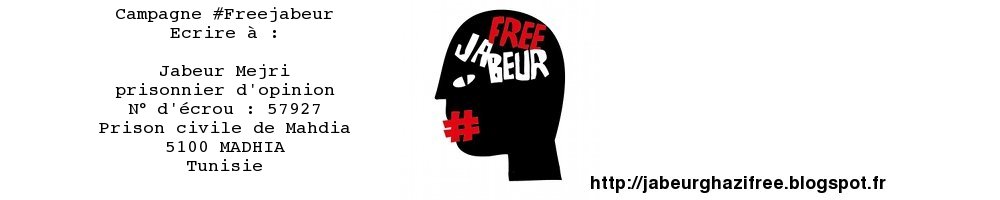
Demande de Grâce présidentielle (24 Juin 2013)
*Une demande de grâce présidentielle est en cours d’instruction auprès de
la Présidence de la République pour demander la libération de Jabeur Mejri
et la suspension des poursuites à l’encontre de Ghazi Béji, premier
prisonnier d’opinion et premier réfugié politique après la révolution*.
Malgré, les lenteurs administratives, tous les documents officiels
nécessaires ont été collectés et la demande devrait être présentée dans les
tout prochains jours.
*Jabeur Mejri et Ghazi Beji*, deux jeunes Tunisiens de Mahdia, sont
condamnés à *7 ans et demi d’emprisonnement et 1 200 DT d’amendes* : à cinq
ans de prison et à une amende de 1.200 dinars pour avoir publié et diffusé *des
écrits susceptibles de troubler l’ordre public*, à deux ans de prison
pour *offense
à autrui via les réseaux publics de communication*, à six mois de prison
pour outrage aux *bonnes mœurs par le geste et la parole.*
*Jabeur Mejri est en prison, depuis plus d’une année déjà*, pour avoir
exercé pacifiquement son droit à la Liberté d’Expression. Un droit stipulé
dans la Déclaration Universelle des Droits de l’Homme, dans son article 19
que « *Tout individu a droit à la liberté d'opinion et d'expression, ce qui
implique le droit de ne pas être inquiété pour ses opinions et celui de
chercher, de recevoir et de répandre, sans considérations de frontières,
les informations et les idées par quelque moyen d'expression que ce soit* ».
Nous, citoyens, internautes, militants des droits de l'Homme en Tunisie,
considérons que ce jugement n'est pas équitable, surtout au sein d'un pays
qui dit avoir rompu avec les méthodes de l'ancien régime mais qui prive en
définitive ses citoyens de leurs libertés de penser et d'expression.
*Nous appelons tous les citoyens, défenseurs des droits de l’Homme,
associations et société civile à apporter leur soutien et support à cette
demande de grâce présidentielle, au nom de la liberté d’expression et des
libertés individuelles. *
*Comité de soutien Jabeur et Ghazi *
kolna.jabeur.kolna.ghazi@gmail.com
www.facebook.com/PourLaGracePresidentielleDeJabeurEtGhazi...
Rappel des faits (Résumé)
Le 2 Mars 2012 Sheikh Zaouali a rencontré dans son bureau une connaissance
qui lui a parlé des photos que Jabeur Mejri avait postées sur son Facebook
qui offensent le Prophète et l'Islam et lui a demandé ce qu'il faut faire.
Cheikh Zaouali après avoir pris un coup d'oeil aux photos sur le profil de
Jabeur, a décidé de l'appeler et lui demander de retirer ces images.
Le 03 Mars 2012, Cheikh Zaouali a déposé plainte contre Jabeur Mejri
appelant à une enquête de Jabeur Mejri pour avoir insulté le Prophète en
images et en écriture, et causant «Fitna» (monde arabe pour la discorde,
division) entre les musulmans.
Le 5 Mars 2012 Jabeur a été arrêté. 3 jours après, Ghazi a également été
accusé dans cette affaire. Un ancien militant tunisien des droits de
l'homme lui a conseillé de quitter le pays parce que l'affaire était «très
grave».
Le 28 Mars 2012, Le tribunal de première instance de Mahdia condamne en
premier ressort Jaber Mejri et par défaut Ghazi Beji à cinq ans de prison,
chacun, et à une amende de 1.200.000 dinars chacun pour avoir publié et
diffusé des écrits susceptibles de troubler l’ordre public, à deux ans de
prison chacun pour offense à autrui via les réseaux publics de
communication, à six mois de prison pour outrage aux bonnes mœurs par le
geste et la parole.
Le 25 Juin 2012, la cour d’appel de Monastir a confirmé cette condamnation.
Une demande en cassation a été présentée.
Le 25 Avril 2015, le tribunal de cassation a confirmé la demande
d’annulation du pourvoi en cassation (présentée par Jabeur lui-même) et a
rendu définitif le jugement de la cour d’appel.
Le jugement étant définitif, la seule lueur d’espoir pour Jabeur serait le
bénéfice d’une grâce Présidentielle.
Enquête détaillée
Communiqués des ONG soutenant Jabeur et Ghazi
* *
*Amnesty International*
www.amnesty.org/en/library/asset/MDE30/010/2012/en/e44dcc...(page
26)
www.amnesty.org/en/for-media/press-releases/tunisian-jour...
www.amnesty.org/en/library/asset/MDE30/005/2012/en/a47bef...
* *
*HRW*
*06/04/2012*
* *
www.hrw.org/news/2012/04/06/tunisia-seven-years-jail-mock...
* *
*RSF*
*10/05/2012*
* *
fr.rsf.org/tunisie-un-flou-juridique-dangereux-pour-10-05...
* *
*IFEX-TMG*
*25/05/2012*
ifex.org/tunisia/2012/05/25/overturn_sentences/
* *
*RSF*
*27/05/2012***
* *
fr.rsf.org/tunisie-entre-violences-et-pressions-27-06-201...
Enquête sur l’affaire de Jabeur et Ghazi (La réalité des faits)
Nous nous sommes rendues à Mahdia le mercredi 4 avril. Le premier
protagoniste de l’affaire que nous rencontrons est Maître Foued Sheikh
Zaouali, l’un des deux plaignants. Jeune avocat, à peine la quarantaine, il
nous reçoit aimablement à son bureau situé à quelques dizaines de mètres du
Tribunal de Première Instance de Mahdia. Nous nous présentons et lui
expliquons les raisons de notre présence. Nous lui demandons de filmer
l’entretien. Il accepte.
Maître Sheikh Zaouali, dossier bien garni à la main (nous disposons d’une
copie qu’il a bien voulu nous fournir), nous explique les raisons qui l’ont
poussé à porter plainte contre Jabeur Mejri. Car il est important de le
souligner, Ghazi Béji n’était pas concerné par la plainte.
Maître Sheikh Zaouali reçoit le 2 mars 2012, à son bureau, une connaissance
(le deuxième plaignant dont je ne citerai pas le nom puisque nous ne
l’avons pas rencontré et donc pas eu son autorisation) qui lui parle de la
publication sur le réseau social Facebook de photos portant atteinte au
Prophète et à l’Islam par Jabeur Mejri et lui demande conseil sur la
manière d’agir. Maître Sheikh Zaouali, après avoir constaté par lui-même
les photos en ligne sur le profil de Jabeur, décide d’appeler ce dernier
pour lui demander de retirer les photos. Jabeur Mejri lui répond (selon le
témoignage officiel de l’avocat plaignant) qu’il n’en fera rien, insulte
l’Islam et le Prophète, traitant les musulmans d’hypocrites, déclarant
qu’il ne reconnait que la religion juive et qu’il demandait asile en
Israël. L’avocat n’appréciant pas les propos de Jabeur décide de porter
plainte contre lui. La plainte est déposée le lendemain 3 mars par les deux
plaignants, sollicitant l’ouverture d’une enquête pénale contre Jabeur
Mejri pour atteinte au Prophète au moyen de photos et d’écrits, atteinte au
sacré appelant à la Fitna (désaccord, divisions) entre musulmans.
Le 5 Mars, Jabeur est arrêté et le deuxième plaignant est entendu. Ce
dernier déclare qu’il connait Jabeur mais qu’il n’a avec lui ni problème
personnel ni différend excepté l’atteinte qu’il a porté à la communauté
musulmane (Al Oumma) et qu’il porte plainte en sa qualité de musulman ayant
subi un préjudice moral aigu l’ayant énormément affecté.
Jabeur est entendu pour la première fois le jour même (5 Mars). Il
reconnait avoir publié textes et photos sur son compte Facebook personnel
et explique que ces publications sont dues à ses convictions car il ne
reconnait pas la religion musulmane. Il déclare être athée et dit avoir par
le passé demandé l’asile politique en Israël et aux États Unis. Il insiste
sur le fait que les publications ne sont motivées que par ses convictions
personnelles. Il refuse de présenter des excuses soulignant que ces
publications ont été faites sur son profil personnel et que personne n’a à
porter plainte contre lui. Il déclare n’être atteint d’aucun trouble
psychique et n’avoir jamais eu à se faire soigner par le passé.
Deux jours plus tard, soit le 7 Mars, Jabeur est entendu une deuxième fois.
Il change de discours. Rappelons que Ghazi dans son témoignage évoque la
torture de son ami, fait que nous ne sommes pas parvenues à vérifier
puisque nous n’avons pas rencontré Jabeur en prison ni ne sommes parvenues
à rencontrer les membres de sa famille. Le 7 Mars donc, Jabeur déclare que
son compte Facebook a été consulté en sa présence dans le cadre de
l’enquête et qu’un livre dont il est l’auteur a été constaté. Ce livre
porte le titre de “La bande uabs” (عصابة uabs) en référence à son ancien
employeur. Il avoue y citer les noms d’employés qui lui avaient porté
préjudice par le passé et évoque son licenciement abusif. Il dit avoir
écrit ce livre par souci de vengeance mais aussi d’interpellation de
l’opinion publique et avoue y avoir intentionnellement porté atteinte à
l’image de l’Islam et du Prophète en y intégrant des caricatures qui lui
ont été fournies par son ami Ghazi Béji connu par tous les habitants de
Mehdia pour son athéisme et évoque le livre de ce dernier “L’illusion de
l’Islam”.
Jabeur revient également sur son refus de présenter des excuses formulé
l’avant veille, demande pardon auprès de tous ceux qu’il a pu offenser et
déclare regretter ses actes les attribuant à des fins personnelles qui le
lient à certaines personnes employées à la SNCFT de laquelle il a été
renvoyé abusivement.
Le 8 mars, une demande de prolongation de la garde-à-vue est formulée :
Le 9 Mars, une ordonnance d’ouverture d’instruction est émise à l’encontre
Jabeur et Ghazi pour transgression de la morale, diffusion de publications
et d’écritures de sources étrangères et autres qui troublent l’ordre public
et apport de préjudice aux tiers à travers les réseaux public de
communication sur la base des articles 121-3 et 226 du code pénal et
l’article 86 du code des télécommunications.
Le jour même, les flics débarquent aux domiciles des accusés et
confisquent un ordinateur, un disque dur et détiennent 11 pages tirées
d’Internet :
Le 12 mars, un nouveau constat est effectué. Le PV révèle le pseudonyme de
Jabeur (Iheb Gammarth) et décrit les caricatures publiées (que Maître
Sheikh Zaouali a préféré ne pas nous fournir afin qu’elles n’accompagnent
pas cet article). Le livre “Illusion de l’Islam” dont Ghazi est l’auteur
est à nouveau évoqué et voici la description qui en est faite :
“Doute de l’existence de Dieu, doute de l’existence d’une religion nommée
Islam, doute de l’existence du Prophète Mohamed (QSSL) avec justificatifs
du doute comme affirme l’auteur”
Le même jour (12 mars), un mandat d’amener est émis contre Ghazi. Mais
Ghazi avait déjà quitté le pays le 9 mars.
Y avait-il des avocats ?
Jusqu’à la date du 12 mars, aucun document en notre possession ne mentionne
la présence d’avocat(s). Maître Sheikh Zaouali nous a confié (vidéo à
l’appui) qu’aucun avocat n’a accepté de plaider. Ce dont m’avait déjà
informée Ghazi lors de notre entretien téléphonique et ce que nous a
également confirmé son père plus tard. Selon Maître Sheikh Zaouali, ses
collègues avaient refusé de le faire par principe.
Le 13 mars, Jabeur est entendu par le juge d’instruction. Le PV évoque que
l’accusé a refusé explicitement de faire appel à un avocat. Une autre page
Facebook ouverte avec un autre compte mail (portant tout de même le nom de
Jabeur) est évoquée. Jabeur déclare que c’est Ghazi qui la lui a ouverte,
l’initiant à son utilisation et lui remettant les photos. Jabeur dit avoir
agi sous l’influence de Ghazi, qu’il appartient à une famille
conservatrice. A ce niveau du PV nous pouvons alors lire la phrase :
“Nous l’avons alors informé que nous ne l’entendons pas en raison de ses
croyances ou de ses idées mais qu’il est poursuivi en raison d’actes
contraires à la loi compte tenu des photos qu’il a publiées et qui portent
atteinte aux croyances d’autrui ce qui est de nature à troubler l’ordre
public en plus de leur portée pornographique qui transgresse la morale et
porte préjudice aux tiers”.
Le 15 Mars, deux témoins sont entendus : Maître Sheikh Zaouali (un des
deux plaignants – son témoignage est publié au début de l’article) et une
deuxième personne (dont je ne citerai pas le nom). Le deuxième témoin
évoque en plus de l’affaire en question deux autres affaires concomitantes
à l’encontre de Jabeur pour diffamation mais déclare qu’elles font l’objet
de plaintes distinctes :
Le 28 Mars 2012, la sentence tombe : Jabeur et Ghazi sont condamnés à 7
ans et demi de prison ferme et 1200 TND d’amende.
Jabeur depuis a fait appel. Le père de Ghazi a pris un avocat qui fera
objection puisqu’il a été jugé en son absence.
Nous avons quitté le bureau de Maître Sheikh Zaouali et nous sommes
dirigées au domicile de Ghazi où son père nous attendait. Nous sommes par
la suite parties rencontré le Sheikh Wanness, réputé pour être le chef des
salafistes à Mehdia car nous avions appris que des menaces de mort auraient
été proférées contre les deux accusés, les rumeurs disant qu’on enverrait
quelqu’un jusqu’à dans la cellule de Jabeur pour l’assassiner. Ces menaces
ont été niées par Sheikh Wanness.
Les vidéos de nos entrevues avec Maître Foued Sheikh Zaouali, avec le père
de Ghazi et avec le Sheikh salafiste Wanness feront l’objet d’un autre
billet un peu plus tard dans la journée.
Ceci est une partie du récit d’une journée qui m’a bouleversée et que je ne
suis pas prête d’oublier… J’y reviendrai.
Par Olfa Riahi
Articles de presse
www.tuniscope.com/index.php/article/24659/actualites/tuni...
www.news24.com/Africa/News/Jail-terms-reviewed-for-Prophe...
directinfo.webmanagercenter.com/2013/01/12/tunisie-carica...
www.amnesty.fr/Presse/Communiques-de-presse/Tunisie-Le-bl...
directinfo.webmanagercenter.com/2013/01/12/tunisie-carica...
www.lemonde.fr/international/article/2012/10/11/l-errance...
www.lecourrierdelatlas.com/343416102012Tunisie-Exclusif-E...
www.lesinrocks.com/2012/08/29/actualite/athees-en-tunisie...
m.youtube.com/#/watch?v=3o89E247i2E&desktop_uri=%2Fwa...
atheistica.com/2012/04/05/tunisian-atheist-whos-sentenced...
blogs.mediapart.fr/blog/salah-horchani/210113/sos-jabeur-...
blogs.mediapart.fr/blog/salah-horchani/080113/n-oublions-...
Actualités
www.kalima-tunisie.info/kr/News-file-article-sid-11918.html
www.google.com/hostednews/afp/article/ALeqM5g4jszxyTynWI-...
alquds.co.uk/index.asp?fname=today%5C25e24.htm&arc=da...
english.alarabiya.net/articles/2012/06/25/222638.html
**
leplus.nouvelobs.com/contribution/578532-tunisie-jabeur-m...
www.ecrans.fr/Peine-caricaturale-pour-deux,14962.html
blog.slateafrique.com/tawa-fi-tunis/2012/06/28/tunisie-ce...
www.aljarida.com.tn/ar/national/3856-2012-06-28-15-13-58....
www.france24.com/fr/20120626-tunisie-jeune-condamne-priso...
www.rfi.fr/afrique/20120626-caricatures-prophete-facebook...
www.rfi.fr/afrique/20120618-titre-provisoire-tunisie-proc...
www.arretsurimages.net/vite.php?id=14114
quebec.huffingtonpost.ca/2012/06/25/prison-caricatures-tu...
www.mag14.com/culture-a-medias/53-medias/718-tunisie-rsf-...
www.letelegramme.com/ig/generales/france-monde/monde/tuni...
Soutenons Jabeur & Ghazi !
Ce collectif, lancé le mercredi 27 juin 2012, réuni des citoyens,
activistes, avocats et journalistes, pour soutenir les deux jeunes
cyber-activistes Jabeur et Ghazi.
Il est ouvert à toute personne convaincue par la cause qu’il défend, à
savoir la "liberté d'expression et de diffusion" pour Jabeur Mejri et Ghazi
Beji et pour tous les tunisiens.
Ce comité a pour objectifs de :
1. Soutenir moralement Jabeur et Ghazi
2. Veuiller à l’intégrité physique et morale de Jabeur et
Ghazi,
3. libérer Jabeur Mejri et arrêter les poursuites contre
Ghazi ; et
4. abolir les les lois répressives des libertés en Tunisie.
Vous pouvez adhérer au collectif et participer aux groupes de travail
suivants:
5. Médiatisation à l'échelle nationale et internationale
6. Contact et sensibilisation de l'Assemblée Constituante
7. Campagne médiatique (facebook, twitter, TV, Radio..)
8. Contribution et soutien des avocats de Jabeur et Ghazi
Pour nous contacter:
kolna.jabeur.kolna.ghazi@gmail.com
www.facebook.com/PourLaGracePresidentielleDeJabeurEtGhazi...
At about 2.40 pm on Saturday 25 June, hundreds of activists staged a flash sit-down protest to close down London's Oxford Circus in protest at the UK continuing to provide diplomatic, military and logistical support to Israel during its ongoing genocidal assault on Gaza. [1]
Many of the activists had met up earlier at around noon at a Youth Demand (see YouthDemand.org) event at Victoria Embankment Gardens where they listened to some speeches before they dispersed in small groups, some followed by the police, but despite the challenging circumstances they seem to have been able to travel across central London presumably in different directions and regroup around Oxford Circus in a well planned and well coordinated protest.
Activists explained to onlookers that they had to carry out the action to try to prevent genocide. At one point a Palestinian shopper who came across the action by accident, spoke to the protesters, urging them not to give up.
Many refused to leave the road when threatened with arrest by the police.
According to the Morning Star, citing Youth Demand, 21 activists were arrested, but I don't know how many, if any, were subsequently charged.
morningstaronline.co.uk/article/21-arrested-after-blockin...
I took some video of the event which can be seen here -
www.youtube.com/watch?v=3-7xpmzEvRQ
www.youtube.com/watch?v=7cdyKstOsFE&t
www.youtube.com/watch?v=TOs_hQUo-z8
www.youtube.com/watch?v=f3YLFcmEBbQ
As of 24 June 2024, at least 37,626 Palestinians have been killed since 7 October, including more than 15,000 children. An estimated 10,000 are missing, of whom most are probably dead.
There is also an unknown number of additional deaths due to excess mortality from food shortages, disease and difficulties in obtaining essential medical care and medicines, while more than 86,000 Palestinians have been injured, many of them with life-changing injuries including many amputations. According to the United Nations, as of 23 June, more than half of all residential buildings have been destroyed or damaged but with some key infrastructure the destruction is even more devastating - including 130 ambulances, 267 places of worship, 80% of commercial facilities and 88% of school buildings damaged or destroyed.
www.aljazeera.com/news/longform/2023/10/9/israel-hamas-wa...
Additionally, as of February, the UN reported that some 83% of groundwater wells are no longer operational, adding that "all wastewater treatment systems are not working, and there is no access to clean water in the northern governorates."
news.un.org/en/story/2024/02/1146947
Also, according to the Committee to Protect journalists as of 25 June 2024, 108 journalists and media workers have been killed, 103 Palestinian, 2 Israeli and 3 Lebanese.
cpj.org/2024/06/journalist-casualties-in-the-israel-gaza-...
And as of 27 May, 8875 Palestinians have been arrested in the West Bank since 7 October 2023, many of them held in indefinite detention with no right to trial, while the Israeli military and settlers have escalated their attacks on Palestinians across the West Bank killing 518 Palestinians.
www.middleeastmonitor.com/20240527-8875-palestinians-arre...
Footnote
1. Re use of the term genocide. In March the UN special rapporteur on human rights in the Palestinian territories, Francesca Albanese, referring to Israel's "unrelenting assault on occupied Gaza," stated that "there are reasonable grounds to believe that the threshold indicating the commission of the crime of genocide…has been met.”
news.un.org/en/story/2024/02/1146947
********************************
Please follow me on Instagram at
www.instagram.com/alisdarehickson/
***********************************
A creative commons PHOTO LICENSE for COMMERCIAL USE for this photo is AVAILABLE for over sixty NGOs and socialist or progressive publications which are listed on the link below
Although this image is being posted on an attribution noncommercial share alike basis CC BY-NC-SA 2.0 DEED, the following organisations and publications listed on the link below are also welcome to reproduce it even if it is for commercial purposes. However please publish the image on the same attribution noncommercial share alike basis. For more info or if any other organisation, person or publication wishes to publish this photo on a commercial basis please email me at alisdare@gmail.com.
Cancún, Q. Roo, diciembre 10, 2011.- En el marco del Día Internacional de los Derechos Humanos, la CROC en coordinación con la Comisión de Derechos Humanos de Quintana Roo (CDHQROO), impartieron dos conferencias a más de 300 trabajadores de la industria gastronómica y hotelera, en el Hotel Gran Caribe Real.
Las ponencias estuvieron a cargo de la Lic. Irma Isabel Solano, con el tema “Que son los derechos humanos”, y Daniel Vidal González Gómez, quien impartió la plática “Ley sobre los derechos humanos”.
Durante el acto inaugural se contó con la asistencia en presídium de la diputada local Leslie Baeza Soto; Lic. María José López Canto, segunda visitadora de la CDHQROO; Lilliam Negrete Estrella, titular del CIJ en Cancún; Lic. Martiniano Maldonado Fierros, secretario de fomento cooperativo de la CROC; René Sansores Barea, secretario general de la sección 36 de gastronómicos; Eugenio Naranjo, comisionado sindical; Alexander Zimmermann Cuevas, secretario de comunicación social de la CROC.
Momentos antes de clausurar el evento, el Lic. Martiniano Maldonado dio un mensaje del dirigente sindical municipal, Mario Machuca Sánchez, para dar a conocer que la Comisión Nacional de Salarios Mínimos (Conasami), acordó un raquítico aumento salarial del 4.2 por ciento, el cual se empezará a aplicar a partir del 1 de enero del próximo año. Aseguró que este incremento es una burla para los trabajadores del país, por lo que la CROC demandará ante la CNDH.
Indicó que la CROC no firmó el Acuerdo Nacional, sin embargo, el sindicato de la Confederación de Trabajadores de México (CTM), lo hizo dejando en claro que ellos no están representando al sector obrero del país, ya que tomaron una postura anti-sindicalista.
Finalmente, comentó que el salario mínimo para el 2012 queda de la siguiente manera: Zona A - 62.33 pesos, Zona B - 60.57 pesos y Zona C - 59.08 pesos.
Nominations for the 24th annual Screen Actors Guild Awards nominations were announced earlier today by Olivia Munn and Niecy Nash from the Pacific Design Center in Hollywood. You may have caught the live stream on TNT, TBS, and truTV aired the announcement, we’re posting a video below in case you want to see it on-demand.
Find out more: www.redcarpetreporttv.com/2017/12/13/sag-award-nomination...
It's that time of year when the Screen Actors Guild Awards® opens their Holiday Auction which will benefit the SAG-AFTRA Foundation’s Children’s Literacy and Actors’ Assistance programs. Find out more at sagawards.org/auction.
The annual Holiday Auction features the ultimate SAG Awards® VIP Package, with two tickets to the 24th Annual SAG Awards Ceremony and Gala on Sunday, Jan. 21, 2018, a backstage tour, two United Airline tickets and a three-night stay at the Beverly Hilton Hotel in Beverly Hills.
But that's not all...
Other highlights include autographed film and television collectibles from Trevor Noah, Mary J. Blige, William Shatner, Sara Michelle Gellar, Jeffrey Dean Morgan, Margaret Atwood, and the casts of “This Is Us,” “The Handmaid’s Tale,” “GLOW” and more. Also up for bid are unique gifts, such as tickets to a taping of “Will & Grace” plus a set tour and meet-and-greet with the cast, VIP tickets to a live taping of “Full Frontal with Samantha Bee,” and several SAG Awards Red Carpet Bleacher Seats packages.
Bidding concludes on Sunday, Dec. 17, 2017, at 6 p.m. (PT) at sagawards.org/auction
Proceeds from the SAG Awards Holiday Auction support the SAG-AFTRA Foundation’s award-winning children's literacy program Storyline Online, the interactive children’s literacy website that attracts more than 12 million global views each month. The auction also supports the SAG-AFTRA Foundation's Catastrophic Health Fund, Emergency Assistance and Scholarship Program for SAG-AFTRA artists and their families.
Here's the list of items up for bid at the SAG Awards Holiday Auction
Experiences, Tapings, and Packages
SAG Awards VIP package – 2 tickets to the 24th Annual SAG Awards Ceremony and Gala, a Backstage Tour, 2 United Airline tickets and 3-night stay at the Beverly Hilton Hotel in Beverly Hills, CA
SAG Awards Backstage Tour and 2 Front Row Red Carpet Bleacher Seats
4 Front Row Red Carpet Bleacher Seats to the 24th Annual SAG Awards Arrivals
2 tickets to a taping of “Will & Grace” plus a set tour and meet-and-greet with cast
4 VIP tickets to a live taping of "Conan"
2 VIP tickets to a live taping of “Full Frontal with Samantha Bee”
2 VIP tickets to “The Tonight Show Starring Jimmy Fallon”
2 tickets to a taping of “Watch What Happens Live with Andy Cohen”
SAG Awards Red Carpet Bleacher Seat packages
Autographed Collectibles and Memorabilia
“This is Us” pilot script signed by the cast
“The Handmaid’s Tale” poster signed by cast members and producers
“The Handmaid’s Tale” paperback book signed by author Margaret Atwood plus gift basket
“Glow” poster signed by cast
“I, Tonya” poster signed by cast and creators
“Will & Grace” poster signed by Sean Hayes, Megan Mullally, Debra Messing and Eric McCormack
“Mudbound” poster signed by Mary J. Blige and Dee Rees
“Breathe” poster signed by Andrew Garfield, Claire Foy and Andy Serkis
“Brockmire” baseball signed by Hank Azaria
“The Walking Dead” Negan POP! doll signed by Jeffrey Dean Morgan
“Mr. Robot” limited edition backpack
“The Walking Dead” gift package including poster collection, special edition board game & baseball cap
“The Walking Dead” journal signed by cast members plus a Rick Grimes limited edition bobblehead
“The Walking Dead Vol.1,” “Outcast Vol.1” and “Invincible Vol.1” graphic novels signed creator Robert Kirkman
“Born a Crime: Stories from a South African Childhood” hardcover book signed by author Trevor Noah
“Zero-G” hardcover book signed by author William Shatner
“Stirring Up Fun with Food” hardcover book signed by creator Sarah Michelle Gellar
“Unqualified” hardcover signed by author Anna Faris
“We: A Manifesto for Women Everywhere” paperback book signed by author Gillian Anderson
“Ballerina Body” paperback book signed by creator Misty Copeland
Premium Items
Champagne Taittinger Bottle 6L signed by 23rd Annual SAG Awards Attendees
Check out all of the items and experiences up for bid on Auction Cause and Charity Buzz!
About the SAG-AFTRA Foundation
The SAG-AFTRA Foundation is a philanthropic 501(c)(3) non-profit organization that provides vital assistance and educational programming to SAG-AFTRA professionals while serving the public at large through its signature children’s literacy program. For more than 32 years, the Foundation has granted more than $19 million in financial and medical assistance, including $8 million in scholarships to SAG-AFTRA members and their dependents. In addition, the nonprofit has offered 7,600 free educational workshops, panels and classes SAG-AFTRA artists nationwide. In addition, its award-winning children’s literacy program Storyline Online has brought the love of reading to more than 300 million children worldwide. The SAG-AFTRA Foundation relies entirely on grants, sponsorships and individual contributions to maintain its free programs and resources, and is the benefiting charity of the annual SAG Awards. For more information, visit sagaftra.foundation.
Connect with the Foundation
Twitter: @sagaftraFOUND
Instagram: @sagaftraFOUND
Snapchat: @sagaftraFOUND
Facebook: facebook.com/sagaftrafoundation
YouTube: youtube.com/sagaftrafoundation
Hashtag: #sagaftraFOUND
Website: sagaftra.foundation
About the 24th Annual Screen Actors Guild Awards®
The 24th Annual Screen Actors Guild Awards® presented by SAG-AFTRA with Screen Actors Guild Awards, LLC and hosted by Kristen Bell, will be produced by Avalon Harbor Entertainment. Inc. and will be simulcast live on TNT and TBS on Sunday, Jan. 21, 2018 at 8 p.m. (ET) / 5 p.m. (PT). TBS and TNT subscribers can also watch the SAG Awards live through the networks' websites and mobile apps. In addition, TNT will present a special encore of the ceremony at 11 p.m. (ET) / 8 p.m. (PT).
Back by popular demand! Following a successful run this past November, mostly queer sketch comedy group Martini Ranch returns with their new revue, Queer & Now. A light-hearted blend of social commentary and silly giggles, the must-see show features original songs, brand-new sketches, and a whole lot of glitter. ColdTowne Theater
Apprentice School built 1891.
First buildings at Islington erected 1883 despite demands that the workshops be built at Port Adelaide. Over the following years more buildings added as works were transferred from the former site on North Terrace. The workshops were important in the development of SA’s railway system and during WWI they also produced munitions. Due to their efficient toolrooms, during WWII they manufactured shells, trench mortar sights, machine-gun carriers, sections of Beaufort bombers & other aircraft, and when necessary, tools, lathes & machines for the workshops. By 1941 there were 3 shifts working 7 days a week on war work. The site transferred 1978 to Australian National, later some workshops were demolished for shopping centre which opened 2014.
“The Government has issued the first notice for erection of workmen's and foremen's cottages at Islington in anticipation of transfer of the railway workshops.” [Port Adelaide News 22 Jan 1881]
“There are improvements going on at the Railway station on North Terrace. The railway workshops or engine sheds have been removed to Islington beyond North Adelaide station, and the old building has been pulled down.” [Burra Record 18 Feb 1881]
“The operative masons and bricklayers working for Messrs. Fry Bros., the contractors for part of the Government workshops at Islington, struck for an increase of wages on Tuesday last. The men had been employed during the past month or two at the rate of ten shillings per day, out of which those of them who live in town had to pay their fares to and from the works, which cost from sixpence to tenpence a day, according to whether they held monthly tickets or not. A number of the men, however, live within a short distance of the works, while others who live at North Adelaide rode to and from the works in the contractors' drays. On Monday during the dinner hour the men held a meeting, at which it was decided to demand an increase of a shilling a day on the ruling wages, and if this were refused, to strike.” [Advertiser3 Nov 1883]
“Messrs. Fry Bros., the contractors for the Government workshops at Islington, refused to accede to the request made by their employes as regards an increase of wages, and recently discharged the whole of the men employed on the works. A number of men have since been engaged at 10s. per day, the contractors paying their fares to and from the works.” [Advertiser 24 Nov 1883]
“The inhabitants of Port Adelaide are still agitating for the removal of the whole of the railway workshops to that town.” [Evening Journal 4 Jan 1889]
“On Friday the barque Warwickshire, tying in the New Dock at Port Adelaide, discharged over 10 tons of machinery intended For the Locomotive Workshops at Islington.” [Register 2 May 1891]
“The locomotive workshops at Islington having been completed the work of transferring the plant and machinery will be commenced in a few days, but it will take some time before the employes are fairly installed in their new quarters. The workshops at North-terrace will be utilised as running sheds for rolling stock until it is necessary to remove them to make way for the proposed new Adelaide Railway station.” [Advertiser 22 Sep 1891]
“Already some 400 mechanics are employed in the shops and in the handsome suite of offices close by are the draftsmen and clerks connected with the department. The building intended for the blacksmiths and boilermakers is completed, and one forge is at work. Foundations for the large steam-hammers have been laid, and in the course of a few weeks a large body of men will be accommodated in this commodious building. The engine-shops and running-shed are already full. . . The cranes in these sheds are a special feature, and by the slightest pressure of a finger one man can lift up to fifty tons and carry it from one end of the shop to another. The carpenters' and carriage-makers' shop is already full of busy men engaged in the construction of rolling-stock.” [Register 9 Jan 1892]
“in December, 1883, the new buildings were occupied by the carriage builders and painters. The space previously monopolized by them at the Adelaide works was converted into fitting shops, and thus a small measure of relief was obtained by the department. In the meantime the traffic on the railways was very considerably increased by the discovery of the Broken Hill mines and by the construction of the overland line to Melbourne, so that in a very short time, even with the increased space at their disposal, the locomotive authorities found themselves so cramped and crowded that they were quite unable to cope with the works they were sailed upon to execute.” [Evening Journal 25 Feb 1892]
“The ground plan of the new works had been designed by Mr. Thow when Islington was first selected as the site. The plans of the new building were prepared in the Engineer-in-Chief's department, under the direction of Mr. Thow; but their details, such as the internal fittings of the buildings, the arrangement of the machinery, the fixing of the engines, end the countless devices to make the works replete with all the most modern appliances were designed and carried out by the present Locomotive Engineer. Mr. T. Roberts. . . A perfect network of rails extends in every direction, the various workshops having several lines running through them. Thus engines, carriages, and wagons are shunted to the exact spot they are to occupy whilst undergoing overhaul and renewal. . . Throughout the works the buildings are of stone, with brick facings. The roofs are of galvanized iron, and are ventilated with louvres. In those buildings which are divided into bays the roofs are supported by iron girders resting on iron pillars. Each bay all through the building is lighted with a double row of skylights extending along the whole of its length. There are, of course, in addition, windows on all the side walls. The end walls are all built on arches, the archways being filled in by immense galvanized-iron doors. Through the centre of each doorway runs a line of rails, the arches being high enough to permit the ingress and egress of the largest sized engines.” [Evening Journal 25 Feb 1892]
“Final operations at the old locomotive shops on North-terrace closed about six weeks or so ago, the foundry men being the last to leave, and now practically every branch of the Locomotive Department at Islington is in thorough working order. . . To cope with an ever-increasing traffic it was absolutely impossible in the circumscribed area at the central Railway Station to provide suitable accommodation for overhauling railway stock and carrying on the very extensive operations of the Locomotive Department.” [Register 8 Jan 1894]
“At least one member of the South Australian contingent at present in South Africa was employed in the Railway Department, and a large number of the volunteers for the second unit are workers in the shops at Islington. Therefore the men engaged there felt that the Patriotic Fund which was started to render assistance in. the case of injured soldiers and bereaved families had a special claim upon their sympathies. Subscriptions were taken up, and the effort resulted in £51 being raised. . . The visitors at once proceeded to the fitting shop, in which about 700 men and youths from all branches of the Islington Department were assembled, and for an hour the feelings of patriotism which had been pent up in the hearts of the men were allowed to assert themselves. Never were the National Anthem and other patriotic songs rendered more vigorously. . . The Locomotive Band accompanied the singing, and the brass instruments and the voices of men and boys vied with each other in a great outburst of patriotism.” [Register 25 Dec 1899]
“a visit to the Islington workshops for the purpose of inspecting the special train which has been undergoing renovation in preparation for the Royal visitors. . . The train consisted of an engine, number 43 of the "M" type, four carriages of uniform exterior design, and a brake-van. The engine, which had just left the paintshop, was embellished suitably for the occasion. On the front the-coat of arms of the Duke of Cornwall was surmounted by representations of flags, and on each of the side-plates the Royal coat of arms was placed, while on either side of the driver's screen the Prince of Wales' plumes were depicted. The Royal purple and red are conspicuous in the adornments.” [Advertiser 5 Jul 1901]
“The Government have decided that the whole of the men employed at the Islington workshops are to work full time instead of five days a week as at present. The new order will come into force this week.” [Advertiser 17 Mar 1915]
“During the recruiting demonstration at the Islington Workshops. . . it was announced that the Islington establishment would be prepared to manufacture munitions. . . the Imperial Government will welcome the manufacture of certain munitions in Australia. Drawings of an 18-lb. shell, have reached us, and have been handed to the Railways Commissioner, who will have sample shells turned out at Islington.” [Register 20 Jul 1915]
“The ceremony of presenting the Defence Department with a motor ambulance, subscribed for by workmen employed at the Islington Railway Workshops, was performed at the yards during the lunch hour on Thursday. . . The workmen recognised that it was their duty to perform the obligations which devolved on them by other men going to the front to fight their battles. They could not all go to the front, but the least they could do was to help the gallant men in the firing line.” [Register 15 Oct 1915]
“an impressive ceremony in the boiler shop at Islington during the lunch hour on Tuesday, when a handsome roll of honor, containing the names of 62 men from the shop who had volunteered and gone to the front, was unveiled by the Chief Mechanical Engineer (Mr. B. F. Rushton). . . The Railway Department proposed to place a roll of honor in each, of the workshops at Islington, so that those who were eligible and had not enlisted might be reminded of their duty. . . Twenty-five per cent, of the staff at the Islington workshops had volunteered for the front. . . Four of the 63 employes whose names figure on the roll of honor—Sergeants C. J. Backman, A. E. Phillips, F. Causer, and Paul—have made the supreme sacrifice by laying down their lives.” [Advertiser 2 Aug 1916]
“Islington. . . There has been a clearing out of old material, which had become unserviceable, at the loco Workshops. Between 80 and 90 tons of scrapiron was sent to Melbourne yesterday, and a parcel of about 10 tons of scrap steel was dispatched to-day.” [Observer 24 Feb 1917]
“Four members of the South Australian branch of the Coachmakers Employes' Federation are to leave Adelaide to-day to proceed to England as munition workers. . . Mr. E. J. Monck, carriagebuilder, has been in the service of the railway workshops, Islington for over 30 years. . . Mr. B. Brundritt and Mr. H. Howard have been employed en the carriage and waggon, building departments at Islington, and have been in the service for some years. . . Like Mr. Monck they are anxious to work on aeroplanes.” [Daily Herald 13 Jun 1917]
“In pursuance of the policy of making the rolling stuck more in keeping with modern requirements, the Railways Department is about to put into commission 20 new brake vans, which will be a distinct contrast to the old ‘blue vans’, or dog-boxes, as they have been termed, now in use. Ten of these new vans have already been completed at the Islington workshops, and will be made available almost immediately. Sleeping accommodation and conveniences for cooking have been, provided, so that on long journeys the vans may be used as living quarters. . . These vans are to be placed on both broad and narrow gauge lines.” [Advertiser 6 May 1925]
“By the end of the year defence work will be playing an important part in the activities of the Islington Railway workshops. . . The largest addition is a tool shop which is being constructed at the east end of the yards, well away from the remainder of the plant. When the building is finished it will be equipped with machinery for the manufacture of milling cutters and other delicate machine parts, which will be sent to Lithgow, New South Wales, to assist in the production of Bren machine guns. . . Some of the older workshops at Islington are being altered in preparation for the beginning of work on the construction of aeroplane parts. No details of what is being planned are available. . . In the meantime, the workshops are filling a contract for the manufacture of nine armored cars. . . At present, however, the busiest section of the workshops is the construction shed, in which the new vice-regal [rail]car is being built in time for the arrival of the Duke and Duchess of Kent.. . . Built of welded steel, it will be 79 feet long and nearly 10 feet wide, and will weigh 56 tons. It will have sleeping accommodation for ten people. At the rear there will be an observation lounge. Next to that will be a ladies' lounge, and then the Governor's suite.” [Advertiser 22 Aug 1939]
“A Shell Annexe has been established at Islington railway workshops, and is now nearing completion.” [Advertiser 6 Feb 1940]
“the tool-making annexe at the Government Railway Workshops at Islington is, in common with Government munition factories in Victoria and New South Wales, working 12-hour shifts. Established with the object of manufacturing the tools and gauges essential in the mass production of munitions.” [News 30 May 1940]
“The managerial staff at the Islington Railway Workshops, already busy with Islington’s own contributions to defence work, has been drawn upon for advice on interior lay-out and equipment of the Hendon factory.” [News 27 Jun 1940]
“Islington workshops. . . There are now 4,000 employes there — more than double the normal number — and about 2,200 to 2,300 of them are engaged on defence work, including munitions and Bristol Beaufort bombers.” [News 3 Feb 1941]
“South Australia's advance to the forefront of munitions-producing States was made possible primarily by the foresight of the Butler Government, which laid the foundations upon which the Playford Government has built so vigorously and soundly. As a matter of fact it was the insistence and foresight of the Government in providing such a wonderful tool shop at the Islington Railway Workshops that provided the first solid basis. The tool shop still remains an object of surprise and admiration for visiting experts who see the value of its modern equipment and the efficiency and skill of its tradesmen.” [News 4 Mar 1941]
“At the Islington workshops of the South Australian Railways Department there are working, in times of peace, about 1,750 people. Today there are 4,300; no fewer than 2,700 are engaged upon war production. . . making aeroplane parts, machine tools, and gauges, shells, machine-gun carriers. . . they are looking after the tooling of the new Commonwealth smallarms ammunition factories in South Australia. . . When Islington wants a machine to do a special job and hasn't got it, it makes it. . . In its tool room it has 370 men working. They may be making trench mortar sights, tools for Islington itself, or for other armament works, working to fine limits of accuracy. . . On war work, Islington is working three shifts a day, seven days a week.” [News 5 Aug 1941]
“Islington also operated another workshop for machining and sub-assembly for centre plane and wing sections of Beaufort bombers.” [The Mail 16 Aug 1941]
“More than half of Australia's gun-carrier production is being accomplished by workmen at Islington Railway Workshops.” [News 3 Dec 1941]
“sturdy little gun carriers are roaring and bucking their way to the forefront in a mechanised war. At Islington Railway Workshops these khaki-green structures take life as they are passed from the stage of plain slabs of steel to the finished, vibrant machine ready for action. Recently the 500th machine moved off the construction line at Islington.” [The Mail 6 Dec 1941]
“the fact that Islington Railway Workshops had an efficient tool room at the outbreak of war was one of the main reasons why South Australia became a munitions area.” [News 2 Apr 1942]
“workshops at Islington have annexes devoted directly to armaments and the tools of munitions side by side with the increased volume of railway output and maintenance. The employes at Islington include many engaged on aircraft wings and other parts; there are hundreds of women, too, and more will be hired as soon as they can be trained. . . Islington has long since passed its thousandth Bren carrier.” [Advertiser 23 Jul 1942]
“South Australia had contributed splendidly to the war-time development of the Australian aircraft industry. Mr. Makin said. The centre plane and wings for each of 700 Beaufort aircraft were produced by the Railways Department at Islington, as well as similar components for more than 350 Beaufighters, before that project was ended recently. The workshop was now producing centre sections and other components for Lincoln aircraft. This work would continue until about June.” [News 25 Oct 1945]
“production during the war years, Islington Railway Workshop is now well on the way back to turning out up-to-date rolling stock for the State's railways.” [Advertiser 15 Feb 1946]
“An honor roll bearing the names of employes at the Islington railway workshops who enlisted in the world Wars, was unveiled by His Excellency the Governor (Sir Willoughby Norrie) yesterday. Sir Willoughby Norrie said there were 382 names of men who enlisted in the first war and 622 names in the last war, making a total of 984 men, 50 of whom did not return. There were more than 4.000 ex-servicemen in the South Australian Railways today.” [Advertiser 4 May 1951]
“The first of 12 fast new diesel railcars for Adelaide suburban lines is expected to be running by the end of March. The Railways Commissioner (Mr. J. A. Fargher) said yesterday that all 12 were expected to be completed at Islington workshops by the end of next year.” [Advertiser 21 Dec 1954]
“The roomette sleeping cars on the Overland express were the best in the world, the British general secretary, of the Amalgamated Engineering Union (Mr. Ben Gardner) said in Adelaide yesterday. He visited the Islington railway workshops and was impressed with the spaciousness of the plant.” [Advertiser 21 Dec 1954]
Clashes broke out between Hong Kong police and protesters on the 70th anniversary of the founding of the People’s Republic of China on Wednesday, with officers firing tear gas in Wong Tai Sin, Tsuen Wan and Sha Tin.
Meanwhile, thousands marched across Hong Kong island to protest the local administration as well as the Chinese Communist Party.
In direct opposition to the celebrations in Beijing, marchers said that they were marking a “day of mourning.”
“There is no National Day celebration, only a national tragedy,” demonstrators shouted – a new slogan coined specifically for October 1.
The Civil Human Rights Front applied to host a peaceful march on Tuesday, but police said that the organisers were unable to guarantee that no clashes would take place.
An attempt to appeal the ban failed on Monday.
Nevertheless, four pro-democracy activists – veterans Lee Cheuk-yan, Albert Ho, “Long Hair” Leung Kwok-hung as well as Figo Chan – said they would march from Causeway Bay despite the police ban
Separately, violence broke out at rallies held in Wong Tai Sin, Tuen Mun, Tsuen Wan and Sha Tin.
Protesters planned to hold simultaneous rallies across different districts in Hong Kong, starting from 1:30pm.
As of 3pm, police fired tear gas near Lung Cheung Road in Wong Tai Sin, as well as near Yuen Wo Road in Sha Tin.
Sha Tin saw protesters throw petrol bombs and bricks, as police responded with tear gas.
In light of Tuesday’s planned protests, the metro system was put on lockdown. As of lunchtime, MTR station closures included Mong Kok, East Tsim Sha Tsui, Tsuen Wan, Tai Wo Hau, Kwai Hing, Kwai Fong, Sham Shui Po, Prince Edward, Yau Ma Tei, Sai Ying Pun, Admiralty, Wan Chai, Causeway Bay, Diamond Hill, Wong Tai Sin, Sha Tin, Che Kung Temple, Tsuen Wan West, AsiaWorld-Expo and Tuen Mun.
Light rail and Airport Express services are also restricted.
Speaking before the Hong Kong Island march, veteran Labour Party politician Lee Cheuk-yan said that the protest was to mourn “70 years of suppression” at the hands of the Chinese regime.
“We are mourning those who sacrificed for democracy in China,” Lee said.
“In 70 years of Communist Party rule, there are lots of sacrifices, human rights abuses, and the [suppression] of the rights of people in Hong Kong and China.”
“We also condemn the fact that the Hong Kong government, together with the Chinese government, deny the people of Hong Kong the right to democracy.”
Lee also called for the vindication of the 1989 Tiananmen Massacre and the end of one-party rule in mainland China. During the march, he also called for a minute of silence in remembrance of the victims of Chinese rule.
However, crowds of black-clad protesters did not always follow the lead of the veteran pan-democrats, with some opting to chant the familiar slogans such as “Liberate Hong Kong, the revolution of our time.”
A protester surnamed Wong said that it was important to take to the streets on October 1 as a show of defiance to Chinese President Xi Jinping.
“Xi wants the world to think everyone in China loves him. A lot of people here feel the opposite,” he told HKFP. He also wore a Guy Fawkes mask – a protest icon made popular in the dystopian film V for Vendetta.
Rain, an 18-year-old university student, told HKFP that she didn’t want the local protest movement to lose steam, and that she wanted to come out to insist on her freedom of assembly.
“The police are putting a curfew on Hong Kong, making people scared to come out,” she said. “We need to show that we will not give up on our five demands.”
During the march, protesters targeted billboards and posters celebrating National Day, often vandalising them with spray paint.
Similar to the “anti-totalitarianism” march on Sunday, the Hong Kong island protests also saw vandalism against properties owned by food and catering firm Maxim’s, including local branches of Starbucks Coffee
Since June, large-scale peaceful protests against a bill that would have enabled extraditions to China have evolved into sometimes violent displays of dissent over Beijing’s encroachment, democracy and alleged police brutality.
Though the bill has been withdrawn, demonstrators are demanding a fully independent probe into police behaviour, amnesty for those arrested, universal suffrage and a halt to the characterisation of protests as “riots.”
www.hongkongfp.com/2019/10/01/day-mourning-protests-erupt...
【明報專訊】民陣原定昨日發起「沒有國慶只有國殤」集會及遊行,但遭警方反對,上訴亦被駁回。多名民主派元老級成員包括民主黨何俊仁、工黨李卓人等,以個人名義呼籲市民上街。被問到會否擔心被控「煽惑他人參與非法集結」等罪名,發起人稱會承擔法律風險,亦勸喻參與者衡量風險。大批市民昨午身穿黑衣自發到場,擠滿軒尼詩道,遊行發起人之一、民陣副召集人陳皓桓估計有10多萬人參與。
民主派前立法會議員何俊仁、李卓人、梁國雄、楊森,以及民陣副召集人陳皓桓昨承接民陣被否決的遊行路線,以個人身分發起遊行。昨午1時起,大批身穿黑衣的市民陸續前往維園附近「個人遊」,灣仔修頓球場4個看台亦坐滿市民,不時高叫「五大訴求,缺一不可」等口號,亦有市民自製「連儂牆」橫額。
李卓人梁國雄楊森等持橫額領頭
遊行隊頭下午1時15分由銅鑼灣東角道起步,由李卓人、梁國雄及楊森等手持「結束專政,還政於民」橫額出發,沿軒尼詩道遊行至中環遮打道。李卓人表示,要以遊行控訴中共剝奪港人民主權利,縮窄香港的自由空間。梁國雄稱昨日香港已進入「半戒嚴」狀態,明顯壓制港人遊行自由。
參與遊行的市民沿路高叫口號,亦有人撒溪錢及手持聯合國會旗。遊行隊頭下午1時45分左右到達灣仔站後,在修頓球場的市民匯合遊行隊伍,往中環方向前進,隊伍抵達金鐘附近後,有人走上連接太古廣場和金鐘廊的天橋,拆走國慶標語。
隊頭於下午近3時到達終點中環遮打道,陳皓桓呼籲參與者「流水式」散去,並以民陣過往舉辦遊行的經驗,估計有10多萬人參與。
昨日遊行途經的多個港鐵站都已封站,有示威者不滿港鐵做法,在多個港鐵站口堆放雜物、倒洗潔精水及打爛出口。
10th-century earthenware bowl from Samarkand (in modern Uzbekistan), inscribed in Arabic. The white glaze and black lettering emulate a silver bowl.
Big things happening today at Flickr, which is why we're all piled in a room gathered around a box of Dynamo donuts. Thanks Bert! (and Douglas, for approving a $70 expense for donuts)
(Ross's computer has a Xoopit sticker on it. Wah wah.)
Obey Giant WE DEMAND CHANGE (Joaquin Oliver) Mural Against Gun Violence by Shepard Fairey in Chinatown at 618 H Street, NW, Washington DC on Friday evening, 28 March 2025 by Elvert Barnes Photography
Learn about this mural project at obeygiant.com/we-demand-change-mural-in-washington-d-c/
Learn about CHANGE THE REF Mass Shootings Awareness Campaign at changetheref.org/
Elvert Barnes PUBLIC ART 2025 at elvertxbarnes.com/publicart
Elvert Barnes March 2025 at exbphoto.com/2025
"Cleveland Demands Justice": Cleveland Marches for Justice Following the Michael Brelo Verdict on the Deaths of Timothy Russell and Malissa Williams, Cleveland, Ohio, Saturday, May 23, 2015.
18 Mar – 21 Aug 2016
“L’image volée” (The stolen image) is a group show curated by artist Thomas Demand, open to the public from 18 March to 21 August 2016. Within an exhibition architecture designed by sculptor Manfred Pernice, the show occupies both levels of the Nord gallery at Fondazione Prada in Milan.
“L’image volée,” includes more than 90 works produced by over 60 artists from 1820 through the present day. Demand’s idea for the exhibition is to explore the way we all rely on pre-existing models, and how artists have always referred to existing imagery to make their own. Questioning the boundaries between originality, conceptual inventiveness and the culture of the copy, the project focuses on theft, authorship, annexation and the creative potential of such pursuits.
The exhibition presents three possible investigations: the physical appropriation of the object or its absence; theft as related to the image per se rather than the concrete object itself; and the act of stealing through the making of an image. The exhibition has been conceived as an eccentric, unconventional exploration of such topics through empirical inquiry. Rather than an encyclopedic analysis, it offers visitors an unorthodox insight into a voyage of artistic discovery and research.
The first section of the exhibition displays photographs, paintings and films in which the stolen or missing object becomes the scene or evidence of a crime. Included in this section are works that directly echo criminal ideas, such as Maurizio Cattelan’s framed theft report for an immaterial artwork he claimed as robbed – Senza titolo (1991) -, or Stolen Rug (1969), a Persian carpet that Richard Artschwager commissioned to be stolen for the exhibition “Art by Telephone” in Chicago. Other works evoke the absence resulting from an act of theft, like the canvas by Adolph von Menzel, Friedrich der Grosse auf Reisen (1854), which had the portrayed faces incised from it.
Other pieces are based on the alteration of preexisting artworks, for example, Richter-Modell (interconti) (1987), a painting by Gerhard Richter that was transformed into a coffee table by Martin Kippenberger and Pierre Bismuth’s Unfolded Origami (2016), who made new work out of original posters by Daniel Buren. All these works explore the notion of authors’ control over their own creations.
The second part of the exhibition analyzes the logic behind appropriation within the creative process. This section begins with the concept of counterfeiting and falsification, exemplified by the hand-reproduced banknote by forger Günter Hopfinger. The exhibition moves on to explore practices that are close to Appropriation Art, such as Sturtevant’s Duchamp Man Ray Portrait (1966), who reclaims a photographic portrait of Marcel Duchamp realized by Man Ray, substituting both the author and the subject of the photograph with herself. Other artists drive the logic of counterfeiting to its limit, including taking possession of another artist’s identity. Other artworks are ‘improvements’ or modifications of preexisting images, for example the défigurations by Asger Jorn, or collages such as those by Wangechi Mutu, realized from medical illustrations and anatomical drawings. Artists such as Haris Epaminonda, Alice Lex-Nerlinger and John Stezaker, meanwhile, encompass postcards, photograms or archival images into their works. Along with these, Erin Shirreff and Rudolf Stingel create their paintings or videos using a photographic reproduction of an artwork from the past as their starting point.
This section continues with a group of works in which the artists borrow elements from another medium or language, or decontextualize the images themselves. Thomas Ruff, in jpeg ib01 (2006) alters an image sourced from the web; Anri Sala explores the potential of film to reveal hidden temporal dynamics in Agassi (2006); Guillaume Paris, in the video Fountain (1994), presents a loop of brief sequences from the animated film Pinocchio (1940). The ground floor of the Nord gallery also includes sculptural work by Henrik Olesen, and new works by Sara Cwynar, Mathew Hale, Oliver Laric and Elad Lassry.
The third part of the show is installed in the lower level of the Nord gallery, marking the first time this area has been used as an exhibition space. This final, subversive part of “L’image volée” deals with the production of images which, by their very nature, reveal hidden aspects on a private or public level. John Baldessari, in his installation Blue Line (Holbein) (1988), inserts a hidden camera that produces stolen images of visitors inside an adjoining space, calling into question the role of the spectator.
Sophie Calle, in the series The Hotel (1981), aims to combine the artistic and private realms in her research, revealing intimate details of strangers’ lives. Another cluster of works develop considerations on public or openly political issues. Christopher Williams in SOURCE… (1981) reveals unofficial perspectives on institutional communication, by selecting four archive photographs of John Fitzgerald Kennedy that portray the American President from behind, and therefore considered inappropriate for public circulation at the time.
In the photographs Americas II, Bahamas Internet Cable System (BICS-1) and Globenet (2015), Trevor Paglen exposes the material infrastructure of mass surveillance, documenting the transoceanic system of undersea cables transmitting sensitive data.
The final part of the exhibition presents a show within the show curated by a prominent contemporary industrial designer, featuring spy tools used by the GDR and the Soviet Union on their citizens: technological instruments capable of breaking down the barriers of the private sphere, selected for the prophetic beauty of their rational design as related to contemporary computers and smartphones.
“L’image volée” is accompanied by an illustrated book published by Fondazione Prada with newly commissioned short stories by Ian McEwan and Ali Smith, essays by Russell Ferguson, Christy Lange and Jonathan Griffin, and contributions by Rainer Erlinger and Daniel McClean.
Ideal Marketplace 317 9th Ave, New York, NY 10001 December 2020
Christmas Tree Holiday lighting Central Park NYC Harlem Meer Lake NY USA December 2020
Celebrate the season at our 24th Annual Holiday Lighting in Central Park.
DATE
December 3, 2020
TIME
5:15 pm
Ring in the holiday season with us and watch on-demand as we celebrate our Holiday Lighting at the Harlem Meer, a virtual reimagining of our beloved annual event.
The event includes a live countdown to lighting a dazzling flotilla of trees on the Meer, a poem read by Conservancy staff, and more holiday fun. Cozy up with some cocoa (check out our recipes below), get your song sheets ready, and carol into the night with this festive evening hosted by the Women’s Committee of the Central Park Conservancy.
This event is made possible thanks to the generosity of our Founding Sponsor. Con Edison is proud to support the Central Park Holiday Lighting.
Charles A. Dana Discovery Center
The Charles A. Dana Discovery Center holds a multitude of educational workshops throughout the year and a Catch & Release fishing program for youths.
The Charles A. Dana Discovery Center was opened in 1993 as one of the park's main visitor centers. Named after Charles A. Dana, former editor of the New York Tribune and mediator between General Grand and Abraham Lincoln during the Civil War, the Discovery Center holds a multitude of educational workshops throughout the year.
In addition to hosting environmental programs for children, the Discovery Center also teaches kids about wildlife firsthand.
The Catch and Release fishing program at the Harlem Meer includes complimentary instruction, poles, and bait. This activity is primarily geared toward children ages 5 to 15.
Charles A. Dana Discovery Center
Central Park N, New York, NY 10029
Central Park is an urban park in New York City located between the Upper West and Upper East Sides of Manhattan.
Central Park NYC
Central Park Conservancy
central to the park
Bethesda Terrace and Fountain Arcade
72 Terrace Dr,
New York, NY 10021
Directions to this section of Central Park
MTA New York City Subway 2 or 3 train to Central Park North 110th st
Video settings
Apple iPhone 12 Pro Max video
Released November 13, 2020
4K UHD Ultra High Definition video
Dimensions 3840x2160
60 fps
Scene detection on
Smart HDR on
8 bit
File Encoded FPS: 28.78
File 30 fps
File 30 p
Aspect ratio 16:9
Audio stereo
File type .MOV QuickTime movie
*************** Christmas Origins *****************
Authors Washington Irving (USA) and Charles Dickens (England) are both often credited for creating Christmas classics in the 1800's that still resonate with people today
Washington Irving (1783 - 1859)
The Sketch Book of Geoffrey Crayon, Gent. 1820
Fifth installment
"Christmas"
"The Stage Coach"
"Christmas Eve"
"Christmas Day"
"Christmas Dinner"
"The Legend of Sleepy Hollow"
Author Charles Dickens (1812 - 1870) "A Christmas Carol" 1843
****************************
Additional famous Christmas story:
"A Visit from St. Nicholas" 1823
Clement Clarke Moore USA
with the quote:
"Happy Christmas to all, and to all a good-night"
***
Believed Christmas origins:
Christmas Tree - Germany
Advent wreath - Germany
Electric Christmas Lights - USA 1880
Christmas Cards - England 1843
Befana Christmas Witch - Italy
Santa Claus (Saint Nicholas) - Greece (area now Turkey)
Rudolph the Red-Nosed Reindeer - USA 1939
Yule Winter solstice shortest day of the year
Birthplace of Jesus, the town of Bethlehem of Judea, about six miles south of Jerusalem (area now Palestine)
Poinsettia red flowers - México
First documented snowman Netherlands 1380
The first Times Square New Year’s Eve celebration was held in 1904
The first New Year’s Eve Ball lowering celebration atop One Times Square was in 1907
First Christmas tree at Rockefeller Center NYC was erected in 1931, during the Depression-era construction of Rockefeller Center, when workers decorated a smaller 20 foot balsam fir with "strings of cranberries, garlands of paper, and even a few tin cans"
1933, a Rockefeller Center publicist decided to make the tree an annual tradition, and they held the first official lighting ceremony with a 50-foot tree.
Rockefeller Center skating rink was opened below the tree in the plaza in 1936 and that year they put up two trees for the celebration
Rockefeller Center has been designated a National Historic Landmark this site possesses national significance in commemorating the history of the United States Of America 1987
Rockefeller Center Christmas tree every year since 2007, lumber milled from the Christmas tree has been given to Habitat for Humanity to help a family build a new home
The National Christmas Tree in Washington, D.C. was lit for the first time by US President Calvin Coolidge Republican on Christmas eve December 24th 1923
Carnaval de Québec Canada first opened in 1984 which ran from January 29 to February 3
Canarsie Brooklyn Christmas Lights in NYC first beginning in 1963
Dyker Heights Christmas Lights Brooklyn NY cited to be started by Lucy Spata when she moved to the neighborhood in the 1980s
The Annual Port Jefferson Charles Dickens Festival on Long Island in New York State started in 1996
#CentralParkNYC #CentralParkNY #CentralParkNewYork #CentralParkNewYorkCity #NY #NYC #Manhattan #Winter #NYC2020 #4K #4KVideo #CentralParkConservancy #CentralToThePark #MerryChristmas #HappyChristmas #Christmas #ChristmasParty #ChristmasTown #NY #NewYork #ChristmasVillage #Festival #Holiday #winter #snow #family #familyevent #USA #Christmasevent #ChristmasEve #fun #Yule #Jól #Yuletide #Yuletime #Yulefest #YuleTree #Mistletoe #Wintersolstice #Winter #midwinter #WinterFestival #Saturnalia #Befana #BefanaWitch #BefanaChristmasWitch #Santa #SantaClaus #Harlem #HarlemN #HarlemNYC #HarlemMeer #MeerLake #Lake
Apprentice School built 1891.
First buildings at Islington erected 1883 despite demands that the workshops be built at Port Adelaide. Over the following years more buildings added as works were transferred from the former site on North Terrace. The workshops were important in the development of SA’s railway system and during WWI they also produced munitions. Due to their efficient toolrooms, during WWII they manufactured shells, trench mortar sights, machine-gun carriers, sections of Beaufort bombers & other aircraft, and when necessary, tools, lathes & machines for the workshops. By 1941 there were 3 shifts working 7 days a week on war work. The site transferred 1978 to Australian National, later some workshops were demolished for shopping centre which opened 2014.
“The Government has issued the first notice for erection of workmen's and foremen's cottages at Islington in anticipation of transfer of the railway workshops.” [Port Adelaide News 22 Jan 1881]
“There are improvements going on at the Railway station on North Terrace. The railway workshops or engine sheds have been removed to Islington beyond North Adelaide station, and the old building has been pulled down.” [Burra Record 18 Feb 1881]
“The operative masons and bricklayers working for Messrs. Fry Bros., the contractors for part of the Government workshops at Islington, struck for an increase of wages on Tuesday last. The men had been employed during the past month or two at the rate of ten shillings per day, out of which those of them who live in town had to pay their fares to and from the works, which cost from sixpence to tenpence a day, according to whether they held monthly tickets or not. A number of the men, however, live within a short distance of the works, while others who live at North Adelaide rode to and from the works in the contractors' drays. On Monday during the dinner hour the men held a meeting, at which it was decided to demand an increase of a shilling a day on the ruling wages, and if this were refused, to strike.” [Advertiser3 Nov 1883]
“Messrs. Fry Bros., the contractors for the Government workshops at Islington, refused to accede to the request made by their employes as regards an increase of wages, and recently discharged the whole of the men employed on the works. A number of men have since been engaged at 10s. per day, the contractors paying their fares to and from the works.” [Advertiser 24 Nov 1883]
“The inhabitants of Port Adelaide are still agitating for the removal of the whole of the railway workshops to that town.” [Evening Journal 4 Jan 1889]
“On Friday the barque Warwickshire, tying in the New Dock at Port Adelaide, discharged over 10 tons of machinery intended For the Locomotive Workshops at Islington.” [Register 2 May 1891]
“The locomotive workshops at Islington having been completed the work of transferring the plant and machinery will be commenced in a few days, but it will take some time before the employes are fairly installed in their new quarters. The workshops at North-terrace will be utilised as running sheds for rolling stock until it is necessary to remove them to make way for the proposed new Adelaide Railway station.” [Advertiser 22 Sep 1891]
“Already some 400 mechanics are employed in the shops and in the handsome suite of offices close by are the draftsmen and clerks connected with the department. The building intended for the blacksmiths and boilermakers is completed, and one forge is at work. Foundations for the large steam-hammers have been laid, and in the course of a few weeks a large body of men will be accommodated in this commodious building. The engine-shops and running-shed are already full. . . The cranes in these sheds are a special feature, and by the slightest pressure of a finger one man can lift up to fifty tons and carry it from one end of the shop to another. The carpenters' and carriage-makers' shop is already full of busy men engaged in the construction of rolling-stock.” [Register 9 Jan 1892]
“in December, 1883, the new buildings were occupied by the carriage builders and painters. The space previously monopolized by them at the Adelaide works was converted into fitting shops, and thus a small measure of relief was obtained by the department. In the meantime the traffic on the railways was very considerably increased by the discovery of the Broken Hill mines and by the construction of the overland line to Melbourne, so that in a very short time, even with the increased space at their disposal, the locomotive authorities found themselves so cramped and crowded that they were quite unable to cope with the works they were sailed upon to execute.” [Evening Journal 25 Feb 1892]
“The ground plan of the new works had been designed by Mr. Thow when Islington was first selected as the site. The plans of the new building were prepared in the Engineer-in-Chief's department, under the direction of Mr. Thow; but their details, such as the internal fittings of the buildings, the arrangement of the machinery, the fixing of the engines, end the countless devices to make the works replete with all the most modern appliances were designed and carried out by the present Locomotive Engineer. Mr. T. Roberts. . . A perfect network of rails extends in every direction, the various workshops having several lines running through them. Thus engines, carriages, and wagons are shunted to the exact spot they are to occupy whilst undergoing overhaul and renewal. . . Throughout the works the buildings are of stone, with brick facings. The roofs are of galvanized iron, and are ventilated with louvres. In those buildings which are divided into bays the roofs are supported by iron girders resting on iron pillars. Each bay all through the building is lighted with a double row of skylights extending along the whole of its length. There are, of course, in addition, windows on all the side walls. The end walls are all built on arches, the archways being filled in by immense galvanized-iron doors. Through the centre of each doorway runs a line of rails, the arches being high enough to permit the ingress and egress of the largest sized engines.” [Evening Journal 25 Feb 1892]
“Final operations at the old locomotive shops on North-terrace closed about six weeks or so ago, the foundry men being the last to leave, and now practically every branch of the Locomotive Department at Islington is in thorough working order. . . To cope with an ever-increasing traffic it was absolutely impossible in the circumscribed area at the central Railway Station to provide suitable accommodation for overhauling railway stock and carrying on the very extensive operations of the Locomotive Department.” [Register 8 Jan 1894]
“At least one member of the South Australian contingent at present in South Africa was employed in the Railway Department, and a large number of the volunteers for the second unit are workers in the shops at Islington. Therefore the men engaged there felt that the Patriotic Fund which was started to render assistance in. the case of injured soldiers and bereaved families had a special claim upon their sympathies. Subscriptions were taken up, and the effort resulted in £51 being raised. . . The visitors at once proceeded to the fitting shop, in which about 700 men and youths from all branches of the Islington Department were assembled, and for an hour the feelings of patriotism which had been pent up in the hearts of the men were allowed to assert themselves. Never were the National Anthem and other patriotic songs rendered more vigorously. . . The Locomotive Band accompanied the singing, and the brass instruments and the voices of men and boys vied with each other in a great outburst of patriotism.” [Register 25 Dec 1899]
“a visit to the Islington workshops for the purpose of inspecting the special train which has been undergoing renovation in preparation for the Royal visitors. . . The train consisted of an engine, number 43 of the "M" type, four carriages of uniform exterior design, and a brake-van. The engine, which had just left the paintshop, was embellished suitably for the occasion. On the front the-coat of arms of the Duke of Cornwall was surmounted by representations of flags, and on each of the side-plates the Royal coat of arms was placed, while on either side of the driver's screen the Prince of Wales' plumes were depicted. The Royal purple and red are conspicuous in the adornments.” [Advertiser 5 Jul 1901]
“The Government have decided that the whole of the men employed at the Islington workshops are to work full time instead of five days a week as at present. The new order will come into force this week.” [Advertiser 17 Mar 1915]
“During the recruiting demonstration at the Islington Workshops. . . it was announced that the Islington establishment would be prepared to manufacture munitions. . . the Imperial Government will welcome the manufacture of certain munitions in Australia. Drawings of an 18-lb. shell, have reached us, and have been handed to the Railways Commissioner, who will have sample shells turned out at Islington.” [Register 20 Jul 1915]
“The ceremony of presenting the Defence Department with a motor ambulance, subscribed for by workmen employed at the Islington Railway Workshops, was performed at the yards during the lunch hour on Thursday. . . The workmen recognised that it was their duty to perform the obligations which devolved on them by other men going to the front to fight their battles. They could not all go to the front, but the least they could do was to help the gallant men in the firing line.” [Register 15 Oct 1915]
“an impressive ceremony in the boiler shop at Islington during the lunch hour on Tuesday, when a handsome roll of honor, containing the names of 62 men from the shop who had volunteered and gone to the front, was unveiled by the Chief Mechanical Engineer (Mr. B. F. Rushton). . . The Railway Department proposed to place a roll of honor in each, of the workshops at Islington, so that those who were eligible and had not enlisted might be reminded of their duty. . . Twenty-five per cent, of the staff at the Islington workshops had volunteered for the front. . . Four of the 63 employes whose names figure on the roll of honor—Sergeants C. J. Backman, A. E. Phillips, F. Causer, and Paul—have made the supreme sacrifice by laying down their lives.” [Advertiser 2 Aug 1916]
“Islington. . . There has been a clearing out of old material, which had become unserviceable, at the loco Workshops. Between 80 and 90 tons of scrapiron was sent to Melbourne yesterday, and a parcel of about 10 tons of scrap steel was dispatched to-day.” [Observer 24 Feb 1917]
“Four members of the South Australian branch of the Coachmakers Employes' Federation are to leave Adelaide to-day to proceed to England as munition workers. . . Mr. E. J. Monck, carriagebuilder, has been in the service of the railway workshops, Islington for over 30 years. . . Mr. B. Brundritt and Mr. H. Howard have been employed en the carriage and waggon, building departments at Islington, and have been in the service for some years. . . Like Mr. Monck they are anxious to work on aeroplanes.” [Daily Herald 13 Jun 1917]
“In pursuance of the policy of making the rolling stuck more in keeping with modern requirements, the Railways Department is about to put into commission 20 new brake vans, which will be a distinct contrast to the old ‘blue vans’, or dog-boxes, as they have been termed, now in use. Ten of these new vans have already been completed at the Islington workshops, and will be made available almost immediately. Sleeping accommodation and conveniences for cooking have been, provided, so that on long journeys the vans may be used as living quarters. . . These vans are to be placed on both broad and narrow gauge lines.” [Advertiser 6 May 1925]
“By the end of the year defence work will be playing an important part in the activities of the Islington Railway workshops. . . The largest addition is a tool shop which is being constructed at the east end of the yards, well away from the remainder of the plant. When the building is finished it will be equipped with machinery for the manufacture of milling cutters and other delicate machine parts, which will be sent to Lithgow, New South Wales, to assist in the production of Bren machine guns. . . Some of the older workshops at Islington are being altered in preparation for the beginning of work on the construction of aeroplane parts. No details of what is being planned are available. . . In the meantime, the workshops are filling a contract for the manufacture of nine armored cars. . . At present, however, the busiest section of the workshops is the construction shed, in which the new vice-regal [rail]car is being built in time for the arrival of the Duke and Duchess of Kent.. . . Built of welded steel, it will be 79 feet long and nearly 10 feet wide, and will weigh 56 tons. It will have sleeping accommodation for ten people. At the rear there will be an observation lounge. Next to that will be a ladies' lounge, and then the Governor's suite.” [Advertiser 22 Aug 1939]
“A Shell Annexe has been established at Islington railway workshops, and is now nearing completion.” [Advertiser 6 Feb 1940]
“the tool-making annexe at the Government Railway Workshops at Islington is, in common with Government munition factories in Victoria and New South Wales, working 12-hour shifts. Established with the object of manufacturing the tools and gauges essential in the mass production of munitions.” [News 30 May 1940]
“The managerial staff at the Islington Railway Workshops, already busy with Islington’s own contributions to defence work, has been drawn upon for advice on interior lay-out and equipment of the Hendon factory.” [News 27 Jun 1940]
“Islington workshops. . . There are now 4,000 employes there — more than double the normal number — and about 2,200 to 2,300 of them are engaged on defence work, including munitions and Bristol Beaufort bombers.” [News 3 Feb 1941]
“South Australia's advance to the forefront of munitions-producing States was made possible primarily by the foresight of the Butler Government, which laid the foundations upon which the Playford Government has built so vigorously and soundly. As a matter of fact it was the insistence and foresight of the Government in providing such a wonderful tool shop at the Islington Railway Workshops that provided the first solid basis. The tool shop still remains an object of surprise and admiration for visiting experts who see the value of its modern equipment and the efficiency and skill of its tradesmen.” [News 4 Mar 1941]
“At the Islington workshops of the South Australian Railways Department there are working, in times of peace, about 1,750 people. Today there are 4,300; no fewer than 2,700 are engaged upon war production. . . making aeroplane parts, machine tools, and gauges, shells, machine-gun carriers. . . they are looking after the tooling of the new Commonwealth smallarms ammunition factories in South Australia. . . When Islington wants a machine to do a special job and hasn't got it, it makes it. . . In its tool room it has 370 men working. They may be making trench mortar sights, tools for Islington itself, or for other armament works, working to fine limits of accuracy. . . On war work, Islington is working three shifts a day, seven days a week.” [News 5 Aug 1941]
“Islington also operated another workshop for machining and sub-assembly for centre plane and wing sections of Beaufort bombers.” [The Mail 16 Aug 1941]
“More than half of Australia's gun-carrier production is being accomplished by workmen at Islington Railway Workshops.” [News 3 Dec 1941]
“sturdy little gun carriers are roaring and bucking their way to the forefront in a mechanised war. At Islington Railway Workshops these khaki-green structures take life as they are passed from the stage of plain slabs of steel to the finished, vibrant machine ready for action. Recently the 500th machine moved off the construction line at Islington.” [The Mail 6 Dec 1941]
“the fact that Islington Railway Workshops had an efficient tool room at the outbreak of war was one of the main reasons why South Australia became a munitions area.” [News 2 Apr 1942]
“workshops at Islington have annexes devoted directly to armaments and the tools of munitions side by side with the increased volume of railway output and maintenance. The employes at Islington include many engaged on aircraft wings and other parts; there are hundreds of women, too, and more will be hired as soon as they can be trained. . . Islington has long since passed its thousandth Bren carrier.” [Advertiser 23 Jul 1942]
“South Australia had contributed splendidly to the war-time development of the Australian aircraft industry. Mr. Makin said. The centre plane and wings for each of 700 Beaufort aircraft were produced by the Railways Department at Islington, as well as similar components for more than 350 Beaufighters, before that project was ended recently. The workshop was now producing centre sections and other components for Lincoln aircraft. This work would continue until about June.” [News 25 Oct 1945]
“production during the war years, Islington Railway Workshop is now well on the way back to turning out up-to-date rolling stock for the State's railways.” [Advertiser 15 Feb 1946]
“An honor roll bearing the names of employes at the Islington railway workshops who enlisted in the world Wars, was unveiled by His Excellency the Governor (Sir Willoughby Norrie) yesterday. Sir Willoughby Norrie said there were 382 names of men who enlisted in the first war and 622 names in the last war, making a total of 984 men, 50 of whom did not return. There were more than 4.000 ex-servicemen in the South Australian Railways today.” [Advertiser 4 May 1951]
“The first of 12 fast new diesel railcars for Adelaide suburban lines is expected to be running by the end of March. The Railways Commissioner (Mr. J. A. Fargher) said yesterday that all 12 were expected to be completed at Islington workshops by the end of next year.” [Advertiser 21 Dec 1954]
“The roomette sleeping cars on the Overland express were the best in the world, the British general secretary, of the Amalgamated Engineering Union (Mr. Ben Gardner) said in Adelaide yesterday. He visited the Islington railway workshops and was impressed with the spaciousness of the plant.” [Advertiser 21 Dec 1954]
Ci sono armadi e ci sono I GRANDI ARMADI.
Mazzali, GRANDI ARMADI e oltre .
( armadio REGOLO Down Up e zona scrittoio )
-----
There are wardrobes and there are THE BIG WARDROBES.
Mazzali, BIG WARDROBES and beyond.
( REGOLO Down Up and and desk )
18 Mar – 21 Aug 2016
“L’image volée” (The stolen image) is a group show curated by artist Thomas Demand, open to the public from 18 March to 21 August 2016. Within an exhibition architecture designed by sculptor Manfred Pernice, the show occupies both levels of the Nord gallery at Fondazione Prada in Milan.
“L’image volée,” includes more than 90 works produced by over 60 artists from 1820 through the present day. Demand’s idea for the exhibition is to explore the way we all rely on pre-existing models, and how artists have always referred to existing imagery to make their own. Questioning the boundaries between originality, conceptual inventiveness and the culture of the copy, the project focuses on theft, authorship, annexation and the creative potential of such pursuits.
The exhibition presents three possible investigations: the physical appropriation of the object or its absence; theft as related to the image per se rather than the concrete object itself; and the act of stealing through the making of an image. The exhibition has been conceived as an eccentric, unconventional exploration of such topics through empirical inquiry. Rather than an encyclopedic analysis, it offers visitors an unorthodox insight into a voyage of artistic discovery and research.
The first section of the exhibition displays photographs, paintings and films in which the stolen or missing object becomes the scene or evidence of a crime. Included in this section are works that directly echo criminal ideas, such as Maurizio Cattelan’s framed theft report for an immaterial artwork he claimed as robbed – Senza titolo (1991) -, or Stolen Rug (1969), a Persian carpet that Richard Artschwager commissioned to be stolen for the exhibition “Art by Telephone” in Chicago. Other works evoke the absence resulting from an act of theft, like the canvas by Adolph von Menzel, Friedrich der Grosse auf Reisen (1854), which had the portrayed faces incised from it.
Other pieces are based on the alteration of preexisting artworks, for example, Richter-Modell (interconti) (1987), a painting by Gerhard Richter that was transformed into a coffee table by Martin Kippenberger and Pierre Bismuth’s Unfolded Origami (2016), who made new work out of original posters by Daniel Buren. All these works explore the notion of authors’ control over their own creations.
The second part of the exhibition analyzes the logic behind appropriation within the creative process. This section begins with the concept of counterfeiting and falsification, exemplified by the hand-reproduced banknote by forger Günter Hopfinger. The exhibition moves on to explore practices that are close to Appropriation Art, such as Sturtevant’s Duchamp Man Ray Portrait (1966), who reclaims a photographic portrait of Marcel Duchamp realized by Man Ray, substituting both the author and the subject of the photograph with herself. Other artists drive the logic of counterfeiting to its limit, including taking possession of another artist’s identity. Other artworks are ‘improvements’ or modifications of preexisting images, for example the défigurations by Asger Jorn, or collages such as those by Wangechi Mutu, realized from medical illustrations and anatomical drawings. Artists such as Haris Epaminonda, Alice Lex-Nerlinger and John Stezaker, meanwhile, encompass postcards, photograms or archival images into their works. Along with these, Erin Shirreff and Rudolf Stingel create their paintings or videos using a photographic reproduction of an artwork from the past as their starting point.
This section continues with a group of works in which the artists borrow elements from another medium or language, or decontextualize the images themselves. Thomas Ruff, in jpeg ib01 (2006) alters an image sourced from the web; Anri Sala explores the potential of film to reveal hidden temporal dynamics in Agassi (2006); Guillaume Paris, in the video Fountain (1994), presents a loop of brief sequences from the animated film Pinocchio (1940). The ground floor of the Nord gallery also includes sculptural work by Henrik Olesen, and new works by Sara Cwynar, Mathew Hale, Oliver Laric and Elad Lassry.
The third part of the show is installed in the lower level of the Nord gallery, marking the first time this area has been used as an exhibition space. This final, subversive part of “L’image volée” deals with the production of images which, by their very nature, reveal hidden aspects on a private or public level. John Baldessari, in his installation Blue Line (Holbein) (1988), inserts a hidden camera that produces stolen images of visitors inside an adjoining space, calling into question the role of the spectator.
Sophie Calle, in the series The Hotel (1981), aims to combine the artistic and private realms in her research, revealing intimate details of strangers’ lives. Another cluster of works develop considerations on public or openly political issues. Christopher Williams in SOURCE… (1981) reveals unofficial perspectives on institutional communication, by selecting four archive photographs of John Fitzgerald Kennedy that portray the American President from behind, and therefore considered inappropriate for public circulation at the time.
In the photographs Americas II, Bahamas Internet Cable System (BICS-1) and Globenet (2015), Trevor Paglen exposes the material infrastructure of mass surveillance, documenting the transoceanic system of undersea cables transmitting sensitive data.
The final part of the exhibition presents a show within the show curated by a prominent contemporary industrial designer, featuring spy tools used by the GDR and the Soviet Union on their citizens: technological instruments capable of breaking down the barriers of the private sphere, selected for the prophetic beauty of their rational design as related to contemporary computers and smartphones.
“L’image volée” is accompanied by an illustrated book published by Fondazione Prada with newly commissioned short stories by Ian McEwan and Ali Smith, essays by Russell Ferguson, Christy Lange and Jonathan Griffin, and contributions by Rainer Erlinger and Daniel McClean.
Anti-Murdoch flashmob demands Rebekah Brooks' sacking. London, 07.07.2011
On what proved to be a momentous day in UK press history, News International, the owners of the scandal-ridden News of The World newspaper suddenly announced the paper's shut-down following a last edition to be published this weekend. The newspaper's reputation has been destroyed by the infamous phone-hacking scandal which News International has tried desperately to underplay over the past few months, but which suddenly erupted into a fully-blown national outrage this week when it was revealed that the Metropolitan Police had evidence to suggest that not only had the newspaper's journalists been behind the hacking of murdered teenager Millie Dowler, the families of several of the victims of the 7/7 London Underground bombings and the families of soldiers killed in Iraq and Afghanistan, but also that the News of the World had been secretly - and illegally - paying members of the Metropolitan Police to get hold of confidential data on up to a thousand people over the years to provide the paper with insider knowledge and many scoops.
These very serious allegations have been revealed against the backdrop of News International's current bid to buy the remaining 61% of shares in the pay-to-view TV company BSkyB, which had been protested vigorously by many people concerned about the unchallenged domination of Rupert Murdoch's media empire in the United Kingdom.
Today's flashmob, organised by the group 'Take Back Parliament', congregated outside the Department of Culture, Media and Sport - the domain of Culture Secretary Jeremy Hunt, who, despite many demands for a full review of News International's suitability and trustworthiness in the light of months of revelations about the phone-hacking and News International's attempts to deceive Parliament during questioning several months ago, has ignored all the warnings and was pushing the Murdoch bid through the official channels at an indecent speed, raising suspicions that David Cameron's close relationship with News International Chief Executive Rebekah Brookes and with Rupert Murdoch himself was influencing Hunt's professional judgement.
The flashmob protesters - some wearing cutout masks of Rupert Murdoch - held up copies of today's London Evening Standard (which is not a Murdoch newspaper), displaying the front page headline "Murdoch Staff Pay Met £100K In Bribes", referring to the illegal supply of highly confidential information to reporters by trusted police officers to News of The World journalists.
Demanding an immediate and complete halt to the BSkyB bid attempt, the protesters also called for the sacking of News International's Chief Executive Rebekah Brookes who was Editor in Chief of the News of The World when all the worst offences were supposedly carried out and who, many maintain, must have known what was happening, despite her frequent denials of any knowledge of the phone-hacking offences. Also of the utmost concern is Brookes' close personal friendship with Prime Minister David Cameron and his wife, and the depth of the debt of gratitude he feels he owes to Rupert Murdoch and his media empire for the massive support he got from the Murdoch press during the last general election.
Many, many questions remain unanswered right now about "who knew what and when did they know it?", and as police enquiries commence it was announced today that five journalists will be arrested, as will ex-News of the World editor Andy Coulson who resigned when the first scandal broke after Royal Correspondent Clive Goodman was famously imprisoned for hacking into Prince William's phone. Coulson immediately became David Cameron's election strategist and press spokesman until more recent discoveries obliged him to resign his post as Cameron's spokesperson. Coulson has always maintained he had no knowledge whatsoever of the phone-hacking, but a cache of emails was handed to the police a few days ago which allegedly contradict Coulson's claims of innocence in the matter, and of the clandestine payments made to corrupt police officers, may be behind the news of Coulson's imminent arrest.
Today's shock announcement of the newspaper's sudden demise saw around 200 journalists made redundant today, almost none of whom were working on the paper during the period in question, prompting National Union of Journalist General secretary Michelle Stanistreet to make the following official statement this afternoon:
“This shows the depths to which Rupert Murdoch and his lieutenants at News International are prepared to stoop. The announcement James Murdoch should be making today is the dismissal of Rebekah Brookes as chief executive of News International. The shocking revelations this week show beyond doubt the systemic abuse and corruption at the top of the operation ran by both Rebekah Brooks and Andy Coulson. Yet News International has persistently lied about the extent of this scandal and tried to pass it off as a problem created by a couple of rogue reporters.
“Closing the title and sacking over 200 staff in the UK and Ireland, and putting scores more freelances and casuals out of a job, is an act of utter cynical opportunism. Murdoch is clearly banking on this drawing a line under the scandal, removing an obstacle to the BskyB deal, and letting his senior executives off the hook. That simply won’t wash. It is not ordinary working journalists who have destroyed this paper’s credibility – it is the actions of Murdoch’s most senior people.
“James Murdoch was absolutely right when he said in his statement today that ‘Wrongdoers turned a good newsroom bad.’ Yet those wrongdoers are still there today, at the top of the News International empire and ordinary staff at the paper are paying with their livelihoods.
“The closure of the News of the World – a newspaper that has been in print now for 168 years – is a calculated sacrifice by Rupert Murdoch to salvage his reputation and that of News International, in the hope that readers will switch allegiance to a new seven-day operation at The Sun, the government will wave through the BskyB deal and he will widen his grip on the UK’s media landscape.
“It is ironic that 25 years after the Wapping dispute it is the behaviour of Rupert Murdoch and his management that has caused the closure of the newspaper. The NUJ will offer all support to its members at the News of the World facing compulsory redundancies and will be organising an emergency meeting of all journalists at the title to offer advice and support.”
All photos © 2011 Pete Riches
Do not reproduce, alter or reblog my images without my permission.
Hi-Res versions of these files are available on application
"What are you doing with a tampon applicator?" demanded Mrs B. Had it not been based on a false premise the question would have been a reasonable one. "It's not a tampon applicator", I replied, "I've just been breathalysed. They let me keep the tube". The policeman had invited me to remove the tube from the top of the apparatus after I had blown into it. He told me to take it as a souvenir to sound all jokey and non-threatening I suppose, but really he must have been following the AIDs guidelines.
It must have been my velocity along the High Street ...some 10mph in excess of the preposterously low speed limit... that first attracted the attention of the lads in the squad car, but when one of them peered into the car he said, "May I ask why you are not wearing a seat belt Sir?" "Human frailty", I replied. I wished afterwards that I had not said this. Quite apart from its silly, show-off, clever-clogs quality, it sounded like an admission of error. In fact it is my belief that any grown adult ought to be allowed to endanger his own safety if he wants to. In a free society every man must be allowed to go to hell in his own way. If I were not required by law to wear a seat belt, I probably would. It is an obviously sensible precaution. I am afraid, however, that official coertion ...being forced to behave responsibly... brings out a streak of contrariness in the Bentos temperament. In much the same way I regard smokers as the heroes of our age, and early death from smoking a form of martyrdom. Legislation will not make people good.
Naturally, no trace of alcohol was found in the Bentos person and I was allowed to proceed with a caution about the seat belt. I suppose I am now on the on-board computer of every police car in the country. I did wonder whether they hadn't prosecuted because the car had come to rest a few yards outside their jurisdiction, in the county of Norfolk. Probably not, but it's a thought. Anyhow, Norfolk has also had its teeth into me, having recently fined me £60 after one of its speed cameras detected the Bentosmobile travelling 6mph faster than permitted. I wonder how many tens of thousands of motorists have been breathalysed during this year's festival of immobility, abstinence, sobriety and unsociability.
EC-JFT Cessna 560 Citation Ultra
Wondair on Demand Aviation
Bristol Airport
Bristol Flying Centre Apron
05/02/2017
U.S. Senator Kamala Harris and Alex Navarro speaking with attendees at the Presidential Gun Sense Forum hosted by Everytown for Gun Safety and Moms Demand Action at the Iowa Events Center in Des Moines, Iowa.
Please attribute to Gage Skidmore if used elsewhere.
Collaboration beetween Biennalist and Ultracontemporay
Art Format
www.emergencyrooms.org/formats.html
Documenta From Wikipedia,
The Fridericianum during documenta (13)
documenta is an exhibition of contemporary art which takes place every five years in Kassel, Germany. It was founded by artist, teacher and curator Arnold Bode in 1955 as part of the Bundesgartenschau (Federal Horticultural Show) which took place in Kassel at that time.[1] It was an attempt to bring Germany up to speed with modern art, both banishing and repressing the cultural darkness of Nazism.[2] This first documenta featured many artists who are generally considered to have had a significant influence on modern art (such as Picasso and Kandinsky). The more recent documentas feature art from all continents; nonetheless most of it is site-specific.
Every documenta is limited to 100 days of exhibition, which is why it is often referred to as the "museum of 100 days".[3] Documenta is not a selling exhibition. It rarely coincides with the three other major art world events: the Venice Biennale, Art Basel and Skulptur Projekte Münster, but in 2017, all four were open simultaneously.
Etymology of documenta
The name of the exhibition is an invented word. The term is supposed to demonstrate the intention of every exhibition (in particular of the first documenta in 1955) to be a documentation of modern art which was not available for the German public during the Nazi era. Rumour spread from those close to Arnold Bode that it was relevant for the coinage of the term that the Latin word documentum could be separated into docere (Latin for teach) and mens (Latin for intellect) and therefore thought it to be a good word to describe the intention and the demand of the documenta.[4]
Each edition of documenta has commissioned its own visual identity, most of which have conformed to the typographic style of solely using lowercase letters, which originated at the Bauhaus.[5]
History
Stadtverwaldung by Joseph Beuys, oaktree in front of the museum Fridericianum, documenta 7
Art professor and designer Arnold Bode from Kassel was the initiator of the first documenta. Originally planned as a secondary event to accompany the Bundesgartenschau, this attracted more than 130,000 visitors in 1955. The exhibition centred less on "contemporary art“, that is art made after 1945: instead, Bode wanted to show the public works which had been known as "Entartete Kunst" in Germany during the Nazi era: Fauvism, Expressionism, Cubism, Blauer Reiter, Futurism and Pittura Metafisica. Therefore, abstract art, in particular the abstract paintings of the 1920s and 1930s, was the focus of interest in this exhibition.
Over time, the focus shifted to contemporary art. At first, the show was limited to works from Europe, but soon covered works by artists from the Americas, Africa and Asia. 4. documenta, the first ever to turn a profit, featured a selection of Pop Art, Minimal Art, and Kinetic Art.[6] Adopting the theme of Questioning Reality – Pictorial Worlds Today, the 1972 documenta radically redefined what could be considered art by featuring minimal and conceptual art, marking a turning point in the public acceptance of those styles.[7] Also, it devoted a large section to the work of Adolf Wolfli, the great Swiss outsider, then unknown. Joseph Beuys performed repeatedly under the auspices of his utopian Organization for Direct Democracy.[8] Additionally, the 1987 documenta show signaled another important shift with the elevation of design to the realm of art – showing an openness to postmodern design.[9] Certain key political dates for wide-reaching social and cultural upheavals, such as 1945, 1968 or 1976/77, became chronological markers of documenta X (1997), along which art's political, social, cultural and aesthetic exploratory functions were traced.[10] Documenta11 was organized around themes like migration, urbanization and the post-colonial experience,[11] with documentary photography, film and video as well as works from far-flung locales holding the spotlight.[7] In 2012, documenta (13) was described as "[a]rdently feminist, global and multimedia in approach and including works by dead artists and selected bits of ancient art".[12]
Criticism
documenta typically gives its artists at least two years to conceive and produce their projects, so the works are often elaborate and intellectually complex.[13] However, the participants are often not publicised before the very opening of the exhibition. At documenta (13), the official list of artists was not released until the day the show opened.[14] Even though curators have often claimed to have gone outside the art market in their selection, participants have always included established artists. In the documenta (13), for example, art critic Jerry Saltz identified more than a third of the artists represented by the renowned Marian Goodman Gallery in the show.[14]
Directors
The first four documentas, organized by Arnold Bode, established the exhibition's international credentials. Since the fifth documenta (1972), a new artistic director has been named for each documenta exhibition by a committee of experts. Documenta 8 was put together in two years instead of the usual five. The original directors, Edy de Wilde and Harald Szeemann, were unable to get along and stepped down. They were replaced by Manfred Schneckenburger, Edward F. Fry, Wulf Herzogenrath, Armin Zweite, and Vittorio Fagone.[15] Coosje van Bruggen helped select artists for documenta 7, the 1982 edition. documenta IX's team of curators consisted of Jan Hoet, Piero Luigi Tazzi, Denys Zacharopoulos, and Bart de Baere.[16] For documenta X Catherine David was chosen as the first woman and the first non-German speaker to hold the post. It is also the first and unique time that its website Documenta x was conceived by a curator (swiss curator Simon Lamunière) as a part of the exhibition. The first non-European director was Okwui Enwezor for Documenta11.[17]
TitleDateDirectorExhibitorsExhibitsVisitors
documenta16 July – 18 September 1955Arnold Bode148670130,000
II. documenta11 July – 11 October 1959Arnold Bode, Werner Haftmann3381770134,000
documenta III27 June – 5 October 1964Arnold Bode, Werner Haftmann3611450200,000
4. documenta27 June – 6 October 196824-strong documenta council1511000220,000
documenta 530 June – 8 October 1972Harald Szeemann218820228,621
documenta 624 June – 2 October 1977Manfred Schneckenburger6222700343,410
documenta 719 June – 28 September 1982Rudi Fuchs1821000378,691
documenta 812 June – 20 September 1987Manfred Schneckenburger150600474,417
documenta IX12 June – 20 September 1992Jan Hoet1891000603,456
documenta X21 June – 28 September 1997Catherine David120700628,776
documenta118 June – 15 September 2002Okwui Enwezor118450650,924
documenta 1216 June – 23 September 2007Roger M. Buergel/Ruth Noack[19]114over 500754,301
documenta (13)9 June – 16 September 2012Carolyn Christov-Bakargiev187[20]904,992[21]
documenta 148 April – 16 July 2017 in Athens, Greece;
10 June – 17 September 2017 in KasselAdam Szymczykmore than 1601500339.000 in Athens
891.500 in Kassel
documenta fifteen18 June 2022 – 25 September 2022 in Kasselruangrupa[22]
2012's edition was organized around a central node, the trans-Atlantic melding of two distinct individuals who first encountered each other in the "money-soaked deserts of the United Arab Emirates". As an organizing principle it is simultaneously a commentary on the romantic potentials of globalization and also a critique of how digital platforms can complicate or interrogate the nature of such relationships. Curatorial agents refer to the concept as possessing a "fricative potential for productive awkwardness," wherein a twosome is formed for the purposes of future exploration.[23]
Venues
documenta is held in different venues in Kassel. Since 1955, the fixed venue has been the Fridericianum. The documenta-Halle was built in 1992 for documenta IX and now houses some of the exhibitions. Other venues used for documenta have included the Karlsaue park, Schloss Wilhelmshöhe, the Neue Galerie, the Ottoneum, and the Kulturzentrum Schlachthof. Though Okwui Enezor notably tried to subvert the euro-centric approach documenta had taken, he instigated a series of five platforms before the Documenta11 in Vienna, Berlin, New Delhi, St Lucia, and Lagos, in an attempt to take documenta into a new post-colonial, borderless space, from which experimental cultures could emerge. documenta 12 occupied five locations, including the Fridericianum, the Wilhelmshöhe castle park and the specially constructed "Aue-Pavillon", or meadow pavilion, designed by French firm Lacaton et Vassal.[24] At documenta (13) (2012), about a fifth of the works were unveiled in places like Kabul, Afghanistan, and Banff, Canada.[13]
There are also a number of works that are usually presented outside, most notably in Friedrichsplatz, in front of the Fridericianum, and the Karlsaue park. To handle the number of artworks at documenta IX, five connected temporary "trailers" in glass and corrugated metal were built in the Karlsaue.[25] For documenta (13), French architects Anne Lacaton and Jean-Philippe Vassal constructed the temporary "Aue-Pavillon" in the park.
Rahmenbau (1977) by Haus Rucker und Co.
A few of the works exhibited at various documentas remained as purchases in Kassel museums. They include 7000 Eichen by Joseph Beuys; Rahmenbau (1977) by Haus-Rucker-Co; Laserscape Kassel (1977) by Horst H. Baumann; Traumschiff Tante Olga (1977) by Anatol Herzfeld; Vertikaler Erdkilometer by Walter De Maria; Spitzhacke (1982) by Claes Oldenburg; Man walking to the sky (1992) by Jonathan Borofsky; and Fremde by Thomas Schütte (one part of the sculptures are installed on Rotes Palais at Friedrichsplatz, the other on the roof of the Concert Hall in Lübeck).
documenta archive
The extensive volume of material that is regularly generated on the occasion of this exhibition prompted Arnold Bode to create an archive in 1961. The heart of the archive’s collection comes from the files and materials of the documenta organization. A continually expanding video and image archive is also part of the collection as are the independently organized bequests of Arnold Bode and artist Harry Kramer.
Management
Visitors
In 1992, on the occasion of documenta IX, for the first time in the history of the documenta, more than half a million people traveled to Kassel.[26] The 2002 edition of documenta attracted 650,000 visitors, more than triple Kassel's population.[27] In 2007, documenta 12 drew 754,000 paying visitors, with more than one-third of the visitors coming from abroad and guests from neighboring Netherlands, France, Belgium and Austria among the most numerous.[28] In 2012, documenta (13) had 904,992 visitors.[21]
References
Adrian Searle (June 11, 2012), "Documenta 13: Mysteries in the mountain of mud", The Guardian.
Roberta Smith (June 14, 2012), Art Show as Unruly Organism The New York Times.
Arnold Bode coined this phrase for the first time in the prologue of the first volume of the catalogue: documenta III. Internationale Ausstellung; Catalogue: Volume 1: Painting and Sculpture; Volume 2: Sketches; Volume 3: Industrial Design, Print; Kassel/Köln 1964; p. XIX
Kimpel, Harald: documenta, Mythos und Wirklichkeit. Köln 1997, ISBN 3-7701-4182-2
Alice Rawsthorn (June 3, 2012), A Symbol Is Born The New York Times.
The documenta IV Exhibition in Kassel (1968) German History in Documents and Images (GHDI).
Helen Chang (June 22, 2007), "Catching the Next Wave In Art at Documenta", The Wall Street Journal.
Roberta Smith (September 7, 2007), "Documenta 5" The New York Times.
Gimeno-Martinez, Javier; Verlinden, Jasmijn (2010). "From Museum of Decorative Arts to Design Museum: The Case of the Design museum Gent". Design and Culture. 2 (3).
dX 1997 Archived 2013-06-14 at the Wayback Machine, documenta XII.
Stephan Valentin (June 12, 2007), An art show in Kassel, Germany, rivals Venice Biennale The New York Times.
Roberta Smith (June 14, 2012), Art Show as Unruly Organism The New York Times.
Kelly Crow (June 8, 2012), A Party, Every Five Years, for 750,000 Guests The Wall Street Journal.
Jerry Saltz (June 15, 2012), Jerry Saltz: "Eleven Things That Struck, Irked, or Awed Me at Documenta 13" New York Magazine.
Michael Brenson (June 15, 1987), "Documenta 8, Exhibition In West Germany", The New York Times.
Michael Kimmelman (July 5, 1992) "At Documenta, It's Survival Of the Loudest", The New York Times.
Jackie Wullschlager (May 19, 2012) Vertiginous doubt Financial Times.
Julia Halperin, Gareth Harris (July 18, 2014) How much are curators really paid? Archived July 20, 2014, at the Wayback Machine The Art Newspaper.
Holland Cotter (22 June 2007). "Asking Serious Questions in a Very Quiet Voice". The New York Times. Retrieved 2014-08-29.
Ulrike Knöfel (8 June 2012). "What the 13th Documenta Wants You to See". Der Spiegel.
"904,992 people visit documenta (13) in Kassel". documenta und Museum Fridericianum Veranstaltungs-GmbH. 16 September 2012. Archived from the original on 25 February 2014. Retrieved 8 August 2013.
Russeth, Andrew (2019-02-22). "Ruangrupa Artist Collective Picked to Curate Documenta 15". ARTnews.com. Retrieved 2020-01-05.
"In Germany, Disguising Documentary As Art". The Huffington Post. Retrieved 2015-09-28.
Stephan Valentin (June 12, 2007), An art show in Kassel, Germany, rivals Venice Biennale International Herald Tribune.
Roberta Smith (June 22, 1992), A Small Show Within an Enormous One The New York Times.
d9 1992 Archived 2014-02-22 at the Wayback Machine, documenta XII.
Adrian Searle (June 19, 2007), 100 days of ineptitude The Guardian.
Catherine Hickley (September 24, 2007), "Documenta Contemporary Art Show Draws Record 754,000 to Kassel", Bloomberg.
Carly Berwick (May 17, 2007), "Documenta 'Mystery' Artists Are Revealed; Buzz Strategy Fizzles", Bloomberg.
Rachel Donado (April 5, 2017), German Art Exhibition Documenta Expands Into Athens, The New York Times.
Catherine Hickley (November 27, 2017), Documenta manager to leave post after budget overruns The Art Newspaper.
Further reading
Hickley, Catherine (2021-06-18). "This Show Sets the Direction of Art. Its Past Mirrored a Changing World". The New York Times.
Nancy Marmer, "Documenta 8: The Social Dimension?" Art in America, vol. 75, September 1987, pp. 128–138, 197–199.
other biennales :
Venice Biennial , Documenta Havana Biennial,Istanbul Biennial ( Istanbuli),Biennale de Lyon ,Dak'Art Berlin Biennial,Mercosul Visual Arts Biennial ,Bienal do Mercosul Porto Alegre.,Berlin Biennial ,Echigo-Tsumari Triennial .Yokohama Triennial Aichi Triennale,manifesta ,Copenhagen Biennale,Aichi Triennale
Yokohama Triennial,Echigo-Tsumari Triennial.Sharjah Biennial ,Biennale of Sydney, Liverpool , São Paulo Biennial ; Athens Biennale , Bienal do Mercosul ,Göteborg International Biennial for Contemporary Art
lumbung
Short concept by ruangrupa for documenta 15
"We want to create a globally oriented, cooperative, interdisciplinary art and culture platform that will remain effective beyond the 100 days of documenta fifteen. Our curatorial approach aims at a different kind of collaborative model of resource use—economically, but also in terms of ideas, knowledge, programs, and innovation."
ruangrupa’s central curatorial approach for documenta fifteen is based on the principles of collectivity, resource building, and equal sharing. They aim to appeal not just to an art audience but to a variety of communities, and to promote local commitment and participation. Their approach is based on an international network of local, community-based organizations from the art and other cultural contexts and can be outlined by the Indonesian term lumbung. lumbung, directly translatable as “rice barn,” is a collective pot or accumulation system used in rural areas of Indonesia, where crops produced by a community are stored as a future shared common resource and distributed according to jointly determind criteria. Using lumbung as a model, documenta fifteen is a collective resource pot, operating under the logics of the commons. It is an agglomeration of ideas, stories, (wo)manpower, time, and other shareable resources. At the center of lumbung is the imagination and the building of these collective, shared resources into new models of sustainable ideas and cultural practices. This will be fostered by residencies, assemblies, public activities, and the development of tools.
Interdisciplinarity is key in this process. It is where art meets activism, management, and networking to gather support, understand environments, and identify local resources. These elements then create actions and spaces, intertwine social relations and transactions; they slowly grow and organically find a public form. This is a strategy “to live in and with society.” It imagines the relations an art institution has with its community by being an active constituent of it. Strategies are then developed based on proximity and shared desires.
The main principles of the process are:
• Providing space to gather and explore ideas
• Collective decision making
• Non-centralization
• Playing between formalities and informalities
• Practicing assembly and meeting points
• Architectural awareness
• Being spatially active to promote conversation
• A melting pot for and from everyone’s thoughts, energies, and ideas
#documentakassel
#documenta
#documenta15
#artformat
#formatart
#rundebate
#thierrygeoffroy
#Colonel
#CriticalRun
#venicebiennale
#documentafifteen
#formatart
#documentacritic
#biennalist
#ultracontemporary art
protestart
Juan Alberto Zepeda Méndez, Juan Zepeda Méndez, Juan_Alberto_Zepeda_Méndez, JuanAlbertoZepedaMéndez, #JuanAlbertoZepedaMéndez, Esposo de Ninel Conde, Amante de Ninel Conde, Empresario, PGR, Demandado, Demanda a Juan Zepeda Méndez, Google, Facebook, Muertos por la explosición en torre de pemex, Heridos, Cartel, Narco, Sinaloa, Justin Bieber, Aventurera, Perfume de Gardenia, jczr, Pinteres, sexo, anal, porno, gay, escort, modelo, desnudo, Beyonce Canta en Superbowl 2013, NFL 2013, iMÁGENES, desnuda, Trio, Enrique Peña Nieto, Televisa, Baño de Mujeres,
This is a photograph from the second annual East Westmeath Athletics Club 5KM Road Race and Fun Run which was held in Rathwire and Killucan villages near Mullingar, Co. Westmeath, Ireland on Saturday December 13th 2014 at 11:00. East Westmeath Athletics Club was set up 2 years ago to cater for a growing demand in the Eastern part of the county for childrens athletics. To date we have over 120 registered members. ALL of the coaches help out voluntarily and 100% of the funds raised by the race event will go to the development of this club. The race started and finished in Rathwire close to the National School. The race took in two loops of a 2.5KM course which brought participants into the cojoined village of Killucan. The route is a fast loop with just one small hill at about 2 and 4KM marks. The weather was very very cold with sub zero temperatures giving an icy feel to the race atmosphere. However the race was very well organised and enjoyed by all of the participants. Refreshments were provided in the National School afterwards.
This photograph is included in a larger set of photographs taken at the race. The link to the full set is provided here: www.flickr.com/photos/peterm7/sets/72157649729047162
Can I use these photographs directly from Flickr on my social media account(s)?
Yes - of course you can! Flickr provides several ways to share this and other photographs in this Flickr set. You can share to: email, Facebook, Pinterest, Twitter, Tumblr, LiveJournal, and Wordpress and Blogger blog sites. Your mobile, tablet, or desktop device will also offer you several different options for sharing this photo page on your social media outlets.
We take these photographs as a hobby and as a contribution to the running community in Ireland. Our only "cost" is our request that if you are using these images: (1) on social media sites such as Facebook, Tumblr, Pinterest, Twitter,LinkedIn, Google+, etc or (2) other websites, blogs, web multimedia, commercial/promotional material that you must provide a link back to our Flickr page to attribute us.
This also extends the use of these images for Facebook profile pictures. In these cases please make a separate wall or blog post with a link to our Flickr page. If you do not know how this should be done for Facebook or other social media please email us and we will be happy to help suggest how to link to us.
I want to download these pictures to my computer or device?
You can download the photographic image here direct to your computer or device. This version is the low resolution web-quality image. How to download will vary slight from device to device and from browser to browser. However - look for a symbol with three dots 'ooo' or the link to 'View/Download' all sizes. When you click on either of these you will be presented with the option to download the image. Remember just doing a right-click and "save target as" will not work on Flickr.
I want get full resolution, print-quality, copies of these photographs?
If you just need these photographs for online usage then they can be used directly once you respect their Creative Commons license and provide a link back to our Flickr set if you use them. For offline usage and printing all of the photographs posted here on this Flickr set are available free, at no cost, at full image resolution.
Please email petermooney78 AT gmail DOT com with the links to the photographs you would like to obtain a full resolution copy of. We also ask race organisers, media, etc to ask for permission before use of our images for flyers, posters, etc. We reserve the right to refuse a request.
In summary please remember when requesting photographs from us - If you are using the photographs online all we ask is for you to provide a link back to our Flickr set or Flickr pages. You will find the link above clearly outlined in the description text which accompanies this photograph. Taking these photographs and preparing them for online posting does take a significant effort and time. We are not posting photographs to Flickr for commercial reasons. If you really like what we do please spread the link around your social media, send us an email, leave a comment beside the photographs, send us a Flickr email, etc. If you are using the photographs in newspapers or magazines we ask that you mention where the original photograph came from.
I would like to contribute something for your photograph(s)?
Many people offer payment for our photographs. As stated above we do not charge for these photographs. We take these photographs as our contribution to the running community in Ireland. If you feel that the photograph(s) you request are good enough that you would consider paying for their purchase from other photographic providers or in other circumstances we would suggest that you can provide a donation to any of the great charities in Ireland who do work for Cancer Care or Cancer Research in Ireland.
We use Creative Commons Licensing for these photographs
We use the Creative Commons Attribution-ShareAlike License for all our photographs here in this photograph set. What does this mean in reality?
The explaination is very simple.
Attribution- anyone using our photographs gives us an appropriate credit for it. This ensures that people aren't taking our photographs and passing them off as their own. This usually just mean putting a link to our photographs somewhere on your website, blog, or Facebook where other people can see it.
ShareAlike – anyone can use these photographs, and make changes if they like, or incorporate them into a bigger project, but they must make those changes available back to the community under the same terms.
Creative Commons aims to encourage creative sharing. See some examples of Creative Commons photographs on Flickr: www.flickr.com/creativecommons/
I ran in the race - but my photograph doesn't appear here in your Flickr set! What gives?
As mentioned above we take these photographs as a hobby and as a voluntary contribution to the running community in Ireland. Very often we have actually ran in the same race and then switched to photographer mode after we finished the race. Consequently, we feel that we have no obligations to capture a photograph of every participant in the race. However, we do try our very best to capture as many participants as possible. But this is sometimes not possible for a variety of reasons:
►You were hidden behind another participant as you passed our camera
►Weather or lighting conditions meant that we had some photographs with blurry content which we did not upload to our Flickr set
►There were too many people - some races attract thousands of participants and as amateur photographs we cannot hope to capture photographs of everyone
►We simply missed you - sorry about that - we did our best!
You can email us petermooney78 AT gmail DOT com to enquire if we have a photograph of you which didn't make the final Flickr selection for the race. But we cannot promise that there will be photograph there. As alternatives we advise you to contact the race organisers to enquire if there were (1) other photographs taking photographs at the race event or if (2) there were professional commercial sports photographers taking photographs which might have some photographs of you available for purchase. You might find some links for further information above.
Don't like your photograph here?
That's OK! We understand!
If, for any reason, you are not happy or comfortable with your picture appearing here in this photoset on Flickr then please email us at petermooney78 AT gmail DOT com and we will remove it as soon as possible. We give careful consideration to each photograph before uploading.
I want to tell people about these great photographs!
Great! Thank you! The best link to spread the word around is probably http://www.flickr.com/peterm7/sets
Haute couture, pura sartorialità.
C'è il su misura e c'è il SU MISURA.
MAZZALI … soluzioni infinite per il tuo spazio.
( Armadio libreria a mansarda lungo 12 metri e altezza 4 metri. )
By Egostile, Milano.
-----
MAZZALI ... a totally ON DEMAND offer
Endless solutions for your space
Attic wardrobe and bookcase, length 12 meters and height of 4 meters
More than 75,000 people from around the U.S. gather at a rally on the Mall near the Washington Monument Grounds October 14, 1979 calling for civil rights for gays and lesbians.
The march specifically demanded “an end to all social, economic, judicial and legal oppression of lesbian and gay people.”
The marchers called on Congress to amend the civil rights acts to protect lesbian and gay people against discrimination. They also hoped President Jimmy Carter would sign an executive order banning discrimination in the military and civil services and among government contractors.
Among the highlights of the demonstration were a 100-piece Great American Yankee (GAY) Freedom Band from Los Angeles and an 80 member gay chorus.
A small counter-demonstration of right wing Christian preachers led by Rev. Jerry Falwell branded the group sinners. Falwell asked the Lord to “deliver them from their lives of perversion.”
“God did not create Adam and Steve, but Adam and Eve,” said Falwell. He likened gay people to “bank robbers, thieves and other sinners.”
For more information and related images, see flic.kr/s/aHskcVHcxD
Photo by Steven Campo. The image is courtesy of the D.C. Public Library Washington Star Collection © Washington Post.
In 1925 Dunlop opened its Aerospace Division to meet the increasing demand for aircraft tyres and supporting rubber products.
This badge signposts Dunlop's diversification into the aviation market with a 'flying winged tyre' superimposed against a classic shield background. The focal point of this badge is the aircraft tyre, rendered in a sublime light blue against a dark red backdrop. It has a strong graphic presence with a refined and understated 'Dunlop' header.
Although Dunlop's core business was linked to tyres for the motoring industry, the 1920s witnessed further diversification into other markets. Tyre companies such as Michelin and Pirelli were adding to sales competition and the need to explore other markets and products became a key strategy.
For example, in 1925 Dunlop acquired the Charles Mackintosh Group resulting in the Dunlop brand being applied to footwear and textiles. Developments in latex foam material for mattresses announced the arrival of 'Dunlopillo' and additional products linked to latex were added to the Dunlop portfolio. This involved Dunlop becoming a stakeholder in the 'sports' market with products such as golf balls and tennis racquets.
Photography, layout and design: Argy58
(This image also exists as a high resolution jpeg and tiff - ideal for a variety of print sizes
e.g. A4, A3, A2 and A1. The current uploaded format is for screen based viewing only: 72pi)
Fence in front of former
Chief Mechanical Engineer's Office is heritage listed.
First buildings at Islington erected 1883 despite demands that the workshops be built at Port Adelaide. Over the following years more buildings added as works were transferred from the former site on North Terrace. The workshops were important in the development of SA’s railway system and during WWI they also produced munitions. Due to their efficient toolrooms, during WWII they manufactured shells, trench mortar sights, machine-gun carriers, sections of Beaufort bombers & other aircraft, and when necessary, tools, lathes & machines for the workshops. By 1941 there were 3 shifts working 7 days a week on war work. The site transferred 1978 to Australian National, later some workshops were demolished for shopping centre which opened 2014.
“The Government has issued the first notice for erection of workmen's and foremen's cottages at Islington in anticipation of transfer of the railway workshops.” [Port Adelaide News 22 Jan 1881]
“There are improvements going on at the Railway station on North Terrace. The railway workshops or engine sheds have been removed to Islington beyond North Adelaide station, and the old building has been pulled down.” [Burra Record 18 Feb 1881]
“The operative masons and bricklayers working for Messrs. Fry Bros., the contractors for part of the Government workshops at Islington, struck for an increase of wages on Tuesday last. The men had been employed during the past month or two at the rate of ten shillings per day, out of which those of them who live in town had to pay their fares to and from the works, which cost from sixpence to tenpence a day, according to whether they held monthly tickets or not. A number of the men, however, live within a short distance of the works, while others who live at North Adelaide rode to and from the works in the contractors' drays. On Monday during the dinner hour the men held a meeting, at which it was decided to demand an increase of a shilling a day on the ruling wages, and if this were refused, to strike.” [Advertiser3 Nov 1883]
“Messrs. Fry Bros., the contractors for the Government workshops at Islington, refused to accede to the request made by their employes as regards an increase of wages, and recently discharged the whole of the men employed on the works. A number of men have since been engaged at 10s. per day, the contractors paying their fares to and from the works.” [Advertiser 24 Nov 1883]
“The inhabitants of Port Adelaide are still agitating for the removal of the whole of the railway workshops to that town.” [Evening Journal 4 Jan 1889]
“On Friday the barque Warwickshire, tying in the New Dock at Port Adelaide, discharged over 10 tons of machinery intended For the Locomotive Workshops at Islington.” [Register 2 May 1891]
“The locomotive workshops at Islington having been completed the work of transferring the plant and machinery will be commenced in a few days, but it will take some time before the employes are fairly installed in their new quarters. The workshops at North-terrace will be utilised as running sheds for rolling stock until it is necessary to remove them to make way for the proposed new Adelaide Railway station.” [Advertiser 22 Sep 1891]
“Already some 400 mechanics are employed in the shops and in the handsome suite of offices close by are the draftsmen and clerks connected with the department. The building intended for the blacksmiths and boilermakers is completed, and one forge is at work. Foundations for the large steam-hammers have been laid, and in the course of a few weeks a large body of men will be accommodated in this commodious building. The engine-shops and running-shed are already full. . . The cranes in these sheds are a special feature, and by the slightest pressure of a finger one man can lift up to fifty tons and carry it from one end of the shop to another. The carpenters' and carriage-makers' shop is already full of busy men engaged in the construction of rolling-stock.” [Register 9 Jan 1892]
“in December, 1883, the new buildings were occupied by the carriage builders and painters. The space previously monopolized by them at the Adelaide works was converted into fitting shops, and thus a small measure of relief was obtained by the department. In the meantime the traffic on the railways was very considerably increased by the discovery of the Broken Hill mines and by the construction of the overland line to Melbourne, so that in a very short time, even with the increased space at their disposal, the locomotive authorities found themselves so cramped and crowded that they were quite unable to cope with the works they were sailed upon to execute.” [Evening Journal 25 Feb 1892]
“The ground plan of the new works had been designed by Mr. Thow when Islington was first selected as the site. The plans of the new building were prepared in the Engineer-in-Chief's department, under the direction of Mr. Thow; but their details, such as the internal fittings of the buildings, the arrangement of the machinery, the fixing of the engines, end the countless devices to make the works replete with all the most modern appliances were designed and carried out by the present Locomotive Engineer. Mr. T. Roberts. . . A perfect network of rails extends in every direction, the various workshops having several lines running through them. Thus engines, carriages, and wagons are shunted to the exact spot they are to occupy whilst undergoing overhaul and renewal. . . Throughout the works the buildings are of stone, with brick facings. The roofs are of galvanized iron, and are ventilated with louvres. In those buildings which are divided into bays the roofs are supported by iron girders resting on iron pillars. Each bay all through the building is lighted with a double row of skylights extending along the whole of its length. There are, of course, in addition, windows on all the side walls. The end walls are all built on arches, the archways being filled in by immense galvanized-iron doors. Through the centre of each doorway runs a line of rails, the arches being high enough to permit the ingress and egress of the largest sized engines.” [Evening Journal 25 Feb 1892]
“Final operations at the old locomotive shops on North-terrace closed about six weeks or so ago, the foundry men being the last to leave, and now practically every branch of the Locomotive Department at Islington is in thorough working order. . . To cope with an ever-increasing traffic it was absolutely impossible in the circumscribed area at the central Railway Station to provide suitable accommodation for overhauling railway stock and carrying on the very extensive operations of the Locomotive Department.” [Register 8 Jan 1894]
“At least one member of the South Australian contingent at present in South Africa was employed in the Railway Department, and a large number of the volunteers for the second unit are workers in the shops at Islington. Therefore the men engaged there felt that the Patriotic Fund which was started to render assistance in. the case of injured soldiers and bereaved families had a special claim upon their sympathies. Subscriptions were taken up, and the effort resulted in £51 being raised. . . The visitors at once proceeded to the fitting shop, in which about 700 men and youths from all branches of the Islington Department were assembled, and for an hour the feelings of patriotism which had been pent up in the hearts of the men were allowed to assert themselves. Never were the National Anthem and other patriotic songs rendered more vigorously. . . The Locomotive Band accompanied the singing, and the brass instruments and the voices of men and boys vied with each other in a great outburst of patriotism.” [Register 25 Dec 1899]
“a visit to the Islington workshops for the purpose of inspecting the special train which has been undergoing renovation in preparation for the Royal visitors. . . The train consisted of an engine, number 43 of the "M" type, four carriages of uniform exterior design, and a brake-van. The engine, which had just left the paintshop, was embellished suitably for the occasion. On the front the-coat of arms of the Duke of Cornwall was surmounted by representations of flags, and on each of the side-plates the Royal coat of arms was placed, while on either side of the driver's screen the Prince of Wales' plumes were depicted. The Royal purple and red are conspicuous in the adornments.” [Advertiser 5 Jul 1901]
“The Government have decided that the whole of the men employed at the Islington workshops are to work full time instead of five days a week as at present. The new order will come into force this week.” [Advertiser 17 Mar 1915]
“During the recruiting demonstration at the Islington Workshops. . . it was announced that the Islington establishment would be prepared to manufacture munitions. . . the Imperial Government will welcome the manufacture of certain munitions in Australia. Drawings of an 18-lb. shell, have reached us, and have been handed to the Railways Commissioner, who will have sample shells turned out at Islington.” [Register 20 Jul 1915]
“The ceremony of presenting the Defence Department with a motor ambulance, subscribed for by workmen employed at the Islington Railway Workshops, was performed at the yards during the lunch hour on Thursday. . . The workmen recognised that it was their duty to perform the obligations which devolved on them by other men going to the front to fight their battles. They could not all go to the front, but the least they could do was to help the gallant men in the firing line.” [Register 15 Oct 1915]
“an impressive ceremony in the boiler shop at Islington during the lunch hour on Tuesday, when a handsome roll of honor, containing the names of 62 men from the shop who had volunteered and gone to the front, was unveiled by the Chief Mechanical Engineer (Mr. B. F. Rushton). . . The Railway Department proposed to place a roll of honor in each, of the workshops at Islington, so that those who were eligible and had not enlisted might be reminded of their duty. . . Twenty-five per cent, of the staff at the Islington workshops had volunteered for the front. . . Four of the 63 employes whose names figure on the roll of honor—Sergeants C. J. Backman, A. E. Phillips, F. Causer, and Paul—have made the supreme sacrifice by laying down their lives.” [Advertiser 2 Aug 1916]
“Islington. . . There has been a clearing out of old material, which had become unserviceable, at the loco Workshops. Between 80 and 90 tons of scrapiron was sent to Melbourne yesterday, and a parcel of about 10 tons of scrap steel was dispatched to-day.” [Observer 24 Feb 1917]
“Four members of the South Australian branch of the Coachmakers Employes' Federation are to leave Adelaide to-day to proceed to England as munition workers. . . Mr. E. J. Monck, carriagebuilder, has been in the service of the railway workshops, Islington for over 30 years. . . Mr. B. Brundritt and Mr. H. Howard have been employed en the carriage and waggon, building departments at Islington, and have been in the service for some years. . . Like Mr. Monck they are anxious to work on aeroplanes.” [Daily Herald 13 Jun 1917]
“In pursuance of the policy of making the rolling stuck more in keeping with modern requirements, the Railways Department is about to put into commission 20 new brake vans, which will be a distinct contrast to the old ‘blue vans’, or dog-boxes, as they have been termed, now in use. Ten of these new vans have already been completed at the Islington workshops, and will be made available almost immediately. Sleeping accommodation and conveniences for cooking have been, provided, so that on long journeys the vans may be used as living quarters. . . These vans are to be placed on both broad and narrow gauge lines.” [Advertiser 6 May 1925]
“By the end of the year defence work will be playing an important part in the activities of the Islington Railway workshops. . . The largest addition is a tool shop which is being constructed at the east end of the yards, well away from the remainder of the plant. When the building is finished it will be equipped with machinery for the manufacture of milling cutters and other delicate machine parts, which will be sent to Lithgow, New South Wales, to assist in the production of Bren machine guns. . . Some of the older workshops at Islington are being altered in preparation for the beginning of work on the construction of aeroplane parts. No details of what is being planned are available. . . In the meantime, the workshops are filling a contract for the manufacture of nine armored cars. . . At present, however, the busiest section of the workshops is the construction shed, in which the new vice-regal [rail]car is being built in time for the arrival of the Duke and Duchess of Kent.. . . Built of welded steel, it will be 79 feet long and nearly 10 feet wide, and will weigh 56 tons. It will have sleeping accommodation for ten people. At the rear there will be an observation lounge. Next to that will be a ladies' lounge, and then the Governor's suite.” [Advertiser 22 Aug 1939]
“A Shell Annexe has been established at Islington railway workshops, and is now nearing completion.” [Advertiser 6 Feb 1940]
“the tool-making annexe at the Government Railway Workshops at Islington is, in common with Government munition factories in Victoria and New South Wales, working 12-hour shifts. Established with the object of manufacturing the tools and gauges essential in the mass production of munitions.” [News 30 May 1940]
“The managerial staff at the Islington Railway Workshops, already busy with Islington’s own contributions to defence work, has been drawn upon for advice on interior lay-out and equipment of the Hendon factory.” [News 27 Jun 1940]
“Islington workshops. . . There are now 4,000 employes there — more than double the normal number — and about 2,200 to 2,300 of them are engaged on defence work, including munitions and Bristol Beaufort bombers.” [News 3 Feb 1941]
“South Australia's advance to the forefront of munitions-producing States was made possible primarily by the foresight of the Butler Government, which laid the foundations upon which the Playford Government has built so vigorously and soundly. As a matter of fact it was the insistence and foresight of the Government in providing such a wonderful tool shop at the Islington Railway Workshops that provided the first solid basis. The tool shop still remains an object of surprise and admiration for visiting experts who see the value of its modern equipment and the efficiency and skill of its tradesmen.” [News 4 Mar 1941]
“At the Islington workshops of the South Australian Railways Department there are working, in times of peace, about 1,750 people. Today there are 4,300; no fewer than 2,700 are engaged upon war production. . . making aeroplane parts, machine tools, and gauges, shells, machine-gun carriers. . . they are looking after the tooling of the new Commonwealth smallarms ammunition factories in South Australia. . . When Islington wants a machine to do a special job and hasn't got it, it makes it. . . In its tool room it has 370 men working. They may be making trench mortar sights, tools for Islington itself, or for other armament works, working to fine limits of accuracy. . . On war work, Islington is working three shifts a day, seven days a week.” [News 5 Aug 1941]
“Islington also operated another workshop for machining and sub-assembly for centre plane and wing sections of Beaufort bombers.” [The Mail 16 Aug 1941]
“More than half of Australia's gun-carrier production is being accomplished by workmen at Islington Railway Workshops.” [News 3 Dec 1941]
“sturdy little gun carriers are roaring and bucking their way to the forefront in a mechanised war. At Islington Railway Workshops these khaki-green structures take life as they are passed from the stage of plain slabs of steel to the finished, vibrant machine ready for action. Recently the 500th machine moved off the construction line at Islington.” [The Mail 6 Dec 1941]
“the fact that Islington Railway Workshops had an efficient tool room at the outbreak of war was one of the main reasons why South Australia became a munitions area.” [News 2 Apr 1942]
“workshops at Islington have annexes devoted directly to armaments and the tools of munitions side by side with the increased volume of railway output and maintenance. The employes at Islington include many engaged on aircraft wings and other parts; there are hundreds of women, too, and more will be hired as soon as they can be trained. . . Islington has long since passed its thousandth Bren carrier.” [Advertiser 23 Jul 1942]
“South Australia had contributed splendidly to the war-time development of the Australian aircraft industry. Mr. Makin said. The centre plane and wings for each of 700 Beaufort aircraft were produced by the Railways Department at Islington, as well as similar components for more than 350 Beaufighters, before that project was ended recently. The workshop was now producing centre sections and other components for Lincoln aircraft. This work would continue until about June.” [News 25 Oct 1945]
“production during the war years, Islington Railway Workshop is now well on the way back to turning out up-to-date rolling stock for the State's railways.” [Advertiser 15 Feb 1946]
“An honor roll bearing the names of employes at the Islington railway workshops who enlisted in the world Wars, was unveiled by His Excellency the Governor (Sir Willoughby Norrie) yesterday. Sir Willoughby Norrie said there were 382 names of men who enlisted in the first war and 622 names in the last war, making a total of 984 men, 50 of whom did not return. There were more than 4.000 ex-servicemen in the South Australian Railways today.” [Advertiser 4 May 1951]
“The first of 12 fast new diesel railcars for Adelaide suburban lines is expected to be running by the end of March. The Railways Commissioner (Mr. J. A. Fargher) said yesterday that all 12 were expected to be completed at Islington workshops by the end of next year.” [Advertiser 21 Dec 1954]
“The roomette sleeping cars on the Overland express were the best in the world, the British general secretary, of the Amalgamated Engineering Union (Mr. Ben Gardner) said in Adelaide yesterday. He visited the Islington railway workshops and was impressed with the spaciousness of the plant.” [Advertiser 21 Dec 1954]
Following our demands of yesterday we were allowed a bit of outside playtime and monkey business today. It was a glorious day and they were both free for a few hours so they decided to take me to the park for a picnic. I was left alone for some serious monkey business on the monkey ropes. Oh you can’t even imagine the fun I had! Thank you all for giving me suggestions to put on our little demands list. I’ll make sure they are all added in the hope that the rest of the demands will be granted shortly… : )
Paquebot commandé par la Cie au Chantiers de La Ciotat sur la demande du Gouvernement Français pour la ligne d'Amérique du Sud. Le 10 mai 1910, décision fut prise de construire un paquebot qui devait se nommer BUENOS AYRES un deuxième étant prévu pour cette même ligne sous le nom de RIO DE JANEIRO.
Avant même le premier lancement du premier paquebot le Compagnie des Messageries Maritimes avait renoncé à demander le renouvellement de la concession de la ligne d'Amérique du Sud. Le paquebot en construction devenant ainsi disponible pour la ligne d'Extrême-Orient reçu le nom de PAUL LECAT (Éponyme : Paul Lecat entré dans les bureaux de la Direction de l'exploitation gravit tous les échelons de la hiérarchie et devint Directeur Général en 1891 et entra au Conseil d'Administration en 1901)
Lancé le 19 mars 1911 par Mr Cademantoy, ingénieur principal à la Compagnie des Messageries Maritimes.
DESCRIPTION GÉNÉRALE :
Beau paquebot-poste à deux hélices, deux cheminées et deux mâts. Avec un vaste château central équipé de deux ponts promenade représentant pour la première fois la nouvelle silhouette d'origine des navires des Messageries Maritimes qui jusque-là, logeaient leurs passagers dans un long roof arrière.
Au moment de sa livraison en septembre 1912 il était le plus grand et le plus puissant navire de la Compagnie. Cf in Le Grand Siècle des Messageries Maritimes page 248 du docteur Paul Bois
Premières sorties en mer les 26, 27 et 28 août 1912 au large des îles de Hyères et les essais officiels des 9 et 10 septembre, le navire est jugé apte et prêt pour son voyage inaugural.
----------------------------------------------
CARACTÉRISTIQUES :
Longueur : 155 m hPP / 161.30 m ht
Largeur : 18.82 m
8.90 m de tirant d'eau (TE)
Creux : 13.75 m
Jauge brute : 12.989 tjb
7.546 tonneaux de jauge nette (tn)
Port en lourd : 6.290 tonnes dont 1.900 tonnes de soutes
Déplacement : 16.200 tonnes à 7.76 m de tirant d'eau.
5 cales desservies par 10 grues électriques de 3 tonnes.
-------------------------------------------------
PROPULSION :
2 machines alternatives à quadruple expansion.
12 chaudières cylindriques, chauffe au charbon timbrées à 15 kg/cm² dans deux chaufferies séparées.
Puissance totale : 11.000 cv
Vitesse aux essais : 17.95 nds
Vitesse exploitation : 17 nds
Machine frigorifique Westinghouse Leblanc.
------------------------------------------
ÉQUIPAGE :
État-major : 17 à 20 officiers
Équipage : Pont 35 hommes – Machine : 40 mécaniciens + 92 chinois (chauffe et nettoyeurs) – ADSG : 70 Français + 60 boys chinois.
------------------------------------------------
PASSAGERS :
1ères Classes : 200 passagers
Sdes Classes : 184 passagers
3èmes Classes : 109 passagers
Rationnaires : 826 passagers
Soit au total : 1319 passagers et 317 membres d'équipage.
------------------------------------------------
LIGNES :
1912 le 22 septembre Premier départ de Marseille pour l'Extrême-Orient. Voyage effectué à 15 nds de moyenne permettant de gagner deux jours sur l'itinéraire habituel Marseille-Yokohama.
1914 jusqu’au cette année effectue régulièrement ses voyages sur la ligne d'Extrême-Orient.
1914 Réquisition-location pour les services postaux de l'État.
1915 – Militarisé pour effectuer les transports de troupes destinées à l'expédition des Dardanelles. Il part de Toulon et de Bizerte avec 1800 hommes du 8ème mixte Colonial Sénégalais et Européens, avec le train de combat. Ils seront débarqués sur le RIVER CLYDE échoué volontairement au moment du débarquement initial et qui sert de môle dans la baie de Morto.
Au retour il embarquera 800 blessés au Cap Hellès.
1915 en mai – Il embarque à Oran, Alger et Bizerte 800 légionnaires et du matériel destiné à Moudros dans l'île de Lemnos où se trouve la base.
Pendant toute la guerre le navire effectue des transports de troupes ou de marins entre Marseille, l'Afrique du Nord et Salonique ou Milo, base de l'escadre Française.
NB Une carte postale de M. Grimaud et Cie rue de la République, 95 montre le Paul Lecat en croiseur auxiliaire Français en rade de Milo ce qu'il n'a jamais été. Il a été peint en gris lorsqu'il fut mis en transport de troupes. Il avait les embarcations de sauvetage amenées à la hauteur des ponts promenades et des radeaux installés sur l'avant, mais il n'y a jamais été installé de canons.
1919 – PAUL LECAT reprend son service sur la ligne Marseille-Chag-Hai, Yokohama avec des rotations de 90 jours pour faire Marseille-Marseille.
1928 le 21 décembre – Arrivée à Marseille de retour de voyage pour arrêt technique. Entrée en cale sèche dans la forme n°7 à Marseille le 29 décembre.
Retrait officiel du service le 21 décembre 1928.
-------------------------------------------------
INCENDIE A MARSEILLE :
Causes :
A cette époque sur les navires en escale à Marseille, le courant était coupé à 17 heures même sur les navires en cale sèche. Mais une partie du personnel vivait à bord et il est possible que des chinois avaient joués près de la salle à manger, à la lueur de bougies. Celles-ci mirent le feu vers 6 h30 le 30 décembre. La cage d'ascenseur faisant appel d'air, le feu se communiqua à tout le château. A 09 h le navire était à flot mais prenait de la gîte. Il fut sorti sur ordre du port et pendant cette manœuvre il continua de brûler malgré l'intervention des bateaux-pompes Joliette et Durance ainsi que l'inondation des cales une fois le navire remis à l'eau. Le sinistre ne put être maitrisé et détruisit totalement le navire en un jour et une nuit.
L'épave sera vendue à Gênes pour la démolition le 24 avril 1929
Anti-Murdoch flashmob demands Rebekah Brooks' sacking. London, 07.07.2011
On what proved to be a momentous day in UK press history, News International, the owners of the scandal-ridden News of The World newspaper suddenly announced the paper's shut-down following a last edition to be published this weekend. The newspaper's reputation has been destroyed by the infamous phone-hacking scandal which News International has tried desperately to underplay over the past few months, but which suddenly erupted into a fully-blown national outrage this week when it was revealed that the Metropolitan Police had evidence to suggest that not only had the newspaper's journalists been behind the hacking of murdered teenager Millie Dowler, the families of several of the victims of the 7/7 London Underground bombings and the families of soldiers killed in Iraq and Afghanistan, but also that the News of the World had been secretly - and illegally - paying members of the Metropolitan Police to get hold of confidential data on up to a thousand people over the years to provide the paper with insider knowledge and many scoops.
These very serious allegations have been revealed against the backdrop of News International's current bid to buy the remaining 61% of shares in the pay-to-view TV company BSkyB, which had been protested vigorously by many people concerned about the unchallenged domination of Rupert Murdoch's media empire in the United Kingdom.
Today's flashmob, organised by the group 'Take Back Parliament', congregated outside the Department of Culture, Media and Sport - the domain of Culture Secretary Jeremy Hunt, who, despite many demands for a full review of News International's suitability and trustworthiness in the light of months of revelations about the phone-hacking and News International's attempts to deceive Parliament during questioning several months ago, has ignored all the warnings and was pushing the Murdoch bid through the official channels at an indecent speed, raising suspicions that David Cameron's close relationship with News International Chief Executive Rebekah Brookes and with Rupert Murdoch himself was influencing Hunt's professional judgement.
The flashmob protesters - some wearing cutout masks of Rupert Murdoch - held up copies of today's London Evening Standard (which is not a Murdoch newspaper), displaying the front page headline "Murdoch Staff Pay Met £100K In Bribes", referring to the illegal supply of highly confidential information to reporters by trusted police officers to News of The World journalists.
Demanding an immediate and complete halt to the BSkyB bid attempt, the protesters also called for the sacking of News International's Chief Executive Rebekah Brookes who was Editor in Chief of the News of The World when all the worst offences were supposedly carried out and who, many maintain, must have known what was happening, despite her frequent denials of any knowledge of the phone-hacking offences. Also of the utmost concern is Brookes' close personal friendship with Prime Minister David Cameron and his wife, and the depth of the debt of gratitude he feels he owes to Rupert Murdoch and his media empire for the massive support he got from the Murdoch press during the last general election.
Many, many questions remain unanswered right now about "who knew what and when did they know it?", and as police enquiries commence it was announced today that five journalists will be arrested, as will ex-News of the World editor Andy Coulson who resigned when the first scandal broke after Royal Correspondent Clive Goodman was famously imprisoned for hacking into Prince William's phone. Coulson immediately became David Cameron's election strategist and press spokesman until more recent discoveries obliged him to resign his post as Cameron's spokesperson. Coulson has always maintained he had no knowledge whatsoever of the phone-hacking, but a cache of emails was handed to the police a few days ago which allegedly contradict Coulson's claims of innocence in the matter, and of the clandestine payments made to corrupt police officers, may be behind the news of Coulson's imminent arrest.
Today's shock announcement of the newspaper's sudden demise saw around 200 journalists made redundant today, almost none of whom were working on the paper during the period in question, prompting National Union of Journalist General secretary Michelle Stanistreet to make the following official statement this afternoon:
“This shows the depths to which Rupert Murdoch and his lieutenants at News International are prepared to stoop. The announcement James Murdoch should be making today is the dismissal of Rebekah Brookes as chief executive of News International. The shocking revelations this week show beyond doubt the systemic abuse and corruption at the top of the operation ran by both Rebekah Brooks and Andy Coulson. Yet News International has persistently lied about the extent of this scandal and tried to pass it off as a problem created by a couple of rogue reporters.
“Closing the title and sacking over 200 staff in the UK and Ireland, and putting scores more freelances and casuals out of a job, is an act of utter cynical opportunism. Murdoch is clearly banking on this drawing a line under the scandal, removing an obstacle to the BskyB deal, and letting his senior executives off the hook. That simply won’t wash. It is not ordinary working journalists who have destroyed this paper’s credibility – it is the actions of Murdoch’s most senior people.
“James Murdoch was absolutely right when he said in his statement today that ‘Wrongdoers turned a good newsroom bad.’ Yet those wrongdoers are still there today, at the top of the News International empire and ordinary staff at the paper are paying with their livelihoods.
“The closure of the News of the World – a newspaper that has been in print now for 168 years – is a calculated sacrifice by Rupert Murdoch to salvage his reputation and that of News International, in the hope that readers will switch allegiance to a new seven-day operation at The Sun, the government will wave through the BskyB deal and he will widen his grip on the UK’s media landscape.
“It is ironic that 25 years after the Wapping dispute it is the behaviour of Rupert Murdoch and his management that has caused the closure of the newspaper. The NUJ will offer all support to its members at the News of the World facing compulsory redundancies and will be organising an emergency meeting of all journalists at the title to offer advice and support.”
All photos © 2011 Pete Riches
Do not reproduce, alter or reblog my images without my permission.
Hi-Res versions of these files are available on application
about 50 Hong Kong Protestors gathered in the Victoria Park before the rally , each wearing a different head mask representing a different message of the Hong Kong Protest movement.
raising of the hands with 5 fingers representing "5 demands not one less"
Pepe the frog , Donald Trump version.
The Blue Lihkg Pig reminds that the police had shot blue tear-inducing chemical from the water cannon truck in dispersing the crowds. The police declined to disclose the chemcial composition.
www.hongkongfp.com/2019/10/25/greenpeace-questions-hong-k...
*******
‘Resist tyranny, join a union’: Huge turnout as Hongkongers hit the streets for New Year’s Day protest
Thousands of Hongkongers took to the streets on Wednesday for the first police-approved mass protest of the new year.
The huge turnout built on a continuing a pro-democracy movement that has reached each corner of the city over the past seven months.
The march received a letter of no objection from the police, and began at around 2:40pm in Victoria Park in Causeway Bay.
The front of the march reached the endpoint at the Chater Road Pedestrian Precinct in Central just after 4pm.
In addition to the five core demands of the movement, protesters on Wednesday also called for increased union participation, supporting the victims of political reprisals, and halting a proposed pay rise for the police.
Protesters chanted slogans such as “Five demands, not one less,” as well as new additions such as “Resist tyranny, join a union.”
Those at the head of the march included some newly-elected pro-democracy district councillors – whose term in office began on January 1.
A group outside Victoria Park were rallying Hongkongers to register to vote: “We want to use our vote to tell the Hong Kong government what we want… We want the people to come out again and win at the Legislative Council election [in September],” Ms Oliver told HKFP, following the pro-democracy camp’s victory at last year District Council elections.
Though the extradition bill – which sparked the movement – was axed, demonstrators are still demanding an independent probe into police behaviour, amnesty for those arrested, universal suffrage and a halt to the characterisation of protests as “riots.”
In a statement, march organisers the Civil Human Rights Front (CHRF) called on the public to be “more united, persistent, and caring of one another” in the coming year.
“In 2020, the police have already fired the first round of tear gas,” the group wrote shortly after midnight. “Carrie Lam and police brutality turned a festive season into anguish, and perhaps we should say ‘Five demands, not one less’ instead of happy new year.”
In a statement later on Wednesday, the Front said the police had taken no responsibility for any misconduct: “They dehumanise protestors as cockroaches, demean journalists as “black reporters” and arrest medical doctors and nurses as rioters. Now, the government even attempts to increase the salaries of these rioting police.”
“We must persist this fight, for the arrested, injured and departed brothers and sisters in this movement. When victory comes, we shall gather at the dawn,” they added.
During the march, Ms Ho of the Construction Site Workers General Union said they had over 10,000 signed-up members and around 100 active members: “It is a union that already exists, but now we are recruiting more workers with the same political stance,” she said.
“We aim for three targets. The first one, we want to defend our own worker’s rights… We want to get the right to vote in the coming legislative election [as a functional constituency]… The third aim – we are trying to use construction workers’ role in this movement – for example, volunteer teams for people in need – trying to prepare for the general strike.”.....
www.hongkongfp.com/2020/01/01/resist-tyranny-join-union-h...
民陣今日(1日)舉行「毋忘承諾,並肩同行」 元旦大遊行。在預定起步時間2時,銅鑼灣東角道已聚集大量等待插隊的民眾,亦有不少市民支持黃色經濟圈,黃店「渣哥」有逾百人排隊光顧。
18 Mar – 21 Aug 2016
“L’image volée” (The stolen image) is a group show curated by artist Thomas Demand, open to the public from 18 March to 21 August 2016. Within an exhibition architecture designed by sculptor Manfred Pernice, the show occupies both levels of the Nord gallery at Fondazione Prada in Milan.
“L’image volée,” includes more than 90 works produced by over 60 artists from 1820 through the present day. Demand’s idea for the exhibition is to explore the way we all rely on pre-existing models, and how artists have always referred to existing imagery to make their own. Questioning the boundaries between originality, conceptual inventiveness and the culture of the copy, the project focuses on theft, authorship, annexation and the creative potential of such pursuits.
The exhibition presents three possible investigations: the physical appropriation of the object or its absence; theft as related to the image per se rather than the concrete object itself; and the act of stealing through the making of an image. The exhibition has been conceived as an eccentric, unconventional exploration of such topics through empirical inquiry. Rather than an encyclopedic analysis, it offers visitors an unorthodox insight into a voyage of artistic discovery and research.
The first section of the exhibition displays photographs, paintings and films in which the stolen or missing object becomes the scene or evidence of a crime. Included in this section are works that directly echo criminal ideas, such as Maurizio Cattelan’s framed theft report for an immaterial artwork he claimed as robbed – Senza titolo (1991) -, or Stolen Rug (1969), a Persian carpet that Richard Artschwager commissioned to be stolen for the exhibition “Art by Telephone” in Chicago. Other works evoke the absence resulting from an act of theft, like the canvas by Adolph von Menzel, Friedrich der Grosse auf Reisen (1854), which had the portrayed faces incised from it.
Other pieces are based on the alteration of preexisting artworks, for example, Richter-Modell (interconti) (1987), a painting by Gerhard Richter that was transformed into a coffee table by Martin Kippenberger and Pierre Bismuth’s Unfolded Origami (2016), who made new work out of original posters by Daniel Buren. All these works explore the notion of authors’ control over their own creations.
The second part of the exhibition analyzes the logic behind appropriation within the creative process. This section begins with the concept of counterfeiting and falsification, exemplified by the hand-reproduced banknote by forger Günter Hopfinger. The exhibition moves on to explore practices that are close to Appropriation Art, such as Sturtevant’s Duchamp Man Ray Portrait (1966), who reclaims a photographic portrait of Marcel Duchamp realized by Man Ray, substituting both the author and the subject of the photograph with herself. Other artists drive the logic of counterfeiting to its limit, including taking possession of another artist’s identity. Other artworks are ‘improvements’ or modifications of preexisting images, for example the défigurations by Asger Jorn, or collages such as those by Wangechi Mutu, realized from medical illustrations and anatomical drawings. Artists such as Haris Epaminonda, Alice Lex-Nerlinger and John Stezaker, meanwhile, encompass postcards, photograms or archival images into their works. Along with these, Erin Shirreff and Rudolf Stingel create their paintings or videos using a photographic reproduction of an artwork from the past as their starting point.
This section continues with a group of works in which the artists borrow elements from another medium or language, or decontextualize the images themselves. Thomas Ruff, in jpeg ib01 (2006) alters an image sourced from the web; Anri Sala explores the potential of film to reveal hidden temporal dynamics in Agassi (2006); Guillaume Paris, in the video Fountain (1994), presents a loop of brief sequences from the animated film Pinocchio (1940). The ground floor of the Nord gallery also includes sculptural work by Henrik Olesen, and new works by Sara Cwynar, Mathew Hale, Oliver Laric and Elad Lassry.
The third part of the show is installed in the lower level of the Nord gallery, marking the first time this area has been used as an exhibition space. This final, subversive part of “L’image volée” deals with the production of images which, by their very nature, reveal hidden aspects on a private or public level. John Baldessari, in his installation Blue Line (Holbein) (1988), inserts a hidden camera that produces stolen images of visitors inside an adjoining space, calling into question the role of the spectator.
Sophie Calle, in the series The Hotel (1981), aims to combine the artistic and private realms in her research, revealing intimate details of strangers’ lives. Another cluster of works develop considerations on public or openly political issues. Christopher Williams in SOURCE… (1981) reveals unofficial perspectives on institutional communication, by selecting four archive photographs of John Fitzgerald Kennedy that portray the American President from behind, and therefore considered inappropriate for public circulation at the time.
In the photographs Americas II, Bahamas Internet Cable System (BICS-1) and Globenet (2015), Trevor Paglen exposes the material infrastructure of mass surveillance, documenting the transoceanic system of undersea cables transmitting sensitive data.
The final part of the exhibition presents a show within the show curated by a prominent contemporary industrial designer, featuring spy tools used by the GDR and the Soviet Union on their citizens: technological instruments capable of breaking down the barriers of the private sphere, selected for the prophetic beauty of their rational design as related to contemporary computers and smartphones.
“L’image volée” is accompanied by an illustrated book published by Fondazione Prada with newly commissioned short stories by Ian McEwan and Ali Smith, essays by Russell Ferguson, Christy Lange and Jonathan Griffin, and contributions by Rainer Erlinger and Daniel McClean.
Rally and March starting at City Hall, marching to Joe Fresh to demand justice for Bangladeshi garment workers and ending at Little Norway Park in solidarity with striking workers at Porter (Queens Quay and Bathurst)
Videos: bit.ly/MayDayTOVids
More info with links: www.toronto.nooneisillegal.org/MayDay
Poster series imagining a Solidarity City: on.fb.me/12HV9DO
For seven years, you have marched on May Day to celebrate and invigorate migrant justice struggles in Toronto. On International Workers Day, we march to build a Solidarity City. Solidarity City is a unified struggle for: Respect for Indigenous Sovereignty, Status for All, an End to Imperialism and Environmental Destruction, an End to Austerity and Attacks on the Poor and Working class, continued resistance against Patriarchy, Racism, Ableism and Homophobia and Transphobia
Pipelines, tankers, mines, and so-called development projects are being forced onto the lands of Indigenous nations. Harper, like every Prime Minister who came before him, refuses to respect the sovereignty of Indigenous peoples and continues to neglect his treaty obligations, as seen in Omnibus Bill C-45. In the face of this and more, land defenders across Turtle Island continue to resist in powerful and inspiring ways. As we look towards an exciting summer of action and resistance fueled by the Idle No More movement, this May Day let us honor all ongoing decolonization struggles and commit to continuing our support for Indigenous sovereignty.
The past year has seen the implementation of C-31, dubbed the Refugee Exclusion Act, further criminalizing migrants and expanding the detention and deportation machine. Jason Kenney announced the creation of a designated countries of origin, a racist, two tiered system under which refugees get fewer rights based on their place of birth. This past November, many of us honored our communities and confronted Minister Kenney when he showed up in Toronto. On May 1st, let us take to the streets to build community alliances and resistance once again.
Exploitative temporary worker programs continue to expand and many migrant workers continue to meet deportation, injuries and in some cases death. Workers are being forced to pay thousands of dollars to get jobs in Canada for which entire families go in to debt, yet no provisions exist for status on landing. Since Harper came into power, over 72,000 people have been locked up in immigration detention. In December we rallied in solidarity with security certificate detainees Mohammad Mahjoub, Mohamed Harkat and Mahmoud Jaballah and all those locked up in immigration detention. This May Day let us take to the streets to end detentions and deportations and to call for freedom to move, freedom to stay and freedom to return!
On February 21st, Toronto City Hall reaffirmed its promise to providing services to residents without full immigration status. We will continue to build a Solidarity City where communities work together to ensure justice and dignity for all residents. The history of Access Without Fear in Toronto is a long one and on May Day let us march to celebrate our victories and commit to continued struggle.
In the face of austerity, climate destruction, colonial and capitalist wars and interventions here and across the world that push people out of their homes, let us fight for status for all. Status for All is the struggle for self-determination, just livelihood, housing, food, education, healthcare, childcare, shelter, justice and dignity for all people, with or without immigration status.
Coordinated by a coalition of community groups including Afghans United for Justice, AIDS ACTION NOW!, Anakbayan Toronto, Association of Part-Time Undergraduate Students (APUS), Camp Sis, Casa Salvador Allende, Cinema Politica, Coalition Against Israeli Apartheid (CAIA), Common Cause Toronto,Common Causes, CUPE local 1281,CUPE Local 4772, CUPE 3906 Executive, CUPE 3906 Political Action Committee, CUPE 4308, CUPE Ontario International Solidarity Committee, Educators for Peace and Justice, Faculty for Palestine (F4P), Grassroots Ontario Animal Liberation (GOAL) Network, Greater Toronto Workers' Assembly, Health for All, Independent Jewish Voices, Toronto, Injured Workers Action for Justice, International Alliance in Support of Workers in Iran, International Jewish Anti-Zionist Network, Canada, International Jewish Anti-Zionist Network, Canada, International Socialists, Jane and Finch Action Against Poverty [JFAAP], Latin American and Caribbean Solidarity Network, Law Union of Ontario, maggie's: toronto sex workers action project, May 1st Movement, No One Is Illegal - Toronto,Ontario Coalition Against Poverty,OPIRG York, Refugees without Border, Revolutionary Women's Collective-women united against imperialism, Rhythms of Resistance - Toronto,Rising Tide Toronto, Socialist Action / Ligue pour l'Action socialiste. Socialist Party of Ontario,Socialist Project, Student Christian Movement, The Mining Injustice Solidarity Network, The Sanctuary Network, Student Christian Movement, Toronto Haiti Action Committee, Toronto New Socialists, Toronto Rape Crisis Centre/Multicultural Women Against Rape, Toronto Young New Democrats, Trans Film Series,United Food and Commercial Workers, Women's Coordinating Committe for a Free Wallmapu [Toronto], Workers' Action Centre, York Federation of Students, Local 68 Canadian Federation of Students and more. To endorse the event, fill out this form bit.ly/ZDRwKU
This project was/is a submission to the “Hover Vehicle” Group Build in early 2020 at phoxim.de. a German science fiction modelling forum. It was a good opportunity and motivation to tackle a Star Wars 1:12 Speeder Bike & Biker Scout combo from Bandai, which I had recently acquired at a reasonable price directly from Japan (since these kits are, due to licensing, limited to the domestic market). In the meantime the price tags for this set have reached absurd heights: while I got it for USD 45, seller frequently demand USD 75 and more these days! Sick.
However, when I bought the set I was already certain that I would not build it OOB, according to Ep. VI (Endor) status. I had the idea of a desert camouflage, esp. for the Biker Scout.
When I started building for the GB, this idea still lingered. As a kind of preface: both models, the Scout and the Bike, are actually snap-fit kits. The parts are molded in appropriate colors and in different materials (even on a single sprue!), so that no painting is required. If you stick the parts together, you already get a nice and presentable set. Due to the zillion of small parts, however, I would not recommend the kit(s) for beginners.
The fit of both kits in the set is excellent, and there are only a few traps during building. However, both kits have potential for a lot more, and esp. with some paint they really “win”.
Work started with the Speeder Bike. I originally envisioned some extras like dust filters or a desert camouflage. But the more I worked on the hardware, the more I became convinced to stay close to the original design. After all, the 74-Z Speeder Bike would be a very common and “cheap” Imperial vehicle, so it would be mass-produced and standardized. There’s actually only little body mass to conceal, and with the original reddish-brown bodywork, I decided to stick with that, since it would match a desert setting. I also found that extra hardware would be difficult to add without making it look “intentional”. The bike is so beefy and spindly – anything added to it would look superficial. Therefore it remained basically OOB.
The only changes I made is that I opened the air intakes in the hull’s flanks (OOB, they end in flat plates that are well visible and not very pretty), and I did some PSR around the parts that come with the intakes, since they leave, despite the kit’s overall good fit, visible and exaggerated seams.
For a more life-like look, I gave the Bike some laser hit marks and dents on the hull – created/sculpted with a heated screwdriver and left pretty “raw”.
Another mod concerns the cargo behind the seat: OOB, the kit comes with a plastic tarpaulin. It does not look bad, but I found it a bit boring – also, because I wanted to make the Scout more interesting and give him a bigger weapon. So I scratched a different equipment package from 1:100 VF-1 (Macross) missiles and small circuit elements (from the DIY store), which are held in place by a flexible net - actually a piece of nylon pantyhose, fixed to additional attachment points.
The whole kit was re-painted with Revell acrylics, since I did not find the plastic’s color convincing. Th red-brown is IMHO too pale, and the engine parts’ grey too light, so that I used more saturated colors. The whole kit was also dry-painted with lighter basic shades, received a black ink washing and an overall matt acrylic varnish coat and was finally treated with mineral pigments.
Next came the Biker Scout. Here, a camouflage was easier to realize and also more plausible, since camouflaged Imperial Troopers actually exist. It took some time to figure out a concept for the uniform, though. I settled upon a three-tone desert scheme (in beige, a reddish clay tone and red brown, similar to the Speeder Bike’s hull) for the suit’s hard elements, and the soft suit underneath, which is originally black/dark grey, became dark brown, for good contrast. Some details like bags or the gaiters became khaki drill.
Some details on the figure were added or modified. For instance, I added two dust filters and antennae to the helmet, and I gave the figure a kind of “skirt” (also made from nylon stockings), inspired by the Snowtroopers from Ep. V on Hoth. Not much, but esp. the skirt makes the Scout look more beefy than the original.
Just like the Speeder Bike, the figure was dry-painted, received a black ink washing and an overall matt acrylic varnish coat and was finally treated with mineral pigments.
Just when I was about to finish the Scout, I eventually decided to add a display base for both models. This was not an easy decision, since a base will have to be stored somewhere when everything has been finished. Originally, I just wanted to build a small neutral, black base that would hold the Bike in hover with the Scout on top, riding it.
However, I eventually had the idea to make the Scout a veteran sniper, being on a single clandestine mission and watching out for a target in a desert setting. This scenic concept led to the base/diorama, which is pretty simple, though, and extra equipment for the Scout: a heavy rifle (taken from a Bandai 1:60 Brocken Labor and slightly modified) and scratched binoculars, which the figure can both hold well and in a natural posture.
At its core, the base is a 20x6” (50x15cm) piece of MDF wood, 1” (2.5 cm) thick, which I had found in the stash. It was just big enough to allow both models to be presented separately, but still small enough to be stored in one of my cabinets later…
The Bike was to be positioned at the right side, the Scout to the left, standing separately, as if watching out. In order to give the base some more structure, I added a piece of rock to the left, since the Scout would not demand much depth. In order to save time and effort, I used a (massive!) resin rock, actually a decoration piece for terrariums!
The base’s surface was created in old-school fashion. At first, I added a border with balsa wood around the MDF board, defining the landscape’s outline. Then the resin rock was positioned, as well as the two models.
The landscape itself was created with a plaster/tile grout mix, the surface was created with very fine quartz sand that was sprinkled onto the fresh/wet plaster. I also added some footprints, as if the Scout had just got off of his Bike. A thorough soaking with a mix of water and white glue fixed everything in place, making the surface stable to touch. Once dry, the landscape was painted with sand brown from the rattle can, and a second layer of lighter beige was later added, too. The diorama’s balsa flanks were painted black, and the whole thing sealed with acrylic matt varnish, also from a rattle can.
On purpose, no vegetation was added. A clear pylon that holds the Bike in place and in a virtual hover was added under the vehicle’s center of gravity, scratched from a piece of clear sprue. OOB, the kit comes with a similar piece, but it turned out to be too short for the use on my diorama.
As a final finish treatment, the whole landscape was dusted generously with the same mineral pigments as the models, and I was lucky to have pigments in store that had almost the same beige color as the final surface paint finish – creating a very consistent look.
Another small, final detail is a scratched critter that hides in one of the rock’s crevices…
A lot of work, the whole building process lasted several weeks, even with creative breaks in which I built other, normal small projects. But I think the extra effort with the desert display base were worthwhile, since the scenic diorama makes everything look more plausible and life-like.