View allAll Photos Tagged Complexity
The Tragedy of Uniformization: Toward a Dialogic of Freedom
In the image the figure of "Miss Chain sawing" embodies the height of "mutilating thought." What we see here is the transformation of an icon of emancipation into a force of reduction, which, under the guise of promoting an abstract freedom, proceeds with the methodical ablation of cultural specificities.
This dynamic illustrates what I call the "barbarism of unity": in wanting to carve up the world according to a single template, this "chainsaw" transforms the concrete richness of cultures into a lifeless transparency. The world, sliced into such thin pieces that it loses its substance, becomes the stage for a pathology of reason that, by seeking to simplify reality, destroys it.
The dialogic, far from being a mere concept, compels us to conceive of a unity that does not negate diversity. We are faced with an inseparable antagonism:
* The need for a freedom that serves as a shared value for all humanity.
* The vital necessity of preserving the roots, mores, and legacies that constitute the unique genius of every culture.
The suffering expressed in **image**—that feeling of a "hidden and insupportable thorn"—testifies to the fact that freedom imposed from the outside, without regard for the singularity of social fabrics, does not liberate: it alienates. To ensure the intellectual and spiritual richness of future generations, we must replace this "chainsaw" logic with an ethics of reliance. It is not a matter of rejecting the universal, but of reconstructing it from within diversity, so that every culture, while remaining itself, can participate in the co-construction of a pluralistic humanity. True emancipation does not lie in the transparency of the void, but in the density of the encounter.
**Suggested Title:** *The Dialectic of the Chainsaw: For an Ethics of Reliance Against the Barbarism of the Uniform*
Complex thinking is an epistemological concept proposed by the philosopher and sociologist Edgar Morin. It is not reduced to science or philosophy, but would allow their communication by operating the shuttle from one to the other[ref. needed]. The complex way of thinking can be useful in addressing organizational, social and political problems. Thought that confronts uncertainty can illuminate strategies in a world that has become uncertain. The first formulation of complex thought dates from 1982 in Morin's book Science with conscience: In the age of Miss Chain Sawing, city planning is no longer a local craft of building with place. It has become the sharp edge of a planetary dialogic: the chainsaw that simultaneously severs the old chains of rooted territories and carves new, standardized wounds into their living flesh. Globalization does not float above cities - it lands inside them, slicing neighborhoods into transparent fragments where local memory, biodiversity, and social thickness are rendered visible only as obstacles to flow. Yet the territory answers back. Every cut produces resistance, every standardized master plan generates its own underground metabolisms. Miss Chain Sawing is therefore not a villain nor a savior; she is the ambiguous operator of our time - the one who makes visible the wound through which territory and globalization ceaselessly remake each other. She cuts the chains of the old world... and the living fabric of the new one. A dialogic inquiry into how globalization slices cities into transparent pieces.
In the spirit of Edgar Morin's complex thought, the encounter between Miss Chain Sawing and urban planning reveals far more than a technical conflict over land use or zoning codes. It exposes a living dialogic - that ceaseless, creative, and often painful interplay between two antagonistic yet inseparable logics: the thick, rooted, auto-eco-organizing fabric of territory on one side, and the thin, accelerating, homogenizing flows of planetary globalization on the other.
Miss Chain Sawing is not a simple villain nor a heroic liberator. She is the ambiguous operator of our time. In one hand she wields the chainsaw that severs the heavy, rusted chains of obsolete structures, colonial legacies, and rigid hierarchies. In the other, the same blade slices through the living tissue of neighborhoods, memories, and ecological relations that still hold cities together. The image that haunts this inquiry makes the wound visible: Lady Liberty's severed head rests upon a body cut into transparent slices, countries rendered so thin they no longer conceal the global flows passing through them. Below lies the gaping skull - the death mask of urban diversity - while the saw works relentlessly. City planning, in its dominant contemporary form, has become the privileged instrument of this cutting.
Globalization does not hover abstractly above cities. It lands inside them, demanding legibility, liquidity, and speed. Master plans financed by international capital, smart-city platforms designed in distant laboratories, real-estate algorithms that treat neighborhoods as data points - all require territories to be rendered transparent. History fabrics are sélectionned into developable plots. into endless soy fields now turns living cities into portfolios of assets. Urban planning, when captured by this planetary grammar, ceases to be the art of composing with place and becomes the art of making place disappear into the smooth space of global circulation.
Yet the dialogic refuses one-way reduction. Territory answers back. Every cut produces its own counter-movements: informal settlements that re-weave social tissue, urban gardens that restore ecological memory, community land trusts that withdraw land from speculative transparency, tactical occupations that slow the chainsaw. These are not mere resistances; they are expressions of the territory's own auto-organizing intelligence asserting itself within the very wound globalization has opened. The part contains the whole: a single neighborhood that refuses to become transparent can reveal the entire logic of planetary urbanization and, at the same time, prefigure other possible cities.
This ongoing mutation transforms the very meaning of freedom. The liberty once symbolized by Lady Liberty - freedom of movement, of enterprise, of individual choice - is increasingly experienced in the sliced city as a new form of enclosure. For those displaced by redevelopment, for those whose daily rhythms are dictated by global real-estate cycles, for those whose cultural and ecological attachments are declared obstacles to progress, the promise of freedom rings hollow. A hidden thorn lodges in the collective flesh: the knowledge that the chains being cut were sometimes also the fragile bonds. that still connected people to place, to memory, to each other. This thorn makes us harsh - toward one another, toward the future, toward any symbol that claims to represent emancipation while participating in the slicing.
Miss Chain Sawing therefore stands at the crossroads of a possible metamorphosis. The same blade that wounds can, under different hands and different intentions, become the tool that carefully prunes dead wood while protecting the living cambium. Urban planning could shift from chainsaw to grafting knife - not erasing the dialogic tension between territory and globalization, but learning to work with it. This would require abandoning the dream of total transparency and total control. It would mean recognizing that every master plan is also a master cut, and that the health of a city lies in its capacity to maintain thickness, opacity, and unpredictability even while remaining open to planetary exchanges. fr.wikipedia.org/wiki/Pens%C3%A9e_complexe
The inquiry remains open. The saw continues its work. Whether it ultimately severs the last living connections or helps birth new, more complex forms of urban autonomy depends on how we inhabitants, planners, citizens, and thinkers - choose to grasp the handle. In the dialogic between territory and globalization, there is no final victory, only the permanent, uncertain work of recomposing what the blade has divided. Complexity characterizes the behavior of a system or model whose components interact in multiple ways and follow local rules, leading to non-linearity, randomness, collective dynamics, hierarchy, and emergence.[1][2]
The term is generally used to characterize something with many parts where those parts interact with each other in multiple ways, culminating in a higher order of emergence greater than the sum of its parts. The study of these complex linkages at various scales is the main goal of complex systems theory.
The intuitive criterion of complexity can be formulated as follows: a system would be more complex if more parts could be distinguished, and if more connections between them existed.[3]
As of 2010, a number of approaches to characterizing complexity have been used in science; Zayed et al.[4] reflect many of these. Neil Johnson states that "even among scientists, there is no unique definition of complexity – and the scientific notion has traditionally been conveyed using particular examples..." Ultimately Johnson adopts the definition of "complexity science" as "the study of the phenomena which emerge from a collection of interacting objects. en.wikipedia.org/wiki/Complexity
Edgar Morin (/mɔːˈræn/; French: [ɛdɡaʁ mɔʁɛ̃]; né Nahoum; 8 July 1921 – 29 May 2026) was a French philosopher and sociologist of the theory of information who has been recognised for his work on complexity and "complex thought" (pensée complexe),[9] and for his scholarly contributions to such diverse fields as media studies, politics, sociology, visual anthropology, ecology, education, and systems biology. He held two bachelors degrees, one in history and geography and one in law, and never did a Ph.D.[10] en.wikipedia.org/wiki/Edgar_Morin
Guarini's dome on the Capella della Sindone in the Palazzo Reale in Turin . Magnificently restored in the decades after the terrible fire of 1997.
I shot this from the bridge that crosses the stream below Cavell Lake. Standing waves from water flowing slowly over a submerged rock make a complex interference pattern from the light reflected from the sky and clouds. In the field, you have to look at reflections like this from exactly the right angle or you can't see them.
Amsterdam 2014
__________________________
» © Jeff Krol 2014 | Do not use/modify without my authorization.
» Contact me if you are interested in buying or using my photographs.
» Follow me on Twitter
I'm trying to portrait,
hmm..it's a feeling of being trapped,stuck.
A prisoner.
Here's the info
Strobist :
Vivitar 1/4 Softbox Zoom 24mm Waist High Right hand side, trigger by Ebay Triggers.
Sb800 + homemade snoot
1/16 zoom 50mm
Optical Trigger
D80 Timer
F6
1/50 sec
K mode 5000
So after my usual routine of preparation I used an early tan foundation.
Omg, went on like silk and, gave me just the base colour I feel fits my Italian roots... I actually would love to know if my DNA has a bit of Italian in it.. I certainly think so. Ciao.💜
Looks like weeds and/or grass from the previous summer, now dead, dried out, and 'bleached' of colour (there are a few bits of brown present - one colour makes this a monochrome image). The small bits of gravel are from what the city sprinkles on Calgary roads during the winter.
Copyright J.R. Devaney
This is one of my new favorite photos and I made it by accident. I selected about 10 different images that I wanted to load into layers to re-arrange. Well, as a slip of the finger would have it, I accidentally clicked “Merge to HDR”! Naturally, nothing was aligned and everything was ghosted. It made for a very interesting montage. So then I went into it and began to do more tweaking with various colors and contrasts until I liked it even more.
- Trey Ratcliff
Click here to read the rest of this post at the Stuck in Customs blog.
In the grass on any given morning there is this complexity of beauty if you were to just look...
This flower is perhaps one cm across...
It's actually pretty simple; or is it?
Mulitple exposure (five frames) in Bright mode under the glare of the strobe. Modest adjustments in Lightroom then JPG'd & off to Photoshop for a barrage of amends, principally a Color [sic] Burn layer & tone & colour curve adjustments post flattening. HSS!
Say hello at Pelcomb Portraits.
Hi! the name's Lukas Bolt! You may be wondering why, how, and when exactly you showed up at this amazing pawn shop. Well, the truth is, you will probably never know because the process of getting you here was somewhat illegal in the first place and I would rather not be arrested by the Fonchi again. Anyway...
This is sort of a kind of thing like an intro to a place you have never been. Welcome to a world of spaceships, legendary swords, Arkynans, adventures and quests, overpriced bling, heroes, dimmed Enchelar which also happen to be heroes (some of the time), cats selling illegal weaponry, walking fridges that buy illegal weaponry, galactic warfare, Lux Pallium, gambling, and a lot more that I would say but I don't want you to turn into a skeleton so I'll pause now.
*elevator music*
Get yourself ready for installations of crazy, action packed scenes from a brand new universe. Epicness is on it's way baby!
This is a creative commons image, which you may freely use by linking to this page. Please respect the photographer and his work.
Reflections on the Tar River at Wilton Slopes, Granville County, North Carolina.
This work is licensed under a Creative Commons Attribution-NonCommercial-ShareAlike 3.0 Unported License.
*ARGRACE* MISAKI v1.1 Update
The updated contents are
- Adjusted to Reduce the Avatar Rendering Complexity
- Added two type of the roots of the hair
- HUD says the name of the hair color
Clicking the button of color change HUD, it will say the name of the selected color via local chat.
Clicking the speaker button to be switched it on and off
- Fixed some bugs
——————————-
*ARGRACE* KAREN v1.1 Update
The updated contents are
- Adjusted to Reduce the Avatar Rendering Complexity
- HUD says the name of the hair color
Clicking the button of color change HUD, it will say the name of the selected color via local chat.
Clicking the speaker button to be switched it on and off
- Fixed some bugs
This is a wall.
The wall which stands in my mind.
Sometimes it can be the maze which keeps me away from my aim.
But it can be the force of my willpower.
So, that's me.
Let’s not understate the complexity of a simple hexagonal plate snowflake. Roughly a millimeter in size, these nearly microscopic snowflakes wouldn’t get a passing glance to the naked eye – you wouldn’t be able to even see it. The connection of two features here reveal a hidden mystery!
Let’s start with the outer edge of the snowflake and work our way in. You might notice, especially along the top edge of the snowflake, that the outer edge is thicker than the inner areas. This plays an important role in generating the circles that echo in towards the center. A thick outer edge can do two things: grow outward into traditional snowflake-like patterns (60-degree growth, branches, etc.) but it also has an inside edge that can collect water vapour as well. This growth starts to round out the corners, becoming more circular as it reaches closer to the center of the snowflake. Circles in the snow are always caused by inward growth from a thick edge! It took me a long time to wrap my head around this when I was first studying them.
The lighter areas of the snowflake are bubbles, or cavities, forming inside the ice. This happens when the center of the prism facet (the thin sides) grows slower than the outer edges of the facet. The patterns change by subtle fluctuations in humidity, and can close entirely when the humidity is higher. You can see how thick these bubbles are by looking at the thin edge of the snowflake. Notice the white line? It’s less than 3 microns (0.003mm) thick. It creates additional ice/air boundaries which allow for more reflection from the flash – which is why these areas appear brighter. They also function to create thinner “layers” of ice on the top and bottom… which is where the turquoise colour comes in.
The colour is caused by the phenomenon known as “thin film interference”, which is the same physics that puts rainbows in soap bubbles and oil spots. If Ice is just the right thickness, light bouncing off the surface of the snowflake will interfere with ice that entered into the snowflake for a brief period of time (slowing down as it passes through a denser material) and the combination of constructive (amplifying) and destructive (dampening) interference will cause white light to be revealed as a specific colour. Further reading on some of pages of my book Sky Crystals as a freebie: skycrystals.ca/pages/optical-interference-pages.jpg
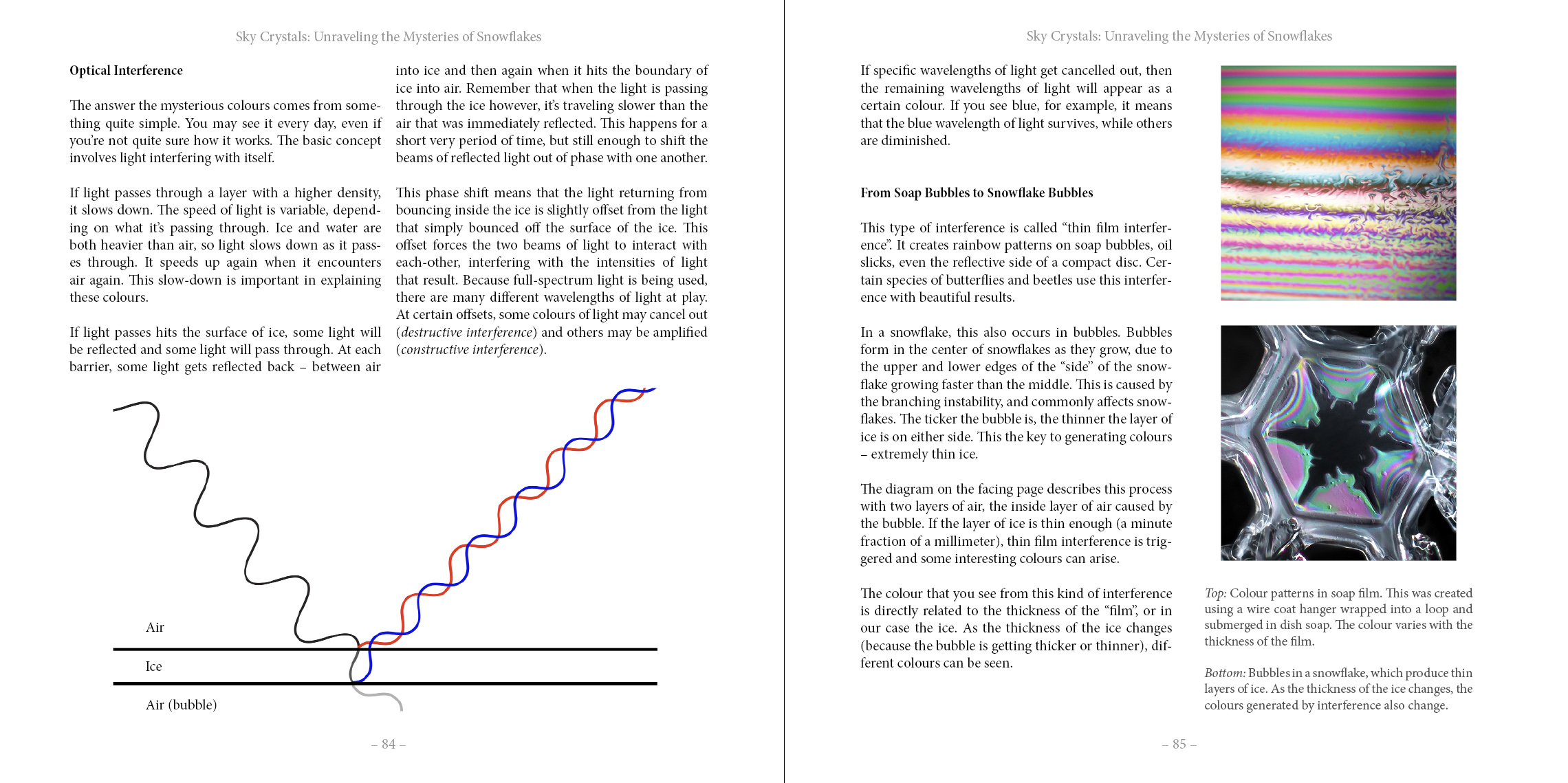
This is where those rings come in. Thin film interference is relatively rare in snowflakes with only a handful of snowfalls a year creating this type of snowflake. You’ll notice that the turquoise colouring happens only in one of the “rings” created by inward crystal growth. At exactly this thickness, we get proper interference patterns. Adjust the thickness slightly on either side and we see no interference at all. The snowflake growing back in on itself allowed it to meet the very strict requires for colours to show up in a snowflake.
All of this is a tiny hexagon falling from the sky. If you like this sort of deep dive into the building blocks of nature, you’d love a copy of my book Sky Crystals:
Hardcover: www.skycrystals.ca/book/
eBook: www.skycrystals.ca/ebook/
2018 Ice Crystals coin, produced by the Royal Canadian Mint and designed by me: www.mint.ca/store/coins/coin-prod3040427
Bonus: How the heck to I measure a snowflakes features? Simple algebra and some practical observations. You’ll a few things:
-The magnification factor. This is easily obtained by photographing a ruler and counting the number of millimeters you cover. With a full-frame camera at 1:1 magnification you’ll see 36mm, since the sensor is 36mm wide.
-The resolution of your camera sensor (horizontal number of pixels)
-The image of the subject you wish to measure.
In this case, I see 3 millimeter markings, so 36 / 3 = 12:1 magnification. Actually, I don’t even really NEED this number, all I need is to know that the horizontal number of pixels of the sensor and divide that by 3. I get 1824px per mm.
Then you count the number of pixels across your subject. This snowflake measures 1880px or just over 1mm, and the thin white line measures 5px. 5 / 1824 = 0.00274mm, or 2.74 microns. Math!
Hedera helix (English Ivy), photographed on Astrum Foto 100 film, processed in Xtol.
Camera used: a 1930s Kodak Retina I, type 126.
complexity of human relations in respect to their environment! a visible spectacle for those who experience!
Complexity sometimes can be uncomfortable and frightening, somtimes it can be fun, putting the pieces together, or solving a mystery like Sherlock.
Either way...
Life is both, simultaneously!
In the World Of Sense, of which everything changes instantaneously, there's a realm of Unchangeable, of which everything is constant.
The meeting of several channels in Botts Marsh, Wheeler, Oregon, at low tide.
Botts Marsh is stewarded by the Lower Nehalem Community Trust, in perpetuity. So these channels will persist and evolve as a natural habitat, providing shelter and feeding grounds for fish, birds, invertebrates, and the occasional mammal, into the unforeseeable future.
Complexity. Image one hundred and thirty-three of my project 365. Just another corner of the University of Wisconsin Madison, Elizabeth Waters Residence Hall.
A series of 3 pictures that started by looking at a ceiling, in a subway station... Details:
www.ticklebear4u.com/2014/01/up-beyond-011365-days-40.html
:)