View allAll Photos Tagged Coalesced
Wind combed side of Mynydd Mawr looking towards the Snowdon massif in Snowdonia National Park. There is a calming feeling in sitting watching the clouds go by as wind strokes your face and the landscape aorund as you coalesce togerher.
Coalescencia - Parque Nacional de Snowdonia, Gales
Laderas peinadas por el viento de Mynydd Maws mirando al macizo del Snowdon en el Parque Nacional de Snowdonia. Hay una sensación de calma en sentarse a ver pasar las nubes con el viento acariciandote la cara y el paisaje mientras formais todo parte de una entidad.
Shortly before Lady Aurora went bananas this night, the visible aurora coalesced into a bright arc...this was already much better than what we usually see in Wisconsin, but the best was yet to come.
Hecla Island, Manitoba, Canada October 11, 2017.
SOURCE FILE: IMG_0830
Copyright
All my photographic and video images are copyrighted. All rights are reserved. Please do not use, copy or edit any of my photographs without my written permission. If you want to use my photo for commercial or private use, please contact me. Please do not re-upload my photos at any location on the internet without my written consent.
Mass Effect 2 - Downsampled from ~25 MP using GeDoSaTo; modified coalesced.ini with UE3 debug codes, playersonly, freecam, custom FOV, setres commands; My own CT for freecam, tilt, FOV, and in-engine DoF and post-processing tweaks; My own ReShade Preset
Mass Effect 2 - Downsampled from ~25 MP using GeDoSaTo; my own ReShade config using MasterEffect Reborn; modified coalesced.bin with UE3 debug codes, playersonly, freecam, custom FOV
Even as far back as 2003, some developers were so much ahead of their time. Story; pacing; artistic detail; music. coalesced into one beautiful collaboration of an epic, emotional experience.
The following is from South Fork Colorado website:
"The San Juan Mountains are the largest volcanic area in Colorado. Enormous lava flows from volcanoes that existed 40 million to 30 million years ago coalesced into a composite volcanic field that was up to 4,000 feet thick and covered about 9,000 square miles. After a quiet period that lasted about a million years, the character of the volcanic activity underwent a dramatic change. About 20 million years ago great pyroclastic eruptions began to produce large quantities of volcanic ash. With major ash flow eruptions exploding again and again from 18 different volcanoes, building up a layer of volcanic ash that was up to 3,000 feet thick in some areas. Most of these pyroclastic eruptions ended about 26.5 million years ago. Sporadic volcanic activity continued until about five million years ago.
The Wheeler Geologic formations are a product of the period of ash flow eruptions. The debris was blown into the air during a pyroclastic eruption consisting of individual particles that range in size from dust flakes to a few scattered pebbles rarely more than a few inches in diameter. Occasionally broken rock fragments up to two or three feet in diameter, called brecci, were thrown out with the ash cloud. The ash particles settled back onto the ground in layers called volcanic tuff. Tuff particles are not firmly cemented together, so the relatively soft tuff beds are readily eroded by the wind and rain over millions of years. Most tuff is light gray or creamy in color, with a bit of pink and sometimes brown thrown in for good measure.
Yeah, it's a thing, and it's exactly what it sounds like. Measurable moisture as a result of fog coalescing on tree needles or leaves, forming into drops, and then falling to the ground.
The Bull Run River, located here in the Mt. Hood National Forest, serves as a watershed and the main source of Portland's drinking water. It's also home to a forest of 500 year old trees and more than 250 species, including the threatened Northern Spotted Owl who's habitat depends on said old growth.
Studies have shown that within the Bull Run Watershed, fog drip from the massive Doug Firs add 35 inches of moisture a year. This adds up to a 40% increase vs. rain/snow alone, and plays a huge role in building and maintaining a diverse ecosystem. It's truly amazing how well Mother Nature designed our forests. They work in harmony with most of their inhabitants (modern humans being the exception) and even come with their own built in water catch system.
Thankfully the BRR is protected from the logging industry and others that wish to mortgage a healthy forest for a fatter wallet. As such, access is quite limited. However, this image of a forest steeped in fog down along the Umpqua River made me think about the impact that this miracle vapor can make, drop by drop.
Image with my Hasselblad 500cm.
Note: This photo was broadcast on Tasmania's WIN News, weather presentation, on 21 October 2021
Removing the Blue
At 20:39:51, I took the above photo, at an elevation approximately 35˚, as I continued to experiment with my Nikkor 500mm f/4P lens and TC-301 teleconverter combination. More about that later.
I used a Colour Temperature of 5,205˚K (Daylight). Well, it was still somewhat daylight and the light shining upon the earth and reflected from the surface through the atmosphere and onto the Moon's surface was sufficient to read a book and use a low ISO and an Aperture of f/11.0, though in a previous photo, I used f/16.0 and f/22.0
Can we make some assumptions?
Approximately 4.5 billion years ago, a billiard-like collision by another heavenly body with Earth took place, causing molten Earth mantle and debris from the heavenly body that collided with Earth to be spewed and coalesced into the orb we call the Moon.
What does that suggest?
The Moon is made up of the same material as Earth, thus would be the same color as parts of our arid and volcanic locations.
Is the Moon made up of cheese, because it appears that way?
Is the Moon made up of blood, as in a Blood Moon?
Is the Moon blue, as in "Once in a blue Moon"?
No. There are easy and scientific ways to explain each of these.
In the above photo, I removed the colour blue, which made the Moon surface begin to look green which I removed by a certain amount, then added a very small percentage of red to begin to simulate the average colour of dirt.
Take a look at this crater, in Arizona, USA, that was the result of an asteroid colliding with Earth-
www.space.com/834-mystery-arizona-meteor-crater-solved.html
and here-
curator.jsc.nasa.gov/education/lpetss/regolith.cfm
and, one more, here-
en.es-static.us/upl/2011/08/lunar_sample_60025_Apollo_16.jpg

www.parkes.atnf.csiro.au/news_events/astrofest/DMA/2016_s...
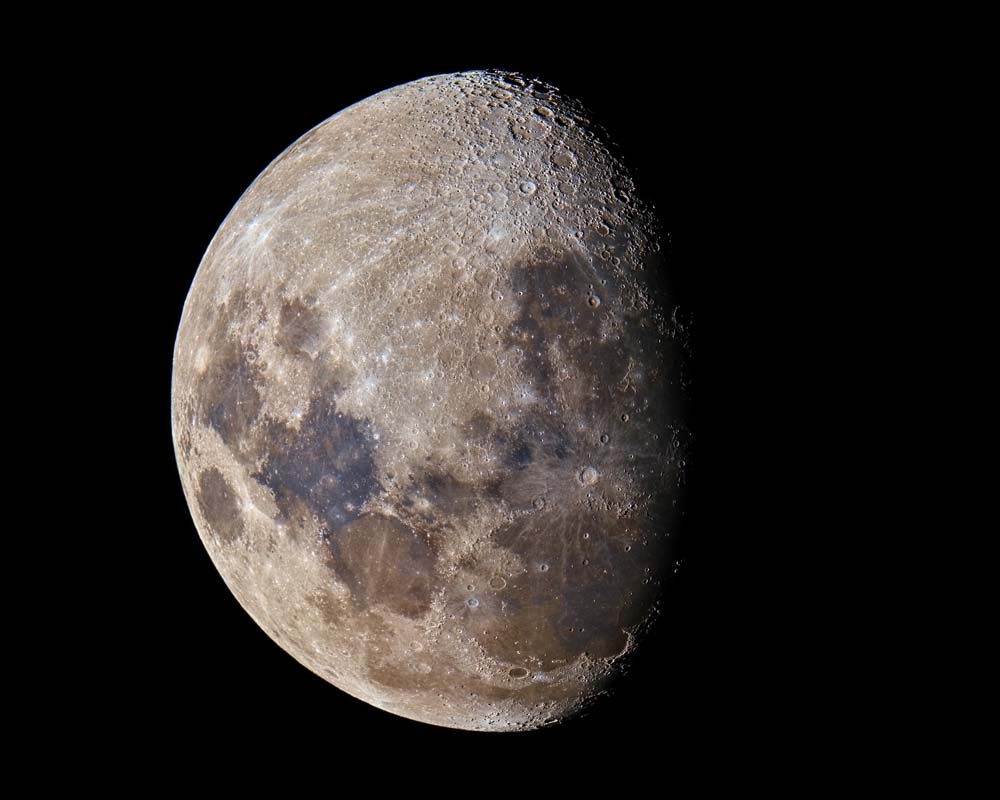
Looks very similar to what you see, in my rendering of the Moon.
Regarding continuing to experiment with my 1,000mm of combined focal length . . . Hmmm, I am here to debunk more internet and Flickr subscriber bullshit.
During the daylight, I set up my heavy duty tripod in an upstairs bedroom with this massive lens assembly pointed out the window to a ridge-line or maybe a plateau quite some kilometers, in the distance, forcing me to focus the lens on ∞ (infinity). Then, I carefully taped the focus ring into place, with the intention of using this setting to photograph the Moon. Isn't that what some of the photography professors on the internet suggest you do? I did, and took several photos dashing inside to check on my computer screen. They were not as sharp as I had expected or hoped for, because I could clearly perceive tree branches on the ridge-line/plateau, many kilometers away. So, I removed the tape and some paint with it (DO NOT PUT ANY TAPE ON YOUR PHOTOGRAPHIC EQUIPMENT -not even the Blue tape). I created the above photo, by merely using my eyeball pressed up to the camera's viewfinder. Considering it was windy, on the surface and certain more so, in the upper atmosphere, this is an exceptionally sharp photo.
A gentle reminder about copyright and intellectual property-
Ⓒ Cassidy Photography (All images in this Flickr portfolio)
Photo taken at Rosendals Trädgård, a garden open to the public situated on Djurgården, west of Rosendal Palace, in the central part of Stockholm, Sweden.
Symphyotrichum racemosum (Small-flower White Aster)
Small white aster is native to eastern North America. The genus name Symphyotrichum comes from Greek symphysis which means “borne together or growing together, coalescing,” and trichinos, “hair, a single hair”.
The species name racemosum means "with flowers in racemes".
Mass Effect 3 - Downsampled from ~25 MP using GeDoSaTo; CT by IDK, One3rd, and myself, for in-engine post-processing tweaks, free camera and roll, FOV, fog, and cutscene AR modification; modified coalesced with UE3 debug codes, playersonly, freecam, FOV; ALOT Texture mod, Vignette Remover; My own ReShade Preset
saturn's rings are inside the orbits of its moons. tidal forces prevented the material in the rings from coalescing gravitationally to form moons
At the local park I hike in the crows love to assemble as a large group just before sunset they fly in and find a few special trees sometimes they spend a few minutes and then head out to another spot. I love seeing them gather and hear them make there bird call. They are gathering to roost, crows will congregate in some area away from the final roosting site, usually an hour or two before complete darkness. Here the crows spend a lot of time calling, chasing, and fighting. Right at dark the main body of the group will move toward the final roosting spot. Sometimes this final movement is relatively quiet, but usually it is still quite noisy.They congregate in different areas, heading to one final staging area where they all coalesce, then everyone heads to the final roost. The final roost can be a cohesive group in a single woodlot, or it can be rather diffusely spread out over quite a wide area of suitable trees. its a survival strategy which brings on the old saying birds of a feather flock together.
Somtimes this grouping is called a murder of crows.
Mass Effect 2 - Downsampled from ~25 MP using GeDoSaTo; modified coalesced.ini with UE3 debug codes, playersonly, freecam, custom FOV, setres commands; My own CT for freecam, tilt, FOV, and in-engine DoF and post-processing tweaks; My own ReShade Preset
Mass Effect 2 - Downsampled from ~25 MP using GeDoSaTo; modified coalesced.ini with UE3 debug codes, playersonly, freecam, custom FOV, setres commands; My own CT for freecam, tilt, FOV, and in-engine DoF and post-processing tweaks; My own ReShade Preset
Tree of Life
Digital Abstract, Gregory Scott
In a storm of movement and color, The Tree of Life rises from chaos, its form at once rooted and wildly alive. Swirls of emerald, gold, and obsidian coalesce into a towering presence—part tree, part spirit, part force of nature. What first appears as abstraction resolves into an unmistakable structure: a trunk, limbs, and leaves contorted by time, weather, and will.
This is no passive tree. It pulses with the energy of becoming. Each twist suggests growth through adversity, the branching out of fate, and the eternal push upward despite gravity’s grip. Black veins thread through luminous greens, hinting at decay and rebirth, suffering and resilience—interwoven, inseparable.
Like the mythic symbol it references, The Tree of Life speaks to interconnectedness: of past and future, life and death, self and cosmos. It asks not to be deciphered, but to be felt—as a mirror of our own striving, rooted deep and reaching still.
---GSP
The NASA/ESA Hubble Space Telescope has snapped the best ever image of the Antennae Galaxies. Hubble has released images of these stunning galaxies twice before, once using observations from its Wide Field and Planetary Camera 2 (WFPC2) in 1997, and again in 2006 from the Advanced Camera for Surveys (ACS). Each of Hubble’s images of the Antennae Galaxies has been better than the last, due to upgrades made during the famous servicing missions, the last of which took place in 2009.
The galaxies — also known as NGC 4038 and NGC 4039 — are locked in a deadly embrace. Once normal, sedate spiral galaxies like the Milky Way, the pair have spent the past few hundred million years sparring with one another. This clash is so violent that stars have been ripped from their host galaxies to form a streaming arc between the two. In wide-field images of the pair the reason for their name becomes clear — far-flung stars and streamers of gas stretch out into space, creating long tidal tails reminiscent of antennae.
This new image of the Antennae Galaxies shows obvious signs of chaos. Clouds of gas are seen in bright pink and red, surrounding the bright flashes of blue star-forming regions — some of which are partially obscured by dark patches of dust. The rate of star formation is so high that the Antennae Galaxies are said to be in a state of starburst, a period in which all of the gas within the galaxies is being used to form stars. This cannot last forever and neither can the separate galaxies; eventually the nuclei will coalesce, and the galaxies will begin their retirement together as one large elliptical galaxy.
This image uses visible and near-infrared observations from Hubble’s Wide Field Camera 3 (WFC3), along with some of the previously-released observations from Hubble’s Advanced Camera for Surveys (ACS).
Credit: NASA/European Space Agency
NASA Goddard Space Flight Center enables NASA’s mission through four scientific endeavors: Earth Science, Heliophysics, Solar System Exploration, and Astrophysics. Goddard plays a leading role in NASA’s accomplishments by contributing compelling scientific knowledge to advance the Agency’s mission.
Follow us on Twitter
Like us on Facebook
Find us on Instagram
An art crtic, John Grande
came to see my show and wrote this about me:
Roger Guetta: Everyday Magic
Re-working the real to uncover a hidden universe that is there for anyone to discover if they remain open to the world we live in, Roger Guetta captures something of the avant-garde spirit. His aesthetics are based on the play of and with the image. For Guetta, images are like phrases or words. The act of layering and reassembling that is an essential part of the artist’s process is like writing with images. But before that Guetta is a hunter gatherer of imagery, selecting and searching materials, objects and images from a range of sources, whether Village des Valeurs, a forest, a beautiful model, or that forest of signs that is our urban reality, all the intensity of microscopic details of our world. The journey Roger Guetta is on involves capturing visual cues and details. He then uses them in the layering, cropping, enhancing that take place in the final stages of his process. In this sense the process of formulating images in the multi-layering is like a form of cognition. The image is no longer an icon but instead a place to visit, where we can find points of experience that exist as a fulcrum for the moment, many moments, a sequence where images are used to build textures of visuality. As intuitive visual investigations of the essential mysteries of life, Guetta provides us with a variety of points of perception within a single image. Like visual texts these photographs inspire each of us to build a meaning into what we see out of the common references drawn from the everyday we discover, uncover, recover, in the textures, colours, movement. Guetta draws from everyday life for sourcing in his imagery for a reason. It enables him to participate in life theatre, like an anthropologist of the present moment. The visual sourcings flower and explode out of a multiplicity, and that flow has no borders, and there is no evidence of cropping, or composition. Guetta condenses, compacts, and layers with great speed. As visual oracular testaments to that great gift of consciousness, we humans have. Guetta mines the unconscious as part of that dualistic process we are always dueling with. The speed of the action and decision-making in bridging imagery builds image depths we can read into. His photos are not maps, but instead pools with depths of interpretation born of the digital age. Roger Guetta uses techniques with an acute awareness of photography’s place within a full spectrum of visual processes from video, to web-based design, to commercial advertising, to televisual and multimedia.
Guetta intuitively understands what the visual image is and can be. While most of these works were produced over the past two years, Guetta produced a series in the 1970s and 1980s using an SX 70 Polaroid Land Camera that revealed the influence of Lucas Samarras. The polaroids were then re-photographed, re-coloured and enhanced to then be printed in a larger scale. The look of these images is Baroque, embroidered, unreal. . Titles form an integral part of the process for they provide a human point of contact with the image. A recent image The Ensemble Waiting for their Props have an 1980s feel. Inspired by the expressionist performance piece Place Of Thunder Guetta directed in 1979, that included masks, drums, a body, and an audience participation that added to the shock effect of the production, this image speaks of presence and absence, of prop scenarios and the theatre of the absurd. In The First Critical Theorist Criticizing his Second Critical Theory, Guetta references irony using the everyday, integrating a solemn copper body image amid a textural, hieroglyphic collagist splay of visual devices to build a resonance, an immediate concrete illusionism. Strong Presence in Association to the Event is a real-time chronicle of illusionism, with a set of eyes disguised under a mask of material, gold leaf and white atmospheric effects; this is an image that reifies our sense of the hidden gesture. The mystery unlocks another mystery….
Guetta’s photos engage us with their pulls, the turns, the facility with which he uses imagery as a painter would paint. The Photoshop of the digital era, enables effects to be achieved that the Surrealists once used with their paintings to explore the unconscious. In our times ‘reality’ itself is surreal, for the contexts, object elements, even nature are transformed seemingly endlessly, and so ‘original context’ is no longer what the artist works with. Imagery becomes a statement about a world in flux. Man Ray, Raoul Hausmann, and John Heartfield’s experiments with collage and montage developed a creative language of association that was expressionist. In the same way Guetta’s photoworks reference memory, imagination, sex, love, and life using imagery of the everyday, and with atmospheres of imagery that build and coalesce. Sometimes, the multi-sensory aesthetic is close to the aesthetic of contemporary Japanese photography.
Writing with visual layers is evocative, beautiful, and even classical when it comes to the portraits, the faces. Others metamorphose, and like embryonic mysteries, break open to reveal multiple facets, but not as fragments. Instead the nudes, and figures, and abstract lights effects establish continuity between the various elements. They become narratives on the sublime, and the imagery is a vehicle towards expressing more universal and spiritual interests. So Guetta builds earth dreams, in a temporal way, while referencing the full range of new technologies, and with an accent that tends towards the sensual whether in earth tones or vibrant colours. We see this in Old School Ride, an image of a 1950s car. Red Burn with its vibrant red and yellow effects is so evocative. The process involved exposing theatre gel on paper to the heat of photo lamps, whereby he colours melted somewhat, to then be stretched. Finally Guetta photographs his experiment and it becomes an abstract study.
Sometimes, the images are spliced together from various sources, and they can express an intuitive, almost sublime sense of the mystery of the everyday, for it is the commonality of the associations in these photoworks, and the strange truly unusual juxtaposition of light effects, colour, textures, and visual imagery. There is always a suggestion of abstraction even when the images are readable, for they are all abstractions from a supposed reality. Guetta has made a series of white on white images that are like worlds within worlds, total constructions, or constructions of a totality that is fleeting, ephemeral, interpretive. As cosmologies they still derive from the so-called real world and an infinity of effects we read into, and build meanings out of our experience. Our experience is every day, every way, always going on, and the filters do their work unperceived. Sometimes we recognize the effects, othertimes we search. The search continues….
And there is another aspect to what Guetta seeks to discover in the imperceptible recognizable, and the merging of it all. That something is the language of commercial advertising that invades our reality in vast volumes daily. Commercial is the most volatile and creative tank of endeavor, particularly as it applies to the visual image Each photo looks like it is captured from within a momentary flux of images, as if nothing were solid, or permanent Instead we feel the ephemeral ever changing sense of life and what it truly means as we experience it. For there are no clues, no ultimate reasons, just a series of visual cues and codices. Guetta interlaces these so as to present a scenario, but not as in theatre, or a plot, more like the way Joseph Cornell will arrange his elements in a magic box assemblage, taking the ordinary to create a near surreal reality, and making what seems unreal so real. We see this in The 7th Way to Cross a River. Juxtaposing a tiny doll manikin with a zig zag abstract surface pattern, this becomes a universal magical mystery. Guetta dances on the end of a rainbow, slides along its colourful arch. As a photographer he is eclectic, and has a very broad range of styles that he can apply. We live in an era when a multitude of styles are available as source from the photographer. Roger Guetta understands all this intuitively.
John Grande
Galaxies come in many shapes and sizes. One of the key galaxy types we see in the Universe is the spiral galaxy, as demonstrated in an especially beautiful way by the subject of this Hubble Picture of the Week, NGC 2985. NGC 2985 lies roughly over 70 million light years from the Solar System in the constellation of Ursa Major (The Great Bear).
The intricate, near-perfect symmetry on display here reveals the incredible complexity of NGC 2985. Multiple tightly-wound spiral arms widen as they whorl outward from the galaxy’s bright core, slowly fading and dissipating until these majestic structures disappear into the emptiness of intergalactic space, bringing a beautiful end to their starry splendour.
Over aeons, spiral galaxies tend to run into other galaxies, often resulting in mergers. These coalescing events scramble the winding structures of the original galaxies, smoothing and rounding their shape. These objects possess a beauty all their own, distinct from the spiral galaxies from whence they came.
Credits: ESA/Hubble & NASA, L. Ho; CC BY 4.0
Simone Marchi presents the emerging story of how cosmic collisions shaped both the solar system and our own planet, from the creation of the Moon to influencing the evolution of life on Earth.
The Earth emerged out of the upheaval and chaos of massive collisions in the infancy of the Solar System, more than four billion years ago. The largest of these events sent into orbit a spray of molten rocks out of which the Moon coalesced. As in ancient mythological tales, this giant catastrophe marks the birth of our planet as we know it.
Space exploration has shown that signs of ancient collisions are widespread in the Solar System, from the barren and once-habitable Mars to the rugged asteroids. On Earth these signs are more subtle, but still cataclysmic, such as the massive asteroid strike which likely sparked the demise of the dinosaurs and many other forms of life some 66 million years ago. Signatures of even more dramatic catastrophes are concealed in ancient rocks. These events wreaked havoc on our planet's surface, influencing global climate and topography, while also enriching the Earth with gold and other rare elements. And recently, modern science is finding that they could even have contributed to developing the conditions conducive to life.
In Colliding Worlds, Simone Marchi explores the key role that collisions in space have played in the formation and evolution of our solar system, the development of planets, and possibly even the origin of life on Earth. Analysing our latest understanding of the surfaces of Mars and Venus, gleaned from recent space missions, Marchi presents the dramatic story of cosmic collisions and their legacies.
Bozar | Inner Travels by Rinus Van de Velde (Now → 15 May' 22)
Exhibit: www.bozar.be/en/calendar/rinus-van-de-velde-inner-travels
Through diverse media ranging from drawings to sculptures, installations and film, Rinus Van de Velde creates a mirror universe where elements from reality and imagination coalesce into a unique kind of visual storytelling.
Artist: Rinusvandevelde.com
Location: Rue Ravenstein 23, Brussels, Belgium
Esmerelda / Come What May sailing in the Sound of Bute, Scotland. Inchmarnock and Arran in the distance
Log of the Dinghy Esmerelda or Come What May
Three seasons learning to sail (1998 - 2000)
May 1998
For years, it seems, it has been at the back of my mind that, when it was convenient, I would learn to sail my own boat. Life being such as it is, I have spent the last nine years living within ten minute's walk of the sea but have not been in a sailing boat in all that time. Last weekend, I answered an advert in the local paper. Now, I am the proud owner of a 14ft Lark sailing dinghy! Ian, the seller, kindly offered to teach me to sail her. She’s a modest little boat, but seems worth the price. Adam (my elder son) is delighted and is raring to have a go.
****
Yesterday evening was our first time out on the water, not on the tide, but on West Kirby marine lake in the Dee estuary. I felt very much an incompetent land-lubber. I have a whole new set of coordination skills to learn, certainly more than when learning to ride a motorcycle or drive a car, but this is part of the challenge. I think it helps to have the limbs and bodily plasticity of an octopus.
****
Ian took me out in the boat for the second time yesterday evening and it was beautiful! - sun sinking in the west, warm blue sky, a gentle breeze and the boat gliding effortlessly through the water. If I am not yet completely hooked, then I soon shall be. My aspirations are modest: I'd be thrilled simply to learn the necessary skills and gain the confidence to navigate the Wirral coast.
****
This sailing has really got a grip on me. I spent last Thursday night in Manchester so that I could start earlier on Friday in order to be home by 5 p.m. to take the boat out. It was wild! The wind was approaching force 4 and we managed to capsize twice, (although we were the last boat on the lake to do so). It is a wonderful activity which, like mountaineering, is completely absorbing both mentally and physically, and which, if you're not actually doing it, then you're thinking about doing it or pottering around with the equipment. I'm pleased, because it has restored a dimension to my life that has been sadly lacking for a few years. Alix and I have decided definitely to withdraw our house from sale and stay put here on the coast, at least for the foreseeable future.
Inanimate objects
I hesitate to consider my boat an inanimate object. She has several traits suggestive of animation, and female at that:
a nice shape,
moves gracefully,
behaves wilfully,
demands attention,
requires sensitive handling,
and on two occasions has been quite upset and ditched me.
Friday 12th June 1998
Stimulating, thrilling, absorbing and therapeutic.
We went out last Saturday and plan to again this Saturday. It is time I took it out on my own though, or rather with someone I can't rely on to take the initiative in a tricky situation. After all, the whole idea is to sail this boat myself. With this in mind, I persuaded my German colleage Tobias to come over on Sunday to join me. He has never sailed, so it'll be the blind leading the blind, but it has to be the quickest way to learn.
Sunday 14th June 1998
Achievement!
I took the boat out truly as 'skipper' this evening (with Tobias). The wind was northerly, gusting force 4, and slightly intimidating - I nearly called the whole thing off - but once we'd cast off it was magical!
Suddenly after all the flapping and palaver of rigging, all is quiet and smooth as we glide downwind. A slightly anxious moment ensues when I realize we'll have to gybe before we run out of lake, but this manoeuvre works smoothly and I realize with relief that I can actually tack back against the wind.
After an hour, despite some interesting moments, we have managed to avoid capsizing and are still relatively dry. We are rewarded by the sun peeping out from under the clouds just before it vanishes below the horizon.
Clynnog fawr, Lleyn Peninsula, north Wales, July 1998
Wonderful holiday! - the best I think for several years. Brothers Martin and Chris and our three families (15 of us in all) staying in a farm house together. Best of all was to see all the kids together (eight cousins and one half-sister) - how the older ones looked after and amused the younger ones, and also how the younger ones amused the adults, and how the adults are actually kids at heart and behave as such when they are all together. It was invaluable to have so many young cousins for Adam to play with, and to be able to let Ricky trot out into the large green spaces around the house and to play in the sand, knowing that there were nearly always three or four others keeping an eye on him.
The farm itself was in a beautiful location on a magnificent length of coast, north west facing, catching the best of the sunsets. The whole area is delightfully quiet and unspoilt (and only two hours drive from home, even towing the boat). The weather was not ideal, but we still managed to spend a large proportion of the time outside.
At the beginning of the week high winds, cloud and some rain made it quite unsuitable for sailing but we managed some hiking and some went horse riding. By Wednesday, the forecast was slightly better and we'd discovered relative shelter and what seemed to be a nice launching site at the northern end of Llanberis Lake, so we decided to sail come what may. [At this moment Come What May suggested itself as a name for my boat. Only later did I discern the name Esmerelda almost completely faded written on the hull.]
It turned out to be a delightful, sunny and warm afternoon, the shore had trees to climb, sticks and stones to splash in the water and soft grassy spots for picnics. We launched and I was able to take everyone out in turn. For Adam and Alix it was actually their first time, the complexities of child care being what they are. Adam was fairly excited but not a hundred percent confident, he finds it a little intimidating but hopefully that will change. It was the perfect day for him - gentle and warm.
The next day started fine with a light breeze. Majority interest however determined that we go riding again followed by a pub lunch, but in the afternoon I was determined to get the boat out. The tide was up and three of us succeeded in handling it down a steep track to the shore and then over small, slippery, seaweed-covered boulders to the water's edge.
I still find it miraculous how, once rigged, with a quick shove and hop in, we are gliding through the water as if by magic (hoping a freak gust doesn't turn us round before I grab hold of the tiller and get the centreplate down!)
Caernarfon Bay, and first time on the sea! The swell was a little daunting as we sailed into deeper water, especially with four adults aboard (not sailed with that many before), but I practised a few tacks, sailing up-wind and down-wind, and she seemed to handle alright without shipping water, albeit a bit heavy at the tiller, so I was happy. It was a delight with the rhythm of the waves and the late afternoon sun sparkling through the spray and sea to the open horizon; with our course set for the open Atlantic I just wanted to keep going. Fortunately, I didn't. All of a sudden there was no more resistance on the tiller and we swung round into the wind: the rudder had torn off its mounting! I was glad that I'd invested in some oars as a precaution with which we were able to turn about to face shoreward; then, by holding the rudder (fortunately still attached to the boat by the uphaul line) and leaning right into the water astern, we were able to hold a course back to the shore. I since realised that the reason the rudder felt so heavy in the first place was because it was not engaged in its fixed down position but trailing horizontally behind; the extra leverage combined with the weight in the boat must have sheared the two mounting bolts. I've now repaired it with four new reinforcing bolts. It was a learning experience and exciting at the time. The others all seemed to enjoy it and seemed to think it was all in a day's sailing adventures.
7th August 1998
Last weekend was wonderful. Summer finally seemed to have arrived: it was comfortable to spend dawn 'til dusk in shorts and T shirt and to sit out late in the garden for dinner with a bottle of wine after the kids were in bed. Adam and I went onto the beach on Sunday and spent a good hour just splashing in the sea and being crabs and sea-monsters wallowing in the deep soft sand. Simple happiness!
More exciting still, I took the boat out twice. First, on West Kirby marine lake completely on my own for the very first time. I was out on the water by 7.30 a.m., it was a gorgeous morning and I had the whole lake and, indeed it seemed, the whole estuary to myself. Second, again on my own, on the high tide for the first time. Two significant achievements which have given me such a thrill that I can't wait to do it again! In fact, I can now say that I have achieved my long held ambition of being able to sail my own boat on the sea, albeit in very easy conditions: a smooth surface and barely a breath of wind. I sailed for three hours on the high spring tide and was really chuffed to be out there on my own, but it would have been nice to have had some good company too. I feel this is only the beginning: my curiosity is already drawing me to peruse the second-hand yacht sections of the sailing magazines!
17th August 1998
I had my sailing abilities stretched this weekend when I took the boat out on the tide in a breeze that was slightly too strong for me (also my muscles and parts of the boat were well stretched). It was a humbling experience:
On the sea front, the breeze felt rather intimidating. The lifeguard on duty hailed me, having seen me with my boat the previous week,
"Going out today?"
I confided my reservations to him, but he replied, presumably intending to encourage me,
"Only way to learn, by experience!"
This was a challenge I felt bound to accept.
Having rigged and launched, all there was to do was push off and hop in. It was that moment of hesitation that reminded me of the feeling I had as a novice skier on the lip of my first black run: the point of no return. Hesitation over, the first few seconds I spent struggling to lower the rudder, which for some reason would not go down (because, I found out later, I'd hitched the uphaul too tight), while keeping an eye on other boats at their moorings skimming past me at an alarming rate even before I'd trimmed the sails. In the excitement, I forgot to lower the centreplate, which meant that having covered about half a mile in what seemed like about ten seconds I tried to come about into the wind but couldn't. Hemmed in by a sand bank on one side and an approaching groyne on the other, there seemed to be little room to manoeuvre and all I could do was gybe, but this didn't work properly either and I capsized. I realised the centreplate wasn't down when I tried to stand on it to pull the boat back upright, it then took me a few moments to lower it because first I had to untangle the anchor warp from the centreplate uphaul, the two having become intertwined. The boat then righted quite easily and I tacked back against the wind with the water gurgling reassuringly out through the self-bailers; I was determined not to be defeated.
Eventually though, the jib became wrapped around the forestay and I capsized again trying to unwind it. At this point I felt I was doing everything wrong and it was time to come in so I limped back to the slip still half full of water where by now a small group of spectators had gathered to watch me, including the lifeguard and two old sea-dogs who'd obviously been passing comment. Later, the lifeguard told me that the old sea-dogs were "impressed" that I'd got back without assistance. But really I don't suppose I impressed anyone much. I clearly have much to learn.
7th September 1998
I took Adam out in the boat on Saturday. There was almost no breeze: we seemed to spend long periods just playing with the sails trying to detect what little air movement there was. Adam had a go at the helm which quite thrilled him, and he even tacked. He was pretty good at holding a course when I told him to steer towards particular landmarks.
The dissipated remnants of hurricane Danielle have been lurking off the coast of Ireland these last few days and forecast to be moving across the British Isles; on Sunday the wind got up and there were gales forecast in the Irish Sea and I chickened out of going out on my own although several boats did sail on the high tide.
14th September 1998
Sunday was too windy for sailing. I'm going to have to experiment with techniques for reefing the sails, or sailing on the jib only.
18th September 1998
I saw a centre page pull-out guide in one of the yachting magazines this week entitled, "Your guide to crossing the Atlantic" - I dream.
9th October 1998
It's been cool and windy here but with a lot of bright sunshine interrupted by occasional showers. The leaves are starting to thin on the trees and most of the apples are in, except the late ripening ones. I was hoping there might have been a chance to take the boat out, but the weather really wasn't suitable. Most of the moored sailing boats are coming in onto dry land for the winter now.
I did get some useful clearing done in the garden and managed to build up our supply of fire-wood. Richard was following me behind the wheelbarrow and he managed to tumble into the pond!
It is simply beautiful being out in the garden. There is something very special about this time of year: the colours, the earthy smells and the sound of the wind in the trees.
20th October 1998
Autumn has set in a big way: chilly, grey and wet, and particularly dismal now that the nights are drawing in. Definitely time for the wood fire in doors. It was beautiful though in the garden on Sunday: I got a lot of clearing done and generated much material for bonfire night; also, I came across a hedgehog - not so rare in our garden but unusual in broad daylight and nice to see. Adam insisted I tell stories to him about hedgehogs for the rest of the day.
3rd November 1998
At 11 p.m. there was a 10 metre tide bursting on the sea wall with a strong northwesterly wind behind it and a full moon. I never saw such a high tide here. The sea was all over the road. I felt a strange, pleasant, almost terrified excitement because there is one recurring nightmare that I have occasionally had in adult life which involves standing on a foreshore and seeing the monster of all waves rising up and bearing towards me and the growing realisation that I won't escape it in time.
Our bonfire party is tomorrow. As usual, a huge pile of wood has appeared as though by magic in the night, the local contractors see it as an opportunity for free rubbish disposal and it will take four of us half the day to built it into burnable shape tomorrow, but this is all part of the fun. Adam is looking forward to it and so am I.
2nd December 1998
We like too much where we live: our wonderful garden, horses over the fence, lying in bed listening to the waves on a summers night, the crashing surf of a winter storm, opening the door to the tangy smell of sea air in the morning, sunrise in a crispy dawn sparkling on frost-covered sand, and the pink rays of setting sun over the water glowing off the distant Welsh hills. It's a clear, frosty night with a full moon. There's a thin, misty vapour over the water as the tide silently slides past the sea wall and the oyster catchers make their eerie call - I love it!
***
26th April 1999
Out sailing again - first launch this year. Saturday was a beautiful day and I took Adam out on the high tide in the evening while the sun was lowering in the west. It was neap and there was virtually no wind - very still, we moved like a whisper. It was so still that we went aground (neap tides don't leave much room to manoeuvre between sand banks) and didn't even notice that we were stuck for about a minute! It was good to be on the water again.
28th April 1999
The sun is a great red orb above the horizon. The boat is all set for launching at the next available opportunity - this weekend. It is a long weekend with the May Day holiday and there are high spring tides around midday - perfect!
14th May 1999
Sailing has been wonderful! Especially yesterday, when conditions were perfect and I spent three hours exploring some of the far reaches of the sand-banks several miles up and down the coast. I'm looking for the best route across the shallows that will allow me to circumnavigate the islands in the mouth of the Dee estuary on a single high tide. The timing is important in order to avoid being left high an dry.
18th May 1999
Sailing is good exercise: strong on the back and arms hauling the trailer along the road to and from the slipway, and then on the tummy muscles when leaning out to balance the boat when it's heeling over.
I had an embarrassing little incident two weeks ago in front of the lifeboat. It was a perfect day for sailing, sunny with a gentle breeze. I'd been out for about an hour and was starting to think about coming in for some lunch when I saw the Hoylake lifeboat coming past. This is a big, powerful, offshore boat with an experienced, sea-going crew. It pulled up close to our slipway, and the crew having passed some lines ashore set about some rescue exercises. Meanwhile, I thought I'd better make a good impression. I gave them a wide berth and tacked cleanly round to make my approach to the slipway in such a way as to avoid any risk of entanglement with their lines. Gliding in smoothly, I reached aft to raise the rudder to stop it grounding, but instead managed to pull the tiller off the rudder stock: the boat slewed round out of all control and, before I could do anything about it, heeled over wildly and capsized, right in front of the life-boat! What's more, a crewman was recording the whole incident on video! I righted the boat without assistance and then sailed out again to allow the self-bailers to empty the boat of water to avoid the embarrassment of having to do so ashore. Afterwards, our local lifeguard, who was also there on duty, remarked that I couldn't have chosen a better moment: the lifeboat only comes down here about once a year!
We've finally booked our holiday cottage for this summer: a house on the shores of Loch Torridon, way up in the north west of Scotland. I'm really looking forward to it. It is in one of the most beautiful parts of Scotland and a superb area for mountaineering. Everything is literally on the doorstep. There is access to the loch to launch the boat and the cottage lies at the very foot of one of the most spectacular mountains in Scotland, Liathach, the crest of which, soaring to 3,456ft directly above the sea, is considered to be one of the four classic ridge routes in the country. Of course, scope for serious mountaineering will be limited, but at least we will be four adults to share child minding. Unfortunately, the cottage was only available for one week and not two, but we plan to take the tent and tour for a few days after. I'm already really excited.
10th June 1999
Sailing, it is completely absorbing and I love it! This was my diary entry last weekend:
Onshore breeze, about force 3, which seems plenty strong enough for me single handed. The question arises how to launch at a right angle to the breeze with the sails up; hoisting the sails once afloat would be the better solution but with no means of holding the bow this could be awkward. I wheel the boat on the trolley half into the water then swing the trolley to head the boat into the wind, hoist the sails, rig the rudder, then manoeuvre the trolley so as to allow the boat to float, holding the bow. I'm glad Alix then turns up to retrieve the trolley. Which direction to cast off? Try to avoid the embarrassing and awkward situation of being blown back onto the sea wall before making way, but to make good way, must lower the plate and sheet-in immediately but can't lower the plate until in deeper water. Conundrum. Oh well, try it. Here goes. Shove, hop in and grab tiller. Impetus of shove already gone, drifting back on shore into small party launching rowing boat; sheet-in sheet-in: yes! now 45 degrees to wind and making way, miraculously avoid sea wall. Rudder down, plate down - no, not enough depth for plate, grounding on sand bank; half raise plate, can't tack, bear round with wind, avoid moored boats, must gybe - tricky in confined space, risk of capsize. Steady gybe by holding vang as boom swings across. Success! Now on course with clear water ahead.
It takes a few minutes of lively sailing to convince myself that I am really in control. The swell is slight but riding the waves is exciting as every other crest bursts on the bow, shooting spray up my bum leaning out over the windward gunwale. Shortly, the rhythmic plunge and rise through the waves works a very soothing effect, my senses become fully attuned to my immediate surroundings and all else seems a world away.
Hoylake Sailing Club Regatta, 15th June 1999
I actually took part in a race this weekend. The local sailing club held its annual regatta. While I was launching on Friday evening one of the officers of the club introduced himself and invited me to take part. It's quite an event locally, with a lot of visiting boats from the region and open to non-members.
So there I was on the water on Sunday morning with only the vaguest notion of what was expected. I was confused by the order of buoys and posts that marked out the course, which ones to pass on which side and in which order. Then there was the gun. There were meant to be six minute and three minute warning shots but I'm sure there was an extra one, and on which side of the line was I supposed to be? At the last moment but too late it suddenly became clear and the start gun found me on the wrong side of the line going the wrong way! The other boats were racing towards the first buoy whilst I having recrossed the line lagged hopelessly in their wake. For a while I was able to follow them, but as the wind got up and the sea became grey and choppy the field spread out and even some of the more experienced boats appeared to become confused and eventually I had to admit that I really didn't know where I was supposed to be heading! Oh well, I'll know what to expect another time.
I appreciated the opportunity to make contact with the sailing club. They seem to be a friendly and pleasantly informal lot and I may consider joining, partly for access to their rather nice clubhouse with bar overlooking the sea, but partly also because it represents a chance to get to know people whose company I might enjoy and who share an enthusiasm for sailing. It is not a sporty, highly competitive dinghy racing club, although they do organise racing on some Sundays. I have the impression that the competitive aspects are not taken too seriously. It is more a group of people who enjoy sailing in all its forms, which suits me. The attractive clubhouse is an added bonus.
It was not a competitive streak that induced me to participate in the race on Sunday, but an exploratory streak to see how I might enjoy it, and a sense of curiosity to see how my sailing matched up to others. I realised that racing is a good way to hone one's skills because I did a lot more manoeuvring and trying to maximise efficiency than when out on my own. I can see how racing could be enjoyable because it involves optimizing your performance, which can be thrilling and satisfying (and it would be nice to win sometimes too) but I can't yet see myself wanting to race regularly. Like skiing, I see sailing as a means of exploration rather than a competitive sport.
Tuesday 6th July 1999
We were sailing on Sunday, all of us together for a change. Rick was very excited before he got in, then once underway he kept saying, "Tip over!" and looking worried, but he got used to it for before long he was scrambling to the stern to grab the tiller saying, "Have it, Ricky do it!" Meanwhile Adam was intent that I tell him a story about some limpets who make friends with some ammonites. I am learning that taking the kids out demands additional skills to normal sailing competence.
We're soon away to Scotland for a fortnight. I actually bought myself a fishing rod and some tackle just in case the wind drops while out on the loch, as if I won't have enough to occupy myself with a boat and kids and magnificent nearby mountains. It telescopes down to 18 inches so it won't take up much space. I thought it might be fun for the kids too (good excuse, eh? Of course I'm just a big one.) I have fished exactly twice in my life and caught one trout about four inches long, so the family probably shouldn't rely on me for food.
Torridon and Kishorn, July 1999
[Monday 2nd August 1999, back home.] It is hard to be back after such a lovely break. Tragic actually. I suddenly see all the things that are wrong with my life here and what an effort it is to try to force myself to put up with them. Especially I see how drab, ugly and over-crowded are the areas where I live and work, even our little patch on the coast holds no magic compared with the northwest of Scotland.
While we were away it was wonderful to be able to spend so much time continually with Richard and Adam and coming back I realize how unnatural it is for a parent to see so little of his children as I normally do here. I have no illusions that we have a right to a perfect life - there is no reason why working for a living should be easy - but some things need to change.
The northwest of Scotland would certainly have limitations as a place to live, the principal of which would be an acceptable means to make a living, followed by the distance to secondary schooling for the boys. Also, family visits would be much less frequent, the midges bite terribly and the weather would not be as reliably good as we had it at least in the second week. But as for the rest of it - city life - I don't need it.
We spent the first week on the shores of Loch Torridon nestling at the foot of two of the principal mountains of the area. Torridon is rugged country - one of the last places in Britain to have glaciers as late as 9,000 BC - but like the whole west highland seaboard, sublimely beautiful. Other fjord-scape coastlines in the world are certainly more splendid, but Scotland has a special charm that appeals to me personally.
The peaks of Torridon rise straight out of the sea to over three thousand feet and are composed of thousand Myr old sandstone, which in the larger corries takes the form of sheer, dark grey precipices of giant masonry blocks, and on the tops, precariously placed boulders like part-melted stacks of huge dinner plates. Many of the peaks are capped with silver-grey quarzite which when wet glints and sparkles in the sun. The whole is founded on much older bed-rock (up to half the age of the earth) which shows itself in places as contorted swirls of intermingled shades of pink, orange and fiery red streaked with white. The region has remnants of the original Caledonian pine forest still undisturbed after eight thousand years. But the principal charms are the play of cloud and light on the hills and sea, and the unhurried style of life, where people still leave their house doors unlocked when they go out.
We had a fair bit of drizzle and overcast days in the first week, during the course of which ours was the only boat we saw afloat in the whole of Upper Loch Torridon. In fact, one afternoon, Martin and I were sitting in the boat in the middle of the loch, with the clouds low on the hills and the rain dribbling down the sails, awaiting any movement of air that might get us back to shore before tea, and I did start to wonder what it might take before I started to question my enjoyment!
Another day Martin and I thought we'd make the most of any time when the breeze died by trying my new fishing rod and three hundred piece fishing kit. Out on the water, the sails lolling impotenty, I gave Martin charge of the helm, should any light air arise to stir us, while I sorted hooks and fiddled, trying to remember how to tie them to the line. All of a sudden, there were ripples on the water, the sails filled, the boat heeled wildly and we were creating a creaming bow wave, covering the distance across the loch in a couple of minutes that it had taken us a whole afternoon the previous day, while I scrabbled to prevent fish hooks from littering the floor around our bare feet and at the same time tried to give instruction to Martin who'd never helmed a dinghy!
Come the weekend, the clouds evaporated and there followed six days of glorious hot weather when we were out everyday in T-shirts and shorts, even on the water and up at 3,000ft late into the evening - very unScottish! We found accommodation slightly farther south, with magnificent views from our living room window up into the majestic corries of Applecross and out to Skye, in a secluded bungalow just outside the small village of Achintraid on the shore of Loch Kishorn. Alix, Adam, Rick and I spent a couple of days of idyllic sailing when we were out for the whole day with picnic and cans of beer, mooring on uninhabited islands and remote beaches for long lunches, lounging in the sun, exploring the rock-pools for crabs and sea-anemones and swimming nude (there simply was no need for swimming costumes because no one was there!), although not for many minutes because the water was chilly. I love to abandon the trappings of civilization as much as possible on holiday - radio and television, swimming trunks, combing my hair, etc. I go happily for days washing and bathing only in salt-water with my hair gone wild, I like the feeling of it.
The Highlands can be extremely bleak and dreary ("driech" in the Scotch dialect) but only in some places and in certain weather. The atmosphere is often fresh and invigorating or imbued with a remarkable softness. Part of the beauty is this softness and the wonderful cloud-scapes. During our hot weather spell, although I wouldn't have wanted to change it, some of the distinctive charm was lost: it reminded me more of the Alps or the Sierra Nevada than Scotland.
I think we've all felt slightly down since returning, we had such a gorgeous few days. Sailing off the sea front here in Liverpool Bay has (at least temporarily) lost its appeal.
***
Sunday 19th March 2000
First launch of the year. It was wonderful to be on the water again! It is something very special to me. On the water, I am happy: life is as it should be and I don't want for anything. I was out at 8:30 a.m. for nearly three hours, and there was no one else.
28th March 2000
Summer time
We switched to British Summer Time this weekend and today the temperature has dropped to 3°C - it feels like January again! I did get out in the boat though, both on Saturday and Sunday. Good thing is, the kids have not adapted to the time change yet, so we get to sleep slightly later, but I wonder how long it'll take for them to catch on.
Sunday 2nd April 2000
Hoylake Sailing Club first dinghy race of the season.
It rained the whole weekend: a pretty much continuous light sea-drizzle which hardly let up even once. Alix took advantage of child-minding by parents and agreed to join me in the boat on Sunday (rare that we are ever in the boat together). At 9 a.m. there was a sea mist and hardly a breath of wind, and we really wondered whether we were silly, sitting bailing the rain out from where it collected from dribbling down the sails as fast as it came in, and feeling the wetness slowly creeping in down our necks. At the starter's gun, the few other boats all managed magically to coax some movement out of the still air, while it took a good two minutes before we managed first to point in the right direction then get underway, bringing up the rear. It was all quite amusing really, and in the end we were glad we'd made the effort to go out. Afterwards, all of us including the boys went into the clubhouse for a drink, then returned home for proper Sunday lunch of roast lamb, a good bottle of Rioja and an afternoon cozily by the living room fire. A near perfect Sunday.
Hoylake Sailing Club Regatta, Saturday 3rd and Sunday 4th June 2000
There were around 70 boats racing offshore, so quite a spectacle. I didn't race. I'm not convinced that racing is where my interest lies, I simply like to be out on the water and go where the whim takes me rather than jostle with other craft around buoys. The lifeguard introduced me to Billy who offered to take me out in Magnetic, his Cygnet cruising yacht. We walked out over the sand to his mooring in the outer channel. The tide comes up here with a rush; it is impressive like a fast flowing river, one minute you're lying aground and the next you're bobbing around floating free. It was interesting for a change and novel to be able to brew tea en route in the cabin, but it struck me how sluggish and how restricted in manoeuvring over the sand banks is a boat like Magnetic compared to my dinghy, so on Sunday I was happy to be back under my own sail.
Alix took the boys to the Millennium Dome in Greenwich at the weekend. It has been billed as a festival of Britain to match the great ones of the past but has had bad press and accusations of waste of public money. Alix thought it was accurate in presenting an impression of the state of Britain today in that it was confused and didn't seem to know what it was trying to be, and it had an abundance of what this country is famous for abroad: its queues.
12th June 2000
I'm considering an over-night sailing and camping expedition to Hilbre. The tides were right this weekend but the winds were too fierce for me, force 4 - 5 the whole time, and I didn't get out in the boat at all (I feel deprived). Beautiful sunny weather for the garden though; however, I had to use some of it on afternoon naps as, first Adam, then Richard, were sick during the night and left us very short of sleep.
16th June 2000
I went out on Tuesday evening just after I got home and it was gorgeous in the late light, sailing into the sunset. There was a significant breeze and I was even surfing in on some waves. This weekend the weather looks set lovely and, wind permitting, tomorrow we will all go out and perhaps anchor somewhere for a picnic.
19th June 2000
We are enjoying a heat wave; that is, I am enjoying it, but many are not. I wouldn't be surprised if some of the inner cities reached 90°F this weekend. We have a south wind, but plenty of breeze on the coast to be bearable. We all sailed on Sunday, cruising out to the far edge of the sandbank (about a mile offshore) where we beached, ate picnic lunch and had a swim; it is good to have a break to provide variety for Adam and Richard, otherwise they get restless just having to sit. After we returned, we all went to the beach again (with swimming costumes this time) to cool off while the tide was still up to swim in. Adam and Richard loved it. Later Alix and I were eating dinner on the lawn until 10 p.m. I love weekends like this and count it a great privilege to have the wonderful sea on the doorstep. Being back at work is definitely dull by comparison, but it is what I am paid for.
Monday 26th June 2000
We are in the 70s today, warmer than at the weekend with its brisk northwesterly breeze - too windy for sailing, unfortunately, which we’d been looking forward to as Alix’ sister and family were here to visit. We were a bit downcast from sadness that our visitors had to leave. The kids were so excited the whole time to have each other as playmates and they were all devastated when they had to part. They all shared the same bedroom and around seven each morning we heard the "gentle" patter of feet as they trooped down stairs, trying to be quiet but not quite succeeding, to organize their own breakfast before any of the adults appeared. On Sunday morning they even let themselves out of the house to play in the garden and in the lane before we got up - two of them still half in their night-clothes! And Adam was revelling in showing them around his home territory.
Sunday 30th July 2000
It's been a good weekend for sailing. Thursday evening was looking gorgeous and Adam decided to come with me (partly I suspect as a means of delaying his bed-time); unfortunately shortly after we launched some grey clouds coalesced above and released persistent rain for an hour. Friday really was gorgeous though: what little rain there was had cleared during the course of the day leaving a few fantastic cloud shapes and sparkling sunshine. I was the only boat out and I sailed until just after sunset in only my shorts and T-shirt. The breeze was very light and at one point I let myself hang backwards over the side with my hair almost dabbling in the water becoming almost dizzy from the huge upside down vista of red orb sun and pink tinted clouds gliding passed at water's-eye view. It was very pleasurable.
This morning Richard and I went out together. First time I've taken Richard alone. He was very good (in doing what he was told when told) and seemed really to enjoy and remain interested for the whole of nearly two hours that we were out (in perfect summer weather). He caused some amusement upon landing when he insisted in helping me by pushing the boat from behind with all his might up the slipway!
Saturday 5th August 2000
We are leaving for the Isle of Bute next Saturday and I feel there is a lot to rush to do before we go. Preparations for holidays these days are no longer a simple matter of organizing a rucksack on my back, boots on my feet and money in my pocket. There's the boat trailer to load - do the lights work? - need a new registration number plate to match the new car, grease the wheel bearings, where are all the straps and cords I used last year? Adam, Rick, where have you hidden xyz since I last saw you playing with it? Where are all the tent pegs? Does the camping stove work? etc. Alix tends to organise food and kids' clothes, which is a relief. All I've done is had a case of wine sent to the friends we're staying with for the first week (definitely essential provisions). I try to tell myself that this is a holiday and we're supposed to enjoy it, but I know I've worn myself down because I've succumbed to respiratory infection and my back is playing up (doesn't help to have to lift the boat trailer). None of this stopped us all going out sailing today though. We pottered along the shore to Leasowe beach and landed for the kids to build sand castles for half an hour (they like the break), then headed home before the tide went out. We saw lots of birds and a couple of very brightly coloured jelly fish.
Wednesday 9th August 2000
The boat and equipment is now loaded for the road and ready to go as soon as we can get out on Saturday morning. I avoid the check-list syndrome as much as possible and usually get by with a single pencilled sheet of paper scribbled a week in advance; I do what I consider necessary to avoid wasting time when we are actually away. High tide is about an hour before sunset and there is light air movement: if I feel I've worked well by the end of the day I'd be tempted to go out, although I'm not sure I want to face all the unloading and reloading again!
Isle of Bute and Argyll, August 2000
Our holiday was really wonderful. August Scottish weather again proved remarkably fine. There were only two days in nearly a fortnight when rain deterred us from doing what we had planned, and we had several magnificent days. Of our eleven days spent actually in Scotland, we sailed on six of them.
We enjoyed our time on the Isle of Bute spent with a long-standing friend David in his parental house. His parents are now dead but his sister lives there still. David lives in Switzerland, but returns every couple of years to supervise (and pay for) necessary structural upkeep as it is a large, rambling Victorian property. He generally invites a house-full of friends for the duration, which makes for a lively week - ideal for the kids, because there are other kids to play with, and for the adults too, who have the stimulus of each other's company.
The island is relatively close to Glasgow but, on its western shore particularly, it is quiet and has much of the character of more remote Hebridean islands. We had some fine sailing off the beaches in magnificent scenery and crystal-clear water. I also took some of the other guests out - I enjoy sharing their pleasure in it.
For the second week we moved farther westward and found a delightful camp spot on the shore of Loch Sween. It was a perfect, level, grassy platform a few yards above the shore, facing the sunsets. We had words with the local farmer who let us stay there and gave us access to a water tap, and who also offered to launch our boat from their adjacent field, enabling us to keep it moored right below the tent. We actually used two tents on this trip, letting Adam and Richard share the small backpacking tent together, which they enjoyed, thus leaving us some peace and privacy in the larger dome tent. It was very close to idyllic: we were completely secluded, I was able to read The Hobbit to Adam snuggled up to the campfire for his bedtime story, and we were very little harassed by midges, which is unusual for the Scottish west coast in August.
Upon arrival, it had been a hectic day travelling in the car, the kids had been fractious and were finally in bed, it was a beautifully placid evening with perhaps half an hour left of sun before sinking behind the hills, and I took the boat out. Ghosting along the middle of the loch with barely a whisper, making myself comfortable with my head resting on the thwart staring backwards up at the sky, I was so absorbed that I turned with a start when I suddenly realized I'd nearly bumped into an island full of seals! About a dozen of them on a craggy rock, about twenty yards long and four wide, breaking the surface of the water by about three feet. The rock was actually marked on the 1:50,000 map as a small blip but I hadn'd noticed it. It lay only about 500yd offshore from where we were camped, so we all returned there together in the morning for a closer look. There were several pups among them looking very cute.
Our nearest shop was 4 miles away by boat up the loch at Tayvallich on the opposite shore, but a 20 mile trip around by car, so we experienced the novelty of a family grocery shopping expedition by sail, making a fine day trip, with a good sea-food pub dinner thrown in.
Kilmartin Glen, not far away, is a centre for some of the earliest known settlements in Scotland, so on non-sailing days there were five thousand year old stone circles, burial sites, iron age fortresses, and also near by, tiny ruined churches dating back to the early Roman missionaries of the 6thC AD, some with original 12thC stone carvings still intact, as well as Castle Sween to explore. But I must say that I loved the sailing most: exploring the little islands, anchorages and unfamiliar harbour entrances. It is completely absorbing, demanding a wonderful combination of attention to physical coordination and judgment. That is what I find immensely satisfying about mountaineering too: this combination of physical challenges together with the continual need for reassessment of the situation in the light of one's knowledge of one's own abilities and of the objective dangers.
Tuesday 29th August 2000
I picked up a book from the library recently about how to build a wood and canvas kayak. I am wondering whether I could sustain the motivation and determination for such a project. This came after casually browsing for some information on glass fibre boat repairs: the boat could benefit from a little attention this year. I would like to paint her name on the hull. The word Esmerelda is just discernible written large on the side but so faded as to be almost invisible except in certain light. I'm still in two minds as to whether to call her this or Come What May, which refers to a remark made in conjuction with a decision to sail one day. To me, Esmerelda is the name of an elderly lady, and as time goes by I realize that she deserves the according level of respect.
Brother Martin and family came over the bank holiday and we sailed. Then today Adam and I happened to get the perfect combination of clear sunshine, fine breeze and high spring tide that allowed us to cross the sandbank and circumnavigate Hilbre, a feat that has been my aim since the beginning of the season, but from which I had been deterred either by too much or too little wind or insufficient tide. We spotted a dozen seals on the way, a pair of which followed us at close quarters for up to half a mile (Adam was thrilled).
Wednesday 13th September 2000
This day I was at home working, ostensibly, but there was mild, balmy sunshine and sufficient breeze to tempt me out onto the tide at midday. It was gorgeous and I made good way into the gentle south westerly air, ploshing pleasantly through the wavelets. Out of the distance, suggesting itself as a destination, appeared the HE2 East cardinal buoy that marks the east side of the West Hoyle Bank, beckoning me like a siren to go farther offshore than I have ever been, two and half miles out from the mouth of the Dee estuary. I decided I ought to be able to round it and return with the breeze behind me in time to cross the bank before the tide receded.
It was eerie being alone and so far out, with the buoy and its apparently resident population of perched seagulls on its large scaffold superstructure behung with lights, bells and other navigational symbols; the boat seemed small and fragile compared to its robust iron bulk.
On the way back the breeze became lighter. A seal investigated me closely, surfacing and blowing noisily just off the stern and rolling tummy-up as if to get a better look. Shortly afterwards the wind died.
I tried with the oars to get as far as possible, and then towed and hauled on the painter as the ebbing tide left me with barely enough depth to cover my ankles, but eventually had to deploy the anchors, abandon my vessel and walk home, some fifteen minutes back to Hoylake promenade.
Next high tide was not until midnight so I would have to walk out and wait for the flood two hours before, then row back in the dark. My main concern was to locate the boat on the vast expanse of sand in darkness; I had taken a compass bearing and, fortunately, noticed that the iron railings on the promenade caused the needle to deviate by about 30°!
Come What May / Esmerelda finally appeared as a ghostly white shadow in the torch beam. Waiting on board for the tide was a quietly serene experience, reclining quite comfortably in my 8mm wet suit in a slight drizzle. It was rather beautiful: wet but warm in the dark, with the night full of the sounds of oyster catchers and imagining the gurgling trickle of advancing water becoming louder by the minute, and a hint of moonlight behind the clouds.
20th September 2000
The season is distinctly about to slide into autumn. The apples have reached full ripeness and are starting to drop, and there are widespread hints of leaves starting to turn colour. The sunshine is warm during the day, but last night the temperature dropped nearly to 50°F for the first time probably in months. With the shorter days, the number of high tides potentially suitable for sailing becomes restricted; that combined with the higher probability of poor weather means sailing will be sporadic (I've been out only twice this month). But I love this season.
22nd November 2000
I'm enthralled with a book at the moment. It is a description of three seasons spent sailing up the eastern seaboard of North America, from Florida to the St. Lawrence, in a 16ft Wayfarer dinghy by Frank Dye. It is about exploration by sail stripped to its bare essentials, the idea of which appeals to me enormously, and is exactly the sort of sailing I'd love to do on this coast, although without some of the author's more hairy adventures. Among other things, he has opened my eyes to what an enormous and varied coast North America has - like distances on the land, the size of the coastline is difficult to conceive compared to this country.
Eightmile Brook at Southford Falls State Park,
Southbury, Connecticut, USA
Cold shadows and the warmth of dawn coalesce at Southford Falls, where Eightmile Brook leaps from an old mill pond and stages a vigorous charge through the dark gorge below.
🌿
To buy a print of “An Eightmile Rhapsody” or inquire about licensing, visit my website:
www.jgcoleman.com/landscape-photography/connecticut/south...
Two exposures were blended for this image that was captured in Maine during the September 2015 "Super Blood Moon Eclipse."
The more of these bubbles inside bubbles shots I take, the more I think a good shot is about composition. I really like the fact that bubbles can be different colours too. There is so much scope for beautymunificence here!
Check out the colours and patterns on the window frame. Totally funky!
One thing I really like here is how the spots of light get scattered by the smaller bubbles. With a single large bubble, you can get nicely spaced dots of light that start tightly bunched from one edge (as per the bottom right of this shot) and then space out along the front of the bubble. You get that here, but then the light also scatters around like an Xmas tree light display.
Mass Effect 2 - Downsampled from ~25 MP using GeDoSaTo; modified coalesced.ini with UE3 debug codes, playersonly, freecam, custom FOV, setres commands; My own CT for freecam, tilt, FOV, and in-engine DoF and post-processing tweaks; My own ReShade Preset
The Lilliputians have been busy in the 320-odd years since their chance encounter on the beach with Lemuel Gulliver, and their centuries-long project, ‘The Great Transition’, begun just after the end of that extraordinary experience, is now approaching its conclusion.
The ’Tower of Symphonic Cohesion’ has been completed and activated by dint of the correct orientation of the specified controls. In the vast parkland surrounding the tower, we can see countless millions of expectant Lilliputians, circling the base of their mighty edifice as they begin the final journey inward to illumination and transcendence. Note please the clockwise direction of travel of the swirling masses.
Look closer at the base of that mighty Doric column and you’ll notice that the participants have formed themselves into orderly ranks (mimicking the very flutes of their colossal monolith) before they complete the final part of their journey with a symbolic straight-line march from the edges of the ‘Grand Circus’ to the entrance halls of the magnificent ‘Palace of Comprehension’, wherein they begin their transfiguration.
Once inside, individuals are transformed by the perplexing multi-dimensional geometry found within the structure. Bodies and worldly goods are converted directly into the energy required to maintain the exotic topology, whilst the very essence of each mortal being is recast as pure mind. This naked mind then rises up the vast column in an anticlockwise direction until it enters the ‘Urn of Coalescence’, which sits atop a simple capital at the summit of the tower.
And there, finally, the singular minds of the entire race will coalesce into the luminous, group-consciousness that is the culmination of this stage of their evolution. Once whole, this flawless psyche will take its place amongst the pantheon of unfamiliar beings who inhabit the higher dimensional realities; leaving the Urn and the Tower mere shells, and the Giants to marvel at the power of Lilliput.
If you look carefully, at the back, near to the enclosing wall, you can see another visiting Giant, carefully picking its way along the narrow path around the edge of the parkland, intent on finding the best spot from which to view the impending climax.
---
I know, such silliness. Never mind. Usual caveats etc.
Twenty hand-held exposures representing 1 minute and 37 seconds of August 21st 2019. Taken in the English Poetry Garden at St. Mary’s House, Bramber, West Sussex.
Here in the Orion Nebula, countless newborn stars are soaking up the surrounding clouds of gas and debris to become grown-up stars that may one day coalesce solar systems like ours.
Speaking of stars, today marks the beginning of my 36th trip around our own star. I don't know, 36 years ago, if my own nursery was stellar or not but I do know my parents were stellar people, just trying to do what they thought was best in their own Journey around the sun. It wasn't perfect but I wouldn't trade my childhood for anything.
During the good-times you learn trust and experience Joy. During the bad stuff you gain independence and build mental strength.
Kinda like the elementary particles colliding in the cosmic crucible pictured here. :)
Space is freaking awesome.
It started with one quick build and evolved into a series of six robots. Fascinated by stickers and all new colors in LEGO, I searched for the perfect - yet unconventional - color combinations. At that point, building became very painterly – which I thoroughly enjoyed. During the process, the post-apocalyptic story of these human-robot duos coalesced in my mind.
So what is NOMAD? Originally, these were unmanned firefighting units. These bipedal Raptor-Class robots carried a large tank of extinguishing powder, and their front cannon was used specifically for extinguishing fires. Although they could independently access the most difficult spots in tropical forests, they were always accompanied by a single firefighter/service technician in heavy fire-fighting armor. A few units that managed to survive the nuclear bombardment remained scattered across the globe. Their heat- and contamination-resistant armor kept the firefighters alive. Over time, the extinguishing powder tanks were converted into fuel tanks, and the rest of the structure was customized with found scrap metal.
Coalescence by Paul Cocksedge
www.creativetourist.com/event/coalescence
In between the morning trip to the Jewish Synagogue and the afternoon trip to the Greek Orthodox Church with the u3a, we fitted in lunch at the Bistro at Blackburne House and a quick visit to the Anglican Cathedral to see the Coalescence sculpture - second time for Jackie, first time for Dennis.
Harmonious Symmetry in a Fancy Hotel Lobbie
Celebrating Spring in UK indoors with Elaborate Floral Arrangements & The Absolute Symmetry.
When photographers talk about composition,they refer to the laws of Visual Coalescence and to Gestalt Theory,which emphasizes that the Whole of anything is Greater than its Parts.
It was "The Decisive Moment ... " Henri Cartier-Bresson
The Photo-Perfect Moment arises ...
The two gentlemen are sitting with their legs crossed,they are generously contributing to the absolute symmetry,unawares.
The pink trousers go with the pink roses and the blue trousers go with the blue crystal vase ... Life is moments ...
Yes,that was Bresson's "The Decisive Moment" concept.
"To me,photography is the simultaneous recognition,in a fraction of a second,of the significance of an event as well as of a precise organization of forms which give that event its proper expression." Henri Cartier-Bresson (1908 - 2004) .
Thanks kindly for all your visits & the Pink ☆s ♥ ♥
“What is beautiful is good,and who is good will soon be beautiful.” ― Sappho. You are all good & beautiful,my Flickr friends ♥
The photograph itself doesn't interest me. I want only to capture a minute part of reality.Henri Cartier-Bresson
This morning's been a fantastic fusion of punk rock and orchestra . It's as if my late-teen years had found a way to coalesce with my adulthood.
Playing with filters. I've developed an affinity for the phasor effect. Very 311.
This is by far my most elaborate and dangerous shot I have ever taken. Walmart had mini black holes on sale, buy 5 get 1 free, so I got 6. Then, I used two vertical mirrors facing each other and two colored flashlights. The black holes were carefully placed to bend the light beams. Three were placed at t he bottom to achieve the beam compression towards the bottom of the picture. Good thing I kept uploading the imagers to the cloud because at the end I got a bit less careful, the black holes coalesced and swallowed my Nikon. I barely escaped to tell the story.
The less likely explanation: this is from inside an elevator at Binghamton University :) Shots pop up at unexpected places. I want to think that this makes my portfolio more diverse rather than imbalanced.
I should add that this is not an obvious shot when you are in the elevator. It took some finesse to find the right angle and camera settings, and then some corrections in postpro.
Also, fun aside, math in, these are hyperbolas created by the cone of light intersecting the walls. Brushed aluminum of the walls gives the beams
an interesting texture.
The Rutland Arms Hotel is a historic 17th-century former coaching inn located on the High Street in Newmarket, Suffolk, England. It is a Grade II listed Georgian building with a notable history connected to horse racing and the town's heritage. Originally known as the Ram Inn, it was renamed in the 20th century after the Duke of Rutland, who was then Lord of the Manor of Newmarket. Its construction as the Rutland Arms Hotel began in 1815, commissioned by John Henry Manners, the fifth Duke of Rutland. The hotel retains many original period features, including a cobbled courtyard dating back to the reign of Charles II. It features timber-framed and rendered elevations with 18th-century joinery, including a distinctive sash window with a semi-circular head on the north side. The hotel has undergone various ownership changes and has been the subject of redevelopment plans aimed at refurbishment and expansion. In recent years, it was put up for auction after its owners faced challenges in progressing development plans, despite having secured planning permission for a 72-en-suite bedroom hotel.
The Codebreaker sculpture in Newmarket is a public artwork commemorating William "Bill" Tutte, a World War II codebreaker who cracked the German Lorenz cipher at Bletchley Park, a feat believed to have shortened World War II. The sculpture, partly seen here beyond and to the right of the info board was designed by Harry Gray. It features six 2.4-meter high perforated steel panels that resemble the paper tape used in the coded messages. When viewed from a distance, the holes in the panels coalesce to form a portrait of Tutte. The sculpture is located on Newmarket's High Street and was unveiled in September 2014.
Tutte's work on the Lorenz cipher was kept secret for decades due to national security concerns. The sculpture serves as a permanent public reminder of his contribution to the war effort.
Mass Effect 2 - Downsampled from ~25 MP using GeDoSaTo; modified coalesced.ini with UE3 debug codes, playersonly, freecam, custom FOV, setres commands; My own CT for freecam, tilt, FOV, and in-engine DoF and post-processing tweaks; My own ReShade Preset
Mass Effect 2 • ReShade Framework • Modified Coalesced • ToggleFreeCam • ToggleHud • One3rd/erikatschinkel CE Table • Pause • Tilt • FOV • Tonemap •
A ship (that is not technically a SHIP) that I have been revising for the past year. Finally got it right on the, um, third attempt, I think?
Built around the UCS Falcon's dish and airlocks for scale, I wanted to see what I could really do building vertically in a Star Wars style. I've had ideas in this direct for the better part of a decade, so it's great to finally get them all to coalesce.
She's unarmed, deliberately, since I thought guns would muck up the outline - and frankly, there should be more civilian ships in the genre. She has a full interior which I shall hopefully photograph next (possibly while standing on a chair!).
2024-09-13, Day 7
Golden Willows intermingle with the red foliage of Dwarf Birch and seem to glow with inner light in the late afternoon under gathering storm clouds, Kluane National Park, Yukon.
Cache Lake sits at the headwaters of Copper Joe Creek in a valley that begins about 850 feet above the Duke River. I can only imagine that the Creek would be named differently if the naming were to be thought about today. Regardless, most of the elevation must be gained in about ⅔ of a mile as the crow flies, and the route description led us to believe that an old mining road that once connected Cache Lake to the Duke River offers a reasonable grade to negotiate the ascent if it can be found. Alas, the features for which the route description instructs one to look from the riverbed to locate the old road appeared to have been erased from the landscape, perhaps shoved, bullied, and rearranged by the tumultuous and chaotic energy of flooding currents. As a result, we found ourselves pushing upward through steep Willow once more, feet looking for purchase on a rapidly climbing slope.
The larger trees thinned out and disappeared as the slope finally crested, and we were afforded a look down the valley toward Cache Lake. The route description suggested good campsites could be found around the Lake, but it looked to us like the storm clouds were coalescing ever more densely and the environs immediately round the Lake offered scant protection from wind. I have slept in a tent in the wind, and like Bartleby the Scrivener, I would prefer not to. We thus elected to continue northward along the creek bed, hoping to find a more sheltered place to pitch the tent, cook dinner, and learn what this weather system might deliver.
Putting my thoughts together for an upcoming exhibit of work I have in December. The mental process looks a lot like this: many different snapshots finding registration together to form the impression of an image.
Holga 120N
Kodak Ektar
Roughly ten exposures... I think
Done in Ai, Finalized in Photoshop.
From the edge of realms where light dies and magic devours itself, rises Velarix — Firstborn of the Amethyst Crucible, Queen of the Ninth Pyre. Her armor is wrought from violet wyrmscale and voidglass, barbed and plated in ever-shifting prismatic hues, as if the cosmos themselves coalesced around her flesh.
A radiant dragonstone core glows at her chest, thrumming with pulsar-born energy — the last shard of a fallen star dragon’s heart. Her crown, fused with her helm, erupts into jagged, symmetrical horns — part flame, part obsidian. From behind her, vast wings unfurl like veils of dying nebulae, casting shadow and ultraviolet light across all who dare meet her gaze.
Her eyes are starlight weaponized: not windows to her soul, but warnings of a fury few have survived. She speaks in silence. She commands without breath. And when her power stirs, entire timelines fracture in her wake.
Yep, doing an ME3 reboot.
Mass Effect 3 - Downsampled from ~25 MP using GeDoSaTo; CT by IDK, One3rd, and myself, for in-engine post-processing tweaks, free camera and roll, FOV, fog, and cutscene AR modification; modified coalesced with UE3 debug codes, playersonly, freecam, FOV; ALOT Texture mod, Vignette Remover, and ReShade