View allAll Photos Tagged CONTRIBUTING
Contributing to the capture of this train from just about every light-favoring angle on the Cal-P, here's PCBOA3 cruising along San Pablo Bay at Hercules behind the newly-minted UP 1943 and UP 9088.
Color contributes to beauty, but it is not beauty. Color should have a minor part in the consideration of beauty, because it is not [color] but the structure that constitutes its essence.
-Johann Joachim Winckelmann
_________________________________________________________________
P.s: In our culture we have this idea that dragonfly brings luck.
A BARREL payload sits on the launch pad at Esrange Space Center near Kiruna, Sweden.
The BARREL team is at Esrange Space Center launching a series of six scientific payloads on miniature scientific balloons. The NASA-funded BARREL – which stands for Balloon Array for Radiation-belt Relativistic Electron Losses – primarily measures X-rays in Earth’s atmosphere near the North and South Poles. These X-rays are produced by electrons raining down into the atmosphere from two giant swaths of radiation that surround Earth, called the Van Allen belts. Learning about the radiation near Earth helps us to better protect our satellites.
Several of the BARREL balloons also carry instruments built by undergraduate students to measure the total electron content of Earth’s ionosphere, as well as the low-frequency electromagnetic waves that help to scatter electrons into Earth’s atmosphere. Though about 90 feet in diameter, the BARREL balloons are much smaller than standard football stadium-sized scientific balloons.
This is the fourth campaign for the BARREL mission. BARREL is led by Dartmouth College in Hanover, New Hampshire. The undergraduate student instrument team is led by the University of Houston and funded by the Undergraduate Student Instrument Project out of NASA’s Wallops Flight Facility. For more information on NASA’s scientific balloon program, visit: www.nasa.gov/scientificballoons.
Image credit: NASA/University of Houston/Edgar Bering
NASA Goddard Space Flight Center enables NASA’s mission through four scientific endeavors: Earth Science, Heliophysics, Solar System Exploration, and Astrophysics. Goddard plays a leading role in NASA’s accomplishments by contributing compelling scientific knowledge to advance the Agency’s mission.
Follow us on Twitter
Like us on Facebook
Find us on Instagram
Rather than use tele-presence and work remotely via collaborative software, on more backward planets, work culture dictates that a few hours a day be wasted in battling traffic to reach a central place of work, spend more hours hating your colleagues...then go home and repeat this process the next day.
Terrifying.
We at Galactic Handling and Logistics don't understand this, but just like everyone else, obey this dogma blindly...just like everyone else.
The TEXAS is a repurposed military surplus walker ranger suit, which we use to provide traffic regulation. We don't ask why people obey red and green signs, but the threat of being crushed by a gigantic robot is probably a contributing factor.
Sea Watch Tribute - Refugee Rescue - Free Carola Rackete Petition by Daniel Arrhakis (2019)
My homage to all those who in recent years have contributed to the rescue of many refugees in the Mediterranean Sea, often putting their lives at risk.
In a Europe that is increasingly lacking in humanistic values, we are witnessing the political pressure of many governments to end this aid, resorting to the blockade and even the arbitrary arrest of vessels and prisons.
The Rescue ship captain Carola Rackete was arrested for breaking Italian blockade when arrived in Sicily with 40 people on Sea-Watch 3.
In a Europe that should defend the most defenseless we see a complete reversal of values with populists like Salvini arresting those who tried to save others from drowning!
But we also condemn the indifference of other European countries to the lack of decent and fair solutions to one of the biggest problems today!
We demand the liberation of all and the end of arbitrary and unjust trials!
_______________________________________________
A minha homenagem a todos aqueles que nos últimos anos contribuíram para o salvamento de muitos refugiados no Mar Mediterrâneo pondo muitas vezes a sua própria vida em risco.
Numa Europa cada vez mais com falta de valores humanistas assistimos à pressão politica de muitos governos para que esta ajuda termine recorrendo ao bloqueio e mesmo ao arresto de navios e prisões arbitrárias.
A capitã do navio de resgate, Carola Rackete, foi presa por quebrar o bloqueio italiano quando chegou à Sicília com 40 pessoas no Sea-Watch 3.
Numa Europa que devia defender os mais indefesos assistimos a uma completa inversão de valores com populistas como Salvini a prenderem aqueles que tentavam salvar outros de morrerem afogados !
Mas também condenamos a indiferença dos outros países da Europa perante a falta de soluções dignas e justas para um dos maiores problemas actuais !
Please sign the petition :
Libertà per Carola Rakete Petition
Liberdade para Carola Rackete Petição
Freedom For Carola Rackete Petition
Freiheit für Carola Rakete Petition
________________________________________________
Work made with images from media, stock images and others from mine. All elements modified for this work.
Portrait of Carola Rakete (MATTEO GUIDELLI VIA AP / ANSA.)
www.mymotherlode.com/wp-content/uploads/2019/06/8rpNq8.jpg

(*)Refugees on the center of the image ( UNHCR/A. Zavallis )
www.unhcr.org/thumb1/56791f386.jpg
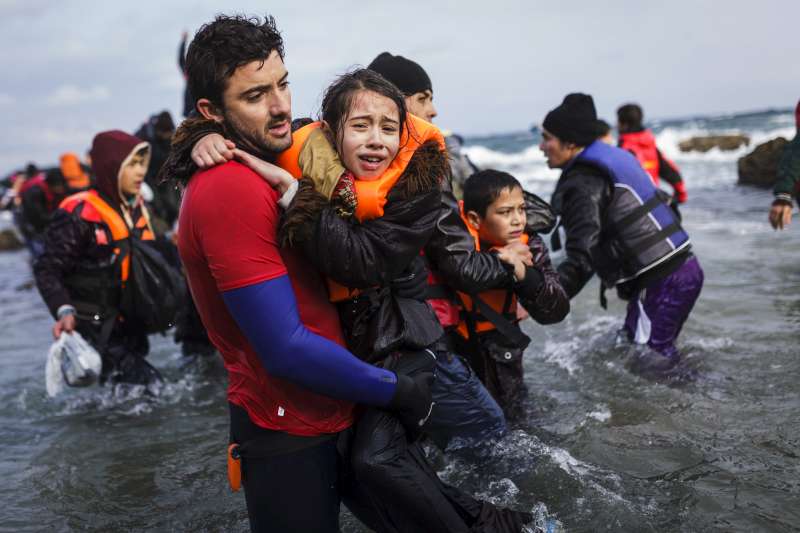
(*)A volunteer life-guard helps a young girl out of the sea after the boat she used along with her family and other Afghan refugees to cross part of the Aegean from the coast of Turkey to Lesbos towards the end of 2015 crashed on a rock off the island’s coast.
From Wikipedia:
Design
Princes Bridge is 30 metres (99 ft) wide and 120 metres (400 ft) long, with Harcourt granite squat half columns resting on the bluestone piers that support the three iron girder arch spans. The coat of arms on the bridge belong to the municipal councils who contributed towards the cost of construction. Other design features include an elaborate balustrade along the top of the bridge, and lamp standards crowning each pier.
The bridge design bears a close resemblance to the earlier Blackfriars Bridge over the River Thames in London, a resemblance which was noted at its opening. Princes Bridge is wider, 30 metres compared with 26 metres, but with 3 spans of 33 metres and an overall length of 131 metres, it is much shorter than Blackfriars Bridge's 5 spans with a central span of 61 metres. Both are excellent surviving examples of Arch Bridge design in the late 19th century.
The bridge underwent a restoration before the 2006 Commonwealth Games.
History
Princes Bridge, originally Prince's Bridge, is a bridge in central Melbourne, Australia that spans the Yarra River. It is built on the site of one of the oldest river crossings in the city, and forms a gateway into the central city from the south. The bridge connects Swanston Street on the north bank of the Yarra River to St Kilda Road on the south bank, and carries road, tram and pedestrian traffic. The present bridge was built in 1888 and is listed on the Victorian Heritage Register.
Because of its position, Princes Bridge is often a focal point for celebratory events in Melbourne such as the Moomba Festival, New Year's Eve and many celebrations taking place on the Yarra River where it flows through the city.
In the late 1870s it was decided to replace the 1850 bridge, and a competition was held in 1879. This was won by architect and engineer John Grainger, only recently arrived in Adelaide, in partnership with local architect Mr Jenkins, with a design largely as eventually built. Jenkins was likely included simply as a local representative, with the design mainly by John Grainger (1855–1917), who already had experience with bridges, and who was working alone by the time the bridge was completed. (Grainger was the father of the Australian composer Percy Grainger.) Construction was delayed over funding and other issues, and it was not until 1884 that the old bridge was disassembled and replaced by a temporary structure. The stones were lettered and numbered and neatly stacked, to allow future re-erection at another location. In the event this did not occur, as the materials were instead reused in the replacement bridge.
David Munro & Co. supplied the winning bid for the construction of £136,998 9s.9d., incorporating reused materials from the old bridge and ironwork fabricated by Langlands foundry in Melbourne. (Munro was also responsible for the construction of Queens Bridge and the nearby Sandridge Bridge.)
The foundation stone of the new bridge was laid on 7 September 1886, and a memorial stone with a suitable inscription was built in over its position in the west end of the south abutment. The new bridge was opened on 4 October 1888,[1] in time for the second International Exhibition to be held in Melbourne. As with many historic Melburnian buildings and bridges, the bridge is built on solid bluestone and concrete bulwarks with plenty of cast iron. The abutments, piers and wing walls are built of solid bluestone.
In 1924, the bridge was reinforced to take the weight of the electric trams which were soon to replace the previous cable trams along St Kilda Road and the side-streets. The name of the bridge is now rendered as Princes Bridge, in line with the policy that possessive apostrophes are not used in place names.
Princes Bridge was also the name of a railway station located on the northern side of the river, to the east of the bridge, on the current site of Federation Square. It was linked to Flinders Street station by the railway tracks that run underneath the northern approach to the bridge.
Until about June 2013 there were two vehicle lanes and a tram lane across the bridge in each direction; the wide footpaths on each side were divided for pedestrians and bicycles. At that time the bicycle lanes were moved to the road surface and the number of vehicle lanes was reduced to a single lane in each direction - starting with the Western (in-bound) side.
The Cathedral Basilica of the Immaculate Conception (French: Cathédrale de l'Immaculée-Conception de Mobile) is a cathedral serving Roman Catholics in the U.S. city of Mobile, Alabama. It is the seat of the Archbishop of the Roman Catholic Archdiocese of Mobile. The cathedral is named for Mary, mother of Jesus, under her title, Our Lady of the Immaculate Conception. It is listed on the National Register of Historic Places as a contributing property to the Church Street East Historic District and Lower Dauphin Street Historic District and is listed on the Historic Roman Catholic Properties in Mobile Multiple Property Submission.
Mobile’s Cathedral Parish was established on July 20, 1703, by Jean-Baptiste de la Croix de Chevrières de Saint-Vallier, Bishop of Quebec. Bishop de Saint-Vallier named Father Roulleaux de La Vente, first pastor of the parish church, which was located at the French settlement of Mobile at the citadel of Fort Louis de la Louisiane. The parish is the first established on the Gulf Coast.
When the Mobile settlement was relocated to its present site in 1711, a new parish church was built and was known as Notre Dame de la Mobile (Our Lady of Mobile). In 1781, during the Spanish occupation of Mobile, the parish took its current name, Immaculate Conception.
Mobile was elevated to a diocese in 1829, and Frenchman, Michael Portier, was named its first bishop. Bishop Portier’s first “cathedral” was a small wooden structure located in the Old Spanish Burying Ground, site of the present cathedral. Portier soon set out to construct a "real" cathedral.
The cathedral, designed in 1833, by Claude Beroujon, a former seminarian turned architect, is laid out in a Roman basilica design. Construction began in 1835, but the Panic of 1837, caused a shortage of funds and delayed progress. The cathedral was consecrated for public worship in 1850, by Bishop Portier, though Beroujon’s design was not yet fully realized. The portico and towers were to come later.
The classical portico, with eight massive columns of the Roman Doric order, was added in the 1870s, under the direction of Bishop John Quinlan. The two towers were completed in 1884, during the watch of Bishop Jeremiah O'Sullivan.
Located on South Claiborne Street in downtown, it is bounded by Dauphin Street on the north, Franklin Street on the west, and Conti Street on the south. The front of the church faces east, toward the Mobile River, and overlooks Cathedral Square.
The building, laid out in an east-west axis, is 164 ft (50 m) long and 90 ft (27 m) wide. The ceiling is 60 ft (18 m) at its highest point, and its twin towers rise to 103 ft (31 m).
One of the cathedral’s finest attributes is its stained glass windows. The windows were made in Munich, Germany by Franz Mayer & Co., and installed beginning in 1890. The last window was installed in 1910, during the time of Bishop Edward Patrick Allen.
The twelve main windows, six on the south wall and six on the north wall, are approximately 8 feet (2.4 m) wide and 23 feet (7.0 m) tall. Each window depicts an event involving Mary in the life of her son, Jesus. The subjects of the south wall windows are Our Lady of the Immaculate Conception, the Presentation of Mary at the Temple, the Annunciation, the Visitation, the Nativity of Jesus, and the Holy Family. The themes of the north wall are the Finding of the Child Jesus at the Temple, the Marriage Feast of Cana, the Crucifixion of Jesus, Pentecost, the Assumption of Mary into Heaven, and the Coronation of Mary, Queen of Heaven.
Two large windows flank the portico, one under each of the two towers. The Baptism of Jesus in the River Jordan, by John the Baptist is the subject of the window in the Reconciliation Room, under the north tower. The window under the south tower, in the stairway to the choir loft, appropriately depicts St. Cecilia, patron saint of musicians.
Smaller windows are found in each of the eight doors in the foyer, behind the cathedral’s main doors, at the church’s front entrance. These depict, from left to right, St. Augustine of Hippo, Our Lady of Mount Carmel, the Presentation of Mary at the Temple, St. Louis IX, King of France, St. Patrick, Our Lady of the Immaculate Conception, St. Agnes of Rome, Virgin & Martyr , and the Most Sacred Heart of Jesus. Above the four middle doors is the Holy Spirit window.
Credit for the data above is given to the following websites:
en.wikipedia.org/wiki/Cathedral_Basilica_of_the_Immaculat...(Mobile,_Alabama)
Known by some tank crewmen as the Chimera tank. The Mittel 4/5 Proto is what happens when insane engineers acting as servitors of an Eldritch Abomination decide to contribute in making a tank out of parts lying around. The tank is an unholy fusion of an enemy machine, and an upgraded Mittel-4. The tank isn't more effective, and is slightly too heavy for the modified Mittel-4 suspension. Aside from that it's relatively easy to upkeep, and isn't as over engineered as other Merthan tanks. The tank was put on the back burner indefinitely until a point in which it was deemed practical enough to fill any unforeseen gap. It is unknown if this ever occurred before the nations collapse.
The Mittel 3/4 is supposed to be an upgraded Panzer 4 that more resembled a Panther but I had a hard time figuring out what to do. I built the hull for this, but decided it was too tall to be either a Panther, or Panzer 4 so I decided to just make a Sherman, and Panther fusion instead. Obviously it was just a build made for fun, and not made to be that realistic.
Turret design/side sloping was inspired by Lt. Pineapple's Panther.
Cornelis van Bijnkershoek (a.k.a. Cornelius van Bynkershoek) (29 May 1673, Middelburg – 16 April 1743, The Hague) was a Dutch jurist and legal theorist who contributed to the development of international law in works like De Dominio Maris Dissertatio (1702); Observationes Juris Romani (1710), of which a continuation in four books appeared in 1733; the treatise De foro legatorum (1721); and the Quaestiones Juris Publici (1737).[1][2] Complete editions of his works were published after his death; one in folio at Geneva in 1761, and another in two volumes folio at Leiden in 1766. He was president of the Hoge Raad van Holland en Zeeland (Supreme Court of the Dutch Republic) from 1724 to 1743.
Van Bynkershoek was especially important in the development of the Law of the Sea. In particular he furthered Hugo Grotius' idea that coastal states have a right to the adjoining waters the width of which had to correspond to the capacity of exercising an effective control over it, that he expressed in his famous book De Iure Belli Ac Pacis. Bynkershoek translated Grotius idea into practical terms, by arguing that such effective control has to correspond to the range of the coastal state's weapons: "terrae potestas finitur ubi finitur armorum vis". However, it was not him, but the Italian Ferdinand Galiami who calculated the range of the most advanced cannon at the time to three nautical miles or a league. This idea became common practice and was known as the "cannon shot rule" and was regarded as the internationally accepted measure of the width of the territorial sea. en.m.wikipedia.org/wiki/Cornelius_van_Bynkershoek
A tireless songster, the Red-eyed Vireo is one of the most common summer residents of Eastern forests. These neat, olive-green and white songbirds have a crisp head pattern of gray, black, and white. Their brief but incessant songs—sometimes more than 20,000 per day by a single male—contribute to the characteristic sound of an Eastern forest in summer. When fall arrives, they head for the Amazon basin, fueled by a summer of plucking caterpillars from leaves in the treetops.
Am I still in time for the photo? I was swimming and totally forget time!
(See the pictures below.)
.
.
Vicks, the polar bear cub in Diergaarde Blijdorp (Rotterdam Zoo, the Netherlands) enjoys swimming. The cub, born on December 6, 2010, has been 'adopted' by the American company Vicks.
Of course it will be cared for and housed as always, but part of the cooperation is that the sponsor is allowed to link its name to the cub. Vicks also contributes to the care of the polar bear cub and a united campagne will be run.
In zoos and also in Blijdorp, the Rotterdam Zoo, it is not new to name animals after sponsors products.
The polar bear (Ursus maritimus) is a bear native largely within the Arctic Circle encompassing the Arctic Ocean, its surrounding seas and surrounding land masses. It is the world's largest land carnivore and also the largest bear, together with the omnivorous Kodiak Bear, which is approximately the same size.
An adult male weighs around 350 - 680 kg and measure 2.4 - 3 m in length. Adult females are roughly half the size of males and normally weigh 150 - 300 kg, measuring 1.8 - 2.4 m in length.
Although it is closely related to the brown bear, it has evolved to occupy a narrower ecological niche, with many body characteristics adapted for cold temperatures, for moving across snow, ice, and open water, and for hunting the seals which make up most of its diet.
Although most polar bears are born on land, they spend most of their time at sea. Their scientific name means "maritime bear", and derives from this fact.
Polar bears can hunt consistently only from sea ice, which is why they spend much of the year on and near the edge of the frozen sea. The polar bear is an excellent swimmer and individuals have been seen in open Arctic waters as far as 320 km from land. With its body fat providing buoyancy, it swims in a dog paddle fashion using its large forepaws for propulsion.
______________________________________________________________________________________
IJsbeertje Vicks in Diergaarde Blijdorp houdt van zwemmen.
Het ijsbeertje dat op 6 december 2010 is geboren, is ‘geadopteerd’ door Vicks. Het jong van moeder Olinka en vader Eric zal er zelf niet veel van merken dat hij of zij vanaf heden door het leven gaat als ‘ijsbeertje Vicks’. Qua verzorging en huisvesting blijft alles zoals het is, maar onderdeel van de samenwerking is dat de sponsor zijn naam aan het ijsbeertje mag verbinden. Vicks draagt ook bij aan de verzorging van het ijsbeertje en er zal een gezamenlijke campagne worden gevoerd.
In de dierentuinenwereld, en ook in Blijdorp, is het overigens geen onbekend verschijnsel om dieren de naam van de sponsor of het product te geven.
De ijsbeer (Ursus maritimus, voorheen: Thalarctos maritimus) is een grote geelwitte beer, die langer en groter is dan de andere beren (Ursidae). De ijsbeer komt enkel voor in en rond het Noordpoolgebied. Hij is het meest carnivoor van alle beren, en leeft vooral van zeehonden.
De ijsbeer is een vrij jonge soort die tijdens het Pleistoceen, in de laatste 200.000 jaar ontstaan is, vermoedelijk uit Siberische populaties van de bruine beer.
De ijsbeer is zeer groot: hij kan tot 3 meter lang en 800 kilogram zwaar worden. Hij heeft een lange nek en een grote neus. Onder de vacht is de huid zwart, wat te zien is op de naakte delen zoals de neus en de lippen. De haren van de vacht zijn niet wit, maar doorzichtig en hol. De kleur van de vacht is, afhankelijk van de tijd van het jaar, lichtval en de hoeveelheid vuil in de vacht, gelig wit tot vuilgrijs. Het is waterafstotend en houdt de warmte van de zon vast. Daarnaast heeft de ijsbeer een dikke onderhuidse vetlaag, waarmee hij warmte vasthoudt. De ijsbeer heeft vliezen tussen zijn tenen, waardoor hij beter kan zwemmen. Zijn achterpoten gebruikt hij als een soort roer om mee te sturen. Hij lijkt verder te zwemmen als een hond.
Mannetjes zijn groter dan vrouwtjes en hebben een opvallend grotere neus. Mannetjes worden gemiddeld 1,4 tot 3 m lang en 350 tot 680 kg zwaar, vrouwtjes 1,8 tot 2,4 m lang en 150 tot 300 kg zwaar.
IJsberen hebben een klein staartje, ongeveer acht tot tien centimeter lang. De ijsbeer leeft meestal alleen en is zowel overdag als 's nachts actief. Ook in de lange, donkere winter zijn ze actief.______________________________________________________________________________________
All rights reserved. Copyright © Martien Uiterweerd. All my images are protected under international authors copyright laws and may not be downloaded, reproduced, copied, transmitted or manipulated without my written explicit permission.
______________________________________________________________________________________
.
.
Built in the 19th Century, this building is a contributing structure in the Lee-Holman Historic District, listed on the National Register of Historic Places in 1996.
.
.
"Every good thought you think is contributing its share to the ultimate result of your life."
~ Grenville Kleise
Each day, I remember things my Dad and Mama taught me while I was a young girl growing up.
Thanks for stopping by
and God Bless,
hugs, Chris
Special thanx to Mike
Doyle and ALL of the No Starch Press staff. Also to my Mom from whom my creativity springs
Photographed in South Africa - From a safari vehicle, no cover
Click on the image or press the L key to view at larger size
On our very last game drive, hours before we had to leave for the airport to fly home at the end of our 2020 trip to Africa, Luke Street, our excellent and much appreciated guide, at our very favorite safari camp,Tanda Tula, took us to see the newly born cubs in a local pride. Since the cubs were so young, Luke kept the vehicle at a distance so as not to disturb them. The cubs coloration was very pale, compared to other lion cubs we’d seen, and Luke told us they were from a gene pool which is responsible for the large number of *white lions which have been seen in the Timbavati region of South Africa. Watching lion cubs play and wrestle with one is always enjoyable as well as seeing the interaction with their mother, keeping a close eye on them as they played nearby. In this image, two of the three cubs are headed to check in with mom while the third cub looks to me like it wants to keep playing.
* en.wikipedia.org/wiki/White_lion
=======================
From Wikipedia: The lion (Panthera leo) is a species in the family Felidae; it is a muscular, deep-chested cat with a short, rounded head, a reduced neck and round ears, and a hairy tuft at the end of its tail. It is sexually dimorphic; male lions have a prominent mane, which is the most recognisable feature of the species. With a typical head-to-body length of 184–208 cm (72–82 in) they are larger than females at 160–184 cm (63–72 in). It is a social species, forming groups called prides. A lion pride consists of a few adult males, related females and cubs. Groups of female lions usually hunt together, preying mostly on large ungulates. The lion is an apex and keystone predator, although some lions scavenge when opportunities occur, and have been known to hunt humans, although the species typically does not.
Typically, the lion inhabits grasslands and savannas but is absent in dense forests. It is usually more diurnal than other big cats, but when persecuted it adapts to being active at night and at twilight. In the Pleistocene, the lion ranged throughout Eurasia, Africa and North America but today it has been reduced to fragmented populations in Sub-Saharan Africa and one critically endangered population in western India. It has been listed as Vulnerable on the IUCN Red List since 1996 because populations in African countries have declined by about 43% since the early 1990s. Lion populations are untenable outside designated protected areas. Although the cause of the decline is not fully understood, habitat loss and conflicts with humans are the greatest causes for concern.
One of the most widely recognised animal symbols in human culture, the lion has been extensively depicted in sculptures and paintings, on national flags, and in contemporary films and literature. Lions have been kept in menageries since the time of the Roman Empire and have been a key species sought for exhibition in zoological gardens across the world since the late 18th century. Cultural depictions of lions were prominent in the Upper Paleolithic period; carvings and paintings from the Lascaux and Chauvet Caves in France have been dated to 17,000 years ago, and depictions have occurred in virtually all ancient and medieval cultures that coincided with the lion's former and current ranges.
The lion is a generalist hypercarnivore and is considered to be both an apex and keystone predator due to its wide prey spectrum. Its prey consists mainly of mammals – particularly ungulates – weighing 190–550 kg (420–1,210 lb) with a preference for blue wildebeest, plains zebra, African buffalo, gemsbok and giraffe. Lions also hunt common warthog depending on availability, although the species is below the preferred weight range. In India, sambar deer and chital are the most commonly recorded wild prey, while domestic livestock may contribute significantly to their diet. They usually avoid fully grown adult elephants, rhinoceroses and hippopotamus, as well as small prey like dik-dik, hyrax, hare and vervet monkey. Unusual prey items include porcupines and small reptiles. Lions kill other predators such as leopard, cheetah and spotted hyena but seldom consume them.
Young lions first display stalking behaviour at around three months of age, although they do not participate in hunting until they are almost a year old and begin to hunt effectively when nearing the age of two. Single lions are capable of bringing down zebra and wildebeest, while larger prey like buffalo and giraffes are riskier. In Chobe National Park, large prides have been observed hunting subadult and even adult African bush elephants. In typical hunts, each lioness has a favoured position in the group, either stalking prey on the "wing", then attacking, or moving a smaller distance in the centre of the group and capturing prey fleeing from other lionesses. Males attached to prides do not usually participate in group hunting. Some evidence suggests, however, that males are just as successful as females; they are typically solo hunters who ambush prey in small bushland.
Lions are not particularly known for their stamina; for instance, a lioness' heart comprises only 0.57% of her body weight and a male's is about 0.45% of his body weight, whereas a hyena's heart comprises almost 1% of its body weight. Thus, lions only run quickly in short bursts and need to be close to their prey before starting the attack. They take advantage of factors that reduce visibility; many kills take place near some form of cover or at night. The lion's attack is short and powerful; they attempt to catch prey with a fast rush and final leap. They usually pull it down by the rump and kill by a strangling bite to the throat. They also kill prey by enclosing its mouth and nostrils in their jaws.
Lions typically consume prey at the location of the hunt but sometimes drag large prey into cover. They tend to squabble over kills, particularly the males. Cubs suffer most when food is scarce but otherwise all pride members eat their fill, including old and crippled lions, which can live on leftovers. Large kills are shared more widely among pride members. An adult lioness requires an average of about 5 kg (11 lb) of meat per day while males require about 7 kg (15 lb). Lions gorge themselves and eat up to 30 kg (66 lb) in one session; if it is unable to consume all of the kill, it rests for a few hours before continuing to eat. On hot days, the pride retreats to shade with one or two males standing guard. Lions defend their kills from scavengers such as vultures and hyenas.
Lions scavenge on carrion when the opportunity arises; they scavenge animals dead from natural causes such as disease or those that were killed by other predators. Scavenging lions keep a constant lookout for circling vultures, which indicate the death or distress of an animal. Most carrion on which both hyenas and lions feed upon are killed by hyenas rather than lions. Carrion is thought to provide a large part of lion diet.
6D6A3059fFlkr
Delaware & Hudson Bldg. - Albany Evening Journal - Flemish Gothic - 1918
The SUNY System Administration Building, formerly the Delaware & Hudson Railroad Building, is a public office building located at the intersection of Broadway and State Street in downtown Albany, New York. Locally the building and land it sits on is referred to as State University Plaza, or the D&H Plaza;[2][3] prior to the construction of the Empire State Plaza it was simply "The Plaza".[4][5] It was listed on the National Register of Historic Places in 1972 as Delaware and Hudson Railroad Company Building.[1] In 1980, when the Downtown Albany Historic District was listed on the Register, it was included as a contributing property.
The central tower is thirteen stories high and is capped by an 8-foot-tall (2.4 m) working weathervane that is a replica of Henry Hudson's Half Moon. The State University of New York is centrally administered from this location. The southern tower's four top floors are the official residence of the Chancellor of SUNY. 228
Built in 1894, this Romanesque Revival-style mansion was constructed for Henry B. Denker, a founder of the St. Charles Car Manufacturing Company, later the American Car and Foundry Company, in 1873, and Mayor of St. Charles from 1907-1910. The house features a red brick exterior with a rough-hewn stone base, a hipped roof with wide overhanging eaves, one-over-one double-hung windows, two cylindrical towers at the corners of the south facade with conical roofs and finials, gabled dormers, a sun porch on the second floor of the west facade with roman arched windows, decorative brick corbeling and stone trim, doric columns and brick piers, a two-story northern service ell, and an enclosed porch with a hipped roof on the south facade. The building is a contributing structure in the Midtown Neighborhood Historic District, listed on the National Register of Historic Places in 2014, and today houses office space.
Spectacular view of Multnomah Falls, Oregon, especially contributed by the viewing bridge 100 ft above the lower cascade.
The Glasshouse is an international centre for musical education and concerts on the Gateshead bank of Quayside in northern England. Opened in 2004 as Sage Gateshead and occupied by North Music Trust The venue's original name honours a patron: the accountancy software company The Sage Group.
History
Planning for the centre began in the early 1990s, when the orchestra of Sage Gateshead, Royal Northern Sinfonia, with encouragement from Northern Arts, began working on plans for a new concert hall. They were soon joined by regional folk music development agency Folkworks, which ensured that the needs of the region's traditional music were taken into consideration and represented in Sage Gateshead's programme of concerts, alongside Rock, Pop, Dance, Hip Hop, classical, jazz, acoustic, indie, country and world, Practice spaces for professional musicians, students and amateurs were an important part of the provision.
The planning and construction process cost over £70 million, which was raised primarily through National Lottery grants. The contractor was Laing O'Rourke. The centre has a range of patrons, notably Sage Group which contributed a large sum of money to have the building named after it. Sage plc has helped support the charitable activities of Sage Gateshead since its conception. The venue opened over the weekend 17–19 December 2004.
Sage Gateshead was developed by Foster and Partners following an architectural design competition launched in 1997 and managed by RIBA Competitions. Over 100 architects registered their interest and 12 – a mixture of local, national and international talent – were invited to prepare concept designs. A shortlist of six was then interviewed with Foster and Partners unanimously selected as the winner. The Design has gone on to win a number of awards: the RIBA Inclusive Design Award, Civic Trust Award and The Journal North East Landmark of the Year Award.
As a conference venue, the building hosted the Labour Party's Spring conference in February 2005 and the Liberal Democrat Party conference in March 2012. On 18 August 2009, Sage Gateshead was selected to host the 2010 and 2011 National Union of Students annual conference. The 2010 Annual Conference took place 13–15 April 2010.
In 2022 The Sage Group announced that they were also sponsoring a new development that is being built next to Sage Gateshead which will be called The Sage. Sage Gateshead announced that they will be finding a new name for the venue prior to The Sage opening in 2024. On 13 September 2023 the venue announced its new name, The Glasshouse International Centre for Music.
Building
The centre occupies a curved glass and stainless steel building designed by Foster and Partners, Buro Happold (structural engineering), Mott MacDonald (engineering consultants) and Arup (acoustics), with views of Newcastle and Gateshead Quaysides, the Tyne Bridge and the Gateshead Millennium Bridge.
The Glasshouse contains three performance spaces; a 1,700-seater, a 450-seater, and a smaller rehearsal and performance hall, the Northern Rock Foundation Hall. The rest of the building was designed around these three spaces to allow for maximum attention to detail in their acoustic properties. Structurally it is three separate buildings, insulated from each other to prevent noise and vibration travelling between them. The gaps between them may be seen as one walks around inside. A special 'spongy' concrete mix was used in the construction, with a higher-than-usual air capacity to improve the acoustic. These three buildings are enclosed (but not touched) by the now-famous glass and steel shell. Sage One was intended as an acoustically perfect space, modelled on the Musikverein in Vienna. Its ceiling panels may be raised and lowered and curtains drawn across the ribbed wooden side walls, changing the sound profile of the room to suit any type of music. Sage Two is a smaller venue, possibly the world's only ten-sided performance space.
The building is open to the public throughout the day.
Concerts
The Glasshouse will host concerts from a wide range of internationally famous artists, and those who have played at the venue include Above and Beyond, Blondie, James Brown, Bonobo, Andy Cutting, De La Soul, Nick Cave, George Clinton, Bill Callahan, Crosby, Stills & Nash, Dillinger, Grace Jones, Gretchen Peters, Elbow, Explosions in the Sky, the Fall, Herbie Hancock, Mogwai, Morrissey, Mumford & Sons, Pet Shop Boys, Sunn O))), Nancy Sinatra, Snarky Puppy, Sting, Yellowman, Shane Filan of Westlife and others. In February 2015, it was one of the hosts of the second annual BBC Radio 6 Music Festival.
It is also home to Royal Northern Sinfonia, of which The Guardian wrote there is "no better chamber orchestra in Britain", and frequently hosts other visiting orchestras from around the world. The current music director for Royal Northern Sinfonia is the pianist and conductor Lars Vogt. In late 2014, Royal Northern Sinfonia collaborated with John Grant, performing at Sage Gateshead, and other venues throughout the UK. Recordings from this tour were made available as a limited edition CD and 12" record via Rough Trade Records in 2015.
Opinion
There has been popular debate surrounding what was Sage Gateshead. The venue is popular in the local area because of its concerts, and also its accessible learning courses for all ages and its constant interaction with local schools and academies through programmes such as Sing Up and the option of school visits.
Awards
2019: UK National Lottery 25th Birthday Award - Best Arts, Culture and Film
2019: Julie's Bicycle Creative Green 2 Star
2019: Gold Standard - Attitude is Everything
2018: Gold Award for Inclusive Tourism (North East Tourism Awards)
2018: Gold Award for Business Tourism (Visit England Awards for Excellence)
2005: Local Authority Building of the Year
2005: British Construction Industry Awards
2005: RIBA Award for Inclusive Design
Gateshead is a town in the Gateshead Metropolitan Borough of Tyne and Wear, England. It is on the River Tyne's southern bank. The town's attractions include the twenty metre tall Angel of the North sculpture on the town's southern outskirts, The Glasshouse International Centre for Music and the Baltic Centre for Contemporary Art. The town shares the Millennium Bridge, Tyne Bridge and multiple other bridges with Newcastle upon Tyne.
Historically part of County Durham, under the Local Government Act 1888 the town was made a county borough, meaning it was administered independently of the county council.
In the 2011 Census, the town had a population of 120,046 while the wider borough had 200,214.
History
Gateshead is first mentioned in Latin translation in Bede's Ecclesiastical History of the English People as ad caput caprae ("at the goat's head"). This interpretation is consistent with the later English attestations of the name, among them Gatesheued (c. 1190), literally "goat's head" but in the context of a place-name meaning 'headland or hill frequented by (wild) goats'. Although other derivations have been mooted, it is this that is given by the standard authorities.
A Brittonic predecessor, named with the element *gabro-, 'goat' (c.f. Welsh gafr), may underlie the name. Gateshead might have been the Roman-British fort of Gabrosentum.
Early
There has been a settlement on the Gateshead side of the River Tyne, around the old river crossing where the Swing Bridge now stands, since Roman times.
The first recorded mention of Gateshead is in the writings of the Venerable Bede who referred to an Abbot of Gateshead called Utta in 623. In 1068 William the Conqueror defeated the forces of Edgar the Ætheling and Malcolm king of Scotland (Shakespeare's Malcolm) on Gateshead Fell (now Low Fell and Sheriff Hill).
During medieval times Gateshead was under the jurisdiction of the Bishop of Durham. At this time the area was largely forest with some agricultural land. The forest was the subject of Gateshead's first charter, granted in the 12th century by Hugh du Puiset, Bishop of Durham. An alternative spelling may be "Gatishevede", as seen in a legal record, dated 1430.
Industrial revolution
Throughout the Industrial Revolution the population of Gateshead expanded rapidly; between 1801 and 1901 the increase was over 100,000. This expansion resulted in the spread southwards of the town.
In 1854, a catastrophic explosion on the quayside destroyed most of Gateshead's medieval heritage, and caused widespread damage on the Newcastle side of the river.
Sir Joseph Swan lived at Underhill, Low Fell, Gateshead from 1869 to 1883, where his experiments led to the invention of the electric light bulb. The house was the first in the world to be wired for domestic electric light.
In the 1889 one of the largest employers (Hawks, Crawshay and Company) closed down and unemployment has since been a burden. Up to the Second World War there were repeated newspaper reports of the unemployed sending deputations to the council to provide work. The depression years of the 1920s and 1930s created even more joblessness and the Team Valley Trading Estate was built in the mid-1930s to alleviate the situation.
Regeneration
In the late noughties, Gateshead Council started to regenerate the town, with the long-term aim of making Gateshead a city. The most extensive transformation occurred in the Quayside, with almost all the structures there being constructed or refurbished in this time.
In the early 2010s, regeneration refocused on the town centre. The £150 million Trinity Square development opened in May 2013, it incorporates student accommodation, a cinema, health centre and shops. It was nominated for the Carbuncle Cup in September 2014. The cup was however awarded to another development which involved Tesco, Woolwich Central.
Governance
In 1835, Gateshead was established as a municipal borough and in 1889 it was made a county borough, independent from Durham County Council.
In 1870, the Old Town Hall was built, designed by John Johnstone who also designed the previously built Newcastle Town Hall. The ornamental clock in front of the old town hall was presented to Gateshead in 1892 by the mayor, Walter de Lancey Willson, on the occasion of him being elected for a third time. He was also one of the founders of Walter Willson's, a chain of grocers in the North East and Cumbria. The old town hall also served as a magistrate's court and one of Gateshead's police stations.
Current
In 1974, following the Local Government Act 1972, the County Borough of Gateshead was merged with the urban districts of Felling, Whickham, Blaydon and Ryton and part of the rural district of Chester-le-Street to create the much larger Metropolitan Borough of Gateshead.
Geography
The town of Gateshead is in the North East of England in the ceremonial county of Tyne and Wear, and within the historic boundaries of County Durham. It is located on the southern bank of the River Tyne at a latitude of 54.57° N and a longitude of 1.35° W. Gateshead experiences a temperate climate which is considerably warmer than some other locations at similar latitudes as a result of the warming influence of the Gulf Stream (via the North Atlantic drift). It is located in the rain shadow of the North Pennines and is therefore in one of the driest regions of the United Kingdom.
One of the most distinguishing features of Gateshead is its topography. The land rises 230 feet from Gateshead Quays to the town centre and continues rising to a height of 525 feet at Queen Elizabeth Hospital in Sheriff Hill. This is in contrast to the flat and low lying Team Valley located on the western edges of town. The high elevations allow for impressive views over the Tyne valley into Newcastle and across Tyneside to Sunderland and the North Sea from lookouts in Windmill Hills and Windy Nook respectively.
The Office for National Statistics defines the town as an urban sub-division. The latest (2011) ONS urban sub-division of Gateshead contains the historical County Borough together with areas that the town has absorbed, including Dunston, Felling, Heworth, Pelaw and Bill Quay.
Given the proximity of Gateshead to Newcastle, just south of the River Tyne from the city centre, it is sometimes incorrectly referred to as being a part of Newcastle. Gateshead Council and Newcastle City Council teamed up in 2000 to create a unified marketing brand name, NewcastleGateshead, to better promote the whole of the Tyneside conurbation.
Economy
Gateshead is home to the MetroCentre, the largest shopping mall in the UK until 2008; and the Team Valley Trading Estate, once the largest and still one of the larger purpose-built commercial estates in the UK.
Arts
The Baltic Centre for Contemporary Art has been established in a converted flour mill. The Glasshouse International Centre for Music, previously The Sage, a Norman Foster-designed venue for music and the performing arts opened on 17 December 2004. Gateshead also hosted the Gateshead Garden Festival in 1990, rejuvenating 200 acres (0.81 km2) of derelict land (now mostly replaced with housing). The Angel of the North, a famous sculpture in nearby Lamesley, is visible from the A1 to the south of Gateshead, as well as from the East Coast Main Line. Other public art include works by Richard Deacon, Colin Rose, Sally Matthews, Andy Goldsworthy, Gordon Young and Michael Winstone.
Traditional and former
The earliest recorded coal mining in the Gateshead area is dated to 1344. As trade on the Tyne prospered there were several attempts by the burghers of Newcastle to annex Gateshead. In 1576 a small group of Newcastle merchants acquired the 'Grand Lease' of the manors of Gateshead and Whickham. In the hundred years from 1574 coal shipments from Newcastle increased elevenfold while the population of Gateshead doubled to approximately 5,500. However, the lease and the abundant coal supplies ended in 1680. The pits were shallow as problems of ventilation and flooding defeated attempts to mine coal from the deeper seams.
'William Cotesworth (1668-1726) was a prominent merchant based in Gateshead, where he was a leader in coal and international trade. Cotesworth began as the son of a yeoman and apprentice to a tallow - candler. He ended as an esquire, having been mayor, Justice of the Peace and sheriff of Northumberland. He collected tallow from all over England and sold it across the globe. He imported dyes from the Indies, as well as flax, wine, and grain. He sold tea, sugar, chocolate, and tobacco. He operated the largest coal mines in the area, and was a leading salt producer. As the government's principal agent in the North country, he was in contact with leading ministers.
William Hawks originally a blacksmith, started business in Gateshead in 1747, working with the iron brought to the Tyne as ballast by the Tyne colliers. Hawks and Co. eventually became one of the biggest iron businesses in the North, producing anchors, chains and so on to meet a growing demand. There was keen contemporary rivalry between 'Hawks' Blacks' and 'Crowley's Crew'. The famous 'Hawks' men' including Ned White, went on to be celebrated in Geordie song and story.
In 1831 a locomotive works was established by the Newcastle and Darlington Railway, later part of the York, Newcastle and Berwick Railway. In 1854 the works moved to the Greenesfield site and became the manufacturing headquarters of North Eastern Railway. In 1909, locomotive construction was moved to Darlington and the rest of the works were closed in 1932.
Robert Stirling Newall took out a patent on the manufacture of wire ropes in 1840 and in partnership with Messrs. Liddell and Gordon, set up his headquarters at Gateshead. A worldwide industry of wire-drawing resulted. The submarine telegraph cable received its definitive form through Newall's initiative, involving the use of gutta-percha surrounded by strong wires. The first successful Dover–Calais cable on 25 September 1851, was made in Newall's works. In 1853, he invented the brake-drum and cone for laying cable in deep seas. Half of the first Atlantic cable was manufactured in Gateshead. Newall was interested in astronomy, and his giant 25-inch (640 mm) telescope was set up in the garden at Ferndene, his Gateshead residence, in 1871.
Architecture
JB Priestley, writing of Gateshead in his 1934 travelogue English Journey, said that "no true civilisation could have produced such a town", adding that it appeared to have been designed "by an enemy of the human race".
Victorian
William Wailes the celebrated stained-glass maker, lived at South Dene from 1853 to 1860. In 1860, he designed Saltwell Towers as a fairy-tale palace for himself. It is an imposing Victorian mansion in its own park with a romantic skyline of turrets and battlements. It was originally furnished sumptuously by Gerrard Robinson. Some of the panelling installed by Robinson was later moved to the Shipley Art gallery. Wailes sold Saltwell Towers to the corporation in 1876 for use as a public park, provided he could use the house for the rest of his life. For many years the structure was essentially an empty shell but following a restoration programme it was reopened to the public in 2004.
Post millennium
The council sponsored the development of a Gateshead Quays cultural quarter. The development includes the Gateshead Millennium Bridge, erected in 2001, which won the prestigious Stirling Prize for Architecture in 2002.
Former brutalism
The brutalist Trinity Centre Car Park, which was designed by Owen Luder, dominated the town centre for many years until its demolition in 2010. A product of attempts to regenerate the area in the 1960s, the car park gained an iconic status due to its appearance in the 1971 film Get Carter, starring Michael Caine. An unsuccessful campaign to have the structure listed was backed by Sylvester Stallone, who played the main role in the 2000 remake of the film. The car park was scheduled for demolition in 2009, but this was delayed as a result of a disagreement between Tesco, who re-developed the site, and Gateshead Council. The council had not been given firm assurances that Tesco would build the previously envisioned town centre development which was to include a Tesco mega-store as well as shops, restaurants, cafes, bars, offices and student accommodation. The council effectively used the car park as a bargaining tool to ensure that the company adhered to the original proposals and blocked its demolition until they submitted a suitable planning application. Demolition finally took place in July–August 2010.
The Derwent Tower, another well known example of brutalist architecture, was also designed by Owen Luder and stood in the neighbourhood of Dunston. Like the Trinity Car Park it also failed in its bid to become a listed building and was demolished in 2012. Also located in this area are the Grade II listed Dunston Staithes which were built in 1890. Following the award of a Heritage Lottery Fund grant of almost £420,000 restoration of the structure is expected to begin in April 2014.
Sport
Gateshead International Stadium regularly holds international athletics meetings over the summer months, and is home of the Gateshead Harriers athletics club. It is also host to rugby league fixtures, and the home ground of Gateshead Football Club. Gateshead Thunder Rugby League Football Club played at Gateshead International Stadium until its purchase by Newcastle Rugby Limited and the subsequent rebranding as Newcastle Thunder. Both clubs have had their problems: Gateshead A.F.C. were controversially voted out of the Football League in 1960 in favour of Peterborough United, whilst Gateshead Thunder lost their place in Super League as a result of a takeover (officially termed a merger) by Hull F.C. Both Gateshead clubs continue to ply their trade at lower levels in their respective sports, thanks mainly to the efforts of their supporters. The Gateshead Senators American Football team also use the International Stadium, as well as this it was used in the 2006 Northern Conference champions in the British American Football League.
Gateshead Leisure Centre is home to the Gateshead Phoenix Basketball Team. The team currently plays in EBL League Division 4. Home games are usually on a Sunday afternoon during the season, which runs from September to March. The team was formed in 2013 and ended their initial season well placed to progress after defeating local rivals Newcastle Eagles II and promotion chasing Kingston Panthers.
In Low Fell there is a cricket club and a rugby club adjacent to each other on Eastwood Gardens. These are Gateshead Fell Cricket Club and Gateshead Rugby Club. Gateshead Rugby Club was formed in 1998 following the merger of Gateshead Fell Rugby Club and North Durham Rugby Club.
Transport
Gateshead is served by the following rail transport stations with some being operated by National Rail and some being Tyne & Wear Metro stations: Dunston, Felling, Gateshead Interchange, Gateshead Stadium, Heworth Interchange, MetroCentre and Pelaw.
Tyne & Wear Metro stations at Gateshead Interchange and Gateshead Stadium provide direct light-rail access to Newcastle Central, Newcastle Airport , Sunderland, Tynemouth and South Shields Interchange.
National Rail services are provided by Northern at Dunston and MetroCentre stations. The East Coast Main Line, which runs from London Kings Cross to Edinburgh Waverley, cuts directly through the town on its way between Newcastle Central and Chester-le-Street stations. There are presently no stations on this line within Gateshead, as Low Fell, Bensham and Gateshead West stations were closed in 1952, 1954 and 1965 respectively.
Road
Several major road links pass through Gateshead, including the A1 which links London to Edinburgh and the A184 which connects the town to Sunderland.
Gateshead Interchange is the busiest bus station in Tyne & Wear and was used by 3.9 million bus passengers in 2008.
Cycle routes
Various bicycle trails traverse the town; most notably is the recreational Keelmans Way (National Cycle Route 14), which is located on the south bank of the Tyne and takes riders along the entire Gateshead foreshore. Other prominent routes include the East Gateshead Cycleway, which connects to Felling, the West Gateshead Cycleway, which links the town centre to Dunston and the MetroCentre, and routes along both the old and new Durham roads, which take cyclists to Birtley, Wrekenton and the Angel of the North.
Religion
Christianity has been present in the town since at least the 7th century, when Bede mentioned a monastery in Gateshead. A church in the town was burned down in 1080 with the Bishop of Durham inside.[citation needed] St Mary's Church was built near to the site of that building, and was the only church in the town until the 1820s. Undoubtedly the oldest building on the Quayside, St Mary's has now re-opened to the public as the town's first heritage centre.
Many of the Anglican churches in the town date from the 19th century, when the population of the town grew dramatically and expanded into new areas. The town presently has a number of notable and large churches of many denominations.
Judaism
The Bensham district is home to a community of hundreds of Jewish families and used to be known as "Little Jerusalem". Within the community is the Gateshead Yeshiva, founded in 1929, and other Jewish educational institutions with international enrolments. These include two seminaries: Beis Medrash L'Morot and Beis Chaya Rochel seminary, colloquially known together as Gateshead "old" and "new" seminaries.
Many yeshivot and kollels also are active. Yeshivat Beer Hatorah, Sunderland Yeshiva, Nesivos Hatorah, Nezer Hatorah and Yeshiva Ketana make up some of the list.
Islam
Islam is practised by a large community of people in Gateshead and there are 2 mosques located in the Bensham area (in Ely Street and Villa Place).
Twinning
Gateshead is twinned with the town of Saint-Étienne-du-Rouvray near Rouen in France, and the city of Komatsu in Japan.
Notable people
Eliezer Adler – founder of Jewish Community
Marcus Bentley – narrator of Big Brother
Catherine Booth – wife of William Booth, known as the Mother of The Salvation Army
William Booth – founder of the Salvation Army
Mary Bowes – the Unhappy Countess, author and celebrity
Ian Branfoot – footballer and manager (Sheffield Wednesday and Southampton)
Andy Carroll – footballer (Newcastle United, Liverpool and West Ham United)
Frank Clark – footballer and manager (Newcastle United and Nottingham Forest)
David Clelland – Labour politician and MP
Derek Conway – former Conservative politician and MP
Joseph Cowen – Radical politician
Steve Cram – athlete (middle-distance runner)
Emily Davies – educational reformer and feminist, founder of Girton College, Cambridge
Daniel Defoe – writer and government agent
Ruth Dodds – politician, writer and co-founder of the Little Theatre
Jonathan Edwards – athlete (triple jumper) and television presenter
Sammy Johnson – actor (Spender)
George Elliot – industrialist and MP
Paul Gascoigne – footballer (Newcastle United, Tottenham Hotspur, Lazio, Rangers and Middlesbrough)
Alex Glasgow – singer/songwriter
Avrohom Gurwicz – rabbi, Dean of Gateshead Yeshiva
Leib Gurwicz – rabbi, Dean of Gateshead Yeshiva
Jill Halfpenny – actress (Coronation Street and EastEnders)
Chelsea Halfpenny – actress (Emmerdale)
David Hodgson – footballer and manager (Middlesbrough, Liverpool and Sunderland)
Sharon Hodgson – Labour politician and MP
Norman Hunter – footballer (Leeds United and member of 1966 World Cup-winning England squad)
Don Hutchison – footballer (Liverpool, West Ham United, Everton and Sunderland)
Brian Johnson – AC/DC frontman
Tommy Johnson – footballer (Aston Villa and Celtic)
Riley Jones - actor
Howard Kendall – footballer and manager (Preston North End and Everton)
J. Thomas Looney – Shakespeare scholar
Gary Madine – footballer (Sheffield Wednesday)
Justin McDonald – actor (Distant Shores)
Lawrie McMenemy – football manager (Southampton and Northern Ireland) and pundit
Thomas Mein – professional cyclist (Canyon DHB p/b Soreen)
Robert Stirling Newall – industrialist
Bezalel Rakow – communal rabbi
John William Rayner – flying ace and war hero
James Renforth – oarsman
Mariam Rezaei – musician and artist
Sir Tom Shakespeare - baronet, sociologist and disability rights campaigner
William Shield – Master of the King's Musick
Christina Stead – Australian novelist
John Steel – drummer (The Animals)
Henry Spencer Stephenson – chaplain to King George VI and Queen Elizabeth II
Steve Stone – footballer (Nottingham Forest, Aston Villa and Portsmouth)
Chris Swailes – footballer (Ipswich Town)
Sir Joseph Swan – inventor of the incandescent light bulb
Nicholas Trainor – cricketer (Gloucestershire)
Chris Waddle – footballer (Newcastle United, Tottenham Hotspur and Sheffield Wednesday)
William Wailes – stained glass maker
Taylor Wane – adult entertainer
Robert Spence Watson – public benefactor
Sylvia Waugh – author of The Mennyms series for children
Chris Wilkie – guitarist (Dubstar)
John Wilson - orchestral conductor
Peter Wilson – footballer (Gateshead, captain of Australia)
Thomas Wilson – poet/school founder
Robert Wood – Australian politician
The varied and influential inhabitants of San Agustín de Callo have contributed to the unique blend of architecture which creates the individual character of the house. Visit: www.incahacienda.com/
Photographed in the Pantanal, Brazil
=> Please click *twice* on the image to see the largest size and to fully appreciate the size of that bill. <=
These two giant otters were hunting for fish or other prey along the river vegetation and the lead otter shows the teeth that have no doubt contributed to the Portuguese descriptor for them, which translates to "water jaguar" and the Spanish descriptor which translates to "river wolf".
=====================
From Wikipedia: The giant otter or giant river otter (Pteronura brasiliensis) is a South American carnivorous mammal. It is the longest member of the weasel family, Mustelidae, a globally successful group of predators, reaching up to 1.7 metres (5.6 ft). Atypical of mustelids, the giant otter is a social species, with family groups typically supporting three to eight members. The groups are centered on a dominant breeding pair and are extremely cohesive and cooperative. Although generally peaceful, the species is territorial, and aggression has been observed between groups. The giant otter is diurnal, being active exclusively during daylight hours. It is the noisiest otter species, and distinct vocalizations have been documented that indicate alarm, aggression, and reassurance.
The giant otter ranges across north-central South America; it lives mostly in and along the Amazon River and in the Pantanal.
Its distribution has been greatly reduced and is now discontinuous. Decades of poaching for its velvety pelt, peaking in the 1950s and 1960s, considerably diminished population numbers. The species was listed as endangered in 1999 and wild population estimates are typically below 5,000. The Guianas are one of the last real strongholds for the species, which also enjoys modest numbers — and significant protection — in the Peruvian Amazonian basin. It is one of the most endangered mammal species in the neotropics. Habitat degradation and loss is the greatest current threat. The giant otter is also rare in captivity; in 2003, only 60 animals were being held.
The giant otter shows a variety of adaptations suitable to an amphibious lifestyle, including exceptionally dense fur, a wing-like tail, and webbed feet. The species prefers freshwater rivers and streams, which are usually seasonally flooded, and may also take to freshwater lakes and springs. It constructs extensive campsites close to feeding areas, clearing large amounts of vegetation. The giant otter subsists almost exclusively on a diet of fish, particularly characins and catfish, but may also eat crabs, turtles, snakes and small caiman. It has no serious natural predators other than humans, although it must compete with other species, including the neotropical otter, jaguar, and caiman species, for food resources.
Naming:
The giant otter has a handful of other names. In Brazil it is known as ariranha, from the Tupí word ari'raña, meaning water jaguar (Portuguese: onça-d'água). In Spanish, river wolf (Spanish: lobo de río) and water dog (Spanish: perro de agua) are used occasionally (though the latter also refers to several different animals) and may have been more common in the reports of explorers in the 19th and early 20th centuries. All three names are in use in South America, with a number of regional variations. "Giant otter" translates literally as nutria gigante and lontra gigante in Spanish and Portuguese, respectively.
Physical characteristics:
The giant otter is clearly distinguished from other otters by morphological and behavioural characteristics. It has the greatest body length of any species in the mustelid family, although the sea otter may be heavier. Early reports of skins and living animals suggested exceptionally large males of up to 2.4 m (7.9 ft); intensive hunting likely reduced the occurrence of such massive specimens. The giant otter has the shortest fur of all otter species; it is typically chocolate brown, but may be reddish or fawn, and appears nearly black when wet. The fur is extremely dense, so much so that water cannot penetrate to the skin. Guard hairs trap water and keep the inner fur dry; the guard hairs are approximately 8 millimetres (one-third of an inch) in length, about twice as long as the fur of the inner coat. Its velvety feel makes the animal highly sought after by fur traders and has contributed to its decline. Unique markings of white or cream fur color the throat and under the chin, allow individuals to be identified from birth. Giant otters use these marks to recognize one another, and upon meeting other otters, they engage in a behavior known as "periscoping", displaying their throats and upper chests to each other.
Hunting and diet:
The giant otter is an apex predator, and its population status reflects the overall health of riverine ecosystems. It feeds mainly on fish, including cichlids, characins (such as piranha), and catfish. One full-year study of giant otter scats in Amazonian Brazil found fish present in all fecal samples. Fish from the order Perciformes, particularly cichlids, were seen in 97% of scats, and Characiformes, such as characins, in 86%. Fish remains were of medium-sized species that seem to prefer relatively shallow water, to the advantage of the probably visually oriented giant otter. Prey species found were also sedentary, generally swimming only short distances, which may aid the giant otter in predation. Hunting in shallow water has also been found to be more rewarding, with water depth less than 0.6 metres (2.0 ft) having the highest success rate. The giant otter seems to be opportunistic, taking whatever species are most locally abundant. If fish are unavailable, it will also take crabs, snakes, and even small caimans and anacondas.
The species can hunt singly, in pairs, and in groups, relying on sharp eyesight to locate prey. In some cases, supposed cooperative hunting may be incidental, a result of group members fishing individually in close proximity; truly coordinated hunting may only occur where the prey cannot be taken by a single giant otter, such as with small anacondas and juvenile black caiman. The giant otter seems to prefer prey fish that are generally immobile on river bottoms in clear water. Prey chase is rapid and tumultuous, with lunges and twists through the shallows and few missed targets. The otter can attack from both above and below, swiveling at the last instant to clamp the prey in its jaws. Giant otters catch their own food and consume it immediately; they grasp the fish firmly between the forepaws and begin eating noisily at the head. Carter and Rosas have found captive adult animals consume around 10% of their body weight daily—about 3 kilograms (7 lb), in keeping with findings in the wild.
4F3A5016-fLRFlkr
Things to be thankful for? Good health, a job I love, great friends and family, and Willard S. Boyle, the Nova Scotian whose work led to the invention of the sensor that makes it possible to capture digital images -- which contributed to my rediscovery of photography. Apparently there are lots of folks who agree that Boyle's breakthrough led to some exciting changes, since he just won a Nobel Prize in Physics for his accomplishment!
This full size Hawker Hurricane replica, standing near the River Thames in Windsor, is a memorial to Sir Sydney Camm and his contribution to British aircraft design.
Sir Sydney Camm, CBE, FRAeS (5 August 1893 – 12 March 1966) was an English aeronautical engineer who contributed to many Hawker aircraft designs, from the biplanes of the 1920s to jet fighters. One particularly notable aircraft he designed was the Hawker Hurricane fighter.
Sydney Camm was born at 10 Alma Road in Windsor, Berkshire, the eldest child of the twelve children of Frederick Camm, a carpenter/joiner and Mary Smith. The Camm family lived near Windsor & Eton Central railway station. His brother Frederick James Camm became a technical author and created the Practical Wireless magazine.
In 1901 he began attending the Royal Free School on Bachelors Acre in Windsor (The Royal Free school became the Royal Free Middle School with the secondary school becoming the Princess Margaret Royal Free School on Bourne Avenue). In 1906 he was granted a Foundation Scholarship. In 1908 Camm left school to become an apprentice carpenter.
Camm developed an interest in aeronautics and together with his brothers began building model aircraft, which they supplied to Herbert's Eton High Street shop. After finding that they could obtain a higher price they began making direct sales to boys at Eton College, which were delivered in secret to avoid attracting the attention of Herbert and the school authorities.
These activities led him to being one of the founders of the Windsor Model Aeroplane Club in early 1912. His accomplishments as a model aeroplane builder culminated in a man-carrying glider which he and others at the club built in 1912.
Shortly before the start of the World War I, Camm obtained a position as a shop-floor carpenter at the Martinsyde aircraft company ,which was located at the Brooklands racing circuit in Weybridge, Surrey. His ability soon led to his being promoted to the drawing office, where he spent the war period. After the company went into liquidation in 1921, Camm was employed by George Handasyde, who had created his own aircraft manufacturing company, which was responsible for the creation of the Handasyde Monoplane.
In November 1923 Camm joined the Hawker Aircraft Company (later Hawker Siddeley) based at Canbury Park Road in Kingston upon Thames as a senior draughtsman. His first design was the Cygnet, the success of which led to his being appointed chief designer in 1925.
In 1925, in association with Fred Sigrist, Hawker's managing director, Camm developed a form of metal construction, using cheaper and simpler jointed tubes, rather than the alternative welded structure.
During his employment at Hawker he was responsible for the creation of 52 different types of aircraft, of which a total of 26,000 were manufactured. Among his early designs were the Tomtit, Hornbill, Nimrod, Hart and Fury. At one time in the 1930s 84 per cent of the aircraft in the RAF were of Camm’s design.
He then moved on to designing aeroplanes that would become mainstays of the RAF in the Second World War including the Hawker Hurricane, Hawker Typhoon and Hawker Tempest.
"Camm had a one-tracked mind – his aircraft were right and everybody had to work on them to get them right. If they did not, then there was hell to pay. He was a very difficult man to work for, but you could not have a better aeronautical engineer to work under. With regard to his own staff, he did not suffer fools gladly and at times many of them appeared to be fools. One rarely got into trouble for doing something either in the ideas line, or in the manufacturing line, but woe betide those who did nothing, or who put forward an indeterminate solution."
Among the engineers who worked with Camm at Hawker were Sir Frederick Page (later to design the English Electric Lightning), Leslie Appleton (later to design the advanced Fairey Delta 2 and Britain's first air-to-air missile, the Fairey Fireflash), Stuart Davies (joined Avro in 1936 and later to be chief designer of the Avro Vulcan), Roy Chaplin (became chief designer at Hawker in 1957) and Sir Robert Lickley (chief project engineer during the war, and later to be chief engineer at Fairey).
The Hawker Hurricane was designed by Sir Sydney Camm.
With the Hurricane, Sydney Camm moved from the technology of the biplane to contemporary monoplane fighter aircraft. The result was that fighters flew faster, and with the improved engine technology of the time, higher and could be made more deadly.
The Hawker engineer Frank Murdoch was responsible for getting the Hurricane into production in sufficient numbers before the outbreak of the war, after an eye-opening visit to the MAN diesel plant in Augsburg in 1936.
When the Hawker Typhoon’s design first emerged and entered squadron service, pilots became aware that there was elevator flutter and buffeting at high speeds, due to the positioning of the heavy Napier Sabre engine intake very close to the wing root.
The engineering of the aircraft to travel at higher speeds and handle compressibility effects was one of the challenges of the day, but with his small design team of one hundred members at Hawker, Camm managed to solve these problems and make the Typhoon an effective combat weapon even at these speeds. As operational requirements changed, the Typhoon was used more as a fighter-bomber, in which role its low level performance, weapon-carrying capabilities and ability to absorb damage made it very effective. It was much used in the Battle of the Falaise Pocket, in which ground-attack aircraft proved very destructive. German losses were so severe that most of France was retaken less than two weeks after the conclusion of this operation.
The lessons learned from the Hawker Typhoon were incorporated into its successor, the Hawker Tempest. As soon as the Typhoon entered service, the Air Ministry requested a new design. C amm recommended that they keep the existing design of the Typhoon for the most part, with modifications to the aerofoil. He also considered the new and powerful Napier Sabre and Bristol Centaurus engines as the powerplant. Camm decided that both engines would be used: the Tempest Mk 5 was fitted with the Napier Sabre, while the Tempest Mk 2 had the Bristol Centaurus. The design modifications to be made to the aircraft to switch from one engine type to another were minimal, so that little assistance was needed in ferrying these aircraft all the way to India and Pakistan, in the final days of the conflict.
The Sea Fury was a higher performance development of the Tempest with a reduced wing area, a Centaurus engine, and a considerably improved view for the pilot. Named the Fury, only the carrier-based Hawker Sea Fury went into service, serving with the Royal Navy from 1947 to 1955.
After the Second World War, Camm created many jet-powered designs which would become important aircraft in the Cold War era.
Notable among these are his contributions to the Hawker Siddeley P.1127 / Kestrel FGA.1, the progenitor of the Hawker Siddeley Harrier. The Harrier is a well-known vertical takeoff and landing (VTOL) aircraft designed at Hawker Siddeley, which would later merge into British Aerospace, now known as BAE Systems. The Harrier was one of the radical concept aircraft which took shape in postwar Britain, which required the coming together of many important technologies, such as vectored thrust engines like the Bristol Siddeley (later Rolls-Royce) Pegasus and technologies like the Reaction Control System. Camm played a major role in determining these and other vital Harrier systems. In 1953, Camm was knighted for these and other achievements and his contribution to British Aviation. The P.1127 first flew on 21 October 1960. Working with Camm on this aircraft and the Hunter was Prof John Fozard, who became head of the Hawker design office in 1961 and would write a biography of Camm in 1991.
Camm worked on many aircraft built by Hawker before the Harrier, including what is probably his most significant aircraft after the Second World War, the Hawker Hunter. The Hawker Hunter, designed by Camm, made its first flight in 1951.
Camm was President of the Royal Aeronautical Society(RAeS) from 1954 to 1955. Since 1971 the RAeS has held the biennial Sir Sydney Camm Lecture in June, given by the current commander-in-chief of RAF Air Command.
Camm retired as chief designer at Hawker in 1965 and was succeeded by John Fozard. He, however, remained on the board of its successor, Hawker Siddeley until his death.
Before he died, Camm was planning the design of an aircraft to travel at Mach 4, having begun his life in aircraft design with the building of a man-carrying glider in 1912, just nine years after the first powered flight.
In 1966, Camm was awarded the Guggenheim Gold Medal, which had to be presented posthumously, as on 12 March 1966 he died aged 73, whilst playing golf at the Richmond Golf Club. He was buried in Long Ditton Cemetery, Long Ditton, in the County of Surrey.
City lights at night along the France-Italy border, Europe are featured in this image photographed by an Expedition 23 crew member on the International Space Station (ISS). The brightly lit metropolitan areas of Torino (Italy), Lyon, and Marseille (both in France) stand out amidst numerous smaller urban areas in this dramatic photograph. The image captures the night time appearance of the France-Italy border area between the mountainous Alps to the north (not shown) and the island of Corsica in the Ligurian Sea to the south (top). The full moon reflects brightly on the water surface and also illuminates the tops of low patchy clouds over the border (center).
This image was taken by an ISS crew member at approximately 11:55 p.m. local time when the station was located over the France-Belgium border near Luxembourg. Crew members orbiting Earth frequently collect images that include sunglint, or sunlight that reflects off a water surface at such an angle that it travels directly back towards the observer. Sunglint typically lends a mirror-like appearance to the water surface. During clear sky conditions reflected light from the moon can produce the same effect (moon glint) as illustrated in this view. The observer was looking towards the southeast at an oblique viewing angle at the time the image was taken; in other words, looking outwards from the ISS, not straight down towards Earth.
Credit: NASA
NASA Goddard Space Flight Center enables NASA’s mission through four scientific endeavors: Earth Science, Heliophysics, Solar System Exploration, and Astrophysics. Goddard plays a leading role in NASA’s accomplishments by contributing compelling scientific knowledge to advance the Agency’s mission.
Follow us on Twitter
Like us on Facebook
Find us on Instagram
The Cathedral Basilica of the Immaculate Conception (French: Cathédrale de l'Immaculée-Conception de Mobile) is a cathedral serving Roman Catholics in the U.S. city of Mobile, Alabama. It is the seat of the Archbishop of the Roman Catholic Archdiocese of Mobile. The cathedral is named for Mary, mother of Jesus, under her title, Our Lady of the Immaculate Conception. It is listed on the National Register of Historic Places as a contributing property to the Church Street East Historic District and Lower Dauphin Street Historic District and is listed on the Historic Roman Catholic Properties in Mobile Multiple Property Submission.
Mobile’s Cathedral Parish was established on July 20, 1703, by Jean-Baptiste de la Croix de Chevrières de Saint-Vallier, Bishop of Quebec. Bishop de Saint-Vallier named Father Roulleaux de La Vente, first pastor of the parish church, which was located at the French settlement of Mobile at the citadel of Fort Louis de la Louisiane. The parish is the first established on the Gulf Coast.
When the Mobile settlement was relocated to its present site in 1711, a new parish church was built and was known as Notre Dame de la Mobile (Our Lady of Mobile). In 1781, during the Spanish occupation of Mobile, the parish took its current name, Immaculate Conception.
Mobile was elevated to a diocese in 1829, and Frenchman, Michael Portier, was named its first bishop. Bishop Portier’s first “cathedral” was a small wooden structure located in the Old Spanish Burying Ground, site of the present cathedral. Portier soon set out to construct a "real" cathedral.
The cathedral, designed in 1833, by Claude Beroujon, a former seminarian turned architect, is laid out in a Roman basilica design. Construction began in 1835, but the Panic of 1837, caused a shortage of funds and delayed progress. The cathedral was consecrated for public worship in 1850, by Bishop Portier, though Beroujon’s design was not yet fully realized. The portico and towers were to come later.
The classical portico, with eight massive columns of the Roman Doric order, was added in the 1870s, under the direction of Bishop John Quinlan. The two towers were completed in 1884, during the watch of Bishop Jeremiah O'Sullivan.
Located on South Claiborne Street in downtown, it is bounded by Dauphin Street on the north, Franklin Street on the west, and Conti Street on the south. The front of the church faces east, toward the Mobile River, and overlooks Cathedral Square.
The building, laid out in an east-west axis, is 164 ft (50 m) long and 90 ft (27 m) wide. The ceiling is 60 ft (18 m) at its highest point, and its twin towers rise to 103 ft (31 m).
One of the cathedral’s finest attributes is its stained glass windows. The windows were made in Munich, Germany by Franz Mayer & Co., and installed beginning in 1890. The last window was installed in 1910, during the time of Bishop Edward Patrick Allen.
The twelve main windows, six on the south wall and six on the north wall, are approximately 8 feet (2.4 m) wide and 23 feet (7.0 m) tall. Each window depicts an event involving Mary in the life of her son, Jesus. The subjects of the south wall windows are Our Lady of the Immaculate Conception, the Presentation of Mary at the Temple, the Annunciation, the Visitation, the Nativity of Jesus, and the Holy Family. The themes of the north wall are the Finding of the Child Jesus at the Temple, the Marriage Feast of Cana, the Crucifixion of Jesus, Pentecost, the Assumption of Mary into Heaven, and the Coronation of Mary, Queen of Heaven.
Two large windows flank the portico, one under each of the two towers. The Baptism of Jesus in the River Jordan, by John the Baptist is the subject of the window in the Reconciliation Room, under the north tower. The window under the south tower, in the stairway to the choir loft, appropriately depicts St. Cecilia, patron saint of musicians.
Smaller windows are found in each of the eight doors in the foyer, behind the cathedral’s main doors, at the church’s front entrance. These depict, from left to right, St. Augustine of Hippo, Our Lady of Mount Carmel, the Presentation of Mary at the Temple, St. Louis IX, King of France, St. Patrick, Our Lady of the Immaculate Conception, St. Agnes of Rome, Virgin & Martyr , and the Most Sacred Heart of Jesus. Above the four middle doors is the Holy Spirit window.
Credit for the data above is given to the following websites:
en.wikipedia.org/wiki/Cathedral_Basilica_of_the_Immaculat...(Mobile,_Alabama)
Finishing our road trip through the Navajo Nation. This is day 4 of the 4 day / 3 night trip. On our way home we stopped at Wupatki National Monument. We drove the extra distance to Wukoki.
"This ruin . . . is one of the most impressive masses of aboriginal masonry. . . It is visible for many miles, and from a distance resembles an old castle as it looms . . .above the plain." Archeologist Walter Fewkes, 1896.
www.nps.gov/wupa/planyourvisit/wukoki_pueblo.htm
www.nps.gov/wupa/planyourvisit/wupatki-pueblo.htm
"Nestled between the Painted Desert and ponderosa highlands of northern Arizona Wupatki seems like an unlikely landscape for a thriving community. In the early 1100s during a time period of cooler temperatures and wetter seasons the ancestors of contemporary Pueblo communities created a bustling center of trade and culture. For Hopi people these sites represent the footprints of their ancestors."
en.wikipedia.org/wiki/Wupatki_National_Monument
"The Wupatki National Monument is a United States National Monument located in north-central Arizona, near Flagstaff. Rich in Native American archaeological sites, the monument is administered by the National Park Service in close conjunction with the nearby Sunset Crater Volcano National Monument. Wupatki was established as a national monument in 1924[4] and was listed on the National Register of Historic Places on October 15, 1966. The listing included three contributing buildings and 29 contributing structures on 35,422 acres (14,335 ha).[5][6]
History
"The many settlement sites scattered throughout the monument were built by the Ancient Pueblo People, more specifically the Cohonina, Kayenta Anasazi, and Sinagua. Wupatki was first inhabited around 500 AD. Wupatki, which means "Tall House" in the Hopi language, is a multistory Sinagua pueblo dwelling comprising over 100 rooms and a community room and the northernmost ballcourt ever discovered in North America, creating the largest building site for nearly 50 miles. Nearby secondary structures have also been uncovered, including two kiva-like structures.[7] A major population influx began soon after the eruption of Sunset Crater in the 11th century (between 1040 and 1100), which blanketed the area with volcanic ash, improving agricultural productivity and the soil's ability to retain water. By 1182, approximately 85 to 100 people lived at Wupatki Pueblo, but by 1225, the site was permanently abandoned. Based on a careful survey of archaeological sites conducted in the 1980s, an estimated 2,000 people moved into the area during the century following the eruption. Agriculture was based mainly on maize and squash raised on the arid land without irrigation. In the Wupatki site, the residents harvested rainwater due to the rarity of springs.[citation needed]"
DSC00722 acd
Various factors contribute to Cambodian culture including Theravada Buddhism, Hinduism, French Colonialism, Angkorian culture, and modern globalization. The Cambodian Ministry of Culture and Fine Arts is responsible for promoting and developing Cambodian culture. Cambodian culture not only includes the culture of the lowland ethnic majority, but also some 20 culturally distinct hill tribes colloquially known as the Khmer Loeu, a term coined by Norodom Sihanouk to encourage unity between the highlanders and lowlanders. Rural Cambodians wear a krama scarf which is a unique aspect of Cambodian clothing. Khmer culture, as developed and spread by the Khmer empire, has distinctive styles of dance, architecture and sculpture, which have been exchanged with neighbouring Laos and Thailand through the history. Angkor Wat (Angkor means "city" and Wat "temple") is the best preserved example of Khmer architecture from the Angkorian era and hundreds of other temples have been discovered in and around the region.
Traditionally, the Khmer people have a unique method of recording information on Tra leaf. Tra leaf books record information on legends of the Khmer people, the Ramayana, the origin of Buddhism and other prayer book series. They are greatly taken care of and wrapped in cloth as to protect from moisture and the jungle climate. Bonn Om Teuk (Festival of Boat Racing), the annual boat rowing contest, is the most attended Cambodian national festival. Held at the end of the rainy season when the Mekong river begins to sink back to its normal levels allowing the Tonle Sap River to reverse flow, approximately 10% of Cambodia's population attends this event each year to play games, give thanks to the moon, watch fireworks, and attend the boat race in a carnival-type atmosphere.Popular games include cockfighting, soccer, and kicking a sey, which is similar to a footbag. Based on the classical Indian solar calendar and Theravada Buddhism, the Cambodian New Year is a major holiday that takes place in April. Recent artistic figures include singers Sinn Sisamouth and Ros Sereysothea (and later Meng Keo Pichenda), who introduced new musical styles to the country.
CN 2598 switching the Pinnacle Pellet plant in Lavington on the Lumby Sub. The plant which is opposite the Tolko mill, opened in 2015 and contributes about 2500 carloads a year to this Okanagan Valley switcher.
August 12, 2016
The modules I contributed to our Rogue Odyssey display were located on the coast of Athens. For these I built a shipyard with a large Greek galley as well as a small town square with an olive tree in the middle, an adjoining temple and a round pavilion on the cliffs. For more detail shots have a look at my instagram.
The shipyard was mainly inspired by Assassin's Creed: Odyssey. Here, a special challenge was that the structure should rise very slightly inland. It was also the first time I built a ship. It had to be stable enough for transportation and at the same time offer an open lower deck with enough space for 20 rowers.
For the temple and the pavilion, I tried different techniques for the columns, decorations and roofs. Experimenting with various parts, offsets and angles was really lots of fun, but also a bit tricky. Furthermore, the oblique integration of the temple and especially the dock into the landscape was not without its challenges, as this required appropriate recesses in the terrain - and even in the water surface.
I am also happy and grateful that the coordination with my neighbors in the collab was such smooth. In the foreground you can see the busy streets of Athens, which were built by Elias (Brickleas). At the town square, Robert (hellboy) continued the city of Athens and built a theater on the hillside. Behind my temple, Eugen (colognebrick) placed a villa for the upper classes. From the town square, there were also stairs between Elias' and Robert's modules leading up to the Acropolis, realized by Kevin (Kevin J. Walter). In the background there is Mount Olympus, which was raised by Markus (rolli). Not directly next to me, but beautifully visible in the back, is a vineyard, which Martin (Mgibarian): has lovingly designed in great detail.
Many thanks also to everyone who helped in various ways, whether it was the great teamwork in the planning, the creation one of all these fantastic collab modules or supporting us with the set-up and take-down on site!
It was captured during Pavarana Purnima festival. Pavarana is a Buddhist holy day celebrated on the full moon of the eleventh lunar month. It marks the end of the month of Vassa, sometimes called "Buddhist Lent." This day marks the end of the rainy season in some Asian countries like Thailand, where Theravada Buddhism is practiced. On this day, each monk (Pali: bhikkhu) must come before the community of monks (Sangha) and atone for an offense he may have committed during the Vassa.
In Bangladesh Buddhist devotees fly Fanush (Hot Air Balloon) to honor Lord Buddha and all the departed soul during the eve of Pavarana Purnima.
Here in this picture a devotee was contributing to fire that Fanush.
Place : Buddhist Pavarana Purnima Festival, Dhaka, Bangladesh.
Camera : D90.
Date : 22 Oct, 2010.
Please don't use this image anywhere without my permission.
© All rights reserved by Kazi Arefin [ar3fin[at]gmail.com | # +8801617-144-388]
Write a testimonial for me at Flickr | Add me at Twitter | Add me at Geavity | Add me at Facebook | Join my FB group | Join my FB page
FP Explored | Explored | 100+ Fav. | 50+ Fav. | 1000+ views | 500+ views
Wedding | Life | Portrait | Creature | Moon | Panning | Architecture | Kuakata | Cox's Bazar | Food
Thanks in advance 4 checking my Photostream...:)
Please don't use any type of graphics or image when commenting in my uploads & also don't send any invitations please.
Measuring the Hubble constant, the rate at which the Universe is expanding, is an active area of research among astronomers around the world who analyze data from both ground- and space-based observatories. The NASA/ESA/CSA James Webb Space Telescope has already contributed to this ongoing discussion. Earlier this year, astronomers used Webb data containing Cepheid variables and Type Ia supernovae, reliable distance markers to measure the Universe’s expansion rate, to confirm the NASA/ESA Hubble Space Telescope’s previous measurements.
Now, researchers are using an independent method of measurement to further improve the precision of the Hubble constant — gravitationally lensed supernovae. Researchers from different institutions around the world are leading this effort after Webb’s discovery of three points of light in the direction of a distant and densely populated cluster of galaxies.
This is an image from Webb’s NIRCam (Near-Infrared Camera) of the galaxy cluster PLCK G165.7+67.0, also known as G165, on the left shows the magnifying effect a foreground cluster can have on the distant Universe beyond. The foreground cluster is 3.6 billion light-years away from Earth. The zoomed region on the right shows the supernova H0pe triply imaged (labeled with white dashed circles) due to gravitational lensing.
This field was selected for observation due to its high rate of star formation of more than 300 solar masses per year, an attribute that correlates with higher supernova rates. SN H0pe is one of the most distant Type Ia supernovae observed to date. The measured Hubble constant value matches other measurements in the local Universe, and is somewhat in tension with values obtained when the Universe was young. Future Webb observations in Cycle 3 will improve on the uncertainties.
In this image blue represents light at 0.9, 1.15, and 1.5 microns (F090W + F115W + F150W), green is 2.0 and 2.77 microns (F200W + F277W), and red is 3.56, 4.1, and 4.44 microns (F356W + F410M + F444W).
Note: This post highlights data from Webb science in progress, which has not yet been through the peer-review process.
[Image description: A two-panel image. In the left panel, dozens of small galaxies are scattered on the black background of space. Just to the left of the center, there is a long, red arc. At its left is a cluster of a few white galaxies that look like a glowing orb. To the right of the center, the red arc and glowing orb of galaxies at the left appear to be mirrored. The curved and distorted galaxy image on the right side is highlighted with a white box. Lines extend from the box’s corners to the right panel, which shows an enlarged view of the curved galaxy. Three faint points of light are circled.]
Credits: NASA, ESA, CSA, STScI, B. Frye (University of Arizona), R. Windhorst (Arizona State University), S. Cohen (Arizona State University), J. D’Silva (University of Western Australia, Perth), A. Koekemoer (Space Telescope Science Institute), J. Summers (Arizona State University).
When one see's and understands that beauty can be realized no matter where or when... that everything is poetry...that anything can contribute to composition, then one is truly humble, rich, and free.
*Created for the Our Daily Challenge topic:
BEAUTIFUL THINGS IN HUMBLE PLACES
"Blessed are they who see beautiful things in humble places where other people see nothing" - Camille Pissarro
I missed out on contributing for awhile
so I'll try to be back here n there!
Hope you don't mind the little clipping of the 1/4 round tiles for headlights; as easily stickered IRL as they are "beta versions" in my current(ly outdated) Ldraw folder ;D
This is the lovely Plaza Santo Domingo adjacent to the church of Santo Domingo in Centro Catagena's UNESCO designated old town.
The church of Santo Domingo, built in 1539, is the oldest in Cartagena. Legend has it that the Devil, unhappy with the building of this holy place, appeared one day to take matters into his own hand. He leaped up to the tower and made every effort to wrench it from its base. It remained firm, although cocked somewhat from its orientation flush with the façade. The Devil is then said to have descended in wrath upon the well in the plaza, located where now there is an ornate lamppost. His passage left the water tasting of sulfur, making it necessary to seal up the well. That's what the legend says. Today the Plaza of Santo Domingo is one of the most attractive points in the city, both by day and night. Fernando Botero, a well-known Colombian artist, contributed one of his "heavy" sculptures to adorn the Plaza. His statute La Gordita (The Fat Lady) "Gertrudis" (Gertrude) is on a pedestal just past the second garbage container.
Surrounded by some of the city’s finest architecture, and filled with umbrella-shaded café tables, the plaza is also a magnet for souvenir vendors. Be sure to bargain.
A special credit to this issue goes to Lord Allo, who contributed to and provided a couple of my favourite Injustice League moments in this issue. Enjoy.
==GCPD. Major Crimes Precinct==
"Yo, Mac, Sarge said you're the go-to for the Kyle case?"
Macdonald looked up from her desk, smirking. "Sure am. Been chasing that one for years. Reports can't seem to decide whether he's dead, alive or something in-between-"
"-Need those files on the Arkham escapees. Crane and Dent may be in custody, but that doesn't mean we get to rest easy. Joker, Day, and a dozen others are still in the wind," Captain Sawyer yelled, drowning them out, as she exited her office.
"Yes, Captain," the bullpen replied in chorus, as the station erupted into a flurry of activity. On the balcony above, a couple more officers talked to one another. The first approaching his superior, report in hand. "Sir, I need a signature on the Radium gear before we can transport it, anyone know where the DA's hiding?"
"That's a negative, kid. Forensics wanted to go over the toxicity levels one last time before they let them go. No stone unturned kinda deal-" Sarge explains, as he makes his way towards the break room.
Down the hall, three more cops stood outside the interview room, coffees in hand. Behind the glass, the inmate, had been yammering all morning, a high pitched melody echoing throughout the room. "Frabjous Day, callooh callay! The time is now, the world shall pay.
Societies are on the move with leagues in hot pursuit! Their armies dream of winning, with a world beneath their boot!
Other factions chart a course- the base atop the hill. Men once filled with honour, care only who they kill."
"What's his problem?" a cop asks, peering into the interview room. Inside, the small, red haired man taps his fingers on the table, singing tunelessly to himself.
"Who, Tetch? Some rookie forgot to take his hat off when he booked him. The wee bastard mind controlled him into raiding the kitchens. Stole all our teabags. Think he got a sugar rush, or something," a second cop explains.
"Teabags? Why not the armoury? Why not free himself?"
"Paranoid schizo, Tom. I'll sleep easy when they open another loony bin," the third cop mutters.
"Like that'll happen, Nate. Their last one nearly killed all the inmates."
"If it works, it works," Nate mutters as he walks past the interview room. "Chandler, let me know if you need some back-up in there," he calls back to his partner.
"He's four foot tall, Nate, I think I'll manage," she smiles back, opening the door. Hatter gazes up at her, and joyfully bursts into song once more.
"Assassins! Misfits! Knights and Thugs, across Earth far and wide! But no one could forever live, and many of them died!
Darkness grew in hearts of men, promises were made! The bug, now just a widower knew vengeance must be paid.
The Caped Crusader, pointed ears, remembered his first vow. Though evil's power grew and grew, never would he bow.
The Merc to once have broke the bat, had a heart now snapped in two. He thought about the daughter, and his attempts to woo.
Disaster rose, his powers grew, forgotten he may be. But now he yearned for his own seat, and, just in time for tea."
Outside, the main door opens, pushed inwards by an invisible hand. Making their way past cop after cop, the unseen figure arrives at the evidence room, a home run, he thinks. But just as he steps through the doorframe, the metal detector sets off, and a loud, ear piercing siren erupts throughout the precinct. He looks down to the ground, and mutters under his breath, as the cops swarm his way.
"Shit."
=====Star City====
Far from the hustle and bussle of the Financial District, Starling Court Drive is situated in the middle of suburbia. The people are kind, honest, unassuming and unsuspecting. The perfect cover for any supervillain hoping to maintain a low profile.
William Tockman was one such man. He exits his house at 10:30 exactly- as he did every day, his red dressing gown draped around his shoulders, a cup of hot cocoa in his hand. He walks down the driveway and opens his mailbox, wrapping the contents under his free arm: bills, bills and the newest issue of his favourite clock magazine (His newest German antique was coming along wonderfully).
Across the road, exiting a shabby old ford, three gaudily dressed men slam the car door closed, and proceed to bicker with each other.
"Hey King," their leader, Disaster, yells cheerily.
Tockman looks at the trio, then at his watch- waving, then promptly running back inside.
“Cmon man, let us in! We just wanna talk!” Disaster calls out, rapping at the door impatiently.
“I haven’t the time!” Tockman exclaims, now barricading the door with whatever he can find.
“Of course you do, man, you always have the time, it’s your thing!” Disaster fires back indignantly.
“Right right, I’m looking at the clock now, it says it’s time to leave me the fuck alone o’clock!” Tockman bellows.
Cluemaster pauses, letting go off the doorknob. “He said ‘o’clock’, Maj., that’s solid proof of the time. Let’s go get a burger or something,” he mutters sheepishly.
“Shut up Artie, and help me kick this idiot’s door in.”
With a single strike the door falls off it's hinges. Big Sir beams at Disaster proudly. It's not returned. Tockman sighs to himself, just add that to the list of repairs... The trio push him aside, track dirt across the floor, and make themselves comfortable on his coach. The group finally static, he gets a good look at Cluemaster.
"Good god, Arthur, what happened to your face?"
"Plane crash," he mutters.
"Ah. Again?"
"No, no, this time it was Black Adam."
Tockman lowers his glasses, confused. "What was he doing flying a plane? The man can fly!"
"No, really- Did you text Multi Man?" Cluemaster asks Disaster, desperate to change the subject to something other than his latest embarrassment.
"I did he hasn't- Wait, hang on that's him now."
"Give me that, it's... a YouTube link."
"Well, dammit man, spit it out, what did he want?" Disaster yells expectantly.
Cluemaster braces himself, clicks the link, and the noise of Rick Astley fills the room.
-----
Disaster sits down in the kitchen, now a makeshift confessional, camera aimed at his face. "Multi-Man... Has been getting into memes. Old memes. It's harmless, really. Well, physically. Mentally, it's very, very draining."
------
"You brought a camera crew..." Tockman scowls.
"I *bought* a camera crew! You remember Bruce don't you? Bruce is heavy into cinematography!"
"I, uh, I wouldn't say "heavy," I mean, I dabble, I guess-" The once mighty Bruce stammers.
"Sure he is! Don't you get it, King, I want the final, brilliant downfall of the JLI to be televised. Live! On Netflix."
...
"Major, the JLI has been disbanded for years."
...
"I... I did not know that," Disaster pauses, as he returns to the kitchen confessional.
"Well how was I supposed to know, Bruce? I was in community service! Big Sir traded my TV for some magic beans Queen of Fables gave him, and- What? Oh, no, I don't know how Netflix works. Ironically it's the one thing Big Sir's good at. His password's pasword. With one "S" "
=The Headquarters of the Secret Society=
"The armies are ready," Kuttler says, as he struggles to keep up with Bane. He's wearing his costume- *that* he hadn't worn in a while. It was heavier than he remembered.
"Good, we depart in an hour. First, I need to make a stop in Gotham," he replies, as they enter his quarters. It's sparse, filled mainly with training equipment, books, a couple of chairs, and a small television.
"An hour? What could we possibly need now?" Kuttler asks, as the two sit down.
"Who. A useful distraction."
With that, Kuttler immediately knows who he's talking about. He sighs, and places his glasses on the desk. "Bane, I'm all for power, control, order. But I also want to *live.* You've seen the files, after what he pulled with the Walker kids-on our watch I might add-"
Bane raises a hand to stop him. "Walker will come for Ra's. When he does, with his band of Outcasts-"
"-Misfits."
"-Rejects... we will need someone to occupy them," he mutters calmly.
"Zod's in the brig, guarded by Corben and Jones. I can fetch him. He could rip them *all* in half," Noah interjects
"Excessive."
"From you, Bane, that's a compliment. I'll inform the council. But, by now, The Justice League will be right on our tails... I'd like to be free, too, when this is all said and done. I'd say unharmed, but I suppose that's an... impossibility." Kuttler trails off, as he looks at the TV screen, and reaches for the remote.
"-interrupt this broadcast to bring you to the GCPD Cauldron Precinct, where, just ten minutes ago, a hail of gunfire was reported from within- No reported casualties yet, but-"
A frown appears on Bane's face. His confidence falters. "Get me Tetch on the line."
======GCPD=======
"I need a run down on everything that was in that evidence room, understand? Guns, gizmos, you name it. This skel thinks they can bust into our house, they've got another thing coming."
"One for every freak in Gotham, ma'am," a young cop yells feverishly. "Freeze rays, shock gloves, think we've got one of Quakemaster's drills in there. But ain't none of them got any juice in them."
"Not good enough officer, we need a list, and we need it now. Sooner we know what we're up against, the... better." She runs her hand against the wall where Pinkey'd been shot. Webs-?
"Listen up people, we've reason to believe that Black Spider, aka Johnny LaMonica has infiltrated our precinct. Already, six of our brothers have been incapacitated. Let's not let him get anyone else."
Blam. Blam. Another two down.
"Boss, I just got off my cell. Blackgate says he's been in isolation for months."
"Call him again. Could be a shape-shifter. Probson, I want the files on Needham. Webs, knives, all of it. Probson-?"
Sawyer turns around. Strung up against the wall.
"They're not webs... They're cocoons," the voice mutters, as he pins her to the wall.
====Star City====
Disaster sits at Tockman's computer, trying to break the dozens of firewalls Netflix has set up. All around him, King's clocks tick, making it hard for him to concentrate. "Could you maybe turn those clocks down? Do you even have to have so many?"
Sir nods in agreement. "Big Sir stop the ticker," he smiles, as he rips a clock off the wall, and tries taking the battery out without breaking it. At this, King leaps from his armchair, and starts wrestling it out of Sir's enormous fist.
"No, you brute, if even one of those clocks is a second out of place, the entire space time equilibrium will become imbalanced!"
...
Cluemaster leans back in his chair. "You're shitting us," he remarks tiredly.
"Time is my life, dammit!" yells King in-between screams of exertion.
"Ach, Sir, leave King alone and give me a hand, will you?" Disaster calls back, agitated.
"Coming Major," Sir replies cheerily, as he marches towards the computer, clock still in his hand.
"Give me that," Tockman hisses, successfully snatching it from Sir's hands now that his attention has been diverted.
“Big Sir also has YouTube. Free to upload. Maybe easier?”
“Shut up, Big Sir, let me think!” Disaster screams, battling with Netflix *and* Tockman's poor WiFi.
“Perhaps it *is* time we gave YouTube our consideration. It would only take five minutes and twenty three seconds," Tockman suggests, still panting, as he examines his clock.
“Now we’re talking. Good idea, King, now the world will see the Justice League brought to its knees! And we won’t even have to wait for a submission process!”
Artie turns to Big Sir, his massive arms now wrapped around him passionately. “What’s the password to your YouTube account, Biggie?”
“Pasword. One S”
--------
Once more, Disaster takes a seat at the kitchen, Artie at his side- their work done for now. "Sir said that the Society was rendezvousing at this place called "Panda or Rat." I think it's Chinese or something."
Artie turns to him, defeated. "Nanda Parbat... I told you, he means *Nanda* Parbat."
Disaster looks away from the camera, as the cogs turn in his head. "That, makes a little bit more sense. Here, I thought it was a Takeaway."
=======GCPD=====
One cop left... The cloaking tech did wonders, it must be said, the figure thought. The kid was young, no older than... Simon. His breath trickled down the boy's neck. Though he couldn't see him, the kid knew he was right behind him, an invisible gun pressed into the back on his head.
"I want everything you have on the Dan Twag case, his gear, his assets, everything he stole."
The boy stammered, as he turned around. "Y-you mean the moth gear? Why... Why would anyone want that."
The voice sighed, as it deactivated the cloaking tech. "Call it, uh, personal reasons. Where are they?"
The boy fell out of his seat, backing slowly away from the purple clad assailant. "Oh, jeez, I didn't mean, I- The impound lot, it's by Port Addams!"
"Thanks."
...
"Are you going to kill me?" The cop stuttered suddenly.
Drury was taken aback. He'd not... He'd never... He looked at the bullpen, dozens of incapacitated officers. In one corner, The Mad Hatter squealed in delight, a phone in one hand, a cup of tea in the other. He lowered the gun, and whispered, maybe to the kid, maybe to himself, in reassurance.
"I- no. Never."
The cop had closed his eyes as soon as he'd seen Drury. When he felt safe enough to open them again, Killer Moth was gone, leaving just him and Tetch, singing to himself.
====Van Cleer Manor, later====
"You can't go in there."
Gar stood guard at the door, flamethrower in hand. In the basement, Drury remained hard at work. Though he'd not told him where he'd got the new gear, to Gar it didn't matter. He had a drive, something he'd not had in weeks. That had to mean something.
Gaige stared at him for a moment, then, with alarming strength, he flung him- and the door aside. "Fuck off Freddy. Walker, I'm coming in. Put down your hankie, zip up your trousers and turn off A Bug's Life!"
"Ah, Gaige," Drury murmured, blowtorch in hand, a large piece of metal propped up by Rigger.
"I don't care what you've been told, an AC/DC montage isn't going to make you a badass. That requires training, perseverance and an attention span longer than your namesake- Is that kinetic armour?" Gaige pauses, as he examines his son in-laws' handiwork.
"I mastered in electrical engineering, how do you think I built the car?"
"To be frank, I thought you had it commissioned," Gaige murmurs.
Drury turns around, as he rests the metal against the wall. "Oh, and who'd I commission to slap a big Moth face and half a dozen stripes of pink and yellow to a Roll's Royce? ...Don't answer that."
"Lady Gaga?"
"I said don't answer that, Gar."
...
Gaige stammers- a rarity, as he ponders Drury's words. "Wait, fuck... A Royce? That mother fucking eyesore was once a Roll's Royce? ...I've seen a Doll-o-Tron in progress... But that, that's the most disgusting transformation I've ever heard of! Fuck! How the hell did you even get a Roll's Royce?!"
"Probably the same place he got the house."
"*Cough* The Mob *Cough*" Chancer interjects, as he finishes loading their guns onto a cart.
"I got the house for dirt cheap really, the money was just for refurbishments," Drury says, trying to ignore Gaige's shrieks of utter disbelief.
"Hang on, you had the chance to make a spy car and you didn't choose an Aston Martin? Shame," Sharpe muses.
"I've told you, not all Aston Martins come equipped with machine guns and scuba gear," Chuck adds, as he finishes sketching some new kite designs.
"How'd you know, Working Class, you've never set foot in one," Chancer shoots back, as The Misfits start bickering with one another. The last to arrive, Ten, taps Drury on the shoulder, as he glances at the various guns, swords and kites.
"Drury, can I talk to you?"
"Ten, we can re-enact Riverdale later, right now I'm kinda busy," Drury mutters.
"It's important, please. Riverdale-?"
"Oh, right, prison. Best you don't know."
Ten cocks his head to one side, confused. "Right. Anyway, Drury, what I wanted to say was... I know what it's like. The allure of vengeance, to hurt those who hurt you.
When Deacon Blackfire had me drink his elixir, each word he spoke made it seem oh so... appealing. Beautiful. I had Harry Simms at my mercy, and if I hadn't fought his programming... He'd be dead, and I'd be left with nothing. Are you *sure* this is what you want?"
Drury looks at him, and whispers coldly "More than anything."
Needham's the next to speak. "Revenge... Ha. Revenge doesn't make it better. I tried. Had Sionis dead to rights. But the thing is, killing him wouldn't bring my family back, and killing Ra's won't bring back yours,"
"Ra's is staying alive somehow, if I find that machine, I don't know, maybe I could."
Ten places his hand on his shoulder, the Misfits are all looking at them now. "Drury! She's gone."
...
"I can save Norbert, I have to save Norbert," Drury repeats to himself.
"Then save him for god's sake! You don't need to fight Ra's to do that," Reardon pleads.
...
Drury nudges past Ten, and stares Needham dead in the eye. "You. You should've killed Roman. Think about all the other families he's killed. Think of everyone Simms will keep hurting. Tell me, how did mercy work out for Roman? He threw Chuck off a building."
At this Needham, punches Drury in the face, blood pouring from his nose. As he tries to get up, he trips him over again. "Bam. Punch to the gut. You're disorientated, barely on your feet. Bam. Strike to the throat, you can't breathe, you're choking. Bam. Sword in your chest, blood on the floor. Miranda was a fighter, trained by Ra's himself. You aren't. She couldn't have lasted, what, three minutes? You won't even last one. It doesn't matter how vengeful you are, you fight the Demon's Head and you're done."
"You got a point to this-?" Drury wheezes, as Gar rushes to his aid.
"Yeah. Your path of self-destruction only ends one way. I know, I lived it. You want to save your brother? Avenge your wife? Then you'll need all of us."
Drury looked up at Needham. At Chancer and Rigger. Chuck and Gar. Gaige... The Misfits, his Misfits stood assembled... Maybe Ten was right. Maybe this was a suicide mission, but they, *they* believed in him, just like she did. And that, that was all he needed.
~
"The game was set, the players poised, the battle had begun!
The Moth sat with his Misfits, for his colleagues, this was fun.
The Bat prepared to fight a war he'd prepped for like the rest.
The Luchador stood in the sun, his armies were the best.
The Major led his underlings, though folly was his quest
The Demon in his quarters smirked, and so began the test."
A Royal Air Force Chinook helicopter from RAF Odiham in Hampshire, contributing food aid flights around Northern Ireland delivering vital Agricultural aid to stricken farming communities.
Feed for sheep was distributed to farmers by the Chinook crew on snowy inaccessible hillsides throughout the region. The aircraft was on station for 48 hours from FS Aldergrove in Co Antrim and the aid flights were organised in cooperation with Northern Ireland's Ministry of Agriculture.
-------------------------------------------------------
© Crown Copyright 2013
Photographer: SAC Nicholas Egan
Image 45155332.jpg from www.defenceimages.mod.uk
This image is available for high resolution download at www.defenceimagery.mod.uk subject to the terms and conditions of the Open Government License at www.nationalarchives.gov.uk/doc/open-government-licence/. Search for image number 45155332.jpg
For latest news visit www.gov.uk/government/organisations/ministry-of-defence
Follow us:
Architect: Reflex Arkitekter
Built in: 2013
Builder: Skanska Sverige AB
Contributing to the ongoing growth and development of Lindholmen Science Park, the Radisson Blu Riverside is a 266 room hotel with additional conference facilities, bar and restaurant with outdoor seating by the Göta river, and a rooftop Spa.
The building’s volume, raised above ground-level, and glimmering façade create a landmark in the surrounding landscape of city and port. The façade is perceived as a sculpture of abstract scale, clad in glimmering scales. The building is oriented towards the centre of Gothenburg, and the glazed end façade facing the estuary becomes a glowing beacon facing the city.
The hotel is planned with sustainability in mind, and designed so as to achieve the internationally-recognised LEED “Gold” certification.
Source: Reflex Arkitekter