View allAll Photos Tagged ApolloSoyuzTestProject
The Apollo-Soyuz mission, also called Apollo-Soyuz Test Project (ASTP), was the first joint flight between United States and the Soviet Union. As a cooperation mission was a symbol of the improved international relations between the two superpowers. In July, 1975, the spacecraft took off separately and the American and Soviet space teams met in orbit to test an international docking system and joint flight procedures. The astronauts (Stafford, Brand and Slayton) and cosmonauts (Leonov and Kubasov) were able to move from one ship to the other and shook hands as a symbol of friendship and cooperation. The mission also allowed to conduct scientific experiments that included the artificial eclipse of the Sun by the Apollo spacecraft to photograph the solar corona from the Soyuz.
The mission provided useful engineering experience for future joint US-Russian space flights, such the Shuttle-Mir and the International Space Station.
The mission was a great success, both technically and international relations, and is a symbol of international cooperation and the peaceful exploration of space.
This LEGO model was built with about 2K pcs at 1:32 scale
Dawn breaks behind the Apollo-Soyuz Test Project Saturn IB launch vehicle during the Countdown Demonstration Test. The Mobile Service Structure was moved away from the vehicle for the test, which is a step-by-step dress rehearsal for the launch culminating in a simulated T-zero and launch. During the test, the stages of the Saturn IB rocket were fueled as they would be on launch day, July 15. Following the simulated liftoff, the fuels were offloaded and the terminal portion of the count was repeated the next day with the prime crewmen Thomas Stafford, Vance Brand and Donald Slayton aboard the spacecraft.
Credit: NASA
Image Number: 75PC-0332
Date: July 2, 1975
Description The first international space mission, the Apollo-Soyuz Test Project brought into contact American and Soviet crews in outer space.
The mission—spanning July 15–24, 1975 marked the end of the space race between the United States and the Soviet Union. It also marked the first joint space mission between two countries. The two spacecraft worked together to perform several experiments in space.
This 1974 painting was created by renowned artist Robert McCall and depicts the moment before the two spacecraft docked in orbit.
Credit: Robert McCall
Image Number: S74-24913
Date: August 1973
This scene was photographed with a handheld 70mm camera from a rendezvous window of the American Apollo spacecraft in Earth orbit during the Apollo-Soyuz Test Project (ASTP) mission. It shows the Soviet Soyuz spacecraft contrasted against a black-sky background with the Earth's horizon below. The three major components of the Soyuz are the spherical-shaped Orbital Module, the bell-shaped Descent Vehicle and the cylindrical-shaped Instrument Assembly Module. The docking system on the Orbital Module was specially designed to interface with the docking system on the Apollo's Docking Module. ASTP was a cooperative space mission between the United States and the USSR. The goals of ASTP were to test the ability of American and Soviet spacecraft to rendezvous and dock in space and to open the doors to possible international rescue missions and future collaboration on manned spaceflights. The Soyuz and Apollo crafts launched from Baikonur and the Kennedy Space Center respectively, on July 15, 1975. The two spacecraft successfully completed the rendezvous and docking on July 17th. While the Soyuz craft returned to Earth on July 21st, the Apollo craft stayed in space another 3 days, landing on July 24th in the Pacific Ocean. ASTP was a success, as not only did crews accomplish the rendezvous and docking, but they also performed in-flight intervehicular crew transfers and various scientific experiments. ASTP proved to be significant step toward improving international cooperation in space during the Cold War.
Credit: NASA
Image Number: 75-HC-492
Date: July 17, 1975
The Soyuz spacecraft and launch vehicle are installed on the launch pad at the Baikonur complex in Kazakhstan. Baikonur is the world's largest space center. This launch was part of the Apollo-Soyuz Test Project (ASTP), a cooperative space mission between the United States and the USSR. The goals of ASTP were to test the ability of American and Soviet spacecraft to rendezvous and dock in space and to open the doors to possible international rescue missions and future collaboration on manned spaceflights. The Soyuz and Apollo crafts launched from Baikonur and the Kennedy Space Center respectively, on July 15, 1975. The two spacecraft successfully completed the rendezvous and docking on July 17th. While the Soyuz craft returned to Earth on July 21st, the Apollo craft stayed in space another 3 days, landing on July 24th in the Pacific Ocean. ASTP was a success, as not only did crews accomplish the rendezvous and docking, but they also performed in-flight intervehicular crew transfers and various scientific experiments. ASTP proved to be significant step toward improving international cooperation in space during the Cold War.
Credit:
Image Number: 75-HC-606
Date: July 1975
Astronaut Donald K. Slayton and cosmonaut Aleksey A. Leonov are seen together in the Soyuz Orbital Module during the joint U.S.-USSR Apollo-Soyuz Test Project docking mission in Earth orbit. Slayton was the docking module pilot of the American crew. Leonov was the Soviet crew commander. This picture was taken with a 35mm camera.
Credit: NASA
Image Number: AST-05-298
Date: July 17–19, 1975
Mid- to late-1970s artist’s concept depicting United States/NASA manned space flight programs, through the Space Shuttle. So, technically, SpaceX/Crew Dragon not withstanding, it’s still “up-to-date”. How depressing.
An “A” for the graphical depiction; with the whole launch vehicle/spacecraft pairing, not bad. Although the LM looks rather contorted. And a relatively minor detail, possibly due to space limitations, but the Mercury-Redstone launch vehicle has been omitted.
HOWEVER, an “F- -”, maybe even a “J”, for execution. There’s something blatantly & inexcusably wrong with one of these spacecraft.
Hopefully/likely, I don’t think this was intended to be anything educational or informative, probably just a lame promotional effort, so the visual ‘damage’ is minimal. It’s primarily just comically pathetic. The artwork is otherwise excellent. No idea on the artist. Intentional?
Seriously though, didn’t anybody with even the slightest/any clue look at this (and too many other images of the time) before they were printed?
Appropriately, it pretty much reflected NASA’s manned space flight doldrums of the late 70s. Fortunately & thankfully, the unmanned program was spectacularly successful.
(July 24, 1975) The ASTP Apollo Command Module, with astronauts Thomas P. Stafford, Vance D. Brand and Donald K. Slayton still inside, awaits pickup by the prime recovery ship, the USS New Orleans, following splashdown in the Central Pacific Ocean to conclude the historic joint U.S.-USSR Apollo-Soyuz Test Project docking mission in Earth orbit. The CM touchdown occurred in the Hawaiian Islands area at 4:18 p.m. (CDT), July 24, 1975. A team of U.S. Navy swimmers assists with the recovery operations. A recovery helicopter hovers overhead.
Credit: NASA
Image Number: S75-29717
Date: July 24, 1975
“SPACE FLIGHT EVOLUTION ---- From Mercury program ‘til ???? This Rockwell International artist’s concept depicts the evolution of manned space flight from Alan B. Shepard’s MR-3 mission through the Apollo-Soyuz Test Project (ASTP) and extends into the near and distant future.”
A gorgeous work, good enough to be displayed in the lobby of the LCC at KSC at some point – I have no idea for how long – because it’s basically unacknowledged. And good enough to merit this photo, YET absolutely NO mention of the artist. WRONG ANSWER.
The man is Ted Brown, and although not employed directly by NASA, his prolific phenomenal works were sure as hell featured like crazy to promote a butt load of conceptual Mars exploration & space station shit, let alone the shuttle. IMHO, an egregious & likely intentional omission.
Oh yeah, it’s signed by Walter M. Schirra Jr.
A resounding confirmation of my above griping. Mind you, this is at THE "Holy Grail" of space websites:
www.collectspace.com/ubb/Forum9/HTML/002211.html
Credit: collectSPACE website
“EVOLUTION OF SPACE”
Although it’s quite the smorgasbord, with U.S. spaceflight - primarily manned - prominent, I see no Gemini representation. Probably because this is a promotion of North American Aviation/Rockwell/Rockwell Int'l & its/their subsidiaries' accomplishments. If so though, then what’s the Mercury Little Joe doing in there? ¯\_(ツ)_/¯
A very nice work, with no signature unfortunately. Manny Alvarez? Maybe even Bert Winthrop?
“Rockwell Aerospace, Space Division--
Making The Dream Real
Rockwell International--
Turning Visions Into Vehicles for the Great Adventure of Space Exploration
From the earliest steps of space flight to the challenge of future space exploration, Rockwell leads the way. Rockwell’s space ventures include the rocket engines that have powered virtually all of America’s launch vehicles; the X-15, man’s first visit to the edge of space; Project Apollo, first man on the moon; Apollo-Soyuz, first international space mission; the Shuttle orbiter, first recoverable spaceship; electrical power for the International Space Station; the X-34, commercial space transportation for small payloads (up to 1,200 pounds); and the X-33, a low-cost, fully reusable space launch system. Rockwell continues to lead the way into space with innovative and high-quality products, ranging from complete space vehicles to rocket engines to avionics to composite materials. Building on the world’s most extensive space background, Rockwell has never stopped creating new concepts, new technology to help man probe farther into space. Experiments with lunar materials showed that oxygen needed for life support and for rocket propellants could be efficiently produced on the moon. Designs for lunar shelters and a lunar base followed. Lunar landers and rovers were designed and analyzed. Return to the moon—this time to stay—was proven feasible.
When President Bush called for a manned mission to Mars, Rockwell was hard at work learning more about the Martian environment, studying data from Apollo and Shuttle entries into the Earth’s atmosphere to determine how the Martian atmosphere can be used to slow and control a Mars spaceship. New materials from advanced programs have led to lightweight, strong designs for new vehicle shapes.
The technologies needed for the great adventure are being developed so that when the nation decides to implement this bold and imaginative plan, Rockwell will be ready to turn dreams into reality, visions into vehicles of the final frontier.”
The vehicles depicted are labeled as:
- X-15
- Mercury/Atlas
- Mercury
- Gemini/Titan
- Gemini
- Apollo-Soyuz
- Apollo-Saturn
- Space Transportation System
- Apollo
- Reusable Launch Vehicle (aka the X-33)
- Space Shuttle Orbiter
- International Space Station
- X-34 (awarded to Orbital Sciences Corporation)
- Lunar Transfer Vehicle
- Lunar Excursion Vehicle
- Mars Transfer Vehicle:
The MTV is depicted to the middle/far right. The Mars Excursion Vehicle (MEV) component, the streamlined, brownish, wingless shuttle orbiter-like component, can also be seen on the Martian surface, with what appears to be a multi-wheeled rover exiting it's payload/cargo bay.
Fortunately, as I was grumbling “I WANT MY MTV!” to myself, I came upon the following. While there’s no cool video, it’s an excellent read nonetheless, with a useful breakout of what the funky looking craft consists of.
But wait, as is too often the case, the copied link is not clickable. Aggravating. Trust me though, it's cool:
commons.erau.edu/cgi/viewcontent.cgi?article=2345&con...
Credit: Embry-Riddell Aeronautical University Scholarly Commons website
Indirectly at least:
commons.erau.edu/space-congress-proceedings/proceedings-1...
Credit: Space Congress/Embry-Riddell Aeronautical University Scholarly Commons
Based on the strong similarity to previously/subsequently? rendered versions of many of the vehicles, I believe this beautiful work to be by Ted Brown.
The Apollo–Soyuz Test Project (ASTP), conducted in July 1975, was the first joint US–Soviet space flight, as a symbol of the policy of détente that the two superpowers were pursuing at the time. It involved the docking of an Apollo Command/Service Module with the Soviet Soyuz 19. The unnumbered Apollo vehicle was a surplus from the terminated Apollo programme and the last one to fly. This mission ceremoniously marked the end of the Space Race that had begun in 1957 with the Sputnik launch.
The mission included both joint and separate scientific experiments (including an engineered eclipse of the Sun by Apollo to allow Soyuz to take photographs of the solar corona), and provided useful engineering experience for future joint US–Russian space flights, such as the Shuttle–Mir programme and the International Space Station.
ASTP was the last manned US space mission until the first Space Shuttle flight in April 1981. It was also US astronaut Donald 'Deke' Slayton's only space flight. He was one of the original Mercury Seven astronauts selected in April 1959, but had been grounded until 1972 for medical reasons.
Above you can see the the restored Apollo Command and Service Module used for testing prior to the mission. Connected to it on the right is the back-up Docking Module. Connected to the other end of the Docking Module off-camera to the right is a model of the Soyuz. This scene is in the Space Race gallery of the Smithsonian's National Air and Space Museum on the Mall in Washington DC.
Cosmonaut Aleksey A. Leonov (left) and astronaut Thomas P. Stafford take part in Apollo-Soyuz Test Project (ASTP) joint crew training at the Cosmonaut Training Center (Star City) near Moscow. They are inside a Soviet Soyuz orbital module trainer. The two men were the commanders of their respective ASTP prime crews. ASTP was a cooperative space mission between the United States and the USSR. The goals of ASTP were to test the ability of American and Soviet spacecraft to rendezvous and dock in space and to open the doors to possible international rescue missions and future collaboration on manned spaceflights. The Soyuz and Apollo crafts launched from Baikonur and the Kennedy Space Center respectively, on July 15, 1975. The two spacecraft successfully completed the rendezvous and docking on July 17th. While the Soyuz craft returned to Earth on July 21st, the Apollo craft stayed in space another 3 days, landing on July 24th in the Pacific Ocean. ASTP was a success, as not only did crews accomplish the rendezvous and docking, but they also performed in-flight intervehicular crew transfers and various scientific experiments.
Credit:
Image Number: S75-25617
Date: April 25, 1975
(July 17, 1975) The American ASTP crewmen search the skies for the Soviet Soyuz spacecraft in this humorous artwork by cosmonaut Aleksey A. Leonov. Astronauts Vance D. Brand, Donald K. Slayton and Thomas P. Stafford (left to right) sit astride the Apollo spacecraft and Docking Module ready to lasso Soyuz. The cartoon humorously depicts the approaching historic event of an American spacecraft rendezvousing and docking in Earth orbit with a USSR spacecraft. Aboard Soyuz are Leonov, crew commander, and his fellow cosmonaut, Valeriy N. Kubasov. Stafford is the Apollo crew commander. Leonov, an accomplished artist, specialized in paintings on space subjects.
Credit: NASA
Image Number: S75-28504
Date: July 17, 1975
“ASTP DOCKING CONCEPT------An artist’s concept depicting the American Apollo spacecraft docked with a Soviet Soyuz spacecraft in Earth orbit. During the joint U.S.-USSR Apollo-Soyuz Test Project mission, scheduled for July 1975, the American and Soviet crews will visit one another’s spacecraft while the Soyuz and Apollo are docked for a maximum period of two days. The mission is designed to test equipment and techniques that will establish international crew rescue capability in space, as well as permit future cooperative scientific missions. Each nation has developed separately docking systems based on mutually agreeable single set of interface design specifications. The major new U.S. program elements are the docking module and docking systems with the USSR-developed hardware to be used on the Soyuz spacecraft. The DM and docking system together with an Apollo Command/Service Module will be launched by a Saturn 1B launch vehicle. This artwork is by Paul Fjeld.”
To go where no man has gone before.
This photo was taken by a Kowa/SIX medium format film camera with a KOWA 1:3.5/55mm lens using Kodak Portra 800 film, the negative scanned by an Epson Perfection V600 and digitally rendered with Photoshop.
“ASTP ONBOARD VIEW --- This scene photographed from a rendezvous window of the American Apollo spacecraft in Earth-orbit shows the Soviet Soyuz spacecraft contrasted against a black-sky background with a heavily cloud-covered Earth below. The three major components of the Soyuz are the spherical-shaped Orbital Module, the bell-shaped Descent Vehicle, and the cylindrical-shaped Instrument Assembly Module. The docking system on the Orbital Module was specially designed to interface with the docking system on the Apollo’s Docking Module. The ASTP astronauts and cosmonauts visited each other’s spacecraft while the Soyuz and Apollo were docked in Earth-orbit for two days.”
Signed & inscribed to Jürgen by Valery Kubasov, along with whatever else he wrote. Frankly, who cares about his signature, it’s more about the photo, which is a lesser seen/published view from the mission.
The signature is JSA authenticated, apparently verifiable at the following by entering the affixed certificate number:
www.spenceloa.com/verify-authenticity
Credit: James Spence Authentication website
Brig. Gen. Thomas P. Stafford (left), veteran of 3 US space flights, "flew" the Soviet Soyuz spacecraft simulator with Maj. Gen. Andriyan G. Nikolayev, veteran of two Soviet Space flights, during General Stafford's visit to Moscow as part of a U.S. group working on the Apollo-Soyuz Test Project (ASTP), which launched July 15, 1975. During a visit to Star City, the Soviet cosmonaut center, General Stafford performed several terminal phase rendezvous in the Soyuz simulator and docked with the Salyut space station. General Stafford, Deputy Director of Flight Crew Operations at the Manned Spacecraft Center (MSC), flew on Gemini 6 and 9 and on Apollo 10 missions. General Nikolayev, who has visited MSC, flew in Space aboard Vostok 3 and Soyuz 9. His wife, Valentina Tereshkova, was the first woman to ever fly in space.
Credit: NASA
Image Number:72-H-1549
Date: October 17, 1972
Astronaut Thomas P. Stafford, Gemini-VI prime crew pilot, is pictured onboard the NASA Motor Vessel Retriever in the Gulf of Mexico during water egress training. Astronaut Walter M. Schirra Jr. (out of frame), prime crew command pilot, also took part in the training.
Credit: NASA
Image Number: S65-43971
Date: August 23, 1965
Dawn breaks behind the ASTP Saturn IB launch vehicle during the Countdown Demonstration Test. The Mobile Service Structure was moved away from the vehicle for the test, which is a step-by-step dress rehearsal for the launch culminating in a simulated T-zero and launch. During the test, the stages of the Saturn IB rocket are fueled as they will be on launch day, July 15. Following the simulated liftoff, the fuels will be offloaded and the terminal portion of the count will be repeated tomorrow with the prime crewmen Thomas Stafford, Vance Brand and Donald Slayton aboard the spacecraft.
“ASTP SOVIET ON-BOARD PHOTO------A view of the ASTP Apollo spacecraft and Docking Module, as photographed from the Soviet Soyuz spacecraft during the joint U.S.-USSR Apollo-Soyuz Test Project docking in Earth orbit mission. This picture was reproduced from a frame of 16mm motion picture film. The side view shows, left to right, the SPS engine, the Servie Module, the Command Module and the Docking Module.
PHOTO COURTESY: USSR ACADEMY OF SCIENCES”
"The Apollo Soyuz Test Project Saturn IB launch vehicle thundered away from KSC Launch Complex 39B at 3:50 p.m. today. Aboard the Apollo Command Module were ASTP astronauts Thomas Stafford, Vance Brand and Donald Slayton."
Above at:
science.ksc.nasa.gov/gallery/photos/1975/captions/KSC-75P...
In black & white:
science.ksc.nasa.gov/gallery/photos/1975/medium/KSC-75PC-...

This really is a fantastic photograph of a Saturn 1B launch. And sadly, that of the last manned Saturn launch vehicle of any sort.
And disappointingly, it was a pain scrounging for the above - with an associated official NASA identification. To me, it’s a reflection of the prevalent blasé attitude regarding Skylab through ASTP, I believe even within NASA’s historical, archival or whatever it’s called section/department. Granted, Skylab was not sexy, ASTP was primarily about the show & the country was focused on the Vietnam war & political turmoil then as well, so I do get it...
C'mon now...likely yet another unmaintained NASA site or one that's to be 'decremented'...with nary an image of this launch. However, the Soyuz launch is represented. WTF? Really? Disappointingly, it's not surprising:
These ten astronauts represent NASA's prime crew, the backup crew, and the crew support team for the joint U.S.–USSR Apollo-Soyuz Test Project docking mission in Earth orbit. They are, left to right, Robert L. Crippen, support team; Robert F. Overmyer, support team; Richard H. Truly, support team; Karol J. Bobko, support team; Donald K. Slayton, prime crew docking module pilot; Thomas P. Stafford, prime crew commander; Vance D. Brand, prime crew command module pilot; Jack R. Lousma, backup crew docking module pilot; Ronald E. Evans, backup crew command module pilot; and Alan L. Bean, backup crew commander. They are photographed by the Apollo Mission Simulator console in Building 5 at NASA's Johnson Space Center in July 1975.
Credit: NASA
Image Number: S75-28361
Date: July 9, 1975
Andrei Sokolov (1931-2007), Russia's foremost space artist, had his artwork carried into orbit in March 1971 aboard Soyuz 11. The paintings were gouache on nonfolding cardboard, measured 47 centimeters by 36 centimeters, and weighed 130 grams each. They were transferred to the orbiting space laboratory Salyut, to become the first orbiting art exhibition in history.
“The SESL was built in 1965 to conduct thermal-vacuum testing for all US manned spacecraft of the Apollo Era. The large size of chamber A meant that full-scale flight hardware could be tested. In addition to Apollo modules, it has been used to test spacesuits, the Skylab/Apollo telescope mount system, various Space Shuttle systems, the Apollo/Soyuz docking module, and various large-scale satellite systems.
The Space Environment Simulation Lab (SESL) contains two large man-rated chambers, instrumentation and data systems, and support facilities. The test chambers have been designated a National Historic Landmark. The chambers, used for space simulation tests, have rotatable floors, dual man-locks to move from ambient air pressure to a thermal-vacuum environment, and irradiation capabilities for various solar simulations.
The Space Environment Simulation Laboratory (SESL) was primarily used to test every command, service, and lunar module sent to space to determine how they would react to the space environment. The chambers were depressurized and cooled to determine how hardware would behave in space. For example, would the modules leak fluids? Would the modules be able to operate in the cold conditions? Would the properties of certain coatings, such as the thermal shield, change when the environmental conditions changed? Astronauts also used the chambers to practice using the modules in such extreme conditions, further readying the astronauts for space travel.”
The above, with some interesting photographs, at:
crgis.ndc.nasa.gov/historic/Space_Environment_Simulation_Lab
Credit: NASA Cultural Resources (CRGIS) website
Also:
www.de-la-terre-a-la-lune.com/apollo.php?page=technos_msc...
Specifically:
www.de-la-terre-a-la-lune.com/vehicules-et-technologies/m...
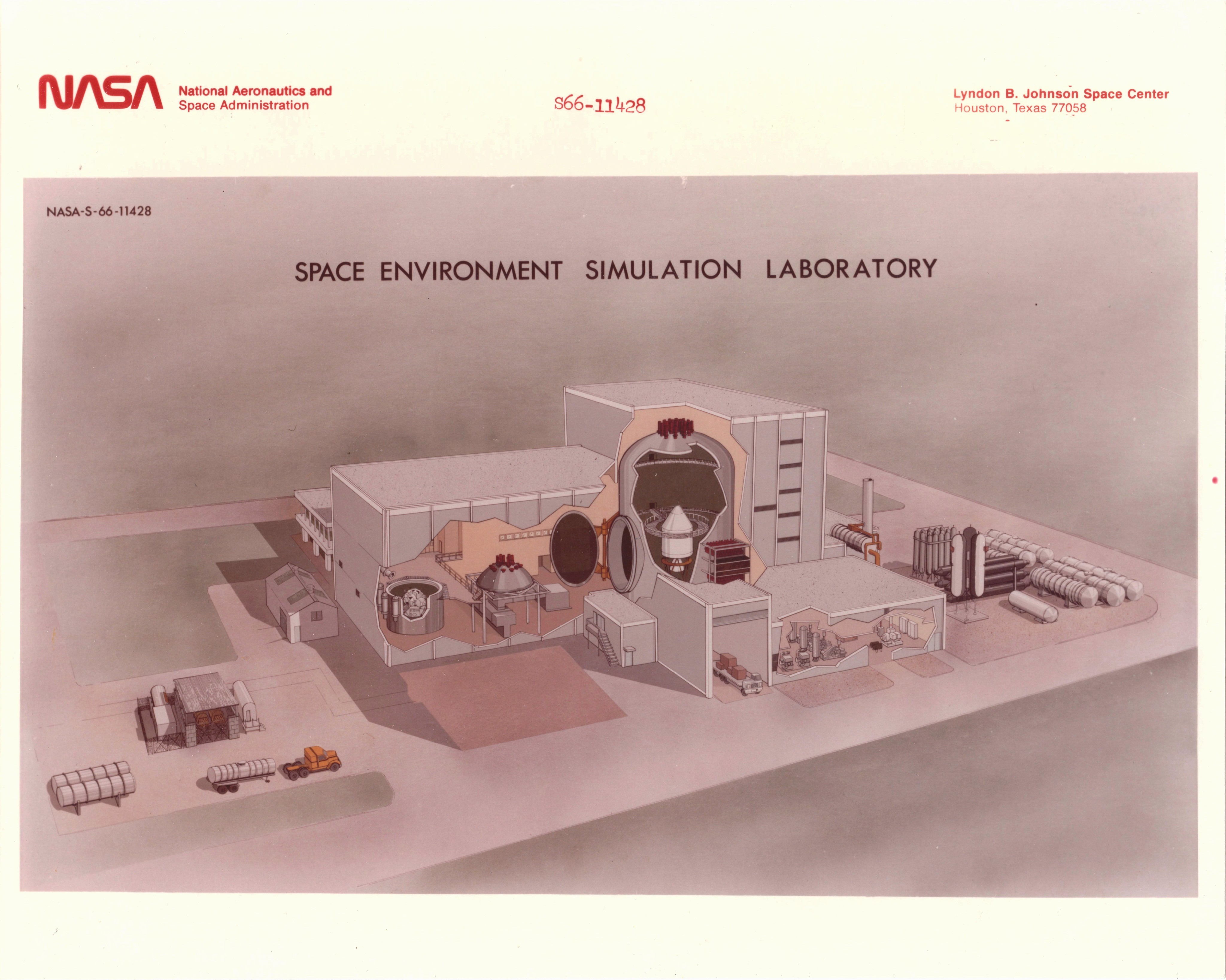
Both above credit the excellent “De la Terre à la Lune” website
en.wikipedia.org/wiki/Space_Environment_Simulation_Labora...
Credit: Wikipedia
More recently:
pdfs.semanticscholar.org/21db/7fdac7d49acdb7c45018b772c35...
A National Historic Landmark since 1985…rightfully so.
"An artist's concept depicting a scene in Earth orbit during the Apollo transposition and docking maneuvers of the Apollo-Soyuz Test Project mission. The Command/Service Module is moving into position to dock with the Docking Module. Following the docking the DM will be extracted from the expended Saturn IVB stage. The Docking Module is designed to link the American Apollo spacecraft with the Soviet Soyuz spacecraft. This scene will take place some one hour and twenty-three minutes after the Apollo-Saturn 1B liftoff from the Kennedy Space Center on July 15, 1975. The Soyuz launch at 7:20 a.m. (CDT) from the Baikonur, Kazakhstan launch pad will precede the Apollo liftoff by seven and one-half hours. The artwork is by Paul Fjeld."
Above at:
spaceflight.nasa.gov/gallery/images/apollo-soyuz/apollo-s...
Mr. Fjeld is one of those individuals that people like me are immensely grateful to, for doing what they do and the way they do it! His contributions to capturing & preserving the history and visual spectacle of space flight are diverse and just plain fantastic. A few examples:
gizmodo.com/13-amazing-paintings-of-space-based-on-actual...
Credit: Gizmodo/Attila Nagy
www.collectspace.com/ubb/Forum9/HTML/002461.html
Credit: collectSPACE website
www.ninfinger.org/karld/My Space Museum/q3.htm
Credit: Ninfinger website
www.hq.nasa.gov/alsj/fjeld.html
Credit: ALSJ website
Wouldn't you agree?
Thank you Mr. Fjeld!
I believe the photo to be authentically signed.
“Apollo-Soyuz rendezvous-Artist concept of the Apollo-Soyuz Test Project (ASTP) rendezvous.
The Major objective of the program will be the inflight testing of a jointly-designed international docking mechanism. Also, experience will be gained for the conduct of potential joint flights by the U.S. and USSR spacecraft, including, in case of necessity, rendering aid in emergency situations. Launch is set for July 15, 1975. The Apollo crew of astronauts are Thomas P. Stafford, commander; Vance Brand, command module pilot; and Donald K. Slayton, docking module pilot. The Soyuz crew are Aleksey Leonov, commander and Valeriy Kubasov, flight engineer.
Illustration by Davis Meltzer”
Beautiful, with actual details of earth visible:
images.nasa.gov/details-S75-27285
history.nasa.gov/astp/artist%20illustration%20ASTP%20dock...

And:
1.bp.blogspot.com/-ViLPPF7Xcwk/WRP3j1zQs7I/AAAAAAAAbSM/1I...

Credit: DSFP's SPACEFLIGHT HISTORY blogspot/David S. F. Portree
Also:
spaceflight.nasa.gov/gallery/images/apollo-soyuz/apollo-s...
"SATURN ENGINE APPLICATIONS"
Per the official description associated with MSFC-9801767 (see comments & thanks to Cygni_18):
"This image illustrates the basic differences between the three Saturn launch vehicles developed by the Marshall Space Flight Center. The Saturn I, consisted of two stages, the S-I (eight H-1 engines) and the S-IV (six RL-10 engines). The Saturn IB (center) also consisted of two stages, the S-IB (eight H-1 engines) and the S-IVB (one J-2 engine). The Saturn V consisted of three stages, the S-IC (five F-1 engines), the S-II (five J-2 engines), and the S-IVB (one J-2 engine)."
"IND A1404E" is an unfamiliar photo ID, I've never seen anything resembling it.
Movement of Crawler Transporter number 1 on crawlerway. Probably still had that new CT smell...oil, metal, grease/other lubricants, diesel.
Note the large "M" under the windows of one of the two driving cabs of the vehicle...the logo of the manufacturer, Marion Power Shovel Company.
Photo has been trimmed.
“The Soviet Soyuz 19 spacecraft is photographed from the American Apollo spacecraft during the joint U.S.-USSR Apollo-Soyuz Test Project (ASTP) docking mission in Earth orbit. Earth is visible in the lower left corner. This picture was taken with a 70mm camera. The Apollo crew consisted of astronauts Thomas P. Stafford, commander; Donald K. "Deke" Slayton, docking module pilot; and Vance D. Brand, command module pilot. The Soyuz 19 crew consisted of cosmonauts Aleksei A. Leonov, command pilot; and Valeri N. Kubasov, flight engineer.”
Above per the caption of the linked Flickr photo.
And/or
“This scene photographed from a rendezvous window of the American Apollo spacecraft in earth orbit shows the Soviet Soyuz spacecraft contrasted against a black-sky background with the earth's horizon in the lower left corner.”
At:
science.ksc.nasa.gov/mirrors/images/images/pao/ASTP/10076...
Theodore Bartholomew Brown, 1931 – 2017
It is with the utmost satisfaction & gratitude that I post this wonderful obituary in honor, recognition & preservation of not only a lifetime of contribution, but of a - sadly, heretofore - unknown legacy.
Not anymore, at least not in my little corner of the internet.
Speaking of a legacy in the making – it is through the gracious consent of Mr. Brown’s daughter, Angela Carole Brown, that I’m able to share this.
Beautiful. Timeless. Poignant:
Credit: Angela Carole Brown/YouTube
Thank You Angela. THANK YOU.
Mr. Brown, THANK YOU.
In addition to the aforementioned, I highly encourage you to click on the “Ted Brown” tag, in order to more fully appreciate this man’s contributions.
A resounding WIN!
Unfortunately, with my inferior skills & tools, this is the best that I could muster to ‘convert’ a pdf into a merged jpeg.
Fittingly, possibly still undervalued & underappreciated, an article on the women of NASA, at KSC, along with an excellent photograph of the "Space Products" mural:
www.vogue.com/projects/13528185/american-women-nasa-kenne...
media.vogue.com/r/w_2000/2017/02/22/nasa-final-layout-13.jpg

Both above credit: Vogue Magazine online website
“Jim McBarron, who oversees the design of spacewalk equipment for the shuttle program, stands between two of the spacesuits he has worked on. On the left is the Apollo spacesuit, worn by astronauts during that program. At right is the new spacesuit worn during spacewalks by shuttle astronauts. Apollo spacesuits were custom made; the new spacesuits are made of standard parts and fit better than ever.”
James (Jim) William McBarron III, the Real Deal. A small sampling of his contributions & impact:
www.nasa.gov/offices/nesc/academy/James_McBarron_Bio.html
historycollection.jsc.nasa.gov/JSCHistoryPortal/history/o...
nescacademy.nasa.gov/video/b8a77e5fae7d4d328a6712e1d511c2...
ntrs.nasa.gov/api/citations/20160002038/downloads/2016000...
www.researchgate.net/scientific-contributions/James-W-McB...
Credit: ResearchGate website
Damn it, TOO SOON! Rest In Peace Good Sir…and THANK YOU:
www.crowderfuneralhome.com/obituaries/james-mcbarron/
Credit: James Crowder Funeral Homes website
Catalog #: 08_00833
Title: new console design for the MOCR at JSC
Repository: San Diego Air and Space Museum Archive
Title: Apollo-Soyuz Test Project
Catalog #: 08_01057
Date: 7/15-24/75
Additional Information: shows the two mission crew together
Repository: San Diego Air and Space Museum Archive
Title: Apollo-Soyuz Test Project
Catalog #: 08_01051
Date: 7/15-24/75
Additional Information: shows conceptual art of the space capsule docking
Repository: San Diego Air and Space Museum Archive
CAPE CANAVERAL, Fla. – Apollo-Soyuz Test Project (ASTP) prime crewmen Donald Slayton, Thomas Stafford and Vance Brand pose with their Saturn IB launch vehicle following the Countdown Demonstration Test [CDDT], a step-by-step dress rehearsal for their July 15 launch. During the “wet” portion of the test the stages of the launch vehicle were fueled as they would be on launch day. The fuels were off loaded and the terminal portion of the count repeated on July 3 with the astronauts aboard the vehicle.
The first international crewed spaceflight was a joint U.S.-U.S.S.R. rendezvous and docking mission. The Apollo-Soyuz Test Project took its name from the spacecraft employed: the American Apollo and the Soviet Soyuz. The three-man Apollo crew lifted off from Kennedy Space Center aboard a Saturn IB rocket on July 15, 1975, to link up with the Soyuz that had launched a few hours earlier. A cylindrical docking module served as an airlock between the two spacecraft for transfer of the crew members.
Credit: NASA
Image Number: KSC-75PC-0330
Date: July 3, 1975
“The Mobile Service Structure was moved away from the ASTP Saturn 1B rocket early this morning during the Countdown Demonstration Test (CDDT). The CDDT is a step-by-step dress rehearsal for launch which culminates in a simulated T-zero and launch. During the test the stages of the rocket are fueled as they will be on launch day, July 15. Following the simulated liftoff the fuels will be offloaded and the terminal portion of the count will be repeated tomorrow with the prime crew astronauts Thomas Stafford, Vance Brand and Donald Slayton aboard the spacecraft.”
A mock-up of the USSR Soyuz spacecraft on display at the Cosmonaut Training Center (Star City) near Moscow. The Soyuz, mounted horizontally, was exhibited at the Paris air show in May- June 1973 in a docked configuration with an Apollo spacecraft. The spherical-shaped section of the Soyuz is called the orbital module. The middle section with the lettering "CCCP" (USSR) on it is called the descent vehicle. Two solar panels extend out from the instrument-assembly module. The joint US-USSR Apollo-Soyuz Test Project docking in Earth orbit mission took place in July 1975. A docking module mock-up is atop the Soyuz training mock-up on the left.
Credit: NASA
Image Number:S74-26395
Date: June 1974
An overall view of the signing of the Apollo-Soyuz Test Project (ASTP) joint flight readiness review in ceremonies on May 22, 1975 in Moscow. Academician Vladimir A. Kotelnikov (on left) and NASA Deputy Administrator George M. Low (in center) are seen affixing their signatures to the ASTP document. Kotelnikov is the Acting President of the USSR Academy of Sciences. Seated at far left is Professor Konstantin D. Bushuyev, the Soviet Technical Director of ASTP. Dr. Glynn S. Lunney, the U.S. Technical Director of ASTP, is seated on Dr. Low's left. Arnold W. Frutkin (in light jacket), NASA Assistant Administrator for International Affairs, is standing behind Dr. Low. Academician Boris N. Petrov (in dark suit), Chairman of the USSR Council for International Cooperation in the Exploration and Use of Outer Space, is standing behind Kotelnikov. The signing of the agreement took place at the Presidium of the Academy of Sciences in Moscow.
Credit: NASA
Image Number: S75-27346
Date: May 22, 1975
Command Module Hatch
Apollo Command Module
This Apollo Command Module to be flown, in 1975, when it was launched into earth orbit for the first-ever docking of a U.S. spacecraft with a spacecraft from the former Soviet Union.
I remember watching the docking on live television. It was a significant event in the development of truly international space exploration, and a unique moment of cooperation during the Cold War.
See NASA's Apollo-Soyuz home page here:
www.nasa.gov/mission_pages/apollo-soyuz/index.html
The mission also provided an opportunity for American astronaut Donald K. "Deke" Slayton to fly in space. Slayton had been selected as one of the original Mercury astronauts, but due to a medical condition he never flew a Mercury mission. NASA's official biography of Slayton is here:
“SOVIET LIFTOFF: This artist’s concept shows the Soviet Soyuz spacecraft lifting off the pad from the Baykonur launch complex near the Aral in Kazakhstan, USSR. Launch of both the Soyuz and the American Apollo spacecraft, which will liftoff from Kennedy Space Center, Fla., is scheduled for July 15 and both will rendezvous and dock in space on July 17.”
One of multiple works by the incredibly talented artist, Davis Meltzer, depicting key moments of the Apollo Soyuz Test Project (ASTP) - Technology Transfer (TECTRAN) mission.
Stunning view of the ASTP Saturn 1B, Launch Complex 39.
SA-210 Apollo-Soyuz Test Project (ASTP) awaits the launch scheduled on July 15, 1975 on the launch pad at the Kennedy Space Center, the ASTP mission with astronauts Thomas Stafford, Vance Brand, and Donald "Deke" Slayton. The Saturn IB, developed under the direction of the Marshall Space Flight Center (MSFC), launched five manned Earth-orbital missions between 1968 and 1975: Apollo 7, Skylab 2, Skylab 3, Skylab 4, and the Apollo-Soyuz Test Project .
history.nasa.gov/astp/ASTP Saturn IB.jpg

"An artist's concept illustrating an Apollo-type spacecraft (left) about to dock with a Soviet Soyuz-type spacecraft. A recent agreement between the United States (USA) and the Union of Soviet Socialist Republic (USSR) provides for the docking in space of the Soyuz and Apollo-type spacecraft in Earth orbit in 1975. The joint space venture is called the Apollo-Soyuz Test Project (ASTP)."
spaceflight.nasa.gov/gallery/images/apollo-soyuz/apollo-s...
And/or:
"Artist's concept of the Apollo-Soyuz docking in earth's orbit."
science.ksc.nasa.gov/mirrors/images/images/pao/ASTP/10076...

Frankly, both the above descriptions are a combination of obligatory, odd & lame - take your pick. Most peculiarly, Mr. McCall - who by this time had achieved notable stature within NASA, to say the least, is oddly not cited in either of the above official(?) descriptions for this iconic depiction.
Did he piss off somebody at NASA during this time? Or was he - subliminally - depicted as "bad cop", by the omission of attribution, due to the disproportionately favorable view of the Soyuz spacecraft??? Whereas Mr. Meltzer's more representative perspective of the vehicles garnered him the "good cop" label??? A form of subtle psyops perhaps? Just kidding...or am I? 😉
Title: Apollo-Soyuz Test Project
Catalog #: 08_01056
Date: 3/1973
Additional Information: shows an outline of the mission sequence
Repository: San Diego Air and Space Museum Archive
“An artist's concept illustrating an Apollo-type spacecraft (on left) about to dock with a Soviet Soyuz-type spacecraft. A recent agreement between the United States and the Union of Soviet Socialist Republics provides for the docking in space of the Soyuz and Apollo-type spacecraft in Earth orbit in 1975. The joint venture is called the Apollo-Soyuz Test Project. Painting by R. Bruneau.”
commons.m.wikimedia.org/wiki/File:Apollo-Soyuz-Test-Progr...

Credit: Wikimedia Commons
Artist's concept of the U.S. Apollo and Soviet Soyuz spacecraft docking during the eventual 1975 Apollo Soyuz Test Project (ASTP) mission.
Excellent article on the artist, Raymond Bruneau:
www.nasa.gov/topics/history/features/raymond_bruneau.html
Finally:
www.collectspace.com/ubb/Forum38/HTML/000998.html
Credit: collectSPACE website
The image above is a First Day Cover commemorating the Apollo-Soyuz Test Project from 1975. It features a cachet (the illustrated design) created by Fleetwood and a U.S. 10-cent stamp. It has been autographed by Ralph McQuarrie - he was a celebrated concept artist most famous for his work on the Star Wars franchise, creating the initial designs for characters like Darth Vader and the Millennium Falcon.
Mission Overview:
The Apollo-Soyuz Test Project (ASTP) was the first collaborative space mission between the United States and the Soviet Union, a symbolic "handshake in space" that marked a period of détente during the Cold War.
Date: The cover is postmarked "JUL 15 1975" from the Kennedy Space Center, FL, which was the first day of issue for the U.S. stamps and the launch date for both spacecraft.
The Crews: The cachet on the left features portraits of the five crew members:
U.S. Astronauts: Thomas P. Stafford (Commander), Vance D. Brand (Command Module Pilot), and Donald K. Slayton (Docking Module Pilot).
Soviet Cosmonauts: Alexei A. Leonov (Commander) and Valeriy N. Kubasov (Flight Engineer).
E c. Copyright, 1975, Fleetwood r, Cheyenne, Wyoming 82008
A Fleetwood cachet refers to the artistic design on a First Day Cover (FDC), which is an envelope bearing a stamp cancelled on its first day of issue. Fleetwood is one of the most well-known and desirable long-running cachet makers in the United States, known for their high standard of production and original, full-color artwork.
Before its acquisition by the Mystic Stamp Company in 2007, the Fleetwood Company was a subsidiary of the Unicover Corporation, which was founded by James A. Helzer in 1968.
Helzer, a prominent philatelist and entrepreneur based in Cheyenne, Wyoming, was responsible for transforming Fleetwood into a premier producer of high-quality, artistic First Day Covers. Under his leadership, the brand became known for its original, full-colour artwork and "First Day Focus" informational cards.
History of Ownership
Early Origins (1929/1941): While some sources trace the Fleetwood name back to 1929, the company began producing its signature First Day Covers in 1941 with the Vermont Statehood issue.
Unicover Era (1968–2007): James Helzer founded Unicover Corporation and acquired or established the Fleetwood brand as its flagship philatelic division.
Current Ownership (2007–Present): The Mystic Stamp Company purchased Fleetwood in 2007 and continues to produce covers under the name today.
Artist Background: Ralph McQuarrie (1929–2012) was an American conceptual designer and illustrator. His work on the original Star Wars trilogy was foundational to the film's aesthetic, providing the visual blueprint for characters and environments like Darth Vader, Chewbacca, R2-D2, C-3PO, and the Millennium Falcon. He received an Academy Award for Visual Effects for his work on Cocoon (1985).
"The Apollo-Soyuz Test Project's (ASTP) NASA Apollo/Saturn 1B space vehicle is launched from Pad B, Launch Complex 39, Kennedy Space Center (KSC), Florida, at 3:50 p.m. (EDT), July 15, 1975, to begin Apollo's catch-up journey toward the already Earth-orbiting Soviet Soyuz spacecraft. Aboard the Apollo spacecraft were astronauts Thomas P. Stafford, Vance D. Brand and Donald K. (Deke) Slayton."
spaceflight.nasa.gov/gallery/images/apollo-soyuz/apollo-s...
Title: Apollo-Soyuz Test Project
Catalog #: 08_01052
Date: 8/1973
Additional Information: shows conceptual art of the docking approach
Repository: San Diego Air and Space Museum Archive
(April 1, 1974) President Richard M. Nixon is given a briefing on the Apollo Command Module similar to the one that will be flown on the upcoming joint U.S./U.S.S.R. Apollo-Soyuz test flight in the summer of 1975. Conducting the tour is the American Commander for the flight, astronaut Thomas P. Stafford. Standing at the President's right is Dr. James C. Fletcher, NASA Administrator.
Credit: NASA
Image Number: 74-H-236
Date: April 1, 1974