View allAll Photos Tagged 16832
Réalisé le 17 février 2013 à Doi Chiang Dao, Thaïlande.
Cliquez sur l'image pour l'agrandir / click on the photograph to enlarge it.
Taken on February, 17th / 2013 in Doi Chiang Dao, Thailand.
Réalisé le 17 février 2013 à Doi Chiang Dao, Thaïlande.
Cliquez sur l'image pour l'agrandir / click on the photograph to enlarge it.
Taken on February, 17th / 2013 in Doi Chiang Dao, Thailand.
#16836 vta wdm-3a + #16832 vta wdm-3a twins with #22414 nzm - mao rajdhani express departing from vadodara jn.
Target train 6V41 with a decent load. Colas 66850+66847 D.I.T with LWRT set, all of this being conveyed to Westbury for an overnight possession job.
JTB Tours 16832
- Engine: Hino EF750C
- Chassis: RU638B
- Prev. Bus Body: Hino Blue Ribbon
- Bus Body: BAR Marcopolo XML6103 Replica
- Caught at St. Peter Parish Comm. Ave.
Photo André Knoerr, Genève. Reproduction autorisée avec mention de la source.
Utilisation commerciale soumise à autorisation spéciale préalable.
Les motrices 264, 912, 308 et 767 se reposent au soleil dans la cour du dépôt.
16832
Photo taken by Chris Witt and uploaded with his kind permission (slide kindly provided for scanning by Florian Weiß).
München-Riem
ca. April 1992
85701
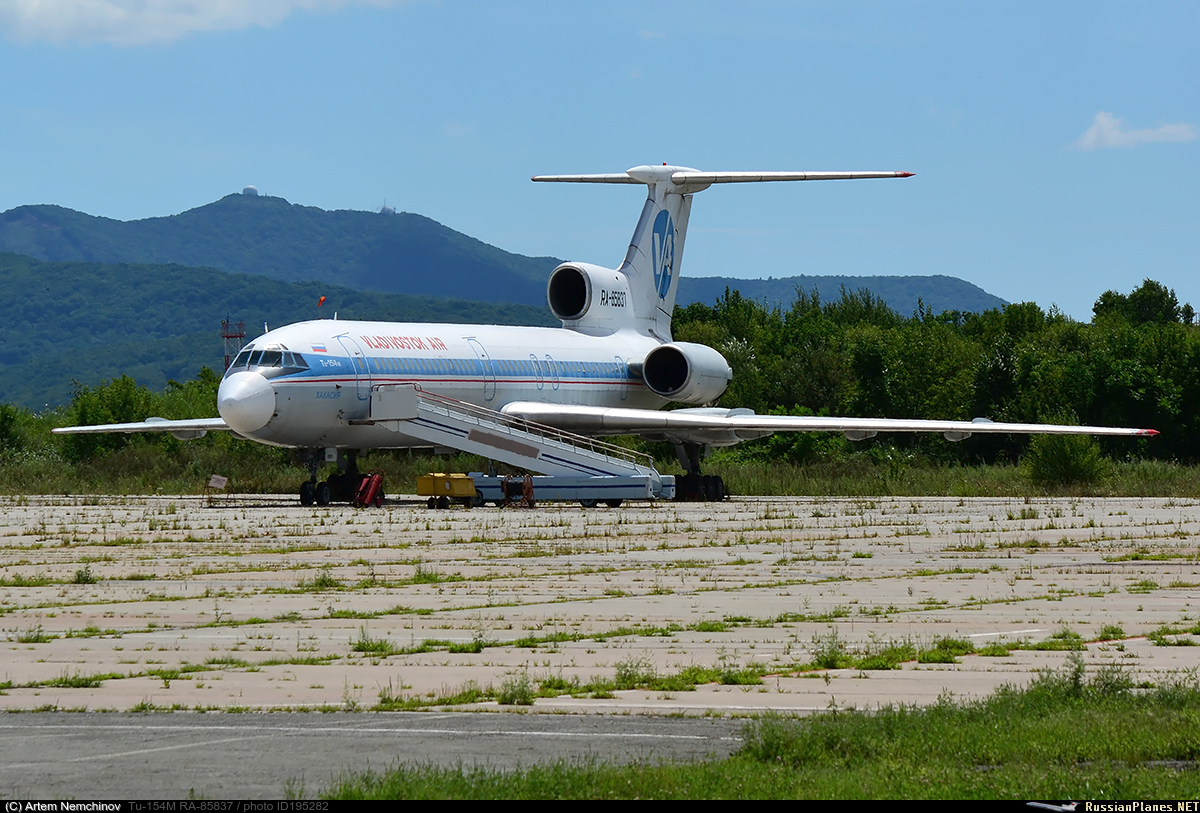
Tupolev Tu-154M
91A876
Авиалинии Украины - Avialini Ukrayiny - Air Ukraine (Aeroflot titles)
This Tupolev was less than a year old when it visited Riem.
Manufactured in July 1991 and delivered in full Aeroflot colours as CCCP-85701 ca. August 1991. Flying for about a year as 85701 (CCCP lettering removed) for Air Ukraine and registered as UR-85701 in January 1993. Later to Donetsk Airlines, DonbassAero, Atlant and Air Vladivostok. Stored at VVO from September 2010, last noted in August 2018. (Sources: scramble.nl, planelogger.com)
Registration details for this airframe:
www.scramble.nl/database/soviet/details/181_75607
This airframe as UR-85701 with Air Ukraine at HAJ in April 1994:
imgproc.airliners.net/photos/airliners/3/7/8/0496873.jpg

UR-85701 with Donetsk State Airline at TFS in November 1995:
cdn.jetphotos.com/full/2/16832_1076838557.jpg

UR-85701 with Atlant-SV at TFS in December 1996:
cdn.jetphotos.com/full/1/93454_1076672064.jpg

This airframe as RA-85837 with Air Vladivostok at BCN in July 2010:
imgproc.airliners.net/photos/airliners/5/2/4/6497425.jpg

RA-85837 with Air Vladivostok stored at VVO in August 2016:
russianplanes.net/images/to196000/195282.jpg
Scan from Kodachrome slide.
Stagecoach Manchester MX58DXW 16832 seen on Corporation Street, Manchester on Bee Network 41 to Sale Metrolink
Two of Golden Eagle's ex-Stagecoach Alexander-bodied Olympians take a well-earned rest on Glasgow's Langisde Rd after dropping off football supporters bound for Hampden Park.
Photo Date: 26th November 2017
New to First, latterly with Go North West, and now running on the Bee Network with Stagecoach, Volvo B9TL 16832 is pictured on Victoria Street in Manchester city centre.
So this is a time for my little celebration … my 100th picture on Flickr , 11,500 views and over 400 friends
… if you like this, take a look at my best … ( Most critically acclaimed :-) )
flickr.com/photos/januszbc/sets/72157594477222489/detail/
Fort Langley dates from a time when the boundary between British and American posession of the West had not yet been decided. Sir George Simpson, Governor of the Hudson's Bay Company, realized that Fort Vancouver built near present day Portland, Oregon might be lost to the Americans if the border did not follow the Columbia River. Fearing the 49th Parallel would become the demarcation line, Simpson ordered the Royal Engineers to construct the original Fort Langley in 1827 at a location 3km downstream from its present site. Fort Langley was intentionally constructed on the south bank of the Fraser River in the event that, if Fort Vancouver was lost to the Americans, that Fort Langley could secure British claims to both sides of the Fraser. By 1830, Fort Langley had become a major export port for salted salmon in cedar barrels.
en.wikipedia.org/wiki/Fort_Langley
en.wikipedia.org/wiki/Hudson's_Bay_Company
The Hudson's Bay Company (HBC) is the oldest commercial corporation in North America and is one of the oldest in the world. It was once the de facto government in North America before European based colonies and nation states existed. It was at one time the largest land owner in the world, with Rupert's Land being a large part of North America. From its longtime headquarters at York Factory on Hudson Bay, it controlled the fur trade throughout much of British-controlled North America for several centuries, undertaking early exploration and functioning as the de facto government in many areas of the continent prior to the arrival of large-scale settlement. Its traders and trappers forged early relationships with many groups of First Nations/Native Americans and its network of trading posts formed the nucleus for later official authority in many areas of western Canada and the United States. In the late 19th century, its vast territory became the largest component in the newly formed Dominion of Canada, in which the company was the largest private landowner. With the decline of the fur trade, the company evolved into mercantile business selling vital goods to settlers in the Canadian West. Today the company is best known for its department stores throughout Canada.
In 2007, the HBC company records became part of the United Nations, Memory of the World project, under UNESCO. The records covered HBC history from the founding of the company in 1670. The records contained business transactions, medical records, personal journals of officials, inventories, company reports, etc.
Stagecoach Manchester MX58DXW 16832 seen on Oxford Road, Manchester on Bee Network 41 to North Manchester General Hospital
Seen in Manchester
18th June 2024
Former First Manchester 37409
www.flickr.com/photos/68628359@N04/35624118883/in/photoli...
(Left to right) Greater Manchester Buses South Limited 16832 MX58 DXW, a Volvo B9TL built 2008 with a Wrightbus Eclipse Gemini H45/29F+14 body with a Bury Interchange to Pendleton (Salford Shopping Centre) via Unsworth, Whitefield, Prestwich and Carr Clough 95 service and Burnley & Pendle Travel Limited 2762 PJ05 ZWK, a Volvo B7TL built 2005 with a Wrightbus Eclipse Gemini CH39/29F body with Rossendale Transport Limited’s 15:45 Bury Interchange (stand C) to Burnley bus station (stand 5) via Rawtenstall 483 service stand on Angouleme Way in Bury. Monday 25th March 2024
Note, PJ05 ZWK was originally operated by Burnley & Pendle Travel Limited as number 2762 named Margaret Pearson. It was transferred to Lancashire United Limited as number 2762 in February 2014, was transferred to Yorkshire Coastliner Limited as number 2762 in May 2021 and was transferred to Burnley & Pendle Travel Limited as number 2762 in November 2021
MX58 DXW was originally operated by First Manchester Limited as number 37409. The Go-Ahead Group plc purchased First Manchester Limited’s Manchester depot and its operations on 2nd June 2019, MX58 DXW passing to Go North West Limited as number 37409. MX58 DXW was renumbered 3251 in July 2020 and ownership was temporarily transferred to Selwyns Travel Limited in spring 2021 during a Go North West Limited driver’s strike. It was acquired by Greater Manchester Buses South Limited in March 2024 as number 16832 and retained Go North West Limited livery
MX58 DXW was possibly working the 15:45 departure from Bury Interchange
Ref no Nikon D7200 7th series - DSC_1865
New to Stagecoach Cleveland Transit as their 832, Alexander bodied Olympian R832OVN carried a Belfast body, rather than a Falkirk one. Latterly Stagecoach North East 16832 it carries Golden Eagle's allover (except the roof!) allover red school bus colours.
R832OVN is a Volvo Olympian-56 / Alexander (Belfast) H77F purchased new by Stagecoach for their Cleveland Transit (832) subsidiary in February 1998. It later became Stagecoach North East 16832, but is now with Irvine's of Salburgh for use on school contracts.
Sibiu, cross-section of the city wall, guardian tower, and old houses inside the once fortified burg. Artisans and craftsmen in medieval cities were organised into guilds for each major profession or group of related professions. Each guild had a gate or a tower assigned to them to man and maintain, so they've all had their share in defending the city. This one pictured here is the Carpenters' Tower (Ácsok Tornya), restored in 2007.
The city first appears in historical records as Cipinum, in 1192. Its name comes from the Cibin / Szeben small river valley on which it was built. The name further comes from the slavic "svbina", meaning "Cornel" (Coarne / Som), the sweet fruit of the dogwood shrubs, also known as "Cornelian Cherry".
The city has been founded by Hungarian King Géza the 2nd, and massively populated with Germans, the Sächsen (Saşi / Szászok), said to be originating from today's Luxemburg area. The city has quickly evolved into the spiritual and economic center of the Transylvan Sächsen, speaking their own dialect of German, and developing a flourishing culture here.
On March 25, 1442, Hunyadi János / Iancu de Hunedoara has beaten the Ottoman Turk armies of Mezid-Bek near the city of Sibiu. Tha burg was protected by strong walls and 40 towers built between the 15th and 17th centuries (like the one pictured here), and it could never be taken by the Turks. However, the city got laregly devastated by a great fire in 1556, and rebuilt after. Sibiu has been an important ecnter of the Transylvan Reformation in the 16th century, and gives home to several protestant churches, most of them German.
On Sep. 12, 1690, Thököly Imre has been elected here as Prince of Tranylvania. Under the Habsburgs, Sibiu / Nagyszeben / Hermannstadt has been a home to the Transylvan Government between 1703 - 1791. The city is the capital of Sibiu County, and has been the capital of Transylvania for a short period, between 1849-1865.
In a 1910 census the population numbers 33489 souls, of which 16832 Germans, 8824 Romanians, 7252 Hungarians, 134 Czechs and 116 Gypsies, thus counting as the largest Sächsen inhabited city in Transylvania. Many if the Germans have fled back to Germany after World War II, wehn the Communists came to power. Legend has it that Communist dictator Ceausescu was even selling back the Sächsen to West Germany for a hefty sum agreed per capita, and as such, facilitating their exit.
After the communist regime fell in December 1989, we've had another census. The 1992 census then revealed 169,656 inhabitants: 158,908 Romanians, 5605 Germans, 4164 Hungarians, and 688 Gypsies.
A more recent 2002 census shows 154,892 inhabitants, of which 148,269 Romanians, 3135 Hungarians, 2508 Germans, and 980 other (Jews, Csángó / Ciangai, Gypsies, etc.).
These numbers show a further decay in German population, probably because of the aging and the now free emigration. However, part of the Sächsen (and Hungarians as well) has well cross-bled into today's Romanian population, and thos declare themselves Romanians. Blue or grey eyes, lots of blond, auburn (and even the occasional red) hair, and Germanic faces are however quie easy to spot at almost every step, in the local population.
Since the year 2000, the city is lead by German mayor Klaus Johannis of the German Democratic Forum, a great manager, who did a lot for this city. The now 50 year old professor is so popular amoung the local population that in 2008 he's been elected for his 3rd mandate of mayorship until 2012 with a majority of 87% of votes. On his second mandate he had 88.7%, so the love is almost unchanged, apparently.
In the year 2007, Sibiu was the Cultural Capital of Europe, along with Luxemburg. Part of the historical center of the city has been greatly restored for the event (and even under the event, as we're always late - bad logistics). For an entire year round, the city has been home to cultural events of all kinds: arts and crafts, performance, theater, classical music, organ concerts, open-air jazz and rock concerts, exhibitions, art fairs, and so on. The gothic medieval backdrop stood as a great setting.
People complain that there has been not much done since the 2007 festive year, though. The restored part of the historical center (Piata Mica, Piata Mare, Piata Huet and surroundings) is sometimes dubbed "The Sibiu Disneyland", as not much seems to be done towards the restoration of the rest of the city ebver since. Restoration work seems to have slowed down to a standstill, presenting very little change since the big rush for Sibiu 2007 - The Europen Capital of Culture.
Aside for restored old center, parts of the city are still in decay or in a rather precarious state anyway. We've seen some private efforts put into reparing and restoring a few buildings here and there, but I'm afraid there's a need for a much bigger effort to continue from where things have been left off. The city has become a great turistic attraction throughout 2007, and tourists still keep to flock in in every season. Even in this half-restored state it is in now, this place is well worth a visit, anyhow.
ВАСИЛИЙ ПОЛЕНОВ - Бабушкин сад
☆📀
Location: The State Tretyakov Gallery, Moscow, Russia
Sources: my.tretyakov.ru/app/masterpiece/16832
www.tg-m.ru/articles/1-2007-14/poeticheskaya-pravda-moskvy
One of the top works of Vasily Polenov in Russian painting of the XIX century.
The artist creates the atmosphere of a neglected but beautiful noble nest of the century before last. Most of the canvas is occupied by a feral garden. Through the lush greenery you can see the mansion, aged, like its owner, who was taken out for a walk by her granddaughter (in any case, you can judge her by the name of the work).
The old is becoming obsolete, and a new growth is replacing it. The grandmother, who goes to the garden of her youth, has an old dark brown salop and a white elegant cap, and the girl’s dress is sewn in the latest fashion of the 1870s.
Vasily Polenov is one of the pioneers of “mood landscapes” in Russian painting. At the end of the 1870s, he created such paintings, similar in mood, as “Grandma’s Garden”, “Moscow Courtyard” (1878) and “Overgrown Pond” (1879). They were shown at the exhibition of the Wanderers, where one of the critics of Moskovskiye Vedomosti accurately noted their innovative features: “Such paintings are designed to give you, first of all, the“ mood “and make up about the same thing in painting as the elegy in poetry". The picturesque pathos of the “Grandmother’s Garden” is close to the lyrics of Athanasius Fet and the novels of Ivan Turgenev dedicated to the outgoing primordial life of the nobility. "Grandma’s Garden" was written by Vasily Polenov in Moscow. The painting shows the same manor house on the corner of Trubnikovsky and Durnovsky lanes, as in the "Moscow Courtyard", created in the same year. This landowner house plays a significant role in the created elegiac image. Moscow was built up with such mansions in the classicist style after the Napoleonic fire of 1812: wooden buildings with a portico under the pediment, stucco molding over the windows and stucco under masonry for representativeness. But on the house in Trubnikovsky Lane, the plaster has crumbled for a long time, and the columns and stone steps are jagged.
Polenov creates a landscape idyll that includes genre narrative. The open air here is not only a “scenery” in which the mise-en-scene is played out, but also its full-fledged participant. The charm of the garden is created with the help of color reflections, subtle light transitions from dense shade to sun glare
Journey into Mystery / Heft-Reihe
The Sorcerer!
cover: Jack Kirby, Dick Ayers
Marvel (Atlas) / USA 1962
Reprint / Comic-Club NK 2010
ex libris MTP
Images taken along the Ramapo River in Mahwah, New Jersey. Beautiful day for taking images, although I would usually like to be later in the day. Lucky for me the Canon PowerShot G12 handles the harsh light very well.
Johnston, Frances Benjamin,, 1864-1952,, photographer.
[Dr. Frederick Kellogg Hollister house, Lily Pond Lane, East Hampton, New York. Delphiniums]
[ca. 1915]
1 photograph : glass lantern slide, hand-colored ; 3.25 x 4 in.
Notes:
Site History. House Architecture: Albro & Lindeberg, 1908. Landscape: Harriet Shelton (Mrs. Frederick K.) Hollister. Today: House but not garden extant.
On slide: blind embossed stamp for "Frances B. Johnston, New York."
Photographed when Frances Benjamin Johnston and Mattie Edwards Hewitt worked together.
Title, date, and subject information provided by Sam Watters, 2011.
Forms part of: Garden and historic house lecture series in the Frances Benjamin Johnston Collection (Library of Congress).
Rights Info: No known restrictions on publication.
Repository: Library of Congress, Prints and Photographs Division, Washington, D.C. 20540 USA, hdl.loc.gov/loc.pnp/pp.print
Higher resolution image is available (Persistent URL): hdl.loc.gov/loc.pnp/ppmsca.16832
Call Number: LC-J717-X109- 27
İstanbul’un Anadolu yakasında bazı ilçelerde yarın elektrik kesintisi uygulanacak.
İstanbul’un Anadolu yakasında bazı ilçelerde yarın elektrik kesintisi uygulanacak.
İstanbul Anadolu Yakası Elektrik Dağıtım AŞ’den yapılan açıklamaya göre, yarın Ataşehir, Beykoz, Çekmeköy,...
yerelturkiye.com/gundem/istanbulda-elektrik-kesintisi-22-...
Stagecoach NE 16832 R832OVN seen at the back of South Shields depot. Withdrawn and stored until further notice. (05/06/13)
Walking alongside Hangmans Hill in the Malvern Hills. While the Hills lie along the Herefordshire-Worcestershire border, this path is on the Herefordshire side.
The Malvern Hills are a range of hills in the English counties of Worcestershire, Herefordshire and a small area of northern Gloucestershire, dominating the surrounding countryside and the towns and villages of the district of Malvern. The highest summit of the hills affords a panorama of the Severn valley with the hills of Herefordshire and the Welsh mountains, parts of thirteen counties, the Bristol Channel, and the cathedrals of Worcester, Gloucester and Hereford.
The name Malvern is probably derived from the ancient British moel-bryn, meaning "Bare-Hill", the nearest modern equivalent being the Welsh moelfryn (bald hill). It has been known as Malferna (11th century), Malverne (12th century), and Much Malvern (16–17th century). Jabez Allies, a 19th Century antiquarian from Worcestershire speculated that 'vern' was derived from the British words 'Sarn' or 'Varn' meaning pavement or seat of judgement.
They are known for their spring water – initially made famous by the region's many holy wells, and later through the development of the 19th century spa town of Great Malvern, a process which culminated in the production of the modern bottled Malvern Water.
The Hills have been designated as a Biological and Geological Site of Special Scientific Interest and as national character area 103 by Natural England and an Area of Outstanding Natural Beauty by the Countryside Agency (now Natural England). The SSSI notification has 26 units of assessment which cover grassland, woodland and geological sites. The site (The Malvern Hills SSSI (Chase End Hill)) is listed in the 'Forest of Dean Local Plan Review' as a Key Wildlife Site (KWS). Management of the hills is the responsibility of the Malvern Hills Conservators
Flint axes, arrowheads, and flakes found in the area are attributed to early Bronze Age settlers, and the 'Shire Ditch', a late Bronze Age boundary earthwork possibly dating from around 1000 BC, was constructed along part of the crest of the hills near the site of later settlements. The Wyche Cutting, a mountain pass through the hills was in use in prehistoric times as part of the salt route from Droit-wich to South Wales. A 19th century discovery of over two hundred metal money bars suggests that the area had been inhabited by the La Tène people around 250 BC. Ancient folklore has it that the British chieftain Caractacus made his last stand against the Romans at the British Camp, a site of ex-tensive Iron Age earthworks on a summit of the Malvern Hills close to where Malvern was to be later established.
J.R.R. Tolkien found inspiration in the Malvern landscape which he had viewed from his childhood home in Birmingham and his brother Hilary's home near Evesham. He was introduced to the area by C. S. Lewis, who had brought him here to meet George Sayer, the Head of English at Malvern College. Sayer had been a student of Lewis, and became his biographer, and together with them Tolkien would walk the Malvern Hills. Recordings of Tolkien reading excerpts from The Hobbit and The Lord of the Rings were made in Malvern in 1952, at the home of George Sayer. The recordings were later issued on long-playing gramophone records. In the liner notes for J.R.R. Tolkien Reads and Sings his The Hobbit & The Fellowship of the Ring, George Sayer wrote that Tolkien would relive the book as they walked and compared parts of the Malvern Hills to the White Mountains of Gondor.
Marte 22-09-2020
16832 frames de 21041
Toya 114mm
ASI 120MC + Celestron Omni Barlow 2x
FireCapture, PiPP, AutoStarkket, WinJupos e RegiStax
Matupá/MT
"What did the Romans ever do for us ?" ( a scene from Monty Python !)
Wroxeter (or 'Viroconium' ) was the fourth largest city in Roman Britain. It began as a legionary fortress and later developed into a thriving civilian city, populated by retired soldiers and traders. Though much still remains below ground, today the most impressive features are the 2nd-century municipal baths, and the remains of the huge wall dividing them from the exercise hall in the heart of the city. The site museum and audio tour reveal how Wroxeter worked in its heyday, and the health and beauty practices of its 5,000 citizens. Dramatic archaeological discoveries provide a glimpse of the last years of the Roman city, and its possible conversion into the headquarters of a 5th-century British or Irish warlord.
For an artists impression of what the site looked like in Roman times, please use link below :