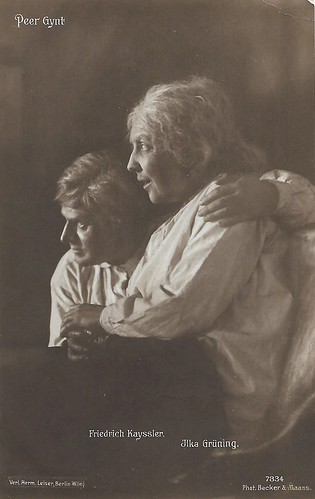
Friedrich Kayssler and Ilka Grüning in Peer Gynt
German postcard by Verlag Hermann Leiser, Berlin, no. 7834. Photo: Becker & Maass. Friedrich Kayssler as Peer Gynt and Ilka Grüning as his mother Aase in Ibsen's play 'Peer Gynt'. Kayssler debuted as Peer Gynt in the eponymous play by Ibsen at the Lessingtheater in Berlin, on 15 September 1913. Ilka Grüning already then played his mother Aase. With the Lessing Theater company, Kayssler and Grüning would perform the play in Spring 1914 at the Neues Deutsches Theater in Prague, the Theater an der Wien in Vienna, and the Lobe-Theater at Breslau/Wroclaw.
Friedrich Martin Adalbert Kayssler, also spelt Kayßler (7 April 1874 – 30 April 1945), was a German theatre and film actor. He appeared in 56 films between 1913 and 1945.
Kayssler was born in Neurode in the Prussian Silesia Province (now Nowa Ruda in Poland). He attended the gymnasium in Breslau (Wrocław), where he became a close friend of Christian Morgenstern and Fritz Beblo. Graduating in 1893 Kayssler studied philosophy at the universities of Breslau and Munich and began his theatre career at the Deutsches Theater in Berlin under manager Otto Brahm, later working at municipal theatres in Görlitz and Halle.
At the Deutsches Theater, Kayssler had made friends with director Max Reinhardt, whose Schall und Rauch Kabarett ensemble in Berlin he joined in 1901. He followed Reinhardt, when he became manager of the Deutsches Theater in 1905, where Kayssler performed in Kleist's The Prince of Homburg, Goethe's Faust and Ibsen's Peer Gynt. He also succeeded Reinhardt as manager of the Berlin Volksbühne from 1918 until 1923. He first appeared as a film actor in the silent movie Welche sterben, wenn sie lieben in 1913. The production company, Literaria Film, eager to have him, paid him 3.000 Mark per month at the time. Kayssler also had the lead in William Wauer's Kellermann adaptation Der Tunnel (PAGU 1915), but it was in the 1920s that Kayssler had a prolific career, e.g. in the part Schicksalswende (1923) of the Fridericus Rex series, three Henny Porten films (Die Liebe einer Königin, 1923; Gräfin Donelli, 1924; Mutter und Kind, 1924), as well as films with Maria Korda, Lucy Doraine, Erna Morena, Mady Christians, and Hans Stüwe. In the early 1930s Kayssler played many major supporting parts in German sound cinema, such as Zwei Menschen (1930), Zwei Welten (1930), Stürme über dem Montblanc (1930), Das Flötenkonzert von Sanssouci (1930). Luise, Königin von Preußen (1931), 24 Stunden aus dem Leben einer Frau (1931), Unter falscher Flagge (1931/32), etc., in addition to smaller parts in other films. He played the leads of Faust in Goethe lebt...! (1931-32), Freiherr von Trachenberg in Die elf Schill'schen Offiziere (1932), and the inventor Achenbach in Gold (1933-34). By the mid-1930s, Kayssler played elder royals, military, commissioners and fathers of the leading actors, such as the Paris police prefect in Verwehte Spuren (1938), Lord Charles Baskerville in Der Hund von Baskerville (1937-38), King WIlhelm I in Bismarck (1940), and Clara Wieck's father in Träumerei (1943/44), one of his last films..
Kayssler also wrote several poems and dramas. In 1934 he starred alongside Veit Harlan in the Berlin premiere of Eugen Ortner's Meier Helmbrecht at the Staatliches Schauspielhaus. In March 1944, his son Christian, who was also a popular film actor, was killed in an Allied bombing raid. Kayssler was named as one of the Third Reich's most important artists in the Gottbegnadeten list of September 1944. During the Battle of Berlin, Kayssler was killed by Red Army troops at his house in the suburb of Kleinmachnow, when he tried to protect his wife.
Source: German Wikipedia and Filmportal.
Friedrich Kayssler and Ilka Grüning in Peer Gynt
German postcard by Verlag Hermann Leiser, Berlin, no. 7834. Photo: Becker & Maass. Friedrich Kayssler as Peer Gynt and Ilka Grüning as his mother Aase in Ibsen's play 'Peer Gynt'. Kayssler debuted as Peer Gynt in the eponymous play by Ibsen at the Lessingtheater in Berlin, on 15 September 1913. Ilka Grüning already then played his mother Aase. With the Lessing Theater company, Kayssler and Grüning would perform the play in Spring 1914 at the Neues Deutsches Theater in Prague, the Theater an der Wien in Vienna, and the Lobe-Theater at Breslau/Wroclaw.
Friedrich Martin Adalbert Kayssler, also spelt Kayßler (7 April 1874 – 30 April 1945), was a German theatre and film actor. He appeared in 56 films between 1913 and 1945.
Kayssler was born in Neurode in the Prussian Silesia Province (now Nowa Ruda in Poland). He attended the gymnasium in Breslau (Wrocław), where he became a close friend of Christian Morgenstern and Fritz Beblo. Graduating in 1893 Kayssler studied philosophy at the universities of Breslau and Munich and began his theatre career at the Deutsches Theater in Berlin under manager Otto Brahm, later working at municipal theatres in Görlitz and Halle.
At the Deutsches Theater, Kayssler had made friends with director Max Reinhardt, whose Schall und Rauch Kabarett ensemble in Berlin he joined in 1901. He followed Reinhardt, when he became manager of the Deutsches Theater in 1905, where Kayssler performed in Kleist's The Prince of Homburg, Goethe's Faust and Ibsen's Peer Gynt. He also succeeded Reinhardt as manager of the Berlin Volksbühne from 1918 until 1923. He first appeared as a film actor in the silent movie Welche sterben, wenn sie lieben in 1913. The production company, Literaria Film, eager to have him, paid him 3.000 Mark per month at the time. Kayssler also had the lead in William Wauer's Kellermann adaptation Der Tunnel (PAGU 1915), but it was in the 1920s that Kayssler had a prolific career, e.g. in the part Schicksalswende (1923) of the Fridericus Rex series, three Henny Porten films (Die Liebe einer Königin, 1923; Gräfin Donelli, 1924; Mutter und Kind, 1924), as well as films with Maria Korda, Lucy Doraine, Erna Morena, Mady Christians, and Hans Stüwe. In the early 1930s Kayssler played many major supporting parts in German sound cinema, such as Zwei Menschen (1930), Zwei Welten (1930), Stürme über dem Montblanc (1930), Das Flötenkonzert von Sanssouci (1930). Luise, Königin von Preußen (1931), 24 Stunden aus dem Leben einer Frau (1931), Unter falscher Flagge (1931/32), etc., in addition to smaller parts in other films. He played the leads of Faust in Goethe lebt...! (1931-32), Freiherr von Trachenberg in Die elf Schill'schen Offiziere (1932), and the inventor Achenbach in Gold (1933-34). By the mid-1930s, Kayssler played elder royals, military, commissioners and fathers of the leading actors, such as the Paris police prefect in Verwehte Spuren (1938), Lord Charles Baskerville in Der Hund von Baskerville (1937-38), King WIlhelm I in Bismarck (1940), and Clara Wieck's father in Träumerei (1943/44), one of his last films..
Kayssler also wrote several poems and dramas. In 1934 he starred alongside Veit Harlan in the Berlin premiere of Eugen Ortner's Meier Helmbrecht at the Staatliches Schauspielhaus. In March 1944, his son Christian, who was also a popular film actor, was killed in an Allied bombing raid. Kayssler was named as one of the Third Reich's most important artists in the Gottbegnadeten list of September 1944. During the Battle of Berlin, Kayssler was killed by Red Army troops at his house in the suburb of Kleinmachnow, when he tried to protect his wife.
Source: German Wikipedia and Filmportal.