Gastone Monaldi in Cicueracchio (1915)
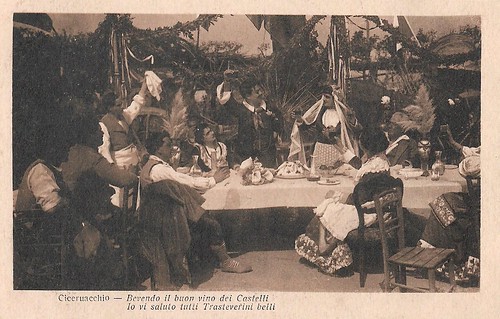
Italian postcard. Photo: Tiber Film. Gastone Monaldi as Cicueracchio in Ciceruacchio (Emilio Ghione, 1915). Caption: Drinking the wine of the Castelli [romani], I greet you all, beautiful people of Trastevere!
Ciceruacchio / Martire del piombo austriaco (Martyr of Austrian bullets) was an Italian historical film, dealing with victims of the Austrian occupation of Italy, and intended to raise anti-Austrians sentiment during the First World War (when the Northwest part of Italy - the present province of Friuli - was still under Austrian occupation). Angelo Brunetti, named Ciceruacchio, a Roman trader in cheese and wine, was much beloved by the Roman people, e.g. for his behavior during the 1837 cholera plague. In a public performance in 1846 he thanked the pope Pius IX for releasing political prisoners, while in 1847 he pressed Pius IX to continue his policy of reform. During the 1848 revolution, he joined the Roman Republican forces and helped the Romans in the siege by the French. But when they were defeated in 1849, he fled with his sons Lorenzo and Luigi and hoped with Garibaldi and allies to liberate Venice from the Austrians. Instead, they were betrayed by locals at Cesenatico and then arrested and executed by the Austrians on 10 August 1849.
Emilio Ghione’s film was scripted by Emilio Calve. The plot mostly follows history. The papal police suspects Brunetti, aka Ciceruacchio (meaning little fat man), but when Pius IX hears about Brunetti's bravery during a flood, he gives him a special audience. Brunetti henceforth considers the pope Rome's savior, while his republican friends think otherwise. When the pope flees to Gaeta during the revolution, leaving the city to foreign oppressors, Cicueracchio becomes Rome's new leader, but he has to flee after the last stronghold, Trastevere, is conquered. He is betrayed and arrested in Rovigo, and executed with his son Luigi (Alberto Collo). NB Ghione suggests Brunetti was killed with only his eldest son, while in reality both sons and also several allies of Brunetti were killed with them.
While reputed stage actor Gastone Monaldi, famous for his dialect acting, played the lead, his partner Fernanda Battiferri played Annetta. Ida Carloni Talli played, as usual, the mother, Brunetti’s mother in this case. The film passed censorship 22 June 1915, while a week earlier, on 18 June 1915, the film had its first night in Rome. Emilio Ghione, who had been a regular Cines, Celio, and Caesar actor in Rome, had starting film directing from 1914. While for a long time he was most remembered for his Za-la-Mort crime films at Tiber Film, in which he had the lead too, at Tiber he also made various - commissioned - historical propaganda films during the First World War, such as Oberdan (1915) starring Alberto Collo, and Ciceruacchio.
The story of Ciceruacchio was afterwards again filmed in In nome del popolo sovrano (1990) by Luigi Magni, in which Nino Manfredi performed Brunetti. Ciceruacchio was also recreated in Camicie rosse/ Anita Garibaldi (1952) by Goffredo Alesandrini and Francesco Rosi, and returned in the recent mini-series Anita Garibaldi (2012).
Source: it.wikipedia.org/wiki/Angelo_Brunetti, Denis Lotti, Emilio Ghione. L’ ultimo apache.
Gastone Monaldi in Cicueracchio (1915)
Italian postcard. Photo: Tiber Film. Gastone Monaldi as Cicueracchio in Ciceruacchio (Emilio Ghione, 1915). Caption: Drinking the wine of the Castelli [romani], I greet you all, beautiful people of Trastevere!
Ciceruacchio / Martire del piombo austriaco (Martyr of Austrian bullets) was an Italian historical film, dealing with victims of the Austrian occupation of Italy, and intended to raise anti-Austrians sentiment during the First World War (when the Northwest part of Italy - the present province of Friuli - was still under Austrian occupation). Angelo Brunetti, named Ciceruacchio, a Roman trader in cheese and wine, was much beloved by the Roman people, e.g. for his behavior during the 1837 cholera plague. In a public performance in 1846 he thanked the pope Pius IX for releasing political prisoners, while in 1847 he pressed Pius IX to continue his policy of reform. During the 1848 revolution, he joined the Roman Republican forces and helped the Romans in the siege by the French. But when they were defeated in 1849, he fled with his sons Lorenzo and Luigi and hoped with Garibaldi and allies to liberate Venice from the Austrians. Instead, they were betrayed by locals at Cesenatico and then arrested and executed by the Austrians on 10 August 1849.
Emilio Ghione’s film was scripted by Emilio Calve. The plot mostly follows history. The papal police suspects Brunetti, aka Ciceruacchio (meaning little fat man), but when Pius IX hears about Brunetti's bravery during a flood, he gives him a special audience. Brunetti henceforth considers the pope Rome's savior, while his republican friends think otherwise. When the pope flees to Gaeta during the revolution, leaving the city to foreign oppressors, Cicueracchio becomes Rome's new leader, but he has to flee after the last stronghold, Trastevere, is conquered. He is betrayed and arrested in Rovigo, and executed with his son Luigi (Alberto Collo). NB Ghione suggests Brunetti was killed with only his eldest son, while in reality both sons and also several allies of Brunetti were killed with them.
While reputed stage actor Gastone Monaldi, famous for his dialect acting, played the lead, his partner Fernanda Battiferri played Annetta. Ida Carloni Talli played, as usual, the mother, Brunetti’s mother in this case. The film passed censorship 22 June 1915, while a week earlier, on 18 June 1915, the film had its first night in Rome. Emilio Ghione, who had been a regular Cines, Celio, and Caesar actor in Rome, had starting film directing from 1914. While for a long time he was most remembered for his Za-la-Mort crime films at Tiber Film, in which he had the lead too, at Tiber he also made various - commissioned - historical propaganda films during the First World War, such as Oberdan (1915) starring Alberto Collo, and Ciceruacchio.
The story of Ciceruacchio was afterwards again filmed in In nome del popolo sovrano (1990) by Luigi Magni, in which Nino Manfredi performed Brunetti. Ciceruacchio was also recreated in Camicie rosse/ Anita Garibaldi (1952) by Goffredo Alesandrini and Francesco Rosi, and returned in the recent mini-series Anita Garibaldi (2012).
Source: it.wikipedia.org/wiki/Angelo_Brunetti, Denis Lotti, Emilio Ghione. L’ ultimo apache.