Romanitas - Pictures and Videos of the Ancient Roman Empire
View allAll Photos Tagged trajan
font: Trajan Pro
textures and effects by Remember Remember
See more in my Coastal views set Coastal views
See more in my Texture set here
A true open-air museum, Rome has preserved and enriched its beauty over the centuries. Each corner of the streets reveals a treasure, be it ancient, religious, architectural or even gastronomic. All roads lead to Rome, and one should not resist, simply take it and go, enjoy the beauty and admire the eternal city.
Petra : Street Of Facades .Nabataean Theather
Nella parte inferiore della prospiciente montagna del Sacrificio ,c'è il teatro Nabateo capace di 7000 persone che è orientato verso est per trarre maggior beneficio dalla luce mattutina . Molte cappelle furono demolite per la sua realizzazione . Il teatro fu realizzato per celebrazioni comprese quelle religiose ,l'altare fu scoperto al centro del Teatro .Il Teatro fu ampliato dai Romani dopo la presa di Traiano . I Nabatei scolpirono la roccia ,mentre i Romani costruirono con blocchi di pietra .Questo è l'unico teatro scolpito nella Pietra .
Patrimonio dell'Umanità dell'UNESCO dal 1985
In the lower part of the facing mountain of sacrifice ,there is the Nabataean theatre capable of 7000 people and is oriented to the east to benefit more for the morning light .
Many chapels were demolished for its realisation .The theatre was built for celebrations including religious ones ,the altar was discovered in the center of the theatre .It was enlarged by the Romans after the capture of Trajan .The Nabataeans carved the rock ,while the Romans built in the stone blocks .
This is the only stone theatre in the world .
UNESCO world heritage site .
The Roman aqueduct in Segovia, Spain (a UNESCO heritage city) is an engineering marvel. Built by the emperor Trajan during the second half of the first century AD, it looks amazing surrounded by the buildings of contemporary Segovia.
Pergamum came under Roman rule in 133 B.C., when King Attlos II died. He had bequeathed Pergamum to Rome in his will. It was during Roman times that a temple was built and dedicated to Emperor Trajan and his adopted son Hadrian. Todd Bolen observes, “The Trajan temple was the jewel of Pergamum.”
… should definitely be played by Ciàran Hinds if there’s ever a biopic or tv series :-)
Which will necessarily be short on historical facts, given we know surprisingly little from someone who was considered the most successful Roman emperor ever by his own contemporaries, and their descendants.
What’s left of his correspondence with Pliny the Younger gives an interesting insight into his thought process, especially regarding delegation of power. But the actual words and language are probably those of his Correspondence Secretary/ies.
A true open-air museum, Rome has preserved and enriched its beauty over the centuries. Each corner of the streets reveals a treasure, be it ancient, religious, architectural or even gastronomic. All roads lead to Rome, and one should not resist, simply take it and go, enjoy the beauty and admire the eternal city.
The Kiosk of Trajan lies some 20 meters south of the Temple of Hathor. Once it may have served as the main entrance from the river. The structure, locally known as the Pharaoh's bed, was not finished.
The Kiosk of Trajan originally served as the main entrance into the temple from the river. It is one of the largest Ancient Egyptian monuments standing today, it is conventionally attributed to the Roman emperor Trajan, though some experts think the structure itself may be older, possibly dating to the time of Augustus. Inside are reliefs showing Trajan as a pharaoh making offerings to Osiris, Isis and Horus.
The edifice was originally built on the island of Philae, near the lower Aswan Dam. It was located together with Isis Temple on the Island. However, it was later transported to Agilika in the 1960s by UNESCO to save it from being enveloped by the rising waters of the Nile due to the construction of the Aswan High Dam.
The kiosk has 14 massive columns with carved floral capitals. The entry to the Roman structure is through two doorways, one from the east and one from the west. The structure is today roofless, but sockets within the structure's architraves suggest that its roof, which was made of timber.
This 15-x-20 metre kiosk is 15.85 metres high. Its four by five columns each carry "different, lavishly structured composite capitals that are topped by 2.10-metre-high piers".
Trajan's Forum was the last of the Imperial fora to be constructed in ancient Rome. In the background you can see Trajan's Column, a triumphal column that commemorates Roman emperor Trajan's victory in the Dacian Wars.
Es la única fuente monumental de Éfeso, construida para un emperador romano. Está ubicado en la calle Curetes y construido a principios del siglo II. Tiene 9 metros y medio de altura y 2 plantas. Estaba dedicado a Trajano, el emperador romano y la diosa Artemisa.
En la época romana, Efesios construyó un acueducto de 39 km de largo para suministrar agua. Este acueducto llegó a Éfeso donde se erigió la fuente de Trajano. El agua corría hacia el centro del estanque donde estaban situadas las enormes estatuas de los emperadores. Hoy solo se ven los pies de las estatuas. La estatua de Trajano era tres veces más grande que otras estatuas, ya que era un dios. Otras estatuas encontradas en las excavaciones se exhiben en el museo de Éfeso. La última restauración de la Fuente de Trajano se realizó en 1958. Hay una piscina principal y una segunda piscina más pequeña. El drenaje es visible y el agua corría hacia el alcantarillado central.
Trajan's column off camera on the left, this is the forum and behind the forum is the market. Yes that's the moon.
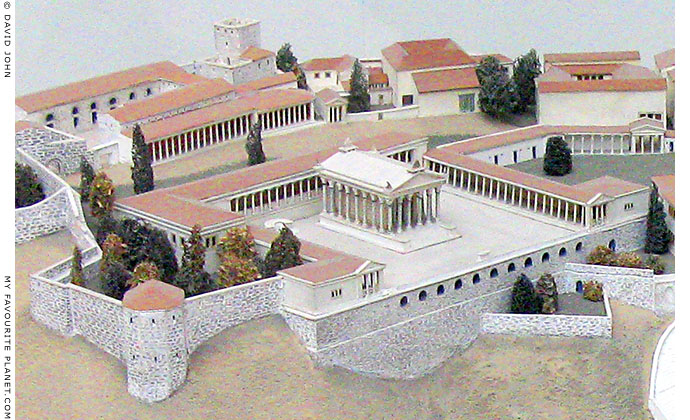
The temple construction of Trajan or Trajaneum was started by the Roman emperor Trajan (53-117 CE). After his death, emperor Hadrian (117-138 CE) completed the construction of the temple in Corinthian order. The temple was placed upon a terrace of the acropolis. Both the emperors were worshipped here as they were considered divine. Attempts have been continuing by German archaeologists since 1976 to erect this temple which has a peripteros plan (one row of columns around the temple). It is completely built of marble. Please click to see a Model of the Trajaneum in Berlin museum showing how the Trajaneum looked when it was built.
---------------------------------------------------------------------- -----------
All my photographs are © Copyrighted and All Rights Reserved.
Built in 113AD. It rises 38 metres above Rome.
It commemorates the emperor's victories over the ancient Dacians. It is decorated with a spiral frieze featuring 155 scenes carved in marble, which are a kind of chronicle of the war.
The restored Kiosk of Trajan added to the right of the main Isis temple at Philae, the island sanctuary relocated to Agilkia islet after flooding by the Aswan dam
Trajan's Columnis
is a Roman triumphal column in Rome, Italy,
that commemorates Roman emperor Trajan's victory in the Dacian Wars.
Completed in AD 113, the freestanding column is most famous for its spiral bas relief
The structure is about 30 metres (98 ft) in height, 35 metres (125 ft)
The shaft is made from a series of 20 colossal Carrara marble drums, each weighing about 32 tons,
@Wikipedia
This forum was built on the order of the emperor Trajan with the spoils of war from the conquest of Dacia,
the Forum was inaugurated in 112.
To build this monumental complex, extensive excavations were required: workers eliminated the sides of the Quirinal and Capitoline (Campidoglio) Hills, which closed the valley occupied by the Imperial forums toward the Campus Martius