View allAll Photos Tagged technologist
About Me:
I am Pranav Bhasin, a technologist by education, photographer by passion, cyclist and runner by desire, entrepreneur by choice and an ardent traveler.
My photography is an attempt to mirror the soul of places I have been to, people I have met and things I have experienced during my travels. Please visit Pranav Bhasin's Photo Gallery and Photo Blog for a collection of my best photos.
You can also connect with me at: My Product Management and Social Media Blog, Facebook, Twitter, LinkedIn, Pinterest, Foursquare.
In case you are interested in using my photos, please write to me and I would be happy to offer them for a price. Please do not use my photos without prior authorization from me. Thanks!
During the course of my travels (~100k flown miles per year on United), I've learned a few things. Being a technologist and a huge fan of gear, I've had the opportunity to field a variety of different bags, cameras, flashlights, laptops, tablets, e-readers, mp3 players, IEMs, etc. I thought I'd share a few tricks of the trade that have stuck over time and have made my travels simpler.
There are a few themes I follow when I travel - less is more, redundancy is good, lighter is better. If I pack something and don't use it after 3 trips, it comes out. There are a few exceptions to this rule - the most notable being a basic First Aid kit that I keep in my toiletries bag - Edit: per requests sent to me via messages, I will post the contents of the first aid kit in a future post - short version includes safety pins, emergency medications like Advil, Tylenol, Nyquil, Caffeine, Imodium), a small sewing kit, Neosporin, bandaids, a chemlight, small packable towel, etc.
L:R
Garmin GPSMap 62s handheld GPS. Mine has a 16gb Sandisk MicroSDHC card loaded with city and topo maps for just about every continent I could possibly end up on. Great for finding directions in a new city both on foot and in-car. I carry this vs a car-mounted GPS because this handheld GPS takes AA batteries (I load mine up with Energizer Lithiums), which can easily be replaced if I'm on foot. Can't say the same for most in-vehicle GPS devices.
SureFire Flashlight - The model varies because I have so many it's absurd, but it's always a 2xCR123 model. This time it's an L4 Lumamax. It's also always the 2nd SureFire I have with me (I carry a SureFire Titan T1A in my pocket everywhere). I always have spare batteries with me as well - usually 2 or 4 of them.
Doorstop - This hasn't seen much use in recent times because I mostly stay in Starwood properties (the W San Francisco for this trip) that at least provide a decent illusion of security, but it doesn't weigh much and I keep it around anyway because I like having it with me. This particular doorstop can be deployed in a variety of ways to keep doors open, keep them closed, etc. If you've ever seen how easily an older-style hotel door chain-lock can be bypassed - same for some keycard locks - you'll understand =]
Recyclable tote bag - This one came from a conference - they fold up nice and flat and don't weigh much and are handy to have for lugging around handouts, souvenirs, and just creating some extra storage if your main pack is full.
Radio - This one is a Yaesu VX-3R 2m Ham radio with a little stubby Maldol antenna. I think it's very handy to have. Cellular networks are among the first things to buckle during a disaster or even when under heavy load at a tech conference - having a radio is very handy.
Watch - Sometimes mechanical, sometimes digital - it really depends on where I'm going and for what purpose. This Suunto Core watch is nice because it has a compass, keeps track of temperature/barometric pressure, etc. Also, it has an alarm, which is really handy until the day comes when I wind up with a mechanical watch with minute repeater from Ulysse Nardin or Audemars Piguet ;]
Phones - iPhone 5 pictured here - I carry 3 phones. 1 work phone and 2 "personal" phones - of the 2 personal phones, one is always an unlocked phone ready to take a SIM that I purchase at my destination. I have AT&T and Verizon as my carriers - if you only have AT&T, you can probably guess why I have two different carriers. I included the phone here because of a specific trick I've been employing for years - I use the camera on my phone to capture quick photos of things I'd otherwise forget during my travels that may be important...like the # of the cab I get into (if I have to ride in a cab) just in case I leave something behind, or a map of my hotel's fire egress route. In the event of an emergency, just about everyone these days will grab their phone, so...
Retractable Cables - I love these. I carry a CAT6, 2x Mini USB and 2x Micro USB - two of them frequently get used with my:
Mini 802.11 AP - This one was a gift from my brother from his last trip to Taiwan, so the menu/firmware is all in Chinese - good thing "SSID" and the other basic things were easy to figure out. A similar American model is available on Amazon. This thing is fantastic - powered via Micro USB and has a WAN IN and LAN out port on it - instant wifi in a hotel room that otherwise only has CAT5E and wants to charge extra for wifi. I always SSH tunnel into my home network before connecting out when on any sort of a public network and use FoxyProxy in Firefox to send my web traffic through my home internet as well.
Location-specific items - I was in San Francisco during this trip and so I had a BART ticket with me as well as a FastTrak (bridge/toll road payment device). You can usually purchase bus passes, train tickets, etc online in advance these days - I like to go prepared whenever possible. The BART tickets ended up being really handy during this trip as I decided to cancel my rental car at the last minute when I figured out that overnight parking at the W hotel in SF is $60/night.
Verizon MiFi - Mine has the huge Mugen Power battery on it. This device is a godsend. I never leave home without it. At some point I had an AT&T 4G device as well, which gave me the redundancy I so badly long for (GSM and CDMA), but I no longer have that. I haven't upgraded to an LTE device because Mugen Power doesn't make a huge battery for the newer MiFis...yet.
Alfa high-power WiFi adapter - Because sometimes - just sometimes - I need to hit a wireless network that's far away and am getting unusable service from my Verizon MiFi. The Alfa gets it done.
Outlets - Another godsend - this one turns a single outlet into 3 + 2 USB. Fantastic in airports, hotel rooms, and just about everywhere else.
I have a few other little things I do that make sense to me but may seem absurd to others: an example would be that I never push out my TripIt/travel status (Aaron is leaving on a trip to _______ for x days) on Facebook, etc. And most of the time, I try to avoid posting my travel photos/details of my whereabouts until I'm nearly home or at home. Maybe it's paranoia, but as a former home burglary victim and a desirable target for all sorts of opportunity criminals, I just can't see a reason why I should make it easier for them by announcing that I plan to be away from my home.
Late last year my local airport implemented TSA's PreCheck, which is a great throwback to travelling pre-9/11. I get to keep my shoes, belt and jacket on and my toiletries and laptop don't need to come out of my bag. The only thing that goes in a bin are my mobile phones. My average time through security (including the "line") has been UNDER 1 MINUTE at the airports I've visited that have PreCheck. I qualified for PreCheck via my enrollment in Global Entry, which is also fantastic as it lets me bypass the lines to re-enter the US at customs.
Explored 4/2/2013
This is the first image ever taken of Earth from the surface of a planet beyond the Moon. It was taken by the Mars Exploration Rover Spirit one hour before sunrise on the 63rd Martian day, or sol, of its mission. (March 8, 2004)
The image is a mosaic of images taken by the rover's navigation camera showing a broad view of the sky, and an image taken by the rover's panoramic camera of Earth. The contrast in the panoramic camera image was increased two times to make Earth easier to see.The inset shows a combination of four panoramic camera images zoomed in on Earth. The arrow points to Earth. Earth was too faint to be detected in images taken with the panoramic camera's color filters.
Credit: NASA/JPL/Cornell/Texas A&M
NASA Goddard Space Flight Center is home to the nation's largest organization of combined scientists, engineers and technologists that build spacecraft, instruments and new technology to study the Earth, the sun, our solar system, and the universe.
Follow us on Twitter
Join us on Facebook
About Me:
I am Pranav Bhasin, a technologist by education, photographer by passion, cyclist and runner by desire, entrepreneur by choice and an ardent traveler.
My photography is an attempt to mirror the soul of places I have been to, people I have met and things I have experienced during my travels. Please visit Pranav Bhasin's Photo Gallery and Photo Blog for a collection of my best photos.
You can also connect with me at: My Product Management and Social Media Blog, Facebook, Twitter, LinkedIn, Pinterest, Foursquare.
In case you are interested in using my photos, please write to me and I would be happy to offer them for a price. Please do not use my photos without prior authorization from me. Thanks!
GOES 12 satellite image showing earth on March 16, 2010 6:45 AM EDT.
Credit: NOAA/NASA GOES Project
NASA Goddard Space Flight Center is home to the nation's largest organization of combined scientists, engineers and technologists that build spacecraft, instruments and new technology to study the Earth, the sun, our solar system, and the universe.
Follow us on Twitter
Join us on Facebook
Goddard technologist Nithin Abraham, a member of the team that has developed a low-cost, low-mass technique for protecting sensitive spacecraft components from outgassed contaminants, studies a paint sample in her laboratory.
To read this story go to: www.nasa.gov/topics/technology/features/outgas-tech.html
Credit: NASA/Pat Izzo
NASA Goddard Space Flight Center enables NASA’s mission through four scientific endeavors: Earth Science, Heliophysics, Solar System Exploration, and Astrophysics. Goddard plays a leading role in NASA’s accomplishments by contributing compelling scientific knowledge to advance the Agency’s mission.
Follow us on Twitter
Like us on Facebook
Find us on Instagram
From: www.infuture.ca
Project Description:
Rob King’s Trillium Icosaflorum explores the symbolic presence of Ontario Place’s Cinesphere. Inspired by Buckminster Fuller’s Biosphere design at Montreal’s Expo 67, the Cinesphere is often mistaken for a geodesic dome (in fact, it is a triodectic dome, a related but different structure). King’s outdoor sculpture examines the techno-utopianism and mathematical purity the geodesic dome has come to signify, using interlocking angular forms to build a sculpture inspired by the Cinesphere’s unique form and geometrical playfulness. A compelling monumental form marked by elegant symmetry,Trillium Icosaflorum questions the origins of commonly-accepted ideas about beauty, exactitude, innovation and futurism.
Biography:
Rob King is an Toronto based New Media artist and creative technologist. He is the founder of XZZ Creative Technologies (xzz.ca), and his work has been shown worldwide in such diverse sites as Sao Paulo, MOMA New York, Belfast, Budapest, Weimar and Montreal. Rob has been producing art and technology since 2004. His work has ranged from acrylic laser sharks to bluetooth enabled diaper sensors. In 2011 Rob's work Tentacles (a collaboration with Geoffrey Shea and Michael Longford) was shown as part of the Talk To Me show curated by Paola Antonelli at the Museum of Modern Art in New York City. In 2009-10 Rob was selected as the as the COMEDIA artist in residence at the Sonic Arts Research Center at Queen's University in Belfast. In this position he developed a series of live performance visuals for improvised network music performance. In 2008 he created the Apiograph project, a visualization of the pollination activities of a nest of bumble bees installed in the *new* gallery in Toronto. Rob is the founder of Addi.tv Art+Code / XZZ, a company that develops provides creative coding services for commercial clients as well as artists and arts organizations. Some of his clients have included Lego, Nike, Scotiabank, Nissan, and We Day.
About Me:
I am Pranav Bhasin, a technologist by education, photographer by passion, cyclist and runner by desire, entrepreneur by choice and an ardent traveler.
My photography is an attempt to mirror the soul of places I have been to, people I have met and things I have experienced during my travels. Please visit Pranav Bhasin's Photo Gallery and Photo Blog for a collection of my best photos.
You can also connect with me at: My Product Management and Social Media Blog, Facebook, Twitter, LinkedIn, Pinterest, Foursquare.
In case you are interested in using my photos, please write to me and I would be happy to offer them for a price. Please do not use my photos without prior authorization from me. Thanks!
A detail view of a filament launch in the SDO AIA 304 band.
Credit: NASA/GSFC/SVS/SDO
To read more about this animation go to: www.nasa.gov/mission_pages/sdo/news/first-light.html
NASA Goddard Space Flight Center is home to the nation's largest organization of combined scientists, engineers and technologists that build spacecraft, instruments and new technology to study the Earth, the sun, our solar system, and the universe.
Our amazingly talented bff sent through the next wave of tees!
These are available in SD only but in more designs and colours than last time. There are 17 total and each tee is $22 + $5 shipping. Shipping is the same no matter how many you buy!
All seams are finished professionally by a qualified (human) fashion technologist in Scotland c:
If you'd like a specific design on a certain colour, that can be arranged but please message me for more info c: <3
Satellite image showing earth on March 6, 2010.
Credit: NOAA/NASA GOES Project
NASA Goddard Space Flight Center is home to the nation's largest organization of combined scientists, engineers and technologists that build spacecraft, instruments and new technology to study the Earth, the sun, our solar system, and the universe.
Follow us on Twitter
Join us on Facebook
I was first tagged by Christian et Cie then by Thierry la Fronde, so I feel I don't really have a choice here... ;-) That's a fun game, I admit (because I learned a lot about my contacts), but I would never consider being tagged alone, as my partner in crime helps a lot with the pictures I post here. I'm talking about David of course (Birdman)... ;-)
So here are 16 random things about us (there will be less to say about me):
1. I'm 4 years older than David. Yeah, I know how to pick them! I spotted him in Cuba on 26 December 2003. What do you know... He was travelling with a friend but ended spending more time with me (sorry John!). ;-)
2. We live in Bishop's Stortford in Hertfordshire, England, a pleasant little town close to Stansted airport (convenient for our travels). People often comment about the amount we travel. I suppose it's become a bit of an addiction as it's easy and cheap for us to reach many destinations in Europe on 'no-frills' budget airlines (and sometimes the flights are even free! Not too expensive when you book an hotel with your Airmiles).
3. I used to be a legal secretary who always wanted to be a graphic artist. Now I'm a legal secretary who would like to be a professional photographer. David is a technologist who invents recipes for polymers, glues and all those fascinating things that you can buy in a tube at B&Q. As a teenager, he wanted to become a make-up artist for horror movies... oh dear! He used to ‘entertain’ his parents by entering the room with fake flesh wounds, missing limbs and eyes hanging out on stalks.
He tried that with me once, lying on the kitchen floor with ketchup on his jeans and a bit of hotdog on the floor, pretending he'd chopped off a finger. I was not impressed! I just stepped over him and went to the loo. Since then he says I'm very insensitive!
4. I'm not a sporty person (I much prefer my chair in front of the PC) as I feel I'm kind of jinxed: someone once threw a dart in my forearm, then at the 'school's Olympics', someone threw a discus into the back of my head, then later on it was a pool ball in the forehead, then my cousin tried to drown me under a rowing boat... David, on the other hand, is a football maniac and Manchester United fan. He played regularly up until a few months ago, but kept coming home broken after each game. "I'm too old, he said!". (Oops! Update here – He says he's going to try again this Friday evening!)
5. As you probably have realised by now, David is a keen birdwatcher. This fits well with my photography, as we get to see a lot of places I wouldn't normally think of visiting (such as the Scilly Isles). While he chases birds around, I have fun with my Canon! David has seen 407 species of birds in the UK, God knows how many worldwide...
6. What kind of music do we like? Well, that's not easy to answer. I remember the first two albums I bought at 13: Dark Side of the Moon and Saturday Night Fever... Yeah... ;-) A short while after that I bought the first five albums of Led Zep, as well as Abba and Beatles albums. But lets say that for a long time, you could classify me as a Rocker, as my gang and I were into Black Sabbath, Deep Purple, etc. Today I'm more into easy listening stuff, and I really like Amy Winehouse! ;-) As for David, he also likes all the above and Rush (a Canadian band... yeh!). His favourite album is Grace by Jeff Buckley.
7. David plays the guitar and sings (pretty well!) He should have joined a band when he was young but was always too lazy (some things never change)! ;-) Now he just plays for his own amusement. I'm the only person who ever hears him play (and sing) these days, what a shame! At least it gives him something to do while I play Flickr!
8. We both like good movies, especially on a lazy Sunday morning when the weather's too bad to go out to play! Our all time favourites are the French classics Jean de Florette and Manon des Sources, by Marcel Pagnol. Other favourites include:
Anik: Frida, Gandhi, Catch me if you can, Forrest Gump and C.R.A.Z.Y. (a Québec movie that depicts what Québec was like when I grew up).
David: The Green Mile, Shawshank Redemption, Twelve Monkeys, American Beauty, Midnight Cowboy, March of the penguins (oh boy ... does he love March of the penguins!...)
9. Thanks to **Gwen**, I have discovered an author I really like these days, and I'm talking about Welsh novelist Ken Follett. One day Gwen suggested I read "Pillars of the Earth". It took me forever, but I finally read it in French (Les Piliers de la terre). I simply adored it. Then I read the 'sequel' (in English), World without End. David is now reading this but he keeps complaining that the book is too heavy!!!
10. Our current car is a gold coloured Peugeot 307 (which I chose by the way!). David does not like it much. It's an automatic, which I insisted we buy instead of the sports car he wanted! Anyway, being a Canadian, apparently I'm only allowed to drive automatics around here. David would be OK with that if only I would actually drive... but I don't! I never got used to the damn roundabouts and the narrowness of the roads in this country. To make things worse, I still need the GPS just to go to the grocery store, and I still manage to bump the curb every time (that's probably because I drive with my two eyes shut and I scream all the time...) ;-)
11. You know what annoys me most about England? ...the fact that they don't have screens in their windows here. I hate that because I'm terrified of spiders. Have you seen the size of the spiders around here? They're as big as mice and run as fast! I always try to make David kill them when I see one, but he systematically refuses! Instead, he carefully catches them (which can sometimes take half-hour) and puts them outside the door (so that they can easily get back in!)... HATE THAT!!! My solution is more radical. I Hoover them up whilst standing on the couch.
12. We both gave up smoking in October 2008 after I got very sick on our return from our trip to the Scilly Isles. I had a very bad chest infection and David, being the wonderful husband that he is, agreed to give up smoking with me from that day forward. Since we both love smoking and find it very difficult to stop altogether, we agreed that we could still smoke every now and then, but only when we're on holiday. Need I tell you I can't wait for the next one? ;-)
13. As a young man David was very accident prone. He once ran into a concrete pipe which caused such a deep wound on his head that he could touch his skull! He also broke his arm from sliding down the banister in his house and was hit by a motorbike which resulted in him having to have his earlobe stitched back on! I think it's just as well that he gave up paragliding when he did...
14. When we met, David had a nipple ring! I think you know what I think of piercings by now... ;-) Eventually I made him get rid of it (body-piercings on over-40's is very undignified I think!)
15. This photo is absolutely rubbish. I just wanted to try (without too much effort, I confess), my new Sigma 30mm f/1.4 lens... I wanted to see what I could obtain in our dark living room without a flash. Not impressed so far! ;-))
16. Where does this story end? Hopefully in British-Columbia, Canada. This is one of the places I would like to retire to, if not in Québec (but this is very unlikely because David doesn't seem to be able to learn French). However, wherever we are in the world when we retire, one of our dreams would be to publish a book about all the places we visited, with my photos and David's texts. Yeah, dream on...
* * *
Now it's my turn to tag five of my contacts (but feel free to decline eh, no sweat!), I know some of you are really busy!... ;-)
Images taken immediately after the AIA CCD cameras cooled on March 30, 2010.
Credit: NASA/GSFC/SDO
To read more about this image go to: www.nasa.gov/mission_pages/sdo/news/first-light.html
To learn more about the SDO mission, visit: www.nasa.gov/sdo
NASA Goddard Space Flight Center is home to the nation's largest organization of combined scientists, engineers and technologists that build spacecraft, instruments and new technology to study the Earth, the sun, our solar system, and the universe.
About Me:
I am Pranav Bhasin, a technologist by education, photographer by passion, cyclist and runner by desire, entrepreneur by choice and an ardent traveler.
My photography is an attempt to mirror the soul of places I have been to, people I have met and things I have experienced during my travels. Please visit Pranav Bhasin's Photo Gallery and Photo Blog for a collection of my best photos.
You can also connect with me at: My Product Management and Social Media Blog, Facebook, Twitter, LinkedIn, Pinterest, Foursquare.
In case you are interested in using my photos, please write to me and I would be happy to offer them for a price. Please do not use my photos without prior authorization from me. Thanks!
A legendary high-performance on and off-roader, the Benzino G 63 possesses qualities worthy of such a moniker: Perfectly tuned by~PI~ technologist. An exciting and innovating competition crushing bodystyle and a sporty, luxurious interior. Also equipped with TV's inside.
BLOG:
nee-nees.blogspot.com/2017/01/pibenzino.html
Store Location for Prestige Imports::
Goddard technologist Vivek Dwivedi (right) and his collaborator, University of Maryland professor Raymond Adomaitis (left), are preparing to insert a sample inside a reactor that will apply a thin film using the atomic layer deposition technique.
Photo Credit: NASA/GSFC/Chris Gunn
NASA Goddard Space Flight Center enables NASA’s mission through four scientific endeavors: Earth Science, Heliophysics, Solar System Exploration, and Astrophysics. Goddard plays a leading role in NASA’s accomplishments by contributing compelling scientific knowledge to advance the Agency’s mission.
Follow us on Twitter
Like us on Facebook
Find us on Instagram
NASA GOES-13 satellite image showing earth on December 17, 2010.
Credit: NOAA/NASA GOES Project
NASA Goddard Space Flight Center is home to the nation's largest organization of combined scientists, engineers and technologists that build spacecraft, instruments and new technology to study the Earth, the sun, our solar system, and the universe.
Follow us on Twitter
Join us on Facebook
About Me:
I am Pranav Bhasin, a technologist by education, photographer by passion, cyclist and runner by desire, entrepreneur by choice and an ardent traveler.
My photography is an attempt to mirror the soul of places I have been to, people I have met and things I have experienced during my travels. Please visit Pranav Bhasin's Photo Gallery and Photo Blog for a collection of my best photos.
You can also connect with me at: My Product Management and Social Media Blog, Facebook, Twitter, LinkedIn, Pinterest, Foursquare.
In case you are interested in using my photos, please write to me and I would be happy to offer them for a price. Please do not use my photos without prior authorization from me. Thanks!
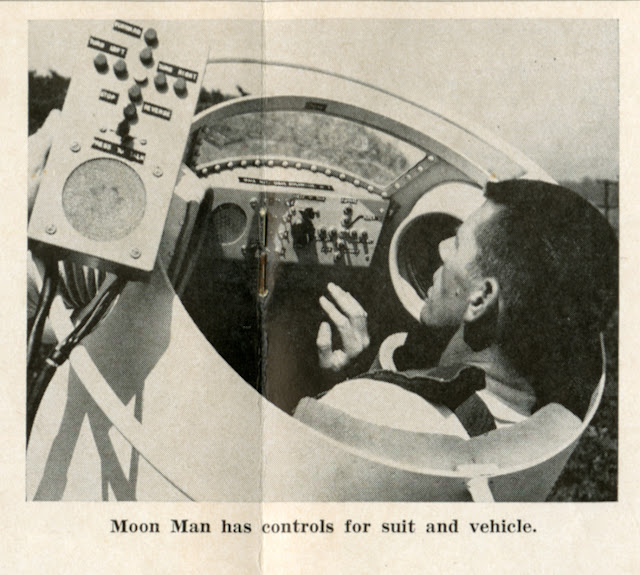
“Moon man has controls for suit and vehicle.”
“After Apollo – Exploring the Moon
After the Apollo spacecraft lands its three-man crew on the moon and brings them back safely, what’s the next step in lunar exploration?
A 12-man expedition to make a 500-mile research trip across the surface of the moon is proposed by Allyn B. Hazard, an engineer at Aerojet’s subsidiary, Space-General Corporation.
It could be done in this decade, he says.
The spacemen would travel to the moon in four rockets – three round-trip passenger vehicles, the other a one-way cargo ship with 30,000 pounds of supplies to support the men and their scientific studies.
Each of the astronauts would be a highly trained scientist or technologist in some particular field; some would be experts in several areas. On the moon, only four of them would make the trans-lunar journey, while the others remained at the rockets’ landing site to conduct research.
The four explorers would wear special tub-like spacesuits in which they would have to live and work, eat and sleep, for the entire trip. They couldn’t get out of the suits because of the airlessness and super-cold of the moon.
That’s the reason for the suit’s peculiar shape – the wearer can slip his arms out of the sleeves to eat, adjust controls, make notes, or even to scratch his nose.
Umbilical connections would link each suit to a tractor-like “moon mobile” carrying the oxygen and life support system for two men. These would carry their passengers across the lunar landscape at five miles an hour. A 500 mile journey (for instance, from Crater Gruithuisen to Crater Aristarchus and back) would take 10 earth days. It would be made during the 330-hour lunar night, to avoid exposing the men to the sun’s radiation.”
All of the above is from the 1962 edition of “AEROJET-GENERAL SPACELINES AND ROCKET REVIEW”. Conscientiously made possible/available by Mr. John Sisson, at his absolutely WONDERFUL “Dreams of Space - Books and Ephemera” blogspot:
dreamsofspace.blogspot.com/2013/06/after-apollo-exploring...
Specifically, the image (from the publication):
2.bp.blogspot.com/-1bVrH2BpGW8/UcCnYRYjBSI/AAAAAAAAFUw/jK...
Also. Wow. Note the umbilical. And, as if all of this wasn’t enough already…a “FLYING BELT”?! You’re kidding me! At least the risk assessment matrix for this would’ve been really simple, consisting of a single red cell at the intersection of the following column/row:
- Probability: HIGH
- Severity - Effect of Hazard: LOSS OF MISSION CAPABILITY, UNIT READINESS OR ASSET; DEATH:
3.bp.blogspot.com/-1yN70bdibrk/UcCndD9y9oI/AAAAAAAAFVA/pI...

So, now that the outlandish premise/proposal has been established:
An excellent photo looking into/at the control panel of the delightful, albeit preposterous MK-I Lunar Exploration Suit. At the controls is the man himself, Allyn Hazard. Per the Aerojet-General publication, the integrated space suit – moonmobile design concept is evident. Due to being confined to the suit, the Astronaut must “plug into/integrate” with the vehicle in order to control it.
I don't quite understand the handheld remote control to the left. If not for its voice communications functionality - requiring a breathable atmosphere in which employ it - I might've considered it to be for lunar use. Like maybe when walking along with the moon mobile if/when "unmanned"? If so, I assume the remote’s connectivity is also via the umbilical to the vehicle, it also serving as the primary source of power & life support?
Maybe it’s just for terrestrial testing/training?
Note the labeling, primarily the one at eye level, on the ‘helmet interface ring?’ – ”THINK”.
Ya ‘think’?!
Whether driving or walking, or both concurrently, AND if/when connected to the vehicle, it’s painfully obvious one had to constantly be alert, attentive and keenly situationally aware…over the course of traveling - up to 500 miles - at night!!!
Catastrophes waiting to happen.
Despite the obvious 'lunacy' of this whole thing, there’s something eminently likable about Mr. Hazard. Like Clarence when seeing the image of George Bailey the first time, from “It’s a Wonderful Life”:
“It’s a good face. I like it.”:
siarchives.si.edu/collections/siris_arc_393495
Credit: Smithsonian Institution Archives website
See also:
paleofuture.com/blog/2009/6/28/a-suit-for-the-first-man-o...
Credit: Paleofuture blog website
The zany & eccentric nature of Mr. Hazard and his ‘moon suit’ on full display at a home show held at the Los Angeles Memorial Sports Arena in 1965.
Per the original June 12, 1965 caption of the “Valley Times” newspaper:
“Home show queen Janice Johnson is helped out of a model of the Apollo spacecraft by Hap Hazard, space engineer, wearing the very latest design in suits for moon crawling. Cutaway model of Apollo is now on exhibit in Sports Arena, along with other aerospace features, 12:30 to 11 p.m. daily through June 20."
At:
calisphere.org/item/3b322fc826a4c1fa8152387936870fef/
Credit: The Los Angeles Public Library & University of California/CALISPHERE website
Regardless, continue to Rest In Peace Good Sir:
www.findagrave.com/memorial/87516589/allyn-b-hazard
Credit: “Find a Grave” website
I dyed my hair. Engineering technologists are expected to be plain and boring.
FUCK MY LIFE; I MADE THE WRONG CAREER CHOICE, AND I'M NOT EVEN THERE YET.
Dammit.
Also, my phone takes terrible pictures, I need a new one to take on dogs/woods adventures. That's what student loans are for, right? :D
EXPLORED? How can I be proud of that?! Thank you though :)
About Me:
I am Pranav Bhasin, a technologist by education, photographer by passion, cyclist and runner by desire, entrepreneur by choice and an ardent traveler.
My photography is an attempt to mirror the soul of places I have been to, people I have met and things I have experienced during my travels. Please visit Pranav Bhasin's Photo Gallery and Photo Blog for a collection of my best photos.
You can also connect with me at: My Product Management and Social Media Blog, Facebook, Twitter, LinkedIn, Pinterest, Foursquare.
In case you are interested in using my photos, please write to me and I would be happy to offer them for a price. Please do not use my photos without prior authorization from me. Thanks!
Todas as Pesquisas e Fotos anexas obtidas via Internet
06 de Outubro Homenageamos o Dia do Tecnólogo, Brasil
***
All Researches and accompanying photos obtained via the Internet
October 06 Day of Homage Technologist, Brazil
***
Toutes les recherches et les photos ci-jointes obtenus via l'Internet
Octobre 06 Jour de l'Hommage technologue, Brésil
***
***
***
YOUTUBE
www.youtube.com/watch?v=Ce7t5FyfYOI
Por Deus, Amigos Queridos assinem por MISERICÓRDIA de nossas FLORESTAS...
Por tudo que já SUPLIQUEI e que posto novamente!!
www.greenpeace.org/brasil/pt/O-que-fazemos/Amazonia/Pagin...
CONTINUO SUPLICANDO, QUANTAS VEZES FOREM NECESSÁRIAS!!
ASSINEM ESTAS PETIÇÕES, POR FAVOR...
- PARA SALVAR A AMAZÔNIA,
www.avaaz.org/po/belo_monte_people_vs_profits/?vl
- PARA SALVAR AS FLORESTAS DO BRASIL,
- PARA VETAR AS MUDANÇAS DO CÓDIGO FLORESTAL !
www.greenpeace.org/brasil/pt/Participe/Ciberativista/Codi...
www.avaaz.org/po/save_the_amazon_sam/?cl=1419482907&v...
VAMOS LUTAR POR NOSSO PLANETA, PELAS NOSSAS FLORESTAS, PELOS INDÍGENAS (NOSSOS IRMÃOS), PELOS NOSSOS FILHOS, NETOS, BISNETOS...PELAS PRÓXIMAS GERAÇÕES...POR UM MUNDO MELHOR...
O PLANETA TERRA PEDE SOCORRO!!
TUDO OU NADA ESTÁ EM NOSSAS MÃOS,... BRASILEIROS!!
Muito obrigada,
Celisa
***
By God, Dear Friends sign of our forests for mercy ...
For all that ever I pleaded and put it back!
www.greenpeace.org/brasil/pt/O-que-fazemos/Am azonia/Pagin...
CONTINUOUS Sulpice, as often as necessary!
Sign these petitions, PLEASE ...
- To save the Amazon,
www.avaaz.org/po/belo_monte_people_vs_profits/?vl
- TO SAVE THE FORESTS OF BRAZIL
- To veto FOREST CODE CHANGES!
www.greenpeace.org/brasil/pt/Participe/Ciberativista/Codi...
www.avaaz.org/po/save_the_amazon_sam/?cl=1419482907&v...
WE FIGHT FOR OUR PLANET, FOR OUR FORESTS, INDIGENOUS BY (OUR BROTHERS), for our children, grandchildren, great grandchildren for generations to come ... ... ... FOR A BETTER WORLD
ASKS HELP THE PLANET EARTH!
ALL OR NOTHING IS IN OUR HANDS, ... BRAZILIAN!
Thank you so much,
Celisa
***
Par Dieu, Chers Amis signe de nos forêts pour la miséricorde ...
Pour tout ce que j'ai plaidé et le remettre!
www.greenpeace.org/brasil/pt/O-que-fazemos/Am azonia/Pagin...
Sulpice CONTINUE, aussi souvent que nécessaire!
S'il vous plaît signer ...
- Pour sauver l'Amazonie,
www.avaaz.org/po/belo_monte_people_vs_profits/?vl
- Pour sauver les forêts du Brésil
- De mettre son veto CHANGEMENTS Code forestier!
www.greenpeace.org/brasil/pt/Participe/Ciberativista/Codi...
www.avaaz.org/po/save_the_amazon_sam/?cl=1419482907&v...
Nous luttons pour notre planète, pour nos forêts, AUTOCHTONES PAR (NOS FRÈRES), pour nos enfants, petits-enfants, arrière petits-enfants pour les générations à venir ... ... ... POUR UN MONDE MEILLEUR
DEMANDE AIDE LA PLANETE TERRE!
Tout ou rien est entre nos mains, ... Brésilienne!
Je vous remercie,
Celisa
***
Por Dios, queridos amigos: signo de nuestros bosques por la misericordia ...
Por todo lo que he declarado y poner de nuevo!
www.greenpeace.org/brasil/pt/O-que-fazemos/Am azonia/Pagin...
CONTINUA Sulpice, cuantas veces sea necesario!
Firmar estas peticiones, por favor ...
- Para salvar el Amazonas,
www.avaaz.org/po/belo_monte_people_vs_profits/?vl
- PARA SALVAR LOS BOSQUES DE BRASIL
- De vetar los cambios Código Forestal!
www.greenpeace.org/brasil/pt/Participe/Ciberativista/Codi...
www.avaaz.org/po/save_the_amazon_sam/?cl=1419482907&v...
LUCHAMOS POR NUESTRO PLANETA, PARA NUESTROS BOSQUES, POR INDÍGENAS (NUESTROS HERMANOS), para nuestros hijos, nietos, bisnietos para las generaciones futuras ... ... ... POR UN MUNDO MEJOR
PIDE AYUDA AL PLANETA TIERRA!
TODO O NADA ESTÁ EN NUESTRAS MANOS ... BRASIL!
Gracias,
Celisa
***
Per Dio, cari amici segno delle nostre foreste per pietà ...
Per tutto ciò che mai ho supplicato e rimetterlo!
www.greenpeace.org/brasil/pt/O-que-fazemos/Am azonia/Pagin...
Sulpice CONTINUO, ogni qualvolta sia necessario!
SIGN queste petizioni, PER FAVORE ...
- Per salvare l'Amazzonia,
www.avaaz.org/po/belo_monte_people_vs_profits/?vl
- PER SALVARE LE FORESTE DEL BRASILE
- Per veto modifiche al codice FORESTA!
www.greenpeace.org/brasil/pt/Participe/Ciberativista/Codi...
www.avaaz.org/po/save_the_amazon_sam/?cl=1419482907&v...
Lottiamo per IL NOSTRO PIANETA, PER I NOSTRI BOSCHI, indigene da parte (NOSTRI FRATELLI), per i nostri figli, nipoti, pronipoti per le generazioni a venire ... ... ... PER UN MONDO MIGLIORE
CHIEDE AIUTO DEL PIANETA TERRA!
Tutto o niente è nelle nostre mani, ... BRASILIANO!
Grazie,
Celisa
***
***
***
Dezenas de milhões de câes e gatos são ASSASSINADOS BRUTALMENTE, com INSTINTOS de CRUELDADE na CHINA !!
Amigos Queridos eu suplico, assinem esta PETIÇÃO, é um PEDIDO de Ativistas e Protetores de Animais que estão se mobilizando no MUNDO INTEIRO, em favor das vidas destes MÁRTIRES!!
Em DOIS MINUTOS pode-se assinar!! São seres INDEFESOS, eu ROGO, por Deus!!
www.change.org/petitions/the-chinese-government-stop-the-...
Muito obrigada,
Celisa
***
Tens of millions of dogs and cats are brutally murdered, with instincts of cruelty in CHINA!
Dear Friends, I beg, sign this petition, it is a request for Activists and Animal Protectors who are mobilizing around the world, in favor of the lives of Martyrs!
In two minutes you can sign up! They are helpless, I pray, by God!
www.change.org/petitions/the-chinese-government-stop-the-...
Thank you,
Celisa
***
Des dizaines de millions de chiens et de chats sont brutalement assassinés, avec des instincts de cruauté en Chine!
Chers amis, je vous prie, signez cette pétition, et une demande pour les activistes et les protecteurs des animaux qui se mobilisent autour du monde, en faveur de la vie des martyrs!
En deux minutes, vous pouvez vous inscrire! Ils sont impuissants, je prie, par Dieu!
www.change.org/petitions/the-chinese-government-stop-the-...
Je vous remercie,
Celisa
***
Decenas de millones de perros y gatos son brutalmente asesinados, con los instintos de crueldad en China!
Queridos amigos, os ruego, firmen esta petición, y una petición de activistas y los protectores de animales que se movilizan en todo el mundo, a favor de la vida de los mártires!
En dos minutos se puede firmar para arriba! Están indefensos, te ruego, por Dios!
www.change.org/petitions/the-chinese-government-stop-the-...
Gracias,
Celisa
***
Decine di milioni di cani e gatti vengono brutalmente assassinati, con istinti di crudeltà in CINA!
Cari amici, vi prego, firmare questa petizione e una richiesta di attivisti e protettori degli animali che si stanno mobilitando in tutto il mondo, a favore della vita dei martiri!
In due minuti puoi iscriverti! Sono impotente, io prego, per Dio!
www.change.org/petitions/the-chinese-government-stop-the-...
Grazie,
Celisa
***
***
***
Que Deus abençoe a todos os Queridos Amigos, principalmente nossas Queridas Amigas @rtbene, Blankita e Mag, e alivie o sofrimento daqueles que tanto necessitam.
Beijos em seus corações,
Celisa
***
May God bless all the Dear Friends, mainly our Dear Friends @rtbene, Blankita and Mag, relieve the suffering of those who so desperately need.
Kisses in your hearts,
Celisa
***
Que Dieu bénisse tous les chers amis, en particulier notre cher ami @rtbene, Blankita et Mag, et soulager la souffrance de ceux qui ont si désespérément besoin.
Bisous dans ton coeur
Celisa
***
Que Dios los bendiga a todos los queridos amigos, en especial nuestro querido amigo @rtbene, Blankita y Mag, y aliviar el sufrimiento de aquellos que tan desesperadamente necesitan.
Besos en tu corazón
Celisa
***
Che Dio benedica tutti i cari amici, soprattutto il nostro caro amico @rtbene, Blankita e Mag, e alleviare le sofferenze di coloro che così disperatamente bisogno.
Baci nel tuo cuore
Celisa
Investigation of the morphology and composition of an oxide layer formed on the surface of a steel X70 . Research conducted by the technologist Thais Mansur (Division of Corrosion / INT / MCTI ).
Courtesy of Mr. FRANCISCO RANGEL
Image Details
Instrument used: Quanta SEM
Magnification: 2000x
Horizontal Field Width: 149 µm
Vacuum: 70 Pa
Voltage: 10 kV
Spot: 3.0
Working Distance: 15.0
Detector: SE PLUS BSE
NASA video release April 22, 2010
This is a zoom into the Carina Nebula, where thousands of stars are born from primeval gas and dust. The zoom sequence centers on a giant tower of cool hydrogen. Stars are forming inside this incubator and fire off jets of material.
Credit: NASA and G. Bacon (STScI)
To read learn more about this video go to: www.nasa.gov/mission_pages/hubble/science/hubble20th-img....
NASA Goddard Space Flight Center is home to the nation's largest organization of combined scientists, engineers and technologists that build spacecraft, instruments and new technology to study the Earth, the sun, our solar system, and the universe.