Syria/Lebanon/palestine/Jordan بلاد الشام
View allAll Photos Tagged syria
Three strong oxen were living in the bush. one red, white and black. One day a lion came upon them and wondered how he might eat the three oxen. The lion realized that he could not attack all the three oxen at the same time . He made a plan to divide them and eat them one by one.
The lion came to the red & black oxen and told them that the white ox was spoiling the bush where they lived. He suggested that the white ox should be killed in order to save the environment. Unknowingly the two oxen thought that the lion was right and allowed him to kill and eat the white ox.
After few days, the lion again came to the red ox and told him that the black ox was arrogant and was intending to kill him (the red ox). The lion suggested that he should protect the life of the red ox by killing the black ox. The red ox agreed the lion’s plan and killed the black ox.
After few days the lion came to the red ox and said, “It is now your time to die.”
The red ox now understood the planned trick of the lion, but was powerless .
The red ox said to the lion,
“You killed me when you killed the white ox.”
Syrian woodpecker (Dendrocopos syriacus) male on a tree trunk.
Samiec dzięcioła białoszyjego (Dendrocopos syriacus) na pniu drzewa.
Syrian woodpecker (Dendrocopos syriacus) male foraging on a branch.
Samiec dzięcioła białoszyjego (Dendrocopos syriacus) żerujący na gałęzi.
Canon EOS 50D + Canon EF-S 18-135mm f/3.5-5.6 IS...
www.flickriver.com/photos/42633755@N04/
Follow me on ...
Instagram :
500px :
Facebook group :
www.facebook.com/groups/1714937958764701/
Facebook :
www.facebook.com/balamirolcay/
Website Fotografturk :
www.fotografturk.com/2307/portfolyosu
Website :
Google+ :
plus.google.com/110528275142555453009
Google+ communities ... :
Syrian woodpecker, oder auch Dendrocopos syriacus, der Blutspecht. Fotografiert in Ungarn, Hortobágyi. Futtertragend, am Nest.
Portrait of an internally displaced Syrian refugee girl in the Atmeh refugee camp, Idlib province Syria.
.
John Wreford is a freelance photojournalist based in Istanbul, Turkey.
Palmyra is a set of spectacular ruins in Syria (which none of us have visited recently), but which I was fortunate to have seen in 2001. ISIS dynamited several of the monuments here, murdered the chief historian, etc. and tried to remove any evidence of any pre-Islam religion. The Brits set up a model of this arch in London (Trafalgar Sq), which was on the news yesterday.
Preservationists/archaeologists who have visited the site (since its recent re-capture by the Syrian govt) are cautiously optimistic that some of these monuments (including this arch) can be reconstructed...
Syria in 2010.
Krak des Chevaliers is a Crusader castle in Syria and one of the most important medieval castles in the world.
Syrian woodpecker (Dendrocopos syriacus) on a tree trunk.
Dzięcioł białoszyi (Dendrocopos syriacus) na pniu drzewa.
Leaving an oily smudge over the desert - the beaten up Hartmann loco forges a lonely path across the sands with its rickety train en route from Damascus to Deraa on the old Hedjaz Railway.
Syria. October 2007. © David Hill.
Syrian woodpecker (Dendrocopos syriacus) female foraging on a branch.
Samica dzięcioła białoszyjego (Dendrocopos syriacus) żerująca na gałęzi.
Reuters, October 5, 2015:
Islamic State militants have blown up the Arch of Triumph, a major monument in the 2,000-year-old Roman city of Palmyra, Syria's antiquities chief said on Sunday, after they destroyed two ancient temples at the central Syrian site in recent months.
The good shepherd seemed anxious that the unusual occurrence of a steam hauled train, albeit a ramshackle one, might spook the flock. He need not have worried - they all took it in their stride.
Somewhere between Deraa and Bosra in Syria.
October 2007. © David Hill
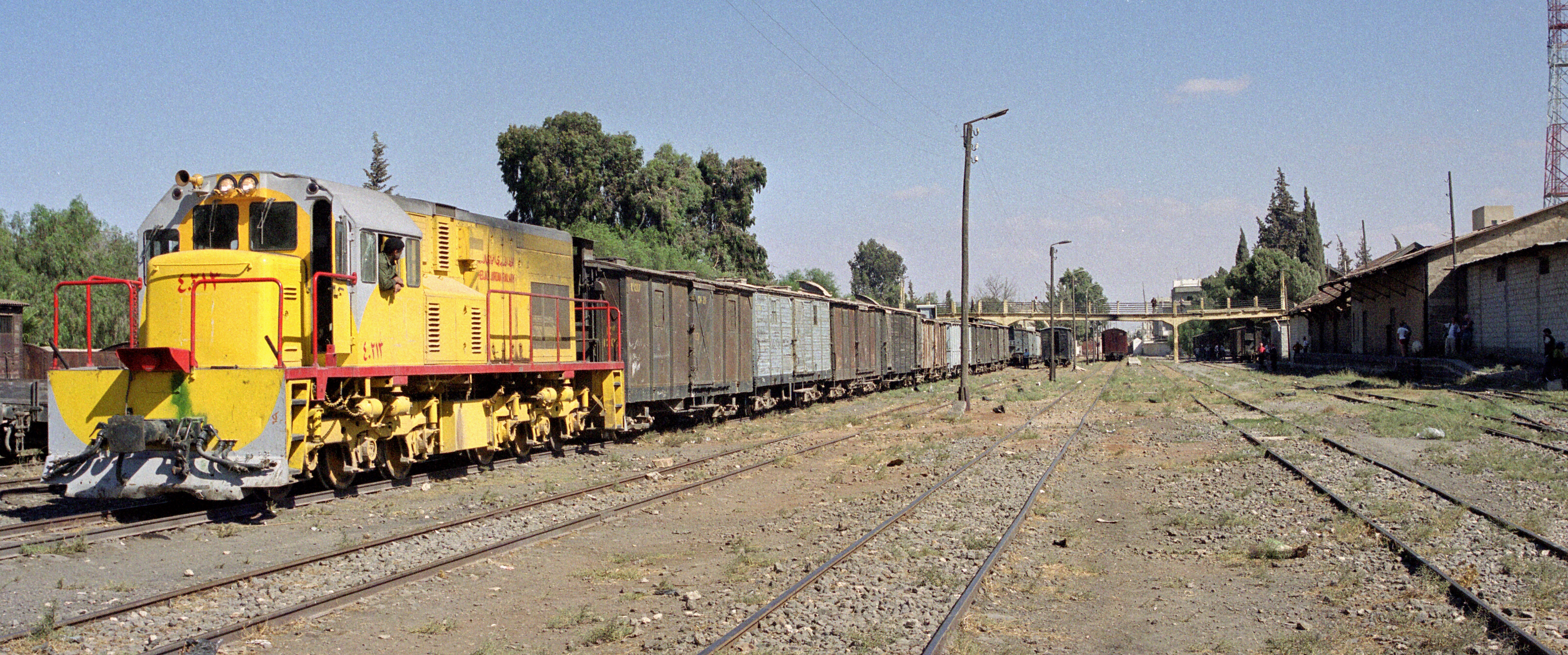
Diesel-electric locomotive 40213 (GE U10B) at Dera'a station, Syria, having arrived with a freight train from Amman, Jordan, Hedjaz Railway, 13/9/00.
Photographer Nigel Tout
A Russian military police armoured personnel carrier (APC) drives along a road in the countryside near the northeastern Syrian town of Amuda in Hasakeh province on October 24, 2019, as part of a joint patrol between Russian forces and Syrian Kurdish Asayish internal security forces near the border with Turkey. - Russian forces have started patrols along the flashpoint frontier, filling the vacuum left by a US troop withdrawal that effectively returned a third of the country to the Moscow-backed regime of President Bashar al-Assad. (Photo by Delil SOULEIMAN / AFP)
Palmyra is an ancient Semitic city in present-day Homs Governorate, Syria. Archaeological finds date back to the Neolithic period, and documents first mention the city in the early second millennium BC. Palmyra changed hands on a number of occasions between different empires before becoming a subject of the Roman Empire in the first century AD.
The city grew wealthy from trade caravans; the Palmyrenes became renowned as merchants who established colonies along the Silk Road and operated throughout the Roman Empire. Palmyra's wealth enabled the construction of monumental projects, such as the Great Colonnade, the Temple of Bel, and the distinctive tower tombs. Ethnically, the Palmyrenes combined elements of Amorites, Arameans, and Arabs. The city's social structure was tribal, and its inhabitants spoke Palmyrene (a dialect of Aramaic), while using Greek for commercial and diplomatic purposes. Greco-Roman culture influenced the culture of Palmyra, which produced distinctive art and architecture that combined eastern and western traditions. The city's inhabitants worshiped local Semitic deities, Mesopotamian and Arab gods.
By the third century AD Palmyra had become a prosperous regional center. It reached the apex of its power in the 260s, when the Palmyrene King Odaenathus defeated Persian Emperor Shapur I. The king was succeeded by regent Queen Zenobia, who rebelled against Rome and established the Palmyrene Empire. In 273, Roman emperor Aurelian destroyed the city, which was later restored by Diocletian at a reduced size. The Palmyrenes converted to Christianity during the fourth century and to Islam in the centuries following the conquest by the 7th-century Rashidun Caliphate, after which the Palmyrene and Greek languages were replaced by Arabic.
Before AD 273, Palmyra enjoyed autonomy and was attached to the Roman province of Syria, having its political organization influenced by the Greek city-state model during the first two centuries AD. The city became a Roman colonia during the third century, leading to the incorporation of Roman governing institutions, before becoming a monarchy in 260. Following its destruction in 273, Palmyra became a minor center under the Byzantines and later empires. Its destruction by the Timurids in 1400 reduced it to a small village. Under French Mandatory rule in 1932, the inhabitants were moved into the new village of Tadmur, and the ancient site became available for excavations. During the Syrian Civil War in 2015, the Islamic State of Iraq and the Levant (ISIL) destroyed large parts of the ancient city, which was recaptured by the Syrian Army on 2 March 2017