View allAll Photos Tagged springtail
A juvenile instar (just over 0.4 mm) showing development of pigment patches. Good detail of arrangement of abdominal setae (I know that Frans is interested in this).
[Part of a garden survey of the "novel" springtail Katiannidae Genus nov.1 sp. nov. that I'm doing with FransJanssens@www.collembola.org initially, to establish the size and differences between the various instars. As a result of the initial findings, Frans is speculating that there are two distinct groups:
Group 1 - where abd.6 in adults is pale, and
Group 2 - where abd.6 in adults is dark.
Canon MP-E65mm Macro (at 5x) + 1.4x tele-extender + 25mm extension tube + diffused MT24-EX Twinlite flash. Heavily cropped.]
Globular springtail X4. Focus stacked using zerene. Taken handheld using a 4X microscope lens on a sony mirrorless body
So you may have noticed that I'm uploading a lot of Collembola shots at the moment. This is partly because I can't find much else to photograph. But mostly its because a group of us is trying to map Shropshire's springtails, something which we believe has never been done anywhere at County level before.
This individual was 2.5 - 3mm long.
Springtails. Proisotoma minuta. 10X. Taken handheld using my microscope camera rig. Single shot showing the extremely narrow DOF
My first Sminthurides aquaticus, just where they ought to be - around the edge of a pond. They were so much smaller than I expected - the smallest ones scarcely visible to the naked eye. But I was in luck, as the water was partly frozen over. When I pressed gently on the surface, tiny pale specks jumped about like fleas - springtails doing what they do best. They moved slowly otherwise, but it was awkward leaning down and keeping my gear from falling in or disturbing the ice. The bitter cold didn't seem to bother them anyhow.
Canon EOS 5D mark III, Canon MP-E 65mm f/2.8 1-5x, Kenko extension tubes, Canon Speedlite 600EX-RT (handheld, Live View).
65+68mm, f/6.3, 1/200, ISO 1600.
Video using my little sports camera showing a springtail on a greenhouse strut everting it's collophore vesicle
Mr Blobby has an evening meal! Of course, this is nowhere as good as Eddie's. I have no idea of the species. (Dicyrtoma fusca, possibly?). It was very small, even by springtail standards. This is a massive crop, because even though the MPE65 was at 5x, this little critter was soooo small, within the frame.
A small springtail, about 1.5-2mm with another of those Linopodes motatorius mites right behind. Saw my first one of those a few weeks ago, and I'm now spotting them everywhere!
Edited following Frans' helpful comments below:
I have to admit that springtails have been on the back burner recently while I've been focusing mostly on spiders. The weather hasn't helped but it's not an excuse, mostly I've been working on spiders. I have been recording springtails regularly, but I haven't posted anything publicly because I haven't found anything particularly interesting - until today. This morning the vacuum sampler turned up a whole bunch of these. After some rusty fumbling, they keyed out to be Sminthurus viridis (which I have found several times recently), but specifically Sminthurus viridis ssp. cinereoviridis (thanks to Frans Janssens for help with the I.D.).
Sminthurus viridis ssp. cinereoviridis has 2 spots on small abdomen. In the ecovariant nigromaculatus of S. viridis, 3 spots are present: www.collembola.org/images/stach/1956/Sminthurus-viridis-1... There are supposedly difference in chaetotaxy of the setae on the subcoxa of the third leg, but I have found it impossible to image these. Steve Hopkins was reluctant to accept nigromaculatus as a separate species. As a dyed-in-the-wool taxonomic lumper, I wouldn't disagree. Frans Janssens calls it "Sminthurus viridis (ecovariant nigromaculatus)", which is said to be associated with sandy areas, heathland, moors, heather, etc. My specimens came from the wettest of wet water meadows alongside the River Soar and have 2 abdominal spots, so Sminthurus viridis ssp. cinereoviridis it is.
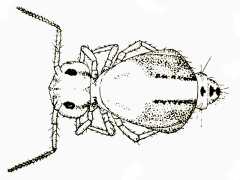
Decided on a trip to the local woodland today to look for globular springtails. Spent about an hour turning over hundreds of pieces of bark and fallen branches. Found just one example; this Allacma fusca that was under the second piece of bark that I looked at!
It kept creeping along in crevices and provided few opportunities for decent shots. This was one of the better ones. It was very "glossy", so quite a bit of reflection on it. A smallish example (~ 1.8-2.0mm), this is only the second time I've seen this species.
Canon 1D3 + MP-E 65mm Macro (at x5) + MT24-EX Flash. Cropped a bit.
Pogonognathellus longicornis
Although July is pretty much the low point in the springtail calendar, the contrast between this year and last year is stark. While we've had the hottest ever day, we've also had plenty of rain and moderate temperatures. Out and about I've been finding springtails pretty much everywhere, recording the following species at the number of sites shown:
Entomobrya nivalis: 7
Deuterosminthurus pallipes: 4
Entomobrya nicoleti: 4
Orchesella cincta: 2
Entomobrya multifasciata: 1
Isotoma viridis: 1
Pogonognathellus longicornis: 1
Tomocerus minor: 1
Springtails about, but nothing of great interest. However, this has to count as a good July for springtails.
Springtails: tiny little things, yet they seem like such characters. We aren't supposed to use the term cute to describe invertebrates, thus linking human characteristics, but I think an exception might be made for these creatures.
Thanks to Frans for the confirmation on the ID :)
Was taken in northern Scotland in the Cairngorm National Park in a pine woodland threatened by housing development.
These small creatures were probably less than ~2mm long. The yellow main part of the photo was the stipe or stalk of the mushroom, with the lower part of the cap at left.
Fiscalini Ranch Preserve,
San Luis Obispo Co., California
Apparently Collembolans (springtails) are no longer considered insects.