View allAll Photos Tagged rom_16
Amedeo Bocchi (Parma, 24 August 1883 - Rome, 16 December 1976) - Ponte Maggiore in Terracina (1930) dimensions 42.5 x 65 cm - Ricci Oddi Modern Art Gallery, Piacenza
IGP MEETING - Roma 16.03.2014
Vecchi portoni e logge circolari.
Location ideale per inondare Ele di scatti da ogni prospettiva.
A me l'onore del centro!
To be a Christian is to walk, moved by the Spirit, in the footsteps of Jesus. Traditionally known as la sequela Christi, this kind of discipleship is the root and the ultimate meaning of the preferential option for the poor.
This commitment—the expression “preferential option for the poor” is recent but its content is biblical—is an essential component of discipleship. At its core is a spiritual experience of the mystery of God who is, according to Meister Eckhart, both the “unnamable” and the “omni-namable” one. Eckhart had to reach this point in order to capture the deeper meaning of this commitment to the absent and anonymous of history. The free and demanding love of God is expressed in the commandment of Jesus to “Love one another as I have loved you” (Jn 13: 34). This implies a universal love that excludes no one, and at the same time is a priority for the least ones of history, the oppressed and the insignificant. Simultaneously living out universality and preference reveals the God of love and makes present the mystery hidden for all time but now unveiled: as Paul says, the proclamation of Jesus as the Christ (see Rom 16: 25–26). This is what the preferential option for the poor points to: walking with Jesus the Messiah.
-In the Company of the Poor Conversations between Dr. Paul Farmer and Father Gustavo Gutiérrez Edited by Michael Griffin and Jennie Weiss Block
Tumba de Julio II (Roma). Es la denominación historiográfica de un conjunto escultórico y arquitectónico marmóreo que Miguel Ángel diseñó y rediseñó varias veces para el monumento funerario del papa Julio II, su principal mecenas.
La obra se encargó en 1505 y quedó en el estado definitivo en 1545, en una escala mucho más reducida que la prevista en el proyecto inicial. Originalmente se iba a ubicar en la basílica de San Pedro del Vaticano, el lugar de enterramiento de los papas; pero finalmente, tras la muerte del papa, se instaló como cenotafio (es decir, sin alojar el cuerpo del difunto) en San Pietro in Vincoli en el Esquilino, iglesia protegida por la familia della Rovere, de la que procedía Julio II, y de la que había sido cardenal titular. Ambos templos se encuentran en la ciudad de Roma, sede del papado y en esa época (especialmente turbulenta -Reforma protestante, Guerras de Italia, Saco de Roma-) también capital de los Estados Pontificios.
En el primer proyecto la tumba se diseñó como una estructura colosal, con espacio suficiente para que Miguel Ángel alojara sus enérgicas y trágicas figuras (terribilità) a una escala sobrehumana. Habría supuesto levantar una mole piramidal de tres cuerpos, inspirada en el Mausoleo de Halicarnaso (vinculando simbólicamente la Antigüedad greco-romana con la Cristiandad), de 7 metros de altura y once metros de base, con más de cuarenta figuras de mármol y varios relieves de bronce, dentro de la cual habría una cámara funeraria oval a la que se accedería por un acceso similar a la "puerta del Hades" del arte funerario romano). Para la ejecución se preveía la descomunal suma de diez mil ducados y un plazo de cinco años; Miguel Ángel tuvo que abandonar los trabajos que tenía en curso, y romper otros contratos.
La obra significó para el artista una de sus mayores frustraciones vitales: el papa, sin explicar los motivos, interrumpió el encargo, posiblemente a causa de la escasez de fondos para su ambicioso programa artístico, que en ese momento tuvieron que emplearse en la reedificación de San Pedro, a cargo de Donato Bramante.Tras la muerte del papa, en 1513, el proyecto tuvo que replantearse como un monumento adosado a la pared, reduciendo sus dimensiones en sucesivos contratos, quedando un número muy inferior a las figuras originalmente planificadas (menos de un tercio).
Del conjunto escultórico, la pieza más famosa es el Moisés, que se completó durante una de las esporádicas reanudaciones de los trabajos, en 1513. Es fama que, sintiendo que era una de sus obras con más vida, Miguel Ángel golpeó con su martillo la rodilla derecha de la imagen, gritando: "¡ahora, habla!". Lo cierto es que puede verse un desperfecto en ese lugar.
Roma 16/3/2016
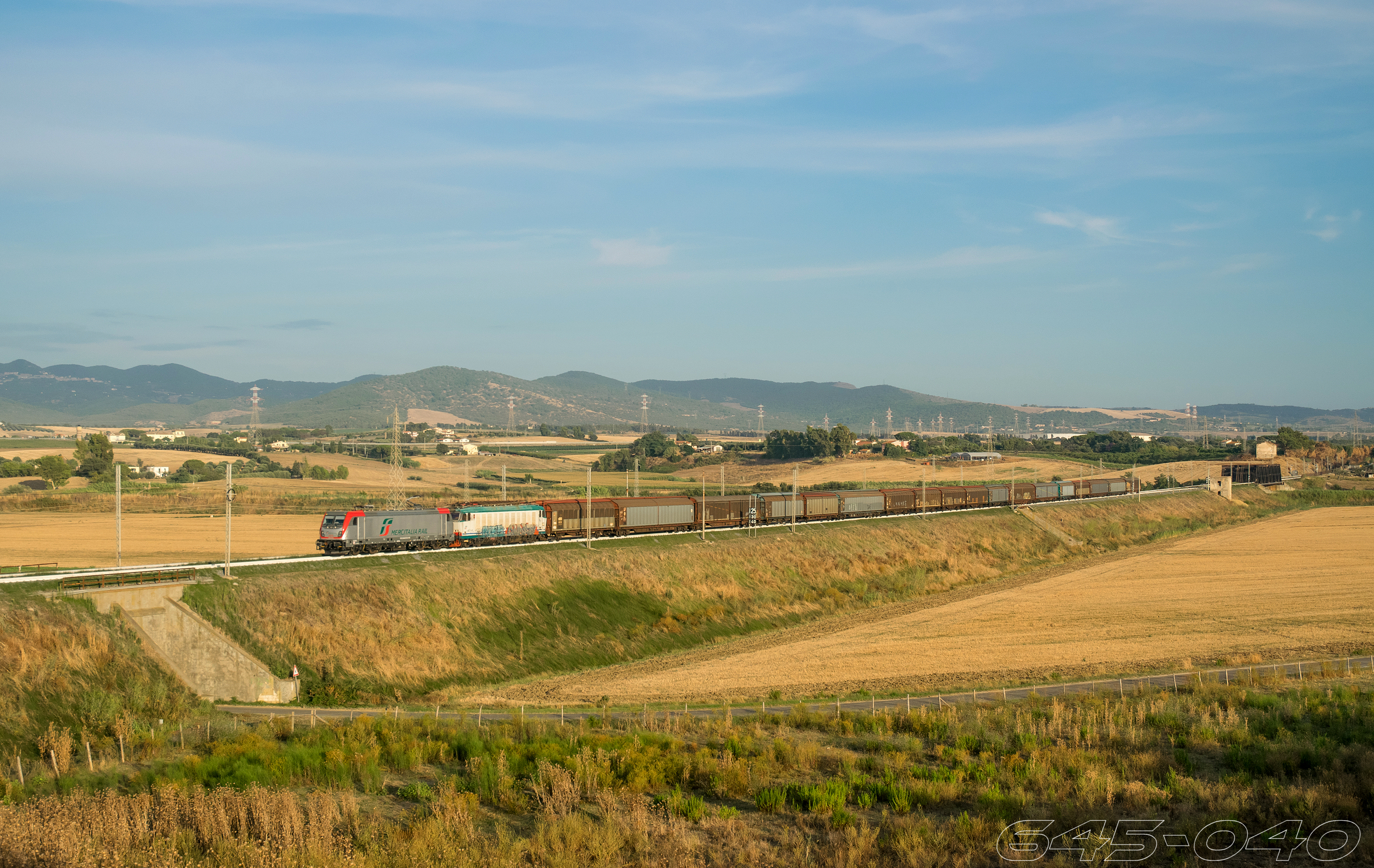
S.Agostino / Civitavecchia(ROMA) 16 Agosto 2019
La E.494.010-8 I-MIR transita nei pressi di S.Agostino (in uscita da Civitavecchia) titolare del Maddaloni Marcianise / Lecco Maggianico
Guardala in FULL FRAME:
lnx.645-040.net/sito/modules/xcgal/albums/userpics/10001/...
Saluti
Paolo CARNETTI
Antonio Donghi (Rome, 16 March 1897 - Rome, 16 July 1963) - Baptism (1930) - oil painting - GAM Gallery of Modern Art of Turin
FIRENZE Romito 16 Gennaio 2010
La E.656.602-x I-TI in spinta di coda al REG FIRENZE SMN/Chiusi C.T.mentre affronta la curva di FIRENZE Romito
Guardala in FULL FRAME:
lnx.645-040.net/sito/modules/xcgal/albums/userpics/10001/...

Roma, 16-08-2018.
www.sguardosulmedioevo.org/2011/08/loratorio-di-san-silve...
Annesso alla Basilica dei Quattro Coronati si trova l'Oratorio con episodi della vita di San Silvestro Papa:
Episodi della vita di San Silvestro:
1- a sinistra: Silvestro battezza Costantino
2- al centro: Costantino é guarito dalla peste da Silvestro
3- Silvestro a cavallo, in corteo, è accompagnato da Costantino
Amedeo Bocchi (Parma, 24 August 1883 - Rome, 16 December 1976) - In the evening on the steps of the Cathedral (1920) dimensions 125 x 242 cm - Ricci Oddi Modern Art Gallery, Piacenza
Studiò all'Accademia di Parma con Cecrope Barilli, poi a Roma (1902) alla Scuola libera del nudo, infine a Padova con Achille Casanova, dal quale apprese la tecnica dell'affresco. Espose per la prima volta alla Biennale di Venezia nel 1910. Si dedicò con perizia all'affresco e alla tempera in chiese ed edifici civili (Cassa di Risparmio di Parma). Numerosissime le esposizioni, sia in Italia che all'estero, e vasti i consensi di critica, specialmente tra la prima e la seconda guerra mondiale (primo premio per il ritratto femminile a Monza, nel 1926). Molti suoi dipinti tra il 1919 e il 1930 sono ambientati nelle Paludi Pontine. Nel marzo 1967 l'Accademia di S. Luca gli organizzò a Roma una importante Mostra retrospettiva a Palazzo Carpegna. Lo interessa in modo particolare la resa della luce, che risolve in ampie sintetiche trasparenti campiture in cui i colori cantano o vibrano in preziosi cangianti.
He studied at the Academy of Parma with Cecrope Barilli, then in Rome (1902) at the Free School of the nude, finally in Padua with Achille Casanova, from whom he learned the fresco technique. He exhibited for the first time at the Venice Biennale in 1910. He devoted himself with skill to fresco and tempera in churches and civil buildings (Cassa di Risparmio di Parma). Numerous exhibitions, both in Italy and abroad, and widespread critical acclaim, especially between the first and second world wars (first prize for the female portrait in Monza, in 1926). Many of his paintings between 1919 and 1930 are set in the Pontine Marshes. In March 1967 the Academy of S. Luca organized an important retrospective exhibition in Rome at Palazzo Carpegna. He is particularly interested in the rendering of light, which he resolves into wide transparent synthetic backgrounds in which colors sing or vibrate in precious iridescent colors.
Amedeo Bocchi (Parma, 24 August 1883 - Rome, 16 December 1976) - Fishermen of the Pontine Marshes (1920) dimensions 131 x 221 cm - Ricci Oddi Modern Art Gallery, Piacenza
E' forse la sua opera più rappresentativa; fu completamente eseguita sul vero, Ie vibrazioni di luce e di colore, attenuate dalle frasche della capanna, non presentano ancora la violenza rilevabile nella "Famiglia del pittore", dipinta anch'essa tutta dal vero, I'anno precedente.
Studiò all'Accademia di Parma con Cecrope Barilli, poi a Roma (1902) alla Scuola libera del nudo, infine a Padova con Achille Casanova, dal quale apprese la tecnica dell'affresco. Espose per la prima volta alla Biennale di Venezia nel 1910. Si dedicò con perizia all'affresco e alla tempera in chiese ed edifici civili (Cassa di Risparmio di Parma). Numerosissime le esposizioni, sia in Italia che all'estero, e vasti i consensi di critica, specialmente tra la prima e la seconda guerra mondiale (primo premio per il ritratto femminile a Monza, nel 1926). Molti suoi dipinti tra il 1919 e il 1930 sono ambientati nelle Paludi Pontine. Nel marzo 1967 l'Accademia di S. Luca gli organizzò a Roma una importante Mostra retrospettiva a Palazzo Carpegna. Lo interessa in modo particolare la resa della luce, che risolve in ampie sintetiche trasparenti campiture in cui i colori cantano o vibrano in preziosi cangianti.
It is perhaps his most representative work; it was completely performed on the truth, the vibrations of light and color, attenuated by the branches of the hut, do not yet show the violence detectable in the "painter's family", also painted entirely from life, the previous year.
He studied at the Academy of Parma with Cecrope Barilli, then in Rome (1902) at the Free School of the nude, finally in Padua with Achille Casanova, from whom he learned the fresco technique. He exhibited for the first time at the Venice Biennale in 1910. He devoted himself with skill to fresco and tempera in churches and civil buildings (Cassa di Risparmio di Parma). Numerous exhibitions, both in Italy and abroad, and widespread critical acclaim, especially between the first and second world wars (first prize for the female portrait in Monza, in 1926). Many of his paintings between 1919 and 1930 are set in the Pontine Marshes. In March 1967 the Academy of S. Luca organized an important retrospective exhibition in Rome at Palazzo Carpegna. He is particularly interested in the rendering of light, which he resolves into wide transparent synthetic backgrounds in which colors sing or vibrate in precious iridescent colors.
Amedeo Bocchi (Parma, 24 August 1883 - Rome, 16 December 1976) - The morning breakfast (1919) dimensions 125 x 181 cm - Ricci Oddi Modern Art Gallery, Piacenza
E' una delle sue opere più note. Le ricerche di luce s'incentrano sul volto della donna vista di fronte, che diventa punto luminosissimo di irradiazione. L'artista rivela qui un gusto decorativo interessante e intelligente.
Studiò all'Accademia di Parma con Cecrope Barilli, poi a Roma (1902) alla Scuola libera del nudo, infine a Padova con Achille Casanova, dal quale apprese la tecnica dell'affresco. Espose per la prima volta alla Biennale di Venezia nel 1910. Si dedicò con perizia all'affresco e alla tempera in chiese ed edifici civili (Cassa di Risparmio di Parma). Numerosissime le esposizioni, sia in Italia che all'estero, e vasti i consensi di critica, specialmente tra la prima e la seconda guerra mondiale (primo premio per il ritratto femminile a Monza, nel 1926). Molti suoi dipinti tra il 1919 e il 1930 sono ambientati nelle Paludi Pontine. Nel marzo 1967 l'Accademia di S. Luca gli organizzò a Roma una importante Mostra retrospettiva a Palazzo Carpegna. Lo interessa in modo particolare la resa della luce, che risolve in ampie sintetiche trasparenti campiture in cui i colori cantano o vibrano in preziosi cangianti.
It is one of his best known works. The searches for light focus on the face of the woman seen from the front, which becomes a very bright point of irradiation. Here the artist reveals an interesting and intelligent decorative taste.
He studied at the Academy of Parma with Cecrope Barilli, then in Rome (1902) at the Free School of the nude, finally in Padua with Achille Casanova, from whom he learned the fresco technique. He exhibited for the first time at the Venice Biennale in 1910. He devoted himself with skill to fresco and tempera in churches and civil buildings (Cassa di Risparmio di Parma). Numerous exhibitions, both in Italy and abroad, and widespread critical acclaim, especially between the first and second world wars (first prize for the female portrait in Monza, in 1926). Many of his paintings between 1919 and 1930 are set in the Pontine Marshes. In March 1967 the Academy of S. Luca organized an important retrospective exhibition in Rome at Palazzo Carpegna. He is particularly interested in the rendering of light, which he resolves into wide transparent synthetic backgrounds in which colors sing or vibrate in precious iridescent colors.
Mino Maccari (Siena, 24 November 1898 - Rome, 16 June 1989) untitled - oil on canvas 50 x 70 - "shows a window on the great art of the twentieth century" - Palazzo del Popolo Todi
Pietro da Cortona, attivo non solo come pittore ma anche come architetto, mantenne una delle maggiori botteghe artistiche di Roma. Il quadro devozionale, commissionato dal cardinale Antonio Barberini già nel 1639, è dipinto su rame. Interpreta il riposo della Sacra Famiglia come una scena idilliaca con un angelo che offre frutti a Cristo Bambino.
Pietro da Cortona, active not only as a painter but also as an architect, maintained one of the largest art workshops in Rome. The devotional painting, commissioned by Cardinal Antonio Barberini as early as 1639, is painted on copper. It interprets the Holy Family's repose as an idyllic scene with an angel offering fruit to the Christ Child.
Giovanni Antonio Galli, called the Spadarino (Rome, January 16, 1585 - Rome, August 17, 1652) - Denial of Peter (1610-15) - oil on canvas 98 x 135 cm. - National Gallery, Bologna
Dopo alcune oscillazioni circa l’attribuzione, dal 2003 il dipinto è stato ricondotto al catalogo dello Spadarino, a cui rimanda il particolare cromatismo, caratterizzato da rossi e bruni spenti, come offuscati da una sorta di pulviscolo che attenua contorni e contrasti. L’austera partitura cromatica, la monumentalità dei personaggi e l’incombenza fisica dei corpi sono caratteri che fanno pensare a una cronologia alta, attestabile attorno all’inizio del secondo decennio del Seicento.
After some oscillations about the attribution, since 2003 the painting has been brought back to the catalog of Spadarino, which refers to the particular chromatism, characterized by dull reds and browns, as blurred by a sort of dust that softens the contours and contrasts. The austere chromatic score, the monumentality of the characters and the physical incumbency of the bodies are characters that suggest a high chronology, attestable around the beginning of the second decade of the seventeenth century.
Civitavecchia(Roma) 16 Marzo 2024
Transita alle porte di Civitavecchia(Roma) la E.494.594-1 I-GTSR mentre svolge il TEC Piacenza / Pomezia
John 15:16 (ESV)
16 You did not choose me, but I chose you and appointed you that you should go and bear fruit and that your fruit should abide, so that whatever you ask the Father in my name, he may give it to you.
Elect, Election.
In modern English, terms referring to the selection of a leader or representative by a group of people. An element of choice is involved, since usually there are several candidates out of whom one must be chosen.
When the verb “elect” is used theologically in the Bible, it usually has God as its subject. In the OT it is used for God’s choice of Israel to be his people (cf. Acts 13:17). Israel became God’s people, not because they decided to belong to him, but because he took the initiative and chose them. Nor did God’s choice rest on any particular virtues that his people exemplified, but rather on his promise to their forefather Abraham (Dt 7:7, 8). God also chose their leaders, such as Saul and David (1 Sm 10:24; 2 Sm 6:21), apart from any popular vote by the people. The word thus indicates God’s prerogative in deciding what shall happen, independently of human choice.
The same thoughts are found in the NT. God’s people are described as his “elect” or “chosen ones,” a term used by Jesus when speaking of the future time when the Son of man will come and gather together God’s people (Mk 13:20, 27). He will vindicate them for their sufferings and for their patience in waiting for his coming (Lk 18:7). In 1 Peter 2:9 God’s people are called an “elect nation.” This phrase was originally used of the people of Israel (Is 43:20), and it brings out the fact that the people of God in the OT and the Christian church in the NT stand in continuity with each other; the promises addressed to Israel now find fulfillment in the church.
In Romans 9–11 Paul discusses the problem of why the people of Israel as a nation have rejected the gospel, while the Gentiles have accepted it. He states that in the present time there is a “remnant” of Israel as a result of God’s gracious choice of them. This group is called “the elect.” They are the chosen people who have obtained what was meant for Israel as a whole, while the greater mass of the people have failed to obtain it because they were “hardened” as a result of their sin (Rom 11:5, 7).
Nevertheless, God’s choice of Israel to be his people has not been cancelled. Most Jewish people have aligned themselves against the gospel, so that the Gentiles may come in and receive God’s blessings in their place; but they still remain beloved by God, and God will not go back on his original calling of them (Rom 11:28). Consequently Paul is confident that in due time there will be a general return to God by the people of Israel.
The word translated “elect” is generally found in the plural and refers either to the members of God’s people as a whole or to those in a particular local church (Rom 8:33; Col 3:12; 1 Thes 1:4; 2 Tm 2:10; Ti 1:1; 1 Pt 1:1; 2 Pt 1:10; Rv 17:14; Rom 16:13 and 2 Jn 13 have the singular form). The use of the plural may partly be explained by the fact that most of the NT letters are addressed to groups of people rather than to individuals. More probably, however, the point is that God’s election is concerned with the creation of a people rather than the calling of isolated individuals.
The use of the word “election” emphasizes that membership of God’s people is due to God’s initiative, prior to all human response, made before time began (Eph 1:4; cf. Jn 15:16, 19). It is God who has called men and women to be his people, and those who respond are elect. God’s call does not depend on any virtues or merits of humankind. Indeed, he chooses the foolish things by worldly standards to shame the wise, the weak to confound the strong, and the low and insignificant to bring to nothing those who think that they are something (1 Cor 1:27, 28). The effect of election is to leave no grounds whatever for human boasting in achievement and position. Whatever the elect are, they owe entirely to God, and they cannot boast or compare themselves with other people.
God’s elect are a privileged people. Since they now have God to uphold them, no one can bring any accusation against them that might lead to God’s condemnation (Rom 8:33). They constitute a royal priesthood; they are God’s servants with the right of access to him (1 Pt 2:9). It is for their sake that the apostles endured hardship and suffering, so that they might enjoy future salvation and eternal glory (2 Tm 2:10).
The elect are distinguished by their faith in God (Ti 1:1), and they are called to show the character that befits God’s people (Col 3:12). They must make their calling and election sure; that is, they must show that they belong to God by the quality of their lives (2 Pt 1:10). They must continue being faithful to the One who called them (Rv 17:14).
The relationship between God’s call and human response is explained in Matthew 22:14: “For many are called, but few are chosen.” Although God calls many through the gospel, only some of those respond to the call and become his elect people. The text sheds no light on the mystery of why only some become God’s people. Certainly, when a person does respond to God’s call, it is because the gospel comes to him or her “in power and in the Holy Spirit and with full conviction” (1 Thes 1:4, 5). When men and women refuse the gospel, it is because they have become hardened as a result of sin and their trust in their own works. Scripture does not go beyond that point in explanation, and neither should Christians.
“Election” can also be used of God’s choice of people to serve him. Jesus chose the 12 disciples out of the larger company of those who followed him (Lk 6:13; Acts 1:2). The same thought reappears in John’s Gospel; Jesus commented that although he chose the 12, one of them turned out to be a devil (Jn 6:70; 13:18). When a replacement was needed for Judas, the church prayed to Jesus and asked him to show them which of the two available candidates he would choose to fill the gap in the 12 (Acts 1:24). Peter attributes his evangelism among the Gentiles to God’s “election” of him for that purpose (Acts 15:7). Similarly, Paul was an elected instrument for God’s mission to the Gentiles (Acts 9:15). The initiative in Christian mission rests with God, who elects people to serve him in particular ways.
Jesus is called “God’s Chosen” (Lk 9:35; cf. the taunt in Lk 23:35). The heavenly voice at Jesus’ transfiguration spoke in language that echoed Isaiah 42:1 and identified Jesus as God’s Servant, chosen to do his work of bringing light to the nations. In the same way, Jesus is a “chosen cornerstone” (1 Pt 2:4, 6; cf. Is 28:16).
In the teaching of Augustine and Calvin, the doctrine of election is of fundamental importance. They taught that God had chosen before the creation of the world to save a number of specific individuals from sin and judgment and to give them eternal life. Those whom he chose did nothing to deserve it; their merits are no better than the rest of humankind who will be judged for their sins. But in his mercy God decided to save some; therefore, he chose them and sent Jesus to be their Savior. The Holy Spirit regenerates and brings to faith through an “effectual calling” those whom God has elected. God’s Spirit effectively persuades each of them to submit to the gospel, so they are guaranteed recipients of eternal life.
This choice by God selectively to save some may seem unjust. But in fact, God is not obliged to show mercy to anybody; he is free to show mercy as he pleases. People cannot protest that because they were not the elect, they never had a chance of being saved. They never deserved that chance anyway. But anybody who hears the gospel and responds to it with faith can know that he is one of the elect. Whoever rejects the gospel has only his own sinfulness to blame.
Many Christians reject that explanation of God’s election. They maintain that although it appears to be logically consistent with Scripture, it makes God the prisoner of his own plan. His predestination of certain individuals to salvation commits him personally to a detailed, predetermined, unilateral course of action that reduces human action to a charade and renders it insignificant. God ceases to be a person dealing with persons.
The Augustinian and Calvinist view of election, according to its critics, also makes God out to be arbitrary in his choice of the elect. In effect, chance becomes the arbiter of human destiny rather than a holy and loving God. Those difficulties arise because, they say, the teaching of Scripture has been pressed into an artificial logical system that distorts it.
Walter A. Elwell and Barry J. Beitzel, Baker Encyclopedia of the Bible (Grand Rapids, MI: Baker Book House, 1988), 681–683.
IGP MEETING - Roma 16.03.2014
'Loro' sono la piccola Chantal <3 Faccino dolce e tanti ricci!
Prisma su gentile concessione di Ludo. Tirato fuori da una delle millemila borse e borsine piene di beni di ogni sorta!
Lei dice di avere la Sindrome da Babbo Natale, io c'ho quella del braccio pesante, ergo in giro porto lo stretto indispensabile :)
Capilla mayor de la basílica de Santa María in Aracoeli (Roma). Sobre el altar mayor se encuentra el icono bizantino del siglo XI "Madonna D'Aracoeli".
Roma 16/3/2016
Sur le produit
1. 5.5 polegada FHD 401ppi gff technique de collage écran 2. Rapide d’identification d’empreintes digitales 3. Yun OS 3.0 carte style compact UI 4. Retour 13.0 MP appareil photo + avant 5.0 MP caméra grand angle 5. Dual SIM double veille...
telephone.pascherenchine.com/products/newman-cm810-5-5-po...
Um texto, em português, do site da Wikipédia, a Enciclopédia livre:
Michelangelo ("Miguel Ângelo") di Ludovico Buonarroti Simoni (Caprese, 6 de Março de 1475 — Roma, 18 de Fevereiro de 1564) foi um pintor, escultor, poeta e arquiteto renascentista italiano.
Apesar de ter feito poucas atividades além das artes, sua versatilidade em vários campos fez com que rivalizasse com Leonardo da Vinci no título de ícone da Renascença. Michelangelo foi genial em vários campos e, além disso, também recebeu tarefas diplomáticas. Duas biografias foram escritas sobre ele ainda em vida (uma de Giorgio Vasari).
Duas de suas mais famosas obras (a Pietà e o David) foram realizadas antes de seus trinta anos. Apesar de sua pouca afeição à pintura, criou duas obras históricas: as cenas do Gênesis, no teto da Capela Sistina, e o O Juízo Final, também no mesmo local. Projetou também a cúpula da Basílica de São Pedro, em Roma. Entre suas outras esculturas, contam-se a também a Virgem, o Baco, o Moisés, a Raquel, a Léa e membros da família Médici.
Michelangelo nasceu em Caprese, perto de Arezzo, na Toscana, o segundo de cinco filhos. Seu pai, Ludovico, quando residente em Caprese, era um magistrado. Michelangelo cresceu em Florença e mais tarde viveu com um escultor e sua esposa na localidade florentina de Settignano, onde seu pai tinha uma mina de mármore e uma pequena fazenda.
Contra a vontade de seu pai, o canhoto Michelangelo escolheu ser aprendiz de Domenico Ghirlandaio por três anos começando em 1488. Também foi aprendiz, na escultura, de Bertoldo di Giovanni. Impressionado com a técnica de Michelangelo, Ghirlandaio recomendou-o para Florença para estudar com Lourenço de Médici. De 1490 a 1492, Michelangelo freqüentou a escola de Lourenço e durante sua estada, seria influenciado por muitas pessoas proeminentes, e pela filosofia platônica da época, que modificariam e expandiriam suas idéias na arte e ainda seus sentimentos sobre sexualidade.
Foi durante este período que Michelangelo criou dois relevos: a Batalha de Centauros e a Madonna da Escada. A primeira obra foi baseada em um tema sugerido por Poliziano e encomendada por Lourenço de Médici. Após sua morte, Michelangelo deixou a corte dos Medici. Nos meses seguintes, produziu um crucifixo de madeira para o pároco da Igreja de Santa Maria del Santo Spirito, que tinha o deixado estudar anatomia a partir de alguns cadáveres do hospital da Igreja.
Pedro de Médici, filho mais velho de Lourenço de Médici, recusou-se a financiar o trabalho artístico de Michelangelo. Também nessa época, as idéias de Savonarola tornaram-se populares em Florença. Sob tais pressões, Michelangelo decide sair definitivamente de Florença e vai para Bolonha por três anos. Logo depois, o Cardeal San Giorgio compra a obra de Michelangelo em mármore Cupido e decide chamá-lo a Roma em 1496. Influenciado pela antiguidade de Roma, ele produz Baco e a Pietà. A Pietà foi uma encomenda do embaixador francês na Santa Sé. Apesar de praticamente se dedicar à escultura, Michelangelo nunca deixou de desenhar, ele desenhava por prazer de desenhar.
Quatro anos mais tarde, Michelangelo retornou a Florença, onde produziu seu mais famoso trabalho: David.
A cidade, na época, estava mudando, após a queda de Savonarola e a ascensão de Pier Soderini. O David foi uma encomenda da Guilda de Lã da cidade. Era, originalmente, um trabalho incompleto, iniciado quarenta anos antes por Agostino di Duccio. O David deveria ser o símbolo da liberdade de Florença e seria colocado na Piazza della Signoria, na frente do Palazzo Vecchio. A obra foi concluída em 1504. Essa obra-prima, feita em mármore de Carrara, colocou-o definitivamente como um escultor de extraordinária técnica e habilidade. Na época, também pintou a Sagrada Família da Tribuna, agora na Galeria Uffizi. Michelangelo era considerado um artista renascentista porque em todas suas obras, ele representava somente figuras do homem.
Michelangelo foi convocado novamente a Roma em 1503 pelo recém-designado Papa Júlio II e foi comissionado para construir a tumba papal. Entretanto, durante a patronagem de Júlio II, Michelangelo tinha constantemente que interromper seu trabalho para fazer outras numerosas tarefas. Por essa e outras interrupções, Michelangelo trabalharia na tumba por quarenta anos sem nunca a terminar.
A mais famosa das tarefas foi a pintura monumental do teto da Capela Sistina no Vaticano, que levou quatro anos para ser feita (1508 – 1512). Michelangelo originalmente deveria pintar os 12 Apóstolos, mas protestou e pediu uma tarefa mais audaciosa: um esquema que representasse a Criação, a Queda do Homem e a Promessa da Salvação. O trabalho faz parte de uma decoração muito mais complexa que, em conjunto, representa toda a doutrina da Igreja Católica.
A composição contém 300 figuras e se centra nos episódios do livro do Genesis, divididos em três grupos: a Criação da Terra por Deus, a Criação da Humanidade e sua queda e, por fim, a Humanidade representada por Noé. Entre os afrescos mais famosos estão: A Criação de Adão e Adão e Eva no Paraíso.
Em 1513, o Papa Júlio II morreu, e seu sucessor, o Papa Leão X, um Médici, pediu que Michelangelo reconstruísse o interior da Igreja de São Lourenço, em Florença, e a adornasse com esculturas. Michelangelo relutantemente aceitou, mas foi incapaz de terminar a tarefa (o exterior da igreja ainda não está adornado até hoje).
Em 1526, os cidadãos de Florença, encorajados pelo saque de Roma, expulsaram os Médici e restauraram a república. Michelangelo voltou para sua amada Florença para ajudar a construir as fortificações da cidade de 1528 a 1529. A cidade caiu em 1530 e os Médici voltaram ao poder.
A pintura de O Juízo Final, na janela do Altar da capela Sistina foi comissionada pelo Papa Paulo III, e Michelangelo trabalhou nela de 1534 a 1541. O trabalho é grandioso e toma uma parede inteira atrás do altar da Capela Sistina. O Juízo Final é uma representação da segunda vinda de Cristo e do apocalipse, quando as almas da humanidade seriam levadas a seu destino final e julgadas por Cristo, rodeado de santos.
Uma vez concluída, as representações de nudez na própria Capela foram consideradas obscenas e um sacrilégio. Após a morte de Michelangelo, decidiu-se obscurecer os órgãos, o que foi feito por um aprendiz de Michelangelo, Daniele da Volterra. Quando o trabalho foi restaurado em 1993, decidiu-se deixar algumas das figuras ainda cobertas, como documentos históricos. A censura sempre perseguiu Michelangelo, que às vezes era chamado de "inventor delle porcherie" ("inventor das obscenidades").
Em 1547, Michelangelo foi apontado como arquiteto da Basílica de São Pedro no Vaticano. Anos mais tarde, em 18 de Fevereiro de 1564, Michelangelo morre, em casa, em Roma aos 88 anos de idade, solicitando em testamento que seu corpo fosse enterrado em Florença.
Michelangelo, muitas vezes arrogante com os outros e constantemente insatisfeito com ele mesmo, via a arte como originada da inspiração interna e da cultura. Via a natureza como uma inimiga que tinha de ser superada. Suas figuras são dinâmicas. Para ele, a missão do escultor era libertar as formas que estavam dentro da pedra. Conta-se que após Michelangelo ter executado sua estátua Moisés, bateu violentamente com o martelo no joelho da obra e gritou: Porque não falas? (Perché non parli).
Na vida pessoal, Michelangelo era abstêmio. Era indiferente à bebida e à comida. Era uma pessoa solitária e melancólica.
Para além da pintura e da escultura, Michelangelo deixou também cerca de trezentos poemas em italiano vernáculo, que escreveu entre 1501 e 1560. Os seus poemas são marcados por uma forte carga homoerótica. Porém, esta foi alterada na primeira edição da sua poesia, em 1623, publicada pelo seu sobrinho Michelangelo, o Jovem. Em 1893, John Addington Symonds traduziu os poemas originais para inglês.
Fundamental para a arte de Michelangelo era sua paixão pela beleza masculina, que o atraía de modo emocional e estético. Era, em parte, uma expressão da idealização renascentista do corpo humano. Mas, para Michelangelo, há uma resposta única a essa estética. Tais sentimentos o faziam sentir uma profunda angústia, uma contradição entre a filosofia platônica e o sentimento carnal.
This sculpture was fotographed at the street in front of the Ufizzi Museum in florence, Italy.
A text, in english, from Wikipedia, the free encyclopedia:
Michelangelo di Lodovico Buonarroti Simoni
Birth name Michelangelo di Lodovico Buonarroti Simoni
Born March 6, 1475(1475-03-06)
near Arezzo, in Caprese, Tuscany
Died February 18, 1564 (aged 88)
Rome
Nationality Italian
Field sculpture, painting, architecture and poetry
Training Apprentice to Domenico Ghirlandaio[1]
Movement High Renaissance
Michelangelo di Lodovico Buonarroti Simoni[1] (March 6, 1475 – February 18, 1564), commonly known as Michelangelo, was an Italian Renaissance painter, sculptor, architect, poet and engineer. Despite making few forays beyond the arts, his versatility in the disciplines he took up was of such a high order that he is often considered a contender for the title of the archetypal Renaissance man, along with his rival and fellow Italian Leonardo da Vinci.
Michelangelo's output in every field during his long life was prodigious; when the sheer volume of correspondence, sketches and reminiscences that survive is also taken into account, he is the best-documented artist of the 16th century. Two of his best-known works, the Pietà and the David, were sculpted before he turned thirty. Despite his low opinion of painting, Michelangelo also created two of the most influential works in fresco in the history of Western art: the scenes from Genesis on the ceiling and The Last Judgment on the altar wall of the Sistine Chapel in Rome. Later in life he designed the dome of St. Peter's Basilica in the same city and revolutionised classical architecture with his use of the giant order of pilasters.
In a demonstration of Michelangelo's unique standing, he was the first Western artist whose biography was published while he was alive.[2] Two biographies were published of him during his lifetime; One of them, by Giorgio Vasari, proposed that he was the pinnacle of all artistic achievement since the beginning of the Renaissance, a viewpoint that continued to have currency in art history for centuries. In his lifetime he was also often called Il Divino ("the divine one").[3] One of the qualities most admired by his contemporaries was his terribilità, a sense of awe-inspiring grandeur, and it was the attempts of subsequent artists to imitate Michelangelo's impassioned and highly personal style that resulted in the next major movement in Western art after the High Renaissance, Mannerism.
Michelangelo was born on March 6, 1475[a] in Caprese near Arezzo, Tuscany.[4] His family had for several generations been small-scale bankers in Florence but his father, Lodovico di Leonardo di Buonarroti di Simoni, failed to maintain the bank's financial status, and held occasional government positions.[2] At the time of Michelangelo's birth, his father was the Judicial administrator of the small town of Caprese and local administrator of Chiusi. Michelangelo's mother was Francesca di Neri del Miniato di Siena.[5] The Buonarrotis claimed to descend from the Countess Mathilde of Canossa; this claim remains unproven, but Michelangelo himself believed it.[6] Several months after Michelangelo's birth the family returned to Florence where Michelangelo was raised. At later times, during the prolonged illness and after the death of his mother when he was seven years old, Michelangelo lived with a stonecutter and his wife and family in the town of Settignano where his father owned a marble quarry and a small farm.[5] Giorgio Vasari quotes Michelangelo as saying, "If there is some good in me, it is because I was born in the subtle atmosphere of your country of Arezzo. Along with the milk of my nurse I received the knack of handling chisel and hammer, with which I make my figures."[4]
Michelangelo's father sent him to study grammar with the Humanist Francesco da Urbino in Florence as a young boy.[7][4][b] The young artist, however, showed no interest in his schooling, preferring to copy paintings from churches and seek the company of painters.[7] At thirteen, Michelangelo was apprenticed to the painter Domenico Ghirlandaio.[1][8] When Michelangelo was only fourteen, his father persuaded Ghirlandaio to pay his apprentice as an artist, which was highly unusual at the time.[9] When in 1489 Lorenzo de' Medici, de facto ruler of Florence, asked Ghirlandaio for his two best pupils, Ghirlandaio sent Michelangelo and Francesco Granacci.[10] From 1490 to 1492, Michelangelo attended the Humanist academy which the Medici had founded along Neo Platonic lines. Michelangelo studied sculpture under Bertoldo di Giovanni. At the academy, both Michelangelo's outlook and his art were subject to the influence of many of the most prominent philosophers and writers of the day including Marsilio Ficino, Pico della Mirandola and Angelo Poliziano.[11] At this time Michelangelo sculpted the reliefs Madonna of the Steps (1490–1492) and Battle of the Centaurs (1491–1492). The latter was based on a theme suggested by Poliziano and was commissioned by Lorenzo de Medici.[12]
Lorenzo de' Medici's death on April 8, 1492, brought a reversal of Michelangelo's circumstances.[13] Michelangelo left the security of the Medici court and returned to his father's house. In the following months he carved a wooden crucifix (1493), as a gift to the prior of the Florentine church of Santo Spirito, who had permitted him some studies of anatomy on the corpses of the church's hospital.[14] Between 1493 and 1494 he bought a block of marble for a larger than life statue of Hercules, which was sent to France and subsequently disappeared sometime circa 1700s.[12][c] On January 20, 1494, after heavy snowfalls, Lorenzo's heir, Piero de Medici commissioned a snow statue, and Michelangelo again entered the court of the Medici.
In the same year, the Medici were expelled from Florence as the result of the rise of Savonarola. Michelangelo left the city before the end of the political upheaval, moving to Venice and then to Bologna.[13] In Bologna he was commissioned to finish the carving of the last small figures of the Shrine of St. Dominic, in the church dedicated to that saint. Towards the end 1494, the political situation in Florence was calmer. The city, previously under threat from the French, was no longer in danger as Charles VIII had suffered defeats. Michelangelo returned to Florence but received no commissions from the new city government under Savonarola. He returned to the employment of the Medici.[15] During the half year he spent in Florence he worked on two small statues, a child St. John the Baptist and a sleeping Cupid. According to Condivi, Lorenzo di Pierfrancesco de' Medici, for whom Michelangelo had sculpted St. John the Baptist, asked that Michelangelo "fix it so that it looked as if it had been buried" so he could "send it to Rome…pass [it off as] an ancient work and…sell it much better." Both Lorenzo and Michelangelo were unwittingly cheated out of the real value of the piece by a middleman. Cardinal Raffaele Riario, to whom Lorenzo had sold it, discovered that it was a fraud, but was so impressed by the quality of the sculpture that he invited the artist to Rome. [16][d] This apparent success in selling his sculpture abroad as well as the conservative Florentine situation may have encouraged Michelangelo to accept the prelate's invitation.[15]
Michelangelo arrived in Rome June 25, 1496[17] at the age of 21. On July 4 of the same year, he began work on a commission for Cardinal Raffaele Riario, an over-life-size statue of the Roman wine god, Bacchus. However, upon completion, the work was rejected by the cardinal, and subsequently entered the collection of the banker Jacopo Galli, for his garden.
In November of 1497, the French ambassador in the Holy See commissioned one of his most famous works, the Pietà and the contract was agreed upon in August of the following year. The contemporary opinion about this work — "a revelation of all the potentialities and force of the art of sculpture" — was summarized by Vasari: "It is certainly a miracle that a formless block of stone could ever have been reduced to a perfection that nature is scarcely able to create in the flesh."
In Rome, Michelangelo lived near the church of Santa Maria di Loreto. Here, according to the legend, he fell in love with Vittoria Colonna, marquise of Pescara and a poet.[citation needed] His house was demolished in 1874, and the remaining architectural elements saved by the new proprietors were destroyed in 1930. Today a modern reconstruction of Michelangelo's house can be seen on the Gianicolo hill.
Michelangelo returned to Florence in 1499–1501. Things were changing in the republic after the fall of anti-Renaissance Priest and leader of Florence, Girolamo Savonarola (executed in 1498) and the rise of the gonfaloniere Pier Soderini. He was asked by the consuls of the Guild of Wool to complete an unfinished project begun 40 years earlier by Agostino di Duccio: a colossal statue portraying David as a symbol of Florentine freedom, to be placed in the Piazza della Signoria, in front of the Palazzo Vecchio. Michelangelo responded by completing his most famous work, the Statue of David in 1504. This masterwork, created out of a marble block from the quarries at Carrara that had already been worked on by an earlier hand, definitively established his prominence as a sculptor of extraordinary technical skill and strength of symbolic imagination.
Also during this period, Michelangelo painted the Holy Family and St John, also known as the Doni Tondo or the Holy Family of the Tribune: it was commissioned for the marriage of Angelo Doni and Maddalena Strozzi and in the 17th century hung in the room known as the Tribune in the Uffizi. He also may have painted the Madonna and Child with John the Baptist, known as the Manchester Madonna and now in the National Gallery, London.
In 1505 Michelangelo was invited back to Rome by the newly elected Pope Julius II. He was commissioned to build the Pope's tomb. Under the patronage of the Pope, Michelangelo had to constantly stop work on the tomb in order to accomplish numerous other tasks. Because of these interruptions, Michelangelo worked on the tomb for 40 years. The tomb, of which the central feature is Michelangelo's statue of Moses, was never finished to Michelangelo's satisfaction. It is located in the Church of S. Pietro in Vincoli in Rome.
During the same period, Michelangelo took the commission to paint the ceiling of the Sistine Chapel, which took approximately four years to complete (1508–1512). According to Michelangelo's account, Bramante and Raphael convinced the Pope to commission Michelangelo in a medium not familiar to the artist. This was done in order that he, Michelangelo, would suffer unfavorable comparisons with his rival Raphael, who at the time was at the peak of his own artistry as the primo fresco painter. However, this story is discounted by modern historians on the grounds of contemporary evidence, and may merely have been a reflection of the artist's own perspective.
Michelangelo was originally commissioned to paint the 12 Apostles against a starry sky, but lobbied for a different and more complex scheme, representing creation, the Downfall of Man and the Promise of Salvation through the prophets and Genealogy of Christ. The work is part of a larger scheme of decoration within the chapel which represents much of the doctrine of the Catholic Church
The composition eventually contained over 300 figures and had at its center nine episodes from the Book of Genesis, divided into three groups: God's Creation of the Earth; God's Creation of Humankind and their fall from God's grace; and lastly, the state of Humanity as represented by Noah and his family. On the pendentives supporting the ceiling are painted twelve men and women who prophesied the coming of the Jesus. They are seven prophets of Israel and five Sibyls, prophetic women of the Classical world.
Among the most famous paintings on the ceiling are the Creation of Adam, Adam and Eve in the Garden of Eden, the Great Flood, the Prophet Isaiah and the Cumaean Sibyl. Around the windows are painted the ancestors of Christ.
In 1513 Pope Julius II died and his successor Pope Leo X, a Medici, commissioned Michelangelo to reconstruct the façade of the basilica of San Lorenzo in Florence and to adorn it with sculptures. Michelangelo agreed reluctantly. The three years he spent in creating drawings and models for the facade, as well as attempting to open a new marble quarry at Pietrasanta specifically for the project, were among the most frustrating in his career, as work was abruptly cancelled by his financially-strapped patrons before any real progress had been made. The basilica lacks a facade to this day.
Apparently not the least embarrassed by this turnabout, the Medici later came back to Michelangelo with another grand proposal, this time for a family funerary chapel in the basilica of San Lorenzo. Fortunately for posterity, this project, occupying the artist for much of the 1520s and 1530s, was more fully realized. Though still incomplete, it is the best example we have of the integration of the artist's sculptural and architectural vision, since Michelangelo created both the major sculptures as well as the interior plan. Ironically the most prominent tombs are those of two rather obscure Medici who died young, a son and grandson of Lorenzo. Il Magnifico himself is buried in an unfinished and comparatively unimpressive tomb on one of the side walls of the chapel, not given a free-standing monument, as originally intended.
Michelangelo's The Last Judgment. Saint Bartholomew is shown holding the knife of his martyrdom and his flayed skin. The face of the skin is recognizable as Michelangelo.
In 1527, the Florentine citizens, encouraged by the sack of Rome, threw out the Medici and restored the republic. A siege of the city ensued, and Michelangelo went to the aid of his beloved Florence by working on the city's fortifications from 1528 to 1529. The city fell in 1530 and the Medici were restored to power. Completely out of sympathy with the repressive reign of the ducal Medici, Michelangelo left Florence for good in the mid-1530s, leaving assistants to complete the Medici chapel. Years later his body was brought back from Rome for interment at the Basilica di Santa Croce, fulfilling the maestro's last request to be buried in his beloved Tuscany.
The fresco of The Last Judgment on the altar wall of the Sistine Chapel was commissioned by Pope Clement VII, who died shortly after assigning the commission. Paul III was instrumental in seeing that Michelangelo began and completed the project. Michelangelo labored on the project from 1534 to October 1541. The work is massive and spans the entire wall behind the altar of the Sistine Chapel. The Last Judgment is a depiction of the second coming of Christ and the apocalypse; where the souls of humanity rise and are assigned to their various fates, as judged by Christ, surrounded by the Saints.
Once completed, the depictions of nakedness in the papal chapel was considered obscene and sacrilegious, and Cardinal Carafa and Monsignor Sernini (Mantua's ambassador) campaigned to have the fresco removed or censored, but the Pope resisted. After Michelangelo's death, it was decided to obscure the genitals ("Pictura in Cappella Ap.ca coopriantur"). So Daniele da Volterra, an apprentice of Michelangelo, was commissioned to cover with perizomas (briefs) the genitals, leaving unaltered the complex of bodies. When the work was restored in 1993, the conservators chose not to remove all the perizomas of Daniele, leaving some of them as a historical document, and because some of Michelangelo’s work was previously scraped away by the touch-up artist's application of “decency” to the masterpiece. A faithful uncensored copy of the original, by Marcello Venusti, can be seen at the Capodimonte Museum of Naples.
Censorship always followed Michelangelo, once described as "inventor delle porcherie" ("inventor of obscenities", in the original Italian language referring to "pork things"). The infamous "fig-leaf campaign" of the Counter-Reformation, aiming to cover all representations of human genitals in paintings and sculptures, started with Michelangelo's works. To give two examples, the marble statue of Cristo della Minerva (church of Santa Maria sopra Minerva, Rome) was covered by added drapery, as it remains today, and the statue of the naked child Jesus in Madonna of Bruges (The Church of Our Lady in Bruges, Belgium) remained covered for several decades. Also, the plaster copy of the David in the Cast Courts (Victoria and Albert Museum) in London, has a fig leaf in a box at the back of the statue. It was there to be placed over the statue's genitals so that they would not upset visiting female royalty.
In 1546, Michelangelo was appointed architect of St. Peter's Basilica in the Vatican, and designed its dome. As St. Peter's was progressing there was concern that Michelangelo would pass away before the dome was finished. However, once building commenced on the lower part of the dome, the supporting ring, the completion of the design was inevitable.
On December 7, 2007, Michelangelo's red chalk sketch for the dome of St Peter's Basilica, his last before his 1564 death, was discovered in the Vatican archives. It is extremely rare, since he destroyed his designs later in life. The sketch is a partial plan for one of the radial columns of the cupola drum of Saint Peter's.
Michelangelo worked on many projects that had been started by other men, most notably in his work at St Peter's Basilica, Rome. The Campidoglio, designed by Michelangelo during the same period, rationalized the structures and spaces of Rome's Capitoline Hill. Its shape, more a rhomboid than a square, was intended to counteract the effects of perspective. The major Florentine architectural projects by Michelangelo are the unexecuted façade for the Basilica of San Lorenzo, Florence and the Medici Chapel (Capella Medicea) and Laurentian Library there, and the fortifications of Florence. The major Roman projects are St. Peter's, Palazzo Farnese, San Giovanni de' Fiorentini and the Sforza Chapel (Capella Sforzesca), Porta Pia and Santa Maria degli Angeli.
Michelangelo, who was often arrogant with others and constantly dissatisfied with himself, saw art as originating from inner inspiration and from culture. In contradiction to the ideas of his rival, Leonardo da Vinci, Michelangelo saw nature as an enemy that had to be overcome. The figures that he created are forceful and dynamic, each in its own space apart from the outside world. For Michelangelo, the job of the sculptor was to free the forms that were already inside the stone. He believed that every stone had a sculpture within it, and that the work of sculpting was simply a matter of chipping away all that was not a part of the statue.
Several anecdotes reveal that Michelangelo's skill, especially in sculpture, was greatly admired in his own time. Another Lorenzo de Medici wanted to use Michelangelo to make some money. He had Michelangelo sculpt a cupid that looked worn and old. Lorenzo paid Michelangelo 30 ducats, but sold the cupid for 200 ducats. Cardinal Raffaele Riario became suspicious and sent someone to investigate. The man had Michelangelo do a sketch for him of a cupid, and then told Michelangelo that while he received 30 ducats for his cupid, Lorenzo had passed the cupid off for an antique and sold it for 200 ducats. Michelangelo then confessed that he had done the cupid, but had no idea that he had been cheated. After the truth was revealed, the Cardinal later took this as proof of his skill and commissioned his Bacchus. Another better-known anecdote claims that when finishing the Moses (San Pietro in Vincoli, Rome), Michelangelo violently hit the knee of the statue with a hammer, shouting, "Why don't you speak to me?"
In his personal life, Michelangelo was abstemious. He told his apprentice, Ascanio Condivi: "However rich I may have been, I have always lived like a poor man." [19] Condivi said he was indifferent to food and drink, eating "more out of necessity than of pleasure"[19] and that he "often slept in his clothes and ... boots."[19] These habits may have made him unpopular; his biographer Paolo Giovio says "His nature was so rough and uncouth that his domestic habits were incredibly squalid, and deprived posterity of any pupils who might have followed him."[20] He may not have minded, since he was by nature a solitary and melancholy person; he had a reputation for being bizzarro e fantastico because he "withdrew himself from the company of men."
Fundamental to Michelangelo's art is his love of male beauty, which attracted him both aesthetically and emotionally. In part, this was an expression of the Renaissance idealization of masculinity. But in Michelangelo's art there is clearly a sensual response to this aesthetic.[22]
The sculptor's expressions of love have been characterized as both Neoplatonic and openly homoerotic; recent scholarship seeks an interpretation which respects both readings, yet is wary of drawing absolute conclusions. One example of the conundrum is Cecchino dei Bracci, whose death, only a year after their meeting in 1543, inspired the writing of forty eight funeral epigrams, which by some accounts allude to a relationship that was not only romantic but physical as well:
La carne terra, e qui l'ossa mia, prive
de' lor begli occhi, e del leggiadro aspetto
fan fede a quel ch'i' fu grazia nel letto,
che abbracciava, e' n che l'anima vive.[23]
or
The flesh now earth, and here my bones,
Bereft of handsome eyes, and jaunty air,
Still loyal are to him I joyed in bed,
Whom I embraced, in whom my soul now lives.
According to others, they represent an emotionless and elegant re-imagining of Platonic dialogue, whereby erotic poetry was seen as an expression of refined sensibilities (Indeed, it must be remembered that professions of love in 16th century Italy were given a far wider application than now).[24] Some young men were street wise and took advantage of the sculptor. Febbo di Poggio, in 1532, peddled his charms—in answer to Michelangelo's love poem he asks for money. Earlier, Gherardo Perini, in 1522, had stolen from him shamelessly. Michelangelo defended his privacy above all. When an employee of his friend Niccolò Quaratesi offered his son as apprentice suggesting that he would be good even in bed, Michelangelo refused indignantly, suggesting Quaratesi fire the man.
The greatest written expression of his love was given to Tommaso dei Cavalieri (c. 1509–1587), who was 23 years old when Michelangelo met him in 1532, at the age of 57. Cavalieri was open to the older man's affection: I swear to return your love. Never have I loved a man more than I love you, never have I wished for a friendship more than I wish for yours. Cavalieri remained devoted to Michelangelo till his death.
Michelangelo dedicated to him over three hundred sonnets and madrigals, constituting the largest sequence of poems composed by him. Some modern commentators assert that the relationship was merely a Platonic affection, even suggesting that Michelangelo was seeking a surrogate son.[25] However, their homoerotic nature was recognized in his own time, so that a decorous veil was drawn across them by his grand nephew, Michelangelo the Younger, who published an edition of the poetry in 1623 with the gender of pronouns changed. John Addington Symonds, the early British homosexual activist, undid this change by translating the original sonnets into English and writing a two-volume biography, published in 1893.
Ignudo, Sistine Chapel.
The sonnets are the first large sequence of poems in any modern tongue addressed by one man to another, predating Shakespeare's sonnets to his young friend by a good fifty years.
I feel as lit by fire a cold countenance
That burns me from afar and keeps itself ice-chill;
A strength I feel two shapely arms to fill
Which without motion moves every balance.
— (Michael Sullivan, translation)
Late in life he nurtured a great love for the poet and noble widow Vittoria Colonna, whom he met in Rome in 1536 or 1538 and who was in her late forties at the time. They wrote sonnets for each other and were in regular contact until she died, though many scholars note the intellectualized or spiritual quality of this passion.
It is impossible to know for certain whether Michelangelo had physical relationships (Condivi ascribed to him a "monk-like chastity"),[26] but through his poetry and visual art we may at least glimpse the arc of his imagination.
Manufacturer: Hegener & Glaser
Year:1990
Elo: 1722
Price: 100 €
Programmer: Morsch, Frans
Processor: 6301Y
Processor: type8-bit single chip
Tact: 2 MHz (8 MHz ceramic resonator)
Calculation depth: 10 half moves
RAM: 256 bytes
ROM: 16 KB
Input: Pressure sensors
Library: 3500 half moves
Train output: 16 edge LEDs
Levels of play: 50 of them, 16 special beginner levels
Dimensions: 23 x 29 x 2.7 cm
Power supply: Battery = 4 x AA, mains = HGN 5001
Related: Mephisto Marco Polo , Mephisto Europa Mephisto Manhattan
IGP MEETING - Roma 16.03.2014
Di chi saranno mai questi piedini verde oliva e questi leggings flower power?!
Ve lo dico io: sono di Noretta, una delle splendide ragazze conosciute durante il mio primo, vero IGP MEETING *.*
Un meeting forse poco fotografico, ma tanto divertente. Alla scoperta di luoghi, giardini ma soprattutto persone meravigliose!
Coming soon i prossimi episodi di questa giornata ;)
Caparezza concerto live @ Rock in Roma.
Roma 16/07/11
© Fabrizio Di Ruscio
Support my new page: Fabrizio Di Ruscio Photography
Manufacturer: Novag
Year: 1988
Elo: 1731
Price: € 170.00
Programmer: Kittinger, David
Processor: 6301Y
Processor type: 8 bit, single chip
Tact: 2 MHz (8 Mhz crystal)
Calculation depth: 20 half moves
RAM: 2 KB
Display: 4-digit 7-segment display
ROM: 16 KB
Input: Pressure sensors
Library: 2,000 half moves
Train output: 4-digit 7-segment display, 16 edge LEDs
Levels of play: 44
Dimensions: 30.0 x 27.2 x 2.8 cm
Power supply: Battery = 6 x AA, mains = Novag 8210
Related: Novag VIP , Novag Supremo , Novag Beluga
Others: Display of time, evaluation, calculation depth and 3 half moves main variant in automatic change.
If you are interested in chess computers, check my new Facebook group..
Manufacturer: Saitek
Year:1992
Elo: 1972
Price: 150 €
Programmer: Morsch, Frans
Processor: H8 / 323 (HD643238)
Processor type: 8 bit, single chip
Tact: 10 MHz (crystal 20 MHz)
Calculation depth: 16 half moves
RAM: 512 bytes
ROM: 16 KB
Input:Pressure sensors
Library: 2000 half moves
Train output: 16 edge LEDs
Levels of play: 64
Dimensions: 31 x 31 x 3 cm (playing surface 20 x 20 cm, king height 5.4 cm, base 2 cm)
Power supply: 4x AA, 9V / 300mA (plus inside)
Related: see Morsch, Frans
Others: Wooden figures, plastic board in wood design
Mostra monografica delle opere di Simone Catalano
Le Segrete - Palazzo Dave
Genzano di Roma
16 - 30 settembre 2018
Manufacturer: Novag
Year: 1990
Elo: 1759
Price: 299 DM (150 €)
Programmer: David Kittinger
Processor: 6301Y
Processor type: 8 bit
Tact: 4 MHz (16 MHz crystal)
Calculation depth: 20 half moves
R.A.M: 2 KB
Display: 4-digit 7-segment display
ROM: 16 KB
Addition: Pressure sensors
Library: 3,000 half moves
Train output: 16 edge LEDs
Levels of play: 44
Dimensions: 23.4 x 28.4 x 2.7 cm
Power supply: Battery = 6 x AA, mains = Novag 8210
If you are interested in chess computers, check my new Facebook group..
Description 100% Original nouveau Chine marque Téléphone pas cher et de bonne qualité!
Bienvenue à notre magasin! S’il vous plaît prêter attention à nos Conseils...
telephone.pascherenchine.com/products/originale-jiayu-f2-...
ROMA ARCHEOLOGICA & RESTAURO ARCHITETTURA 2022. Pantheon deturpato dai vandali: 'Aliens Exist' / gli alieni esistono. Bufera sul Comune: "Videocamere fuori uso da anni." Il Tempo (16/07/2022). S.v., Foto: Margherita Corrado / Fb (14/07/2022) & @stefanociavatta / Twitter (16/07/2022). S.v., Corriere Della Sera, Fanpage.it & Wanted in Rome (16/07/2022). wp.me/pbMWvy-2Wn
Foto: Pantheon deturpato dai vandali: ‘Aliens Exist’; in” Il Tempo (16/07/2022).
www.flickr.com/photos/imperial_fora_of_rome/52219465647
1). ROMA - Pantheon deturpato dai vandali: gli alieni esistono. Bufera sul Comune: "Videocamere fuori uso da anni." Il Tempo (16/07/2022).
Foto: architectmat, “Pantheon. Rome”; in: INSTAGRAM (29 April 2022).
www.flickr.com/photos/imperial_fora_of_rome/52220960630
Deturpato il Pantheon, scempio nel cuore di Roma. Una scritta realizzata con vernice blu è apparsa sul lato destro del celebre monumento di Piazza Rotonda. "Aliens exist", gli alieni esistono è il messaggio lasciato dai vandali insieme a due disegni, forse dei dischi volanti. E scoppia il caso delle telecamere che non avrebbero potuto documentare lo scempio, dal momento che sarebbero fuori uso.
Foto: Pantheon deturpato dai vandali: ‘Aliens Exist’; in” Il Tempo (16/07/2022).
www.flickr.com/photos/imperial_fora_of_rome/52220960655
La scritta sarebbe stata fatta nella notte fra lunedì 11 e martedì 12 luglio. Ad allertare le forze dell'ordine sono stati i residenti e la Sovrintendenza sta pianificando l'intervento per rimuovere la scritta. Il Corriere della Sera fa sapere che le forze dell'ordine hanno ricercato le telecamere per esaminare eventuali video, ma a quanto pare il circuito di video sorveglianza era fuori uso. Gabriella Musto, la direttrice del Pantheon, ha dichiarato a Fanpage che il monumento condivide "il sistema di videocontrollo con la diocesi all'interno, mentre all'esterno le telecamere presenti sono sotto la responsabilità del comune, ma credo che quelle ormai facciano parte di un circuito dismesso tempo fa e mai ripristinato". Gli impianti di sicurezza dei negozi vicini, inoltre, non avrebbero documentato la scena.
Fonte / source, foto:
--- Il Tempo (16/07/2022).
www.iltempo.it/roma-capitale/2022/07/16/news/pantheon-scr...
S.v.,
Foto: Roma, ciav @stefanociavatta / Twitter (16/07/2022).
www.flickr.com/photos/imperial_fora_of_rome/52220485788
2). ROMA - 'Aliens Exist' - Segnalano che a via Monterone lo stesso mentecatto del Pantheon ha lasciato la sua firma, magari lí le telecamere funzionano! (16/07/2022).
Fonte / Source, Foto:
--- Roma, ciav @stefanociavatta / Twitter (16/07/2022).
twitter.com/stefanociavatta/status/1548351694857113600
Foto dal profilo Facebook di Margherita Corrado (14/07/2022), senatrice della Commissione Cultura, «ALIENS EXIST / Gli alieni esistono»,
www.flickr.com/photos/imperial_fora_of_rome/52220485493
3). ROMA ARCHEOLOGICA & RESTAURO ARCHITETTURA 2022. Foto dal profilo Facebook di Margherita Corrado (14/07/2022), senatrice della Commissione Cultura, «ALIENS EXIST / Gli alieni esistono», lo sfregio sul Pantheon e il giallo delle telecamere; in: Corriere Della Sera, Fanpage.it & Wanted in Rome (16/07/2022). wp.me/pbMWvy-2Wb
Fonte / source, foto:
--- architectmat, "Pantheon. Rome"; in: INSTAGRAM (29 April 2022).