View allAll Photos Tagged drupal.
The fruit bearing clusters of palm trees are called drupes. This is a close-up of one cluster of drupes from a Pygmy Date Palm from my yard. (I also have another variety of palm that produces huge drupes of orange, fiberous fruit, each drupe cluster weighing about 20 pounds or 9 kilos.)
The drupes emerge from a protective pod (also pictured) that hardens into wood after opening. The little balls on the stalks are flower buds which will turn into tiny yellow flower clusters before going to seed.
Shot for Looking Close… on Friday!, Flora on Black Background
Au 14 °S , le café est surtout une plante cultivée en Ethiopie , puis au Yemen .
Des Hollandais importeront des graines , en Inde , à Ceylan et dans l'ile de Java.
Ce sont des plants d' Arabica...... qui vont se développer, également dans les iles avoisinantes.
Au 19° s , une épidémie de rouille dévaste la majeure partie des plantations.
L'indonésie introduit alors le café Robusta ,plus résistant à cette maladie.
Depuis l'indépendance, les plantations de café sont gérées comme des plantions publiques d'Etat , et on introduit de nouvelles variétés d'Arabica....
Désormais, 90% des plantations fournissent du Robusta et les autres plantations de l'Arabica .
L’arabica est cultivé dans les fincas (fermes) entre 750 et 1400 m d'altitude sur les flancs du volcans de Bandung et dans l'Est de java sur le Plateau d' Ijen.
I had to look up online to see what this fruit is called. From Wikipedia: "The fruits of all dogwood species are drupes with one or two seeds, often brightly colorful."
This is our ad for DrupalCon SF, where we have a spot in the program booklet as sponsors.
So what's Kit? Check it out: drupal.org/project/kit.
Poison Ivy is well-known for causing Urushiol-induced contact dermatitis, an itchy, irritating, and sometimes painful rash in most people who touch it. It is caused by urushiol, a clear liquid compound in the plant's sap.
The berry-like fruit, a drupe, mature by August to November with a grayish-white colour. Fruits are a favorite winter food of some birds and other animals. Seeds are spread mainly by animals and remain viable after passing through the digestive tract.
Wizzlern.nl is a group of skilled Dutch Drupal experts who can train developers and themers in Drupal.
See also: www.flickr.com/photos/x-foto/4923221504/
I used a single camera-mounted 580EX flash bounced off the ceiling.
SN/NC: Mangifera Indica, Anacardiaceae Family
Mangoes are juicy stone fruit (drupe) belonging to the genus Mangifera, consisting of numerous tropical fruiting trees, cultivated mostly for edible fruit. The majority of these species are found in nature as wild mangoes. They all belong to the flowering plant family Anacardiaceae. The mango is native to South Asia, from where it has been distributed worldwide to become one of the most cultivated fruits in the tropics.
The English word "mango" (plural "mangoes" or "mangos") originated from the Malayalam word māṅṅa via Portuguese (also manga) during spice trade with Kerala in 1498. The word's first recorded attestation in a European language was a text by Ludovico di Varthema in Italian in 1510, as manga; the first recorded occurrences in languages such as French and postclassical Latin appear to be translations from this Italian text. The origin of the "-o" ending in English is unclear. Mango is also mentioned by Hendrik van Rheede, the Dutch commander of Malabar (Northern Kerala) in his book Hortus Malabaricus, a compendium of the plants of economic and medical value in the Malabar, published in 1678. When mangoes were first imported to the American colonies in the 17th century, they had to be pickled because of lack of refrigeration. Other fruits were also pickled and came to be called "mangoes", especially bell peppers, and by the 18th century, the word "mango" became a verb meaning "to pickle".
Mango's zijn sappige steenvruchten (steenvruchten) die behoren tot het geslacht Mangifera, bestaande uit talrijke tropische vruchtbomen, die voornamelijk worden gekweekt voor eetbaar fruit. De meeste van deze soorten komen in de natuur voor als wilde mango's. Ze behoren allemaal tot de bloeiende plantenfamilie Anacardiaceae. De mango komt oorspronkelijk uit Zuid-Azië, van waaruit hij wereldwijd is gedistribueerd om een van de meest gecultiveerde vruchten in de tropen te worden.
Het Engelse woord "mango" (meervoud "mango's" of "mango's") is afkomstig van het Malayalam-woord māṅṅa via Portugees (ook manga) tijdens de specerijenhandel met Kerala in 1498. De eerste geregistreerde verklaring van het woord in een Europese taal was een tekst van Ludovico di Varthema in het Italiaans in 1510, als manga; de eerste geregistreerde voorvallen in talen als Frans en postklassiek Latijn lijken vertalingen te zijn van deze Italiaanse tekst. De oorsprong van de "-o" -uitgang in het Engels is onduidelijk. Mango wordt ook genoemd door Hendrik van Rheede, de Nederlandse commandant van Malabar (Noord-Kerala) in zijn boek Hortus Malabaricus, een compendium van de planten van economische en medische waarde in de Malabar, gepubliceerd in 1678.
As mangas são frutas suculentas de caroço (drupa) pertencentes ao gênero Mangifera, consistindo de numerosas árvores frutíferas tropicais, cultivadas principalmente para frutas comestíveis. A maioria dessas espécies são encontradas na natureza como mangas selvagens. Todos eles pertencem à família de plantas com flores Anacardiaceae. A manga é nativa do sul da Ásia, de onde foi distribuída mundialmente para se tornar uma das frutas mais cultivadas nos trópicos.
A palavra inglesa "mango" (plural "mangoes" ou "mangos") originou-se da palavra malaiala māṅṅa via português (também manga) durante o comércio de especiarias com Kerala em 1498. O primeiro atestado registrado da palavra em um idioma europeu foi um texto de Ludovico di Varthema em italiano em 1510, como mangá; as primeiras ocorrências registradas em línguas como o francês e o latim pós-clássico parecem ser traduções desse texto italiano. A origem da terminação "-o" em inglês não é clara. A manga também é mencionada por Hendrik van Rheede, o comandante holandês de Malabar (norte de Kerala), em seu livro Hortus Malabaricus, um compêndio das plantas de valor econômico e médico do Malabar, publicado em 1678.
Les mangues sont des fruits à noyau juteux (drupe) appartenant au genre Mangifera, constitués de nombreux arbres fruitiers tropicaux, cultivés principalement pour les fruits comestibles. La majorité de ces espèces se trouvent dans la nature sous forme de mangues sauvages. Ils appartiennent tous à la famille des plantes à fleurs Anacardiaceae. La mangue est originaire d'Asie du Sud, d'où elle a été distribuée dans le monde entier pour devenir l'un des fruits les plus cultivés sous les tropiques.
Le mot anglais "mango" (pluriel "mangoes" ou "mangos") provient du mot malayalam māṅṅa via le portugais (également manga) lors du commerce d'épices avec le Kerala en 1498. La première attestation enregistrée du mot dans une langue européenne était un texte de Ludovico di Varthema en italien en 1510, comme manga; les premières occurrences enregistrées dans des langues telles que le français et le latin postclassique semblent être des traductions de ce texte italien. L'origine de la terminaison «-o» en anglais n'est pas claire. La mangue est également mentionnée par Hendrik van Rheede, le commandant hollandais de Malabar (nord du Kerala) dans son livre Hortus Malabaricus, un recueil des plantes à valeur économique et médicale du Malabar, publié en 1678.
Los mangos son jugosas frutas de hueso (drupa) pertenecientes al género Mangifera, que consisten en numerosos árboles frutales tropicales, cultivados principalmente para frutas comestibles. La mayoría de estas especies se encuentran en la naturaleza como mangos silvestres. Todos pertenecen a la familia de plantas con flores Anacardiaceae. El mango es originario del sur de Asia, desde donde se ha distribuido a nivel mundial para convertirse en una de las frutas más cultivadas en los trópicos.
La palabra inglesa "mango" (plural "mangos" o "mangos") se originó a partir de la palabra malayalam māṅṅa a través del portugués (también manga) durante el comercio de especias con Kerala en 1498. La primera certificación registrada de la palabra en un idioma europeo fue un texto de Ludovico di Varthema en italiano en 1510, como manga; las primeras apariciones registradas en idiomas como el francés y el latín posclásico parecen ser traducciones de este texto italiano. El origen de la terminación "-o" en inglés no está claro. El mango también es mencionado por Hendrik van Rheede, el comandante holandés de Malabar (norte de Kerala) en su libro Hortus Malabaricus, un compendio de las plantas de valor económico y médico en Malabar, publicado en 1678.
I manghi sono dei succosi frutti a nocciolo (drupe) appartenenti al genere Mangifera, costituito da numerosi alberi da frutto tropicali, coltivati principalmente per frutti commestibili. La maggior parte di queste specie si trova in natura come manghi selvatici. Appartengono tutti alla famiglia delle piante da fiore delle Anacardiaceae. Il mango è originario dell'Asia meridionale, da dove è stato distribuito in tutto il mondo fino a diventare uno dei frutti più coltivati ai tropici.
La parola inglese "mango" (plurale "mangoes" o "mango") ha avuto origine dalla parola malayalam māṅṅa attraverso il portoghese (anche manga) durante il commercio di spezie con il Kerala nel 1498. La prima attestazione registrata della parola in una lingua europea era un testo di Ludovico di Varthema in italiano nel 1510, come manga; le prime occorrenze registrate in lingue come il francese e il latino postclassico sembrano essere traduzioni di questo testo italiano. L'origine della fine "-o" in inglese non è chiara. Il mango è anche menzionato da Hendrik van Rheede, il comandante olandese del Malabar (Kerala settentrionale) nel suo libro Hortus Malabaricus, un compendio delle piante di valore economico e medico nel Malabar, pubblicato nel 1678.
Mangos sind saftige Steinobst (Steinfrucht) der Gattung Mangifera, bestehend aus zahlreichen tropischen Obstbäumen, die hauptsächlich für essbare Früchte angebaut werden. Die meisten dieser Arten kommen in der Natur als wilde Mangos vor. Sie gehören alle zur Familie der Blütenpflanzen Anacardiaceae. Die Mango stammt aus Südasien und wurde von dort weltweit vertrieben, um zu einer der am meisten kultivierten Früchte in den Tropen zu werden.
Das englische Wort "Mango" (Plural "Mangos" oder "Mangos") stammt aus dem Malayalam-Wort māṅṅa über Portugiesisch (auch Manga) während des Gewürzhandels mit Kerala im Jahr 1498. Die erste in einer europäischen Sprache aufgezeichnete Bescheinigung des Wortes war ein Text von Ludovico di Varthema auf Italienisch im Jahre 1510 als Manga; Die ersten aufgezeichneten Vorkommen in Sprachen wie Französisch und postklassischem Latein scheinen Übersetzungen aus diesem italienischen Text zu sein. Der Ursprung des auf Englisch endenden "-o" ist unklar. Mango wird auch von Hendrik van Rheede, dem niederländischen Kommandeur von Malabar (Nordkerala), in seinem 1678 veröffentlichten Buch Hortus Malabaricus erwähnt, einem Kompendium der Pflanzen von wirtschaftlichem und medizinischem Wert in Malabar.
Here lies the Frank Grimes of the Drupal world. Hard working, persistent, ever -present - but largely ignored.
Now it's gone forever. Well, unless it gets reopened. Easily done.
Drupal modules as of 11/9/07
Full-sized, legible photo can be seen here: http://www.flickr.com/photo_zoom.gne?id=2007464793&size=o
Linkable version here: www.kentbye.com/files/drupal_modules_all.html
This photo set contains the 5 smaller printable sections.
These linkable Cheat Sheets are here:
www.kentbye.com/files/drupal_modules_part1.html
www.kentbye.com/files/drupal_modules_part2.html
www.kentbye.com/files/drupal_modules_part3.html
www.kentbye.com/files/drupal_modules_part4.html
www.kentbye.com/files/drupal_modules_part5.html
I created this graphic because I felt overwhelmed with how many Drupal modules were out there, and I wanted to have a single cheat sheet that I could print out and reference. But this proved to be impossible, and it took me splitting up this massive photo into 5 subsections listed above in order to legibly print out all of the modules -- all of the modules as of November 9th, 2007 that is. (There's been another 20+ new projects created since then according to http://drupal.org/taxonomy/term/14/0).
A couple of technical points: The modules are color coded according to the 30 categories listed here: http://drupal.org/project/Modules
Also this massive graphic actually has repeating modules in the sense that if a module is in three different categories, then it'll be listed 3 different times.
There were also 36 projects that weren't categorized and inadvertently left out of this big graphic, but were included in part 5 of the cheat sheet -- along with the project pages that have been created without a release, projects w/ deprecated HEAD or pre-4.7.x releases & CVS namespaces that don't have a current project page.
Finally, this listing doesn't take into consideration the fact that many Drupal project releases actually contain multiple modules within them. For example, the Drupal for Facebook module is actually composed of 9 modules.
UPDATE: The 30 MB excel file that contains the raw data used to generate these visualizations has been uploaded to scribd.com
Here is a similar ZIA with Drupe, colored with Prismacolor pencils. I should have known that with the attention span of a two year old I couldn't do two exactly alike, so I added Ixorus and Buttercup to Drupe and Nzeppel.
FULL SIZE: http://farm3.static.flickr.com/2395/2053916246_f1e007e75c_o.png
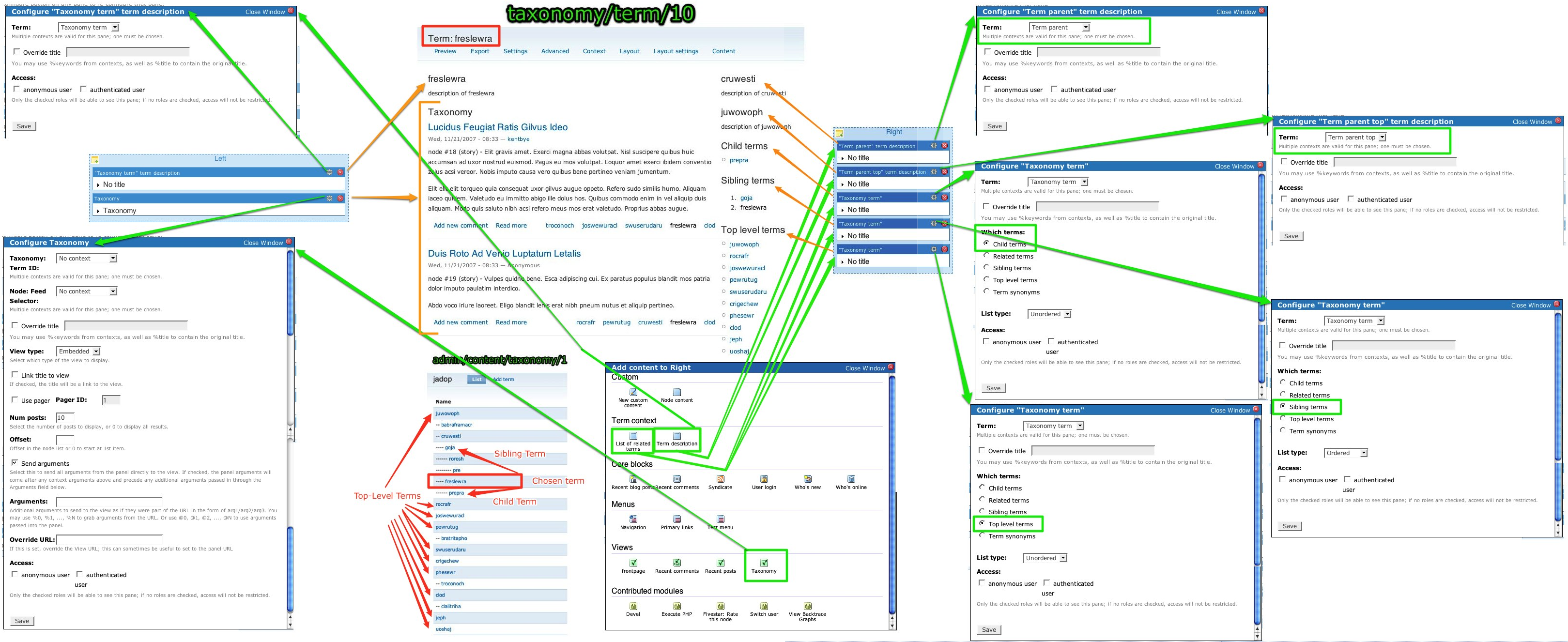
More details here: Panels: What is Context? & here.
The export code to recreate this panels scenario of overriding taxonomy/term/tid with contextual panels be found here: drupal.pastebin.com/f1bc881a3
Just copy & paste it from the box, add a new panels page, and then click import and paste it in. It helps to have some stock data with taxonomy terms created by the devel generate module.
Jen Lampton, lead of the Twig initiative for Drupal, watches as Twig is committed to Drupal core live during the BADCamp 2012 keynote by Dries Buytaert, Drupal's project lead. The commit was the culmination of months of hard work by Jen and other contributors.
This one made it onto drupal.com! Here's a screenshot: www.flickr.com/photos/runforcover/3821462202/
Other mentions:
twitter.com/bertboerland/status/3152770147
twitter.com/kristofvanroy/status/3163294319
As the owner of an ecommerce store, you have many major decisions to make that directly impact your company. What products will you carry? How will you determine your pricing? What shipping services will you use? All these and more are questions you need to answer before launching your site.
But...
voxilltec.com/2017/02/20/drupal-vs-magento-right-ecommerc...
I guess this is why they call it fall.
I'm guessing under a walnut tree.
Near the Fountain Garden
Cantigny Park, Wheaton, Illinois 41.854053, -88.154825
September 29, 2020
COPYRIGHT 2020 by JimFrazier All Rights Reserved. This may NOT be used for ANY reason without written consent from Jim Frazier.
200929cz7-90531600
SEE FULL SIZE: www.flickr.com/photo_zoom.gne?id=2009094288&size=o
www.kentbye.com/files/drupal_modules_part1.html
www.kentbye.com/files/drupal_modules_part2.html
www.kentbye.com/files/drupal_modules_part3.html
www.kentbye.com/files/drupal_modules_part4.html
www.kentbye.com/files/drupal_modules_part5.html
Drupal Modules as of 11/09/07.
Love that Budzic by Sue Clark. You can find the step-out at Tangled Ink Art. I put it inside of Drupe for the Square One Focus tangle this week.
SEE FULL SIZE: www.flickr.com/photo_zoom.gne?id=2026324860&size=o
www.kentbye.com/files/drupal_modules_part1.html
www.kentbye.com/files/drupal_modules_part2.html
www.kentbye.com/files/drupal_modules_part3.html
www.kentbye.com/files/drupal_modules_part4.html
www.kentbye.com/files/drupal_modules_part5.html
Drupal Modules as of 11/09/07.
BlueMasters for Drupal is based on the BlueMasters PSD template, which was designed by Wendell Fernandes and released for Smashing Magazine and its readers.
BlueMasters has been ported to Drupal and is supported by More than Themes, as part of our ongoing effort to bring quality themes to Drupal.
Which other theme would you like to see ported to Drupal?
Let us know at www.drupalizing.com.
Features
- Custom front page with 4 block regions
- Footer with 4 block regions
- A total of 12 block regions
- implementation of a JS Slideshow
- CSS rules for
- Read More and Comment buttons
- Images into content or blocks
- Contact form
- 2-column layout for inner pages
- 3-column layout with a JS Slideshow for the front page
///////////////////////////////////////////////
Tangle in a tangle challenge #44
Tangle string is Drupe
Done on watercolor paper layered on scrapbook paper and cardstock.
I've started making cards from my challenge pieces.
Apropos www.disambiguity.com/drupalorg-come-wireframe-with-me/.
This is the homepage, in case you couldn't guess. I forgot to include the site search, though. :(
SEE FULL SIZE: www.flickr.com/photo_zoom.gne?id=2009065024&size=o
www.kentbye.com/files/drupal_modules_part1.html
www.kentbye.com/files/drupal_modules_part2.html
www.kentbye.com/files/drupal_modules_part3.html
www.kentbye.com/files/drupal_modules_part4.html
www.kentbye.com/files/drupal_modules_part5.html
Drupal Modules as of 11/09/07.
SEE FULL SIZE: www.flickr.com/photo_zoom.gne?id=2009106828&size=o
www.kentbye.com/files/drupal_modules_part1.html
www.kentbye.com/files/drupal_modules_part2.html
www.kentbye.com/files/drupal_modules_part3.html
www.kentbye.com/files/drupal_modules_part4.html
www.kentbye.com/files/drupal_modules_part5.html
Drupal Modules as of 11/09/07.
SEE FULL SIZE: www.flickr.com/photo_zoom.gne?id=2009084128&size=o
www.kentbye.com/files/drupal_modules_part1.html
www.kentbye.com/files/drupal_modules_part2.html
www.kentbye.com/files/drupal_modules_part3.html
www.kentbye.com/files/drupal_modules_part4.html
www.kentbye.com/files/drupal_modules_part5.html
Drupal Modules as of 11/09/07.
BlueMasters for Drupal is based on the BlueMasters PSD template, which was designed by Wendell Fernandes and released for Smashing Magazine and its readers.
BlueMasters has been ported to Drupal and is supported by More than Themes, as part of our ongoing effort to bring quality themes to Drupal.
Which other theme would you like to see ported to Drupal?
Let us know at www.drupalizing.com.
Features
- Custom front page with 4 block regions
- Footer with 4 block regions
- A total of 12 block regions
- implementation of a JS Slideshow
- CSS rules for
- Read More and Comment buttons
- Images into content or blocks
- Contact form
- 2-column layout for inner pages
- 3-column layout with a JS Slideshow for the front page
///////////////////////////////////////////////
This is a closeup of a calendar. Notice today's date is highlighted. For more information, see openconcept.ca
For more recent screenshots of Drupal Calendars.
Okay, Drupal. Since *you're* so fucking smart with uppercase, lowercase and punctuation, why don't *you* just provide me with a password, huh?
Maybe you can make me one a really cool one, like "Xco_s4Wwl3". I love those. Because I got nothing better to do with my time than frequently requesting new passwords from you, because you think the ones I provide are rubbish, even though yours are impossible to remember.
Yes, Drupal, you got it all figured out, don't you? Well, newsflash: you're a system, runnning on hardware capable of calculating a request every 0.0001 second. I'm happy for you. That must be an awesome feeling being smart like that. And I really like you in general. So take it from a friend: STOP ACTING SO GODDAM SMUG ABOUT IT, YOU ASSHOLE!