View allAll Photos Tagged TarantulaHawk,
There was a big patch of snow-on-the mountain wildflowers that attracted an amazing number of pollinators, including this Tarantula-hawk wasp, Entypus unifasciatus ssp. unifasciatus. This is another new species for my prairie bee and wasp species set.
Some species info: bugguide.net/node/view/6803
This is a tarantula hawk wasp. (Warning: it gets gross from here) Called a tarantula hawk because it will sting and paralyze a tarantula and then drag the tarantula back to its special burrow. It then lays a single egg in the tarantula's abdomen. When the egg hatches the larva eats the paralyzed tarantula alive, avoiding critical organs until the last. Creepy!
Tarantula hawk
Taken in Los Liones Canyon
These wasps have one of the most painful stings of any animal and are in fact rated number two in pain for bug bites. They are not very aggressive though. One of the few predators who will eat these are roadrunners.
"Dragged to it's Doom" - Tarantula Hawk w/hapless Desert Blond Tarantula
©R.C. Clark: Dancing Snake Nature Photography
All rights reserved - Pima County, AZ
#PeaceLoveConservation, #canonphotography
A tarantula hawk (Pepsis formosa) at the Arizona-Sonira Desert Museum in Tucson, Arizona. They are best left alone--extremely painful sting!
Tarantula Hawk - Peru
Something a little different today. This very colorful little insect was flying around some flowers on our hotel grounds. A tarantula hawk is a spider wasp that preys on tarantulas.
hemipepsis tamisieri, one of the tarantula hawks , those who attack those large hairy spiders... very restless creatures, always on the go...but here it stopped for a while....
A tarantula hawk is a spider wasp that hunts tarantulas. Tarantula hawks belong to any of the many species in the genera Pepsis and Hemipepsis, in the family Pompilidae (spider wasps).
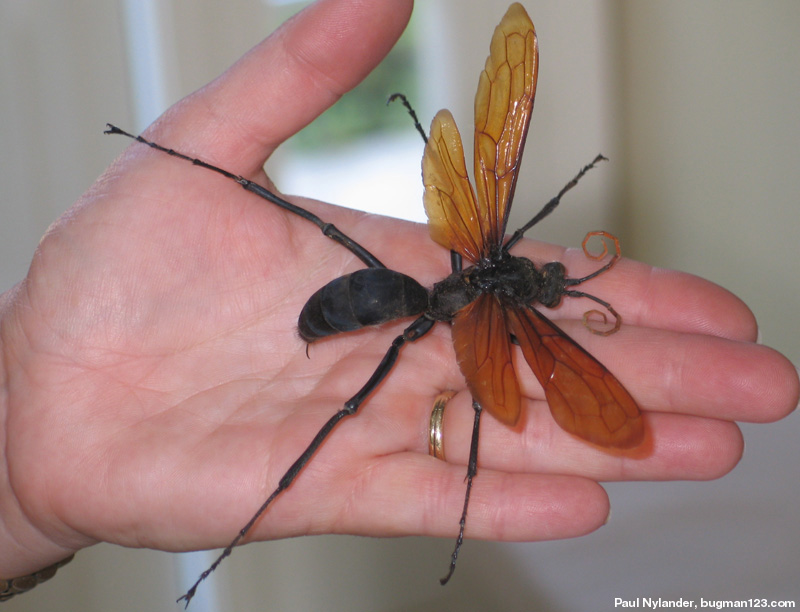
The more familiar species are up to 5 cm (2.0 in) long, making them among the largest of wasps, and have blue-black bodies and bright, rust-colored wings (other species have black wings with blue highlights). The vivid coloration found on the bodies, and especially wings, of these wasps is an aposematism, advertising to potential predators the wasps' ability to deliver a powerful sting. Their long legs have hooked claws for grappling with their victims. The stinger of a female Pepsis grossa can be up to 7 mm (1⁄4 in) long, and the sting is considered one of the most painful insect stings in the world.
The female tarantula hawk wasp stings and paralyzes a tarantula, then drags the prey to a specially prepared brooding nest, where a single egg is laid on the spider's abdomen, and the entrance is covered. Sex of the larvae is determined by fertilization; fertilized eggs produce females, while unfertilized eggs produce males. When the wasp larva hatches, it creates a small hole in the spider's abdomen, then enters and feeds voraciously, avoiding vital organs for as long as possible to keep the spider alive. After several weeks, the larva pupates. Finally, the wasp becomes an adult and emerges from the spider's abdomen to continue the life cycle.
Los Angeles. California.
Las avispas de este género se especializan en cazar arañas a las que paralizan con su veneno para depositar sus huevos en ella. También se las considera dentro del grupo de insectos capaces de producir un mayor dolor con su picadura, según el índice de dolor de Schmidt
One of the largest wasps in the world, this one hunts for tarantulas, which it paralyzes in order to plant an egg upon the big spider. The egg hatches. The larva feeds on the still-alive spider until it reaches maturity. It sounds like the script for a horror movie, but it is a reality. (If you don't believe me, look it up in Wikipedia.) The sting of this wasp is one of the most painful in the world, but they are not aggressive to humans. I have seen them flying around, looking for the dens of tarantulas many times. I had no idea of their habits until I did some research. They are big and impressive. I am glad I am not a tarantula.
At up to 2 1/2 inches (6.5 cm) long, tarantula hawk wasps are among the largest of wasps. They are relatively docile and rarely sting without provocation. However, the sting is among the most painful of all insects, though the intense pain only lasts about five minutes.
Tucson, AZ
It's fairly common to see these tarantula hawk wasps at Boyce Thompson Arboretum. While reportedly not very aggressive, their stings apparently hurts like the devil. So I do keep my distance. Interesting creatures.
We were relaxing on our patio the other evening when I saw something out of the corner of my eye - this big resident wasp had found and stung a tarantula! After rushing inside and fumbling around trying to get the camera and macro / flash assembled (and discovering a dead battery in the camera!) I figured she'd be gone, but she was still dithering, looking for a hole to put the spider in. So I kept firing away while she dragged it around, and finally she seemed to be satisfied with a squirrel hole, of all things, although I didn't see her pull it all the way in (and at that point it was almost completely dark).
As a biological note, these tarantula hawk wasps (and this one was small - only around 3 cm long) find a tarantula, sting it, and drag its paralyzed body to a hole in which they place the sleeping spider. Then she lays one egg on the spider, and the young larval wasp feeds on the fresh but anesthetized tarantula for around 30 days! Then the larva pupates and later emerges as an adult wasp.
I've seen a female wasp that looks like this one flying around at dusk for the past couple weeks, on and off, so suspect it MIGHT be the same one each time.
North Peak, Cuyamaca Mountains, California.
July 26, 2021
Greeting to Dave Sticker (David Seidensticker)
A fight between a big spider and a big blue wasp, the spider lost! Seen in Thailand in the forest. We’ve seen a big brown spider walking on the ground near a big tree. It was rather dark down om the ground in the forest. Suddenly a huge insect with beautiful blue and fast flapping his wings came down and attached the spider. and the fight was wild an very fast, difficult to focus. I’ve been so surprised, so I didn’t even think to set my camera on 4 k photo ode series shooting. First, we thought it was a big blue butterfly because the size of the wings, but then my friends saw, the insect was stinging the spider into its bally, again and again, until it was paralysed. Then it transported the spider up the tree trunk, it carried it and walked up. Unfortunately I couldn’t get it in focus so quick.
After that, we look up in the internet to find out what kind of insect it was and we came to the result, it must have been a tarantula hawk, it obviously can be in different colors. Ours was blue. If anybody here knows better, please let me know!
Greetings to David Seidensticker :)
© This photo is the property of Helga Bruchmann. Please do not use my photos for sharing, printing or for any other purpose without my written permission. Thank you!
A Tarantula Hawk drags a paralyzed Tarantula to its burrow where it will lay an egg on the spider and then bury it. The young wasp will consume the living tarantula as it grows, eating the non-essential organs first in order to keep the spider alive as long as possible.
Focus stacked manually from 3 photos (there are some focus gaps, but focus stacking was the only way to get the entire head in focus). I used the 28mm reversed at f/8 or f/11 on a few extension tubes and cropped (barely). I also used a new larger flash diffuser I made recently, and used on the past few photos. Provides some really soft light (no blown highlights).
I drove back out to the location where I took the previous two photos. I saw a tarantula hawk (for those who don't know, a tarantula hawk is a huge wasp that fights with tarantulas, see here and also read about them here) I also saw a few spotted weevils mating, I saw a few colorful sharpshooter leafhoppers, a HUGE (well over an inch) solid black horsefly, and a new (to me) jumping spider. I spent the better part of an hour chasing this damselfly around the woods (see the picture below) before he/she settled down on a fallen limb.
Female, on Desert Milkweed [Asclepias subulata], BugGuide Identification, Tucson, Pima County, AZ, 14 August 2019
a Tarantula Hawk drags a paralyzed Tarantula to its burrow where it will lay an egg on the spider and then bury it. The young wasp will consume the living tarantula as it grows, eating the non-essential organs first in order to keep the spider alive as long as possible.
~40 mm
Supposedly delivers the most painful sting of all wasp species in the U.S. So it was with a lot of trepidation that I photographed this beauty.
Lens: Sigma 150mm
Tarantula Hawk - Hemipepsis toussainti ??
I have seen this a couple of times now, a wasp catching a rain spider.
The previous time a lizzard and wasp was fighting over a rainspider. That was something awesome to have seen and experienced.
I just wished that I could have captured that moment, but they were quite camera shy.
South African Spider Wasp.
Rain Spider (a.k.a. Huntsman Spider)
Using the Tamron SP AF 60mm f/2 Di II MACRO 1:1 LD (IF) (model G005N II) lens.
Critique is welcomed.
Thank you all very much for your visits, favs and comments.
EDIT:
Source: www.sabisabi.com/wildfacts/spider-hunting-wasp/
Spider hunting wasps belong to the family Pompilidae, and are found all over the world. There are around 4200 various species of this wasp, with 6 families in South Africa alone. The name of the wasps refers to their unique behaviour of hunting spiders, but in all other respects they are harmless and non-aggressive.
The spider hunting wasps are easy to identify. They are mostly black, with, depending on the species, conspicuous orange, red, yellow or white aposematic markings which deter predators from eating them. These long-legged wasps are found in an assortment of sizes, from a dwarf 10mm up to a staggering 50mm. It is difficult to differentiate between the sexes, although the female wasp is often larger than the male.
All species of spider hunting wasps are solitary, and most species will paralyse their prey after capturing it. Being solitary these wasps don’t colonize; they nest alone in crevices or burrows. Although they have the ability to fly well, they spend much of their time running around on the ground searching for prey under rocks and leaves.
These wasps have powerful venom which is used to paralyses the spider which will become host to a wasp larva. Although spiders are well equipped to defend themselves, the spider hunting wasps have their great agility and mobility to thank for their success in hunting. The wasp overwhelms the spider with a single poisonous sting before dragging its live but immobilized prey to a generally pre-prepared burrow. The wasp then lays a single egg on the spider’s abdomen, exits the nest and closes it – after which it will conceal the entrance.
The size of the spider’s prey will determine whether the wasp will lay an egg that develops into a male or female. Larger spiders will be host to future female wasps, and smaller spiders to male wasps. The egg will hatch after about 10 days, at which stage the larva will feed on the edible parts of the live, paralyzed spider. After consuming the spider, the larva spins itself into a silk cocoon, remaining dormant until the correct temperature and humidity stimulate pupation and it emerges as an adult.
The next time you see a scary-looking, long-legged wasp running backwards and forwards on the ground, look carefully – it may be a spider-hunting wasp searching for its next victim.
"The female tarantula hawk captures, stings, and paralyzes the spider, then either drags her prey back into her own burrow or transports it to a specially prepared nest, where a single egg is laid on the spider’s abdomen, and the entrance is covered. When the wasp larva hatches, it creates a small hole in the spider's abdomen, then enters and feeds voraciously, avoiding vital organs for as long as possible to keep the spider alive. After several weeks, the larva pupates. Finally, the wasp becomes an adult, and emerges from the spider's abdomen to continue the life cycle. Tarantula wasps are also nectarivorous" (which is recorded here in the photo).
The tarantula hawk is relatively docile and rarely stings without provocation. However, the sting, particularly of P. grossa, is among the most painful of any insect, though the intense pain only lasts about three minutes.--Wikipedia
In genus Pepsis. On milkweed, Asclepias eriocarpa,
Monterey Co., CA
A soldier watches as a Tarantula Hawk (T-Hawk) Micro Remote Piloted Air System (RPAS) hovers over the desert in Afghanistan.
The Tarantula-Hawk takes off vertically and hovers to get a clear view of the ground ahead of troops.
It is used by the British Army in Afghanistan, clearing routes without risking human life and checking for roadside bombs.
Talisman is the army unit using T-Hawk. It is a counter-IED task force and uses specialist equipment, including this drone, to clear routes for large convoys.
-------------------------------------------------------
© Crown Copyright 2013
Photographer: Captain Dave Scammell
Image 45156607.jpg from www.defenceimages.mod.uk
This image is available for high resolution download at www.defenceimagery.mod.uk subject to the terms and conditions of the Open Government License at www.nationalarchives.gov.uk/doc/open-government-licence/. Search for image number 45156607.jpg
For latest news visit www.gov.uk/government/organisations/ministry-of-defence
Follow us:
Females have curled antennae, males straight.
Worldwide distribution:India to Southeast Asia, Africa, Australia, and the Americas
Tarantula hawks are large, up to 5 cm (2 inch) blue-black wasps with bright orange wings. They feed on nectar from flowers but are most famous for their unique relationship to tarantulas in a particularly morbid fashion (the basis for their name). The female tarantula hawk captures, stings, and paralyzes the spider, then either drags her prey back into her own burrow or transports it to a specially prepared nest, where a single egg is laid on the spider’s abdomen, and the entrance is covered. When the wasp larva hatches, it creates a small hole in the spider's abdomen, then enters and feeds voraciously, avoiding vital organs for as long as possible to keep the spider alive. After several weeks, the larva pupates. Finally, the wasp becomes an adult, and emerges from the spider's abdomen to continue the life cycle.
Their long legs have hooked claws for grappling with their victims. The stinger of a female Pepsis grossa can be up to 7 mm (1/3 in) long, and the sting is considered the second most painful insect sting in the world.
Yesterday, on the way to Costco, we went for a short drive. We saw some some nice, sweet baby duckies, and a huge bullfrog. Then we saw a wasp. Not just any wasp. A HUGE wasp, dragging a tarantula across the ground. It's the same type of wasp that my Dad got stung by when I was about 16 years old, up in San Dimas Canyon (we were collecting bugs for my bug collection). Here's how badly it hurt . . . my Dad, who never cusses, yelled a curse word in front of his 16-year-old daughter and his 9-year-old son and started jumping up and down. Now I can see why. Here is the description of the Tarantula Hawk's sting on Wikipedia:
"The stinger of a female Tarantula Hawk can be up to 1/3 inch long, and delivers a sting which is rated amongst the most painful in the insect world. These wasps are usually not aggressive, but the sting, particularly of Pepsis formosa, is among the most painful of any insect. Commenting on his own experience, one researcher described the pain as "...immediate, excruciating pain that simply shuts down one's ability to do anything, except, perhaps, scream. Mental discipline simply does not work in these situations." In terms of scale, the wasp's sting is rated at the top of the Schmidt Sting Pain Index, second only to that of the bullet ant. Because of their extremely large stingers, very few animals are able to eat them; one of the few animals that can is the roadrunner."
I remembered my Dad had been stung by one and that it had hurt, but I forgot that I had looked up info on this wasp last year and read about the painful sting. Otherwise, I probably would NOT have done what I did yesterday, which was grab a stick and move the wasp (and the tarantula) out onto the road a couple of times so I could get a better picture. At one point, it started climbing up the stick towards my hands and I dropped it. My heart was beating SO hard. Ugh. I still feel like I have bugs crawling all over me because it freaked me out so much.
Oh, and after they drag the tarantula to their evil hidey-hole, they lay eggs on it and when the larvae hatch, they suck the juices out of the STILL LIVING TARANTULA. Did you hear me? The tarantula is still alive at this point, just paralyzed by the sting. Actually, I think it's a pretty amazing cycle of life, and I think the wasp is a beautiful creature. But it still creeps me out. Here's what Wikipedia says about the babies feeding on the tarantula:
"They capture (often following a dramatic battle), sting and paralyze the spider. Next they either drag the spider back into her own burrow or transport their prey to a specially prepared nestegg is laid on the spider's body, and the entrance is covered. The wasp larva, upon hatching, begins to suck the juices from the still-living spider. After the larva grows a bit, the spider dies and the larva plunges into the spider's body and feeds, avoiding vital organs for as long as possible to keep it fresh."
Will you sleep well tonight?
Worldwide distribution:India to Southeast Asia, Africa, Australia, and the Americas
Tarantula hawks are large, up to 5 cm (2 inch) blue-black wasps with bright orange wings. They feed on nectar from flowers but are most famous for their unique relationship to tarantulas in a particularly morbid fashion (the basis for their name). The female tarantula hawk captures, stings, and paralyzes the spider, then either drags her prey back into her own burrow or transports it to a specially prepared nest, where a single egg is laid on the spider’s abdomen, and the entrance is covered. When the wasp larva hatches, it creates a small hole in the spider's abdomen, then enters and feeds voraciously, avoiding vital organs for as long as possible to keep the spider alive. After several weeks, the larva pupates. Finally, the wasp becomes an adult, and emerges from the spider's abdomen to continue the life cycle.
Their long legs have hooked claws for grappling with their victims. The stinger of a female Pepsis grossa can be up to 7 mm (1/3 in) long, and the sting is considered the second most painful insect sting in the world.
A large iridescent wasp. In the shade under the trees they appear black, but in sunlight or flash, the blue iridescence makes them really pretty. They have a very painful sting, but only sting if threatened. Here is a Youtube video of someone purposely getting stung by one.
Wasp Wednesday. The tarantula hawks (pepsis wasps) were feeding at Tohono Chul Park, and then I came on one laying in provisions for the next generation. And there were also lots of flowers, lizards and other neat things.
RAW file processed with Olympus Viewer 3.
_7013111
Death Valley, California. This wasp will catch a tarantula, bury it alive, and lay an egg on it. And when the baby wasp hatches it has a live birthday meal.
Large on black
My stocklist
Tarantula Hawk on The Prowl as it searches through the brush for Pray. This is one of the Wasps That Sting a Tarantula Then Lay an Egg on it before burying the still living spider for its offsprings lunch
A type of wasp that captures tarantulas by stinging them. The tarantula is paralyzed by the sting and then dragged to a burrow where an egg is laid. The tarantula becomes host to the egg, then food for the hatched larva. Didn't think I would feel sorry for a tarantula until I read this information. I have read that the sting of this wasp is one of the most painful insect stings. Luckily they are not aggressive until provoked. I'm not adventuresome enough to test the sting rating of this species.
Seen in Dimmit County, Texas during October 2020. There happen to be plenty of both tarantulas and tarantula hawks in that area.
This indigo and iridescent Tarantula Hawk settled down on the beach sands is known for making zombies out of spiders.
They capture the spider and send the toxins through their powerful sting. Once the toxins take effect on the poor arachnid, the spider is still alive, but immobilized totally!
The hawk drags its victim to an isolated location and does not feed upon the spider. Instead lays eggs within the spider's body. The larvae that emerge from these laid eggs would eat the spider, which is fresh and alive, but cannot protest being eaten.
Then the larvae emerge into adults after pupation and continue with their life cycle, searching for potential mates and juicy spiders!