View allAll Photos Tagged Embryo
It seems to be taking so long for them to hatch. Every day i think "today could be the day". So far it has not been that day. I am currently hoping that tomorrow is the day they hatch. *fingers crossed*.
My dog had attacked the nest of a bird that had made a little home in some tall grass by the house. I found the nest laying out by the front porch and all of the eggs were laying around it. I put them back in the nest and put the nest back in the grass, hoping that the mother would come back to care for them. After two days, she still hadn't returned, so I figured that they weren't going to make it- something would eat them or they would just rot. So me and my sisters thought we could blow out the eggs and keep them since they were speckled and pretty. But one had a hole in the side of it and we could see that the inside was already formed. We opened a few up so that we could look at the embryos of the dead chicks and I took a few pictures.
Theory of Embryo Complete Information of Wholistic Organs. The ear, as a relatively independent part of the body, is able to reflect all life information of the whole body.
Life embryo
Paint on canvas
Carly Sheil
I wanted to portray both security and also a sense of insecurity in this piece, as though the girl was in a protective womb yet had to curl up into herself to feel safe. I felt that the womb had to be green instead of red because it was cold and still living, almost like a plant, whereas her, and her ribbons are warm colors, to bring them to stand out and show their difference from the harsh, yet safe, surrounding womb. These insecurities are also portrayed in her almost nakedness.
She has alien eyes because she isn’t quite human, or doesn’t feel as such. She is not a part of this safe haven and this reflects not only in her coloration, but in her eyes as well. A womb generally matches its occupant, red walls to a flesh toned fetus, which is the norm. I chose red and green because they contrast each other and bring each other out. They are the only colors I chose and thus stand out more.
The red ribbons, I like to feel, represent the string of fate; a long, red cord that connects someone with their destiny and future mate. Hers is twisting around her, the path is untraceable and this leads to further confusion.
A range of images demonstrating the increased macro effect of using my standard 18-55mm Canon lens with a set of macro extension tubes. Pictures are all of a set of six chicken embryos at various stages in their development, encased and preserved in acrylic.
False color scanning electron micrograph of zebrafish embryo by Annie Cavanagh and David McCarthy displayed a the Koch Institute Art Gallery March 2014
DSCN7082
Available at; www.hypefortype.com/?page=22&ID=140
Embryo is a custom font which is applicable for any type of graphic design - web, print, motion graphics etc and perfect for t-shirts and logos.
Go to Page 54 in the Internet Archive
Title: Manual of antenatal pathology and hygiene : the embryo
Creator: Ballantyne, J. W. (John William), 1861-1923
Publisher: New York : Wood
Sponsor: Open Knowledge Commons
Contributor: Francis A. Countway Library of Medicine
Date: 1905
Language: eng
If you have questions concerning reproductions, please contact the Contributing Library.
Note: The colors, contrast and appearance of these illustrations are unlikely to be true to life. They are derived from scanned images that have been enhanced for machine interpretation and have been altered from their originals.
Read/Download from the Internet Archive
A range of images demonstrating the increased macro effect of using my standard 18-55mm Canon lens with a set of macro extension tubes. Pictures are all of a set of six chicken embryos at various stages in their development, encased and preserved in acrylic.
My dog had attacked the nest of a bird that had made a little home in some tall grass by the house. I found the nest laying out by the front porch and all of the eggs were laying around it. I put them back in the nest and put the nest back in the grass, hoping that the mother would come back to care for them. After two days, she still hadn't returned, so I figured that they weren't going to make it- something would eat them or they would just rot. So me and my sisters thought we could blow out the eggs and keep them since they were speckled and pretty. But one had a hole in the side of it and we could see that the inside was already formed. We opened a few up so that we could look at the embryos of the dead chicks and I took a few pictures.
Taken @ Embryo
View large! www.flickr.com/photos/24101056@N04/3934731438/sizes/o/
Thanks Katiya for the texture again :)
Cross section of a Leptecophylla oxycedrus (coastal pinkberry) stone. Like many berried epacrids the stones bear multiple seeds. In this cross section four seeds are revealed with one empty fruit chamber. In the center of the seeds the linear embryo can be seen.
Cut test performed after 500 days of incubation at various temperatures.
These are my personal notes taken during a geology presentation at: "Evolving Form and Function, Fossils and Development", a Symposium Honoring Adolf Seilacher for his Contributions to Paleontology, and Celebrating his 80th Birthday, which was held at Yale University in New Haven, Connecticut, USA in 2005. I give the notes here because they may be of some interest. Do not expect them to always be in complete sentences, etc.
-----------------------------------
Embryos and Ancestors
Presented by: Phil Donoghue (School of Earth Sciences, University of Bristol, Bristol, Britain) (www.bris.ac.uk/earthsciences/people/philip-c-donoghue/ind...)
1 April 2005
----------
The fossil record is traditionally perceived to be biased against embryological remains. Since the Zhang & Pratt embryo paper, several finds have been made in various places, especially in the Doushantuo Formation of South China - has produced animal & plant/algae embryos. A growth series of fossil embryos is now available.
Parapandorina (jpaleontol.geoscienceworld.org/content/74/5/767/F8.large.jpg) - it has a well known embryological series. No later stages, unfortunately, for the most part (but see Megaclonophycus).

The Doushantuo Formation is packed with embryos.
Tianzhushania/Megasphaera (senior synonym) - Megasphaera (2.bp.blogspot.com/_J-oN8KCzVDw/SmjEU_30lOI/AAAAAAAAACA/bM...) was originally considered an acritarch (schaechter.asmblog.org/schaechter/images/2008/02/06/acrit...). It is a resting cyst/cleaving embryo with an inside envelope. It's identification is unclear - is it a pteropod?


The South China fossil embryos occur in cherts & phosphorites.
The Dengying Formation is Ediacaran in age, but earliest Cambrian dolostones have fossil embryos, too.
The Dengying Formation overlies the Doushantuo Formation in the Yangtze Platform. The Dengying has cleaving embryos present.
Olivooides (www.spacedaily.com/images/life-first-animal-bg.jpg) - this fossil has been identified as a series of cleaving embryos. Described by Stefan Bengtson. Compare Olivooides with the loricae of some modern organisms. It possibly has cnidarian/conulariid affinities.
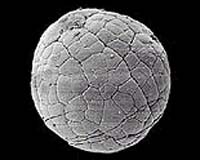
Pseudooides - Steiner has recently well defined an embryological series. Has a well-defined pinched germ band (lobopodan/onychophoran). Some later stages of something lobopod-like - but related to Pseudooides?
Michael Steiner has found an embryo with a membrane and Onychodictyon-like sclerites poking through. (www.esacademic.com/pictures/eswiki/79/Onychodictyon.jpg)

Markuelia has been pinned down, phylogenetically. (cdn.physorg.com/newman/gfx/news/hires/2006/Fig_02Markueli...) It is now identified as a metazoan embryo by Stefan Bengtson. Markuelia was a direct developer. Its head is poorly preserved in Stefan’s sample, though. The body has surface annulations - it's metameric. Stefan suggested a lobopod affinity or an annelid affinity. Simon Conway Morris suggested that Markuelia may be a halkieriid. Halkieriids include the last common ancestor of molluscs, annelids, brachiopods. But, these three groups are primitively indirect developers.

Dong Xiping has dissolved lots of rock - now has lots of new Markuelia samples (Markuelia hunanensis from Middle Cambrian of China). Some have their heads preserved. The Markuelia head has a terminal donut mouth & three circlets of radially arrayed spines. ~30 mm long, ~130 segments. This information allows us to reject the lobopod hypothesis - lobopods have a subterminal mouth. This information also allows us to reject the annelid hypothesis and halkieriid hypothesis (these were ideas based on fossils associated with Markuelia).
New hypothesis - Markuelia has affinities with the Introverta (= nematodes, priapulids, nematomorphs, kinorhynchs, loriciferans). Markuelia appears to be a sister group to the Kinorhyncha, Loricifera, Priapulida clade (KLP). This is cool information, but Markuelia is a direct developer, while KLP are all indirect developers. This means that the KLP (= Scalidophora) common ancestor was a direct developer.
So, embryos do have phylogenetic relevance. But, we need more data/samples to prevent fossil embryos from being curiosities.
Late Neoproterozoic & Cambrian - shouldn’t there be a lot of indirect developing embryos? Is this apparent bias toward the presence of direct developing fossil embryos due to them having higher preservation potential? Someone should do taphonomic experiments with modern embryos to find this out.
There's only one planktotrophic larva fossil known (an indirect developer).
We can squeeze more out of the data we have already.
It’s only been 10-11 years since the first embryos were found and identified.
But, dissolution of rock & microfossil fishing have gone on for a long time, for biostratigraphic purposes. So, we're not sure if we have more potential.
The Aldan River basin in Siberia has 5 sites with paleoembryos. Northern Australia has 4 sites with paleoembryos. The Lower Ordovician of Nevada has 2 sites with paleoembryos. These are all Markuelia - it disappears after the Lower Ordovician.
-------------------
Dolf Seilacher questions/comments: What about this embryo taphonomic window? Is it the same taphonomic window as for other exceptionally preserved fossils? Note the stranded jellyfish taphonomic window (Wisconsin, Spain, India) - they only occur in Cambrian beaches - there are lots of them.
-------------------