View allAll Photos Tagged DavidScott
#Donnerstagsmonochrom
#ThursdayMonochrome
Another oldie from the archives, taken back in August 2019. It was one of those "Should I take the camera out, or will it look stupid?" moments, but the life-sized astronaut figure (gold-coloured, of course) was a subject too special to not take a few snapshots, especially together with the huge standee with a photo of George Clooney and his Omega Speedmaster in the jeweller's entrance. Obviously, this was an Omega promotion event to celebrate the 50th anniversary of 1969's Apollo 11 mission to the Moon. The Speedmaster was the watch NASA had officially certified for all its manned space flights. But it was only Buzz Aldrich who wore the Speedmaster on the first-ever moonwalk. Neil Armstrong had left his watch on the Eagle, as a backup because the mission timer onboard the Eagle had malfunctioned.
The Speedmaster also played an important part in the dramatic Apollo 13 mission ("Houston, we have a problem!") where it saved the lives of the crew of three by accurately timing the ignition that would bring the stricken ship safely back to Earth. An oxygen tank had exploded which resulted in an immediate mission call-off. To save energy for the now necessary manually-stirred trip home to Earth, the electricity onboard had been switched off, mission timer included. Jack Swigert operated his Speedmaster to time the precise ignition (14 seconds sharp) while the other two astronauts, Jim Lowell and Fred Haise, navigated the space shuttle that, on top of it all, had also lost directions, toward Earth. Successfully.
But did you know that there is another Moon watch that a NASA astronaut had worn on the Moon? David Scott, a member of the Apollo 15 crew, wore a Bulova chronograph during his 1971 moonwalk. The crystal of his Speedmaster had popped off, so he wore his Bulova which he had taken to the mission as a backup. In 2021, Bulova reissued that watch under the name "Lunar Pilot".
“At one point on Agena, near the docking cone and extended antenna, Scott will open a small, spring-loaded door to expose a micro-meteorite impact plate. On a subsequent Gemini mission—probably Gemini 9—it is tentatively planned to approach the dead Gemini 8 target craft, and another space-walking astronaut will retrieve the plate for earth study of meteorite impacts during the interim between flights."
By Russell Arasmith. Masterful. Striking:
Astronaut David R. Scott, commander, gives a military salute while standing beside the deployed U.S. flag during the Apollo 15 lunar surface extravehicular activity (EVA) at the Hadley-Apennine landing site. The flag was deployed toward the end of EVA-2. The Lunar Module "Falcon" is partially visible on the right. Hadley Delta in the background rises approximately 4,000 meters (about 13,124 feet) above the plain. The base of the mountain is approximately 5 kilometers (about 3 statute miles) away. This photograph was taken by Astronaut James B. Irwin, Lunar Module pilot.
Credit: NASA
Image Number: AS15-88-11863
Date: August 1, 1971
Lightning streaks through the sky around the Apollo 15 stack of hardware prior to the Apollo 15 launch. The huge 363-feet-tall Saturn V is scheduled to launch from Pad A, Launch Complex 39, at 9:34:00:79 p.m. (EDT) on July 26, 1971. The prime crewmembers for the Apollo 15 mission are astronauts Dave Scott, Commander; Jim Irwin, Lunar Module Pilot; and Al Worden, Command Module Pilot.
Credit: NASA
Image Number: S89-41564
Date: July 25, 1971
“Apollo 15 modified lunar module for the ninth manned Apollo crew. The members of the Apollo 15 prime crew are James B. Irwin, lunar module pilot; David R. Scott, commander; and Alfred M. Worden, Jr., command module pilot. Apollo 15 is the fourth lunar landing mission and the first to use the Lunar Roving Vehicle to traverse the lunar surface.”
The plume deflector under the near RCS quad is…not there, but the other two are. Other than that it’s great, to include the lunar surface sensing probes, correctly located/depicted.
Looks to be from the same base diagram, with ample, informative & useful callouts. Well done:
airandspace.si.edu/multimedia-gallery/5212hjpg
Credit: Smithsonian NASM
“APOLLO 15 LRV ON MOON---An artist's concept of the Apollo 15 Hadley-Apennine landing area showing the two moon-exploring crewmen on a traverse in their Lunar Roving Vehicle (LRV). The two figures represent Astronauts David R. Scott, commander, and James B. Irwin, lunar module pilot. The Apollo 15 Lunar Module is in left background. (Art work by Teledyne Ryan.)”
“Art work by Teledyne Ryan” means it’s by Robert Watts…whose signature has been removed by the cropping of the image, in comparison to the linked Teledyne Ryan issuance of it.
It looks like Dave’s got the pedal to the metal and is barreling INTO Hadley Rille…probably redlining it at ~12 mph! Like “Thelma & Louise”!
This frame from Jim Irwin's 8 o'clock (southeast) pan shows the southeast portion of the Lunar Module (LM). The dark gray doors cover the Scientific Equipment (SEQ) Bay. The fuel cask is in the down position at the left of the SEQ Bay doors. Note the wrinkling of the plume deflector. The dome removal tool and the attached dome are next to the minus-Y (south) strut. The fuel-element extraction tool is at the lower left. To the left of the LM in the distance, Dave Scott has moved away from the Lunar Roving Vehicle (LRV) into the ALSEP deployment site.
Full Description: A Titan booster launched the Gemini 8 spacecraft on March 16, 1966, from launch complex 19 Cape Kennedy, Florida. The flight crew for the planned 3 day mission, astronauts Neil A. Armstrong and David R. Scott, achieved the first rendezvous and docking to Atlas/Agena in Earth orbit. But the mission was terminated early due to a malfunctioning thruster on the Gemini spacecraft.
Credit: NASA
Image Number: SPD-MARSH-9141927
Date: March 16, 1966
R. ARASMITH ART COLLECTION
One of at least three (I think) gorgeous works by Russell Arasmith depicting Gemini VIII Astronaut, David R. Scott, during his planned EVA, the goal being translating to, and then donning & testing the Extravehicular Support Package (ESP) for the first time. A feat never to occur.
No caption/description is associated with this NASA-posted image, and I don’t have it in me to provide my usual drivel for it. However, the press slug associated with the preceding sequence for this phase of the mission follows:
“Next, Scott will move back toward Gemini (while Gemini and Agena still are docked) and proceed aft over the spacecraft, pulling up a handrail to help his movement over the retro (center) section and also using a second handrail over the equipment (aft) section that will be extended when the spacecraft leaves its booster at orbital insertion. This sequence is shown in 1, 2, 3, 4 order as Scott moves aft and takes a position (4) on a bar at rear end of the spacecraft, where he faces and checks out a special back he will wear for extended space walking.”
This gorgeous work, to me, is a tour de force by Mr. Arasmith. Pretty damned gutsy to attempted to depict an Extravehicular Activity (EVA) which had yet to occur, with only the photography from relatively static previous EVA’s as a ‘template’, with equipment that had yet to be used in flight, and from such a ’three-dimensionally’ demanding perspective. All without having it look goofy, awkward & somehow ‘wrong’.
Mr. Arasmith knocked it out of the park, into the wind, towering, into the adjacent parking lot. Yeah, hyperbole, but this is mad skills on display.
At, along with many others. Well worth browsing through:
www.nasa.gov/centers/marshall/history/russ-arasmith-gemin...
The prime crew of the Apollo 15 lunar landing mission. They are from left to right: Commander, David R. Scott, Command Module pilot, Alfred M. Worden and Lunar Module pilot, James B. Irwin. The Apollo 15 emblem is in the background. This official crew portrait was taken about a month before their launch to the Moon on July 26, 1971.
Credit: NASA
Image Number: S71-37963
Date: June 28, 1971
“APOLLO 9 EVA - - Astronaut Russell L. Schweickart, lunar module pilot, operates a 70mm Hasselblad camera during his extravehicular activity on the fourth day of the Apollo 9 earth-orbital mission. The Command/Service Module and Lunar Module 3 “Spider” are docked. This view was taken from the Command Module “Gumdrop.” Schweickart, wearing an Extravehicular Mobility Unit (EMU), is standing in “golden slippers” on the Lunar Module porch. On his back, partially visible, are a Portable Life Support System (PLSS) and Oxygen Purge System (OPS). Astronaut James A. McDivitt, Apollo 9 commander, was inside the “Spider”. Astronaut David R. Scott, command module pilot, remained at the controls in the Command Module.”
A refreshingly well-written caption!
A stunning image. Check out the reflections of both spacecraft, Scott and the 'entire' earth in Schweickart's visor!
One of at least three (I think) gorgeous works by Russell Arasmith depicting Gemini VIII Astronaut, David R. Scott, during his planned EVA, the goal of it to translate to, don and test the Extravehicular Support Package (ESP) for the first time. A feat never to occur.
The press slug associated with it:
“Next, Scott will move back toward Gemini (while Gemini and Agena still are docked) and proceed aft over the spacecraft, pulling up a handrail to help his movement over the retro (center) section and also using a second handrail over the equipment (aft) section that will be extended when the spacecraft leaves its booster at orbital insertion. This sequence is shown in 1, 2, 3, 4 order as Scott moves aft and takes a position (4) on a bar at rear end of the spacecraft, where he faces and checks out a special back pack he will wear for extended space walking.”
Excellent:
www.collectspace.com/ubb/Forum29/HTML/001489.html
Credit: collectSPACE website
This gorgeous work, to me, is a tour de force by Russell Arasmith. Pretty damned gutsy to attempted to depict an Extravehicular Activity (EVA) which had yet to occur, with only the photography from relatively static previous EVA’s as a ‘template’, with equipment that had yet to be used in flight, and from such a ’three-dimensionally’ demanding perspective. All without having it look goofy, awkward & somehow ‘wrong’.
Mr. Arasmith knocked it out of the park, into the wind, a towering drive, eventually dropping into the adjacent parking lot…with the bases loaded…in extra innings…during an away game. Yeah, hyperbole, but this is mad skills on display.
Astronaut Group Three announced. They are (seated, left to right) Edwin E. Aldrin Jr., William A. Anders, Charles A. Bassett II, Alan L. Bean, Eugene A. Cernan, and Roger B. Chaffee. Standing (left to right) are Michael Collins, R. Walter Cunninham, Donn F. Eisele, Theodore C. Freeman, Richard F. Gordon Jr., Russell L. Schweickart, David R. Scott and Clifton C. Williams Jr.
Credit: NASA
Image Number: S63-18765
Date: October 18, 1963
“PACIFIC OCEAN – Astronauts (left to right) David Scott and Neil Armstrong, still seated insider their Gemini 8 spacecraft, wait to be picked up by the U.S.S. destroyer Mason. Pararescue men stand on floatation collar assisting the astronauts after they had placed the collar around spacecraft. The National Aeronautics and Space Administration’s Gemini 8 mission was terminated during the sixth orbit, landing some 500 miles east of Okinawa.”
Per the caption for the identical image, with photo ID no. S66-18602. If correct, it contains excellent additional information (obviously associated with it being in color) and is very well written…wow, pinch me. Must've been outsourced: 😉
“Astronauts Neil A. Armstrong and David R. Scott sit with their spacecraft hatches open while awaiting the arrival of the recovery ship, the USS Leonard F. Mason after the successful, but early, completion of their Gemini VIII mission. They are assisted by USAF Pararescuemen Eldrige M. Neal, Larry D. Huyett, and Glenn M. Moore. The overhead view shows the Gemini 8 spacecraft with the yellow flotation collar attached to stabilize the spacecraft in choppy seas. The green marker dye is highly visible from the air and is used as a locating aid.”
Neil is rockin’ those Ray-Bans, too too cool, which he INDEED WAS during this mission. The 1201 alarm, <30 seconds of fuel remaining combo three years later was a walk-in-the-park compared to this.
RIGHT STUFF X 2.
Air Farce, err…Force Pararescue?! I would’ve expected Navy…like UDT folks.
Hmm…Airmen, they’re probably waiting on caviar & crackers to be air-dropped to them. Did they even know how to swim? 😉👍 ✈️
Who knew?
Launch:July 26, 1971
Landing: August 7, 1971
Astronauts: David R. Scott, James B. Irwin and Alfred M. Worden
Apollo 15 stayed on the moon for three days as the first of the Apollo “J” missions that allowed them to stay on the moon for longer periods of time. They were also the first mission to take a car to the moon and drive it. The Lunar Roving Vehicle allowed the astronauts to travel 17.5 miles and collect more than 170 pounds of lunar samples.
Credit: NASA
Image Number: S71-30463
Date: May 1971
“Apollo 104 command and service modules arrive at Kennedy Space Center from the skid strip on Cape Kennedy. Scheduled for the second manned Saturn V flight, the spacecraft was flown from the manufacturer’s plant in California. The printed sign says “Good luck again Jim, Dave and Rusty – 104 opens the door,” referring to astronauts James McDivitt, David Scott, and Russell Schweickart, who will fly the mission scheduled for this December.”
Pertinent, interesting & informative discussion:
www.collectspace.com/ubb/Forum29/HTML/001889.html
Credit: collectSPACE website
“Scott will make the nation’s second space walk on the mission. After stepping out of the capsule, wearing a chest pack that is connected to the spacecraft with a 25-foot umbilical (a combined oxygen-communication-tether line) he will move aft to the adapter section and experiment with a torqueless power tool. To begin the experiment, Scott will pull up a box-like unit from the adapter, open it to take out a power tool, then use the tool on four nut-and-bolt-test setups to determine the effectiveness of the tool and whether its action will tend to turn his body in space as a reaction to its operation.”
Due to the near disaster as a result of the spacecraft’s runaway thruster, no Extravehicular Actvity was conducted by Scott. As you might expect, in addition to Command Pilot being Neil Armstrong, there’s no shortage of material/reading available regarding this flight. A few:
airandspace.si.edu/stories/editorial/spinning-out-control...
Credit: Smithsonian NASM website
www.collectspace.com/ubb/Forum29/HTML/001927.html
www.collectspace.com/news/news-031616c-gemini8-50th-anniv...
www.collectspace.com/ubb/Forum29/HTML/000681.html
Above three credit: collectSPACE website
Finally, back to what I’m here for, the photographs and/or artists & artist’s concepts. Russ Arasmith…what a body of work.
“ASTRONAUTS EMBARK ON LUNAR EXPLORATION”
The fifth of five gorgeous renderings of Lunar Roving Vehicle (LRV) deployment by Grumman Aircraft Engineering Corporation (GAEC)/Grumman Aerospace Corporation (GAC) master artist Craig Kavafes.
Also:
www.hq.nasa.gov/alsj/alsj-LRVDeployGrumman.html
Specifically:
www.hq.nasa.gov/alsj/S71-38190HR.jpg

Both above credit: ALSJ website
I love the ALSJ; however, although it's not my place, I take issue with the poor choice (IMHO) of the term…”cartoons” and the “sigh” remark. “Sigh”, “UGH” and a host of other vulgar & disparaging sounds befit most NASA attempts at any ‘attempt/effort’ regarding image preservation, description, presentation, cataloging, etc., etc., etc. Not the fact that this doesn't represent actual candidate landing site topography.
I’m okay with a little dramatic terrain. I’m also thankful they have it & shared it!
“GT-11 PILOTS:
When GT-8 space travelers David Scott and Neil Armstrong, foreground, posed with backup pilots, Richard F. Gordon and Charles (Pete) Conrad, it made a routine handout picture from NASA.
But shortly afterwards, the troops destroyed NASA protocol’s cool when they borrowed hats, a photographer’s light reflector, and sat again for the deadpan portrait at bottom.
Conrad and Gordon, backups then, are the prime space crew for Gemini 11, scheduled for launch September 9.”
Absolutely delightful. Gordon is totally rockin’ that fedora.
Note also the now-disassembled Gemini spacecraft model. I wonder if the position of Armstrong’s hands was an “American Gothic” homage. Also/finally, the object on Armstrong’s head is not just ANY photographer’s light reflector, thanks to the resolution of the photograph, along with enough of the lettering/wording on it visible, identifies it as a “SMITH-VICTOR”. And they’re still in business! Outstanding:
I really think Smith-Victor may have missed a golden marketing opportunity…especially commencing early to mid-1969. Maybe something like:
- “If our light reflectors are good enough to be worn by the first man on the moon, they’re good enough for your photographic lighting needs.”
- “SMITH-VICTOR: A-OK for Neil, A-OK for YOU!”
- “Luminaries Both: Neil Armstrong & Smith-Victor”
- “Functional AND Fashionable. Take it from Neil!”
“APOLLO RENDEZVOUS—Apollo 9 spacecraft command and service modules hold position as Lunar Module Pilot Russell L. Schweickart maneuvers ascent stage to first manned rendezvous and docking in program. The rendezvous and docking, shown in this illustration by North American Rockwell’s Space Division, depicts event as it will take place over moon in actual lunar landing flight slated for July. Mothership command and service modules are produced for NASA by North American Rockwell’s Space Division, Downey, California.”
Note the nearly opposing shadow directions cast by the two sets of service module RCS thrusters. I assume the one on the right due to earthlight. Attention to detail...I like it.
Exquisite, detailed & masterful work, as always, by resident NAA/NAR artist Henry Lozano Jr.
A WIN: Thankfully, Mr. Lozano subtly placed his signature between the circular tropical depression(?) and earth’s limb.
Launch: March 3, 1969
Landing: March 13, 1969
Astronauts: James A. McDivitt, Russell L. Schweickart and David R. Scott
Apollo 9 preformed the first two successful rendezvous and docking with the Command and Service Module (CSM) and Lunar Module (LM). Overall the mission was a success with all the prime mission objectives being met.
Credit: NASA
Image Number: S69-19569
Date: February 1969
Genevieve and I had the great honor of sitting up front with Rusty Schweickart (the first Apollo Lunar Module Pilot) and his delightful family. When I showed him my vintage Lunar Module cufflinks, he lit up and showed me that he was wearing Command Module cufflinks, and exclaimed “Dock, Dock”… and so we executed a inter-cuff rendezvous!
Rusty thanked McDivitt on stage, for the first time, for authorizing his EVA. This was a judgement call because Rusty threw up on the mission, and were that to reoccur during the EVA, it could be life threatening. We also learned that Borman threw up on Apollo 8, but the Apollo 8 crew hid that from NASA at the time, and so Rusty's illness on Apollo 9 was seen as an anomaly, dashing his hopes to land on the moon on a subsequent mission (as David Scott, center here, did on Apollo 15).
“We worked together more than any other astronaut team. We were the backup crew for Apollo 1, and then flew together for Apollo 9. We get along pretty good, except for Rusty being a liberal.” — Commander Jim McDivitt
“The PLSS backpack check went perfectly. The next use was by Neil Armstrong on the moon. If anything on the Apollo 9 mission had failed, we would not have hit Kennedy’s deadline for landing on the moon.” — David Scott
“We also tested the lifeboat mode of the Lunar Module, used during the Apollo 13 rescue.” — Rusty
“The Lunar Module is my favorite spacecraft” — Gene Kranz
“There were no tracking satellites yet, so we had to continually reestablish ground contact as we orbited, and so we did not get much sleep” —Jim McDivitt
Update: I found video clips of their Apollo 9 memories and perspectives on the future.
“Gemini-8 back-up [crew of Charles?] “Pete” Conrad, command pilot, and Richard F. Gordon, pilot, enter the Gemini-8 spacecraft for a simulated test at the White Room level of Complex 19. Flight crew for the National Aeronautics and Space Administration’s three day mission is Neil A. Armstrong, command pilot, and David R. Scott, pilot.”
The three Apollo 15 crew receive a welcome on their arrival at Ellington Air Force Base, Houston, Texas, after en eight-hour flight aboard a U.S. Air Force C-141 jet aircraft from Hawaii. Left to right are: Astronauts David R. Scott, Alfred M. Worden and James B. Irwin. Members of the astronaut's families identified in picture are left to right: Scott's daughter, Tracy; Worden's father, Merrill Worden; Worden's daughter, Merrill; and Irwin's two daughters, Joy and Jill.
Credit: NASA
Image Number: S71-43428
Date: August 8, 1971
Mission Date: March 16, 1966
Mission Duration: 10 hours, 41 minutes, 26 seconds
Astronauts: Neil A. Armstrong (Commander), David R. Scott (Pilot)
The objective of the Gemini VIII mission was to rendezvous and dock with the Gemini Agena Target Vehicle (GATV-5003) and conduct EVA operations.
Credit: NASA
Image Number: S66-23978
Date: March 1966
SDASM.CATALOG: 08_001937
FILE NAME: 08_01937
SDASM.TITLE: Apollo 9
SDASM.MEDIA: Glossy Photo
SDASM.DIGITIZED: Yes
SDASM.SOCIAL MEDIA: www.flickr.com/photos/sdasmarchives/sets/72157627981313215/
SDASM.TAGS: Apollo 9
Commander David Scott's Space Suit.
Smithsonian National Air and Space Museum.
Thanks to all that pass by.
Justin
“Astronauts James B. Irwin and David R. Scott drive the Lunar Roving Vehicle (LRV) from the lunar training area after completing an extra-vehicular activity (EVA) time line study. The National Aeronautics and Space Administration’s fourth manned lunar landing mission Apollo 15 with the selected Hadley-Apennine site some 465 miles north of the lunar equator as the target point and will use the LRV to traverse the surface during the three planned expeditions during the 67 hour stay. The flight crew members are astronauts David R. Scott, commander; James B. Irwin, lunar module pilot; and Alfred M. Worden, Jr., command module pilot.”
Until fairly recently, my first & only exposure to this near identical photo. Fond memories. My parents bought it for me...from Kmart...along with the delicious pre-packaged subs available at the entrance/exit to the store. Of course I still have it...the film, that is:
www.depop.com/products/35mm-apollo-15-super8-cine-film/
Credit: Depop website
Taken a moment after/before:
images.nasa.gov/details-S71-39867
The covered/capped(?) cylindrical looking thing on the right looks like a designated Apollo Lunar Surface Drill testing area. I wonder if the substrata there was filled, compacted or whatever, in such a way as to simulate that expected at the actual landing site? Would make sense, wouldn't it?. Or maybe it's just a sprinkler valve/control/junction box. Oh wait...1971, it’s gotta be a ‘butt can’...yeah, that’s it.
If indeed the former, unfortunately, I don't think it fully prepared Scott for his Herculean drilling battles on the moon:
www.hq.nasa.gov/alsj/a15/a15carrier.html
Credit: ALSJ/David Carrier
"Commander Neil Armstrong (right) and pilot David R. Scott prepare to board the Gemini-Titan VIII. Gemini VIII successfully launched at 11:41 a.m. EST, March 16, 1966. The mission conducted the first docking of two spacecraft in orbit and landed safely back on Earth after an emergency abort."
"Astronauts Neil A. Armstrong (foreground), command pilot, and David R. Scott, pilot, walk up the ramp at Pad 19 during the Gemini-8 prelaunch countdown.”
While both of the above are “official" NASA descriptions, I assume the second to be a latter, dumbed-down, cursory & half-assed version…more per the norm:
Note the reporter(?) on the far right, with microphone in-hand. If so, for one of the networks? Or, an in-house NASA chap? He looks vaguely familiar to me...I think I remember him...as a network reporter for either NBC or ABC. Maybe/Maybe not? ¯\_(ツ)_/¯
Update: Sometimes, I amaze myself. The gentleman with the microphone is indeed NBC reporter Bob Abernethy, who I do actually remember watching regularly! I’m counting this as a WIN:
en.wikipedia.org/wiki/Bob_Abernethy
Credit: Wikipedia
www.circlingthenews.com/obituary-former-honorary-mayor-bo...
Credit: “Circling The News” website
8.5" x 11".
My posted photo was taken at about the 00 : 01 : 23 : 18 Periscope "film counter" mark:
www.youtube.com/watch?v=bVTdO34uPBk
Credit: PeriscopeFilm/YouTube
Finally, something interesting & unique about this photo, although I'm sure only to me:
99.98% of the time, a NASA photo on "A KODAK PAPER" is vintage, that is, produced/distributed shortly after the event, mission, etc. So, when I saw this photo for the first time, I discounted the stamped date on the verso, assuming that was just when it was deemed to merit being stamped.
However, in comparing the 'sequence' of the McDonnell Douglas photo identification number on the verso to other McDonnell Douglas photos in my possession, it does seem to correspond with that time period. So, technically, this is a reissue, despite being on A KODAK PAPER. I haven’t come across anything like this before.
From left to right - John Orr, Scotch lassie, George Douglas, George Combe, Edward Irvin (high collar), George Brown, William Kelvin (back middle), Helena Kennedy (front middle in colour), Woolcomber (alive!), William Orchardson, David Scott, Andrew Combe (toga), Robert Brough, Anne Machonochie, Donald Dewar.
"Astronaut David R. Scott, commander, gives a military salute while standing beside the deployed United States flag during the Apollo 15 lunar surface extravehicular activity (EVA) at the Hadley-Apennine landing site. The flag was deployed toward the end of EVA-2. The Lunar Module (LM), "Falcon," is partially visible on the right. Hadley Delta in the background rises approximately 4,000 meters (about 13,124 feet) above the plain. The base of the mountain is approximately 5 kilometers (about three statue miles) away. This photograph was taken by astronaut James B. Irwin, lunar module pilot. While astronauts Scott and Irwin descended in the LM to explore the moon, astronaut Alfred M. Worden, command module pilot, remained in lunar orbit in the Command and Service Modules (CSM)."
www.spaceflight.nasa.gov/gallery/images/apollo/apollo15/h...
Great Dave Scott background reading:
swimswam.com/swimmer-dave-scott-7th-human-to-walk-on-the-...
Credit: Swim Swam website
“THE MOON: From the surface of the moon, Astronaut David Scott cancels a first issue of a stamp issued 8/2, marking the lunar expedition.
CBS NEWS PHOTO VIA UPI TELEPHOTO”
The envelope (cover), to which the stamp is affixed, is the white angled/canted rectangular object partially obscuring the “S” of the “UNITED STATES”/U. S. flag decal(?) affixed to/on the descent stage of Lunar Module Falcon. Scott, whose partially extended left arm can be discerned, is holding the envelope at the lower left-hand corner. The two white smaller divided/slightly separated trapezoids to the left of the envelope are the opened/opposing pages of Scott’s cuff checklist.
The frame was taken as he was preparing to cancel the stamp, somewhere on the rather jumbled surface of the Modular(ized) Equipment Stowage Assembly (MESA).
Excellent reading, watching & listening regarding the event:
postalmuseum.si.edu/exhibition/one-giant-leap-for-mankind...
Credit: Smithsonian National Postal Museum website
And of course:
history.nasa.gov/alsj/a15/a15PostalKit.html
Credit: ALSJ website
"Excellent view of the docked Apollo 9 Command and Service Modules (CSM) and Lunar Module (LM), with Earth in the background, during astronaut David R. Scott's stand-up extravehicular activity (EVA), on the fourth day of the Apollo 9 Earth-orbital mission. Scott, command module pilot, is standing in the open hatch of the Command Module (CM). Astronaut Russell L. Schweickart, lunar module pilot, took this photograph of Scott from the porch of the LM. Inside the LM was astronaut James A. McDivitt, Apollo 9 commander."
spaceflight.nasa.gov/gallery/images/apollo/apollo9/html/a...
Interesting discussion regarding the red EVA helmets worn by Scott and Schweickart during this mission:
www.collectspace.com/ubb/Forum14/HTML/000900.html
Credit: collectSPACE website
Excellent & seldom seen photo of Apollo 9 CMP, David Scott during his concurrent EVA with LMP Rusty Schweickart. Taken by Mission Commander James McDivitt from inside LM Spider.
I believe the photo was taken while Scott was retrieving a (thermal?) sample attached to the exterior of the Service Module.
Amazing footage:
Credit: Retro Space HD/YouTube
And always excellent:
www.drewexmachina.com/2019/03/19/apollo-9-giving-the-spid...
Credit: Drew ExMachina/Andrew LePage website
“UNDERWATER TRAINING---Group of astronauts and instructors are photographed at the underwater swimmer school. Seated, left to right, are Scientist-Astronaut Harrison H. Schmitt; an unidentified instructor; Astronauts John W. Young and Richard F. Gordon Jr.; instructor Atkinson; Scientist-Astronaut F. Curtis Michel; Swimmer School Commander Willits; Astronaut Edwin E. Aldrin Jr.; David C. Schultz, Flight Crew Support Division, Manned Spacecraft Center; instructor Byers; instructor Hewitt; and instructor Houston. Standing, left to right, are Astronauts William A. Anders, David R. Scott, Alfred M. Worden, Russell L Schweickart, Thomas P. Stafford, James A. Lovell Jr., Eugene A. Cernan, Stuart A. Roosa, James A. McDivitt, and Neil A. Armstrong; Mr. Shyken, McDonnell employee; Astronauts Thomas K. Mattingly, Edward G. Givens Jr., and Michael Collins; L. De Wolf, FCSD, MSC; Astronaut Gerald P. Carr; Donald R. Garrett, FCSD, MSC; and Astronaut Joe H. Engle.”
Surely one of the largest posed group photos of the wannabe Apollo Astronauts.
Note the "diver" on the shark...speaking of which:
uwss.org/PDF/February_2004.pdf
uwss.org/images/602School&shark-Recovered.jpg
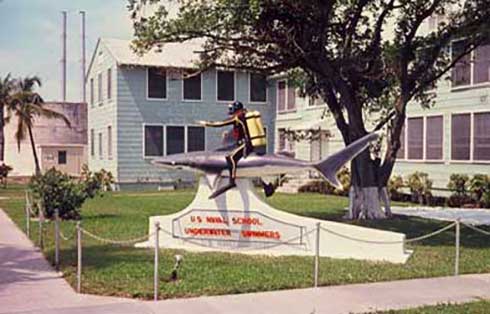
Both above, credit: Fraternal Order of Underwater Swimmers School website
And, check out 'instructor' Hewitt. Looks to be a crusty sea dog...old school Navy right there...that's probably a tattoo of his mom on his left thigh, another one on the inside of his right calf, and of course, on both forearms. Popeye doesn't have anything on this guy. The look on his face, with headgear irreverently canted...all attitude, and most likely, supremely competent - OORAH! I can't make out the rank, a Chief Petty Officer at the very least, possibly/probably even Senior Chief. Dig the Converse high-tops to complete the look. Drive on Shipmate!
And, if I'm not mistaken, instructors Atkinson & Houston both appear to be wearing Army Jump Wings. I say again, United States Army...jus' sayin', again.
Finally, note that Armstrong (particularly) & Aldrin are the only ones wearing print shirts. Even their proximity to each other. AND, Collins appears to be wearing plaid Bermuda? shorts! Coincidence? Nah...Destiny. 😉
Per usual, excellent pertinent reading/information at:
www.collectspace.com/ubb/Forum29/HTML/000784.html
Credit: collectSPACE website
Uploaded as accompaniment to the two photos I’ve linked to.
I love that it’s an opposing view, taken at nearly the same moment, and that it includes the NASA photographer - standing next to the top of the ramp - taking the 16mm film footage – from which I took the Periscope Film screenshot:
commons.wikimedia.org/wiki/File:KSC-66C-1861_Gemini-8_Ast...(104-KSC-66C-1861).jpg
Credit: Wikimedia Commons
picryl.com/media/104-ksc-66c-1861-109b69?zoom=true
Credit: Picryl website
Yep, down the rabbit hole & possibly pathetic, but so what.
Stunning view of the Apollo 15 launch vehicle on the pad.
On some sort of 'unwatermarked' photo paper. Part of an Itek Apollo 15 promotional packet, likely ICW their panoramic camera being flown for the first time during this mission.
The modelers running the Lego layouts went big! The top of the tall grey building there is about 10 feet off the floor. That's a lot of Lego bricks!
“This is a relief map of the landing site made by the U. S. Army Photographic [Topographic] Command. The landing site is here several kilometers east of Hadley Rille. The Apennine Mountains are off the relief map further off to the east. There five objectives at the landing site: The first and primary objective is to sample the mountain front. At this particular place the Apennine Mountains for a slight bow to the west so that the mountains which are further off to the east here come around and we are able to sample south of the landing site some of the Apennine front material. That is the primary objective of the mission. The secondary objective of the mission is to study the rille itself. The sinuous, meandering rilles on the moon are an enigma at this time. The third objective is to look at the mare itself. We are now quite a bit further north than any of the other mares we visited. This is in particular a very dark mare. It may be one of the youngest mares that we can visit on the moon. The fourth objective is the north complex. The most probable interpretation at this time is that this is a volcanic complex. There are other interpretations possible. The sampling will take place at several points in the north complex. And the final objective is this cluster of craters southeast of the landing site, and these are believed to be secondaries from the large craters, Autolycus and Arostyllus [Aristillus], which are much further to the northwest within the Mare Imbrium itself.”
With the above task list, it’s a testament to David Scott’s professionalism, commitment and dedication to becoming an astute student & practitioner of geology/geological observation. Not that I expect anyone to do it, but if you watch - listen actually - to his commentary & observations while on moon, it’ll blow you away, especially if you’re a Geologist. I’m sure Jack Schmitt was proud. And not to slight Irwin, but Scott’s efforts were singularly exceptional.
This photograph is really cool, in that it’s actually a photograph of an actual relief map, (with EVA traverses superimposed). A pretty good one at that. Then again, it had to be, after the POS the Army crapped out for Apollo 13/14. I’m surprised NASA gave them another/continuing opportunity.
One of the physical relief maps is seen here:
dygtyjqp7pi0m.cloudfront.net/i/29546/25729474_2.jpg?v=8D3...

Credit: RR Auction/icollector.com
It sold for something like a bajillion dollars, +/- a couple of billion.
To me, this landing site was by far the most spectacular visually as well.
"Apollo 15 onboard film."
Signed & inscribed by Jim Irwin:
"Randy
Best Wishes
Jim Irwin
Apollo 15"
And/or:
Astronaut David R. Scott, Apollo 15 commander, walks away from the Lunar Roving Vehicle (LRV) during the third and final Apollo 15 lunar surface extravehicular activity (EVA-3) at the Hadley-Apennine landing site. The LRV is parked a short distance from the rim of Hadley Rille. The far wall of the rille is in the distant background at extreme upper left. In his left hand, Scott is holding a 70mm camera equipped with a 500-mm lens. The photograph was taken by astronaut James B. Irwin, lunar module pilot. While astronauts Scott and Irwin descended in the Lunar Module (LM) to explore the moon, astronaut Alfred M. Worden, command module pilot, remained with the Command and Service Modules (CSM) in lunar orbit.
A fantastic mini-pan of this and the preceding frame, with Hadley Rille visible:
www.hq.nasa.gov/alsj/a15/a15pan11167-8.jpg

Credit: David Harland/ALSJ website
And excellent photos of where (Station 10) this incredible photo was taken:
lroc.sese.asu.edu/news/uploads/LROCiotw/M111571816RE_thum...
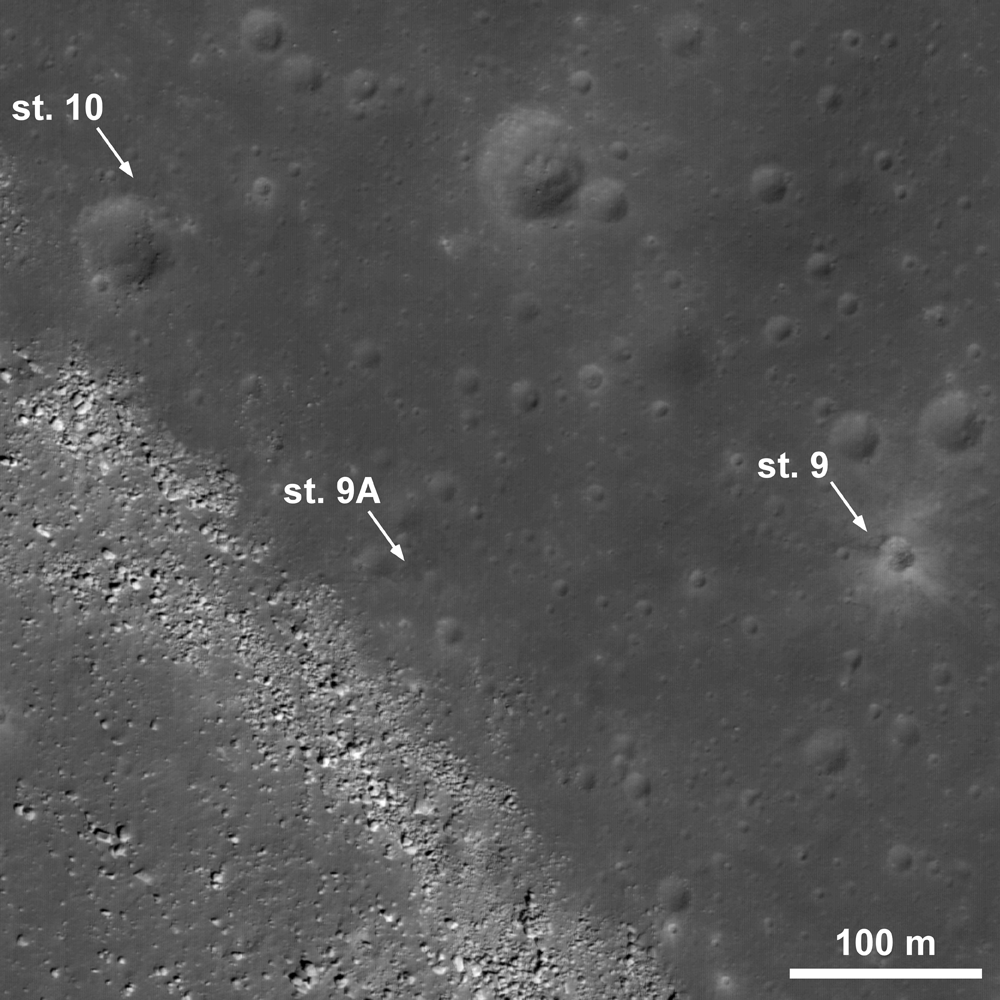
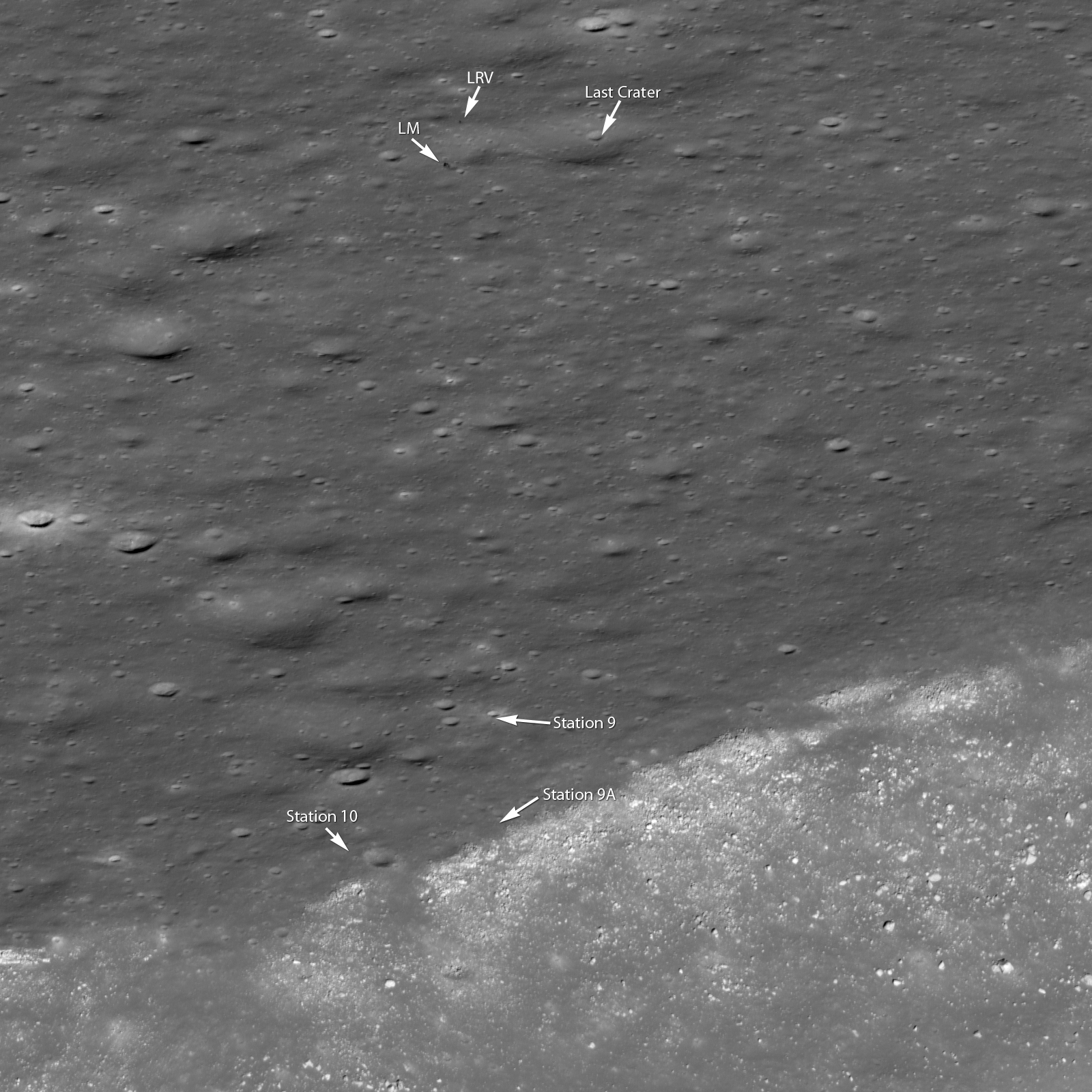
50 years ago, today Apollo 15 lifted the first lunar rover to the moon. It is the world’s most expensive car and GM’s first EV. And it carried paper maps, like this one.
After three days of driving about, it still retains traces of moon dust and some handwritten numerical references. I purchased it from Astronaut Dave Scott who writes that "this map was attached to a Rover post with a large clip. The Map contains traces of lunar dust and was exposed to the temperature extremes, radiation, and Solar Wind on the surface of the Moon. It has been in my personal collection since returning to Earth."
It was during this second EVA that Dave Scott and Jim Irwin recovered the ‘Genesis Rock,’ a large sample composed primarily of anorthite and formed in the early stages of the solar system, at least four billion years ago. it is arguably one of the oldest samples the astronauts brought back and one of the most scientifically important of the whole Apollo program.
For the anniversary, Earl Swift's new book, Across the Airless Wilds, traces the history of the rover’s development and achievements, pushing human exploration to its farthest point to date. Some of the Apollo engineers recommend that NASA simply brush off and update those designs for Artemis. “If we went to the Moon today,” one Apollo engineer said, “you could go with the same vehicle—don’t change a thing about it.” — a '69 Classic!
• Built in 17 months for $40M, but 2x over budget.
• 1HP, 4 redundant electric motors, 460 lbs., carries twice its weight
• On the first Apollo 15 drive, they covered more ground than all prior Apollo missions combined. Apollo 11’s footsteps would fit in a football field. The rover missions covered 56 miles in total, and gathered ¾ of the moon rocks of Apollo, including the most scientifically important.
The book has a wonderful passage summering this particular EVA 2: "Apollo 15's lead flight director, Gerry Griffin, called the second EVA 'the greatest day of scientific exploration, certainly, that we in the space program have ever seen — and possibly of all time.'" (p.244)
"HOW IT WILL HAPPEN: This artist's impression shows (top right) the Gemini 8 spacecraft moving towards the stationery Lockheed Agena target vehicle. On the left, the two-man spacecraft 'docks' in Agena. Launch date is set for March 15."
Beautiful & meticulous artwork by Mr. Jack Young. A 'first heard' for me.
This is amazing, and a resounding reaffirmation of preserving not only history, but the memories of those that embody it.
To my fellow Brother in Arms, THANK YOU...in many ways:
www.aeroclassics.us/artist.html
Credit: Aero Classics website
Sadly, as is the case all too often, the above site is no longer, along with the history & memories I naively referenced. DAMNIT!
At the least the following exists, but SADLY, only because Mr. Young passed since I first posted my photo. Continue to Rest In Peace Good Sir, and again, thank you:
share.google/A66SkKY8iemXQN6JS
Credit: Perl Funeral Home website
nara.getarchive.net/media/a-hand-sketched-illustration-by...
Credit: U.S. National Archives
David R. Scott, Commander of Apollo 15, works at the Lunar Roving Vehicle (LRV) during the third lunar surface extravehicular activity (EVA) of the mission at the Hadley-Apennine landing site. Hadley Rille is at the right center of the picture. Hadley Delta, in the background, rises approximately 4,000 meters (about 13,124 feet) above the plain. St. George Crater is partially visible at the upper right edge. This photograph was taken by Lunar Module pilot James B. Irwin. This view is looking almost due South.
Credit: NASA
Image Number: AS15-82-11121
Date: August 2, 1971
“This excellent picture is the last one that Dave took at the end of EVA-1. He has moved around to a position in the LM shadow southwest of the Rover. A detail shows Jim and the Rover.
www.hq.nasa.gov/alsj/a15/a15det11603.jpg

Mt. Hadley, in all its glory, is in the background. On the back of the Rover we can see two SCBs mounted on the gate; and, also, the rake, both pairs of tongs, the extension handle, probably with the scoop attached, and the penetrometer. Note that the TV camera is pointed down, in the stowed position. As can be seen in a labeled detail
www.hq.nasa.gov/alsj/a15/a15LTO41B4-Hadley11603.jpg

from Lunar Topographic Orthophotomap LTO41B4
www.hq.nasa.gov/alsj/a15/a15LTO41B4.jpg

Mt. Hadley's summit is 4100 m above the LM and at a distance of 20 km. The distant, bright summit immediately to the right of Mt. Hadley is about the same height but is 33 km from the LM.”
www.hq.nasa.gov/alsj/a15/AS15-86-11603HR.jpg

Above of course, per/at the ALSJ website.
Also:
spaceflight.nasa.gov/gallery/images/apollo/apollo15/html/...
Beautifully done:
commons.m.wikimedia.org/wiki/File:Mons_Hadley_AS15-M-1423...

Credit: Wikimedia Commons/James Stuby
Outstanding:
dahp.wa.gov/sites/default/files/documents/nominations/WHR...
Credit: Washington State Department of Archaeology & Historic Preservation website
Astronaut David R. Scott, mission commander, with tongs and gnomon in hand, studies a boulder on the slope of Hadley Delta during the Apollo 15 lunar surface extravehicular activity. The Lunar Roving Vehicle (LRV) or Rover is in right foreground. View is looking slightly south of west. "Bennett Hill" is at extreme right. Astronaut James B. Irwin, lunar module pilot, took this photograph.
Credit: NASA
Image Number: AS15-85-11437
Date: August 1, 1971
“Mount Hadley, fully lighted, showing abundant linear features. Mountain rises approximately 14,765 feet above the plain. Apollo 15 was launched July 26, 1971 at 9:34 a.m. EDT and touched down at the Hadley-Apennine site at 6:16 p.m. EDT, July 30—staying a total time of 66 hours and 55 minutes. Splashdown in the Pacific was August 7, at 4:46 p.m. EDT. Astronaut Alfred M. Worden was the command module pilot; James B. Irwin, lunar module pilot and David R. Scott, commander.”
The electronics box of the Heat Flow Experiment (HFE) can be seen at the far left center of the photograph, along with one of its two sensors protruding up from the surface to the right of it... in the disturbed, heavily trodden, darkened regolith... where David Scott busted his ass trying to get the ALSD to go deep enough to fully emplace the probe, not to mention the extraction of the drill stem first.
Astronaut David R. Scott, commander of Apollo 15, works at the Lunar Roving Vehicle (LRV) during the third lunar surface extravehicular activity (EVA) of the mission at the Hadley-Apennine landing site. Hadley Rille is at the right center of the picture. Hadley Delta (background) rises approximately 4,000 meters (about 13,124 feet) above the plain. St. George Crater is partially visible at the upper right edge. This photograph was taken by astronaut James B. Irwin, lunar module pilot. This view is looking almost due south.
spaceflight.nasa.gov/gallery/images/apollo/apollo15/html/...
Better:
This frame from Jim Irwin's Station 9A panoramic photo sequence shows the view south along Hadley Rille. Dave Scott is reaching under his seat to get the Hasselblad camera, equipped with a 500-mm lens.
Credit: ALSJ
Outstanding:
dahp.wa.gov/sites/default/files/documents/nominations/WHR...
Credit: Washington State Department of Archaeology & Historic Preservation website
I got a pair of shadow boxes to better display these cables that have flown to the moon. The glass lids can fold down for photos, and up for a wall hanging.
The white Apollo 15 umbilical cord really pops against the black background. The Apollo 16 Lunar Module cable is quite heavy and I am still working on the ideal orientation. It spent three days on the moon.