FS - Fotógrafos Sevillanos
View allAll Photos Tagged Curriculum
Sì, scivolo sui pavimenti insaponati.
Ma non improvviso.
Anni di esperienza mi permettono un certo virtuosismo.
Nella vita c'è chi sceglie la strada della perfezione.
La mia, di strada, ha le aiuole con le violette.
Name: Miska
Citizenship: Hungarian
Date of birth : 11.31.2017 (two years old)
Marital status: it's complicated
Breed: pumi
Competences: sit, lay, stay, crawl, give paw, turn around, jump, bring stuff...
Hobbies: sheep herding, agility, sniffing around, hunting...
www.comunicacionsocial.df.gob.mx/?p=764
Currículum del Jefe de Gobierno del Distrito Federal, Marcelo Ebrard Casaubon
Estudios Profesionales
Marcelo Ebrard ingresó a la carrera de Relaciones Internacionales en El Colegio de México, esta institución es considerada como uno de los mejores centros de estudio e investigación en el país.

Al terminar exitosamente sus estudios universitarios, viajo a Francia para estudiar un curso de administración pública. Hacia finales de 1981 regreso de París para incorporarse a trabajar en la Secretaría de programación y Presupuesto.
Servicio Público
1985 - Terremoto DF.
Su vida pública ha estado vinculada a la ciudad a raíz del terremoto ocurrido el 19 de septiembre de 1985 que marcaría para siempre la vida de Marcelo Ebrard, al igual que la de millones de capitalinos. El sismo de 8.1 grados Ritcher lo sorprendió cuando se dirigía a su oficina ubicada en el Centro Histórico. El recorrido le mostró de golpe la magnitud de la tragedia que estaba viviendo en ese momento la Ciudad. Pocos minutos después el enorme espíritu de solidaridad de los mexicanos empezó con la formación de cadenas humanas para remover escombros y rescatar a los sobrevivientes. Sumándose a estas tareas Ebrard entiende el valor de la política y de su potencial para cambiar las cosas. A partir de ese momento sabe que dedicará su vida a la Ciudad.
Desde una posición modesta participo en el Programa de Renovación Habitacional Popular, Ebrard es testigo e interlocutor privilegiado de la formación de estos movimientos. De calle en calle y reunión en reunión, Ebrard atiende a más de cinco mil frentes de trabajo, realizando una importante tarea de concertación social.
1986 - Reconstrucción DF.
En el año 1986 y con apenas 26 años Ebrard enfrenta esa situación y logra la confianza de la gente en el Programa, permitiendo así que se llevara a cabo el proceso de reconstrucción mas grande del mundo para una urbe moderna en un año. 10 meses después de la tragedia, la Ciudad había reestablecido sus servicios y se habían construido más de 44 mil viviendas beneficiando a más de medio millón de personas.
1987 - Ley General de Equilibrio Ecológico
En 1987 Marcelo Ebrard coordinó la elaboración del Proyecto de la Ley General de Equilibro Ecológico y Protección al Ambiente, que representaba en su momento la primera legislación en materia ecológica en el país, misma que permitió la instrumentación de programas con éxito en la Ciudad de México como el "Hoy no circula", el uso de convertidores catalíticos y el cambio de gasolinas.
1992 - Secretario de Gobierno
En el año de 1992 y a sus 33 años edad, fue nombrado Secretario General de Gobierno, la segunda posición más relevante en el Gobierno de la Ciudad. La experiencia vivida en el temblor le permite a escuchar y atender a cientos de grupos con las más diversas demandas, además de que adquiere un conocimiento profundo de la Ciudad debido a las tareas de coordinación del gabinete que su cargo requería. Entre estas tareas coordinó los programas comunes de las 16 delegaciones políticas, protección civil y la reubicación de comerciantes ambulantes en el centro histórico.
En esta experiencia de gobierno, Ebrard participó en logros muy importantes para la Ciudad, entre los que destacaron la reapertura de la Plaza México, el Teatro Blanquita, el Frontón México, El Palacio de los Deportes y el Auditorio Nacional; la construcción de la Nueva Viga; la restauración de edificios en el Centro Histórico; la ampliación de 17 Km. de la línea "A" del Metro; la sustitución de gasolina por gas natural en las termoeléctricas y cada Familia un Árbol, mismos que obtuvieron premios internacionales. Se recuperaron zonas ecológicas como la del Ajusco y Xochimilco; se construyeron 688 aulas nuevas y se pusieron en operación los Hospitales Generales de Iztapalapa, Tláhuac y Milpa Alta.
Ante los acontecimientos de enero de 1994, Marcelo Ebrard se sumó al equipo que apuesta por una salida pacífica al levantamiento zapatista y al reconocimiento de sus causas y demandas, contra las posiciones que reclamaban un endurecimiento. Este equipo logra el alto total al fuego y el establecimiento de una mesa de negociación y diálogo con el EZLN.
1997 - Diputado Federal
En septiembre de 1997 fue electo Diputado Federal de la LVII legislatura, primera con mayoría opositora al partido gobernante.
Como Diputado fue uno de los primeros integrantes del Congreso en denunciar la inconstitucionalidad y el enorme fraude que significaba el Fobaproa, que significaba un costo de más de 80 mil millones de dólares (equivalentes al presupuesto total de la ciudad de México por 19 años). Mantuvo una oposición permanente a la conversión del rescate bancario en deuda nacional y en favor de un estricto ejercicio de rendición de cuentas. Impulsó la realización de una auditoria independiente en la que participó en su Comité Técnico de seguimiento hasta su arbitraria exclusión.
En materia financiera propuso diversas iniciativas para prohibir el endeudamiento de manera indirecta sin la autorización del Congreso; dotar a la Cámara de Diputados de facultades reales de investigación y postuló la integración de un órgano de supervisión bancaria independiente alternativo al IPAB.
1999 - Denuncia los malos manejos en la SHCP
El 16 de noviembre de 1999 denunció, desde la tribuna de la Cámara, los malos manejos de los funcionarios del gabinete de la presidencia de la República y presentó pruebas de la ilegal jubilación del Secretario de Hacienda equivalente a 206 salarios mínimos mensuales. Al mismo tiempo defendió hasta que fueron aprobados 3 mil millones de pesos en el presupuesto de egresos del año 2000 para aumentar la pensión de más de un millón 798 mil adultos mayores del país que recibían menos de un salario mínimo al mes.
Como integrante de la Comisión de Presupuesto pugnó de manera importante por la reorientación del gasto público hacia programas sociales y a favor de las entidades federativas.
Es co-autor de los libros "Del FOBAPROA al IPAB, testimonios, análisis y propuestas" coordinado por Ricardo Solís (UAM - Plaza y Valdés) y "FOBAPROA, el acuerdo que no debió ser" de editorial Océano, coordinado por Gabriel Székely.
Marcelo Ebrard se suma el 15 de marzo del 2000 a la alianza Por la Ciudad de México encabezada por Andrés Manuel López Obrador que a la postre obtuvo el triunfo electoral en julio de ese año.
2000 - Asesor del Consejo Nacional de Ahorradores
A finales del 2000 participó como Asesor del Consejo Nacional de Ahorradores que agrupó a la mayoría de las 230 mil familias afectadas por la crisis del sistema de ahorro popular desatada por una acción gubernamental. Su intervención fue definitiva para que la Cámara de Diputados asignara mil quinientos millones de pesos que fueron destinados a resarcirle el 70% de los ahorros de menos de 190 mil pesos a 160 mil personas, de los cuales en un 90% eran adultos mayores que habían invertido todo su patrimonio en la caja. Esta lucha provocó una profunda reforma al sistema de ahorro del país con la creación de la Ley de Protección al Ahorro popular y el destino de por lo menos otros dos mil millones de pesos para subsanar a ahorradores afectados.
Después de fungir como asesor en diversas materias, el Jefe de Gobierno Andrés Manuel López Obrador invitó a Marcelo Ebrard a hacerse cargo de la seguridad pública en la Ciudad, sin duda una de las tareas más difíciles en el gobierno. El 17 de febrero del 2002 fue nombrado Secretario de Seguridad Pública del Gobierno del Distrito Federal.
2002 - Secretario de Seguridad Pública
Durante su ejercicio como Secretario de Seguridad Pública del 2002 al 2004, emprendió políticas innovadoras y la reforma integral de los cuerpos policiales más importante en los últimos años. Logró una disminución de los delitos en 9.2% y el promedio diario alcanzó su nivel más bajo en los últimos 10 años, mientras que el número de detenidos en las cárceles en la Ciudad alcanzó su cifra récord al llegar a casi 30 mil.
Aumentó el trabajo de la policía cualitativa y cuantitativa convirtiendo al Centro Histórico en una de las zonas más seguras de la Ciudad, después de que por años había sido la zona con más delitos. Puso en marcha nuevas agrupaciones policiales como las Unidades de Protección Ciudadana, la policía típica, la ribereña, un agrupamiento especial para Polanco y la unidad de protección a robo a cuentahabiente.
2005 - Secretario de Desarrollo Social
El 8 de febrero del 2005 fue nombrado Secretario de Desarrollo Social, teniendo como responsabilidad mayor conducir los programas sociales de la administración. En este tiempo logró reimpulsar y aumentar el alcance de programas sociales como el de apoyo a madres solteras, discapacitados, útiles escolares, la extensión del programa de mastografias a 80 mil, programa impulso joven para promover el reingreso de los jóvenes que han abandonado sus estudios al sistema escolar.
También, como coordinador del Gabinete de Progreso con Justicia, impulsó la puesta en marcha del programa de atención médica domiciliaria a adultos mayores y la ampliación del programa de vivienda.
Renunció a la Secretaria de Desarrollo Social en septiembre del 2005 para contender en la elección interna del Partido de la Revolución Democrática para candidato a la Jefatura de Gobierno del distrito federal, proceso del que salió vencedor con un margen de 20% de ventaja en la votación del 4 de diciembre de ese año.
Como candidato de la Coalición por el Bien de Todos triunfó el 2 de julio del 2006 con una amplia ventaja de casi un millón de votos sobre su más cercano contendiente en la elección constitucional para Jefe de Gobierno del Distrito Federal, responsabilidad que asume este 5 de diciembre
The first thing you notice when you meet Julie is that she has the most shapely legs this side of christendom. It hardly seems right for one person to be blessed with this quality - still, if life was fair, Elvis would be alive and all the impersonators would be dead.
Having changed her name from a somewhat dreary title reminiscent of matronly endeavours (though this was where the resemblance ended) she spends an inordinate amount of time dreaming. A die-hard fan of Mills and Boon she harbours a secret desire to be a classical musician - but meantime keeps her day job (though she has invested in a crimson custom-made drum kit).
Makeup and styling by Kelayla
P1060790
7 May 19
37099 & 150271 Helsby
3Q94 10:40 Bangor CS to Derby RTC & 5T99 12:34 Ellesmere Port to Liverpool South Parkway (viz Liverpool Lime Street)
Castellamare di stabia, 1902.
Tivadar Csontváry Kosztka (1853 – 1919), the Hungarian painter loved by Picasso.
"Csontváry’s works were exhibited in Paris in 1948. Picasso spent an hour outside the exhibition’s regular opening hours viewing them, and after emerging, declared “I did not realize there was another great painter in this century aside from myself.”
Csontváry probably would have taken issue with Picasso’s proclamation, arguing that he was a more significant painter even than Raphael."
"On the hot sunny afternoon of 13 October 1880, when Csontvary was 27 years old, he had a mystic vision. He heard a voice saying, 'You will be the greatest Sunway Painter, greater than Raphael!' He took journeys around Europe, visited the galleries of the Vatican, and returned to Hungary to earn money for his journeys by working as an apothecary. From 1890, he traveled around the world. He visited Paris, the Mediterraneum (Dalmatia, Italy, Greece), North Africa and the Middle East (Lebanon, Palestine, Egypt, Syria) and painted pictures. Often his pictures are very large, several metres wide and height is not unusual."
"In recent decades, Tivadar Kosztka Csontváry has become a true national hero. After all, he has all the necessary attributes: he was only celebrated after his time, his canon of work is not only spectacular, but also unique, and his contemporaries in Hungarian society treated him as all future national heroes were: he was mocked and humiliated.
He painted his major works between 1901 and 1909. He had some exhibitions in Paris (1907) and Western Europe. Most of the critics in Western Europe recognized his abilities, art and congeniality, but in the Kingdom of Hungary during his life, he was considered to be an eccentric crank for several reasons, e. g. for his vegetarianism, anti-alcoholism, anti-smoking, pacifism, and his cloudy, prophetic writings and pamphlets about his life (Curriculum), genius (The Authority, The Genius) and religious philosophy (The Positivum). Some of his biographists considered this as a latent, but increasingly disruptive schizophrenia. Although he was later acclaimed, during his lifetime Csontváry found little understanding for his visionary, expressionistic style. A loner by nature, his “failure” impaired his creative power.
His art connects with post-impressionism and expressionism, but he was an autodidact and cannot be classified into one style. He identified as a "sunway"-painter, a term which he created.
The painter, after being derided for decades, ended up starving to death after the Soviet Republic took everything away from him.
He starved to death.
To give us an idea of how his life’s work was rated at the time, his heirs attempted to sell the paintings to delivery men as they were painted on high-quality canvas. Were it not for Gedeon Gerlóczy, who recognized Csontváry’s genius and bought them all up, there would be no paintings surviving to this day.
Today, a Csontváry is worth millions of Euros."
en.wikipedia.org/wiki/Tivadar_Csontv%C3%A1ry_Kosztka
bestbudapest.blog.hu/2015/07/22/csontvary_the_hungarian_p...
The rear 360 unit 360101 has had the Spray can treatment passing through Brantham on a London Liverpool st to Ipswich service comprising three four car sets. The haze is from a farmers bonfire.What a day for February
credits:
three girls by adwriter
www.flickr.com/photos/adwriter/201915678/in/set-721575942...
ballet dancer by Gabriela Camerotti
www.flickr.com/photos/face_it/428888778/
pills by hokkey
www.flickr.com/photos/hokkey/3928307655/
bubbles by mr.beaver
www.flickr.com/photos/mr_beaver/4093313878/in/set-7215762...
texture by pareeerica
www.flickr.com/photos/8078381@N03/4267916015/
rjg329
www.flickr.com/photos/eaglesaerie/839268567/in/set-721576...
tree by robpatrick
www.flickr.com/photos/alkalinezoo/35955313/
tree by rubyblossom.
www.flickr.com/photos/rubyblossom/4202344881/
little girl by rubyblossom.
www.flickr.com/photos/rubyblossom/3654659866/
"Du haftest in der Welt, beschwert von Ketten,
doch treibt, was wahr ist, Sprünge in die Wand.
Du wachst und siehst im Dunkeln nach dem Rechten,
dem unbekannten Ausgang zugewandt.."
Ingeborg Bachmann, aus dem Gedicht "was wahr ist"
The first thing you notice when you meet Julie is that she has the most shapely legs this side of christendom. It hardly seems right for one person to be blessed with this quality - still, if life was fair, Elvis would be alive and all the impersonators would be dead.
Having changed her name from a somewhat dreary title reminiscent of matronly endeavours (though this was where the resemblance ended) she spends an inordinate amount of time dreaming. A die-hard fan of Mills and Boon she harbours a secret desire to be a classical musician - but meantime keeps her day job (though she has invested in a crimson custom-made drum kit).
22-ul 129
9 Jul 13
致 死者。欲使社會更好而選擇自殺的死者。
In honor of those who commit suicide for wanting to make the society better.
--
Inspired by Radiohead - No Surprises (the song and also the MV) youtu.be/u5CVsCnxyXg
the form of expression inspired by "Ancajaier 章潔" ’s photo series “Self Portrait / Chinese Herbal Bath" www.facebook.com/theancajaier
A heart that's full up like a landfill
一個滿是毀棄之物的心靈
A job that slowly kills you
一份慢慢將你逼殺的工作
Bruises that won't heal
和許多永不痊癒的傷口
You look so tired and unhappy
你看起來真的好累、好痛苦
Bring down the government
來吧!我們乾脆推翻這政府吧
They don't, they don't speak for us
反正他們不可能會站在我們這邊說話
I'll take a quiet life
我要去享受從此平靜的生活了
A handshake of carbon monoxide
我要去和一氧化碳把手言歡了
No alarms and no surprises
別驚慌,別驚訝
No alarms and no surprises
別驚慌,別驚訝
No alarms and no surprises
別驚慌,別驚訝
Silent, silent
安靜……安靜……
This is my final fit, my final bellyache with
這是最後一次發作了,這是我最後一次為此作痛了
No alarms and no surprises
別驚慌,別驚訝
No alarms and no surprises
別驚慌,別驚訝
No alarms and no surprises please
別驚慌,別驚訝,拜託……
Such a pretty house, such a pretty garden
多麼漂亮的房子啊!多麼漂亮的花園啊!
No alarms and no surprises (let me out of here)
別驚慌,別驚訝(讓我離開這裡啊)
No alarms and no surprises (let me out of here)
別驚慌,別驚訝(讓我離開這裡啊)
No alarms and no surprises please (let me out of here)
別驚慌,別驚訝,拜託……(讓我離開這裡啊)
中文翻譯:Dick8045 (goo.gl/OJDT2)
--
這應該是第一張Music Inspiration與社會事件結合的作品。朋友們對於黑箱課綱的關注,讓我從完全不了解到站在認同退回課綱的立場上,也用文字、用影像發聲。
每個人心中都有一把尺,正義與否、操弄與否,其實大家都很清楚。但在此,我只想對死者致上最高的敬意,而非為自己的立場多加闡述,如此便失去此作的焦點。
躺臥在水裡即將沉沒、不帶掙扎,是象徵性的自殺;手上握著的白玫瑰,象徵至死也緊握心中那朵良善之花;雙眼被掩蓋了,還留有一口可以發聲。然而說到底,這也只是我的表達方式,這些象徵與體驗過程的難受,又豈能與祂們的實際的犧牲付出相比?
祂們當然不是神話,而我也反對用自殺的方式處理問題,此作更非鼓吹或歌頌自殺。但是怎麼樣龐大的勇氣,能讓一個人終結自己的生命,以換取心中的理想?憾事已成,我只能希望這樣的勇氣,在最後的最後,能帶來使大眾明辨是非的可能。
五年前,這只是傷心播放清單裡的一首歌;今時今日,這首歌卻聽來為台灣人而泣。
This is probably the first Music Inspiration work that associate with social events. My friends' attention on "Anti-Curriculum Change Movement" happened in Taiwan, changed my standpoint from not knowing to agreeing with returning controversy curriculum, and made me speak with words and images. (for those who not knowing the context, here's a report from CNN: ireport.cnn.com/docs/DOC-1260788, or you can google "Anti-Curriculum Change Movement in Taiwan" for more details.)
There's always a scale in everyone's heart to judge the truth. Whether it is justice, whether it is being manipulated, people know that with aware in fact. Here however, I'd like to show the highest respect to the dead rather than elaborate my standpoint, so the focus of the work won't be blurred.
Lying under the water and sinking in no time without any struggles represents symbolized suicide; the white rose held in hands represents clasping the flower of good and honest even until death; eyes are covered but the mouth was kept to speak. Yet after all, this is only my way of expression. How come could these symbols and uncomfortable feelings during the process be compared with their actual sacrifice?
They are definitely not living in the mythology, and I oppose to deal with the problem with suicide; furthermore, this work is way far from advocate or praise suicide. But how immense the courage is, to make a human being ending his life in exchange just for the ideal? The regrettable thing had occurred. I can only hope this courage brings out the chance for people to distinguish right from wrong in the end of the end.
Five years ago, it's just a song in my sad music playlist. Today, this song is played to cry for Taiwanese.
--
PS.
1. 自殺不能解決問題。只要心理覺得不適應時,請記得一定要找能夠提供幫助的人談談,更請別羞於向心理師求助。專業的心理師是不會用立場跟你對話的。
Suicide won't solve the problem. Once you feel mentally uncomfortable, don't hesitate to talk to someone who may help, and please don't be shy to seek assistance to psychologist. A professional psychologist won't communicate with you with a certain standpoint.
2. 不要汙名化精神疾病,更不應該公布他人的病史。
Don't stigmatize psychiatric disorders, and one should not make someone's medical history public.
3. 因為成果與章潔姐姐前輩的作品太相似了,怕引起誤會,所以有事先問過本人,他說沒問題哦!(超害羞的)
The result of work is too resemble to Ancajaier's work, and I was afraid of being misunderstood, so I ask her in advance about the similarity, and she said it's alright! *shyness*
This is a male muskox, identifiable by the heavy horn boss connecting its horns across the top of its head. I don't know much about this arctic native, but even today they play somewhat of the same role for Alaskan indigenous people as the bison (no relation) did in the lower 48 states. Their woolly and very warm fur ("qiviut"), skin, meat and blubber, and horns can all be put to important uses. Also as is the case with bison, muskoxen can be maintained in domestic herds.
Alaska Wildlife Conservation Center, Girdwood Alaska
A little about the AWCC from their website:
The Alaska Wildlife Conservation Center (AWCC) is located in Portage Valley and is surrounded by the breathtaking Chugach Mountain Range and Turnagain Arm Inlet. Located at Mile 79 of the Seward Highway, AWCC is a non-profit sanctuary dedicated to preserving Alaska’s wildlife through conservation, education, research, and quality animal care. AWCC takes in orphaned and injured animals year-round and provides them a forever home. The sanctuary maintains over 200 acres of spacious habitats for resident animals to feel at home displaying their natural wild behavior as education ambassadors for their species. The AWCC has a partnership with the US Forest Service and leases 110 additional acres that are dedicated specifically to wood bison.
"The AWCC is home to lynx, brown bears, porcupines, wood bison, black bears, foxes, coyotes, wolves, moose, elk, Sitka black-tail deer, muskox, caribou, reindeer, a bald eagle, a great horned owl, a red squirrel, and ferrets. The animals are cared for in large, natural environments. It is common for visitors to see brown bears swimming, moose strutting, wood bison roaming, muskox playing, wolves posing, porcupines climbing, and more!
Since 2003, the AWCC has taken part in a program to reintroduce native wood bison back into Alaska after a 100-year absence. The wood bison is the largest land mammal in North America and is a keystone grazing herbivore from the region. This project is a joint effort with the Alaska Department of Fish & Game. In 2015, 130 wood bison were released back into western Alaska. For more information, visit the Wood Bison Restoration page.
Along with our conservation efforts, the AWCC is also dedicated to providing our guests with high-quality learning opportunities. Educational efforts include development of STEM curriculum, as well as teaching visitors and students about Alaska’s wildlife through field trips, tours, interpretive signage, and animal presentations."
[ Doctor Grillo - Currículum vítae ]
(Si no vas a escuchar la canción, mejor ignora la foto... no tiene sentido sin ella)
Voy a empezar a escribir mi currículum vítae...
Ser o no ser, ojalá fuera todo más simple...
He puesto que tengo un máster en esquivar zancadillas
Y que hablo el idioma de las ardillas.
He puesto que me gusta la risa de las cosquillas
Y que soy el que mejor balancea telesillas.
He puesto que la carrera la hice mientras dormía
Y que tengo experiencia en soñar maravillas.
He puesto que, por supuesto, soy de corbata y camisa
Y que el jefe siempre manda aunque diga tonterías.
Y en letra muy pequeña he puesto que
Si me dan una pala y un cubo soy el niño más feliz del mundo.
He puesto una foto arriba en la esquina,
Sale mi cara... y el café y la tila.
He puesto que a mí el mar me gusta más que la vida
Y que hice de cangrejo en La sirenita.
He puesto que mis neuronas van buscando una isla
Donde agruparse, con palmera y sin brisa.
He puesto que soy adicto a tus muñecos de arcilla
Y que siempre me quedo mudo en las despedidas.
Y en letra muy pequeña he puesto que
Si me dan una pala y un cubo soy el niño más feliz del mundo.
~~~~~ ~~~~~ ~~~~~ ~~~~~ ~~~~~ ~~~~~ ~~~~~ ~~~~~ ~~~~~ ~~~~~ ~~~~~ ~~~~~
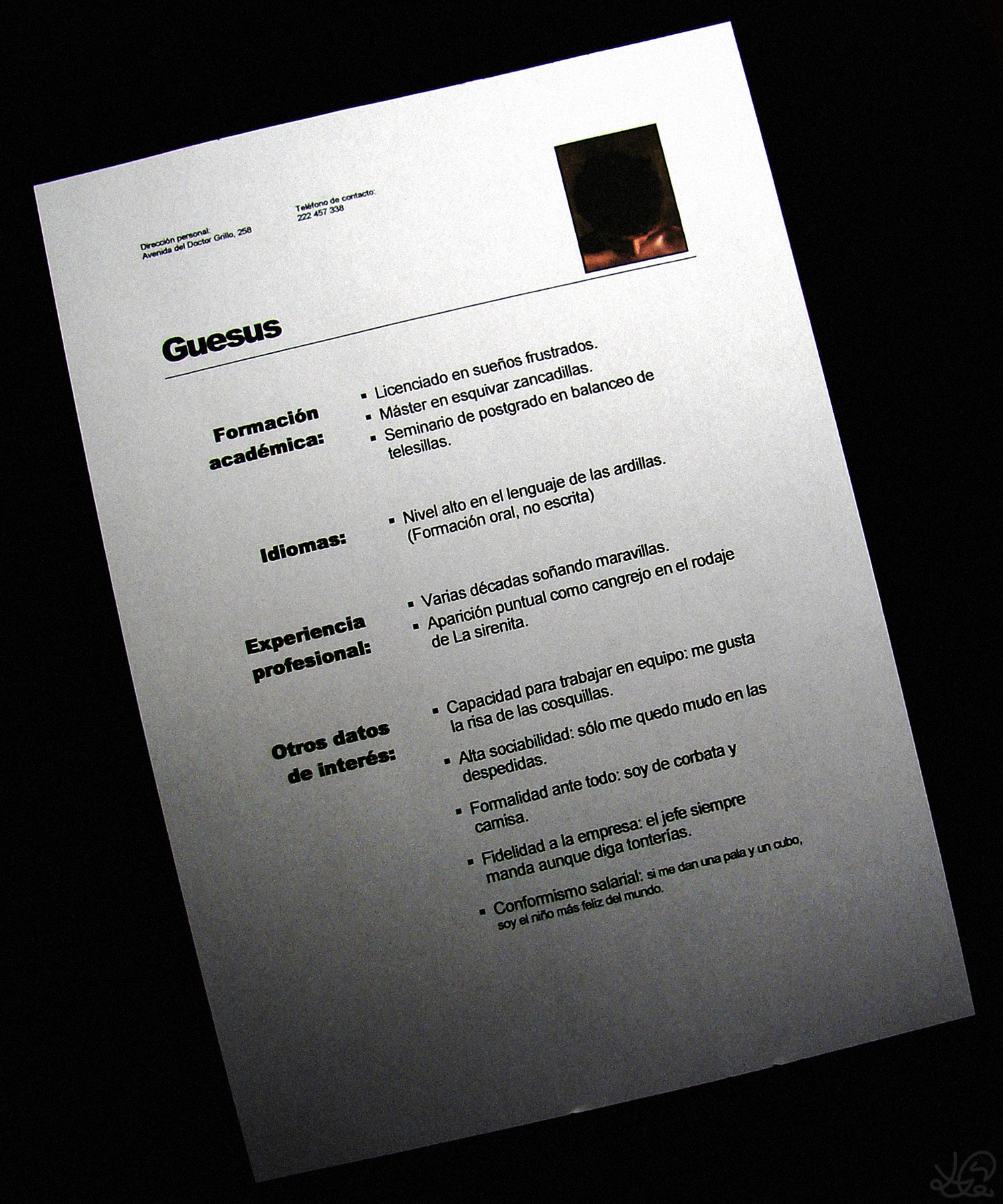
(Si no vas a ver la foto en su tamaño original... para qué has escuchado la canción?? xD)
Currículum vítae es una de mis canciones preferidas de Doctor Grillo y siempre me pidió a gritos hacer realidad lo que cuenta. Ahora, gracias al reto semanal de un grupo flickero, por fin me he animado a intentarlo.
Para ello he pretendido ser lo más fiel posible, añadiendo lo mínimo pero intentando que parezca real.
Lo que más me duele de mi viaje a Madrid es no haber podido ver a Paco Bello (el cantante (y autor de la letra)) en directo. Pero a cambio, el viaje tuvo otros muchos alicientes, que son las verdaderas razones de haberme quedado con ganas de más.
Bueno, este es un pequeño parón mientras reorganizo mis fotos madrileñas.
I spent some time planning the 2008-2009 technology curriculum for Honey Creek today. Lots of ideas that have been percolating in the last few months got committed to paper, calendars got printed out, and much outlining was done. There's a lot left to do, but it's a good start!
I re-wrote my CV, I found some job offers for which I'd like to apply and anyway I'll need it in 1-1,5 months as I'll move soon.
It sounds like I'm ready to start my new life.
fresco in the church of St. Elizabeth in Košice
Francis II. Rákóczi (1676–1735) was a Hungarian nobleman, Prince of Transylvania and leader of the largest anti-Habsburg estate uprising (1703–1711). He was born in Borša, and from childhood was politically formed by his mother Helena Zrínska against the Habsburgs. He led the uprising as a Kuruk leader, but after the defeat he went into exile and died in Turkey
Taken and described in English by WR
Szrajer's Building ("Kamienica Szrajera"), Kalisz, Poland.
13: Western avant-corps, ground floor: floral capital 西側の張り出し部分、地階の花の形の柱頭装飾
The Szrajer's Building ("Kamienica Szrajera") at Kosciuszki St. 9, in Kalisz, build 1904-1905 in the Berliner Secession style for Adam Szrajer, an owner of the famous Szrajer's Dolls and Toys Factory.
From the beginning, Adam Szrajer rented the building to Helena Samdeniowa Boarding School for Young Ladies - a progressive educational institution for girls which offered curriculum on a par with boy's middle schools and very different from the “lady of the house” model universally adopted by all the finishing schools for noble maidens. Unusually for the period, the graduates were able to move into regular, i.e. boy’s schools and take final exams there, which would open for them the track to university entry. With stress put on humanities, the school taught three foreign languages, history and literature, as well as formal and natural science. Until the World War 2, the Szrajer's Building hosted a succession of various educational institutions, but after the war, because of severe accommodation shortages, the building had been converted into a tenement and partially run down due to the lack of funding.
The Szrajer's Building, one of the most interesting in Kalisz, with its picturesque facade organized in colossal order and dominated by central pair of elongated, calm-faced secession caryatids, supplemented with floral ornaments, accentuated with ribbed pilasters and crowed with four eagle heads, has been eventually recognized by the District Conservator Office as the Important Architectural Monument and currently funds for renovation projects are gradually allocated.
An old, 1912 black-and-white postcard showing Szrajer's Building is available at the link below: fotoforum.gazeta.pl/photo/8/ld/if/0jlg/iPXyvF9w5WbCURmhNX... (in: “Kalisz - Zdjęcia”, fotoforum.gazeta.pl/72,2,784,46336261.html?v=2&wv.x=1 [2018.7.10]).

At the time Wanda Motylkowa Boarding School for Young Ladies (in 1909 Motylkowa took over Helena Samdeniowa School, some of the former graduates of Samdeniowa school were employed there as teachers).
(W.R.)
ポーランド、カリシュ市にあるシュライエルの家。1904-1905年建設。ベルリンの分離派様式。所有者アダム・シュライエルは有名な人形とおもちゃの工場を経営する実業家でしたが、この建物は初めから第二次世界大戦まで女子学校等教育機関に貸し出されていたそうです。戦後共同住宅に使われているうちに傷みが激しくなり、現在修復が進められているようです。(抄訳N.R.)
Evidently the training didn't help this business very much. A curriculum revision is required. I'm not sure one can be "trained" for life, aside from taking it as it comes, keeping a positive attitude, keep good friends, keep a close relationship with a Higher Power, keep a smile on one's face, dare to love, and help those in need. Beyond that, I'm at a loss as to what else "training for life" can include.
If I missed, something let me know . . .