
Examining Andromeda
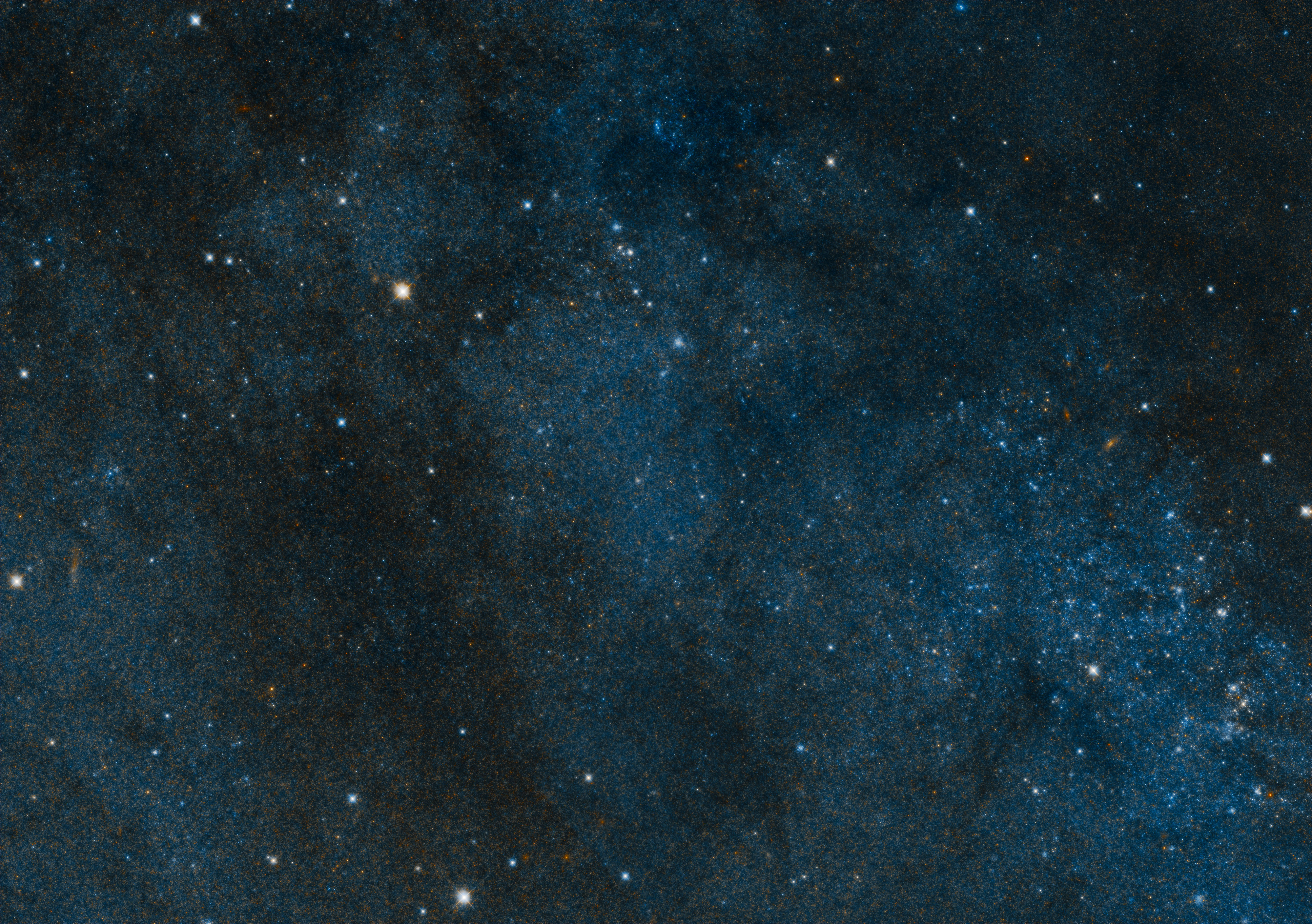
This came from the PHAT (The Panchromatic Hubble Andromeda Treasury) project. The image I started with was over 16000 pixels wide and was just a sea of noisey stars. Looking at it, you'd think you were looking at a section of our Milky Way because so many individual points of light are visible.
Usually, stars in other galaxies are more of a fine mist or cloud-like structure with only supernovas ever standing out as their own entities. Not so with Hubble's close up of Andromeda. And with two filters, 417W and 814W, I was able to produce a color image. Because 814 is infrared, I ended up selectively darkening the reddest areas to create visual interest and contrast. Otherwise, it would just be a sea of bright orange and blue specks.
A larger version is available here: www.geckzilla.com/apod/m31_phat_B15_crop.jpg
hlsp_phat_hst_acs-wfc_12056-m31-b15_f814w_sci
hlsp_phat_hst_acs-wfc_12056-m31-b15_f475w_sci
Examining Andromeda
This came from the PHAT (The Panchromatic Hubble Andromeda Treasury) project. The image I started with was over 16000 pixels wide and was just a sea of noisey stars. Looking at it, you'd think you were looking at a section of our Milky Way because so many individual points of light are visible.
Usually, stars in other galaxies are more of a fine mist or cloud-like structure with only supernovas ever standing out as their own entities. Not so with Hubble's close up of Andromeda. And with two filters, 417W and 814W, I was able to produce a color image. Because 814 is infrared, I ended up selectively darkening the reddest areas to create visual interest and contrast. Otherwise, it would just be a sea of bright orange and blue specks.
A larger version is available here: www.geckzilla.com/apod/m31_phat_B15_crop.jpg
hlsp_phat_hst_acs-wfc_12056-m31-b15_f814w_sci
hlsp_phat_hst_acs-wfc_12056-m31-b15_f475w_sci