Path to Aphrodite
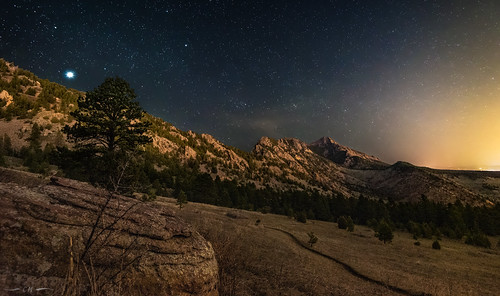
A bright burst of light shines from the planet Venus as it travels toward the horizon southwest of Bear Peak and the town of Boulder, Colorado. Lights from town glow from the western edge of the Great Plains on the right of the frame and fill the valley with a soft glow. There is a new moon, and the night is dark in the forest but brighter here once the lights of Boulder come into view.
In the Western world, the planets of our solar system are all named for Roman gods. Among these gods, Venus is the sole female of the pantheon to grace our night skies. The planets were discovered between nearly 2000 BC to 1930 AD, with Venus being the first named planet and Pluto the last, though the latter has now been classified as a dwarf planet. Of course, Venus was probably noticed well before 2000 BC, but it was the ancient Sumerians from that time living in Babylon (modern day Iraq) who created the first known written documents of her orbit on clay tablets. The Sumerians described this bright light as a divine, heavenly lady, and it seems this characterization struck a chord with humanity. Ever since, she has been associated with grace, beauty, procreation, love, desire, fertility, prosperity, and victory. The Roman goddess Venus was herself greatly informed by the Greek goddess Aphrodite. The etymology of the name 'Aphrodite' is unclear, but apparently most scholars now believe it was borrowed from the near-eastern Phoenician cultures, and ultimately came from the ancient Sumerians who first described her course through the heavens. Given that the cultures that first identified and named the planets nearest earth believed in complicated assortments of gods and goddesses, it is striking to me that only one planet besides our own Earth is female. What are the odds?
Back to modern times, I have hiked this trail south of Eldorado Springs on dozens of occasions and all of them by night. In the recent past, this schedule was largely due to the acrobatic juggling of work and home life with young children. It always seemed easiest to make time for myself after the children had gone to sleep. Although we both grew up in Oregon, a good high-school friend of mine lives not far away, and we often ramble the foothills after dark, planning backpacking trips, discussing solutions to the worlds problems, the intractable conundrums of child-rearing, the complicated trade-offs and gifts inherent to relationships, and the finer points of bread-baking and gardening. Now, the children can put themselves to bed without parental supervision. And yet, we still find ourselves out plying the darkened path to Aphrodite, drawn by the quietude that permeates the senses when naught but starlight shines down upon us.
Technical notes: A blend of 3 exposures, one for Venus at a smaller aperture to achieve the light-burst effect, another long exposure for the sky, and then a third long exposure with wider aperture for the foreground. All 3 images developed separately and then manually blended in Photoshop CC.
Path to Aphrodite
A bright burst of light shines from the planet Venus as it travels toward the horizon southwest of Bear Peak and the town of Boulder, Colorado. Lights from town glow from the western edge of the Great Plains on the right of the frame and fill the valley with a soft glow. There is a new moon, and the night is dark in the forest but brighter here once the lights of Boulder come into view.
In the Western world, the planets of our solar system are all named for Roman gods. Among these gods, Venus is the sole female of the pantheon to grace our night skies. The planets were discovered between nearly 2000 BC to 1930 AD, with Venus being the first named planet and Pluto the last, though the latter has now been classified as a dwarf planet. Of course, Venus was probably noticed well before 2000 BC, but it was the ancient Sumerians from that time living in Babylon (modern day Iraq) who created the first known written documents of her orbit on clay tablets. The Sumerians described this bright light as a divine, heavenly lady, and it seems this characterization struck a chord with humanity. Ever since, she has been associated with grace, beauty, procreation, love, desire, fertility, prosperity, and victory. The Roman goddess Venus was herself greatly informed by the Greek goddess Aphrodite. The etymology of the name 'Aphrodite' is unclear, but apparently most scholars now believe it was borrowed from the near-eastern Phoenician cultures, and ultimately came from the ancient Sumerians who first described her course through the heavens. Given that the cultures that first identified and named the planets nearest earth believed in complicated assortments of gods and goddesses, it is striking to me that only one planet besides our own Earth is female. What are the odds?
Back to modern times, I have hiked this trail south of Eldorado Springs on dozens of occasions and all of them by night. In the recent past, this schedule was largely due to the acrobatic juggling of work and home life with young children. It always seemed easiest to make time for myself after the children had gone to sleep. Although we both grew up in Oregon, a good high-school friend of mine lives not far away, and we often ramble the foothills after dark, planning backpacking trips, discussing solutions to the worlds problems, the intractable conundrums of child-rearing, the complicated trade-offs and gifts inherent to relationships, and the finer points of bread-baking and gardening. Now, the children can put themselves to bed without parental supervision. And yet, we still find ourselves out plying the darkened path to Aphrodite, drawn by the quietude that permeates the senses when naught but starlight shines down upon us.
Technical notes: A blend of 3 exposures, one for Venus at a smaller aperture to achieve the light-burst effect, another long exposure for the sky, and then a third long exposure with wider aperture for the foreground. All 3 images developed separately and then manually blended in Photoshop CC.