
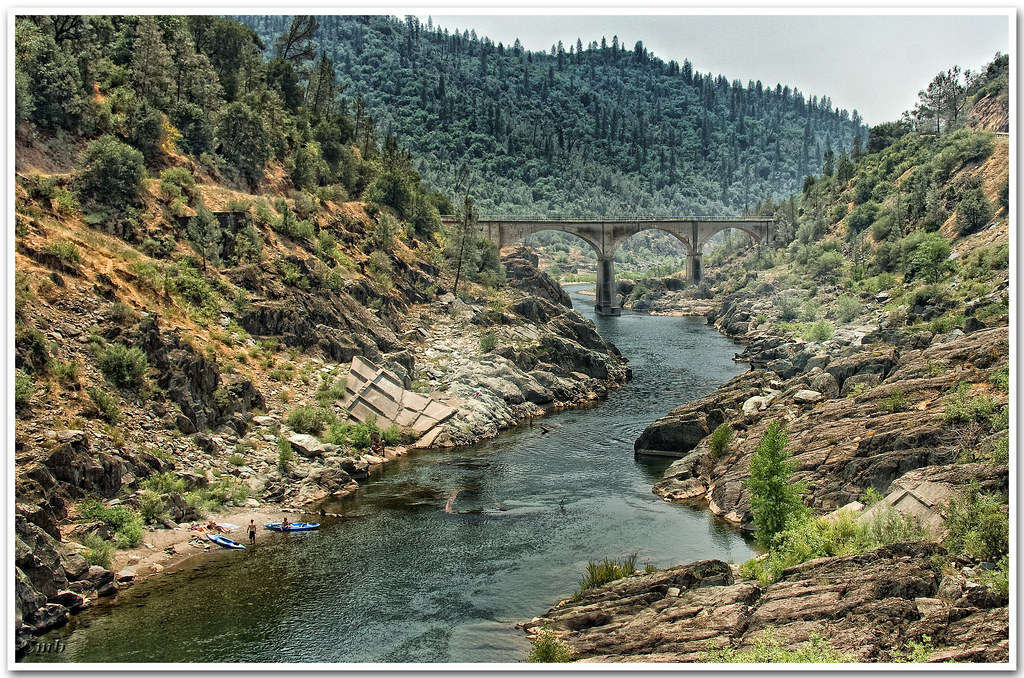
No Hands Bridge
©2008 Marianne Bush
Better Large
Front Page Explore
Just found the reason for those slabs on either side of the river:
The Mountain Quarry Cement Bridge, later known as "No Hands Bridge," was completed on March 23, 1912, by 600 men working on the Placer County side and 200 more on the E1 Dorado side to the tune of $300,000. At the time of its construction the bridge was the longest concrete arch bridge in the world. The building of this structure proved that concrete was practical for building long bridges. Although it was plagued by various problems during construction , the span was considered a great piece of railroad bridge engineering.
The old cement bridge stands today as a proud monument to early-day engineering and the men who built it. The bridge has withstood the tugging of the American River currents for over 80 years and stayed on its footings when the Hell Hole Dam broke in December 1964 and took out two modern bridges upstream. It also withstood the so-called "Valentines Day Flood" of 1986, which submerged the bridge before destroying a 250-foot earth-filled coffer dam two miles down river.
The cement bridge has served as a landmark since the railroad went out of service in the 1940s. It did, however, serve a purpose shortly after the Hell Hole dam flood. The dam, located some 40 miles upstream, brought millions of tons of thundering water down the Middle Fork. The force of the water tore out the newer concrete-and-steel highway bridge nearby that linked Auburn with Cool and Georgetown. But the cement railroad bridge survived and was quickly pressed into temporary service to restore vehicle traffic between the two counties.
The rail route's 15 trestles and lines of tracks were removed in the 1940s: the metal and other materials were used in the war effort.
Today, a portion of the old rail route is designated as the Western States Pioneer Express Recreation Trail, in accordance with the National Trails System Act. It is primarily used by horsemen, runners and hikers. The name "no hands" came from veteran rider, Ina Robinson, who would drop her reins to ride across the then guardrail-less bridge. The bridge now stands as the "gateway to Auburn" and the final American River crossing of the Western States 100 Mile Endurance Run.
No Hands Bridge
©2008 Marianne Bush
Better Large
Front Page Explore
Just found the reason for those slabs on either side of the river:
The Mountain Quarry Cement Bridge, later known as "No Hands Bridge," was completed on March 23, 1912, by 600 men working on the Placer County side and 200 more on the E1 Dorado side to the tune of $300,000. At the time of its construction the bridge was the longest concrete arch bridge in the world. The building of this structure proved that concrete was practical for building long bridges. Although it was plagued by various problems during construction , the span was considered a great piece of railroad bridge engineering.
The old cement bridge stands today as a proud monument to early-day engineering and the men who built it. The bridge has withstood the tugging of the American River currents for over 80 years and stayed on its footings when the Hell Hole Dam broke in December 1964 and took out two modern bridges upstream. It also withstood the so-called "Valentines Day Flood" of 1986, which submerged the bridge before destroying a 250-foot earth-filled coffer dam two miles down river.
The cement bridge has served as a landmark since the railroad went out of service in the 1940s. It did, however, serve a purpose shortly after the Hell Hole dam flood. The dam, located some 40 miles upstream, brought millions of tons of thundering water down the Middle Fork. The force of the water tore out the newer concrete-and-steel highway bridge nearby that linked Auburn with Cool and Georgetown. But the cement railroad bridge survived and was quickly pressed into temporary service to restore vehicle traffic between the two counties.
The rail route's 15 trestles and lines of tracks were removed in the 1940s: the metal and other materials were used in the war effort.
Today, a portion of the old rail route is designated as the Western States Pioneer Express Recreation Trail, in accordance with the National Trails System Act. It is primarily used by horsemen, runners and hikers. The name "no hands" came from veteran rider, Ina Robinson, who would drop her reins to ride across the then guardrail-less bridge. The bridge now stands as the "gateway to Auburn" and the final American River crossing of the Western States 100 Mile Endurance Run.