
Tailer's Family - journeying!
Project: Gloucestershire - Tewkesbury, with Worcestershire - Upton-upon-Severn.
No. 1 - 4: Exploring - the Abbey Church of Saint Mary the Virgin, Tewkesbury, Gloucestershire .
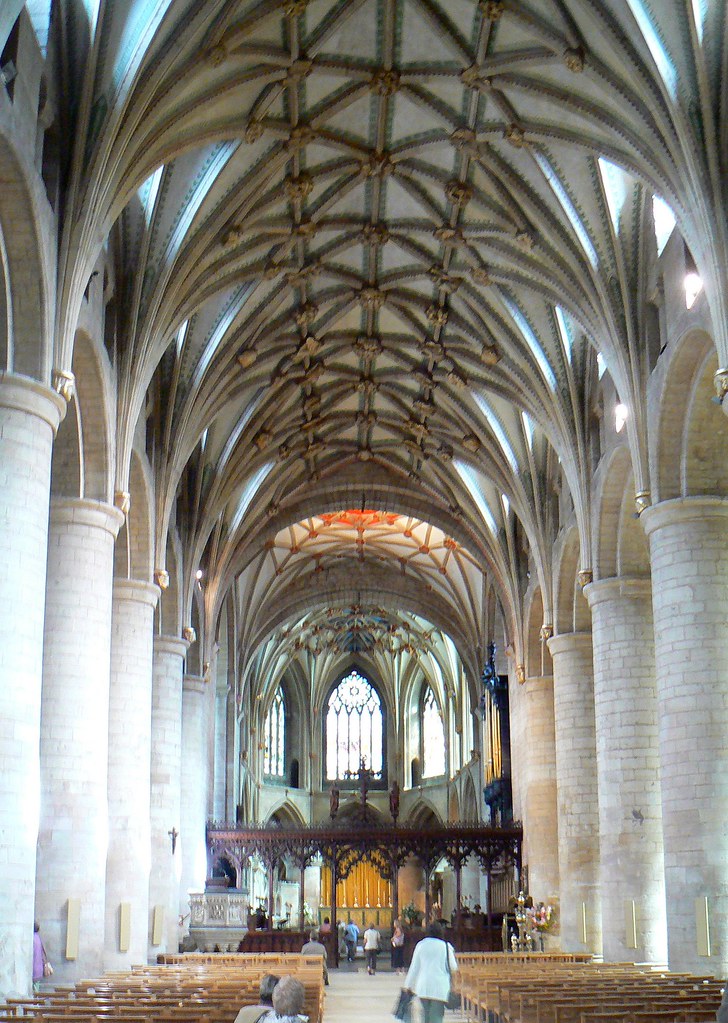
The Nave whilst looking westward
The nave here was being built in all probability while the great Flambard was busy with Durham (1105-1130), and very soon after he had finished his labours at Twynham or Christchurch, Hampshire. Gloucester is generally assigned to Serlo, 1089 to 1100, and Norwich was begun in1096.
Above the arches of the nave are small double round-headed openings into a very narrow triforium walk, which is vaulted, as at Gloucester, with a quadrantal arch.
There is another peculiarity, too, here, in that the vaulting of the roof springs from corbels which rest directly on the capitals of the piers. As a result of this the roof looks low and heavy.
The triforium openings, which are divided by small shafts, similar in character to those in the tower chamber, are 5 feet 6 inches high and 4 feet 10 inches wide. The passage is 26 inches wide and 6-½ to 7 feet high.
The two western bays of the triforium are not alike. On the north the openings correspond to those in the other bays, and are not contracted to correspond with the narrowed arch below; whereas on the south side they are so contracted. By this means the square angle of the western pier was continued to the roof. On the north side the western pier ends abruptly at the capital of the respond.
The clerestory windows are partly concealed by the vaulting. Of course the original windows were much smaller, and were removed and the space enlarged when the re-roofing was done in the fourteenth century.
The Roof
-Originally, no doubt, as at Peterborough, where it remains, the inner roof was a flat panelled ceiling of wood, supported by a moulded framing. Whether the wooden roof decayed or was destroyed by fire, it was found necessary in the early part of the fourteenth century to re-roof the nave, and the present vaulting was then constructed. Beautiful though it is architecturally, it has the effect of dwarfing the nave, as it springs directly from the tops of the piers in the nave. In character it is a simple pointed vaulting, and the ribs at their many points of intersection are lavishly decorated with bosses.
Originally the vaulting was painted and gilded, but owing to the idiosyncrasies of those who fancied they were having things done "decently and in order," it was colour-washed in the early part of this century. The present scheme of colour decoration was carried out by Mr. T. Gambier Parry. Its chief merit is that it throws out the bosses in very strong relief. The bosses can be studied with an opera-glass, but it is less fatiguing to examine them with the help of a pocket mirror. There is a tradition that the bosses were carved by a monk who was not held in much esteem by his companions, and was a butt for their gibes and witticisms. Whether this was so or not, he knew how to carve rudely and effectively in stone, and long may his work remain with us. They represent in a highly pictorial manner the life of our Lord. Beginning at the west end, the central bosses depict:
(1)
The Nativity. (2) The Shepherds rendering homage.
(3) The Magi on their journey.
(4) The Magi in adoration.
(5) The finding of Christ in the Temple.
(6) The triumphal entry into Jerusalem.
(7) The Last Supper
(8) The Betrayal.
(9) The Flagellation.
(10) The Crucifixion.
(11) The Resurrection.
(12) The Ascension.
(13) The Day of Pentecost.
(14) The Coronation of the Virgin.
(15) The Last Judgment.
The other bosses contain angels bearing musical instruments of every known kind, and alternating, more or less regularly, with angels censing and angels bearing emblems of the Passion.
On the south side:
(1) Angels with pipe and tambourine.
(2) Angels with cymbals and bagpipes.
(3) Angels with hurdy-gurdy and harp.
(4) Angels with dulcimer and organ.
(5 and 6) Angels censing.
(7) St. Matthew and St. John with their emblems, a scroll and an eagle.
(8) Angel with a violin; others with emblems of the Passion, _i.e._,
posts, spear, and scourges.
On the north side are to be found:
(1) Angel with pipe and tabor; another censing.
(2) Angel with harp; another censing.
(3) Angels with rebec and zither.
(4) Angels with tabor and zither.
(5 and 6) Angels censing.
(7) St. Luke and St. Mark, with their emblems, a winged ox,
and a winged lion.
(8) Angel with a harp; others with emblems of the Passion, ie, a crown of thorns, a sponge, a cross, and a scourge.
Mr. Gambier Parry, who personally supervised, where he did not personally execute, the decoration of the roof, termed it "a marvellous specimen of English carving," and says that "together with the cathedrals of Gloucester and Norwich, it combined some of the finest features of mediæval sculpture." Further he adds that though "fine details must not be looked for, yet it exhibited a vigour of conception and a charm of inspiration which quite atoned for any
faults."
At the west end of the building are two half-figures, male and female, like the figure-heads of ships, which serve as corbels for the vaulting of the roof. They have been thought by some to represent Adam and Eve, and by others to represent the founder, Fitz-Hamon, and Sibylla his wife.
The Great West Window dates back, as far as the masonry is concerned, to 1686, and was erected then to replace the window blown in by the wind in 1661. The glass was inserted in 1886 by Rev. C.W. Grove in memory of his wife, and represents various scenes in the life of Christ. In the lowest tier is the Annunciation, with the Nativity in the centre, and the Presentation in the Temple on the right. Above is the Baptism by St. John in the Jordan, the Last Supper in the centre, the Agony in the Garden on the right. In the topmost tier is the Bearing of the Cross, the Crucifixion, and the appearance of our Lord to Mary after the Resurrection. In the head of the window are angels, those in the two side lights on either side being engaged in censing. In the central top light is Christ in Majesty, with angels. The glass is by Hardman.
The Abbey Church of Tewkesbury ...... by H.J.L.J. Masse, M.A.
London George Bell & Sons 1906
Larger size:-
farm3.static.flickr.com/2570/3974262304_c31b40b9ec_b.jpg
Taken on:-
August 29, 2007 at 11:35 BST
Project: Gloucestershire - Tewkesbury, with Worcestershire - Upton-upon-Severn.
No. 1 - 4: Exploring - the Abbey Church of Saint Mary the Virgin, Tewkesbury, Gloucestershire .
The Nave whilst looking westward
The nave here was being built in all probability while the great Flambard was busy with Durham (1105-1130), and very soon after he had finished his labours at Twynham or Christchurch, Hampshire. Gloucester is generally assigned to Serlo, 1089 to 1100, and Norwich was begun in1096.
Above the arches of the nave are small double round-headed openings into a very narrow triforium walk, which is vaulted, as at Gloucester, with a quadrantal arch.
There is another peculiarity, too, here, in that the vaulting of the roof springs from corbels which rest directly on the capitals of the piers. As a result of this the roof looks low and heavy.
The triforium openings, which are divided by small shafts, similar in character to those in the tower chamber, are 5 feet 6 inches high and 4 feet 10 inches wide. The passage is 26 inches wide and 6-½ to 7 feet high.
The two western bays of the triforium are not alike. On the north the openings correspond to those in the other bays, and are not contracted to correspond with the narrowed arch below; whereas on the south side they are so contracted. By this means the square angle of the western pier was continued to the roof. On the north side the western pier ends abruptly at the capital of the respond.
The clerestory windows are partly concealed by the vaulting. Of course the original windows were much smaller, and were removed and the space enlarged when the re-roofing was done in the fourteenth century.
The Roof
-Originally, no doubt, as at Peterborough, where it remains, the inner roof was a flat panelled ceiling of wood, supported by a moulded framing. Whether the wooden roof decayed or was destroyed by fire, it was found necessary in the early part of the fourteenth century to re-roof the nave, and the present vaulting was then constructed. Beautiful though it is architecturally, it has the effect of dwarfing the nave, as it springs directly from the tops of the piers in the nave. In character it is a simple pointed vaulting, and the ribs at their many points of intersection are lavishly decorated with bosses.
Originally the vaulting was painted and gilded, but owing to the idiosyncrasies of those who fancied they were having things done "decently and in order," it was colour-washed in the early part of this century. The present scheme of colour decoration was carried out by Mr. T. Gambier Parry. Its chief merit is that it throws out the bosses in very strong relief. The bosses can be studied with an opera-glass, but it is less fatiguing to examine them with the help of a pocket mirror. There is a tradition that the bosses were carved by a monk who was not held in much esteem by his companions, and was a butt for their gibes and witticisms. Whether this was so or not, he knew how to carve rudely and effectively in stone, and long may his work remain with us. They represent in a highly pictorial manner the life of our Lord. Beginning at the west end, the central bosses depict:
(1)
The Nativity. (2) The Shepherds rendering homage.
(3) The Magi on their journey.
(4) The Magi in adoration.
(5) The finding of Christ in the Temple.
(6) The triumphal entry into Jerusalem.
(7) The Last Supper
(8) The Betrayal.
(9) The Flagellation.
(10) The Crucifixion.
(11) The Resurrection.
(12) The Ascension.
(13) The Day of Pentecost.
(14) The Coronation of the Virgin.
(15) The Last Judgment.
The other bosses contain angels bearing musical instruments of every known kind, and alternating, more or less regularly, with angels censing and angels bearing emblems of the Passion.
On the south side:
(1) Angels with pipe and tambourine.
(2) Angels with cymbals and bagpipes.
(3) Angels with hurdy-gurdy and harp.
(4) Angels with dulcimer and organ.
(5 and 6) Angels censing.
(7) St. Matthew and St. John with their emblems, a scroll and an eagle.
(8) Angel with a violin; others with emblems of the Passion, _i.e._,
posts, spear, and scourges.
On the north side are to be found:
(1) Angel with pipe and tabor; another censing.
(2) Angel with harp; another censing.
(3) Angels with rebec and zither.
(4) Angels with tabor and zither.
(5 and 6) Angels censing.
(7) St. Luke and St. Mark, with their emblems, a winged ox,
and a winged lion.
(8) Angel with a harp; others with emblems of the Passion, ie, a crown of thorns, a sponge, a cross, and a scourge.
Mr. Gambier Parry, who personally supervised, where he did not personally execute, the decoration of the roof, termed it "a marvellous specimen of English carving," and says that "together with the cathedrals of Gloucester and Norwich, it combined some of the finest features of mediæval sculpture." Further he adds that though "fine details must not be looked for, yet it exhibited a vigour of conception and a charm of inspiration which quite atoned for any
faults."
At the west end of the building are two half-figures, male and female, like the figure-heads of ships, which serve as corbels for the vaulting of the roof. They have been thought by some to represent Adam and Eve, and by others to represent the founder, Fitz-Hamon, and Sibylla his wife.
The Great West Window dates back, as far as the masonry is concerned, to 1686, and was erected then to replace the window blown in by the wind in 1661. The glass was inserted in 1886 by Rev. C.W. Grove in memory of his wife, and represents various scenes in the life of Christ. In the lowest tier is the Annunciation, with the Nativity in the centre, and the Presentation in the Temple on the right. Above is the Baptism by St. John in the Jordan, the Last Supper in the centre, the Agony in the Garden on the right. In the topmost tier is the Bearing of the Cross, the Crucifixion, and the appearance of our Lord to Mary after the Resurrection. In the head of the window are angels, those in the two side lights on either side being engaged in censing. In the central top light is Christ in Majesty, with angels. The glass is by Hardman.
The Abbey Church of Tewkesbury ...... by H.J.L.J. Masse, M.A.
London George Bell & Sons 1906
Larger size:-
farm3.static.flickr.com/2570/3974262304_c31b40b9ec_b.jpg
Taken on:-
August 29, 2007 at 11:35 BST