
Pledge of Allegiance must end!
swastika audi logo emblem symbologist olympic rings symbol
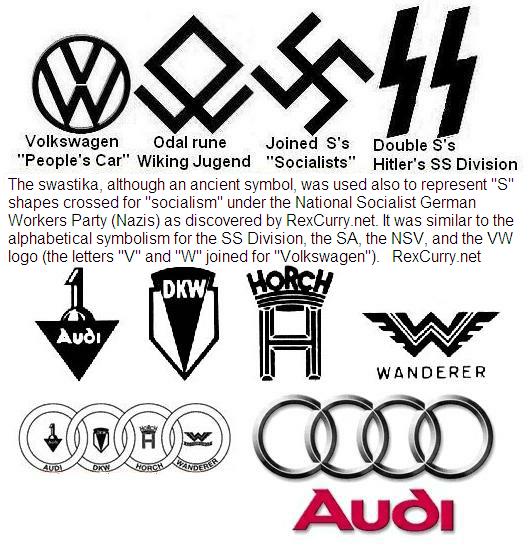
The Volkswagen logo is alphabetical symbolism of the meshed letters "V" and "W" that exposes the swastika as intertwined "S" shapes symbolizing "Socialism" for the monstrous National Socialist German Workers' Party. It is more proof in support of discoveries by the noted historian and symbologist Dr. Rex Curry. rexcurry.net/bookchapter4a1a2a.html
Audi also supports Dr. Curry's discoveries. rexcurry.net/bookchapter4a1a2a1.html
Trabant also provides support for the discoveries. rexcurry.net/trabant-sachsenring-rex-curry.html
Maybach-Motorenbau GmbH provides additional evidence.
rexcurry.net/maybach-car-pictures.html
Organisation Todt under Dr. Ing. Fritz Todt also lends support. rexcurry.net/bookchapter4a1a2b.html
The Krit Motor Car Company of Detroit supports Dr. Curry's discoveries. It was an American car that bore a swastika long before it was associated with German cars and the Volkswagen VW. rexcurry.net/krit_motor_car_company_detroit.html
More graphic examples are at rexcurry.net/swastika-vw-logo.JPG
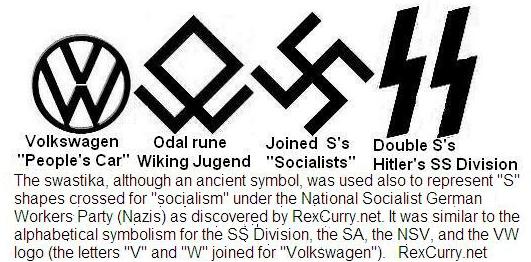
Many people forget that the word "Nazi" is a syncopation for "National Socialist German Workers Party." The group's actual full name indicates Nazism's clear affinities with collectivism.
Germany in the 1930's often used symbols for letters and words. Common symbols under the National Socialist German Workers' Party often used the "S" shape, including the side-by-side use in the "SS" Division and the overlapping use in the Hakenkreuz - swastika. The German word for "swastika" is "Hakenkreuz" ("hooked cross" or "armed cross").
Swastika images 1 rexcurry.net/swastika3clear.jpg
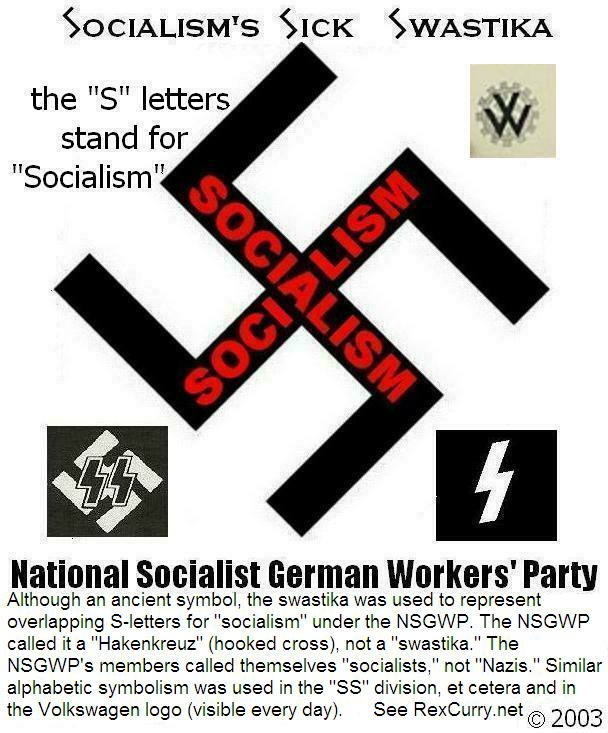
Swastika pictures 2 rexcurry.net/swastika3swastika.jpg
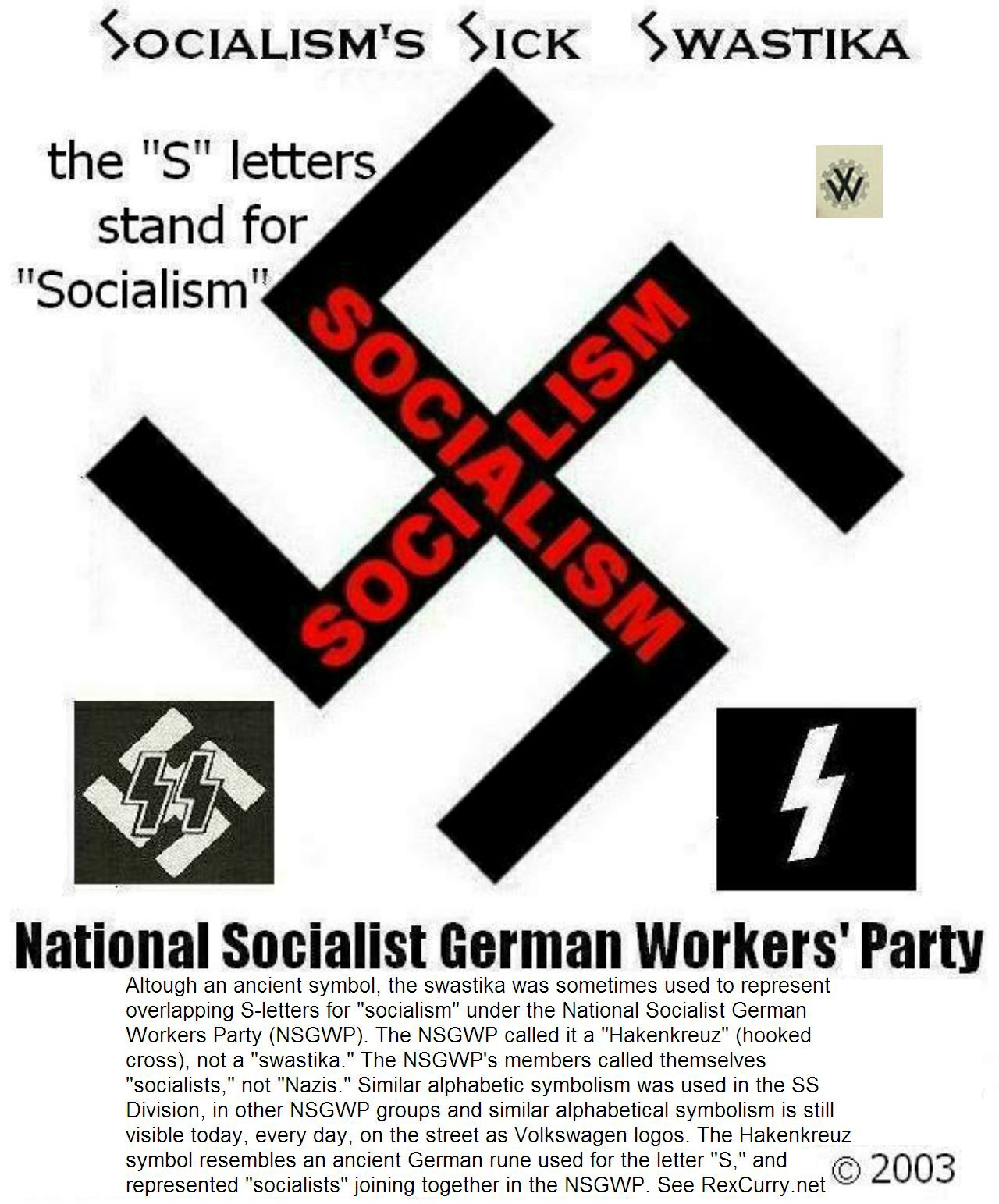
Swastika images 3 rexcurry.net/fascism-third-reich-hitler-nazism-swastika45...
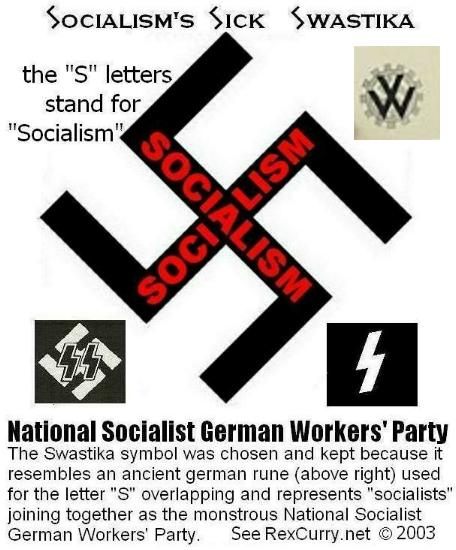
Hitler was aware of the practice, and perhaps the source of the practice, in that he evolved "Adolf Hitler" into "S Hitler" in his own signature. rexcurry.net/bookchapter4a1a4.html
It was a manner of declaring his socialism every time he signed his name and it was equivalent to signing "Socialist Hitler."
It is part of growing evidence that supports the discovery by Dr. Rex Curry (in the book "Swastika Secrets") that the Hakenkreuz, although an ancient symbol, was used also to represent "S" shapes for "Socialism" and its victory under the horrid National Socialists.
rexcurry.net/book1a1contents-swastika.html
....................................................
Audi symbol related to Olympic rings via Nazism (National SocialistGerman Workers Party)
rexcurry.net/bookchapter4a1a2a1.html
The symbol of the Olympic Games is five interlocking rings and similar to the Audi symbol. It influenced the Audi symbol and is related to
other symbolism under the National Socialist German Workers Party.
rexcurry.net/bookchapter4a1a2a1.html
They Olympic ring symbol was originally designed in 1912 by Baron Pierre de Coubertin, the founder of the modern Olympic Games.
In his article published in the "Olympic Revue" the official magazine of the International Olympic Committee in November 1992, the American
historian Robert Barney explains that the idea of the interlaced rings came to Pierre de Coubertin when he was in charge of the USFSA, an
association founded by the union of two French sports associations and until 1925, responsible for representing the International Olympic Committee in France: The emblem of the union was two interlaced rings (like the vesica piscis typical interlaced marriage rings) and originally the idea of Swiss psychiatrist Carl Jung because for him
the ring meant continuity and the human being.
According to De Coubertin the different ring colors with the white background stand for those colors that appeared on all the national flags of the world at that time.
The 1914 Congress had to be suspended due to the outbreak of World War I, but the symbol (and flag) were later adopted. They would first
officially debut at the VIIth Olympiad in Antwerp, Belgium in 1920.
The symbol's popularity and wide use began during the lead-up to the 1936 Summer Olympics in Berlin under the National Socialist German
Workers Party. The rings would subsequently be featured prominently in German National Socialist (Nazi) images in 1936 as part of an effort
to glorify the union of socialists and socialist groups under Adolf Hitler, and is related to the joined rings for Audi cars and to the use of the swastika which, although an ancient symbol, was used to reperesent joined S-letters for "socialism" under the National Socialist German Workers Party, as shown by the symbologist Dr. Rex
Curry (author of "Swastika Secrets"). rexcurry.net/swastika-audi-logo.JPG
The Olympic ring symbol was used to promote Leni Riefenstahl's Olympic work, including the movie "Olympia." rexcurry.net/olympic-rings-symbol-audi.jpg
The official Olympic salute originated in the USA's Pledge of Allegiance, which used a stiff-armed salute, and was also the origin the Nazi salute and Nazi behavior adopted later under German National Socialism.
rexcurry.net/pledge-allegiance-pledge-allegiance2.jpg
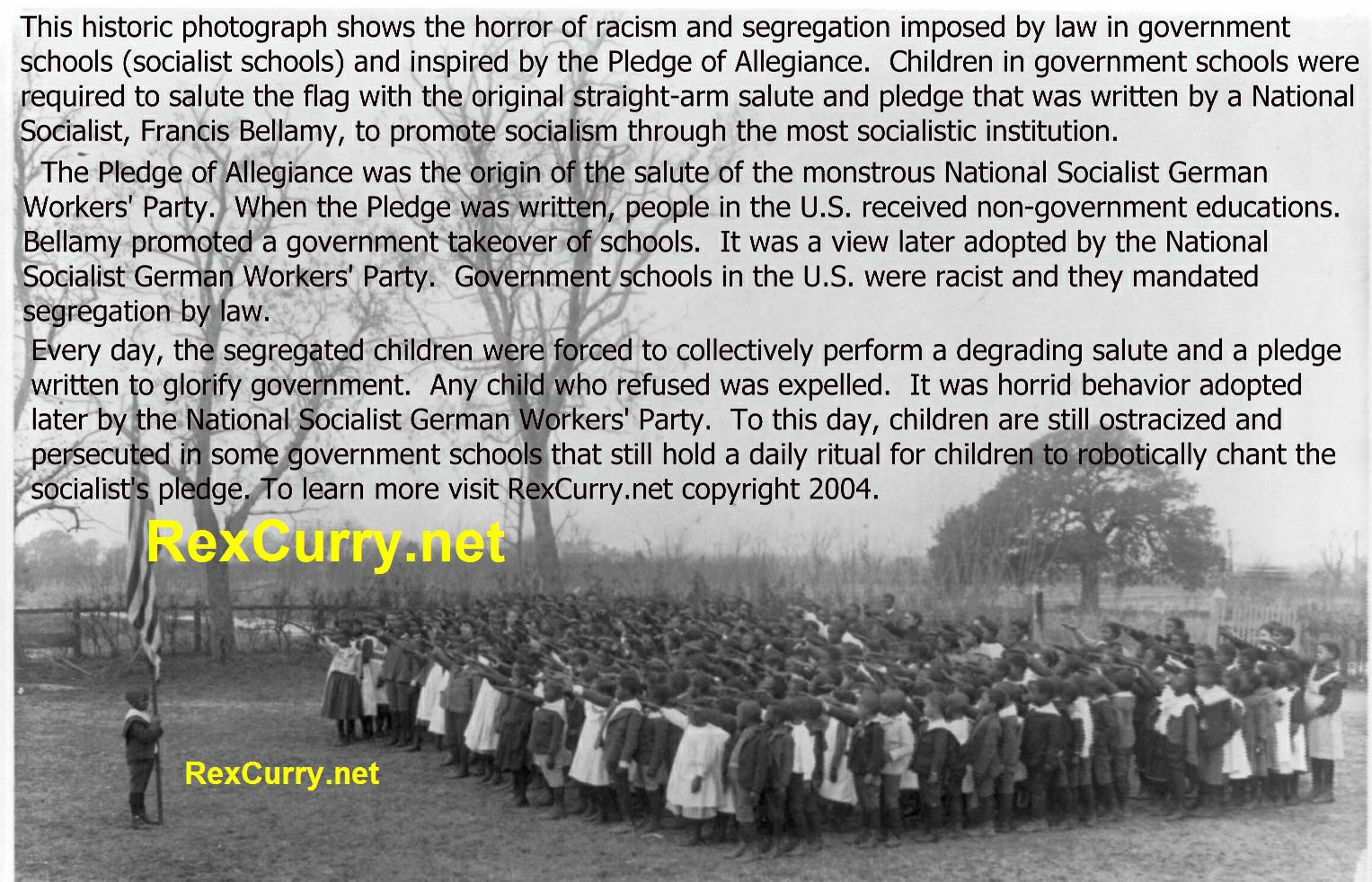
Francis Bellamy (author of the Pledge) was cousin and cohort of Edward Bellamy and they were both national socialists in the United States
long before their dogma spread to Germany and worldwide. The Bellamys and socialist schools in the United States influenced German National
Socialism, its dogma, symbols and rituals.
rexcurry.net/bookchapter1a1c.html
The National Socialist German Workers' Party began in 1920, and achieved electoral breakthroughs in 1930, and dictatorship in 1933.
In 1932, Audi, Horch, Wanderer and DKW combined to form the Auto Union (AU). They adopted four rings as their logo, one for each of the founder companies. The marques were originally all based in Saxony – Audi and Horch in Zwickau, Wanderer in Chemnitz-Siegmar and DKW in Zschopau.
Adolf Hitler was aided by German unions of auto workers (compare that with how American auto workers in their unions have aided national socialist policies in the USA, including those of Barack Obama, and the unions were repaid with General Motors -Government Motors- and as the Europeans chewed up the GM European division). The Audi rings were joined in a union to glorify the union of socialists in Germany under Hitler.
During German National Socialism, the race track in Saxony developed its stylized "S" letter for "Sachsenring" that imitates the swastika's "S" for "socialism." It led to similar swastika-style symbolism that the Union of Soviet Socialist Republics used for its Sachsenring Trabant logo. rexcurry.net/trabant-sachsenring-rex-curry.html
Together the four Audi companies could cover the whole motor-vehicle market from motorbikes to luxury cars. Audi concentrated on the sports side, Horch on producing luxury vehicles, Wanderer (whose auto division had been bought in a hostile take over) on small to medium cars, and DKW on small cars. DKW was the main brand, producing around 80% of the conglomerate's cars, and only narrowly being beaten by VW (Volkswagen) to producing Hitler's 'people's car'. The acronym "DKW" originated from "Dampf Kraft Wagen" (steam-driven wagon).
This 4-circle badge was used, originally, only on Auto Union racing cars in that period while the member companies used their own names and emblems. Often, the 4 circles contain the original symbols of Audi, Horch, Wanderer, and DKW. Wanderer used a wide winged "W" letter; Horch used a large "H" letter; DKW used the letters "DKW"; Audi used an inverted triangle and the number "1."
The leader of the National Socialist German Workers' Party had determined to make German automobiles into world leaders, in order to promote his socialism. Hitler regarded racing as an integral part of this, and consequently 500,000 Reichmarks in government subsidies were pledged to make Mercedes the leading race team in the world - Hitler was a fan of Mercedes. AU sent a senior delegation to Hitler and persuaded him that having two competing racing programs would be better than one. He agreed to split the government money between Mercedes and AU. Although AU earned themselves the enmity of Mercedes, an enemy they could never hope to match in terms of size, they also won themselves an opportunity to make their name in the racing world.
Ferdinand Porsche had already done some work for Wanderer, before setting up his own consultancy in the wake of the Government-created depression and crash of 1929. Porsche had a car design, but no customers for it. AU signed him up.
Audi still uses the German tag line "Vorsprung durch Technik." The tag line is used either in original or in its English translation "Advantage through Technology." It is an odd reminder of socialist clichés from the 1930's such as "Kraft durch Freude" ("Strength through Joy" and "Kdf"); Schönheit der Arbeit ("Beauty of Labor"); "Arbeit macht frei" ("Work brings Freedom"). The "Strength through Joy" program was part of a scheme to provide holidays to workers at inexpensive rates, and was related to the "Beauty of Labor" office. When the early VW versions were introduced, Hitler abruptly changed the name of the car to KdF Wagen. The word "Volkswagen" itself meant "people's car" (cf. "folk's wagon"). Near the end of World War II many men, both young and old, were called upon to serve in the "People's Army " (Volksturm).
swastika audi logo emblem symbologist olympic rings symbol
The Volkswagen logo is alphabetical symbolism of the meshed letters "V" and "W" that exposes the swastika as intertwined "S" shapes symbolizing "Socialism" for the monstrous National Socialist German Workers' Party. It is more proof in support of discoveries by the noted historian and symbologist Dr. Rex Curry. rexcurry.net/bookchapter4a1a2a.html
Audi also supports Dr. Curry's discoveries. rexcurry.net/bookchapter4a1a2a1.html
Trabant also provides support for the discoveries. rexcurry.net/trabant-sachsenring-rex-curry.html
Maybach-Motorenbau GmbH provides additional evidence.
rexcurry.net/maybach-car-pictures.html
Organisation Todt under Dr. Ing. Fritz Todt also lends support. rexcurry.net/bookchapter4a1a2b.html
The Krit Motor Car Company of Detroit supports Dr. Curry's discoveries. It was an American car that bore a swastika long before it was associated with German cars and the Volkswagen VW. rexcurry.net/krit_motor_car_company_detroit.html
More graphic examples are at rexcurry.net/swastika-vw-logo.JPG
Many people forget that the word "Nazi" is a syncopation for "National Socialist German Workers Party." The group's actual full name indicates Nazism's clear affinities with collectivism.
Germany in the 1930's often used symbols for letters and words. Common symbols under the National Socialist German Workers' Party often used the "S" shape, including the side-by-side use in the "SS" Division and the overlapping use in the Hakenkreuz - swastika. The German word for "swastika" is "Hakenkreuz" ("hooked cross" or "armed cross").
Swastika images 1 rexcurry.net/swastika3clear.jpg
Swastika pictures 2 rexcurry.net/swastika3swastika.jpg
Swastika images 3 rexcurry.net/fascism-third-reich-hitler-nazism-swastika45...
Hitler was aware of the practice, and perhaps the source of the practice, in that he evolved "Adolf Hitler" into "S Hitler" in his own signature. rexcurry.net/bookchapter4a1a4.html
It was a manner of declaring his socialism every time he signed his name and it was equivalent to signing "Socialist Hitler."
It is part of growing evidence that supports the discovery by Dr. Rex Curry (in the book "Swastika Secrets") that the Hakenkreuz, although an ancient symbol, was used also to represent "S" shapes for "Socialism" and its victory under the horrid National Socialists.
rexcurry.net/book1a1contents-swastika.html
....................................................
Audi symbol related to Olympic rings via Nazism (National SocialistGerman Workers Party)
rexcurry.net/bookchapter4a1a2a1.html
The symbol of the Olympic Games is five interlocking rings and similar to the Audi symbol. It influenced the Audi symbol and is related to
other symbolism under the National Socialist German Workers Party.
rexcurry.net/bookchapter4a1a2a1.html
They Olympic ring symbol was originally designed in 1912 by Baron Pierre de Coubertin, the founder of the modern Olympic Games.
In his article published in the "Olympic Revue" the official magazine of the International Olympic Committee in November 1992, the American
historian Robert Barney explains that the idea of the interlaced rings came to Pierre de Coubertin when he was in charge of the USFSA, an
association founded by the union of two French sports associations and until 1925, responsible for representing the International Olympic Committee in France: The emblem of the union was two interlaced rings (like the vesica piscis typical interlaced marriage rings) and originally the idea of Swiss psychiatrist Carl Jung because for him
the ring meant continuity and the human being.
According to De Coubertin the different ring colors with the white background stand for those colors that appeared on all the national flags of the world at that time.
The 1914 Congress had to be suspended due to the outbreak of World War I, but the symbol (and flag) were later adopted. They would first
officially debut at the VIIth Olympiad in Antwerp, Belgium in 1920.
The symbol's popularity and wide use began during the lead-up to the 1936 Summer Olympics in Berlin under the National Socialist German
Workers Party. The rings would subsequently be featured prominently in German National Socialist (Nazi) images in 1936 as part of an effort
to glorify the union of socialists and socialist groups under Adolf Hitler, and is related to the joined rings for Audi cars and to the use of the swastika which, although an ancient symbol, was used to reperesent joined S-letters for "socialism" under the National Socialist German Workers Party, as shown by the symbologist Dr. Rex
Curry (author of "Swastika Secrets"). rexcurry.net/swastika-audi-logo.JPG
The Olympic ring symbol was used to promote Leni Riefenstahl's Olympic work, including the movie "Olympia." rexcurry.net/olympic-rings-symbol-audi.jpg
The official Olympic salute originated in the USA's Pledge of Allegiance, which used a stiff-armed salute, and was also the origin the Nazi salute and Nazi behavior adopted later under German National Socialism.
rexcurry.net/pledge-allegiance-pledge-allegiance2.jpg
Francis Bellamy (author of the Pledge) was cousin and cohort of Edward Bellamy and they were both national socialists in the United States
long before their dogma spread to Germany and worldwide. The Bellamys and socialist schools in the United States influenced German National
Socialism, its dogma, symbols and rituals.
rexcurry.net/bookchapter1a1c.html
The National Socialist German Workers' Party began in 1920, and achieved electoral breakthroughs in 1930, and dictatorship in 1933.
In 1932, Audi, Horch, Wanderer and DKW combined to form the Auto Union (AU). They adopted four rings as their logo, one for each of the founder companies. The marques were originally all based in Saxony – Audi and Horch in Zwickau, Wanderer in Chemnitz-Siegmar and DKW in Zschopau.
Adolf Hitler was aided by German unions of auto workers (compare that with how American auto workers in their unions have aided national socialist policies in the USA, including those of Barack Obama, and the unions were repaid with General Motors -Government Motors- and as the Europeans chewed up the GM European division). The Audi rings were joined in a union to glorify the union of socialists in Germany under Hitler.
During German National Socialism, the race track in Saxony developed its stylized "S" letter for "Sachsenring" that imitates the swastika's "S" for "socialism." It led to similar swastika-style symbolism that the Union of Soviet Socialist Republics used for its Sachsenring Trabant logo. rexcurry.net/trabant-sachsenring-rex-curry.html
Together the four Audi companies could cover the whole motor-vehicle market from motorbikes to luxury cars. Audi concentrated on the sports side, Horch on producing luxury vehicles, Wanderer (whose auto division had been bought in a hostile take over) on small to medium cars, and DKW on small cars. DKW was the main brand, producing around 80% of the conglomerate's cars, and only narrowly being beaten by VW (Volkswagen) to producing Hitler's 'people's car'. The acronym "DKW" originated from "Dampf Kraft Wagen" (steam-driven wagon).
This 4-circle badge was used, originally, only on Auto Union racing cars in that period while the member companies used their own names and emblems. Often, the 4 circles contain the original symbols of Audi, Horch, Wanderer, and DKW. Wanderer used a wide winged "W" letter; Horch used a large "H" letter; DKW used the letters "DKW"; Audi used an inverted triangle and the number "1."
The leader of the National Socialist German Workers' Party had determined to make German automobiles into world leaders, in order to promote his socialism. Hitler regarded racing as an integral part of this, and consequently 500,000 Reichmarks in government subsidies were pledged to make Mercedes the leading race team in the world - Hitler was a fan of Mercedes. AU sent a senior delegation to Hitler and persuaded him that having two competing racing programs would be better than one. He agreed to split the government money between Mercedes and AU. Although AU earned themselves the enmity of Mercedes, an enemy they could never hope to match in terms of size, they also won themselves an opportunity to make their name in the racing world.
Ferdinand Porsche had already done some work for Wanderer, before setting up his own consultancy in the wake of the Government-created depression and crash of 1929. Porsche had a car design, but no customers for it. AU signed him up.
Audi still uses the German tag line "Vorsprung durch Technik." The tag line is used either in original or in its English translation "Advantage through Technology." It is an odd reminder of socialist clichés from the 1930's such as "Kraft durch Freude" ("Strength through Joy" and "Kdf"); Schönheit der Arbeit ("Beauty of Labor"); "Arbeit macht frei" ("Work brings Freedom"). The "Strength through Joy" program was part of a scheme to provide holidays to workers at inexpensive rates, and was related to the "Beauty of Labor" office. When the early VW versions were introduced, Hitler abruptly changed the name of the car to KdF Wagen. The word "Volkswagen" itself meant "people's car" (cf. "folk's wagon"). Near the end of World War II many men, both young and old, were called upon to serve in the "People's Army " (Volksturm).