Norwich, Norfolk
Church of Simon and St Jude,
Monument to Sir John Pettus †1614 and Bridget Curtis and Sir Augustine Pettus †1613, alabaster. Commissioned by Thomas Pettus, Sir John’s second son, the executor of his will. Unknown, probably Norwich mason, also responsible for the Suckling monuments in St Andrew’s, restored 2007/8.
St Simon and St Jude was declared redundant in the 1890s, and abandoned in the 1930s. Now owned by the Norwich Churches Trust it has been saved from its state of collapse in the 1930s, but the inside has been butchered by the addition of the nave mezzanine. This makes it impossible to appreciate the monument to Sir John and his family, on filling the north wall flanking the chancel arch. Mercifully the late George Plunkett took a full set of photographs of the interior in the 1930s, including the monument (www.norfolkchurches.co.uk/norwichsimonjude/plunkett/plunk...).
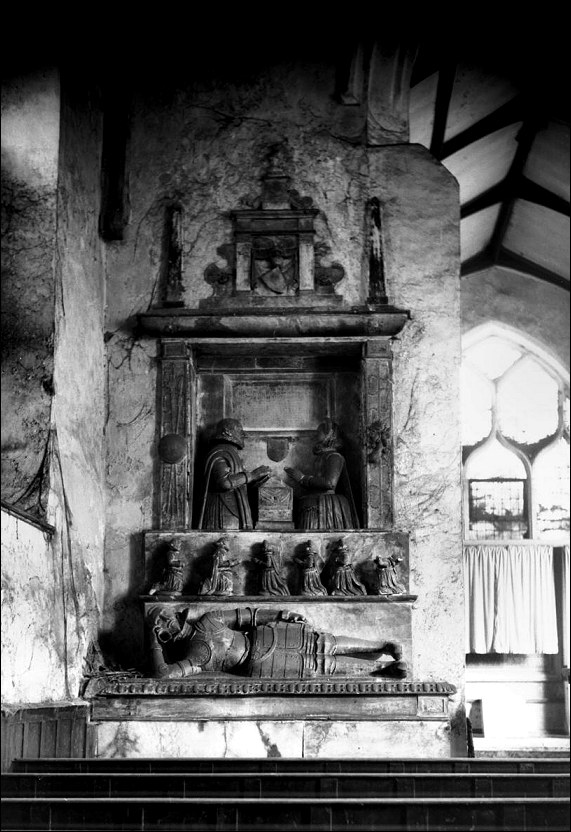
The monument rises from an impressive coloured alabaster base, to the Pettus coat of arms flanked by two obelisks. Sir John in his mayoral robes (he was Mayor in 1608) appears to kneel at a prayer desk opposite his wife, Bridget Curtis, although there is no sign of their legs. Blomefield writing in the 18th century mistook the armorials and identified the kneeling figure as Sir Augustine, who, unlike his father, was never Mayor of Norwich. Most of the literature has followed Blomefield, who was corrected by the Norfolk Heraldry Society (information from Tony Sims). Sir John and Lady Bridget are flanked by pilasters; his decorated with lances, hers with pomegranates and other fruit. Their children, two sons and two daughters kneel underneath, while Sir Augustine, who had died under a year before his father, is repeated lying stiffly in his full armour looking out from the monument, his head propped on his right arm, holding what could be a gauntlet or drinking horn, showing the fingers of a small hand.
Sir John had moved beyond both the family’s relative humble origins as tailors and local politics when in 1604 he had become the first Norwich Member since 1558 to be elected to two consecutive parliaments. He was active as an MP, while continuing his charitable work in Norwich. At the death of his father he had inherited considerable wealth, as well as the family house on Elm Hill, once extending to the churchyard, now nos. 41-43, and the estate at Rackheath, since at death his moveable goods, which included a substantial armoury of nine guns, were valued at £952 19s. 6d and the house on Elm Hill contained 27 rooms, together with stables for eight horses.
Blomefield, An Essay towards a Topographical History of the County of Norfolk: volume 4: The History of the City and County of Norwich, part II, ‘chapter 42: East Wimer ward', (1806), pp. 329-367; Chris Kyle, ‘Sir John Pettus’ in The History of Parliament: the House of Commons 1604-1629, , ed. Andrew Thrush and John P. Ferris, 2010.
detail of kneeling sons
Norwich, Norfolk
Church of Simon and St Jude,
Monument to Sir John Pettus †1614 and Bridget Curtis and Sir Augustine Pettus †1613, alabaster. Commissioned by Thomas Pettus, Sir John’s second son, the executor of his will. Unknown, probably Norwich mason, also responsible for the Suckling monuments in St Andrew’s, restored 2007/8.
St Simon and St Jude was declared redundant in the 1890s, and abandoned in the 1930s. Now owned by the Norwich Churches Trust it has been saved from its state of collapse in the 1930s, but the inside has been butchered by the addition of the nave mezzanine. This makes it impossible to appreciate the monument to Sir John and his family, on filling the north wall flanking the chancel arch. Mercifully the late George Plunkett took a full set of photographs of the interior in the 1930s, including the monument (www.norfolkchurches.co.uk/norwichsimonjude/plunkett/plunk...).
The monument rises from an impressive coloured alabaster base, to the Pettus coat of arms flanked by two obelisks. Sir John in his mayoral robes (he was Mayor in 1608) appears to kneel at a prayer desk opposite his wife, Bridget Curtis, although there is no sign of their legs. Blomefield writing in the 18th century mistook the armorials and identified the kneeling figure as Sir Augustine, who, unlike his father, was never Mayor of Norwich. Most of the literature has followed Blomefield, who was corrected by the Norfolk Heraldry Society (information from Tony Sims). Sir John and Lady Bridget are flanked by pilasters; his decorated with lances, hers with pomegranates and other fruit. Their children, two sons and two daughters kneel underneath, while Sir Augustine, who had died under a year before his father, is repeated lying stiffly in his full armour looking out from the monument, his head propped on his right arm, holding what could be a gauntlet or drinking horn, showing the fingers of a small hand.
Sir John had moved beyond both the family’s relative humble origins as tailors and local politics when in 1604 he had become the first Norwich Member since 1558 to be elected to two consecutive parliaments. He was active as an MP, while continuing his charitable work in Norwich. At the death of his father he had inherited considerable wealth, as well as the family house on Elm Hill, once extending to the churchyard, now nos. 41-43, and the estate at Rackheath, since at death his moveable goods, which included a substantial armoury of nine guns, were valued at £952 19s. 6d and the house on Elm Hill contained 27 rooms, together with stables for eight horses.
Blomefield, An Essay towards a Topographical History of the County of Norfolk: volume 4: The History of the City and County of Norwich, part II, ‘chapter 42: East Wimer ward', (1806), pp. 329-367; Chris Kyle, ‘Sir John Pettus’ in The History of Parliament: the House of Commons 1604-1629, , ed. Andrew Thrush and John P. Ferris, 2010.
detail of kneeling sons