
mfoylan
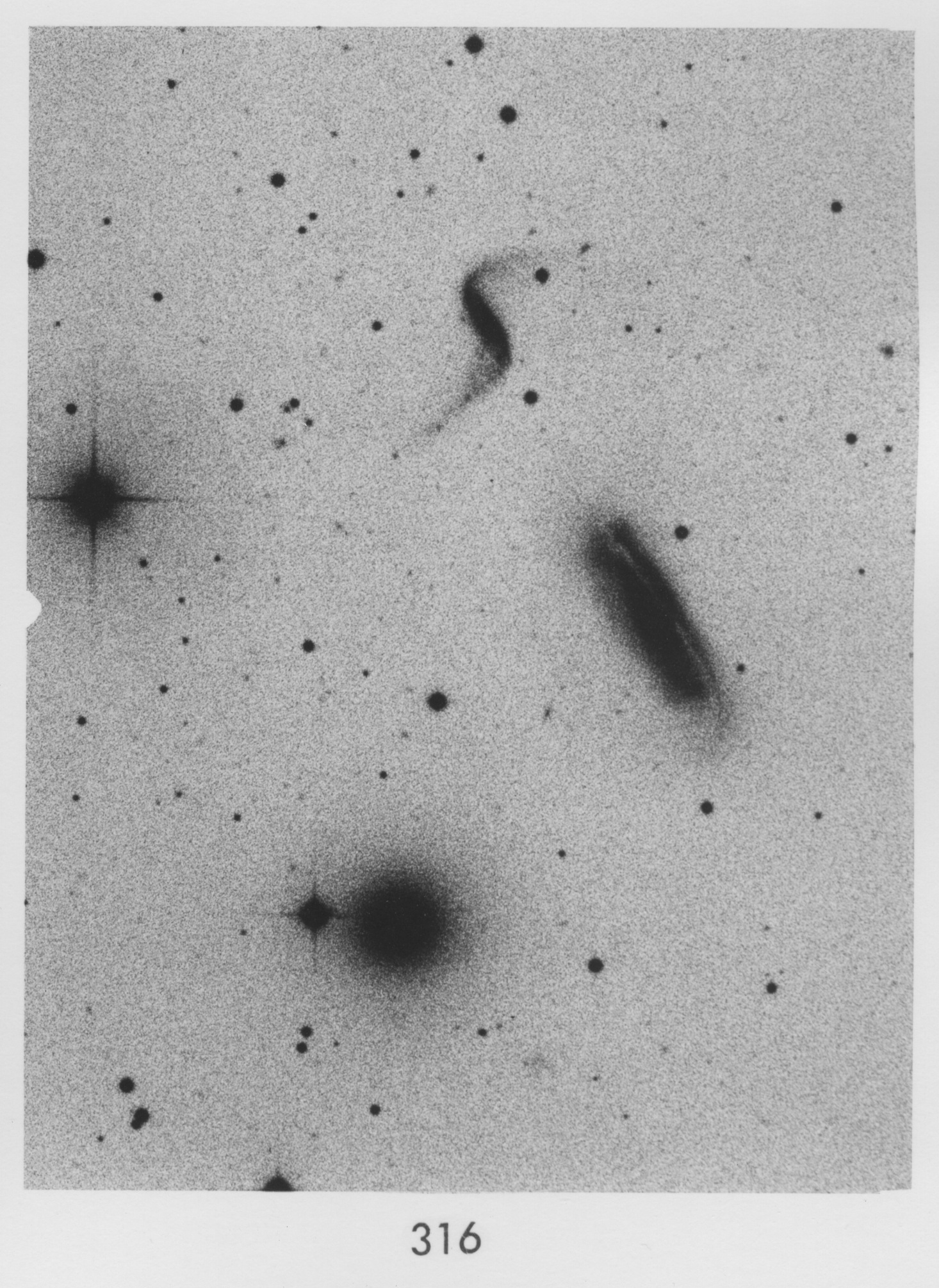
Arp Peculiar Object Number 316 - Groups of Galaxies
NGC 3187 (= PGC 30068 = HCG 44D, and with NGC 3190 & NGC 3193 = Arp 316)
part of Hickson Compact Group 44
Discovered (January 1850) by George Stoney
A magnitude 13.4 spiral galaxy (type SB(s)c? pec) in Leo (RA 10 17 47.9, Dec +21 52 24)
Historical Identification: Per Dreyer, NGC 3187 (= GC 2055, 3rd Lord Rosse, 1860 RA 10 10 05, NPD 67 25.1) is "very faint, extended". The position precesses to RA 10 17 45.4, Dec +21 53 03, less than half an arcmin north of the western end of the central bar of the galaxy listed above, the description fits and there is nothing comparable nearby so the identification is certain.
Discovery Notes: Although Dreyer credits the report of the discovery to William Parsons, 3rd Earl of Rosse, he notes that many of Rosse's nebular discoveries were actually made by his assistants, George Stoney, Bindon Stoney and R. J. Mitchell.
Physical Information: Based on a recessional velocity of 1580 km/sec, NGC 3187 is 70 to 75 million light years away, in fair agreement with redshift-independent distance estimates of 85 to 150 million light years. However, as a member of Hickson Compact Group 44 it probably has a distance corresponding to the average recessional velocity of the group, which is about 1360 km/sec (in which case its peculiar velocity relative to the average radial velocity of the Group would be about 220 km/sec), which corresponds to a distance of 60 to 65 million light years. Given that and its apparent size of 3.2 by 1.2 arcmin, it is about 60 thousand light years across. NGC 3187 is used by the Arp Atlas (with NGC 3190 and 3193) as an example of a group of galaxies. It is also a member of Hickson Compact Group 44.
"Excerpt courtesy of Courtney Seligman"
cseligman.com/text/atlas/ngc31a.htm#3187
Image... Cherryvalley Observatory (I83). Telescope: 0.2-m SCT & SBIG STL-1301E CCD Camera @f7.6. Image Scale 2.17 arcsec/pixel, Field of View 46 x 37 arcmins. Combined Stack of three images of 180 seconds each unfiltered and unbinned. CCD operating temperature: -30 degrees. Image acquisition and processing: CCD Soft v5, TheSky6 Professional and Mira Pro v7. 25th March 2017
Dr. Halton Arp originally compiled the Atlas of peculiar galaxies with photographs he made mainly using the Palomar 200-inch telescope and the 48-inch Schmidt telescope between the years 1961 to 1966. Original image can be found here: ned.ipac.caltech.edu/level5/Arp/Figures/big_arp316.jpeg
Arp Peculiar Object Number 316 - Groups of Galaxies
NGC 3187 (= PGC 30068 = HCG 44D, and with NGC 3190 & NGC 3193 = Arp 316)
part of Hickson Compact Group 44
Discovered (January 1850) by George Stoney
A magnitude 13.4 spiral galaxy (type SB(s)c? pec) in Leo (RA 10 17 47.9, Dec +21 52 24)
Historical Identification: Per Dreyer, NGC 3187 (= GC 2055, 3rd Lord Rosse, 1860 RA 10 10 05, NPD 67 25.1) is "very faint, extended". The position precesses to RA 10 17 45.4, Dec +21 53 03, less than half an arcmin north of the western end of the central bar of the galaxy listed above, the description fits and there is nothing comparable nearby so the identification is certain.
Discovery Notes: Although Dreyer credits the report of the discovery to William Parsons, 3rd Earl of Rosse, he notes that many of Rosse's nebular discoveries were actually made by his assistants, George Stoney, Bindon Stoney and R. J. Mitchell.
Physical Information: Based on a recessional velocity of 1580 km/sec, NGC 3187 is 70 to 75 million light years away, in fair agreement with redshift-independent distance estimates of 85 to 150 million light years. However, as a member of Hickson Compact Group 44 it probably has a distance corresponding to the average recessional velocity of the group, which is about 1360 km/sec (in which case its peculiar velocity relative to the average radial velocity of the Group would be about 220 km/sec), which corresponds to a distance of 60 to 65 million light years. Given that and its apparent size of 3.2 by 1.2 arcmin, it is about 60 thousand light years across. NGC 3187 is used by the Arp Atlas (with NGC 3190 and 3193) as an example of a group of galaxies. It is also a member of Hickson Compact Group 44.
"Excerpt courtesy of Courtney Seligman"
cseligman.com/text/atlas/ngc31a.htm#3187
Image... Cherryvalley Observatory (I83). Telescope: 0.2-m SCT & SBIG STL-1301E CCD Camera @f7.6. Image Scale 2.17 arcsec/pixel, Field of View 46 x 37 arcmins. Combined Stack of three images of 180 seconds each unfiltered and unbinned. CCD operating temperature: -30 degrees. Image acquisition and processing: CCD Soft v5, TheSky6 Professional and Mira Pro v7. 25th March 2017
Dr. Halton Arp originally compiled the Atlas of peculiar galaxies with photographs he made mainly using the Palomar 200-inch telescope and the 48-inch Schmidt telescope between the years 1961 to 1966. Original image can be found here: ned.ipac.caltech.edu/level5/Arp/Figures/big_arp316.jpeg